U of M senate approves ‘compassionate grading’ plan
Students now able to exclude one course per semester from GPA
The U of M has seen nearly a year of remote learning and, though time has passed, the university’s student senate caucus found that students still face the same issues they did in the winter 2020 term.
Students who went into the fall 2020 semester reported that despite believing that online learning would improve from last winter, they experienced more difficulties, including anxiety due to Respondus software and webcam monitoring and trouble finding a quiet study place.
In an effort to ease some of students’ academic concerns during the pandemic, the student senate caucus’s proposal advocated for the implementation of the alternative grading options that were used at the end of the last winter semester but dropped for the summer 2020 and fall 2020 semesters.
According to Todd Mondor, chair of the COVID-19 recovery steering committee, the system used last winter was implemented because of the “unexpected and abrupt transition” from in-person to remote learning.
The reason that the grading approach reverted back to the original scheme was because “stu-
dents were advised in advance how the course would proceed and so they knew what they were signing up for. There was no abrupt transition.”
Mondor said the steering committee acknowledged the negative impacts that online learning has on students.
“We felt that [accommodations would be] fair and compassionate.”
The student senate caucus is made up of elected representatives from each faculty and is co-chaired by the University of Manitoba Graduate Students’ Association’s vice-president academic Rubel Talukder and UMSU’s vice-president advocacy Kristin Smith, who said that after hearing from students about concerns throughout the semester, the compassionate grading scheme is “truly, widely needed.”
“I actually wish we’d started doing it a little bit sooner if I’m being honest,” Smith said.
See ‘Ultimately’ | Page 4
UMSU annual general meeting recap
Student healthcare and finances, Bill 33 among topics discussed
AMIRA TEKLE, STAFF
The UMSU executive informed membership of its activities and projects at its 2020 fall annual general meeting (AGM) Dec. 3.
The AGM did not meet its quorum of 200 members.
Campus and provincial advocacy
In her report, UMSU president Jelynn Dela Cruz said advocacy at the provincial level regarding COVID-19 has been ongoing since June, when she and UMSU vicepresident advocacy Kristin Smith first met with Finance Minister Scott Fielding and Minister of Economic Development and Training Ralph Eichler.
Her report went on to discuss the asks UMSU had of the provincial government, including “reinstating the ACCESS program to assist mature and parttime students, funding of Campus Manitoba’s credit transfer database and high-speed broadband and internet access for rural Manitoban communities.”
The ACCESS program provides supports — such as academic advising, smaller classes and personal counselling — to students faced with unique situations and barriers upon entering post-secondary education.
Smith spoke about campus advocacy with the student senate caucus in her report, noting the recent success of the compassionate grading proposal.
She said the caucus had made another proposal that is seeking to make “adjustments to online learning.”
“For example, banning widgets that prevent students from going back and forth between questions,” said Smith.
“We spoke to some professors within the faculty of education, and they were able to confirm what our research had also suggested, that there’s no good basis in pedagogy for practices like that.
“Others request that professors post their lectures online, or give students the proper instructions before online exams, so there isn’t any issue with academic integrity.”
Smith spoke about the #SaveTheSemester campaign — the social media campaign that was run by UMSU to try to ward off a strike by the University of Manitoba Faculty Association.
“I think I would be naive to say students singlehandedly warded off a strike, but I would also be naive to say we had no impact at all.”
Student healthcare and finances
Healthcare for international students was another big topic brought up by UMSU to the province. Dela Cruz said the rate for international student healthcare increased due to “a projected decline in enrolment.”
In her report, Dela Cruz stated “international student healthcare premiums should be brought in line
with domestic student rates” as an ask from UMSU to the province of Manitoba.
Dela Cruz said UMSU saw some “good successes” regarding the U of M’s 2020-21 budget but acknowledged an “average of a 3.75 per cent increase” in tuition for students.
“We tried our best at that time to direct the attention and direct the pressure toward the provincial government,” she said, while also noting that the province “didn’t budge” on the issue.
Dela Cruz also spoke about U-Pass contract negotiations, saying UMSU hopes costs do not continue to rise beyond the currently approved $200 per term rate.
According to Dela Cruz, the COVID-19 UM student technology fund — which provides money toward a laptop from the Fort Garry bookstore for students who are without and require one for remote learning — has been recently replenished with a donation of $50,000.
She said the fund has “gone on to help […] hundreds and hundreds of students.”
Smith said that “lots of people” have had concerns surrounding fall and winter fees.
“The fee for [recreation] was reduced for 30 per cent off.
“All other fees, despite perception which might be an unpopular sort of opinion, actually remained relevant during COVID-19.”
Bill 33 advocacy
Smith said “a lot of students” have been worried about Bill 33 — the Advanced Education Administration Act. Bill 33 would increase the power of the minister of economic development and training to “issue guidelines in respect of a tuition fee or a student fee set by a university board.”
The bill has drawn comparisons to Ontario’s student choice initiative (SCI), which was a directive issued by Ontario’s provincial government that allowed students to opt out of what were called ancillary fees — including student union fees.
The SCI was struck down in court in November 2019. Smith’s report touched on a variety of initiatives UMSU is taking regarding the bill, including “communicating with student unions who have faced similar bills, preparing a campaign and education effort for this issue alongside [the Manitoba Alliance of Post-Secondary Students], planning a multi-partisan student forum event to help students reflect on the implications of the bill, undertaking an independent review of UMSU fees with increasing affordability as a top priority and retaining legal counsel in regard to the bill.”
Smith said that due to the bill, “compulsory student fees at our union could become obsolete.”
“We remain vigilant on that front.”
Active living centre launches remote health programs
Programs prioritize both physical, mental health
DAMIEN DAVIS, STAFF
Uof M recreation services is striving to keep people motivated regardless of a global pandemic.
After the closure of the campus Active Living Centre and Joe Doupe Recreation Centre, the service’s programs have moved online with the goal to promote and motivate people to maintain and improve their physical and mental health from home.
According to Tanya Angus, director of recreation services, a
focus for the program is ensuring accessibility for those utilizing the services.
“We’re looking at ways to make sure that it’s easy for the users, and because we have such a wide range of users, we want to make sure that there’s something for everyone.”
The centre launched its virtual platform at the end of November and is offering four different programs.
Through the centre’s website,
users will be able to follow along to full-length pre-recorded exercise classes in the “follow along” program or complete workouts at their own pace through detailed written routines and proper techniques in the “workout warriors” program.
The centre’s “movement and mobility” option provides a video guide to adding some movement into a day spent sitting at a desk.
Angus said that given the circumstance of remote learning and working, the short breaks are “just something good for people to make sure that they’re [taking] care of their bodies.”
The final online program the centre provides is called “learn from the pros,” a page of articles written by professionals in the field to allow for more informed decision making when it comes to both physical and mental health.
“We wanted to tap into some of their knowledge and share that with students, staff and the com-
munity members that we have,” she said.
Angus said that users can expect to see the programs updated weekly and will continue to be uploaded through the winter term.
In the new year, Angus is hoping to be able to conduct seminars on health topics like stress, nutrition and sleep habits.
Recreation services virtual health and fitness online resources can be found on the recreation services website as well as their Facebook, Instagram and YouTube.
Angus is encouraging students to “go to our website, take a look at it, get involved, get active.”
“We’re looking at different ways, not only that are physical fitness, but just engagement and physical activity to help people connect with others during this time.”
CAM CANNON, STAFF
Throughout the week of Nov. 23, UMSU participated in a federal lobby week as part of the Undergraduates of Canadian Research-Intensive Universities (UCRU). UMSU also participated in the first-ever provincial lobby week with the Manitoba Alliance of Post-Secondary Students (MAPSS).
UCRU is a federal lobbying organization founded in 2015 that represents some 250,000 students across 10 U15 universities in Canada. It holds an annual lobby week during which each member student association — including UMSU — sends two representatives to meet with federal government representatives and advocate for students.
UMSU vice-president advocacy Kristin Smith was one of the representatives sent by UMSU.
“It was a really great week of lobbying, we had around 70 meetings in total […] we presented on four key lobbying priorities […] had engagement with folks across the aisle, and we’re really pleased with how it went,” said Smith.
The four priorities being advocated for as part of UCRU’s lobbying week include more financial supports for students, the inclusion of international students in the Student Work Placement Program, further investment in undergraduate research awards and an expansion of the Post-Secondary Student Support Program, which assists Indigenous students.
“This is definitely a tricky time, and no one wants to commit to anything,” said Smith.
See ‘Always seeking’ | Page 5
PHOTO BY BASEL ABDELAZIZ
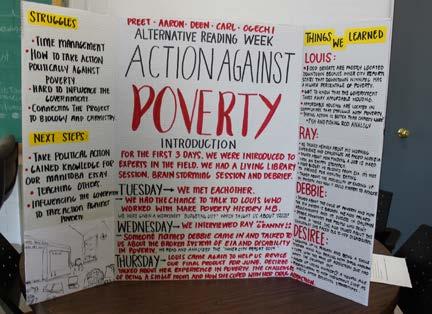
Community Projects program teaches through experience
Transformed alternative reading week program allows action with funding
DAMIEN DAVIS, STAFF
Even in the midst of a pandemic, community engaged learning (CEL) at the U of M has maintained its goal of providing students and community members alike with education that combines “community service with activities designed to develop intercultural competence, critical thinking and reflection and civic engagement.”
Community Projects, a program that sprouted from its previous program, alternative reading week (ARW), is one of the programs from CEL that is striving to get people involved in helping the community.
The program is co-ordinated in part by fifth-year kinesiology student Amin Montazeri, who explained that the difference between the two is that
“the program is now designed for students to come in and not just read […] the theory of this community engagement.”
Rather than being taught about the concept in a classroom, Montazeri emphasized the new independence that comes with the practical aspect of the program.
“Through their placement and the
training that they go through, [participants] learn how teamwork takes place.”
“How, once you have the knowledge, you can design your own project depending on the needs of the community, whether this is a community that you belong to or somewhere that you see and want to be a part of and give back to them.”
Participants have the opportunity to learn to “identify community needs,” and how to use those needs to partner with funding in community organizations to meet those needs.
Students learn the ins and outs of community outreach by learning how to form their own ideas, how apply for grant money to carry out those ideas and how to manage their projects.
“You really won’t learn this in a lecture.”
Montazeri referred to ARW as “sort of short-term student community organization involvement,” compared to the new program.
In a typical year, students would shadow mentors and conduct small projects over three days in an assigned placement.
“It might be Winnipeg Harvest, Big Brother Big Sisters or West Broadway Youth Outreach, or wherever your placement.”
According to Montazeri, this year, in addition to parts of the experience that came with ARW, participants are provided with funding to develop
“a distinct project.”
“Usually when community outreach organizations come in place, they just want to take over something that is already built and has its own space,” he said.
“Our approach is, ‘What can we learn from you?’”
“‘This what we have, this is what you have, is there any space for us to come in and work together?’”
The program is not only available for undergraduate and graduate students but for youth in general from
“You really won’t learn this in a lecture”
—
Amin Montazeri, co-ordinator of
Community Projects
high school students to university alumni.
“We try to get community engagement as much as we can.”
‘Ultimately this is an advocacy win for both of the students’ unions the University of Manitoba’
Continued from front page
The caucus’ proposal asked that, rather than leaving no option but to take the letter grade they receive at the end of their course, students should have the opportunity to either choose to accept the letter grade but exclude in from their GPA or use a pass/fail option for their transcript.
The proposal was passed on to and approved by senate with their own recommendations.
UMSU president Jelynn Dela Cruz said that even though the grading scheme approved by senate was
not the exact same as the version proposed by the student senate caucus, “ultimately this is an advocacy win for both of the students’ unions at the University of Manitoba.”
“Already and prior to COVID-19, being a post-secondary student in Manitoba was a balancing act,” said Dela Cruz.
“Now, in the middle of this code red, remote learning and an institutional labour dispute, the scales have certainly been tipped, and it’s about time that they tip in the favour of student success and wellbeing.”
The version of the proposal that
will be implemented does not include a pass/fail option but allows all students the opportunity to choose to exclude one grade in fall 2020 and one grade in winter 2021, or the grade from one course spanning both terms, from their cumulative GPA (CGPA).
A grade excluded from a student’s CGPA will remain on their transcript with an asterisk beside it but a CGPA without that grade will be calculated.
This recalculated CGPA will be used for progressions in undergraduate and graduate programs and will allow students to maintain any performance-based financial aids.
“While remote learning will never replace pre-COVID learning, our goal is to bring the quality of learning that the university offers us, students, as close to that standard as possible” — Jelynn Dela Cruz, UMSU president
Students have until the end of the winter 2021 semester to decide to drop a grade from either semester.
An already existing option for students is to drop all courses in a term or to potentially appeal for a tuition refund for medical and compassionate reasons is by Authorized Withdrawal (AW).
Smith said the proposal used the term “compassionate grading” to not only allow for more grading options but to “also encourage the university to undertake and encourage professors to exercise a culture of compassion in every scenario.”
“There are some students that might need consideration on a caseby-case basis, and that obviously can’t be mandated from the top down, but calling the proposal compassionate grading helps get that message across.”
In addition to the compassionate grading proposal, UMSU, along with UMGSA, is currently working on advocating for five other items to improve student experience that, if approved by senate, will be implemented for the upcoming semester.
The unions are aiming to address concerns regarding the environmental scan from Respondus during exams and are advocating for a more fair student appeal process and workload along with more flexibility with deadlines in the case of technical troubles.
“While remote learning will never replace pre-COVID learning, our goal is to bring the quality of learning that the university offers us, students, as close to that standard as possible,” said Dela Cruz.
GRAPHIC BY DALLIN CHICOINE
PHOTO PROVIDED BY AMIN MONTAZERI
U of M hosts commemoration, human rights roundtable
Local memory, international effects among discussion topics
SARAH DORAN, STAFF
T
he University of Manitoba’s Centre for Human Rights Research (CHRR) hosted a roundtable Dec. 4 titled “Commemoration Matters: History, Human Rights, and the Politics of Commemoration.”
History professor and CHRR director Adele Perry moderated the roundtable, while Sean Carleton, an assistant professor in the history and Native studies departments, was one of the panellists.
The other panellists were Laura Madokoro of Carleton University, Melanie Newton of the University of Toronto and Omeasoo Wāhpāsiw of the University of Prince Edward Island.
“I think we will […] remember this year as one where ongoing con-
versations about history, about commemoration and human rights, took significant turns,” Perry said while opening the discussion.
“Prompted by social movements, including Black Lives Matter and Land Back, people have engaged the ways that commemorative practices on both sides of the Atlantic, in spaces both colonized and colonizing, refract and kind of calcify the politics of anti-Blackness, of anti-Indigenous racism and of colonialism.”
Wāhpāsiw pointed out some of the troubling statistics about Indigenous treatment in Canada’s court system, including a November 2020 CBC report that found the Canadian government spent $3.2 million since 2013 as the defendant in a case from a
group of residential school survivors from a single school in Ontario.
“Yet it is the commemoration of Sir John A. Macdonald that has many Canadians concerned over the destruction of his legacy, through some various creative approaches to a statue,” she said.
She then contrasted the legal situation with progress toward completing the Truth and Reconciliation Commission’s calls to action, released in 2015.
“This is really a microcosm of the last four years of the federal government’s relationship with Indigenous people,” Wāhpāsiw said.
“Hard work on the symbols while avoiding the substance.”
Carleton and Newton both expanded on the Macdonald discussion, offering non-Canadian perspectives. Carleton spoke about Macdonald’s British ties and the international and political connections behind every commemoration.
“I think we need to be aware that when we’re looking at these commemoration debates that there are threads that go beyond the local,” he said.
“What was going on in the United States over the summer had impacts all around the world, as we saw. There was sort of a cascade effect — all of a sudden, people were wanting to reckon with those colonial roots, whether it be in Bristol or British Columbia. And I think that conversation is both a local and a global one, and I think it’s important to pay attention to those roots.”
Many of the current debates about commemoration in Canada revolve around restoring previously repressed histories and conversations about what Canada fundamentally is as a country. Madokoro talked about a folk song about a man who was ordered to be deported in 1958, a tale which would otherwise have been lost to historians, during a conversation about music as commemoration.
“When I first came to Canada as a student to Montreal, I was at McGill […], and I think partly as
‘Always seeking to find a middle ground that helps students now’
Continued from page 3
“No one is promising anything at this point, but the reception was positive.”
The officials UMSU met with throughout the week included Minister of Diversity, Inclusion and Youth Bardish Chagger and Minister of Employment, Workforce Development and Disability Carla Qualtrough.
“We frequently speak with Minister Qualtrough’s office […]
they’re keeping their ears to the ground when it comes to what UCRU has to say,” said Smith.
MAPSS is an “informal” provincial lobbying group that first began meeting this September. The organization counts UMSU, the University of Manitoba Graduate Students’ Association and the Red River College Students’ Association as members.
“MAPSS seeks to take a more professional, pragmatic, relationshipdriven approach to advocacy, [lever-
aging] campaigns and activism where appropriate while also exercising a ‘no surprises’ policy with government,” said Smith.
Smith continued that MAPSS is “always seeking to find a middle ground that helps students now as opposed to sort of fighting for measures that bring you to a standstill and leave students with nothing.”
Over the last month, MAPSS met with the provincial Liberal and New Democratic Party caucuses, the Minister of Economic Development
and Training Ralph Eichler and the department’s deputy minister Tracey Maconachie, among others.
“The idea was for it to be a week, but just due to scheduling, it turned out to be more so a month of meetings scattered throughout,” said Smith.
In its lobbying efforts, MAPSS advocated for five recommendations, including increasing funding to the ACCESS program — which helps provide support to students who need it throughout their degrees, especially for low-income and Indigenous students; more funding for open educational resources as well as the establishment of a provincial credit transfers database; allowing international students to “buy-in” to the provincial health system at a costneutral rate to the provincial government; a more equitable approach to performance-based funding for postsecondary institutions and amending the Freedom of Information and Protection of Privacy Act (FIPPA) to enable institutions to share the results of internal investigations into sexual misconduct.
“This came directly out of the [Steve] Kirby case and how basically it was left to survivors to contact Berklee [College of Music] and tell
a joke, my friends at the time who were Canadian-born taught me ‘O Canada’ as ‘our home on native land,’” Madokoro said.
“And that’s genuinely what I thought it was for years. I should have known better, but in some ways, the more truthful reimagining of our relationships, again, with these symbols sometimes happens in very unexpected ways. When I hear ‘O Canada,’ that’s what I hear.”
A common thread throughout the discussion was histories that have been forgotten or repressed, and the ways our perception of the past is affected by what we can see.
“I think it’s important when we debate, say, statues like John A. Macdonald and so on, just as [Wāhpāsiw] mentioned, there are these other forms of commemoration, and these silences […] that are invisible and precarious precisely because of the way that they’re debated,” Newton said.
“It’s important that the debate [is] not just framed about the statues that are already there, but what kinds of commemoration would actually pay real respect to the past and speak more to who we would like to be in the present.”
them of [his actions],” said Smith on the FIPPA ask.
“We don’t feel that that should be left on survivors.”
Smith also mentioned that as a result of their lobbying efforts, the office of Manitoba Minister of Finance Scott Fielding requested that MAPSS produce a budget proposal for four of the five recommendations — the FIPPA recommendation not requiring a budget proposal due to it being “more of a policy change,” according to Smith.
“We always strive to be aspirational in our goals, but it’s how you get there […] How you get there is ensuring your relationship with government is strong, that you take incremental measures that help students […] where they’re at and then build the issue to a point where real change can be made.”
PHOTO BY ALEXANDER DECEBAL-CUZA
PHOTO BY ALEXANDER DECEBAL-CUZA
Editor-In-Chief:
EDITOR-IN-CHIEF Matthew Doering editor@themanitoban.com
BUSINESS MANAGER Alice Teufack accounts@themanitoban.com
ADVERTISING CO-ORDINATOR Diego Castro ads@themanitoban.com
EDITORIAL
MANAGING EDITOR Ty Brass me@themanitoban.com
NEWS EDITOR Amira Tekle amira@themanitoban.com
NEWS EDITOR Gillian Brown gillian@themanitoban.com
COMMENT EDITOR Lucas Edmond comment@themanitoban.com
ARTS AND CULTURE EDITOR Shaylyn MaharajPoliah arts@themanitoban.com
SOCIAL MEDIA EDITOR Colin Ijebor social@themanitoban.com
REPORTERS & ASSOCIATES
NEWS REPORTER Cameron Cannon
NEWS REPORTER Damien Davis
ARTS AND CULTURE REPORTER Kaelen Bell
ARTS AND CULTURE REPORTER Zoë LeBrun
COLUMNIST Grace Gyolai
DESIGN ASSOCIATE Mikaela Warkentin
PHOTO ASSOCIATE Basel Abdelaziz
SOCIAL MEDIA ASSOCIATE Jalene Moman
VIDEO ASSOCIATE Arsalan Saeed
AUDIO ASSOCIATE Tawana Matizanadzo
GRAPHICS ASSOCIATE Dallin Chicoine
COPY ASSOCIATE Aldin Sabic
SPORTS REPORTER Matthew Merkel
VOLUNTEER CONTRIBUTORS
A “volunteer staff” member is defined as a person who has had three volunteer articles, photographs, or pieces of art of reasonable length and/or substance published in the current publishing year of the Manitoban. Any individual who qualifies must be voted in by a majority vote at a Manitoban editorial board meeting. Elected representatives and non-students may be excluded from holding votes as volunteer staff members in accordance with the Manitoban Constitution.
‘Ratatouille’ musical inspires next generation of artists
GILLIAN BROWN, STAFF
Musical theatre can be enjoyed almost universally through cast recordings and community performances, but live musical theatre on Broadway is only accessible to those with the resources to visit New York and ability to afford expensive tickets to see the newest shows. However, during the COVID-19 pandemic, the lights of Broadway have gone dark and musical theatre is witnessing a renaissance through the social media platform TikTok.
Broadway performers, composers, musicians, dancers and producers are all creating content on TikTok, allowing anyone with a smartphone to duet videos accompanied by the corps d’elite of musical theatre. Now, the average TikToker can join the tempo of Andrew Lloyd Webber, composer of the Phantom of the Opera, or sing with Kristin Chenoweth, the original Glinda in Wicked
Rather than writing and composing original shows, producers have adopted the plot of popular films and applied it to the form of musical theatre. Films such as Mean Girls and Beetlejuice, along with a variety of Disney movies, have been performed theatrically.
Decisions to continuously churn out shows like these could be understood as an effort to bring musical theatre to a more mainstream audience rather than meet the niche demands of musical theatre fans.
Often, however, these renditions end up as shallow versions of the classic source material and remain inaccessible to the audience they try to reach.
Recycling old plots displays a lack of creativity, and it comes with a cost. This material is produced at the expense of what could be new and original art, demonstrating that Broadway producers value income over quality. The industry is becoming yet another avenue of creativity lost to consumerist demands.
Broadway theatre is dying. The high price of supporting luxury theatre isn’t sustainable among younger generations, and the quality found in originality is declining in favour of revivals and remakes.
Further, stunt casting is being used as an effort to draw younger fans, rather than employing younger talent in both performance and
production.
The fact is, generation Z can’t afford Broadway, and most likely will not be able to afford Broadway in their lifetimes if the industry continues to be as exclusive as it is. The worst part, though, is that younger generations may
The high price of supporting luxury theatre isn’t sustainable among younger generations, and the quality found in originality is declining in favour of revivals and remakes
lose interest in supporting the industry as a whole.
Most recently, musical theatre fans have taken accessibility to a new level by coming together to create their own production, Ratatouille: The Musical
On TikTok, the unofficial musical adaptation of the 2007 Disney-Pixar film Ratatouille made some major changes to the game. The creators make no profit, there is no affiliated company limiting what the artists can do and any person with a smartphone can contribute, view and support the creation process.
Originating as more of a joke than anything else, the song “Remy the Ratatouille” was written by TikTok user Emily Jacobsen as an ode to the film’s main character and as a closing number for the show.
The song quickly snowballed and has inspired generation Z artists across the platform to write their own songs for characters, choreograph dance numbers, create costumes and sets, compose overtures and design playbills.
The trend has been adopted by professionals in the industry as well. Broadway performers are writing their own songs. Actor Kevin
Chamberlin wrote a song for chef Gusteau that Chamberlin titled “Anyone Can Cook.” Others have posted covers of songs that amateur songwriters on the app have performed.
Patton Oswalt, the voice of Ratatouille ’s main character Remy, along with the film’s director and writer Brad Bird, have taken notice of, and support, the phenomenon.
Even further, Playbill, a prominent magazine based in New York, shared artist Jess Siswick’s playbill art, and Pixar’s Instagram posted a photo of Remy acknowledging the musical-inthe-making, quoting Jacobsen’s lyric, “the rat of all our dreams,” in the caption.
What happens now that the companies that created and own the rights to Ratatouille have noticed the TikTok musical? As seen, the response from the corporations have been positive, but that may not be as much of a good thing as it seems.
TikTok users have worked independently to put together what could be a theatrical performance worth real production value — their work is good. However, these creators don’t legally own the rights to the material and cannot protect their content. In the event that Disney ever decides to take Ratatouille: The Musical to Broadway, the content is already there and available to use.
To have a production company as big as Disney use your song or your set design could be understood as a compliment to those who produced the material for the sake of it, but the creators may not receive anything of concrete value in return for their work.
Rather than encouraging the new talent that is emerging on media outlets like TikTok, Disney could steal the independently-produced content from TikTokers and run its own Ratatouille: The Musical. A move that may seem all too familiar.
If anything, TikTok has proven that there is talent to be found beyond the micro-universe of Broadway elitism. If professional producers want musical theatre to survive, they must expand the accessibility of Broadway and attract new demographics.
GRAPHIC BY DALLIN CHICOINE
Good Luck on Finals & Happy Holidays!
Vice-President Finance & Operations From the UMSU Executive Team
Community Engagement
Tino Dogo Vice-President
Jelynn Dela Cruz President
Kristin Smith Vice-President Advocacy
Savannah Szocs Vice-President Student Life
Brendan Scott
Comment Editor: Lucas Edmond Contact: comment@themanitoban.com
New voting regulations improve accessibility
Elections Manitoba taking steps to ensure all have equitable access to voting stations
GRACE GYOLAI, STAFF
Democracies around the world utilize many different methods for conducting elections. Some countries have made voting compulsory, while citizens in other nations consider it to be an optional civic duty. There are notable benefits with both these approaches, but one thing is key regardless of election laws — the overall health of our democratic system relies on voter participation.
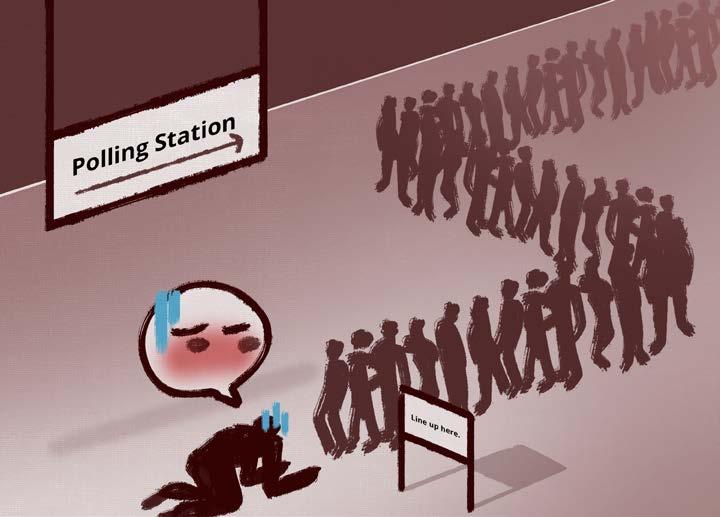
Elections Manitoba is proposing a new voting model that will give Manitobans the flexibility to vote at any given polling station in their electoral district instead of assigning voters to a specific location. The goal is to decrease the number of obstacles faced by Manitoban voters to help encourage local democracy.
To implement this new system, every voter will receive a voter information card. This card will list the polling station that is nearest to their registered address.
But, due to the new regulations, anyone with a form of identification can cast their ballot in a variety of different stations across their registered district. Experts believe this will reduce lines and give those with structural restraints the ability to maneuver themselves and their schedules enough to make time to vote.
This improved model is a muchneeded update to the current voting system. Accessible voting should be of top priority for the province — Manitoba has one of the lowest voter turnout rates in Canada. In the 2019 provincial election, only about 55 per cent of eligible voters participated.
After the last election cycle, Statistics Canada reported that 22 per cent of non-voters refrained because they were too busy. Additionally, 13 per cent cited disability or illness as their reason for not voting.
Statistics Canada also found that only 36 per cent of single parents with children aged five or under voted. In contrast, 60 per cent of couples who raised their young children together voted. This indicates that busy schedules are large factors that impact Canadians’ likelihood to cast a ballot. It also shows that people who are disadvantaged have a tougher time representing themselves democratically.
The integrity of the democratic system only holds if a high percentage of eligible citizens are voting and, in turn, are influencing public policy and political elections.
Overall, immigrants, renters, the unemployed and people with children are all significantly less likely to vote than citizens with fewer restraints or structural hurdles. As
a result, wealthy, highly-educated homeowners are more likely to vote, and elections tend to over-represent these groups.
By allowing voters the option to
By allowing voters the option to select the most convenient polling station on election day, Elections Manitoba is taking a step in the right direction
select the most convenient polling station on election day, Elections Manitoba is taking a step in the right direction and facing the pressing issue of civic engagement. If more Manitobans are able to vote, our political landscape will better reflect constituents’ needs.
It is refreshing to have a government agency that actually tries to meet the specific needs of Manitobans. But, apart from making voting locationally easier, there
are still concerns that Elections Manitoba must address.
Disinterest in politics also plays a significant role in preventing voter turnout. Disinterest accounted for 35 per cent of all non-voters in the country in 2019, and lack of engagement is another sizeable obstacle that must be addressed by Elections Manitoba and representative of political parties.
One possible interpretation is that there are festering feelings of dissatisfaction with our political options and the system in general. Individuals who feel none of the political parties represent their interests may ignore elections altogether.
Also, Canadians are more likely to vote if they think that their ballot has influence.
After the last election, it was reported that 68 per cent of Canadians would support electoral reform. In order to salvage the remaining trust in Canada’s democracy, it is crucial that the supermajority of Canadians’ collective opinion be taken into account.
Voter turnout is dwindling. If approximately 68 per cent of Canadians support election reform, it is not enough to simply allow voters to cast ballots at their most convenient location.
Accessibility seems like a com-
mon-sense reform if the province’s priority is to increase voter turnout and gain a better understanding of the constituents’ needs. Optimal representation should always be a top priority for Elections Manitoba, and easy accessibility seems like a basic first step.
In order to serve the province at the highest standard, Elections Manitoba should continue to consult with outside organizations and groups to formulate even more drastic reforms to the voting system. What exactly those reforms look like should be determined by Manitobans themselves.
Increased attention to accessibility is a great start, but in order to engage citizens who are disinterested in the political system, new and creative election reform and public policy should be considered.
As Elections Manitoba continues to implement new measures, they must remember that voter participation takes many forms. The ability of people to come together and vote on the issues we face as a province is crucial to the health of democracy. While accessibility issues are being addressed, the province must also consider why more citizens are disengaging and how it will reverse this concerning trend.
GRAPHIC BY JENELLE MCCANN
Mayor Bowman’s lack of resolve on display
After a summer of discontent with policing, city increases police funding in preliminary budget
LUCAS EDMOND, STAFF
In response to the Black Lives Matter rallies across North America this spring, Winnipeg Mayor Brian Bowman claimed, “Winnipeg is listening.”
The next Friday, on June 5, Winnipeg had its own rally. Organized by the local movement Justice 4 Black Lives Winnipeg, over 15,000 Winnipeggers marched from the Manitoba Legislative Building to the Canadian Museum for Human Rights.
The point was to signal to those situated within privilege and power that Winnipeg would not stand for the police abuse of Indigenous and Black lives. Those who attended may or may not have been aware of Bowman’s claims but, let it be known, Winnipeg’s preliminary 2021 budget does not indicate he was listening at all.
Quite the contrary, really. It indicates that the municipal government is politically tone-deaf to the demands of a large portion of the public. In the preliminary budget, the city notes that record investments in police services will continue to be made.
The police budget will purportedly rise two per cent annually until 2023. This will see investments in police services bloat from roughly $294 million to $312 million — maintaining one of the highest police budgets across the country. This is a far cry from the demands of activists to divert funding from the police into
community and social services.
In June, more than 25,000 people signed a petition to abolish or dramatically defund the city’s police service. Recently, a study indicated that more than one-third of Winnipeg residents support slashing police funds.
Why wouldn’t they? The police budget has grown approximately 163 per cent since 2000. And since then, the investments made have not contributed to community safety. Instead, funding police services to exorbitant levels has the ability to proliferate crime by channelling needed resources away from social services and communities and continuing to further inequality. Martin Daly — professor emirtus of psychology and neuroscience at McMaster University — argues in his 2017 book Killing the Competition: Economic Inequality and Homicide that inequality is a key variable in predicting homicide rates. Daly is not alone in this observation; dozens of research papers have confirmed the same thing. Investing heavily in police and prisons makes communities less safe, especially when Indigenous and Black people continue to be persecuted by them.
After the anti-police brutality protest, Winnipeg police chief Danny Smyth claimed that the budget of police, social services and other community services are “not mutually exclusive.”
But this argument is tough to make considering community ser-
vices have historically beared the brunt of budget cuts while police spending and wages rise faster than inflation.
Although the City of Winnipeg managed to balance its budget this year due to significant funding from the federal government, valuable resources were lost to police overfunding.
In contrast to cities with similar population sizes like Edmonton or Hamilton, Winnipeg’s budget more than doubles the proportion of annual spending on policing. Hamilton dedicates approximately 10 per cent of its budget to police, and Edmonton commits less than 15 per cent.
In contrast, roughly a third of Winnipeg’s annual budget is dedicated to its police force.
If Winnipeg funded its police like Edmonton, approximately $150 million could be saved and redirected to programs and efforts to reduce inequality. Investments in productive services like daycare facilities, public transit, non-profit organizations with equitable social goals, or mental health care could raise the standard of living and simultaneously reduce levels of crime without taking coercive measures.
Before publishing the preliminary budget, the City of Winnipeg did a public engagement summary — a study to help determine what priorities the people of Winnipeg have and, hence, what services the municipal government should focus
on in the budget. Of the 25 sectors listed in the survey, policing ranked one of the least important services to Winnipeggers, just behind golf services and parking.
Over 50 per cent of participants voted that policing was not important. According to the survey, the most important services were community projects like livability, libraries, public transit, waste collection, medical response and so forth.
Despite palpable community resistance, Winnipeg continues to invest the largest portion of its budget in police services.
Despite palpable community resistance, Winnipeg continues to invest
the largest portion of its budget in police services
Early in June, Smyth asserted that ripping large portions of funds out of the police budget in such a rapid fashion would contribute to an unsafe environment. Although it is desired, anybody that expected the city to defund the police right away was perhaps dreaming. It will take far greater resistance to crack the mono-
lith of policing in Manitoba. But I had hoped, as many others likely did, that the city would at least consider defunding the police force gradually. Unfortunately, naivety may be the best way to describe this unfounded optimism.
As Winnipeg enters its winter months, it feels like the momentum to defund or abolish the police, that was built this spring and summer, has slowed down to a crawling pace. Fewer and fewer people are talking about it. As a pack, everybody jumped into the discourse at once and energized the city’s resistive spirit. But, just as fast as the discourse had opened, it closed again.
Bowman may have been telling the truth when he told the world that he was “listening.” But this does not necessarily mean he cared. Fundamentally, this budget is a bureaucratic message to constituents that their desire to defund the police does not resonate with those that rest with power.
Winnipeg’s discontent may have been heard loud and clear, but Bowman lacks the resolve to do anything about it.
Winnipeggers cannot rely on their leaders for radical and equitable change. This is a project that requires unrelenting energy from outside the political hierarchy. The preliminary 2021 budget displays that if citizens quiet down, the status quo and their grey-shaded political imagination will take advantage.
GRAPHIC BY DALLIN CHICOINE
Arts & Culture Editor: Shaylyn Maharaj-Poliah Contact: arts@
Practicing the art of living
In conversation with local designer and artist Lennard Taylor about life, art
ZOË LEBRUN, STAFF
I
n this year of uncertainty, local designer and artist Lennard Taylor hopes to bring a smile to people’s faces with his debut book, The Art of Living
Taylor was born in Winnipeg to a family of artists and art has always been a big part of his life. After working with Freed & Freed, a local garment manufacturing company, for a number of years, he decided to open his own boutique in 2015 and has been thriving as a designer and artist ever since.
“It’s a combination of everything that I am,” Taylor said.
“So, it’s my art, it’s my clothing, I’ve got local makers, I’ve got makers from across Canada to cultivate a really […] classic, clean shop that caters to all sorts of people from all over the gambit.”
Taylor’s goal in life is simple: “to make people smile and feel good.” This idea is part of what led him to write The Art of Living, another vehicle through which he hopes to spread positivity.
The Art of Living was a project already a couple of years in the making when a surprise gift inspired him to finally finish it.
“The catalyst for putting the book out was one of my clients actually came to my shop and gave me a hardcover book of my quotes and paintings and stuff she’d taken from social media and various different channels […] I just looked at that and [thought], ‘Well, if that’s not the universe telling me to get my book done, I don’t know what is.’”
The Art of Living is intended to stick to Taylor’s ultimate goal of making people happy — containing images of his artwork, inspirational quotes, meditations and musings about life, Taylor wanted his book to be a pick-me-up for readers on down days and an inspiration to look at life from a more positive perspective.
The book’s title was a way for
“Right now, especially, a lot of people are suffering from the mental highs and lows of life and people need that pick-me-up, that little self-starting thing that will make them smile and feel good” — Lennard Taylor, artist
Taylor to express the lack of distinction between art and life — how each person’s life is an art form and that changing your mindset can change
and his debut book
your whole life.
“When we strip it down and look at it for what it is, we need food, water, space, shelter and air to live. Those are the key points of life that we need,” Taylor said.
“But then there’s also all these other aspects like balance and meditation […], appreciation, gratitude [and] all these other things that will enhance your life if you’re more aware of them, so those are […] things that you’ll see in the book and hopefully feel as well.”
The Art of Living was independently published with FriesenPress in Manitoba because Taylor wanted
to keep its publication as local as possible.
“The reason I wanted to self-publish the book is just to get it out there and get people experiencing it,” said Taylor.
“Right now, especially, a lot of people are suffering from the mental highs and lows of life and people need that pick-me-up, that little selfstarting thing that will make them smile and feel good.”
A portion of the proceeds from The Art of Living will be going to two charities of Taylor’s choosing, Artbeat Studio and Tree Canada.
Artbeat Studio is a non-profit organization in Winnipeg that helps people dealing with mental health issues engage in artistic expression by providing access to studio space, exhibition opportunities and likeminded peers. It promotes recovery, empowerment and community through mental health education and advocacy.
Taylor chose Tree Canada as the second charity he wanted to donate to in order to offset the carbon footprint he created by publishing his book.
“I wanted to give something heartfelt to the community and also cover
my tracks of what I do,” he said.
“Sustainability is at the core of who I am and what I do, so therefore everything I do has to be in that sustainability aspect.”
Since the book’s release, Taylor has been met with overwhelmingly positive reactions and hopes to organize a virtual book discussion soon with those who purchased The Art of Living in lieu of a book launch, which was prevented by COVID-19 social distancing restrictions.
The Art of Living can currently be purchased through lennardtaylor.com.
Turning to tunes through trials and tribulations
Local
rapper, Nabeel Khan, on the freedom and companionship music provides during dark times
KAELEN BELL, STAFF
Making music is often as much of a business venture as it is an art form — a conduit for unspeakable feeling warped by an industry that’s only growing more cold-blooded and cutthroat.
Nabeel Khan, who raps under the moniker NABZ, can attest to the feeling of freedom that comes with making music for yourself, outside of industry pressures — he describes his work as a necessity more than anything else.
“It kind of gave me a way to release [...] everything that I felt” — Nabeel Khan, rapper
“I needed an outlet, because I was getting depressed,” Khan said. “I had nothing to do.”
An international student, Khan arrived in Winnipeg with no family and little support.
“I had to struggle, I had to work a lot […] two jobs, trying to pay off my
school, basic necessities, all that fun stuff,” he said.
“I’ve had nights where I didn’t eat anything […] and I just didn’t know what to do […] there was no solution.”
“Music was there when no one [else] was.”
So, in 2018, he started to write.
Khan said that while he had friends who’d been rapping and making music for years, he had no clear idea of what he wanted this writing to reflect — he only knew that he needed a way to express himself.
“I started writing, and a few of the things that I wrote rhymed,” he said.
“And I just made a project out of it.”
That project would eventually result in his debut single, aptly titled “The First Chapter.”
“It took me a year to write my first song because I just gave up on myself in between,” Khan said. “I [thought], ‘I should probably not do this.’”
Khan stuck with it, continuing to write and record with the help of friends and local producers. He describes rapping as freeing, a way to express the frustrations he’d been trying to understand.
Khan said there are “a lot of restrictions, coming as a Muslim boy coming from Pakistan — my parents
’Toban tracks
were pretty strict on things.”
Although making music wasn’t meant to be priority, he found solace in it nonetheless.
“It kind of gave me a way to release […] everything that I felt.”
That sense of freedom has driven
him to release a steady drip of singles, though he says it’s been difficult to find his muse amidst the lockdown.
“Finding inspiration in your bedroom 24-7 is really not that great,” he said, laughing, adding that you have to “go out and explore the world a bit.”
Still, Khan said he doesn’t plan to stop any time soon. He’ll keep writing, rapping and sending beats around, trying to pull himself up out of the dark.
Celebrate 2020 coming to an end with some of the best Canadian music released this year
KAELEN BELL, STAFF
I
n a year that felt like an endless series of rugs being pulled out from under us, the one thing you could always rely on was the music. This year delivered a near-endless stream of beautiful, challenging, life-affirming songs — escape hatches to new worlds and maps to help us better understand our own.
Canadian artists in particular have released some incredible music this year, from the righteous fury of
Vagina Witchcraft, the serpentine jazz of the Weather Station, the horror-rap of Polaris Prize winner Backxwash or the searching indie rock of Amos the Kid.
This playlist barely scratches the surface — there’s no way to capture every worthy piece of new Canadian music in a single list.
There will be unintentional snubs and dozens that simply couldn’t fit, but it’s a tasting menu of sorts, a col-
lection of some of the best and most exciting new music to come from our home province and beyond. There are ’80s-pilfering glitter bombs from Boniface and Mise En Scene, wildeyed, joyful art punk from Hut Hut and Crack Cloud, blooming pop songs from Lido Pimienta and Austra, among a dozen other vital sounds and voices.
Some will make you want to dance, some will make you want to cry and
some might have you doing both. The moods and energies are as varied as the artists themselves, but they all point to one undeniable truth — in a year defined by loss and upheaval, Canadian artists continued to make vital, necessary music. Hopefully, with this playlist as a jumping-off point, you’ll discover a record you didn’t know you needed.
Robber — the Weather Station, Ignorance Jesus Cocaine Ketamine Christ — Amos the Kid, Mountain View Where Are You Judy — Andy Shauf, The Neon Skyline High School Feeling — Mise En Scene, Winnipeg, California Count Me Out — Chiiild, Synthetic Soul Midnight: Ghosts (feat. Chad Price) — Odario, Good Morning Hunter Center of the World (Kotti Blues) — Marie Davidson & L’Œil Nu, Renegade Breakdown ALVVAYS — Vagina Witchcraft, Vagina Witchcraft Woodstock ’99 — U.S. Girls, Heavy Light
Hey Strangers — Hut Hut, Hut Hut Hut
The Next Fix — Crack Cloud, PAIN OLYMPICS
Cue Synthesizer — Destroyer, Have We Met Fear — Begonia, Fear
Spells — Backxwash feat. Devi McCallion, God Has Nothing To Do With This Leave Him Out Of It How Did You Know? — Austra, HiRUDiN
Sideways — TiKA, Soothing Love
Susie Save Your Love — Allie X & Mitski, Cape God
I Will Not Return As A Tourist — Boniface, Boniface
New Low — Sarah Harmer, Are You Gone
This year delivered a near-endless stream of beautiful, challenging, lifeaffirming songs
Barb 217 — Julien’s Daughter, The Static That Caries Over Riverbank — Danny Bell and His Disappointments, Songs for the Town Reliever — William Prince, Reliever Crown of Leaves — Mellifera, Crown of Leaves
Pale Blue — Basia Bulat, Are You in Love?
Eso Que Tu Haces — Lido Pimienta, Miss Colombia
Both Of Us — Jayda G, Both Of Us/Are U Down
New Jade — Caribou, Suddenly
GRAPHIC BY JENELLE MCCANN
PHOTO BY SHERAB RABZYOR-YOLMO
Editor: Shaylyn Maharaj-Poliah
Treat yourself to something sweet this holiday season
The Manitoban staff shares their favourite family recipes for some seriously scrumptious desserts
STAFF
With the rise of COVID-19 in Manitoba, this year’s holiday season is sure to look a lot different, but that doesn’t mean you can’t celebrate safely with some tasty holiday baking. Satisfy your sweet tooth with some of these delectable holiday delights this season, from our homes to yours.
Sharron’s Pumpkin
Cheesecake
Matthew Merkel, sports reporter
This recipe belongs to my mom, Sharron. One Christmas, she couldn’t decide whether to make a pumpkin pie or a cheesecake for our family dinner, so she combined the two. The resulting dish quickly became a favourite among my cousins and I, and now it’s a regular holiday dessert in my house.
Ingredients:
For the crust:
1 1/2 cups Oreo cookie crumbs or graham cracker crumbs
6 tbsp (3/4 stick) melted butter
1 tbsp sugar
1/2 tsp cinnamon
For the filling:
16 oz. cream cheese
1 1/2 cups brown sugar
15 oz. canned pumpkin puree
4 eggs
1/4 cup sour cream
2 tbsp all-purpose flour
2 tsp pumpkin spice
1/4 tsp salt
1 tbsp vanilla
For the crust:
Mix the Oreo cookie crumbs or graham cracker crumbs with sugar, cinnamon and melted butter in a bowl. Line the bottom and sides of a baking pan with the mixture. Bake at 176 C (350 F) for eight minutes. After baking, let cool on a cooling rack while you make the filling.
For the filling: In a bowl, mix the pumpkin puree, eggs, sour cream, flour, salt, vanilla and pumpkin spice. In a separate bowl, mix the cream cheese and brown sugar together. Combine the two mixtures together, mix well. Pour the mixture into the pie crust. Tap the bottom of the pan or use a toothpick to pop any bubbles that may be forming in the mixture. Bake at 176 C (350 F) for 60 minutes. After 60 minutes, turn off the oven and leave the cheesecake in the oven for 45 more minutes.
To check doneness, stick a toothpick into the filling. If it comes out clean, then the pumpkin pie cheesecake is done.
After baking, let cool on a cooling rack.
Serve cool or at room temperature.
Spiced Chai Sugar Cookies
Shaylyn Maharaj-Poliah, arts and culture editor
Tender, delicious and so easy to make — these classic cookies paired with fragrant chai tea make for a warm and exotic treat that perfectly complements your favourite holiday drink. I like a little extra chai flavour in my cookies, so I add two tea bags worth of leaves, but feel free to dial it back.
Ingredients:
1 1/2 cups all-purpose flour
1/2 tsp baking powder
1/8 tsp salt
1/2 cup softened butter
3/4 cup granulated white sugar
1 egg 1 tsp vanilla extract
1 to 2 tbsp chai tea leaves (about 1 to 2 tea bags)
Cream together the butter and sugar with a hand mixer until fluffy. Add the egg and vanilla and beat well.
In a separate bowl, whisk together the flour, baking powder and salt. Cut
open the tea bags and add in the tea leaves.
Mix the dry ingredients into the wet in increments until combined.
Turn out the dough onto a clean, lightly floured surface so it doesn’t stick. Wrap the dough in plastic wrap and let it rest in the refrigerator for one hour.
After the dough has chilled, preheat the oven to 176 C (350 F).
Remove the dough from the plastic wrap and place on a lightly floured surface.
Roll out the dough using rolling pin until you have a half-inch thick sheet of dough. Cut out circles using a glass or some festive cookie cutters.
Transfer the cookies to a baking sheet lined with parchment paper, about an inch apart.
Don’t waste those extra dough scraps, reroll them and cut out more cookies. Bake for 15 minutes or until golden brown. Let them cool completely and enjoy.
Makes approximately two dozen cookies.
Satisfy your sweet tooth with some of these delectable holiday delights this season, from our homes to yours
Christmas Bikkies
Kaelen Bell, arts and culture reporter Christmas baking, much like Christmas itself, takes on sinister new layers as you age.
The veil slowly lifts, and all that effortless Christmas magic reveals itself to be a frenzy of stress and expectations. With this in mind, I
prefer my Christmas baking to be a simple set-and-forget situation that can be easily doubled or tripled and sent away.
This cranberry, white chocolate and pistachio cookie recipe — what my family inexplicably calls “Christmas Bikkies” — meets the criteria.
Ingredients:
1 1/2 cups all-purpose flour
1/4 teaspoon salt
3/4 cup (1 1/2 sticks) salted butter, softened
1/4 cup plus 2 tbsp granulated sugar
1/2 teaspoon finely grated fresh orange zest
1/2 cup shelled pistachios
1/3 cup dried cranberries
1/2 cup white chocolate chips or chunks of white baking chocolate
1 large egg, lightly beaten
1/4 cup decorative sugar
Stir together flour and salt in a bowl. Beat together butter, granulated sugar and zest in a separate large bowl at medium-high until pale and fluffy.
Reduce to low and add dry ingredients, mixing until dough comes together in clumps, then mix in pistachios, cranberries and white chocolate.
Gather and press dough together, then cut into two equal pieces. Form each piece of dough into a log about one-and-a-half inches in diameter using wax paper. Chill, wrapped in plastic wrap, until very firm, at least two hours.
Preheat oven to 176 C (350 F).
Line two large baking sheets with parchment paper.
Brush egg over the bars and sprinkle decorative sugar. Cut the bars into 1/4-inch rounds. Bake cookies until edges are pale golden, about 15 to 18 minutes.
Great Grandma Klassen’s Ginger Snaps
Zoë LeBrun, arts and culture reporter
This recipe is a holiday standard in my household — we use my great grandma’s recipe and, when I tell you these are the best ginger snaps ever, you better believe it. Unlike most store-bought ginger snaps, these ones are soft, spiced and sweet, but above all they’re simple. This makes them great for festive baking with family members of all ages. They’re great on their own or dipped in coffee or tea.
Ingredients:
2 cups flour
1 tbsp ginger
2 tsp baking soda
1 tsp cinnamon
1/2 tsp salt
3/4 cup shortening or oil
1 cup sugar
1 egg
1/4 cup molasses
Sugar for rolling
Cream shorting and sugar in a large bowl. Beat in egg and molasses. Mix dry ingredients together in a separate bowl, then sift into previous mixture gradually. Blend well. Form dough into small balls and roll in sugar, placing them two inches apart on a lightly greased baking sheet. The most vital step: bake cookies for 12 to 15 minutes at 176 C (350 F) and make sure to watch your first couple dozen cookies to prevent overbaking. Do not overbake these cookies — this is the secret to keeping ginger snaps soft. They continue to cook when you take them out of the oven and they will have the texture of a hockey puck if overbaked. They’re ready to come out of the oven when the cookies begin to flatten, crack and their edges have set. Once out of the oven, let the cookies cool on a rack and enjoy.
Makes approximately 45 cookies.
GRAPHIC BY JENELLE MCCANN
Seven new recruits for the Bisons
Young female hockey player highlights recruiting class
MATTHEW MERKEL, STAFF
Competition at the collegiate level is the clear next step for many high school athletes and, like every move forward, takes tremendous effort from athletes, coaches and parents.
This semester, hard work has paid off for a select few athletes as the University of Manitoba Bisons Sports announced three signings and four commitments.
Elijah Lostracco and Tito Obasoto are the newest additions to the Bisons men’s basketball team.
Signing out of Redeemer University in Ontario, Lostracco comes to the herd after a year where he averaged 13.6 points per game.
Out of Halifax Prep, Obasoto commits for the 2020-21 season. Before making the move out to Nova Scotia, the Winnipegger played with Fort Richmond Collegiate and also suited up for Team Manitoba in 2018.
For women’s volleyball, Andi Almonte and Eve Catojo are the newest recruits. Both are alumnae
of the Shock Volleyball Club out of Winnipeg. Catojo signed out of Sisler High School, while Almonte commits out of Oak Park High School. The two join a young Bisons volleyball team that hope to build off last year’s 4-20 record next season.
“Eventually they’ll find their groove and get comfortable in their new home”—
Sarah Zacharias, head coach of Balmoral Hall prep hockey
On the men’s side, Jonah Dueck and Spencer Grahame are the newest members of the Bisons men’s volleyball squad.
Committing out of Rosenort school, Dueck — a six-foot-seven middle — also came up through the Providence Junior Pilots Volleyball Club.
Signing out of Lord Selkirk Regional Comprehensive Secondary School, Spencer Grahame joins the left side of the Bisons court. In 2019, he represented the Keystone province at the 2019 Western Canada Summer Games.
Highlighting this year’s class of recruits is Dana Goertzen.
The 16-year-old left winger spent the last two seasons with the Balmoral Hall Blazers Varsity Prep hockey team.
Sarah Zacharias, director of hockey and head coach of the prep team, has high praise for the young forward.
“Dana, or Baby G as we call her, is a star talent,” Zacharias said.
“She’s gritty and tough to get the puck from, she has an incredible shot with high accuracy, she has golden
gloves and slick moves, an incredible work ethic and great leadership abilities.”
Slated to join the Bisons in the future, Goertzen still has two more years with the Blazers Prep team.
Zacharias noted that the jump to the collegiate level is not an easy one. Athletes face a huge adjustment in their sport and in the classroom.
“Grade 12 players leave their leagues being the [biggest, fastest and strongest] just to go right back to being the rookie, where they play against players that can be [five to six] years older than them,” Zacharias said.
“Most freshmen struggle with balancing school and sport requirements,” Zacharias said.
“That first semester they’re expected to do a lot both academically and athletically [and] it can be a bit overwhelming to start, but eventually they’ll find their groove and get comfortable in their new home.”
The time prior to joining the
Bisons women’s hockey team will be valuable to the incoming Bison in developing herself on the ice and in the classroom.
Although she has the opportunity to take time to develop, Zacharias believes Goertzen is ready for the rigours of a U-Sports season and has the maturity to adjust to university life.
Zacharias said Goertzen “is very different off the ice, she’s funny, considerate [and] conscious of everyone around her.”
“Dana is always aware of her teammates’ needs and is the first one to step in and help in any situation,” Zacharias said.
With U-Sports cancelling all fall and winter championships this year, these new recruits may have to wait a little longer than expected to represent the University of Manitoba. Hopefully, once play resumes, this class of student athletes will be ready to represent the brown and gold proudly.
PHOTO BY BASEL ABDELAZIZ
Sports Editor: Isaiah Wagner
Bison athlete Masse finds positives in pandemic
Women’s hockey veteran continuing to lead
ISAIAH WAGNER, STAFF
The women’s Bisons hockey team finished the 2019-20 season with a disappointing 10-18 record. This put the team one point above the University of Lethbridge for second last in the Canada West division for women’s hockey.
The team was filled with young players — it had 13 first-year or second-year players which made up over half of the overall team.
One bright spot on the squad last year was third-year player Emilie
Masse. The former Shaftesbury Titan tied for third on the team in goals and took the season as a chance to really become a leader for the young Bisons.
“Being a vet last year was kind of a similar experience of when I was in my first year, except switched,” Masse said.
“My first year, I was on a very veteran team that opened my eyes drastically to what it takes to be a great leader.
“Constantly observing my team-
mates and their composure through the past three years has allowed me to get a greater understanding on what it means to be a veteran,” she said. Due to the decision from U-Sports to cancel the 2020-21 season because of the COVID-19 pandemic, Masse and the Bisons will not be lacing up their skates starting in January. It will end up being a longer off-season for the team and the Bisons will prepare them to come out better than ever when the 2021-22 season rolls around.
Masse, a leader on the team, knew that she had to step up during the pandemic and really help out the younger players on the team.
“Being a leader on a team during a pandemic isn’t much different besides just being more vocal on Zoom or social media,” Masse said. She said this means “coming up with different ideas on how to stay connected as a team and […] doing our best [to make sure] that we give the rookies that ‘Bison experience.’”
For the Bisons, COVID-19 has had many negative impacts this year, but Masse believes that some good has come out of it as well.
“Unfortunately, COVID-19 has put an end to our 2020-21 season,” Masse said. “We do still practice, however, within smaller groups based off of safety precautions.
“COVID has positively impacted our training this year as it has allowed us to meet prior to the season in June where we got to meet a bunch of the new incoming players through Zoom,” she added.
This is a great step to take for a young team that could use a little bit of chemistry and rebuilding to shake off the tough 2019-20 season.
“Honestly, our team is just taking it step by step and that’s really all we can do,” said Masse.
“We do communicate often and strive to motivate each other in any way possible, but it is in times like this that we must remind ourselves that you can’t really prepare for anything.”
Another way to have a better next season is to continue to train and better themselves as a team and as individuals.
Although this is not possible right
“Constantly observing my teammates and their composure through the past three years has allowed me to get a greater understanding on what it means to be a veteran”
— Emilie Masse, Bison Athlete
now due to the COVID-19 restrictions that the Manitoba government has set in place for its citizens, it will be possible once the restrictions are lifted, and Masse and the Bisons will be ready.
“Once restrictions are lifted, we will start to practice as a team while maintaining social distance,” Masse said. “This is important for us to get on the ice and train if we want to go into next season without missing a step.”
Nobody likes losing, but Masse takes those losses and wants to turn those into positives for any new young Bisons.
“My advice to any upcoming Bison player is to not take it to heart and get discouraged,” she said. “A lot of the time, you go from being top of your midget team playing many minutes to getting scratched often your first year.
“Everyone goes through it and, if anything, I believe it’s a very humbling experience that allows you to grow.”