On Nov. 1, 2016, the University of Manitoba Faculty Association (UMFA) declared a strike when fair mediations were unsuccessful with the University of Manitoba administration. The strike cancelled hundreds of classes and left approximately 30,000 students displaced for three weeks.
The talks in 2016 between faculty and the university caused disturbances for students in many ways — not only were their classes cancelled, but some also reported higher stress and anxiety.
Unions ensure that good teachers stay at the university by guaranteeing they are compensated properly and treated with the respect they deserve.
Currently, the U of M is facing a situation that could echo 2016.
A press release from Oct. 20 from UMFA said that the U of M administration had rejected UMFA’s proposal to settle salary contract negotiations through fair third-party arbitration. A similar situation precipitated the 2016 strike.
JESSE BOILY, STAFF
Circling the wagons
UMFA-organized honk-a-thon applied pressure on U of M to begin negotiations
Easy access
Bannatyne campus opens clinic
Provincial post-secondary audit released
“Having strong governance is important to ensuring that we maintain that autonomy”
Request for proposals
Pallister’s obsession with privatization seeps into our provincial parks
A matter of life and death
The provincial government is failing to take proper precautions with novel coronavirus
Honk-a-thon held after refusal to negotiate
AMIRA TEKLE, STAFF
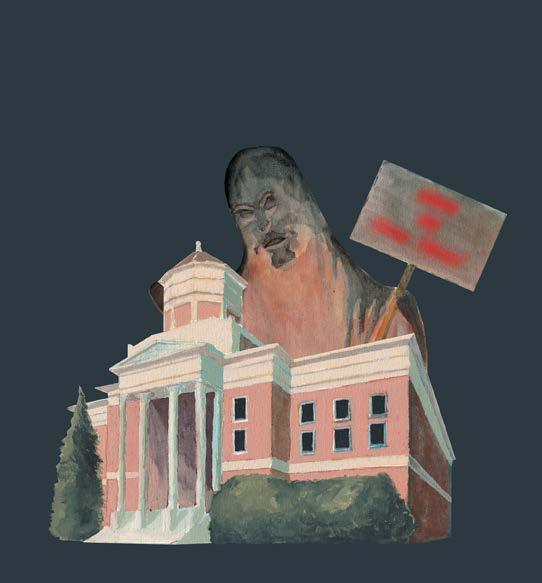
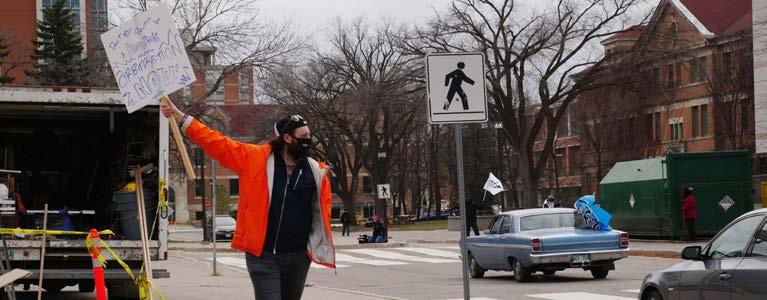
The University of Manitoba Faculty Association (UMFA) held a honk-a-thon rally Oct. 20 to protest the U of M’s refusal to participate in binding arbitration, hindering progress on a new collective agreement.
According to a statement from UMFA, “over 150 people in cars, on bikes and on foot” attended the rally that took place on the Fort Garry campus, with participants circling the administration building.
This closely follows a social media campaign by UMFA on Twitter pinpointing frustrations with working from home and a lack of support in doing so from the U of M administration.
UMFA and the university have had a generally contentious relationship in recent years, with a threeweek strike taking place in November
2016 after contract negotiations broke down between the two parties.
UMFA president Michael Shaw said the association organized the rally to put pressure on the U of M administration to negotiate with UMFA through arbitration.
“We’ve been in bargaining with the university with our salary reopener [period of our collective agreement] since early August [and] [the U of M administration] haven’t moved at all,”
Shaw said.
“So, we’ve requested [during] these last few meetings binding arbitration,” Shaw said. “It’s a way that lets us both get in front of a neutral party, and so far [U of M president Michael Benarroch] and this university board of governors have refused that.”
Shaw said he wants the U of M to “reconsider their stance about not getting us in front of an arbitrator so we
can settle this without any disruption.”
Large numbers of UMFA members attended the rally, including Michael Minor, an instructor in the faculty of social work.
“I want the corporatization that’s been happening at the university to stop,” Minor said.
“I want the faculty to get a fair deal and I want justice for the funny business that the university and the province have been up to for the last four years where they interfered with our fair bargaining process.
“We want to make sure the impact of [the public services sustainability act] aren’t felt any further than here, and we want all the other public employees [and] unions that have been affected by this to get a fair deal, too,” he said.
The public services sustainability act (PSSA) was a piece of provincial legislation passed in 2017. Never proclaimed into law, it affected over 100,000 public sector employees — including UMFA members — by freezing their wages for two years after the expiry of their existing collective agreements. The act was declared unconstitutional in June 2020, but it had already affected UMFA members — the existing collective agreement follows the terms of the PSSA after U of M administration withdrew a more lucrative deal when the PSSA was passed. As the four years of the previous agreement comes to a close, the agreement is
currently due for renegotiation.
Bruce Ford, a professor in the biological sciences department, also attended the rally. Ford expressed his support of moving into binding arbitration and said he is “looking for dialogue between the administration and the union.”
“So far […] we haven’t even been able to enter into a reasonable negotiation and talk about things in a reasonable fashion,” Ford said. “Things have been stonewalled, I’d just like to see this thing open up.”
“I’ve been through three strikes at this university and there seems to be a pattern in terms of just not engaging with [UMFA], in terms of negotiations,” Ford said. “These are unusual times, [so] you have to resort to unusual means to get the attention of the administration.”
Minor said his frustrations lie with the university’s refusal to negotiate.
“They’ve just come forward and said they’re not willing or prepared to offer anything in this round of negotiations even though this round was specifically to take into account [the PSSA].”
Minor said he hopes the rally will allow UMFA “to be heard, to be seen, to show some support and solidarity for other union members and to let the administration know that they’re not the only people that matter at the university, they don’t get to call all the shots.”
— With files from Cam Cannon
Medical clinic opens on Bannatyne campus
U of M turned down UMFA offer to settle agreement through arbitration Clinic to make accessing healthcare
‘less stressful and more convenient’
DAMIEN DAVIS, STAFF
As of Oct. 19, students on the U of M’s Bannatyne campus now have access to a new health clinic, a service they did not have prior.
With partnership between student affairs and the Rady faculty of health sciences, students can now visit the university health service clinic (UHS) at room P309 in the pathology building along with using services remotely.
Students on the Bannatyne campus will now have access to same-day medical care and a family physician on campus.
“It had always been the goal to
eventually have a clinic for students on that campus so that it’s easier for them to access healthcare,” said Lori-Ann Lach, director of university health service.
Lach said the opening of the UHS clinic will allow students to get medical attention while “minimizing any disruption to their studies.”
“This will make accessing health care much less stressful and more convenient for busy students,” Lach said in a statement.
Having been a medical student herself and working in the health-
care profession, Lach understands that “particularly, when you’re in the healthcare discipline, you spend a lot
“This will make accessing health care much less stressful and more convenient for busy students”—
Lori-Ann Lach, director of university health service
of time at school.”
Lach added that the Rady faculty of health sciences “got really on board and excited about the idea,” and helped “provide the push” to get the clinic up and running.
Though the clinic is now open, Lach said there were some challenges that led to its delay.
“The reason that opening was delayed had nothing to do with [the COVID-19 pandemic], but it was
quite a challenge getting things up and running,” she said.
The clinic needed to apply to and gain approval from the university’s COVID-19 recovery steering committee and establish its plans for what the screening protocol would be if patients from outside the campus were to enter the building, which Lach noted was “a concern” while opening the clinic.
Lach said that students having access to medical resources is “probably the most important thing” about having a clinic on the Bannatyne campus.
Before the clinic was built, Lach said students “didn’t have access to all the same services that the students at Fort Garry Campus had through no fault of their own, simply due to where they were going to school.”
She continued to say that “hopefully it will make life much easier […] for students on that campus now that they know that they have a place that they can go for their healthcare.”
The clinic is now open for bookings and can be reached both in person and by phone at (204) 272-3148.
Audit reveals ‘weak’ monitoring of institution expenses
U of M working with province, other institutions to ensure proper governance processes
A provincial post-secondary audit released this month revealed financial and governance concerns at seven Manitoba institutions.
Post-secondary provincial audits are not routine, but rather are initiated after concerns are brought to the attention of the office of the auditor general.
The report, titled Audit of the Oversight of Post-Secondary Institutions, covering the institutions from 2010 to 2018, was initiated as a result of “several factors, including the mediareported issues at Red River College that had led to the departure of a former president in 2014,” in which Stephanie Forsyth, the president at the time, was found making “improper” expense claims and approving them herself.
The audit was initiated at the time where the responsible provincial government department was the department of Manitoba education and training. The audit found that, though there were concerns with the clarity of presidential and board spending, a larger issue was that of the government department, whose “monitoring of institutional performance was weak.”
See ‘Any conflicts’ | Page 7
GILLIAN BROWN, STAFF
PHOTO BY BASEL ABDELAZIZ
PHOTO BY ALEXANDER DECEBAL-CUZA
Socially-distanced solidarity
ALEXANDER DECEBAL-CUZA, STAFF
‘Whose lands are being inundated for my convenience?’
Native studies seminar discusses colonial roots of land extraction
DAMIEN DAVIS, STAFF
On Oct. 21, people from all over Canada tuned in to attend a free Zoom seminar as part of the U of M’s Native Studies Colloquium series titled “The Politics of Loss and Survival in Anishinaabe Territory.”
The seminar featured speakers Brittany Luby, assistant history professor at the University of Guelph, and Chief Lorraine Cobiness, board president and chief of Niisaachewan Anishinaabe Nation.
The two, in conversation with Niigaan Sinclair, an associate professor at the U of M, discussed Canada’s history with the hydroelectric boom as well as current activism as examined in Luby’s recent book published by the University of Manitoba Press, titled Damned: The Politics of Loss and Survival in Anishinaabe Territory
The book, through oral history along with archives and environmental observation, aims to explore how Canada’s hydroelectric boom in Kenora, Ont. and the Lake of the Woods area and hydroelectricity, “designed to serve settler populations,” resulted in the undermining of
a treaty with Luby’s ancestors.
She shared how Anishinaabe families were able to resist and to respond to the economic loss.
Luby said that education can “help us understand that resistance is still happening today.”
“It’s not only the historical activities that I talk about in the text, but also […] the education that we’re seeking today for our young people and also even this space,” she said.
Luby said the seminar “is a space of resistance and putting these stories out into the world.”
“I think that learning is also an unlearning, which is part of that resistance movement,” she said.
Luby said the seminar had a diversity of listeners, including individuals from the International Joint Commission (IJC), an organization that is “guided by the Boundary Waters Treaty,” signed in 1909 by Canada and the U.S.
The IJC takes approves projects that affects water across the U.S./ Canada boundary, along with investigating issues and recommending
solutions to those issues.
The IJC’s recommendations and decisions work with a wide range of water uses, including hydroelectric power generation, along with drinking water, fishing, agriculture and ecosystem health.
“Every time I turn on a light in Kenora, I place a demand on an electrical grid that causes the periodic flooding of my ancestral home, so it is my hope that the stories contained in this book […] will cause you to ask, ‘Where is electricity being generated?’ It’s my hope that you will ask, ‘Whose lands are being inundated for my convenience?’” Luby said.
Sinclair brought to light the stance that many people have taken “to say, enough is enough already.”
“Enough is enough with the constant taking of our lands and our territories,” he said.
According to Sinclair, right now, Indigenous people in Canada have only two per cent of their lands.
He asked, “Why is it that pipelines always are built on our territories?”
“Why is it that the dams are always
built on our territories?
“Why is it that, constantly, our treaty rights are the ones we always have to give up so that Canada can have this economy?”
Sinclair, while mentioning how
“so many brilliant and incredible women in Treaty 3 have been fighting so long for water,” expressed how, at times, he felt it’s a “frustrating challenge, because what we’re doing is we’re constantly seeking peaceful means to what are violent impositions on our territory.”
“I think that learning is also an unlearning, which is a part of the resistance movement” — Brittany Luby, author
He asked Cobiness how she
kept positive in all of this when “we continue to see resource extraction projects […] stepping up during the pandemic.”
“I think as a woman, as Anishinaabekwe, we are generally caretakers of a lot of things,” Cobiness said.
“We are the backbones of our communities […] We’re strong, we know, and it takes a lot to be always continuously […] hopeful, right?
“And you do it because you think about [the Seventh Generation principle], you think about what you need to do.
“And a lot of times when you’re looking at being part of a solution, there’s a lot of give and take as well. You have to be able to compromise and look at things down the road for the greater good and it’s not always going to be things you’re looking at in your lifetime. We’re looking at things way, way down.”
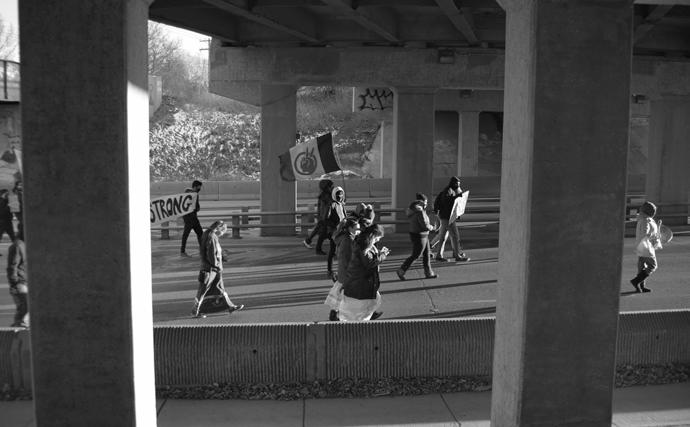
The All Eyes on Mi’kma’ki rally and march in Winnipeg proceeded along Portage Ave. Oct. 23. The group passed under the railway overpass where the “Never Forgotten” mural depicting 10 missing and murdered Indigenous women. The Sept 17. launch of an Indigenous lobster fishery by the Sipekne’katik First Nation in Nova Scotia has been met with violence, protests and attacks from non-Indigenous fishers.
UMSU board meeting update
UMSU opposes Respondus Monitor, supports UMFA
CAM CANNON, STAFF
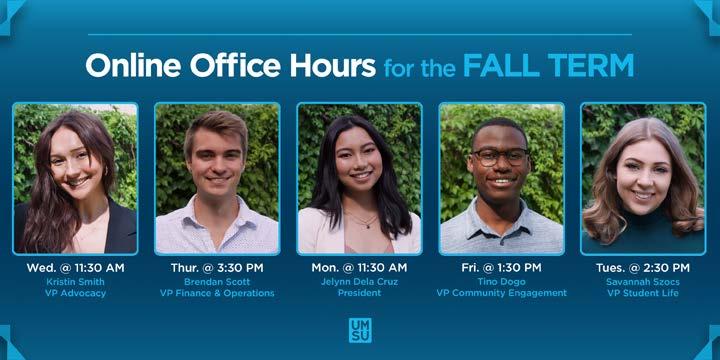
At its Oct. 22 meeting, UMSU’s board of directors received a presentation on the ongoing discord between UMFA and the university administration.
Also discussed were the provincial government’s efforts to implement performance-based funding (PBF) for post-secondary institutions. It also passed a motion to oppose the implementation of Respondus Monitor.
UMFA president Michael Shaw and vice-president Orvie Dingwall made a presentation to the board on the current state of negotiations between the university administration and UMFA. They also asked for UMSU’s assistance in pressuring the univer-
sity administration to accept binding arbitration.
“UMFA is ready to be at the bargaining table whenever the university is willing to be there,” Dingwall said.
“We will always say yes if they want to meet.”
UMFA’s main concerns centre around equity and compensation for faculty. The previously negotiated contract between the university and UMFA was created under the public services sustainability act, which froze public employee wages for two years and capped wages for the two following years.
The controversial provincial legislation — passed in 2017 and never proclaimed — was declared unconstitutional in June. UMFA said the
university is offering a zero per cent increase for the fifth year of the contract.
UMFA voted Monday to authorize a strike vote which will take place over the weekend. If UMFA votes in favour of a strike, a date will be set for its beginning and the university administration will have the opportunity to negotiate with UMFA up until that date to prevent a strike or lockout.
UMSU president Jelynn Dela Cruz stated that UMSU will be penning an open letter to students to assuage any anxieties students may have as a strike vote takes place.
The board also discussed the issue of PBF, which would see the funding of post-secondary institutions
tied to key performance indicators such as graduation rates, graduates’ incomes and employment levels post-graduation.
UMSU vice-president advocacy Kristin Smith said the strategy of the recently launched Manitoba Alliance of Post-Secondary Students — which counts UMSU, the Red River College Students’ Association and the University of Manitoba Graduate Students’ Association as members — (MAPSS) is to not directly oppose the implementation of PBF, but to advocate for equity-based performance metrics to implemented.
Riley Shannon — a board representative from the Science Students’ Association — said it seems that thus far, the Manitoba government has not listened to stakeholders in decision-making.
Shannon mentioned the “Tennessee model” the Manitoba government recently revealed it is taking ideas from, saying the model has made it more difficult for “poor folks, low income folks, racialized folks, kind of those [individuals] from the margins to actually get to university and access this education.”
Smith said that MAPSS will be addressing those concerns and asking the provincial government to “ensure that the PBF formula includes strong equity incentives.”
“That means that a portion of their funding is directly tied toward, let’s say, Indigenous student graduation rates, Indigenous student acceptance rates.”
Smith said the provincial government has been “adverse” to working with student groups in some cases, but that communication has improved with this UMSU executive.
She said she believes the Canadian Federation of Students played a role in previously frosty relationships with governments.
“I think it’s no secret that I’m not a fan of the [Canadian Federation of Students]. I think that a reason why the provincial government doesn’t want to engage with students is because the [federation] is the main voice. I think they are incredibly antagonistic. They don’t look at relationship building, and I think if they’re trying to change that now […] they’ve done far, far too much damage.”
She said the method of “putting forward a number of recommendations and seeing what the government’s response to those will be is a responsible way to do this as opposed to just shouting against it and sidelining themselves.”
“If the government gives us […] a big fat middle finger, then […] I’m going to give it back.”
Honk-a-thon draws over 150 in support
ALEXANDER DECEBAL-CUZA, STAFF
GRAPHIC BY JENELLE MCCANN
The art and science of making images from space
Using data points and algorithms to see the universe
COLIN IJEBOR, STAFF
Since the advent of space exploration, cosmic images have been a vital source of information for us.
Jayanne English, an associate professor in the department of physics and astronomy at the U of M, recently took second place in an international contest with her own depiction of a far-off galaxy.
English’s cosmic image, submitted to the National Radio Astronomy Observatory’s image contest, is a composite image constructed with data from the Hubble space telescope and the Very Large Array (VLA), a radio telescope. The image shows the extended magnetic field of the galaxy NGC 5775.
Many people may think cosmic images are simply photographs from space, but these images are actually
constructed from data. English said the public has trouble understanding the information scientists collect in its original form, so “space photography” is more accurately a visual representation of that data rather than literal pictures.
Light is understood as an electromagnetic wave. The electric and magnetic fields are perpendicular to each other, and the light waves move perpendicularly to these fields. Sometimes, the waves may become slightly rotated. The radio telescope helps image-makers determine the degree of rotation, which is called the polarization angle.
To construct the images, these polarization angles are drawn as vectors. A random noise field is put down and the vectors are placed on top of
that and then joined with a line integral convolution algorithm, which traces the change in orientation of the magnetic field lines on the sky.
“So, it’s not a snapshot of the magnetic field lines,” English explained.
“It’s actually a tracing of the radio astronomy data — polarization angles on the sky.”
Interestingly enough, all the data used is in black and white, and the image-maker is responsible for assigning colours.
English is a member of the CHANG-ES consortium (Continuum Halos in Nearby Galaxies — an EVLA Survey), an international collaboration using the VLA telescope to study the evolution of galaxies.
“Galaxies aren’t static — they
change with time, and we want to know the role of magnetic fields in changing galaxies over time,” English said.
“So, we’re measuring, in an image like the one I did, the magnetic fields [and] how they’re moving away from the disc of the galaxy.”
To understand the role of magnetic fields, CHANG-ES studies their structures within galaxies.
“When we know what the structure is, that structure will constrain the origin of the magnetic field,” English said.
“So, we will be able to determine whether magnetic fields are formed in galaxies due to, say, the galaxy rotation, or whether magnetic fields were part of the universe and so galaxies are born with magnetic fields.”
To generate magnetic fields on Earth, she explained, the protons and neutrons in the molten core are charged and separated from each other. This generates an electric current, and the rotation of Earth and other similar bodies generates a magnetic field.
CHANG-ES seeks to discover whether this is also the case with galaxies.
“As long as you have an electric current flow, you are going to generate a magnetic field, and vice versa,” English said.
While the data involved with creating astronomy images is modern, English believes that astronomy has
always had an impact on everyday life. To her, experiments over the centuries have been able to cause many societal changes as well as scientific ones.
“Our philosophy [and] our beliefs have become dynamic,” English said.
“And I think that it’s when we look around at the world around us and understand the world around us, and we understand that the world […] [and] the universe around us is dynamic, then it allows our beliefs to be fluid and dynamic as well — they can change with time.”
For those interested in exploring the concepts behind constructing cosmic images like English’s, she teaches a hands-on course called “The Art of Scientific Visualization” in the faculty of science. The course is open to students in their third year and above regardless of faculty as a 4000-level course with no prerequisites, but graduate students can also take it as PHYS 7440.
“It’s how to construct figures and images that use human perception so that it’s supportive of the message you want to get across to your audience, either professional or public,” English said.
“If people want to know how to do this, or are interested in doing for themselves to promote their own research or to communicate more clearly with their colleagues, then anyone from the university is welcome.”
Alumni discuss Indigenous potential in co-op structure
Report highlights common ground between co-operative principles and Indigenous values
On Oct. 15, the Canadian Centre for Policy Alternatives (CCPA) held a webinar and launched a report entitled Indigenizing the Co-operative Model, authored by Jimmy Thunder and Mark Intertas, two University of Manitoba alumni.
Thunder is an Asper school of business graduate and a co-founder of Reconciliation Thunder, a non-profit that uses social media to educate on reconciliation, treaties and the history of Indigenous-settler relationships in Canada. Intertas received his master’s degree in city planning in 2017 and completed a law degree this year.
The report includes a literature review featuring an overview of
the history of Indigenous peoples in modern-day Canada, interviews with key people including Elders and activists and an Indigenous design workshop.
The co-operative model is a way of governing businesses which are owned by members — either consumers or the workers employed by the business — collectively making decisions through the principle of “one person, one vote” as opposed to shareholders, whose say in decisions is weighted by how many shares in the company they own.
Generally, co-operatives are viewed by proponents as enhancing democracy in economic matters and
a way of generally increasing the wellbeing of communities. Profits are distributed to members and tend to stay in the respective communities, rather than getting pocketed by shareholders and invested elsewhere, saved or used to finance luxury consumption.
The authors acknowledge that reality is more complicated in theory, however.
“We talk about how the co-operative model is a magic bullet solution […] but in this case I can’t really see how it would solve some of these very specific types of problems with specific solutions,” Thunder said.
The report also highlighted the similarities between the Neechi principles of community economic development, used by the Neechi Foods Co-Op and the government of Manitoba, and the Rochdale principles of co-operation, the set of principles originally adopted by the International Co-operative Alliance in 1937 and which today guide the decision making of 315 co-operatives in 111 countries.
The overlap in these principles — such as local decision-making, concern for community, co-operation with other co-operatives and local reinvestment of profits, among others — convinced the authors
the co-operative model in practice can enhance Indigenous economic self-determination.
The report further suggested that the co-operative model would enable communities to more conscientiously decide how their cultures
“There’s no panIndigenous opinion out there” — Jimmy Thunder, co-author
develop alongside economic development, as opposed to the corporate model of firms, pointing to the constant tension between economic and cultural development and cultural preservation.
In a discussion with the Manitoban , Intertas clarified that cultural change is an inevitable result of economic development, but with the co-operative model as opposed to the corporate model, the people of the communities impacted have more control over said impacts.
However, as the authors themselves noted, their findings are
not without controversy among Indigenous people, especially around the concept of “red capitalism” which suggests Indigenous people can “Indigenize” capitalist structures and make use of them for their own purposes.
“Some Indigenous people hate that, and some [say] this is how Indigenous people can operate in capitalist society,” Thunder said.
“There’s a huge diversity, and there always will be this diversity, a real diversity of opinion.
“There’s no pan-Indigenous opinion out there,” he said.
Intertas and Thunder agreed that even though many debates about best economic practice for Indigenous groups still remain, the most important aspect is choice.
“If Indigenous people take it and bring it into their culture, and they redefine it, and that becomes their new culture, it’s still their culture,” Thunder said.
“As long as they are the ones deciding what is Indigenous, they determine that for themselves, then their self-determination is still strong.”
CAM CANNON, STAFF
PHOTO PROVIDED BY JAYANNE ENGLISH & YELENA STEIN
PHOTO BY ALEXANDER DECEBAL-CUZA
Fixing the lack of pediatric cannabis research
Nationwide group seeks to establish data set to back up anecdotal evidence
SARAH DORAN, STAFF
With growing acceptance of cannabis in a medical setting, the University of Manitoba is home to one of the major names in pediatric cannabis use.
Lauren Kelly, a pharmacologist and assistant professor in the department of pediatrics and child health, is the scientific director of the Canadian Childhood Cannabinoid Clinical Trial (C4T) program. Kelly also works as a clinical trialist at the George and Fay Yee Centre for Healthcare Innovation.
While led by academics, C4T also includes pediatricians, nurses and parents in an effort to gather knowledge useful in many contexts. The group was established in 2018 to rectify the almost total lack of pediatric research on medicinal use of cannabis.
“We had all been being asked the same questions as pharmacologists,” Kelly said.
“You know, ‘What do you guys
‘Any
know about using cannabis for epilepsy, or for pain, or for autism spectrum disorder or in cancer?’ And we all kind of said the same thing — we really don’t know. We have no answers. And it became very clear that this was an increasing area of interest from patients and families, so we really said, ‘If not us, then who?’”
In June 2018, Canada became the second nation in the world to legalize recreational marijuana, but a 2017 survey found that 50 per cent of pediatricians across Canada were already managing at least one child using medical cannabis, and 22 per cent managing five or more. Many of these patients had turned to cannabis as a method of pain relief, but others used it for epilepsy, anxiety or ADHD.
Kelly is leading a number of C4T projects in hopes of gathering more precise information on how pediatricians should judge dosage and format
of cannabis when treating chronic headache, as well as any side effects patients may experience. Other teams led by members of the pharmacology department at the University of Saskatchewan are looking into the capability of cannabis as a treatment for epilepsy and cancer pain relief, as well as studying the effects of prenatal exposure.
Nearly every pediatric hospital in Canada is involved with C4T.
Kelly said rethinking the format of clinical research and consulting potential participants for feedback on the design of the study is key for fostering trust.
One current C4T project works directly with children aged 14 to 18 with chronic headaches to determine what they, as patients, especially care about and what method of collecting data works best for them. This can range from asking whether patients give data via text message or written
forms to ensuring all appointments are at a consistent time in order to make sure families can plan for the disruption to their daily lives.
Even so, cannabis researchers are running into issues academics studying other topics may not face. Many of the patients have had “horribly
“This was an increasing area of interest from patients and families, so we really said, ‘If not us, then who?’”
— Lauren Kelly, assistant professor
negative” experiences with healthcare providers and health researchers, and others may simply be tired of playing guinea pig when they just want pain relief.
“A lot of the use is still stigmatized, so there’s a lot of parents who don’t necessarily want to disclose it or have had a negative experience — they disclose it to one care provider who says, ‘Oh no, you absolutely should not be doing that’ so then they just continue to do it but don’t tell anyone about it,” Kelly said.
Part of the push for more research involves helping ease that stigma, while also potentially providing evidence to back up the parents who say cannabis worked for their child.
“Parent advocacy groups have sparked up all over the place —
conflicts that may arise can and are managed appropriately’
Continued from page 3
The audit also found the department of education and training had failed to adequately monitor and oversee expenses and failed to establish protocols and strategies for institution accountability in using funds.
Twenty-seven pieces of advice were made to Manitoban post-secondary institutions regarding the auditor’s concerns.
These pieces of advice include examining oversight processes, the board committee and structure the training and development of postsecondary board members and the board committee and structure.
Since the beginning of the audit, the U of M had 14 out of the 27 advisements already in place 14, six were in progress and seven were unacted upon.
The U of M secretary, Jeff Leclerc, emphasized the importance of good university governance.
“I think, from the university’s per-
spective, we welcome the audit,” said Leclerc.
“The recommendations they’ve given to us give us an opportunity to improve,” he later said.
According to the audit, the U of M plans to prioritize the recommendations of having regular interaction between the minister, board chairs and presidents to discuss accomplishments and major issues at the U of M. This would also allow the university to advise the province on the board’s unmet skillset needs and create a more “timely, transparent and collaborative process.”
The university will also pay attention to the composition of the board to ensure the ability to appoint members so that “necessary skill sets” are in place.
Lastly, the U of M recommended that guidance regarding compensation provided to universities should be developed “in conversation with the institutions” and “appropriate to the sector.”
The U of M in recent months has been no stranger to financial scandal. This past July, a senior employee was found to be misusing university funds, and “immediate corrective action” to internal financial controls had been taken.
“Having strong governance is [...] important to ensuring that we maintain that autonomy” — Jeff Leclerc, U of M secretary
The annual report that disclosed the information was reported to the auditor general, who, at the time, was
considering a potential audit.
The office of the auditor general failed to respond to multiple requests for comment.
Leclerc said the university looks forward to working with the government in setting and monitoring goals and objectives.
Despite taking on most of the audit’s recommendations, the U of M did disagree with the auditor’s concern about university presidents being voting members of the board.
“Having a president as a voting member of the governing board and the senate is respectful of the bicameral nature of university governance and reinforces the complementary nature of the governing bodies,” the university said in the report.
“Any conflicts that may arise can and are managed appropriately.”
Leclerc said the bicameral system that the U of M follows, consisting of both a board of governors and a senate, ensures the university’s autonomy.
“Having strong governance is, in
there’s lots of websites you can see and there’s lots of anecdotes, and while we can’t base clinical practice on anecdotes, they’re certainly not [something] that we should completely ignore,” Kelly said.
“So, I think if all of these parents are saying that there’s benefits, it’s really something we should investigate.”
However, Kelly said children already fight an uphill battle when it comes to medical research.
“Luckily, kids aren’t sick as much as adults, but that means there’s not as much incentive to study them,” she explained.
“[Pharmacology] basically ignores them because there’s no money to be made.
“With 10 kids that have a rare disease, they’re not going to make any money to develop drugs for them, so it’s something I’ve always been passionate about, from a pharmacology perspective, of building that evidence that promotes safe and optimal pharmacotherapy for kids.”
As vital as pediatric cannabis research is, one of the biggest issues C4T faces is funding. Cannabis products are expensive, and it is important for C4T to remain impartial to guarantee the validity of its findings — meaning no relationships with the cannabis industry and no researchers with any conflicts of interest.
“I think it’s going to be really important as we move forward, because we can only answer as many questions as we have enough funding to do,” Kelly said.
“And so, I think as our question list grows, the resources may not mirror that growth.”
processes, important to ensuring that we maintain that autonomy.”
Through the department of economic development and training, the government has begun to implement new strategies to monitor expenses.
In December 2019, the department issued its first-ever mandate letters to share its goals, priorities and expectations, and adopted an “outcomes-based funding approach” which works to focus funding based on an institution’s demonstration to show “clear priorities, increase transparency and report on performance.”
The outcomes of the audit were discussed at U of M’s Oct. 7 senate meeting, and the university is waiting to hear back from the provincial government regarding its application and proposal for the new funding approach.
PHOTO PROVIDED BY LAUREN KELLY
EDITOR-IN-CHIEF Matthew Doering editor@themanitoban.com
BUSINESS MANAGER Alice Teufack accounts@themanitoban.com
ADVERTISING CO-ORDINATOR Diego Castro ads@themanitoban.com
EDITORIAL
MANAGING EDITOR Ty Brass me@themanitoban.com
NEWS EDITOR Amira Tekle amira@themanitoban.com
NEWS EDITOR Gillian Brown gillian@themanitoban.com
COMMENT EDITOR Lucas Edmond comment@themanitoban.com
ARTS AND CULTURE EDITOR Shaylyn MaharajPoliah arts@themanitoban.com
A “volunteer staff” member is defined as a person who has had three volunteer articles, photographs, or pieces of art of reasonable length and/or substance published in three different issues of the current publishing year of the Manitoban. Any individual who qualifies must be voted in by a majority vote at a Manitoban editorial board meeting. Elected representatives and nonstudents may be excluded from holding votes as volunteer staff members in accordance with the Manitoban Constitution. The Manitoban is the official student newspaper of the University of Manitoba. It is published monthly during the summer and each week of regular classes during the academic year by the Manitoban Newspaper Publications Corporation. The Manitoban is an independent and democratic student organization, open to participation from all students. It exists to serve its readers as students and citizens. The newspaper’s primary mandate is to report fairly and objectively on issues and events of importance and interest to the students of the University of Manitoba, to provide an open forum for the free expression and exchang of opinions and ideas, and to stimulate meaningful debate on issues that affect or would otherwise be of interest to the student body and/or society in general. The Manitoban serves as a training ground for students interested in any aspect of journalism.Students and other interested parties are invited to contribute to any section of the newspaper. Please contact the appropriate editor for submission guidelines. The Manitoban reserves the right to edit all submissions and will not publish any material deemed by its
Editorials in the Manitoban are
and
Editor-In-Chief:
of the
Positives outweigh negatives in online class
Remote learning could bring greater discipline
ISAIAH WAGNER, STAFF
Goinginto the 2020-21 university academic year, many students, myself included, wondered how the semesters were going to be planned due to the COVID-19 pandemic. Would learning require small classrooms and social distancing protocols? Or would the more drastic measures of online learning be taken?
Everything seemed uncertain.
After some deliberation, the University of Manitoba decided that fall semester classes, and now winter classes, are going to be facilitated remotely through UM Learn and various web platforms.
Personally, I was excited by this news as it meant I had more flexibility to work more than I would have if I was commuting to class every day.
However, my excitement was coupled with some anxiety. This is a very new style of learning, and although the end of the 2020 winter term was online, it was simply too short a time to learn to apply it to an entire academic year.
As it turns out, adjusting to the online version of school has been rather difficult for me. One of the problems with online learning is that not everybody learns the same way.
During in-person classes, students may be more focused with the vigilant presence of professors. However, during a Zoom meeting, for example, it can be a whole different story.
Now, students are sitting at home with a variety of distractions around them.
Whether it be the television, video games, a pet or their phones, students may be tempted to switch their attention to one thing or another.
When phones buzz, the embarrassment of interrupting the entire class is filtered through the mute option. Students have been collectively saved from the public shame of a professor stopping the entire lecture to wait for phones to stop ringing.
Instead, our phones have become enduring temptations.
With classes moving online, I immediately have to look at my phone if it rings. Even if I resist picking it up momentarily, the idea that I could answer without anybody knowing dis-
The more I grew to hate online school, the more I realized this might be what our generation needs
tracts me enough to shake me from my task.
These distractions could lead to a harder time focusing, which could also lead to lower grades. But it could also be an opportunity for personal development.
The more I grew to hate online school, the more I realized this might be what our generation needs.
We have grown up with technology and distractions all our lives — maybe having school at home is a wake-up call for the real world after university. Maybe it is something we can learn from.
For me, online school has taught me to be more disciplined than I have ever been. I have made a schedule of what I have to do every day of the week, and I have made it a goal to complete it, something that I would have never done during regular in-person classes.
With phones being the main problem, online school forces students to try and pay attention during Zoom classes and maybe put their phone down, or even turn it on silent.
This is something that I did not think was
going to be a problem while learning, but I was very wrong. Another reason online classes benefit students is the fact that they teach us to become better students on our own without professors telling us what to do. There is a larger degree of independence found in online classes compared to in-person classes. It has made me more disciplined, and more of an active participant in my learning than one who just goes to class, comes home, sleeps and repeats.
Maybe making online school our new normal would be beneficial.
With social distancing’s estimated conclusion in question, this could be the future of learning beyond this academic year. While this idea may torment many students’ minds, this is something that could be beneficial for our academic careers and our professional lives.
With all of the technological advances in the world, it is important that we understand that technology could very well be the future of learning.
We should get used to technology — it will likely become more necessary in the future.
Even as I work toward a career as a sports reporter, this is not done like it was pre-Internet — now it takes a relative savviness with online platforms of all sorts. Whether it be articles on the internet, Zoom calls online or even just typing on a computer, online schooling could actually help.
It causes people to be more aware of the way the world is changing. And for the better or for the worse, the world is no doubt changing. When I reflect, I am grateful that we have online classes. It has come at a perfect time for me, a 20-year-old who needs to learn how to be disciplined and become smarter with technology and productivity in today’s world.
GRAPHIC BY JENELLE MCCANN
Comment Editor: Lucas Edmond Contact: comment@themanitoban.com
Province embraces finest in environmental negligence
Privatizing provincial parks is short sighted
LUCAS EDMOND, STAFF
Premier Brian Pallister and the Progressive Conservative Party of Manitoba have issued a request for proposals (RFP) on how to start privatizing Manitoba’s provincial parks.
As of Oct. 13, the RFP is seeking to evaluate 76 of the province’s 92 provincial parks and has emphasized public divestment.
The winners of the bid will also be responsible for assessing the profitability of the parks from a business perspective.
The RFP calls for options to create new tourist attractions such as water parks, amusement parks or hotels within the protected parks themselves.
The province seems to have forgotten that provincial parks are not businesses, and nor should they be.
Protected eco-zones such as our provincial parks are meant to be havens of nature buffered from, in most cases, potentially destructive human development.
This land is not simply idle waiting for private investment interest — it is protected under principles of conservationism.
Although many provincial parks entertain limited levels of infra-
structure for economic development as long as it does not disturb the integrity of the park’s natural surroundings, can we really trust private businesses to follow strict regulations? Especially considering regulations may be overseen by an austerity-driven government bent on cutting public necessities.
Beyond this, private interest is wholly concerned with one thing — profit.
This means that cutting both costs and corners is inadvertently encouraged by the ethos of business.
Personally, I have always opposed conservationism. Conservation necessitates human desire to enjoy and exploit nature in various capacities.
Instead, advocating for models of preservation — which do not account for human desires, but rather places the integrity of habitats first — should be the norm for our cherished provincial parks.
But now, under the Pallister government, the principles of conservationism seem like a dream lost to a cold splash of water thrown over your face mid-sleep — worse, perhaps a scalding-hot cup of coffee.
If you have your suspicions about
private interest in our provincial parks, your anxiety is well-founded.
In May, the Wilderness Committee discovered a mining claim in Nopiming Provincial Park where mining and economic development was strictly prohibited. Areas had been subjected to destructive mineral exploration, which overlapped with hectares of protected forest that are home to threatened populations of boreal woodland caribou and supposedly a rare pair of trumpeter swans who are formally classified as an endangered species in Manitoba.
The mining claim would have seen this habitat bulldozed for the extraction of plain rocks.Soon after, the committee called for all industrial activity to be banned in provincial parks. And rightfully so.
Greed and profit have no place on the little protected land we have left — especially when that land is home to vulnerable populations or species.
The rights of private conglomerates do not rule on common land. There is no reason why we should allow our government to throw away our collective responsibility to these parks for a couple of bucks.
Further, privatization of provin-
cial parks could throw consultations with Indigenous leaders, who typi-
If you have your suspicions about private interest in our provincial parks, your anxiety is well-founded
cally play a central role in the direction of park policy, by the wayside.
The privatization of provincial parks resembles the historic enclosures of common land.
Everywhere from Mexico to Nigeria, Vietnam to New York, India to the Amazon, land and people have been subjected to the colonial method of common enclosures and the establishment of dispossessive private property rights.
In every example noted, Peter Linebaugh, a prolific historian, has outlined the principle tendency for planetary woodlands to be destroyed for commercial interest and the ten-
dency for Indigenous populations to be silenced as resource exploits are extracted.
Pallister’s move to privatize provincial parks embodies this history in many indirect, but nonetheless, concerning ways.
I cannot imagine that our parks will be protected when the government is actively advertising them as opportunities to make money. And I certainly can’t imagine private interest consulting with Indigenous communities before desecrating the parks in the empty name of development and business.
With the government in fiscal turmoil after the devastating economic impacts of the COVID-19 pandemic, Pallister, and the provincial government, is looking for every opportunity to double down on his radical agenda to privatize and gouge public resources.
And, in this case, privatize and gouge a public resource that shouldn’t even be considered property in the first place.
This may be a harrowing lesson to our management of environmental policy — nature’s gifts are not our own just because we believe we own them.
GRAPHIC BY DALLIN CHICOINE
Too little, too late on COVID-19 response in Manitoba
Premier
Brian Pallister
and his government have played politics and now we are paying the price
MATTHEW AVERBECK, STAFF
With another week of increasing COVID-19 cases in the province, particularly in Winnipeg, Manitoba now has the highest active cases per 100,000 people in the country. In response, the provincial government introduced new restrictions in Winnipeg on top of the mask mandate put in place last month — including, but not limited to, new capacity limits on restaurants and museums and the closure of bars and nightclubs.
Premier Brian Pallister and the Progressive Conservatives (PC) claim these new restrictions will help make Manitobans safer. However, they are not enough, and they have come far too late.
The provincial government has done nothing but play politics at a time when we desperately need leadership.
If the government had acted sooner, we might have avoided the dire situation we currently find our-
selves in.
At the beginning of the summer, Manitoba’s case numbers were extremely low.
At one point in July, the province went two weeks without a single person testing positive.
In late July, communities in western Manitoba began to experience outbreaks and, instead of imposing new restrictions to get ahead of the outbreak, the province decided to enter Phase 4 of the reopening plan.
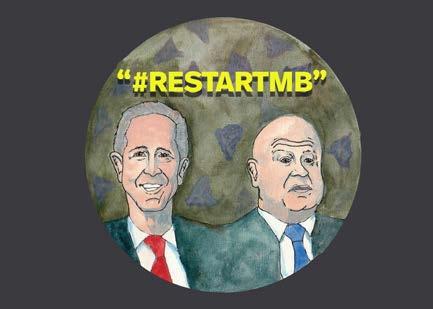
Pallister took this new phase as an opportunity to launch his #RestartMB ad campaign in August, in part to encourage Manitobans that we are “ready to live with COVID-19.”
The rushed reopening plan and the #RestartMB campaign have proven to be irresponsible, nonsensical and were seemingly driven by economic and political incentives rather than the safety of Manitobans.
If the provincial government really had the health of Manitobans in
mind, they would have ensured that Manitobans were as protected and as prepared as possible before entering a potentially dark and challenging fall and winter.
Take, for example, the current situation in schools. Three schools across the province have had outbreaks in the last two months.
Teachers are feeling anxious about the added workload they have this year, the uncertainty and the possibility of contracting the virus due to inconsistent implementations of the regulations.
The province had ample time this summer to effectively prepare for the school year.
This time could have been used to ensure teachers had the necessary resources and information they needed. Most importantly, it could have been used to ensure that the health of students and teachers was protected.
Instead, the PCs irresponsibly
pushed their ill-conceived reopening plan to pretend that we are learning to live with this virus.
Now schools are cramped, students in cohorts — which were meant to curb the transmission of the virus
The rushed reopening plan and the #RestartMB campaign have proven to be irresponsible
— are still interacting with other students outside of their cohorts. And on top of all this, teachers are struggling with their mental health.
While the province introduced further restrictions in schools in northern Manitoba and in Winnipeg this last week, there is still uncertainty about how the rest of the school year will fare and whether these restrictions will be adequately implemented.
This will almost certainly increase anxieties among teachers, parents and students.
Beyond the nightmarish situation in schools, Pallister has displayed irresponsibility with his confusing public messages and his delayed implementation of mask mandates in high-risk areas.
In August, Pallister claimed that mask mandates had become a “debate” and failed to explain why he was refusing to implement one.
This is despite scientific research confirming that they are extremely effective and, most importantly, save lives.
Proven scientific findings are not a debate, but Pallister and his government have managed to exploit public naivety and made it one.
Pallister has shown a lack of leadership on the issue. Even Health
Provincial policies will harm students in event of UMFA strike
Continued from front page
In 2016, the U of M president at the time, David Barnard, had said the university was in a stable financial position. With more than one-half of the university’s funding coming from provincial coffers, UMFA members took to the bargaining table to discuss a wage increase proposal — one that was desperately needed considering U of M faculty salaries were among the lowest compared to all major universities in Canada.
Premier Brian Pallister had a large role to play in this dispute — allegations of unfair labour practice arose when he had supposedly asked the university to resist mediation and
withdraw its salary proposal. Now a similar situation could be on the horizon.
On June 11 the public services sustainability act (PSSA) — the act that guaranteed salary raises were restrained — has been declared unconstitutional by provincial courts.
The university is now offering union members zero per cent increases in compensation, which UMFA says is in line with an August government mandate.
In response, UMFA proposed arbitration to discuss a new deal — the U of M administration has ultimately declined.
The proposal’s rejection could leave many students in a situation
like those before them in 2016 — in fear of a strike.
A strike in 2020 has the potential to hurt students more than it did in 2016.
This year, students and faculty have faced many hardships as they shift to online and remote learning and the daily worries of living in a COVID-19 dominated world.
Beyond this, tuition has been raised, and enrolment is up — the university is in a stable place financially, why not open discussions?
As important as it is for the faculty to ensure their fair treatment, in the end, it may be the students who genuinely suffer.
The association held a honk-a-
thon on Oct. 20, where other union groups joined UMFA in solidarity.
It seems as though the many honks fell on deaf ears, as little concern can be seen across media platforms, but most importantly, the U of M administration has not budged in its position.
This year has been full of civil unrest as the Progressive Conservative (PC) government has been accused of strike breaking for pushing through legislation that has made it easier for employers to fire striking workers. The legislation was introduced Oct. 14 and has ridded requirements for binding arbitration that were established to protect workers’ rights.
Minister Cameron Friesen has given into anti-mask groups by stating that they make some “good points.”
There is still not a province-wide mask mandate, and Manitoba’s Chief Provincial Public Health Officer Brent Roussin — currently the most visible public health official in Manitoba — has refused to adequately answer why mask mandates have not been implemented across the province.
It seems as though Pallister and the PCs have attempted to play politics with the health and safety of Manitobans.
To put into context just how poor the response has been, let’s take a look at what Ontario has done and how they have fared so far.
Mask mandates were introduced in regions of Ontario starting in June and, according to experts, these mandates may have reduced the number of weekly COVID-19 cases by as much as 25 per cent.
At the end of last week, Ontario, the most populated province in Canada, had roughly 43 active cases per 100,000 people compared to about 129 in Manitoba.
This brings into question where Manitoba would be if mask mandates and other sensible restrictions were adopted during the spike this summer.
Now we are left with uncertainty about our schools, our jobs and whether we’ll even be able to celebrate the winter holidays with our families and friends.
Pallister and the provincial government have done a poor job regulating this crisis, and now everyday Manitobans are dealing with the consequences.
Going forward, the government must act responsibly, communicate clearly and focus on the health and safety of all Manitobans rather than solely on their own political interests.
Social issues rain high in Manitoba right now, and they need to be heard. Faculty seeking fair treatment and pay need to be given attention.
On the same side, students need to be treated with more respect as they are the most vulnerable in this situation.
It appears as though the U of M administration, who claims to put students first, need to start its negotiations much earlier to protect and put students first.
More importantly, the U of M needs to begin treating their faculty members with respect and afford them the right to fair arbitration.
GRAPHIC BY DALLIN CHICOINE
Maharaj-Poliah
Get your ghostly groove on this Halloween
The Manitoban staff shares some spooktacular songs for your Halloween playlist
S
ince many Halloween festivities will be on a forced hiatus this year, the Manitoban’s arts and culture team is bringing the party to you with some of our favourite spooky tunes. Whether you’re hosting a virtual get-together with friends or having a party for one, crank up the volume and enjoy the music.
“Voodoo Doll” — VIXX
Shaylyn Maharaj-Poliah, arts and culture editor
When thinking about Korean pop music, or K-pop, the song most likely to come to mind is PSY’s 2012 mega-hit, “Gangnam Style,” or the more recent English-language single “Dynamite” from supergroup, BTS.
Infectious beats, energetic dance routines and joyful lyrics are staples of the genre but, if you’re one of those naysayers who doubt K-pop’s versatility, then you are in for a rude awakening.
Back in 2013, K-pop idol group VIXX surprised fans with teaser videos for their first full album, Voodoo, and its title track, “Voodoo Doll.”
One of these videos was R-rated for body horror and gore. The beats were pulse-pounding and memorable, using scare chords and a ghostly chorus. When the full song was released,
it didn’t disappoint. There’s a reason why VIXX is known as the “concept kings.”
The song starts out sinister with rapper Ravi’s deep, guttural growling, builds into the melody and ends with crisp falsettos from vocalists N, Leo and Ken. Hongbin’s rap parts, heavily distorted with autotune, sound like audio interference, similar to what would be heard through a spirit box used by paranormal investigators.
The haunting refrain from the teaser was provided by none other than the youngest member, Hyuk.
Whether you’re hosting a virtual get-together with friends or having a party for one, crank up the volume and enjoy the music
You don’t need to understand Korean to understand that this is a seriously creepy song.
The choreography enhances the
creep factor, from the members throwing Ken like a ragdoll to mimicking the torture endured by voodoo dolls, the group truly went all-in on this concept.
Perhaps too all-in, as the music video itself was rated R for graphic imagery, which meant that Hyuk, who was 18 at the time, was too young to watch his own music video.
This isn’t a trick — “Voodoo Doll” is a treat for the ears, whether you’re a K-pop fan or not.
“Black Cat 13” — Peach Kelli Pop
Zoë LeBrun, arts and culture reporter
The song that should be the next addition to all of your Halloween playlists is “Black Cat 13” by Peach Kelli Pop.
It lives up to its title, content-wise — the lyrics describe running into a black cat on Halloween night and all of the omens and superstitions this encounter imposes on its viewer. This leaves you with a song that has spooky themes but isn’t outright scary, making this song kid-friendly and, in general, good for those who don’t handle eerie sounds well — “Black Cat 13” is entertaining, dynamic and about a cat. What’s not to love?
You may be asking: Why else does
this song deserve a place among your favourite Halloween songs? Not to put too fine a point on it, but “Black Cat 13” is simply a great song.
Off of the 2018 album Gentle Leader, this song is short, sweet and has the quintessential Peach Kelli Pop sound — best described as bubble-gum punk with a hint of Japanese pop. “Black Cat 13” offers a welcome change from the clichéd songs normally heard at this time of year but maintains the fun, Halloween vibes needed to get you through a night of trick-or-treating, pumpkin carving or socially distanced household celebrations!
This high-energy song, with its racing electric guitar and clashing percussion, is sure to ramp up your Halloween playlist.
“Halloween” — Siouxsie and the Banshees
Kaelen Bell, arts and culture reporter
With guitars that shriek like Bernard Herrmann’s legendary Psycho, strings and lyrics that evoke the ancient terror lurking beneath our innocent trick-or-treat tradition, Siouxsie and the Banshees’ “Halloween” is the theatrical height of goth rock — perhaps the most intentionally sinister, squirming song on
an album famously rife with dread.
One of the few songs on 1981’s landmark Juju with lyrics by bassist Steven Severin rather than frontwoman Siouxsie Sioux, “Halloween” overcomes its potential goofiness by sending the band swirling to its blackest pitch, a feverish dance of sickly noise and pummeling drums.
It’s Sioux’s immense gravity and John McGeoch’s peerlessly unsettling guitar that make lyrics like “trick or treat, trick or treat/The bitter and the sweet” sound foreboding rather than silly.
Sioux flies over the arrangement like a witch above suburbia, rising and diving with her legendary cool — rock music’s patron saint of Halloween, giving us an anthem of genuine fear.
It’s not necessarily party playlist fodder, but if you’re looking to access some of the black magic at the heart of Halloween, consider pausing the “Monster Mash” and letting your subconscious go unchecked for three minutes and 37 seconds of cold sweats and panic. Suddenly, all those kids in costumes won’t seem quite so harmless.
Check out these bewitching songs on your preferred music streaming platform.
Big-budget studio quality that’s local and affordable
Adam Fuhr’s House
KAELEN BELL, STAFF
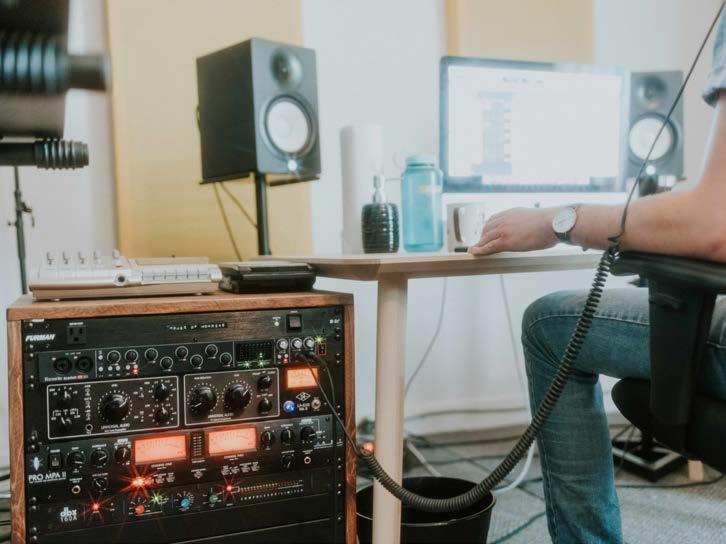
of Wonders offers Manitoba musicians mentorship, comfort and creativity
Filled with instruments and recording gear, the floor strewn with old rugs and ceiling lined with fairy lights, Adam Fuhr’s House of Wonders is a world away from its namesake — the Zanzibari palace, but it feels just as rich with stories — and is probably better equipped to capture them.
The Yes We Mystic frontman describes the small recording space — and its sister label House of Wonders Records — as the confluence of several dreams, both for himself and for a music industry that’s swallowing artists and spitting them out faster than ever before.
“Producing is something I’ve been working toward for a long time — my band Yes We Mystic’s latest album, Ten Seated Figures, was where I took off the training wheels and produced fully on my own,” he said.
“The label comes from another place — I’ve been quite heavily involved in the release plans of Yes We Mystic music for many years, and I wanted to share what I’ve learned with artists I believe in.”
Fuhr credits his experience on both sides of the equation for House
of Wonders’ approach — an artistfirst perspective that attempts to prioritize comfort, creativity and low costs over corporate promotional tactics and major label pressures.
“Every inch of every decision is shaped by my experience as an artist,” he said.
“Everything. I basically look at how I would have wanted things to be when I was starting out and then try to find a way to make it happen now.”
“I don’t feel married to any particular way of doing things because I keep costs low and want to stay agile. Let’s just say that the experiment is ongoing,” he said.
For what it’s worth, that experiment seems to be working. A steady stream of local names — Virgo Rising, JayWood, Julien’s Daughter, Amos the Kid, Laura Lucas and Anthony OKS, among others — have brought their songs to House of Wonders’ little palace.
“It’s been awesome to work with Adam — he’s incredibly hard-working and just knows a ton about the industry,” says Amos the Kid, House of Wonders’ inaugural signee. Amos Nadlersmith’s debut EP as Amos
the Kid, Mountain View, generated a modest, well-deserved buzz outside of his home province — a buzz he partially credits to Fuhr and House of Wonders Records.
“[Fuhr] also has contacts from all over the world, so he’s given my tunes a reach that I otherwise wouldn’t have been able to do,” he said, adding that
“We are together experimenting, trying to find moments that make us shake in our seats and holler at the sky”
– Adam Fuhr, founder
he and his band have recently finished recording his upcoming sophomore EP at House of Wonders.
Anthony Sannie, who performs as Anthony OKS, describes Fuhr’s approach as personal and seriously committed to the music.
“He’s super easy to work with, and
he’s patient with the music and the process,” said Sannie. “You can tell that he wants to get your song right, too.
“So, seeing that investment in an engineer is great.”
What started as a recording space for Yes We Mystic has quickly become a hub for Winnipeg artists looking for an affordable middleground between home recording and big-budget studios.
“We’re used to just recording our songs on our phones, so working at House of Wonders transcended our music into so much more than we ever thought it could be,” said Emily Sinclair of Virgo Rising, who, along with bandmates Jenna and Lauren Wittman, worked on their debut EP with Fuhr.
“He brought new ideas to the table and we were able to make so many stellar sounds with his equipment and expertise.”
It’s the affordable opportunity to record in a professional setting that, more than anything else, make spaces like House of Wonders feel vital. The financial reality of working musicians has always been unpredict-
able, but with the sudden and essentially total loss of paid performance opportunities — along with worrying industry trends decades in the making — many artists are facing a scary financial future.
“We need to find ways to make music for the least amount of upfront cost possible while still ensuring high-quality output,” said Fuhr.
“There are very, very few people for whom recording for $600 a day at a big studio makes any sense anymore. If you’re not getting five million streams, you’re not even paying back the money it took to make the thing.”
It’s no small battle, but House of Wonders seems like a step toward a more professional and equitable future for Winnipeg’s artists. And with a new Amos the Kid EP on the way — and new, as-yet-to-berevealed signees to the label — Fuhr said he’s optimistic about what’s to come and excited to explore new avenues of sound.
“No matter the genre, the fundamentals are the same,” he said. “We are together experimenting, trying to find moments that make us shake in our seats and holler at the sky.”
PHOTO BY ALLY GONZALO
Creating a sense of home
The Winnipeg Art Gallery offers a survey of Manitoba’s last 50 years through paintings, sculptures, installations and more
ZOË LEBRUN, STAFF
Beginning Oct. 10, art lovers were gifted with a celebration of Manitoba at the Winnipeg Art Gallery (WAG) in the form of an exhibit titled In Place: Reflections from Manitoba. The exhibit is curated by Riva Symko, the WAG’s head of collections and exhibitions as well as the curator of Canadian art.
In Place features work from 58 Manitoban artists and reflects on the ways identity and culture are set in place — a concept even more relevant given the COVID-19 pandemic, which has kept many in-province over the past many months.
and Joseph Sanchez.
While proceeding through In Place, attendees will notice a large space on one of the walls with a placard next to it. Here, Symko describes her disappointment in the lack of representation of Black artists in the WAG’s permanent collection and her plans to change this.
tic community over the last 50 years. The Prairie landscape was, unsurprisingly, prominent throughout In Place but reimagined in the various works in a plethora of ways. Multiple artists took this plain setting and found truly unique methods to portray it, which is a testament to the way spaces can be perceived and experienced by different people.
At first glance, Cemetery could be misinterpreted as a diagram of an actual graveyard. However, upon further inspection, fingerprints and lines made in charcoal betray its artistic origins and triggers a line of questioning about people’s relationship to physical places, the afterlife and the ways we perceive spaces around us.
Symko was new to the city at the time and could not explore it the ways newcomers usually might due to public health restrictions. She turned to the WAG’s permanent collection for both curatorial pursuits and to learn more about her new home.
Some of the artists featured include Marcel Dzama, Diana Thornycroft, Lita Fontaine and Cliff Eyland. In Place also displays work from five artists who established the Professional Native Indian Artists Inc. in the early 1970s, whose members include Daphne Odjig, Carl Ray, Jackson Beardy, Alex Janvier, Norval Morriseau, Eddy Cobiness
In Place was conceived while Winnipeg was quarantined in March to flatten COVID-19 infection rates.
Symko also made space for Black artists within this exhibition despite not having many works by Black Manitoban artists in the WAG’s permanent collection. By physically making space for Black Manitoban artists, Symko shows that Black artists matter, and she is willing to make an effort to include and celebrate these artists. This gives hope for the WAG’s future representation for Black artists.
The exhibition itself, which contains 126 different works, creates a real sense of place upon entrance. With blue-painted gallery walls, the rooms containing In Place gave the impression of a wide-open prairie sky and provided both a sense of calm and excitement when moving through the space.
From sculptures to paintings and everything in between, the wide array of mediums displayed in this exhibition speak to Manitoba’s diverse artis-
THE DOCTOR THE WORLD
From sculptures, to paintings and everything in between, the wide array of mediums displayed in this exhibition speak to Manitoba’s diverse artistic community over the last 50 years
Some pieces of note from the exhibit are Steve Higgins’s Cemetery (1991), Daphne Odjig’s Thunderbird Woman (1973) and Look at Me by
Thunderbird Woman , with its undulating lines and colours, appears to move right before your very eyes — the longer you look at it, the more figures emerge from its depths — creating dark, cinematic energy.
Whitehouse’s Look at Me feels like many spaces at once. As you shift your brain in and out of focus, it seems to portray different things, making one realize the way that we infer a work’s meaning based on what we are able to see through abstract forms in space.
When many people think about Manitoba, they tend to view it as boring, but In Place proves this wrong and demonstrates the artistic ingenuity, humour and talent that our province provides.
In Place: Reflections from Manitoba is on at the Winnipeg Art Gallery until Jan. 17, 2021.
PHOTO BY ZOË LEBRUN
Former Bisons soccer player offers advice to future players
Brazil native Rebecca Wilson talks Bisons
ISAIAH WAGNER, STAFF
Former women’s soccer player
Rebecca Wilson spent her rookie season last year playing for the Bisons, but unlike many other student athletes this year who’ve seen their seasons halted due to the COVID-19 pandemic, Wilson decided on her own to pause her playing career. Competing athletically is something Wilson loved, but school came first for this student athlete.
“I really wanted to focus on academics,” she said.
“Even though I am not on the team, I still keep in touch with many of the girls.”
Before playing for the Bisons, Wilson played for her high school team Collège Beliveau and for the Bonivital Flames. Playing well for both of these squads resulted in her recruitment to the women’s Bisons team.
“It’s hard work and long hours, so you have to be disciplined in balancing academics and the commitment to the team” — Rebecca Wilson, former Bison
Wilson has had a number of achievements in her career.
She was the Premier 2 Bonivital SC female soccer player of the year in 2014. The student in student athlete is also something she took pride in, as she was given the SCAC Scholar-Athlete Recognition award in both 2017 and 2018.
She is not like many student athletes that play for the Bisons, having
been born in Manaus, Brazil. Her family came to Canada when she was just two years old.
Wilson was one of just three players on the team from outside North America, the other two being from India and Colombia.
The national sport in Brazil is soccer, a fact which is not lost on Wilson.
“It’s more of a cultural thing in Brazil for sure, but I have always liked to be active,” she said.
“In addition to soccer I played school volleyball, hockey and was a competitive gymnast for 13 years.”
The ability to stay active and play different types of sports is beneficial no matter what type of athlete you are and what level you play at. It brings different strengths to players based on their previous activity.
“Even though I am small, I felt that I could hold my own on the field,” Wilson said.
“I’ve been playing soccer since the age of four, so I am able to read the plays well.”
The former Bison loved to play for the team. It is a great way for a first-year student to get to know other athletes and play the sport they love.
“It felt really good to be part of a team,” she said.
“It was a great way to stay in shape, that’s for sure.”
“It’s hard work and long hours, so you have to be disciplined in balancing academics and the commitment to the team,” Wilson said.
She offered some advice to future players on how to act and what to do when living as a student athlete.
“Be positive and coachable,” she said.
“Get to know your teammates.”
“Making connections off the field is important for making the connections on the field.”
Former Bisons basketball star inks new pro contract
Omoerah earns Euro deal in market affected by COVID-19
MATTHEW MERKEL, STAFF
Former U of M Bison Keith Omoerah has recently agreed to a new contract with MBC Mykolaiv of the Ukrainian Super League. The third-year pro makes his return to the club after splitting last season between the Iranian league with Exxon Sport Club and the Ukrainian Super League with BC Odessa. The Winnipeg native also has international experience. Omoerah has been a regular member of the Nigerian national team since 2018, playing in FIBA events such as the African Cup.
In the 2018-19 season in
Omoerah knows he was one of the lucky few to be able to get a contract this year, as many other ballers are left without contracts in a freeagent market filled with uncertainty
Mykolaiv, Ukraine, Omoerah had one of his best pro seasons statistically, averaging 13.2 points, 5.7 rebounds and 2.7 assists in 18 games. Over three games with Bipa Odessa in the 2019-20 season, the six-foot-four shooting guard averaged 8.3 points, 5.3 rebounds and 4.0 assists before the team’s season was cut short due to the spread of COVID-19.
The shortened season meant
Omoerah had to come home to the keystone province. Although he had to forgo the rest of his season, Omoerah is thankful for the time he was able to spend with loved ones.
“As tough as this off season was, the silver lining in it is that I got to be home longer than expected and spend time with my family,” he said.
As the pandemic shut down professional sports leagues around the world, many athletes were left wondering what their future would look like. Financial ramifications from a season cut short and a damaged world economy have put pro sports leagues in a tough position.
Omoerah knows he was one of the lucky few to be able to get a contract this year, as many other ballers are left without contracts in a free-agent market filled with uncertainty.
“Due to [COVID-19], a lot of leagues had to shut down which obviously means a lot of jobs were lost,” he said.
“Unfortunately, there’s a lot of good hoopers out there still without a job. On top of that, a lot of players overseas had to take a pay cut as well. I’m thankful to be in the position I am being back in […] Ukraine.”
The former Bison hopes to leave his mark overseas like he did in his hometown. The Grant Park High School graduate played four seasons for the herd in 2010-11, 2011-12, 2015-16 and 2016-2017. In his time, Omoerah was a Canada West conference all-star and helped lead the Bisons to the Canada West Final Four. After the season, he signed with Norwegian club Bærum
Basket for the 2017-18 season. Omoerah had an incredible university career that was topped off by earning his spot in the professional ranks, something rare in collegiate sports.
The U of M alumnus knows the commitment and sacrifice a student athlete must make for their sport. So, when Canada West announced that they were cancelling all winter sports due to the COVID-19 pandemic, he could not help but empathize with Bison athletes.
“I feel for the university athletes during this time,” Omoerah said.
“For me, playing at the University of Manitoba was the [most fun] basketball has ever been. So, for those players not to have the opportunity to enjoy this year is upsetting. Understandable, but still upsetting.”
However, Omoerah knows that if any athlete wants to succeed, they need to make the most of any opportunity. Leaving a message for Bison athletes, he highlighted the importance of persevering through the difficulties of a cancelled season.
“As tough as this year might be, [Bison athletes] just have to stay the course,” he said. “Don’t cheat the game and the game won’t cheat you.”
This mindset is what has helped Omoerah find success on the court and in free agency. After a cancelled season, the former Bison heads back overseas with renewed optimism, in the face of COVID-19.
“I’m excited to be back playing in the Ukraine this year,” he said. “With so much uncertainty in the world right now, I find it comforting to be back in a familiar place.”
PHOTO PROVIDED BY KEITH OMOERAH
PHOTO BY ALEXANDER DECEBAL-CUZA
Graphics Editor: Jenelle McCann
THE IVORY BUFFALO
Monsters and ghouls take on a COVID-19 Halloween
How have vampires, werewolves and zombies dealt with the pandemic?
JESSE BOILY, STAFF
T
he pandemic has changed all our plans, including how we celebrate holidays, but it has not affected anyone more than Halloween’s ghouls and monsters.
Halloween is the one night of the year when vampires, werewolves and babadooks can freely roam the streets as if they were one of us normies.
Trolls who once lived under bridges have since moved on to damp, dingy basements with highspeed Internet.
Now they often lurk among boomer Facebook pages spreading fake news and cringy opinions, enraging the stereotypical “Karen.”
Vampires, best known for their blood-sucking escapades and high conceitedness, are now upset with the province’s latest restaurant rules. Constrained restaurant hours have limited their deceitful forum for blood-sucking, and their victims are increasingly hard to come by.
Manitoba’s werewolf population is well known to keep to themselves, so social distancing from the populace has not been a problem.
The werewolf community feels exceptionally blessed during the COVID-19 pandemic due to their canine-like genes. They don’t display symptoms of the virus but still practice social distancing as they fear they could be carriers.
That being said, if you do go out this Halloween, be aware that it is a full moon.
The zombies groaned in unison in March as the possibility of their great upheaval was upon humanity and was subsequently put off.
COVID-19 did not turn out to be the pandemic
to lead to us all to become brain-thirsty living dead creatures.
Although not the living dead, many of us have spent so much time looking at computer screens that we all have a zombie-like gaze.
The zombie hunters and doomsday preppers have warned us the world would shut down — in
Manitoba’s werewolf population is well known to keep to themselves, so social distancing from the populace has not been a problem
March, while many made the mad dash for toilet paper and hand sanitizer, the new age boy scouts sat back in their fortified bunkers with their crossbows and DVD collections of Survivorman and The Walking Dead
Although they haven’t been heard from since, one must wonder if they are tired of their dehydrated food and boil-in-bag meals yet.
When they emerge from their bunkers, what will they think of our world as we pushed on through the pandemic? To their great disappointment, it will be a world without zombies.