Faculty of health sciences approves anti-racism policy
Trailblazing policy sets out framework for anti-racism education
AMIRA TEKLE, STAFF
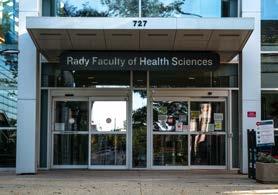
The U of M’s Rady faculty of health sciences (RFHS) approved the first anti-racism policy of any kind to exist in a Canadian post-secondary institution on Aug. 25.
The creation of the disruption of all forms of racism policy was led by the faculty’s office of equity, diversity and inclusion (EDI) anti-racism working group.
The working group included Delia Douglas, RFHS anti-racism practice lead; vice-dean (Indigenous) Marcia Anderson; director of EDI Jackie Gruber; members from Ongomiizwin, RFHS Indigenous institute of health and healing; the RFHS’s office of professionalism and
the U of M’s office of human rights and conflict management.
The policy defines racism in its various forms and offers commitments and requirements for education and learning within the faculty to curb racism.
Brian Postl, dean of the RFHS and vice-provost (health sciences), said in a message posted online that “each of us needs to recognize existing racism within our faculty and to take responsibility to eliminate all forms of racism, to promote safe work and learning environments free of racism and to intervene when witnessing any racism.” Douglas helped create the policy
as the faculty’s anti-racism practice lead. She began working in her current position in September 2019.
She said the groundwork on the policy began about a decade ago with “a study on the experiences of Indigenous learners.”
“Over the years, there has been consultation with Indigenous learners — and in my 11 months I met with Indigenous learners, members of the Black medical students’ association, racialized learners and the student governance and senior sticks from the various colleges of [RFHS],” Douglas said.
“Discussions with Indigenous, Black and racialized learners reveal how racial discrimination, harassment, vilification and racism are manifest in the organizational culture, hidden curriculum, policies and processes, bystanders and educators.
“The creation of this policy is based on the fact that Indigenous, Black and racialized learners do not feel safe accessing current structures.”
She said the creation of the policy shows that the U of M is prioritizing anti-racism work.
“The creation of an anti-racism policy signals that racism is a key concern of the university and evidence of its commitment to building an inclusive and [safe] community that has zero tolerance for racism, and where all are valued equally and treated with
dignity and respect.”
The policy is far-reaching and addresses reporting mechanisms for incidents of racism and historical injustices that have been enacted upon Black, Indigenous and people of colour (BIPOC).
“Crucially, the policy is an affirmation of the humanity, rights, dignity and safety of BIPOC students, staff and faculty” — Delia Douglas, RFHS antiracism practice lead
“The disruption of all forms of racism policy outlines the myriad manifestations of racism that exist in the RFHS and outlines procedures for the reporting and disruption of racism,” Douglas said.
“In addition, the policy is an affirmation of the histories of dispossession, enslavement, genocide and their legacies and ongoing settler-colonial projects.”
“Crucially, the policy is an affirmation of the humanity, rights, dignity
and safety of BIPOC students, staff and faculty.”
Training and education are an integral part of the implementation of the policy. This includes the launching of an anti-racism website in the future.
“We are beginning with an online module that offers an overview of the policy, and this will be followed by a module on receiving disclosures,” Douglas said.
She said that racism is a problem not only at the U of M and within the RFHS but a problem that permeates post-secondary institutions across Canada.
“The prioritization of racism is important because racism is entrenched in our day-to-day lives, including in our policies and practices at the university,” Douglas said.
She said she would like to see more policies like the one at the RFHS enacted at other schools and faculties.
“Given that there is no place to stand outside of racism, I hope to see other faculties and universities follow the Rady faculty’s lead, as the widespread creation and implementation of anti-racism policies would be an important step in support of ongoing struggles for social change and social justice, of which the university is but a part.”
Supports in place to help new students begin studies remotely
GILLIAN BROWN,
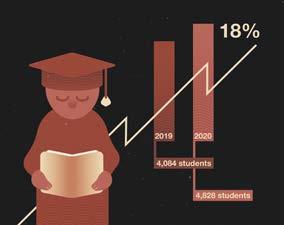
Despite the increasing tuition costs and shift to remote learning amid a pandemic, a preliminary 2020 fall term report states that the U of M has seen a sharp increase in enrolment compared to the 2018 and 2019 fall terms.
ing the number of part-time students at the university to 4,828.
These enrolment numbers follow the university’s decision to increase student tuition by an average of 3.75 per cent beginning this fall for both domestic and international students.
The tuition plan was developed about a year earlier by Todd Mondor, deputy provost (academic planning and programs), who, after the one per cent reduction in the university’s operating grant from the province, said the increase was a necessary step.
Executive director of student engagement and academic success
Brandy Usick said that while remote learning “can be challenging for some, for others it’s quite welcomed” because of the increased accessibility for those who may struggle balancing classes with other commitments.
they take on a full course load to see if they can make that transition successfully,” Usick said.
The sharpest increase is parttime enrolment at 18.2 per cent higher than last year
When looking at enrolment, Usick said the university’s traditional demographic is recent high school graduates and students aged 17 to 21, because for many students, “it’s just the normal trajectory, or what they see to be their trajectory.”
a “huge collective effort is being made to deliver the best possible learning under challenging circumstances and to align opportunities for students with labour market needs.”
“From our perspective, it’s wanting to ensure that we’re here to provide support to students — whether they’re full time or part time and whatever their personal situation is — in terms of helping them with that traditional transition from high school to university, but also given [COVID-19], helping them with transitioning into that remote learning environment,” Usick said.
Total enrolment this year saw a 3.7 per cent increase from 2019 following a 2.3 per cent increase the year before.
Undergraduate enrolment in fall 2020 saw an increase of 4.2 per cent, 1.9 percentage points greater than the increase in 2019, but the sharpest increase is part-time enrolment at 18.2 per cent higher than last year, bring-
She said many students have been taking longer to complete their degree programs, and that may be connected to the ongoing increase in part-time enrolment.
“It might be that [students] choose to take a reduced course load because of other commitments, or because they want to get their footing before
University of Manitoba president and vice-chancellor Michael Benarroch said “even during these uncertain times, more students are registering for courses because they want to secure a meaningful future for themselves.”
He continued to say that the U of M is prepared for the challenges, and
She said that in efforts to provide support for new students, the university 1 first year centre has been able to transition all programs online. The centre has done additional work through UM Commons and through new programs like prep week designed to familiarize new students with the university.
STAFF
GRAPHIC BY JENELLE MCCANN
PHOTO BY ALEXANDER DECEBAL-CUZA
Research and
Video games are the future of telerehabilitation
New devices track physical therapy progress from a distance
SARAH DORAN, STAFF
The rehabilitation and physical therapy process is difficult for long-term patients. Appointments can number in the hundreds and the cost of care is often steep — not to mention the mental aspect of struggling with repetitive, uninteresting exercises.
The U of M’s Tony Szturm, a professor in the Rady faculty of health sciences’ department of physical therapy, has developed a device to solve those problems. He and his team have created a miniature motiontracking wireless mouse that provides real-time data to physical therapists while the patient plays video games at home.
The motion mouse is the size of a flash drive, which means that it’s easy
to attach to anything from the brim of a hat to a modified game controller, depending on what the physical therapist wants to track. While the patient completes what Szturm calls “game-assisted repetitive task practice,” the motion mouse records how fluid the action is and how long it takes to complete.
Some 500 games have been tested with the motion mouse, and the availability of video games makes rehabilitation more engaging for the patient while also generating a lot of data.
“In three minutes of playing a computer game, they’re going to make hundreds and hundreds of movements,” Szturm said.
“Some fast, some slow, some large
amplitude, some small amplitude — the game activities are going to be randomized. I can add precision by decreasing the paddle size, so the beauty of a computer game is that not only are you doing movements, you’re doing precision movements.”
He added that while any game can be adapted as an exercise, different games will be more appropriate to the different skills patients want to restore. Szturm works with many patients looking to improve their fine and gross motor skills, but also patients with cognitive, balance and visual tracking impairments. Some patients may benefit from practicing dexterity and tracking in games like Bejeweled, while others find joystick games like Pac-Man more useful for
working on larger arm movements.
“The computer games are actually assessment tools,” Szturm said.
“When you’re doing movements in a computer game, I’m capturing your movements in the context of what they’re supposed to do, and I can come up with all kinds of motor
“The
computer games are actually assessment tools”
— Tony Szturm, physical therapy professor
and cognitive outcomes.
“I can see what they’ve done, I can see how well they did it and if they are progressing.”
Szturm recently worked extensively with Sanjay Parmar of the SDM College of Medical Sciences and Hospital in Dharwad, India to trial the motion mouse with 80 children between three and eight years old, but Szturm and Parmar’s work is not the first to link video game technology to telerehabilitation. The Xbox 360’s Kinect — which uses the player’s physical movements in the real world to control their avatar in a game — has been repurposed for remote observation as well. However, Szturm argued that having realworld objects to grip and manipulate is much more useful to the patient’s progress than reacting to the screen.
At $400, the motion mouse’s price is broadly comparable to current major video game consoles, but it’s
UMSU offering subsidy to offset transit costs
pass for the fall semester.
No U-Pass is being offered this fall term due to the majority of courses
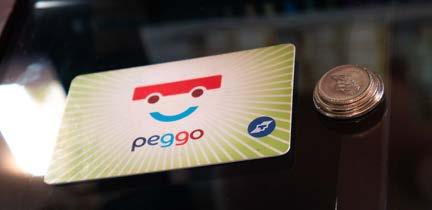
being offered remotely. A minority of classes and labs are being offered in person on U of M campuses. Given that no U-Pass is being offered this term, UMSU is seeking to bridge the financial gap between
the cost of the U-Pass and the cost of a post-secondary pass.
The U-Pass comes at a cost of $200 per term, while the post-secondary pass costs $278 per term. Typically, the U-Pass is mandatory for most
Eligibility requirements to access the subsidy include proof of financial need and demonstrated need to attend campus regularly for mandatory in-person classes
students and included in each term’s fee statement. In a statement posted on social media, UMSU said the transit subsidy has been “created to assist stu-
not available for general sale. Szturm, while adamant that the motion mouse is a medical device, explained that affordability was a driving force in the mouse’s design.
“The therapy has to be effective,” he said.“But the critical issue is — how much would it cost to give them tools that they can take home to do these effective exercises? […] These robotic devices and these sophisticated Kinect programs, they’re 10, 15, 20, 40, 50 thousand dollars. How many people, the average stroke client, are they going to be able to afford that for their home?”
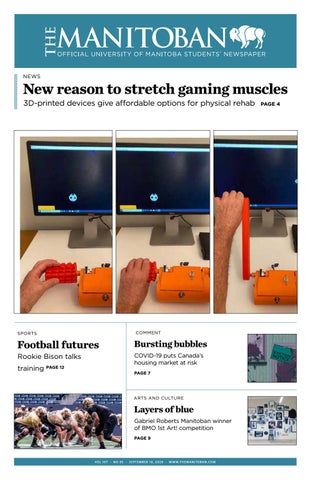
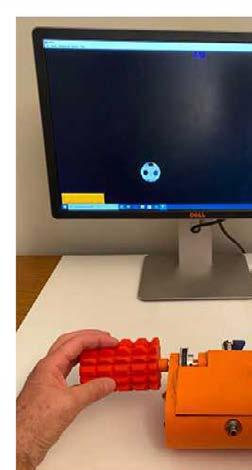
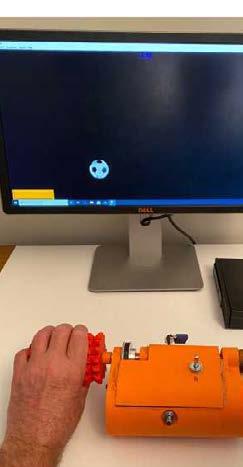
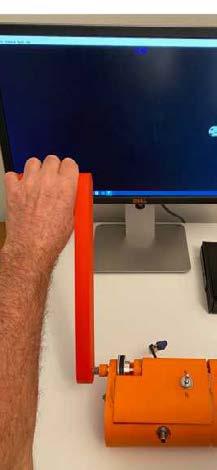
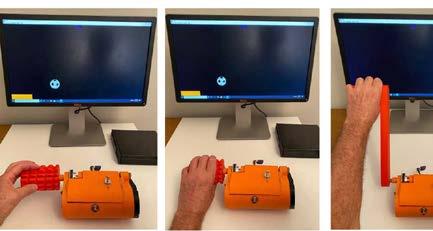
Working with Nariman Sepehri of the U of M’s mechanical engineering department and a team of graduate students, Szturm has also created a manipulandum — an object that is manipulated physically while testing motor skills— that looks like an orange box a little smaller than a box of tissues with prongs for attachments on the top and sides. The team can attach a wide variety of 3D-printed handles specific to the kinds of exercises the patient is doing, as well as adjusting the resistance to the patient’s needs.
The two devices are used separately. The motion mouse collects data on the patient’s movements while attached to something else, while the manipulandum allows the use of a specifically designed object to interact with. Together, the two devices represent a major step forward in at-home care.
The manipulandum will soon enter clinical trials before it is approved for general physical therapy use, with an estimated cost between $500 and $700.
dents in need.”
“With the majority of the upcoming term proceeding remotely, UMSU recognizes that there remain students who are burdened by the $78 and have no other reasonable way to attend their academic commitments which remain in-person,” UMSU said in a statement.
Eligibility requirements to access the subsidy include proof of financial need and demonstrated need to attend campus regularly for mandatory in-person classes.
For graduate students, the U of M graduate students’ association states on its website that it is “currently looking into how to assist students who may not be able to afford the extra cost [of a post-secondary pass].”
Application information for UMSU’s transit subsidy will be made available online in the coming weeks.
TEKLE, STAFF
PHOTO BY ALEXANDER DECEBAL-CUZA
PHOTO PROVIDED BY TONY SZTURM
Inexpensive options to monitor physical rehabilitation progress, like the movement-tracking manipulandum, allow physical therapists to provide at-home care.
Some classes cancelled for virtual scholar strike
Calls to action include BIPOC representation, mentorship in academia
GILLIAN BROWN, STAFF
Underrepresentation in academia among BIPOC (Black, Indigenous and people of colour) students and faculty is nothing new, but last Wednesday and Thursday, academics across Canada and the U.S. took a stand against it.
Either by in-class discussion or striking, several U of M professors and faculty participated in Scholar Strike Canada, a two-day virtual teach-in created to protest “racist, carceral, institutional and systemic forms of violence” that affect BIPOC scholars in academia.
The campaign originated from a tweet by Anthea Butler, a professor in the department of Africana studies at the University of Pennsylvania calling for labour action similar to the recent striking of professional sports players in support of the Black Lives Matter movement.
One of the faculty members at the U of M who signed an online statement of support for the strike was labour studies professor Julie Guard, who emphasized the importance of the virtual campaign held in Canada.
“We have a tendency to think about ourselves as immune to racism
because we compare ourselves to the [U.S.], but certainly, as a Canadian historian, it’s pretty clear to us that we’re not immune,” she said.
The Canadian strike, like its U.S. counterpart, calls for an end to anti-Black police violence, but has a specific emphasis on colonial violence against Indigenous people in academia.
Guard said that since the pandemic “the online presence just got a whole lot more active.”
Online activism is not new to Canada, but in the time of social distancing, “it’s a lot more necessary,” according to Guard.
movements, there needs to be both broad support from people and a “sustained life” of the movement.
The organizers of the strike corroborate this, maintaining that “statements of solidarity, while important, are not enough.”
In the effort to end violence against BIPOC in academia, the strike urges participants to commit to supporting demands to defund
Indigenous faculty in all Canadian institutions” and “supporting meaningful efforts to recruit, admit, retain and mentor” racialized undergraduate and graduate students.
At the U of M, that’s what assistant professor in the school of art Daniel McCafferty has been trying to do with his Indigenous design in residence program, which he hopes will show students that “personal values [and] personal politics can align with their practices.”
“As a Black person myself that has been through academia […] sometimes I am not sure [if I want to finish my degree] because of the barriers I know I will face when facing anti-Blackness from not only my classmates but from the very people that are supposed to be educating me”
— Mahlet Cuff, activist and U of W student
“We can only use the tools we have to hand, and one of those is the internet.”
She said in order to turn single events like the strike into social
police and redistribute the funds to marginalized communities and to remove campus police.
Calls to action also include addressing the “historic and current underrepresentation of Black and
“It’s important to have such models, because they’re not the dominant mode of practice in the world — they are not easy to support or sustain.”
University of Winnipeg student and activist Mahlet Cuff can attest to the underrepresentation at the U of W. Cuff said that “to be a BIPOC person within a white institution is terrifying because […] you will most likely not see people that look like you.”
“As a Black person myself that has been through academia […] sometimes I am not sure [if I want to finish my degree] because of the barriers I know I will face when facing anti-Blackness from not only my classmates but from the very people that are supposed to be educating me,” Cuff said.
Cuff was one of the leaders of Justice 4 Black Lives Winnipeg, the organization that led the rally in support of Black lives on June 5 which garnered more than 15,000 supporters at the legislature.
Guard said events like that are how change is made.
“Ordinary people have to impel our political leaders, our legislators, our community leaders and so on, to take the action that we want them to take […] That’s how politics works, right? That’s how legislation works.”
“It just enrages people,” she said.
“Sometimes, for inexplicable reasons in history, the stars just kind of align, and people are ready to take a stand on something and just say, ‘This is enough,’ and I think this looks like it’s one of those moments.”
PHOTO PROVIDED BY KELECHI (K.P. OBINNA) ASAGWARA
Earlier this year the Black Lives Matter movement, which includes events like the June 5 rally in Winnipeg pictured, began drawing attention to systemic racism. The scholar strike, held virutally Sept. 9 and 10, saw some classes either cancelled or replaced by in-class discussions. The strike movement began with University of Pennsylvania professor Anthea Butler who tweeted Aug. 26 “I would be down as a professor to follow the NBA and Strike for a few days to protest police violence in America.”
Editor-In-Chief: Matthew Doering
Contact: editor@themanitoban.com
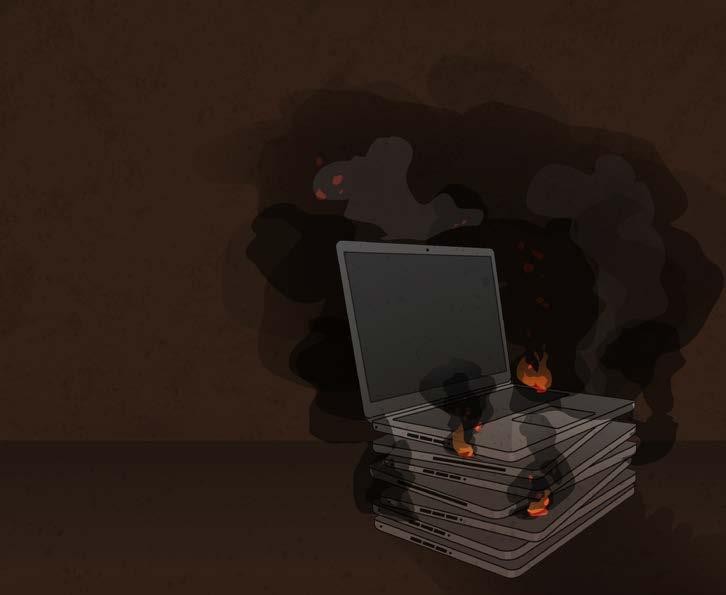
Inclusivity suffers when laptops banned in classrooms Professors should not mandate a no-computer
clause in their classes
SARAH DORAN, STAFF
Fall classes have kicked off the University of Manitoba’s academic year once again, but this semester looks a bit different — professors are going over syllabi using Cisco Webex and Zoom instead of in lecture halls, students are griping over unmuted mics instead of crowded buses and the normally bustling campuses are unusually quiet.
One of the most encouraging changes, however, is less dramatic than the rest.
For once, not a single professor has banned the use of laptops in their classes. Admittedly, that’s because laptops and computers effectively are the classrooms now.
Even so, making laptops a more permanent education tool when classes return to campus would be a welcome development.
Professors often cite a 2014 study by Pam Mueller of Princeton University and Daniel Oppenheimer of the University of California, Los Angeles as precedent for requiring students to take notes by hand.
The study suggested that the use of laptops results in a shallower understanding of lectures due to a tendency of students to take notes from a professor’s lecture verbatim instead of being forced to adapt notes in order to take them down more efficiently.
This is nonsensical.
As anyone who’s ever tried to take detailed, verbatim notes in a university-level lecture can testify, the rate at which professors speak far outpaces the rate at which most people can type.
In fact, when the U of M’s Student Accessibility Services office hires transcriptionists to provide wordfor-word transcriptions of lectures, they are usually assigned in pairs and switch off. This is because typing that quickly is exhausting and one person alone simply cannot manage the speed.
In addition, many professors use PowerPoint as a visual aid while delivering their lectures.
When students taking notes by hand are presented with a summary
of a professor’s lectures and have limited time to write down information, what motivation do they have to use
Sure, a student can get their instructor’s permission to use a laptop anyway, but it comes at the cost of being noticeably different from the rest of their classmates
their own words?
Laptop bans are also unnecessarily ableist.
The U of M prides itself on supporting students who need academic accommodations, but it’s hard to see this as anything but lip service when
professors are allowed to forbid computers, which are a vital part of many students’ accommodation plans. Sure, a student can get their instructor’s permission to use a laptop anyway, but it comes at the cost of being noticeably different from the rest of their classmates.
Is an opinion about learning styles, however well-researched, more important than a student’s right to privacy? No one should be put in the position of having to disclose disabilities without their consent.
Professors who follow accommodation plans while instituting policies that all but announce any deviation from the abled neurotypical norm are essentially telling students from the very first week that they matter less than the professor’s feelings.
But wait, professors cry — what about students who play games, watch videos and message people during class? Surely even other students can understand how that would be distracting.
The problem is, professors are
considering this from their own perspective, not the perspective of other students. At the end of the day, students pay a lot of money to attend classes. The goal is to pass the course. If a given student chooses not to pay attention during a lecture, that’s their problem. It will no doubt show in their final grade.
To denounce the misuse of computers during class time is one thing, but to ban computers altogether alienates students who rely on them. There is no logic in penalizing entire classes, present and future, for the misbehaviour of previous students.
With the COVID-19 pandemic pushing at least the fall 2020 semester online, the U of M should take this opportunity to put an end to laptop bans.
After all, the alternative is once more forbidding students to type their notes after months of requiring a computer to attend class. If the university really wants to be front and centre, now is not the time to take a step back.
GRAPHIC BY JENELLE MCCANN
Canadian housing market’s foundation is cracking
Universal housing voucher program provides path forward for low-income renters
LUCAS EDMOND, STAFF
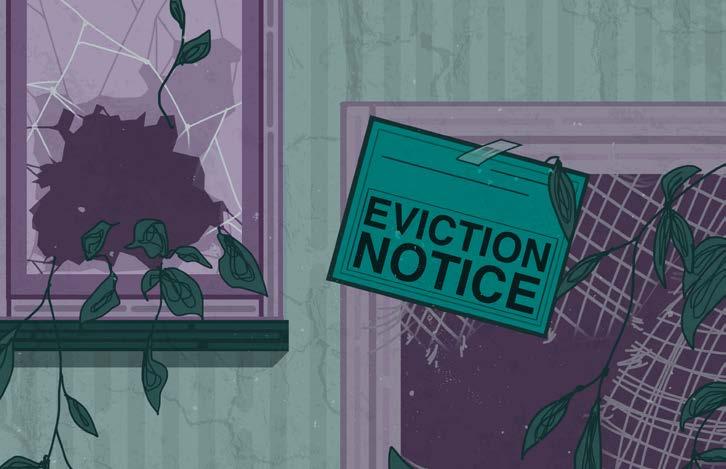
Provincial eviction bans across Canada have begun to end. The bans were initially adopted as a response to the economic shut-down induced by COVID-19.
These bans, along with income support from the Canadian Emergency Response Benefit (CERB), have maintained the integrity of the housing market during the pandemic.
But with COVID-19 still in full swing and eviction bans being lifted, it could spell bad news for lowincome renters and potentially the Canadian economy.
While the U.S. was plunged into a housing crisis in 2007 — which subsequently turned into the financial crisis — Canada had a slightly different experience.
Although Canada certainly felt reverberations from the financial collapse — after all, when the U.S. sneezes, the world catches a cold — our housing market was relatively unscathed.
The U.S.’s housing market simply acted as the catalyst for a more severe financial meltdown.
As a result, when the financial collapse was felt across the border, Canada looked to monetarily stimulate the economy by lowering already incredibly low interest rates. These lowered interest rates increased borrowing but effectively placed borrow-
ers in a highly precarious leveraged position with big banks.
Canadians owe over $2 trillion in consumer debt and since 2008 our debt spending has risen 80 per cent.
The housing market was not excluded from this spendthrift.
Landlords from across the country took out loans to expand the quantity of their rental properties, thereby inflating the housing market, rents and mortgages and effectively contributing to unsustainable growth in the housing sector. And now, more than ever, the Canadian economy is reliant on its housing market for growth.
The real estate sector took up approximately 15 per cent of Canada’s annual gross domestic product in 2019 — this does not include the collateral industries involved in making the housing market’s gears turn. Industries like nail production, lumber for framing or minerals for foundation rely on growth in the real estate sector in order to maintain their economic integrity — and so does a vast labour market.
Considering how indebted the housing market is at the moment, if individuals stop paying rent due to unemployment, Canada could be in for a massive economic meltdown that sends shockwaves throughout the country.
Although many renters in smaller,
more livable cities have been able to maintain payments on their leases with the help of the CERB, many renters in high-cost cities like Toronto, Ont. or Vancouver, B.C. have fallen behind on payments due to unsustainably high rental costs that the CERB simply cannot account for.
In this scenario, many tenants have been left to the mercy of their landlords.
As debt deferrals end in October, just as most eviction moratoriums will have ended, landlords will likely be less willing to understand a missed payment under the pressure of their mortgages.
Even more nerve-racking, a recent report published by the Canadian Alliance to End Homelessness suggested one in four Canadian renters are worried about affording rent.
But evicting tenants could very well undermine landlords’ means to afford their mortgage.
A large chunk of renters nowadays includes young workers in precarious employment scenarios — the very demographic that has been most affected by lost hours or work from COVID-19. And in this unique scenario, there may not be enough demand to meet the supply of dwellings that will be made available when evictions begin.
Nonetheless, landlords have a playbook of judicially backed power
that they have relied on since the first imaginings of private property — a system that makes it remarkably easy to evict tenants who have made a home out of a rental property. So, expect landlords to act on eviction when they can.
With an economic outlook as dismal as this, it is time to re-imagine housing as a fundamental human
With an economic outlook as dismal as this, it is time to re-imagine housing as a fundamental human right and entrench with it mechanisms to protect the most vulnerable sectors of society and the economy
right and entrench with it mechanisms to protect the most vulnerable sectors of society and the economy.
Establishing a universal housing
voucher program would be a solid place to start and could bring an equilibrium to the private housing market.
This system suggests that anybody under a baseline income level would be eligible for subsidized rent to live anywhere. Under such a system, government administrators would set fair rents based on the quality of the home to prevent landlords from exploiting renters. Tenants would be expected to dedicate 30 per cent of their monthly incomes to rent with government vouchers subsidizing the rest.
This program would effectively provide security to renters, affordable housing in high-cost areas and would regulate the greed of the private housing market. Evictions would become an abnormal occurrence and the precarity of an increasingly volatile market would be stabilized by guaranteed payments.
The Canadian housing market is treading dangerous waters with COVID-19.
If landlords want to maintain their privileged position in the economy, they would do well to exchange a piece of their profit for stability with the universal housing voucher program.
Comment Editor: Lucas Edmond Contact: comment@themanitoban.com
GRAPHIC BY JENELLE MCCANN
Arts & Culture Editor: Shaylyn
Maharaj-Poliah
Local theatre festival resumes performances
Enhanced safety procedures in effect for FemFest 2020 live performances
SHAYLYN MAHARAJ-POLIAH, STAFF
With the fourth phase of Manitoba’s pandemic plan for restoring safe spaces allowing for live stage performances to resume with limited capacity and physical distancing measures, the show will go on for Sarasvàti Productions’ annual feminist theatre festival, FemFest, one of the first live theatre events to occur in Winnipeg since the March closures.
While having humble beginnings back in 2003 as a small event meant to showcase female playwrights and their work, FemFest has grown into a
full-scale festival, garnering national attention and featuring diverse lineups of female and non-binary theatre artists from across Canada and all over the world.
The goals of the festival include showcasing women playwrights and emerging theatre artists as well as providing a platform to address female-centred social issues through performance art, installations, music and dance.
The theme for this year’s festival is “engaging community,” which the
organizers aim to do through workshops for novice and veteran theatre practitioners to hone their skills, develop new projects and attend lectures delivered by experts in the field. These events are not limited to theatre folk, however, and Sarasvàti hopes for everyone to enjoy the magic of theatre safely, despite these unpredictable times.
What’s different about this year’s offerings is that the festival is adopting a hybrid approach and advertises both in-person and online events to
abide by the province’s health and safety procedures.
One such event includes livestreamed screenings of Montreal
The goals of the festival include showcasing women playwrights and emerging theatre artists as well as providing a platform to address femalecentred social issues
playwright Alexandria Haber’s Alice and the World We Live In, starring local powerhouse performers Elena Anciro and Ray Strachan. The play chronicles a woman’s struggles as she tries to cope with the loss of a loved one. Screenings will take place both online and in a socially distanced manner at Assiniboine Park on Sept. 23, 25 and 26.
Another show featured via livestreaming only, Monstrous, by Sarah Waisvisz, is a one-woman auto -
New Indigenous series premieres this fall
APTN’s original documentary series Amplify aired its pilot and second episode Sept. 11. Pre-filmed in the spring and summer of 2018, new episodes will air weekly in English and Ojibwa.
This new show provides a platform for some of the country’s most innovative rising Indigenous singersongwriters to combine their personal stories with Indigenous history and culture and showcase the music that comes from it.
Each episode of the creative anthology invites an Indigenous songwriter to write a song about something inspirational — such as an art piece or belief — and ends with a music video of the finished song. The series was created by Ottawaborn Shane Belcourt, a Métis musician and filmmaker known for his feature films Red Rover and Tkaronto Since, in Indigenous cultures, traditional songs pass down histories, life lessons and philosophies from previ-
ous generations, Belcourt believes music is the glue that holds these communities together.
Belcourt tapped into songwriters he believes are open, articulate and fearless storytellers. The audience gets the opportunity to see how these songwriters view a particular Indigenous issue.
“We called it ‘Amplify ’ because the series amplifies Indigenous music, Indigenous stories and Indigenous perceptions,” Belcourt said.
“By narrowing that story and those big ideas down to a single person, then you’re now feeling that this work and these ideas are not just stats,
“We called it ‘Amplify ’ because the series amplifies Indigenous music, Indigenous stories and Indigenous perceptions” — Shane Belcourt,
creator
they’re not figures, they’re not problems to solve, they’re specific human beings in all our communities.”
This enables every viewer to relate to the issues, regardless of ethnic community.
Amplify currently has 13 episodes lined up from Wolfwalker Productions and Wabung Anung
biographical show that provides commentary on Canada’s multiculturalism. Through incorporating dance, song, projections and audience participation, the audience joins the protagonist on her journey of selfdiscovery. The piece stars Waisvisz as herself and was directed by Eleanor Crowder. The performance will be streamed from Sept. 23 to 25.
In addition to providing different viewing options for events to adhere to health and safety protocols, Sarasvàti Productions is also implementing a digital self-declaration form for guests to fill out if physically attending a performance.
Other measures include timed arrival slots, so as not to exceed lobby capacity for indoor performances, a new refund policy to allow for lastminute ticket cancellations if guests are experiencing symptoms, mask requirements for all staff and volunteers as well as cashless concession and ticket sales.
Tickets for this year’s festival are $15 for single shows and $50 for festival passes.
FemFest 2020: Engaging Community runs from Sept. 19 to 26. For more information on the festival schedule and COVID-19 protocols, visit sarasvati.ca.
Film Co., each highlighting a different artist and director from the same regions and backgrounds.
Shot in numerous locations throughout Ontario and Manitoba, episodes seven through nine were filmed on location in Winnipeg and feature local Indigenous artists and directors.
The seventh episode, titled “Enfolding,” airing in English Oct. 16, features U of M alumna Tara Williamson, a Cree songwriter whose songs self-examine truths that hurt before they heal.
In the episode, directed by Winnipeg filmmaker Madison Thomas, Williamson tries to make sense of losing her infant son while examining the power of art to encapsulate loss.
The series gives voice to Indigenous worldviews on various unique topics, many rooted in pain. However, Belcourt says, “through music, there is inevitably a hopeful outlook.”
Amplify airs on APTN in English on Fridays and in Ojibwa on Thursdays at 7 p.m.
PHOTO PROVIDED BY TAO PR
PHOTO PROVIDED BY SARASVATI PRODUCTIONS
U of M student wins big in Canada-wide competition
Gabriel Roberts discusses inspiration, rationale behind his award-winning art installation
ZOË LEBRUN, VOLUNTEER STAFF
Gabriel Roberts, set to graduate from the U of M’s school of art next summer, has been named the Manitoban winner of the 2020 BMO 1st Art! competition.
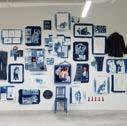
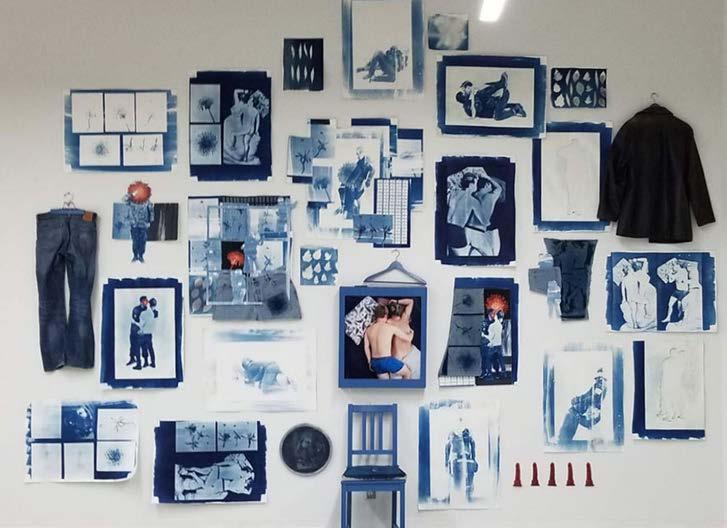
His winning piece, A Closet Painted Blue, is a multimedia installation work that explores his own sexuality within the confines of a closeted relationship.
Inspired by the work of artists such as Joe Sinness, Aaron Skolnick, John Dugdale and Ivan Forde, among others, Roberts has always sought out opportunities to experiment with alternative photographic processes. This has led to continual experimentation with these mediums throughout his artistic practices and is especially relevant in his work A Closet Painted Blue, which was the very first piece in which he used the cyanotype process.
“I love the physical nature of exposing and processing images manually,” Roberts said.
“For me, it is the most rewarding medium and I plan to continue using alternative process photography as my main medium.”
Roberts also spoke about how the nature of cyanotypes supports the core concepts of A Closet Painted Blue
“I wanted to use cyanotype photography as my medium to express
A Closet Painted Blue ’s core concepts because of the numerous steps that have to be undertaken to produce the image and the automatic reflection that comes with engaging with my images physically.”
This brings him even closer to the subject matter and artwork as it is slowly created, step by step.
In addition, Roberts also commented on how A Closet Painted Blue was an important venture into a being more vulnerable in his artwork.
“It was the first time that I made work about my sexuality,” Roberts said.
“I had promised myself to create a personal piece for my honours year, and part of that promise was to step outside of my comfort zone to share it with others.”
Sharing this subject matter is important to Roberts for many reasons, including but not limited to connecting with other gay artists.
“I created A Closet Painted Blue as a contemplative exploration into my sexuality within the constraints of a closeted model,” Roberts said.
“This project allowed me to be meditative, vulnerable and honest while exploring the consequences of a closeted relationship and the prevalent fear of coming out.”
For those approaching A Closet
Blue without any context about Roberts’s work, the first thing most viewers notice is the predominance of the colour blue throughout the piece itself.
The abundance of this colour is a direct result of the cyanotype process, yet this colour represents much more in the piece.
“Firstly, blue is associated with sadness, so I was attributing the colour with my feelings in my relationship,” Roberts said.
“Secondly, we all currently live in a society that associates people assigned male at birth immediately with the colour blue.
“As a person who continues to identify myself as male […] it seemed appropriate to express the work through the context of blue.”
Another intriguing part of A Closet Painted Blue ’s installation is the presence of various objects and items of clothing, all of which hold special significance in the piece for Roberts and were yet another place of experimentation in cyanotype’s versatility as a medium.
“My goal for the year was to fill a ‘bedroom’ with cyanotypes,” said Roberts.
“I was slowly experimenting with the process of printing images onto a variety of objects and ultimately
working toward the goal of using different pieces of furniture […] the hangers are a small nod to the closet […] and I chose to experiment with leather because of the denim and leather subcultures in the [LGBTTQ*] community.”
The assemblage aspect to A Closet Painted Blue ’s installation very much
“I had promised myself to create a personal piece for my honours year, and part of that promise was to step outside of my comfort zone to share it with others” — Gabriel Roberts, artist
drives home the idea that the piece we are viewing is made up of a multifaceted experience — one where memories and emotions become tied to the things around us that we
see and interact with every day. In this way, A Closet Painted Blue also imparts the idea that a self-portrait or time capsule of experience can be found in the most mundane of objects throughout our daily lives.
On being named Manitoba’s winner of the BMO 1st Art! competition, Roberts was ecstatic.
“It felt incredible and empowering to be recognized by an esteemed selection committee outside of my community.”
Roberts also expressed gratitude.
“I want to take this opportunity to thank the faculty and staff at the [school of art] for all of their support and behind-the-scenes assistance that allowed me to create A Closet Painted Blue,” he said.
“I would also like to thank BMO and the BMO 1st Art! team for their support.”
“Leaving art school, this award will allow me to continue to create meaningful artwork.”
Gabriel Roberts’s artwork A Closet Painted Blue is available to view in the first-ever virtual BMO 1st Art! exhibition from Sept. 15 to Oct. 16 at artmuseum.utoronto.ca.
Painted
PHOTO PROVIDED BY TOUCHWOOD PR
Shaylyn Maharaj-Poliah
American awards show acknowledges Canadian talent
Su Rynard’s
documentary
DOMINIQUE WIGHTMAN
nominated in two categories at the Jackson Wild Media Awards
Director Su Rynard’s documentary Reef Rescue has been declared a finalist in the Jackson Wild Media Awards (JWMA).
Selected by more than 150 international judges from
Selected by more than 150 international judges from roughly 620 entries from over 30 different countries, the film has been nominated for two awards
roughly 620 entries from over 30 dif- ferent countries, the film has been nominated for two awards in the long form categories of best conservation film and best science in nature film.
Produced by Merit Motion Pictures in Winnipeg, Capa
Presse/Films à Cinq and ARTE, in association with the CBC and Vulcan Productions, Reef Rescue follows an international team of scientists as they utilize the new revolutionary technique of “assisted evolution” to reproduce super coral.
By reproducing super coral, these scientists hope to resurrect coral reefs that are already decaying or dead.
Reef Rescue documents the process of assisted evolution on super coral reproduction and seeks to apply its subjects’ knowledge to the global effort of coral reef revitalization.
Based out of Jackson, Wyo., the JWMA is considered to be “the highest bar of achievement in the natural history filmmaking industry” and has been dubbed “nature film’s equivalent to the Oscars.”
Reef Rescue is up against stiff competition in both categories.
In best conservation film, Reef Rescue is nominated alongside Corona — The Pandemic and the Pangolin, Jane Goodall: The Hope and The Story of Plastic.
In best science in nature film, Reef Rescue is nominated alongside My Octopus Teacher, The Age of AI: Saving the World One Algorithm at a Time and The Deep Med
Reef Rescue is the fifth feature in Su Rynard’s filmography and expands her earlier work’s exploration of art, science, ecology and the relationship between man and nature.
Within her filmography, Rynard has established a respected portfolio with a breadth of genres, including dramatic, experimental, documentary and installation.
Rynard is no stranger to the wildlife film award circuit. In 2015, her documentary The Messenger garnered critical acclaim and was granted numerous awards. Her 2017 documentary Mosquito was met with similar acclaim and distinction, most notably the Golden Sheaf Award for best documentary in the research and science, nature and technology categories.
The JWMA are part of the Jackson Wild Virtual Summit, which will be held online from Sept. 28 to Oct. 1.
The summit will host event speakers and delegates including “innovative filmmakers, conservationists, photographers, scientists and thought-leaders from across the globe, all engaged in conservation, nature, wildlife and media.”
The JWMA winners will be announced digitally on Oct. 1.
For more information on Reef Rescue, visit the film’s respective producers at filmsacinq.com/en/portfolio/reef-rescue and vulcanproductions.com/reefrescue/thefilm. More information on Su Rynard and her work can be found at surynard.com.
Physical distancing is mandatory. We have over 70,000 square feet for everyone to safely social distance. All lines will allow for 2m/6ft distance between each guest/group. Markers will be placed in all lines for mazes, food trucks, merchandise, and at the ticket booth. All visitors must wear a mask. FREE souvenir HEEBIE JEEBIES mask will be provided.*
*For more information about our COVID-19 policies, please visit our website. This is an intense haunt experience and is not recommended for those under 13 years old.
Vaccaro excited about future with the Bisons
Being part of the team ‘a great experience’
ISAIAH WAGNER, STAFF
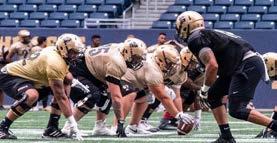
Though the U of M Bisons football team has been able to practice, the cancellation of the season due to the COVID-19 pandemic has left many first-year players ready to make their rookie season debuts waiting for another year to get their shot.
One of those players is first-year offensive lineman Matteo Vaccaro.
Vaccaro has played football for many years, previously at St. Paul’s High School and with Team Manitoba before suiting up for the Bisons. Vaccaro credits great coaching with the improvements his football skills have seen over his career thus far.
“The coaching staff that I was around for my high school football career played a huge part as to how I was able to bring my game to the next level,” Vaccaro said.
“Furthermore, being able to play on both the [under 16] and [under 18] provincial teams, I was exposed to the best coaching in the province which helped elevate my game to get to the next level.”
Quarantine can be tough on
many athletes due to the struggle to remain on an elite level of
“Being a part of the Bisons football team has been a great experience for me. The team is very welcoming and the group of guys that I am around every day brings a lot of energy to my day”
— Matteo Vaccaro, U of M Bisons
athleticism.
Vaccaro has remained in-shape with a mix of at-home workouts and team practices that have fol-
lowed safety precautions, and he is determined to be ready for the next season.
“During quarantine, I have been able to do some weight training at my house,” he said.
“Also, the team has been able to practice every Tuesday, Thursday and Sunday at the east turf near the soccer complex while following the university’s COVID-19 protocol for safe training.”
Going to a new team can be a hard process, but Vaccaro has had an easier time adjusting, which he attributes to the team itself.
“Being a part of the Bisons football team has been a great experience for me,” he said.
“The team is very welcoming and the group of guys that I am around every day brings a lot of energy to my day.
“The coaching staff is amazing and are driven to help shape who we are as a team,” he added.
“The team has really prided themselves on creating a brotherhood amongst every member of the team where no one is left out, which is amazing.”
Vaccaro described a close team when speaking about the Bisons, a trait that is necessary to the sport because of how important teamwork is on the field.
“I enjoy being a part of a team environment where every member has to work together, allowing the team to succeed.
“I enjoy the bonds that are created on the team that carry out further than football.
“Furthermore, football provides me the opportunity during the day where I can drop any thoughts during the day, good or bad, and work on my craft alongside my teammates and coaches,” Vaccaro added.
A unique challenge facing student athletes is the necessity to balance school with sport, something Vaccaro is aware of.
“My intentions for school are to pursue law,” he said.
“My future goals for football would be able to play out all of my eligibility with the Bisons and to secure a starting position with the team.”
National Hockey League moves up the entry draft date
First round to begin Oct. 6
ISAIAH WAGNER, STAFF
The NHL has announced that they have moved up this year’s entry draft to Oct. 6 and 7, a few days earlier than the original dates of Oct. 9 and 10.
The draft, which was supposed to be held in Montreal, Que., will now be held virtually for the fans to watch due to the COVID-19 pandemic. There will be no in-person attendance at the draft as it will all be done online. Despite this, the draft remains an exciting time for teams, players and fans as the spotlight is shone on some of the best hockey prospects in the world.
A virtual draft isn’t unprecedented this year, with the National Football League having held their own entry draft virtually earlier this year.
The New York Rangers will have the first selection in the draft and are projected to select Canadian Alexis Lafrenière. Lafrenière scored a total of 112 points in 52 games last season in the Quebec Major Junior Hockey League for the Rimouski Océanic.
Other notable potential first-round picks are Canadian Quinton Byfield and Winnipegborn Seth Jarvis.
Both players are projected to be top 10 picks and can be expected to make an impact for their respective teams immediately.
The Winnipeg Jets will be drafting at number 10 this year and will have plenty of options to choose from when its name is called.