City, Manitoba Metis Federation push out Indigenous and Métis residents
GILLIAN BROWN, STAFF
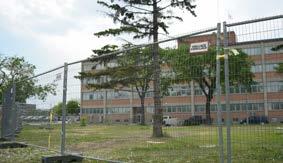
People living in tents outside the Manitoba Metis Federation (MMF) were evicted after the federation sent a letter to the city threatening legal action if the camps were not broken up.
On June 10, after responding to two fires at the site, the Winnipeg Fire Paramedic Service (WFPS) ordered that all occupants were to vacate the property before noon on Friday, June 12.
That Thursday, the camps were evicted by the city.
WFPS determined there were numerous fire and life safety concerns present at the encampment, including excessive accumulation of combustible materials and risk of carbon monoxide accumulation within shelters.
The federation has said the safety concerns are due to drug and alcohol use at the camps.
Warren “Tower” Redhead was
among the group of Indigenous and Métis people who lost their residences.
“Last year [David Chartrand, MMF president] told us that it would be a safe spot […] for tenting,” Redhead said.
According to Redhead, Chartrand had been providing the camps with space, as well as free food on some days.
“It was quiet, it was safe. It was safer than people think it was,” Redhead said.
“I thought it was safer than anywhere else. Even if I had a choice, I would put a camp up right outside the fence [of the MMF property],” he added.
He said he believes the reason they were told to leave was because Chartrand and other MMF employees there were scared by an incident with one side of the camps.
According to Redhead, there were roughly 28 or 29 tents in total around the building. There were 21 on his side and seven or eight on the other side.
He said his side was “the clean side” — with minimal drugs or alcohol and once a month city workers would come and clean the site.
The residents lived independently from the MMF, providing their own heating and electricity through gen-
“I lost everything, and now I’m starting over” — Warren Redhead
erators along with their own carbon monoxide detectors.
“But over [on the other side] there was meth […] They were going a little crazy over there.”
Redhead said that a possible cause for alarm was when one of the members of the encampment chased after an MMF employee.
“Just from that one incident, the worker there felt unsafe.”
International PhD tuition fees to be reduced to match domestic rates
International PhD students no longer eligible for IGSS, IGSES awards
SARAH DORAN, STAFF
T
he University of Manitoba faculty of graduate studies has reduced the tuition fees for international PhD students beginning in the 2020-21 academic year.
Deputy provost of academic planning and programs Todd Mondor — who was the dean of graduate studies before taking his current position — said the change had been planned for at least two years.
The decrease is intended to replace the granting of the International Graduate Student Scholarship
(IGSS) and International Graduate Student Entrance Scholarship (IGSES). Previously, students with a GPA of 3.5 or higher automatically qualified for the IGSES with no application necessary. Mondor estimated that a little over 80 per cent of international PhD applicants were receiving at least one of the scholarships.
“The scholarships were meant to compensate the international students for the higher tuition that they would pay,” he said.
While undergraduate tuition varies depending on faculty and course load, graduate students pay a base program fee per term — with a few exceptions — for a set number of years, then a continuing fee for any years that follow.
Master’s students pay the program fee their first year, while PhD students usually pay the program fee for two years.
“Domestic and international graduate students pay the same continuing fee, and they have for a long time,”
Mondor explained.
“So, that’s not changed. But on paper, international graduate stu-
“Most international students are paying the same as domestic students […] and have been for a long time” — Todd Mondor, deputy provost (academic planning and programs)
dents are charged about double the program fee for every year they pay the program fee.”
Prior to the fee decrease, international PhD students were charged $5,662.56 in program fees per term — more than twice the $2,573.86 rate for their domestic counterparts.
“We were nominally, on the surface, charging these students higher tuition, a higher program fee, but then they’d get a scholarship that compensated them for that,” Mondor
He recalls that members from the opposite side of the encampment had come and attacked his side as well.
In a public statement, the city explained that “the decision to ask individuals to leave the encampment was not made by the city alone and was supported in full by our partner agencies as the site has become dangerous for those residing in it and other members of the community.”
The Monday night after they had been forced to leave, Redhead’s own tent had been lit on fire. He and the rest of the former residents of the encampment no longer have a safe space to live.
“I lost everything, and now I’m starting over,” he said.
Main Street Project provided Redhead with a new tent and clothes, and he has now set up camp with some others in a new location.
“I think someone should just buy [the MMF building], tear it down and put up a homeless encampment there.”
said.
“Most international students are paying the same as domestic students already at the U of M and have been for a long time.
“Why not just get rid of the scholarship and charge the students the same rates right off the bat?”
He also discussed the university’s strategic enrolment plan, which hopes to attract more graduate students and more PhD students in particular.
“We want to get more PhD students here — they really contribute enormously to the research activities of faculty members that they work with,” he said.
“They really are a great benefit to the university.”
Mondor referenced the national movement to reduce international student tuition rates, but said that with the COVID-19 pandemic causing budget cuts for education, there is no plan currently in place to reduce tuition for international master’s students as well.
“That’s something we might come back to at some point.”
The registrar’s office website, though not yet reflecting the new rates, is expected to be updated over the summer.
PHOTO BY ALEX DECEBAL-CUZA
PHOTO BY QUINCY HOUDAYER
Q-and-A with Justice 4 Black Lives Winnipeg organizer
Mahlet Cuff talks rally, allyship, demands
AMIRA TEKLE, STAFF
Mahlet Cuff is working toward a women’s and gender studies degree at the University of Winnipeg. She is also one of the organizers involved in the Justice 4 Black Lives Winnipeg group that organized the rally at the legislature June 5.
The Manitoban spoke with them after the rally.
The Manitoban:
Why did you decide to become involved in organizing the Justice 4 Black Lives Winnipeg rally?
Mahlet Cuff :
It’s definitely something that has been on my mind for the past couple of months […] There has been a lack of organizing in the city for Black people and Black women and Black non-binary folks and queer folks as well to talk about these kinds of things and the injustices that we see in [the U.S.] but also here in Winnipeg, or in Canada in general. I put out a call-out about a week ago […] [asking if] any Black folks want to organize to rally or protest or whatever it may be to talk about Black lives and Indigenous lives because we’re both disproportionally [victims of police brutality], racially profiled and treated terribly [compared to] our white counterparts. So, that was something I put out on Facebook and on Instagram […] and the response was outpouring, and the support of Black folks and then allies who want to be able to support and Indigenous folks who want to be able to support
“We don’t want to cause harm […] we want to make sure our community is safe for every single person. We showed the police that we don’t need them. “
— Mahlet Cuff
as well. I never expected it to be this big in the sense that people really wanted to show out and be able to help.
The Manitoban:
What did you hope to achieve, or what do you believe was achieved by holding this rally? What do you think this rally meant for Winnipeg?
Mahlet Cuff:
That’s something I’ve been processing for the last couple days […] I think what we achieved as a group
of people — to be able to put this on for the community — was to be able to be represented. I think we wanted Black folks to [think], “I can see someone that looks like me speak in front of everyone and tell me that my life matters.” I think that’s something that’s been really lacking in this city […] There isn’t enough visible organizing, that people can go out in the streets and feel comfortable going out and protesting about these kinds of things and speaking about these
“I hope we showed people that this is not the end” — Mahlet Cuff
kinds of things, too.
So, I think what we achieved is to show that Winnipeg really showed love for the Black community and the Indigenous community, but […] that rally was one day […] and this is something that [should] continue into the next couple — we hope — months and years. I hope in my lifetime, I hope in my family’s lifetime that this will not be a thing we have to go and protest, for my life and other people’s lives.
I hope we showed people that this is not the end, and this is the continuation of what anti-racist work and [working against] anti-Black racism looks like in the city.
The Manitoban: What problems and issues do you think Black and Indigenous people face when it comes to racism by police and from the public in Winnipeg and in Canada on a local level?
Mahlet Cuff:
I think it is on all levels [from] the minimum — so, microaggressions — to the max where you are kicked out of somewhere for being Black or Indigenous. What I’ve experienced is [situations] where people think they have access to my body or my hair or telling me that I “sound white.”
My name is not an English name — it’s an Ethiopian name — so people telling me they can’t pronounce it [saying] “Oh, it’s too hard, what’s your nickname?” So, it’s those kinds of things.
Then things get worse and worse […] I’m not a dark-skinned Black woman, so I think about those women in the sense of what they go through and how they are treated terribly [as opposed to] lighter-skinned women. Black men are fetishized […] and seen as violent when they’re just people trying to be people. I think
about police brutality, I think about surveillance of Black people in the community, I think about being pulled over for something that isn’t even relevant and then [police officers] asking me, “Is this your car?” when they know damn well it is my car — it says my name on the insurance.
[It’s] those kinds of things […] or even more extreme than that, being arrested for something you didn’t even do and going to prison for a long time […] Or even in schools, where there are cops at high schools […] There should not be cops waiting for you at school every day. Your teachers are supposed to be there, your friends are supposed to be there.
It really shows that Winnipeg is not much better than anywhere else […] There’s a way that Winnipeg is
“So, I think what we achieved is to show that Winnipeg really showed love for the Black community and the Indigenous community, but […] that rally was one day […] and this is something that [should] continue into the next couple — we hope — months and years”— Mahlet Cuff
able to hide things and brush things under the table to protect the wrong people. I think with this rally, and I think with the conversations we’re having in Canada, Winnipeg, Treaty 1 and all over Turtle Island, [the consensus in our community] is that we can’t keep brushing things under the table anymore, underneath the rug […] I am fed up, I am angry, I am sad and I am frustrated with the people in my community […]Words are just words, action means the real thing.
The Manitoban:
Could you describe the importance of non-Black and particularly Indigenous allyship in Winnipeg, where the Black and Indigenous populations are comparatively small as opposed to the white population?
Mahlet Cuff:
That’s something I have been
really thinking about for the last couple months […] It is so important for non-Black people and Indigenous folks to really show up for Black people in the sense that, if I’m able to call out someone or tell someone that they’re being racist, there’s a limit and I hit a capacity where I can’t do it anymore.
So, I really hope people understand that this work is not only on us — it’s on non-Black people, it’s on Indigenous folks, it’s on the people that don’t face the brunt of anti-Black racism. You have to really show up — when you see something [racist] on Facebook, say something. If you can’t say something, tell your friend to say something if they’re more comfortable to say it. If you see something in [public] and it doesn’t look right and you’re a white person or you’re a nonBlack person, you benefit from white supremacy. You have to remember that you have a place to say something. Film it, see what you can do to show the allyship, because allyship doesn’t mean anything to me if you’re not able to call out things, if you’re not able to make phone calls, if you’re not able to donate money, if you’re not able to go to rallies.
The Manitoban: Why do you think this rally was so peaceful when some rallies south of the border for the same or a similar cause have devolved into rioting?
Mahlet Cuff:
I think Winnipeg wanted a peaceful event. I think the city wanted it to be peaceful. I think we put enough messaging out there [saying] that if you respect the organizers, the Black community, the Indigenous community, folks of colour, you’ll know that if there was a riot, that would […] marginalize people even more.
We gave the information to ensure it was peaceful, we reiterated
“So, I really hope people understand that this work is not only on us — it’s on non-Black people, it’s on Indigenous folks, it’s on the people that don’t face the brunt of anti-Black racism”
— Mahlet Cuff
that in our messaging very clearly and consistently every day up until the day of the rally and at the rally as well [...]
“This is something that is a long-term goal for all of us […] We want to make sure Winnipeg is held accountable for their actions and make sure that Black folks are protected and Indigenous folks are protected [so] we don’t have to protest anymore”
— Mahlet Cuff
I think that shows the police and the city that you have to trust the community — if you don’t trust us, that’s where the disconnect happens, that’s when people riot and that’s when people cause harm to their communities. We don’t want to cause harm […] we want to make sure our community is safe for every single person. We showed the police that we don’t need them.
The Manitoban: Will you be holding any similar events in the future? What’s next for Justice 4 Black Lives Winnipeg?
Mahlet Cuff:
We hope so. Right now, we’re really talking about the petition, with our list of demands which outlines abolishing the police, putting more money into community not-for-profits that support Black and Indigenous youth and people of colour. I think people need to look at the petition and sign it […] Share it with your friends […] so it’s constantly circulating, not only here in Winnipeg but across Canada, so we can show the city that this is not going to be done after [June 5]. This is something that is a long-term goal for all of us […] We want to make sure Winnipeg is held accountable for their actions and make sure that Black folks are protected and Indigenous folks are protected [so] we don’t have to protest anymore.
Petition, calling out [racist behaviour] — we want people to hold other people accountable, which is what we’ve been doing all week.
We’ve been holding the city accountable, the government accountable for their actions, [holding] the police accountable. So, we hope people continue to do that, and we will, too.
Legislature grounds crowded in support of Black lives
Justice 4 Black Lives Winnipeg petition gathers over 60,950 signatures
AMIRA TEKLE, STAFF
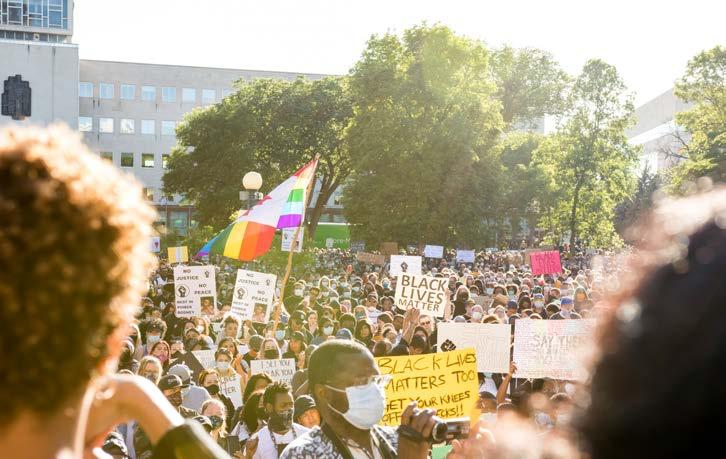
On June 5, the Justice 4 Black Lives Winnipeg rally took place at the legislature to protest the deaths of Black people at the hands of police, drawing thousands.
Police estimated more than 15,000 people came out in support of Black lives at the rally.
The rally was organized by Jayda Hope, Mahlet Cuff, Kameshia Hope, Imani Pinder, Betel Belay, Diana Ayodele, Ted Moko and Ella Taylor.
The exceptionally large turnout was the result of global outrage over the deaths of Black people following police brutality in the U.S. and Canada.
This protest was one of many taking place all over the world sparked by the death of George Floyd in police custody — a Black man — by police officer Derek Chauvin in Minneapolis, Minn. May 25. Chauvin was arrested May 29 and has been charged with second-degree murder.
In Winnipeg, Machuar Madut was shot by police Feb. 23, 2019. He was pronounced dead upon arriving at the hospital. He was Black. No officers were charged after an investigation into the deadly use of force by police by the Independent Investigation Unit of Manitoba. An inquest into his death is pending.
There was a moment of silence to remember Madut at the rally.
Protesters held up signs containing messages of solidarity and rallying cries, including “Being Black is not a crime,” “I can’t breathe,” “We must dismantle white supremacy,” “No justice no peace,” “#GeorgeFloyd can’t breathe,” “Black lives matter,” “Silence is violence” and “Stop killing us.”
The organizers of the rally spoke to attendees, and other speakers included Uzoma Asagwara, New Democratic Party MLA for Union Station; Natalie Bell, a local Black influencer and founder of PegCityLovely; Sandy Deng, a Sudanese community activist; Felisha Simone, an Afro-Indigenous activist; Adeline Bird, an Afro-Indigenous advocate, author and filmmaker; Mandela Kuet, a community organizer; Michelle Edwards, a teacher and advocate for the Black and lesbian communities; Kayla Fernandes, a queer poet and activist; and Nadine Sookermany from the Women’s Health Clinic.
Protesters marched from the legislature to the Forks and brought traffic to a halt along parts of Broadway in downtown Winnipeg.
A fourth-year international environmental science student at the U
of M who wished to remain anonymous said she showed up to the rally
“All lives will matter, but Black lives need to matter first” — Syanne Tippmann
because “it is time for systematic change.
“For far too long, Black people globally [have been] oppressed.”
“I think it’s time that we actually hold the system accountable,” she said. “We have been doing this for years, but no one has really paid attention but I’m glad that now people are paying attention.”
She said she believes the police receive too much funding and are calling for the city to defund the police.
“I know there’s multiple instances where a small thing happens and eight cop cars show up with 16 police. They clearly have too much money and too much time on their hands.
“As an international student in
my faculty, I feel like we are out here representing our brothers and sisters.”
She emphasized that police violence occurs close to home and hurts marginalized communities.
“Violence is not unique to [the U.S.], there is violence toward Black people here in Canada,” she said. “Canada has done a really good job of covering it up with public relations and it’s not right. There’s also violence [against] Indigenous peoples.”
Syanne Tippmann and Maria Tippmann attended the protest to support those who have been affected by racism in policing.
“I’m just here to support all the people that died from racist cops and just to support Black people,” Maria Tippmann said.
They believe the rally will be effective in giving “a huge wake-up call” to Winnipeg.
“All lives will matter, but Black lives need to matter first,” Syanne Tippmann said.
A student in attendance speaking on condition of anonymity said they attended because they were “tired of seeing Black people, innocent Black people, killed by the police.”
“I find it hard to just sit around and not do anything while innocent people are being killed.”
They said they think the rally will
send a strong message to the city that the people of Winnipeg care about the issue of racism in police departments and that they believe the demands issued by Justice 4 Black Lives Winnipeg will lead to broader change and “make a difference.”
Justice 4 Black Lives has issued a petition with a list of demands to make Winnipeg safe for all BIPOC (Black, Indigenous, people of colour).
The petition has garnered more than 60,950 signatures to date and lists the City of Winnipeg, Mayor Brian Bowman, Premier Brian Pallister, the Manitoba Teacher’s Society and the province of Manitoba as decision makers.
The 11 demands of the petition include defunding and abolishment of the Winnipeg Police Service and asking the province to “cut all current ties that the Manitoban education system has with the police.”
Justice 4 Black Lives Winnipeg is planning a series of “flash protests” called “7 Days of No Peace” for the week of June 22 to June 29. Each protest will run from 3 p.m. to 4 p.m. Protest details will be provided at 9 a.m. daily via the Justice 4 Black Lives Winnipeg Instagram page, @justice4blackliveswinnipeg.
PHOTO BY KELECHI ASAGWARA
Nobel laureate gives virtual lecture to faculty of science
Winnipeg native James Peebles discusses how sociology and astrophysics connect SARAH DORAN, STAFF
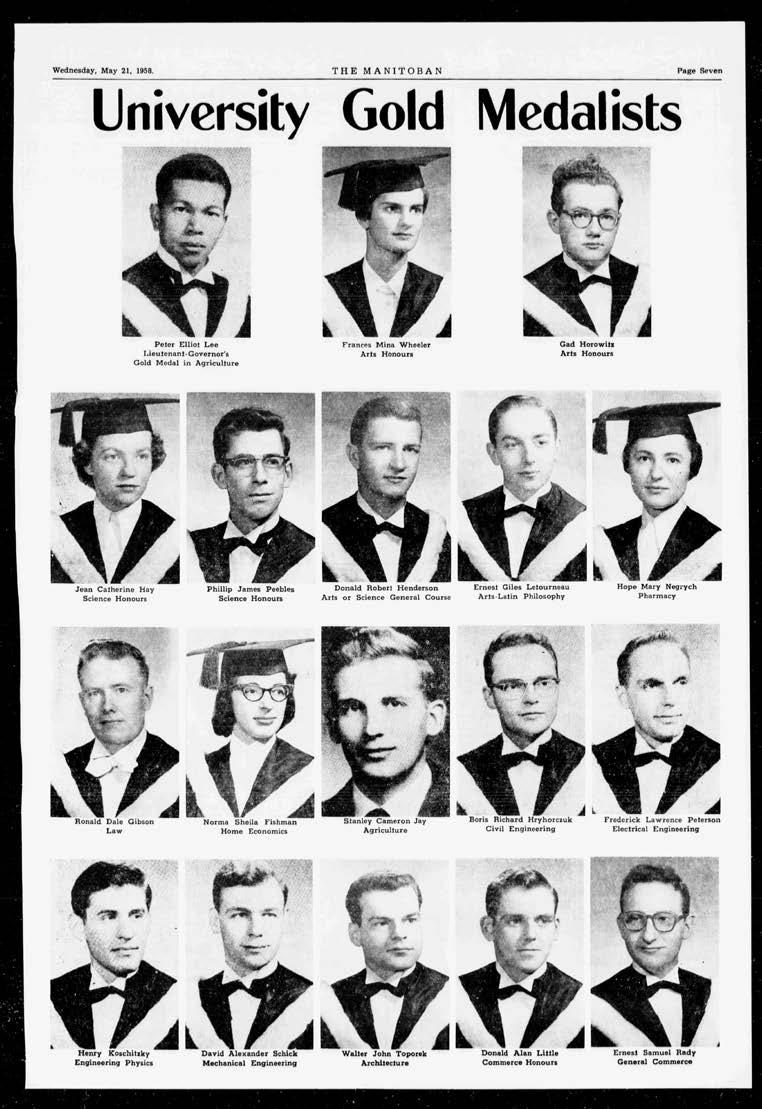
: Published in the
May 21, 1958
Above: Published in the
Oct. 28, 1958
: Published in the Manitoban Nov. 3, 1988
Opposite
Manitoban
Manitoban
Left
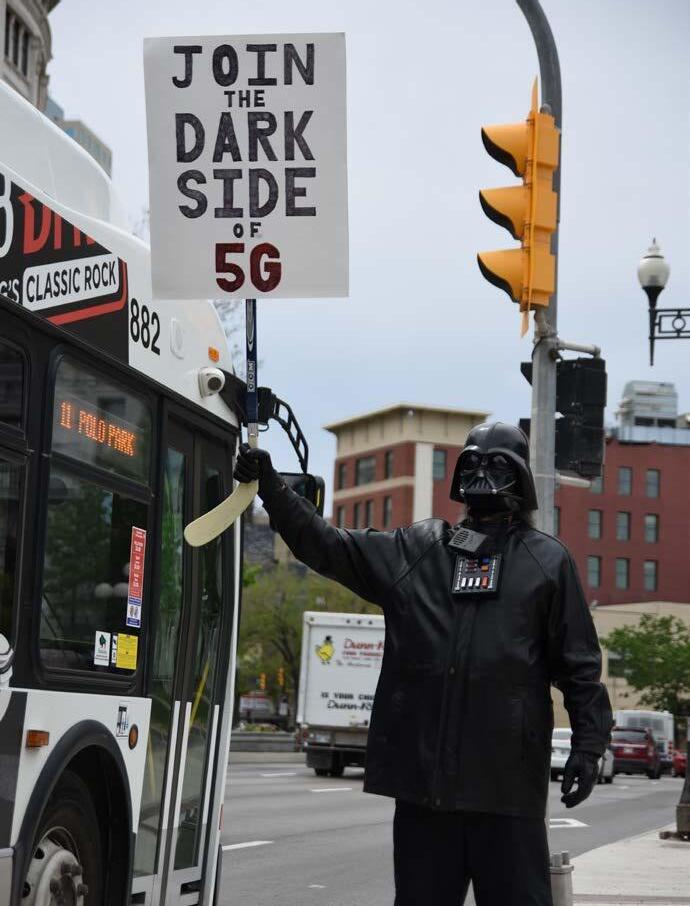
“Join the Dark Side of 5G”
ALEXANDER DECEBAL-CUZA
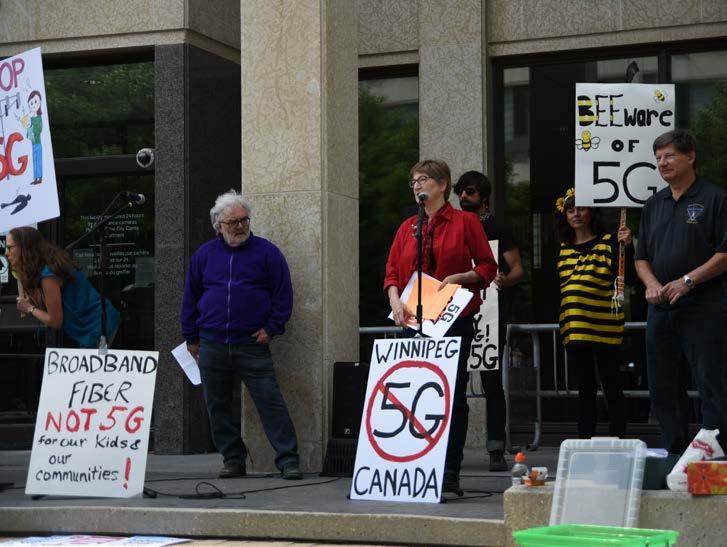
A protester in Darth Vader garb holds up a sign for passersby, next to the protest against 5G wireless technology outside Winnipeg city hall June 6. Coverage of the fifth generation wireless antennas continues on page 10.
Group calls for halt to 5th generation wireless antennas
5G Winnipeg Awareness raises concern about possible public safety issues
MARIO MENDEZ, STAFF
“Stop 5G,” read the sign of a concerned citizen.
On June 6, members of the 5G Winnipeg Awareness group gathered at city hall to hold a rally on the 3rd Global 5G Protest Day. During this event, Margaret Friesen — a former research biologist with the Government of Canada — took the stage along with a retired telecommunications engineer, a businessman and a child representative to share why they think the fifth generation mobile network (5G) is a serious threat to the health of Winnipeg residents.
The group is asking the City of Winnipeg to halt the installation of 5G antennas in residential neighbourhoods until 5G is deemed safe for the general public.
The group succeeded in filing a report that mandates stakeholder communication and public consultations through a standing policy committee on innovation and economic development held June 13.
Although speakers at city hall quoted a mix of anecdotes and sci-
entific studies, the group is not alone in their concern about 5G networks.
Multiple cities in California have passed ordinances pausing network deployments. On a larger scale, 5G development was halted in Brussels, Belgium, because the radiation emitted by network antennas did not comply with the nation’s radiation standards.
The “problem” with 5G Electromagnetic fields (EMFs) are generated when electric current flows; that is, every time an electronic device is turned on. EMFs generate radio frequencies (RFs) which are the basis for most wireless communication including radio, television broadcasts and wireless networks (Wi-Fi) among many others.
In our day-to-day lives, we are exposed to RFs of varying intensities through our electronic devices. Implementing a 5G network requires the installation of thousands of small cell towers, which means urban populations will constantly be exposed to RFs emitted by these installations.
Human exposure to certain RF intensities can result in heating of the skin. The use of RFs to heat biological tissue is the same principle by which microwave ovens heat food.
Some studies have examined the possibility of a link between RF exposure and cancer. The World Health Organization (WHO) has been studying the effects of RFs on human health since 1996 through the EMF Project. These and other studies have resulted in the creation of legislation dictating the RF intensity range to which humans can safely be exposed to — in Canada’s case, Safety Code 6.
The 5G Winnipeg Awareness group quotes several studies which have shown that serious health effects — such as cancer and DNA damage — can be caused by some RFs, including the ones employed by 5G. However, these RFs are currently considered safe by Health Canada’s Safety Code 6.
It is the current standing of a Canadian government health guide that “The scientific evidence does not
support a link between exposure to radiofrequency EMF and cancer at
“Our group will pursue the peaceful means that our democracy provides for us” — Margaret Friesen, 5G protester
the levels permitted by Canadian exposure guidelines.”
Friesen said the studies showing otherwise have failed to change Canadian laws because “Health Canada would then have to change its Safety Code 6 guidelines. In turn, innovation science and economic development, which has adopted these guidelines as their standard, would have to develop regulations and more protective compliance criteria. This would be inconvenient and
costly to the wireless industry.”
Recent news have mentioned 5G thanks in part to conspiracy theories. In April 2020, social media content blaming 5G for the spread of COVID-19 led to more than 70 arson attacks on cell towers in the U.K.
“I do not advocate violence,” Friesen said. “Our group will pursue the peaceful means that our democracy provides for us […] To be clear, I do not believe that 5G causes nor spreads COVID-19.”
The Internet of Things, the new generation of internet-connected devices which has brought the like of smart homes, app-controlled coffee machines and wireless security cameras requires a powerful network to enable it.
According to Canada’s Communications Research Centre website, “5G will be a game changer in wireless telecommunications, ushering in a network for future generations with more devices, faster communication and higher speeds.”
PHOTO BY ALEX DECEBAL-CUZA
Editor-In-Chief: Matthew Doering Contact: editor@themanitoban.com
Manitoba’s government must stop being anti-education The
arts remain valuable, despite any dislike for required literature courses
GRACE PAIZEN, STAFF
It is a contradiction provincially acknowledged that arts deemed valuable in politicians’ personal lives become extraneous costs in their professional lives.
But the value of the arts transcends the political rhetoric of balanced budgets and cut costs. From the international impact of Game of Thrones, the Beatles and Picasso, to the national and local Guess Who, Group of Seven and Leo Mol, the arts are clearly invaluable to Winnipeggers and indispensable for provincial tourism.
In fact, you can go onto any social media platform to discover people sharing memes about how hellish it would be to endure the COVID-19 quarantine without the arts.
Now imagine patting yourself on the back for expecting post-secondary institutions to teach solely based on “labour market need” and telling universities to “be nimble and responsive, ceasing programs that lack responsiveness and value in a modern context and building programs that deliver the skills needed for today and tomorrow.”
The Manitoba government did just that in the mandate letters sent to the province’s post-secondary institutions earlier this year, and it is wildly obvious that it is the arts who should be “ceasing” because of their lack of “value in a modern context” simply because the current government of
Manitoba fails to understand that building arts programs does deliver the skills needed in today’s workforce.
It is no secret that university students who are referred to by the term “arts student” — the literature, theatre, film, media, music, fine arts and women’s and gender studies majors — are culturally stereotyped as a bunch of free-loading, neo-hippies who sit
The arts, the humanities, the social sciences are needed alongside the natural and physical sciences
around in circles and talk about their feelings.
And since at least 21 of the 36 Progressive Conservative members of the legislative assembly have had some form of post-secondary education, the value of including the arts in university programs should be more apparent in these mandates and policies.
In fact, these members should know that being required to discuss plays in university programs is far from useless fluff — it is intentional.
The arts not only teach students how to analyze Shakespeare plays , it allows students to take that skill and analyze the world around us.
The arts teach you how to be social and how to have meaningful discussions about opinions or subjects with people you completely disagree with.
The arts teach you how to write down complex ideas in a thorough, coherent and precise manner — skills you will need later in life just to write an email to a co-worker.
The arts teach you how to present yourself — what business studies would call “branding” — so that you are the sure hire at your next job.
In fact, we should all consider how the arts have been shaping us since we first set foot into a Montessori or elementary school. All that learning of the alphabet and learning how to read and write stories? Those were the arts.
To suggest that children should not learn how to read because they should simply be another cog in the economic wheel is draconian. But this is what the Pallister-led government is implying when it attempts to delegitimize university programs which it believes no longer hold value in the modern world.
Universities and colleges are the final formal destinations for learning. To consider some of their programs obsolete equates to the idea that every other program designed to facilitate
that specific education prior to university is also obsolete.
This implies that reading, writing and socializing are obsolete values and should be cut out of every level of education from post-doc work to kindergarten, which is ludicrous when considering the publication and conference record needed to secure a professorship.
More than the skills, there are lessons in the Charles Dickens novels assigned in class. Even if you rooted for Ebenezer Scrooge in A Christmas Carol until his heart grew three sizes. Even if you think Amy Dorrit should be sentenced to living her life in a debtors’ prison in Little Dorrit just because she was born in one. Even if you think Pip should have never received an education in Great Expectations because he “wasted” it on eventually becoming a well-rounded human being.
Even if you think all of this, the fact remains that being able to encounter these works is intended to give the reader a glimpse into the horrors of an underfunded society that placed values on an archaic class system where those who were not born into money should not be able to receive a chance in life to improve their character and social situation.
With the mandate letter sent to the U of M, Ralph Eichler, minister of economic development and training, and the entirety of the
Pallister-led government seem to have completely missed this lesson and are instead implying that it is not valuable to educate yourself of the past so that you don’t repeat those mistakes in the present.
To not read the assigned text for class is one thing, but to be against diversifying one’s knowledge is disgraceful.
To not know that transplants and the portable pacemaker were inspired by Mary Shelley’s Frankenstein, and that rocket technology was developed from concepts taken from Jules Verne’s From the Earth to the Moon, and then deciding studying literature is no longer valuable to students developing skills for the modern workforce is, in itself, an uneducated decision.
The arts, the humanities and the social sciences are needed alongside the natural and physical sciences. Together, they bring balance to the force of education and inspire invention.
So, stop undermining the arts from university budgets.
Stop making uneducated assessments to the value of university programming.
Stop being anti-education. Surely no one would want their legacy in history to be the villain of knowledge.
GRAPHIC BY JENELLE MCCANN
David Barnard’s legacy one of respect, fundraising
12-year term
for U of M president and vice-chancellor draws to a close
ASTITWA THAPA
As we all stay home and reflect on the disruption caused by COVID-19, students might have missed an announcement from the U of M: David Barnard is leaving the university after serving as the president and vice-chancellor for 12 years.
I must start by saying that I do not know Barnard on a personal level. However, I had the opportunity to work with him on a professional level while I served as a senator for the faculty of environment, earth and resources and later as UMSU’s vicepresident (external).
I have now completed my second year of law school at the University of British Columbia and although I haven’t spoken to him in four years, I still follow some of the news that comes out of the U of M.
There is no doubt that Barnard has been a controversial figure.
Along with hundreds of students, I mercilessly criticized him for his budget cuts and fee hikes in 2015-16. I remember barging into the board of governors meeting to protest against his administration’s failure to prevent budget cuts at the university.
In 2016, I fully supported professors who went on a strike to challenge the administration’s attack on academic freedom. To put it mildly, Barnard’s handling of the strike was disappointing.
I never thought I would say this,
but I eventually grew to like him.
Despite my strong opposition to some of his decisions, I developed a deep sense of respect and admiration for Barnard’s contributions to the U of M.
My admiration comes not because Barnard is perfect, but because he tried relentlessly to set the foundation to transform the university.
In the past five years, Barnard and his vice-president (external), John Kearsey, have worked tirelessly to raise money for the U of M’s Front and Centre campaign.
Under Barnard’s leadership, the U of M raised more than a jaw-dropping $626 million, making the Front and Centre campaign Barnard’s most enduring legacy, as despite opposition from some students and faculty, Barnard continued with his push to raise money.
academia, research chairs and professorships might not mean much. However, for graduate and professional students, this opens countless research opportunities.
significant progress toward reconciliation with Indigenous peoples.
The U of M has a long way to go, but the campus is a much better place for Indigenous students because of Barnard.
Whether you like Barnard or not, he has left a strong legacy
Through this effort, the U of M will finally be able to build critical infrastructure and repair some old facilities that need desperate improvements. It will also create scholarships and bursaries for hundreds of students.
Most importantly, the university has created 21 research chairs and professorships. To those not in
As an environmental science graduate, I would have loved to see Barnard do a lot more to promote environmental sustainability, and to his credit, under Barnard’s leadership, the university established the office of sustainability. In fact, the U of M made remarkable progress in terms of reducing water and energy consumption.
The university also significantly expanded environmental research under his leadership. However, he will also be remembered as the person who failed to adopt the fossil fuel divestment campaign unlike other campuses, such as UBC.
I understand the unique political pressure the administration faces, but, nevertheless, no university administrator in the country should be allowed to duck the issues surrounding climate change.
As an ally of Indigenous students, I have also seen the U of M make
Barnard was the first president to apologize to Indigenous peoples for the university’s failure to challenge the residential school system. The truth and reconciliation commission applauded his unconditional apology to Indigenous students and faculty. He walked the walk by making more funds available for scholarships and bursaries for Indigenous students and by expanding his executive team by creating the first-ever vice-president (Indigenous) position at the U of M.
Although the U of M continues to have a serious problem with racial discrimination toward Indigenous students, under Barnard’s leadership, the university has taken the first few steps toward decolonizing the education system.
For international students like myself, we likely won’t remember him for the money he raised, but rather for the care and respect he showed to foreign students. He stood shoul-
der to shoulder with international students during candlelight vigils when tragedies struck home and he always made a point to speak about the contributions made by foreign students that make the university a better place for learning.
It’s no wonder international students waited for their opportunity to attend the reception for graduating students at Barnard’s house each year. For many international students, going to his residence may have been the biggest highlight of their student experience in Canada.
Whether you like Barnard or not, he has left a strong legacy.
He has successfully expanded the childcare facility, established a sexual violence resource centre, created hundreds of scholarships for students, given students a fall reading week and generated hundreds of millions of dollars for capital projects.
The outgoing U of M president will be remembered as a person who tried to make a difference.
He will also be remembered as the person who had the most boring tweets in the entire world. If you are reading this article, David Barnard, please hire someone in their 20s who knows the Twitter game or delete your account as you enjoy the next phase of your life.
Tweets aside, I wish him the best in his future endeavours.
PHOTO BY ALEX DECEBAL-CUZA
David Barnard’s 12-year term as president and vice-chancellor ends June 30, 2020. He will be succeeded by Michael Benarroch who will become the U of M’s 12th president in the university’s 143-year history.
Time for a necessary step, time to defund the police
Diverting police funding is a necessary and viable step in the direction of racial justice
LUCAS EDMOND, STAFF
Calls to defund the Winnipeg police department followed the Justice 4 Black Lives rally earlier this month. Premier Brian Pallister has responded to these demands claiming defunding the police is an “illogical step,” focusing the discussion on reform instead.
But police reform has failed Black and Indigenous lives for over a century.
Just a month before the death of George Floyd in Minneapolis,
Minn., members of the Winnipeg police department fatally shot two Indigenous people in a span of 12 hours. The victims were 16-year-old Eishia Hudson and 36-year-old Jason Collins.
These shootings reflect — albeit to a nation in denial — that the issues of police brutality and racism are alive in Winnipeg and across Canada. Funding for the force has been growing at an unnecessary rate for 20 years and police services have eaten
into the municipal budget.
Since 2000, the police budget has grown by roughly $186 million — approximately a 163 per cent increase. The police budget now rests at roughly $300 million annually.
To contrast this, community services now only receive $114 million annually.
On top of this discrepancy, the city and province announced their plan to cut funding to various nonprofits and essential organizations that communities rely on.
It is clear the municipality places a priority on policing as opposed to strengthening community ties with non-profits and organizations that emphasize equitable action.
The fact is simple: policing is an ideological system that maintains status quo structures of power, racial subjugation and inequality.
Policing in Canada emerged from the violent dispossession and surveillance of Indigenous and Black communities, and it’s also widely known that Indigenous and Black peoples are dramatically and unjustly overrepresented in the carceral system.
Racism is at the very core of policing and its legacy.
No viable option remains but to dismantle the police force that is reproducing the conditions it was purportedly established to solve.
By demanding such large chunks of revenue, valuable resources are
No viable option
remains but to dismantle the police force that is reproducing the conditions it was purportedly established to solve
wasted perpetuating a violently colonial system.
These resources could be used for social programs to equitably raise standards of living for low-income communities and train professional workers to peacefully de-escalate tense scenarios.
It is time to recognize that defunding the police is not only a
viable solution to police brutality but a necessary one.
Policing is a cause, not just a condition, of crime. Rates of violent crime are significantly reduced when inequality is reduced, not because of the presence of police.
Revenues, then, must be refocused toward community based and autonomous social programs and projects. It must be insisted that resources be funnelled into unarmed response units with specialized abilities in social work, health and crisis de-escalation.
Additional revenues should be focused on reducing inequality and poverty, the key determining factor in criminal offences.
Forms of investment in equitable access to quality free post-secondary education, higher wages, universal childcare programs, mental health care and affordable housing would all act as buffers to crime, bringing the community together.
We should not police crime, we should be actively attempting to prevent the precarious environments that precipitate it.
Leading with a bold vision, followed by a mixed record
A look back at Glen Murray’s long track record as
he
runs for federal leadership
Former Winnipeg mayor, Ontario cabinet minister and municipal issues advocate Glen Murray is running for leadership of the Green Party of Canada.
Murray’s vision for the party is passionate but his record in government is mixed.
On April 29, Murray announced he was running for leadership of the Green party. The centrepiece of his campaign is promoting a
“green recovery” as Canada returns to economic activity following the shutdowns induced by COVID-19. This includes investments in electric vehicles and enhanced rail as well as retrofits for buildings.
The former mayor describes his vision as “big, bold and practical” with plans for “technologically savvy cities, towns and villages.”
Murray’s vision is similar to former Green leader Elizabeth May’s.
Large investments and targets to make buildings and transportation less carbon-intensive were key parts of the party’s 2019 election campaign.
Given Murray’s history advocating for a new relationship between federal and municipal governments, it is probable that Murray will look to emphasize municipal issues. And in fact, this could be helpful for the party. Municipalities deliver many crucial services but find it harder to collect taxes to pay for services than other levels of government.
It has worked before.
Former New Democratic Party leader Jack Layton successfully carved out a space in federal politics advocating for municipalities for many years.
Murray’s first dive into federal politics came in 2004, when he unsuccessfully ran for the Liberal party in Charleswood. He hoped to work on a federal urban strategy if elected to parliament.
In fact, the former mayor long championed diversifying sources of revenue. However, Murray’s attempt to get new money streams for the city as mayor shows why his record is mixed.
In 1998 — Murray’s first year as mayor of Winnipeg — he championed a property tax freeze, that was
drafted the year before, hoping this would pressure the province and federal government to share tax dollars with the city.
Murray later proposed a detailed “new deal” for Winnipeg in the fall of 2003, which he hoped would supplement the lost revenue from the tax freeze.
Signature tax increases would
Murray’s attempt to get new money streams for the city as mayor shows why his record is mixed
have included a new municipal sales tax, a new fuel tax, garbage collection taxes, a new liquor tax, charges for contacting 911, taxes on hotels, increasing water fees and increasing rates for natural gas and electricity.
This complicated proposal was rejected by residents, so Murray walked it back.
He followed up with a simpler plan, where the city could collect additional revenue from federal and provincial gas taxes.
With this plan, Murray hoped
Winnipeg could use some of these new funds to slash property taxes up to 8 per cent.
However, only a very limited form of a tax shift did happen. In 2005, Paul Martin — the prime minister at the time — started transferring money from federal gas taxes to municipalities, but Murray was out of the mayor’s office by then.
Despite this small win for the city’s books, the prolonged property tax freeze took a hefty toll.
The freeze proved very popular and continued well after Murray left the mayor’s chair. But, the forgone money was squeezing the city into a tight budget, and in 2012, after 14 years, property taxes finally rose again in Winnipeg.
The fact that Murray’s vision for Winnipeg was for more reliable revenue, considering his legacy of being one of austerity and strained services, is ironic.
Glen Murray has had a long and active record in urban affairs. He would be a high-profile voice for cities as the Green party leader and he has the potential to implement “big, bold and practical” plans while in office, but his inconsistent track record should not be ignored.
DYLON MARTIN
GRAPHIC BY JENELLE MCCANN
GRAPHIC BY JENELLE MCCANN
Comment Editor: Lucas Edmond
Contact: comment@themanitoban.com /
A digital iron curtain is falling on the tech industry
Global scramble for 5G markets escalates geopolitical tensions
LUCAS EDMOND, STAFF
Dozens of Winnipeggers joined in a global protest on June 6 to express their concerns with the expansion of 5G infrastructures.
The protests come at a tumultuous time for telecommunications companies.
The rush of the fifth generation mobile network (5G) into western markets signals a global scramble for intellectual patents and market consolidation over what could be the defining innovation for the next decade of technology.
Gathering at city hall, dozens of locals expressed their concerns about the cell towers used to service this generation of internet.
Organized by Margaret Friesen, a retired research biologist, the protestors believe the cell towers necessary for 5G networks have not gone through enough testing to vindicate their safety.
Health experts have repeatedly asserted that technology such as 5G does not carry significant health risks.
But demonstrator’s demands in Winnipeg have been relatively straight forward: they desire further studies be published before 5G becomes the dominant internet server.
To this point, Canada and its allies seem rushed pushing 5G to the market so abruptly.
Just a week before the protests, a B.C. Supreme Court judge ruled that extradition orders against Huawei’s chief financial officer, Meng Wanzhou, should proceed.
She is facing 23 charges in the United States, including intellectual property theft, fraud and laundering money out of the sanctioned Iranian economy into the global financial network.
The arrest and alleged libels against Wanzhou appear to have served as precedent for banning Huawei’s tech in some countries.
The U.S. and other western nations have cited Huawei’s close ties to the Chinese government as the reason for their sanctions.
Relying on national security as an excuse for Huawei’s exclusion from these markets seems to be a stretch, especially when considering that the U.S. and their incorporated military contractor Lockheed Martin rely on Chinese subcontractors to manufacture essential circuit boards which they utilize universally in their F-35 fighter jets. These jets are then sold
around the world to various other nations.
With this in mind, citing national security issues as the reason for banning Huawei seems like a loaded excuse.
Banning Huawei from business in various high-consumer markets signals an attempt by western nations to consolidate 5G markets for local and rival corporations.
In fact, western nations have sought to undermine Huawei on the global market not only by banning their products, but by actively funding European technology competitors such as Ericsson and Nokia.
These moves appear to be a game of catch-up to the corporate leviathan.
It is estimated 5G will produce up to US$13.2 trillion of global economic output and over 22 million jobs by 2035.
It is no surprise, then, that various western nations are worried about falling behind Huawei in the scramble for markets and technology patents.
While Canada has yet to ban Huawei’s 5G technologies, they joined the U.S. in funding and relying on Huawei’s competition to stunt
their presence internationally.
In fact, Canada recently contracted infrastructural projects out to Rogers, who receives materials from
The U.S. and other western nations have cited Huawei’s close ties to the Chinese government as the reason for their sanctions
one of Huawei’s main competitors, the Swedish tech giant Ericsson.
This strategy seems to be working and it has come at a great cost to the Chinese corporation. Actions taken by the U.S. have resulted in a net US$12 billion projected revenue loss for Huawei.
Ren Zhengfei, the CEO of Huawei, claimed it may take a few years to recover from the impact of this economic aggression as Nokia and Ericsson have filled the 5G
vacuum since the ban. Ericsson now holds 93 5G commercial contracts, with Nokia close behind holding 63 and Huawei with only 50.
However, this will not last long.
With the sanctions placed on Huawei, the corporation has been forced to seek industrial self-sufficiency.
Huawei once relied on a variety of U.S. suppliers for various pieces of technology, such as chip suppliers like Intel and Qualcomm and Google, for their Android operating system. Due to the sanctions, Huawei has lost access to these crucial companies.
The escalating tensions between China and western nations in reference to technological hegemony has created a divide that reporters have referred to as the “digital Cold War.” And the divide will only get worse as the servers will require complete independence from each other.
So, the race is on and, unfortunately, western nations show no desire to take their foot off the gas, even in the face of local concerns. The iron curtain has fallen, and the technology industry has become a key arena in geopolitical tensions.
GRAPHIC BY JENELLE MCCANN
Come home to the WAG again
Winnipeg Art Gallery reopens with reduced provincial COVID-19 restrictions
ZOË LEBRUN
To the joy of many local art lovers, the Winnipeg Art Gallery (WAG) officially reopened May 5 in the wake of COVID-19.
Apart from its first two days of opening which were reserved for frontline workers and their families, regular hours for the public resumed May 7.
However, the WAG’s reopening — like many other businesses and public spaces — does not come without changes to its usual order of business.
Following government guidelines, there are new safety standards being
set in place at the WAG to protect both visitors and staff.
These practices include strict social distancing protocols and limiting building capacity, cleaning well and often and encouraging the use of masks and hand sanitizer within the gallery itself.
Though this might seem overwhelming, Jeff Macoun, president and chief operating officer at Canada Life — a partner of the WAG — believes the public access to the WAG is a great first step in renormalization.
“The gallery is the perfect place to reunite safely with your family and friends, with plenty of room to practice safe social and physical distancing,” Macoun said.
Among many other suggestions, the WAG is also encouraging contactless payment methods, bringing as few personal belongings into the gallery as possible and using online self-screening tools before deciding to visit.
An important change to make note of is that, for the time being, on-site water fountains will be una-
vailable for use. However, visitors have been temporarily permitted to bring a water bottle with them into the gallery.
Luckily for those who didn’t get the chance to see some of the WAG’s exhibitions before quarantine began, many of the shows are still running until late summer and even into the new year.
Some of these exhibitions include Lionel LeMoine FitzGerald’s Into the Light , Norval Morrisseau’s Androgyny and James Webb’s Prayer Additionally, the seasonal Rooftop Sculpture Gardens are open for visitors at this time.
For those who cannot make it into the gallery, WAG@Home is expected to continue as it did during quarantine, providing virtual exhibitions, artist talks and activities to participate in remotely.
In fact, WAG@Home remains a fantastic option for those who would still like to engage with the art and sense of community that the WAG provides but are unable to visit in person due to the residual risk factors posed by the lingering presence of COVID-19.
However, regardless of the ongo-
ing pandemic, Stephen Borys, director and CEO of the WAG, believes this is a safe opportunity to reunite with loved ones.
“The WAG has been a gathering
For those who cannot make it into the gallery, WAG@ Home is expected to continue as it did during quarantine
place in the city for over a century — and I cannot think of a time when Manitobans need spaces like this more,” Borys said.
“Art has the power to inspire, uplift and connect — and we want to do our part to help.”
For more information about the WAG or WAG@Home, go to wag.ca.
Stranger things have happened, and we want more
Winnipeg artist weaves tradition, culture and history in recent exhibit
ZOË LEBRUN
Bold, bright and colourful — these are the words that best describe the energy emanating from the work of Winnipeg Oji-Cree artist Jordan Stranger.
Originally from Peguis First Nation, Stranger was born into an artistic family and names them — along with Keith Haring, and Woodland style artists like Norval Morrisseau and Daphne Odjig — as inspiration for his own art.
Stranger’s style, dubbed Totem Doodem, is rooted in the Seven Teachings, Indigenous stories and sacred ceremonies of the Anishinaabe peoples, lending his work a sense of strength, history and cultural identity. Stranger’s eye-catching work began as graffiti around Winnipeg and eventually led to opportunities such as murals — a significant set of these being his Manitoba 150 murals located at the Forks.
More recently, Stranger had an exhibition at Aceartinc. called Firekeeper, which ran for just over a month last fall.
While this exhibition was on, Stranger held an artist talk. He spoke of learning as he went along, as well as the importance of sacred ceremonies and traditional teachings. Firekeeper is an exhibition that represents a healing journey not only for Stranger himself, but for audience
members as well. The exhibition’s name comes from Ojibwa culture, where the role of the Firekeeper is to keep a fire lit during sacred ceremonies.
“I can’t take credit for any of those things, they don’t belong to me. They were given to me years ago and I’m just the person that is sharing it” — Jordan Stranger, artist
“I can’t take credit for any of those things, they don’t belong to me. They were given to me years ago and I’m just the person that is sharing it […] I thank my Elders for that, I thank my father for that, I thank my teachers and instructors.
“They gave me the tools so that I could share it.”
In this vein of thought is where Stranger invites the audience to go on a healing journey through Firekeeper with him.
Since sacred ceremonies and practices are preeminent in Stranger’s work, he wanted to turn Firekeeper into a safe space for reflection and prayer for people of all faiths. A posting in the gallery invited viewers to participate in this by placing tobacco onto a sacred fire as offerings for their own prayers.
Through this body of work, Stranger views himself as a Firekeeper — keeping the fire of his culture and the Seven Teachings alive through art and bringing it into public spaces.
Uniquely, Stranger doesn’t like taking credit for his work.
“These teachings were given to me by Elders and passed down for generations,” Stranger said.
“I wanted this piece to express to all people that you have power,” Stranger said. “You have a voice, you have something that somebody needs to hear.”
“This culture isn’t just for [Indigenous peoples] […] it’s for everybody.”
Stranger’s artist talk on Firekeeper can be found at aceart.org.
PHOTO PROVIDED BY WINNIPEG ART GALLERY
PHOTO PROVIDED BY ACE ART INC.
The best seats in the house are in your own home
Enjoy a night at the National Theatre, free of charge, every week
SHAYLYN MAHARAJ-POLIAH, STAFF
During these unprecedented times, society has turned to the arts to fill the hours spent quarantining.
Besides the overwhelming presence of streaming services specifically for television and film, many plays and musicals have also become available on online platforms, including those presented by the National Theatre in London, England.
One of their many initiatives, National Theatre Live, broadcasts live recordings of theatre productions staged in London to movie theatres across the globe.
Even with social distancing and public safety measures implemented in the wake of COVID-19, leaving both cinemas and live theatre houses shuttered indefinitely, the National Theatre continues to deliver theatre to a global audience with their new project, National Theatre at Home.
National Theatre at Home pro-
vides access to free to view, prerecorded, full-length theatrical performances available through their YouTube channel.
The plays also address accessibility needs, with each play containing subtitles, and certain titles available in described video.
National Theatre at Home also provides behind-the-scenes audio recorded notes for certain plays, describing their sets, costumes and necessary background information for a fulsome theatrical experience.
Productions are screened every Thursday at 7 p.m. GMT (2 p.m. CDT) and are available on demand for viewing for the duration of the week.
In addition, National Theatre at Home offers supplementary content for each production such as podcasts, trailers, quizzes, Q-and-A’s, archival videos and behind-the-scenes clips.
The theatre offers something for everybody, from Shakespearean classics Coriolanus and Twelfth Night to premieres of archived performances never before seen in theatres — such as Inua Ellams’s Barber Shop Chronicles
Though earlier streaming offerings were comedies, recently the available titles have taken a turn for the dramatic and timely.
The theatre’s most recent presentation, Alan Bennett’s The Madness of George III, starring Mark Gatiss of Sherlock fame in the title role, dramatizes the British monarch’s struggles with deteriorating mental health and provides a compelling critique of the stigma surrounding mental illnesses.
The theatre’s June lineup continues to tackle issues of social justice with the production of Small Island, a stage adaptation of British author Andrea Levy’s 2004 novel about colonization,
racism and ignorance in the years following the Second World War.
Following this is an uncon-
Though earlier streaming offerings were comedies, recently the available titles have taken a turn for the dramatic and timely
ventional retelling of William Shakespeare’s A Midsummer Night’s Dream
Though a comedy at its heart, director Nicholas Hytner opts for a cast role reversal that provides com-
mentary on gender inequalities.
It should also be noted that in response to COVID-19, the National Theatre has made their entire collection of performances digitally available to post-secondary institutions through Drama Online — Bloomsbury’s online library service. Though access to the collection is only free for U.K.-based educational organizations, they have extended their free trial period for international institutions until the end of June.
Digitally, then, the show is going on.
For more information about National Theatre at Home, go to nationaltheatre.org.uk.
PHOTO PROVIDED BY ACE ART INC.
PHOTO
We’ll always have Cinematheque at Home
Local, independent theatre offers digital services for a great movie night in
GRACE PAIZEN, STAFF
With sit-in movie theatres still closed around the province, and if you don’t own a vehicle to attend a drive-in theatre, Winnipeg’s local darling, the Cinematheque, has you covered for a movie night in.
Cinematheque at Home is a digital service offering weekly theatrical releases. At a time when supporting local business is so important, it’s a great way to support your local, independent theatre.
For a $10 virtual ticket, not only do you get to watch a film for much
cheaper than what would be charged at Cineplex, you are doing your part to ensure a future remains for independent movie theatres in the province.
Cinematheque at Home is also offering a documentary free of charge, running until July 3. Cincinnati Goddamn , a 2015 documentary, is horrifically relevant. The film details police brutality in Cincinnati, Ohio from 1995 to 2001 — a timespan which saw 15 young Black men killed by police — that resulted in commu-
’Toban turntable
The Prairie Joggers — ‘The Prairie Joggers,’ 4/5
KAELEN BELL
The EP is cohesive without being repetitive — each song a new twist on their basic, weathered formula
The Prairie Joggers make simple songs with complicated hearts. The Winnipeg duo’s chipper, dustblown sound is reliant on dense lyricism and memorable melodies rather than any sort of bombast or surprise.
Their debut self-titled EP is a four-song cycle of discovery built on warm guitar, Adam Hill’s unobtrusive drums and Cody Goertzen’s reedy voice.
The Prairie Joggers leans cheery and lighthearted, driven by a rambling storytelling style and a retro love song sensibility. However, tracks like closer “The Cloud Song” create folds in these traditional stylings, with strange asides and a spiralling narrative
that upend what could have been a derivative rehash.
These are traditional songs, surely, but they ride a sideways energy that keeps them from drifting into been-there background noise.
The EP is cohesive without being repetitive — each song a new twist on their basic, weathered formula.
The immediate highlights are the EP’s bookends. The tumbling opener “Me to You” and the aforementioned closer “The Cloud Song” — which is the strangest and liveliest song of the bunch — is an exciting taste of what the duo is capable of when they avoid the more obvious throwback sound of songs like “Dreaming of a Paradise.”
The Prairie Joggers certainly aren’t doing anything new, but their particular songwriting choices and genuine personality make for a pleasingly brief and satisfyingly bright-eyed EP.
The Prairie Joggers will be live streaming their EP release show on Facebook Live on June 24 at 8 p.m. as part of the Live at the Roslyn series hosted by the Village Idiots. The Prairie Joggers EP will be released June 26.
nity uprisings and demands for justice and police accountability.
In fact, Cinematheque at Home is very much themed this month with documentaries running until June 26 that showcase the fight for equality.
Made in Bangladesh details a factory worker in Dhaka, Bangladesh who fights to unionize with her fellow co-workers despite threats from management, and Whose Streets? documents the 2014 killing of Michael Brown at the hands of police in Ferguson, Mo. — an event that inspired the protest slogan “Hands up, don’t shoot.”
Cinematheque has also partnered with Urban Shaman to present another timely documentary film. In My Blood It Runs follows Dujuan — an Australian Indigenous boy — and his struggles to not become another statistic in the welfare and school to prison pipeline.
The movie selection is rounded out by the documentary You Don’t Nomi that chronicles how the 1995 flop Showgirls became a cult hit, and the hot-off-the-metaphoric-press 2020 feature film The Surrogate, which explores an unforeseen complication with a surrogacy.
With new releases added weekly,
there is a Cinematheque at Home film for everyone.
There is also an opportunity to watch The Task at Hand: Four undercelebrated blue-collar Manitoba films Curated by Winnipeg Film Group’s Mike Maryniuk in January 2019, the program is an end to a journey
With new releases added weekly, there is a Cinematheque at Home film for everyone
in which Maryniuk sought to assemble films about the working class in Manitoba. The collection is rounded out by 1983’s Goldeye, 1984’s Spirit of Asessippi , 1985’s The Price of Daily Bread and 1988’s Can-D-Man
The short films are compiled into one convenient video that can be found on the myCinematheque page of the website.
Interviews conducted by Maryniuk with the filmmakers are also located on the same webpage as
the 56-minute film compilation.
And if you’re really feeling in the Canadian movie spirit, you can purchase DVDs on Cinematheque’s website.
These include the infamous 2006 comedic documentary Death By Popcorn: The Tragedy of the Winnipeg Jets from awrd-winning directors Mike Maryniuk, Walter Forsberg and Matthew Rankin.
The film documents Winnipeg’s misfortune of losing the 1.0 Winnipeg Jets.
As well, the Cinematheque movie store has the must-watch 2009 documentary Land of Oil and Water by the U of M’s own Neil McArthur, professor of philosophy, and Warren Cariou, professor of English, film, theatre and media .
The film documents the expansion of Alberta oil companies on Indigenous homelands closer and closer to Indigenous communities.
For U of M students craving a night at the local theatre, Cinematheque at Home has you covered for a socially distanced movie night in.
For more information, go to winnipegfilmgroup.com
PHOTO PROVIDED BY MAGNOLIA PICTURES
PHOTO PROVIDED BY THE PRAIRIE JOGGERS
COVID-19 pandemic a non-issue for U of M Bisons Adamopoulos and Tsai
Student athletes talk staying healthy and in shape during quarantine
An athlete must maintain a fit and healthy lifestyle to be able to compete at a high level of sport.
Since the outbreak of COVID19, sports have been cancelled and gyms have been shut down.
These are tough times for a student athlete, but Bison athletes Stephen Adamopoulos and Jessica Tsai have made the most of it.
Adamopoulos started his Bisons
“Although the season is cancelled, we’re still going to do our best to improve and be prepared to kick off the season in 2021” — Stephen Adamopoulos, U of M Bisons football player
career in 2018.
Quarantine has not been hard on Adamopoulos — he continued to focus on his regular routines.
“Since quarantine began, I have been trying to remain consistent in balancing workouts, stretching and my nutrition,” he said.
“I can honestly say I have been more focused in my approach to my stretching routine, which has
definitely helped a lot so far […] I have been trying to get to the field and do workouts several times per week.”
Quarantine may only happen once in a lifetime and hard times create new opportunities.
“I’ve definitely tried to get creative with the lack of access to a gym,” Adamopoulos said.
“For me, this meant trying new things like yoga, which has been a great new habit I have developed.”
Although he is forced to train individually, he is still part of the Bisons football program and teamsanctioned workouts are the key to success.
“We’re still waiting to hear what team activity is going to be allowed for the fall [term],” Adamopoulos said.
“For now, we will continue to do player-led positional group workouts throughout the summer.
“Although the season is cancelled, we’re still going to do our best to improve and be prepared to kick off the season in 2021.”
Although football and soccer are two different sports, the training during quarantine looks much the same.
Rookie sensation of 2019-20 Jessica Tsai was named to the 2019 U-Sports women’s soccer all-rookie team.
In Tsai’s rookie season, she earned a total of 22 points in 16 games — an impressive stat line for any player, let alone a rookie.
Quarantine has been a new and
strange experience for Tsai, but she is staying healthy and fit.
“During quarantine, even though I haven’t been able to train directly with my team, we still had to continue our training individually,” Tsai said.
“In terms of staying healthy and in-shape, it’s been really helpful and motivating to have a workout plan set for the team.”
And although these past few months have been a change of pace for Tsai, she is not complaining one bit.
“I have a younger brother that plays soccer as well, so I have spent a lot of time outdoors with him the past couple of months playing soccer or making up our own games to play against each other,” Tsai said.
“This has been a good way for both of us to stay active while having some healthy competition.”
Although a break from things is sometimes positive, Tsai and the Bisons women’s soccer team are not looking to take any steps backward.
“Even though our season is cancelled, our team still has plans on training similarly to if we did still have a season,” Tsai said.
“Hopefully, soon enough, we will be able to start practicing on the field again, which I’m really looking forward to.”
In fact, Tsai sees this as an opportunity for team building.
“Instead of this next year being a break, as a team we still want to keep developing and growing so we can be as strong as possible for the
following year,” she said.
Both Adamopoulos and Tsai are two very determined and already successful student athletes who have some advice for future Bison athletes.
“My best advice to any athlete entering university-level sport is to believe in yourself and strive to be better every day,” Adamopoulos said.
“Student athletes have major commitments and the only way to make the best of it is to work toward being the best version of yourself in all aspects. This means taking every opportunity to learn, reflect and work toward being better than yesterday.
“I believe this mentality all links back to one important principle, and that is believing in yourself.”
Moreover, Tsai believes growth comes from the people around you.
“I think my biggest piece of advice for incoming athletes would be to not be afraid or embarrassed to ask for help, both for school and sports,” Tsai said.
“The transition from high school to university can be pretty challenging, but it’s important to remember that everyone is going through the same thing and there are so many people willing and ready to help you out.
“For me, personally, my teammates were my best support system throughout my first year and I know I can always count on them to help me out.”
Canada West makes official COVID19 sports announcement
First term sports cancelled, second term in question
A sports lover’s worst nightmare is slowly getting even harder to believe.
The first half of 2020 has already taken a toll on the population, but it has gotten much worse for those who were looking forward to the conclusion and beginning of sports seasons.
The coaches, players and fans all knew it was coming, but it was still tough news to take in.
Canada West announced June 8 that there will be no university sports in the first term of the 2020-21 season due to the COVID-19 pandemic.
This means that the U of M Bisons and other Canada West teams will be sidelined for longer than they would have liked.
The decision went through a vote of the 17 universities and it was unanimous that some sports were to be cancelled or postponed.
Football, rugby, field hockey and soccer are all fully cancelled for the first term of the 2020-21 season.
And none of the two-term sports can begin before Jan. 1, 2021. These sports include hockey, basketball and volleyball.
As well, on July 15, a decision will be made on sports with single championships such as golf, swimming and cross country.
However, all this being said, student athletes who are eligible for athletic scholarships will continue to be eligible.
And although this is a tough time for everyone, it is extremely important to respect these guidelines and to understand why these precautions need to be taken.
These measures are meant for the safety of the players, coaches, staff and fans.