

CAMPUS CLOSED AMID CORONAVIRUS PANDEMIC






Change slate sweeps election
Slate led by Silvia Sekander wins all UMGSA positions

EDITORIAL
MANAGING EDITOR Garett Williams me@themanitoban.com
NEWS EDITOR Garett Williams garett@themanitoban.com / 474.6770
NEWS EDITOR Ty Brass ty@themanitoban.com / 474.6770
COMMENT EDITOR Kenny Ingram comment@themanitoban.com
ARTS AND CULTURE EDITOR Grace Paizen arts@themanitoban.com
SPORTS EDITOR Jason Pchajek sports@themanitoban.com
ASSOCIATE COPY EDITOR Megan Pietrus megan@themanitoban.com
COPY ASSOCIATE Ursula Chojko-Bolec
DESIGN
DESIGN EDITOR Joshua Wesey design@themanitoban.com
GRAPHICS EDITOR Evan Tremblay graphics@themanitoban.com
DESIGN ASSOCIATE Kellie Huynh
GRAPHICS ASSOCIATE Ernest Zarzuela
AUDIO AND VIDEO
VISUAL CONTENT EDITOR Quincy Houdayer visual@themanitoban.com
AUDIO EDITOR Joseph Gonzales audio@themanitoban.com
PHOTO ASSOCIATE Alex Decebal-Cuza
PHOTO ASSOCIATE Ally Gonzalo
VIDEO ASSOCIATE Nish Joshi
VIDEO ASSOCIATE Paul Stabell
AUDIO ASSOCIATE Tino Hove
REPORTERS
NEWS Gillian Brown
NEWS Damien Davis
NEWS Amira Tekle
NEWS (INDIGENOUS AFFAIRS) Kayla Lariviere
COLUMNIST Cam Cannon
COLUMNIST Meagan Hughes
ARTS & CULTURE Kaelen Bell
ARTS & CULTURE Zachary Sigurdson
SPORTS Isaiah Wagner
Silvia Sekander, president
Akeem Azeez, senator
William Dowie, senator
Rubel Chandra Talukder, VP academic
Nora Ampomah, VP finance and administration
Etinosa Osemwota, VP services and support
3 News
U-Pass may return at further increased price
UMSU board to vote on undergraduate enrolment
AMIRA TEKLE, STAFF
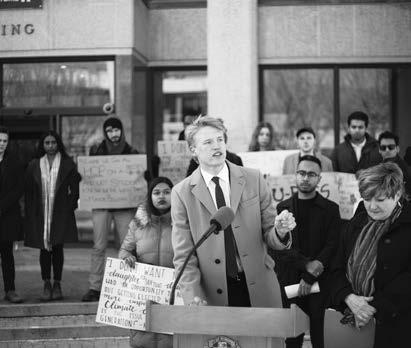
Sanderson (left), UMSU president, and Coun. Janice Lukes were among those who spoke at a rally outside Winnipeg City Hall March 10 to protest the city’s cancellation of the U-Pass. The city budget initially proposed cancelled the U-Pass after a fee increase was taken to a referendum at the U of M and the University of Winnipeg.
The City of Winnipeg’s executive policy committee passed an amendment March 18 to reverse the proposed axing of the U-Pass program from the 2020-23 budget.
City council as a whole passed the revised budget March 20 — by a vote of 11 to 3 — which could see the U-Pass come at a cost of $200 per semester, over and above the $160.75 per semester approved by students in the U-Pass referendum in February. UMSU’s board of directors will meet March 26 to ultimately decide the fate of the U-Pass for undergraduate students at the U of M.
Students voted in unprecedented numbers in the U-Pass referendum which took place from Feb. 12 to 14 and chose to remain enrolled in the U-Pass program, with 39.5 per cent of eligible students voting in UMSU’s referendum.
UMSU president Jakob Sanderson spearheaded the push to save the U-Pass, which began weeks after the UMSU referendum took place.
The referendum was triggered by the city’s decision to increase the cost of the service by $24.50 per term, bringing it to a total of $160.75 per term, as UMSU believed such a fee increase required a ref-
erendum of the student body. On March 6, the city’s executive policy committee brought forward a version of the budget with the U-Pass cut out entirely, while knowing that students at both the U of M and University of Winnipeg had recently voted in favour of continuing the U-Pass program at a rate of $160.75 per semester.
Sanderson said he believes the process to reach this point was unnecessarily long-winded and ridden with errors.
“It was a very, very flawed process,” he said.
“The idea that there was a $4.3 million mistake which has now been publicly acknowledged and apologized for, that students, in this case myself, had to find by independently requesting financial documents, going through them line by line, continued calls and emails to departments and to councillors and to the chief financial officer is reflective of a horrible process that allows for these types of things to happen and in fact almost encourages these types of things to happen,” Sanderson said.
He is calling upon the city to change the process so mistakes like these never occur in the future.
“I looked at one tiny piece of
PHOTO BY QUINCY HOUDAYER
something that didn’t make it into the budget and look what we found,” said Sanderson. “We found $4.3 million. So, that can happen all over the place and […] it’s really hard for people to make this kind of difference.”
Sanderson said the rate of $200 per term is “currently not binding” and is pending ratification by UMSU’s board of directors. He said the board will be making the final call on whether to unilaterally make the decision on increasing the fee or to send the U-Pass to yet another referendum of the student body.
“UMSU’s board of directors is the highest decision-making body of UMSU and the UMSU Act states quite clearly that referendums are only necessary on fees directly collected by UMSU, and this fee is collected by the City of Winnipeg.”
According to UMSU board members, UMSU directors were instructed to sign non-disclosure agreements during closed session of the March 12 board of directors meeting in order to maintain secrecy over UMSU’s negotiating strategy with the city.
Continued Further | Page 5
Change slate sweeps 2020 UMGSA general election
No incumbent executives returning
TY BRASS, STAFF
Preliminary results of the 2020 University of Manitoba Graduate Students’ Association (UMGSA) general election show Change, the only full slate in the running, taking every position.
Presidential candidate Silvia Sekander took 300 votes, vicepresident academic candidate Rubel Chandra Talukder took 536 votes, vice-president services and support candidate Etinosa Osemwota took 579 votes, vice-president finance and administration candidate Nora Ampomah took 559, and the two senatorial candidates Akeem Azeez and William Dowie took 530 and 550 votes respectively.
Of the three independent candidates announced at the outset of the election, the two presidential candidates, Saeideh Mirzaei and Gift Amadi, took 255 votes and 159 votes, while vice-president academic candidate Danielle Milln withdrew from the race before the voting period began.
“We will try our best because the whole world is facing the pandemic” — Silvia Sekander, UMGSA president-elect
There will be no 2019-20 executives returning to their positions this upcoming year. Sekander said she was surprised upon learning the results.
“I was really shocked,” she said. “Even though I was expecting to get many votes, because I have campaigned a lot throughout the campaigning period, I worked really really hard to get this.”
Sekander’s first priority is “lobbying for the international student healthcare.”
Last September, international students saw their health-care coverage costs sharply rise, just a year after the province had cut universal health care for international students.
With the March 25 UMGSA council meeting set to be held remotely due to the COVID-19 pandemic, Sekander said the next few UMGSA council meetings — held on the last Wednesday of every month — may take place remotely, and that she is unsure how that will affect her early time in office, but she was optimistic that the online process could be made to work effectively.
“We will try our best, because the whole world is facing the pandemic, not only us.”
Before these preliminary results are ratified, all complaints and appeals must be resolved. The only complaint posted by the election’s chief returning officer to the UMGSA website resulted in no penalty applied.
Sekander and her slate will take over the executive roles in May, but will begin attending UMGSA council meetings in preparation beginning with the remote meeting scheduled for March 25, at which the general election’s preliminary results are to be ratified according the organization’s election and referendum manual.
Jakob
Campus clamps down as U of M responds to pandemic
University closes in face of COVID-19, international students facing additional uncertainty
GILLIAN BROWN, STAFF
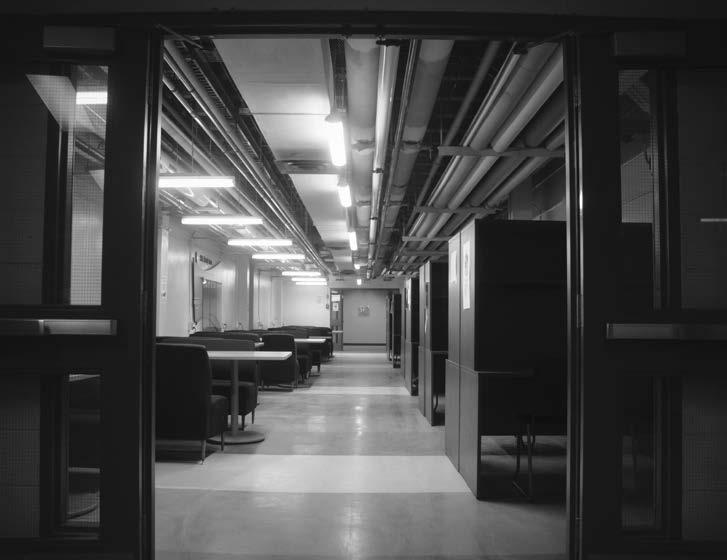
The University of Manitoba is closed.
In an ever-escalating response to the continuing global COVID-19 pandemic, the U of M announced Friday afternoon that its buildings would be closed to all but essential staff beginning 11:59 p.m. Monday. The announcement followed a provincial declaration of a state of emergency hours earlier.
While all courses had already transitioned to remote or online instruction earlier last week, libraries and other campus services had been maintained until Friday afternoon. Libraries will remain closed this week, but online resources will continue.
There will be no in-person exams and the voluntary withdrawal date has been pushed back to April 13.
The announcement Friday also directly addressed research, suspending most on-campus and field research, scholarly works and creative activities.
A university release notes that all work will be paused that cannot be completed remotely or that cannot ensure the health and safety of
research personnel and might introduce the coronavirus into a vulnerable population.
“The expectation is that researchers will continue as much research as possible remotely, but only limited research will continue in university research facilities, including off-campus research sites,” said the release.
Earlier last week, residences on campus required that all students who could do so return home.
Those who were unable to leave continue to have modified access to residence dining halls. Additionally, the pharmacy is maintaining regular hours.
The turmoil is taking a unique toll on international students who not only worry for their own health but for their families at home.
“They’re very concerned,” said UMSU international community representative Victoria Nwabuisi. “Especially those who have families in countries that are being severely affected by the virus. So it’s a very scary time for a lot of people.”
International students in need of support are encouraged to seek guidance, counselling and spiritual care
through the International Centre, which continues to take appointments over the phone.
Students remain under the Manitoba International Student Health Plan and if required, COVID-19 testing and treatment will be covered.
“I’m glad that the university has taken such measures to ensure the safety of all of the members of the U of M community,” said Nwabuisi. “And I think that has really helped ease some of the anxiety that a lot of international students are currently dealing with.”
“I can’t imagine having to be in school — dealing with all of the essays, final exam deadlines, [et cetera] — during a time like this when you’re worried about your family in another country [and] your family is also worried about you.”
She added that moving classes online was “a great relief for all students in the U of M, but especially international students.”
“We have people from every walk of life coming to the U of M for classes, and maybe somebody who’s just flown back in from one of the
affected countries passes on the virus to a student who lives [in residence].”
“Then, every single student on residence would be at risk.”
Caretakers in residence are taking additional safety precautions and sanitizing frequently-touched areas like door handles, elevator buttons and light switches. The dining hall is remaining open, and seating areas have been spread out to help practise social distancing.
“It’s global, it’s affecting every single person in different ways” — Victoria Nwabuisi, UMSU international community rep
Nwabuisi added that local food business have offered free delivery to students.
The uncertainty around the
response to the pandemic is an additional concern for international students in their final year of school, she said, adding that “We are supposed to be finishing our degrees this semester, and our study visas only go until July, and as from July, we’re supposed to have finished our degrees.”
Nwabuisi said the administration’s decision to cancel classes for two days last week and push back the voluntary withdrawal date may not have targeted international students but helped the entire U of M community regroup.
“It’s very limited, what they can do for just the international community, I would say, because this is an issue that, it’s global, it’s affecting every single person in different ways,” said Nwabuisi.
“So even people who are here, who are Canadian citizens, some of them still have family who live in some countries that are being severely affected right now.”
Misko Fest postponed due to COVID-19
No word on length of delay, online community remains strong
STAFF
KAYLA LARIVIERE,
T
he University of Manitoba
Indigenous Students’ Association (UMISA) has postponed its fourth annual Misko Fest due to COVID-19.
Past Misko Fests have taken place during either the U of M Indigenous Awareness Week or U of M Indigenous Awareness Month in March.
The university did not have an Indigenous awareness week or month planned for this year, but UMSU had its first Indigenous students’ month in November.
This year’s Misko Fest was to include powwow dancers, jigging, Inuit throat singing, and a small trade show with local Indigenous organizations and was to be followed by a feast.
The planned festival also included a performance by Annie Beach, a student in the bachelor of fine arts honours program.
Beach’s performance, “Wanted: Red & Alive,” was to showcase contemporary Indigenous art and per-
formance. According to Beach, the performance would have examined “the absurdity of imposed stereotypes and how it shapes Indigenous identity.”
She added that it was included in Misko Fest this year because “the goal of the festival is to integrate Indigenous culture directly in the student hub of [University Centre] through a powwow celebration.”
read the statement. “The health and safety of the community is our main priority.”
The UMISA Womxm’s Council, University of Manitoba Indigenous Concerns on the Environment
“Along with many other cultural event cancellations, such as Misko Fest, it is important that the Indigenous community on campus knows that we are here for one another”
— Taylor Galvin, Misko Fest co-organizer
UMISA cultural co-ordinator Mackenzie Anderson explained the cancellation in an emailed statement.
“Due to the COVID-19 pandemic UMISA and the Misko Fest committee have decided to postpone our annual celebration to a later date,”
(UMICE) and the Metis University Students’ Association (MUSA) were involved in planning the event this year.
UMICE president Taylor Galvin, despite the cancelling of all UMICE events, shared positive words in light of current events.
“Along with many other cultural event cancellations, such as Misko Fest, it is important that the Indigenous community on campus knows that we are here for one another,” said Galvin. “As Indigenous student groups at the University of Manitoba strive to keep cultural activities at the forefront, during this time we can still learn about traditional medicines and ways to prepare them with our families and elders.”
“Though the impacts of COVID-19 isolation are disheartening on the campus environment, we must continue to work together and share teachings and stories of ways to assist in our health and well-being until further notice,” added Galvin.
MUSA has also postponed all
its events. MUSA president Kirsten Fleury said “we believe it was the best decision to be made to protect our whole community.”
“While the social isolations protocols are difficult for students in many ways, we have been seeing the Indigenous community showing great resiliency on social media platforms, whether it be by encouraging love and kindness, practicing traditional art and ceremonies and dancing and praying for good health for everyone,” said Fleury.
“The MUSA executives are so inspired by the strength of our community and we encourage everyone to keep doing what they are doing, and we want everyone to know they are more than welcome to reach out to us for support in whatever way we can offer it.”
Further cost increases needed to bring U-Pass in line with low-income transit pass, city says
Continued from Page 3
“We were authorizing […] UMSU’s board of directors to authorize the executive committee to negotiate with the city and approve up to a certain rate to allow us to try and expedite these negotiations” Sanderson said, “$200 is outside of that rate and so that is why we will have to go back to the board of directors at this point.”
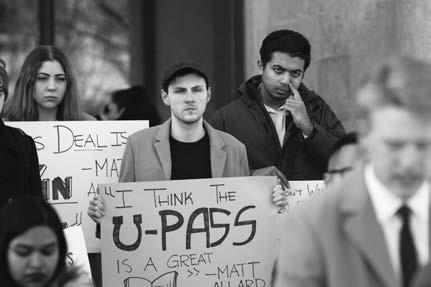
Sanderson acknowledged the apology given to UMSU and U-Pass proponents by infrastructure and public works committee chair and councillor for St. Boniface Matt Allard but believes that statements
made by Mayor Brian Bowman that appear to be taking credit for saving the U-Pass program are disingenuous.
“We also saw the message from Mayor Bowman saying ‘We found a way to save this program,’ and I would say ‘No you didn’t, we did,’ ‘We,’ being the students, found a way to save this program by diagnosing that [4.3 million-dollar] error.”
Allard posted a statement on Facebook March 19, saying postsecondary students are owed “a debt of gratitude for helping to save this great program.”
Allard also admitted to mathematical errors that were found and corrected by Sanderson and
University of Manitoba Graduate Students’ Association (UMGSA) vice-president academic and former UMSU president Tanjit Nagra.
Allard wrote that Sanderson and Nagra “were correct that the estimated $15 million lost revenue and expense target projection in our report is off by several million dollars.”
Allard said the new increase, up by $63.75 per semester from the current rate of $136.25, will bring the cost in line with the new low-income pass, which not all students would qualify for.
“The U-Pass program will be preserved in the 2020-2023 budget,” Allard wrote.
Nagra said in an email that the
UMGSA will be reviewing its options for a referendum.
“We also saw the message from Mayor Bowman saying ‘We found a way to save this program,’ and I would say ‘No you didn’t, we did,’ ‘We’ being the students” — Jakob Sanderson, UMSU president
She said that although she does not use the bus as her primary mode of transport to and from campus and has “mixed opinions on the cost of the U-Pass at $200,” she will be voting “Yes” in the eventual UMGSA referendum.
“I see the U-Pass fee as an investment into our environment and I am OK paying a bit extra so that my fellow graduate students who rely on the bus are able to access this service [as] a more affordable option,” Nagra said.
Mohamed Soussi Gounni, a U of M student, had harsh words for the city, saying councillors went back on their word after giving UMSU the figure of $160.75 in order to keep the U-Pass program alive.
“This $160 number was voted on by the [infrastructure and public works] committee, was voted on by city council, and then proposed to us students,” he said.
“That was the city who told us, ‘Look, if you want to keep the U-Pass, it has to be $160,’ and we went ‘Oh, you know what, that’s fine, we accept.’”
Gounni said he feels that the city negotiated “in bad faith” and caused UMSU to spend time, money and resources on a referendum by including a dollar amount that is no longer relevant.
“We spent thousands of dollars on the referendum,” he said. “Since January our [UMSU] executive obviously had negotiated with the city to get the $160 number.”
“They blindsided us on March 6, with the cancellation of the U-Pass.”
According to Gounni, a councillor on the infrastructure and public works committee told delegates March 12 that the budget had been in its current form since the beginning of February, prior to the U-Pass referendums at both the U of M and the U of W.
“They knew they were negotiating in bad faith because they knew [the U-Pass continuation] was never going to happen.”
In response to the city drawing out the process to continue the U-Pass program, Gounni had this to say: “You disrespected students, you don’t respect our time, you don’t respect our money and you certainly don’t respect our voice.”
The UMSU board of directors will be meeting remotely to discuss the U-Pass and other matters March 26 at 6:30 p.m. Students are encouraged to attend.
More details regarding the remote meeting will become available in the coming days via UMSU’s official channels.
PHOTO BY QUINCY HOUDAYER
Editor-In-Chief: Matthew Doering
Contact: editor@themanitoban.com
/ 474.6770
COVID-19 is the wake-up call humanity needs
Let the virus serve as a reset button and slow down the world’s pace
EVAN TREMBLAY, STAFF

Before the COVID-19 pandemic began its march across the continents, the media was filled with stories of our failure to adjust the path of our societies to the reality of a climate increasingly harsh and a biosphere collapsing.
If the headline has changed, the analogy invoked is the same: the need for massive, collective action is likened to war footing.
Although the worst of the pandemic is yet to come, in the past few weeks we have witnessed a massive, sudden global pivot such as is beyond the living memory of those born since the conclusion of the Second World War.
The ancient, intimate fear of bodily sickness has accomplished what the more rarefied, existential dread of climate change — which is still by far the greatest threat to our communal wellbeing — has failed to do: inspire collective, immediate action.
Although the economic damage of the present disruption will be severe — again, such as is outside the memory of many now living — the communal consensus under which a neoliberal, globalized world laboured
is revealed to be false. Rents to be frozen, mortgage payments are suspended, utilities are forbidden to be shut off, so that individuals can do what must be done for the good of their communities.
A guaranteed living wage for all citizens seems more like a necessity day by day.
Humans and their societies are more able to take sudden, dramatic action than we have been accustomed to think, provided we are scared enough.
We see already the effect of the lessening of the tyranny of that hallmark of the world — modern, frenzied transportation of human bodies.
The sudden and precipitous drop in long-distance movement, by both plane and automobile has inevitably left the air cleaner. Satellite images show a marked drop in smog and vehicle emissions over cities whose names were synonymous with pollution.
A researcher suggests that thousands of premature deaths have been staved off from the increase in air quality in Beijing due to the temporary shuttering of factories.
The eternal gridlock of Los Angeles has dissipated, and with it the city’s seemingly eternal smog: the occlusion of the sun has lessened in that sunny city.
Cities whose dignity had been eroded by throngs of tourists — for example, Venice, Barcelona and Paris — are revealed in their dignity, the squares and streets and monuments returned to the quiet peace that befits ancient seeds of culture.
Though eerie, the emptiness allows all of us to marvel at the human expressions of beauty and civilized urban life.
If we are eager to see these places filled again with crowds, we perhaps understand that by right those crowds should be composed mostly of the people who now shelter in those places.
Emptied of gawking tourists and those who pander to them, these are places of great beauty — testaments to the long labours of generations now passed to dwell meaningfully in a specific place.
In Venice, canals long muddied by motorboats stirring up sediment columns have become crystal
clear, exposing the canal bottoms covered in seaweed that are inhabited by schools of fish. Birds have returned to the water’s edge. Without cruise ships disgorging hourly their throngs, the city is again enchanted: La Serenissima, the Most Serene Republic.
This may be the reset button we needed but thought we would never get
Rome regains her dignity as the Eternal City of seven hills when the many fountains flow only for her inhabitants, and no tourist must be fined for bathing in them. If the long streets of Paris seem to yearn for crowds in the cafés, the Champ de Mars seems a more pleasant place without the endless line at the foot of the Eiffel Tower.
Where national parks are closed, the wildlife has respite from the clamour of tourists and the rumble of engines.
Dolphins have been spotted cavorting in silent harbours. Nature is quick to venture into the spaces voided by humans — this offers evidence, in the end, that humans are the damaging element which must be restrained.
It is good if, even temporarily, the non-humans of the world have a chance to stretch their legs.
This pandemic will pass, as have all before it. What would be a shame would be to return to the antebellum rush which it has thankfully paused. As we shelter in place, the world around us becomes by measure more like it once was: quieter, slower and less filled with pointless comings and goings. Surely this is a desirable result of a most undesirable situation.
We come to a new appreciation of the powers of telecommunication and the risks of constant movement. This may be the reset button we needed but thought we would never get.
Perhaps the greatest move this generation can make is to take advantage of this time to reflect on the pace of life after COVID-19.
Here are some things to know!
The arrival of COVID -19 here in Manitoba has triggered a chain of events that has affected each of our lives in a multitude of ways in our
Economic Support
The federal government announced $82 billion in economic measures to help support those in need during the fight against COVID -19. Part of this includes a six-month pause on federal student loan payments. UMSU will be releasing a detailed breakdown of the plan in the coming days to help inform students of the financial supports available to them.
Academic Supports & Services
Academic advisors, student supports and other services offered through the university are all still available, even though you may have to access them in different ways. And effective immediately students will not be required to provide medical notes in support of absences from class activities/requirements and from evaluations including final examinations.
In-Person Classes
There will no longer be any in-person classes held on U of M campuses for the remainder of the winter term, as well as no in-person final examinations to be held for any courses in inter 2020 term. We urge you to stay in contact with your instructors to see how your courses and evaluation will be shifting to alternate delivery methods as things progress.
Voluntary Withdrawal
The university has decided to change the Voluntary Withdrawal date to April 13, 2020 and changes to the Limited-Access ‘Policy’ Section 2.5. (a) of the ‘Repeated Course’ policy be suspended indefinitely – stipulating that any student who has voluntarily withdrawn from, or received a final grade in a course is prevented from repeating the course for the immediately subsequent three consecutive terms.
Summer Term Registration
Registration for Summer Term courses will be suspended indefinitely with no in-person instruction or assessment for any courses to take place until at least September 1, 2020. All summer courses – courses that were scheduled to take place between early May and the end of August – will now begin no earlier than June 1, 2020 and take place online and/or via distance education.
COVID-19 has drawn us together with a common goal
This type of unification has the power to combat the world’s biggest problems
MEAGAN HUGHES, STAFF
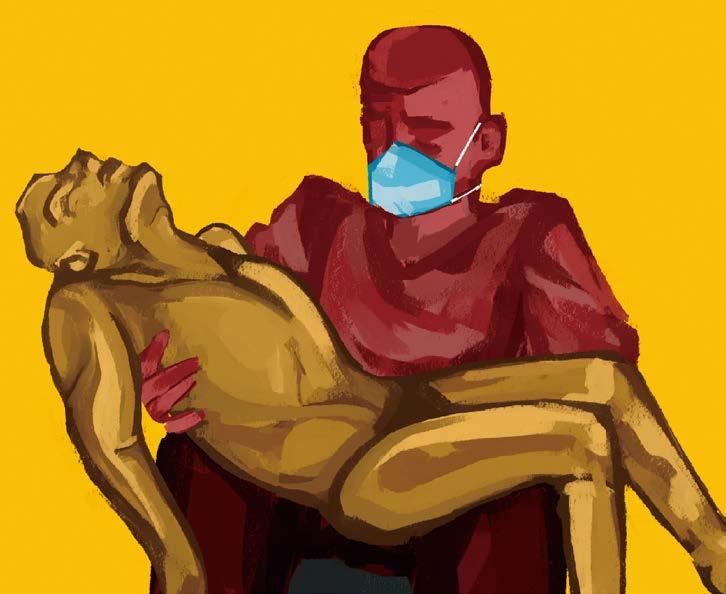
We are currently living through one of the most significant periods of uncertainty in our lifetime.
Not even halfway through 2020, our daily lives and routines have come to a halt as we shift into social isolation and distancing to contain the COVID-19 virus.
Over 2,000 cases have been reported in Canada thus far with over 400,000 cases reported worldwide.
Our highly-connected and globalized world may have been a catalyst for the spread of the virus, but it also may be what keeps us sane while we sort through this pandemic.
As humans, we are very adaptive — we have found innovative ways to achieve balance, stay connected with each other and continue to support our local economy during this time.
This crisis has, in its own way, shaken up our daily lives to wake us up to our own fragility. People have a newfound appreciation and respect for public human health. Although
we may never know if our own social distancing practices have had a direct impact on the life of someone else, this is how we choose to contribute to public health.
It is the same as getting vaccinated — we may never know if being vaccinated directly saves someone close to us from getting sick, but we do it anyway because we are contributing to herd immunity and creating healthier and safer communities.
By staying home, we are looking out for those around us. We are in solidarity with each other. We can feel a sense of connection in knowing we are in this together and we are doing what is best for the betterment of public health.
COVID-19 has found a way to unite people as we are all powering through this crisis on a global scale.
Social media currently plays an important role in allowing us to keep in touch with family and friends while we remain at a physi-
COVID-19 has found a way to unite people as we are all powering through this crisis on a global scale
cal distance.
There have been online support groups popping up in Canada, amassing hundreds of members quickly. Members have offered support in the form of deliveries of supplies to those in need as well as advice and emotional support during this time.
Local artists and businesses have taken to the internet to keep people together through online groups, online classes and even online music
shows.
Winnipeg dance studio Drop In Dance has ceased all in-studio classes until further notice but is hosting online dance classes with pay-whatyou-can donations from $5 to $20 to keep the local dance community alive.
Local hair salons have also been offering delivery of hair care products to keep revenue coming in and connect with their clients since many salons have closed during the pandemic.
Musicians have taken to social media to connect with fans and host online shows in order to spread their art during this time. Among many, musician Ashley MacIsaac from Cape Breton, N.S., is planning to host an online music festival April 1 with low-cost — or free — tickets.
The COVID-19 pandemic has invoked an immediate and decisive global response. But this immediate response to an urgent threat is what’s needed for another existential
threat — climate change. In the same way that it has for COVID-19, the world must band together to initiate change and do what is best despite any inconveniences.
COVID-19 has had the advantage of being an almost instant crisis, with a clear and detrimental effect on every population it encounters. Climate change is different because its effect on the would cannot be immediately seen in the same way.
But it is a crisis that necessitates the type of response COVID-19 has received, or else the world may end up longing for the days when the largest issue it faced was a global pandemic. The people of the world need to understand that, in both cases, everyone is in this together, and the more we act responsibly now the sooner we can all really be together again.
GRAPHIC BY ERNEST ZARZUELA
Pandemic is opportunity for more equitable society
Reformist policies to simply return to normal are not enough
CAM CANNON, STAFF

In recent weeks, practically the entire world has been shaken by the COVID-19 pandemic.
The stock markets have been plummeting, thousands have been laid off from their jobs and a state of emergency has been declared in Manitoba.
The government response to the crisis has been unsurprising to say the least. Nonetheless, from a political and economic standpoint, it is intriguing. We are experiencing history.
Billions of dollars in stimulus are set to be given to suffering industries such as airlines and the oil and gas sector. The Bank of Canada is dropping interest rates to less than one per cent. Mortgage payments are being deferred and wages are being subsidized.
All of these measures are excellent news to anybody lucky enough to own businesses or properties.
For the vast majority of people, the direct financial support is being given
through tax credits such as the GST top-up payment, which promises roughly $400 payable to single adults who filed taxes. But in Manitoba, this does not even cover a rent payment for many people.
Another way direct financial support is being given to Manitobans is in the form of enhanced employment insurance (EI) benefits, which can give up to $900 bi-weekly for up to 15 weeks to those workers who are unable to work due to the pandemic and do not qualify for EI.
Massive amounts of financial aid are about to be sent directly to sectors like airlines — which failed to keep cash reserves and instead opted for stock buybacks — and the oil and gas sector, which for years has been in decline and needs to be phased out.
Mortgage payments can be deferred, yet renters are expected to continue paying rent.
Business owners are further being helped with their bottom line through wage subsidies and increased
credit availability.
Only people who are up-to-date on their taxes will receive the GST top up — not to mention that this support will not be available until May.
Overwhelmingly, these measures benefit those with the most wealth — people who own businesses and properties and are therefore able to extract profits or rents from the labour of others.
Economic logic dictates that in a crisis such as this, the most effective way to prevent a downward spiral which leads to another economic depression is to dramatically increase government spending and get money into the hands of the majority of people — who will more than likely immediately spend it on necessities — keeping the economy running.
Keeping in line with this logic, across the political spectrum there have been widespread calls for the introduction of a policy called universal basic income (UBI).
The premise of UBI is simple: since the boom and bust cycle inherent to capitalism tends to be caused by a lack of effective demand from average people not having enough money to buy products, giving people money to spend — regardless of their employment status — would ensure effective demand is maintained at a minimum level.
However, there is a risk associated with such measures.
Without the elimination of rents, or at least tight control of them, UBI could potentially serve as nothing but a subsidy for landlords, enhancing their ability to accumulate wealth while renters remain in exactly the same position.
If such a thing were to happen, the macro-economic benefits of UBI would essentially be lost — inequality would likely only continue to grow as property becomes evermore concentrated in the hands of a few people.
Of course, it is no surprise that the emergency measures already
announced overwhelmingly support business and property owners — after all, we do live in a capitalist society where the state serves only the bourgeoisie — or at the very least maintain an acceptable enough institutional environment for profit to occur at a reasonable enough rate.
Income taxes were introduced as a temporary emergency measure and remained beyond the initial crisis that birthed them — the same could happen with UBI.
The emergency care benefit, an enhanced form of employment insurance, is close enough that it could serve the same purpose.
Throughout the history of capitalism, crises have almost always led to a massive change in political economy. Think about the rise of Keynesianism after the two world wars, and the rise of neoliberalism after the economic crises of the 1970s.
We are experiencing history. Where we go as a society is in flux, and now is not the time to be quiet.
Capitalism’s disgusting behaviour revealed in pandemic
Greed
of those price-gouging in crisis emblematic of a system that turns people into monsters
KENNY INGRAM, STAFF

Over the past few weeks, COVID-19 has gone from a slight concern to global pandemic.
In that time, grocery stores began selling out of products like toilet paper, hand sanitizer and other essentials.
But it wasn’t just the unfounded panic-buying that led to the empty shelves. There was a much more sinister plot in the minds of some of the people who contributed to the temporary shortages of essential goods.
In the United States, a man went to every store he could find around Tennessee and Kentucky with a U-Haul truck and purchased nearly 18,000 products — from hand sanitizer to disinfectant wipes.
Some people from Canada had the same idea. A couple from British Columbia — Manny Ranga and Violeta Perez — were seen buying obscene amounts of disinfectant wipes from Costco.
They ended up selling over $100,000 worth of products in the first three or four weeks.
In a surprising twist, the gouging
even led companies — from Amazon to eBay to Kijiji — to crack down on the multitude of people pricegouging on their platforms.
But it cannot be overstated just how unsurprising this development — of opportunistic people attempting to profit off of other people’s pain and suffering — really is within the framework of a system that rewards it.
This is exactly what capitalism turns people into: monsters looking for ways to make a quick dollar at every turn.
But it’s clearly not just people like Ranga and Perez who are guilty of this mindset. Capitalism turns wellmeaning people into self-interested barbarians.
When researches come up with a life-changing or life-saving drug, it’s often handed over to the worst possible people — where citizens who actually need it are either gouged or forced to go without.
It’s seen in all aspects of society. Where executives of the largest companies are fine withholding information leading to the poisoning of
large percentages of the population — like Johnson & Johnson and Philip Morris International — or the planet, like ExxonMobil, as long as they continue making millions for themselves.
This type of behaviour — the one that urges people to go out and hoard thousands of bottles of essential goods — is exactly the kind of behaviour that allows for someone to be successful within the framework of a capitalist system.
With the world’s two richest people able to amass and hoard over US$100 billion each — contributing to a situation where eight people own more wealth than than the poorest 50 per cent of the world — and with even developed, industrialized countries like Canada having nearly 10 per cent of people living in poverty being an all-time low, something is very wrong.
Whether it’s hoarding essential goods or hoarding wealth, capitalism is a system that encourages and rewards both.
But just as society has condemned the opportunistic people who stack
their carts with sanitizer, it must also condemn the people who have amassed the billions of dollars that have contributed to the global crisis of poverty.
Capitalism turns well-meaning people into self-interested barbarians
This behaviour is contradictory to the behaviour that can be seen within a family, where everyone gets what they need, when they need it. Everyone is given access to the best resources available to the family.
No one is asked for money — that would be absurd. When you sit down to eat, everyone is fed and there’s no money to be made.
But the moment you step outside the door, everything changes. You’re treated like an outsider.
If you walk into a grocery store in a
time like this, you can very quickly be accused of greedily trying to snatch up the last of the essential goods for yourself.
In a system that’s supposed to reward innovation with profit, it often seems to reward those who innovate the least.
That is, unless you view shoving people out of your way as you fill up your cart with the last of the hand sanitizer as being something “innovative.”
Basic human decency is incompatible with a ruthless system like capitalism, and the COVID-19 pandemic is only more evidence of it.
We need to get beyond a system that rewards the monstrous, opportunistic behaviour that capitalism fosters and move to a system that treats everyone like the human they are. Where, in times of crisis like this, everyone gets access to the resources they need. Like a family.
A better society is possible, but it won’t come about by denying the reality of the current system — a system that rewards the worst of humanity.
11 Arts & Culture
Jonas Chernick’s road to ‘James vs. His Future Self’
U of M alumnus set to debut new film April 3
GRACE PAIZEN, STAFF

Picking a major can be one of the most difficult decisions one can make as a university student.
However, U of M alumnus and Toronto-based filmmaker Jonas Chernick knew he was going to be a film major from the very start.
“I was an arts guy and other than whatever other required courses I had to take to get my [bachelor of arts degree], all I took were film classes and theatre classes,” Chernick said.
“I was heavily involved with the Black Hole Theatre […] but most of my time was spent sitting in the movie theatre classes — I would call them — and watching movies.”
Taking three to four film courses a year exposed Chernick to movies and film theory that would ultimately help him throughout his career.
“It was very, very informative and I would say over the course of my four-year [degree] I saw hundreds of films that I would not have otherwise
seen, and that helped turn me into a film artist that I consider myself to be today,” he said.
After graduating from the U of M in the mid-’90s, Chernick maintained his ties with the students he had met in his program. Together, they took their acting ambitions to the professional stage.
“We formed our own independent theatre company and we started to do productions at the Winnipeg Fringe Festival,” Chernick said.
“We would collaboratively create a show from the ground up.”
“I handled a bit of the business side of the company. So, I was also doing the financing and the marketing and the producing, all of which ended up feeding into me making my own films […] about five or six years later,” he added.
However, it was the acting that launched Chernick’s career. After getting the attention of a casting
PHOTO
PROVIDED BY JONAS CHERNICK
company while performing at the Fringe, Chernick was part of the television and movie boom happening in Winnipeg.
“I started booking TV jobs and film jobs, smaller parts, and just kept doing that through the ’90s,” he said.
“And then around 2000 [I] made my first film, which we thought was just a little artsy, indie kind of movie that nobody would ever see, but it got into [Toronto International Film Festival (TIFF)] and it won an award […] and suddenly I had an acting career, which is what I always wanted.”
The film was Inertia, Winnipeg filmmaker Sean Garrity’s first full-length film, which won Best Canadian First Feature Film at TIFF.
After a taste of success, Chernick moved to Toronto and kept up his acting career. However, he kept coming back to Manitoba to make films.
“When I wasn’t acting on some-
body else’s project, to keep myself sane, I would write scripts and try to get them made,” Chernick said.
“So, by default […] I accidently became a writer-producer while I was waiting for other people to hire me as an actor. I started to make my own films and all of them, by the way, were shot in Manitoba.”
“I kept coming [back to Manitoba] to make films — my own films — and as those films found some success […] it dovetailed nicely with this acting career that I was also nurturing. And then that all culminated with making this film, James vs. His Future Self, which is the biggest, most ambitious, most extensive film I’ve made to date.”
“When I wasn’t acting on somebody else’s project, to keep myself sane, I would write scripts and try to get them made” — Jonas Chernick, filmmaker
Set to be released April 3 on digital streaming platforms, James vs. His Future Self has been a film in the making for many years now. Focusing on a time-travelling obsessed scientist, he meets his future self who has time travelled to tell James not to become the world’s first time traveller.
Starring Chernick as James and Daniel Stern of Home Alone fame as James’s future self, Chernick’s friend and fellow Canadian filmmaker Jeremy LaLonde directs the sci-fi rom-com, having helped Chernick develop the screenplay.
“When I was 19, I went backpacking through Europe with my friend
and went to ‘find myself,’” Chernick said.
“I didn’t ‘find myself,’ but I started to wonder what would happen if I literally found myself. […] What would that conversation be like — what would you ask and what would you want to know, what wouldn’t you want to know and how would it change you to have met yourself?”
“Eventually, I acted in a film in 2015 […] and the director of that film is a friend of mine, Jeremy LaLonde, and we had a good experience working together. He said to me afterwards ‘Hey, I’d like to develop my next film and I’m thinking of something that’s kind of sci-fi. Do you have any ideas?’ And I just threw this idea out.”
Collaborating and developing the film together, Chernick and LaLonde didn’t set out to make a sci-fi film per se — they wanted to “use time as a device to explore character.”
Described by Chernick as “a warm hug of a movie,” he’s finding the release of his biggest project serendipitous.
“I want people to feel good, especially right now — we need a distraction, we need something positive and full of life and love and humour,” he said.
“The movie is ultimately about learning to be present and to be in the moment […] And so, hopefully the movie will also make the audience think a little bit about what they’ve got and take a moment to stop and smell the roses and just take a deep breath and ‘be.’”
Just like his movie, Chernick’s future in the film industry looks positive, proving you can be a kid from Winnipeg and make it big. Hopefully he can now take his own advice to relish in the moment.
“Because everything has been cancelled and all the work is put on hold and everything, all you have is what you’ve got right in front of you […] so it’s a good moment to kind of take stock of that.”
’Toban turntable
Basia Bulat — ‘Are You in Love?,’ 4.5/5

To hear Basia Bulat sing is to be reassured — each note feels like a friend’s hand on your knee, understanding and encouraging.
Her music has always held a warm, hard-won wisdom, and Are You in Love? is no exception. The record sways and shimmies with a deeply human abandon, telling compassionate stories of love, heartbreak and life.
In fact, it’s arguably Bulat’s most dynamic record yet.
A satisfying marriage of Bulat’s soul-folk origins, the arrangements are playful and sparkling without becoming overstuffed
Composed and recorded primarily in the deserts of Joshua Tree National Park, in California, U.S.A., it glitters brightly and shifts like dunes.
Each song seems to emit a warmth all its own — a tender, skin-awakening light to close your eyes and bask in.
Are You in Love? is a record with a lot of ideas and a solid sense of what it’s meant to be — a satisfying marriage of Bulat’s soul-folk origins, the arrangements are playful and sparkling without becoming overstuffed.
Producer Jim James employs a light touch, letting Bulat’s outsized presence fill the spaces rather than
cram them with psychedelic washes of sound or stampedes of pounding drums.
The record feels in conversation with U.S. Girls’s recently released Heavy Light Bulat’s self-discoveries and deeply-felt declarations act as the cosmic foil to Meg Remy’s bodydriven and percussive opus. The two women share writing credits on each other’s records, an inspiring musical partnership that seems to have pushed both parties to their best works.
The highlights on Are You in Love? are spread evenly throughout, and it rarely loses its sense of momentum and discovery. The twinkle of “Electric Roses,” the heat-wave shimmer of the stunning “Light Years,” the stomp of “Pale Blue”— each song adds dimension and depth to the richly glowing whole, a collection of vivid truths discovered in the desert.
The album reaches its peak, fittingly, at its conclusion. The driving “Love is at the End of the World” — an optimistic approach to the end-times — explodes in a corrosive guitar solo, stealing the record away in a swirl of whipping winds and desert sands.
That Are You in Love? ends on a moment of such vibrant catharsis — and immense hope for our capacity to love in the face of nothingness — is Bulat’s appeal captured in amber. Her music asks you to be better — to yourself, to those you love and to those you’ll never meet.
The least we can do is heed her call.
Want us to review your band? Email arts@themanitoban.com today!
Juniper Bush — ‘Healing Through a Sonic Figure,’ 4/5

The corrosive pink that colours Juniper Bush’s press photo is an accurate foretelling of the music the band creates.
The acidic shade has a deep history, recalling the dreamscape of My Bloody Valentine’s Loveless, the feathered fantasy of Garbage and even Pearl Jam’s Ten
The band is adept at crafting crafty hooks as well as conjuring atmosphere
That these records are all ’90s staples is fitting — Juniper Bush operates in the always-fertile ground where grunge, shoegaze and jangle-pop unite, creating a sugar-sweet swirl of thunderous guitars and reverb-drenched vocals.
The band’s debut full-length album, Healing Through a Sonic Figure, is a disorienting swell of a record — a wave of texture and feeling that revels in a sea of hooks and Lizzy Burt’s haunting voice.
As with their forebears My Bloody Valentine, Juniper Bush seems interested in utilizing the voice as another piece of the enormous sonic puzzle, less centrepiece than equal player.
Burt coos and hums as often as she sings out, layering her voice over top and underneath the walls of guitar, creating dense washes of human sound amongst the thrashing.
The band is adept at crafting catchy hooks as well as conjuring atmosphere. Healing Through a Sonic
Figure has just enough awareness of the album’s loudness to allow for the occasional detour — as when everything save a single twanging guitar drops out midway through the pummelling “Follow My Lead.”
The quiet strums that open the meditative “Turn” are also a welcome reprieve from the onslaught, a brief chance to breathe and take stock amidst the swirl.
But there is a brightness to Juniper Bush’s riffs, a surf-swing that sends the listener hurtling in the sun rather than wallowing in more downcast corners of shoegaze.
As well, Healing Through a Sonic Figure is a fitting title. There’s something balm-like about the warm rushes of sound that Juniper Bush creates.
Even at its loudest, there’s a comforting insularity to the album’s sound, a sensation of being swept up in something larger than yourself.
It’s the kind of album that can wipe your mind clear. Let it wash over you and you’ll likely find yourself somewhere different from where you started.
In fact, the record closes on the steady “And You,” a hypnotically inactive march into quietude. It’s a stabilizing end to a record that whips and twirls with such abandon, blowing each sound out to its obliterating endpoint.
In the age of isolation, Healing Through a Sonic Figure feels like a journey to somewhere else, a chance to disappear into sound.
Want us to review your band? Email arts@themanitoban.com today!

KAELEN BELL, STAFF
KAELEN BELL, STAFF
ALBUM ART PROVIDED BY BASIA BULAT
ALBUM ART PROVIDED BY JUNIPER BUSH
Revitalizing the power of storytelling
New online docu-series focuses on traditional teachings
ZACHARY SIGURDSON, STAFF
S
torytelling is an important part of our lives. The artform can pass down valuable information from generation to generation and teaches us about ourselves and our ancestors.
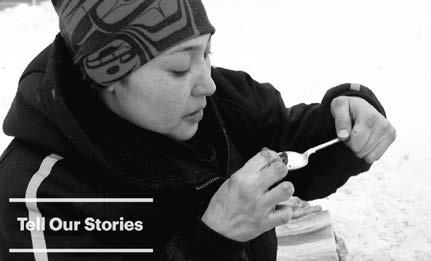
The new online docu-series Tell Our Stories seeks to do just that. With its debut March 16 online at tellourstories.ca, the series was created to protect and promote Indigenous storytelling, and one of the five short documentary films has a serious Manitoba connection.
Directed by Indigenous filmmaker Taina Da Silva from Grassy Narrows First Nation, the film Revitalizing Untold Stories of Indigenous Foods follows Winnipeg-based Indigenous chef — also originally from Grassy Narrows — Chantelle Bone as she returns home to learn traditional recipes from her elders and gain knowledge of the land.
The short film subtly catalogues teachings that became lost through the horrendous practices of colonization.
Bone first learns how to hunt and how to pay her respects to the animals she hunts before learning how to traditionally prepare and cook the food. The chef quickly realizes the relationship to the land lives on in her community and that the simplest of ingredients can be made into the most delicious of meals.
For filmmaker Da Silva, this documentary seems to be a long time in the making, her own stories culminating with the project to revitalize Indigenous cuisine and an opportunity to showcase the injustices faced by Indigenous peoples and against the environment.
“I’d say my greatest success so far is being able to reach young Indigenous audiences” — Taina Da Silva, filmmaker
“I come from a reserve that has a lot of social injustices,” Da Silva said. “I really want to just focus on the storytelling of Indigenous peoples and going back to the culture and just everything to do with bringing that back and showing that in documentaries.”
Da Silva’s main goal is to be able to share these stories, but most importantly to encourage and mentor Indigenous youth, hoping this film will add to her own role of teaching Indigenous youth about their culture and traditions
“I’d say my greatest success so far is being able to reach young Indigenous audiences,” she said.
“My main goal is just to reach those audiences — the Indigenous youth — show them what they can do or show them […] what it means to be Indigenous.”
The collaboration between Da Silva and Bone began simply with the two knowing each other from
growing up in Grassy Narrows and wanting to work together. The Tell Our Stories campaign became the perfect way to promote their own goals of reacquainting themselves and their audiences with their culture.
Whereas in the short film Bone hopes to incorporate traditional food into future recipes as a chef, Da Silva hopes to continue her role as a storyteller with more projects — including
both film and writing — educating future generations about their cultural heritage.
“I love to write about the land and my people.”
Revitalizing Untold Stories of Indigenous Foods is available to stream for free on tellourstories.ca along with the other four Tell Our Stories short documentary films.
Renowned Indigenous artist gains deserved recognition
Ruth Cuthand wins Governor General’s Award in Visual and Media Arts
ZACHARY SIGURDSON, STAFF
One of the immediate and most unfortunate casualties of the pandemic is the closing of our many art galleries and exhibitions. One such casualty was the Endurance….. Patience exhibit at the Urban Shaman Contemporary Aboriginal Art gallery.
The exhibit featured Ruth Cuthand’s visual piece “Boil Water Advisory.” The good news for Cuthand is that during her exhibit’s tenure at the gallery, she won the Governor General’s Award in Visual and Media Arts.
A renowned artist, activist, mentor, teacher and member of Little Pine First Nation, Cuthand said she was inspired to be a visual artist at a young age by professional Indigenous artist Gerald Tailfeathers.
“I remember visiting his studio and seeing all the paints, the brushes and his work,” Cuthand said.
“He had this huge studio all by himself. I think that’s what I liked most — he was by himself and just making art and I thought ‘That would be a great thing to do.’”
Her work has covered a bevy of subjects including white liberal attitudes toward Indigenous women, the 1990 Oka Crisis, MormonIndigenous relations in Alberta, the
diseases brought to Indigenous communities by European settlers and the deplorable living conditions that many Indigenous communities are forced to live with.
“It’s really hard to get the rest of Canada to notice you” — Ruth Cuthand, artist
Now a Governor General’s Award recipient, Cuthand feels she has had some of the national recognition she has struggled for as an Indigenous woman from the Prairies.
“It’s really hard to get the rest of Canada to notice you,” she said.
“I’ve been working at this for a long time, so I really like having that recognition of my work. It just feels great.”
The collection that changed her as a visual artist — and the most relevant to where we find ourselves today — is her “Trading” series of beaded images cataloguing the many diseases brought to the Americas by Europeans.
In fact, the “Trading” project
changed the meaning of beadwork for her.
“It became an artform rather than a craft form,” Cuthand said.
“And ever since I did that, I have influenced so many young beaders into doing contemporary beadwork.”
Her “Boil Water Advisory” piece in the Endurance…..Patience exhibit was a small piece from her larger series called “Don’t Breathe, Don’t Drink” — a brilliant collection of beaded approximations of harmful bacteria and parasites frozen in resin set within a mismatched collection of glassware, including baby bottles.
“There [are] reserves [that don’t] have decent drinking water, very inadequate housing and I wanted to bring that in a very public way through an art space to people,” Cuthand said.
As for her future work, Cuthand is currently working on some beading projects related to COVID-19.
“I’m working on COVID-19 [beadwork]. People have been asking me and there’s some institutions that would like to collect it. So, yes, I’ll do it.”
For more information on Ruth Cuthand and her artwork, go to ruthcuthand.ca.

PHOTO PROVIDED BY FRIENDS OF CANADIAN
PHOTO
Volleyball veterans left disappointed by cancellation
Negus and Leoppky react to the national championship that wasn’t
JASON PCHAJEK, STAFF

For Kevin Negus and Eric Loeppky, the 2020 U Sports national men’s volleyball championship was supposed to be special.
Both entered the tournament with exceptional careers behind them and had plenty of reasons to be excited. Instead, with an 11th-hour cancellation the night before the pair was slated to square off at Investors Group Athletic Centre, the two were left disappointed.
“Just completely devastated,” Negus of the U of M Bisons said.
“Our team had been hearing rumours all night that it would be cancelled, but finally hearing the news was just extremely disappointing.”
Loeppky and the Trinity Western University Spartans were also blindsided by the news, even though they expected changes would be made to
accommodate COVID-19 concerns.
“In the morning practice they told us that no fans were allowed, only family, then no family later in the afternoon,” Loeppky said.
“Then they finally pulled the plug late that night. Honestly we weren’t surprised by the fans but didn’t think they would cancel. At the time there was only one case in Manitoba.”
women’s volleyball, women’s hockey and men’s hockey championships, would not continue.
Despite the disappointment, Negus said he is certain that cancelling the tournament was the right thing to do.
tion hurt just a bit more for Negus.
“I was really looking forward to putting on the Bison uniform one last time,” he said.
“I was really looking forward to putting on the Bison uniform one last time”
Loeppky had his own reasons to be disappointed, as the Steinbachborn outside was ready to play in front of friends and family — some for both the first and last time.
— Kevin Negus, Bisons men’s volleyball right side
On March 12 — the day before the tournament was slated to begin — Bison Sports released a statement officially announcing the tournament would be played without fans in attendance. By 9:30 p.m., U Sports had convened an emergency meeting and decided the men’s championship, along with the
He said the decision “wasn’t ideal, but it was necessary.”
“As tough as it was to come to terms with everything, I knew that U Sports and Bison Sports were just doing what was best,” he said.
As the lone senior on the Bisons men’s volleyball team, the cancella-
“Lots of family and friends were planning on being there. [I] was so excited to play in front of all of them for one last time,” he said.
The Sioux Lookout-born Negus was also ready to take to the court in front of family and friends.
He mentioned that a large contingent of Ontario-based supporters were ready to fly in to Winnipeg to
see him take to the court one last time.
“My parents and my sister had planned on coming as well as a lot of friends from my hometown,” he said.
“But they heard the news early enough to cancel travel plans.”
Now the pair of veteran volleyball players is looking toward the future and getting through the next stretch of uncertainty caused by the current viral outbreak. Loeppky made the long drive home to Manitoba from the West Coast following the closure of Trinity Western University housing to students who were able to travel home.
Negus is already planning his professional debut.
“Next up for me is hopefully flying overseas to play pro either this coming fall or the following year,” he said.
PHOTO BY QUINCY HOUDAYER
Historic goal ‘a moment I’ll
never forget’
Amy and Ko look for silver linings following women’s hockey nationals cancellation
JASON PCHAJEK, STAFF

The Daria O’Neill feed was perfect, slicing through coverage, right to Tatum Amy’s blade.
Then, as the Birtle, Man., native slid the puck home, her team’s bench erupted.
The Mount Royal University Cougars women’s hockey team had beaten the favoured University of Toronto Varsity Blues. In its first game at nationals, the club gained its first win and advanced to the U Sports national women’s hockey championship semifinals.
“As soon as [O’Neill had] the puck, I gave a stick tap and wasted no time to shoot it in the net,” Amy said.
“That goal was probably one of the biggest [highlights] of my hockey career.
“It’s a moment I’ll never forget. Every time I watch it I get the same feeling I felt when I first put it in.”
The third-year forward was so wrapped up in the moment it barely registered, but luckily linemate Tianna Ko was right there to see it all unfold.
“Well I was laughing with [O’Neill] about this because […] I was still yelling at [O’Neill] to shoot the puck because I didn’t see [Amy] sitting back door,” Ko said.
“And so when she passed it I was thinking ‘What are you doing?’ but then I saw that [Amy] was there and then the puck went in and I don’t think I’ve ever been more excited.”
Being involved in such a historic moment was huge for both players, setting the club up for what looked like a magical run to the national finals. Beating Toronto to open the tournament for Ko “proved to a lot of people that even though it was our first time at nationals we deserved to be there.”
onship due to COVID-19 concerns.
Riding high after a historic win, the team was unaware of any discussions going on about cancelling the tournament.
But when head coach Scott Rivett brought the group together to tell the team what was happening, the dream suddenly ended.
Both Ko and Amy found a silver lining in the situation and are looking forward, not back.
“It was really disappointing because we were in a position to win the entire thing,” Ko said.
“So not knowing how it would’ve turned out sucks, but I think it’ll just motivate us for next season.”
that game was their last one with a Cougars jersey on, and they didn’t even know it.
“That win will be an experience none of us will ever forget, and I couldn’t [have] asked for better teammates to share it with.”
With two more years left in a Mount Royal jersey, Amy, too, is looking toward next season.
“That goal was probably one of the biggest [highlights] of my hockey career” — Tatum Amy, Mount Royal Cougars women's hockey forward
But just a few hours later, what looked like a magic run in the making turned to heartbreak as U Sports announced it was cancelling the remainder of the national champi-
“A lot of us were just hanging out, excited about our big win, until we started looking on social media,” Amy said.
“We didn’t want to believe it obviously. But when our coach called a meeting, it felt more real.”
Now the Cougars are left wondering about how far the club could have gone, but that doesn’t mean the players are dwelling.
She said the experience has changed how she’ll approach the game moving forward, and she’ll never take a game for granted.
“I think how the tournament ended it was a huge eye-opener for a lot of us,” she said.
“For me, every time I step on the ice I will play like it will be my last game.
“Nationals was the biggest stage I’ve ever played on, and for some girls
Despite the fact she’ll be able to pull on a Cougars sweater again, will have two more shots at getting to nationals and has the memory to look back on, Amy still wonders what could have happened if they had kept playing.
But the Manitoban sees the brighter side.
“I think one more thing that hasn’t left my mind is that despite the circumstances, I can’t help it but think about the ‘What if?’ and if we could [have] carried on and played,” Amy said.
“But, as athletes we are taught to always stay positive, so I choose to look at the good things and that’s the fact that my team is healthy, and we got to play one game that we will never forget.”