
Locally grown



MANAGING EDITOR Malak Abas me@themanitoban.com
NEWS EDITOR Malak Abas news@themanitoban.com / 474.6770
NEWS EDITOR Ryan Stelter ryan@themanitoban.com
COMMENT EDITOR Jacob Singleton comment@themanitoban.com
ARTS & CULTURE EDITOR Braiden Pergis arts@themanitoban.com
SPORTS EDITOR Jason Pchajek sports@themanitoban.com
COPY EDITOR Matthew Doering copy@themanitoban.com
DESIGN EDITOR Kellie Huynh design@themanitoban.com
GRAPHICS EDITOR Evan Tremblay graphics@themanitoban.com
PHOTO EDITOR Asha Nelson photo@themanitoban.com
PHOTO AND VIDEO EDITOR Quincy Houdayer quincy@themanitoban.com

Fax:
A “volunteer staff” member is defined as a person who has had three volunteer articles, photographs, or pieces of art of reasonable length and/or substance published in three different issues of the current publishing year of the Manitoban. Any individual who qualifies must be voted in by a majority vote at a Manitoban staff meeting. Elected representatives and non-students may be excluded from holding votes as volunteer staff members in accordance with the Manitoban Constitution. The Manitoban is the official student newspaper of the University of Manitoba. It is published monthly during the summer and each week of regular classes during the academic year by the Manitoban Newspaper Publications Corporation.
The Manitoban is an independent and democratic student organization, open to participation from all students. It exists to serve its readers as students and citizens. The newspaper’s primary mandate is to report fairly and objectively on issues and events of importance and interest to the students of the University of Manitoba, to provide an open forum for the free expression and exchange of opinions and ideas, and to stimulate meaningful debate on issues that affect or would otherwise be of interest to the student body and/or society in general. The Manitoban serves as a training ground for students interested in any aspect of journalism. Students and other interested parties are invited to contribute to any section of the newspaper. Please contact the appropriate editor for submission guidelines. The Manitoban reserves the right to edit all submissions and will not publish any material deemed by its editorial board to be discriminatory, racist, sexist, homophobic or transphobic, ableist or libellous. Opinions expressed in letters and articles are solely those of the authors. Editorials in the Manitoban are signed and represent the opinions of the writer(s), not necessarily those of the Manitoban staff, Editorial Board, or the publisher.
MALAK ABAS, STAFF

A spokesperson for the U of M has confirmed there are currently five open investigations under the U of M’s respectful work and learning environment policy and sexual assault policy.
Out of the five investigations, one involves sexual assault and personal harassment, one involves sexual assault and sexual harassment, one involves sexual harassment and two involve human rights claims.
All five complaints have faculty as the respondent. Out of the five respondents, two are currently on leave.
U of M president and vice-chancellor David Barnard apologized to students affected by incidents of inappropriate behaviour, including sexual violence on campus, at a media conference Sept. 5 — the first day of classes.
“Inappropriate behaviour, including sexual harassment and sexual assault on campus, is unacceptable and, quite honestly, I find it to be horrible and reprehensible,” Barnard said.
“Today, I’m here to apologize to students who’ve experienced such inappropriate behaviour. I am sorry. I am deeply sorry.”
The apology, the first publicly concerning the issue from the university, came after two prominent cases of
sexual harassment and assault by U of M professors toward students became public in a little more than a year. It also comes shortly after the university’s board of governors held two emergency meetings in one week in late August.
Barnard would not confirm if the meetings related to the university’s handling of sexual assault and harassment complaints.
In 2017, it was reported that jazz professor Steve Kirby was allowed to retire from the U of M after an internal investigation found allegations of sexual harassment against him held merit.
In August, oncologist and former associate dean at the faculty of medicine Gary Allan Joseph Harding was convicted of professional misconduct and stripped of his medical licence after he allegedly made repeated sexual advances toward two students, both of whom said it was not consensual.
While Harding denied any sexual contact, he did acknowledge his actions to be “horrendous” and “even harassing.”
UMSU president Jakob Sanderson criticized the university’s handling of sexual harassment and assault cases, saying the U of M “has lost the benefit of the doubt.”
“For it to have taken many years of complaints against Steve Kirby before actions were even taken in the first place shows that campus safety was not a priority,” Sanderson said.
“Now, for a long time, the University of Manitoba and president Barnard and the rest of his team have been adamant that keeping stu-
“Today I’m here to apologize to students who’ve experienced such inappropriate behaviour. I am sorry. I am deeply sorry”
— David Barnard, U of M president
dents safe is a top priority for them. However, the actions have not represented that.”
Following his retirement from the U of M, Kirby went on to a position at Boston-based Berklee College after receiving what has been criticized as a positive recommendation from the University of Manitoba.
Kirby’s letter of employment was
released to media at the conference.
The letter states Kirby was an “important contributor” to the development of the U of M’s jazz program and notes he helped “raise over $200,000 in funds” for the program. It also mentioned that Kirby had “retired” from the U of M in June 2017.
Barnard told media he learned only a week ago “that we have issued letters of employment to individuals that contained more information than I consider appropriate.”
“I understood [Kirby’s letter of employment] to be a mere chronology of his time at the university; in fact [it] also included an outline of activities and achievements that, though factual, could be construed as supportive,” he said.
“The inclusion of this material was a mistake, and that must not be repeated.”
Vice-provost students Susan Gottheil said the university is taking steps to combat sexual violence “head-on,” including a video introducing students to concepts of consent and sexual violence that launched at orientation this week.
“We’ve been delivering presentations on these issues, as well as power and advising relationships, to international and graduate students in a number of our faculties including
music and medicine,” she said.
Gottheil added that all new faculty and new academic administrators “learn about consent culture, sexual violence policies and responding to disclosures” as a part of their own orientation.
Karan Saxena, the consent culture facilitator for U of M student group Justice for Women Manitoba — who was initially denied entry to the news conference but was allowed in at the invitation of local media — said learning there are open, active investigations underway left him feeling less secure on campus.
“After not knowing if the people under these investigations, the respondents, could very well be my professors? Could very well be staff members that I have daily encounters with? I have no idea who these people are,” Saxena said.
“I have no idea who the complainants are. I have no idea who the respondents are. So yesterday, I felt safe. I felt naïve, thinking that the university has policies in place. Now I’m learning that there are multiple investigations that we don’t even know about. I would have to say my honest truth, and I do feel less safe than I did yesterday.
“An apology wasn’t enough to make me feel safe.”
DAVID ZIRANGEY, STAFF

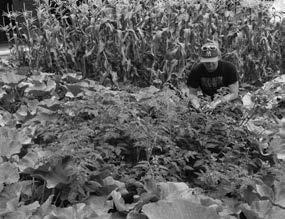
It is an exciting time for local food crop farmers and garden owners.
Harvest season has arrived and farmers’ markets are flourishing with fresh produce from varieties of freshly picked fruits, vegetables and legumes, to ready homemade pastries and desserts.
Close to home, right at the heart of the UMSU University Centre, the students’ union-owned Degrees restaurant sources some of its fruits, vegetables, grains, herbs and legumes directly from the Fort Garry campus through the UMSU campus gardens.
The gardens are a student-run initiative that operates mainly on the work of volunteers. Several plots of soil are available to students and community members. Student volunteers seed produce in the Buller greenhouse at the end of April and transplant sprouts into the garden beds.
we sell the rest,” Woods said.
“We take it down [to the main floor of University Centre] and we sell it really cheap to the university community.”
Degrees has long been a vocal advocate for eco-responsibility and sustainability — it is one of few restaurants in Canada with a level 3 “Leaf Certification,” the highest designation from Canadian non-profit food service certification program LEAF that recognizes a “top level of environmental sustainability.”
The gardens Degrees draw produce from do not use any preventative
to the university community.”
He added that he hoped students who see the colourful gardens or taste the fresh produce are encouraged to look to their own potential as gardeners.
“It is my hope that seeing projects like this will inspire others, especially students, to see the potential in the space that they have,” said Peters.
“People would see that even if you just start with a few plants here and there, the resulting plants and fresh produce with all their benefits to health and the environment are well worth the monetary and temporal costs.”
“It is my hope that seeing projects like this will inspire others, especially students, to see the potential in the space that they have” — Matthew Peters, Degrees garden manager
This year, Degrees harvested a variety of crops from campus gardens, including tomatoes, rhubarb, zucchini, watermelon, cantaloupe, turnips, beets, habanero peppers, squash and kale.
Degrees restaurant and catering manager Ryan Woods said that while Degrees makes use of the fresh produce in its recipes, it also offers an opportunity to provide healthy food throughout campus.
“It all goes to Degrees, and then basically the kitchen gets to cherrypick what they want out of it and then
pesticides. The volunteer gardeners monitor the crops for pests, and should they arise, an insecticidal soap is used.
Matthew Peters, a fifth-year U of M student, maintained this season’s gardens, carrying out the planting, weeding, watering and harvesting over the summer, with occasional help from volunteers.
“It is extremely rewarding to watch all your time and effort result in a beautiful and thriving garden,” said Peters, “culminating once you are able to start harvesting — quite literally — the fruits of your labours and then later being able to provide those fruits
Peters also noted the importance of furthering the U of M’s sustainability efforts.
“I think it would be great to see interest in it grow, allowing it to expand in scope which would allow more produce to make its way into the restaurant as an increasingly reliable source of ingredients for the summer, as well as providing more fresh produce for the university community as an alternative option.”
While the bulk of this year’s produce has already been harvested, many crops like tomatoes, cantaloupe, pumpkin, beets, squash and corn will continue to yield through September and some into October.

MALAK ABAS, STAFF
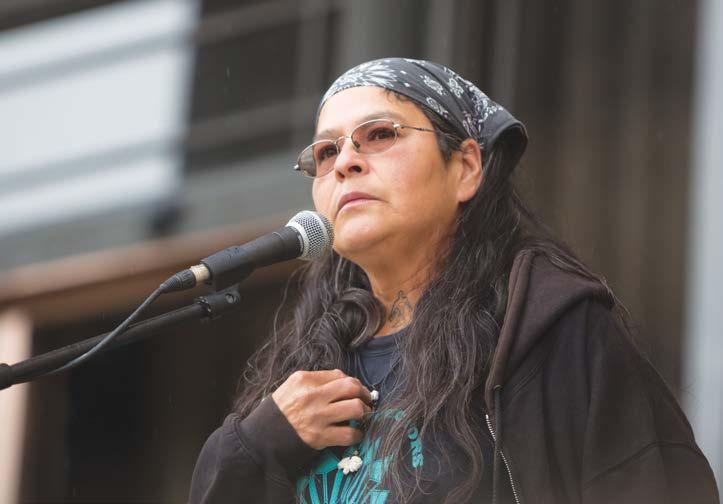
Hundreds of rain-soaked Winnipeggers gathered at the legislative building Saturday for a march criticizing government inaction on climate change.
The march was scheduled as part of the international Rise for Climate initiative, which saw hundreds of thousands of people in over 90 countries demand a move away from fossil fuels toward clean energy.
In Winnipeg, many protesters focused their efforts on the Line 3 pipeline expansion. Some carried signs with slogans reading ‘Keep it in the Ground’ and ‘Stop Line 3.’
December.
Former Canadian Football League offensive lineman T-Dre Player acted as the master of ceremonies for the speeches prior to the march. Player encouraged protesters to work in any way they could, saying “small things all matter.”
“We have to come together and have a conversation with our leaders, who we’ve appointed, who we’ve voted [in], in which they’ve made a
“I’m Dakota. And my Dakota people are out there, helping this line. And you have no idea how much that bothers me as I sit out there.”
Enbridge has a long history of oil spills — the company itself estimates it has dealt with over 800 spills in the last 15 years, including the largest inland oil spill in U.S. history in 2010, when 3.18 million litres of crude oil was spilled into the Kalamazoo River in Michigan.
“Understand this — we’re not asking for something to happen overnight. We understand it’s a process. But we’re willing to make that process” — T-Dre Player
The Enbridgeowned project, which will cost $5.3 billion, will replace and expand upon an existing pipeline that runs through Manitoba and into North Dakota and Minnesota. The expansion will nearly double the capacity of crude oil transported daily to about 760,000 barrels.
Work on the pipeline has already begun in Manitoba, and protest groups have responded by setting up camps near the construction. The Canadian portion of the project is expected to be completed by
promise to us to divest and to make that transition,” Player said.
“Understand this — we’re not asking for something to happen overnight. We understand it’s a process. But we’re willing to make that process.”
Geraldine McManus, founder of the Spirit of the Buffalo prayer camp near Gretna, Man., has been camping near where the pipeline crosses the border since mid-July.
“I still sit there and wait for my people,” McManus told the crowd.
Enbridge faced criticism when it was revealed they had ignored repeated leak warnings for 17 hours beforehand.
“We know how much [pipelines] leak — we know the destruction it has caused into our environment, to the animals,” McManus said.
“We understand this. Our people have been trying for hundreds of years to tell everyone ‘Watch what you do to this land.’ We need this land. We kept saying it’s not for sale. But everyone sold it anyway on us. Where I sit is traditional Dakota territory. Right here is traditional Dakota territory. My territory.
“So will I stand and defend it? You’re darn rights I will. And to hell
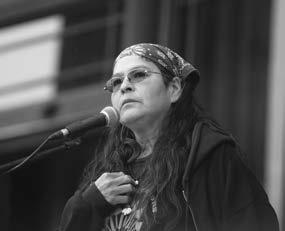
with Enbridge.”
The crowd cheered as McManus continued their call to arms, and the crowd yelled “shame!”
After the speeches, the crowd marched through ManyFest and the Sherbrook Street Festival. Several carried a large black prop snake representing the effects of oil on water, and protesters sang and clapped.
Player spoke to the value of soli-
darity within protest groups and the importance of continuing to demand transparency from the country’s leaders.
“Oftentimes, we are distracted with things that happen in our own lives, and that’s okay,” he said.
"But we must hold each other accountable. And most of all, hold these leaders accountable. Stop Line 3.”
New private health insurance policy can void coverage for severely ill students
MALAK ABAS, STAFF
International U of M students who become severely ill may be forced to return to their country of origin under the newly revised private health insurance plan.
While the policy is standard for private health insurance programs in Canada, this will be a new policy for international students in Manitoba after the Manitoba government announced in March international students will no longer receive Manitoba Health Care coverage.
Canadian Federation of Students — Manitoba (CFS), said the change in policy sends a worrisome message, adding that the new rules seem “cruel” and “unfair.”
“The policy clearly sends a poor message to international students: that they are only worth the money they have,” he said.
Manitoba.
He added that if faced with possible removal from the country due to illness, students should “contact a human rights advocate and an immigration lawyer.”
“International students should always read and understand the terms and conditions of any private provider they might be with,” Ojewole said.
“The policy clearly sends a poor message to international students: that they are only worth the money they have” —
Dele Ojewole, CFS chairperson
Under the prior public health insurance plan, international students that had a valid study permit received the same level of health care as Canadian students.
Under the new policy, a student who falls seriously ill or is diagnosed with a terminal illness while studying and refuses to return to their country of origin may have their Blue Cross coverage cancelled.
Dele Ojewole, chairperson of
the
“International students are not cash cows and should not be treated as such by healthcare providers. With the elimination of public healthcare, universities in the province will see a drastic decrease in the number of international students coming to the province.”
Ojewole said CFS has heard from students who said the health care coverage was a deciding factor when choosing to pursue their studies in
CFS will continue to advocate for international students, Ojewole said, and will focus on highlighting the importance of international students on Canadian campuses.
“As a federation, we would continue our fight for the restoration of healthcare for international students as it was something we fought for in 2010,” he said.
“Currently, we have a campaign titled ‘Fairness for International Students’ geared toward advocating for international students while also

educating the public about their contributions to our society.”
The campaign looks to improve immigration policies for international students, restore post-secondary funding for international students and to bring students together to advocate for legislative change.
The U of M is paying the fees for the private insurance healthcare plan for the 2018-2019 year.
Starting September 2019, however, international students will have to pay their own premiums.
Garett Williams
Editor-In-Chief:
Contact: Editor@themanitoban.com / 474.6770
GARETT WILLIAMS, STAFF

An absurd and curious scene is playing out in Ottawa this week as a single contract negotiation threatens to upend production of the capital’s two English daily newspapers.
Postmedia Network, the media behemoth that owns both the Ottawa Citizen and the Ottawa Sun, informed the union representing workers at both papers — which operate out of a single newsroom — that if its final offer is not voted on and accepted by the end of Wednesday, workers will be locked out Thursday.
Beyond exemplifying the continued pressure management applies to working newsrooms as it fails to effectively monetize what should more rightly be understood as a public service, the episode neatly illuminates the ridiculous nature of newspaper ownership in Canada and why bloated networks like Postmedia ought to be broken up.
The 63 members of the Communications Workers of America (CWA) working at both the Sun and the Citizen have been without a contract since 2015.
In a recent letter to staff, Postmedia vice-president of human resources and labour relations Chris
Krygiel called it time to “move on” from negotiations and threatened permanent job losses if operations are disrupted.
Postmedia’s $316 purchase of 175 print and digital publications from Quebecor, which brought the tabloid Sun Media brand under its umbrella.
A spokesperson for the CWA said the union has already made significant concessions regarding pensions, vacation and maternity top-ups but membership is standing firm in defence of its benefits.
It is not Postmedia’s bargaining tactics that reach beyond the pale. Pressuring for, and defending against, concessions and benefit rollbacks is standard fare in collective bargaining.
But when one company’s failure to settle an agreement with its staff threatens all daily, English print news coverage in the national capital, the preposterous nature of a structure permitting a single owner to operate two ostensibly competing publications is brought into clear focus.
Postmedia owns more than 140 Canadian print operations — including 36 dailies and 105 community papers. Among its stock of daily papers, the network owns multiple formerly competing dailies in four major centres: Ottawa, Edmonton, Calgary and Vancouver.
Much of this conflict was solidified with the 2015 completion of
Local editors must be free to endorse the candidates and policies that suit the communities they report on
More recently, Postmedia and Torstar — itself the owner of 10 daily newspapers, including its flagship Toronto Star, and another 113 community papers through its Metroland subsidiary — came under investigation of the Competition Bureau after exchanging 41 papers in 2017, leading to the closure of 36 publications and the elimination of close to 300 jobs.
In court filings, the bureau claims the companies made an agreement not to compete in some regions and to shutter certain publications as part of the deal.
Postmedia's reach is obviously vast. A 2016 study — reported on prominently by its own papers — pegged the network’s reach at more than 11 million readers through print and online.
The network’s Financial Post boasted about the nearly three million more readers than the Torstar network and five million more than the Globe and Mail. Considering the arithmetic, the stat hardly blows back one’s hair. Less readership would represent the anomaly. The number fairly reflects what Postmedia owns, not what it produces.
And as far as what it produces, the network has shown a pessimistic willingness to abuse the relationship it has with its audience.
During the 2015 federal election campaign, the network mandated 16 of its major papers to endorse the Stephen Harper Conservatives. It issued a similar directive a year earlier in the Alberta provincial election, throwing its institutional support behind the Progressive Conservatives and Jim Prentice.
While both efforts failed, they illustrate management’s willingness to exploit its reach for its own partisan concern. More recently, ques-
tions were raised during the Ontario provincial election after an internal memo prescribing Toronto Sun reporters lean Conservative in news coverage was leaked to Canadaland
The union representing Sun journalists said the memo never reached the newsroom. But it didn’t really have to. Whatever was reported after the release of the leaked memo must be understood to be influenced by management, even indirectly.
Local editors must be free to endorse the candidates and policies that suit the communities they report on, not handed the directive from on high.
Better yet, they should be free to not endorse any party or candidate at all but argue for and analyze policies directly relevant to the communities they serve.
When too few command too much of what is reported and presented as news and informed analysis, the environment is ripe for abuse.
Readers presented with two papers, published under two banners, can be forgiven for believing they are consuming varying perspectives. Postmedia should not be forgiven for abusing that trust.