ISSUE 370 APRIL 2026 A
CAPSULE OF THE WORLD
ISSUE 370 APRIL 2026 A

“The
future belongs to those who believe in the beauty of their dreams.”
ELEANOR ROOSEVELT

“Well, I feel that we should always put a little art into what we do. It’s better that way.”
JULES VERNE, FROM THE EARTH TO THE MOON
SUPERNATURE

“The moon, by her comparative proximity, and the constantly varying appearances produced by her several phases, has always occupied a considerable share of the attention of the inhabitants of the earth.”
JULES VERNE, FROM THE EARTH TO THE MOON (DE LA TERRE À LA LUNE), FIRST PUBLISHED 1865

he Moon is a 4.5-billion-year-old time capsule, pristinely preserved by the cold vacuum of space. This April, the Artemis II mission carried its crew farther from Earth and closer to the Moon than any human has been in over half a century. The astronauts on board were both scientists and subjects as they flew around the far side of the Moon and back.


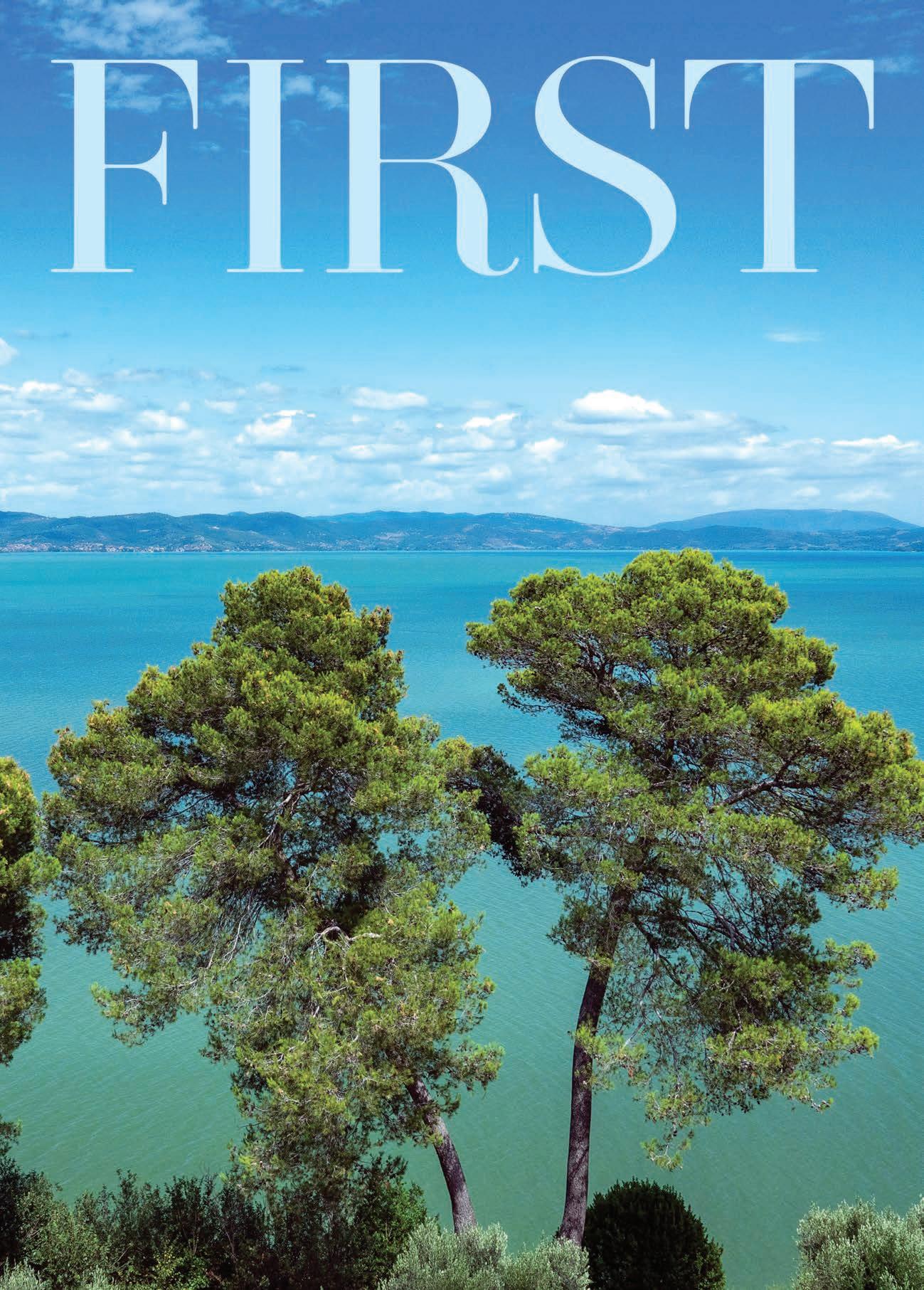
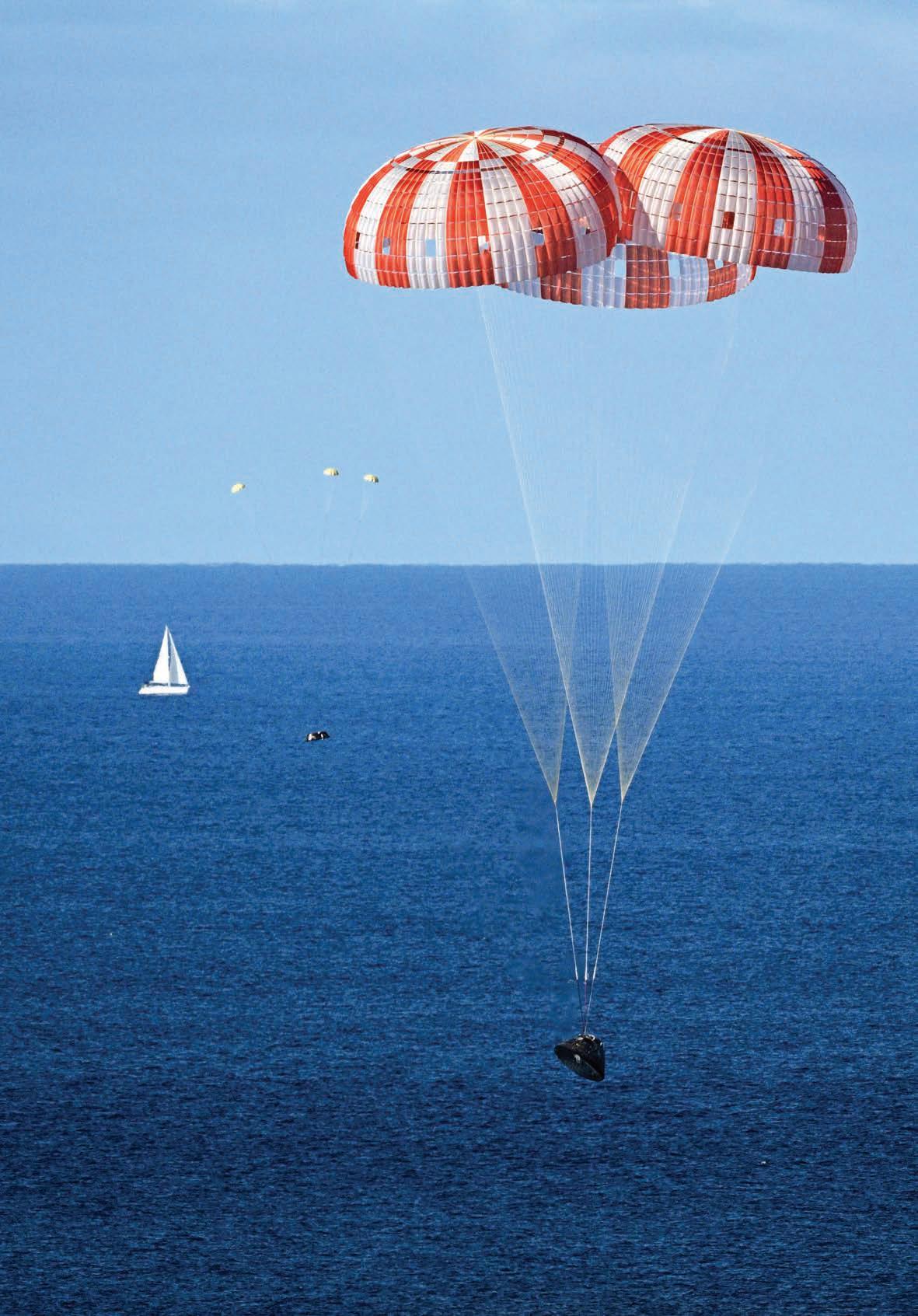
ON THE COVER: Lago di Trasimeno, Castiglione del Lago, Umbria, Italy. Photo Nils Schirmer. THIS PAGE: NASA’s Orion capsule descends under its main parachutes over the Pacific Ocean off the coast of California, following the Artemis II mission on Friday, 10th April 2026. Photo Josh Valcarcel/NASA via AP. SALES AND CREATIVE DIRECTOR SEAN ELLUL SELLUL@INDEPENDENT.COM.MT DESIGNER CONRAD BONDIN CBONDIN@INDEPENDENT.COM.MT PRODUCTION MANAGER ANDRE CAMILLERI ACAMILLERI@INDEPENDENT.COM.MT PUBLISHER STANDARD PUBLICATIONS, STANDARD HOUSE, BIRKIKARA HILL, ST JULIAN’S. TEL: 00356 2134 5888, WEB: WWW.INDEPENDENT.COM.MT
Sponsorjat minn:





8
LA DOLCE VITA
Castle in the Hills. Reschio, A Dreamy Umbrian Retreat.
24 INTERIORS
AValletta Townhouse Reimagined. La Maison on St Barbara Bastion.
40 RESTORATION
Reviving Valletta’s Jesuits’ Church. A NewChapter for a Historic Landmark.
44 CONCOURS D’ELEGANCE
Return of the Great Machines. Valletta Concours.
50 CULTURE
From the Earth to the Moon. Artemis II’s Modern Photography.
58 ARTS & CULTURE
Arts Council Malta’s Strategy 2030.
GASTRONOMY
Planning For Life, Money and Time. The Cost of Waiting. Larissa Ciantar on Why Time Outperforms Timing.
74 GASTRONOMY
Amura by Ángel León opens at Mount Nelson, A Belmond Hotel.
86 WORLD EARTH DAY
Food for Thought.
88 THIS IS WINE TASTING NOTES
Comtes Lafon Meursault 2022. La Conseillante 2020. Le Pergole Torte 2019.

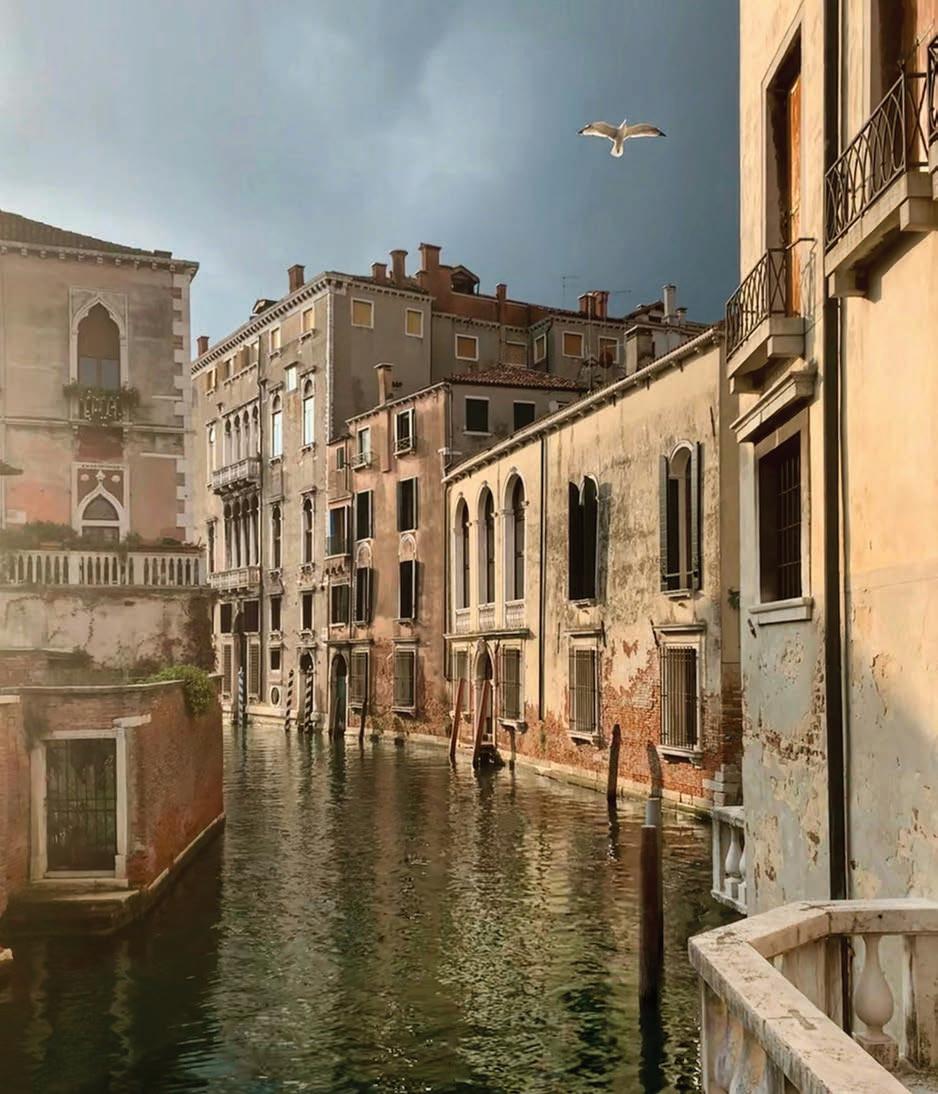
INVESTING & RETIREMENT. The Cost of Waiting. Photo Martino
“Are you sure That we are awake? It seems to me That yet we sleep, we dream.”
WILLIAM SHAKESPEARE, A Midsummer Night’s Dream
UMBRIA
RESCHIO, A DREAMY UMBRIAN RETREAT SHAPED BY HILLS, FORESTS AND THE STEADY HAND OF A FAMILY DEVOTED TO RESTORATION
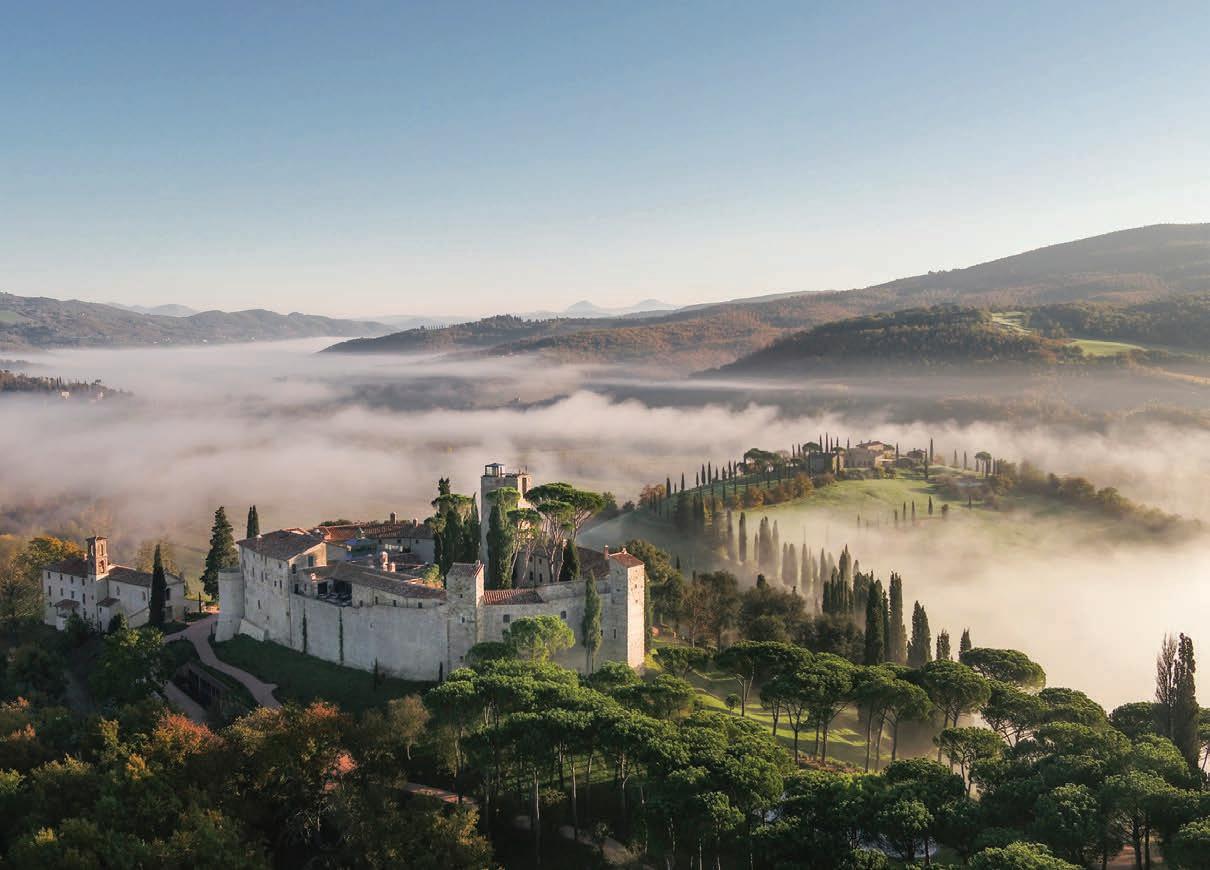
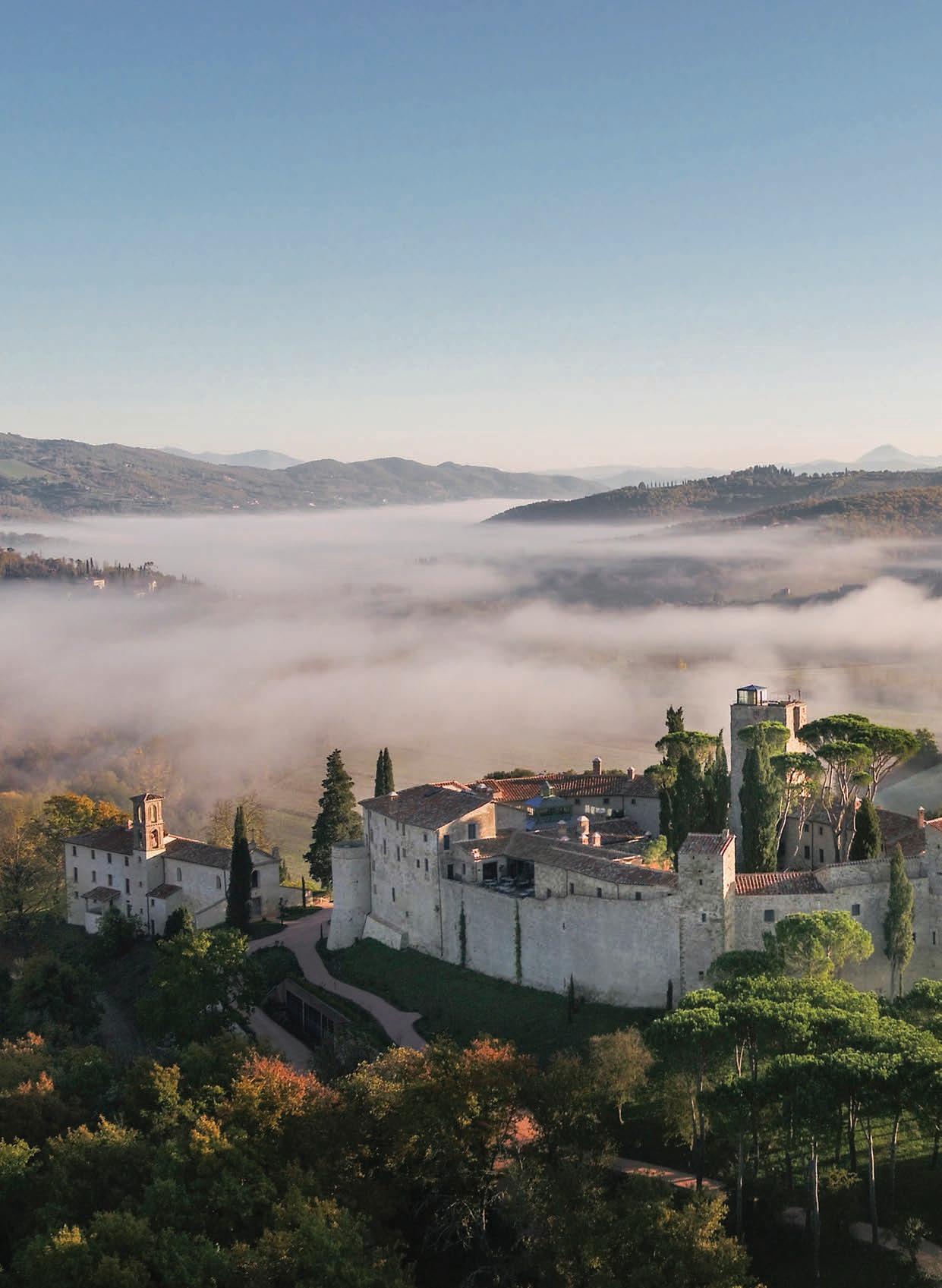
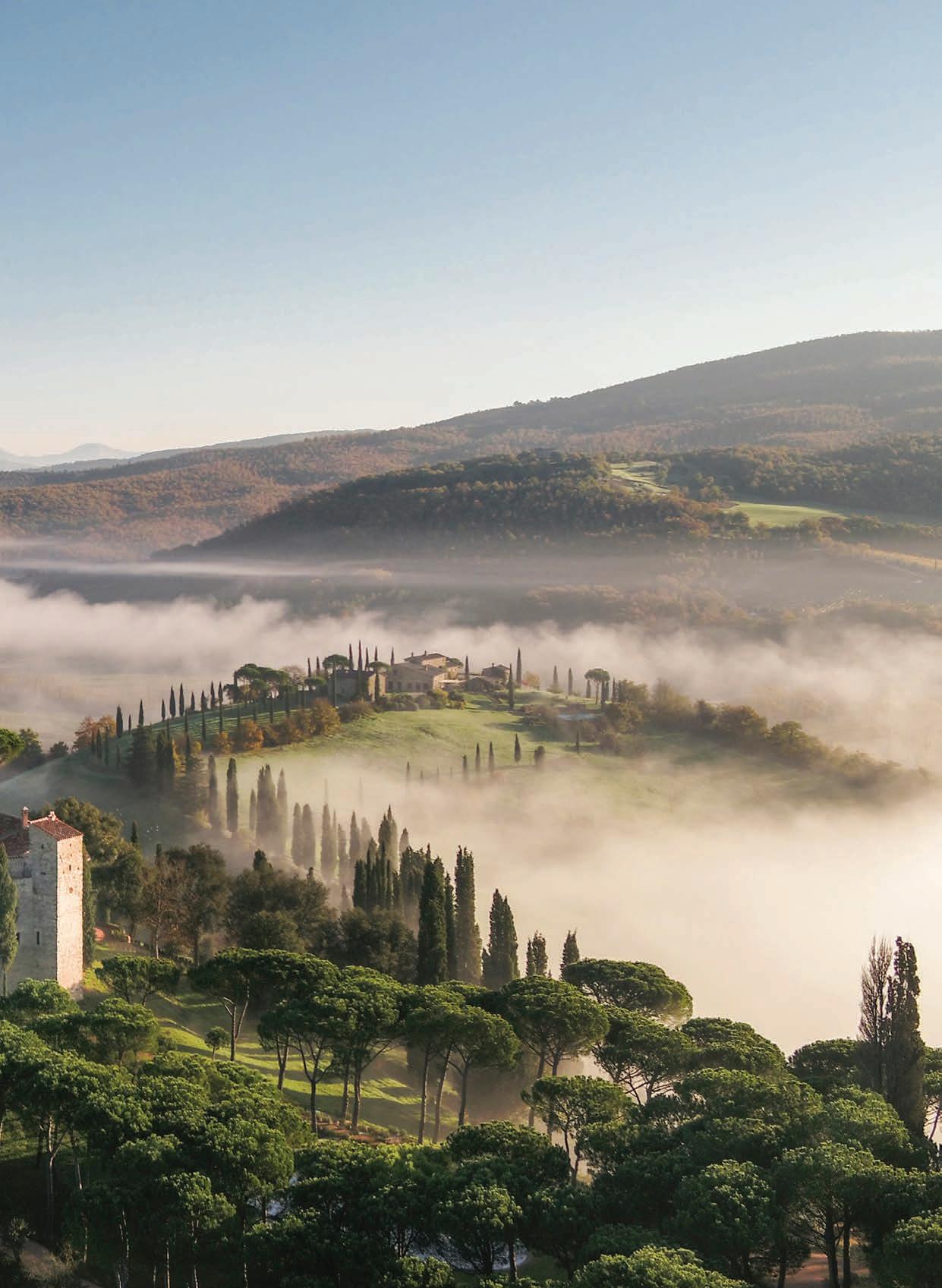
The hills around Reschio shift from gold to green as the seasons turn, revealing a thousand-year-old castle, restored farmhouses and stables set deep within the Umbrian countryside. Recognised with Three Michelin Keys for its sense of place and design, the estate offers a way of travelling firmly rooted in beauty, nature and thoughtful restoration.
Photography courtesy Reschio.
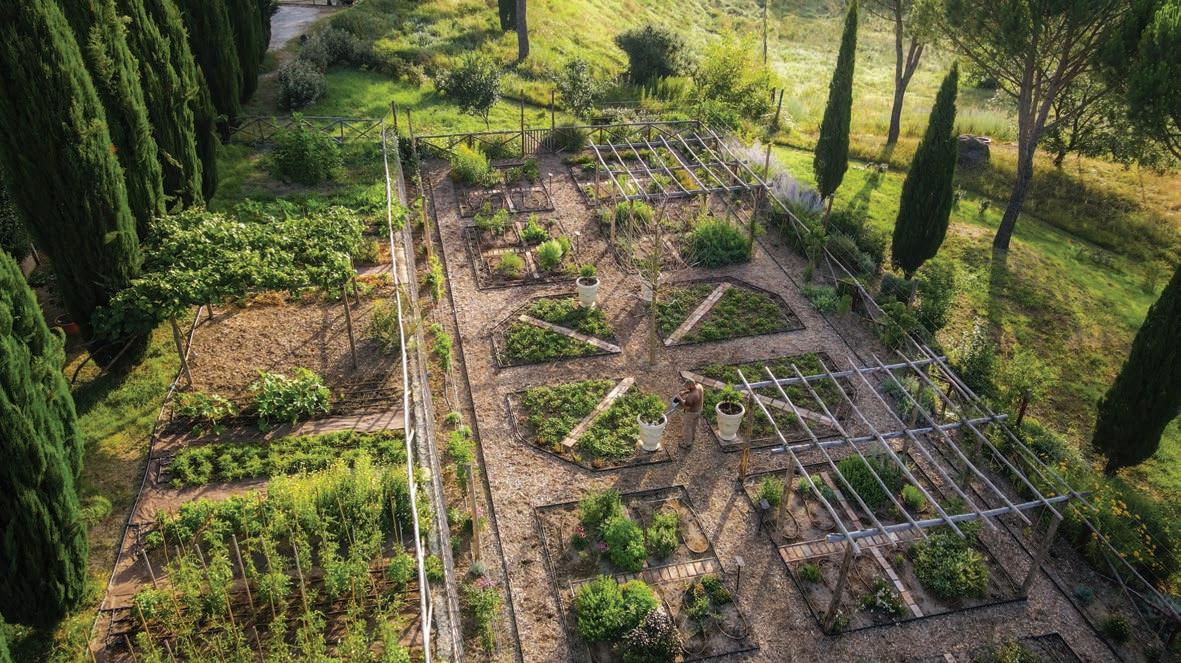
Above: Reschio's Giardino Alchemico, with different specific zones or rooms: food (edible herbs), toxic (poisonous plants), health (cleansing herbs, plants for the nervous system, the digestive system, immunity), cosmic, and colour (herbal dyes).
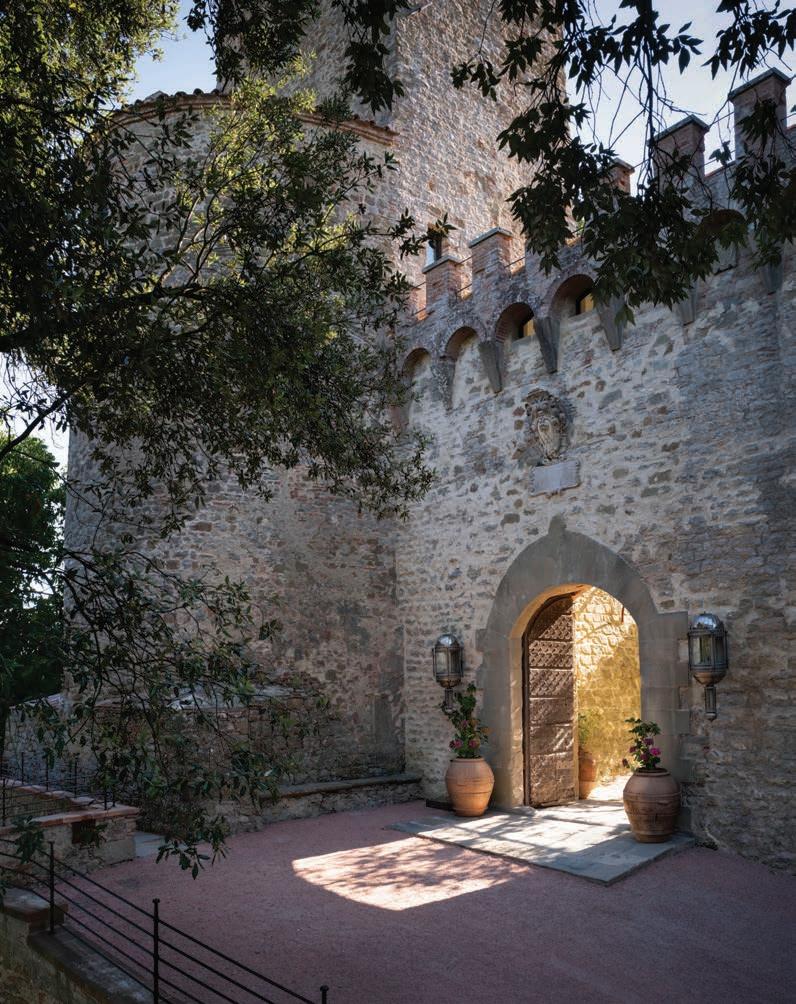
Below: Dating back to 1050, the Castello has been reimagined, its ancient architecture now framing a hotel shaped by thoughtful design and individuality. Photo Philip Vile.
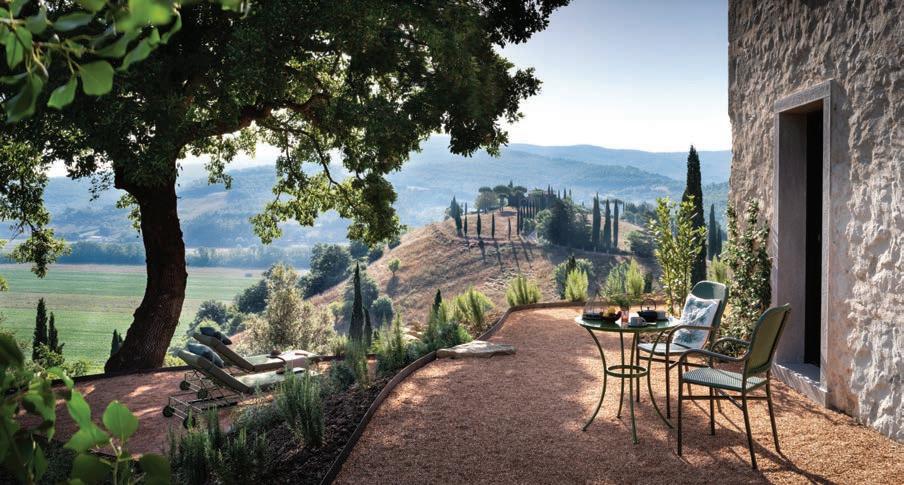
Set on the border between Umbria and Tuscany, Reschio unfolds across 3,855 acres of rolling hills, oak forests and meadows that shift in colour with the seasons. The estate reopens for the 2026 season with the same sense of poise that has defined it since its reinvention began three decades ago, when the Bolza family first arrived with a vision to revive a forgotten corner of central Italy. What began as a collection of crumbling farmhouses has evolved into one of Europe’s most distinctive rural retreats, anchored by a thousandyear-old castle and a constellation of private houses available to rent. The atmosphere is shaped by craftsmanship, landscape and a way of living that is deeply rooted in place.
The story of Reschio began in 1994, when Count Antonio Bolza purchased the estate and set about restoring its buildings and land. His son, Count Benedikt, trained as an architect in London, has since guided the transformation with a meticulous eye. Working with his wife, Donna Nencia Corsini, he has restored more than half of the estate’s fifty ruins, each project undertaken by Reschio’s own
Architectural & Design Studio. Their approach is grounded in an understanding of Umbrian vernacular architecture, but still open to contemporary design, resulting in houses that are both timeless and individual. Benedikt’s involvement extends from architectural planning to interior design, landscaping and the creation of bespoke furniture and lighting through his BB for Reschio studio. Antique markets, artisan workshops and small foundries across Italy have become part of the estate’s creative ecosystem, feeding a design language that is recognisable without being formulaic.

This sensibility carries into Reschio Collections, developed with the Bolza family’s three eldest daughters, Giorgiana, Nerina and Vita. The line translates the estate’s aesthetic into objects inspired by daily life at Reschio, from hand-finished ceramics to sculptural lighting. It reflects the family’s instinctive approach to design, where materials, craftsmanship and a sense of proportion guide every decision.
Seven houses are currently available to rent, each set
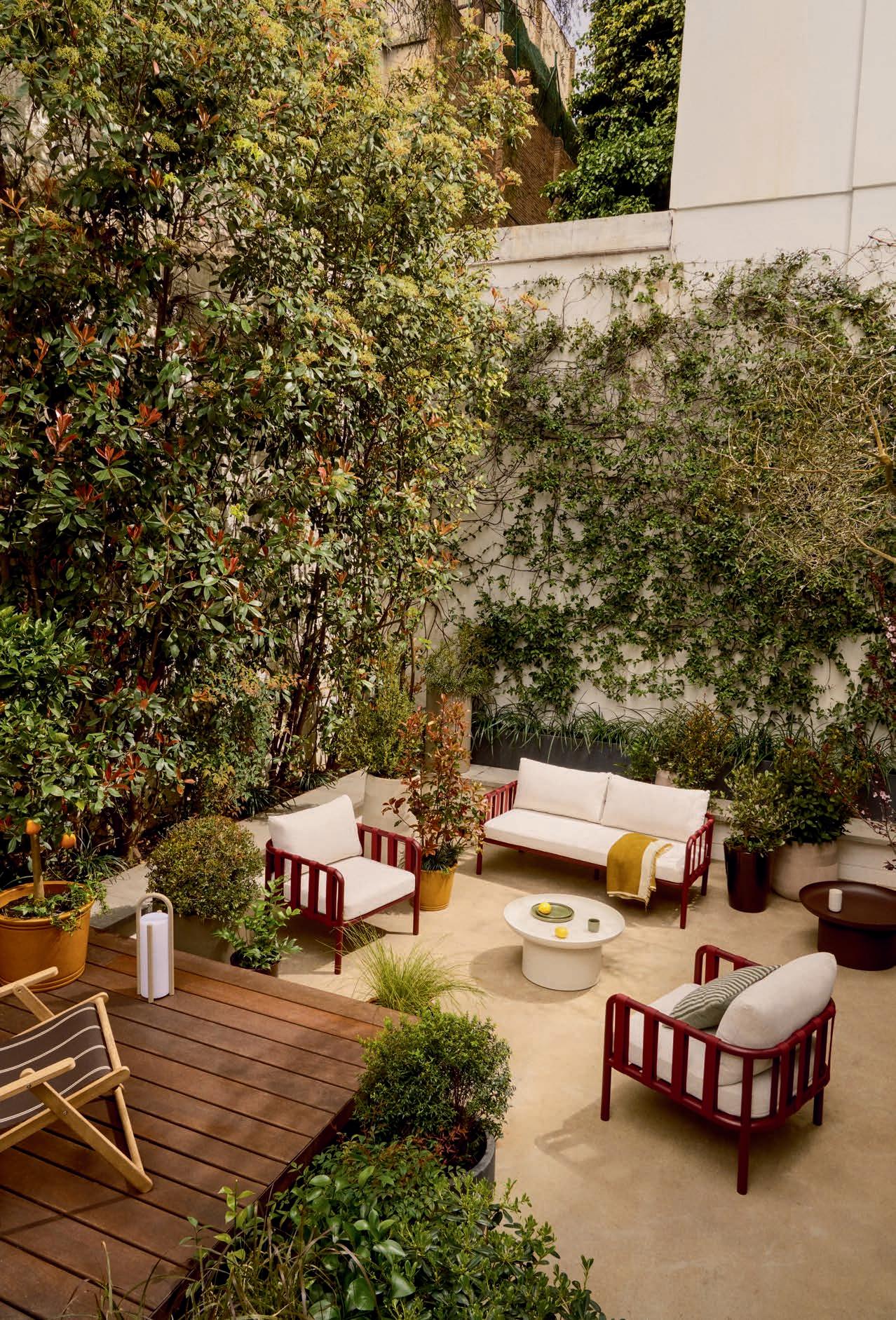
within its own pocket of the estate. They vary in scale, from intimate hideaways to expansive farmhouses with private pools and terraces overlooking the hills. An eighth, a newly renovated four-bedroom farmhouse, will join the collection in autumn 2026. The houses share a common thread of natural materials, generous volumes and a palette shaped by the surrounding landscape. Terracotta floors, lime-washed walls, reclaimed timber and stone fireplaces create interiors that feel both refined and grounded. Outside, infinity pools stretch towards the horizon, their surfaces reflecting the shifting greens of the Umbrian countryside.
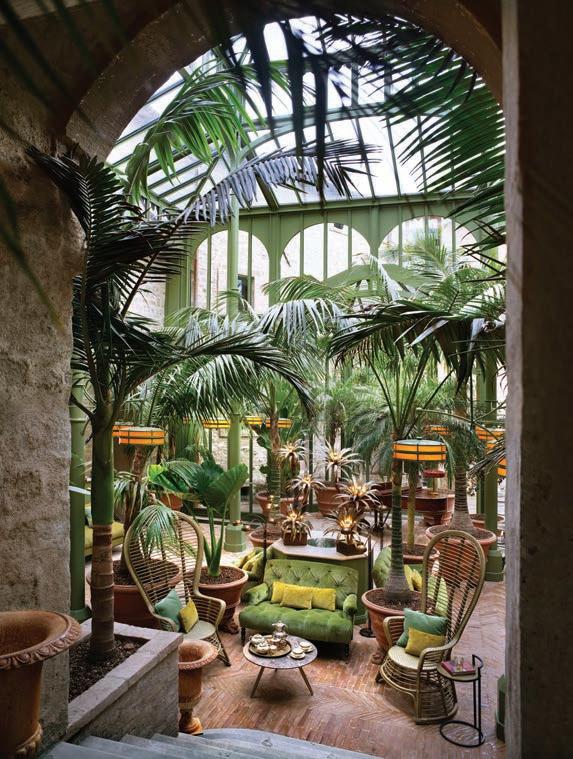
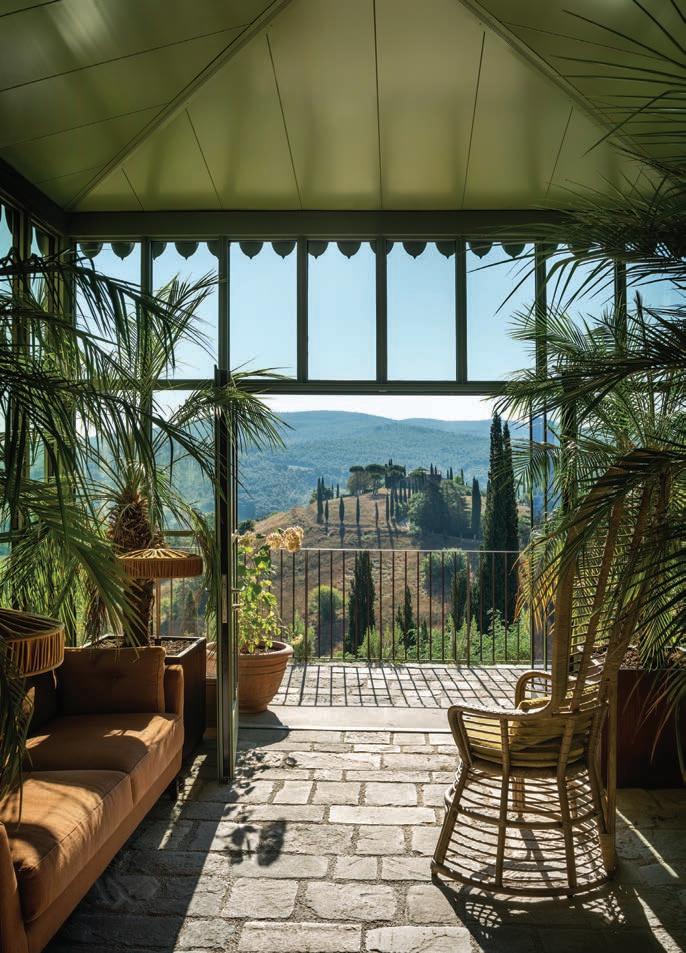
palms and Belle Époque style structures bring a gentle, greenhouse elegance to the heart of the castle.
Left: Large windows frame gardens and hills, drawing the landscape into the castle’s interiors. Views from the estate extend across hills that shift in tone with the seasons. Photography Philip Vile.
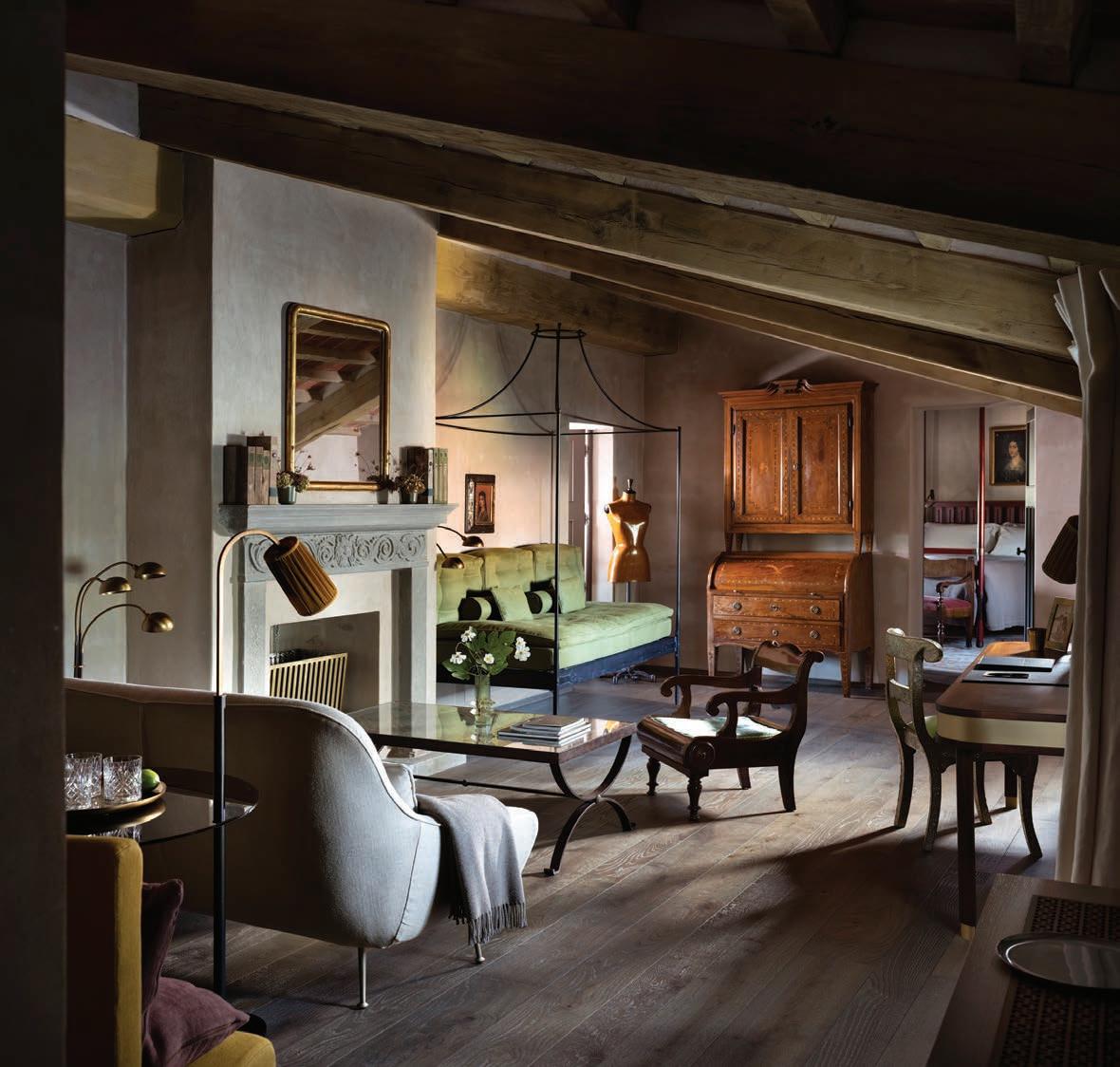
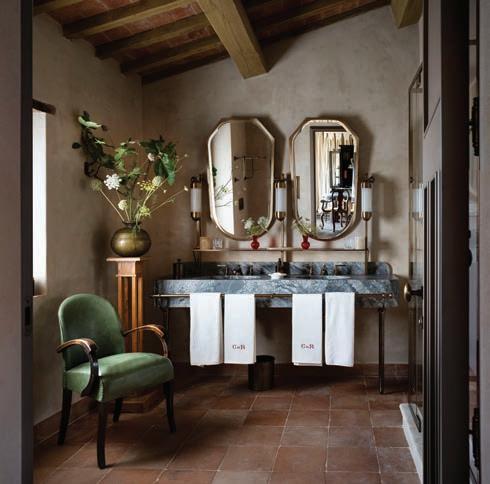
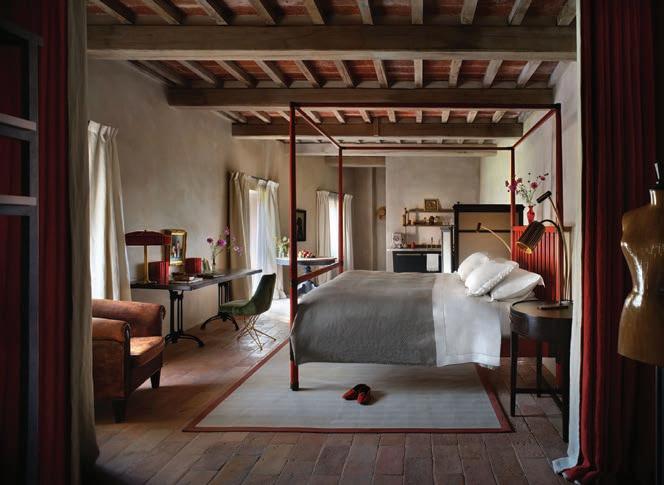
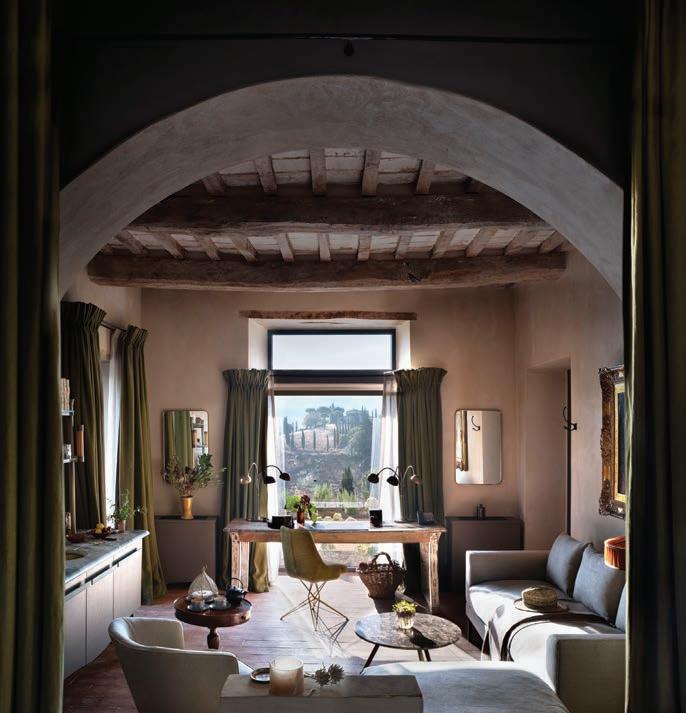
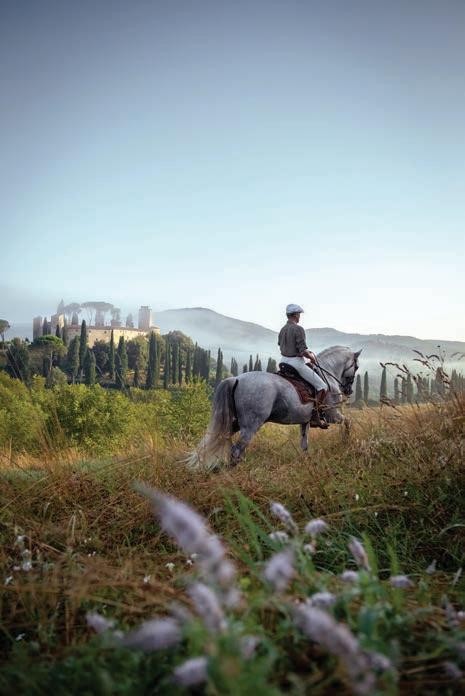
Left and below: Set within the old Vestry, a few steps from the castle walls, the San Michele Garden Suites offer lightfilled spaces opening onto peaceful private gardens. Photography Philip Vile. Above: A hack across the flower meadows, up into the oak and chestnut forests around hidden lakes and returning along paths lined with swaying cypresses is both magical and life affirming.
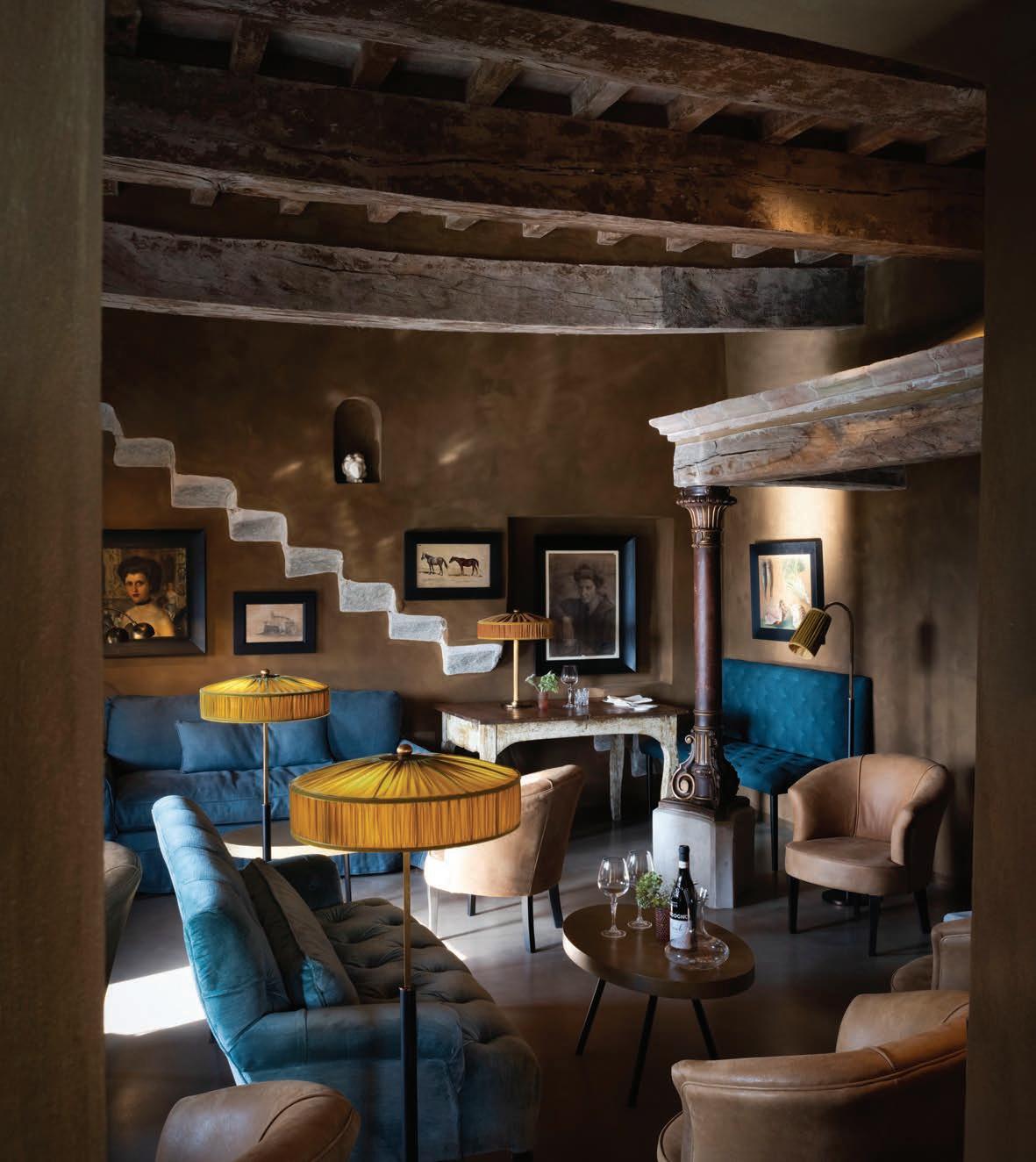
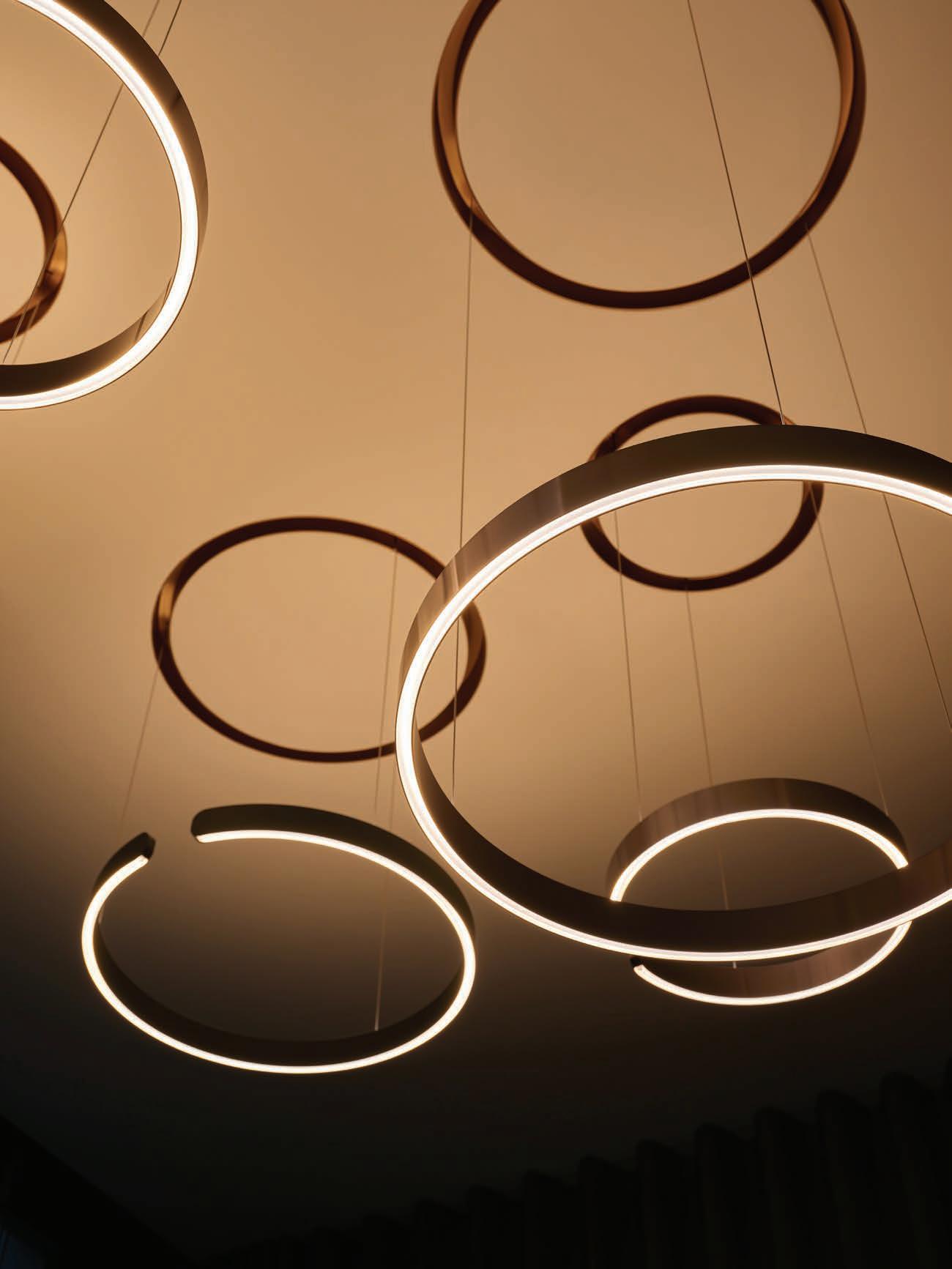
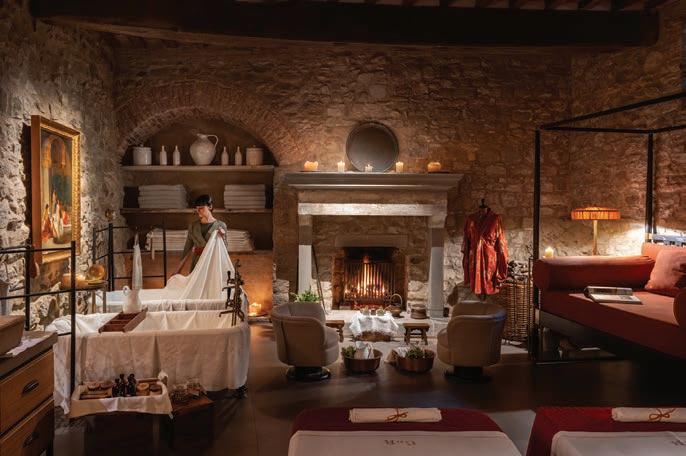
At the heart of the estate stands Reschio Hotel, which opened in 2021 within the tenth-century castle that once served as the Bolza family’s home. The castle’s restoration is one of the estate’s most ambitious undertakings, carried out with a sensitivity that preserves its medieval structure while introducing a contemporary elegance. The 35 rooms and suites are individually composed, each shaped by a mix of antique pieces, bespoke furniture and subtle Art Nouveau references. Parquet and terracotta floors meet coffered ceilings and whitewashed walls, while stone fireplaces and sculptural lighting add depth. Large windows frame views of the gardens and hills, drawing the landscape into the interiors.
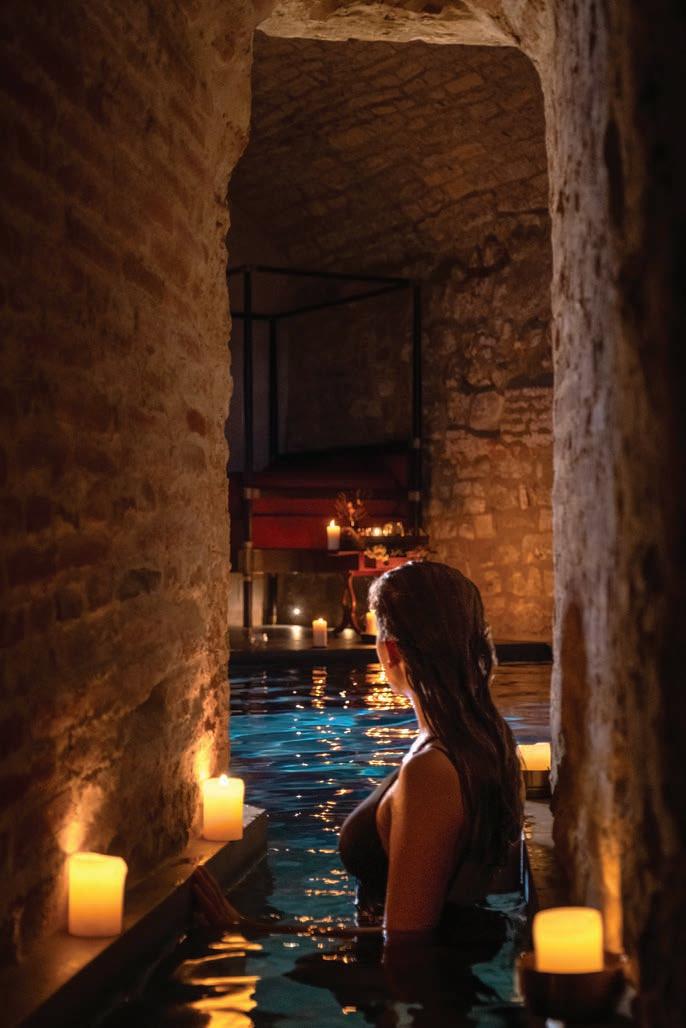
The Bathhouse, set within the castle’s ancient foundations, offers a different kind of immersion. Vaulted chambers, warm stone and candlelit pools create an atmosphere that feels both elemental and indulgent. Nearby, Victorian and Belle Époque-inspired greenhouses sit within the castle walls, filled with palms and ornamental plants that soften the architecture and create pockets of shade.
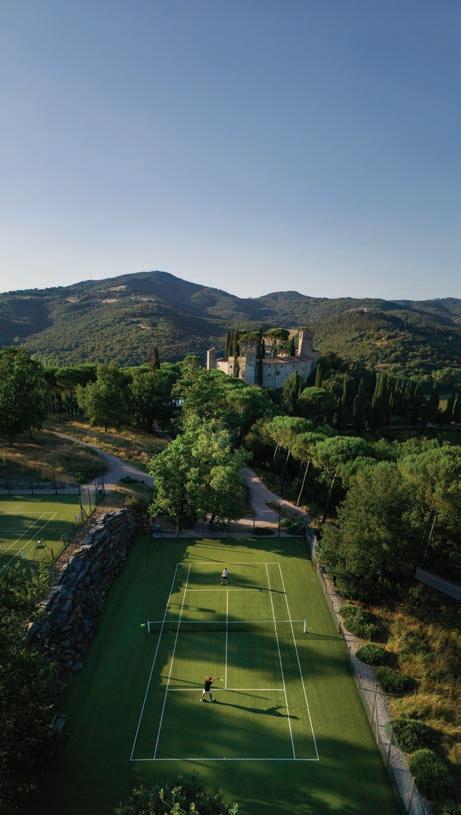
Reschio’s equestrian centre is another defining element of the estate.
Horses are at the heart of Reschio's story and remain ever-present, grazing in the fields, cast in bronze, and performing piaffes and pirouettes in the Teatro Equestre. Head trainer Antonello Radicchi oversees the breeding and training of purebred Spanish horses, known for their elegance, calm nature, height and classical training. Guests can observe training sessions, ride through the estate's nature reserve or attend performances in the equestrian theatre.
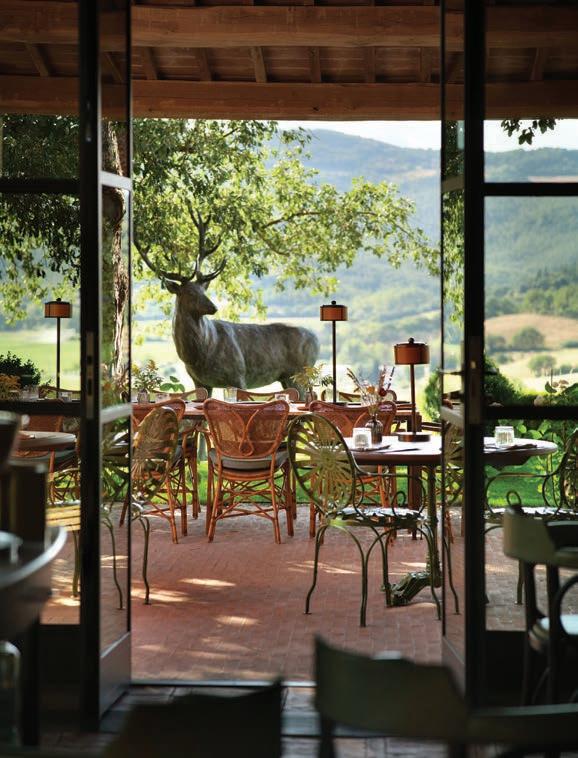
Food at Reschio draws directly from the land. Organic gardens, orchards, olive groves, vineyards and beehives supply the kitchens of Ristorante al Castello and Ristorante Alle Scuderie. The menus change with the seasons, shaped by ingredients grown or foraged on the estate. Guests may dine in the restaurants or enjoy meals in the privacy of their farmhouse, where terraces overlook the hills and the light softens as the sun sets. The estate’s vineyards produce natural wines from indigenous and international varieties, including Grechetto, Trebbiano, Sangiovese and Sagrantino, as well as the ancient Roman grape Cesanese, which thrives in Reschio’s microclimate.

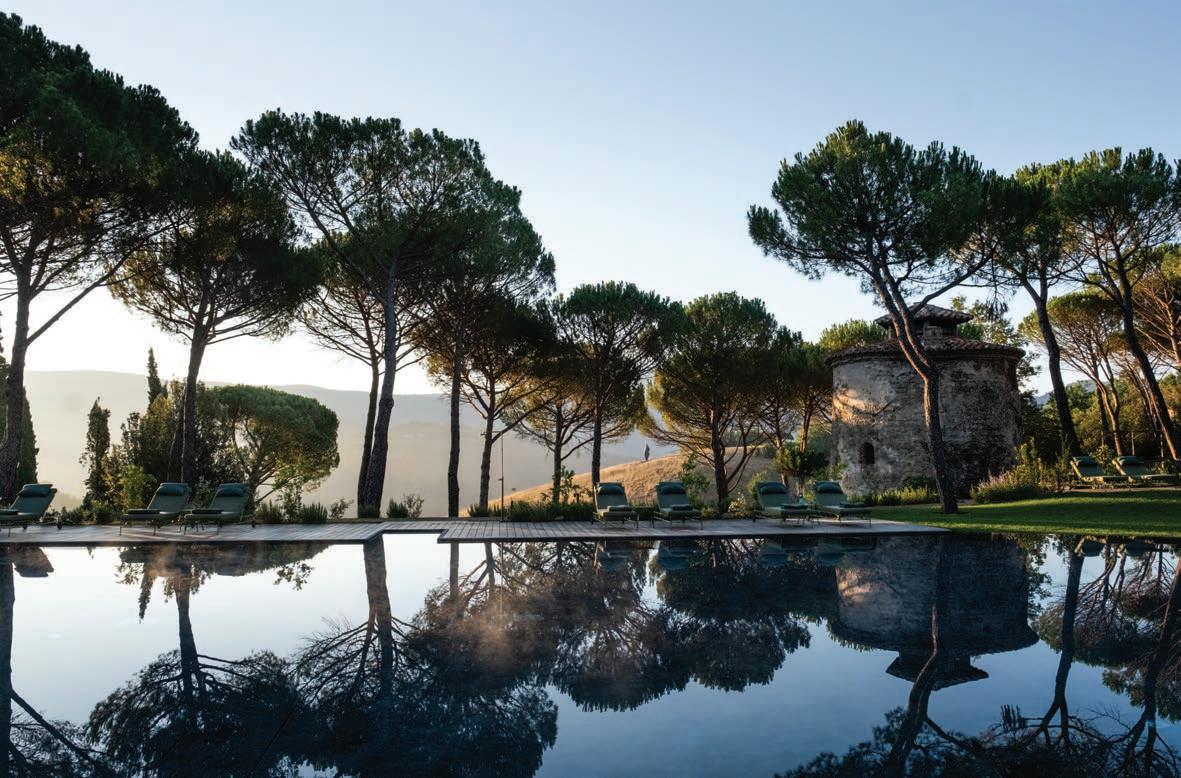
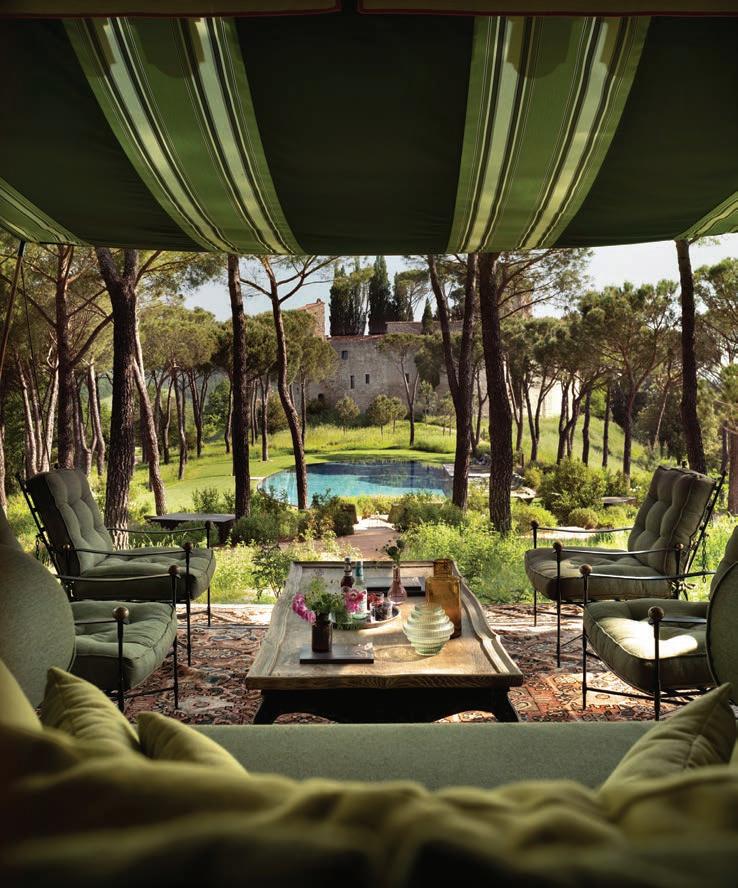
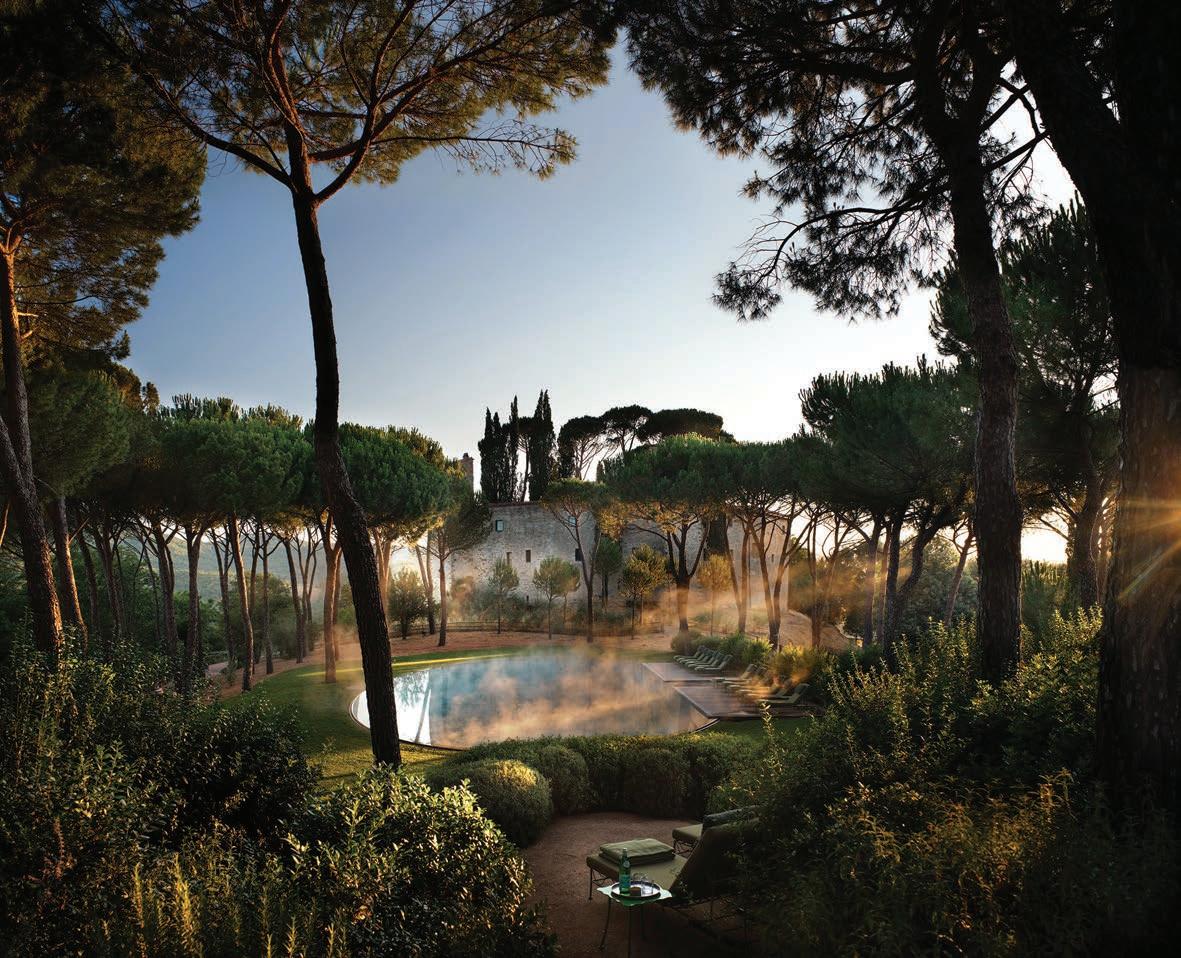
Above: Surrounded by umbrella pines and the soft silhouette of the hills, the pool feels as though it has been poured directly into the landscape, a line of water that mirrors the hills and the changing Umbrian light. Left: Beneath the shade of towering umbrella pines, a campaign-inspired tent can be rented privately for half or a full day, perfect for those wanting to enjoy the Castle’s poolside in complete privacy. Facing page, top:The primary inspiration in the creation of the hotel pool was the natural lakes present throughout the estate. Emerging from a break in the trees and bordered by soft grassy banks, it looks as though it has always been part of the landscape.
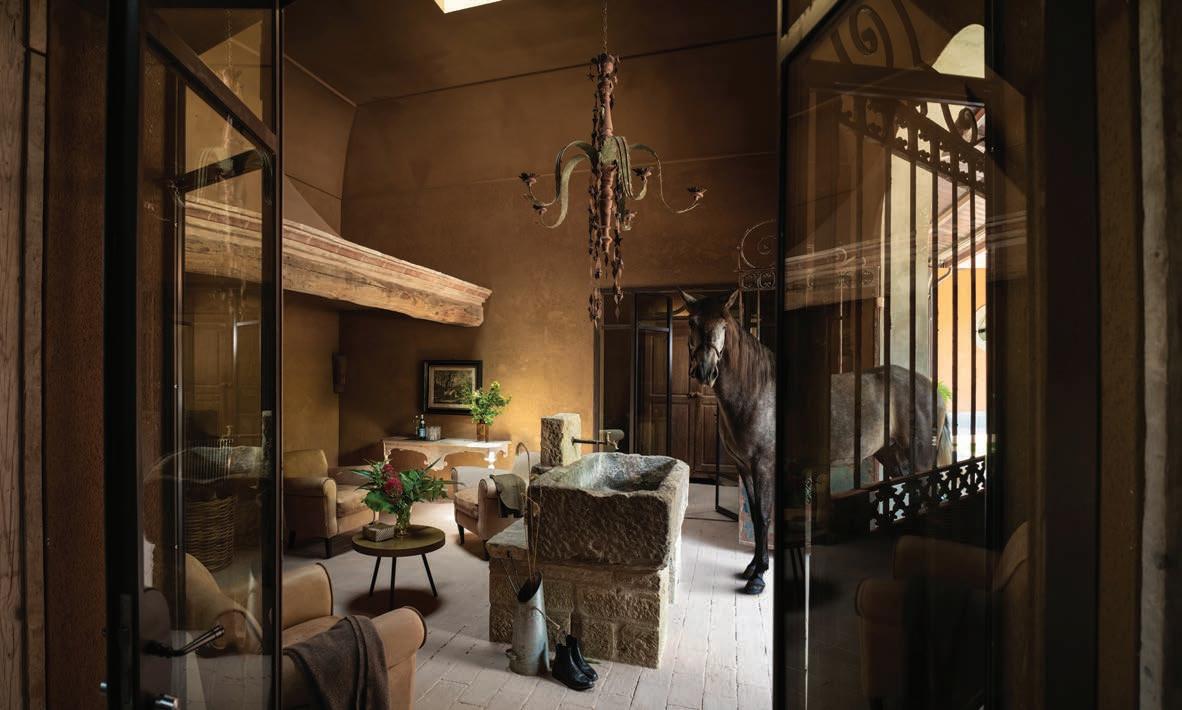
Bottom: The Tack Room and Stables at Reschio encourage both horses and people to linger and enjoy the warmth of being surrounded by the gentle horses.
Photography Philip Vile.
At Reschio, life moves at a gentle, unhurried pace.
Guests can take part in workshops like ceramics, drawing, or traditional crafts, wander the estate on foot or by bike, or head to the cellars for wine tastings. The whole experience feels like a dream. The scenery is a mix of cypress-lined paths, wildflower fields, and woodland trails, with sweeping views over the borderlands of Umbria and Tuscany. Horses roam freely in open pastures, and the air is filled with the warm, fragrant scent of sun-kissed herbs. Reschio’s charm lies in the way it blends architecture, nature, and a way of life into a unique, design-shaped reality.

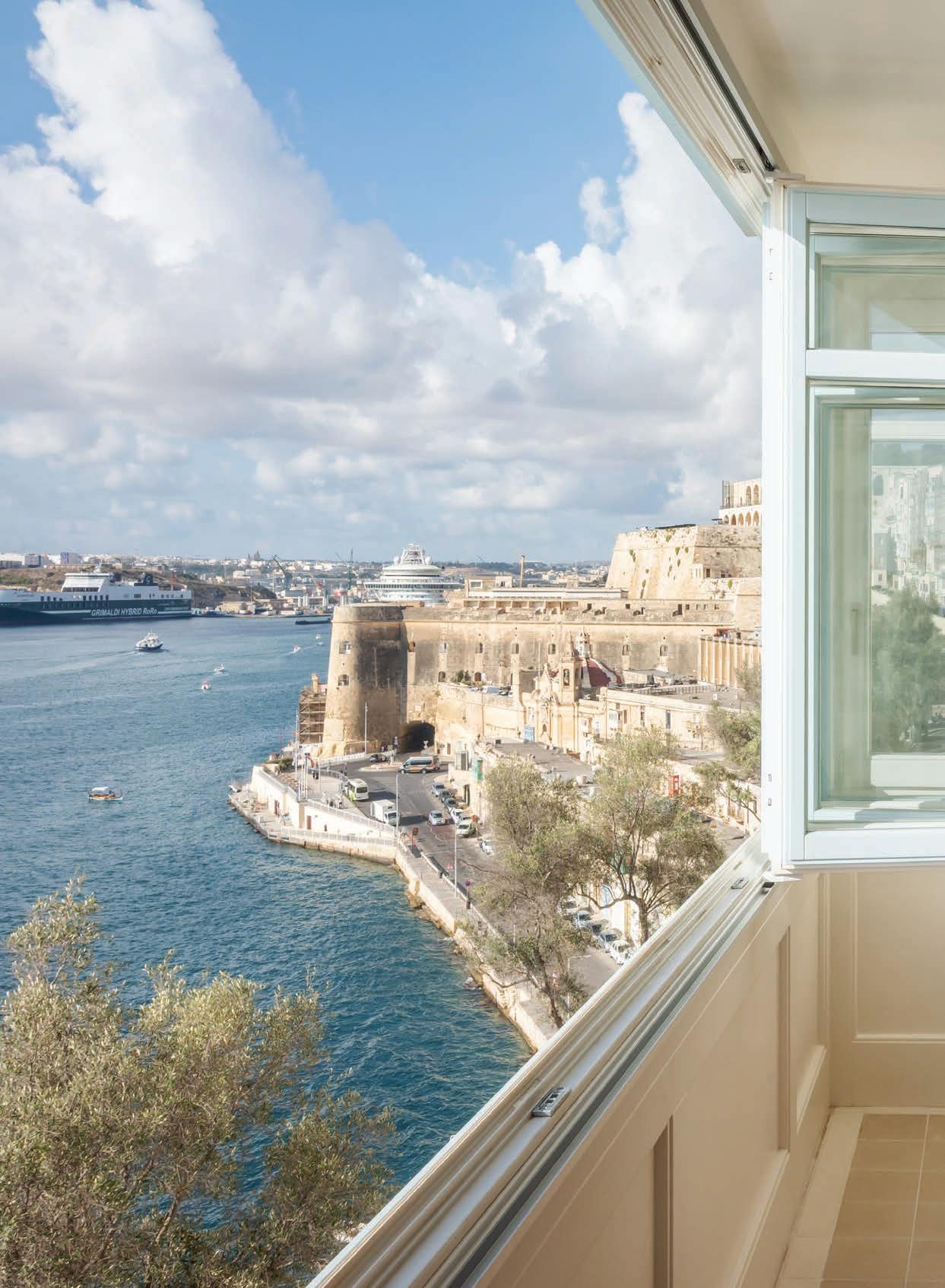
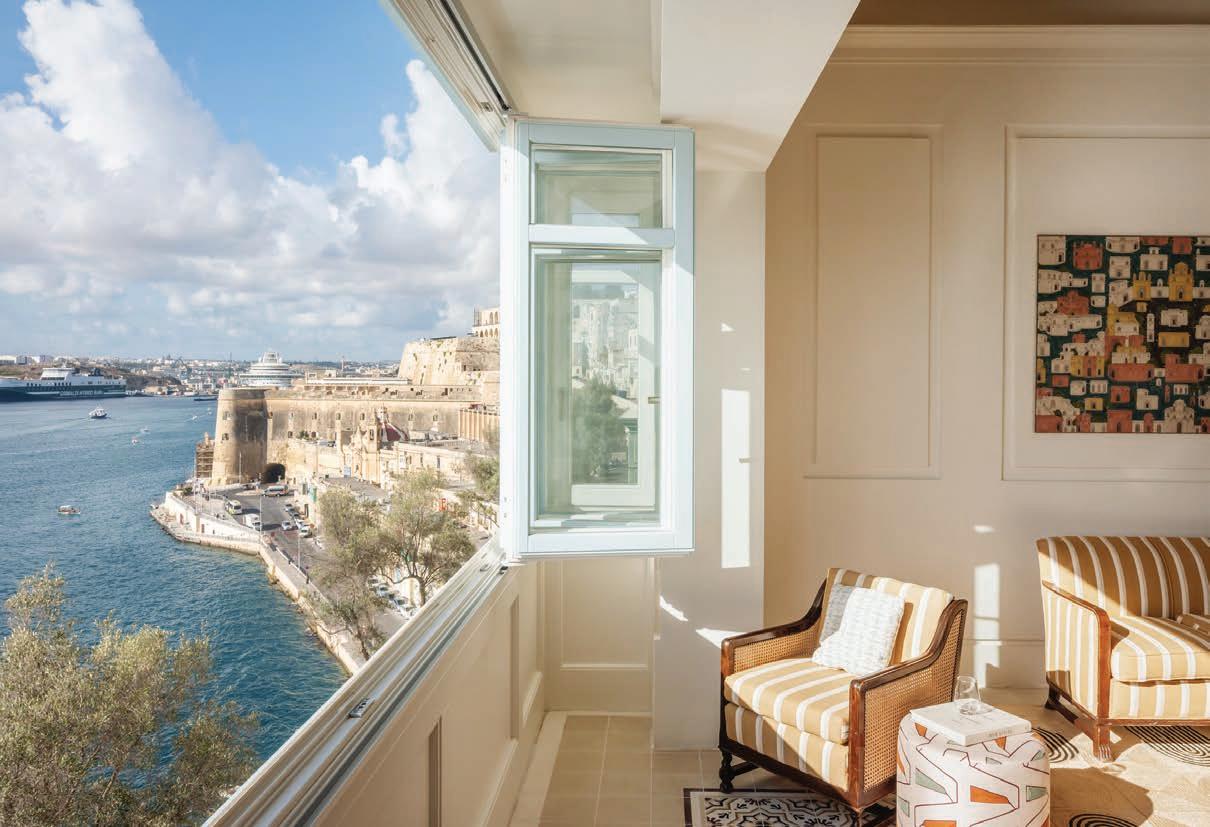
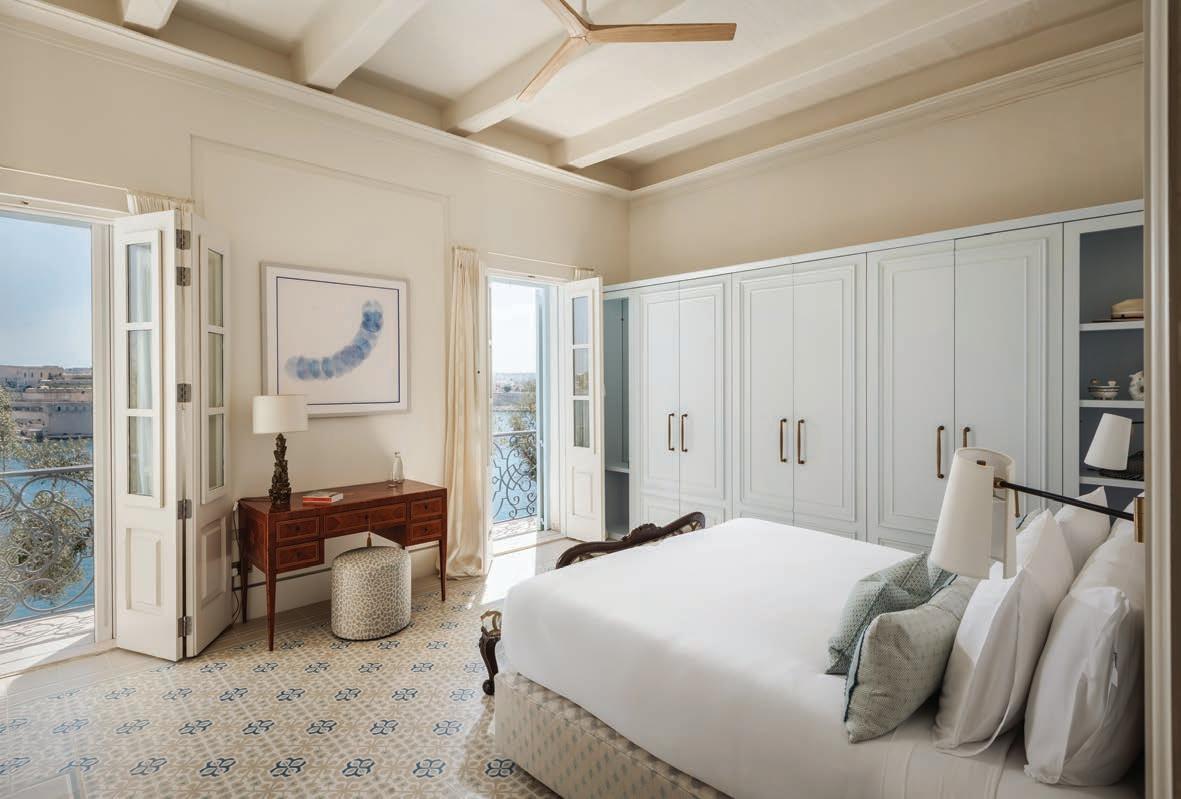
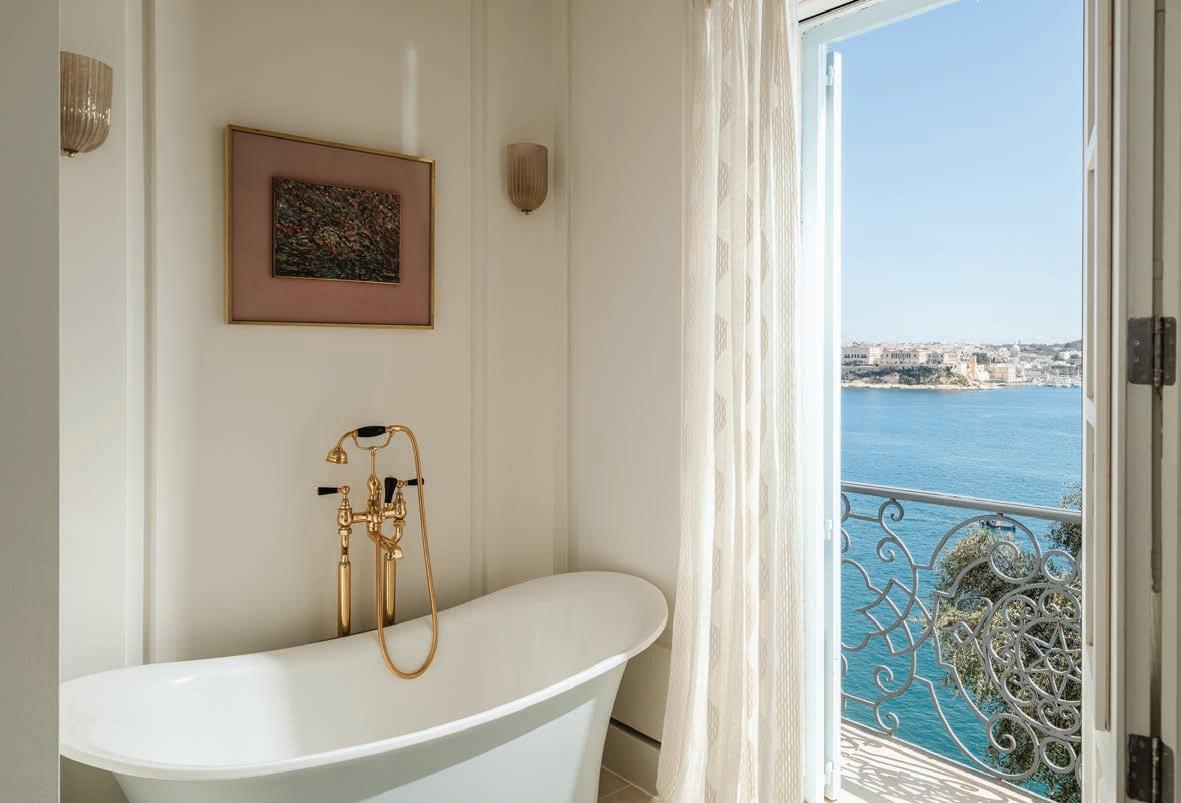
Set on Valletta’s idyllic St Barbara Bastion, La Maison is a six-storey private townhouse newly introduced by Iniala Harbour House. Designed by AP Valletta with interiors by London-based And Architects, it brings together Maltese craftsmanship and contemporary detailing. Across 330 square metres, the residence unfolds through luminous rooms, restored architectural elements and a rooftop pool that frames one of the Malta’s most iconic views.
Main photography David Curran, courtesy Iniala Harbour House.
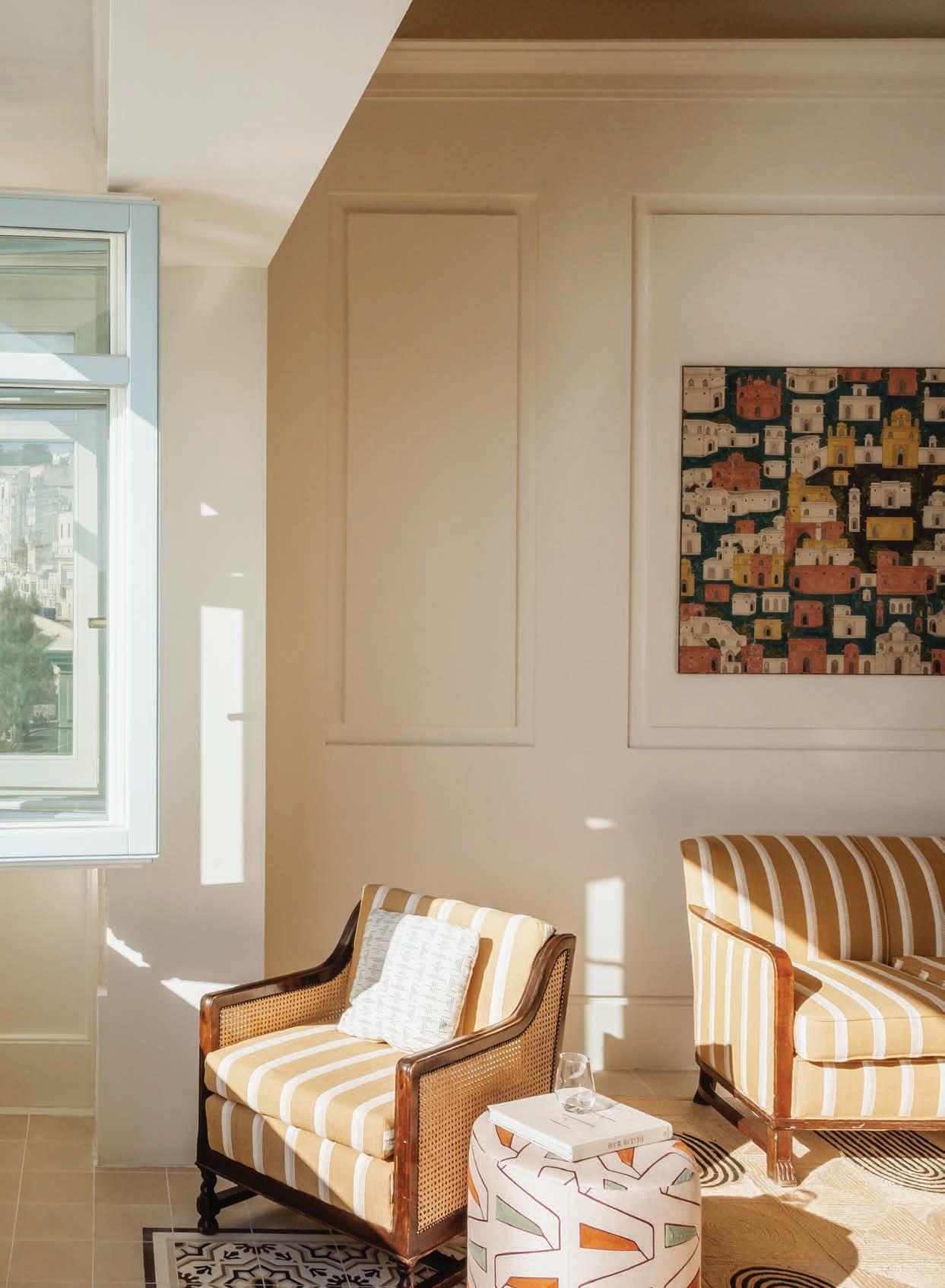
St Barbara Bastion has long been one of Valletta’s most coveted addresses, a terrace of 19thcentury townhouses set above the Grand Harbour with a view that has shaped the city’s identity for centuries. The bastion itself dates back to the era of the Knights of St John, its position once guarded by Fort St Angelo across the water. Today, the street is defined by limestone façades, timber balconies, a whimsical row of trees and the harbour below. It is here that Iniala Harbour House has introduced La Maison, a private townhouse launched last October as part of its growing collection of refined urban residences.
Iniala Harbour House opened in 2020 and quickly established itself as one of Malta’s most distinctive hospitality addresses, earning Forbes
Five-Star status in 2022. La Maison extends this ambition into a more intimate experience. Conceived as a private home with the service of a discreet hotel, the six-storey, 330square-metre residence has been shaped by AP Valletta in collaboration with London-based And Architects. Their approach draws on the townhouse typology that defines Valletta, while introducing a contemporary sensibility that feels entirely at ease within the historic fabric.
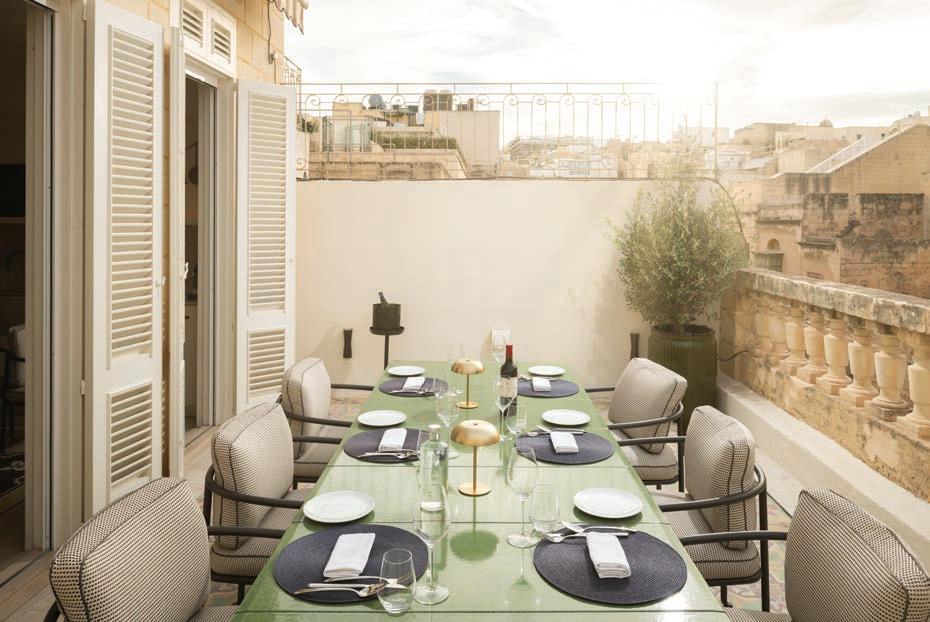
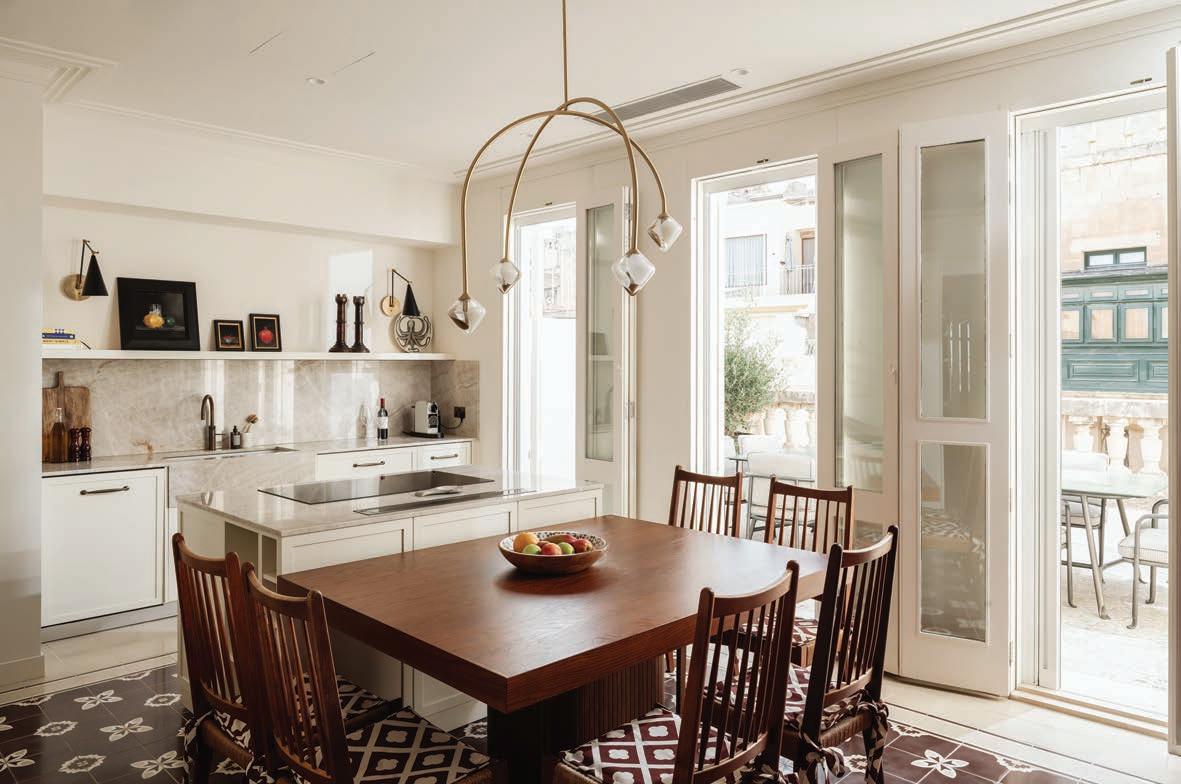
Above: Contemporary cabinetry and stone surfaces define the kitchen, complemented by views over East Street. The kitchen is designed for both hosting and everyday living, with direct access to the outdoor dining terrace. Left: The dining terrace overlooks East Street, offering an intimate outdoor setting framed by Valletta’s rooftops.














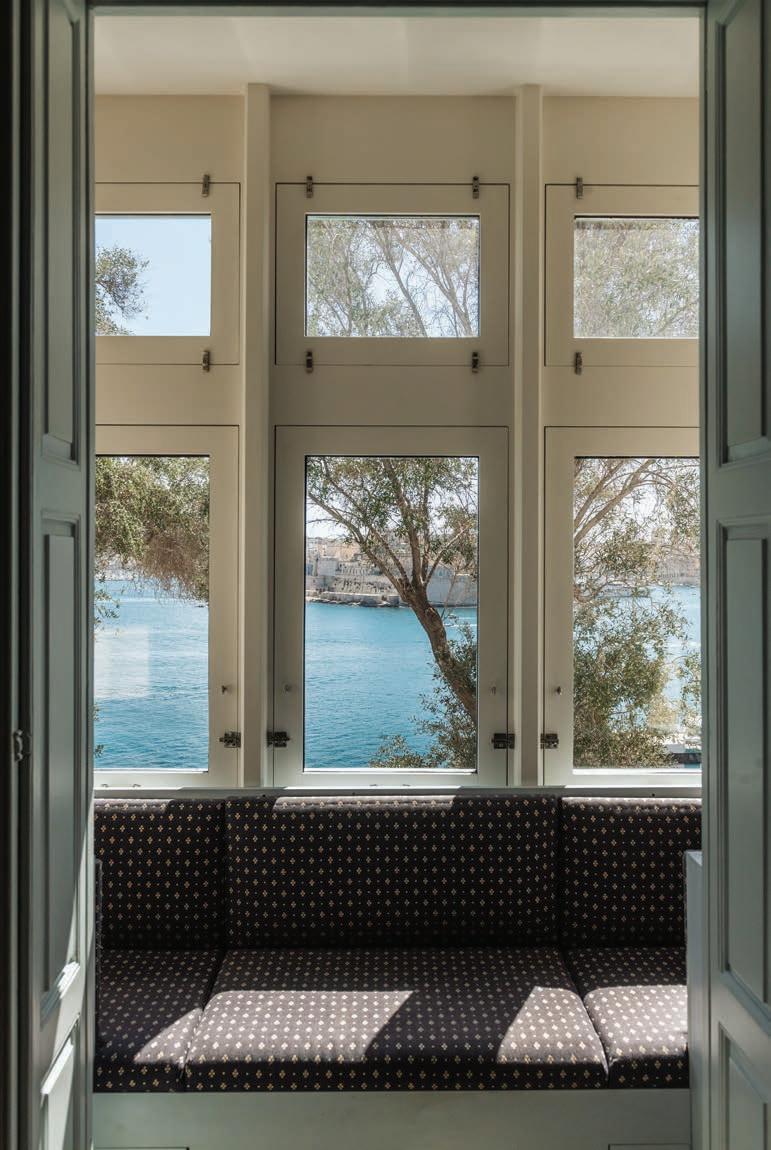
The design begins with the building’s structure. Over decades, the original hierarchy of rooms had been diluted by successive alterations. The architectural team approached the project as an opportunity to restore proportion and coherence, reinstating the spatial rhythm characteristic of Valletta’s domestic architecture. Locally cut stone, timber apertures and patterned tiles reappear throughout, not as nostalgic gestures but as materials that belong to the building’s DNA. These are paired with contemporary finishes and refined detailing, creating a natural dialogue between past and present.
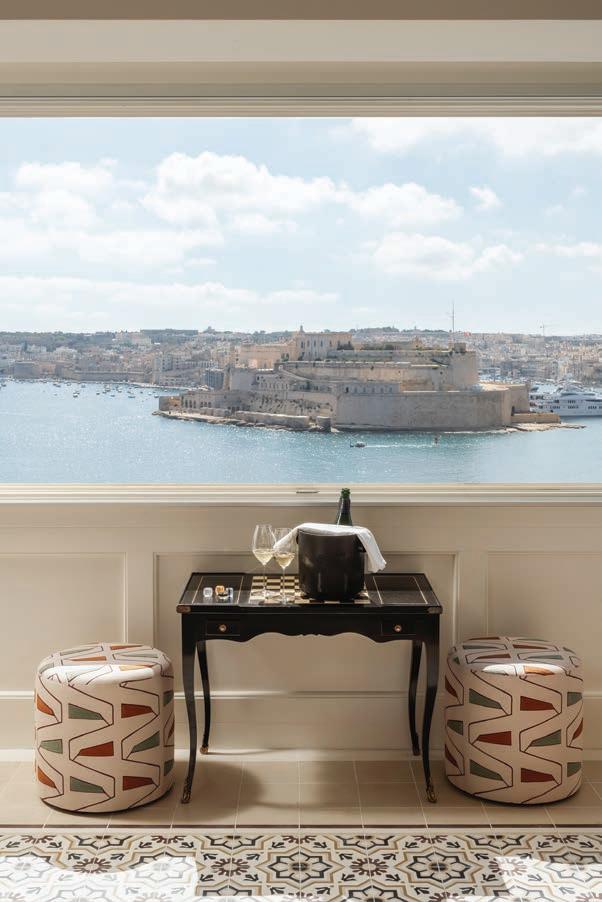
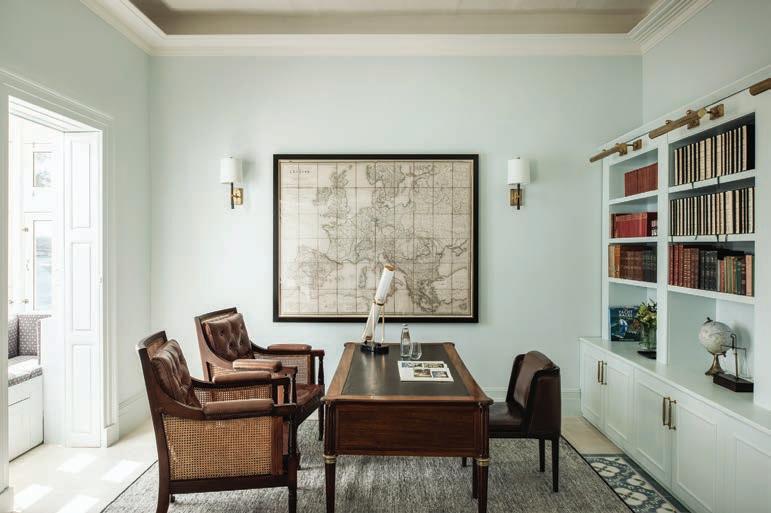
Left top and bottom: A spacious office creates a refined workspace within the townhouse. The office features two traditional Maltese balconies, framing the harbour in a way that feels both dramatic and intimate.
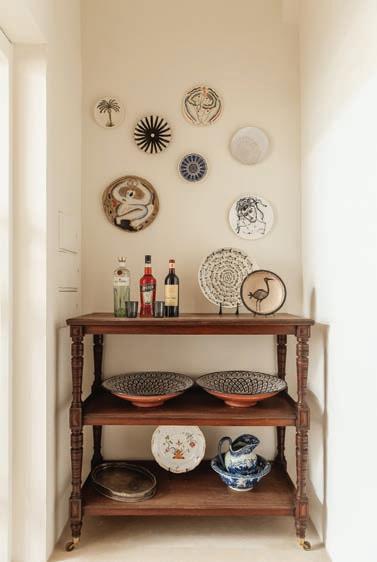
Above: Antique pieces and contemporary design elements sit comfortably together, giving the interiors a layered, collected feel.






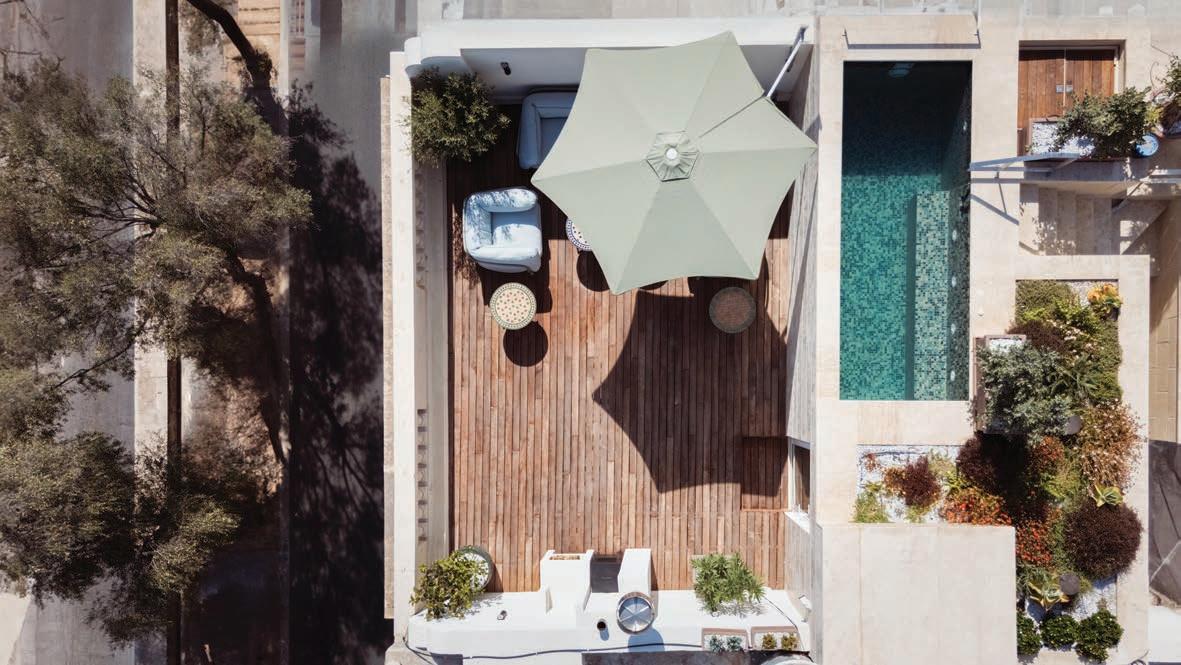
Acentral element of the intervention is the reinterpretation of the stairwell void. What had once been a residual space became the anchor for a new vertical axis, culminating in a rooftop pool that appears to
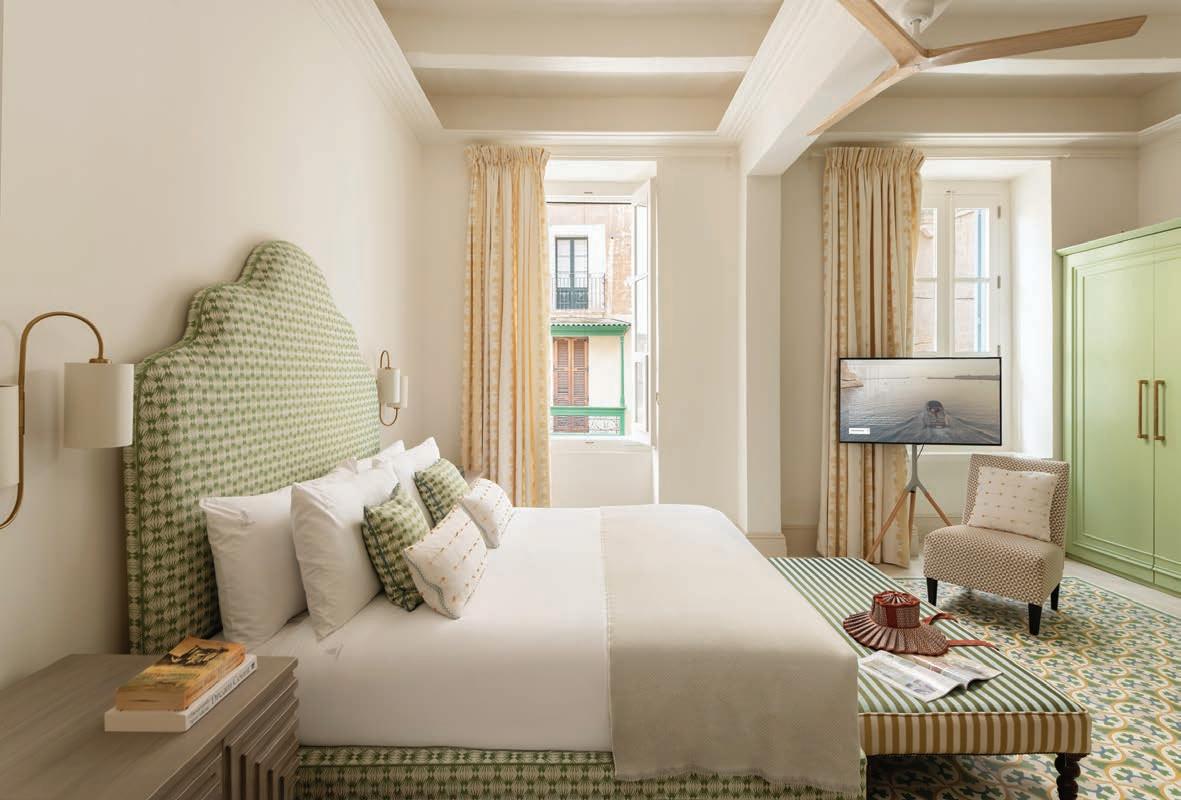
This page: The second bedroom overlooks Valletta’s rooftops, offering a different perspective on Valletta’s layered architecture. The guest bedroom captures the warmth of the city through its restored apertures and soft palette.
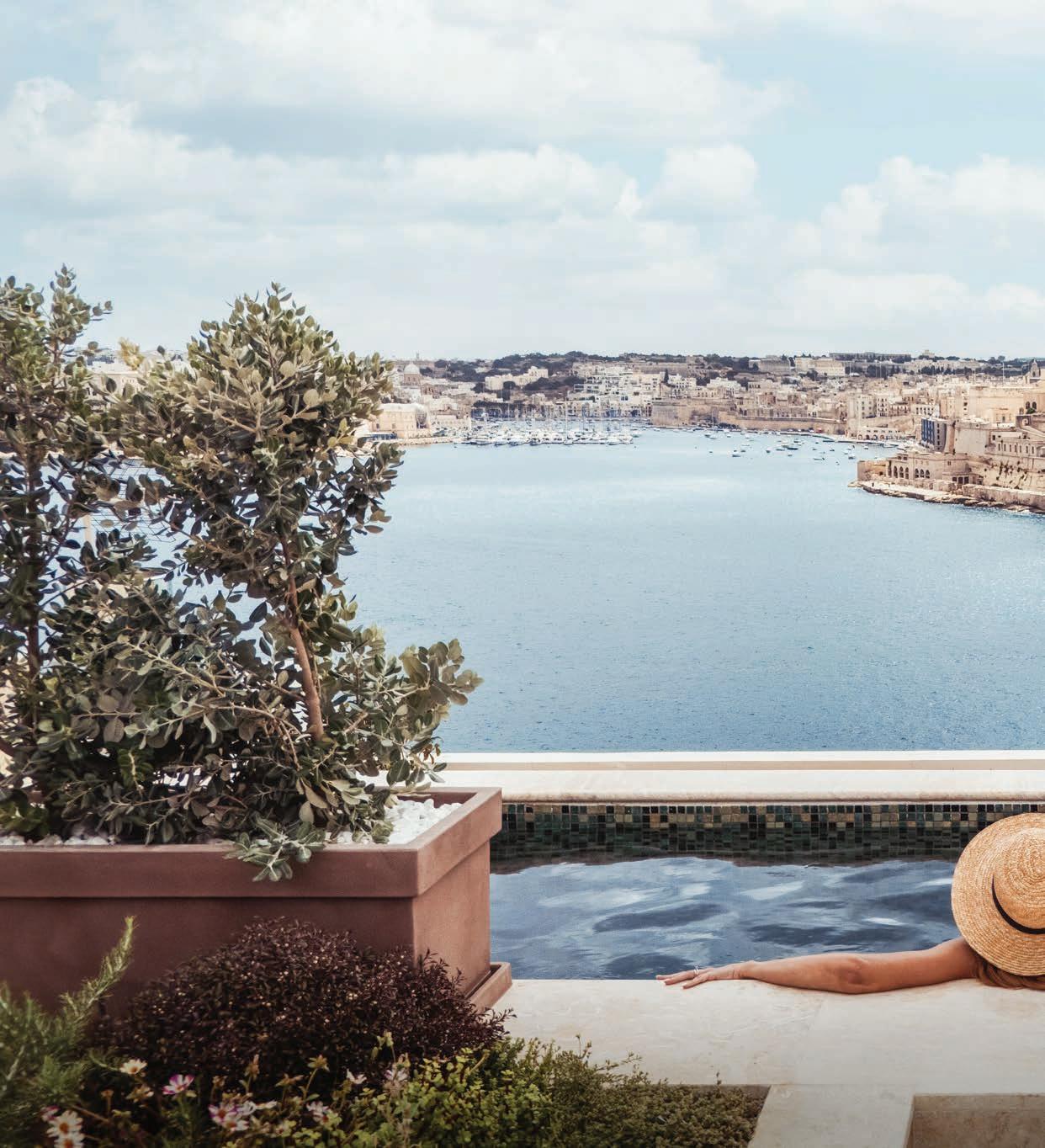
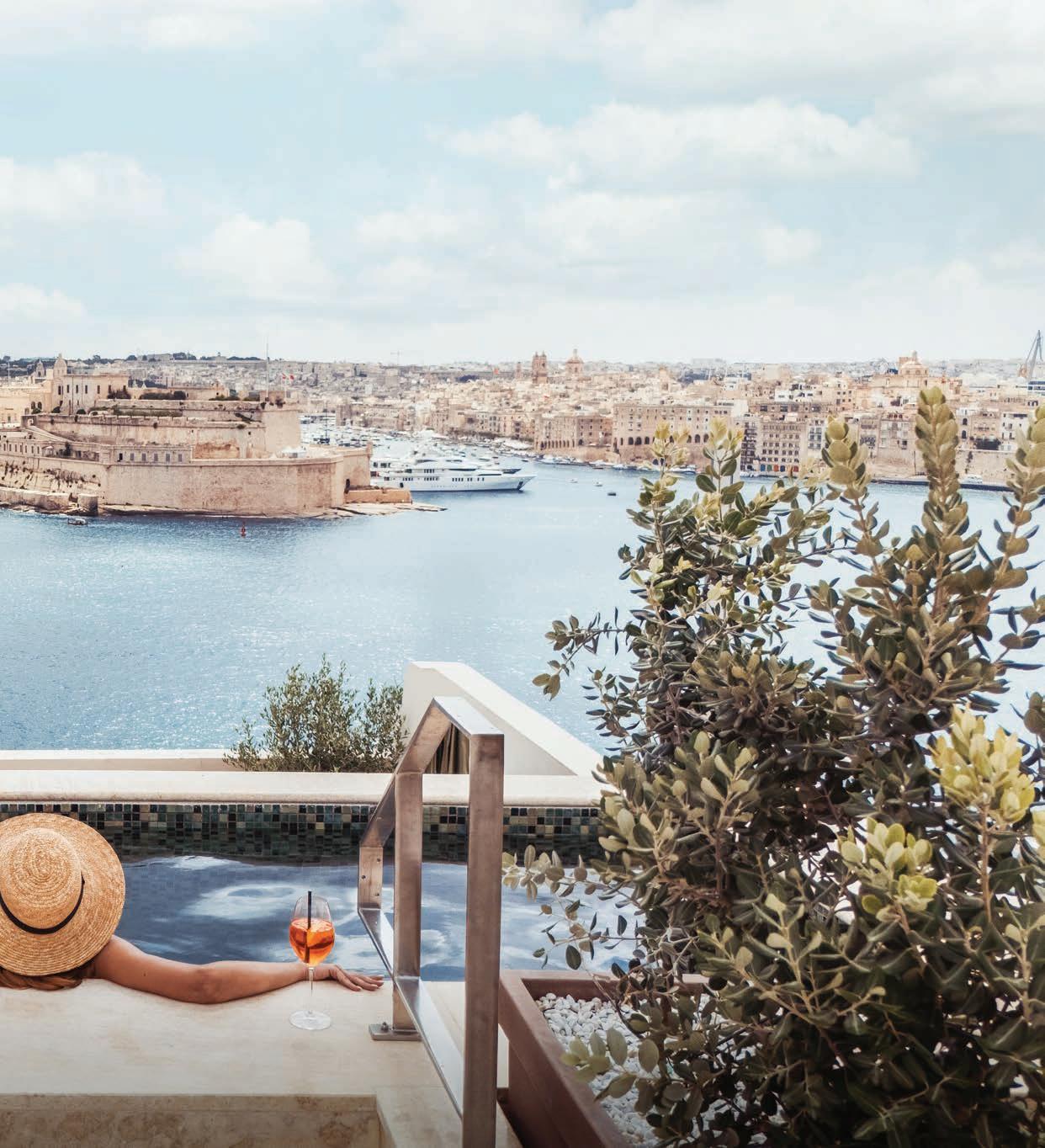
hover above the harbour. Its geometry is integrated into the building envelope with precision, and from the water’s edge the city unfolds in a panorama of limestone, domes and masts. This links the townhouse’s interiors to the wider landscape, reinforcing the sense of living within Valletta’s layered topography.
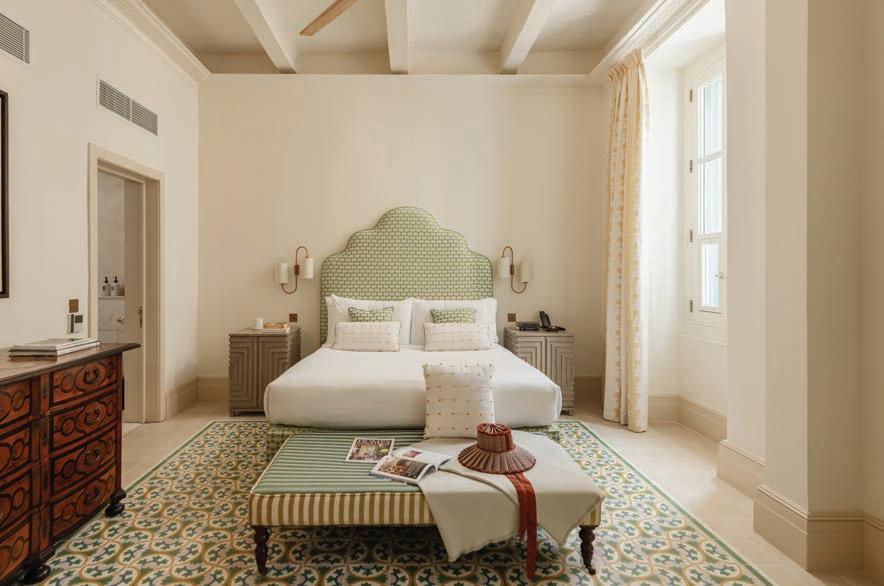
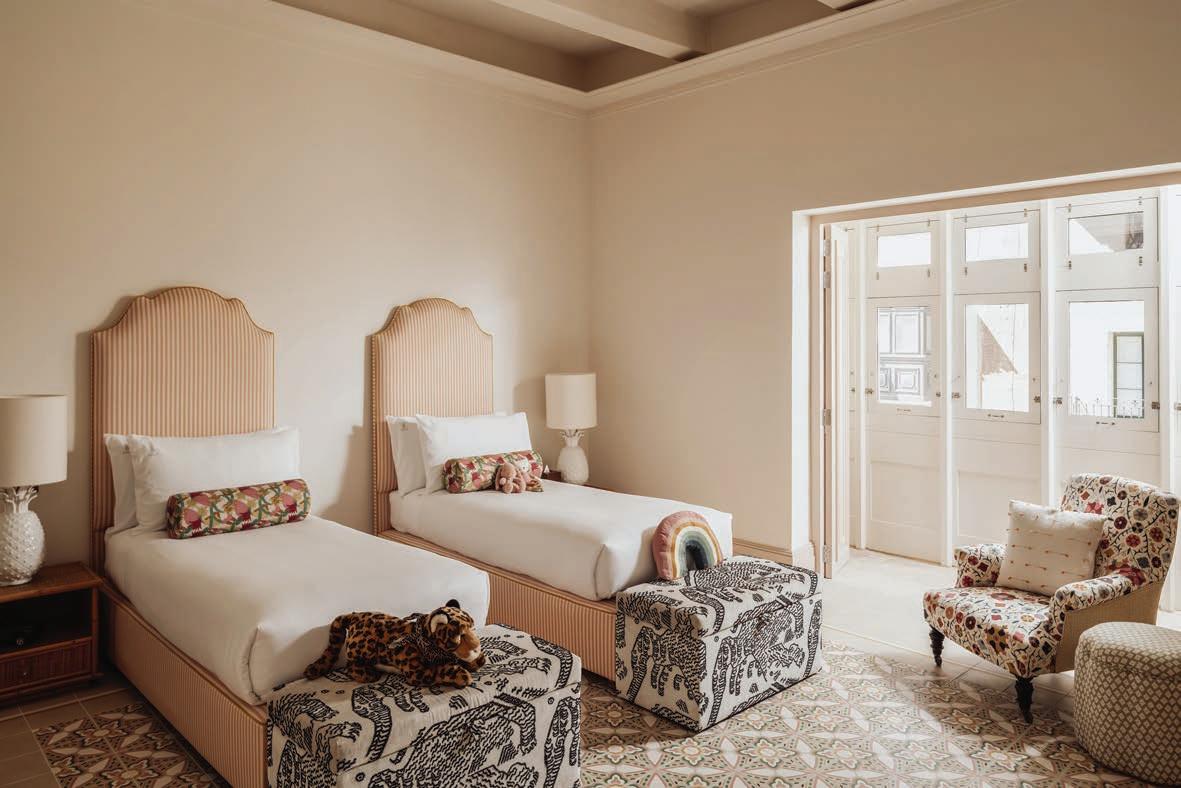
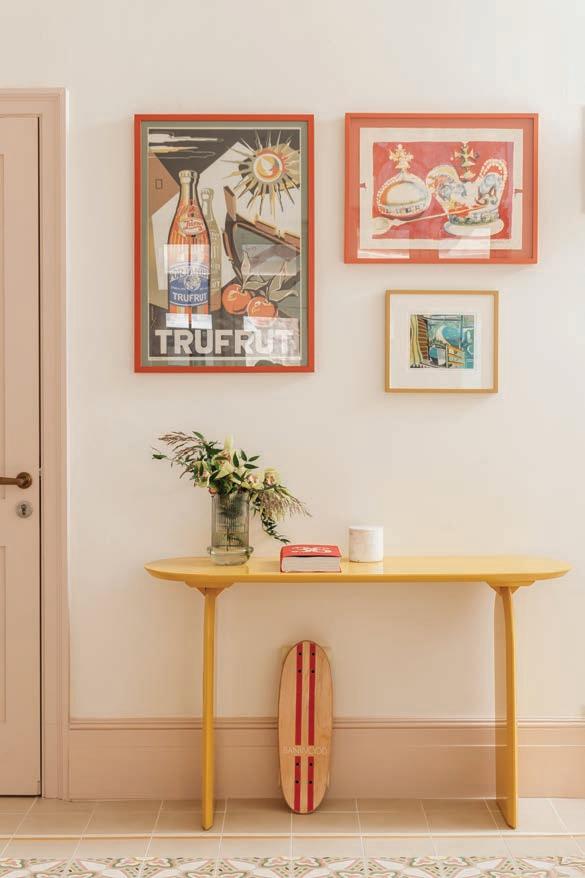
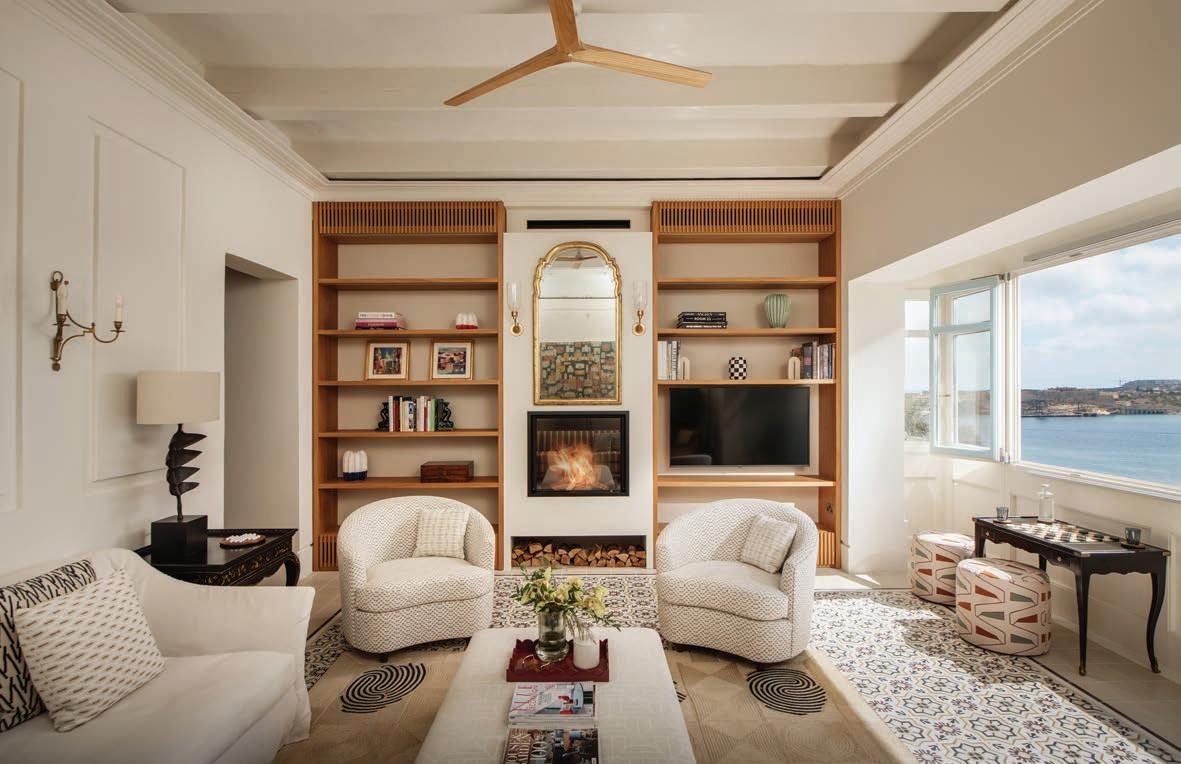
Inside, the rooms unfold through a sequence of individually composed spaces, each with its own palette and atmosphere. The interiors are unified by bespoke tilework inspired by traditional Maltese patterns. Reclaimed originals were used as a starting point, informing a cohesive language of colour and texture that runs through the house. Antique pieces sit alongside contemporary furniture, and the combination gives the rooms a lived-in elegance.
The townhouse’s separate entrance reinforces the sense of privacy, and the entrance level functions as a lobby, setting a calm tone before the house begins its ascent. On the first floor, an office with two traditional Maltese balconies frames the harbour. A guest bedroom and bar area complete the level, offering a sense of privacy that suits longer stays.
The second floor is dedicated to the bedrooms. The master suite looks directly onto the harbour, its Super King bed positioned to capture the morning light. A standalone bathtub shares the same view, creating a moment of indulgence that feels entirely in keeping with the townhouse’s character. A second guest bedroom faces the city, its windows opening onto Valletta’s rooftops and church spires.
















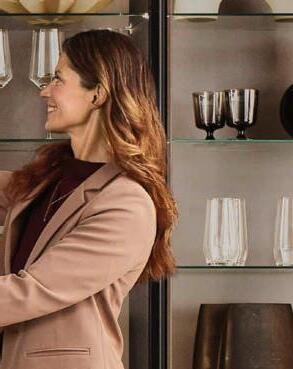
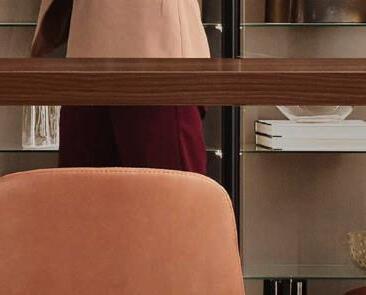

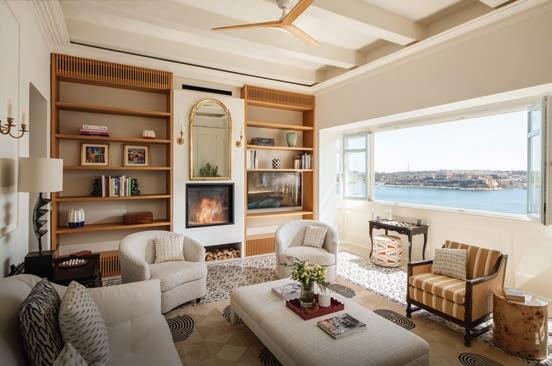
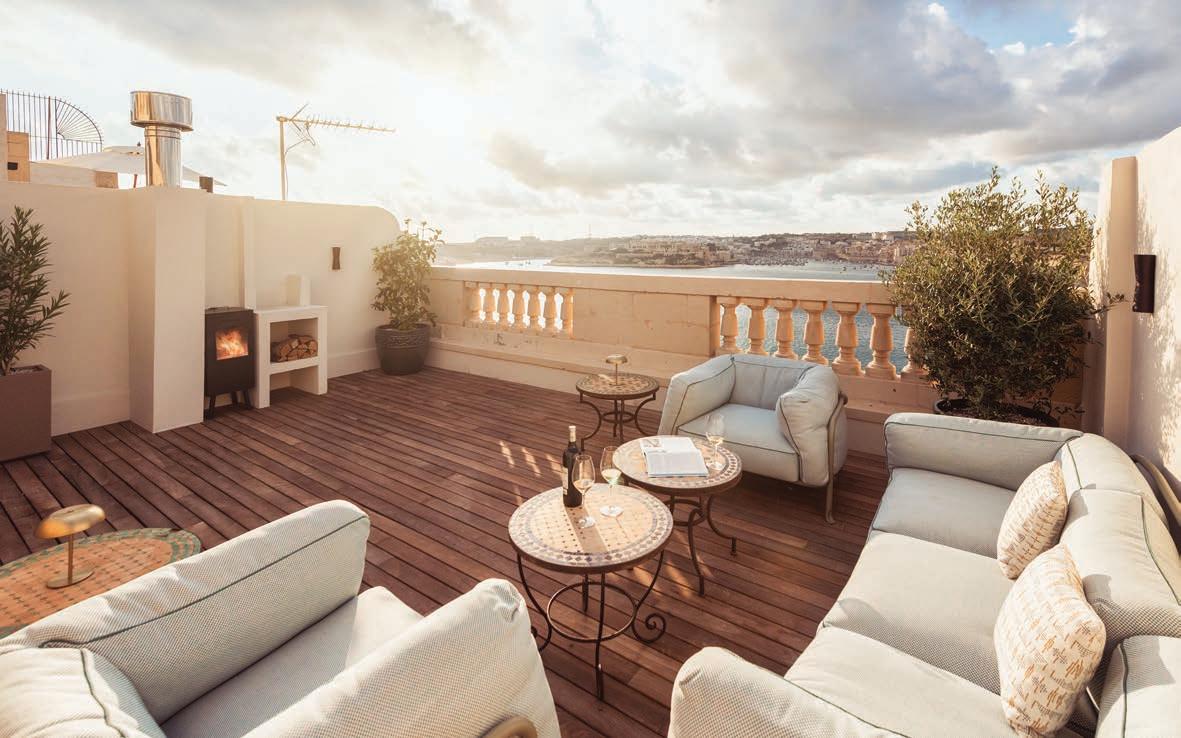
The third floor is the social heart of the house. A woodburning fireplace anchors the living room, while a grand Maltese balcony opens fully to the harbour, turning the room into an elevated loggia.
The adjoining kitchen is designed for both cooking and entertaining, with a terrace overlooking East Street that seats up to ten guests. The combination of harbour and city views gives this level a sense of dual orientation, connecting the townhouse to Valletta’s contrasting moods.
Above, the terraces offer spaces for dining,
lounging and open-air gatherings. An inbuilt bar, barbecue and outdoor shower make the level suited to long summer evenings, while the harbour remains a constant presence. The top floor pool completes the ascent, its waterline meeting the horizon in a way that feels almost surreal.
Throughout the house, curated artworks and bespoke design pieces add layers of personality. The selection is thoughtful, contributing to an atmosphere where
craftsmanship and creativity sit comfortably together.
La Maison blends architecture, interior design, and hospitality, pairing Valletta’s historic charm with modern comforts. Its rooms are defined by light, balance, and texture, while its
position over the harbour and The Three Cities beyond gives it a distinct character. For those wanting a home in the city rather than just a hotel stay, it’s an inviting choice, a townhouse that respects its heritage while embracing contemporary style and creature comforts.




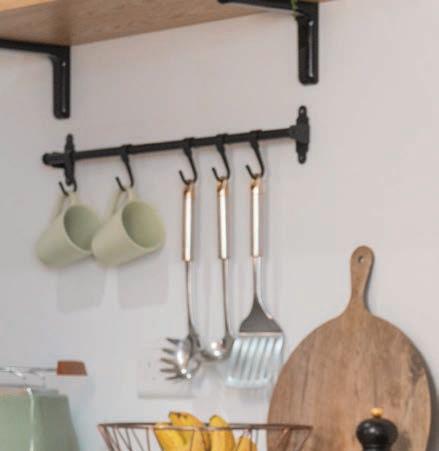
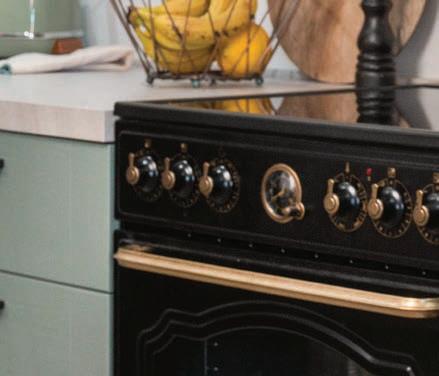







“My husband and I took a while to decide on the colour for the kitchen of our Gozo apartment. We wanted it to reference Zebbug where it is located, as well as the colour of the sea, and after seeing lots of samples, decided on a cool pale green. To complement it, we went with this fresh yet subtle off-white shade for the walls. My husband and I did all the painting together, but he didn’t trust me with the final coat – that was all him!
Nadine Cauchi


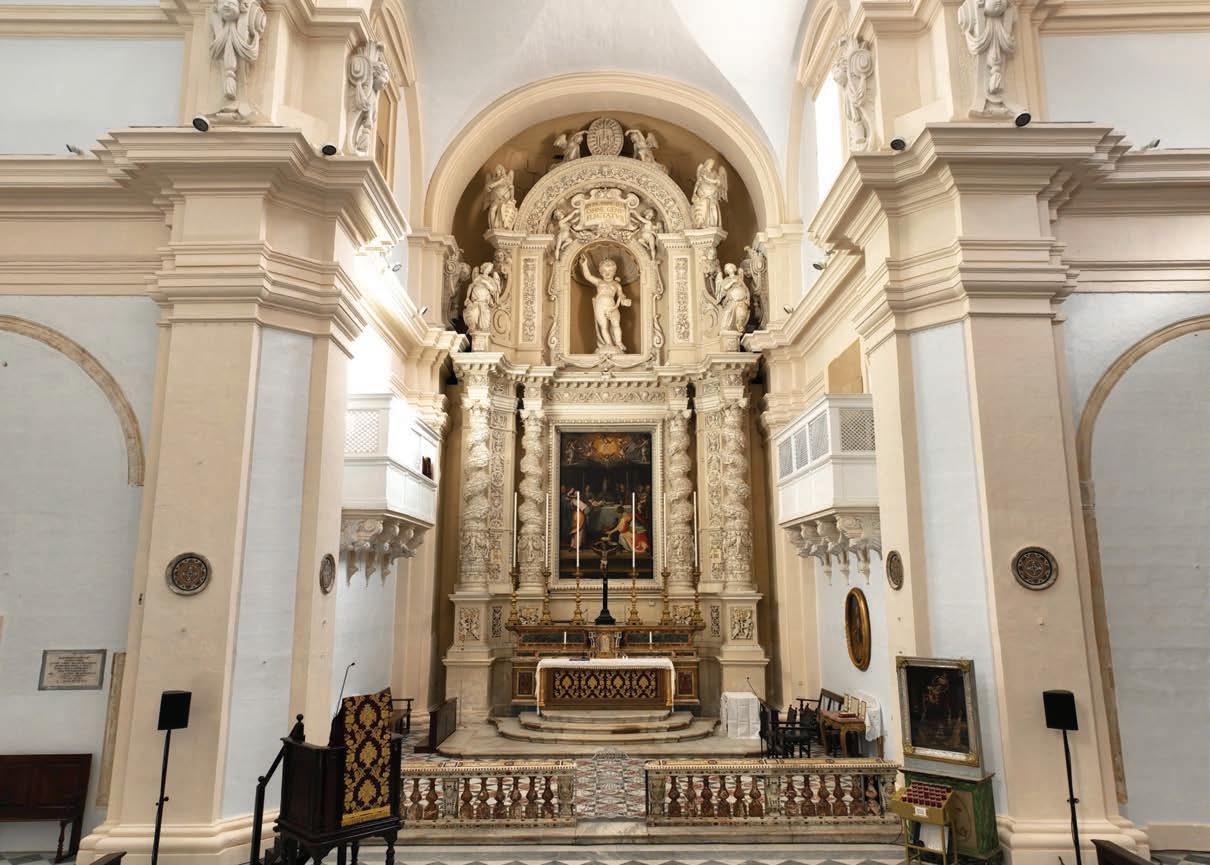
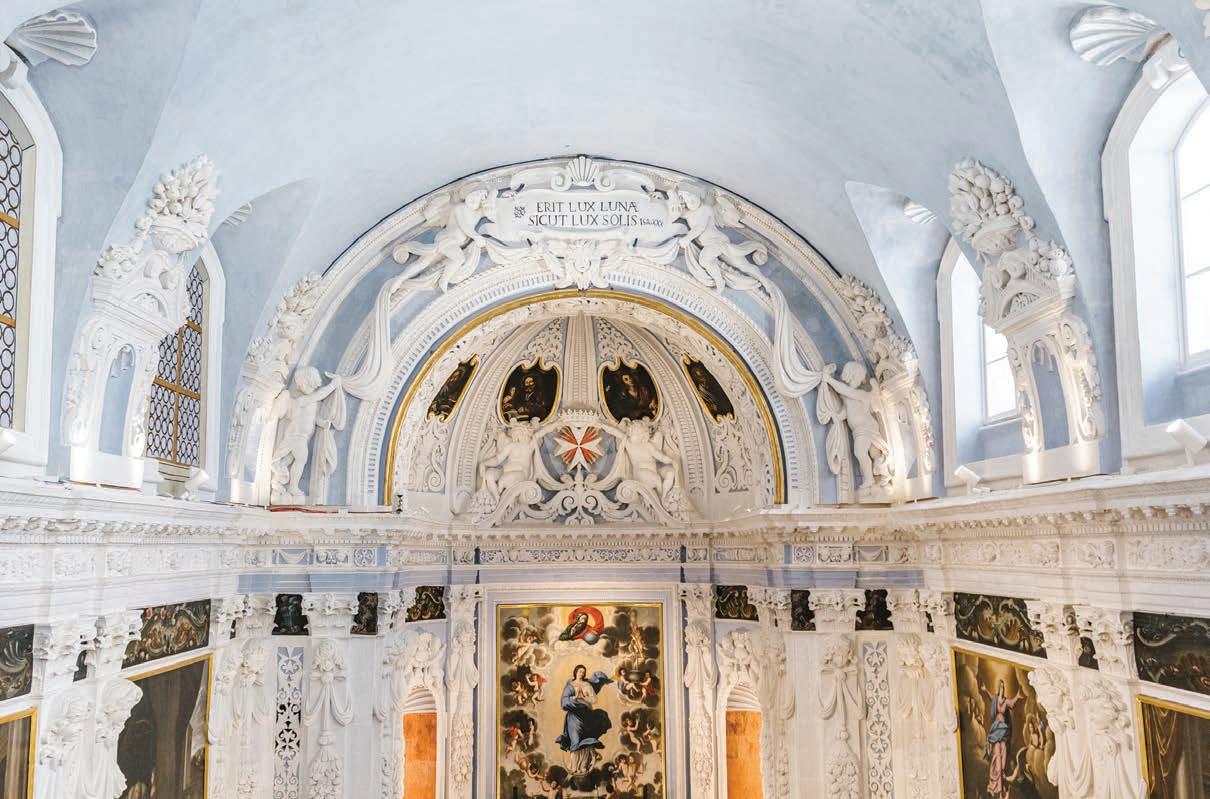
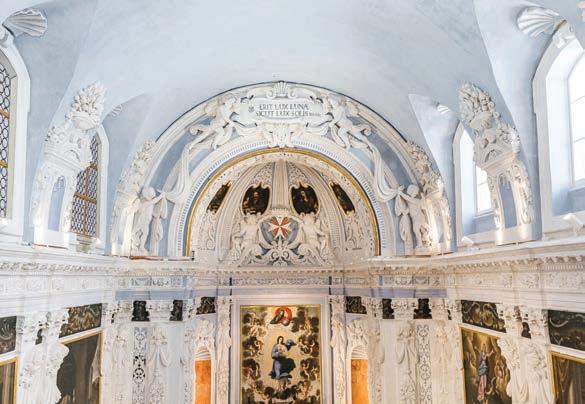
MULTI YEAR RESTORATION BY AX CONSTRUCTION HAS RENEWED THE JESUITS’ CHURCH IN VALLETTA, SAFEGUARDING ITS STRUCTURE, INTERIORS AND ARTISTIC HERITAGE FOR FUTURE GENERATIONS.
AX Construction, led by Director Denise Xuereb, was entrusted with the restoration of The Jesuits’ Church in Valletta, which has reopened to the public following a long-term project, which has carefully revitalised both the structural and artistic elements of this historic building. Works on the main church were completed earlier this year, marking a significant milestone to preserve one of the capital’s most important religious and cultural sites.
Photography courtesy AX Construction.
Built between 1593 and 1609, the Jesuits’ Church is one of the oldest and largest churches in Valletta and holds historical importance as the birthplace of the University of Malta. Over the centuries, the church has remained closely linked to the development of education, culture, and religious life on the island.
This restoration project began in 2015, initially focusing on the exterior of the church, the adjoining oratories, and the Old University building. In the subsequent phases, AX Construction was entrusted with extensive restoration works across both the oratories and the main church. The first phase of interior works concentrated on the sacristy, the Oratory of the Immaculate Conception, and the Oratory of the Onorati where expert cleaning, consolidation, and repair works were carried out to stabilise and restore original surfaces. These works were completed prior to the closure of the main church, allowing religious functions to continue in these spaces during later phases.
Attention then shifted to the main church, which had been affected in the past by a lack of maintenance, causing water infiltration. One of the first priorities for AX Construction
was the repair of the active leakages, enabling conservators to proceed safely with internal restoration. The intervention included the cleaning and consolidation of walls and ceilings, restoration of marble flooring, and extensive works on the dome, both internally and externally.
Throughout the project, AX Construction adopted state of the art restoration methods that remained faithful to the building’s original construction. Modern paint layers were carefully removed to reveal historic colour schemes, which informed the final finishes. Traditional materials, including limebased mortars, were used in areas such as the dome to repair deteriorated surfaces and ensure compatibility with the original fabric of the building.
The works were carried out by AX Construction in collaboration with the Restoration and Preservation Department and the Jesuits’ Church Foundation, established in 2021 to oversee the long-term care and preservation of the church and its heritage, under the coordination of Rev. Dr Father Doublet, Rector of the Jesuits’ Church Foundation, who guided the project’s implementation. The Foundation continues to support conservation efforts, as well as cultural and educational initiatives linked to the church.
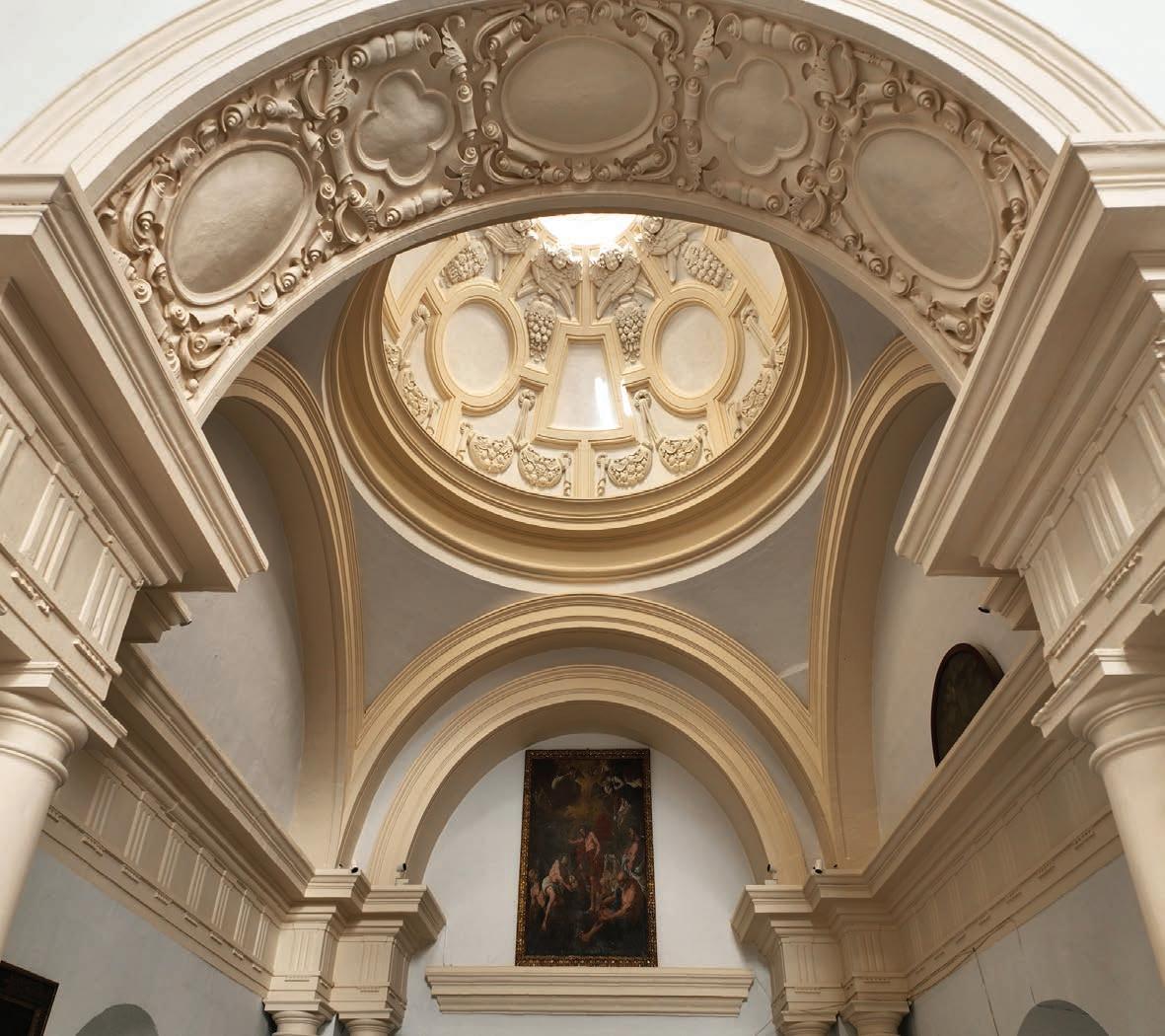
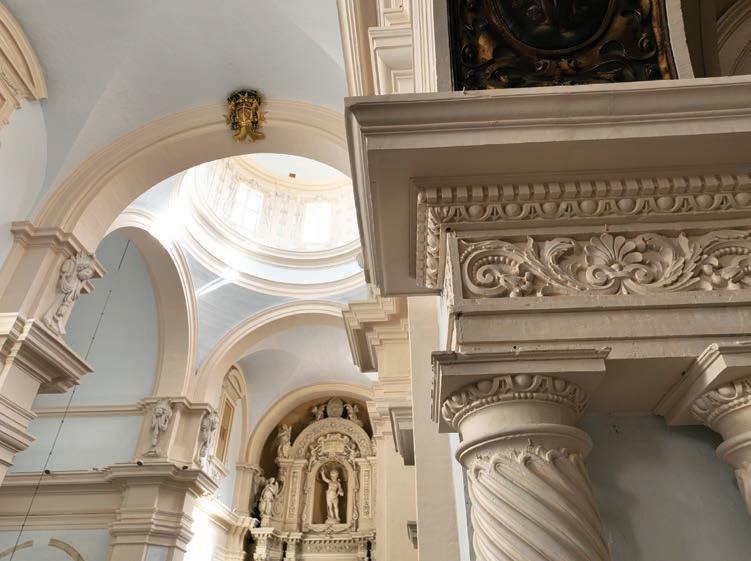
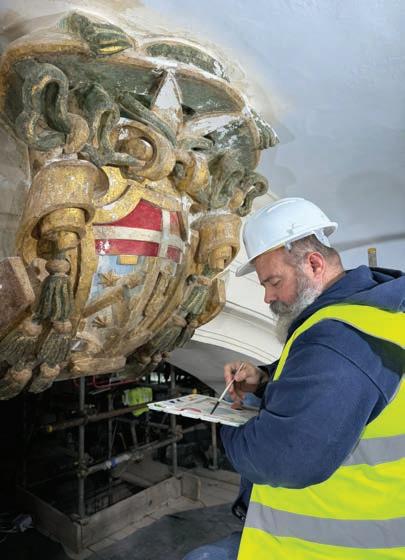

This project also forms part of AX Construction’s wider presence in Valletta, where the company has been entrusted with several restoration and conservation projects in recent years. Through this continued involvement, AX Construction has established itself as a considerate contractor within the capital city, delivering complex works in sensitive historic environments while maintaining respect for the surrounding community and built heritage.
AX Group is proudly sponsoring the conservation of three masterpieces by Mattia Preti, originally commissioned by the Rosselli Massa family for their chapel within the Jesuits’ Church, an initiative that further strengthens the historical connection
between the church and Rosselli –AX Privilege, located directly opposite and once part of the family’s residence. The Jesuits’ Church houses an important collection of fine art, including works by Giovanni Battista Caracciolo, Stefano Erardi and Alessio Erardi, and alongside its architectural restoration AX Group is also playing a leading role in safeguarding its artistic heritage through the conservation of these Rosselli-Massa Chapel paintings, which are being restored by the St John’s Co-Cathedral Foundation restoration team to ensure their preservation and continued public accessibility.
Today, the church has resumed its role as a place of worship and a venue for cultural and academic events, including university ceremonies. Its reopening reflects a broader commitment to preserving Malta’s built heritage while maintaining its relevance within contemporary community life.
The Valletta Concours returns this May with a showcase of classic and vintage cars judged by an international panel. This year Triton Square becomes the stage for a weekend shaped by design, engineering and the city’s architectural fabric.
Photography Ikona Artworks, courtesy Valletta Concours.

The Valletta Concours returns this May, bringing a weekend shaped by design, engineering and the jazzy atmosphere that arrives when historic cars take their place in the city. This year’s edition unfolds in Triton Square on Sunday 24th May, framing the event against Renzo Piano’s reimagined entrance to Valletta and Triton Fountain’s sculptural presence. The location suits the Concours, which has grown into one of the
Mediterranean’s most distinctive gatherings for vintage and classic automobiles, drawing collectors, designers and enthusiasts from Malta and abroad.
The theme, Art Meets Art, captures the spirit of the event. The Concours was founded on a shared appreciation for the city, for automotive design and for the preservation of mechanical craft. Over the years it has developed into a fixture on the international classic-car calendar, attracting collectors who bring rare and significant models to Malta for a weekend that blends exhibition, competition and cultural exchange.

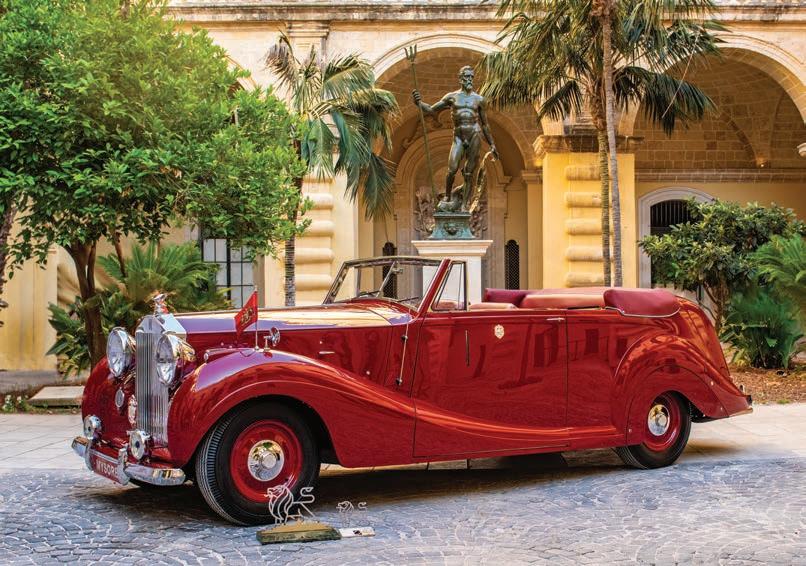
Recent editions have seen exceptional cars arrive from across Europe and beyond, including the 1949 Rolls-Royce Silver Wraith owned by Yohan Poonawalla, which travelled from India to Valletta and was awarded Overall Best of Show 2025. Maltese collectors have also found a platform here, with locally restored cars going on to compete successfully at major international events.
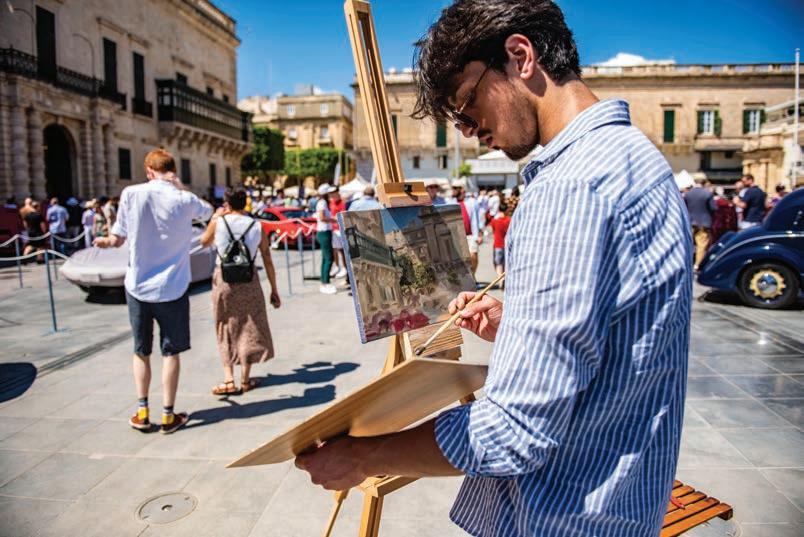
Alongside the automotive element, the Concours incorporates a collective art exhibition centred on Valletta and classic cars. Sixteen Maltese and international artists will exhibit their work in the Chamber of Commerce foyer on Republic Street, with the exhibition running from 16th to 24th May. On the day of the Concours, several artists will paint live in Triton Square, adding another layer to the event’s atmosphere. The Concours also invites the public to participate through a retro clothing competition, encouraging visitors to engage with the event’s atmosphere in their own way.
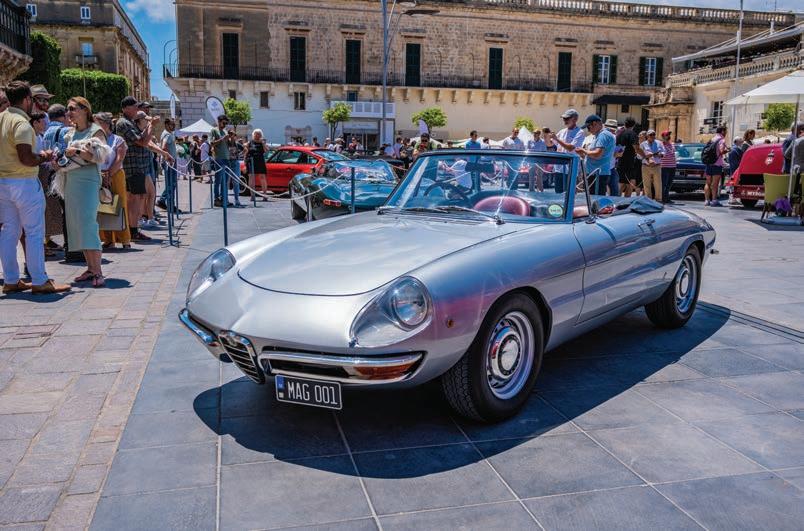
Overleaf and top: The 1949 Rolls-Royce Silver Wraith presented by Yohan Poonawalla, winner of the 2025 Overall Best in Show Award. Centre: The 1968 Alfa Romeo Spider “Osso di Seppia” by Pininfarina presented by Mark Borg, winner of the 2025 Best in Show Maltija Award. Bottom: Sixteen Maltese and international artists will exhibit their work in the Chamber of Commerce foyer on Republic Street, with the exhibition running from 16th to 24th May. Like last year, several artists will paint live on the day of the Concours, adding another layer to the event’s atmosphere.

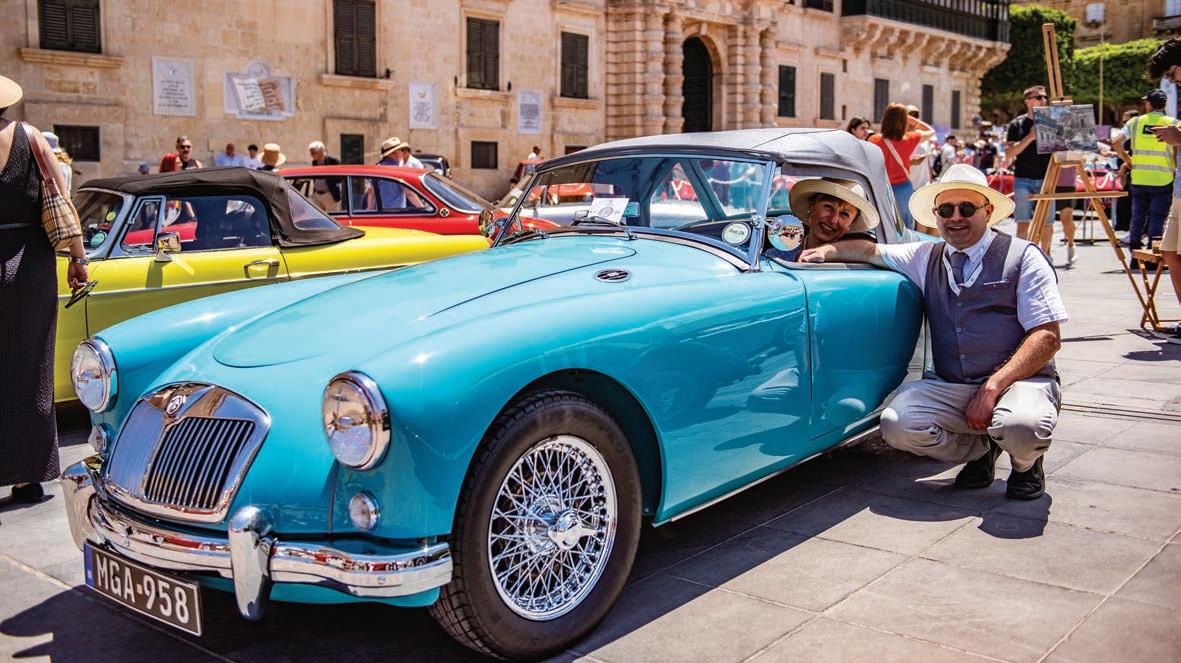
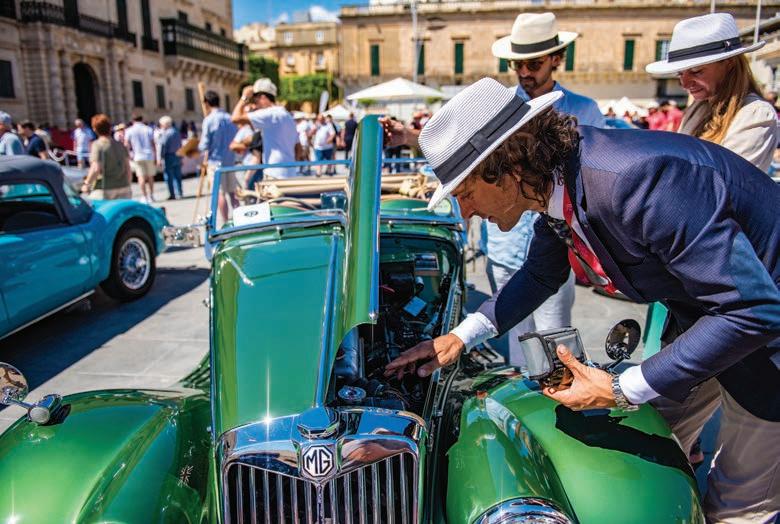
Around sixty-five vintage and classic cars will take part this year, joined by a notable group of motorcycles. The vehicles will be judged across several categories, including Elegance, Pre-War, Post-War, Jaguar, Pininfarina, Preservation, Popular Classic, Sports Car and Modern Classic. The 2026 edition also commemorates Carrozzeria Touring Superleggera, with several examples expected to appear in the dedicated class. The inclusion of a Classic Pedal Car Class adds a lighter note, while the Preservation Class reflects a growing appreciation for originality
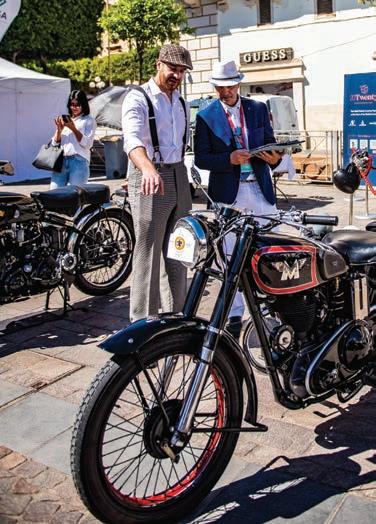
and the patina of age.
One of the Concours’ defining features is the judging panel. Led by Chief Judge Jeremy Jackson-Sytner, the twenty-strong international jury brings together designers, historians and automotive specialists whose expertise shapes the evaluation process. Their focus on authenticity, design and condition gives the event a level of rigour that has helped build its reputation. The presence of figures such as FIVA President Tiddo Bresters in 2025, and this year’s special guest Lorenzo Ramaciotti, reinforces the Concours’ standing within the wider automotive community.
The cars will make their way from Triton Square into St George’s Square during the
event, creating a procession that showcases Valletta’s urban fabric as much as the vehicles themselves. The movement of these machines through the city’s streets offers a reminder of how design evolves across decades, and how certain forms retain their ability to captivate. As the Valletta Concours approaches, it continues to refine its identity as an event where automotive design, cultural heritage and the city’s architecture come together. This year Triton Square will set the stage, and the cars, each with its own story, craftsmanship and presence, will shape a weekend that celebrates the art of the automobile.
Further information www.vallettaconcours.com













“It is better for us to see the destination we wish to reach, than the point of departure.”
JULES VERNE, ROUND THE MOON

ARTEMIS II CREW USED MODERN PHOTOGRAPHY TO TELL THE VISUAL STORY OF THEIR LUNAR JOURNEY, AND UPDATE SOME CLASSIC APOLLO IMAGES
At this point in NASA’s human spaceflight story, researchers have a substantial amount of material, documents, artifacts and images, with which to tell the stories of past flights to space. But with NASA’s Artemis II mission around the Moon now in the books, we’re getting a refreshed look at space. And the digital photographs transmitted back to Earth, even mid-mission, tell a modern story of the crew’s experience writes Jennifer Levasseur, Curator of the National Air and Space Museum, Smithsonian Institution.
Photography NASA.


Entire generations born after Apollo 17’s last close-up looks at the Moon in 1972 may hardly believe the reality of Artemis II in the age of AI-generated deep fakes.
But this mission was real, and four humans can tell the tale of their adventure using the photographs safely stored on memory cards now in NASA’s hands.
As a space historian and curator well-versed in the visual culture of human spaceflight, I’ve long anticipated seeing the photographs of a return to the Moon.
Post-Apollo, images of space travel were characterized by launching space shuttles, Erector Set-like space stations and Mars rovers crossing a
dusty landscape. While the Artemis II photos have timeless, classic elements similar to the Apollo photos, better photographic tools give them a clean, crisp vibe. Space travel now looks more like many people may imagine it’s supposed to look: grand, adventurous, audacious, sublime.
As part of Gen X, I have no personal memory of Apollo. Like many born after NASA’s first slate of lunar missions, my memories of space include visuals like the ill-fated Challenger launch; Mercury program astronaut John Glenn’s return to orbit in a space shuttle in 1998, at age 77; and seeing photos of deep space from the Hubble Space telescope. But these events didn’t include humans on or near the Moon, and many people around my age are thirsty for their own lunar memories to share.
Thanks to the internet and social media, which allow people to access images at a greater speed and volume than ever before, photographs from the Artemis II crew became almost instantly iconic. They were also compared to what came before, as they fit within a mental catalog of exploration photography that’s far older than humans’ earliest attempts at space travel.

Top: The Artemis II crew captured this view of an Earthset on April 6th as they flew around the Moon. Below: Earth taken by NASA’s Artemis II astronaut commander Reid Wiseman inside the Orion capsule on April 3rd. In 1972, as the crew of Apollo 17 began their journey to the Moon, geologist Harrison Schmitt captured a series of images of the fully lit disc of Earth at around five hours after the start of the mission. This photo became an icon within a series of iconic photographs of the Space Age. That was Earth 1972, and now we have Earth 2026 – both serving as documents of singular moments in Earth’s long history. This new photograph shows Earth –lit by the Moon’s glow, not the Sun, as with the Apollo 17 photo – in the black void of space, the thin sliver of our atmosphere shielding life, and generating polar aurorae.












Artemis II crew members Reid Wiseman, Victor Glover, Christina Koch and Jeremy Hansen had weeks’ worth of photography training with a slew of Nikon digital cameras and iPhones. Taking photos with the device so many people have in their pockets is leaps and bounds beyond photography equipment used during Apollo 17, even the 1960s-era 35mm camera.
NASA’s preference for using the Nikon D5 on the International Space Station has extended to Artemis II. This camera performs well, and NASA likes tried and true reliability when astronauts travel to space.
NASA took a decidedly different path when planning for images of the Moon with Artemis, compared to Apollo. First, the Orion spacecraft used on Artemis is bigger, and it has double the number of windows and cameras inside. Five of Orion’s six windows had livestreaming video cameras capturing the lunar flyby. Because of their wide swing around the Moon at a distance greater than any Apollo flight, this crew could see more of the Moon in a single glance. Artemis’ crew trained intensively with geologists and other scientists to be on the lookout for more prospective landing sites for future missions, craters and just interesting events or features. People watching live online could hear their descriptions of what they saw. The conversation between the astronauts on the Orion capsule and the Artemis Science Team was also broadcast. Based on the launch date and the position of the Moon, the crew was prepared for unique angles like Earthset, similar to sunset, and a solar eclipse.
Top: From their lunar orbit, the Artemis II crew managed to capture a solar eclipse from space on April 6th. The Moon shadowed the Sun entirely. Centre: The Artemis II crew captured this image of the heavily cratered terrain of the eastern edge of the South Pole-Aitken basin of the Moon with the shadowed terminator – the boundary between lunar day and night during a lunar flyby, April 6th. Bottom: The Artemis II crew captured this image of the Milky Way on April 7th. Photography NASA via AP.

Earthrise, like sunrise, was made familiar by Apollo 8. But it wasn’t visible in the same way for Artemis II due to the Moon’s darkness in its current phase. So, while denied a chance to compare an Earthrise of today with that of 1968, another moment early in the mission provided what might be an even more spectacular visual alignment with memories of Apollo. In 1972, as the crew of Apollo 17 began their journey to the Moon, geologist Harrison Schmitt captured a series of images of the fully lit disc of Earth at around five hours after the start of the
mission. This photo became an icon within a series of iconic photographs of the Space Age, and probably the entire 20th century. It was even featured in Al Gore’s film “An Inconvenient Truth.”
That was Earth 1972, and now we have Earth 2026, both serving as documents of singular moments in Earth’s long history.
This new photograph shows Earth, lit by the Moon’s glow, not the Sun, as with the Apollo 17 photo, in the black void of space, the thin sliver of our atmosphere shielding life, and generating polar aurorae. Schmitt’s “Blue Marble” spent over five decades as one of the most-viewed photographs in history. And while people back on Earth saw the new Artemis version within hours
of capture, it might get less public recognition in an age of photo manipulation and high-tech wizardry. These first few images from Artemis II are just the tip of the imagery iceberg, though. Modern memory cards have a capacity that will allow the number of digital images from Artemis II to far surpass the nearly 4,000 photos captured during Apollo 17. In the weeks and months to come, as mission images fill online databases, Artemis II’s significance as a fresh new vision for human space exploration will continue to grow, building on the lessons of Apollo.
This article first appeared on The Conversation.

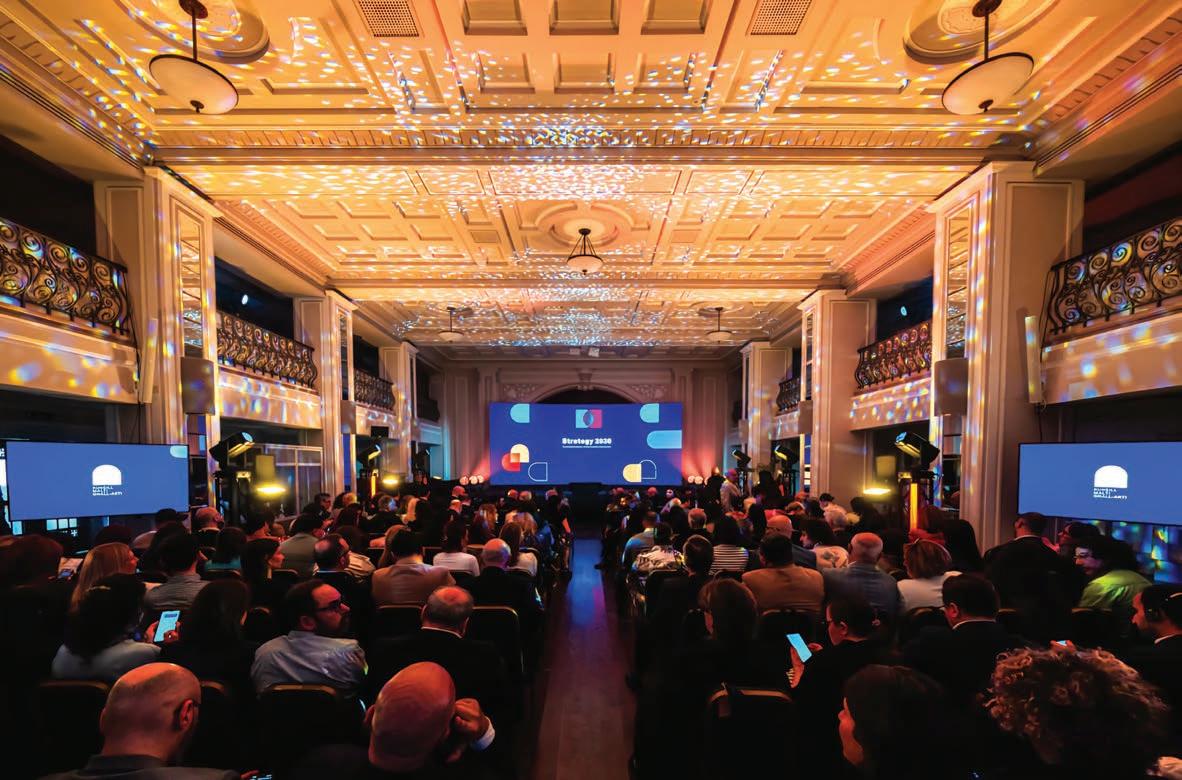
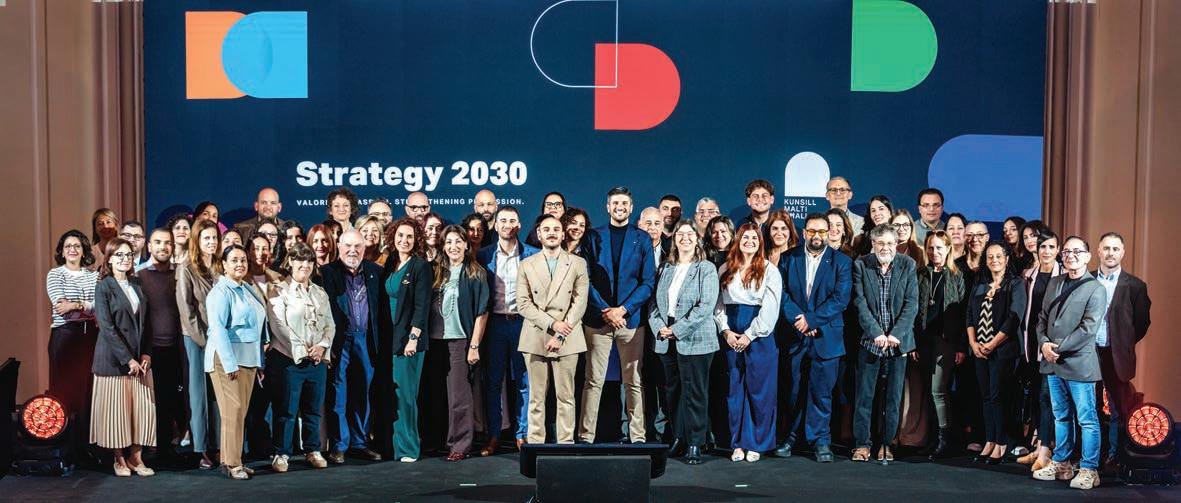
Passion and profession work hand-in-hand as Arts Council Malta’s new Strategy 2030 comes into being, putting the spotlight on professional development, cultural rights and internationalisation.
Arts Council Malta’s new Strategy 2030 is now in effect, bringing to life a national framework for the country’s cultural and creative sectors. The theme ‘Valorising Passion. Strengthening Profession.’ is built around professional development, cultural rights and internationalisation, pointing towards a strong focus on the conditions that allow the sector to thrive.
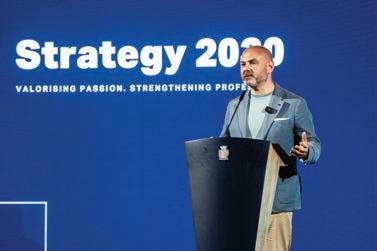
Dr Luke Dalli, Executive Chair of Arts Council Malta, believes that the significance of the strategy lies in the fact that it goes beyond policy for policy’s sake, framing a broader process.
“Malta has steadily chosen to take culture seriously, not as something ornamental, but as a pillar of national development. Culture is not a ‘nice to have’,” Dr Dalli says. “It is a means through which a nation understands itself, and a bridge that brings communities together.”
That shift in perspective has also shaped the evolution of Arts Council Malta itself. Over the past 11 years, Dr Dalli says, the sector has moved from one marked by evident talent and
potential, but also fragmentation and uneven support, towards one that is more organised, better funded and more visible. Strategy 2030 is intended as the next step in that journey.
For Dr Dalli, this next phase requires moving beyond a model centred primarily on one-off support for individual initiatives and towards a more ambitious focus on the wider system that sustains the sector over time.
“Our aim is not only to support today, but to build a system that works for tomorrow,” he says. “We are moving from individual support to a system that is truly being created to sustain the entire sector.”
This is where the strategy’s central theme comes into sharper focus. passion and profession, he elaborates, are not opposing ideas, but complementary ones. The strategy acknowledges that not everyone who engages with creativity wants or needs to become a professional artist. At the same time, it insists that those who do choose this path should be able to rely on structures that make creative work viable over the long term.
“Whoever chooses this as a profession has the right to sustainable structures that support them throughout their career,” he insists.
That thinking underpins a wider
understanding of who the strategy is actually for. Dr Dalli is clear that Arts Council Malta’s role is to support an entire ecosystem: established professionals, emerging creatives, organisations, communities, volunteers, and those who may simply be starting out with an idea or ambition.
“This is not only Arts Council Malta’s strategy,” he says. “It is the strategy of the entire sector.”
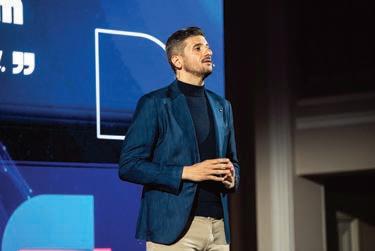
Daniel Azzopardi, Director Strategy at Arts Council Malta, explains how that thinking has been translated into a practical structure. For Azzopardi, Strategy 2030 begins with a basic but often overlooked question: what actually makes creative work possible, and what allows it to endure over time.
“If we want to talk seriously about the cultural and creative sectors, we also have to talk about what makes creative work possible, and what allows it to continue,” he says.
That, he explains, is why the strategy is built around three pillars: professional development, cultural rights and internationalisation. Together, these are intended to respond not only to the realities of

artistic practice, but also to a wider landscape shaped by digital change, environmental responsibility, resilience, innovation and policy.
“At the centre of the strategy lies a key principle: artistic passion and professional development are distinct, yet deeply interconnected. And when aligned, they drive meaningful impact and lasting outcomes,” Azzopardi says.
Professional development, in this context, is about far more than training alone. It is tied to skills, fairness in practice and the creation of sustainable career pathways. Cultural rights, meanwhile, frame culture as something that must remain inclusive, equitable and connected to both individual and collective well-being. Internationalisation places Malta as an active and confident participant in global cultural dialogue, with exchange and engagement treated as part of long-term sectoral growth rather than an optional add-on.

Crucially, Azzopardi stresses that the strategy is meant to function as more than a symbolic statement. Its ambition is to give stronger shape to cultural development without losing sight of creativity itself, while supporting a sector that is more sustainable, more inclusive, more connected and more confident in its role both locally and internationally. This, it does through a structure of three pillars, five functions, four strategic areas, 55 strategic actions, and more than 255 measurable indicators.
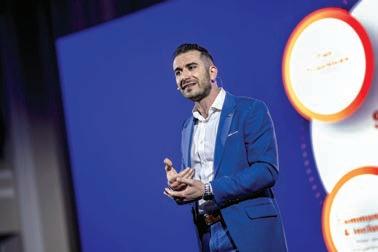
The process behind that framework is one of the aspects highlighted most strongly by Prof. Valerie Visanich, cowriter of Strategy 2030. For her, one of the defining features of the document is that it was developed through a collaborative process in which co-creation was not simply a buzzword, but a working principle.
“Stakeholders were active participants in the
production of knowledge, and their contributions were documented and analysed thematically to help ensure that the strategy reflects concrete realities.”
That process included focus groups with stakeholders as well as with Arts Council Malta staff, helping the strategy emerge from a broad base of discussion, feedback and thematic analysis rather than from top-down assumptions alone. For Prof. Visanich, this mattered not only in methodological terms, but because it allowed the final document to remain anchored in the lived realities of the sector it is intended to support.
The result is a strategy that reflects the complexity of Malta and Gozo’s cultural and creative landscape, a framework through which policy, consultation and sectoral realities can meet in a more grounded and coherent way.
The full strategy is available online on https://artscouncilmalta.gov.mt.


“Compounding works best when you can give a plan years or decades to grow. This is true for not only savings but careers and relationships. Endurance is key. And when you consider our tendency to change who we are over time, balance at every point in your life becomes a strategy to avoid future regret and encourage endurance.”
Morgan Housel, THE PSYCHOLOGY OF MONEY
THE LONG VIEW –PLANNING FOR LIFE, MONEY AND TIME

“AND SINCE YOU CAN BUILD WEALTH WITHOUT A HIGH INCOME, BUT HAVE NO CHANCE OF BUILDING WEALTH WITHOUT A HIGH SAVINGS RATE, IT’S CLEAR WHICH ONE MATTERS MORE.” MORGAN HOUSEL, THE PSYCHOLOGY OF MONEY
Time tends to slip by without us noticing, especially when it comes to money. For a lot of people, saving for retirement feels like something far off, something to do when careers are steady, loans or mortgages are under control, or life feels less financially tight. But the key to long-term planning is surprisingly simple: the sooner you start, the less you’ll have to do later. What might seem like an issue of discipline or income often comes down to timing.
Photography Martino Pietropoli.
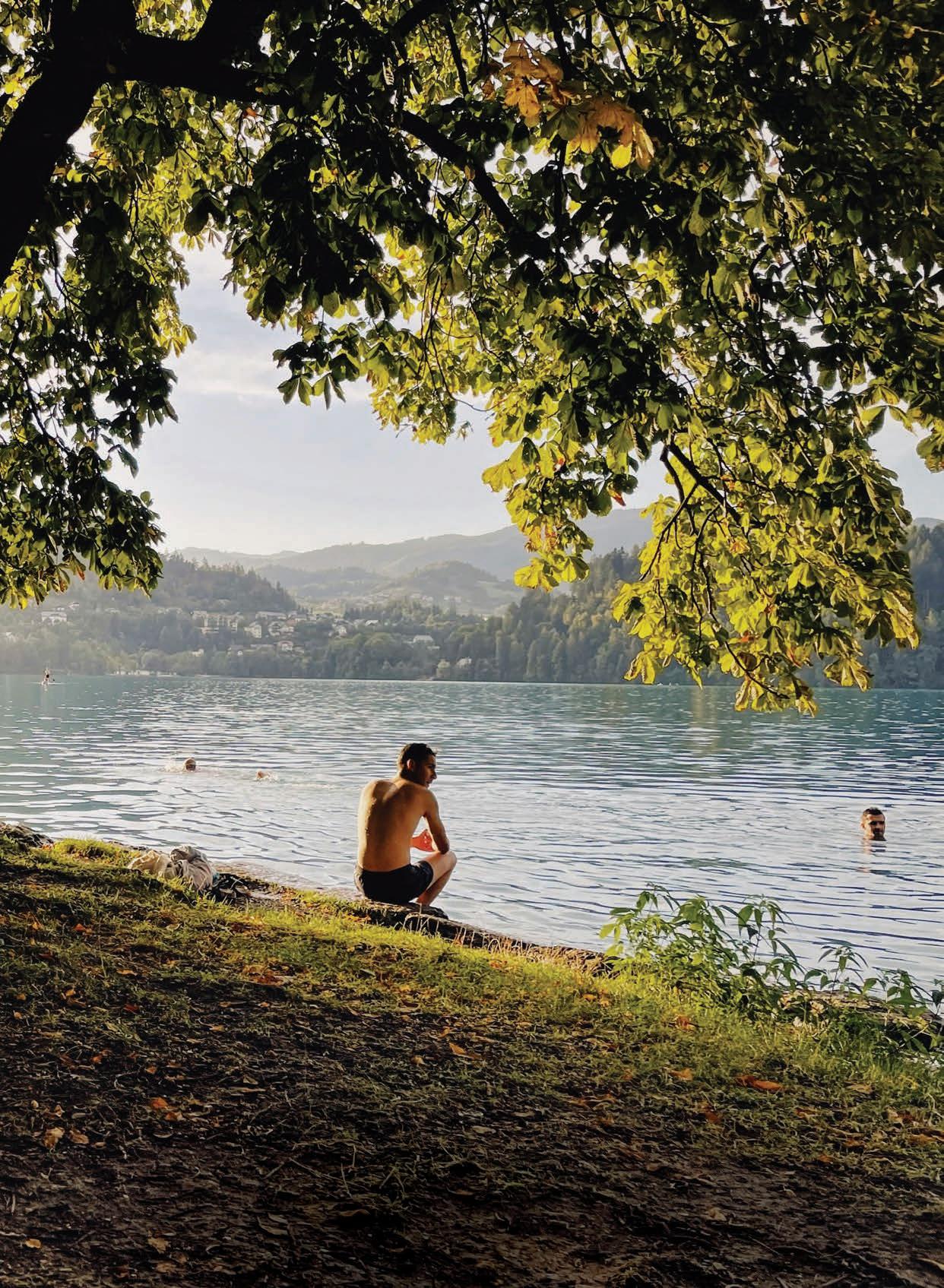
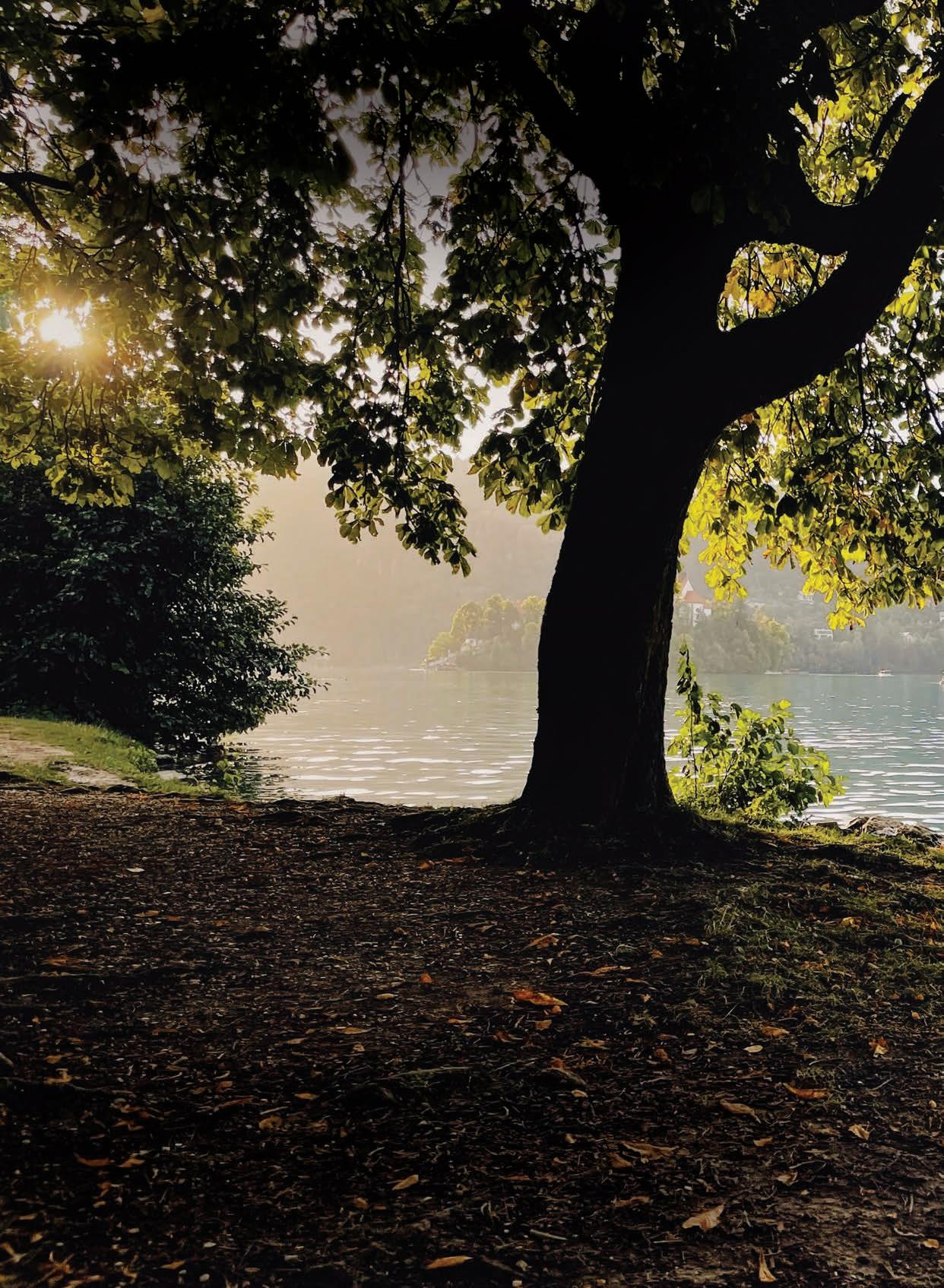
SOMEONE’S SITTING IN THE SHADE TODAY BECAUSE SOMEONE PLANTED A TREE A LONG TIME AGO.” WARREN BUFFETT
It’s a simple statement, but it sums up the value of long-term thinking perfectly. Planting requires patience, with little immediate reward. The benefit emerges gradually, almost imperceptibly, until one day it becomes indispensable.

SUCCESSFUL INVESTING TAKES TIME, DISCIPLINE, AND PATIENCE. NO MATTER HOW GREAT THE TALENT OR EFFORT, SOME THINGS JUST TAKE TIME: YOU CAN’T PRODUCE A BABY IN ONE MONTH BY GETTING NINE WOMEN PREGNANT.” WARREN BUFFETT Steady, consistent effort over time leads to results that sporadic bursts can’t easily match.
The idea isn’t new. Investors have always known that returns build on themselves, with growth fueling more growth and gaining momentum over decades. What’s less obvious is just how much the starting point affects the outcome. Setting aside a small amount in your twenties can, with enough time, beat much larger contributions made later. The math may be simple, but the takeaway is powerful: time does most of the work, making steady effort more valuable than bursts of intensity.
Imagine two people taking different approaches to saving. One starts early, putting away modest amounts each month while their income is still growing. The other waits, planning to contribute much more once they’re earning more. While the second plan might seem logical on paper, it’s often much tougher in reality. The later saver has to put in a lot more money to catch up, and even then, there’s less room for mistakes. Market ups and downs, job breaks, or surprise costs have less time to even out. Morgan Housel, author of the best-selling book The Psychology of Money writes “Compounding doesn’t rely on earning big returns. Merely good returns sustained uninterrupted for the longest period of time
– especially in times of chaos and havoc–will always win.”
This imbalance shows how time works unevenly in financial life. The early years carry more weight than the later ones, as early contributions are given the space to compound, while later ones must work harder to compensate. The result is that waiting becomes costly, not in an immediate or visible way, but through opportunities that slip away quietly.
Warren Buffett is an American business magnate, investor, and philanthropist widely regarded as one of the most successful investors in history. As the chairman and CEO of Berkshire Hathaway, he is known for a longterm “value investing” strategy that emphasises patience, analyzing business fundamentals, and investing in companies with enduring value, and he has often returned to this idea in his thoughts on investing:“Someone’s sitting in the shade today because someone planted a tree a long time ago.” It’s a simple idea, but it sums up the value of long-term thinking perfectly. The act of planting requires patience, with little immediate reward. The benefit emerges gradually, almost imperceptibly, until one day it becomes indispensable. Financial planning works much the same way, less about big, dramatic moves and more about steadily building through small, consistent actions and patience.
As Buffett puts it, “Successful investing takes time, discipline, and patience. No matter how great the talent or effort, some things just take time: You can’t produce a baby in one month by getting nine women pregnant.”
What makes this especially relevant today is the changing nature of retirement. People are living longer, and pension systems are evolving, putting more responsibility on individuals to plan for their future. While past generations often depended on guaranteed benefits, many now face a situation where results,and amounts available, hinge on personal choices. This doesn’tnecessarily require complex strategies, but it does place greater emphasis on habits formed early. The real challenge however isn’t grasping the idea, but putting it into practice. Our behavior often gets in the way. It’s natural to focus on immediate needs over future ones, to put off decisions that feel distant, or to assume there’s still plenty of time to adjust. As Morgan Housel points out in The Psychology of Money, financial success is less about technical skill and more about how you act: “Doing well with money has little to do with how smart you are and a lot to do with how you behave.” The inclination to postpone saving, even when aware of its importance, perfectly captures this gap between knowing and doing.








Abig part of the challenge comes from how invisible progress can be in the beginning. In the first few years, the results are usually small, making the effort feel like it doesn’t matter much. It’s only later that things start picking up speed. This gap between action and reward can make it hard to stick with it, and some people give up entirely. But it’s exactly during this slow early stage that the groundwork is set for everything that comes next.
Looking at saving from a different angle can make a big difference. Instead of seeing it as a sacrifice, think of it as a way to keep your options open for later. Setting money aside now gives you more choices down the road, like retiring sooner, working less, or keeping the lifestyle you enjoy. Saving then feels less like a limit and more like a tool for flexibility, letting you make future decisions from a place of strength instead of need.
In practical terms, this does not require large sums. Regular contributions, even at a modest level, can establish a pattern that becomes easier to maintain over time. Increasing those contributions gradually, in line with income growth, allows the strategy to evolve
without placing undue pressure on current finances. Tools such as retirement calculators can provide a useful reference point, illustrating how different choices influence long-term outcomes and reinforcing the value of consistency.
Looking at the bigger picture, financial security later in life often means having the independence to spend time the way you want, without outside pressures. It might involve traveling, exploring creative hobbies, or just enjoying the freedom to slow down. These dreams take shape over many years, built on choices that may seem small in the moment but add up to something meaningful. “Money’s greatest intrinsic value, and this can’t be overstated, is its ability to give you control over your time,” says Morgan Housel. In contrast he also writes, “Spending money to show people how much money you have is the fastest way to have less money.”
The cost of waiting isn’t just about money, it’s about the opportunities you might miss down the road. Putting things off shrinks your options, making it harder to get the same results and leaving less room to adjust when things change. Starting early, on the other hand, opens up more possibilities, giving you time to handle uncertainty and cushion against surprises.


“MONEY’S GREATEST INTRINSIC VALUE, AND THIS CAN’T BE OVERSTATED, IS ITS ABILITY TO GIVE YOU CONTROL OVER YOUR TIME.” MORGAN HOUSEL Looking at the bigger picture, financial security later in life often means having the independence to spend time the way you want. It might involve traveling, exploring hobbies, or just enjoying the freedom to slow down. These dreams take shape over many years, built on choices that may seem small in the moment but add up to something meaningful.
The English-American financial analyst, economist, accountant, investor and professor Benjamin Graham, often called the “father of value investing”, stressed the importance of discipline and a long-term outlook. His method was rooted in patience, avoiding knee-jerk reactions to short-term market swings, and staying focused on lasting principles. Though his advice was aimed at investors, the core idea fits personal finance just as well. Steady, consistent effort over time leads to results that sporadic bursts can’t easily match. In the end, starting is less about finding the perfect moment and more about breaking through inertia. There will always be excuses to wait, other priorities, uncertainties, or the feeling that conditions aren’t quite right. But the real advantage goes to those who act anyway, knowing that time is the most valuable resource there is.
Once it’s gone, you can’t get it back, only make up for it at a higher cost. The early steps in financial planning might seem ordinary, marked by small contributions and slow progress. Their true importance shows up later, when the years of steady effort add up. By then, the gap between starting early and starting late isn’t just theory, it’s clear in the options you have, the security you’ve built, and how much of your future you’ve already shaped. As Morgan Housel writes, “When most people say they want to be a millionaire, what they might actually mean is “I’d like to spend a million dollars.” And that is literally the opposite of being a millionaire.”
SUGGESTED READING: The Psychology of Money: Timeless Lessons on Wealth, Greed, and Happiness by Morgan Housel, The Intelligent Investor by Benjamin Graham, and The Warren Buffett Way by Robert G. Hagstrom.









When people think about long term investing, they often focus on market performance or finding the “right” investment. Yet for long term financial security, one factor matters more than any other: time. Time is also the most underestimated resource. Many delay investing because retirement feels far away, income feels stretched, or they believe they need large sums or expert knowledge to start. In reality, postponing investment decisions can be far more costly than short term market fluctuations, writes Larissa Ciantar, Head of Personal Banking at MeDirect Bank (Malta) plc.

“The cost of waiting is clear when comparing two individuals with similar profiles. If one starts investing at 25 and another at 40, both contributing consistently and following sensible strategies, the earlier starter benefits from an additional 15 years of compounding,” says Larissa Ciantar, Head of Personal Banking at MeDirect Bank (Malta) plc. “Consistency is just as important as starting early. Investing a fixed amount regularly removes the pressure of trying to time markets and helps smooth out volatility.”
At its core, investing means putting money to work so it can grow over time. The earlier this process begins, the more powerful it becomes. This is due to compounding, where returns are reinvested and generate returns of their own. Over long periods, even modest, regular contributions can grow into meaningful outcomes.
The cost of waiting is clear when comparing two individuals with similar profiles. If one starts investing at 25 and another at 40, both contributing consistently and following sensible strategies, the earlier starter benefits from an additional 15 years of compounding. By retirement, this difference can translate into significantly greater financial flexibility.
Consistency is just as important as starting early. Investing a fixed amount regularly removes the pressure of trying to time markets and helps smooth out volatility. Over time, this disciplined approach encourages long term focus rather than reacting to short term market noise.
Diversification also plays a vital role. Spreading investments across asset classes, sectors and regions helps reduce risk and build more resilient portfolios that can adapt to changing economic cycles and life stages.
Importantly, long term investing should remain flexible. As careers evolve and priorities change, financial plans should adapt while maintaining discipline. At
MeDirect, we believe investing should be accessible, transparent and aligned with real life goals, whether individuals manage their own portfolios or opt for professional solutions.
The key message is simple: investing does not require perfect timing or complexity. Time in the market is far more valuable than trying to time it. Starting early, investing regularly and diversifying responsibly provides a stronger foundation for long term financial wellbeing.
Ultimately, the greatest cost is not market volatility, but the opportunity lost by waiting. Time compounds whether it is used or not. The sooner it is put to work, the more it can do.
MeDirect Bank (Malta) plc, company registration number C34125, is regulated by the Malta Financial Services Authority and is licensed to undertake the business of investment services under the Investment Services Act (Cap. 370). When investing you may lose some or all of the money you invest. The value of your investment may go down, as well as up. Any income you get from this investment may go down, as well as up. A commission or sales fee may be charged at the time of the initial purchase for an investment. Any decision to invest should always be based upon the details contained in the Prospectus and Key Information Document (KID), which may be obtained from the Distributor.
MeDirect Bank (Malta) plc, The Centre, Tigné Point, Sliema, Malta.






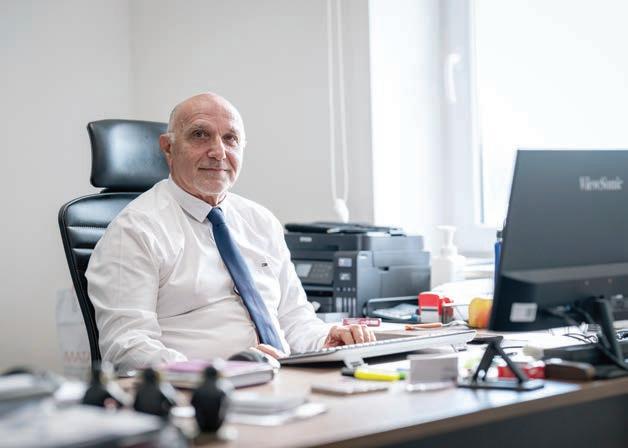
The Older Persons Standards Authority (OPSA), established under Maltese law in 2023, is tasked with regulating services for older persons to ensure dignity, safety, and quality of care, writes CEO George Fenech. Its regulatory framework is built around three core sets of standards:
•Residential Services for Older Persons (including dementia care)
•High Dependency Chronic Care Services
•Day Care Centers for Older Persons
hese standards are designed to establish a robust, consistent, and person-centered framework that safeguards the dignity, rights, and well-being of older persons while ensuring high-quality service delivery across all care settings.
At the core of OPSA’s vision is the commitment to ensuring that every older person, regardless of where they receive care, benefits from safe, equitable, and high-quality services. The standards introduce clear benchmarks aligned with best practices, promoting improved clinical, social, and psychological outcomes, and ensuring that care is tailored to individual needs.
A key impact of this framework is the standardization of care across the public, private, and church sectors, reducing disparities and guaranteeing minimum levels of quality nationwide. Through strengthened licensing, inspection, and enforcement mechanisms, OPSA enhances accountability and transparency, ensuring that service providers are held to clearly defined and achievable expectations.
Standards also play a critical role in the professionalization of the care sector, driving workforce development, strengthening operational practices, and fostering a culture of continuous improvement and innovation. By promoting integrated and coordinated care pathways, OPSA supports a seamless experience for older persons across different services and stages of care.
Each set of standards contributes uniquely to the overall impact. Residential services, including dementia care, are expected to provide improved living environments and enhanced quality of life. High dependency chronic care standards strengthen clinical oversight and safety for the most vulnerable individuals. Day care center standards promote active ageing, social inclusion, and community-based living, helping to reduce isolation and delay institutionalization.
Collectively, these standards will have a broader national impact by strengthening public trust in the care system, aligning Malta with international best practices, and supporting sustainable social and healthcare outcomes through prevention and early intervention.
Ultimately, OPSA’s regulatory framework is not only about compliance but about driving a lasting cultural change -one that places dignity, respect, and quality of life at the center of ageing in Malta.

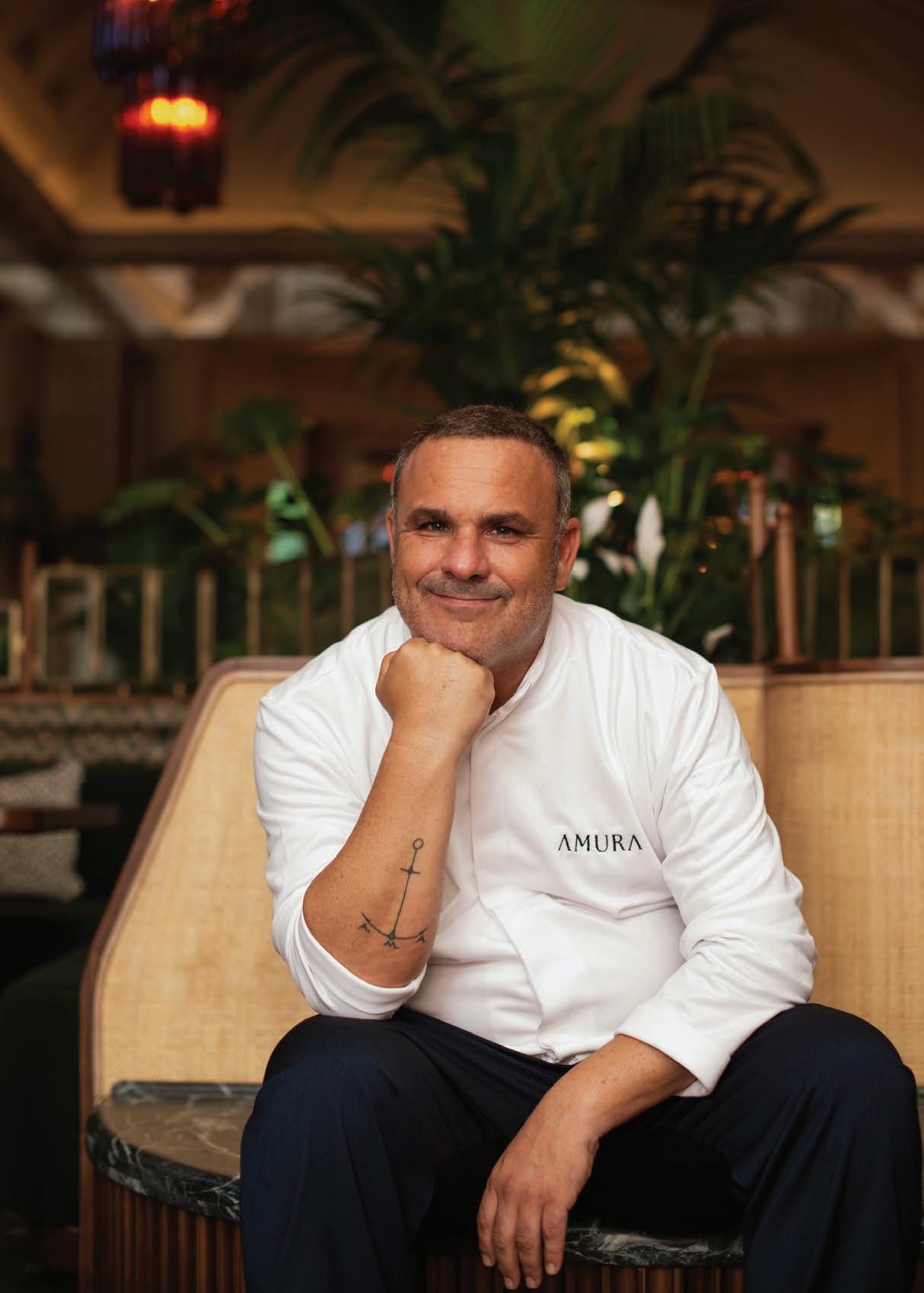
“Working with local producers and ingredients sourced from the two oceans surrounding the Cape Peninsula has been a revelation. The coastline is full of species that are overlooked, just like in Andalusia. That’s where we find beauty, in the unexpected.”
Chef Ángel León, “EL CHEF DEL MAR”
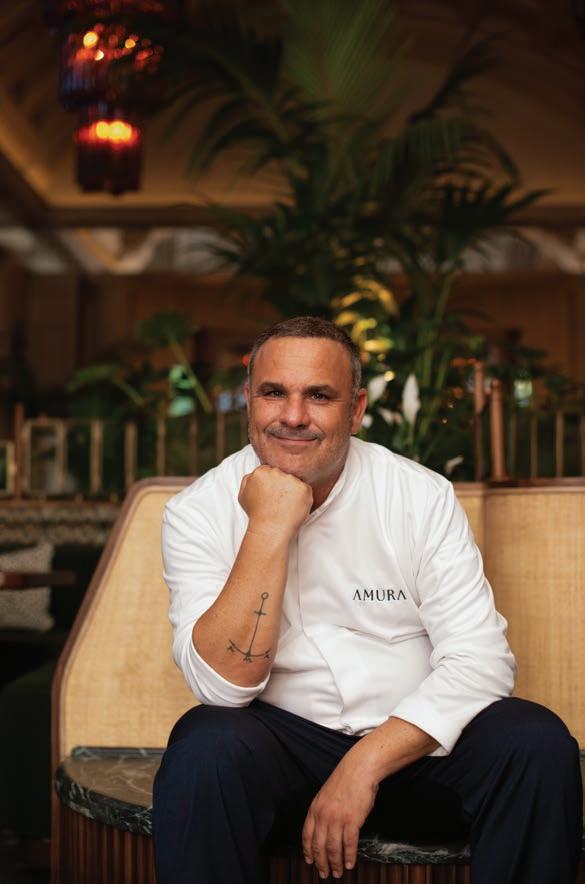
At the foot of Table Mountain, where two oceans shape the Cape’s horizon, Amura introduces Cape Town to the marine-driven world of Ángel León, one of the most influential chefs of his generation. At his core a humble fisherman, León has revolutionised global gastronomy through his profound commitment to understanding and preserving the ocean’s ecosystems. His first restaurant outside Spain brings Andalusian technique into conversation with South African waters, guided by a philosophy rooted in curiosity, biodiversity and the stories carried by wind and tide. At Mount Nelson, A Belmond Hotel, Amura opens a new chapter in ocean-centred gastronomy.
Photography Claire Gunn, courtesy Belmond.
Where the Atlantic and Indian Oceans meet at the foot of Table Mountain, a new chapter in Cape Town’s culinary landscape has begun. Amura by Ángel León opened at Mount Nelson, A Belmond Hotel, in December, introducing South Africa to one of the most influential chefs working today. Known internationally as “El Chef del Mar”, León has reshaped the language of marine gastronomy through research, innovation and a deep connection to the ocean. His arrival in Cape Town marks the first time he has opened a restaurant outside Spain, extending a body of work that has already shifted global conversations around sustainability, biodiversity and the future of food.
For León, the partnership with Mount Nelson emerged from a shared philosophy. “Rooted in heritage and guided by a respect for nature, Mount Nelson and Amura come together in a shared vision: to honour the ocean, celebrate heritage and hospitality with soul,” he says. “United by Belmond’s commitment to storytelling, local connection, responsible sourcing and marine conservation, this partnership finds its natural home in Cape Town, a city that, like Cádiz, gazes out to sea with history in its bones.” His words
capture the sense of continuity he sees between the two coastlines, shaped by centuries of wind, salt and maritime exchange.
León’s importance in contemporary gastronomy is difficult to overstate. At his restaurant Aponiente in Cádiz, he holds three Michelin stars and the first Michelin Green Star in Andalusia, while his restaurant Alevante holds two. His work has introduced the world to ingredients once considered unusable or invisible: phytoplankton, Zostera marina sea grain, marine honey, halophyte plants and undervalued bycatch species. These discoveries are not scientific curiosities, they are expressions of ecosystems he has spent decades studying. His approach has influenced chefs, researchers and environmentalists, positioning him as a leading figure in the movement towards responsible, ocean centred cuisine.
Cape Town offered him a new coastline to explore. “To cook in Cape Town is to feel the ocean from another angle, another culture, another heartbeat,” he says. “Here the sea speaks with a different salt, a different light. Amura is born from the desire to celebrate those nuances… We didn’t come to impose; we came to learn.” His intention is clear: to build a dialogue between Andalusia and the Cape, shaped by shared histories of trade, migration and maritime tradition.
Facing page: Chef Ángel León at Amura, bringing his ocean-centred culinary philosophy from Cadiz to Cape Town for the first time. Known as “el Chef del Mar,” León is a Spanish chef renowned for his experimental seafood dishes and innovative approach to marine gastronomy. His work has earned him multiple international honours, including being named Food Hero 2023 by the FAO.
Below:
The restaurant is also a personal homage to Chef Ángel León’s father (Ángel León Senior), who first instilled in him a love of fishing and a profound respect for the sea. Named Amura, after the bow of the boat, always moving forward, it carries the spirit of his father’s legacy: one of devotion, discovery and an enduring bond with the ocean. The restaurant continues that lineage, guided by the chef’s brother Carlos, who has long been part of the family’s culinary journey. Together, they have created a space that draws on an ancient maritime bridge between Spain and South Africa, expressed through fermented fish, spice-driven broths, fire-cooking and preservation techniques that echo across both coasts.











































“Our menu is an homage to this shared seafaring legacy,” León explains. “To the salted fish and coastal fermentations, speaking the same ancestral language. To the spices that crossed oceans, just like our forebears. To the broths, flames, vinegars and preservation traditions that echo across both coasts. To stories that travel without borders, carried by wind and wave.” His approach is rooted in curiosity and shaped by the belief that overlooked species often hold the greatest potential. “Working with local producers and ingredients sourced from the two oceans surrounding the Cape Peninsula has been a revelation,” he says. “The coastline is full of species that are overlooked, just like in Andalusia. That’s where we find beauty, in the unexpected.”

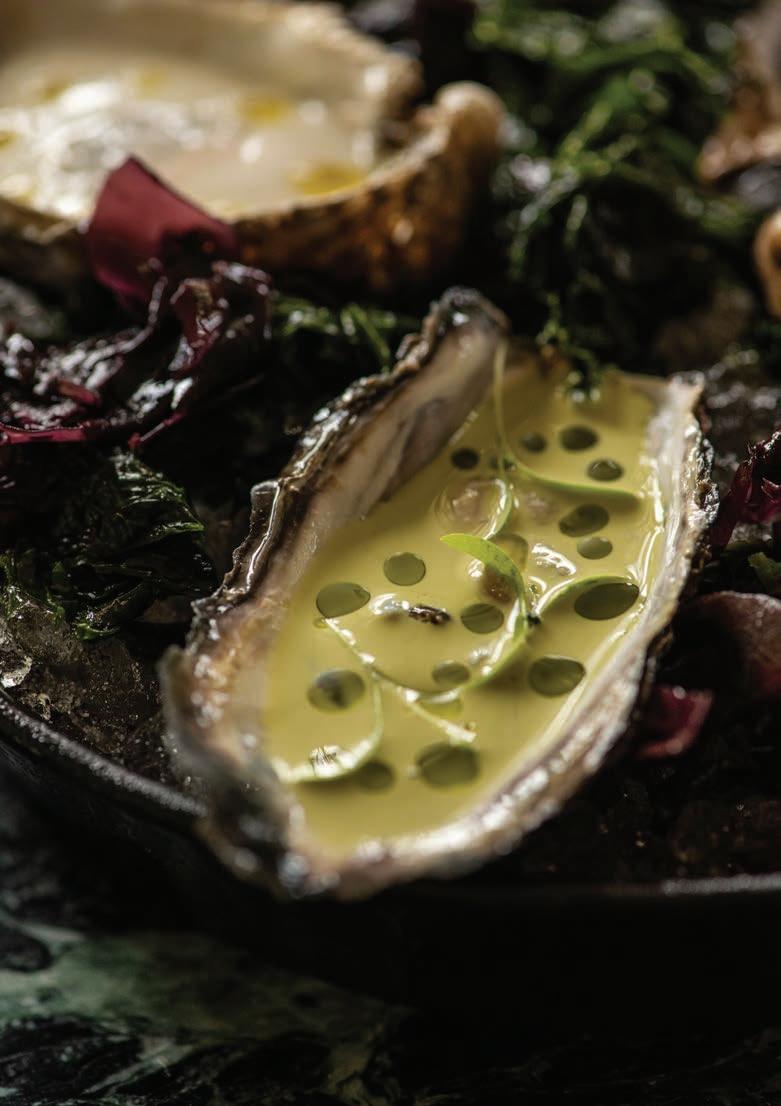
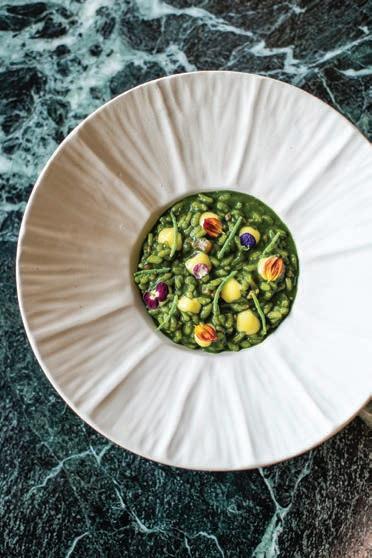
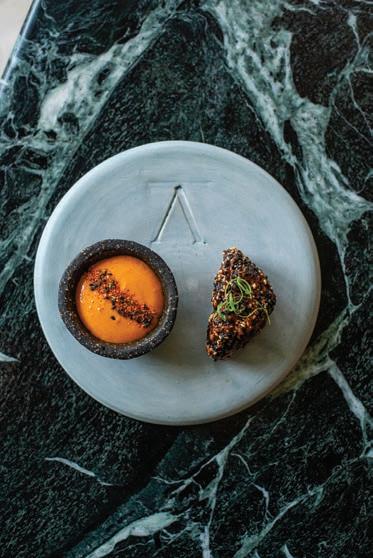
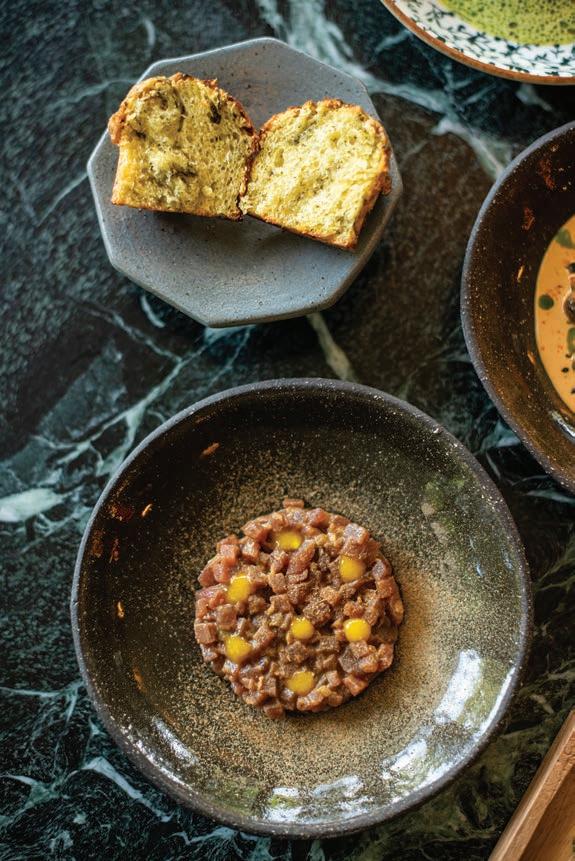
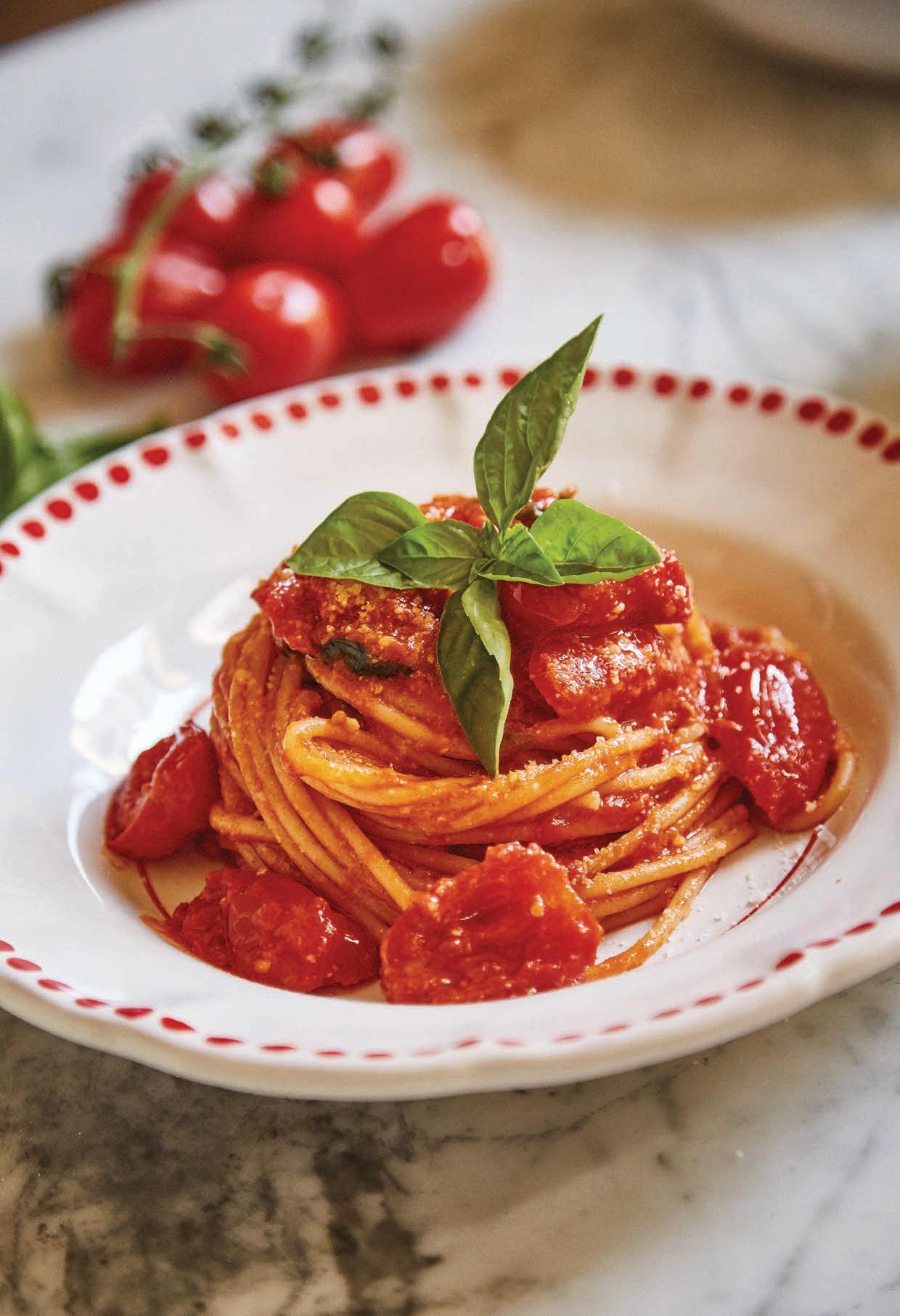
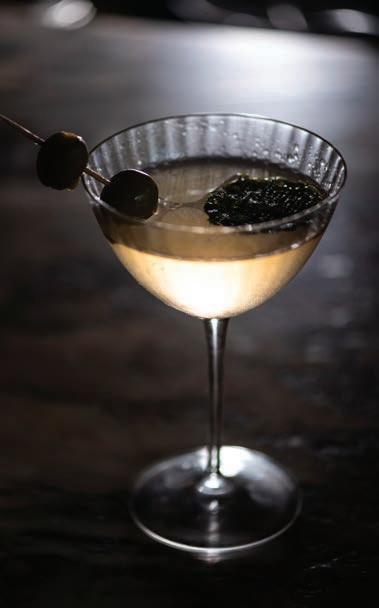
Guests may choose between an à la carte selection or a tasting menu that moves through unsung fish species, kelp, wild herbs and indigenous spices. Plankton risotto arrives in a vivid green, carrying the tidal umami that has become one of León’s signatures. Yellowtail tartare is dressed in escabeche and brightened with Cape citrus. The catch of the day is paired with pickled kelp, honouring the cold Atlantic. Saldanha Bay oysters are served with Silverthorn’s “River Dragon” bubbly, while West Coast mussels appear with seaweeddusted chips. Even the drinks programme extends the marine narrative: a kelp martini made with a bespoke Cape St Blaize gin, and Atlantic-aged Sauvignon Blanc matured on the ocean floor.
Top left: Saldanha Bay Oysters with Silverthorn “River Dragon” Bubbly –a bright, celebratory pairing with Colombard, one of the Cape’s very earliest grape varieties.
Far left: Plankton Risotto –electric green, deeply savoury, with 50x more Omega-3 than olive oil; a dish with the pure, tidal umami of the open sea.
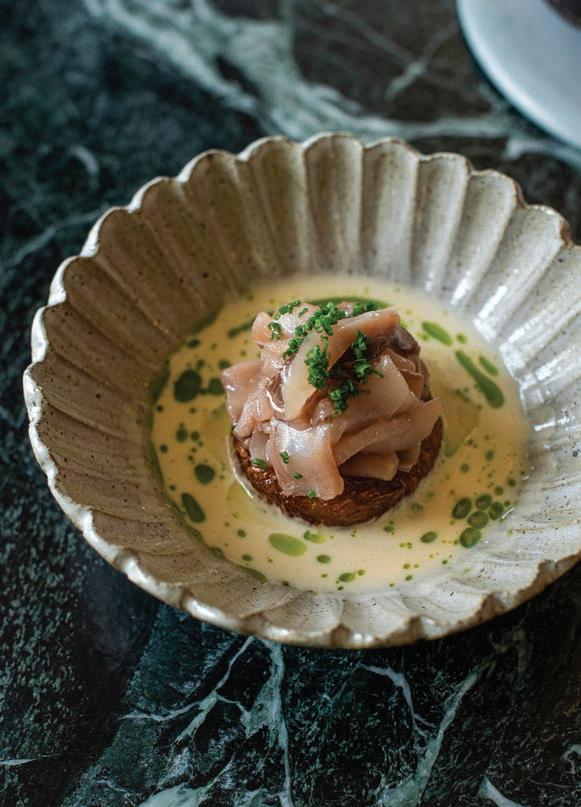
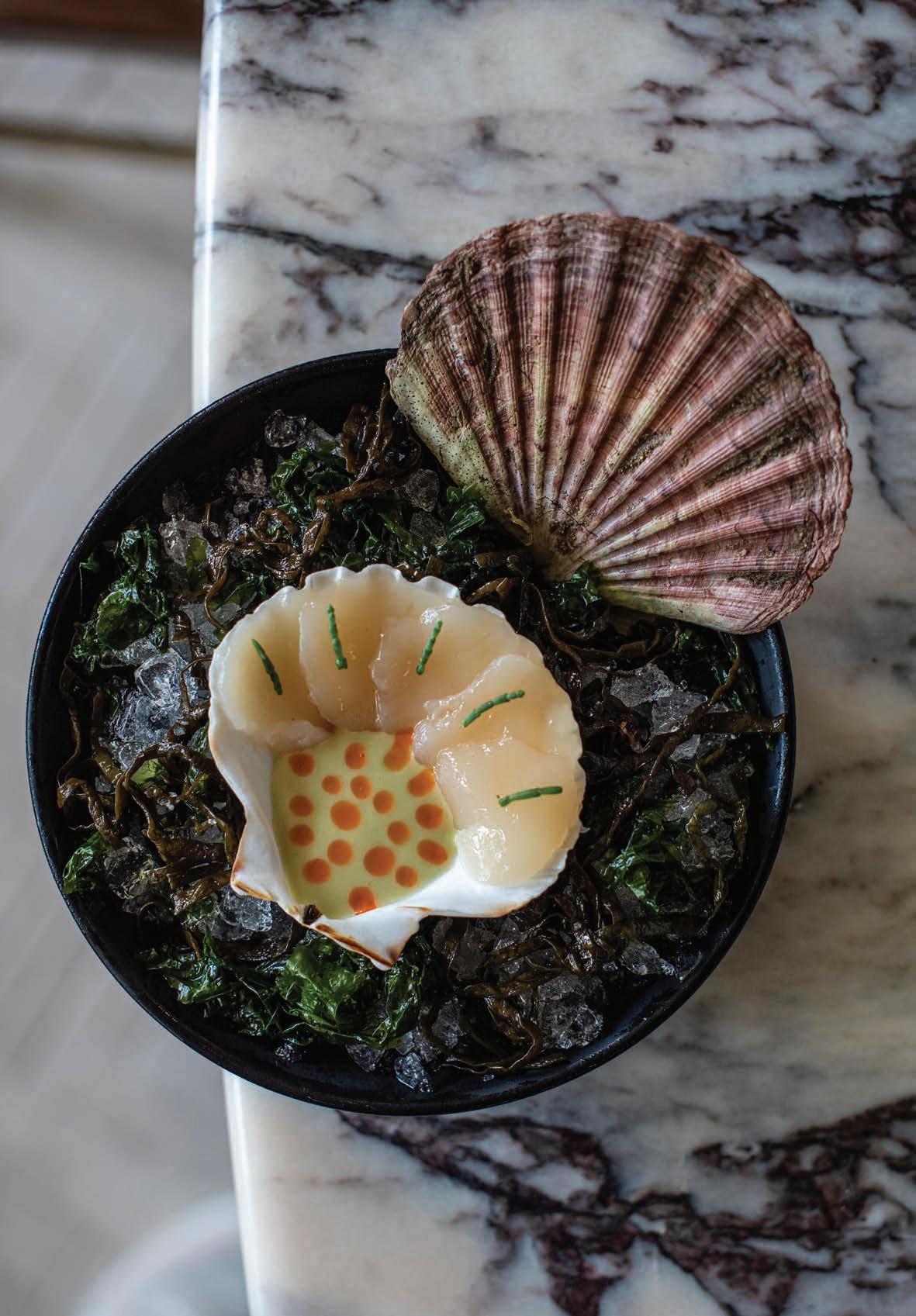
Left: Prawn toast reimagined with Andalusian technique and Cape ingredients. Facing page: Scallops served in their shell, paired with a sea-inspired emulsion and subtle bursts of fresh ocean flavour.
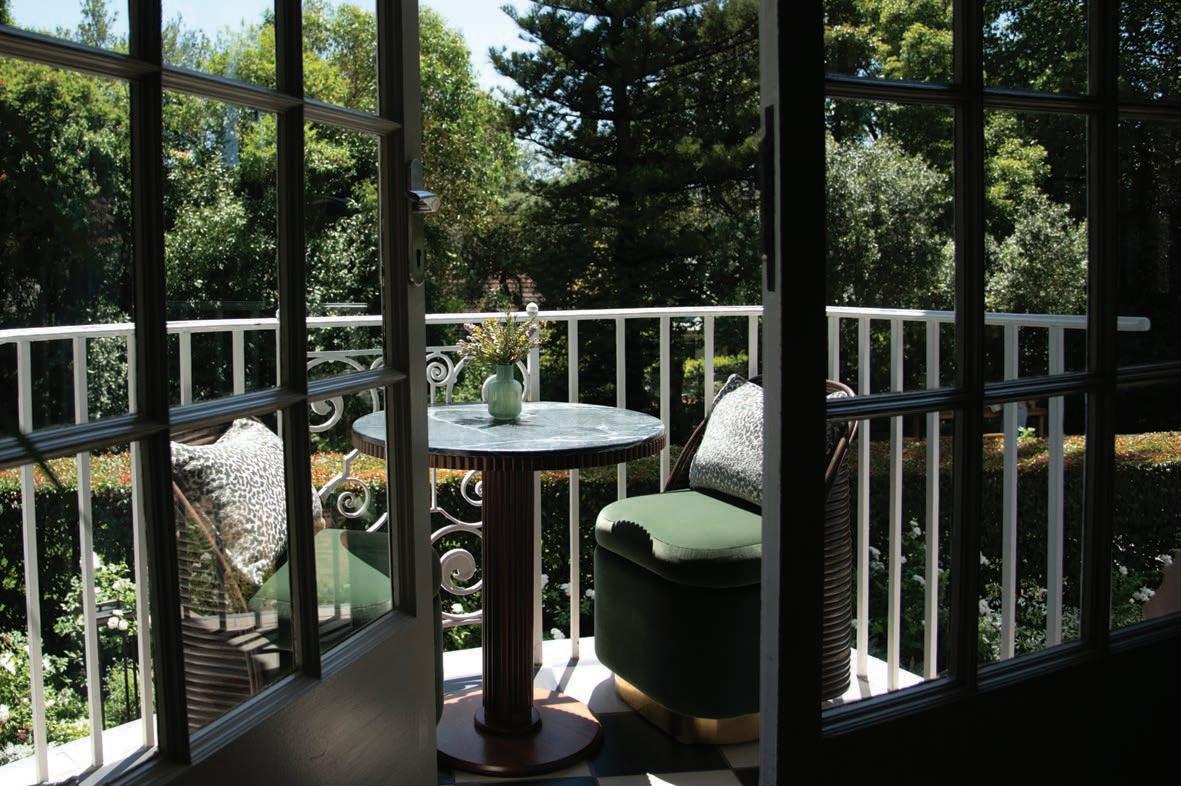
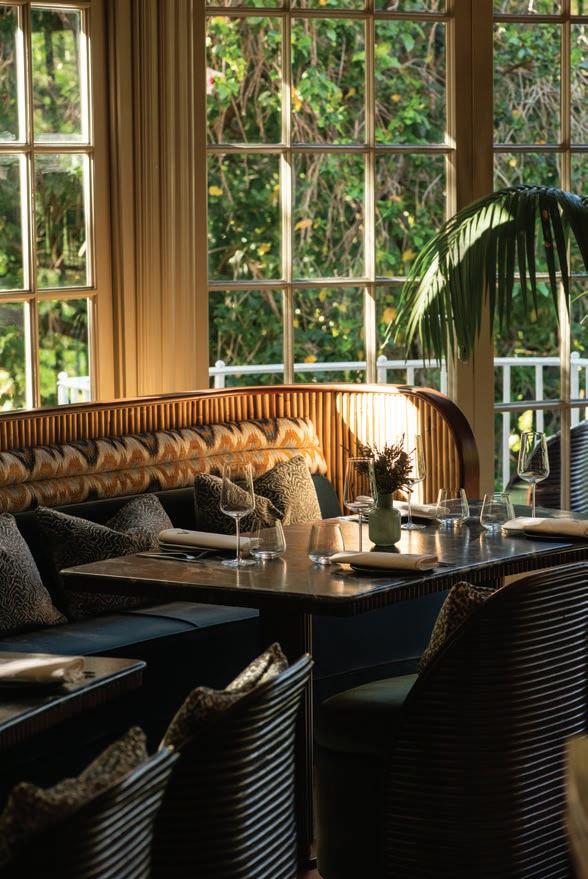
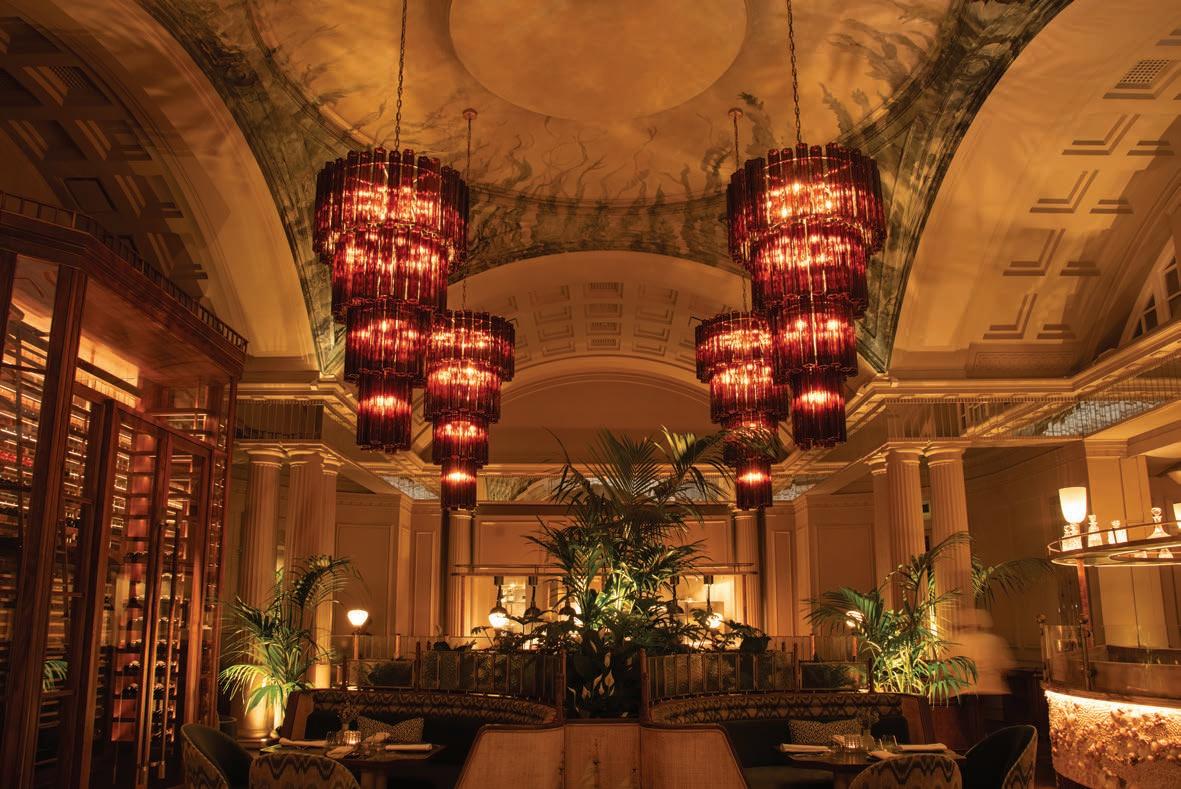
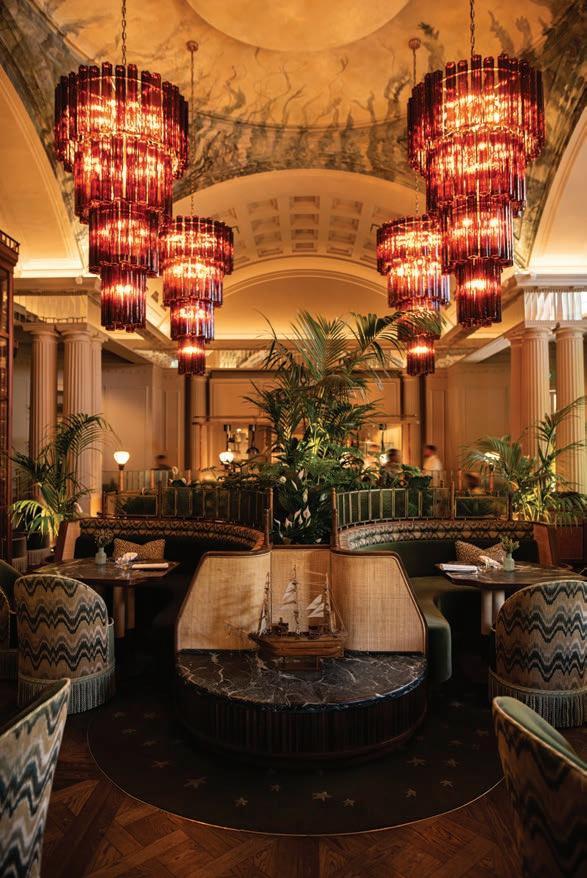
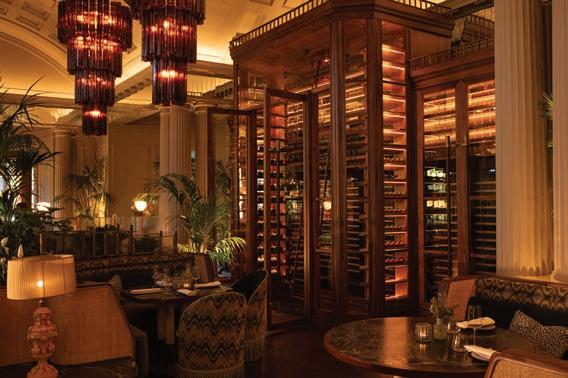
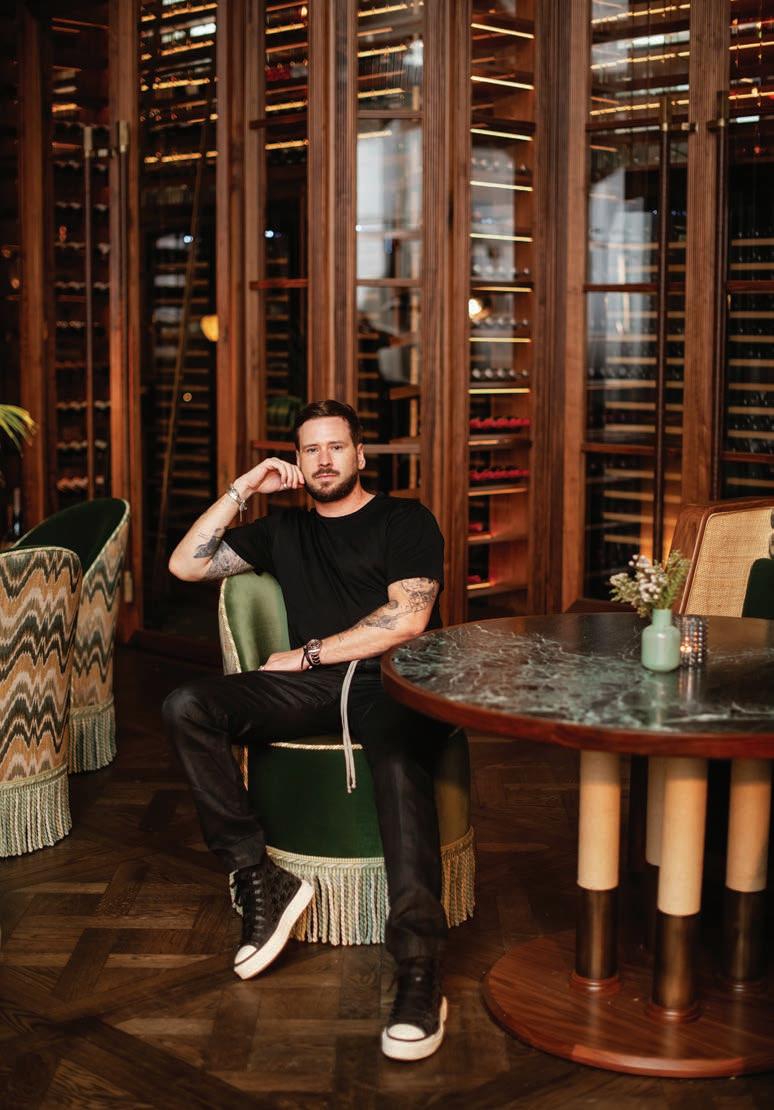
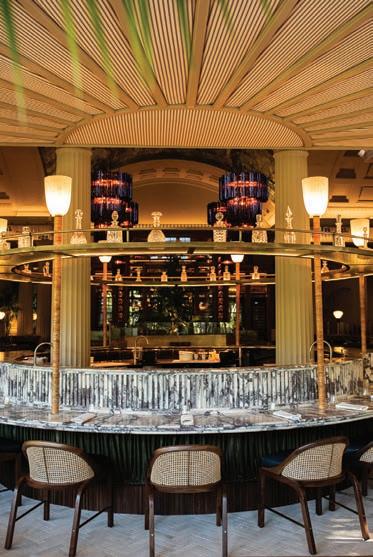
Designed by internationally acclaimed South African interior architect Tristan du Plessis, the space is inspired by the romance of grand ocean liners and the atmosphere of underwater forests. Deep greens, burnished bronze and crafted timber create a cinematic mood, anchored by a spectacular double-height wine library accessed by a classic library ladder. Curved forms evoke the hull of a ship, while intimate lighting recalls the filtered glow of kelp drifting in the current. The open kitchen forms the pulse of the space, where flame, steam and brine intermingle in real time.
At the front of house, Amura’s General Manager Markus Fiedler brings many years of refined hospitality experience, from The Test Kitchen and Salsify at The Roundhouse in Cape Town to Copenhagen’s Noma and Geranium ecosystems, and senior roles across Switzerland. Known for precision, warmth, and immersive storytelling, he is uniquely equipped to guide Amura’s ambitious vision.


In Cape Town, León has discovered a coastline that truly speaks to him, and at Amura, he’s crafted a restaurant that invites guests to pause and listen. “Mount Nelson has always been a sanctuary shaped by its surroundings,” says General Manager Patrick Fisher.
“With Amura, we honour our oceans, our heritage and the beauty of the Cape through the visionary lens of Chef Ángel León.”
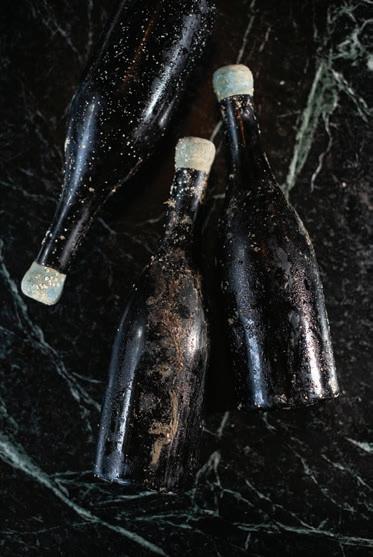
Above: The designer behind Amura’s atmospheric interior, Tristan du Pless, inspired by ocean liners and underwater forests. Top right: Kelp Martini –Cape St Blaize’s bespoke gin for Amura shaken with kelp-infused olive brine; mineral, cold and coastal. Far left: The bar within Amura, where kelp-infused cocktails and ocean-aged wines echo the restaurant’s marine philosophy. Left: Undersea aged wine at Amura.











RETAILER YOU CAN TRUST
World Earth Day, celebrated every April 22, is a yearly reminder of how our choices impact the planet’s long-term health, and food often makes that message hit home. From what we eat to how it’s produced, and the systems that make it possible, our meals shape ecosystems, water supplies, and carbon emissions worldwide. With the food system responsible for about a quarter of global greenhouse gases, every bite becomes both a personal and environmental choice. This link between food and the planet’s wellbeing is at the heart of Ángel León’s work, the Spanish chef known as “El Chef del Mar,” whose research-driven take on marine cuisine offers an inspiring vision for the future.
León’s influence extends far beyond the kitchen. His three-Michelin-starred Aponiente in Cádiz operates as a culinary laboratory dedicated to the unexplored potential of the sea. His work with marine biologists, environmental scientists and coastal communities has positioned him at the forefront of sustainable food innovation. In 2023, the Food and Agriculture Organization of the United Nations named him a Food Hero for his contributions to ocean conservation and his efforts to develop new, sustainable marine food sources. His projects demonstrate how gastronomy can support biodiversity, reduce pressure on land-based agriculture and encourage a shift towards more responsible consumption.
One of his standout achievements is cultivating Zostera marina, a seagrass that produces a nutrient-packed grain known as “sea rice.” It grows without the need for freshwater, fertilizer, or soil, offering a sustainable food model that fits perfectly with the eco-friendly goals celebrated on World Earth Day. Seagrass meadows also lock away carbon at impressive rates and provide vital nurseries for marine life, tying food innovation directly to ecosystem restoration. León’s work with marine phytoplankton follows the same thinking: by highlighting the ocean’s food chain foundation,
he promotes eating lower on the trophic scale, helping to lessen the environmental strain caused by larger, overfished species.
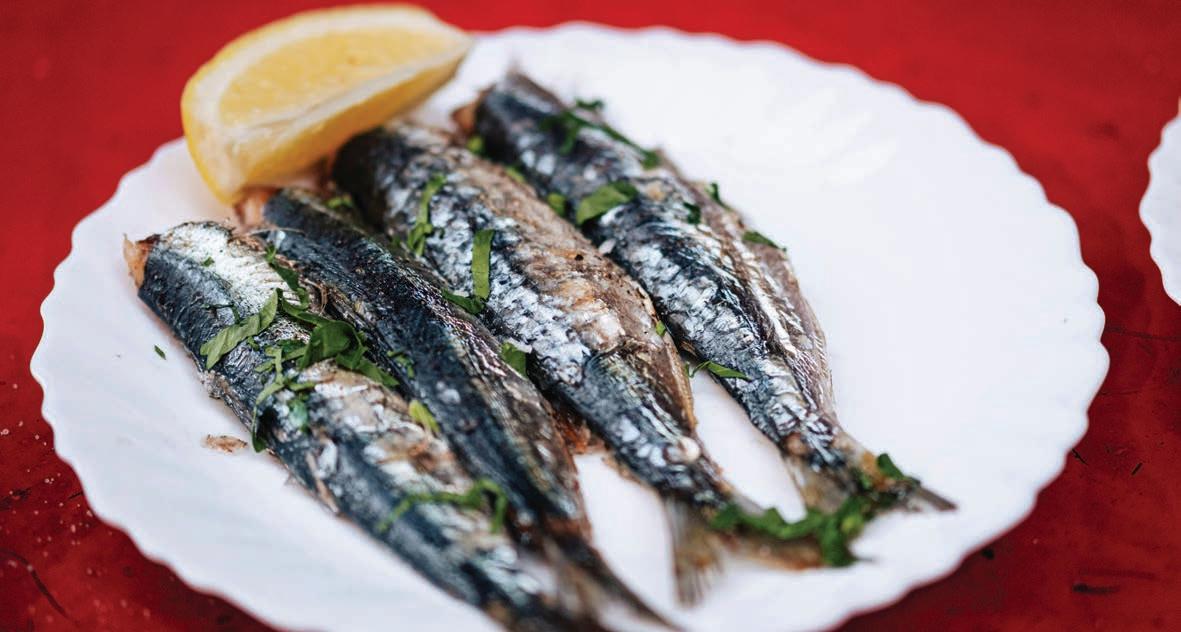
His dedication to zero-waste marine gastronomy reinforces this vision. At Aponiente, fish typically discarded as bycatch are turned into elegant dishes, widening the variety of edible marine resources and cutting down on waste. Ongoing research into marine soy, sea vegetables, and alternative proteins keeps expanding the options. These ideas aren’t just theoretical, they provide real, workable ways to build a more sustainable food system that uses fewer resources and helps keep our oceans healthy.
This year’s World Earth Day theme, Our Power. Our Planet., highlights how much influence individuals and communities have on the environment. León’s work shows how this impact reaches the food we eat. Simple choices like buying seasonal produce, cutting down on waste, trying lesser-known species, and backing sustainable fisheries can add up to big change. Food becomes a way to show environmental responsibility every day, and it’s something everyone can take part in.
In this way, León’s impact on gastronomy fits perfectly with the spirit of World Earth Day. His work shows that creativity, care for the environment, and the joy of good food can go hand in hand, offering a future where the ocean is seen not just as a resource but as a partner in sustaining life.













































“You have more philosophy in one bottle of wine than in all the books.”
Pasteur
Burgundy whites hit peak perfection in the 5 grand cru Montrachets. Yet the largest village in the Cote de Blancs, Meursault has built a notoriety for upstaging its better-heeled neighbours with lower tiered wines equally sought after in rival prices. Producers have anchored the region with their green fingers and chai nous to extract enough of a pure expression of terroir to lead to a specificity. Puligny has a signature nervosity, Chassagne a balanced chalkiness but Meursault is all butter and hazelnut creating a flashy style married skilfully to toast oak, writes Kris @ FirstThisIsWine.
The marvel of Meursault is that there are no grand cru, the most important 1re crus abut Puligny, while village level wines are often labelled with their lieu dits and can be brashly divided into those hillside surrounding the 1re cru band with a mineral backbone, and those on flatter lands verging on fatter wines. The best producers vinify and bottle their village plots separately, even if omitted on the label as in the famed case of Coche Dury village.
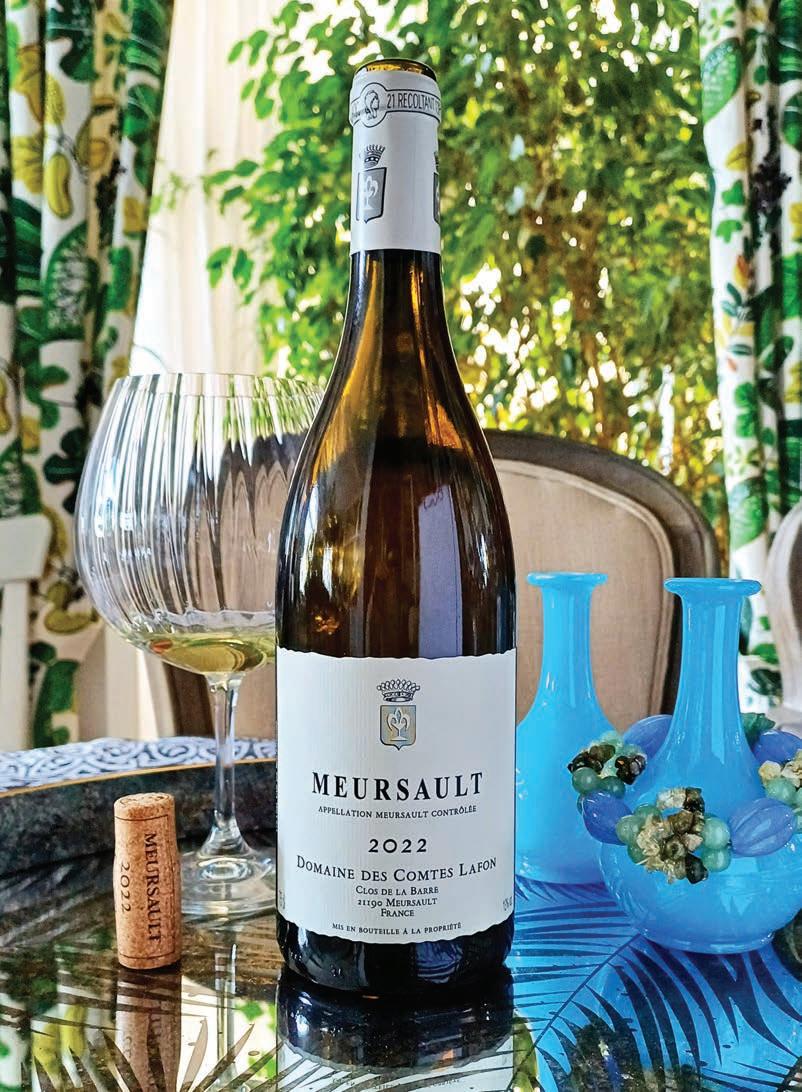
Here we taste Comtes Lafon Meursault 2022, a blend of 3 plots (Barre, Luraule and Crotots). On the nose, honeysuckle and apple blossoms with a tincture of peach. The entry is rich full bodied buttered and toasted hazelnut praline with squishy peach, pear and yellow apples laced in a lemon and tonka bean brioche and a barn hay finish. Fresh cut grass, touch of cream, crushed chalk make their mark but essentially a fat serving of buttery perfectly poached pure fruit with a yeast torrefaction. There is depth and breadth but wrapped in a soft intensity rather than structure with a silky energy and choreographed opulence. This is a ballerina in a snow globe kind of wine as it pivots as all pretty and lullaby enclosed in an intimacy of flavours and textures of recurrent themes of moorishness in balletic strides yet turn left field and you are suddenly enraptured in a cadence of soft falling snow flakes of bite sized beauty of gorgeous and hallowed depth, visceral fits and starts, all fast disappearing. Magical liquid gold.
“I
am not born for one corner; the whole world is my native land.”
the Younger
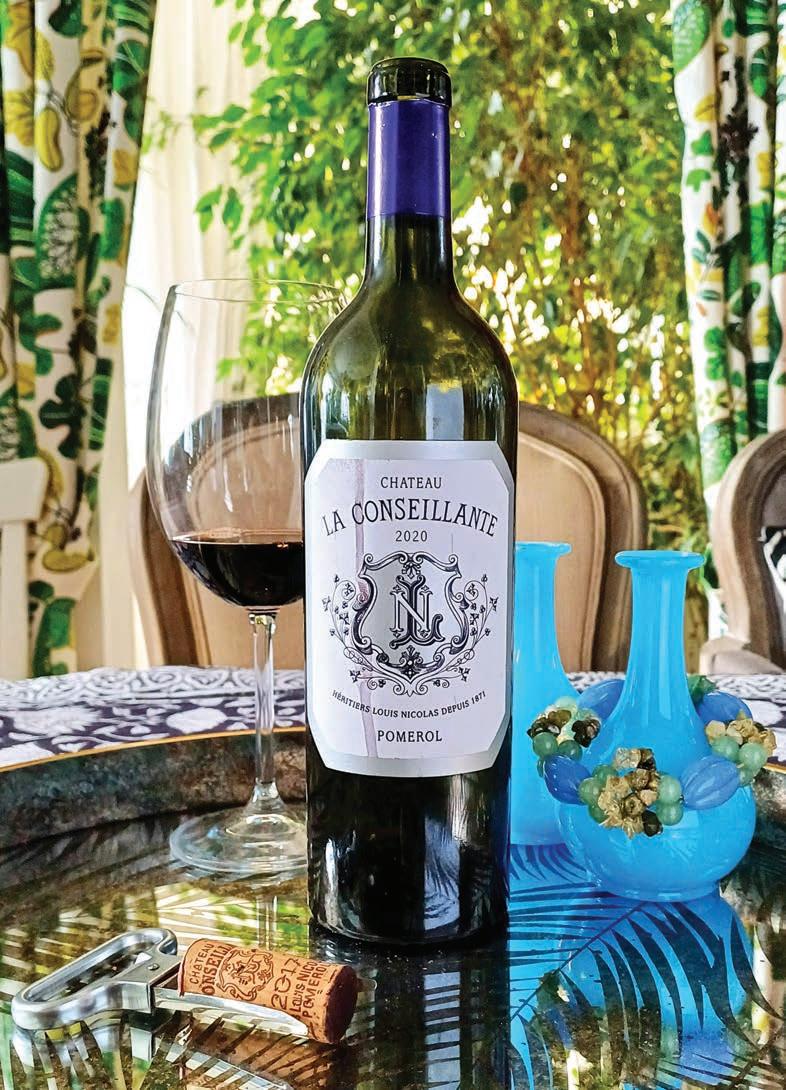
Pomerol is Merlot grown on a small plateau of varying clays, gravels and sands with an iron rich under soil and the occasional dash of Cab Franc or Cab Sauvignon for added aromatic structure. This however severely understates the sophistication of wine here to the extent that each producer with their unique combination of clay, gravel and sand plots makes wine that tastes entirely different from a winemaker just one vine away, writes Kris @ FirstThisIsWine.
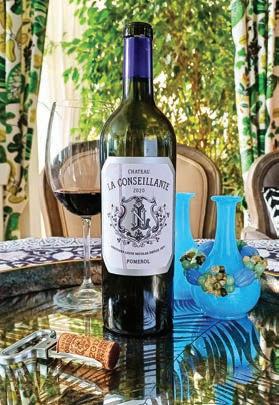
Conseillante may need no introduction, but apart from the triumvirate of Petrus, Le Pin and Lafleur, a handful of other heavy weight chateaux offer their own expression of Pomerol. With plots traversing into St Emilion and having both Petrus and Cheval Blanc as its vine plot neighbours, Conseillante is known for its rather elegant take with a floral depth and a graceful layering in contrast to the broad shouldered powerful expression of traditional Pomerol per se. Merlot grown on clay may do its thing in terms of depth and opulence but Cab Franc grown on gravel and sand has a way of providing a floral spectrum, dainty silky feel and secondary cedar and tobacco dimension that is equally prized.
La Conseillante 2020 starts off with signature purple flowers and blueberries on the nose. Black cherries and berries on the attack with a fretwork of cedar tobacco and baked spices both dense and pure to end in a soothing plum molasses chocolate and espresso finish. There is depth and some opulence from the clay and fine elegance from the gravel. 2020 is a stellar at once ripe and fresh vintage and Pomerol is top contender for that year so this is a keeper as much as a drinker.
There is something touchingly all too familiar; something vaguely distant and restrained about this in equal measure. The wine pivots around intimacy, pleated proximities, right bank flavours and recurrent themes of moorishness but also unapologetically plush where sovereign fruit reign supreme with silky tones, a deep essence, high florals and lots of promising ethers for years to come. Aspirational stuff in fine feather.
La Conseillante is available at Farsonsdirect.
“It took me four years to paint like Raphael, but a lifetime to paint like a child.”
We dwell in the unknown even unbeknownst to us and when we do know it is rather a deeper understanding of that unknowing. Such it is also with wine as every bottle is an unlearning in search of greater truths. The wonder of Pergole Torte a translation of twisted arbours from the steep hills the vines are grown on is how a Sangiovese monocepage is the most iconic Supertuscan sought by collectors due to its labels of female portraits adding to its cult status, writes Kris @ FirstThisIsWine.
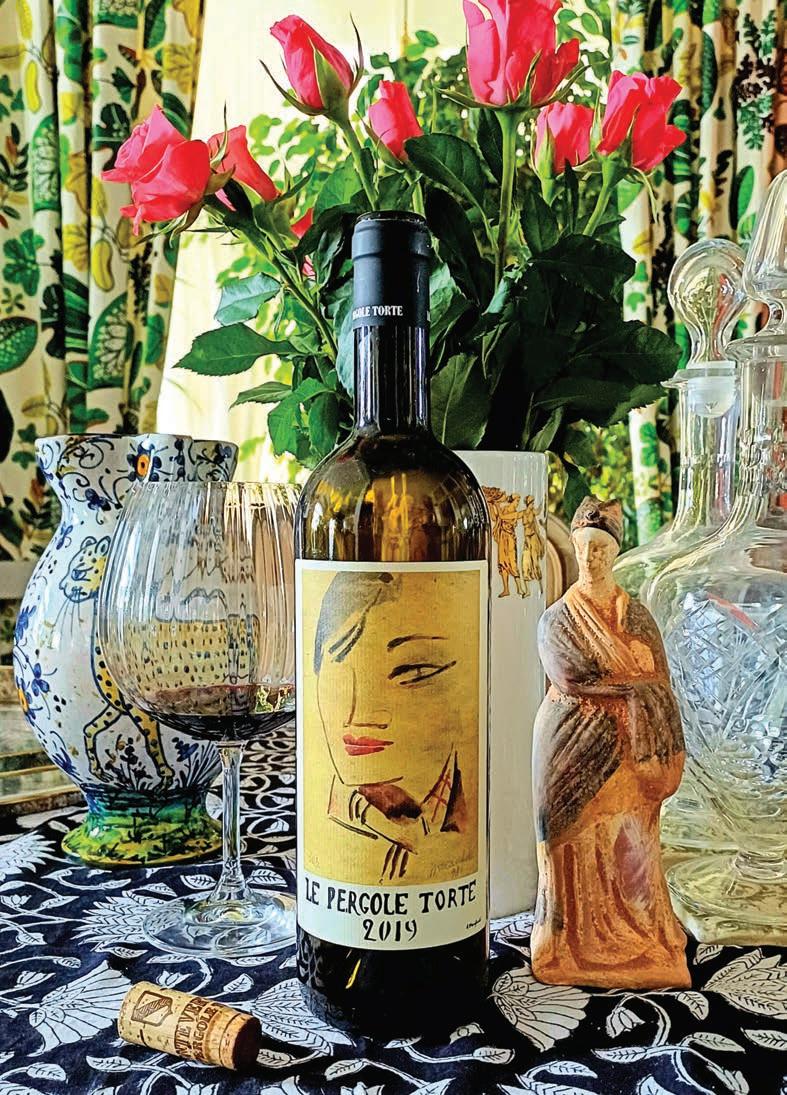
As fables would have it, an industrialist Sergio Manetti would buy a summer house in 1967 in the Radda hills of Tuscany and plant five acres of vines to dabble in winemaking purely for family enjoyment only to chance on immediate success by ignoring the stifling Chianti blending rules and bottle a hundred percent indigenous Sangiovese without even touching French varietals. With some of the highest vineyards about 400 metres altitude and the help of Giulio Gambelli of Soldera fame, Pergole Torte is the most important Sangiovese wine outside of Brunello proper.
Le Pergole Torte 2019 opens to an intense nose of purple flowers and red fruit. The attack holds true with wild cherries and damson plums coated in light herb aromatics to end in a large finish of tobacco, cedar, cocoa, anise, coffee and graphite. Some rind, more flowers, a smoky touch leather and cedar, tincture of baked spice and ethers of wild berries are layered and tiered in graceful waves of expression that are powerful peaked and pure as much as they are delicately construed. There is a completeness to this but the structure promises a future ahead to be expected from a signature raciness outclassing other 2019s. In the shifting tones and crystal notes there is a Von Trier twisted Classicism. Think Melancholia. Instead of a hopeful sun, there is a baying moon of luminous flavours. Instead of a filigree of stars, a blue planet haunts and hurtles towards us with a devastating and tantalizing form of doom and beauty. It is a see Naples and die kind of wine. This does violence. Electrifying.