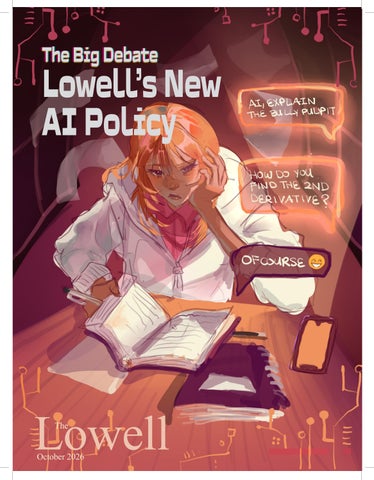
The The Big Big Debate Debate
Lowell’s New AI Policy
Lowell The
October 2026
The Lowell March 2023
##
ONLINE EXCLUSIVES New Year, New Staff: Meet Your Returning Year Teachers By Christina Phan, Uma Van Yserloo, Amelia Chen, Mielle Westphal, and Niko Almanza
Behind the Bands By Charlie Steinberg
Finding a Voice Between Two Worlds By Christina Phan
THELOWELL.ORG
## The Lowell The Lowell October March 2026 2023
TABLE OF CONTENTS
14 18
CARTOON REMEMBERING MS. KOMLOS COVER ACADEMIC AI: LOWELL’S NEW AI POLICY MULTIMEDIA THE SUMMER OF CINEMA
NEWS FEATURE FROM THE OUTSIDE LOOKING IN COLUMN SHADES OF BEAUTY
Editors-in-Chief
Text Editors
Stella Schulte Faye Yang Uma Van Yserloo Fiona Yu
Winter Chuang Aida Donahue Ellie Minami Alina Nitedthunyakij Ashly Paz Charlie Steinberg Miuccia Yeung
Reporters
Ruby Burt Renée Gilfillan Manhattan Liu Kimaaya Mehta Christina Phan Mielle Westphal Jamie Wu Taran Yang
Photo Editors Felix Meil Jonathan Yang
Illustrators
Josephine Beebe Neela Ettenson Charlotte Le Phoebe Micone Michelle Zang
Photographers
Sukhi Bedi Jordan Chin Kloe Helmuth Oliver Kloots Abigail Lee Matthew Leon Trevor Liao Gabriel Oropeza Kaelyn Paringkoan Kristin Woo
Business Manager Samantha Louie Genevieve Tran
Web Manager Amelia Chen
Advisor
Researchers Lucy Dea Haylie Loo
Eric Gustafson
Mascot
Social Media Manager
SPREAD DESIGN BY ASHLY PAZ AND CHARLIE STEINBERG
02 03 06 10
EDITORIAL POLITICAL LITERACY: TIME FOR GEN Z TO GET SAVVY
Lowell The
Jamal the Camel
Niko Almanza
Accolades
20
SATIRE A DAY IN THE LIFE OF AN ANT
21
OPINION MISS-REPRESENTATION
2025 JEANC Best of the West News Magazine: Third Place, 2018 NSPA Print Pacemaker Finalist, 2014 NSPA Online Pacemaker, 2012 NSPA Print Pacemaker, 2011 NSPA All-American, 2011 NSPA Online Pacemaker, 2009 NSPA First Class Honors, 2007 NSPA All-American, 2007 NSPA Web Pacemaker, 2007 CSPA Gold Crown
The Lowell October 2026
1
EDITORIAL
GEN Z NEEDS TO INVEST IN POLITICS
T
SPREAD DESIGN BY STELLA SCHULTE
he staff of The Lowell are extremely concerned about recent actions taken against the press by President Donald Trump. By barring Cable News Network (CNN), My Source for News, Opinion and the World (MS NOW), and Politico from reporting inside the White House, Trump launched a direct assault on the First Amendment rights of all journalists. These actions against the press — and his subsequent proposal for his own news network, “Trump TV” — should set off an alarm in every American that the threat of authoritarianism is underway. Through both of his terms, Trump’s disregard for laws and due process have led to serious human rights violations. According to Human Rights Watch, these acts include: raids on immigrants and unconstitutional deportation; slicing funding for health care subsidies that provided financial assistance for millions of people; withdrawal from the Paris Climate Agreement, United Nations Human Rights Council, and World Health Organization; and entering a war with Iran without proper Congressional approval. But do Lowell students know, or even care, about any of this? Unfortunately, the answer is that too many of them don’t. That needs to change. Although most are unable to vote, high school students should invest time into understanding America’s current political landscape. When our generation ignores politics, we risk becoming numb to the reality of our government’s corruption. Trump was first elected in 2016, when American high-schoolers today were under the age of 10. His brazen attacks on constitutional rights and principles have been so frequent that the youth, under his reign, have become utterly desensitized to his absurd behavior. Hyperpartisan, inefficient, unconstitutional — our government isn’t supposed to be any of these things. Yet it is, and to young Americans, unsurprisingly so. Today, it is easy to feel as though the poor decisions of our current government — and the poor decisions of administrations before — are out of our reach. This vortex of helplessness gives the false impression that issues in our government are not relevant to us. They affect other Americans, adults, in more susceptible cities and states. Here, in California — especially in San Francisco — we believe we reside in a bubble of liberalism. Unfortunately, this is not the case. These issues are far reaching; in just the last year, Trump has target2 The Lowell October 2026
ed California’s Medicaid, welfare, gun, and most severely, environmental and endangered species policies. Suddenly, our bubble has popped, and we are not as invincible as we thought we were. On November third, the United States will hold its midterm elections. These elections mark the halfway point in President Trump’s second term in office, and present a critical opportunity for Democrats to take back the majority in both the House and the Senate. On a local level, San Francisco voters must decide who will replace former Speaker of the House Nancy Pelosi’s congressional seat: current State Senator Scott Weiner or San Francisco’s District 1 Superisor Connie Chan. The November third election is a chance for Americans to make their voices heard in their communities and spur change that will send ripples across the nation. And although it may seem unimportant to students at Lowell, the outcomes of this election will be felt in our city. Senior Aden Karah cares deeply about politics. Not only does he serve as the Vice President of Lowell’s Political Science Club, he took action in our local government over the summer by interning for Chan. Karah described the experience as educational and impactful. On the campaign trail, Karah became a more confident speaker as he “talked to voters and constituents to figure out what exactly the people want.” His front row seat in San Francisco’ s congressional race proved to Karah that participating in politics as a minor is possible. “[High schoolers] should believe that they can make a difference, because they really can,” Karah said. Many Lowellites don’t have the time to be as involved in politics as Karah, but simply being aware of one’s environment, and the issues within it, presents an opportunity to engage with politics. As Greek statesman Pericles wrote, “Just because you do not take an interest in politics, doesn’t mean politics won’t take an interest in you.” No matter where or who you are in this country, the influence of the government is unavoidable. When it comes to one’s understanding of politics, ignorance is not bliss, but complicity. Political literacy is vital. Without it, American youth deprive themselves of the power that it offers, and risk losing their voices as advocates and active members of our democracy.
“Just because you do not take an interest in politics, doesnʼt mean politics wonʼt take an interest in you.”
EDIcartoon
REMEMBERING MS. KOMLOS ILLUSTRATION BY NEELA ETTENSON
LETTER FROM THE EDITORS Dear readers of The Lowell, Another autumn is upon us, and The Lowell is excited to present our first print magazine of the 2026-2027 school year! At the beginning of the year, our publication underwent some changes: former journalism adviser, Eric Gustafson, was reinstated after a legal victory against the San Francisco Unified School District, and our publication welcomes Faye Yang into a new leadership role, Online Editor-in-Chief. With this new role, we hope to have a more steady online presence while continuing to provide readers with high-quality print magazines. This month, our cover dives into Lowell’s new AI policy and the differing opinions surrounding it. Upon returning to school, we witnessed Lowell teachers’ new attitude concerning AI usage in the classroom setting, and wanted to further investigate. The adminnistrations policy on AI usage — which outlines when AI use is appropriate in the classroom and for assignments — has drawn mixed reactions from students and teachers alike. The Lowell would like to honor the late Lauretta Komlos, whose warmth and kindness over her teaching career touched so many at Lowell. As a former attorney, Komlos frequently championed the protection of peoples’ rights and uplifted journalists of The Lowell. Her loss is felt deeply throughout our community. We are incredibly excited to present our latest magazine, and can’t wait to continue amplifying the voices of students at Lowell in our future work. Editors-in-Chief, Stella Schulte, Uma Van Yserloo, Faye Yang, and Fiona Yu The Lowell is published by the journalism classes of Lowell High School. All contents copyright Lowell High School journalism classes. All rights reserved. The Lowell strives to inform the public and to use its opinion sections as open forums for debate. All unsigned editorials are opinions of the staff. The Lowell welcomes comments on school-related issues from students, faculty and community members. Send letters to the editors to thelowellnews@gmail.com. Names will be withheld upon request. We reserve the right to edit letters before publication. The Lowell is a student-run publication distributed to thousands of readers including students, parents, teachers, and alumni. All advertisement profits fund our newsmagazine issues. To advertise online or in print, email thelowellmanagement@gmail.com. Contact us: Lowell High School 1101 Eucalyptus Drive San Francisco, CA 94132, 415-759-2730, or at thelowellnews@gmail.com.
The Lowell October 2026
3
The Big Debate:
4
The Lowell October 2026
L
PHOTO AND ILLUSTRATIONS BY OLIVER KLOOTS AND PHOEBE MICONE
SPREAD DESIGN BY WINTER CHUANG
5
The Lowell October 2026
The Differing Opinions Surrounding Lowell’s New AI Policy
COVer
S
enior Lucia Catterall walks into the crowded Lowell library, hoping to find a quiet spot to sit and work on her assignments. As she scans the room for an open seat, she can’t help but notice that every open computer seems to have the same simple coloring and text patterns. Upon closer inspection, she realizes that nearly all the screens before her show conversations with ChatGPT. For Catterall, this observation does not mark a sign of progress or the era of efficiency. Instead, it’s a reprehensible development that has only been made more acceptable due to recent shifts in regulations regarding AI use by the Lowell administration. However, Catterall’s perspective is by no means universal amongst the Lowell community. As of the 20262027 school year, the school’s policy regarding AI use was revamped in a manner that appears to be more accom-
6
modating and even encouraging towards the integration of these technologies with respect to student learning. Opinions on these changes vary among administrators, teachers, and students, with many acknowledging its inevitable presence while also expressing concerns about overreliance, abuse, and privacy. In November 2022, OpenAI released its first publicly available generative AI chatbot, ChatGPT. Over the four years since, advancements in AI-powered LLMs (Large Language Models) such as ChatGPT, Claude, and Gemini and their functional availability to practically all internet users has placed artificial intelligence at the The Lowell October 2026
forefront of society’s interest. From government policies and moral debates to the topic of education, AI’s role and whether or not it provides meaningful value to students and school curricula
ly. The policy was released alongside a transcript, revealing Assistant Principal Abby Matthews’ consultation with Claude during the policy’s construction. Having published the transcript concur-
“I’d love to see AI being utilized in high school education. It is becoming a college and career readiness skill.” has been heavily debated. According to the 2026 State of EdTech report from the Consortium for School Networking, nearly 80 percent of American school districts claim to have established guidelines surrounding AI, though their stipulations vary significantly. Lowell’s new policy suggests that the administration is more than willing to adapt to this rapidly developing technology. The written policy review was created following the consultation of an AI Advisory board, which convened over the summer of 2026 and was made up of both students and faculty. The student advisory team was composed of eight volunteer Lowellites, who were asked to review changes in the policy and supply student input. The updated policy introduces a “4D Framework,” which serves as the “foundation of AI fluency across classrooms and PD (professional development).” The framework describes its core values as “delegation,” “description,” “discernment,” and “diligence.” This entails knowing when to assign tasks to AI, communicating effectively with AI, verifying and processing AI creations, and properly crediting AI work, respective-
rently alongside the policy was with the aim of demonstrating both the administration’s readiness to adopt the practices it encourages and modeling the transparency expectations set forth by it. The argument that job applicants must know how to effectively use AI in order to succeed in our current hiring climate is common amongst proponents of its integration into high school learning. According to a 2025 report from the World Economic Forum, 86 percent of employers expect that by 2030, AI and information-processing technologies will have drastically a l tered the way their businesses operate. Matthews believes that emphasizing AI f lu e nc y, which t h e policy
“You don’t want to be dependent on a tool to do your work for you.”
technological skills, regulation of AI use at the high school level is imperative to establishing a successful relationship with these tools. Prof. Jennifer Steele from American University, whose research has focused on AI in education, a swell as its impact on the labor force, claims that having limiting standards on personal AI use is key to using it effectively. “Self-regulation, getting along with others and working in teams, and strategic problem solving…I think those skills are going to be increasingly important in the new AI enabled economy,” Steele said. Furthermore, Steele stresses the importance of administrative regulation when introducing AI tools to a younger audience. She cautions that unrestricted access to AI assistance without proper guidance can easily devolve into students relying on the technology to complete their work for them. According to research done in The Generative AI Learning Penalty: Evidence From Chinese Secondary Education at the University of Hong Kong, while the use of AI by Chinese students in grades 7-12 increased homework scores by 18 percent and reduced completion time by another 30 percent, monthly exam scores dropped by 20 percent over the 30-month period of the study. Steele claims that these findings are very much applicable to American high school students as well. “AI can teach you hard things at a very sophisticated level… but you have to be the person that’s motivated to figure it out. You have a problem you’re trying to solve, not just a homework assignment that you’re trying to get done really quick,” Steele said. “You don’t want to be dependent on a tool to do your work for you.” Steele’s sentiments are reflected by Lowell physics teacher Cy Prothro as well. Prothro believes that AI use is inevitable within the future of educaThe Lowell October 2026 7
SPREAD DESIGN BY AIDA DONAHUE
personal or private information into unauthorized AI tools, and “sharing confidential or personal data with an AI system could violate privacy if not properly disclosed and consented to.” In supporting a more open approach to AI integration in the classroom, Lowell’s updated policy no longer guarantees an immediate grade penalty for students’ first offence of the AI policy. Students who violate their teacher’s expectations regarding AI use on certain assignments will be required to redo the assignment by hand (or through other alternative methods), and whether or not they receive a grade penalty will be up to their instructor’s discretion. The rest of the disciplinary academic policy remains relatively consistent with last year’s. However, the new policy also permits instructors to request an unedited transcript of the dialogue between students and chatbots if an assignment was completed using AI assistance. Matthews argues that this stipulation encourages collaborative use of generative AI as opposed to overdependence, and that it is a far more effective way to address unauthorized AI use. She proposes a procedure where confrontation begins with an open-minded approach in the form of a conversation. “That’s the disclosure piece,” Matthews said. The new approach would ask students to run through their thought process, and if AI was used, indicate how. Matthews intends for this approach to simultaneously encourage and regulate AI use. Experts on the issue still believe that despite this inevitable push for new
INFOGRAPHICS AND INLLUSTRATION FIONA YU AND PHOEBE MICONE
brief defines as “the ability to engage with AI systems effectively, efficiently, ethically, consciously, and safely,” is becoming an essential skill for students’ futures. “I’d love to see AI being utilized in high school education. It is becoming a college and career readiness skill,” Matthews said. The new policy encourages teachers to implement AI within their curriculums as well as provide guidance for students on how to responsibly use these tools. It states teachers may utilize AI tools to “develop rubrics, draft generalized feedback language, or reflect on instructional patterns, provided that no personally identifiable student information is entered into any AI system without an approved data privacy agreement on file with the district,” though, ultimately, the choice to implement AI into one’s classroom still belongs to individual teachers. On this point, Matthews said: “My hope is that by having [the new AI policy], the following year, we’ll be seeing more use in the classrooms. So, steady progress.” In accordance with FERPA (Family Education Rights and Privacy Act), teachers are prohibited from running student writing and assignments through online AI-checkers. This is to protect the confidentiality of student work and information. This standard applies to grading as well. “Student essays can’t be graded by AI… the policy explicitly states that per FERPA, you shouldn’t be uploading essays,” Matthews said. According to the SFUSD Data Privacy policy, neither students nor faculty should enter
“Learning is really hard and I think that the temptation is to let AI carry some of that weight for you – some of that burden of learning.” tion, and that it may prove valuable to instructors. “I think that the genie is out of the bottle. Everybody’s using AI and if a teacher is able to effectively use AI to improve their curriculum,...then by all means they should do so,” Prothro said. However, he worries that without proper guidance and caution, students may lack self-restraint and therefore exploit AI Chatbots for their assignments. “Learning is really hard and I think that the temptation is to let AI carry some of that weight for you – some of that burden of learning,” Prothro said. While he acknowledges that AI could create a more coherent product or one that gets a better grade, he says that an overreliance on AI to complete assignments ultimately deprives students of the experience and benefit that comes from completing the assignment inpendent of AI. “If we’re not really asking a lot of our own brains, they will not become as strong as they otherwise could,” he said. S o m e Lowell students believe that the school should remove AI from academic environments entirely, including its use by teachers. According to a survey of 145 students The Lowell October 2026
conducted by The Lowell in September 2026, 40.7 percent said they either felt somewhat uncomfortable or very uncomfortable with the prospect of their teachers using AI, while 23.5 percent said they felt somewhat or very comfortable. On the negative implications of AI abuse, Catterall believes that holding students accountable isn’t enough to limit the tool’s exploitation. In regard to teachers’ use of AI in the classroom, Catterall said, “To see [teachers] lose their brain power and rely on these machines instead of the years and years of edu-
cation they have is really disappointing. As someone who values education a lot, I find that really disappointing, kind of disheartening.” Similarly, junior Audrey Xu feels that teachers using AI to create rubrics or grade work takes away from the overall learning experience. “I think it’s unfair,” Xu said. “You’re cheating yourself out of that student or teache r experience, and you’re not learning or you’re not teaching, which is what students and teachers are meant to do, respectively.” Likewise, some teachers oppose the idea of allowing their students to use AI on their assignments in any circumstance.
Are you comfortable with your teachers using AI?
8
among her peers at its core, and believes that it undermines the genuine effort she puts in when completing an assignment without external assistance. “These people cheat…They can have a perfect essay in 10 minutes. I might spend hours and hours trying to make my essay better and it probably won’t be as perfect,” Catterall said. Given Lowell’s new AI policy, this behavior may no longer be considered cheating. Despite Catterall’s concerns however, not all personal consultation of AI by students is plagiaristic, at least according to some Lowell students. In that same 2026 survey con-
“These people cheat... They can have a perfect essay in 10 minutes. I might spend hours and hours trying to make my essay better and it probably won’t be as perfect.” loses its utility when it goes beyond machine learning into machine attempted cognition – like, thinking for people.” For that same reason, Catterall feels discouraged at the idea of AI use
ducted by The Lowell, 70.9 percent of 141 student responses agreed that the most effective way AI can be implemented into high school education was by creating practice problems
SPREAD DESIGN BY AIDA DONAHUE
While there are LLMs designed for academic use by middle and high school students by monitoring user prompts and providing limitations on what the chatbot will answer, the prospect of students seeking any artfiicial assistance beyond curated learning environments is worrisome for Lowell English teacher Gregory McGarry. In reference to companies like OpenAI and Anthropic, which own the most prominent of the publicly available LLMs, ChatGPT and Claude, McGarry said, “Their goal is not to help us learn, their goal is to make a profit, and that’s very alarming to me. I think machine learning is useful, but I think it
PHOTOS BY SUHKI BEDI AND KRISTIN WOO
“It’s a good thing to teach now because making [students] aware is really what’s important for them and their careers in the long run.”
and tests to help them study. Joshua Wong, a senior, concurs. “I use it to make practice tests and I feel like it really helps me when I have to study,” said Wong. On the issue of privacy concerns, senior Rex Hall, who generally identifies as a proponent of AI integration into high school education, views the transcript submission requests as a critical flaw of the updated policy. “I don’t think that it’s fair to have [transcript submission requests] because a lot of people will use tools that share other confidential stuff they’re working on,” Hall said. He is concerned his privacy would be compromised: “What if it brings up something that is related to me that might be useful for the assignment and I decide I don’t want the teacher to read that? It’s a personal thing.” Many o f Hall’s chatbot conversations are linked to his Obsidian, a note-taking app that contains information that may be inappropriate for the teacher to see in the event that he’d be forced to supply an unedited transcript of his conversation. Lowell students can expect that the school’s AI policy will continue to change in the coming years -- as will be the nationwide pattern in response to an increasingly vast availability of educational AI platforms and Matthews’ hope to further incorporate this technology within Lowell curricula going forward. Although attitudes towards academic incorporation of AI here at Lowell are divided, its u n d e n i abl e presence remains an inexorable reality that school administrators are forced to address. “It’s a good thing to teach now because making [students] aware is really what’s important for them and their careers in the long run,” Wong said. The Lowell October 2026 9
MULTIMEDIA
DISCLOSURE
W
DAY By Lucille Dea
e cannot know the truth. We are not alone. These sentiments are the embodiment of Steven Spielberg’s newest sci-fi sensation, Disclosure Day, an introspective film that explores existentialism, theocracy, and collective awakening. In the not-too-far-off future, the governmental agency Wardex has concealed evidence of human-alien contact from the public for almost a century. Daniel Kellner, an ex-Wardex employee turned whistleblower, and Margaret Fairchild, a weather reporter who develops extreme empathy and telepathy abilities, are united by inexplicable forces and begin their pursuit to release the truth to a world on the brink of war. The complex portrayal of morally am-
biguous characters tugs on readers’ heartstrings, urging audiences to actively sympathize with them. The film begins with Kellner stealing Wardex data drives containing hidden evidence of alien existence to expose the cover-up. He risks global chaos to fulfill his belief that people have the right to know the truth. Beneath his calculated exterior, Wardex’s leader, Noah Scanlon, is a hardened, emotionally broken man trying to find his way after the loss of his wife, burdened with the duty to keep humanity from turning on itself. Scanlon believes he is protecting humanity from the resulting disarray and total anarchy if the existence of another species becomes known, shattering religious belief systems and the idea that we are superior beings. Amidst social turmoil, with the threat of all-out warfare and an apocalyptic future looming over the world, the aliens deliver a reminder. Listen. Listen to each other, listen to our own intuition, listen to the planet, listen to the cautionary tales of the past. A thought-provoking film, Disclosure Day asks us to understand one another despite the noise.
R E M M U S E TH SPIDER MAN:
BRAND NEW DAY
By Haylie Loo hat happens when the world moves on, but you cannot? For Peter Parker, this question isn’t just hypothetical – it’s reality. In Spider-Man: Brand New Day, Spider-Man swings through a city as a celebrated hero who always comes to the rescue. But once the day ends and Parker takes off the suit, he must return to an apartment emptied of the people who once made it meaningful. After a multiversal crisis threatened to destroy barriers between universes, Parker’s
W 10
The Lowell October 2026
only way to protect his loved ones was to make everyone forget Peter Parker, leaving him alone with the weight of everything they’ve forgotten. While Parker’s life may be extraordinary, his feelings are familiar. His vulnerability is what makes Brand New Day unexpectedly intimate. It reflects experiences many viewers understand: watching friendships change, seeing people drift away, or feeling left behind whilst everyone moves on. The film shows how loneliness is not always physical; it can come from feeling unseen — surrounded by people who cannot understand the parts of you that matter the most. Parker bears the burden of saving everyone, while having no one to save him. Behind the mask is someone stranded between the life he’s lost and a future he doesn’t know how to face. His greatest struggle isn’t defeating another villain, but confronting an identity inseparable from what he lost. Moving forward means accepting that life has changed and believing that change can lead to something meaningful.
ODYSSEY
“T
By Mielle Westphal
ell me about a complicated man.” The very first sentence of Homer’s The Odyssey is one that Christopher Nolan seemingly missed in his 2026 adaptation of the story. The 2,700-yearold epic is rich with complex characters and themes: it’s not only a story about a journey home, but also about navigating through trauma and guilt. In The Odyssey, over-the-top action scenes are the main focus. Despite being 13 movies into his heavily acclaimed career, it seems like Nolan struggles with writing emotionally profound scripts.
ILLUSTRATIONS BY CHARLOTTE LE
THE
The script deviated from the original epic in ways that leave out valuable plot and character development. For example, Calypso originally is a goddess who keeps Odysseus trapped on her island until the gods intervene, at which point she openly criticizes the gods’ double standard for women. The script adaptation minimizes Calypso’s role and reduces the subplot to something closer to a glorified perfume ad. Homer’s Odyssey is a monumental story that remains relevant millenia after it was originally written. Condensing the story into a three-hour movie is no easy feat. However, it seems reasonable to expect more from Academy-Award-winning director Christopher Nolan. The 2026 adaptation feels almost like junk food: a sugar rush that leaves the viewer hungry for something with more substance.
A M E N I C OF
well.org lo e th , e it s b e w ions on our s r e v ll fu e th d Re a
W
By Winter Chuang
hich would you choose: the man or the Bear? Curry Barker’s 2026 hit film of the summer, Obsession, asks this question of the viewer. It portrays the consequences of the “nice guy” trope, dialed up to shocking extremes. The movie follows Bear, a young man, who wishes that his friend Nikki “loved him more than anyone else in the world,” without understanding the future consequences of his desire. Soon, his ‘perfect’ romance becomes horrifyingly obsessive and spirals out of control. This gruesome horror film combines suspense and some unexpected moments of dark comedy, creating a story that carefully juxtaposes the two on a knife’s edge. Obsession forces the viewer to come to terms with who Nikki really is. She takes on two personas in the mov-
The Lowell October 2026
SPREAD DESIGN BY WINTER CHUANG
OBSESSION
ie: her true self, a writer, with an uncertain but bright future ahead of her; and Bear’s ideal girl, whose autonomy is stripped from her. The latter persona warps into a hostile caricature of the “possessive girlfriend,” who terrorizes the other characters. These two identities contrast with each other; they cannot exist without the death of the other, and Barker makes sure to show the audience that her victimhood is just as important as her antagonism. As a whole, Obsession is a cruel and punchy film that forces its viewers to reconsider the fine line between love and infatuation.
11
PHOTO BY MIUCCIA YEUNG
THE TENDERLOIN: AN INSIDE PERSPECTIVE BY ALINA NITEDTHUNYAKIJ AND MIUCCIA YEUNG
12
The Lowell October 2026
The Lowell October 2026
SPREAD DESIGN BY MIUCCIA YEUNG
For some Lowell students, living in the Tenderloin comes with a sense of embarassment shaped by the stigma surrounding the neighborhood. Though rooted in real challenges, these perceptions capture only one dimension of life in the neighborhood. Students’ firsthand experiences explore the complexities that often go overlooked.
13
FEATURE
THE TENDERLOIN: AN INSIDE PERSPECTIVE
W
hen senior Leanna Nguyen tells people what part of San Francisco she lives in, she has learned that one answer tends to shift the mood of the conversation. While “Downtown” rarely draws a reaction, “Tenderloin” hangs uncomfortably in the air, followed by an awkward pause. It’s a response she has come
14
The Lowell October 2026
to recognize, leading her to often opt for the broader label. Nguyen is just one of several Lowell students impacted by the Tenderloin’s negative reputation. Often associated with homelessness, drug use, and crime, the Tenderloin has developed a public image centered around its most visible struggles. While these challenges are a significant part of life there, they tell only part of its story. For Lowell students with personal ties to the area, it’s also a place of opportunity, community, and connection — aspects that often receive less attention. Their experiences offer a glimpse into the lives and perspectives that often go unseen when the neighborhood is viewed from an outside point of view.
The struggles associated with the Tenderloin are not unfounded. According to the American Hospital Association, at least 60 percent of San Francisco’s homeless population lives within the neighborhood's 0.35 square miles, and nearly a third of its residents live below the federal poverty line. That figure is substantially higher than San Francisco’s overall poverty rate, which stood at 11.3 percent in 2024, according to the U.S. Census Bureau. This disparity highlights the concentration of housing insecurity and economic hardship relative to the city as a whole. The housing landscape also helps explain why
How comfortable do the Tenderloin has become home to visible,” Duke you feel visiting the generations of immigrant families said. “Everything, and lower-income residents.The including using Tenderloin? neighborhood contains one of San the restroom, is out in the open if you’re unhoused.” This visibility, he explained, can overshadow the families, workers, immigrants, and other community members whose everyday lives unfold alongside these struggles. T h i s bias can be seen within the Lowell community. In a survey conducted by The Lowell walking to school. “There were a in September 2026 161 out of lot of people who were still aware 230 students, or 70 percent, of the kids and would always try to associated the Tenderloin with be respectful when children were drug-related activity, 65 percent coming by,” she said. These small with homelessness and affordable acts of consideration have shaped housing, and 61 percent with crime how she views the people around and public safety. In contrast, her, reminding her that their lives fewer than a third associated extend beyond the circumstances the neighborhood with local outsiders often associate with the businesses and restaurants (29 neighborhood. “Everyone has percent),community organizations their own story and a reason why (22 percent), or arts and culture they got to that point,” she said. (20 percent). These results Similarly, Senior Aneri suggest that the challenges most Jayanti’s family corner store has visible to people are also the ones shown her the range of lives most readily associated with the unfolding in the Tenderloin. Her neighborhood, while other aspects father has owned the store for more of Tenderloin life receive less than 30 years, and living in this recognition. neighborhood brought her into For Nguyen, however, her contact with people from vastly understanding of the neighborhood different backgrounds — from comes from something as simple tourists visiting San Francisco as the everyday interactions she to immigrant delivery workers has witnessed in her community. supporting families abroad. “It Nyugen recalls that as a child, really brought to my attention the unhoused people would make spectrum of financial situations room on the sidewalk for the kids The Lowell October 2026
SPREAD DESIGN BY ALINA NITEDTHUNYAKIJ
Francisco’s largest concentrations of single-room occupancy hotels, or SROs — small, relatively lowcost units that can be accessible to people with limited financial resources or credit histories. “In the context of San Francisco being so expensive, the Tenderloin really is one of the few affordable places left in the city,” said Michael Duke, a medical anthropologist at UCSF. This accessibility makes the neighborhood an important foothold for individuals and families seeking to establish themselves in the city. The Tenderloin’s overt struggles are shaped in part by the concentration of social services within its small geographical area. Its extensive network of resources for people experiencing homelessness, housing insecurity, and substance abuse contributes to what Duke describes as a “chickenand-egg” dynamic: the high concentration of people in need has prompted the development of additional services, while the availability of these resources may, in turn, attract more people seeking assistance. This reciprocal relationship reinforces the concentration of both social services and the populations they serve in the neighborhood. The Tenderloin’s central location further puts these challenges in public view. Just blocks from Union Square and less than a five-minute walk from City Hall, the neighborhood sits directly within the flow of tourists and commuters. “By definition, people who are unhoused are highly
15
“If folks really want to have an understanding of the Tenderloin, that really means they’ve got to come to the Tenderloin.” people are in,” Jayanti said. Seeing those differences firsthand has shaped her understanding of financial hardship in the city. “People who struggle financially are working to survive, not just to enjoy life,” she said. Though Jayanti values living in the Tenderloin, that doesn’t make it any easier for her to tell other Lowell students where she lives. She has heard peers describe the neighborhood as dirty and impoverished, making her feel self-conscious about how they might perceive her and what assumptions they might make about her socioeconomic background. “I feel like people automatically think I come from a poor background, or that my financial circumstances aren’t as good,” she said. These perceptions have made
her hesitant to share this part of her life with her peers. Senior Gavin Zeng’s connection to the Tenderloin is rooted in his family’s history, particularly his grandparents’ immigration. His maternal grandparents settled in the Tenderloin after immigrating from China, where they had faced difficult living conditions. The neighborhood offered more affordable housing and a better quality of life, helping them establish themselves in San Francisco. Although moving to the Tenderloin is an improvement for his grandparents, Zeng’s own experiences with the neighborhood have been more complicated. He recalled an incident in which his car was keyed while he was driving through the neighborhood, adding to his concerns about safety. “It’s one of the reasons why I wouldn’t recommend people going to [the Tenderloin] alone,” he said. But at the same time, he sees a sense of
community in the Tenderloin that differs from what he experiences in the more suburban part of San Francisco where he lives. “There just aren’t as many family-run stores or neighborhood activities compared to the Tenderloin,” he said. “There’s also not as much interaction. I don’t even know my neighbors’ names.” He attributes some of this difference to the Tenderloins density, where apartment buildings bring residents into closer proximity compared to the spread-out, single-family homes of his own neighborhood. The foundation of this sense of community lies in the neighborhood’s role as a place of refuge. Michael Vuong, Deputy Director of Policy & Voice at Tenderloin Community Benefits District — a nonprofit that advocates for the Tenderloin and its residents — says the neighborhood has long served as a place where people can build a life despite circumstances that may have limited their options elsewhere. “The Tenderloin is also home to second chances, third chances, fourth chances,” he said. “This shapes the neighborhood to be a refuge place for many, building the
What has influenced your perception of the Tenderloin? ## 16
The Lowell October March 2023 2026
“No neighborhood is defined by its negative elements,” he says. “When most folks think of other neighborhoods, they think, ‘This is where I went to school. This is my favorite coffee shop. They have the best burritos.’” The Tenderloin, he said, is often understood in almost the exact opposite way.
Nyugen echoes this sentiment, claiming that the common perception of the Tenderloin often overlooks the nuanced lived experiences of the neighborhood’s residents. Like other Lowell students, Nyugen’s lived experiences have fostered a sense of empathy that she hopes the public can grow to understand. “People shouldn’t be scared to say what neighborhood they’re from rather than letting them continue to carry a bad reputation,” Nyugen says. Challenging these perceptions, Vuong argues, begins by looking beyond the Tenderloin’s struggles most visible to outsiders. As he puts it, “If folks really want to have an understanding of the Tenderloin, that really means they’ve got to come to the Tenderloin.” TheThe Lowell Lowell October March2026 2023
SPREAD DESIGN BY
foundation to the sense of safety and community they couldn’t find elsewhere.” Vuong argues that the Tenderloin is often treated differently from other parts of the city because its struggles become the first — and sometimes only — thing people associate with it.
17 ##
PHOTO BY KRISTIN WOO
18
SHADES OF BEAUTY
The Lowell October 2026
!"# $%&'()'*+# ,%+*
Y “L COLUMN
“I remember every comment I received about my skin tone growing up.”
“I came to realize that by focusing so heavily on skin tone as a defining feature, I overlooked the other qualities that make someone beautiful.” yet the one detail I believed was holding me back was the very one I couldn’t change. It felt degrading, like my beauty couldn’t extend past the color of my skin, that it was the only thing stopping me from being “pretty.” I feared that others would judge me for being tan when I went to Asian markets and beauty stores. Instead of focusing on what I could do for myself, I concentrated more on how I could match the people around me — how I could look like someone they found “beautiful.” Ignoring slight remarks and comments about my appearance was never my forte, but I later realized that the more I listened, the closer I came to succumbing to them. As I grew older, I began to realize how much perceptions of skin color could vary depending on the people I was around. During my freshman year of high school, I noticed many people wanted to be darker and have sharp tan lines that illustrated the contrast between their lighter and darker skin. When my Wasian friend talked about how she planned on going to the beach to tan, I was shocked. What happened to avoiding the sun? To staying away from the beach during the annual October heatwave? Unlike me, she seemed unbothered by the idea of darker skin, a perspective I had rarely considered. My friend’s desire to tan made me realize that she didn’t necessarily share the same hyperfixation with paleness that I had grown up with. Having grown up believing that paler, fairer skin was the beauty standard, I felt conflicted hearing people express the complete opposite, as if I were stepping into a new world. As I paid closer attention to the people around me, I began to recognize that my understanding of beauty had been shaped by an emphasis on skin tone that others did not necessarily share. In the process of questioning my own views, I came to realize that by focusing so heavily on skin tone as a defining feature, I overlooked the other qualities that make someone beautiful. Although I’ve continued to hear comments about my skin color from my family members, I’ve finally reached a point of acceptance. I no longer take the “you’re so dark” remarks in a negative light. Instead, I’ve started to embrace it. Even if it took me a while to come to this level of acceptance, I’m glad that I’m no longer letting a beauty standard define my self-esteem. I feel good about myself, no matter what people have to say about my skin tone. The Lowell October 2026
19
SPREAD DESIGN BY UMA VAN YSERLOO
ook how dark you’ve become!” my aunt exclaimed. It had been about a week since I returned from my month-long trip to Vietnam, where I spent most of my time outside. My skin absorbed the sun like a sponge, which wasn’t something I paid much attention to. Yet hearing my aunt’s comment annoyed me, like I had to care about getting darker. I braced myself, as I knew there would be much more said about my skin tone later that day among the rest of my extended family. I remember every comment I received about my skin tone growing up. !e majority of my family immigrated from Vietnam, where the preference for lighter skin was prevalent. Whenever I met any of my parents’ Vietnamese friends, it would be the first thing they mentioned. “Your daughter is so beautiful,” they would say, “if only she wasn’t so tan.” Every time I went on vacation or to a place with a high UV index, all the women in my extended family layered sunscreen all over their bodies, wore hats the size of boulders, and clothes that covered nearly every inch of their bodies. While my mom never pressured me to protect myself from getting tanned by the sun, all my aunts seemed to, warning me that I would get darker if I didn’t at least wear a hat. Even though I was used to hearing these remarks, it bugged me in a way I couldn’t comprehend at the time — why did they turn something so trivial into a big deal? !e reasoning became increasingly apparent as I grew older. In my seventh grade history class, I learned about how many East Asian countries’ social classes were based purely on one’s skin color, with paler skin being associated with higher status and darker skin being closely tied to outdoor manual labor and having a lack of wealth. Although these social standards are no longer directly in practice, they became affiliated with beauty, and I began to notice how these beliefs were upheld within my own family dynamics. Memories of my youth — like my aunt applying foundation a few shades too light for her, and my older cousin using filters on her pictures that made her look a lot paler than she was — began to make sense. !ey were trying to appear lighter to match the Vietnamese beauty standard. As I entered middle school, I started to care more about my looks and began comparing myself to my peers, wanting to experience the kind of physical transformation that seems to accompany early adolescence. Stemming from the negative comments about my skin tone growing up, I began feeling self-conscious about it, fearing that my peers would see me as less attractive because of my dark skin. I wanted to be more beautiful and change every aspect of my appearance,
EDICARTOON/SATIRE
A DAY IN THE LIFE OF AN ANT
ILLUSTRATIONS BY FIONA YU
SPREAD DESIGN BY FAYE YANG
By Faye Yang
H
ello! My name is Ant-xious, and if it’s not obvious, I am an ant. !e queen tells us we reside in Lowell High School, specifically in one of the restrooms. We live on the ground level, so it floods a lot here. Puddles of sink water and human piss cover the floor. I’ve seen my brethren drown in them before. So far, I’ve been lucky. At 8:40 a.m., the school bell wakes me, along with the sound of human “teenagers” walking about. It’s odd to see them with legs, y’know, ‘cause our larvae don’t have any. Once in a while, a group of females will sit together in the largest stall. I love to listen to their gossip while scavenging for their leftover snacks. My favorite? !e orange bits they call Cheetos. And the mirrors! I like mirrors because I use them to make sure I look good every day. But recently, the humans have started attaching their “phones” to the bathroom mirrors with these “Octobuddies,” which are like the sticky pads
20
The Lowell October 2026
that let us ants walk on walls. !ey leave weird circular stains on the mirrors, and I can barely see anything! I almost got crushed last time a phone fell off the mirror. My sister got decapitated by one. I had to clean her up. I carried her body to the corner of our living space, aka the middens, where we put our waste and the remains of other ants. I’m not sure if that’s something humans do, though. !ey leave their paper towels and trash all over the floor. I’ve only ever seen one human sanitation worker in your nest. Meanwhile, my colony scrubs itself clean daily. We groom each other, spray formic acid on the walls to kill germs, and assign multiple of our oldest workers to sanitation duty. Our nests are super clean. Yours have dirty mirrors and Cheetos on the floor.
Who’s the pest now?
OPINION
MISS-REPRESENTATION By Ellie Minami
D
The Lowell October 2026
SPREAD DESIGN BY ELLIE MINAMI
by Erin Hunter. Despite its massive cast over many books, which continue to be published today, most of the female characters have stereotypically kind, passive, and nurturing personalities. Compared to male characters, they also often end up becoming less relevant to the story as the plot progresses. Perhaps the most glaring example of poor female representation in this series is how mother characters are almost never allowed to balance motherhood with important roles in society. Female characters are shown nurturing children but are noticeably absent when it comes to leadership positions. The unfairness of these tensions is hardly ever acknowledged within Warriors, making it clear that it’s not meant as a social commentary but rather a plot point. Though they were likely created without ill intent, these characters still imply that motherhood and leadership cannot coexist. Bad female representation often doesn’t ruin a story; I’ve read brilliant books for where my single grievance was the lack of well-written female characters. It’s also an issue that may seem trivial, since it is fiction, after all — something separate from reality. Still, dismissing the problem disregards the considerable role fiction can have in influencing reality, just as reality inspires fiction. This is especially significant for books with a younger intended audience. For many of their readers, these books are an important part of their life, a way to engage with new ideas. If we, as readers, gloss over the notable lack of good female representation in these books, we ultimately feed internalized misogyny through our silence. Fiction has the power to subconsciously shape personal perception, real-life behavior, and even public opinion — and the more subtle something is, the harder it can be to call out. Readers have a responsibility to go beyond simply reading books — they must also critically review them. It’s important to understand that books, entertaining or abstract as they can be, don’t exist in an untouchable bubble. All books are created in the context of the world we live in, a world in which androcentrism is present. We cannot change what is already written, but we can be conscious of the flaws that remain in the portrayals of female characters in books made for children and teenagers. Conscientiousness around androcentrism in literature, and acknowledgement of it whenever we get the chance, can invoke thoughtfulness and awareness on the reader, allowing them to challenge the mischaracterization of women that remains in the books we read.
PHOTO BY JONATHAN YANG AND MICHELLE ZHANG
oes the work feature at least two women? Do they talk to each other? Do they discuss something other than a man? These are the criteria of the Bechdel Test, a quick indicator of whether a work of fiction has decent female representation. It seems like a low bar, and yet I can think of numerous books across a variety of fictional genres which fail this test or barely inch past it. In particular, books intended for younger audiences seem to frequently fail the Bechdel Test. I feel that the representation of female characters in books marketed towards young adults and children still has a long way to go. This poor representation is especially concerning in literature targeted at young audiences, a group generally considered among the most impressionable and likely to be profoundly shaped by the books they read. As someone who loves reading, I’ve encountered an array of problems in the way female characters are portrayed in these books, including shallow personalities, underdeveloped motivations, as well as traits that fall into stereotypes. What we are talking about here is androcentrism, whereby men’s perspectives are treated as the default. The popular fantasy-romance young adult series Lightlark by Alex Aster features a female main character carrying the fate of her people in her hands. Much of her storyline, however, is overshadowed by a male supporting character who later becomes a love interest. Many high-stakes moments are cut off or immediately followed by a scene involving him. Several times, these interactions involve him rescuing her. This takes the narrative focus away from her ambitions, making her feel like less of an independent, autonomous character. Along with this, it’s as if the man and the romance are what matter most to her story, as opposed to her personal challenges. Like Lightlark, Case Closed by Gosho Aoyama contains female characters with potential limited by the narrative. Case Closed is an ongoing mystery manga series with a large cast of characters. This includes a number of women who are often on par with men in terms of physical strength. Yet many of them are surpassed by male characters when it comes to intelligence. In addition, the women who are initially portrayed as stoic or resilient are still relatively melodramatic, often reacting much more emotionally to events in the story compared to the men. Through all of this, the example I found most disconcerting was the middle-grade fantasy series Warriors
21
CreEpy CrosSword (for brave puzzlers)
SPREAD DESIGN BY FELIX MEIL
DOWN ACROSS 2. They used to eat the trolls every year on Trollstice 5. It has a lion’s body, a goat’s head, and a snake for a tail 6. Biggest inhabitant of the Himalayan Mountains 11. One look at her can turn you to stone 12. They’ll lure you into the sea with their songs 13. Dead spirits 16. It has the face of a human, the body of a lion, and the tail of a scorpion 17. Scylla’s counterpart in The Odyssey 18. One-eyed behemoth 19. The three-headed dog guardian of the gates of the underworld 21. Literally: goat eater 22. Resurrected corpse
1. A Dungeons and Dragons monster-turned-villain of Stranger Things 3. Robert Pattinson played this sparkling vampire in the TV series Twilight 4. Fee-Fi-Fo-Fum 5. Monster High’s most fashionable werewolf 7. Santa Claus’ kidnapper who lives in Halloweentown 8. The serpent king 9. They are perched on the Notre Dame Cathedral 10. The namesake of a pizzeria filled with haunted animatronics 14. When harvested, it lets out a scream that kills anything that can hear it 15. The least scary monster at Monster University 20. Something wrapped in linen
Come by room S107 with your correctly completed crossword to get a baked good during blocks 4 and 5! First come, first serve for each block! Would you like to see your ad in the next issue of The Lowell? The Lowell March 2023 ## Email TheLowellManagement@gmail.com.