


Peyton Dorsey News Editor
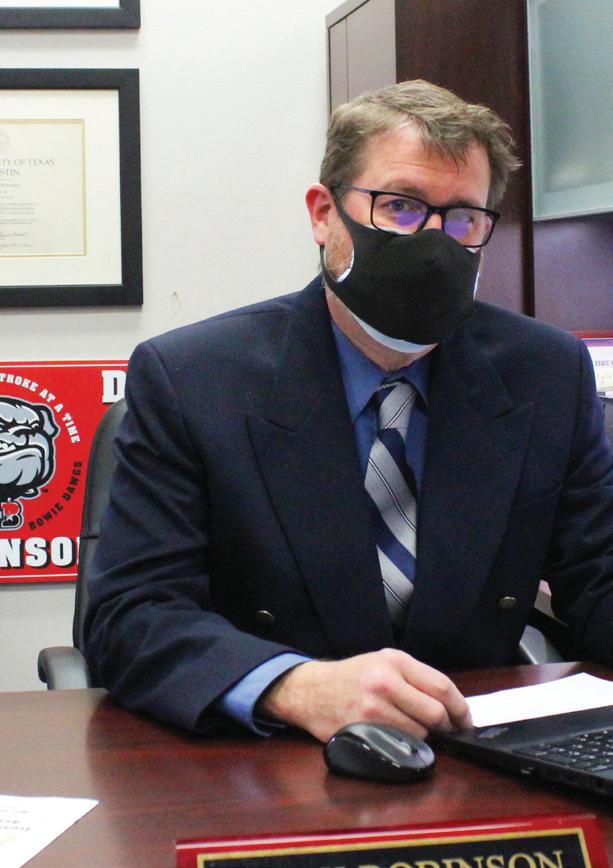
On Monday, January 5, principal Mark Robinson announced his retirement from Austin Independent School District (AISD). Robinson had been principal of James Bowie High School since 2017, and was only the third principal of the school since its opening in 1988. This announcement was made in person to staff during a meeting on the 5th, and came in the form of a campus wide email to staff, students, and parents, sent from Robinson himself. His last day on campus with students was January 19.
“AISD is going through an evolution with school consolidations and other comprehensive changes regarding the budget,” Robinson said. “I know that those changes are going to include Bowie. When I reflected on the next phase, I started thinking that maybe it was time for another principal to lead Bowie through that next evolution.”
AISD has had some struggles in the past few years regarding budgeting. These struggles are evolving and will have an effect on Bowie in the coming years, reflected in budget allocation and money the campus will receive from the district.
“I hope we have a very strong person with administrative experience come in,” Administrative Assistant Joanna Willard said. “We don’t get much money from the district, and it’s really challenging to run a school on the budget we have, so we will need a strong advocate and someone that works just as hard as Mr. Robinson for our school.” Willard and Academic Director Kaylin Brett were the only two people Robinson informed of his retirement decision prior to his campus announcement. Robinson began the conversation with them about his
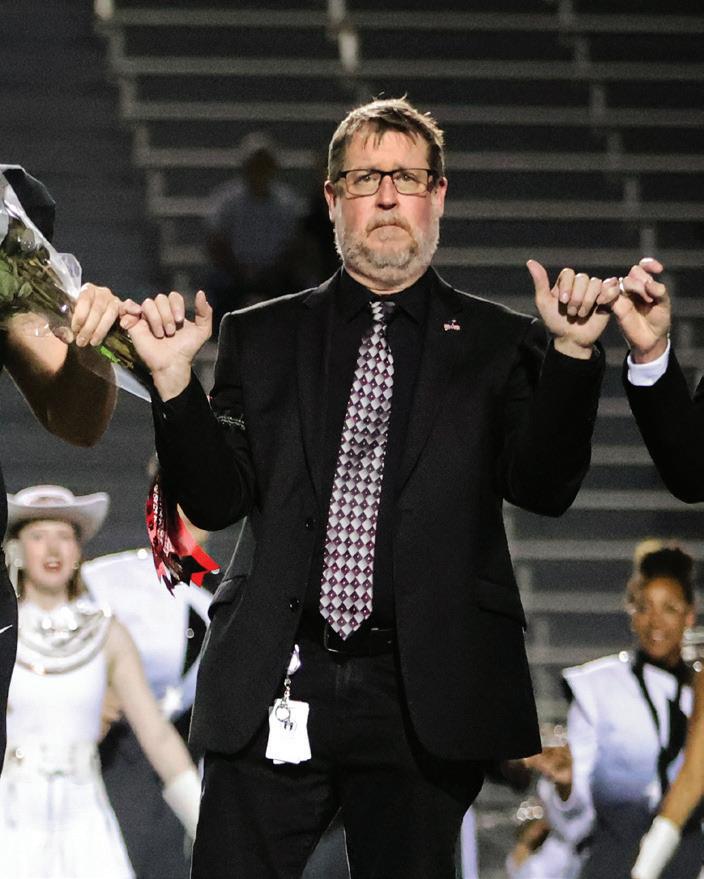

plan after fall break. Willard has acted as administrative assistant or principal secretary for Robinson since 2021, and will continue this role with the next principal.
“I really didn’t let anyone know until I’d already made up my mind and knew this was the direction I was going to go,” Robinson said.
“I did tell Ms. Brett and Ms. Willard early because we’ve worked so closely
Bowie mourns the loss of an influential & connected educator after shocking announcement
On
here was brief, students and faculty members emphasize the positive impact he left on campus and the students he taught. School administrations confirmed his death and shared the news with students, staff, and Bowie families, offering support and resources to students in the days following like Martha the therapy dog, and counselor support provided during class.
together.”
Robinson solidified the logistics and timing of his retirement plan

during the winter break between semesters. His decision to retire before the end of the school year was made to allow the district enough time to hire a new principal before the 2026-2027 school year.
“I didn’t want the campus to have to struggle without a permanent principal for a whole year before the next one was hired,” Robinson said. “It was
important to me with the timing that I gave the district time to name a new principal.”
Personal aspects also played a role in the timing of Robinson’s retirement. He sustained an injury a few years ago that required surgical attention. The healing time from this surgery kept him off campus for an extended period of time in which Brett filled in. Robinson required another surgery this year that has a four to six week recovery period. He decided to retire before this recovery period to allow the district ample time to hire a new principal before the next school year.
“I personally reflected on both what that past time in recovery meant for me and how hard it was for the campus to operate in my absence,” Robinson said. “I didn’t want the campus to be waiting for their principal to come back, especially knowing it wasn’t necessary since I would be retiring soon anyway.” Robinson has formed many connections on campus with staff and students that will sustain his legacy after retirement. He’s worked alongside Student Council president Gabby Bochey during her involvement as a school leader to improve the student experience on campus.
“My interactions with Robinson have always been really positive,” Bochey said. “He’s always been super welcoming, accommodating, kind, and he just has a lot of guidance to give.”
The transition into Bowie’s next principal is anticipated to run smoothly along the timeline Robinson has allowed. It is expected that Bowie will have its fourth permanent principal named before the first day of school in August of 2026.
“I think Robinson is doing the best thing he could have, retiring now and allowing time to hire before the end of the summer,” Bochey said. “I really like the way he’s gone about it, even if it is sad in terms of him not being here for the remainder of the year or for graduation.”
Madeline Whitten Dispatch Reporter
A series of thunks follows the tardy bell as students place their backpacks against the wall of the classroom. The students are complying with their teacher's rule of keeping backpacks at the front of the room, which came from Texas House Bill 1481 (HB 1481).
HB 1481 was put into effect on September 1, banning the use of personal devices such as phones, smartwatches, and personal laptops in schools. According to American Sign Language teacher Jessica Bartell, several of her students were reluctant to put their phones away, resulting in her and other teachers, such as math teacher David Flores, coming up with new ways to limit the distractions caused by phones.
“It was a bit of a shock at first, he was truly such a light and he was such a good person, when I found out he passed away, it didn't register until a couple days later when we were back in his room for the first time,” senior Ayah Hakim said. “I’ll remember him in the little things, like a poster for Mumford & Sons, or that we were both so excited for the ACL lineup to come out, and I realized he'll never be able to experience those things again.”
“When I visited his classroom and heard from his students, it was clear how much his students truly loved him as a teacher,” Assistant Principal Kaylin Brett said. “Anytime a teacher can make that strong of an impact in such a short time, you know he was a terrific and special teacher.” Students also remember Morrow for his passion for music, which was reflected during his celebration of life, where people were encouraged to wear T-shirts of their favorite bands in his honor. This was a tribute that highlighted an interest of his, and that he often shared to his classes and bonded with students over.
STORY BY Marissa McGowan
“I didn’t want to fight that battle, so I adjusted my expectations and my rules for my own classes,” Bartell said. “Instead of allowing them to keep their backpacks with them, I am separating the temptation from the people.”
According to HB 1481, school districts in Texas were given the responsibility of deciding how they would make their schools a phone-free environment. Given the choice, AISD chose to implement an ‘away all day’ policy, allowing students to store their phones in their backpacks, and instructing teachers to confiscate any phones they see.
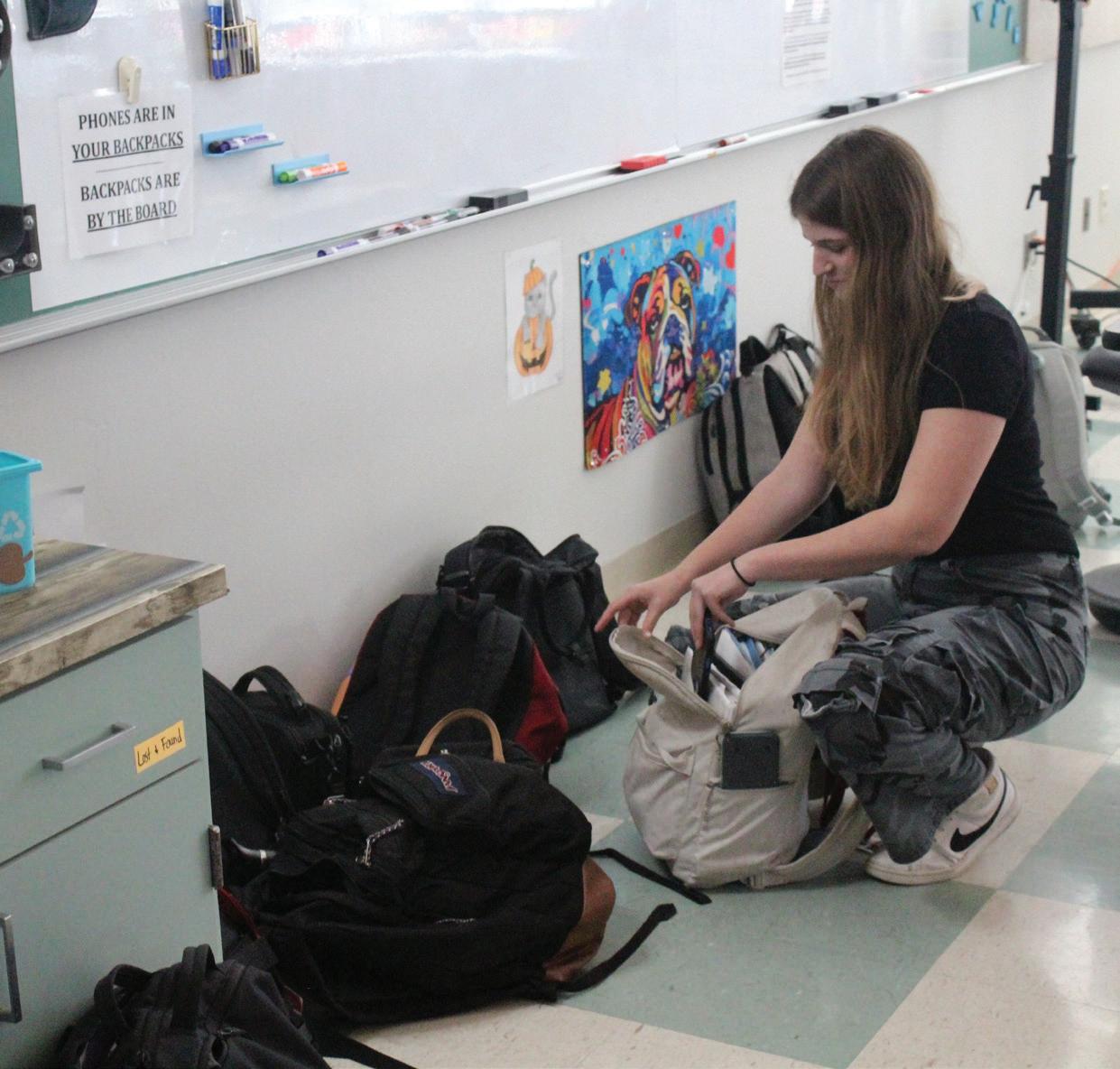
“It’s not my job to play phone hall monitor,” Bartell said. “I got tired of kids trying to hide it, because whether they know it or not, they’re not very good at hiding things.” Bartell said that when students come in, they can get out the supplies she’s listed on the whiteboard, and then place their bags, containing their phones, at the front of the room. According to a study from the University of Arkansas, when students were asked to give their input on methods schools use to create phone-
free environments, a large number wanted a less intrusive way to remove phones.
“I was surprised,” sophomore Jessica Moore said. “I wasn’t really expecting a rule like that, and I feel like it’s kind of invasive, because while I understand that it’s because of the no phones rule, I don’t feel like my teacher should be able to keep all of my stuff from me.”
A study done by Paragon Health
Institute (PHI) links phone bans to a decrease of in-class disruptions. The data also included input from teachers, who all noted that their classes were easier to manage, had fewer side conversations, and improved attention from students.
“I don’t have to fight that battle every day,” Bartell said. “We have a more cohesive atmosphere, and it’s just a more enjoyable place to be because people aren’t distracted. We have more time to connect and learn and grow together.”
PHI’s study on phone bans also noted an increase in student engagement as well as stronger peer interaction due to reduced phone-related distractions. Similar changes were noted by Bartell among the students in her classes.
“It made it way easier for me to make the classroom more of a safe space, a better space for kids to communicate,” Bartell said. “My students actually get to know each other better when we put technology away, and I think it enhances the atmosphere in my classroom.”
According to students, Bartell made her rule a non-negotiable for her classes, making sure everyone followed it every day. Her students feel that her enforcement of this policy turned it into a class routine that they are all used to.
“I think it’s much better now than it was at first,” sophomore Alexis McManus said. “My class talks more, and I know everyone in my class, unlike my other classes, where I don’t even talk to most of the other people.”
READ MORE “Students begin storing bags at front of the room as part of classroom rule”





Katie Grumet
Objective Executive Editor
Walking into the dance gym during FIT, senior and co-vice president of Country Kickers, Angelina Prieto, puts her bag down and stands at the front of the room. With the music playing, Prieto lets go of her worries as she practices line dances with her friends.
Prieto views this activity as an escape from the real world during school; however, with AISD’s revised Board Policy FNAB, non-curriculum-based clubs, such as this one, will no longer be able to meet during the school day.
FNAB is an AISD Board Policy that created guidelines regarding the use of school facilities for non-academic purposes. According to AISD, it was initially created to comply with the Equal Access Act of 1984 and has now been updated to be in compliance with Senate Bill 12 (SB 12). The revised FNAB went into effect at Bowie on December 5.

“We’ve been over this new policy with our entire staff,”
Facilitator of School Improvement Halle Whittington said. “Senate Bill 12 has to do with various things, including student clubs, and that specific part of the law is what led AISD to revise how clubs operate moving forward.”
SB 12 took effect back in September of this school year and included things such as prohibiting school districts from sponsoring clubs organized around sexual orientation or gender identity. However, according to Texas AFT, SB 12 does allow for single sex clubs to exist with missions that “do not advance a political or social agenda." According to the Texas Tribune, this portion of the bill has received some push-back, with a lawsuit being filed in September against SB 12, which argued that this bill violated the 1st and 14th Amendments and the Equal Access Act.
“The Equal Access Act is a federal law related to student clubs at the secondary level,” Whittington said. “It says schools must give equal access to all non-curriculum-related school clubs.”
According to Cornell Law School, the Equal Access Act, passed in 1984, states that it’s illegal for secondary schools to deny equal access to any student who wishes to conduct a meeting based on religious, political, philosophical, or any other type of speech. Additionally, the meeting must be student-initiated, and teachers or other school employees cannot lead or “sponsor” the meeting. The
Equal Access Act also says that these student-initiated meetings can’t interfere with educational activities during the school day.
“It’s important to have non-academic clubs because that’s how a lot of people meet their friends,” Prieto said. “I’m in a few other clubs that are not academic related, and I really enjoy them, so I don’t understand why we can’t meet during the school day.
A student group is considered a curriculum-related club if the subject matter is taught in a regularly offered course, related to a course as a whole, or participation in this club is required for a class. Some examples of this are the Student Council, the National Honor Society (NHS), and the debate club. In contrast, non-curriculum clubs’ content does not align with any classes at a school, with some examples being the anime club, Fellowship of Christian Athletes (FCA), and film club.
“School is a great place where students can join whatever club they want to be in,” senior Navika Amar said. “This new policy is preventing students from doing that because some people have activities before and after school that might stop them from joining clubs.”
In compliance with both the Equal Access Act and SB 12, FNAB says that secondary schools must offer an opportunity for non-curriculum-related clubs to meet on school property during non-instructional time. Before school, after school, and during lunch are times that are considered non-instructional time. Flexible Instructional Time (FIT) is considered instructional time, so non-curricular clubs can no longer meet during this time.
“I think this policy was created so that students could focus on school more and have grades be higher.” Prieto said. “However, non-academic clubs are where people can build a nice community and it's something that helps keep me mentally okay."
According to AISD’s Board Policy, the district cannot sponsor any non-curricular student clubs however, a principal may assign a staff member to the club as a monitor to ensure student safety and order without participating in or promoting the club. For curriculum-related clubs, teachers whose curriculum aligns with the club can be considered a sponsor and continue advising as usual. Additionally, this policy prohibits individuals outside of the district from attending or directing student group activities.
“We have a list on the Bowie website that has all of the curriculum-related clubs with the sponsor names, and then we have a list of all the non-curriculum clubs on a different tab with the monitor names,” Whittington said. “Next year, there’s going to be a different application process


for clubs. Every single club has to reapply, and the club itself has to be approved by the principal.” This application process will begin in the 2025-26 school year and continue every school year after that.
According to Whittington, curriculum-related and non-curriculum-relat-
ed clubs will have different application processes. Curriculum-related clubs must complete an application, while non-curriculum-related clubs are required to notify the campus that they will be meeting on campus.
“Fun non-academic clubs are going to face membership shortages, causing
Thia
Betts Dispatch Reporter
Bowie Principal Mark Rob inson retired this January after nine years as principal at Bowie High School. In the 20262027 school year, Bowie will be under the leadership of a new principal, but before then, the campus is in a transitional phase. According to Austin Inde pendent School District (AISD) the decision on who the prin cipal will be ultimately comes down to the superintendent and the school board. What they look for in a principal is based on the AISD Leadership Framework, which is a docu ment that has information on the ideal characteristics of an AISD principal. According to the document available on the AISD website, the AISD Leadership Framework is composed of four different characteristics: an instructional leader, a talent developer, an executive leader, and a culture leader.
them to disband if no one can come to meetings after school,” Amar said. “It’s also going to be harder for clubs to get more members because of these restrictions, and I think this policy is not fair because all clubs deserve the opportunity to meet during school.”
Students begin storing bags at

creates a positive student body that is inclusive and engages community members.
“Choosing a principal of a school, especially a school like Bowie, where we are the biggest school in Austin ISD, takes a lot of time and energy, " Academic Director Kaylin Brett said. “The district likes to hear from the staff, the students, and the parents. The reason it takes so long is because we need to make sure the new principal is a perfect fit.” Based on the AISD Leadership Framework document, an instructional leader is a person with the ability to empower, lead, and build the campus community. A talent developer can grow a highly effective school community and bring people together by encouraging
“I think it's going to be interesting to see what the changes are going to be,” freshman Kai Hedenberg said. “I hope the new principal is nice and bonds with the students and I think that people will have mixed opinions on any new rules that could be enforced”
The community plays a large role in deciding on a good candidate for principal, according to Brett. On February 3, there was a principal profile meeting at Bowie where parents and students could express what they hope to see in a principal.
“I hope that the new principal always puts the community around Bowie first, " math teacher Lou Kuhn said. “I hope they really love South Austin, love our school and want to spend a lot of time here.”
dents. Their research shows the principal workforce trends over the last decade and the achievement levels of students and the report encourages equal distribution of inspiring leaders across Texas no matter the school type or community.
Dr. Cathryn Mitchell has filled in as the Administrative Substitute after being principal of Gorzycki Middle School.
“Not having our principal is a big loss because Mr. Robinson really oversaw a lot of great things, but with Dr. Mitchell coming in, she knows a lot of our students and she knows a lot of our families,” Brett said. “She's so excited to come back and see her kiddos that she remembers. So, I really don't feel like it's going to be a rocky transition because she already knows so much and she's been a principal in AISD for years.”
Dr. Mitchell has been an administrative substitute for
since retiring.
“When I found out that Dr. Mitchell was a substitute at Bowie. I was so excited because I got to work for her for six years at Gorzycki Middle School when I was teaching there,” Kuhn said. “I love seeing her as a principal. I think she's an amazing leader and a great advocate for teachers, students, and our community.”
The student body will find out who their new principal will be in May. According to Brett the new principal will officially be in office in July.
“I hope the next principal is a learner who comes in and sees how we do things,” Brett said. "I want every kid and every staff member to feel connected to Bowie and I hope the next principal is really committed to building that connection.”
the front of the room as part of classroom rule
CONTINUED from pg. 1
According to Bartell, since the beginning of this year, she has experienced little to no interruptions in her classes from students retrieving forgotten materials in their bags. Bartell states that the few materials that are forgotten do not cause large disturbances to her classes when students go to get them.
“Students getting stuff from their backpacks during class is not a problem to me,” Bartell said. “I don’t think it’s much of a distraction, plus I’ll try to help by listing what materials my students need on the board at the beginning.”
The study done by the University of Arkansas also contained a list of concerns recorded from teachers. One of these concerns regarded students finding ways to use their personal devices despite the policies.
“Kids still try to hide being on their phones,” Bartell said. “I still have those days where I have to confiscate phones, but it’s way less than I think it would be without the rule.”
In addition to the rule, Bartell created signs of the
house bill and a slogan, “your phones are in your backpack, your backpack is by the board.” She has hung copies of these signs both inside and outside her classroom as a clear statement of her expectations for her students.
“I made signs for the LOTE department that have the actual law on it, and the other has a slogan,” Bartell said. “I offered it to all of our teachers in this department, because I thought, if it works for me, you can try it.” According to Bartell, her rule has become a success in her classes, proposing the potential reality of other teachers choosing to adopt this policy as well. Students such as McManus express their concerns about this routine becoming widespread at Bowie and how it would work with different classroom arrangements.
“I think it would be interesting in other classes because I use a lot more stuff in them than I do in ASL,” McManus said. “I think if there’s a good way to do it, it could work well.”
Marissa McGowan Objective Executive Editor
As students walk onto campus, a new face greets them at the door. Hallways continue to buzz with the usual conversation, and while most students go about their day without noticing much difference, behind the scenes, Bowie is adjusting to a change in leadership, marking a large shift as the school prepares for the rest of the year.
With the retirement of Principal Mark Robinson, AISD has appointed Dr. Cathryn Mitchell as Administrative Substitute for the remainder of the school year. Mitchell stepped into this role on January 19, following Robinson's departure, bringing in her decades of experience in education and leader ship.
“I really do love being a principal, I enjoy getting to know all the students, just watching all the things that y'all do,” Mitchell said. “I've totally loved it, because for so many people I remember what you were like in middle school and how different that has been to see y'all grow up. I really like watching everything from theater events, cheer, sports, dance. I just enjoy watching everyone do everything.”
Mitchell began in AISD in 1992, where she worked as a fifth-grade teacher while simultaneously working towards earning her masters degree and principal certification. Then Mitchell began her career as a principal shortly after, where she administered multiple various schools such as Oak Hill Elementary. Mitch ell made the decision to retire in June 2024 after her final position at Gorzycki Middle School.
“I knew I wanted to come back. I had a friend that subbed right after she retired, so I knew that was something I wanted to do,” Mitchell said. “Between June of 2024 and right now, I think Bowie is now my eighth campus that I have substituted on.”
Both Robinson and Assistant Principal Kaylin Brett knew Mitchell had been subbing at various other schools throughout the district, and with her knowledge of Bowie campus and students, they made the selection of Mitchell as substitute.
“I think Dr. Mitchell is an obvious choice with her background in our community,” Brett said. “She was the principal at Gorzycki Middle School and knows many of our students and parents. She is already connected with our community.”
As Mitchell settles into her new position, student reactions have varied. With Mitchell's experience, lots of students are familiar with her and the role she played in previous schools, and while some are eager to begin this transition, others are hesitant of the change away from Robinson.

“For the past year, Robinson has been detached from students' concerns, especially with Student Leadership, and he hasn't applied any of our necessary changes that should have been made to the school,” senior Natalie Frey said. “So, it's nice to have someone come in who's committed to helping the school, and because they’re new, they want what's best for us.”
At Gorzycki Middle School, Mitchell previously worked with many other staff members who are currently at Bowie. Mitchell expressed this will make for an easier transition within administration. However, the staff are not the only familiar faces to Mitchell, as she is reconnecting with many students she knew in the past.
“Her presence feels pretty intimidating to me because of my past experiences with her in middle school,” senior Hannah Fellers said. “I think students just want to be comfortable. I feel like some students might be less open to talking to her or opening up to her compared to Robinson, and that could make the environment feel less welcoming.”
While some students remain unsure about the leadership change, Mitchell has found the transition to be easier than anticipated, and that her experience on many larger campuses have made Bowie easier to adapt to than initially thought.
“I had always heard that Bowie was really big and intense, and while it is big, it still feels small in a way,” Mitchell said. “It’s not nearly as overwhelming as I thought it was going to be. I thought I’d be scared walking around at first, but I’ve seen some of the biggest kids cry in my office when they get in trouble, so it’s hard to be intimidated by someone you’ve seen cry.”
As she continues to adjust to Bowie, she has begun identifying areas for improvement, specifically with organization and communication around campus.
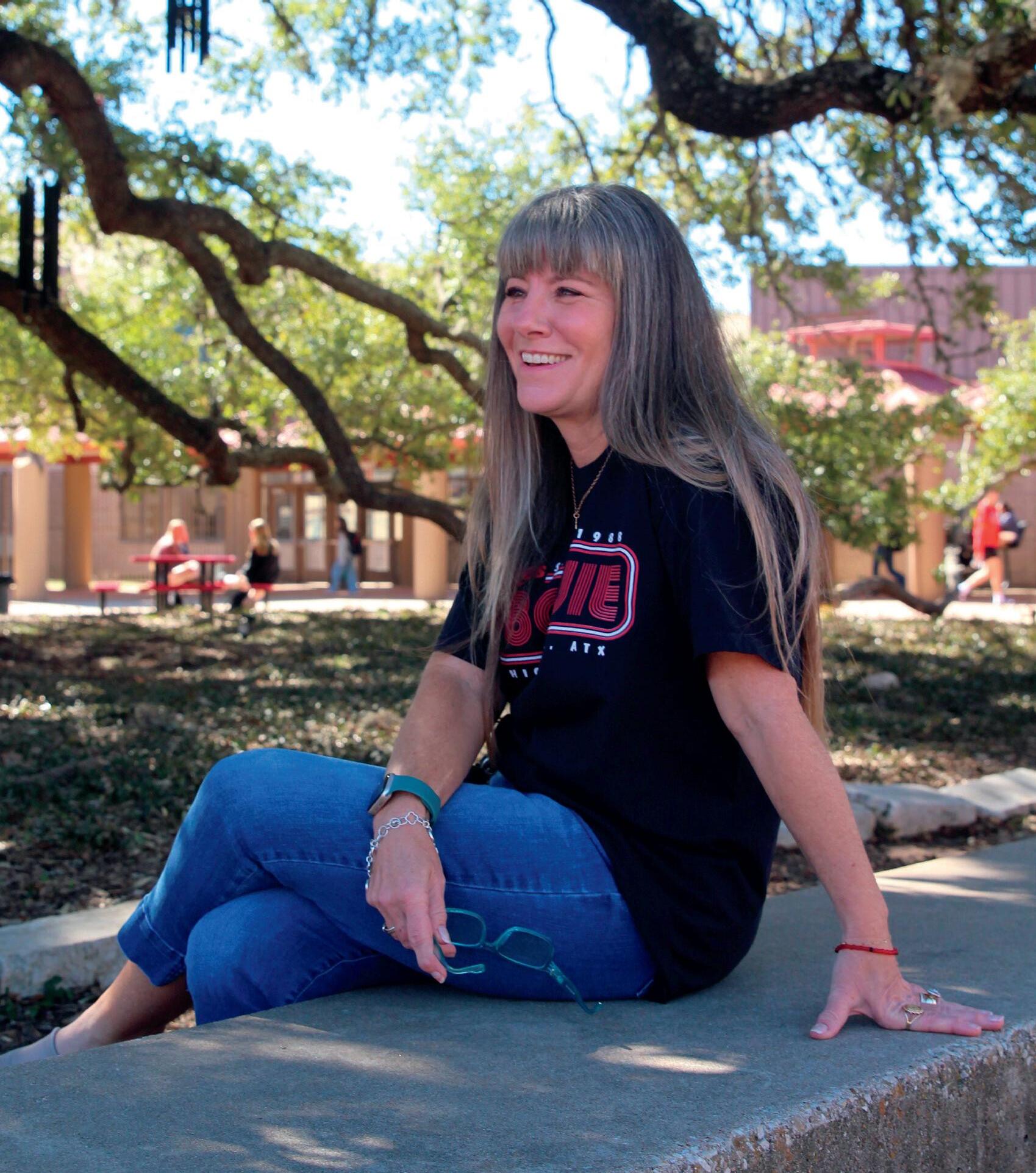
“One of my strengths is that I really like systems, I have to have systems in place because these are large campuses and I need to know what’s going on,” Mitchell said.
“One of the things I noticed about this campus is that there isn’t a master calendar, which I think is kind of crazy. There’s so much happening, and there’s not one place to look to see everything. I want to help create something like that so when the new principal comes in, they can easily see what’s going on.”
the school year, she has acknowledged that there are several challenges that she needs to work with administration to navigate.
Its nice to have someone come in who is committed to helping the school, and because they're new, they want whats best for us.
Natalie Frey Senior
As Mitchell looks ahead at the remainder of
Morgan Hertel Dispatch Reporter
Students pass through the halls, voices fill the air, they begin to file into the same math classroom they have gone to all year, except a different face greets them at the door. In the doorway stands new geometry teacher Connor Bootz, welcoming students as they walk in.
After the first semester, former geometry teacher Davis Tran left to take on a new job as a flight attendant. This left students with a substitute for about a week before Bootz took the job as the new geometry teacher.
“This is my sixth year teaching,” Bootz said. “Before I came to Bowie, I was teaching at James Campbell High School, where I lived in Ewa Beach, Hawaii, and prior to that, I was teaching at Dr. Kirk Lewis Career in Technical High School in Houston.”
Although Bootz used to teach in Houston and also attended Texas A&M University, he is new to the Austin area. He explains that he moved to Austin with his wife and his kid so that they could be closer to family.
“I heard that Bowie has really good students and that there are a lot of really good communities that surround the area,” Bootz said. “I think that a lot of good programs and systems are instilled into the school as well.”
According to Bootz, he originally got his inspiration for wanting to be a teacher from his geometry teacher when he was in school. Bootz explains that he wasn’t a very good student in high school, but his teacher made him value the structure of high school.
“My old teacher later became the principal of the school that I had originally worked at,” Bootz said. “When I moved back to Houston, after college and after traveling, he mentioned that he was a principal, and he said that if I wanted to teach, then I could. So, then I became a long-term sub and I really loved it.”
At his old schools, Bootz has taught geometry, multiple different levels of algebra, and statistics. However, at Bowie, Bootz took over Trans academic geometry classes, continuing on from where students left off during the first semester.
“Mr. Bootz has gone over some of the stuff that Coach Tran taught us so that we are more refreshed and have a better understanding of what we are doing,” sophomore Lauren Flowers said. “He is a great teacher. He is very kind and loud and
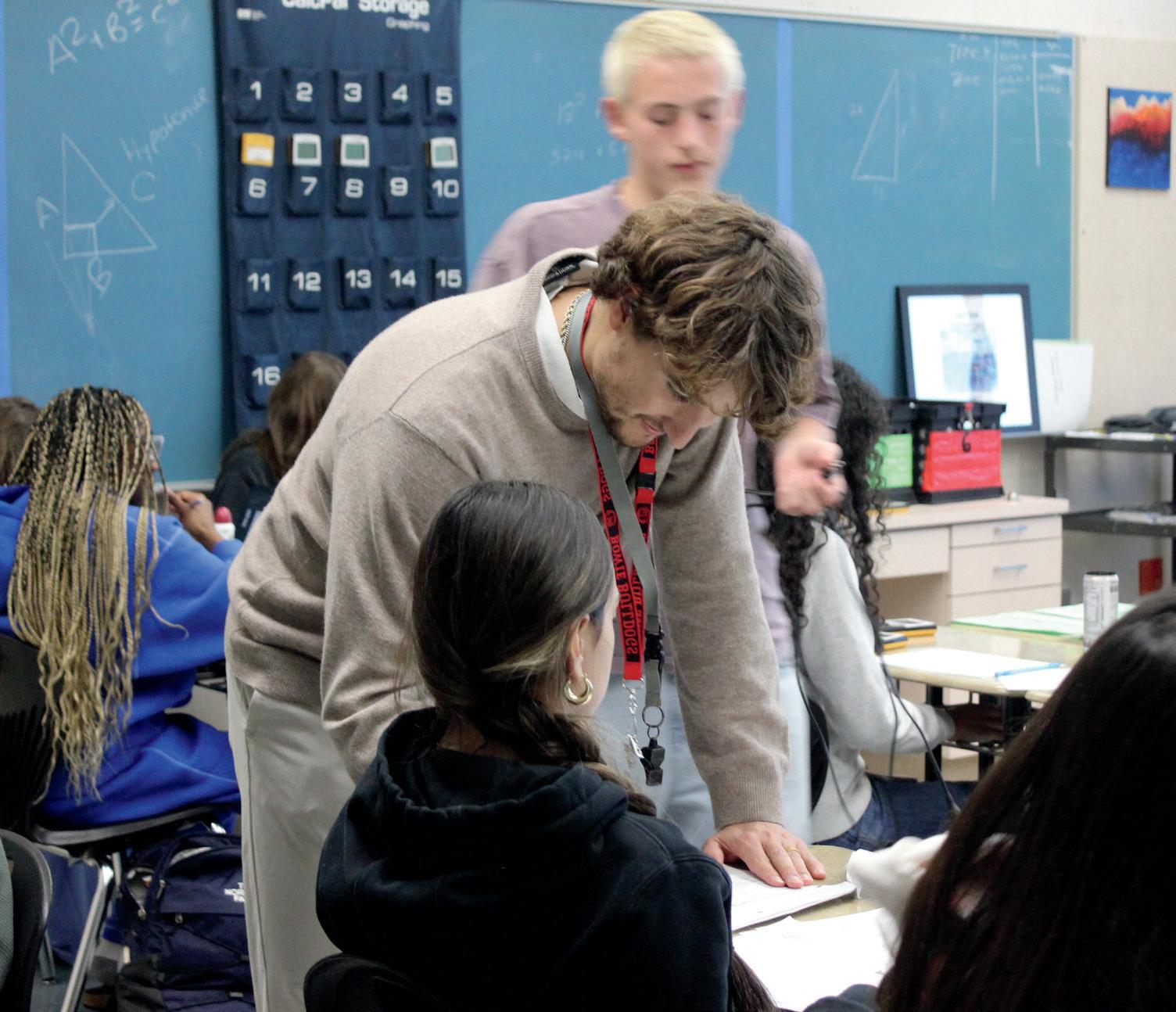
funny, and he always seems like he enjoys his job.”
Geometry teacher Kristen Cayer explains how the transition after Tran left was fairly smooth. According to Cayer, Bootz was able to step in and start the position right away as he helped the students and continued to move forward.
“For the most part the transition has been pretty seamless,” Bootz said. “I think people and students specifically are very similar, no matter where they're coming from. They're very reflective of the culture and society around them. The kids here get a lot of freedom and so getting used to balancing that as to what structures are already in place has been an interesting part of the transition.”
Since joining the classroom mid-year and having previous teaching experience, Bootz has developed his own teaching approach. Bootz explains that it is important to have structures and rules in place for students and that it is important to hold everyone accountable.
“I am very energetic in my teaching style, and I’m a little sporadic or unorganized, but I’m very passionate,” Bootz said. ”I prefer to view every one of my students as a person, rather than just viewing them as one of my geometry students. I also like to try and balance every aspect of their life when I'm asking them to get a certain thing done. I also like to utilize comprehension and understanding rather than completion and busy work.”
Even though Bootz has only been at Bowie for a short amount of time, Cayer explains she has already noticed the impact that he has made on the students so far. According to Cayer, all of the students that she has talked to have seemed to like Bootz a lot.
“Mr. Bootz obviously really cares about his students, which is the best kind of teacher that you can have,” Cayer said. “I think that the kids really appreciate Mr Bootz’ patience and his ability to help them understand the material better.”
“One of the biggest challenges is scheduling for next year, especially once students start turning in their choice sheets,” Mitchell said. “We have to build the schedule and the budget at the same time and make sure we have enough teachers for all the classes we need. That’s always stressful, and it’s a challenge every year. On top of that, Slaughter Lane is going down to one lane for five weeks, so traffic is already something we’re trying to plan around.”
Annual education rating of AISD schools results in an A for Bowie
The Texas Education Agency (TEA) came out with its yearly School Report Cards for the 2023-24 and 2024-25 school years on January 16.
According to the TEA, this report measures how much students in each grade level are learning, and whether or not they are considered ready for the next grade level. This report also helps show how well a school prepares its students for success after high school in college, the workforce, or the military.
“Bowie was rated as an A campus, and that is traditionally where we tend to fall in line,” Academic Director Kaylin Brett said. “A few years ago, we did have a B, but we fixed a lot of things and created new systems to bring our school back up to an A. This score just helps reiterate that Bowie is a high-performing school, and we have high expectations not just for our students, but our parents also push us to be a great school.”
According to TEA, the overall grades are based on the school’s performance in three different areas: School Progress, Closing the Gaps, and Student Achievement, with Bowie getting a 93 out of 100 in every category except for School Progress, which got an 84. School Progress is defined as how much better students are doing compared to last year. Closing the Gap is analyzed by TEA, with them considering if there is a performance gap among different groups of students, and Student Achievement is just based on how much students know.
“It’s cool that our school got an A,” freshman Luke Etheridge said. “I think we got this score because we have good teachers and a lot of smart kids go here.”
When TEA is analyzing a school’s progress, they measure two things: Academic Growth and Relative Performance. Academic Growth is an analysis of how much students grow by at least one school year, and Relative Performance is how students at one school compare performance-wise on STAAR tests to another school. Bowie scored a 77 on Academic Growth and got an 84 on Relative Performance.
“Students at Bowie take testing pretty seriously because they start to think about college early on,” sophomore Sam Norton said. “Around sophomore year rank comes out, GPA starts to matter and scholarship opportunities start to open up which I think causes people to care more about STAAR and other tests.”
According to Brett, Bowie has increased their score in the Closing the Gap category. In this area, students are broken down into groups such as male, female, ethnicity, economically disadvantaged and English language learners to compare their performances to each other. Brett feels that the school is making sure that all students are performing at a similar rate.
“The report just came out, so we’re still working through all the data,” Brett said.
“When you have a school that is rated an A, it causes more students to want to attend that school. I think that a good school performance creates a domino effect of the school performing well, which causes the community to develop around the school which is why I always believe that a school is the center of a community.” STORY BY Katie Grumet
Charlotte Schwarte Executive Objective Editor
The kitchen is still filled with the smell of warm butter and sugar as junior Ryker Smith steadies his hand and begins to ice. The cake is crumbly, the kitchen too hot, and the piping bag is hard to hold as Smith deliberately swirls the frosting into florets. However, he can already picture the finished creation in his mind, and pushes his sleeves back as he prepares to continue.
Smith started baking when he was five years old, and he’s now taken that passion into his personal business, Cakes By Ryker. He completes orders for paying customers, as well as making cakes for the non-profit organization Bake-a-Wish Austin.
“My grandmother is the inspiration for all of my baking, she cooked and baked with me as a child and I followed in her footsteps,” Smith said. “I first started making cakes because, in all honesty, I hated H-E-B cakes. I enjoy baking because it’s challenging, and I’m a perfectionist.”
Bake-A-Wish allows for professional and at-home bakers to bake birthday cakes for people in need, with Smith specializing in baking for children. He first got involved after visiting a cake baking competition where Bake-AWish was advertising their opportunities, and now regularly creates confections

for them.
“I’m making cakes for kids that wouldn’t regularly get a cake, so I think I’m making a huge impact,” Smith said. “Even though they’re going through so much struggle, and I don’t even know what it is they’re going through, I hope they know that there’s people out there who are supporting them, and are willing to do something like bake a birthday cake for them.”
To volunteer with Bake-AWish, Smith uses a spreadsheet of orders from the organization, and given only the child in need’s name, age, and interests, creates a birthday cake personalized to them. He then delivers the cakes to the Bake-A-Wish office, which then gifts them to the recipients.
“Ryker has found so much joy in sharing his passion of baking with others, whether it's baking a cake for a child in need or creating the perfect cake as a gift for someone's birthday,”
Ryker’s mother Jen Smith said.

“His cake creations have brought happiness to so many people and I hope his experiences with baking reminds him throughout his life the impact that something as simple as a cake can have on someone's life.”
Cakes By Ryker as a business began in 8th grade for Smith, with the BakeA-Wish contributions starting later in high school. However, he doesn’t only make cakes, creating a wide variety of baked goods, with his favorite being his chocolate chip cookies.
“A lot of people don’t like cake,
and even though it’s not my favorite, I want to change people’s perspectives on it,” Smith said. “It can be really, really good. There’s a lot of different techniques and flavors. I also just like having a positive impact on people in general. I like getting their reaction, making them happy, because I love food, and I like introducing new food to other people.“ Smith started his baking journey by just making goods for his friends and family, which he continues to do today. He states that Cakes By Ryker
is more of a hobby than business, and contributes his baked goods to birthdays and school events alike.
“He puts a lot of time and effort into his baking,” friend Gage King said. “He doesn’t let little mistakes mess him up, and he will take all day if he has to make something good. His baking has always been the best I’ve ever tasted.”
Among the people Smith has baked for is Bowie AP US History teacher Jessica Isaacs, whom Smith made a holiday party cake for freshman year. She states that it was a huge success, with the snowman tiered cake remaining a favorite topic of conversation among her friends.
“Ryker is delightful,” Isaacs said. “He is very studious, he’s very kind, he’s very intelligent, he is super outgoing, and I think that he is going to be a really successful person one day. I was very pleasantly surprised when I saw the cake he made because it was so amazing. Everyone at my party loved it, and they raved about it.” Smith’s cakes are products of laborious work, most taking two days in order too accommodate cooling times and frosting. Embellished with chocolate covered strawberries, gold leaf, decorative flowers, cartoonish designs, and many tiers, his work can be found on the dedicated Instagram account @cakes.byryker.
“I enjoy baking, but a lot of the time it’s really stressful, if I’m being honest,” Smith said. “I struggle with perfectionism, so I love making the cakes and getting the reaction, but actually getting there is definitely a process.”
Ryker plans on pursuing finance, investment or real estate, with baking taking the back-burner in terms of careers. Outside of his personal baking pursuits, he is a member of the Bowie lacrosse team, Business Professionals of America, PALS, and the Culinary Program; works as both a food runner at Carve and counselor at Camp Longhorn; and is Co-President of the Young Investor’s Society.
“Ryker has learned many valuable skills from baking and selling his cakes,” Jen said. “It's not easy to manage all of the details, even at a small scale. From buying the supplies, providing excellent customer service and a quality product, and managing your time during the process with other responsibilities. All of these will be valuable learning opportunities for him to take into his career or next phase of his life.”
Madeline White Dispatch Reporter
Senior Felix Moran sits at a desk, gripping his pencil as his hand flies across the newest page of a sketchbook. Moran’s mind is full of concentra
tion as he begins a design of a car, trying to make the image in his mind come to life. Moran has expressed an interest in cars and art since before he was ten years old, and began to combine his two hobbies around his sophomore year. As he approached the second semester of his junior year, he began to see his pastime as a future career path.
“I’ve always done advanced arts, ever since middle school,” Moran said. “I liked cars separately, and then I thought, ‘what if I put them together’?”
Raised in an expressive household, Moran has been encouraged to make art by his parents since he was young. In addition to his main media choice of pencil and paper, Moran will also occasionally paint.
“Both of my parents do art in their spare time, they’re very creative,” Moran said. “They really inspire me, and have always been pushing me to create stuff, even if it’s not
spending his time creating his art based on photos he has taken of the world around him, and engaging with others regarding drawing and design.
“Felix has a passion for design,” Felix’s mom Cheryl Moran said. “He is energized by spending hours working on sketches, and he also loves connecting with peers and mentors to share and develop new ideas. He truly is in his element.”
Creating art based on his love of cars, Felix developed an enthusiasm for transportation design. He was accepted into Art Center, in Los Angeles, California, and the College for Creative Studies, in Detroit, Michigan, where he recently committed.
“It’s something I’ve always done, because I always need to be creating something, no matter what it is,” Felix said. “I feel like cars these days are becoming boring, so I just want to put my perspective out, to show what I think cars should be.”
Felix puts everything down on paper, as he believes that no idea is bad. He completes several designs of various vehicles every day, and has finished four sketchbooks with his drawings from the past four months.

“I’m always sketching, every day,” Felix said. “I finish five to ten pages in my sketchbook a day, just putting anything out on the page, and if anything catches my eye that I could develop further, then I’ll do more sketches and start on a final design.”
A majority of Felix’s designs are created during free time in his classes, and he will occasionally sit down and sketch with his friends. He takes pride in his artwork and enjoys sharing this large part of his life with his friends.
“I think it’s great that he’s super interested in it, and that he’s really applied himself,” senior Sam Munger said. “We’ll share sketches and projects sometimes, and all his stuff is really good.”
Every so often Felix finds himself in a creative block, and has discovered the best way to get out of it is to continue his regular routine of putting any design he can think of into the world.
“Even if I have no idea what I’m gonna draw, I force myself to,” Felix said. “Sometimes it’ll look really bad, and I’m not feeling inspired that day, but I just have to get through it.”
Felix is at the beginning of his time in the transportation design industry, and he tries to create an assorted array of designs in order to build up his portfolio. He practices designing transportation for different situations, such as predicting what the future of transportation will look like.
“He explores diversity in the designs and types of vehicles he designs,” Cheryl said. “I’m

impressed not only by his designs, but his ability to articulate the influences and intent for his designs.”
In addition to his creative home life, Felix has taken an advanced art class all four years of high school. Currently he is taking AP studio art and drawing, where he has discovered his design and drawing skills benefit from learning some of the art basics.
“It just pushes me to always be doing some sort of art,” Felix said. “Even if it’s not design, it’s learning how to shade, do perspective, and all that stuff.”
Felix creates his designs with the future in mind, hoping that one day his ideas will come to life. His commitment to CCS makes a future in transportation design and his dream a possibility.
“That’s the end goal, I would feel super accomplished,” Felix said. “One day I think it will happen, and I don’t want to be too cocky, but I really hope so.”
Currently, Felix’s design process consists primarily of sketches with pencil and paper. Going
into the transportation design field, he hopes to have the chance to experiment with designing with different mediums.
“Right now I’m doing designs on a smaller scale,” Felix said. “Once I get to the super high levels, you start working with clay modeling, and I’m really excited for that.” Before he committed, Felix participated in a three week summer course on transportation design at CCS over the summer, which left him with excitement for his future. The college offers many opportunities for hand-on education, as well as an almost 100% placement in careers in that field, leaving his parents assured Felix has found his path.
“I think that anything a person does to develop themselves and enjoy themselves in a healthy way can benefit their entire lives,” Cheryl said. “I’m very happy that he has found his
Fite grows personal hairstyling business after
Savannah Riggins Feature Editor
In bedrooms turned makeshift salons and kitchens under early morning lights, frustration has been replaced with confidence. Fly-aways are laid to rest, and curls are coaxed into order. At the center of it all stands sophomore Sarah Fite with a comb in hand and a satisfied smile on her face. Although there is no sign on the door, no appointment book, and no large paycheck waiting at the end of the day, her reputation has grown amongst friends and strangers.
Fite first began tackling the art of hairstyling four years ago. She began with her own hair in middle school and has continued to practice her craft; all the while, her skills and confidence have grown.
“I started doing my own hair in sixth grade,” Fite said. “I had been getting salon haircuts, and they were just so expensive, so one day I decided to do it myself instead. At first, I just cut my hair, and I’m not going to lie, it was definitely a rough beginning. But, I slowly began to get it down, and I moved on to learning more skills, like dying and bleaching my hair.”
Despite this rough beginning Fite was deterred. She kept learning through a process of trial and error until she felt skilled enough to begin working on hair other than her own.
“I didn’t start doing other people’s hair until about two years ago,” Fite said. “I needed the time to make sure that I felt ready because it is a lot of pressure and trust that someone gives you when you do their hair. I first worked on my friend’s hair, but now I’ve gotten in contact with a few people that I didn’t know at first, and I’ve done their hair, too.”
One of Fite’s clients is fellow grade-level student and friend, Scarlett Wray. According to Wray, they have known each other since sixth grade and have been close friends ever since then. Wray had her hair done
by Fite this summer, and was one of the first people that Fite began doing hair for. “I told Sarah that she could experiment on my hair at the beginning of this summer,” Wray said. “I came to her with the idea to do a teal color that looked like the Baja Blast drink from Taco Bell. I wanted it done on the underside of my hair. She also added some of her own flair to the style by adding raccoon tails. I thought it all turned out really good and the color stayed for a long time.”
Wray has not only been one of her clients, but she is also Fite’s connection to the professional beauty industry. Wray’s mom, Holly Wray, owns Yellow Door Salon, which is a local beauty salon. According to Fite, this connection to a licensed beautician offers many learning opportunities to hone her skills. “I have helped Sarah just here and there,” Holly said.
“Sometimes adjusting the cut or helping with color which usually consists of helping bleach her roots. She honestly doesn’t need much help.”
According to Holly, Fite is very creative and bold which is something that stands out about her when it comes to hair styling. As mentioned by Holly those traits have the potential to open up many doors for Fite in the beauty industry.
“What I’m most impressed with is that Sarah actually has the balls to cut her own hair with no actual education in how to do that,” Holly said. “I think the sky is the limit for Sarah. She is super creative and willing to try things that I never would have done, especially in high school. She definitely has a look and a knack for hair and is willing to take risks and mess up. She doesn’t care what others think and doesn’t feel the need to look like everyone else. I love it”
While Fite does spend time doing hair, for her, it is more of a hobby than a job. She doesn’t typically charge for her services and just lets herself enjoy the process.
“Doing people’s hair is just
Zoe Stover Dispatch Reporter
Firmly holding the pristine wooden instrument in hand, she presses the waxed seal of the didgeridoo to her lips. As she slowly exhales, the room is filled with a rich, mysterious sound. She harnesses the tunes into a steady rhythm; a heartbeat of sound and wonder.
Senior Gianna Sanchez, a lifelong musical enthusiast, decided to focus her creative energy on a new kind of sound. She wanted to try something exotic, something out of the ordinary to expand her musical repertoire. Fascinated by the unique history and distinct sound of the didgeridoo, she decided to give the rare instrument a try. Didgeridoos, widely unheard of in America, are large wooden instruments carved from the eucalyptus trees of Australia.
“I already play some instruments, and I wanted to learn something new that sounds interesting,” Sanchez said.
“The didgeridoo is so interesting and beautiful to me because it is music in its purest form. It makes me feel connected to my body, slightly moving my tongue in different positions and my diaphragm to produce different sounds.”
Traditional didgeridoos are carved from eucalyptus trees that have been hollowed out by termites, which creates the basic structure of the instru-

fun for me more than anything, it doesn’t feel like a chore,” Fite said. “It’s more of a ‘pay what you can’ if it’s a haircut or something easy, and if it’s something I want to do, then obviously, I won’t charge. But if it’s going to take five hours of bleaching and cutting, then some money would be nice.”
Fite has experience with a variety of hair types, including curls and more masculine hairstyles. According to her, one of her favorite styles to do is highlights.
“I love working on different hair types,” Fite said. “But, doing highlights is a lot of fun, and more complicated than other styles, because it really depends on the type of hair that you have and how light you’re trying to go. There are a lot more things to take into consideration. And

ment. Didgeridoos originated from the Aboriginal people of Australia, who used the instrument for ceremonial dancing and spiritual songs.
“I find the origin of the didgeridoo beautiful simply because of how resourceful and intelligent human minds can be,” Sanchez said. “I just love that no matter where you are in the world, people find a way to express themselves creatively, making art and music from the simple components the earth gives.” Sanchez has a musical foundation of piano and guitar, which made it
bleach is a more volatile form of lightning, so you need to be careful. I’ve even had it explode in my bathroom a few times.”
According to Fite, she has come very far along her hair journey. However, things weren’t always smooth sailing, and she has had some rough patches that required her to rebuild her confidence.
The biggest one was the last time she got her hair professionally done. They had not given her the hairstyle she wanted, and she had the idea to do it herself to avoid another salon fee.
“My hair had been really long before. I wanted it cut shorter with layers added,” Fite said. “They definitely didn’t give me layers, and my hair was cut to about a bob length. I was really upset with it, and I thought that I would be able to do the layers on myself. So, I took craft

easier for her to pick up a new instrument. Around four months ago, she purchased her yard-long didgeridoo from Amazon to tackle the challenge of mastering a new form of music.
“It’s very relaxing,” Sanchez said. “It kind of takes me away from everything else, because I’m trying to focus on keeping the sound constant, and I also have to circular breathe while I play.”
Circular breathing is a woodwind instrument technique that allows the musician to keep the sound constant as they breathe. Sanchez researched
scissors and, without watching any tutorials, I started cutting. Let’s just say it turned out very unfortunate, but I’m the type of person who takes bad situations and uses them as a motivation to improve.”
When thinking about continuing her career in the beauty industry, Fite is still unclear. As she doesn’t want hairdressing to become a chore instead of a hobby, but as of right now, she still plans to expand her knowledge and keep enhancing her skills.
“I feel like once you turn a hobby into a job, it stops being a hobby,” Fite said. “If I do end up getting my cosmetology license, I would use it to get better materials, but I don’t think I would work in a salon full-time.
As Fite reflects on her progress, she considers how far she’s come and what doing hair means to her.
“Doing hair is my way of

videos on breath work, as well as how to make the signature drone sound of the didgeridoo, to improve her performance. To practice her skills, Sanchez meets with seniors Lyla Womack and Priscilla Mier for fun musical freestyle sessions.
“It’s for my friends and me, me and my friends,” Sanchez said. “It’s fun, it’s easy, and it gives me something to do after school. My favorite part is learning new sounds and honing in on what I already know.”
When playing music together, Womack and Mier often alternate be-
expressing myself. While some people get piercings or tattoos, styling hair is its own form of art,” Fite said “I love the ability to change something about myself and the freedom that it gives me. When I think back to the beginning, I would tell myself to just keep going, because it has been so worth it. Looking back, I feel like I’ve become the person that I was looking up to.”
tween instruments like the xylophone, guitar, drums, and meditation bowl. The trio have a free and spontaneous style of playing, harmonizing and building riffs off one another to create songs.
“I didn’t even know what a didgeridoo was before she started playing, and when she started picking it up, I thought it was a really interesting-sounding instrument,” Mier said. “I think it’s really cool that we’re getting to experience listening to such exotic instruments in a place that isn’t exotic, at least to us. I think it’s really cool, and I admire her.”
In addition to playing the didgeridoo, Sanchez has other hidden talents that spark her creativity. She taught herself Mongolian throat singing and enjoys crafting papier- mache fish and felt puppets in her free time.
“She does literally whatever she wants, like she doesn’t care if anyone’s judging her,” Womack said. “She just wants to play and do funny stuff just to bring joy to people, and that’s awesome.”
The court buzzes with energy as the Bowie Boys volleyball team practices hard in anticipation for their season. They work through countless drills to get ready for their first game in less than a month.
The team is a club organization, not UIL like Bowie’s girls volleyball team, so they are currently based in the gym at Bethany Church, right across the street from Bowie. This also means that their coach is a parent volunteer instead of someone employed at the high school, but according to senior captain Matthew Villanueva all the players wouldn’t want anyone else as their coach.
of skill on it, and I’m always learning new things from my teammates who play club,” Medina said. “I sometimes practice outside of school with my dad and my friends, and I don’t really have a lot of pressure when playing for Bowie and can just have fun.”
According to manager Sofia Zamora, the team has vastly improved since the start of practices and they are becoming a more competitive program by the day. As manager, she is able to watch the team’s progress from the sidelines by taking stats, or scrimmaging with them during practice if they have an odd number.
“This is my first year managing for the team and the majority of my responsibility is just to be at practice and help anywhere I’m needed,” Zamora said. “My favorite part is seeing how much the players improve over time and how relationships develop between players as the team learns to work together.”
"“Coach Fechter is just such a good guy and a really great coach,” Villanueva said. “He played volleyball in San Diego, so he knows how to play a fast paced game and at a high level too. His drills allow us to learn from him and get better as athletes.”
Tryouts were held earlier in the school year to decide who would make the team and who wouldn’t. Boys volleyball only has one team, so although most people who tried out made the team, but there were some cuts. The team practices once a week on Tuesdays and mostly scrimmage in preparation to face off against competitive teams like Westwood.
The community of our team is so great, and I love to see the students section show up to all the games.
Matthew Villanueva Senior boys volleyball captain
“Recently practices have been focused on getting ready for our game against Westwood at the end of this month,” junior Rocco Medeiros said. “I’m excited for it and I think the team has a really good chance of winning if we keep focused and play well.”
Both Medeiros and Villanueva play club volleyball outside of school and try to bring the same competitiveness to the school team. Their club is called Austin Junior Volleyball, a competitive program where teams all over Austin play teams from around Texas.
“It’s a much higher level of play at club and every kid is stronger and bigger,” Villanueva said. “You have to be at a certain level of athleticism to be able to compete well, and I want that to be the way it is during school games too.” A big part of the program is made up of students who don’t play club volleyball outside of school. One of these players is junior Julian Medina who plays setter and is new to the team this year.
“Our team has a lot of different levels
Every practice draws the team closer together as they work hard and share their love of volleyball with one another. According to Villanueva, having a community of people that share the same passion as you at school is a motivation to always show up and try his hardest.
“The community of our team is so great, and I love to see the students section show up to all the games,” Villanueva said. “It’s very fun to be able to practice with my friends and see people I know supporting the team at the games.”
This is Villanueva’s senior season, and he believes the team can make a really good run in playoffs. As captain, it’s his job to prepare them to face off against those competitive teams and keep them focused on their goal of going to state.
“Being captain means keeping everybody in check,” Villanueva said. “We can get off track sometimes, but it’s important to stay focused for the start of our season. I also help everybody out if they don’t understand a drill and encourage them to practice hard.”
Along with strong leadership, the team is fueled by high expectations for the season ahead. The focus has shifted from just practicing to competing and players, coaches, and managers are enthusiastic at the promise of a strong season.
“I am looking forward to a lot of things this season, especially playing Vista Ridge because it should be a very competitive and fun game,” Zamora said. “I love that I can be a part of this team and I can’t wait to watch them do really well this season.”

SERVING UP SUCCESS: Junior Thomas Morvant looks at the ball as he prepares to serve it over the net. The boys’ volleyball team practices which consists of drills, scrimmages, and working on ball control. “This volleyball season will be very entertaining and will leave us with a positive record,” Morvant said. “The team is doing fabulous, so we will likely have good precision.”

SPIKING IT DOWN: Junior Morgan Whited sticks his hand out to block the ball from making it over the net. The first game of the season is against Westwood on February 19. “We have a lot of young people on the team, like freshmen and sophomores,” Whited said. “We have a pretty good team, though there’s definitely a lot of room for growth. It’s better than last year.”
JUMPING HIGH: Junior Rocco Medeiros leaps to spike the ball over the net during the boys’ volleyball practice. Boys’ volleyball is not a UIL sport, so they have to practice at Bethany Church. “So far, the season is going really well, especially since we only get one practice a week,” Medeiros said. “We are really getting closer as a team through team dinners, and I think it has helped us grow a lot more as a family. We should do really well this year.”
PHOTO BY Ashley Marcus


HUDDLE UP: The varsity Bowie boys volleyball team huddles together during their practice. Debriefing after their practices is a common routine for the team, helping them to understand each other better.
“The team is really just a family,” junior Jayden Youngblood said. “Everybody loves each other, so we can compete well together.”

are looking forward to it,”
Liberty Pittman Media Editor-in-Chief
Getting ready to leave the house to head to H-E-B, she pauses, taking a moment to decide if it is really worth it to leave if it means putting herself at risk of a run in with U.S. Immigration and Customs Enforcement (ICE). What once felt completely normal, now feels odd for senior Alison Milla as ICE presence increases in and around the Austin area.
Milla legally immigrated from Honduras around six years ago, and has worked to create a new life for herself here in the U.S., but what once felt like an open world of opportunity now feels to her like a place where people are targeted because of their background.
“At this point I don't feel welcome, and I don't feel like I'm given the opportunity to also achieve my goals,” Milla said. “I definitely don't feel like it's a free country at all, and I'm not trying to say I should be treated as a native born citizen, but I also shouldn't be treated like another species, like an alien. I feel like they're pretty much trying to push me out and push my people out, without realizing that we also deserve a chance to have a life here.”

Milla is not the only one who feels that what is currently going on with ICE in the U.S. is wrong. Protests have broken out across the country, and have only been fueled by recent controversial actions by ICE including the shootings of two American citizens. This outrage has made its way to the Austin area with protests popping up all over the city, and walkouts taking place at 14 Austin Independent School District (AISD) schools on January 30.
“It's really good that people are spreading awareness and making their voices heard and letting representatives know that we're aware of this and we're not just going to let it happen,” senior Ethan Pfeiffer said. “We're letting our representatives know this isn't what we want. This is what the administration is doing out of their own greed because it serves their agenda, and not because it’s what the people want.”
According to the official ICE website, the mission of ICE is to enforce immigration laws, and conduct criminal investigations in order to protect America and preserve both national security and public safety. The website states that while the main focus of ICE is to secure the U.S. borders and safeguard the immigration system, the majority of ICE missions take place in the interior of the country.
“I understand their goal, but the way they're executing it is wrong,” Milla said. “They've exceeded the limit from going just for criminals and people who are not bringing a positive thing to the country as a whole. Now, they are just targeting people based on race, based on color, and based on appearance, and I feel like they are just encroaching on our human rights as citizens.”
According to the ICE website, the eligibility requirements for someone to apply to be a deportation officer include U.S. citizenship, having a valid drivers license, being eligible to carry a gun, and being under 40 years old. Applicants also have to pass a fitness test and go through a vetting process which can take anywhere from two weeks to one year. According to the ICE website, once hired, officers must go through a five week Spanish language training, and a 16 week immigration and law enforcement training. According to PBS White House Correspondent Liz Landers, the reported 10,000 agents hired in 2025 has left some people concerned about ICE recruitment tactics, hiring practices, and training standards.
“I've seen videos of ICE in situations where people got hurt and killed, and they just act very unprofessionally,” senior Owen Hayden said. “They're just really aggressive, tear gassing kids and stuff, and I don't think any kind of training would tell someone that is okay. They're not just targeting a certain group of people, they're targeting everyone, like, anyone that speaks out against them, so it feels like no one's safe, and that's really scary.”
ICE has received a lot of scrutiny over their practices in the field recently due to posts and videos spread of them wearing masks, forcefully detaining people, using tear gas, using pepper spray, and arresting people without giving a reason. In addition to this, many wonder if ICE is truly standing by its mission to go after “the worst of the worst,” with The Guardian reporting that more than 328,000 people were arrested by ICE and nearly 327,000 people were deported by ICE since October 14, 2025 with the arrests of those with no criminal record significantly surpassing that of those with a criminal record or pending charges as of September 7, 2025. “What they're doing is really messed up,” Hayden said. “They're just breaking laws, and doing it without consequence. They're hiding their faces and hiding from responsibility. It's people that just want to hurt other people, just because they have an excuse to.”
According to the ICE website, ICE agents do not need a judicial warrant to arrest those they suspect to be “illegal aliens.” According to the American Immigration Council, in early September the Supreme Court opened up the potential for ICE to racially profile people, in the 6-3 ruling on the Vasquez Perdomo v. Noem case the court granted a request from the Trump administration, and allowed ICE agents to stop and question anyone they presume to be in the U.S. illegally, even if the reason for the stop is based on how one looks, the language they speak, where they are, or what they do for work.
“I've seen a lot of stories online of people being harassed by ICE, agents just taking them, breaking their windows, opening their doors without their consent and exceeding their boundaries and their personal space,” Milla said. “It makes me feel unsafe, and It makes me feel like I'm not welcomed in the country just because of how I look and how I talk. It makes me feel scared for me, my family, and my friends. At this point the legal stuff doesn’t matter, it's just how people look.”
On January 21, Austin Independent School District (AISD) Superintendent Matias Segura sent a message to the AISD community pledging to review and update school protocol in response to any changes to ICE policies or practices. Segura also re-emphasized that the district is “committed to serving all students and families, regardless of immigration status,” and mentioned that information regarding school policy pertaining to ICE is
available on the AISD website along with resources to support students, parents, and staff.
“Nothing's really changed for ICE related protocols as far as AISD's approach or guidance for us on the campus level,” Academic Director Kaylin Brett said. “We've definitely seen more ICE presence, and more activity, so I know that there's more need for us to understand the policy now. When we first got the policy last year, we didn't really do anything with it because we weren't seeing it. Now that we are seeing it, the last principal's meeting I was at principals requested for information about ICE related policies to be sent out again, and that's what generated Mr. Segura to send out the email.”
Currently, there is a step-by-step process schools can follow if ICE agents were to show up on campus. If ICE were to show up on campus, any documentation they have would be taken and sent to the AISD legal team for verification. The school administrators would then be in contact with the district office to receive guidance on how to proceed. Student Resource Officers (SRO’s) are also contacted to ensure student safety. According to Brett, local Austin superintendents have met with ICE and have been informed that it is not their typical practice or intent to come to school campuses.
“I don’t worry about ICE when I’m at school,” student Jane Doe* said.
“I live in a mostly Hispanic area, not around Bowie, so I feel like out here, I do feel safer and in the walls of my school, I don't fear anything happening to me. I definitely do worry about ICE when I’m at home. I have seen a lot of things on the news saying that ice is around where I live, and I live right next to a school where the majority of the student body is Hispanic, so it is really frightening. I am really scared for my parents whenever they leave the house, just because of the super sudden things that happen with ICE and people just living their lives.”
Mexico. People aren't able to go to work to make a living, and some kids aren't going to school because of it. It's impacting everyone in so many different ways.”
In addition to encouraging participation, the organizers have used their platform to remind prospective participants that their walkout is a form of peaceful protest. The group has advised protesters that they should counter opposition with respectful conversation rather than hostility in order to inform their fellow students rather than encourage violence. The group has also warned their fellow students to keep their protest clean, as signs with profanity can be taken by admin.
“It's so important not to be a bystander right now and not think this will get solved, because, in reality, it's not getting solved, it's getting worse,” Fellers said.
“It's going to make so much more of a difference if we all work together and that's why I especially wanted to have time in advance for the protest, because I really wanted the protest to have a community. I want the message to be extremely clear that this is about giving a voice to the people that aren't able to use their voice, and to show that it's all from a place of kindness and peace.”
" It makes me feel unsafe, and It makes me feel like I'm not welcomed in the country just because of how I look and how I talk.
Alison Milla Senior
AISD has resources available for families and staff in the case of an ICE related crisis. There are FAQ’s available on the AISD website for any clarifying questions involving ICE policy, and schools or families can request a parent support specialist who can provide families with guidance on many different topics.
“We have support services in the district where we can help students in different situations, because unfortunately, there are situations where things happen and kids don't have someone to go home to,” Brett said. “We do have services to support in those moments and in the moments afterwards, and I would hope that students would seek help. Even if they tell a friend, I hope the friend would come and seek help, speak up for them, and say, ‘let's go to your counselor or let's tell someone’ so that we can make sure that the student is safe to go wherever they end up after school.”
Along with providing support for families, AISD has also provided resources for teachers to navigate conversations about ICE with their students. According to Brett the main ideas emphasized to teachers is that they should listen if a student expresses concerns to them and support them while remaining neutral and being mindful not to take a political stance. According to the AISD website, Government, Debate, and World Cultures teachers are allowed to talk about how “political activities unfold and differing viewpoints are contemplated” as long as they remain neutral and are cautious to include multiple perspectives in their lessons.
“The closest I've gotten to a lesson about ICE is maybe in government, and it's mentioned completely indirectly,” Pfeiffer said. “There are lessons that have important information on how to see the error in ICE's ways. We learn about due process and how a government should be run, and then we have to be able to go out and research and see what ICE is actually doing, to see where the discrepancies are. There are also lessons in history where the same thing happens, but it's also not connected, we have to see the parallels for ourselves.”
A group of Bowie seniors, inspired by other protests around Austin and outraged with ICE behavior, decided to plan a walkout. The group of organizers consists of seniors Hannah Fellers, Lyla Womack, and Yazzie Bukhari. They planned for the walkout to take place on Friday, February 13, following the end of second lunch and have spread information using their Instagram account @bowieprotests. The group has worked to plan a route for the walkout, keep participants and admin informed about their plans, and encourage participants to dress in a way that reflects their culture in order to spread their message that everyone in America is an immigrant except natives.
“They're taking immigrants that are ‘illegal’, but this is Native American land, we're all immigrants,” Fellers said.
“What's happening with ICE is honestly terrifying. They're just going down the street and picking out any person of color that they see, and stereotyping them and that's obviously not moral or legal, especially when they don't have warrants to be doing so. It's really scary to see, especially in a state that's on the border of
While Fellers and other organizers are very passionate about their cause, they have also warned any students with pending immigration status, or worries about being a target of ICE not to come. The organizers also stated on their Instagram that they will have masks available for any students who wish to protest but have their face covered.
“I was originally going to be one of the people leading the protest, but my mom came to me and said that she was really afraid of me doing that and me being seen on TV,” Doe* said. “In that situation the government has all the power, and it is really frightening what they can do, and the ability that they have to find my family. So, for my safety, I don't plan on going to the protest, but I do really want to help out and speak out about ICE and how prejudice they're being against immigrants.”
Throughout the protest planning process Fellers stated that she received both support from the community offering to bring speakers and instruments, and hate from the community for being “woke.” In light of all of the different responses from the Bowie community Fellers wants to emphasize that regardless of political alignment, everyone is welcome to protest if they believe in the cause.
“Some people think this is supposed to be Democrats versus conservatives, but that isn't what it is,” Fellers said. “It's about innocent lives and people versus evil. It's just crazy to me that there's people who don't have basic morals, there's all these people being like, ‘Oh, this is woke.’ This isn't woke, this is just sympathy. That’s one of the reasons the protest is the day before Valentine's Day. This is for love. This is for the people. It's not about political parties. It's about human lives.”
*Jane Doe is a fictitious name created to protect the identity of a source who wished to remain anonymous.
WELCOME
In Robinson’s first year, he had many plans for Bowie including promoting belonging, encouraging S.E.L, and uniting Bowie.
This year, the nearly $1 billion dollar bond Robinson expressed hope about in his first few years was approved and began going into action.
With the Covid-19 pandemic forcing students into isolated and remote learning, Robinson’s
The nearly ten-year impact of now retired principal Mark Robinson
Elizabeth
Yowell Print Editor-in-Chief
“Good Morning Bulldog Nation!”
rang out in an enthusiastic voice across campus, as teachers and students looked up from their desks to hear the voice of new principal, Mark Robinson. On the first day of the 2017-2018 school year, Robinson introduced himself to the campus on speakers throughout the school, something no Bowie principal had ever done. On Jan. 19, Robinson served his last official day as principal at Bowie, but his legacy and impact on the campus will stay for years to come. Robinson was Bowie’s third principal in 30 years, leading the campus through a global pandemic, new construction, and an effort to unite the campus.
happenings and receive advice.
This year, the construction wrapped on the new parking garage, new athletic facilities and a new theatre were completed, entering Bowie into a new era.
After spring break the Corona Virus forced the campus into full shutdown, and teachers, students and administration were forced to adjust to new kinds of learning. BIG CHANGES
In fall 2025, schools all across AISD experienced huge changes as a result of a significant amount of new passed legislation for the education world including SB-12 and HB-1481
On
“I’ve been with him since 2021,”Administrative Assistant, Joanna Willard said. “There are a lot of things that with public education that are tough and he would take on those challenges and work hard for our school and I will miss that really hardworking integrity he had, always trying to get what was best for all our staff and students.”
2017-2019
Robinson has worked in education for three decades, and before Bowie he worked several administrative and educative jobs at a multitude of schools, including working as an 8th grade history teacher at an alternative disciplinary school in Arlington AISD. His experience working at the disciplinary school is what shaped a good portion of his plans coming into Bowie.
“I worked with kids dealing with just incredible situations, incredible challenges, and kids who were in really bad situations,” Robinson said. “One thing I’ve learned in my 30 years of education is that there are no bad kids, there’s no bad people.
"There’s people who have had bad role modeling, people who are in bad situations, people who have been dealt a bad hand, and the only way that you can get out of those situations is through empowering yourself with education and taking advantage of the opportunities that we have in order to improve your situation. And so being able to get really good at that, became the team leader and that’s where the idea that I could reach even more students, I could make a bigger impact and affect a bigger change started.”
“The principal panel was a group of students recommended by their social studies teachers who met with Mark Robinson on a monthly basis in order to discuss student opinions on new policies, events or rules,” Murray said. “For example, we discussed the implementation of things like ‘Character Strong’ and digital hall passes with Robinson and we got to know that he really cared about how these policies affect students’ lives.”
Many student’s and staff’s first impression of Robinson was those first morning announcements, where he opened with Bulldog Nation and closed with “and always remember that you belong at Bowie.” He would continue to close all his announcements this way.
"gaging was courageous. Then there was a need for connection, there was definitely a need for empathy, and those two things went hand in hand because everybody was in a different place. We needed to respect that we needed to meet people where they are, but then also maintain that connection because that was vital to everybody maintaining their sanity through that time of isolation.”
He really emphasized the different programs, and making sure that we have the necessary resources to be successful in those programs.
Alejandro Garcia Social Studies Teacher
“There’s so many different groups that didn’t exist prior to COVID, that his emphasis of ‘you belong at Bowie’ brought about, there truly is something for everybody,” 2026 teacher of the year Alejandro Garcia said. “As long as you want to take that sometimes scary step forward to say, ‘I want to try to do that. I’m going to try to join something,’ which takes something inside to want to actually say that. But he always emphasized that and I think it has served us well.”
Both Bulldog Nation and ‘you belong at Bowie’ were a key part of Robinson’s mission to embrace diversity and unite Bowie, under the idea of all being a part of one ‘Nation.’ These ideas became a big part of how Bowie knew Robinson, and would be the catalyst for a lot of change as the year went on.
One thing I’ve learned in my 30 years of education is that there are no bad kids, there’s no bad people.
Mark Robinson Former Principal
“‘The Bulldog Nation’ phrase is what he coined and said, all right, we’re all kind of aiming at one goal here, which you see everywhere, T-shirts and the gym and all the different things,” Garcia said. “He really emphasized the different programs, whether it’s student council or PALS or yearbook or newspaper and making sure that we have the necessary resources to be successful in those programs. ”
When coming to Bowie, Robinson hoped to unite the student body and connect kids across all different types of backgrounds and interests, bridging gaps between students with varying course levels. In a Bowie Dispatch feature published in 2017, Robinson shared that his biggest goal was to make certain every student felt like they had a place at Bowie.
“Principal Robinson would always treat everyone as equal and was very chatty, making people just feel like they were in the right place with him,” junior member of the principal panel Clover Murray said. “I think he impacted campus by always being around and available. would often see him walking around the halls or the courtyard, checking in on teachers and students.” Robinson came into the role of principal with a clear plan of action, and a few goals he wanted to accomplish fairly early on. These goals included an increased emphasis on social and emotional lessons, a push for the $1 billion AISD bond, and the introduction of new classroom tools, such as Chromebooks and Enriching Students.
“That’s kind of where ‘you belong at Bowie’ really started because we’d gotten really good at the science of education, but we needed to shift to the individualization, customization, personalization of learning so that we could really eliminate those achievement gaps,” Robinson said The principal’s panel is one example of a tradition Robinson started to help better unite the staff and students. In these panels, Robinson would meet with members to conduct general surveys about campus
In the center of Robinson’s tenure at Bowie was one of the most uncertain time periods in the education world; a global pandemic. The Covid-19 virus forced Bowie students into remote learning in much of 2020 and 2021, and had lasting social and learning impacts on the school for many years to follow.
“When it went from everybody coming here on campus to us being in everybody’s living rooms or homes or spaces, it was just a huge shift,” Robinson said. “A lot of the thinking was about the logistics of how do we do this? What are we allowed to do? What do we need to do? And it was liberating in a big way, but also terrifying because we’d never done it before.”
The pandemic not only created change in the physical aspects and daily routines that Robinson had established in the four years he had already been at Bowie, but it also presented challenges for Robinson’s hope to bridge the academic and social gaps between students at Bowie.
While students continued to be secluded to their homes unprepared for a school year turned ‘remote’ Robinson began sending out the ‘Bowie Star Newsletter,’ detailing official updates to students and parents. These newsletters were a staple of clear communication during a time of continuous mixed messaging.
“Clarity was really the fourth and probably the most important component in addition to courage, connection, empathy, clarity and communication because there was so much uncertainty at that time,” Robinson said. “It meant a lot to me that people saw that source of information as something that they could count on, something that they knew when they saw it in the newsletter that it was official.”
Robinson had a plan to combat the separation of students from campus, and it involved a beloved part of Bowie’s campus, the courtyard tree. In Robinson’s newsletters he coined the phrase “until we meet at the tree,” promising that one day Bowie would again be united, on campus and together.
“All of a sudden school is like where we all wanted to be,” Garcia said. “That’s because of him really pushing that mantra of ‘meet at the tree,’ that was the goal, that was the aim. His leadership style was that we wanted to rebuild our school to how great it was beforehand, and we’re going to take all these different steps to actually make that happen. And now looking in hindsight, six years after COVID, he did a fantastic job of doing that.”
"said. “We wanted every program to be on the same level and be able to be directly served here.”
As students began to come back to campus in 2021, Robinson continued to drive his hope to bring students together, “until we meet at the tree,” and encouraged the utilization of the new facility by supporting the revival of many extra-curriculars and the beginning of several new clubs.
“The pre-COVID world that he was here for versus what it is now is a completely different place, not because of COVID, but because of our attitudes towards school,”
Garcia said. “I can only speak really about the student council as the best example. We have tons of stuff to do everywhere, whether we’re painting, whether we’re gardening, whether we’re doing anything, literally around this campus and that’s how I personally took that mantra of you belong at Bowie and everybody belongs. The change that I’ve seen from that has been wonderful.”
2023-NOW
In Robinson’s final years, as schools all across America recovered from the pandemic and returned back to normalcy, Robinson’s long term goals for Bowie remained. Clubs and extra-curriculars were seeing an all time high in participation by students across different backgrounds.
He’s worked hard to protect our clubs and no matter what type of club that was
Joanna Willard Administrative Assistant
The empty campus presented the opportunity to move ahead with the construction project included in the $1 billion AISD bond Robinson was pushing for approval in 2017.
“When I got to Bowie, the facilities were identified as one of the most challenging things about the campus,” Robinson said. “There were some things that had begun to wear out and deteriorate and things that really needed repair. In addition, our programs and our participation in our programs and our student population was so large that, for example, we couldn’t fit all the students in band on the stage, or when the Silver Stars or dance would have a performance, we couldn’t get all the students in that dance class on the stage.” The updated facilities included a new athletic building, an additional 600-seat amphitheater, and a three-story parking garage. Robinson worked extensively with the construction team to make important decisions about where and how things would be built in order to bring Bowie together in the ways he hoped to unite the student body.
When it went from everybody coming here on campus to us being in everybody’s living rooms or homes or spaces, it was just a huge shift
Mark Robinson Former Principal
“The other thing that I figured out really quickly was that there were certain things that were kind of essential to being effective,” Robinson said. “One of them was the courage to engage because it took courage to lead at that time when everything was so uncertain. We’d never done it before, just en-
“We took that opportunity to solve some other problems because, at that point, the band was going to Burger [Athletic Center] every day to practice, and that is a lot of people and instruments to transport just to have band practice every day, and so we knew we needed to take that opportunity through this construction to bring programs back to campus, not to displace anybody else,” Robinson
“He would have those kinds of personal relationships. JROTC kids always come in the morning and do announcements and he would try to do that, but also for clubs, clubs are kind of being attacked by our state and he understood how important clubs are in a very big school like Bowie,” Willard said. “It’s important for a kiddo here to feel like they belong and they have a group and they’re not just by themselves. And so he’s worked hard to protect our clubs and no matter what type of club that was.” Robinson’s outward appearance to students may have been outgoing, consistently energetic and fairly social as he was often present at school events and went out of his way to interact with the campus. However, Robinson, and those close to him, consider him an introverted person.
“He may not have been a big outward personality kind of person, but again, he did little things for the staff,” Willard said. “He did the cookouts for the staff, and that was his way of wanting to have individual conversations when he came through. It’s hard to have those connections, but he really did want to have that connection to hear what’s going on with them in their classrooms.”
When Robinson announced his exit in January, many students and teachers were blind-sided by the news, especially with the exit coming so close to Robinson’s ten-year mark.
“I’ll always remember Robinson by his kindness and openness towards students, he believed anyone could contribute a good idea, not just other staff members,” Murray said.
“He spoke to everyone as equals, he would never talk down to people even though he was the head authority figure. I think ultimately Mark Robinson leaves behind a legacy of open-minded equitable relationships between school administrators and students that he fostered well during his time here.”
Bowie has gone through many changes in Robinson’s nine years, but Robinson will be remembered by the tree in the courtyard, the clubs which grow in size each year, and the echo of that familiar morning announcement closing.
“‘You belong at Bowie’ is a huge, foundational thing that I’m really hoping continues after I’m gone, just because Bowie is such a big school, it’s so easy for students to get lost if they’re not connected, if they don’t feel like they belong” Robinson said. “At the end of the day, it was really important for me
MAJOR MILESTONE: Featured in the Dispatch, Robinson reached the four-year milestone at Bowie with a multitude of accomplishments to be proud of.
FIRST DAY JITTERS:
CHEERING ON THE
The University Interscholastic League (UIL) realigned the sports districts with new classifications
On Monday February 2, the UIL committee released new classifications and alignments for football, basketball, and volleyball for Texas high schools. These classifications and alignments will last until 2028, when they are reexamined.
These realignments have caused shifts in the district for which Bowie plays in, District 26. For the 20262028 seasons the Bowie football, basketball, and volleyball teams will play against Akins, Austin High, Buda Hays, Buda Johnson, Del Valle, and Dripping Springs.
The reason that Westlake and Lake Travis moved districts is because of how the UIL decides on criteria for the realignment. Many different components go into where different schools are placed in their respective districts.
“The classifications for the high schools are based on student enrollment,” Athletic Director Jeff Ables said.
“Then the UIL places each school, in the same classification, in a specific district based on geographic location around other schools.”
With Lake Travis and Westlake being moved to a different district, the future for Bowie sports has changed. Senior Cameron Alsup commented on how next year could look different for Bowie.
“I think not having Westlake and Lake Travis in our district could honestly hurt Bowie sports in the long run as their programs and talent pushed us to work our hardest and grow as a team,” Alsup said. “However, It will be nice in the sense of traveling since we won’t have to drive to these locations anymore.”
Driving long distances is a reason UIL realigned almost every Texas district. But with the additions of Buda Johnson and Buda Hays, Bowie athletics will be driving a comparable distance to these schools.
“Driving to Johnson won’t be anything new for the soccer program since Johnson used to be in our district a few years back,” junior Maren Moore said. “I do think that playing Johnson and Hays instead of Westlake and Lake Travis will affect our standings in district play, and we’ll have a better chance at making the playoffs.”
Since Lake Travis and Westlake have been replaced with Buda Johnson and Buda Hays, some argue that Bowie has an easier route to the playoffs. Alsup explains her opinions on how the two new teams will impact Bowie sports.
“I think it’s nice to have a smaller district because it increases our chances of making playoffs, but then inconsistency in the districts can be frustrating,” Alsup said. “It will also be difficult next year as some of our best competitors are moving districts, so we won’t get as much exposure to challenging teams.”
The UIL realignment has sparked a mix of emotions among the Bowie community because of the new challenges that will arise. Ables describes how he believes the alignment will affect the ‘Dawgs.
“We are excited for the new district,” Ables said. “But understand that, like every realignment, it will be challenging for all of our sports.” STORY BY Caroline
Baxter
COMING UP IN
Olivia Hunter Dispatch Reporter
Players stretch, managers gather, and cleats scrape against the turf as the Bowie girls soccer team gets in position for kickoff. The laughter dies down as the first whistle blows. What follows is ninety minutes of pure focus and endurance.

This 2026 season, with the Bulldogs holding a 3-6 overall record, marks a new chapter as the team is rebuilding after fifteen seniors graduated. According to head coach Carrie Hoffman-Howell the Bowie Girls Soccer program is intent on teaching student-athletes the importance of accountability and sportsmanship.
“Bowie Girls Soccer is a community. It is a group of people passionate about soccer, and we support one another through school, sports, and life,” Hoffman-Howell said. “I hope the team forms lifelong bonds with one another and shows that while winning soccer games.”
Sophomore Anna Young, the only underclassmen on the team has embraced the challenge of being the youngest to compete at varsity level. She credits her improved ball skill and composure to playing alongside juniors and seniors.
“Being the only sophomore on varsity is really fun because I get to play with the seniors and juniors for at least a year or two,” Young said. “Playing on this team has influenced me both on and off the field by making sure I do my best, no matter what I am doing or where I am.”
At the beginning of every season, the varsity players vote on who’s going to lead them throughout the year. This decision is based on qualities such as dedication, communication, and leadership.
“A captain is someone that the coach can rely on to help communicate with the team, or to lead the team on the field. Also, someone who can report back to the coach when something is of concern with the team,” Hoffman-Howell said. “This year’s captains have great personalities that really pump up the energy of the team. Plus, they are smart, funny, and great leaders.”
As reported by Girls Soccer Network, balancing academics
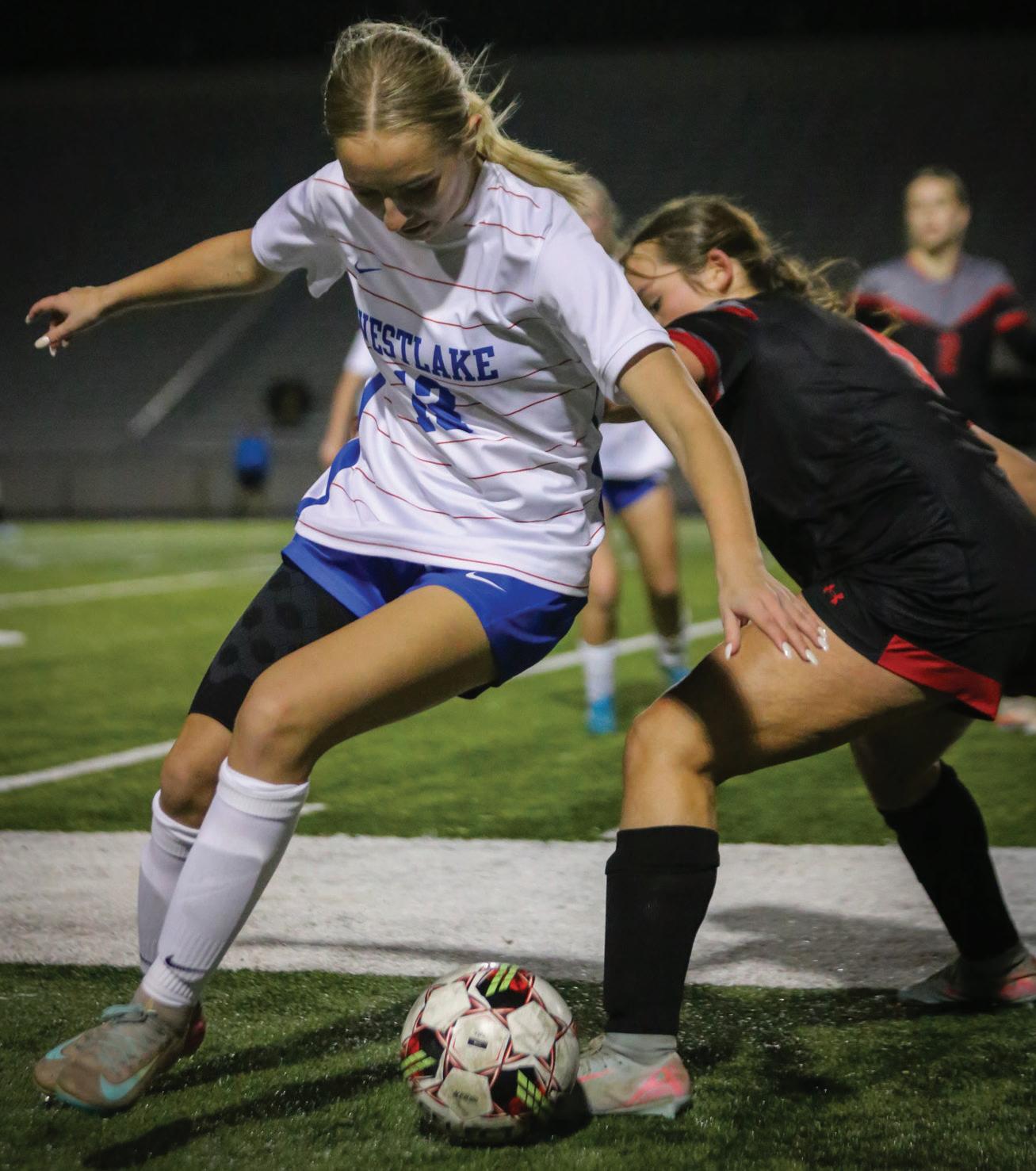
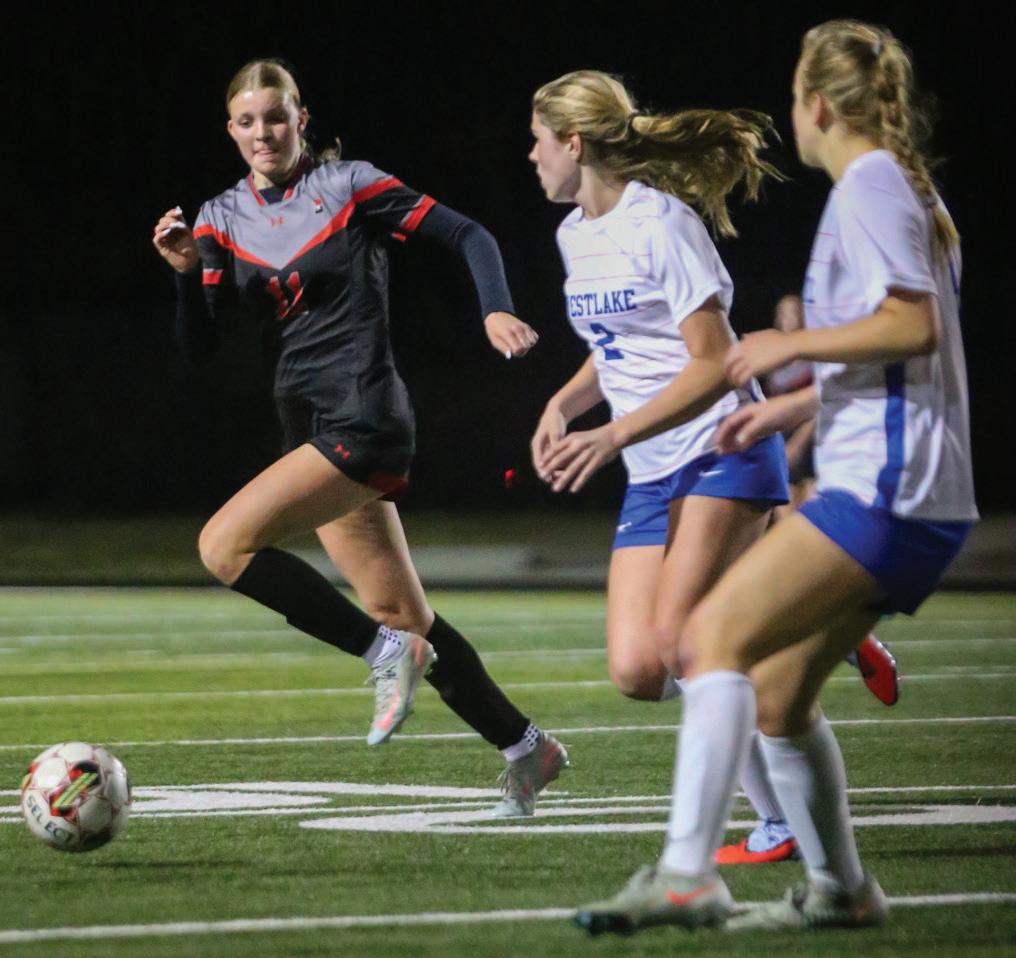
and athletics can be mentally exhausting for students. That is why a captain’s job is beyond just communicating with their teammates during games; according to senior captain Marley Downs, it’s about motivating and helping players off and on the field.
“Over the past few years I have learned to get my priorities straight, sometimes I have to sacrifice hanging out with my friends or scrolling on my phone for studying or if I have practice I’ll cancel plans,” Downs said. “As captain I have had to learn to find collaborative and efficient ways to communicate directions to the team but in a respectful way.”
Junior Aili Billick, known for her 1v1 skills and midfield mindset, believes the team has already shown improvement. After scoring five goals last season, she is excited for more offensive opportunities and a chance at playoffs.
“I think this season we have already shown a lot of growth from the start, and been able to connect more as a team through each scrimmage we’ve
played,” Billick said. “On the field, playing on this team has given me the opportunity to be more of an attacking player and grow my love for the game while playing attacking mid, whereas in club I play outside back.”
Soccer, often referred to as football around the world, is a sport built on communication, strategy, and the utilization of the eleven players on the field at all times.
out that is always in good positioning, making the game simple, and true team players,” Hoffman-Howell said. “A team stands out when they can keep possession and discipline to work the ball as a team down the field.”
Carrie HoffmanHowell Soccer Coach "
I hope the team forms lifelong bonds with one another and shows that while winning soccer games.
Hoffman-Howell believes that the key to success within the sport is often through consistently and teamwork rather than individual talent.
“Many people like goal scorers or flashy players, but to a coach, a person stands
Currently fifth in district, the Bulldogs continue to focus on building chemistry. As the Lady ‘Dawgs continue their season, they have high hopes for playoffs and acknowledge the challenge of having a younger roster. “I think the most challenging part so far has been getting comfortable with the new team because of the amount of seniors that left,” Billick said. “However, I think the team has done an amazing job so far in building a dynamic, despite the big change.”
Arlo Stockstill Photo Essay Editor
The crowd’s applause grows deafening as the team finishes their final flips at showoffs. After months of preparation, they know they are now ready to compete at Nationals. Satisfaction builds within the team, everyone knows that what they are working so hard for, is now within reach.
The 2025-2026 cheer season is coming to a close with the Bowie cheer team qualifying for the Nationals performances in Orlando, Florida, after competing at the preliminary showoffs. This highlights the hard work that all of the cheerleaders have put in, states junior Co-Spirit Coordinator Reagan Pfeffer.
“Showoffs are a chance for us to demonstrate to our family and friends more of what we have been working so hard on,” Pfeffer said. “We performed in UIL early in January to see how well we stacked up against other teams in Texas, which went pretty well, and it gave us a better look on how we could improve leading up to Nationals.”
The hard work of the team is mirrored by the strong leadership and love for the sport given by senior captain Genevieve Casas. As they approached Nationals, the cheer squad leaned on their leaders to push everybody to their full potential.
“Leading up to performances I get the team to run full-outs of the whole cheer instead of working on each section,” Casas said. “That way we are prepared to run the whole cheer on stage. Then right before the meet, I bring us all together to say whatever we need to say before we go, we can pray, and really do whatever the team needs to be as

confident as possible.”
Leading up to Nationals, the team took measures to make sure they were in the best shape possible to perform at their best. The team practiced active recovery by stretching, going to the trainers, and practicing short portions of each cheer to keep their muscles in their best shape, while also allowing
them to heal up.
As Nationals neared, pressure set in Casas, but this is calmly dealt with as she has faith in her teammates, and knows she is a leader for a reason. Her mental focus on each move in the moment leads to minimal mistakes for not only her, and her team.
“As a leader there is definitely pressure,” Casas said. “During the cheer I am thinking, don’t fall, don’t mess up. I have also begun watching the team while we dance, and not just myself which is something I’ve never done before. I make sure everybody is in place and has sharp movements.” Nationals were February 7 and 8 and despite the possible pressure in the moment, to coach Scott, Nationals is just like any other competition, as she requires full energy and effort from her team anytime they cheer, whether it’s a small competition or Nationals.
“Nationals is just like any other competition in my eyes,” Scott said. “No matter what, we should always put our best routine on the mat. Cheerleading is different because cheerleaders, we practice for hours and weeks and days. And we get one time to showcase all of our hard work. So, no matter what you do, do your best, and that’s what I try to encourage my athletes.”
This past weekend was Nationals in Florida, and after flying through prelims, semi-finals, and finals, the Bowie medium game day squad finished 11th in the nation. There were 54 schools represented at the event.
“Physical rest is important because you need your body to recover,” cheer coach Hailey Scott said. “There are days where we will only do sections of dances, or shift to just watching film rather than full outs. Also, mental rest is important, sometimes we switch to work on basketball cheers when I see the girls are getting mentally frustrated or overwhelmed.”
Sydney Murphy Sports Editor
Runners breathe heavy, struggling to hold their goal pace while pushing themselves to their limits. From cold, early mornings, to months of sore legs and preparation, these athletes have endured, all with the end goal of completing a half marathon. For many Bowie students, their commitment to their training will lead them to the starting line.
The International Austin Half Marathon is a 13.1 mile road race that was held on January 18, and had many Bowie finishers. This specific race is designed for speed, and is known for its downtown course.

This year over 6,000 runners participated. Bowie began their half marathon program after a student, in 2020, decided to do a half marathon on his own. After that student came back the next year, faster than he was before, Bowie cross country and track coach Laura Tilson founded the half marathon program.
“I realized that by consistently running, building up endurance and distance, he was able to drop time and show a level of commitment to running,” Tilson said. “After that I thought that if we could get more runners to participate in the half marathon, that everyone would get faster come cross country season.”
This event helped lay the groundwork for what would become a permanent opportunity for distance runners to train through the school. However, for some runners, the environment of race day is worth all of the challeng
practices. “I ran the half marathon last year and I really enjoyed the race since it was all downhill,” junior Maddie Mahurin said. “It is a really great atmosphere to run in since there is a lot of live music and spectators cheering for us.”
Although everyone has different goals and experiences while running the half marathon, according to Tilson, it is a community. This year, Bowie had 32 students train for the half marathon, providing a diverse community of runners.
“When you start meeting up with people on the daily, you start to meet new people,” Tilson said. “At Bowie, we have a running community, and it’s great to see people branch out from their normal friend groups to connect with new people who share their interests.”
As much as the program unites runners into a single team, runners’ individual motivations change each athlete’s experience throughout the season. For some, it’s the structure of organized training that leads to their commitment.
“It’s nice to be held accountable by someone instead of having to come up with motivation on your own,” junior Blake Martin said. “I was just hoping to accomplish something that feels like I conquered the hill.”
Training for a half marathon involves more than the number of miles each student runs weekly. Coaches watch for attendance, work rate, and general well-being within the entire training program.
“Our goal as a program is to get people to show up, that means consistently coming when they’re supposed to, as opposed to, never being there,” Tilson said. “Even if they are injured or sore, we adjust their amount of running accordingly, we talk individually about how they’re feeling for that day, do less ning, or more running.”
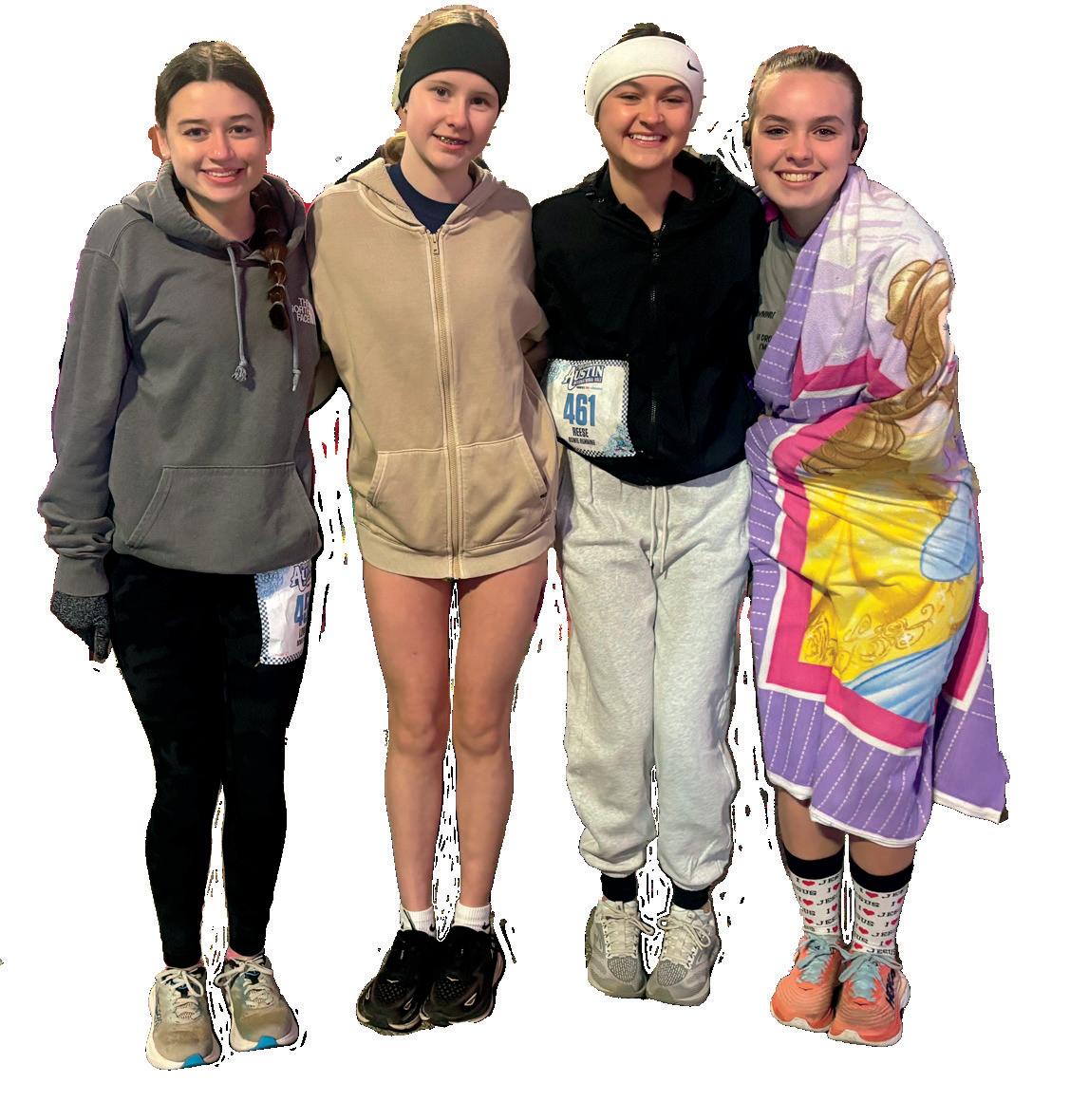

Beyond excitement for race day, the program also prioritizes balance and injury prevention during half marathon preparation. By prioritizing runners’ health, coach Tilson ensures that students are able to stay healthy while performing at their highest level.
“I liked that we were a community,” Mahurin said. “We all had a shared goal, which got me motivated to actually complete it.”
As half marathon training comes to a close, runners have built up their tolerance of running long distances. However, endurance is not the only factory that benefits students in the long run, but the confidence they have built up during training does.
“I think some of those kids that are doing the half marathon don’t think of themselves as the fastest runners,” Tilson said. “I am proud that they’ve gained confidence from being able to do



the distances.”
Leading up to race day, the atmosphere in training starts to shift as runners start to see their progress as they inch closer to their goal of completing the half marathon. During the last few weeks, athletes’ attention has shifted towards their race execution.
“Coach Tilson helped me to be able to do long runs on my own,” Mahurin said. “I wanted to feel more comfortable with 10 mile runs, and she also just helped us to, set goals and know who we should be running with.”
Practices start with ground-
work, a five minute jog, and dynamic stretches which according to Tilson, wakes up the muscles. Their workout consists of having a thirty to forty minute run three days a week and one fifty minute long run on the weekend.
“We focus more on the amount of time we spend running than we do distance,” Tilson said. “Most likely it’s more about the fact that you’re on your body or on your feet for a long period of time, less about how fast you’re gonna be going or how many miles you’re doing.”
According to Mahurin, this progressive build up in mileage and consistency has begun to feel real for her. As training
demands have increased, mental readiness has become as important as physical endurance.
“I stayed motivated because I knew that I had put in the work that I needed to and I trained hard for a long time,” Martin said. “The last week of training felt rewarding since I knew that I was almost done and I felt ready to compete.”
For Tilson, the goal of the program goes beyond a single race or season. The long term growth of her runners and program is what makes the training worthwhile.
“My favorite part about coaching is building relationships with kids and trying to help them to gain confidence and have fun with what they’re doing,” Tilson said. “I love being able to see them doing things that a lot of them thought they could never do and evolve from not being able to run more than three miles to running a half marathon.”

Les Miserables receives alumni and parent support

Alice Goss Entertainment Editor Questions? Concerns? Email: bowie.journalism@gmail.com
The first melodic notes of the show wash over the audience, settling the theatre as the revolution prepares to begin. Actors stand in the wings, techs standby for their cue, and parents exhale as the first moments of the production play out. Almost 100 people came together to put the Starlight Theatre Company (STC) 2026 main stage musical together this year and all of these efforts were put on display the last two weekends of January.
The STC tackled the enormous production that is Les Miserables this year, based on Victor Hugo’s novel depicting the French June rebellion. The show is known for its elaborate technical elements and heartbreaking performances, so the company had to prepare for countless hours of work.
The directors decided to build two double sided moving towers, two stationary towers, a false proscenium, and countless other set pieces and props. The intricate set required the work of every actor and tech for multiple hours each weekend the past three months, as well as every student in a tech theatre class dedicating entire periods to painting and finishing up any projects.
Another technical toll that needed to be tackled was costuming such a large cast. With over 30 ensemble members playing an average of four different characters, history teacher Ruth Narvaiz started sorting through the STC’s large costume inventory, creating and altering countless costumes. But she wasn’t alone, theatre teachers from across AISD graciously allowed the STC to borrow costumes for the production.
A few weeks before the production opened, STC alumni Connor Russell and Sam Holschuh returned to help set up the mic and sound system for the show. Their extra support shortened the time required to mic people, assisted in blending the sound between actors and a live accompaniment, and taught current students professional skills.
Not to mention the amazing support from the STC Booster Club, these parents come together to provide food for the entire cast and crew before shows, decorate the theatre lobby for the show, and reach out to the community to encourage donations and support.
Emily Saucedo was invited to attend All-State dance convention
Gracie Ruland Entertainment Editor
Emily Saucedo dances across the stage twirling, leaping and shining in the spotlight. Saucedo was selected to be the Captain of the Silver Stars for the 2025-2026 school year, a role awarded to dancers who show natural leadership and commitment. Her role consists of leading her teammates, communicating with her directors, helping with choreography, and representing what it means to be a Silver Star in and outside of practice.
“Emily is great at connecting with people and seeing everyone in the room,”head dance director Bilnoski said. “She takes initiative to complete behind the scenes tasks so practice is effective and productive. She has stepped into her captain role with so much maturity and grace.”
Saucedo has danced at studios D’ette and Company Dancers and Pivotal Academy of Dance, and was a Bailey Star Strutter from 7th-8th grade, where she had a leadership position. With dance running in her family, Saucedo’s passion for dance started at the early age of three years old.
“I was first inspired to begin dancing at an early age because of my older sister, Maddie. We are three years apart and I have always looked up to her, so she is the ultimate reason my parents put me in studio dance when I was three years old,” Saucedo said. “Maddie was also a Silver Star while she was a student here at Bowie, so her passion for dance inspired me to continue pursuing my love for dance as well.”
For Saucedo, dance is not just a hobby, it is an opportunity. Whether she is demonstrating her leadership skills or simply having fun while being on stage, she is willing to grow and allow herself to fully be herself when she is dancing.
“I’m passionate about dance because it has been a space for me to express myself and it has given me the opportunity to learn my abilities as a dancer and leader,” Saucedo said. “Performing is most definitely nerve wracking, but each time I hit the floor, I’m overwhelmed with such a joyful feeling. The resilience, discipline, sportsmanship, and the community that I have gained through dance, continue to further my passion.”
Jordyn Bujanos, a fellow teammate of Saucedo, is a witness to her commitment and leadership. Having watched her go through the audition process for captain.
“Emily has an incredible work ethic and is always giving 110% in and out of practice. She’s such an

amazing leader for the team as cap-
tain and such an incredible dancer,” Bujanos said. “Every time she dances I am in awe of her. She really loves the team and wants what is best for everyone involved.”
Saucedo has also won various awards, varying from team to solo awards. Although she has won all of these unbelievable achievements, her favorite was more of an honor than an award, the Silver Stars Legacy Trio. This consists of a sophomore, junior, and senior Silver Star each year.
“This trio family is truly so special to me as this is now my third and final year being a part of it. I remember being so thrilled when I was invited to join as a sophomore, and each year as I’ve moved up in grade levels, it’s been exciting to
choose a new member and watch their joy unfold when they begin their trio journey. Each year the legacy trio performs a competition routine, which ultimately highlights the senior leaving the trio and embarking on their next journey,” Saucedo said. “While all of the awards I’ve earned while being on Silver Stars are special, having the opportunity to be a part of the Silver Stars Legacy Trio, and perform and make memories with the groups of girls each year, is one of my most cherished accomplishments.”
This year the Silver Stars All State convention was held in Houston, Texas, at the Marriott Marquis Convention Center. Every year the captain of Silver Stars is selected to attend the TDEA convention as an
Kona Badgley-Finan Dispatch Reporter
As the actors put on a show on stage, the tech crew puts on their own kind of show behind stage.
All State Dancer. Saucedo was sent numerous videos worth of group and optional featured sections of choreography to learn in order to prepare for the auditions held at the convention.
“Starting the first day of class, we began with auditions for the advanced featured section, followed by auditions for the big group section. The process consisted of showing the choreographer, Claire Rogers Lewis, the featured choreography twice,” Saucedo said. “Then if you were tapped on the shoulder, that meant you moved onto the next round. 50 Captains auditioned for the featured section and only 40 made it. I was one of the 40 dancers. After auditions for the featured section, everyone else was placed into the big group formation. There were about 300 dancers total at the convention.”
Throughout her time at the convention, she spent rigorous hours polishing and perfecting every step to make the dances as clean as possible for their performance. In her free time at this convention, she proceeded to take some unique master classes, fulfilling her learning experience from this convention.
“Throughout the time of the convention I took some master classes such as a DCC Pro Style class taught by current Dallas Cowboys Cheerleader, Allison Khong, and a Jazz Fusion class taught by professional dancer and former Dancing With the Stars Troupe member, Stephani Sosa,” Saucedo said. “Both of these classes were very fun and allowed me to venture out of my usual dance styles. Along with dance classes, there were also two leadership classes that were held.”
She described her feeling on stage at the convention as “happy” because even though it was a very hard and tiring amount of dance she was participating in, the encouragement she got from all the other dancers and captains inspired her and ultimately made her experience worth it.
“The environment of being around each of the other dancers was truly so special. Now looking back on this experience, I am able to say that this was one of the most cool and rewarding experiences. Being surrounded by many other Captains, and those who I grew connections with, was such a cherishable memory, knowing that we got to share it together,” Saucedo said. “Having the opportunity to participate and perform as an All State dancer at the TDEA All State Convention allowed me to visualize how far I’ve come in my dance journey.”
All of this collaboration across a single production is a huge testament to the community of the STC. From every single actor being willing to get paint under their nails, to the alumni spending their free time returning to their high school theatre company because they want to help out. It takes a lot to put on a production, and the help from other schools across AISD and the community that has been built at Bowie itself is amazing. What has been your favorite part of creating the look of Les Miserables?
On Thursday January 22, the Starlight Theatre Company’s new production of “Les Miserables” premiered. The Starlight Theatre Company (STC) spent months on stage training and preparing for this show. What the audience doesn’t see is the behind the scenes work, one of the most critical pieces. Set design, lighting, audio, and costume design are just some of the things that the stage crew does to bring this show to life.
The planning process for “Les Miserables” was very rigorous. They start planning months in advance in order to create the best show possible. Matthew Humphrey, one of the technical directors of this show, was a big part of bringing this show to life.
“We start pretty much as soon as we get the idea to start the show, we start planning and start figuring out what it’s gonna look like and figuring out what feel we’re going for,” Humphrey said. “So, as soon as we pick the show we start brainstorming.”
This show takes place in the early 1800’s, therefore the costumes are very important because they help reflect the essence of the era. Assistant directors Alice Goss and Spencer Findely did lots of research to help costumes and Opal Burns, is one of the main people that made the costume decisions.
“A lot of research on the time period, what styles, what silhouette and what colors go into the making of the costumes.
One of the most important things is the difference in social classes,” Burns said. “Typically, the poor people have an older style because they can’t afford to have new clothes.”
Team work is essential for the tech crew, as they have to be able to communicate with one another to connect all of the moving pieces of the show. With Les Miserables being one of the biggest shows the STC has ever done, it comes with a lot of hard work.
“We are doing all sorts of different things, kids are working on lights and trying to

perfect their light cues, we have kids who are working on sound with microphones, we are building, we are painting, we are detailing,” Humphrey said. “We are doing as many things we possibly can at once to make sure all the pieces come together.”
Sound and audio can determine how a scene makes the audience feel. If the audio doesn’t match the scene it can change the whole feeling. If there is a sad scene going on and upbeat music starts to play it completely changes the vibe. One of the audio leads, Sasha Zimmerman guides this process.
“A lot of audio is just practice and skill. Audio is easier than people make it out to
be, it’s just patience and being able to follow along in a script and bringing up the right slider,” Zimmerman said. “Once the show is started, the process of getting things ready gets a little less difficult, getting a schedule ready, making sure everybody understands how to troubleshoot during a show quickly and quietly.”
Lighting is also a key element in setting the scene. Much like audio, lighting determines how the audience feels and can really help communicate what the scene is trying to convey. Paul Hampel, one of the lighting designers, enjoys being part of the lighting process.
“The lighting is really important in a lot of scenes for this show,” Hampel said. “It is especially important in the last scene.”
BY Kona Badgley-Finan
BY Kona Badgley-Finan



“My favorite part of creating this show has been being able to see my students learn more about the behind the scenes processes,and grow as people.”
“I really like getting to see how costumes match the emotion of the character and as the characters get darker, normally their costume also becomes darker.”
“My favorite part of creating the show has been seeing everything come together after all of our hard work.”
A deep dive into how the novel shines in comparison to the film, but is still incredible
Eleanor Blue Dispatch Reporter
Frankenstein is a novel that has frightened and enthralled its readers for centuries. First published in 1818, the story follows Dr. Victor Frankenstein on his quest and ultimate downfall trying to create life. It is widely considered to be the first science fiction novel, and has inspired countless spin-offs, plays, songs, and legends. But why is Frankenstein so culturally significant? Why is this monster movie still so relevant today? And is it possible to bring such a legendary story to screen?
If you’ve heard about Frankenstein, chances are you’ve also heard that Mary Shelley was only 18 when she wrote it at an informal writing contest. This is both true and misleading. Mary Shelley was 18 when she wrote the first draft of Frankenstein for publication, but the copy we read today went through many edits by Shelley and was republished in 1836. There are a few key differences in the works, but both stand out as well crafted works of fiction.
I read this classic in anticipation for the newly released Frankenstein movie, directed by Guillermo del Toro. I’ve been told numerous times to always read the book before watching the movie, and I wasn’t about to break my streak. However, after finishing Frankenstein, I remember thinking “this should not be a movie.”
The book itself is a masterpiece. It weaves wonder with real-world concerns, and finds itself at the center of conversations now, managing to stay relevant. It’s a fascinating read that I’ve been thinking about since finishing it. Mary Shelley has an incredible way with words. Her writing can trans port you to a very different world, one that is com plex and difficult to understand. Frankenstein is unimaginable. That is what makes it such an iconic story. It exists only in your head, some thing inconceivable. The monster is re jected because it is out of the ordinary. Reading the book, you want to think that you would be different. That you would accept the
monster and be the first one to truly listen. But this is impossible. Through reading not visualizing, you are forced to confront the idea of Frankenstein’s monster, not the image.
Still, I was hearing good things about the adaptation and was, above all, curious. Unfortunately, going to see the movie only confirmed my fears.
I’m not going to say that del Toro’s adaptation was all bad. For one, there were some undoubtedly beautiful shots. You could tell that it was a high budget production when it came to the scenery and landscape shots.
Jacob Elordi was also a standout as the monster. I was skeptical that the former Kissing Booth actor could pull off the role, but he showed a solid complexity that really complemented the character.
Besides Elordi, I thought that the acting in general fell short. Oscar Isaac, who played Victor Frankenstein, had a strange delivery that never quite conveyed enough emotion to be believable.
I’m a big fan of Mia Goth but I thought her performance was also lack-luster. She did what she could with the script, but most of the interactions came across as clunky and unrealistic.
This was one of the biggest failings of the movie, the lack of character development. I understand that a book has more time to spend with the characters, but for a run-time of two-anda-half hours, there was an unsettling amount of things missing or just not

For one, Victor Frankenstein is a very explicitly evil person in the movie. His brother, at one point, even looks at him and says, “Victor, you’re the monster.” This onthe-nose dialogue is common throughout the movie and something that really brought me out of the story. In the book, there’s a part of you that relates with Victor. He creates the monster in an attempt to make a new discovery and push the limits of science. This makes him naive, but it does not make

him evil. You can see yourself in him, which is a part of what makes it so frightening.
The decision to depict him in a completely sinister light really limited the movie. He is shown as a thoroughly corrupt person, blindly driven to create life after the death of his mother at a young age. This explanation did not make sense to me. Although tragic, the death of his parental figure does not explain the bizarre decisions that he makes throughout the rest of the movie. And for such a family-oriented man, we spend almost no time in his childhood or with his family at all.
Then when Victor dies, he randomly becomes sympathetic, calling the monster his son and asking for
forgiveness. This made absolutely no sense with his one dimensional character thus far, and was tonally a strange way to end the movie. There were also a few directorial choices that didn’t make sense to me. Wolves attack houses in packs, we get almost no exposition for the ship scenes, and there is a decision to convey a very close bond that even dips into romance between Elizabeth and the monster.
My last main gripe with the adaptation was the decision to make the monster a supernatural, rapidly-healing creature. This choice was in contrast to the book, with the monster suddenly capable of healing from multiple gunshot wounds overnight
and pushing an entire cargo ship out into the ocean.
It’s not as if I have an issue with the unrealistic aspect of this power. My concern is with how this choice turns the creature into a super-villain. It paints him as something completely surrealist and fictionalized. At the end of the day, Frankenstein is man-made. Victor did not find the cure to live forever, he created something life out of death. This bizarre and unexplained decision to give the creature this healing was not necessary in my opinion. Overall, I have no major gripe with the movie. If you enjoyed it, it’s understandable. I just loved the book and del Toro’s take didn’t add anything new for me to think about.
Ava Weaver Review Page Editor
I believe a really good bagel can cure any sadness. And if you haven’t had a bagel during a rough spot in life, you are prolonging your suffering. I’m joking, obviously. However, bagels are my favorite breakfast food, and because of their plainness, they can be crafted into the most filling lunch. I want my peers to fall in love with bagels like I have. So, I went to two beloved bagel spots in Austin to decide which is the best. Located on Lamar Boulevard, you’ll find Nervous Charlie’s bagels, a delightful little spot that won my heart. After being forced to run four miles, I walked into nervous Charlie’s bagels, to fix my bagel craving and wipe the tears from my nonathletic eyes. I ordered their $12 specialty breakfast sandwich, the Longhorn. The sandwich comes with two fried eggs, cheddar cheese, breakfast potatoes, Charlie’s hot sauce, and your choice of protein.
As I took a crunchy bite into the toasted bread, I got a flavorful burst of sweet ham that balanced out the hot sauce perfectly. Out of all the bagel places in Austin that I tried, their bagels were definitely my favorite. And to make it even better, I only had to wait about 10 minutes in line.
And my favorite aspect is the owners of Nervous Charlies rescued their dog, Charlie, from a puppy mill, giving him a new life with a loving couple and a bagel shop mascot. According to their website, their goal is to bring Long Island-style bagels to Austin. And even though I’ve never been to Long Island and can’t be the one to judge its authenticity, I can say the bagel that I had was pretty astounding and won the favor of all my taste buds.
The specific location I went to had an outside seating option, which I thought was nice, but since we are in Texas and it’s always hot, I decided to eat in my car instead. Though having an outside seating area is perfect for dog owners who want to enjoy a bagel with their furry friend, and maybe have a play-date with Charlie.
But if I can’t commute all the way to Charlie’s bagels, Wholly Bagel, located off of Mopac, is tried and true. When I’m craving a classic everything bagel with a heck ton of cream cheese, I know a trip to Wholy Bagel will never disappoint. Their bagels might be hard like a baguette, but they put a mountain of cream cheese on every bagel that counterbalances that texture. I

was craving another bagel sandwich this specific time, and I ordered two, both with ham, cheese, and classic cream cheese. Unfortunately, they forgot my cheese on both of them. This was an honest mistake, of course. And in comparison to Nervous Charlie’s, their meat was less savory and tender, and overall less enjoyable. Though I am not impressed with their sandwiches, I will still visit to get the classics. For my fellow Austinites, I am sure you know Wholly Bagel as the “it” spot for bagels in our city. Wholly Bagel originates in Austin and only has two locations, making this spot an Austinite exclusive. They are known for making their bagels from scratch daily and mirroring that NewYork style. Growing up in Austin, I have many memories of my dad getting a Wholly Bagel
almost daily. Then, I thought it was excessive. Now, I fully understand, and if I weren’t a broke teenager, I would be doing the very same. Wholly Bagel doesn’t have outside seating, but for everyone always on the go, this is preferred. In comparison, Wholly Bagel is more convenient for those on the south side of Austin who need a fulfilling meal on the way to school or work. But, if you have more time and want scenery to enjoy your bagel, Nervous Charlies provides that. Both places had a variety of options that were similar in comparison. I tend to favor savory foods, but bagels can also be sweet. I saw fruity blueberry bagels and sweet cinnamon bagels, so there is definitely a bagel for anyone and everyone. I mean, with the vast amount of ways one
can eat a bagel, I would argue that there is no such thing as “disliking bagels.” Overall, both spots have bagels that I love and recommend, but if I were craving a bagel sandwich, I would go to Nervous Charlie’s, and if I wanted the classic tried and true, I would opt for Wholly Bagel.

On January 19, Principal Mark Robinson walked the halls of James Bowie High School one last time before his retirement. Over the course of the ten years he’s been at Bowie, Robin son has worked hard to make Bulldog Nation into a tight knit community. His consistent involvement in school activities and events have left a positive impact on students, staff, and parents.
Robinson made sure every day started off right by greeting students and staff with encouragement during the morning an nouncements. He would go beyond just sharing infor mation about the coming school week. Robinson worked to make all students feel included and accepted at Bowie, and he was able to accomplish this by high lighting individual student and team achievements, promoting sporting and theatre events, and highlight ing month-long observances, like Black or Women’s History month, all through the morning announcements. As he would sign off for the day, Robinson would always make sure to say “You belong at Bowie.”
He’d make sure to practice what he’d preach by showing up to school events whenever possible. For example, he was on the sidelines of every football game to support the team, as well as the dancers and col or guard. He also spoke at every pep rally in order to hype up students and promote
Bulldog pride, and he recognized every team during their respective seasons. Students weren’t the only ones that felt Robinson’s influence and leadership. All staff were held in high regard and were trusted
ery day decisions. Instead of taking on all issues himself, Robinson recognized the specific strengths of his staff and effectively delegated some authority to them in order to achieve high levels of efficiency. He also trusted that

able to run their classes and programs without being constantly observed and micromanaged. This system was able to empower Bowie staff and allow for all systems to run smoothly. Along with trust and respect, Robinson made sure to always show his staff that they are appreciated by doing fun things for them. For example, once a year, during lunches, he set up a grill and cooked burgers for all staff members that wanted one. This lighthearted tradition showed staff that all their hard work is being recognized while also putting a smile on everyone's face. Even the parents of Bowie students felt Robinson’s impact. Before he arrived at Bowie, many parents felt out of the loop on what was going on at their kids' school. Robinson faced this issue head on and created the Bowie Star Newsletter. Through the Bowie Star, he connected with parents directly and made sure to address all possible questions that they had. The newsletter includes information like upcoming school events, AP Exam and course information, student parking, attendance policies, and so much more. Thanks to Robinson’s efforts, parents were able to feel more involved and well informed. After showing up day after day, year after year, Robinson can now walk away knowing he’s leaving a legacy that will continue to impact Bowie for many years to come. His efforts have forever community, and we thank him for it.



• The Dispatch is the official student newspaper of James Bowie High School. 3500 copies are published and distributed for free six times a year, generally once per six weeks for the school’s students, staff and community.
• The Dispatch is an open forum for student expression. The Dispatch is not reviewed by school administration prior to distribution, and the advisor will not act as a censor. Content represents the views of the student staff and not school officials.
• The Dispatch works to avoid bias and/or favoritism. We strive to make our coverage and content meaningful, timely, and interesting to our readers. Our articles reflect our genuine objective of reporting news and will be held to a high standard of quality.
• We make every effort to avoid printing libel, obscenities,
Across social media, the rise in trends like wearing quarter zips, sipping on iced matcha lattes, and listening to Lana Del Ray with wired headphones, are considered characteristics of a “performative man.” The Conversation describes the phrase “performative man” as a “new Gen Z term describing men who deliberately craft a soft, sensitive, emotionally aware aesthetic, signaling the rejection of ‘toxic masculinity.’”
Just because this trend is glamorized on social media and throughout the world today doesn’t mean that it is acceptable to participate in it. The “performative man” trend has negative effects such as creating pressure for men to live up to certain standards and the spread of harmful jokes are easily unno ticed by many that take part in this trend. The internet should not partake in the performative trend and needs to acknowledge the issues that have brewed because of this trend. The performative men trend has resulted in people who are participating in its ideas to be laughed at or become a meme. While men change their style, hobbies, and present themselves in ways the media craves, they are scoffed at and made into a meme. The internet begs men to critique themselves to reach their standards, but fall back when it looks too forced.

Not only has this happened to men, but women as well. The term “pick me girl” has similar effects, girls changing their style and participating in trends that men are more likely to do,
in order to live up to people's standards, but then are accused of forcing the change. As trends like these run their course, it is important to realize the effect they have on people. These trends can make men feel like they are forced to act and present themselves in a certain way and live up to certain standards. They present themselves in ways the public wants to see them, such as carrying a tote bag, film camera, participating in trends that maybe more women are active in, and changing their clothing style. Many younger boys as well who participate in this trend compare themselves to others on social
media because of how it is being idolized. This can lead them to believe they need to look and behave in a certain way to receive validation.
This trend has not allowed men to be themselves. USA Today suggests that “instead of being themselves, these men are trying to be the type of person they believe others want them to be.” The ideas of being a “performative man” can create negative impacts on one's identity by presenting themselves as someone they are not, rather than their authentic self. This can lead to confusion on how men present themselves, especially for men who are genuinely interested in trends that are labeled as “performative.” Issues like this can lead to anxiety and confusion in one's identity.
Although the “performative men” term has many negative effects, this trend can lead to
men being able to explore their identity more and runs counter to the toxic masculinity label. Participating in trends can create the discovery of new interests for one, and allows men to try new things that they wouldn’t have done if it wasn't for the performative man trend. This includes exploring their style, new hobbies, and trying new foods and drinks. Yes, this is true, but social media has changed the idea of exploring your identity and instead compares its characteristics of being a “performative man” many of which are negative aspects. People shouldn’t have to worry about expressing their identity and shouldn’t be afraid of being judged or made fun of because of it. It is important to realize the effects this trend has on men and the consequences it can bring into their lives.

In December of 2025, 68,440 people were detained by the U.S. Immigration and Customs Enforcement (ICE) according to The Guardian. Additionally, of those detained in December, 75% had no criminal convictions, and seven died, according to the same Guardian article. Since its creation in 2003 in response to the 9/11 terrorist attacks, ICE has been a controversial topic not only within discussions of politics but also in discussions of human rights. Legally, ICE is tasked with finding and deporting illegal immigrants. With President Donald Trump cracking down on illegal immigrants and enforcing stricter ICE policies, many people have been debating whether ICE’s methods of detaining people are humane or if they need change.
The way ICE treats both U.S. citizens and non-citizens is incredibly inhumane, and something needs to be done about it before more lives are unfairly taken or changed. ICE and the Trump Administration have completely lost sight of what is truly important, and irreversible harm is being done to our country. Whether it is just a redesign of the current organization or a complete restart into something new, action needs to be taken as soon as possible.
ICE racially profiles people based on looks and appearances, not actually on the status of their citizenship. This causes them to take actual U.S. citizens into custody without any true rhyme or reason. This should not be a possibility at all, and the fact that it has happened numerous times is extremely concerning. ICE should not be able to derail someone’s daily life just because they look a certain way.
Part of this group of U.S. citizens who are wrongly detained are children who are too young to know what is really going on. This creates the possibility of giving the children unneeded and fully preventable trauma that can carry into adulthood, and cause them to live their lives in fear just because they don’t look the way Trump thinks an American citizen should look. Last February, an 11-year-old girl even took her own life after her classmates taunted her with threats of ICE due to her family’s citizenship status, as reported by CNN. The effect of ICE stems further than just the point of deportation, and has caused an uprising of prejudice towards immigrants. No child should have to debate whether or not their life is more valuable than the concept of citizenship.
to make a life for themselves and their families, they should not have to suffer for it. We shouldn’t just let people come and go into the U.S. as they please, but it would be extremely beneficial to, instead of detaining and deporting the innocent immigrants, present them with simpler ways to attain citizenship, so they aren’t unfairly ripped away from the life they worked hard for.
In a recent devastating event, Renee Good, a mother and wife living in Minneapolis, was shot three times and killed by an ICE agent after attempting to drive away from a group of ICE agents in the middle of the road in her neighborhood. Good was a U.S. citizen who showed zero aggression towards the agents. Many who are in support of ICE claim that Good attempted to run over the agent, but in the video, you can clearly see her turning away from them in order to drive away without hitting them.
If someone’s only crime is trying to make a life for them and their families, they should not have to suffer for it.
Trump’s reaction to this situation was unprofessional and lacked any empathy after he called her violent and vicious, ignoring her devastating murder by the very person who is supposed to protect us, and saying that it was a part of the “Radical Left Movement of Violence and Hate.”
At no point in time in the video does Good state her political beliefs, and her last words to the ICE agent were even a peaceful “I’m not mad at you.” This is not the first injustice that ICE has caused, and it will not be the last, especially if our president is supporting it.
such as cancer, diabetes, and various heart issues. These are life-threatening conditions that require constant care, and it is despicable of ICE to ignore that.
Former detainees also expressed witnessing other detainees being put in solitary confinement for simple things, such as asking to shower. Furthermore, these detention centers are inaccessible for people with disabilities and incredibly unsanitary. The condition of ICE detention centers are described to be worse than that of a prison. As a reminder, children are brought here, in rare cases, without their guardians. Nobody deserves this type of treatment, especially when most of the time their only crime was attempting to create a better life for themselves.
Supporters of ICE justify this horrifying treatment by expressing that illegal immigrants simply should have taken the steps to become U.S. citizens. These supporters do not realize how arduous it is to actually attain citizenship. According to the Cato Institute, an immigrant from Mexico may have to wait between five and 25 years to become a U.S. citizen. This same Cato report highlighted how caps and blockages for employment based visas for Indian immigrants can have a projected wait of up to 150 years. Long waiting periods, and ridiculous and excessive blockages prevent a large portion of people will most likely never attain U.S. citizenship. The U.S. is lucky to be a developed country with many opportunities for work, and other countries do not always have the same luxury, causing many people to aspire to live here.

Ava Weaver Review Editor
Questions? Concerns? Email: bowie.journalism@gmail.com
Gen Z has a problem, an apathy problem, that goes beyond the expected teenage carelessness. Teenagers have all slipped up on curfew, their grades have slumped, and they have been lectured on their behavior. But Gen Z is living in a world with wars, a corrupted government, and even scarier, if they are not affected, they don’t care.
And what can’t be ignored is that Bowie High School’s population is privileged and is set up for educational and financial success, as well as a sense of security on campus. In my opinion, this is the foundation needed to speak up against corrupt government and businesses safely and productively. And yet, my classmates express how done they are with this whole “political thing,” with the tone exhibiting this “political thing” as an inconvenience and not wars, fascism, and ICE raids. As the next generation to live and function as adults, we need a government that cares enough about its people to provide the tools to lead productive, fruitful lives. And given the reality we live in, I urge my classmates to get “woke,” get involved, and use their voice now.
I am not going to list for you the many ways the American government is becoming a fascist one, because if you cannot see the signs, then these words are for you to urge you towards becoming aware of the political decisions and actions taking place at both the national and state levels. My goal is to give you some advice on how improve your media literacy, so you can be able to see the signs of a corrupt government and ways you can help prevent this development from furthering.
Firstly, becoming informed goes a long way. But, propaganda is everywhere, and if someone wrote it, it’s biased to what they believe. Being around my classmates, I have realized that this is the major factor preventing them from getting involved, most feeling discouraged by the vast amount of news sources and their basis. For example, Fox News information is right-skewed, while CNN can skew left. So, what about how you get your information?
The United States’ culture has been cultivated from a blend of hundreds of different life styles from different parts of the world. Deporting the very people who make up the fabric of this country is counterintuitive and hypocritical. If someone is committing a serious crime that genuinely harms and negatively affects someone, they should be appropriately punished and held accountable, regardless of their citizenship. However, if someone’s only crime is trying
Many videos of ICE show them being extremely rough with people who aren’t attempting to harm them in any way or escape. If this is the way that ICE publicly treats U.S. citizens, then how do they treat non-citizens in private? This raises important questions about whether or not ICE will get progressively more violent if the Trump administration continues to give them the power to do so.
After being forcefully removed from their lives, those who are detained by ICE are taken to detention centers, which are typically neglectful and inhumane. According to the American Civil Liberties Union (ACLU), many people who have experienced the detention centers said the ICE agents ignore health issues and deny treatment for conditions
This horrifying reality being created by the growth of brutality from ICE needs to be ended as soon as possible. You can help by attending local protests, signing and creating petitions, and most importantly, looking out for your neighbors. Don’t be afraid to stand up for what you know is right, and don’t let others tell you that you are wrong. Even simple things, such as posting on social media, help spread awareness about the truth of what ICE is doing to our country and its people.
ICE has done nothing but spread fear and violence across the United States. They are doing the opposite of protecting citizens, and they need to be stopped immediately. As the Trump Administration continues to push stricter immigration laws, we need to speak up and show them that what they are doing is wrong.
Read your school newspaper, and yes, I am aware of the bias. Calling the Dispatch newspaper a reliable source when I myself am a newspaper staff member. But, looking at accessibility, school newspapers are the most accessible for high school students, shocker. I am sure they are well aware of this; the problem is, they just don’t care enough to read it. I urge you to read your school newspaper at least because if you don’t care about what’s not affecting you, at least care about what is. The Dispatch Newspaper covers what’s happening on campus, off campus, and in the city of Austin. Furthermore, you can ask your peers who wrote those articles further questions, making the way you can get information a conversation in person.
Now, don’t let that information sit idle in your head. This is unproductive and can make us, as kids, feel hopeless with the weight of the information. So here are ways you can act.
Call your representatives and complain. Gen Z is great at that. For us in Austin, Texas, our representative is Lloyd Doggett. Calling your representatives lets your voice be heard and holds the people in office accountable. If you don’t speak up when you disagree, your silence is heard as approval.
Gen Z is more than in tuned on how to use social media platforms to their advantage, and I believe this is the prime way for high schoolers to participate. You can interact with the people who hold office accounts, spread information, and build a community.
Remember, it is all about balance. No one is expecting high schoolers to solve every issue. But, at the same time, we can not be ignorant. So please, lock in with this whole political thing.
Do you think the way ICE is handling immigrants is ethical and beneficial to our country?

The U.S. is a country founded on immigration. ICE is killing people and tearing apart families.
No, it is inhumane and despicable how ICE is handling immigration.


I don’t think ICE is handling anything well. They aren’t following the Constitution or laws set in place.
As someone that has parents that are immigrants, I believe that how ICE is handling it is wrong in every way.


No, there is no efficiency in who is being targeted and the means are not ethical.


As the lights in the theater fade and the first haunting notes echo through the air, the audience is swept into the shadowed streets of 19th-century France, where revolution simmers, justice is tested, and the powerful story of Les Misérables unfolds.
Since late fall, the Bowie Starlight Theater Company (STC) has been preparing for its production of Les Misérables, a large-scale musical told entirely through song, accompanied by a live orchestra.
"outside their comfort zones, not just vocally, but emotionally, as they worked to tell a much darker and more complex story. For many students, the show challenged them to connect more deeply with both their characters and their fellow cast members.
Les Misérables
Directed by Marco Bazan, Kade Lassiegne, Matthew Humphrey, and Courtney Hall, the team oversaw all aspects of performance, music, and technical elements to bring the show to life. The performances took place over two weekends on January 22, 23, 28-31, and February 1.
“Les Misérables has a lot of moving parts, and every detail has to work together,” Lassiegne said. “From the music to the set pieces, it’s been about staying intentional and committed so the story can really come to life for both the performers and the audience.”
Unlike past productions, this year’s musical pushed cast members to explore heavier emotions and more demanding music. Les Misérables required performers to step
“I think it’s really a lot different from our musical last year, Mamma Mia,” junior Marin Lawson said. “It’s a lot more emotional, and we’re doing it with a dialect as well and connecting with the actors more. It’s a really sad, emotional play, so being able to act through that was really hard for me, and the music was ten times harder as well, but the entire cast and crew worked together to give our best performances.”
This year’s production of Les Misérables required cast members to coordinate more than just singing and acting. It demanded precise timing, physical awareness, and teamwork to bring the massive set and revolutionary Paris to life.
Junior Clover Murray played the character of Tenardier also participated in the large ensemble on his off nights.
“I think the main thing I learned about teamwork is to make sure everyone is on the same page when things need to happen during the show,” Murray said. “There are many
big ensemble numbers and set transitions happening, so it was important for all of us to communicate and work together closely.”
Beyond individual roles, the cast also had to master the technical side of performing as a team, learning how to blend their voices and work in harmony with the live band. Senior Sasha Zimmerman, who worked on sound and technical support for the production, reflected on the behind-thescenes teamwork that kept the show running smoothly.
“I think one of the most important parts of our job is communication,” Zimmerman said. “We have to make sure the band, the actors, and the tech crew are all on the same page. Even small mistakes can throw off a scene, so being clear and working together is key to making the show feel seamless.”
Beyond the emotional performances and technical precision, the success of Les Misérables ultimately depended on the collective effort of the entire company. From the ensemble on stage to the musicians in the pit and the technicians behind the scenes, every group played a critical role in bringing the production together. For many students, the show highlighted how collaboration across all areas of theater is essential to creating a seamless and impactful performance.
“Teamwork is what really makes the show come together,” junior Adam Hart said. “The actors, the band, and the tech crew all rely on each other, and seeing every piece fit together is what makes the production so powerful.”