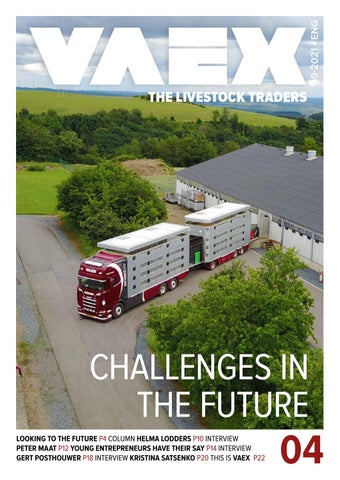
09-2021 - ENG
THE LIVESTOCK TRADERS
CHALLENGES IN THE FUTURE LOOKING TO THE FUTURE P4 COLUMN HELMA LODDERS P10 INTERVIEW PETER MAAT P12 YOUNG ENTREPRENEURS HAVE THEIR SAY P14 INTERVIEW GERT POSTHOUWER P18 INTERVIEW KRISTINA SATSENKO P20 THIS IS VAEX P22
04
Contents
04 10 12
Looking to the future
Young entrepreneurs have their say
Stefan Derks Jaap de Wit Sven Cooremans Paul Verhoeven
Lisa & Luc Michele Grandi Rene Vaske Mile Gvojić
Column Helma Lodders Tomorrow is today
14 18
Interview Gert Posthouwer Trading is in the blood
We cannot see into the future. However, we can follow and discuss trends and developments. That is exactly what we will do in this edition of the VAEX magazine.
Interview Peter Maat
Interview Kristina Satsenko
VAEX and Maat Viehhandel, together for more than 10 years.
Russia is huge and the possibilities are almost endless
20
A step towards the future On the road to the future, livestock traders, farmers, livestock transporters and other companies in the industry encounter many hurdles. Great adapt ability and flexibility are required. We notice that social pressure and animal welfare are playing an evergrowing role in that regard. How will the industry cope with these hurdles? What developments are taking place? In this edition, we will discuss various trends and developments with different parties and connections in the industry. We will talk with, among other people, four
2 | VAEX MAGAZINE NO. 4 - 09/2021
international young entrepreneurs. What do they expect from the future? Helma Lodders, chairperson of Livestock & Logistics, expresses her concerns about the political debate; the banning of long-distance transport. Together with four parties, we will discuss the entire cycle in the context of the future, from the genetic line to meat processing. With the team from VAEX, we are happy to take on all challenges in the future. By going that extra mile. Searching for and exploring unknown boundaries. Together, we are taking steps forward towards the future. Onwards and upwards every day.
Dirk Govers, CEO
THE LIVESTOCK TRADERS | 3
The world of livestock and meat in which VAEX operates is dynamic. In a series of articles, five different leaders who are active in the meat production chain will give their vision on the coming years. What developments, opportunities and threats do they see in their field of work? In the process from seed to chop, the breeding, slaughtering, preventive and curative animal health, trade and logistics are highlighted.
4 | VAEX MAGAZINE NO. 4 - 09/2021
DanBred is one of the leading pig breeding organisations within the sector. The core breeding and fundamental research are concentrated in Denmark. This means that breeding expertise, inspection and registration are all centralised and focus is placed on genetic progress via breeding goals; pigs that grow fast and produce a high percentage of good quality meat with as little feed as possible. Every year, based on the genetic trend, it becomes 2 euros cheaper to get a DanBred pig ready for slaughter. Breeding by index and centralised control are the quickest ways to get the most benefit. Working on efficiency is and will continue to be necessary as the global demand for pork continues to rise in the coming decades. DanBred is going to make great strides in that area. Whereas fattening pigs with DanBred genetics have grown an average of 20 grams per day year
after year in practice, this will only continue in the coming years. In five years' time, DanBred expects to achieve an additional 100 grams of growth. Technologies such as genomic selection and selection on metabolites generated during metabolism bring additional genetic advances. The trend of more growth and lower feed conversion is accelerating. But we are also involving pig farmers in this acceleration by providing them with fundamental knowledge about nutrition, health and management. This enables pig farmers, wherever they are in the world, to get more out of the genetic potential of their pigs. In the case of sow breeding, more emphasis is being placed on survival of offspring up to the slaughter line. In other words: giving birth to robust, social piglets. The aim is to require fewer and fewer sows to fill the fattening pigsties with calm animals that perform
Source: Stefan Derks
LOOKING TO THE FUTURE
ACCELERATING THE GROWTH AND FEED CONVERSION OF PIGS
Name: Stefan Derks Position: Director Company: DanBred Nederland & Klasse Ki
and, in time, can be kept with their tails intact. Offspring of the DanBred Duroc fit perfectly into that future picture and provide the best economic revenue model.
THE LIVESTOCK TRADERS | 5
SHARING DATA MAKES THE DIFFERENCE
6 | VAEX MAGAZINE NO. 4 - 09/2021
can be linked as data to each pig. Information that can accompany the animal in a digital piglet passport as proof of health. Pig farmers use health data to improve technical results. That data flow to monitor health will only grow with the advent of new technologies such as cameras and cough monitors. Linking data files and performing the right analyses are essential when managing animal health. Raising the level of animal health and biosecurity requires constant attention. Going the extra mile and getting rid of company-related diseases brings peace of mind, a positive image and better trading conditions.
The importance of customisation is growing and leads to intensive cooperation with customers and their dealers. High health status of the piglets and safeguarding against diseases are essential issues. We also know that diseases often have a negative impact on trade flows. Screenings and vaccination strategies are adapted to the market and the regions where the piglets end up. Knowing exactly what the customer wants and making it happen. This health puzzle must be solved by the trade.
Name: Jaap de Wit Position: Director of purchasing Company: Westfort
HEALTHY PIG PRODUCTION REQUIRES A HYGIENE COACH
specialisation. We work together in a network of pig farmers, suppliers, traders, slaughterhouses, pharmacy and science. The (inter)national trade of
Source: Sven Cooremans
Name: Sven Cooremans Position: Specialist pig veterinarian Company: Lintjeshof veterinary practice
Source: Paul Verhoeven
continuously share knowledge and information with all other links to get them on board in optimising the KDV chain and producing full value pigs. Healthy animals that perform to the best of their ability on the farm and that we can maximize the value of. Sharing up-to-date data makes all the difference and is making considerable headway.
CHAIN-WIDE SUPPORT IN HEALTH The certified pig doctors of Lintjeshof in the Netherlands work on health solutions for production companies based on their own knowledge and
For example, we are developing proprietary screening programmes and routinely check for PRRS, APP, mycoplasma and Glässer disease in our own laboratory. Within the context of trade in piglets, African swine fever is also a factor. All these issues, the medication and the vaccination
Source: Jaap de Wit
Westfort is a meat processor with strong links to the sustainable pork chain, KDV. Animals from some 250 KDV pig farmers end up at our modern pig slaughterhouse and processing plant in IJsselstein. We continuously invest in more efficient meat processing by concentrating activities there. 95 per cent of Dutch consumers eat meat at least once a week. They also want to consume animal proteins in the future, which means that the slaughter of animals will continue to be necessary. In addition, there is a growing focus on animal welfare, the carbon footprint and ensuring claims, such as meat from pigs that have not been fed antibiotics or soya their entire lives. Buyers of that pork want transparency and hard guarantees. In order to regulate this in the KDV chain, we started applying ear tags with a chip six years ago. Meanwhile, 150 KDV pig farmers work with electronic animal identification and record various data per pig. From the slaughterhouse, we link technical and financial information to it. In this way, we can better control the production chain in terms of, for example, genetics, health and better returns. KDV companies can compare themselves to pig farmers who do the same and make targeted adjustments. Our data warehouse in the cloud has the advantage that failure costs can be detected quickly. If fattening pigs show certain abnormalities, tracing the terminal boar is easy. We're on top of the data. They can also be used very quickly for reports or audits. And we reward the pig farmers for the data. We
piglets and fattening pigs is all about safeguarding animal health. In the context of product liability, whether for medicines, animals or meat, transparency in health data and honest communication are essential. Individual animal recognition with transponders will probably play a decisive role in that regard.
Name: Paul Verhoeven Position: HyCare specialist Company: MS Schippers
Working with healthy pigs in a tidy sty environment is more sustainable on all fronts. Piglets and fattening pigs feel good, grow faster, make better use of feed, do not need antibiotics and give the pig farmer the best returns. Employees also experience more job satisfaction. Cleanliness is positive for the image of the pig farm and the sector. Hygiene on farms plays a crucial role in preventing animals from falling ill and infecting each other. HyCare is a method to maintain a high level of hygiene on pig farms through strict protocols. A great deal of health gains can be made through hygiene management on the
farm. This means, among other things, having surfaces that can be cleaned easily and thoroughly, ideal walking lines and individual materials for each animal category or stall. Using gloves and overshoes, and paying attention to feed and water hygiene for intestinal health. Using the HyCare method, the spread of any infections within the sty walls can be kept to a minimum. When it comes to infection prevention, it is extremely important to work consistently in the right way. Learning new behaviour and keeping that up is difficult. >
THE LIVESTOCK TRADERS | 7
Especially with larger companies and an increasing workload. That is why hygiene coaching is crucial for continued success. In other words: the future-oriented pig farmer is in charge of his business and surrounds himself with a team that consists of a feed consultant, a veterinarian and a hygiene coach or HyCare coach.
The fact that our method is effective is evidenced by the growing number of farms worldwide that are starting to use it. Pigs raised in a germ-free HyCare environment perform better and represent added value. The links after the pig farm, such as trade, transport and processing, can also contribute to optimising the health benefits in the mar-
ket. Together, we will bring the entire pork chain to a higher level in terms of food safety and image.
LINKING ROLE FOR A GROWING NUMBER OF CONNECTIONS Thanks to the many connections and large international network of VAEX, we get pigs and heifers to the right destination as agreed. We know how to connect places with a surplus of piglets with areas where there’s a shortage. Knowledge of markets and having the right connections are crucial. The coronavirus crisis and African swine fever outbreaks have made things more complex and challenging, especially in Germany. We thrive in times of turmoil; this is when our strength and added value for European livestock farming come into their own. It is a given that the pig market in the European Union will continue to change. In the Netherlands and Germany, a decline in the number of sows has started and will continue for some time. Structural cooperation with our Danish partner in the marketing of Danish piglets creates a stable basis. The Polish piglet market remains one of going flat out and slamming the brakes on. In Spain, pig farming is growing rapidly and compensating for the decline in the number of pigs in North-Western Europe. The sale of Dutch piglets to Spain is now around its peak and it may well be that Spain will be its own piglet exporter in a few years' time. Piglet purchasing areas are changing and VAEX is moving with such developments by building up new trading channels.
8 | VAEX MAGAZINE NO.4 - 09/2021
Like Poland, Romania will not be rid of African swine fever in the coming years. VAEX has been operating as a reliable trading partner in the dynamic Romanian pig market for fifteen years. Certainty about collecting money and keeping to agreements are appreciated by market parties and result in new collaborations and trade flows. We fill the space created there and in the surrounding countries with our passionate Romanian team in Arad. One of the conditions in the piglet trade is to be open and honest about the origin and animal health. Knowing what you’re buying and selling is a must. Reliable data from pig farms is needed. Buyers want transparency because they can work efficiently with healthy animals and make a safe product from them. Basic issues are hygiene, the accurate vaccination of piglets and making cuts in health between the different animal categories. Food safety and minimising the use of antibiotics are issues for all markets in the EU, even if each country implements them in its own way. Worldwide, these health issues are also receiving full attention, while the global need for safe animal proteins is growing. By sending additional information with the meat, EU exporters can respond in a targeted manner. Social pressure and animal welfare play an increasingly prominent role in the transport of livestock. Limiting the duration of animal transport in the EU is under discussion, as is
the transport of livestock to countries outside the EU. Limiting the driving time to, say, eight hours for the transport of slaughter cattle to the slaughterhouse is understandable. If this also applies to the sale of piglets, countries like Denmark and the Netherlands will find it extremely difficult. Nor do I believe that the EU will decide to regionalise animal flows in this way in the next few years. One point that concerns me is a possible European transport ban on animals at temperatures above 30 degrees. This would mean that in certain regions animal transports could not take place for three months a year. Inconceivable and impossible. Innovation in means of transport to transport animals in cool conditions is a solution. This requires creativity on the part of bodywork manufacturers in order not to increase the additional costs too much, and cooperation from government inspection agencies. In the coming years, VAEX wants to focus more on the trade in meat and carcasses. I expect, for example, that the slaughter of slaughter piglets will take place more in the region, thus creating space for this specific trade flow. We will use our large network to expand the trade in meat and carcasses. We expect to play a more prominent role in streamlining the supply and delivery of small to medium-sized slaughterhouses and meat processors, mainly in Eastern and Southern Europe.
Name: Dirk Govers Position: Director Company: VAEX The Livestock Traders
Italy remains an import market for good and heavy piglets. The development towards closed business structures is not in the Italian national nature. By serving that social market for the production of heavy pigs in a tailor-made way, we keep the piglet trade going and always look for opportunities.
THE LIVESTOCK TRADERS | 9
Helma Lodders was appointed chairperson of Vee&Logistiek Nederland on 8 May 2021. Until recently, Ms Lodders was agricultural spokesperson for the VVD in the House of Representatives. Before that she was, among other things, alderman in Zeewolde. Her husband runs a dairy farm and both her grandfathers were cattle dealers.
On 7 June, Helma Lodders visited VAEX. She wants to get to know as many members as possible of Vee&Logistiek Nederland and the sector. To this end, she is visiting various companies, including VAEX.
Source: Helma Lodders
Helma Lodders’ column
TOMORROW IS TODAY
10 | VAEX MAGAZINE NO. 4 - 09/2021
Working today on tomorrow's future: the motto of many entrepreneurs in the livestock logistics sector. Entrepreneurs who are constantly looking for opportunities to raise animal welfare during transport to an even higher level. It is in no one's interest for animals to arrive at their destination stressed or injured, least of all the livestock trader, transporter or exporter. That's why quality of livestock transport and animal welfare are high on the livestock logistics agenda. I know many fine examples of this. At VAEX, that is the latest insulated livestock trailer with cross ventilation, a cooling engine and bodywork cooling. This reduces the air temperature by a few degrees. Furthermore, the flow of cooler air helps to evaporate extra moisture from the animals en route. Innovative, sustainable and designed for the future.
A worrying development; for the position of the Dutch industry, but also for countries where our high-quality (breeding) cattle go. We contribute to food production in many developing countries. That is why Vee&Logistiek Nederland is committed to workable rules and standards for our entrepreneurs, with a scientific basis. To this end, we are, for example, conducting research into animal welfare during transport in public-private partnership with the Dutch Ministry of Agriculture, Nature and Food Quality, and Wageningen University & Research. I am confident that it will help us prove that Dutch cattle transporters have their knowledge and fleet in order and spare no effort to get our beautiful Dutch cattle to their destination in top condition and stress-free. Even if that destination is more than eight hours or 500 kilometres away.
In the coming period (autumn 2022), the amendment of the transport regulations is on the agenda in Europe. Our Minister of Agriculture recently anticipated the political debate by banning long-distance transport.
THE LIVESTOCK TRADERS | 11
“ Together for more than 10 years" In 2010, VAEX traded with Peter Maat for the first time. Since then, many cows have been exported together every year. VAEX is always in contact with Axel Blume (buyer and seller), although little contact is needed. Just a few words are all that are needed for VAEX and Maat Viehhandel to know what’s needed and what’s expected from each other. There’s mutual trust. "Trust is very important. A common saying at our company is ‘VAEX first’. VAEX is our regular customer, who we always contact first. Relationships such as the one with VAEX are very important for the future," says Peter.
The Dutchman Peter Maat (50) is the owner of Maat Viehhandel GmbH & Co. KG. He was brought up with the cattle trade from an early age. His grandparents and father were also cattle dealers. At 18, he started working as an international lorry driver on a cattle truck. Five years later, he entered the cattle trade. He saw opportunities in Mecklenburg in Germany and moved there to start trading cattle independently. In the meantime, he has been living in Germany for 25 years with his wife and three daughters and there is a successful international company Maat Viehhandel. Peter prefers to be on the road. Buying cattle. He considers working with cattle to be one of the best parts of his job. 25 years ago, he was only on the road. As a director, he’s also needed in the office now. By giving the staff a lot of freedom and responsibility,
he can still get on the road. If he gets the chance, he also likes to take a ride on the truck. Besides working on the farm, he also sees this as a real hobby. In the future, Peter expects to go deeper rather than wider. From the calf to the consumer. Improving current processes. In addition, personality and trust are important for the cattle breeding trade. He doesn’t see digitalisation happening so quickly. People want to see each of the cows with their own eyes. Peter finds it difficult to estimate how things will turn out with the legislation and regulations concerning long-distance transport. "25 years ago, there were also discussions about this. Since then, great strides have been made to improve transport in the industry," says Peter. "From both sides, it is important to achieve a good result to-
Source: Peter Maat
‘FROM THE CALF TO THE CONSUMER’
12 | VAEX MAGAZINE NO. 4 - 09/2021
gether. VAEX and Maat Viehhandel work together to ensure that the journeys run as smoothly as possible so that the cows are exported safely and healthily."
Maat Viehhandel has existed almost 25 years and is based in Vietgest. With a team of 20 employees, they trade cattle internationally. In 2006, they also acquired a slaughterhouse and an animal feed processing company. In 2016, they also started farming themselves and bought a farm with 900 cows.
THE LIVESTOCK TRADERS | 13
Rijkevoort Name: Lisa Cornelissen (29) and Luc Cornelissen (27) Company: Varkenshouderij Cornelissen B.V. Activities: Together with their father and two other brothers, they manage nine locations. Both in the office and in the shed. Responsible for personnel, transport, administration and work in the sties, among other things.
Essen-Addrup Rijkevoort
YOUNG ENTREPRENEURS HAVE THEIR SAY Ariano nel Polesine
Markusica
Why did you choose this profession? It's been instilled in us from the very beginning. Our family business has existed for four generations. We’ve been involved in the company and the industry since childhood. We grew up with it, as it were. What will your company look like in 10 years? ‘One team, one task'. That's how we'd describe our current working method within Cornelissen. We manage the locations together with our staff, but can also regularly be found in the sties ourselves. Wherever staff is needed, we are happy to step in. This will certainly continue to be the case in the future. We aim to become a closed company in the future. We already do a lot, from arable farming to manure processing to renewable energy production. We want to ‘complete the circle' and have the whole process in-house. In addition, society demands a lot from our company and our employees. Another priority in the coming years is to make our company more transparent, to communicate more about what we are doing all day. We will have to tackle this not only as a company, but with the whole sector together.
What will the sector look like in 10 years? We will still be pig farmers in 10 years, but things will be different. Laws and regulations will be tightened. Understandable, but we hope it will remain workable for us in the future. We're willing to invest, but it has to remain profitable. We keep a close eye on legislative and regulatory developments in order to be prepared for them. We don't see integration happening in the Netherlands any time soon. What you do see is that this is already happening with arable farming and manure processing, and it will continue to do so in the future. In general, the Dutch agricultural entrepreneur is ambitious and likes to seize such opportunities. What challenges will there be in the future? One of the challenges we already face is finding and keeping suitable staff. Attracting and retaining staff will continue to be a challenge in the future. It's very difficult to get staff, let alone trained staff. That is why we try to motivate and interest young people in the region in pig farming.
Ariano nel Polesine Name: Michele Grandi (31) Company: Az. Agricola Grandi Activities: Owner of a farm of 60 hectares and 4,000 pigs.
Why did you choose this profession? Since the end of my studies, the desire has always
14 | VAEX MAGAZINE NO. 4 - 09/2021
been to continue the business that my parents built up in 20 years. Where they once started with a small >
THE LIVESTOCK TRADERS | 15
shed for cows, this was later expanded with a piglet and sow sty. A job as a farmer isn't for everyone. Time pressure and unpredictability can make it difficult to enjoy time off from work. But by doing it, I've come to love it. With the support and trust of my parents, I now manage our farm. Located in the beautiful delta of the River Po, in the province of Rovigo.
What will the sector look like in 10 years? In my view, everyone has the opportunity to make the sector grow. But the past has taught us that it is always better to plan for the medium term. Unfortunately, the economic crisis, the pandemic, diseases and the rising prices of raw materials have severely restricted growth in the sector in recent times.
What will your company look like in 10 years? I learned that working in pig farming is not just putting on a pair of boots and standing in the sty all day. We must be aware that it’s more than that. It's necessary to be prepared for and to face all obstacles that we may encounter in our business life. From the genetic aspect to the feed. We must be able to make choices in the short term. I always say 'the glass is half full'. That's how I feel too. In the next 10 years, my goal is to give the company a strong economic structure and to grow my production by 50%.
What challenges will follow in the future? I certainly do not have a crystal ball, but I think that the future of pig farming will be completely determined by the genetic line. It must perform optimally and be able to meet sales prices. In addition, I sincerely hope that cooperation between the food industry and pig farming will grow. The use of residual streams from animal feed will open the way to a green future.
sector. I expect the future generation to be able to digitally advance the agricultural sector and positively influence the general perception of the sector. What challenges will follow in the future? Due to the ever-changing conditions of customers for the food industry and the legislation and regulations from the government, investments in the trade will increase. Custom-
ers are becoming more critical of what they buy. This means that marketing the right product to the right customer will play an increasingly important role in the future. The level of livestock farming, the labelling and the place of birth and rearing of the animals will determine the selection of the buyer. This can be crucial for economic success in the livestock trade.
Markusica Name: Mile Gvojić (36) Company: OPG Marko Gvojić Activities: Owner. Manages complete agricultural and livestock cycle. Fattening of pigs and cattle.
Essen-Addrup Name: Rene Vaske (28) Company: Bernard Vaske Viehhandel Activities: Purchase and sale of pigs for slaughter and piglets, as well as planning, branding and transport of animals.
Why did you choose this profession? My passion for the cattle trade started when I was very young. As a small child, I often went with my father to unload piglets and pigs. From that moment on, it became clear to me that my future lay in my parents' family business. In preparation for the working in livestock sector, I did, among other things, a training course to become a trader specialising in foreign trade in the livestock and meat sector. What will your company look like in 10 years? Thanks to the structure of our family business, we are currently well positioned in the market. Despite the decreasing number of animals, we will continue to work closely with our partners in the future. In this way, we hope to expand our business further and remain a reliable trading partner in the
16 | VAEX MAGAZINE NO. 4 - 09/2021
market. In addition, I expect the legislation and regulations and their requirements to play an increasingly important role in the livestock trade. If we continue to meet these requirements in the future and cooperate with our customers and suppliers, together we can continue to promote modern production of a desirable end product. What will the sector look like in 10 years? I believe that the future of agriculture is in the hands of politicians. It is now important for politicians to provide farmers with economic prospects in spite of the constantly changing legislation and regulations. Only in this way can they secure the future of farmers and ensure continuity in the sector. Only if this is successful will future generations also be enthusiastic about working in the agricultural >
Why did you choose this profession? Our family business has existed for many years. I'm the third generation. I discovered my passion for the profession when I was young. The work suits me very well. I still do it every day with great pleasure. What will your company look like in 10 years? Of course, it is always good to have goals and to improve your knowledge and skills. My goal is to increase production by 30% in the next ten years. In addition, I not only want to broaden my own knowledge and skills, but also those of our employees. I also want to invest in modernising the existing fattening farms and building a new barn for pigs.
Although I was an excellent student, I left school to devote myself to farming and pig farming. In ten years' time, I expect persistent and determined individuals with a passion for the profession to be engaged in agriculture. What challenges will follow in the future? Those who dare to take risks are rewarded. In that spirit, I overcome all obstacles and challenges that I encounter with my business. Whether they're good or bad. I can only learn from this. I can then apply those lessons to the future of my business.
What will the sector look like in 10 years? There is a lot going on in European production sectors, including agriculture. New legislation and regulations regarding animal welfare and the environment demand a lot from us in terms of adaptability. Also in the future. How you deal with this will determine the future of your business.
THE LIVESTOCK TRADERS | 17
Gert’s list: Gert Posthouwer (34) has been working at VAEX for almost three years as a buyer and seller of piglets and pigs. However, he has been working in the cattle trade for much longer. Gert knew early on that he wanted to do something with transport and trade. He had an affinity with this from home. His father has also always been in the cattle business. Back in the day, Gert used to draw trucks with pigs and his own name on them. It is therefore not surprising that Gert left school at 18, immediately got his truck driving licence and became a driver. As a driver, he's transported many types of cattle and seen many places in Europe. At 23, Gert bought his first truck and started working for himself. That was when Gert first became acquainted with VAEX. He bought his very first truck at VAEX, where he met Pim Govers. At 31, Gert was looking for a new challenge and Pim responded. Gert had thought carefully about the future of his career and had drawn up a list of conditions that his new job would have to meet. VAEX met all these conditions.
DID YOU KNOW THAT... Pim indirectly paid for Gert's wife's wedding dress. To this day, Gert's wife has never forgotten it.
Travel through Europe Get on an aeroplane/in a car to visit customers Trucks Trade with livestock Languages No 9 to 5 office job No planning Travelling not a proble m, only not every week Freedom and feeling of responsibility
How have you seen the cattle trade market change? Over the years, I have seen the cattle trade market change a lot, especially since last year. Swine fever and COVID-19 have hit hard. An ‘emotional market’ has emerged. This applies in particular to the countries where I mainly operate; they have always acted more on the basis of emotion. As a result, you have very high peaks and much deeper valleys. In those times, I continue to visit our partners, try to stay positive and hope that things will turn around in the positive direction. It's important to keep investing in the market, even if there's no trade from time to time. What do you think the cattle trade will look like in 10 years? I expect the companies to get bigger and the lines and distances to get shorter. There used to be 10 farmers in the street, now there's only one. I expect there to be fewer players in the market and more economies of scale.
TRADING IS IN THE BLOOD 18 | VAEX MAGAZINE NO. 4 - 09/2021
What do you like best about trade? The feeling when something succeeds. If I can connect all the lines, despite difficult periods. We look for solutions where others have not yet looked. When I have found the perfect solution, it gives me great satisfaction.
GERT'S MOMENT OF BLISS: Walking around the airport all day for a transport of cows by plane to Pakistan. "Then I felt like the king of the airport”.
DID YOU KNOW THAT... Gert is busy learning the Spanish language so that he can start trading in Spanish-speaking countries.
THE LIVESTOCK TRADERS | 19
Source: Kristina Satsenko
RUSSIA IS HUGE AND THE POSSIBILITIES ARE ALMOST ENDLESS
20 | VAEX MAGAZINE NO. 4 - 09/2021
Russia is the most important sales channel for VAEX heifers. But will this still be the case in 5 or 10 years' time? VAEX talked to Kristina Satsenko of Noka Agro LLC, with about 15,000 cattle the largest producer of raw milk in the Moscow region.
VAEX and Kristina met at a trade fair in Russia. Meanwhile, Noka Agro LLC has the first Dutch cows on a farm in Moscow via VAEX. The 27-year-old Kristina has been working at Noka Agro LLC since 2016. Kristina was born and grew up as a city girl in Tallinn, Estonia, but from an early age she knew she would be working with animals in the future. In Estonia, there are no large cow farms where she could realise her dream. So after studying in Estonia, she decided to study in Moscow and moved to Russia. She then started working at Noka Agro LLC. As a senior project manager, she is involved in major projects of the company. She started by implementing and monitoring production standards. More and more, she took projects into her own hands. Genetics and livestock breeding were also soon added to her remit. Now she doesn't spend a day in the office anymore. That's what she likes about her job. Every day, she is on the road and every day is a new challenge. She sees taking good care of the animals as one of her main tasks. "The main task of every farmer is to make life better for the animals, to take care of them," says Kristina.
DID YOU KNOW THAT KRISTINA... ● is very ambitious and sets herself many goals. Besides her job, she is working on obtaining a Master's degree. ● doesn't often sit still. In her free time, she enjoys working with graphics programmes or doing odd jobs in her own flat. ● once took the saying 'Taking the bull by the horns' very literally. When she came face to face with a bull, she jumped at it and grabbed the bull by the horns.
Why Dutch cows? Dutch cows are sturdy working animals. They fit well in our environment. They always have strong legs, good udder shape and nipple placement. They can easily adapt to our technologies and feed. Compared to cows from other countries, Dutch cows are easier to work with. In our Russian conditions, they show the best results. Endless possibilities Russia has a lot of potential. Russia could already be self-sufficient, but there are still ambitious companies wanting to set up new farms. This will always be the case. Russia is huge and the possibilities are almost endless. That's why Kristina believes that there will always be opportunities for growth. "With Noka Agro LLC we want to be the market leader not only of all of Moscow but of all of Russia. This is a difficult task, but I believe we can handle it".
THE LIVESTOCK TRADERS | 21
We propose ...
THIS IS VAEX VAEX The Livestock Traders Reek, the Netherlands Arad, Romania Trade in: • Piglets • Pigs • Sows • Breeding cattle • Goats • Carcasses & meat + Own transport department AXIS EUROLINK + Own rest stall in Hungary www.thelivestocktraders.nl
VAEX The Truck Traders Ravenstein, the Netherlands • Traders in new and used trucks and livestock transport + vehicles Own workshop www.thetrucktraders.nl
BUFFL Reek, the Netherlands • Installation of truck interiors www.buffl.nl
VAEX THE LIVESTOCK TRADERS Heijtmorgen 19 5375 AL Reek The Netherlands E: info@vaex.nl T: 0031-486472250 ©2021 VAEX The Livestock Traders VAEX MAGAZINE No. 4 - 09/2021
22 | VAEX MAGAZINE NO. 4 - 09/2021
ALWAYS FURTHER, ALWAYS AHEAD