

LITTLE HAWK THE

MOCKADILES CHOMP DOWN ON STATE
By Lily Rantanen
On Wednesday, April 1, City High Mock Trial team the Mockadiles won the Iowa State Mock Trial Championship.
After placing in the top four out of 32 teams during preliminary rounds on Tuesday, the team, composed mostly of seniors, advanced to the semifinals. They won their semifinal round against Ankeny Centennial’s A team and the final round against Ankeny Centennial’s B team.
“There were definitely a lot of nerves going into the competition. We made it to the finals last year, so this year it was kind of a second chance,” Amal Eltayib ‘26 said. “I think looking around and seeing our entire team with us made everyone feel really good.”
City High Mock Trial secured state runner-up finishes in 2024 and 2025. This is only the second year that the team has won the state championship, after a successful run in 2021 that led to a second place finish at the national championship.
This year, the final round was held in the Iowa Judicial Branch Building and was judged by members of the Iowa Supreme Court, including Justice Matthew McDermott.
“This team has a lot of natural talent for this activity. As sophomores, they placed sixth at the state tournament,” Jason Schumann, a City High mock trial coach, said. “Every year, they

improved, whether it was adding depth to their witness characters or improving the clarity of their objection responses.”
City High Mock Trial alumni have gone on to successful careers both in and outside of the courtroom. Alumni currently attend law school at Harvard, the University of Pennsylvania, the University of Wisconsin, and the University of Iowa, while other students have become neuroscientists, aerospace engineers, teachers, and magazine publishers.
“Mock trial teaches students a number of skills, including analytical thinking, argumentation, creative writing, and public speaking,” Schumann said. “Students also learn real world legal skills from reviewing a case file to arguing the admissibility of evidence in a courtroom.”
In March, City High qualified two of their four teams for State at the St. Ambrose regional competition, including the Mockadiles and the junior team.
“We focused on improving our performance from regionals by sharpening our material and making it funnier, more dramatic, and smoother,” Alma Bhandary-Narayanan ‘26 said.
From the junior team, which did not place at State, Rosella Light ‘27 and Vidya Kumar ‘27 won awards for Outstanding Witness and Outstanding Attorney respectively. Additionally, Lily Rantanen ‘26 won the state championship in the courtroom journalist competition and will join the Mockadiles at the national tournament in May.


This year, the National High School Mock Trial Championship will be held in Des Moines from May 7-9. Iowa hasn’t hosted since 1984, when the first National Championship took place.
“We knew the National championship would be in Iowa for a long time, and I think this year we were determined to make [a state championship to qualify for Nationals] happen,” Amal Eltayib ‘26 said. “It feels good to bring it home!”
The Mockadiles are composed of ten members: six who play witnesses and four who play attorneys. Judging is based on evidentiary knowledge, preparation, and courtroom decorum.
“The big lesson of Mock Trial is that if you can’t be interesting, you need to be short,” Quinn Clark ‘26 said. “It doesn’t matter how sound your legal theory is or how damning your witness’ testimony is, [because] if you can’t captivate the judge, you’re not going to win.”
Clark played Gale Hawthorne, an insurance adjuster and expert witness, in this year’s case. Her characters are usually funny while still being compelling and trustworthy to judges.
“We have put in so much work over the last four years and built skills that helped carry us to the state championship,” Bhandary-Narayanan said. “We have all learned how to think on our feet and command an audience.”


By
PILOT STRIKE STRANDS STUDENTS
By Lily Rantanen
Over 100 students attending the City High Music Department trip to Europe were stranded in the Chicago suburbs following a Lufthansa pilot strike.
Before leaving for O’Hare International Airport on Wednesday morning, the group received word that their flight was canceled due to a strike by the Vereinigung Cockpit union. However, they were informed that the tour management company was handling the situation and to proceed as normal. When they arrived at the airport, they learned that most students had not been booked on new flights.
JAZZ WINS STATE COMP
By Martha Willard
After a sixth place finish last year, City High’s Jazz Ensemble won the 2026 Iowa Jazz Championships.
When awards are being announced, they start with eighth place and continue down all the way to first.
By Little Hawk Editorial Board
The First Amendment is a miracle. The fact that the founding fathers saw the importance of giving the people a right to criticize the government is an understated fact, and given that the First Amendment is the most commonly recognized amendment in the US, that’s saying something. But acknowledging that the First Amendment rocks isn’t enough.

The final round of the 2026 Iowa High School Mock Trial Championship was held in the Iowa Judicial Branch Building. Members of the Mockadiles (left to right): Emma Bhardoshi ‘27, Elaine Burer ‘26, Amal Eltayib ‘26, Siena Brown ‘26, Alma Bhandary-Narayanan ‘26, Quinn Clark ‘26, Bryce Trainor ‘26, Jillian Conlon ‘26, Hazel Boerner ‘26, and Miriam Reschly-Krasowski ‘26 .
PHOTO COURTESY OF ALMA BHANDARY-NARAYANAN
The City High Football team held morning workouts to lift, meet together, and play game to increase team bonding.
Micah Hartwig and Will Meis


Letter From The Editor
Hi Little Hawks and Friends!
I’m probably going to cry when I see the final issue of Volume 112 of The Little Hawk in print. Since my first year on staff, I’ve been heavily involved with this newspaper, and I’ve covered everything from Crumbl’s new location in Coralville (real hard-hitting, boots-on-the-ground journalism) to the Iowa Department of Education’s public school rating system. I’ve been a FoJ student, a staff reporter, a section editor, and now, I’m in charge of the whole show.
Graduation, and the end of my time on TLH, is looming ahead. I’d be lying if I said the senioritis isn’t hitting hard. But while I’m excited for everything after high school, I’m also sad to leave The Little Hawk behind.
In April, TLH staff members traveled to Minneapolis for the annual National High School Spring Journalism Convention. There’s probably something beautiful about being in a room with 1,800 other high schoolers who are all as invested in their school’s newspaper as you. But I wouldn’t know. I didn’t go.
At the conference, The Little Hawk was awarded Third Place Best of Show in both the print newspaper and website categories. In addition, we won the following Quill and Scroll awards:
In Depth Reporting (team) - First Place, Tai Caputo and Lily Rantanen Review Writing - Second Place, Ben Haines Newspaper Front Page Design - Third Place, Kyle Hartwig News Writing - Honorable mention, Lily Rantanen
Here’s the rundown for the May issue:
On page 5, you’ll find an article about the students running for next year’s Student Senate president. Every junior is able to vote in the election.
Little Hawks have won not one, but two state championships recently. If you saw the front page, you’ll know that one was Mock Trial. The other one was the Iowa Jazz Championship—you can read about that on page 7.
Our staff editorial this month is about political activism. We think that it’s important for students and teenagers to have their voices heard, and we’ve even provided a helpful list of ways to do so.
Don’t hesitate to connect with us by submitting a letter to the editor. You can find us on Instagram (@instalittlehawk) or read more on TheLittleHawk.com, where we post new stories daily.
Your favorite (current) executive editor,

LH GAMES


LH Journalism donations help pay for cameras, print publications, contest fees, and more.
FRIENDS OF LH JOURNALISM
($0-$99)
William E Chappell
Theresa Connor
Thomas W Haines
Brian Litton
Jeff Mallory
Shawn Noble
The Sheldons
John M Smythe
Collen Theisen
STAR REPORTERS
($100-$499)
Friends of the Public Library
Gaslight Village Rentals
Jack Kennedy
Jerry and Carol Litton
Anil Marian
Patricia A Meis
Howell Morsch
Casey Wagner
Pamela Willard
HEADLINERS
($500-$999)
LH JOURNALISM LEGENDS
($1000+)
Jean and Randy Jordinson
The Rogers

MARTHA’S MInI
Bite size desert, with four
Rotating machine part
Fill in the puzzle so that every row across, every column down and every 9 by 9 box contains the numbers 1 to 9.
CORRECTIONS
The Little Hawk holds itself accountable for all misprints and typos that occur. If you notice an factual error or misspelling, please submit a letter to the editor. Here are the corrections for the March 2026 issue.
P. 3 - MOCK TRIAL
The dominant photo was credited to Jonah Hefti. He did not take the photo, but he provided it.
P. 3 - NEWS BRIEFS
The Spring Show is listed as taking place on March 13. It took place on March 8.
P. 5 - STUDENT WINS KCRG AWARD
The quote “We challenge our students...young person,” is incorrectly attributed to Amal Eltayib, and the quote “Conducting research...multiple myelomas,” is incorrectly attributed to John Bacon. The former was by Bacon and the latter was by Eltayib.

By Lily Rantanen
Baseball, Softball Start May 4
Baseball and softball practices start on Monday, May 4. Interested students should sign up via Bound.
AP Tests May 4-15
AP tests will be held the first two full weeks of May at the ICCSD Center for Innovation. Students should bring #2 pencils (no mechanical pencils), black or blue pens, a calculator (if needed), and a snack and water bottle for breaks.
The Center for Innovation is located at 2255 N. Dubuque Rd. Students should show up by 7:30 AM for morning tests.
Band Concert May 6
City High Bands will hold their final concert on Wednesday, May 6 at 7:00 PM in Opstad Auditorium. Freshman Concert Band, Symphony Band, and Wind Ensemble will perform. Selections include works by Oscar Navarro, Viet Cuong, and John Philip Sousa.
Senior Honors Night
Pilot Strike Strands 100+ Students in Chicago UPCOMING DATES
Half of the students attending the City High Music Department trip to Germany and the Czech Republic were stranded in Chicago following a Lufthansa pilot strike over Spring Break
By Lily Rantanen, Nico Vergara-Vanegas, and Jonah Hefti
Over 100 students attending the City High Music Department trip to Europe were stranded in the Chicago suburbs following a Lufthansa pilot strike in March.
Before leaving for O’Hare International Airport on Wednesday, March 11, the group received word that their flight was canceled due to a strike by the Vereinigung Cockpit union. However, they were informed that the tour management company was handling the situation and to proceed as normal. When they arrived at the airport, they learned that most students had not been booked on new flights.
“We sat in the airport for about an hour with no plan, when suddenly [our band director, Mr. Kowbel,] made an announcement that the airline had chosen a group of 23 individuals for a flight to Germany,” Jolie Evans ‘27 said. She was one of the people selected. “We waited and waited, losing hope after [three hours] standing in this line.”
One group of about 50 students and chaperones were able to make their original flight, which landed in Vienna and was not affected by the Lufthansa strike. Another 46 were able to secure later flights. The rest stayed overnight in a hotel near O’Hare Airport.
Madeline Fischer ‘27 was rebooked on an alternative flight with a group of 23 other City High travelers, including her five-person chaperone group, but was later separated from that group and put on an earlier flight.
“I got on a plane to another country without my dad or my group. [I had] no idea if they would be randomly drawn to be put on the following flight to Germany,” she said. “I am very grateful that many of my friends ended up being randomly selected for the seven PM flight, because I did not want to take on a new country without
anyone I was close to.”
At one point, 120 students were in Chicago, two flights were en route to Germany, and 58 kids had already landed in Vienna. Very few people were able to find a flight with their assigned chaperones.
“We were waiting for various lost luggage and instruments for three hours in the [Frankfurt] airport,” Amari Castro ‘27, who was booked on an alternative flight to Germany, said.
Her group was supposed to board a connecting flight from Frankfurt to Berlin, but it was canceled and they had to take a bus instead.
111 students were stranded in their hotel in the Chicago suburbs Wednesday evening. On Thursday morning, they were given two options: either leave O’Hare on a flight Sunday evening or go back to Iowa City and cancel their trip. Students who chose not to go to Germany would receive some money back if they had paid for travel insurance.
“We’re just trapped in this hotel,” Miriam Hachtman ‘26 said on Thursday. “We don’t have a way to get to Germany, and we don’t have a way to get back to Iowa City. We don’t even have a way to get around Chicago.”
An Instagram post reshared by some students and parents expressed frustration towards the tour company managing the trip, Gateway Music Festivals and Tours.
“The company should be equipped to deal with far worse situations,” Susan Newton, a parent of one of the students stuck in Chicago, said. “Families without insurance will lose out on tons of money and kids could lose out on amazing experiences, experiences that could have shaped them in such positive ways as they head out to college.”
Despite issues communicating with Gateway, the travel company was able to extend the trip for two extra days for the students stuck in Chicago.
The strike didn’t just leave students with
no easy way to Europe. The general confusion also forced them to wait for hours in the airport while the chaperones attempted to get rooms for every student who would have to wait for a night or more to get to Germany.
Poi Borchardt ‘26 and Jillian Leman ‘26 were two of about twenty students who didn’t even know if they would have a hotel room to sleep in on Wednesday night. After receiving meal vouchers from the airline, they were told that there were no more rooms available in the hotel that had been reserved.
“[Everyone who had gotten rooms] just had to leave us behind,” Borchardt said. “And then there’s a group of fifteenish students who are just sitting there waiting and waiting because they keep telling us 15-20 more minutes, 15-20 more minutes.”
Borchardt and Leman didn’t arrive at the hotel until a little after eight PM, after everyone who had gotten rooms earlier had already settled in.
“The whole time, we were scared we weren’t going to have a place to sleep. We had no idea if we were going to be separated from our group,” Leman said. “After a very stressful day, that was the last straw and I could not stop myself from crying.”
Students who chose to remain on the trip left Sunday, March 15 and came back on Sunday, March 22, two days after the group that was able to catch their original flights came back. Although they were unable to visit Germany, they spent the rest of Spring Break in the Czech Republic.
Orlando Plum Cuba ‘26, a percussionist in the City High Band program, was one student who stayed the weekend in Chicago before leaving on Sunday.
“It went a little different than expected, but the time we had in Prague was a good time, and I’m glad I did the experience,” Cuba said. “Obviously, if the trip went as planned, I think that would have been better. But I’m [happy with] how everything went.”
May 11
Senior Spotlight will be on April 18 at 11:30 AM, the EPIC Event will be held April 18 from 7:00 - 9:00 PM, and Senior Honors Night will be on May 11 from 7:00 - 9:00 PM. Invited students should refer to information provided for details.
Film Fest May 15, Submissions Due May 8
Film Fest—an annual event that features short films directed, produced, and created by students—will be held on Friday, May 15 7:00-9:00 PM in Opstad Auditorium. Submissions will be accepted from any City High student or group of students until Friday, May 8.
Culture Day May 22
The fourth annual Culture Day will be held all-day May 22 in Opstad Auditorium. The event, which celebrates students from underrepresented backgrounds, is hosted by MESU, International Club, and Latino Hawks, but any student interested in participating should speak to an advisor or student involved.
No School May 25
No school and the ICCSD district office will be closed on May 25 in observance of Memorial Day.
Senior Events
May 28-30
A number of senior events and traditions will occur May 28 to May 30.
May 28 Senior Grad Walk
May 28 Senior Picnic
May 29 Last Day for Seniors
May 29 Graduation Rehearsal May 30 Graduation
Board Meetings
ICCSD School board meetings occur every second and fourth Tuesday at 6:00 PM at the ICCSD Center for Innovation. Members of the public are invited to attend.
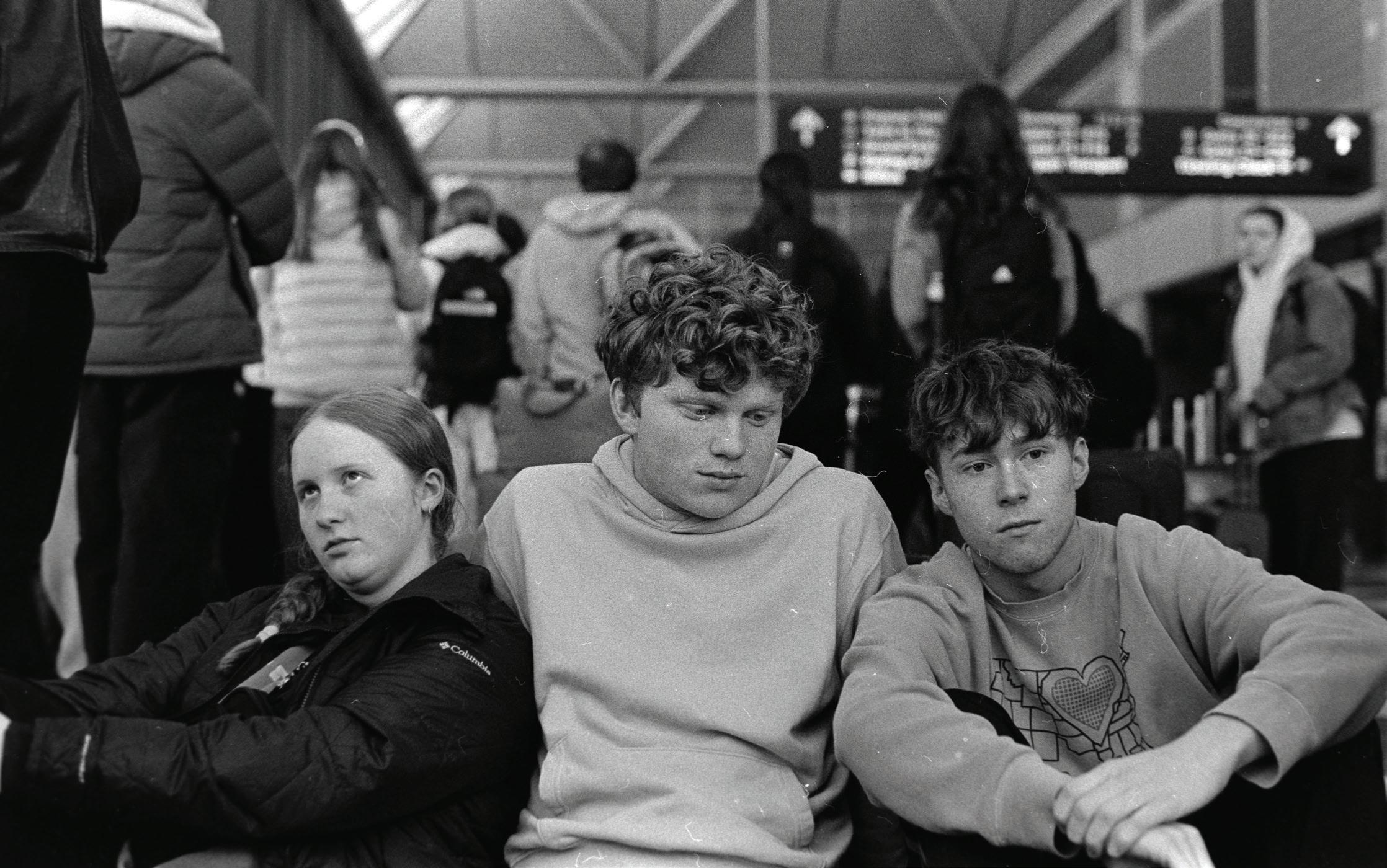
Clara Meehan ‘26, Daniel Kenyon 26, and Nate Malone ‘27 wait in the airport on Wednesday evening. PHOTO BY BEN HAINES
Spring Blood Drive Breaks Record for Donor Registrations
Interact Club Partners with University of Iowa DeGowin Blood Center in 17th Annual Blood Drive
By Saylor Short
Dr. Elmer Degowin, a pioneer in blood research and professor at the University of Iowa, established the first blood bank west of the Mississippi River here in Iowa City in 1938. Almost 90 years later, the DeGowin Blood Center partners each year with City High’s Interact Club to host multiple yearly blood drives, with several students participating in each.
The blood collected in this drive, as with many donations at the DeGowin Blood Center, goes straight to local patients either at the University of Iowa Health Care Medical Center or the Stead Family Children’s Hospital. The spring 2026 drive set a new record of donor registrations, with 34 registrations and 26 collected units.
While taking a couple of hours out of your day to donate a unit of blood might seem like a simple task, it truly changes someone’s life in a way you never could have expected.
“I decided to come and donate blood today because I just felt like it was important to use the resources that I have,” Annika Batten ‘27 said. “I felt like ‘Why not? Why shouldn’t I just do it?’ because I know it can help a lot of people.”
Since the blood stays local, it’s easier for donors to see the positive impact they have made on the patients who need the donations and feel proud of what they did.
“It’s a good opportunity to help others, especially those who just need the help right now. If I can get them the help they need now, that’s what I’m going to do,” Stephie Sumaili ‘26 said.
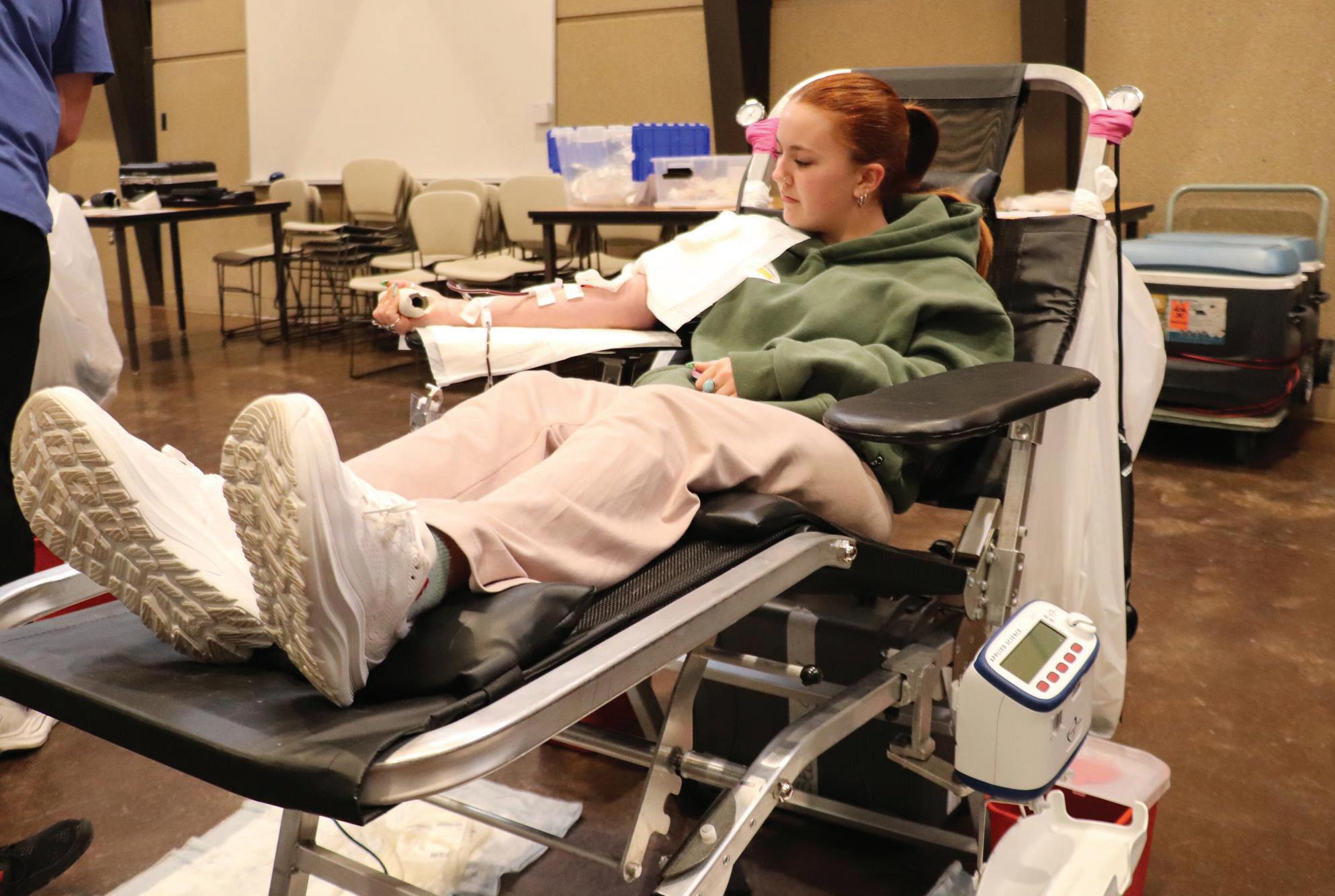

Ily Jensen ’26 squeezes a towel to increase blood flow in the middle of her donation. PHOTO BY SAYLOR SHORT
Juniors Campaign for Student Senate President
This year’s ballot for Student Senate Co-Presidents include Lucas Iverson ‘27 with Martha Willard ‘27 and Joseph Hayek ‘27 with Noah Cox ‘27
By Quentin Blakeslee and Jonah Alam
While the election for the class co-presidents of 2027 is less than three months away, it hasn’t stopped the ambitions of some, including two sets of candidates who agreed to be interviewed about their objectives, running mates, and qualifications.
“I think having some more space for lunch would be helpful,” said Lucas Iverson ’27. “I always feel like it’s a bit cramped where I’m eating lunch [old commons].”
Iverson, along with Martha Willard ’27, has proposed implementing senior parking spots, painting parking spots, and improving communication between teachers and students. The last point was emphasized by Willard during her interview when asked what her and Iverson’s objectives would be.
“I feel like an issue that come across this year is that there’s a lot of parody Instagram accounts for student Senate and that’s not good so I feel like I don’t know how that can be remedied because it’s obviously it’s a very difficult thing, like random students decide to make their account,” Willard said.
Both Willard and Iverson have been in student senate since their sophomore year and are both very active in leadership roles both inside and outside of city high.
“I’ve served as the concertmaster of orchestras. Before, I was one of the drum majors here at City High. I also am a teacher at a summer camp,” Iverson said. “I think all of my experiences in leadership, whether it’s leadership of a club or leadership of a large
group like a band or taking care of young kids, I think all those experiences would help anybody, and I think they definitely will help me in particular.”
“I do Boy Scouts and one of the main things of Boy Scouts is growing young leaders, I’m an Eagle Scout and twice I have been a senior patrol leader of two different troops,” Willard said.
But these two aren’t the only candidates who are running. This is where the “newcomers” enter the picture, the first newcomer being Joseph Hayek ’27.
“This is actually my first year [participating in Student Senate],” Hayek said. “I’ve always been involved in other ways around the school. I do mock trial, I do BPA, and I’m involved in a lot of sports.”
And when asked why he decided to run for class president, Hayek said: “I enjoy being a leader in these types of clubs and I feel like I have been a leader in my sports my other club so I thought, why not do it on a bigger scale?”
But like Iverson, Hayek isn’t running alone.
“I’ve chosen Noah Cox, another junior here who is an awesome guy,” Hayek said. “Also, he’s very smart, is very involved in school, and we’ve been friends for a while. It’s going to be great.”
Hayek and Cox’s campaign strives to unify students at City High.
“Our main objective, I would say, is sort of connecting the school. I feel like there are a lot of different groups at City. We both feel this way. There are lots of different groups at City High, sort of almost cliques, like you kind of know how it is here, but
we should bring everybody together in one little Hawk family, and then the obvious one is we would like to increase student representation and student government,” Hayek said.
Even if Hayek loses the election, he won’t stop trying to bring people together.
“I think most of the other groups and student senate will be with us. I don’t think this is like a super controversial objective,” Hayek said. “I just think it’s something that needs to happen, and it needs to be focused on. You know, student representation is what student government should be.”
Cox has friends all around the halls of City High, and he feels that his connections could help with unifying the school.
“I’d say that, within my grade/class, I’m well connected with a large percentage of people at City High and truly believe that I have the means to represent them all equally,” Cox said. “Joseph’s and my goal is to unite the populations of City High and offer an increased level of representation within the student government. Of course, we’d also like to make our senior year fun and memorable.”
Both sets of candidates expressed confidence during their interviews, with Cox and Willard being the clearest when asked about their chances in the elections.
“I think that what we bring to the table is truly irrefutable, and I strongly believe that we’re a pair of strong and qualified candidates,” Cox said. “Not only do we connect very strongly with each other, but our connections within City High are vast. As a result, I believe that we could equally represent all of those who call City High
home.”
Willard’s response to the same question was “I think we’ve got a great shot for sure but I also think that the other people running or I mean the people that we should not be wary of but we should understand that these are real people and they’re actually running like it’s not like a joke or anything.”
All candidates expressed a willingness to cooperate and negotiate with the other, regardless of the result.
“Often, I’ve found that it’s incredibly difficult to achieve all of your goals without negotiation or compromise; they’re necessary in order to get what you want.” Said Cox.
Iverson expressed similar sentiments.
“Yeah I’m very happy to compromise. I think that we need a lot more that are in our government and in our world and I always advocate for that.”
All interviewed were also asked for their opinion on the current class co-presidents, Tobias Collins ’26 and Alma Bhandary Narayanan ’26. All responses were overwhelmingly positive from all those interviewed.
“I think they’re great,” Hayek said, “I think they’re both gonna be a great help for Cox and I, if we get elected it I think I’d love to stay in contact with them.”
Willard had a more comprehensive response to the same question.
“I think they’re doing a great job. I think honestly it can be a pretty hard job,” Willard said. “Because you are kind of the representative of the student body, but you also don’t have a lot of true power.”
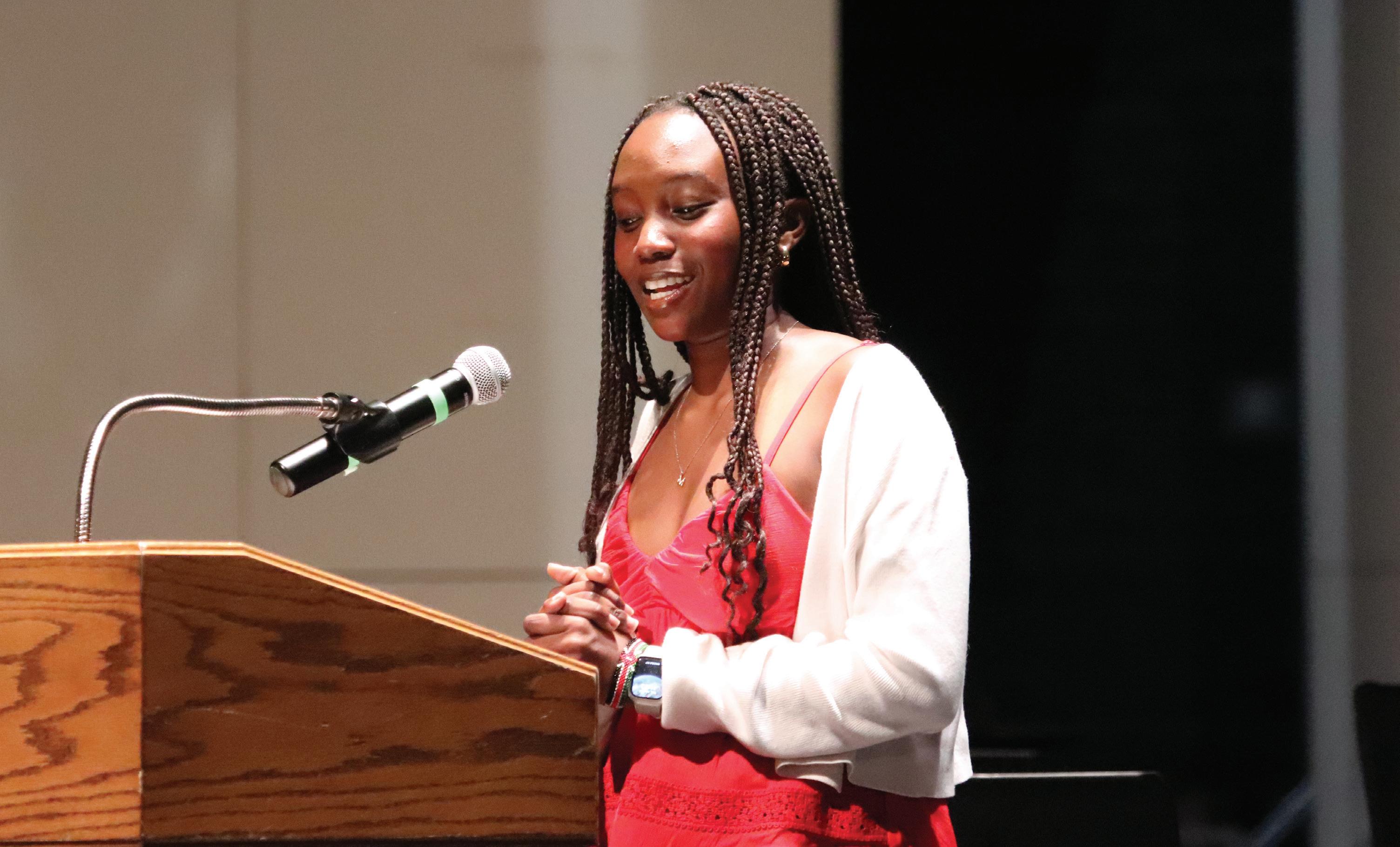
Mercy Ngugi ‘26 presents speech to senior class in May 2025. Ngugi ran for Student Senate Co-President with Jesse Varner ‘26 but had an unsuccessful campaign, losing to Toe Collins ‘26 and Alma Bhandary-Narayanan ‘26. PHOTO BY OWEN RAEFIELD
Frozen Brings Magic to Eastside
The City High Drama Department performed the spring musical, Frozen, from April 24-26
By Nicolas Vergara-Vanegas and Vencenzio McGill
On April 24th, Iowa City High became one of the first schools in the country to perform Frozen: The Musical after it was made available by Musical Theatre International (MTI) to theater communities nationwide on August 1st, 2025.
The musical starred Jillian Leman ‘26 as Anna, Clara Meehan ‘26 as Elsa, Cameron Echols ‘26 as Kristoff, Ev Mozena ‘28 as Olaf, and Nate Malone ‘27 as Hans.
It’s not just hard work for the leads. The show wouldn’t be complete without characters like the Duke of Weselton (Ben Haines ‘27), Pabbie (Mickey Cochran ‘27), Bulda (Esme Hutchinson-Reuss ‘26), King Agnarr (Micah Hartwig ‘28), Queen Induna (Miriam Hachtman ‘26) and Oaken (Auggie Dickerson ‘28). In addition to their roles, these characters are sometimes part of the ensemble, giving them a taste of both the spotlight and the background.
“It is something you have to be conscious of when you’re in the background. It’s two different things from when [Weselton] actually has lines from when he’s singing or just in the background or something,” Haines said. “You have to be aware that there is a main show going on. But then also maybe allowing the audience to think, ‘Oh, what’s that guy doing back there? He looks nefarious.’”
There’s more to a production than the actors, however. For the month prior to the show, the construction, paint, sound,

light, and prop crews, led by Doug Lestina, worked to get everything ready for opening night. The production has had a few challenges, including dealing with special effects and having to work around the construction of Opstad.
“Our sets are very, very big. They’re meant to take up most of Opstad. So, to be able to make these huge structures, we obviously need a lot of space and Opstad being inaccessible for so long, we had to create all of these structures in the shop or in the basement,” Zoee Noble ‘27, a paint crew lead, said. “It really affects every single crew. The actors need the stage, Paint Crew
needs the stage, Construction Crew needs the stage. Costumes and Makeup both need the painting room in the basement. It was a lot of people trying to work in not a lot of space, which is obviously very difficult.”
A cabin, mountains, and enormous columns have been the major projects on the set for both construction and paint crew.
“I think the most challenging project was probably the cabin because there were just a lot of different parts to it, and so many different materials that had to be used to build it,” Lucy Buckley-Hooks ‘28, a construction crew lead, said. “Sometimes it is a bit hard to pull your weight, but it’s also been pretty
fulfilling and satisfying.”
Another integral part of the production is the pit, a collection of musicians playing a variety of string, wind, and percussion instruments. The pit provides the soundtrack for the musical, as well as occasionally giving cues to the actors.
“Things are changing constantly. It’s important to be in tune with the rest of the people in the pit. But the most important thing is just watching the director one hundred percent of the time and always staying locked in with Mrs Stucky,” Gabe Bales ‘28, a keyboard player in the pit, said, “Sometime we’re giving the actors cues, sometimes the director is cueing people from in the pit. Sometimes [the actors] are cueing us. It’s a really hard balance to achieve, but we do it.”
In addition to a live soundtrack, the performance included a couple of ‘special effect surprises’, a fog machine onstage, and new lights effects thanks to the new upgrades in Opstad.
The show played at Opstad from Friday April 24th to April 26th, with two shows on Saturday at 2 and 7 and a final show on Sunday at 2, making City High Theatre one of the first schools to perform the show since MTI’s 2022 ‘United States Frozen’ contest.
“There isn’t much of a blueprint for it. We can’t just look online at what other schools have done for a lot of these things, which makes it challenging,” Director Lauren Darby said. “But it’s also been really exciting to be doing a show that is getting so much excitement in the community.”
Music Department Plans for New Band
In addition, the City High Band Department has released the band rosters for 2026-2027
By Jonah Hefti
Over the last few years, City High’s band program has been growing, so this next year, they are going to expand to include a new band. A change to the composition of the band program has been on the table since at least two years ago.
“The main thing that has changed about band is that we are adding a 4th concert band,” Lucas Iverson Iverson ‘27, a drum major in the marching band, said. “Instead of splitting out the program across one auditioned, one non auditioned, and one freshman band, we’re adding another auditioned band to make our ensembles smaller and better balanced.”
Running more bands could provide students with more opportunities to grow as musicians.
“Having four bands is going to be a really, really, great opportunity for the program to grow and expand,” Felix Cook ‘28, a contrabass clarinet player, said. “Having an easier audition-only band will push people to challenge themselves that otherwise wouldn’t have.”
This new ensemble could also provide the opportunity to better balance ensembles. However, due to the limited number of band directors, the choice of who will direct the new band is currently up in the air.
“We’re still trying to figure out [who will conduct the new ensemble],” City High bands co-director Aaron Ottmar said. “[We are] trying to figure out a good balance
because we have a lot of bands in our band program.”
The band directors are considering changing who conducts which bands in order to accommodate the new ensemble. The current band program has three bands with one for 9th graders (Concert Band), one for 10-12th graders (Symphony Band), and one audition band (Wind Ensemble).
“I think right now it’s extremely likely that Mr. Kowbel will continue to do Wind Ensemble and I think it’s extremely likely that I will continue to do symphonic band,” Ottmar said. “We’re just trying to figure out who’s going to do symphony and what concert band might look like…we just haven’t
quite landed the plane on that one yet.”
Due to the addition of the new band, concerts will be divided in half to shorten the length of the concerts, as they are often held on school nights.
“For each concert, it’ll only be two bands, and that will hopefully allow for a better experience,” Ottmar said. “On the concert side of things, each of the two concerts [individually] will be a little bit shorter than our [one] concert right now.”
This new structure will allow more space for the families of the performers and enable bands to play more music.
“Say there’s a family who just wants to see their students perform, then they can
go to just that concert,” Jethro Michelson ‘27, a trombone player, said. “I think it’ll be great because the concerts will be shorter and people can choose whether they want to go to just one concert or both concerts, and that will allow there to be more seats in each concert.”
2026-27 band placements were released in March. Audition materials were released in December before winter break, giving students slightly more than a month to prepare before placements. The audition required students to prepare one short piece, or etude, for the audition. Students were also able to prepare additional, optional materials, including advanced songs and scales.
“I think it’s pretty simple and well thought out,” Iverson said. “Students really have the opportunity to show as much as they can do with little pressure on trying to push themselves too hard.”
This year, some changes were also made to the process of auditioning for a band. In prior years, band auditions were in person and optional, only required for those wishing to join Wind Ensemble. Now, all freshman, sophomore, and junior students are required to complete them.
This audition cycle is also the last for many juniors moving into their senior year. It can mark the start of their final year in the City High band program.
“I feel good about [next year],” Lucas Iverson said. “Not gonna lie, I’m a bit sad that my time here at TSTL is more in the past than in the future…. But I know I’m going to have a great final year and I’m excited about that!!”
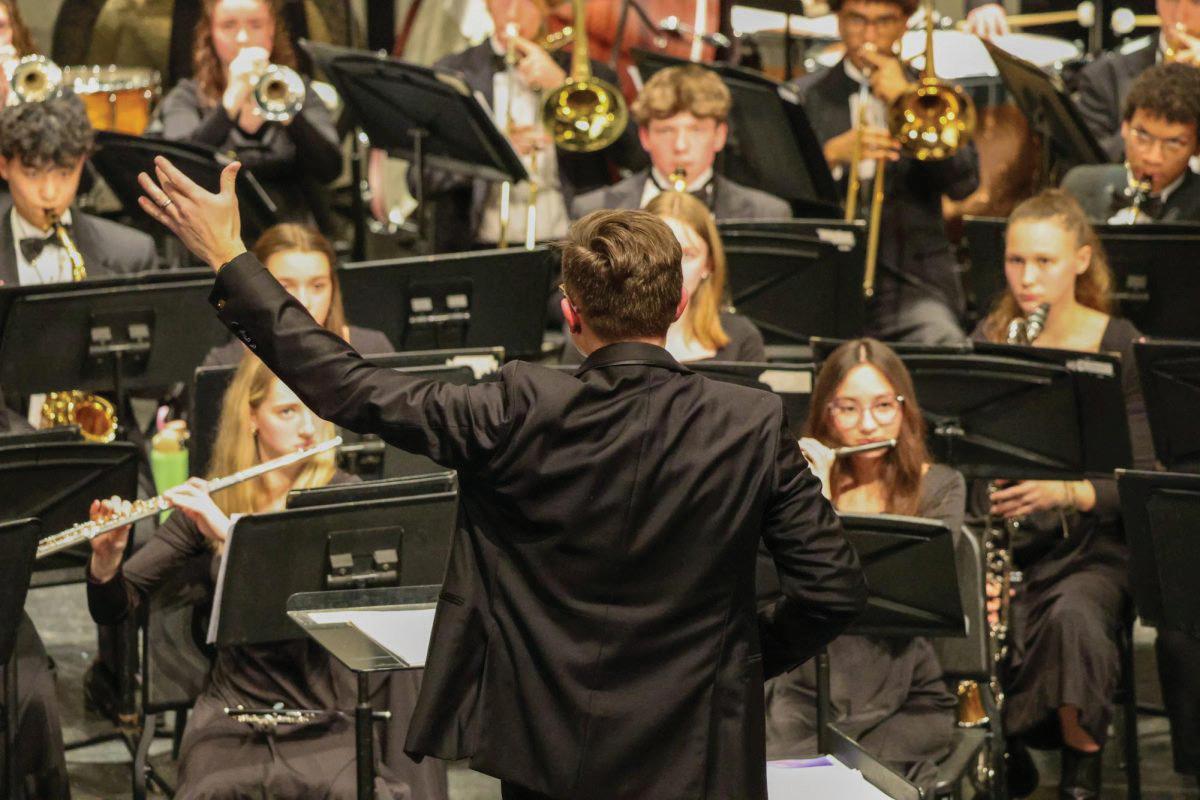
Wind Ensemble performs at the 2025 Mid-Winter Band Concert. PHOTO BY ESTELLE HARTZ
Clara Meehan ‘26 performs Let It Go as Elsa on Thursday at the elementary school preview performance.
PHOTO BY NINA RENAUD
Jazz Ensemble Wins Iowa Jazz Championships
By Martha Willard
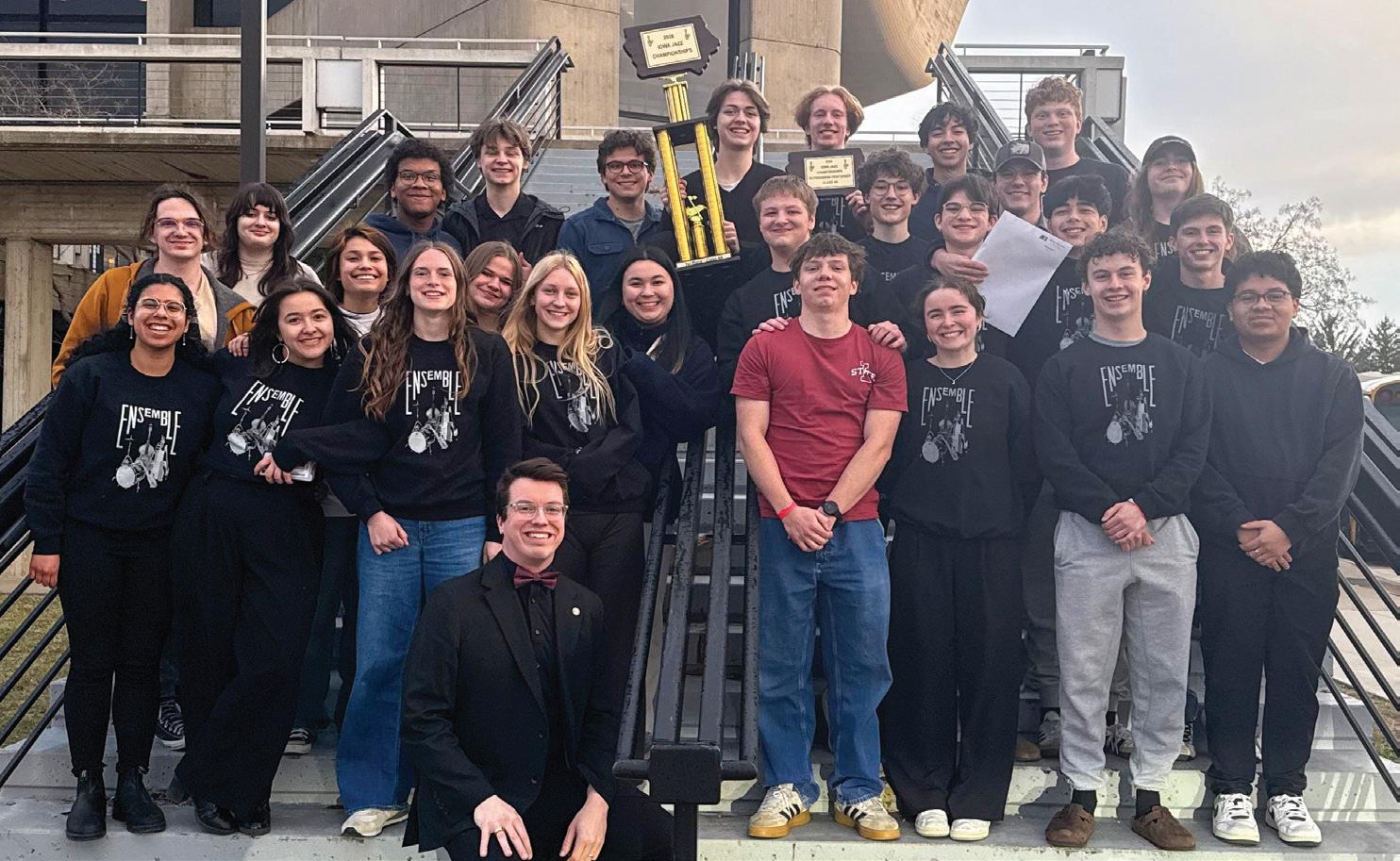
After a sixth place finish last year, City High’s Jazz Ensemble won the 2026 Iowa Jazz Championships.
When awards are being announced, they start with eighth place and continue down all the way to first.
“Our name kept not getting called, which is a very interesting feeling. You’re like, wait, did they forget about us? And then our name was the last one,” Jazz Ensemble director Aaron Ottmar said. “It was just unreal. I was very overwhelmed with emotions, and I think the students felt that same way too.”
This is the second time the group has won the Iowa Jazz Championships, after a first place finish in 2024. The group did not qualify by placing in the top two at the district competition. Instead, they were selected via wild card because of their overall season performance.
“I feel like it’s cooler to get chosen as a wild card band, because the people at the [Iowa Jazz Champi-
onships] are collectively thinking about [how we] have won all these other competitions or placed very highly,” Coraline Etler ‘26 said. “It means more to me than just random competition results.”
According to Ottmar, judging can be subjective, like in any musical competition, so it’s important for the group to focus on things they can control.
“[This group] loves making music, and I’ll take that over anything, regardless of results,” Ottmar said. “I always tell them to not take that for granted, because it’s something you can control. You can’t control points or placements or getting a trophy or not, [but] you can control how you approach what you do musically, and they are just very intentional with that.”
This year’s group of seniors, including several that were members of the 2024 championship-winning band, have especially led that intentionality over the past four years. These wins, however, aren’t the biggest takeaway for Levine.
“I love being able to do some-
thing I’m passionate about with my friends. You don’t get that many opportunities to do something at a really high level and with the people who you know, the only people that you want to do it with,” Levine said.
“So I think that’s just pretty amazing to get the opportunity.”
Ottmar and his City High bands co-director Mike Kowbel often emphasize having a City High band family, not only in the Jazz band but throughout the program as well.
This year’s senior class has especially helped support that.
“There [are] 12 seniors out of the 20 [jazz ensemble members] of them. They’ve done a really, really wonderful job of serving our jazz program and our band program… through the years,” Ottmar said. “They’ve done so much to put in hard work and dedication to not only play music at a high level, but to care about the family atmosphere altogether.”
PERFORMER PROFILE: Lucas Iverson
By Margaraet Cilek and Anna Platte
On the nights he can’t sleep, Lucas Iverson ‘27 stands in front of the bathroom mirror and conducts. His whole day is filled with music, from first period orchestra to hours of practice each night. His dedication has led to many leadership roles at City. This includes leading rehearsals for pit orchestra when Ms. Stucky can’t be there.
“I didn’t come into high school with a bunch of ideas of what I was going to do. It’s just [that] opportunities came and I took them. I am bad at saying no to things, so I take on a lot,” Iverson said.
One of these things was pit orchestra. This is Iverson’s second year playing for the musical. His first was the Singing in the Rain pit his freshman year.
“It was really challenging, but I felt like I grew a lot during that time,” said Iverson. “It was really fun too, even though I didn’t have a lot of friends in pit, it was a really
positive experience.”
While his first pit experience was a challenge, this year Iverson feels much more relaxed. He’s also ex cited about the group of people in pit, who he says are jelling well and having fun.
“I feel like everyone’s energies are working really well together, and we’ve only had a couple rehearsals, but it seems like it’s going to be real ly fun,” Iverson said. “I feel like this year we’re going to do a lot of stuff together and it’s going to be like one happy family.”
Iverson is also a leader in band. He is one of the three drum majors in marching band, and is the section leader of the Symphony Band flutes. He thought his fresh man year would be his last in the band program, but ended up really enjoying it.
“I had concert band with Mr. Kowbel, and I really liked that. I liked how serious he was, and how he expected such high results from the freshman, and how much he pushed us. And so I really fell in love with band again.”

Jazz Ensemble poses for a photo with their trophy after awards are announced. PHOTO COURTESY OF AARON OTTMAR
At the behest of his mother, Iverson began playing violin at just three years old. PHOTO BY MARTHA WILLARD


Executive Editor
Lily Rantanen
News Editors
Martha Willard
Liyan Elgiseer (asst.)
Sports Editors
Jack Rogers
Rito Perez
Tessa Driscoll
Ben Klitgaard
Louisa Berry-Stoelzle (asst.)
Caden Beard (asst.)
Opinion Editor
Nicolas Vergara-Vanegas
A&E Editor
Estelle Hartz
Positivity
Editors
Ada Meineke
Scarlett Carino-Marek
Izzy Brown
Feature Editors
Lily Rantanen
Rayan Ahmed (asst.)
Video-Broadcast
Melody Ross
Avery O’Brien
Social Media
GRAPHICBYNICOVERGARA-VANEGAS

Ramy Makawi
Staff
Jack Lampe, Owen Raefield, Ben Haines, Kyle Hartwig, Jack Litton, Ven McGill, Micah Hartwig, William Meis, Bella Ragona, Kelsey Herrig, Liz Degner, Stevie Wilmoth, Oliver Erickson, Alex Donovan, Jacob Reid, Audrey Vande Berg, Henry Birt, Stella Demarest
Advisor
Jonathan Rogers
Mission Statement
The Little Hawk, student journalism newspaper and website of City High School, aims to inform, educate and entertain readers. LH journalists follow the code of the journalist by seeking truth, doing no harm, being independent, and working toward balance in all news stories. All student voices are enouraged to be part of a LH journalism class. To join the class, talk to your guidance counselor today.
Letters to the editor may be submitted to: LittleHawkPage@gmail.com
ICCSD Equity Statement
It is the policy of the ICCSD not to discriminate on the basis of race, creed, color, religion, national origin, gender, age, marital status, sexual orientation, gender identity, veteran status, disability, or socioeconomic status in its educationall programs, activities, or employment practices.
If you believe you (or your child) have been discriminated against or treated unjustly at school, please contact the Equity Director at:
509 S. Dubuque Street (319) 688-1000
Letter to the Editors



What Can You Do?
The First Amendment is a miracle.
The fact that the founding fathers saw the importance of giving the people a right to criticize the government is an understated fact, and given that the First Amendment is the most commonly recognized amendment in the US, that’s saying something. But acknowledging that the First Amendment rocks isn’t enough. When something happens in this nation that an American doesn’t agree with, they need to be able to know how to do something about it, and how to do it effectively. This is especially true when it comes to young populations who are often the most vocal and active. So what can be done?
Protest
Protesting may seem like the most obvious answer, but it is still important! Protesting can get the government’s attention, because when people voice discontent with policies, it brings more attention to issues. Protesting also shows others that they aren’t alone in their struggles or beliefs. It shows solidarity to others in the community. And it really can cause change.
When people across the country started protesting against ICE, Democrats finally stopped funding the Department of Homeland Security. Politicians may seem above everyone else, but in the end, they answer to the community. They still need to get elected. Protests can be the most important tool to push for change on many occa-
STAFF
EDITORIAL:
It’s important to use the voice that the 1st Amendment has given the nation. This is how anyone can do it
sions.
Often, one doesn’t need to be the one doing the legwork to organize and spread news about protests. There are often people and groups who may already be doing this in your community, you just need to seek them out. This actually plays into the next point of being active. To be aware of these protests, it’s important to stay aware of what’s happening and that is a fundamental part of Political activism.
Stay Aware
Another important part of being politically active is to know exactly what’s happening. Try to know what’s happening with issues and especially be aware of who your legislators are. Keep an ear out about walkouts being planned and listen to local news. This not only supports local news stations, but local events are a lot easier to influence than national ones, so it is important to keep tabs on them. This does NOT look like sitting online and doomscrolling. That really doesn’t do anything. Read the news but DON’T just fall into stress. Do something. Just sitting is the exact opposite of being politically active. Being aware of the news, knowing who
represents the community, and keeping an ear out about protests or walkouts is how one can stay informed.
Another option is to join a voter’s league. They provide information often to allow people to make more informed decisions about who to support. There are probably groups in the Iowa City community dedicated to keeping people up to date, and if there aren’t, work can be done to organize some.
Don’t Stop at Protesting
Voting is a simple yet fundamental way to stay politically active. Don’t just vote in national elections; vote for the school board and whatever is happening at the local level. Voting is the single most important way to express your beliefs and your duties as a citizen.
Reach out to your legislators
Reaching out to local legislators is a classic form of resistance. Their number and email are available. This has much the same effect as protesting but the time required is drastically less. All it takes is a couple people with some time to start sending emails. The bar to entry isn’t a hundred people, it’s one person with a bit of time. This
pushes legislators to take actions and listen to their constituents. Speaking to someone isn’t even required; sending an email is enough. It really is pretty easy.
Organize
Organizing allows voices to be heard. It allows for collaboration between people who agree on a subject at lets them to collectively be louder. The more people speak out the harder it is for them to be ignored. A larger group will almost always be preferable for political activism. Organizing can take the form of volunteering for a political campaign, joining a club at school, creating new organizations, or joining a political organization or voter’s league. If there aren’t any existing ones in the area, they can be made. Someone has to take the first step, and there are no age requirements to do so.
Donate
If money allows, donating to groups who share the desired beliefs is another great way to get involved. Many good groups exist to donate to. There are groups for republicans, democrats, free speech supporters, civil rights supporters, communists, or countless other groups. Even volunteering can help. Donating is just another way to get involved and to use the power of free speech. Most importantly, all these examples are simple and can be done by people who are used to being politically active or just starting to use their voice. So long as this is done, the people continue to have a voice, and change can happen.
The Little Hawk Little Hawk Journalism Staff

GRAPHICBY NICOLAS VERGARA-VANEGAS
DON’T BE SCARED
“The only thing we have to fear is Fear itself”- FDR by Nico Vergara-Vanegas
Fear is a natural reaction to a dangerous situation. It’s a primal emotion, essential for the Fight, Flight, or Freeze response. Fear has kept humanity alive for the last 350,000 years, and will likely continue to do so for years to come. But here’s the thing about fear– more than an emotion, it’s an instinct. It doesn’t require thinking. In fact, many people are afraid of illogical things, like bald people (peladophobia), cats, (ailurophobia), or the dark (nyctophobia). Emotions like fear that don’t require thinking, allow for faster responses. This is fine, even ideal for the conditions that humanity was subject to for thousands of years(when it wasn’t at the top of the food chain), and that many humans are still subject to today. For many others though, fear can lead to irrational decisions that can cause terrible consequences. History is rampant with these examples. Here in the United States, the Red Scares which resulted in the Palmer Raids in the early 1920s and later in McCarthyism in the 1950s. This caused many immigrants to be targeted for suspected communist ideals, often with no evidence and unjustly. But with anti-communist feelings filling the government and much of the nation, fear allowed these things to happen. Centuries earlier, during the Bubonic Plague, with no knowledge of the origin of the disease or how to treat it, governments blamed the Jewish minorities in their nations for spreading the disease, allowing the people to project their fear towards the Jews instead of the government, who couldn’t do anything. Even during Covid-19 pandemic, fear controlled the actions of people. I remember how my parents would frantically clean everything as often as possible, how anti-Chinese sentiment began to rise, and how quickly people turned against each other depending on their individual handling of the crisis. Fear, unchecked and unsupervised, is dangerous.
Fear is also an easily exploited emotion. As I mentioned before, fear doesn’t require thinking– that means that when scared, it’s easiest to have someone else think for you. Think of it this way; in a dangerous situation, if somebody yells ‘RUN!’, the most likely response is to run. It doesn’t matter if the direction that the person runs toward is a dead end— they didn’t


consider that when they started running. In fact, they only started running because someone else told them to, not because they thought it was the wisest thing to do. That’s because fear makes a person suggestible, and as a consequence, easily manipulated. Such things have happened before. In fact, they happen all the time. The Palmer Raids could not have happened without soldiers who feared communism. Jewish pogroms wouldn’t have happened during the Black Death if people weren’t afraid of the Plague. If the knights of Europe didn’t fear islamic domination, there would never have been a Crusade. Fear, more than an emotion, is a powerful political tool that allows leaders to come to power, control populations to do their bidding, and maintain control for a very long time. It’s the ultimate tool of not just dictators, but of influencers, politicians, and advertisements. In summary: a scared populace is an easily controlled and dangerous army.
“Fear, more than an emotion, is a powerful political tool that allows leaders to come to power, control populations to do their bidding, and maintain control for a very long time.” Nico VV Opinion Editor
So how does one avoid falling in the trap of fear? I’ve already said, three times now, that fear doesn’t require thinking. Often, some things seem a lot scarier than they actually are. The things that might be in the dark are easily revealed when one turns on the light. People who know more about what they’re fearing are less likely to make rash decisions in response to fear. So staying informed, doing research, and most importantly, keeping a calm demeanor in stressing situations are key to not giving in to fear. Those who intend to manipulate a scared populace can only do so if the populace is willing to listen to them. An informed and calm populace is difficult to control with fear-inducing lies. It’s also important to keep a critical mind. Everything in this world has a purpose; every advertisement, product, and piece of propaganda is meant to sway people to do something. In the case of fear, keeping in mind the purpose of something that causes fear is also helpful to not fall into fear’s trap. This is simple in theory, but sometimes, it’s hard to acknowledge that one has been fearing something irrational when it seemed so rational in the past. It’s because of this that fear is so powerful, and why it’s been used so many times for so long. Calm and rational minds are the only thing that will allow for a peaceful future.


Q&A With Patrick Cotnoir
Behind the Scenes with the producer of ‘The George Lucas Talk Show’
“One problem that I’ve had for 11 years is trying to describe this show, and I still haven’t figured out a good way to do it,” producer, director, and talent booker Patrick Cotnoir said to me when I asked him to explain what The George Lucas Talk Show is to you, the reader. Despite this lack of confidence, Cotnoir did a terrific job.
“The George Lucas Talk Show is a real talk show hosted by fake George Lucas,” he explained. “Comedian Connor Ratliff plays George and acts as him as if he’s hosting a Tonight Show-style talk show. His sidekick is the character Watto from the Star Wars prequels, played by actor and comedian Griffin Newman. But we treat it like it’s a regular, real talk show. I’m their on-screen producer. I also help book all the guests and make sure everything is running smoothly.”
“On-screen producer” might seem like a confusing role, but watch the GLTS long enough and you realize that Cotnoir’s a necessary presence when it comes to raining-in Ratliff and Newman.
“Yeah, they hate me, and they’re mean to me,” Cotnoir joked when talking about his dynamic with the two comedians. “No, I don’t think they hate me. They’re polished performers and seasoned improvisers, and I’m very much not. I spend a lot of time around improv, because I did a lot of stuff at UCB like booking and producing and
stuff, but I’m not a performer in that sense of the word. We’re different types of personalities in the show and I think it does help, because sometimes they’ll go down a path where they’re getting real bit-heavy and I’m the one who sort of has to be the straight man and move it back into the path of a talk show. I think it was the Seth Meyers episode where before the show I said, ‘Remember to talk to the guests.’ And Griffin always makes fun of me for that, but I think it’s like a fair thing that I do have to remind them of sometimes.”
In addition to keeping Ratliff and Newman in check, part of Cotnoir’s role is ensuring that the guests feel free to have fun and experiment.
“I think the goal for the show is always to make sure they’re having a good time and they’re having the experience that they’re not going to forget. Make them feel comfortable, but also make sure they can act in a way they wouldn’t in a normal interview setting or tell the stories that they wouldn’t normally tell. We want them to be able to let their guard down a little bit. I think being in such a strange scenario like this show automatically lets that happen a little bit. When you’re expecting a certain thing, but then George Lucas asks you about an episode of Law and Order that you were in 15 years ago you’re caught off guard and you sort of open up in a way that I don’t
think you would with Jimmy Fallon. I feel like some of our best guests don’t know about Star Wars and that rules. And so much of our show has nothing to do with Star Wars at this point that it doesn’t really matter that much. It’s rare that we really go down [a Star Wars rabbit hole]— we’re talking more about the things that Connor’s interested in.”
Like most great comedic things, the GLTS started as a bit.
“In 2014 Connor had been doing a lot of stuff at UCB—an Improv Theater in New York called the Upright Citizens Brigade started by Amy Poehler, Matt Walsh, Ian Roberts and Matt Besser—and Connor had been doing stuff there for a few years wanted to do his own show. He pitched this one show where he played a bunch of characters, and it went up once and didn’t really happen again. So he thought, Okay, I need to do a show that has a hook that can really get people to come see it, because they’re not going to come see it if it’s just me. He had been doing this George Lucas impression for his friends when they were growing up so he thought, Well, if I just do a talk show and have it say ‘The George Lucas Talk Show,’ people are going to show up because maybe they’ll think it’s George Lucas. So let me try that.”
Cotnoir first became involved with the show almost by accident.

“I was on my way to the first show, and I got a call from Connor, and he said, ‘Hey, we had a warm up comic for the show. They just dropped out. You’re doing it.’ And I was just like, ‘What does that mean?!’ And he went, ‘I don’t know. Just figure it out.’ So I did my version of what the comedians do to get the Jimmy Fallon audiences ready, and I had a good time. I went to a few more of the shows, but missed a couple early on. And then maybe three or four months in started going pretty regularly, and was filming the show for Connor and helping set up the stage, and getting stuff ready. At some point we were talking to someone in the lobby and Connor said, ‘Oh, do you know Patrick? This is Patrick. He’s my producer.’ And I said, ‘What are you talking about? I’m not your producer. I’m just the guy who helps set up.’ He went, ‘No, no, you’re my producer.’ And that’s a very Connor thing in that he doesn’t really tell you a lot of stuff, but he just makes decisions and goes. So that was a twist that I was not expecting. That was 12 years ago, at this point!”
I mean, I’ve talked to Watto more than I’ve talked to some family members in my life. I’ve just spent so much time with them that I think we do feel so comfortable with each other. It’s unlike any other show that’s out there. And I say that trying to be humble about it, but it’s different and it’s weird and it’s interesting, and I like that.”
LITTLE HAWK MOVIE PICKs






Patrick Cotnoir is the producer of the George Lucas Talk Show, a real talk show hosted by a fake George Lucas. PHOTOS AND GRAPHIC BY BEN HAINES
by Ben Haines
SPORTS GAMBLING: An Epidemic Targeting Young Men

By Rito Perez OPINION
It’s a night like any other, a group of City High student athletes are huddled together in a basement, all with money riding on this primetime sports game. What might sound like an innocent hobby, just trying to get in on the action, becomes a lot more sinister. Friends are yelling at each other, the TV, and increasing their cortisol levels staring at the stats for their prop bets. This is not a fun way to spend a weekday night, it’s a sign of an emerging sports gambling problem.
A sports gambling problem is simply defined as a persistent, recurring, and uncontrollable betting behavior which takes over a person’s life. Unfortunately, this can be seen all too much in City High. Students create spreadsheets to plan out bets in class, placing bets in class, and taking over the social life during school instead of productivity.
“I’ll say this: whenever we’re doing anything else, and people around me are constantly focused on their bets, it gets old quick. It definitely seems like it’s taken over some of my friends’ lives, and whenever I’m with them playing poker or whatever, they are only focused on their other bets, ” an anonymous City student said.
This all started in 2018, the Supreme Court case Murphy vs. NCAA, overturned a federal ban on sports betting (in states not named Nevada). This ruling allowed states to choose whether
or not they were going to allow sports betting in their states. Since then, 38 states have legalized sports betting.
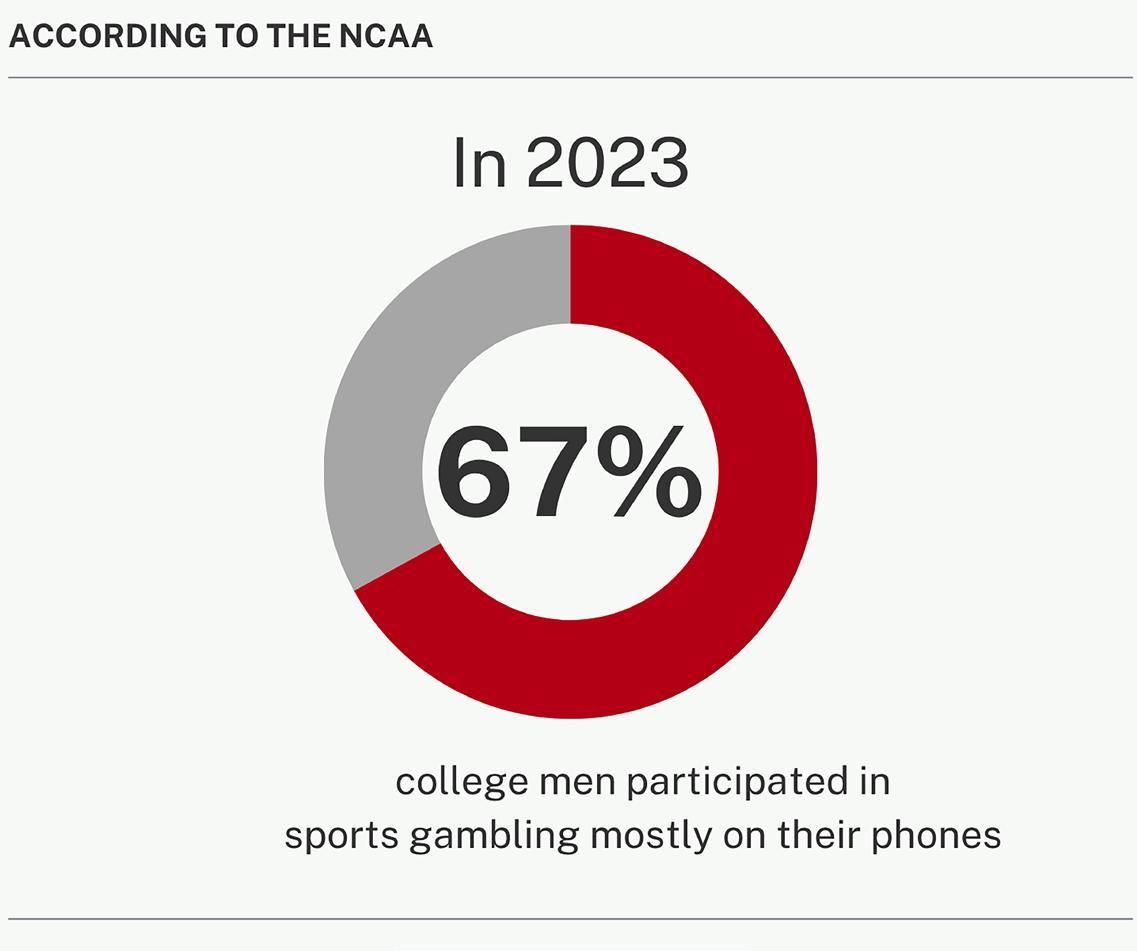
According to the AIBM (American Institute for Boys and Men), through advertisements featuring cameos from celebrities and athletes which young adults idolize, or the gamification of spending money on gambling apps; the betting industry has been predatory to these young and impressionable men. According to an article written in 2023 by the NCAA, 67% of all men living on campus participated in some sort of sports betting. This legalization has also proved a complete takeover of sports betting into American sports culture. It’s nearly impossible to watch the main American sports and not see an advertisement for a sports book.
It’s no secret that teenagers and college students are beginning to gamble. Gambling is everywhere on social media and in our culture now, but it’s quickly becoming more accessible. Through legally dubious means, there are ways that men under the age of 21 (the legal gambling age in Iowa) have been able to gain access to sports betting apps.
Enter another City High student; the target demographic for gambling companies. This student has been a lifelong sports fan, and is now finding himself sitting in his basement with access to DraftKings, intently watching any and all sport games, counting the stats and becoming either extremely elated or extremely irate at even given games on the TV. His parlay didn’t hit, of course it didn’t, because it never does. Now, to cope with his lost money, he makes a “sweat free bet” on a Korean Women’s Field Hockey Game airing at 1 am to gain back some of his now lost money.
This may sound like a rare occurrence, maybe an exaggerated fictitious story, but this is all true. These are behaviors of the aforementioned emerging gambling problem, and there are a substantial number of young men at City

High who do the same thing as our anonymous friend. Watching and praying that their bets will hit on any given night. Placing hundreds of dollars a night on a player getting 30 points, or scoring a touchdown, or there will not be a run in the first inning of the 12pm slate of MLB games. The list goes on, and these young bettors will find anything to bet on.
“I started gambling this year, but I had an epiphany one morning when the first thing I did when I woke up was look at DraftKings. I couldn’t find anything to bet on, and I realized I was forcing myself to just bet. I realized at that time, this was becoming a problem for me, and my friends who do the same,” Anonymous City High Student said.
Embracing and normalizing betting in American sports is the easiest way to embed betting culture permanently into our nation’s sports viewing, which has millions of young viewers every year. According to the Guardian, sports books use features like “free bonus bets”, or normalizing it in American culture designed to keep men engaged. Outside of those factors lay some psychological factors. The brains of young men are more susceptible to addictions which release dopamine, or award based addictions.
“I just remember all the times that me and my friends would have fun together that [wasn’t] just sitting in a basement and sweating out peoples bets, and I think that it has just turned for the worst for everyone involved. Even people that don’t sportsbet in our friend group are affected because of the grasp that it has on the people that are sports betting. I just wish that nobody ever even started,” another anonymous student said.
The main reason states have begun legalizing sports betting is because it’s an easy way for states to gain tax revenue. According to the Tax Foundation, Iowa and Nevada, for example, have a 6.75% tax on all revenue these sports books gain, which is the lowest of all the states. On the highest end
are states like New Hampshire and Rhode Island, with a 51% tax on gross revenue.
This revenue gained for the states is mostly beneficially, and is easily facilitated into public infrastructure and education, without the need to increase tax on its citizens. Ironically, this revenue is oftentimes put into state gambling rehabilitation programs and centers.
Iowa legalized in spring of 2019, but this has not come without some drawbacks. Despite earning 45 million dollars in revenue from the aforementioned tax, it came with a record high statewide spending of 2.6 billion dollars on sports betting in 2024. This unfortunately proves the first drawback, which is the fact that Iowa has seen an increase in gambling problems, and somehow, declining treatment funds for the state.
Going back to 2021, Iowa had a series of athletes across the NCAA get in major trouble for gambling. If you are an NCAA faculty member or athlete, this automatically bars you from participating in sports betting. However, many people did it anyway. At least 35 Iowa or Iowa State athletes faced either criminal charges and/or losses of eligibility in the NCAA, along with suspensions. So, at least in Iowa, it seems this legalization has caused more harm than good for most cases.
There are also legal ways for students to get in on the action. Kalshi, a new prediction market gambling site is a legal loophole for permitting 18 year olds to begin betting. The site with an estimated valuation of 22 billion dollars disguises itself as a “financial future trading” (i.e. a stock market app), it can evade state gambling regulations. Even more suspiciously, Kalshi is largely not taxed like sports books are by states, giving no benefit to states for legalizing. Oh wait, that’s right, they didn’t have a choice. Through yet another loophole, Kalshi has been able to become legal in all 50 states.
Regardless, these prediction market programs are permitting even younger men to begin gambling earlier in extremely predatory ways. Scrolling on social media, it’s extremely likely to see a popular creator being sponsored by Kalshi or Polymarket (which is basically Kalshi under a different name). This is used as an effort to once again lure in the minority of the population which does not participate in sports betting.
“I definitely used it because I didn’t have access to any other betting websites. It’s overwhelming how many things you can bet on for Kalshi. I don’t use it anymore because I don’t really see a point, but it’s a really weird app ” an anonymous City High student said.
There is a silver lining, though. When investigating how much the people of Iowa spent on Kalshi this year, the only information found was the fact the state of Iowa is being sued by Kalshi due to pushback on the limited tax benefits states receive, and the lack of regulatory power states wield.
Kalshi, though, is not the end of the problem. Somehow, the United States has another legal loophole for gambling companies to exploit. FLIFF, which is essentially a sportsbook, permits men who are 18 (under the legal age for gambling) to begin sports betting. Similar to Kalshi, FLIFF uses a loophole where instead of using real money, they use “Fliff Cash”. However, you’ll find that “Fliff Cash” is equivalent to one USD. Because users are technically only using virtual currency, this is permitted under United States law.
Unfortunately, according to NPR, the American government doesn’t track how many adults struggle with a gambling problem, dissimilar to drugs and alcohol addictions. Furthermore, NPR claimed when they requested data from the Massachusetts gambling helpline, they found that since the state legalized sports gambling in 2023, the amount of callers on the helpline doubled.

WILL FEAGLER PROFILE: BUILT FOR THE MOMENT
By Rito Perez
There are few people who have the talent and ability to be ranked #2 in the state of Iowa individually for tennis. There are even fewer people who achieve that status as a sophomore.
However, City High has their very own who did just that. Will Feagler ‘28 after just one year of high school tennis found himself as the second best player in the state.
“I’m always going to try to win as many matches as I can. I’m still learning about how to best prepare for each meet day, so learning every day is also a big one for me,” Feagler said.
Last year, Feagler played as the two spot on the team underneath Ahbay Anil ‘25. Eventually, Feagler and Anil played each other in the district championship match to go to state. Feagler won the match in an upset. At the state tournament, Feagler placed fifth, cementing himself as a force to be reckoned with on the court.
“The biggest thing for me is staying level headed and focused, when I am confident and relaxed I perform my best. Making sure I’m keeping my body in good shape and healthy is a big key to go from sport to sport. Injuries happen fast if you are not careful,” Feagler said.
The varsity tennis squad looks a little different this year. Losing five seniors in the starting lineup left only two tennis players; those being Feagler and Daniel Kenyon ‘26. With these changes comes a new role for Feagler. Most sophomores aren’t expected to be leaders on the team, but Feagler has stepped into his new role well. “I enjoy playing on the team but it is tough when I
have to focus on myself but not block the team out as well. Holding a high energy environment is important in tennis, but it is harder when I am still getting a feel for the season,” Feagler said.
Feagler is not only an excellent tennis player, but a talented golfer. Feagler has started on the varsity golf team for both of his first two years, his freshman year in the six spot, and his sophomore year in the two or the three spot. Now, with the notable departure of star golfer Jack Rogers from the team, Feagler will likely remain in the two, or climb to the one spot.
“Meeting new people from around the world has been a great experience for me. I’ve enjoyed working hard with many different people and look forward to learning more every time I play,” Feagler said.
The Little Hawks have only had one meet this year to after their initial dual against Cedar Falls was postponed due to weather. The first meet against Kenned, the team lost 1-8, with the only win coming from Feagler. The team is set to officially kick off the home season on April 16 against Washington High School.
“The dynamic has changed a lot, the guys last year were seasoned varsity players so they were much more relaxed. I’ve noticed the team is a little more uncomfortable in the big moments but I have no doubt it will change by the post season,” Feagler said.
For updated coverage on City High Tennis visist thelittlehawk.com

ABOVE: Will Feagler ‘28 hitting a drive in the teams meet at Brown Deer. Feagler was apart of the teams school record on nine holes.
PHOTO BY JACK ROGERS
ABOVE: Will Feagler ‘28 returning a hit in the individual district meet last year. Feagler ended up winning his district over teammate Ahbay Anil ‘25.
PHOTO BY RAMY MAKAWI
OSCAR GATES: Returning to the Midfield
After
spending three and a half years at a prepatory high school in Minnesota, Oscar Gates ‘26 returned to City High joining an already highly ranked boys soccer team.
By Jack Rogers
Number eight this year for the City High soccer team is worn by Oscar Gates ‘26. Trotting out to the midfield on the City High turf, Gates makes his return. After spending three years at Shattuck-St. Mary’s School in Faribault, Minnesota, Gates returned to Iowa City for his senior season. Shattuck-St. Mary’s is known as one of the top college preparatory programs in the country and competes in MLS NEXT, the highest level of high school soccer in the country. Despite the elite competition, Gates said his decision to come home was driven by more personal reasons.
“The biggest factor for me in my decision to come home was my love for the game of soccer,” Gates said. “I love Shattuck and the lifelong friends I made there. But after three years, my love for soccer had faded. At City, I think I will enjoy playing soccer again. I also wanted to come back to spend more time with my family before
heading off to college.”
Gates’ soccer career began when he was just four years old with the Iowa Soccer Club, where he developed with many of the same players he will now rejoin at City High. He remained with the club through middle school and quickly established himself as one of the top players in the club before leaving for Shattuck before his freshman year. His decision to attend Shattuck came from both its reputation and the level of competition it offered.
“My decision was influenced by Shattuck’s great reputation for allowing players to play in top college programs,” Gates said. “Another factor was my desire to play at the highest level I could access. Shattuck plays in MLS NEXT, the top amateur league in the nation. Week in and week out, we would play top teams, including MLS academies. That competition pushed my teammates and me to become better.”
At Shattuck, Gates made a significant impact. He served as a team captain and played 1,686 of the team’s 2,003 total minutes at central defensive midfield, helping
guide the team to a 10-6-7 record. His consistent presence and leadership made him a key piece of the lineup. Following his high school career, Gates is set to continue his soccer journey at Carleton College, a Division III program in Northfield, Minnesota.
“We practiced year-round (at Shattuck) training about one or two times a day with lifts, which helped me improve a lot as a player, and I am thankful for the time that I spent there,” Gates said.
Back at City High, his return is already being felt by new teammates.
“Having Oscar on the team now is definitely a big improvement,” returning starter Jayden Le ‘26 said. “Losing so many seniors in the midfield was a big loss, but having Oscar really helps fix those problems. He’s definitely increased our chances of making a deep run in the postseason.”
Gates joins a City High team that has come close to a state championship in recent years. Two seasons ago, the Little Hawks fell in extra time in the state semifinals, and last year they were upset in the quarterfinals by a single goal after entering
as favorites. Now, with a couple of returning starters and the addition of Gates, expectations are high once again. He has already been recognized as one of the top players in Class 4A and is expected to play a major role in the team’s success.
“This team, including myself, doesn’t have a lot of returning starters, so everyone is inevitably going to gain experience as the season goes on. So gaining experience and trusting each other and the coaches are going to be our keys to success this season,” Gates said.
For Gates, however, this final season is about more than just results.
“My goals at City are to enjoy my last season of soccer in high school and to make it to the State Tournament,” Gates said. “I’m most excited to play with my childhood friends one last time and to have the opportunity to experience high school soccer.”
After three years of high competition away from home, Gates returns not just as a talented player, but as a person trying to rekindle his passion for the game.
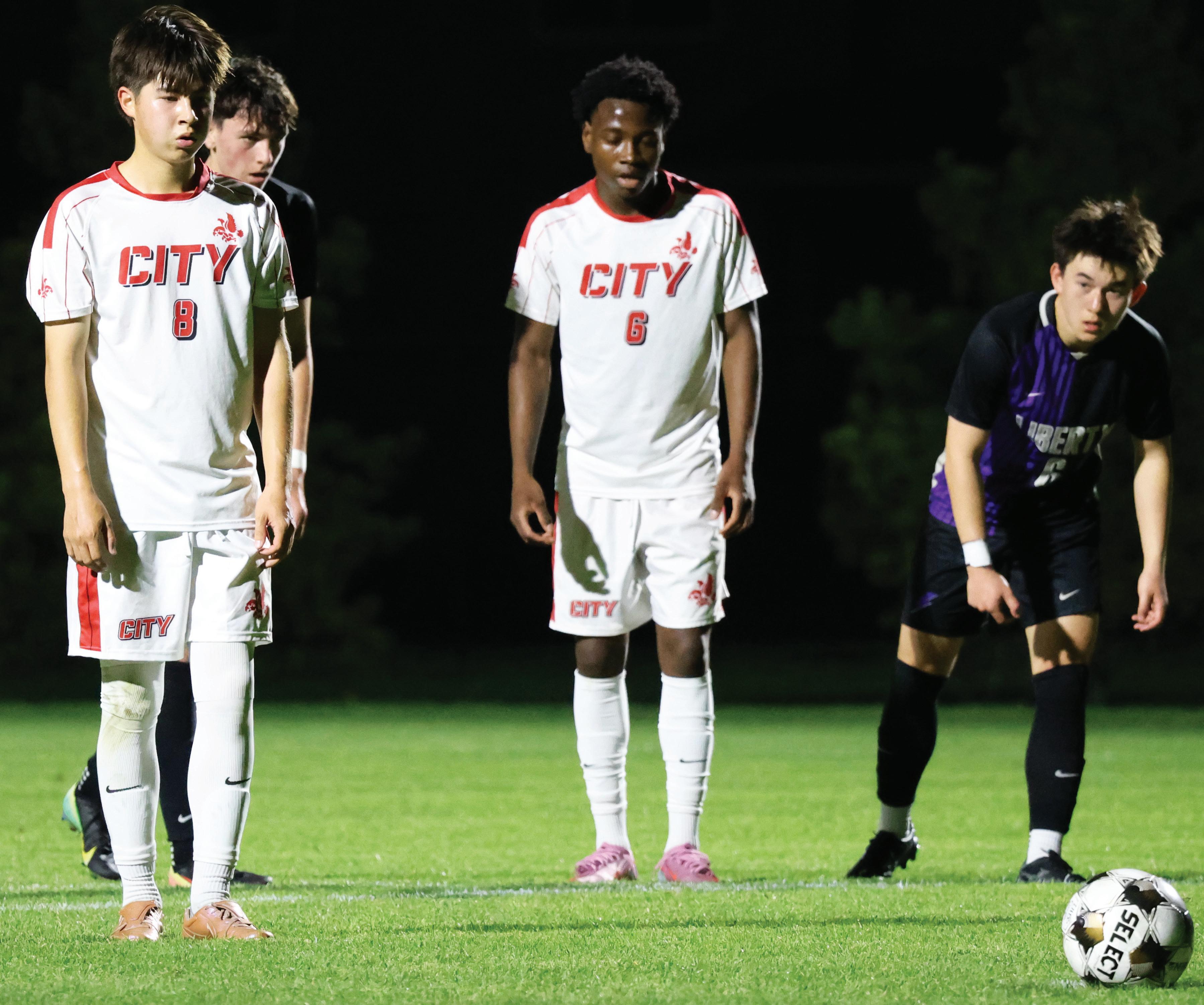
ABOVE: Oscar Gates ‘26 takes a deep breathe before taking his penalty kick that would put the Little Hawks up 2-1 against Liberty. The team went on to win the game 3-1 maintaining their unblimished record. PHOTO BY JACK ROGERS

UFA DRAKE CHAMP: Bowen-Burt Burns 400s
By Tessa Driscoll
Maeve Bow-
en-Burt ‘26 has always been surrounded by competition. Growing up with two older brothers, she was always thrown into games, competitions, and challenges.
“Growing up like that, it really made me hate to lose. Losing is one of the worst feelings. It just sucks, and you eventually get over it, but I hate that feeling,” Bowen-Burt said.
This aspect of her upbringing is the reason for her determination and drive in athletics.
Bowen-Burt plays basketball, but her true passion lies with track and field. Bowen-Burt began track and field in seventh grade, when she decided to go out for fun.
“I’d run with my brother’s sometimes, so I thought I would try track,” Bowen-Burt said.
Bowen-Burt did a little more than “try track.” She dedicated herself to it, and has run for the Little Hawks ever since.
“It’s my favorite sport now. The events I run, they just push me in the most extreme way possible,” Bowen-Burt said.
Being pushed is something that Bowen-Burt enjoys.
“I’ve always loved to win things, and being pushed is part of that. Growing up with brothers,
they’d always fight over who was the best. I was always trying to be the best, even though I never was,” Bowen-Burt said.
Now, Bowen-Burt does not face that same struggle. She is quite often the best. At the moment, she is ranked 8th in the 400 hurdles in the state of Iowa, after only three meets.
“I set the meet record at the Sherwood Relays, but honestly, I am always just trying to cut down on my times,” Bowen-Burt said.
Bowen-Burt runs the 400, 400 hurdles, and the 800; arguably, some of the hardest events in track and field. Sadistically, that’s why Bowen-Burt enjoys them.
“Especially with the 400, people always say it’s the hardest event, and I just think if you can run at it and be good at it, it just shows how strong you are,” Bowen-Burt said.
The sophomore is nothing if not strong. After a promising start, Bowen-Burt is looking forward to some goals she has for the rest of the ‘26 season.
“I’d really like to place in some open events, and it would be awesome to compete individually at Drake,” Bowen-Burt said.
To accomplish this feat, Bowen-Burt feels it is essential to “remain poised and stay calm” throughout her races.
Constantly performing at such a high rate is not as easy as Bowen-Burt makes it seem, though.
“It’s definitely difficult, especially being a female athlete who has grown up competing with guys. Their times are always going to be faster, and sometimes that can make you disappointed in a time that’s actually good for yourself,” Bowen-Burt said.
But Bowen-Burt understands that the key to her success is staying confident in herself.
“I just have to stay focused on myself and be confident in my times and what I’m capable of doing,” Bowen-Burt said.
Now, though she still competes with her brothers, she feels their support during her high school career.
“They keep me humble and motivated, and I just look up to them. Their support means a lot,” Bowen-Burt said.
Bowen-Burt ended up placing first at the Drake Relays completing the goal she placed for herself.
When she looks to the future, Bowen-Burt is unclear whether or not track will be a part of her life.
“Running collegiate track would be awesome, and definitely something I’d be interested in, but I’m not sure what I want to do in the future yet,” Bowen-Burt said.
For now, Bowen-Burt is focused on the rest of her sophomore season.
“I love track so much, and am excited for this season. Track is truly just a fun experience to be a part of,” said Bowen-Burt.

ABOVE: Maeve Bowen-Burt ‘28 ran as the anchor in the winning 4x4 team in the Sherwood Relays last year. Bowen-Burt overcame a deficit in the race to take first place.
PHOTO BY AUDREY VANDE BERG
ABOVE: Maeve Bowen-Burt prepares for her race on the City High track. Bowen-Burt primarily runs the 400 meter dash. PHOTO BY ROSE NKUMU

FEATURED PHOTO
LET THE STORM RAGE ON: Clara Meehan ‘26 performs Let it Go from Frozen on April 23. “Let it go was the most magical experience for me, and not because of the actual magic,” Meehan said. “A lot of work was put in by our tech crew to make the scene possible, and the rest of the cast and I are so grateful for them.”
Read more about Frozen on page 6.
BY NINA RENAUD
PHOTO