THE
LITTLE HAWK Vol. 112
Iowa City, IA
THE SCHOOL THAT READS REAL NEWS THE LITTLE HAWK “Seek Truth and Report It” Since 1926
Issue I
October 2026
New Retake Policy Brings Mixed Reactions
thelittlehawk.com
STAFF EDITORIAL
Helps or Hinders? By Little Hawk Editorial Board
Education. It’s what keeps nations afloat, keeps citizens informed, and makes a society progress. And since education is so important, in the United States and many other countries there is a well funded (mostly) public education system. In the United States, children go to school from the age of five to the age of eighteen, advancing from grade level to grade level as they pass a class. But how does one measure learning? How can one measure understanding in a child? For many centuries, the answer has been a little thing called testing. Essentially, a teacher will ask their students questions about the things that said teacher has been teaching in the past week and see how much the students remember. Based on the amount of questions that the student gets right, they get more points, measured by letter grades which are supposed to let students know at what level they’re at.t they have learned the material after failing a test.
STAFF ED 08
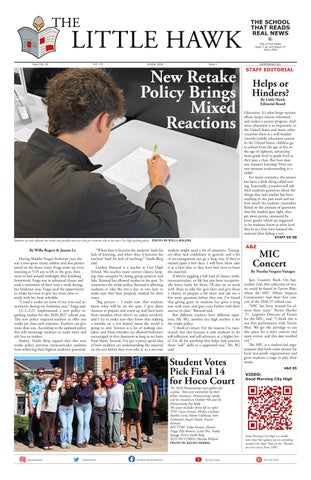
Students are now allowed one retake and possibly more per class per trimester due to the new City High grading policy. PHOTO BY WILLA ROGERS
By Willa Rogers & Jaxson Le During Maddie Fraga’s freshman year, she was a two-sport varsity athlete and also participated on the dance team. Fraga woke up every morning at 5:45 am to lift in the gym, then went to bed around midnight after finishing homework. Fraga was in advanced classes and took a minimum of three tests a week during her freshman year. Fraga used the opportunity to retake her tests to give her more time to study with her busy schedule. “I used a retake on most of my tests and assessments during my freshman year,” Fraga said. I.C.C.S.D. implemented a new policy regarding retakes for the 2026-2027 school year. This new policy required teachers to offer one retake per class each trimester. Teachers can give more than one. According to the updated policy this will encourage students to study more and rely less on retakes. Audrey Vande Berg argued that this new retake policy prevents extracurricular students from achieving their highest academic potential.
“When does it become the students’ fault for lack of learning, and when does it become the teachers’ fault for lack of teaching?” Vande Berg said. Lindsey Barnard is a teacher at City High School. She teaches many science classes, keeping class energetic by doing group projects and labs. Barnard has allowed retakes in the past. To counteract the retake policy, Barnard is allowing students to take the test a day or two later to make sure they have properly studied for their exam. “Big picture – I make sure that students know what will be on the quiz, I give them chances to prepare and screw up and then learn from mistakes when there’s no stakes involved, and I try to make sure they know that making a mistake on a test doesn’t mean the world is going to end. Science is a lot of making mistakes, and those mistakes are allowed/welcome/ encouraged in this classroom as long as we learn from them. Second, I’ve got a pretty good idea of how students are understanding the material on the test before they even take it, so a nervous
student might need a bit of assurance. Teenagers often lack confidence in general, and a bit of encouragement can go a long way. If they’ve missed quite a few days, I will have them take it at a later date so they have had time to learn the material. If they’re juggling a full load of classes, work, extracurriculars, or life has just been exceptionally heavy lately for them, I’ll also try to work with them to take the quiz later and give them a chance to prepare a bit more and ask me a few more questions before they test. I’ve found that giving grace to students has gone a long way with trust, and goes even farther with their success in class,¨ Barnard said. But different teachers have different opinions. Ms. BG, another city high teacher, is for the retake policy. “I think it’s smart. For the reasons I’ve mentioned, but also because it asks students to do self-reflection and self-advocacy at a higher level. I’m all for anything that helps kids practice those “soft” skills in a supported way,” Ms. BG said.
Student Votes Pick Final 14 for Hoco Court The 2026 Homecoming court gathers for a photo. They were votered for by their fellow classmates. Homecoming royalty will be revealed on October 9th and the Homecoming Pep Rally. The court includes (from left to right) TOP: Lucas Iverson, Mickey Cochran, Kaitlin Loria, Hattie Galloway, Seth Zeithamel, Joseph Hayek, Preston Mensah. BOTTOM: Vidya Kumar, Eleanor Fraga, Ella Romero, Laila Pho, Nadia Spragg, Henry Vande Berg. NOT PICTURED: Martha Willard PHOTO BY KELSEY HERRIG
@instalittlehawk
@thelittlehawk
Facebook.com/thelittlehawk
The Little Hawk
A&E
MIC Concert
By Nicolas Vergara-Vanegas Jazz. Country. Rock. On September 2nd, this collection of music could be found in Tavern Blue, where the MIC (Music Impacts Community) had their first concert of the 2026-27 school year. “MIC has been around for almost three years,” Brynn Sheeley ‘27, Logistics Director of Events for the MIC, said. “I think this is our first performance with Tavern Blue. We get the privilege to use this space for a mini concert and open events, and this date worked out.” The MIC is a student-led organization that both raises money for local non-profit organizations and gives students a stage to play their music. A&E 05
VIDEO:
Good Morning City High
Good Morning City High is a weekly news show that updates you on everything around CIty High. They are the “Number one news source from 3108”.
The Little Hawk
02 LETTER FROM THE EDITORS
THE LITTLE HAWK - OCTOBER 2026
4
Little Hawk Games and Comix September Print
5
By Martha Willard - Published on https://crosshare.org 1
2
3
ACROSS 1 Having great courage and bravery 4 Iowa City elementary school
Hi Little Hawks and friends! In our first issue of the year, we have lots for you to read: Senior parking spots, amazing interviews with Cinematographers by Ben, the underclassmen chosen as this year’s Freshmen to Watch, and more. Don’t forget to check out our special feature story On a more personal note, there’s a lot going on in The Little Hawk Journalism this year. The Iowa High School Press Association (IHSPA) State conference is coming up, and all of our work from last year will be facing up against school journalim programs around the state, including our cross town rival, the West Side Story. The Little Hawk is also participating in a mini-documentary about high school journalists along with the West Side Story, which will hopefully create awareness of what journalism is really about; getting information to the people. So we encourage you to read all news, regardless of your place in the world, your political ideology, your interests, or your age.
5 ____ Dairy, Iowa City ice cream shop
4
DOWN 1 Correct, true. 2 City High Business teacher
5
3 Woodwind players need a lot of these.
ACROSS 1 Having great courage and bravery 4 Iowa City elementary school
5 ____ Dairy, Iowa City ice cream shop DOWN 1 Correct, true. 2 City High Business teacher
3 Woodwind players need a lot of these.
Read about music and arts, about politics and technology, about the highs and lows of your favorite sports team, or about whatever is going in the world. Stay informed, stay curious, and go Little Hawks. Whether you’re a student, staff member, or Iowa City resident with no relation to City High, we hope this issue has something for you! Keep up to date with us on Instagram (@instalittlehawk) and read more on TheLittleHawk.com. Your favorite (current) executive editors, Louisa & Nico
Laughs Before the Bell Presents...
“(American) Football” By Nicolas Vergara-Vanegas
THE LITTLE HAWK - OCTOBER 2026
03 NEWS
UPCOMING DATES 10.07
PowderPuff The annual PowderPuff tournament will take place on Wednesday, October 7th. The powderpuff commitee is still finalizing the number of teams and the registration process. The games will begin at 7:30 on Bates Field following the homecoming parade. The Booster Club will be hosting their chili supper fundraiser at the same time. Chili and macaroni and cheese will be available for $7 at the concessions stand.
10.09 ABOVE; Kaitlin Loria painted the Wayne State logo along with a basketball design following her recent commitment to Wayne State. PHOTO BY KAITLIN LORIA LEFT; Lucy Sherburne ‘27 painted her parking spot with her friends, drawing Snoopy because of how much Naomi Downing-Sherer loves the character. PHOTO BY LUCY SHERBURNE FURTHEST LEFT; Archie Fisher ‘27 was one of the seniors that joined in on a new tradition of painting parking spots. According to Fisher he drew the album cover of Bob Dylans Highway 61 Revisited. PHOTO BY ARCHIE FISHER
HoCo Sports The Little Hawk Football team will play their homecoming game on Friday, October 9th against Des Moines East. Both the girls and boys cross country teams have their annual MVC meet on October 8th, at the Irv Warren Memorial golf course. The volleyball team has a match at Xavier on October 8th as well as a tournament at Bettendorf on October 10th. Pep Rally The homecoming pep rally will take place on Friday, October 9th in the Little Hawk Arena. The homecoming court will be revealed and they will have a chance to perform skits infront of their peers. The band and and cheerleaders will also perform.
SCHOOL NEWS
CLASS PRESIDENTS HAYEK AND COX BRING NEW TRADITION OF PAINTING 10.10 PARKING SPOTS TO HOOVER LOT By Hazel Schluckebier
As the school year came to a start, class presidents Noah Cox and Joseph Hayek wanted to form new traditions for the senior class to look forward to, one of them being painting parking spots. “I chose to do Senior Parking Spot Painting because lots of students reached out and because any event that brings students together is a great event in my eyes. Lots of seniors showed up from all different corners of the school, and everyone came together and had a good time. It was a perfect way to kick off senior year,” Hayek ‘27 said. On Sunday, August 24th, the graduating class gathered at City to claim their spots and begin creating what would soon be detailed works of art. Archie Fisher ‘27 chose to do an intricate design; The album cover for Bob Dylan’s Highway 61 Revisited. “Dylan has always been one of my favorite musicians. This album cover is so iconic and recognizable even if you don’t listen to him,” Fisher said. This piece took nearly five hours of dedication. While it may seem long, the students emphasized that having that time to hang out with friends while also spending time expressing themselves was very enjoyable. “I would hope that this tradition continues and more people come to paint spots,” Fisher ‘27 said. Kaitlin Loria chose to go in a different direction when painting her spot. Following her recent commitment to Wayne State, she chose to showcase the logo among the other drawings. “For my spot I drew a basketball with a wildcat paw print on it, and I wrote my name, 2027, and LLPS. I did the basketball
with the paw print because basketball is a huge part of my life and it will be for a while because I am committed to Wayne State College so I painted their paw print to go with it,” Loria ‘27 said. Preston Mensah ‘27 also chose to make his sport the centerpiece of the design. He included his football number, nickname, Hawkeye symbols, and “LLPS” on the bottom. “I wanted to do something unique that I wouldn’t be able to find on Pinterest,” Mensah ‘27 said. Including the abbreviation “LLPS,” (abbreviated for Live Like Parker Sutherland), was a common theme in the parking spots as students found a way to pay tribute to former City High student. Maeve Obermueller ‘27 painted pink and white stripes, and added “LLPS” to the bottom to make it more personal. “I also added “LLPS” to the bottom of my spot because it is important to me and so many others,” Obermueller ‘27 said. While some students chose to do solo spots, others, including seniors Rainie Pfohl and Maybes Miller, collaborated. “I painted my spot with Maybelline Miller, my dear close friend. We detailed a blue sky with a sun and rain clouds. We did this to symbolise how I am the rain (wordplay on my name), and how Maybes is the sun, but we work together as friends. It shows the contrast of how different we are, yet how we still work perfectly together,” Pfohl ‘27 said. Similarly, seniors Alice Edelen, Ella Romero, Brooklyn Riley-Poma, and Addison Klein opted to do their spot together. “We drew a starry night with a sailboat on the ocean, and then painted the words City of Stars. We picked it because I wanted to have a sailboat, and Nadia wanted to do
La, La, Land. I hope other grades are able to do it because I think it really bonded our class,” Edelen ‘27 said. Mensah ‘27 also had a glowing response. “I really hope that students in the future get to do this because it was fun, and I know past students wish they had this opportunity,” Mensah ‘27 said. Even with helping hands, according to Edelen, painting the spot took six hours. “My piece took four hours and was gruesome, but so, so worth it,” Pfohl 27’ said. Among these works, seniors Lucy Sherburne, Madeline Fischer, Naomi DowningSherer, and Quinn Brende drew a graduation inspired “Snoopy,” inspired by Naomi’s love for the character. “I had a really fun time painting the spot and so I hope other grades can do it as well, but I think the seniors care far too much about their spots getting taken this year so I hope future grades don’t make such a big deal out of it,” Sherburne ‘27 said. Class Co-President Noah Cox ‘27 painted the red spider from the movie Spiderman: Into the Spider-Verse. He drew inspiration from the movie quote “Alright… lets do this one last time,” thinking it was fitting for his final year at City. “I was super happy that City High got the opportunity to do something like this, and I know many of the students that painted spots had a blast. It’d be really cool for this to turn into a tradition, and I think it’s super plausible that after all this construction is done, it could grow into something amazing. However, something that I think would be even cooler, would be to see this pop up at other schools who haven’t done this yet, such as Liberty and West. I would love for City High to be the reason West and Liberty’s seniors get to paint spots,” Cox ‘27 said.
HoCo Dance The homecoming dance will take place at City High, on Saturday, October 10th. The dance is from 7 to 10 p.m.. The dance is taking place in the gym. The student senate has made the decision to move tickets online, opening up for sale through the MySchoolBuck website. They will be available for purchase on 10/5 through 10/9. A limited number of tickets will be available to purchase during lunch on Friday.
@INSTALITTLEHAWK SEPTEMBER STATS 129,000 VIEWS 43 POSTS TOP POST BELOW: 21K VIEWS
THE LITTLE HAWK - OCTOBER 2026
4 NEWS
STUDY TIME: Julian Inkis ’27 works on his AP Psychology assignment. He had to adjust to the longer school day because his school day ended at 2 p.m. in Germany. PHOTO BY JACK LITTON FOREIGN EXCHANGE STUDENT PROFILE JULIAN INKIS
FROM MUNICH TO IOWA CITY HIGH SCHOOL By Jack Litton & Bones Kalina
Julian Inkis walked off the plane in July, stepping onto United States soil for the first time in his life. He looked out from the windows to see the rolling hills. Stepping off the plane onto the moonlit airstrip looking for his host family, his mind filled with the worry of not knowing what is ahead of him for the next nine months. “I was very nervous the whole plane ride to America, I had never been to America and I didn’t know what to expect,” Inkis said. Julian Inkis is a 16-year-old senior from
Munich, Germany. He is spending his senior year at Iowa City High School as part of a foreign exchange program, coming from a major city in Germany to a college town in the American Midwest. “I live in Munich, Germany so I wasn’t used to agricultural areas so I wanted to live in a small town or city and that’s just what I got,” Inkis said. For as long as he can remember, Julian has hoped to do a foreign exchange year and then finally started planning it last year. “I decided to do it and I started planning my whole year at 15 years old, one year before my departure. I’ve just always wanted to meet Ameri-
cans because I heard that all Americans are really nice and they like sports and that’s what I also like to do,” Inkis said. Julian has seen that the school system in America is a lot different than in Germany. “School ends at 2 p.m. in Germany and at 1 p.m. on Mondays. We also don’t have a lunch break in Germany,” Inkis said. One of the main things that stood out to Julian was the wide variety of classes offered at City High. “In Germany schools just have the usual subjects like languages, math, and science and at City High you can choose subjects that you like and that prepare you for the real world and that’s just different. That’s
why I really like it here.” Inkis said. Outside of school in Germany, Julian was very involved in sports, especially soccer, and he hopes to do the same here. “I played soccer in Germany for my club so I will try to play soccer here, and hopefully I’ll get varsity but I don’t know,” Inkis said. Julian has been quick to make new connections here at City High, and is excited to make even more. “Everybody’s been nice and everybody just wanted to introduce me and make sure I have a good time,” Inkis said. READ MORE PROFILES ON THELITTLEHAWK.COM
Eight Seniors Earn National Merit Scholarship Semifinals By Rayan Ahmed
Eight City High School seniors have been named National Merit Scholarship finalists, earning national recognition for their academic achievements and placing them among the highest-scoring students in the state. “It’s really rewarding. Taking big tests is not fun, so it’s great to see that my hard work paid off,” Harriet Galloway ‘27 said. The recognition gives the finalists more than an academic achievement. It also allows them to represent City High School beyond its classrooms. “It means a lot to me. I really believe that City is one of the best high schools to attend and I’m happy that I can be a representative for the school,” Galloway ‘27 said. As the students begin to look beyond high school, National Merit recognition provides another academic accomplishment
to include in their application. “It’s definitely comforting to know that I now have this achievement on my application that really makes me stand out academically,” Martha Willard ‘27 said The path to National Merit recognition begins with the PSAT. A standardized test that helps high school students prepare for the SAT and qualify for college scholarships. “Taking the PSAT sophomore year was super helpful,” Galloway said. “For test-taking in general, knowing what areas you struggle with and focusing on those while you are studying is super helpful.” Preparing for the PSAT does not always happen through studying for the test itself. Everyday academic habits, including reading, can help students build skills they can use for the exam. “I think one thing that prepared me really well for the reading section was reading
Left to Right; Seniors Vidya Kumar, Martha Willard, Harriet Galloway, Madeline Fischer, Alexandra Patrick-Ferree, Micah Claassen, James Huynh, and John Huynh. PHOTO BY CLAIRE HARTWIG
lots of books, ” Willard said. “The more experience you have with reading, especially at a higher level, is something that can really help you with the PSAT.” With College as their next chapter, City’s eight National Merit finalists will carry this recognition with them as they take
the next step in their academic careers. National Merit Scholarship finalists: Micah Claassen ‘27, Madeline Fischer ‘27, Harriet Galloway ‘27, James Huynh ‘27, John Huynh ‘27, Vidya Kumar ‘27, Alexandra Patrick-Ferree ‘27, and Martha Willard ‘27.
THE LITTLE HAWK - OCTOBER 2026
05 A&E
Student Non-Profit Kicks Off School Year With Concert at Tavern Blue MIC: MUSIC IMPACTS COMMUNITY TOP: A performer at the concert clasps a microphone. BELOW LEFT: Singer/Songwriter Molly Nolan performs at Tavern Blue. She sung four original songs. BELOW RIGHT: Singer/Songwriter Farrah Zimmerman performs at Tavern Blue. She presented one orginal song, “Futile”, as well as other covers.Nadia Spragg ‘27 reviews their lines before their audition. She was cast as Madame Pernelle. PHOTOS BY MICAH HARTWIG
By Nicolas Vergara-Vanegas
J
azz. Country. Rock. On September 2nd, this collection of music could be found in Tavern Blue, where the MIC (Music Impacts Community) had their first concert of the 2026-27 school year. MIC has been around for almost three years,” Brynn Sheeley ‘27, Logistics Director of Events for the MIC, said. “I think this is our first performance with Tavern Blue. We get the privilege to use this space for a mini concert and open events, and this date worked out.” The MIC is a student-led organization that both raises money for local non-profit organizations and gives students a stage to play their music. The organization is made up of students from all over the Iowa City Community School District, including Liberty, West, and City High.
“Our founders wanted to create a place for students to perform their art. Whether it’s Jazz, or original pieces, or to showcase their band, students aren’t given a lot of opportunities to perform,” Sheeley said. “So MIC wanted to give students that platform to perform while raising money for charitable causes.” The show started off with The Basement Buddies, a jazz band made up of four students: Gabriel Bales ‘28 on piano, Evan Farley ‘29 on bass, Thomas Hand 28’ on the saxophone, and Max Krapfl-Viner ‘30 on drums. In addition to being a piano player for Basement Buddies, Bales is also the Treasurer for the MIC. “We’re all students who really like jazz, and who all have known each other for a good while. And so one day, we got together and started playing jazz in a basement,” Bales said. “I had been involved with the MIC for about a year. The idea to begin playing for the MIC came from our drummer, and me being treasurer, I thought it would be great.” After The Basement Buddies left the stage, Molly Nolan ‘29 presented her songs “Honey”, “One in a Million”, “Better than Ever”, “Nothing Gold”, and “When it’s Rough”. Nolan wrote each song herself, and accompanied her vocals with guitar. “When it’s Rough,” the last song per-
formed by Nolan, has a special connection to her. “It’s my favorite song because it was the most authentically me. It’s about my personal journey about mental health and stuff like that,” Nolan said. “It’s become like this song that says ‘It’s okay, it’s okay, I can do it,’ and I want to be so other people can hear it and say ‘It’s okay, it’s okay, I can do it.’” Nolan was followed by another singer-songwriter, Farrah Zimmerman ‘29, who performed covers as well as one original song, also accompanying them with a guitar. She performed covers of “Duvet” by Boa, “Love Song”, by The Cure and her own song, “Futile.” “My best friend moved from Iowa City to Portland and I wrote the song for her. It’s supposed to be about our memories together, and I put movie references that only she and I would understand,” Zimmerman said. “Duvet, by Boa, is my favorite song in the entire world. It’s my go-to song. I sing it whenever. I know it by heart.” The concert ended with Day On Venus (DOV) performing “Rock You Like a Hurricane” by The Scorpions, “Say it ain’t So?” by Weezer, “Zombie” by The Cranberries, “Higher Ground” by Red Hot Chili Peppers, “Plush” by Stone Temple Pilots, and “Sweet Child of Mine” by Guns and Roses. Then, following the request from the audience for another song, DOV
also played “Killing in the Name of ” by Rage Against the Machine. “We’ve come prepared to have an encore. Today, we didn’t have a song ready for that, but we had to cut songs because we weren’t sure we had time. Then [The audience] called for an encore, so we played the extra song,” Bella Nelson ‘27, a student from Liberty and the lead singer for DOV, said. “ [Performing] was great. I love the set. I like the lights. The sound guys always do their jobs so well. It’s really great. It’s a great experience.”
THE LITTLE HAWK - OCTOBER 2026
06 A&E
Fall Play Cast: City High Theatre Tartuffifed Tartuffe, the fall play, is a satirical piece by Molière written in the mid-1600s By Martha Willard
C
ity High’s 2026 fall play: Tartuffe, a fraudulent vagrant manipulates a wealthy family, seducing the father in order to marry his daughter. “He’s a real sly individual, and I’m not that. I just want to make it like the complete opposite of what I am in real life,” Toby Morlan ‘29, the lead, Tartuffe, said. “He’s very seductive in the show. [I need to] do that, but with what I like to call Tobyisms. Be as crazy [as I am], but I need to be as convincing as this sly conman.” Morlan has performed in two City High productions, East of the Sun, West of the Moon and Frozen: The Musical. However, he grew up in a theater family, taking part in his first production at age eight. “My first theater thing I did was back in 2019, when I was in a show about my dad that I did. After COVID, I started doing other shows,” Morlan said. “It just
became a really big part of me. Now it’s the career that I want to do.” Similarly, Nadia Spragg ‘27 first started her theater career in 2018 as young Eponine in Les Misérables. Since then, she has also been in Singin’ in the Rain, Urinetown, East of the Sun, West of the Moon, and Frozen: The Musical. Now, she is one of Tartuffe’s female leads, Madame Pernelle. “I really didn’t know what to expect because I auditioned with that monologue, but I wasn’t necessarily [in love with] that character or knew that I was going to get it,” Spragg said. “I was really just like whatever happens, happens, and then I got it and I was so excited.” One reason that Lauren Darby, who is in her fifth year as theater director at City High, picked Tartuffe is because of the creative opportunities it provides the crew. “I wanted to give our hair and makeup and costume crews something really fun to do,” Darby
Nadia Spragg ‘27 reviews their lines before their audition. She was cast as Madame Pernelle. PHOTO BY MICAH HARTWIG
said. “I’m really excited about the costuming and wigs. Jackie Green, who is doing our costumes, and I got most of them from our friends at theaters around Iowa City, and it’s going to be really cool.” Because Tartuffe is originally a French play, there are many English translations to choose from. Darby is giving the cast the opportunity to read several options and pick for themselves. “I want the students to select which script we’re going to use,
because there are approximately 5 million different translations and interpretations, and they all bring something very different to the table. I think it will be really interesting,” Darby said. “So that means a lot of experimentation up front, and also seeing if we can actually manage to do a show entirely in rhyme and not have it sound like Dr. Seuss.” The cast, at only 13, is the smallest since before Urinetown in the spring of 2025, which had
~20 actors. “We haven’t had such a small cast since we did Urinetown, and it was a very tight-knit group that formed as a result,” Darby said. “We have some people who are totally new to theater, some people who are more experienced, but everyone is in a different sort of role than they have played in the past if they are returning. So I think it’ll be really fun to see how everyone stretches themselves and how they work together.”
HVAC Malfunction Causes Moldy Instruments
Many of City High Orchestra’s cellos and basses were damaged by mold due to an HVAC malfunction in the music wing By Margaret Cilek
D
ue to an HVAC malfunction over the summer, nearly all of the orchestra’s cellos, as well as many basses, cases, and bows, ended up moldy and will need to be replaced. “It was just a mechanical failure,” Philip Hansen, assistant principal, said. “In essence, the HVAC system just did not work in those rooms. And when it’s like that for a few days, it obviously is warmer and humid and can lead to [mold], just as mold grows anywhere.” According to Hansen, there have been some previous malfunctions or late maintenance issues with the HVAC, but they’re usually caught before any real damage can be done. Because the instruments are stored in smaller storage rooms that aren’t checked
A moldy cello. The mold in this picture is mostly on the neck and strings of the instrument. Almost all of City High’s cellos grew mold like this and need to be replaced. PHOTO BY MARGARET CILEK
as regularly, the malfunction—and resulting mold—wasn’t caught until the damage was already done. “When we are in a building this size, there are many different units throughout the building,
and sometimes you need to do a filter change, those kinds of things,” Hansen said. “Our custodial staff does sweeps at the building; they check rooms and make sure these things are up
to date. Some of those smaller individual [rooms] may not get checked daily. So when you have a mechanical failure, some of those spaces are missed and that’s what happened.”
City High isn’t the only school where this has happened. Schools across the country have dealt with mold situations, many of them affecting music departments just like City’s. At a neighboring school district, the air conditioning was shut off for construction over the summer, leading to a mold situation very similar to the one here. At City High, three basses could be saved, but all except one cello will have to be replaced. In the meantime, the orchestra is using temporary loaner instruments while the district sorts out the insurance. “Mrs Stucky-Swanson did a phenomenal job finding loaners,” Hansen said. “Ultimately, it’s an insurance claim, similar to if it happened at a house or something, and so the district facilities team is working through the insurance claim to get things replaced. As far as the immediate fix, we were able to work with local music companies to get loaners here so the class can go on.” Hansen says the school is hopeful that permanent replacements will arrive soon, but the orchestra is still able to practice as normal on the loaners until that happens.
THE LITTLE HAWK - OCTOBER 2026
07 A&E
An Interview with Jared Raab
The cinematogrpaher and producer behind “Nirvanna: The Band The Show The Movie” explains how he and his friends made one of the best films of the year by staying true to themselves.
Nirvanna: The Band - The Show - The ‘Why are we doing this?’ or ‘Is this worth Movie is one of the best films of the year. it?’ Then the answer is no, it’s not worth it. For so many reasons, but perhaps the most For many of us, the expectation is [making crucial is its unrelenting authenticity. The this movie’s] going to be difficult, and if film, which follows two friends named it’s easy, we’re probably doing something Matt and Jay (Matt Johnson and Jay wrong.” McCarrol, playing semi-fictional versions Raab and his collaborators, including of themselves), was shot entirely in docJohnson and McCarrol, met when they umentary-style, often without filming were attending York University in Toronto, permits, and most of the time without paid Canada. “The film scene in Canada is very extras. (Instead, the Nirvanna crew would small, so like-minded people tend to find opt for regular people Matt and Jay would each other pretty quickly,” Raab described. encounter on the streets of Toronto.) It’s “We got along since we all had no idea what an astonishing feat of filmmaking which would make anybody ask “How the hell did they make this?” The answer? Not easily. “We’ve essentially been detained by the police,” cinematographer and producer for Nirvanna, Jared Raab told me, when describing the trials and tribulations of shooting the film as well as its companion, Nirvanna: The Band - The Show. “I’m [also] banned from some major landmarks in Toronto,” he continued. Hearing this, I had to ask Raab Jared Raab why he thought this approach was Cinematographer & Producer worth it. He seemed slightly taken aback. “Why is making anything worth it? It almost seems like a silly question to me,” he replied. “No one who we were doing. I think that’s kind of why we work with would ever think for a second it still works today is [that] we still have no ‘Should we be doing this?’ I think if we did, idea.” we wouldn’t do it. Any reasonable person “I would say our producer, Matt would stop at a certain point and say, ‘This Grayson, once put it very well: the reason is absurd. We can’t do these kinds of hours. that this team works well together is [we’re We can’t think about this project that a] collection of people who are kind of all much.’ I think good work can only come director-minded, but are perfectly happy to from people who are truly dedicated to the do other roles on set. Everybody is sharing craft of whatever it is they’re making. As a a little bit of the storytelling responsibility, result, I just think that if you’re questioning but I think we’re trying to become a little
“No one who we work with would ever think for a second ‘Should we be doing this?’ I think if we did, we wouldn’t do it.”
better at our specializations. I believe that it’s important to have a director on set who makes the final decision, but I also think that we benefit from a bit of a collective hive-mind situation.” As Raab noted, he isn’t only responsible for cinematography. He also has to be a character within the world of Nirvanna. Because of the documentary approach, occasionally Jay and Matt will casually make reference to Raab as their fictional cinematographer (as well as their real one). This can lead to some funny hijinks, but much like everything with Nirvanna, authenticity has to be kept in mind. “There’s a word we use a lot around here and it’s resonant, which essentially just means that the thing that what you are doing for the film is the same as the thing that you are doing in real life. That’s a sort of stupid way of putting it, but basically the idea is that if what you’re doing feels true to your actual character, then you don’t have to think about it and things can come naturally.” “I actually think this is good advice for people who are making art of any kind, is to do the thing that comes the most naturally. A good example of this would be Matt and Jay—their dynamic is what the characters in Nirvanna: The Band have. They’re basically playing heightened versions of themselves, and that allows them to do it effortlessly, so that we can focus on other things like [making] this episode better and the best way to tell the story.” “On any creative project, you’re going to come up against challenges that are going to make it hard to finish that thing. So if your [art] is coming from a place of a true feeling that you [and your collaborators] have, you’re much better set up to do a good job
by Ben Haines
Illustration by Marin Irvine
at making that piece of work.” Hearing this, it’s hard not to think of so many of Raab and his collaborators’ films, whose protagonists all eventually learn a similar lesson about staying true to yourself regardless of how externally lucrative that might be. “[This story] about collaboration and friendship and the challenges of getting bigger and all of that; it’s the story of our lives, and it’s the story that we are best suited to tell in these films. As a result, like anything, if it’s true for you, it’s probably true for somebody else. The things that feel very specific are often the most universal.” “We certainly feel [our work] comes from a real honest place for us. [A place] where we make films and television that we truly love. [Even though] we often wouldn’t admit it because we’re so critical of it, it really is—because it speaks to us, and I hope that some people see it and are inspired not by the work itself, but by the idea that if you make something that comes naturally and feels true to you, then you are in a much better position to succeed.”
08 STAFF EDITORIAL
THE LITTLE HAWK - OCTOBER 2026
Does the New Retake Policy Help or Hinder Students? The Little Hawk Little Hawk Journalism Staff Executive Editors Louisa Berry -Stoelzle Nicolas Vergara-Vanegas News Editors Hazel Schluckebier Lily Sheerin(asst.) Sports Editors Maddie Fraga Audrey Howe Opinion Editor Jonah Hefti A&E Editor Martha Willard Review Editor Ben Haines Feature Editor Margaret Cilek Video-Broadcast Will Meis Avery O’Brien Stevie Wilmoth Micah Hartwig(asst.) Social Media Kyle Hartwig Bella Ragona Staff Rayan Ahmed, Liam Allen, Ta M’ya Bishop, Quentin Blakeslee, Andrew Hayek, Kelsey Herrig, Jaxson Le, Jack Litton, Rosy McKay, Sydney Raefield, Saylor Short, Willa Rogers Advisor Jonathan Rogers
Mission Statement The Little Hawk, student journalism newspaper and website of City High School, aims to inform, educate and entertain readers. LH journalists follow the code of the journalist by seeking truth, doing no harm, being independent, and working toward balance in all news stories. All student voices are enouraged to be part of a LH journalism class. To join the class, talk to your guidance counselor today. Letters to the editor may be submitted to: LittleHawkPage@gmail.com ICCSD Equity Statement It is the policy of the ICCSD not to discriminate on the basis of race, creed, color, religion, national origin, gender, age, marital status, sexual orientation, gender identity, veteran status, disability, or socioeconomic status in its educationall programs, activities, or employment practices. If you believe you (or your child) have been discriminated against or treated unjustly at school, please contact the Equity Director at: 509 S. Dubuque Street (319) 688-1000
Letter to the Editors
STAFF EDITORIAL: A look at the good, The bad, and the ugly of the 2026 Retake Policy LITTLE HAWK EDITOR VOTE: 3 For VS 5 Against Retake Policy The Pros: Retakes. They were is the root of the problem, and there in case students forgot in a lot of subject matters you do to study, didn’t understand the need to have daily training.” material, or were gone the week Additionally, when unlimited before the test. But the Iowa City retakes are available, there is also Community School District’s no motivation to do it on time, new policy now only requires which Balcaen touched on briefly. that teachers offer one retake per Resetting to one retake per trimestrimester. While the new system ter brings back that motivation, of one retake per tri is imperfect, forcing students to treat their first it is a step in the right direction chance at assessment seriously, to improve learning and reduce which was an issue in the past. teacher workloads. “I will actually have students In school, learning builds on ask me in the middle of taking a itself. Being able to do Calculus test, can I retake this, and I'm like, your senior year of high school could you take it for the first time relies on having learned how to first? It's almost like I don't have solve equations in Algebra, and for to prepare for this, I don't have to that you need work for PEMDAS it, I don't from elemenhave to do tary school. anything, This is true because I within courscan just es, too. If you retake it,” don’t learn the English future tense teacher Ali in Spanish at Borgthe beginning er-Gerof the year, it mann said. will be much In harder to write response to essays later. issues like Retakes, when these with ALI BORGER-GERMANN used correctly, the retake support this policy, the continuation ICCSD of learning. They give students a formed a committee to study how reason to try again when a concept the district’s prior reassessment didn’t click the first time and so and grading policy had played give them a second chance to learn out in the classroom and how it it. But frequently, that’s now how should be improved or changed. they were being used at City. “The meeting actually hapNo one is truly and completely pened because there was consistent intrinsically motivated. In comfeedback that the ability to reassess bination with unlimited retakes was being overused, so there was and no late work penalty, this fact sort of a sense of entitlement to is, in some students, a recipe for reassessment that teachers across extreme procrastination. In-class the district were recognizing was assignments and homework are actually creating really bad study essential for understanding, and habits, and a lot of students were when you’re not forced to turn using reassessment as a chance to them in on time or before the test, just sort of see what they know, you’re not forced to truly try to and they weren't really studying learn the material. for that assessment in the first “The late work policy makes it place,” Biology teacher and comso [students] aren’t ready to take mittee member Siri Felker said. quizzes, because they don't do the Though many students overuse work ahead of time and maybe the ability to reassess, many also the fact that there's no retake, it'll try their best the first time, still force them to do the homework don’t quite understand the mateon time, or if they are late, [it’s] rial, and subsequently don’t get just a day or two, as opposed to the grade they want. But that still waiting weeks to turn in stuff,” isn’t solved by a blanket policy of French teacher Tony Balcaen said. unlimited retakes. Instead, reas“But I think [the late work policy] sessment needs to be accompanied
“It’s almost like I don’t have to prepare for this, I don’t have to work for it, I don’t have to do anything because I can just retake it”
by some sort of relearning, which looks different in every classroom. “I think that [the new policy] reflects the fact that our different class areas need different things, and so I think that the committee struggled to come up with a policy that could be applied appropriately to everyone,” Felker said. “So I think that's why it ended up being the one [retake], rather than saying these are things you need to do before, because that might look different in art or Spanish or biology.” Requiring a minimum of one retake provides a baseline for teachers, allowing them to develop systems and policies that best support student learning. Retakes in and of themselves are not the enemy; it all comes down to how they are used. Another issue with the retake policy is the increased workload on teachers. Time spent on creating and grading assessments could be used to create and improve lesson plans, provide individual help, offer more study opportunities, and more. “There's abuse [with unlimited retakes], and it's a lot of work for the teacher, and sometimes the retake isn't even better, and so it's a lot of work for not necessarily a good result idea,” Balcaen said. “It's bad for multiple reasons, like it's bad for me, because as a teacher, I have to design another test, right, or figure out a way for them to retake it while maintaining the integrity of the test for everybody else. It's bad for learning, because they're obviously not learning the material or studying the material, it's also bad for executive functioning, which is the part of decision making where you like plan and prepare for things, which is something that teenagers specifically need a lot of practice with, because you don't have a prefrontal cortex yet, and so the only way you can get executive functioning is through practice.” The Cons: Education. It’s what keeps nations afloat, keeps citizens informed, and makes a society progress. And since education is so important, in the United States and many other countries there is a well funded (mostly) public education system. In the United States, children go to school
from the age of five to the age of eighteen, advancing from grade level to grade level as they pass a class. But how does one measure learning? How can one measure understanding in a child? For many centuries, the answer has been a little thing called testing. Essentially, a teacher will ask their students questions about the things that said teacher has been teaching in the past week and see how much the students remember. Based on the amount of questions that the student gets right, they get more points, measured by letter grades which are supposed to let students know at what level they’re at. This system has been in practice for many, many, many years, but in more recent times, how tests work has been changing. Some schools, including City High, have introduced the idea of retaking tests, allowing students to do a test again. The idea behind this is to allow students to prove that they have learned the material after failing a test. And for a while, City High school allowed students to retake practically any test, which helped students raise their grades. But in 2026, the retake policy in City High changed to one retake per class, per trimester, causing controversy and outrage in the student populace. The new retake policy will not only harm students, it’s also a step back for the entire learning community and for education in the United States and in Iowa.
THE LITTLE HAWK - OCTOBER 2026
09 STAFF EDITORIAL
GRAPHIC BY NICOLAS VERGARA-VANEGAS
The problem with the old retake policy (and one of the reasons it was changed) is that it’s insanely easy to abuse. Some students wouldn’t prepare adequately for tests because they knew that a retake was available. Instead of encouraging students to learn from their mistakes, students just procrastinated and only studied after bombing the test. But this wasn’t all students. For most, the retake wasn’t a cheat code, but a second chance. It made tests feel less like a final sentence. But now, the lack of a safety net is a major stressor. “It’s not a good policy because you could need a retake for things that are out of your control. I don’t like it. I feel really nervous about tests now,” Emma Yockey ‘30 said. Then there’s the grades issue that comes from the new retake policy. Maintaining a high GPA and getting A’s and B’s is a priority for many students not just because of their personal expectations, but also because of those that parents or guardians may have for them, and how their grades can affect their future. The issue that students face with this policy is not restricted to the loss of the retakes themselves, but the domino effect that it brings. Increased stress, less second chances, and an emphasis on perfection the first time will cause some students’ grades to drop. What’s worse is that the new
policy doesn’t fix grade inflation; it as grades drop because of the just makes it harder for students to policy, City High students will besucceed. While it’s true that grade come less competitive with other inflation makes it easier for stustudents from other schools who dents to get an A or a B, it also has have unlimited retakes, meaning a flip side: getting anything lower less City High Students will have than a B is practically failing, a chance to participate in higher which is crazy considering that education. a C is supposed to be “average” But the retake policy and grador “satising inflation factory.” are all part of Grades are a much larger so inflated problem: the in modern school system times that is flawed. It during the prizes test 2025-26 scores over the school year, actual learning over half of practice. City High Schools are students judged not by made the the kinds of honor roll, programs that a distincthey offer, but LITTLE HAWK STAFF tion that the score their requires students get a student on standardto maintain at least a 3.0 GPA. ized tests, which have been often In the past, honor roll students criticized for being inaccurate at were pretty much guaranteed a measuring learning. Instead of spot in a college. But what about being taught to learn and to stay last year’s honor roll students? It’s curious, students are taught how impossible to say for sure, but at to be good test takers. A good the University of Iowa, incoming example of this is a trick taught freshmen have an average GPA of all the way in elementary school 3.86. Once upon a time, that was known as the process of elimia high standard, but now, thanks nation. Essentially, if a student to grade inflation, it has simply doesn’t know the answer to a become that anyone who doesn’t question, they cross out possible have mostly A’s on their transcript answers if they seem unlikely to be won’t be accepted. So what does correct until only one answer rethat have to do with retakes? Well, mains. But this makes the students
“Getting anything lower than a b is practically failing, which is crzay considering that a C used to be ‘average’ or ‘satisfactory’”
assume that the answer is on the test page somewhere, even though in real life, the right answer isn’t always at reach. And with this method, students aren’t really learning what’s right, but rather what’s wrong. And the moment the test is over, all the information a student has learned is disposed of to make room for the next thing. This is not learning; it’s pointless memorization for tests that don’t measure learning very well, tests that, in recent years, have become even less relevant thanks to the introductions of retakes and grade inflation. But what can be done? The entire system is difficult to change, but students and teachers can change how they learn and how they teach respectively. Creating an educational community that values skill development and progress over perfection will benefit students more in the long run than simply earning an “A” and moving onto the next topic. These expectations will allow students to develop resilience and problem-solving skills as they search for the best way to earn back some points. Instead of creating a general retake policy for all students to abide by, the solution should be more individually tailored to the subject and the material that is being assessed, therefore leaving more of the decision up to the teachers. The district policy should provide more leeway in order to
maximise every student’s potential to do well, and while unlimited retakes may not be the best way to do so, taking away an opportunity for students to learn from their mistakes and fix them can only be harmful in the long run. Conclusion: The bottom line is that both the old and new retake policies are far from perfect. Neither truly prioritize student learning, but that isn’t the fault of the district. That is because our educational system is flawed. The point of high school isn’t to get an A, or be valedictorian, or even get into college. It’s to learn. So how do we address that which is no longer at the center? Teachers should focus not on the grades of their students, but on their individual progress. Encourage their students to learn and help those who are struggling to understand the subject they need help with. Many teachers are doing this already. Students need to strive to learn more by themselves. Don’t be limitted by what is taught in a classroom; when curiosity strikes, feed it. Learn for the sake of learning, not for an arbitrary letter on Infinite Campus. And as for the administration, instead of measuring students through just tests, try to measure progress and learning through projects, application, and creativity. And when it comes to the retakes, students to need to make sure that they put in the work to make each one count.
10 OPINION
THE LITTLE HAWK - OCTOBER 2026
THUMBS UP
Interstellar City High Volleyball Tartuffe (Play) Robert Pattinson Paw Patrol: The Dino Movie
THUMBS Down
COVID (AGAIN!) School Shutdowns Tartuffe (Character) Rain 2 Tardy Phone Policy
The War on Phones On July 28, Illinois officials signed in a new law that makes it mandatory for students to not use their phones throughout the entire school day. This policy, known as “bell to bell,” has been becoming increasingly popular in the wake of the pandemic. Many major educational institutions have reported a higher rate of attention from students after banning phones, but is that really the case? The “bell to bell” system is very flawed in its reasoning that phones are the main cause of the drop in student attention. The smartphones’ wide array of abilities have made them popular amongst all ages. Senior citizens will use them to talk with their loved ones and browse Facebook. People in their 40s might use them for their job or to meet new people. But in the wide demographic for the cellphone, one age group tends to stick out in particular; in a study done by the National Library of Medicine, it was found that 95% of teenagers between the ages of 13 and 17 have a cellphone. Many parents buy their kids smartphones as a way to keep in touch with them, as well as to keep them entertained. Many teens like having a cellphone so they can use social media apps such as Snapchat and TikTok. The many different uses of the cellphone makes it a necessity to take with you everywhere you go, and now you can’t go anywhere in public without seeing at least one person on a cellphone—well, everywhere except one place: schools. Distracted teens in schools, particularly during class time, has been an issue since before the invention of the cellphone. But now that phones are a lot smaller and have more to do on them than just calling, teens on phones in school became an even larger problem. Recently, there have been many attempts to stop teens from using phones at all during school, even during permitted free time. The United States in particular has been cracking down on phones a lot
recently; as stated in the introduction, just over a month ago, Illinois signed a law that banned the use of cell phones during the entire school day. This policy, known as “bell to bell,” has been rising in popularity around the country. I started noticing the Iowa City Community School District (ICCSD) cracking down on phones around 2023, with them banning the use of cell phones at all times with the exception of study halls and lunches. Ever since that year, I’ve watched that policy become stricter and stricter, with phones being banned without exception in all middle schools in the district. I mean, from the way they enforce these rules, you would think that students can’t learn because they’re doing drugs in class or something, not scrolling Instagram or texting their parents. Every day, every class, it’s always “Secure your devices!” but I’ve always wondered if securing our devices even does anything. Online, I’ve seen the perspectives from other states and districts that have been adopting even stricter rules. Some districts were attempting to keep students’ phones locked in magnetic pouches at the start of the day and not being opened till the end of the day. These pouches were made by the company Yondr, whose whole business practice has been selling these pouches to schools across the country. Many students saw these pouches as unfair and could have major problems during emergencies, citing how they wouldn’t be able to contact anyone in an emergency. Personally, I miss being able to use my phone during permitted class time, as it provided me with a break from the constant classwork. Now when I’m caught up on classwork, I’ll either just sit there and do nothing or find something to do on my Chromebook, which leads me to my first issue with the ban, being that taking away phones doesn’t make people learn. Ever heard the saying, “You
can lead a horse to water, but you can’t make it drink”? I think the saying applies to the banning of phones, something like “You can make a student look at the teacher, but you can’t make them learn.” The point being that from what I’ve seen, banning phones hasn’t suddenly made more students learn. In fact, I think banning phones has hardly made an impact on most people. The students who would commonly use their phones during instructional time before the ban are still not paying attention; instead of them ignoring class on their phones, they just ignore class entirely. There is nothing stopping a human from just drifting off into their own thoughts, and unless we find a way to rewire students’ brains, I don’t think that will be changing. What doesn’t help the issue of students not paying attention is the fact that every student is now given their own school-issued laptop, which they carry with them at all times. And while they have some restrictions to prevent students from using non-educational websites, they do still have internet access, which is a privilege that’s going to be exploited. I’d argue I’ve seen more students on their Chromebooks playing games than actually doing schoolwork. The Internet has a practically infinite number of websites. No matter how many sites the school board blocks, there will always be more. In an interview done by Harvard Kennedy School with an educational expert, the expert talks about the effects of the phone ban in Florida, stating, “Learning improved—but so did suspension rates. Kids were getting suspended from school because they were disobeying.” This says to me that students are becoming more disobedient because of the phone ban, which is the exact opposite of what the ban is supposed to do. Banning phones is a temporary solution to the issue of student attention. It’s like putting duct tape over a leak in a boat. Sure, it looks like everything is holding fine, but
by Quentin Blakeslee
GRAPHIC BY NICOLAS VERGARA-VANEGAS
when you dig deeper, it’s clear to see that there is a larger issue at play. In this situation, there are no winners. Students who would use phones during instructional periods are unhappy because they can’t use their phones anymore; students who would pay attention and only use their phones during free time are upset because they are being punished because of the actions of others, and while the school board likes to act like everything is okay, I know that they at least realize there is some deeper issue here, and banning phones hasn’t solved much. The results of student grades after the ban have been very mixed. Prior to the ban, the average student GPA in the United States ranged around 3.0; this number isn’t totally accurate due to the problems of weighted grades around the time but still is relatively correct. And now with the ban, the average GPA is still 3.0! There has been practically no major change in student GPA because of the ban, and while some may argue that the lack of changes is due to weighted grades being less common, it still shows that the ban is doing very little to improve students’ grades, which was supposed to be the entire point of the ban in the first place. In conclusion, I think banning phones isn’t helping students learn; even after the bans, literacy rates are still very low right now, and it’s clear to see that phones aren’t the reason why. I care about this topic so much because I miss being able to relax and take a break for a bit after finishing my classwork. Overall, I feel that the ban has made going to school a much more negative experience for me. I miss having that time to destress from all the work of school, and I’m sure I’m not alone in that opinion. I agree that students are not focusing on school enough, but banning phones is not the “grand solution” that the school boards believe it to be.
THE LITTLE HAWK - OCTOBER 2026
11 REVIEW
Upcoming Releases
OCTOBER 9
“Other Mommy”
Nolan’s “Interstellar” & Spielberg’s “Disclosure Day” SPOILERS AHEAD!
D
isclosure Day made me very happy. In its opening weekend, I saw it three times—not out of some bizarre fan-like dedication, but because it genuinely made me feel better about myself and the world. And then for the next three months almost everybody I talked to about it stared at me in disbelief as I praised Spielberg’s new extraterrestrial action/thriller. The film follows meteorologist Margaret Fairchild (Emily Blunt, in perhaps her best performance to date), and hacker Daniel Kellner (Josh O’Connor), as they trek across the midwest with footage that could, according to the evil Noah Scanlon (Colin Firth, perfectly toeing the line between hammy Bond-esque villain and real-life evil billionaire) “could upend all established order.” Spoilers: the footage is proof of extraterrestrials visiting earth. People complained of what they perceive to be a shallow and cliché narrative in Disclosure Day. Many people (people who most certainly haven’t seen West Side Story or The Fabelmans) used the film as evidence that perhaps “it’s time Spielberg retire.” While I could go on and on about how Disclosure Day has more character and competency in its construction than any film starring a certain red-headed telepath this summer (a film which was almost universally greeted with open arms), the irony I really couldn’t stop thinking about was that, while Disclosure Day shared the summer with Christopher Nolan’s The Odyssey, the initial reaction to Spielberg’s new film was much more similar to that of Nolan’s 2014 masterpiece, Interstellar. I can already hear people yelling at me. Interstellar might be one of Nolan’s most highly-regarded movies today, but it’s easy to forget that at the time, people viewed it as a bit of a dropoff for Nolan. (I tend not to put too much stock in Rotten Tomatoes, but I do think it’s worth noting that Disclosure Day currently holds a higher score than Interstellar does.) In short, Interstellar, which chronicles the time-bending journey of pilot Joseph Cooper (Matthew McConaughey) as he attempts to find a habitable home for the human race, perplexed a sizable chunk of audiences and critics at the time of its release. Similar to Disclosure Day, so much of the initial criticism of Interstellar revolved around its ending. So let’s break down both films’ endings and I think by the end of this essay we’ll have found that they complement each other in an oddly beautiful way.
First, we need to dispense with some common readings of Disclosure Day’s ending. Many people have complained about the sequence at the end in which we cut to people across the world all watching the same footage be unveiled, claiming that this is Spielberg’s hammy way of saying that “we’re all human.” What these people seem to forget is the fact that, um, we are all human. The criticism of Disclosure Day that this seismic event wouldn’t prompt the exact same reaction from every single person on earth, neglects the fact that the film ends before we really get a glimpse into the aftermath of the information revealed. Spielberg (who has a ‘story by’ credit on Disclosure Day) knows that every single person on earth would have their own unique reaction to proof of aliens and he clearly finds something kind of beautiful about that; it’s our differences that unite us. In a polarizing time, Spielberg isn’t all that interested in what our differences are, rather, he’s more interested in our acknowledgement of our differences. In a word, empathy. Empathy is the most important element of Disclosure Day. Margaret essentially has empathy powers (she can literally feel people’s feelings). And there’s a line that Hugo (Colman Domingo, in his 800th role of 2026), the mastermind behind the titular disclosure, has towards the end of the movie in which he describes that the extraterrestrials “regard empathy as an evolutionary advantage, as the foremost evolutionary advantage. In fact, the core of animated existence. Our rejection of this understanding is leading us to our extinction.” Replace any of those words with “love” and this might as well be a line from the end of Interstellar. A couple years ago, Vulture critic Bilge Ebiri wrote a terrific piece titled, “Interstellar’s Most Enduring Quality Is Exactly What People Used to Hate About It.” In the piece, he writes, “Nobody, it seems, was prepared for how strange a movie Interstellar turned out to be, especially in the High Age of Online Snark.” He goes on, “One imagines all the Oscar pundits sitting in the audience at the first screenings of Interstellar collectively turning into The Simpsons’s Professor John I.Q. Nerdelbaum Frink Jr. as he reads, with bafflement and anger, the results of his gas chromatograph: ‘The secret ingredient is … LOVE?!?’” There’s a certain irony to the fact that Interstellar, which holds a world record for “Most scientifically accurate black hole in a movie,” has a second act which culminates in its main character falling into one before waking up in a bizarre tesseract which serves
by Ben Haines
GRAPHIC BY BEN HAINES
as a way he can communicate with his daughter across space and time. It’s goofy as sh*t. And I love it. In Disclosure Day, empathy is the one thing that transcends language or species, and in Interstellar, it’s love that transcends space and time. Listen—these themes are not subtle; in fact, they’re both pretty much directly stated in the films, but it’s this sincerity that makes these two films so beautiful to me. Disclosure Day’s sincerity works because it’s in contrast to the backdrop of what, for the most part, feels like an action/ thriller from the 70s, and Interstellar’s works because it’s in contrast to the cold and grounded nature of a…well…Christopher Nolan movie. Disclosure Day might not have been the film that we felt like we wanted in our current cinema and media landscapes, but I have a feeling that, with time, we’ll come to identify Disclosure Day much like how we do Interstellar now: as a film we needed. The last line of Interstellar is spoken by Cooper’s daughter, Murph (Ellen Burstyn, and earlier in the film also portrayed by Jessica Chastain and Mackenzie Foy), when she’s urging him to not watch his “own child die.” Instead, she wants him to go back out into the unknown space to find perhaps the only person left alive who will understand him: his partner, Brand (Anne Hathaway—in a seismic performance and role which transcends the common complaints about Nolan’s female characters). “She’s... out there,” Murph tells Cooper. “Setting up camp. Alone, in a strange galaxy. Maybe right now, she’s settling in for the long nap. By the light of our new sun. In our new home.” Whether it’s empathy or love, both of these films are—at their core—about human connection. Neither one has rose-colored glasses about how humanity’s differences can cause extreme turmoil, but they also know that attempting to understand one another is the only way to move forward as a species. In Interstellar, Cooper’s grand realization isn’t one of a scientific caliber, but one of an emotional caliber; it was always about his daughter. The scientific jump that this father/daughter duo make takes a backseat to their connection. The former would’ve been impossible without the latter. And, of course, the last line of Disclosure Day, spoken by Margaret (and translated from an actual alien) to the entire world is, “Listen.” (One assumes, to each other.) Like I said, it’s not subtle, but man, oh, man if both of those endings don’t make me cry like a little baby.
The new horror film from director Rob Savage (The Boogeyman). Other Mommy stars Jessica Chastain as Ursula and Arabella Olivia Clark as Bela, Ursula’s daughter. The two are terrorized by the disturbing and mysterious doppelgänger of Ursula: the titular “other mommy.” I’ve seen plenty of people roll their eyes at this one, but I can’t deny—when I first saw the trailer before The Odyssey this past summer, a chill ran down my spine. At the very least, Other Mommy promises a hammy performance by Chastain, and a spooky time.
OCTOBER 30
“You Can See Everything” In their new documentary, directors Lance Oppenheim (Primetime) and Nathan Fielder (The Rehearsal) attempt to understand Theranos-founder Elizabeth Holmes in the days leading up to the beginning of her prison sentence. Fielder, who never strays away from discomfort, is the perfect (regardless of how unexpected) person to interrogate Holmes about her and her legacy. You Can See Everything promises plenty of discomfort. Especially since Fielder and Oppenheim might be the only ones with the courage to ask Holmes the personal questions that most others would never dream of asking.
OCTOBER 30
“Wildwood” The latest release from Laika—and the latest directorial effort from Travis Knight (Master of the Universe, Kubo and the Two Strings)—follows a young girl named Pru, whose baby brother is kidnapped by crows. To get him back, she ventures into the dangerous woods near her town. The film is based on a children’s novel by Colin Meloy and promises to capture the same vibes as its source material. I talked last year in an article about how beautiful the trailers for Wildwood have been—suffice to say, I haven’t gotten any less excited for it since then. Every behindthe-scenes clip for the film has me salivating; we just don’t put this much effort into things anymore. At the very least, the film will be beautiful to look at.
12 SPORTS
THE LITTLE HAWK - OCTOBER 2026
CHAYSE NEWTON RECORD BREAKER September 18th against Cedar Falls, Chayse Newton breaks the record for all time receptions in City High history with the school record of 118
MAIN PHOTO: Preston Mensah lifts Chayse Newton after touchdown. Chayse has led the team in receptions the past three seasons. ABOVE: Team captains Marshall Sheldon, Arrow Westerdahl, Chayse Newton, and Savion Miller shake hands before the victory against Bettendorf. PHOTOS BY BEN MANJOINE & KELSEY HERRIG
THE LITTLE HAWK - OCTOBER 2026
13 SPORTS
On the left is Gabe Bales ‘28, and on the right is Felix Cook ‘28. PHOTO BY JONAH HEFTI
A CUT ABOVE
City fencers Gabe Bales ‘28 and Felix Cook ‘28 compete in epee, foil and saber competetions By Jonah Hefti It’s late in the evening downtown. A small, boxy building sits near the Iowa River. Inside, Two students stand opposite each other, waiting for an opening. Suddenly, one dashes forward making an attack as the other fencer jumps out of the way. He jumps too late. The sword bends slightly as it makes contact with the fencing suit and the first fencer emerges victorious from the round of sparring. Fencing is a sport in which two contestants get a sword and attempt to hit the other player. Both people wear protective vests and the swords are dull to avoid injuries occurring while fencing. It has multiple types including epee, foil, and saber fencing. “I do foil fencing, which is the most popular at ICFC, and also among fencers of my age,” Felix Cook ‘28 said, “[Although] epee is the most popular overall.” The types of fencing vary in large part by what areas you can hit on your opponent. Some types of fencing also consider “right of way” which means that one fencer wins if both are hit and is gained by parting your opponent.These differences can affect the style of the game. “All three weapons are very different,” Cook said “[In] foil, attacking and defending are mostly balanced and there’s a lot of focus on getting the right of way, and then trying to repost [hit back] and score. In Epee, because there is no right of way, you have to be very careful to not get hit [so], there’s a lot of emphasis on minute detailing until you have the perfect combination of [deception] , the right distance, the right speed, right place, right time, right everything, and then you can finally attack. Saber, because being able to score with the side of the blade enables a much quicker attack, it’s usually blazing, fiery attacks [from the start]. In Saber, the defender is not really expected to succeed in defending. The attacker usually has the advantage.”These differences within the sport also lead to differences in strategies used to win. However they do not effect how competitions are organized which remains standard across all types of fencing. “[How you win a match] depends on which [type of ] fencing,” Judy O’Donnell, the fencing instructor at the Iowa City Fencing Center, said.“In foil [fencing] you have to score on the torso and … no matter where you hit on target it’s still just one point. Typically competition[s are organized so] you have a whole round where everybody fences everybody. Then you’re going to our 50s [in which you need 50] touches in order to win [before] the time runs out.” City High is home to many people who regularly fence. Many of them fence at the Iowa City Fencing Center, a
fencing club located nearby to the big grove in the downtown area. “[I started fencing when] I was eight,” Luken Adis ‘28 said. “My mom gave me some options between fencing, karate and taekwondo. Obviously, I chose the best option.” Soon after Adis began fencing, some other kids of his own grade started fencing at the Iowa City Fencing Center where he had been going. One of these students was Bales. Cook joined soon after. “My parents wanted me to do something,” Gabriel Bales ‘28 said. “They saw a flyer for fencing and signed me up. I remember thinking it was really cool and that Judy, the coach, was really great [so] I’m gonna keep doing it.” Soon after Bales began fencing he began attending competitions. A large part of fencing, like most sports, is competition. Tournaments occur regularly from low stakes invitationals to national tournaments even up to olympic level competition. Soon after having joined fencing, Bales attended his first tournament in 2018. “I think it was a year or two into fencing. It was a rubber ducky [tournament]. I think [Luken was] there,” Bales said. “I probably got third, but in fencing there are two third places. There’s no fourth place and I think there [were] four people there. So I essentially got last.” Despite early struggles, Bales continued attending tournaments for years since then and his ratings have increased accordingly. The fencing system of ratings starts with being unrated and then progresses from E to A alphabetically. Both Lukan and Gabe have been able to move up to Es. However, their growth as fencers was limited a couple of years after they started by the COVID pandemic. “Covid [was hard],” Adis said. “Online fencing was weird, [and I stayed online for] two years [after Covid].” Covid forced them to hold lessons online, limiting their ability to practice in person and preventing them from fencing with other students. “We couldn’t go into the fencing center because it was too risky. So we would get on the zoom. I would sit on my sidewalk and just like advance up and down,” Bales said “You can’t fence other people. So the only thing you can do is like twenty minutes of balance training, an hour of mental training, random quiz games and footwork. That’s it. And you had to practice a lot of blade work and footwork over the years.” After the pandemic ended, they were able to start training normally again and began fencing in tournaments. Competitions are often held at their fencing center by their coach every couple months. “We host competitions here every month,” Fencing Coach O’Donnell said. “There are also regional compe-
titions that happen maybe five or six times a year and of course national competitions.” Although they often struggle at regional and national competitions, Bales believes that this is largely due to their disadvantage of being a smaller club. As a smaller club they have less money leading to fewer available resources to improve. This can have a direct effect on their tournament performance. “We’re a really small club,” Bales said. “When we go to these regional and national tournaments, you find people from clubs with Olympic coaches and millions of dollars worth of private sponsors, so it’s a bit of a struggle out here… on the regional and national level. But I think I’m improving and beating some better people.” As the three of them grew as fencers, they were able to once again compete against each other. “[Luken and Gabe are] better than me and I know it,” Cook said. “But I can still give them a run for their money out there.” During training, fencers often spar with others from their own fencing school. This training time can be a significant time commitment and between class lessons and time for open fencing a lot of time can be spent fencing,especially by committed fencers.This training can be time-consuming for some and stop them from being able to do other activities. “I wanted to run track last year,” Bales said. “But I’m much better at fencing than I am at running and it’s hard to do both at the same time. I know some people who have tried and some fencers here are also runners [but] they usually run more than they fence. But I decided [not to] since [fencing] was more important.” This time investment can pay off as fencers claim to see improvements from fencing in their everyday lives. According to Manhattan Fencing it can help improve mental acuity, problem solving, and encourage sportsmanship. “[I’m] mentally more focused [on] things,” Cook said. “That’s a big thing that we do, trying to focus as much as possible. I think that’s made me [a] more confident person in general.” Fencing can often be perceived as a rather expensive sport. Bales however, thinks this reputation is misplaced. “Fencing usually comes across as a really expensive sport, one for rich kids,” Bales said. “In this case, it really isn’t. If you just want to try fencing, all the equipment gets provided by the fencing center. You don’t need to buy any of your own. The only thing you need is a good pair of shoes. FULL STORY ON THELITTLEHAWK.COM
14 SPORTS
THE LITTLE HAWK - OCTOBER 2026
FRESHMEN TO WATCH
AVA MULFORD By Audrey Howe
Long before she stepped onto the high school field, Ava knew exactly where she belonged. Softball became her passion at a young age, and ever since, she has been working to turn that passion into something bigger. “I started playing softball when I was 9, and I’ve pretty much stuck with it ever since. I just really enjoyed playing, and as I got older, I wanted to keep getting better and see how far I could go,” Mulford ’30 said. For Mulford, her decision to start playing softball was influenced by someone close to home, her mom. Having played softball herself in high school, Mulford’s mom became one of her biggest inspirations to give the sport a go. What started as following in her mom’s footsteps quickly grew into a passion of her own. “My mom played softball when she was in high school, so she really encouraged me to play and got me started,” Mulford ‘30 said. While Mulford’s mom first encouraged her to start the sport, everyone needs support and inspiration on the field. And for Mulford, that inspiration comes from her teammate, Eliza Mitchell. Having known Mitchell for years, Mulford has had the opportunity to watch her play and learn from her firsthand. Whether it is her skill, work ethic, or how she carries herself on the field, Mitchell has become someone Mulford looks up to. “I’ve known Eliza for a while, and whenever she does something, I just
want to be like her. She’s someone I look up to, especially when we’re playing, because I see the way she does things and I want to be able to do those things too,” Mulford ’30 said. While having people to look up to has helped shape Mulford as a player, she has already begun making a name for herself on the field. Despite only being a freshman, Mulford earned a spot on the varsity team, taking on the role of center fielder. Making varsity as a freshman is not a small accomplishment, and Mulford has shown that her years of hard work have prepared her for this level of competition. “Having a teammate like Ava is just so fitting for our team. She’s a multisport athlete who brings such positive energy to everything she does,” Eliza Mitchell ‘27 said. For Mulford, making varsity isn’t where the work stops. She puts in time outside of practices and the season, going to the hitting facility four to five times a week and finding opportunities to get on the field whenever she gets the chance. “I go to the hitting facility at least four times a week, and then anywhere up to five times a week if I can. Anytime I can get on the field, I’ll have someone throw to me, and I always try to go to winter workouts,” Mulford ‘30 said. With her dedication to the sport and her desire to put in the extra work, Mulford is already proving she belongs on the varsity field, and she’s only getting started.
Mulford ‘30 running to home base to score a run for the Little Hawks. PHOTO BY KELSEY HERRIG
FRESHMEN TO WATCH
THIESSEN LORIA By Audrey Howe
Thiessen Loria grew up in a household full of athletes. From his parents to his three older sisters, everyone in his family was involved in some form of sport. Surrounded by competition from such a young age, Thiessen found his own place in the world of athletics. “The person I look up to most in my family is my older sister Kaitlin Loria. She’s really good at basketball, but something that I admire most about her is how tough she is. No matter what she’s doing, she always gives it her all and never gives up. She’s one of my biggest idols, both as an athlete and as a person. Although I will say, she still can’t guard me,” Thiessen Loria ‘30 said. When Kaitlin was asked about Theissen and his work ethic, she responded with little to no hesitation. “My brother has always been a super hard worker in so many aspects of his life. Watching him grow up doing all of the things he loves has been so much fun. He always wants to go lift with me or go and work out with me in some way, so while he has gotten better, he has helped me as well. I am so proud of the person he has become through his sports, and I am so excited to see how he grows more as this year goes on,” Kaitlin Loria ‘27.
Having an idol in your family is important, but having someone you look up to on your team can be just as meaningful. For Thiessen, Will Meis serves as a role model, a support system, and an older figure to look up to. “The person I look up to is probably Will Meis because he will give me rides everywhere and really took me under his wing when I needed someone to guide me through hard practices or drills,” Thiessen Loria ‘30 said Will Meis is a junior at City High School and is starting his second year as a varsity athlete on the football team, so he has some experience in helping the younger dudes such as Thiessen. “Thiessen always shows up to practice with an awesome work ethic, and he always has an awesome attitude when attacking the day. Out of the freshmen we have had on the football team this year, Thiessen is definitely one of the top in terms of his talent and qualities as a teammate and player,” Will Meis ‘28 said For now, though, as Thiessen is only a freshman, showing dedication and improving as an individual. But if his athletic future is anything like his freshman season is turning out, it is certain there is much to come for this young athlete.
Thiessen Loria ‘30 looking to make a pass. PHOTO COURTESY OF TOM WARD
THE LITTLE HAWK - OCTOBER 2026 FRESHMEN TO WATCH
MIKAELA TRAN By Maddie Fraga
Sweat drips from her face; she reties her shoes and rebounds her ball. She is tired, but she still has 100 more shots to make until she is done for the day. Tran wakes up every morning at 6:00 am to shoot in the city high gym; later in the day, if she doesn’t have practice, she shoots again after school. “The only way to get better is by putting in the work. I want to go to the state this year, and I’m willing to work as hard as I can to get there,” Tran ‘30 said. Mikaela says she’s always dreamed of going D1 but doesn’t have a specific school in mind at the moment, as she is only a Freshman. This past year she played for Mokan and her team got 5th at Chicago Nationals. “This summer, a lot of my focus was on basketball; I shot almost every day and tried to get in the gym a lot more,” Tran remarks. Outside of team practices before 6th grade, Mikaela didn’t put a lot of time into basketball. She shares that this reflected in her game, and she didn’t score as much as she wanted. This motivated her to train nearly every day. After seeing the prog-
ress, she knew it was time to take it seriously. “I can’t wait for my high school season because of the girls I get to play with. My team means so much to me,” Tran ‘30 said. After a few summer scrimmages, Mikaela has grown a close bond with some of the girls on the team. “I’ve known Mikayla for a while, and she’s always had such good determination and she’s put so much effort into improving not only herself but every team she’s on.” Kaitlin Loria ‘27. “The girls on this team are so much fun. During the summer we had van rides together which have to be some of my favorite memories. My freshman season hasn´t started yet but I already have a great connection with all the girls,” Tran ‘30 said. Mikaela exclaims she’s super excited for her freshman season and is excited to put in the work, alongside doing it with her friends. This summer the City High Girls Basketball Team tracked their shots, and Tran led the team with 17,595 makes. “I have a good feeling about this year, and I’m eager to make this an unforgettable season,” Tran ‘30 said.
Tran ‘30 dribbling down the court at her Las Vegas tournament. PHOTO COURTESY OF AIDEN DIBLE
FRESHMEN TO WATCH
MICAH FAJARDO By Maddie Fraga Micah Fajardo has been playing soccer for 11 years. Growing up, the first club soccer team he played for was ISC. Following that, he switched to FC United. The role that Micah plays is an attacking midfielder. “My dad Jose has always been my inspiration, he played when he was younger and he now coaches my current club team. I’m always playing with him and I’m excited for him to be my school coach too,” Fajardo ‘30 said. The relationship between Micah and his dad is something he values and appreciates everyday. Fajardo will also be playing with some of his old teammates from club soccer. “Having your dad as a coach can be very special, even if he’s hard on me I know it’s from his heart. He wants what’s best for me, and wants me to succeed more than anything,” Fajardo remarks. Last year, City High soccer qualified for that state tournament. Micah watched this and immediately got motivated, he remarks that his teammates are willing to put in the work with him so he is excited to watch it come to life. “I’m looking forward to being a part of the team, I’ve always been around it but I’m excited to show everyone what I can do to benefit the team. I would love to hopefully play varsity as it has been a big goal of mine,” Fajardo said. Being a freshman comes with lots of responsibilities which Micah is ready to tackle each one. The switch from middle school to high school was a major change for Micah but
with the exposure that he’s had with the environment and the team, his debut season is more than ready to kick off. “I have many goals such as winning state for city high, that’s always been a goal. Hopefully we can do it because this is looking like a promising season,” Fajardo says. Showing up, and practicing hard to make a difference is something Micah wants to prioritize in his upcoming season. He hopes to one day play college soccer or go pro. Micah’s club team qualified for the Denver National Soccer Tournament, he remarks that he has a specific process he follows to shake off the nerves. “I want to walk into every game with a clear head, and think about what I need to do to help this team win. I´ll listen to music to help me chill and get in a good headspace before my game,” Fajardo explains. Micah expressed his love for the team and how excited he is for the upcoming season. Over that summer Micah practiced with the team and spent time getting to know them. ¨The team has a really good vibe and everybody’s striving to win. Outside of soccer it’s a great family culture but once we get to practice it’s serious and everyone’s ready to work hard. Everyone I play with is super competitive and we don’t like to lose games, if I don’t win I work to win every game after that,” Fajardo said. Micah is excited to show everyone how hard he has been training for his first high school season. ¨He´s a talented young player with a bright future, who’s going to really contribute to the team,” Andrew Hayek ‘29 said.
Micah ‘30 observing the field during his ODP match. PHOTO COURTESY OF MICAH FAJARDO.
15 SPORTS
16 SPORTS
THE LITTLE HAWK - OCTOBER 2026
COMMITTED
Hattie Galloway committed to play college volleyball at the University of Milwaukee. She is a right side hitter, but is known for her versatility and intensity on the court volleyball at a high level if David hadn’t believed in me. Once I Going into her senior year, started playing for Rockets in Hattie Galloway ‘ 27 knew seventh grade, Denise and Megan Milwaukee was the place for her (our assistant coaches) were a huge to commit to the university to part of my continued growth as continue her volleyball career. a volleyball player. I was newer “When I was at the [University to the sport than most of the of Milwaukee training] camp, people on that team, so I was both the coaches and the commits always asking them questions and were so nice and made me feel looking for coaching when I felt right at home. The head coach, like I wasn’t quite playing to my Susie Johnson, has a coaching style full ability. For the past two years, that I really enjoy and respect, and my coach at Rockets has been Jay. her coaching philosophies were a He’s been so helpful in pushing better fit for me than any of the me to keep getting better and to other programs I visited,” Gallolearn how to be a better defender way said. and passer, even though I’ve alGalloway is known for her ways been a middle. I’ve been able presence on the volleyball court, to raise my level of play because of racking up 500 kills her junior his high expectations, and I think year, with more to come her senior that’s one of the things that really year; she has already reached 200 helped me to get recruited.” blocks, and the season has just Her volleyball career wasn’t begun. Galloway is a varsity starter easy; people don’t tend to see the in basketball; she chose volleyball mental part of sports. instead since “My bigshe liked the gest challenge Milwaukee was learning program how to show better. up to practice “I had two every day with scholarship ofa good mindfers for schools set, Galloway that I was said. “After a considering, long day at and I chose school, and Milwaukee maybe having because it just another pracfelt better. The tice before, HATTIE GALLOWAY other school it’s really hard was very far to be ready away and had to work at a much smaller campus, which volleyball practice. Sometimes, wasn’t something that I enjoyed. it’s less challenging because you’ll I also felt more comfortable with have an easier practice or it’ll just the coaching staff at Milwaukee, be a good day. But other times, and I liked the academics and the practice is the last thing you want volleyball program better,” Galloto do, and it’s really hard to get way said. anything out of it. Learning and Galloway had offers from nugrowing during bad or even just merous schools, but it came down hard practices is hard because it reto two. This gave Hattie a hard quires a lot of focus. Being able to time choosing between schools, improve my mindset as I got older but in the end she found the right is what helped me to continue to place for her. grow in the sport.” “Playing D1 volleyball means For Galloway, advice is a big a lot to me because it shows that part of her life; from coaches to all my hard work has paid off. I’ve players, one sentence can mean a devoted so much of my time to lot. this sport, and I’m so happy that I “One time in junior high, some have the opportunity to play at a members of the Iowa basketball great program during my time in team came to talk to us. One college. I’ve also been dreaming of thing I remember Kate Martin playing college sports since I was a saying is that once you start relittle kid, and it’s really incredible cruiting, don’t compare your jourthat the dream is now a reality.” ney or your scholarships to others. Even though her recruiting It seems simple, but that really process is over, Hattie talks about helped me through my process.” what playing D1 volleyball means Through Galloway’s time spent to her and who inspired her. in club volleyball and school vol“When I was younger, I leyball, and through her countless wanted to play college basketball hours thinking about colleges and because of my dad. Eventually, the pros and cons of her school, as I started playing volleyball and her process focused on finding the watching more college volleyball, right fit. I thought that playing any college “My recruiting process was sport would be really fun. I just hard because I didn’t really know wanted to play whichever one I where to start,” Galloway said. could play at a higher level. As I “My Rockets coaches were super got older, I realized that I liked helpful, but I also had to just try volleyball more and that I was and figure out a lot of it on my better at volleyball than basketball, own. I had to send a lot of emails so I decided to play volleyball in and kind of go through a tricollege.” al-and-error process to figure out For Galloway, volleyball has what type of programs to target. been more than just a sport; it’s My parents helped me a lot by been a journey of growth, hard finding different colleges that they work, and support from the peothought would be a good fit and ple around her. getting me to camps so I could “All of my Rockets [club team] check out the program and the coaches have had a huge impact campus. Going to these camps on my volleyball career, especially took up most of my summer, and David Rodgers,” Galloway said. “ I couldn’t have done it without my I never would’ve started playing parents supporting me.” By Georgia Sutherland
“I’ve been dreaming of playing college sports since I was a little kid, and it’s really incredible that the dream is now a reality.”
TOP: Hattie Galloway ‘27 prepares to serve against Dubuque Hempstead. In the game she reached 200 career blocks. ABOVE: Hattie eyes an attack. On the attack Hattie is known for a mixed array of shots around the court. PHOTOS BY ROSE NKUMU