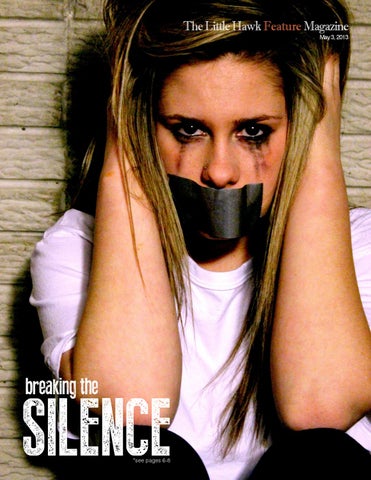
The Little Hawk Feature Magazine May 3, 2013
breaking the
SILENCE *see pages 6-8
The Little Hawk Feature Magazine May 3, 2013
breaking the
SILENCE *see pages 6-8
The Little Hawk Feature Magazine
May 3, 2013
64
15 4
21 4
ON THE COVER: BREAKING THE SILENCE
THE CLEAN CRAZE
THE CLASSROOM DIVIDE
By Emma Baxter
By Emma Baxter & Alex Perez
By Caroline Brown
Every two minutes in the United States someone is sexually assaulted. City High shares two victims’ nightmares of this traumatic event.
Adding fresh, bright, colorful foods to your diet is turning into the tastiest trend that improves body and mind.
City High profiles students who have various learning disabilities, exposing a different side to learning.
BURNING OBSESSION
FROM THE EDITORS Emma Baxter & Alex Perez
Dear Readers, This is our last issue and our emotions are mixed. It’s so crazy that this is our last issue as your Features Editors. We’ve been through many long nights, challenging interviews, and bouts of writer’s block, but every step has been worth it. It’s hard for us to tell
you how much we care about this magazine; it’s kind of like our baby, but we feel confident handing it over to the next editor who can carry on the tradition of sharing hard hitting, interesting and engaging stories. Throughout the year we’ve had a handful of committed writers join staff who have dedicated themselves to the features magazine. We can honestly say that they are some of the most thoughtful and driven writers that we have ever had the opportunity to work with. It’s sad that we’re leaving, but we know we
WWW.THELITTLEHAWK.COM
4
4
By Emma Baxter
Achieving that summer glow through tanning salons has become a phenomenon in recent years. But does the risk outweigh the costs?
can trust the next generation of Little Hawk writers to carry on what we started. We are going our separate ways next year but we know we’ll keep each other and The Little Hawk in our hearts. Being a part of something so special has really changed our lives. Love your editors, Alex and Emma
COLLEEN DAVIS By Renata Stewart Though Colleen Davis, English teacher at City High, has not moved far from her hometown, her teaching style has changed in many ways. Davis grew up in Cedar Rapids and went to Kennedy High School. She then moved to Iowa City for college, and graduated from the University of Iowa with a degree in communication studies, one which she admits “is not the most useful”. “I didn’t really know what I wanted to do when I was in college,” Davis said. “I knew I really liked working with kids, and I liked English.” Her interest when she was younger led her in the direction of language arts, as well. “I loved to read. I was a huge reader all the time,” she said. “My parents always had to tell me to put my books down. I think I read a lot for escape; I just loved entering these other worlds.” She learned about the Masters of Arts and Teaching program at the U of I, and decided that that seemed like a good direction. After completing this two and a half year program, Davis got a job right away in Lone Tree teaching English. In high school, however, Davis’ interests were not focused only on language. “Math was probably my best subject in high school,” she said. “It was always my highest
“ test score, and I did really well. I just have a really analytical mind despite my literary inclinations.” But she soon realized that math was not what her future held in store. “It just took one advanced Calc class at the University for me to realize that I really needed to be in the humanities,” she said, laughing. But her systematic disposition carried over into her career as an English teacher. “I definitely use my analytical mind when I’m reading. It’s all about analyzing,” she explained. “There is a direct correlation: being able to see patterns and breaking things down to try and understand them.” This relationship is present in the planning stages as well. “If you could see the beginning stages of when I start putting [lesson plans] together, it’s just so step-by-step. I always ask: Why am I doing this, what do I want [my students] to get out of it? And how am I going to get them there?” She admits that this may be a slightly different approach than those taken by her colleagues. “I know a lot of english teachers are really creative, whereas I would say I’m definitely more analytical,” she said. “I mean, it’s worked so far.” Beyond the walls of City High, Davis is very much home and family-oriented. “I am frequently aware of the fact that I have not moved more than 30 miles from my hometown,” Davis said. “It was more a matter
“
A Teacher Profile:
I loved to read, I was a huge reader. My parents always had to tell me to put my books down. I think I read a lot for escape; I just loved entering these other worlds.
of practicality that I stayed in Iowa. And I love it here.” She was dating someone after college, which influenced her decision to stay. “He was still in school, and I didn’t want to leave him. So I was looking for things that would keep me in Iowa City,” she explained. And she adds with a chuckle, “He is my husband now, so it was the right choice to stay.” Her now-husband eventually went to PA school, during which time Davis was a self-proclaimed “sugar mama”. But staying in Iowa City together wasn’t always in the plans. “We definitely looked at the possibility of moving when he was graduating,” she said. “But that’s when we had our child, and it didn’t make a whole lot of sense to pull up and move away from all our friends and family when we brought a little wee one into the world.” Beyond this, they became more and more aware what a great place Iowa City was to raise their daughter Sophia, now 9 years old. “When we were talking about moving, a lot of my students said that Iowa City is the perfect place to raise your kids,” she said. “So I have no qualms about being here. I don’t feel stuck at all. I love my home.” Davis is always working to improve her lessons and teaching style, which, to her, adds an aspect of newness to the repetition of teaching. “I think there is the question of whether I get bored, teaching the same stuff year after *continued on page 20 May 3, 2013 LH FEATURE MAGAZINE
3
burningobsession
4 LH FEATURE MAGAZINE
February 8, 2013
B
As more teenagers flock to tanning beds, concern over their negative consequences increases.
lue and green ultraviolet lights illuminate the room. The characteristic aroma of lotion and sweat fills the air. Fans whirl and and music plays as she lays in the tanning bed waiting for the lights to turn her skin from pale white to golden bronze. “I started tanning in 8th grade because I was going to florida and I didn’t want to burn the first day I got there,” Taylor Reyhons ‘13 said. Taylor’s tanning soon turned into a pattern because her motives behind it changed. “I tan because I think it makes me look better,” she said. “I like when I have darker skin. My tanning has definitely increased over this past year, but I don’t think it’s a problem.” According to a Boston University study, indoor tanning beds increase your bodies production of Vitamin D. “Being in the beds just make me warm and relaxed,” Reyhons said. “Sometimes I can even take naps. I always feel happier after tanning too.” This happy feeling can be attributed to a rise in serotonin levels in the body. Serotonin is the chemical that gives a person a sense of well-being and mood enhancing emotions. Although this is one so-called benefit of indoor tanning, there are numerous dangers. The most significant would be the increased risk of developing melanoma and other skin cancers. “I get nervous for skin cancer because they have signs all over the tanning salon warning of the risks,” Reyhons said. Despite the knowing the dangers she still does it. “I feel like I worry about it but I do it anyways because I’m not thinking into the future,” Taylor said. “I know it’s stupid to think that ‘it will never happen to me’ but I still do it even knowing all the risks.” Some people give Reyhons a hard time for her tanning habits. “I think there are people who probably judge me for tanning,” she said. “Those who think I’m killing my skin. They’ll say that I’m going to have old and wrinkly skin when I’m older but my mom tans sometimes and she looks fine.” Taylor doesn’t tan every single day. “I think a lot of people jump to that conclusion because I get so dark. But really I just tan super easily,” she said. “I tan about every other month and before vacations and special events like prom if I’m going to be showing off my skin.” This same tanning pattern is what led City High staff member, Mariah Ritter, to have a spot removed from her nose three years ago. “I noticed a growth on my nose and asked my doctor what it was,” she said. “They didn’t know if it was cancerous or not, but it was better to be safe and have it removed. It was no big deal but it could have
By Emma Baxter
been if I didn’t go and ask what it was.” Although the doctors don’t know for sure if the spot was from indoor tanning throughout high school, Ritter has a strong feeling that it was. “I tanned a fair amount my junior and senior year of high school. All for the usual events: spring break, prom, and summer. I thought I needed to be tan. Everyone thought that and because everyone thought that everyone went tanning,” she said. Like Reyhons, Ritter never thought the risks of tanning would affect her. “It never occurred to me that tanning would put my health in danger,” she said. “When I was 16 years old I wasn’t looking into my future, but I wish I had.” The amount of girls she see’s tanning is worrisome to Ritter. “It’s not worth having a tan that lasts two weeks. You put yourself in a serious health risk for what, to be tan for one night?” she said. “I think people should be happy with who you are, I know that sounds cliche but it’s true.” After spending time in the Philippines, Ritter noticed some surprising billboards. “There were signs advertising creams to make your skin lighter. I was so shocked by this,” she said. “As we’re trying to make our skin go from lighter to darker, other countries are trying to do the exact opposite. Everyone wants what they don’t have. People just need to be happy with you they are. This is my skin color and I’m going to love it.” Ritter understands the hype around tanning. “I feel like the media and everyone around us endorses tanning and makes it seem desirable,” she said. “I know I thought that. I didn’t want to be the pasty white girl in pictures, but if you’re doing it for looks, you have to think about your future looks too.” The Skin Cancer Foundations created the Go With Your Own Glow campaign encouraging women to love and protect their natural skin color. Stressing the importance that having a glowing complexion is what truly makes everyone look their best. Their hope is that once people stop associating tanned skin with beauty, they will begin the battle against skin cancer. According to the Skin Cancer Foundation 90 percent of all skin cancers are attributed to exposure to ultraviolet radiation. Melanoma, the most dangerous form of skin cancer kills an estimated 8,790 thousand people in the United States a year. Those who have been indoor tanning just six times increase their risk of developing melanoma by 74 percent. “If you do tan, make sure to check yourself for spots so you can catch them before it’s too late,” Ritter said. “It’s scary to think you could develop any type of growth at any time. Don’t feel like you’re immune to getting skin cancer.”
76%
of Americans who tan are female
1 in 5Americans get skin cancer in a lifetime
every hour, one person dies from melanoma.
20% chance increase of getting melanoma in one indoor tanning session
*According to the American Skin Cancer Foundation May 3, 2013 LH FEATURE MAGAZINE
5
1 out of every 6 American women has been the victim of an attempted or completed rape in her lifetime.
Two City High students share their stories.
I
By Emma Baxter & Alex Perez
t’s not everyday that you have to watch your best friend flush down painkillers to prevent them from committing suicide. But for friends Samantha and Jane, this was just part of the aftermath of being sexually assaulted. Approximately 2/3 of assaults are committed by someone the victim knows personally. Jane was 13 when her uncle assaulted her. “I was at a party at my aunt’s house,” she said. “My uncle had been drinking a lot. When everyone was asleep he pulled me over and started touching me and calling me hot.” Jane realized that things weren’t right and went into “survival mode” and pushed him off of her. “I ran to my parents and started bawling,” she said. “I couldn’t really talk but I said my uncle’s name and my dad figured it out. I thought he was going to kill him.” She was confused after it happened. “I was only 13 and hadn’t even kissed a boy yet,” Jane said. “I was terrified. I didn’t want my first sexual experience to be like that.” This incident was especially challenging because it disrupted Jane’s whole family. “Some of my family believes me and some don’t,” she said. “He say’s it never happened and that I just misinterpreted it for a hug. It was not a hug.” But most of the family tends to ignore it. “I never really had to think about it because we didn’t talk about it,” Jane said. “That wasn’t healthy for me because I didn’t talk about it for years. My parents never really knew what happened. At the time I was too embarrassed to tell my parents what he really did, I finally was able to let it out when it happened to Samantha.” Unlike Jane, Samantha was in love with her abuser. “I was a sophomore and we had been dating for a year,” she said. “We never had sex because he was saving himself for marriage. We broke up because he was going to college but I still loved him.” One night at a bonfire he asked her to go on a walk. “We were making out and I was cool with that, but then he started to take off my pants.” Samantha said. “he just kept saying ‘you’ll like it’ and proceeded to rape me. His cross necklace was hitting my face the whole time which was kind of ironic.” After he raped her she kept it from her family for a month, only telling Jane what had happened. “I finally told me mom that he touched me and that I wasn’t okay with it. He was one of my brothers best friends so he was at my house almost everyday.” Samantha said. Her mom didn’t react. Months later she tried to tell her mom what really happened.
“I just started crying infront of her and told her that he raped me,” Samantha said. “All she said was ‘it hurts the first time’. She thought I just had sex with him and regretted it. When he started texting her again Samantha found it easier to forget that it happened than confront him. “Before he was the guy that raped me, he was the guy I loved and thought I was going to marry. He still says it never happened.” After a few months what he did to her finally clicked for Samantha. “I came to terms with had had happened. What he did to me was awful. It made me angry. I was so mad at everyone,” she said. Samantha’s anger soon led to depression. “I would take everything so personally,” she said. “I would cry in the middle of class, people would say things that weren’t even that mean and take it to heart. Everything was painful.” Samantha decided to seek professional help. “I started going to a therapist once a week and it helped. I was diagnosed with post traumatic stress disorder,” she said. With her therapists help Samantha realized her brothers were a direct trigger to her rapist. “We learned that my brain makes connections with something called a trigger,” she said. “Things like seeing my brothers’ faces, smelling his cologne, seeing someone with his body type or the same car takes me right back to that night. I think that’s one of the reasons why I struggled so much because it was hard to me see him as just one person. He was two separate people, there was the guy I was in love with that would’ve never hurt me and then there was my rapist.” Things got worse for Samantha in December of 2012. “I was very suicidal. I felt really unconnected with Jane and I couldn’t talk to my parents.” she said. It didn’t matter what anyone said. “Jane tried to comfort me all the time but I didn’t want to hear it,” Samantha said. “One day I just decided that I was done.” She happened to go to her therapist that day. “I had never told her that I was suicidal, but I think I mentioned that I had Vicodin and she flipped.” Samantha’s parents were notified and she had to flush her Vicodin down the toilet with Jane watching her do it. “It was really hard. Nothing I said would make her fetter better. I would try to protect her from people because every little thing could be a trigger. I was worried all the time when I wasn’t with her.” Jane said. Samantha was prescribed Prozac and it helped. But she will never be 100% okay. “I don’t have an intent of suicided, but it comes in waves. My life is literally a roller coaster of being up and down,” she said. “I’m way better now that I’m on medication but it’s something that’s never going to get fixed. Depression doesn’t go away, you can have high and low points.”
“Before he was the guy that raped me, he was the guy I loved and thought I was going to marry. He still says it never happened.”
May 3, 2013 LH FEATURE MAGAZINE
7
Jane felt more at ease when Samantha was put on depression medication. But when Jane was spending time with her boyfriend, Samantha felt alone. “Subconsciously it felt like betrayal, but on the conscious level I was never mad at her,” Samantha said. “It made me feel unneeded and unwanted. When I was alone it was just like ‘I’m stuck, I don’t know what else to do, no one needs me, why am I here.’” This made Jane feel guilty. “I haven’t had the same experience as Samantha has had,” she said. “That makes me feel bad sometimes, like why did she have such a hard time with it. Why did she have to see a therapist and feel like she was going to commit suicide and not me.” Even though they didn’t have the same healing process, having each other there helped in its own way. “It is really ironic that we were both sexually assaulted, and were both best friends,” Jane said. “Because it both happened to us we were able to talk about it and that really helped me understand it better.” Samantha agrees. “Our roles as best friends feel so completely different from everyone elses,” she said. “Jane is my protector. Sometimes I feel bad that I can’t be self sufficient and worry her. Other times I think ‘why is this hap-
pening to me, why can Jane be strong and I can’t.’” Now that time has passed, they both feel very strongly about social awareness when it comes to talking about sexaul assault. “I’ve had to hide what I’ve been feeling for three years,” Samantha said. “People don’t understand that what they say really hurts people. They don’t understand when they make jokes saying ‘that test raped me’ and ‘we’re going to anal rape the other team’ that it can push people over the edge.” As a victim there is never a full recovery. “People don’t understand the whole process rape victims go through. It’s something we will have to live with forever,” Samantha said. “No one looks at me and thinks I’ve been raped, or tried to commit suicide. But I feel like I’ve been re-born. I had to relearn everything. How to walk, talk, interact with people. I was raped and those who haven’t been raped probably don’t understand, but that’s the best analogy I’ve heard.” Even though every two minutes someone is sexually assaulted, they hope that that number will change. “Our society teaches girls how not to get raped by boys. Teaching us not to dress provocatively, not staying out too late, and being careful who we’re with,” Samantha said. “Instead of teaching boys not to rape girls.” *Names have been changed for privacy
“It is really ironic that we were both sexually assaulted and we’re both best friends. Since it happened to both of us, we were able to talk about it and that really helped me understand it better.”
**This was a staged photo. Model used for representation purposes only
SEXUAL ABUSE STATISTICS: MALE AND FEMALE CASES
54% of assaults are never reported
38% of rapists are a friend 8 LH FEATURE MAGAZINE
March 15, 2013
44% of victims are under age 18
*According to the Rape, Abuse and Incest National Network
97% of rapists will never go to jail
www.tspaIowaCity.com
You are invited to a
Night of Fashion WEDNESDAY, MAY 1ST 2013 at 7:00 PM Limited Seats Available: $5 General Admission, $10 VIP Tickets To purchase tickets: Call 319.248.2958 or at the front desk Event location: 1550 South 1st Ave, Iowa City, IA
Net proceeds benefit Johnson Co. Social Services At Risk Youth Programs
May 3, 2013 LH FEATURE MAGAZINE
9
STICKS & STONES MAY BREAK MY BONES BUT WORDS WILL NEVER HURT ME
LH FEATURE MAGAZINE May 3, 2013
I
By Alex Perez
t’s been seen and heard all over City High lately, contested in the halls, debated on Twitter: the R-Word and its effects has been a prominent topic this year. The conversation appears to be deeply two-sided -- should we be allowed to say what we want? Or should our words have limits based on their consequences? “I personally believe it’s a very offensive word that people should not say,” Emma Wortman ‘14 said. “I’ve had the experience of seeing the immediate effects of the use of that word. There are just better and different words to portray your point.” Sam Buatti ‘13 disagrees. “I use the word,” Buatti said. “I tell people not to tell me what I can and can’t say. I don’t think it’s fair that people have brought it upon themselves to tell anyone else what to do.” The Spread the Word to End the Word campaign was created in 2004 when the Special Olympics International Board of Directors started a movement to change the term “mental retardation” to “intellectual disabilities”. “It used to be that people would be diagnosed with a mental retardation,” James Willging ‘13 said. “But then it was decided that it was too broad of a term so they changed it. People then took that and turned it into something else; they started using it synonymously with words like “stupid” and “dumb” and that’s not what it’s supposed to be used for.” Buatti feels that if used in the the correct context, the word is acceptable to use. “I understand that the word might be offensive to people with disabilities,” Buatti said. “And I think it’s inappropriate to use it around them, but going around telling people what they can and can’t say is just giving the word power and fear.” The r-word.org was established in 2008 and now has 397,327 online pledges and is growing everyday. The fight to end the use of the word is ongoing. “How I react depends on the situation I’m in when I hear the word,” Willging said. “If I’m with my buddy or around someone disabled I’ll call people out on it. I usually say that ‘You shouldn’t say that, you don’t realize what effects your words have on people.’ If someone just says it casually I’ll let it slip because I don’t like to be that guy who’s always yelling at people about what they say.” Buatti feels that ending the word isn’t the solution. “I think a lot of people think that using the word is the ‘big problem’. I don’t think that’s what they should be focusing on,” Buatti said. “I think the focus should be on treating people with disabilities more humanely. Which I do, you can tell as many people in the world not to say the word but that doesn’t mean that people are going to stop getting made fun of. I
think desensitizing it by using it more often is a way better decision that to give the word all of this hateful, mean power.” Nat Alder ‘13 agrees. He feels advocates for ending the use of the word should try a different approach. “I’m not against ending the usage of the word,” Alder said. “But at the same time I think people are trying to use fear and are weaponizing the word. The anti-R word approaches are antagonistic, they’re teaching people that they should be afraid of the word. They should be teaching them that it’s just a word, and they shouldn’t be afraid and affected by a word.” Although advocates have been hard at work making people aware of their feelings toward the word, it still seems present in people’s vocabulary. “I don’t know why people continue to choose to use the word,” Willging said. “I think sometimes people just say it to spite people who are advocates and that’s just really immature. There’s only so much that can be said to people who feel like it’s okay. They don’t realize that their actions have consequences and that they’re hurting other people.” Best Buddies President Molly Powell-Littler ‘13 agrees. “I consider it a very derogatory term,” Powell-Littler said. “Calling someone ‘retarded’ is basically saying that that person shares characteristics with someone who has an intellectual disability. It’s implying that when someone does something stupid that they are acting like someone with a disability.” To some, just speaking out isn’t enough. “If I see someone who is using the word in an inappropriate context, I’ve taken action before.” Willging said. “If you’re going to put it on the internet, it’s fair game. It’s not unfair to call someone out. I don’t feel like making it known to administrators that I think it’s a problem is a bad thing.” Buatti has been confronted by administrators for his use of the word. “I’ve been talked to about saying the word before,” Buatti said. “People will just indirectly say it without even thinking and people get really upset. I understand that it’s disrespectful in certain contexts, if I ever saw anyone doing it I’d be upset and insulted but i don’t think anyone is helping anyone by telling others what to say.” Willging feels that the overall intent of the campaign is to establish a sense of respect among everyone. “I don’t want it to be something that has to be fought for,” Willging said. “I want it to be something that people recognize that it isn’t a useful word, all it does is take away the dignity of thousands of people. The goal is just to get people to understand that no matter how high or low functioning a person is on the outside, they’re still just a person on the inside and everyone deserves dignity and respect.”
May 3, 2013 LH FEATURE MAGAZINE
11
12
LH FEATURE MAGAZINE May 3, 2013
They’re cold, flavorful, and come with an added jolt. They’re bought in gas stations, supermarkets, vending machines, and bars. Energy drink consumption is on the rise. Red Bull and Monster Energy, the two top selling brands have increased their annual profits by 650 and 700 million dollars, respectively. This shows a massive rise in energy drinks being consumed world-wide. The taste and caffeine content of energy drinks appeal to teenagers, whose tight schedules and insufficient sleep levels make it hard to stay awake during the day. More and more teens have been opening up cans of energy drinks worldwide, and the trend shows little sign of stopping. Max Ibsen ‘13 has been drinking energy drinks since he was 13. “The first time I had one, it gave me a lot of energy, and it tasted great. I drink them a lot now,” he said. This growth has continued despite the recent death of 14 year old Marylander Anais Fournier, who suffered from a heart attack after drinking Monster Energy two days in a row. Her mother filed a lawsuit against the popular energy drink company claiming that they don’t post accurate warning labels on their products. Although the event of Fournier’s death caused Monster’s stock to drop, the company did not get sued. Monster does post warning labels on their energy drinks, warning against consumption by children and the caffeine sensitive, but their definition of children is limited to those under the age of 12, and there is concern over whether energy drinks are appropriate for teens to drink, given the risk and marketing of the drinks. “It’s scary to think that something sold to kids can kill them, and is still being sold,” Claire Goodfellow ‘13 said. Dr. Christopher Hogrefe, a clinical assistant professor of Emergency Medicine at University of Iowa Hospitals and Clinics, agrees. “The amounts of caffeine being consumed in these energy drinks are not negligible. While the levels may not reach the FDA definition of toxic, the amount of caffeine has been shown to be sufficient to cause heart arrhythmias or convulsions,” he said.
Monster Energy has products with names like Monster Rehab and Monster Assault, each with almost twice the caffeine of an equally sized cup of coffee. Over half of all energy drink purchases are made at bars, according to Zenith International, specialist consultants for the food and drink industry. Marketing isn’t the main issue though. A recent government survey reported 20,000 plus emergency room visits caused by energy drinks since 2011. Despite the survey, teens are still drinking energy drinks. Despite the apparent risks, Ibsen doesn’t worry for his health. “I like the taste, mostly,” Ibsen said. “I’m not really worried about my health, the worst thing that’s ever happened to me is caffeine withdrawal, which after the first time isn’t that bad.” Caffeine withdrawal is the difficult process after a regular consumer of caffeine quits taking it in. Symptoms include but are not limited to headaches, nausea, inability to concentrate, drowsiness and irritability. “It can suck, and it happens after only a few days without caffeine. Combined with dehydration caused by the caffeine, it can really kick you in the butt,” Ibsen said. But teens drinking caffeinated beverages isn’t new. Teens are becoming the fastest growing population of coffee drinkers, and the effects of the caffeine are the same. “Caffeine helps to maintain alertness and focus, which are very attractive side effects,” Hogrefe said. Ibsen agrees. “They do keep me from falling asleep. I don’t get much sleep, so it helps me stay awake in class, which is nice. I don’t really get the energy anymore, I’ve built up such a tolerance,” he said. Hogrefe is concerned that energy drinks are being overused. “I think the rise in consumption of energy drinks warrants our attention as a society. I’m concerned that these products [energy drinks] may not be in the best interest of their consumers in the long term,” he said. Thad Sheldon, Biology teacher, voices added concern.
“I’m primarily concerned with the amount of calories in a teen’s diet that would be coming from these drinks,” Sheldon said. If someone is on a 2,000 calorie diet, one 16oz can of Monster Energy would make up a tenth of that. It’s the same for Red Bull. And considering that most of those calories are coming from sugar, the opportunity for nutrition is lost. With the stress of school, lack of sleep, and after school activities stretching students’ abilities, a pick me up in the form of caffeine might seem like the best option. But Hogrefe disagrees. “We live in a society of convenience. We are too busy with too much happening in our lives. If a quicker solution to address an issue exists, that solution will often be sought. That does not make it the proper decision, but it is often the one made,” he said. It’s true that teens don’t always make the right choices when it comes to diet; many choices are solved based on what’s most easily come by. Ibsen admits that he doesn’t really eat healthily. It hasn’t really been an issue for him. “I’ve never really had a healthy diet, I just eat what I feel like eating. I’m not usually sick though, so I tend not to worry about it,” he said. As a teacher, Sheldon understands that life as a student can be tough. “It’s obvious that tighter schedules play a big role in what teens eat and drink, and their health overall. Teens who are pushed to take more classes might not have time to eat right,” he said. Although they might not be the best option for teens, energy drinks show no signs of disappearing from the market, and in future years, more and more high school students will begin to drink them. For those people, Hogrefe has this advice: “Energy drinks, smartphone use, water, pizza…They are all the same. Practically, caffeine (and therefore energy drinks) have a useful role in maintaining focus and enhancing memory when utilized in small doses,” he said. “Anything more than that and caffeine loses its benefit,” he said.
May 3, 2013 LH FEATURE MAGAZINE 13
14 LH FEATURE MAGAZINE
March 15, 2013
By Emma Baxter As colorful fruits and veggies crowd out the fatty carb loaded foods from plates, clean eating has become a major trend in students’ lives.
D
etoxes and clean eating diets are known to be the quick fix for celebrities wanting to slim down before a big event. But recently this food trend has experienced more popularity among people just wanting to get fit and be healthy. “I think everyone should be concerned with eating in a healthy way,” Dr. Linda Snetselaar, Director of the Nutrition Center at the
University of Iowa College of Public Health said. Clean eating isn’t some special plan, but just a change to incorporate healthier food into your diet. “Fruits and veggies in higher quantities are going to be great for your body,” Dr. Snetselaar said. “Anytime you start processing food you eliminate the most important nutrients first, the more you can do to eat fresh, whole food, the better. Try to eliminate fatty foods and eat in moderation and control portion sizes. Lean meats, low fat dairy products, and whole
May 3, 2013 LH FEATURE MAGAZINE
15
grains--that will help you lose weight.” Clean eating is a easy lifestyle change according to Dr. Snetselaar. “Often when people go on diets they go overboard with eliminating so called bad foods,” she said. “I don’t like to give foods a label. Anything eaten in moderation and in the right proportion is okay.” Thinking about foods that are better for you sets you up for a better diet. “Food is so much fun. We can keep it fun by not going crazy by counting calories and looking at a number on a scale. Experiment with new recipes and try unfamiliar foods,” Dr. Snetselaar said. “What is most important is how you look and feel in your body.” Her view on detoxes is simple. “I think anytime you eat in a healthy way you’re doing some sort of detox. Whether you’re cleansing your body with a juice blend or just cutting carbohydrates, by eliminating damaging foods you’re leading your body in a healthy direction.” Francesca Lubecki-Wilde ‘13 took a more intense route and decided to go on a five day green tea detox to jump start her changing lifestyle. “I want to be a better me. I’m eating clean and working out to be that better version of myself,” she said. She found the green tea detox while reading Livestrong.com. A detox never seemed like the healthy way to go, but as she looked further Francesca learned that it has great benefits. “As I was reading I learned that a detox wasn’t unhealthy because it can flush your body of toxins, get rid of cravings, and quicken your metabolism.” Francesca only consumed water and green tea for five days. “I was surprised at how great I felt. I had a lot of energy and was happy,” she said. “I probably was drinking a couple liters of water and seven cups of tea a day.” To some, this might seem like a drastic and unhealthy way to lose weight. “People would ask why I was starving myself,” Francesca said. “Weight loss is such a sensitive subject, with teenage girls especially, that for me it’s one of those things where I would want people to be supportive of me and I also know they would step in if they thought it was getting out of hand.” Francesca thinks there is a fine line between detoxing and an eating disorder. “When you use a detox to jump start a clean diet and exercise pattern, like why I did it, that’s super great,” she said. “But when you use a detox as an excuse not to eat that won’t work and it’s incredibly bad for you.” Dr. Snetselaar worries that people are denying their bodies of important protein and nutrients. “You should be getting a mix of everything in your diet. If you’re doing something that eliminates those foods from your diet you could be 16 LH FEATURE MAGAZINE
May 3, 2013
putting your body in danger. I know it’s human nature to want the ‘quick fix’ but if you’re losing weight in a unhealthy way it can be detrimental in the long run.” Changing your diet takes a considerable amount of self control. But Francesca’s vegetarian habits came naturally. “I was eating a lot of foods that I just didn’t need to be consuming,” she said. “When I decided to become vegetarian I didn’t set an end date because I think that gives people the wrong mindset. I just told myself to stop eating meat and now it’s part of my everyday life.” Maintaining self control is different for everyone. “I think it depends on why you’re doing whatever you’re doing,” Francesca said. “If you don’t really care then you’ll probably give in and eat the brownie and skip a day at the gym, but if you really want it then it’s not hard.” She thinks the best way to lose weight is working out and eating healthier. “Exercise and eating right just gives me so much more energy and I feel better,” Francesca said. “When I eat badly I’m in a worse mood and I’m more tired. My physical health affects my mental health. When I know I’m physically healthy I feel mentally healthy.” Fitness and clean eating accounts have appeared very popular on Twitter and Instagram, with thousands of followers, there are both positive and negative effects. “I don’t think you should lose weight to look like anyone else,” she said. “I personally don’t want to lose weight to look like a model or any girl at school. I want to lose weight to be a better and healthier version of myself.” She also adds, “It’s really good when people motivate each other to be healthy. Those accounts should be inspiring and give you a good mindset. But when you start comparing yourself to models in the pictures with their unrealistically skinny, tanned bodies that can tear you down.” In the end, Francesca thinks that something that is sustainable is the most beneficial. “It’s all about getting yourself on a schedule and sticking to it,” she said. “So many people are doing the clean eating diet because it’s effective, healthy, accessible, and you do see results. There are no easy solutions, you have to make sacrifices, but if you don’t feel healthy and confident about yourself then it’s worth any sacrifice.” Dr. Snetselaar agrees completely. “Sustainability is the key to a healthy diet. Get into a workout regimen that works for you and plan ahead. Do something you know you can follow over a long period of time and have patience because changes will come if you provided your body with what it needs.” photos by Emma Baxter, Lily Howard, and Emma Gier
By Lauren O’Brien
The fairytale prom seen in the movies isn’t a true assesment of what this so-called magical night is, according to City High seniors. The flowing dresses, the suits, the glamour, the prom. As the City “Prom is kind of a joke. It’s a waste of time really. It’s a whole entire High prom draws near, excitement levels are lower than expected, due to night is people complaining and getting all hot and sweaty and people bestudents who have had bad experiences in the past. The fairytale prom ing all awkward,” Reuter said. high school students dream of, may not be so fabulous after all. As prom becomes less of a big deal, the dancing becomes less formal “What I learned is that if something doesn’t meet your expectations too. Some think that the dancing has all molded together to form the same then lower your standards,” Lauren Coffey ‘13 said. “I’m going to go and moves all night long. have a good time and not expect anything. I’m not going to put prom on a “The thing about our generation is that no one knows how to dance pedestal and go all out.” to music that doesn’t tell you how to dance to it,” Coffey joked. “There are As years go by, the preparation for prom starts to become more ca- specific instructions in the lyrics. No one knows how to dance without sual. An average prom committee consists of fifteen to twenty students. grinding. It’s also not like homecoming, you can’t make the rounds, you This year, there are four juniors planning prom. have to stay with your date the whole time.” “The preparation has been going really slow but I feel like it will kick A trending disappointment for some juniors and seniors is the party into gear as we get closer to it. We have been meeting before school at after prom hosted by the parents. It is a part of prom that students are 7:30 on Wednesdays,” Cassidy Bringle ‘14 said. beginning to not want to attend, due to “There are three or four of us helping out and boredom and having nothing to do. planning, so the lack of hands makes everything “I think party after prom is too long more stressful.” because if you are going to keep kids until "last year i think there The prom committee chooses the food, decfour in the morning then your should at orations, pre-prom photography, and the theme least make activities that are worthwhile was a lot more planfor the night, but having only four juniors helping instead of things we would have loved to out makes the process much longer. do in junior high,” Bringle said. ning going into it. i think “Last year I think there was a lot more planParty after prom lasts for around we're expecting a rening going into it. I think we’re expecting a really four hours and is planned by the stufun night but it was terrible last year,” Kara Hartdents’ parents. Generally students are ally fun night, but it ley ‘13 said. “So this year’s just like whatever it’s happy with the food but wish the activigoing to be a fun night except not. I’m doing a lot ties were more attuned to the wants of was terrible last year. less than I did last year. It’s going to be really chill.” the common high schooler. A handful of senior girls are lowering their “To me, the party after prom is a I'm doing a lot less than i expectations from last year by spending less bigger disappointment than actual prom did last year." money, while others will plan to go all out for the because I knew actual prom would be dance. hell,” Curtis said. “What happens with -kara hartley '13 “There are a few select girls who take prom parents of high schoolers is, they always way too seriously. They go out and buy six billion want to do more than they’re capable of. dollar dresses and have exclusive groups,” Coffey You try to do too much and it ends up said. “I don’t have a problem with those who do that, I just know I didn’t being way less than what you were trying to do. It’s really disappointing. So want to do prom like that this year.” no I’m not going to waste my time with going to that again.” Guys may take a different angle on prom and choose to get ready less Less people will be attending party after prom because it can get borthan an hour before the dance, and girls may choose to get ready in the ing, and the lock-in style of the event isn’t appealing. morning or afternoon hours. “I’m going to attempt to go in, grab food, and then leave. There’s no “Last year I got ready about 20 minutes of before it was time to go,” way I’m staying until four. The food at party after prom is so good but I Mitch Reuter ‘13 said. “When I went to get my tux, I didn’t even know think last year I just walked around the entire time and had nothing to do,” what her dress looked like. So I just got whatever I thought looked kind of Coffey said. cool. I didn’t really care how much it costs, if I’m going to dress-up I might Though prom may not turn out to be the fairytale you dreamed of, as well go all out.” juniors, parents, and staff work hard to make prom a night the upperclassPeople are beginning to treat prom more casually than in past years men will enjoy. and not taking it very seriously. 18 LH FEATURE MAGAZINE
May 3, 2013
Popular places to eat WHERE DID YOU basta
BUY YOUR DRESS?
ATLAS
DEPARTMENT STORE
IOWA RIVER POWER RESTAURANT
ONLINE
BLACKSTONE
BORROWED A FRIEND'S
WHERE DO YOU RENT YOUR TUX? MEN'S WAREHOUSE SKEFFINGTENS AUSTIN & BURKE
WHERE DO YOU GET YOUR HAIR DONE? LA JAMES SALON ACADEMY TWIN IMAGE
PROM STORE
WHERE SHOULD YOU GET YOUR FLOWERS? HY-VEE SUPPELS FLOWERS EVERY BLOOMIN' THING
WHAT DO YOU DO AFTER PROM?
AVEDA SALON
GO TO PARTY AFTER
WAVE LENGTH
GO TO A FRIEND'S HOUSE
year,” she said. “And yes, there is an element of that, but I try to do different things and bring new things in, one for my own professional development and for the development of my students. I find myself going through cycles where I will completely shift and change what we’re doing and how we’re going to go about it.” This changing process has been accelerated with changes in technology. “I’ve been trying to figure out ways to work that in,” she said. “I don’t want to use technology just to use technology, because I think that’s silly, but to find ways where it actually can help with the learning is really important.” Students drive the shifts, as well. “As a teacher, you have to tweak your curriculum to who is in the classroom. You can’t do something one year the exact same way you did it the year before, because the kids are so different. Especially with U.S. Lit Honors, I like it to be pretty discussion based. I’ll still lay out what the big ideas are and what we should look for, but the discussion comes from the students,” she explained. “That makes it really refreshing for me as a teacher. I can come up with a brilliant lesson plan, and it will work fabulously with one group of students and be a total failure with the next group.” Behind these shifts and transient lesson plans lies a more permanent
teaching philosophy. Davis didn’t hesitate for a moment when explaining this. “I’m a quote and concept person. I like to look at what the big ideas are that are working in the text, and how the author is creating them,” she said. “And then digging in and finding [the quotes] and writing about how they fit with the bigger concepts.” Teaching how to read well is what she feels is crucial. “As an English teacher, it’s not important that I teach you the Great Gatsby, it’s important that I teach you how to read the Great Gatsby, so that when someone else puts another book in front of you, you know how to read a book. The literature is just the vehicle we are using to try and teach you how to read well.” This all stems back from her experience as a student, and what sticks out from her time sitting in the “small, cramped desks.” “When I started teaching, I looked back on high school and tried to think about what I remembered: separate your variables from Algebra, and the green light from the Great Gatsby. So that made me really think: what are we doing here? Because if we’re going to forget the specifics, what is it that we’re doing?” Ultimately, Davis came to her own realization: “It’s so much more about the experience and the skills, and that has been what has driven what I teach in the classroom.”
HIGH SCHOOL STUDENTS ONLY!
TWO WEEKS
A
Independent Films d n a e ativ n r lte
UNLIMITED
TANNING
19
95
$
3
*
39
UV FREE$
SPRAY TANS
Student Admission: $3 Non-Students: $7 bijou.uiowa.edu 20 LH FEATURE MAGAZINE
May 3, 2013
*Must present valid high school student I.D. card. Not valid with any other offer. 14 & 15 years of age must have parental consent. See store for details. Expires 5/15/13
115 Hwy 1 West, Iowa City • 338-0810 585 Hwy 965 S. Suite #C, North Liberty • 626-3040
No Appointment Tanning • Open 7 Days a Week www.ashleylynnstanning.com
May 3, 2013 LH FEATURE MAGAZINE
21
t
apping her pencil, glancing at the clock, watching everyone else walk to the front of the room to turn in their tests. She tells herself to take her time, even though she’s barely half way done. Realizing her medicine is wearing off, trying to focus becomes impossible. “Some teachers just don’t understand,” Madelyn DeWitt 16’ said, “It’s not something that goes away, it’s always there.” DeWitt was diagnosed with dyslexia, a learning disability that impairs a person’s fluency or accuracy when reading, in second grade, when her teacher noticed she couldn’t read very well. She was also diagnosed with ADHD. “The doctors said there wasn’t much to do besides keep reading, writing and practicing,” she said. “There is no medicine you can take for dyslexia.” According to the American Psychiatric Association, an annual nine percent of children ages 3 to 17 are diagnosed with attention deficit hyperactivity disorder, or ADHD. Additionally, an estimated 5 to 15 percent of Americans suffer from some form of dyslexia. Many of these problems are connected, and it is not uncommon to have both. Eddy Galstad 16’ has been dealing with ADHD since she started grade school. “It helps knowing I am not the only one that struggles,” Galstad said. “but some people don’t get it. When people say, ‘Why can’t you understand this?’ that’s probably the worst. It’s not that I can’t, I
22 LH FEATURE MAGAZINE
May 3, 2013
just need help along the way.” Though many people do experience the same problems, people who don’t have ADHD or dyslexia often don’t understand. “It’s kind of annoying when people try to give us special treatment,” DeWitt said, “I don’t like it when people talk down to me, they treat me like I’m five years old.” Galstad has had similar experiences with teachers and friends who try to understand, but don’t always know how to handle the situation. “You don’t want to be treated like you need help, but you want to get the help you need,” Galstad said. “that’s one of the more difficult parts, people will assume you’re stupid.” People making assumptions is something DeWitt and Galstad have a hard time accepting, especially because they have to devote more time and energy than the average student. “I have to put more effort into a lot of things if I want to do them well,” DeWitt said, “I’m not saying other people don’t try, but I have to try a lot harder because of my ADHD and dyslexia.” Staying focused and continuing to try hard is frustrating for students with ADHD when results are not as obvious. “It kind of upsets me sometimes when there are things I don’t understand. I think I could understand things better if I didn’t have ADHD,” Galstad said. “it’s kind of disheartening to feel that way, that I can’t do this because it’s something that I can’t control.”
Galstad explains how being motivated to keep trying becomes difficult when trying her best doesn’t seem to be enough. “I’ll look out the window for a second and when I look back the class is talking about something completely different, some days I just can’t focus as much as I need to. This is when I really start to notice it,” Galstad said. DeWitt agrees that day to day it’s not something she notices, but in the classroom it definitely brings challenges. “When I’m hanging out with friends it’s fine, but when it comes to school it’s hard,” DeWitt said. “it is what it is. I don’t want to be in denial because I know I work hard everyday to overcome it.” Helping students conquer their learning disabilities is exactly what the staff of City High strives for. Assistant Principal, Emily Dvorak works with City’s students to make sure they get the support they need. “504 plans give teachers all your plans. They check on how the student is doing, send out emails, call you in for meetings, and they really do a great job of making sure everybody is okay. Emily Dvorak has everyone involved and it’s really helpful.” Galstad said. Though she’s only had the position for a year, Dvorak is already very involved. “A 504 plan is an accommodation plan and it’s something that a student and their parent can request, it’s a formal process. What it does is it evens the playing field for students that might have ADHD,” she explained, “they are for any student that needs some accommodations to achieve at their greatest level in the classroom.” City High’s priority is to make sure that every student is able to learn and achieve their goals to the best of their ability. In order to make that happen, these plans stay with the student for as long as is necessary. “Every student is different, every student learns differently, therefore, ADHD is different for each student,” Dvorak said, “I’d like to think that as a teaching staff and as a school, we do a really good job of trying to individualize student needs. Sometimes even after we do that, it’s not enough. That’s where the plan comes in.” In addition to keeping everyone informed, 504 plans and meetings encourage the student to communicate with teachers and know when they need to ask for help.
“For a lot of students knowledge is power, so knowing about it, knowing about yourself, the more you know, the better you can advocate for yourself.” Dvorak said. Students are encouraged to be independent with their needs, and figure out what works for them when it comes to their academic success. “A lot of people with ADHD as they get older, learn how to manage it and learn how to self regulate much better than when they were in first and second grade. Often things will get easier as they grow up.” Dvorak said. Unlike most kids, who are diagnosed at age seven, Ryan O’Malley 13’ was only recently diagnosed. He shares how his ADHD went unnoticed for nearly all of his childhood. “I was diagnosed a month ago so nobody really knows other than a couple of close friends,” O’Malley said, “My IQ was high enough to keep me getting decent grades, no one could tell anything was wrong.” Stress and anxiety are familiar emotions to almost any student in high school, but O’Malley realized that something was different. “They realized the reason I would stress over school, and have to study so hard to keep decent grades is because I was having trouble paying attention and processing information,” O’Malley said. Many kids with ADHD not only struggle in school, but it can be the cause of or lead to other day to day problems. “I suffered for a really long time with persistent anxiety and depression issues,” O’Malley said, “Because nobody knew about it, it caused me to work harder.” Not knowing what the problem was, O’Malley was seeking help through meditation classes, and meeting with a psychiatrist for a few months, eventually finding an answer. “It was a big relief,” O’Malley said, “It made me feel a whole lot better about my life and what’s been going on, because I realized I’ve been dealing with it for a really long time and continuing to try hard.” Realizing that success can be attained even with a challenge, O’Malley shares his best advice for students struggling with ADHD. “Never give up, you never give up no matter what the problem is. There is always someone out there dealing with it too. Know you are not alone,” he said.
May 3, 2013 LH FEATURE MAGAZINE
23
#LHFEATURE