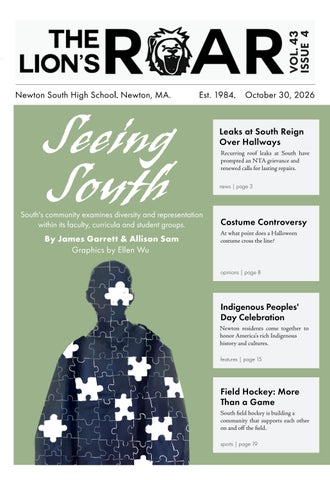
VOL. 43 ISSUE 4 Newton South High School· Newton, MA.
Seeing South
Est. 1984·
South's community examines diversity and representation within its faculty, curricula and student groups.
By James Garrett & Allison Sam Graphics by Ellen Wu
October 30, 2026
Leaks at South Reign Over Hallways Recurring roof leaks at South have prompted an NTA grievance and renewed calls for lasting repairs. news | page 3
Costume Controversy At what point does a Halloween costume cross the line?
opinions | page 8
Indigenous Peoples' Day Celebration Newton residents come together to honor America's rich Indigenous history and cultures. features | page 15
Field Hockey: More Than a Game South field hockey is building a community that supports each other on and off the field. sports | page 19
page 2
October 30, 2026
NEWS issuu.com/thelionsroar
Volume 43, Issue 4
October in Review photo by Bethesda Yeh
By Bethesda Yeh
I've had negative experiences with the past principal because of who I am and what group I belong to ... I just really want everyone to feel welcome at school. Tia Aldehneh Class of '28 & Student Listening Session Attendee
Principal Search Committee Listens The most important thing is to be fair and On Oct. 16, the Superintendent Advisory Committee for South’s Principal Search hosted a student listening session in the Student Center during WIN3. Through small group discussions and a survey, participants shared their desired qualities, experiences and qualifications for South’s next permanent principal. The final hire will take the reins in July 2027, replacing Interim Principal Caitlin Brown. The Committee also hosted a staff listening session on Oct. 6 and a parent/guardian listening session on Oct. 28.
Lisa Heyer Director of Public Health Services in Sept. 28 Hearing Determination
Judy Hinchey Owner of Miniature Horse Clover
graphics by Ellen Wu
Mini Horse Can Stay, For Now In the latest development to a saga involving an unusual backyard pet, Newton granted resident Judy Hinchey an extension of up to six months to remove her 28.5-inch miniature horse, Clover, from her property. The city previously rejected Hinchey’s appeal to keep the horse, a therapy animal. The dispute centers around whether Clover, despite her small size, can be considered a “Large Animal” under city regulations. Hinchey has said that she plans to escalate the appeal to Middlesex Superior Court.
photo courtesy of Fig City News
She's Newton's miniature horse. [It's] just amazingly fulfilling to get to do something that makes people so happy that I want to continue that.
Jason Williams Vice Principal & Co-Chair of Superintendent Advisory Committee for South’s Principal Search
photo contributed by Judy Hinchey
A miniature horse is a breed of horse and thus, based solely on the plain language of the Regulations, constitutes a Large Animal.
equitable in the search. I just want to make sure that we give everybody a chance to have their voice heard as much as we possibly can.
Even if we had infinite funds, it would be challenging to try to completely get rid of an insect that can fly and produces lots of offspring and spreads on vehicles. Jennifer Forman Orth Environmental Biologist via WGBH
Spotted Lanternflies Take Over An invasive species has infested over 150 towns and cities across the state, including Newton: the spotted lanternfly (SLF). First detected in Massachusetts in 2021, these insects severely damage fruit trees and over 100 plant species, depleting them of their sap while secreting a honeydew, sticky waste product. In response, Massachusetts' Department of Agriculture Resources has assembled a team of inspectors to survey sites with SLF sightings and monitor high-risk pathways.
If you see small numbers of SLF adults or nymphs ... squish or smash the insects to destroy them. Spotted Lanternfly Management Guide Massachusetts Dept. of Agricultural Resources
issuu.com/thelionsroar
news | page 3
Leaks reign over hallways and classrooms
Sinan Ozkumur
Trash barrels catching water from ceiling leaks have become a familiar sight at South. While many longtime teachers report that leaks have been a mainstay for decades, the problem has worsened and grown more conspicuous recently. Their impact, meanwhile, has been felt by students and staff alike. South English teacher David Weintraub, who has taught in the school for 22 years, said leaks are a constant companion of everyone at the school. Ceiling tiles in his classroom, he said, have fallen multiple times before, each time miraculously avoiding a student who could have been sitting underneath. “I'm very resigned to just having the leak be a constant feature of the building and my classroom,” he said. “I make a joke about it because there's no other way that I can deal with it professionally.” New teachers alike have already felt the leaks’ effects. First-time South biology teacher John Coyne said that, in the middle of one of his classes, a tile that had been sagging with water gave way and fell to the floor with a thud. Coyne said that nobody was harmed by the falling tile and that custodians came promptly, cleaning up the debris by the end of the block. However, he said that the situation posed both a safety hazard and teaching disruption. “A lot of kids were a little flustered. Some were laughing,” he said.“It pulled attention away from the lesson that I was teaching that day.” South freshman Dariel Lara said the trash cans that sit in hallways cause a daily
News Reporter
inconvenience to students. “The containers can $ll up the space in the hallways, so there's less room for students to walk in, which makes the hallways more crowded,” he said.
(NPS) simply hasn’t solved. “The district's approach over the years, on this issue, but on other issues too, has been to try to do short-term patches,” he said. “Shortterm $xes that do not address the long-term
photo by Cameron Holbrook
On June 22, the Newton Teachers Association (NTA) $led a Step 3 grievance, a higher-level escalation of an unresolved dispute, over the school’s leaky roofs. NTA Second Release Officer Ryan Normandin, a former math and physics teacher at South, said that the leaks are a continuation of a problem that the Newton Public Schools
problems with the underlying issues.” South head custodian John Griffin said that his custodial staff constantly work to manage leaks and respond as soon as issues are reported. While NPS relies on outside crews for actual roof repairs, Griffin said that the problems persist. “We have a company that comes in and
repairs it, and it gets better,” he said. “And then new ones come up here and there.” Newton and NPS officials have pledged long-term repairs. At a Sept. 28 School Committee meeting, Mayor Marc Laredo said that spending operating funds on patchwork $xes is cost-ineffective in the bigger picture. “We’re going to tackle it the right way, which is [to] do the real work. Fix the problem completely,” he said. In an Oct. 14 message to the NPS community, Superintendent Anna Nolin announced that a feasibility study for South building projects was underway. “The committees are being created as we speak and we will begin to visit model schools and write education plans for the next round of school buildings in Newton,” she said. South history teacher Katherine Wildman said that she has appreciated the progress made so far. “It'll take a while to get [long-term building projects] done, but I was really glad to see that on the list,” she said. “I do think lots of people in the city are taking this very seriously.” In the meantime, leaks remain an ongoing issue across the building. South English teacher Robyn Marder said that staff members try to stay positive despite the persistent distractions. “We will sometimes joke about how we're like the postal service. We'll just keep working despite the conditions,” she said. “We have to have a grain of fun about it and a little bit of humor because, if you just look at the reality of it, it is kind of demoralizing.”
South awarded dental hygiene CTE grant
Chloe Carrano & Julia Ding This fall, Newton’s Career and Technological Education (CTE) department added three new programs: a dental assisting program and information support services and networking (ISSN) at South, and a medical assisting program at North. Funding for these new programs came from a $1.4 million federal expansion grant awarded to the Newton Public Schools (NPS) by the Department of Education. These programs are part of the CTE department, which offers programs for students who aspire to become future professionals in certain $elds. CTE programs require a four-year commitment and follow an ascending structure to earn certi$cation, similar to many of the core classes students take. They allow concentrated, exploratory education in one speci$c $eld. Superintendent Anna Nolin said the CTE programs prepare students to immediately enter the work force. “If a student leaves our school $elds … and they have gone through these programs, they can work in these industries right away and get industry certi$cation,” she said. “So it seemed really like a no-brainer of an idea.” South sophomore Amelia Nincic, a junior officer of the Aspirations in Medicine club, said she thinks that the program would give students a glimpse of real-world careers. “It's important to give students a chance to see what they might be interested in in the future,” she said. South junior Chloe Cheung, who is registered to participate in the dental assisting
program, said she prefers the opportunities these programs have to offer. “I'm glad that South [is] giving all these students a huge variety of options to explore their path,” she said. “I think one thing that high schools should be doing a lot more is kind of preparing students for what comes afte r h i gh school.” Preexisting programs like culinary arts, or Early Education and Care, have exclusively been located at North. The dental assisting and ISSN programs are the first CTE programs located at South, removing barriers such as transportation for students. CTE director Kathleen Duff said she appreciates the newfound accessibility of CTE
News Editor, News Reporter
classes to South students. “By having the CTE programs at South, one, it gives easier access for the kids that want to do it,” she said. “[Two], it expands the community for everybody to see lots of different types of learning and learning styles.” The launch of these new programs offers an opportunity to upgrade facilities at South. Nolin said that many accom mo d a tions are being made to South’s classrooms to better support the opening of these new programs, speci$cally dental assisting. “They're being upgraded so that [the rooms] can become the dental suite,” she said. Nolin said i a ka lara S that a large amount graphic by C of the funding for the new programs comes from a federal expansion grant. “There's lots of grant opportunities for
expansion, and districts have just never taken advantage of any of them,” she said. “We wrote one, and we chose those three shops because we polled students at North and South.” Next, the school’s facilities were evaluated and students were surveyed based on their interests. Nolin said that career opportunities were also factored into the decision of which new programs would be implemented. “There's a big medical area around us,” she said. “It seemed just like the right match for interest [and] the local economy.” The district introduced the new programs, along with preexisting ones, to rising freshmen at all middle schools and emailed the information to students and families. Michaela Henry, director of the dental assisting program, said that the program will allow students to explore all the specialties through their high school career, including oral surgery, orthodontics and pediatric dentistry. Moreover, the program will include education in infection control, dental radiology, chair-side assisting and an introduction to dental tools and materials. “There's a huge shortage in the industry in general for existence and awareness,” she said. With excitement in the air as these programs prepare to debut, Duff said she is eager to hear the reactions of participants and further strengthen the CTE community as its own school within a school. “I just think it'll be a bunch of opportunities for kids that they wouldn't have had otherwise … a piece of a dream coming true,” she said.
page 4 | news
the lion's roar
Lopes takes charge of METCO in Newton
Leah Fiadjoe
On July 23, Newton Public Schools (NPS) announced that Blayne Lopes would become the 2026-2027 interim director for Newton’s Metropolitan Council for Educational Opportunity (METCO) program after director Lisa Gilbert-Smith became North’s interim principal. Before being chosen as the interim METCO director, Lopes worked across NPS, including with the I’m Amazing Program, which he ran at North. Kate Carpenter Bernier, Executive Director of Newton Community Education, said that she worked with Lopes while he ran the program. “He was an excellent organizer and leader. He also continuously improves the curriculum. He helps to fundraise for the program,” she said. Carpenter Bernier said that Lopes’ attention to students is evident. “He's very reliable,” she said. “He obviously cares deeply for the students, and he has very high expectations for them. And they know that.” Leah Castellano, North’s METCO director, said that she has also witnessed Lopes’ work with students. “He has such a way of connecting with students,” she said. “[High school students] are tricky. Not everyone needs the same thing. He was able to hear everybody, make them feel valued, and that's all we could ask for.” Since becoming interim director, Lopes said that he has become more intentional about how he interacts with students.
News Editor
“When you're a counselor, you're in the school, the kids are stopping by your office, they're coming by for lunch,” he said. “You're able to connect with them.” “Being a director … I might not have those same relationships with new students who I haven't
he gives,” he said. “It's a lot of axe grinding, really trying to put METCO at the forefront, but everything's for the best interest of the kids,” he said. As director, Lopes interacts with various sections of MET- CO. South math teacher Mark Rice, an advisor o f
graphic by Seyoon Byun
met before, and that's okay. I'm still here to advocate for them, and to support them,” he said. Joshua Smith, South’s METCO Family Engagement Coordinator, said that Lopes’ advocacy doesn’t go unnoticed. “A lot of people don't really know how many no’s he gets compared to how many yeses
STEM Mentors — which provides academic help to METCO students in elementary and middle schools — said that Lopes is a skilled leader. “I was very impressed with the ideas that he had for how to more effectively run the program,” he said.
South senior Aylin Liang, student director of STEM Mentors club, said she feels confident in the program's success. “Overall, this program has been very well run,” she said.“There aren't any major concerns that I've noticed.” Castellano said that Lopes’ experiences as a counselor can be applied to the director role. “His confidence is just something that we can feel within the METCO team, and it's comforting. You never want a leader that is not confident. I trust him, and if there's something that we disagree on, we're able to talk it out; there's no tension. He just has a way of being really collaborative,” she said. Despite Lopes’ many responsibilities, he strives to acknowledge the experience of METCO students. “Our METCO students are a part of Newton Public Schools,” he said.“They bring value to the district. I want people to know that our kids are intelligent. They're worthy; they deserve to be here. There is power in pausing and asking and not making assumptions.” Lopes’ position as METCO director follows social and community work. Smith said that experience from these previous roles has influenced his leadership, keeping students at the forefront. “He stresses it every time I see him: everything's for the best interest of the kids,” he said. “He champions those words, and I think he's the perfect man for the job.”
Normandin mounts NTA presidential bid
Natalie Moore
On Sept. 3, former South math and physics teacher Ryan Normandin announced his candidacy for president of the Newton Teachers Association (NTA). Normandin taught at South for 12 years before leaving in 2025 to assume his current role as the NTA’s Second Release Officer. He is running alongside Angier Elementary School second-grade teacher Elizabeth Ross Del Porto. The campaign announcement came after current NTA President Mike Zilles announced at the Sept. 1 Newton Public Schools Convocation that he would retire at the end of this school year. The NTA will hold its election in March 2027, with newly elected officers serving two-year terms beginning that summer. South English teacher Kelly Henderson said that the NTA’s next president with take on a consequential role. “We are one of the largest unions in the [Massachusetts Teachers Association],” she said. “To me, the job of a president is to organize, lift up leaders in various places, identify people who have particular skill sets and empower them.” Many of Normandin’s former students voiced their support for him, including South ‘26 graduate Yoni Shavelsky. Shavelsky, Normandin's former precalculus student, said that Normandin’s commitment as an educator in the classroom shined through. “Mr. Normandin, as a teacher, was super impactful. [For] me and many other students, his class was one of our best experiences at Newton South,” he said. “With his position as NTA president, it's much more behind the
News Reporter
scenes. I don't exactly feel a tangible impact, but I'm sure he's doing a lot of meaningful work.” South‘26 graduate Boston Bulis said that even as a teacher, Normandin was a powerful voice at South. “When something needed to get done, he would email people to get it done, and people
“One of the things that Mike [Zilles] does very well is just communicate with the rank and file, with the people of the union. Every week, there's an update,” he said.“I would hope — I would think that Ryan would do the same thing.” South senior Ada Karsligil said that photo courtesy of Ryan Normandin
would listen to him. He had a lot of influence,” they said.“He was a dude who, when you got an email from him, you would reply immediately. “He cares about this influence. If he knows something isn't right, he's the type of person to just go and fix it.” South English teacher Alan Reinstein said that the key traits he hopes for in the NTA’s next president are empathy, flexibility, communication skills and a capacity to listen well.
Normandin displayed those very characteristics as her precalculus teacher. “He was able to create such an open environment … People felt comfortable talking to each other and joking around with him, like he was another student,” she said. “Leadership isn't just about being able to produce results. It's about creating an environment where [people] feel comfortable, and they can be productive.” During the 2024 two-week NTA strike,
Normandin was a vocal figure for the union, serving as a member of its Negotiations Team and appearing regularly in local news outlets. South senior Karuna Tarafdar said that although she is unfamiliar with the ins and outs of NTA politics, the ferocity and enthusiasm that he exhibited are common threads of his character. “He was very active during the strike, and he had a lot to say [about] how to do things like paying the teachers,” she said. “He's passionate about almost everything he puts his mind to.” Bulis said that Normandin’s rhetorical skills that were on full display were particularly impressive. “I remember, he had this one video that went viral right before the strike,” they said. “I think the first thing he said [to the School Committee] was like,‘If you guys were my wife, I would have divorced you by now’ … His words were very powerful.” South ‘26 graduate Hana Futai said that Normandin’s campaign slogan,“With You and For You,” is very fitting with the work that he has spent years doing. “He's always just been fighting for and advocating for teachers' voices,” she said. Normandin declined a request to comment on the article, citing NTA campaigning restrictions. Whatever the election’s outcome, Shavelsky said he believes that Normandin would be effective in any role he assumes. “Mr. Normandin wants to make an impact and knows how to make the strongest impact,” he said.
issuu.com/thelionsroar
news | page 5
Antisemitic graffiti found on playground
Seyoon Byun
On Sept. 2, antisemitic graffiti was found at a playground at The Aven apartments on Needham Street. The graffiti has been removed from the playground, and Newton Police detained a suspect the following day. In 2024, Newton experienced 40 vandalism incidents of antisemitism — including vandalism in a South classroom. The number dropped to 20 antisemitic incidents last year, and so far in 2026, 10 have been reported. For South students and faculty, incidents like these feel both distant and deeply personal. The graffiti was found several miles from the South, but its presence in the community raises questions about how students understand antisemitism and how to respond when hate appears in the community. South senior Gal Sapir said that, as a Jewish person, the incidents are hurtful and shine a negative light on the community. “It just means that we're not doing a good enough job of educating our kids on how harmful this stuff is in history and the impacts that it's had,” she said. South English teacher David Weintraub said he prioritizes students’ well-being when thinking about antisemetic incidents. “I feel less affected because I'm older and probably just more desensitized,” he said. “I'm also honestly more concerned about students than myself, so that's my primary way of responding to hateful events when they happen.” For both students and faculty, conversations in classrooms about antisemitism and
Managing Editor
larger discussions about race and politics can also be difficult to navigate. Sapir said the school should have a space where people ask questions, listen to different experiences and recognize when political discussion crosses into forms of hate. “We need a place where people might be talking about things that might feel like
those affected know that they matter to our whole community. However, broadcasting these events when they happen has a potentially detrimental side effect, which is giving more attention to the perpetrators,” he said. South junior and Jewish Student Union ( JSU) leader Mai Golan said she also believes classrooms are not the appropriate spaces for dis-
uncomfortable topics,” she said.“If anything, we should push to keep going until there's nothing that feels uncomfortable.” However, not everyone believes that holding a discussion immediately is necessarily the best response. Weintraub said he feels reluctant to bring incidents like the Sept. 2 one into his classroom. “On one hand, our school should communicate when hateful events happen so that
cussions that ensure every student is comfortable. “I don't think there should be a class discussion because it can trigger a lot of people, and also can take away from the classroom time,” she said.“I do think that there should be other school-founded groups, not necessarily school clubs, but a school's initiative to create … a circle where people can talk and process things together.” South’s administration did not send out
photo courtesy of Newton Beacon
any community announcements regarding the incident. South Dean Meaghan Martin said the school follows a strict procedure for how to respond to incidents of hate-speech at school and in the community. “We have a whole protocol where we try to find out more information,” she said.“We fill out a form that goes to our district leaders to make sure that they have accurate information. We inform our principal and outside groups, but stay mostly within the district.” Martin said that the protocol, however, focuses mainly on South’s community. “We want to make sure that first and foremost, students are safe, people are safe. We try to find out if we can figure out what happened,” she said. South Dean Marc Banks said that, by choosing to notify the community, the school focuses on the pervasiveness of incidents and evaluates the necessary response. “It depends on what the incident is and how big it is,” he said. “Sometimes things are found by deans, campus aides. Sometimes things are found by students. So we always start with the locus of control, and we go out from there.” South Principal Caitlin Brown said the school’s safety can only improve with students’ assistance, especially when it comes to reporting offensive incidents. “We don't know what we don't know,” she said. “I would let people know that every single time something is reported to us, we take it very seriously.”
ICE detains two outside District Court
Ella Hulburd
On Sept. 10, Immigration and Customs Enforcement (ICE) agents arrested Guatemalan immigrant Hector Arnoldo OrellanaLopez outside Newton District Court. As federal agents followed a second vehicle to the front of Newton City Hall for questioning, one bystander called 911, bringing the Newton Police Department in to monitor the scene. Although the second individual was released, Orellana-Lopez remained in custody until a federal judge ordered his release on Sept. 23, declaring the method of arrest unlawful and determining that Orelanna-Lopez was entitled to a hearing. Following these events, Mayor Marc Laredo issued a statement reinforcing Newton’s position as a “Welcoming City.” Asserting that local police are meant to prioritize community safety without acting as an extension of federal immigration enforcement, Laredo’s Feb. 5 executive order bars city collaboration with warrantless civil immigration operations. “I am not going to put our officers in legal jeopardy, potentially facing charges,” he said in an interview. “Our officers, by definition, have to engage at times in actions that put them at personal risk. I'm not going to do that lightly.” Superintendent Anna Nolin has reassured families that public schools remain protected zones. On Sept. 14, the Newton School Committee formally approved measures under the state’s PROTECT Act, which prohibits ICE agents from entering school grounds or
News Reporter
questioning students without a judicial warrant. Even so, the visible federal presence near local landmarks has created safety uncertainties for many students. South English teacher Kelly Henderson said that she observes these impacts daily. “Actions like [those of ICE] are often successful [as] they rely on very segregated lives,” she said. “There are some people who
with ICE agents,” he said. This sentiment hits close to home for Newton’s immigrant student population. One student, residing in the U.S. on a visa, said that there is a distinction between political rhetoric versus real-world risk. “I was first kind of scared … even though I’m here legally,” the student said.“If [the mayor] just says stuff and does not act upon what he
photo courtesy of Mass.gov
can live very easily without knowing that this is even happening, and there are some people whose lives are entirely disrupted.” Concerned students from North hosted a walkout to protest the detentions. North senior Tyler Vazquez, a student representative on the School Committee, said that students have felt urgency surrounding the issue. “[Threats] have become a lot more actualized,” he said.“There is a hard line that needs to be drawn…[that] there will be no collaboration
says, it doesn’t really make a difference. He doesn’t have anything at stake.” This disconnect is apparent among the South’s larger student population as well. South freshman Olivia Jurilla said she only knew of the events on a vague, broader scale, but didn’t think that Newton Public Schools was offering enough support to student immigrants. “Schools in Newton should work better together to give more support to immigrants who are impacted,” she said.
Henderson, however, said she questions the system at its core. “[Welcoming City policies are] a good start. But in reality … what does that really mean?,” she said. “It’s really, really hard to stop unaccountable people with guns from doing what they’re going to do.” Many conservative officials strongly reject the city’s stance, framing local immigration restrictions as an unlawful overreach that undermines general public safety. Tom Mountain, an elected Republican State Committeeman, said that the uproar surrounding the City Hall incident is simply “much ado about nothing.” “We in the Republican Party totally reject the sanctuary city status of Newton,” he said. “Law enforcement personnel within the city of Newton cannot obstruct anything that ICE is doing at all. That is federal law.” As school leaders integrate the PROTECT Act and student groups seek greater solidarity within campus spaces like student unions, the debate over the boundaries of federal authority and local sanctuary remains an unresolved, lived reality for the students and residents of Newton. In response to bipartisan community unrest, Laredo said that his administration aims to use every communication channel available to reassure residents and offered his support for student advocates at both North and South. “I certainly hope that the students … will read materials in the press, keep themselves well informed and be active and vocal members of our community,” he said.
page 6
October 30, 2026
EDITORIALS issuu.com/thelionsroar
Volume 43, Issue 4
Newton Public Schools, fix the damn leaks Any student needs the right tools and the right environment to succeed. The current state of South’s building just doesn’t cut it. Ask around, and you’ll quickly "nd out that South’s infrastructure has a reputation for being old, leaky and subpar. While North boasts a six-lane swimming pool, South is home to splashing facilities of its own: a collection of squelchy trash barrels to catch water falling from our perpetually leaking ceilings. With leaks being a regular occurrence, students have become desensitized to the sight of a new bucket catching water or a missing piece of the ceiling. Nonetheless, we remain demoralized by our declining building and disconcerted by Newton Public Schools’ (NPS) lack of systemic, long-term action to address these problems. Take the second floor landing outside the 2000s stairwell, one of South’s most congested areas where hoards of students pass through between classes. After last month’s nor’easter, ceiling leaks persisted for days, and as many as eight trash barrels and buckets were strewn across the area to catch the dripping water, standing alongside a single “Caution" sign. Between bells, hallways became even more congested as already hurried students were forced to navigate an indoor obstacle course. For students with mobility challenges, including those using wheelchairs or crutches, obstructing barrels and wet floors made travel-
ing from class to class outright dangerous. The leaks are nothing new; veteran teachers know "rsthand that they have been an issue at South for decades. Yet, in all this time, the district has been effective neither in resolving the leaks in the long-term, nor in "nally providing students with a school building that is conducive to learning. We are aware that leaks stem from an underlying issue of poor building design; yet a deep-seated culprit is not an excuse for inaction. Instead, the district has a duty to address that root cause. Furthermore, NPS’ lack of direct communication is troubling. Perhaps the nor’easter’s aftermath at South was inevitable — as seems to be the case after every major bout of precipitation. But given that the situation presented an educational hazard to students and occupational hazard to faculty, the least that the district could have done was acknowledge the issue and reassure us that they would do something substantive about it. Now, we are heading into yet another winter with no indication that things will be different this year when another snowstorm hits. Once again, we can expect to see more buckets come out and line the halls inde"nitely. Once again, we can expect the district to say nothing to us and assume that we are all doing "ne. NPS has continually failed to address
our worsening infrastructure with the urgency that it demands. The district is not only “playing whack-a-mole” — as Superintendent Anna Nolin put it in the Sept. 28 School Committee meeting — with South’s roof, but with our facilities in general. These leaks are only emblematic of a larger pattern: building problems disregarded until they become too big to ignore. At South, our moldy bathrooms, bursting pipes and malfunctioning air conditioning units also warrant attention, but it seems that NPS will not begin to care unless they reach a breaking point. The leaks issue reached a breaking point after the Newton Teachers Association (NTA) "led a Step 3 grievance this past June. Imagine the level of severity required for the NTA to resort to such a high-level escalation. Even since then, however, no concrete plans have been communicated to either students or teachers. While NPS recently announced a feasibility study for several South building projects, the timeline is unclear. We call on NPS and the School Committee to take immediate action that is long overdue. First, begin big-picture improvements now. The superintendent has said that NPS is “exploring” major structural overhauls, such as a renovation, rebuild or “whatever comes.” Give us a concrete timeline so that long-term solutions don’t get pushed into the theoretical
near future. Second, be proactive and not reactive to the problems with our facilities. Even while addressing our roof leaks, don’t let the other ongoing issues go under the district’s radar. Infrastructure maintenance should be regular so that students, teachers and custodial staff don’t have to bear the brunt of the consequences when the problem "nally boils over. Third, and most importantly, tell us what’s going on. Communicate in an accessible way the actual measures, both short-term and long-term, that NPS will take to remedy South’s failing infrastructure. Establish a line of feedback between students and the district. Students who walk through the reality of South’s deteriorating building conditions every day shouldn’t be left in the dark about the plans — or lack thereof — that will directly impact their education. It’s unacceptable when engineering students look up and see a leaky engineering failure right above their heads. It’s unacceptable when dripping water turns watching “Jaws” in "lm studies into an immersive undersea experience. And it’s unacceptable when a biology class must continue their lesson about the building blocks of life while, at the front of the classroom, custodians clean up a block of the building that has just crashed to the floor. To NPS leadership and the School Committee: Prove us wrong. Take real action.
Volume XLIII The Lion’s Roar Newton South High School’s Student Newspaper 140 Brandeis Road Newton, MA 02459 ss.lionsroar@gmail.com
Editors-in-Chief Grace Yang
Bethesda Yeh
Managing Editors Seyoon Byun
Abby Miller
Section Editors
Editorial Policy The Lion’s Roar, founded in 1984, is the student newspaper of Newton South High School, acting as a public forum for student views and attitudes. The Lion’s Roar’s right to freedom of expression is protected by the Massachusetts Student Free Expression Law (Mass. Gen. Laws Ann. ch. 71, Section 82). All content decisions are made by student editors, and the content of The Lion’s Roar in no way reflects the official policy of Newton South, its faculty or its administration. Editorials are the official opinion of The Lion’s Roar, while opinions and letters are the personal viewpoints of the writers and do not necessarily reflect the opinion of The Lion’s Roar. The Lion’s Roar reserves the right to edit all submitted content, to reject advertising copy for resubmission of new copy that is deemed acceptable by student editors and to make decisions regarding the submission of letters to the editors, which are welcomed. The Lion’s Roar is printed by USA Today Co. and published every eight weeks by Newton South students. All funding comes from advertisers and subscriptions. The Lion’s Roar's policy on journalistic ethics strictly forbids any use of arti"cial intelligence (AI) in the reporting, writing and editing process. The Lion’s Roar reserves the right to reject pieces offered for publication that are found to be in violation of this policy.
News
Chloe Carrano Leah Fiadjoe Serena Liu
Features
Opinions
Centerfold
James Garrett Allison Sam
Leena Choi Denis Eraslan Ezra Lewis Andrew Petrilla
Photo Managers Lev Navisky Kinneret Rosen
Kaylee Da Anastasia Karpova Sophie Lu
Sports Margot An Clara Borus Ella Chung
Humor Columnist/ Business Manager Adam Ransbotham
Faculty Advisor Ashley Chapman
Graphics Manager Ellen Wu
issuu.com/thelionsroar
editorials | page 7
LETTER from the
EDITOR Seyoon Byun
Managing Editor I’ve recently been painting a piece consisting entirely of close-ups of my friends. During the four-hour lesson, I patiently sat there, dissecting every detail of their faces. The shape of a nose, the way someone’s hair fell over their forehead, the small differences between one expression and another. I couldn’t stop reminding myself that this was probably my last year with most of them. Four hours should have been enough time to make those thoughts feel distant. Instead, I started wondering how four years of knowing someone could somehow feel so much shorter than four hours of painting their face. Of course, time itself had not actually changed speed. The clock moved at the same pace it always had. Yet, somewhere between mixing paint and studying the curve of someone’s cheek, I realized how quickly almost four years of high school had disappeared. I had spent those years seeing these faces without actually looking at them. When I finally had four uninterrupted hours to do so, I was already counting down the time I had left. We become so accustomed to the ordinary rhythm of our lives that we rarely notice it passing until something forces us to look closely. A whole school year ahead of us becomes one final semester to keep up your grades; a semester becomes months to revel
I've been thinking about time...
in the freedom of being a senior in the spring; and suddenly, it’s June. Everything I see now will soon be reduced to the past tense. Maybe those odd lapses of time are why I’ve become so attached to the ordinary. I take comfort in repetition because I already know my daily life. I can recognize the tables I sit with my friends every morning, the way their bags look all the way across the hallways. I know everyone involved in my routine, and so making room
ting close to people feel almost irrational. Why spend months learning someone and what makes them who they are when the relationship will inevitably end? Why make yourself vulnerable with someone you might one day have to say goodbye to? Now, only after turning 18, I’m realizing that this difficulty of uncomfortable vulnerability and reaching the same level of understanding is exactly what makes new relationships worth it.
Awkwardness, misunderstandings and gradual vulnerability aren’t obstacles to closeness; they are exactly how closeness is built.
for a new person meant disrupting the ordinary flow I cherished. In fact, new relationships have always been uncomfortable. They require time, and there’s no guarantee that any effort put in for the sake of friendship will even last. I might spend months learning someone's habits, their stupid jokes, the damn Roblox game they play during class – only for something beyond either of us to pull the connection apart. For a while, that uncertainty made get-
I measured relationships by permanence rather than what they let us discover. Getting to know someone means allowing them to surprise you. In the process, you’re forced to reconsider what you thought you knew about yourself. Awkwardness, misunderstandings and gradual vulnerability aren’t obstacles to closeness; they are exactly how closeness is built. And perhaps this is what I’ve misunderstood about time, too. I’ve spent so much of it worrying about how quickly it disappears
to the point of forgetting that its passing is unavoidable. I can’t make four years last longer by refusing to begin another relationship, just as I couldn’t make those four years last longer by wishing I had looked more closely at my friends. If anything, fearing an ending is just another way to waste the time I’m trying desperately to hold onto. The painting has taken me about two months, and I’m finally nearing its completion. Ironically, I’ve already started wishing I had more time. I want more hours to notice another expression, another feature, another ridiculous detail I had somehow missed. I keep wanting more time only after I realize I’m running out. More time to paint. More time with my friends. More time to figure out why my friends play Save the Krusty Krab on Roblox. And as much as I can’t change the perception of time, I still struggle with the way I perceive new relationships. I still rarely make new friends, and I’ll never be ready to let go of the relationships to form new ones after graduation. Maybe I’ll never get particularly good at knowing when something is worth paying attention to. I’ll probably still get caught up in the routine of things and assume I have more time than I do. But at least now I know that next time, I just notice what matters in my life and look at everything a little closer, a little earlier.
page 8
October 30, 2026
OPINIONS issuu.com/thelionsroar
Volume 43, Issue 4
At what point does a Halloween costume cross the line?
By Ana Ciric
C
ancel culture runs rampant on social media platforms such as Instagram and X, with users refusing to separate the art from the artist. Many creators make reels with lines like,“I could never be on Love Island because I dressed up as blank for Halloween.” When does cancel culture go too far, and when does a Halloween costume itself cross the line? Where do we draw the line between satire and disrespect? What is the difference between dressing up as a person and dressing as a stereotype? Is there any difference at all? Last year, Julia Fox, an actress best known for her role in “Uncut Gems,” dressed up as Jackie Kennedy for Halloween. Her costume consisted of a pink suit with fake blood splatters on it, mimicking the outfit Jackie famously refused to change out of when John F. Kennedy was assassinated. Fox received backlash, with people on social media calling her costume “tasteless” and“inappropriate.” Even John F. Kennedy’s grandson, Jack Schlossberg, commented on Fox’s costume, stating that “glorifying political violence is disgusting, desperate and dangerous.” Critics argued that she believed the issue was insensitive for a Halloween after-party and that it was attention-seeking. Fox shared her intentions behind the costume with an Instagram post:“I’m dressed up as Jackie Kennedy in the pink suit. Not as
a costume, but as a statement.” She continued, saying Kennedy’s refusal to change out of the suit represented “performance, protest and mourning” all at once. If Fox did not intend t o
wear the outfit as a costume, does it matter that people understood it in that way? After all, she controls only her own intentions behind the costume, not what people say about it. Should she have stated her intentions when she first went out in the costume? Probably. But if her costume was meant to represent Jackie Kennedy’s devotion and persistence during a time of devastating loss, does it disrespect her or honor her in some way? I did not know about Jackie Kennedy’s refusal to change out of her pink suit before Fox’s Halloween costume. Is controversy really a bad thing? Or does it make us question and become more aware of our surroundings? I would argue that controversy is generally good. If people never disagreed on a matter, would we ever see any change or progress? It's reasonable to find Julia Fox’s costume offensive. It does glamorize a tragedy. She did wear it to an event where she knew she would be seen and talked about. But in another way, her costume may raise awareness of a historical tragedy. After all, a costume's intentions and meaning ultimately rest with the wearer or creator. With society more politically aware than ever, many people feel it is up to them to interpret the intentions behind others' actions. Sure, art is created to invite various interpretations. But only the artist knows the piece's true meaning. Dis-
DISGU
ST
ING!
course over interpretations pushes people to create more art because it sparks thought and conversation. The same applies to Halloween and costumes. The more people talk about a costume, the more opportunities there are to question and test different forms of expression. Although open to various interpretations, I do not think Fox’s costume crossed the line from satirical to disrespectful. S h e openly expressed that her costume was out of respect f o r Jackie’s bravery a n d elegance during a tragedy. Furthermore, while critics may say her outfit stereotypes Kennedy, I do not think it does because Fox dressed as Kennedy rather than a broad generalization of her. The outfit replicated one Kennedy wore at a specific event, rather than a generalized perception of her. In a world where cancel culture runs rampant and shapes our day-today lives, Fox’s outfit has strayed from what society deems acceptable. But does that mean it's bad to stray from that norm? I would argue that it is not. While Fox’s outfit is certainly offensive to many and inappropriate as a Halloween costume, the intentions behind it matter. Any form of expression, as long as it is not intended to deliberately harm someone else, can have value. photo-graphics by Seyoon Byun
opinions | page 9
issuu.com/thelionsroar
Growing epidemic of digitized moments By Brendan Lew & Jay Liu You’re walking home from school when you notice a glimpse of a gorgeous rainbow between the trees. You instinctively pull out your phone and press record before it disappears. In those few seconds, were you actually admiring the rainbow, or were you looking at your screen, making sure you got the video? It’s a small thing, but it happens constantly. Something beautiful, funny or unexpected happens, and our !rst instinct is to pull out our phones and capture rare events before they go. Sometimes, in trying to make sure we record a moment, we lose our ability to experience it. Why has recording become a re"ex? Do we take videos because we want to remember the moment, or do we want other people to see it? Is the experience any less real if we don’t have anything to prove it? The desire to capture moments is nothing new. Before cameras, artists captured scenery in drawings, sculptures and even cave paintings. When people invented photography, they gained the ability to easily preserve a visual moment and return to it later. As cameras became more accessible, photography transitioned from being reserved for special occasions to becoming a part of everyday life. Now, cameras are part of something almost everyone carries everywhere: their phones. At the same time, social media has transformed the act of doing into capturing. Platforms like TikTok and Instagram have made videos the heart of our interactions. Snapchat goes even further, encouraging us to
constantly send photos of our everyday lives to our friends. Suddenly, simple day-to-day events become a picture or video. As our lives move online, our experiences take on a digital presence. We don’t experience something; our camera experiences it. We don’t tell the story ourselves; our posts tell the story. We don’t reminisce on a moment; our Photos app reminisces for us. Why do we rely so much on cam-
to be shared across long distances. The issue isn’t that we are recording things; the issue is that recording is our default response to experience. When we immediately reach for our phones, our attention shifts from what is happening to how we are capturing it. At a concert, we might spend more time making sure the camera is angled correctly than actually watching the performance. If we meet a celeb-
eras nowadays? Sometimes, we genuinely want to preserve a memory. Other times, pressing that red record button is a habit. But a more prevalent motivation in today’s world is the need for validation through likes, views and replies. A recording is proof that our experiences are real. Signi!cant. Worthy of attention. Recordings can be incredibly useful. They preserve otherwise ephemeral moments and allow events
rity o r idol, Graphic by Ellen Wu we might ask for a mere sel!e with them instead of really spending time to meet the person because we are preoccupied with how our friends will react. If we begin to associate the value of an experience with the reaction of others instead of our own, we give other people control over how we perceive our own lives. We equate the
validity of our lived experiences with our ability to get others to “like” it. This dependency can lead to damaging psychological e$ects. Low self-esteem. Anxiety. Even self-hatred. A joke isn’t any less funny because it didn’t get a hundred likes on Instagram. A trip isn’t any less profound because it’s not documented in a post. A view isn’t any less dazzling because it's not saved on camera. Sometimes, we forget that life can be meaningful even if nobody sees it! The ability to record shouldn’t be a reason to record. The camera has given us an incredible ability to preserve pieces of our lives, but perhaps that ability has gone too far. When something extraordinary happens, the !rst instinct doesn’t need to be, “I have to record this!” or “This is gonna go viral!” Maybe it should just be “Wow!” Have you ever noticed that you can never fully capture the true beauty of a moment in a photograph or video? Nature reveals a simple truth: beauty is in the eye of the beholder. The ethereal feeling of watching a live sunset or the breathtaking views of standing on the mountain peak cannot be replicated through a digital medium. Many experiences are meant to be appreciated in the moment, not captured for external validation. So, the next time you !nd yourself reaching for your phone, pause. If we spend our lives recording every moment, how many moments do we actually live?
Dear Hollywood, let's not hire the same face By Molly Hadlow If you walk into any movie theater or look through social media posts of upcoming movies, you will most likely see the same names: Zendaya, Tom Holland, Robert Pattinson, Anne Hathaway, Margot Robbie and Timothee Chalamet. Are studios relying too much on the same actors because they are best suited for the role, or are they simply choosing the “safest” option? While celebrities can bring attention and talent to a movie, Hollywood needs to stop treating familiar names as a guarantee of success and start giving smaller actors a chance. Big-name actors can de!nitely bring bene!ts to a !lm. They attract audiences and give movies instant publicity. For a smaller production, having a well-known actor involved can determine people’s decision to watch a !lm. This trend creates a cycle where studios keep casting the same famous actors for viewers’ attention, making it harder for aspiring actors to build their career in the industry. However, a famous cast doesn’t automatically make a movie good. Successful movies like "Obsession" are proof that smaller actors can still make a
movie a hit. Despite“Obsession” operating on a small budget and starring little-known actors, the movie grossed $500 million worldwide. The success of “Obsession” challenges the idea that an outstanding movie needs a huge budget, a major cast and backing from a major studio.
If smaller !lmmakers like Curry Barker can create movies people genuinely love without waiting months for a studio to agree on the production, !lmmakers should be more willing to take chances on unknown actors, smaller productions and original ideas instead of relying on the same names. However, mainstream, well-known ac-
tors still have their place. Familiar actors can bring real skill to di$erent kinds of roles, and sometimes their popularity is exactly what allows a movie to get made. But studios should realize that a big name in a cast doesn’t guarantee a high-quality movie. David O. Russell’s“Amsterdam,” starring Margot Robbie, Chris Rock, Anya Taylor-Joy Graphic by Seyoon Byun and even Taylor Swift, was a huge "op. This trend is bigger than audiences getting tired of seeing the same faces in every movie. Studio decisions determine which actors get opportunities, which stories receive funding and support, which movies make it to theaters and which are sent straight to streaming. Hollywood does not need to stop getting huge casts for movies. It needs to stop taking the safe route and take chances on smaller actors and new !lmmakers. If a small-budget movie like "Obsession" can get a bigger audience than movies that have major casts, studios should ask themselves what could happen if they took chances on the next big actors instead of casting people they know will sell and giving viewers the same thing they experienced in the last three new movies they saw.
page 10 | opinions
the lion's roar
Strings The question Luca Guadagnino's "Artificial" raises: How independent can Hollywood really be with technology companies as their biggest financial partners?
By Emilia Hackner & Audrey Wang
H
ollywood has long had a complicated relationship with the people who fund its movie production. But what happens when the company funding your movie also makes a $50 billion investment in the very company your movie is about? That is the strange situation of “Artificial,” Luca Guadagnino’s upcoming film about OpenAI and the firing and rehiring of CEO Sam Altman, played by Andrew Garfield. The movie follows the chaotic events surrounding Altman’s removal and reinstatement as CEO in 2023. Amazon developed the roughly $40 million film, but in June, just months after it announced its $50 billion investment in OpenAI, the company suddenly decided not to release it. Amazon said the movie “would be better served” by another studio. As the producers of “Artificial” searched for other distributors, several major studios passed on the opportunity, stating that accepting would unintentionally disturb political sensitivities. Concerns about the film’s premise and commercial prospects contributed to the difficulty of finding a new distributor. “Artificial” eventually found its place with Neon, an independent distributor. However, the timing is difficult to ignore. If concerns about the movie’s performance were the primary reason for Amazon’s decision, they would’ve withdrawn earlier. Amazon’s commitment to OpenAI is no small project. In Feb. 2026, Amazon announced a major strategic partnership centered on the multi-billion-dollar investment. This money expanded Amazon Web Services computing infrastructure through custom chips and integration of OpenAI’s advanced models. Only a few months later, Amazon walked away from a near-finished movie about OpenAI’s CEO. Despite the film’s obvious satirical na-
valuable when considering the future of this technology. Andrew Garfield himself reportlle edly ended up uninstalling ChatGPT nW gra u after looking into Sam Altman for ph ic b yE the role, raising concerns about the lle nW u safety and privacy of the AI models. Meanwhile, a majority of Americans support regulations on AI, re$ecting broader concerns that the technology is moving too fast. With continued emphasis on transparency in the development of AI, Amazon’s withdrawal comes at a time when many are already wary of the technology’s trajectory, including Big Tech’s growing power over everyday life. Additionally, Big Tech’s incentives lie in profits, chasing economic gains and opposing regulation that could jeopardize their current positions. Even if “Artificial” is satirical, Amazon’s withdrawal proves that any depiction of Big Tech in a negative light is intolerable. So, the question remains: how independent can Hollywood really be when technology companies become big financial partners? As of now, the answer seems simple: companies have bought their way into controlling the narrative in Hollywood, even if that in$uence is indirect and unintentional. Either way, the importance of art remains. Throughout history, art has consistently been used for political causes, promoting change in problematic institutions or exposing harsh realities that otherwise remain hidden. If Hollywood becomes dependent on the companies facing the most criticism now, their art will shift to propaganda. With concerns on the rise about the checks and balances of our federal government, ligence itself. the trajectory in which Big Tech’s in$uence Within the film industry, AI has dramati- continues to grow is alarming. cally changed the production process. AI has As we continue to blindly use AI for begun to substitute CGI and even take on roles our benefit without considering how it works, traditionally performed by voice actors or the the underlying actors or the consequences, we actors themselves. are unknowingly giving power to Big Tech With this rapid progression, transpar- and destroying the integrity we cherish in the ency and truth have become increasingly art we love. gra ph ic b yE
ture, Amazon’s withdrawal was likely self-censorship driven by fear of upsetting OpenAI and the new partnership. Its decision is part of a broader phenomenon of self-censorship known as the Chilling Effect. Big Tech already controls the lens through which it is viewed via its growing economic and cultural power. That in$uence continues to expand alongside artificial intel-
issuu.com/thelionsroar
opinions | page 11
The Right's Fight for Congress
Midterm elections give us insight into our political climate. What will Congress show us this year?
By Sofia Castillo
A
s Americans prepare to vote in the midterm elections, control of Congress remains uncertain. This election could significantly reshape the balance of political power in Washington, D.C., and influence the direction of the country for the rest of Trump’s presidency. Both parties face close, unpredictable races in the House and Senate. Democrats are currently favored to regain control of the House, while the Senate remains competitive, giving Republicans the ability to potentially continue advancing Trump’s legislative agenda even if Democrats gain control of the House. Looking at the House, the Cook Political Report projects that Democrats are likely to win a narrow majority: Democrats are highly favored to win 208 seats, Republicans favored to win 205 and 17 Republican-held seats are classified as toss-ups compared with only five Democratic-held seats. For Republicans to hold the House, they would need to win the majority of the toss-up races, while Democrats graphic by Simona Wang would only have to win 10 out of the 22 toss-up races to obtain a majority. The Hill’s forecast was even more favorable to Democrats, estimating a 76% chance for a Democratic victory, with Democrats projected to win 234 seats and Republicans 201. However, nothing is guaranteed when it comes to the government. Even as the House becomes more favorable for Democrats, there are still multiple Democratic-held House seats that are strongly predicted to flip, in part due to redistricting in certain states.
A few key districts The Hill predicts will flip are Florida’s 9th District; Texas’ 9th, 32nd, and 35th Districts; and North Carolina’s 1st District, which is viewed as the most vulnerable Democratic district in the country. Looking at the Senate, we see a different political landscape.As of now, Republicans hold a 53-47 majority, meaning Democrats need to gain a minimum of four Republican-held seats while protecting their
own to take control. This gives Republicans a decent structural advantage, but there has been increasing competitiveness in states that Trump won in 2024. The nine Senate races to look out for are Alaska, Georgia, Iowa, Maine, Michigan, New Hampshire, North Carolina, Ohio and Texas, all of which have been labeled as toss-ups. According to Reuters, the reason for this may be the recent decline in Trump’s approval rating, which currently stands at 33%, the lowest of his political career. Therefore, Trump’s role could be sig-
nificant in deciding Senate control, forcing candidates to ask themselves a key question: how much should they embrace Trump to secure his supporters without driving away the voters giving him such low approval ratings? Republicans retain an advantage in the Senate, while the House could be seeing a Democratic takeover, but with all the recently declared toss-ups, anything could happen. Another major political dispute involves Trump’s efforts to change mail-in voting rules. In March, Trump issued an executive order that directed the federal government to create new requirements for mail-in ballots. Some of these requirements were new markings and barcodes on ballot envelopes and a system that mandated states to give the United States Postal Service (USPS) information about voters who were receiving and sending mail ballots to ensure compliance with the new rules. Trump’s administration argued the changes would help improve election security, while opponents argued that the government was unconstitutionally overstepping its authority. This executive order faced significant backlash and legal challenges. On Aug. 11, Massachusetts federal judge Indira Talwani blocked the administration from implementing its new rules. On Aug. 27, she issued a temporary restraining order, blocking USPS from implementing the new rules. The Supreme Court then became involved. On Sept. 14, the Supreme Court rejected the Trump administration’s request to lift the restraining order. As a result, the USPS rule will not take effect for the 2026 midterm elections. However, this does not mean the executive order itself was overturned, leaving the constitutionality of the rule still in question.
Adam Ransbotham
Humor Columnist & Business Manager
M
ost holidays are celebrations that strengthen the bonds between people and build community. Halloween could not be more different. Halloween is about getting free candy at whatever cost. Now you might be thinking to yourself, “Oh, I can’t trick or treat because [insert lame excuse],” but you can’t let lame advice from Halloween haters stop you from winning Halloween. I’m here today to help you win Halloween, silence the haters and avoid coming to terms with the fact that you don’t have anything better to do. You can just go to Costco and buy a bag of candy for 24 Washingtons — no hassle (except for getting to Costco (which is kind of a lot of hassle)) and instant gratification as well. Some might consider this cheating, but you know what they say: “If you’re not cheating, you’re not going to get the most candy on Halloween,” or something along those lines. The most common technique is using multiple costumes. All you need to do is whip out the arts and crafts supplies a few days before Halloween and prepare a few costume changes for the big night. No one’s going to remember you, and if they do, start running: dip into your stash of candy for a speed boost on your escape. These next two are best done together: hole in your bucket and recruiting a younger sibling. The idea behind this is that a person handing out candy is waaay more likely to take pity on a small, innocent candyless child as opposed to your sorry self dressed up as both Edward Scissorhands and the hedge because no one would go with you. And if you don’t have a younger sibling, you can probably rent one for the night, but you might have to book it a little in advance because Halloween is the busiest rent-a-kid night of the whole year. Although it requires a lot of preparation, hiding a vacuum in your costume might be the best way to get lots of candy fast. Elephant costumes with vacuum trunks are the traditional way to get it done, but no one suspects the anteater costume, and as a bonus, it's anatomically accurate (don’t fact-check me). The cream of the litter, the pick of the crop, the best candy-getting method: the Indiana Jones Raiders of the Lost Ark style perfect weight replacement. All you need to do is fill your bucket up with fake candy that has the exact same weight and then swap it out when you get to each house so that everyone is none the wiser. It works especially well if you use real candy so that they won’t be able to tell that it got swapped at all. Go out there and try to win Halloween, but make sure not to get into any white vans with people promising candy. Been there, done that, and I can tell you they only have old people candy.
page 12 | centerfold
the lion's roar
Seeing
South's community examines diversity and represent
By James Garrett
A
mid a national backlash against diversity, equity and inclusion initiatives, South is often viewed as an oasis of inclusivity. Yet even at a school known for embracing diversity, students’ experiences with representation in the classroom, curriculum and school community reveal a more nuanced picture. Latin teacher, Legacy Scholars director and Courageous Conversations on Race (CCoR) facilitator Matthew Williams said South’s reputation for relative inclusivity does not excuse complacency. “We like to think that we're good on these issues, and we certainly are comparatively. But in terms of being where we need to be, I would say that we're not,” he said. “We should never get complacent that we've reached a level where we've done enough, because the scale of the issue is such that you'll pretty much never get there, and that's a very uncomfortable feeling.”
In the 2025-26 school year, about 45 percent of the South’s student body identified as a race other than white, but 79 percent of South’s educators were white. Junior Olivia Dunker said that not seeing teachers who look like her has been isolating. “In most of my classes, I'm the only Black person,” she said. “Having more Black people around would make me more comfortable.” Teachers have also noticed the discrepancies between student and faculty demographics. English teacher and Asian Student Organization (ASO) advisor Matthew Wilson said he has been surprised by how often he encounters students who have never had a teacher of the same race. “Too often, our Asian and Asian American students can come through high school and never have a teacher who is of Asian descent,” he said. “I've had students where I'm [their only Asian teacher], and that's only half Asian, right? So, literally, they've had half of an Asian teacher for their whole education over 13 years, which, to me, is kind of nuts … You should see people that look like you, sound like you, eat like you, whatever it is that makes you feel seen.” Experiencing this lack of diversity among teachers firsthand, freshman Sophia Saloum said that while English teachers often have conversations about identity, ethnicity, race and religion, they struggle to create a representative classroom environment because they share homogeneously superficial perspectives.
“We should definitely have more teachers of color because … I feel like most of the English teachers just [have] the same identity.” A lack of representation among teachers has greater implications for their students’ educational experiences. A study by Anna Egalite and Brian Kisida of North Carolina State University surveyed more than 80,000 U.S. public school students and found that students taught by teachers of the same race as them reported greater engagement with their schoolwork, feeling more cared for and holding higher aspirations for the future. South’s METCO counselor Joshua Smith said he has observed similar positive impacts among his students. “If someone who looks like you is telling you that you can do this and is pouring [that confidence] into [you], the light bulbs might go off,” he said. “[The student] might be like, ‘Man, maybe I can do this, right?’” Senior and Legacy Scholar Adrian Camacho-Diaz echoed Smith’s point and said that differences between students' and teachers’ backgrounds can limit how readily students share their ideas. “There's probably limitations to the perspectives that are available at school. Not that I think white teachers can't do their job because they're white,” he said. “But I can imagine how [South’s] environment is maybe suitable for only some people. I imagine some people would be more comfortable forming relationships with their teachers knowing that they've experienced or had similar backgrounds to them.”
Opportunities for representation extend beyond relating to teachers’ experiences and identities. Diverse courses can offer students opportunities to see themselves in their schoolwork. South offers a diverse range of senior elective courses, including Asian American literature and African American studies. Yet representation in lower-grade courses varies. Throughout her years at South, senior Halima Rafat said she has noticed some perspectives receive less attention than others, especially in history classes.
“It may be worth devoting at least some time to exploring the different aspects and perspectives surrounding certain issues that are covered in classes,” she said. The history department is in the midst of a curriculum revision process. History teacher Jamie Rinaldi said teachers from South and Newton North are adjusting existing courses to better reflect today’s world. In several pilot sophomore classes, teachers are experimenting with starting the curriculum in the middle of the 19th century, creating more time in the latter half of the year to focus on decolonization, globalization and nation-building. The revived sequence would allow for a greater focus on countries and regions outside of Europe. “We want our students to understand the world they live in, and the world they live in isn't North America, Western Europe, Japan and the former Soviet Union,” Rinaldi said. “It's more complicated than that.” History teacher David Murdock’s AP African American Studies class focuses on the history of Black Americans in the United States going back to the founding of the nation. Murdock said he hopes his class will continue to attract a wider variety of students and perspectives. “I'd love students who maybe had never even thought about taking an AP course to come in and take AP African American Studies,” he said. “I'm going to try to do
graphic by Ellen Wu
outreach this year to different programs and see if I can recruit students.” Murdock said teaching African American Studies as a white educator requires him to remain conscious of his own perspective and prioritize the voices of the community whose history he teaches. “My role as a white man is not necessarily to run around and be the voice for the Black community,” he said. “That's one thing I have to be cautious of. In any of these situations, we want to elevate the voice of Black members of the South community.” Although elective courses let students explore underrepresented perspectives in greater depth, access to these perspectives depends on which courses students take. By contrast, South’s CCoR program provides a structured, in-classroom setting for all sophomores to discuss race and identity. Students created the program with support from South educators in 2014 after a policeman killed 18-year-old Michael Brown in Ferguson, Mo.
issuu.com/thelionsroar
centerfold | page 13
g South
tation within its faculty, curricula and student groups.
t & Allison Sam Throughout her time with the program, history teacher and CCoR facilitator Katherine Wildman Zinger said its discussions have evolved. “I think that the conversations have deepened,” she said. “We've changed some of the ways we get [students] talking about things with each other, and I think in some ways it’s gotten them thinking about the day-to-day realities of their own intersections with race.”
Beyond creating CCoR 12 years ago, students have continued to take initiative and create spaces where they can not only see themselves represented, but also find community. Affinity groups let students connect o v e r
shared backgrounds and experiences that may not be reflected in the classroom, where the curriculum and predominantly white teaching staff can leave some perspectives less visible. Since coming to South, senior and ASO officer Lukas Shrestha said a major difference between middle school and high school has been his ability to bond with peers over common backgrounds. “I really found a community here, which was not really the case at my [non-NPS] school where I didn't find people similar to me,” he said. “[Even though] there's no one that's exactly like me here, I feel like it's easier for me to make connections because there's so many people that share the same interests with me or that share similar backgrounds.” Senior and Middle Eastern, Southwest Asian and North African (MESWANA) Coalition student leader Kenza Errami said her experience with South’s affinity groups has given her a greater sense of belonging at school. “I [see affinity groups] in a positive light, because they made me feel less alone,” she said. “Being shown people that also shared a similar culture and ideals to me made it easier to feel like I had a place in Newton South instead of just being the odd one out.” However, not all students gravitate toward affinity groups for community. Unlike Shrestha and Errami, Camacho-Diaz said his positive experiences with his racial identity at South have led him to find other sources of connection. “ I haven't really checked [affinity g ro u p s ] out extensively, and I don't really feel
the need to,” he said. “Speaking to the inclusivity of South, I don't feel like I've ever felt ostracized because of my race. I don't feel like I've needed to find a space of people like me to find a community at school, which I guess that's a nice endorsement.” S enior and South Asi an Student Association (SASA) senior leader Sai Hridaya said that, while affinity groups provide a place for cultural celebrations, they do not necessarily translate into broader representation in students’ everyday experiences. “There's a difference between having opportunities to celebrate your culture and feeling like it's represented in your school life,” she said. However, some school-organized programs bring students from similar backgrounds together to build connections. Legacy Scholars, a program for high-achieving Black and Latino students, holds meetings where juniors and seniors can exchange advice and have an open dialogue about race, including topics like the achievement gap. Member and senior Javi Nashat said he has appreciated South’s efforts to place multiple Legacy Scholars in the same classes. “As you went into higher-level classes, they would really try and work with the schedule to make sure you had at least one or two other kids who were Legacy Scholars in your class, so that it doesn't feel so lonely for Black and Latino kids,” he said. Even with these opportunities, not every student finds a space that reflects their background. Sophomore Izzy Oliviera said she would welcome a space that celebrates her Brazilian heritage beyond the groups already available at South. “It would be interesting to have a way that everyone could come together under the school because it’s hard for people to naturally want to reach out [to find people who share the same culture],” she said. “If the school organized something, that would attract a lot of people.”
Similarly, Rafat said the plethora of support spaces does not directly translate to flawless inclusivity. “I think we all kind of acknowledge that the reason why we have these clubs [in the first place] is because we want to improve even more,” she said. “There are some instances where th i ng s s t a r t to get tricky around [South] being really progressive. I think we're still trying to make some progress, but we're not really expecting perfection.”
Despite the gaps students and faculty have identified, South has taken steps to foster a more inclusive environment, from offering courses that explore underrepresented perspectives to supporting affinity groups and programs such as Legacy Scholars. But as Williams cautioned, those efforts should not lead the school to assume its work is complete. One potential avenue for improvement is expanding the diversity of South’s teaching staff. Rinaldi said South could do more to encourage students to consider careers in education, potentially creating a more diverse pool of future applicants. “We have an informal pipeline, and given the diversity of our student body, I wonder if there's a missed opportunity for us to recruit from within our own ranks to encourage all of our students to consider careers in education at Newton South or elsewhere,” he said. “If every school had that kind of approach, we could start to shape the applicant pools more dramatically.” Smith said students should also have a greater role in conversations about how the school can improve. “Try to get kids to be more at the table for some of [these conversations],” he said. “If we have more school presidents or [other student voices] at the table with some of these administrators, I think that would definitely be something that could help.”
page 14 | jump
the lion's roar
page 15
October 30, 2026
FEATURES issuu.com/thelionsroar
Volume 43, Issue 4
Indigenous Peoples' Day Newton residents come together to honor America's rich Indigenous history and cultures.
By Andrew Petrilla
T
he warm fall air was tinged with smoke from the fire as Indigenous dignitaries led hundreds of attendees in a ceremony. Close by, just inside Newton North High School, dozens of tables sold everything from Peruvian empanadas to Indigenous Caribbean jewelry to handcrafted ribbon skirts, all to raise awareness for countless causes. Oct.12 was the sixth annual Newton Indigenous People’s Day celebration, and it focused on ancestral plants and medicine. Founded by Darlene Flores in the wake of Newton’s 2020 decision to officially rename Columbus Day to Indigenous People’s Day, Indigenous People’s Day Newton (IPDN) is a nonprofit organization. Flores, a Taino medicine keeper and longtime Newton resident, said she created IPDN to allow Indigenous groups to share their cultures and connect with non-Indigenous people. “I wanted Indigenous people to have a space where we could tell our own stories and represent our own cultures and [be] seen as living communities, not just people who exist in the past,” she said. According to Flores, the event took roughly a year of planning and coordination. For the planning committee, the main challenge was fundraising to pay speakers and performers, and compensating Indigenous dignitaries for their work, transportation and accommodations. Flores said many people underestimate events’ true costs. “It's a lot of moving parts, and we intentionally keep the celebration free to attend, but we have to raise the money to make it possible,” she said. “Free-to-attend does not mean freeto-put-on.” Among local Indigenous Peoples Day celebrations, the Newton event has a ceremonial portion alongside the booths and music. For many Newton residents, it is the only time they can observe and participate in Indigenous ceremonial traditions firsthand.
Krysia Villon, Chiqui’s Kitchen owner and IPDN founding organizer, said the ceremony is vital in the way that it unifies different Indigenous groups. “It's a beautiful thing to be a part of that, and also connect with individuals in that way from a spiritual place,” she said. While the organizers try to highlight
local groups like the Narragansett and Wampanoag, a key component of the event is the celebration of different Indigenous groups from across the Americas. Toni Scott, a Narragansett tribal elder, said she admires IPDN’s commitment to showcasing many different groups. “I absolutely love it,” she said.“I love what it stands for, and I love the inclusion, because indigenous is indigenous.” Heather Leavell of Italian Americans for Indigenous People’s Day also celebrates the event’s diversity and inclusivity. “It's really incredible to be among so
many amazing people and learning about their culture and sharing that experience with them,” she said. “It's just such a great uplifting experience for anyone who goes.” Contrary to the belief that Indigenous Peoples’ Day events are only for Indigenous attendees, Lara Coelho, who attended on behalf of UMass Boston Institute for New England Native American Studies, said the event is a great way for non-Indigenous people to learn about different Indigenous cultures. “This is not exclusively for Native Indigenous Americans; anyone [is] able
to come here,” she said. “Anyone should be interested in learning more of the history that's important, not only for natives, but also for non-natives because we are all in this community.” Nonetheless, the Indigenous Peoples’ Day events have not been devoid of conflict. In recent years, small but vocal groups have protested at the event, calling to change the name back to Columbus Day. As a co-founder of Italian Americans for Indigenous Peoples’ Day, Leavell said that she works to show people that, despite the stereotype, many Italian Americans fully support Indigenous Peoples’ Day. “We don't view Columbus Day as a point of pride, or the figure of Christopher Columbus as a point of pride. We don't identify with Columbus in terms of our history and our culture. In fact, it's embarrassing,” she said.“There
are many of us [Italians] who don't support Columbus Day and lifting up the colonizer, a horrific, brutal, genocidal colonizer.” Villon urges proponents of Columbus Day to respect that many people at Indigenous Peoples’ Day events are trying to share their cultures or connect with Indigenous leaders. “They're just individuals that wanted to celebrate that the day had been renamed and reclaimed, and there was an opportunity for people to learn,” she said. “I wish that that would always be the spirit in which Newtonians take that. It's a celebration. It's a ceremony. It's an opportunity to learn. It's an opportunity to connect. It's an opportunity to see the people that have been so invisible.” In the past, the U.S. education system has often erased Native American stories. Recalling a previous Newton Indigenous Peoples’ Day event, Scott said she is optimistic Newton is taking steps toward teaching students about Native American history and culture. “Elementary photos by Lev Navisky schools had their students come to the fair and to ask us questions,” she said.“They could choose whatever vendor they wanted, and ask us questions about our product, what we were selling, why, what did it mean, so forth and so on. That impressed me.” Scott said she urges anyone interested in learning more about Indigenous culture to attend an IPDN event. “You will have an opportunity to gain so much knowledge about Indigenous people, some of the past, the present, and what we hope is the future,” she said. Reflecting on the impact of Indigenous Peoples’ Day, Flores said she hopes the lessons learned and connections formed through IPDN will extend past the event's culmination at 5 p.m. “I want Indigenous Peoples’ Day to not only be one day within a year-round relationship between Indigenous communities and the broader community,” she said.
page 16 | features
the lion's roar
The Roar follows four seniors with different interests as they navigate the college application process. Their identities will be revealed as they make their decisions.
By Leena Choi, Denis Eraslan & Ezra Lewis
S
triving for a humanities major, Mary* is climbing through her concluding high school year. Mary said she feels better prepared for this year’s stress. “[Senior year] feels less difficult or strenuous, not because it necessarily is, but because you're more used to it and you're better equipped for it,” she said. Currently, Mary said she is keeping her workload as balanced as possible. “I feel like there's going to be a lot more stark highs and lows when I start, when it's college decision season, obviously,” she said. “But right now, my life feels very pleasantly median.” Mary said she has expanded the list of
A
s the school year begins to get back into motion, Gwen* is working toward her college goals, while also effectively managing her classes. Gwen said she is able to balance her workload more effectively after junior year, allowing her to create more art pieces for AP Drawing. She has a goal of completing two to three art pieces per month. “It's so much better than junior [year] … It's been a lot easier to balance [everything] this year, and right now I'm working on my portfolio,” she said. For Gwen, one of the hardest parts of applying to college is writing the personal statement, beginning to put her thoughts down
H
aving finished his summer commitments and started his last year at South, Miles’* college application path is starting to look clearer. Previously, Miles said he believed he would be applying solely as a biology major, but his AP Psychology class has opened up a whole new branch of biological sciences. “The neuroscience aspect of psych [is] super cool to me, and I just discovered that,” he said. “It's definitely something I want to look into more.” In addition to now applying as a neurobiology major, Miles said his time spent at an immunology lab over the summer offered
experiences that helped him discover specific interests. “It taught me that I really like lab work for sure,” he said. “I also [shadowed] doctors, actually [meeting] with the patients, and when I at least compare those two experiences, I feel like I'd rather do lab work moving forward.” For Early Decision, he will apply to Boston University. Although he would love to attend Tufts University, he believes he has higher odds of getting accepted to BU. When he started filling out his Common App, Miles said he quickly learned that he dislikes the essay prompts. “When I write, I like to have fun with it,
schools she is applying to, and has added UMass Amherst. She plans to apply Restrictive Early Action to Yale University, with her earliest deadline being Nov. 1. “My college list has changed a lot … I have really quality, good safety schools that I feel very confident [about],” she said.“I've added on a few more stretch and far-reach goals.” Besides managing her schoolwork and extracurriculars, Mary said she is trying to get ahead on the application process, specifically her personal statement. “I feel like writing [my personal statement] over such a long period of time, I started early September, has given me a chance to reflect on it a lot better,” she said.
Mary said she views the personal statement as an opportunity for introspection. “It helps to think of supplemental questions as journal prompts when, obviously, the specific purpose is to showcase your best qualities,” she said.“It's really just writing about yourself.” Mary said the questions have her planning for future job opportunities. “Writing has helped me to recognize how my passion for English and literature could be used in a career later in my life,” she said.“I want to complete the pre-law requisites because I've recognized that there are a lot of obviously very deep flaws in the justice system.”
I
nterested in pursuing mechanical engineering as a major and being recruited for a college’s cross-country team, Peter* is settling into senior year well. Peter said he has not talked to any other college cross country coaches, however; he is applying early to UMASS Amherst, University of Michigan, University of Wisconsin-Madison, Purdue University, Georgia Institute of Technology and University of Maryland. Apart from the stressful college application process, Peter is enjoying South’s Engineering III class. “We're learning a lot, especially about how to apply engineering to [the] real world,” he said. “It's definitely challenging, but [that’s
what] makes it a lot more fun.” Almost a month and a half into his senior year, Peter said his schedule has become busier. “College applications and writing essays take up a lot of time, as well as sports outside school, like cross country, and then also, of course, my classes,” he said. He said he views cross country as a break from the stress. “I really enjoy cross country, and I look forward to going to practice every day and races. For me, that's almost a break from studying and working on college applications. The idea is that these three activities, even though they take up a lot of time, are breaks [from each other],” he said.
into an essay. “I needed to put so much consideration into my personal statement topic,” she said.“It's taken a while to not just generate ideas, but also to just get ideas out onto the page.” Additionally, Gwen has reached out to others to help navigate the college admissions process, specifically for her personal statement. “Mr. Wilson … [gave] some good advice for how to write personal statements,” she said. “[It] really helps me with just brainstorming how I want to convey myself in my personal statement and in my supplementals.” As an outreach manager, varsity competitor and the event coordinator for Boomilever, Gwen has also been setting goals for the
Science Team, getting the materials to build Boomilever’s wooden structures to hold as much weight as possible. “The events are set up well. I've finally gotten my wood for [Boomilever], and for outreach … I'm doing everything so much earlier this year, and I'm making sure that I have a set plan,” she said. Gwen said she feels mostly ready for the rest of senior year as college deadlines are fast approaching, with Penn State’s Early Admission deadline coming up on November 1st. “I feel pretty good, at least for my targets and my safeties,” Gwen said. *Names changed to protect students' identities
but with these essays, I feel like you have to be very serious,” he said.“I like fiction a lot, so when they make you sit down and write something really serious and [in] a certain format, I just don't like it too much.” Despite this challenge, Miles said he has found that the application process helps learn more about the schools to which he is applying. “I honestly didn't really know much about what a biology major entailed for each of these schools,” he said. “Now I'm going in, researching and seeing what these schools actually have to offer besides where they're located … It's definitely made me more interested in the whole college process.”
Peter said he keeps breaking personal records in cross country and is a key part of the team’s success this year. “During the Bay State Invitational, I got a new [5K] personal record of 16 minutes and 22 seconds, so that was definitely a good milestone for me,” he said. In the upcoming month, Peter said that his goal is to finalize his college application process. “I'm finalizing the exact colleges that I'm going to apply to [so] I will have figured out my final [options],” he said.“I also hope to be quite a bit further done with the college application process like [finishing my] essays.”
graphics by Ellen Wu
issuu.com/thelionsroar
S
features | page 17
The Restorative Corner
!"#$%!
Alan Reinstein English Teacher
Relationships Matter: The Core Principle of Restorative Practices
SCROLLING !!!!!!!!!!!!
T
Cabot's, the beloved Newton ice cream parlor and restaurant, has gained a significant following online.
By Abby Miller
S
erving a range of meals, desserts and signa- intentional. ture ice creams, Cabot’s Ice Cream has been “We saw a real opportunity to meet both an old-fashioned Newton staple since 1969. longtime fans and people who had never heard Recently, a new wave of customers has of Cabot’s right where they’re already spending begun visiting the popular establishment, many their time,” she said. attributing their interest to one marketing Masterson said she has observed a similar device: social media. phenomenon. In March 2023, Karen Masterson took “We have a significant number of people over Cabot’s ownership with her husband, coming into the restaurant for the first time Kevin. after finding us on social media, some people Since becoming owner, Masterson said who live close by and had never been in before, she wanted to further implement the use of which is exciting,” she said. social media into Cabot’s advertising. graphic by Yuehan Liu However, fre“Cabot’s had been quent Cabot’s cususing a social media tomer, company for about T J the last 10 years, and I felt it had gotten stale and was not keeping up with current trends,” she said. Former longtime owner Joe Prestejohn, who is still heavily involved with Cabot’s management and has been given the title of “Ice Cream Ambassador,” said the business’s new online visibility has helped it gain more customers. “ In the past several months, we’ve gotten many new customers, mostly younger folks that have seen us on Instagram or TikTok,” he said. “Our social media popped up on their device, and it got their attention.” This new interest can be attributed to Greer Brodie-Hall, Cabot’s Social Media Manager, who joined the team in June. Brodie-Hall said she immediately noticed success from the new marketing strategy on social media. “The audience growth has been extremely fast,” she said. “In the first two months Randall, of this new partnership between myself and the said that despite visiting owners … our videos garnered about 24 mil- regularly from Plymouth for over 30 years, he lion views across platforms, and we continue has not noticed a change in activity. to grow each month.” “I’ve been coming here since 1992,” Online attention is not only he said. “We only come here once in a while, enticing customers from Newton, and it always seems like it’s the same but Prestejohn said he has noticed kind of busy.” customers visiting from outside NewNonetheless, he said he has ton, too. seen a change in Cabot’s online presence. “To my surprise, it's pretty local; [it] “One thing that’s changed positively is could be Watertown, Cambridge, Belmont,” they definitely stick with the seasons [online], he said. “I find it to be surprising that they'd so you can tell when the seasonal ice creams never been here before.” [are here] and everything,” he said. “It’s a lot of Brodie-Hall said simultaneously attract- fun.” ing frequent visitors and new customers was Although the posts might vary with the
weather, Brodie-Hall said that the formula for a post is similar each time. “Our most successful format is simple: a familiar Cabot’s face, a hyper-specific question as the hook, and Cabot’s outrageous sundaes,” she said. Frequent Cabot’s customer and Newton resident Kathy Rogozinski said she follows Cabot’s on Facebook and has not noticed many changes. Despite this, she enjoys visiting Cabot’s often. “[I love] the food, the welcoming atmosphere and the familiarity,” she said. “It’s multi-generational. I t ’s great for families.” Newton resident Mark Rogozinski said he likes to visit Cabot’s because of the nostalgia. “It’s like the olden days,” he said. While some visit for the sentimentality, BrodieHall said she’s witn e s s e d others seek out Cabot’s for specific sundaes. “ I ’ve heard directly from customers who traveled across the country just to try a Chocolate Homicide because of a [TikTok video],” she said. Whether posting is attracting new or old customers, Prestejohn said he feels that the newfound commitment to social media has been positive overall. “It’s very hard for social media to show [customers’] return on investment, but I definitely think it’s working with engaging new customers,” he said. As for sales, Prestejohn said the online presence has helped Cabot’s greatly. “I do believe the ice cream sales have increased, and our general exposure has definitely increased,” he said. Masterson said she is pleased with the results of the growing digital popularity. “It’s really fun to see new generations of people fall in love with this beloved iconic restaurant that has been such an important part of so many people’s lives in the Newton area and far beyond,” she said.
he core principle of restorative practices is that personal relationships matter. When they’re damaged, either by accident or by intention — say, a student with another student, or a student with their teacher, or teacher with a colleague, or any other combination there is in our big school — there are practices in place to help restore them. And before they are damaged, similar practices are in place for regularly building and strengthening the community so that the likelihood of harm occurring is lessened. And the circle — a restorative circle or communitybuilding circle — is the principal framework for supporting this effort. This is the nutshell description of restorative practices: they are reactive and proactive strategies for repairing and building relationships that will make a community healthier. At the end of last school year, I listened to a colleague speak about two guiding principles they used for their own teaching practice that I think are helpful reminders for me, now that Term 1 is almost over. The first one is a reminder to have empathy, and the second is a reminder to be responsible, and as with all guidelines for healthy behavior, they are very easy to talk about or write about and very hard to practice. Here’s the first one: “If a student misbehaves, before you speak with them, imagine that they may be having one of the worst days of their school year.” This guideline, which is not just for teachers, of course, reminds me of a more general precept that my daughter often quotes: “Treat everyone as though they are going through a battle.” It’s good for me to remind myself at the start now that the school year is in full swing to try to respond to challenging encounters I have with either colleagues or students by leaning in with curiosity and readiness for empathy. Just pausing to consider the variety of parts in each person’s life may be enough for me to settle into a more sympathetic stance before I respond. This isn’t to say that people aren’t responsible or accountable for what they do — or responsible for repairing harm that’s been caused — but an effort to understand what a person is going through can prompt compassion, which, according to the ancient Chinese philosopher Laozi, is “the one wealth that can afford them.” The second piece of advice my colleague gives to himself is this: “Imagine that wherever you go during your day, a five-year-old child is shadowing you,” watching you, taking notes, and reminding you with their very presence that you can be a healthy role model for them. Despite the uneasiness of a surveillence culture that such an imagination comes from and leads to, I do understand its significance in this case and know that if my actions are going to be regularly viewed by an impressionable child, I’m more likely to be good to others in both my words and actions, which is something I want for myself as an adult in the school. Here’s to being watched then. So here are two pointers I’m urging myself to consider with a restorative mindset: one, lean toward empathy in my relationships by assuming that the people with whom I interact could use some; and two, lean toward wanting to make a good impression on those around me by imagining that someone I care about is watching me. Relationships matter; these are two reminders to help me see it better.
page 18 | features
the lion's roar
South's History Team on a historical run Features Reporters
Jonathan Cheng & Henry Oliveira “History is not a burden on the memory but an illumination of the soul.” Lord Acton’s quote illustrates the principles that fuel South’s History Team to learn and understand history in depth beyond what is taught in classrooms. Accordingly, their desire pushed them to reach the New England History Bowl and the National History Bowl in the past year. History teacher and faculty advisor Jamie Rinaldi said that he was impressed by the team’s dedication to the subject and their ambitions. “I think that they take the work seriously. I think they're competitive. They've had a lot of success in history team competitions, and I think this year, they hope to not only repeat those successes, but build on them,” he said. Besides competitions, the History Team presents itself as an open community for th o s e w h o love history, a subject often underappreciated. Sophomore Arthur Pellegrin, a member of the History Team, said that he felt welcomed by team members. “At that time, I was a freshman, and I didn't really
think I would have a group of my own. I was kind of in my bubble. But then when I joined, I realized I really had my own community,” he said. Students from all grades and backgrounds are able to come together to appreciate world history. Senior Daniel Yeo said that every member is constantly improving their knowledge when debating with one another. “Everyone … knows m o r e ab out a certain subject than everyone else. So there's always more to learn from everyone here,” he said. Junior and longtime member Xander Scheufele said that the History Team has a friendly and inviting environment. “There's a lot of fun people, and you get to just hang out; you can learn a lot from it,” he said. Meeting every Friday and during Lion Block, this close-knit team studies their subject
with a passion to uncover and understand history. After seeing the members’ dedication to the History Team "rsthand, Rinaldi said that he was blown away by their commitment. “I'm amazed at how much time these students spend reading and thinking about history, and how much information they're able to internalize from that reading and thinking,” he said. “They're able to recall very precise details in the m o ment, a n d that is ... an amazi n g thing.” Us u a l meetings include l e c tures, photo by Lev Navisky heated debates and most importantly, practices for competitions. Meets are usually in a buzzer format, meaning that the person who pushes their button the fastest and answers correctly will receive points. Many members often recall nervous moments, especially from the previous years, where they often made it to the national level.
Senior Julian Yang said that he can recall a victory at a high-stakes competition. grap “One of our hics by C lara S akai mem-
bers buzzed in the 30-point range and got the question right, and so we won,” he said. The team represents a place where history, which is often overlooked by STEM-related subjects, is preserved in the curious minds of individuals who wish to learn about the past. Senior and History Team captain Alejandro Martinez Sapriza said that he has observed bene"ts of the community cultivated by the team. “I feel like [it] is … a really fun activity, but also an activity where a lot of people could learn a subject that is usually not that wellrestored,” he said. However, the most important aspect of the History Team is not the knowledge gained, but the bond the members built. Yeo said that he has fond memories from the History Team. “I've met a bunch of great people here. You really learn a lot from the other people here, and that in itself is pretty valuable,” he said.
1 in 2000: Ms. Penney, a loving creative
Features Reporters
Ana Fitzpatrick & Louisa Younkin Reaching the hearts of staff and students alike is no easy task, but visual arts and photography teacher Laura Penney has accomplished it nonetheless. Penney joined the South community in 2015 after leaving a long-term substitute teaching position. “I was looking for a full-time teaching position, and I just kind of kept my eyes open to any position that would pop up,” she said. Penney said s h e found the opportunity t o work a t Newton S o u t h working at a camp with English
while summer teacher Alan Reinstein. “[Mr. Reinstein] said, ‘I think there's a position at the school I teach that's opening,’ … and it was for a photography teacher at Newton South,” she said. Penney said she "nds joy in all her classes, especially after teaching for 11 years at Newton South. “I like Art Foundations because I think that generally ... it’s students’ "rst experience with art at South, and students who want to take it are generally excited about making art in some way,” she said. Her students and coworkers admire Penney’s kindness and eagerness to help.
Sophomore Catherine McDonough said she appreciates Penney’s ability to create a welcoming classroom environment. “I feel like no one ever misbehaved in her class,” she said. “ Everyone was just like,‘Oh, she's so nice. Let's just not [misbehave].’” Regarding her teaching, senior Henry Fu, who has had multiple classes with Penney, said he appreciates her instruction methods. “ H e r teaching style is very into letting us be independent,” said Fu. “It's really nice to have that freedom to explore and develop our own styles.” Sophophoto contributed by Laura Penney more Evan Miksad-Roseman said that Penney is always eager to help with projects. “She's quite supportive of your ideas … if you're stuck on something, she really helps you out,” he said. Junior Hannah Davis said Penney’s teaching allows students to curate artistic skills in depth.
“[She asks what] you're focus-
grap hics by L ouis a
You nk
in
ing on photographing, asking you to dive deep into what kinds of pictures you're taking, complimenting the pictures that you're taking,” she said. Fu said he appreciates Penney’s personability and calming presence. “Sometimes she feels more like a friend than a teacher,” said Fu.“Ms. Penney is someone you can have a conversation with about almost anything. She's there for you as a teacher and as a person too.” Davis said she admires Penney’s ability to build strong and meaningful connections
with students. “It doesn't matter what grade they're in. It doesn't matter whether she currently has them, whether she had them in the past,” she said. “[Ms. Penney] doesn't forget who you are. She'll always ask, ‘How's your day going, how was your weekend?’” Art teacher Erin Malloy said Penney’s positivity is one-of-a-kind. “She's always smiling. She really enjoys what she does,” she said. Davis said Penney is also beloved for the joy she brings into the classroom. “She is always smiling and keeping the vibes up,” she said. “She has like a classroom playlist where every kid adds a song, and so that's always just playing off in the background a little bit.” On a personal aspect, Penney said she recently hit a major milestone in her personal life. “I got married this summer, which was really exciting, and my dog got to be a part of our wedding,” she said.“She was the flower girl and made quite an appearance.” Penney is also reaching physical milestones, as she is currently in the process of relocating. "We just moved, and now our dog has a little bit of a yard, which is incredible and so nice to just be able to let her enjoy being outside,” she said. As South begins a new school year, Fu said he is happy to be around a warm presence like Penney. “I admire her positivity. I really do,” he said. “If I could describe Ms. Penney in three words, I'd say that she's caring, loving, and kind.”
page 19
October 30, 2026
SPORTS issuu.com/thelionsroar
Volume 43, Issue 4
graphics by Ellen Wu
Field Hockey:
More Than a Game South field hockey is building a community that supports each other on and off the field.
By Naomi Koganov, Abigail Lee, Meaven McEachern & Tenley Miller
F
or the Newton South !eld hockey team, being a part of the team is more than just numbers on a scoreboard. Through the pressure of tough competition, the team has built something that extends far beyond the !eld: a close-knit community where players support one another and grow together. Senior co-captain Olivia Bianchi reflected on her time on the team and said that the upperclassmen girls from when she was a freshman made the team a community that made South feel smaller. “From the moment I walked onto the team, [they] set a really positive environment where this is a team where everyone's kind to each other and everyone treats each other with respect,” she said. “We're excited to be here together playing a sport that we all love. And I think that culture has been really positive for me, both as a student and as an athlete.” Freshman and varsity player Lilo Wood started playing !eld hockey this summer, and she said that the team’s encouragement has helped her grow as a player. “I feel like my con!dence has de!nitely gotten so much better because when I started. I was super duper nervous, and I was always scared I was gonna mess up, so I wouldn't try anything new,” she said. “But I feel like as the season has started, I've been able to be more con!dent in how I play.” JV Coach Hannah McGrath said that she sees the o$-!eld friendships develop into on-!eld chemistry and improve the team’s level of play. “Once you're bonded with someone, that just creates a di$erent playing style, because you just know where
they are. You know how they talk, how they play, what motivates them and what upsets them. Everyone communicates di$erently, and you know how to hype them up,” she said. Senior co-captain Bailey Paisner said the connections the players have surpassed the level of teammates or even friends. “[We’re] like a family,” she said.“These are my sisters. I don't know how else to explain it.” Paisner’s sister, freshman Sasha Paisner, is on JV this year, and she said that the friendships on the team really help build on-!eld chemistry, which is critical in games. “I think that most people [on the team] are friends and that helps the dynamic run smoothly,” she said. Head coach Savannah Schisler said that the players’ commitment to one another is only matched by their dedication on the !eld. “They all are honestly amazing people, but also they are giving 100%, which can be challenging. You can't really coach that,” she said. During challenging games, Schisler said that she encourages the team to keep a growth mindset in what she calls the “green zone.”
photos by Kevin Gauthier
“Being in the green zone means if you make a mistake, you accept it, you move on, and then you correct it for the next time,” she said.“If we can stay in the green zone, including not just on the !eld, but after wins and losses, that's how we'll move forward.” Sophomore goalie Danielle Falkenstein said that staying in the green zone during intense games can be di%cult, but the support of the team helps her bounce back. “I'm a goalie, and oftentimes when I let a goal in, I can put a lot of pressure on myself, but the team is just always so caring and there for me,” she said. Falkenstein said the team’s optimistic attitude is important during hard losses and games. “Even if we're not winning, we're able to celebrate small wins, which I think are even more important,” she said. Sophomore JV captain Julia Heywood said that the team tries to keep the dynamic the same no matter the outcome of a game. “I think our team, we really try to learn from our losses, but we don't try to stay on them too long,” she said.
As the team looks ahead to the rest of the season, senior Ella Ro$man highlights the simultaneous goals of winning games while also growing the team in a positive and enjoyable way. “I want our team to have fun, and I want our team to also really grow and be able to win games against hard teams,” she said. Paisner said she hopes for a more con!dent approach when playing the rest of their opponents, no matter how skilled the other team may be. “I want us to be more con!dent in ourselves. We've played some really hard teams so far this season,” she said. “I want us to be con!dent in our abilities to beat the teams that are coming up.” Bianchi agreed on the importance of maintaining the sense of community the team has worked so hard to build, and that has become a vital part of the !eld hockey program. “I want to see it be a program that stays and keeps that special sense of community,” she said. JV player sophomore Tara Tow!gh said she picked up !eld hockey during tryouts this year and encourages others to join too. “ I seriously love it compared to other sports I play. I don't feel super lost, and I feel like [it’s something] anyone could like,” she said. Wh e n a s k e d about the program’s future, Schisler focused on the team’s growth. She said she hopes to see a dramatic increase in the interest in the sport for years to come. “My hope for the future of not just Newton South, but Newton !eld hockey, is that there will be so many people that we don't know what to do. That would be the dream,” she said.
issuu.com/thelionsroar
sports | page 20
Judged as women first and athletes second
A nearly naked Sydney Sweeney sits on a basketball hoop, repeating the word “sports.” She uses sports equipment to cover her body as the camera captures her striking poses. This recent advertisement for Novig, a sports betting platform, uses a woman’s physical appearance as a marketing tool, reinforcing the idea that female athletes are only as valuable as their visual appeal. Women in sports are constantly assessed for marketability instead of their athletic achievements. They are judged for their appearances, personalities and relationships with men that headline the news instead of their performances in their sports. Even as women are becoming increasingly visible in sports, they are still portrayed and seen differently than men in sports media. They are held to the same unrealistic beauty standards that teenage girls struggle with today. They face pressure to behave and look a certain way to make them more attractive. They have to "ght for recognition for their athletic accomplishments. These expectations mean
Sports Editor
that excelling at sports is not enough for female athletes to succeed. In the 2026 Winter Olympics, U.S. "gure skater Alysa Liu won two gold medals, including the women’s individual singles, making her the "rst American woman to win this event since 2002. Yet even after her remarkable performance, Liu received online scrutiny for her striped brown and bleached hair, tattoo, piercings and outspoken personality. While many celebrated her unique style and boldness to challenge stereotypes, people also used it to question if she "ts conventional expectations of how female athletes should present themselves. Even at the highest level of achievement, the media did not solely focus on her accomplishments. Liu’s experience is one of many examples of how female athletes are judged as women before being evaluated as athletes. However, appearance is not the only factor that overshadows the athletic achievements of women in sports. The term“WAGs” has been developed in pop culture and sports media to describe the wives and girlfriends of high-pro"le male athletes.
One of these “ WAGs” is women’s soccer star Trinity Rodman, who is an Olympic gold medalist with the U.S. Women’s National Soccer Team and currently plays for the National Women’s Soccer League’s Washington Spirit. She is also in a highly publicized relationship with the No. 1 American men’s tennis player, Ben Shelton. While they both support each other at their sporting events, much of the media attention is centered around Rodman's role as a WAG, undermining her own success as a soccer player. After winning the Nexo Dallas Open in February, Shelton and Rodman shared a hug on the court, with Rodman jokingly reacting with an “ewww” to her sweaty boyfriend. A video of the moment quickly spread online, reaching almost four million views. One Instagram user commented, “I bet she won't say 'ewww' to the money and social status that come with this sweat." In response, Shelton defended Rodman and highlighted her own success, writing, “Highest paid female soccer player in the
graphics by Ellen Wu
Margot An
world btw.” Based on the user’s critical comment, it is clear they believe Rodman’s money and status are attributed to her relationship with Shelton. This presumption outlines a double standard that favors men and undervalues the accomplishments of women in sports. While female athletes are often judged by and overshadowed by their relationships with men, male athletes are rarely de"ned by who they date and are instead assessed based on their athletic performance. While this may seem evident, athletes should be valued equally regardless of gender. Female athletes should not be judged by how they look, who they date or how marketable they are, but by their skill, dedication and what they bring to their sports. They deserve to be taken seriously for who they are as athletes in the same way that men are. This begs the question: how much more could be achieved if women were given the same opportunities and support as men?
When fantasy becomes a true obsession
Ariv Saxena
Millions of people willingly sign up for 17 weeks of stress, non-stop negotiation and yelling at their TVs every Sunday afternoon. It’s a mix of strategy, low-stakes gambling and unhealthy attachments to players you barely know. From the draft to the season’s end, those entrapped in the world of Fantasy Football spend Sundays stressed out in their living rooms, frantically texting their league group chats. Essentially, you use some strategy, take some risks and become way too obsessed with stats, building a team with some great stars, but also having some unknown players you were forced to pick up. Everybody just wants to beat their friends and not get last place – which often entails an embarrassing punishment. To see how crazy fantasy is, you need to look inside my fantasy league. My league consists of 10 members (including me), all obsessed with winning. The day of the draft, I got the second overall pick. My logic was primarily based on statistics from players last year, so with the 2nd overall pick, I selected Puka Nacua. He was the number-one fantasy wide receiver in the 2025 NFL season, averaging 23.4 fantasy points per game and leading the NFL in receptions, touchdowns
Sports Reporter
and receiving yards. consensus top-three tight end in fantasy. I continued picking stars from 2025, With him, I received an offer for running including Derrick Henry, Tetairoa McMillan back Jahmyr Gibbs and wide receiver and Matthew Stafford. However, looking back, Drake London in exchange I realize some of these picks were irratiofor Trey McBride and nal, as it is unrealistic Derrick Henry. for a player to After accepting, perform exI felt like my ceptionally roster worsened. i n f ant a sy However, I quickly for multiple realized that I got consecutive the best player in seasons. fantasy, Gibbs, In f a c t , and London, Football Nation a solid wide USA states that receiver. 47 out of 49 players I then traded who score 14 touchone of my bench downs in a season are pieces for a highunable to do so the upside running next season. back in JerAlthough my emiyah Love. I draft strategy was spoke to another somewhat foolish, I friend who was still ended up with very interestwhat I think is the best ed in Love. team in the league. The I targeted key players on my team trading with consisted of stars Derhim, and sucabrera C rick Henry, Matthew cessfully traded y ile R by c graphi Stafford, Puka Nacua, London and Love for wide Breece Hall and Tetairoa McMillan. receiver Amon Ra St. Brown and running back After seeing other star-studded Bhayshul Tuten. teams in my league, I "rst traded wide receiver My friend, blinded by Love, seemed to Tetairoa McMillan and some random bench forget that St. Brown ranked in the top three pieces to get star tight end Trey McBride, a wide receivers last year and is considered one
of the safest receivers. This trade instantly stacked my team with stars Gibbs, Nacua and St. Brown. I have three wins and zero losses in my fantasy league with these three leading the way. Sometimes I ask myself why I am trying so hard, but after a short amount of thinking, it's because I don’t want to face the punishment. For my league, we have not yet decided on a punishment, but we are leaning toward the winner shaving the loser’s head. This is a no-go for me. I need to win at all costs. Personally, I proposed the loser wearing their Halloween costume in January and going around houses until they have 100 pieces of candy. With all these punishments, the question is: why do we even sign up? I would say what makes fantasy compelling is how it allows you to manage a team instead of being a passive viewer and feeling the thrill of football. Additionally, whether you make a terrible draft pick or trade, the ability to manage a team and participate in Fantasy Football with your friends is a pleasurable experience. Overall, fantasy football is a fun, yet stressful experience with lots of ups and downs, all of this just to be better than your friends. Whether your record in the league is currently 3-0 or 0-3, worrying about getting your head shaved always has us coming back for the exhilaration.
issuu.com/thelionsroar
sports | page 21
Getting Involved Do you love sports but want options other than a varsity team? Here are some of the many sports clubs that South offers!
By Stella Chang & Ayelet Dorfman Benjamin
Dreamfar Club
T
he K-pop Dance Club spends its time learning, rehearsing and performing official K-pop choreographies, led by seniors Su Jeong, Jesslyn Robinson and Isabella Santos. a junior and member of the club, Kamola Toychieva said that the club's community is very inclusive. “You don't have to be a really great dancer or know many K-pop groups,” she said. “Anybody can join, and you can have fun.” Santos said that no matter what K-pop group or genre you like, there is a space for everyone in the club, and that you can find others who like something similar. “Our community is quite friendly, because it's just a club about something you love,” she said. Reeha Sita, a junior and member of the club, said she loves the community and how members feel comfortable without being judged. “That aspect just makes everything more comfortable and makes everyone feel closer,” she said. The club meets in the Dance Room on blue Lion blocks, WIN 2 and WIN 3, and new members can join by showing up or messaging the club Instagram. “If anyone wants to join, do not feel scared. Do not feel like anyone will judge you for joining. We are so welcoming, and we would love to have you here,” Sita said.
ara Bor us grap hic by C l
D
reamfar is a club built for all kinds of runners with the hope of running a marathon at the end of the year. This club meets every Tuesday during Lion Block to run with multiple schools and is managed by three captains, seniors Claire BonnerStewart, Sam Cohen-Weinberg and Jesslyn Robinson. Cohen-Weinberg said the club is a place for runners of all levels. “It's really supportive and really accepting. Anyone who is interested in running but hasn't really run that much before can join,” he said. “Someone who's only run a mile can end up running a half marathon or a marathon.” Members said that Dreamfar is a great way to make friends and join a community at South. Robinson said that as a new student moving to Newton for freshman year, she was able to make many new friends through Dreamfar. Faculty advisor and special education teacher Holly Kee said that Dreamfar has allowed her to interact graphics by Riley Cabrera with many di"erent students at South. “It enables me to be a part of the greater experience of Newton South, and I get to be involved in a di"erent capacity,” she said. “It allows me to interact with everybody who's in the building.” Kee said her favorite memory was crossing the finish line during her first Dreamfar marathon with juniors from South. “To share that experience and have your first marathon, as an adult, while helping somebody else in high school have their first marathon experience … There are no words to describe it,” she said.
K-Pop Dance Club
Figure Skating Club
Fishing Club
he Figure Skating club is a great place for skaters to find community at South. Run by captains Jonah Wiener and Brendan Man, this club meets on orange Tuesdays during Lion Block. F a c u l t y advisor Scott Perrin said the club has a tight-knit community. It is also a great way to connect with people you might not have otherwise. “I'm kind of slotted with certain types of kids,” he said. “This type of club exposed me to other kids that I wouldn't have exposure to.” The figure skating club is a passionate community with captains that truly enjoy teaching and sharing t h e sport with others. It is the perfect place for those who are hoping to improve their skills. “I like to see the involvement of the captains coaching the younger kids,” he said. The club does a great job fostering younger students and newer skaters. “When they talk about figure skating and what they're doing for other kids around them, the absolute happiness in their face is what brings you out,” he said. “That's all that it is.”
ery social and dedicated to fishing, the Fishing Club meets every orange Lion Block in room 2102; its leaders are Jake Harris, Rocco Kasabula and Ephram Kronenberg. Kasabula said that two years ago, the club went deep-sea fishing, and everyone could join. “It was good club bonding,” he said. “We all had a really fun time.” Kasabula said the club’s community in one word is "passionate," especially about fishing. Harris said that the club members spent a long time together, as they got up at 4 a.m. for the trip. “The bonding on that trip for 10 hours really brought us all together,” he said. “It was just a great experience for everyone, and it really showed what the Fishing Club can do.” The club’s faculty advisor, Sally Rosen, said that the group is very social. “There are a lot of personalities,” she said. “There’s a lot of good energy there.” Harris said the di"erent perspectives are what make the Fishing Club so enjoyable. “It's a great community because it's just a lot of di"erent kids,” he said. Kasabula said he enjoys seeing the club grow and reach out to new people who are interested in fishing. “My favorite thing about the club is seeing everyone when we have our meetings and seeing how people are involved with the club,” he said.
T
V
page 22 | sports
the lion's roar
Football fans: where do we draw the line?
Johannes Spencer & Thomas Timko All sports leagues are built on the backs of their fans, and the Premier League is no exception. Passion fuels football in England, but when does that passion cross the line? When does it turn an otherwise joyous atmosphere into a hostile experience? !e Premier League has some of the most intense atmospheres, like Sunderland’s Stadium of Light or Newcastle’s St. James’s Park, which encapsulate what English football is all about. For many English fans, a football club is not simply a team you support, but a piece of your identity. However, especially with the rise of social media, these tight-knit fanbases have turned hateful toward rivals — and even against their own clubs and players during moments of poor form. To understand the toxicity that permeates the Prem, one must first comprehend how these fanbases work. Allegiance to a club is often assigned at birth, with many inheriting their team from their parents, hometown or neighborhood. With that club come lifetime rivals, teams and people who you are raised to despise. In a culture where football means everything, there are no exceptions made for any club. Fans demand, and in some cases expect, everything from their team and pour their own hearts into every game, which makes for a unique, pulsing atmosphere inside the stadium. But this over-the-top passion is not what creates the problems the Prem faces today. Heckling and taunting are ever-present
Sports Reporters
in stadiums, with borderline offensive and aggressive chants being some of the most popular. Take Arsenal’s “What do we think of Tottenham?” chant, or the “Sacked in the morning” chants directed at underperforming managers and players. !ese types of chants, unlike what some may lead you to believe, are not the problem. Instead, they merely represent the passion among fanbases and the decadesold rivalries that are designed to get under the skin of the opp one nt . If the league
starts fining clubs or punishing fans for mocking player abilities, the game will slowly lose the passion that draws people into it in the first place. In contrast, the league and those who advocate for change need to shift their focus to the darker side of English football and focus on stomping out hate that hurts the league’s reputation and fan experience, rather than focusing on everyday rivalries. So, where do you draw the line?
graphic by Simona Wang
!e real issue the Premier League faces is a sharp rise in blatantly racist, misogynistic and violent threats that players receive on the pitch and online, after mishaps as small as a disappointing match. It is these aspects of the fanbase that are brazenly hate-filled, with no regard for the actual sport, that need to be fixed. !e responsibility for this lies in the hands of the league itself. Concrete examples include fan reactions to the Feb. 22 match between the Wolverhampton Wanderers and Crystal Palace. In the 43rd minute of their 1-0 defeat, the Wolves striker Tolu Arokadare missed a penalty shot. Multiple fans reached out to him on social media afterwards, including extremely racist phrases, and blamed the loss entirely on him. !eir overt racism simply does not have a place. Similarly, ahead of the 23-24 season, chants regarding stadium disasters, where many fans were killed, became popular amongst opposing fans. In response, the league instituted stadium bans and even criminal prosecution for those who participate in such chants. !e results were measurable and immediate, with tragedy chants falling in number over the next few seasons. !e Premier League must take a similar approach to the racist chants and behavior. If the Premier League institutes these same policies involving online abuse and instadium hate speech, the glory of traditional English football can finally be restored, and matchday can be joyous with the little bit of an edge the Brits bring to every game.
Text
Boston Hunters play in NPBL debut season
Cole Ueberroth
As the inaugural season of the new professional women's baseball league comes to a close, excited fans are asking: What comes next? The Women's Pro Baseball League (WPBL) began its first season with four test cities: Los Angeles, New York, San Francisco and Boston. Each team takes its name from a pioneering woman, with Boston's Hunters being named for the physician and women's rights activist Harriot Hunter. Although the Hunters made history, the biggest challenge is now turning the enthusiasm surrounding the new league into a lasting and engaged fanbase. Rather than competing directly with Boston's giant established teams, the Hunters have to carve out their own niche community by connecting the city's softball players, young baseball players and families. !e Hunters now have an opportunity to connect with young female baseball players. Beth Greenwood, a native of Amherst, N.H., grew up dreaming of playing for the Red Sox, but no professional women’s baseball league existed at the time. Greenwood now plays catcher for the Hunters. She participated in a youth baseball tournament with over 900 girls participating, illustrating the existing audience of many young female baseball players in the area. !e Hunters must establish a distinct identity by attracting fans specifically interested in women's baseball, rather than competing directly with Boston's established sports teams.
Sports Reporter
!e WPBL introduced its team names and logos, received over 4,000 merchandise orders totaling around $300,000 and its initial stock of jerseys and hats sold out within weeks. However, this early interest does not necessarily prove that these fans will become regular supporters. !e team must maintain
the excitement surrounding the creation of the league, as fans’ interest is not guaranteed to last. !e inaugural season is also serving as a test for the league, as teams do not play in their actual home market. For example, the Hunters played in Illinois rather than Boston, limiting opportunities to connect directly with local
Its media rights deal with ESPN provides an opportunity to reach a wider audience, although streaming games behind a paywall discouraged some viewers from watching. Additionally, player salaries and team expenses require a sustainable source of income to retain players and support its future expansion. Sponsors such as Dick's Sporting Goods and New Era Sports can provide financial support while helping the league reach new audiences, but the WPBL must continue developing sponsorship and media partnerships to increase its revenue and visibility. !ese efforts will help to establish the league as a sustainable professional organization and maintain media attention beyond its inaugural season. !e success and potential of the league are sky-high, as it has consistently shown a strong audience and potential for expansion after only one season. However, to continue this rate of growth, the league must establish new sources of revenue, expand media deals and connect with its niche community of supporters. By fostering a strong fanbase and photo contributed by WPBL continuing to gain media attention, the Over the next few seasons, their abil- WPBL can establish itself as a permanent, ity to connect with Boston's community will respected professional league and create lots demonstrate the league's potential to establish of new opportunities for women's baseball. I'm excited to see the Hunters play in itself and expand into more cities. For the WPBL to continue growing Boston and watch this league grow along with at its current rate, it must establish a reliable women's sports in general. Go Hunters! income and expand its viewership numbers. communities in Massachusetts. As a result, the team's success in building a family will face a tougher test when they begin playing in Boston. Although initial interest surrounding the league suggests that there is potential for a local audience, the Hunters must turn this interest into consistent support.
CRO SSWO RD!
issuu.com/thelionsroar
fun page | page 23 Happy Halloween from the Lion's Roar!
Today's puzzle brought to you by a spooky Saturday Halloween...
ACROSS
DOWN
1. Ms. Penney's dog was ___ at her wedding (pg. 18). 3. !is senior sta" member has an affinity for the Disney musical "Teen Beach Movie." 6. !e fear of Halloween is called ___. 7. Sports section editor Margot loves this football team. 10. Summertime fruit that will go out-of-season soon; the name of Features section editor Ezra's axolotl. 11. South is currently being plagued by ___ (pg. 4). 12. !e furry keychains taking the world by storm this time last year. 14. South organization created to combat racism (pg. 12-13).
2. Synonym for growth mindset used by the Field Hockey team (pg. 19). 4. You could learn to become a ___ thanks to the new CTE grant (pg. 4); a person who might be busy after Halloween. 5. Restaurant and ice cream parlor that has recently amassed a large amount of online fame (pg. 5). 7. !is Women's Pro League's inaugural season has come to an end (pg. 22). 8. Club that meets every Orange Lion (pg. 21); one might do this for compliments. 9. Court involved in midterm election disputes (pg. 11). 13. Luca Guadagnino's upcoming film (pg. 10).
ANSWERS: 1. Flower girl 2. Green zone 3. Bethesda 4. Dentist 5. Cabot's 6. Samhainophobia 7. Buffalo Bills (across), Baseball (down). 8. Fishing 9. Supreme Court 10. Peach 11. Leaks 12. Labubu 13. Artificial 14. CCOR
Today's Roaroscope — Halloween Edition —
Aquarius (Jan. 20-Feb. 18): You don't need to DIY a costume the night before Halloween. Just wear an old one.
Gemini (May 21- June 20): Driving around and enjoying the pretty autumn foliage seems like the kind of break you deserve.
Pisces (Feb. 19-March 20): Grab some friends and tell ghost stories. Be careful not to scare trick-or-treaters!
Cancer (June 21- July 22): Visiting a haunted house would be the perfect use of your time! Wait ... what's that
Aries (March 21-April 19): Wandering in a haunted corn maze is tons of fun, getting lost for hours is not.
Leo (July 23- Aug. 22): Yes, your winter holiday decorations are up too early. Wait a few more weeks!
Taurus (April 20-May 20): !ose Trader Joe's Halloween snacks will be out of season soon...Stock up now!
Virgo (Aug. 23- Sept. 22): Spend some time currating the perfect Halloween playlist! Get in the festive mood!
Libra (Sept. 23- Oct. 22): Buying pounds upon pounds of candy is a waste of money. You won't really get that many people at your door. Scorpio (Oct. 23- Nov. 21): Nobody is judging your carved pumpkin. We all know that you tried your best. Sagittarius (Nov. 22- Dec. 21): A scary movie night sounds like the perfect way to remedy that equally-scary math test you took! Capricorn (Dec. 22- Jan. 19): You're never too old to want candy, but you might be too old to trick-or-treat.
Follow @nshslionsroar for a treat (or a trick) — it's your cosmic destiny!
page 24 | back
the lion's roar
The Jennifer Price Global Education Leadership Fund ROOTED IN NEWTON. CONNECTED TO THE WORLD GELF PROVIDES SCHOLARSHIPS FOR STUDENTS PARTICIPATING IN NPS GLOBAL PROGRAMS. NEWTON SOUTH GLOBAL PROGRAMS: ARGENTINA EXCHANGE CHINA EXCHANGE (WITH NNHS) FRENCH EXCHANGE GALAPAGOS ISLANDS
LATIN TRIP (WITH NNHS) PRAGUE SPRING PRAGUE SUMMER (WITH NNHS) UNESCO CONFERENCE