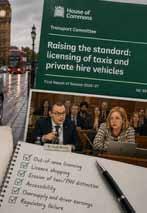
These recommendations are welcome. However, they expose a contradiction which the report never fully resolves. For decades London’s taxi trade has been required to provide universal wheelchair accessibility as a condition of licensing.
Drivers have invested in specialist vehicles, accepted higher operating costs and complied with
obligations that go far beyond those required of most private hire operators.
The Committee recognises the importance of accessibility but does not fully address the question of how those obligations can remain sustainable if operators competing for the same passengers are not subject to equivalent requirements. The report identifies accessibility as a public good but largely
avoids examining how that public good should be funded or protected.
Perhaps the greatest weakness in the report concerns the economics of the market itself. Throughout the inquiry the Committee heard evidence regarding driver earnings, working hours, financial pressures and concerns about sustainability.
MPs acknowledge that many drivers face long hours and declining earnings. The report also recognises concerns regarding oversupply in parts of the market.
What is striking, however, is the extent to which the Committee avoids confronting the issue directly. There is relatively little discussion of whether unrestricted growth in vehicle numbers has itself become a source of wider problems.
Congestion, falling earnings, increased competition for work and pressure on standards are all discussed to varying degrees, yet the relationship between these issues and market saturation is never examined in detail. The result is a report that acknowledges the consequences of oversupply without seriously considering whether oversupply itself has become part of the problem.
This omission matters because many of the concerns raised by taxi drivers cannot be separated from the wider economics of the market. Standards, accessibility, vehicle quality and professional competence all depend upon viability.
A system may impose obligations on drivers, but those obligations become increasingly difficult to sustain if the economic foundations of the trade are steadily weakened. The report acknowledges the symptoms but avoids engaging with this broader question.
The Committee is at its strongest when discussing regulatory failure. Its conclusion that the existing framework is “unfit for purpose in the modern era” is unusually blunt by Parliamentary standards. Equally significant is its criticism that “successive governments have sat on worthwhile reforms without acting.”
These statements reflect a recognition that many of the challenges facing the industry today are not new. Concerns about licensing consistency, technological change, enforcement and regulatory fragmentation have been raised repeatedly over many years.
The Committee also supports the creation of a national database and stronger informationsharing arrangements between licensing authorities. These proposals have the potential to improve enforcement and accountability. Likewise, its support for national minimum standards reflects a recognition that significant inconsistencies currently exist across the licensing system.
Nevertheless, the report leaves several fundamental questions unanswered. It recognises that technology has transformed the market
but does not fully address the consequences for the traditional distinction between taxis and private hire vehicles.
It acknowledges the importance of accessibility without resolving how accessibility obligations should be sustained. It identifies problems arising from out-of-area licensing while stopping short of recommending structural reform. It discusses driver welfare and financial pressures while largely avoiding the question of market saturation.
Taken as a whole, the report represents an important step forward. It validates a number of concerns that have been raised by London’s taxi trade for many years and provides a far more critical assessment of the current system than many previous reviews. Its findings on out-of-area licensing, regulatory fragmentation and legislative failure are particularly significant.
However, the report is ultimately stronger on diagnosis than prescription. It identifies many of the industry’s problems with considerable clarity but is often less certain when it comes to proposing solutions. For that reason, the real test will not be the publication of the report itself but the legislation that follows.
The forthcoming Taxi and Private Hire Vehicle Bill will determine whether Parliament’s findings lead to meaningful reform or simply become another chapter in a long history of reports that recognised the problems but failed to resolve them.
Mark White
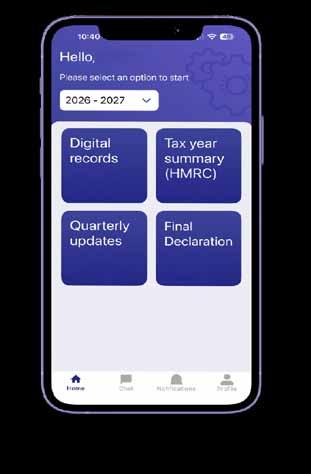
the accountant in your pocket
TRUSTED BY THE TRADE
The Licensed London Cabbies already using Tax Mouse love its simplicity.
No jargon, no spreadsheetjust a few taps between fares and your books are done
HMRC RECOGNISED
Fully authorised for 2026/27 MTD filing requirements
TOTAL SIMPLICITY
Log income & expenses in seconds Edit or delete mistakes in one tap
INSTANT VISIBILITY
See your running profit in realtime
25 YEARS OF HISTORY
Built by the team at United House who have been looking after the trade for over two decades
WesTMinsTeR CiTY COUnCiL CALLs On
TFL TO HALT PLAns FOR OXFORd sTReeT
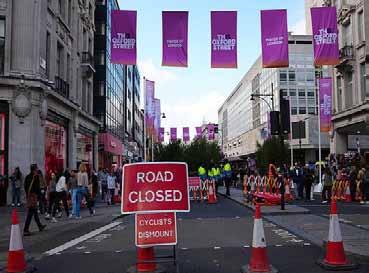
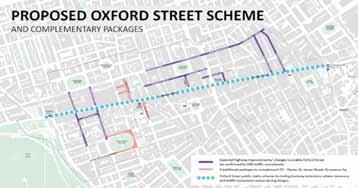
Westminster City Council has asked Transport for London (TfL) to halt changes to bus stops on Oxford Street that are being implemented as part of the mayor's plan to make the thoroughfare pedestrian-only.
Council leader Paul Swaddle accused TfL of "a stitch-up, plain and simple" after the measures were advertised the day after the May local elections, when all eyes were on the results.
He said the mayor and TfL "tried to force through permanent changes to the most famous shopping street in the world, the day after an election, in a consultation so quiet that the people whose livelihoods depend on the street never even knew it was happening.
"That's not how you treat
Sadiq Khan has pledged on social media, to engage directly with the taxi trade and unions to protect livelihoods. He said in the Highways news, automation will not be introduced at the expense of jobs.
But this is the Mayor who pledged to be the renaissance of the London Taxi Trade, yet under his mayoralty we’ve seen the numbers of licensed taxi drivers drop by a third. He also reduced the age limits of euro 4/5 Taxis, and we are now seeing their disappearance at an unprecedented rate.
Because the older, cheaper to rent vehicles are disappearing fast, many older drivers who worked mainly part time, are finding it unaffordable
the nation's high street."
The transport authority published traffic orders affecting more than 20 streets with the aim of pedestrianising the street later this year.
TfL said the orders included changes to bus stands and other infrastructure "to ensure the traffic network can continue to operate
effectively once the pedestrianisation has
been rolled out".
The pedestrianisation plan was approved only after Sir Sadiq Khan, following the council's rejection of the proposals, obtained government permission to assume planning powers.
The western stretch of Oxford Street between Orchard Street and Great Portland Street will be closed to private vehicles, buses, taxis, cycles, scooters and pedicabs.
Westminster does not
to rent newer vehicles and so have given up the job.
But then most of what’s happened to the trade
over the last 15 years was predicted in the Project Horizon Files, yet few people took any notice of their publication.
So where do we go from here….to be honest I can’t see any worthwhile resistance to this introduction of driverless hire vehicles.
But the one thing we have to fight to protect at all costs is our iconic name "TAXI." We have to fight tooth and nail to stop our name being associated in any way with these driverless mini cabs.
TAXI LEAKS EXTRA BIT:
As an old friend of mine
have the power to reject TfL's traffic orders.
A spokesperson for TfL said it followed the standard process for making traffic orders which included "publishing a notice and sending emails to statutory consultees such as Westminster City Council".
Sir Sadiq has claimed his plans will help boost the local economy and rejuvenate the area.
The £150m scheme has come in for criticism over fears about the impact on crime, accessibility and traffic.
The Local Democracy Reporting Service said the council was expecting more notifications as the scheme progresses, providing future opportunities to respond.
Courtesy of the BBC
(who used to write under the name of Semtex) said in his final post on my website The Anderson Shelter, which later moved over to Facebook and became Taxi Leaks…
"Although we had a few wonderful drivers who led from the front and turned up at every protest, they were not supported by the main body of the trade… When the final battle for our survival comes, you will find all those capable of leading the troops from the front, will have left the battlefield through consistent lack of support over the years."
As Pastor Martin Neimoller famously said in his 1946 poem: "And when they came for me there was no one left to fight for me."
Those are not the same thing.
Representative organisations exist to express the views of members and challenge decisions that affect them. Stewardship is different. Stewardship involves responsibility for outcomes. It requires somebody to take ownership of the future rather than simply comment upon the present.
For years I have argued that Heathrow requires a single properly constituted, democratically accountable, drivercontrolled and notfor-profit organisation capable of taking responsibility for the Heathrow taxi business as a whole. Not because I believe all existing organisations should disappear. Not because I imagine everyone will suddenly agree with each other. But because the current structure has failed to produce the strategic leadership that the trade increasingly needs.
This is not a criticism of individuals. It is an observation about outcomes.
The evidence is sitting in front of us.
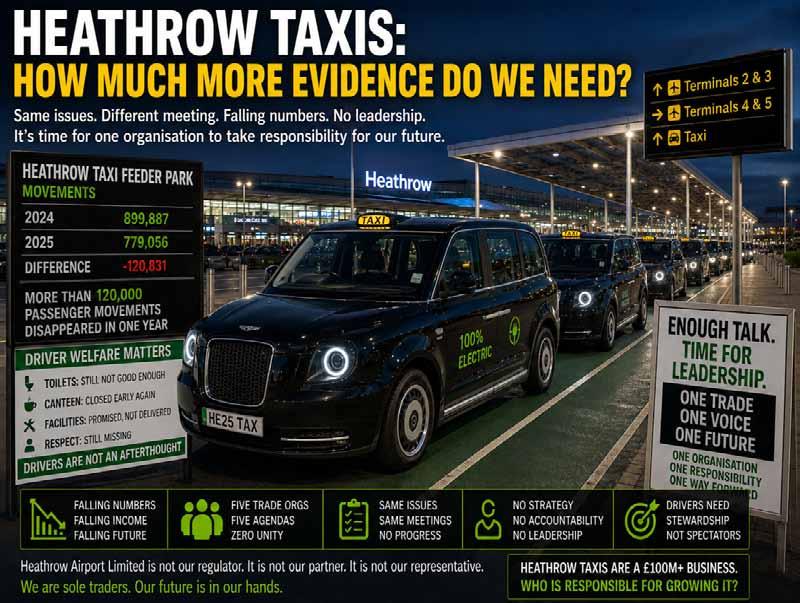
The feeder park figures are falling.
The same operational issues continue to reappear.
The trade remains fragmented.
The market becomes more competitive every year.
And Heathrow Airport Limited continues to make decisions based upon Heathrow’s interests rather than the interests of self-employed taxi drivers.
That last point is
particularly important.
Many drivers still appear to believe that Heathrow Airport Limited should somehow solve these problems for us. Heathrow will listen. Heathrow will engage. Heathrow will occasionally invest. Heathrow will sometimes accommodate requests from the trade. However, Heathrow is not our regulator, our trade association or our representative body. Heathrow is a commercial airport operator.
Its priorities are not necessarily our priorities.
Nor should we expect them to be.
The interests of a commercial airport and the interests of thousands of independent sole traders will sometimes overlap and sometimes
diverge. That is simply reality.
Expecting Heathrow to provide the strategic leadership that the trade itself has failed to provide is neither realistic nor sustainable.
The irony is that the solution has been staring us in the face for years.
The Heathrow taxi trade generates many millions of pounds in passenger revenue every year. It is a substantial economic operation serving one of the busiest airports in the world.
Yet responsibility for its future remains fragmented across a collection of organisations, committees and meetings with no single body accountable for developing the business, protecting market share or planning
strategically for the future.
No successful enterprise operates in that manner indefinitely.
Eventually somebody takes responsibility.
The only question is who.
The June Liaison Meeting reinforced that view more than ever. I listened to discussions about barriers, cameras, systems, enforcement and procedures. Some of those discussions were necessary. Some were useful. Yet I could not escape the feeling that we were once again discussing the symptoms whilst ignoring the underlying condition.
The Heathrow taxi trade does not merely have an operational problem. It has a leadership problem.
It has a structural problem.
Most importantly, it has a responsibility problem.
More than 120,000 feeder park movements have disappeared since 2024. The market is changing. Passenger expectations are changing. The competitive environment is changing.
Yet the trade continues to rely upon structures that were never designed to provide strategic direction for an industry of this scale.
There comes a point where the evidence becomes too overwhelming to ignore. For me, that point arrived some time ago.
The question is how much more evidence everybody else needs.
is iT TiMe FOR A CLeAROUT AT TFL's
By Christopher Johnson
For years, ministers have been told that the country's cross-border licensing crisis is the consequence of outdated legislation.
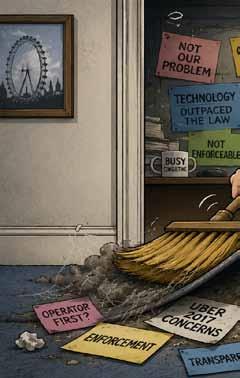
For years, Parliament has been told that technology has outpaced the law.
For years, local authorities have complained that they are powerless to control private hire activity taking place on their own streets.
For years, government consultations have been launched, reports have been commissioned, and fresh legislative proposals have been advanced.
None of it has worked. The reason is not complicated.
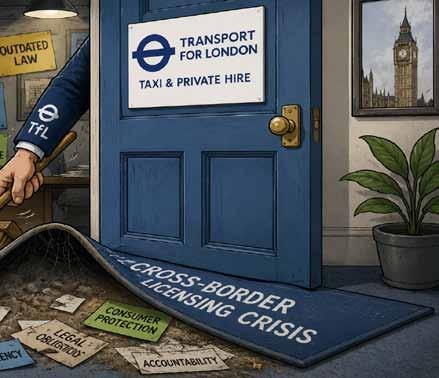
The country's cross-border licensing crisis is not the result of a lack of law—it is the result of a deliberate failure to enforce the law that already exists. The uncomfortable truth—the truth that platform lobbyists have worked hard to keep off the agenda—is that the legal principles required to address this crisis were identified years ago. The regulator understood them. The regulator applied them. And then the regulator stopped.
That decision did not happen by accident. It happened at Transport for London's Taxi and Private Hire Department. And it is long past time for Parliament to say so plainly.
The Regulator That Already Knew
In 2017, Helen Chapman, then General Manager of Taxi and Private Hire at TfL, investigated Uber's operating model and concluded that Uber's previous explanations regarding its booking process were materially
inaccurate.
TfL found that a booking request was offered to drivers, a driver decided whether to accept the trip, and only afterwards was the booking recorded as accepted by Uber’s London operating licence. TfL regarded that issue as sufficiently serious to question whether Uber's model complied with the statutory framework governing private hire operators. As a condition of continued operation, TfL required Uber to redesign its booking system so that the operator accepted and recorded the booking before approaching drivers, and to provide greater transparency to passengers by expressly informing them that Uber London had accepted their booking before a driver was allocated.
The principle is not complex. The operator accepts the booking. The driver performs the journey. The operator comes first.
That principle sits at the heart of private hire regulation for good reason. The operator is the licensed entity. The operator is accountable. The operator is subject to regulatory oversight. Parliament did not create a licensing framework built around drivers. It created one built around operators.
TfL recognised this. TfL defended this. TfL insisted upon it. And then it walked away.
TfL Shut the Front Door. The DfT Left the Back Door Open.
While Uber was required to alter its London operating model, the wider issue was never addressed nationally. The Department for Transport did not require licensing authorities across England and Wales to apply the same operator-first
acceptance principles that TfL had insisted upon in London.
The consequences were entirely predictable. Crossborder hiring expanded. Operators accumulated licences in multiple jurisdictions. Digital platforms evolved into national booking marketplaces. Drivers and bookings moved freely between licensing districts. The distinction between operator acceptance and driver acceptance was progressively eroded.
The problem that TfL identified in London was not solved. It migrated.
Today, ministers are told that the country's crossborder licensing crisis requires fresh legislation. But before Parliament is asked to rewrite the law, a more important question demands an answer:
Why was the original solution never applied consistently across the country? And why has TfL— the regulator that understood the problem better than anyone—declined to pursue identical concerns in the years since?
Enter Bolt UK
Bolt's passenger terms expose the current position with particular clarity Consumers are presented with a single national identity: Bolt UK.
Behind that identity sits a collection of operator licences issued by licensing authorities across the country. Bolt's own terms define "Operator Licences" as including its London licence together with licences issued elsewhere.
The question that this raises is not subtle. Which operator is accepting the booking? Not eventually. Not after processing. Not after allocation. Not after a driver
becomes involved.
But before the contract is formed—at the point at which the consumer commits, and legal obligations arise.
The answer cannot be identified. The consumer cannot identify it. The regulator has not explained it. The licensing authority cannot readily determine it.
Everything is presented under the umbrella of Bolt UK. Yet private hire legislation does not licence brands.
It licences operators. Specific operators. Specific operating centres. Specific licences. Specific legal entities exercising specific statutory rights and obligations.
Parliament created a framework based on identifiable operators accepting identifiable bookings. It did not create a framework whereby dozens of geographically separate operator licences could be pooled and marketed to consumers as a single national trader.
That is what is happening. And TfL appears to have no interest in saying so.
The Consumer Law Problem
This is not merely a licensing issue. It is a consumer protection failure.
Parliament has required traders to disclose material information to consumers before contracts are concluded. That obligation has been tightened progressively through the Consumer Contracts Regulations 2013, the Consumer Rights Act 2015 and the Digital Markets, Competition and Consumers Act 2024.
The principle is not
ambiguous: Consumers must know who they are dealing with before they commit.
Under the Bolt UK structure, a consumer cannot identify which specific geographical operator is accepting their booking before the contract is formed. If the operator cannot be identified until after a driver somewhere in the country has accepted a booking request, the question of who actually accepted the booking first becomes impossible to answer on the operator-first model that TfL itself has historically required.
TfL knows this argument. TfL built this argument. The only question is why it has chosen not to deploy it.
The Great Regulatory Fiction
A booking request enters a national digital marketplace. Drivers are identified, offered the trip and respond.
Only afterwards does the system determine which operator licence becomes associated with the booking.
TAXi & PRiVATe HiRe dePARTMenT?
The paperwork records operator acceptance. The operational reality is materially different. The operator appears at the end of the process rather than the beginning.
by taxi drivers alone. They were identified by Transport for London.
That question matters not only for the litigation itself.
institutional self-preservation.
A Clear-Out
The booking is retrospectively attached to whichever geographical operator licence the platform selects.
In her witness statement, Helen Chapman described how TfL became concerned that Uber's booking process did not operate
The legal documentation presents operator acceptance. The technology depends upon driver acceptance.
This is precisely the issue TfL identified in 2017. That it appears unwilling to confront the same issue in 2025 is not a coincidence. It is a choice. And it is a choice that demands explanation.
The Shadow of the Uber Litigation
The ongoing litigation brought by black cab drivers against Uber concerns allegations about the way Uber operated in London between 2012 and March 2018.
The issues underpinning that claim were not identified
as previously described and stated that TfL was "minded to conclude" that Uber's arrangements did not comply with the statutory framework because the licensed operator was not demonstrably accepting bookings at first instance.
TfL ultimately required Uber to redesign its booking architecture so that bookings were accepted and recorded by the operator before drivers were approached, and passengers were expressly informed that Uber London had accepted their booking before a driver was allocated.
TfL acted—eventually.
The question that the litigation makes unavoidable is why it took so long, and what regulatory decisions were made in the intervening period that allowed a model identified by the regulator itself as problematic to continue operating.
It matters because the underlying issues have not disappeared. They have evolved. The platforms have changed. The technology has changed.
But the fundamental question remains exactly the same: Who accepted the booking first?
When regulators learn nothing from their own history, the public is entitled to ask why.
TfL's Conflict of Interest Is Not Subtle
If TfL were formally to identify operator-first acceptance failures in modern platform models, such as Bolt, attention would return immediately to its own record.
Questions would arise about when similar concerns were first identified internally.
Questions would arise about what enforcement decisions were taken, when they were taken, and by whom.
Questions would arise about whether regulatory assumptions were permitted to persist because confronting them would expose the department's own prior conduct.
The regulator is therefore not a neutral party. It is a party with a direct institutional interest in not finding what independent scrutiny might find. That is not a coincidence of circumstance. That is a structural conflict of interest.
And it is precisely why the current leadership of TfL's Taxi and Private Hire Department cannot be trusted to investigate itself, assess its own historic decisions, or reach conclusions untainted by
This is what independent scrutiny exists to address.
Parliament Must Act
For too long, scrutiny has focused exclusively on operators. The operators are not blameless.
But the regulator that permitted non-compliant models to operate failed to apply established principles more broadly and now declines to pursue concerns it has historically recognised—that regulator has questions of its own to answer.
Senior officials at TfL's Taxi and Private Hire Department should be required to explain, publicly and under examination:
• How do current platform models satisfy operator-first acceptance requirements, and what evidence has TfL examined?
• How do consumers identify the specific contracting operator before bookings are formed, and has TfL formally assessed whether that is possible under Bolt’s existing platform architecture?
• Why do the concerns identified during the Uber investigation in 2017 not appear to be driving equivalent enforcement activity today?
• What role, if any, has institutional self-interest played in enforcement decisions made since 2018?
• Whether any formal legal advice has been sought or received regarding the consumer protection obligations of operators using pooled multi-jurisdiction licence structures.
These questions should not be answered in private correspondence or deflected to future reviews. They should be answered before the Transport Select Committee, on the record, in public.
The country's cross-border licensing crisis did not emerge because Parliament forgot how to legislate.
It emerged because regulators chose to stop enforcing first principles. The law did not fail. Enforcement failed.
TfL's Taxi and Private Hire Department once understood the importance of operator-first acceptance. It once recognised the dangers of driver-led booking models. It once demanded compliance. The record of what it demanded from Uber in 2017 is public.
The contrast with what it tolerates today is stark. That contradiction does not resolve itself. It does not improve with time. And it will not be addressed by another consultation, another legislative review, or another set of assurances from the same officials who have overseen the crisis.
What is required is a formal parliamentary inquiry into Transport for London's Taxi and Private Hire Department: its leadership, its enforcement priorities, its historic decisions, and its role in creating the regulatory environment that has produced the country's cross-border licensing disaster.
The inquiry should have the power to examine documents, require attendance, and produce findings that are binding upon the department's future conduct. And if that inquiry finds what the evidence already suggests—that first principles were identified, applied briefly, and then quietly abandoned in the interests of regulatory convenience—then yes.
A clear-out is exactly what is needed.
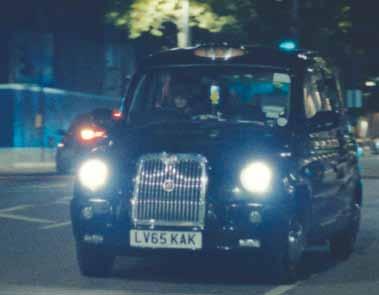
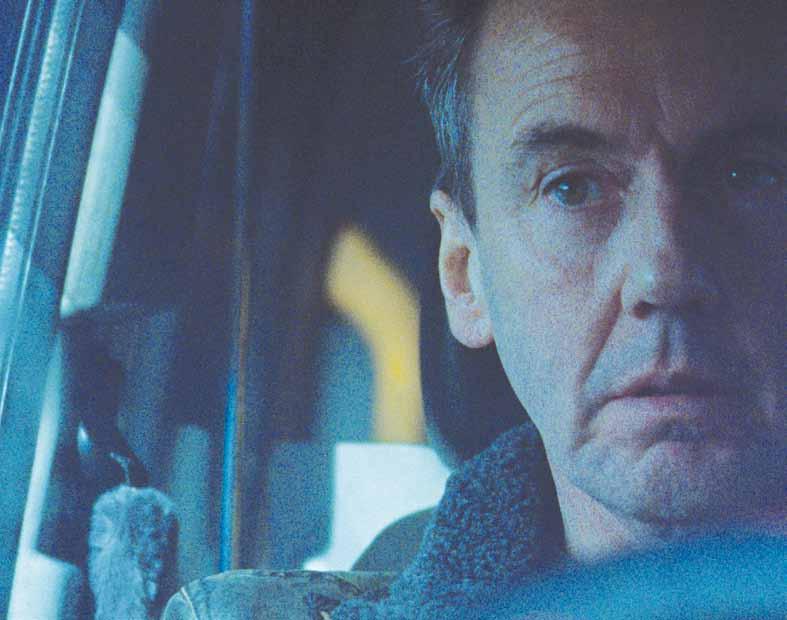
BLACK CAB - A FAMiLY dRAMA ABOUT L
ABOUT THE FILM
Black Cab is, at its core, a family drama about a man trying to hold on to his sense of purpose as a husband, father and provider, in a world quickly leaving him behind.
Writer & Director, James Arden, says of the film: “I wanted to make this film now because the script’s themes are so current - autonomous cars are starting to appear on London’s streets in 2026. In a wider sense, all of us are concerned about what the future holds, and I think we can all relate to wanting to preserve our place in the world. Harry is just a normal person, like us all, facing great change.”
Over two years of research and development went into the script - interviewing real cab drivers and gaining real insight into a fast-changing industry. It’s easy to get caught up in exciting technological developments without considering the wider social impact on individual people. Car technology is a perfect example of this: the convenience of Uber; the allure of a selfdriving Tesla or Waymo. But all those people who make their living behind the wheel - cabbies, truck
drivers, delivery drivers, emergency services drivers - will soon have to find new work, and millions will be potentially left by the wayside.
“I wanted to tell a story about an individual dealing with this developing crisis; how it affects him and his family life. Work identity defines so many of us - especially men as earners, providers and protectorssomething Harry, despite his optimism, can’t escape when reality hits.”
ADDITIONAL THOUGHTS FROM BROTHER / PRODUCERS:
What immediately drew us to Black Cab was its portrayal of an incoming (and in 2026, very much imminent) societal change that twenty years ago would seem like science fiction.
Harry’s plight in James Arden’s script is a harsh reality that all London cabbies are going to face in the years to come, and it typifies the wider friction between technology and tradition that we’re seeing across every sector of 21st century life. It is this friction that James, and Jay Simpson who plays Harry in the film, were able to bring to life so effectively.
As a production company we are hugely proud of Black Cab and what the whole team were able to achieve - weeks and months of preproduction slotted around other (paid!) projects,
three bitterly cold shoot days in South and West London, and a hefty postproduction process that slowly but surely began to look like the film we’d all envisaged from the first draft.
We’d like to extend a heartfelt thank you to the entire cast and crew for coming on this journey with James and ourselves.
As Harry would say, “be lucky!”
LiFe As A LOndOn CAB dRiVeR in 2026
Jay Simpson (HARRY)
I'd thought about A.I. a lot before meeting James and playing Harry, but doing this film has made me think so much more about what is coming for us all in a world where A.I. is advancing at a pace beyond anything most of us had imagined.
I felt a real connection with Harry, he's a man who did the Knowledge - the hardest driving/ navigational test in the world. I can memorize a play, or a script but: 25,000 streets, 20,000 landmarks and 320 specific routes like a black cabbie does… completely beyond me, beyond most of us. It's not an easy club to join, being a black cab driver, and not an easy living.
I've been lucky enough to earn my living, as an actor, all my adult life. When Harry learnt the Knowledge, that's what it meant - a job for life. A surefire way to provide for you and your family if you were willing to work hard enough. Now that is going. Being taken away. Through no fault of his own he is being made obsolete.
For what? The Waymos of this world don't feed families, they take jobs away from people the world over purely to make profit for Google.
If it's anything like Uber (owned by massive financial outfits like Blackrock and Vanguard), they start out playing nice, they are cheap and on time - but only until they eliminate all the competition. Nearly all the mini-cab firms we used to rely on are gone. Then, they bump the prices and cancel on you at the last minute but you have no choice. If you
need a ride, they are the only game in town. Apart from the black cabs.
So now it looks like Waymo are going to use the same playbook to take out the Cabbies. Real men and women who have studied London's streets for years, on mopeds and electric bikes in all weathers, trying to build a future for themselves and their families.
Why? They say it's progress, but they don't talk about the hidden cost, the human cost. If you're young enough, you can retrain right? But globally, driving is one of the biggest employers of people without secondary or tertiary education. They don't tend to earn more
when their jobs vanish. They take whatever is available and earn less, and they suffer. Their families suffer. But Waymo or whoever wins. And when they are the only game in town, they charge what they want and again we have no choice.
There's only one longterm aim: increase the price of their stock. And the cost to people whose jobs they take, whose lives they damage: nothing to do with us, it's progress. I think a world where tens of millions lose their jobs for profit is the ultimate in greed and cynicism. To paraphrase Oscar Wilde: They are men who know the price of everything, and the
value of nothing.
In my industry, many actor's voices have already been stolen by A.I. and used without their permission in commercials and other media without the human receiving any form of payment. Many authors have had their work taken by A.I. And used without permission, payment or credit. Microsoft's own research says its Co-Pilot chatbot can complete at least 90% of the work carried out by historians and coders, 80% of salespeople and journalists, and 75% of DJs and data scientists.
No one has a job that is safe. And if none of us have work, how do we
earn, how do we live?
I fear we will be forced to give up any idea of meaningful work, jobs we like or love or can take some sort of pride in or even just earn a living at. When the day comes, we will have to take what is left.
That will be up to them, and judging by the tax avoidance and lack of care for anyone who uses their platforms, willingness to post information they know to be harmful to anyone of any age and complete lack of empathy for other human beings - I fear that day.
This film is that day for Harry.
dean 'Mean Machine' Gardner claims Commonwealth title
BETHNAL GREEN
– Dean “Mean Machine” Gardner delivered a careerdefining performance on Saturday night, capturing the Commonwealth International Super Lightweight title with a dramatic stoppage victory over Joseph
at the iconic York Hall.
The Sutton fighter entered the contest amid considerable anticipation, with many predicting a “barnstormer” of a fight. The bout certainly lived up to expectations, providing fans with eight rounds of relentless action and high
drama.
The opening exchanges were closely contested, with both fighters enjoying success in the first two rounds. However, Gardner seized control in the third, sending Butler to the canvas twice with punishing body shots.
For the next four rounds, the two men stood toeto-toe in the centre of the ring, exchanging heavy punches in a fierce battle of attrition. While Butler remained dangerous throughout, Gardner gradually began to gain the upper hand as his superior pressure and accuracy took effect.
As the fight entered the eighth round, Gardner raised the intensity once more. A series of clean head shots left Butler under increasing pressure before another devastating body shot sent him to the canvas for a third time.
Butler bravely rose at the count of eight, but referee Sean McAvoy judged that he had taken enough punishment and waved the contest off, handing Gardner a memorable stoppage victory.
The result sparked jubilant celebrations among the large contingent of Gardner
supporters in attendance, with York Hall erupting into cheers and applause as the new champion's hand was raised.
Speaking after the fight, Gardner’s trainer and club member, Alec Wilkey, expressed his delight at the victory.
“I’m over the moon for Dean,” Wilkey told The Badge. “He’s the ultimate professional. He trains hard, lives the life and deserves every bit of success that comes his way.”
Wilkey described the title win as “the icing on the cake” and revealed hopes that Gardner will return to the ring in September, potentially challenging for another championship belt.
The victory marks a significant milestone in Gardner’s career and further establishes him as one of the region’s most exciting boxing talents.
Butler
‘Please let me stay up and watch it dad, ah go on mate’
‘No, bit strong for you boy’
‘Oh go on, everyone is talking about it at school, I’ll be left out I will…’
‘Oh, alright then, but if it’s got strippers in it, you’re off to bed…’
And so went the conversation, or something like it, between me and my dad in the early 70s when the TV series ‘Budgie’ was all the rage in the UK. It was a massive hit and my memory is of it being originally shown on a Friday evening. It was on 8/9 at the time hence my old man wary of me seeing the stray nipple, which to be fair looking back on the show as I do on a regular basis, popped up in more than one or two episodes.
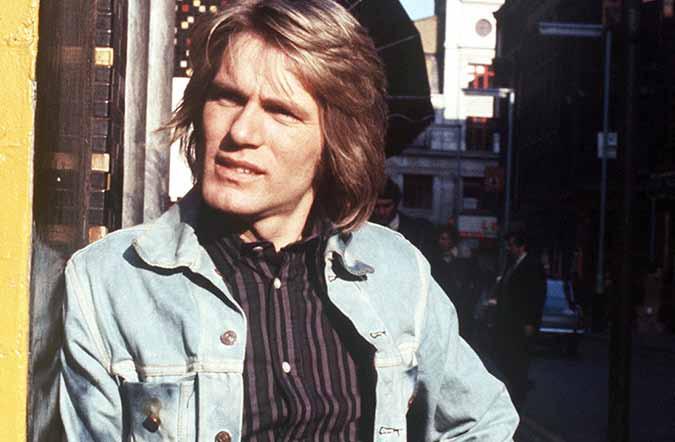
This show was so big – only three channels then remember – that the fashions worn by Ronald ‘Budgie’ Bird, played by singer, actor and entrepreneur Adam Faith soon became seen on many a high street. His hair for a start was a feather cut, very much along the lines of Rod and The Faces. He also wore a jacket that quickly became known simply as a Budgie jacket (that’s fame that is) and then there was him wearing clogs. They proved to be inconvenient for when he was running away from the police, which like the appearances of nipples, happened on a fairly regular basis. Even as a rascal thief, fashions came first to Budgie.
Ok, to the nuts and bolts of it. It was all the idea of writers Keith Waterhouse and Willis Hall, who had a fine pedigree with films like ‘Billy Liar ‘ from 1963.
‘Budgie’ ran for two series and they were shown on ITV between April 1971 and July 72. Each series of 13 shows had a different theme tune, both great and both fondly remembered.
The Mumper of SE5
Budgie stands the test of time
First up was the ‘The Loner’ performed by The Milton Hunter Orchestra and then ‘Nobody’s Fool’ written by Ray Davies of The Kinks and sung by brother Dave, both performing under the name of Cold Turkey.
The plot of each show showed Budgie, a small time petty thief, mainly operating around the
serious Glaswegian hard man, played by Iain Cuthbertson, who had previously appeared as ‘Daddy, my Daddy’ in the film The Railway Children from 1970.
‘You sticky fingered toe rag Budgie!’
Charlie’s wife, only ever addressed as Mrs Endell,
Budgie’s home life in series two shows him fresh out of the nick, living with girlfriend Hazel and their son Howard. Despite having certain responsibilities, Budgie continues to get in scrape after scrape eventually annoying Charlie Endell so much by the end of the series, that he sets his henchmen on him,
‘alleyways of old Soho’ trying to pull a stroke or two, whilst all the time in the ‘now and then’ employ of one Charles ‘Charlie’ Endell, porn baron and
never says a word in any of the programmes.
‘Another Strawberry tart Mrs Endell?’
she called him, that she was ‘up the stick’ again, so he had another baby coming.
‘Oh do leave off ‘Azel’
Needless to say, our boy scarpers from all of that, never to be seen on TV again. There were rumours of a planned third series, but Faith was involved in a serious traffic accident soon after filming had ended and he temporarily, as it turned out, retired from acting at the time.
He would later make a comeback and appeared in the films such as ‘Stardust’ in 1974 and ‘McVicar’ in 1980 and managed singer Leo Sayer in his early career. Not one to stay still old Adam.
I distinctly remember the beating Budgie received from the programme the first time round and I was left wanting more. That memory never left me, so I was delighted to see repeats of the show in the 1980s on the then new Channel Four. I set about taping all the programmes I could and watched them endlessly after. The whole set up, the acting, writing, and plot lines for me, had stood the test of time.
Fair to say I was bitten by the Budgie bug. So much so, that I ended up seeing a musical based on the show, not once but twice at The Cambridge Theatre in 1988. Faith played Budgie, with Anita Dobson then of ‘ Ange from Eastenders’ fame playing Hazel. The music was by Mort Schuman with lyrics from the pen of Don Black. Despite all that talent, the show never really took off and ended after a three month run.
You can buy the two series of ‘Budgie’ now on DVD and I often dip in and refresh my memory of how good it was. If you haven’t got it, I urge you to purchase.
including one called ‘Laughing Spam Fritter’ played by John Rhys Davies. Hazel, played by Lynn Dalby had by this stage informed ‘Budge’ as
Trust me, it's good and still stands up. I mean, as the man himself would have said ‘Would I put you on a dodgy one?’