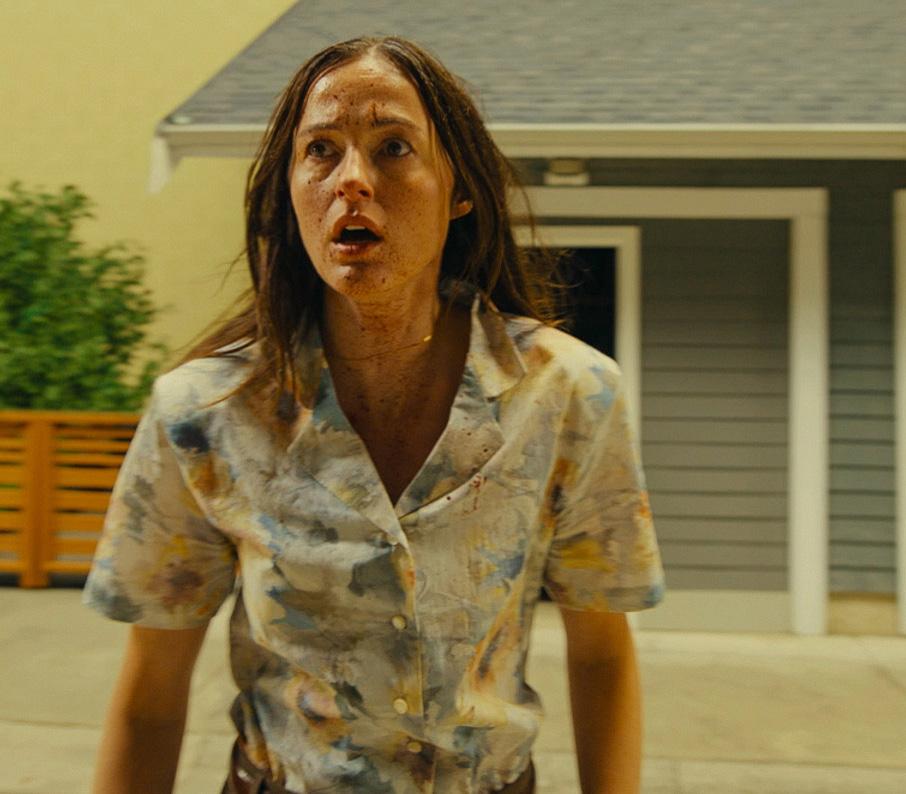
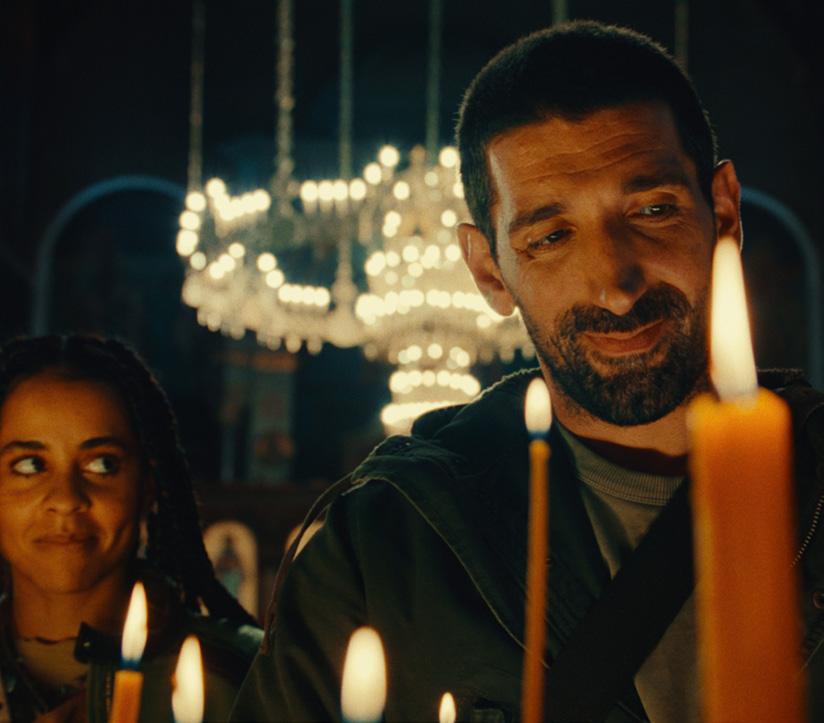
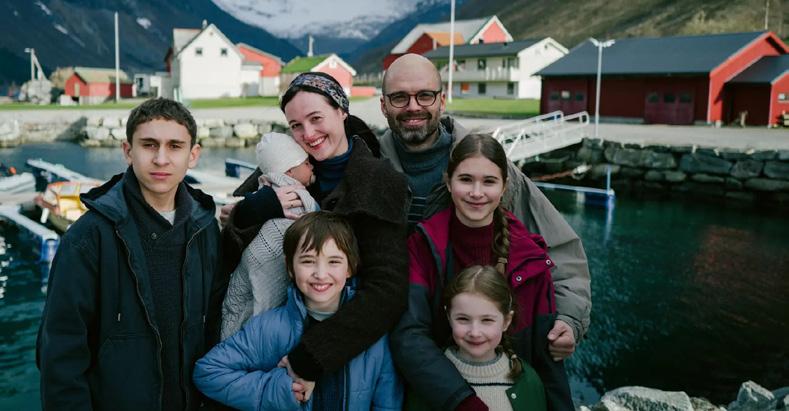
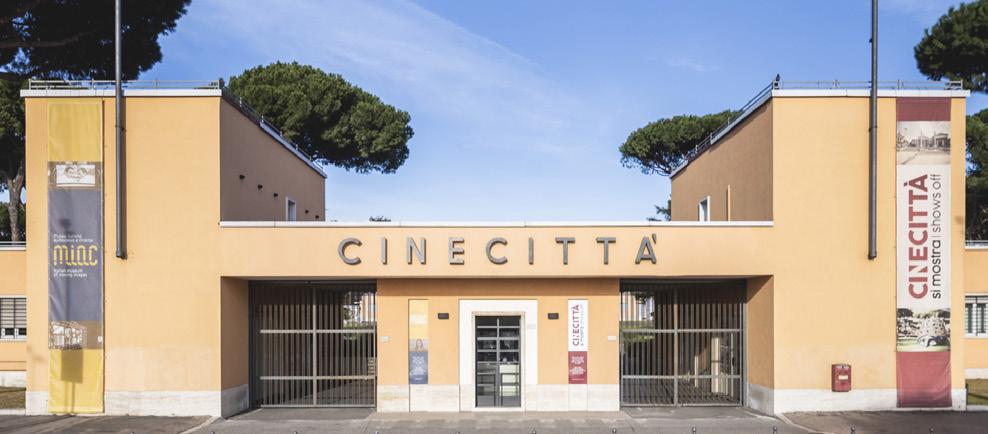
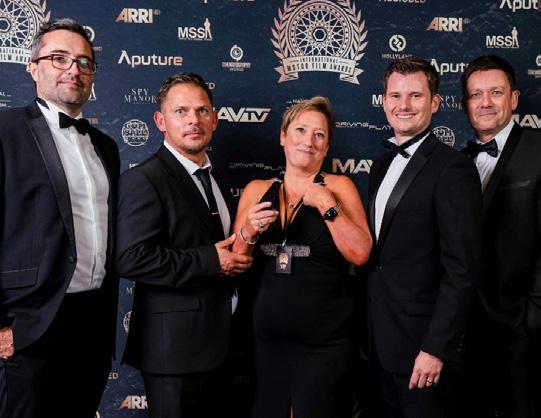
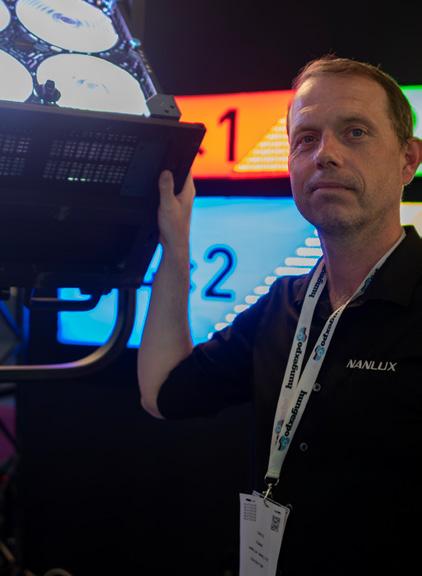
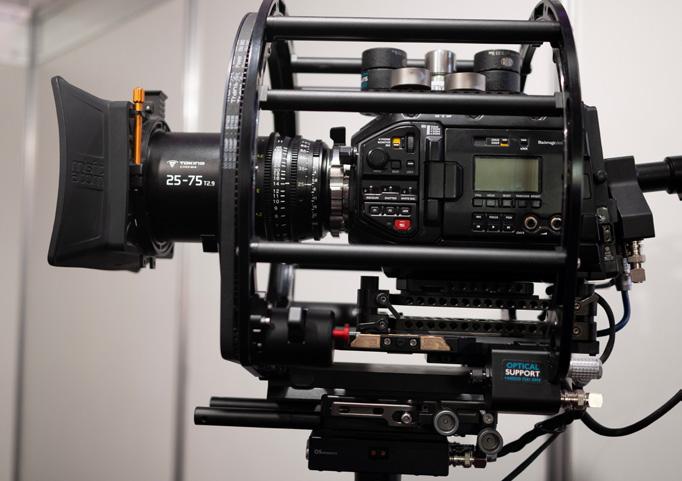
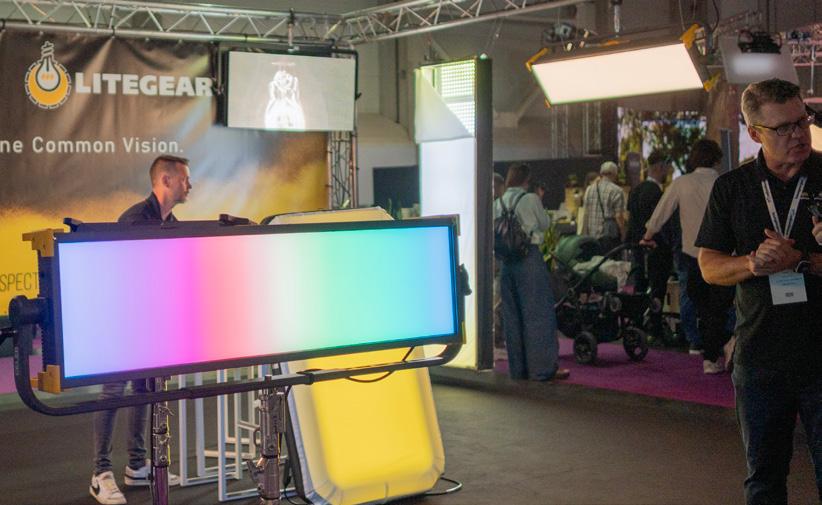
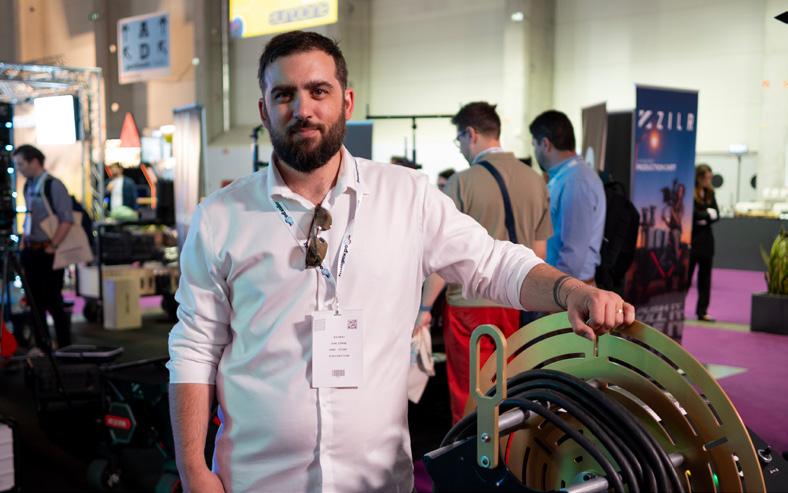
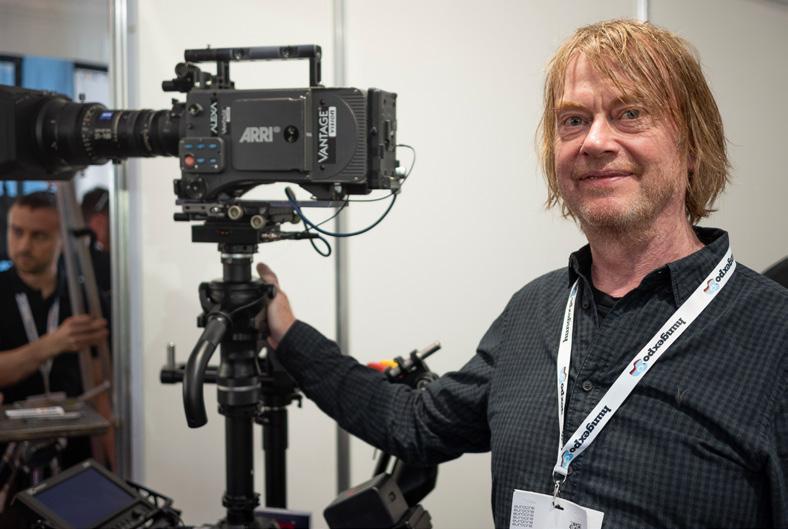
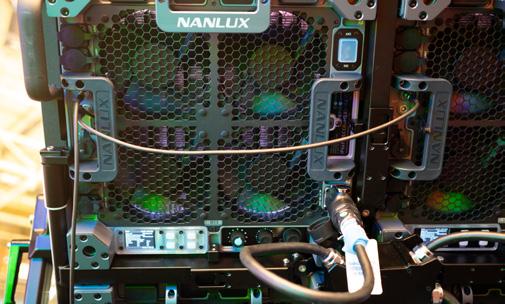
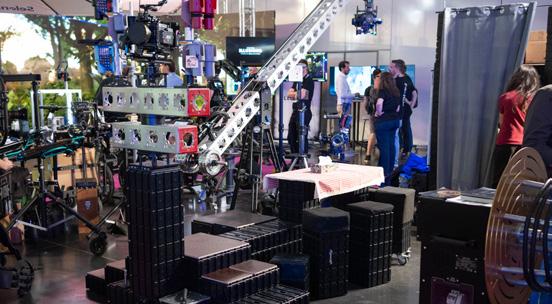
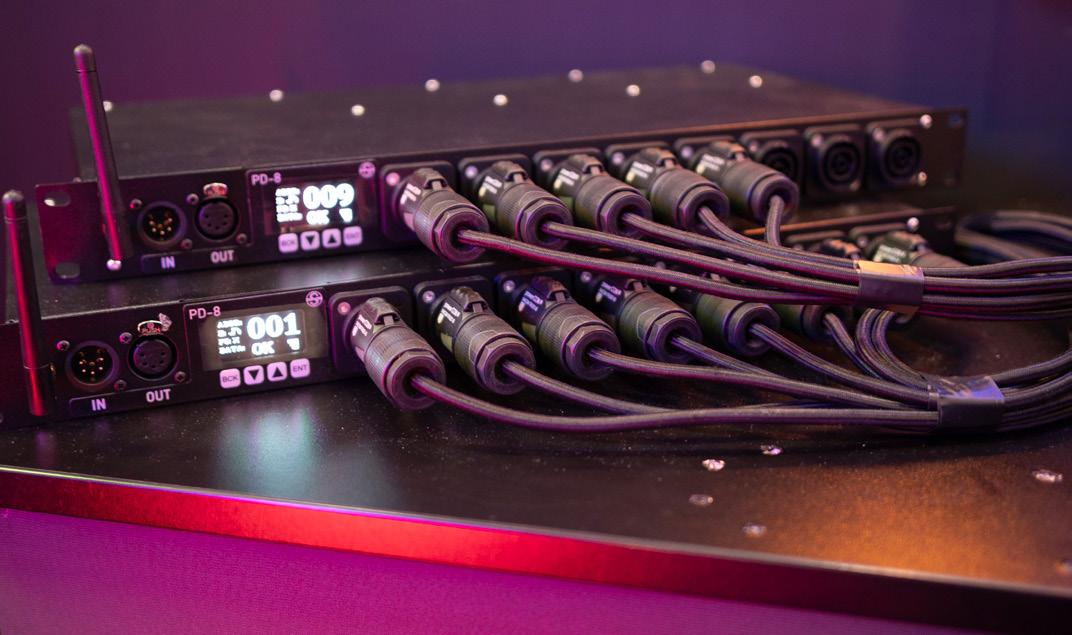
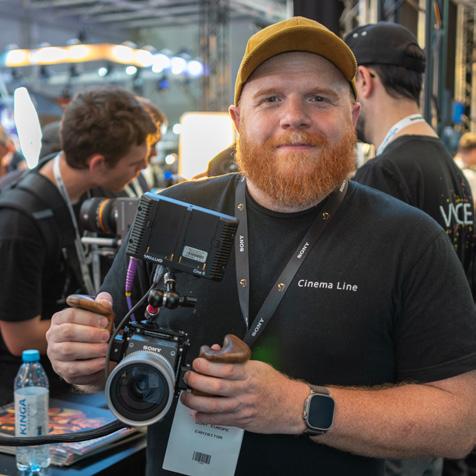
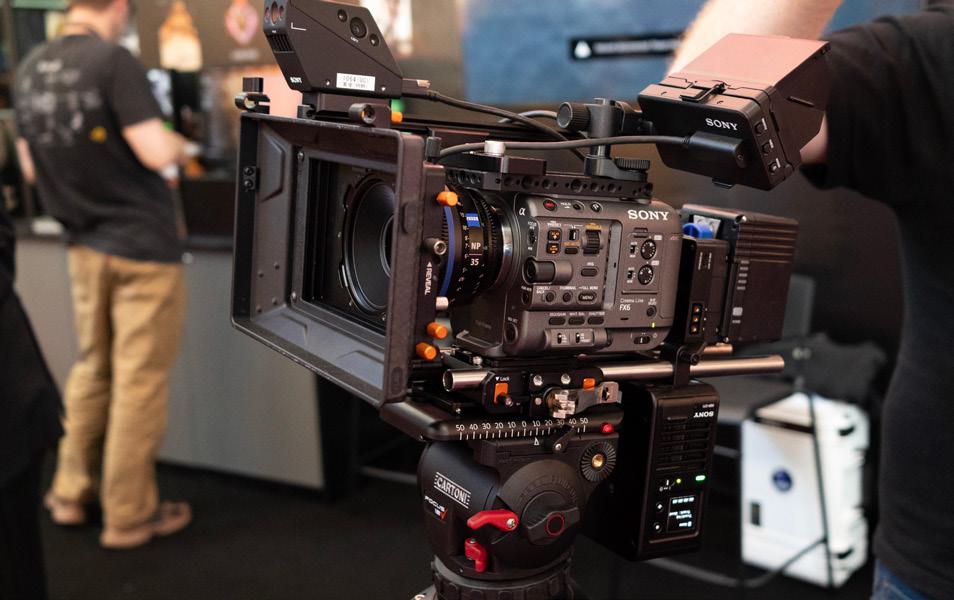
With a more upbeat mood now prevailing around the industry, not one, but two new events sprang on to the cinematographic calendar this year – EuroCine in Budapest which took place in May, and CineVerse at Cinecittà in Rome, which is scheduled for 16th and 17th October.
Following a change of government in Hungary –already a vibrant destination for shooting film and streamed content – EuroCine did not disappoint. Far from it, the fledgling festival was wholeheartedly backed by the incoming administration, and proved well-populated by exhibitors and well-attended by professional filmmaking visitors alike, with a wideranging seminar programme hosted by many industry leaders to boot.
We are excited to confirm that EuroCine will return in 2027, and will exclusively announce the dates soon. With the rich history, prestige and prowess of the Italian production community in the mix, CineVerse promises to deliver even more of the cinematographic good stuff.
Cinematography World is proud to be a leading media partner at both events, which mirror our founding remit to extol the talents of cinematographers and expand the importance of cinematography around the world. We look forward to seeing you in Rome.
In the meantime, our thoughts and sympathies rest with the supremely-talented George Richmond BSC, following a most terrible accident whilst paragliding in India. We wish you, and your family, all the best for the future.
Long live cinematography.
EDITORIAL TEAM
Ron Prince has over three decades of experience in the film, TV, CGI and VFX industries, and has written about cinematography for 25 years. He won the ARRI John Alcott Award from the BSC in 2014, and earned a Special Award for supporting cinematography from the AIP in 2026. He also runs the international content marketing and PR communications company Prince PR Ltd.
Darek Kuźma is a film and TV journalist, translator/interpreter, and a regular collaborator/programmer of the EnergaCamerimage Film Festival. He is an ardent cinephile who has a lifelong romance with the visual language of cinema.
David Wood is a freelance journalist covering film/TV technology and production He was a former technology editor at Televisual, and is a regular contributor to Worldscreen, TVB Europe and Broadcast.
Iain Hazlewood is a designer, writer and presenter specialising in the film & TV, music and electronics industries across digital and print publications.
Kirsty Hazlewood has over two decades of editorial experience in print/online publications, including reporting for the IBC and ISE Daily, and is a regular contributor to folk/roots music website Spiral Earth.
You can subscribe to the print, digital, or print and digital, versions of Cinematography World. This will cover you for the six issues delivered over a 12-month period. Your email will also be added to our monthly newsletter update, unless you decide to opt out of these news feeds.
Cinematography World is part of Rascals Publishing & Media Ltd. The publishers emphasise that opinions expressed within Cinematography World Magazine are not representative of Rascals Publishing & Media Ltd, but are the responsibility of individual contributors.
Ron Prince Editor in Chief
Official Media Partners
Ron Prince photo by Joe Short www.joeshort.com
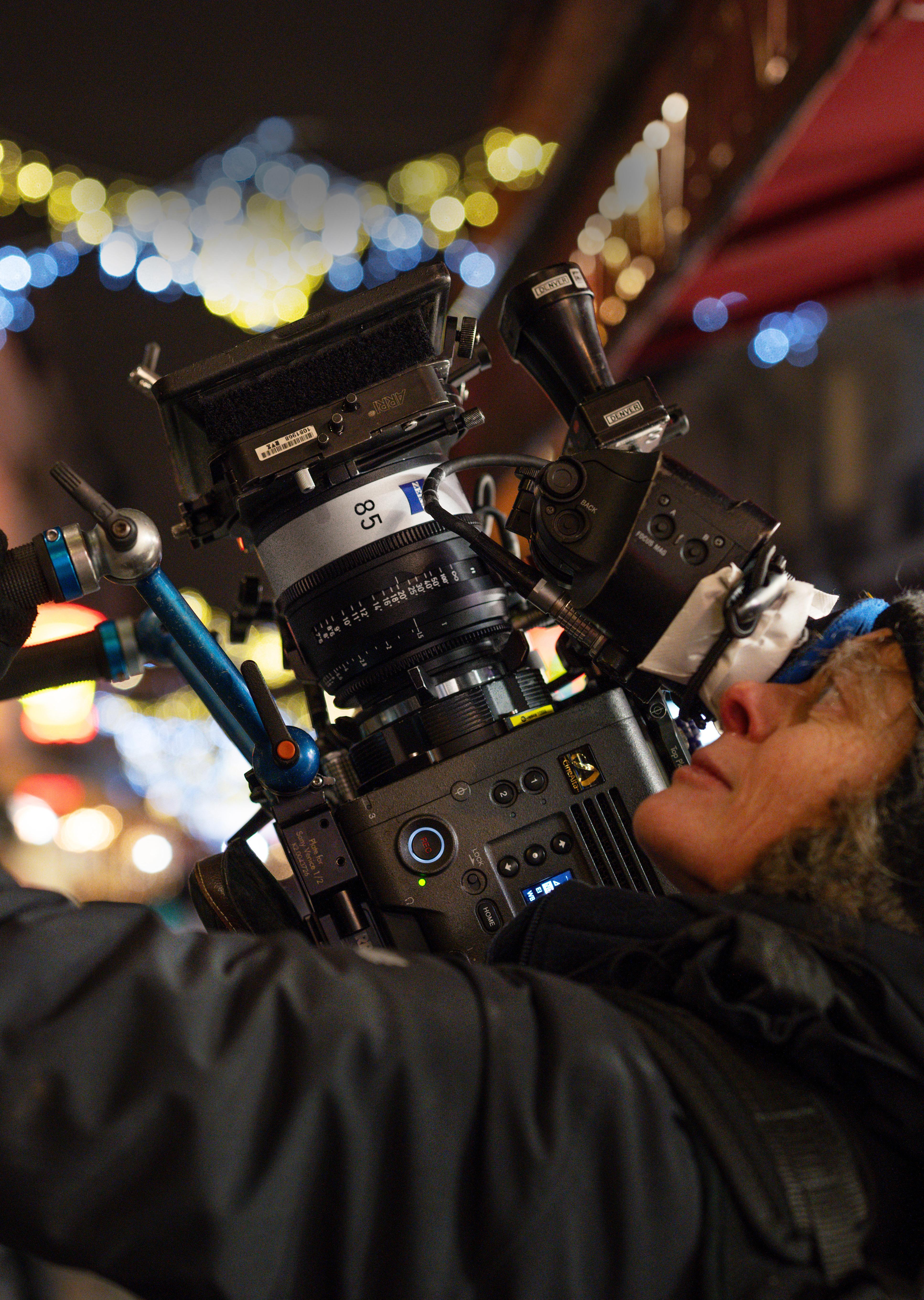
Embrace the Soul of Your Cinematography
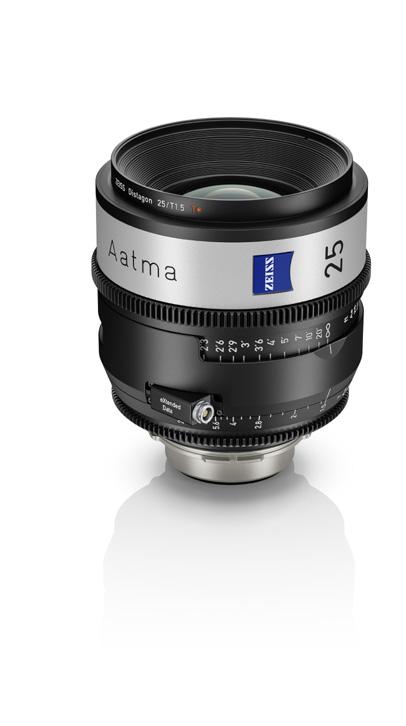
ZEISS Aatma zeiss.com/aatma
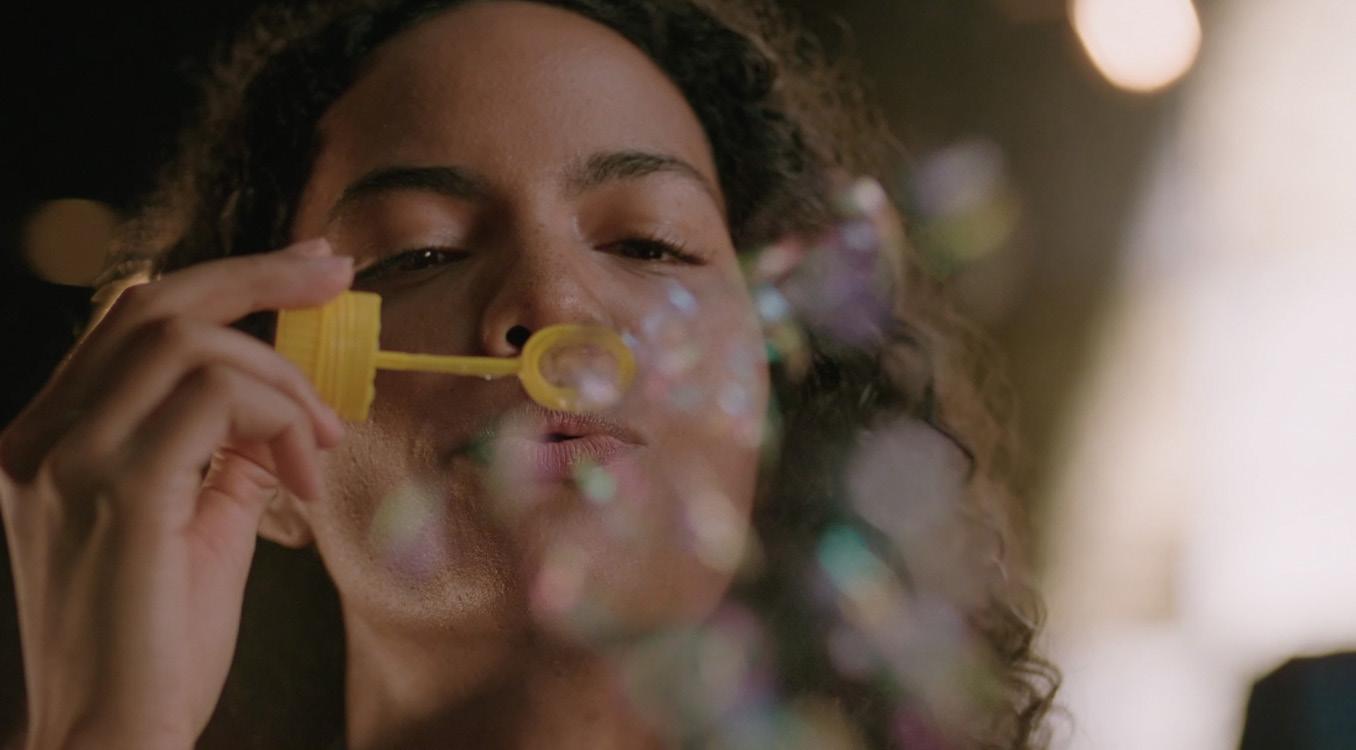
ZEISS Aatma lenses are inspired by characteristics of some of the most beloved classic ZEISS lenses of the 20th century. Their legacy look evokes emotion with softly painted skin texture, a rich bokeh with gentle soap bubble effect, and smooth and vibrant focus transitions. Combined with all conveniences of modern cine lenses, the Aatma lenses let cinematographers put their signature in every frame to fully embrace the soul of their craft.
Pictured cinematographer: Pascale Marin, AFC
SHELLY JOHNSON ASC RE-ELECTED ASC PRESIDENT
The American Society Of Cinematographers (ASC) board of governors recently announced a new slate of officers, with DP Shelly Johnson ASC re-elected as president.
Johnson, who takes the reigns from incumbent president Mandy Walker ACS ASC, previously served as the organisation’s president from 202325. The board also voted-in vice presidents Charlie Lieberman, Alice Brooks and John Simmons; treasurer Charles Minsky; secretary Scott Cunningham; and sergeant-at-arms Chris Chomyn.
The new ASC Board, elected by the organisation’s active membership, includes Natasha Braier ADFC ASC, Russell Carpenter, Richard Crudo, Steven Fierberg, Michael Goi, Tommy Maddox-Upshaw, Erik Messerschmidt, M. David Mullen, Cynthia Pusheck, Nancy
CANNES 2026 WINNERS
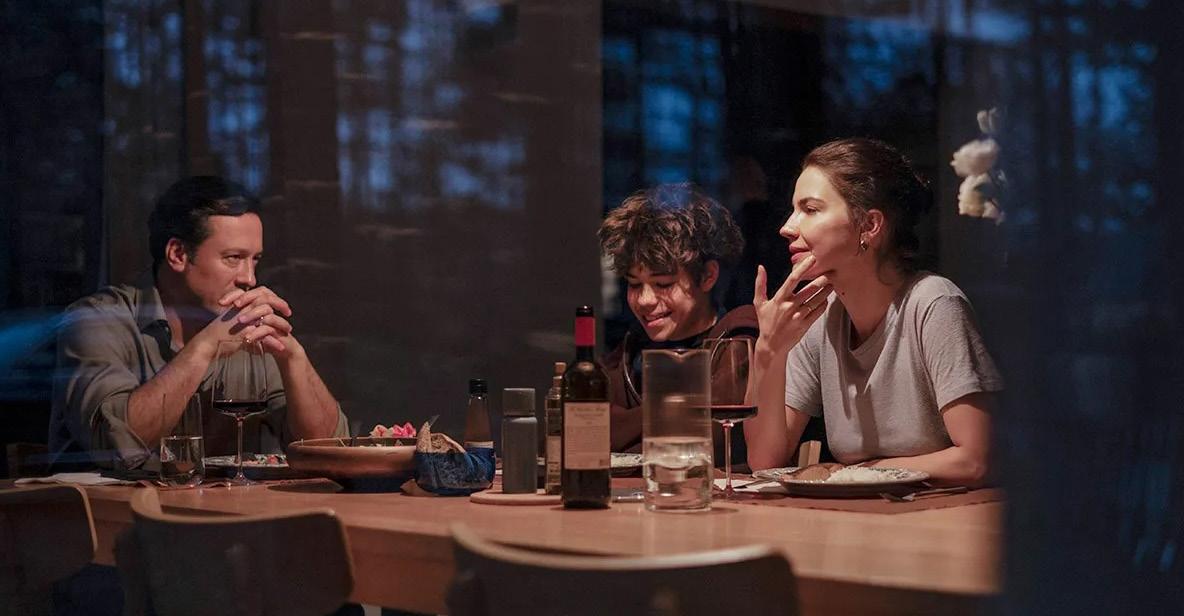
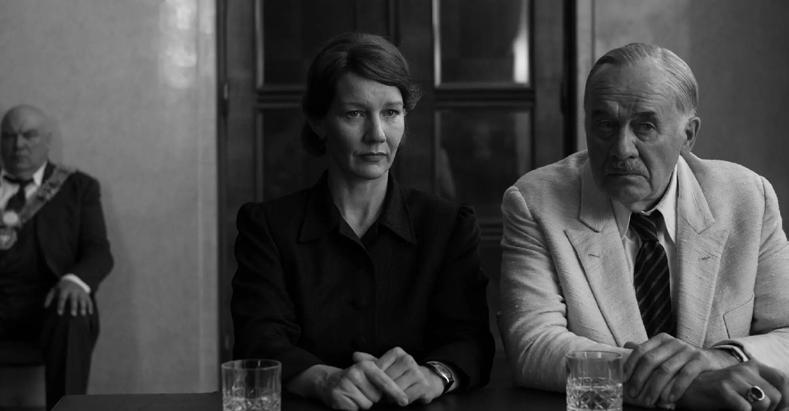
The 2026 Cannes Film Festival concluded with Romanian director Cristian Mungiu claiming the Palme d’Or for Fjord (DP Tudor Vladimir Panduru), starring Sebastian Stan and Renate Reinsve. The win makes Mungiu only the tenth filmmaker in the festival’s history to take the top prize twice, having previously won in 2007 for 4 Months, 3 Weeks And 2 Days (DP Oleg Mutu).
Andrey Zvyagintsev’s Minotaur (DP Mikhail Krichman RGC) took the Grand Prix, whilst the
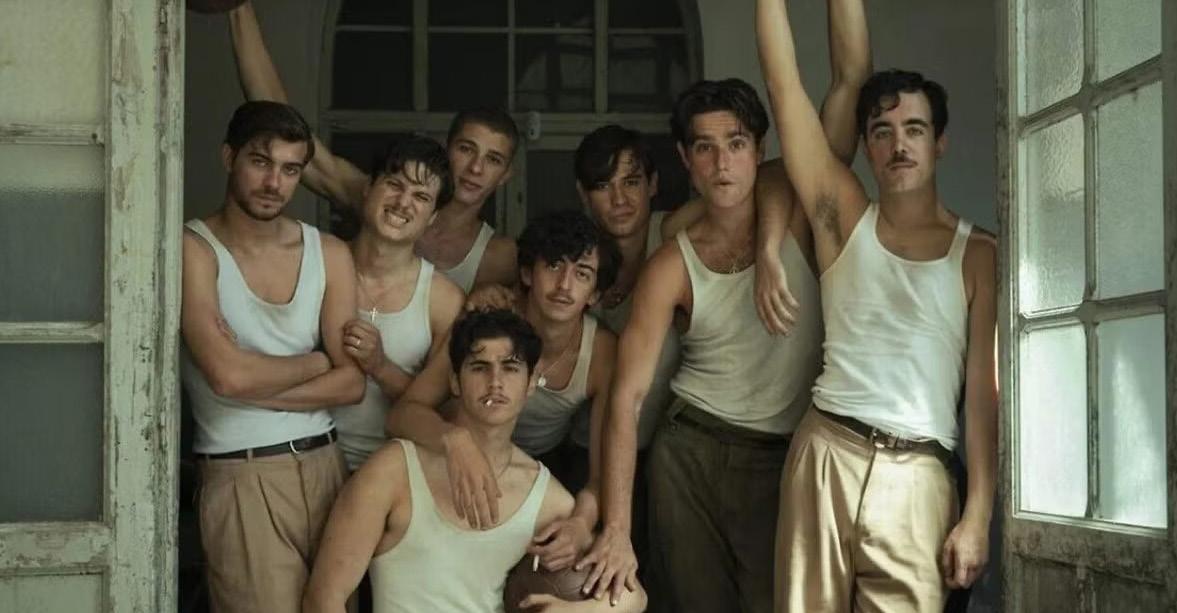
Best Director prize was shared between Pawel Pawlikowski for Fatherland (Łukasz Żal PSC) and the Spanish directing duo Javier Calvo and Javier Ambrossi for La Bola Negra/The Black Ball (DP Gris Jordana AEC).
The acting prizes were equally shared. Virginie Efira and Tao Okamoto jointly won Best Actress for their performances in Ryusuke Hamaguchi’s All Of A Sudden (DP Alan Guichaoua), whilst Valentin Campagne and Emmanuel Macchia shared Best Actor for their roles in Lukas Dhont’s Coward (DP Frank van den Eeden NSC SBC).
The 2026 edition continued Cannes’ reputation for championing bold international cinema, with winners drawn from Romania, Russia, Poland, Spain, Japan, and Belgium, a typically diverse slate reflecting the festival’s enduring global scope.
Schreiber and Amy Vincent. Alternate Board Members include Ernest Dickerson, Dejan Georgevich, Suki Mendencevic, Lowell Peterson and Rodney Taylor.
“The ASC has been instrumental in shaping cinematography since its earliest days,” notes Johnson. “At its core, great cinematography is rooted in a deeply human point of view, where every image reflects the cinematographer’s personal vision shaped by sensitivity, intuition and intent. That perspective is developed through dialogue with peers, and sustained through a tradition of mentorship, linking one generation of imagemakers to the next.
FLORIAN HOFFMEISTER BSC RECEIVES THE MARBURG CAMERA PRIZE
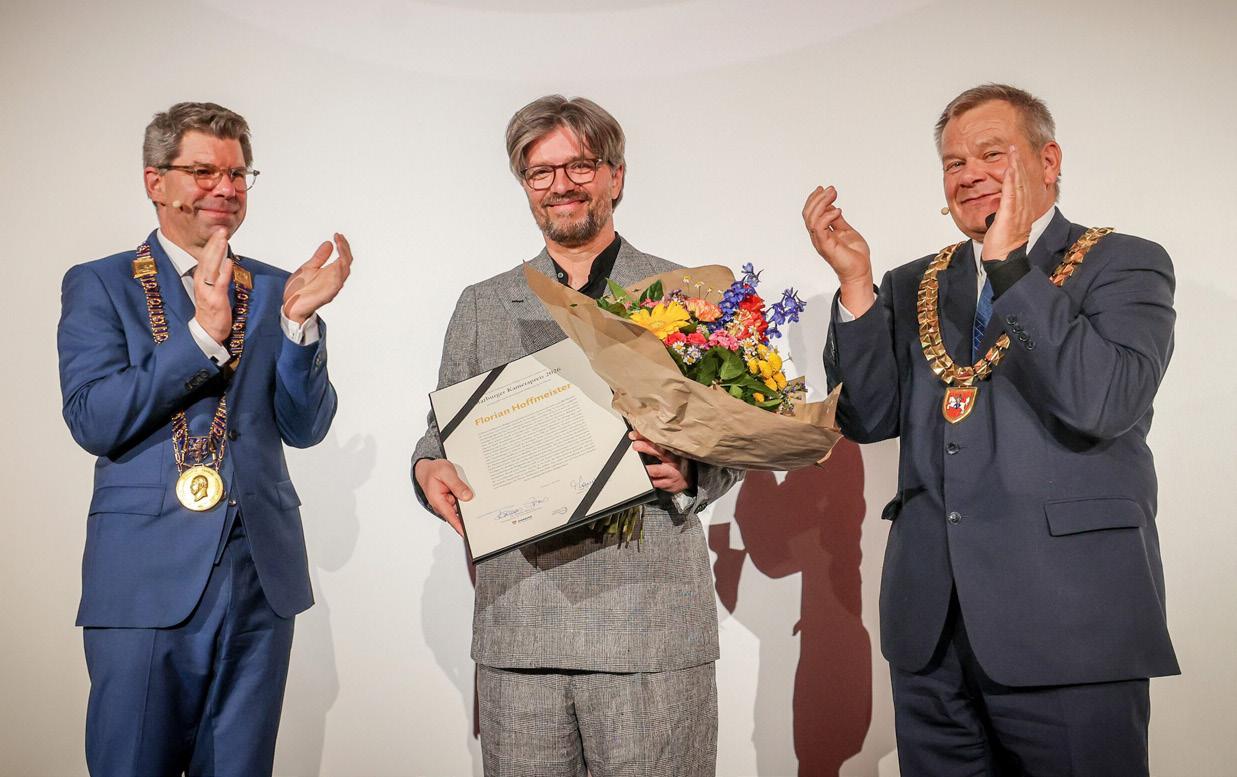
Cinematographer Florian Hoffmeister BSC has received the Marburg Camera Prize, an award that stands apart from the usual industry cycle.
Presented by the University Of Marburg in Germany, it recognises a body of work rather than a single title, framed through a three-day academic conference of screenings and critical discussion.
The structure is deliberate. Organisers position the prize as a corrective to what they describe as the industry’s tendency to underestimate cinematographic achievement, instead placing the image at the centre of film authorship. It is one of the few forums to treat cinematography not simply as collaboration, but as a discipline worthy of sustained study.
Hoffmeister joins a roster that includes Anthony Dod Mantle DFF BSC ASC, Philippe Rousselot AFC ASC, Agnès Godard AFC, Paweł Edelman PSC, Robby Müller NSC BVK and Edward Lachman ASC — cinematographers whose work has defined the visual language of contemporary cinema.
“Cinematography has quietly shifted from authorship to service over the past decade,” Hoffmeister said. “What I value about the Marburg Camera Prize is that it insists on the opposite – that the
image is not just functional, but authored, considered and worthy of being studied.”
2026 BAFTA CRAFT AWARD WINNERS
The BAFTA Television Craft Awards celebrated the outstanding talent and creativity of television craftspeople who brought the top programmes of 2025 to life.
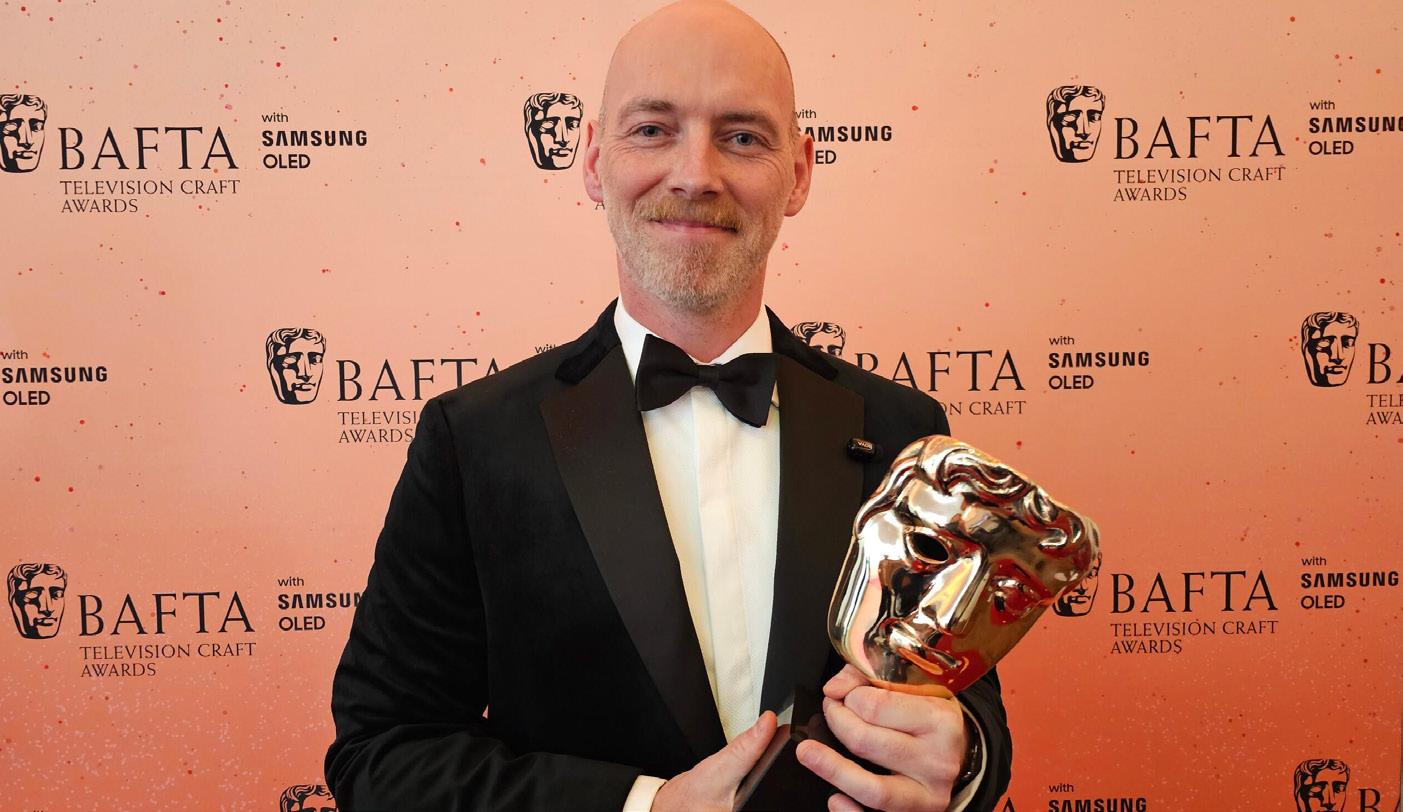
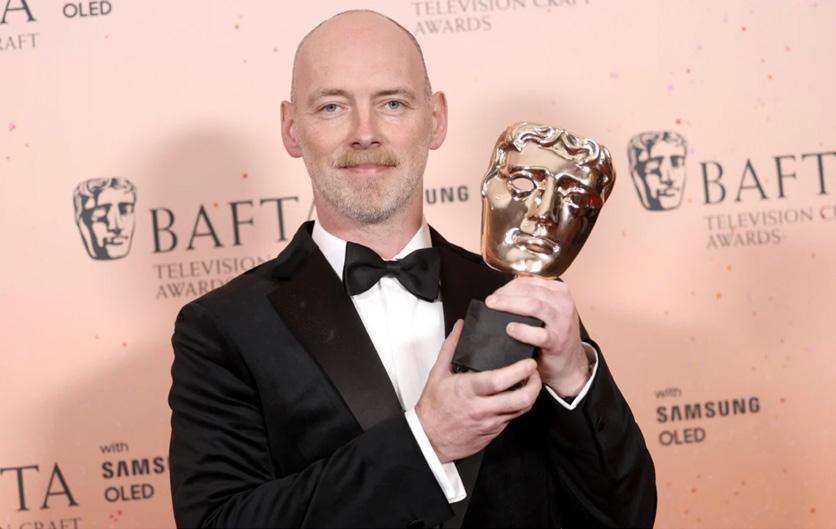
In Photography & Lighting: Fiction, Ryan Kernaghan ISC won for Trespasses, beating a strong field that included Matthew Lewis for Adolescence, Catherine Goldschmidt BSC for The Last of Us, and Suzie Lavelle ISC BSC for Severance.
In Photography: Factual, Jordan Bryan took the award for Our Land: Israel’s Other War. The
nominees reflected the breadth of contemporary factual storytelling, including the camera team behind Secrets Of The Penguins, Marcel Mettelsiefen for State Of War: Fighting The Narcos, and Stefano Ferrari and Tim Cragg for Surviving Black Hawk Down.
BOB NGUYEN ACS WINS ACS 2026 MILLI
AWARD
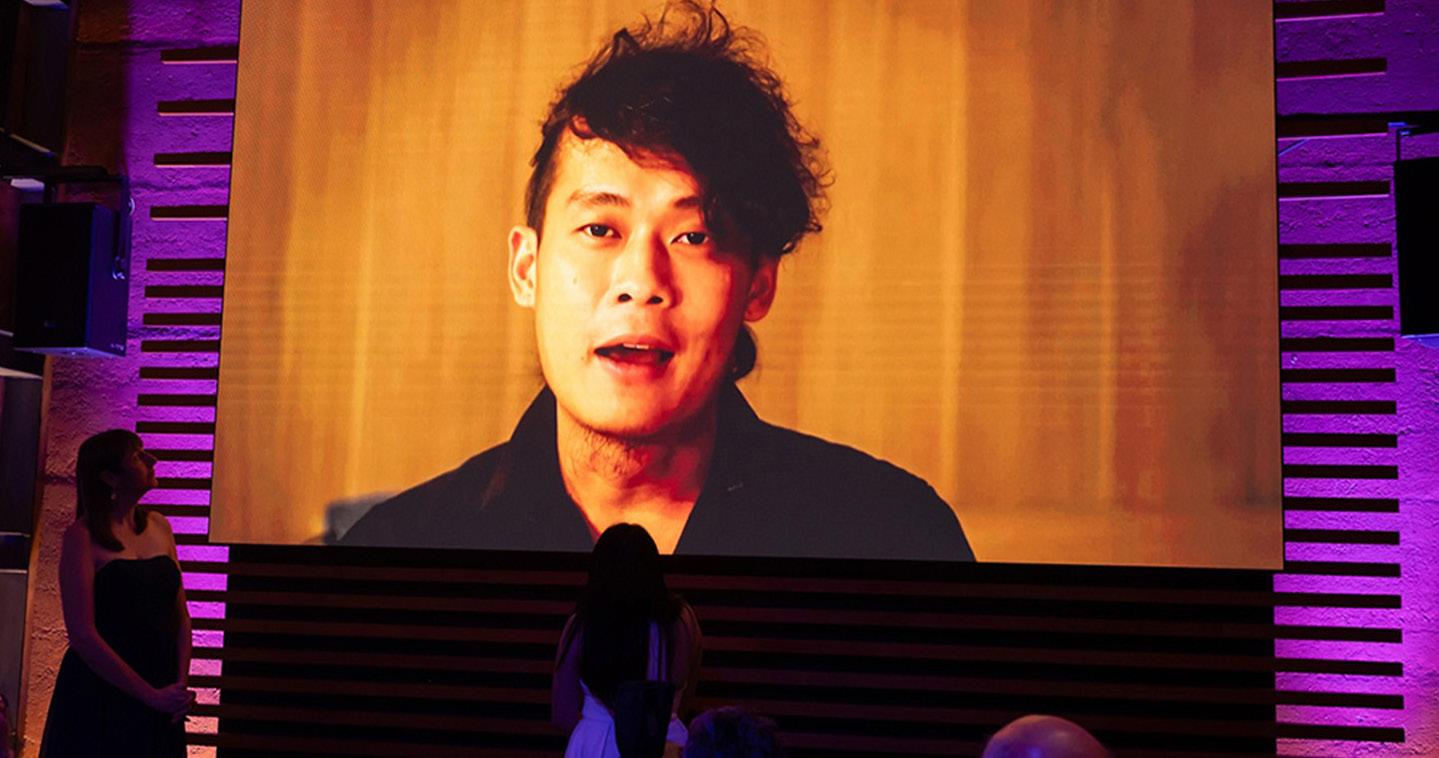
At the 2026 Australian Cinematographers Society (ACS) 56th National Awards in Adelaide, Bob Nguyen ACS won the prestigious Australian Cinematographer Of The Year Milli Award. Nguyen also won a Gold Tripod in the Feature Films –Budget Under $5m category for Ky Nam Inn, directed by Leon Le, shot on 35mm film.
Nguyen is a critically-acclaimed
and highly-awarded member of ACS, and an extremely experienced celluloid cinematographer.
His notable works include Sút (2016, dir. Viet Max) and Song Lang (2018, rid. Leon Le), with Song Lang garnering more than 30 international awards. In 2019 Nguyen won the Golden Tripod and the prestigious Milli Award for the first time. His cinematography on Black Hen (2023) and Muoi – The Curse Returns (2022, dir. Hang Trinh) also earned him double Gold Awards and two additional Golden Tripods at previous ACS National Awards.
“It is a great honour to have won the Milli for the second time, particularly when the standard of cinematography in Australia is so high,” Nguyen said. “I would like to thank the ACS, all of their sponsors for putting on the awards and for everything they do for cinematographers, and congratulate all of the other nominees for their excellent work.”
KODAK RELEASES VERITA 200D COLOUR NEGATIVE
Eastman Kodak Company has announced the availability of Verita 200D 5206/7206, a new colour negative motion picture film stock, which will be offered in 65mm, 35mm, and 16mm formats.
Developed in close collaboration with writer, director and producer Sam Levinson and cinematographer Marcell Rév HCA ASC, Verita 200D was commercialised in motion picture format to achieve a distinct visual aesthetic for the third season of HBO’s original drama series Euphoria.
and Rév exposed
Verita 200D delivers detailed highlights, high colour saturation, deep blacks, and warm, natural skin tones. Compared with Kodak’s VISION3 colour negative films, it features a shorter yet exceptionally rich dynamic range for a more
shoot significant volumes of large format 65mm film.
“Verita has the richness and density curve that reminds me of the golden age of colour film, with the flexibility and latitude of modern negative stocks,” said Rév. Additionally, Kodak Motion Picture is celebrating twenty productions shot on Kodak film at the 2026 Cannes Film Festival.
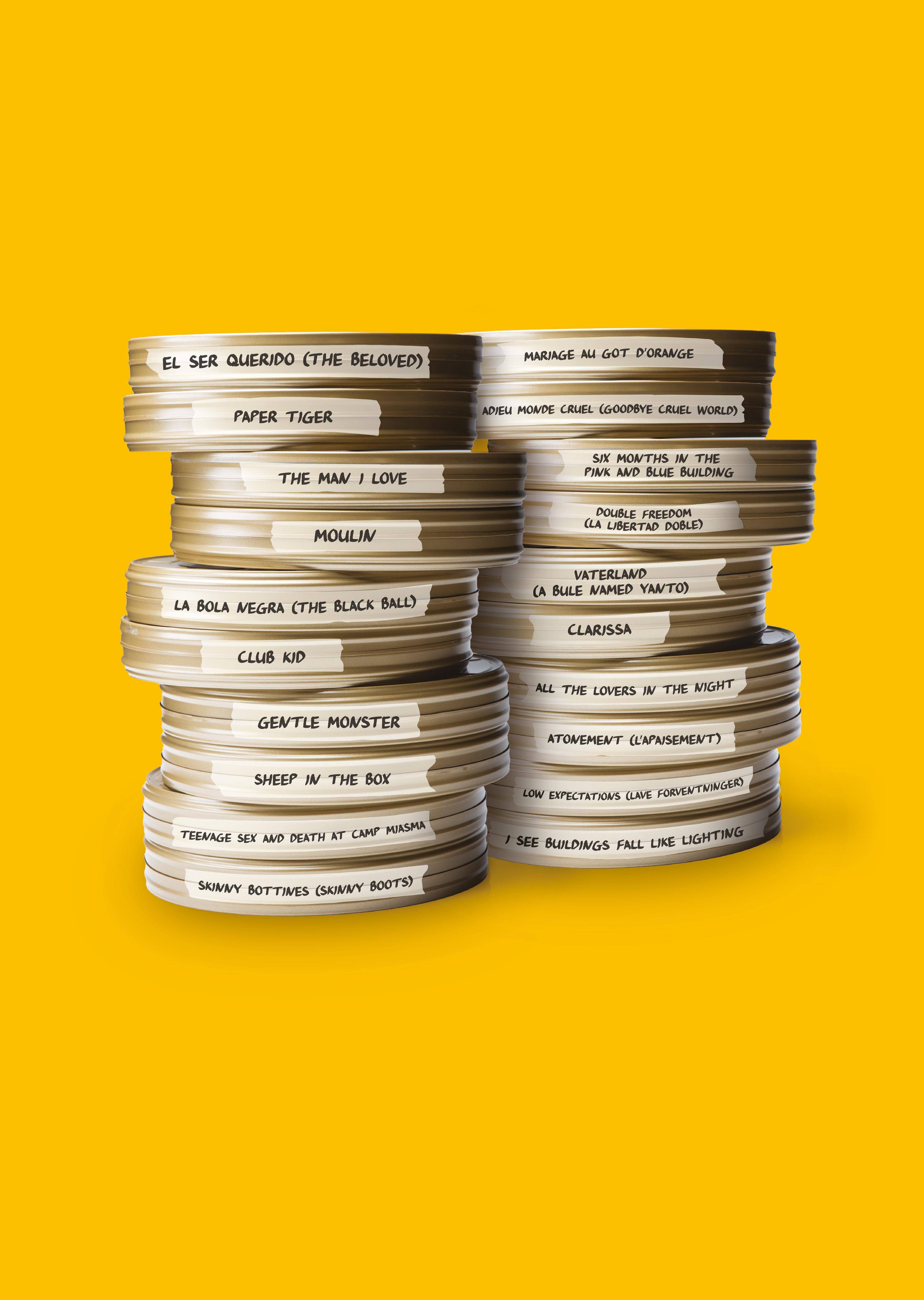
Seven of the twenty films competed for the Palme d’Or including: Rodrigo Sorogoyen’s El Ser Querido/The Beloved (DP Alejandro De Pablo); Marie Kreutzer’s Gentle Monster (DP Judith Kaufmann BVK); László Nemes’s Moulin Mátyás Erdély HCA ASC; Javier Ambrossi & Javier Calvo’s La Bola Negra/The Black Ball (DP Gris Jordana AEC); James Gray’s Paper Tiger (DP Joaquín Baca-Asay) Hirokazu Kore-eda’s Sheep In The Box (DP Ryûto Kondô) and Ira Sachs’s The Man I Love (DP Josée Deshaies).
Three on-film titles were featured in Un Certain Regard with another ten shot-on-film productions across Directors’ Fortnight and Critics’ Week.
classical cinematic look.
Levinson
more than one million
feet of Verita 200D in 35mm and 65mm formats during production of Euphoria S3, which was shot entirely on Kodak film. The series is also the first television production to
EUROCINE & AIC ANNOUNCE CINEVERSE ROMA AT CINECITTÀ
Launching on 16th–17th October 2026, alongside the international film activity taking place in Rome, CineVerse Roma marks the first partnership between Eurocine and the Associazione Italiana Autori della Fotografia Cinematografica (AIC), bringing together the global film community at the iconic Cinecittà Studios for a new chapter in cinematic imagination.
Commenting on the announcement, newlyelected AIC president Daniele Massaccesi said, “As president of the AIC, I believe technology must never
replace emotion, artistry, or humanity — it must elevate them. CineVerse is our invitation to dream bigger, create fearlessly, and build a bridge between the legacy of cinema and the infinite possibilities of tomorrow.”
Rob Saunders, co-director of Eurocine and SCS Concepts and Exhibitions Ltd, added,
“Cineverse will combine an expo with masterclasses and seminars, plus support the AIC vision for developing new talent and processes. Together, Eurocine and AIC aim to shape CineVerse Roma into an inclusive meeting point for cinema heritage and the future of visual storytelling.”
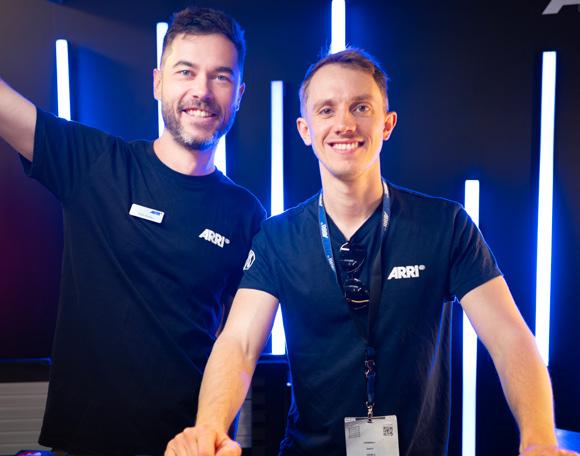
ARRI ACQUIRED BY THOMAS RIEDEL & LAUNCHES OMNIBAR
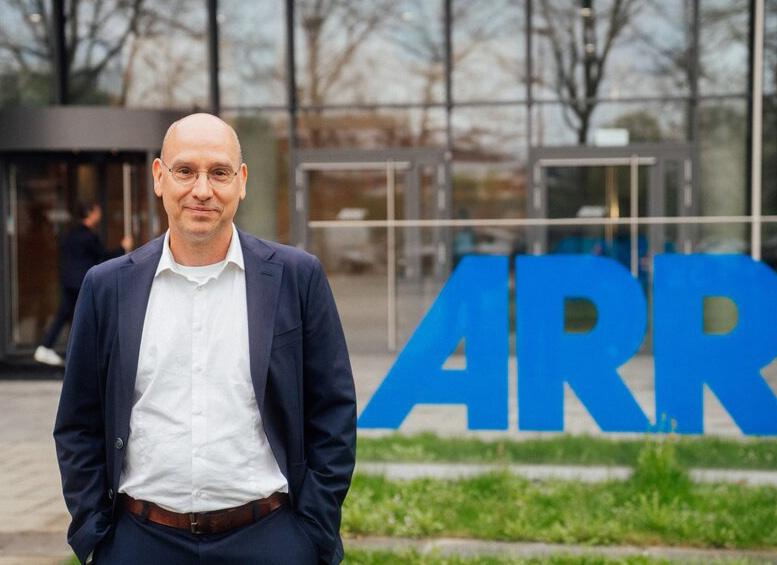
Thomas Riedel, founder and owner of Riedel Communications, has acquired ARRI, bringing the company’s camera, lighting, and systems ecosystem alongside Riedel’s existing portfolio.
To accelerate the vision, ARRI has expanded its management board and simplified its organisational structure. Frank Eischet joins as interim CFO, bringing his role at Riedel Communications with him to deepen group-level collaboration, whilst a permanent CFO appointment is expected shortly.
Marcel Koutstaal joins as COO, bringing extensive international experience in large-scale operational optimisation and high-end camera technology across studio, outside broadcast, and cloud-based production environments.
David Bermbach assumes the role of chief product officer, leading a unified product strategy across camera and lighting with a focus on integrated
solutions spanning hardware, software, and services. Chris Richter continues as chief commercial officer, overseeing global sales, rental, and brand positioning. The four-person board replaces a structure previously split between Camera Systems and Lighting business units — a consolidation designed to accelerate decision-making and bring product development, operations, and commercial execution into closer alignment for customers across Motion Picture, Live Entertainment, and Content Creation.
“Strengthening the operational backbone within ARRI allows us to set a clear focus on supporting the Media & Entertainment industry in these times of change,” said Bermbach and Richter.
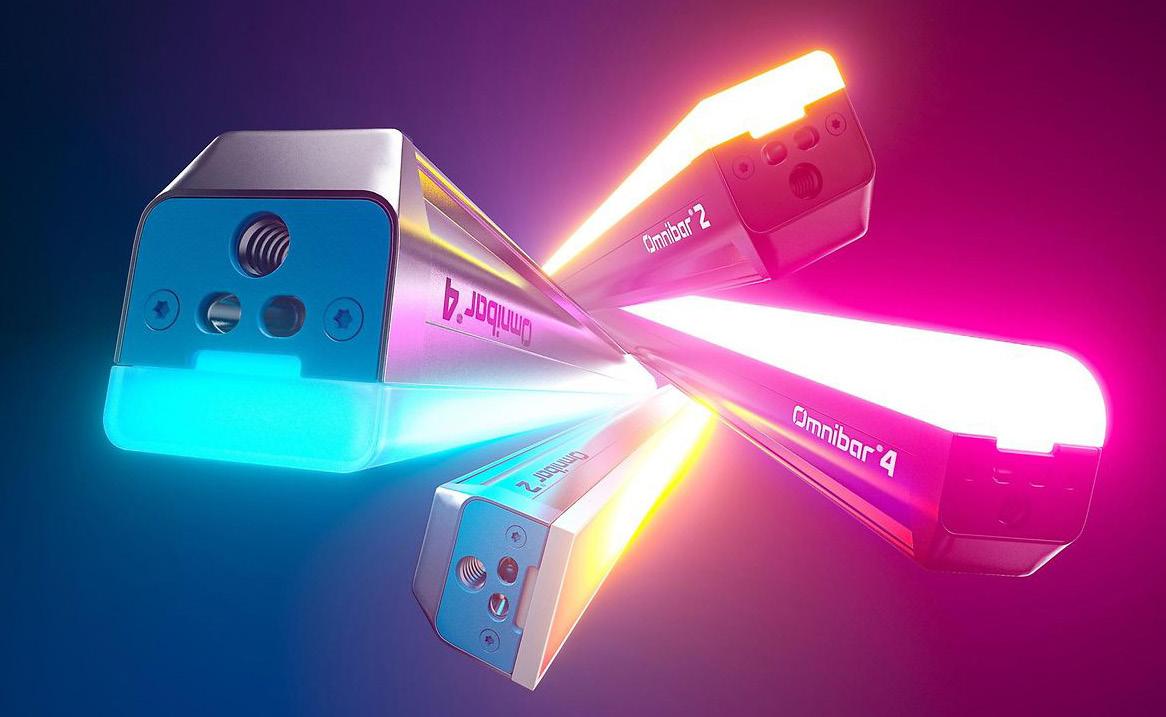
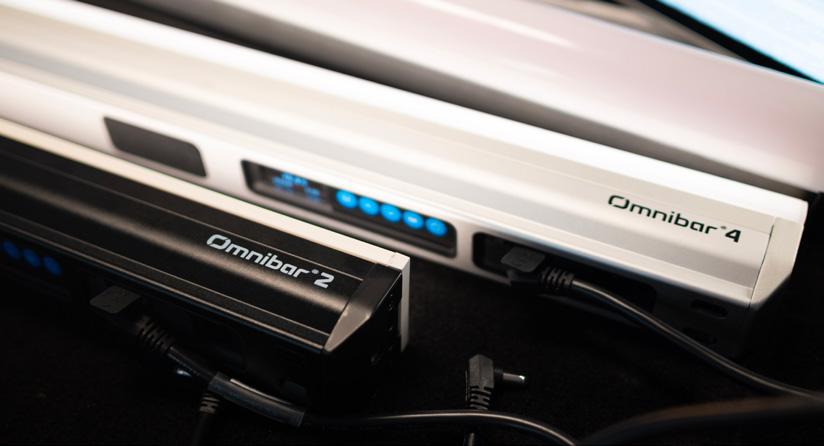
The first tangible product news under the new structure is the launch of Omnibar, a compact, battery-powered, multi-colour LED
linear fixture built for the same three target markets. Available in two-foot and four-foot versions – the Omnibar 2 and Omnibar 4 – and offered in black or blue/silver housing, the fixture combines full-spectrum output with IP65 weather protection for reliable indoor and outdoor use on set, on stage, or in a small studio. Omnibar’s modular design is one of its defining features. Bars can be daisy-chained together using the Omnibase hub, which provides a single power and data source to reduce setup times and simplify cabling. Up to 12 feet of fixtures can run off a single daisy-chain, with up to 24 feet supported across two or more chains.
CVP ADDS RANDY KOEMAN AS SALES MANAGER
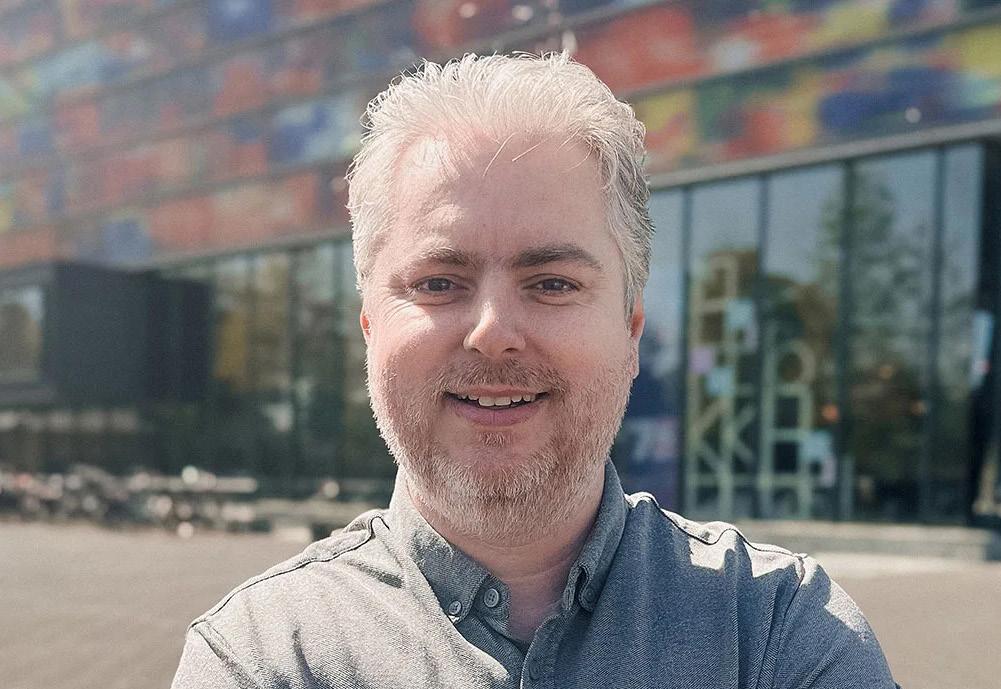
CVP has appointed Randy Koeman as sales manager, Netherlands, marking another significant step in the company’s on-going European expansion.
Koeman joins CVP with more than two decades of experience across broadcast, post-production, and media technology. He began his career in 2000 with leading Dutch facility company NOB and later its successor Dutchview/NEP, before moving into television production, where he specialised in building and optimising post-production environments and workflows for production companies.
In 2018, Koeman moved into the commercial side of the industry, joining DigiNet, where he focused on supporting independent television
production companies as well as podcast and
vodcast studios with tailored postproduction and content creation solutions.
“My experience across broadcast and post-production has given me a strong understanding of the challenges content creators face every day,” said Koeman.
“What attracted me to CVP is its combination of technical expertise and genuinely customer-focused support. There’s a real opportunity in the Dutch market for a trusted long-term partner, and I’m excited to help grow that presence locally.”
PANAVISION MAKES NEW APPOINTMENTS IN LA & CANADA
Panavision has made two significant additions to its sales leadership, appointing Fritz Heinzle as vice president of sales at its Woodland Hills headquarters and Kimberlee Alexander as director of sales and market development in Vancouver.
Heinzle brings more than three decades of industry experience to his new role, reporting to chief revenue officer Sherri Potter. Born in Austria, he studied automotive engineering before transitioning into the film industry as a camera technician. He joined Otto Nemenz International in 1996 and spent nearly 30 years there, rising to executive vice president.
A member of the Academy Of Motion Picture Arts &
Sciences and an associate member of the ASC, he arrives at Panavision with deep technical knowledge, an extensive industry network, and a hands-on understanding of what filmmakers need from their equipment partners.
“Fritz brings a renowned combination of technical expertise, leadership, and strong relationships across the industry,” said Potter. “His passion for the motion-picture industry, and for going above and beyond for filmmakers, is contagious.”
Kimberlee Alexander joins Panavision’s Vancouver office, reporting to Johanna Gravelle, managing director of Panavision Canada.
A member of Screen BC, she is well embedded in the province’s production community and will focus
on growing new business, activating sponsorship and partnership opportunities, and building long-term industry relationships.
“Kim brings a unique and valuable perspective to this new role,” said Gravelle. “Our industry is evolving rapidly, and it is essential that we evolve with it. Kim’s experience and leadership will be instrumental as we navigate this shifting landscape.”
COLORFRONT RELEASES APP FOR APPLE IMMERSIVE VIDEO CREATION
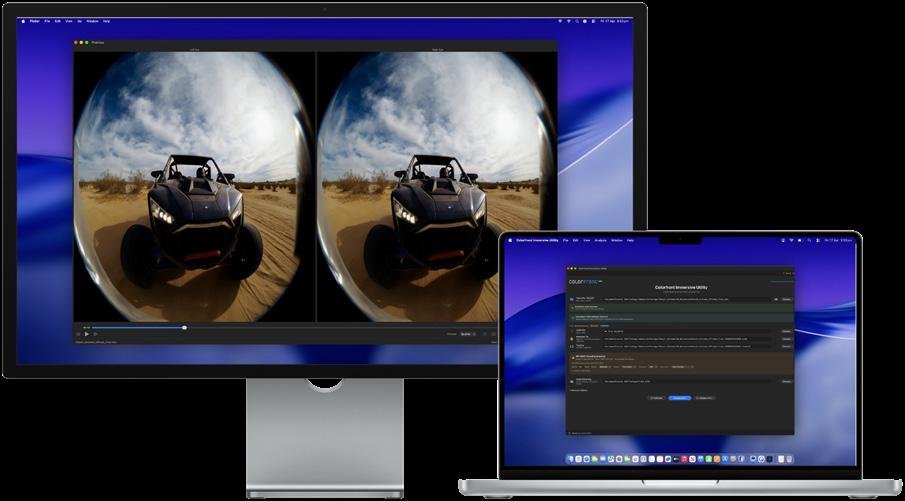
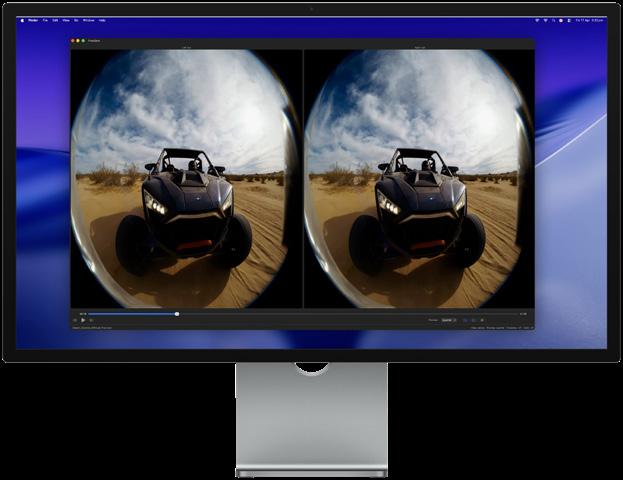
Colorfront has launched a macOS app that creates Apple Immersive Video files (.aivu) for playback on Apple Vision Pro. The Colorfront Immersive Utility, takes in ProRes, MV-HEVC, and other standard video formats, pairs it with spatial audio and camera metadata, and outputs a single AIVU file ready for distribution.
The app streamlines the process for preparing immersive video content for Apple Vision Pro. Users select a video file, a metadata file containing camera intrinsics, and an output directory. From there, you just click Create AIVU, and the app handles encoding, audio extraction, and packaging automatically.
“We built Colorfront Immersive Utility to put immersive video production into the hands of every type of creative, whether you’re a filmmaker, a documentarian or a brand telling a story in a completely new medium,” said Mark Jaszberenyi, co-founder of Colorfront.
“Apple Vision Pro has opened-up an incredible
storytelling canvas, and we wanted to expand access to these tools to as many creatives as possible. The entire pipeline runs on Mac devices with Apple Silicon using Metal, so users can go from camera originals to a finished Apple Immersive Video experience.”
Before starting any encode, users can run Source PreCheck, a pre-flight validation tool that analyses video, audio, metadata, and timeline files for potential issues without beginning the creation process. PreCheck grades results by severity – errors that block AIVU creation, warnings worth reviewing, and informational notes.
After an AIVU file is created, the app can validate it with a GPU-accelerated light level analysis. The validation flags frames that exceed the 108-nit maximum brightness of the Apple Vision Pro display.
A built-in preview window provides real-time GPU-accelerated playback of the processed video. View modes include stereo (dual eye), single eye (left or right), and an immersive perspective view. Preview quality can be set to full, half, or quarter resolution.
Colorfront Immersive Utility is available today on the Mac App Store. It requires macOS 26.0 (Tahoe) or later, a Mac with Apple silicon (M1 or later required), and at least 16 GB of RAM (32 GB or more recommended for 8K content).
ZEISS LAUNCHES CINCRAFT LENSCORE
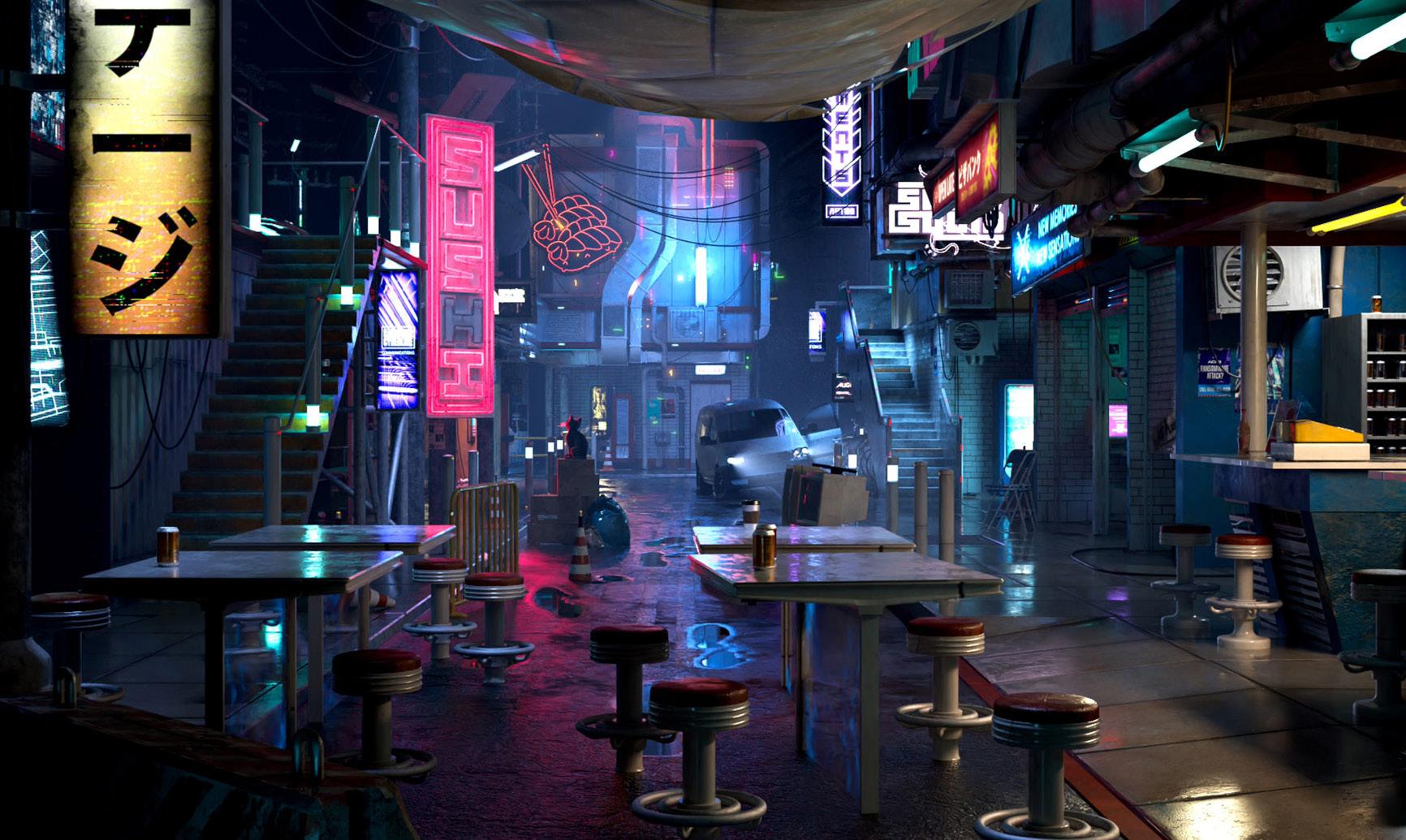
Zeiss has launched CinCraft LensCore, a Nuke plugin designed to bring physically based cinematic lens looks into visual effects and animation pipelines.
At its core is a GPU-accelerated, ray-traced
rendering engine that simulates authentic lens behaviour across every pixel and frame — delivering realistic bokeh, defocus, distortion, and vignetting grounded in the physics of real glass. With a single click, artists can apply a complete digital lens look to a shot, loading profiles from a digital lens shelf that includes real cinema lenses and custom presets, and comparing looks in seconds.
Beyond replicating existing optics, LensCore also allows artists to
create entirely new lenses that behave according to authentic optical physics. Every parameter — focus, T-stop, focal length, and focus distance — remains physically coherent across adjustments, whilst a built-in inpaint feature intelligently fills areas occluded by defocused objects, reducing the need for complex 3D setups.
The result is a tool said to replace time-consuming manual processes with repeatable, production-ready workflows.
In other news, a series of hands-on trainings brought filmmakers and technicians closer to the Zeiss cine lens portfolio. At the Lens Summit in Portland in March, participants explored Nano Prime, Supreme Prime, and Master Prime lenses – including practical teardown sessions for deeper technical understanding. This was followed by multi-day sessions at AbelCine and Cine Visuals, covering everything from Ultra Primes and CP.3 lenses to Supreme Zoom Radiance, Supreme, Nano, and Master Primes, as well as the Master Macro 100.
SONY ANNOUNCES NEW R SERIES CAMERAS
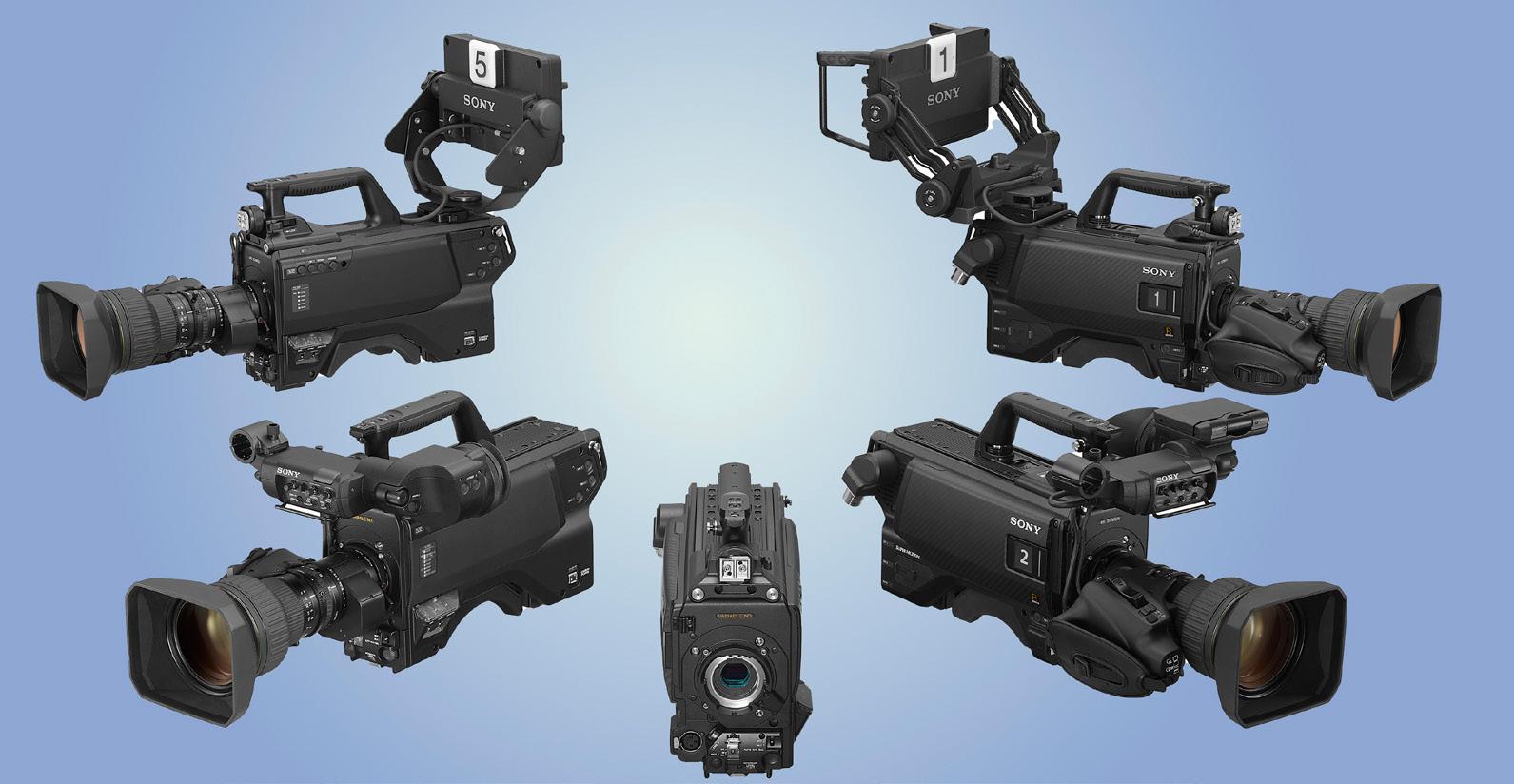
Sony Electronics has introduced the R Series — five new system cameras comprising the HDC-5500R, HDC5500RV, HDC-3500R, HDC-3500RV, and HDC-3200R — alongside the HDCU-3500R camera control unit and HKCU-LUT351 3D LUT option board. The series is planned for availability in summer 2026.
Built around a 2/3-inch three-chip 4K CMOS sensor with global shutter, the R Series delivers high-quality 4K and HDR live production with no rolling shutter distortion and a wider dynamic range than its predecessors. The HDC-5500R and HDC-5500RV additionally support 4K high frame rate shooting, UHB transmission, and 12G-SDI. An S/N ratio of -64dB enables sensitivity and dynamic range balance, making the cameras well-suited to challenging environments such as stadiums and live music venues.
Transmission flexibility is a key focus, with video trunk support across the range and the new HB+ method on the HDC-3500 models enabling video trunk
and prompter over a single 3G SDI line. The HDC3200R adds network trunk support at up to 1Gbps. Operability improvements include a standard
slide
for
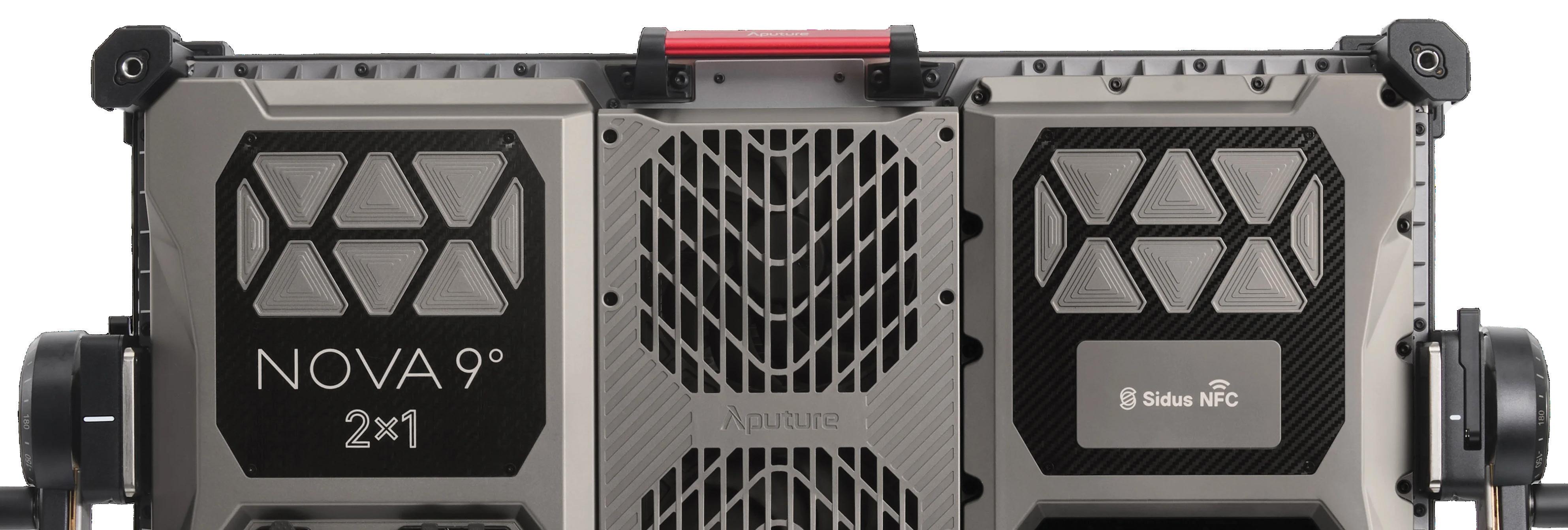
APUTURE UNVEILS STORM CS32 POINT SOURCE
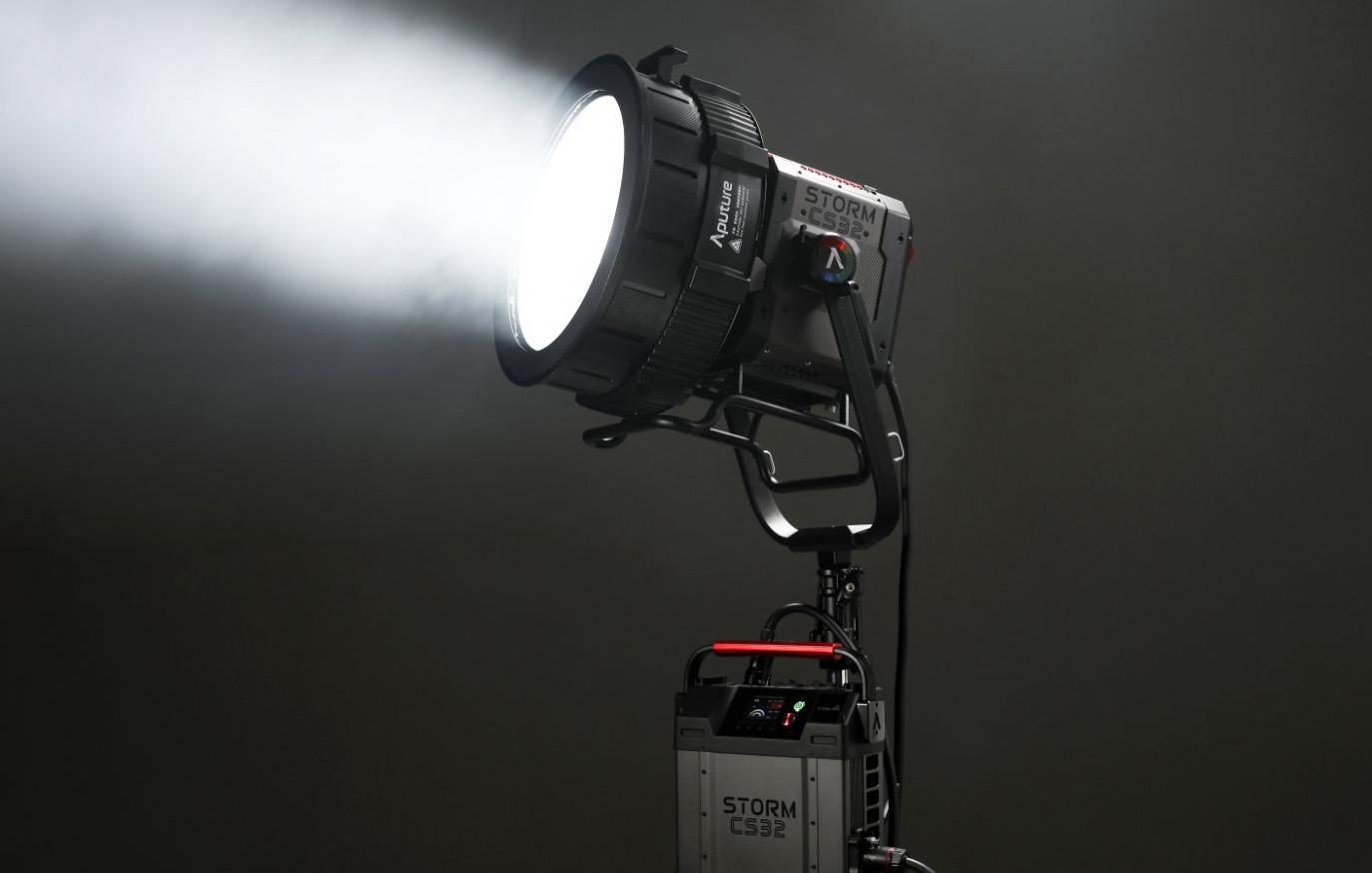
Aputure has unveiled the Aputure Storm CS32, the brightest fully tuneable colour fixture in its point source line of LED lights.
The Storm CS32 is the brightest COB light in the industry to feature Aputure’s advanced BlairCG light engine, with an output rivalling a 4K HMI, excellent saturated colours across the visible light spectrum, and exceptional tuneable white light, all whilst maintaining a small size and weight for single person operation
“Our goal was the impossible light,” explained Mitch Gross, director of marketing for Aputure.
“Can we make a fixture with no compromises in light output and light quality yet still remain lightweight? With each new product our engineers push to cram in as much performance as possible
whilst continuing to reduce size and slash weight.
“We made the light work under any available power. You can plug it into a household 120v socket and the Storm CS32 will automatically switch itself to the maximum that circuit can deliver. Switch cables for a higher-powered circuit to deliver another 25% of light output that’s equivalent in brightness to a 4K HMI.”
The Storm CS32 features the latest iteration of the Blair-CG light engine, with Indigo and Extended Red emitters to cover a huge range of rich colours and more natural white light with
proper skin tones.
NANLUX ADDS MORE LED FIREPOWER
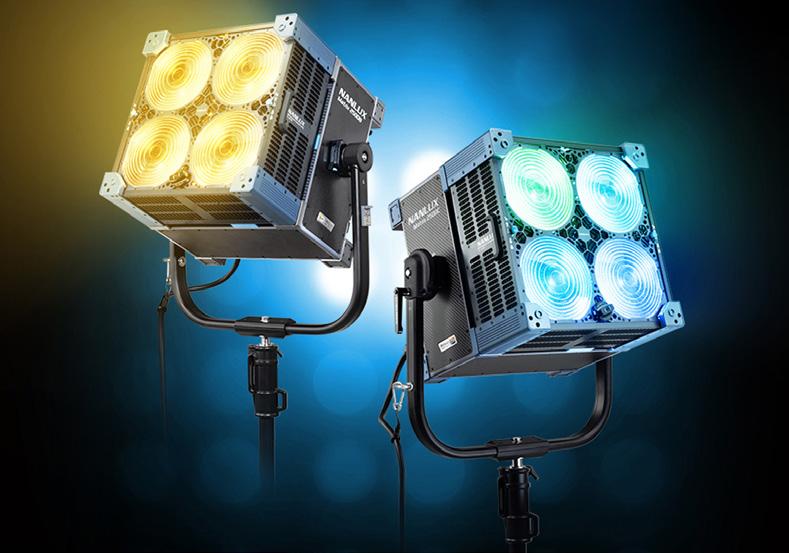
Nanlux has unveiled two new additions to its professional lighting line-up. The Matrix 2500B and Matrix 2500C are four-head integrated fixtures built for largescale production. Delivering 2,500W of output from a compact 40 × 40 × 23.5 cm body, both models are designed to be deployed in multiunit arrays, where their tight spacing creates exceptional light density and beam continuity.
The Matrix 2500B outputs 103,000 lux and the Matrix 2500C 67,900 lux (at 3 m, 5600K, with FLMT25 Motorised Fresnel Lens at 16°), making them powerful options for bounce lighting, accent work, and background illumination alike.
The two fixtures differ in their light engines. The 2500B features the Nebula B4, combining four types of white LEDs for a colour temperature range of 2,700K–6,500K with ±80 green/magenta shift. The 2500C steps up to the eightcolour Nebula C8, covering 1,000K–20,000K with ±200 green/magenta adjustment, broader colour
gamut, and enhanced skin tone reproduction. Both deliver an average CRI and TLCI of 98 and offer 0.1% linear dimming from zero to full output.
Array building is central to the Matrix concept.
An all-in-one design means only a power cable is needed to get up and running, whilst an optional fourlight frame lets users assemble a 10,000W array using the included 4-way power distribution cable and EXT sync port.
Multiple arrays can be scaled further across truss systems into a larger modular matrix. A frontto-rear airflow cooling system with four fan modes, including an auto Smart mode that responds to ambient temperature, keeps performance stable under sustained high-load operation. IP66 weatherproofing and a one-piece magnesium alloy housing round out the build quality for reliable outdoor use.
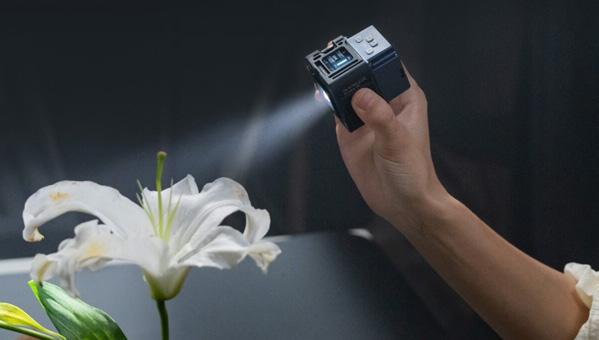
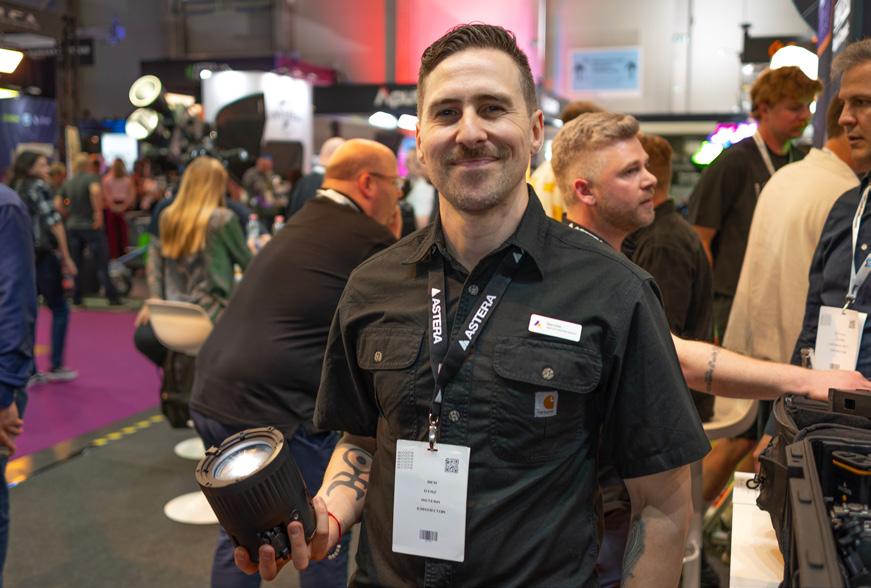
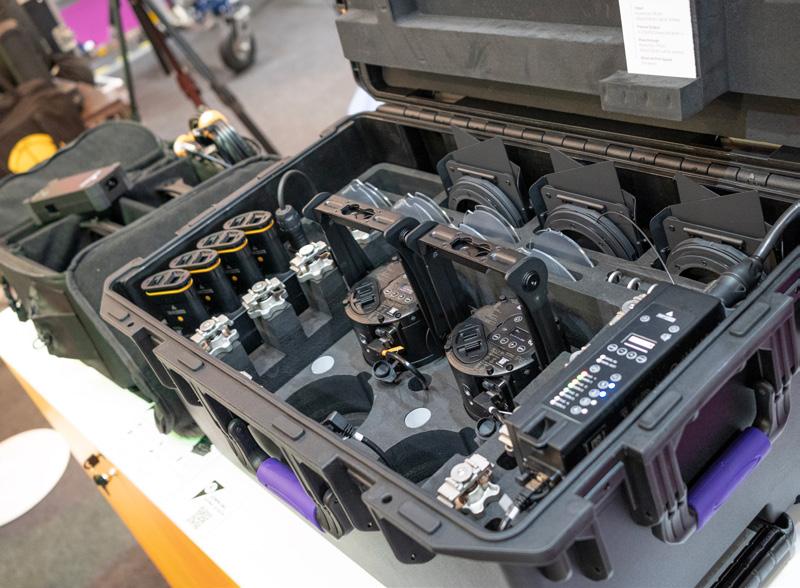
Additionally, the Evoke 5C is a 6W spotlight measuring just 5.6 × 4.4 × 4.5cm and weighing 160g, addressing a gap for gaffers and DPs who need precision
control in an ultra-compact form.
Despite its size, the Evoke 5C is equipped with the same Nebula C8 eight-colour light engine as the Matrix 2500C — offering the same 1,000K–20,000K range, CRI/TLCI average of 98, and seven lighting modes including CCT, HSI, RGBW, Gel, and Effect.
A comprehensive ecosystem of 14 accessories including Soft Dome, Fresnel Lens, Spot Beam Lens, Snoot, and Projection Attachment attach magnetically or via snap-fit for rapid reconfiguration.
mechanism
the 7.4-inch OLED viewfinder and a unified intercom operation panel across compatible models.
THE EYES HAVE IT…
Our regular round up of who is shooting what and where
BERLIN ASSOCIATES:
Edward Ames is shooting The Dumping Ground S15 for the BBC. Al Beech is lighting on Midsomer Murders S26 for Bentley Productions, with producer Peter Bullock. Sarah Bartles Smith recently finished on Hard Shoulder for Hartswood Films, and is now shooting Opening Up for Avalon with director Alice Snedden. Andy Clark lit A Good Ship Murder S4 for Clapperboard, produced by Jonathan Phillips. Nick Cox has wrapped on block 8 of Waterloo Road for Wall To Wall. Annemarie Lean-Vercoe shot episodes 5, 6 & 7 of All Creatures Great And Small for Playground Entertainment, directed by Andy Hay. Nick Martin is shooting Fable Pictures’ Chocolate Wars with producer Hannah Farrell. Trevelyan Oliver has been lighting Better Later for Tidy Productions. Tom Pridham is filming on Nutopia’s The White House S2. James Swift has also been shooting on Chocolate Wars for Fable Pictures. Michael Timney recently finished on BBC’s Casualty. Alistair Upcraft has been lensing Am I Being Unreasonable S3 for Boffola Pictures/ Hulu. Amy H C Wilson shot Waffle’s After School Club S2. Phil Wood lit block 2 of Quay Street Productions’ The Woods for. Alex Veitch is lensing Waterloo Road for Wall To Wall.
CASAROTTO:
Laura Bellingham has wrapped on Corinna Faith’s Unspeakable. Rik Burnell recently completed on Emma Miranda Moore’s feature debut Giants Matt Gray BSC is shooting on Mavis Eccleston, a series directed by Bruce Goodison for Corestar Media, Indefinite Films and ITV. Kate McCullough ISC recently lit Justyna Tafel’s Safe And Silent
WIZZO & CO:
Ryan Kernaghan ISC won the 2026 BAFTA for Photography & Lighting: Fiction for his outstanding work on Trespasses Ahmet Hüsseyin shot the documentary Mouth Full Of Golds, which will have its world premiere at Tribeca Film Festival in New York later this year. Tim Sidell BSC is prepping a new drama directed by Lisa Gunning. Charlie Goodger is shooting a C4 drama. Aaron Reid BSC continues shooting Supacell S2 alongside director Rapman. Scott Coulter just wrapped an ITN drama. Nick Dance BSC is shooting a drama in Croatia. Susanne Salavati BSC is filming an Apple TV drama directed by Josephine Bornebusch. Luke Bryant recently finished on Honey, directed
by Michelle Savill. Maxime Lahousse SBC is lensing a drama in Belgium. Dmytro Nedria has graded the feature Merry Christmas Aubrey Flint, directed by Jack Spring. Shaun Harley Lee SASC is shooting a Netflix drama in Saudi Arabia. Steven Ferguson is prepping a drama directed
DFF shots block 1 of a new drama directed by Ben Chanan. Gary Shaw has wrapped on Black Doves S2 with director Kieron Hawkes. Hamish Anderson shot a documentary with Duna Films. Felix Cramer is shooting on location in Germany. Darius Shu lit a short with director Georgie Yukiko Donovan. Maximiliaan Dierickx SBC is prepping a recurring TV drama in Belgium. Federico Alfonzo shoot with The Royal Ballet and Opera House. Henry Gill shot a commercial directed by Chris Fowles. Chaimuki shot a spot directed by Chloe Hughes. Joe Douglas lit a short directed by Björn Rühmann. Franklin Dow is lensing a documentary with Josh Allott. Jan Richter-Friis DFF is prepping an embargoed drama. Mike McMillin shot with director Samuel Bradley. Simon Stolland lit for director Malik Rowe. Dan StaffordClark is filming an NDA’d drama. Matthias Pilz shot second unit on a Netflix drama. Arran Green framed a Red Bull documentary with director Jack Bailey. Chas Appeti continues on an embargoed project. Aman K Sahota graded a short.
by Camilla Strøm Henriksen. Rasmus Arridlt
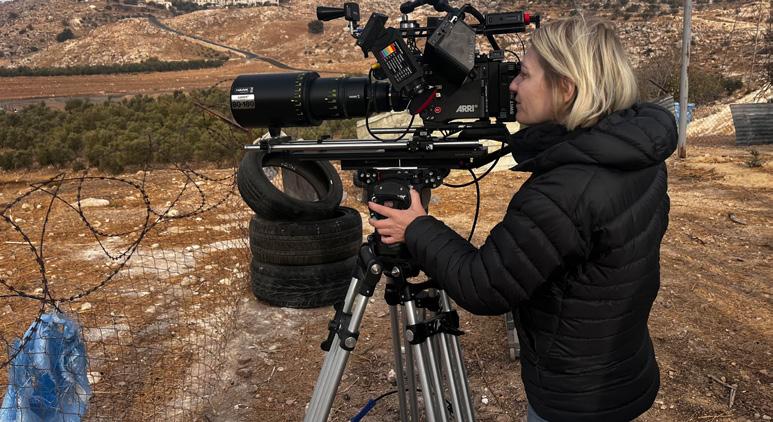
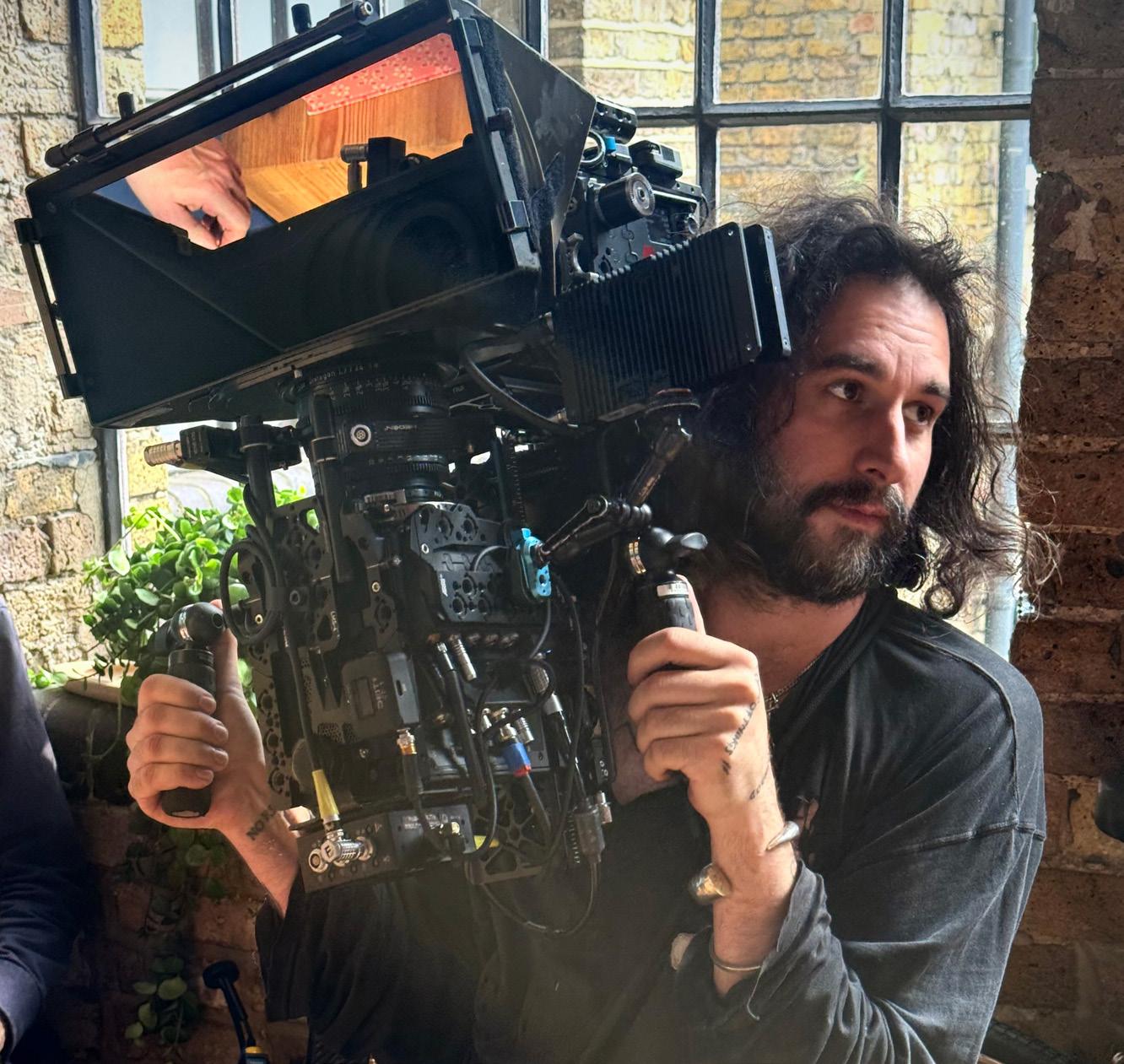
This page: Images (top down) DP Korsshan Schaluer on the set of an HBO series, photo by Colin Hutton; Ryan Kernaghan ISC winning the BAFTA; and Ahmet Husseyin on Mouth Full Of Gods, photo by Madeleine Sanderson.
Theo Garland collaborated with director Fatal Farm. Will Bex shot an embargoed feature. Sverre Sørdal FNF graded a project in Norway. Murren Tullet shot with director Jim Archer. Ben Magahy lit for director Duncan Christie. David Procter BSC lensed a music doc with director Joe Connor.
SCREEN TALENT:
Bart Sinkiewicz shot a short in London with Cinecentre Films and a TV documentary in Azerbaijan for CBC. Valentina Caniglia lit the feature Isola, starring Fanny Ardant and Johanna Kulig, which opened at the Torino Film Festival won Best European feature film at ECU 2. She also shot Jesus Land based on the New York Times bestselling book directed by Saila Kariat, starring Juliette Lewis and Ella Anderson, in Mississippi, and the feature Fly Little Bird, directed by Johannes Boesiger starring Zoe Bleu, Adam Bakri in Jordan, India and UK. Ross Clarkson recently finished on John Rambo in Thailand, where he was the main camera operator on the action unit. Adam Sliwinski is shooting Sins Of An Amish Husband for Lifetime/A&E with director Linda Lisa Hayter.
INDEPENDENT TALENT:
Arni Filipusson is prepping for Down Cemetery Road S2 with Börkur Sigþórsson directing. Eric Kress DFF is prepping for Valde S3. Ashley Barron ACS is shooting Bridgerton S6. Toby Lloyd is lensing a feature documentary for Passion Pictures with Dan Vernon directing, a recently wrapped on the short Tussle directed by Gabrielle Torrebore. Bani Mendy is lensing the latest season of Death In Paradise Andreas Neo recently shot additional photography on Lego Friends: Heartlake The Musical with director Paul Becker. Carmen Pellon Brussosa is prepping for the feature, Alegre Y Olé directed by Clara Santaolaya. Stuart Bentley is lighting on The Worst for director Simon Woods. Ole Birkeland BSC is shooting The Last Of Us S3, directed by Vincenzo Natali, Andrew Bernstein and Craig Mazin. Eben Bolter BSC is getting ready for Slow Horses S8 directed by Mark Mylod Robert McKillop. Jermaine Canute Edwards is prepping on Wahala directed by Loeonara Lonsdale, Theresa Ikoko, and Remi Weekes. Oliver Curtis BSC shot block 2 of War
S2 directed by Lisa Mulcahy. Michael Filocamo is lighting The Secret Life Of Adrian Mole with director Alex Winckler. Baz Irvine ISC BSC is shooting on The Kennedy’s, directed by Zetna Fuentes. John Matheison BSC is filming Hello And Paris with director Elizabeth Chomko. Seamus McGarvey BSC ISC ASC is framing Bare, directed by Lorna Tucker. Mark Patten BSC is readying for Young Sherlock S2, directed by Guy Ritchie. Kate Reid BSC is lensing Meantime, helmed by Jon S Baird. Erik Wilson BSC is getting ready for the feature Tangled, directed by Micael Gracey. Jordan Buck has been lighting ads with Roman Rutten, Peter Banks, Pham and Sophie Edelstein. Miguel Carmenes shot spots with Taran, Matt Rendall, Raja Virdi, Three Shades, Josh Cohen, Luke Brookner and Silence. Chris Clarke has been shooting TVCs with Bugsy Steele, Adam Wells and Will Smith. Toby Elwes has been framing films and music videos with Clemente Lohr and Will Peppercorn. Kit Fraser has been filming a mixture of spots and documentaries with Daniel Sharp, Adam Lampard and Remi Paringaux. Catherine Goldschmidt BSC has been shooting ads with Maya Albanese.
Billy Kendall has lensed commercials and music videos with Relta, Bedroom, Charlie Rees, Will Beach, Douglas Raddan, Alex Robson and Edward Cooke. Suzie Lavelle ISC BSC lit TVCs for Patrick Daughters and Freddie Powell. Patrick Meller filmed spots with Benji Weinstein, Stephen Pipe, Noah Harris, Guy Manwaring and Fred Rowson. James Rhodes has been lensing commercials with D.A.R.Y.L, Becky Garner ans Rich Hall. Chris Sabogal has been framing ads with Max Barden, Molly Manners, Charlotte Regan and Sam Hibbard. Linda Wu shot TVCs with Traktor, Rachel Stubbings, Fanny Hötzeneder and Billy Boyd Cape.
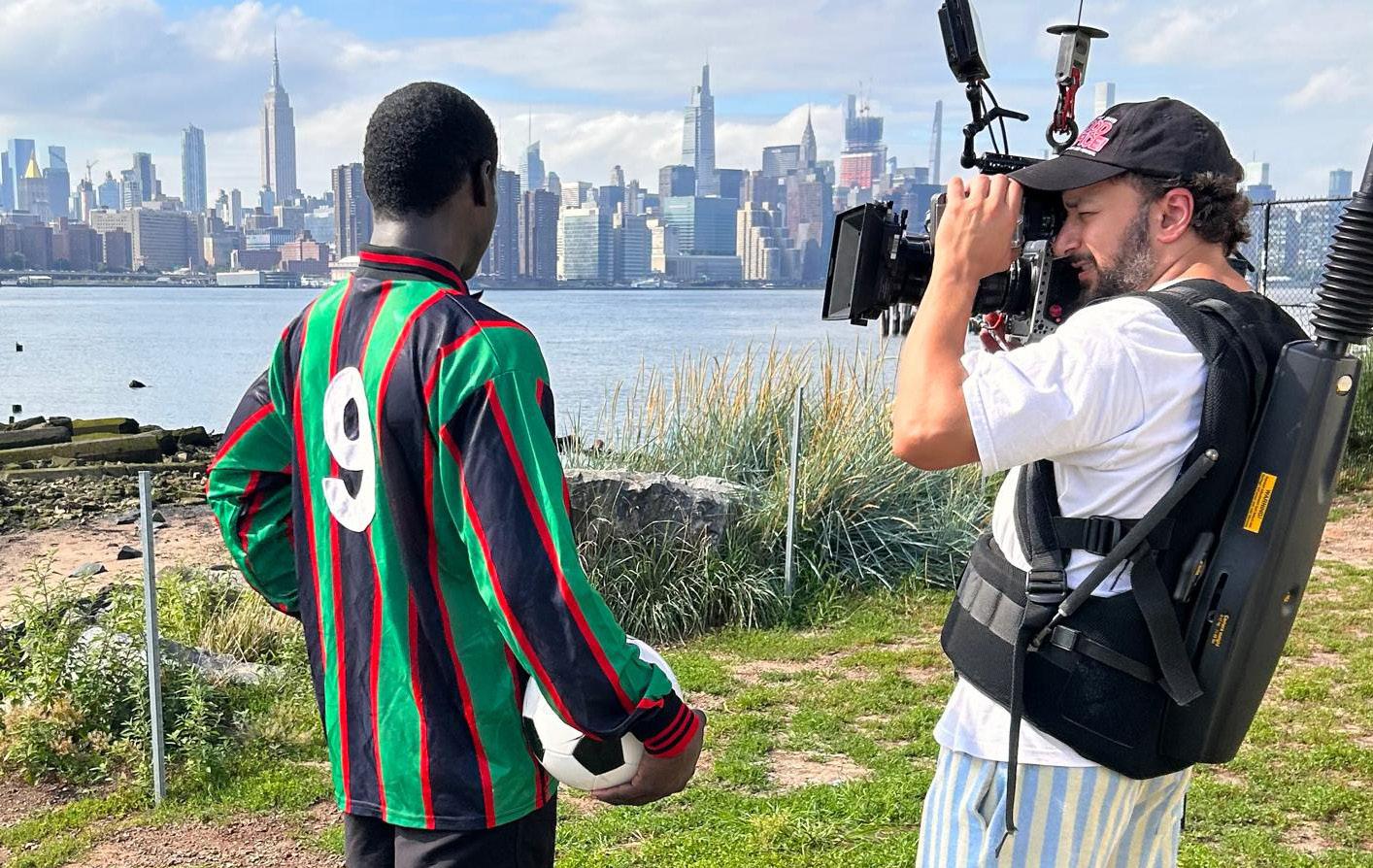
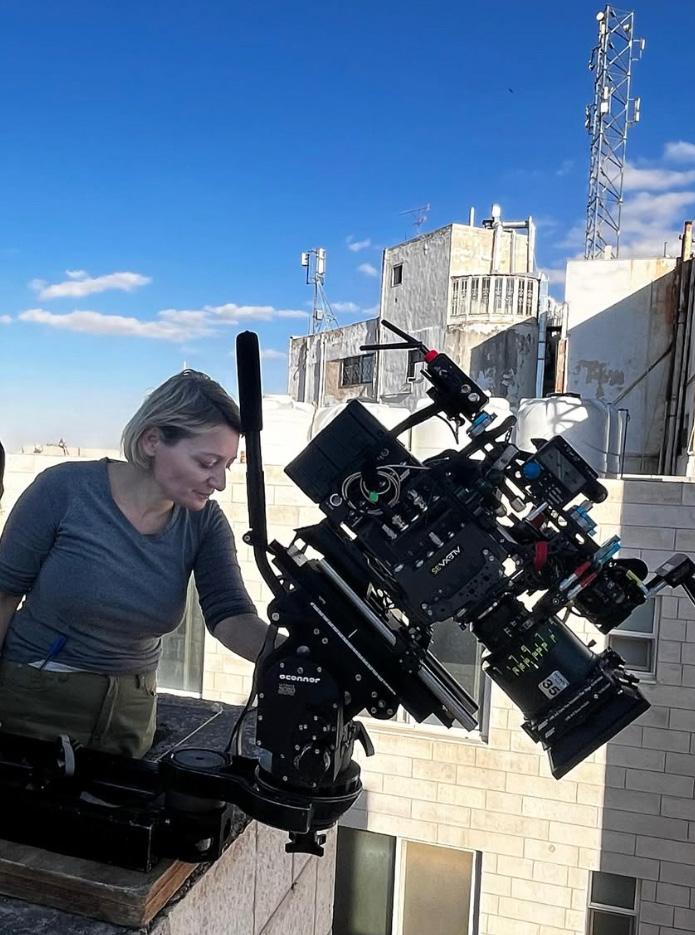
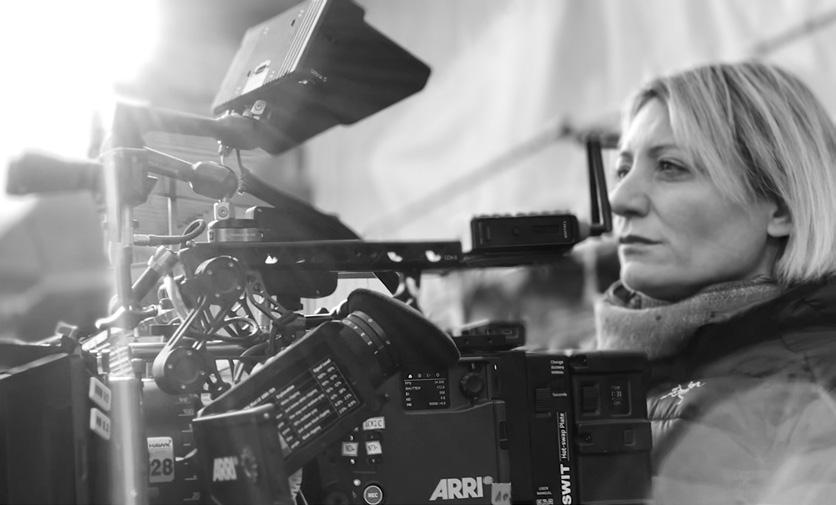
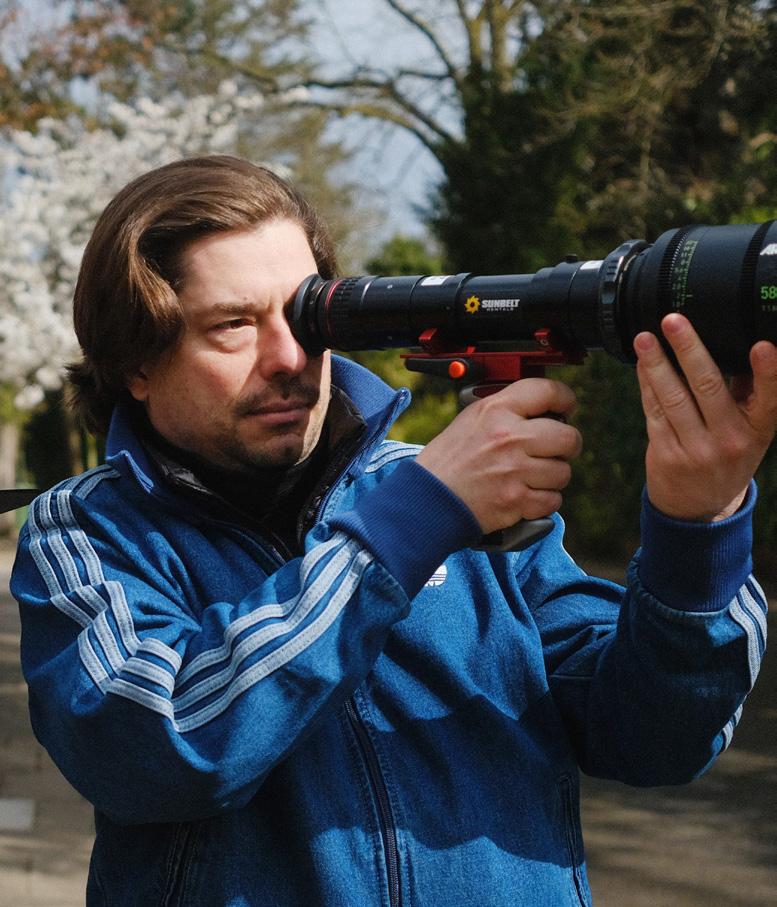
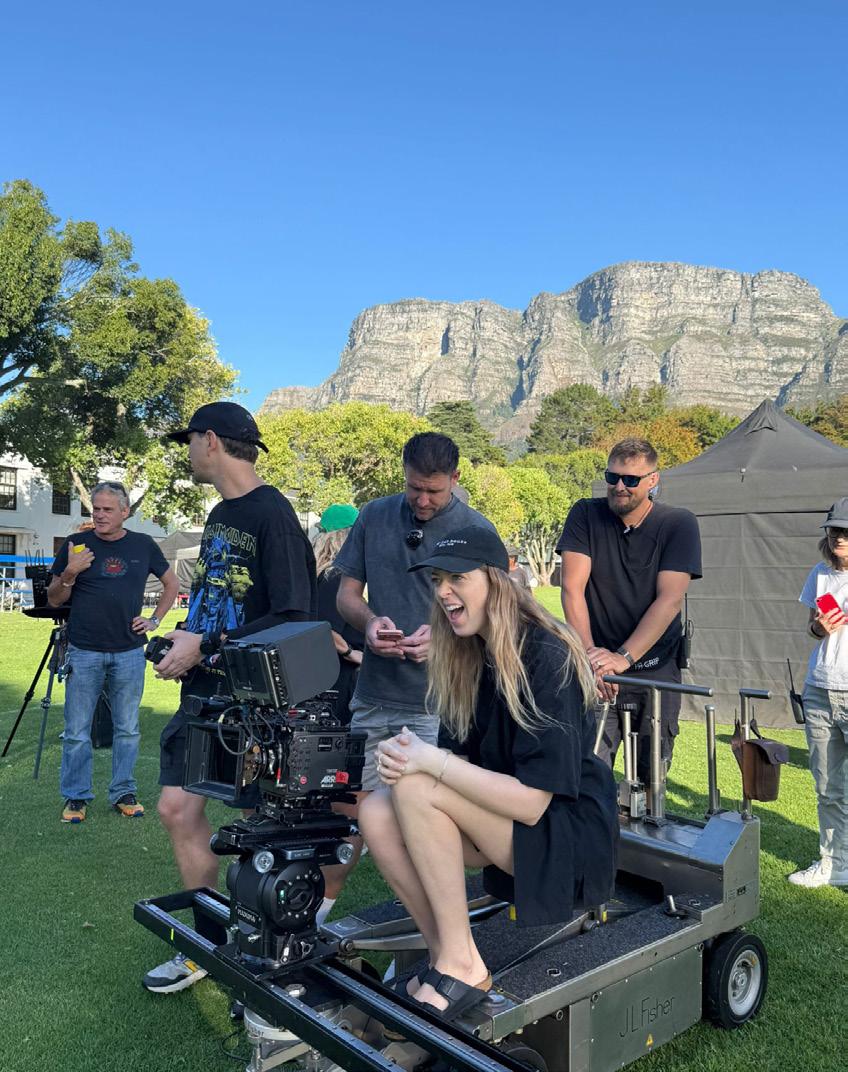
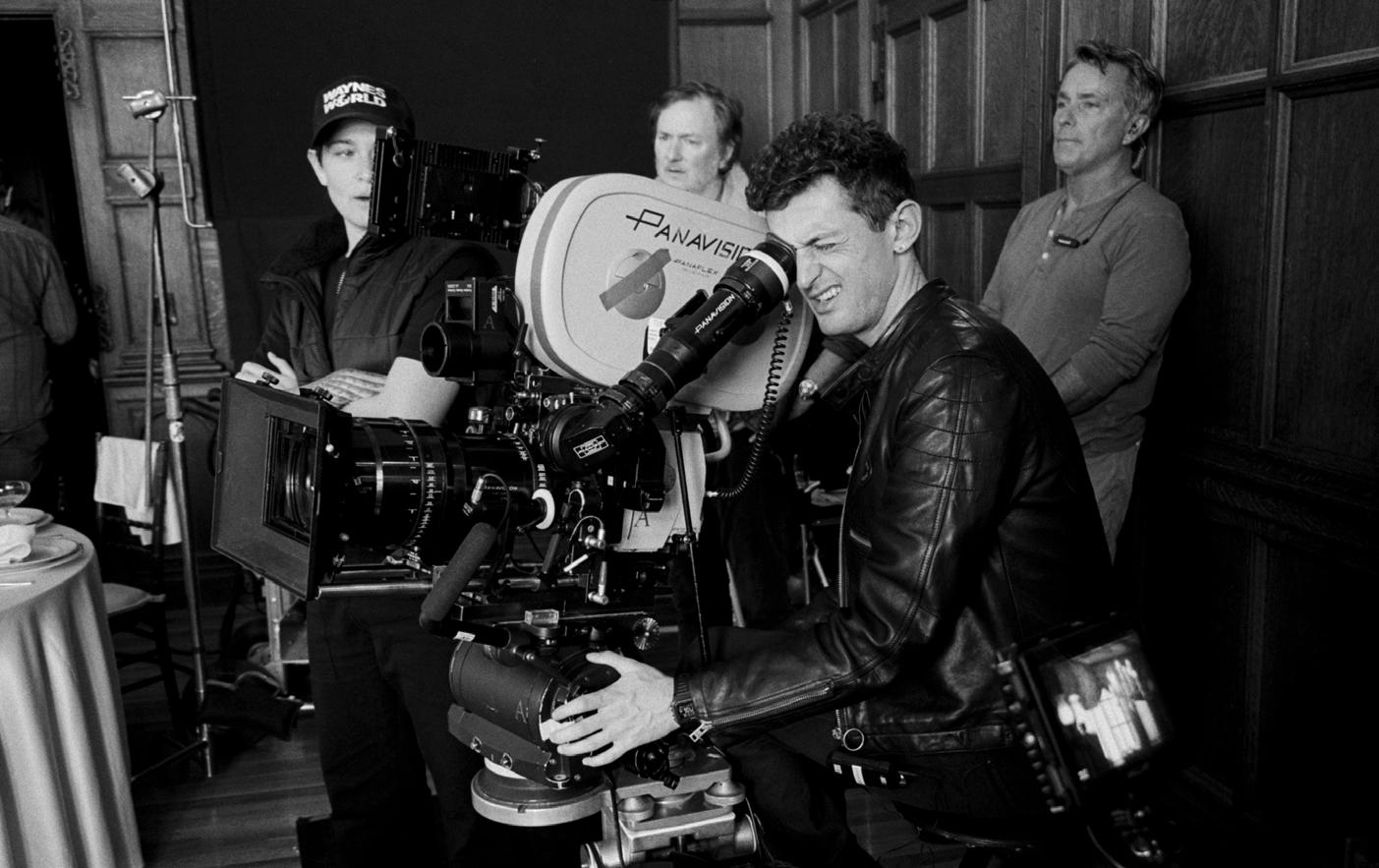
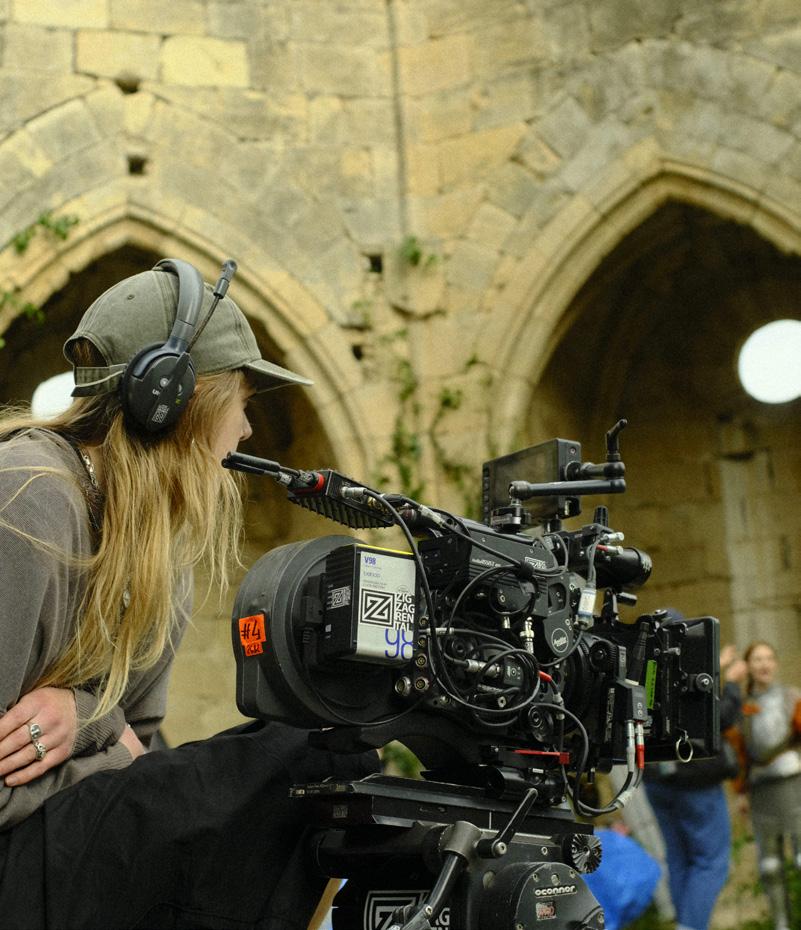
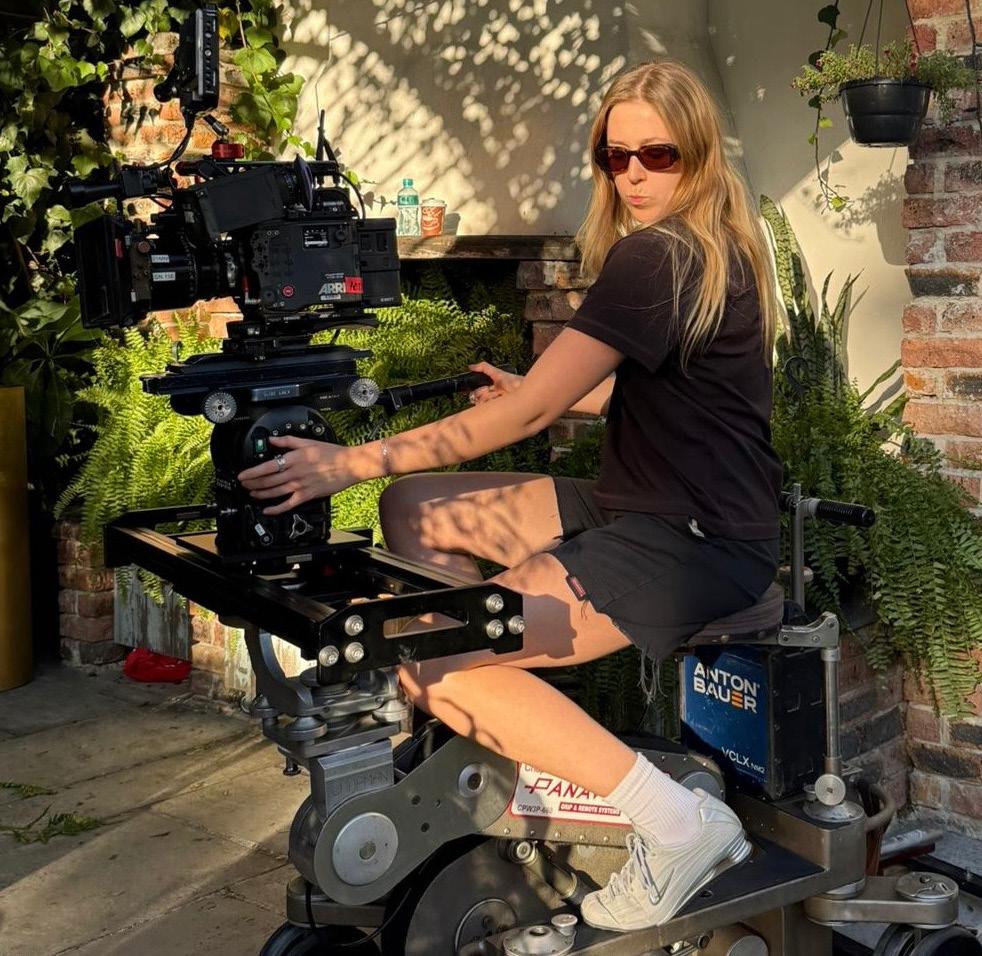
This page: Images (clockwise) – DP Valentina Caniglia CCS ASC shooting on a roof and in Jordan; Bart Sienkiewicz lensing a short film; Natasha Duursma on the dolly; Arseni Khachaturan filming The Drama; and another photo of Valentina Caniglia CCS ASC at the camera.
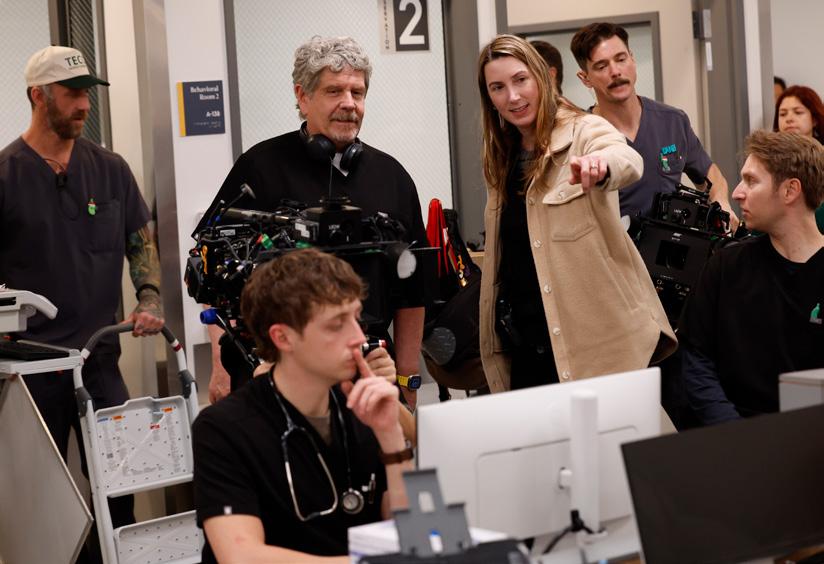
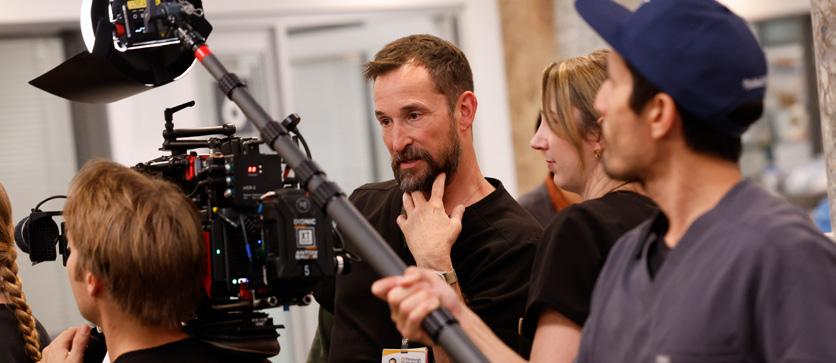
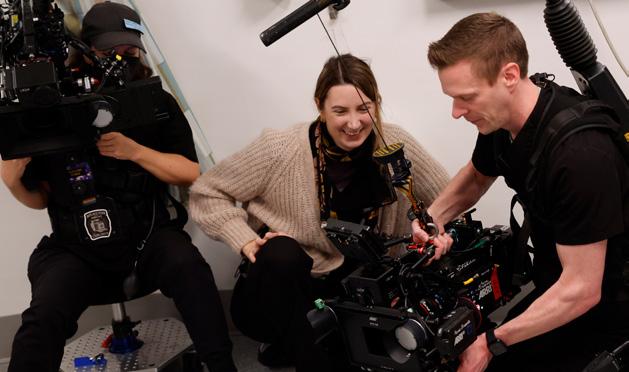
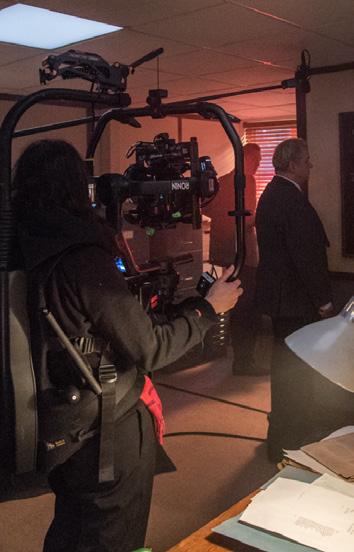
Opposite page: Images (clockwise) – Pat Aldinger shouldering the camera; Natasha Duursma enjoying the sunshine on the dolly; Johanna Coelho shooting The Pitt S2; Martyna Knitter with the Easyrig; Natasha Duursma again; Johanna Coelho on set of The Pitt again.
Rolling Stones promo directed by François Rousselet Mauro Chiarello lit an Epsilon Tequila campaign for director Tom Kuntz Rina Yang BSC filmed an OpenAI campaign with director Jess Kohl Christopher Aoun BVK is shooting Mr. Nawashi, directed by Isabella Eklöf. Harry Wheeler lit campaigns for Ally and EE, both helmed by Daniel Wolfe, and an Audi campaign with Elliott Power Ben Fordesman BSC shot a Coinbase spot directed by Oscar Hudson Justin Brown BSC lensed a SAP ad for director Rupert Sanders Darius Khondji ASC AFC shot a Charlotte Tilbury campaign directed by Christian Breslauer, and an NDA project with Wes Anderson James Laxton ASC shot an NDA project directed by Barry Jenkins Autumn Durald Arkapaw ASC is lensing the pilot episode of Untitled X-Files Reboot for Hulu, directed by Ryan Coogler. Arnaud Potier AFC shot a Club Med
LUX ARTISTS:
Steve Annis BSC is prepping for Eleven Missing Days, directed by Bertie Ellwood, and shot the
campaign with director Fleur Fortuné Nicolas Bolduc CSC has wrapped a Netflix series Dans Les Brumes De Capelans. Henry Braham, BSC continues on Mister, directed by Wade Eastwood. Eigil Bryld is shooting Somewhere Out There for Alexander Payne. Nico Poulsson FNF shot campaigns for Leapmotor with director Romain Chassaing, and for EA by Vedran Rupic Andre Chemetoff shot a Hoka campaign directed by Amber Grace Johnson Natasha Duursma shot a Ffern campaign with director Julia Jackman Jakob
latest
Ihre FSF and Manuel Alberto Claro are shooting the Netflix series Kennedy for Thomas Vintenberg. Arnau Valls Colomer AEC is lighting A Quiet Place III with director John Krasinski. Maximillian Pittner shot an Apple campaign directed by Rubberband, and an O2 commercial for director Miles Jay Patrick Golan shot campaigns for Burberry helmed by Elliott Power, as well as Armani and On Running, both with
AFC lit A Head Full Of Ghosts with directors Severin Fiala and Veronika Franz. Benjamin Roux wrapped Nord Loire, helmed by Antoine Chevrollier. Adam Scarth is lensing BBC series The Witch Farm with director Stacey Gregg. Nanu
Pantera Lol Crawley BSC ASC is lensing an untitled Damien Chazelle film. Matyas Erdely HCA ASC wrapped Deep Cuts directed by Sean Durkin Oscar Faura is lighting Ibelin directed by Morten Tyldum. Ryan Marie Helfant is shooting Parachute, directed by Annie Silverstein. Ruben Impens SBC wrapped The Custom of the Country, helmed by Josie Rourke. Arseni Khachaturan shot a Bvlgari campaign directed by Jonas Lindstroem Rik Zang SBC shot an NDA project helmed by Romain Chassaing Benjamin Kračun BSC has wrapped on Tom Ford’s Cry To Heaven Frank Lamm is shooting for BBC/ ZDF’s series Hamburg Days, directed by Christian Schwochow. Michael McDonough BSC ASC is lensing on Paramount+’s series Mayor Of Kingstown S5. Adam Newport-Berra is filming Apple’s The Studio S2. Yaron Orbach shot on Hulu’s series Southern Bastards with director Reinaldo Marcus Green. Julien Poupard AFC is lighting on Dumas, directed by Ladj Ly. Jonathan Ricquebourg
WHO, WHAT, WHEN & WHERE
Segal BSC has wrapped S7 of Apple’s Slow Horses.
Bobby Shore CSC is shooting Apparatus, directed by Sofia Banzhaf.
Jasper Wolf NSC is prepping for Please with director Halina Reijn Rob Hardy BSC ASC lit a Twix ad helmed by Dougal Wilson. Nicolai Niermann shot a Lancôme campaign for Rubberband Kasper Tuxen DFF shot a Spotify campaign with director Jonathan Alric Jake Scott directed a promo for FKA Twigs shot by Jordan Hemingway
LOOP TALENT:
The agency welcomes DP Petra Korner AAC to its roster. Petra’s impressive credits include His Dark Materials, Shadow And Bone and A Discovery Of Witches Bebe Dierken BSC is in prep for the HETV series The Last Resort Dave Miller is shooting the feature West The Road, directed by Ita Fitzgerald. Johanna Coelho AFC is prepping for The Pitt S3. Denson Baker ACS NZCS recently wrapped on the feature No Way Off Martyna Knitter is working on documentaries and short form. Matt North has been fliming a BBC series. Paul Mackay is lighting the feature Christmas Family Feud Ryan Eddleston is in prep for When Two Worlds Collide Ali Asad is prepping for a feature. Oona Menges BSC is attached to the feature Human Remains Darran Bragg has been meeting about HETV and film projects. Marti Guiver is framing commercials and music promos.
Naoise Kettle is working with director Tom Day. Emma Dalesmen has been shooting documentary projects. Olly Wiggins has been lighting a food series. Nick Bennett lit commercials for Sky and BBC. Thomas English has been filming VP commercials. Jon Muschamp has been shooting short form. Bertrand Rocourt has been working in Europe. Tom Turley and Chris O Driscoll have
been shooting short form. Natalja Safronova is prepping for an Air BnB content shoot. The agency also welcomes Steadicam/camera operator Rachel Wood and camera operator Louise Murphy Michael Eshun-Mensah ACO has re-joined the diary service. Lou Macnamara has been upgraded to an Associate ACO member. Junior Agyeman-Owusu ACO is B-camera/Steadicam on a six-parter for Bad Wolf/Netflix, shooting in Cardiff. Steadicam operators James Anderson ACO and Ben Mitchell ACO have been operating dailies. Grant Sandy-Phillips ACO is in prep for a feature. Ben Eeley ACO SOC has started on Wahala as B-camera/ Steadicam for Firebird Pictures. Gary Kent, Michael Vega and Nicolas Di Maetto have been operating Steadicam on commercials and music promos. Chai Rolfe has been operating on live events. Fabio Olgiati was Steadicam operator in Tuscany on a factual entertainment series for Studio Lambert.
Jack Smith has been operating for Mad Cow Films on ads. Toufique Ali operated on a project in Geneva. Laura Van De Hel is operating on Gangs Of London S4.
This page: Images (top down) – two pixs of Korsshan Schaluer pictured with focus puller Dom Cheung Focus, and with 2nd unit DP Carmen Pellòn, both on the set of an upcoming HBO Series, photos by Colin Hutton.
feature with director Michael Almeryeda, and recently worked on a campaign for Christian Dior.
WORLDWIDE PRODUCTION AGENCY: Christophe Nuyens SBC has wrapped the first series of Harry Potter for Warner Brothers and HBO with director Ben Caron. PJ Dillon ASC ISC continues on Wednesday S3 with director Tim Burton for Netflix. Stephen Murphy BSC ISC is prepping on Mr & Mrs
ECHO ARTISTS:
Ailsa Aikoa has worked on several campaigns with directors including Katie Lambert, Seb Gillmore and Emily Freda Sharp. Bjorn Stale Bratberg BSC FNF recently joined the agency as a new client. Nicolas Canniccioni worked on Marie Madeleine with director Gessica Généus in Haiti, which premiered at the 2026 Cannes Film Festival. Federico Cesca ADF ASK is back shooting S2 of an HBO series. Andrew Commis ACS is shooting Robert Connolly’s feature in Antarctica. Nick Cooke is filming an A24 project, directed by Kate Hewitt. Ruben Woodin Dechamps has been framing documentaries with production house Magna. Maria Von Hausswolff is shooting a Millennium Films project with director Martin Campbell. Yunus Roy Imer is prepping on a TV project with Firebird Pictures. Jo Jo Lam recently worked on Jean Michel, selected for the 2026 Tribeca Film Festival as part of the documentary competition. Toby Leary recently wrapped on an Adidas documentary with Rebecca Salvadori, screening in and around the UK in the coming months, and also filmed campaigns for SFC x Adidas and Aston Villa. Will Pugh is shooting documentaries for Paramount Pictures, Amazon and HBO. Korsshan Schlauer has finished a Merman series for HBO, penned by Sharon Horgan and directed by Dawn Shadford, and graded Trash TV Noel Schoolderman recently wrapped a feature in South America, and has been filming in the UK with Luke Brookner. Ben Smithard BSC has been lighting commercials. Chloë Thomson BSC is shooting a new series written by Anya Reiss, produced by The Forge Entertainment for BBC1, directed by Mahalia Belo. Sean Price Williams is filming a
Smith S2 for Amazon. Callan Green ACS NZCS shot pick-ups and has graded Amazon/ MGM Studios’ The Beekeeper 2 with director Timo Tjahjanto. Michael Snyman has kicked-off the third season of Netflix’s 3 Body Problem, with director Miguel Sapochnik. Fabian Wagner BSC ASC is shooting Minecraft 2 with director Jared Hess for Warner Bros. Ruairí O’Brien BSC ISC continues shooting on Peacock’s The Day Of The Jackal S2 alongside director Neasa Hardiman. Colin Watkinson ASC BSC has wrapped Wild Things for Apple TV+, with Richard Donnelly ISC working alongside and wrapping-up additional photography. Jamie Cairney BSC continues on the new BBC series Legacy Of Spies with director Michael Lennox. Joel Devlin BSC completed the final block of This City Is Ours S2 for BBC, and is prep on block two of The Lord’s Day for Bad Wolf.Netflix. Tony Slater-Ling BSC filmed Fox/Lionsgate TV’s The Interrogator with director Paul McGuigan. Vanessa Whyte BSC has wrapped and started grading on Apple TV+’s Ted Lasso S4. Maja Zamojda BSC has graded the new Netflix series Project Codename Mattias Nyberg BSC has done the DI on Paramount+’s The Crow Girl S2 with director Bex Rycroft. Matt Toll is prepping 2nd unit on the upcoming live-action Tangled remake for Disney. Pedro Cardillo ABC shot ITV’s Grace S7 with director Imogen Murphy, and began prep on new BBC series Sutherland with director Patrick Harkins. Katie Swain shot on the splinter unit of The Batman Part II for Warner Bros. and DC Studios with director Matt Reeves. David Ungaro AFC is prepping for the Netflix’s Dept. Q S2 with director Scott Frank. Anna Patarakina FSF has wrapped on the new Clerkenwell Films/BBC’s series Shy & Lola with director Samuel Donovan. Xavier Dolléans
AFC shot the feature A Cowgirl For Christmas with director Leslie Greif. Mattias Troelstrup DFF continues shooting the second block of the Netflix series Breakers Arthur Mulhern ISC has graded The Hardacres S2 for directors Rachel Carey and Stephen Bradley. Job Reineke is shooting on ITVs The Bay S6 with director Brian O’Malley, whilst Sunshine Hsien Yu Niu is prepping block 2 with director Bindu De Stoppani. Emily Almond Barr lit Maigret S2 for PBS with Patrick Harbinson directing. Paul Morris has graded Apple TV+’s new series The Wanted Man with director Rachel Leiterman. Rotem Yaron continues on Apple TV+ series Safe Houses with Otto Bathurst. Bryan Gavigan has completed on C4’s series Maud with director Lee Haven Jones. Lorenzo Levrini shot 2nd unit on Gangs Of London S4, while also prepping his next feature. Edouard Le Grelle has wrapped on the feature Sandy Banks with director Tony O’Donnell in Ireland. Jake Gabbay lit a Nike ad in Paris with Division directed by Marius Gonzalez, and then travelled to Leipzig for a New Balance spot with Love Song and Walid Labri. Benjamin Todd shot Draft Kings in Prague with Academy Films’ director Joseph Khan, followed by a Coral commercial directed by Rich Hall through for Riff Raff Films. Matthew Emvin Taylor shot American Century with RSA Films’ director Jack Cole in Serbia, the returned to London for an ad for The Economist via Biscuit Filmworks with Florence Poppy Feary, and then a Barclay’s commercial with Girl & Bear director Zac Ella. Benjamin Cotgrove lit a Persil TVC for Revolution director James Coton in Romania, filmed with Collider director Dan French in Auckland, and then went to Kosovo for a Duracell ad directed by Ernest Desubila via Kode Media. Amelia Hazlerigg shot a John Lewis ad with You Are Here Productions. Dan Holland lit for Penny with Markenfilm director AJ Colomb in Berlin. Samual Hooper wrapped an MNEK music video with Friend director Douglas Reddan, and framed an Adidas ad with Attitude director Thomas Van Kristen. Edward Gibbs shot a L’Oreal spot with McCann Films, directed by Vicky Lawton. Joel Honeywell collaborated with Dazed Media for Escentric Molecules, directed by Services Généraux. Matthew Fox shot a McCafe TVC with Prettybird director Joy Kilpatrick, and then moved onto a Krude shoot with Dark Energy director Mike Matthews. Nathalie Pitters shot an Andrex ad with director Ruth Pickett via Hungry Man. Dajiana Huang lit a Reina music video with Magna Studios, directed by Ivo. Luke C. Harper shot with The NTWRK for a Flo music video with director Troy Roscoe. Tony C. Miller lit a Herbal Essences ad with Mathematic and Léa Esmaili. Björn Charpentier SBC was in Sofia on a Range Rover commercial with director Xavier Mairesse and Chormista.
UNITED AGENTS:
Ricardo De Gracia is shooting a mini-series in Spain. Sonja Huttunen is filming a comedy series in Finland. Philippe Kress DFF lit on The Day Of The Jackal S2 for Carnival Films/Sky. Mark
Nutkins filmed an episode of Casualty for BBC. Danny Cohen BSC is shooting on Doctor Foster S3 Damian Paul Daniel worked alongside Ventureland on a feature documentary. Matt Lewis is in New Jersey framing Netflix’s Rabbit Rabbit with Philip Barantini Kieran McGuigan BSC is lighting the final block of The Buccaneers S3 Simon Tindall has graded Sherwood S3 directed by Clio Barnard. Frida Wendel FSF has done the DI on the four-part TV2 Norway/ Amazon Prime series Rinnan with director Kenneth Karlstad Laurens de Geyter is lighting Dochters, a Belgian series, with director Anthony Schatteman Sam Heasman is working on Supacell S2 for Netflix. Si Bell BSC has graded the drama series Maya for C4. Rachel Clark BSC shot Finding Emily James Friend BSC ASC is in New Zealand lensing Lord Of The Rings: The Hunt For Gollum, directed by Andy Serkis. Milos Moore is shooting the first series of Bishop for Amazon MGM Studios. Ed Rutherford BSC is lighting the first series of upcoming BBC sci-fi thriller Sutherland Ben Wheeler BSC is shooting the new series of
WHO, WHAT, WHEN & WHERE
Speeckaert ASC AFC SBC shot a Fiat 600 ad for director Bart Timmer via Movie Magic International. Gavin Struthers ASC BSC has wrapped on A Visit To Grandpa’s starring Anthony Hopkins. Adam Suschitzky BSC is lighting Foundation S4 for Skydance/Apple TV. Matt Windon is working on Three Body Problem S3 in Budapest. Marcel Zyskind DFF filmed a commercial in Buenos Aires with director Stuart McIntyre via Canada.
VISION ARTISTS:
Benedict Spence is shooting an NDA Apple series across the UK and Europe. Jonas Mortensen graded Counsels, a Glasgow-set legal drama produced by Brian Kaczynski and directed by Lynsey Miller for BBC, and is shooting on the new series of Gangs Of London. Kia Fern Little’s BBC short Jealous People Are Ugly People, directed by Theo James Krekis for The Fold, had its US premiere at SXSW. Will Hanke’s new TV series Alice And Steve for Clerkenwell Films, directed by Tom Kingsley and starring Jemaine Clement and Nicola Walker,
is premiering now. Will has also graded the new BBC comedy series Break Clause, directed by Alice Snedden. Jim Jolliffe has done the DI on the new Disney docu-Series Pompeii, produced through Little Island and directed by Tom Barbor-Might. Anna MacDonald is shooting material for an NDA documentary for Object And Animal, directed by John Davies. Luciana Riso’s short Free Eliza, directed by Alexandra Matheou, premiered at 2026 Cannes Film Festival.
MCKINNEY MACARTNEY MANAGEMENT: Stuart Biddlecombe is shooting Lluest with director Gareth Bryn. Ben Butler has been filming spots. Wes Cardino is lensing on Nobody Wants This S3 for Netflix in LA. Sergio Delgado BSC AEC is lighting on Amazon’s The Assassin S2, directed by Sarah O’Gorman. Jean Philippe Gossart AFC continues on Disney’s Shōgun S2. Andy McDonnell is behind the camera on BBC’s Shy & Lola, directed by Emily Atef. Richard Mott is lighting ITV’s Two Birds, directed by James Griffiths. Richard Stoddard recently wrapped on Forever Home for C5, directed by Claire Winyard. Robin Whenary recently completed shooting on ITV’s Saviour in Liverpool, directed by Annetta Laufer.
Peaky Blinders for BBC/Netflix. Barry Ackroyd BSC has been lighting commercials, including a Denza ad featuring Daniel Craig, directed by Yann Demange via Park Pictures. Alex Barber has been lensing commercials, including a Sunrise spot with director Mike Warzin in Switzerland through Czar Film. Simon Chaudoir was in Paris working on two Dior jobs, one for director Amy Troost and one for Torso. Sara Deane is framing Buccaneers S3, block 2 for director Amy Neil. Catherine Derry BSC has wrapped on the upcoming Peaky Blinders sequel series. Lasse Frank shot a VW commercial with directors Andreas Nilsson and Henry Moore Selder, in Spain through Czar Film. Florian Hoffmeister BSC is shooting The Riders with director Edward Berger. Corey Robson is lighting Yellowjackets S4 in Vancouver. Oli Russell BSC is lensing the series War for HBO. Glynn
This page: Images (top down) – two shots of DP Cordelia Lawler shooting Nepenthe, a narrative-based Sadler’s Wells dance film directed by Jordan Chandler.
GLORIOUS LUTS
By David Stump ASC BVK
Common LUT Format (CLF) is almost (but not quite yet) a SMPTE specification. It is still going through the comments process before becoming a full-fledged standard soon.
Cinematographer David Stump ASC BVK –who has worked on numerous motion pictures and TV productions as DP, as a visual effects DP and as a visual effects supervisor, with Emmy nominations and an Academy Award for Scientific and Technical Achievement to his name – has been intimately involved with the development of the CLF for over two decades. Here’s a look at how the CLF came about.
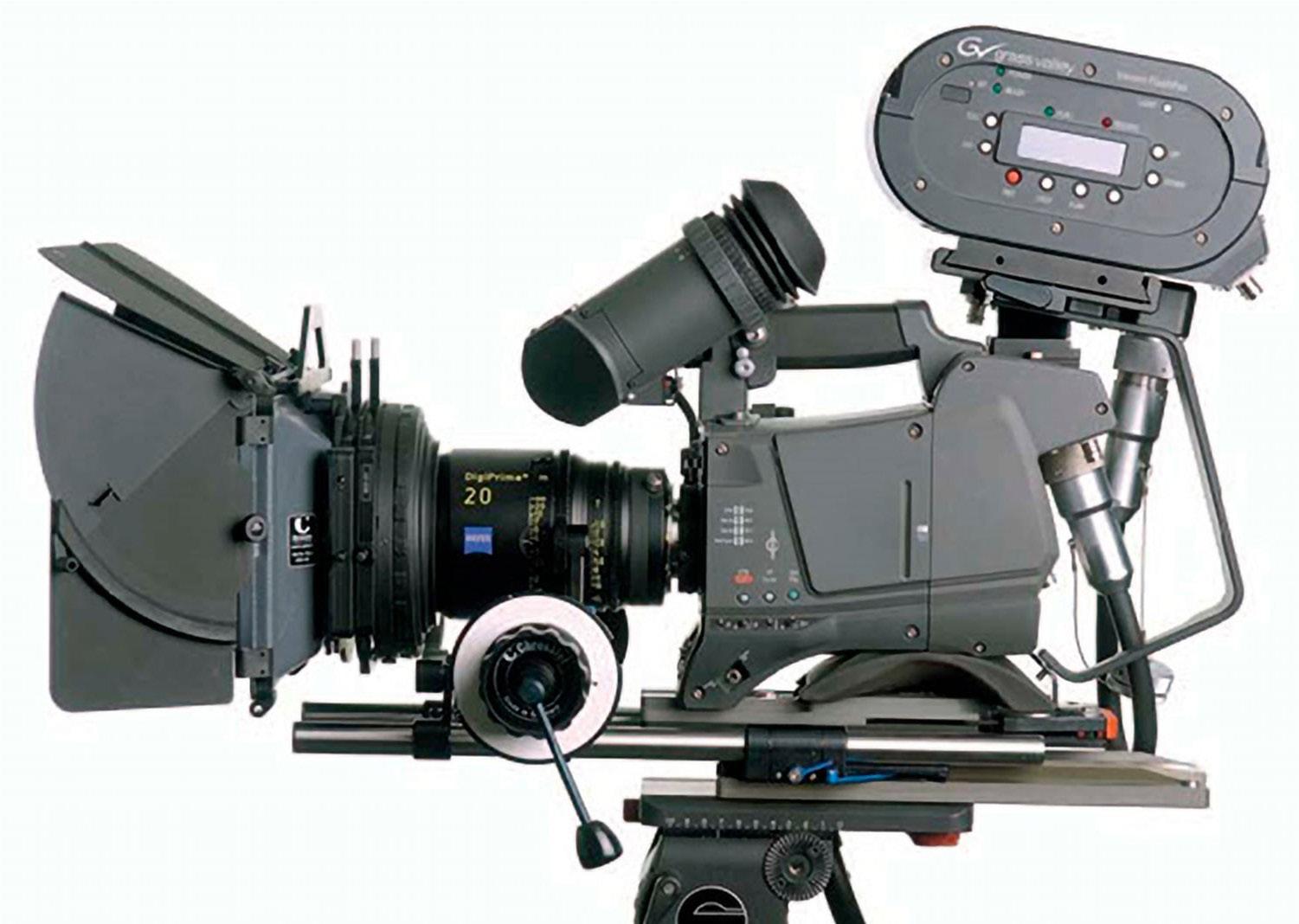
From about 2002 through to 2005, I shot several digital feature films, predominantly using the Thomson Grass Valley Viper Filmstream and the Sony F950 cameras. Because I planned to do a lot of VFX work on those movies, I determined that instead of using a baked-in Rec709 workflow, I would implement log workflows (very experimental workflows at the time!) to capture a more robust camera original. This meant that I would necessarily have to employ Look Up Table (LUT) correction to the camera signal for viewing and post production.
CLF is in very wide use all over the world now
As I made my way through the maze of what were prehistoric digital cinema workflows, I quickly learned that while many claimed to have a LUT solution for my purposes, none of the 50 plus solutions was interoperable with any other. Converting digital camera signals into a viewable signal, or even worse, conditioning the signal for a Digital Intermediate pipeline was an enormous problem. Fortunately, I had enough friends in colour science to call-in many, many favours along the way.
When I finally took a break from back-toback productions, I convened a small meeting of the then tiny ASC Metadata Committee (that I chaired), to talk about what I had learned. With a modest measure of begging and convincing, I got several people to agree to help me develop a LUT format that would be interoperable.
Jim Houston, Ana Benitez and Gary Demos were among my co-conspirators, and we set about analysing the state of the technology of LUTs. We were in unanimous agreement that we would use Extensible Markup Language (XML) for the task.
David Stump ASC BVK is a renowned cinematographer and VFX supervisor, celebrated for his work on major films including X-Men, The Bourne Identity and Deep Blue Sea. He has earned an Emmy Award, an Academy Award for Scientific and Technical Achievement, plus the IMAGO Technical Achievement Award, and is serving as a professor/researcher at Universidade Lusófona in Lisbon, Portugal.
As the work progressed, Andy Maltz at AMPAS Sci Tech became interested in what we were doing and asked if the colour science staff at the Pickford Center For Motion Picture Study in Hollywood, owned by the Academy of Motion Picture Arts & Sciences, could participate in the process.
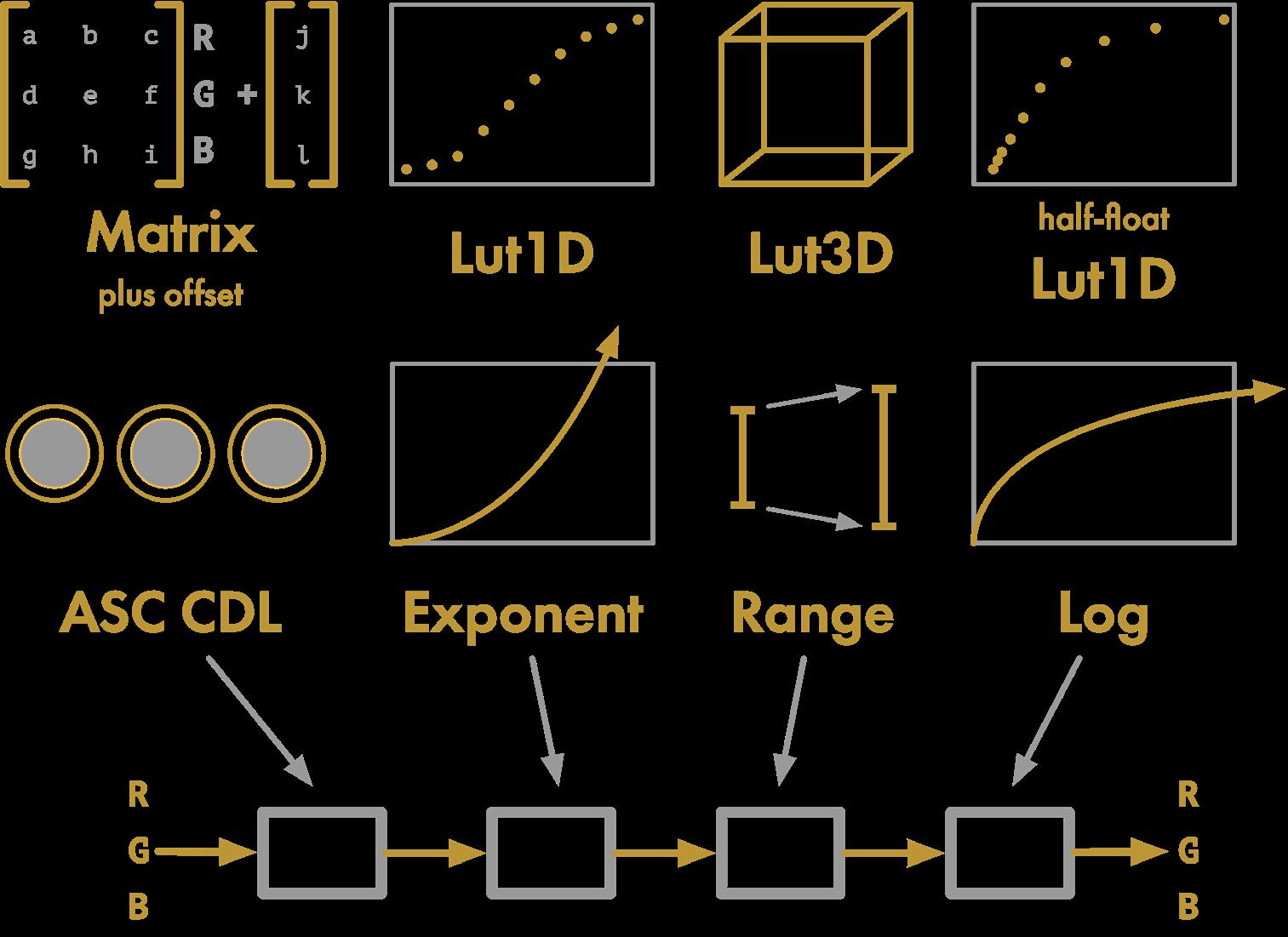
After several years of gestating, in 2008 version 1.0 of the Common LUT Format spec was released (CLF version 1.0). In that original specification, we defined four “process nodes”: LUT3D, LUT1D, Matrix and Range.
Then in 2012, Autodesk introduced CLF support in Flame and Lustre. The version of CLF with Autodesk extensions (adding more process nodes) was called CTF. In 2014 Autodesk introduced CLF support in Maya.
Also in 2014, the ACES committee at AMPAS decided to update the spec and include it in the ACES specification. Later in 2014, the ASC and AMPAS jointly released “A Common File Format for Look-Up Tables” (CLF version 2.0), which added support for two features of Autodesk CTF, namely ASC_CDL process node and half-float LUT1D.
In 2019 the ACES group convened a CLF virtual working group to update the spec. In 2020, the ACES 1.2 release contained a revised version of S-2014-006 (CLF version 3.0) which added support for two more Autodesk CTF features – Log and Exponent (i.e., gamma) process nodes.
Later in 2020 the ACES group convened a CLF virtual working group to develop an implementation guide, and in 2021 the ACES group
published the CLF implementation guide on their website (heavily leveraging OCIO). In 2021, OpenColorIO v2.0 was released with support for CLF v3.0, and CTF, Autodesk’s extended version of CLF, became the native format for OCIO lossless I/O for all transforms.
In 2023 the SMPTE convened a CLF drafting group under 31FS, and later moved to 10E. As of 2025, CLF is supported in dozens of apps via OpenColorIO, including: Adobe PhotoShop/ After Effects/Substance, Foundry Nuke/Mari, SideFX Houdini, Epic
Maya/3DS Max/RV/Arnold/VRED.
HISTORY OF THE COMMON LUT FORMAT
I have continued to participate in the evolution of the specification through all these years, and I am happy to report the next stage of its success. The draft SMPTE spec has now been published for public review, taking advantage of SMPTE’s new process on GitHub: https://github.com/SMPTE/st2136-1/
Colour scientist Doug Walker reposted their LinkedIn announcement with some extra commentary. To quote his post, “The industry is one step closer to finally having an archival standard for LUT formats. SMPTE has published on GitHub for public review and comment the committee draft specification for the “Common LUT Format” (CLF). If you’re not familiar with CLF, it is capable of holding more than just 1D and 3D LUTs – it’s a powerful colour transformation pipeline capable of handling extended-range floating-point images.
“The SMPTE working group started with the widely-used Academy/ASC CLF spec and completely reworked it to follow the rigorous format necessary to become a SMPTE standard. Most existing CLF files will only need a change of the header line in order to be compatible, although the syntax rules are now more strict. I encourage you to download the PDF and post your comments on the GitHub site before the public review period ends.”
I recently received an email from a senior R&D engineer at the BBC. He was writing to invite comment on the proposed specification, and when I replied, I suggested that we should do a zoom call. He explained to me that the CLF is in very wide use all over the world now, having become the de facto transform for colour matching at the BBC, and at almost every European broadcast network. It has been used for many purposes including World Cup soccer, Formula One racing, the Olympics, and even the coronation of King Charles III.
To quote his email, “To add to the discussion on LUTs, I would just like to introduce the new set
of profiles of the new CLF standard designed for real-time production. It is currently out for public consultation.”
From the GitHub welcome page, “In high-end modern live television production, there is often a need to produce a number of output formats for delivery to the end user, to other broadcasters and to the archive. When producing multiple video formats, broadcasters and production companies currently rely on Look-up Tables (LUTs) to perform a range of conversions. Current LUT
formats can be difficult to use and require expert knowledge to install correctly.”
SMPTE ST 2136-10 aims to make the process much easier. I am still working for the advancement of technology in the name of the craft of cinematography. Needless to say, I am pleased and proud that our tiny little ASC Metadata Committee initiated something that eventually became so powerful! Even if it did take 20+ years to accomplish.
FRAME OF MIND
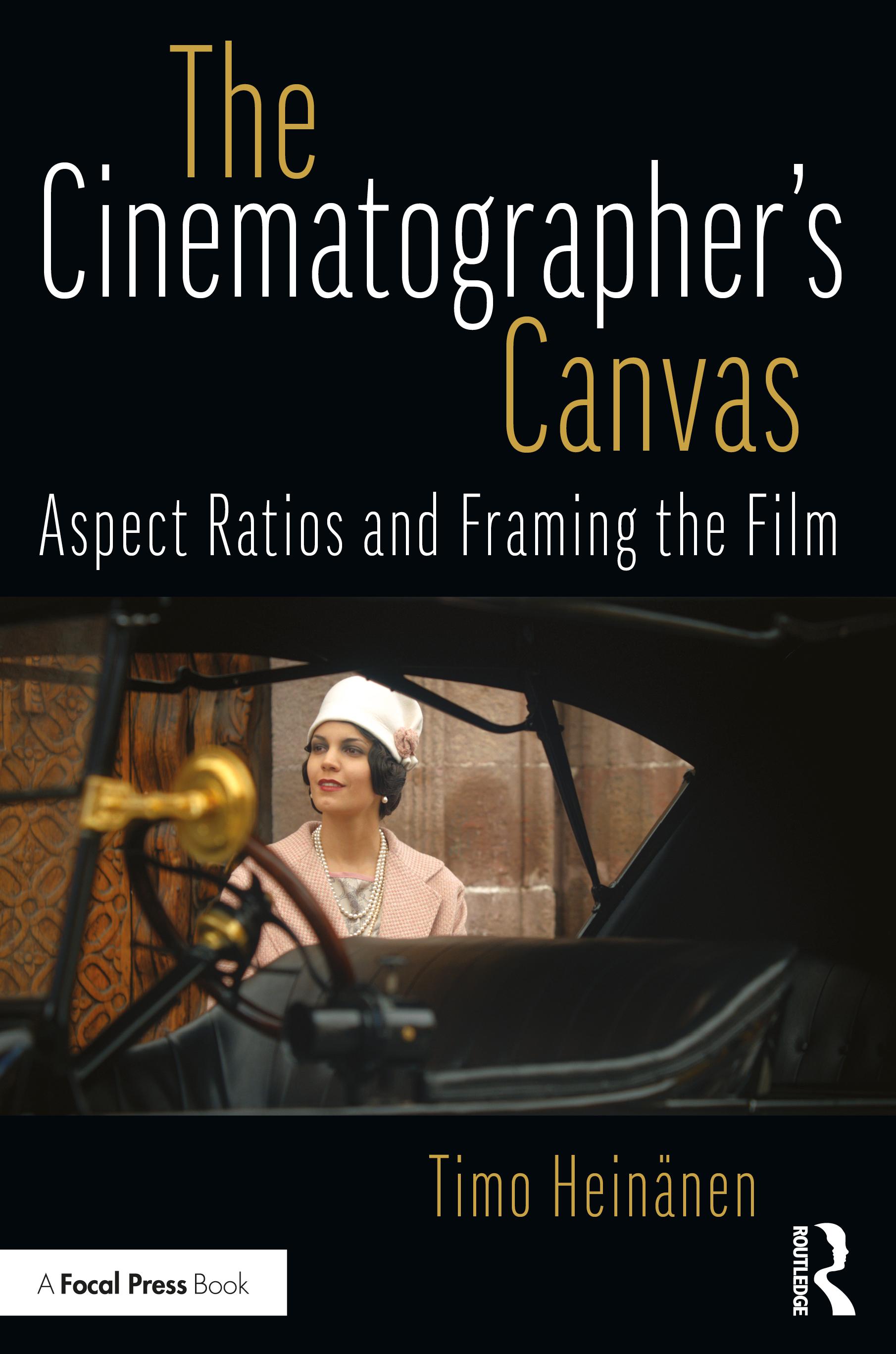
Timo Heinänen’s book, Cinematographer’s Canvas – Aspect Ratios And Framing The Film , investigates the crucial yet often under-appreciated role of cinematographers in shaping cinematic narratives through aspect ratios.
It features over 40 cinematographers from around the world including: Vittorio Storaro AIC ASC, Annika Summerson BSC, Anthony Dod Mantle DFF BSC ASC, James Chressanthis ASC GSC, Elen Lotman ESC, Jerzy Zielenski ASC, Louis-Philippe Capelle SBC, Nik Knowland BSC, Olympia Mytilinaiou GSC, Philippe Ros AFC, Sławomir Idziak PSC and Joan Hutton CSC.
Beginning with an historical overview, Heinänen identifies the gap in academic discourse regarding their vital contributions and stresses the need for deeper understanding of how aspect ratios influence artistic expression and decisionmaking. The introduction sets the stage for a comprehensive exploration of the technical and creative dimensions of framing, composition and collaboration.
Pre-production is presented as foundational, with cinematographers working closely with directors and crew to translate scripts into visual concepts. Initial readings of the screenplay spark intuitive responses that guide aesthetic decisions. Storyboards, communication and collaboration ensure coherence, whilst aspect ratios enhance narrative themes. The text emphasises that thorough pre-production often determines the quality and unity of the final film. The chapter underlines the delicate balance between artistry and practicality.
The selection of aspect ratios is examined as a complex process involving cinematographers, directors and producers. Whilst cinematographers frequently initiate discussions, artistic choices may be constrained by technical requirements or distribution demands. This tension between creative vision and external pressures can lead to frustration, but successful collaborations yield innovative uses of aspect ratios that enrich storytelling.
The chapter entitled, The Modes Of Activity In The Selection Process, emphasises balancing artistry with practicality. Collaboration with directors is highlighted as central. Communication, trust and mutual respect are essential, as directors vary in their approaches – some preferring meticulous preparation, others spontaneity. Early discussions about aspect ratios can significantly influence framing and storytelling. Cinematographers
Timo Heinänen FSC, is a professional cinematographer with over 30 years of experience in film and television, and a member of the Finnish Society Of Cinematographers. His career includes more than 20 feature films, numerous TV series, short films, documentaries, commercials and music videos. Alongside his creative work, he has dedicated himself to teaching, serving as a cinematography professor at ELO Film School Helsinki, head of camera at London Film School, and most recently as a teaching fellow at British University Vietnam. Drawing on decades of practice and observation, he brings a unique perspective as both filmmaker and educator.
navigate directors’ visions whilst maintaining creative freedom, adapting to different levels of visual literacy.
In the chapter The Act Of Framing – Emotions, Intuition And Rules, aspect ratios are further explored as tools that shape audience perception and emotional engagement. Filmmakers select ratios to align with genre conventions, narrative needs and audience expectations. Cinematographers describe how unconventional ratios can evoke emotions or challenge norms, as technological advancements expand possibilities. The evolving nature of aspect ratios reflects both tradition and innovation,
with filmmakers experimenting to forge deeper connections with their narratives.
Framing and composition are presented as critical to shaping the viewer’s experience. The immersive nature of cinema is influenced by aspect ratios, which can heighten or disrupt immersion. Unconventional ratios may draw attention to the screen’s borders, altering perception. Cinematographers discuss how composition conveys emotional tones and narrative depth and peripheral vision. Emphasising the harmony between individual style and storytelling requirements illustrates how compositional
decisions can enhance narrative most effectively.
Visual art serves as a major source of inspiration, with cinematographers drawing from paintings to inform shot composition, lighting and colour palettes.
Collaboration with directors and designers allows them to infuse films with expressive visuals that support narrative depth.
The interaction between artistic expression and cinematic techniques produces works that are visually compelling and intellectually stimulating.
The evolving nature of aspect ratios reflects both tradition and innovation, with filmmakers increasingly experimenting to forge deeper connections with their narratives.
Instinct, intuition and gut feeling often guide initial choices
The chapter entitled, On The Centre, Balance And Void, explores the concept of centre and balance in composition through aspect ratios. Wider formats allow dynamic instability, square formats emphasise verticality and constrain the energy vectors to be spread, whilst negative space and frame edges contribute to narrative meaning too, possibly highlighting the psychological impact and emotional resonance of composition. Instinct, intuition and gut feeling often guide initial choices. Aspect ratios themselves can evoke emotions such as loneliness or tension. Reasoning can overshadow intuition, but revisiting instinct enhances authenticity and emotional depth in visual storytelling.
Rules and dogmas of composition, such as The Golden Mean and Rule Of Thirds, are discussed as guiding principles. They are used either consciously or subconsciously. Some follow the rules strictly, but others break them to serve narrative needs. The
text promotes flexibility, recognising the interplay between theory and instinct in framing decisions.
The final part of the book reinforces its central point: cinematographers play a vital role in shaping cinematic narratives through aspect ratios. Frames not only present images but structure them, revealing choices about inclusion and exclusion. Drawing on interviews, questionnaires, and personal experience, the author calls for
reevaluating how aspect ratios are chosen and their narrative potential. Ultimately, the book advocates for a deeper exploration of visual grammar in cinema, elevating recognition of cinematographers’ contributions to the art form.
The book can be purchased online at Routledge, Amazon, Ebooks, Barnes & Noble and Adlibris.
VISUAL ARTISTRY IN THE AGE OF AI • FUTURE SHOCK
STEP UP!
By Michael Goi ASC ISC
The American Society Of Cinematographer’s Artificial Intelligence Committee was formed three years ago to explore the potential applications that (at the time) fledgling technology might have for professional visual storytelling. Today, the rapid growth in sophisticated functionality of various models has spurred a flurry of social media sites dedicated to provoking anxiety and outrage with headlines like “Hollywood Is Dead!” and “A Complete Feature Film In An Hour!” But the reality is not quite that cutand-dried.
Art is not random. Art is specific. It is for that very reason AI can never make a great filmmaker out of a mediocre one. There is a difference between having a vision and selecting the tools to make that specific vision a reality, and just accepting anything that pops up and looks cool. Being a visual artist requires that you have the visual in your imagination before you manifest it using lights, film, digital, paint, or any medium you
can think of, including AI.
The live AI demonstrations that the ASC has done for Camerimage, the 2025 AI Summit Conference and other events paired cinematographers like Caleb Deschanel ASC and Dante Spinotti AIC ASC with emerging AI content creators such as Ellenor Argyropoulos and Matthew Wenhardt. The idea was to dispel the myths behind the medium and to emphasise the need for a depth of technical know-how and a grounding in the fundamentals of film grammar in order to work with AI.
Cinematographers need to step-up right now and be part of where AI is going
You can access video recordings of the June 2025 two-day ASC AI Summit here: https://f.io/cLUA701Y Password: SummitAI What was proven time and again was that the more specific your vision is, the more
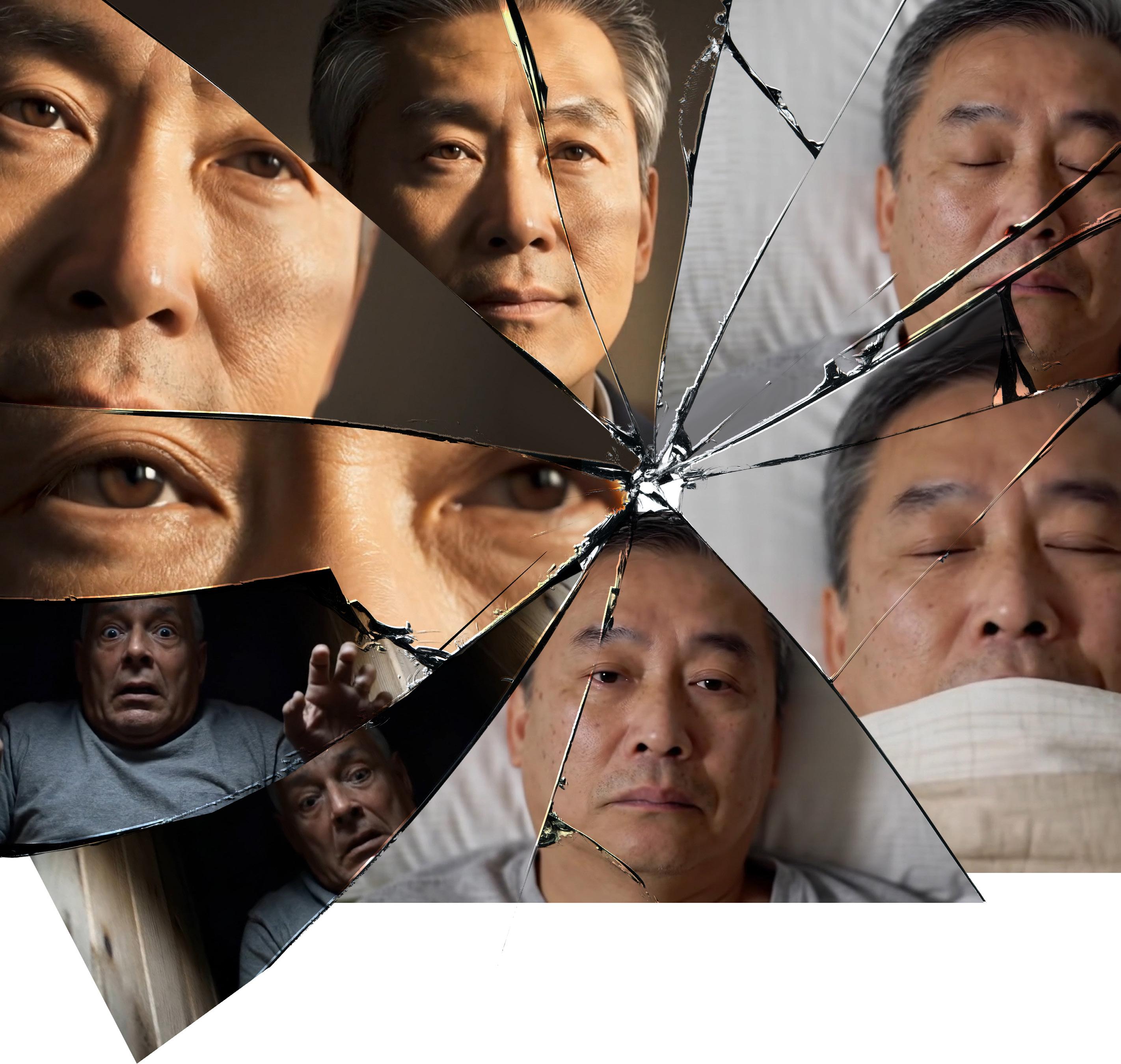
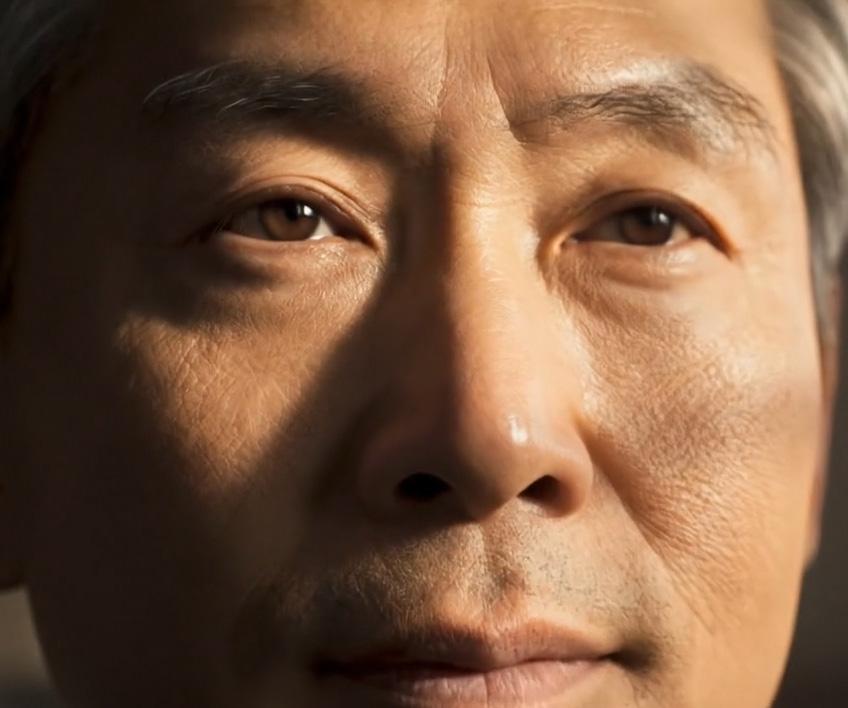
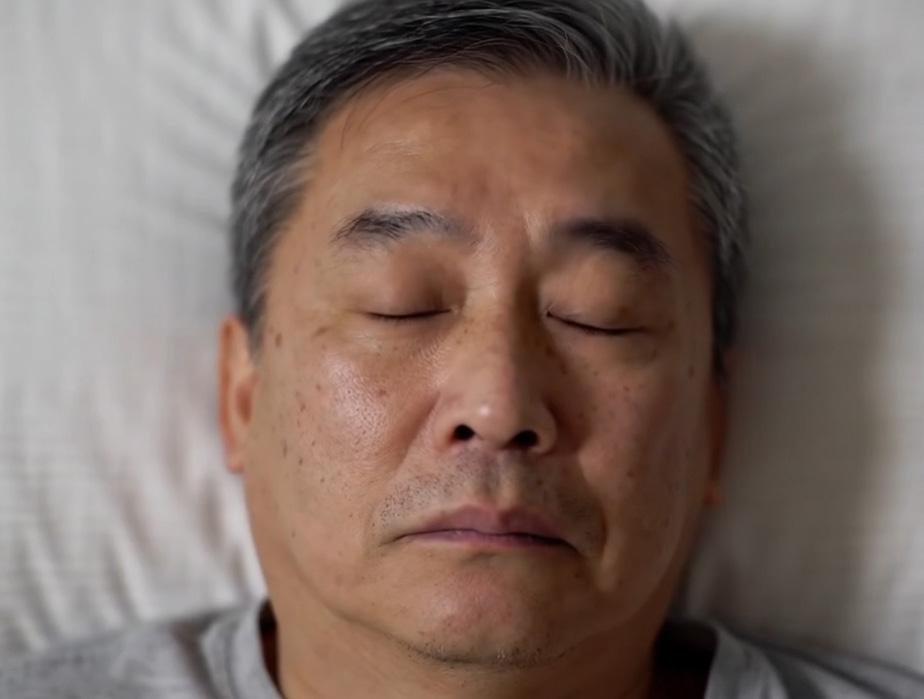
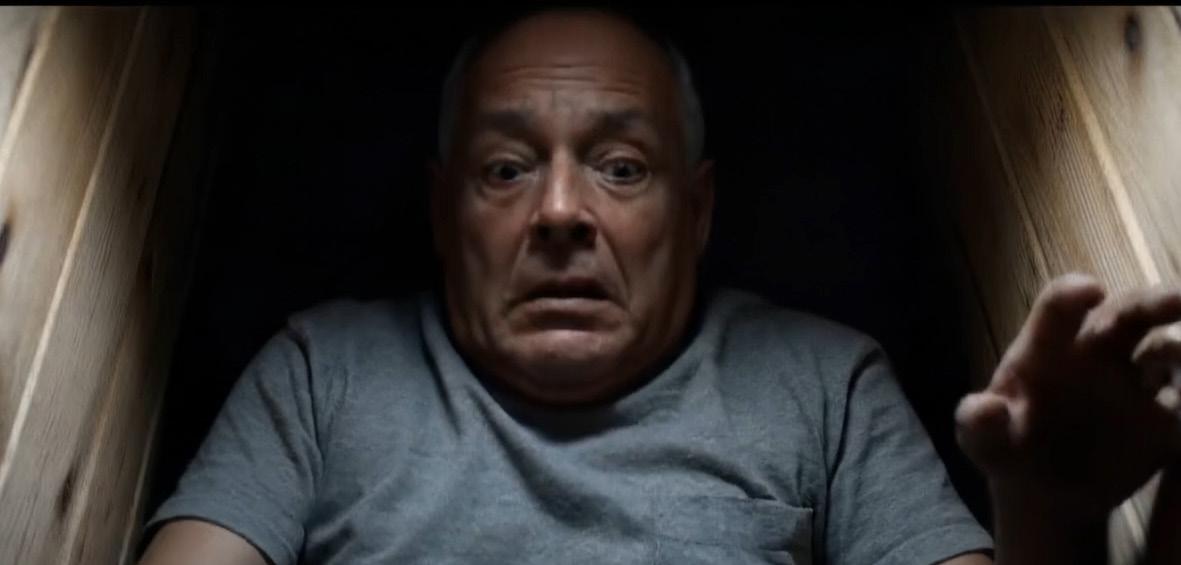
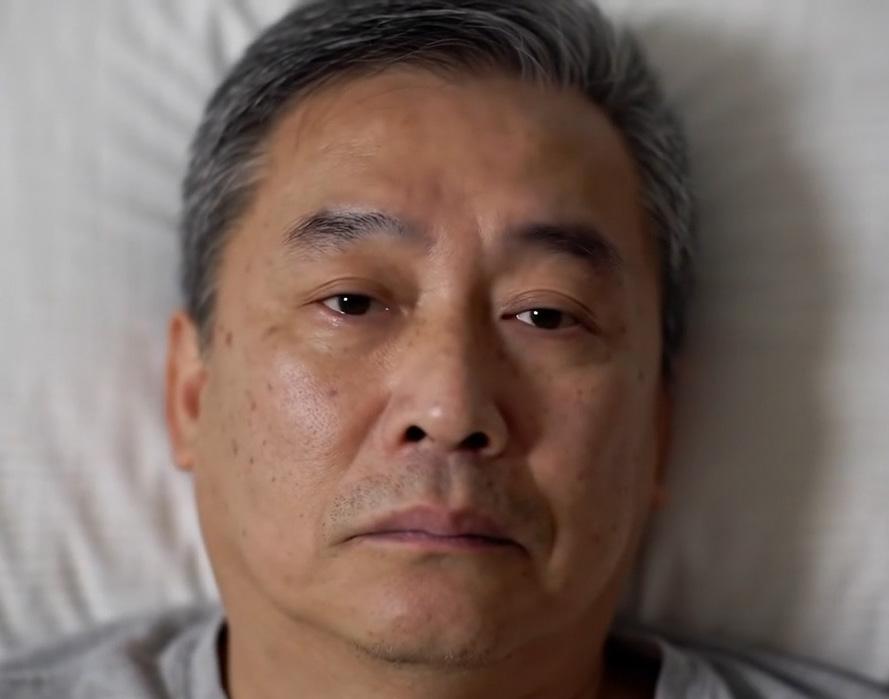
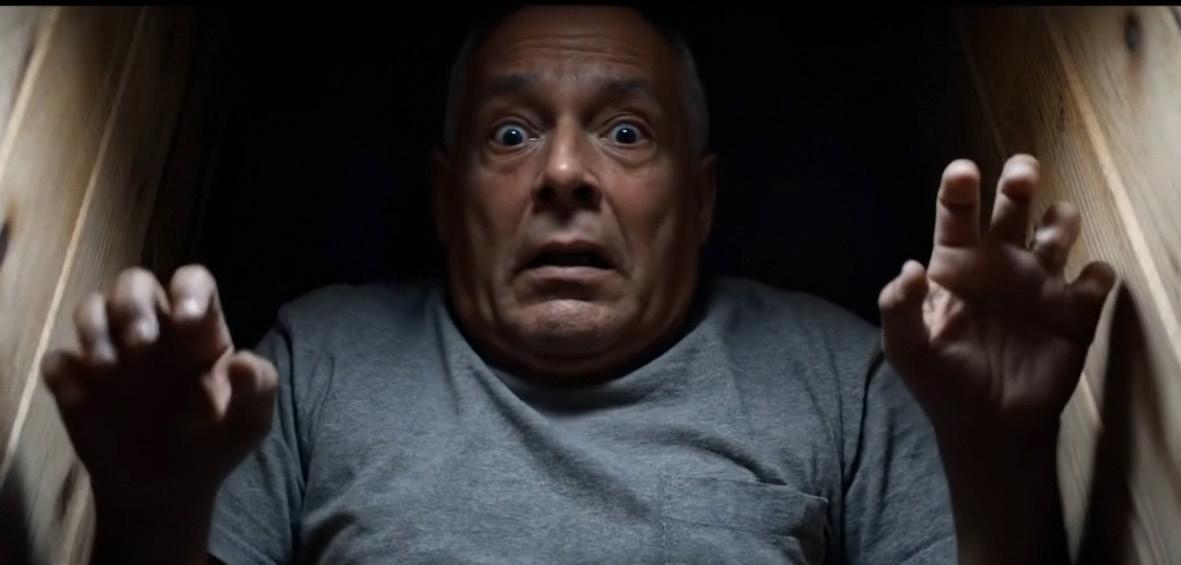
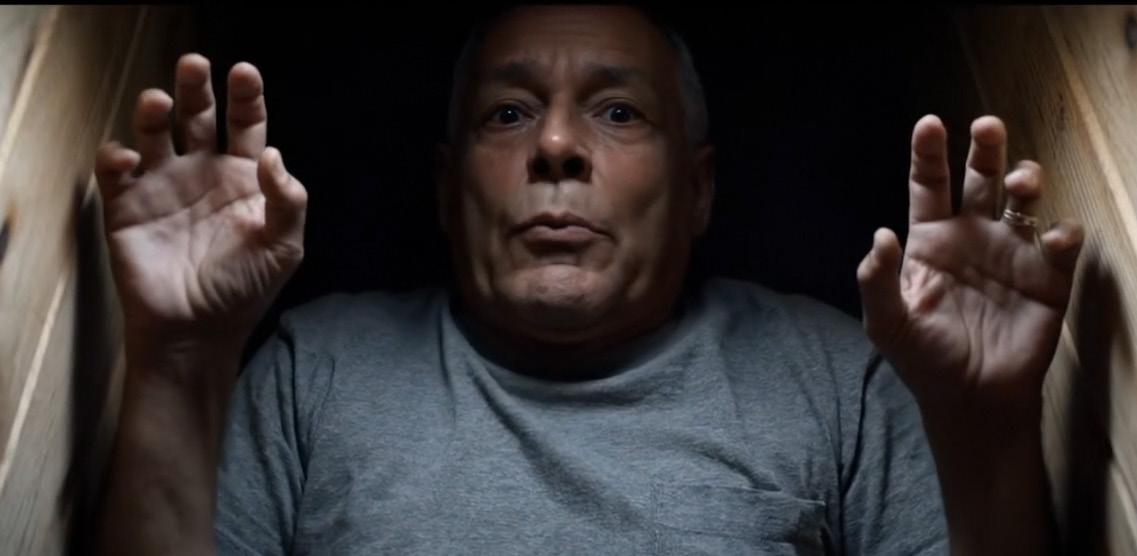
frustrating AI can be as a tool to accomplish that vision. It’s like a slot machine of possibilities – sometimes you can hit the jackpot and get a perfect representation of your intended objective, but mostly you get variations that range from the passable to the hilarious, and you have to choose the least egregious iteration to move on and build from. For example, for a recent demo I provided this prompt: “ We start close on the eyes of an older Asian man as he starts to awaken. As he becomes aware of his surroundings, we slowly widen out to see his entire face frontal. The environment is dark with no prominent light source. As we continue to widen out we see that he is lying down in an enclosed space, a coffin. The old man starts to panic and reaches for the walls to try to find a
FUTURE SHOCK • VISUAL ARTISTRY IN THE AGE OF AI
way out, crying out for help. We continue to pull up and away from him and transition to the outside of the coffin lid as his screams become more muffled, through the dirt surrounding the coffin, and up to the surface where we see that we are on a pleasant, grassy hillside on a sunny day where children are laughing and playing and the man’s screams can no longer be heard .”
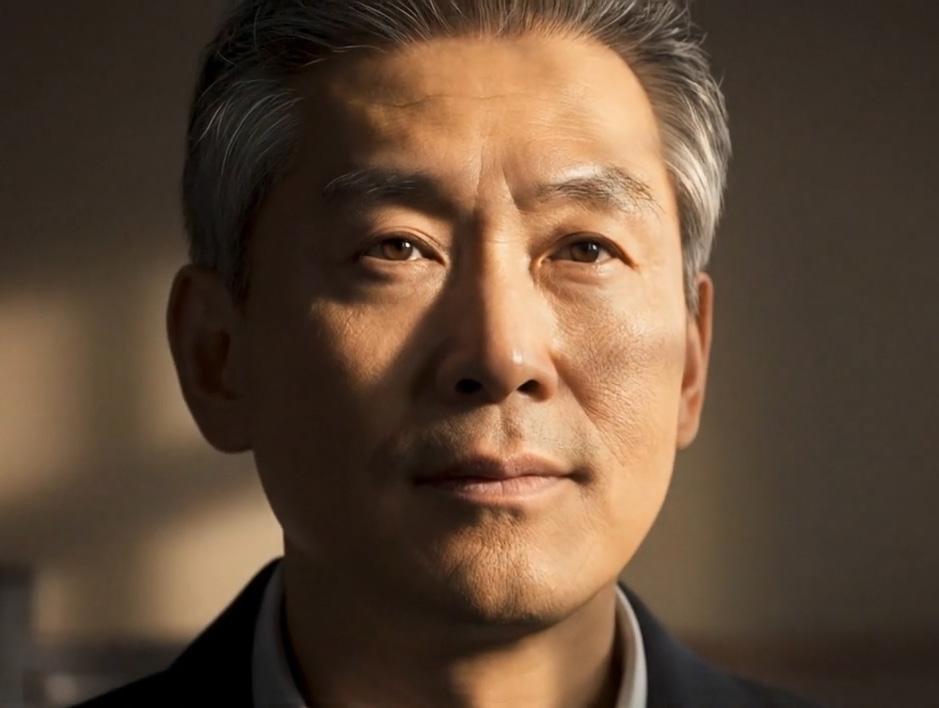
One of the first images our top-of-the-line AI model gave us was image of an Asian man just calmly standing in a daylit room, which was pretty far from the concept:
After refining the initial prompt, it gave us the Asian man sleeping in a bed during the day instead of panicking in a dark coffin:
Further adjustments and re-emphasizing important story elements gave us the moody interior of the coffin, but inexplicably turned the man Caucasian:
Dozens of more tries, including using visual reference images and prompts refined with ChatGPT finally provided this video, which ended so bizarrely offtone that it was time to call it a day: https://vimeo. com/1165078221/5f50625233?share=copy&fl=sv&fe=ci
The desire to make film production cheaper and faster by employing new technologies is nothing new. The industry is always looking for the elusive magic tool that will be the answer to all our dreams. Consider the hullabaloo about digital motion picture cameras 15 years ago –“They’re cheaper, uses less crew and less equipment!” –
none of which was true (and we’re still trying to figure out the archival question about all that digital data).
Learning the history of filmmaking and the incredible movies that have influenced new generations of filmmakers is an essential part of making AI work for you. The industry and the tools we use will continue to evolve and be part of our storytelling process. But one constant remains: filmmakers with vision will lead the way, by refining technologies to suit their needs and making the algorithms and equations bend to their creative will, while the ones who are content to accept whatever is given to them will find themselves unemployed because they cannot reliably repeat their accidental success.
AI is good enough to be a threat to cinematographers’ traditional workflow right now. The industry is willing to look past technical elements that we would consider serious impediments (like lack of 4K resolution and predictable repeatability) in the quest of reducing costs and having fewer creative voices in the mix. This is why cinematographers need to step-up right now and be part of where AI is going in order to protect the craft for future generations. Today, it’s AI. Tomorrow it’s…?
Michael Goi ASC ISC is a three-time past president of the ASC and chair of the ASC’s Artificial Intelligence Committee. Along with being a DP, he also regularly works as a producer and director, with credits including the DGA Award-nominated pilot and first regular episode of Avatar: The Last Airbender for Netflix, and the vertical series based on his movie Megan Is Missing for Lionsgate.
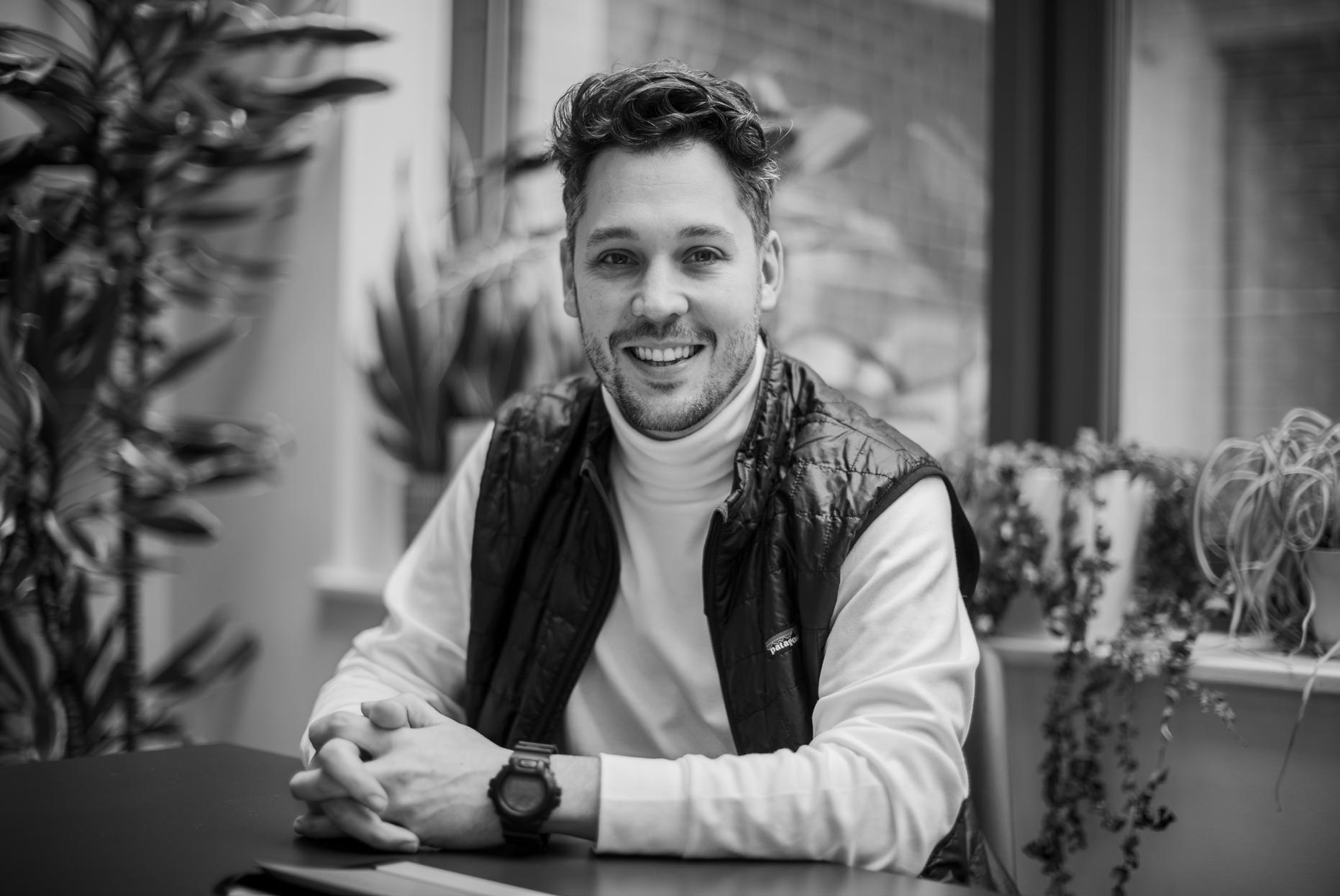
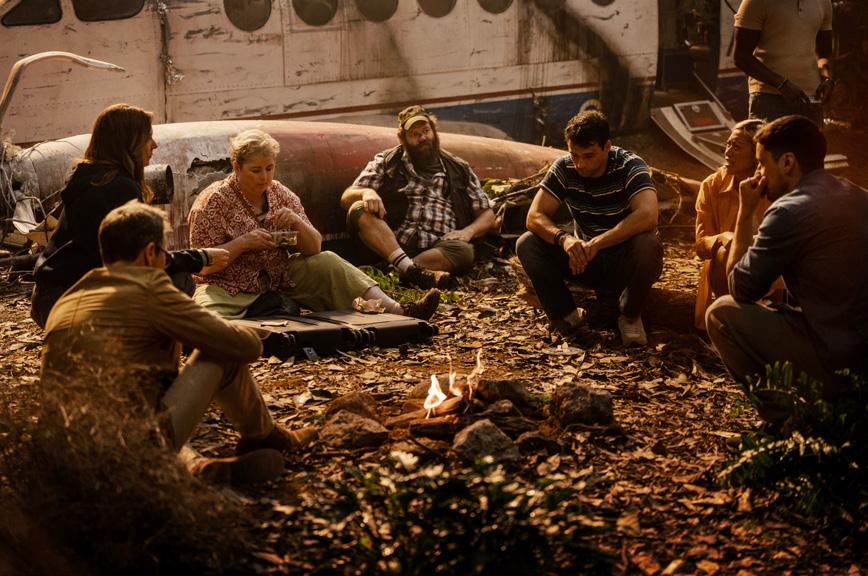
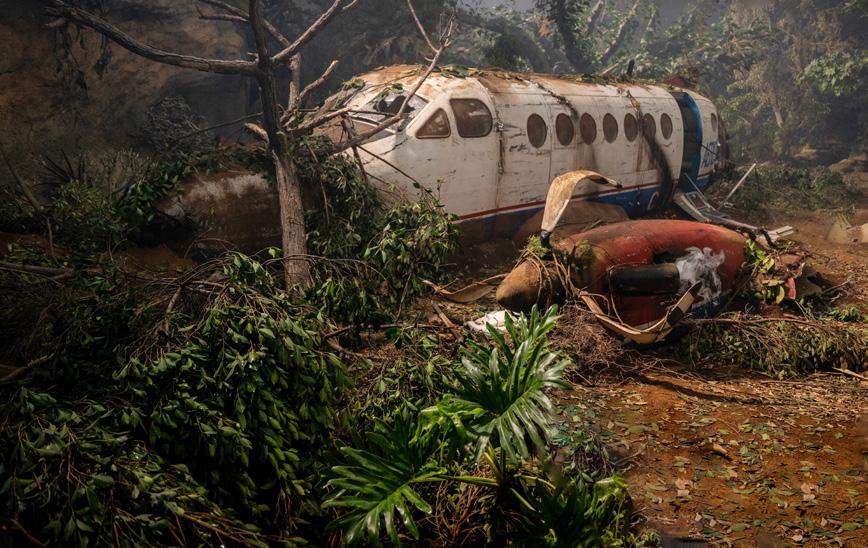
Images: AI-generated pictures show the current unpredictability of AI
BE MORE DYNAMIC…
Why do we need to create an environment where editorial is HDR friendly?
HDR is ten years old. And yet, on a huge number of productions, the first time a creative stakeholder sees the image in HDR is during the grade. Something needs to change.
Editorial counts for a huge amount of the production time. For the editors, DPs, directors and showrunners, if what they’re looking at isn’t HDR, then HDR isn’t really part of the conversation.
When I posted a version of this opinion on LinkedIn recently, one phrase from Bram Desmet, MD of Flanders Scientific, stuck with me. He called it the Primacy Effect: what stakeholders see first becomes the version they accept as normal, the version they prefer. By the time you arrive in a Dolby Vision grade with an HDR image, you’re often spending the session convincing people to let go of the SDR proxy they’ve grown attached to over months of cuts and reviews. If we want HDR to be fully embraced and leaned into, we need editorial to be HDR-friendly, and to be able to monitor HDR from set-to-screen.
Colour Consistency
Thomas Graham put it neatly in the same thread: there really isn’t such a thing as a consumer 100-nit SDR experience anymore. Consumer TVs, even the lower end, are 200 nits+ when displaying SDR content – and yet we’re still mastering in 100nits. SDR can’t carry the full weight of what a modern digital cinema camera is capturing. So when the dailies, the offline, the VFX renders and the temp screenings are all SDR, the creative conversation is happening on a representation of the image that compresses, or clips a chunk of what was shot and what is possible with the image.
One scenario is this, if you’ve held a highlight on a face for a reason, and the first time the director sees that decision in its full form is in the grade, it poses a big discussion. More than likely the response will be to dial it right down, closer to what they were used to seeing in the edit.
Another conversation is shadow detail, the decision to hold or crush a shadow, these are creative calls that need to be seen the moment they’re made, not first revealed in the grade. Modern OLEDs can deliver nearzero blacks; the audience is potentially seeing more
HDR monitoring is now available at price points that weren’t imaginable a few years ago
shadow detail than ever before. If we’re not monitoring those decisions on-set and in the edit, we’re not making them. If these conversations are happening on-set, in dailies and in editorial, it’s possible that HDR could be used to its full potential.
Colour consistency throughout the workflow doesn’t just protect the cinematographer’s intent, it removes ambiguity for every other discipline. VFX know what they’re matching to. The team in the sound mix and conform meetings see what audiences will see. Producers and studio executives walk into the Dolby
Julian Nelson is co-founder and head of post at Residence Pictures, a specialist in high-end colour and picture finishing. He works with creatives, studios and manufacturers across film and television from pre-commission to delivery, with a long-standing interest in HDR pipeline and preserving creative intent from set-to-screen.
Vision grade familiar and confident with what’s in front of them, instead of being asked to react to something new. More often than not, the starting point for the Dolby Vision grade is much closer to the SDR 100 nit version that they have become accustomed to.
Editorial
The instinctive worry from editors and post supervisors is reasonable, and there are workable solutions that can mitigate this to facilitate making processes more efficient and ultimately less expensive.
Starting every project in editorial on an ACES 2.0 template, with the ability to upgrade an existing project at any point, would allow the colour science to be future-proofed and standardised from day one.
Input transforms should be hidden from the editor, applied under the hood, at source, after ingest, before the timeline. This could be significantly more user friendly, rather than being introduced as an effect that an assistant has to manage shot by shot or needs to be rendered.
Having two output transforms only, labelled in language editors actually use: SDR (BT.1886) and HDR (P3-D65), is a simple but easy potential remedy to be useful from the outset in editorial.
Finally, (but not as a definitive list of colour consistency-enabling workflow improvements), productions could implement a scene-referred Show LUT(s) travelling all the way from set to DI, a CLF as part
of an AMF. Like the input transform, this lives outside the timeline applied at source, after the input transform, before the output transform.
Crucially, the point of all of this is to not change the editor’s day-to-day. While they edit, the HDR view is one button away, but nothing in the timeline behaves differently. For the cinematographer and the colourist,
however, a continuous pipeline now exists from the onset monitor to the final Dolby Vision master, same input transform, same Show LUT, same intent with the only variable being the output device.
Monitoring
The most common pushback when you raise this is monitoring – on-set and in the edit bay. Currently the only place outside of the grading suite where we have a HDR capable display is on-set, but this is few and far between. If there is one, it is used sporadically at points to check highlights and shadow details on key scenes but not consistently.
The pushback in editorial tends to be that, “You can’t fill an edit suite with reference-grade HDR displays at tens of thousands of pounds a unit.” That argument is becoming less true every year. HDR monitoring is
We need editorial to be HDR-friendly
now available at form factors and price points that weren’t imaginable two or three years ago. We don’t need every edit bay to be a Dolby Vision finishing suite, we need monitors capable enough to give an honest impression of HDR intent, deployed thoughtfully across the rooms where decisions get made.
There’s also an opportunity for manufacturers and studios to collaborate on a class of monitor built for editorial: sensible peak luminance, a wide gamut in P3 with a D65 white point, repeatable calibration, robust enough for a working bay rather than a grading theatre.
On the codec and storage side, Avid’s recent move to bit-depth independence in the DNx v4 SDK is genuinely important. As Danny Hollingsworth flagged in the same conversation, codec levels can now support 8- to 16-bit precision without forcing productions up into much heavier bitrate tiers. Historically, that jump was one of the main reasons HDR struggled to live in editorial.
Now you can carry HDR-capable image precision through the cut at bitrates that make sense for big, distributed editorial teams. This removes one of the structural barriers that has held HDR editorial back for years.
The Hero version?
If we want HDR to be the hero version of the content rather than a finishing trick, we have to behave as though it is the hero version from set to screen. That means HDR monitoring on set as the default, not the upgrade. It means dailies viewed in HDR. It means editorial and VFX seeing HDR.
Pushing for HDR-aware editorial with ACES 2.0, a Show LUT(s) travelling with the AMF, hidden transforms and a clean SDR/HDR toggle gives you a workflow where every collaborator is watching the same picture.
The editor’s experience is unchanged, and creative intent is preserved throughout the image journey. As a result, when it ends up in the grading suite the colourist’s job has become a refinement instead of a rescue. By the time you walk into the Dolby Vision grade, the conversation is about taste, not surprise. Creative intent has been preserved throughout.
Images – (this page top) from Film Club (BBC/Fremantle), all other images from Nine Bodies In A Mexican Morgue (MGM/BBC).
LET THERE BE LIGHT
By Ron Prince
Unchosen is the six-part British psychological thriller series, created and written by Julie Gearey, streaming on Netflix. DP Catherine Derry BSC worked with director Jim Loach to shoot the first three episodes, and thereby set out the stall for an unnerving drama.
The story follows Rosie (Molly Windsor), a devoted wife and mother in a strict and reclusive Christian sect, known as ‘The Fellowship Of The Divine’, where technology is forbidden, members are isolated and intimacy is strictly controlled. Its members are forced into the penance of solitary confinement if they step out of line.
Rosie’s husband, Adam (Asa Butterfield) is a rising leader in the sect who hides his sexuality and abuses Rosie to maintain her submissiveness. But Rosie’s life changes when an escaped convict named Sam (Fra Fee) saves her deaf daughter, Grace, from drowning, and then uses emotional manipulation to ingratiate himself with the cult leaders, led by the authoritative Mr. Phillips (Christopher Eccleston).
The story was very much about Rosie and Jim wanted the camera to travel with her
Upon its release, Unchosen became a global streaming success on Netflix, reaching number one in 69 countries. Along with acclaim for the cast, Derry’s work on the series has been praised for trapping the viewer inside the cult’s reality of isolation and indoctrination, using intimate framing to capture Rosie’s paranoia and emotional turmoil. This achievement is all the more remarkable as the DP was, along with Loach (the son of veteran filmmaker Ken Loach), hired for the project at short-notice.
“I don’t know what happened, but a different director and DP were originally hired for the production, but left during prep. Jim came in and I then got a call about the job,” says Derry, whose recent HETV credits include Hulu/C4’s The Great S3 (2023, eps 1,2, 5, 6, 9 & 10), Disney+’s A Thousand Blows S1 (2024, eps 1 & 2), Paramount Plus’ The Road Trip (2024, eps 4, 5 & 6) and Netflix’s Hostage (2025, eps 4 & 5). After Unchosen, Derry shot the opening three episodes of the expanding Peaky Blinders universe, commissioned by the BBC and Netflix, set to premiere later in 2026.
“I had never worked with Jim before and was actually away camping in a field when I did the
interview with him and Julie Gearey over Zoom,” she says. “I really liked them and the sound of the project, and got the job on the back of that interview. However, because of the change of director and DP, I had a shortened prep – just six weeks, which was not a lot for three episodes, but we managed to bring it together.”
Regarding her initial conversations with Loach about the show’s look-and-feel, Derry relates, “The story was very much about Rosie. Jim wanted the camera to travel with her and to centre around her experiences and observe her emotions. Although the story starts-off joyfully at a summer barbecue, it was really about capturing Rosie’s growing sense of unease after her daughter is rescued from drowning by a stranger, and her growing realisation about being confined and oppressed within the sect.
“Along with the framing and camera movement, our conversations extended to decisions about the colour palette and the tonal range of the production design and costumes, with the idea of underlining the discipline and uniformity within the community. This was especially important in the scenes set in the church where the congregation of followers meet, and we took that claustrophobic and unsettling feeling into Rosie’s home as well. Production designer Simon Elliott and costume designer Ian Fulcher did an amazing job with that.”
To gain insight into the ways secretive religious sects operate, Derry’s research included watching
Holy Hell (2016, DPs Polly Morgan BSC ASC & Will Allen), a documentary by Will Allen and his experiences as a member of the Buddhafield religious group for two decades.
More specific creative references included Paveł Pawlikowski’s Ida (2013, DPs Ryszard Lenczewski PSC & Łukasz Żal PSC) for the way sunlight enters rooms that feel dingy, and Rosemary’s Baby (1968, dir. Roman Polanski, DP William Fraker ASC) for its sense of menace and terror. Derry and Loach also discussed the depiction of the dystopian, totalitarian society in The Handmaid’s Tale TV series.
I wanted to connect Rosie to her environment using depth-of-field
Images courtesy of Netflix and Catherine Derry BSC.
Principal photography on Unchosen began in mid-August 2024. Derry shot her trio of episodes over for 45 days, before wrapping in midOctober. DP Philippe Kress DFF then shot the final three episodes with director Philippa Langdale. Physical production included multiple locations around Oxfordshire. An assembly hall in Harrow, London, previously used by a religious organisation that had since vacated the premises, was used as The Fellowship Of The Divine’s church. The building had no windows and a single electric sliding entrance that could seal the space, contributing to its unnerving atmosphere of power and control. Derry also shot for three weeks on sets built at Shepperton Studios, including the interior of Rosie and Adam’s house. Grace’s rescue from drowning was filmed on the Underwater Stage at Pinewood Studios.
Derry framed Unchosen in 2.35:1 aspect ratio, shooting with ARRI Alexa 35 and two sets of Caldwell Chameleon Anamorphic lenses, plus a Technovision Anamorphic zoom. The shooting package was supplied by One Stop Films in London.
“I had to pitch to Netflix to shoot in widescreen, and successfully reasoned that, with the main focus on Rosie, this format supported the oppressive theme of the story, whilst offering a variety of atmospheric compositions on group shots and within the meeting hall.
“One Stop Films are very helpful and
knowledgeable, and supplied everything I needed. I chose the Alexa 35 as I really love the colours and the colour separation in the images, which would be essential to depict all of the subtle pastel shades in the wardrobe. During prep, I worked with Andrew Daniel, senior colourist at The Look, to develop a LUT that softened the
I care very much about my team and how they are feeling every day… we’re in it together
contrast and saturation of the primary colours.
“I also went with the Alexa 35, as I didn’t want to lean into shooting wide-open with the shallow depth-of-field you get with large format sensor cameras. I have grown increasing weary of seeing that style of cinematography. I wanted to connect Rosie to her environment using depth-offield, and generally shot between T4 and T5.6.”
Discussing her choice of optics, Derry remarks, “We had two sets of Caldwell Chameleon Anamorphics as this was a two-camera shoot. I had used them before on The Great, and really like the way they perform and the look they deliver. Being modern they’re mechanicallyreliable, and the design of the focus rotation makes things easier for focus-pullers.
“Most of the focal lengths in the Chameleon series have same physical dimensions and lightweight build, making swaps on-set fast and helping the schedule. I used the 25mm, 32mm and 40mm a lot, as they are beautiful on different types of portraiture, with a gentle, natural fall-off at the edges of the frame. Although I know they produce blue horizontal flares, there’s a time and a place for using those, and I avoided bringing flares into the visual vocabulary, as it just didn’t seem right.”
Production, in the main, was a two-camera affair, with regular collaborators in Derry’s team. John Piggott operated A-camera/Steadicam, supported by Leon Hoser on focus. Derry wielded the B-camera, assisted by Sarah Rollason 1stAC. Freddie Lathbridge was the loader and sometimes operated B-camera. Louis McCracken also worked a loader, with Divne Zaki on-set as a trainee.
The exceptions to this modus operandi were two sequences of intimate sexual nature, when Derry operated the camera solo.
“Jim encouraged me to make the necessary decisions about the sex scenes, working in tandem with the actors and intimacy coordinator Abigail Kessel,” she recounts. “I thought it was unnecessary to be graphic, because the clues were in the script. When we came to shoot these scenes, Jim and the camera team were outside, and it was just me with the actors, shooting handheld, keeping the camera on faces and expressions.”
Whilst Loach had expressed his desire for the camera to travel with and observe Rosie, Derry says there were no overall rules governing how the framing and camera movement would occur.
“The camerawork was very much scenespecific and dependent on the emotion being conveyed. Sometimes it felt right to have the camera very composed and the image framed-up in particular way to underline Rosie’s constriction or unease within the sect. We went handheld when the story became more edgy. At other times, we just would simply track alongside her with the Steadicam or camera on a DJI Ronin gimbal, and even a drone.”
The lighting package for Unchosen was supplied by MBS. Working for the first time with gaffer Chris Sowden, Derry reveals that to signal the secrecy of the sect and the level of control over its members, lighting the interiors was about natural daylight or bright sunlight being constantly obscured
or prevented from entering rooms and spaces.
“We often had the odd shaft of light coming through semi-closed curtains and blinds. It was fun working with Chris and the production designer Simon Elliott on different window coverings that we could shine lights through, such as the bilious yellow that pervades the room where Adam’s brother Isaac is locked away, paying penance.
“Obviously, I always wanted to make sure Molly looked good as Rosie – she has such an expressive face and amazing blue eyes. A lot of effort went into lighting her close-ups, whilst also making sure to illuminate the surroundings.
“Having shot a lot of film, and maybe just because I am older, when it comes to lighting, I always prefer to walk on-set and use my eyes, rather than a monitor. We decided to have ceilings on our set-builds, so there was no lighting from above. I think that really helped make the interiors feel like real places.”
The house interior sets at Shepperton were illuminated using ARRI SkyPanel S60-Cs in softboxes, with 12kw daylight heads and 10kw Tungsten Molebeams to create the idea of warm low sun, or sometimes a mix of Creamsource Vortex 8 and ARRI S360s to soft-fill through windows. Due to the lack of windows in the meeting hall, no fewer than 280 Astera Titan tubes we used to shape the light for those sequences.
For location interiors, Derry went towards 12 and 18kw Silver Bullet daylight heads pushing-in light from outside, and Vortex 8s and Astera tubes on the floor. The opening exterior sequence at the picnic was lit with two 100kw Luminys Soft Suns, and the woodland set-ups were purely Tungsten, created with eleven 12-light Dinos running though dimmer packs and a desk to emulate the sun coming out.
Lighting the suspenseful rescue scene on the Underwater Stage and Pinewood involved 40 Creamsoure Vortex panels, with eight of them bounced into a 30m x 15m stretched white cloth, plus 2 x 18kw daylight heads along with a small amount of soft-fill from underwater LED tubes.
Reflecting on the production, Derry concludes, “Perhaps the biggest challenge was that we had so many changes of location and unit moves, which made it tough on the crew. I care very much about my team and how they are feeling every day. We’re in it together, often for several months, trying to make something that looks good, and it’s really important to work with a happy team. If there’s a good vibe, you can get through anything.
“I have to say that Jim created a good atmosphere on-set. It was a delight to work with him, and even though we could have done with more time, I’m pleased with the result and the reaction from audiences around the world.”
GALAXY QUEST
By Darek Kuźma
For David Klein ASC, expanding The Mandalorian into action-packed IMAX-scale cinema meant preserving the analogue soul, physicality and slightly off-beat intimacy that made the series a global phenomenon.
IMAX was one of the ways we expanded our galaxy
THE MANDALORIAN AND GROGU • DAVID KLEIN ASC
The Mandalorian And Grogu picks up where the series left its strongest emotional imprint: with Din Djarin no longer just a lone bounty hunter drifting through the wreckage of the Empire, but a protector, teacher and reluctant participant in galactic history, travelling with Grogu through a galaxy still trying to understand what peace even looks like.
The Empire is gone, though its warlords and crime bosses – including successors to the infamous Jabba The Hutt – continue to operate in the shadows, whilst the fragile New Republic looks to Mando and his young apprentice to help defend what the Rebellion fought to build.
Jon Favreau’s film, The Mandalorian And Grogu, carries obvious weight. It’s the first theatrical expansion of the Disney+ phenomenon and a test of whether the laconic, space-western sensibility that defined the series can survive the scale of contemporary Star Wars spectacle. Its promise is bigger in every obvious way – larger ships, wider worlds, louder battles – but the real wager is continuity – the same worn armour, the same childlike Force-sensitive mischief, now towering
There was always a mandate from Jon Favreau to push the limits of what we’d done before
on an IMAX cinema screen.
For Klein, joining that journey was a no-brainer. “It was the easiest and most obvious ‘yes’ of my career,” he recalls. “My good friend Matt Jensen ASC was one of the DPs of The Mandalorian S2 and was recommending me for tandem units, whilst director Lesli Linka Glatter was putting in a good word with Favreau. With those two recommendations, an offer came my way and it was a natural choice.”
Klein first entered the world through additionalunit work on the second season before taking over one of Jensen’s episodes, later becoming the main cinematographer on The Book Of Boba Fett and shooting four episodes of The Mandalorian’s third season. That history matters, because The Mandalorian And Grogu is not a detached feature-film reinvention, but an evolution supervised by filmmakers who had already spent years building Favreau’s universe from the inside.
“JF is always pushing us to do new things – to use new methodologies, different
“One of the things that is always expected of us is volume work, so we did less of it than on The Mandalorian. That’s also what the story required. A bit of volume, but a lot of big stage installations too, a fair amount of backlot work, as well as some location work.”
Still, how do you make a feature version of a series that already looked cinematic? “How do you go bigger than we’d already gone? IMAX was the most natural and organic next step. As big as possible, meaning 1.43:1. IMAX was one of the ways we expanded our galaxy.”
Yet expansion never meant abandoning the old Star Wars instincts. “We always asked ourselves how would George Lucas have done it back in the late ‘70s and early ‘80s. We may be using all of the modern tools available to us, but the rule was that everything still had to feel analogue. A telescopic arm needed to feel like a rigid arm or a dolly shot. Our modern tech needed to look and feel like the analogue tech of the day.”
The creative references followed that same philosophy and informed the texture and rhythm of the world without turning the movie into a collage of obvious callbacks.
“JF, production designer Andrew Jones, VFX supervisor John Knoll and myself spent a bit of time during prep digesting Rogue One: A Star Wars Story (2016, dir. Gareth Edwards, DP Greig Fraser ACS ASC) and Blade Runner (1982, dir. Ridley Scott, DP Jordan Cronwnweth ASC). There’s also a healthy dose of The French Connection (1971, dir. William Friedkin, DP Owen Roizman ASC) on the moon of Shakari, and a wonderful bit of Midnight Run (1988, dir. Martin Brest, DP Donald E Thorin ASC) throughout the film. There are a lot of others, let the viewers decipher them,” he says.
That analogue mindset carried directly into the camera package.
“Audiences and filmmakers generally remember Star Wars in a specific way. Whether they know it or not, the Anamorphic look-and-feel is the fabric on which this story has been told. As a series, we were already using large-format ARRI Alexa LF cameras paired with Caldwell Chameleon Anamorphic glass, as we absolutely adored the edge behaviour and other characteristics of those lenses.
“What was not known though was the ‘IMAX’ of it all. We tested as many full-frame spherical lenses
lighting, unique sets. Sometimes it’s about doing what’s outside of our comfort zone or trying things we haven’t done before, sometimes it’s about doing what’s unexpected.”
The film had to honour the series that viewers fell in love with, whilst making the galaxy feel newly expanded.
we could get our hands on for a couple of months at the beginning of our prep, both in the volume and on the soundstages, but just didn’t find any others that gave us the secret sauce we always got from the Caldwell Chameleons.
“Most of our IMAX work was done using the Chameleons – sometimes as a centre-extracted 1.43:1 or 1.90:1 IMAX frame, and sometimes, because a lot of our sets were synthetic, we used the entire 2.39:1 frame as the bottom half of our IMAX aspect ratios.”
Moiré has become one of the major technical challenges withing virtual production environments. It’s all about math and as such get boring really quickly. One thing we’re learned over the years is to shoot as wide-open as is possible in the volume to avoit moiré. The Caldwell Chameleons handle this aspect of volume work better than any other lenses we used, or even tested.”
Klein says 40mm Chameleon became his favourite during production. “We love that lens. It’s a marvellous piece of engineering and craftsmanship. It was quite possibly the most-used lens on the movie, and we put it through its paces.”
The wider lenses in the set helped preserve the spatial directness of the world. Klein usually shot with two cameras, sometimes three or four, depending on the scene or problem at hand.
“For the water sequence when Mando fights the serpent, we had two land-based cameras that could dunk and one handheld underwater camera that could also surface.”
Lighting remained similarly pragmatic and grounded. “Our philosophy has always been bent towards realism and how best to achieve this whether in the volume, on a stage or a backlot,” he says of his work with gaffer Jeff Webster ICLS and key grip Walter “Bud” Scott.
“There’s always a mandate from Favreau to push the limits of what we’ve done before and to do things that we have not.”
The production itself relied on multiple approaches.
“Justin Van Der Lek (production co-VFX supervisor from ILM) took a photogrammetry unit to Mount Waddington north of Vancouver, BC for the opening sequence on the ice planet. He also took a plate photography unit to Nova Scotia for the sand dune chase sequence. Other than that, we had 100 days of
DAVID KLEIN ASC • THE MANDALORIAN AND GROGU
main unit and 80 days of second unit photographed by Paul Hughen ASC, all in California. Prep was a solid five months prior to that, which was a fairly standard length carried over from the series.” Otto Nemenz International supplied the camera and lenses package.
Most of the principal photography took place at MBS Studios in Manhattan Beach, including the volume work. Laguna Beach appears in the sequence when Mando watches Rotta and Grogu on the beach, whilst the SCS warehouse in downtown Los Angeles doubled as the Blade Runner- esque world of Shakari.
Whatever we did, it was such a fun and satisfying process
What remains surprising is just how physical so much of the production actually was.
“We used nearly all of their stages. The volume work was only about 25% of the film. Andrew Jones and Doug Chiang designed and built huge sets, and we had Rosco SoftDrops as a bit of old school tech, but also
bluescreens when necessary, backlot work for day and night exteriors, and we turned the SCS warehouse into a volume of sorts. It was about using whatever technology – or lack thereof – that helped us tell a particular part of the story. There was also a stop-motion sequence towards the end of the film that was created by Phil Tippett Studios.” StageCraft, the LEDvolume system that helped define The Mandalorian experience on small screens, remained part of the visual language, although Klein describes it less as a technology than as a way of working.
“We pushed the boundaries of volume work together before and did so once again on the feature – sometimes it was due to doing things we hadn’t done before, sometimes it was about doing something unexpected to keep the audience wondering where the practical ends and the virtual begins. Whatever we did, it was such a fun and satisfying process.”
THE MANDALORIAN AND GROGU • DAVID KLEIN ASC
The SCS warehouse sequence reflected the scale of that approach. “A hundred meters of a city street with 15x15 metre volume walls at either end for set extension. StageCraft was never there to replace the physical world.”
In effect, it became another tool folded into it –part backdrop, part set extension, part old-fashioned movie illusion rebuilt with contemporary technology. That required a creative core team built around virtual production supervisor Justin Talley, associate virtual production supervisor Brad Watkins, and virtual production colour lead Rey Reynolds.
By the time The Mandalorian and Grogu reached post-production, the DI became less about fixing problems and more about refining ideas.
“All I can say is that it was the smoothest version of a DI I have ever known. Mostly due to the fact that our final colourist, Mike Sowa, had been training for this over the past few years, just as the shooting crew had been training for this by working on the series for five years prior to the feature. Mike knew what we wanted before we did, and so it was much more of a creative process rather than fixing mistakes or matching this shot to that.
“The whole team was brilliant – A-cam operator Simon Jayes, focus puller Dominik Mainl, B-cam operator Chris Murphy, focus puller Josh Greer, DP Paul Hughen on second unit with gaffer Brice Bradley and key grip Benjamin Kilmer.”
The result is a film trying to expand a familiar relationship without sanding away the texture that made audiences care about it in the first place.
Grogu may now move through a galaxy stretched to 1.43:1, but the core idea remains old-school and tactile. Which is exactly what Star Wars cinematic adventure should feel like.
We didn’t find any other lenses that gave us the secret sauce we always got from the Caldwell Chameleons
LOVING THE ALIEN
By Ron Prince
As the world stands on the brink of World War III, a cybersecurity expert and a local-TV meteorologist find themselves at the centre of a movement to expose an almighty cover-up.
Humanity, it turns out, is not alone. Earth has had contact with in-coming extra-terrestrials for many decades, but knowledge about those events and alien beings – dating back to the Roswell Incident of 1947 – has been kept well-and-truly under-wraps by Wardex Corporation, a top-secret arm of the US government.
Until now, that is, when a group of rogue employees have decided the world deserves to know the truth about the existence of extraterrestrial life, despite the risk of triggering societal panic, religious crises and financial chaos after humanity’s foundational understanding of reality is shattered.
That’s the premise behind Disclosure Day, the action-packed, sci-fi thriller, directed and produced by Steven Spielberg, from a screenplay by David Koepp, based on an original story by Spielberg himself. The film features an ensemble cast, including Emily Blunt, Josh O’Connor, Colin Firth, Eve Hewson and Colman Domingo, and was shot by Spielberg’s long-time cinematographic collaborator, Janusz Kamiński.
The director said his aim with Disclosure Day was to create a “credible movie about the UFO phenomenon. It’s not a holistic review of UFOs through history but from the perspective of the whistle-blowers who are now coming out and starting to reveal hidden truths.”
Disclosure Day earned $93m at the boxoffice worldwide over its opening weekend. It also garnered critical acclaim for Blunt’s multilingual performance as Margaret Fairchild, Spielberg’s perennial gift of delivering spellbinding entertainment – intertwining high-octane thrills with themes about empathetic connection – and Kamiński’s relentlessly kinetic and handsomely cinematic camerawork.
Disclosure Day represents Kamiński’s 21st movie with Spielberg in a collaboration stretching back to 1993. Kamiński won the Academy Award for Best Cinematography twice, for Spielberg’s Schindler’s List (194) and Saving Private Ryan (1998).
“Steven’s movies all have big, universal themes and he is one of the most successful directors of all-time because he communicates those so well,” Kamiński declares. “ I’m not a religious person, but was really moved by the religious politics in
It’s always an adventure for me… and I enjoy a few challenges along the way
Steven relies on me to create the overall aesthetic
the story, and the message that empathy is our foremost evolutionary advantage as human beings.
“Steven and I have had 33 years of professional friendship, and it’s always an adventure for me to shoot his next film, although it should never be completely smooth skiing. I always enjoy a few challenges along the way. This movie was not necessarily overly complicated to make in terms of logistics, but it still meant I had to create new stuff, and work with new technology, which I really enjoy.”
Kamiński says he and Spielberg didn’t really have formal conversations about how movie’s look and feel, declaring, “Steven relies on me to create the overall aesthetic. The only thing he said to me about this production was that we were going to shoot on film and we were going to shoot Anamorphic.”
Accordingly, Kamiński’s immediate challenge was to fi nd an appropriate visual language for the film, especially the opening sequence when Wardex henchmen confront whistle-blower Dr. Daniel Kellner and his girlfriend Jane behind-thescenes at a boxing match.
“This was not easy for me because I wanted to create something that I hadn’t done before, a kind of film-noir look that would immerse the audience into the intrigue, using hard light and silhouettes to whip-up the psychological tension, before the story became more like an all-out action thriller. I don’t look at references directly, but did have movies I grew-up with, during in the ’60s and ‘70s, in my mind’s eye to inform the overall feeling of the visual storytelling.”
These included The Manchurian Candidate (1962, dir. John Frankenheimer, DP Lionel Linden), for its disorienting, blue-hued, gritty, expressionistic cinematography, evoking the idea of control, paranoia and corruption. Kamiński also notes suspense thrillers such as The French Connection (1971, dir. William Friedkin, DP Owen Roizman ASC) and Marathon Man (1976, dir. John Schlesinger, DP Conrad Hall ASC), along with atmospheric dramas including Midnight Cowboy (1969, dir. John Schlesinger, Adam Holender ASC) and Panic In Needle Park (1971, dir. Jerry Schatzberg, DP Adam Holender ASC) as key inspirations in the visual reckoning.
Production took place over 75 shooting days, between February and May 2025. Whilst the story is primarily set in Kansas City, Missouri, Maryland and West Virginia, it was filmed around New Jersey and New York State. Prior to commencing principal photography, Kamiński had eight weeks of prep.
The KCXE TV Station, where Margaret works as the weather reporter, was filmed on a set built at the New Jersey Institute Of Technology, whilst the Wardex Corporation HQ was constructed at Steiner Studios. The decrepit safehouse in which Daniel and Jane hide away, was shot at Foster Fields Farm in Morristown. The high-stakes train chase sequence used a real train line outside of Cape May, after which some of the train cars were taken back to Steiner Studios to complete the stunt with the actors in a safe environment. The recreation of Margaret’s childhood home was built inside a warehouse in The Bronx, although the show-bound exterior was entirely CG-created entirely. Clips of alien crash sites and other human/ alien contact scenes were filmed at an industrial site on Staten Island.
Kamiński framed Disclosure Day in widecreen 2.39:1 aspect ratio, filming with Panavision Panaflex Millennium XL2 35mm cameras, fitted with Panavision C- and T-series Anamorphic lenses, for the mainstay of narrative storytelling. He also employed Sony Venice 2 for certain drone shots and low-light scenes, including the interior of the Wardex Corporation HQ. The camera and lens package was supplied through Panavision New York.
For the shoot, Kamiński went with KODAK VISION3 500T 5219 for the majority of the film, harnessing KODAK VISION3 250D 5207 for a small number of daylight exterior scenes, such as the train chase sequence. He also shot 16mm B&W film for the alien footage for its innate grain
Movies I grew-up with, during in the ’60s and ‘70s, helped to inform the overall feeling of the visual storytelling
and texture. Film processing and scanning were done at FotoKem in Los Angeles, where 70mm blow-ups were also made for IMAX cinemas. The final DI grade was done by senior colourist Mike Hatzer at Picture Shop in Burbank.
“Whatever story you are telling, celluloid remains a wonderful artistic choice,” Kamiński enthuses. “Steven and I still use celluloid to make movies, because film emulsion has a unique ability to evoke atmosphere and emotion. Additionally, we enjoy the rhythmic ritual and intrinsic value of doing a take, cutting, reloading and going again.”
That said Kamiński reveals he did wonder how he was going to light and shoot the Wardex Corporation interior set, as it had hundreds of TV screens and computer monitors.
“Could I shoot that on film? Yes! But would it be laborious to do that? Yes! Could I light it as a conventional set, while also using the illumination just coming off the screens, and shoot with a digital camera instead? Yes!
“So that’s what I ended-up doing with a S ony Venice 2, sometimes using a drone, shooting at either 1600 or 3000ISO depending on the scene, with additional lights incorporated into the set design. Digital cameras are getting really good, and film negative has much finer grain these days. So, the final blend between the 35mm and the digital footage in post-production was pretty good.”
Kamiński’s crew included David Emmerichs as A-camera operator, with Mark Spath pulling
I like lighting people and especially their faces
focus, and John Buzz Moyer on B-camera and Steadicam, assisted by 1st AC Tim Metivier. George Patsos was the key grip, and Steve Ramsey ICLS the gaffer. Flying Monster in New York City, provided and operated the drones.
“Most of the folks in my crew are my age, and it was really nice to be surrounded by people that I’ve known and worked with for many years. They are proper craftspeople who bring positivity to the set every day along with consummate skill.”
One talking point of Disclosure Day has been the constantly moving camera, with cunning camera moves to follow the action through nerve-jangling chase scenes.
“We employed pretty much every tool you can think of to push, pull, spin, float and twist the camera perspective – dolly, Steadicam, cranes, drones, pursuit cars and car mounts. We even incorporated GoPros inside vehicles to mix-up the shots and heighten the action.
“Whether it was sunny or cloudy, we were always rolling. We went with what God, or the aliens, gave us. Of course, you can have the sunlight in one scene and then the car comes out of the forest and it’s overcast. It was up to me to make the shots match, so that the audience experience would not be interrupted by any visual mismatches.
“So, I legislated for this during the different scenes in a sequence through the on-set lighting and then later in post-production through colour, VFX and sky/cloud work. That’s modern moviemaking. Waiting around for the right weather doesn’t exist anymore.”
Kamiński shot some of the car driving sequences using wrap-around LED walls, displaying background plates he supervised himself. To bring dynamism to these scenes, the car roof was removed allowing the camera to travel 360-degrees around the actors.
“Shooting against LED walls was an extremely enjoyable experience. I learned a lot, such as always giving camera a little bit of a movement, to enhance a sense of reality. Along with the interactive on-set lighting, I occasionally passed a flashlight across the lens, over the faces and around the car to deepen the sensation of them driving along.
“Over the years I’ve done lots of car work against the bluescreens, and on process trailers as well, and it’s always been difficult – with lighting, especially at night, or camera angles – not to make the results look completely fake. But the LED wall and interactive lighting technology proved to be very successful. I was impressed by how well things
turned-out within the confinements of the stage. It’s the most realistic car work I ever done.”
He admits that lighting the safehouse scenes proved a further challenge.
“This part of the film was a little tricky because I wanted to create a look I was not familiar with through the lighting. I wanted something spooky, suspenseful, with a little edge, using a slightly green/blueish light and atmospheric smoke, but still making Eve and Josh look good in the overall context of the scene. The same too when Colin appears at the kitchen table. I loved the mystery of waiting to see the graded dailies, and they came out just gorgeous. You’d never get this with digital. I must say that the safehouse sequence is probably one I’m most proud of in terms of what I achieved with colours, composition and atmosphere.”
The lighting package for the production contained a combination of traditional Tungsten and HMI fixtures, along with modern LED illumination. The 500T film did the lion’s share of the work, and being rated at 400ISO with a typical target stop of T4, meant a lot of light was required.
“There’s been a tendency, which I don’t particularly like, to shoot wide-open with soft lighting. Consequently, a lot of movies and episodic streaming shows just look the same. I like lighting
DISCLOSURE DAY • JANUSZ KAMIŃSKI
people and especially their faces, and with Emily, Josh, Colin, Eve and Colman I had plenty of opportunity to do just that, whilst bringing a sense of mystery and spooky film noir.”
Contemplating his lengthy career shooting with Spielberg, Kaminski says, “Steven has a masterful ability to entertain us at the same time he’s delivering a message. I really love his classical way of telling stories, laying out the geography of a scene so the audience can get on with enjoying the action.
“He’s also a great collaborator, not just with me but other heads of department too. For example, we had an amazing stunt coordinator, Brian Machleit, on this production. Steven
storyboarded the car chases and train stunt sequence and, realising his input to enhance Steven’s vision would be welcomed, Brian became an intimate team-player and did a great job.
“This is partly what makes Steven such a brilliant director and filmmaker. He surrounds himself with talented people and lets them run with the ball. Sometimes, they might get a little bit daunted or overwhelmed at first, because of the prestige associated with his films, but he genuinely encourages the people he selects to be collaborative. That kind of mutual respect brings out the best in people, and that’s what this movie was all about.”
Create the Moment
Reporting and photos by Kirsty and Iain Hazlewood.
After spending two days at the well-attended EuroCine expo, the Cinematography World team came away with the sense of an event whose star is on the rise.
The atmosphere was energetic, optimistic and genuinely international, as cinematographers, camera and lighting crew met with manufacturers, rental houses, broadcasters and other production professionals from across Europe and beyond.
In addition to the busy exhibition floor and lively symposium sessions, there was a palpable
APUTURE
Aputure used the show in Budapest to spotlight its latest innovations in LED lighting for film and television.
Marketing manager Menno Propitius presented the new Storm CS32, a compact yet powerful fixture, described as roughly half the size of its Storm XT52
feeling that the industry in Hungary is entering a new phase. Following the country’s recent political shift, conversations around the show carried clear feelings about positive change and renewed confidence for the future of production, investment and creative collaboration in the country, and the wider region too.
EuroCine reflected that momentum. From established camera and lighting giants to emerging technology innovators, the event balanced cuttingedge workflow discussions with the practical
‘big brother’, making it an ideal one - person light without sacrificing output or quality.
Also on show was the Nova 9° panel, a narrow-beam variant of Aputure’s existing panel range, designed to deliver a tight, punchy spot rather than a broad wash, offering cinematographers greater control and contrast.
The company’s stand showcased a complete setup combining the CS32 with
realities of filmmaking today.
Claire Saunders, organiser of EuroCine, said, “We were really encouraged by the positive response to this year’s event. With the best part of 4,000 visitors across two days and over 40 conference sessions, Budapest proved to be the perfect host city, creating an incredible atmosphere and a real sense of optimism about the future of the industry in Central Europe.”
Nova 9° 2x1 panels, all integrated via a three-light bracket that allows daisy- chaining through a single cable for streamlined rigging.
The expo marked Aputure’s first exhibition in Budapest, underlining the company’s commitment to emerging markets and closer support for local customers and rental houses.
www.aputure.com
ARRI, which was recently acquired by Thomas Riedel, founder and owner of Riedel Communications and the Riedel Group, brought significant innovation to EuroCine, showcasing two major new products launched just a couple of weeks before the show.
The Omnibar, an IP65 tube-style light, stood-out for its interchangeable optics, allowing it to function as either a hard or soft light. With quick-swappable accessories such as soft bags and a robust new
mounting system that avoids the fiddly clips common to other tube lights, it is designed for fast, flexible on-set use. Available in two colours and two sizes, the Omnibar is already shipping and was certainly a strong draw on the ARRI stand in Budapest.
Alongside it, ARRI debuted the Cforce Max lens motor, described as a true next-generation unit. It is twice as fast as any motor ARRI has previously produced, 20% smaller too, and features a new touchscreen display, making it particularly powerful for focus pullers using advanced focus tracking systems.
“Omnibar has been easily the busiest part of
Astera showcased its newly completed Quik family of fixtures, headlined by the QuikBeam – a compact, battery-powered light purpose-built for cinematographers.
Whilst QuikSpot and QuikPunch were first adopted in the event world, QuikBeam brings the range firmly into the film space by echoing the familiar output of traditional 150, 300 and 650 Fresnel units, but in a modern, ultra-light LED form factor.
at ISE
EuroCine marked one of the first showings of QuikBeam in Eastern Europe following its launch
Barcelona.
have responded positively to the light, noting its tiny size, low weight and fast battery swap, all geared toward uninterrupted shooting.
Astera’s focus is not on piling-on features, but on speed of workflow and intuitive operation; lights you don’t need a manual for. With QuikBeam, the company aims to give creatives more time on set for actual storytelling.
Ben Diaz, head of product management at Astera, said, “Our goal was to strip away complexity. You shouldn’t need a user-manual, you pick the light up and immediately know how to use it.” www.astera-led.com
ARRI
our EuroCine booth, thanks to its next-generation flexibility,” commented Sean Dooley, head of marketing at ARRI, who was supported at the show by product manager Harry Gay. www.arri.com
ASTERA
in
Filmmakers
BLACKMAGIC DESIGN
Mark Clowes, business development manager for cameras at Blackmagic Design said the show provided a valuable opportunity to talk directly with cinematographers, filmmakers and post professionals and how they are working today. There was strong interest in the Ursa Cine 17K 65 and Pyxis
12K cameras, plus DaVinci Resolve 21, particularly around how production and post workflows continue to become more flexible and connected. On the camera side, many visitors got their hands on the Pyxis 12K. Its compact form factor was a big part of those conversations, but so was the flexibility it gives crews on set, particularly when it comes to working at different resolutions, whilst still making full use of the sensor. The Ursa Cine 17K 65
CAMERIMAGE
Camerimage’s international marketing manager, Dariusz Wyczółkowski, outlined a festival in transition, but with renewed confidence, as he travels to maintain connections with long-term partners and meet new supporters. In recent months, the team has been immersed in preparations, opening submissions and working through the selection process, for the upcoming 34th edition of the International Film Festival of the Art of Cinematography that will take
place from November 7-14 2026 in Toruń, Poland. For a festival that significantly depends on public funding from municipal, regional and cultural bodies, a key development is the acquisition of Toruń as the new title sponsor. With this backing, Camerimage, from now on called TorunCAMERIMAGE, can plan more ambitiously rather than simply cover the basics.
The new name also aims to strengthen the global recognition of both the festival and the city as a place of
also prompted a lot of discussion, especially among visitors interested in large-format digital filmmaking and where that sits in high-end production.
DaVinci Resolve Studio 21 carried that conversation into post, with the latest tools across editing and colour on-show, along with Fusion compositing and Fairlight audio post production software, as well as the new Photo Page for stills workflows. Blackmagic Cloud proved an important part of discussions, particularly for teams looking at how to collaborate more easily across different locations.
www.blackmagicdesign.com
modern artistic dialogue and visual communication technologies, as well as a strong centre for film, art and entertainment.
On the marketing side, the team is actively recruiting exhibitors and using targeted discounts to build a busy, international showfloor. There’s also a strong push to revive Camerimage’s famous social life, with Wyczółkowski aiming for a full run of sponsored evening parties to bring the festival back “to its regular shape” by offering party sponsorship at special rates.
www.camerimage.pl
CREAMSOURCE
(c/o LCA – LIGHTS CAMERA ACTION)
Creamsource highlighted its latest optical developments for the Vortex family, led by global sales director Spencer Newbury. The company showcased new lens kits for the Vortex4, Vortex8 and Vortex24, giving cinematographers narrow, intermediate and wide options to fine-tune
FILM CREW COLLECTIVE
Film Crew Collective
unveiled a major relaunch at the show, introducing an expanded platform designed to support crew members, freelancers, creatives and production companies across the film and television industry.
beam shape and output on-set.
The updated network features new
FUJIFILM
Fujifilm reported a strong first day on the show floor, with cinema business development and marketing manager Marc Cattrall highlighting both the scale of the event and the quality of conversations.
The company showcased its cinema line-up with a particular focus on the Eterna camera, which has been gaining traction across commercial, fashion and corporate work. Cattrall noted the unusually broad mix of attendees – from hobbyist filmmakers through to high-end professionals –aligning well with Fujifilm’s wide product offering.
“What I’m really liking about Eurocine is the
competitions, giveaways and member rewards aimed at benefiting professionals working both on set and behind the scenes. Organisers said the platform had been developed to strengthen industry connections while helping members build and protect their careers.
Film Crew Collective also confirmed plans to introduce a range of insurance services, including public liability cover, income
breadth of filmmakers here – from low-end hobbyists to high-end professionals. That mirrors exactly what Fujifilm is about. We’ve had so many Fujifilm owners come and find us just to say they love the film emulations, and the response to Eterna has been fantastic.”
Beyond the booth, Fujifilm also contributed to Eurocine’s education strand, supporting a lighting workshop and additional talks.
www.fujifilm.com
Creamsource also demonstrated a new intensifier that converts the open 110-degree “naked” LED into a tighter 80-degree beam, delivering around 39% more luminance. Originally introduced on the Vortex24, the concept has now evolved into dedicated intensifiers for the Vortex24, Vortex8 Soft and Vortex4 Soft, as well as standalone units across the range.
www.creamsource.com www.lcauk.com
protection, vehicle insurance and private health insurance for members.
The relaunch marks a significant expansion for the organisation as it continues developing a broader support network for the film and television production community.
www.filmcrewcollective.com
GREAT GEAR GUIDE • EUROCINE 2026 BUDAPEST ROUND-UP
GODOX
Godox unveiled its new PL (Palette Lab) series of full -spectrum LED fixtures, presented by brand ambassador Hrvoje Bazina. At the heart of the range is the Palette Lab colour engine, designed to eliminate traditional LED spectral gaps and deliver a smoother, more natural spectrum that closely tracks sunlight and Tungsten.
By combining multiple emitters, including a deep red chip for rich, Tungsten - like skin tones and a violet, near- UV chip to restore natural fluorescence in everyday materials, the PL series aims to solve long -standing colour and
KINO FLO / LITEGEAR
Kino Flo underscored its reputation for innovation, with Paul Royalty, global head of sales, walking visitors through the company’s latest advances in virtual production lighting. The spotlight was on the new Icon 12, with inventory in Burbank and at parent company Chauvet’s Belgium facility, signalling Kino Flo’s commitment to properly serving the European market.
Another major talking point was the debut of Light Gear’s Light Tile, shown in tandem with the Kino Flo Mimic system. Together, they promise to deliver a
NANLUX
Chris Cowan, technical sales manager at Nanlux, showed the company’s latest advances in versatile, colour-accurate LED lighting. At the heart of the stand was the new Evoke 5C, featuring the Nebula C8 eight-colour engine shared with the 600C, 150C and 80C. Delivering a remarkable 1000–20,000K colour temperature range, the 5C is designed to
ONE STOP CINE
One Stop Cine presented two practical tools aimed at day-to- day production work. Company president Kenny Galerne introduced the C Box, a modular system designed as an alternative to traditional apple boxes.
Made from recyclable plastic, the units can be stacked and combined to create steps, platforms, and seating, offering a Lego-style approach to building on-set structures. Accessories can be slid into the boxes, allowing crew to store and transport small items within
OPTICAL SUPPORT
Optical Support returned to EuroCine this year with a strong focus on expansion and innovation in camera stabilisation, said company director Chris Edwards.
matching issues for cinematographers.
“Because we added a near UV violet chip, Palette Lab brings back the natural fluorescence you see outside but usually lose under LED,” commented Bazina.
In the professional
video- driven lighting solution aimed at contemporary virtual production workflows. The 2 x 8ft Light Tile folds into a compact softbox and is driven from a laptop using Assimilate Live FX, feeding HDMI to a video processor and streaming ACN to the tile.
On the show, Royalty reflected, “I love being in Budapest, it has a real film industry, a wonderful production community, and the crews here are fantastic.” www.kinoflo.com www.litegear.com
render skin tones faithfully across all complexions while offering deep reds and icy blue whites.
Despite its ultra-compact 5W form factor, the Evoke 5C is highlyadaptable, with an extensive ecosystem of accessories: domes, flat diffusers, a mini Fresnel, snoots, gobos, battery grip, bulb adapter and underwater options, all in an IP67-rated housing.
Nanlux also previewed its new Matrix system: a modular, four-head
the same system.
Alongside the C Box, One Stop Cine showed its Force One electric cable roller, targeted in particular at rental houses handling large volumes of return cables from location shoots. The device is intended to speed-up the process of winding and managing heavy, often dirty cables, while reducing physical strain on staff.
Together, the products reflect an emphasis on modularity, durability and workflow efficiency for technicians
The team showcased the Dragonfly stabiliser sled, featuring Optical Support’s own gimbal and
Knowled line, Godox showed the PL 1200 RF and PL 600 RF, whilst the Godox range also featured the SL 300 RF, SL 200 RF and compact ML 150 RF for creators on the move. With high SSI scores and three selectable curves – Godox, black body and daylight – the system offers precise control for matching mixed sources and real -world daylight. www.godox.com
yoke built around 600W colour units to deliver a 2400W soft, fully-controllable source. Positioned as a modern alternative to traditional HMIs and Tungsten Brutes, Matrix underlines Nanlux’s focus on compact, modular, colour-flexible tools for contemporary film production. www.nanlux.com www.nanlite.com
working in film and TV production. www.onestopcine.com
VZ grip, designed to be bolted together into what Edwards describes as the most rigid and most adjustable sled they’ve produced. With around 40 units already sold and strong interest from high - end operators, Dragonfly is designed as a
go -to choice for demanding shoots. Also on show was a re - engineered AR- upgraded Dragonfly, now featuring brushless motors, full app-based control, and programmable moves for precise, repeatable camera work. Teased alongside these was the upcoming “magic box” camera metadata device, slated for a later launch. www.opticalsupport.com
EUROCINE 2026 BUDAPEST ROUND-UP •
ROSCO
Rosco’s UK business unit director Steve Ramos highlighted a comprehensive line-up of lightcontrol solutions designed for both film and broadcast environments. Core to the showcase were Window Clings
RUPIXELS
RuPixels debuted its innovative RuPixels Canvas system, a 1400W pixel fixture designed as an everyday, onset workhorse with advanced creative capabilities.
Rather than being reserved for specialist effects, the Canvas is built to function as a standard lighting tool that can then be pixelated at virtually any scale, giving cinematographers the flexibility to move seamlessly from
SETSYNC
(c/o LCA – LIGHTS CAMERA ACTION)
– a family of self-adhering ND filters that apply directly to glass to manage natural light on location. Complementing these were Rosco Grip Strips, selfadhesive NDs for practicals and fixtures, plus the increasingly popular Slideys, offering fast, flexible light shaping on-set.
Ramos also pointed to strong demand for Rosco’s Dash pocket lights, supported by a dedicated optic kit that expands their creative versatility. Rounding-out the stand was Rosco’s growing textile range, including new ND grid cloths.
www.rosco.com
conventional looks to complex, dynamic visuals.
Unveiled to the public for the very first time at EuroCine, the system enjoyed a strong reception, with visitors quickly understanding its potential and responding enthusiastically.
According to RuPixels’ Michael Kelly, many attendees are already exploring how to integrate RuPixels Canvas into their own sets and workflows.
www.rupixels.com
SetSync’s headline product on the LCA booth was a 2K inline dimmer (16A C-form, 2200W) with zero- cross detection, delivering exceptionally stable, flicker-free results – even when driving very small loads on a high- capacity dimmer.
With LumenRadio built into the handle for robust wireless control, it’s designed as a rugged, set-ready workhorse. SetSync has scaled the concept down into a 100W plug-top dimmer for practicals and ramped it up into an 8 x 400W, 19-inch rack unit, both offering switchable leading/ trailing edge modes for compatibility with tungsten and modern dimmable LEDs.
Alongside the dimmers, SetSync showed the S6 LED driver, a 6 x 10A (40A total)
LED tape driver running at 20kHz for camera-safe operation at high frame rates and fast shutter angles. A colour screen, selectable linear/logarithmic curves and DMX smoothing give cinematographers refined low- end control and smooth fades.
Completing the story was the Bridge Duo: a two-universe LumenRadio transmitter that appears as an Ethernet interface to iOS devices, removing Wi- Fi from the control chain. Its clever pass-through power design maintains power during direction changes, ensuring uninterrupted on-set control.
Dan Walters, LCA’s tech manager commented,
“By appearing as a wired Ethernet connection to your iPad, the Bridge Duo takes Wi Fi uncertainty out of the equation, giving you reliable, real time wireless control of your lights.” www.set-sync.com www.lcauk.com
Sony showcased a cohesive virtual production and cinema ecosystem led by its new Ocellus marker-free tracking system. Demonstrated on the FX6, but compatible with virtually any camera, Ocellus is said to deliver robust inside-out tracking without markers, forming a key pillar of Sony’s end-to-end virtual production offering alongside LED walls and software toolsets.
Sony’s Will Newman also highlighted the Venice Rialto mini extension system, which separates the sensor block to
create a compact, 500-gram Venice configuration ideal for gimbal and handheld work. Nearby, the Burano was presented in a cinema build with Anamorphic glass and an advanced autofocus solution from Moon.
Roundingout the booth, Sony’s FX line – FX2, FX3 and FX6 – ran with the Monitor Control app, enabling streamlined, app-based camera operation.
Newman said the early reception to Sony’s presence had been good, noting that there was strong interest in the company’s virtual production solutions and expanded cinema line-up. www.sonycine.com
SONY
SWORDS & SORCERY
By Darek Kuźma
In director Travis Knight’s Masters Of The Universe, Fabian Wagner BSC ASC approached the fabled planet of Eternia less as the setting of a fantasy franchise and more as a world shaped by myth, colour and the kind of childhood imagination that never really disappears.
Travis said he’d love me to shoot it, and I was over the moon
Masters Of The Universe has spent decades drifting between toy shelves, cartoon mythology and pop-cultural afterlife. Born from toy-maker Mattel’s early-1980s franchise and immortalised for a generation by the animated adventures of He-Man, Skeletor, Teela, Man-At-Arms and Castle Grayskull, it first entered live-action in the 1987 film, also called Masters Of The Universe (dir. Gary Goddard, DP Hanania Baer) starring Dolph Lundgren, Frank Langell and Courteney Cox, then spent decades trying to find its way back to the big screen.
The 2026 version follows Prince Adam, separated from Eternia for 15 years, as the Sword Of Power leads him back from Earth to his home world that has been shattered under the tyrannical rule of the skull-faced Skeletor. The project itself travelled almost as far as its hero, passing through years of development hell, shifting studios, writers and stars before finally landing at Amazon MGM, where director Travis Knight and cinematographer Fabian Wagner BSC ASC looked for a way to make Eternia feel less like a recycled lore and more like a real, living world.
For Wagner, whose credits include fantasy worlds like Game Of Thrones (2014-19, 8 eps), Zack Snyder’s Justice League (2021, dir. Zack Snyder), Venom: The Last Dance (2024, dir. Kelly Marcel), the journey began long before Hollywood rediscovered Eternia.
“I was born in 1978, and my main toy when I was a kid was He-Man. I played with Star Wars toys a bit with friends who had them, but I only had the He-Man figures. And I loved them,” Wagner confesses.
“When the movie first came my way around 2018, I got very excited, but it quickly fell apart. A few years later the offer came back, but I turned it down because I’d just had my second child and didn’t want to be away from home for that long.”
That version collapsed too, but when the project resurfaced again in 2024, now with Knight
attached to direct, Wagner was finally ready.
“I’m a huge animation fan and I knew Travis from his work at Laika (the US stop-motion/ animation studio). When I heard the project was happening again, I was shooting in Las Vegas. I called to see if he wanted to meet, then flew to Portland over the weekend just to talk. A few weeks later Travis said he’d love me to shoot it, and I was over the moon.”
Knight and Wagner’s goal was to honour the original comics and toys without embalming them.
“One of the things that attracted me to Travis’s take was that he wanted to pay homage to the comics and their
original spirit, but also make it work on a human and emotional level. He’s a big fan of the franchise and he carried that all the way through prep and production, guiding us with his passion for the material.”
Wagner revisited the 1987 film, but he and gaffer Johnny Franklin found their visual references in the comics.
“The interesting thing I realised, looking at them as an adult from a cinematography, lighting and framing point-of-view, is how different those comics actually are, depending on the writer, artist or illustrator. We dug deep into the ones we loved and pulled a lot of colour references that we translated into the film. The idea was to create something nostalgic, whilst also developing a cinematic language for a modern fantasy film that works both for long-time fans and younger audiences.”
That approach became inseparable from the film’s fractured geography. Adam grows up on Earth believing in one version of himself, before returning to Eternia – the place he remembers as magical –only to find it desolate.
“From the very beginning, we wanted it to feel immersive and human, but still have that magical, otherworldly quality that defines Eternia. There were so many colour palettes to explore to show the splendour of its glory days and the ruin of Eternia under Skeletor’s rule,” says Wagner.
They shot largely at Elstree Studios, combining physical sets, backlot work and two weeks on-location, including the medieval Wells Cathedral in Somerset.
FABIAN WAGNER BSC
My main toy when I was a kid was He-Man
“We recced Iceland, Ireland and Scotland, but shot only in Somerset and Devon. In the studio, we did no volume work at all. Everything was pretty much a physical set. Some sets had no greenscreen whatsoever, though on a film like this we still had VFX-heavy setextensions.”
Principal photography ran from winter into early summer 2025 across roughly 75 shooting days.
The most stubborn enemy, as so often in big-budget fantasy filmmaking, was not Skeletor but mathematics.
“Because the film had been in development for so long, there was a huge backend bill attached to the budget that had to be paid. In the end, this massive $200 million script had to be made for a lot less. But the limitations sharpened the creative process, and I’m very proud of the collaboration,” he says.
One of the clearest visual ideas was to make Earth and Eternia feel like worlds shaped by different cinematic instincts.
“Obviously, with a film like this, IMAX becomes part of the conversation, and I knew we should aim for IMAX. But we also wanted the movie to have the cinematic feel of a 2.39:1 widescreen frame.”
The solution became a dual-format grammar. “We shot Anamorphic for Earth, then switched to spherical 1.90 IMAX for Eternia to give the two worlds distinct visual identities whilst still keeping them emotionally connected.”
Wagner considered using two different camera
systems, but budget and schedule argued otherwise.
“We chose the Sony Venice 2, occasionally with the new Mini Rialto on main unit, and used various camera settings to create Earth’s Anamorphic look and Eternia’s IMAX scale.”
The separation also came through lenses, with each world assigned its own visual language.
“For Earth we used Xtal Express lenses for imperfection and beauty of Anamorphic glass. For Eternia, we had Xelmus Apollos – mostly the 25mm for wides and the 50mm or 60mm for action closeups, because the close focus is brilliant and the flares are great. For more dramatic emotional scenes we used ARRI Alfa Anamorphics, mainly the 40-100mm.”
Shooting on the Sony Venice 2 allowed the crew to move between the visual modes without constantly rebuilding the camera package whenever the schedule demanded, say Earth in the morning and Eternia in the afternoon. ARRI in London supplied the cameras and lenses.
Wagner carried three cameras, usually shooting with two and occasionally operating the third himself, because even in a world of comicbook heroes, digital extensions and massive set-pieces, he wanted his own eye as close to the frame as possible.
“I had my trusted friends Joe Russell on A-camera/Steadicam and Jamie Phillips on B-camera, but if a three-camera set-up worked, I’d jump on the C-camera myself. I love operating. I like being active. On films like this it’s useful to be able
MASTERS OF THE UNIVERSE • FABIAN WAGNER BSC ASC
to step away sometimes – prep another stage or deal with something else – but I love framing, the immediacy of being there with the actors,” he says.
“I can see why sitting at the monitor is comfortable, but I’m not that kind of DP. If I look at a monitor, there are too many distractions around me. When I look through the eyepiece, I’m focused on the frame. Having started back in the day on film, we’re used to solving everything through the eyepiece. I still find it much easier to spot problems – or things I don’t like – there than from behind a monitor.”
Camera movement in Masters Of The Universe followed a simple principle: energy without decoration.
“You’re trying to make this a high-octane movie and keep the action interesting, but I don’t like moving the camera for no reason. We had every tool in the box –cranes, Steadicam, dollies, Ronins, Stabileye, gimballed spaceship sets – but we tried to be smart about how and when we used them.”
Wagner says he approached lighting the film much the same way.
“We used LEDs a lot because of their flexibility and because we needed different colours for interactive lighting. But we also used Tungsten units: a lot of 20Ks, some Molebeams, and one set was lit entirely with traditional space lights.”
Collaboration with gaffer Johnny Franklin and DIT Ian Mars helped ground that mix in practical experience.
“They always come up with interesting ideas, and
I trust them to give me an honest opinion, which I really value. I’m the DP, but I can’t make the best-possible film on my own. So, I surround myself with people who’ll honestly say: ‘Look, this isn’t working. I think we can make it better.’”
That trust extended into colour management as well. Before principal photography, Wagner, Mars and Company 3 developed several LUTs to define the film’s shifting worlds.
“We had an Earth LUT, an Eternia pre-destruction LUT and an Eternia post-destruction LUT. Everything was built around those, and then we’d tweak them depending on what we were doing,” he recalls.
The final DI with colourist Stephen Nakamura was extensive, but not radical in philosophy.
“It was pretty straightforward. We went through the film scene-by-scene, looking at selected shots from each sequence. Then Stephen spent two or three weeks with Travis finishing the rest together. I always try to shoot as close as possible to what I want on-set, so there’s already a strong guideline in place. The main thing was bringing everything together and refining the details you don’t have time for while shooting. The rule was always that the spectacle only works if the human element never disappears beneath the scale of it.”
Masters of the Universe may arrive wrapped in sword-and-sorcery spectacle with sci-fi undertones, but Wagner’s images are built around the idea that childhood fantasy only survives adulthood if it retains a human face.
“I’m proud of the movie and of what everybody’s done, and incredibly grateful to Travis for bringing me on-board of this journey – both as a DP lucky enough to shoot projects like this and as a kid who once dreamed of being part of that fantasy world,” Wagner says.
And if Eternia opens its gates again, he will gladly return.
“This is the first time this has been done in 30-something years, and it was so much fun. I think everybody involved would love to come back. We’d definitely push it further cinematically and explore that world more.”
The Sword Of Power may glow across the screen and Castle Grayskull may still radiate mystery, but Masters Of The Universe ultimately works because the people behind it never treated that world as disposable nostalgia.
I can see why sitting at the monitor is comfortable, but I’m not that kind of DP
The idea was to create something nostalgic, whilst also developing a cinematic language for a modern fantasy film
ABOUT A BOY
By Ron Prince
Collaborating again with László Nemes, and shooting once more on KODAK 35mm as well, cinematographer Mátyás Erdély HCA ASC depicted a painful slice of Hungarian history for the director’s acclaimed feature Orphan/ Arva, using a recipe involving lenses, filmstock, lighting, exposure and development, and remarks, “It’s my best work so far.”
It’s my best work so far
Orphan is set in the aftermath of the failed Hungarian Revolution of 1956 against the Communist regime, an uprising that was brutally crushed by Soviet forces, during which thousands were killed or wounded, and nearly a quarter of a million Hungarians fled the country, ushering-in a new age of authoritarianism and state-instigated paranoia.
The coming-of-age drama, co-written by Nemes and Clara Royer, is loosely-based on the real-life childhood experiences of Nemes’s own father, the celebrated Hungarian film and theatre director András Jeles. It follows Andor, a young Jewish boy, who goes in search of his missing father, only to unveil uncomfortable truths about his mother, her survival during the Holocaust during WWII, and his father’s true identity.
The film stars Bojtorján Barabas as Andor, making his feature-debut aged just 14, Andrea Waskovics as his mother Klára, and Grégory Gadebois as Mihály Berend, a local butcher who claims to be Andor’s biological father.
The feature was nominated for the Golden Lion at the 2025 Venice Film Festival, and earned praise for its exploration of generational trauma, plus Barabas’ compelling performance in portraying a young boy’s crisis of patrimony, amid the scars of WWII and the failed rebellion.
Critics also hailed it as a visual masterpiece, citing Erdély’s atmospheric and exquisitely-striking rendition of 1950’s Budapest. The DP won the American Society Of Cinematographers’ Spotlight Award for his work.
The film represents Erdély’s third longform feature with Nemes, following Son Of Saul (2015) and Sunset (2018), both of which were shot on KODAK 35mm film. The duo have since collaborated on Moulin (2026), a feature about a French Resistance member during the occupation of France in WWII, which was also shot on KODAK 35mm film.
“Orphan is László’s father’s story, and it’s a very Hungarian-specific story, that’s for sure,” says Erdély. “The final image was the result of small and big decisions I made with László along the way as regards the compositions, lenses, lighting, filmstock, exposure and development at the lab, and I consider it to be my best work so far.”
Erdély’s says there was never a question-mark about shooting Orphan on film.
“There’s no better way to make movies than
by shooting them on film. The results are extremely beautiful, and that gives the audience a more immersive experience. When we put digital and film images next to each other, László and I always react to the filmed pictures with a stronger emotional response. It’s that’s simple and, as filmmakers, that’s exactly what you want. You want the audience to emotionallyconnect to your images and to your story.”
While Son Of Saul and Sunset were typified by the camera being intimately tethered to the protagonist, either framing faces in tight close-ups at eye-level or by tracking closely over shoulders, Erdély and Nemes chose to give the camera a wider gaze.
“We started with a completely blank slate,” he explains. “We didn’t want to fall back on previous approaches, and preferred to treat this story in its own right. From the start of our conversations László had a strong feeling about Andor being a child being in a world of grown-ups.
“This meant that the camera height and compositions would have to channel the perspective of a 12-year-old boy, but also allow for deep-focus framing, showing him curiously listening under doorways or peering through cracks in walls.”
He adds, “The other important consideration that we deliberated on for a months and months, was how best to depict the presence of Andor’s imaginary father character. After much discussion, we felt that having the camera high-up and looking down at Andor would be the most appropriate way to represent this point-of-view. So that became part of the visual vocabulary too.”
Unlike many filmmakers, Erdély reveals he and Nemes don’t seek inspiration from direct creative references, and don’t compile a look book either.
“We like to take our visual cues from the emotional moments in the script, and the research done by the art department into what the places and environments were like, along with the wardrobe and the colours of the time. Later on, we might then link our ideas for different scenes to particular photographs we remember, and during the shoot these are simply illustrative reminders about the ideas we talked about originally.
“Obviously I wasn’t around in the 50s, but I had a very strong aesthetic understanding about what communism looked like in Eastern
I had a strong aesthetic understanding about what communism looked like in Eastern Europe
Europe anyway – the earthy brown and golden hues, the particular blue of the clothes and the red of Soviet emblems, which was all reinforced by the research work of our production and our costume designers. This wasn’t like a sci-fi movie where you have to create your own world. It was more about encapsulating something we carry within ourselves from our shared memory.”
The 45-day shoot took place in and around the city of Budapest, and the local countryside, during the summer of 2024. The only set builds were the interior of apartment where Andor lives with his mother, and the attic space at Mihály Berend’s house, constructed on stages at the National Film Institute’s studio complex in Fót
“Our
physical locations and set-builds were beautifullydesigned, dressed and prepared, to recreate the look-and-feel of the period,” Erdély recalls. “And it was amazing to work closely with VFX supervisor Glen McGuigan, who did astonishing work in making the transformation of time and place complete through seamless background replacements, setextensions and clean-ups on things like satellite dishes and air-conditioning units.”
Erdély framed Orphan in 1.33:1 aspect ratio for its inherently intimate, boxed-in and nostalgic feeling. He shot using ARRICAM LT cameras and two full sets ARRI/Zeiss Ultra Prime lenses, that were separatelydetuned for day and night work by Christoph Hoffsten, head of the camera department at ARRI Rental Berlin. The camera and lens package was supplied through ARRI in Budapest.
“Knowing that we were going to shoot on film, and wanted to represent a certain mood from that period in Hungarian history, during prep László and I revisited some of the old shorts we had shot together, and came-up with a combination of lenses, filmstock exposure and lab development that we liked. In combination with outstanding work from the production and the costume designers, these elements worked together give the film its unique look-and-feel.”
Discussing the lenses, Erdély remarks, “Christoph is a very old friend of mine, and I started talking with him about what we wanted for this production many months in advance of the shoot. There was a lot of back-and-forth as he gradually customised the lens sets, including a 24-290mm Angénieux zoom to match, and we ended-up with two amazing sets of glass – one for the day, the other for the night work – which contributed so much to the fundamental look and visual language of the film.”
For the film’s prologue, set in 1949 depicting the four-year-old Andor being released back to his mother from an orphanage, Erdély selected Orwo NC500 Colour Cine 400ASA 35mm filmstock, but harnessed KODAK VISION3 5219 500T for the rest of the film’s two-hour running time. Film
negative processing, plus 35mm release prints of the final movie, were done at Magyar Filmlabor, The Hungarian Filmlab.
“The Orwo stock is pretty unstable, in the way that the perforations are not quite correct,” he says. “That gives a little shake and weave to the image, which we embraced. The Orwo also has prominent, chunky grain, and the colours are generally muted, flat and desaturated, helping to give a really nostalgic, cinematic look, almost like a kind of bad dream.
“The 5219 500T is my favourite stock, and I have used it many times over the years. I love the quality of its grain, the saturation and contrast, and wanted the visual consistency of using just one stock for everything during the shoot – our interior/exterior day/night scenes. The 500T is incredibly flexible. When I’m shooting superbright day exteriors, I just ND it down, but still have the same grain structure contrast and saturation as I would with a normal exposure. The same too with dark and low-light situations. I really like that.”
Erdély could have brought push/pull processing into the visual equation, but preferred to put the exposed negative through a bleach bypass process at the lab, thereby retaining the metallic silver in the film emulsion alongside the colour dyes. This had the effect of delivering deeper shadows, richer blacks and muted, more pastel-like colours. After the final DI colour grade was completed, the filmed-out 35mm negative was printed to bleach-bypass positive stock to make the 35mm release prints.
“I love working with Magyar Filmlabor as they are always willing and able to undertake special processing methods. Although we had to do some testing to make sure the 4K DCP and 35mm film release prints matched, the results of both looked great, because of the additional silver in the image.”
Erdély operated the camera, during what was largely a single-camera shoot, supported by Gergely Csepregi as 1st AC/focus puller. Ferenc Krámli led the grip team and operated the crane, while gaffers József Simon and Szabolcs Galgóczi collaborated with Erdély on the lighting.
“I loved the effect of shooting in 1.33:1 with regards to the portraiture of faces. We could also see the ceilings, which gave a feeling of being enclosed and oppression,” Erdély notes. “This was a time of paranoia, when people regularly reported one-another to the secret police, and mothers didn’t talk openly in front of their own children. To reinforce the idea of suspicion and claustrophobia, we purposefully framed through doorways, along tight alleyways and even keyholes. We used dolly and track to follow the characters, with little push-ins, along with telescopic cranes and Matrix head, from Special Grip Hungary, for the high-angle work.”
Discussing his approach to the lighting, he says, “I tend to lean towards old-school lighting units, as I prefer the way they look. Most of the nightwork was Tungsten-based, and I relied on HMIs for the daywork, with bounced-light through windows and practicals on the interiors. There were some occasions where LEDs were really useful, but I try to stay away from using softboxes containing Sky Panels, as that approach looks boring to my eyes.
“My gaffers did a great job, and I am proud of how well the interior scenes of Andor’s apartment, which were shot on-stage, matched with the exteriors, which we shot on-location. There are several sequences in the film where the action cuts back-andforth between interiors and exteriors, and the results looked natural and organic. I also like the strong mood we created for big scene at the funfair, and the symbolic imagery in the final shot that comments on the all-consuming nature of communism at that moment in history.”
With his work on Orphan, Erdély has cemented a reputation for immersing audiences directly into intense historical and political struggles, through a combination of meticulous technique and collaborative effort.
“I really enjoyed everything
about shooting this film on film, and visualising an incredible period in Hungary’s past,” but also confesses, “I was truly shocked to receive the ASC Spotlight Award. I also felt truly humbled, when two colleagues, both cinematographers who had experienced that time as kids, contacted me separately to say how the film brought back that era. Those are wonderful compliments to me – as well as to László and the other people in cast and crew – that I will cherish forever.”
We had two amazing sets of lenses – one for the day, the other for the night work
There’s no better way to make movies than by shooting them on film
UNCANNY UNKNOWN
By Darek Kuźma
In Backrooms, cinematographer Jeremy Cox helped maverick director Kane Parsons turn an evocative, internet-born nightmare of yellow walls, fluorescent ceilings and impossible spaces into a full-length feature film about fear, perception and the human need to understand.
A bizarre doorway appears in the basement of a furniture store, and what waits behind it is not a haunted house, nor a monster lurking at the edge of the frame, but a world of endless corridors, cavernous rooms and narrow passageways with yellowing wallpaper that seems to react to whoever enters it.
Kane Parsons’ feature expands the eerie mythology that began in 2019 on a 4chan thread, as a ‘creepypasta’ (a horror-related story circulated, copied and pasted across the internet) and evolved into an online phenomenon with a visual language of its own.
This is liminal horror, where dread comes not from spectacle but from the almost familiar. The unease lies in places that are designed for human use, but are emptied of human meaning, such as a childless playground, an empty parking lot and a waterless swimming pool.
Backrooms throws architect-turned-desperatefurniture-salesman Clark (Chiwetel Ejiofor) and troubled psychologist Mary (Renate Reinsve) into an uncannily ominous maze of interconnected office spaces and vacant corridors that seem to exist for no good reason at all – a place that feeds on whatever fears its visitors bring with them.
Half the film was shot on locations around Vancouver, the other half unfolded inside the constructed maze. Principal photography lasted 35 days between June and July 2025.
“We shot on-location for three weeks, then the remaining three on-stage,” Cox recalls. “At first, we discussed sticking to one stage but as prep continued, the scale got bigger and bigger. Eventually we had filled four stages with physical sets, each with their own visual anomalies.”
That physical expansion suited the material: a film about a space that resists containment became itself difficult to contain.
“Prior to meeting Kane I had poured through all of his films on his YouTube channel. The feeling from his Backrooms series of shorts, published in early 2022, was the foundation for everything. When so much of the world-building already exists, it gives you a great head start.”
However, that head start came with a trap. As millions of people already had Backrooms in their heads, Cox and Parsons had to decide how an audience enters a space it thinks it knows.
“We discussed how to embrace the single point perspective that works so well in YouTube series. We restrained from anything omniscient
until the audience has already been through a space. This played into the theme of looking around corners. You can only see something new by uncovering it. When Clark first enters Backrooms, we are with him. Later, when Mary enters, the camera is already in the space,” he says.
This informed the shot-list and gave the filmmakers a clear direction, reinforced through visual references meant to keep the film from drifting into either fan service or conventional horror gloss.
“We looked at projects such as One Hour Photo (2002, dir. Mark Romanek, DP Jeff Cronenweth ASC) and the Amazon TV series Mr. Robot (DPs Todd Campbell & Tim Ives) as well as lots of liminal space imagery. The deadpan portraits of office spaces and suburban lifestyles by Swedish photographer Lars Tunbjörk was also very inspiring.”
Cox shot the main body of Backrooms on Sony Venice, occasionally using its Rialto mode.
I loved the way this project pushed us outside of what modern horror usually is
“We wanted to embrace a cleaner image. The Backrooms has a monochromatic nature that by imposing any optical distortion would take away from its eerie feeling,” he explains.
Utility mattered too. Internal NDs, dual-base ISO and the flexibility of the Rialto mode were all required
for the film, whose real-world scenes had to feel ordinary enough to make the other dimension more disturbing.
But the decisive factor was format. “We went fullframe to embrace a wider field-of-view which was necessary to feel the vastness of the Backrooms.”
Cox paired the Sony Venice with a set of Zeiss Supreme Prime lenses, chosen precisely because they refused to impose themselves on the image.
“They’re clean, sharp, small, light and incredibly consistent across the set. We didn’t want barrel distortion or any kind of bias coming from the lenses. We wanted the audience to experience the space almost untouched.”
This sense of untouched space was built through strict optical rules.
“Outside of the Backrooms we were mostly shooting on 28mm, 35mm and 50mm. Inside, we lived primarily on the 14mm and 18mm,” recalls Cox.
The VHS-style found-footage sequences, operated by Cox and A-cam/Steadicam operator Leonardo Harim, demanded a different strategy, as they had to resemble Parsons’ YouTube aesthetic whilst surviving a feature-film VFX pipeline.
“We landed on the Red Komodo in cropped Super 16 mode with an 8-64mm Canon zoom to retain that servo feel. The smaller sensor felt closer to DV CCD cameras those videos used. But we still captured RAW so the VFX team could adjust as needed. Then we printed to VHS.”
Some material was fully-built in Blender 3D CG software, reflecting Parsons’ selftaught background creating much of the series that way. Surprisingly, the hardest part was operating these handheld sequences.
“Kane’s camera movement in Blender was created through keyframes, so mimicking it while participating in the scene as another actor was quite the mental shift. Within the Backrooms we shot Steadicam, dolly and handheld, whilst
We went full-frame to embrace the vastness of the Backrooms
Images courtesy of A24. BTS photos by Asterios Moutsokapas.
The idea was to create a strippeddown environment that became an abstraction of itself
outside of the Backrooms we just used a dolly or fixed camera placement.”
For Cox, the liminal quality of Backrooms was never really about emptiness, but about an overwhelming excess of implication.
“The idea was to create a stripped-down environment that became an abstraction of itself. That’s why we leaned into simplification.”
That idea informed the film’s visual language, and Cox searched for a way to translate the static fascination of liminal photography into cinema without losing its strange stillness, with techniques such as flat tilt and zero tilt reducing visual noise without reducing the sense of unease.
“Outside of the Backrooms, the camera doesn’t move much, any movement is reserved to soaking up a character’s entrance or movement within a space. Nothing over 12ft. We chose a lot of unusual rooms when shooting on location. For example, Mary’s very small therapy room or Clark’s triangular office. Thematically, it provided a visual echo for the look of the Backrooms.”
What began as a digital myth became most uncanny when the set construction turned stubbornly physical. The Backrooms were built across four full-sized stages at Fraserwood Studio in Vancouver.
“The biggest
one was 20,000sq/ft. We filled them fire lane to fire lane. It actually became possible to get lost in there. We even had electric scooters to get around,” Cox laughs.
Parsons’ facility with Blender became part of the cinematography process rather than something that got in the way.
“Kane does everything in Blender, so I did my best to get familiar. He would build the models and sets there, send them to me, and I’d drop-in lighting and plan the frequency of the overheads alongside the gaffer Yannie Yu.
“It was impressive seeing the Blender version and then the finished set – the crossover was surreal. It was also really useful for figuring-out the scale of the build.”
The lighting of the Backrooms had to feel omnipresent without becoming shapeless.
“We didn’t use a single light on the floor, everything was in the ceilings. Every fixture was an Astera tube. We had 360 Titans and 56 Helios across the sets, all controlled from a board that moved between stages,” recalls Cox.
The drop ceilings were built
with diffuser prisms and the tubes were hung nine-inches above the diffuser to avoid seeing the shorter outline of them. The raise also helped the fixtures feel softer. We landed on one fixture for every three ceiling tiles horizontally. We found this was the sweet spot where it felt both soft yet specular.”
The real world had to remain natural whilst carrying what Cox calls “a natural-plus feeling.” Practical lamps, streetlights, Litemats, headlights, ARRI SkyPanels, Creamsource Vortexes, HMIs and Titan tubes were used to extend reality rather than impose upon it.
The film eventually allows the Backrooms to mutate, revealing new ways of using the people inside, though never enough to turn mystery into
explanation. One sequence involving a space no longer behaving like the original yellow maze required more intervention.
“The kitchen had a window with a 40x20 greenscreen outside. We had a softbox and 12 ARRI SkyPanels above the window to create the feeling of a larger fluorescent room outside, once the lights went out, a huge glow was pouring in,” says Cox.
Even then, the visual language remained practical, top-lit and fluorescent.
“Most of the time, the world didn’t need embellishment. Once we’d embraced wide-angle lenses, every frame became interesting.”
That restraint extended into colour management. Cox worked with Company 3 colourist Joseph Bicknell to develop LUTs ahead of production, testing them directly against wallpaper and skin tones.
“We had one LUT for the Backrooms and another for outside. We shot at 800 base ISO, and the Backrooms LUT pulled the image down
about half a stop, giving us more shadow retention, whilst the outside LUT stayed closer to a natural white balance. The final look and the LUTs were very similar.”
It was enough to soften the digital contrast without disguising what the film fundamentally was. No filters, no gels, nothing on the lens. The world already carried its own distortion.
What started as a strange internet-born project, grew into a production of unexpected scale: eight weeks of prep, 35 shooting days, four studio stages, plus location work around Vancouver. And, in January 2026, Cox found himself alone in San Jose with a Sony Burano, shooting atmospherics to help California breathe through a film largely made elsewhere.
“I loved this project and the way it pushed us outside of what modern horror usually is,” he concludes.
For many, this journey into the uncanny unknown may become one of the most unsettling cinematic experiences of 2026. But Backrooms may also prove to be one of horror cinema’s more elastic universes, as it understands that fear often begins where explanation stops.
HANDLE WITH CARE!
By Ron Prince
Cinematographer Olan Collardy BSC is known for creating emotionally-resonant imagery, and certainly brought a bold, colourful and filmic feel to Thea Gajić’s touching feature debut, Surviving Earth.
Written by Gajić and based on a true story, Surviving Earth follows Vlad, a talented harmonica player who originally arrived in the UK during the 1990s after the civil war in Yugoslavia, where he was a soldier in the Serbian army. Now a divorcee and a recovering heroinaddict, he lives in Bristol, working as an addiction counsellor, whilst bringing his love for Balkan music alive in a band formed with mates from work.
The group strives for success, but as they do, Vlad is revisited by traumas of the past. His carefully-rebuilt world begins to fracture, straining relations amongst the people closest to him, the hardest-hit being his only daughter Maria, the most important person in his life.
community in London where filmmakers are welcomed to show and talk about their work. I had just screened a project I had directed/shot, when she introduced herself to me, saying she was an actor/director and would love to work with me in the future,” Collardy recalls.
“We kept in contact, and for a while she became the muse for the many camera tests I like to conduct. I then shot her short film Run (2016), which won the New Talent Award at BFI Future Film Festival and also earned her a Sundance Ignite Fellowship.
We wanted an observational camera… that would simply watch without prejudice
Surviving Earth stars Croatian actor Slavko Sobin as Vlad, with Olive Gray as Maria. The film premiered at the 2025 SXSW Film, earning praise for Sobin’s charismatic performance, Gajić’s assured direction and Collardy’s striking visuals in defying the conventional bleakness associated with films focussing on socialrealism. After a stint on the festival circuit, it was pickedup for distribution by Metis Film and went on general release in the spring of 2026.
Surviving Earth represents Collardy’s third narrative credit, following Raine Allen-Miller’s acclaimed romantic comedy Rye Lane (2023) and Sasha Nathwani’s Berlinale Crystal Bear-winning Last Swim (2024). The DP later shot Allen-Miller’s upcoming heist feature The Roots Manoeuvre, produced by Plan B.
“I first met Thea ten years ago, through a film
“This success made us feel that we might be on to something in creating good work together. I filmed several of Thea’s subsequent shorts, such as The Importance Of Skin (2017), and over time we developed a very good connection and friendship.”
Gajić won development funds for Surviving Earth in 2018 –which is essentially the story of her relationship with her late father – and Collardy shot various excerpts from her original script.
“This was another good experience, but Thea later decided to pivot the POV of the storytelling to focus more on Vlad. I became privy to that updated script a couple of years before we shot it for real in 2023.”
Collardy says his challenge was how to bear witness to Gajić’s father, “As a multi-faceted character – a musician, a father, a counsellor, an ex-addict and a kind-hearted soul. How to humanise his character, tell this story in a non-judgemental way, and enable the audience to root for him? Especially without sinking into a social-realist aesthetic, even though this film was tackling what you might call social issues and other difficult subject matters.
“For me, it was much more than just looking at a B&W script to inform me about the story and the
characters. The creative answers really came from knowing Thea so well and having inhabited the story for five years before we shot. I had the benefit of what you might call a long soft prep, and feel it’s in the interests of all productions that DPs are given adequate time to decide how to convey empathic visual storytelling through the lensing, framing and lighting.”
When it comes to creative references, Collardy explains, “For inspiration, I like to start with photography or paintings before looking at other films. I like the singular, unique views, the mood and emotions, that solo artists like these bring to their images.”
References included the stills work of Harry Gruyaert and Alex Webb, both Magnum photographers, for their respective use of bold colour and the layering of foreground, middle-ground and background elements, with separate points of focus that bring depth to the image.
The DP also considered the intimate and atmospheric darkness in the B&W work of Roy DeCarava in capturing musicians such as Billie Holiday, Miles Davis, John Coltrane and Thelonious Monk. A filmic reference, provided by Gajić, included the psychological tragedy Biutiful (2010, dir. Alejandro González Iñárritu, DP Rodrigo Prieto AMC ASC) for its richness of contrast and darkness across the story arc.
“We wanted an observational camera, not like a documentary-style, but one that would simply watch without prejudice. In honour of her dad, Thea wanted colour amid the darkness. No milky blacks. We
OLAN COLLARDY BSC
committed to a strong and powerful aesthetic. I think a lot of the problem with modern cinematography with digital cameras is the fact that people feel they need to see everything – detail in the clouds and in the shadows – and you end-up getting mushy, non-committal looking results.”
Production on Surviving Earth took place over 27 shooting days, during October and November 2023, mainly at locations around Bristol, UK, plus a two-day stint in London to shoot the A40 overpass and Serbian Orthodox Church of Saint Sava in Notting Hill.
“As I had so much soft prep beforehand, the three weeks of real prep I had was more about recceing the locations around Bristol, getting into lockstep with the other HODs, including the production designer Elena Muntoni, who I already knew well from previous projects. When we went into production, we were a tight-knit and well-focussed crew.”
characters. It also meant we could move fast, as there weren’t so many lens changes, and I could find new compositions quickly.”
Prior to the shoot, Collardy used Da Vinci Resolve to build a single LUT that would imprint a distinctive colour palette, and furthered the lookdevelopment work with DIT Ben Grady.
For inspiration, I like to start with photography or paintings
Collardy framed Surviving Earth in 1.85:1 aspect ratio, using an ARRI Alexa Mini LF camera plus Tribe7 BlackWing X-Tuned lenses and a Panavision spherical 11:1 Primo Zoom. The camera package was supplied by Panavision in London.
“We needed to hero on Vlad’s face, so I erred away from shooting in cinemascope, as that would have entailed going wider with the lenses, and landed on 1.85:1,” says Collardy.
“I went with the Alexa Mini LF not because I thought this had to be a large format story, but because I like the look of the images and the camera’s sensitivity. The vast majority of the film was set in day/ night interiors, and there were many low-light night interior/exterior situations as well. I knew I could push the Alexa Mini LF to 1280, 1600 or 3200 ISO without the addition of noise, and this was important as I intended to treat the image with grain texture in post.
“I really like the Tribe7 BlackWing X-Tuned lenses as they’re a modern design with a nice mix of having some funk about them and something that feels a bit vintage. They have a nice luminosity and feel cinematic.
“That said, the Panavision zoom became quite a workhorse. The observational language of the film required long lensing, especially when we were outside, just to watch, follow or travel along with the actors. This was especially true in group dialogue scenes where I might pan around or zoom into the
“I don’t believe in having multiple LUTs on a project, as I prefer to keep things simple,” he says. “The LUT on this production pulled-down contrast in the mid-tones, to deliver really dense skin tones, which I love. It also pulled-down the highlights to prevent that really sharp, sometimes drastic, fall-off you can get with digital sensors.
“Along with the LUT, and with Thea’s agreement, I was keen to bring a filmic quality to the images and decided to do this using the emulation tools in Filmbox. It wasn’t so much about replicating film, but more about introducing some texture and soul into the image using things like halation, grain and gate weave. I’m not being paid to endorse it, but it’s a pretty good plug-in.
“Ben has great technical knowledge and was able to translate my feelings about contrast and colour using the LUT and Filmbox on-set, whilst safeguarding the image by protecting the toe and avoiding false colours. He then also shepherded the footage, plus the CDLs, to our colourist Marina Starkey, in Berlin. She was able to use that material as the base for the final grade, as she had the look I intended. Apart from a small number of secondary corrections, the DI was mainly a case of maintaining a consistent look and exposure across the timeline.”
Collardy says he likes to bake-in the look as far as possible in-camera and on-set – so as to underline the artistic intention for other stakeholders in the production – and successfully warded-off a request from the producers to view the RAW footage.
“They thought the film was looking a little dark, but I reassured them that Thea and I wanted to embrace the darkness, just as we were keen to encourage colour and texture. That was the look we had committed to and we were staying with it.”
Images courtesy of Metis Films.
BTS photos by Jelani Pomell.
SURVIVING EARTH • OLAN COLLARDY
Collardy operated during what was effectively a single-camera shoot. “I love operating and kept things observational. I didn’t want the camera to introduce any meaning into the images, just for it to witness the feelings coming from the actors. No handheld, no sliders, just simple dolly moves or locked off. Using the zoom was a way of directing the audience’s attentions to particular beats.”
Most of Collardy’s key crew were based in the Bristol area, which he says proved a blessing. “A lot of good films and narrative TV shows are shot in the West of England. The skills of my crew meant I was free from any micromanaging, and allowed me to really concentrate on the job of telling the story visually through the camera and lighting.”
making the world feel true, and keeping things simple.
“On faces my approach was, if I could get the light to be empathetic to the character and their emotion, then everything else was secondary. I didn’t bind myself to having three-point lighting, sometimes a single source gave me what I wanted.
“For example, during the scene in the Serbian church when Vlad and Maria light candles, I let the candles do the heavy-lifting and wrapped light around the faces using a ROSCO DMG Dash LED with a Dot diffuser.
“Even though we were location-based, I was able to approach and control the interior lighting as if we were in a studio.
The lighting approach was all about making the world feel true and keeping things simple
James Brown worked as 1st AC/ focus puller, supported by Charlotte Hayde as clapper/loader, and Daisy Balmont working a camera trainee. Only Suellen Meidell, the key grip, came from London.
Most of Surviving Earth takes place in interiors, which Collardy welcomed with open arms.
“My first two features, Rye Lane and Last Swim, were largely exterior, so I finally had a film where I could have proper control over the lighting. The philosophy was about
Using kit such LEDs including Lite Mats and Vortexes on Polecats, plus Astera tubes, I could give the light the motivation I wanted.
“Vlad’s flat benefitted by having an exterior balcony, to motivate light coming from outside. Working this way was very freeing as I could easily switch lights on/ off, or adjust them as necessary. And, as there were no stands on the floor, finding the best position for the camera and moving between set-ups was fast.
“The different music venues that Vlad’s band perform in had existing stage-lighting rigs that included Parcans, which I love, and
I incorporated them into my lighting. The only time we used HMIs was when Vlad and Maria meet in a café, when I had two or three M40s pushing light through the big window. Other than that, it was largely LED lighting.”
Looking back at his work on Surviving Earth, Collardy concludes, “I’m proud of all the films I have shot so far, but Surviving Earth is probably my best singular work so far. I really understood what Thea wanted from the story and felt in lock-step with her about creating something that was distinctive, intimate and honest.”
SHINING A LIGHT ON...
MERITXELL MESA
By David Wood
Age// Place of birth// School// Training// Early career// Lives// Hobbies & passions// 33
1993 in Barcelona, Spain
Bande à Part film school, Barcelona On the job in film and commercials
Lighting intern from the age of 17
Alicante, Barcelona and Madrid, Spain
Philosophy, poetry, music, racing cars, bicycling, travel…
Selected Filmography:
(as gaffer unless otherwise stated)
El Mapa De Los Anhelos (2026) (TV mini-series)
Gold Lust (2024)
Love & Revolution (2023)
El Color Del Cielo (2022)
Harta (2021)
The Laws Of The Border (2021) (electrician: second unit)
From a very young age, I knew I wanted to dedicate myself to cinema. I didn’t really know what role I would end-up pursuing, but I knew I wanted to be part of that world.
So, when I finished high school, I decided to apply to a film school to train professionally. I also searched everywhere for a way to start working on film sets. Whilst I was still studying, I joined the lighting crew of a film as an intern. That gave me the opportunity to learn from within the industry itself. Did you always want to be a gaffer?
I wanted to become a gaffer from the moment I discovered what the job was. I knew I had found my place. Part of that desire came from wanting to help tell stories that could make people think or feel something – stories that might change something. Another part came from a fascination with photography and light that I still can’t fully explain.
Learning the trade
I learned the job by doing it and have always tried to work with people I admire. I always wanted to be around the people I thought were the best, and even though that often made me feel like I knew nothing, they also made me realise that everyone has something valuable to bring.
I started-out working on several films as a lighting assistant, then spent years working as a spark. Later on, I became best girl for gaffers I admired – and still admire – whilst also building my own path as a gaffer.
I remember perfectly when the gaffer I was working with at the time told me he wasn’t going to call me anymore to work as his best girl, because I was already a gaffer. At first I got a bit upset – maybe because I still didn’t fully believe I had earned that title yet. But he was completely right, it was already my job, and the industry
already saw me that way.
What challenges have you faced as a women in becoming a successful gaffer?
I think I’ve faced every possible challenge. Hahaha. When I started, there were barely any women in the lighting crew. I’m not exaggerating when I say there were probably no more than five female sparks in all of Spain. Among them, I especially want to mention two colleagues I deeply admire and have learned so much from – two electricians and best girls who deserve all the recognition in the world. Sending a shout-out Jessica Parreño and Mery Padín.
Of course, there were no female gaffers at all 15 years ago. I was the first woman working professionally as a gaffer on national and international productions. I had to break through many barriers, because the industry had never seen a woman doing that job before. It took time to earn
the trust of DPs, producers, and even colleagues. Even after many years working as a gaffer, people would still sometimes doubt my ability to handle large-scale projects.
I always say that I was never given a project because I was a woman, but I was definitely taken off many because of it. Luckily, that hardly happens to me anymore as people know me and recognise my work. But it has taken years.
I know that my example inspires many girls who want to become gaffers, and thankfully the industry has changed a lot. But I always want to emphasise that this is a long-distance race. There’s no need to rush. You don’t become a gaffer just because you want to. You become one when you are truly ready.
How can more women be encouraged to embark on this career path?
I do think things are changing, and I’m seeing more and more women leading departments. That’s exactly the kind of thing that can encourage others to do the same. I know it really helps people believe that it’s possible.
But just because there are more women in the industry doesn’t mean we’re all working under equal conditions. It’s also important to look at
which departments, positions and projects women are actually getting. It’s not only about being part of the industry, it’s about having access to the same opportunities, both in quantity and quality.
I still rarely see big productions led by women. So for me, real equality isn’t about ‘giving women a space’ in the industry. Real equality is about women having the same space men have.
Working with DPs
My latest films have been with Pablo Díez and Román Martínez De Bujo, who I think are two of the best DPs in Spain. I’ve been following their work since I started in the industry, and I’ve always loved the beauty and the storytelling in everything they do. Getting to work with them really makes me enjoy my job even more.
It’s not easy, I have to say. Every project with them is a challenge. The level of demand is very high, but it’s a shared standard, and the ‘struggle’ and the way we all push ourselves to get the best result, are what really makes it feel like a proper team.
I learned the job by doing it
I really believe in what they’re trying to do and in them as cinematographers. Being able to understand and kind of make your own what the DP has in their head is something that gives my job a lot of meaning. When you have a shared mindset and start working from the beginning, everything starts to make sense. Having that clear lets me stay one step ahead on set and adapt better to locations and any technical issues that come up. What do you look for when hiring crew?
I don’t look for anything specific. I believe everyone brings something to the table, and it’s the group as a whole that gets us through. Some are faster, some are stronger, some are more precise, and understanding where each person fits best, and giving them that space, is essential. But what is absolutely non-negotiable is that everyone shares the same values of respect, teamwork and professionalism that define me and the people I work with.
Biggest challenges
Some films were huge technical challenges, like the first time I dealt with massive shoots involving ten cherry pickers, lighting lists with more than 600 fixtures and huge structures. But those projects come with a lot of preparation and organisation, and in the end there’s actually a real sense of calm on-set. Others were shot in extreme weather, like shooting in the mountains in the snow at -20°C. Working in those kinds of environments comes with extra responsibility because there’s always something you can’t control. Especially in the snow, figuring out how to manage sunlight and work safely with heavy equipment means studying the terrain carefully and
being physically and mentally prepared to spend 12 hours outside in tough conditions.
But I think the biggest challenges come when you have to adapt to a production where there’s no communication. When the DP and the director aren’t on the same page, both the DP and yourself can end-up feeling frustrated.
I remember one film where the production designer and the cinematographer completely disagreed on the visual concept. We arrived and found the sets painted in colours that were incredibly difficult for us to work with, and the whole artistic direction went against the DP’s original vision. Working from that starting point became our biggest challenge, because we had to somehow save the film whilst everything was already working against us visually. In the end, if everyone isn’t moving in the same direction, a project can become really difficult to enjoy.
What’s been the most difficult location you have lit?
Once we shot a night sequence in the middle of the ocean between several boats. Finding a way to light a scene in the middle of the sea was a whole adventure. We basically used other boats as tripods. Hahaha! Except everything was moving all the time. It was intense work and required a lot of precision, but the result was really rewarding.
For the night scenes, besides rigging several lights onto the mast of the main boat itself, we also had support boats lighting from different positions, plus other boats carrying lights for the background. Coordinating everyone’s position in the dark, in the middle of the ocean, was definitely an experience!
What are your favourite bits of kit?
My favourite light sources are Tungsten Fresnels, Maxi-Brutes and Molebeams. That doesn’t mean I don’t use LED. LED fixtures allow us to work quickly, with great versatility, they offer convenience and help us stay minimally invasive on-set. I tend to mix LED quite a lot with Tungsten and HMI. I use the latter as large light sources, especially over long distances.
They’re my essential tools. I really like shaping and controlling light sources. Very rarely will there be a light source without frames, cutters, diffusion, textures and bounces. And the more you shape and modify the light, more output you usually need. Advice to somebody wanting to break into film lighting?
Try to surround yourself with the best people and learn from them. Stay humble and don’t be in a hurry. It’s a long-term journey and, as we say in Spain, “Despacito y buena letra”, “Go slowly and carefully”. Take the necessary time and do things properly.
From a very young age, I knew I wanted to dedicate myself to cinema