THE ART AND CRAFT BEHIND THE CAMERA
ISSUE 018 NOVEMBER/DECEMBER 2023
INSIDE THIS ISSUE ROBBIE RYAN ISC BSC•DARIUSZ WOLSKI ASC•CLAUDIO MIRANDA ASC•NICOLAS CANNICCIONI•JUANMI AZPIROZ AEC•TOMASZ NAUMIUK PSC PHILIPP BLAUBACH BSC•CHRISTOPHER SABOGAL•GEORGE RICHMOND BSC•EIGIL BRYLD•ERIK MESSERSCHMIDT ASC•LINUS SANDGREN FSF ASC
Celebrating Films on Film. Congratulations to the movies selected and celebrated at Camerimage, Locarno, Telluride, Venice, Toronto, London and New York Film Festivals who brought their stories to life with KODAK.
#SHOOTFILM Learn more at Kodak.com/go/motion ©KODAK, 2023. KODAK and the KODAK logo are trademarks of KODAK.
ISSUE 018•CINEMATOGRAPHY WORLD Struggles are worth fighting for Marek Żydowicz, EnergaCAMERIMAGE Festival Director
Editor-in-Chief RON PRINCE ronny@cinematography.world Special Consultant ALAN LOWNE alan@cinematography.world Editorial Assistant KIRSTY HAZLEWOOD kirsty@cinematography.world Advertising Manager CLAIRE SAUNDERS claire@cinematography.world Subscriptions & Social Media CHLOÉ O’BRIEN chloe@cinematography.world Web Manager IAIN HAZLEWOOD iain@cinematography.world Art Direction & Creative Kinda Stuff JAM CREATIVE STUDIOS adam@jamcreativestudios.com tim@jamcreativestudios.com CONTACT US News hello@cinematography.world Ad sales & Subscriptions +44 (0) 1428 746 377 Artwork artwork@cinematography.world +44 (0) 1428 746 375 www.cinematography.world
HOPE AND GLORY
At this time of year our thoughts can’t help but focus on what is the highlight of many highlights in our calendars… a trip to Toruń, Poland, to soak-up the cinematographic magic, delivered in spades, at the Camerimage Film Festival. 2023 marks the 31st edition of the veritable event, and this year’s festival will be our 20th visit, where we look forward to seeing a host of great films, attending seminars and workshops, enjoying the company of our many friends and supporters, and making new acquaintances along the way. And, we can’t wait to see the progress of the new cultural centre being built in the city too. Of course, these are difficult times, and we also look forward to the end of the strikes that have blighted the industry, causing hardship and havoc far and wide, and for peace to break out. As Marek Żydowicz says in his salient introductory message in our special festival preview, whilst perseverance is a fact of life, it also offers hope.
Ron Prince photo by Joe Short www.joeshort.com
Rascals Publishing & Media Ltd! Red Lion Yard, Odd Down, Bath United Kingdom BA2 2PP Tel: +44 (0) 1428 746 375
Whatever the weather, you are uppermost in our thoughts, and we will always do our best to support the people who devote their time, talents and passion to the glorious art and science of cinematography. Stay safe, keep the faith, and we’ll see you soon.
EDITORIAL TEAM Ron Prince has over three decades of experience in the film, TV, CGI and VFX industries, and has written about cinematography for 20 years. In 2014, he won the ARRI John Alcott Award from the BSC. He also runs the international content marketing and PR communications company Prince PR. “Count” Iain Blair is a British writer/musician who lives in LA and writes extensively about film/entertainment for outlets including LA Times, Variety and Reuters. He interviews movie stars, as well as Hollywood’s top filmmakers. Darek Kuźma is a film and TV journalist, translator/interpreter, and a regular collaborator/programmer of the EnergaCamerimage Film Festival. He is an ardent cinephile who has a lifelong romance with the visual language of cinema. David Wood is a freelance journalist covering film/TV technology and production He was a former technology editor at Televisual, and is a regular contributor to Worldscreen, TVB Europe and Broadcast. Kirsty Hazlewood has over two decades of editorial experience in print/ online publications, and is a regular contributor to folk/roots music website Spiral Earth.
Ron Prince Editor in Chief
Get your free digital subscription by scanning here
Official Media Partners
NOW!
Natasha Block Hicks is an artist/designer/maker, who spent a decade as a freelance film and TV camera assistant, and indulges her love for cinema and cinematography through research and writing. Seth Emmons is an American writer and communications professional who has explored the intersection of art and technology through production tools and techniques for nearly two decades.
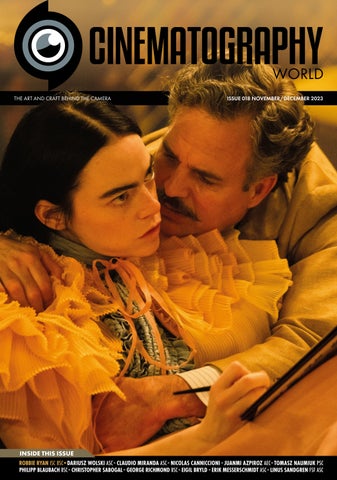
Cover Image: A scene from Yorgos Lanthimos’s Poor Things, shot on KODAK EKTACHROME by Robbie Ryan ISC BSC. Image courtesy of Searchlight Pictures. © 2023 20th Century Studios. All Rights Reserved. SUBSCRIBE You can subscribe to the print, digital, or print and digital, versions of Cinematography World. This will cover you for the six issues delivered over a 12-month period. Your email will also be added to our monthly newsletter update, unless you decide to opt out of these news feeds. Cinematography World is part of Rascals Publishing & Media Ltd! The publishers emphasise that opinions expressed within Cinematography World Magazine are not representative of Rascals Publishing & Media Ltd!, but are the responsibility of individual contributors. Cinematography World is created using responsibly sourced paper. All inks used during the printing process are vegetable based and virtually free from volatile organic compounds. Waste, paper, ink and consumables are recycled. Where this is not possible waste is sent to specialist centres for safe disposal. RECYCLE
Cinematography World is created using responsibly sourced materials
CINEMATOGRAPHY WORLD NOVEMBER/DECEMBER 2023 3
Anywhere Anytime Camera Tracking
at t us ge e e M rima e m C a s t i va l Fe
ZEISS CinCraft Scenario Meet the only real-time camera tracking system that works indoors and outdoors, on film sets, with green and blue screens and in LED volumes. That uses natural markers, reflective markers, and even digital markers on LED screens. That provides camera tracking data for real-time use and records it for post-production. And that integrates lens characteristics to skip the cumbersome lens calibration process. Meet ZEISS CinCraft Scenario. zeiss.ly/cincraft-scenario
ISSUE 018•CINEMATOGRAPHY WORLD
INSIDE
ISSUE 018 NOVEMBER/DECEMBER 2023
6 VIEW FROM THE TOP•SARA PUTT, MD SARA PUTT ASSOCIATES / BAFTA CHAIR 8 PRODUCTION NEWS 18 STUDIO NEWS 20 WHO, WHAT, WHEN & WHERE 28 DARIUSZ WOLSKI ASC•NAPOLEON 34 ROBBIE RYAN ISC BSC •POOR THINGS 40 CLAUDIO MIRANDA ASC•NYAD 42 NICOLAS CANNICCIONI•HOW TO HAVE SEX 44 JUANMI AZPIROZ AEC•AWARENESS 46 TOMASZ NAUMIUK PSC•THE GREEN BORDER 48 SPECIAL REPORT•ENERGACAMERIMAGE FESTIVAL 2023 56 LINUS SANDGREN FSF ASC•SALTBURN 62 ERIK MESSERSCHMIDT ASC•THE KILLER 66 EIGIL BRYLD•THE HOLDOVERS 68 GEORGE RICHMOND BSC•PAIN HUSTLERS 70 CHRISTOPHER SABOGAL•CHAMPION 72 PHILIPP BLAUBACH BSC•CULPRITS 74 GREAT GEAR GUIDE•IBC 2023 HIGHLIGHTS 80 GAFFER’S CAFÉ•IAN SINFIELD
28 NAPOLEON
34 POOR THINGS
46 THE GREEN BORDER
56 SALTBURN
70 CHAMPION CINEMATOGRAPHY WORLD NOVEMBER/DECEMBER 2023 5
VIEW FROM THE TOP•SARA PUTT
COMMUNITY SPIRIT
I
f you had told me back in 1990 when I took over Carlin Crew, a small diary service based out of Shepperton Studios, that 33 years later Sara Putt Associates would still be here and thriving, and that I would also be the chair of BAFTA, I would have laughed out loud at the very idea. But that is the remarkable thing about this industry. In the words of William Goldman “Nobody knows anything…” and it’s a quote that seems as apt for the running of an agency as for the success of any film. Sara Putt Associates grew out of Carlin Crew in order to offer a more pro-active form of representation than a diary service could provide. However, the main impetus for setting-up the company was to build a community – a place where freelancers could belong. I have often thought that one of the most challenging aspects of being freelance is the sense of isolation, and that together with the promotion, career strategy and negotiation an agency provides for its clients, a sense of belonging to a wider community is also hugely important. During the last three decades I have had the privilege of working with several generations of filmmakers and the joy of watching many of their journeys into and through the industry, from trainees to heads of department and in some cases onto producing and directing. But, the industry has changed enormously over this period. Today’s freelancers are so much more aware of the need for training and strategy in building their careers. ‘Soft’ (professional) skills are now widely respected and the need to understand how to best manage a team is now acknowledged as a valuable part of any HoD’s toolkit. Crews generally are more diverse and inclusive than they were back in 1990 and walking onto a film set you are far more likely to see a crew that resembles the general population than used to be the case. However, we still have a long way to go. Building sustainable careers for a diverse community is still challenging, and the fragility of being freelance has been thrown into sharp relief by the recent strikes in the US. Whilst we now have a much more authenticallydiverse community at entry level, this does not yet translate at mid-career level. There is a great deal of excellent support and training out there, and we now need a more joined-up approach to ensure that
we can properly support freelancers at all stages of their careers. This together with a more flexible attitude to some roles and towards those with parenting/caring responsibilities will help us to retain talent. And the increasing focus on excellence not only in the content created, but also in the manner of its creation will ensure that work is a safe and creative place for everyone.
Potential talent is everywhere… however, opportunity is not
At Sara Putt Associates we set-up our own Trainee Scheme and Foundation ten years ago, and there are now over 350 of our ex-trainees/ foundationers working in the industry. Some of our very first trainees and foundationers now occupy senior roles and have either become agency clients themselves or now employ our clients. All of them have become part of our community. The first board I sat on as a trustee was Women in Film & Television, an organisation I feel very proud of being involved with, and one that still does hugely-important work supporting women in our industries. I am also a trustee of the Film & TV Charity, another vital part of the industry landscape.
A mission to celebrate, inspire and support talent in film, TV and games is at BAFTA’s core
I have been involved with BAFTA since 2014. In this time I’ve chaired the Learning Inclusion and Talent Committee, the TV Committee and now find myself chair of the Academy. I am honoured to represent all of the BAFTA membership, and to be able to continue to highlight the vital importance of craft roles within the academy.
6 NOVEMBER/DECEMBER 2023 CINEMATOGRAPHY WORLD
Over the next three years, working alongside the amazing BAFTA team and its new CEO Jane Millichip, we need to continue to increase BAFTA’s engagement with all of its stakeholders including our own members, and to scale-up the impact and reach of its work. Many people are still not aware that BAFTA is a charity and that a mission to celebrate, inspire and support talent in film, TV and games is at its core. There are many amazing BAFTA initiatives providing support for career starters including bursaries, scholarships and BAFTA Connect our new entry-level membership, through to mid-career schemes like BAFTA Elevate, a programme to help talented freelancers from diverse backgrounds move into senior roles. Alongside the masterclasses, mentoring and bespoke support that these schemes offer, this is again about building community and a sense of belonging. In my work, both as an agent and elsewhere in the industry, I have been lucky enough to spend my career nurturing freelance talent. Potential talent is everywhere. However, opportunity is not, and to play a small part in creating pathways and support for behind-the-camera talent has been and continues to be a great privilege. Sara Putt MD Sara Putt Associates & BAFTA Chair
SOFT LIGHT. PRECISE WHITE.
COLOUR SCIENCE
CONTROL
FORM FACTORS
With its innovative light engine, Panalux
Panalux Sonara provides the highest level
Available in 4:4, 3:2, and 4:1 form factors,
Sonara produces a broad, even spectrum of
of creative control with adjustable CCT, HSI,
Panalux Sonara offers a low weight, slim
variable white light at a high CRI, TLCI, and
Gel, and x,y coordinate modes. Connect
profile, and integrated ballast. Refine the
SSI, from 1600K-20,000K. Render natural skin
via DMX, LumenRadio CRMX, or EtherCON,
fixtures’ wraparound output via softbox,
tones, tune across an array of pastel hues, and
or take command with the removable,
diffusion, or eggcrate, and rig how you like
accurately emulate select LEE lighting gels.
ergonomic controller with custom UI.
with comprehensive mounting options.
LEARN MORE AT WWW.PANALUXSONARA.COM
PRODUCTION & POST NEWS
OSCAR-WINNER PETER BIZIOU BSC RECEIVES MANAKI BROTHERS AND CAMERIMAGE AWARDS
C
inematographer Peter Biziou BSC has been awarded the 2023 Manaki Brothers’ Golden Camera 300 and Camerimage Lifetime Achievement awards. Biziou, who was born on 8th August 1944 in Wales, developed a reputation for helping to make good films exceptional, and became one of the most distinguished British cinematographers in history, framing features such as Monty Python’s Life Of Brian (1979, dir. Terry Jones), Time Bandits (1981, dir. Terry Gilliam), Pink Floyd – The Wall (1982, dir. Alan Parker), 9½ Weeks (1986, dir. Adrian Lyne) and A World Apart (1988, dir. Chris
Menges), before winning the Oscar for best cinematography on Mississippi Burning (1988, dir. Alan Parker), among other prestigious awards. The Truman Show (1998, dir. Peter Weir), Damage (1992, dir. Louid Malle), In The Name Of The Father (1993, dir. Jim Sheridan) and Richard III (1995, dir. Richard Loncraine) are amongst his many other notable film credits. In November 2023, Biziou graces Camerimage, in Toruń, Poland, with his presence to receive the 31st Lifetime Achievement Award. You can read more about him and his career in our Camerimage Preview, in this edition.
PANAVISION’S KIM SNYDER RECEIVES HPA ALCHEMIST HONOUR
T
he Hollywood Professional Association (HPA) recently announced Panavision president and CEO, Kim Snyder, as the recipient of the Alchemist Honour, which recognises a leader who spearheads the innovation of noteworthy technology, and who is dedicated to serving the community.
Snyder was presented with the Alchemist Honour during the HPA’s Women In Post summer lunch, where she was the featured speaker. In a Q&A, she spoke about overcoming obstacles, whilst bringing new technologies to life, adapting to new trends in an ever-evolving industry,
and fostering a culture of curiosity and risk-taking. She also shared her thoughts on the future of
workflows from set-topost, offered advice for aspiring leaders, and discussed Panavision’s commitment to supporting underrepresented communities in the entertainment industry. Under Snyder’s leadership, Panavision has supported and helped to spearhead a variety of industry initiatives, including being a founding partner of the Academy Gold Program, a multitiered educational and experiential diversity initiative, and as a primary sponsor of the AFI Cinematography Intensive For Women, a tuition-free workshop for women who are at the early stages their journeys to become directors of photography.
PGGB APPOINTS MICHAEL HUNTER AS HEAD OF MARKETING AND COMMUNICATIONS
T
he Production Guild Of Great Britain (PGGB) has appointed former Film London marketeer Michael Hunter as head of marketing and communications.
Hunter joins the PGGB from his previous post in marketing and events for Film London. For the past four years, he has looked after branding, design and events for the capital’s screen agency, after previously managing social media and marketing collateral for the Edinburgh International Film Festival and Filmhouse Cinema in his native Scotland. Lyndsay Duthie, PGGB CEO, commented, “Michael brings with him a wealth of experience, honed during years of involvement in the screen industries, plus an obvious passion for film and screen production. As the guild continues to grow and adapt to industry trends and conditions, Michael’s role is central to the strong relationships we are building with our members and business partners.” Hunter added,“I am hugely excited to be part of an organisation as prestigious as The Production Guild Of Great Britain, and to be supporting our members and screen sector partners to ensure the UK remains one of the greatest places in the world to produce exceptional screen content.”
8 NOVEMBER/DECEMBER 2023 CINEMATOGRAPHY WORLD
EVERYTHING YOU NEED IN ONE TAKE. Sunbelt Rentals have united four well-known names in Film and TV; Movietech, PKE Lighting, Alpha Grip and Media Access Solutions. Together we are specialist suppliers of professional end-to-end solutions for content creators. With a comprehensive and technologically advanced rental inventory of lighting, camera, access, grip, power and temporary infrastructure, we offer a full production solution from prep to wrap. Think of us the team behind the crew. Skilled technicians, in-house production experts and best-in-class maintenance teams who will do whatever it takes.
We look forward to seeing you at the EnergaCAMERIMAGE 2023 0161 241 6185 filmandtv@sunbeltrentals.co.uk
Now part of Sunbelt Rentals
PRODUCTION & POST NEWS
HARBOR ACQUIRES LONDON COLOUR STUDIO CHEAT
H
arbor has acquired Cheat, a premium colour and finishing studio, with clients now benefitting from having access to the colourist rosters of both Harbor and Cheat for their post-production projects across entertainment and advertising.
the company offers scaled solutions for premium content, whilst maintaining a boutique feel, servicing UK-based global studios and agency clients across advertising and entertainment. “Bringing Cheat and its team into the Harbor fold extends our ability to locally serve our global entertainment and advertising clients from Los Angeles to Chicago and Atlanta, to New York, and now the United Kingdom,” said Zak Tucker, founder and CEO of Harbor. “Moreover, it adds very special, sought-after artists and producers to our crew, affording for multi-geographical opportunities and creative collaborations, both centrepieces of Harbor’s promise to clients and ourselves.”
Harbor has appointed Dan Bennett as managing director of advertising, UK, to oversee the division. The acquisition of Cheat accelerates advertising capabilities for Harbor in London, a central piece to its business, and expands the company’s VFX and colour grading offerings in the UK. It will also allow Harbor to further invest in cross-over and emerging talent in advertising seeking to segue into entertainment. Located at Harbor’s Turnmills studio,
GREEN VOLTAGE POWERS-UP SALTBURN SUSTAINABLY
G
reen Voltage has expanded fourfold, since launching in 2019, and now comprises a dozen employees, whilst its product range has grown exponentially to feature over 150 battery products, ranging from 100kW E-gens and the 5k Voltstack, to the light and compact 2k InstaGrid Max, complemented by over 100 stateof-the-art portable solar panels.
The company’s collaboration with the production team on Saltburn, shot by DP Linus Sandgren FSF ASC, saw it supplying two 100kW E-Gens and eight 5kW Voltstacks, along with two 2kW Voltstacks. These sustainable power solutions played a pivotal role during numerous location shoots, and removed the reliance on traditional generators. This resulted in significant reduction in noise pollution and carbon emissions, and offered speed and versatility on-set.
The 5kW Voltstacks powered localised lighting and feed for the grips, whilst the E-Gens silentlypowered the video village and substantial LED lighting rigs. Using Green Voltage solutions, the production crew managed many days without needing generators and saved an estimated 24 tons of carbon across the shoot. David Appleby, key grip on Saltburn, said, “Green Voltage batteries are versatile and reliable, making prepping locations, as well as studio floors, quick and efficient. As they are silent
and emissions-free, they’re my go-to choice of power on many prestigious productions with large and smaller budgets.”
CHRIS AUTY APPOINTED AS NEW DIRECTOR AT LONDON FILM SCHOOL
T
he London Film School has announced Chris Auty as its new director. Auty has been a senior head of department at the National Film & Television School for the past ten years where, along with his role as head of supervising the development and production of up to 30 short films a year, and running the NFTS’s two-year MA producing programme, he was also responsible for designing, validating and running new MA courses. Prior to taking up his role at the NFTS, Auty worked
DEDOLIGHT INTRODUCES LIGHTSTREAM THE V-FLECTOR VARIABLE REFLECTOR
D
edolight has introduced the V-flector, a variable reflector, who’s surface can be changed from completely flat to a bent shape, and allows the operator to control the spread angle of light in terms of horizontal or vertical width.
What is unique about the V-flector, unlike others reflectors on the market, is that it is designed to bend. This has the effect of shaping the light coming from the reflector and on to the subject in a way that can be varied by moving the adjustable handle. Anything from circular or elongated shapes can be easily created, and the reflector can be flipped from horizontal to vertical for even more variations. 10 NOVEMBER/DECEMBER 2023 CINEMATOGRAPHY WORLD
extensively in the film industry. “I’m particularly delighted to be taking on the leadership of this renowned film school in the heart of London, as it happens to be the place where my own journey into film began, working with LFS alumnus Miguel Pereira on his first feature film. I greatly look forward to working with staff, students, and alumni to build the brightest possible future for this unique, world-class school for independent filmmakers.” Auty replaces Neil Peplow who joined LFS as director last year, but who has left to take up a senior international role in the film industry.
The use of several V-flectors, set up in a row, activated by different lights, can create a continuous river of light, for the movement of talent in parallel with the row of light without any change of exposure. The V-flector is available in Dedolight Lightstream reflectors No.2 or No.3. While each reflector in the range is designed to create a spread of light according to the characteristics of the reflected surface, the V-flector creates a continuous, modifiable shape, as the product name implies.
PRODUCTION & POST NEWS
KINO FLO’S MIMIK 120 WINS 2023 HPA AWARD FOR ENGINEERING EXCELLENCE
K
ino Flo Lighting Systems has announced that its Mimik 120 full-spectrum, imagebased video lighting tile has been honoured with a 2023 Hollywood Professionals Association Award for Engineering Excellence.
Previously this year, the Mimik 120 also received the Best Of Show Award at the Euro Cine Expo and a Product Of The Year Award in the Location/Studio Lighting category at the 2023 NAB Show. The HPA Awards for Engineering Excellence are a coveted honour, with the Mimik 120 chosen as a
winner based on the innovation and advancement it delivers for the media and entertainment industry. “The Mimik 120 is designed to create a fullspectrum, colour-correct, lighting environment on virtual sets that perfectly mirrors the LED wall volume via the video signal, ensuring unprecedented realism for every shot,” said Kino Flo company founder Frieder Hochheim. “We believe its capabilities are a game-changer for virtual production, and it’s extremely gratifying to have our efforts acknowledged with these three prestigious awards.”
JEBSEN TIFFEN EXPERIENCE DAY FOR FILTERS AND STEADICAM IN BEIJING
T
he Jebsen Tiffen Experience Day was held on Monday 21st August at the CineSpace facility in the Soho business area of Beijing. This was an opportunity for DPs, cinematographers and Steadicam operators to get to know the latest range of Tiffen filters and also get an insight into the Steadicam M-2 sled and Volt system and see the new Steadicam G-70X2 arm prototype.
Robin Thwaites, Tiffen’s director of international sales, introduced the latest filter developments from Tiffen with a short presentation, after which a live filter demonstration and workshop with three live cameras and an illuminated set took place. The afternoon saw a presentation based on the M-2, Volt, Exovest and new G-70X2 arm followed by opportunities to test the system. A number of wellknown local Steadicam operators dropped by and, seeming impressed with the new arm, stayed some
time for a chat and catch-up. The day finished around in the late afternoon, with some reluctant to leave, but promising they would visit BIRTV, find the Jebsen stand, and continue any unfinished conversations.
LEE FILTERS LAUNCHES LEE100 DELUXE KIT+
L
ee Filters has introduced the new Lee100 Deluxe Kit+. Designed for firsttime Lee users and seasoned photographers alike, the new Lee100 Deluxe Kit+ provides everything needed to get started with the renowned Lee100 filter system.
Additionally, the Lee100 Deluxe Kit+ marks the introduction of Lee’s new high-performance ProGlass Graduated Filters, which deliver the renowned optical quality photographers expect from the company. Lee ProGlass Graduated Filters will also now be included in the Lee100 Landscape Kit and Lee100 Long Exposure Kit. The Lee100 Deluxe Kit+ comprises of : Lee100 Holder, a sturdy, versatile, easy-to-use holder for
100mm filters, designed to anchor photographers’ creative journeys; wide-angle adaptor rings in three popular sizes (72mm, 77mm and 82mm) providing compatibility with a wide range of lenses; and Lee ProGlass Neutral Density Graduated Filters, new
ASTERA WELCOMES NEW GROUP CEO
A
stera, the developer of innovative light solutions for film and events, has announced that Carl-Johan Sköld is joining its team as group CEO. Having acted as a consultant for the German-based lighting firm for some time already, Sköld will advise and lead Astera into a period of strategic growth, bringing with him an extensive background in business consultancy and strategic development, with a particular focus on the East Asian market.
Sköld’s analytical abilities will be brought to bear at Astera, facilitating an end-to-end evaluation of existing operations, from product design to 12 NOVEMBER/DECEMBER 2023 CINEMATOGRAPHY WORLD
high-performance glass filters in three graduated densities – 0.6ND Medium Grad, 0.9ND Hard Grad and 1.2ND Medium Grad. Also included is Big Stopper, the long-exposure filter with 10-stops of exposure compensation; the Lee100 Polariser; a protective pouch to keeps filters safe and organised; and ClearLee filter wash and a microfibre filter cloth to ensure photographers can keep their
filters crystal clear. The Lee100 Deluxe Kit+ is available now, and can be purchased through Lee Direct in the UK and US as well as through the Lee Filters shop on Amazon.
manufacturing, internal processes and intelligence gathering, accounting, reporting and finance, as well as global strategy. Working with management teams, Sköld’s focus will be on charting a course for Astera’s future position, setting forth ambitious long-term strategies and goals, whilst also fortifying Astera’s current standing. Speaking about his new role, Sköld said, “It is clear from the recognition Astera gets from some key names in the field of film and TV lighting, that its reputation is welldeserved, and I am both grateful and excited to begin a new path together with the team.”
Introducing the next generation full frame digital cinema camera! The new Blackmagic Cinema Camera 6K is an extremely high end digital film camera that produces precise skin tones and rich organic colors. It features a massive full frame 24 x 36mm 6K sensor with wide dynamic range and built in optical low pass filter for better detail handling. You also get a very flexible L-Mount for both new and vintage lenses!
Extremely Lightweight Portable Design
Get the “Hollywood Look” with Digital Film!
Record to CFexpress Cards or External Disks!
Blackmagic Cinema Camera 6K has the professional features you need for high end
The camera features a built in CFexpress card recorder, and a USB-C expansion
feature films, television programming and documentaries. Now this same quality
port for recording direct to SSDs. CFexpress media are more durable and faster
can be used for the production of cinematic content for social media platforms!
than older media so are perfect for recording full resolution, 12-bit Blackmagic
Imagine shooting with a large format digital film camera on independent films
RAW files. The camera records both Blackmagic RAW and H.264 proxies
and TV commercials. Or even weddings, training films and corporate video!
at the same time, perfect for cloud and mobile work!
Full Frame Flexibility The large full frame sensor lets you work in a variety of film formats and aspect ratios without sacrificing quality! The full area of the sensor gives you a unique open gate 3:2 image which also lets you reframe your shots in post production. Or work in true 6:5 anamorphic without cropping, making widescreen cinematic
The elegant design packs an incredible number of high end digital film features into a miniaturized, handheld design. Made from lightweight carbon fiber polycarbonate composite, the camera has a multifunction handgrip with all controls for recording, ISO, WB and shutter angle right at your fingertips. Plus the large 5” LCD makes it possible to get perfect focus.
Blackmagic Cinema Camera 6K Only £2,119
images more detailed and in higher resolution than before!
www.blackmagicdesign.com/uk Camera shown with optional accessories and lens. SRP is Exclusive of VAT.
Learn More!
PRODUCTION & POST NEWS
JAGOTEQ UNVEILS NEW CONCEPT FOR PRO LIGHTING
J
agoteq has announced a new concept in professional lighting, with a system utilising patent-pending technology that combines the precision of lasers with the versatility and flexibility of fibre-optic cable. The result is a lighting tool that functions as both a professional illumination source and as a practical design element. Current uses include film, broadcast and live production, as well as effects, wet locations, neon and LED-strip replacement, plus wearables. The new technology includes a compact and efficient module that features three individual laser engines in R, G and B, which unite to form a specified colour. With the new system, users can achieve colour saturation that is three times greater and 25% brighter than conventional LED ribbon. Igniting the laser module illuminates Jagoteq’s
360° Side Emitting Fibre Optic (SEFO) cable. It is available in a choice of 1mm, 6mm, 8mm, or 12mm diameters, in standard lengths up to 33ft. When more distance is required, additional laser modules may be combined to extend the range up to 100feet with minimal visible light loss. The company says the proprietary SEFO cable is flexible, easy to install and safe to use, as there is no heat or electrical transmission. Suitable for wet locations, it can be fullysubmersed in pools, salt water or other liquids. Unlike LED ribbon, fibre optic cable can
be reused indefinitely and, when no longer needed, can be 100% recycled.
BROMPTON TECHNOLOGY POWERS BLUE BOX XR VIRTUAL PRODUCTION STUDIO IN BEIJING
B
ig Blue Technology specialises in virtual production technologies, innovative Metaverse technology, and cutting-edge extended reality solutions. In early September, it welcomed over 400 guests to the grand re-opening of its second virtual production studio in China, Blue Box xR Studio.
The upgraded studio offers a wide range of applications, from advertising to TV productions to broadcast to xR virtual product launches, and features a state-ofthe-art LED set-up, including Roe Visual LED screens and industry-standard Brompton Technology LED processing. Blue Box xR Studio spans 1,400sq/m, with high-end equipment such as Brompton 4K Tessera SX40 LED processors, Roe Visual LED screens,
Disguise media servers, ARRI cinematic lighting equipment, Vicon motion capture and Mo-Sys camera tracking systems. Brompton LED processing plays a key role in the set-up, enabling fast and efficient operation of the
LED screens. “Our team relies on a full suite of Tessera features, with our favourites including PureTone, which eliminates unsightly colour casts in the greyscale for balanced, neutral output,” said Vno Hu, chief technology officer at Big Blue Technology. “We’re also big fans of Dynamic Calibration, the enabling technology for Brompton HDR, that allows us to achieve beautiful, uniform video content even at extremes of brightness and colour gamut.” Elijah Ebo, Brompton’s director of APAC operations, added, “We are delighted to see the team using our LED processing technology and look forward to the innovative productions that will originate from this facility.”
DP DENSON BAKER ACS NZSC JOINS LOOP TALENT
U
K-based Loop Talent has announced DP Denson Baker ACS NZCS to its roster. Hailing from New Zealand and of Māori heritage, Baker is celebrated for his remarkable cinematography, showcased across feature films, music videos, documentaries and commercials. His recent work includes the feature film The Colour Room (2021), the award-winning BBC TV series The Luminaries (2020) and the Sky TV series Domina (2021).
nothing short of brilliance translates seamlessly onto the screen, captivating audiences and leaving an indelible
Baker was honoured with the 2021 Cinematographer Of The Year Award by the Australian Cinematographers Society (ACS), and has been an accredited member of the ACS, since 2005, and the New Zealand Cinematographers Society (NZCS) since 2015. Lucy Price, managing director of Loop Talent, said, “We’re thrilled to welcome Denson into our distinguished family of HoDs. He is a superstar in the world of cinematography, showcasing immense talent and unwavering dedication to excellence in every project he takes on. His commitment to delivering
14 NOVEMBER/DECEMBER 2023 CINEMATOGRAPHY WORLD
impression.”now invited from PGGB members. Closing date for entries is Monday 25th September 2023.
www.arri.com
PRODUCTION & POST NEWS
CINELAB SUPPORTS THE LATEST HIGH-END, HIGH-PROFILE FEATURES
Maestro
C
inelab Film & Digital has recently been involved with a range of highprofile projects, many of which look set for accolades during the coming awards season. The company handled the processing on All Of Us Strangers, directed by Andrew Haigh and lensed by cinematographer Jamie Ramsay SASC, the first-known feature to be captured on 35mm film on an LED virtual production stage. The company has also supported two other hotly-tipped films. The company did the processing and 4K scanning on Bradley Copper’s second directorial effort Maestro, which sees the actor also star as conductor Leonard Bernstein, lensed by DP Matthew Libatique ASC on 35mm 4-perf film. Cinelab also handled the 4K film scans, plus the creation of film deliverables, on the recent Golden Lion winner Poor Things, director Yorgos Lanthimos’s eagerly anticipated film, shot by DP Robbie Ryan ISC BSC on a mix of Kodak 500T, Ektachrome and Double-X 35mm filmstocks. This year’s London Film Festival opening night gala film, Saltburn, written and directed by Academy Award-winning filmmaker Emerald Fennell, and shot on 35mm 4-perf film by cinematographer Linus Sandgren FSF ASC, was processed and 4K-scanned by the company. BAFTA Award-winning David Yates’s new Netflix film, Pain Hustlers, shot by DP George
Richmond BSC using ARRI Alexa LF, proved a particularly interesting project. Cinelab setup a remote digital lab for dailies, and later applied its DFD (Digital-Film-Digital) analogue intermediate process to the graded master. The digitally-captured footage was recorded to Kodak 250D 4-perf 35mm film, processed at the lab and scanned back to digital, for an authentic filmic look. Similarly, for Amazon Studios’ series Wilderness, Cinelab established remote digital labs across north America to
service dailies on the production. The company also collaborated with director Wes Anderson on a series of short films for Netflix based on well-loved Roald Dahl stories The Wonderful Story Of Henry Sugar, The Swan, The Rat Catcher and Poison. All were shot on 16mm film by cinematographer Robert Yeoman ASC, before being processed and scanned to 4K, a fitting celebration of the 16mm format in its centennial birthday year.
SUSTAINABLE FILM SURVEY TO SUPPORT UK FILM & TV INDUSTRY SUPPLY CHAIN
W
ith 70% of a film’s carbon footprint attributed to the emissions of the supply chain that support the industry, Sustainable Film is launching a survey to find out what it needs to become green. The survey seeks to discover how the industry can best support suppliers as they strive for sustainability.
Sustainable Film understands that suppliers have limited time, limited budgets and may need support to address their environmental footprint, and is looking for feedback from those within the industry. “We want to engage with suppliers,” said Sustainable Film director Amelia Price, “to find out how we can best support them. Our survey will ask questions such as: What challenges have you faced in trying to make your services more sustainable? Do you think there should be more incentives put in place to encourage sustainability in the film industry? Do you think there needs to be more support for suppliers to reduce their impact and develop sustainable ways of working? Let’s get this conversation going.” The insights from the survey will be shared with industry bodies and studios to raise awareness about the needs of suppliers on their environmental journey. The survey is open to anyone who works in the film and TV industry and will take approximately 5-10 minutes to complete. Please participate at https://www.surveymonkey.co.uk/r/ green_supplier_network_survey. 16 NOVEMBER/DECEMBER 2023 CINEMATOGRAPHY WORLD
LIGHT, CAMERA, ACTION: PANALIGHT IS THERE. Pa n a l i g h t, 3 0 y e a r s i n a n d f o r f i l m m a k i n g .
CAMERA | LENS | LIGHTING
| GRIP | SPECIAL ACTION EQUIPMENT
V I S I T PA N A S H O P. I T, T H E S H O P F O R F I L M P R O F E S S I O N A L S . Distributor for Italy
panalight.it
panalight@panalight.it
Exclusive Agent for Italy
STUDIO ROUND-UP•WARNER BROS•SHINFIELD•SHEPPERTON
STUDIO NEWS
By Kirsty Hazlewood
WARNER BROS. STUDIOS LEAVESDEN SET FOR SIGNIFICANT EXPANSION Warner Bros Discovery has confirmed it is planning a major expansion of its Warner Bros. Leavesden Studio’s lot, with the UK location set to become the epicentre of DC Studios production. Barbie, one of the top-grossing Warner Bros movies ever made, with a box-office return of £1.43 billion worldwide, was shot at WBSL. The plans call for ten new sound stages and an additional 400,000sq/ft of production and support space, according to a press release – a growth surge that will increase production capacity at WBSL by more than 50%. The total stage count will rise from 19 to 29 and the overall production space from 1.14 million sq/ft to 1.78 million sq/ft. Work is slated to start in the second quarter of
SHINFIELD STUDIOS HOSTS SCREEN BERKSHIRE LAUNCH EVENT Screen Berkshire, part of the BFI’s nationwide Skills Cluster initiative to support the on-going growth of the film and high-end television (HETV) production industry in the regions, was officially launched during a special event at Shinfield Studios, near Reading. Shinfield Studios is a Screen Berkshire partner alongside the University of Reading and Bedlam Film Productions, and the BFI Skills Cluster initiative is designed to provide opportunities for work and training, improve diversity in the industry and support productions filming around the UK. The Screen Berkshire launch event follows an announcement earlier in 2023 that it had been awarded £600,000 BFI National Lottery funding to make the industry more accessible and help
SHEPPERTON STUDIOS SUPPORTS LOCAL BIODIVERSITY Shepperton Studios has officially opened the River Ash Corridor, known as Studios Walk, having completed substantial biodiversity enhancements it has carried-out in partnership with local Spelthorne Borough Council. The community and ecology enhancements to River Ash Corridor include an investment of around £1million into Studios Walk, which runs along the Shepperton Studios’ boundary. Future maintenance will be undertaken by Spelthorne Borough Council funded by Shepperton Studios with a £300,000 grant to be allocated over the next 15 years. Andrew M Smith OBE DL, corporate affairs director of Pinewood Group, commented, “We are extremely pleased to have delivered the biodiversity enhancements of the River Ash Corridor ahead of schedule. We hope the rejuvenation of this valuable resource will be enjoyed by our neighbours and the local community of Spelthorne for years to come.”
2024 and conclude in 2027. The bulked-up WBSL will become a primary production hub for DC Studios, the company said. “Warner Bros. Studios Leavesden is globally-recognised for its exceptional soundstages and facilities,” said Simon Robinson, COO of WBD Studios. “With this planned expansion adding significant capacity and capabilities, it will be home to even more incredible storytelling for both film and television projects. We are proud to not only be growing our productions in Leavesden and making it the main hub for DC Studios, but also to be
develop emerging and experienced film and TV production crews. The three-year programme aims to create opportunities for new entrants to the workforce, those from underrepresented backgrounds,
Cllr Malcolm Beecher, chair of Spelthorne Borough Council’s Environment & Sustainability Committee, added, “Studios Walk is valued by the local community as a place to walk and immerse themselves in the fantastic biodiversity of the woodland and River Ash. The project has openedup a new walking route that will allow residents to roam amongst the trees and enjoy views of the river
18 NOVEMBER/DECEMBER 2023 CINEMATOGRAPHY WORLD
growing our economic and community contributions to the UK’s creative sector.”
individuals up-skilling and over 50s jobseekers returning to work. Alongside this mission, Screen Berkshire has the goal of supporting existing crew to up-skill and re-skill as well as supporting productions who are producing locally by offering a single source to help access crew, facilities and locations. Dominique Unsworth MBE, CEO of Resource Productions CIC, said, “A more diverse production staff, and a broader pipeline of technical and creative talent, is crucial to the future of the industry. Through Screen Berkshire, we have the plan and the partners to achieve it.”
from areas which were previously inaccessible.” These works are part of a number of commitments that have been made to the local community in connection with the expansion of Shepperton Studios. Most recently, the studios announced a £180,000 investment in three local play areas and a rolling Community Fund to support charities and organisations in Spelthorne.
BRISTOL FILM OFFICE•BOTTLE YARD•MARLOW FILM•TDC•STUDIO ROUND-UP
BRISTOL FILM OFFICE ANNOUNCES IMPRESSIVE PRODUCTION SPEND FIGURES Annual figures released by Bristol Film Office, which marks its 20th year of operations in 2023, show that film and TV production was worth an estimated £20.1 million to Bristol’s economy during the 2022-23 financial year. The figures reveal that production levels have held strong in the city since the previous 12-month period (2021-22), when the economic impact of the sector was valued at £20.8 million, the highest figure in a decade. £20,134,750 of inward investment was generated in 2022-23 by 220 recorded productions, and 838 filming days took place on-location, assisted by Bristol Film Office or
at the city’s The Bottle Yard Studios. Over the past 20 years, Bristol Film Office and its partners The Bottle Yard Studios have assisted TV and film production worth an estimated £322 million to Bristol’s economy. Its operations have generated more than £2.1 million income for Bristol City
BOTTLE YARD STUDIOS HOSTS MALORY TOWERS SERIES The fifth series of Malory Towers, produced by King Bert Productions for CBBC and BBC iPlayer in the UK and BYUtv in the US, has wrapped filming at Bristol’s Bottle Yard Studios. It is the first time that the beloved children’s drama has based at a UK studio. Interior scenes for series one to four were previously shot in Canada, but, The Bottle Yard Studios housed the show’s extensive sets for series five. Filming began in early August for the latest 20 x 25-minute episodes at the studios as well as picturesque locations around south-west England in Devon and Cornwall.
Laura Aviles, senior film manager at Bristol City Council, said, “It’s been our absolute pleasure to host King Bert Productions at The Bottle Yard Studios. Quality children’s drama is a vital part of the film and TV production sector in the south-west of England and we were so pleased that our facilities here fitted the bill so well when the production relocated its studio base from Canada to the UK.” Jo Sargent, managing director for King Bert Productions, added, “With our location filming taking place in North Devon and Cornwall, The Bottle Yard Studios was the perfect home for our physical sets and allowed us to maximise the use of regional crew and suppliers. The Bottle Yard Studios is excellent and the team were very supportive
MARLOW FILM STUDIOS UNVEILS LOCAL COMMUNITY PLANS New formal submissions by Marlow Film Studios to Buckinghamshire Council continue to set out key commitments to the local community. The planned state-of-the-art filmmaking facility, on a former gravel extraction and waste disposal site, aims to provide a range of transport infrastructure, training, public amenities, and the delivery of outstanding workspace for the next generation of filmmaking talent, as part of a package of comprehensive community benefits. “From Barbie to Indiana Jones, via Mission Impossible, Ant Man to The Little Mermaid, Britishmade movies continue to deliver big box office hits in 2023. Six of the top thirteen performing films globally in 2023 were British made, boosting local
TDC STUDIOS IN SYDNEY OFFERS VIRTUAL PRODUCTION SUPPORT Opening its doors in Sydney, TDC Studios is giving film, TV, events and advertising industry professionals up-to-the-minute insight into virtual production research and development, and opportunities to try, test and discuss the emergent technology. “Australia is becoming a centre of excellence in digital filmmaking,” said David O’Connor, technical project manager at TDC Studios. “Virtual production has grown significantly over the past few years and we’re seeing a boom in high-end production techniques that mirror that growth.”
creative skills, and bringing highly-productive and rewarding careers to the economy,” said Marlow Film Studios CEO Robert Laycock.
Council through filming permits and charges. Councillor Craig Cheney, deputy mayor and cabinet member for finance, governance and performance, said, “We are proud that Bristol is home to the largest studio hub for film and TV production in the west of England, and is at the heart of a sector worth over £320 million to our local economy since 2003. Our city is one of the most competitive filming cities outside of London.”
during production.”
“Two thirds of the outstanding crews who are the sector’s key workers live within a reasonable distance of Marlow Film Studios. This studio project has been located and designed for a once in a multi-generational chance to keep a stellar local economic sector thriving, all while being based on good principles of sustainable development. “Our masterplan will deliver over 4,000 new jobs and bring £380 million annually to the local economy, whilst adding 75 acres exclusively for recreation, enhanced habitats and training of a very special quality.” The full planning application for Marlow Film Studios, with a total investment of £750 million, has received over 3,200 letters of support and has recently been endorsed by Marlow Town Council in an overwhelming majority vote.
TDC Studios is showcasing equipment from ARRI, Barco, GhostFrame, Megapixel VR, Pixotope and others, to demonstrate the very latest innovations in virtual and xR (extended reality) production through demonstrations in augmented reality and tracking techniques that allow the seamless blend of live and virtual worlds. The showcase at TDC Studios will provide Australian film, television, production and advertising production staff, as well as members of the Australian Cinematography Society, and the honorary Visual Effects Society, the opportunity to discover the world of possibilities that virtual production has to offer.
CINEMATOGRAPHY WORLD NOVEMBER/DECEMBER 2023 19
WHO, WHAT, WHEN & WHERE
WHODUNNIT…? Our regular round up of who is shooting what and where SCREEN TALENT: Bart Sienkiewicz PSC has wrapped on the art-film series Leviathan with director Shezad Dawood. BERLIN ASSOCIATES: Edward Ames is shooting the opening block of the new season of Waterloo Road for Wall To Wall/BBC. Al Beech has wrapped on BBC’s Silent Witness S27, with directors Toby Frow and Rob Bangura. Sarah Bartles Smith has been shooting Mr Bigstuff, a 6x30-min comedy series for Sky Studios. Claudio Cadman is shooting Phoenix Rise for BBC. Nick Cox is on the second block of Waterloo Road S12. Len Gowing is shooting Granite Harbour for LA Production/BBC Scotland. Annemarie Lean-Vercoe recently finished lensing episode five of Call The Midwife with director Sarah Esdaile. Trevelyan Oliver has completed shooting all six episodes of BBC’s Death Valley. Pete Rowe completed on Dodger for the BBC and is now shooting Mandy for the BBC. James Swift shot the second block of new TV series Protection, for New Pictures/ITV, directed by Sasha Ransome. Matt Wicks is shooting Avoidance for Ranga Bee Productions. Phil Wood worked on The Bay S5, for Tall Story Pictures/ITV.
INDEPENDENT TALENT GROUP: Dan Atherton is shooting new TV series Trinity, directed by Brady Hood. Chas Bain has wrapped the Dr Who S14 ‘special episode’ with regular collaborator, director Jamie Donoughue. Ole Birkeland has graded Dan Levy’s Good Grief. Eben Bolter BSC is shooting The Life Of Chuck, a feature directed by Mike Flanagan, starring Tom Hiddleston and Mark Hamill. Balazs Bolygo BSC HSC is lighting Suspect, directed by Paul Andrew Williams. Caroline Bridges did additional photography days on Paris Has Fallen and Famous Five. Jordan Buck shot with directors Tim Brown, Lake Buckley, Pip + Lib and Lucas Garrido. Miguel Carmenes lit for directors Nicolee Tsin at Kode, Mindcassle, Mori, Paddy McGowan and most recently reunited with Eros Vlahos for the short Meat Puppet. Chris Clarke has been working with Familia director Will Smith for William Hill, and with photographer Jason Schmidt for a stills fashion campaign. Oliver Curtis BSC reunited recently with commercials director Chris Cottam. Ben Davis BSC is prepping The Stuntman for debut-director Damien Walters. Anthony Dod Mantle DFF BSC ASC has been
Images: (from top down) – DP Bart Sienkiewicz PSC, 1st AC Matt Choules GBCT & 2nd AC Maeve Malenczyk on the set of Leviathan; DP Pete Rowe on Dodger for BBC Studios; and two shots of Claudio Cadman on Phoenix Rise.
shooting with Traktor for Coca Cola and British Gas. Adam Etherington is shooting Paris Has Fallen, directed by Oded Ruskin. Michael Filocamo worked on A Good Girl’s Guide To Murder. Sam Goldie has wrapped on The Gathering for World Productions/C4 with director Amanda Blue. Catherine Goldschmidt has finished on House Of The Dragon with Geeta Patel. Rick Joaquim is keeping busy with short projects including Marionette, Wake Up and Largo. Suzie Lavelle ISC BSC shot on Severance S2 in New York, and has graded The End We Start From. Bani Mendy is shooting in Guadaloupe with director Steve Brett on Death In Paradise S13. Andreas Neo has been shooting commercials, the most recent being at the virtual production studio Cube with Matilda Finn at Patchwork Films. Roman Osin BSC is in Canada shooting In The Black with Frances-Anne Solomon. Mark Patten BSC is prepping Black Doves, directed by Alex Gabassi for Sister Pictures/Netflix. Stephan Pehrsson is prepping the new series of Black Mirror with regular collaborator Toby Haynes. James Rhodes shot with regular director Paul Dugdale. Chris Ross BSC worked on Day Of The Jackal block 1. Ashley Rowe BSC has finished lighting on Day Of The Jackal block 2. David Ungaro is prepping Department Q with Scott Frank. Mark Waters is shooting block 2 and 3 of Grantchester S9, directed by Katherine Churcher. Erik Wilson BSC has finished lensing Paddington 3. Mark Wolf has started on Playing Nice, directed by Kate Hewitt. Maja Zamojda BSC is in Ireland lighting Bad Sisters S2 until the end of 2023. LUX ARTISTS: Steve Annis shot a Lexus spot directed by Amber Grace Johnson. Alejandro Martinez has wrapped on
20 NOVEMBER/DECEMBER 2023 CINEMATOGRAPHY WORLD
BEYOND FASHION...
CLASSIC*
Jokers & Alphas HMI light light quality quality for for life life -- Durable Durable –– Reliable Reliable –– Versatile Versatile HMI *Classic :: adj. adj. style style that that is is always always fashionable fashionable ;; A A high high quality quality or or standard standard *Classic against which which other other things things are are judged. judged. against
AVAILABLE IN THE UK THROUGH LCA AVAILABLE IN THE UK THROUGH LCA
sales@lcauk.com sales@lcauk.com
ON SALE SALE FROM FROM ONE ONE STOP STOP ON
51 rue du Commandant Rolland, Bat E3, 93350 Le Bourget, France 51 rue du Commandant Rolland, Bat E3, 93350 Le Bourget, France info@onestopcine.com | +33 1 30 90 57 37 | #onestop.cine info@onestopcine.com | +33 1 30 90 57 37 | #onestop.cine
Manufactured in Europe by Manufactured in Europe by K5600 Lighting Europe K5600 Lighting Europe
WHO, WHAT, WHEN & WHERE Images: (from top down) – DP Pete Rowe on Dodger for BBC Studios; James Swift shooting Protection for New Pictures, with key grip Jim Neale; and Natalja Safranova on-set.
HBO’s House Of The Dragon S2. Matyas Erdely HCA lit a Newco ad directed by Miles Jay. Tasha Back has finished on ITV’s The Tower S3, directed by Rene van Pannevis. Daniel Landin BSC shot an Etsy spot directed by Steve Rogers. Eigil Bryld is lensing Martin Campbell’s feature Cleaner. Rob Hardy BSC ASC shot a Chivas Regal ad directed by Matthijs Van Heijningen, and a Heinz TVC directed by Steve Rogers. Ruben Impens SBC is working on Emma Benestan’s feature Animale. Nicholas Bolduc CSC is shooting The Count Of Monte Cristo, directed by Matthiew Delaporte and Alexandre Patelliere. Olan Collardy shot an NDA spot directed by Shannon Murphy. Lukasz Zal PSC lit a music video directed by Jordan Hemingway and FKA Twigs. Jody Lee Lipes ASC has wrapped on The Listeners, directed by Janicza Bravo. Pat Golan lensed a TVC for The Guardian, directed by Rubberband. Shawn Peters lit a Beats commercial, directed by Bradford Young. Benjamin Roux is shooting on the Apple TV+ series La Maison with director Daniel Grou. Diego Garcia framed an AT&T ad directed by Daniel Wolfe. Ben Fordesman filmed a Boots spot directed by Sam Brown. Henry Braham BSC is shooting Superman: Legacy, directed by James Gunn. Manuel Albero Claro is shooting Submergée with director Alante Kavaite. Benjamin Loeb lensed a Meta ad directed by Fredrik Bond. Arnaud Potier AFC shot a Mini TVC directed by Daniel Wolfe. Magnus Joenck is shooting The Assessment with a director Fleur Fortuné. Adam Newport-Berra lit an Omar Apollo promo, directed by Rubberband. Monika Lenczewska PSC is lensing Tomas Alfredsson’s series Faithless. Harry Wheeler shot an Asics commercial, directed by Frank Lebon. Kasper Tuxen shot a McVitie’s spot directed by Sam Pilling. LOOP TALENT: The agency welcomes cinematographer Denson Baker ACS NZSC to its roster. Denson’s recent works include the critically-acclaimed film The Colour Room, starring Phoebe Dynevor and Matthew Goode, the award-winning BBC TV series The Luminaries, featuring Eve Hewson and Eva Green, and the Sky TV series Domina, with an outstanding ensemble cast, including Kasia Smutniak, Claire Forlani and Isabella Rossellini. Lorenzo Levrini is prepping for a UK feature. Ali
Asad is shooting a feature in Wales. Bertrand Roucourt is in prep for a feature, and also shooting fashion commercials in Europe. Jon Muschamp recently wrapped on a project with Lookout Point and is shooting a documentary. Emma Dalesman has graded The Buckingham Murders, which screened as part of London Film Festival, and is currently shooting a feature. Ali Little has graded a C4 drama. Chris Fergusson has done the DI on a returning BBC series. Matt North is shooting Tell Me Everything S2 with Ruth Carney. Dave Miller is shooting with Stigma Films, plus high-end food spots. Kyle MacFadzean is shooting commercials all over the world. Nick Bennett is shooting ads too. Rik Burnell’s documentary, Red Herring, screened at Raindance, and he’s recently been shooting a short. Natalja Safranova has been filming a documentary alongside commercial projects. Martyna Knitter is shooting a documentary and short form. Olly Wiggins is working all over the world. Jerry Amadi Pradon, Paul Mackay, Aman Sahota, Chris O’Driscoll, Tom Turley and Tom Watts are shooting short forms. Matt Gillan lensed music promos and a documentary in Mexico. James Anderson ACO is working as A-camera/Steadicam on Sweetpea. Jack Smith, Jem Rayner GBCT ACO and Alice Sephton have been operating on short form projects. Grant SandyPhillips has wrapped on The Famous Five and is back to the world of commercials. Sebastien Joly ACO, Michael Eshun-Mensah, Laura Seears, Michael Vega and Gary Kent have been operating Steadicam on short form projects. VISION ARTISTS: Anna MacDonald’s feature-documentary Asog is had its UK premiere at BFI London Film Festival. The unique docu-drama hybrid was directed by Sean Devlin and executive produced by Adam McKay and Alan Cumming. Following Rey, a non-binary Filipino school teacher, on a road trip to compete in a drag pageant. Anna has also been shooting additional photography on BBC’s Grime Kids for Abdou Cissé. Anna’s short, The Talent, starring Emma D’Arcy and directed by Thomas May Bailey was short-listed for the Iris Prize. Luke C Harper’s short, Goodbye Python, has was also shortlisted for this year’s Iris Prize, a transgender focussed sci-fi shot by trans director Frankie Fox and produced by Milo Beyts. James Blann is shooting the new series of BBC comedy Peacock, directed by Joe Roberts through Big Talk. Luciana Riso is prepping Adeyemi Michael’s documentary feature Hidden Heroes, which focusses on black soldiers who fought in WWII, produced by October Films. Nick Morris is lighting on Sweetpea with See-Saw Films, directed by Ella Jones. This month also sees the release of Nick’s work on new TV series Everything Now on Netflix, directed by Alyssa McClelland. Benedict Spence has graded the new Netflix series Eric starring Benedict Cumberbatch, produced by Sister Pictures,
22 NOVEMBER/DECEMBER 2023 CINEMATOGRAPHY WORLD
directed by Ben’s long term collaborator Lucy Forbes. Jaime Feliu-Torres has graded the
tests for the BFI feature Free, directed by David Alexander. Jonas Mortensen has prepped Chris O’Dowd’s new TV Series Small Town Big Story, written by O’Dowd, with Jonas’ episodes directed by Catherine Morshead. Kia Fern Little has been shooting the documentary Murujuga in Australia with Laura Rindlisbahcer, following Aboriginal women fighting to conserve their ancestor’s land. Kia also continues to shoot the Apple TV documentary of a high profile music star, directed by Luke Monaghan. Will Hanke is shooting new TV comedy We Might Regret This for Roughcut, directed by Nick Collett. Stephen Dunn saw the release of short documentary Out There on online platform Nowness, focussing on the real
d n o y e B , d l o B , t h Brig
●
2600W full output across all color temperatures
●
Flicker-free performance and production-ready color rendering
●
Matching 4K PAR even at 10m and beyond
●
IP54 certificated weather-resistant
●
Innovative G-Mount for secure and stable workflow
●
Exquisite craftsmanship and robust durability
●
Complete light-shaping system with heat-resistant capability
●
●
Meticulously-designed powerful cooling system
Professional control system: CRMX / Ethernet / DMX / Removable panel
website: www.godox.com
sales inquiries: godox@godox.com
WHO, WHAT, WHEN & WHERE
stories and testimony of youths who were used and trafficked by county lines drug gangs. Courtney Bennett has been shooting development reels for a new feature-length music doc for director Matt Kay. Eoin McLoughlin’s short film Two For The Road won best short and best cinematography at Galway Film Festival, directed by Locky McKenna, produced by Screen Ireland. Ryan Eddleston has prepped a new Bad Wolf TV project in Wales. Rhys Warren has been part of a longform documentary for Britpop band Blur, directed by Simon Lane. In commercials, Arthur Loveday shot content for Sky and Dyson. Ian Murray has been lighting promos for BAFTA and Starbucks. Jack Wilkinson has been shooting Co-Op spots for Charlotte Regan at Knucklehead. James Watson worked with his regular collaborator Ben Tonge for Prodigious. Jim Jolliffe has been lensing for Rogue Films and Max Fisher on a piece for the Royal Marines. Moritz Moessinger has been lighting gin commercials for Mert Alas with January Productions. Luke Scott reteamed with advertising partners Hogarth to shoot content for Soap & Glory. Martin Hill continues to shoot food and supermarket pieces for Rattling Stick. Tim Green has been lighting tech and food with photographer Dan Tobin Smith. Spike Morris has been lensing fashion spots for Moncler and Peloton. Tim Fok shot a range of food ads with Greenroom and Agile. ECHO ARTISTS: Stuart Bentley BSC is lighting for director and regular collaborator Aneil Karia, on his feature Hamlet. Carlos Catalan has wrapped on Alexandra Brodski’s episodes of upcoming Disney+ series Rivals. Andrew Commis ACS is shooting Charles Williams’ upcoming feature Inside. Nick Cooke lensed Tom George’s episodes BBC series Sherwood S2, and has graded the BFI/ Mubi feature Bring Them Down. Ruben Woodin Dechamps is shooting Never Seen The Sea with director Stroma Cairns. David Gallego ADFC is lensing Sean Dunn’s The Fall Of Sir Douglas Weatherford for BFI/BBC Film. Will Pugh is lighting Pete Townsend’s feature-doc Lighthouse with Pulse Films. Bartosz Swiniarski is shooting the feature China Sea, directed by Jurgis Matulevicius for Lava Films. Felix Wiedemann BSC is
working with director Julian Jarrold and Blueprint Pictures on the next instalment of A Very English Scandal. Sean Price Williams has wrapped on the feature Harvest, with director Athina Rachel Tsangari for Sixteen Films. Nicolas Canniccioni, Nadim Carlsen DFF, Federico Cesca ASK, David Chizallet AFC, Rachel Clark, Edgar Dubrovskiy, Bonnie Elliott ACS, Jo Jo Lam, MacGregor, Patrick Meller, Korsshan Schlauer, Noël Schoolderman, Chloe Thomson BSC and Maria Von Hausswolff have all been shooting commercials. WIZZO & CO: The agency welcomes Simon Stolland to its roster. Simon’s latest feature, Sumotherhood, directed by Adam Deacon, was released in cinemas in October. Ryan Kernaghan ISC has graded the feature Kneecap alongside director Rich Peppiatt. Aaron Reid has graded the entire season of Netflix Original Supacell, created and directed by Rapman. Fede Alfonzo is shooting the feature Near Miss, directed by Jamie Rafn. Charlie Goodger is prepping an embargoed feature. Luke Bryant has completed the grade on Extraordinary S2. Gary Shaw is prepping a drama that will shoot on location in Cuba. Franklin Dow is prepping a feature with director Linda Plancarte. Christophe Nuyens SBC has wrapped on Andor S2. Jan Richter-Friis DFF is shooting a drama on location in the Canary Islands. Steven Ferguson has wrapped on Dinosaur, directed by Niamh McKeown. Oli Russell has graded Red Eye alongside director Kieron Hawkes. Nick Dance BSC has completed the grade on the feature Joy To The World, directed by Ed Hall. Scott Coulter wrapped and had graded G’Wed, directed by Akaash Meeda. Susanne Salavati has done the DI work on drama True Love. Matthias Pilz has completed the grade his episode of Grace S4 alongside director Dan Zeff. Ashley Barron ACS is prepping an embargoed drama. Chas Appeti is shooting an embargoed feature. Carmen Pellon Brussosa shot and has graded two short films. Nicola Daley BSC ACS is prepping a drama. Adam Gillham has done the DI on Paramount +’s A Gentleman in Moscow, alongside director Sam Miller. Darius Shu is prepping an embargoed documentary project. Tim Sidell BSC
24 NOVEMBER/DECEMBER 2023 CINEMATOGRAPHY WORLD
is lighting a project with Samantha Morton. Sverre Sordal FNF recently graded the short For Fox Sake, directed by Minha Kim. Molly Manning Walker has been on the festival circuit. Murren Tullett shot with director Jane Morgan, David Procter BSC with director Joe Connor, and Antonio Paladino with James Rouse. Karl Oskarsson IKS lensed with director Sara Mirandi, Dmytro Nedria with Joseph Paul, and Ben Magahy with Zac Ella. Arran Green worked with director Niall Coffey, Henry Gill shot alongside director Jess Colquhoun, and Theo Garland with Chris Balmond. Joe Douglas lit for Amy Becker-Burnett, Will Bex for Terri Timely, and Hamish Anderson for David Morgan. MCKINNEY MACARTNEY MANAGEMENT: Ben Butler and Alessandra Scherillo have been shooting commercials. Sergio Delgado is lighting Toxic Town for Netflix, directed by Minkie Spiro. Gavin Finney BSC is prepping Wolf Hall S2 for BBC2, with Peter Kosminsky directing. Jean Philippe Gossart AFC is filming Wheel Of Time S3 for Amazon Studios. Dale Elena McCready BSC NZCS is prepping Day Of The Jackal for Sky Studios. Richard Mott is shooting The
WHO, WHAT, WHEN & WHERE Images: Opposite: Denson Baker ACS NZCS; and Mattias Troelstrup on Playdate. This page: Mattias Troelstrup and Eva Husson on Playdate.
Gathering for C4 in Liverpool, with Gareth Bryn directing. Mike Spragg BSC is lensing The Famous Five for Moonage Pictures in Cardiff. WORLDWIDE PRODUCTION AGENCY: Ruairí O’Brien ISC BSC continues principal photography on the new series Small Town, Big Story with writer/director Chris O’Dowd for Playground Entertainment and Sky. Callan Green ACS NZCS is shooting on Gangs Of London S3 with director Kim Hong Sun for Sky. Tony Slater Ling BSC continues principal photography on Apple TV+’s Bad Sisters S2 with director Dearbhla Walsh. Jamie Ramsay is lighting the feature Wilhelm Tell with director Nick Hamm for Tempo Productions. Richard Donnelly ISC continues on HBO Max’s new series Dune: The Sisterhood with director Richard J. Lewis. Anna
Patarakina, FSF is lensing the new six-part series Insomnia with director Börkur Sigthorsson for Left Bank Pictures/Paramount+. Bryan Gavigan is filming the ITVx’s new series Ruth with director Lee Haven. Amandine Klee, SBC continues principal photography on Pandore S2 with director Savina Dellicour for ViaPlay. Stephen Murphy ISC BSC is shooting the final episodes of FX’s Say Nothing with director Micheal Lennox. Kanamé Onoyama AFC has wrapped principal photography on his block of Say Nothing with director Alice Seabright. PJ Dillon ISC ASC has completed principal photography House Of The Dragon S2 with director Alan Taylor. Paul Morris shot on BBC’s Blue Lights S2 with directors Adam Patterson and Declan Lawn, has graded BBC’s Time S2 with director Andrea Harkin, and started prep on the Sky series Sweetpea with director Haolu Wang. Mattias Troelstrup DFF has wraps on Playdate with director Eva Husson for Quay Street Productions/ Star/Disney+. Pedro Cardillo has concluded his work on ITVx’s series Joan with director Richard Laxton, and is prepping for C.B Strike: The Ink Black Heart with director Sue Tully for BBC. Jamie Cairney BSC lit the feature film Joy with director Ben Taylor for Wildgaze Films/Pathé/Netflix. Robert Binnall is getting ready to shoot the upcoming
feature The Morrigan with director Colum Eastwood for Cowboy Cosmonaut Films. Joel Devlin, BSC is prepping on Showtrial S2 with director Julia Ford for ITV. Jack Edwards is prepping for La Boheme, a feature directed by Robin Norton-Hale for Finite Films. Charlie Sarroff is shooting Paramount Pictures’ Smile 2 with director Parker Finn. Catherine Derry shot pick-ups for Disney+/Hulu’s A Thousand Blows with director Nick Murphy. Also shooting pickups were Nathalie Pitters for C4/Lionsgate TV’s Queenie, directed by Makalla McPherson, and Arthur Mulhern ISC on Nightsleeper with directors Jamie Stone and John Hays for Fremantle’s Euston Films/BBC. Thomas Tyson-Hole shot across England with Iris and director Jake Erland for Samsung, and then went on to shoot with Glenn Kitson and Iconoclast for Sky Bet. Dan Holland lit for Oscar Cariss and Annex on a McCains spot. Jaime Ackroyd travelled to Italy to shoot Antslive’s latest promo with Pulse director Tom Emmerson. Carl Burke shot a spot for Hyundai with All Of Us Here director Ewan Morris Evans, plus a Lego ad with Peter King at Brave. Fabian Wagner BSC ASC shot a Premier League commercial director Ehsan at Friend. Pieter Snyman lensed an EA spot with director Peter Banks at Kode Media. Amelia Hazlerigg shot a collaborative project between Samsung and Glamour
CINEMATOGRAPHY WORLD NOVEMBER/DECEMBER 2023 25
WHO, WHAT, WHEN & WHERE Magazine with Dog Eat Dog director Silence. Joel Honeywell travelling across England, France and Germany for an on-going campaign for Amazon with director Scott Perry and Collective Studios. Sy Turnbull shot BHF for Odelay Films’ director Ben Falk, and then shot with Rocket Film and Martim Condeixa for McDonalds in Switzerland. Matthew J. Smith shot with director Hannah Berry George for Asus via Yours Truly, and The Booker Prize via Mermade. Tony C. Miller lit a Dove Hair ad with Fresh Films and director Luiza de Moraes. SARA PUTT ASSOCIATES: George Amos is in Tenerife working on the Untitled Guy Ritchie project alongside DP Ed Wild. Andrei Austin has wrapped on Joan, directed by Richard Laxton for Snowed In Productions/ITV. Andrew Bainbridge is working with DP Nick Cooke on Sherwood S2 for BBC One. Danny Bishop recently ran a three-day workshop in camera operating in association with CVP and the ACO, shooting drama, handheld and geared head. Ed Clark did dailies on Red Gun S2 (fire and splinter units), and on Geek Girl with DP Tim
Palmer BSC. Dan Evans continues with DP Jason Webber on Malory Towers on location in Devon. Ilana Garrard shot dailies on the feature Joy, and is working on the UK unit of Day Of The Jackal. Zoe Goodwin-Stuart, alongside Ilana Garrard, recently ran a course called ‘Soft Skills & Confidence On The Floor’ for the ACO. James Leigh has wrapped on Mammoth’s Murder Is Easy in Scotland. Will Lyte has wrapped on Paris Has Fallen, lit by Adam Etherington for Urban Myth Films/ Canal+. Tanya Marar enjoyed a stint in Italy, operating on Netflix series The Decameron. Chris Maxwell finished on Nightsleeper for BBC1, operated on the feature A Scottish Love Scheme, and did pick-up days on Outlander with DP Ali Walker. Julian Morson, on hiatus for Heads of State, has been operating dailies on House Of The Dragon and shot a commercial in Switzerland for Nike Nocta, directed by Mahfuz Sultan. Tom Walden was A-camera/Steadicam operator on the feature Joy for Wildgaze Films/Netflix. Rick Woollard operated for Sky’s Canada London, did crane on wheels for M&S Xmas through Partizan, and Steadicam for Royal Mail via Stink, plus AR work for Zara Kids via North
Six, Moncler x Adidas through Lafour Studios, Magpie with Smuggler and Prada via Roscoe. INTRINSIC: Gareth Munden has finished lighting the delayed Italian extravaganza, The Opera. Philip Blake has completed shooting Ready Or Not. In TV drama, David Liddell has continued to light the Blue Unit on Band Of Spies in Hungary and Malta. Gabi Norland has been operating on A Thousand Blows and Insomnia. Tom Hines is shooting on Beyond Paradise. Andrew Johnson has been back at Casualty. James Mather ISC has shooting on Split Milk. Bebe Dierken continues in Germany on the Iraq War drama The Second Attack. New Intrinsic client, John Hoare, has been doing a stint on Hollyoaks. Simon Hawken FNF, Gabi Norland, Martin Roach, Lynda Hall and another new client, Leon Brehony have all been busy with commercials, trailers, idents and corporate films.
Image: Richard Mott on the set of The Gathering.
26 NOVEMBER/DECEMBER 2023 CINEMATOGRAPHY WORLD
NAPOLEON•DARIUSZ WOLSKI ASC
EMPIRE OF LIGHT By Ron Prince
C
inematographer Dariusz Wolski ASC’s latest collaboration with director Sir Ridley Scott is the spectacle-filled Napoleon, detailing the rise and fall of the iconic French Emperor, Napoleon Bonaparte. Against a stunning backdrop of large-scale filmmaking orchestrated by Scott, the film captures Bonaparte’s inexorable journey to power through the prism of his addictive and volatile relationship with his one true love, Joséphine de Beauharnais. It also showcases his visionary political and military tactics in some of the most dynamic battle sequences ever brought to the screen, including the Siege Of Toulon and the Battle Of Austerlitz, before Napoleon’s defeat at the Battle Of Waterloo and ultimate exile to the remote Atlantic island of St Helena. The Apple Studios-financed film was written by David Scarpa, and stars Joaquin Phoenix (also a producer) as Napoleon Bonaparte,
28 NOVEMBER/DECEMBER 2023 CINEMATOGRAPHY WORLD
DARIUSZ WOLSKI ASC•NAPOLEON Images: Apple Original Films and Columbia Pictures theatrical release of Napoleon. Photos by Aidan Monaghan. Images copyright ©2023 Apple.
Vanessa Kirby as Empress Joséphine, alongside Tahar Rahim playing politician Paul Barras, Rupert Everett as Napoleon’s principal military rival Arthur Wellesley, Duke Of Wellington, and Édouard Philipponnat as Tsar Alexander I of Russia. Napoleon runs at 157 minutes, although Scott has a near four-and-a-halfhour Director’s Cut in the works, to be released after its initial theatrical run.
I liked how Ridley wanted to intertwine the epic with the intimate Wolski, who is of Polish descent, was born in Warsaw and studied at the renowned Łódź Film School, before moving to the US in 1979 aged just 23,
where he found work as a camera assistant on lowbudget films in New York and LA, before eventually becoming a cinematographer. Napoleon represents his ninth collaboration with Ridley Scott. “Historically, Napoleon is regarded as a hero in Poland, as he kept the idea of Polish independence and freedom alive for a short period, after defeating the Prussians and creating the Grand Duchy Of Warsaw in 1807,” he says. “This was the first attempt to re-establish Poland as a sovereign state after partitions in the 18th-century, and it covered the central and south-eastern parts of present-day Poland. Napoleon is looked upon favourably by Polish people, and when Ridley told me he was going to make a film about his life I was instantly intrigued. “I liked how Ridley wanted to intertwine the epic with the intimate – whilst there were going to be battles and grand ceremonial moments, the movie was also going to be very much about the personal relationship between Napoleon and Joséphine.” Wolski says that along with reading historical biographies about Napoleon, he also studied famous paintings, such as ‘The Coronation Of Napoleon’
(1807) by official painter Jacques-Louis David, depicting the coronation of Napoleon as Emperor at Notre-Dame de Paris. The oil painting has imposing dimensions, being almost 10-metres wide and almost 6-metres tall. “Paintings like that were essentially big, promotional ‘advertisements’ for Napoleon,” says Wolski. “Everything is dramatic, he’s always God-like in the spotlight, and we wanted to imitate those as accurately as possible. However, in reality, paintings like that started with basic sketches, before being completed in the artist’s studio using doubles and lookalikes. So many of these artworks were simply made-up, invented impressions and interpretations, with the bright light shining on Napoleon and everybody else falling into the shadows. I knew that lighting grand scenes like those was going to be quite a task.” Along with taking-in some of the many movies that have been made about Napoleon, plus Scott’s The Duellists (1977, DP Frank Tidy BSC) for its period setting and costumes, Wolski says films such as Waterloo (1970, DP Armando Nannuzzi AIC),
CINEMATOGRAPHY WORLD NOVEMBER/DECEMBER 2023 29
NAPOLEON•DARIUSZ WOLSKI ASC
directed by Sergei Bondarchuk and produced by Dino De Laurentiis, proved inspirational in staging some of the epic battle scenes in the film, which required up to a dozen cameras shooting simultaneously. However, the use of thousands of authentically-dressed extras in those old movies would have been financially and logistically impossible on this production, and Wolski knew that modern CG crowd replication techniques, plus constant liaison with production VFX supervisor, Charley Henley, would be essential pre-requisites throughout. “I had a lot of discussions with Ridley and all of the HoDs, but especially with Charley and Arthur Max, the production designer, regarding the choreography of the battle scenes and the coordination of extras, horses, stunt-people, grips, camera crew, as well as the repeat takes that would be needed by VFX for cloning later-on. Arthur made large-scale models of the different battlescapes which were very helpful in our camera-placement planning, especially as one battle scene actually involved shooting at two separate locations. Also, you can only run horses so much before they get tired, and don’t want to perform any more.” Production on the film took place largely in the UK, commencing in February 2022 and concluding 60 shooting days later in May. The crew reportedly spent a week preparing Lincoln Cathedral, which stood in for Notre-Dame de Paris, for the two-day shoot of Napoleon’s coronation. Filming at other English locations included, Stowe Avenue and House, plus West Wycombe Park, in Buckinghamshire, Blenheim Palace in Oxfordshire, Petworth House in Sussex, and the Old Royal Naval College in Greenwich, London. These all variously doubled for Parisian or European settings, especially after Henley altered rooflines in VFX to make them appear distinctly French. The film also shot in Malta for three weeks, during May 2022, at Fort Ricasoli in Kalkara, which was dressed and transformed into the site of the 1793 Siege Of Toulon, where Napoleon had his first victory. Wolski selected ARRI Alexa Mini LF cameras, shooting in ARRIRAW, with Angénieux EZ-1 and EZ-2 lightweight zooms for the mainstay of the exterior
scenes, plus Panavision Vintage 65 lenses for night and low-light interiors. The film was framed in classic 2.35:1 widescreen aspect ratio for an appropriate sense of scale and grandeur. “When you see the scale of the battle scenes there are just so many places to position the cameras, as we had already pre-determined during prep,” says Wolski. “We had them on 50ft cranes, tracking vehicles with arms and remote heads to shoot separate profiles of the infantry and cavalry charges, as well as cameras buried in the ground and moving handheld in the thick of the action. “It was all carefully choreographed in advance, but was quite a technological undertaking, because you have to transmit the pictures from those cameras wirelessly to the video village half a mile away.” Discussing his lens choices, Wolski says, “The Panavision 65 Vintage lenses are fast, typically T1.4, and were designed to evoke the feeling of an image from the past, with soft contrast and a gentle transition between coarse and fine features. We generally
carried three sets, but this number grew to five when we shot the night-time scenes of the Siege Of Toulon.” Wolski is a self-confessed fan of modern zoom lenses, and explains, “The concept that zoom lenses are not as good as prime lenses was true in 1975, but it’s not so now. The optical quality of modern zooms today is so good that you would be hard-pressed to find the difference between them and regular primes when you compare them. “I also like zooms for the way they help to support the shooting schedule. Set-ups and reframing were much quicker, as we didn’t have to worry about timeconsuming lens changes with primes. We were always ready to roll and this supported the absolute need to complete production in 60 days. We generally used the shorter Angénieux 20-60mm and longer 45135mm zooms. We also carried a long Panavision SLZ11 24-275mm T2.8 11:1 Primo Zoom lens to shoot the perspectives from the opposing camps during the Battle Of Waterloo, which were almost a mile apart.” Napoleon is noteworthy for a panoply of looks, some very painterly, others monochromatically atmospheric. Whilst many cinematographers develop
30 NOVEMBER/DECEMBER 2023 CINEMATOGRAPHY WORLD
LUTs to help create a particular aesthetic, Wolski says, “I hate the word ‘LUT’, that’s not for me. It’s unnecessarily complicated and I prefer to create the look in-camera scene-by-scene. “Like any DP who came from film, I was originally very resentful towards digital technology. So, I have always worked with my gaffer to decide the colour temperature of a scene, and my DIT to then do simple on-set grading of the dailies. It’s not that far-removed from when you lit the film negative and then colour-
Shooting in huge, historic spaces, meant we had to be very careful timed the rushes at the lab. “Essentially, I graded Napoleon on the set with my DIT, Ryan Nguyen, as we went along and stuck with that. The film was close to the final look when we went into the DI, with Stefan Nakamura at CO3, and that’s the best place to control a sky or adjust a face up or down a little.” When it came to finding crew to operate so many cameras during the battle sequences, Wolksi enthuses that he had, “a great pool of young, open-minded day-players, who have honed their skills on independent and blockbuster productions shooting in the UK. They were pretty incredible in understanding the huge puzzle of shots that had to be choreographed and filmed in-sync with one another. During the production, we often shot with dual Steadicams, operated by Daniele Massaccesi and Shaun Cobley, who both did brilliant work.” Wolksi says he was also impressed with the collaborative efforts of gaffer Jonathan Spencer. “Shooting in huge, historic spaces, meant we had to be very careful and really could not do much with
ARRI ALEXA 35
Available now with Interest Free Finance CVP | ARRI Creative Space This exciting collaboration between CVP & ARRI is designed as a destination that celebrates all aspects of our community, from early access to the latest production solutions - including the ALEXA 35, Mini LF, TRINITY 2 - to learning, socialising and networking.
Book a demo demo@cvp.com
Learn more cvp.com/arri
Get in touch +44 (0) 208 380 7400
NAPOLEON•DARIUSZ WOLSKI ASC
lighting fixtures. Jonathan was very resourceful. We pushed a lot of light through windows using HMIs, and sometimes had simple front-light on the main characters, with helium balloons way-up overhead to add a bit of fill light here and there, which helped when it came to imitating the look of the classical French painters we were trying to emulate. “Intimate candle-lit scenes were much more tricky, as we were not allowed to use real candles much at all in those prestigious estates. Yes, we could use just a few candles for close-ups, but anything against the walls, and chandeliers, had to be artificial light. “So we wired-up all the chandeliers, and all the candelabras, with small, thin LEDs that gave a nice warm colour temperature, which Jonathan created specially, and flickered those lights from the dimmerboard to give the correct overall effect of candlelight. We did very precise tests with Charley, and filmed a real candle beside our fake candles. He then put the real flames over our LED lights during post production, which was quite another job.” Wolski says he did not light the battle scenes, remarking, “You have to go with what nature gives you. I really try to avoid lighting day exteriors. “We generally had great weather, but when we shot Napoleon watching the Battle Of Waterloo, passing clouds meant that the light changed all the time. So we shot the close-ups on him in two different ways, one with the sunlight, the other when it was more overcast, so that Ridley could choose whatever he preferred during the edit.” A further crew member noted by Wolski is key grip Darren ‘Dutch’ Holland. “Dutch was brilliant at supervising the multiple camera-tracking cars, plus all the crane and dolly
work. But there was something else that I admired very much,” Wolski reveals. “The old tradition, especially in the UK, was that bluescreens, especially big ones with static scaffolding, were always managed by the construction team. These could often be problematic to shoot against when you needed flexibility. In the US, it’s different because bluescreens are handled by the grips as an extension of the camera team, and they understand the shots you need to capture. “Because there has been so much American production in the UK, things have changed, and Dutch and his team were exceptional. During the big battle scenes, Charley needed a huge number of blue or grey screens for the VFX work, and it was really impressive how Dutch studied what was needed and trained his crew to quickly manoeuvre Manitou cradles with 30 x 20ft bluescreen frames around the location. They could align a 300ft wall of blue in a matter of minutes, super-fast, amazing!” Looking back at his time on the film, Wolski concludes, “It was a joy to work with Ridley once again, with a wonderful crew, and to meet to the challenges that his way of making large-scale movies presents. As a subject matter, it is very special, very close to my heart, and the final result speaks for itself. The Director’s Cut will be even more captivating.”
32 NOVEMBER/DECEMBER 2023 CINEMATOGRAPHY WORLD
Events, Workshops and Training Our events programme features everything from creative and technical masterclasses, screenings, networking and a variety of product workshops.
Join our network Sign up to receive early access to the latest news, events, promotions and product updates.
Upcoming events cvp.com/events Stay up to date cvp.com/signup
POOR THINGS•ROBBIE RYAN ISC BSC
AWAKENINGS
By Ron Prince
I am very happy to shoot on film when I get the opportunity
D
escribed as “one of the most visuallyimaginative and energetic Hollywood comedies in years”, Poor Things, directed by Yorgos Lanthimos, looks set for a highprofile run during the 2024 awards season. The film was shot by cinematographer Robbie Ryan ISC BSC, Oscar-nominated for his work on Lanthimos’ bawdy and frequently foul-mouthed Queen Anne drama, The Favourite, with the DP using Kodak 35mm B&W, color negative and EKTACHROME Reversal and film stocks, to depict another disruptive period drama, but this time set in Victorian London. Poor Things is the first major feature production to shoot on 35mm Ektachrome and develop it as reversal via the E-6 process, since Kodak reintroduced the filmstock in 2018 on Super 8mm and 16mm, and on 35mm in 2021. The film also joins Oppenheimer (DP Hoyte Van Hoytema FSF NSC ASC), Maestro (DP
Matthew Libatique ASC) and Asteroid City (DP Robert Yeoman ASC) as features that were also made using a storytelling hybrid of Kodak 35mm colour and B&W stocks, and which also look good for high-profile exposure and accolades. Starring Emma Stone, Willem Dafoe, Mark Ruffalo and Ramy Yousef, Poor Things was adapted for the screen by Lanthimos and co-writer Tony McNamara from the 1992 novel of the same name by Scottish author and illustrator Alasdair Gray. The story follows Bella Baxter, a young woman who is brought back to life by her protective guardian, the unorthodox scientist Dr Godwin Baxter. Although initially naïve and childlike, Bella eagerly learns about the world around her and elopes with Duncan Wedderburn, a slick, debauched lawyer, and embarks with him on a whirlwind adventure across seas and continents. Free from the prejudices of the times, Bella
34 NOVEMBER/DECEMBER 2023 CINEMATOGRAPHY WORLD
grows steadfast in a purpose to stand for equality and liberation, during her an odyssey of self-discovery and sexual liberation. Produced by Film4, Element Pictures, TSG Entertainment and Searchlight Pictures, the film premiered at the 2023 Venice Film Festival, and received rave reviews for its direction, central performances, production design and Ryan’s evocative cinematography. It was also selected as the opening film of the 2023 Camerimage Film Festival, in Toruń, Poland. Whilst some DPs actively avoid reading novels from which scripts are subsequently adapted, for fear of tainting their cinematographic approach to a project, Ryan says he enjoyed reading Gray’s original novel. Rather than affecting his aesthetic sensibilities, Ryan believes this gave him more background and detail to consider when it came to depicting Lanthimos’s singular take of Bella’s physical and emotional journey inside a
ROBBIE RYAN ISC BSC•POOR THINGS Images: BTS photos by Atsushi Nishijima. Images courtesy of Searchlight Pictures. © 2023 20th Century Studios. All Rights Reserved.
Gothic fairytale. “Whilst the story is inspired by Alasdair Gray’s amazing original novel, Yorgos and Tony essentially created their own universe for the film, for sure,” says Ryan. “I remember Yorgos telling me that he had visited Alistair Gray a decade or so ago, to talk about making a film from the book, and to negotiate the filming rights. It wasn’t a project that just landed on his lap, it was something he’d wanted to do for a long time. “The premise of the film, about re-activating a dead woman with her unborn baby’s brain, was a pretty unusual scenario to start from, and knowing his work with Tony, and their kind of humour, I knew it would be an ambitious take about sexual, emotional and spiritual awakening, with a lot of layers. “When I read their script, I saw it as a fantastical slant on a fantastical story. The sets had a ramped-up reality, with a distinct richness to them, presenting the world of Bella Baxter in an imaginative way, with an added dash of madness. “Portraying her world as bold and colourful, seeing it as if for the first time, was really the only way this story could get told. I think this approach gave us license to really open-up the palette and the style of framing.” Poor Things was filmed during August 2021 in Hungary, mainly at Origo Studios in Budapest, where elaborate interior sets, created by production designers Shona Heath and James Price, were built on-stage, along with exteriors of Paris and Lisbon on different backlots. Remarking that, “Yorgos is a big advocate for shooting on film,” Ryan says, “I have been really lucky to have shot a lot of films on film over the last 15 years, and am very happy to shoot on film when I get the opportunity.” Ryan’s previous celluloid credits are extensive: Andrea Arnold’s Fish Tank (2009) and Wuthering Heights (2011); Noah Baumbach’s The Meyerowitz Stories (2017) and Marriage Story (2019); a clutch
of features for Ken Loach, including I, Daniel Blake (2016), Sorry We Missed You (2019) and The Old Oak (2023); plus Catch Me Daddy (2014, dir. Daniel Wolfe) and I Am Not A Serial Killer (2016, dir. Billy O’Brien), were all variously captured on 35mm/16mm film. “I was delighted to learn that Yorgos wanted to shoot Poor Things on 35mm film, although, as with The Favourite, the big thing again for me was getting inside his particular vision for the production,” says Ryan.
The world-building in Poor Things is really fresh, unusual and beautiful “Yorgos has a unique vision for every film he makes. For him, Poor Things was not so much a costume drama, it was more an enthralling character-driven story that he wanted to explore in his own particular visual way. Shooting on film, using zoom and wide lenses, along with fluid camera movement, were all of great importance to him as part of the visual aesthetic on this production.” With this in mind, Ryan absorbed a number of references provided by Lanthimos. Chief amongst these were films by Rainer Werner Fassbinder infusing Hollywood melodrama with avant-garde, kinetic filming techniques such as zooms lenses, and heightenedreality moments in movies, including And The Ship Sails On (1983, dir. Federico Fellini, DP Giuseppe Rotunno AIC), set aboard a luxury cruise liner. A further inspiration was Bram Stoker’s Dracula (1992, dir. Francis Ford Coppola, DP Michael Ballhaus ASC) for its photographic dexterity, especially of miniatures, and general spooky atmosphere. After much discussion with Lanthimos and extensive
CINEMATOGRAPHY WORLD NOVEMBER/DECEMBER 2023 35
POOR THINGS•ROBBIE RYAN ISC BSC
testing, Ryan went with ARRICAM LT and ST 35mm film cameras, framing in 1.66:1 aspect ratio. He selected an array of lenses that would support Lamthimos’s desire to introduce zooms into the cinematic language of the movie, together with ultra-wide glass that would provide fantastical views on sets and faces, plus vintage optics that support a gothic air in the portraiture. These included Nikon, Angenieux Optimo and Zeiss Master Zooms, an ultra-wide PL-mount Optex 4mm fish-eye, designed for 16mm/S16mm cinematography, that opens up to T2, plus antique 58mm and 85mm Petzvals. The mainstay of the camera package was provided by ARRI Rental Budapest, under the auspices of head of camera Eszter Farádi, who Ryan remarks “was so knowledgeable and helpful to us.” The Petzval lenses came through True Lens Service (TLS) in the UK. “Technically, building zooms so much into the fabric of the visual storytelling was a new thing for me,” admits Ryan.
36 NOVEMBER/DECEMBER 2023 CINEMATOGRAPHY WORLD
“Yorgos hates the idea of conventional film coverage. So we blocked scenes with all sorts of dolly and crane moves that, for example, started on a close-up, zoomed back and then tracked over to a different character, which might perhaps then intercut with an extreme wide. The Zeiss 16.5 to 110mm Master Zoom is ridiculously big, but has a sharpness and clarity that was perfect for our framing purposes on 35mm film, and it became one of our workhorses. This way of working with the zooms, worked for a good many certain scenes, but not in others, when we’d just shoot wide with a zoom. “However, If the moment needed something a bit more mad, we’d pop the Optex 4mm on the camera. As it’s designed for 16mm/S16mm cinematography, it’s the wrong lens for the 4-perf film 35mm format we were shooting. But, it gave a lovely vignette with dark edges, a kind of porthole into another world, sharp on centre, with gradual fall-off towards the edges, that Yorgos really liked. “It does not bulge and bend the image so much as the 6mm PV lens we used on The Favourite, but has a huge depth-of-
IN ANY WAY SHAPE OR FORM
NOW AVAILABLE
IN 30, 60 & 120 CM APUTURE.COM
POOR THINGS•ROBBIE RYAN ISC BSC
38 NOVEMBER/DECEMBER 2023 CINEMATOGRAPHY WORLD
ROBBIE RYAN ISC BSC•POOR THINGS
field, where pretty much everything in the frame was in focus from a face or object just a few inches in front of the lens right out to infinity. “The Petzvals are really beautiful, the edges are quite extreme and the focus is in the dead centre, so you feel like you’re in a vortex, and they were perfect for the portraiture work.” As with other directors who like to make the most of the immersive quality of film, Lanthimos shot parts of Poor Things using a VistaVistion camera – such as the sequence in which Bella is reanimated – where the 35mm negative film is horizontally-oriented in the camera gate, and the 8-perf frame width conveniently offers 1.66:1 aspect ratio and double the size of a standard 35mm film, yielding more details in the negative. Ryan selected KODAK DOUBLE-X 5222 for the movie’s opening B&W sequences, KODAK EKTACHROME 100D 5294 Colour Reversal Film for Bella’s elopement and adventures with Wedderburn, and KODAK VISION3 500T 5219 for the film’s denouement. “The DOUBLE X 5222 stock has a superb scale of tonal contrast and grain, and it was a real joy to shoot in B&W,” says Ryan. “Of course, the 500T is such a versatile stock that you can use for all sorts of interior/ exterior day/night situations. “Yorgos is always willing to try new things and really liked idea of the saturated colour palette and contrast that come from the wide dynamic range of the Ektachrome stock. I had not really used it much before, certainly not on this scale, and it took a little time to get my head around exposing it correctly. Pushing or pulling it at the lab weren’t necessarily the right things to do, and we learned as we went along that the look we liked the most was best-rendered through the on-set lighting.” Processing of the Double-X 5222 and 500T 5219
footage was done at Hungarian Film Lab/Magyar Film Labor, in Budapest. The exposed Ektachrome was developed via E-6 processing at Andec Filmtechnik in Berlin, with production management provided by Cinegrell Postproduction. The E-6 process for developing Ektachrome results in positive images. It is highly-sensitive to temperature variations, and relies on careful supervision as the exposed Ektachrome goes through the first developer bath to form a negative silver image in each layer of the film. A second reversal bath prepares the film for a subsequent colourdeveloper step, which forms the positive silver image. This is followed by separate bleaching and final fixing baths, with washes in between the different stages, before final rinsing and drying.
Yorgos has a unique vision for every film he makes “It was really exciting to see the results that came back from Andec, which were skilfully managed by their contact person, Ludwig Draser,” says Ryan. “The Ektachrome footage had a colour saturation and contrast that I’ve never seen with other Daylight or Tungsten motion picture filmstocks I have used before. “The colours are invitingly rich and vivid, like vibrant reds that really bounce-off the screen, but it never looked cartoon-like. The blacks are really dense and contrasty, and the skin tones are true-
to-life. It supported the otherworldly looks of the bold set and costume design, and was a great way to visually depict the fantastical adventure Bella goes on. Yorgos absolutely loved the results that Ektachrome delivered.” 4K film scanning of all the different filmstocks was completed by Cinelab, along with the creation film print deliverables. The DI grade was performed by Greg Fisher at Company 3 in London, who Ryan says “was perfectly tuned into the look that Yorgos and I wanted, a real comrade, who showed great diligence and patience during the whole process.” Ryan operated during what was mainly a single camera shoot, ably assisted by Olga Abramson as 1st AC, Cristina Cretu as 2nd AC, and camera trainee Ármin Szilágyi. Attila Szûcs led the grip team. Ryan says that perhaps his biggest challenge came with crafting and shaping the light on the large and elaborate set, using more LED fixtures than he has been traditionally used to on other film productions. He was supported in this task by gaffer Andy Cole. Ryan concludes: “I am so pleased that Poor Things continues to fight the good fight for film as a storytelling medium. Working with Yorgos is a learning curve every day. He likes to push the boundaries, and is often quite extreme. There are not many directors who do what he does, and whether you like it or not, he always brings a different and interesting visual approach to his films. He has amazing taste in cinema, and his knowledge is vast. He really taps into that, and the world-building in Poor Things is really fresh, unusual and beautiful. The fun and enthusiasm he generated on-set has definitely transferred to the screen.”
CINEMATOGRAPHY WORLD NOVEMBER/DECEMBER 2023 39
NYAD•CLAUDIO MIRANDA ASC ACC
AT THE DEEP END
By Iain Blair
C
inematographer Claudio Miranda ASC ACC won the Oscar for his work on the waterborne adventure Life Of Pi, and after taking to the skies for last year’s global smash Top Gun: Maverick, he’s once again returned to the sea for the new Netflix drama Nyad. It tells the true story of famed marathon swimmer Diana Nyad (Annette Bening) who, three decades after retiring, decides at the age of 60 to finally try to complete the epic and dangerous Mount Everest of swims that always eluded her – the 110-mile open ocean, shark-and-jellyfish-infested swim from Cuba to Florida. Determined to become the first person to finish the swim without a shark cage, Diana Nyad embarks on a four-year journey to achieve that goal with her best friend and coach Bonnie Stoll (Jodie Foster) and a dedicated sailing team that includes legendary navigator John Bartlett (Rhys Ifans). The film marks the narrative directorial debut of documentary filmmakers Elizabeth Chai Vasarhelyi and Jimmy Chin, who won an Academy Award for their 2018 nail-biting climbing documentary Free Solo. “I think Elizabeth and Jimmy were both a bit surprised that I wanted to do this film,” recalls Miranda, “but I was looking for a smaller movie after Top Gun: Maverick and now F1. I loved the script and all their documentary movies, we had a great meeting, and I felt it would be a nice change of pace.” The film was largely shot in the Dominican Republic (along with some plates shot in Los Angeles and Hawaii) because of easy access to a huge water tank with an infinity pool for doubling water work in the tank. To help with prep, Miranda pulled in several key collaborators used by director Joseph Kosinski on Top
Gun: Maverick and F1, including a storyboard artist, and DP Pete Zuccarini, an underwater specialist whose credits include Avatar: The Way Of Water. “This gave us some general ideas about shots and angles, especially about working in the tank, and what the movie should look like,” Miranda says. “Pete Zuccarini worked with me on Life Of Pi, so I brought him in to do all the underwater work, and we worked very closely together all the time. When we were shooting simultaneously, he’d be under the water and I did all the above water shooting.” Shooting in a massive tank, let alone at sea, is notoriously difficult, notes Miranda. “I wanted to make sure we had a deep-enough tank, and whilst the tank probably wasn’t ideal, nothing else was really available,” he explains. “I knew that VFX would be more of an issue because the tank was only four foot deep, and you could stand in it. So with all this underwater work, there were going to be VFX extensions. Life Of Pi was kind of the same thing, except we had a little bit deeper tank, but we still had to replace everything in the end.” He also notes, “Another big problem was that the tank had more of a ripple-making machine, rather than a wave-making machine. Wave machines were so loud that the sound team complained they couldn’t hear anything. Which meant we did as much as we could on the shoot, but had to extend all the waves in post.” Another key element was the boat that accompanies Nyad as she swims, and Miranda reports that he spent “quite some time getting it right for the shoot. In fact, we kind of designed the boat from scratch. It was really important to me that all the characters onboard had sightlines to each other, so that Jodie could
40 NOVEMBER/DECEMBER 2023 CINEMATOGRAPHY WORLD
see Annette, and she could see John and so on. It was hard to have that visual triangle with the original boat, so we reconfigured things to make that work.” Miranda reports that he shot with Sony Venice 2 and Sony FX3 cameras to Atomos Recorder for Pro-res Raw, with ARRI/Zeiss Master Primes and Fujinon zooms. “I just stayed kind of master Anamorphic for Super 35 for the vibe of most things we were doing, and used the same lenses I had on Life Of Pi. I thought that turned out fine, so why change it?” he says. “Everyone gets really fancy with lenses and stuff, but I decided to stick with the Master Primes, and if I wanted to get funky with them, I went wide open, as I think they have a great look to them. The Master Primes were the main lenses used. Other than that, I used zooms.” The DP worked closely with his longtime DIT, Rohan Chitrakar, who was there with Miranda for the whole shoot. Miranda says he talked to Chin extensively about shooting the underwater footage. “We discussed a couple of different ways we could be a little more lightweight and mobile in capturing Annette and her swimming scenes,” he explains. “So instead of shooting with a big Hydroflex camera, we wanted something a bit more nimble that let us get really close to the character. In the end we used the small Sony Alpha FX3 full-frame Cinema Line camera, and Pete absolutely loved it. “He was so free with this little camera that he could do great shots of Annette swimming, in which he’d back out for an arm-stroke and time it so that he could then come in and get a really close shot of her face. I thought what Pete did with that small set-up far-outweighed trying to lug a big underwater housing around whilst try
CLAUDIO MIRANDA ASC ACC•NYAD
Images: Annette Bening stars as Diana Nyad in NYAD. Cr.Liz Parkinson/ Netflix ©2023.
I was looking for a smaller movie… and this felt like a nice change of pace to keep up with her swimming. And Annette is a fantastic swimmer. She was in the water for most of the day, which is very hard and kind of amazing.” Lighting also presented a lot of challenges, especially on the boat. “I wanted to light it so it would be self-contained and you could see people out there doing some sort of work,” Miranda reports. “So, I designed a little light that would kind of be my ‘body light,’ whilst Bartlett had a little light in his cabin and we had cabin lights for the others.” The team also designed and custom-built, a flexible, six-foot-long, red tube light based on the real one used by Nyad, which had trailed behind her whilst swimming, like a warning beacon. “However, we made ours a lot brighter and it kind of became a theme,” explains Miranda. “That was a little bit of a challenge too, as I didn’t really think about what would happen once it was six feet under in salty water. Even at that depth you lose a lot of light and we were struggling a little with exposure. Also, it kept shorting out, and was a big thing to get it waterproofed and working. “In the end we had a couple of designs made-up. Some worked. Some failed. That was a big trial and error process. Luckily, we ended-up with one that really worked for the movie because I felt it was a kind of key lighting character in the film.” Miranda has never been “a big LUT guy,” he stresses, “but what I did find really useful was that because of the light levels of the red tube and other stuff, sometimes I did shoot quite a lot at 3200 ASA. It allowed me to light more simply in a way and I love that. We got a little bit into condors and cranes with small lights on them just to give a little shape to the
water, but I played that pretty low key, as I didn’t want to get overly ‘Hollywood’ with the lighting on the water, if that makes sense.” Unsurprisingly, the film’s big storm sequence was the most difficult to shoot, “because we were very confined and really cramped as to the angles we could shoot,” he reports. “And then you’re dealing with all the rain and water and trying to work with the equipment whilst the boat was rocking. But I think it turned out great in the end.” Ultimately very little shooting was done at sea.
I just wanted to make sure it felt as realistic as possible. We didn’t crush anything, although there were some shots I really wanted to bring down, and some scenes that were silhouette, just to give it more of a mood.” Summing up the whole experience, Miranda admits that, “this turned into a bigger deal than I expected. Initially it was a lower budget movie, but I just knew the water would take a lot of work and I’m just grateful that Netflix actually put the funds into really making the water work, because that’s such a character in this movie.”
I didn’t want to get overly ‘Hollywood’ with the lighting on the water “We did some wide shots, and some drone work towards the end of the shoot, that’s kind of sprinkled around a bit in the movie,” he says. “We did do some ocean shots, but never with the actors, and they wouldn’t allow Annette to be in the ocean. It’s just too dangerous and difficult to try and shoot out at sea.” Back on dry land after the 60-day shoot, Miranda did the DI at Company 3’s London office, “as by then I was already working on F1,” he says. “Our colourist Stephen Nakamura was in New York, so on weekends I would go to the session in London, where I was alone in a room but linked to Stephen in New York, and give my colour notes to him. CINEMATOGRAPHY WORLD NOVEMBER/DECEMBER 2023 41
HOW TO HAVE SEX•NICOLAS CANNICCIONI/MOLLY MANNING WALKER
DANCE SLEEP DRINK REPEAT
By Natasha Block Hicks
10
% of women contributing to the third British National Surveys Of Sexual Attitudes & Lifestyles (Natsal-3) in 2010-2012, reported an occasion of being subjected to sex without their consent, with coercion being the principal agent of assault. Early findings from Natsal-4 – currently underway – show that these experiences usually occur around 18 years of age. Padding out the grey-scale statistics with a rich illustration of how coercion can contaminate early intimacies, comes How To Have Sex (2023, DP Nicolas Canniccioni), the writer/director feature debut of Molly Manning Walker, known for her cinematography of Scrapper (2023, dir. Charlotte Regan). The film won the Un Certain Regard prize at the 2023 Cannes Film Festival and earned critical acclaim worldwide for its compassionate storytelling. How To Have Sex follows teenager Tara, played by Mia McKenna-Bruce, as she embarks on a rites-of-passage clubbing holiday in the 24/7 party resort of Malia, Crete, accompanied by her two wing-women Skye and Em. As the days blend, intoxication biting into the heels of hangovers, the trio’s shared enthusiasm for drinking, dancing and divesting Tara of her virginity morphs into an ‘at-any-cost’ mission, testing loyalties and banishing safeguarding to the margins. “The main themes for me were about consent and the latent peer pressure that plays out in a group context,” says How To Have Sex’s Canadian DP Nicolas Canniccioni, who was introduced to Manning Walker and her “impressive, beautiful script” through his UK representation at Echo Artists.
There is no randomness in the miseen-scène… Molly was behind it all “Most women I know have had an experience like this,” elaborates Manning Walker, “yet most men wouldn’t put themselves into the bracket of a perpetrator. I wanted to examine that disconnect.” The narrative behind How To Have Sex is drawn from Manning Walker’s own history, “an amalgamation of different holidays and different friendship groups,” she explains. Canniccioni on the other hand, although he had some exposure to such youthful excess through shooting documentaries featuring Spring Break, had never himself experienced it as a teenager. “I was very curious,” he admits. Manning Walker enlightened Canniccioni to Malia’s “intense atmosphere” with a pre-prep scout, catching the last week of the British holiday season. “We slept in the same hotels as the teenagers, went out in the evenings, and sat on the side of the strip soaking in the chaos,” reports Manning Walker. During prep, the pair utilised Artemis, the director’s digital smartphone viewfinder app, to experiment with framing at different 42 NOVEMBER/DECEMBER 2023 CINEMATOGRAPHY WORLD
NICOLAS CANNICCIONI/MOLLY MANNING WALKER•HOW TO HAVE SEX Images: Courtesy of Mubi.
locations, paired with the celestial tracking app Helios. Previous 35mm photos taken by Manning Walker, plus images from Martin Parr’s ‘80s UK beach photobook, The Last Resort, and Peter Dench’s uncensored visual study of holidaying partygoers, The British Abroad, joined this data to form an extensive and exhaustive scripted shot-list. “There is no randomness in the mise-en-scène,” Canniccioni stresses, “Molly was behind it all. Myself, the production designer Luke Moran-Morris, costume designer George Buxton and the other gifted people in the team were all there to help her crystalise her vision.” The choices made for framing and camera movement were informed by Manning Walker’s wish to draw the viewer into Tara’s personal experience. “It was clear from the beginning that the film was going to be mostly handheld,” reveals Canniccioni, whose documentary background had stood-out to Manning Walker when she was choosing a DP. “I wanted it to feel real,” she confirms, “so the plan was to stay close to Tara’s face and be reactive to what she sees and feels.” The ARRI Alexa Mini LF mounted with Canon K35 prime lenses or, sparingly, an ARRI/Zeiss 150mm Master Prime, were the principal combinations for the film’s handheld sequences. The team also had K35 25-120mm and Cooke 25-50mm zooms to hand. The majority of the kit was supplied by Karamanos Studios in Athens, except for the K35s, which were shipped-in from Ontario Camera in Toronto, “which was mental,” laughs Manning Walker. “The Alexa Mini LF/K35 combination is very compact and lightweight,” explains Canniccioni, “and the large format meant we could use a 35mm rather than a 24mm lens in confined spaces, which was more immersive. My favourite was the 55mm. The K35s are very fast, so we would often use available light, even at night. They have that vintage purple, orange quality on the flares which worked beautifully with the kind of colours that feature in the film.” “I love the shallow look and the way faces are
captured on spherical lenses,” adds Manning Walker, “I’ve often used K35s as a DP. And the scale of the LF meant we could really get across the glossiness of their big, epic holiday at the beginning.” “For handheld, I minimised the camera package as much as possible,” details Canniccioni, “even getting rid of the matte box. My Greek camera assistant, Giorgos Maniatis, had to be a focus ninja, because the movement was very intuitive and there was a lot of freedom for the actors.” At a pivotal moment in the story the pace switches suddenly to static, locked-off frames, including a zoomin to the deserted litter-strewn strip.
We used available light, or reproduced it with an expressive and natural quality “It’s so different to how we’ve experienced the rest of the story so far, and it alerts the audience that something’s really wrong here,” explains Manning Walker, “like a hungover feeling of unease.” Canniccioni describes their approach to the lighting as, “raw and real, but with a little bit more control.” The kit list from Karamanos was carefully planned by him with veteran Greek gaffer Babis Kalderimitzis, who he describes as “always passionate about light”. “He is a sweet and very hard-working man” agrees Manning Walker. The lighting package consisted of ARRI Skypanels, Aladdin Light Mat, HMI Fresnels and a couple of Astera wireless LED units, as well as Leko Light, an
underwater light for pool scenes and for the clubs: strobes and black lights. The essential ancillary kit included a 20x20-foot diffusion that Kalderimitzis stretched between two rooftops to control the sun for a key balcony scene. “We either used available light, or reproduced it with an expressive and natural quality,” explains Canniccioni. “In some locations the shafts of sunlight hitting the floor made a beautiful and usable light. If it was a small scene we would use the real thing, but for longer scenes we would mimic it, so it was stable.” The scene of the first assault – an after-dark encounter at the water’s edge – required both technical and artistic delicacy. “We didn’t want the classical moonlight,” explains Canniccioni, “we wanted to give the impression of light bleeding from the beachside architecture and fading into the sea, and to sense the party carrying-on in the far-off town. The challenge was that there were very few places to hide the lights.” Set in the film during the balmy height of the season, but actually shot during the Mediterranean winter, the cold added a sobering element to the uncomfortable content of the scene. “It was most difficult for the actors, Mia and Samuel Bottomley,” recalls Canniccioni, “but they were always in good spirits. We were very happy with how that scene turned out.” Mid-vacation, before events take their sour turn, the partygoers visit Crush, a packed poolside bacchanal, where inhibitions are abandoned at the door. “This was a crucial scene in the film,” explains Canniccioni. “We watched what was happening for real at the location during the scout, and calculated things like camera angles so that we would be ready when we came to shoot. It was a huge space with minimal lighting, so we used what worked best naturally to keep it realistic.” A second camera operated by Alkistis Terzi was bought in to help cover angles and take in the energy of the 300 extras. “It was only the second week of shooting, in the middle of the night in the middle of winter,” emphasises Manning Walker, “I was super-nervous because the production execs were watching me direct for the first time. But I’m really proud of how that scene came together and the team that helped make it happen.” One “luxury” that Manning Walker says helped her keep track during production was the presence of editor Fin Oates on-location, knitting the shots together almost as they were being captured. Before shooting kicked-off, Manning Walker’s friend Joseph Bicknell – a colourist at Company 3 – had created a look-up table/LUT based off a grading exercise he conducted with her on some 35mm stills she had taken on the scout, which meant the look on-set was very close to the final film. Subsequently, the grade was completed in four days, with Caniccionni sitting -n remotely. “The LUT was so strong that it didn’t require much tweaking,” he comments. Whilst Manning Walker is clearly proud that How To Have Sex was recognised at Cannes, acknowledging it as “amazing”, she’s also pragmatic. “My wish for the film is that it won’t be seen as an attack on men, but rather it will spark a conversation. The fact that so many people on-set felt open to talk about their experiences on both sides is just as special to me as winning an award. Hopefully this is the start of something new.”
CINEMATOGRAPHY WORLD NOVEMBER/DECEMBER 2023 43
AWARENESS•JUANMI AZPIROZ AEC
ALTERNATE REALITIES By Ron Prince
P
roduced by Amazon in Spain, and directed by Daniel Benmayor, the action-packed thriller, Awareness, follows Ian, a renegade teenager who has the special power of casting visual illusions into other people’s minds, which he has inherited from his long-lost parents. When he exposes his special powers to prevent an armed bank raid, sinister forces seek to exploit his special gift, and all too soon he finds himself caught in the middle of a conflict between rival groups, and has to choose which side to fight on in an inevitable conflict.
been on-going for many years over many different projects. So when it comes down to a specific production, like Awareness, it’s really simple. We just adapted those ideas and practices to what that script requires. On Daniel ś movies the camera moves all the time. The scene is normally set-up as a oner, although we do coverage later, so he needs space around for the camera and the actors to move. The same was true here. Our initial thought was to design the lights on the sets as practicals as much as we could. We did that with the production designer, Balter Galart.
The screenplay was written by Benmayor, alongside Iván Ledesma and Manuel Burque, with cinematographic responsibilities falling to Spanish DP Juanmi Azpiroz AEC, a frequent collaborator with Benmayor. What was your initial reaction to the script? It is not common, at least for me it’s not, that one of your best friends tells you, “We’re going to make a sci-fi movie with lots of action in it!” So my first impression was how lucky I was to be able to shoot this movie. The movie is about a kid who has the power to create imaginary environments inside people’s minds, making them see things that are not really happening. I thought recreating that on-camera was going to be a fun challenge. Playing with what is real and what is not, is ultimately what we do as cinematographers.
What visual references did you explore? I work with references during prep and build a look book early-on containing my visual thoughts about every single scene. It contains lighting looks, framing ideas, setpieces, fixtures, essentially anything that I think is worth keeping in mind. This helps me communicate my take on the look with the director, producers, designers and gaffer. For this movie my look book had pictures from Rogue One: A Star Wars Story (2016, dir. Gareth Edwards, DP Greig Fraser ACS ASC), Logan (2017, dir. James Mangold, DP John Mathieson BSC), The Girl With The Dragon Tattoo (2011, dir. David Fincher, DP Jeff Cronenweth ASC) and Assassin ś Creed (2016, dir. Justin Kurzel, DP Adam Arkapaw ASC). However, I don’t carry references to set. There’s a moment during prep when any references get put to one side completely, and our version of the movie takes over.
Tell us about your discussions regarding the look for the film with Daniel Benmayor? Along with ten years of shooing commercials together, this was my fourth movie with Daniel. Generally-speaking, the discussion about how we like to shoot, and how we like our camera to move, has
When did you shoot? We shot for 50 days over the course of ten weeks during January, February and March 2022. in Madrid, for some exteriors and all the stage builds, in Burgos for exteriors and some interiors of the science lab, and in Delta del Ebro, for the little town by the sea
44 NOVEMBER/DECEMBER 2023 CINEMATOGRAPHY WORLD
Daniel loves the camera to add tension, highlight a character and even show-off with a flashy movement
JUANMI AZPIROZ AEC•AWARENESS Images: Courtesy of Amazon Studios.
and the boat parts. We built many interiors on different stages in Madrid. The interrogation room and the bedrooms at the lab were all builds, as were Ian’s room in the boat and the room at the hotel. We shot all the car interiors with LED backgrounds. What aspect ratio did you choose? We were looking for some grandeur in this movie, so we shot 2.39:1 – it’s the most cinematic format in my opinion. Tell us about your camera and lenses choices? We choose the ARRI Alexa LF as the main camera, but also had ARRI Alexa Studio and ARRI Alexa Mini cameras onset. We went with the Alexa LF and its large format sensor to get some of that grandeur, big scope feeling, I was talking about earlier. I like to shoot the LF at 2500ASA, as I really like that little bit of noise it brings to the image at that higher ASA rating. We also used a Phantom Flex 4K for several high-speed scenes. The lenses were the Leitz Thalias. We tested a bunch of Anamorphic and spherical lenses, but the Thalias were closer to the look I was seeking. There’re also a ton of VFX in the film, so not shooting Anamorphic made the VFX supervisor very happy. I also used Fujinon Premista 28-100mm and 80-250mm zooms, plus an Angenieux Optimo 25-250mm zoom, on a Scorpio Pursuit Arm for the chases and action scenes. A company in Madrid, called Toboggán, supplied the cameras/lenses. How about LUTs and on-set colour grading? I worked with a LUT that I created on set with our DIT Thais Batlle. I like to work with a LUT that gives me the closest feel of the final look as possible. The dailies look pretty close to the movie. Thais did a great job!
Playing with what is real, and what is not, is ultimately what we do as cinematographers
Was it a single-camera shoot? I’d say we shot 60% of the film single camera, and 40% with two cameras. As I mentioned, we like to move the camera around quite a bit, so the second camera doesn’t always fit. Of course, the camera is an integral part of the storytelling, but when shooting for Daniel that’s even bigger. He loves to tell the story with the camera, to add tension with its movement, highlight a character with the framing, sometimes even show-off with a flashy movement. The camera is almost another character in his movies, so the camera does move a lot and we always try
to motivate it from the storytelling stand point. We used lots of different tools to move the camera. We had two Fisher 10 dollies and a Steadicam on set at all times. But, for different scenes we used other tools. Like the Bolt Jr motion control crane, a Scorpio telescopic crane, Scorpio Arm Pursuit Vehicle and a Trinity rig. Please tell us about your approach to the lighting? My gaffer was Kino Sanchez and my key grip Julio Santa. I was very fortunate to have these two on my side, as they are both very experienced and massively talented. We used a combination of ARRI M-series HMIs, ARRI Sky Panels and Astera lights, in a package provided by Aluzine in Spain. The movie has two parts to how it looks, one is down-to-earth and the other is sci-fi and high-tech. For the down-to-earth part the looks are pretty naturalistic, with the light always coming from windows or practicals in a non-aggressive way. On the sci-fi part, the light comes from less natural sources, normally from the ground or the ceiling, creating weird shadows even on faces. The interiors were mostly set-builds, so we could easily integrate the lights into the sets to get the desired effect. Please give your camera team a namecheck… My camera crew did a great job. My A-camera operator was Alberto Borque, supported by 1st AC Toni Rodriguez, and 2nd AC Marta Mulas. David Sevilla was the B-camera/Steadicam operator, with Celine Gravez working as 1st AC, and Olaya Marcos as 2nd AC. The final DI was done by colourist is Noémie Dulau at Luciernaga Color Grading in Madrid.
CINEMATOGRAPHY WORLD NOVEMBER/DECEMBER 2023 45
GREEN BORDER•TOMASZ NAUMIUK PSC
WILD FRONTIER
By Darek Kuźma
C
inematographer Tomasz Naumiuk PSC went against everything he stood by as a DP to help make director Agnieszka Holland’s Green Border the powerful and poignant film it needed to be. Green Border is a realistic retelling of different kinds of crises – geopolitical to humanitarian – that originated in a lush forest of the exclusion zone on the Belarusian-Polish border, also the European Union border, when Belarusia’s President Lukashenko began to destabilise the region by offering nonEuropean refugees a safe passage through Belarus. The B&W film tries to recapture the ordeal of people – mostly from Africa and the Middle East – who had travelled thousands of miles only to see their basic human rights repeatedly violated by soldiers from both sides, executing orders of decisionmakers who would rather spread fear than take any responsibility. Even though Green Border suffers from on-going waves of combative review bombing, it covers viewpoints of the bewildered members of the Polish Border Guard, the hopeful-but-exhausted activists, and the Poles living in the area. For Naumiuk, as for Holland, both vocal defenders of human rights, shooting a film like Green Border was a matter of principle. It is only right, then, that the first conversation they had about the project was in the autumn of 2020 during a Warsaw protest against what was happening at the border. “Agnieszka felt that due to her age (72) she was unfit to go there by herself to help, but had to do something. There was no script back then, but I immediately agreed,” Naumiuk recalls. “We wanted to shoot it right away, in 2021, to catch the zeitgeist. But we also knew the Polish government did not want this film to happen, so we had to seek the money elsewhere. Ultimately, we were only able to shoot it in the spring of 2023, but we had a script based on thorough research and thousands of hours of conversations with various people who had experienced the border crisis first-hand.” This prolonged prep proved invaluable when it turned out they would only have 24 shooting days to make an intensely emotional, 150-minute-long film with an international ensemble cast. “We took my
I did everything to preserve the feeling of inner turmoil within myself private car and drove as close to the border as possible to be sure that what we’re doing looked authentic. What we saw there, the discussions we had, informed the film’s look,” Naumiuk says. “I knew the project by heart, but I realised I wouldn’t be able to shoot this amount of footage with one unit. As we scouted locations in a privatelyowned forest 30 miles from Warsaw, we decided to form a parallel unit with Kamila Tarabura and Katarzyna Warzecha at the helm and Jakub Burakiewicz behind the camera. It wasn’t your typical second unit, they did big scenes as well. Both units worked simultaneously for ten days in close proximity, sharing the equipment and some of the crew.” One of the most challenging decisions Naumiuk made in prep – to shoot Green Border in B&W – stemmed precisely from his profound understanding of the situation. “I love colour, I like to play with it and use it as a narrative device, and the last time I shot in B&W was at film school, and
46 NOVEMBER/DECEMBER 2023 CINEMATOGRAPHY WORLD
only then because it was mandatory,” he laughs. “But as we were talking to people on the border, it dawned on me that colour would oppress the human stories. “We wanted to depict refugees from various countries and cultures in a way that could speak to audiences right around the globe. Different cultures treat colour differently and I realised that I wouldn’t be able to control the message that colour sends and our intentions may be misinterpreted. Fortunately, Agnieszka understood my concerns and supported this decision, even though she loves shooting in colour too.” Additionally, Holland saw an opportunity to model Green Border on one of her favourite films: Jan Němec’s Diamonds Of The Night (1964, DPs Jaroslac Kucera/Miroslav Ondrícek), about two Jewish boys who escape from a train transporting them from one concentration camp to another. “It was a great reference because of what the film is about – two boys escaping a Nazi concentration camp, running through forests, hills and swamps – and how it was shot – on 1960s B&W film negative, probably ORWO brand, very contrasty, dirty and grainy, with this sort of documentary-like authenticity,” he explains. “We referenced Diamonds Of The Night when we made Mr. Jones (2019) together, but as stark as it often was, it was shot in colour and quite cinematic. Green Border had to be more like Robby Müller’s films for Jim Jarmusch. I recall Müller, whose cinematography heavily influenced my career, often said that when people raved about a location or a spot,
TOMASZ NAUMIUK PSC•GREEN BORDER he knew not to direct his camera there. It was too obvious, too filmic.” Naumiuk thought long and hard about how to forget his training and just be there to capture the essence of what is happening, without intervening stylistically. “Shooting in B&W is very cinematic, and it’s easy to lose yourself in the aesthetic side of things. I was honestly afraid of that,” he admits. “I contacted my friend Agata Kubis, a well-known photojournalist who had often worked on the border, and told her about my concerns. What she said imprinted on my memory: ‘Act like you only have five seconds to do the shot and you feel bad that people suffer. But instead of helping them, you’re shooting a scene’. I did everything I could to preserve this feeling of inner turmoil within myself and asked Agata, who became our still photographer, to remind me of this responsibility each and every day on the set.” This, along with the decision to shoot in B&W, affected his choice of what equipment to use and how to use it to depict the spine-chilling events through the prism of an amalgam of extremely diverse personalities and worldviews. “During tests I tried to assess various cameras with a fresh pair of eyes, and I’ve found what I was looking for – high ISO range and contrast for B&W filming, full-frame sensor, and just enough of latitude to give the story a somewhat undefined look – in a semi-professional Sony FX3 camera. It quickly turned out it’s too weak for a theatrically released film, but its sister, the FS6, with its ISO12800 and the same sensor as in Sony or Fuji still cameras photojournalists use, fitted perfectly. I wouldn’t pick this camera for any other project, B&W or colour, but it worked great for Green Border.” Naumiuk equipped the Sony FX6 with Canon CN-E spherical lenses (both provided by Warsawbased Little Beast) for their “simplicity, small size and their sort of lack-ofcharacter – in a sense that they don’t modify images in any way by themselves,” he says. “With my colourist, Ajith
Krishnamoorthy Nair, we decided to turn away from filters and gels as they distort the visible spectrum, which could prove risky in a project with such a wide variety of complexions,” Naumiuk explains. “The same applied to camera movement. Apart from two drone shots for prologue and epilogue, most of the film was shot handheld. We didn’t have gimbals,
The last time I shot in B&W was at film school, and only then because it was mandatory dollies or cranes. We had a slider for scenes in which we weren’t able to bring the handheld shakiness to a tolerable level. Green Border was informed by the people it was based on, the people who made it, and the people who we made it for.” It also applied to how Naumiuk and his team lit Green Border. “During camera tests I realised that with so many night exteriors I could not light the forest in any meaningful way because the actors would feel as if they were on a set and lose their authenticity. Not to mention that lighting trees in B&W could have given the film a sort of fairytale character,” he offers. “I always try to stay invisible with lights to help actors, but it’s essential in films like Green Border, or Nina (2018, dir. Olga Chajdas) where I minimised the amount of lamps to preserve the feeling of growing intimacy between two female protagonists. My gaffer Łukasz Głaszczka and best boy Michał Kozon were afraid that our package for Green Border was too small, but I was adamant about working in low-light conditions, because then a mere flashlight held by an actor becomes a powerful and completely natural source of light.” Indeed, the lighting package, provided by Heliograf, was pared-down and consisted of Astera Titan and Hiperion Tubes, Nanlux Evoke 1200s and
Images: Copyright Agata Kubis.
Dynos, as well as SkyPanels S-60s and S-360s. “We mainly used Asteras, hanging them on trees in specially-adapted softboxes to mark the forest’s ambience. We thus had a directionless light that was just enough to shape silhouettes and faces without making the forest look artificial. These were our workhorses, plus flashlights and a high ladder,” laughs Naumiuk, adding that he had to create a more controlled environment for one emotionally resonant moment. “We had this difficult stunt scene with a child actor on a wetland, so I had to bring in a cherrypicker with big lamps to make the set safe and comfortable. This was basically the only time when I didn’t apply the ‘five seconds to do the shot’ rule.” Naumiuk admits shooting Green Border, even if emotionally-exhausting, was one of the highlights of his career. “I always felt I was on the brink of not having enough of equipment or exposure, and that we went too far with making actors feel like they’re in a cold, dark forest. We had to work on it quite intensively in post and we finished a few days before the Venice Film Festival premiere. But it was worth it.” The film received a number of accolades at the Venice Film Festival, including a long, standingovation and the Special Jury Prize, but for Tomasz Naumiuk it was a far more personal experience. “When we went on the border during prep and talked with activists, refugees and soldiers, a certain woman from a local community centre said that people can’t be afraid to stand-up for their values. I hope that this is what we did. And that the audiences will appreciate that.”
CINEMATOGRAPHY WORLD NOVEMBER/DECEMBER 2023 47
ENERGACAMERIMAGE 2023 PREVIEW•31ST ANNIVERSARY
TIME TO CELEBRATE
By the EnergaCAMERIMAGE Team, with additional reporting by Ron Prince
All Of Us Strangers
A
fter last year’s successful 30th-year celebration of promoting the art of cinematography, and pushing the envelope of how a festival supports all those brilliant professionals who mostly stay out of the limelight, EnergaCAMERIMAGE is back, once again, for eight November days, when it becomes the world capital of film. While Marek Żydowicz, Kazik Suwała and the Camerimage Gang (blame David Lynch for that term) are getting closer to finally building the grand European Film Center CAMERIMAGE, that will multiply the festival’s potential tenfold, they have put their minds and hearts to make the 2023 edition an event to remember. Even though EnergaCAMERIMAGE is focused the art of cinematography, the organisers also put a substantial emphasis on the work of production designers, editors, documentary filmmakers, avantgarde auteurs and creators of music videos’ magic. And if you come this year to Toruń, you are in for such a treat. Just remember that EnergaCAMERIMAGE will also always will be about people. So whilst you watch and discuss features, documentaries, shorts, student etudes, music videos and TV series episodes, and attend seminars and workshops conducted by leading global companies, make sure to spend as much time as possible networking and getting to know this one-of-akind community. It is worth every second of your life. This year’s guest list includes Peter Biziou BSC, Werner Herzog, Peter Zeitlinger, the Brothers Quay, Warwick Thornton, Pedro Luque, Robbie Ryan ISC BSC, Mandy Walker ACS ASC, Ed Lachman ASC, Rodrigo Prieto AMC ASC, Agnes Godard, Walter Murch, Jeff Gibbs, Jamie Ramsay SASC, Phedon Papamichael ASC, Chris Doyle, Erik Messerschmidt ASC, Linus Sandgren FSF ASC, Stephen Lighthill ASC, and many more.
The Art Of Perseverance I should be writing exclusively about this year’s EnergaCAMERIMAGE Film Festival. How the awards we are presenting to the brilliant cinematographer Peter Biziou BSC, and the great filmmaking duo of cinematographer Peter Zeitlinger and director Werner Herzog, are the continuation of our three-decadelong efforts to honour professionals who make cinema the art-form we all love and respect. How each year we struggle with the same problem of not having enough of time and screening space to show all of the feature films, shorts, student etudes, TV episodes and music videos submitted to us. How the long-gestating project of European Film Center CAMERIMAGE is filling our hearts with hope that, in just few short years, we will finally have a building that will make EnergaCAMERIMAGE shine as it has never before. Make no mistake, these are all important aspects of what we do here, of what we stand for as a team. It makes me immensely proud that we have another great edition on our hands, yet, at the same time, I know this is only part of the story. I have always believed that this festival – to paraphrase a classic – is not an island but a part of something much bigger, of a community that celebrates the artistry, craft, creativity and versatility of visual storytellers from around the globe. Yes, primarily cinematographers, but other filmmakers as well. There are many critical battles fought throughout the world – including the on-going struggle for authorship rights and the WGA and SAG-AFTRA strikes that have shaken the industry to the core – that affect us, too. Maybe not directly, maybe not literally, but they affect us, precisely because EnergaCAMERIMAGE is a part of this beautiful and grand network of support. And I believe that with such support you can persevere through anything. Trust me when I write this, as this festival has persevered a lot throughout the last 30 years. We have persevered several relocations that forced us
All Of Us Strangers
48 NOVEMBER/DECEMBER 2023 CINEMATOGRAPHY WORLD
Black Flies
to start anew in each of the subsequent cities that hosted us. We have persevered a wide variety of political and personal attacks from power-hungry people who did not understand our ways and wanted EnergaCAMERIMAGE to close its doors. We have persevered years of self-sacrifices that are an inevitable part of growing a small event, in a city that many foreigners did not hear of, into a truly international celebration of filmmaking with thousands of industry professionals, film school students and people who simply share their passion for film – in an atmosphere of trust, inclusion and diversity. Because of this, I think it is fair for me to call the EnergaCAMERIMAGE Film Festival not only a place where art meets technology, but also one where the art of filmmaking intertwines with the art of perseverance. Consider the careers of our special award recipients this year. Peter Biziou BSC, who became proficient at a young age in engineering, machining, and technical drawing, chose a career of an independent freelancer and persevered many years of low-paid jobs to become the artist he always wanted to be. He then lensed some of the most important films of the late 20th century. Peter Zeitlinger and Werner Herzog have persevered travelling to distant and dangerous places, including shooting in Antarctica, to shed a new light on human history, nature and relationships with the surrounding world. The Brothers Quay, one of the most innovative and self-contained artists in the history of the medium, have persevered the hardships of sticking to their path in a world trying to impose its own. This is true for most of our guests who have supported us over the years, believing our struggles are important. The art of perseverance is something you should discuss, in one way or another, during the 31st edition of EnergaCAMERIMAGE. Or, if you cannot be with us in Toruń this year, among your friends and colleagues. I am sure this is going to be yet another memorable edition, as much as I am certain the struggles I have mentioned, and those left unmentioned, are worth fighting for. Especially with the support we should offer to each other. Together we will persevere.
El Conde
31ST ANNIVERSARY•ENERGACAMERIMAGE 2023 PREVIEW
Maestro
Marek Żydowicz EnergaCAMERIMAGE Festival Director
“I am immensely proud that we have another great edition on our hands”
Who will win the Golden Frog? Films in the Main Competition…
All of Us Strangers - DP Jamie Ramsay SASC, dir. Andrew Haigh Black Flies, DP David Ungaro, dir. Jean-Stéphane Sauvaire El Conde - DP Ed Lachman ASC, dir. Pablo Larraín Ferrari - DP Erik Messerschmidt ASC, dir. Michael Mann Filip - DP Michał Sobociński PSC, dir. Michał Kwieciński Killers Of The Flower Moon - DP Rodrigo Prieto AMC ASC, dir. Martin Scorsese Lee - DP Paweł Edelman PSC, dir. Ellen Kuras Maestro - DP Matthew Libatique ASC, dir. Bradley Cooper Napoleon - DP Dariusz Wolski ASC, dir. Ridley Scott The New Boy - DP Warwick Thornton, dir. Warwick Thornton Poor Things – DP Robbie Ryan ISC BSC, dir. Yorgos Lanthimos Society Of The Snow - DP Pedro Luque, dir. Juan Antonio Bayona
Lifetime Achievement Award for Peter Biziou BSC Peter Biziou BSC, is that rare kind of cinematographer who has garnered universal acclaim among his co-workers for his professionalism and the ability to make an impact on the production while abiding by the director’s cues and respecting his vision. Having won an Oscar for Best Cinematography among other prestigious awards, he has become one of the most distinguished British cinematographers in history. He was born on August 8th, 1944 in Bangor, North Wales. His family were evacuated there during WWII. From childhood, he was surrounded by the world of cinema thanks to his father, Leon Bijou, cinematographer, special effects, animation and assistant director, who worked with Richard Thorpe on Ivanhoe (1952) and as cinematographer with Adrian Lyne on Foxes (1980). Following his return to post-war London, Biziou studied at Paddington Secondary Technical School (renamed Quintin Kynaston School in 1969). There, he became proficient in engineering, machining and technical drawing, which proved very useful in the subsequent years of his budding career as a cinematographer. Being raised by a single parent, he accompanied his father to the production studios where he observed and learnt about the complicated process of film creation in person. He also lent a hand to his dad in his modest workshop, helping him piece together short stop-motion animations and gradually kindling his love of cinema. After completing his education, Biziou began to stand on his own two feet career-wise. Looking to find his way into the film industry, he had persistently written to a particular company in Soho’s Wardour Street, specialising in animation. Although the company did not have a position at that time, they kindly invited him
to walk around and see a few of their departments. When they walked through a redundant machine shop, the studio’s manager was impressed by the young man’s knowledge about the metal and wood lathes gathered there, and offered him a job anyway. There, he produced a broad spectrum of animation rigs and scaled models, and learnt the ropes of animation work, assisting company cameramen with the lighting, lenses and cameras, and went on to shoot his own animated sequences. Despite that promotion, in the mid-‘60s Biziou decided to start working as an independent artist, primarily lighting sets of commercials and shorts. That enabled him to work alongside renowned photographers taking their first steps in the film industry, who gladly allowed young, fledgling cinematographers to help turn their photographic visions into moving picture reality. Time spent on commercial sets greatly influenced Biziou’s cinematographic style by fostering his innate intuition and his courage to implement innovation. He worked with the likes Len Fulford, Bob Brooks, Terence Donovan, John Swannell, Frank Budgen, and many others. The collaboration with fashion photographer, Robert Freeman, brought the opportunity for Biziou to oversee the visuals on Secret World, starring Jacqueline Bisset. This debut as a cinematographer was well-received and Biziou got commissioned for commercials, shorts, videoclips and documentaries. He was able to cultivate a modern approach to lighting film sets, and got more and more challenging and exciting job offers. Biziou’s outstanding work on Another Country (1984), directed by Marek Kanievska brought him critical acclaim and the award for Best Artistic Contribution at Cannes Film Festival. However, it was his collaboration with Alan Parker (director and longtime associate) that ushered in several productions that brought him international recognition. Together,
CINEMATOGRAPHY WORLD NOVEMBER/DECEMBER 2023 49
ENERGACAMERIMAGE 2023 PREVIEW•31ST ANNIVERSARY
Killers Of The Flower Moon
they produced short forms, like Our Cissy (1974) and Footsteps (1974), and famous features – Bugsy Malone (1976, joint cinematographic work with Michael Seresin), Pink Floyd: The Wall (1982), The Road To Wellville (1994), and Mississippi Burning (1988) for which Biziou was awarded the Oscar for Best Cinematography. It also earned a mention in ASC List Of 100 Milestone Films In Cinematography Of The 20th Century, which includes productions that forward the development of the craft and inspire future generations of cinematographers. Other professional attainments include a cooperation with the Monty Python crew on Life Of Brian (1979, dir. Terry Jones) and with director Terry Gilliam on Time Bandits (1981). The public fell in love with his evocative visuals in the controversial 9½ Weeks by Adrian Lyne (1986). He also worked his magic behind the camera on A World Apart (1987), contributing to the success of another outstanding cinematographer, Chris Menges BSC ASC, whose directorial debut was awarded at Cannes Film Festival. Biziou’s star rose even further thanks to the acclaimed In The Name Of The Father (1993) by Jim Sheridan, and the hyper-realistic rendition The Truman Show (1998, dir. Peter Weir). Biziou also lensed such features as Rosencrantz & Guildenstern Are Dead (1990, directed by Tom Stoppard), City Of Joy (1992, dir. Roland Joffé), Damage (1992, dir. Louis Malle), Richard III (1995, dir. Richard Loncraine), Ladies In Lavender (2004, dir. Charles Dance), before his last theatrical film, Derailed (2005, dir. Mikael Håfström). Peter Zeitlinger and Werner Herzog to receive Cinematographer-Director Duo Award Born in Prague, Peter Zeitlinger is an experienced cinematographer who honed his skills at the Vienna
Conservatory, and over the years earned recognition from critics and independent film lovers. Zeitlinger’s versatile repertoire reaches from a one-man show in arthouse cinema to thriller and sci-fi like Future World by James Franco. Before he began his long-standing collaboration with Werner Herzog, he worked with Ulrich Seidl, for whom he shot the documentary Losses To Be Expected (1993). It was his work on this film that caught Herzog’s attention and resulted in an invitation in 1995 to collaborate on the documentary Death For Five Voices. In his filmography, Zeitlinger has dozens of feature and documentary films, both long and short format, including Abel Ferrara’s Tommaso (2019) and the Italian drama The Angel In The Wall (2022, dir. Lorenzo Bianchini), which competed for the Golden Frog in 2022. Alongside his work on film sets, he also works as a lecturer, teaching at the HFF Munich Film School. Werner Herzog, on the other hand, is a renowned German film director, screenwriter, producer, actor, and poet, considered a pioneer of New German Cinema, working in both feature and documentary cinema. He made his first short film Herakles aged19. His full-length debut Signs Of Life came in 1968, instantly earning critical acclaim. In his professional portfolio he has more than 60 features and documentaries, all of which he produced, wrote, and directed. His films have been shown and awarded at the most important film festivals around the world, including Cannes, Berlin, Venice, Locarno, and Sundance. Zeitlinger and Herzog, in nearly 30 years of fruitful cinematic collaboration, have created several joint projects alongside their first joint venture, Death For Five Voices (1995), their productions include the documentaries: Little Dieter Needs To Fly (1997), My Best Fiend (1999), Wheel Of Time (2003), Grizzly Man (2005), Encounters At The End Of The World (2007), Cave of Forgotten Dreams (2010), Into the Abyss (2011), From One Second To The Next (2013), Lo And Behold: Reveries Of The Connected World (2016), Into The Inferno (2016), Fireball: Visitors From Darker Worlds (2020), and Theatre Of Thought (2022).
Their feature films include: Invincible (2001), Rescue Dawn (2006), Bad Lieutenant: Port Of Call New Orleans (2009), My Son, My Son, What Have Ye Done? (2009), Queen Of The Desert (2015) and Salt And Fire (2016). Their joint project, Encounters At The End Of The World was nominated for an Oscar in the Best Documentary Feature category. This fascinating story about the people living in Antarctica and the unique nature of their work, in Herzog’s typical style, tells of their passion and hopes while showing the fleeting beauty of the remote continent. Zeitlinger also pushes his artistic boundaries, following the transgressiveness of Herzog’s characters and his directorial style, creating unique narratives whose main aim is to illustrate the internal states of the characters. Believing in the power of image to reach the senses of the viewer with its message, Zeitlinger abandons stereotypical visual habits and reaches into the world of archetypes. His meticulous and unique camera direction significantly contributed to raising the overall quality of the production, and subsequently to its box office and artistic success, supported by a series of awards. Zeitlinger and Herzog are undoubtedly an extraordinary duo of film creators and specialists in art house cinema. The accompanying presentation of their joint film achievements will be an excellent complement to the meeting with the creators and a chance for a deeper understanding of the uniqueness of this cinematographer-director team.
Napoleon
The New Boy
Lee
50 NOVEMBER/DECEMBER 2023 CINEMATOGRAPHY WORLD
The Brothers Quay receive the Award to Directors with Unique Visual Sensitivity Stop-motion and live-action directors Timothy and Stephen Quay, or the Brothers Quay, will accept the Camerimage Award to Directors with Unique Visual Sensitivity. They excel in exploring dark areas of human imagination most filmmakers would not dare to consider. Their short and feature films offer a unique
ENERGACAMERIMAGE 2023 PREVIEW•31ST ANNIVERSARY
The New Boy
blend of ghostly imageries, surreal atmosphere and evocative genre-hopping that makes the stories they tell literally one-of-a-kind. Since the 1970s, when they made their first projects and realised their artistic sensibilities are not attuned to the mainstream, the Brothers Quay have become masters of short stop-motion films, finding comfort and artistic freedom in time constraints and loose plots the form allows. Like in Street Of Crocodiles which, on a literal level, is a story of a man who inadvertently brings to life a truly bizarre world of inanimate objects’ grimly captivating rituals. The film is an idiosyncratic rumination on the hopes and despairs of being alive, whereas its haunting musical score and dreamily ambience evoke a sense of longing for something that is always outside of our reach. It is a true work of art that inspired Tim Burton and Henry Selick’s Nightmare Before Christmas and is considered by Terry Gilliam one of the best animated films of all time. But those are not the only filmmakers stirred by the Brothers’ Quay work – Christopher Nolan produced a short documentary, Quay, about them and their studio. Even though the brothers were born in Pennsylvania, USA, they have lived in England for most of their lives, and have their own studio in south London in which they bring the effervescent creations of their imagination to cinematic life. Not only do the Brothers Quay write and direct the scripts for their offbeat films, they are also their own animators, editors, production designers and cinematographers, making them true film auteurs. Their stories do not have typical three-act structures, they are usually devoid of spoken dialogue, and are removed from being literal as much as possible, using symbols, metaphors and evocative musical scores to support the visual world-building of lyrical darkness, morbid humour and dark psychology that penetrate all of their films. Their stories shift between the living and the
inanimate, the fantastic and the mundane, the curious and the weird, using a plethora of literary and cinematic references, from Franz Kafka to Walerian Borowczyk, from Bruno Schulz to Jan Švankmajer, from Jan Lenica to Luis Buñuel. Although the Brothers’ Quay are mostly recognised for their short and feature films, they have also worked on music videos for Peter Gabriel and commercials for Coca-Cola, Nikon, MTV and British Film Institute.
OTHER HIGHLIGHTS Jeff Gibbs Seminar Jeff Gibbs reveals insider tips and tricks gleaned from decades of work as a producer and composer for some of the top documentaries of all time including Bowling For Columbine and Fahrenheit 9/11, as well as his own film Planet Of The Humans. He identifies the key ingredients to creating non-fiction films that will be seen by millions and just might change the world. This seminar will be helpful for those both in non-fiction and fiction filmmaking. First rule: don’t make a documentary, make a movie. AFC Seminar: Anamorphic Traditions & Variations The screening of film excerpts from cinema history and more recent projects will be the occasion for a discussion about the evolution of Anamorphic aesthetics and techniques with AFC cinematographers and questions and comments from the audience. BVK Seminar: Self-organisation as a freelancer in the film industry For freelancers, the path into the working field is often hard and survival in the audiovisual industry is not easy. This makes it all the more important to develop professional strategies - and to position oneself well from the start. This self-organisation seminar clearly explains the steps into the industry and the essential factors that
Killers Of The Flower Moon
52 NOVEMBER/DECEMBER 2023 CINEMATOGRAPHY WORLD
El Conde
are important for any solid career in the film business. Building-up a professional network is indispensable, but boring topics like contracts and the material conditions of work have to go hand-in-hand with creative work for films. Otherwise, there’s the threat of sheer exploitation. Producers know what they are doing, so should you. As a freelancer, you have to know your value and be able to claim it. This requires a clear self-image and a professional negotiation strategy. In addition to valuable information, the seminar offers the opportunity to exchange views on working conditions with colleagues from all over the world. Moderated by Dr. Michael Neubauer, general manager BVK OTHER SEMINARS: – Walter Murch – AFI Conservatory Cinematography z Programme by Stephen Lighthill ASC – Astera Seminar – Lensflares For Creative Use, with Markus Foerderer – FilmLight Seminar – Leitz Seminar: Optical Design: Art, Science & Magic with Leica‘s Peter Karbe Plus events, seminars, workshops and panels by ARRI, Aputure, Atlas Lens Co, Canon, FilmLight, Sony, Zeiss and others!
31ST ANNIVERSARY•ENERGACAMERIMAGE 2023 PREVIEW
Lee
EXHIBITORS At the time of writing, confirmed exhibitors at this year’s festival included: Aputure; ARRI; Astera; Atlas Lens Co.; Canon; Codex+Pix; Creamsource; Fujifilm/ Fujinon; Irix Lens & Godox; Leitz; Moonlighting Industries; Nanlux; Panavision; Prolights; Sigma; Sumolight; Sunbelt Rentals; The Studio B&H; Vantage Film (HAWK); Xeen; and Zeiss. APUTURE Festival goers are welcome to visit Aputure in the marketplace, where you try out their latest LED lighting fixtures for cinematic purposes – as well as other fanfavourite Aputure products. Think MC Pro, InfiniBar, Light Storm fixtures and of course the upcoming
Mini LF and Trinity 2. ARRI Rental is showcasing its fleet of Monochrome cameras, along with exclusive lens offerings, including the Heroes lens collection. Visitors are invited to creatively engage with ARRI’s products and accessories and do hands-on testing at the booth. The ARRI Academy is organising educational seminars on lighting and camera topics, from SkyPanel X to Electronic Control Systems (ECD). The ARRI Big Screen Experience offers a deep dive into the world of Signature lenses and Impression V Filters, presented by cinema lens product specialist Art Adams. ASTERA The prominent German manufacturer specialises in battery-powered LED lights for film and event lighting. Renowned for colour accuracy and versatile white tones, its lights ensure impeccable illumination for diverse skin
Electro Storm series – featuring all of its cutting edge accessories. Visitors should also keep an eye on the Camerimage activities list, as Aputure is bound to be planning something.
tones. The company will host an engaging seminar on ‘Lens Flares For Creative Use’ by cinematographer Markus Förderer, an enlightening session on leveraging lens flares for artistic expression and visual storytelling.
ARRI In 2023, ARRI’s stand highlights include the new SkyPanel X LED panel, along with Alexa 35, Alexa
CREAMSOURCE Step into a world of illumination and innovation at the Creamsource stand. Featuring the powerful Vortex4, Vortex8, and SpaceX, witness the cuttingedge of lighting technology. But that’s not all! You can rejuvenate with the company’s ‘Kill or Cure’ hangover drinks, grab some CreamSwag and engage in insightful conversations or some easy banter with the CreamTeam. Don’t miss this opportunity to experience the future of lighting and connect with likeminded creatives.
of activating 34 different focusing Dedolight LED lights with perfect dimming to 0.01%; the complete range of Dedolight Lightstream products, including the Dedolight PB70, now available in a 2.5K version,
the Dedolight V-flector (vari-flector), the latest addition to the range of Dedolight Lightstream reflectors. Using a controllable handle the V-flector will bend the reflective service to create circular and elongated light shapes; this can be used horizontally or vertically. Asymmetric background light – this amazing system will illuminate the entire surface of the highest backgrounds, totally even with no spill. Allows for perfectly even lighting of chromakey background without shadows. GODOX Lighting brand Godox, together with distributor Next77, are showcasing its latest line of products. Godox’s presence at the festival highlights their commitment to providing cutting-edge equipment for filmmakers. One of the highlights of their exhibition will be the MG2400BI, a lighting system designed specifically for the high-demand cine industry. With its advanced features and superior performance, the MG2400BI is set to elevate the standards of lighting in film production.
DEDOLIGHT Dedolight is showing its latest technology, including: Dedolight Neo, one ballast capable
CINEMATOGRAPHY WORLD NOVEMBER/DECEMBER 2023 53
ENERGACAMERIMAGE 2023 PREVIEW•31ST ANNIVERSARY
Poor Things
LEITZ Find Leitz Cine at their stand in the market area with lenses on display for demonstration and consultation. Stop by to see the new Elsie and Hugo primes and learn more about the full Leitz family of cine lenses, which includes seven sets of prime lenses and a pair of premium cine zoom lenses, all with unique characteristics and image qualities designed to tell your stories. On Monday, Leitz will host Peter Karbe, head of Leica Camera’s optical development department, in a presentation about ‘The Art, Science & Magic Of Lens Design For Photography And Cinematography’. Don’t miss it!
NANLUX/NANLITE Watch out for the Nanlux Evoke 2400B, a new bi-colour LED light from Nanguang. It is built with
2400W of rated power, and offers a wide CCT range with G/M±80 adjustment. An IP55 rating of both the light fixture and power supply, allows for use in severe weather conditions. Multiple control methods including on-board control, Nanlink App, DMX/RDM, LumenRadio CRMX and Ethernet (Art-Net, sACN), and these provide convenient
SONY Sony is looking forward to connecting with cinematographers and professionals across the industry, to help them push the boundaries of digital cinematography using the latest technology. Festival attendees will be able to get handson with Sony’s solutions across shooting and on-set, post production and workflow. Sony will also host two seminars where DPs will share their recent experiences using Sony Venice 2 camera (Tuesday 14 November) and Burano (Thursday 16 November) for their creative work. The full CineAlta family of high-end digital cinema cameras will be on display - including the Venice 2, Venice Extension System 2 (CBK-
and reliable lighting solutions for productions. Additionally, Evoke 2400B has accessory recognition function, for automatically identifying accessories that with optical contacts, making it a more intelligent lighting equipment.
Napoleon
54 NOVEMBER/DECEMBER 2023 CINEMATOGRAPHY WORLD
31ST ANNIVERSARY•ENERGACAMERIMAGE 2023 PREVIEW
Filip
3620XS) and Burano, a new, versatile, lightweight and compact full-frame 8K cinema camera specially-designed for single-camera operators and small crews. Sony will also exhibit its complete line-up of lenses and professional monitors including the BVM-HX3110. Sony is an official sponsor of the festival. SUNBELT RENTALS Sunbelt Rentals is attending and exhibiting at EnergaCAMERIMAGE for the first time. Formerly PKE Lighting, Movietech, Alpha Grip and Media Access Solutions, Sunbelt Rentals provides first-class equipment for filmmaking – lighting, camera, grip, plant, power and temporary infrastructure – throughout the UK, Ireland, and via its production partners William F. White in North America and Canada. Sunbelt Rental’s team of friendly, skilled technicians, production experts and maintenance specialists, provide customised rental packages, with a personalised service that’s built on trust. It’s unique business operations mean it has access to a wide range of equipment, and its in-house teams will do whatever it takes to support your production – from prep through to wrap.
VANTAGE Vantage Film is a developer and manufacturer of film lenses, and one of the most sought-after fullservice rental providers of camera equipment and film technology. The company supports film and commercial productions all over the globe with an extensive pool of rental equipment, sophisticated logistics and uncompromising service solutions. The Hawk lenses produced by Vantage Film are considered leading-edge and enable filmmakers to translate their artistic visions into compelling visual statements. Since Peter Martin and Wolfgang Baumler founded Vantage Film in 1993, the company has aspired to set standards of excellence and
unleash the creative power of its customers. Vantage Film is located in Weiden (HQ), Berlin, Leipzig, Prague, Paris, Brussels, London, Marrakech and Los Angeles, employing around 100 staff. ZEISS At this year’s festival, Zeiss looks forward to presenting its brand-new camera tracking solution, CinCraft Scenario, that is great for previz, works indoors and outdoors, on film sets, with green and blue screens and in LED volumes. Of course, you can get your hands on the company’s cinematography lenses, including Supreme Prime, Supreme Prime Radiance, CP.3 and more. And you shouldn’t missing the Zeiss seminar on Tuesday, November 14th at 2:30pm.
Ferrari
Poor Things
Filip
The New Boy
CINEMATOGRAPHY WORLD NOVEMBER/DECEMBER 2023 55
SALTBURN•LINUS SANDGREN FSF ASC
DEVIL MAY CARE
By Ron Prince
T
he devilishly-Gothic font of the film’s title, set in a squareshaped frame on the screen, looms large over the audience as they settle into their seats before a special showing for BAFTA-members’ showing of Saltburn in central London. It screams that we’re about to go on a trip.
56 NOVEMBER/DECEMBER 2023 CINEMATOGRAPHY WORLD
LINUS SANDGREN FSF ASC•SALTBURN Images: Photos by Chiabella James. Copyright: © 2022 Amazon Content Services LLC
Saltburn was quite different to anything I had shot before
CINEMATOGRAPHY WORLD NOVEMBER/DECEMBER 2023 57
SALTBURN•LINUS SANDGREN FSF ASC Directed by Emerald Fennell, and captured on Kodak 35mm film by cinematographer Linus Sandgren FSC ASC, the psychological thriller is a pitch-black satire about obsession and desire, power and privilege, wealth and class. Fennel has described it as “visceral and surprising and dark and sexy.” Set in the mid 2000s, the films follows Oliver Quick a new student struggling to find his place in university life at Oxford. Oliver becomes obsessed by Felix Catton, his charming, aristocratic and stupidly-sexy classmate, and spends a summer at the eccentric Catton family’s Saltburn estate. The vacation soon descends into debased debauchery and carnal desire. Fennell, winner of the Best Original Screenplay Oscar, who also earned Best Picture and Best Director nominations, for Promising Young Woman (2020, DP Benjamin Kračun), wrote, directed and produced Saltburn, which stars Barry Keoghan, Jacob Elordi, Rosamund Pike, Richard E. Grant, Alison Oliver and Archie Madekwe. Saltburn had its world premiere at the 2023 Telluride Film Festival, generating plenty of buzz for Fennell’s direction and screenplay, Keoghan and Pike’s performances, the production design by Suzie Davies, and Sandgren’s masterclass in cinematographic framing and lighting. It looks set to do well during the 2024 awards season. Sandgren had never met Fennell before, and says his introduction to her came from none other than actress Margot Robbie, who he framed so sensationally on Babylon (2022, dir. Damien Chazelle) using 35mm film, and who acted as a producer on Saltburn, alongside Fennell and Josey McNamara. “I really enjoyed the tonal, storytelling shifts, from forgiveness and vengeance, from light to dark in Promising Young Woman, and recognised Emerald has a strong and singular voice as a filmmaker. I absolutely loved the script for Saltburn – how it was funny, outrageous and grotesque all at the same time, and the way the story built slowly,” says Sandgren. “To me, this was an original take about a range of interesting subjects, and was certainly quite different to anything I had shot before. From the visual descriptions Emerald had written into her script – which you could say were disturbing, but in
a good way – I saw it as a kind of gothic vampire story, but not one that descends into the tropes and stereotypes you would normally associate with those sorts of movies, but a film that was very much alive and in the real world.” During his early discussions about the look for the film with Fennel, Sandgren found their thoughts concurred. “She showed me paintings with Caravaggio-style dramatic lighting, such as Judith Slaying Holofernes and Salome With The Head Of John The Baptist, by the female Italian-Baroque painter Artemisia Gentilesch, as well as works from the 19th century French illustrator/painter, Gustave Doré, depicting dark and moody moments from the bible. “When it came to talking more specifically about the language for the film, it kind of circulated around voyeurism, so there was a dose of Hitchcock in our bloodstreams. We also discussed the spooky atmosphere in silent movies like Nosferatu: A Symphony Of Horror (dir. FW Murnau, DPs Fritz Arno Wagner/Günther Krampf).” Which brings us to the aspect ratio. That nearsquare-shaped frame alluded to at the start is in fact 1.33:1, the standard format for early motion pictures, one well-suited to genre films, especially horrors flicks and thrillers. “Emerald had this idea that she wanted the audience to feel as if they were peeping into a
We had a lot of fun lighting this film
doll’s house,” Sandgren recalls. “As we discussed things like the historic family portraits hanging on the walls of the Catton’s ancestral home, we realised just how good the boxy form of 1.33:1 would be, in combination with evocative lighting, for evocative portraiture – on isolated close-ups of faces, or even tighter shots of lips, eyes and sweat, as well as singles where you can just detect the presence of another person. “Emerald wanted the camera to be with Oliver, to see what he sees, and the square frame would confine the viewing experience to create a sense of tension and claustrophobia. It also leant itself to all sorts of other interesting image compositions, and I knew it would be just wide-enough to capture landscapes and establishing shots.” Sandgren also reveals that the decision to shoot Saltburn on film was initiated by Fennell, encouraged by Robbie, and when he signalled his approval, the decision was rubber-stamped. Sandgren’s impressive list of credits, all shot using celluloid film, include American Hustle (2013), Joy (2015), La La Land (2016) for which he won an Oscar, Battle Of The Sexes (2017), First Man (2018), The Nutcracker And The Four Realms (2018) and 007 James Bond No Time To Die (2021). “There was no debate about digital, Emerald wanted to shoot on film, as did Margot, and I was in
58 NOVEMBER/DECEMBER 2023 CINEMATOGRAPHY WORLD
LINUS SANDGREN FSF ASC•SALTBURN complete agreement that film was a great choice,” he remarks. “Of course, we could have gone with 16mm, but it was pretty clear that 35mm would deliver more beautiful and much crisper images, rich and juicy-looking with deep contrasty blacks. To me 16mm would have been too naturalistic and too close to human emotions. Shooting 35mm, with its finer grain, would allow us to heighten the luxurious elements of the set and costume design, whilst framing and lighting would bring an uncanny, unsettling emotional detachment.” Filming began on July 15th, 2022, before wrapping 48 shooting days later days on September 16th. Production took place around landmark locations in the university town of Oxford, UK, before decamping to Drayton House, a country pile in Northamptonshire, where filming was aided by a long spell of warm and sunny weather. Sandgren’s main camera on the production was the 35mm Panavision Millennium XL2, with an ARRIFLEX 435 Xtreme 35mm camera on-hand for underwater work, speed-ramped shots and second unit time-lapse photography. Lenses were Panavision Primos, with the camera package provided by Panavision in London. “When you shoot spherical 1.33:1, you have a lot of lenses to choose from, for sure,” Sandgren muses. “I looked at the Kowa Prominars, although they’re very yellow, with extremely yellowey flares, and they felt too cold. Master Primes would have been too sharp, clear and real, although vintage Canon K35s had some interesting properties. “Out of all the lenses I considered, I loved the Panavision Primos the most. I first used them on The Nutcracker And The Four Realms, where the requirement was for a luscious and visuallyspectacular aesthetic, and knew I could tame those properties down a little for Saltburn. “Along with being colourful, the Panavision Primos have great contrast and blacks, plus slightly funky aberrations that make the image less naturalistic and very subtly stylised. I did not want flares in the image, and the Primos are much easier than others when it comes to controlling that. “In combination with 35mm film they gave exactly that juicy richness I envisioned. We had the full range at our disposal. We use the 10mm for wides, but close-ups could vary between 35mm,
40mm, 85mm or up to 100m depending on how we needed to tell the story at a particular moment.” Sandgren’s 35mm filmstocks-of-choice were KODAK VISION3 500T 5219 for low-light scenes and night interior/exterior shots, KODAK VISION3 200T 5213 for overcast days, and KODAK VISION3 50D 5203 for day exteriors. The exposed negative was processed and 4K-scanned at Cinelab in the UK, with dailies overseen by Matt Wallach, at Company3, who also performed the final grade. “The 200T and 500T both have a lovely natural look and match very well together, whilst the 50D has great colour rendition,” he says. “However, before we shot, I conducted push, pull and normal processing tests at the lab, along with simple overexposure of the different film stocks in the camera. Assessing these tests with Emerald, we ended-up liking over-exposure of the film in the camera, followed by a normal lab process. “For the night interiors/exteriors I rated the 500T at 320ASA, and shot the exterior sunny days and sunsets on 50D rated at 32ASA. Overcast days and the foggy exteriors, which generally accompanied someone dying, were similarly over-exposed using the 200T. “Working this way helped to sharpen the grain and accentuate the colour, contrast and intricate details in our wide shots, was well as the details in more shadowy, nuanced moments. The pictures on the shots when the youngsters are lounging around the pool, playing tennis and lying naked in the corn field, all looked really nice. The more disturbing shots and portraiture looked all the more beautiful.” Ossie McLean operated the camera for much of the production, with framing instruction to be precise, but for image composition to be as aesthetically-appealing as possible. Sandgren freely sings the praises of his Saltburn camera and lighting crew and their collaborative efforts to deliver a distinctive-looking result. “We planned, choreographed and executed a number of long takes, including one following Oliver at the very start of the movie, as he heads along the streets and into the college courtyard. These oners were expertly-done using Steadicam by Ossie and Jason Ewart, supported by our focus puller Jorge Sánchez, second AC Chloe Harwood,
CINEMATOGRAPHY WORLD NOVEMBER/DECEMBER 2023 59
SALTBURN•LINUS SANDGREN FSF ASC
and the grip team led by David Appleby, and their work behind the camera really set the scene every time. He also singles-out his gaffer, Ian Sinfield as being especially resourceful. “I worked with David Sinfield, Ian’s brother, when he gaffered for me The Nutcracker And The Four Realms and No Time To Die, with Ian working as best boy. They are a great electric family, always working closely together, with clear communication to me and a positive attitude. When David was pre-lighting a set for me, Ian would step-in by my side and there would be no difference for me whatsoever. David worked on Saltburn for a couple of weeks initially, but had to leave for a previouslybooked production elsewhere. So Ian took over as gaffer, and the transition was seamless.” Sandgren says that shooting in Oxford chambers, and especially at the historic ancestral house, meant having to be very careful about the lighting being used, especially the latter where protection of the home and its furnishings, together with the environmental impact of filmmaking, were key concerns to the estate owners. “To mitigate risks and emissions, we powered
We realised just how good the boxy form of 1.33:1 would be, in combination with evocative lighting, for evocative portraiture many of the set-ups with gear from GreenVoltage – their 100kW E-Gens, 5kW Voltstacks and 2kW Voltstacks – and lit as much as we could with LED lighting instruments,” Sandgren explains. “Of course, I do like the quality of Tungsten as a warm key light, and sometimes mixed-in LEDs as a cooler fill and to bring colour separation to the image, such as some the intimate and suggestively
60 NOVEMBER/DECEMBER 2023 CINEMATOGRAPHY WORLD
homoerotic scenes, between Oliver and Felix in Oxford. Sometimes we just had to push-in daylight from traditional HMIs.” He adds, “We had a lot of fun lighting this film, with hard, directional, noiresque front-light on faces and mid-shots of the actors, as well as the supercolourful scenes at the disco. The karaoke scene was essentially just flame bars. “The moment when Oliver receives his birthday cake on the staircase was pretty special. We shot that on 500T, and blanketed the entire lobby in a deep, devilish, blood-red, using an array of Creamsource Votex8s and a ridiculous number of real candles on the cake to illuminate his face.” Looking back at his time on the production, Sandgren says, “It was a wonderful experience. Emerald is a super-visual person, never afraid of saying what she thought, but she was always encouraging and welcomed ideas.” On learning that there was much praise for Saltburn as ‘a piece of art’, along with praise its direction, performances and design, during the Q&A that followed the London screening, Sandgren modestly replies, “It’s always fun to do different things.”
THE KILLER•ERIK MESSERSCHMIDT ASC
I WILL SURVIVE By Seth Emmons
A
merican cinematographer Erik Messerschmidt ASC reunited with director David Fincher for The Killer, the pair’s third collaboration following the Academy Award-winning feature film Mank (2020) and the critically-acclaimed series Mindhunter. The new Netflix Original neonoir thriller is adapted from the eponymous graphic novel by French writer Alexis “Matz” Nolent and follows an unnamed assassin played, by Michael Fassbender, on a global hunt for revenge, only to find himself the subject of an international manhunt after a after a hit goes wrong.
Principal photography on the film began in November 2021 and wrapped in March 2022, with filming taking place in Paris, Dominican Republic and New Orleans, Louisiana, and St Charles in Illinois. Messerschmidt is quick to point out that The Killer is not a caper, but an exercise in observing the journey of a fascinating character, a professional who considers himself separate from the masses. But, when his meticulous planning goes wrong, the framework of his world gets knocked off balance as well. The Killer exemplifies the decisive filmmaking style that Fincher has become known for and Messerschmidt embraces this methodology when working together. “The Killer is probably the most precise movie I’ve ever worked on,” he says. “There’s something to be said for spontaneity and the moments between the moments that you capture in an unexpected way, and I would never want to detract from the value of that. But, to me the most satisfying way of filmmaking is trying to be as sublime as possible. It’s hard work and you have to know where you’re going at every step to achieve it. It’s all about previsualisation and the pursuit of those ideas. “Sculpture is a great metaphor for how David works. He strips away anything extra – from the camera movement to the performance to the set dressing – and focusses on what the audience needs to learn from each scene. There’s no showing-off because it’s all about telling the story in the clearest, most effective way. The artistry presents itself in the micro decisions. This frame or that frame? Should the camera be here, or a foot further back? It becomes much more nuanced.” As Fassbender’s fastidious character goes down an increasingly unfamiliar and challenging path, the
viewer is taken along for the ride. “We wanted to congeal the film stylistically with what was happening dramatically because the story is very much a discussion about precision, procedure and process,” Messerschmidt explains. “Our main focus before shooting was what we were going to do with the camera. David is famous for stabilising shots in post, but camera movement is an important element of storytelling in The Killer and we wanted to art-direct that as much as possible.” Sections of the film appear handheld to work in conjunction with the killer’s emotional and mental state. When the killer is stressed, the camera is stressed. When the killer is confident, the camera is confident. “But every shot was on a dolly,” Messerschmidt notes. “Every movement was made with purpose.” Though increasingly rare these days, Messerschmidt was part of the entire post-production process, which allowed for some unique choices during production. “The set can be a very intense environment. I’m trying to do my work quickly to give David as much time as possible with the actors, so it can be a great benefit to remove some decisions from the immediacy of that setting. Some decisions benefit from objectively analysing them with a cappuccino in a colour correction suite and I’m glad to have had the opportunity to do so with David.” Though this style of filmmaking has its detractors, Messerschmidt views it relative to photography. “Consider that the printing process has been an elemental part of photography since the beginning. Ansel Adams’ Zone System was built around the idea that how you expose the film and how you print it are of equal importance. When I say that David and I push some decisions until later it doesn’t mean that we
62 NOVEMBER/DECEMBER 2023 CINEMATOGRAPHY WORLD
don’t have intent on-set. We just compartmentalise things into what choices must be made onset, and which choices we can still control later. “Regarding the camera movement, we did a lot of testing to evaluate whether we should stabilise handheld work or unstabilise dolly shots and found an effective way to unstabilise the footage later.” Although they generally shoot somewhat “clean” by modern standards, Fincher and Messerschmidt rarely intend for that to be the finished look. “The spherical lenses we used on this film are fairly flat, which allowed us to apply barrel distortion in post. Some scenes get more, but maybe there’s a scene with a lot of parallel lines so we pull it back a bit. We’ll defocus the edges in one scene, add a bit of Anamorphic flare in another. The ability to art-direct these elements in a strategic way is fascinating to me.” Although Messerschmidt considers himself camera agnostic, he is quite comfortable with RED cameras and their particular bleeding edge of technology. “We shot The Killer on brand new RED Raptor cameras. I think the housing was still cooling when they arrived for prep,” he remarks. The Killer was shot at 6K with a 2.35:1 aspect ratio and a 17% extraction, which ended-up around 5K wide and roughly 24mm across the sensor similar to traditional Super 35 film. “This helps with on-set shorthand when visualising shots because a 50mm looks like a 50mm on a Panaflex or ARRICAM camera, but we also wanted that room for stabilisation and destabilisation,” Messerschmidt says. “I did shoot some stuff in 8K and 7K with 25% extraction when we wanted more of a look-around the room or when shooting plates. I was happy to find that the Leitz
ERIK MESSERSCHMIDT ASC•THE KILLER Images: BTS photos by Monaris/Netflix. Copyright: ©2023 Netflix.
We wanted each location to have its own aesthetic
Summilux-C lenses do cover 7K.” Messerschmidt used the exact same set of Leitz Summilux-C primes they had used on Mindhunter and Mank and paired them with Fujinon Premier zooms. The main camera package came from Keslow Camera in the US with RVZ in Paris supplying equipment for the location work.
David strips away anything extra – from the camera movement, to the performance, to the set dressing – and focusses on what the audience needs to learn from each scene “There were some scope POV shots that required the longer zooms, and we used the Fujinon 18-85mm on the crane as a variable prime to avoid lens changes. They match well with the Summiluxes,” he says. “The Summiluxes are spectacular and remarkably consistent, particularly where I like to work with the aperture around a T2 or T2.5. In my work with David, we’re not looking for a lot of character in the lens, but if we want to add character we can shoot them wide open, especially in a close-up, and it adds just enough messiness to get a little highlight or some
halation in the image. When those lenses are wide open with a lot of highlights in the frame, some really magical things can happen.” “One of the reasons I like the Leitz Summilux-Cs is because the lenses don’t put me in a position where I have to adjust my technique because of uncontrolled backlight or bright windows or flares. I can institute my technique on top of the lens. If I want those more deliberate looks I can use filtration, or a net behind the lens, or add atmosphere to the room, or apply Scatter, which is a new digital tool we used on this film.” Messerschmidt generally avoids putting glass in front of the lens, and explains, “I’m a bit paranoid about double reflections. However, I discovered a plug-in for Blackmagic’s DaVinci Resolve called Scatter that is a digital filter emulator. We tested it before shooting so we knew how far we could push it and used it in some scenes with enormous success. There’s a whole sequence in the movie that takes place in the Dominican Republic and we wanted it to feel hot and sweaty and it was perfect for that sort of thing.” Finishing in HDR has become more common for streaming and theatrical release and Messerschmidt has embraced this requirement both on-set and throughout the post pipeline. “I started monitoring in HDR on the second season of Mindhunter and haven’t looked back since,” he declares. “Rec. 709 was designed for the sweet spot of the monitor, not the sensor. In terms of capturing dynamic range, it’s like exposing film via the video tap. Rec. 709 shows a lot more contrast, the highlights peak earlier, and the shadows fall away earlier. In most cases, at least with Netflix, its colour space is smaller than the intended broadcast or display.” “When I’m on-set I want to know where the exposure truly lies. What is the distribution of highlights, CINEMATOGRAPHY WORLD NOVEMBER/DECEMBER 2023 63
THE KILLER•ERIK MESSERSCHMIDT ASC
midtones and shadows? Modern cameras capture so much more information and if I’m monitoring in SDR I’m working off a dishonest image and I’ll end-up adding a bunch more fill than I actually need. “I don’t want to tell anyone how to work, because you can get the same information with a spot meter by measuring your practicals, your lampshades, the brightness of windows, and the shadow areas. And that’s what I do when I’m shooting film. “But, if I’m really pushing the limit with a digital camera, particularly in the shadows, I can see the contrast, highlight retention and shadow detail in a matter of seconds with a Sony HDR P3-capable monitor and a scope. In post I can always get to any display format if I start in HDR, but I find it much more difficult starting with SDR because I’m not making full use of the capture medium.” The Killer follows the action around the world. However, rather than determining the look of
each place and designing the location to match a predetermined vision, Fincher and Messerschmidt allowed the locations to guide them. “We took a unique approach in that we didn’t look at a lot of references aside from the source material. The character travels quite a bit and we wanted each place to have its own aesthetic, but we made those choices based on the locations. I scouted in Paris, the Dominican Republic, Chicago, etc. and took tons of photographs with my Leica Q and Sony a7 cameras. I graded the images and sent them to David. We built the look of the movie around what we liked in those images.” Sometimes they even brought the locations with them, as is the case early in the film. “There’s a sequence in Paris where the killer is perched high in a building looking out the window waiting for his target. All the point-of-view shots of him looking out the window were shot in Paris, but we
64 NOVEMBER/DECEMBER 2023 CINEMATOGRAPHY WORLD
shot the reverse shots with the interiors on a stage in New Orleans. While in Paris we shot exterior plates, including a very wide HDRI lighting reference of the environment. On-stage we put LED walls on the floor and ceiling outside the set and fed that lighting reference through them creating interactive lighting on the set with passing cars casting shadows on the ceiling and adding some colour to the light hitting the windows. It was more like a car process shot than a full volume concept, but it worked pretty well.” Messerschmidt concludes, “David brings a unique level of vision and cinematic grammar to each project, and it may require 90 people on-set marching in the same direction until it’s achieved, but it is such an exciting and gratifying way to work.”
THE HOLDOVERS•EIGIL BRYLD
THE GOOD OLD DAYS
By Darek Kuźma
C
inematographer Eigil Bryld embraced a particular spirit of freedom to give Alexander Payne’s vintage dramedy The Holdovers a distinctive 1970s vibe. There is something alluringly subversive in the way director Alexander Payne invariably evades tired tropes of contemporary dramedies to portray his tenderly Capraesque stories of misguided characters regaining their humanity and self-assurance through the bonds they form with others. His latest film, The Holdovers, is certainly no different, recounting a heartwarming story of a kinship between a prickly teacher, a troubled student, and a cook grieving her son’s death in the Vietnam War. For various reasons, the trio stays on-campus of a private New England boarding school during the Christmas break of 1970, before taking a life-affirming journey to nearby Boston. Where The Holdovers differs from other movies in Payne’s oeuvre is in the way it evokes the spirit of a bygone era. “Alexander’s idea was to shoot a period piece that did not adhere to the way many period pieces are done, by hiding modern sensibilities behind a prestigious and aesthetically-fake window dressing,” offers Bryld, for whom this was a first collaboration with Payne. “We wanted to take it a step further, to make a film that would look-and-feel like it was recently found in some kind of archive and released. We were committed to limiting the modern means we used as much as possible so as to resemble the shooting process from the ‘70s. “We started chatting a long time ago but two other projects that we were going to shoot in Scandinavia and England fell through. When he sent me this script and explained his vision, I knew this was something I wouldn’t want to miss.” Bryld admits that although shooting The Holdovers in the spirit of the 1970s was a largely satisfying process, he found establishing its look in prep quite a difficult task.
“Whereas we could replicate the visual style and ideas of Hal Ashby’s collaboration with Gordon Willis ASC on The Landlord (1970) or with Michael Chapman ASC on The Last Detail (1973), which were two out of our many references, the big issue was the filmstock – because there is no modern filmstock that looks anything like those from the early ‘70s. I’m old enough to remember shooting only on film and observing how filmstocks evolved and changed throughout the years, especially after the introduction of the digital intermediate, when they were eventually digitised and started to have much finer grain and low contrast.
I promised myself not to be bogged-down by too many rules “We shot tests on both digital and film, we even tried 16mm but we didn’t pursue it in the end as Kodak said that, due to Covid-era logistical issues, they couldn’t guarantee us the amounts of stock we needed. And, we realised that if we decide to shoot on film, we’d still have to build-in a lot of the artifacts of the early ‘70s stocks in post. We would basically have to de-grain the image, then add grain again, etc., which was quite discouraging, so we abandoned the idea. “So we settled on shooting digital, based on a LUT I did with the brilliant DI artist Joe Gawler, at Harbor, who has done a million Criterion restorations, and is an expert in recreating vintage
66 NOVEMBER/DECEMBER 2023 CINEMATOGRAPHY WORLD
looks. We pulled old stocks and experimented with building-in their characteristics, contrast ratios, colour fading. Not only to mimic the look, but also to make our film seem like it was sitting for decades in some archive.” The first part of The Holdovers is set in and around the campus, and was shot in the winter of 2021 in the Northfield Mount Hermon School and the Deerfield Academy in Massachusetts. The second part revolves around the transformative journey the characters go on, and was shot in various locations in Boston. This brought Bryld and 1st AC Glenn Kaplan to choose ARRI Alexa Mini. “We were nowhere near any soundstage, so I needed a tried-and-true camera. I like Alexas for their sense of intimacy and condensed images suitable for this kind of drama. And it went well with the 1.66:1 aspect ratio we had decided upon. Historically, it was a bit of a stretch to shoot 1.66:1, as it was a more European format at the time, but there was this kind of humbleness to it that suited the story, so we decided to cheat this one time,” he laughs. Bryld equipped the Alexa Mini with Panavision H-series spherical lenses (24, 29, 32, 35, 40, 55, 75, 100, 150mm) and Panavision Super 35 zooms (21-100, 26-300mm) provided by Panavision USA and specially-tuned by the company’s lens guru, Dan Sasaki, to suit the filmmakers’ needs. “Our go-to portrait lens was a 55mm. I’m not a fan of the regular 55mm as they are kind of stuck between what other lenses offer, but this set of H-series lenses had a beautiful fall-off and a real gentleness to them and the 55mm proved a wonderful tool to portray our characters’ inner journeys,” Bryld recalls. “Because everything was shot on-location,
EIGIL BRYLD•THE HOLDOVERS Images: BTS photos by Seacia Pavao. Copyright: © 2023 Focus Features LLC. All Rights Reserved.
we were often limited by the physicality of the surroundings, but tried to stay true to this classic slightly longer lenses’ feel. We did sometimes shoot wide, but not necessarily super-wide.” It is fair to say that the ‘70’s vibe was often Bryld’s only guide through the project’s challenges. “The 1960s and 1970s saw this break from big studio movies, it was all about the independent spirit, new handheld technologies, a sense of liberation from the former limitations. This unique kind of revolution fascinated me from my early years, and I promised myself not to be bogged-down by too many rules in The Holdovers. Rather than copy certain ways of moving the camera or lighting a scene from others, I just went with the spirit of the era and shot even if it was a bit underexposed,” he reminisces. “Alexander is an intuitive filmmaker who isn’t precious about a misplaced prop or whatever and allows himself some freedom on a set. We had lots of fun deciding where to put the camera and how to frame the shots.” Though the characters move a lot within frames, there is not that much camera movement in The Holdovers. “I’m a big believer in moving a camera only when it serves the story’s dramatic purpose. Then it’s much stronger, memorable. If there’s something about the frame that doesn’t chase the action, people start to notice details like finger twitching, etc., little things that make them feel the characters on a deeper level,” he offers. “We talked a lot about when and how to move the camera. We didn’t want Steadicams or cranes, it was mainly a dolly which is elegant and very immersive if done right. The only time we really shot handheld was when we had to steal some shots in Boston, working in this guerilla-style because we couldn’t get permissions to close the streets.” “Alexander has this saying, I believe it’s a quote
from Kurosawa, that you should block a scene and then shoot it like a documentary. It means that if you block well, it becomes obvious where to put the camera,” he recalls. “The same thing applied to lighting – if we knew how the people would behave in a given space, it was a matter of refining the tools we had at our disposal. Keeping with the ‘70’s spirit, I wanted to maintain a level of inconsistency between different set-ups and not to be too self-conscious. Back then, films were not as balanced as they are today, this whole seamless way of shooting appeared when the digital gave us more control. Hence, the set-ups we did with my gaffer Frans Weterrings III were quite simple to achieve this sort of transparency that films like The Last Detail had.”
We had lots of fun deciding where to put the camera and how to frame the shots
a purist for authenticity’s sake, but I realised this mindset was getting in the way of what we wanted to achieve, and so I started to have fun within that limited playground we had created for the film,” says Bryld. “When we moved a lot, I embraced being fast, efficient. When we had time, I tried to get inside of the characters’ heads with higher-contrast Dutch angles, etc.” The lighting gear came from Red Herring MPL Inc. out of Boston. Bryld admits that he and colourist Joe Gawler did some extensive work in post. “We went back-and-forth, added grain here and there, took out grain from other scenes, put in low light to make blacks richer.” But he emphasises that the project was much more than a technical achievement. “Alexander Payne is a joy to work with, he’s a classical storyteller in that he’s right next to the camera, interacting with everyone. You’re really there with him, not in front of a monitor, doing these tiny adjustments on the fly. It’s ensemble filmmaking in its full glory, everyone is important, from a dolly grip to a sound recordist. You’re doing this little dance with the actors to capture moments and emotions that shape the film the audiences will hopefully fall in love with.”
They used Octabanks with Tungsten bulbs and Rosco DMG Lumière LED fixtures as their colour, whose ease-of-use made them good to mix with Tungsten, high pressure sodium vapour (HPS) and other light sources. They also used a ton of Astera Titan and Helios tubes. During night scenes they put up 20 of these on lifts to bounce instead of using large soft boxes. “I went through a period when I wanted to be CINEMATOGRAPHY WORLD NOVEMBER/DECEMBER 2023 67
PAIN HUSTLERS•GEORGE RICHMOND BSC
BITTER PILL
By Natasha Block Hicks
T
he relationship we have with our doctor is probably one of the most trusting that exists between strangers. It rests on our belief that medics adhere to a modern Hippocratic Oath: to do no harm, to prescribe only beneficial treatments and to behave wholly professionally. But is this blind faith? From BAFTA award-winning director David Yates and screenwriter Wells Tower comes the Netflix Original feature, Pain Hustlers (2023), based on reporter Evan Hughes’ nonfiction book The Hard Sell: Crime And Punishment At An Opioid Start-up. Emily Blunt plays Liza Drake, a broke but resilient single mother of an ill teenager, who takes a sales job alongside Chris Evans’ conniving rep Pete Brenner at a small-fry pharmaceutical venture. Using her charm to cajole doctors into writing increasing numbers of prescriptions for their potent pain-relief product, Liza catapults the company from the scavenging margins to the very top of the pharma food chain, with moral and mortal consequences. “There’s black comedy in Pain Hustlers, but it never treads into comic territory that is insensitive towards people who are suffering in the current and very real opioid crisis in America; the film treads a fine line,” explains cinematographer George Richmond BSC, who previously collaborated with Yates on Fantastic Beasts: The Secrets Of Dumbledore (2022).
recalls. “We also referenced William Eggleston. Some of his stills of real-life moments are very moving, and the palette lent nicely into some of what we were doing.” From the first conversation Richmond had about Pain Hustlers, Yates had expressed the wish to use the the same Panavision camera package that they utilised for Fantastic Beasts – namely the ARRI Alexa Mini LF and Panavision Ultra Vista Anamorphic primes, with an Alexa LF on-hand for slow motion sequences. “David was very particular about that,” Richmond says. “The Alexa Mini LF is amazing; the way the large format capture area works with the 1.65 Anamorphic squeeze leaves no wastage, and gives the same vertical resolution as you get on an Alexa 65. The Ultra Vistas, which are made specifically for that format, give you this incredibly dense and beautiful cinematic image with amazing fall-off in the focus, but with a nice structure in the out-of-focus area.”
Fentanyl, the synthetic opioid drug at the heart of the scandal that inspired Pain Hustlers, is so potent that the lethal dose is the equivalent of only four grains of sand. “It’s 100 times more powerful than morphine,” stresses Richmond, “and the sales reps pushing it have about as much knowledge of what they’re selling as the people taking it.” Richmond’s first knowledge about Pain Hustlers was via a personal phone call from Yates. “Pain Hustlers wasn’t green lit at that point, but I enjoyed working with David so much on Fantastic Beasts that I called my agent and told them to make sure I was available,” he relates. “David is an incredibly nice human being, very talented, and I admire his creative process and the way he uses actors and cameras to tell a story. I don’t think there’s any type of project I would refuse if David was leading it.” Set in Florida – the operating turf of the real-life Insys Therapeutics, whose executives were convicted of racketeering in 2019 – Yates and Richmond wanted Pain Hustlers to feel “modern and fresh”. “During prep, we studied photographs from Alex Webb and Stephen Shaw, looking at their compositions and use of pastel colours,” Richmond
Over the course of a few films, Richmond has worked with Panavision’s vice president of optical engineering, Dan Sasaki, to adjust the way his preferred set of lenses look and work.
A successful scene can come from the most mundane of set-ups “Dan has made some of Ultra Vistas sharper in the middle, removed barrel distortion where possible, and tweaked the veiling glare and the way they flare,” Richmond reveals. “The Ultra Vistas are not like a uniform set of modern lenses; each one has got a different character. Some are very good at doing portraits, some are better at being
68 NOVEMBER/DECEMBER 2023 CINEMATOGRAPHY WORLD
wide and close, and then there are medium lenses that are also good at doing wides from further back. “I find it really interesting, for instance, to have two different versions of wide lenses, each having a different bokeh and look,” he continues. “You can observe what the frame is doing, how the light falls and how far the actors are from the camera and then instinctively choose the lens with the character to fit.” Richmond is quick to acknowledge 1st AC Eric Swanek’s role in making the Ultra Vistas sing during the shoot. “Eric is a superb and instinctive focus puller who is precise, but also artistic with it, which is a wonderful thing,” he exclaims. An operator for many years, Richmond still likes to take the helm of a camera and for Pain Hustlers he joined forces with “excellent and very experienced” camera/Steadicam operator Bela Trutz to run a twocamera team. “I like to use the Ronin 2 3-axis stabilisation system, perched on a dolly,” Richmond explains, “then I can sit to the side with my cans on and a monitor, and run the lighting cues from there. For a prosumer device, the Ronin’s an unbelievably good piece of kit. We had a camera on it permanently with a set of DJI
GEORGE RICHMOND BSC•PAIN HUSTLERS
Images: Copyright: © 2023 Netflix.
When the schedule’s tight you adopt skills that help you work fast, but without rushing the final product
Master Wheels so we could easily switch it from a 50ft Technocrane to an Aerojib, then move it to a bar and have grips run it around while I operated remotely. I have a longstanding relationship with my key grip Richard Guinness. He has such a wealth of experience and helps me turn ideas into actions.” Efficiency was essential, to cover a script that spanned several years and multiple locations within a 42-day shoot. “When the schedule’s tight you adopt the skills that help you work fast, but without rushing the final product,” explains Richmond. “Rather than shooting our way around a scene with ten set-ups, for instance, we would design two set-ups which would get us ten cuts. If the scene had an urgency to it, that leant into working handheld and letting the action lead us. We tried to be brave with how we approached every single day.” Richmond’s mantra for the lighting was to aim for simplicity and to keep it “as natural as possible”. Much was shot on-location with some set builds at Screen Gems, Atlanta, who also supplied the production’s lighting package. Typically, Richmond, supported by gaffer Dan Cornwall and the lighting team, would prelight the studio interiors at the weekends. “We’d stand in every corner of the room and light
it to the look we wanted, then cue each set-up on the lighting console operator’s desk.” Richmond prefers not to complicate his toolbox, explaining, “I don’t light exteriors and I try to minimise the equipment in the interiors”. The simplified lighting inventory consisted of LiteGear LiteMats, Creamsource Vortex and ARRI SkyPanel, including the SkyPanel 360, plus classic Tungsten fresnel fixtures for hard lights coming through windows, along with HMIs. “For actor close-ups I would create a soft light using a Magic Cloth or a Full Grid Cloth. I also do a lot of dimming up and down of lights that are rigged and even on moveable lights someone’s holding, so long as that isn’t too distracting. These techniques help keep the flow. “I love to say we’re ready before the actors have left the set from the last shot,” Richmond laughs. “Trying to be faster than the 1st AD is always good fun.” All the editing and colour grading work for Pain Hustlers was conducted in the UK, including a film analogue intermediate process to add real film grain. During production Richmond would rise early and sit at a calibrated iPad running Sohonet’s ClearView, to conduct a daily grading session of the previous day’s rushes remotely with dailies colourist Joshua Callis-Smith at Cinelab in London. The subsequent post-production
grade was then conducted at Goldcrest in-person, with Yates and Richmond’s long-time colleague and friend, the “brilliant” Rob Pizzey, sitting in. Once Yates signed-off on the film, it returned to Cinelab to go through the company’s DFD (digital-filmdigital) process. “We shot out to Kodak 250D stock, which has got more grain structure than DI stock,” explains Richmond. “Having tested 4-perf Anamorphic and 3-perf spherical patch sizes, we went with the 4-perf Anamorphic because it pulled the grain out horizontally, so it was slightly elliptical which, to my eyes, has a cinematic quality that’s reminiscent of the movies that I grew up watching.” Now entering his fourth decade in the industry, Richmond is philosophical about what makes success as a cinematographer. “The more elaborate you are with your craft, the more you risk losing the essence and feeling of what you’re doing, as the technical side takes over” he explains. “A successful scene doesn’t have to be complicated, it can come from the most mundane of set-ups. But it works because the actors are on-point, the camera is dancing with them and the light is uniting it all in perfect harmony.”
CINEMATOGRAPHY WORLD NOVEMBER/DECEMBER 2023 69
CHAMPION•CHRISTOPHER SABOGAL
IN RAPTURE…
By Ron Prince
D
escribed as ‘consistently entertaining’ and a showcase of the black British rap, reggae and R&B music scene, the BBC One drama Champion revolves around sibling rivalry – Bosco Champion (Malcolm Kamulete), a 25-year-old rapper, who is just out of jail, and his sister, Vita (Déja J. Bowens), who is rumoured to be the scribe of Bosco’s best bars, but has yet to make it in her under her own steam. Until, that is, one of Bosco’s rivals gives her a shot at musical stardom. Champion was written by Candice CartyWilliams, best known for her 2019 debut novel Queenie. The first three episodes of the eight-part drama, noted for its sharp social observations, banging soundtrack and rapid-fire bars, were shot by DP Christopher Sobogal, working alongside
director John Ogunmuyiwa, with production taking place in Birmingham in the summer months of 2022. Other episodes were variously shot by DPs Cinders Forshaw BSC, Robin Whenary and Adam Barnett. Where did you train to become a cinematographer? I studied TV and video production at Bournemouth University. It was a very practical course and we were constantly making and creating short films, documentaries and live studio shows. After graduation I moved back to London and started shooting and lighting a bunch of very, very low budget music videos with close friends, whilst also running and camera assisting. It all grew and evolved from collaborating and creating our own work and making a lot of mistakes, to develop our visual tastes and identity. What did you feel about the script for Champion? I was very excited about the musical elements of the script and how this weaved into the drama of a sibling rivalry and a complex family saga. The show addresses important themes of fame, isolation and mental health, how the characters navigate their fragmented family life, and how they fight to be heard and seen in the music industry. I was excited to visualise all these themes and the contrast between the veneer of ‘showtime’ and the reality of ‘everyday life’. What were your first discussions with about the look/the visual aesthetics with John Ogunmuyiwa? John is a filmmaker and a photographer with clear understanding and an elegant taste for photography and visual storytelling. He had strong and exciting ideas about the look for the show and wanted it to feel natural and real, but at the same time cinematic and vibrant with a strong and distinct photographic look – alive and warm to reflect the energy and soul of the show. We discussed how to achieve the right balance, between the everyday world of the characters and the heightened emotional and musical moments of the story, and how we would transition between the two – a visual language rooted in reality, but with elements of poetic realism. We wanted the camera to feel fluid, dynamic and free to move amongst the action,
We wanted the show to feel distinct with its own certain moods
interacting with the characters, so the audience would feel completely immersed in the story. What research did you do? Any visual references? Simon Wheatley’s photographs documenting grime culture between 1998-2010 were an initial starting point. We then went on to discuss and analyse a broad range of medium format street photography, feature films, music videos and live music performances. We liked how immersed a lot of the photographs were with their subject matter and the aesthetic of how the filmstocks rendered colour and skin tones in available light. John was specifically keen about how Kodak Ektar 100 35mm film did this. But we didn’t heavily reference anything in particular, as we wanted the show to feel distinct with its own certain moods. How much preparation time did you have and when did you shoot? I had four weeks of prep and, like always, it didn’t feel enough. Block one started shooting on 27th June and wrapped on 12th August 2022. Everything was shot on location. Did you do much testing of different cameras and lenses? We were fortunate enough to have a few days of testing and John and I got time to look through and play with various lenses and filters to find the nuanced look that we were after. We chose to shoot the main action with Canon K35 lenses. We loved the look and feel, and how they worked with the large-format ARRI Alexa LF chip. There was a certain softness and photographic
70 NOVEMBER/DECEMBER 2023 CINEMATOGRAPHY WORLD
beauty to the lenses that seemed to match the balance between the everyday reality and the poetic realism we were after. On some of the musical numbers and heightened emotional moments, we used a set of Blackwing Primes, to have a slight textural shift for these occasions, and we particularly liked how the Blackwing lenses flared and haloed to create a more ethereal and subtle magical feel. We also used a Lensbaby for some of the scenes, to help reflect Bosco’s fragile state of mind. The Alexa LF deals with colours and skin tones well. During production I rated the camera at its native 800ISO and only pushed it on a few occasions. We shot all of the first three episodes using Black Glimmer Glass, because we liked the added warmth and glow it gave to the Canon K35s. Panavison supplied all the cameras and lenses and their support throughout was amazing. Did you work with a colourist to create any LUTs (Look-Up-Tables)? We didn’t have the luxury of being able to create a specific LUT. But, we were confident we could achieve the look we were after in the final grade, within the parameters of the network’s expectations, whilst sticking to Rec.709 on the shoot. Did you colour grade on-set with a DIT? We tweaked a few scenes on-set with our wonderful DIT, Adam Plowden. And, once we were up-and-running I had confidence in Adam to diligently and thoroughly make any small amendments. I took away LOG TIFFS of every scene at the end of each shooting day, which enabled me to create a catalogue of all the scenes and have an
CHRISTOPHER SABOGAL•CHAMPION elementary play in Lightroom with colours and tones, etc. I turned this into a look book, that was updated weekly and shared with John, the other HoDs and the execs, so that everyone could see an overview of how the look of the show was evolving and expanding. Was it a single camera shoot? Yes, except for the scenes that had complicated action, such as stunt scenes and the big musical performances. On the biggest day we had four cameras shooting simultaneously. Sandra Coulsen, my focus-puller, did a fantastic job at organising all the extra equipment and crew for these days. Did you operate the camera? The amazing Junior Agyeman Owusu was our superhero A-camera operator, and he stayed on the project for the whole series. On the first three episodes we shot a lot of scenes using Steadicam and Junior’s energy, enthusiasm and tenacity were incredible. What was your approach to motivating the camera for storytelling purposes? We wanted the camera to feel alive and dynamic, to be free to move
amongst the action, interacting with the characters so the audience would feel completely immersed. We predominantly mixed Steadicam with heldheld shooting. We also used Junior’s AR rig on a few occasions to help design and construct shots/movements for certain heightened moments. Sandra did a brilliant job throughout of following the flowing action and spontaneously reacting to many impromptu and serendipitous moments. My key grip, Allan Hughes, also did a fantastic job.
I was excited to visualise the contrast between the veneer of showtime and the reality of everyday life
What was your approach to the lighting? We wanted to reflect the contrast in worlds with our light, between very real and more heightened emotional and musical moments. For the most part, we kept everyday scenes feeling natural and would only try and augment what already existed. There were certain times that we played with a different type of deliberate light or reduction of the light to subtly add an extra dimension of hope or tension to a scene. We planned the lighting of bigger musical moments and concerts in great detail, and these were all inspired by real, live grime music shows. These moments had to be more grand, vibrant and glossy, and had to be programmed on a desk and timed precisely to allow
Images: BTS photos by Ben Gregory-Ring, copyright: BGR Photography. Images courtesy of BBC.
us to shoot synced performances on multiple cameras. My gaffer, Pete Trevena, and his team were incredible throughout. The pool of knowledge, experience and energy that they brought was assuring and invaluable, especially with such a tight schedule and budget. Also, Pete’s connections with liveevent lighting companies, and the extra teams he brought in for those days, was inestimable. Where did you do the final DI colour grade? We did our grade at Picture shop, with colourist was Sonny Sheridan. What’s up next for you? To spend time with my family. I’m in the process designing a very personal photography project called ‘The First Day Of Autumn’, that I hope to publish in bookform in the New Year. I’m also developing another personal photography project based on a short story by the American author Richard Ford set in Montana, USA. In terms of filmmaking, I would love to shoot an independent feature.
CINEMATOGRAPHY WORLD NOVEMBER/DECEMBER 2023 71
CULPRITS•PHILIPP BLAUBACH BSC
ALL IN GOOD TIME
By Darek Kuźma
For me, colourists are like gaffers, but in post-production
C
inematographer Philipp Blaubach BSC worked across four countries and two continents after he teamed-up once again with writer-director J Blakeson to make the streaming drama/thriller series Culprits shine. You can stream the original series now on Disney+. When Blakeson asked Blaubach to collaborate for the first time since their 2017 collaboration on Gunpowder, Blaubach did not hesitate. “We go way back and share similar sensibilities. I shot his feature debut The Disappearance Of Alice Creed and each time we worked together, it was a great experience. How could I refuse doing such a grand international series with complex set pieces with J?” Blaubach is an independent filmmaker at heart, but spent the last few years lensing big-budget streaming shows. “I knew it was going to be different. Unlike Bridgerton where you have various directors, writers, and producers, Culprits felt like it had one filmmaker behind it, like there’s one singular vision.” The complexity of Culprits stems from its multi-layered plot and narrative structure. Joe seems to be a regular family guy living in a small town in Washington with his partner Jules and their two children. However, it quickly turns out that his real name is David and he is a former criminal. Three years prior he took part in a risky London heist that forced him to hide halfway across the world under an assumed identity. When he realises that the heist’s crew are being targeted by a killer, he has to put all that was ever dear to him on the line, while we watch the story unfold in three timelines: NOW (the present), THEN (the heist) and BEFORE THEN (how Joe got involved in the heist). Blakeson and Blaubach started prep in the summer of 2021, and then shot episodes 1-4 and 8. Director Claire Oakley and DP Anna Valdez-Hanks did episodes 5-7. “Dividing the work made sense for a production of this size,” he offers. “All-in-all, we had 135 days of principal photography and often there were two units shooting concurrently in the UK and Spain or Norway. There were times I shot a bit of Anna’s episodes, and she covered for me when I got Covid. It was a good way to go.” They began by shooting the NOW scenes in September 2021 in Toronto that stood-in for suburban America. “We wanted to give each timeline a distinct feel, but in a way that would not draw attention to itself or pull the audience out of the story, so that the whole series would still feel like one eight-hour film,” Blaubach recalls. “Though we see the secret from Joe’s past creeping up on him, America was supposed to be a warmer, happier place. Especially Joe and his family’s house. I lit more than ever before with practicals and spent a lot of
time with the art department to make sure the fixtures we chose gave the right quality of light, or used specific lamp shades to add a colour accent in the frame.” “I usually tended to go with a handful of big lights, like 18K ARRIMaxes further back, to bounce and light through windows, and then use practicals wherever possible to light from within the frame, and supplemented them with smaller LED units like LiteGear LiteMat series, Asteras or Aputure MC lights hidden behind furniture, or boomed in on an arm, or clipped above the window,” Blaubach reveals. “There were large-scale set-ups, like when we were shooting near a highway that didn’t have any street lighting. So we had to bring a massive Condor crane with an 18K. But for other night exteriors, like the scenes in the forest, I mostly used balloons as they give this very good, yet invisible, ambient light that you don’t have to explain where it comes from”. This timeline – including the places Joe visits when he comes out of hiding – occupies the bulk of the screening time, so it was crucial to present it in a truly memorable way. “We shot using the Sony Venice camera, partly because of its impressive low-light performance that helped us in various scenes, such as a car crash that we shot on our first night in Toronto with eight cameras. And the Sony Venice’s Rialto mode got us out of trouble when we shot in confined spaces.” Distinguishing between the timelines was mostly about the lenses. “For the NOW I chose T-Tuned Blackwing Tribe7s. They’re really characterful and have chromatic aberrations and flamboyant flares that worked great for the bold images we wanted.” They wrapped in November and moved to the UK to shoot the THEN scenes in Manchester and London, followed by a location shoot in Barcelona that also stoodin for other countries the characters travel to. “The heist is much more kinetic, so for this part the language was less formal using longer lenses, often handheld, that add tension to the storytelling. I chose the very sharp, high-contrast Signature Primes for these scenes, and we knew that we’d drain the colours in the DI for a cooler, bleached and even more high-contrast look” he explains. “Our Steadicam operator, Rob McGregor, had many opportunities to shine with his AR rig, which allowed to go from high to low mode. He was brilliant at suggesting frames and finding angles.” Shooting THEN was also the most experimental part of the job. “There’s this high-speed chase when a getaway car crashes into another vehicle. We created it at the end of our schedule during one-week stay at Mars LED volume stage in London. We had the plates shot in Manchester by VFX supervisor Salvador Zalvidea. The footage was
72 NOVEMBER/DECEMBER 2023 CINEMATOGRAPHY WORLD
stitched, stabilised and colour-corrected, so that we could shoot two cameras simultaneously,” Blaubach reminisces. “The idea was to present a near-impact POV shot. We had an FPV drone pilot who flew straight towards the car and pulled-up over the roof at the last minute. It was a very effective way of doing it. “For driving action sequences shot in the LED volume, we used long rows of compact par cans to emulate street lamp chases, as well as moving head fixtures and spinning gobos that gave a convincing effect of dappled sunlight streaking past,” he recalls. “We had the plates for French countryside, Toronto, Las Vegas etc., and could quickly shoot two or three scenes back-to-back. The results are so much more realistic, with the real light interaction from the LED walls creating complex and subtle effects, than what you would get from bluescreen. I was really pleased with the result. It’s very satisfying to see how a location car rig shot cuts with an LED volume shot and you can’t tell what is what.” Finally, BEFORE THEN footage revealing Joe’s past and the origins of the heist was shot using Caldwell Chameleon Anamorphic lenses. “The Chameleons are beautiful lenses with 1.8 squeeze and much a softer character that lent itself to the idea of referring back to the life Joe once had,” Blaubach says. “We used the S35mm set, which is not designed for the large sensor, but they covered fine for our 2.40:1 ratio and gave a beautiful illumination fall-off on the sides. I found that by expanding lenses to cover the full sensor you lose a lot of their characteristics, especially around the edges of the frame.” The camera and lens package was provided by OneStop Films. The production also went to Norway to shoot a sequence when a character who was hiding in the wilderness is forced to return. “We initially thought we’d shoot it in the Spanish Pyrenees, but it was already April so we chose Alta in Norway. Because of Covid and budget reasons, we had to go a bit like a wildlife unit, guerilla-style. There were eight or ten of us on snow mobiles, with minimal kit packed into backpacks, and lenses wrapped in warm blankets. I only used a few handheld LED units to light dusk-for-night,” says Blaubach who chose Alexa Mini LF this time. “The Alexa Mini LF is better for documentary-style shooting, and I like the dynamic range in the high-end, which works great with snow.” They also used a DJI drone for aerial shots and two FLIR thermal imaging cameras. The production wrapped in May 2022. All timelines and character arcs were stitched seamlessly during the DI, done with colourist Jet Omoshebi at Goldcrest. “As well as differentiating between timelines through the lenses, we also designed six different LUTs, two for each
PHILIPP BLAUBACH BSC•CULPRITS Images: Culprits 2023 © Character 7/Disney+/Photographer: Des Willie.
timeline, one for days and one for nights. We really wanted a highly-saturated bold look with a bit of grain to have this sort of 35mm film feel that J and I love,” he reveals. “For me, colourists are like gaffers, but in postproduction. When I’m shooting, I bear this process in mind because that’s when I have the time to address and tune things that I didn’t have time for during the shoot.” “J and I, we’re both interested in crafting images with a strong look that creatively support the story and the structure of the script,” he declares. “We always have lots of references, from street
photography to seminal directors like Hitchcock or Fincher. But the most important thing was to go beyond the limitations of genre filmmaking and to make the audience emotionally engaged in the story, to keep it fresh and interesting. “The beauty of Culprits is that it’s not obviously one thing, it’s a drama told through the visual language of a thriller, with some spectacular set-piece action sequences that inform who the characters really are behind the masks. And I hope the viewers will recognise this.”
It’s satisfying to see how a location car rig shot cuts with an LED volume shot… and you can’t tell what is what
CINEMATOGRAPHY WORLD NOVEMBER/DECEMBER 2023 73
GREAT GEAR GUIDE•IBC 2023 HIGHLIGHTS
SHOWSTOPPERS…
Reporting and photos by Christine Gebhard, Gerd Voigt–Müller, Birgit Heidsiek, Kirsty Hazlewood and Iain Hazlewood.
Reporting by Kirsty Hazlewood and Ron Prince.
APUTURE Alongside its acquisition of fellow lighting manufacturer, Prolycht, Aputure showcased four of its newest products – the Electrostorm CS 15, the Electrostorm XC 26, the accompanying motorised
Ben Diaz
ARRI ARRI introduced its SkyPanel X, and we were treated to a great demo of the new, all-weather LED luminaire, by Ben Diaz from ARRI’s lighting division. Launched as a modular system and configurable into different sizes, SkyPanel X offers native soft, native hard and open-face lighting, and delivers new levels of dimming, colour rendition, output and beam quality.
the world, Astera lights have been deployed on recent productions including The Witcher S1 & S2,
along with upcoming films such as Back In Action, Deadpool 3 and AppleTV’s Disclaimer.
yoke, plus the F14 Fresnel and the Spotlight Max. Designed for high-end professional use, the robust and heavy-duty Electrostorm lights are made to handle the task of lighting big film productions. They feature the universal Bowens Mount and an all-new electronic Aputure Mount compatibility. The Aputure Mount also has electronic contact points that allow it to communicate with its accessories, meaning it can communicate with the F14 Fresnel, a 14-inch motorised Fresnel designed for the Electrostorm family. In addition, a motorised yoke is now available for both lights, which is able to pan/tilt 360-degrees within eight seconds, with the company hoping to optimise speed even further. With demand for tube lights from its customers, Aputure’s Infinity Bars were also a big staple at the show. Able to be infinitely connected in interesting configurations, the lights are designed to allow users
to be creative, but in easier ways, with functionality including intensity, pixel control, magnets and network connectivity options.
With a variety of innovative features, SkyPanel X is tailored to the requirements and working dynamics of DPs, gaffers, console operators, lighting designers and broadcast technicians. It provides top-notch low-end dimming, with flicker-free operation from 100 to 0% for direct, to support close-distance key lighting. With a dynamic CCT range from 1,500 to 20,000K, the luminaire can emulate the characteristics of sodium lamps or cloudy sunlight. The RGBACL full-spectrum light engine features ARRI’s best lighting colour science to date, enhancing skin tones and achieving deep colour reproduction. Eight pixel zones per LED panel meet the requirements of advanced console programming, VFX and virtual production environments. Engineered for endurance and reliability, SkyPanel X is fully-protected from rain, storms, or high-pressure jet cleaning, certified with IP66 rating for all weather conditions. This dramatically reduces the maintenance procedures and extends the lamphead’s lifecycle. SkyPanel X offers wireless control, advanced networking
74 NOVEMBER/DECEMBER 2023 CINEMATOGRAPHY WORLD
Brandon Le
ASTERA Astera showcased its full range of integrated lighting solutions, including its newly-launched PlutoFresnel and LeoFresnel, two powerful LED Fresnels which are designed to combine the creative potential associated with Fresnel lighting with the practical benefits of LED technology. Astera fixtures span a range of different lighting types, including the beam-shaping HydraPanel, the robust Titan, Helios and Hyperion tubes, the bi-directional PixelBrick, as well as the PlutoFresnel and LeoFresnel. They are all LEDbased, which means they are not only energyefficient, but also allow for convenient, effective and creative control over elements such as colour, luminosity and position. Control is facilitated through the Titan Engine, via CRMX Wireless DMX or wired DMX, or through the AsteraApp with Bluetooth Bridge, enabling lighting professionals to integrate the lights seamlessly into their existing workflows. Hugely-popular on sets and locations around
possibilities, and integrated power supply.
IBC 2023 HIGHLIGHTS•GREAT GEAR GUIDE
BROMPTON Brompton showcased its latest TrueLight technology, along with Frame Remapping and ShutterSync products. Propelling transformation across the LED volume production sector, TrueLight builds upon Brompton’s Dynamic Calibration technology to empower panels with extra emitters, such as RGBW, to be fully per-pixel colour-calibrated and ensure colour accuracy is maintained at all times. Users retain complete control over the RGB to RGBW conversion, allowing them to choose the desired spectrum for achieving their intended outcome. This game-changing technology proves particularly beneficial in scenarios where panels are used as high-quality lighting sources, such as within a virtual LED production volume or any virtual reality situation where LED panels illuminate foreground elements that need to blend in with content. Frame Remapping enables multiple cameras to each capture a rendered virtual background with
the correct perspective, ultimately unlocking a myriad of in-camera visual effects possibilities to be realised for XR or virtual production. Additionally, when filming an LED screen, it is crucial to precisely match the camera’s shutter speed to the LED screen refresh rate to avoid unsightly artefacts, and Brompton’s ShutterSync feature allows for precise adjustment of the LED refresh rate to synchronise with the camera, just one of many tools for fine-tuning on-camera performance to give users complete creative control.
CHIMERA LIGHTING Chimera showcased new accessories for the ARRI Sky Panel X, including the Sky Panel X21, single head, and Sky Panel X23 three-head units, mounted in a job-specific yoke. John Fuller from Chimaera noted, “It was a pretty fast-track turnaround period to get our light-shaping tools ready for the Sky Panel X, around two weeks. But as we are lucky-enough to have ARRI as partners, they sent us the unit itself, a prototype of the three head unit, and we developed and designed something in a very short period of time and got it over to them for the show.” Chimera also showed its complete range of its Octas, including its smallest and most recent addition, the 2ft OctaPlus Lightbank, that is ideal for lighting in more confined spaces.
the 13 stops of dynamic range with dual native ISO up to 25,600 provide low-noise images in all lighting conditions. Plus, you can shoot up to 36fps at full sensor resolution or 120fps windowed. Priced at €2,355 Euros and shipping now in Europe, the camera is targeted at a broad user-base, from second unit specialist applications on feature films, through to owner-operators.
Claire Saunders, Neha Sharma, Ron Prince & Victoria Chernih
can also be used with Blackmagic Pocket Cinema Camera accessories. Featuring a native resolution of 6048 x 4032, with internal proxy media recording. the camera allows users to shoot with a shallow depth-of-field, or to use Anamorphic lenses uncropped for a true cinematic look. Whether you’re shooting in bright sunlight or in almost no light at all,
Heather Dornan & John Fuller
BLACKMAGIC Blackmagic showcased its new Cinema Camera 6K, a high-end digital film camera that produces precise skin tones and rich organic colours. The camera features a massive full frame 24 x 36mm 6K sensor with wide dynamic range, flexible L-Mount for lenses, and a built-in optical low pass filter that’s custom-designed to match the sensor. The camera
CINEMATOGRAPHY WORLD NOVEMBER/DECEMBER 2023 75
GREAT GEAR GUIDE•IBC 2023 HIGHLIGHTS
DEDOLIGHT It is always a pleasure to spend time with the great Dedo Weigert, and the company’s stand was busy for the entire duration of the show, with key products on-display. Dedolight Neo is a single ballast that is capable of activating 34 different focusing Dedolight LED lights with perfect dimming from 100 to 0.01%, a high-speed flicker-free mode, plus DMX and wireless connectivity, and was shown alongside the Dedolight Neo Color RGBACL colour-focussing
Creamsource plans a general broadening of the range in 2024, aware that there’s always room for a variety of tools and different applications. Watch this space!
Tama Berkeljon
CREAMSOURCE We caught-up with Tama Berkeljon, founder and CEO of Creamsource, for a good old chat. The company started in 2005 and more recently has managed to ratchet-up production of its products to meet high demand during an incredible period of growth in the industry as a whole. It recently built its own factory and, between its production, sales and service teams around the world, the company now numbers 160 staff. Shipping what Berkeljon describes as a colossal number of units globally, key growth areas include India. With new offices in Beijing, Singapore and a boutique experience in Burbank underway, Creamsource aims to provide spaces where customers will be able to test and really play around with its innovative lights. Berkeljon believes that image-based lighting will experience substantial growth over the coming few years as the push towards merged virtual and physical production environments grows ever
to support the latest digital camera formats, including the new Sony Burano, along with augmented capabilities for ACES 1.3 workflows, such as ACES CFE LMT pipeline types and the ability to import/convert legacy ACEScct LMTs them to .CLF files. There are also new tools for retiming HFR (high-frame-rate) clips, improved rendering and QC, a redefined shots table for metadata inspection and editing, editable fields for burn-ins/render paths, plus extended support for third-party OpenFX plug-ins enabling users to add textural qualities to their content.
stronger. He reveals the company is working with Unreal Engine on colour and workflow, in order that its lighting tools are well integrated and easy to use from the filmmaker’s perspective. With a lot of requests for larger single fixtures.
LED, that has a 4:1 variable beam-angle courtesy of Dedolight’s unparalleled optics. The complete range of Dedolight Lightstream products were also on display, including: the Dedolight PB70, now available in a 2.5K version; the Lightstream Lite, a portable, take-anywhere system for working with reflected light on-location; and Lightstream Table Top for filming miniatures, animation, product shots or any table-top work in a controllable space. Dedolight V-flector (vari-flector) is the newest addition to the range of Dedolight Lightstream reflectors. Using a controllable handle, the V-flector bends the reflective surface to create circular and elongated light shapes, and can be used horizontally or vertically. The company’s Asymmetric background lighting system can illuminate the entire surface of the highest backgrounds, totally-even and with no spill, allowing for perfectly-even lighting of chromakey background
DE SISTI Taking part on the Cinematography World Pavilion, De Sisti showcased its Muses Of Light created in collaboration with Vittorio Storaro AIC ASC and his daughter, Francesca. Davide Locatelli said the Muses had been used in recent film Peter Pan And Wendy, shot by DP Bojan Bazell, to bounce light inside into interiors. In addition, Robert Richardson ASC utilised many of De Sisti’s Muses whilst shooting Equaliser 3, including the triangular Melpomene 480W, 1176 NOVEMBER/DECEMBER 2023 CINEMATOGRAPHY WORLD
Davide Locatelli
COLORFRONT Colorfront conducted its in-person technology demonstrations as usual at The Okura Hotel in Amsterdam. However, in a presentation revealing the outstanding power and quality of its Streaming systems to ‘live-steam’ footage processed by Colorfront Transkoder in-the-cloud, the number-crunching took place some 270 miles away, in Frankfurt, Germany, using regular hotel broadband for the demo. The company also showed the latest implementation of Transkoder on Mac Silicon, featuring new AI and Dolby Vision tools, amongst other technological advances. The 2023 versions of Colorfront’s hugely popular On-Set Dailies and Express Dailies have been updated
without shadows. Also. on-show at Dedolight was an amazing system by Infiniti Electro Optics, capable of shooting extreme close-ups while holding focus all the way to infinity. The result being unique images that have extreme depth-of-field.
beam-angled light, the square Tersicore 1000W watt with a 16° beam angle, and the ten-sided 1,200W Talia extra wide flood. A special version of De Sisti’s large circular 2,000W Aurea narrow spot light was recently used on the Apple TV children’s series My Little Farm by cinematographer Simon Raye, to represent the sunrise.
IBC 2023 HIGHLIGHTS•GREAT GEAR GUIDE set and keeping their hands free. Designed by Max Graham, this system works with Filmsticks medium and small sticks, and has already been used on several production sets. Filmsticks also announced Gripsticks, a new collaboration between 4130 and Filmsticks, a new innovative design of patented clapper stick that combines the
technical excellence of 4130’s engraving and printing know-how with the Filmsticks concept of resin sticks.
K5600/ONE STOP Renowned as a torchlight for quality, the team at K5600, participated in the Cinematography World Pavilion, under the new One Stop banner. Marc Galerne, K5600 co-founder, is handing-over the running of the company to his son, Kenny, as the
business branches-out into sub-rental, renting K5600 kit, and more, to rental houses, via One Stop. As Kenny explains, “Let’s say a rental company has a request for four Alpha 18K HMIs, but only has two. Because we have ample stock, we can sub-rent to them for a period, whether it’s a couple of days or a couple of months. The same for our other lights, like the Jokers, for example. The idea is to make the products available via One Stop and give people what they ask for. “But we’re going to change a few things. We’re going to add some new, innovative and less wellknown products to One Stop, whether that’s a light or accessories,” he adds. Additional niche products include unique lights, such as the flexible, magnetic and calibrated Boa LED, from French company Ruby Light, which can measure from 2 to 8-feet, and accessories such as Lite Mover, an innovative,
motorised device, designed and developed by Erso Das especially for film lamps.
KEMAMA Showing on the Cinematography World Pavilion, Kemama is a start-up that develops, produces, sells and leases mobile hybrid power supplies for film and TV productions, events and other mobile applications. Located in Cologne, Germany, the company’s Film Hybrid 30/60 is able to run a film set for 10 hours delivering 60 to 80 kilowatt hours a day. The key element is the electric vehicle’s large 110 kWh battery, which is used to drive the vehicle and to operate the inverters. In addition, the inverters have a phase balancing function. This means that the three phases of a possible mains feed are loaded evenly, even if the phases on the output side are loaded asymmetrically.
Although normally not needed, the FH 30/60 features a backup generator on-board for the confidence of the user, and is ideal for location film sets in cities, as well as studios without a reliable power supply, and can be fully recharged overnight. With one vehicle currently in use on a film shoot in the east of Germany, Kemama plans to begin shipping its FH30/60 worldwide, also building additional hybrid power systems for the needs of its customers.extreme depth-of-field.
David Wuest & Conrad Keuck Rainer Hercher, Kevan Parker & Laura Kaufmann
LEITZ Although Leitz didn’t have a stand at the show, Rainer Hercher, Laura Kaufmann and Kevan Parker dropped by the Cinematography World Pavilion, clutching a lens from its Elsie range. The Elsie lenses have been designed from the ground-up as set of premium cine lenses, with full-frame performance and a consistency in size and speed, to serve a broad range of productions. Available in LPL mount, the 13-lens set ranges from 15mm to 150 mm, all at T2.1. The Elsies are what Leitz call ‘character’ lenses. The name is inspired by Elsie Kühn-Leitz, daughter of Ernst Leitz II, and a lifelong humanitarian who championed the oppressed, much to her own personal risk. On the camera, they deliver a noticeable but gradual fall-off of resolution and illumination in the corners of the image, to create a dimensional ‘pop’ that gently draws the eye toward the centre of the frame.
Kenny Galerne
FILMSTICKS Filmsticks designs and manufactures the highest quality all-weather clapperboard sticks, slates and accessories for the film industry. During the show, from the Cinematography World Pavilion, the company exhibited its general accessories used by ACs worldwide, including its industry-standard Clapper Sticks, ClapperBoard Kits, TPU FCASE Pouches, T-Handle screwdrivers for all camera plates, T-Marker kits for camera and actor/ talent marks, hex key kits, and cable. The company also showcased the new-concept hinge design, that allows camera assistants to attach a clapperboard behind their back whilst working on-
CINEMATOGRAPHY WORLD NOVEMBER/DECEMBER 2023 77
GREAT GEAR GUIDE•IBC 2023 HIGHLIGHTS
Harry Gay
Jakob Ballinger
LIGHTBRIDGE Lightbridge’s Jakob Ballinger said its mission is to share the importance and impact of lighting, working together with its dealers to show customers new tools and new ways of thinking about light using its CRLS reflectors, and this was the company’s focus at IBC, as it took part in the Cinematography World Pavilion. Giving back to the younger generation, especially at a time when newcomers are financiallystruggling, Lightbridge’s popular raffle drew enthusiastic crowds, and offered young DPs and gaffers the chance to win either a starter kit, featuring small reflectors ideal for small portrait projects or a full CRLS kit including multiple 50 x 50cm reflectors, great for documentaries and bigger jobs.
NANLUX/NANLITE Nanlite’s FC series of lights tap into new potentials for content creators, photographers and filmmakers to unleash their unlimited creativity. The rated power of the FC-300B/500B are 350W and 520W respectively, sufficient power to give them high output with 37340 lux@1m (FC-300B w/reflector, 5600K) and 65640 lux@1m (FC-500B w/reflector, 5600K). A professional-grade emitter provides a high-quality and even beam spread. The
LUMOLIST Lumolist is a new digital catalogue of film and TV lighting equipment from founder Harry Gay. From lamps to stands, distribution and control flags, Lumolist features images, descriptions and data sheets of the wide variety of available equipment. Lumolist also works as a listmaking tool. Users can go through is database, build an equipment list for a job and add production details and shooting dates. It then exports this information into a clear and concise PDF document that users can send to rental companies or production for quotations.
surface of COB is equipped with glass protection to ensure professional performance. FC-300B/500B have a wide colour temperature range of 2700K-6500K, with two output modes built in. The Maximum Output Mode ensures to output the maximum brightness for the chosen colour temperature, fully releasing the performance of the light. The Constant Output Mode guarantees consistent brightness across the entire CCT range. Based on various tests including colour rendering,
78 NOVEMBER/DECEMBER 2023 CINEMATOGRAPHY WORLD
Lumolist is free to download and browse images. To access full data sheets and build lists, a monthly or a yearly subscription applies. Harry Gay commented, “I initially launched Lumolist in the UK and did a beta test phase to gauge response and iron-out any bugs and issues, and it went down really well. I then launched it into another 39 countries in Europe. Obviously, the market’s slightly different in terms of power and distribution and a few other technical details, but the majority of the lamps and fixtures are the same throughout Europe and the uptake has been pretty good.”
fidelity and saturation, the colour reproduction ability of FC- 300B/500B have been comprehensively evaluated and optimised. Coming with the standard Bowens mount, FC300B/500B are fully compatible with Nanlite’s Bowens mount accessory ecosystem. The lights are also equipped with an umbrella hole for mounting diffuse umbrella and reflective umbrella for creating richer lighting effects and providing ideal lighting solution for more scenes.
RB1.9BV2-C panels alongside the Black Marble LED floor, the BM2. The Ruby RB1.2 is a fine-pitch, broadcast-grade HD-LED panel delivering high-performance visuals. The Ruby RB1.9BV2-C is a curved LED panel that is fully-compatible with the regular RB1.9BV2, and promises seamless integration for broadcast and virtual LED production applications. Designed with cutting-edge LED technology and high-speed components, the RB1.2 and RB1.9BV2-C panels are manufactured for broadcast and very good for oncamera performance, with a high refresh rate, scan mode and a very high-colour accuracy.
ROSCO / DMG Taking part in Cinematography World’s Pavilion, Rosco highlighted its DMG Lion LED Fresnel, first shown at Cinegear Los Angeles back in June, followed by Euro Cine Expo in Munich. Highlighted
by gaffers including Martin Smith, the Lion Fresnel has been noted as one to watch as a small and powerful product, adding value and helping filmmakers to do what they do best. Also on show was the DMG Dash, billed as the most successful Rosco product in the last five years. The company noted that it has welcomed more customers than expected during the show. with a good number from Japan, China, Hong Kong, Thailand, the Philippines, the Middle East and India. This allowed the team to gather invaluable feedback from end-users, helping Rosco to improve its Lion Fresnel prototype that’s almost ready for market. Once the production demo units are released around early December, Rosco believes its customers will appreciate that
SONY Over at Sony’s sizeable stand, Claus Pfeifer said the newly-launched Sony Burano 8K camera was the company’s “star of the show, very well-received by dealers and customers alike, with orders already coming in.” Burano is a new addition to Sony’s Cine Alta lineup, sitting between Sony Venice and the FX9 in terms of price and features, whilst inheriting technology from other cameras in the family, such as imagestabilisation, auto-focus and electronic ND filters, plus E- and PL-lens mounting options that open-up the possibility of working with all sorts of spherical and Anamorphic glass. Priced at $25,000 USD, Sony is aiming the Burano at run-and-gun, owner/operators and natural history filmmakers, where creative flexibility and highquality imagery are required. Burano has a large 36 x 24mm full-frame image sensor, with a maximum resolution of 8632 x 4856 pixels, 16 stops of latitude, the same Dual Base ISO 800 and 3200 as Venice 2, plus internal recording of X-OCN LT as well as Sony’s
new XAVC H. Sony is the only manufacturer to produce cameras and displays, and its new Verona Crystal LED panel featured in a special setup to showcase features including brightness, clarity, extraordinary black levels and ultra-low reflection. Available in 1.56mm and 2.31mm pixel pitches, Verona’s wide colour gamut, high refresh rate, plus installationfriendly features, have been designed to let content creators compose immersive and realistic visual experiences on any scale.
Marina Prak
ROE VISUAL Roe showcased its next-generation Ruby family of LED panels featuring the Ruby RB1.2, RB1.5 and
it has listened to feedback from the marketplace and is 100% customer-driven.
Claus Pfeifer
ST 2059-2) and return video (SMPTE ST 211020) with VSF TR-08. In Matrox Video booth 7B15, Red showcased this latest Red Connect feature in tandem with Matrox ConvertIP two-way SMPTE ST 2110 converters. ConvertIP is plugand-play with Red Connect for easy setup and integration of Red Connect cameras into any ST 2110 environment. Red also demonstrated direct-to-cloud workflows using Red’s built-in S3 integration with AWS at booth 5.C90 and 4.C13.
Steve Ramos, Cristian Arroyo & Thomas Servelle
RED Although it did not have a stand of its own, Red Digital Cinema showcased it entire line-up of camera systems on a multitude of partners stands during IBC, as well as the latest cinema broadcast and IP-based workflow solutions including Red Connect. Red’s latest update to the breakthrough Red Connect offering is the ability to easily output a standardised SMPTE ST 2110-22 JPEG-XS 4K 60P stream over IP networks. Productions can simply integrate Red into an IP broadcast environment with the help of NMOS camera discovery and management (AMWA), PTP synchronisation (SMPTE
Marc Cattrall
IBC 2023 HIGHLIGHTS•GREAT GEAR GUIDE
CINEMATOGRAPHY WORLD NOVEMBER/DECEMBER 2023 79
GAFFERS CAFÉ•IAN SINFIELD
SHINING A LIGHT ON... Selected Filmography (so far): Saltburn (2023) (gaffer) All The Old Knives (2022) (rigging electrician) No Time To Die (2021) (best boy: floor) Venom: Let There Be Carnage (2021) (best boy: floor) Wonder Woman 1984 (2020) (assistant chief lighting technician) The Secret Garden (2020) (electrician) Aladdin (2019) (best boy: floor) The Mummy (2017) (best boy: floor - additional photography) Wonder Woman (2017) (best boy: floor) The Huntsman: Winter’s War (2016) (best boy: floor) In the Heart Of The Sea (2015) (best boy) Muppets Most Wanted (2014) (lighting technician: second unit) Thor: The Dark World (2013) (lighting technician) Jack The Giant Slayer (2013) (lighting technician) Skyfall (2012) (rigging electrician)
IAN SINFIELD
39 Born// Ashford, Middlesex School// Spelthorne Junior / Thamesmead Secondary Training// Lee Lighting apprenticeship scheme Early career // Batman Begins, Harry Potter, The Holiday Lives // Blackwater, Camberley, Surrey Hobbies// Road cycling and fishing Age//
How did you get started? My uncle was a stagehand/grip who introduced me to Lee Lighting stores at Shepperton. They took me on as an apprentice and put me through college.
Forests are never the easiest of locations with things like access and the terrain to think about, and having a good plan in place for all situations really paid-off. Night exteriors on Lord Of The Rings were a particular challenge across different blocks in the forest locations. In the winter, over long periods of night work, every night is different and you have to think on your feet about how to achieve the same look, but maybe using different tools. Working alongside the DPs and coming-up with solutions that get thrown your way are always a challenge, but it’s also a fulfilling part of the job.
Did you always want to be a gaffer? I had the urge to gaffer, yes, but obviously you need to get some real-world experience. That’s important because it allows you to witness gaffers on-set trying to light the scene, whilst the art department is standing with an A1 drawing of a revamped set, whilst the rigging gaffer is with another drawing of another set. Sometimes you witness this and you think, “Wow, do I really want to do this?” But once the project is over and you see the result on the big screen, it’s all worth it.
The biggest leap forward in the past three years has been the battery generator
How did you learn the trade? Lee Lighting was a huge bonus. I learnt about the equipment, but at the same time, on a rigging day, watched how that equipment would be put together on a stage. And likewise, on a shoot day, I saw how each department would work around each other to get that scene lit, dressed and ready-to-shoot. It was an even bigger bonus when I passed my exams, because I felt I was ready. Working with DP Linus Sandgren FSF ASC on Saltburn During prep Linus had pinned to a wall his own version of a lookbook, with pictures of art, or stills, to give the feel of the movie. We sat and had long chats about the script, which gave me an initial feel about what he was after, which meant that when we went on location recces I roughly knew what we were looking for on each set. That made the whole experience a lot easier. Testing was also valuable for us, as Saltburn was shot on 35mm film We tried different filmstocks at
By David Wood
different exposures and ratings both for day/night, interior/exterior scenes. Once the test rushes came back to from DI grader/colourist, Linus and I went to view them and make more definitive decisions about the lighting. It was such a good way to start a film. Biggest challenge? Shooting day exteriors on Lord Of The Rings. In the UK, especially during autumn, winter and spring, no two days are ever the same. Keeping continuity on-location in various forest locations as the sun is beaming, but then decides to disappear for two hours, was really tough.
80 NOVEMBER/DECEMBER 2023 CINEMATOGRAPHY WORLD
Favourite movie-making experiences? The 007 James Bond film No Time To Die, which my brother David gaffered for Linus. Whether it was the house built on a frozen lake in Norway or Bond’s villa on a beach in Jamaica, on every shoot-day I woke-up and couldn’t wait to go to work. Favourite bits of kit? I always like to have a Tracer battery and an EMP Designs’ LV4 Pro dimmer not far away. If it comes to it, you can put a little LED pad on a Steadicam or hidden somewhere to wirelessly control a handheld light, such as a LiteGear Litemat.
IAN SINFIELD•GAFFERS CAFÉ
Images: No Time To Die – BTS photos by Jack Mealing. Copyright © 2021 DANJAQ, LLC & MGM; Disney’s The Nutcracker And The Four Realms – BTS photos by Laurie Sparham. Copyright © 2018 Disney Enterprises, Inc.
Latest innovations in lighting Lighting-wise, Creamsource changed a lot of the ways things are lit with their 2×1 RGBW Vortex 8. I have used them on nights as our backlight. I even put a Vortex 8 in a shop front and made it a funky colour, so they are a very flexible. But the biggest leap forward in the past three years has been the battery generator. We first used GreenVoltage’s 2K and 5K generators on No Time
To Die. With their rapid recharge time, these made a lot of things easier for us, from powering the video village and sound department, in the middle of a frozen lake, to rigging solar panels on a boat in Jamaica. GreenVoltage provides video, sound and a crane feed, which lasts all day without having to listen to the drone of a 5K Honda generator, plus there’s no need to refuel while bobbing about at sea. So, for me, the battery generator is a piece of equipment I want to keep an eye on. These days powering-up an entire film set with emission-free generators that are quick, efficient and quiet is part of the job. Virtual production technology? We used it on No Time To Die very successfully. What I have learnt is that all departments need to work together and prep becomes more important. For a gaffer matching the colour of set lights to the screen is always important. We usually meter the lights out in XY mode and use pre-saved settings on the desk.
As one of the industry’s premier rental resources, we are extremely proud to support crews around the world with an unrivalled collection of production solutions which embrace both the conventional and the very latest in advanced lighting technology. Whatever your production type, wherever you are, when it comes to lighting - we’ve got the lot.
MBS Equipment Company Lakeside Road, Colnbrook, Slough, Berkshire SL3 0EL +44 (0) 1753 987 888 mbseco.uk
PMBS generic quarter.indd 1
Rise of the desk operator Desk ops have become a key ingredient in lighting over the past few years. With LED lighting on stages and during night shoots, you really couldn’t be without one. And now, with fixtures like MBS’s motorised Vulcan PAR 18kW head, they are an even more important ingredient for a day exterior. Day exteriors are busy moments for your shooting crew and stand-by rigger, but now the desk op is there
Desk ops have become a key ingredient in lighting… and can save a lot of time during the shooting day STUDIO LOCATION FEATURES COMMERCIALS DRAMA TELEVISION EQUIPMENT GENERATORS TRANSPORT SUPPORT INNOVATION SAFETY SUSTAINABILITY 12/01/2022 11:18
CINEMATOGRAPHY WORLD NOVEMBER/DECEMBER 2023 81
GAFFERS CAFÉ•IAN SINFIELD
Images: No Time To Die – BTS photo of gaffer David Sinfield, DP Linus Sandgren FSF ASC and stand-by art director Arwel Evans, by Jack Mealing. Copyright © 2021 DANJAQ, LLC & MGM; Wonder Woman 1984. Copyright: © 2018 Warner Bros. Entertainment Inc.
with an iPad as well, dialling-in and controlling lamps. As long as you have good people to prep, using the desk op can save a lot of time during the shooting day. Advice to aspiring gaffers? Come up through the lighting store route if you can. You won’t learn faster about the equipment and how it all operates anywhere else. If you’re on a training scheme, where you are placed on a job, then be patient with the crew. A shooting team can often work at a really fast pace, and can’t always find time to explain things there and then. But, if you are put with the rigging crew first then take the opportunity to ask and to be shown how things operate, why a particular cable is labelled with a particular colour tape, etc. When
you get to the shooting crew you will understand what is being asked for on the radio and can muck-in. Cinematographer Alex Disenhof ASC, says: “A gaffer’s job in many ways mirrors that of the DP. They need to have enormous technical acumen, whilst also possessing a creative eye. A great gaffer can also communicate clearly with every department and stay cool under pressure. Ian has all of these qualities, as well as a great sense of humour, which makes the long hours on-set more enjoyable. His ability to understand the creative vision of the show and his reliability whilst carrying it out are second to none, which is everything I could ask for in a creative partner.” Cinematographer Linus Sandgren ASC FSF, says: “Ian and I got to know each other well, when working together on The Nutcracker and No Time To Die, when he was the on-set best boy to the main gaffer David Sinfield. On these films, Ian often replaced David when he had
82 NOVEMBER/DECEMBER 2023 CINEMATOGRAPHY WORLD
to go light another set. There’s no doubt they streamlined their way of working over the many years together. When David was not available for the full shoot I did not hesitate one second to let Ian take the role of gaffer. Like his brother, Ian has a helpful, warm and positive approach to the entire team. He’s service-minded and always tries to find the best solution that also makes the production team happy. He delegates objectives to the crew over radio in the most precise manner, and always in a very kind way. He is always by the camera, carefully-monitoring each shot, fully-engaged, always ready to propose a great idea. And always with a positivity that spreads to the rest of us.”
C
M
Y
CM
MY
CY
CMY
K
RETURNING TO MUNICH
2024
T H E L A R G E S T C I N E M AT O G R A P H Y E V E N T I N M A I N L A N D E U R O P E
27-29 JUNE 2024 EXPO AND SYMPOSIUM Keep updated at eurocineexpo.com and via Social Media
+44 1428 609 382 info@eurocineexpo.com
EUROCINEEXPO.COM