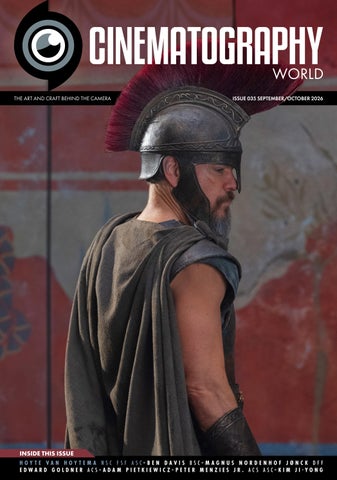
THE ART AND CRAFT BEHIND THE CAMERA
ISSUE 035 SEPTEMBER/OCTOBER 2026
INSIDE THIS ISSUE H O Y T E V A N H O Y T E M A N S C F S F A S C• B E N D A V I S B S C• M A G N U S N O R D E N H O F J Ø N C K D F F E D W A R D G O L D N E R A C S • A D A M P I E T K I E W I C Z• P E T E R M E N Z I E S J R . A C S A S C• K I M J I -Y O N G
QUEEN AT SEA IN THEATERS OCTOBER 30
Photo courtesy of Greenwich Entertainment
FILM. KO DAK VI S I O N 3 50 0T 52 19 3 5M M D I R ECTED BY L AN C E HAM M ER | C I N EMATO G R APH Y BY AD O LPH O VELOSO, AB C, AI P
#QUEENATSEA
©Kodak, 2026. KODAK, VISION and the KODAK logo are trademarks of Kodak.
ISSUE 035 • CINEMATOGRAPHY WORLD I’m privileged and happy that I get to keep pushing the boundaries of filmmaking Hoyte Van Hoytema NSC FSF ASC
Editor-in-Chief RON PRINCE ronny@cinematography.world Special Consultant ALAN LOWNE alan@cinematography.world Editorial Assistant KIRSTY HAZLEWOOD kirsty@cinematography.world Advertising Manager CLAIRE SAUNDERS claire@cinematography.world Advertising & Marketing Executive ALICE LARNER alice@cinematography.world Subscriptions CDT ASSOCIATES LTD CWSubscriptions@cdtassociates.co.uk Web Manager IAIN HAZLEWOOD iain@cinematography.world Art Direction & Creative Kinda Stuff JAM CREATIVE STUDIOS adam@jamcreativestudios.com tim@jamcreativestudios.com CONTACT US News hello@cinematography.world Ad sales & Subscriptions +44 (0) 1428 892 630 Artwork artwork@cinematography.world www.cinematography.world
FOR YOUR CONSIDERATION
Summer has dissolved into autumn. The clocks and colours have changed. The nights are drawing-in much earlier now. A friend dished-up a scrumptious pumpkin pie the other evening. The caramel hue and warm spices of this particular confection brought comfort to the season’s inevitable transformation. Although I prefer the longer days of the calendar year, one consolation of the dwindling light during the winter months, is the approaching awards season and the feast of features heading our way, helping to offset the tedium of long, dark evenings. Who in our industry doesn’t enjoy the excitement of watching the possible contenders and the anticipation of guessing the likely winners? For us, fun starts with a trip to Camerimage in Poland, the annual festival of cinematography, where recognised filmmaking artists come together with newcomers and students, amongst a smorgasbord of seminars, workshops and panel discussions, all whilst productions of visual, aesthetic and technical merit are showcased on the big screen.
Ron Prince photo by Joe Short www.joeshort.com
Rascals Publishing & Media Ltd Red Lion Yard, Odd Down, Bath United Kingdom BA2 2PP Tel: +44 (0) 1428 892 630
This year’s festival will be our twenty-something visit, and we express our thanks to the organisers for their support in making it an unmissable event for us. Over the years a good many Frog-winning films have gone on to earn nominations or gongs for Best Film, Best International Feature Film and Best Cinematography. Of course, many more movies get released for several weeks after our Polish jaunt, helping to alleviate the doldrums of dank November and December nights through the promise of narrative intrigue and visual delight. Along with some of the films in this issue, there are some wonderful new productions coming down the pipe and, in our December 2026 special edition we’re aiming to bring you the cream of the crop. Who knows who the winners will be? That’s for your consideration.
Official Media Partners
Keep well, stay safe. Long live cinematography.
EDITORIAL TEAM Ron Prince has over three decades of experience in the film, TV, CGI and VFX industries, and has written about cinematography for 25 years. He won the ARRI John Alcott Award from the BSC in 2014, and earned a Special Award for supporting cinematography from the AIP in 2026. He also runs the international content marketing and PR communications company Prince PR Ltd. Darek Kuźma is a film and TV journalist, translator/interpreter, and a regular collaborator/programmer of the EnergaCamerimage Film Festival. He is an ardent cinephile who has a lifelong romance with the visual language of cinema.
Ron Prince Editor in Chief Get your free digital subscription by scanning here NOW!
David Fox has worked in TV and radio as a writer, reporter, researcher, producer and director, and as a journalist for many national newspapers and magazines, including writing extensively about TV and film technology. David Wood is a freelance journalist covering film/TV technology and production He was a former technology editor at Televisual, and is a regular contributor to Worldscreen, TVB Europe and Broadcast. Kirsty Hazlewood has over two decades of editorial experience in print/online publications, including reporting for the IBC365 and ISE Daily, and is a regular contributor to folk/roots music website Spiral Earth. Cover Image: The Odyssey, written, produced & directed by Christopher Nolan, filmed on in IMAX format on KODAK by Hoyte Van Hoytema NSC FSF ASC. © Universal Studios. All Rights Reserved.
SUBSCRIBE You can subscribe to the print, digital, or print and digital, versions of Cinematography World. This will cover you for the six issues delivered over a 12-month period. Your email will also be added to our monthly newsletter update, unless you decide to opt out of these news feeds. Cinematography World is part of Rascals Publishing & Media Ltd. The publishers emphasise that opinions expressed within Cinematography World Magazine are not representative of Rascals Publishing & Media Ltd, but are the responsibility of individual contributors. Cinematography World is created using responsibly sourced paper. All inks used during the printing process are vegetable based and virtually free from volatile organic compounds. Waste, paper, ink and consumables are recycled. Where this is not possible waste is sent to specialist centres for safe disposal.
RECYCLE
Cinematography World is created using responsibly sourced materials
CINEMATOGRAPHY WORLD SEPTEMBER/OCTOBER 2026 3
Create Larger ZEISS Panoptes 65 ZEISS Panoptes 65 lenses feature a well-balanced look with natural colors, forgiving skin textures, gentle focus fall-off and a silky bokeh. Covering 65 mm sensor cameras, the set offers an unprecedented consistency with ten focal lengths from 25 to 180 mm, all with a fast T2.2. Featuring ZEISS high-end ergonomics and full lens data support. zeiss.com/panoptes65
Meet us at Camerimage
ISSUE 035 • CINEMATOGRAPHY WORLD
INSIDE
ISSUE 035 SEPTEMBER/OCTOBER 2026
28 THE ODYSSEY
6 PRODUCTION NEWS 14 WHO, WHAT, WHEN & WHERE 22 VIEW FROM THE TOP • THOMAS RIEDEL – ARRI & FOUNDER/OWNER/CEO RIEDEL GROUP
24 SPECIAL PREVIEW • TORUŃCAMERIMAGE 2026 34TH EDITION 28 HOYTE VAN HOYTEMA NSC FSF ASC • THE ODYSSEY 34 BEN DAVIS BSC • WILD HORSE NINE 38 PETER MENZIES JR. ASC ACS • THE YELLOW TIE 42 KIM JI-YONG • POSSIBLE LOVE 44 GREAT GEAR GUIDE • IBC 2026 HIGHLIGHTS 50 VIEW FROM THE TOP • PROF. DR. PETER C. SLANSKY & FKTG 52 MAGNUS NORDENHOF JØNCK DFF • HER PRIVATE HELL 56 ADAM PIETKIEWICZ • ANGH 60 ED GOLDNER ACS • TREASURE & DIRT 64 GAFFER’S CAFÉ • PRZEMYSŁAW SOSNOWSKI
34 WILD HORSE NINE
38 THE YELLOW TIE
52 HER PRIVATE HELL
60 TREASURE & DIRT CINEMATOGRAPHY WORLD SEPTEMBER/OCTOBER 2026 5
PRODUCTION & POST NEWS
THE ODYSSEY IS THE BIGGEST FILM OF ALL-TIME AT BFI IMAX
S
hot on Kodak 65mm film in IMAX 15-perf format by Hoyte Van Hoytema NSC FSF ASC, Christopher Nolan’s The Odyssey has become the highest-grossing film of all time at London’s BFI Imax venue. There were 173 consecutive IMAX 70mm film print screenings scheduled across its initial eightweek run at the cinema. Every single one of those celluloid film print screenings was completely sold-out, with audiences travelling internationally to see the movie in its native analogue format. The film has recorded £2.7m in ticket sales to date from its single screen, with more than 101,000 admissions sold, passing the £2.5m record of 2009 release Avatar, with further takings to come for The Odyssey.
The BFI IMAX is the number one IMAX venue in the UK and international markets for the film, and the second-highestgrossing IMAX screen globally, behind the TCL Chinese Theatre in Los Angeles, which has almost double the BFI IMAX’s 500-seat capacity. It sold 28,000 pre-sale tickets in the first 24 hours when tickets went on sale in June for £750,000 in revenue; and took £220,000 on The Odyssey’s opening weekend, for the highest opening of any film at the venue.
DUNCAN KENWORTHY OBE TO BE HONOURED WITH BAFTA FELLOWSHIP
D
uncan Kenworthy OBE received a BAFTA Fellowship at a special presentation on Friday 23rd October 2026, honouring his extraordinary contribution to film, his championing of British talent and storytelling, and his enduring support for the next generation of screen talent. Over a five-decade career, Kenworthy has helped define modern British cinema, producing Richard Curtis’s Four Weddings And A Funeral (1994, dir. Mike Newell, DP Michael Coulter BSC), Notting Hill (1999, dir. Roger Michell, DP Michael Coulter BSC) and Love Actually (2003, dir. Richard Curtis, DP Michael Coulter BSC). His partnership with Curtis shaped the British romantic comedy for global audiences.
A multiple BAFTA winner and an OBE recipient, he co-founded DNA with Andrew Macdonald, the production house behind Trainspotting (1996, dir. Danny Boyle, DP Brian Tufano BSC), 28 Days Later (2002, dir. Danny Boyle, DP Anthony Dod Mantle DFF BSC ASC), The Last King Of Scotland (2006, dir. Kevin Macdonald, DP Anthony Dod Mantle DFF BSC ASC), and Civil War (2004, dir. Alex Garland, DP Rob Hardy BSC ASC). His TV credits include Sesame Street, Fraggle Rock and the Emmy-winning Gulliver’s Travels, through his long association with Jim Henson. Beyond producing, Kenworthy has championed emerging talent and the UK’s screen industry, serving on BAFTA’s Film Committee since 1996 (chair 2004-06, vice president 2009-15), with a room at BAFTA 195
6 SEPTEMBER/OCTOBER 2026 CINEMATOGRAPHY WORLD
Piccadilly named in his honour. He served on the NFTS Board Of Governors and, through Toledo Productions, established the Toledo Scholarship, supporting UK students from underrepresented backgrounds entering film and TV.
PRODUCTION & POST NEWS
REMEMBERING RODNEY CHARTERS ACS NZCS ASC
R
odney Charters ASC CSC NZS, a two-time Emmy Award nominee for the high-stakes dramatic series 24, died suddenly on September 13th in Amsterdam at the age of 80, whilst attending the IBC trade show. Born in New Zealand on November 25, 1945, Charters grew-up in the coastal town of New Plymouth and was immersed in imagemaking thanks to his father, a portrait photographer and filmmaker. Whilst studying at the University Of Auckland, he shot a short film with his father’s Bolex that was shown at the Sydney Film Festival and helped him gain
entry into the Royal College Of Art in London. His classmates there included Ridley and Tony Scott, with whom he later collaborated on commercials, and future ASC colleague Stephen Goldblatt ASC. Though his resumé came to include many other high-profile TV series – among them The Pretender, Roswell, Shameless and reboots of Dallas and Magnum P.I. – Charters’ name was synonymous with the highoctane thriller 24. From 2001-2010, he shot 184 episodes of the series and directed three. Charters received Emmy nominations for Outstanding Cinematography For A SingleCamera Series for the 24 episodes “Day 4: 5:00am – 6am” and “Day 5: 9:00pm -10pm.”
DR ANTHONY NEWTON JOINS THE FILM & TV CHARITY AS ANTIRACISM WELLBEING ADVISER
T
he Film & TV Charity has announced the appointment of Dr Anthony Newton as its new anti‑Racism wellbeing adviser – an industry‑first specialist role created to support black and global majority professionals working behindthe-scenes in film, TV and cinema, who are experiencing racism, racialised bullying or harassment. Newton joins the organisation with more than 17 years of experience across the NHS, private practice, occupational mental health, and a variety of corporate settings, as well as a deep personal commitment to anti-racist and
intersectional practice. Born and raised in Southeast London, with Sierra Leonean and Guyanese heritage, his lived experience and professional expertise will help strengthen the Charity’s wellbeing support as well as bolstering its delivery against its Charitable Objects, including, “To promote equality, diversity, and inclusion… by reducing, preventing and discouraging discrimination and the resulting barriers in the film, television, or moving image industry.” The anti-racism wellbeing adviser will sit alongside the established bullying service adviser in the Charity’s support services team.
ENTRY CARDS FOR TORUŃCAMERIMAGE 2026 AVAILABLE NOW
E
ntry cards for this year’s ToruńCAMERIMAGE Film Festival are now available for purchase. The cards enable access to film screenings (with prior reservation), seminars and discussion panels (with prior reservation), meetings with filmmakers after screenings, and the ToruńCAMERIMAGE Market film equipment trade show festival exhibitions. Starting October 24th, cards will be sold at the regular festival price (PLN 50 more expensive). Price list is available on the festival website. CINEMATOGRAPHY WORLD SEPTEMBER/OCTOBER 2026 7
PRODUCTION & POST NEWS
ASC SETS DATE FOR 41ST ANNUAL AWARDS
T
he American Society Of Cinematographers (ASC) will present the 41st Annual ASC Outstanding Achievement Awards on March 7th, 2027, at The Beverly Hilton in California. Live-streamed to a global audience, the ASC Awards spotlight the exceptional artistry and technical mastery of directors of photography whose work advances and elevates the craft of visual storytelling. The society will present awards in feature films, episodic, documentaries and music video categories, each with its own eligibility window and a submission deadline of November 13th, 2026. Theatrical feature films must have a release date between January 1st to December 31st, 2026. TV categories require a show to have aired or streamed
between December 1st, 2025 and November 30the 2026, and eligible documentaries must be released or air within the same window. Music videos must have a release date between November 1st, 2025 and November 30th, 2026. The ASC will also bestow a Spotlight Award recognising exceptional cinematography in independent films or limited releases.
ALIA AND AVIXA SIGN COLLABORATION TO ADVANCE ON PROFESSIONAL DEVELOPMENT IN SPAIN‘S AUDIOVISUAL INDUSTRY
S
pain’s Audiovisual & Integrated Experience Association (AVIXA) and the Alliance Of The Audiovisual Industry (ALIA) have formalised an institutional collaboration agreement establishing a framework for joint action in three key areas: specialised training and professional certification; event organisation and crossparticipation; and the mutual promotion of initiatives of shared interest. AVIXA, the international association representing the audiovisual industry, produces professional audio
and video trade shows around the world and is the leading resource for industry standards, certification,
training, market intelligence and thought leadership. Through partnerships with regional industry organisations, AVIXA helps drive the professionalisation and growth of the audiovisual sector worldwide. For its part, the ALIA has represented technical and service companies within Spain’s audiovisual sector since 2020, acting as an interlocutor with public and private institutions while promoting competitiveness, internationalisation and industry collaboration. “The signing of this agreement represents a natural step in ALIA’s evolution and reflects our commitment to building bridges across every area of the audiovisual industry,” said Roberto Sacristán, president of ALIA. “We share AVIXA’s commitment to fostering knowledge, innovation, and business opportunities for our member companies. We are confident that this collaboration will create significant value for both organisations and help strengthen the industry as a whole.”
SCREENSKILLS APPOINTS SINEAD ROCKS AS NEW CEO
S
creenSkills has appointed Sinéad Rocks as its new chief executive officer, who will take up the role in November 2026. She succeeds Laura Mansfield, with Lisa Opie acting as executive chair during the transition. Rocks brings extensive experience to ScreenSkills, having held senior leadership positions across the UK broadcasting industry, most recently as managing director, Nations & Regions at C4, a position she held from 2019 until stepping down earlier this year. Prior to joining C4, Rocks was the BBC’s director of education, responsible for a range of content across TV, radio and online. “We are very much looking forward to welcoming Sinéad to ScreenSkills. Her career to date speaks of a strategic leader with a real passion for putting national and regional talent on the industry map,” commented Opie, ScreenSkills executive chair. Reflecting on her time as ScreenSkills CEO, Laura Mansfield commented, “Change
8 SEPTEMBER/OCTOBER 2026 CINEMATOGRAPHY WORLD
has been the whole job and the context. The organisation spent this time working out how ScreenSkills needed to adapt: partnering more, evolving its board, bringing-in new activities, ensuring its training evolves for the workforce to get future-fit, and being clearer and more visible about what it offers and how it can support freelancers and collaborate with the wider industry. Mansfield says she is proud of what she achieved together with the tea. ScreenSkills is supporting 12% more people than a year ago, on-track to reach 36,000 by the end of 2026, with 68% of them based outside London. 1,291 took AI training last year, and that number is growing fast.
PRODUCTION & POST NEWS
ARRI ANNOUNCES SMPTE ST 2110 SUPPORT FOR ALEXA 35 LIVE
A
RRI has announced SMPTE ST 2110 support for its Alexa 35 Live multicam system, opening the platform to fully IP-based broadcast studios, stadiums, flypacks and remote productions. Delivered via Software Update Package 1.5.0 for the Live Production System LPS-1, the update brings Alexa 35 Live into modern ST 2110 infrastructures through a permanent software license, enabling independent routing of uncompressed video, multichannel audio and time-sensitive metadata
over a 25GbE connection, with seamless ST 2022-7 redundancy for glitch-free failover.
UK live production specialist Adlib tested a pre-release version in a platform built for a
major arena tour, with Ashley Ball, the company’s video technical manager, praising how easily ST 2110 integrated via the LPS-1’s web UI. The architecture is built for interoperability with ecosystems including Riedel Communications and SimplyLive, backed by comprehensive AMWA NMOS support and PTP synchronisation. ARRI’s imaging expertise is also moving into mobile devices. Honor has launched the Robot Phone, the first product from the companies’ Cinematic Imaging Partnership, carrying a “co-engineered with ARRI” designation. It combines Honor’s imaging, AI and robotic camera technology with ARRI LogC3, ARRI Wide Gamut 3 and ARRI Looks, supporting 10-bit LogC3 recording for use in professional grading workflows.
SONY LAUNCHES FX5 AND NEW FISHEYE LENS
S
ony has introduced the FX5, a new fullframe camera in its Cinema Line series. The camera is equipped with a newlydeveloped, fully-stacked CMOS image sensor and further enhances sensitivity performance through 15+ stops of dynamic range, a Dual Gain Shooting mode, and three base ISO settings. For the first time in the Cinema Line FX series, it supports Open Gate shooting as well as in-camera recording in X-OCN, Sony’s proprietary RAW format. The camera is capable of shooting in 5K at up to 60fps in 4K up to 120fps and in FHD up to 240fps. These features bring together the Cinema Line
look and operability designed to meet the needs of production environments in a compact, highly-portable body. This release will also include two new optional accessories – a detachable OLED viewfinder, and an XLR Handle that enables recording in-camera at up to 96kHz, 32-bit float. Sony has also introduced the FE 8-14mm F3.5 Fisheye G (SEL814G), the company’s first fisheye zoom G Lens for full-frame Alpha E-mount cameras. The 8mm to 14mm zoom range covers circular fisheye at 8mm through diagonal fisheye at 14mm. Built for landscapes, architecture, sports, and video production, the lens pairs a compact, lightweight body
with G Lens resolution, fast and precise autofocus, and refined operability for stills and movies. In a dual-lens configuration with the Venice Extension System Mini it also supports spatial content production. In further news, Sony has also introduced two new external controllers integrating camera control and monitoring. The DP7 and DP5 are designed for use with Sony’s Cinema Line range of cameras for video production. At the time of release, they will be compatible with the FX5, FX3, FX2, and FX30*1. By enabling users to check and adjust settings even when positioned away from the camera, the products help streamline shooting for solo operators and small production teams. With reliable operation through physical buttons, control knob and multi-function dials, wired connectivity, accurate colour reproduction, and a robust design, the controllers support the increasingly diverse needs of video production environments. With select compatible transmitters, the controllers can also support a wireless connection.
APUTURE RELEASES STORM CS32
A
puture has released the Storm CS32, the brightest, fully-tunable, colour fixture in its point source line of LED lights. The Storm CS32 features an advanced BLAIR-CG with Extended Red light-engine with output exceeding a 4K HMI, exceptional saturated colours across the visible light spectrum, and excellent tunable white light, all whilst maintaining a small size and weight for single person operation. “The Storm CS32 can be seen as a 4K HMI replacement, but it is so much more,” said Mitch Gross, Aputure director of marketing. “It has a huge range of tunable white light with amazing spectrum accuracy to match natural light, with unprecedented SSI scores in the 90s. The CS32 is also a full-colour tunable light with an enormous range of deep colours and the best yellows and golds available for
shooting gorgeous sunset effects.”
10 SEPTEMBER/OCTOBER 2026 CINEMATOGRAPHY WORLD
Blackmagic URSA Cine 17K 65
Shoot 65mm format 8K up to 170 fps and 17K up to 60 fps with 16 stops of dynamic range! High Performance Internal Media for Recording
Blackmagic URSA Cine is a revolutionary digital film camera that introduces new advanced digital film technology combined with total integration into the post production workflow. That means it’s the first digital film camera with fast high capability storage built in, plus high speed networking for on set media sync. You can also swap between PL, LPL, EF and Hasselblad lens mounts.
URSA Cine is the first digital film camera with ultra fast high capability Cloud Store technology built in. Blackmagic Media Module is fast, rugged and includes a massive 8TB of storage. The module can be easily removedfrom the camera and loaded into a Blackmagic Media Dock for transferring media to a network or to Blackmagic Cloud for instant global collaboration!
Cinematic Large Format Sensor
Live Sync and Edit Media While the Camera is Rolling!
URSA Cine features a revolutionary new sensor designed for incredible quality images at all resolutions from 4K to a massive 17K! Building on the original 12K RGBW Super 35 sensor, the new large format design features larger photo-sites, delivering an astounding 16 stops of dynamic range! Now you can capture more detail with a wider dynamic range than ever before!
URSA Cine records an HD proxy in H.264 in addition to the camera original media. The small proxy file can upload to Blackmagic Cloud in seconds, even as the camera’s recording, so your media is available back at the studio in real time. If you have multiple cameras, then the new multi source feature in DaVinci Resolve’s Cut page will show each camera angle in a multiview.
A Camera Body Optimized for High End Production! The evenly weighted camera body is built with a robust magnesium alloy chassis and lightweight carbon fiber polycarbonate composite skin to help you move quickly on set. There’s a 5˝ fold out touchscreen for reviewing shots and accessing camera settings, plus a dedicated assist station on the other side of the camera, with 5˝ LCD and full camera controls.
www.blackmagicdesign.com/uk SRP is Exclusive of VAT
Blackmagic URSA Cine 17K 65 From £14,075
Learn More!
PRODUCTION & POST NEWS
KINO FLO PORTFOLIO EXPANDS TO INCLUDE LITEGEAR PRODUCT LINES
C
hauvet has brought LiteGear’s acclaimed product lines into the Kino Flo portfolio, creating an expanded cinema lighting ecosystem designed to give film, television and broadcast professionals greater access to complementary lighting technologies, global support and continued product innovation. The expanded Kino Flo portfolio will create a streamlined experience for cinematographers, gaffers, rental partners, broadcast professionals, integrators and production facilities worldwide. Popular LiteGear product lines including LiteMat, LiteTile, LiteRibbon and Auroris will become part of the expanded Kino Flo portfolio and will be marketed under the Kino Flo brand. The complete portfolio will be fully-supported, with continued access to product expertise, service, parts and future development through Kino Flo, supported by Chauvet’s global service network and facilities. As part of the expanded support model, the portfolio will also be backed by a new multi-year warranty program, giving customers greater long-term support and confidence in their investment. Eligible products registered within 60 days of purchase qualify for extended coverage.
LEITZ LAUNCHES ID MOUNT FOR HUGO AND SUMMILUX-C LENSES
L
eitz Cine has introduced the Leitz iD Mount, an optional mount with a metadata interface for Leitz Hugo and Summilux-C lenses. Compatible cameras can recognise the lens and record static /i metadata with every clip, including lens name, focal length, serial number, distortion map, and shading map. Keeping this information with the footage through dailies and post can reduce manual lens logging, ease identification of the exact lens and focal length for reshoots, and give VFX teams immediate access to optical data supporting plate undistortion, compositing, lens matching and emulation, and reapplication of original lens characteristics after VFX work.
The iD Mount provides persistent lens identity and characterisation data rather than full telemetry. It does not transmit live, frame-by-frame focus or iris positions. New Hugo and Summilux-C lenses can be ordered with the mount factory-installed and programmed; owners of existing lenses can purchase upgrade mounts. The Summilux-C version uses a PL mount, the Hugo version an LPL mount. Customers can supply serial numbers to receive mounts pre-encoded with lens-specific data before shipping, for an additional fee, arriving ready to install. The self-contained interface needs no internal electronic connection to the lens; installation involves swapping the mount and a standard backfocus check with shimming if required.
NANLITE INTRODUCES SUPER-POWERFUL FC SERIES MODELS
N
anlite has launched the bi-colour FC-1200B and full-colour FC1200C, bringing 1000W+ LED output – previously reserved for bigger-budget productions – within reach of more modest budgets. With 1350W-rated power and 1200W output, both remain lightweight and compact-enough to function as a sun replacement on indie films, documentaries, interviews, livestreams and product photography. The FC-1200B delivers 15,620 lux@3m (5600K, 45° reflector) with a 2700K–6500K range, 96 CRI and 98 TLCI. The FC-1200C delivers 14,220 lux@3m via
Nanlite’s Nebula C4 colour engine, spanning 2400K–12,000K with ±150 green/magenta
12 SEPTEMBER/OCTOBER 2026 CINEMATOGRAPHY WORLD
adjustment, 95 CRI and 94 TLCI, plus five modes including HSI, RGBW and Gel. Both offer 0.1% dimming precision and a 90° beam for even coverage with large modifiers. Each weighs 10kg, with an all-in-one head integrating the power adapter, a single AC cable, 360° tilt yoke, and Bowens plus umbrella mounts. Control options include onboard knobs and display, the Nanlink App 2.0, NFC configuration, and 5-pin XLR DMX in/out. Four noise modes bring Smart mode down to roughly 26 dB(A). The FC Series now spans 78W to 1350W across bicolour and full-colour models with unified controls and DMX/ RDM support.
PRODUCTION & POST NEWS
DOPCHOICE UNVEILS SNAPGRID CORE LIGHT SHAPER FOR ARRI OMNIBAR
D
oPchoice has debuted the Snapgrid Core for ARRI Omnibar, a first-of-itskind flexible hard-grid system featuring a 40-degree honeycomb-style cell structure designed to complement both the two-foot and four-foot versions of ARRI’s light. To create it, DoPchoice combined 20 years in light-shaping precision with Holland-based Ellar
Works, founded by working DP Job Kraaijeveld, who has spent over a decade turning his own lighting experience into custom-engineered tools. Snapgrid Core is engineered for optimum illumination control, and is particularly well-suited to the geometry of long linear fixtures. It snaps directly onto the Omnibar’s face, secured with two hook-andloop bands, and is compatible with both the Omnibar
Flat Diffuser and Intensifier. Its rugged yet lightweight build offers durability and resistance to rigging wear without losing shape or directional control. On the longer Omnibar 4, increased cell angling at the outer ends focuses output toward the light’s far field centre, avoiding abrupt edge falloff; creating a Core Focus Cone effect that gently wraps light around the subject. Snapgrid Core fits the Omnibar 2 (61 x 6.5 x 4cm, 0.30kg) and Omnibar 4 (121 x 6.5 x 4cm, 0.50kg).
ZEISS INSPIRES AT 2026 CHINESE SOCIETY OF CINEMATOGRAPHERS (CNSC) EXHIBITION
A
t the 2026 Chinese Society Of Cinematographers (CNSC) exhibition, Zeiss captivated the local industry with its latest products. The highlight was the presentation of the new Zeiss Aatma lenses, designed to deliver a characterful, legacyinspired look for modern cinematographers. Attendees had the exclusive opportunity to test these lenses on-site, praising them for their creative potential. In addition, Zeiss hosted a keynote roundtable discussion on vintage lenses, exploring their enduring charm and unique visual aesthetics in modern filmmaking. This session brought together industry leaders to discuss how vintage and vintage-inspired optics can complement contemporary storytelling. With hands-on trial zones, technical forums,
and the annual cinematographers’ conference, the CNSC 2026 exhibition proved to be an
inspiring platform for Zeiss to connect with cinematographers and showcase its lens solutions.
DZOFILM EXPANDS ARLES CINE LENS SYSTEM
D
ZOFILM has announced the Arles 25–75mm T2.6 and 65–180mm T2.6, two full-frame cinema zooms offering continuous coverage from 25mm to 180mm, extending the Arles line to 11 primes and two zooms. Both are parfocal, weigh under 1.8kg, hold a constant T2.6 aperture, and cover a 43.5mm image circle. Each is priced at US$2,899, with a two-lens kit and hard case at US$5,199. The 25–75mm gives a 3× range through wide, normal and short-telephoto perspectives, while the 65–180mm’s 2.8× range extends into telephoto. The two overlap between 65–75mm rather than meeting at
one point, letting operators switch lenses mid-shoot or match framing across cameras without a visible jump. Both use an internally zooming design that keeps balance and barrel length constant, with minimal focus breathing, 270-degree focus rotation and 100-degree zoom rotation. They share the Arles primes’ coating formulation for consistent colour and tonal rendering, plus a 16-blade iris for smooth bokeh. DZOFILM cites 8K resolving support based on internal testing. Mechanically, both share a 95mm front diameter, M86 filter thread and 0.8 MOD
gearing. Lenses ship with PL mounts standard; EF mount kits are available for US$99.
CINEMATOGRAPHY WORLD SEPTEMBER/OCTOBER 2026 13
WHO, WHAT, WHEN & WHERE
TAKE THAT!
Our regular round up of who is shooting what and where SCREEN TALENT: Adam Sliwinski recently shot No Screens Christmas for Crown Media, with Mark Robison directing. Bart Sienkiewicz PSC shot a concept film with director Gerald Gregory and producer Llewelynn Greeff from Dark Matter Studio, filmed additional cinematography on the HETV show Testament S2 with director Paul Syrstad via Angel Studios, and is now lighting a feature with directors Arnold T Rice and Nathan Newman through My Accomplice.
WIZZO & CO: Congratulations to Ryan Kernaghan ISC who won the BAFTA for his work on Trespasses directed by Dawn Shadforth. Ryan recently wrapped on Rich Peppiat’s feature Bad Bridget. Welcome to Léa Taillefer, a Canadian DP based in London who shot an MVA/UKMVA-nominated music promo Geese alongside director Noel Paul, and also has multiple short films under her belt. Aaron Reid
BSC has graded Supacell 2 for Netflix. Susanne Salavati BSC is shooting the opening block of How To Kill Your Family for Netflix and director Josephine Bornebusch. Gary Shaw shot the opening block of Danger Money, directed by Carl Tibbets. Will Bex has wrapped on a documentary feature directed by Scott Lyon. Steven Ferguson has graded his latest drama. Rasmus Arrildt DFF is shooting the opening block of Prisoner S2 for Sky, with Anthony Philipson directing. Ndrika Anyika shot 2nd Unit on Michaela Coel’s First Day On Earth. David Procter BSC has graded his latest feature, Uncle, directed by Joe Marcantonio. Tim Sidell BSC continues shooting Army Of Shadows with director Lisa Gunning. Maxime Lahousse SBC is lensing a drama in Belgium. Nick Dance BSC continues shooting in Croatia. Maximiliaan Dierickx SBC has completed the grade on Bookish S2. Hamish Anderson is framing on a documentary. Charlie Goodger recently graded C4’s drama Wrong Move alongside director Rene Van Pannevis. Dmytro Nedria has completed the DI on Merry Christmas Aubrey Flint, directed by Jack Spring. Shaun Harley Lee SASC has graded his Netflix project. Matthias Pilz is shooting an episode of Grace alongside director Dan Zeff. Sverre Sørdal FNF is prepping a feature. Scott Coulter is shooting Black Ops S3 directed by Rosco 5. Luke Bryant is shooting an embargoed Apple drama. Felix Cramer is prepping a feature in Germany. Franklin Dow is lighting a project with Emmy-winning director Steven Leckart. Chas Appeti is prepping a new project. Darius
14 SEPTEMBER/OCTOBER 2026 CINEMATOGRAPHY WORLD
This page: (Main image) of Arran Green shooting Sophie And The Giants – Stone Cold, photo by Noor Zuabi; and DP Bart Sienkiewicz PSC with director Gerald Gregory, photo by Malte Hubner.
Shu recently wrapped his latest project. Aman K Sahota lit a short film. Ahmet Husseyin has been collaborating with director Jolyon White. Mike McMillin continues shooting 2nd Unit on an Apple drama. Simon Stolland shot with Percelle Ascot, and Fede Alfonzo with Jamie Rafn. Ben Magahy lensed with Ben Mallaby, Joe Douglas with Mischa Rozema and Henry Gill with Chris Fowles. Theo Garland lit for Dom & Nic, and Chaimuki with Tom Ivin. Arran Green lensed with Mollana Burke, and Murren Tullett with Neil Gorringe. INTRINSIC: It was with great sadness that the agency announced that Malcolm McLean passed away on-set shooting the feature Half Time Hero. Malcolm was a hugelyrespected and talented DP and camera operator, who died doing what he loved, and all our thoughts are with his family and friends. Colin Coomber lit the lightning-fast indie feature Everything. David Liddell is prepping Making Noise. In TV drama, Evan Barry ISC is filming The Walsh Sisters 2. James Mather ISC has returned to Kin. Tom Hines has been busy on The Detection Club. Nic Lawson returns to the revamped Bergerac. Simon Vickery has been operating on Rebus 2 in Scotland, where David Liddell operated on Meantime. Andrew Johnson has been shooting Casualty. Gabi Norland has been operating on Slip and has been busy on various documentaries, art installations and live performances. Martin Roach and Gareth Munden have been busy with commercials and corporate films.
TECHNOLOGY SERVING THE IMAGINATION. Panalight, over 30 years in and for filmmaking.
CAMERA | LENS | LIGHTING
Distributor for Italy Distributor for Italy
| GRIP | SPECIAL ACTION EQUIPMENT
V I S I T PA N A S H O P. I T, T H E S H O P F O R F I L M P R O F E S S I O N A L S . V I S I T PA N A S H O P. I T, T H E S H O P F O R F I L M P R O F E S S I O N A L S . Exclusive Agent for Italy
panalight.it panalight.it panalight@panalight.it panalight@panalight.it
WHO, WHAT, WHEN & WHERE This page: (Main image) and inset picture of Felix Cramer on-location in Germany; plus DP Franklin Dow with director Orlando Von Einseidel, shooting The Cycle Of Love, photo by Juan Minotta.
CASAROTTO: Hélène Louvart AFC wrapped on Danya Taymor’s Jonah and then jumped on to Karim Ainouz’s The Last Dance. Annika Summerson BSC is shooting Esperanto Films and Anonymous Content’s Ascension for Apple. Edward Tucker returned to shoot the second season of SNL UK. Michael Wood BSC operated B-camera on Porto Rico, directed by Residente.
Pictures, with directors Tom McKay and Jill Robertson, and Hannah Farrell producing. Alistair Upcraft is shooting The Woods for Quay Street, block 3. produced by Will McDonagh. Phil Wood has finished on block 2 of The Woods for Quay Street Productions, with director is Claire Tailyour and Will McDonagh producing. Alex Veitch recently filmed Anisha, Accidental Detective for BBC, and is preparing to shoot Waterloo Road S20, Block 2.
BERLIN ASSOCIATES: Al Beech recently finished shooting Marlow Murder Club S4 with director Tracey Rooney. Sarah Bartles Smith has finished filming the Sky comedy series Mr Bigstuff 3 for Water & Power Productions, producer Hayley Sterling. Nick Cox is preparing to shoot Waterloo Road S20, Block 1. Mark Garrett recently wrapped on Art Detectives S2, Episodes 1 & 2, directed by Declan Wrecks and with Martin J Mahon producing. Annemarie Lean-Vercoe is lensing Death In Paradise S16, Block 5, with director Ian Barber and Helen Burt producing. Nick Martin is in prep for In Contempt for Hartswood Films. Trevelyan Oliver recently wrapped on Can You Keep A Secret? S2 with director Simon Hynd and Lauriel Martin producing. Tom Pridham is lensing Marbles for Big Talk Productions, with director David Sant and producer Lyndsay Robinson. Kelvin Richard did 2nd unit days on an Apple TV drama. Pete Rowe filmed some days on Saturday Night Live and is currently shooting Horrible Histories S12. Simon Rowling has wrapped on the feature Macdonald with director Daniel Patrick Vaughan. James Swift shot block 2 of Chocolate Wars for Fable
ECHO ARTISTS: Ailsa Aikoa recently filmed Paris Paloma’s music video for her new single ‘Silhouette On The Hill’, with director Georgie Cowan-Turner. Bjørn Ståle Bratberg FNF BSC shot additional photography for Everybody Wants To F**K Me, which screened in Toronto. Nicolas Canniccioni worked on Marie Madeleine with director Gessica Généus, which screened in Cannes and at the Toronto and London Film Festivals. Where The River Begins, another feature he shot, also screened in Toronto. Andrew Commis ACS shot Extra Geography, which recently screened Out-Of-Competition in Edinburgh. Nick Cooke has graded Sugar Raye, directed by Ruth Greenberg. Ruben Woodin Dechamps has been working on various projects with directors Will Robson Scott, Charlie Watts and Dan Emmerson. Ruben’s additional photography on Oasis: Don’t Look Back In Anger was selected to screen at Venice Film Festival 2026. Maria von Hausswolff DFF recently wrapped on a project with director Josefine Kirkeskov. Her work on Brave New Love was selected to screen at the Locarno and London Film Festivals. Yunus Roy Imer’s work on The State Of Us was selected for the Sean Connery Prize for Feature Filmmaking Excellence
16 SEPTEMBER/OCTOBER 2026 CINEMATOGRAPHY WORLD
competition and Edinburgh Film Festival. He also just wrapped on a Firebird Pictures and BBC1 series directed by Theresa Ikoko and Remi Weekes. Toby Leary recently worked on various campaigns for brands such as Adidas and Meller. Will Pugh has been busy shooting with director Mat Whitecross. Will was one of the cinematographers on Oasis: Don’t Look Back In Anger which screens at Venice. Korsshan Schlauer shot Youth, just released worldwide on
WERED B
D
W
E
ER
POWER
ED BY
Y
PO
BY
PO
ORDER NOW
WHO, WHAT, WHEN & WHERE HBO/HBO Max. Ben Smithard BSC filmed Bunker which was selected for the Venice, Toronto and London Film Festivals. Ben worked on Visionquest too, which was also selected for the London Film Festival.
He is currently collaborating with director Julia Ford on a new series for ITV. Shane F Kelly is about to start filming on a Sandalphon Arts feature directed by Rocky Rodriguez Jr. Chloë Thomson BSC recently wrapped Reputation, a Forge Entertainment and BBC1 series, written by Anya Reiss and directed by Mahalia Belo.
LOOP TALENT: The agency welcomes DP Richard ‘Stoddy’ Stoddard to its roster. Stoddy was nominated for a BAFTA Cymru Award for his work on The Guest, and his is currently in prep on HETV series Furnace Town. Loop also welcomes Award-winning DP Jan Richter-Friis DFF whose drama credits include Fear The Walking Dead, Sleepy Hollow, Riviera S3 and The Passage. Johanna Coelho AFC is filming series three of the multiple Emmy Award-winning series The Pitt. Bebe Dierken BSC is in prep for a HETV series. Ryan Eddleston’s feature Frank And Percy had its world premiere at this year’s London Film Festival, and he’s
This page: Images (clockwise from top) Franklin Dow on The Cycle Of Love, photo by director Orlando Von Einseidel; Al Beech lowering his grip, Suellen Mendel, into a large vat; two shots of Korsshan Schlauer; Simon Rowling in the countryside; and Pete Rowe with his eye to a wooden camera.
currently in prep on a narrative project. Matt Wicks is shooting the Working Title HETV series Charmer. Petra Korner AAC framing the feature Nemesis 21 in Bilbao. Oona Menges BSC is shooting Paramount HETV series Majesty in Cardiff. Darran Bragg is lighting MMP Captain India in the UK and India. Matt North is shooting The Detection Club for the BBC. Ali Asad is filming the feature The Last Occupant with director Maurizio Caldera. Denson Baker ACS NZCS is in prep for a feature. Dave Miller is shooting West The Road in Ireland. Jon Muschamp is shooting pick-ups for a feature film. Emma Dalesman lit a short film. Chris O’Driscoll is shooting ads for sports brands. Martyna Knitter is in prep for a feature. Thomas English has been shooting high-end work in the UK and internationally. Olly Wiggins is lighting a series alongside other short form projects. Tom Turley is lensing a documentary for the BBC. Paul Mackay has been shooting short-form. Marti Guiver lit a music promo for Caviar with director Megan Tan. Natalja Safronova has been shooting a documentary project with director Lexi Powne. Naoise Kettle shot an Irish Women’s National team ad for Sky with Irish production company Vibrant. Loop Talent Crew is delighted to announce the new arrivals of camera/ Steadicam operators Ivan Wood and Tamia Diaz. Grant Sandy-Phillips ACO has just started a new long form project Nixon’s Gamble as Steadicam operator. Michael Eshun-Mensah ACO operated
the TechnoDolly on a couple of NDA projects, and operated Steadicam on a short. Ben Eeley ACO SOC is Steadicam operating on a large returning drama for Netflix. Junior Agyeman-Owusu ACO just wrapped six-part series for Bad Wolf and Netflix, shooting in Cardiff. Ben Mitchell ACO recently wrapped on a film shooting in Cardiff. James Anderson ACO has been operating dailies. Gary Kent and Fabio Olgiati operated Steadicam on ads and music promos. Lou Macnamara was the Steadicam operator on a short film and various commercials. Nicolas Di Maetto was in Milan on a shoot with Vogue. Camera operator Louise
18 SEPTEMBER/OCTOBER 2026 CINEMATOGRAPHY WORLD
Murphy has been shadowing a DP on a long-form project for The Future Cinematographers programme. Laura Van De Hel, Chai Rolfe and Jack Smith have been operating on spots. UNITED AGENTS: Ricardo De Gracia is shooting a miniseries in Spain. Sonja Huttunen has wrapped on the comedy series Créme De La Créme in Finland. Philippe Kress DFF has concluded on The Day Of The Jackal S2 for Carnival Films/Sky. Danny Cohen BSC is working with Lenny Abrahamson on You Are Here. Damian Paul Daniel is filming a feature documentary for Ventureland. David Higgs BSC is grading Sharon Maguire’s The Joy Of Sex. Matt Lewis is prepping the upcoming Netflix series Unheard. Bet Rourich is shooting the
Spanish feature Sealskin. John Sorapure BSC is filming second unit work Slow Horses S7. Simon Tindall has begun shooting the third series of Ludwig. Alasdair Boyce has graded Counsels. Jo Jo Lam is prepping the feature film La Vrai Vie, directed by Marie Monge. Sam Heasman has graded Supacell S2 for Netflix. David Rom is prepping block one of the final season of Industry for HBO. Frida Wendel FSF has done the DI on a 4-part mini-series, Rinnan, for TV2 Norway and Amazon Prime with director Kenneth Karlstad. Carlos Catalan BSC is starting on Everyone In My Family Has Killed Someone for Fifth Season/HBO. James Friend BSC ASC is in New Zealand lighting The Lord Of The Rings: The Hunt For Gollum, directed by Andy Serkis. Anton Mertens SBC is in prep for BBC’s Dragon Slayers, directed by Al Mackay. Neus Ollé AEC BSC is lighting Memorial in Spain with director Sergi Pérez. David Raedeker BSC is filming Daria Martin’s debut feature The Sleeping Woman. Ed Rutherford BSC was in Wales shooting Majesty with director James Strong. Ben Wheeler BSC is lensing The Inbetweeners 3, directed by Iain Morris and Damon Beesley. Felix Wiedemann BSC is shooting
This page: Images (clockwise from top) Ryan Eddleston working as 2nd unit DP on The Last Detectives; DP Paul Mackay on the set of Carnival; Chris Fergusson during the recent feature Two Kids; and another snap of Ryan Eddleston on The Last Detectives.
Hercule for BBC, directed by Jonny Campbell. Barry Ackroyd BSC has been busy with ads, including an OTP Bank spot with director Thomas Ormonde via Prod Co in Budapest. Alex Barber has also been busy with commercials, including a Quilter spot with Tim Godsall at Anonymous Content. Robbie Bryant has wrapped on the feature Echolalic with director Jo Lewis. Sam Care BSC is shooting Block 2 of the upcoming series Hercule with director Chanya Button in the UK. Simon Chaudoir recently shot an Initio Parfum spot with director Ben Miethke for Birth, London. Rachel Clarke BSC lit a British Gas ad with directors 32 in London via Anonymous Content. Catherine Derry BSC is shooting Block 1 on upcoming series Dirty with director Jim Loach. Lasse Frank has been in Bulgaria with director Lucy Forbes for Smuggler and filmed a TK Maxx spot with Gary Freedman in
WHO, WHAT, WHEN & WHERE
London via MJZ. Adam Hall is shooting the feature The Ant Mill in the UK with director Julian Gilbey. Rick Joaquim is currently lensing the feature Nightcapper with director Dan Clark in the UK. Stephen KeithRoach shot a Gu TVC with Danny Kleinman at Rattling Stick. Tim Maurice Jones BSC has wrapped on Halftime Hero with director Ole Sanders. Alex Melman recently shot an FCIO ad in Vienna with director Big Red Button via Tony Petersen Film GmbH. Erik Messerschmidt ASC is shooting The Batman Part 2 with director Matt Reeves. Diana Olifirova is framing Pijin with director Euros Lyn. Tristan Oliver recently lensed a McDonalds commercial with Tom O’Meara via Passion Pictures. Miles Ridgway lit a spot for Debenhams with director Tom Dream through Pulse. Glynn Speeckaert ASC AFC SBC recently lit a Yoto spot in Tbilisi with Floris Kingma at Armoury
London. Matt Windon is working on Three Body Problem S3 in Budapest. Haris Zambarloukos BSC GSC worked with director Alex Prager on a Margiela campaign via Arts & Sciences, London. SARA PUTT ASSOCIATES: Of the agency’s DPs… Maroš Žilinčan recently finished lighting Block 3 of Treasure Island for Playground for Paramount+. Ben Wilson recently picked up 2nd Unit work on Rivals S2. Chris Dodds has been picking-up commercials for Builders Arms and State Street. Chris Fergusson is shooting the feature film Last Laugh. Tom Debenham has been working on Tesseract as VFX DP. Giulio Biccari recently finished lighting Rebus S2 for Eleventh Hour. Iikka Salminen recent short film Mine For A Moment is picking-up awards on the festival circuits and is now BAFTA and Oscar-qualified. Helena Gonzalez has been working on a collection of commercials for Toast. Jan Jonaeus is lighting Block 2 of BBC’s Nightsleeper S2. Lorena Pagès’ recent job, Death In Benidorm, for Clapperboard is now available to watch on C5. Martyna Jakimowska recently lit the feature film The Crossing. Toby Moore worked as C-camera and 2nd Unit DP on Sonic The Hedehog 4 alongside DP Brandon Trost. Yinka Edward is shooting BBC’s Odd Squad S6 with director Dom Stephenson. Tanya Marar recently lit Block 1 of The Detection Club for BBC. Of the agency’s camera operators… Aga Szeliga is operating B-camera on The Mummy 4 with DP Brett Jutkiewicz. Akhilesh Patel has been picking-up 2nd Unit dailies on block 2 & 3 of Wednesday S3 for Netflix. Alastair Rae has been picking-up dailies too. Andrei Austin is operating on BBC’s Odd Squad with DP Yinka Edward. Andrew Bainbridge is B-camera on Apple TV’s Down Cemetary Road S2 with DP Arni Filippusson. Ben Mankin has recently operated A-camera on The Lords Day for Netflix with DP Rasmus Arrildt. Chris Maxwell is A-camera/Steadicam on BBC’s The Nightsleeper S2 with DP Philipp Haderlandt. Dan Evans is operating on Death In Paradise S16.Danny Bishop is operating on Far Cry for Disney+ with DP Polly Morgan BSC ASC. Dan Nightingale is A-camera/Steadicam on Army Of Shadows for DP Tom Sidell. Ed Clark is operating on Netflix’s The Gentleman S3. Ilana Garrard was A-camera/ Steadicam on Amazon’s Tomb Raider. James Frater is A-camera/Steadicam on The Lord Of The Rings: Hunt For Gollum with DP James Friend
CINEMATOGRAPHY WORLD SEPTEMBER/OCTOBER 2026 19
WHO, WHAT, WHEN & WHERE
BSC ASC. James Leigh is operating on Netflix’s How To Kill Your Family. Jessica Lopez recently operated Steadicam on Operation Wipeout with DP Alana Gonzalez. Julian Morson is on Sam Mendes Beatles Film Ringo Starr with DP Greig Fraser ACS ASC. Rick Woollard operated B-camera on Gentle Monster for DP Robbie Ryan ISC BSC, as well as various Steadicam & AR shoots with Future Deluxe, Prod Pro and Rogue Films. Tanya Marar is B-camera on Apple TV’s The Village with DPs Luke Bryant. Tom Walden is operating on Ascension for Apple TV. Vince McGahon is lensing on HBO’s Harry Potter S2 with DP Adriano Goldman ABC BSC ASC. Will Lyte has recently wrapped on Legacy Of Spies for Amazon with DP Jamie Cairney. Zoe Goodwin Stuart is B-camera on Paramount+’s The Laird. INDEPENDENT TALENT: Dan Atherton BSC is in prep for Blocks 2 & 3 of The Laird, directed by Brady Hood. Ole Birkeland BSC is shooting The Last Of Us S3, directed by Vincenzo Natali, Andrew Bernstein and Craig Mazin. Eben Bolter BSC is lensing Slow Horses S8, helmed by Adam Randall. Oliver Curtis BSC has begun prep on Industry S5 Block 2, directed by Max and Joe Weiland Ben Davis BSC is framing the untitled Ocean’s Eleven Prequel with Bradley Cooper directing. Anthony DodMantle DFF BSC ASC is shooting Porto Rico, directed by Rene Perez Joglar. Kit Fraser is in prep for The Last Flight with Babak Anvari at the helm. Katie Goldschmidt BSC has begun filming The Choir Block 2, directed by Jim Archer. John Mathieson BSC is in prep for Naughty, with Olivia Wilde directing. Seamus McGarvey ISC BSC ASC is shooting The Laird Block 1, helmed by Joe Wright. Mark Patten BSC is lighting on Young Sherlock S2, directed by Guy Ritchie. Stephan Pehrsson BSC is getting ready for The Gentlemen S3, directed by Guy Ritchie. Kate Reid BSC has begun prep for The Offing, with Jessica Hobbs directing. Ashley Rowe BSC has started prep for Mosquito, helmed by Matthew Moore. Martin Ruhe ASC is confirmed to shoot Deepfake, directed by Eddie Alcazar. Erik Wilson BSC is lensing Tangled with director Michael Gracey. Arni Filippusson is currently shooting Down Cemetery Road S2 directed by Börkur Sigþórsson. Eric Kress DFF is framing Valde 3. Toby Lloyd shot Tonos, a short film directed by Coro Benavent, as well as The Case Of Constance And Mark and The Jigsaw Killer for Minnow films. Bani Mendy is lighting Beyond Paradise. Andreas Neo is currently filming Nixon’s Gamble. Linda Wu is currently shooting 2nd Unit on Tomb Raider. Chas Bain is lensing on 2nd unit and doing additional days on Young Sherlock 2. Stuart Bentley BSC graded Walk The Blue Fields has been shooting ads. Jermaine Canute Edwards lit spots for Conde Nast. Miguel Carmenes has been filming TVCs with directors Goshdamn, Josh Cohen, Raja Virdi, Dominic O’ Riordan and Caroline Hajny. Chris Clarke lit ads with Adam Wells, Will Innes Smith, Ivan Roberto and Sasha Nathwani. Toby Elwes shot additional
This page: Images (clockwise from top) Lorena Pages on an M&S commercial; and Chris Dodds on a TVC with Sam Robinson.
unit days on Tomb Raider. Catherine Goldschmidt BSC has been lighting spots with Hanna Maria Heidrich, Maya Albanese and Todd Biermann. Baz Irvine ISC BSC lit a spot with Charlie Crane. Billy Kendall is filming his debut feature Bottle Jobs with director Tom Wheeler. Ali King is a new client who is has been lensing spots with Three Shades Creative and Tiago Kingwell. Suzie Lavelle ISC BSC lit ads with Max Bearden before heading off on her next feature film. Patrick Meller shot TVCs with Tom Speers, Tiffany Whitney Chang and Ninian Doff. Carmen Pellon Brussosa is back from shooting a feature in Spain, and now shooting TVCs with directors Edie Amos and Somayeh. James Rhodes has been filming ads and live events with directors Paul Dugdale, Joe Connor and Becky Garner. Chris Sabogal has been shooting ads with directors Sasha Nathwani, Rob Leggatt and Charlie Watts. Linda Wu shot TVCs with Rachel Stubbings. ASCENT CREATIVES INTERNATIONAL: Richard Donnelly ISC is lensing Darkness Has Fallen, the third volume of the Has Fallen series, alongside director Marco Kreuzpaintner for StudioCanal. PJ Dillon ASC ISC has wrapped on Netflix’s Wednesday S3, helmed by Tim Burton. Callan Green ACS NZCS has finished on Lego Wonders series with director David Kerr. Michael Snyman is lighting Netflix’s 3 Body Problem S3, directed by Miguel Sapochnik. Maja Zamojda BSC is prepping Apple TV+’s new series Beat The Reaper. Ruairí O’Brien BSC ISC is shooting the feature Phoebe And The Robot with director Matt Lipsey. Tony Slater Ling BSC is lensing a BBC series, The Young Team, with director Paul McGuigan. Narayan Van Maele ISC has wrapped his block on Amazon’s new series Boys Of Tommen, helmed by John Hayes. Jamie Cairney BSC is starting the new ITV series Among Us alongside director Georgia Parris. Anna Patarakina BSC FSF starts to prep block two on the second season of Down Cemetery Road, directed by Daniel Nettheim for
20 SEPTEMBER/OCTOBER 2026 CINEMATOGRAPHY WORLD
Apple TV+. Mattias Nyberg BSC is prepping the second block of Dirty, a new Amazon series with director Ben A. Williams. Nathalie Pitters is lighting block two of the new Netflix series Roald Dahl’s Twist Of Fate helmed by Ben Gregor. Marc Gómez Del Moral is shooting Clanes S3 with director Ángeles Huerta for Netflix. Bryan Gavigan has started lensing the new BBC series Alys & Tom. James Blann is lighting the upcoming series Push for Various Artists Limited with director Joe Roberts. Matt Toll is shoot on 2nd Unit on the upcoming live action Tangled remake for Disney. Pedro Cardillo ABC wrapped the BBC series Sutherland with director Patrick Harkins and started prepping block two Ludwig S3 alongside director Stella Corradi. Katie Swain BSC continues shooting the splinter unit on The Batman Part II for Warner Bros. and DC Studios, directed by Matt Reeves. David Ungaro AFC has wrapped on Netflix’s Dept. Q S2 with director Scott Frank. Arthur Mulhern ISC has completed his work on the second block of BBC series Fox, with director Rachel Carey. Lorenzo Levrini is getting ready to shoot on block three of Industry S5 for BBC and HBO, directed by Michelle Savill. Ilya Maksymenko lit a spot for Playstation with Liakh via Park Pictures. Courtney J. Bennett is shooting for Black Is In Business with Quiet Storm and director Adu Lalouschek. Benjamin Todd framed an ASDA Christmas campaign with Finn Keenan at Riff Raff Films and a Pieces Unique ad for Jack Driscoll at Obvious. Matthew Fox lit the food unit for an ASDA Christmas campaign with Finn Keenan and Riff Raff Films. Karol Jurga finished shooting the feature Just The Two Of Us, and lit ads for Hugo with Camp David Film’s director Simon Gusafasson. Pieter Snyman lit a Sheba commercial for Omnicom. Nikita Kuzmenko lensed an Amazon ad with director Jonas Hegi via Builders Club. Matthew Emvin Taylor filmed the latest Hot Chip music video. Jack Edwards shot an Aston Martin spot with Kingdom Creative director James Lamond. Benjamin Cotgrove lit Footlockers’ Christmas campaign for Silence and Sticker Studios. Blake Myers shot a Ralph Lauren spot for Tann Services and director Amy Soich. Dajiana Huang lit a Westfield ad for director Lu Xiao Wei and DreamLab Studio. Carl Burke shot a commercial for Ninja with Studio99. Sy Turnbull lensed a Dog Trust campaign with Girl&Bear director Lucy Bridger. MCKINNEY MACARTNEY MANAGEMENT:
WHO, WHAT, WHEN & WHERE Stuart Biddlecombe is shooting Code Zero with director Ashley Way in Wales. Ben Butler has been shooting spots. Wes Cardino recently wrapped on Nobody Wants This S3 for Netflix in LA. Gavin Finney BSC recently finished filming Dance Of The Macaroni Flowers with director Vadim Jean, and then started prep on A Passage To India in Mumbai, directed by Richie Mehta. Jean Philippe Gossart AFC lit FX’s Shōgun S2 with directors Kate Herron, Hiromi Kamata, Justin Marks and Anthony Byrne in Toronto. Andy McDonnell is lensing A Woman Of Substance S2 with director Richard Senior. Robin Whenary is shooting Code Of Silence S2, directed by Nirpal Bhogal.
directed by Mimi Cave. Olan Collardy BSC is lighting for the Apple TV series Bailey, for director Shaun James Grant. Daniel Bouquet NSC shot a Ford campaign, directed by Salamon Ligthelm. Arnau Valls Colomer AEC has wrapped on A Quiet Place III, with John Krasinski at the helm. Oscar Faura AEC continues shooting Ibelin, directed by Morten Tyldum. Ben Fordesman, BSC is prepping for The End Of Yhe World As We Know It, directed by Tom Berkley & Ross White. Crystel Fournier AFC wrapped Summer In Heat, for director Levan Akin. Wyatt Garfield has finished on Stages directed by Sonoya Mizuno
This page: Images (clockwise from top) Dan Nightingale with director Lisa Gunning, operating a Red Camera on Army Of Shadows, photo by Kerry Spicer; Anthony Dod Mantle DFF BSC ASC playing Hundemand Dog Man board game; Chris Fergusson on the feature film Two Kids.
Zang SBC wrapped 14 Juillet, directed by Nicolas Boukhrief. Lol Crawley BSC ASC shot a Lancôme ad, directed by Damien Chazelle. Patrick Golan lit a Giorgio Armani spot, directed by Pantera. Daniel Landin BSC filmed an FKA Twigs music promo, with director Jordan Hemingway. Ula Pontikos BSC shot a Vodafone campaign directed by Sebastian Strasser.
VISION ARTISTS: Benedict Spence spent the summer months working across Europe on a new NDA’d Apple TV sci-fi series, and has graded the Husbands TV series for A24. Meanwhile a teaser has dropped for his most recent series Neuromancer, releasing in early 2027, based on the hit sci-fi novel of the same name and directed by JD Dilliard. Will Hanke
has wrapped the new series Open Water, based on Caleb Azumah Nelson’s book and directed by Stella Corradi. Anna MacDonald is shooting preliminary footage for an NDA’d documentary with the international commercial and film production company Object & Animal. The trailer for the Amazon series Kill Jackie, starring Catherine Zeta-Jones, part shot by Jaime Feliu-Torres and directed by Dawn Shadforth, has premiered online. Jim Jolliffe’s documentary series Pompeii has debuted on Disney+. Jonas Mortensen has wrapped the latest series of Gangs Of London for Pulse, directed by Lynsey Miller. Jonas has also graded Counsels, the latest BBC series from Brian Elsley and Brian Kaczynski, and begun prep on a new TV series produced by Fifth Season. Kia Fern Little has graded a new BBC taster with writer/director Mark Gatiss. New signing Max Brunner has wrapped feature film Coming Of Age with Josh Appignanesi. New signing Duncan Stingemore has been shooting the docudrama Dickens for Expectation TV, directed by Ben Sanderson. Another new signing, Bart Bazaz, shot second unit on Gangs Of London as well as seeing the premiere of his episode of Play For Today premiere at BAFTA Piccadilly. LUX ARTISTS: Steve Annis BSC has wrapped on Eleven Missing Days, directed by Bertie Ellwood. Christopher Aoun BVK recently finished shooting Mr. Nawashi, helmed by Isabella Eklöf. Tasha Back BSC is prepping for Block 2 of the BBC/A24 series The Ministry Of Time, directed by Leanne Welham. Maceo Bishop continues shooting Lizard Music, directed by Benny Safdie. Henry Braham BSC wrapped Snake Island, directed by Doug Liman, and started prepping for Beneath for Joachim Ronning. Natasha Braier ADF ASC is prepping for The Girls, directed by Antoneta Alamat Kusijanović. Justin Brown BSC is prepping for Pumping Black,
and started prepping for the Paramount+ series Clandestine, directed by Zal Batmanglij. Ryan Marie Helfant is shooting Preppy by Janicza Bravo. Jakob Ihre FSF is shooting the miniseries 9/12 directed by Tobias Lindholm. Pat Aldinger shot a Rolling Stones music promo directed by Henry Scholfield. Ruben Impens SBC is prepping Sonny Et Ses Freres, with director Jean-Bernard Marlin. Darius Khondji AFC ASC is prepping for Scapegoat helmed by Ari Aster. Stuart Winecoff shot a Calvin Klein campaign, directed by Gordon Von Steiner. Frank Lamm is shooting the Netflix series Zoltar, directed by Ben Gregor. John Lynch ISC is shooting Sky/Working Title series Charmer, directed by Elliot Hegarty. Alejandro Martinez AMC ASC is prepping for Alien: Earth S2, helmed by Ed Moore. Piers McGrail ISC wrapped Maya Butterfly, directed by Edwina Casey. Yaron Orbach is shooting The Girl With The Dragon Tattoo, with director Reinaldo Marcus Green. Julien Poupard AFC is shooting Montjoie, helmed by Noe Debre. Benjamin Roux is shooting Seul(s), helmed by Antoine Chevrollier. Nanu Segal BSC is framing the Apple TV series Gin Joint directed by Nick Murphy and Kari Skogland. Adolpho Veloso AIP ABC is filming Petrol, directed by Jess Kohl. Rasmus Videbaek is lensing Mit Livs Eventyr directed by Nikolaj Arcel. Harry Wheeler continues shooting the BBC and A24 series The Ministry Of Time, helmed by Aneil Karia. Jasper Wolf NSC wrapped Please directed by Halina Reijn. Rina Yang, BSC is shooting Get Lite, directed by Teyana Taylor. Bradford Young ASC is lighting Martha & Muhammad, directed by Rami Youssef. Rik CINEMATOGRAPHY WORLD SEPTEMBER/OCTOBER 2026 21
VIEW FROM THE TOP • THOMAS RIEDEL ARRI & FOUNDER / OWNER / CEO RIEDEL GROUP
REFRAMING THE FUTURE Thomas Riedel reflects on acquiring ARRI, why cinematic imaging is entering a more connected era, and how two German technology companies can help shape the future of image-making from set-to-screen.
T
here are moments in business that are purely strategic, and there are moments that also feel personal. For me, acquiring ARRI is both. ARRI has been part of my story for much longer than people might think. As a teenager, I was involved in theatre and event projects, and ARRI lights were among the first professional tools I truly admired. I could not afford to buy them, so I rented them instead. I immediately understood what they represented: quality, reliability and respect for the people creating the image. That impression stayed with me. Then ARRI unexpectedly became part of a true turning-point in my journey. In the early 1990s, when I was still building Riedel, ARRI was connected to my first step into the Olympic world through the Winter Games in Lillehammer. That project changed the direction of my company. It opened a door into international live events, and from there into sports, entertainment, broadcast and many of the most demanding real-time productions in the world.
ARRI has been part of my story for much longer than people might think So, when I say that ARRI has been part of my entrepreneurial path for a long time, I mean it very literally. But the personal story is only part of the picture. What ultimately drove this decision is that the industry around us is changing. For many years, cinema, broadcast and live production were treated as separate worlds. Cinema was where the image was crafted with the greatest care. Live production was where speed, scale and reliability mattered most. Those differences still exist, but the boundaries are blurring. Audiences now expect premium images everywhere: in feature films, high-end TV, concerts, sports, award shows, streaming formats, e-sports and large-scale cultural events. The future of image-making will not be defined by one format, one screen or one production model. It will be defined by the ability to combine
cinematic quality with connected, secure and flexible production workflows. That is where ARRI and Riedel belong together. ARRI stands for image quality, colour science, cameras, lenses, lighting and more than a century of trust from the creative community. Riedel stands for the infrastructure behind complex productions: communications, signal transport, networking, control and the ability to make mission-critical systems work under pressure. These are not competing strengths. They are highly complementary. This is not about turning ARRI into Riedel, or Riedel into ARRI. I have said from the beginning that ARRI should remain ARRI. That is essential. Blue stays blue, red stays red. ARRI will remain operationallyindependent, headquartered in Munich, and anchored in the motion picture market that is at the heart of its identity. Keeping ARRI independent is not about leaving it untouched. It is about preserving what makes the company unique, whilst connecting the strengths of both companies where that creates value for customers and new creative possibilities for the industry. In motion picture, progress will not only come from better cameras. It will also come from better-connected workflows.
This direction is very much aligned with where the wider industry is heading. Initiatives such as the MovieLabs 2030 Vision point toward cloud-based, software-defined, interoperable workflows, where applications come to the media rather than media endlessly moving between disconnected systems. For creative teams, the goal is not technology for its own sake. The goal is to give people more time, more flexibility and more confidence to focus on the work that matters.
Productions today generate enormous amounts of image data, metadata, colour decisions, camera settings, looks and creative intent. Too often, these elements still move through fragmented pipelines. Files are copied, transported, converted, checked and rechecked. Valuable time is lost between set, editorial, VFX, colour, finishing and studio review. The industry is already moving toward a future in which media is captured, secured and made available to the right creative teams more directly, whilst preserving the integrity of the original image.
That matters for cinematography because the craft of the image does not end when the camera stops rolling. It continues through dailies, VFX, colour, finishing, mastering, archiving and future reuse. A more connected production environment can help protect creative intent from set-to-screen. It can carry metadata more intelligently, reduce repetitive technical work, make high-quality review and collaboration possible earlier in the process, and help studios and production teams make better decisions without compromising the image.
This is where ARRI’s imaging expertise and Riedel’s infrastructure mindset can become especially powerful.
The same logic applies to live and hybrid production. The Eurovision Song Contest offered a powerful early example. With 24 ARRI Alexa 35 Live cameras used at major live-production scale, the show demonstrated how cinematic image quality can work in one of the most demanding live environments. What matters is not only resolution or technical specification. It is also the emotional character of the image: the nuance in highlights, the detail in shadows and the way colour, contrast, depth, and movement shape how an audience feels.
ARRI has already been exploring advanced workflow concepts that bring high-quality camera data closer to cloud environments and downstream creative processes. The principle is simple: preserve the quality and flexibility of the camera negative, whilst reducing friction between capture, review, postproduction and finishing. In the future, that kind of thinking can help cinematographers, DITs, editors, VFX teams, colourists, studios and technology partners collaborate with greater speed and confidence.
22 SEPTEMBER/OCTOBER 2026 CINEMATOGRAPHY WORLD
Many viewers may not consciously identify those details, but they respond to them. That is the power of cinematic image-making. It gives a production identity.
THOMAS RIEDEL • VIEW FROM THE TOP
The industry around us is changing… audiences now expect premium images everywhere I believe this will become increasingly important across the entire media landscape. A feature film, a series, a concert tour, a sports event, or a global streaming format, should not all look the same. They should have visual character. They should be recognisable. They should create emotion. Cinema has spent more than a century developing the language to do exactly that, and ARRI has helped shape that language from the beginning. Of course, bringing cinematic tools into more connected environments is not simple. A camera is no longer only a capture device. It becomes part of a larger production system. It must interact with lighting, metadata, monitoring, communication, storage, review, VFX, control systems and security requirements. That requires new collaboration between people who may previously have worked in separate technical and creative cultures. For me, that challenge is exciting. It is exactly where innovation happens. Efficiency will remain important. Customers need workflows that are smarter, faster, more secure, and more cost-effective. But I do not believe the future of our industry can be built only on reducing cost. We
also need to create new value: new formats, new experiences and new ways for creative teams to reach audiences. That is what motivates me. ARRI has built trust over 109 years. Riedel has spent almost four decades supporting some of the world’s most complex productions. Bringing these strengths closer together is not about changing what either company stands for. It is about giving both companies more room to grow and giving customers better tools for a changing media landscape.
For motion pictures, progress will not only come from better cameras. It will also come from betterconnected workflows
For cinematographers, filmmakers, broadcasters, studios and live-event creators, I believe the next chapter will be more connected, more flexible and more visually-ambitious. The craft of image-making will remain central, but it will move into more places, more formats and more real-time environments. That is the opportunity ahead of us. And for me personally, it is a privilege to help shape it.
Thomas Riedel is the founder, owner, and CEO of the Riedel Group. A Wuppertal-based German entrepreneur and technology innovator, he has spent almost four decades shaping live production, broadcast infrastructure, sports and entertainment workflows. In 2026, he acquired ARRI, marking the largest acquisition of his career.
CINEMATOGRAPHY WORLD SEPTEMBER/OCTOBER 2026 23
SPECIAL PREVIEW • ToruńCAMERIMAGE 2026 34th EDITION
EYES ON THE PRIZES F
rom November 7–14, 2026, Toruń will welcome, for the 34th time, the people who tell stories through images. Acclaimed filmmakers, emerging artists at the beginning of their careers, students, industry professionals, and audiences for whom cinema remains a source of emotion, questions and discovery will come together. For one week, the city will once again become a place for encounters and conversations – about films, but also about the world from which those films emerge. Last year the Golden Frog, the festival’s highest honour, was awarded to Judith Kaufmann BVK for Late Shift (dir. Petra Biondina Volpe). Fabian Gamper received the Silver Frog for Sound Of Falling (dir. Mascha Schilinski), with Michał Sobociński PSC AIC earning the Bronze Frog for Chopin, A Sonata In Paris (dir. Michał Kwieciński). Sentimental Value (dir. Joachim Trier) shot by DP Kasper Tuxen DFF, won the Audience Award. These, along with the other winners at the festival, reveal how cinematography remains a wonderfully-varied artform, capturing vastly different stories with impact. From the very beginning, we have believed that the art of filmmaking is best learned in the presence of others: by watching them work, listening to the choices they make, having the courage to ask about what did not work, and trying again ourselves. At ToruńCAMERIMAGE, the experience of masters meets the imagination of those still searching for their own language. Some bring the memory of cinema; others, the impatience to discover something new. We need both. This year’s edition grows out of a childlike sense of curiosity – that moment when we look at the world before we have learned that something “cannot be
done”. It is a way of seeing, that reveals possibilities where habit sees only limits. We want to remind ourselves that great stories begin with imagination, but take shape through work, attentiveness, and encounters with other people. That is why we will speak both about the promise of the future and about the challenges that require creators today to raise their voices together. Films will remain the heart and soul of the festival. We will present outstanding work in the Main Competition, the Directors’ Debuts and Cinematographers’ Debuts Competitions, the Polish Films Competition, as well as competitions devoted to television series, short and feature-length documentaries, music videos and student films. We want to celebrate the richness of visual storytelling: from sweeping feature films to stories that need only a few minutes to stay with us for years. We will ask how images carry narrative, what they reveal about characters, and how they allow us to see familiar subjects from unexpected perspectives. As every year, we expect to welcome around 800 cinematographers and nearly 1,000 filmschool students from around the world. Their presence gives
The festival lives through people who share knowledge and remain curious about the work of others
the festival its distinctive rhythm. A conversation after a screening may last longer than the film itself; a question raised during a meeting with a filmmaker may return the next day in a workshop; an encounter in Toruń may, years later, lead to a piece of art made together. The festival lives through people who want to share their knowledge and who remain curious about the work of others.
Great stories begin with imagination In 2026, we will devote special attention to Andrzej Wajda. To mark the centenary of his birth, throughout the final quarter of the year – including during the festival week – we will revisit his work from a perspective close to CAMERIMAGE. We will trace the path of an artist whose cinematic imagery drew on both Polish and international painting, whilst creating a visual language recognised around the world. We will consider how Wajda translated literature into cinema: how he could distill the vast world of a novel or a play into a single gesture, an actor’s glance, a colour, a shaft of light, or the composition of a frame. We will also present documentary films that allow us to observe Wajda at work. He listened to actors, watched the set closely, searched for the right solution, changed his mind, and continued asking questions. This image of the artist is particularly close to us. Even great experience does not release a creator from the need to remain curious. We therefore want to revisit Wajda’s legacy not only as part of the history of Polish cinema, but as a living lesson in creative courage. One of the important events of this year’s festival will be the return of workshops held on a working film set. This will be made possible by the newly built CAMERIMAGE Film Studio, which will partially open during ToruńCAMERIMAGE 2026. The Film Studio
CINEMATOGRAPHY WORLD SEPTEMBER/OCTOBER 2026 25
SPECIAL PREVIEW • ToruńCAMERIMAGE 2026 34th EDITION
Chopin, A Sonata In Paris
is currently being equipped and will become fullyoperational in mid-2027. This autumn, however, we already want to invite filmmakers and students inside so that they can once again work side by side: asking questions while a shot is being created, observing the decisions of masters, and seeing for themselves how a change in light, movement, or point of view can transform the meaning of a scene. For us, this return means more than simply reinstating the workshops. Working together gives new energy to conversations about the art of filmmaking. It allows us to move from words to experience, and then return to discussion with questions that arose through practice. We believe this is how the most valuable encounters between generations happen: when a master shares knowledge while remaining open to the unexpected idea of a young filmmaker. The CAMERIMAGE Film Studio is the first step toward the European Film Center CAMERIMAGE. In time, we want the entire complex to become a place for encounters and conversations throughout the year, not only during the festival week. A place people come to learn, work, find collaborators, and develop projects; where
One of the most important themes will be generative artificial intelligence young artists can meet their masters, and masters can meet the future of cinema. This conviction lies at the heart of the Center itself: dreams need the right conditions if they are to mature and become reality. This year’s seminars, masterclasses and debates will connect reflection on cinema’s heritage with questions about its future. We will return to the foundations of film language – the meaning of light, composition, movement and the relationship between director and cinematographer. We will also examine how working methods are changing and how new possibilities influence artistic decisions. We are interested not only in what can be created today, but why we create it, who makes the decisions, and whose voice is heard. For this reason, one of the festival’s most important themes will be generative artificial intelligence. It is impossible to discuss the future of cinema without considering its possibilities, but it would be equally irresponsible to ignore the concerns it raises among creators. Together, we want to consider how to protect artists and other creative professionals: their work, their body of work, their voices, their likenesses, and their right
Chopin, A Sonata In Paris 26 SEPTEMBER/OCTOBER 2026 CINEMATOGRAPHY WORLD
to decide how their own creations are used. We will invite filmmakers, representatives of different professions, researchers, and people developing new technologies to join the conversation. We want a debate in which optimism does not obscure risk, and in which concern for the people who make cinema becomes the starting point for thinking about change. Through Camerimage Market and industry presentations, participants will be able to explore solutions shaping contemporary film production and post-production. We are interested in their practical applications, but just as important will be a discussion of their artistic and ethical consequences. The history of cinema shows that technology can open new paths for the imagination. But it is people who decide where those paths lead.
The future of cinema is best created together Just as important as screenings and seminars will be the encounters that cannot be fully planned. Talent Demo Showcase will give young filmmakers the opportunity to present their work to experienced professionals. Mentoring sessions will create space for an honest exchange of experience and for questions that cannot always be fully explored in a public discussion. Panels, Q&A sessions, and industry meetings may become the beginning of collaborations across countries
SPECIAL PREVIEW • ToruńCAMERIMAGE 2026 34th EDITION
Late Shift
and disciplines. Experience has taught us that conversations like these can lead to films made together, lasting partnerships, and friendships. The special awards ceremonies and retrospective screenings accompanied by meetings with filmmakers will also play an important role. They allow us to thank artists whose work has shaped cinema, while also seeing their achievements through the eyes of a new generation. A festival needs moments of celebration, but it also needs time for reflection: on what we have inherited, what we want to preserve, and the choices we are making today. We want ToruńCAMERIMAGE to remain a place where the art of the moving image
Late Shift
Sound Of Falling
is discussed not only by professionals, but by audiences as well. Every viewer can feel the power of a cinematic frame, even without knowing the names of all the techniques that brought it into being. Our ambition is to deepen that sensitivity and to show just how much meaning is created through the work of cinematographers and entire filmmaking teams. Those who come to Toruń will have the opportunity to see extraordinary films, meet the people who made them, and take part in conversations that do not end with the final screening. We hope our guests will leave the festival with new ideas, new collaborators, and new friends – and with the conviction that the
Sound Of Falling
Sentimental Value
future of cinema is best created together: with the courage to imagine, respect for the work of others, and curiosity about what we cannot yet imagine.
LAST YEAR’S WINNERS
GOLD Judith Kaufmann BVK for Late Shift SILVER Fabian Gamper for Sound Of Falling BRONZE Michał Sobociński PSC AIC for Chopin A Sonata In Paris Audience Award: Sentimental Value (DP Kasper Tuxen DFF)
Sentimental Value
CINEMATOGRAPHY WORLD SEPTEMBER/OCTOBER 2026 27
THE ODYSSEY • HOYTE VAN HOYTEMA NSC FSF ASC
EPIC ADVENTURE By Ron Prince
T
he Odyssey, director Christopher Nolan’s big-screen adaptation of Homer’s epic poem, marks a milestone in cinematographic history. It was shot entirely using IMAX film cameras, and every single frame was captured on KODAK 65mm film in 15perf IMAX format, making it the first narrative feature to use the format from start-to-finish.
Shot by Nolan’s long-time collaborator, cinematographer Hoyte van Hoytema NSC FSF ASC the movie’s combination of traditional filmmaking techniques, advances in camera and lighting technology, along with colossal success at the global box office, must surely plant it in the reckonings for the 2027 awards season. The story preserves Homer’s nearly 3,000-yearold, non-linear narrative. It follows the battle-worn Odysseus, king of Ithaca, as he faces a perilous, decade-long voyage home after the Trojan War, encountering mythical monsters, giants, sirens and witches along the way, before having to outwit suitors to his wife Penelope and reclaim his home. Starring Matt Damon, Tom Holland, Anne Hathaway, Robert Pattinson, Lupita Nyong’o, Samantha Morton, John Leguizamo, with Zendaya and Charlize Theron, the film received five-star reviews for its immersive, jaw-dropping ambition, and breezed by the billion-dollar mark at the box office just three weeks after its premiere. Fervor for the film was such that advance tickets for special IMAX and 70mm film print screenings, as well as graveyard showings in the wee small hours of the morning, sold-out in seconds. The impact of the film has also seen an upswing in book
The blimp was a real gamechanger
and audiobook sales of Homer’s work. The Odyssey marks van Hoytema’s fifth collaboration with Nolan, following Interstellar (2014), Dunkirk (2017), Tenet (2020) and Oppenheimer (2023) – all of which were shot with varying combinations of KODAK 65mm in 5-perf format and 15-perf IMAX format. Oppenheimer was the first movie to shoot 65mm in B&W – using KODAK DOUBLE-X 5222, specially-created for use with IMAX and Panavision System 65mm film cameras – and scooped seven Academy Awards, including Best Picture, Best Director and Best Cinematography. “Chris kept this project strictly under-wraps from me until about a year before we went into pre-production,” van Hoytema confides. “I was invited over to his house and literally a second before handing me the script he said, ‘By the way, it’s The Odyssey’.” Van Hoytema admits to having a passing knowledge of Greek myth and legend from his school days, but says, “Just as I did with Oppenheimer, you immerse yourself in the subject matter. Homer’s ‘The Odyssey’ is a rich and mysterious work. Chris’ treatment involved horror, intrigue, jeopardy and romance and I immediately knew it would make for a thrilling feature film.
28 SEPTEMBER/OCTOBER 2026 CINEMATOGRAPHY WORLD
“Shooting a movie entirely using 65mm film in 15perf IMAX has been Chris’s long-term dream. But, as we learnt on previous productions, it has limitations, such as agility because the cameras are heavy, and being able to record sync-sound, as they are noisy too. Our solutions generally boiled down to shifting between 65mm 5-perf for dialogue and 65mm in 15-perf IMAX for establishing shots, action sequences and large-scale set-pieces. “When I first read the screenplay Chris was already determined to shoot The Odyssey entirely in IMAX. He got me involved early-on as he knew his approach, involving close-up scenes, would need time for us to engineer, build and figure-out stuff with the IMAX camera, largely because dialogue recording has been the biggest barrier to shooting an entire film in IMAX format.” The DP adds, “It’s no secret that Chris and I love film in IMAX 15-perf as a capture and exhibition
HOYTE VAN HOYTEMA NSC FSF ASC • THE ODYSSEY Images: The Odyssey © Universal Studios. All Rights Reserved.
I’m privileged and happy that I get to keep pushing the boundaries of filmmaking
format. No other film or digital format comes close to its resolution and depth. It brings a heightened experience for the audience, and you feel as if you are close to the characters and truly immersed in the action. However, whilst the ambition was to go IMAX all the way, when we started this production, we were not entirely sure we could pull-it-off.” Van Hoytema recounts that he and Nolan watched epic historical features such as Andrei Tarkovsky’s Andrei Rublev (1966, DP Vadim Yusov) and Akira Kurosawa’s Ran (1985, DPs Takao Saito, Shoji Ueda & Asakazu Nakai), along with Greek mythology films incorporating special effects by Ray Harryhausen. “We never think our films should mirror references visually, nor the specific visual styles of other filmmakers, it’s more about how the images feel emotionally,” van Hoytema remarks. “Our motivation has always been to ground the image into a believable part of the world-building using the wide array of classic and traditional filmmaking techniques, keeping CGI and digital manipulation to a minimum. From these points of view, Andrei Rublev was interesting to us because of its sheer ambition, and how they achieved that with limited analogue technology. Ran excited us, as it’s an epic family story
with scale, scope and warfare. “We don’t typically look at still images – such as paintings or photography – as they are often strong interpretations. Our aim is to bring an experiential, rather than an intellectual, connection to the image. It’s very much about pulling people into our world and making them believe in it.” Production on The Odyssey took place over 91 shooting days across six months, in Morocco, Greece, Italy, Scotland, Iceland, and the United States, with Nolan eager to embrace the physicality and tactile realism of real-world locations to help inform the mythical storytelling and depict how difficult Odysseus’ journey would have been. What they could not accomplish on-location, they built and shot on California soundstages. The camera at the centre of the movie’s landmark achievement remained the tried and trusted IMAX MSM 9802, although Nolan and van Hoytema had to conquer the issue of its noisy operation. Typically, IMAX cameras are distractingly loud, making sync-sound dialogue scenes nearly impossible without extensive on-set sound dampening or ADR (automated dialogue replacement) in post. To reduce decibels to acceptable levels, and break
the sound barrier of dialogue recording on-set, IMAX Corp tailor-made an acoustically-insulated ‘blimp’ housing for the camera. “We began developing noise-reduction technology with IMAX Corp on Tenet, but it was never really finished, and it didn’t work to our level of need,” van Hoytema explains. “It took a little bit of analysis from both sides to understand why, and we decided to take a slightly different approach this time around with much simpler instructions regarding the blimp. We asked them just to build us something that did what it needed to do – to filter-out the sound of the camera – without worrying whatsoever about the camera’s ergonomics, nor how we were going to deploy it. Those would be our considerations.” This turned out to be a successful approach, and over several months IMAX Corp developed three prototype blimps, one of which proved the winner. “IMAX cameras radiate different frequencies of sound,” van Hoytema explains. “Some need to be filtered-out by being absorbed into heavy, thick material, others by being bounced back. We settled on one design with a sort of sandwich-cake layering principle, and they delivered us a virtually soundproofed box that made close-up dialogue recording
CINEMATOGRAPHY WORLD SEPTEMBER/OCTOBER 2026 29
THE ODYSSEY • HOYTE VAN HOYTEMA NSC FSF ASC viable for the very first time. We used the blimp mainly with the IMAX MSM 9802 camera, and it was a real gamechanger.” Whilst the blimp helped to eradicate the issue of sound, its bulky size meant it interrupted or blocked natural eyelines between the actors standing close to the camera. To solve this issue the camera crew mounted precision mirrors, angled on either side of the camera, so that instead of peering around the bulky blimp, or playing to tape marks or objects, the actors could look into the mirrors and see their scene-partner’s reflection close to lens axis. “It’s sadistic to ask an actor to put their expressions and emotions into a tape mark or an object,” recounts van Hoytema. “The mirror set-up gave them true eye-toeye contact and helped to preserve the flow and depth of their performances.” Worthy of note, The Odyssey is dedicated to David Keighley (1948 – 2025), the long-time chief quality officer at IMAX Corp, who played a key role in IMAX development over several decades, and whose specific collaborative efforts on this production resulted in the Keighley IMAX camera being used on the film. Lighter and more compact than its predecessors, the Keighley IMAX camera delivered a re-engineered film transport system making it significantly quieter than previous models. “Sadly, David passed away after we wrapped,” laments van Hoytema. “Although he never got to see the final film, David, along with his wife, Patricia, oversaw every single foot that we shot on The Odyssey. He will
be fondly remembered but sadly missed as a champion of large-format filmmaking.” Lenses for the shoot were specially-developed by Dan Sasaki at Panavision, Woodland Hills, California. “Dan is our go-to lens creator,” enthuses van Hoytema. “He has helped to solve specific and practical problems many times over the years, and has crafted functional, beautiful lenses for us to shoot in IMAX. However, when you shoot in this format, it’s not so much a discussion about whether your lens is pretty or not, nor about fall-off and so on. It’s more about trying to diminish optical hindrances. “For instance, Chris and I always want to go closer to the actors with lenses that traditionally can’t go close. Also, I always want to widen the T-stop when shooting with real fire, or I want to shoot in darkness and need the lenses to be fast. Dan has always engineered lenses with those needs in mind.” Delving further into the optics, van Hoytema reveals, “The focal lengths in the lens-set we use are limited, not because they are hard to develop, but because we have learned which lenses we prefer and the lenses that work best in the IMAX format. “For example, with very long lenses, you can create a sharp image, but you just don’t buy the perspective from your vantage point in the cinema, because everything gets so compressed, and the sense of immersiveness can be diminished. It’s the same with some of the wide lenses, it’s more like you’re looking
We wanted the camera to feel light, loose and dynamic 30 SEPTEMBER/OCTOBER 2026 CINEMATOGRAPHY WORLD
HOYTE VAN HOYTEMA NSC FSF ASC • THE ODYSSEY in to a goldfish bowl. So, our favorites, that we keep using over and over, are the 50mm and 80mm, with 35mm, 40mm and 110mm lengths derived from the look-and-feel those.” Residing on a platter in the projection room of an IMAX cinema, the tightly-coiled print of The Odyssey weighs-in at around 600lbs, and measures some 11-miles in length of KODAK 70mm film. Other figures reveal that the production itself consumed over two million feet (379 miles) of 15-perf 65mm negative filmstock, developed and processed by FotoKem in Burbank. For the shoot, van Hoytema chose KODAK VISION3 250D 5207 to film day exteriors and brighter day interiors, with KODAK VISION3 500T 5219 for low-light and night scenes. “The 250D and 500T are my sweet spot filmstocks. I love their grain structures and they’re very much my functional workhorses. The way I work with lenses, NDs, daylight and lights for night scenes, falls within the sensitivity curves of both those stocks. They are both versatile too. For example, I can shoot a little bit longer into magic hour with the 250D and I don’t have to resort too quickly into going higher-up in ASA.” The Odyssey was mainly a single camera shoot, except for action sequences when a second camera was introduced. Van Hoytema estimates he operated for 90% of the time during production – working either on the shoulder or from the array of camera moving and grip gear – with Keith Davis pulling focus. James Goldman was the Steadicam operator, and also worked on B-camera during action and fight scenes. Kyle Carden led the grip team. Scott Smith was the IMAX camera technician. “IMAX cameras are like F1 race cars, in that they are not off-the-shelf items,” says the DP. “They undergo a lot of stresses and
help isolate the camera from vibrations that might showup on the big screen, such as the heavy-duty Cartoni Magnum HP, that was specially-engineered to balance and secure the camera. “We didn’t want the film to feel stiff in terms of the camera movement, just because we were lugging a massive camera and blimp around. Quite the opposite, we wanted the camera to feel light, loose and dynamic. “Over many years and all of our collaborations, Chris and I have learnt how to deploy IMAX cameras in different situations, finding solutions and workarounds along the way to make it practicable to use them on the shoulder, Steadicam, dollies, cranes, Technocranes, arms and jibs, on land, sea and in the air. “For some of the water-based scenes, we used a special craft with a Russian arm. It’s a very powerful vessel, used to supply oil rigs or service off-shore wind turbines, and it meant we were very agile and could get the angles we wanted. We also employed the HydroFlex splash bags and splash housings we developed for the waterborne sequences in Dunkirk, operated by Scott Hoffman, our underwater camera specialist. Along with camera, The Odyssey also usheredin new developments in lighting, in the form of pyrahedron LED light tiles designed, developed and manufactured in conjunction with gaffer Adam Chambers ICLS and van Hoytema’s specialist R&D company, Honeycomb Modular. Pyrahedron tiles have dense grids of LED cells and, being hexagonal and modular, could be fitted together into hemispherical domes of different sizes. With specially-prepared media playing through them, created by lighting console programmer/ dimmer-board operator Noah Shain, that emulated the color qualities and randomness of real firelight, the pyrahedron domes provided Nolan and van
strains, and need to be constantly maintained to stay in tip-top working order. “We had six IMAX camera bodies pre-rigged and available at any one time – the blimped IMAX MSM 9802 as our preferred A-camera for dialogue scenes, the Keighley IMAX camera, one for Steadicam, a Mk IV for high-speed work, and two others for VFX and action shots on different rigs or cranes.” Of course, the blimp itself proved to be not just big, but heavy too, at around 300lbs, making the overall camera lump just shy of 400lbs. As van Hoytema notes, “The IMAX format doesn’t lie. We needed beefy grip and camera support gear to
Hoytema with new opportunities for night scenes and 360-degree camera moves, such as the sack of Troy. “It would have been impossible to use real firelight at scale, never mind the implications that would have entailed for health and safety of the actors, stunt extras, SFX team and other crew. Nor were there any suitable lighting fixtures readily off-the-shelf,” van Hoytema reports. “The domes we made from the pyrahedron tiles were lightweight, easy to move around and organize in a three-dimensional way in-camera. What Chris and I found to be hugely advantageous, was that we could create sets in which we could shoot 360-degrees. We could place the lights up on a hill, put them under trees and have glowing fires here and there, giving scale width and depth to the image, but without losing
CINEMATOGRAPHY WORLD SEPTEMBER/OCTOBER 2026 31
THE ODYSSEY • HOYTE VAN HOYTEMA NSC FSF ASC the tactility and the reality of how a fire actually photographs. Noah Shain developed a set of different modes – such as windy, mellow and gentle. The shadows from the pyrahedrons looked very realistic, in the way the light danced around, and the lights integrated so seamlessly with real fire light too, helping us to buy into the artifice.” Analog processes were also a feature in the post production workflow, such as the dailies, color timing and editorial. Whilst digital scans were made for the editorial team, print dailies were made to KODAK 35mm film for projected dailies viewing. “We have always watched projected printedfilm dailies, and done traditional color timing at the lab to achieve the final master,” says van Hoytema. “The DCP is derived from the film print that has been color-timed photochemically at the lab. During our DI grading sessions, with senior digital colorist Kostas Theodosiou, we projected the roll of analog print film on the right and copied that look to the digital version on the left. We literally mimicked what the analog technology gave us. “People use the DI to make their films look extremely even. But Chris and I have never been interested in things being even. Photochemical grading is by its nature a brutal and honest process, because you are forced to color time on-the-fly. You cannot plaster over exposure errors that you’ve made on-set using windows, secondaries or other cosmetic trickery. For me it’s like going back several decades to a time
when that process was the norm. You get to really understand how DPs mastered cinematography back then, and I really like that.” Reflecting on his experience of shooting The Odyssey, van Hoytema concludes, “I loved every minute of it. I’m privileged and happy that I get to keep pushing the boundaries of filmmaking with Chris. It was incredibly exciting working with IMAX, Panavision and my ingenious team on the blimp, and to dress the box and the camera with the paraphernalia we needed. But the unit moves were huge logistical undertakings, especially to those which were remote or hard to access. “I am delighted that so many people around the world have seen this film and enjoyed the experience we intended it to be. I have fought my whole career to keep shooting on film. It’s the medium I love the most, and the one that is really the most beautiful to watch.”
32 SEPTEMBER/OCTOBER 2026 CINEMATOGRAPHY WORLD
HOYTE VAN HOYTEMA NSC FSF ASC • THE ODYSSEY
Chris and I love film in IMAX 15-perf as a capture and exhibition format
EQUIPMENT THAT TELLS YOUR STORY. filmandtv@sunbeltrentals.co.uk | 0300 373 1200 | filmandtv.sunbeltrentals.co.uk
CINEMATOGRAPHY WORLD SEPTEMBER/OCTOBER 2026 33
WILD HORSE NINE • BEN DAVIS BSC
MATTER OF LIFE AND DEATH By Ron Prince
W
ild Horse Nine, director Martin McDonagh’s colourful, black-comedy thriller, shot by DP Ben Davis BSC, is set shortly before the Chilean coup d’état of 1973, which saw the overthrow of democratically-elected socialist president Salvador Allende and the establishment of a military dictatorship under General Augusto Pinochet.
There’s a lot of subtext, always a lot going on between-the-lines
CIA agents Chris and Lee are sent from their Santiago base to the remote Easter Island (Rapa Nui) on an assignment by bureau chief, MJ. As their mission unfolds, amid the island’s mysterious statues and stunning landscapes, the long-standingpartners confront personal demons, buried political secrets and question the purpose of their work. Lee, Chris’s protégé, uses a Super8mm home-movie camera to record the trip, but when Chris forms an unexpected connection with two rebellious students, their mission becomes increasingly complicated, testing personal loyalties and threatening to expose uncomfortable truths. Starring John Malkovich as Chris, Sam Rockwell as Lee, and Steve Buscemi as MJ, the film received a 13-minute standing ovation at the 2026 Venice Film Festival, and generated acclaim for its abrasive humour, along with early awards-season buzz, particularly around Malkovich’s performance. Set against the dramatic backdrop of Easter Island’s
scenery and monolithic stone figures, Davis’s lustrous period aesthetic and widescreen cinematographic efforts were also commended in helping to reinforce the film’s themes about personal vulnerability, political interference and moral ambiguities surrounding life and death. The production represents Davis’ fourth collaboration with McDonagh following Seven Psychopaths (2012), Three Billboards Outside Ebbing, Missouri (2017) and The Banshees Of Inisherin (2022). “What I love about Martin’s screenplays is that there’s a lot of sub-text, always a lot going on between-the-lines,” he says. “You might find yourself laughing at a particular scene, but there’s always a darker story unfolding underneath the dialogue. And that was certainly the case with this story.” Regarding the aesthetic-development of the film Davis remarks, “Martin and I don’t really startout with a particularly strong idea of how a film
34 SEPTEMBER/OCTOBER 2026 CINEMATOGRAPHY WORLD
is going to look. That evolves during prep. As we discussed this production, our overall goal became about evoking the nostalgic texture, colour and atmosphere of the period setting. We didn’t want to recreate a ‘70’s movie per se, rather to make the audience feel as if they had been transported back to that time. “ I already had in mind the richly-saturated Kodachrome and Ektachrome work of photographer William Eggleston during the late 1960s and early ‘70s as a visual reference, which Martin liked. One of the films we considered from that time was Fat City (1972, John Huston, DP Conrad Hall ASC), for its naturalistic and painterly approach and use of the camera as an unobtrusive witness.” Davis recounts that the initial desire was to shoot the movie on 35mm analogue film, but laments, “The logistics of doing that when you are in one of the most remote places on Earth, like Easter Island, made 35mm unrealistic. The turnaround on
BEN DAVIS BSC • WILD HORSE NINE Images: © 2026 Searchlight Pictures All Rights Reserved.
We needed to find a way of getting the digital image to look as good as analogue film developing the negative and getting rushes back would’ve been close to a week, and that became too high a risk. If we’d have developed any sort of camera or lens issues, we wouldn’t have picked them up in time. So, we had to go digital, but needed to find a way of getting the digital image to look as good as it would on analogue film. And that became quite an exercise in itself.” During pre-production Davis accompanied McDonagh on a week-long director’s scout around Easter Island and Santiago. “Along with a DSLR, I also packed a 35mm SLR, plus a Super8mm camera, as it plays an intrinsic role in the film, and shot digital stills together with still and moving film footage on Kodak Ektachrome stock. “When we got back to the UK, we went to Cinelab to get the filmstock developed and worked with Darren Rae, their head of colour, to grade the images to our particular taste. I loved the colour palette of the island – the blue sea, azure
sky and luscious verdant landscape – and how the Ektachrome film caught that so beautifully, especially on day exteriors, and those images became our yardstick.” Opting to shoot the film with an ARRI Alexa 35, plus Baltar and Cooke Panchro lenses, Davis began testing wardrobe and elements of the production design in London, and then spent time with senior colourist Adam Glasman at Goldcrest, to imbue the digitally-acquired images with the desired palette. Working with Glasman, this involved the development of a film-emulation LUT, delivering increased contrast and extra saturation on cyans, greens, reds and yellows, mimicking the care-worn appearance of 1970s filmstocks. But that was only one part of the final look, as Davis explains. “Once we had the filmic colouring we wanted, the task then became about giving the digital images a more authentic, filmic texture. We went back to Cinelab, and did all sorts of tests
using their DFD (Digital–Film–Digital) process. Essentially, we shot-out the digital images, with our LUT applied, to different film negatives, including Ektachrome, so as to embed organic properties like grain, colour and halation, before scanning the film back to digital. “We ended-up preferring the punchy colourful and contrasty look from the KODAK VISION3 50D 5203. This intermediate process also helps to break down certain unattractive elements of digital photography – such as softening hard highlights so they become less electronic – whilst adding little bit of film and grain movement. It’s subtle, but details like that are really important.” Davis says the Baltar and Cooke Panchro lenses also helped to soften the look and support the period feel. “It was first time I’d used the Baltars, and I thought they were great for our Easter Island sequences. They have a distinct analogue character, with a painterly fall-off from the centre of the frame
CINEMATOGRAPHY WORLD SEPTEMBER/OCTOBER 2026 35
WILD HORSE NINE • BEN DAVIS BSC that softened-out the harshness of the sensor. They also delivered rich, warm colours with smooth tonal transitions, and were flattering on skin tones. “The vintage Cooke Panchros have a poetic and painterly rendering too, but are not quite as messedup as the Baltars. We used them for our Santiago scenes to mark a strong difference in look between the grey architecture of the CIA bureau and the lusciousness of the island.” Principal photography on Wild Horse Nine took place over 40 shooting days during March and April 2025. Locations on Easter Island included Ahu Tongariki, the large ceremonial platform featuring 15 restored Moai monolithic human figures, carved in stone by the Rapa Nui people, and Rano Raraku, the
volcanic crater and quarry where the iconic statues were originally hewn. The hotel in which Chris and Lee stay in adjoining rooms is an existing business, although an extension with floating walls was built to create that effect for the production. Filming also took place at Plaza De Armas and The Municipal Theatre in Santiago for downtown interior and exterior sequences, along with John Ford Point, the dramatic promontory offering sweeping panoramas across Monument Valley, to depict a call between Chris and his estranged brother Jim, played by Tom Waites. “Martin and I had quite long discussions about
the aspect ratio,” Davis recalls. “The Easter Island landscapes lent themselves to widescreen, but the Moai heads don’t as they are a vertical element. We considered 1.85:1 during tests, but landed on 2.39:1 as it’s Martin’s favourite, and gave us lots of compositional options to picture Chris and Lee on their own or together in the same frame. The camera and lens package, which included an ARRIFLEX 16SR and Super8mm cameras along with the Alexa 35, was supplied by ARRI Rental, London. “I shot Heads Of State (2025, dir. Ilya Naishuller) using the Alexa 35, and in my opinion it’s the best digital camera out there. It has great dynamic range and holds at least another stop in the highlights. Martin loves interiors and exteriors being linked in the
the film, such as Chris communing with the wild horses. I loved how the horses and the stone heads played such a significant part of the story, as if they were silent observers to human foibles and dysfunction.” In the main, Wild Horse Nine was a two-camera shoot, with Des Whelan operating A-camera, assisted by Tim Morris on focus, and Davis operating a second camera, supported by Jonathan Maldonado. Sam Hayes was the loader, with Lincoln Benjamin the DIT. Paolo Frasson was the key grip, with gaffer Rodrigo Ramirez leading the lighting team. “Martin likes to shoot with two cameras to give himself and the actors freedom, and to allow for different opportunities during the edit. On this production we needed to cross-shoot our leads at the same time because it was so much about the performance, dialogue and relationship between two men. There were no crazy flourishes as we didn’t want the camerawork to draw any attention to itself.” Davis says the driving scenes proved one of the bigger challenges on the film. “Many important conversations between Chris and Lee, including a night scene, take place as they are travelling around
in the car. We shipped-over a rudimentary lowloader, and started-out with the idea the camera would be in the backseat. However, that becomes very limiting and can be boring to watch, so we spent time working-out different positions for the camera in relation to beats in the script. “Car work can be excruciating and if there’s one thing you need more than anything else it’s patience. The other issue with the car work was the awful condition of the roads – we had to pick our locations carefully, and filled the potholes as best as we could to enable us to shoot.” Whilst the core of Davis’s camera and lighting crew came from the UK or US, the rest of the team were Chilean. “They were all cinephiles, completely mad about cinema, and were fully-engaged in the film we were trying to make, especially when Sam Rockwell and John Malkovich came on-set. We also had a lot of enthusiastic islanders working for us on construction, which was a beautiful thing. “I have to give so much credit to the production department too with regards to shooting on Easter Island. All of the camera and lighting equipment, trucks,
2.39:1 gave us lots of compositional options
image, and there were lots of scenes of Chris looking out the window, observing Lee outside, and vice versa. I knew the camera would hold up well in those situations. Also, when we shot night exteriors I could put the camera in a high-sensitivity mode, 1600 ISO, and shoot without noise in the image.” “The camera you see Sam Rockwell using in the film is the one we used to shoot the Super8mm footage. The original intention was that Sam would film with it, but we then then realised that he’s perhaps not the greatest operator. So, we filmed Sam performing with the camera, whilst I watched what he was doing. Then I put myself in his place and photographed the Super8mm images as if he had shot them. To be fair, that footage needed a bit of focus, you can’t just point and expect it to be perfect.” “We used the ARRIFLEX 16SR for some important moments in the script, where we knew the enlarged Super8mm would be too grainy, such as various daybreaks and the Moai nighttime scenes, adding the perforations later in post so it looked like Super8mm. “We liked the look of the 16mm so much that we also used the camera to shoot beautiful moments in
36 SEPTEMBER/OCTOBER 2026 CINEMATOGRAPHY WORLD
BEN DAVIS BSC • WILD HORSE NINE
cars, construction materials and wardrobe, had to come by boat, and the infrastructure on the island is just not designed for filmmaking – the roads are narrow, and in need of repair. “So we had to bring in small trucks to move things around. There were no camera cars, no lighting cranes. But I kind of enjoyed that aspect of the production, as it reminded me of when I started-out making short films and low budget movies in difficult locations. I don’t think I would’ve been able to make this film if I hadn’t had that period in my career, learning how to swivel and make things work with limited resources.” Working with his gaffer, Rodrigo Ramirez, Davis went with the available light for day exteriors, and a mixture of Tungsten and LED fixtures for interior and night scenes. “There were a few days when the clouds gathered and the occasional storm blew over, but we were lucky with the weather, and the conditions were pretty consistent. I generally shot the day exteriors using natural/available light, but did introduce negative fill and some bounce when needed. “LED lighting fixtures, like Helios tubes, are great in terms of colour control and things like that, but I still like Tungsten Fresnels with doors and flags,
light a Dedo 650W or a 300Kw, to shape the light and shadows, especially on night interiors. They are beautiful lamps and are still superior than LEDs for that kind of work at the moment. So, I typically used a Fresnel as my key light, with gels, and filled in with LEDs to match the colour. “Lighting the night scene, when Chris goes to the large Moai heads, wasn’t easy. We didn’t have cherry pickers, or anything similar. It had to be lit from towers, using hidden lights, it was incredibly challenging, but we managed to make it work.” Looking back on his experience on the film, Davis says, “It was a beautiful. We were on Easter Island for a couple of months, and I grew to love the place and the people. Just like The Banshees Of Inisherin, there’s something special about working on an island surrounded by the ocean, where every day is remarkable in its own way. I really enjoyed working with Martin once more, and with our wonderful cast. It’s a movie that will make people think, and I’m very happy with the result.”
The infrastructure on the island is just not designed for filmmaking
CINEMATOGRAPHY WORLD SEPTEMBER/OCTOBER 2026 37
THE YELLOW TIE • PETER MENZIES JR. ASC ACS
A COLOURFUL By Darek Kuźma
F
or The Yellow Tie DP Peter Menzies Jr. ACS ASC turned seven decades in the life of renowned Romanian conductor, Sergiu Celibidache, into a sweeping Anamorphic journey through music, history and uncompromising artistic conviction.
To imagine that the whole film took place in downtown Bucharest is extraordinary
Across its broad cinematic sweep, The Yellow Tie presents Celibidache (played by Ben Schnetzer and John Malkovich) as a student, conductor, traveller, lover, teacher, father, husband and son. Running through all these facets of his life, however, is music – the one thing on which he refuses to compromise. It pulls the young Romanian away from the life his father envisioned for him, through the trauma of World War II, then on to South America and concert halls around the world. For Celibidache, music exists only in the instant it is performed, shared between conductor, orchestra and audience; recording, selling and consuming it as a commodity misses the point. Directed and co-written by his son Serge Ioan Celebidachi, The Yellow Tie is inevitably a deeplypersonal undertaking. Reportedly the most expensive Romanian production to date, it moves between Celibidache conducting before thousands of people in concert halls, and the intimate struggles that shaped his life. Menzies understood the director’s position before they had even met. “On my first Zoom call with Serge, that’s where we really connected – through our fathers. I immediately connected with the script because my father was also a DP. Having worked for my father, I could sympathise with Serge, as the son of a maestro,” he recalls.
“I also liked that, on many levels, it’s a love story. It had action and this incredible music, which was exciting because I’d never done anything with classical music before. But for me, it’s a love story – the love of music, his wife, his siblings, his mother, and his father – tough love, but still love. It’s all part of this incredible arc of a life, with all its ups and downs.” The director had spent years developing the project, amassing a rich archive of images and memories to share with Menzies. “Serge had a lot of time to prepare. This was about his father, and a lot of things are true to his life. The French countryside house, for instance, is still there and part of the family. Having all that to draw-on was one of the beautiful challenges of the project.” Menzies says part of the reason he was hired was the production’s desire for what was loosely described as a “Hollywood look.”
38 SEPTEMBER/OCTOBER 2026 CINEMATOGRAPHY WORLD
“As much as I love Eastern European films, a lot of them are desaturated and grainy, with little colour. They wanted a Hollywood film made in Romania – a big, beautiful-looking story,” he explains. Working with production designer Vlad Vieru, the filmmakers let the imagery flow across the decades rather than giving each period a distinct visual identity. “We never changed the 2.39:1 aspect ratio. We gave it a colour arc, but the saturation from 1920s Romania through post-war Berlin, Milan and Paris, and back to Bucharest is quite similar. There’s a little colour bookend there.” The shifts are easier to feel in the image’s texture. Working with colourist Claudiu Doagă, Menzies assigned different layers of grain to individual eras. “That was probably the biggest stamp we put on the time periods. In some scenes we stretched the highlights, in others we didn’t. As we got further into the
LIFE
’80s and ’90s, we stretched them quite a bit. I didn’t use any diffusion filters either. If you light the women beautifully, I don’t think they need to be diffused.” For Celibidache’s first performance amid the ruins of Berlin, recreated on stage against a greenscreen, they pushed the texture further. “We put even more grain into that sequence to make it less clean. There’s footage of his real performance in the ruins, with these dramatic skies, so we had that as a reference point. The film was mostly shot with LEDs, but here we used Tungsten lamps, with a couple of 10Ks in shot, and the concept art drove this very late magic-hour feel.” One decision had been there from the beginning. “Serge’s dream was to shoot Anamorphic. It just had to be,” says Menzies. Having worked with Panavision for years, Menzies had initially hoped to stay with the system and the tools he knew, but the budget led him to Atlas Orion lenses provided by Bucharest rental house Cutare Film. “It was a pure money-thing in the end, but the lenses were great and my assistants felt they were very Panavision-like when pulling focus. We had a great range, starting at 25mm, with some longer lenses and zooms as well.”
PETER MENZIES JR. ASC ACS • THE YELLOW TIE Images: BTS photos by Adi Marineci.
It was exciting because I’d never done anything with classical music before
The 40mm and particularly the 60mm became favourites. “The 60mm is one of my favourites in Anamorphic. You can do a great close-up without distortion, and because it’s Anamorphic you can still do a pretty darn good wide shot. “One of my dreams in everything I shoot is for the audience to be a participant and not an observer. Whether it’s action, comedy or a film like The Yellow Tie, nearly all lens choices are made to make the audience feel like a participant. If you go too long, you’re separating the characters from the world they’re in.” The Sony Venice, which Menzies had already used on several features, gave him the latitude he was looking for. “I did a lot of testing with every camera available when the Venice came out. To me, it seemed to hold the highlights a little better than everything else. We don’t want anything clipping because then we always have room to play later. It has that range, and the internal NDs make everything so fast and easy.” They also carried the Rialto extension, using it when a more compact set-up was needed. Menzies brought along an unusual LUT he had originally developed with LA colourist Mitch Paulson and used for several years.
“Nearly every DIT goes, ‘What? So thick!’ But to me it goes back to shooting film, when we’d overexpose and bring everything down. You start with something dense that you have to expose and light properly, but it gives you an incredible range. I still want to have to light the image.” At 2500 ISO, the Venice could turn a single flame into the lighting set-up. “There’s a scene in Berlin with two guys lit by one little candle. There was no other lighting. The closest I’d come to that was years ago when I shot The 13th Warrior (1999, dir. John McTiernan). We forced the filmstock two stops, shooting interiors at 2000 ASA with flaming torches. All these years later, shooting an interior at 2500 ISO with one candle was a dream. The Venice had virtually no noise, whereas the Kodak had grain at 2000.” That freedom extended to the concert halls. “The Yellow Tie was always going to be digital because we needed to use very little light in these places. At the Athenaeum at the end, when Sergiu returns to Bucharest, there’s one Leko lighting him. That’s all. Everything else is practical lighting. We tweaked it, dimmed some lights and raised others, but to let that gorgeous theatre light itself was brilliant.” Menzies and gaffer Octavian ‘Tavi’ Andreescu
CINEMATOGRAPHY WORLD SEPTEMBER/OCTOBER 2026 39
THE YELLOW TIE • PETER MENZIES JR. ASC ACS approached the rest of the film with the actors firmly in mind. “Getting enough light into their eyes so we could see them was essential. The eyes are everything. Lighting was driven by the psychology and the character arc.” The package consisted largely of LEDs, including Creamsource units and ARRI SkyPanels, while Menzies’ preference for backlight influenced both the images and the schedule. “I’m a stickler for backlighting. It’s beautiful and incredibly efficient. Serge, production and the Ads, worked with me to shoot different angles of backlight at different times of day. We made that film in 48 days, and this allowed us to go much faster.” When young Sergiu stands in front of a mirror and conducts with a knitting needle for the first time, the cinematographer pushed the light towards sunset. “There was this dream window placement. I remember saying to Tavi, ‘Another layer of CTO. Another layer of CTO.’ We just kept jamming it on that window. I’m really proud of how it turned out.” Outside that window was, in reality, Bucharest – the city that would also stand in for Paris, Milan, Berlin and everywhere else Celibidache’s life would take him. Menzies had initially read the screenplay with rather more travelling in mind. “I said to my wife, ‘We’re going to Paris, Rome, Milan, South America.’ In the end, we were basically all in Bucharest. I think our furthest location was 25 kilometres from the centre. To imagine that the whole film took place in downtown Bucharest is extraordinary.” One building near the Old Town doubled for several cities. “One day we were in Paris, the next in Milan. We’d just change floors and the art department would make it completely different. We’d park the
trucks outside and move through the building.” The production drew on a predominantly Romanian crew, almost entirely new to Menzies. “They were world-class. Working with them, you could’ve been shooting in LA, London, Toronto or Sydney. And this film was very important to them because it was about a man who is an icon in Romania. You could see that passion every day.” The director arrived at some locations with particular images in mind, especially the overheads that recur during the orchestral performances. Around those fixed points, Menzies, Australian key grip Ian Bird and A-cam/Steadicam operator Alexandru Durac, kept things considerably looser. “He’d have some very specific shots, so we had to make sure we had the equipment. The rest could develop around them. With the Steadicam and crane, we gave the actors quite a bit of freedom.” World War II Berlin demanded more choreography, especially Sergiu’s escape during a devastating air raid. “When Ben Schnetzer wakes after an explosion and walks through the building, we actually shot another two floors almost as a continuous shot before he gets to the medicine room. A lot of that was cut to keep the film to a reasonable length, but the whole sequence was extremely challenging.” Then the actor started running, in one of the film’s rare handheld passages. “We never thought Ben could run that fast. The dream was that Alex Durac would run with him, but eventually we had to put him on a little ATV.” The orchestral performances were a different kind of challenge. “Everything was live. We couldn’t
They wanted a Hollywood film made in Romania – a big, beautiful-looking story
Serge’s dream was to shoot Anamorphic. It just had to be
40 SEPTEMBER/OCTOBER 2026 CINEMATOGRAPHY WORLD
PETER MENZIES JR. ASC ACS • THE YELLOW TIE interfere with the orchestras, and sometimes you’ve got hundreds or thousands of extras. They were complicated to capture.” Two cameras and a telescopic crane gave Menzies and his team the flexibility to move between conductor, musicians and audience. “You see a lot of slow push-ins. Then we’d do another take closer on the crane. Having that flexibility was great.” At the Athenaeum, producer Adela Celebidachi invited musicians who had actually performed under Sergiu Celibidache. “Some of them must have been in their 90s. They were in tears. It was a beautiful moment.” The film’s opening concert posed a different problem: filling the hall. “We talked about VFX tiles and cardboard cut-outs. Then one of the local producers said, ‘I’ll fill the hall.’ They ran radio and television ads, and suddenly there were about 4,200 people in costume waiting for us. When John Malkovich walked onto the stage as Sergiu everyone stood-up and applauded.” For all the changes of period, country and scale, Menzies hoped the images would convey the full span of Celibidache’s life. “We wanted to depict that incredible change, that journey, from a young man to performing in these extraordinary halls, and how beloved he became. His life took him from Berlin to South America, Milan and back to Bucharest. That’s an incredible arc, and I hope we did it justice.”
CINEMATOGRAPHY WORLD SEPTEMBER/OCTOBER 2026 41
POSSIBLE LOVE • KIM JI-YONG
LOOK … WHO’S TALKING? By Ron Prince
I
n director Lee Chang-dong’s critically-acclaimed Possible Love, the lives of two married couples from opposite sides of South Korea’s economic divide become deeply entangled. The story centres on Mi-ok and her husband Ho-seok, a laid-off factory welder who has been left profoundly depressed and alcoholic following a violently-suppressed labour strike. Whilst attending the funeral of a former colleague, who committed suicide, they cross paths with Ye-ji, an affluent independent filmmaker chronicling displaced workers, and her wealthy hedge-fund husband, Sang-woo. Hoping to shed light on her husband’s trauma, Mi-ok agrees to participate in Ye-ji’s documentary. However, as filming progresses, the camera warps the dynamics between the two couples. An uneasy pseudo-friendship forms as Ye-ji quietly exploits Ho-seok’s emotional collapse for cinematic content. Meanwhile, the immense wealth gap between the couples drives Mi-ok into an unspoken but desperate attraction toward the aloof Sang-woo. During a joint vacation at the wealthy couple’s secluded beach house, repressed desires and resentments boil over. The film, shot by South Korean DP Kim Ji-Yong, premiered at the 2026 Venice Film Festival, where it won the Grand Jury Prize and the FIPRESCI Prize. It garnered critical praise as a haunting exploration of class, desire and exploitation, and was selected as the South Korean entry for Best International Feature Film at the 2027 Oscars. Kim Ji-Yong is a prominent figure in South Korean cinematography, whose lens has shaped many homegrown films and international series over two decades. His credits include: Squid Game (2024-25); Decision To Leave (2022) and The Sympathizer (2024), both directed by Park Chan-wook; plus Cobweb (2023) and The Age Of Shadows (2016), both helmed by Kim Jee-woon. Kim Ji-Yong also shot The Fortress (2017, dir. Hwang Dong-hyuk), a film praised for its stunning, bleak, snowy landscapes which earned him the Golden Frog at EnergaCAMERIMAGE, becoming the first South Korean DP to receive this award. In Possible Love, Kim Ji-Yong’s cinematography was not simply about creating attractive images, it also acted as a central storytelling device. At the centre of the film is Ye-ji’s documentary footage of the working-class couple. When combined with the main live action, this created several layers of observation: the audience watches Ye-ji, while Ye-ji watches and records her subjects. Ye-ji may intend to document reality, but her presence and camera inevitably influence her subjects. This approach was particularly significant as the film constantly questions whether the camera can ever represent reality objectively. Kim Ji-Yong adopted a restrained, realistic visual style. Everyday environments were filmed with an observational quality, allowing scenes to unfold naturally. Subtle handheld camerawork contributed to the film’s sense of realism and psychological instability. Characters are often shown within their surroundings, emphasising their relationship to the spaces they inhabit. This is particularly effective when Ho-seok
42 SEPTEMBER/OCTOBER 2026 CINEMATOGRAPHY WORLD
KIM JI-YONG • POSSIBLE LOVE Images: Copyright © 2026 Netflix, Inc.
observes another family in a restaurant. The camera remains with him outside, physically separating him from the people he is watching, expressing his social and emotional distance. This also places the audience in a similar position as observers looking into someone else’s life. Possible Love reminds us that seeing is never completely objective. Was this your first feature film collaboration with Lee Chang-dong? I have long been a fan of director Lee Changdong’s films, and this was our first time collaborating directly on a project. Back in 2013, I shot the film Hwayi: A Monster Boy, which he produced. What did you feel about the script? Although I am a cinematographer, I try not to approach a script with a cinematographer’s eye when I read it for the first time. What I felt about the script is something that is very hard to put into words. That is why I wanted to shoot this script and be the one who sees the film first. What were your first discussions with your director about the look/visual aesthetics? If you look at director Lee’s previous works, you can see his consistent visual tone. We discussed creating images that would look unembellished, just as the human eye sees things. However, even if an image is unembellished to look like real life, it doesn’t mean that I just point-and-shoot. How much preparation time did you have? I participated in pre-production for eight weeks. Principal photography took place from late August to late November 2025. Where did you shoot? We built Sang-woo’s summer house along the southern coast of South Korea (Goheung, Jeollanamdo), where we shot the interiors and exteriors. The only scene shot on a soundstage was a car interior. What aspect ratio did you choose? We shot in 1.85:1. One of the main reasons was that I wanted a visual contrast with the 16:9 documentary footage featured inside the film. Which cameras and lenses did you choose? We chose the ARRI Alexa 35. There were many outdoor shoots and even for the indoor scenes we wanted to use natural light as much as possible whilst avoiding cinematic lighting. So, I needed the wide sensor latitude of the Alexa 35. For lenses, to facilitate handheld operating (almost the entire movie was shot handheld), we used a lightweight Angénieux EZ Zoom, alongside a light set of Zeiss Super Speed Mk3 prime lenses. Did you create any LUTs (Look-Up Tables)? The shadow contrast on the default Alexa 35 Rec.709 was too harsh, so I created a simple custom LUT to reveal a bit more shadow detail. Did you operate the camera? This was a single camera shoot, and I have operated the camera myself on every film I have ever
shot. My focus puller was Kim Beom-geun (김범근). How did you move the camera? Almost the entire film was shot handheld. Aside from a single side-tracking shot on the beach and a drone shot over a coastal road, no grip equipment was used. What was your philosophy around the lighting? Everyone has a different interpretation of what a “cinematic image” means, but for this film, I wanted the visuals to feel real rather than cinematic. Stripping away everything that felt artificially cinematic and figuring-out how to create an authentic, realistic screen feel was the biggest task on this film. What lights did you use? To balance interior and exterior light on-location without making the entire interior broadly overilluminated, we frequently bounced Source 4 type LED lights off surfaces hidden out of frame. Do you have any thoughts to share about your camera and lighting team? Everyone loves director Lee Chang-dong’s films, so they really enjoyed working on this project. The director also explained what he wanted so clearly to the crew that everyone on-set was inspired. What was the biggest challenge you faced? Even though I was holding the camera right in front of the actors, I wanted them to genuinely feel the moment and act naturally. That’s why I tried to minimise film lighting whilst still crafting authentic visuals. Figuring-out how to create believable ambient light required a lot of thought. Where did you do the final DI grade? I worked with colourist Park Jin-young at Dexter The Eye, with whom I have collaborated for 15 years. Due to the natural light, which constantly changes both indoors and outdoors, (the film especially had many scenes shot utilising natural light) some shots came out brighter, others darker, and weather continuity didn’t always match. Therefore, the colour grading was instrumental in unifying those uncontrollable circumstances from the shoot. We actually shot many scenes with postproduction in mind. We also introduced subtle colours into the shadows to avoid a flat, monotonous look while maintaining realism. How do you feel about the final result? Usually, it takes about one to two years after
Stripping away everything that felt artificially cinematic… was the biggest task on this film finishing a movie before I can watch it objectively. Right now, it is still difficult to purely immerse myself in it. Possible Love is a film I am eagerly waiting to view with that kind of time and distance.
I try not to approach a script with a cinematographer’s eye when I read it for the first time
CINEMATOGRAPHY WORLD SEPTEMBER/OCTOBER 2026 43
GEAR ING UP... GREAT GEAR GUIDE • IBC 2026 HIGHLIGHTS
44 SEPTEMBER/OCTOBER 2026 CINEMATOGRAPHY WORLD
IBC 2026 HIGHLIGHTS • GREAT GEAR GUIDE
Reporting & photos by David Fox and Claire Saunders. Here are some of the highlights.
APUTURE KICKS UP A STORM Aputure’s highoutput Storm CS32 is its brightest fullytuneable colour fixture, boasting output rivalling a 4K HMI. At 16.8kg it is lightweight and compact enough for single person use, and automatically delivers the maximum power available, whether from a household socket or full power bank, up to 105,300 lux (at 5600K, with a medium reflector at 3m).
ARRI TAKES ‘LIVE’ TO XTREMES ARRI expanded its Multicam System with Alexa 35 Live Xtreme and SMPTE ST 2110 support. Xtreme offers highframe-rate output via SDI and includes 8x HFR in HD or 2x in UHD. Up to 4x can be output via one SDI connector, with higher speeds split across both SDI outputs. It can be linked to a replay server via the LPS-1 fibre adapter and base station. Up to 330fps it benefits from the Alexa 35’s full 17-stops of dynamic range, while
ASTERA IS QUIK TO SHINE Astera’s compact new QuikBeam is a 20W colour LED light (claimed 200W Tungsten equivalent) with multiple power options. The QuikBrick swappable-battery offers an 80-minute runtime at full power. This can be replaced with the PowerFlow mains connector, which has in/out ports to enable easy daisy-chaining of multiple lights together. QuikBrick can be charged using a ChargingDock,
It has a wide 1800K-20,000K colour temperature range and comes with the latest iteration of Aputure’s BLAIR-CG light engine, with Indigo and Extended Red emitters to offer a wider range of colour and more natural white light. Aputure also showed the recently-updated Sidus Link Pro, its virtual lighting console for iPad and (now) Mac. It is claimed to reduce complexity for users whilst still being powerful enough for programmers. The latest release includes Action Panel, a full-screen view allowing users to assign cues and Quickshots to large, customisable Go buttons for fast, reliable operation. www.aputure.com Aputure’s Storm CS32 is its brightest point source LED light
Sensor Overdrive mode enables up to 480fps at 11-stops. Phase-blending provides control over
motion blur and shutter effects in the live feed. LPS-1 SUP 1.5.0 brings ST 2110 IP to its Live Production System. It enables independent routing and control of uncompressed video, multichannel audio and time-sensitive metadata over a 25GbE full-duplex connection, and can transport two uncompressed UHD camera feeds (including HFR) alongside multiple HD or UHD return-video and return-Aux channels. www.arri.com
ARRI’s LPS-1 Fibre Camera Adapter, now with added ST 2110 support
USB-C, or via PoE (which can power it during operation). Bengi Güven, head of marketing, Astera, said, “QuikBeams have been used as wall lighters, or you can also use
them as a fill light or key. It is a Fresnel, so you can zoom it from 13º to 60º.” There is also a QuikBeam Connect tracklight version, aimed at architectural use, “but some of the film guys are interested in it too, because you can use it on film sets for atmosphere,” added Güven. The IP65 rated QuikBeam includes LumenRadio’s wireless DMX and RDM, as well as app control. www.astera-led.com
Bengi Güven shows-off Astera’s new QuikBeam with its Quik-swap power options
CINEMATOGRAPHY WORLD SEPTEMBER/OCTOBER 2026 45
GREAT GEAR GUIDE • IBC 2026 HIGHLIGHTS with tools for face reshaping (to give someone a smile, say), blemish removal, aging and ultrasharpen, which is particularly useful if eyes are a little soft. “All these things, used subtly, are actually very good,” he said. “Not all the effects are in real time, but it’s really fast.”
The AI can also be prompted to do a wide variety of actions, such as “take my camera footage, put it into a bin and organise it by file format”, it could then make short edits for socials in 9x16, and export them in suitable formats. “It’s really useful for re-versioning.” Blackmagic has also added ST 2110 video support to its Ursa Cine 12K LF camera for cinematic live production. www.blackmagicdesign.com
Colourist Darren Mostyn demonstrating DaVinci Resolve 21.1 at IBC
CINETICA SAYS CREATIVITY MUSTN’T WAIT Outstanding camera movement, but with less effort, was the message from German manufacturer Cinetica, as it showed its Nu.Tron 4.0 hand-guided, zero-gravity, camera- moving technology. The mechanical design of the Nu.Tron 4.0, involving counter-balancing, allows cinematographers, operators and key grips to move between jib shots, push-ins, slides, pedestal movements and top-down perspectives all from one system. It can be set-up in around ten minutes, and supports industry-standard heads and can be mounted on dollies, with or without tracks. It has a 5m/16ft horizontal reach and can carry a 20kg/44lbs payload. Changes can be made quickly, and as it’s all
mechanical and without motors, software or programming, there are cables, no batteries and no boot-up. Designed, engineered and manufactured in Munich, the system reflects Cinetica’s practical approach to camera technology: that equipment should be reliable, intuitive and ready to respond when the shot changes, without interrupting the rhythm of the set. Nu.Tron 4.0 hand-guided, zero-gravity system for silky smooth moves
CINEVEAM OFFERS A NEW APPROACH TO BEAUTY LIGHTING Creating soft, flattering light for skin and replicating natural light have always been a pursuit for cinematographers and gaffers. Exhibiting on the Cinematography World Pavilion, CineVeam made its European debut at the show, where visitors were able to experience a new approach to professional soft lighting. One system comes in three ranges offering different colour
configurations, types of control and kit packaging – rectangular, round and lantern in different sizes. The highIP-rated Professional range, aimed at cinematographers, gaffers and rental houses, offers full RGBWW colour engine, integrated DMX console, built-in CRMX wireless operation with remote control from an App. The Studio range is bi-colour, and has slightly lower specs, targeted at studios, locations and broadcast environments. The Creator is the entry-level bi-
DE SISTI BLOOMS AT THE CINEMATOGRAPHY WORLD PAVILION Showing at the Cinematography World Pavilion, De Sisti Lighting presented a focussed selection of its product portfolio, featuring the Vari-White and VW+C ranges in both Fresnel and SoftLED formats, together with the established The Muses Of Light. The big news, however, was the launch of the Galileo SoftNel Fresnel, the first lighting fixture to deliver continuous, real-time shadow modulation along a single optical axis, inspired by Galileo’s understanding of the physics of light. Two powerful 200W LED engines drive the optics – a dedicated Fresnel source and a full soft light ring, each operating independently yet fused into one perfectly aligned beam. From razor-sharp shadows to seamless diffusion, every gradation is controlled in real time from the console.
Designed to provide lighting professionals with a new level of creative control, Galileo enables fast set-ups and reduces the number of fixtures required, whilst delivering the output, colour accuracy, and reliability expected from De Sisti. The fixture is DMXcontrolled from 0 to 100%, with ultra-smooth dimming and negligible colour temperature shift across the entire dimming range. Galileo
colour range, offering manual-only control and connectivity, designed for creators, streamers and videographers. CineVeam’s innovative designs create beautifully-even, naturally-flattering illumination from ultra-lightweight fixtures that deploy in seconds. Silent operation, rapid set-up and sheer portability make them suitable for cinematography, broadcast, television, virtual production and content creation, whilst delivering the soft, wraparound quality of a traditional reflected source without the complexity of large book-light rigs. www.cineveam.com
Beauty lighting doesn’t need to be beastly with CineCeam
46 SEPTEMBER/OCTOBER 2026 CINEMATOGRAPHY WORLD
allows tuning of the CCT from 2,800K to 6,600K, maintaining an enhanced CRI above 95 at any point within the range. The Galileo combines the classical spot-to-flood beam control of a traditional Fresnel, offering an equivalent focus range, with excellent barndoor shaping. This output can be blended with the SoftLED engine, allowing precise control over shadow definition. www.desisti.it
De Sisti’s new Galileo… magnifico!
Like most major manufacturers, Blackmagic’s cinematic cameras now come with ST 2110
BLACKMAGIC SHOWS MORE RESOLVE DaVinci Resolve 21.1 has received a raft of AI upgrades, improved colour management, an expanded Fusion 3D and shape tool kit, and 100+ new tools and controls for faster editing and colour grading. Colourist Darren Mostyn, of Brighton-based Online Creative, who was demonstrating the upgrades, believes the AI tools could prove useful, as he showed
IBC 2026 HIGHLIGHTS • GREAT GEAR GUIDE COLORFRONT & QUMULO SOLVE CLASSIC METADATA CONUNDRUM Qumulo and On-Set Dailies developer, Colorfront, announced a collaboration to solve “one of post-production’s most persistent and expensive problems: data associated with shot details and specifications created on-set almost never survive the journey to the people who need it.” The collaboration is aimed at ensuring on-set metadata – camera make and model, sensor mode, resolution and frame rate, lens, focal length, aperture, focus distance, timecode, reel and scene identifiers, colour intent as ASC CDL values and LUTs, framing intent, sound roll and sync points, script supervisor notes, circle takes, VFX flags – reaches the people downstream.
The information is fragmented across cameraoriginal headers, sidecar files, ALEs, EDLs, spreadsheets and a colourist’s local project database. Each hand-off (set to dailies, dailies to editorial, editorial to VFX, VFX to finishing) is an opportunity for the loss of important metadata, flattened into a filename, or transcribed by hand. Using Colorfront and Qumulo, metadata is packaged as a property of the media, carried by the filesystem, surviving every copy, move and tier transition, and searchable from the moment it is written. Mark Jaszberenyi, CEO, Colorfront. “Writing metadata to the file on Qumulo,
where it can be searched in plain language, means the work our software does on-set keeps payingoff through editorial, VFX and finishing, and long into the archive.” www.colorfront.com
Colorfront and Qumulo are re-writing the rulebook on metadata
CREAMSOURCE ADDS C3 LED FRESNEL The Creamsource C3 LED Fresnel shipping next year is a colour fixture that fills 94% of Rec 2020. “The C3 is a 3000W full-colour, LED Fresnel with a new colour mix: BCGLARD, which is Blue, Cyan, Green, Lime, Amber, Red and Deep Red,” said Creamsource technical director, Jim Amorosino. Like a traditional Fresnel “we have moved the source inside the fixture, as opposed to moving the lens. We’ve also designed a square Fresnel, which optically looks just like you’d expect it to look, but it will allow you to join multiple fixtures together, and the square allows us to fill those gaps. So, it works really well when you’re building out an array of multiple C3 units.”
FUJIFILM WIDENS ETERNA LENS LINE The new Fujinon GF19-35mm T3.5 PZ OIS WR is Fujifilm’s second power zoom lens for its large-sensor GFX Eterna 55 camera. “It covers the full GFX Eterna sensor, and not a lot of glass does cover it completely. And it’s very similar to our Premista Series, which are very well established in terms of the look and feel,” said Fujifilm marketing manager, Marc Cattrall. “The major difference is that it has internal motions for focus, for zoom and for iris. So you can use it completely like a cinema lens, you can put gears on, but you can also have everything controlled in camera,” which means that you
ratings of 98, running the Creamsource Color Management System (CCMS). Th head weighs 45kg (99.2lbs) excluding the yoke. Pre-orders open in November 2026, with the first shipments expected to begin in Q2 2027. Y The C3 was shown alongside the compact new Vortex2 and Vortex2 Soft panels offering the same CreamOS workflow, colour science, rugged build quality and IP65 weather resistance of its existing Vortex family, but in a smaller, 6kg 160W form factor. www.creamsource.com Jim Amorosino with the new C3 LED Fresnel
The C3 Delivers an average of 10,000 lux at 10-meters in full spot (18°) and 1,500 lux at 10-meters in full flood (60°). It features typical CRI and TLCI
control it on the new Pro Remote app. Ideal for a remote camera or single person use.
Also new is a dedicated, native 4x3 EVF for the Eterna 55 to match the camera’s 4x3 sensor. “It’s very high resolution, high nit, and will be out this year.” Fujifilm also showed three new broadcast lenses: the very wide UA16x4; flexible UA30x7.3; and UA94x8.7 budget box lens. www.fujifilm.eu
Marc Cattrall with Fujinon’s new GF19-35mm T3.5 on the GFX Eterna 55 camera
CINEMATOGRAPHY WORLD SEPTEMBER/OCTOBER 2026 47
GREAT GEAR GUIDE • IBC 2026 HIGHLIGHTS GODOX BROADENS ITS PALETTE OF LED LIGHTING Godox pumped-up its range of Inflatable Mat Lights with the new 800W KnowLED AM800R full-colour LED 4x4 (1.2x1.2m) panel, plus the threepanel 12x16 6000W AM6000R model. Both have a 1800K-10000K CCT range, ±100 GM adjustment, and professional CCT, HSI, GEL modes, for precise control over high-saturation cinematic soft light. They support CRMX, DMX, Ethernet, KnowLED App and on-board control. Also new are the IP65-rated KnowLED PL600 RF and PL1200 RF LED lights based on its PaletteLab colour engine to deliver full-spectrum performance
“for accurate colour control at every nanometre”. They offer a broad 1800K-10000K CCT range and cover 92% of the Rec.2020 colour gamut. The compact new Godox RS100Bi/RS100R location light delivers 28,600lux at 1m (5600K, with reflector) and 52-minutes of battery run-time at full-power (with PD charging). It includes NFC tapto-pair using Godox Light App control, plus DMX, and precise 0-100% dimming. It is compatible with Godox S-Mount accessories. www.godox.com / www.knowled.com
GFM WHEELS-OUT COLUMN CHOICES Grip Factory Munich introduced a new carbon fibre GFNeo Column plus the GF-Column Dolly, which marries “20 years of experience with a lot of feedback from clients”, said Henning Magee, GFM’s COO. “It has an all-new transmission, a big improvement. It gives you very soft, nearly resistance-free steering,” and users can move between direct and crab steering very quickly via a foot switch. Also upgraded are the hand control and the electronics, “with a new menu, very intuitive.” It lifts 72-142cm in 2.5 seconds.
The GF-Neo Column is “super lightweight” (16kg), operated by a handset and can travel nearly a metre-per-second, but can carry camera packages up to 32kg through 78cm travel. “So it’s very powerful.” GFM has traditionally served the feature side of the industry, but Magee expects the GF-Neo will be attractive for live production, “where it will be integrated into different types of motorisation on the horizontal axis.” It mounts overslung or underslung. www.gripfactory.com
Godox KnowLED inflatable-lights balloon-in-size
GFM’s Sean Magee, CEO, engineer Robin Puhlmann, and COO Henning Magee with the new GF-Column Dolly
KINO FLO UNROLLS LITERIBBON LiteGear is now part of Kino Flo, and has gained a new up-to-five-year warranty and worldwide servicing to go along with an expanded product line, including four types of LiteRibbon available in multiple colour mixes. LiteGear products “coming under Kino Flo, are not going to die, or be phased-out. They’re being invested in,” said Alan Ipakchi, Kino Flo’s global brand manager. The standard LiteRibbon with individual LEDs, is joined by: Fusion, a CoB design with dot-less illumination; Shield, an IP67-rated version protected against dust and capable of submersion “for a short period of time”; and Halo, offering a flexible, diffused neon-style glow. All four run on 12V and 24V, work with
NANLITE SPOTLIGHTS AFFORDABILITY Nanlite has brought 1,200W-class LED output to its affordable FC Series of LED spotlights with the new FC-1200B and FC1200C models. Both combine a compact 10kg all-in-one design with Bowensmount compatibility, 0.1% dimming, DMX/RDM, Nanlink 2.0 App control and quiet fan modes. The FC-1200B offers 2700K–6500K bi-colour white light, while the FC1200C adds Nanlite’s Nebula C4 full-colour
LiteDimmer, and are available in 5M lengths. The colour mixes include: the cinema series of camera-ready, white lights in daylight or tungsten; and chroma series, for expressive colour with RGB and either daylight, tungsten, amber or Spectrum Ultra, a colour mix of RGBACL (Red/Green/Blue/Amber/ Cyan/Lime), that provide a wide colour gamut spanning 90% of Rec2020. www.kinoflo.com Kino Flo’s Alan Ipakchi fronts-up for LiteGear’s extended LiteRibbon
engine, 2400K–12,000K CCT adjustment, green/magenta correction and extensive creative colour tools.
48 SEPTEMBER/OCTOBER 2026 CINEMATOGRAPHY WORLD
Also new are the Nanlux Matrix 2500B and Matrix 2500C - four-head integrated fixtures delivering 2500W output in a compact, IP66-rated design. They are engineered specifically for multi-unit lighting arrays, with a fully integrated design and seamless multi-fixture synchronisation. The 2700K–6500K Matrix 2500B outputs 103,000 lux and 1000K–20,000K full-colour Matrix 2500C 67,900 lux (at 3m, 5600K, with the FL-MT25 Motorised Fresnel Lens at 16°), making them useful for bounce lighting, accent lighting or background illumination. www.nanlux.com / www.nanlite.com Getting to grips with Nanlite’s FC-1200B
IBC 2026 HIGHLIGHTS • GREAT GEAR GUIDE RED RINGS THE CHANGES FOR LIVE BROADCAST Red Digital Cinema set up a fullyrigged boxing ring to demonstrate how it can now bring cinematic quality to live broadcast for IP-based multicamera production. Red’s Cine-Broadcast Module was recently deployed on sports and live events broadcast by CBS, NBC, and Netflix, and it showed V-Raptor XL and V‑Raptor capturing 4K 240p super‑slow‑motion replays, dynamic Steadicam ring‑walk coverage, and classic shoulder‑mounted broadcast capture. All camera feeds were routed to a fully-equipped control desk ROSCO SHOWS A BUNCH OF INNOVATIONS Now you can control window brightness quickly and easily with Rosco WindowCling filters. Available in three neutral densities and a unique day-fornight option, these ultra-thin filters use static electricity to attach to windows and can be layered to achieve the desired light reduction as conditions change. Slide on a Rosco Slidey to quickly transform unused flags and gel frames into versatile on-set tools. This patent-pending system repurposes most 24”x36” and 48”x48” frames – even damaged flags – into reflectors,
featuring leading RCPs and switching, as part of a true end‑to‑end broadcast workflow. It also used its V-Raptor cameras with dual fisheye spherical lenses to capture 8K video at 50fps, streamed over fibre via Red Connect to Apple Vision Pro headsets for live, 180º immersive sports production. Another workflow demo showed high‑end capture with a V‑Raptor XL on a Dinky Dolly paired with anamorphic glass, full lens control and live wireless feeds to a DIT cart for real‑time camera adjustments, colour work and editorial. www.red.com High-speed V-Raptor models occupied the Red corner during a boxing demo
bouncers, or small blue and green screens. Whether reducing the brightness of headlights, emergency lights, or LED signage, Rosco Grip Strips offer a simple solution for non-dimmable light sources. These N.6 neutral density filters feature a medium-tack, repositionable adhesive that adheres to virtually any flat lighting surfaces and removes cleanly. The DMG
SONY OPENS GATE TO MINI VENICE Sony’s new FX5 is “a very small footprint camera” that’s ideal for use in a car rig or other places you wouldn’t put a full cinema camera, “but you still have the workflow that you would expect from high-end cinema cameras like Venice or Burano,” said Daniel Listh, cinematic business development manager, Sony Europe. It is fully-compatible with X-OCN, Sony’s RAW original camera negative, used in the larger cameras. “Also, for the first time, since Venice, we have a camera that
THE MAKING OF (TMO) EXCLUSIVE INTERVIEWS Cinematography World teamed-up with video podcast platform The Making Of (TMO), at the Cinematography World Pavilion, giving exhibitors and attendees a unique opportunity to showcase their innovations and share their stories with a global audience. Of those taking part in exclusive interviews were representatives from Aputure, AJA, OWC, Kino Flo, MRMC and Creamsource, along with expert film/TV technologist Gary Adcock, and Jem Schofield from The C47, a fullservice video production and content creation company the Pacific Northwest. Founded in 2022 by Michael Valinsky, The Making Of features in-depth
Dash is most compact fixture in the Rosco Mix family, delivering powerful, high-quality light output and precise colour control in a durable, handheld design. Featuring six-chip Mix LED technology, it provides superior colour mixing, tuneable white light (1700K–10,000K) with high CRI/TLCI values, and access to over 130 True Rosco Color gel matches – all from a durable, weatherproof aluminium housing. www.rosco.com
supports 3x2 open-gate recording,” added Listh. Open gate has been very popular on Venice, especially for full-frame Anamorphic shooting. “There’s only a few cameras that offer that, and now we have a smaller footprint of camera that can offer that as well. So, there’s a lot of productions that will see this as a B-camera to Venice.” Sony has also updated Cinematic Live “so it supports all the necessary workflows within a live production. So you have colour consistency and image consistency and workflow consistency,” he added. www.sony.net Daniel Listh shows off Sony’s 5K FX5 compact cinema camera
conversations with leading filmmakers, television and broadcast professionals, post-production experts and technology innovators shaping the future of the industry.
Created to inspire, educate, and connect the film, television, broadcast and content creation communities, TMO now reaches more than 400,000 subscribers across its podcast, newsletter, website, YouTube channel and social platforms – connecting with top professionals, aspiring creatives and influential industry leaders around the world. https://themakingof. substack.com/
Claire Saunders of CW magazine and TMO’s Mike on the mic at IBC 2026
CINEMATOGRAPHY WORLD SEPTEMBER/OCTOBER 2026 49
VIEW FROM THE TOP • PROF. DR. PETER C. SLANSKY
PRESIDENT ELECT I have taken on my new role with a clear focus on the future
VIEW FROM THE TOP FACT FILE //
T
he Society For Television & Cinema Technology FKTG (Fernseh und Kinotechnische Gesellschaft) is the most important professional association in the media technology industry in the German-speaking world – Germany, Austria and German-speaking Switzerland – and is a non-profit, independent information and communication network. The primary goal of the FKTG is to provide a platform for the exchange of ideas and experiences among all those working in the TV and film industries, as well as scientists, engineers and technicians interested in these fields. The FKTG is one of the oldest technical associations in Germany and traces its origins to the German Society For Cinema Technology (DKG), founded back in 1920, and the Society For Television Technology (FTG), founded in 1952. In 1972, the DKG and FTG merged to form the FKTG. In 2020, the FKTG celebrated its 100th anniversary. As a non-profit organisation with approximately 1,100 individual members and about 85 corporate members today, organised in 12 regional sections, the FKTG forms a network that meets regularly at regional and national events and, in addition to virtual online interactions, particularly fosters and promotes in-person connections. The major biennial conference is the most important event. In addition to the conference itself, it features a university forum, a corporate exhibition and numerous networking opportunities. Time and again, prominent figures from the industry attend FKTG conferences to acknowledge the organisation’s importance and reaffirm their support. Among the FKTG’s supporting members are industry heavyweights such as Sony, Panasonic, Avid, Dolby, Grass Valley and IBM, as well as broadcasters like ARD, ZDF, Deutsche Welle, ProSieben/Sat1, RTL2 and Sky. What’s more, nearly all German-speaking universities offering degree programmes in media technology are represented in the FKTG. The FKTG Journal is the FKTG’s digital members’ publication. As a communication and knowledge
platform for FKTG members and sponsoring companies, it focusses on articles from the fields of research, development and application, as well as the latest news from the industry and the association. The FKTG operates its own podcast and online job board. It also carries-out special support initiatives such as “Women In Tech” and offers scholarships for young professionals. It also awards several highly-prestigious prizes to individuals who have made outstanding contributions to the fields of cinema technology or media technology: the Oskar Messter Medal (named after the cinema pioneer) and the Richard Theile Medal (named after the television pioneer). It also presents the Innovation Award for IT in Media Technology, as well as awards to support young talent. One of the most important pillars of the FKTG’s activities is its specialist conferences, which have been a fixture for many years. The collective expertise of its members and associated experts on the many topics related to television, cinema technology, and digital media is presented to registered participants at these events. At the same time, the FKTG’s sponsoring companies use a concurrent exhibition to showcase their current product and service portfolios. In Europe, an innovative exchange of ideas of this kind is otherwise possible at most only within the framework of large trade fairs. Consequently, the FKTG conferences are always popular and well-attended. Incidentally, not only FKTG members are welcome to attend the conferences. There’s hardly anything more refreshing than a fresh start – as long as you embark on it with the right people. Following a successful election in the first quarter of 2026, the newly elected FKTG board of directors met in May for its inaugural meeting in Mainz, where it filled all board positions. I was elected as the new president, succeeding Prof. Dr. Rainer Schäfer. Sonja Langhans remains vice president for the upcoming term. Claus Pfeifer serves as treasurer, and Anna-Maria Daschner as secretary. The at-large members – Prof. Dr. Jan Fröhlich, Dr. Christiane Janusch, Benedikt Krönung, Kim Seidler, and Prof. Dr. phil. Sebastian Vogt – round-out the executive board for the
50 SEPTEMBER/OCTOBER 2026 CINEMATOGRAPHY WORLD
Recently-elected FKTG president, and keen amateur astronomer, Prof. Dr. Peter Slansky, dressed in a light and casual outfit, at 40°C+, during his observation and live broadcast of the total solar eclipse on August 12, 2026, in Spain with the ARRI Alexa 35. He began working as a cinematographer in 1988, and has taught cinematography and filmmaking technology since 1992, including a longterm professorship at the University For Television & Film Munich. He became the FKTG president in 2026. term from 2026 to 2030. I have taken on my new role with a clear focus on the future. My new position presents many challenges but also fills me with pride and confidence. In November 2025, after 26 years as a professor of film and TV technology at the University Of Television & Film Munich, I retired, which gave me the time and motivation to take on this new position of honour. Through my lectures and workshops – for example, at the Euro Cine Expo – I have become better-known in the English-speaking world, where my goal is to further expand international networking. Commenting on her re-election as vice president, Sonja Langhans said, “I gratefully accept the trust that has once again been placed in me. I look forward to continuing the projects we began during my last term.” Prof. Dr. Rainer Schäfer, who did not run for re-election after four years as chair, bade farewell with words of appreciation. “It was a time that was as challenging as it was enriching, during which we accomplished a great deal together. I wish the new board joy in their work and good fortune in everything that lies ahead.” A major milestone for the new leadership team is the 31st FKTG Conference, taking place November 10–12, 2026, in Wuppertal. It’s well worth attending! www.fktg.org
FITS RIGHT IN. Meet the Vortex2 & Vortex2 Soft
Discover more.
HER PRIVATE HELL • MAGNUS NORDENHOF JØNCK DFF
INTO THE HAZE By Darek Kuźma
D
P Magnus Nordenhof Jønck DFF helped director Nicolas Winding Refn turn Her Private Hell into a shifting neon fever dream that assaults the senses and defies expectations.
A bizarre mist is swallowing the futuristic metropolis of Nicolas Winding Refn’s Her Private Hell. Through it moves an elusive killer whose legend grows with each retelling, whilst the boundary between reality and imagination blurs. The film follows Elle, a rising actress about to shoot a retro science-fiction film alongside a former friend who is now her stepmother, and Private K, who searches for his missing daughter in the unrelenting haze. They move through places as different as a hotel suspended above the city and desolate neon-lit streets before their stories begin to converge. Film noir, sci-fi, horror and grotesque fantasy drift in and out of the frame, mingling with graphic violence, extravagant melodrama and flashes of poignancy, without ever settling into a single genre. Just another day in Refn’s heightened, twisted cinematic universe. For Jønck, who had worked with Refn on several projects, the collaboration began with trust. “Nic is a good friend, but he’s also an artist whose approach and way of thinking I find very inspiring. I probably wouldn’t go as far as saying I’d do any project with him, but I would go pretty far,” he says. When Jønck first read the script, the film was planned as a Tokyo shoot, and Refn had brought his
core creative team together to discuss its world. “It was almost like a writers’ room. Nic wasn’t talking so much about what he wanted; it was more about getting everyone’s input. How does Private K’s world look? What does it look like outside the hotel where the girls are staying? Should it look like Tokyo, or something slightly different from any city we know? What is the vibe? Those were the questions.” The planned Tokyo shoot was eventually abandoned. Most of the film was shot on soundstages in Copenhagen, with a handful of location scenes, including one at the old Carlsberg brewery. “From there, I talked a lot with production designer Gitte Malling and Nic, honing our ideas through visuals we had gathered and Nic’s references to 1960’s science fiction, Russian films and things that almost seemed like childhood memories. They were far from the end product. It’s more about drawing inspiration from that universe than using it literally.” That conversation continued across departments. “It’s almost like ping-pong. When you see the costumes, you think about how the light should respond to them. Then production design brings in something else. It’s an on-going development right up until we start shooting, and sometimes even on the day.”
52 SEPTEMBER/OCTOBER 2026 CINEMATOGRAPHY WORLD
Some of the references pointed towards expressive techniques rarely used in contemporary filmmaking. Powell and Pressburger’s The Red Shoes (1948, DP Jack Cardiff BSC) and Fassbinder’s Querelle (1982, DP Xaver Schwarzenberger) fed discussions about painted backgrounds and miniatures, and for a while the filmmakers considered building parts of their feverish neon city that way.
“We looked very deeply into how we could do all this practically on-set. Instead of greenscreen, could we use matte paintings? Could we paint the backgrounds? There were these exaggerated, painted backgrounds in the films we were looking at. At one point we got deep
MAGNUS NORDENHOF JØNCK DFF • HER PRIVATE HELL Nic is an artist whose approach and way of thinking I find very inspiring
into discussing miniatures: everything we saw outside the interiors would be shot with them,” he recalls. “I’d love to see a version of Her Private Hell that would do this, but the truth is, it’s difficult to do today. It’s more expensive than you think. There aren’t many painters who can do it, and it’s just not the way we work nowadays.” The rooftop scenes, where Elle and her friends talk above the haze-filled city were shot against a greenscreen, but the painted backgrounds they had discussed still shaped the result. “All those visual references came back when we were finalising the VFX. How exactly should the rooftop look? Finding the city and its whole vibe took quite a few rounds, but it ended-up closer to a painting than a realistic background. In a way, we came back to matte painting,” Jønck says. Elsewhere, in Private K’s journey, older tricks proved useful. “We used a dolly, shifted the set and moved through a mirror – all done practically, in an old-school way. A lot of Private K’s world was shot in a very small studio with a lot of smoke, and much of that was practical too.” The omnipresent haze, sinister and alluring, obscures architecture, catches shafts of light and
makes modest spaces feel imposing. For Jønck, finding the right way to create it was one of the project’s biggest challenges. “The original plan was to make it pink. We did a few tests, but pink took away all the other colours. It looked promising for the miniature world seen from outside, but once you were inside it, even after 30 seconds, the pink started to feel grey. And the pink smoke you get from military smoke grenades isn’t healthy for actors to be around for long.” White haze let them place the colour with light instead. “We used different fog machines for lowhanging fog, and denser haze that crept in different ways. Then we used practicals, fixtures and neon light to put colour where we wanted it. My camera was dripping in the end because of the oil.” With so many ideas in motion, the crew’s shared history with Refn helped hold the film together. “Most of us had worked with Nic before, so we knew his world and the things he liked. When ideas are floating around, they’re all over the place but, somehow, we always find our way to the same place. You don’t really have to worry about consistency, because this film has to be many different things. It doesn’t have to belong to a specific genre. We can mix
genres and try to make something interesting, something that hasn’t been seen before. That’s the fun of working with Nic.” Even on a film shot mostly on soundstages, that freedom survived extensive storyboarding. “Nic is a very spontaneous filmmaker. I think this was the first time he storyboarded everything, but we left the storyboard behind every day.” Shooting chronologically over 59 days, from May to July 2025, gave Refn room to reshape scenes. “Every morning Nic comes in with an idea and talks to the actors about what he wants. Sometimes it’s close to the
CINEMATOGRAPHY WORLD SEPTEMBER/OCTOBER 2026 53
HER PRIVATE HELL • MAGNUS NORDENHOF JØNCK DFF script, sometimes it becomes a different scene. He rewrites in the evening, coming up with different solutions. It feels like he’s also figuring-out what the film is really about and where it’s going as we shoot. You have to be ready for that.” Yet each day’s improvisation began with a conversation. “We’d meet about an hour early to talk about shots and blocking. We’d walk around with a viewfinder, then the actors would come in and we then shot the master. Then we’d shoot only the angles the story needed. Often the master covered the whole scene, sometimes with a pan. Every set-up felt like we were looking at it with fresh eyes.” Jønck chose the ARRI Alexa 35 and Cooke Anamorphics after testing several options; the budget made shooting on 35mm film unlikely. “We decided on Anamorphic pretty quickly. The Cookes are a little different, especially at the wide end. The lines bend inwards in a slightly strange way, and they have texture without being too sharp. They just felt right. With all that haze, the lenses
We decided on Anamorphic pretty quickly
couldn’t be too old-school, blurry or soft.” The Super 35 format, wide lenses and deeper focus kept the film’s constructed world visible behind the actors. “I prefer the Alexa 35 over the LF now because of the variety of lenses, and I like Super 35. It doesn’t give you such shallow depth-of-field. We shot with a little more depth-of-field than I usually do, around T2.8 to T4, and with wide-angle lenses because you want to see the world. The background couldn’t be blurry – it was part of that world.” They worked mostly between 25mm and 40mm, with a 65mm for some close-ups. “When you get close with a wide-angle Anamorphic lens, you wonder whether faces look too distorted or too oval. But a 32mm or 35mm still looks okay on faces, and the 65mm gives them a great shape. We rarely went longer than that.” Colour posed another challenge: intense cyan and blue could flatten the skin tones. “I try not to go too far and still mix in a little white light. With cyan or blue, sometimes the colour loses its tonality, especially digitally, and you get into this greyish area.” Tests with Company 3 colourist Sofie Friis Borup helped preserve that complexity. “We did colour tests and talked about how to keep some complexity in the skin tones. It shouldn’t be just one colour, it needed a little duality.” The sets could change colour almost as quickly as Refn changed direction. With the ceilings visible in the wide shots, Jønck built most of the lighting into the sets. “The overall philosophy was to have
Every set-up felt like we were looking at it with fresh eyes
54 SEPTEMBER/OCTOBER 2026 CINEMATOGRAPHY WORLD
MAGNUS NORDENHOF JØNCK DFF • HER PRIVATE HELL everything built into the set. We had ceilings in the hotel suite and hallways, and because we were shooting so wide, we couldn’t hide lights above them. The practicals were built-in, with very little lighting on the floor. I might bring in muslin or Duvetyne to soften something, or one or two lights on stands.”
Everything was on a dimmer board and DMX, so we could change colour temperature or intensity very quickly The predominantly LED package included Creamsource Vortex fixtures and ARRI SkyPanels. “Everything was on a dimmer board and DMX, so we could change colour temperature or intensity very quickly. Nic works incredibly fast, so we had to keep up. I spent time pre-lighting, but once we were on set, we could move fast from one set-up to the next.” Private K’s world made the haze itself a lighting problem. “Pretty much everything was built into the fixtures, the signs and the ceiling, with some bulbs. To create the exterior world, we had a carpet of soft light from above, controlled in separate sections. Haze is difficult: every time you bring a light up or down, you can see it very easily. You have to move in bigger sections. You can’t really use spotlights; it has to be very, very soft.” Jønck shot most of Private K’s scenes at 1250 ISO, whilst other scenes were shot at 800. But controlling what the camera saw meant more than setting its sensitivity: he wanted to be close enough to notice when a face or a patch of light changed. Apart from one fight scene filmed with four fixed cameras and focus pullers, he generally operated the camera himself. “I prefer to be there, close to the actors. I can see where the light is coming from. If something changes slightly when the actor comes in, I want to understand it and make an adjustment.” “I grew-up with handheld documentary filmmaking in Copenhagen, and it gets under your skin. On a one-camera or even twocamera production, I prefer to be close to the actors. I have a hard time being away from everything, sitting under a tent at a monitor and communicating over a radio. I also find it a little boring. With handheld, or even when you pan, it matters when you pan and how you feather into it. Another person brings their own energy. I’m exploring what works by doing it. It feels closer to something, even if it’s difficult to explain.” The mist swallowing Refn’s city is the work of dozens of people, all serving one feverish imagination. Trying to follow the plot through its sensory overload may infuriate some. But whether that assault reveals an idea or buries it, Her Private Hell remains one of the year’s most singular films.
CINEMATOGRAPHY WORLD SEPTEMBER/OCTOBER 2026 55
ANGH • ADAM PIETKIEWICZ
EXTINCTION By Ron Prince
S
hot entirely on KODAK 16mm film, by DP Adam Pietkiewicz, director Theja Rio’s debut feature, Angh, won the Platform Prize at the 2026 Toronto Film Festival for its immersive, authentic and resonant storytelling about the erosion of indigenous cultural identity, and is set to be a contender during the 2027 Awards season.
It was a dream come true to shoot this story on 16mm The story is based in the early 1960s in a remote jungle village in the Konyak district of Nagaland, near the Indo-Burma border, during a period of major political transition and cultural change. Spoken entirely in the Konyak language, it follows Anghbha (Anghlong Konyak), the last surviving hereditary village chief and his silent, non-speaking son Amao (Sobino Rengma), who live in isolation, resisting the spread of Christianity after the arrival of an American missionary (Douglas Henshall). Most of the villagers have left or converted, leaving Anghbha isolated from the changing world, alone with his ailing wife and son, who becomes attracted to the comforts brought by the mission. Following its world premiere, Angh earned widespread acclaim for its neutral, insider perspective on the quiet, irreversible eradication of ancient spiritual and cultural traditions, along with plaudits for Rio’s vision, tenacity and courage in tackling a complex historical narrative, and the textural soul of Pietkiewicz’s disarmingly-simple cinematography on 16mm film. Angh is first Indian film to win TIFF’s Platform Prize, providing it with a direct pathway to consideration for Best International Feature Film at the 2027 Oscars. Cinematographer Adam Pietkiewicz won the Artisan Award at TIFF 2026 for his work on the production.
Pietkiewicz started his journey into cinematography at the Krzysztof Kieślowski Film School, in Poland, before taking an MA in cinematography at the National Film & TV School (NFTS) in London. He worked as a camera operator on various films and TV shows, including Netflix’s Baby Reindeer (2024), before shooting his first longform as a DP, Wrooklyn Zoo (2024, dir. Krzysztof Skonieczny), which received a nomination for the Golden Frog (in the Polish Films Competition) at the 2024 Camerimage Festival. Connections and camaraderie are always important to careers in filmmaking, and Pietkiewicz’s acquaintance with Rio began at the NFTS. “Theja came to study at the NFTS from Nagaland, where he was born and raised,” says Pietkiewicz. “We quickly realised that we shared the same kind of passion for minimalistic, indie-style cinema. I remember him saying this story was going to be his first feature film. He already had the script ready-to-go, but needed to secure the financial backing. “He made a short version of Angh (2021, DP Vincenzo Condorelli) before attending film school. He applied to NFTS with this film and showed it to us during his studies, although he went on to shoot a different film for his graduation project. Having had
56 SEPTEMBER/OCTOBER 2026 CINEMATOGRAPHY WORLD
such a great time together at film school and spending so much time hanging-out, he eventually decided to make his very first feature film with me. He was looking for a partner-in-crime who would be ready to take on a tough adventure together. “I knew this full-length feature, about a disappearing culture and traditional way of life, would be a special and meaningful project, and I actually turned-down a more lucrative offer to work with Theja on this project. He wanted to adopt an observational style of photography to depict the story from the insideout, with minimal camera and lighting set-ups, and minimal coverage. We would only have 20 shooting days, plus a lot of night-time sequences, so the prep we had was necessarily very detailed.” The decision to shoot Angh on 16mm film was never in doubt, as Pietkiewicz explains. “Every project Theja has made has been captured on film. Indeed, he wrote ‘This film needs to be shot on 16mm,” on first page of the script. “For me, it was a dream come true to shoot this story on 16mm for him. I knew it would be the perfect format to travel back in time to capture Nagaland in the early 1960s, with things like film grain and imperfections such as scratches, dust and dirt, all adding texture
ADAM PIETKIEWICZ • ANGH
REBEL I actually turneddown a more lucrative offer to work with Theja on this project
and atmosphere to connect the fictional story to the historical reality of the Naga community. Digital would have looked far too modern and clinical.” Chief among Pietkiewicz’s visual references was an array of documentary film footage of Nagaland from the 1960s and ‘70s, that Rio presented to him. “I became obsessed with that archive material, because the cinematography was so amazing – wonderful compositions and observational camerawork, beautiful close-ups, all shot in natural/ available light. These became quite a talking point, and our ambition was to give our images the feeling of an archival record.” The pair also discussed the lighting styles and use of chiaroscuro in artworks by Carvaggio and Rembrandt to create dramatic depth, with Pietkiewicz recalling, “We weren’t afraid of high contrast, and really wanted firelit tattooed faces to loom out from the darkness,
for the blacks in the set and costumes to remain black, nothing grey or milky.” Movies by Béla Tarr, the visionary Hungarian director and a foundational figure of the slow cinema genre, whose films are renowned for their bleak, existential themes, hypnotic visuals and long, choreographed takes, also came into their visual reckoning. During extensive recces in Nagaland, Pietkiewicz and Rio visited several old villages, looking for inspirations for the set design, textures and lighting. “I took hundreds of photographs of the places and the people, studying their homes, clothing and skin tones. These stills formed part of a book that we created called ‘The Bible Of Angh’, in which we gradually detailed the breakdown of every single scene in the film – where we should put the camera and lights, the length of the shot, the framing and how the camera
should move. “It was quite a puzzle, figuring-out what we felt would be best. During production, the book became a very helpful guide, not just for us, but also for the rest of the cast, most of whom were non-actors, and the crew, so everyone could understand our intention and the cinematic grammar.” Production on Angh took place over 23 days shooting days during March and April 2025 in the Mon district of northern Nagaland, India, amongst the Konyak, the largest Naga ethnic group that area. Two authentic villages – Anghbha’s and the Christian mission – were custom-built with the physical help of locals, who Pietkiewicz’s remarks, “opened their hearts and their homes to us.” Pietkiewicz framed Angh in 1.66:1 aspect ratio – the native, open-gate Super 16mm film format, often called ‘European widescreen’ – shooting with an ARRI
CINEMATOGRAPHY WORLD SEPTEMBER/OCTOBER 2026 57
ANGH • ADAM PIETKIEWICZ
We took just one ARRI 416 camera body
416 16mm camera and ARRI/Zeiss Ultra Prime lenses. “Open-gate Super 16mm is one of my favourite formats,” he says. “It’s very photographic, and gives the image a nostalgic feeling. It also provides a versatile middle ground where I could balance intimate character framing with enough width for environmental context, without the subject looking confined by the frame. “We took just one ARRI 416 camera body. It was a big risk, as if it had broken-down we would have been screwed. But it’s well-engineered, exceptionally reliable and was properly maintained during production by the obligatory personal assistant/technician who came with it from the rental house. “I went with the Ultra Primes, as they deliver crisp images with high contrast that remain sharp even when shooting wide-open. The full lens set was supplied by two different rental houses in Mumbai, and each was accompanied by the mandatory service technicians.” Pietkiewicz shot Angh using two filmstocks – KODAK VISION 3 250D 7202 daylight-balanced for day exteriors/interiors, and KODAK VISION3 500T 7219 Tungsten-balanced for the film’s night and lowlight scenes. Film processing was done at Filmlab India, now Monsoon Colour Lab, part of Harkat Studios. The rushes were scanned at 2K, followed by 4K scans for final editorial, at Prasad Film Labs in Chennai, with colour and picture finishing at Prasad Studio, with Mahak Gupta doing the final grade. “We wanted a rough and raw look that suited the
1960’s Nagaland setting, and the two stocks worked well together in that respect, along with delivering lovely colour rendition and separation. The 250D produced a relatively clean daylight image, but retained the characteristic texture of 16mm, whilst the 500T gave me more exposure latitude for our low-light and nighttime scenes.” From the very start of the project, Pietkiewicz was fully-aware that the logistics of working in a remote part of India were going to be the hardest part of this project. “Everything had to come from Mumbai, and it took a week for the camera and lighting trucks to get there. This meant we had to be extremely well-organised, especially when it came to getting the film developed. “Sending the rushes to Mumbai via plane was too expensive, so we employed a separate team of three or four people who travelled regularly back-and-forth from Nagaland to Mumbai by road and rail, carrying the exposed film during the entirety of the shoot. It was stressful imagining what might happen if the cans were damaged, lost or stolen. And, with a six-day turnround on the rushes, I had many restless nights before I saw the first results. “Even though I had done rigorous tests and knew that the camera, lens and magazines worked perfectly, and despite there being a B&W video tap on the camera, you still want to see the actual rushes. “When got the scans came from the lab – which we watched on a large TV screen at Rio’s house via
58 SEPTEMBER/OCTOBER 2026 CINEMATOGRAPHY WORLD
Google Drive links – I was incredibly relieved and deliriously happy. The pictures looked great. Knowing everything was working perfectly, we could continue as planned. We held regular screenings for cast to show them the results. It was reassuring for them, as most, apart from Douglas, were non-actors. They got the chance to see the results, assess their performances, and the team became even more focussed and passionate about the project.” Angh was a single-camera shoot, with Pietkiewicz operating, assisted by Satyanarayana Chary as 1st AC/focus puller. The loader was Balamurugan S, with Bhushan Pal working as the cinematographer’s assistant/translator. Siby Joseph performed the combined role of gaffer/grip. “I always operate whenever I can,” Pietkiewicz declares. “For me, it’s one of the most important roles on-set. We didn’t want the camera to interfere with the world of our characters, rather to remain as an outside, objective observer. No matter the character, the camerawork would be non-judgemental, thereby leaving any judgement to the audience. “As we only had 23 filming days, the challenge was really about depicting scenes with as few shots as possible, and the breakdowns we had worked-out in The Bible Of Angh proved a great help. In the main the
ADAM PIETKIEWICZ • ANGH
camera was either locked-off or involved slow pans, and these were a great way to portray Anghbha’s grief and anxiety. “When we needed to follow a character, the camera moved at its own pace, rather than religiously keeping-up them. We sometimes used Steadicam, but also went old-school. As we could not afford a regular Fisher, Pee Wee or Chapman Leonard dolly, we put the camera and tripod on a basic wooden platform on wheels, adding sandbags for weight, which was then pushed along the tracks by our gaffer/grip.”
I learned a lot about being well-prepared, being bold and going old-school Alluding to Rio’s original remark about the production being a tough experience, Pietkiewicz remarks, “I had a really nasty bout of typhoid just before the shoot, which delayed our actual start by a few days. During production, I stayed at Theja’s house which was about an hour from the location, and then worked a 12-hour shift, followed by an hour’s drive back – so the days and nights were long. “Along with mosquitoes, there was lots of dust. This meant we had to make a special clean-zone in the minibus to house the camera, lenses, magazines and filmstocks, and the assistants maintained the equipment
during every lunch break and evening.” Speaking about his approach to lighting the film, Pietkiewicz says, “We didn’t have enough money for grand lighting set-ups, and it was too expensive to transport equipment by air. So, everything came by truck, and the lighting package was not extensive. “On day interiors, I used Astra tubes with custom softboxes made by Siby Joseph my gaffer. We controlled all the LED fixtures using the Blackout app on an iPad, which allowed us to adjust each light individually. For the top light, I also used an Aparo inflatable mat. Throughout the production, I additionally used Nanlux Dyno 1200s, Nanlux Evokes and ARRI Sky Panels, combining them with various HMI lights to achieve the desired lighting set-ups. Lighting with authenticity proved quite a challenge, especially the night scenes, as the only sources of light in Nagaland in the 1960s were fire and moonlight “During prep in Mumbai, I conducted tests with different LED fixtures, such as ARRI Sky Panels, Creamsource Vortexs and Astera tubes, to see which had the best fire-light effects. In truth, I was not fond of the results, so we didn’t use any of them. Regular firetorches wouldn’t give me enough exposure in the dark. This led us to making reusable fire-torches that, when
applied with a special flammable liquid, would burn longer and brighter to give me enough light, which looked particularly good on faces. “We also went old-school by building wooden fireboxes, containing either nine or twelve Tungsten bulbs, which were hand-painted in different shades of red, yellow and orange, with a layer of gold/amber gel and diffusion over the opening. We connected them to a traditional flicker box and the result looked great. We also rigged a gas pipe set-up with bespoke flame bars around Anghbha’s house to augment or simulate real fire light. “On the dark nighttime scenes, I overexposed the 500T by one stop, setting my light meter to 250 ASA. This also helped to mitigate against the image being too grainy and losing detail, especially in the shadows.” Reflecting on his experience of shooting Angh, Pietkiewicz says, “Theja is a talented director, and I loved his vision for this production. The crew were great, enthusiastic and empathetic to the narrative. “It proved to be a great adventure, and I learned a lot about being well-prepared, being bold and going old-school, like building your own lights. I also truly love film as a production format – the texture, colour separation and colour reproduction of the 16mm were extraordinary and brought fundamental value to the honesty the production.”
CINEMATOGRAPHY WORLD SEPTEMBER/OCTOBER 2026 59
TREASURE & DIRT • EDWARD GOLDNER ACS
GOLD DUST By Ron Prince
A
n adaptation of the best-selling novel by Australian author Chris Hammer, the six-part HETV series Treasure & Dirt follows homicide detective, Ivan Lucic, as he is sent to investigate the mysterious and grisly murder of a miner in an outback opal town, where thieves raid the mines, zealots preach salvation to the lost and billionaire magnates play god.
Joined by local rookie detective Nell Buchanan – who knows how the place really works, and how it warps people – the duo are soon drawn into a labyrinth of secrets, greed and old sins that won’t stay buried, where law-and-order is little more than a myth. As the case twists into something darker and more surreal, Ivan and Nell can’t tell whether it’s the town that’s unravelling or themselves. Directed by Madeleine Gottlieb, and shot by Australian DP Edward Golder ACS, Treasure & Dirt is an Easy Tiger Production for the ABC in association with BBC and the South Australian Film Corporation. Starring Michael Dorman and Liv Hewson in the lead detective roles, the series has earned widespread critical acclaim for its expansive and gloriously-surreal cinematic scope, seldom seen in standard television procedurals, set against the harsh reality of the Australian outback.
Treasure & Dirt also stands-out as the first major Australian TV series to be captured using Blackmagic’s URSA Cine 17K 65 camera, which helped Goldner achieve its distinct large-format look. Pre-production began around August 2025, with the shoot running for approximately ten weeks before wrapping in December. The series was filmed primarily in Coober Pedy, set on a treeless plain, 850km north of Adelaide, called “the opal capital of the world” because of the quantity of precious opals mined there. Coober Pedy is renowned too for its subterranean dwellings, called “dugouts”, where many of the locals live to avoid scorching daytime heat, when summer temperatures often exceed 50°C. Production also took place at Flinders Ranges, an ancient mountain chain north of Adelaide, which provided exterior landscape sequences that expanded the world of the series beyond the opal town itself, with interiors shot in Adelaide. “I had previously worked with Mads on The Twelve (2022),” Goldner remarks. “It was a great experience. We share a lot of the same taste and values around imagery and coverage. She’s an incredible director, who fully-commits to choices, which I love.” “Australia produces its fair share of dramedies about detectives going to the outback, but I felt this project had its own unique voice and would be unlike anything I’d seen on television here in the past. “On top of this, I was incredibly excited to work in
60 SEPTEMBER/OCTOBER 2026 CINEMATOGRAPHY WORLD
South Australia, where so much great work has been created. Despite living in Victoria, which borders the state, places like Coober Pedy and Flinders Ranges feel like a completely different world. “Flying into Coober Pedy, on an incredibly small plane, you’re met with these stunning views of endless desert. It’s hard to fathom how anyone is able to live in such an unforgiving environment.
The town itself is also unique in that many homes in business exist in underground dugouts to escape the relentless heat”. Discussing creative references for the production, Goldner says he watched neo-noir thrillers such as Twin Peaks (1992, dir. David Lynch, DP Ronald Víctor García ASC) and U Turn (1997, dir. Oliver Stone, DP Robert Richardson ASC). “These both felt pertinent to the deadpan, off-kilter tone we were setting out to
EDWARD GOLDNER ACS • TREASURE & DIRT Images: Courtesy of Easy Tiger TV. Photos by Ian Routledge.
This project had its own unique voice
create along with balancing restraint with a degree of playfulness.” He also considered the unadorned cinematography on films by Hirokazu Kore-eda and Andrey Zvyagintsev. “I really appreciate the simplicity towards the cinematography on their projects. The imagery is beautiful but understated and never trying to be too showy.” Shooting using the URSA Cine 17K 65, Goldner opted to frame the production in widescreen, 2.39:1 aspect ratio, but with spherical Blackwing7 Tribe T-tuned lenses rather than Anamorphic optics. The camera and lenses were provided by Lemac Rentals. “When I did my initial testing, I started with low-compression Anamorphic lenses” Goldner explains. “What I quickly learned was that we didn’t need to imbue too much artifice into the image. At their core, the visuals needed to capture the essence of the environment and firmly place the audience within it. “So, I opted for spherical T-tuned Blackwings as they delivered an image that felt naturalistic and rich. The URSA 65 sensor is incredibly sharp and I found that these lenses added a slightly gentler, more organic
texture, which really complimented the format.” The DP adds, “There was a lot of night and low light work in the scripts. I knew we’d be working in remote locations, where it would often be difficult to get larger lamps and machines in. The Blackwings have a near uniform T1.9 aperture, which was a huge help here when I was limited with exposure levels.” Goldner admits that he could have selected a multitude of different cameras for the shoot, but became interested in the Blackmagic URSA Cine 17K 65 after being impressed by pieces of early footage. “The images I was seeing were stunning. The larger format has a real immediacy, and it brought the possibly of shooting on a 65mm sensor that was actually affordable for an Australian TV series production, which hadn’t been a reality in the past”. Goldner cites the knowledge and feedback from fellow Australian cinematographers Greig Fraser ACS ASC and John Brawley ACS, who had both worked on early release models of the camera. “They’d both worked extensively with the camera and had great things to say about it. John had shot the Apple TV+ series Shrinking on the
The URSA Cine 17K 65 camera performed incredibly well
URSA 65 and provided a wealth of information on compression settings and workflow, which was invaluable when I started conversations about the format with producers and post. “You’d expect the URSA 65’s 17K files to be gigantic and unwieldy, but this really wasn’t the case. Through testing, we zeroed-in on Blackmagic RAW (BRAW) Q3 Constant Quality, which retains a huge amount of quality, whilst keeping data manageable through its compression. I was fortunate to be working with incredibly supportive producers and a post team and Blue Post in Sydney, who were open and excited work with a new format.” During prep, Goldner tested a variety of LUTs and says he preferred the look of the Blackmagic Gen 5 Film to Extended Video LUT. “Right out-of-the-box the Gen 5 LUT had a beautiful organic quality with gentle roll-off, which I refined into a show-LUT with our DI colourist Matt Fezz at Blue Post, by rolling-off the top and bottom ends of the curve and adding a bit more density to the mids. For the night and low-light work we created a couple of pull LUTs just to give me a little flexibility in the bottom end of the image.” Treasure & Dirt was a two-camera shoot in the main, with Goldner operating alongside Murray Johnson on focus. Matt Dobson operated the other camera and Steadicam, with Sian Bates pulling focus.
CINEMATOGRAPHY WORLD SEPTEMBER/OCTOBER 2026 61
TREASURE & DIRT • EDWARD GOLDNER ACS
Right out-of-the-box the Gen 5 LUT had a beautiful organic quality
Matt Richardson led the grip team, with Pete Giuliani working as gaffer. “Mads and I worked very closely on coverage for each scene. We were very economical with our setups and would try to maximise getting as much out of each shot as possible to avoid cutting too often. I erred away from adding too many flourishes or overt prompts through camera movement. “It was also important to balance this stripped-back approach with some playfulness and inject a bit of an off-kilter tone into the imagery. Compositions were often intentionally disjointed and worked to alienate the detectives from their surroundings. The odd Dutch tilt and low-zoom created a feeling of unease, of things being a little bit surreal and odd.” Regarding the ergonomics of the URSA Cine 17K 65, he says, “One of the things I appreciated was its straight-forward layout. Settings are all easilyaccessible along the side of the camera along with an intuitive menu system for more advanced functions. “The majority of the shoot was shot in production mode – on dolly and sliders with occasional
instances of handheld. For the latter, the camera balanced well and felt solid, whilst also being light weight. We also ran the camera on a Ronin 2 for crane and tracking vehicle work, which the system integrated into seamlessly.” Shooting day exteriors Goldner says he adopted the mindset that it was going to be warts-and-all. “There’s harsh, toppy light in that environment, and I thought it best to be faithful to that world. So, I surrendered, and actively embraced the conditions we were working in. I did introduce a bit of negative fill and occasionally some bounce when needed, but the lighting on the day exteriors was very minimal.” The URSA Cine 17K 65 features 16 stops of dynamic range, and Goldner was impressed with how the image held-up when working between full sun and low-light in the dugout interiors. “I typically shot at around 1600 ISO, which I found resulted in the best highlight retention on the sensor. We often had characters in complete silhouette at the front of cave opening against really bright backgrounds. These were some of the highest contrast conditions I
62 SEPTEMBER/OCTOBER 2026 CINEMATOGRAPHY WORLD
had worked in and I found that the camera performed incredibly well.” Goldner says that despite having a budgetconscious lighting package, Guiliani proved adept at working with smaller LED lighting units for illuminating the night exteriors. “We certainly didn’t have anything big, like 18Ks. In Coober Pedy, we largely worked with 4Ks and Creamsource Vortexes. Pete and I worked closely with production designer Jonah Booth-Remmers to build as much of the lighting into practical fixtures as possible. For night scenes, I occasionally pushed the camera up to 2500 and found it performed well with completely usable noise levels.” Goldner concludes, “Being out in Coober Pedy and Flinders Range, at the mercy of the elements, and approaching the production with a kind of Dogma filmmaking mentality created something really authentic. This was also the first production in Australian shot on the URSA 17K, which also felt incredibly special.”
EDWARD GOLDNER ACS • TREASURE & DIRT
Mads and I worked very closely on coverage for each scene… and were very economical with our set-ups
CINEMATOGRAPHY WORLD SEPTEMBER/OCTOBER 2026 63
GAFFERS CAFÉ • PRZEMYSŁAW SOSNOWSKI
SHINING A LIGHT ON...
PRZEMYSŁAW SOSNOWSKI
By David Wood
42 Kraków, Poland AGH University of Science & Technology, Kraków, majoring in metal forming Lives// Wherever my suitcase is! Hobbies & Interests// Anything related to water activities, especially swimming, scuba diving and, more recently, fishing Age// Place of birth// School//
Selected Filmography: (as gaffer unless otherwise stated) Tears Of Neon (2027) (in post) Fatherland (2026) In The Lost Lands (2025) The Girl With The Needle (2024)
Medicine Man (2023) Anxiety (2023) EO (2022) Cold War (2018) The High Frontier (2016)
For the record, I think it’s enough to make just one film that people will truly love and keep coming back to for years! Where did your career start? My journey began in the Bieszczady Mountains in southern Poland. I was offered the position of gaffer on the TV series Wataha, directed by Michał Gazda, with Tomasz Augustynek as DP. During the shoot, Łukasz Żal PSC happened to be staying at the same hotel whilst scouting locations for one of his films. We met completely by chance, and just a few weeks later we found ourselves working together on The High Frontier (dir. Wojciech Kaspserski). Then came Cold War (dir. Paweł Pawlikowski) followed by many more projects with him. What was your big/lucky break? For me, without a doubt, it was Cold War. I fell in love with the script from the very beginning – the same
way I did with EO (2022, dir. Jerzy Skolimowski, DP Michał Dymek PSC). The scale and ambition of the film were extraordinary, and working with Łukasz was an absolute pleasure. What does the role of gaffer require? The term ‘gaffer’ has become incredibly broad these days. Many people call themselves a gaffer because they’ve worked on a film, a commercial, or spent ten years lighting a television series. My definition is a little different. Simply wanting to be a gaffer is not enough. You also need the skills, the experience, the right mindset and, to some extent, a bit of luck. This is where the real story begins. To become a truly good gaffer, you need to find a cinematographer with whom you can build a relationship based on trust, understanding and collaboration – not only on-set, but often beyond it as well. That partnership is the foundation of everything we do. Being a gaffer means having one’s own vision
64 SEPTEMBER/OCTOBER 2026 CINEMATOGRAPHY WORLD
for the lighting and the courage to carry it through. It doesn’t always align with the cinematographer’s vision, but for me it must always be true to my own convictions. Only then can I take full responsibility for what I do. Simply saying, “I want to be a gaffer,” isn’t enough. Becoming a gaffer isn’t just about ambition or a job title. It’s something that is built over years – through experience, trust, strong relationships, and the projects you grow through together. Why do you find light inspiring? It changes with every film and every year spent working on-set. Twenty five years ago it was simply an extra job during my studies. I was carrying tripods and lights under the supervision of gaffers, without realising that one day I would be in their place. I quickly became fascinated by the world that can be created with light. That was when I understood the power that light has in cinema. After all, you can make a film without sound, without colour, without production
PRZEMYSŁAW SOSNOWSKI • GAFFERS CAFÉ Images: BTS photos by Lech Lewandowski and Michał Dymek PSC.
design (for example, in an empty room), or even without actors but you cannot make a film without light, whether it’s natural or artificial. It would be rather difficult to watch a black screen! Today, light is a major part of my life, it’s my other half!
Be confident in your decisions, support them with facts, and stand-up for what you believe is right How do you view the changing world of film lighting? At the beginning of my career, the lighting world was dominated by HMI and Tungsten. For many years, we were missing something that could be lightweight, mobile and give us control over both intensity and colour. Then came Kino Flo. From small 10W batterypowered units to enormous lighting walls built from hundreds of Kino Flo tubes, the film industry went crazy
for them. It seemed that nothing better could ever be invented. Then LEDs arrived. Once again, the market went crazy. And that excitement continues to this day. Are LEDs better than HMI or Tungsten? Yes and no. LEDs give us complete control over intensity and colour directly from an app. They require much less power than an HMI fixture with comparable output. Whilst many believe they produce inferior light compared to HMI or Tungsten, I disagree. Light two portraits: one with an HMI and one with an LED. Soften both sources using diffusion frames, shape the light with negative fill, flags and nets, add bounce fill from a reflector, and then take two photographs. Ask people which portrait was lit with which source. Most people will not know. But that is probably where the advantages end. The downside of LEDs Every day I hear about another innovation: a new fixture, a new reflector, a new Chimera, a new
As one of the industry’s premier rental resources, we are extremely proud to support crews around the world with an unrivalled collection of production solutions which embrace both the conventional and the very latest in advanced lighting technology. Whatever your production type, wherever you are, when it comes to lighting - we’ve got the lot.
MBS Equipment Company Lakeside Road, Colnbrook, Slough, Berkshire SL3 0EL +44 (0) 1753 987 888 mbseco.uk
PMBS generic quarter.indd 1
accessory. How can anyone keep up? If we already have a 700W LED fixture, why introduce a 600W one? We already have dimmers, why do we constantly need new versions with slightly different specifications? Also, LEDs seem to suffer from endless failures. We constantly see problems with screens, buttons, knobs, plastic connectors, cracked surfaces on LED mats, and inflatable LED units that no longer maintain their seals. I have seen fixtures that, after only one year of work on an outdoor television series, were practically unusable. This was not the case with previous generations of lighting equipment. We often assume LED fixtures are smaller than HMI or Tungsten fixtures. But take, for example, a 5,200W LED fixture from a well-known manufacturer. Together with all the accessories, it takes-up roughly the same amount of space as four 4K HMI Fresnel units.
STUDIO LOCATION FEATURES COMMERCIALS DRAMA TELEVISION EQUIPMENT GENERATORS TRANSPORT SUPPORT INNOVATION SAFETY SUSTAINABILITY 12/01/2022 11:18
CINEMATOGRAPHY WORLD SEPTEMBER/OCTOBER 2026 65
GAFFERS CAFÉ • PRZEMYSŁAW SOSNOWSKI
Find a cinematographer with whom you can build a relationship based on trust, understanding and collaboration And that is only one fixture. Today, I often arrive on-set with two trucks because we simply cannot fit all the cases into one vehicle. Colour accuracy When measured with a colour meter, the actual colour temperature of LED fixtures often does not match what is displayed on the fixture’s screen. Different manufacturers’ fixtures also cannot always be controlled from the same application, which creates enormous confusion on-set. The ability to control lighting through apps has also created the need for an additional crew position – a dimmer board operator. This has increased production costs rather than reduced them. Do you work with a regular lighting crew? Always. There’s no room for chance here, and there never will be. My team is my second family. I spend more time with them than I do with my loved ones. Everyone has a clearly defined role and knows exactly what they’re responsible for. I trust them completely, and they know they can always count on my support. What challenges do you face as a gaffer? The only thing that limits my ideas is the budget I have to work within, and that is often the biggest barrier. They can spend millions on a script that exists only on paper, whilst the equipment needed to bring that vision to life – equipment with high real value – is expected to be provided for a fraction of that amount. Then there’s working outdoors and dealing with unpredictable weather. How do you design and maintain the right lighting for a scene when it is raining, snowing, or when strong winds make everything more difficult? However, the biggest issue has to be working hours. A 12-hour day on-set has become the standard. What is often forgotten is that our work does not end when the
My team is my second family shooting day finishes. Equipment has to be packed, collected from or returned to the rental house, transported, unloaded, and prepared. A 12-hour day quickly becomes a 15-hour day. Then there are overtime hours on top of that. Despite our objections and our clear refusal to normalise excessive overtime, the contracts we are presented with often give producers full control over these decisions, whilst our only real option is to refuse the work altogether. We are constantly told that this is simply the “nature of our profession.” But where is the time for family? For life outside of work?
What’s the best advice you were ever given? Not only in film, but also in life, you have to be confident in your decisions, to support them with facts, and stand-up for what you believe is right. To have a strong voice, you first have to believe in yourself. It sounds simple, but, in reality, it is incredibly difficult to achieve. In my case, the person closest to me helped me find that confidence. I am deeply grateful to her for that — for helping me become a new version of myself, a new Przemek.
What’s the best way to learn about light and lighting? Working on-set, working on-set and, once again, working on set! Any advice for up-and-coming people who want to work in film lighting? “Run, Forrest, Run…” During one film shoot, we spent several days filming in a coal mine, where the background actors were real miners. I’ve always admired their work and considered it one of the toughest jobs anyone can do. Imagine my surprise when, after a few days onset, one of the miners came over to me and said, “I never thought anyone could have a harder job than we do in the mine, but I was wrong. I admire what you do, and I could never do your job!” His words have stayed with me ever since. They remind us just how physically and mentally demanding our profession can be. I also want to acknowledge that I believe women in our industry often face even greater challenges than men. It’s an incredibly demanding profession, and it truly takes a special kind of person to do it.
66 SEPTEMBER/OCTOBER 2026 CINEMATOGRAPHY WORLD
Your greatest achievement? That I’m still here, still passionate about making films, and still determined to keep going despite all the challenges. As much as I love what I do, I’m also very aware of how much this career has asked of me, and of the sacrifices it has required from both me and the people closest to me.
symposium • screenings • expo • education • networking • awards
A Celebration of the Moving Image
Join us back in Budapest in 2027!
SAVE THE DATES
Discover more at: euro-cine.com
29 April - 1 May 2027 | Budapest, Hungary symposium • screenings • expo • education • networking • awards
Show the world your world
www.panavision.com