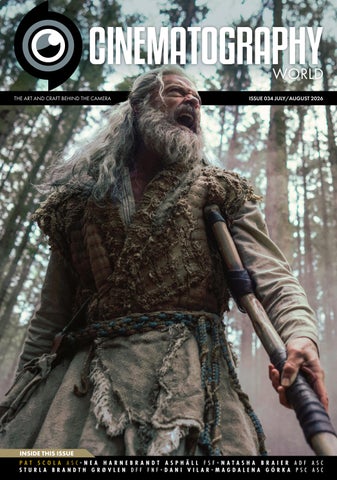
THE ART AND CRAFT BEHIND THE CAMERA
ISSUE 034 JULY/AUGUST 2026
INSIDE THIS ISSUE P A T S C O L A A S C• N E A H A R N E B R A N D T A S P H Ä L L F S F • N A T A S H A B R A I E R A D F A S C STURLA BRANDTH GRØVLEN DFF FNF•DANI VILAR•MAGDALENA GÓRKA PSC ASC
THE ODYSSEY IN CINEMAS JULY 17
THE FILMMAKER’S FILM MAKER KO DAK VI S I O N 3 50 0T/52 19 20 0T/52 13 250 D/5207 50 D/520 3 6 5M M D I R ECTED BY C H RI STO PH ER N O L AN | C I N EMATO G R APH Y BY H OY TE VAN H OY TEMA ASC
@THEODYSSEYMOVIE
©Kodak, 2026. KODAK, VISION and the KODAK logo are trademarks of Kodak. © 2026 Universal Studios. All Rights Reserved.
ISSUE 034 • CINEMATOGRAPHY WORLD When you can make art with a message you think will bring something of value and importance to people, there isn’t a better feeling than that
Editor-in-Chief RON PRINCE ronny@cinematography.world Special Consultant ALAN LOWNE alan@cinematography.world Editorial Assistant KIRSTY HAZLEWOOD kirsty@cinematography.world Advertising Manager CLAIRE SAUNDERS claire@cinematography.world Advertising & Marketing Executive ALICE LARNER alice@cinematography.world Subscriptions CDT ASSOCIATES LTD CWSubscriptions@cdtassociates.co.uk Web Manager IAIN HAZLEWOOD iain@cinematography.world Art Direction & Creative Kinda Stuff JAM CREATIVE STUDIOS adam@jamcreativestudios.com tim@jamcreativestudios.com CONTACT US News hello@cinematography.world Ad sales & Subscriptions +44 (0) 1428 892 630 Artwork artwork@cinematography.world www.cinematography.world
Natasha Braier ADF ASC
ON THE ROAD
The back-end of 2026 is going to be a busy time for the team at Cinematography World, as we get out-and-about. The big news for anyone exhibiting, or with a product/service to promote, is our hook-up with The Making Of (TMO), the far-reaching industry podcast platform, during IBC 2026 at the Cinematography World Pavilion (Hall 12, Stand A40). Join the sponsored video podcast conversations at our pavilion, hosted by TMO’s podcast hero Michael Valinsky, and your latest, greatest news will be spread and publicised among our combined 300,000+ contacts worldwide. You’ll be able to use your podcast for your own in-house marketing efforts too. Get in touch!
Ron Prince photo by Joe Short www.joeshort.com
Rascals Publishing & Media Ltd Red Lion Yard, Odd Down, Bath United Kingdom BA2 2PP Tel: +44 (0) 1428 892 630
Along with IBC, we’re looking forward to visiting Cinecittà Studios, in October, for the first edition of the AIP’s CineVerse expo, where Cinematography World is the premier media partner. Themed as ‘Cinematography Technology & The Next Generation’, CineVerse is shaping-up to be a terrific two-day event, and we’ll be reporting on that in our next edition. Of course, if we don’t see you in Amsterdam or Rome, there’s always Camerimage in Toruń, Poland, this November, when we’ll enjoy the conviviality and camaraderie that the festival offers.
Official Media Partners
See you soon. Stay safe. Long live cinematography.
Ron Prince Editor in Chief EDITORIAL TEAM Ron Prince has over three decades of experience in the film, TV, CGI and VFX industries, and has written about cinematography for 25 years. He won the ARRI John Alcott Award from the BSC in 2014, and earned a Special Award for supporting cinematography from the AIP in 2026. He also runs the international content marketing and PR communications company Prince PR Ltd.
Get your free digital subscription by scanning here NOW!
Darek Kuźma is a film and TV journalist, translator/interpreter, and a regular collaborator/programmer of the EnergaCamerimage Film Festival. He is an ardent cinephile who has a lifelong romance with the visual language of cinema. David Wood is a freelance journalist covering film/TV technology and production He was a former technology editor at Televisual, and is a regular contributor to Worldscreen, TVB Europe and Broadcast. Kirsty Hazlewood has over two decades of editorial experience in print/online publications, including reporting for the IBC and ISE Daily, and is a regular contributor to folk/roots music website Spiral Earth. Cover Image: The Death Of Robin Hood, filmed by Pat Scola ASC on KODAK 35mm. Photo by Aidan Monaghan, courtesy of A24.
SUBSCRIBE You can subscribe to the print, digital, or print and digital, versions of Cinematography World. This will cover you for the six issues delivered over a 12-month period. Your email will also be added to our monthly newsletter update, unless you decide to opt out of these news feeds. Cinematography World is part of Rascals Publishing & Media Ltd. The publishers emphasise that opinions expressed within Cinematography World Magazine are not representative of Rascals Publishing & Media Ltd, but are the responsibility of individual contributors. Cinematography World is created using responsibly sourced paper. All inks used during the printing process are vegetable based and virtually free from volatile organic compounds. Waste, paper, ink and consumables are recycled. Where this is not possible waste is sent to specialist centres for safe disposal.
RECYCLE
Cinematography World is created using responsibly sourced materials
CINEMATOGRAPHY WORLD JULY/AUGUST 2026 3
Anamorphics. Reimagined. ZEISS Horizon Anamorphic ZEISS Horizon Anamorphic lenses mark the next chapter in ZEISS cine lens technology. These full frame 2x anamorphics deliver a refined cinematic look with pronounced oval bokeh and a stretched sense of space, adding depth and immersion to the narrative. With their lightweight, fully motorized design, the seven lenses from 35 to 200 mm integrate seamlessly into existing lens control ecoystems, speed up camera set-up times and improve on balance and efficiency while offering unprecedented accuracy. zeiss.com/horizonanamorphic
ISSUE 034 • CINEMATOGRAPHY WORLD
INSIDE
ISSUE 034 JULY/AUGUST 2026
6 PRODUCTION NEWS 14 VIEW FROM THE TOP • ABBI COLLINS
26 I LOVE BOOSTERS
MARK MILSOME FOUNDATION CHAIR
16 WHO, WHAT, WHEN & WHERE 24 VIEW FROM THE TOP • ROWAN BRAY
UK SCREEN ALLIANCE, FACILITIES COUNCIL CHAIR
26 NATASHA BRAIER ADF ASC • I LOVE BOOSTERS 30 STURLA BRANDTH GRØVLEN DFF FNF • THE SUMMER BOOK 34 SPECIAL PREVIEW • CINEVERSE 2026 36 SPECIAL FEATURE • BIRO FLORIN: VP FOR INDIES 38 NEA HARNEBRANDT ASPHÄLL FSF • BAD APPLES 44 PAT SCOLA ASC • THE DEATH OF ROBIN HOOD 50 GREAT GEAR GUIDE • IBC 2026 PREVIEW 54 MAGDALENA GÓRKA PSC ASC • THE BRINK OF WAR 60 DANI VILAR • RIDE OR DIE 64 GAFFER’S CAFÉ • SEAMUS LYNCH
30 THE SUMMER BOOK
38 BAD APPLES
44 THE DEATH OF ROBIN HOOD
60 RIDE OR DIE CINEMATOGRAPHY WORLD JULY/AUGUST 2026 5
PRODUCTION & POST NEWS
ARRI SELLS GLOBAL RENTAL ACTIVITIES & RELEASES ALEXA 35 LIVE XTREME
A
RRI has entered into a management buyout agreement to sell its global rental activities in Europe, the UK and North America. The management buy-out is led by ARRI Rental’s existing UK-based leadership team of Dana Harrison, Russell Allen and Tamim Essaji, in partnership with H2 Equity Partners. Illumination Dynamics will remain part of ARRI and is not included in the transaction. The divestiture of ARRI Rental is a planned and significant element of ARRI’s long-term strategic development. A key rationale for the transaction is to resolve a structural conflict-of-interest between ARRI’s manufacturing and rental business. As a manufacturer of camera and lighting technology, ARRI supplies customers and partners worldwide, some of whom compete with its rental activities. Through this transaction, ARRI aims to sharpen its focus on the development, production and commercialisation of innovative camera, lighting and software-based technologies, thereby strengthening its role as an independent and trusted technology partner to the global media and entertainment industry. “This transaction is a milestone in ARRI’s strategic transformation and future positioning,” said Thomas Riedel, owner of ARRI as well as founder and owner of Riedel Communications and the Riedel Group. “It enables us to direct our investments even more specifically toward the further development of our technologies and new growth areas. At the same time, it allows the rental business to continue to develop independently
and to unlock additional market potential.” Dana Harrison, who will also serve as CEO of the global rental business, said, “For myself and the team, this is far more than a change of ownership; it’s a commitment. We know the business, our customers, and our craft, and through this management buy-out we’re taking ownership of its future. “ARRI Rental has built something exceptional over many years, and we’re proud to carry it forward as an independent company. Our customers will see the same teams, the same standards, and the same dedication they have always relied on, but now with the focus and freedom of a business that’s ours to grow. “With H2 Equity Partners as our partners, we are exceptionally wellplaced to invest, expand into new markets and deepen the relationships that define us. We are also pleased to continue working closely with ARRI as our technology partner.” In other news, ARRI has released the Alexa 35 Live Xtreme, a new camera that brings high-frame-rate output of up to 8x to live productions using traditional
SDI workflows. Together with ARRI’s Live Production System LPS-1, the new camera enables live entertainment events to be broadcast not just in ARRI image quality, but also in slow motion, enhancing creative options. Alexa 35 Live Xtreme comes permanently pre-installed with the existing High-Speed License for Alexa 35 and a new High Frame Rate SDI License. When combined with the ARRI LPS-1 Fiber Camera Adapter and Fiber Base Station (and a standard slow-motion playout server such as SimplyLive or EVS) the camera outputs HFR at up to 8x in HD or 2x in UHD. Up to 4x HFR can be output via a single SDI connector, and higher speeds are split across both SDI outputs.
Frame rates up to 330fps use the camera’s full dynamic range of 17 stops, whilst a sensor overdrive mode enables frame rates up to 480fps at a dynamic range of 11 stops. Whatever frame rate is chosen for the slowmotion feed, the system simultaneously outputs a live feed for broadcast, allowing operators to switch between the programme frame rate and HFR in real-time. A unique phase-blending feature provides control over motion blur and shutter effects in the live feed.
CVP LAUNCHES WARRANTY+ SCHEME FOR PROFESSIONAL EQUIPMENT
C
VP has announced the launch of CVP Warranty+, a new extended warranty programme designed to help customers protect their investment after the original manufacturer’s warranty has expired. CVP Warranty+ is designed to seamlessly extend protection on eligible products by up to four additional years. “Our customers depend on their equipment every day, whether they’re producing content, broadcasting, teaching students or working on-location. When a manufacturer’s warranty ends, the equipment doesn’t suddenly become any less important, so neither should the support behind it,” said Dominic Smye-Rumsby, technical director at CVP.
“CVP Warranty+ gives customers a simple way to protect their investment for longer. Backed by our pro-repairs engineers and global service network, it provides continued protection and a single point of contact throughout the repair process. It’s a natural extension of our commitment to supporting customers throughout the entire lifecycle of their equipment.”
6 JULY/AUGUST 2026 CINEMATOGRAPHY WORLD
Show the world your world
www.panalux.biz
PRODUCTION & POST NEWS
PGGB ANNOUNCES NOMINATIONS FOR 2026 AWARDS
T
he 2026 Production Guild Awards, in association with Warner Bros. Studios Leavesden, take place on Saturday 12 September at the Royal Lancaster London, hosted by comedian and actor Ellie Taylor. CEO Kaye Elliott congratulated the 20 nominated members and six productions recognised for their contribution to UK film and high-end television. Production Team Of The Year (HETV), sponsored by Netflix: Harry Potter, The Night Manager and Young Sherlock. Production Team Of The Year (Film), sponsored by Panavision: Frankenstein, I Swear and The Sheep Detectives. Assistant Directing, sponsored by Universal Production Services: Jonathan Farmer (Atomic) and Neil Wallace (Masters of the Universe). Inspiration Award, sponsored by BCD Travel
& IHG: Beth Timbrell (The Thursday Murder Club), Russell Lodge (Masters of the Universe) and Sally Stabler (The Fantastic Four: First Steps). Location Management, sponsored by Entertainment Partners: Anna Watson (Gangs of London), Charlie Hayes (F1: The Movie) and David Kennaway (& Sons). Physical Production Management, sponsored by Shadowbox Studios Shinfield: Ali James (The Family Plan 2), Edward Rastelli-Lewis (Young Sherlock) and Mirna Kapetanovic-Kennedy (The Buccaneers Season 2).
Post-Production & VFX, sponsored by EON Productions: James Jordan (Gangs of London), Rich Yeomans (Masters of the Universe) and Simon Frame (Atomic). Production Accounting, sponsored by Sargent-Disc: Andrew Hill (The Night Manager S2), Lucy Drake (Pride And Prejudice) and Sean Browne (Star Wars: Starfighter). Spotlight On New Talent, sponsored by MBS Lighting: James Knowles (Hamnet), Shyam Bansropun (Supergirl) and Sally Stabler (The Fantastic Four: First Steps).
BFI WELCOMES SIX NEW BOARD GOVERNORS
C
reative Industries Minister, Ian Murray, announced the appointment of six new members to the BFI’s board of governors, chaired by Jay Hunt OBE. The new BFI governors are Tanya Cordrey, Mark Herbert, Ganan Kanagathurai, Hakan Kousetta, Ryan Prince and Jane Tranter (Wales Governor). Each Board member serves a term of four years. Recruitment for a new BFI governor to represent Scotland is on-going. The Secretary of State has also reappointed BFI governors Monica Chadha, Elizabeth
Karlsen, Laura Miele and Edgar Wright for a further four-year term. They will rejoin a board that also includes Michael Birshan, Declan Keeney (Northern Ireland Governor), Nell Whitley and chair Jay Hunt. The new
14-strong BFI board of governors will support the BFI, and its executive team led by CEO Ben Roberts, to deliver its ten-year Screen Culture strategy, as the UK’s lead organisation for film, television and the moving image reaches its centenary in 2033.
CREAMSOURCE INTRODUCES VORTEX2 & VORTEX2 SOFT
C
reamsource has announced the Vortex2 (V2) and Vortex2 Soft (V2S), two compact additions to the Vortex family now in a smaller 160W form factor. Vortex2 is the more directional fixture of the pair with a tighter 20° beam angle, whilst the Vortex2 Soft has a native 110° spread for broader, softer coverage At 6kg without the yoke, the V2 series is compactenough to move easily between truck packages, small studio environments and fast-moving set-ups. Built-in LumenRadio, etherCON, pass-through DMX, and pass-through power were designed for efficient daisy-chaining and more practical multi-unit configurations, particularly longer linear arrays. The V2 series fixtures are part of the broader Vortex ecosystem rather than being standalone products. Existing Vortex users will find the same operating environment across CreamOS, networking, colour management and control workflows, including the Slyyd app and Creamsource Webserver. DoPchoice has introduced a complete light-shaping system for the new Vortex2. The modular Snapbag for Vortex2 comes with Snapgrid and Snapcloth diffusion options designed for both single and dual-fixture configurations. 8 JULY/AUGUST 2026 CINEMATOGRAPHY WORLD
Blackmagic PYXIS 12K
Get URSA Cine’s large format sensor with 16 stops of dynamic range recording into Blackmagic RAW! Introducing the next generation customizable cinema camera! It features an extremely versatile design that lets you build the perfect camera rig for your production! You get a full frame 36 x 24mm 12K sensor with wide dynamic range with a built in optical low pass filter that’s been designed to perfectly match the sensor. Plus there are 3 models available in either EF, PL or L-Mount. You also get 2 x CFexpress media recorders!
Large Format Cinematic Digital Film Sensor
Designed for Maximum Customizability
Blackmagic RAW Fueled Image Capture
With multiple mounting points and accessory side plates, it’s easy to configure Blackmagic PYXIS into the camera you need it to be! Its compact body is made from precision CNC machined aerospace aluminum, which means it is lightweight yet very strong. You can easily mount it on a range of camera rigs such as cranes, gimbals or drones! That means you can build the perfect camera for any production!
Blackmagic RAW is a revolutionary format designed to capture and preserve the quality of the sensor data from your camera. It also saves camera settings as metadata so you can set ISO, white balance and exposure in camera or override them later while editing, all without any loss of quality! Blackmagic RAW files are also small and fast to use making them easy to work with.
Blackmagic PYXIS 12K features a large full frame sensor with a native resolution of 12288 x 8040. That’s almost three times larger than a Super 35 sensor and lets you shoot with a shallow depth of field or use anamorphic lenses uncropped for a true cinematic look. This amazing sensor combined with Blackmagic color science gives you the same quality as the most expensive digital cinema cameras.
Get the “Hollywood Look” with Digital Film Blackmagic PYXIS has the professional features you need for feature film, television programming and documentaries, however now this same quality can be used to create cinematic content for social media, YouTube videos and more. Imagine shooting with large format digital film on low budget independent films, TV commercials or even corporate video!
Blackmagic PYXIS 12K From £3,919
www.blackmagicdesign.com/uk Main image shows camera with optional accessories and lens. SRP is Exclusive of VAT
Learn More!
PRODUCTION & POST NEWS
DOPCHOICE DEBUTS AIRGLOW FOR RUPIXEL CANVAS
D
oPchoice has introduced the latest addition to its inflatable Airglow series – the 8×2 Frame for RuPixel Canvas. The super-lightweight inflatable modifier softens and beautifies the Canvas output, whilst preserving the distinctive pixel effects that make the system so versatile. Easily-manoeuvred or lofted into position, the 8×2 Airglow Frame allows users to mount and rig four flexible square Canvas panels in any location. A black outer edge delivers softboxlike directional control, whilst optional Half Soft Frost and Snapcloth diffusions attach to the
frame face via hook-and-loop to create a soft, even aura across each LED pixel array. The combination results in a more natural, pleasing look on the subject without sacrificing the creative pixel effects, programmability or powerful output of the RuPixel Canvas’s performance. The Airglow Frame connects to Canvas via the light’s native hookand-loop mounting points, secured by a cinching strap for a reliable hold. When not in use, the inflatable Airglow Frame can be deflated and rolled-up for compact transport and storage, even with Canvas panels still installed.
GODOX LAUNCHES NEW KNOWLED PL600RF & PL1200RF FIXTURES
G
odox has launched two new fixtures in its Knowled line-up – the PL600RF and PL1200RF – aimed at highend film production, commercial advertising and studio work, marking a significant advancement in the company‘s portfolio of full-spectrum LED lighting equipment. Both are built around Godox’s newlydeveloped PaletteLab full-spectrum colour engine, a multi-channel spectral system designed to improve colour fidelity across complex lighting set-ups, delivering smoother spectral
distribution and better rendering of skin, fabric and mixed-light environments.
The PL series covers 92% of the Rec.2020 gamut and unlocks over 281 trillion colours, with three calibrated response curves: Godox Curve, Blackbody Curve and Daylight Curve. On-set, both fixtures integrate CRMX wireless DMX control for professional lighting networks, carry IP65rated construction for tough studio and outdoor use, and use a Flat Bowens Mount for compatibility with a wide range of modifiers. A lightweight, all-in-one design removes the need for an external adapter, cutting gear load and speeding up set-up.
APUTURE ANNOUNCES SIDUS LINK PRO 2.4
A
puture has announced the release of Sidus Link Pro 2.4, a major update to its professional lighting control app. The release introduces Action Panel, a dedicated full-screen view that allows users to assign cues and Quickshots to large, customisable ‘Go’ buttons for fast, reliable operation. The update also brings Sidus Link Pro to Mac, giving users more screen space, keyboardand-mouse precision and keyboard shortcuts. “This update is designed to simplify the execution and hand-off of professional lighting set-ups, and the new Action Panel feature
solves a real workflow problem in professional lighting control,” explained Ben Dynice, director of
10 JULY/AUGUST 2026 CINEMATOGRAPHY WORLD
product at Aputure. “The person who programmes the system is not always the person running it. With Action Panel, you can build a full DMX set-up in Sidus Link Pro, assign cues and Quickshots to a dedicated control surface, and optionally lock it with a passcode to prevent exposing the full programming interface. It keeps the system powerful for programmers and simple for operators.”
PRODUCTION & POST NEWS
DP JAMES WHITAKER ASC LIGHTS THE DARK COMEDY DTF ST. LOUIS WITH ASTERA
J
ames Whitaker ASC reunited with long-time collaborator Steve Conrad on HBO’s darkly comedic hit DTF St. Louis, an unclassic whodunit wrapped around a midlife crisis. One of the first productions shot entirely on the ARRI Alexa 265 with Prime DNA lenses, the show relied on Astera LED fixtures throughout to shape its rich contrast, warm skin tones and cool shadows. Whitaker and Conrad opted for “graphic framing” – wide shots paired with tight close-ups – to isolate stars Jason Bateman, Linda Cardellini and David Harbour. For close-ups, Whitaker built what he calls a
“complicated single source” – angled Astera Titan Tubes in Dooplo diffusion as a window-style key, a gridded Titan for a three-quarter edge, and a naked Helios or Titan “skip bounce” from floor level to spark the eyes. The whole set-up took eight minutes. Intimacy scenes called for minimal on-set intrusion. In a motel tryst between Cardellini and Bateman, Whitaker mounted an ARRI T24 Tungsten as the sun on a Technocrane outside the window, with LunaBulbs in the
practicals – all controllable remotely so no one had to re-enter once the door closed. A dusk cable-cam shot revealing Harbour dead in a pool house used Titan Tubes replacing ceiling fluorescents, in-frame Helios Tubes for VFX to paint-out, LunaBulbs in alcoves, and dimmable LED streetlights across the block, all under programmer control to chase the falling light.
RED POWERS MULTI-CAMERA CAPTURE OF DAVID GUETTA’S ULTIMATE MONOLITH SHOW
R
ed Digital Cinema supported Epic Cinema and acclaimed director Stijn Verlinde in capturing superstar DJ David Guetta’s The Ultimate Monolith Show at Stade de France in Saint-Denis, France. The production deployed a fleet of Red cameras, including Red’s Cine-Broadcast live production system. Staged across three sold-out nights, June 11-13,
the event drew more than 240,000 fans. The ambitious finale of Guetta’s tour was a fully-immersive audio-visual experience featuring a striking monolith-inspired stage and ground-breaking liveperformance technology. “This was truly a career milestone for our team,” said Verlinde. “David is one of the biggest artists in the world, and the energy he has in his shows is unmatched. His
Monolith Show demanded a solution that could deliver a cinematic impact, cameras with a high dynamic range to shoot in the crowd and capture the LED show without over- or under-exposing. Red provided the flexibility to operate across live broadcast and cinematic capture without compromise.”
SONY DEVELOPS RIALTO 65 SENSOR BLOCK FOR VENICE 2
S
ony is expanding its longterm commitment to the cinema industry with the development of Rialto 65, a new 65mm format capable image sensor block for the Venice 2, targeting release in the first half of 2027. Designed to extend the capabilities of the Venice 2 platform, the new sensor reinforces Sony’s focus on supporting cinematographers with flexible, future-ready tools. When paired with existing Venice 2 camera bodies, Rialto 65 effectively transforms the system into a 65mm format digital cinema platform, preserving compatibility with the current Venice 2 ecosystem. The new sensor block can be mounted to the Venice 2
camera body directly or separate from the body via a cable similar to the VeniceE Extension System, enabling greater mobility and versatile shooting configurations. This modular approach allows creators to adapt quickly to demanding production environments without compromising image quality.
CINEMATOGRAPHY WORLD JULY/AUGUST 2026 11
PRODUCTION & POST NEWS
PANAVISION ANNOUNCES NEW PRIMO 65 MOTION PICTURE LENSES
P
anavision has unveiled the new Primo 65 lens series. Delivering the famed look of Panavision’s storied 35mm-format Primo spherical optics, the Primo 65 spherical primes offer full coverage of 65mmformat camera sensors. The Primo 65 series was built in response to cinematographers’ requests for Primo characteristics from lenses that cover 65mmformat sensors. The full set comprises 12 focal lengths in total, all but one at T2 – 21, 27, 30, 35, 45, 50, 65, 80,
100, 125 and 170mm, with the 225mm at T2.5. All focal lengths feature Panavision’s proprietary
SP70 mount and share a common 4.44-inch (112.8mm) front diameter, with commonly-spaced focus and iris rings to help streamline lens changes. The lenses’ red and yellow engravings pay homage to the original Primo series. Primo 65 lenses are compatible with multiple sensor diagonals, delivering high performance across 65mm, large format and super 35 digital cameras. “The internal layout of the Primo 65s echoes the optomechanical design of the original Primos,” said Dan Sasaki, Panavision’s senior vice president of optical engineering and lens strategy. “In terms of their contrast, focus fall-off and more, the Primo 65s are a true match to our 35mm-format Primos. They fully-cover the 65mm digital format, and also deliver excellent performance on Super 35 and large-format sensors.”
DP AAKASH SUBRAMANIAM CHOOSES ZEISS SUPREME & NANO PRIMES FOR OUR WEIRD SELVES
C
inematographer Aakash Subramaniam WICA mixed Zeiss Supreme and Nano Prime lenses to give Our Weird Selves its raw, unfiltered look. The film follows Charles (Foster Manley) as he brings his wife Bridget (Anquanizia Hall) home from hospital. When she spots a euthanasia brochure slipping from his jacket, both are forced to face a reality neither is prepared for. Despite the grim premise, the film is darkly funny and tender. “It was really important for me to capture my actors in their rawest form – the skin texture, the imperfections, the details that make them real,”
Subramaniam explains. The team tested several sets before the Supreme Primes clicked. “The director tapped me and said, ‘This is the lens I want to shoot with. No other lens.’ What stood-out was how well it held detail without feeling clinical – allowing me to see the world the way I see it.” Subramaniam used the Supremes for two-handers between Charles and Bridget, switching to Zeiss Nano Primes for cutaways and detail-rich solo shots. “The Supremes are like an elder sister to the Nanos. I found the Nanos even a tad sharper, which gave it this observational quality I was looking for.” Subramaniam shot over a third of the film wide-
open at T1.5, adding a diopter for the extreme close-up of Bridget whispering in Charles’ ear. “I wasn’t looking for a lens with personality for the sake of it. I was looking for something that lets me observe truthfully. Zeiss gave me that.” In other news, Zeiss presented its latest lenses, including Aatma, Panoptes 65, and the new Horizon Anamorphic, alongside live demonstrations of CinCraft Scenario camera tracking during Cine Gear Expo. The hands-on sessions sparked great conversations around optical performance, virtual production workflows, and the future of on-set technology. A particular highlight was a presentation on the new Horizon Anamorphics with David Warner and Sundeep Reddy at Theatre 1, which attracted strong interest and provided deeper insights into the design and creative potential of the lens series.
DEEP-LIGHT EXPANDS GLOBAL CINEMATOGRAPHY COMMUNITY WITH NEW MENTORSHIP INTENSIVE FOLLOWING BRADFORD YOUNG LAB
D
eep-Light, the cinematography platform founded by Argentinian DP Natasha Braier ASC ADF, continues to grow as a global space for cinematographers seeking a more honest, experience-based approach to the craft and career. Since launching in 2025, the platform has grown into an international community of over 3,000 members across five continents, with all live programmes selling out within days. Earlier this year, Deep-Light hosted The Light Inside, a two-day in-person lab in Los Angeles led by cinematographer Bradford
Young ASC. The event focussed on the inner process behind the work: how cinematographers develop a personal visual language, stay connected to their vision under pressure, and
12 JULY/AUGUST 2026 CINEMATOGRAPHY WORLD
make creative decisions from a place of clarity. The experience sold out within days and reinforced the demand for spaces that go beyond technique into the deeper layers of the craft. “Deep-Light is everything I wish I had when I was coming-up,” said Braier. “Not just technical knowledge, but real conversations about how this career actually works. The work-life balance in this profession is a real challenge, and no-one really prepares you for that. These are the things that shape your path, and they’re rarely talked about openly.”
PRODUCTION & POST NEWS
BEN FORDESMAN BSC ON THE MAKING OF ANEMONE D P Ben Fordesman BSC, the cinematographer of Rose Glass’s St. Maud and Love Lies Bleeding, plus Dylan Southern’s The Thing With Feathers, worked with Panavision and Panalux on the camera and lighting packages for Ronan Day-Lewis’s film Anemone, where much of the drama lives in the performances of its leads, Daniel Day-Lewis and Sean Bean, playing estranged brothers.
Autumn Sonata, influenced the look of Anemone. “I’m endlessly fascinated with lighting the face, and I think in a sort of interior space it just opens up a sort of kaleidoscope of options. What I loved about Anemone was there were so many intense two-handers. It felt almost like kitchen sink, social realism, with intense dialogue, very long monologues, two people talking in a room. It immediately spoke to me to say that these scenes
The film follows Ray (Day-Lewis), a former military man whose service in Ireland during ‘The Troubles’ has resulted in unspeakable stress, guilt and the destruction of his previous life. He retreats into self-imposed exile in the woods, leaving behind his pregnant partner, Nessa and his son. When his brother, Jem (Bean) ventures from suburbia to convince Ray to return home the two men to confront deep-seated family trauma and political violence. Fordesman explains that he strove to focus on the performances through composition, minimal lighting and restraint. Andrey Zvyagintsev’s The Banishment, Andrei Tarkovsky’s Stalker and Ingmar Bergman’s
need to be handled with visual restraint and static compositions, allowing that tension to breathe.” Although much of the physical drama happens in a confined space, Fordesman had the freedom to open-up visually when capturing Ray’s imaginative interior life. “The script explored the rich inner world of Ray, and this was handled in a metaphysical visual way. “We had dream sequences and quite big set-pieces, which contrasted to the intensity between two guys having it out in long 12-minute monologues.” To support the actors’ performances,
Fordesman strove to be as unobtrusive as possible with his lighting. “For Daniel, it was super important for his character to exist in a world of all the props,” Fordesman says. “Everything was carefully selected. He needed to feel this was real, and that also meant the same for the lighting. “My gaffer, Jonathan Yates, and I wrestled with lots of different options,” he continues, “and we nearly landed-on putting a soft box out of shot in the ceiling to light the space so that there was freedom for the actors. But that would have felt like a studio environment, and it just wasn’t right. Then production designer Chris Oddy presented us with paraffin lamps, saying ‘What about these?’ “We tested a few real ones. They were really stinky and you need to keep refilling them,” Fordesman explains. “So in the end, the only way was to retrofit them with RGB LED clusters. By the time the texture of the interior and the costume and the make-up all came together, these lamps actually worked really well.” Fordesman utilised the effects of hard sources to illuminate the windows to the characters’ souls – the actors’ eyes. “It’s sometimes quite uncomfortable to work with very hard light sources, particularly if there’s a lot of movement and people moving around,” he says. “But they did produce these wonderful eye lights, and sometimes our really warm light would just fall-off and Chris created this dark background and all the costume was dark. We had these light-absorbing materials, so just their faces and eyes hung out in the darkness, and the eye-lights made the magic of those close-ups. It was simple in the end.” Anemone marked the latest in a line of collaborations between Fordesman and the teams at Panavision and Panalux. “I’ve lost count of to times I’ve driven along the A40 and popped into Panalux or Panavision to do a test that I probably didn’t need to do. They’re always ready to accommodate, find a space and be super helpful.”
NEW TRUSTEES WELCOMED TO SCREENSKILLS BOARD
S
creenSkills has welcomed two new members to its board of trustees, helping to guide organisation under the leadership of its chair, Lisa Opie. Dr Leon Hawthorne joined the board in July, whilst Joanna Rwama joined in March, replacing outgoing chair of
Farcom and vice-chair of the board, Kate Lyndon. In addition to the new members, Alex Pumfrey, who joined the board in October, has been named vice chair of the board. The appointments follow those of Sachin Dosani, Sarah Monteith and Stephen O’Donnell
in October last year and reflect the governance review ScreenSkills undertook as part of the Board’s commitment to its five-year strategy, launched in October 2024. They are part of an on-going process to move to a smaller, skills-based board, ensuring it is representative of the strategic future needs of the organisation in terms of sector experience, diversity and location.
CINEMATOGRAPHY WORLD JULY/AUGUST 2026 13
VIEW FROM THE TOP • ABBI COLLINS
PLAY IT SAFE The Mark Milsome Foundation
I
t was truly a career-defining moment when I was asked to become chair of the wonderful Mark Milsome Foundation (MMF), which I have supported as a Trustee since 2024. I was handed the baton from Samantha Wainstein, who, along with Mark’s widow, Andra, and the core MMF team, developed the foundation into a well-respected and innovative player in the screen entertainment industry.
covering: The Law And Chain Of Responsibility; Risk Assessment & Management; Working Hours & Welfare; Communication, Competence & Due Diligence; When Things Go Wrong; Speaking-Up; Health & Safety Abroad; Mental Health; and ends with important contact details for various organisations. The test sections have multiple choice questions, and a pass can be achieved with a good common-sense approach.
I have been in the stunt industry for 39 years, initially as a stunt performer, with hundreds of film and TV roles, doubling wonderful actors, such as Rene Zellwegger in the Bridget Jones films and Catherine McCormack in Braveheart, working alongside Mel Gibson, who was my heartthrob for many years, and he didn’t disappoint!
We are actively supporting BECTU with its campaigns to not break the 11-hour turnaround and it is my personal mission to highlight the need for productions to consider the personal travel time of crew each day. When their schedule calls for long days, and they then ask for extra overtime, accommodation should be provided. I’ve spoken to many crew members who have had accidents falling asleep at the wheel when driving home.
My role as a stunt coordinator means safety is paramount in everything I do. I was a founder and vice chair of the British Stunt Register (BSR), established in 2017 and although the development of the BSR proved to be extremely challenging, I am very proud to say it has grown into the dynamic and well-established organisation it is today.
Safety is paramount in everything The MMF is a mission-driven foundation and after only nine years has made a significant impact in the media and entertainment industry. We produced a renowned online safety course, which most of the leading entertainment and streaming providers subscribe to annually. Since its launch in 2021, almost 17,000 production and crew have completed the course. I will be revising and refreshing the content this year, along with writer / director Kirk Jones, our founding chair, now patron, who created the course. This will be in-line with industry feedback and developments. It will become the Production Safety Accreditation 1 (PSA1) with an industryrecognised certification, valid for three years, which covers all productions during that timescale. We encourage all crew members to take the online course, not just HoDs. It takes 90 minutess to complete online and has eight chapters,
There is a new documentary out now on Prime Video called Safe Sets – Dying To Work In The Film Industry, and I urge everyone in our industry to see it. It’s a hard watch but the deaths it covers could easily have been avoided, including Mark’s, with due diligence, a more professional approach and a mindset that doesn’t put budgets before safety. We have engaged three new Trustees to our amazing team, who bring diverse expertise, perspectives and networks in abundance. Fran Zerenghi, an entertainment publicist, Rebecca Hawkes, head of studios, Elstree and camera operator Chris Plevin ACO. We are also excited to announce our new patron, actor Mark Gatiss, who was overjoyed to be approached and has been an avid supporter of the MMF for many years. We’ve just launched a new black T-shirt to commemorate Mark’s birthday and celebrate nine years of the foundation’s important work. Designed by cinematographer Birgit ‘Bebe’ Dierken BSC, it features an array of coloured cameras, inspired by the Macbeth colour chart used by DPs. We added a QR code to the nape which, when scanned, leads to one of six powerful real-life quotes from people working in the film and TV industry. It’s a fabulous new addition to our merchandise line and they are selling like hot cakes! Planning is now in progress for a major MMF event to commemorate the ten-year anniversary of Mark’s death in November 2027. It will be a black-tie event – so watch this space! It will of course be bitter-sweet, but we are determined to keep Mark’s memory alive and celebrate his amazing life and legacy.
14 JULY/AUGUST 2026 CINEMATOGRAPHY WORLD
The industry is currently going through a dip, but we are hopeful it will pick-up over the next 12 months. Going forward, I think AI will become a standard production tool and virtual production will expand, as we are already seeing with regular use of LED volume stages. Our young generation should be mindful of this and hone their AI literacy skills and virtual production knowledge. I also feel international content will continue to grow, as the industry becomes more technology-driven but with good storytelling still at its core. I’m extremely proud to be at the helm of the MMF and we will continue to grow and embrace the ever-developing changes, always with safety at the forefront of everything we do. Abbi Collins Chair: The Mark Milsome Foundation www.abbicollins.com www.britishstuntregister.com
GET THE T-SHIRT https://www.markmilsomefoundation.com/ product/marks-birthday-tee-2/
WHO, WHAT, WHEN & WHERE
FOCAL LENGTH
Our regular round up of who is shooting what and where SCREEN TALENT: Ross Clarkson operated B-camera on second unit for John Rambo in Thailand. Adam Sliwinski is shooting Garage Sale Mysteries for Crown Media, directed by Paula Elle. Bart Sienkiewicz PSC is working on a film with director Gerald Gregory and producer Llewelynn Greeff. CASAROTTO: Balazs Bolygo BSC recently wrapped on First Woman, working with director and frequent collaborator Philip Martin. Aaron Adrian Rogers has completed on Gangs Of London S4, working with Eran Creevy. Matt Gray BSC shot on Mavis Ecclestone with director Bruce Goodison. Julian Court BSC has finished on Tomb Raider. Rik Burnell is shooting second unit of Not Like Us, a feature by Rich Moore and Ramla Ali. Michael Wood BSC is lighting Porto Rico, working with Residente. Beatriz Delgado Mena is attached to shoot the feature A Beautiful Kill. BERLIN ASSOCIATES: Edward Ames recently wrapped on The Dumping Ground S15 for BBC. Al Beech is shooting Marlow Murder Club S4 with director Tracey Rooney. Sarah Bartles Smith has been lensing on the Sky comedy series Mr Bigstuff S3 for Water & Power Productions, produced by Hayley Sterling. Andy Clark has completed on Clapperboard’s A Good Ship Murder S4 with producer Jonathan Phillips. Nick Cox graded his recent work on Waterloo Road before starting
prep the next series. Mark Garrett is shooting Art Detectives S2, episodes 1 & 2, with director Declan Wrecks and Martin J Mahon producing. Annemarie Lean-Vercoe has graded her episodes (5, 6 & 7) of All Creatures Great And Small. Nick Martin is shooting block 1 of Fable Pictures’ The Chocolate Wars. Trevelyan Oliver is preparing to shoot on Can You Keep A Secret? S2. Tom Pridham recently finished shooting The White House S2 for Nutopia. Kelvin Richard filmed with CaveLight Films USA on the longform documentary Why We Love Dogs, Eat Pigs And Wear Cows, and recently completed on the action-comedy short Rude Boys, directed by Mustapha Kseibati. Pete Rowe recently finished on Lion Television’s Horrible Science. Simon Rowling shot second unit on Testament S2 with director Tom Ruddock. James Swift continues to shoot block 2 of Chocolate Wars. Michael Timney recently finished shooting on BBC’s Casualty. Alistair Upcraft lensed on Am I Being Unreasonable S3 for Boffala, and then went on to The Woods for Quay Street, block 3. Amy H C Wilson recently completed on the Waffle’s After School Club S2. Phil Wood is shooting block 2 of The Woods for Quay Street Productions. Alex Veitch filmed on BBC’s Anisha, Accidental Detective. WIZZO & CO: The agency welcomes Ndrika Anyika an NFTS graduate and Netflix Scholar. Ndrika’s work has been featured on the BBC, ITVX, BFI Flare Festival and Sheffield DocFest. Ryan Kernaghan ISC is shooting Bad Bridget, directed by Rich Peppiatt. Tim
16 JULY/AUGUST 2026 CINEMATOGRAPHY WORLD
Main image: Simon Rowling shooting at Mersea Island on Testament S2 2nd Unit, photo by Lou Alvarez.
Sidell BSC shoots Army Of Shadows, directed by Lisa Gunning. Dmytro Nedria has graded the feature Merry Christmas Aubrey Flint, directed by Jack Spring. Maxime Lahousse SBC shoots a drama in Belgium. Mike McMillin shot second Unit on a new AppleTV+ drama. Felix Cramer is prepping a feature in Germany with director Hannu Salonen. Maximiliaan Dierickx SBC is prepping a feature in Belgium. Nick Dance BSC is shooting a TV drama in Croatia. Hamish Anderson continues to lens a documentary for Duna Films. Susanne Salavati BSC just wrapped on The Husbands for AppleTV+. Steven Ferguson is shooting a drama in Brighton. Arran Green shot with Jonathan Pearson. David Procter BSC is prepping a feature with director Joe Marcantonio. Ahmet Husseyin shot with director David Ranson. Matthias Pilz lit second unit on a BBC One drama. Rasmus Arrildt DFF has wrapped block 1 of The Lords’ Day for Netflix. Franklin Dow is shooting a documentary with Josh Allott. Scott Coulter is filming a drama with directors Rosco 5. Simon Stolland shot with Percelle Ascott. Charlie Goodger continues lensing a drama with director Rene Van Pannevis. Aaron Reid BSC has wrapped on Supacell S2. Fede Alfonzo collaborated with Simon Ratigan. Joe Douglas lit with Guy Shelmerdine. Ben Magahy filmed for director Chris Cottam. Murren Tullet lensed with Jim Archer. Will Bex shot with Vaughan Arnell. Sverre Sørdal FNF is prepping a feature in Norway. Gary Shaw is
Create the Moment Where media and entertainment come to life
Register Now: show.ibc.org
#IBC2026
WHO, WHAT, WHEN & WHERE Images: Ndrika Anyika at the camera, photo by Juan De Leon-Padmore; and Toby Leary shooting with an Easyrig in Naples
prepping on a drama. Theo Garland shot with Johnny Kelly. Henry Gill lit for directors Abdou Cisse and Akwasi Poku. Chas Appeti is prepping an embargoed project. Aman K Sahota is lit a short film. Chaimuki shot a commercial directed by Jocelyn Anquetil. Darius Shu lensed a documentary for Dash Pictures. Shaun Harley Lee SASC has wrapped on a Netflix series. Dan StaffordClark is shooting a Sky drama. Luke Bryant has graded a BBC One drama. INDEPENDENT TALENT: Arni Filipusson is in prep for Down Cemetery Road S2, with Börkur Sigþórsson directing. Eric Kress DFF is shooting Valde S3. Ashley Barron ACS recently wrapped on Bridgerton S6. Toby Lloyd shot a feature documentary for Passion Pictures with Dan Vernon directing, and recently concluded on the short, Tussle, with Gabrielle Torrebore directing. Bani Mendy is lensing the latest season of Death In Paradise. Andreas Neo recently did additional photography on Lego Friends: Heartlake The Musical, directed by Paul Becker. Carmen Pellon Brussosa is lighting the feature, Alegre Y Olé, helmed by Clara Santaolaya. Chas Bain shot additional unit days on Young Sherlock S2. Miguel Carmenes has been filming commercials with directors Josh Cohen, Faith Aylward, Gosh Damn, Jamie Tarr and Taran for brands including Adidas, Knorr, Barclays, Autotrader and Audible, plus a short with Andrew McGee. Chris Clarke has been lensing ads with Will Innes Smith at Girl & Bear. Toby Elwes has been shooting music videos with Clemente Lohr. Katie Goldschmidt BSC has been lensing spots with Maya Albanese. Billy Kendall has been shooting TVCs and
music videos with directors Relta, Bedroom, Avleen K and Charlie Rees. Suzie Lavelle ISC BSC lit commercials with Drool director Freddie Powell and Anonymous Content director Patrick Daughters. John Mathieson BSC has wrapped on Hello & Paris, directed by Elizabeth Chomko, starring Kate Hudson and Javier Bardem. Patrick Meller lit commercials with directors Benji Weinstein, Stephen Pipe, Guy Manwaring, Chris Balmond, Tiffany Whitney Chang and Tom Speers. James Rhodes filmed TVCs with Sweet Shop director D.A.R.Y.L and live performances with Paul Dugdale, and Heartstopper: Forever, directed by Wash Westmorelsand, was released in July. Chris Sabogal has been shooting ads with Randy Krallman and Sasha Nathwani. Linda Wu lit for Lego with Traktor and other commercials with Craig Ainsley, Sarah Dattani, Samona Olanipekun and Jesse Lewis Reece. Stuart Bentley recently finished shooting on The Worst, directed by Simon Woods. Ole Birkeland is lighting on The Last Of Us S3, directed by Vincenzo Natali, Andrew Bernstein and Craig Mazin. Eben Bolter BSC is currently filming Slow Horses S8, directed by Adam Randall. Jermaine Edwards is shooting on Wahala, with directors Leonara Lonsdale, Theresa Ikoko and Remi Weekes. Ben Davis BSC is prepping for the Untitled Oceans Prequel, with Bradley Cooper at the helm. Anthony Dod Mantle DFF BSC ASC is prepping for Porto Rico, directed by Rene Perez Joglar. Michael Filocamo is shooting on the series The Secret Diary Of Adrian Mole Aged 13 3/4, with director Alex Winckler. Seamus McGarvey ISC BSC ASC has graded Narnia, helmed by Greta Gerwig. Mark Patten BSC is shooting on Young Sherlock S2, directed by Guy Ritchie and Colm McCarthy. Kate Reid BSC has wrapped on
18 JULY/AUGUST 2026 CINEMATOGRAPHY WORLD
Meantime, with Jon S Baird directing. Martin Ruhe ASC is finishing on Luther 2, directed by Jamie Payne. Erik Wilson BSC is shooting the feature Tangled, helmed by Michael Gracey. ECHO ARTISTS: Ailsa Aikoa has recently been shooting across shorts, music videos and commercials with directors including Imogen Harrison and Lucy Bridger. Bjorn
THE BRIGHTEST 1x1 PANEL AVAILABLE NOW
WERED B
D
W
E
ER
POWER
ED BY
Y
PO
BY
PO
WHO, WHAT, WHEN & WHERE
This page: a trio of photos featuring Will Pugh; and two more of Toby Leary shooting with an Easyrig in Naples.
Stale Bratberg BSC FNF is prepping pick-ups for Everybody Wants To F**K Me for Studio Canal and Lucky Chap Entertainment. Federico Cesca ADF ASK is shooting S2 of an HBO series. Andrew Commis ACS is still shooting in New Zealand with director Tim Miller. Andrew’s Extra Geography was selected for the Out-Of-Competition category at Edinburgh Film Festival. Nick Cooke recently
has graded the second season of The Crow Girl with director Bex Rycroft for Paramount+. Matt Toll shot second Unit on the upcoming live action Tangled remake for Disney. Pedro Cardillo ABC continues lensing the new BBC series Sutherland with director Patrick Harkins. Katie Swain BSC shot on the splinter unit of The Batman Part II for Warner Bros. and DC Studios, directed by Matt Reeves. David Ungaro AFC filmed on Netflix’s Dept. Q S2, helmed by Scott Frank. Mattias Troelstrup DFF has on wrapped block 2 of the new Netflix series Breakers. Arthur Mulhern ISC is prepping on block 2 of the BBC series Fox with director Rachel Carey. Job Reineke has concluded on block 1 of ITV’s The Bay S6 with director Brian O’Malley, whilst Sunshine Hsien Yu Niu has started shooting block 2 with director Bindu De Stoppani. Matthew Emvin Taylor lit the upcoming feature Life Stream for Omnibus, and travelled to Riyadh with Hebbar and Aziz Alijasmi to shoot commercials for Emkan
Merman series for HBO penned by Sharon Horgan and directed by Dawn Shadford, and recently shot additional photography on a feature film with Simon Woods. Noel Schoolderman has had a run of projects shooting in Amsterdam and the UK and recently wrapped with Leonn Ward. Ben Smithard BSC graded a feature in Madrid with director Florian Zeller. Isabelle Stachtchenko is filming a project with director Jessie Posthumus. Chloë Thomson BSC is shooting a series for Forge Entertainment/BBC, written by Anya Reiss and directed by Mahalia Belo.
wrapped on an A24 project, directed by Kate Hewitt. Nick recently worked on Mission, selected for the Sean Connery Prize For Feature Filmmaking Excellence at the Edinburgh Film Festival. Ruben Woodin Dechamps has been working on various projects with directors James Marsh and Dan Emmerson. Maria von Hausswolff is lighting a project with director Josefine Kirkeskov. Yunus Roy Imer is lensing a TV project
WORLDWIDE PRODUCTION AGENCY: Stephen Murphy BSC ISC is shooting on the second season of Amazon’s Mr & Mrs Smith. Richard Donnelly ISC is lighting Darkness Has Fallen, the third volume of StudioCanal’s Has Fallen series, alongside director Marco Kreuzpaintner. PJ Dillon ISC ASC continues shooting on Netflix’s Wednesday S3 with director Tim Burton. Callan Green ACS NZCS joined Jason Statham Stole My Bike in Malta to shoot
with Firebird Pictures. Yunus’s recent work on A Happy Family was selected for the Crystal Globe Competition at the 60th Karlovy Vary International Film Festival, whilst The State Of Us was selected for the Sean Connery Prize For Feature Filmmaking Excellence at the Edinburgh Film Festival. Toby Leary lit music videos and campaigns with directors including Becky Garner and Billy King. The ‘Starburst’ music video he lensed for Danny Brown was recently nominated for best experimental at the Berlin Music Video Awards. Will Pugh is shooting various projects with directors Mat Whitecross and Will Graburn, and recently worked with Vogue. Korsshan Schlauer has graded a
splinter unit. Michael Snyman lit on 3 Body Problem S3 for Netflix and director Miguel Sapochnik. Fabian Wagner BSC ASC continues to shoot Minecraft 2 with director Jared Hess for Warner Bros. Ruairí O’Brien BSC ISC recently wrapped on The Day Of The Jackal S2 for Peacock alongside director Neasa Hardiman. Jamie Cairney BSC shot on the first block of Legacy Of Spies for BBC, whilst Paul Morris is shooting the third block with director Michael Lennox. Joel Devlin BSC continues shooting block 2 of The Lord’s Day for Bad Wolf/Netflix. Maja Zamojda BSC shot additional photography for HBO’s A Knight Of The Seven Kingdoms S2. Mattias Nyberg BSC
20 JULY/AUGUST 2026 CINEMATOGRAPHY WORLD
and Zoi Ice Tea. Emily Almond Barr has graded Maigret S2 for PBS with Patrick Harbinson directing. Rotem Yaron has wrapped on the Apple TV+ serie Safe Houses with Otto Bathurst directing. Lorenzo Levrini continues shooting second unit on Gangs Of London S4, whilst also prepping his next feature. Jake Gabbay shot with Anonymous Content director Marco Prestini for Jaguar. Alexandre Jamin shot in Mexico with director Camille Marotte and Mestiza Tribe for Toyota, and in Georgia for KSIA with DejaVu and James Coton. Dajiana Huang shot a spot for Just Eat with Girl & Bear and directing duo Pip+Lib. Edward Gibbs filmed for Max Factor with Lock
This page: a nice portrait of Will Pugh; and Joel Devlin eyeing-up a shot on The Lord’s Day.
Studios. Carlos Ritter travelled to Slovenia to shoot a Dell commercial with director Gregory Brunkalla via Skunk. Ben Mullen shot in Prague for O2 with Stink Films director Eoin Glaister, and returned to London with Stink Films and Eoin to shoot an ad for Liberty. Jaime Ackroyd shot with director Saman Aminzadeh via Lovesong Films for Footlocker.
WHO, WHAT, WHEN & WHERE
Courtney J. Bennett lit a MyProtein spot with Antfarm director James Killeen. Thomas TysonHole collaborated with Chris Ranson and St Marks for a Samsung commercial. Adam Bentel SASC was in Qatar for a Qatar Airways TVC with director Billy Pols and Digitek. Ilya Maksymenko lit a commercial for Buxton with Biscuit Filmworks director Stanley Brock.
James Blann lensed a spot for Curry’s with Nice Shift Films and Kai Schonrath. MCKINNEY MACARTNEY MANAGEMENT: Stuart Biddlecombe is filming on Code Zero in Wales with director Ashley Way. Ben Butler continues shooting commercials. Wes Cardino has just finished shooting on Nobody Wants This S3 for Netflix in Los Angeles. Gavin Finney BSC has started lighting Dance Of The Macaroni Flowers with director Vadim Jean. Jean Philippe Gossart AFC continues filming FX’s Shōgun S2 with directors Kate Herron, Hiromi Kamata, Justin Marks and Anthony Byrne. Andy McDonnell has wrapped filming on Shy & Lola for the BBC, directed by Emily Atef. Richard Mott is continuing to shoot ITV’s Two Birds, directed by James Griffiths. LOOP TALENT: The agency welcomes Matt Wicks to the roster. His many credits include The Buccaneers for Apple TV directed by Charlotte Regan, BBC’s Vigil directed by Andy De Emmony, and Sky’s Funny Woman directed by Oliver Parker. Matt’s comedy work includes BAFTAwinning Amandaland, alongside Smoggie Queens and Twenty Twenty Six. He recently wrapped on block 1 of The Woods for Quay Street/Netflix. The agency also welcomes Richard ‘Stoddy’ Stoddard. His HETV credits includes Run Away for Netflix, Amazon’s Lazarus, and BBC’s The Guest. His film credits encompess Gareth Bryn’s The Passing which won him a BAFTA Cymru for Photography and Lighting, Sometimes Always Never starring Bill Nighy, and That Good Night starring Sir John Hurt. Johanna Coelho AFC is shooting The Pitt. Oona Menges BSC is in prep for Paramount’s HETV series Majesty. Darran Bragg is prepping the feature film Captain India. Ryan Eddleston has graded the feature Frank And Percy. Matt North is prepping a drama series. Dave Miller has done the DI on the feature West The Road, in addition to shooting food spots. Ali Asad getting ready for the feature Tottenham Rules. Denson Baker ACS NZCS is prepping for a feature. Paul Mackay is shooting the feature Christmas Family Feud. Bebe Dierken BSC prepping for the feature The Volunteers. Petra Korner AAC has been lensing a narrative project. Thomas English shot ads for Nurofen and Shell. Olly Wiggins has been lensing projects with regular collaborator Marcus Liversedge. Bertrand Roucourt has been shooting short form. Natalja Safronova framed a Budweiser brand activation project for the World Cup. Naoise Kettle lit an NDA tech spot with Media Arts Lab. Martyna Knitter is working on documentary projects and has two features coming up. Chris O’Driscoll has been filming TVCs for sports brands. Emma Dalesman
CINEMATOGRAPHY WORLD JULY/AUGUST 2026 21
WHO, WHAT, WHEN & WHERE
is shooting documentaries. Jon Muschamp is lensing short form. Marti Guiver has been working on fashion ads. Tom Turley has been shooting documentaries. Congratulations to camera/Steadicam operator Rachel Wood on being upgraded to Associate ACO member. Michael Eshun-Mensah ACO operated the Technodolly on a brace of NDA projects. Grant Sandy-Phillips ACO worked with Loop DP Paul Mackay on Christmas Family Feud. Ben Eeley ACO SOC was B-camera/Steadicam on Wahala for Firebird Pictures. Junior AgyemanOwusu ACO has wrapped on a six-part series for Bad Wolf/Netflix, shot in Cardiff. Ben Mitchell ACO recently concluded on a film in Cardiff. James Anderson ACO has been operating dailies. Gary Kent and Fabio Olgiati operated Steadicam on ads and music promos. Lou Macnamara operated Steadicam on a short in Ireland. Toufique Ali and Nicolas Di Maetto worked at a live event for Stella Artois as camera operators. Laura Van De Hel is camera operating on Gangs Of London S4. Camera operators Louise Murphy, Chai Rolfe and Jack Smith have been working on commercials. UNITED AGENTS: Ricardo De Gracia is lensing a mini-series in Spain. Sonja Huttunen is shooting a new comedy series in Finland. Philippe Kress DFF is filming the second series of The Day Of The Jackal for Carnival Films/Sky. Mark Nutkins is shooting on The Marlow Murder Club S4 for Monumental Television/ITV Studios/ UKTV. Danny Cohen BSC is prepping You Are Here with director Lenny Abrahamson. Damian Paul Daniel is working alongside Ventureland on a feature
This page: (Images clockwise) Pedro Cardillo Sutherland out-and-about; a happy Richard Stoddard; and a highly-focussed Matt Wicks.
documentary. David Higgs BSC has begun filming The Joy Of Sex, directed by Sharon Maguire. Matt Lewis is in New Jersey shooting Netflix’s Rabbit Rabbit with Philip Barantini. Kieran McGuigan BSC is lighting the final block of The Buccaneers S3. Bet Rourich is filming the feature Sealskin in Spain. Simon Tindall has graded the third series of Sherwood, directed by Clio Barnard. Alasdair Boyce has done the DI on Counsels. Jo Jo Lam is prepping the feature La Vrai Vie, directed by Marie Monge. Sam Heasman has graded Supacell S2 for Netflix. David Rom is prepping block 1 of the final season of HBO’s Industry. Frida Wendel FSF has graded the four-part mini-series, Rinnan, for TV2 Norway and Amazon Prime with director Kenneth Karlstad. Si Bell BSC recently wrapped on Cry Wolf for FX/Disney, created by Sarah Treem. Rachel Clark BSC has done the DI Dreamlands for Sister Pictures. Bonnie Elliott ASC is India filming Eka, directed by Suman Sen. James Friend BSC ASC is in New Zealand shooting The Lord Of The Rings: The Hunt For Gollum, with Andy Serkis directing. Anton Mertens SBC is in prep for Dragon Slayers, helmed by Al Mackay for BBC. Milos Moore is lighting Bishop for Amazon Studios. Neus Ollé AEC BSC is lighting Memoria in Spain. Ed Rutherford BSC is in Wales shooting Majesty with director James Strong. Ben Wheeler BSC has graded The Undertow and Black Doves S2. Felix Wiedemann BSC is shooting BBC’s Hercule, with Jonny Campbell at the helm. Alex Barber lit a Loewe campaign with director Aidan Zamiri via Object & Animal and a Quilter ad with director Tim Godsall in London through Anonymous Content. Laurent Barés is shooting on the latest series of Grace with director Philippa Langdale. Robbie Bryant is prepping the feature Echolalic with director Jo Lewis. Simon Chaudoir lensed a Gucci campaign with Joan Renck through Reset, and an Alo campaign via La Pac with director Claire Arnold. Lasse Frank’s commercials including a Primark TVC with director Andreas Nilsson in Barcelona via Biscuit. Alex Melman lit a Curry’s ad with director Greg Bell through Nice Shirt Films. Oli Russell BSC is shooting the series War for HBO. Glynn Speeckaert SBC AFC ASC filmed a Backmarket spot in London with director Harold
22 JULY/AUGUST 2026 CINEMATOGRAPHY WORLD
Einstein. Simona Susnea has graded Faith with director Paul Andrew Williams. Matt Windon is working on Three Body Problem S3 in Budapest. LUX ARTISTS: Steve Annis BSC is lensing Eleven Missing Days, directed by Bertie Ellwood. Christopher Aoun BVK continues shooting Mr. Nawashi with director Isabella Eklöf. Autumn Durald Arkapaw ASC wrapped the pilot episode of Hulu’s Untitled X-Files Reboot with Ryan Coogler at the helm. Justin Brown BSC lensed campaigns for Leapmotor, directed by Henry Hobson, and Notino directed by Alex Prager. Mattias Rudh FSF lit O2 spots, with Sam Pilling directing. Daniel Landin BSC filmed an NDA project, directed by Steve Rogers. Łukasz Żal PSC shot a Claude campaign with director Daniel Wolfe. Maceo Bishop is prepping for Lizard Music, directed by Benny Safdie. Henry Braham BSC has wrapped Mister, helmed by Wade Eastwood. Nicolai Niermann shot an SK-II campaign, helmed by Jonas Lindstrøm. Stuart Winecoff shot a Charli XCX promo with director Aidan Zamiri, and Jacquemus spots, with Gordon Von Steiner directing. Max Pittner lensed a Troye Sivan promo, directed by Gordon Von Steiner and a President’s Choice campaign, directed by Rubberband. Patrick Golan framed Instagram TCVs helmed by Stefanie Soho and Lucid spots with Niclas Larsson directing. Arnau Valls Colomer AEC continues shooting A Quiet Place 3 with director John Krasinski. Oscar Faura continues shooting Ibelin, directed by Morten Tyldum. Crystel Fournier AFC is lighting Summer In Heat with director Levan Akin. Wyatt Garfield is prepping for Stages helmed by Sonoya Mizuno. Jakob Ihre FSF is shooting the mini-series 9/12 with director Tobias Lindholm. Frank Lamm is shooting the BBC/ ZDF series Hamburg Days, directed by Christian Schwochow. John Lynch ISC is prepping for a Sky/Working Title series Charmer, with Elliot Hegarty directing. Michael McDonough BSC ASC has wrapped Paramount+ series Mayor Of Kingstown S5. Piers McGrail ISC is prepping for Maya Butterfly, directed by Edwina Casey. Julien Poupard AFC continues shooting Dumas, with Ladj Ly directing. Adam Scarth wrapped BBC series The Witch Farm, helmed by Stacey Gregg. Rasmus Videbaek is prepping My Fairytale Life, directed by Nikolaj Arcel. Harry Wheeler shot an NDA project, directed by Brady Corbet and Mona Fastvold, a Charli XCX music video helmed by Aidan Zamiri, and is prepping for BBC/A24 series The Ministry Of Time, with Aneil Karia directing. Jasper Wolf NSC is shooting Please, directed by Halina Reijn. Rik Zang SBC is prepping 14 Juillet, with Nicolas Boukhrief at the helm. Rina Yang BSC framed an M&S campaign with Rubberband. Sebastian Blenkov lensed a Škoda campaign, directed by Sam Brown. Matyas Erdely HCA ASC lit a Hanes campaign with Nick Ball and an NDA project directed by Spike Jonze. Ben Fordesman BSC lensed a Ford campaign with director Rupert Sanders. Rob Hardy BSC ASC lensed a Disney campaign, directed by Dougal Wilson and a Three campaign directed by Lucy Forbes. Nico Poulsson FNF shot an EA campaign directed by Vedran Rupic. Norm Li, CSC shot Gentle Monster spots with Gibson Hazard at the helm.
WHO, WHAT, WHEN & WHERE SARA PUTT ASSOCIATES: Of the agency’s DPs… Maroš Žilinčan has finished lighting block 3 of Treasure Island for Playground/ Paramount+. Ben Wilson recently picked-up second unit work on Rivals S2 for Happy Prince, and Carnival’s Day Of The Jackal S2. Chris Dodds has been lensing ads for Holiday Max and State Street. Chris Fergusson is shooting the feature Two Kids. Tom Debenham has been working on Tesseract as VFX DP. Giulio Biccari is lighting Rebus S2 for Eleventh Hour. Helena Gonzalez has shot multiple short films. Jan Jonaeus recently finished lighting Blue Lights S4 for BBC Studios. Lorena Pagès recent work on Clapperboard’s Death In Benidorm is now available to watch on C5. Martyna Jakimowska lit the feature film The Crossing. Toby Moore was C-camera and second unit DP on Sonic The Hedehog 4 alongside Brandon Trost. Yinka Edward is shooting series six of BBC’s Odd Squad with director Dom Stephenson. Tanya Marar is lighting block 1 of The Detection Club for BBC. Of the agency’s camera/Steadicam operators Aga Szeliga was B-camera on Buccaneers for Apple
TV+. Akhilesh Patel picked-up second unit dailies on Wednesday S3 in Ireland. Alastair Rae has been picking-up dailies. Andrei Austin operated on Hestia and did dailies on Solstice in Germany. Andrew Bainbridge was B-camera/Steadicam on block 3 of A24/Apple TV+’s The Husbands. Ben Mankin was A-camera on Treausure Island for Playground. Chris Maxwell recently completed pick-ups for the Outlander prequel Blood Of My Blood. Dan Evans is operating on Death In Paradise S16 for Red Planet Pictures. Danny Bishop operated on Protagonist Pictures’ The Return Of Stanley Atwell with DP James Friend BSC ASC. Ed Clark did second unit dailies on Amazon’s Tomb Raider with DP Julian Court. Ilana Garrard is A-camera/Steadicam on Amazon’s Tomb Raider. James Frater recently operated on Amazon’s Highlander with DP Dan Lausten DFF ASC. James Leigh picked-up dailies on The Crow Girl S2 for Buccaneer. Jessica Lopez is operating Stedicam on Operation Wipeout with DP Alana Gonzalez. Julian Morson is operating on Sam Mendes Beatles Film Ringo Starr with DP Greig Fraser ACS ASC. Rick Woollard operated across multiple commercials including AR for Rogue Films on a Sky Vegas ad. Tom Walden is operating on War S2 for New Pictures.
Vince McGahon did dailies on HBO’s Harry Potter. Will Lyte operated A-camera/Steadicam for DP Jamie Cairney on The Ink Factory’s Legacy Of Spies. Zoe Goodwin operated A-camera on Disney’s, Only Murders In The Building S6 with DP Kyle Wullschleger.
This page: (Images clockwise) Lorena Pages on Benidorm Is Murder; Andrei Austin operating on Hestia in Mallorca; a quartet of pix showing Willow Bidwell shooting The Colour Of Rotting and Water; and Mauro Chiarello Ciardo under-cover.
VISION ARTISTS: Benedict Spence spent the last two months working across Europe on an exciting new NDA’d Apple TV sci-fi series. Last month also saw the latest teaser for his most recent series Neuromancer, based on the hit sci-fi novel of the same name and directed by JD Dilliard. Will Hanke saw the premiere of new Disney series Alice And Steve, produced
by Clerkenwell Films and directed by Tom Kingsley. Will is now prepping on the new series Open Water, based on Caleb Azumah Nelson’s book and directed by Stella Corradi. Anna MacDonald has begun shooting preliminary footage for an NDA’d documentary with the international commercial and film production company Object & Animal. Jim Jolliffe’s documentary series Pompeii has debuted on Disney+, directed by Tom Barbor-Might directed, narrated by Tom Hiddleston, and featuring documentary elements and dramatic reenactments. Jonas Mortensen has been shooting the latest series of Gangs Of London, directed by Lynsey Miller, and has graded the BBC series Counsels, from Brian Elsley and Brian Kaczynski. Kia Fern Little has been prepping a new BBC taster with writer/director Mark Gatiss. New signing Max Brunner has been prepping a feature film with Josh Appignanesi. Rhys Warren worked with RSA Films and director Neda Shadanlou on a short entitled, Look At Me.
CINEMATOGRAPHY WORLD JULY/AUGUST 2026 23
VIEW FROM THE TOP • ROWAN BRAY
POST & VFX:
UNSUNG HEROES UK Screen Alliance – Post & VFX
U
K Screen Alliance is the trade body for post production, VFX and animation. Founded over 20 years ago, it celebrates the remarkable success story, through its 190+ members, of these globally successful UK business sectors. Having been an active member of the Alliance for many years, it is a privilege to step-up recently, as co-chair, to represent the post and VFX membership; alongside Ruth Fielding, who is co-chair representing the animation side of the Alliance. The creative industries are seen as a major growth area in the UK, attracting inward investment and a huge range of viable career opportunities. Inevitably, perhaps, when government and policymakers focus on the UK creative industries they see broadcasters, production conglomerates, on-screen talent and some renowned directors and scriptwriters. The supply chain that underpins and delivers the UK’s production success is less visible, but just as vital. UK Screen Alliance promotes and represents that supply-chain to government; to the international production market; and to key buyers in the UK sector. It celebrates creative and technical innovation and delivers practical support to foster success, thus reinforcing global pre-eminence for the UK’s post and VFX market. The Alliance offers a unique voice for a range of diverse businesses across the UK, who are currently facing common challenges in a disrupted business. Identifying shared goals and needs enables the Alliance to lobby government, highlight common causes and garner support in a positive way that no member can achieve alone.
A great example of this was the successful campaign to deliver an enhanced VFX tax credit in production to extend inward investment. The issue was that an unintended consequence of the structure of the UK’s tax reliefs for film and high-end TV put UK VFX vendors at a disadvantage compared to other territories.
Training is essential if the UK’s post and VFX sector is to maintain its status as a global leader UK Screen Alliance campaigned for many years to get more competitive tax relief for VFX, using industry intelligence and cogent fiscal arguments to highlight the sector’s potential for growth and the creation of approximately 2,000 highly skilled jobs. In 2025 the scheme, with cross party support, passed into law. One year has passed and the evidence to date, being collated by UK Screen, is that growth is being delivered and new projects won, despite the extended downturn in global production. But, there is a great deal more to focuson and deliver. The sector was built on a vibrant and diverse independent production community, stimulated by a healthy broadcast sector. Their projects helped grow a broad supply chain with well-trained, skilled staff, innovative technical installations, nimble and
24 JULY/AUGUST 2026 CINEMATOGRAPHY WORLD
adaptable suppliers serving budgets of all sizes. That reality is changing fast. New distribution models are making the global production world a much more diverse market, with fewer opportunities for commissions and ever-increasing pressures on budgets. As broadcast in the UK is deregulated and its financial model is destabilised, the impact has been felt acutely on fixed-cost businesses like post and VFX. The viability of some businesses is in question and profitability is under pressure. UK Screen is lobbying to make sure the importance of this essential supply chain is recognised in this new market reality. However, these challenges offer an opportunity for change, different service models are emerging and businesses are adapting to offer new creative solutions. In addition, despite these economic pressures, demand is increasing to deliver initiatives for sustainability, increasing diversity and additional training that are now part of every project pitch. As chair of the Green Champions group, I see first-hand the amazing initiatives of many companies to manage and reduce the carbon footprint of post-production. There is no industry-standard measurement to evaluate the carbon footprint of post-production services as yet. However, the ever-increasing demand for innovative services, including AI, VP and cloudbased workflows, are creating an exponential rise in potential carbon costs. Clear Cut, working with consultancy Cut The Carbon, has developed an award-winning measurement tool to assign accurate carbon measurements to individual projects. Other
ROWAN BRAY • VIEW FROM THE TOP
companies are working to allocate electricity usage to projects or are committed to offset their footprint for worthwhile social benefit. This work is carrying-on in segregated projects currently, and UK Screen Alliance is working at pace to bring these disparate threads together and deliver recognition and bespoke training for green champions across the sector. The sector gets no support from training grants or subsidies, the highly-skilled workforce are largely trained by their employers – the post and VFX companies themselves. This is a recognised burden which is more challenging as budgets decrease while the technology evolves constantly. This training is essential, if the post and VFX sector in the UK is to maintain its status as a global leader in our services, evolving with the ever-changing technology available and adapting to the creative demands of our clients’ expectations.
Developing our workforce, not just for now but for a bright future, is essential to delivering ongoing global recognition of UK post-production and VFX services. There is a lot to be excited about in post and VFX, despite the current slowdown in commissioning. The sector is packed with amazingly talented creative and technical staff; companies deserving of their global recognition; all offering bespoke solutions to deliver projects for ambitious innovative clients – who always seem to want more for less! UK Screen is leading the way in supporting this industry growth, lobbying for the investment and support the sector needs and celebrating the sector’s considerable achievements. I am looking forward to seeing how the journey unfolds.
Rowan Bray Clear Cut Group Rowan Bray is the managing director of the Clear Cut Group, comprising three post production companies serving the UK and international TV production markets. She has worked in post production for over 40 years. Alongside running the business, Rowan takes a keen interest in sustainability and training issues. She is currently chair of the Green Champions group and co-chair of the UK Screen Alliance.
UK Screen was instrumental in developing bespoke post production and VFX apprenticeships. It sources funding for technical and managerial training, whilst lobbying government to inform policy for the future.
NOW WITH 5 LOCATIONS ACROSS THE UK & IRELAND. Following our recent acquisition of Cine Electric, Sunbelt Rentals Film & TV is proud to announce our new depot in Dublin, Ireland. More locations. More support. More possibilities.
LONDON 0300 373 1200
filmandtv@sunbeltrentals.co.uk
MANCHESTER 0161 511 8131
CARDIFF 02921 304 120
BELFAST 028 9024 0977
DUBLIN 01 2812480
filmandtv.sunbeltrentals.co.uk/
CINEMATOGRAPHY WORLD JULY/AUGUST 2026 25
I LOVE BOOSTERS • NATASHA BRAIER ADF ASC
POWER TO THE PEOPLE W
By Ron Prince ritten/directed by Boots Riley, and shot by DP Natasha Braier ADF ASC, I Love Boosters is
a colourful and visually-striking absurdist crime comedy, satirising unfettered corporate capitalism, the systematic exploitation and economic inequality of workers, whilst exploring class solidarity, the Black American experience and the complex bonds of female friendship.
Combining live-action, stop-motion and animation, and set to a catchy soundtrack composed by lo-fi indie group Tune-Yards, the film follows The Velvet Gang, an all-female crew of shoplifters (“boosters”), who steal luxury fashion items from high-end stores and sell them back to the community at lower prices, as part of what they call “fashion-forward philanthropy”. The gang specifically target the ruthless billionaire fashion mogul, Christie Smith (Demi Moore), after she steals a design for her Metro fashion brand from the team’s leader, Corvette (Keke Palmer). Planning to steal $100,000 suits, the crew are unexpectedly joined by a Chinese woman, named Jianhu, who also has a vendetta against Christie because she and her family toil at a sweatshop where sandblasting denim jeans for Metro causes sickness. What starts out as regular heist rapidly spirals into surreal, chaotic territory involving high-tech tele-transportation devices, pyramid schemes, musculoskeletal corporate cronies stripped-of clothes and skin, madcap car chases through shopping malls, plus a mysterious lothario with a pinky ring, as protests and strikes break-out worldwide. I Love Boosters had its world premiere as the opening film at the 2026 SXSW Film Festival, with reviewers applauding Riley’s imaginative, thoughtprovoking critique on capitalism, along with Braier’s embrace of vibrant, primary colours and playful cinematographic efforts in bringing the narrative to life. “I had not worked with Boots before, although he had contacted me previously about shooting Sorry To Bother You (2018, DP Doug Emmett) and then I’m A Virgo (2023, DPs Steve Annis BSC & Eric Moynier
ASC), but I wasn’t available unfortunately,” Braier divulges. “Thankfully, he tried me again for I Love Boosters, and this time I dropped everything to join him on this movie. He is a unique filmmaker and I love what he does. I simply couldn’t miss shooting this one. “As a responsible filmmaker and human being, I always ask myself if I want to tell a particular story. I was inspired by Boots’ treatment, how it talked about corporate capitalism, and how solutions can be found by communities coming together. I related to the characters and felt it could be an important movie.” Born in Argentina, Braier earned a masters in cinematography at the National Film & TV School (NFTS) in the UK, subsequently shooting documentaries, music videos, art installations, commercials and shorts, winning many awards along the way. Her narrative credits include XXY (2007, dir. Lucía Puenzo), The Rover (2014, dir. David Michôd) and Honey Boy (2019, dir. Alma Har’el), with best cinematography awards for Glue (2006, dir. Alexis Dos Santos), The Milk Of Sorrow (La Teta Asustada) (2009, dir. Claudia Llosa) and Neon Demon (2016, dir. Nicholas Winding Refn). She also shot She Said (2022, dir. Maria Schrader). Along with shooting, Braier, who lives in Los Angeles, is the first Latina to serve on the board of governors for the American Society of Cinematographers, where she teaches masterclasses, and is the founder of Deep-Light, the global mentorship and community platform created by and for
26 JULY/AUGUST 2026 CINEMATOGRAPHY WORLD
cinematographers, which goes beyond technique and into fostering human connection, artistic courage and support for up-and-coming filmmakers. Braier reveals that Riley’s creative references incorporated the use of mixed media plus vivid colour. “Boots wished to create a movie that shakes you when you watch it, that explodes inside your head and makes you ask ‘What the f*ck?’. When he sent me the script, it was also accompanied by the music that would feature in the film, and he asked me to read it whilst playing the tracks on loop, to get a feeling for the ebbs and flows of the story beats. “He also provided a lot of vibrant still images, plus shots of fashion items to give me an understanding about the maximalist ideas in the story. I also received shot of a little toy car being eaten by a sandpapering machine to illustrate the idea of the tele-porter, plus a note that we would be shooting stop-motion miniatures for our vehicle chase scene.” pecific film references from Riley encompassed a number of movies that created their own magical
NATASHA BRAIER ADF ASC • I LOVE BOOSTERS Images: BTS photos by Pete Lee. All images courtesy of Neon.
universes. These included: Black Cat, White Cat (1998, dir. Emir Kusturica, DP Thierry Arbogast AFC) for its seamless blend of diegetic music and acrobatic mise-en-scène; the hyperstylised Kung Fu Hustle (dir. Stephen Chow, DP Hand-Sang Poon), which fuses live-action with gravitydefying cartoon-style camerawork and a smoky, noir-esque colour palette; and Mood Indigo (2013, Michel Gondry, DP Christophe Beaucarne SBC) where low-tech practical effects, stopmotion animation and physical contraptions, were used to build whimsical dreamscapes, rather than CGI or digital VFX. A further reference was the Soviet-Armenian avant-garde film The Colour Of Pomegranates (1969, dir. Sergei Parajanov, DP Suren Shakhbazyan), for its texture and poetic surreality. “Boots felt the look and feel of I Love Boosters should be somewhere in-between those movies – maximalist, energetic and colourful,” says Braier. “His references gave me a great sense of where things would be likely to go. It was going to be a visual feast and thought I’d won the lottery.” Principal photography on I Love Boosters began in November 2024, concluding 38 shooting days later in December. Filming took place at locations across Oakland, California, the wider San Francisco Bay Area, and select areas in Atlanta, Georgia. A cavernous former warehouse in Atlanta was used to film the interior of Christie Smith’s strangelytilted penthouse, along with the movie’s fashion show and Chinese sweatshop scenes. The film’s climactic vehicle chase, involving stop-motion photography on 12:1 scale miniature sets – modelled on San Francisco streets and detailed replicas of shopping mall interiors – were designed and filmed over the course of three months by Blind Beagle VFX led by Christopher Lee Warren.
Backgrounds from those scenes were subsequently used in an LED wall set-up involving the actors inside a van. Mystery Meat Media, based in Oakland, animated the skinless corporate cronies as handmade 6:1 scale models. After testing during pre-production Braier shot I Love Boosters in 2.39:1 aspect ratio using an ARRI Alexa 35 fitted with Panavision Anamorphic optics, custom-made by lens guru Dan Sasaki. “From my earliest talks about the film with Boots, I always thought we had to shoot Anamorphic to get as much of this world onto the screen as possible,” says Braier. “Our wish was to shoot on film, and have the organic texture that
comes with film, but our budget would not extend to that. So, after choosing the Alexa 35, I had to find a way to contaminate the digital image, and add some roughness via the lenses. “I love Joe Dunton’s original JDC Xtal Express Anamorphic lenses, and always test different glass for every movie I do against the Xtals. However, Boots wanted to be able to pushin and get very close to the actors, and I also needed to shoot wide-open, because I knew we were not going to have a lot of time or resources for lighting the night exteriors. These issues precluded the Xtals, as close-ups are not their greatest visual asset, and you really need to shoot with them at T4, otherwise they don’t define too well. “Dan spent a month conjuring-up Anamorphic
optics for us combining Panavision’s vintage B-series glass with the modern mechanics of the T-series. These enabled close-focus and better speed, plus the sort of refraction, astigmatism, distortion, aberrations and flaring characteristics that the Xtals have.” During prep, Braier worked with colourist Damien Vandercruyssen at Harbor, who completed the final DI, to create a small selection of LUTs. “Boots said he wanted a visceral reaction to colour, and I showed Damien references of what we looking for in terms of saturation though the LUTs. I then tested these at Panavision with the lenses. We ended-up with one LUT, which had three levels of intensity – soft, medium and hard – which I then applied depending on the emotion of the scene.” The use of colour is one of the film’s most striking visual motifs – where Metro clothing stores are stylised in basic hues – completely yellow, entirely green – whilst the fashion show and clothing factory are saturated with multicoloured designs and fabrics. During production Braier, says the key was about coordinating the colour of the costumes by Shirley Kurata, the production design by Christopher, and the lighting to bring coherence and the visceral reaction Riley had requested. “It was a kind of dance between departments. It reminded me of an historic practice in the era of classic Hollywood, when a Technicolor colour designer or consultant was sent to oversee the palette of every film using the complex three-strip colour process, and make the most of the colour harmony. “It was a really interesting challenge because sometimes the costumes were totally over the top, other times he sets sometimes were totally over the top. So, I was conscious and careful about keeping the audience grounded inside the movie with the camerawork.” Along with the set and costumes designs, Braier injected colour into the images via the lighting, working in close collaboration with chief lighting technician/ gaffer Joshua Stern. “I used some Tungsten fixtures as I love the frequency of the light in elevating things like skin tones, that you cannot readily get with most LEDs. But, other than that, we mainly used LEDs – Creamsource and Aputure panels, and lots of Astera tubes, chiefly because they are so quick and easy to keep tweaking and adjusting.” I Love Boosters was a single-camera shoot in the main, with Matías Mesa operating A-camera and Steadicam, assisted by Matthew Horn on focus. Janice Min operating B-camera, supported by Jamie Pair on focus, when additional angles were required for the fashion show and action sequences. John Day led the grip team.
Boots wanted to create a movie that explodes inside your head and makes you ask ‘What the f*ck?’ CINEMATOGRAPHY WORLD JULY/AUGUST 2026 27
I LOVE BOOSTERS • NATASHA BRAIER ADF ASC One of the more challenging scenes to shoot included the avant-garde, penthouse apartment of fashion tycoon Christie Smith, featuring a floor slanted at an imposing 45-degree angle. Whilst Christie walks around this dramatic slant with ease, her visiting employees slip and slide around when they enter. “The set was intended as a practical sight-gag highlighting Christie’s warped, untouchable power versus the struggle by everyone else to maintain balance in her domain,” says Braier. “It was a really fun set, although we all got super-dizzy because our brains were trying to compensate for the horizon line, and the floor tiles and painted outlines that made you feel as if you’d been taking acid. “We had a lot of shots to do there, with lots of different angles, over just two days. Some of the actors and props needed harnesses to prevent them from slipping around which didn’t make things easier. “We initially thought we would need two Technocranes – one at the bottom of the inclined set,
the other at the top – to shoot everything we needed, but the budget wouldn’t really stretch to that. So we shot with a crane at the bottom of the set for the first day, and then shot Steadicam and handheld looking down on the second day. Although the incline and the schedule were tough on the actors and the crew, the result was great.” Braier says every day held a challenge, but she relished the prospect. “Normally you know how your week ahead is going to pan out, and you’re mentally and technically ready for a big day when you might have to shoot an explosion or an action sequence. On this production there wasn’t one straightforward day – an actress on a greenscreen treadmill, an inclining set, an action scene. “Also, more often than not, we did not have the time or the resources for endless takes. That meant that we did only two or three takes before movingon. Sometimes we filmed the rehearsal and did one take. All this meant everyone had to be superfocussed, which was demanding, and the on-screen result feels raw, human and alive because of that.”
I simply couldn’t miss shooting this one
28 JULY/AUGUST 2026 CINEMATOGRAPHY WORLD
NATASHA BRAIER ADF ASC • I LOVE BOOSTERS
Braier confides, “Although things were intense, it was fun, and shooting this film is my favourite moviemaking experience so far. I have seen the film multiple times with audiences, and have enjoyed the
feeling in the room as people laugh and shriek. When you can make art with a message that you think will bring something of value and importance to people, there isn’t a better feeling than that.”
This film is my favourite moviemaking experience so far
CINEMATOGRAPHY WORLD JULY/AUGUST 2026 29
THE SUMMER BOOK • STURLA BRANDTH GRØVLEN FNF DFF
HIDDEN GEM By Darek Kuźma
F
or cinematographer Sturla Brandth Grøvlen FNF DFF, photographing director Charlie McDowell’s adaptation of Tove Jansson’s original novel meant learning to trust an island and its changing sky, and taking the time to find each image. There is very little in The Summer Book that asks for attention. Charlie McDowell’s adaptation of author and painter Tove Jansson’s original novel follows three generations of one family as they come to terms with loss, memory, and time itself. It unfolds almost imperceptibly, without dramatic twists or emotional declarations. The sea advances and retreats against the rocks. Wind bends the grass. A hand rests on moss covering a weathered stone. Every scene seems to linger just a moment longer than expected. The film trusts its audience to fill the silences, finding meaning as much in gestures, pauses and glances as in words. Memories and emotions simply surface, revealing something different to each viewer. Cinematographer Sturla Brandth Grøvlen FNF DFF says he found that approach already in Jansson’s novel. “The island where the film takes place has its own
character. It’s connected to the people that inhabit it in a symbiotic way. They become dependent on each other – the island’s nature and the characters. I think this is beautifully described in the novel. You constantly have this feeling of tremendous respect and fascination for nature. “It’s expressed through these two characters: the granddaughter at the beginning of her life, looking at everything with a different kind of curiosity, and the grandmother with her wisdom and experience. Those two points of view clash, but they also complete each other, complemented by their surroundings: changing light on the water, the texture of moss covering the rocks, the space between a question and its answer.” Nature is never just a backdrop, and neither is the cinematography there to tell us what to feel. Grøvlen’s camera simply stays close enough to notice details that usually disappear in more plot-driven cinema. “We were basically trying to create a lot of shots with the characters inside nature, but also shots of the island itself,” he explains. “There’s a scene where the grandmother is sleeping and breathing quite heavily. We created these shots of the water coming onto the shore and slowly flowing back out again, and suddenly
I knew it was going to be a beautiful experience
30 JULY/AUGUST 2026 CINEMATOGRAPHY WORLD
the sound of the sea connects with her breathing. We kept looking for those kinds of visual connections.” That was what attracted him to the project in the first place. “I was familiar with Tove Jansson because of her Moomins books and comic strips, but I didn’t know she had written novels for adults. So I got hold of a copy of The Summer Book, read it… and now it’s one of my favourite books of all time. “To be given the opportunity to translate it into images was fascinating. It doesn’t really follow a traditional narrative. It’s just moments. I’d never done anything like that before, and I immediately connected to it,” he recalls. He nearly turned it down, however. Already committed elsewhere, Grøvlen only returned to the project after production was pushed back for a year because of cast availability. “Charlie was a close friend of mine, we’d worked together on The Discovery (2017), and I knew it was going to be a beautiful experience.” Having such a good relationship, the two spent three weeks during prep on the small island of Rankki in the Gulf of Finland, where the film would be shot, mapping-out the production together.
STURLA BRANDTH GRØVLEN FNF DFF • THE SUMMER BOOK Images: BTS photos by Roxana Reiss. Images courtesy of Conic.
Director Charlie McDowell, Glenn Close with Delilah the dog, and DP Sturla Brandth Grøvlen FNF DFF
We wanted a very observant, slow-paced camera, which reflected the feeling of an endless summer
“It was nice to walk around the island in no hurry, talk, laugh, discover new locations, and basically create the geography of our island as we explored it ourselves. We planned most of the blocking, took pictures, drew floor plans, and devised shots. We wanted a very observant, slow-paced camera, which reflected the feeling of an endless summer. Because of that, the film feels slightly improvised, but in reality The Summer Book was very carefully planned,” Grøvlen offers. Principal photography lasted 30 days between July and early August 2023, with nearly all of the film shot on-location on Rankki, about an hour by boat from the mainland. The house itself was built for the production, whilst only a handful of interiors – including the attic, recreated inside an empty building on the island – and a neighbouring lighthouse required work away from the main set. “Most of the crew had to commute every day, but I was lucky enough to stay on Rankki. The logistics of making The Summer Book were quite challenging, but we knew beforehand that shooting in such a remote place wouldn’t be easy. You can’t plan or control everything. You have to embrace what is in front of you,” he says. “On the plus side, we didn’t have a big cast –
basically Glenn Close, Anders Danielsen Lie and Emily Matthews, and they were all available pretty much all the time – so we could move the schedule around depending on the forecast or whatever came up.” The result is a film that never feels at odds with the landscape. “I enjoyed that. It felt right for this film. The island was such an important character that it didn’t make sense to fight against it. The biggest thing we kept pushing for was the storm, because we wanted to get something for free from the weather – rain, wind, waves. But none came our way, so in the end we had to create whatever storm feeling we could on location. Otherwise, we were quite lucky. It was a beautiful summer in Finland, and we didn’t have to compromise too much.” For Grøvlen, that approach feels like a natural continuation of a career shaped by landscapes as much as by the people who inhabit them. From Victoria (2015), Rams (2015) and Heartstone (2016) to other Scandinavian productions such as Another Round (2020 and The Innocents (2021), his cinematography has consistently favoured presence over spectacle. The long northern days created a different challenge. In July the sun barely disappears below the horizon, yet the production revolved around eight-yearold Matthews, whose working hours were naturally
limited. Instead of treating those limitations as obstacles, Grøvlen accepted that realism occasionally had to give way to emotional truth. “Sunset was around 11pm. It’s difficult as a storyteller to tell the audience that now it’s night, even though it’s bright as day. You have to take some creative freedom. For night interiors, we created that feeling during the day by blacking-out the sets and using gels on the windows to create a darker evening atmosphere, then lifting the set with practical lights. Even though we wanted these bright nights, we also had to create some darkness to give the audience a sense of time passing.” Grøvlen and gaffer Aslak Lytthans treated lighting the same way: it served the characters rather than beautifying the island or romanticising the Finnish summer. “The day exteriors were pretty natural, with bounce and some overheads. We shot the night exteriors whilst it was still bright but underexposed them heavily, using almost no light. The only exception was the last shot of the film, where a simple 5K Tungsten slowly dimmed-up to suggest sunrise on Glenn Close’s face. Otherwise, we mostly used LiteMats, LEDs and Dinos for low sun through the windows. For day interiors, we pushed soft daylight bounced from HMIs. There was just the gaffer, his two assistants and myself. Small crew. Small lighting package.” The equipment came from Valofirma in Helsinki.
CINEMATOGRAPHY WORLD JULY/AUGUST 2026 31
THE SUMMER BOOK • STURLA BRANDTH GRØVLEN FNF DFF The same instinct also informed the film’s visual references. “We didn’t watch any films and were mostly inspired by Charlie’s lookbook, as well as archival footage of Tove Jansson on the island that inspired her novel. Some of that footage plays during the film’s end credits. For me personally, it was also the late-1960s Swedish TV series Seacrow Island, which I watched as a kid in the eighties. While shooting The Summer Book, I made a conscious effort to go back to my childhood and bring a bit of a child’s point-of-view into the film. But I never discussed that with Charlie. It was simply my own way into the project,” he says. The biggest technical decision concerned the capture format. “I tested the Alexa Mini in prep, assuming we’d shoot digital because it was obvious we couldn’t afford 35mm on our budget. Then one day Charlie said, ‘If there was ever a film we should shoot on film, this is it. Shouldn’t we try 16mm?’ We tested an ARRIFLEX 416 with Zeiss Ultra 16 lenses, including make-up tests with
Glenn Close in all her prosthetics, and it just felt right,” Grøvlen recalls. “16mm film suited the period we were trying to create and the texture of the film is very sensual and tangible. It appeals more to the senses than the plot. Super 16 also looks amazing in sunny daylight, and the highlight roll-off feels beautiful.” Logistically, shooting on Super 16 made everything harder. “It was tough to shoot on an island an hour from the mainland, two hours from the closest international airport, with the negative shipped to our lab in Budapest and the material coming back about two days later. But again, it was the right thing for this story.” The same simplicity carried over into framing. The 1.66:1 aspect ratio felt intimate in close-up whilst accommodating the verticality of the island’s trees, rocks and interiors. “We spend a lot of time inside the house, and 1.66:1, which is a very humble format, felt perfect for close-ups on 16mm. It also resembles Tove Jansson’s Super 8mm archive footage, bringing us
closer to her.” Instead of building an elaborate LUT pipeline, Grøvlen kept things simple. At the end of each shooting day, he photographed the locations with a digital still camera, made a quick grade, and sent the images to colourist Albert Máté at the National Film Institute Hungary, together with notes on the direction he wanted the dailies to take. “We had very good communication with the lab about anything I was worried about, where they should put the exposure on the dailies, and whether they should tweak a scene in a particular direction.” The final grade was done by colourist Pasi Mäkäle. The camera followed the same philosophy. “This film may feel handheld, but it actually has a lot of static shots on tripod or dolly. Once I’m inside a film, its DNA and language become part of how I see. When I put my eye to the viewfinder, that’s where I connect most to the image and what’s happening in front of me. “During prep I didn’t imagine many handheld
It was nice to walk around the island in no hurry, to talk, laugh and discover locations
32 JULY/AUGUST 2026 CINEMATOGRAPHY WORLD
STURLA BRANDTH GRØVLEN FNF DFF • THE SUMMER BOOK
16mm film suited the period we were trying to create and its texture is very sensual and tangible
shots, but I still wanted movement and flexibility, so I used a mini-jib that I could operate myself. It gave me the freedom to adjust the distance and height in relation to the characters and find movements that felt right in the moment.” The Summer Book was mostly a two-camera shoot. Grøvlen operated A-camera, whilst B-camera operator Roxana Reiss stayed alongside him or photographed landscapes and details connecting one scene to the next. Perhaps that is why The
Summer Book never feels eager to impress with its cinematography. The challenges were undeniable: a remote island, shifting weather, an eight-year-old lead actress, endless northern daylight, analogue acquisition, exposed negative travelling across Europe. Yet the film wears that complexity lightly. “I enjoy such films because they come together in an organic way. As a filmmaker and storyteller, you learn what’s best for them as you go along. We came prepared as much as possible, but we
discovered a lot of the film on the way. Which fits the story,” he concludes. The same is true for the audience. The film never insists on how its images should be interpreted. It simply invites us onto the island and leaves space for each viewer to discover a different summer of their own.
CINEMATOGRAPHY WORLD JULY/AUGUST 2026 33
SPECIAL PREVIEW • CINEVERSE 2026
ALL ROADS LEAD
TO ROME
CINEVERSE DEBUTS AT CINECITTÀ Cleopatra
By Kirsty Hazlewood
T
he inaugural edition of CineVerse Roma takes place on 16th and 17th October 2026 at the legendary Cinecittà Studios in Rome, uniting the global film community in the birthplace of Italian cinema, with Cinematography World honoured to be the main media partner. Themed as ‘Cinematography Technology And The Next Generation’, the two-day event is free to attend, and with exhibition space already 85% sold, it is shaping up to be one of the industry debuts of the year. CineVerse marks the first-ever partnership between the team behind Eurocine and the Associazione Italiana Autori Della Fotografia Cinematografica (AIC) (Italian Society Of Cinematographers). The seeds were sown when the AIC, in the midst of an ambitious restructuring programme, approached the Eurocine team for help in relaunching its events, and the new show was duly unveiled following Eurocine 2026 in Budapest. Timed to coincide with the international film activity taking place in Rome each October, there are plans for activities linking industry events together. The vision is deliberately more than a technology expo: a mixture of products and services, hands-on technical and practical sessions, Q&As, discussion panels and touchand-try demonstrations, with the emphasis squarely on practical application, learning and networking. Conceived as a sister event to Eurocine, the ambition is for CineVerse to become a regular fixture in the calendar, returning annually or biennially. On the UK side, the event is organised by Claire and Rob Saunders of SCS Concepts & Exhibitions Ltd, the team behind Eurocine. For Claire Saunders,
the priority is clear: a technology event that gives attendees real learning opportunities alongside the chance to connect. Claire Saunders commented, “The global calendar of industry events is a busy one. That’s why, as with the continued evolution of Eurocine, we’re so excited to work with the AIC on making CineVerse an event that’s truly worth travelling for – a place where the industry can gather not just to see an amazing array of technology and equipment, but to listen, learn, connect and engage. The history within the walls of Cinecittà makes it the perfect home for CineVerse, and gives visitors one more reason to join us at this iconic location.” New chapter for the AIC In Italy, the driving force is the AIC under Daniele Massaccesi, seven months into his presidency after succeeding Luciano Tovoli AIC. For Massaccesi, the concept of CineVerse grew directly out of the restructuring of the association and a determination to reintroduce technology into the heart of the Italian industry. Rome and Italy, he believes, spent too long looking back at the technologies of the past whilst the wider industry evolved. CineVerse is about pointing firmly at the future, hence the name, chosen
34 JULY/AUGUST 2026 CINEMATOGRAPHY WORLD
to represent a new direction for moviemaking. Massaccesi is quick to stress that the event does not replace the AIC’s traditional Micro Salon; rather, it looks forward where the Micro Salon looked back. The scope of the event is broad – long-form production, high-end television, commercials and short films, and every aspect of creating images, from new technologies to the continuing shift from
We’re excited to work with the AIC on making CineVerse an event that’s truly worth travelling for film to digital. The audience is intended to be global, Massaccesi sees CineVerse positioning Rome as a central hub for moviemaking across Europe, the Middle East and Africa, backed by strong support from local companies and with a specific mission to draw in the young generation. “Geographically, Rome is quite a unique place – right in the centre of the Mediterranean, connecting three continents,” Massaccesi comments. “The idea is to make Rome the centre of moviemaking for this whole area, unifying different societies and different ways of telling stories.” There is a deeper purpose too. In an age of
CINEVERSE 2026 • SPECIAL PREVIEW
Gangs Of New York Ben-Hur
CINEVERSE ROMA – AT A GLANCE Dates: 16th–17th October 2026 Venue: Cinecittà Studios, Via Tuscolana 1055, Rome – Stage 26, the Fellini Theatre and the permanent outdoor set Theme: Cinematography Technology And The Next Generation Organisers: Claire and Rob Saunders (SCS Concepts & Exhibitions Ltd / Eurocine) with the AIC Entry: Free-of-charge Web: www.cineverseexpo.com
La Dolce Vita
ON THE FLOOR
digital isolation, Massaccesi describes CineVerse as a place to connect and talk face-to-face about filmmaking and cinematography, to foster relationships and inspiration via in-person interaction. This chimes with his goals for the AIC itself. “We want to restore the allure of an association whose members have included Vittorio Storaro AIC ASC, Giuseppe Rotunno AIC ASC and Tonino Delli Colli AIC. We want to keep those roots alive whilst also moving forward, for decades to come, and CineVerse is open to all Italian cinematographers.” Massaccesi adds, “Cinema has always evolved through the dialogue between imagination and innovation. CineVerse will bring together artists, visionaries and technology in shaping the future of cinematic storytelling. As president of AIC, I believe our greatest responsibility is not only to preserve the legacy of cinema, but to inspire those who will write its next chapter.” The Dream Factory There could scarcely be a more evocative home for CineVerse. Founded in 1937 and sprawling across the Via Tuscolana, Cinecittà is the largest film studio in Europe and the beating heart of Italian cinema. It is the ‘Dream Factory’ where Fellini shot La Dolce Vita (1960, DP Otello Martelli) and 8½, 1963, DP Gianni Di Venanzo), where chariots raced in Ben-Hur (1959, dir. William Wyler, DP Robert Surtees ASC) and where more than 3,000 productions have been made, from Cleopatra (1963, dir. Joseph Mankiewicz, DP Leon Shamroy ASC) to Gangs Of New York (2002, dir. Martin Scorsese, DP Michael Ballhaus ASC).
The idea is to make Rome the centre of moviemaking for this whole area, unifying different societies and different ways of telling stories Cinecittà has been instrumental in delivering CineVerse, and the studio’s own renewal mirrors the event’s spirit. The show will occupy the brand-new Stage 26, part of Cinecittà’s recent expansion, along with the Fellini Theatre – named for the maestro himself – and a permanent outdoor set. As Massaccesi frames it, CineVerse is part of the new energy carrying both the AIC and Cinecittà into the future. “We are delighted to be working alongside AIC to deliver CineVerse Roma this October at the iconic Cinecittà studios,” adds Rob Saunders. “This is a place for the global film industry to gather in an amazing location, and we are excited to work alongside the recently elected president Daniele Massaccesi AIC and his board. CineVerse will combine an expo with masterclasses and seminars, plus support the AIC vision for developing new talent and processes.”
Exhibition space is 85% sold. Confirmed and committed names include: Canon; GFM; Sony; ARRI; DeSisti; Panavision; Panalight; plus Italian dealers, rental houses and a group of green companies focused on sustainable production. WHAT’S ON? Touch-and-try technology demonstrations; hands-on technical and practical sessions; seminars, panel discussions and Q&As; masterclasses and educational activities for the next generation; screenings; and an opening-night party. Big-name cinematographer guests to be announced. On the showfloor Exhibitors confirmed so far include Canon and GFM, alongside a contingent of green companies focused on sustainable production, with major brands such as Sony, ARRI and DeSisti, plus local dealers and rental houses including Panavision and Panalight, all keen to be part of the launch. The expansive programme of seminars, panel discussions, Q&As, masterclasses and educational activities is currently being finalised, with some famous names from the world of cinematography expected to be announced soon, and attendees can also look forward to screenings and a party on the first night. With free entry, a once-in-a-lifetime setting and a mission to connect the heritage of cinema with its future, CineVerse Roma looks set to become a key date in the European production calendar. Full details will be on the website soon – register and be part of it.
CINEMATOGRAPHY WORLD JULY/AUGUST 2026 35
SPECIAL FEATURE • BIRO FLORIN
BEYOND THE VOLUME By Biro Florin, Masterwork Studios
V
irtual production has spent a decade defined by LED walls and Hollywood budgets. The more interesting story is what happens now that it fits in a room you can afford?
When most people picture virtual production, they picture The Mandalorian: a vast LED volume curving around the actors, a wall of light throwing reflections onto helmets and hulls, a render farm humming somewhere out-of-shot. It is a seductive image, and it has defined the conversation for the better part of a decade. It has also, I suspect, quietly convinced a lot of filmmakers that virtual production is something that happens to other people: the ones with stages the size of aircraft hangars and the budgets to match. I would like to offer a different picture, because over the past two years at Masterwork Studios I have watched virtual production slip its Hollywood moorings. Start with the number that changes everything. A decent LED volume costs somewhere between £200,000 and £500,000 for the LED set-up alone, before you have hired the people to operate it or found the volume of work needed to justify the return on investment. A greenscreen virtual production stage capable of genuinely professional output can be built for £5,000 to £10,000, plus lighting and cameras. That is not a rounding error. It is the difference between a technology reserved for studios and a technology available to a commercial creator, a small production company, or a single cinematographer with a
unit of space and some ambition. That gap is the whole story, so it is worth understanding why it exists, and why closing it has become possible. The same idea, made affordable It helps to remember that virtual production is not really ‘virtual’ at all. I have always thought it should be called ‘mixed’ production, because what you are actually doing is combining real talent, props and lighting with virtual worlds, in real time, during the shoot rather than in post. The concept is old: rear projection put actors in moving cars decades ago, and broadcast has parked weather presenters in front of greenscreens for as long as any of us can remember. What is new is the technology that makes the illusion convincing. LED volumes are one route to that illusion, and a spectacular one. You get real reflections, real interactive lighting spilling onto the talent, and a background the camera simply photographs, with no compositing sleightof-hand required. But that quality comes at a cost beyond the panels themselves. You need physical distance from the wall to avoid moiré, which means a bigger space; you are typically limited to one camera, because the
36 JULY/AUGUST 2026 CINEMATOGRAPHY WORLD
perspective-correct ‘frustum’ can only serve one lens at a time; and you often still have to build a physical floor set, because the illusion tends to stop at the actors’ feet. Greenscreen inverts almost every one of those constraints. The background is virtual, so you can shoot with as many cameras as you like. Paint the floor as well as the walls and your talent stands on the virtual ground for free. You are rendering a single 4K feed out of the camera/computer, rather than driving millions of pixels across a curved wall, so the processing demand collapses, and the electricity bill with it. It asks more of you in craft, particularly in lighting and keying, but it removes the barrier of capital. And crucially, one person who understands the moving parts can run the whole thing. Free software, prosumer hardware The economics get better the closer you look. The engine at the centre of all this, Unreal Engine, is free. The plug-ins you need to turn a game engine into a virtual production tool are free. Unreal was never built for us. It is a game development platform, and features like Lumen for real-time lighting and Nanite for dense geometry exist to make games look good. But it has accumulated enough cinema tooling to place a photoreal 3D world
BIRO FLORIN • SPECIAL FEATURE
For years, virtual production belonged to the Hollywood conversation. It does NOT any more
Biro Florin is the founder of Masterwork Studios, a UK-based greenscreen virtual production facility focussed on practical, scalable workflows for independent filmmakers and commercial creators. Over the past two years he has worked at the intersection of virtual production, Unreal Engine and AI-assisted production, and now runs a growing education platform and community around accessible virtual production.
behind your talent and move a virtual camera in lockstep with your real one. The hardware has followed the same curve. We run Blackmagic Studio 6K Pro cameras, around £2,000 each, with proper SDI outputs. Real-time keying and compositing, once the preserve of high-end broadcast, is handled by a dedicated Ultimatte, arguably the best keyer there is, though you can equally do it in software on a capable computer while you find your feet. Even the lighting has come down to earth. DMX control, which used to mean a Hollywood gaffer and a wall of faders, is now built into prosumer fixtures; a tablet and an app let a small team save a lighting set-up and reload it perfectly on shoot day. None of this is theoretical. The Masterwork stage is six and a half metres wide and three and a half deep, small by any professional standard, and it comfortably handles commercials, narrative scenes, brand films, panel shows and podcasts. The point is not the size of the room. It is that the room is within reach. What accessibility actually unlocks The temptation is to see all this purely as “the cheap way to do VP.” That undersells it, because real-time compositing changes the work itself.
Because the composite happens live, you see the finished shot on a monitor as you frame it. You make creative decisions about focal length, angle and where the light falls with the final image in front of you, not weeks later in a grade when it is too late to fix. You can match the lighting on your subject to the virtual environment on the spot, in a constant back-and-forth that I have come to think of as the dance. You can switch camera angles and deliver a finished, composited edit on the day, which means you can also go live: broadcast, stream, or run a branded event inside a photoreal world with the cameras tracked and moving, and nobody able to dismiss it as a background dropped in afterwards. It changes the performance, too. One of the oldest complaints about greenscreen is that it is soulless: actors marooned in a void, asked to imagine everything. Put a large monitor on-set showing the composited world and that objection dissolves. The talent sees themselves standing in the medieval village or the desert at dawn, and it feeds the performance in a way an empty green wall never could. Then there is the newest thread. For a static shot you do not even need a full 3D build. An AI-generated still, matched for lighting, can serve as a background
in minutes. Alongside Unreal workflows and creatorled production, that points to something bigger than a cheaper studio: a genuine shift in who gets to make this kind of work. An honest word I would be lying if I said any of this were effortless. It took a year of constant struggle to arrive at a lighting rig I trust, and we rebuilt our stage more than once learning what we should have known at the start. Greenscreen rewards attention to detail: green hides in the shadows, spill finds every reflective surface, and integration is a craft you earn. But that is precisely the point. The barrier now is knowledge and effort, not a half-million-pound wall of LEDs. For years, virtual production belonged to the Hollywood conversation. It does not any more. The infrastructure has become affordable, the software is free, and the workflows are scalable enough to grow one camera at a time. What that democratises is not just a technology. It is the kind of production value that used to require an aircraft hangar. And that, for independent filmmakers and commercial creators alike, is where the next few years get genuinely interesting.
CINEMATOGRAPHY WORLD JULY/AUGUST 2026 37
BAD APPLES • NEA HARNEBRANDT ASPHÄLL FSF
SHOUTING STAGE By Darek Kuźma
I felt this was a film I’d like to watch
D
P Nea Asphäll FSF and Jonatan Etzler’s Bad Apples balances black comedy, razorsharp satire, and psychological suspense through a restrained visual style that traces its protagonist’s gradual moral collapse.
Some films ask us to search for monsters in the dark. Bad Apples suggests they are more likely to walk into a classroom carrying a school bag. Etzler’s feature follows Maria (Saoirse Ronan), a young, passionate primary school teacher whose escalating clashes with an unruly ten-year-old pupil, Danny (Eddie Waller), draw her ever deeper into moral quicksand. After accidentally injuring the boy, she kidnaps him, locks him in her cellar and, deciding she might as well salvage something from the situation, carries on teaching him outside school hours. Every desperate attempt to regain control over the nightmare she has created only makes matters worse, as pitch-black comedy and psychological suspense become inseparable, leaving the audience constantly reconsidering where its sympathies lie. And who the real monster is? The camera follows the same path. Sometimes it simply watches. Sometimes it creeps forward so slowly you hardly notice until you are looking at a completely different frame. There are no abrupt stylistic turns, only an accumulation of small shifts that mirror Maria’s own decisions. “When I read Jonatan’s script, I felt this was a film I’d like to watch. It had everything I love: dark comedy,
satire, drama. I wanted to do it immediately. We’d worked together for almost ten years by then, ever since film school. We understand each other completely, and I had shot everything he’s directed since film school – so far,” recalls Asphäll. “Jonatan a very strong filmmaker with a unique voice, and this was his English-language feature debut, which also became my English-language debut. How could I not support him and take on such a wonderful challenge?” Their relationship defines almost every visual decision in Bad Apples, from the choice of lenses and the approach to shooting in darkness, to the design of its unsettling camera movement and its colour palette. “It’s amazing. Jonatan is colour-blind, yet he has an incredible eye for colour, probably because he sees contrast and light differently. Discussing colour has always been one of my favourite
38 JULY/AUGUST 2026 CINEMATOGRAPHY WORLD
parts of our collaboration.” Finding visually-striking shots was always part of the process, but every decision ultimately came back to what each individual scene needed. “Some scenes called for gritty handheld tracking, whilst others became much stronger if the camera kept moving imperceptibly towards Maria, like a slaughterhouse machine that never stops coming. She keeps making bad choices, and it’s as if she sets something in motion she can no longer switch off.” To capture the right mood, they immersed themselves in films like Yórgos Lánthimos’s The Killing Of A Sacred Deer (2017, DP Thimios Bakatakis GSC), Denis Villeneuve’s Prisoners (2013, DP Sir Roger Deakins CBE BSC ASC) Andrea Arnold’s Red Road (2006, DP Robbie Ryan ISC BSC) and their own Student Academy Award-winning short, Get Ready With Me (2019), which had a similar premise. But they
NEA HARNEBRANDT ASPHÄLL FSF • BAD APPLES Images: Courtesy © 2026 Paramount Pictures.
also relied on something far more practical: shooting rough versions of scenes on an iPhone, using a handful of extras to test the many ideas they wanted to explore during prep. “The iPhone is our prep tool of choice: if we’re unsure about an idea, we shoot it first. Then you’re free to experiment because you’re not standing on-set with the whole crew waiting. Jonatan edits those scenes together with an editor, and we can see whether it’s in-sync with the other scenes. “We spent some time convincing the producers to stretch the budget for it, but it’s worth every minute. That process also shaped the way Maria is seen on screen without reducing her arc to a series of rigid do’s and don’ts. “At the beginning, Maria feels smaller within the frame. Less confident. She’s failing. We wanted to emphasise what happens when she gets rid of the troublemaking boy and becomes a teacher celebrated for her passion and inspirational work with the rest of the children. And because Jonatan and I are Swedish, we also wanted to play with the perception of the ‘Scandinavian style’. “I’m quite proud that after the first screenings, the British viewers said the film feels Scandinavian, whilst
Swedish people felt it was very British,” Asphäll adds. “We also wanted to stay close to Saoirse’s face because she knows exactly what happens when the camera is close. The tiniest change in expression completely shifts the mood of a scene. Some of those decisions weren’t planned. They simply felt right once started shooting.” Movement is one of the film’s most expressive storytelling tools, and for Asphäll, operating the camera was essential to maintaining its rhythm. “I like operating because I want to control those tiny adjustments. Sometimes it’s just a slight shift because an actor moves differently than expected. Often, I was on a slider or a dolly, asking my grip, James Holloway, to move almost imperceptibly whilst I adjusted the camera sideways or forward myself. The camera never judges Maria. It simply stays with her, refusing to look away.”
The locations became another way of reinforcing that perspective, with the school seamlessly assembled from two different locations. “We wanted the school to give a sense of confinement, so we used a lot of hard lines and squares to amplify the restrictions a school imposes. Everybody’s brains aren’t designed to fit inside that square.” Working in the UK brought a new set of challenges for Asphäll. “In Sweden I’d have about as many prep weeks as shooting weeks. Here I had less than four weeks of prep before 33 shooting days.” Filming took place in and around Bristol in the spring of 2024, before the crew returned months later to complete scenes inside an apple-processing factory. “There were no apples in spring, and children weren’t allowed inside whilst the machines were
Discussing colour has always been one of my favourite parts of our collaboration
CINEMATOGRAPHY WORLD JULY/AUGUST 2026 39
BAD APPLES • NEA HARNEBRANDT ASPHÄLL FSF running,” she recalls. “So we shot the actors first, then returned in September to recreate the camera moves. The VFX team stitched the two together.” The cellar posed another challenge. Because the film is based on Rasmus Lindgren’s Swedish novel, the production needed a basement – something surprisingly rare in Britain. “During scouting, we found a house we absolutely loved, but it didn’t have a cellar, so production designer Jacqueline Abrahams and her team built half the kitchen, the staircase and the cellar on stage, with removable walls that gave us room to play.” It also gave Asphäll and Etzler greater control over darkness. “We both like darker scenes and would much rather create that feeling in camera than in post. It’s not moody for the sake of it, and people still need something to see in the darkness, but it feels more truthful. Especially in a film like this. Especially in a cellar,” she laughs. “Jonatan and I wanted the lighting to feel smooth and natural. We spent a lot of time with gaffer Ben Manwaring looking at references, but once we were on-set, we often ended-up dimming lights or switching them off completely. I like working minimally: a lot of negative fill, fabrics and flags, taking light away
instead of adding it. I also bounce light whenever possible because I love soft light. “On location, I want to keep the windows alive and bounce light back through them so you can still see outside instead of blocking everything up.” Creamsource Vortexes, Astera tubes and large diffused LED sources provided additional control whenever it was needed. That philosophy also guided the choice of camera package. Asphäll chose an ARRI Alexa Mini LF paired with Cooke Panchro Classic FF lenses. “I really love how these lenses have softness and character without drawing attention to themselves. And I like large format. The Alexa 35 is beautiful, but we wanted the width that the LF gives you.” The package was deliberately simple. Most of the film was shot on spherical lenses, primarily the 27mm and 40mm, with Fujinon Premista 28–100mm and Angénieux Optimo Ultra 12x 46–435mm zooms reserved for selected scenes. A single camera covered almost the entire shoot, apart from a few days with a second camera and a handful of second-unit shoots, with Steadicam appearing only briefly. The package was supplied by Films@59, in Bristol, who bought the Cooke Panchro Classic FF set specifically for the production after
Asphäll and the team committed to renting it. Before shooting began, Asphäll worked with colourist Martin Steinberg to build a family of LUTs, with separate looks for day and night interiors and exteriors, based on the visual language she and Etzler had developed together in Get Ready With Me. “Our DIT, Conor Gilmour, applied the LUTs every day and kept sending me stills. They became a visual notebook throughout the shoot. By the time Martin and I started the grade, very little had to change. People sometimes expect 40 JULY/AUGUST 2026 CINEMATOGRAPHY WORLD
NEA HARNEBRANDT ASPHÄLL FSF • BAD APPLES
I want the image to be as close as possible to the final result whilst we’re shooting
CINEMATOGRAPHY WORLD JULY/AUGUST 2026 41
BAD APPLES • NEA HARNEBRANDT ASPHÄLL FSF
The iPhone is our prep tool of choice
the grade to change everything, but I don’t work like that. I want the image to be as close as possible to the final result whilst we’re shooting. Then the DI becomes a conversation about details rather than fixing mistakes: bringing the windows down, refining the colour, smoothing transitions.” For all the careful preparation, some of the film’s defining moments still demanded solutions that no amount of storyboarding could anticipate. The biggest challenge came with a long tracking move alongside a child actor running over such a distance that the wireless systems reached their limits.
“We originally had to shoot it on a rickshaw because we weren’t allowed to use a motorised vehicle. The camera was on a remote head, but the move was so long that I lost connection, the focus puller lost focus, everybody lost the picture.” Permission was eventually granted to repeat the shot using a small electric vehicle, allowing Asphäll, Etzler and focus puller Rich Turner to travel alongside the camera. “The first take ended-up in the film because the actor simply couldn’t repeat the run at the same pace straight away. I wanted another one because several large white trucks in the background caught the eye, but VFX solved that by changing their colour.” The shots Asphäll remembers most fondly were not necessarily the most technically demanding. “There’s one tracking shot through the auditorium as Maria rushes to the meeting. James, our grip, is running with the dolly while I’m on top operating. The shot ends with Maria sitting down before shifting to another character. I just love that shot. It’s one of those moments where everything comes together.” Another favourite was a rain-soaked handheld fight scene between Saoirse Ronan and her twelveyear-old co-star. “We shot the whole scene as a one-take.
42 JULY/AUGUST 2026 CINEMATOGRAPHY WORLD
They both had so much to do emotionally, and we wanted the camera to stay with them throughout. In the end, they used some coverage before the fight because it worked better for the rhythm of the film, but from the fight onwards it’s still the original one-take. I’m still very proud of it.” And it was this collaborative spirit that Asphäll says formed the foundation of the film. “It was my first British film as a DP, and I didn’t really know what to expect. But everyone was incredibly kind, professional, and they made me feel part of the team straight away. I remember this tradition that on the last day people hand out little thank-you cards to each other. We don’t do that in Sweden, so I wasn’t prepared, but if I’d known, I would’ve written dozens. “You realise filmmaking is hard work, people spend months together, and it’s a beautiful tradition. I honestly hope my crew read this article because I want them to know how grateful I am for the experience!” This spirit may explain why Bad Apples feels so assured despite balancing dark themes with sharply contrasting emotions. The film moves from awkward comedy to moral unease, from domestic realism to a visually-arresting nightmare, without ever drawing attention to its cinematography. It trusts the performances, embraces silence and trusts the audience to follow without sweeteners or oversimplification.
TECHNOLOGY SERVING THE IMAGINATION. Panalight, over 30 years in and for filmmaking.
CAMERA | LENS | LIGHTING
Distributor for Italy Distributor for Italy
| GRIP | SPECIAL ACTION EQUIPMENT
V I S I T PA N A S H O P. I T, T H E S H O P F O R F I L M P R O F E S S I O N A L S . V I S I T PA N A S H O P. I T, T H E S H O P F O R F I L M P R O F E S S I O N A L S . Exclusive Agent for Italy
panalight.it panalight.it panalight@panalight.it panalight@panalight.it
THE DEATH OF ROBIN HOOD • PAT SCOLA ASC
SLINGS & ARROWS By Ron Prince
T
he Death Of Robin Hood, written and directed by Michael Sarnoski, portrays a dark and distinctly unromantic vision of Robin Hood, one that’s far-removed from the myth of the gallant outlaw performing deeds of derring-do, robbing the rich and providing to the poor.
44 JULY/AUGUST 2026 CINEMATOGRAPHY WORLD
PAT SCOLA ASC • THE DEATH OF ROBIN HOOD Images: Photos by Aidan Monaghan, all images courtesy of A24.
We were keen to visually-separate this project from other films and streaming shows set in medieval times
CINEMATOGRAPHY WORLD JULY/AUGUST 2026 45
THE DEATH OF ROBIN HOOD • PAT SCOLA ASC
Paintings proved to be the greatest influence on us visually
Captured on KODAK 35mm filmstocks by DP Pat Scola ASC, Robin is presented instead as a callous criminal and murderer, who has lived a life of bloody violence, only to have become wearied and tormented by his transgressions. It’s 1247 in the wild, windswept Celtic highlands, and the grizzled Robin Hood must stay watchful for the vengeful offspring of people he has slaughtered, all of whom are hell-bent on retribution. He remains a merciless marauder, but when his erstwhile associate Little John recruits him for one last mission, Robin is gravely injured. He finds himself being nursed back to health in a remote priory run by Sister Brigid, and questions what his past has truly amounted to. The film stars Hugh Jackman as Robin Hood, with Jodie Comer as Sister Brigid and Bill Skarsgård as Little John, alongside Murray Bartlett and Noah Jupe. Critics applauded Sarnoski’s unusual take on the Robin Hood legend, the central performances of the cast, and Scola’s naturalistic cinematography, including a change in aspect ratio, to convey Sarnoski’s alternative vision. The Death Of Robin Hood is Scola’s third feature collaboration with Sarnoski following Pig (2021) and A Quiet Place: Day One (2024). It also extends his
experience of shooting longform features on film, following Sing Sing (2023, dir. Greg Kwedar) and Lurker (2025, dir. Alex Russell), both of which were captured on KODAK 16mm. Scola says he and Sarnoski decided to shoot The Death Of Robin Hood on 35mm film from the get-go. “Michael and I knew from the start that this story had to be shot on 35mm film. It was a no-brainer, partly because of how film helps world-building by transporting you to, and grounding you in, the reality of another time and place. And partly because of the inherent difference film brings to the overall look. We were keen to visually-separate this project from other films and streaming shows set in medieval times, especially those that have been shot digitally.” Regarding references, Scola remarks, “We
46 JULY/AUGUST 2026 CINEMATOGRAPHY WORLD
referenced precious-few feature films in our visual approach, apart from how the brutality of nature was depicted in The Revenant (2015, dir. Alejandro G. Iñárritu, DP Emmanuel Lubezki AMC ASC), and Braveheart (1995, dir. Mel Gibson, DP John Toll ASC) for its truly period feel. “Whilst I appreciate their artistry, I actively avoided watching films like Robin And Marian (1976, dir. Richard Lester, DP David Watkin BSC) so as not to obscure my objectivity. It was more about finding a set of aesthetics, lighting and textures that would support Michael’s vision, and paintings proved to be the greatest influence on us visually.” Scola says this started with cover-page of Sarnoski’s script, featuring NC Wyeth’s famous 1917 oil-painting The Passing Of Robin Hood. “That image was an immediate pointer for the film’s denouement, not just for its heart-breaking imagery, but also for the textures in the stone walls,
PAT SCOLA ASC • THE DEATH OF ROBIN HOOD
furniture and clothing, the intimacy of the moment and the ethereal light. “That image also started to inform the rest of the film in a way we hadn’t expected, and we went down a wonderful rabbit hole of painters and painterly aesthetics.” Steeping themselves in research and artistic references, Scola cites works by Vermeer, Caravaggio and Goya and being hugely-inspiring. The pair also wanted to make deliberate use of changing colour palettes across the story arc. Scola explains, “The idea was that light and colour would be indicative of Robin’s mental and physical states. At the beginning of the film, we are plunged into the bleak, grey, tough and brutal environment of Robin’s world. Once we arrive at the Priory, under Sister Brigid’s auspices, colour and warmth filter back into Robin’s world as his life changes and he begins to heal physically. Ultimately, the colour returned to a form of greyness in the story’s denouement as he confronts the terrible things he’s done.” Along with the changes in colour, Scola says he saw the story as divided into two distinct parts – Robin the myth and Robin the man – representing different versions
of the character and his personal transformation. Along with colour, he felt this shift would be best-reflected by changing aspect ratios. “We decided to present our vision of Robin Hood, during the violent opening section of the movie, by shooting in widescreen Anamorphic,” says Scola. “Once we get to the Priory, where intimacy and humanity prevail, and the story becomes much more of a chamber drama, we transitioned to a taller, more accessible aspect ratio, enabling us to photograph faces that would suck the audience into inner struggles of the protagonists. “Furthermore, from a technical standpoint, as so much of the second part of the film takes place inside small rooms and spaces, the height of a taller aspect ratio avoided things feeling claustrophobic or stuffy had we remained in Anamorphic.” Principal photography took place over 30 shooting days during February and March 2025, at locations around Northern Ireland and Eire, some extremely remote. Scola says the weather could be unforgivingly cold, adding, “The reason this film looks so wild and real is because it actually was that way when we shot.” The movie’s battle scenes, when buildings are engulfed by flames, were shot in a large field over two
nights, using sets that were purpose-built for several burns. The Priory was an amalgamation of multiple locations. These included interiors of Shanes Castle in Northern Ireland and exteriors of Rock Of Cashel, in Country Tipperary, Eire, plus set-builds at Belfast Harbour Studios of connecting hallways and Robin Hood’s bedroom, which was filmed using a skyscape SoftDrop custom-made by Rosco. Scola shot the entire movie in 3-perf using ARRICAM LT 35mm cameras, framing the first part in widescreen 2.39:1 aspect ratio with Ultra Panatar II 1.3x squeeze Anamorphic lenses, before transitioning to 1.66:1 using spherical Panavision Primos, for the remainder of the film. A small, lightweight ARRIFLEX 235 was used for travelling shots involving Steadicam and Trinity camera stabilizers. The DP also variously employed a Lensbaby Sweet 35 and a glass preserving jar, filled with water, to bring distorted and impressionistic looks to the sequence in which the injured, semi-conscious Robin Hood is transported to the Priory. “The lenses were an interesting puzzle,” Scola remarks. “The Ultra Panatar IIs were built for large-format digital cameras, but with a little help from Dan Sasaki
CINEMATOGRAPHY WORLD JULY/AUGUST 2026 47
THE DEATH OF ROBIN HOOD • PAT SCOLA ASC and the team at Panavision in Woodland Hills, LA, we were able to use them on the 35mm film cameras, with the 1.3 Anamorphic squeeze in the 3-perf size. This meant we didn’t have to change camera bodies when we switch to the Primos. “For the sequence when the dazed-and-confused Robin is taken to the Priory, I tested tilt/shift lenses, and even a lens with a liquid silicone front-element, but went with the Lensbaby Sweet 35, and the results looked tremendous on 35mm film.” Aerials were captured using a DJI Inspire 3 camera drone, with the digital footage later printed-out to a variety of KODAK VISION3 50D, 250D and 500T 16mm/35mm film stocks, so as to add the texture of real film grain. The camera and lenses were supplied via Panavision in London. Film processing and 4K scans were done at Cinelab in London. Scola selected KODAK VISION3 5219 500T for the low-light and night interior/exterior scenes using Tungsten and LED fixtures, and KODAK VISION3 5207 250D for all daytime scenes, principally illuminated using HMIs. He also selected KODAK’s newest film stock, KODAK VERITA 5206 200D, for the film’s denouement in Robin Hood’s bed chamber. “I had shot with KODAK VERITA a couple of times during its beta testing. It gives a peachy rosiness to skin tones that is just stunning, as well as lovely colour saturation, rich blacks and bleachy roll-off in the highlights. When you see the window behind Robin in that final scene, it’s kind of blown-out in a lovely textural way. Using KODAK VERITA for that scene was a way to subtly affect the audience emotionally, but without them
noticing it visually.” Apart from a handful of days filming with two cameras – for the fight/battle scenes and second unit – The Death Of Robin Hood was a single camera production. Charlie Rizek worked as A-camera/ Steadicam operator, supported by Ben Brown on focus, apart from a small number scenarios, such as Robin building his bow, and teaching Little Margaret how to skin a rabbit, when Scola operated the camera handheld. “The camerawork was all about getting inside the soul of each scene, connecting to the performances, watching Robin and Sister Brigid and observing how they make sense of one another. So, the camera remained subtly-inquisitive or still, and never needed to do anything particularly energetic or crazy.” Discussing his approach to the lighting with gaffer Seamus Lynch, Scola says, “The idea was to keep things naturalistic, and on exteriors we often shot in available light with few or no supplementary lamps. “Interiors often involved motivating the light from firelight. There’s a romance to shooting just with real fires and flames, but there are situations when you have to be careful to protect the actors and their performances, and that means finding suitable workarounds. “We used real flames and firelight when we could, but necessarily had to bring-in electrical lighting sources. Our exterior fires were supplemented by combinations of Maxi Brutes and 12, 9 and 6-lights. For some of the close-ups we used what Seamus called, ‘The Dalek’, a 3 x 3ft plywood board, crammed with 500W bulbs that could be randomly flickered and dimmed as required. At other times we ran fire videos though LED panels. In one instance, we did a Texas Switch, swapping between a real torch and an LED torch in the same take.” Regarding Robin Hood’s chamber, Scola recounts, “This was my fourth film using Rosco SoftDrops and I’m always impressed by how versatile they are. To represent the view from Robin’s bed chamber, we used a drone to photograph different ocean skies and Rosco did an amazing job of putting together all those plates and printingout our SoftDrop backdrop. We lit it from different angles and in different qualities of light to give us an overcast day or a peachy sunset, and could even light it from behind for moody
48 JULY/AUGUST 2026 CINEMATOGRAPHY WORLD
moonlit moments.” Summing-up his experience of shooting The Death Of Robin Hood, Scola says, “It was a real privilege to work in Northern Ireland, with a largely local and highly-talented crew. I really enjoyed shooting on film again too. I am always a champion for this medium, and will keep pushing for film with anyone who will let me shoot on it.
The camerawork was all about getting inside the soul of each scene
“This isn’t a movie for everybody, and it’s likely different to what you might be expecting. I wish more ‘grown-up’ movies were made like this, and I am proud of the visceral, visually-poetic result.”
PAT SCOLA ASC • THE DEATH OF ROBIN HOOD
Michael and I knew from the start that this story had to be shot on 35mm film
CINEMATOGRAPHY WORLD JULY/AUGUST 2026 49
GREAT GEAR GUIDE • IBC 2026 PREVIEW
ALL THE FUN OF THE FAIR...
IBC 2026 is Europe’s major media, entertainment and technology convention taking place from September 11–14, 2026, at the RAI Amsterdam convention centre. Here are some of the highlights.
APUTURE (Hall 11, Stand B22) Aputure returns with an expanded range of professional lighting solutions designed for today’s cinematographers, gaffers and lighting technicians. Taking centre stage is the new Storm CS32, Aputure’s latest high-output LED fixture, delivering the power, colour accuracy and versatility required for demanding film productions. Alongside the wider Storm family, visitors can
generation of professional LED panels. Combining notable colour performance with advanced control
ARRI (Hall 10, Stand A24) ARRI will demonstrate how its renowned cinematic image quality is transforming live entertainment production. Building on ARRI’s involvement in the Eurovision Song Contest, the showcase recreates a real-world live environment with four cameras capturing a live DJ performance, including moving and groundlevel camera positions, live switching, and an immersive ARRI Omnibar lighting installation. At the heart of the demonstration is the Alexa 35 Live Xtreme, presented in an integrated
slow-motion workflow with Riedel’s Simplylive technology. Visitors can also experience centralised system control and live lookmanagement through the ARRI MCU, automated set-up and look changes with Live Edit, and SMPTE 2110 integration via ARRI’s web interface. A hands-on camera set-up with a B4 box lens gives visitors the opportunity to assess both handling and image quality. The presentation connects image capture, lighting, system control, slow motion and IP-based integration in a demonstration designed around a proven majorevent application. It shows how ARRI technology supports creative ambition, operational control and cinematic consistency across complex live
productions worldwide for global audiences. The QR code and link provide access to a short behind-the-scenes video on ARRI and Riedel’s involvement in the Eurovision Song Contest. You will also find ARRI on partner stands, including Videndum, Fujinon, Skaarhoj, BlackCam and CyanView. www.arri.com
ASTERA (Hall 12, Stand G53) Astera will spotlight its Quik and Bulb families. QuikBeam is a compact spotlight delivering 200W Tungsten-equivalent output from 20W, with a 13°-60° zoom and three power options: QuikBrick battery, built-in PoE or PowerFlow daisy-chaining. QuikSpot is a battery-driven uplight offering 300W equivalent output from 38W, with wired DMX and 4.5 hours runtime. QuikPunch delivers 650W equivalent output from just 75W, 8,000 lux at 3 metres with zero stray light. All three offer a removable yoke, KickStand, built-in wireless CRMX, and AsteraApp control. The Bulb family includes LunaBulb, NYX Bulb and SolaBulb, a 50W Par-bulb-equivalent
luminaire with a 15°-50° zoom. Drawing just 15W, SolaBulb delivers 5,228 lux at 1 metre via Astera’s Titan RGBMA LED Engine, 96 TLCI rated. IP44, fan-free, with built-in CRMX and Bluetooth, PowerStation-compatible, and each kit includes 8 SolaSnoots.
Fresnel into a profile spotlight with a 16°–36° beam and gobo support. Expect a demo zone throughout the show. www.astera-led.com
experience lighting solutions built to perform across everything from intimate interior scenes to large-scale location shoots. The stand will feature the Nova II series, showcasing Aputure’s next
There’s more. Also on show are other Astera fixtures, including the Tubes range and Pluto with the ProjectionLens, turning the wireless
50 JULY/AUGUST 2026 CINEMATOGRAPHY WORLD
and flexible light shaping, the Nova II family is designed to meet the creative and technical demands of modern cinematography. Visitors will also be among the first to discover the latest additions to Aputure’s professional lighting portfolio, further expanding the company’s ecosystem for cinematic production. Throughout the stand, Sidus Link Pro demonstrates how Aputure’s connected lighting ecosystem simplifies complex productions through wireless fixture management, network-based lighting control and intuitive on-set workflows. Live demonstrations will showcase how powerful fixtures and intelligent software work together to give DPs greater creative freedom whilst streamlining lighting control on-set. www.aputure.com
IBC 2026 PREVIEW • GREAT GEAR GUIDE BLACKMAGIC DESIGN (Hall 7, Stand C49) Blackmagic Design will bring its latest digital film and post-production workflows to IBC 2026, with a focus on large-format cinematography, immersive production and collaboration from set through to final delivery. Visitors can compare the Ursa Cine 17K 65 with the Ursa Cine 12K LF, exploring the creative differences between digital 65 and large-format acquisition. The compact Pyxis
12K will also be on show, sharing the Ursa Cine 12K LF’s RGBW sensor
technology and full sensor 4K, 8K and 12K capture. The stand will also highlight Blackmagic Design’s
move into cinematic live production. Announced at NAB, the Ursa Cine 12K LF 100G combines a large-format digital film sensor with high-frame-rate SMPTE ST 2110 video over 100G Ethernet, supported by new 100G switching, recording, conversion and storage products. The Ursa Cine Immersive and Immersive 100G will demonstrate production for Apple Immersive Video, including emerging live workflows. For post production, DaVinci Resolve Studio 21 and Blackmagic Cloud will showcase AI-assisted tools, shared projects and remote collaboration across editorial, VFX, colour and finishing. www.blackmagicdesign.com
CINEMATOGRAPHY WORLD PAVILION (Hall 12, Stand A40) CINETICA Creativity shouldn’t wait for the next set-up. Camera movement can add energy, perspective and emotion to a scene, but it can also slow a production down when every new idea requires another rebuild. The Nu.Tron 4.0 was developed around a simple question: how can crews create more movement without adding unnecessary complexity? Its mechanical design allows cinematographers, operators and key grips to move between jib shots, push-ins, slides, pedestal movements and top-down perspectives within CINEVEAM CineVeam will make its first European public appearance at the show, where visitors can experience a completely new approach to professional soft lighting. Exhibiting on the Cinematography World Pavilion, CineVeam will demonstrate its patented Reflective Source technology live throughout the show. Unlike conventional soft lights, CineVeam’s innovative design creates beautifully even, naturally flattering illumination from an ultra-lightweight fixture that deploys in seconds. Silent operation, rapid set-up DE SISTI LIGHTING De Sisti Lighting is presenting a focussed selection of its product portfolio, featuring the Vari-White and VW+C ranges in both Fresnel and SoftLED formats, together with the established The Muses Of Light. The Vari-White range is based on a custom LED chip developed by De Sisti in collaboration with Bridgelux, one of the world’s leading LED manufacturers. This solution was engineered to meet precise performance and spectral requirements, enabling accurate control over output, colour quality and consistency. The result is improved luminous performance, colour rendering, and
one system. Changes can be made quickly, without motors, software or programming, and without interrupting the rhythm of the set. That makes the Nu.Tron less about replacing individual tools and more about keeping options open. A new angle, a different height or an additional camera movement can be explored without turning every decision into a technical reset.
and sheer portability make it ideal for cinematography, broadcast, television, virtual production and content creation, whilst delivering the soft, wraparound quality of a traditional reflected source without the complexity of large book-light rigs. Visitors will be able to see the system in action,
spectral stability, with particular attention to behaviour at central correlated colour temperatures, a critical area for cinematography and professional studio lighting. The VW+C range complements the offering with an integrated approach to white light and colour, providing a versatile tool for a wide range of production environments.
Designed, engineered and manufactured in Munich, the system reflects Cinetica’s practical approach to camera technology: equipment should be reliable, intuitive and ready to
respond when the shot changes. Experience the Nu.Tron 4.0 at the Cinematography World Pavilion and discuss how flexible camera movement can support a faster, more creative production process. www.cinetica.org
compare its unique light quality and discover why CineVeam represents a genuine step forward in professional lighting design. The launch marks the beginning of CineVeam’s European rollout, with products now available for demonstration and dealer discussions. Whether you are a cinematographer, gaffer, rental company or production professional, experience the latest in beautiful, fast, lightweight and silent lighting. www.cineveam.com
www.desisti.it
The Muses Of Light are showcased as refined and proven luminaires, widely-appreciated by cinematographers for their distinctive quality of light. Developed with Vittorio Storaro, they continue to represent a lighting approach rooted in cinematic aesthetics.
CINEMATOGRAPHY WORLD JULY/AUGUST 2026 51
GREAT GEAR GUIDE • IBC 2026 PREVIEW CINEMATOGRAPHY WORLD PAVILION (Hall 12, Stand A40) ROSCO ROSCO will be showing a bunch of innovations for the lighting department. WindowCling. Now you can control window brightness quickly and easily with Rosco WindowCling filters. Available in three neutral densities and a unique day-for-night option, these ultra-thin filters use static electricity to attach to windows and can be layered to achieve the desired light reduction as conditions change. Slideys. Slide on a Rosco Slidey to quickly transform unused flags and gel frames into versatile on-set tools. This patentpending system repurposes most 24”x36” and 48”x48” frames – even damaged flags – into reflectors, bouncers, or small blue and green screens. Rosco Grip Strips. Whether reducing the brightness of headlights, emergency lights, or LED signage, Rosco Grip Strips offer a simple solution for non-dimmable light sources. These N.6 neutral density filters feature a medium-tack, repositionable adhesive that adheres to virtually any flat lighting surfaces and removes cleanly.
CREAMSOURCE (Hall12, Stand H52) The CreamTeam will debut Vortex2 and Vortex2 Soft for the first time in Europe. Both fixtures bring the renowned Vortex platform into a more compact form factor, carrying over the same colour science, CreamOS workflow, rugged build quality and IP65 weather resistance found across the Vortex family. Vortex2 is the more directional fixture of the pair with a tighter 20° beam angle, whilst the Vortex2 Soft has a native 110° spread for broader, softer coverage. Fixtures of this size tend to move around onset. They get packed onto carts, rigged into tighter
DMG Dash. The most compact fixture in the Rosco Mix Family, delivering powerful, highquality light output and precise colour control in a durable, handheld design. Featuring six-chip Mix LED technology, it provides superior colour mixing, tuneable white light (1700K–10,000K) with high CRI/TLCI values, and access to over 130 True Rosco Color gel matches – all from a durable, weatherproof aluminium housing. THE MAKING OF (TMO) The Making Of (TMO) is teaming up with Cinematography World on the CW Pavilion, giving exhibitors and attendees a unique opportunity to showcase their innovations and share their stories with a global audience. Founded in 2022 by Michael Valinsky, The Making Of features in-depth conversations with leading filmmakers, television and broadcast
professionals, post-production experts and technology innovators shaping the future of the industry. Created to inspire, educate, and connect the film, television, broadcast and content creation communities, TMO now reaches more than 400,000 subscribers across its podcast, newsletter, website, YouTube channel and social platforms – connecting with top professionals, aspiring creatives and influential industry leaders around the world. https://themakingof.substack.com/
spaces, and are regularly pulled into jobs they weren’t originally brought in for. That’s where the V2 series comes into its own. At 6kg without the yoke, it’s
built to move. Built-in LumenRadio, etherCON, pass-through DMX, and pass-through power support, have been designed for efficient daisy-chaining and larger fixture arrays. Several new rigging features have been developed specifically for the V2 series, including a centre mount gooseneck. The front-load accessory mounting system first introduced with the Vortex Soft series also carries over to both V2 fixtures, alongside multiple LNX and 3/8” rigging points, plus a new 3-pin XLR DC input designed for portable battery operation using existing battery systems. www.creamsource.com
FUJIFILM (Hall 12, Stand B20) Fujifilm will showcase its optical line-up for the GFX Eterna 55, featuring the new GF19-35mm T3.5 alongside the established GF32-90mm T3.5. Together, these two power zooms cover a seamless 19 to 90mm range at a constant T3.5, packing high-end cinema performance into compact, weather-sealed bodies weighing roughly 2kg each. Optically, the lenses forgo clinical sharpness for a characterrich cinematic look reminiscent of Fujifilm’s Premista series. They deliver exceptional edge-to-edge accuracy, natural colour rendition, and minimal chromatic aberration, balanced by a gentle focus roll-off and a subtle softness that flatters natural skin tones and organic textures. 52 JULY/AUGUST 2026 CINEMATOGRAPHY WORLD
For solo operators, built-in OIS provides crucial steady handheld capture when a gimbal or external stabilisation isn’t available, whilst fast autofocus and internal motors allow full control over focus, iris, and zoom directly from the camera’s dials. When scaling-up for larger crews,
industry-standard 0.8M gear pitches seamlessly integrate with wireless follow-focus units and cinema rig accessories – making this duo a versatile asset for any production set-up www.fujifilm-x.com/filmmaking/
IBC 2026 PREVIEW • GREAT GEAR GUIDE NANLUX/ NANLITE (Hall 12, Stand F21) Following the launch of the Evoke 5C – the smallest spotlight in the Evoke family – in February 2026, Nanlux expanded its professional lighting line-up in May with the introduction of the Matrix series, featuring the Matrix 2500B (bi-colour, 2700K-6500K with ±80 green/magenta) and Matrix 2500C (full-colour, 1000K–20,000K with ±200 green/magenta). Delivering 2500W of output, both fixtures feature a four-head integrated design and an IP66 weatherproof rating. Specifically-engineered for multi-unit lighting arrays, their modular design
and square form factor allow multiple fixtures to be quickly configured into 2-fixture, 3-fixture, 4-fixture, or even larger array set-ups, providing exceptional scalability for high-output applications. The Matrix series also supports multiple professional control methods, including DMX/ RDM, LumenRadio CRMX, Art-Net/sACN, and
RED DIGITAL CINEMA (Hall 11, Stand C35) Red Digital Cinema will showcase its latest broadcast-focused innovations, demonstrating advanced workflows for live production, multi-camera environments, immersive experiences and IP-based broadcast integration. Red has been a driving force in pushing VR and immersive media into the mainstream. The company will present its first immersive demo at IBC – a liveexperience boxing match at the stand – delivered
via Red Connect and Apple Vision Pro. Already a visible contender in the field, the Cine-Broadcast Module has recently been deployed on global events broadcast by CBS Sports and NBC Sports Group. Fuse Technical Group has integrated Red into its live event infrastructure for concerts. This spring, Red supported David Guetta’s Ultimate Monolith
Show for Epic Cinema. Red brings impressive cinematic power to live production, with award-winning cameras and workflows empowering all filmmakers from narrative, live, sport and immersive. New enhancements to Red’s Cine-Broadcast workflows, Red Connect, and broadcast colour capabilities will be on display too. Attendees can see the latest in the Z Cinema line, the Red V-Raptor XE.
SONY (HALL 13) Sony will illustrate how it is shaping the future of entertainment with a wide community of creators, spanning news, live and spatial content production. Recent launches on-show include the FX5 Cinema Line camera, Rialto 65 – an image sensor block expanding Venice 2 to 65mm format — and the SRG-AS10 PTZ autoframing camera, with further exciting developments ahead of the show. The new HDC-R Series system cameras deliver reference-quality imaging for mission-critical live production, alongside Moxela and softwarebased workflows powered by DMF architecture – reinforcing Sony’s innovation in softwaredefined broadcast. News production includes an expanded
transmitter ecosystem and a content provenance demonstration, reflecting Sony’s commitment to authenticity. Spatial content production solutions, including Ocellus V2 and XYN, sit alongside Cinematic Live’s colourmatched Cinema Line and HDC cameras, showcasing the industry’s broadest portfolio for cinematic live production. On the show floor, Sony leads two theatre talks: “A Software Revolution,” on the Barclays Women’s Super League’s software-defined broadcast journey, and “The New Frontier,” redefining multi-camera virtual production. The stand reuses last year’s recycled-plastic Polygood panels, in line with Sony’s “Road To Zero” commitment. Upstairs, visitors will discover a special exhibition marking Sony’s
80th anniversary and six decades of pioneering firsts in the broadcast industry. www.opticalsupport.com
Bluetooth, for seamless integration into existing workflows. Included the Motorized Fresnel Lens, offering a 16°–48° zoom range, the fixtures enable precise beam adjustment remotely, delivering greater flexibility and efficiency on set. Visitors will experience the impressive capabilities of the Matrix series firsthand through a 30,000W lighting array, demonstrating the system’s outstanding output, versatility and ease of deployment for large-scale productions. In addition to the Matrix, the team will also showcase the company’s other latest lighting fixtures. www.nanlux.com www.nanlite.com
CINEMATOGRAPHY WORLD JULY/AUGUST 2026 53
THE BRINK OF WAR • MAGDALENA GÓRKA PSC ASC
EDGE OF HISTORY By Darek Kuźma
R
eturning to Höfði House, where Ronald Reagan and Mikhail Gorbachev met in October 1986, cinematographer Magdalena Górka PSC ASC and director Michael Russell Gunn recreated the Reykjavík Summit for The Brink Of War with meticulous historical precision.
Few diplomatic meetings have generated as much speculation as the Reykjavík Summit of October 1986. For 48 hours, Ronald Reagan and Mikhail Gorbachev negotiated what came close to the most ambitious nuclear disarmament agreement in history. The talks eventually broke down, yet historians continue to regard the summit as a decisive step toward the end of the Cold War and the start of arms-control treaties that followed.
54 JULY/AUGUST 2026 CINEMATOGRAPHY WORLD
Set almost entirely in the rooms where those conversations took place, The Brink Of War relies on dialogue, performance and the shifting dynamic between the two leaders. Returning to Reykjavík and filming inside Höfði House, director Gunn and Górka sought to make audiences feel they were witnessing history as it unfolded rather than watching a reconstruction. That approach demanded a visual language designed to disappear
MAGDALENA GÓRKA PSC ASC • THE BRINK OF WAR Images: Courtesy of Angel Studios
The script read like a good novel… and I immediately thought, ‘This is my next movie!’
behind the performances, whilst remaining faithful to the people Jeff Daniels and Jared Harris had to portray. Górka was at the seaside with friends when the screenplay arrived, but she could not stop reading it. “I was lying on a beach when my agent sent it over. It was still called Reykjavik. I opened it and forgot about my friends completely. The script read like a good novel, and I immediately thought, ‘This is my next movie!’ I
also thought it was very important to tell it because its message is universal across political landscapes.” This was no conventional historical drama however. Gunn approached one of the Cold War’s defining moments with unusual intimacy by placing almost every scene inside rooms where little happened physically, yet where every sentence carried enormous consequences.
For Gunn, there was no question or recreating the story somewhere else. He insisted on returning to Höfði House and its surroundings. “Michael wanted to be as truthful as possible. We shot at the real house. There was no build. Everything was shot on-location at the same time of year as the actual events took place. We shot for 20 days in October 2024, exactly 38 years after Reagan and
CINEMATOGRAPHY WORLD JULY/AUGUST 2026 55
THE BRINK OF WAR • MAGDALENA GÓRKA PSC ASC
Everything was shot on-location at the same time of year as the actual events took place
Gorbachev met there.” Historical accuracy shaped every decision that followed. Before discussions about cameras, lighting or colour palettes began, Gunn and Górka analysed White House photographer Pete Souza’s original summit photographs. “Pete sent me the contact sheets and they were fantastic because they were already faded, full of beautiful blue hues. The skin tones had shifted with age and had this vintage feeling that I was looking for. We wanted to literally replicate the photos, including the exact blocking of Reagan and Gorbachev. There’s a photograph outside the house where they shake hands – we reproduced it shot-for-shot, including the colour!” says Górka. There were few other references. “Apart from Pete’s photographs and pictures from political summits of that period, we did not really use anything else. We watched Steven Soderbergh’s Out Of Sight (1998, DP Elliot Davis) for camera movement and zooms, plus The French Connection (1971, dir. William Friedkin, DP Own Roizman ASC) and The Conversation (1974, dir. Francis Ford Coppola, DPs Bill Butler ASC & Haskell Wexler ASC) as references for building tension through zooms. But that’s it.” The colour palette was developed around the
same references, drawing on faded ORWO negatives and the muted palette of Souza’s photographs. Authenticity alone, however, could never sustain a two-hour film built almost entirely around conversations. One idea gave the negotiations a subtle visual progression without distracting from the performances. “Michael wanted to use the negotiation table as a narrative tool. When we started photographing Höfði House during prep, we found the table was so big, and the room so small, that we’d need very wide lenses to photograph them sitting at opposite ends. So, he asked the production designer to build three different tables, each shorter than the last. It became part of our visual language, and at the end, when the tension is high and they’re getting closer to making a deal, there is a scene where they’re sitting at what is almost a square table,” Górka says. As negotiations progress, Reagan and Gorbachev move physically closer together, and
56 JULY/AUGUST 2026 CINEMATOGRAPHY WORLD
the visual language tightens around them. “At the beginning we stayed on wider lenses and wider framings. As the negotiations became more intense, the lenses became longer and longer. Eventually we were almost inside their minds, looking at every movement of the eyes, every eyebrow, every tiny facial expression,” she says. “There was no need for dramatic camera movement. Everything important was already happening inside the frame. Whenever there was a particularly significant line, Michael wanted a very gentle dolly move forward. Outside the house we used slow zooms, but inside we wanted the camera to breathe with the performances.” This approach depended as much on the actors as it did on the camera. “We had extensive rehearsals in costume inside the house, and our brilliant make-up designer, Ivana Primorac, transformed Jeff Daniels completely. I remember a camera test when he walked into the room as Ronald Reagan and everyone fell
CINEMATOGRAPHY TECHNOLOGY AND THE NEXT GENERATION
16–17 OCTOBER 2026 CINECITTÀ STUDIOS, ROME VISITOR REGISTRATION IS NOW LIVE D EL I VER ED B Y S C S C O N C E P T S A N D E X H I B I T I O N S L TD
cineverseexpo.com
THE BRINK OF WAR • MAGDALENA GÓRKA PSC ASC silent. At that moment we knew we had a movie.” If the summit room demanded precision, Iceland itself demanded adaptability. Gunn’s decision to shoot in the same month as the original negotiations brought the production closer to the original circumstances, but it also meant embracing conditions few crews would willingly choose. “We knew we would lose daylight every single day. That affected everything – the schedule, the lighting, and even the order in which we could shoot scenes. In 1986, Höfði House stood on open volcanic ground with nothing but the ocean in front of it. Today, the country’s busiest highway runs past the house. And this is a historic movie. So, I had to get the camera height right to avoid cars constantly driving through the frame because we had no budget to close the main road in Iceland.” Nature was no less uncompromising. “The light was only right for shooting around 9am and was gone by 3pm, so we had to schedule every scene with windows within those hours,” adds Górka. Then came the wind. “People don’t realise it, but there are no trees in Iceland because strong winds blow for most of the day. So, my main prep was figuring out how to secure the equipment. We couldn’t just put 18Ks on stands because they would be destroyed immediately. We had to tie everything down to Manitous and use softening techniques on the windows because we couldn’t put up any butterflies – they’d fly away!” Those limitations often determined how scenes could be shot. “When we were shooting scenes with Raisa Gorbacheva on the horse farm, we couldn’t just park anywhere. We had to park where the ground was firm enough for our generators, run cables, and mostly rely on natural light. I had to serve as a DP and be an observer, create the world with the tools I had available, be flexible and adaptable, focus on these amazing actors and their performances. I also had to observe nature and include it as a character in the overall picture instead of trying to create images that didn’t feel true.” Choosing the camera package proved easier than establishing the film’s visual identity. “We shot on the ARRI Alexa 35 because I absolutely love that camera. Its dynamic range is incredible, especially when you work with practical lights, daylight and constantly changing Icelandic weather. I knew it would give me enough information in both the highlights and the shadows.” Most scenes were shot with two cameras,
though never simply for coverage. When I came to selecting the lens package Górka says, “We tested Anamorphic lenses, but they felt too stylised. They created a layer between the audience and the actors that we did not want. That’s why I decided to rely on Vantage Hawk One lenses, supported by ARRI/Fujinon Alura zooms for the exterior scenes. The Vantage Hawk One lenses have this beautiful softness without becoming sentimental. They render skin wonderfully, but they are still sharp where they need to be. The 40mm and 65mm lenses became the heart of the movie.” The same discipline also shaped the way Górka and gaffer Wim Swinnen lit The Brink Of War. “I never leave anything to chance. I always create as much of the picture in-camera and like to have the onset lighting as close as possible to the final product. I never think, ‘I’m going to fix it in post.’” Even the simplest set-ups demanded meticulous preparation. “I really wanted to enhance the natural light that was already happening in the house, because I didn’t want my cinematography to take attention away from the story or the performances. “The lighting was very basic. I had two windows, with one 12K as close to them as possible, with negatives behind the camera, and that was pretty much it. The 12K had to be tied to a Manitou, before being roped to the house, because I was concerned that wasn’t enough to prevent it from being swept away. Then it had to be covered for the rain because it was raining all the time.” If the negotiating room relied on restraint, the underground locations demanded invention. “One of my favourite sets was the house’s basement, where CIA and KGB operatives had to co-exist, separated by a single white line on the floor. I love creative challenges like that. When you have nothing given, the best cinematography and the best stories are built because you have to be extremely creative.” Every centimetre mattered in such a confined space, thus Górka operated herself. “We had to fit actors, camera, lighting and everybody else into rooms much smaller than they appear on-screen. Sometimes I was squeezed between the wall and the actors, but I enjoy working like that because it keeps me very close to the performance and I could react to the slightest eyebrow movement.” Gorbachev’s cabin aboard the ship, built in a room adjacent to the basement, presented a
There was no need for dramatic camera movement
58 JULY/AUGUST 2026 CINEMATOGRAPHY WORLD
similar challenge. “It was another tiny location where everybody had to help everybody else. There’s a scene that is all about Gorbachev being dressed for power, but also about this very intimate relationship with Raisa. We created this whole blocking there, and when we saw the rehearsal, we realised the scene couldn’t remain static anymore. It had to become a choreographed dance captured on Steadicam.” That same collaborative approach extended into colour. During prep Górka designed an initial LUT inspired by Pete Souza’s faded contact sheets and ageing ORWO film stock. Once production moved to Iceland, however, the look continued to evolve. “We created the LUT with Company 3 before shooting, but after the first few days I realised I wanted to push it further,” she explains. Although the production had no traditional onset DIT, the process continued remotely throughout the shoot with Jón Már Gunnarsson. “When we transcoded the footage at night, I would always call him to check everything, and he’d make any necessary tweaks.” By the following morning, new LUT refinements were ready to be loaded into the camera, meaning the look kept evolving throughout the first days of production. “I wanted people who were looking at the image during the shoot to already feel that this was the movie. I didn’t want to wait until months later.” By the final DI, done with colourist Siggy Ferstl at Company 3, most of the creative work had already been done. “The grade took literally three days, and it was more about polishing than reinventing. That is always my goal.” Looking back, what remains strongest in Górka’s memory is not a particular shot, scene, or lighting set-up, but the people who made the film possible. “I always believe filmmaking is about finding the right people. Equipment is important, but people are everything. If you build a team where everybody trusts one another, creativity comes naturally. I always interview people in-person. I try not to do Zooms. I always meet people so I can feel their energy. It’s never a short conversation. We talk about movies, but mainly about life, especially for this project when I knew I was going to spend weeks in a tiny room with them,” says Górka. “This was probably one of the most creative projects I have ever worked on. Every day there was another challenge to solve that would lead us to a beautiful discovery, and I genuinely love working that way. Those are the films I always hope to make.”
RIDE OR DIE • DANI VILAR
LICENCE TO THRILL By Darek Kuźma
Large format Anamorphic felt like the right way to tell this story
R
ide Or Die is a fast-moving, James Bond-esque blend of espionage, action and comedy that sends its two unlikely heroines on a breakneck journey across Europe. Cinematographer Dani Vilar developed a visual approach that gave the eight-part Amazon Prime series a distinctive identity.
For all its brawls, gunfights and chases, Ride Or Die begins with a friendship. Debbie (Octavia Spencer) believes she knows everything about her lifelong friend Judith (Hannah Waddingham) until she discovers that the quiet forensic accountant has spent years living a double life as an international assassin. Forced to flee across Europe after a botched operation, the two women find themselves dodging assassins, conspiracies, and ever-larger action set pieces, but their bond remains the series’ emotional anchor. Early in a shoot that would ultimately span nearly six months, Vilar travelled to a ski resort in Austria, where he filmed a bold assassination sequence and the ensuing ski chase. Snow-covered peaks and crisp mountain light provided the perfect introduction to a series that would soon relocate to The Czech Republic, where Prague doubled for London, as well as Monaco and several other European locations. Before a single frame had been shot, however, Vilar was already thinking beyond those opening scenes. As the pilot cinematographer, and the DP behind episodes two, five and six as well, he worked closely with director Peyton Reed to establish a visual approach that every department could inherit. “I was invited to the project by executive producers
Barbara and Andy Muschietti, with whom I’d recently worked on Welcome To Derry (2025). It seemed really interesting, and even though a superhero project was on the table, I chose this one because it was more character-driven and offered richer storytelling. “It was about these two ladies, their relationship, and the adventures they go through. I wanted to explore that. And I obviously wanted to work with Peyton Reed, who understands both action and comedy,” says Vilar, whose background is steeped in action filmmaking after working alongside Greig Fraser ACS ASC on The Batman (2022), Dune (2021) and Dune: Part Two (2024), among many other productions. Being the pilot cinematographer involves far more
60 JULY/AUGUST 2026 CINEMATOGRAPHY WORLD
than choosing a camera package. On Ride Or Die, it also meant laying the groundwork for DP Craig Wrobleski CSC ASC, who shot the remaining episodes. “In episodic television, you have to be a team player. Your choices affect other people. Nobody cares whose episodes are whose episodes. We’re all in the same boat,” Vilar says. “Craig joined when we were already discussing the look, the lenses and what was working. Sometimes, as the pilot DP, you’re involved in the process of selecting the other DPs. I recommended Craig because I knew he could work as part of a team, and I was very happy when he joined the show. I interviewed a lot of people proposed by Stillking in Prague to build a team for both of us. We had an incredible gaffer, Kriz David, one of the best I’ve ever worked with, and an excellent Steadicam operator, Yoshua Berkovitz. As a DP, you
DANI VILAR • RIDE OR DIE Images: Courtesy of Prime Video
have to get the best out of your team, understand their strengths and weaknesses.” The same openness also guided discussions with showrunners Tessa Coates and Matt Miller. Together with Reed and the production team, Vilar assembled visual references inspired by Skyfall (2012, dir. Sam Mendes, DP Sir Roger Deakins CBE BSC ASC) and other Bond films without forgetting that Ride Or Die was, above all, comedy. “This production had to have action and scope, but be funny at the same time. I wanted it moodier, with more contrast, but the producers wanted it brighter and more comedic. It was a very honest exchange of ideas. I won some of those battles and they won some of those battles. I’m happy to work with people you can
tell what you’re thinking,” he recalls. “The show starts very action-packed and comedic, then becomes more dramatic, so we began with strong tableaux and gradually became looser. You respond to the locations, sets and light.” Filmed between January and June 2025, the production transformed The Czech Republic into a convincing stand-in for much of Europe, from the streets of Prague and the spa architecture of Karlovy Vary to historic castles such as Ploskovice and Slapy. Prep quickly turned to practical decisions. Vilar lives by one simple rule: the sooner the camera package is locked, the sooner conversations can return to storytelling. Working on Welcome To Derry had convinced him that horror demanded spherical lenses
and room above and below the frame for unseen threats, yet Ride Or Die asked for something entirely different. “Large format is my way to go. We had different countries, different locations and Anamorphic felt like the right way to tell this story. It would give the series a sense of scale without losing intimacy between the characters,” he explains. He chose ARRI Alexa Mini LF paired with Alpha Anamorphics supplied by Prague rental house Stillking. “I’d worked with those lenses on The Batman and knew exactly what they could give me. The whole show was shot on Alexa Mini LF and the Alphas. Craig followed the visual language we established with great precision. We might occasionally reach for different focal lengths – I mostly favoured 58mm to 70mm, whilst he would
CINEMATOGRAPHY WORLD JULY/AUGUST 2026 61
RIDE OR DIE • DANI VILAR sometimes go a little wider – but the look remained completely consistent.” That philosophy also shaped the way Vilar covered and moved the camera. Whilst modern television often relies on multiple cameras to maximise coverage, he has never found that approach satisfying. “I’m not really a multi-camera guy. I don’t like putting another camera there just because. I don’t like fishing, so most of Ride Or Die was actually shot on one camera. I work shot-by-shot. That’s how I tell the story. If we can get a wide and a close-up together, great. But I think you actually move faster if you concentrate on one camera at a time,” he says. “We had cranes, dollies, Steadicam, everything, but the main tools were dollies and Steadicam. I like the camera to feel solid, but television doesn’t always give you the time you’d like, especially after the pandemic when budgets started to shrink, so those two tools helped us tell the story efficiently. Yoshua Berkowitz on Steadicam was an incredible ally, helping us stay on schedule dayafter-day, maintaining the energy and precision the series demanded.” Fight scenes often drew Vilar back behind the camera. As he explains, “My experience shooting action taught me the instinct of moving with the actors and stunt team. I knew exactly where I wanted to be and every now and then I’d say, ‘Guys, let me do it.’”
The greatest illusion in Ride Or Die had nothing to do with visual effects. It was convincing the audience they were travelling across Europe. “On a James Bond movie you simply go where you need to go. We couldn’t. Sometimes it was a real challenge, like making Prague look like London in early spring, when Prague itself doesn’t reach spring until April or even May. In March, the streets were frozen. I wanted wet roads, but we weren’t allowed because the water would freeze and the actors would slip. Or the English countryside in spring, where we couldn’t shoot some shots because the flowers weren’t blooming,” Vilar says. “Ninety percent of the show was shot in Prague, but our production designer, Mark Homes, made the job much easier. His office walls were covered with photographs of every country featured in the series, and we just kept finding another angle, another street or another piece of architecture to suggest a different place in Europe.” The same philosophy extended to lighting. Before shooting began, Vilar built a set of LUTs, treating them as a foundation rather than a finished look. “I knew the grading would come later. I wanted to know I had detail in the shadows. We developed an entirely LED-based workflow that let us react quickly to constantly changing locations while remaining gentle on the actors.”
In episodic television, you have to be a team player… your choices affect other people
Large Octabox soft sources formed the backbone of the lighting, supported by Creamsource Vortex fixtures, Astera tubes and practicals hidden throughout the sets. “We had two main actresses, one very fair and blonde, the other brunette with very dark skin. They needed different lighting when they shared the frame. Top light wasn’t flattering, so we came lower and a little more frontal. The last thing you want is for them to think about the lighting. They should only be thinking about the performance. There’s been a book on lighting actresses since Marlene Dietrich and we basically shot by the book.” By the time post-production began, Vilar had already moved on to prep Dune: Part Three (2026) with Linus Sandgren FSF ASC, leaving cinematographer David Luther to complete the final weeks of his last block while continuing to join the grading sessions remotely whenever possible. “It was nothing new from what we did in prep anyway. The DI is where you polish the image, not where you reinvent it. If you’re trying to fix everything in the grade, you’ve probably made mistakes on-set.” The biggest creative discussions centred on how far the image could be pushed. “I naturally like a moodier image. That’s probably my European side,” Vilar laughs. “The producers wanted it brighter because people watch television in so many different environments now. Sometimes, we DPs imagine everyone watching on the big screen at the BFI, but people watch on tablets, telephones, laptops or on a plane. The producers weren’t wrong. There was a lot of back-and-forth, but I don’t see it as a lack of authorship. I see it as teamwork.”
Like the friendship at the heart of the series, the visual language of Ride Or Die never stands still. As Debbie and Judith’s relationship changes, the photography gradually becomes darker, looser and more intimate. “As a DP, you have to get the best out of your team, understand their strengths and weaknesses. I’d also like to thank the entire Stillking family in Prague. Everyone in the crew was amazing. 62 JULY/AUGUST 2026 CINEMATOGRAPHY WORLD
Special thanks to first AC Filip Sturmankin for his first-class focus pulling,” Vilar reflects. “At the end of the day, it’s not about what I want. It’s about what the show needs, taking into account the actors, the directors and the parameters given to you by the studio. But you also need to put yourself into it somehow. I think I did just that, and I’m proud of the show.”
DANI VILAR • RIDE OR DIE
This production had to have action and scope, but be funny at the same time
If you try to fix everything in the grade, you’ve probably made mistakes on-set
CINEMATOGRAPHY WORLD JULY/AUGUST 2026 63
GAFFERS CAFÉ • SEAMUS LYNCH
SHINING A LIGHT ON...
SEAMUS LYNCH
By David Wood
61 Coventry, England St Colman’s College, Newry, Co Down, Northern Ireland Lives// Newry, Co Down, Northern Ireland Hobbies & Interests// Motorcycles and machinery Age// Place of birth// School//
Selected Filmography: (as gaffer unless otherwise stated)
The Death Of Robin Hood (2026) 4 Kids Walk Into A Bank (2025) Knight Of The Seven Kingdoms (TV series) (2025) The Northman (2022)
Mrs Wilson (TV series) (2018) Krypton (TV series) (2019) The Woman In White (TV series) (2018) Derry Girls (TV series) (2018 -2022) The Lost City Of Z (2016) Morgan (2015)
When did you discover you wanted to be a gaffer? To be honest I never set out to be a gaffer. From an early age I was fascinated by electricity and how it was generated. I guess I was always going to work in that field, but gaffering was something that happened to me rather than something I wanted to happen. Who was it that said ‘Life is what happens when you’re making other plans’? It was a bit like that. How did you get into the lighting department? I was between jobs as an electrical construction foreman in the mid ‘90s when I got a phone call from my brother John Lynch, who is an actor and producer. His company was making a film in Wicklow. They were bringing-in a German lighting designer called Helmet Prein and John wanted to know would I work for Helmet as his assistant on the project?
Little did I know that my decision to say ‘yes’ would change forever the direction of my career. The film was called This Is The Sea (1997, dir. Mary McGuckian, DP Des Whelan) and was gaffered by the enigmatic Gerry Donnelly. Gerry and I became friends and he was instrumental in me obtaining my union card in Dublin and in making the transition from construction to film. The more I worked in film the more I learnt. The more I learnt the more I loved what I did. What was your big break? It was in the summer of 2014, when Mark Patten BSC came to Belfast to shoot Morgan (dir. Luke Scott). My old friend and mentor Brian Livingstone was unavailable to gaffer and producer Mark Huffam insisted that I should. Gaffering for Mark was a privilege; his technical ability was matched only by a sense of fun and good humour that filled the DIT tent with joy. I have been blessed with the DPs I have met when
64 JULY/AUGUST 2026 CINEMATOGRAPHY WORLD
gaffering, with Mark being the first. And I can’t thank Mark Huffam enough for believing in me and making this project happen. What’s the best advice you were ever given? My best advice came from a charismatic gaffer called Danny Eccelstone, whose credits include The Last of The Mohicans (1992, dir. Michael Mann, DP Dante Spinoiit AIC ASC). He told this fresh-faced wannabe ‘Trust only your mother’! How do you see your relationships with cinematographers? I always try to ensure my relationship with a DP is one of collaboration. We are a team. What does light mean to you? Light means mood. I think I find light interesting because it’s one of the few forms that can straddle the technical and the creative. And to find a balance between the two, for a gaffer that becomes the holy grail.
SEAMUS LYNCH • GAFFERS CAFÉ Opposite: (Images top clockwise) pictured on-set; scouting with DP Jarin Blashke on The Northman; and with crew, l-r best boy Gino Lynch, gaffer Seamus Lynch, rigging gaffer Shane McNabb and HoD rigger Paul Toman. This page: (clockwise from top) with crew; on-location in Glenarm on Knight Of The Seven Kingdoms; and on-set in the studio lighting The Death Of Robin Hood for DP Pat Scola ASC.
Vortex V24 and Nanlux 5K bicolour. I love silk in any space or form, whether it be an 8x8 T-bar or a simple 4x4 shape with a DoPChoice Snapgrid.
How do you think that DPs and gaffers work best together? I think success lies in both knowing their roles and where the boundaries of this relationship lie. I believe it’s the role of the DP to provide a vision or visual style to the show and its then up to the gaffer to translate that into logistics. The best DPs have a clear vision of how they want the frame to look and the best gaffers deliver that. How do you keep-up with new developments in lighting technology? With the proliferation of social media, R&D has been made a lot easier. But it also helps to surround yourself with a young and dynamic enthusiastic team who keep you sharp and focussed and never let you forget how old you are. Are LEDs as good as more traditional HMI/Tungsten fixtures? LEDs are an amazing lighting tool and have made great strides in recent years. But to compare LED to HMI/Tungsten is like comparing daylight to dawn. Both are important but different. What developments would you like to see in lighting equipment? I would love to see a reduction in the weight of LED fixtures, whether that be reducing the size and weight of heatsinks or PSUs, which would make our lives and the lives of our rigging sparks a lot easier. However, our large Tungsten units still have a place in the industry as anyone who has ever seen a 20K at 40% would agree. But LEDs are slowly but surely closing the gap. What are your current favourite pieces of lighting kit and why? Currently my go-to’s are the Creamsource
Who are your regular lighting crew? When you’re in the company of good people, good things happen. For me that’s best boy Gino Lynch, rigging gaffer Shane McNabb, rigging best boy Conor Carson and HoD electrical rigger Paul Toman. What challenges have you faced and the solutions you have found? Recently on The Death Of Robin Hood, we faced logistical challenges of transporting cable, lights and equipment to remote locations. To get our lights and equipment into position we used the same life-saving equipment that mountaineer rescue teams use to rescue people from hazardous mountain environments. It was not a job for the faint-hearted.
I find light interesting because it straddles the technical and the creative It can be tough being a gaffer, how do you keep yourself fit and healthy? I try to eat reasonably healthy and I get out in the hills with my dog Fredo as often as I can. How can the lighting departments become more diverse and inclusive? Lighting can be a very challenging environment, but we constantly strive to move away from a stereotypical perception of our department by encouraging more inclusive recruitment. Our industry could support this by
As one of the industry’s premier rental resources, we are extremely proud to support crews around the world with an unrivalled collection of production solutions which embrace both the conventional and the very latest in advanced lighting technology. Whatever your production type, wherever you are, when it comes to lighting - we’ve got the lot.
MBS Equipment Company Lakeside Road, Colnbrook, Slough, Berkshire SL3 0EL +44 (0) 1753 987 888 mbseco.uk
PMBS generic quarter.indd 1
developing internships and apprenticeships opportunities. Are you a member of the ICLS? What are its attractions and benefits? I was one of the founding members of ICLS and was invited to join by Mike Bauman ICLS. It was originally devised for gaffers to chat whilst we were imprisoned by Covid. I enjoyed these
STUDIO LOCATION FEATURES COMMERCIALS DRAMA TELEVISION EQUIPMENT GENERATORS TRANSPORT SUPPORT INNOVATION SAFETY SUSTAINABILITY 12/01/2022 11:18
CINEMATOGRAPHY WORLD JULY/AUGUST 2026 65
GAFFERS CAFÉ • SEAMUS LYNCH
I never set out to be a gaffer… from an early age I was fascinated by electricity
chats very much as it brought you into contact with gaffers all over the world and it’s reassuring to know that we all face the same problems, anxieties and budget restrictions. However, I have since let my membership lapse and I can only apologise to Mike for that. What’s the best way to learn about light and lighting? The best way to learn about light and lighting is on-set. You can obviously research online, and watch endless YouTube videos, but there is no substitute for watching skilled people on-set. What advice do you have for up-and-coming people who want to work in film lighting? Find a way to work on-set, there is no substitute for real, live experience. Be prepared for long hours, bad weather, poor catering, but love it all. What are the key skills/talents you need to succeed as a gaffer? Leadership, integrity, determination, sensitivity, and I would say the ability to manage; you cannot gaffer alone! There are so many variables when it comes to gaffering – crew, budget, gear, schedule. You need to be aware of all of these and design
your set-ups around them. What do you consider to be your greatest achievement, so far? There have been so many proud moments for myself and my team, including working with Darius Khondji AFC ASC on The Lost City Of Z, our collaboration with Jarin Blaschke on The Northman, and working with my idol Robert Richardson ASC on 4 Kids Walk Into A Bank. But my recent collaboration with Gustav Danielsson FSF, DP on the HBO production Knight Of The Seven Kingdoms, a Game Of Thrones prequel, resulting in an Emmynomination, was a recent high point. What is the most important lesson your working life has taught you? Never give up. Your future career path? What’s next for you? I love life and I love my job. Who knows what’s next?
66 JULY/AUGUST 2026 CINEMATOGRAPHY WORLD
This page: working with a large lighting fixtures, including 2 x 18ks with a flyswatter for sunblock; with Fredo the dog; discussing tactics with DP Gustav Danielsson FSF on Knight Of The Seven Kingdoms; and pictured on his very first film This Is The Sea.
symposium • screenings • expo • education • networking • awards
A Celebration of the Moving Image
Join us back in Budapest in 2027!
SAVE THE DATES
Discover more at: euro-cine.com
29 April - 1 May 2027 | Budapest, Hungary symposium • screenings • expo • education • networking • awards
Show the world your world
www.panavision.com