Thursday September 10th, 2026
THE LANTERN
Issue 29, Year 145
The independent student voice of the Ohio State university since 1881.
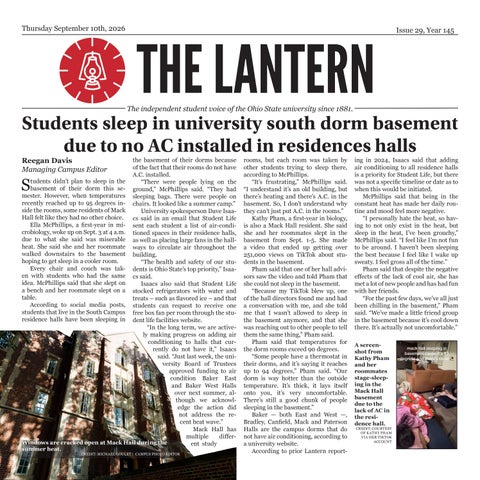
Students sleep in university south dorm basement due to no AC installed in residences halls Reegan Davis Managing Campus Editor
the basement of their dorms because of the fact that their rooms do not have A.C. installed. tudents didn’t plan to sleep in the “There were people lying on the basement of their dorm this se- ground,” McPhillips said. “They had mester. However, when temperatures sleeping bags. There were people on recently reached up to 95 degrees in- chairs. It looked like a summer camp.” side the rooms, some residents of Mack University spokesperson Dave IsaaHall felt like they had no other choice. cs said in an email that Student Life Ella McPhillips, a first-year in mi- sent each student a list of air-condicrobiology, woke up on Sept. 3 at 4 a.m. tioned spaces in their residence halls, due to what she said was miserable as well as placing large fans in the hallheat. She said she and her roommate ways to circulate air throughout the walked downstairs to the basement building. hoping to get sleep in a cooler room. “The health and safety of our stuEvery chair and couch was tak- dents is Ohio State’s top priority,” Isaaen with students who had the same cs said. idea. McPhillips said that she slept on Isaacs also said that Student Life a bench and her roommate slept on a stocked refrigerators with water and table. treats – such as flavored ice – and that According to social media posts, students can request to receive one students that live in the South Campus free box fan per room through the sturesidence halls have been sleeping in dent life facilities website. “In the long term, we are actively making progress on adding air conditioning to halls that currently do not have it,” Isaacs said. “Just last week, the university Board of Trustees approved funding to air condition Baker East and Baker West Halls over next summer, although we acknowledge the action did not address the recent heat wave.” Mack Hall has multiple differWindows are cracked open at Mack Hall during the ent study
S
summer heat.
CREDIT: MICHAEL GOULET | CAMPUS PHOTO EDITOR
rooms, but each room was taken by other students trying to sleep there, according to McPhillips. “It’s frustrating,” McPhillips said. “I understand it’s an old building, but there’s heating and there’s A.C. in the basement. So, I don’t understand why they can’t just put A.C. in the rooms.” Kathy Pham, a first-year in biology, is also a Mack Hall resident. She said she and her roommates slept in the basement from Sept. 1-5. She made a video that ended up getting over 251,000 views on TikTok about students in the basement. Pham said that one of her hall advisors saw the video and told Pham that she could not sleep in the basement. “Because my TikTok blew up, one of the hall directors found me and had a conversation with me, and she told me that I wasn’t allowed to sleep in the basement anymore, and that she was reaching out to other people to tell them the same thing,” Pham said. Pham said that temperatures for the dorm rooms exceed 90 degrees. “Some people have a thermostat in their dorms, and it’s saying it reaches up to 94 degrees,” Pham said. “Our dorm is way hotter than the outside temperature. It’s thick, it lays itself onto you, it’s very uncomfortable. There’s still a good chunk of people sleeping in the basement.” Baker — both East and West —, Bradley, Canfield, Mack and Paterson Halls are the campus dorms that do not have air conditioning, according to a university website. According to prior Lantern report-
ing in 2024, Isaacs said that adding air conditioning to all residence halls is a priority for Student Life, but there was not a specific timeline or date as to when this would be initiated. McPhillips said that being in the constant heat has made her daily routine and mood feel more negative. “I personally hate the heat, so having to not only exist in the heat, but sleep in the heat, I’ve been grouchy,” McPhillips said. “I feel like I’m not fun to be around. I haven’t been sleeping the best because I feel like I wake up sweaty. I feel gross all of the time.” Pham said that despite the negative effects of the lack of cool air, she has met a lot of new people and has had fun with her friends. “For the past few days, we’ve all just been chilling in the basement,” Pham said. “We’ve made a little friend group in the basement because it’s cool down there. It’s actually not uncomfortable.” A screenshot from Kathy Pham and her roommates stage-sleeping in the Mack Hall basement due to the lack of AC in the residence hall.
CREDIT: COURTESY OF KATHY PHAM VIA HER TIKTOK ACCOUNT
Thursday September 10th, 2026 | www.thelantern.com | 2
CAMPUS
On page 4
On page 6
Ohio State ranks among top 10 “party schools”
POWR-ZONE grand opening
Ohio State University revoked Flock camera access from an organization partnered with the Department of Homeland Security
Austin Gano Oller Special Projects Reporter
O
hio State has revoked campus Flock camera access from an organization that partners with federal agencies, including the Department of Homeland Security. It is not clear how much access, if any, federal agencies had to campus-located cameras, or for how long. Ohio State’s decision to drop the Northeast Ohio Regional Fusion Center came days after The Lantern asked about
Lantern Classifieds UNFURNISHED 3 BEDROOM Beautiful, Brand New Luxury 3 BR 2 BA Apt. 6 Mins From New Albany Near Intel. Garage w EV charger, pool, golf, secure pkg delivery lockers, patio, hot tub, gym, walk-in closet, granite counter tops, LV plank flooring, accessible. In Westerville. 20 mins to airport. 15 mins to Easton. 30 mins to Downtown Cbus. Pets ok. Call/text 614-374-2874 for more info. Available Sept 1st. Unfurnished or furnished.
its presence on a list of agencies with which the university shares camera access. The list was obtained through a records request. “Thank you for pointing this out,” university spokesperson Dan Hedman said in an email. “Their access has been terminated as of this week.” The university also imposed restrictions on other agencies’ ability to use its camera data to make immigration related and reproductive health care keyword searches in June. That decision, and the more recent fusion center decision, coincide with months of national scrutiny and concerns over privacy and the cameras’ use in immigration enforcement, which have led some cities, including Columbus and Cleveland, to suspend and restrict
their use. Flock cameras are automatic license plate readers that capture and store images of every vehicle that passes their field of view, according to Flock’s website. Ohio State has at least 63 of these cameras, according to Hedman. The cameras are small black boxes positioned under angled solar panels that are roughly three square feet, typically fastened to light, sign or independent poles in high traffic areas and other areas of concern. Flock owns the hardware and software that is licensed to subscribing agencies. The Northeast Ohio Regional Fusion Center was one of roughly 400 law enforcement agencies Ohio State was sharing its Flock camera access with, according to the documents received
THREE BEDROOM 3 bedrooms 10 minutes from downtown Columbus. For rent 3 bedroom, 1 office bi-level with 2 car arage. $975.00 per month rent, plus same for deposit. Contact me by e-mail to receive rental application, pictures are available on Zillow. Call 614-886-0614 for further specifics or to schedule a viewing. Email bruiserpyshia@gmail.com
To advertise go to thelantern.com
by The Lantern. Given that the requested records were shared in June, the current exact number of agencies is unclear. The Fusion Center lists Ohio Homeland Security, Cuyahoga County, Cuyahoga County of Ohio Security & Research, Cuyahoga County Sheriff’s Office, City of Cleveland and Cleveland Police among its partners. It’s also partnered with the Department of Justice, the FBI and Homeland Security. Homeland Security, in turn, houses ICE and Customs and Border Patrol. “Fusion Centers are state-owned and operated centers that serve as focal points in states and major urban areas for the receipt, analysis, gathering and sharing of threat-related information between State, Local, Tribal and Territorial (SLTT), federal and private sector partner,” the Homeland Security website states. There is nothing to suggest that the Fusion Center mishandled access to Ohio State’s Flock cameras, but its federal partners have drawn enough concern that the City of Cleveland suspended Flock camera access to the fusion center. Cleveland City Council voted to end sharing the city’s Flock camera access with the fusion center on July 15, according to the city record and Ordinance 683-2026. The city’s Flock camera contract was also renewed for six months instead of Cleveland Mayor Justin Bibb’s 12-month proposal.
FLOCK continues on page 3. A Flock automatic license plate reader faces west at the corner of College Road and Woodruff Avenue.
CREDIT: MICHAEL GOULET | CAMPUS PHOTO EDITOR
Thursday September 10th, 2026 | @thelanternosu | 3
Continued from page 2. Illinois is one of several states where criticism came after local law enforcement agencies’ Flock cameras were accessed by Homeland Security subsidiaries through now-cancelled pilot programs, which granted federal agency access without Illinois agencies’ permission. “We clearly communicated poorly. We also didn’t create distinct permissions and protocols in the Flock system to ensure local compliance for federal agency users,” said Flock CEO Garrett Langley in a 2025 blog post. Ohio State recently imposed more regulations on its Flock camera use, according to Hedman. “As of June, OSU has restricted search topics for both internal and external users such as (but not limited to) immigration and/or reproductive healthcare, and beginning later this fall we expect to implement regular audits,” Hedman said in an email. Columbus police was among many local law enforcement agencies to make searches related to immigration on behalf of DHS subsidiaries, rather than granting them full access, said Columbus City Council member and Chair of Public Safety Emmanuel V. Remy in an Aug. 10 Council Public Safety & Criminal Justice Committee meeting. “It identified more than 15,000 searches across the broader Flock network with a possible immigration-related search reason,” Remy said, referring to a Columbus police internal audit on its Flock usage. Law enforcement agencies’ sharing of their Flock camera data and access is allowed, according to Flock. “Any access to customer data by a federal agency, if it occurs at all, must be explicitly granted by a local customer and must comply with applicable law,” Flock states on its website Remy reinforced his belief in Flock’s value as a public safety tool and the importance of its responsible and transparent use during an Aug. 10 Council Public Safety & Criminal Justice Committee meeting. The Columbus Police Department was subject to more public criticism when Columbus Police Chief Elaine R.
Bryant said an officer, Melvin Tellis, used its Flock cameras to search the same license plates hundreds of times. This was during a Sept. 3 press conference with Columbus Mayor Andrew Ginther. “The officer has been relieved of duty pending the outcome of the investigation,” said Bryant. Columbus’ Flock cameras have been deactivated pending investigation, according to Ginther. Columbus Police Department also created a transparency portal showing over 869,000 unique vehicles were detected by its Flock cameras and 3,853 searches were conducted in the last 30 days.
Undergraduate Student Government President Chris Cade [right] and Vice President Isaiah Nire [left].
CREDIT: COURTESY OF AASHVI SONI
USG President and Vice President look ahead to first full semester in office Josephine Pajemola Lantern Reporter
T
he Undergraduate Student Government’s newest leaders have much to look forward to for their first full semester in office and they say hearing from the student body is at the top of their list. Chris Cade and Isaiah Nire were elected as the president and vice president respectively of the USG in April. They ran on a platform of student advocacy, per prior Lantern reporting. Cade, a third-year in public policy analysis, political science and public policy and management, said that he wants to be approachable to the student body. “Historically, people have not really felt like USG is approachable, and we’re really trying to change that culture across the entire institution,” Cade said. Cade mentioned several ways students can get in contact with USG; students can message on Instagram, attend meetings or simply stop them on the street. “Students come up to us all the time and we stop and talk to them,” Nire, a third-year in finance, said. One way Cade and Nire plan to reach students is through the clubs active on campus this semester. “We’re beginning a strong outreach plan to reach out to every leader of every student organization,” Cade said.
An email will be sent to the organizations offering resources of what the USG does, Cade said. This accessibility is a hallmark of the administration that Cade and Nire said they plan to spearhead going into the 2026-27 academic year. “Chris and I have been running on a pretty much open-door policy,” Nire said. Advocating on the student body’s behalf is a strong motivator for the new president, who is making efforts to lessen the financial burden of much of the undergraduate student population, said Cade. “I worked four on-campus jobs before coming to this position,” Cade said. “[I am] trying to make sure that the 11,500 student employees are paid appropriately and have all the benefits and resources to help them launch their actual careers post-graduation.” As for the vice president, Nire said he is especially pushing for more dining options on campus. He gives the example of a late-night, hot-food dining option that students can swipe for when studying into the later hours of the evening. Letting their own experiences as students at Ohio State shape their efforts in USG, Cade and Nire said they aspire to lessen the gap between undergraduate students and their own government. Rather than a secluded government body, Cade said he aims for the USG to take up more of a space on campus. “We want to be accessible and open for students to reach out to us because ultimately, Isaiah and I can’t do our jobs if we don’t have students coming to us with issues,” Cade said. “There’s probably a million things I can talk to administrators about, but that means nothing if it’s not informed by the students.”
Thursday September 10th, 2026 | www.thelantern.com | 4
ARTS & LIFE
On page 7 Facial authentication implemented at football games
Local bar owners reflect on Ohio State ranking amongst top 10 “party schools” GRAPHIC BY FAITH SCHNEIDER | MANAGING DESIGN EDITOR
Helena Hennessey Managing Arts & Life Editor
C
hampionship-winning sports teams, top-notch academics and campus atmosphere, but on Aug. 31, the university ranked amongst the top 10 colleges in a different category — top “party schools.” According to a study released by Niche — an online review and ranking platform for U.S. schools, colleges and neighborhoods — and sourced through its users and U.S. Census data, Ohio State is ranked seventh in its 2027 Top Party Schools in America list. Local bar owners throughout the University District are reflecting on what it means to be a “party school,” and whether the ranking accurately reflects Ohio State’s culture and reputation. “We’re an academic institution that has some of the best nightlife and the best students that like to go out and party,” Quinn Allen said, owner of The Library Bar, located at 2169 N. High St., and The Thirsty Scholar, located at 2201 Neil Ave. “If you work hard, you’ve got to play hard. There’s got to be balance to life.” Niche curated the list of the top “party schools” based on various factors, according to the website’s breakdown. The source with the largest contribution, at 70%, was self-reported student surveys from Niche users. Smaller contributors were students’ access to bars, according to the U.S. Census’ website, colleges’ athletic and greek life grades pulled from Niche’s website and students’ access to restaurants. Scott Ellsworth is the owner of a
series of bars on High Street, including Threes Above High, located at 2203 N. High St., Fours On High, located at 1120 N. High St., and the up-and-coming revival of Twos Under High, located under Dirty Frank’s Hot Dog Palace at 2036 N. High St. In an Instagram direct message, Ellsworth said a “party school” is defined by its students’ ability to multitask. “[A party school is] a school where students take their education seriously and still manage to have a good time,” Ellsworth said. “Those things can coexist.” Allen echoed this thought.
“It’s funny, because you could probably pull up in class and see the person who has straight A’s [and] is leader of the study group, and then you’ll go out and they’ve got a pitcher poured up and [they] beat the clock at 2 o’clock in the afternoon,” Allen said. “Then they’re still out at 2 o’clock in the morning, shutting the bar down.” Partying means more to students than merely staying out all night, Allen said, as it allows them to connect with their peers beyond the classroom.
“When you’re in class, you get introduced to people, and then at night when you’re out and you see those people or you see other people, that’s when you get to know people, because that’s when people have their guard let down,” Allen said. “That’s when you start to realize who people are, and I think that shapes the community.” Allen said spending quality time with peers allows students to grow as individuals and feel fully immersed in the Ohio State community. According to Allen, High Street bars are one the best places to do so. “Ohio State is not some small deal,” Allen said. “That is the biggest adventure of any one person’s life, when they’re moving onto campus and when they’re embarking on that journey. If you don’t have a way to release some of that pressure through the nightlife, through the activity [or] through the social aspect of college, then college can eat you alive.” College is the place where students are enabled to find lifelong friendships, Ellsworth said, and the Ohio State community’s nightlife culture encourages this. “Nightlife is part of that [college] experience,” Ellsworth said. “Seeing friends, listening to live music, letting loose, watching a game and feeling like you belong somewhere. Years later, people come back wanting to sit in
their old booth. That tells you it meant something.” Ellsworth said Ohio State’s athletics and football-focused culture contributes to its students’ passion for ending game days with a celebration. “You have students from everywhere, alumni who never really leave and an entire city that plans its emotional well-being around what a bunch of 20-year-olds do with a football,” Ellsworth said. “Buckeyes don’t need much of an excuse to get together, but we’re always happy to provide one.” Allen said the excitement around game days contributes to students’ desire to have a place to spend time with friends.
PARTY continues on page 5.
Thursday | @thelanternosu | 5 Continued from page 4. “We’re so used to the amount of foot traffic into the bars on the crazy game days,” Allen said. “It just seems like we’re always trying to find a reason to have a good time … Everybody’s always down to have a good time shaped around that. It doesn’t take too much convincing to get a student at Ohio State out at any hour of the day to go have a party.” The success of locally-owned bars is a result of their willingness to support one another, Ellsworth said, just as they support students. “We want to create places where you know the staff, run into your friends and feel comfortable being yourself,” Ellsworth said. “We’re locally owned, we care about this campus and we’re proud to be the bars of the people. We also believe all the campus bars do better when we all work together.” Allen reflected on the long-lasting
Thursday September 10th, 2026 | @thelanternosu | 5
nature of Ohio State’s local bars, and said there will always be a need for them as long as they are celebrated by the community. “There is a divine need for these places to come together, share a drink and create memories,” Allen said. “We see other places come and go, and when you see these real establishments that stand the test of time, it just shows you that they are necessary. That’s why these places are still here, and that’s why they’re still booming with business. No matter how the generations change, there’s always going to be a need for that to fit into the culture that is college life.” Despite Ohio State’s seventh place ranking as a top-tier “party school,” Ellsworth said a subjective list fails to reflect the true spirit of the Buckeye community. “I’m requesting a recount,” Ellsworth said.
Fast track your path to a Master of Science in Nursing. For anyone with a non-nursing bachelor’s degree Take your next step go.osu.edu/graduate-entry-masters
From top to bottom: Threes Above High. Credit: Lantern File Photo. The Library Bar. Credit: Faith Schneider | Managing Design Editor
Thursday September 10th, 2026 | www.thelantern.com | 6
POWR-ZONE grand opening brings sustainable fitness to Columbus community Thursday Siena Kessler Arts & Life Editor
P
OWR-ZONE Columbus, a new fitness and wellness destination, will open its doors Thursday, Sept. 10, with a grand opening that will give attendees a firsthand look at the facility’s fitness equipment, coach-led workouts and sustainable technology. From 9 a.m. to noon, guests can tour the facility, located at 1020 Dennison Ave., see SportsArt’s equipment and learn about POWR-ZONE’s smallgroup training programs. Craig Lerner, founder of Involve, said guests can expect to learn how the space combines the SportsArt sustainable equipment and fitness programming. “This is a sponsored experience that [SportsArt] is helping to produce,” Lerner said. “This is owned by a new company that came out of my agency called WellXM. WellXM is the owner of this space.” Unlike a traditional open gym, POWR-ZONE is designed with an emphasis on community, said Lerner. The facility is owned and operated by WellXM, a Columbus-based company created by Involve. Lerner said the workouts are designed to change from cycle to cycle while maintaining the same overall format — combining strength, cardio and conditioning into 30-, 45- and 60-minute coach-led sessions. Sadie Klaff, an Ohio State graduate and certified personal trainer who will lead classes at POWR-ZONE, said the small-group setting allows instructors to provide more individualized attention than traditional group fitness classes. “The smaller group aspect is unique,” Klaff said. “You can give individualized feedback, there’s no microphone. It’s very much connected to who you are talking to to get that more personal training but in a group setting.” Thinking back to her time at Ohio State, Klaff said community is an un-
derlying reason behind the popularity of group classes. “There’s a reason why group fitness people have a following at the RPAC, there’s a reason why the classes fill up and it’s the same people every week,” Klaff said. “You create that community, you create that bond, that trust with an instructor.” Klaff said the group setting can also make exercise feel more approachable to beginners. “Having someone there to cheer you on, it’s that community,” Klaff said. “I taught group fitness at Ohio State and that’s why I am still in the group fitness world. It’s amazing to see the community build and how excited people are to just take that 30, 45 minutes [or] an hour of the day to go and do something for them.” Klaff said she works on making the workouts accessible to participants with different fitness backgrounds and abilities. “I’m very focused on making sure the form is proper, and if they do have an injury, I can make modifications so there are no limits on what they are able to do,” Klaff said. Sustainability is another major component of the space. The facility uses SportsArts’ ECO-POWR cardio equipment, which converts energy generated from workouts into electricity, according to Ruben Mejia, executive vice president of SportsArt. “With the ECO-POWR equipment, every pedal [and] every stride creates energy,” Mejia said. “Every other piece of workout equipment, that energy dissipates into heat, but with our equipment, we’re capturing that energy and feeding it back directly and immediately to the local grid. We’re preventing a power plant from burning fossil fuels when you’re exercising, so there’s a bit of a higher purpose to not just losing weight, burning calories and getting in shape. You’re actually making a difference on the planet.” Mejia said SportsArt has had this technology for years, but growing in-
POWR-ZONE Columbus features SportsArt equipment as part of its sustainable fitness experience.
CREDIT: SIENA KESSLER | ARTS & LIFE EDITOR
terest in sustainability has driven its continued development and new opening. “We’ve had this technology since 2010,” Mejia said. “We’ve had three different variations of it but with the more popular it gets and more people caring about sustainability, it gives us more motivation to create other products that also generate electricity and contribute to somebody’s sustainable mission.” Lerner said the technology could be particularly appealing to younger consumers, including Ohio State students. “From the college standpoint, that’s where the ECO-POWR is really big,” Lerner said. “Students, younger consumers and the younger audience is pretty motivated by sustainability and social consciousness in general.” During workouts, there will be a screen to show participants just how much energy they are producing. “There’s going to be a screen called POWR+ that will show the energy produced from their workout,” Lerner
said. “They can see the kilowatt-hours that they’re producing right now.” Lerner said POWR-ZONE also hopes to collaborate with Ohio State students interested in the world of fitness. “Because we’re gonna be class-driven and workshop-driven, I’d say that [we will] collaborate with students who are in personal training and exercise physiology,” Lerner said. As the Columbus location develops, Lerner said the programming will continue to grow based on feedback. “The idea of the program evolving, meeting the needs of more, getting more pros more excited about how they can make it their own,” Lerner said. “I think it’s an evolution of adding more depth to what POWR-ZONE training will mean.” Classes will begin next week, with two POWR-ZONE training classes scheduled for Tuesdays and Thursdays and yoga classes on Wednesdays, Lerner said.
Thursday September 10th, 2026 | @thelanternosu | 7
Facial authentication software Express Entry simplifies entrance into Ohio Stadium Dylan Buganski Senior Sports Writer This story was originally published September 5, and has been updated for this edition.
F
or Ohio State fans, getting into the Horseshoe on game day has often meant waiting in long lines before kickoff. That process looked different Saturday. Ohio State expanded Express Entry, a facial authentication ticketing system designed to speed up entry to Ohio Stadium, to public gates as the Buckeyes opened their season against Ball State. The technology allows fans to enter designated gates using facial authentication rather than stopping to scan a traditional mobile ticket, with the goal of reducing congestion and wait times around the stadium. For Ohio State alumnus Duane Pullins, the difference was noticeable compared with his experience at the Buckeyes’ 2024 College Football Playoff game against Tennessee. “This is as easy as I have ever gotten into the stadium,” Pullins said. “My wife and I came here for the Tennessee playoff game two years ago, and it was a nightmare.” Ohio State introduced the facial scanner last season, but it was only available in the Huntington Club and student section gates. The software is now available in gates 17 and 20 for fans and gates 34 and 36-38 for students. With the system now in place, more fans are taking advantage of quicker entry. Tracy Kitchel, CFAES senior associate dean and director of faculty and staff affairs, attended the game as a fan and used the new system.
not having to dig up my phone and find my tickets at the gate.” The technology is also helping students wanting to get into the game closer to kickoff. “We don’t have to save as much time in the mornings,” Max Gustavson, a first-year in mechanical engineering said. “I did not know how much [time] I would have today, and now I know that I can just kind of walk through, and it’s real quick.” Kate Nushart, who works in the ticketing department at Ohio State, said that was the primary reason behind the adoption of the software.
“Students like to enter games later, and we want to find the quickest and safest way to get them into the stadium,” Nushart said. Moving forward, there is hope this service can be expanded all throughout the stadium and continue to attract new fans. “Our No. 1 thing is growth, and we hope to continue adding more [scanners] at the gates and attracting more people to use it and be interested in the technology,” Nushart said. Fans can sign up for the service through their Ticketmaster or Wicket accounts by submitting a selfie. Fans then take another selfie using the technology at the gate, and it matches the
two selfies to their ticket. “It took like three minutes to sign up— it is pretty easy,” Gustavson said.
Stay updated through the Ohio State Buckeyes football season with our Instagram! Check out @thelanternosu!
“I signed up for it out of A student walks into an express entry entrance at the Buckeyes’ season opening game. CREDIT: MICHAEL GOULET | CAMPUS PHOTO EDITOR curiosity quite frankly,” Kitchel said. “It is nice
Thursday September 10th, 2026 | www.thelantern.com | 8
SPORTS
On page 2
On page 3
Revoked Flock security camera access
USG leadership feature
Jeremiah Smith faces Texas for a third time after previous quiet performances Reilly Cahill Managing Sports Editor
J
eremiah Smith’s first catch of the 2026 season resulted in a feat he’s experienced many times during his college career: hearing the crowd in Ohio Stadium erupt while being swarmed by his teammates in the end zone. In the first quarter of last Saturday’s season opener, the All-American junior wide receiver pinned the ball against his helmet with one hand to haul in a 48-yard touchdown pass from quarterback Julian Sayin. While Smith has made his presence felt on the stat sheet in most games he’s played in as a Buckeye, getting to celebrate a touchdown in the end zone is something that Smith has not done against Ohio State’s upcoming opponent, Texas. Across his career, Smith averages 87.4 receiving yards per game, but in two games against Texas, Smith has averaged 23 receiving yards per game. Saturday’s matchup against Texas marks the third consecutive year Ohio State will face the Longhorns, who the Buckeyes have beaten in the previous two seasons. Head coach Ryan Day described how valuable Smith has been to the Buckeyes, even when his numbers on the field aren’t as high. “I’ve said it before, what makes a great player great, [is] he makes everybody on the field better and certainly [Smith] does that,” Day said. Defensive end Kenyatta Jackson Jr., who was a teammate of Smith’s in high
school at Chaminade-Madonna College Preparatory School in Florida, described that although Smith wants to make key plays on the field, he values winning over his individual achievements. “Of course Texas is going to do whatever to take him out of the game, but as long as we win, he’s good with it,” Jackson said. Smith made that message clear at Big Ten Media Days in July that winning was what was most important to him on the field. “I’m really just about the team first and that’s winning a national championship [and] Big Ten championship, bringing more hardware back to Ohio State,” Smith said July 29. After being held to a career-low one catch for just three receiving yards in Ohio State’s 2024 College Football Playoff semifinal 28-14 win against Texas, when the Buckeyes faced the Longhorns the next season, Smith was held in check again. Smith caught six receptions for 43 receiving yards and zero touchdowns, in addition to two dropped passes, in Ohio State’s 2025 season-opening 14-7 win. For Sayin, who made his first career start against the Longhorns last season, he described that he thought he could’ve targeted Smith more. “Whether it’s a certain coverage or something like that, they tried to double team him or whatever it was, I think just sometimes the ball didn’t go his way,” Sayin said. “I think there was opportunities maybe even last year where I could’ve taken the ball towards him. I wouldn’t say they limited him in
any aspect.” Day described the impact of getting Smith involved in the upcoming matchup. “It’s no mystery that when the ball is in his hands good things happen,” Day said. “He’ll always be part of how we game plan and what we do.” Day said that with Texas having a new defensive coordinator, Will Muschamp, who was the head coach of Florida from 2011-14 and South Carolina from 2016-20, there are still unknowns factored into game planning against the Longhorns. “Coach Muschamp’s a great coach, and we all have a lot of respect for him, but he really hasn’t called a game in a while, so there’s unknown here on how it’s going to play out, what they’re going to do defensively,” Day said. “We have to be able to respond to that in-game and figure that part of it out.” However, there was also a coaching change on Ohio State’s offensive side of the ball. During the offseason, the Buckeyes hired new offensive coordinator Arthur Smith. Jeremiah Smith revealed how the offense is different from a season ago, prior to the start of the 2026 season. “What’s different? Get me the ball,” he said Aug. 26 while laughing. In the Buckeyes’ 2026 season opener, Smith tallied eight receptions, 156 receiving
yards and two touchdowns in just the first half of Ohio State’s 56-3 win over Ball State. Despite Smith’s limited impact in the previous two matchups, Day said Ohio State still looks to incorporate the program’s leading receiver the last two seasons into the offense. “We’re going to work hard to make sure he has a major impact on the game,” Day said. Junior Wide Receiver Jeremiah Smith (4) stiff-arms a defender for extra yards after a reception in the Buckeyes’ season opener againt Ball State. CREDIT: LIAM AHERN | MANAGING PHOTO EDITOR