Thursday October 29th, 2026
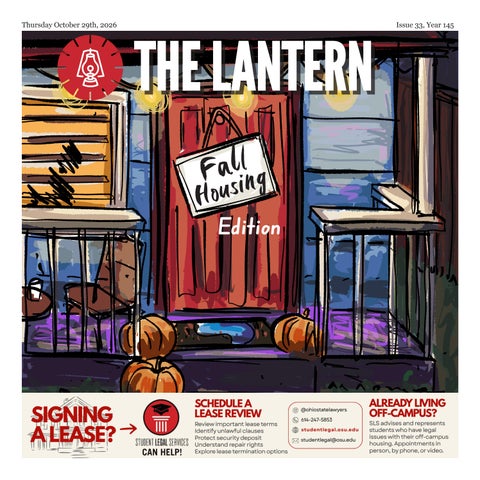
THE LANTERN l l a F ing
s u o H
Edition
Issue 33, Year 145
Thursday October 29th, 2026 | www.thelantern.com | 2
Subleasing to or from someone? Advice from Ohio State students who’ve done it Reegan Davis Managing Campus Editor
O
hio State students who study abroad, get internships outside of Columbus or generally move out may look to sublet their apartment to someone else. A sublease creates an agreement between themselves as the sublessor and another person, the sublessee, that states that the sublessee will take over the sublessor’s lease for a certain period of time, according to a university website. Some students who sublet their apartment experience a straightforward, convenient process. For Cailin Janas, a third-year in strategic communication, this process of finding someone to take her lease was not simple.
“[Finding someone] was really hard, I’m not gonna lie,” Janas said. “I posted it a bunch of times, and I just said, ‘[direct message] me for details.’ I got a couple people asking, but then as soon as I told them the price, they ghosted me.” After having no luck finding someone to take her lease for her Rambler Columbus apartment before she studies abroad in the spring, Janas said her mom started to help her out. They made multiple posts on Ohio State sublet Facebook groups. They started getting responses from people interested, but once they shared the rent price of the apartment, people either stopped communicating or said it was too expensive, similar to what Janas experienced herself. Things finally changed when Janas’ mom posted that they were willing to negotiate a price. “She got a ton of people so fast, and she negotiated with I don’t know how many people,” Janas said. “Maybe started with one, and I think that’s who we’re going with because she took a little bit off
the price.” After she decides who will replace her, Janas said the other party has to fill out an application to the Rambler Columbus to sublease her apartment. Ohio State offers students the opportunity to publish a sublet ad on its online housing search website, which students can access with their Ohio State logins. Students must be looking for a sublessee to assume the responsibility of their existing lease and confirm the lease allows them to sublet, according to the requirements listed on Ohio State’s website. Some property managers may have their original renter remain on the lease, while other property managers may remove departing students and start a brand-new lease with the individual who is subletting. The website also states that certain leases may state that if damage is done to a student’s unit during their lease term, even if they have moved out, they may be responsible for damages. That’s even if the damage was done by the individual who is subletting. Maya Piechowiak, a third-year in strategic communication, had a different experience from Janas’. Her experience subleasing went much smoother due to personal connections, she said. Piechowiak got a summer intern-
ship this year in Columbus. Originally from Medina, she knew that she needed somewhere to stay this summer to go to work Monday through Friday. A woman in Piechowiak’s sorority, Kappa Kappa Gamma, shared that her roommate was interning elsewhere, and that there was an open spot in her house. “I was like, well, this worked out perfectly, because I was really looking for cheaper housing rather than a $1,500-a-month apartment or whatever those numbers look like,” Piechowiak said. “It was perfect to live with my friends and then be down here this summer.” Piechowiak said that the payment process was easy. She would simply Venmo the original tenant her share of the rent and the other girls in the house money for utilities. Piechowiak added that compared with other summer housing options, subletting from someone was the best option for her, financially. “It was definitely more doable,” Piechowiak said. “I would not have been able to do this internship this summer without taking out a loan if I wanted to live in the Rambler or whatever the case may be. That just would not have been doable at all.” Piechowiak said that the more people that students reach out to or know, the easier the subleasing process is. “You’re not going to live with your best friend when you sublease,” Piechowiak said. “Just finding somewhere that works for you, financially, is the way to go, in my opinion.” To post a sublet ad or to view other sublet ads, visit offcampus.osu.edu/ resources/housing-resources/sublet-resources. CREDIT: LYDIA WEYRICH | LANTERN FILE PHOTO
Student Legal Services at Ohio State recommends students go through their lease with an attorney through Student Legal Services at Ohio State before entering a sublease agreement.
Thursday October 29th, 2026 | @thelanternosu | 3
Why some Ohio State second- New mass timber residential year students choose Greek building set to begin leasing life housing over dorms for the 2027-28 academic year Hana Alghamdi Lantern Reporter
F
or some Ohio State second-years involved in Greek life, closer friendships, shared experiences and more privacy make living in a sorority or fraternity house more appealing than returning to the dorms. Students returning to Ohio State for their second year can choose to live in university-approved sorority and fraternity houses instead of residence halls through the university’s housing exemption process, according to Akua Nelson, assistant director of housing for Sorority and Fraternity Life. Nelson said in an email that living together can deepen students’ commitment to their chapters by strengthening their sense of sisterhood or brotherhood. There are 1,020 second-year students living in approved chapter facilities this academic year. “For some, this is truly a home away from home,” Nelson said. Roman Wullenweber, a second-year in mechanical engineering and member of Pi Kappa Alpha, said the option to have his own bedroom persuaded him to move after sharing a four-person room in Haverfield House during his first year. “I didn’t have the worst time in the dorms, but it’s hard to compare to living in a house with all your best friends,” Wullenweber said. Ella Jones, a second-year in nursing and member of Kappa Alpha Theta, said she chose to live in her sorority house instead of the dorms because she considered sharing a home with other women in her chapter a once-ina-lifetime opportunity. Jones said she enjoys sharing meals with her sorority sisters. She said that she’s also motivated to stay productive by seeing other women in the house prioritize their academics. “It’s so much more active in your
house, getting close to so many more people,” Jones said. Individual sorority and fraternity chapters select their residents, while students must request a housing contract exemption through Housing and Residence Education, Nelson said. Megan Graham, a second-year in business finance and member of Kappa Delta, said visiting her older sister’s Alpha Xi Delta house while she was in high school helped her decide to live in Greek housing. Graham said she prefers having meals prepared in her house, especially during colder months, over her walks to Siebert Hall’s cafeteria during her first year. “I just really love it. I would not have changed this for anything,” Graham said. “I couldn’t really imagine being in a dorm this year.” Keaton Groff, a second-year in finance and member of Beta Theta Pi, said he chose not to return to the dorms because nearly everyone in his fraternity class planned to live together and he liked the rooms in the chapter house, which was rebuilt in 2017. “Last semester, we were all living in different parts of campus,” Groff said. “Now we’re living in the same house, so we’re able to bond even more.”
Grace Everett Lantern Reporter
A
t the corner of Ninth Avenue and High Street, a new apartment complex is likely to set some records when it starts leasing for the 2027-28 school year. The 242,000-square-foot, 186-unit student housing building will become the first mass timber structure in Columbus, bringing a design focused on sustainability into the University District. It’s expected to hold a height record of 158 feet and 13 stories for mass timber student housing, Marguerite Munoz, a project spokesperson, said in an email. “Every beam we put in place on this project brings us one step closer to students moving in next summer and discovering that this building looks and feels different than anything else near campus,” Mark Bell, Harbor Bay Ventures’ CEO, said in a press re-
lease. Harbor Bay Ventures, a Chicago-based real estate and investment firm, developed Intro Columbus. The design uses exposed wood throughout the apartments, hallways and study lounges to introduce visible wood grain and a “warmer acoustic aesthetic,” according to the press release. More specifically, the structure uses cross-laminated timber panels and prefabricated glulam, or glue-laminated, columns and beams, Munoz said, which allows for faster construction. The prefabricated materials helped the building grow at a rate of 2.5 floors every two to three weeks, Munoz said. “Every day we save on the superstructure is a day the other trades get back, and that compounds,” Josh Dortzbach, Forefront Structural Engineers’ principal, said in a press release. “Pulling 10 weeks forward means enclosure, interior buildout and commissioning all shifts earlier.” The building reached its topping-out milestone, or its full structural height, on Sept. 8, which was about 10 weeks ahead of its November target, according to the press release.
TIMBER continues on page 5.
CREDIT: PAIGE PUHALSKY | LANTERN TV CAMPUS PRODUCER
Beta Theta Pi fraternity house, one of the university-approved housing options for eligible second-year students instead of residence halls, Oct. 23.
Thursday October 29th, 2026 | www.thelantern.com | 4
CREDIT: CASSANDRA D’ANGELO | SPORTS PHOTO EDITOR
Rambler Columbus is one of the popular, off-campus luxury apartments that students choose to live in, located at 222 W. Lane Ave.
Luxury apartment or a house? Students discuss choosing between two off-campus housing options Audrey Coleman Campus Editor
P
icture this: a student is staring at a computer screen, scrolling through leasing websites and available homes to rent for the next school year. Then, a new option pops up during the hunt – a luxury apartment building with amenities, close proximity to classes and marketing that catches the eye. In the University District, luxury apartments are becoming increasingly popular among student renters, with popular choices in the campus area, including Rambler Columbus, Lumen on Ninth and Blume on 16th. With over 1,500 beds across the three properties — and more to come with Intro Columbus coming Fall 2027 — students are exploring higher-end options when searching for an off-campus home. Henry Fronczak, a third-year in biochemistry and the leasing and marketing manager at Lumen on Ninth, said that he’s noticing students are looking for “nicer” perks to their campus living arrangements, a trend that’s different from when their parents were in school. “Housing in general has definitely switched drastically from when our parents were in college to now a luxury-based environment,” Fronczak said. “We see it in the parents when they come to tour. They didn’t get to have this type of housing option for them-
selves and they really want it for their kids.” Fronczak said that parents can be on the fence about the price tag before touring, but after learning about the amenities, most understand the higher cost. “If this is an option, when it comes fully furnished, [has] gyms, pools, a lot of study rooms, things like that, they’re willing to pay that extra money for the convenience,” Fronczak said. Emmy Tepe, a third-year in public management, leadership and policy, said that some of the spaces in her Blume on 16th apartment are nice additions to the building. “I was saying this when I got here with my parents when I moved in. I never really need to leave besides to go to class,” Tepe said. “I can work out here, I can study here instead of walking to the library. There’s just so much.” Caitlyn Walrod, a fourth-year in finance and international business, has lived in Rambler Columbus for two years and said the apartment’s marketing drew her in, both for the amenities and the space’s pros. “I was part of their ambassador program my sophomore year, so they had set up all of these events that I could go to, and they gave us a bunch of perks,” Walrod said. “They worked really hard from a marketing perspective. They were always sending out different promos for stuff, especially after we signed our lease.” Fronczak said marketing an apart-
ment differently pulls students in and makes them interested in the property. “Even if you’re not thinking about it, psychologically you’re corresponding these things. ‘Oh, they have cute merch. They do a bunch of giveaways. It’s really cute inside. People post pictures there,’” Fronczak said. “Things like that definitely add up.” Fronczak said that draws potential tenants. “They have a very appealing aspect [to] them, and it definitely does impact people’s decisions to go and tour,” Fronczak said. Those different techniques have a name, he added. “We call it ‘lifestyle leasing,’” Fronczak said. “[Our Instagram] is veered away from apartment content necessarily to being cute, aesthetic and lifestyle to further the brand and the vibe that we try to put out there.” With her experience and the marketing in mind, Walrod decided to stay in Rambler Columbus for her senior year. Her first year’s rent was lower because of a discounted rent program through the apartment in honor of its first year in business, she said, but this year is the regular price. “I’m now paying full rent, and that was also another consideration when I was deciding where to live my senior year,” Walrod said. “But after talking to [my roommate], enjoying my experience so much here with all the amenities and it being so close to my classes, we decided that one year of the higher
rent [was] worth it for that final year, but it’s not lost on me that it is absolutely outrageous of a price tag to be living here.” Without the rent program, Walrod said she wasn’t sure if she would have lived in Rambler Columbus to begin with. However, she said her experience has been extremely positive, but different from living in a “regular” college house. “One thing that has stood out to me over the past two years [is] that I’m missing out on having a front porch or yard of a house or having a front yard, but that’s just a part of the trade-off,” Walrod said. Walrod also mentioned the disconnect that can happen when talking about living in a building that is one year old versus longstanding on campus, but it isn’t a true downside to living in a house. “The other thing is I do every once in a while hear alumni say, ‘Oh, I lived in this house on Frambes or, like, this house on 13th,’ and I can’t really connect with the alums or family friends who were students here in that way,” Walrod said. “I wouldn’t necessarily say I think an apartment or a house [that] one is better than the other. I just think it’s what you’re more interested in and what fits for you.”
LUXURY continues on page 9.
Thursday October 29th, 2026 | @thelanternosu | 5 Continued from page 3. Intro Columbus was also designed with sustainability in mind, with the building sequestering, or storing, 1,128 metric tons of carbon compared to a steel and concrete design. The project also reduced transportation-related carbon emissions through transport from Alabama by 55 percent. “For a building like this, reducing carbon wasn’t the only goal. It was making sure people feel the material every day,” Cameron Jacobson, DLR Group senior associate and project architect, said. “Our design made a point of keeping timber exposed everywhere a resident spends time, not just in the lobby. It’s a different kind of experience to come home to.” Exposed timber also promotes stress reduction and calming effects, which can low-
er blood pressure and heart rates, Munoz said. Since the wood is left exposed, extra layers of finish are not necessary, which makes the design more economical and sustainable, Munoz said. “With the topping out, developer Harbor Bay Ventures is demonstrating what mass timber offers over steel and concrete: a faster build, calm, healthy living space and a strong precedent that proves tall wood buildings can be built cost-effectively and at scale using regional supply chains,” Munoz said. CREDIT: COURTESY OF MARGUERITE MUNOZ
A render of Intro Columbus, an apartment complex opening for the 2027-28 school year, which will become the first mass timber structure in Columbus.
Offering Quality Homes & Apartments in the Campus Area for over 50 Years!
Now Leasing! 1-7 Bedrooms Available! 2425 N. High St. • www.gasproperties.com (614) 263-2665 • info@gasproperties.com
Thursday October 29th, 2026 | @thelanternosu | 7
Campus Roundup: Differences between popular leasing companies for off-campus house hunters Lauren Savitsky Campus Senior Writer
A
s Ohio State students start to navigate the University District’s off-campus housing market, leasing companies’ websites can be difficult for first-time renters to search through. Each leasing company varies in how many properties they manage, where those properties are generally located and policies related to pets and utilities. Read on to learn about some of the more well-known leasing companies’ information to make the most of the off-campus renting experience.
Range of available beds from leasing companies
OSU Properties OSU Properties, also known as George Kanellopoulos Properties, lists properties in the University District on the website ranging from one bedroom apartments up to homes with 13 bedrooms. More than half of the properties it manages have five to seven bedrooms. Most of these properties would be considered in the northern section of the University District, with addresses on Oakland, Northwood, Norwich and Maynard Avenues, though a few residences are as far south as Pennsylvania and Ninth Avenues. According to the company’s sample lease, utilities (gas, electricity, cable, internet and water) are not included in rent, and tenants must set up accounts with approved utility companies before move-in, but some properties individually note if utilities are included in rent. It is also noted in the sample lease that no pets are permitted.
LEASING continues on page 8. CREDIT: FAITH SCHNEIDER | MANAGING DESIGN EDITOR
Bar graph depicts range of bedrooms for leasing companies.
Thursday October 29th, 2026 | www.thelantern.com | 8 Continued from page 7. Hometeam Properties Hometeam Properties manages almost 1,000 properties in the University District, ranging from studio apartments to houses with as many as 11 bedrooms. Most properties are in the studio, one-bedroom and two-bedroom categories. According to the company website’s filters, most properties are located in the central and southern areas of the University District, although there are properties sprinkled throughout. Utilities like water and gas are included in a Hometeam Properties tenant’s rent, but others, such as electricity, cable and internet, are not. Hometeam Properties does allow pets, as long as they have been registered through their animal registration form. Buckeye Real Estate Another familiar leasing company in the University District is Buckeye Real Estate, which lists properties from studios and one-bedroom units up to eight-bedroom houses on its website. Buckeye Real Estate’s managed residences are generally spread evenly throughout the northern, central and southern parts of the University District, according to the company website’s map. The Buckeye Real Estate website did not disclose information about utilities. Pets and animals are permitted with prior written consent from Buckeye Real Estate. North Steppe Realty The North Steppe Realty website lists properties ranging from studio to one bedroom homes to up to eight bedrooms. Most properties managed are located in the central University District, generally east of Ohio State’s campus. According to their website, North Steppe Realty tenants are responsible for utilities in their own name. The company also states that each lease
and property can have different policies. “Tenants are responsible for putting utilities in their name prior to moving in as well as taking them out of their name at the end of their lease term,” the website stated. “Please refer to your lease as to what your responsibilities are.” The website stated similar policies surrounding pets — each property is different and tenants are advised to look at their individual lease. Inn Town Homes & Apartments Inn Town Homes and Apartments lists properties on their website from one-bedroom homes and apartments up to the largest home with 10 bedrooms. Of the listings, most properties were in the three to five or more bedroom range. Inn Town Homes and Apartments have a large prevalence on Norwich and 12th Avenues, with properties on many other streets in the University District spread throughout their listings. Inn Town Homes and Apartments’ FAQ page states that water and lawn and exterior maintenance are included in rent, while residents must arrange all other utilities upon move-in. It also identifies pet-friendly properties and outlines the process for adding a pet to a lease.
Read more on our website! Check out www.thelantern.com
YOUR SPACE. YOUR PERKS. YOUR COLLEGE EXPERIENCE. Studio, One, Two & Three Bedroom Apartments Private Shuttle Transportation to OSU’s Campus Beautiful Tree-Lined Community & Green Spaces Exciting Resident Social Events & So Much More!
UNIVERSITYVILLAGE.COM TOUR TODAY & mention “THE LANTERN” to receive our latest special!
Thursday October 29th, 2026 | @thelanternosu | 9
The north dorms: Drackett, Taylor and Jones Tower updates Reegan Davis Managing Campus Editor
T
wo north-campus dorms have begun renovations this semester to modernize the buildings, with a goal of making them available to students by the start of the autumn 2028 semester. The university Board of Trustees approved the construction projects during a Sept. 3 meeting. The board approved $145 million for Drackett and neighboring Taylor Tower, which closed in January 2026 after flooding from a burst pipe prompted the relocation of 700 students. Construction fences have been placed completely around the two buildings and will remain in place for the next two years. In addition to Drackett and Taylor, fencing will go up around Jones Tower at the end of this semester, university spokesperson Dave Isaacs said in an email. Jones Tower will be fully demolished in 2027, according to a university Facility Design and Construc-
tion website. According to a July update published from Melissa Shivers, the Senior Vice President of Student Life, some of the pedestrian walkways directly around Taylor and Drackett are closed, but there are multiple paths available throughout the North District. “If you find yourself in the North Residential District, just a friendly reminder to be aware of your surroundings and watch for construction traffic in the area,” Shivers said in the update. “I am Scarlet and Grateful to all who will be advancing these important projects in so many ways.” Interior and exterior renovations for the two buildings include fully replacing the plumbing systems, heating and air conditioning systems and fire protection. The residential floors will be renovated with new lounges on each floor, according to the update. Student rooms and furniture will be updated throughout the
buildings. Common areas will be expanded to offer more space for group activities and study sessions, the update stated. Taylor Tower’s front entrance — which required stairs and a ramp to get to the first floor — will be relocated to ground level to improve accessibility and make it easier for students to enter the building. Before the flooding occurred at Taylor Tower, the three towers were supposed to go under interior and exterior renovations and reopen by August 2030, per prior Lantern reporting.
CREDIT: REEGAN DAVIS | MANAGING CAMPUS EDITOR
Taylor Tower sits empty after shutting down in January. The residence hall is set to open for the autumn 2028 semester.
Continued from page 4. Tepe is moving out of Blume on 16th for her senior year. Though the building itself isn’t the issue, Tepe said she wanted to experience living in a house with friends. “Living in a house [with your friends] is more homey,” Tepe said. “Then an apartment, it’s super nice, but I feel like it’s more like a hotel, commercialized. I just think that’s part of the reason, just having your college house on your college street, whereas living in, like, a huge building on the corner of one.” Overall, choosing to live in a luxury apartment versus a house is something the student decides, both Walrod and Tepe said, though each situation has its benefits. Between amenities, proximity and safety concerns, the college housing market is shifting in different directions. “Usually, college used to be like a rough time; people would joke about eating ramen noodles, and that’s it,” Fronczak said. “Now people are going for happy hours and then going back to their luxury apartment. The apartments have played a major role in changing the college experience, and it is for the better. The college experience in general has changed, and student living and apartments have changed with it.”
Stay updated with our Instagram! Check out @thelanternosu
Thursday October 29th, 2026 | www.thelantern.com | 10
Off-campus residents keep their homes safe with doorbell cameras Lauren Savitsky Campus Senior Writer
pens when we aren’t home and we need to tell someone who is home, then we can do that too.” The two agree that their Ring door-
camera has not caught either of them when the cars were literally right in front of our house,” Beitzel said. “Two smashed windows on back-to-back
approaching their front door, and is considering purchasing another camera from Ring or Blink Smart to ensure more reliable surveillance of their cars Moving into an off-campus on the street. house can be a difficult transi“It’s nice knowing there is a tion for first-time tenants. While camera out there, but the fact many houses come with their that it didn’t catch [the vehicle own locks on doors and windows, break-in] is kind of crazy,” BeitOhio State student-renters are zel said. turning to other methods to help Courtright said she feels simkeep their homes secure, includilarly, and that the deterrent of ing doorbell cameras. the camera recording is enough Companies such as Ring and protection to make her feel safe Blink Smart are amongst the in her neighborhood. popular choices for students Other students are content looking to keep their home safe to rely on their homes’ built-in while living in the University locks. District, and are known for their Lauren Haley, a third-year in doorbell cameras’ easy-to-use public policy, said she and her features, allowing students to roommates never purchased a focus on their studies, instead of doorbell camera and haven’t had security concerns. any problems to cause them to Claire Courtright, a thirdwant one. year in nursing, and Sam Jalics, “When we were first planning a third-year in mechanical engito move in, [a doorbell camera] neering, said they chose a Ring was one of the things we had on doorbell for their first off-camour list to do, but then we just pus house because of its popumoved in and never got around larity amongst other residents in to it,” Haley said. their area. Haley said she only wishes she “It protects us and makes me CREDIT: LAUREN SAVITSKY | CAMPUS SENIOR WRITER had a security system when packagfeel more at ease,” Courtright said. A Ring Doorbell offers users motion-activated surveillance, live streaming, notificaes are delivered and she fears they “I feel like it also deters anybody, tions and two-way communication with visitors. might be stolen. because they see that we are re“Our windows have alarms on cording.” bell gives them peace of mind in a days and it didn’t record either.” them and all of our doors have deadAccording to the company’s webhouse of all female tenants, and their Beitzel also said she and her roombolts and stuff, so we do have those site, battery-powered Ring doorbells decision was one they would make mates were especially disappointed things to help,” Haley said. can be mounted near a home’s front when they realized that after their Haley said she and her roommates door to detect motion, send real-time again. Blink Smart, a third-party securifree first month, the subscription was are diligent about making sure doors notifications and allow users to see, ty system that offers doorbell camerequivalent to other third-party securiare locked at night and blinds are shut, hear and communicate with their visas with features similar to Ring, is an ty systems. but her next-door neighbors owning a itors. The device also records activity, investment Emerson Beitzel, a thirdAccording to the Blink Smart webRing doorbell camera provides a secto let users review footage. year in primary education, said she site, the doorbell cameras include very ond sense of security. The roommates said Ring makes similar features to other companies, Overall, the off-campus stuthem feel safer when leaving for class would reconsider. Beitzel said she purchased a doorlike Ring, at a similar subscription dent-tenants think doorbell cameras or late nights because they can see bell from Blink because of its more price, but with a more affordable uphelp deter potential threats and are an people approaching their home from affordable upfront cost, but has been front cost of purchasing the device iteasy way to keep their homes safe. the system’s live streaming feature. disappointed with its lack of recording self. “I’m glad that we do have a camera, “It’s a very typical thing to do and I in important moments. Despite her negative experience, because people can easily break into almost feel better with it because now “There’ve been two break-ins right Beitzel said she thinks the camera houses even when they are locked,” Bewe are alerted if anything happens at in front of our house, and our Blink generally deters possible threats from itzel said. “It’s nice that it’s there.” night,” Jalics said. “If something hap-
Ohio State launches initiative to transform on-campus residential experience
Jacob Jolliff Campus Senior Writer
O
hio State launched a new initiative aimed at improving students’ on-campus residential experience by connecting housing, dining, recreation and academic support, according to a Sept. 30 university news article. The Residential Experience Transformation initiative aims to strengthen student success by creating residential communities that support students’ academic progress, well-being and sense of belonging, according to the article. The university said the initiative will focus on more than residence hall buildings and renovations. Instead, the effort will examine how dining, recreation, housing and student support services can work together to build relationships while engaging with the university. The initiative comes after Ohio State made changes to its on-campus housing. Taylor Tower closed at the beginning of the spring 2026 semester and Drackett Tower closed during the summer 2026 semester for renovations and are scheduled to reopen in autumn 2028, per prior Lantern reporting. Senior Vice President for Student Life Melissa Shivers, Interim Executive Vice President and Provost Trevor Brown and Senior Vice President
and Chief Financial Officer Mike Papadakis are leading the initiative, according to the university news article. The university said it would also give more attention to improving the Honors and Scholars experience, with more opportunities available in the program. Ohio State’s announcement did not outline specific changes to residence halls, dining facilities or student services. The university said upcoming engagement processes will help shape the future of the residential experience. Dave Isaacs, a university spokesperson, said in an email that the initiative is still very new and that additional information was not available at this time. The initiative is a part of Ohio State’s broader Education for Citizenship 2035 efforts to strengthen student and community success and academic excellence. CREDIT: CASEY CASCALDO | LANTERN FILE PHOTO
A student walks outside of Blackburn house — a residence hall located on North campus.
Thursday October 29th, 2026 | www.thelantern.com | 12
Ohio State students traditions and tips to make a college house a home
Audrey Coleman Campus Editor
T
hroughout the University District, the majority of houses are rented by students, often for their junior and senior years. Though many move into blank slates, not knowing anything about the previous tenants, others inherit a house, following a tradition common in Greek life, siblings and close-knit friend groups. However they find the houses, the question is always how to make the house more of a home? Between shared history, creative names and interior design, Ohio State students find ways to do exactly that. Emma Geesling, a third-year in actuarial science, is living in a house affectionately named Love Shack, which was passed down from seniors in her sorority, Kappa Kappa Gamma. But the legacy didn’t start just last year as it began with Madison Lasso and her friends, who graduated from Ohio State in 2022. The house originally was named Kappa Krypt, and has since evolved into Love Shack. “There were two Kappas who lived in it with a bunch of their friends,” Lasso said. “We lived in that house our senior year, so just one year together. I’m not really sure how we came to name it the Kappa Krypt, but I think we just thought it was cool, since we had a group chat that was called the Kappa Krypt.” Before Lasso’s lease, Cincinnati Bengals quarterback Joe Burrow reportedly lived in the house. Lasso said that knowing, at least vaguely, the peo-
ple who lived there before her helped make moving in feel less like moving into a random house. “It’s a more familiar place, you know that there’s a shared history with your community, your sorority, which I think that’s a nice aspect, too,” Lasso said. “I like living somewhere with history, with a backstory. It’s been there for a really long time, it’s housed generations of Ohio State students.” Geesling held the same sentiment about the house, especially knowing that the name, even though it’s changed once or twice, has been passed down with the house too. “Sometimes I wish we did get to coin it [ourselves], but I love the lineage and the tradition of it,” Geesling said. “Different inside jokes makes it special for that singular group, and maybe that name gets passed down to the next one. Maybe it’s not, and then it changes based on that new friend group’s background and little inside jokes, and I think that’s really special because it brings everyone closer together in the house.” Paige Sommerfeld, a fourth-year in health sciences, isn’t living in a passdown house, but her roommates still took it upon themselves to name it. “We thought [the house] was very red, so we were just sit-
ting there, and then someone just said, ‘Red Rocket,’” Sommerfeld said. “I feel like everybody in the house has a very big personality as it’s not surprising that that is the
name.” Even without the name, Sommerfeld said that a large part of making the house feel like theirs is also on the inside, with decorations and collections. “We try to make it really homey with stuff that we’ve all brought from home, and then as we collect stuff too,” Sommerfeld said. “I look back at pictures of when I moved in, and I feel like, ‘There’s no way I’m living here.’ Definitely what you bring in— it makes it not feel old and gross.” Camille Zitney, a fourth-year in architecture, said decorating really helps brighten the space and make it feel individual to each group of students. She does not live in Red Rocket, but in a different house in the University District. “It’s more about bringing your CREDIT: COURTESY OF PAIGE SOMMERFELD roommates’ personal styles Ohio State students who live in together and combining off-campus housing often name their things,” Zitney said. houses and chalk the name on the “Collecting fridge magfront of the house. nets from everyone’s travels, having old Zitney’s house has a story too. Her birthday posters older brother lived there and passed and decorations the lease down to Zitney’s group two linger really years ago. can “I came to [Ohio State], and I spent make your not a ton of time there, enough that I house feel a knew of the house,” Zitney said. “Even lot homier, like now, I’ll be talking to my brother on the when you know that phone, and he’s like, ‘I cannot believe people live there and you’re living in my house,’ [and then] you can tell that it has I’m like, ‘No, it’s my house. It’s not your personality.” house. It’s my friends and I. This is our Making a house feel put house, and it feels like our house.’ ” together and well-decorated Zitney said Ohio State students exdoesn’t have to break the bank, Zit- cel at turning a college house rental ney said, especially when the budget into their own space. might need to go towards rent or gro“You can put whatever you want into ceries. a home, but it’s really about it being “I made my own headboard for my somewhere that everyone feels safe, room, I made the valance that goes comfortable, able to be themselves over my bed, and did a lot of different and really relax at the end of the day,” DIY things that still look great,” Zitney Zitney said. “You can feel the energy said. “But when you’re on that college when you walk in, and it’s more than budget, it’s important to use your re- just what you put in it. It’s definitely a sources, get creative, find tutorials on- feeling, and it makes it feel like home.” line and work with what you have.”