Thursday October 8th, 2026
THE LANTERN
Issue 31, Year 145
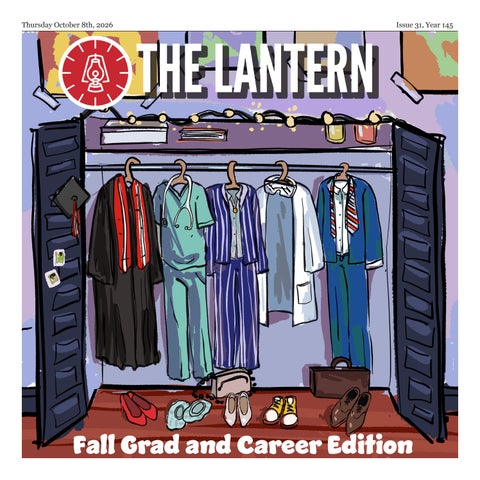
Fall Grad and Career Edition
Thursday October 8th, 2026 | www.thelantern.com | 2
CAMPUS
On page 4
On page 5
Federal judge pauses ruling from Department of Homeland Security
Graduate School offers career workshops
A second degree, first job or something in between: Buckeyes decide if grad school is for them Audrey Coleman Campus Editor
A
s seniors in high school, students were faced with the decisions of where to apply to school, what major to choose and ultimately where they would spend their undergraduate career. Now, as upperclassmen, and with graduation creeping closer, students are weighing a similar choice: wheth-
er or not they should pursue a graduate degree. With different types of degrees, programs and everything in between, everyone has a different post-grad plan. Ohio State has over 11,000 graduate students enrolled, according to the 2025 University Enrollment Report. Ella Magaw, a fourth-year in public management, leadership and policy, is pursuing a master’s in public administration through a combined program
at Ohio State, the MPA-DC. The program consists of two years of graduate studies, beginning during senior year of undergrad. The first year consists of taking classes in Columbus, or online, followed by a second year living, learning and working in Washington, D.C., according to the John Glenn College of Public Affairs’ website. “Combined programs are a really affordable way to get another degree, so this is something I knew I would
A Capital Distinction. At Capital Law, we know becoming a lawyer requires you to not only learn the law, but learn to practice law. Our location in downtown Columbus, Ohio places our students in the heart of Ohio’s legal community – and steps away from opportunity.
pursue around my second year of undergrad,” Magaw said. “I will be completing the last year of the program in Washington, D.C. and the job market there is a little terrifying, so I’m hoping the extra degree will give me a leg up.”
GRAD DECISION on page 3.
continues
FALL APPLICATION IS OPEN! (NO APPLICATION FEE)
6
CLINICS WITH LIVE CLIENT EXPERIENCE
50+
LOCAL EXTERNSHIP PLACEMENTS
95%
2-YEAR ULTIMATE BAR PASSAGE RATE
Visit us at law.capital.edu
Thursday October 8th, 2026 | @thelanternosu | 3 Continued from page 2. For Magaw, the decision to complete the program was accompanied by application requirements, waiting for a decision and being aware of the responsibility that comes with taking graduate courses along with undergrad. Gigi Hanner, a fourth-year in public policy analysis, is also working toward a MPA, though not through the same program as Magaw. Hanner said she discovered the program by chance during a meeting with her advisor, and that’s led to her getting involved with the coursework. “I’m hoping that my combined degrees will give me a bit of an edge over other jobseekers and also show that my education has been bolstered,” Hanner said. “Ohio State’s MPA program is the best in Ohio, so that added credential will hopefully look good on my future job applications as well, though I didn’t consider that as a factor when applying.” For both students, being aware of the benefits, stress and work required for a graduate degree is something to consider, especially as the choice between finding a job or higher education gets closer. “I think you just have to be personally aware of when the extra degree is not necessary,” Magaw said. “One of my good friends dropped out of the MPA program that I’m in, because she realized that she didn’t need it to work the job she wanted. So, it then became the smarter choice to just jump into the workforce. It’s different for each student.” On the other side of the spectrum are students who already know they will not be
going to graduate school, or looking into an additional program. Ryan Uher, a fourth-year in accounting, considered going to grad school, but decided against it after consulting with advisors, coworkers and looking into changes to licensing requirements. “I talked with current people in the accounting industry during my internship and they told me how a masters degree doesn’t really make you more competitive for entry level accounting roles, and it doesn’t unlock new job opportunities that weren’t available with only a Bachelors,” Uher said. For Uher, the expectation of having a masters degree isn’t something that he used as a factor when making his decision. “I think it’s nice to have, but no one expects you to have one,” Uher said. “The best thing about a masters degree is telling people you have [one], rather than it providing competitive advantage in the workforce.” Regardless of student opinion or decisions made towards moving toward a masters degree, the choice is one to make yourself based on multiple factors, according to Hanner. “I spoke to career advisors, academic advisors, basically any faculty member I could, about the degree and what they thought,” Hanner said. “No matter what anyone says though, you have to listen to your gut to decide what is right for you.” CREDIT: ZACHARY RILLEY LANTERN FILE PHOTO
Graduate students hold up their diplomas on graduation day in 2022.
Reid Family Career Closet offers free professional clothing to Ohio State students
CREDIT: COURTESY OF MADI BARNES
The Reid Family Career Closet inside Youngkin Success Center.
Paige Puhalsky LTV Campus Producer
This story was originally published on Sept. 14 and has been updated for The Lantern’s Fall Grad and Career 2026 edition.
P
rofessional clothing can be a major stressor for college students looking to make a positive impression as they enter the workforce. The Reid Family Career Closet gives Ohio State students access to free professional clothing to help them feel prepared for job interviews, career fairs and other professional opportunities. The resource center aims to expand the career closet’s reach and bring professional resources directly to students, said program coordinator Madi Barnes. “If you have an outfit that you feel comfortable in, it makes you feel more confident as you’re approaching your professional endeavor,” Barnes said. For both undergraduate and graduate students, building a professional wardrobe can be costly. The career
closet helps students manage those expenses by providing free business attire, Barnes said. “I think it’s really important that resources like the Reid Family Career Closet exist to help students as they’re managing their finances, often for the first time on their own,” Barnes said. Ohio State’s Fashion Retail Studies Department created a style guide for the career closet’s pop-up for students to reference when choosing professional clothing, Barnes said. Women’s and men’s suits are among the most popular items at the career closet, however, it also offers a variety of button-down shirts, blouses, dresses, skirts, shoes, scrubs and winter apparel, said Morgan Vibbert, associate director for the Student Wellness Center, which offers career wellness resources, according to its website. The clothing offered is meant to serve students entering a variety of fields in the workforce, Vibbert said, including medical, office and agricultural careers. Continue reading on thelantern.com!
Thursday October 8th, 2026 | www.thelantern.com | 4
Federal judge pauses ruling from Department of Homeland Security that would limit duration international students can stay in the United States Dalina Houangvilay Lantern Reporter
T
he Department of Homeland Security ruling in July that would place limits on how long international students can stay in the United States, as well as restrict work and travel, has been paused by a federal judge. Because of this, Ohio State students and organizations face new uncertainty and are forming informational resources for what is to come. The Council of Graduate Students hosted a webinar titled “Understanding Current International Student Policies” on Sept. 23, at which an immigration lawyer from Student Legal Services provided advice for affected students. Tatiana Chaiban, co-chair of the International Student Affairs Committee within the Council of Graduate Students and Ph.D. student in the educational policy program, said that the webinar was meant to provide legal advice for international students to better follow and be safe under the DHS ruling. “We’re not trying to go against [the ruling] because that’s not something in our own control, but as international students, what we try to do is we try to clarify the situation,” Chaiban said. “Like, ‘What does this rule mean? How should you act? How should you still comply?’” The International Student Affairs Committee co-chair and biomedical engineering Ph.D. student Chethana Yerramsetty said that the webinar was meant to focus on a wide range of questions each international student may have, where they can ask it openly. “A lot of these students are coming in for the first time in America, and that means, in the past one or two years, that’s their first exposure to what visas look like,” Yerramsetty said. “I think that was the big thing we
wanted to communicate as well is that, ‘Okay, here are resources to help you understand how these things work.’” Yerramsetty was born in India and is considered an international student, though she has lived in Ohio since she was 6 years old. She said that she avoids traveling out of the country to adhere to the ruling, even to academic conferences. Chaiban is an international student from Lebanon, who credits her past experiences to her actions as the International Student Affairs Committee cochair today. She said that international students, in spite of their background or “baggage,” are here on an academic basis, and she structures her advocacy in the Council of Graduate Students to support that. Under the new ruling, international students would be limited to four years on a visa unless granted specific, legal permission if their degree requires a longer amount of time. Andrew Peiffer, an immigration lawyer from Student Legal Services, also shared that international students would need permission to take part in internships or research outside of the university, and would likely only be allowed to work internships if it is required under their majors. The ruling was paused due to U.S. District Judge F. Dennis Saylor IV’s claim that it would cause “immediate irreparable harm” to the affected students. The webinar focused on explaining areas international students are affected under the DHS ruling. Peiffer advised in the webinar for international students to set up appointments with him, because many legal questions work on a case-by-case scenario and because immigration laws are in a state of flux. “Things are changing, and changing again, and there is quite a lot of uncertainty in this area right now,” Peiffer
CREDIT: DALINA HOUANGVILAY | LANTERN REPORTER
The Department of Homeland Security ruling that would require international students to leave the United States after four years, among other restrictions, has been paused.
said. “But, it’s one thing to know what you don’t know and it’s another thing to not know what you don’t know.” Advice included suggestions for international students to work with Ohio State’s Office of International Affairs immediately if they have concerns such as considering taking an extra year, only applying to internships if required for graduation and not traveling outside the country in the case that a student is not let back in. The DHS ruling has caused some international students to shift their plans for the future to act in accordance with its outlines. Fourth-year air transportation major Moath Alghamdi is an international student from Saudi Arabia and chose Ohio State for its aviation program, which he called one of the best in the country. He is pursuing his degree on a professional track and had previously considered finding work experience in the United States after graduation. After the DHS ruling, he said he is no longer looking for a job in the United States,
calling it a hassle. “You have to be critically thinking, you have to be very conscious of what kind of method you want to take,” Alghamadi said. “If I decided to stay here and for some reason, I can not land the job here, that might put me in the risk of getting deported at some point. So, what should be my top priority? I guess it’s just basically not to be in that position.” For Alghamdi, education is his main focus, and that even though he wanted a job in the United States for his resume, it is in his best interest to go back to Saudi Arabia after he graduates. “I’m trying to get this done so I can at least have my degree at bare minimum, if I’m not pursuing any jobs or anything,” Alghamdi said. “That would be absolutely one of my worst nightmares, to somehow get deported and I haven’t gotten my degree yet. So it’s just like, all the four years that I have spent here, which has gone in vain.”
Thursday October 8th, 2026 | @thelanternosu | 5
Campus Roundup: Graduate School offers fall career workshops Jacob Jolliff Campus Senior Writer
G
raduate students and postdoctoral scholars at Ohio State can take part in several career development workshops this fall covering topics including academic and nonacademic careers, networking opportunities, artificial intelligence and job-search strategies. The Graduate School offers the workshops through Beyond the Professoriate and Beyond Graduate School, two online career development programs that Ohio State graduate students can access at no additional cost. The programs offer live webinars, on-demand videos, workbooks and other career resources. Read on to learn more about the upcoming career development workshops for graduate students and postdocs. Upcoming Career Workshops Going Beyond Subject Matter: How to Identify Skills Employers Want Graduate students develop skills through their research and other academic experiences, but identifying those skills can be difficult when looking for jobs outside their field of study. This workshop will help students identify transferable skills developed through graduate training and learn how to communicate their value to nonacademic employers through job applications and interviews. The workshop
will be held Oct. 21 from noon to 12:45 p.m. through Beyond the Professoriate for doctoral students, Ph.D. graduates and post doctoral scholars. 3 Mistakes Master’s Students Make on LinkedIn This workshop, taking place Oct. 21 from 2 - 2:30 p.m., will focus on three common mistakes master’s students make when using LinkedIn as part of their job search and alternative options that students can use. Held through Beyond Graduate School, students will also learn how to reach out to professionals on LinkedIn and what they can do on the platform to move their job searches forward. The seminar is intended for master’s students. How to Research Career Options in Industry The workshop will be held Nov. 4 from noon to 12:45 p.m. through Beyond the Professoriate for doctoral students, Ph.D. graduates and postdoctoral scholars. The workshop will focus on how students can identify and research careers outside academia that align with their backgrounds and professional goals. Students will learn how to research potential career options based on their skills, values and personal goals. The session will also cover where students can begin looking for jobs after identifying potential career paths. How to Stand Out in an AI-Driven Job Market Taking place Nov. 4 from 2 - 2:30 p.m.,
CREDIT: MACKENZIE SHANKLIN | LANTERN FILE PHOTO
University Hall houses the administrative offices of the university’s Graduate School. Students can attend various online Graduate School workshop throughout the semester.
this workshop will examine how students can approach their job searches strategically while artificial intelligence becomes more common in the hiring process. Created by Beyond Graduate School and intended for master’s students, the workshop will teach about the potential risks of relying on AI during job searches and strategies for standing out to employers. The workshop will also discuss how students can use AI without losing their own voice or making their applications feel impersonal. What International Students Need to Know About Job Searching in Canada and the U.S. This session will be held Nov. 4 from 2 - 2:30 p.m. through Beyond Graduate School and is designed for international master’s students considering employment in Canada or the United States. The session will discuss what international students should know when looking for work in either country and how the job-search process can differ for international and domestic students. Building a Network to Help You in Academia and Beyond This session will focus on building and growing professional networks that can support students pursuing careers in academia or outside higher education. Students will learn how networking can contribute to an academic or nonacademic job search and where they can find people to connect with as they develop their professional networks. The workshop will be held Nov. 18 from noon to 12:45 p.m. through Beyond the Professoriate for doctoral students and Ph.D. graduates. How to Decide Between an Academic and Nonacademic Career This four-day session series will take place Dec. 7 - 10 from noon to
12:45 p.m. through Beyond the Professoriate. The series is designed for doctoral students, Ph.D. students and postdoctoral students who are deciding whether to pursue a faculty career or a career outside academia. The Dec. 7 session will focus on identifying personal values, while Dec. 8 will focus on identifying marketable skills. The Dec. 9 session will cover building a professional network using on-campus resources, and Dec. 10 will focus on practical considerations and using a decision rubric. The series will also include prerecorded material on the factors students should consider when making a decision about their career path. Your Next Career Move: Strategies for Career Changers and Career Advancers This four-day series will take place Dec. 14 - 17 from 2 - 2:30 p.m. through Beyond Graduate School. It is designed for master’s students with at least five years of professional experience. The series has two tracks based on students’ career goals. The career changer track is for master’s students using their degree to move into a new career field. The Dec. 14 session will focus on using a master’s degree to move into a new field, while Dec. 15 will focus on building a professional network in a field where students do not already have connections. The career advancer track is for students using their master’s degree to advance in their current career field. The Dec. 16 session will show how to use a master’s degree to pursue a promotion or senior role, while the Dec. 17 session will focus on building and using a professional network to find new career opportunities. Students can access Beyond the Professoriate and Beyond Graduate School through the Graduate School using their Ohio State credentials. Registration to the webinars can be found on the Graduate School’s website.
Thursday October 8th, 2026 | www.thelantern.com | 6
ARTS & LIFE
On page 8 Digital cameras make a comeback
Before the laughter, community comes first in Ohio State’s comedy groups
Jane Asante-Tutu Lantern Reporter
A
s the crowd settles and the stage lights warm the Ohio Union’s Cartoon Room, Backburner Sketch Comedy president, Alexandra Hajdu-Nemeth, a fourth-year in health sciences, stands backstage with the night’s performers, an origami star pressed into each palm. The group’s pre-show ritual is meant to steady nerves, and it is one Hajdu-Nemeth said she relied on herself the night of her first comedy show. “Seeing someone on a stage, putting something out there that they created that’s original, seemed really scary,” Hajdu-Nemeth said. “It wasn’t until I actually saw one of my sketches performed on stage that I felt like it was truly a part of me.” Hajdu-Nemeth is one of many students involved in comedy at Ohio State, where sketch, improvisation and stand-up groups give undergraduate students room to explore creativity through writing, acting, improvisation and video work. “I’ve always been an artist, but it wasn’t until college where I met people [in comedy],” Hajdu-Nemeth said. “I didn’t even know that sketch comedy was a possibility for me to do or what it was.” Backburner, founded in 2015, is an open-membership student organization that encourages students to explore different forms of comedy through writing workshops, acting practice and collaboration with other campus groups. Hajdu-Nemeth said the group
draws inspiration from sketch comedy shows like “Saturday Night Live,” but its style leans toward absurdist humor and subverting expectations. “We welcome people with all different types of humor,” Hajdu-Nemeth said. Students interested in performing submit sketches ahead of the group’s monthly shows and attend two meetings to rehearse and refine their work. Hajdu-Nemeth said the group’s support makes it easier for newer members to take creative risks. “At the end of the day, even if you’re vulnerable and maybe the audience doesn’t really vibe with your sketch, you all have each other,” Hajdu-Nemeth said. Mollie Asquino, social media and marketing chair for Fishbowl Improv and a fourth-year in health and rehabilitation studies, is familiar
with the vulnerability that comes with being an improviser. “I know people aren’t laughing at me,” Asquino said. “They’re laughing at what I’ve said and what I’ve created, and I feel like that’s a testament more to my creativity as a person and my ability to immerse people in that world that we’re building.” Asquino said the ability to express herself through comedy is made possible by the support of other Fishbowl members, many of whom keep comedy in her life outside the organization. “We try to teach our guppies, ‘Don’t go into a scene thinking [about] what’ll get the biggest laugh,” Asquino said. “We’re going into a scene thinking, ‘How can I support my teammates?’” Asquino said Fishbowl was founded in 2009 by alumnus Alex Lefeld after he was cut from 8th Floor Improv’s callbacks, later establishing itself as the university’s free-to-join improv group. Fishbowl shows blend improvisers’ CREDIT: FAITH SCHNEIDER | MANAGING DESIGN EDITOR
Mason Melvin, a third-year in French and francaphone studies and member of 8th Floor Improv performs on stage in the Union.
varied characters, signature games and audience-driven scenarios. “It’s defining the character through physical action and embodying the voice so that, even if I can’t hear anything you’re saying, I look at you and I see somebody different,” Asquino said. Fishbowl encourages creative expression during its new member auditions each semester, and hosts open auditions for students who want to try improv without committing to the fulltime cast. “There’s so many different avenues to express creativity and it’s such an important thing to do, especially as we’re growing into adulthood,” Asquino said. That sense of exploration and support looks different across campus’ comedy scene. For members of 8th Floor Improv, creativity grows through the friendships and long-term collaboration that shape performers both on and off stage. Founded in 2004, the group’s motto, “best friends doing best friend improv,” reflects its commitment to making practices and shows welcoming for new members, said Mason Melvin, 8th Floor’s treasurer and a third-year in French and francophone studies. Melvin said he recalls his earliest days in the group as a crash course in improv’s roots, as he was guided by older members who helped new performers find their footing in the group’s style.
COMEDY continues on page 7.
Thursday October 8th, 2026 | @thelanternosu | 7
Amplify. Advocate. Change. CREDIT: FAITH SCHNEIDER | MANAGING DESIGN EDITOR
MSW
Members of 8th Floor Improv perform in front of a crowd in the Union at their Western themed show on Sept. 25, 2026.
Continued from page 6.
Earn Your Master’s Degree in Social Work. All Majors Welcome Online or on Campus Top-Ranked MSW Program Full-Time or Part-Time Advanced Standing or Traditional MSW Scan the code to
APPLY NOW go.osu.edu/ msw-apply-now
CSW.OSU.EDU
“It takes so much courage to go up there, do something you’ve never done and hope that other people like it,” he said. Melvin said the close relationship 8th Floor maintains with its alumni has strengthened his confidence over the years, and he credits former president Samuel McQuate as one of his mentors who guided him early on. “I was so nervous when I first got in the group, but he was super kind and [reached] out, making sure I feel good about what I’m doing,” Melvin said. The responsibility now falls on the current cast, Melvin said, to carry that mentorship forward to new members and students who come to their open practices. 8th Floor is preparing for several upcoming programs, including its annual alumni show and Bellwether, which Melvin described as “the biggest free college improv festival in the world.” The festival gathers college and professional teams in the Ohio Union for two back-to-back nights of performances. However, the impact of campus comedy reaches beyond the performers themselves, according to Melissa Anne-Marie Curley, professor of Comedy, Culture and Society. She said she has watched students discover how humor shapes emotional responses for
the people onstage and the audiences who react to them. “You’re drawing the laughter out of people, you have a kind of magical ability to create a situation in which people can release their feelings and know how good it feels to laugh,” Curley said. Curley said in these groups, students examine how humor connects people, study improv and stand-up techniques and analyze how stage work shapes social differences. As part of that work, she encourages them to attend comedy shows around Columbus and reflect on what they see. “One of the things that my students have really kind of opened my eyes to is how close the relationship is between laughter and other kinds of bodily expression,” Curley said. As Backburner prepares for its spring shows, Fishbowl looks ahead to Tides and 8th Floor prepares for Bellwether, Hajdu-Nemeth said she hopes the Ohio State’s comedy scene continues to offer a place where students can gather, laugh and support one another. “Laughter is super important,” Hajdu-Nemeth said. “The stress of college is enough, but also the stress of the world. People need a place where they can be relieved from that, even if it’s just for the hour and a half that our show is going on.”
Thursday October 8th, 2026 | www.thelantern.com | 8
Digital cameras make a comeback among Ohio State students
Paige Puhalsky LTV Campus Producer
F
or many members of Gen Z, their first interactions with a digital camera were sporting their 2000s-style haircuts and outfits in front of one. Now, they’re picking those cameras back up, and chasing that same look that documented their childhoods. As Y2K fashion and early 2000s aesthetics make their way back into popular culture, some Ohio State students are choosing digital cameras to capture a retro look. For students like Talia Norton, a first-year in accounting, the appeal goes beyond social media, she said, combining nostalgia, creativity and a different way of documenting everyday life. Whether she is posting on social media, spending time with friends or simply saving photos to look back on, Norton said she frequently reaches for her digital camera instead of her cell-
phone. “I bring my digital camera everywhere,” Norton said. “I feel like each time I bring it, it’s for a different reason.” Although her iPhone is able to produce a quality photo, Norton said it does not create the same front-flash effect as her digital camera. The flash makes people stand out in photos while making skin appear clearer and outfits pop, she said. While a similar effect can be created by editing an iPhone photo, Norton said that requires an understanding of which adjustments to make. “With a digital camera, you click a button and it’s all done,” Norton said. Cara Tiller, a third-year in health sciences, said digital camera photos can feel more authentic than those taken on an iPhone. Part of the excitement, she said, comes from waiting to upload the photos and see what moments she captured.
Differences in blurriness and brightness can also give digital camera photos a more distinctive look, Tiller said. For Norton, the distinct look of digital cameras is also connected to nostalgia. She said the flash associated with digital cameras can give photos the vintage look that has become popular alongside the rise of Y2K fashion. Norton said she first noticed digital cameras becoming popular during her sophomore year of high school, in 2023. She began seeing digital camera photos on TikTok, and noticed her friends bringing cameras to social gatherings. The trend also reminded Norton of looking through her mom’s old photos, which featured Y2K fashion trends like low-rise jeans, tank tops and animal print. She said all the photos were taken on digital cameras. “[Digital cameras] kind of reminded me of growing up, seeing my mom
Prepare to be
Leader-ready. Career-ready. Future-ready. BW’s graduate degrees emphasize practical application, data-driven problem solving, ethical decision-making and industry partnerships, preparing you for the challenges of a dynamic future.
Visit bw.edu/graduate or call 440-826-8012 for more information.
and my grandmothers take pictures of everything and take pictures of me,” Tiller said. “I loved that part of growing up, so I guess I just wanted to bring that back for myself.” Tiller’s inspiration also came from wanting to create a photo album documenting her college experience with her friends. Gina Osterloh, an associate professor of art in the Department of Art, said she believes the rise in digital camera use is partly driven by students wanting to create images outside of cellphones to spend more time away from their devices. Although social media has contributed to increased interest in digital cameras, Osterloh said she believes creativity plays a larger role in the trend. “When I see and hear and listen closely to students about their inspiration from creating and seeing an image that doesn’t look like everyone else’s
BUSINESS
PROGRAMS (flexible formats)
Master of Business Administration Master of Accountancy
HEALTHCARE PROGRAMS Master of Clinical Mental Health Counseling Physician Assistant Master of SpeechLanguage Pathology Accelerated Bachelor of Science in Nursing
Thursday October 8th, 2026 | @thelanternosu | 9 images, and to connect with other students in that excitement, I think maybe that’s greater than the social media influence,” Osterloh said. Osterloh said although digital cameras can have a lower resolution than newer iPhones, the ability to achieve a unique image is a driving force behind their increased use. Students might prefer the imperfections of older digital cameras over advanced iPhone cameras because they allow for unique types of storytelling. Another part of the appeal of using a digital camera, Tiller said, is that the experience feels different from taking photos with a cellphone. “It feels more fun,” Tiller said. “It feels more in the moment. And it’s something about taking pictures on something that isn’t your phone.” Osterloh said using a separate camera can change the way someone ap-
proaches taking a photo, because it encourages them to see and observe things differently, as a different device can change how someone observes their surroundings. Taking a photo on an iPhone can involve multiple taps, while using a traditional camera can offer a more deliberate experience, often involving holding the camera with two hands and pressing a shutter button, Osterloh said. Tiller said she brings her camera with her when she is going somewhere new or doing something fun — using it to photograph her surroundings from her point of view. An Ohio State football game, for example, gives her an opportunity to photograph her friends and the atmosphere around her. “It’s just a way to capture what I’m seeing and all the fun that’s going on,” Tiller said.
However, digital cameras still have limitations, Norton said. When using flash, photographers may have to wait a few seconds before taking another photo, making an iPhone more convenient for capturing several candid shots. Despite this limitation, Norton said digital cameras allow her to preserve memories, regardless of whether she plans to share the photos on social media. “I feel like the second biggest reason [to have a digital camera] is just memories,” Norton said. “Even if it’s not to post, to remember a time or look back at it and make you happy.” Norton said she believes digital cameras will remain popular as people continue looking for ways to document their lives and share photos with friends. Osterloh echoed this thought, and
CREDIT: PAIGE PUHALSKY | LTV CAMPUS PRODUCER
An Ohio State student uses a digital camera to capture memories of her college home.
said she believes digital cameras will continue to grow in popularity as students realize they can use them to express their individual creative voices. “Seeing this excitement to create images that might not automatically be traceable by AI, like images that exist outside of those algorithms, that’s really special,” Osterloh said. Tiller said she plans to continue using her digital camera, even if her peers move on to the next trend. “[My camera] reminds me of my childhood and all the pictures I would take on my little camera when I was younger,” Tiller said. “It’s just bittersweet to be in college doing the same thing that I looked up to my mother doing and my grandmother doing.”
Thursday October 8th, 2026 | www.thelantern.com | 10
Big Ten calls on Buckeyes to take part in We Give Blood competition Bridget Lombardo Sports Senior Writer
A
cross the Big Ten, Ohio State and 17 other schools compete on the field, court and rink for championships. But another conference-wide competition is underway: this one measured in pints rather than points. All 18 Big Ten schools are competing in the 2026 We Give Blood competition, a partnership between Abbott Laboratories, a global health care and medical device company, and the conference. The school with the most donations will receive a $1 million grant from Abbott to support student or community health initiatives. The competition began Aug. 12 and runs through Dec. 4, with the winner set to be announced Dec. 5 at the Big Ten Football Championship Game at Lucas Oil Stadium in Indianapolis. The campaign comes amid a national shortage in blood donations.
“Right now, the United States is facing the worst blood shortage in a decade.” Shohaan Singh said,Ohio State’s partnership representative for the We Give Blood campaign. The American Red Cross declared its second-ever national blood supply crisis July 27 after donations fell to a four-year summer low. The organization also reported having less than a one-day national supply of type O positive blood at that time. For Ohio State, the competition against fellow Big Ten schools, including its biggest rival Michigan, offers an opportunity to turn the loyalty that typically surrounds Buckeye athletics into an incentive to donate blood. “I mean, at the end of the day, you’re fighting for your school,” Singh said. “There’s a little bit of financial incen-
tive as well involved, but also the bragging rights of ‘We want to beat That Team Up North.’” Last year, Ohio State finished in fourth place behind Wisconsin, Nebraska and Michigan. At the time of publication, Ohio State sits third in the Big Ten with 5,789 donors, trailing Wisconsin’s 11,252 and Nebraska’s 9,051. The Buckeyes currently lead Michigan, which sits fourth with 4,974 donors. Across the conference, 59,163 people have donated throughout the campaign, with the leaderboard estimating 177,489 lives saved. Ohio State accounts for approximately 17,367 of those lives saved, according t0 the Big Ten Conference Abbott battle website. Singh explained that blood donors have historically tended to be older, making college students an important group for the campaign to reach. By incorporating the competition between Big Ten schools, organizers hope students will be encouraged by their school pride to participate in donating blood. “We wanted to get college students involved because if they can put a little bit of passion of Poster for the 2026 We Give Blood campaign. fighting for their school pride, it might incite more tions across campus, including resipeople to donate, especially at a youngdence halls and Ohio Stadium, while er age,” Singh said. providing students with multiple opOhio State has promoted the comportunities to participate. petition through blood drives at loca-
CREDIT: COURTESY OF IMPACT LIFE
BLOOD continues on page 11.
Thursday October 8th, 2026 | @thelanternosu | 11 Continued from page 10. Ohio State’s athletic director Ross Bjork said in an email that although Ohio State wants to win the competition, helping those in need remains the most important part of the campaign. “We love competition at Ohio State and excellence is part of our DNA in everything that we do,” Bjork said. “So, while we want to win the competition during the We Give Blood drive, giving back and helping those in need is the most important element of this campaign.” Eligible participants can donate at any blood center or mobile blood drive in the United States during the competition. After donating, participants must submit proof of their donation through the We Give Blood website or text GIVEBLOOD to 222688 and follow the prompts. Donors then se-
lect which Big Ten school they want to count their donation toward. Proof can include a photo or document showing that the individual donated but should not contain personal health information. Participants who submit their donation also receive a free We Give Blood t-shirt specific to their
school. Singh said completing the submission process is important because donations are not automatically added to Ohio State’s total. “All [donors] have to do is go to the website, take a picture, show that you’ve donated blood, and then count it toward Ohio State,” Singh said. “It counts toward our team total.” Bjork said in an email the competition also provides an opportunity to raise awareness of the blood shortage. “We challenge all Buckeyes to do what they can and give blood during this crucial time,” Bjork said. While schools can win $1 million through the competition, the larger purpose is to create a community willing to donate for people they may never meet. “We want to create this community of, ‘Hey, we are there to support other people that we might not even know,’” Singh said. “I might not know their name, but I know I’m saving those lives that might be having to use that
blood to stay alive.”
Stay up to date the Ohio State athletics through our Instagram! Check out @thelanternosu!
Thursday October 8th, 2026 | www.thelantern.com | 12
SPORTS
On page 2
On page 3
Deciding on grad school
Career Closet offers free professional clothing
How the Ohio State club football players balance demanding schedules
Owen Cavinder Lantern Reporter
O
hio State’s club football team is in pursuit of its third straight National Club Football Association title. Yet the club athletes' time commitments goes far beyond striving for success on the football field. The team practices three days a week, with a fourth dedicated to film study. In addition to classwork, juggling jobs and other extracurriculars. They are also still trying to compete at a NCFA championship level on the gridiron. Aidan Donovan, a fourth-year in finance, who plays tight end and nose tackle on the club team also plays club lacrosse, bartends and has duties as a member of the fraternity Pi Kappa Alpha. Donovan described what he’s learned from handling all of those responsibilities while being on the club team. “Preparing me to time manage everything,” Donovan said. Donovan said being a member of the team is worth it, because of the group of friends he’s made through club football. “I’m out here doing something I love every day with guys I love,” Donovan said. Elijah Lowden, a fourth-year in finance who plays defensive end, felt the same about balancing school, work and football. “At the end of the day, it’s time management,” Lowden said. Lowden serves as the club team’s
treasurer and works part-time at a pet store while actively searching for internships. Lowden estimated the total time spent as a student-athlete to be in the ballpark of 20-25 hours per week. A habit of getting work done ahead of time is crucial to success on the club football team, he said. “I’ve got to get my stuff done early,” he said. “Otherwise, I’m gonna run into issues.” It’s not free to play club football, either. Club football head coach James Grega Jr. said the cost to play on the club football team varies from year-to-year, but for the 2026 season, each player must spend $375. This covers the cost of jerseys and out-of-state travel, which includes buses, vans and hotel stays. While the payments can be made in installments, Grega said it’s due in full by the start of the season. However, there is some financial aid. Each year, one standout athlete is selected for the Founders Scholarship, which covers the cost of that player for the season. Grega, as well, is no stranger to dealing with time management on the team. In 2013, Grega started every game as quarterback. That season, he led the Buckeyes to a 6-4 record,
tying the program record for wins at the time. Now, as the head coach, Grega said he advises his players to budget their time wisely and establish a routine. Grega said the Ohio State club football team competes at a level that is comparable to an NCAA Division III program. “I think the thing that people often mistake with club football is people hear club football and they think it’s
intramural,” he said. “We have the talent of a division three football program.” The club team has started its season 3-0. The team traveled for its first two games of the season, defeating Michigan State 17-16 in Ithaca, Michigan on Sept. 20 and Pittsburgh 62-7 at the Pitt Sports Dome on Sept. 27. The Buckeyes played their first home game Oct. 4 and beat George Mason 52-6 at Lincoln Tower Park. Lowden called the successful results “extremely fun to see.” Players vying for the five remaining spots on the active roster put in their best efforts during practice. Teammates actively encouraged each other, showing support on big plays. Despite having to manage his time as a club football player, Donovan reflected on being on the team the past three years. “I wouldn’t trade it for the world,” Donovan said. CREDIT: COURTESY OF COLIN KOVINCHICK | CLUB FOOTBALL PHOTOGRAPHER
Defensive lineman Elijah Lowden (99) breaks the huddle for the Ohio State club football team in a game against the Toledo Rockets in the 2025 season.