CHOICE, VOICE AND CONTROL
“Good flex” the key to a sustainable health system page 8
RATIOS ROLL-OUT
AGED CARE
ED vindication; regional MPSs still waiting
Keeping our politicians accountable
page 14
page 18
REGULARS Ask Katrina Professional Perspectives Health & Wellbeing Crossword
p.20 p.38 p.45 p.46
THE MAGAZINE OF THE NSW NURSES AND MIDWIVES’ ASSOCIATION VOLUME 83 NO 4 AUG / SEPT 2026
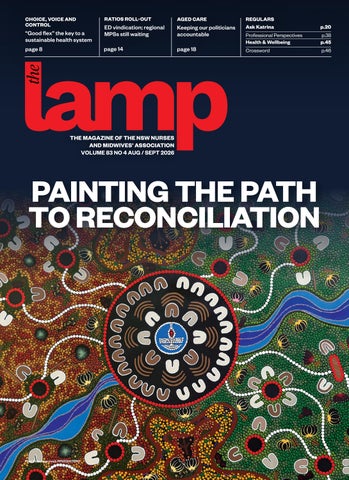
PAINTING THE PATH TO RECONCILIATION
Print Post Approved: PP100007890
A top performing fund working for real world impact. At HESTA, we believe in providing strong long-term returns while having an impact on the world our members retire into. Learn more at hesta.com.au
Issued by H.E.S.T. Australia Ltd ABN 66 006 818 695, Trustee of HESTA ABN 64 971 749 321. Consider whether this product is appropriate for you by reading the PDS and TMD at hesta.com.au/pds. Past performance does not indicate future performance. Based on HESTA’s analysis of SuperRatings 10 Year Platinum Performance 20162026 (MySuper), see superratings.com.au/ratings. Product ratings and awards are only one factor to be considered. For more information on Super with impact™, see hesta.com.au/impact.
2 | THE LAMP JUNE / JULY 2026
CONTENTS
Contacts NSW Nurses and Midwives’ Association For all membership enquiries and assistance, including The Lamp subscriptions and change of address, contact our Head Office. Head Office 50 O’Dea Avenue, Waterloo NSW 2017 (all correspondence) T 8595 1234 (metro) 1300 367 962 (non-metro) F 9662 1414 E gensec@nswnma.asn.au W www.nswnma.asn.au
VOLUME 83 NO. 4 AUGUST / SEPTEMBER 2026
NSWNMA Communications Manager Danielle Blasutto T 02 8595 1234 (metro) T 1300 367 962 (regional) For all editorial enquiries T 8595 1234 E lamp@nswnma.asn.au 50 O’Dea Avenue, Waterloo NSW 2017 Produced by Citrus Media E jim@citrusmedia.com.au Press Releases Send your press releases to: F 9662 1414 E gensec@nswnma.asn.au Editorial Committee Michael Whaites, NSWNMA General Secretary Katrina Bough, NSWNMA Assistant General Secretary O’Bray Smith, NSWNMA President Michelle Cashman, Long Jetty Continuing Care Michelle Cutmore, Tweed Hospital Karen Hart, Wagga Wagga Base Hospital Robyne Brown, Maitland Hospital
6
COVER STORY Reflect Reconciliation Action Plan To tell the story of its reconciliation journey, the Association turned to one of its own. The result is an artwork rich in stories of connection, care and community.
Printed by Printed by IVE Group Sydney Advertising T 8595 2139 E nswnursescomms@nswnma.asn.au
8
CHOICE, VOICE AND CONTROL
General Disclaimer The Lamp is the official magazine of the NSWNMA. Views expressed in articles are contributors’ own and not necessarily those of the NSWNMA. Statements of fact are believed to be true, but no legal responsibility is accepted for them. All material appearing in The Lamp is covered by copyright and may not be reproduced without prior written permission. The NSWNMA takes no responsibility for the advertising appearing herein and it does not necessarily endorse any products advertised. Authorised by M.Whaites, General Secretary, NSW Nurses and Midwives’ Association, 50 O’Dea Avenue Waterloo NSW 2017
14
RATIOS ROLL-OUT
18
AGED CARE
Privacy Statement The NSWNMA collects personal information from members in order to perform our role of representing their industrial and professional interests. We place great emphasis on maintaining and enhancing the privacy and security of your personal information. Personal information is protected under law and can only be released to someone else where the law requires or where you give permission. If you have concerns about your personal information, please contact the NSWNMA office. If you are still not satisfied that your privacy is being maintained, you can contact the Privacy Commission.
22
Information & Records Management Centre To find archived articles from The Lamp, or to borrow from the NSWNMA nursing and health collection, contact: Adrian Hayward, Coordinator. T 8595 2175 E gensec@nswnma.asn.au The Lamp ISSN: 0047-3936
Subscriptions for 2026 Free to all Association members. Professional members can subscribe to the magazine at a reduced rate of $30. Individuals $84, Institutions $140, Overseas $150.
PEFC Certified Paper from sustainably managed forests and controlled sources PEFC/21-31-119
pefcaustralia.org.au
“Good flex” the key to a sustainable health system Greater flexibility with rosters, improved staffing and more support from managers are fundamental to the resilience of the health workforce, says a new report. ED ratios “a gamechanger” Winning 1:3 ratios in ED was hard fought and the transition has been challenging but the rewards are undeniable. The fight continues More than 60 members attended a recent NSWNMA Aged Care Summit and vowed to continue campaigning to improve the sector.
30
5 Editorial 20 Ask Katrina 32 Education calendar 36 Branch Beat 38 Professional Perspectives 40 News in brief 45 Your Health & Wellbeing 46 Crossword
CHOICE, VOICE AND CONTROL
“Good flex” the key to a sustainable health system page 8
RATIOS ROLL-OUT
AGED CARE
ED vindication; regional MPSs still waiting
Keeping our politicians accountable
page 14
page 18
REGULARS Ask Katrina Professional Perspectives Health & Wellbeing Crossword
p.20 p.38 p.45 p.46
THE MAGAZINE OF THE NSW NURSES AND MIDWIVES’ ASSOCIATION VOLUME 83 NO 4 AUG / SEPT 2026
AVERIL IN ANTARCTICA
The war for our key crustacean Four months aboard an ageing protest vessel gave nurse Averil Thornton a fresh perspective on medicine, activism and her own potential.
26
REGULARS
PAINTING THE PATH TO RECONCILIATION
GATEWAY BILLS
Rights under review Supporters call them targeted reforms. Opponents call them ‘gateway bills’ – small changes that open the door to larger debates. LITTLE WINGS
Print Post Approved: PP100007890
COVER: Painting by Lesley Salem
Dollar for Dusty Dusty Langby is walking 540km to help put rural healthcare shortages in the spotlight.
The Lamp is printed on PEFC certified paper. The paper is certified under the Programme for the Endorsement of Forest Certification (PEFC) which assures consumers that the utilised forestry products can be traced from a certified, sustainably managed forest through all stages of processing and production by a chain of custody process. The Lamp is wrapped in Ecopure film which is recyclable and biodegradable.
THE LAMP AUGUST / SEPTEMBER 2026 | 3
Peer support counselling Delivered by experienced nurses and midwives For nurses, midwives and students of the professions
1800 001 060 info@nursemidwifehpa.org.au
A free 24/7 anonymous helpline for confidential advice and referral.
1800 667 877 Head to our website and discover: Online Resources Mentorship Program Wellbeing Portal Service Finder 4 | THE LAMP JUNE / JULY 2026
nmsupport.org.au
Scan to learn more
EDITORIAL
Listening to members is key to delivering better care Our members have always known what works. Ratios and new workforce research now provide further evidence that listening to nurses and midwives delivers better outcomes for everyone. One of the great privileges of this role is seeing members campaign for change, then watching that change begin to make a real difference in their workplaces. For years, our members told governments that ratios would improve patient care, reduce pressure on nurses and midwives and help retain experienced staff in our public health system. We never stopped making that case because our members never stopped making it to us. Today, we are beginning to see those years of campaigning paying off. The rollout of 1:3 nurse-to-patient ratios in Emergency Departments is already changing the way care is delivered. Members are telling us they have more time with patients, they’re getting their breaks more consistently, and they’re able to provide the standard of care their patients deserve. Equally as important, members are reporting that the benefit of ratios extends beyond the day-today, it impacts the profession as a whole; workplaces are once again transforming into environments where staff want to build long-term careers. Our members knew what ratios would achieve long before governments accepted the evidence. Ratios have never just been about numbers on a roster. They are also about creating the conditions for nurses and midwives to deliver safe, high-quality care. There is still more work ahead. While the rollout is continuing into general medical, surgical and specialty wards, we will continue advocating until every
commitment made to members by Labor has been delivered, including for nurses and midwives working in our Intensive Care Units and Multi-Purpose Services in regional communities. From these five we will build; every member deserves to work in a safe, properly staffed workplace, regardless of where they practise. This edition of The Lamp also features the Choice, Voice and Control report, and in many ways it tells the same story. Compiled by Professor Rae Cooper AO and her team from the Centre for Gender Equality and Inclusion @ Work at the University of Sydney Business School, the report draws on the experiences of more than 2,000 public sector nurses and midwives across NSW. The findings offer irrefutable evidence that a lack of choice, control and flexibility in the current workplace design is unsustainable, with 56 per cent of nurses and midwives reporting they often had to stay at work after their shift ended, 82 per cent agreeing they had too much work to do, and 54 per cent saying they did not have an adequate work-life balance. By speaking up in Professor Cooper’s report, members have articulated what needs to change to futureproof our profession. They want manageable workloads, genuine input into their rosters and working hours, supportive managers and workplaces that recognise nurses and midwives have families, caring responsibilities, and lives outside work. Most of all, they want to feel heard.
Every member deserves to work in a safe, properly staffed workplace, regardless of where they practise These are not unreasonable expectations, they are the foundations of a sustainable health workforce. One of the strongest messages from the report is that flexibility works best when it works for everyone. Nurses and midwives need genuine choice, voice and control over how they work, while continuing to deliver excellent care to patients. That kind of flexibility is only possible when staffing levels are safe and employers listen to the people providing care every day. That is why these two stories belong together: ratios reinforce what happens when governments listen to nurses and midwives, and the Choice, Voice and Control report highlights where we need to keep listening. Together, they provide a clear roadmap for building a stronger and more sustainable health system. Ultimately, every major improvement our members have secured has come through collective action. Better wages, safer staffing, improved conditions and stronger workplace rights have never been handed to us. They have been hard won because members organised, stood together and refused to accept that things could not change. There will always be more work to do, but the progress we are seeing today is a reminder of what is possible when members speak with one voice. As your union, we will continue listening to our members, campaigning alongside them and making the case for a health system that values the people at its heart. Because when members are listened to, patients receive better care, workplaces become stronger and our public health system is better for everyone. n THE LAMP AUGUST / SEPTEMBER 2026 | 5
RECONCILIATION ACTION PLAN
Painting the path to reconciliation To tell the story of its reconciliation journey, the Association turned to one of its own. The result is an artwork rich in stories of connection, care and community.
A
t t he hea r t of t he NSWNMA’s new Reflect Reconciliation Action Plan (RAP), the Association has been honoured to recognise the contribution of the first Aboriginal person to be endorsed as a nurse practitioner in Australia, Lesley Salem.
community and care through Aboriginal storytelling traditions.
A proud descendant of the Wonnarua Nation in NSW and Order of Australia recipient, Lesley was invited to describe her vision of the Association’s reconciliation journey.
THE ACTION PLAN
Speaking from Hamilton, the fly-in fly-out remote area nurse said that her new work tells a simple story of a complex connection to country,
“My nursing has shown me that we often need a greater connection with our patients,” Lesley says. “My art is that connection with patients within the Aboriginal communities I work with.”
Reconciliation is the word we give to the journey of restoring friendly relations in this land, Lesley says. “Australians are navigating the challenges of overt and covert racism every day. “Reconciliation seeks a way to heal from the impact of historical
colonisation, institutional and personal biases, ingrained cultural stereotypes and a media of casual microaggression normalising the racism of our schoolyards. “Reconciliation must make two seemingly contradictory peoples compatible with one another. “It’s an essential element in the ongoing struggle to heal historical divisions and build mutual respect.”
ORANGE IS FOR HEALING Using the rich vocabulary of her work’s narrative symbolism, Lesley says the journey begins from the dominant centre circle. “Here initially begins the division of indigenous and non-indigenous peoples, demonstrated through the outer layer of people. “The protection of a wind break, indicating that with our care this process of Reconciliation is protected, always. “And at the centre is the NSWNMA organisation, central to this process, for protection and its outcomes.” O ut side t he c i rcle i s a representation of the community with reconciliation. It shows a healthy community, respectful of the land, flora and fauna. “Water for life, ongoing,” Lesley explains. “Orange small circles show widespread healing, cultural humility.” It goes from the green of the coast to the orange-browns of the desert.
“At the centre is the NSWNMA organisation, central to this process, for protection and its outcomes.” 6 | THE LAMP AUGUST / SEPTEMBER 2026
The landscape of mountains, earth, rivers and rocks is punctuated with
Wonnarua woman Lesley Salem (centre) says that her artwork tells a simple story of a complex connection to country, community and care through Aboriginal storytelling traditions.
Also highlighted is the birthing place, Lesley says, while the entire circle is surrounded in a line of vivid orange – traditionally a healing colour.
“Reconciliation must make two seemingly contradictory peoples compatible with one another. It’s an essential element in the ongoing struggle to heal historical divisions and build mutual respect.”
“The pregnant women, the elderly and the nurse…
— Lesley Salem, artist, author, and nurse practitioner
flowering gums, desert grasses, wattle (and Hardenbergia violacea), emu, kangaroo, eagle, goanna, echidna and ants as well as man and woman.
“Reconciliation is healing.” Lesley’s work is helping to launch and guide the NSWNMA’s new RAP, which
builds on reconciliation practices underway across the Association. The RAP commits to strengthening relationships, improving cultural safety and increasing representation a nd leader sh ip w it h i n t he organisation. “RAPs give our profession a practical, measurable way to build relationships, promote respect and create a meaningful way forward together,” Lesley says. “My art just tries to depict how working together purposefully can result in a better society.” n THE LAMP AUGUST / SEPTEMBER 2026 | 7
CHOICE, VOICE AND CONTROL
“Good flex” key to a sustainable health system: report Greater flexibility with rosters and improved staffing by addressing the structural constraints are fundamental to the resilience of the health workforce, says a new report.
N
SW nurses and midwives want more flexibility in their rosters to improve wellbeing, retention and longevity in their careers, says a new report.
The report – titled Choice, Voice and Control – outlines what NSW nurses and midwives want from their shift and roster patterns. It outlines the barriers and enablers that exist between them and their aspirations; and the consequences and risks when nurses and midwives do not properly have the choice, control and flexibility they want and need. The report was based on an overview of existing research, a survey of more than 2,000 nurses and midwives, 15 focus groups, and in-depth interviews. The researchers – led by Professor Rae Cooper AO from the Australian Centre for Gender Equality and
Stronger rights needed around rosters The researchers propose working arrangements “that provide clear benefits to employees by offering predictability, support, and genuine scope for voice, choice and control – while also meeting organisational needs” which they call “a good flex”. These improved working arrangements would include: strengthening working-time rights, embedding employeecentred rostering, enhancing managerial capability and transparency, and enabling genuine employee voice.
Inclusion – describe “a cycle of poor job quality” with three interacting elements: endemic understaffing, overwhelming workloads and a lack of flexibility in rosters. Nurses and midwives told the researchers they wanted more say over their hours and “to feel that their voices are being listened to”. “You would think that (with) the volume of nurses that there are in any ward or any hospital, if we all were able to put forward our preferences and then be heard … things would balance out pretty much,” a Clinical Nurse/Midwifery Specialist said. W hen a na lysing work place f le x ibi l it y, t he re s e a rcher s distinguished between what they call “bad flex” – employer-driven practices designed for operational efficiency and delivery – and “good flex”, which consists of working arrangements that offer employees predictability, support and a say in their working hours.
“The report reveals significant and worrying implications for the sustainability of the health sector and the perceived quality of the care that nurses and midwives can provide to patients.” — NSWNMA General Secretary, Michael Whaites
8 | THE LAMP AUGUST / SEPTEMBER 2026
Managers highlighted “chronically busy, overwhelming and stressful workloads” as a structural barrier to good flex. These overwhelming workloads were seen as a consequence of insufficient staffing. “Time pressure and exhaustion push staff away from nursing and midwifery and, when experienced staff cannot easily be replaced, overwhelming workloads intensify, perpetuating the cycle,” the report says.
Choice, Voice and Control NSW Nurses and Midwives’ Experiences and Aspirations in Hours, Rostering and Flexibility at Work
Many participants spoke positively about managers that had endeavoured to make rostering ‘work’ for their teams. Solidarity from co-workers and supportive teams were also seen as a “significant enabler of good flex”.
The Australian Centre for Gender Equality and Inclusion @ Work Professor Rae Cooper AO, Dr Elsie Foeken, Associate Professor Joshua Healy, Professor Elizabeth Hill, Dr Vanessa Loh, Dr Jessie Liu, Sydney Colussi and Dr Suneha Seetahul
AN ASPIRATION TO BE AWAY FROM WORK MORE OFTEN
GOOD FLEX CONSTRAINED BY STRUCTURAL ISSUES
Overall, participants revealed that nursing and midwifery is not only unfriendly to workers with families, but to anyone who wants to have a life outside of work.
Nurses and midwives said they wanted support from their managers, including greater fairness and equity in rostering; clearer communication with employees; and a more sincere desire to understand employees’ needs and wants in relation to workloads, rosters and hours, the report says.
Many nurses and midwives reported experiencing clashes between work and life, with over half of the survey respondents (54 per cent) disagreeing that they ‘have an adequate balance between their work and personal/family life’. One R N pointed out t he consequences of inadequate breaks after relentless shifts. “You’re creating fatigue. You’re not allowing for family time. You’re not allowing for me time. I’ve actually said to my manager, do you want to come around and do my washing and cook a week’s worth of meals? Because, you know, (with) this roster, I haven’t got time.” A Clinica l Nurse/M idw ifer y Specialist warned that unless nursing and midwifery become family-friendly, there was a high risk of losing more staff. “I always think you will retain nurses if you make it accessible to people who have kids and have to work these unsocial hours,” she said.
What nurses and midwives want NSW nurses and midwives have five major aspirations for their working time:
1 2 3 4 5
Greater flexibility and control over their rosters, shifts and hours of work More manageable workloads and improved staffing Increased support from managers Work that accommodates life outside of work Better wages to support retention and ease workloads
In the survey, 81 per cent agreed they can ask co-workers for help, and 72 per cent agreed they can rely on their co-workers when things get tough.
IT STARTS WITH UNDERSTAFFING The report concludes that while the “poor job quality cycle” has several elements, the cycle starts with understaffing: “This cycle is entrenched at the structural level by the chronic understaffing of nurses and midwives throughout the state… time pressure, overwork and poor work-life balance lead in combination to fatigue and emotional exhaustion, which drive worn-out nurses and midwives out of their jobs.” NSWNMA General Secretary Michael Whaites said the report reflected what members had told the Association about their overwhelming pressures. “The report reveals significant and worrying implications for the sustainability of the health sector and the perceived quality of the care that nurses and midwives can provide to patients. “Helping nurses and midwives gain greater control over their hours and shifts would help to stem poor workforce retention and make nursing and midwifery more sustainable professions as the workforce demands greater flexibility,” he said. n THE LAMP AUGUST / SEPTEMBER 2026 | 9
CHOICE, VOICE AND CONTROL
Juggling the impossible Mental health RN Sarah Ellyard is currently enjoying maternity leave with her son Finley, but she is already thinking about her return to work and how she will manage the demands of motherhood with a taxing job. Sarah was quite happy to work extra hours earlier in her nursing career. “But I gradually got to the point where I didn’t want to do that anymore. So, I just started to say no,” she says. “I think it’s certainly common for early career nurses to often take on a disproportionate amount of overtime. “But there comes a point when it’s not sustainable to keep doing that. And people’s priorities change. Particularly if they end up having young children or other kinds of caring responsibilities as they get older.” Staffing shortages and the resulting gap in rosters creates pressure for staff to work double shifts and overtime, she says. “There’s an expectation that, regardless of your preferences, you need to work all the different shifts. You do have a little bit of a say, but it depends on who the manager is. “But in the end, the operational needs of the hospital always get put above the needs of individual nurses.” Sarah says it’s particularly hard to get enough time to properly recover from night shifts. “I found it hard having to work night shifts every month. Sometimes I had to work six days in a row. I would like more flexibility, so I don’t have to do rosters like that. “I’d like to work no more than five days in a row. That would really help with fatigue management. “If there is less burnout, and nurses come to work feeling less tired but happier thanks to a better work-life balance, then I think it would benefit the organisation as well.” 10 | THE LAMP AUGUST / SEPTEMBER 2026
“If you’re not working the standard nine to five job, finding childcare that has extended hours is really difficult.” — Sarah Ellyard, Macquarie Hospital
More flexibility and control over hours would aid retention, Sarah says. “I know nurses who had to resign their permanent job and go casual because they’re not able to get the hours or the shifts that they need.” Sarah says the challenge of ba la ncing work a nd fa mily responsibilities is compounded by the lack of childcare options. “There aren’t many daycare centres that
open early. If a morning shift starts at seven, there’s not very many daycares that open before that. There are some that open at 6.30am but they’re very few and far between. And then, obviously, there’s not many that do extended hours in the afternoon either. “If you’re not working the standard nine-to-five job, finding childcare that has extended hours is really difficult.” n
“It got to crisis point” If you don’t have enough staff, there’s no way of fairly sharing unsociable hours, says Nurse Practitioner Emma Harrison.
Before she was a Nurse Practitioner, Emma Harrison says her workload as an RN put an inordinate amount of stress on her family. “Because I was one of the more senior RNs in the facility, one year I worked 46 full weekends in 12 months. “It got to a point where my husband said things had to change because we just weren’t seeing each other and I wasn’t seeing my kids. My daughter was at boarding school, and she would be home on the weekends and I would be at work. So, there were weeks when I would only see her for a couple of hours.
“It got to crisis point. My husband had some health issues, exacerbated by the fact that there was stress around me being gone all the time.” Even though things have improved in her new role and since her days as
“It’s hard to be enthusiastic about coming in and helping people and being the best nurse you can be when you’ve had two hours sleep.” — Emma Harrison, Far West Local Health District, Hay
an RN, it is still difficult to balance work and family life, Emma says. “It’s very difficult because I live an hour and 20 minutes from where I work. I’ve got a daughter who’s in year seven, and she’s had a few awards lately, and I haven’t been able to go to those award ceremonies because I’d have to drive an hour and 20 minutes to get to the school and then the same to come back again.” Emma says a lot of the older nurses she speaks to find it hard to maintain their former commitment to the job. “When you are constantly smashed by work and you are tired, it’s difficult to be empathetic and caring, and it’s not because you don’t want to and it’s not because you don’t care about people. “It kills your enthusiasm, especially if your work conditions are rubbish. It’s hard to be enthusiastic about coming in and helping people and being the best nurse you can be when you’ve had two hours sleep.” Staffing and work conditions lie at the core of the problem, she says. “If you don’t have enough staff, there aren’t people to cover. There’s no way of fairly sharing out the unsociable hours. And who wants to turn up and do unsociable hours for poor pay?” Emma says that if we can make the workplace more family-friendly, “then we’ll have more people interested in doing it as a job”. “But if we don’t, then we’re going to lose people to other professions. That’s already happening. We can’t fill positions, especially in rural areas. We are advertising positions repeatedly and not getting any applicants.” n THE LAMP AUGUST / SEPTEMBER 2026 | 11
CHOICE, VOICE AND CONTROL
Health needs jobs that work for people Researchers behind the Choice, Voice and Control report talk to The Lamp about their findings. From your research, what snapshot of the wellbeing of our nursing and midwifery workforce did you get? Prof Rae Cooper AO: This is a workforce under significant pressure and exhibiting multiple signs of difficulty, disenchantment and distress. NSW’s public sector nurses and midwives are stressed, depleted, frequently at risk of quitting or burning out, and feeling underappreciated and unseen. Worryingly, two out of every three regularly think about leaving the profession. What do you see as the barriers to more family-friendly workplaces for nurses and midwives? A/Prof Josh Healy: Our research highlights “good flex” – essentially, flexibility that benefits workers as well as employers – as a cornerstone of workforce sustainability in nursing and midwifery. At present, however, nurses and midwives in the NSW public sector get much less of this “good flex” than they want. And the types of flex that they want, but cannot currently access, are often uncomplicated. At least half of them would like more opportunities and choice to swap shifts, change their work start or finish times, and take paid time off for appointments. Yet, while these “good flex” varieties are easy to name, they are harder to implement in practice for many NSW public hospitals. Our report identifies four main barriers that prevent good flex from being more widely available: local work context; a lack of consistent managerial support for flexibility; the 12 | THE LAMP AUGUST / SEPTEMBER 2026
complex nature of rostering itself; and chronic understaffing. Experiences of flexibility differ markedly. Even where the work setting is conducive to flexibility, this is not necessarily facilitated by managers. Some of our research participants spoke of managers who impede workers’ attempts to achieve good flex. Even for well-intentioned managers, rostering is a difficult task. It too is an essential, but underappreciated, skill; and it too requires flexibility. Finally, these challenges are compounded by the pervasive realities of understaffing and stretched budgets in the public system. What are the factors that facilitate a more sustainable workplace for nurses and midwives? Prof Rae Cooper AO: A sustainable workplace provides what we describe as “good flex”: predictability, support and genuine choice. This is different from “bad flex”, where flexibility primarily meets the employer’s needs and workers are expected to absorb unpredictable hours or changes to their working time. Flexibility is only good when it works for both workers and employers. Nurses and midwives need flexibility and better control over rosters and shifts, more manageable workloads, work that lets them have a life, and increased support from senior managers for job design that works for people. Employers can support this by establishing and expanding flexibility initiatives in partnership with staff, recognising
and resourcing rostering as a specialist skill, and building support for good flex across teams, managers and senior leadership. What are the consequences for our public health system if there is no structural change in the way nurses and midwives work is organised? A/Prof Josh Healy: Changes in work organisation and job design are imperative to ensure that our public health system can continue to meet the growing health needs of the people of NSW. The system’s sustainability is at risk, at a time of rising service demand. Without changes in work design and organisation that enable more sustainable workforce management, the problems revealed in our report will persist or get worse. Our public hospitals will continue to struggle to hold onto their nursing and midwifery staff – including the most experienced of these staff, who are essential to quality care. How central is improved staffing to solving the problem? Prof Rae Cooper AO: Improved staffing is central, but it cannot be separated from how the work is designed. More staff would help to manage workload pressures, prevent burnout and create the conditions in which access to flexibility expands. But understaffing can’t be effectively resolved while the jobs themselves continue to drive skilled nurses and midwives away.
Associate Professor Josh Healy
“The public health system cannot continue to rely on the commitment of its staff, while expecting them to sacrifice their own wellbeing.” — Professor Rae Cooper AO
What are the benefits for employers and health organisations from improved flexibility and control for nurses and midwives in their jobs? A/Prof Josh Healy: Work design is critical to organisational success and workforce sustainability. Good flex benefits both workers and health organisations. Nurses and midwives experience better wellbeing and job satisfaction, along with reduced fatigue and less risk of burnout. Employers benefit from being better able to attract and retain skilled staff, which eases understaffing issues, and helps to build sustainable institutional knowledge and capability.
The benefits f low through to eff iciencies and productivity gains via lower staff turnover and replacement costs and higher staff engagement. What weight would you give to the gendered undervaluation of nurses and midwives’ skills and labour to the existing problems in the system? Prof Rae Cooper AO: It deserves significant weight. Nursing and midwifer y are predominantly female, frontline workforces, and their work and skills are often undervalued. This is reflected in understaffing, workload pressures and limited attention to job design
that accounts for workers’ lives and caring responsibilities outside work. The recent wage increase from the NSW Industrial Relations Commission helps to rectify the historical undervaluation, but it doesn’t address all the issues that affect job quality for nurses and midwives. The public health system cannot continue to rely on the commitment of its staff, while expecting them to sacrifice their own wellbeing. Designing jobs that work for a predominantly female workforce is essential if we want to attract and retain skilled staff. We must ensure that the people who save our lives are not sacrificing their own lives to do it. n THE LAMP AUGUST / SEPTEMBER 2026 | 13
RATIOS
ED ratios “a gamechanger” Winning 1:3 ratios in ED was hard fought and the transition has been challenging but the rewards are undeniable, say Kelly Falconer and Victoria Dane.
T
here are now almost 80 EDs in NSW that have implemented ratios, with multiple new nursing positions introduced across NSW. One of the rejuvenated EDs is at Wyong Hospital on the Central Coast. “Having 1:3 means that patients are getting better care, the staff are getting breaks and it’s just more relaxed in the department,” says Kelly Falconer, NSWNMA Wyong Hospital Branch President. “We’re still busy, we always have been, but it’s just made a world of difference. “With less patients to look after, we’re spending more time with them doing what we should be doing, asking them questions and talking to them. It’s made a difference with the care that we give our patients. Ultimately, that’s what we wanted.” Kelly says there has been “a bit of a transition period” since the roll-out started at the end of November. “Here we are in July, and we’re almost there. But it takes time to hire up to 30 people. You can’t just have 30 people start and ‘we’re all good’. You do it in a transition phase.
“It’s taken a good six months, but it’s been a great transition the way we’ve done it. We’re pretty close to being fully staffed.” — Kelly Falconer, NSWNMA Wyong Hospital Branch President A MORE ATTRACTIVE JOB
“First, we did the acute pod, which had the most need, then we moved to the fast-track area. And now we’re moving to peds.
Victoria Dane, an RN who also works in the Wyong ED, says the improvement brought about by the introduction of ratios has kept her in the profession.
“It’s taken a good six months, but it’s been a great transition the way we’ve done it. We’re pretty close to being fully staffed.”
“It’s a much nicer environment to work in now. People just get on better. Because you are not drowning so much in work, and you have time to
14 | THE LAMP AUGUST / SEPTEMBER 2026
interact with people rather than be task-orientated robots. “Work is so much more relaxed, and people are happier. So, it’s more likely to keep people in the profession than before. “There was certainly a period, probably about three years ago, where I was going to walk away from nursing altogether.
RATIOS
The next stage of ratios begins The NSW government announced the next stage of the Safe Staffing Levels (SSL) policy rollout in May. The next tranche includes general medical, surgical and specialty wards including neurology, respiratory and oncology, moving away from the current Nursing Hours Per Patient Day (NHPPD) methodology. Public hospital wards will see minimum nurse-to-patient ratios of: • 1:4 on morning and afternoon shift • 1:7 on night shift • Additional in-charge of shift positions
NSWNMA General Secretary Michael Whaites says this significant win is the result of the sustained campaign by members over many years. “Our collective action cemented the introduction of ratios as a key election commitment from the government, including funding for an additional 2480 full-time equivalent (FTE) nurses and midwives into the healthcare system, ensuring the community gets improved care,” he said. “By bringing in 1:4, we are working to stop the practice of surge beds not being staffed, repeated shifts being
worked short, and improving the skill mix on wards. "For the first time, there will be limits on the number of assistants in nursing that can be rostered on shift, ensuring registered nurses and enrolled nurses are prioritised within staffing profiles. “For those wards and units already compliant with NHPPD, members will see the introduction of an additional in-charge on some shifts – an important recognition of workload, coordination and leadership responsibilities on shift. Wards that are not compliant with NHPPD will see a lift in their numbers.” n
“You have time to interact with people rather than be task-orientated robots.” — Victoria Dane, RN “At my lunch or on my breaks, I was looking up other jobs. And then they said safe staffing is coming, and it gave me a little bit of motivation to stay and stick it out and see what it was going to be like. And I’m now really glad that I have. “Now you’re truly seeing the difference that it makes because we have the staff. The rosters are appropriate to the model of care.” Victoria says there has been plenty of interest from other parts of the hospital about the changes in ED. “They ask what it’s like and you say, ‘it’s game-changing’ with the amount of stuff that you can actually get done, and there’s not so much pressure. I try and reassure them that it is going to come for them too. “They see it’s rolling out in their ED. But they were fighting for it to roll out on the floor as well. They deserve it.” n THE LAMP AUGUST / SEPTEMBER 2026 | 15
RATIOS
Regional MPSs still waiting for the ratios they were promised The ED experience vindicates our faith in ratios, and our Multi-Purpose Services are now crying out for them.
T
homas Hubba rd, t he branch secretary of the NSWNMA Quirindi and Werris Creek branch, has his own story of the dire staffing crisis that exists in some of our regional hospitals and MPSs. “I got asked to do eight night shifts in a row once, which is unheard of, because there was no staff to cover them. And it hurt me a lot,” he said. “I was physically worn out, drained. My mood was horrible. I probably had a little bit of depression doing all those shifts. But being the person I am, I just said yes to them because no one else was going to do it.” At the time, Thomas was working at the Werris Creek MultiPurpose Service, located about 45 kilometres from Tamworth. The facility has four semi-acute beds and 12 residential aged care beds.
“On a shift, you had one RN and sometimes an EN and one or two AINS. But then some days, you would only have an RN and two AINS. “It only has semi-acute beds, so it has patients coming back from Tamworth for palliative care, semiacute issues or waiting for residential aged care facilities. “There is a massive waitlist to get into residential aged care because there’s no aged care facilities available around the area.” The Minns government committed to ratios in Multi-Purpose Services, but they are yet to be funded and there has been no roll-out. Thomas says the branch is “pretty upset” that there has been no 16 | THE LAMP AUGUST / SEPTEMBER 2026
“Our care for our patients never ceases but we just need extra help.” — Thomas Hubbard, Branch Secretary
movement to implement ratios as had been promised. “We just feel like we’re forgotten. Ratios would make a lot of difference. We’d be able to give the proper care that our patients need. We’d actually be able to have breaks because at the moment a lot of us, including me, are doing a lot of overtime. “We’re not taking leave like we should be doing. And we’re calling in agencies, which is costing an absolute mountain of money. A lot of the older staff are burning
out because of the workload and unsafe ratios.” Thomas has since moved to nearby Quirindi Hospital to work. It too has an acute staffing problem. “The staff here are amazing. We do the job that we have to do with the number of staff and the amount of resources that we can get. But we are also understaffed. “We don’t have enough emergency department nurses to cover the ED full time. A lot of our nurses are doing overtime shifts, doing 12-hour shifts constantly, to cover it because we are a 24-hour hospital. “We’re about to put a motion to ask NSW Health if we can get extra staff. It’s going to be an uphill battle. Our care for our patients never ceases but we just need extra help.” n
Free online CPD portal
for NSWNMA members
Access to online CPD FREE for NSWNMA members and student members Hundreds of hours of FREE CPD online Meeting your Continuing Professional Development (CPD) obligations is now even easier with this great benefit for NSWNMA members. As a financial member you have access to over 200 CPD modules – all part of your Association membership. FEATURING
FREE access to over 200 CPD modules online Highly visual and interactive modules you can do at your own pace New modules added regularly Your own personalised ePortfolio and CPD tracker so you can provide evidence to the Nursing and Midwifery Board of Australia (NMBA) of participation in CPD annually.
LOGGING ON
nswnma.info/ilearn
MEMBERS New users create a ONE-TIME login to Member Central
NON-MEMBERS Join at www.nswnma.asn.au and receive access to hundreds of FREE CPD hours online!
LOGIN HELP AND FAQ
nswnma.info/ ilearn-help
AGED CARE
The fight continues in aged care More than 60 members attended a recent NSWNMA Aged Care Summit and vowed to continue campaigning to improve the sector.
T
here have been many achievements in aged care to be proud of, but much work remains to be done, according to participants at the recent summit. “Honestly, aged care has improved, but it had a lot of improvement to make. There is still neglect in aged care. There are still people dying prematurely when they shouldn’t be”, said Lannelle Bailey, an AiN in aged care and a NSWNMA Councillor. Lannelle says while work conditions are important, it wasn’t the focus for participants at the summit.
“For aged care workers the main frustration is that their working conditions lead to neglect of their residents, and I think that’s what breaks their hearts the most.” For Jocelyn Hofman, an aged care RN and fellow NSWNMA Councillor, the highlight of the summit was the growth in the number of activists. “When I first started this advocacy work decades ago, there was only a handful of us and now it is inspiring to see so many faces in that group. Our membership has increased a lot and we’re much stronger. “The work is not done yet, but we are a force to be reckoned with. There was plenty of enthusiasm to keep on campaigning to make positive change.”
MANDATED CARE MINUTES ARE NOT WORKING Both Jocelyn and Lannelle say that it was clear in discussions that members believed the implementation of aged 18 | THE LAMP AUGUST / SEPTEMBER 2026
“There was plenty of enthusiasm to keep on campaigning to make positive change.” — Jocelyn Hofman care minutes and direct care minutes was flawed across the sector.
themselves as a team where they are needed.”
There was a widely held belief that there is a need for ratios in the sector, they say.
A LACK OF STAFF IS A ROOT CAUSE OF VIOLENCE
“We’re finding out that providers are doing staff reclassification, counting indirect care like preparing food, lifestyle activities, or administration work towards care minute quotas. That’s very manipulative and deceptive,” said Jocelyn. “I am baffled as to how they thought care minutes were going to work,” added Lannelle. “At least with ratios, it’s more about the numbers on the floor and it’s more about giving autonomy to the staff to understand what the residents require and distributing
There was a lot of discussion at the summit around violence and the connection with staff shortages. “Violence and aggression happen when residents’ needs aren’t met. There is a build up of frustration,” says Lannelle. “Residents can be aggressive because they’ve either been trying to communicate a need or things just aren’t going in their favour, and then frustration builds up, and the aggression comes out. “But with better numbers around those residents, you’ve got more eyes, you’ve got more opportunity to reduce those unmet needs and
AGED CARE
Keeping our politicians accountable A delegation of five aged care workers visited Susan Templeman, the ALP member for the federal seat of Macquarie to share their experiences in aged care.
“With better numbers around those residents, you’ve got more opportunity to reduce those unmet needs and to de-escalate those (violent) behaviours.” — Lannelle Bailey to de-escalate those behaviours. It’s about staff skill mix and having experienced staff who understand and have learned to read the signs. They can then mentor and support new staff to be able to cope in situations and to learn how to read those signs.”
Jocelyn Hofman, a member of the delegation, says the visit brought home to her the importance of keeping aged care issues in front of our elected representatives, “because it’s quite possible that none of them really understand what’s going on in the sector”.
positive. But we still needed to do it because she wasn’t aware of what was going on. She was surprised about the manipulation of the aged care minutes and direct care minutes. She now knows there’s still a lot of work to do.” Jocelyn says Ms Templeman gave a commitment to engage with local providers in Macquarie and to discuss members’ concerns about the aged care minutes and direct care minutes with the federal Minister for Aged Care, Sam Rae.
“They don’t work on the floor, so they don’t really realise what’s happening. And this is very important because it’s taxpayers’ money. It’s a lot of money, and it shouldn’t be taken for granted. Our residents’ care is very important,” she says.
“She gave us a commitment that she will write to the aged care providers in her electorate to emphasise that aged care minutes and direct care minutes should be followed.
Jocelyn says she delivered the blunt message that mandated direct care minutes are not working.
“I would encourage other aged care workers to see their members of parliament to show that our story is not just happening in Macquarie but across Australia.” n
“She was surprised. She listened to our concerns, and she was very
“She said that she’s going to do that and then we’re going to meet up again in September.
TRANSPARENCY IS NEEDED AROUND GOVERNMENT FUNDING Jocelyn says that a key flaw around the aged care reforms is a clear lack of transparency around government funding. “It is very important that staff members can see where the money is going,” she says. “The providers should show where the money is going. It’s taxpayers’ money and we have to spend it wisely. Our residents’ lives are put at risk if we’re not spending it right. Providers say they’re compliant, but we know that when we work on the floor, we’re short staffed. “The government is ultimately responsible for where the money goes, and they should impose more transparency and accountability on the providers.” n
“(Susan) listened to our concerns, and she was very positive. But we still needed to do it because she wasn’t aware of what was going on.” — Jocelyn Hofman THE LAMP AUGUST / SEPTEMBER 2026 | 19
YOUR RIGHTS
Ask
Katrina Audit ready Can the Nursing & Midwifery Board of Australia (NMBA) conduct random audits to ensure registrants are meeting registration standards such as recency of practice? Yes. Nurses and midwives are required to maintain recency of practice by ensuring they have completed a minimum of 450 hours of practice within the past five years. If audited, this can be demonstrated by providing: a certificate of service from your employer, pay slips, an income statement for the year, or other documents showing the hours and dates worked.
Protection after a complaint If I complain about my employment (such as filing a grievance), what happens if my employer takes action against me? For employers outside of NSW Health this may constitute adverse action under the Fair Work Act 2009. For NSW Health employees, it may be victimisation under the Industrial Relations Act 1996 (NSW). An employer cannot take action against you (for example issue you a warning or a reduction of your hours), as a result of exercising a workplace right (in this case if you make a complaint about your employment). If you have raised a concern with your employer and you believe that your employer may have taken against you in response, please get in touch with us so we can provide specific advice on your circumstances.
Understanding long service leave I work in the public sector. I took two weeks of long service leave but they’ve deducted 14 days, not 10. Is that correct? Long service leave (LSL) is different from annual leave as it is an 20 | THE LAMP AUGUST / SEPTEMBER 2026
When it comes to your rights and entitlements at work, NSWNMA Assistant General Secretary Katrina Bough has the answers.
entitlement based on your overall service and the actual period of absence taken is based on calendar days (inclusive of non-workdays) not actual current hours. It is also standing practice that one week of long service leave equates to seven days of leave, and long service leave is generally taken in week blocks, so yes, if you have opted to take your LSL at single pay, that is correct that your balance was deducted as seven days for one week of leave.
Knowing your rights on a performance improvement plan I am an Enrolled Nurse and I’ve been put on a performance improvement plan (PIP) – how do I know if it’s being handled fairly and is actually meant to support me? A fair and supportive PIP should give you a genuine opportunity to successfully complete it. This includes making sure you are clearly informed of the concerns about your performance, with real examples, and that you are given a meaningful opportunity to provide input before the plan is finalised. The plan should include: • t he identified performance concerns based on the standards of practice for an enrolled nurse, with clear learning objectives • a n action plan outlining support and strategies • clear, measurable expectations so you know what success looks like, along with realistic and well defined timeframes • a greed evaluation criteria and regular review points • practical support such as training, guidance, or regular check ins You shouldn’t feel like you are being set up to fail. The focus should be on supporting you to improve, not punishing you. Open
communication, consistency, and a process that is free from bias are all key signs that the plan is being handled the way it should be.
Planning for a gradual retirement I’m thinking of retiring soon and would like to reduce my hours leading up to retirement. What do I need to do? You will need to request either a permanent or temporary reduction in your hours. You can provide the reason of a plan to retire as to why you would be requesting this. In the Public Health System, for temporary reduction in hours, this would be requested through the TIRA process or if you work in the private system or an AHO you may be able to make a request for a flexible work arrangement under the Fair Work Act 2009. Your employer can reject your request based on reasonable business grounds but should provide these reasons in writing. If you have made a flexible work arrangement application under the Fair Work Act 2009 your employer is required to provide a response to your request within 21 days. If you have made your request and it is rejected, call the Association for further advice on 02 8595 1234.
Logged in and liable I’ve just started my New Grad programme, and the senior nurses have been pushing me off my computer to look up details about their patients. I’ve challenged them on this but have been told that it’s okay because they are only checking blood results. Is this true? No. Health organisations are required to maintain the confidentiality of their patient records. You are also required to ensure that you are only accessing the records of patients who are under
YOUR RIGHTS
Every action under your login creates an electronic fingerprint that may show that you have accessed the records of a patient whom you are not providing direct care to. This has the potential to lead to a disciplinary matter for yourself if your organisation conducted an audit of your electronic medical record access, which they are known to do periodically.
Caring for loved ones in hospital In the public health system, can I take personal carer’s leave to provide emotional support to a family member who is under fulltime professional care in a hospital? Personal carer’s leave is not usually approved for this purpose. This is because the NSW Health Leave Matters Policy Directive PD2024_046 in clause 4.2.1 specifically states that:
If the person you are caring for is ultimately discharged from hospital and you become their full-time carer at home, then personal carer’s leave would apply from that time onwards. If personal carer’s leave is declined and you still wish to take leave to provide emotional support, it may be possible to apply for some other type of leave such as annual leave or long service leave. Personal carer’s leave comes out of your sick leave balance and the amount of sick leave you have available may also be a consideration when deciding what type of leave to apply for. n
Call the Association on 1300 367 962 and find out how you can access this great service
FREE
SW
N
Quality legal advice for NSWNMA members
for
1300 367 962
FIRST CONSULTATION rs
You have been right to challenge your colleagues when they ask to access records while you have been logged into the system.
All nurses and midwives should make sure that they are familiar with their local policies concerning the use of electronic medical records. If your colleagues continue to try and use a computer you are logged into, you might want to consider educating them around their privacy obligations and; or speaking to your manager for support.
be
your care as a part of your registration requirements. Many organisations also have internal policies that mandate that staff are to only look at electronic health records while logged into the system with their own credentials, and to log out of the system when their computer is unattended.
I n normal circumstances, the employee must not take personal carer ’s leave where another person has taken leave to care for the same person. The use of sick leave for personal/carer purposes would not usually be appropriate in cases where the person is under professional care, for example under professional care in hospital. However, the specific circumstances are to be taken into account to establish whether the employee’s presence is required to provide care and support. This may include supporting documents or advice from relevant clinicians, to determine eligibility to use personal carer’s leave in these situations.
N MA m e m
4 Workers compensation claims and advice 4 Litigation, including workplace related claims 4 Employment and Industrial Law 4 Workplace Health & Safety 4 Public liability 4 Anti-Discrimination 4 Motor Accidents / CTP claims 4 Criminal, including driving offences 4 Probate / Estates 4 Public Notary 4 Discounted rates for members 4 Free standard Wills for members and their partners who reside in NSW THE LAMP AUGUST / SEPTEMBER 2026 | 21
AVERIL IN ANTARCTICA
Finding inspiration in the war for our key crustacean Four gruelling months aboard an ageing protest vessel gave nurse Averil Thornton a fresh perspective on medicine, activism and her own potential.
L
“A sea change was what I wanted when The Captain Paul Watson Foundation asked me to join them in Antarctica. I packed a bag for Port Anthony in Victoria the next day.”
“It’s been a crazy 10 months or so,” Averil said in between shifts at Manning Base Hospital in Taree.
That was serendipity calling. Averil had first volunteered for an anti-trawling campaign way back in 2022, just as the floor of the English Channel was first being scoured by the super trawlers that would become
ate last year, Averil Thornton knew she was in a job that was both too much and not enough. But instead of downing tools and taking to the couch, she took her teals to the Southern Ocean, hoping to save the planet and her career.
22 | THE LAMP AUGUST / SEPTEMBER 2026
the subject of David Attenborough’s 2025 feature film, Oceans. But with opportunities for both work and play opening up for Averil ahead of Christmas last year, the last one she expected to receive was the call to arms from Captain Paul Watson to join the frontline in protecting the incredible Antarctic krill from the growing industrial assault on one of nature’s true keystone species.
Averil Thornton went from Manning Base Hospital in Taree to the decks of the MV Bandero to take part in direct actions against krill trawlers in Antarctica.
Justly named Euphausia Superba , these krill keep the entire Southern Ocean ecosystem humming and despite barely tipping one whole gram, a single flock can get so enormous you can reportedly see them from space. That’s around 30,000 individuals every cubic metre and altogether the clever wee pink prawns hoover up some 12 billion tonnes of carbon from our atmosphere every year, according to the British Antarctic Survey. But they’re also a great, rich biomass just waiting for an industrial trawler to suck them up and churn them into dollars. That’s a fairly new trick for modern exploiters of the ocean – and it doesn’t sit right with a lot more people than one hardy nurse from country NSW. “Krill are those tiny crustacean guys that literally everything in Antarctica eats,” said Averil. “And I mean everything… whales, leopard seals, penguins, sea birds – so it’s messed up that corporations are
literally take the food out of the whales’ mouths,” Averil said.
“The Southern Ocean is one of the last intact marine ecosystems left… and we’re just ripping it out for pet food.” — Averil Thornton, Manning Base Hospital ripping out thousands of tonnes a year for nothing more than ridiculous and unnecessary supplements, pet food or even salmon farms.” The Captain Paul Watson Foundation says that last season, factory trawlers sucked up more than 620,000 tonnes of Antarctic krill, with over 70 per cent taken directly from whale feeding grounds. “They
Led by Norway, China and Japan, fishing nations are now pushing to expand allowable catches to 1.2 million tonnes, nearly doubling the pressure on an ecosystem already stressed by climate change. Much of the catch is processed into pet feed and omega-3 supplements, with salmon farmers taking the rest. “If you need a sign to stop eating farmed salmon,” said Averil, “this is it!” In March, the World Wildlife Fund lodged an objection with the Marine Stewardship Council (MSC), calling for an immediate review of the certification of the Antarctic krill fishery, but the cull continues with fresh technological audacity. “The Southern Ocean is one of the last intact marine ecosystems left… and we’re just ripping it out for pet food.” THE LAMP AUGUST / SEPTEMBER 2026 | 23
AVERIL IN ANTARCTICA
Left: Fur seals in situ as the Bandero crosses the horizon. Actions against krill trawlers Antarctic Endurance (below centre) and Antarctic Sea (far right).
But saving whales and people from themselves wasn’t the only thing that led Averil to Port Anthony and the 64-metre MV Bandero on that unseasonably warm spring morning in November 2025. “I know I can do more,” she said. “And I have energy to burn. I’m always looking to learn new skills I can apply to my work. I want to be better and take more ownership.
dry land. The Bandero – at first sight a graceful if rapidly ageing Japanese ship – was far from seaworthy, let alone battle-ready, and its entirely missing sick bay presented Averil with her first test. “Having been told it would be about four months total, it became pretty clear that the Bandero was nowhere near ready to sail,” she said. “Imagine you’re invited on a round-the-world road trip and the car you’re supposed to be taking is a rusted old paddock basher with no rego. And because it’s all donation-based, very limited in terms of money.
“My parents and family know I am a bit of an adrenalin junkie, so they weren’t surprised and they were very supportive.” Adrenalin junkie or just plain determined, Averil has never mucked around when it comes to testing her powers of relaxation: motorbiking, skydiving, ultra-marathons, iron man, rock climbing and mountain biking are her preferred methods of meditation. “But they also know by now that I’m sensible… and while everything we did out there was a heavily calculated risk, safety was priority number one … especially for me as the only ship’s medic!” The opportunity to lead presented itself pretty quickly while still on 24 | THE LAMP AUGUST / SEPTEMBER 2026
“I didn’t realise there were close to zero medical supplies”: Averil (above) was the ship’s sole medic for the duration of the four-month journey.
“I didn’t realise there were close to zero medical supplies. But somehow, in a few months, I got the ship’s complete hospital stocked. I sourced and scrounged masses of oxygen, heaps of drugs, reliable medical equipment, a safe, a defibrillator and lots and lots of sea sickness medication!” At the same time, Averil threw herself into repairing the ship with a skeleton crew and other volunteer
deckhands from around the world – including Mexico, Iran, Qatar, Germany, Chile, the UK, Scotland, Columbia, France and Canada. By the time the boat left port on February 22, Averil was taking this farflung handful of activists on morning runs around the (now) spotless deck. Her admiration and the bond she’s made with this unlikely band of brothers is easy to appreciate. “[They] certainly made me feel like I could be doing a lot more. So many were also proper sailors… working with the flotilla in Gaza, trying to break the illegal blockade, or they were rescuing refugees from boats in the Mediterranean. We had a crew from everywhere… our Spanish captain only knew two words of English (hint: the second one is ‘off’).” Suddenly, after months in dry dock, the patched-up Bandero was greenlit and hit the open ocean in a race to get to the Southern Ocean before the seasonal trawlers fled. In front of her, a vast and often treacherous three weeks of crash courses in cabin fever, injuries and ‘just heaps’
of seasickness – and then on to Antarctica, for Averil’s first view of the krill and the haunting sight of the factory trawlers…
and I wish we could do more. And there are things I wish I’d done differently. When the campaigning was done, I jumped ship in Ilhabela, Brazil.”
“Straight away we were into some very dodgy direct action with the aim of causing the best ruckus possible,” Avril said. “Screaming his favourite two English words, the captain charged time and again between the trawlers and their prize. We put out our anchor and did our best to strafe the nets.
That was the 17th of April. Averil has since returned to work, inspired to make the move into critical care (ICU). She has also applied for the Transition to Speciality program. It takes courage, selflessness and patience to get through an ordinary day in Averil’s world, but the Tareeborn woman thinks like a nurse: self-deprecating, humble and utterly accountable.
“If the countries who agreed to protect Antarctica are going to let corporations steal from the mouths of whales, someone’s gotta let them know it ain’t right!” While Averil’s crew focused on whales, she believes it’s the krill in Antarctica that really matter. “Krill are actually also responsible for absorbing the most CO2 from the environment,” she said. “More than all the trees in the world put together. We are literally taking out one of the best defenders of climate change for supplements? “I wish it could have gone on longer,
“I am just a regular person from a small-town rural hospital. If I can do something like this, more people can take action,” she said. “The campaign has changed my life. I’m stronger. I’m more certain. And I know how and where to shape my life and continue doing direct action when I can, especially on ships. “I’ve been so inspired by the people on board that I know I can do more. And for any of my colleagues reading this – you can too.” n THE LAMP AUGUST / SEPTEMBER 2026 | 25
GATEWAY BILLS
Rights under review Supporters call them targeted reforms. Opponents call them ‘gateway bills’ – small changes that can open the door to far larger debates.
I
n NSW, rights debates are rarely fought through sweeping legislative change. More often they arrive through technical amendments, private members’ bills and narrowly targeted reforms that can have implications well beyond their immediate purpose. This year, two seemingly unrelated pieces of legislation have attracted the attention of health professionals, legal experts and advocacy groups alike. While both are presented as modest reforms, critics say their impact could reach well beyond the specific issues they seek to address. What’s certain is that these small, 26 | THE LAMP AUGUST / SEPTEMBER 2026
Rights are rarely removed all at once. More often they are narrowed incrementally – one amendment, one exemption and one ‘common sense reform’ at a time. technical bills often precipitate the next political seachange by acclimating everyone to new or familiar controversies – which then accumulate into tectonic shifts, shaking the foundation of our everyday rights. The trick lies not in what each bill changes for us immediately, but in the precedents they set for what might come next.
The first is the Crown Land Management Amendment (Statutory Review) Bill of 2026, and the second is the Abortion Law Reform Amendment (Sex Selection Prohibition) Bill of 2025. One targets Aboriginal land claims, the other stimies access to abortion. Both are to politics what tobacco is to narcotics – prime examples of ‘gateway bills’.
NSW Aboriginal communities”, the pushback delivered another for tnig ht (until July 31) of consultation on the legislation.
ABORTION: REOPENING OLD WOUNDS
LAND RIGHTS: “AN ATTACK BY STEALTH”
Abor tion in NSW was only decriminalised in 2019 – thanks to a long and relentless campaign backed by health bodies including the NSWNMA.
Steve Kamper, Minister for Lands and Proper ty, says that the Aboriginal land claims system is broken and his bill will fix it. “It’s a very small number of edge cases that became claimable due to technical non-compliance,” Kamper told SBS.
Barely six years later, the Libertarian MLC John Ruddick is suddenly compelled to table his Abortion Law Reform Amendment (Sex Selection Prohibition) bill, making sex-selected abortions a criminal offence.
Introduced in March, the bill was about technical tweaks to some 43,000 unresolved claims – not about eroding land rights. The NSW Aboriginal Land Council (NSWALC) disputes that characterisation, arguing the proposed changes could have much broader implications for Aboriginal land rights. “It could mean substantial [parcels] of Crown Land could be removed from the register,” rights advocate Raymond Kelly told NITV. The bill drew blanket opposition from Land Councils, sparked a May rally outside NSW Parliament and saw the NSWALC quit Closing the Gap forums in protest. The NSWNMA also joined other Unions NSW affiliates in meeting with Kamper to express support for the NSWALC and raise concerns about the proposed changes. NSW Law Society President Ronan MacSweeney believes the bill “fundamentally alters what has
Penalties would target practitioners with prison time. Clockwise from far left: NSWALC rally outside Parliament in May. Leeanne Hampton and Dr Raymond Kelly. MLC John Ruddick. NSW Law Society President Ronan MacSweeney.
been long understood” regarding the Aboriginal Land Rights Act (1983). This gifts government ‘broad, retrospective powers’ to end land claims without involving impacted Councils. “We are the canary in the coal mine,” according to NSWALC’s Leeanne Hampton. Both agree the Trojan legislation could nullify ‘tens of thousands’ of claims by establishing a precedent for retrospective law-making. While MacSweeney still fears “further potential injustice(s) to
That got the blood up for One Nation’s newly minted Barnaby Joyce and the ever-alert antiabortion advocate Dr Joanna Howe. Speaking at a June rally outside NSW Parliament, the former deputy PM argued that reigniting the pro-life cause could shift the political landscape in One Nation’s favour, memorably calling on the crowd to “keep that fire burning for those people who can't stand up for themselves… and I call them people. They’re not foetuses, they are people.” Joyce later posted on social media that “this law in NSW must be passed or otherwise we all accept that sex selection is appropriate. Girls are not as good as boys.” THE LAMP AUGUST / SEPTEMBER 2026 | 27
GATEWAY BILLS
What has energised Joyce, Howe and other supporters of the Ruddick bill is research out of Edith Cowan University (ECU) that Ruddick described in Catholic Weekly as “the rolled gold Olympic champion of studies”. Using data gathered over 21 years (1995-2016) from some 2.1 million registered births in WA and NSW, the ECU concluded that there’s ‘indirect evidence’ of a sex ratio skew at birth among Aussie migrant populations, specifically calling out Indian and Chinese immigrants as preferring boys to girls.
Greens MP and general practitioner Dr Amanda Cohn MLC called the bill “a thinly-veiled attempt to incrementally recriminalise abortion” and accused its supporters of “an organised campaign to wind back access to abortion”, a la the United States.
outcomes. They cannot be separated without cost.
BEDSIDE MATTERS
Opponents argue that the real significance lies not in the immediate impact of either bill, but in what they make politically possible in the future.
Critics are incensed. NSW Health Minister Ryan Park says sex selection is not happening in NSW and that he won’t support moves to sneak abortion back into the criminal code. RANZCOG has crticised the bill for relying on ‘unsubstantiated claims rather than clinical evidence’.
For nurses and midwives, this isn't just a parable in parliamentary procedure. Reproductive healthcare is frontline healthcare. Legislative uncertainty can make clinicians more cautious about caring, leading to mistrust and impediments to access, particularly in regional areas already under the pump. Recognising these concerns, the NSWNMA has been actively lobbying members of Parliament to oppose the Abortion Law Reform Amendment (Sex Selection Prohibition) Bill.
Meanwhile, the Human Rights Law Centre thinks such a ban is “likely to result in the stigmatisation and racial profiling of People of Colour”.
Self-determination and connection to Country are established social determina nt s for Aborig ina l communities and their health
Around 150 students and activists gathered in Martin Place in counter protest to the June Sydney Life Rally outside NSW Parliament. 28 | THE LAMP AUGUST / SEPTEMBER 2026
THE ARGUMENT OVER PRECEDENT Supporters call them modest and targeted: a deterrent in one case, a backlog fix in the other.
Rights are rarely removed all at once. More often they are narrowed incrementally – one amendment, one exemption and one ‘common sense reform’ at a time. Whether these bills represent sensible policy or the beginning of a broader shift remains fiercely contested. What is beyond dispute is that nurses and midwives understand better than most that the health of communities cannot be separated from rights, access and self-determination. n
The trustees of the Lions Nurses’ Scholarship Foundation invite applications for scholarships. Nurses eligible for these scholarships must be resident and employed within the State of NSW or ACT.
Looking for funding to further your studies in 2027?
LIONS NURSES SCHOLARSHIP FOUNDATION The Lions Nurses’ Scholarships open on 1 August and close on 31 October each year
You must currently be registered with the Nursing and Midwifery Board of Australia and working within the nursing profession in NSW or the ACT, and must have a minimum of three years’ experience in the nursing profession – the last 12 months of which must have been spent in NSW or the ACT. Details of eligibility and the scholarships available (which include study projects either within Australia or overseas), and the online application is available at: www.nswnma.asn.au/education Administration Liaison, Lions Nurses’ Scholarship Foundation 50 O’Dea Avenue Waterloo NSW 2017 or contact Matt West on 1300 367 962 or education@nswnma.asn.au
Completed applications must be in the hands of The Secretary NO LATER THAN 31 OCTOBER
DISCOUNTS + OFFERS
Savings for you & your family With your Member Advantage, there are new offers every month to help you save even more! You can now access: Attractive offers from Samsung and LG for your favourite tech Discounts on golf memberships with Future Golf Exclusive prepaid SIM-only mobile plans on the Telstra wholesale network Plus, great offers on automotive, shopping, leisure and more!
Login and see how easy it is to iSave!
online.nswnma.asn.au E
iSave half.indd 1
1300 853 352
customercare@memberadvantage.com.au 13/7/2026 1:34 PM
LITTLE WINGS
Dollar for Dusty Dusty Langby is walking 540km from Warren to Canberra to help put rural healthcare shortages in the spotlight.
M
ost 12-year-olds spend their school holidays trying to avoid long walks. But Dusty Langby – son of NSWNMA member Sarah – is planning a hike that stretches all the way from the Orana Region of Central Western NSW to Parliament House.
communities needing specialist medical care in major centres; they receive only limited government funding and rely heavily on donations and community support.
The young schoolboy from the rural town of Warren is preparing to walk 540km to Canberra in an effort to raise money for children’s charity Little Wings and draw attention to the challenges faced by families in regional Australia trying to access specialist healthcare. His goal, he says, is simple. He wants to “fall down at the Prime Minister’s door”. Dusty’s determination is rooted in his own family’s experience; when he was just three years old, his father was seriously injured in a car accident and faced a long recovery, relying heavily on doctors, nurses and the support of the local community. With Mum Sarah returning to work at the local hospital, Dusty learned to help around the house, look after his younger brother Angus and pitch in on the family property outside Warren. Now in Year 6 at Warren Central School, Dusty has seen first-hand how difficult it can be for country families to access specialist care that city families often take for granted. He hopes the journey will help shine a light on the shortage of paediatric services in the bush and the enormous distances many country families must travel to get treatment for their children. Little Wings provides free flights and ground transport for seriously ill children from regional and remote 30 | THE LAMP AUGUST / SEPTEMBER 2026
“I might only be 12, but I know that where you live shouldn’t decide if you get the help you need.” — Dusty Langby
For Dusty, the cause is deeply personal. He and his younger brother Angus travelled to Sydney with the help of Little Wings to attend appointments at Royal Far West, where Angus was diagnosed with autism and ADHD, and both boys were diagnosed with a specific learning disorder. Dusty says getting answers changed everything for his family and allowed his brother to receive the support he needed in order to thrive at school. “Because I’ve seen what happens when you get help, and I’ve seen what happens when you have to wait,” Dusty says. “I don’t want country kids to feel forgotten.” Back home, Dusty has already become something of a local celebrity as support builds behind the mission.
To help prepare for the challenge, schools and communities along the route are being invited to take part in a “Dollar for Dusty” fundraiser by walking laps of their own school ovals and donating a gold coin to Little Wings. The idea is simple: if Dusty can walk 540km for country kids, surely the rest of us can manage one more lap around the oval. The route from Warren to Canberra is roughly the same distance as driving from Sydney to Melbourne and back to Goulburn. By the time he reaches the nation’s capital, Dusty is hoping politicians won’t just notice the sore feet. He wants them to pay attention to the families who make journeys just as long every week simply to attend an appointment their city counterparts can reach in half an hour. Spanning from August 30 to September 14, the walk will
take Dusty through towns and communities that understand those realities all too well. Supporters are expected to join him for sections of the journey as his message gathers momentum on the road to Canberra. For a 12-year-old, it’s an awfully long way to walk for an audience with the PM. But then again, for plenty of regional families, travelling that far for healthcare is about as normal as it gets. Dusty’s mission, he says, is for his brother, for the children in his school, and for families “who are trying their best”. “I might only be 12,” he says, “but I know that where you live shouldn’t decide if you get the help you need.”
Dusty’s mum Sarah will join him on the walk. For more info or to help support the cause, visit littlewings.org.au/dollar-for-dusty/
The NSWNMA Council has made a donation of $10,000 in support of Dusty – and we wish him all the best for the long journey ahead! n THE LAMP AUGUST / SEPTEMBER 2026 | 31
PROFESSIONAL EDUCATION CALENDAR 2026 Waterloo
Law, Ethics & Professional Standards in Nursing & Midwifery Wednesday 9 September and Tuesday 10 November, 9am – 4pm, 6 CPD Hours Cost: members $95 / non-members $190 Clinical Communication & Documentation Wednesday 14 October, 9am – 4pm, 6 CPD Hours Cost: members $95 / non-members $190 Wound Care: Wound Care Essentials Wednesday 18 November, 9am – 4.30pm, 6 CPD Hours Cost: members $120 / non-members $240 Perinatal Loss & Bereavement Support Workshop Friday 27 November, 9am – 4.30pm, 6 CPD Hours Cost: members $95 / non-members $190 NEW Trauma Informed De-Escalation Training (TIDE) Tuesday 1 December, 9am – 3.30pm, 5 CPD Hours Cost: Members $200 / non-members $325
5 CPD Hours
Blacktown
Kate Maid Diabetes Workshop Monday 14 September, 9am – 4pm, 6 CPD Hours Cost: members $95 / non-members $190
Central Coast (Gosford)
Aged Care Nursing Seminar Friday 25 September, 9am – 4pm, 6 CPD Hours Cost: members $75 / non-members $150
Coffs Harbour
The Deteriorating Patient Wednesday 28 October, 9am – 4pm, 6 CPD Hours Cost: members $95 / non-members $190
Dubbo
The Deteriorating Patient Thursday 20 August, 9am – 4pm, 6 CPD Hours Cost: members $95 / non-members $190
Newcastle
Wound Care: Compression Assessment & Diagnosis of Lower Leg Wounds Thursday 13 August, 9.30am – 4pm, 6 CPD Hours Cost: members $120 / non-members $240
Taree
Medications: How we do it better Wednesday 18 November, 9am – 4pm, 6 CPD Hours Cost: members $95 / non-members $190
Register via nswnma.info/education Go online to register for these education sessions and our free range of live webinars. Use the dropdown search fields to search by topic (Professional Courses, WHS Courses and Webinars), suburb or month.
Waterloo • Tue 1 Dec
Trauma Informed De-Escalation Training (TIDE) Tue 1 December, 9am to 3.30pm NSWNMA, 50 O’Dea Avenue, Waterloo NSW 2017 Cost: members $200 / non-members $325 TIDE education is evidence based and teaches trauma-informed de-escalation techniques using immersive VR simulation and AI experience. It is applicable to all healthcare workers that practise in areas with unpredictable situations.
32 | THE LAMP JUNE / JULY 2026
Blacktown Mon 14 Sept
DIABETES WORKSHOP Monday 14 September, 9am to 4pm Club Blacktown, 40 Second Ave, Blacktown Cost: members $95 / non-members $190 Lunch and refreshments provided
Coffs Harbour • Wed 28 Oct
The Deteriorating Patient Wednesday 28 October, 9am to 4pm C.ex Coffs, 2-6 Vernon Street, Coffs Harbour Cost: members $95 / non-members $190 Lunch and refreshments provided
6 CPD Hours
As health professionals we need to ensure people in our care who are having difficulty can be appropriately managed and cared for. The lack of recognition and appropriate management of patients, whose condition is deteriorating, has been identified as a contributing factor for many adverse events worldwide.
Join Kate Maidment (Credentialled Diabetes Educator) and Chantelle Trevarthen (Accredited Practising Dietitian) for a hands-on diabetes education workshop! This workshop covers essential knowledge in Type 1, Type 2 and Gestational Diabetes, alongside practical food education. Gain exposure to the latest diabetes technologies, including the opportunity to wear a Continuous Glucose Monitor and hands-on experience with insulin pump therapy. Designed to build clinical confidence, enhance diabetes management skills, and support improved patient care, this interactive workshop also provides opportunities for questions, discussion, and reflective learning. 6 CPD Hours
Clinicians need to be concerned and have the skills to recognise and manage the deteriorating patient. This requires the ability to identify signs of deterioration and escalate as needed. This workshop will cover key elements of deterioration such as: • When to worry • A-G Assessment • Urinary system changes • Neurological changes • Respiratory system changes • Circulatory system changes, and • Communication for detecting and maintaining patient safety. THE THELAMP LAMP JUNE / JULY 2026 | 33
nswnma.info/amt Member Foundations
6 CPD Hours
Central Coast • Fri 25 Sept
Aged Care Nursing Seminar Friday 25 September, 9am to 4pm Gosford Golf Club, 22 Racecourse Road (opposite Gosford Hospital and next to Gosford High School) Cost: members $75 / non-members $150 Lunch and refreshments provided Join us at Gosford Golf Club for the annual NSWNMA Aged Care Nursing Seminar.
Member Foundations is designed to empower members with the knowledge and confidence to take an active role in union life. This course is the ideal starting point for new activists and a valuable opportunity for experienced members to reflect and strengthen their skills. Join us to build a foundation for meaningful union involvement and collective action. Dubbo 18 – 19 August
AMT IS GOING REGIONAL!
Gosford 23 – 24 September
Taree 16 – 17 November
Coffs Harbour 26 – 27 October
Waterloo 8 –9 December
Supporting and Representing Members + Negotiation and Issue Resolution This course is designed for Delegates, Member Leaders and Branch Officals seeking to enhance their confidence and capability in supporting members and resolving workplace issues. Through interactive discussions and practical exercises, you will refresh essential skills and explore real experiences of member representation.
PROGRAM: • Grief and loss in aged care – Dr Michelle Stubbs, University of Newcastle • Supporting people living with dementia: key considerations for high quality care – Helen Samphier, aged care consultant and trainer • Aged care advocacy – Ina Groenewald, aged care advocate • Senior rights service – Phillip Atkins, Community Development Officer, Senior Rights Service • Psychosocial hazards in aged care – Liam Luscombe, NSWNMA WHS Officer • Aged care and the law – Alysha McCarthy and Stephanie Le, NSWNMA solicitors
We can come to you!
Ample on-site parking available, or only a short ten-minute walk from Gosford Train Station and just over an hours drive from Sydney.
If you work in regional NSW, speak with your organiser about the possibility of running a course in your area. We’re happy to look at running one of our courses with at least 10 people attending.
34 | THE LAMP JUNE / JULY 2026
Waterloo: 9-10 September • 10-11 November
Delegate Skills Current and aspiring Branch Delegates, who want to enhance their knowledge and engagement within the Association, will gain a clear understanding of your responsibilities, the Association’s democratic processes, and the rules that guide your role. You will be equipped to actively contribute to our democratic structure. Waterloo: 13 October • 8 December
missed some merch this conference?
BEANIE $20
ED EV
O OL
P
SH
ED EV
O OL
S NG
5
$2
P
LE
LE
TS OR
0
$2
LO
GET THEM VIA
MEMBER CENTRAL
LOGIN @ WWW.NSWNMA.ASN.AU
Merchandise half.indd 1
SPEND $60+ FOR FREE POSTAGE $10 postage for orders under $60 17/7/2026 8:57 AM
A super fund for health workers For over 30 years Aware Super has been managing the retirement savings of 295,000 healthcare workers. Caring for others is your super power. Being super helpful is ours. Join today at aware.com.au
Consider if Aware Super is right for you and read the PDS and TMD at aware.com.au. Issued by Aware Super Pty Ltd (ABN 11 118 202 672, AFSL 293340) trustee of Aware Super (ABN 53 226 460 365). AS456 0726
THE LAMP JUNE / JULY 2026 | 35
BRANCH BEAT
Branch
Beat
Branch Beat with NSWNMA General Secretary Michael Whaites
Union Delegate Activity Time (UDAT) is now a part of our Public Health System Award and gives members access to leave for union duties. The rollout of UDAT is progressing across the public health sector. It is a significant win that recognises the role of branch officials carrying out union activity. UDAT may be used by eligible branch officials to distribute Association information, hold discussions with members and potential members, and engage workers around union initiatives.
Branch officials who have already accessed UDAT are using the paid time effectively to support member engagement and branch activity. This includes preparing for biennial general meetings, conducting member surveys, and ensuring members are kept informed with current updates and advice from the Association. The progressive rollout of UDAT strengthens the capacity of our branch officials to organise, communicate and advocate on behalf of members in the workplace. It will play a significant role in strengthening our union democracy.
Paid time for union activity will boost member engagement
T
rying to involve time-poor nurses and midwives in union branch activity has always been a challenge, says Amanda Bailey Derrett, Secretary of the Coffs Harbour Hospital Branch. “Before UDAT, we struggled to get everyone off the floor to get to branch meetings and reasonable workload committee meetings, so they tended to get postponed or cancelled. “And we didn’t ever really find the time to walk around and talk to members because workloads, as everyone knows, are so high that getting off the floor to be able to do anything is very difficult.” Amanda says that UDAT gives delegates increased recognition and legitimacy. She also says that while it is “early days”, her branch has already put processes in place to maximise its potential.
“We’ve always had a group chat. So, we selected some dates every eight weeks and booked a room in the education centre with a recurring booking every eight weeks. And then just put out the message on the group chat for delegates to apply for the leave on those dates in advance, and then we will all meet up. “We have also requested that the reasonable workload committee meetings be scheduled on those dates.” Amanda says having time to build relationships with members in what is a very large regional hospital will be a major benefit for the branch. “We hope to get more engagement from members and hopefully have the time to just get around and talk to members. And when they see that we have a strong branch and a strong union presence, other members will want to get more involved and might want to take on a role in the branch.”
Amanda believes that in some workplaces, UDAT may alleviate the anxiety that some nurses and midwives might have about joining the union for fear of a negative management reaction. “I think that if staff can see us having fun together as well and just chatting to people and showing the positive aspects of being involved, and that we have the backing of management to do what we do, then hopefully that also helps gives us power and reduces that fear. “I guess one other little bonus is that we’ve got some people that are very time poor, and I think that turns a lot of people off being a branch official. And so, in this case when you can actually do this day within your paid work time and not have to sacrifice your own time to commit to branch duties, it makes it a lot easier to be a part of the branch.” n
“The progressive rollout of Union Delegate Activity Time strengthens the capacity of our branch officials to organise, communicate and advocate on behalf of members in the workplace.” — NSWNMA General Secretary, Michael Whaites 36 | THE LAMP AUGUST / SEPTEMBER 2026
Known as “ABD” to her colleagues, Secretary of the Coffs Harbour Hospital Branch Amanda Bailey Derrett (second from left) says that UDAT gives delegates increased recognition and legitimacy.
“When they see that we have a strong branch and a strong union presence, other members will want to get more involved and might want to take on a role in the branch.” — Amanda Bailey Derrett, Coffs Harbour Hospital Branch
What the Award says about UDAT Clause 54 of the Award says: (vi) An elected Association Official (for the purposes of this subclause ‘elected Association official’ is defined as the elected Branch Delegate, Branch Secretary and Branch President pursuant to the NSWNMA’s rules) shall be allowed 8 hours every 8 weeks during work time for the purposes of distributing official association publications and holding discussions with employees in the workplace (in addition to that as provided for in (i)-(v) above) and such period shall be deemed work time, provided:
a. the rostering of such time, through request prior to roster publication, is subject to not requiring rostered overtime or agency staff to be rostered in replacement where such practices do not already exist b. subject to operational requirements, the elected Association Official can be required to perform work functions throughout such paid work time, and in such circumstances be provided with an alternative equivalent period throughout the 8-week period; and
c. the Association provides an updated list of elected Association Officials, pursuant to their rules, when requested; and d. for each hospital or workplace, the employer is not required to allow paid work time for more than one elected Association Official per every 50 full time equivalent (of nursing/ midwifery) per hospital or workplace. n
THE LAMP AUGUST / SEPTEMBER 2026 | 37
YOUR RIGHTS
Professional Perspectives The pathway from midwife to Endorsed Midwife What is an Endorsed Midwife and how do I become one? Endorsed Midwives are experts in maternity care, providing vital and safe care for birthing women. Endorsed Midwives have been assessed and subsequently endorsed by the Nursing and Midwifery Board of Australia (NMBA) to autonomously prescribe Schedule 2,3,4, and 8 medications, appropriate for midwifery practice, and in accordance with the Health Practitioner Regulation National Law, in force in each state and territory (National Law). Additionally, Endorsed Midwives can request pathology and ultrasound imaging. To adhere to the Registration Standard: Endors ement for Scheduled Medicines for Midwives, Endorsed Midwives must:
• Complete an approved postgraduate program
• Hold current general registration
38 | THE LAMP AUGUST / SEPTEMBER 2026
The Association’s Professional team answers your questions about professional issues, your rights and responsibilities. as a midwife in Australia with no conditions or undertakings relating to unsatisfactory professional performance or unprofessional conduct
• Have undertaken the equivalent of three years’ full-time clinical practice (5,000 hours) in the past six years.
Continuing Professional Development and dual registration I am a nurse, thinking about completing my midwifery degree. What would be my CPD requirements once I am dual registered? All nurses and midwives must complete at least 20 hours of CPD (Continuing Professional Development) every year from 1 June to 31 May, relevant to their context of practice for each registration they hold. For those registered as both a nurse and midwife, 20 hours of CPD is required for each registration. It should be noted there
can be crossover of CPD, if relevant to both professions. For example, a medication module could count towards both nursing and midwifery CPD hours and can be recorded under each registration.
Making the renewal decision post-retirement I have worked part time over the last few years and have just retired from my employment as a registered nurse. Should I renew my registration next year? While we can’t advise yes or no, it is important to consider your employment plans in the future and if you would like to return to the workforce as a registered nurse. If you are unsure if you would like to take up casual or part time work in the next few months or years, you may wish to renew your registration. To renew your registration, you will need to meet the recency of practice registration standard (have practiced 450 hours within the last five years).
YOUR RIGHTS
If you do not wish to return to the workforce, then you may consider not renewing your registration or choose to hold a non-practicing registration. The non-practicing registration type is suitable for individuals who stop all nursing/midwifery practice but want to retain a protected nursing/ midwifery title. Please contact the Association for further individual advice around your registration renewal as you transition into retirement.
When overtime crosses the line The ward I work on is constantly short-staffed. Every day I go to work and am asked to work overtime. I am fatigued but feel pressured by the nurse manager to stay back. I have previously said that I am tired. Can they keep putting pressure on me to work overtime? Under the National Law, nurses and midwives have a clear mandate: they must not be directed or pressured by their employers to engage in practices that violate professional standards, ethical guidelines, or codes of conduct. This principle is essential for maintaining the integrity and safety of nursing and midwifery practice. When managers pressure staff to take on shifts while fatigued, it undermines Principle 7 of the NMBA Code of Conduct, which is centred on Health and Wellbeing. This principle emphasises the necessity of maintaining both physical and mental health to ensure safe and effective practice. Nurses have an obligation to:
• Understand and promote the principles of public health, including health promotion activities and vaccination;
• act to reduce the effect of fatigue
and stress on their health, and on their ability to provide safe care.
By adhering to these obligations, nurses and midwives can uphold the highest standards of care while safeguarding their own health and the wellbeing of their patients.
Bringing your nursing skills to Australia I am an overseas qualified nurse; how can I gain registration in Australia? Information about eligibility and the assessment process for internationally qualified nurses and midwives (IQNM) can be found on the Nursing and Midwifery Board (NMBA) website https://www.
nursingmidwiferyboard.gov.au/ Accreditation/IQNM.aspx. There are different requirements depending on the Country in which you gained your qualification, English language requirements and visa considerations. Once you do gain registration and start working in Australia, we recommend you join the relevant branch of the ANMF (the Union for nurses and midwives) in the state or territory you are working. This will ensure your employment rights are protected and you have access to ongoing education as well as professional, work health and safety, and legal support and advice. n THE LAMP AUGUST / SEPTEMBER 2026 | 39
NEWS IN BRIEF
WORLD
AUSTRALIA
Devastating consequences from distrust in health care
Billionaire wealth surges as 3.7 million live in poverty
Influencers and others on social media have revived and spread disinformation that has undermined health care interventions.
Oxfam reports a new record number of Australian billionaires, enjoying staggering increases in wealth, while high living costs drive more people into poverty. An Oxfam analysis of the Australian Financial Review Rich List found that the wealth of Australia’s billionaires increased by $25.67 billion in the past year, equivalent to almost $50,000 a minute. Australia now has 178 billionaires, up 17 from last year. In contrast, Acoss estimates that 3,706,000 Australians live in poverty, including 757,000 children under 15 years.
This year has seen outbreaks of Ebola, hantavirus and, in Australia, diphtheria. Among the challenges in dealing with these outbreaks has been distrust in health care or a lack of information where misinformation has filled the vacuum, say health experts writing for the online magazine, The Conversation. They report how distrust, rumours and misinformation have repeatedly emerged as major barriers to controlling Ebola. These issues have “hampered how cases of Ebola are identified, discouraged people to seek timely health care or to hide cases, and have undermined public health interventions”. In late May, some residents in the Democratic Republic of the Congo set fire to a tent set up by Médecins Sans Frontières for suspected and confirmed Ebola cases. The trigger for this was the announcement of a ban on large funeral wakes and gatherings which served to alienate the local population from health authorities. During the recent cruise ship hantavirus outbreak aboard the MV Hondius, US health officials were slow to communicate publicly about the risks. Others then filled the vacuum, including online influencers spreading information via social media about the virus’ pandemic potential, unproven treatments, as well as false links to vaccination. Better communication and community-driven action are vital during these outbreaks, experts say: frequent press conferences, social media updates and direct engagement with the public helps build the necessary trust. n
Better communication and community-driven action are vital during these outbreaks. 40 | THE LAMP AUGUST / SEPTEMBER 2026
One in three households experienced food insecurity last year, meaning they stressed about or struggled to put food on the table. The 20 richest Australians now hold more wealth than the bottom three million households. Oxfam Australia’s chief executive, Jennifer Tierney, told the Guardian that while many Australians continue to feel the brunt of high living costs, billionaire wealth was continuing to surge. “There is something fundamentally wrong with a system where extreme wealth keeps skyrocketing while so many people are struggling to afford the basics, and governments claim there is not enough money for housing, healthcare, climate action and essential services,” she said. The increase in billionaire wealth in the past year alone could have lifted nearly a million Australians out of poverty or covered household electricity bills for every single Australian household for well over one year, she said. n
“There is something fundamentally wrong with a system where extreme wealth keeps skyrocketing while so many people are struggling to afford the basics.” — Oxfam Australia CEO, Jennifer Tierney
NEWS IN BRIEF
AUSTRALIA
AUSTRALIA
Australia lauded for eliminating trachoma
Minimum wage workers win 4.75% wage increase
Trachoma, the world’s leading infectious cause of blindness, no longer represents a public health problem in Australia, says the World Health Organization (WHO).
The ACTU says the increase will help lower paid workers keep up with price pressures. With inflation running at 4.2 percent, the Annual Wage Review decision by the Fair Work Commission (FWC) will broadly keep up with the cost-of-living and will provide some financial relief for 3 million working Australians, the ACTU said. The uplift in pay for minimum wage and award-reliant workers will help working Australians deal with the very worst of the inflation effects caused by what the FWC termed the “wild card of the Middle East conflict”.
“This major milestone is thanks to Aboriginal and Torres Strait Islander leadership, community commitment and sustained investment over many decades.”
Additionally, the FWC increased the wages of around 100,000 workers on the lowest modern award rates by 6 per cent. This lifts the lowest rate of pay from $24.95 per hour to $26.44, or a $56 a week increase for a full-time worker to $1,004 from 1 July.
WHO called the elimination of trachoma in Australia “a significant milestone in the health of indigenous peoples”.
Lower-paid workers are concentrated in retail, accommodation and food services, community, care, arts, administration, recreation and the health care sectors. They are predominantly women, and on part time or casual work arrangements.
— Minister for Health and Ageing, Mark Butler
Australia becomes the 30th country globally to have eliminated trachoma. The origins of this success lie in the establishment of the National Trachoma Management Programme in 2006 which implemented the WHO-recommended SAFE strategy: surgery for trichiasis, antibiotics to treat infection, promotion of facial cleanliness, and environmental improvement. Regular screening of all communities classified as at-risk of trachoma by teams of qualified health workers formed an important part of the programme. Interventions were delivered through coordinated partnerships between federal and state governments, Aboriginal community-controlled health services, and local communities.
ACTU Secretary Sally McManus welcomed the FWC decision. “The lowest paid need to spend almost all of what they earn to survive, and this wage increase will be vital to them while generating income for local businesses that also need a boost.”n CROSSWORD SOLUTION
“WHO congratulates Australia on this important achievement,” said Dr Tedros Adhanom Ghebreyesus, WHO Director-General. “This success reflects sustained commitment, strong partnerships, and a focus on reaching populations most affected by health inequities.” “Elimination of trachoma is a win for the eye health of communities across Australia,” said Mark Butler, Minister for Health and Ageing. “This major milestone is thanks to Aboriginal and Torres Strait Islander leadership, community commitment and sustained investment over many decades.” n THE LAMP AUGUST / SEPTEMBER 2026 | 41
NEWS IN BRIEF
AUSTRALIA
WORLD
NSW EDs buckle under pressure
ILO builds on Australia’s groundbreaking gig worker laws
More presentations with higher numbers of acutely unwell people are stretching the state’s EDs to the limit.
The UN’s International Labor Organisation (ILO) has adopted a new International Convention on the rights of gig and platform workers that is modelled on Australian laws that established world-leading rights for workers in the Australian gig economy. The ACTU and the Transport Workers Union led the push for the new convention in negotiations in Geneva. Under the new convention gig and platform workers: • will no longer be able to be unfairly sacked or ‘deactivated” by an automated system, using algorithms to hire and fire; • cannot be misclassified, get paid on time and at rates that at least match their country’s minimum wage; The latest Bureau of Health Information Healthcare Quarterly Report shows there were almost 800,000 ED attendances in NSW hospitals from January to March, while the number of acutely unwell patients rose compared to the same time last year. During the quarter: • urgent cases increased by almost 10,000 • the average time patients spent in ED climbed by an additional 50 minutes to 9 hours and 4 minutes. NSWNMA General Secretary Michael Whaites said the volume of patients needing resuscitation, emergency or urgent care in emergency departments, depicted a system under significant pressure. “A high volume of patients coupled with higher acuity and more complex cases is creating the perfect storm in our EDs. “The state government must continue to adequately invest in its public health workforce to ensure it has the resources to cope.” NSWNMA Assistant General Secretary, Katrina Bough, said “it’s clear our metropolitan and regional facilities are struggling to cope with a spike in patients being admitted into hospital”. “On a positive note, it’s pleasing to see more elective surgeries have been performed on time and the waiting list has fallen during the quarter compared to the same period last year.” n
“The state government must continue to adequately invest in its public health workforce to ensure it has the resources to cope.” — NSWNMA General Secretary Michael Whaites 42 | THE LAMP AUGUST / SEPTEMBER 2026
• must also be protected from violence and harassment at work either online or involving the clients and customers of the platform company. ACTU President Michele O’Neil said the Convention is a big breakthrough that will significantly uplift the working lives of millions of gig and platform workers around the world. “Behind each of these provisions are real people. People who are working long hours to support their families. People who face risks every day simply to earn a living. “People who too often feel invisible but no longer will be thanks to this landmark convention.” The World Bank estimates that there are between 154 million and 435 million appbased gig workers globally. n
“Behind each of these provisions are real people. People who are working long hours to support their families. People who face risks every day.” — ACTU President Michele O’Neil
NEWS IN BRIEF
AUSTRALIA
ANMF launches new landmark Work Value Case The ANMF seeks to follow up on the successful Aged Care Work Value Case with long-overdue wage increases for nurses, midwives and assistants in nursing (AIN) covered by the Nurses Award 2020. The ANMF maintains that current wage rates under the Nurses Award 2020 no longer reflect the true value, complexity and responsibility of nursing and midwifery work and is seeking an increase in wages for all nurses, midwives and AINs (working outside of aged care) who are covered by the Award. ANMF Federal Secretary Annie Butler said the case before the Fair Work Commission was being made on the basis that the work performed by nurses and midwives has been undervalued for many decades. “The ANMF maintains the nature, skill and responsibility required to perform nursing and midwifery work in modern health settings, certainly justifies increases to award wages.” Annie Butler said the case also seeks to ensure that the classification structure in the award is reflective of work value and provides for career progression, with the name of the award to be changed to the Nurses and Midwives Award, to recognise that it covers midwives. The ANMF’s Aged Care Work Value Case resulted in nurses and PCWs working in aged care receiving minimum award rate increases of 15-30 per cent. n
K N K A N H A T H T YOU
The NSW Nurses and Midwives’ Association gratefully acknowledge and thank our sponsors
PLATINUM SPONSOR
GOLD SPONSOR
SILVER SPONSORS
“The ANMF maintains the nature, skill and responsibility required to perform nursing and midwifery work in modern health settings, certainly justifies increases to award wages.” — ANMF Federal Secretary Annie Butler
BRONZE SPONSORS
NSWNMA fee waiver
for members on parental leave
Did you know,
if you’re going on parental leave, paid or unpaid, we’ll waive your Association fees until you return to work? You’ll still be entitled to access advice and receive The Lamp. Contact the Association and let us know when you plan to take parental leave so we can set up your waiver. Call 1300 367 962 or email gensec@nswnma.asn.au
www.nswnma.asn.au
YOUR
health+wellbeing Wide awake at 3am: why sleep deserves a place on every nurse’s care plan
BROUGHT TO YOU BY
Small, shift-friendly changes that help Recently published sleep hygiene guidelines for shift workers offer practical starting points:
• Build a short wind-down routine before bed
• Keep your sleep space cool, dark and quiet
• Watch caffeine and heavy meals close to bedtime
We tell our patients that sleep is medicine. So why do so many of us treat our own sleep as optional?
• Plan your transition into days
The evidence is sobering. As many as 61 per cent of nurses report poor sleep quality – almost double the rate in other health professions. The consequences aren’t abstract, either. Tragic, well-publicised cases of nurses falling asleep on shift, with devastating outcomes for the patients in their care, are a stark reminder that fatigue is a patient safety issue, not just a personal one.
The risks extend beyond decisionmaking, too. Poor sleep is linked to a higher risk of workplace injury, and sleeping less than six hours a night makes catching a common cold around four times more likely. With winter illness and workforce exhaustion regularly in the headlines, protecting sleep may be one of the simplest ways to protect our workforce.
• Consider light exposure when
The hidden risks of running on empty
Why nursing makes good sleep so hard
Sleep isn’t a luxury or a sign of weakness. For a workforce that gives so much, protecting it is good selfcare – and good patient care too.
Fatigue affects the body much like intoxication does – after enough hours awake, reaction times and judgement can be impaired to a degree comparable with drinking. Few of us would care for a patient after a few drinks, yet chronic undersleeping can leave us functioning at a similar level, night after night.
Rotating rosters, night shifts, quick turnarounds between shifts, caring responsibilities at home, study, and carrying the worries of a shift home with us – it’s the perfect storm. Generic advice aimed at the general population, like “keep a consistent bedtime,” often simply doesn’t apply to shift workers.
If sleep, fatigue or wellbeing is a concern for you, Nurse & Midwife Support is available 24/7 on 1800 667 877 and Nurse and Midwife Health Program on 1800 001 060 n
New: a podcast on sleep and fatigue If you’d like to go deeper, Nurse & Midwife Support’s podcast has recently released Episode 56, Improving Your Sleep Health, featuring clinical psychologist and sleep specialist Dr Sumedha Verma.
off, rather than letting sleep debt build up negotiating shift timing
• Treat sleep time between shifts as non-negotiable
A little understanding of sleep science – what drives it, and what disrupts it – also helps nurses and midwives make smarter rostering requests and everyday recovery decisions.
It’s a candid, practical conversation about shift work and what genuinely helps. Dr Verma is also running a short, five-minute Sleep & Fatigue Support Survey to help shape future support for the profession – your input is welcome. THE LAMP AUGUST / SEPTEMBER 2026 | 45
CROSSWORD
test your
Knowledge
ACROSS 1
Determination of which of the similar symptoms’ diseases is what the patient is suffering (12.9) 10 A tourniquet (6) 11 Non-invasive scan (1.1.1) 13 Muscles of the scapula (10) 14 With fine motor skill (7) 15 Unguis (4) 17 Ligature’s purpose (3) 18 A synthetic progestin used in hormonal contraception (10) 19 Citrus (5) 20 Medication (4) 21 A standoffish manner (6) 23 A stimulus (3) 24 Agents that reduces fever, antifebriles (12)
26 Join or combine (5) 29 Male hormone (12) 33 Swollen on one side (10) 35 Cardiovascular pumps (6) 36 Expression of annoyance (2) 37 Therapy for social anxiety (13.8) 44 Tetanus toxoid (1.1) 45 Containing or resembling turpentine (11) 47 Admonish rebuke (9) 48 Molecular weight (8.9.4) 50 Intraocular pressure measurer (9) 53 To sustain with food (7) 55 An hallucinogenic compound related to amphetamine (1.1.1) 56 Symbol for iridium (2) 57 Site of osmosis (13.8)
46 | THE LAMP AUGUST / SEPTEMBER 2026
DOWN 1
Common cause of knee replacement (13.9) 2 Reproductive capacity (9) 3 Pivot joint (8.5) 4 Extreme lethargies (11) 5 Voice box examiner (14) 6 A graft between genetically identical individuals (8) 7 The edible heart, liver, and gizzard of a fowl (7) 8 Marrow-based microcytic anemia (14.7) 9 Fatal neurodegenerative condition of childhood (14.7) 11 A unit of measurement of heat production by the body (3) 12 A passage leading from one anatomic part to another (4) 16 Autoimmune disease that
often affects joints and skin (1.1) 22 Any fluid or semifluid in the body (5) 25 To visualise (3) 27 Otolaryngology (1.1.1) 28 Hordeolum (4) 29 A key vaccine for eradicating polio (1.1.1.1) 30 Looked at (4) 31 A pronoun to point out (4) 32 Procedure performed to reopen blocked heart artery (1.1.1.1) 34 Naris (7) 38 Automaton (5) 39 Pioneer, groundbreaker (9) 40 Short-lived symptoms (9) 41 Anatomical arrangement (9) 42 Offensive to the mind, abhorrent (9) 43 INR calculation factor (1.1.1)
Proudly sponsored by
NSWNMA
AWARD WINNERS
2026
The NSW Nurses and Midwives’ Association are pleased to announce the winners for the NSWNMA Stronger Together Awards.
Scan for watch their stories
MEMBER OF THE YEAR
Community Award
CLARENCE VALLEY BRANCH
Shirley Brown
Darren Demmery Darren Demmery is the 2026 Member of the Year award winner thanks to his relentless pursuit of a safer, fairer, and more compassionate healthcare system. A staunch advocate of Work Health and Safety, Darren’s actions helped secure 24/7 security measures in the Grafton and Maclean emergency departments ensuring a safer work environment, while also revitalising the reasonable workloads committee to address staffing concerns in his workplace. Willing to go the extra mile for the cause (he famously drove an enormous bus all the way to Lismore for the Value Us rally), Darren’s passion, energy, and dedication have inspired countless others to get involved in the issues impacting their workforce.
“He’s the heartbeat of our profession, and his impact will be felt for generations to come.”
MOUNT DRUITT COMMUNITY HEALTH BRANCH A Registered Nurse for more than sixty years, Shirely has become a trusted voice in the Mount Druitt and Blacktown areas, where she advocates strongly for those often facing social or economic barriers.
Activism Award
James Adams
BATHURST HOSPITAL BRANCH James is a tireless advocate for safe staffing and ratios within the emergency department at Bathurst Base Hospital.
Rising Star Award
Jumaila Adal Yoonus
WYONG HOSPITAL BRANCH Juamila Adal Yoonus has consistently fought for inclusion, while empowering colleagues to speak up about unfair treatment in the workplace.
We’ve got you covered You care for others, we care for you – all year round. Reach out to the NSWNMA if you are:
Asked to attend a disciplinary or fact finding interview with your employer Threatened with dismissal Instructed to provide a statement for any reason Contacted by the Health Care Complaints Commission or the Nursing and Midwifery Council of NSW Contacted by police or solicitors in relation to a Coronial Inquest.
Scan the QR code to contact us or go to
nswnma.info/contactus