T 8595 1234 (metro) 1300 367 962 (non-metro) F 9662 1414 E gensec@nswnma.asn.au W www.nswnma.asn.au
NSWNMA Communications Manager
Danielle Blasutto
T 02 8595 1234 (metro) T 1300 367 962 (regional)
For all editorial enquiries, letters and diary dates
T 8595 1234 E lamp@nswnma.asn.au
50 O’Dea Avenue, Waterloo NSW 2017
Produced by
NSWNMA T 8595 1234
Press Releases
Send your press releases to: F 9662 1414 E gensec@nswnma.asn.au
Editorial Committee
Michael Whaites, NSWNMA General Secretary
Katrina Bough, NSWNMA Assistant General Secretary O’Bray Smith, NSWNMA President
Michelle Cashman, Long Jetty Continuing Care
Michelle Cutler, Tweed Hospital
Karen Hart, Wagga Wagga Base Hospital
Robyne Brown, Maitland Hospital
Printed by
Printed by IVE Group Sydney
Advertising
T 8595 2139 E nswnursescomms@nswnma.asn.au
Information & Records Management Centre
To find archived articles from The Lamp, or to borrow from the NSWNMA nursing and health collection, contact: Adrian Hayward, Coordinator. T 8595 2175 E gensec@nswnma.asn.au
The Lamp ISSN: 0047-3936
General Disclaimer
The Lamp is the official magazine of the NSWNMA. Views expressed in articles are contributors’ own and not necessarily those of the NSWNMA. Statements of fact are believed to be true, but no legal responsibility is accepted for them. All material appearing in The Lamp is covered by copyright and may not be reproduced without prior written permission. The NSWNMA takes no responsibility for the advertising appearing herein and it does not necessarily endorse any products advertised.
Authorised by M.Whaites, General Secretary, NSW Nurses and Midwives’ Association, 50 O’Dea Avenue Waterloo NSW 2017
Privacy Statement
The NSWNMA collects personal information from members in order to perform our role of representing their industrial and professional interests. We place great emphasis on maintaining and enhancing the privacy and security of your personal information. Personal information is protected under law and can only be released to someone else where the law requires or where you give permission. If you have concerns about your personal information, please contact the NSWNMA office. If you are still not satisfied that your privacy is being maintained, you can contact the Privacy Commission.
Subscriptions for 2026
Free to all Association members. Professional members can subscribe to the magazine at a reduced rate of $30. Individuals $84, Institutions $140, Overseas $150.
VOLUME 83 NO. 2
COVER STORY
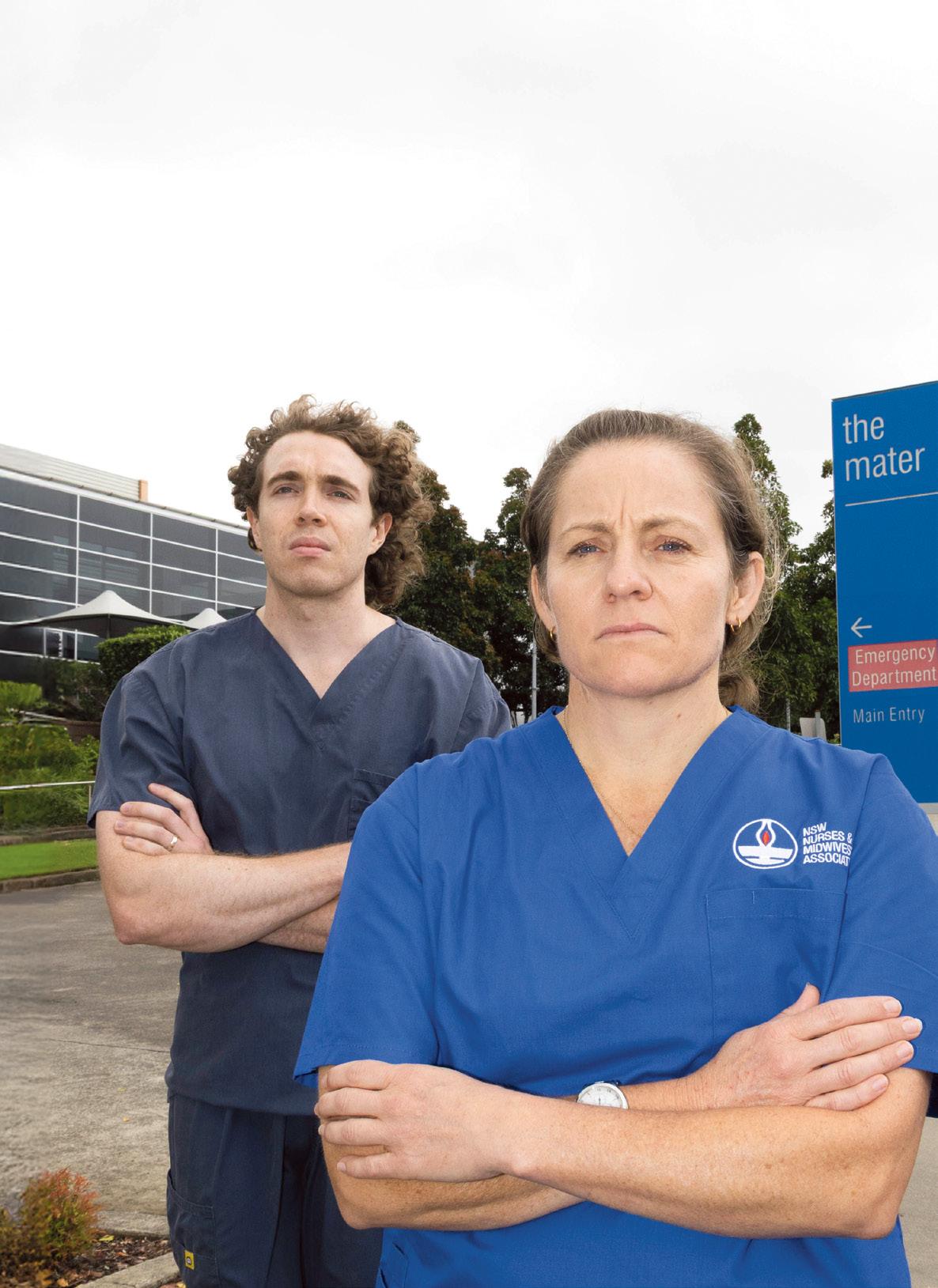
Mould, maggots and another failed PPP Action by the NSWNMA branch at Newcastle’s Calvary Mater Hospital has forced the government to intervene to fix dangerous maintenance issues – and prompted a parliamentary inquiry.
10 NEW DELEGATES
Welcome to our new workplace reps Elections for branch officials and delegates have been held across NSW.
14 PPP
Northern Beaches Hospital transitions to public ownership
Northern Beaches Hospital is due to move to public ownership on 29 April – an outcome the NSWNMA campaigned strongly for. The Association is working to ensure the transition does not unfairly disadvantage the nurses and midwives who have loyally served the Northern Beaches community.
16 PPP
NSWNMA backs overseas recruits
Internationally recruited staff at Northern Beaches Hospital get a lifeline after the Association asks for government intervention.
24 MARDI GRAS
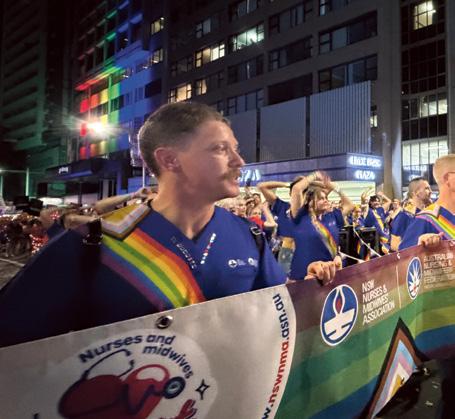
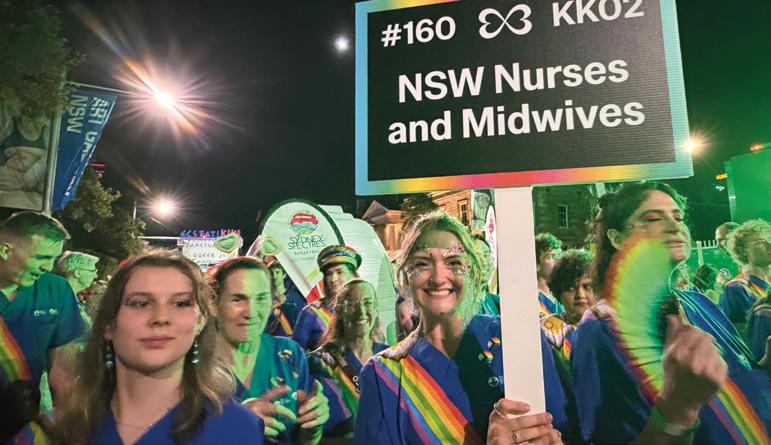
Nurses and midwives share love and care at Mardi Gras
An 80-strong contingent of nurses and midwives from across NSW donned scrubs with rainbow sashes under the theme ‘Nurses and Midwives: the Heart of our Community’.
Ask Katrina
Branch Beat
Education calendar
Professional Perspectives
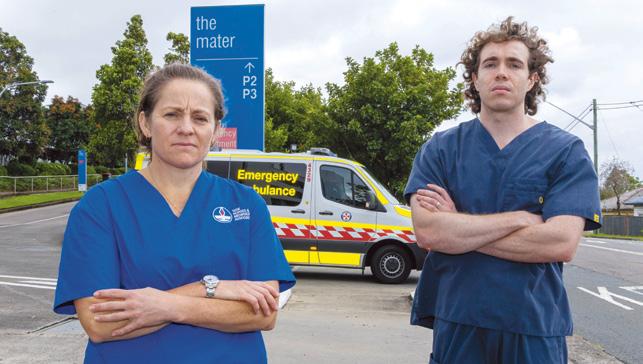
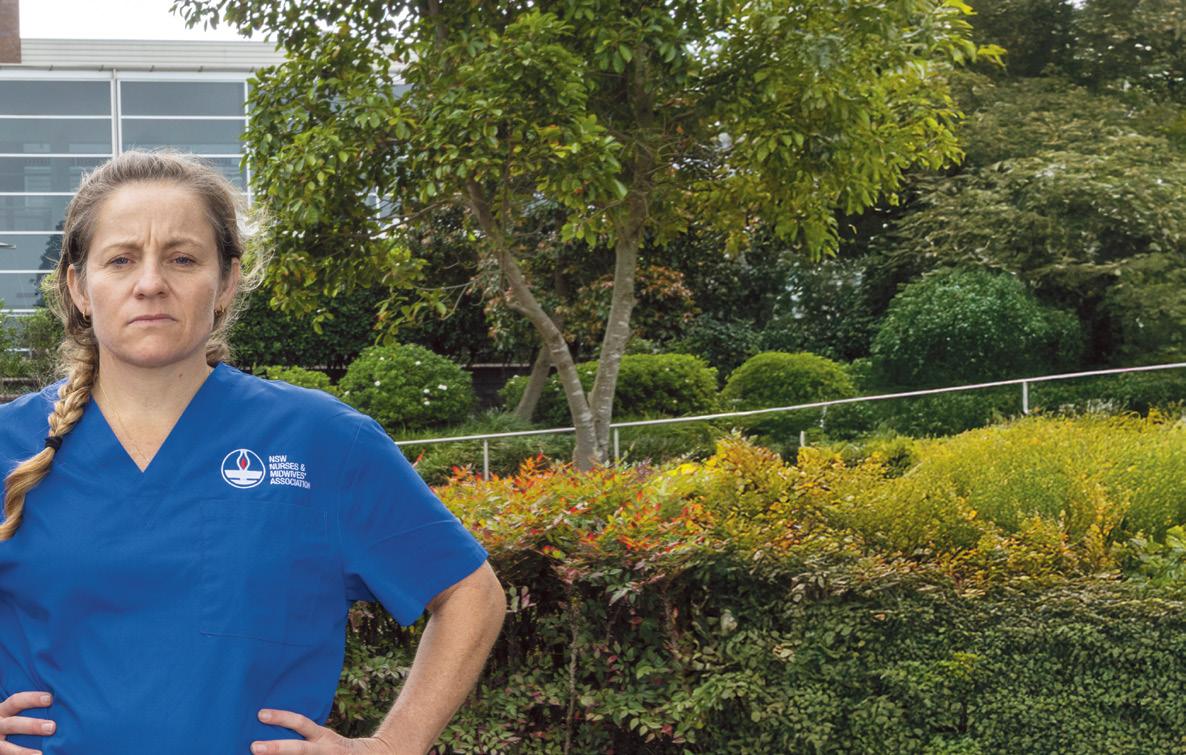
COVER : Damian Moore and Camilla Smith, Newcastle’s Calvary Mater Hospital Branch Photographed by Sharon Hickey
MICHAEL WHAITES
GENERAL SECRETARY
The power of the people is stronger than the people in power
Two of our most crucial core values – collectivism and courage – were on display as members made themselves heard – achieving significant wins in two major hospitals.
One of the great joys of this position is watching passionate members demand change for the greater good. Collective action is an intrinsic part of our DNA and seeing branch members coming together to spotlight maintenance issues at Newcastle’s Calvary Mater Hospital is a great example (see p6).
Calvary Mater in Newcastle is one of the state’s busiest cancer hospitals. Despite being a major public health hub for the region, nurses endured months of water leaks in wards, mould outbreaks in the ICU, and maggots falling from the ceiling. Deeply concerned not only by what was taking place but also by the refusal of management and the Novacare consortium responsible for maintenance and repairs to address the issues, the branch formally escalated concerns, citing risks to staff and immunocompromised patients.
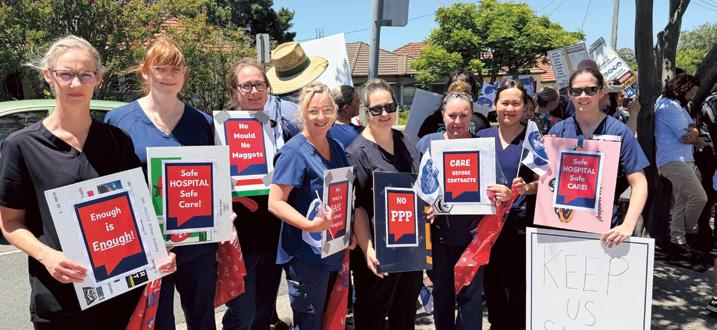
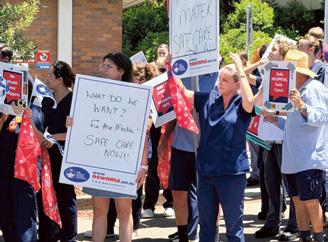
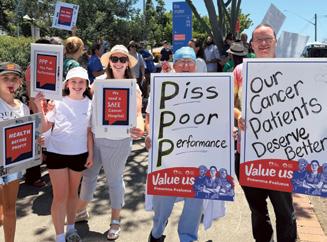
The branch passed resolutions demanding transparency, lodged a Section 81 safety process, and repeatedly pressed management and the Novacare consortium for answers. When maintenance delays persisted and accountability remained unclear, the branch organised a major rally in their own time that drew more than 100 staff. Spotlighting the issue gave our members a platform to connect directly with their local community, ensuring that patient and worker safety were at the forefront. Following this, the government promised to engage an independent contractor – separate from the public-private partnership
The failure of yet another PPP provides further proof that quality health care is compromised when profits are prioritised over patients.
– to manage building works. This action generated widespread media coverage and prompted the Minister for Health to intervene, fast tracking cladding replacement. Their advocacy also helped drive a parliamentary inquiry into PPP management and hospital maintenance failures.
This has been one of many recent examples where members have organised and used provisions of the Work Health & Safety Act to achieve change. Not for the first time, the courage of branch members established a safe channel for staff to speak up and pressured authorities to act. As a union, we will continue to campaign for system wide maintenance reforms across NSW hospitals.
ANOTHER PPP BITES THE DUST AS NBH GOES PUBLIC
The saga of the Northern Beaches Hospital will finally come to an end with the transfer to public hands scheduled for 29 April 2026 (see p14). While this is a welcome move, the failure of another PPP provides further proof that quality health care is compromised when profits are prioritised over patients. The Association campaigned strongly against the PPP when it was announced, and staff have shown incredible resilience and unity while navigating a turbulent time.
On the plus side, nurses and midwives will be covered by a generally more favourable public health system award, but the consequences of Healthscope’s collapse are not over yet. The union maintains that this transition must not unfairly disadvantage nurses and
midwives who have given many years of loyal service to the community, and who strongly support the provision of public health services.
We continue to assist with issues relating to tax, a dispute over cashing out excessive leave, and a potential reduction in annual leave for parttime workers.
NSWNMA OFFERS VISA HELP TO OVERSEAS RECRUITS
I am especially proud of how the NSWNMA has helped achieve a major win for overseas-recruited staff employed by Healthscope on shortterm visas (see page 16). The decision by the NSW Government to take over NBH immediately put at risk the visa status of approximately 80 internationally recruited nurses and midwives on Healthscope-sponsored “skills in demand” 482 visas. The Association engaged with Health Minister Ryan Park to ensure visa sponsorship was transferred to NSW Health and Northern Sydney Local Health District and later advised all NBH visa holders that NSW Health would take over management of their 482 visas.
WELCOME NEW WORKPLACE REPS
A big congratulations and welcome to our new branch officials and delegates following the conclusion of the Biennial General elections. These elections are essential to the democratic nature of our union and crucial in ensuring each workplace has a voice in the union’s direction (see p10). We can’t wait to see the incredible work you will do representing your branch over the next two years.n
Mould, maggots and another failed PPP
Action by the NSWNMA branch at Newcastle’s Calvary Mater Hospital has forced the government to intervene to fix dangerous maintenance issues –and prompted a parliamentary inquiry.
Water leaks, mould and maggots dropping through the ceiling forced Calvary Mater Hospital in Newcastle to close wards, repeatedly move patients and cancel surgery.
Nurses had to complete at least seven ward movements between December 24 and January 20.
A cancer ward was closed when mould was found in the air-conditioning system. Later, patients had to be moved from the haematology ward after maggots were discovered there.
In February, mould was again detected in several wards, including the ICU.
And a former electrical contractor at the hospital went on TV to reveal potentially fatal electrical wiring and a build-up of rat droppings in the ceiling.
Calvary Mater is one of the state’s
busiest cancer hospitals, with 215 beds and more than 1,300 staff.
It is a public hospital operated by Calvary Health Care, under a service agreement with Hunter New England Local Health District.
Building maintenance and repairs are the responsibility of the Novacare consortium under a public-private partnership (PPP) with the state government, which leases the campus from Calvary.
Frustrated by long delays in remediation work, the branch passed a resolution calling for transparent communication about remediation plans.
Branch officials said inadequate building maintenance and repairs had created an unsafe work environment that also posed grave risks to immunocompromised patients.
Members voted to hold a lunchtime rally to publicise their demand for urgent improvements.
MEDIA COVERAGE
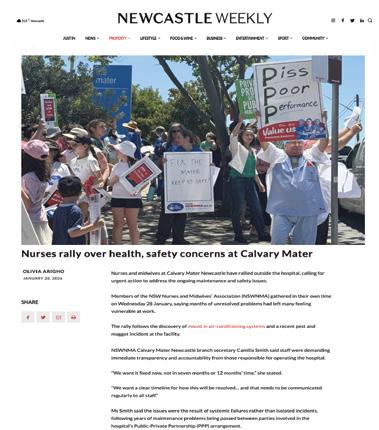
The rally got widespread media coverage, including local TV, a frontpage Newcastle Herald article, online coverage in The Newcastle Weekly, and more than 10 radio mentions.
Five days after nurses rallied outside the hospital, chanting “Ryan Park, where are you?”, the health minister announced the government was intervening in the protracted maintenance scandal.
Mr Park said the government would ensure that non-compliant cladding [which contributed to some water leaks in parts of the hospital] is replaced without further delay.
Hospital cancels chemo treatment due to ongoing leaks
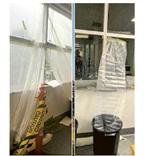
which a SafeWork NSW inspection last month seemingly missed. The leaks have been a persistent problem for years and in the past four months have become so bad that leaking windows are be ing patched up with plastic garbage bags and drained into bins Duringthe heavy rain on Monday,the hos pital had to cancel day treatments, includin chemotherapy and other infusions, due patient safety. One of the recovery ward bays is permanently closed due to the leaks, while the electrical panels near another must be regularly turned off Staff have labelled the tearoom "the Mater waterfall", due to the four plastic bags hanging from walls to funnel water into buckets. But when SafeWork inspected the site on April 11 no concerns were raised regarding the leaks, the garbage bag patching or the dangerous aspergillus mould outbreak in the hospital's air-conditioning system The watchdog was called to inspect the hospital regarding potential electrical issues
directly with a building contractor rather than waiting any longer for Novacare to act.
Novacare is a consortium of four companies – Honeywell, Westpac Bank, Medirest and Abigroup – to provide facilities management services.
SafeWork says no concerns were raised during the inspection regarding mould and refused to answer any questions regarding other issues including the leaks and electrical work "SafeWork NSW enquiries are ongoing. No further comment can be made at this time," a spokesperson said. Following the Newcastle Herald's inquiries last week SafeWork inspected the hospital's leaks on Monday NSW Nurses and Midwives (NSWNMA) Calvary Mater branch secretary Camilla Smith said the situation was "appalling" and "a constant battle". "This is getting worse and worse, yet they continue to make us work in this dangerous environment," Ms Smith said. "You walk in thinking what's today going to look like, if it's safe to come to work and if your patients That's the stuff on your mind every day."
Local Labor MP Sonia Hornery said NSW Health had issued a number of “notices of breach" to Novacare but the company was “not willing to do the necessary works, so the government has intervened”.
On 28 February, Mr Park announced site preparation for the cladding work had begun.
PARLIAMENTARY INQUIRY
Meanwhile, Opposition and Greens MPs moved to establish a parliamentary inquiry into management, maintenance and operational issues at Calvary Mater Newcastle.
Terms of reference include the effectiveness of the PPP model, including whether it has contributed to delays, disputes or failures in maintenance, asset management or service delivery.
Committee Chair, Greens MP Dr Amanda Cohn, said critical safety and maintenance issues were reported by staff “through the proper channels” as early as 2017.
“The purpose of this inquiry is to investigate systemic issues in this hospital, not to pore through isolated incidents,” she said.
“Where issues have occurred, it is never because cleaners and other staff are not hard working or diligent; it is always at the higher level of infrastructure management, which is where the interest is in this matter.”
Despite the recent inspection, Ms Smith "didn't leave the meeting [with SafeWork] thinking things were going to change". It's not the first time the NSWNMA has raised concerns about SafeWork. Last year the union slammed the effectiveness of the inspections in Auditor-General's review of the organisation. The Association is observing inspectors attend health premises where there are clear breaches of the WHS legislation without issuing an Improvement or Prohibition Notice," the submission stated In the past 12 months, SafeWork has received four complaints about the Mater, along with notification of two incidents The Mater is managed under a public-private partnership by a consortium called Novacare which is composed of four companies: Westpac Banking, Abigroup Honeywell and Medirest. Novacare subcontracted its hard facilities management to Honeywell, which did not answer the Herald's questions and has previously directed them to the state government. Hunter New England Health (HNEH), which provides in-patient and clinical services at the Mater, reiterated to the Herald that Novcare was responsible for the hospital's maintenance
Maintenance deficit plagues underfunded hospitals
“Patients have a right to be treated in environments that meet appropriate hygiene and safety standards. If the environment is not safe, the care cannot be safe.”
— NSWNMA General Secretary Michael Whaites
NSWNMA General Secretary Michael Whaites said the Association was deeply concerned about maintenance issues across the public hospital system.
“We are aware many of these issues are longstanding and indicative of systemic underfunding, neglect and maintenance backlogs rather than isolated incidents.”
He called for greater investment in the public healthcare system and said the NSWNMA will “continue to advocate for urgent, system wide action to address maintenance failures, strengthen inspection and reporting mechanisms and ensure hospitals meet their work health and safety obligations.”
“Patients have a right to be treated in environments that meet appropriate hygiene and safety standards. If the
and that includes properly maintained infrastructure.”
Michael was commenting on revelations that two people died and another four became seriously ill in an outbreak of fungal infections among patients at Royal Prince Alfred Hospital transplant unit in Camperdown.
A preliminary assessment found invasive fungal infection was a causative factor in the deaths of the two patients, The Sydney Morning Herald reported.
The Herald said environmental testing found widespread mould and water damage on at least four floors of the hospital.
Photos attached to the report showed visible mould growing inside plant rooms on levels 4 and 10 of the hospital. The survey also found mould in ceiling vents in the post-natal and staff areas.
The Herald added there were serious mould issues at Cumberland, Wyong, Ryde, and John Hunter hospitals.
Jamieson Murphy
“The branch provided a safe channel for staff to push for better conditions without risking their jobs.” — NSWNMA branch president Damian Moore
Partners dodged responsibility as safety concerns grew
Long-running maintenance issues at Newcastle’s Calvary Mater Hospital came to a head early last year when contractors began working on HVAC air-conditioning filters late at night without the usual work notifications, creating a sense of secrecy.
“We were kind of assured that it wasn’t a big issue,” said NSWNMA branch president Damian Moore. “We were told it was done in response to mould, but we weren’t told the extent of it. Or, where the mould was.”
Later, portable air filters appeared in hallways and every room.
Staff had more cause for concern when maggots started dropping through the ceiling of the haematology department nurses’ station.
“Patients and staff were left in the unit for days until maggots appeared in a clinical area and it was closed.”
The branch sought advice from NSWNMA officials who sent a work health and safety officer to help the branch.
The Association also took action under Section 81 of the Work Health and Safety Act , which requires parties to “make reasonable efforts to achieve a timely, final, and effective resolution”.
Damian said Section 81 meetings were held that brought together NSWNMA branch representatives and the work health and safety officer with NSW Health, Calvary Mater national office, SafeWork NSW, and Novacare consortium members responsible for maintenance and building works.
“However, Novacare were at times unable to answer questions our members wanted answers to.
“One issue we kept bringing up was the lack of maintenance of the portable air filters. We could see the filters were getting clogged with dust.
“We were reassured they were being serviced, but members told us they had never seen anyone working on them.
“Sometimes the filters malfunctioned and stopped working, and nurses were told that they needed to report that. So, the responsibility was put on the nurses to monitor the machines.”
After a number of ineffective Section 81 meetings, branch members decided to contact the media and MPs to apply external pressure and raise community awareness.
But before going public, the branch passed a resolution demanding to see confidential air quality test results.
“We want to have our hospital fixed. We want our staff to feel safe and our patients to feel safe.” — Branch secretary Camilla Smith
When management failed to produce the test results, the branch proceeded with media outreach and a public rally, which “massively increased” community awareness of the problems, Damian said.
Following the January rally, the government promised to engage an independent contractor – separate from the public-private partnership – to manage building works.
Cladding replacement was due to start in late March.
Damian said the complicated responsibility structure was a big obstacle.
“It was unclear who was ultimately accountable for maintenance – Calvary Mater, Novacare or subcontractors like Honeywell.
“Everyone was saying that they weren’t responsible, and the contractors argued they only had to maintain the building to the subpar standard that existed when they took over.”
Damian said collective action through the Association branch and persistent advocacy finally forced the government to act.
‘Patients and staff are being severely impacted by these failures’
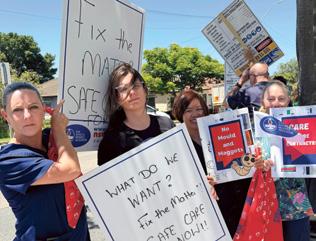
A NSWNMA rally outside Calvary Mater Newcastle Hospital got “fantastic support” with more than 100 nurses and other staff attending in their own time, said branch secretary Camilla Smith. She welcomed the attendance of local Labor MP Sonia Hornery and Greens MP (and former GP) Dr Amanda Cohn.
“We’re here today rallying because we’re sick of our hospital leaking. We want to have our hospital fixed. We want our staff to feel safe and our patients to feel safe,” Camilla said. “We also want clear communication and consultation with our members and all of our staff and workers, to know that these problems are going to be fixed and the timeframe that they’re going to be fixed in.”
She said the branch would continue to advocate for patients and staff “to ensure this situation never happens again and PPPs in public health are removed.”
Speaking later to The Newcastle Weekly, Camilla said the issues were the result of systemic failures rather than isolated incidents.
“The branch provided a safe channel for staff to push for better conditions without risking their jobs.
“This issue taught me how much we can actually achieve when we act as a collective. And also, how persistent you need to be.
“I knew things would be slow, but I’ve been surprised by how long it’s taken us to get to this point.”
In an interview with The Newcastle Weekly, Damian said staff morale had been affected, with many nurses feeling undervalued and stressed by the conditions.
“You do not sign up to be a nurse
They followed years of maintenance problems being passed between parties involved in the hospital’s public private partnership arrangement.
“This has been going on for a very long time and in the past 12 months it has become particularly problematic,” she said.
“Patients and staff are now being severely impacted by those failures.”
She said it took a formal Section 81 workplace safety process to bring all parties to the table, describing communication as slow and difficult.
“We should not have to go through SafeWork just to get basic answers,” she added.
“Nurses should be able to come to work, do their job and go home safely.”n
worrying about whether the building you work in is being properly maintained,” he said.
“We come here to care for people… and that requires a safe environment.”
Damian said the situation was particularly concerning given the hospital’s role as the region’s main cancer and haematology service.
“These patients are often immunocompromised and extremely vulnerable.
“If you are coming into a hospital, you should not be worrying about whether the building itself is putting you at risk.”n
Welcome to our new workplace reps
Elections for branch officials and delegates have been held across NSW.
The Association rules require elections for all branch positions and Aboriginal and Torres Strait Islander Member Circle positions every two years.
Active democratic branches allow members to have a voice in the
Association’s direction. Delegates represent their colleagues at statewide Committee of Delegates meetings and Annual Conference.
Branch officials are workplace-based representatives who act as the primary link between members and the
Rebeca Montesinos
Association. They play a critical role in enforcing industrial agreements, representing member interests and promoting union membership.
Meet some of our newly elected workplace representatives in the public, private and aged care sectors.
NSWNMA delegate at Opal Aged Care in Bathurst
Rebeca Montesinos knew nothing about unions when she migrated from Peru to Australia in 2023 at the age of 18.
Rebeca completed a six-month AiN (Assistant in Nursing) training course and worked at an Opal aged care facility in Sydney, where a relative suggested she join a union.
“My parents and I had absolutely no experience of unions. I chose the NSWNMA because it offered legal support and support for migrant workers,” she said.
‘Peoples’ experiences and perceptions of unions in other countries can affect their willingness to join unions in Australia.’ — Rebeca Montesinos
Rebeca moved to Bathurst on a scholarship to undertake a TAFE diploma course and got a job as an enrolled nurse at Opal Aged Care’s 156-bed Bathurst facility.
It was in Bathurst that she received a NSWNMA email seeking members for the Association’s new Culturally and Linguistically Diverse (CaLD) sub-committee.
The sub-committee’s roles include championing issues affecting CaLD nurses and midwives, helping to develop and review NSWNMA policies and serving as a link between the Association and CaLD members.
She applied and was invited to attend the group’s inaugural meeting in Sydney, with about 20 attendees from diverse backgrounds and sectors.
Rebeca said the group aims to encourage people from diverse backgrounds to join the Association and apply for branch roles.
“People’s experiences and perceptions of unions in other countries can affect their willingness to join unions in Australia,” she said.
“In some countries, union membership can be very dangerous or culturally unfamiliar.”
As a newly elected delegate, Rebeca is learning the role with support from Opal Bathurst branch officials and intends to pursue union training.
Rebeca said she aims to ensure everyone feels comfortable in raising workplace and industrial issues and seeks to improve communication between NSWNMA members and management.
“I think my workplace environment is pretty good; everyone helps each other,” she said
“Regarding my delegate role, I have just started and feel very honoured to hold the position. But to be honest, I still have things to learn.”n
Roslyn Ost
NSWNMA delegate at Maclean District Hospital
RN Ros Ost, a newly elected branch delegate at Maclean District Hospital, was working as an endorsed enrolled nurse (EEN) at Gatton Hospital in rural Queensland when she first learned the value of taking action as a union member.
Ros had joined the Queensland Nurses and Midwives Union but had not been an active member.
The catalyst was a policy change after Gatton Hospital moved under the West Moreton Health Service, which did not allow EENs to administer IV antibiotics – a task they were competent in and had previously performed under the Darling Downs Health Service.
“I made my first contact with the union hoping that it would help us nurses to change the policy,” Ros said. “I went to the union head office in Brisbane because we did not have an active branch at Gatton at that time.”
Though a relatively new EEN, Ros made the initial approach to the union because her EEN colleagues “didn’t really want to step on management toes.”
The union guided her on how to lobby the health service, which then updated its policy and permitted EENs to administer IV antibiotics.
“We were finally able to use our skills for the tasks we were qualified to perform – and we also eased the workload on RNs,” Ros said.
“That experience showed me that the union could be a powerful tool for creating change.”
Ros graduated as an RN in 2018 and moved to Maclean “for a change of scenery” a year later.
Encouraged by her union experience in Queensland, Ros volunteered to become a ward steward for the NSWNMA’s Clarence Valley branch, which covers Maclean and Grafton hospitals.
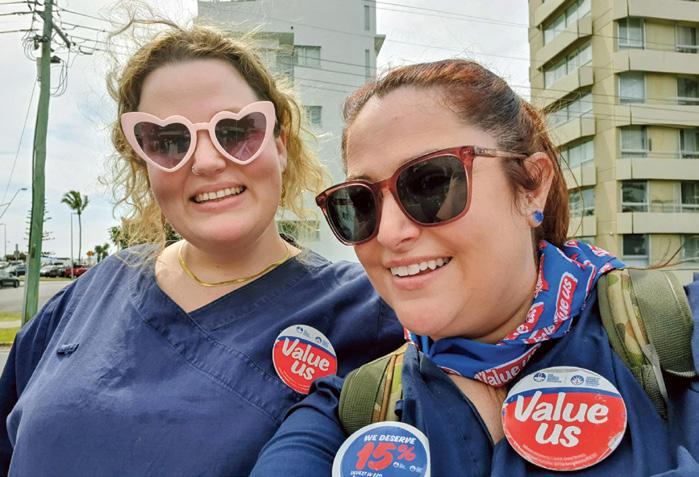
She was active in the NSWNMA’s “Value Us" campaign in 2024–25 which saw a big increase in the number of nurses taking industrial action.
“At our first rally there was only me and one other nurse from Maclean in attendance. By the third rally, our ward had to get managers from other areas to come and do ward work because so many nurses took part in industrial action.
“It was really inspiring to see so many people prepared to do their part at the rally or engage with our community at a stall in the main street of Maclean or at Grafton Shopping World.”
As a steward, Ros has repeatedly raised critical understaffing issues with management, with support and advice from her branch president, Darren Demery, and branch secretary Paula Duffy. “We managed to get patient beds capped twice (from 33 to 24, and later to 27) to align with safer staffing levels,” she said.
‘It was really inspiring to see so many people prepared to do their part at the rally or engage with our community.’
— Roslyn Ost (right)
Faced with 60 unfilled shifts recently, she worked to arrange for an urgent Reasonable Workload Committee meeting to seek solutions.
Ros said achieving safer staffing and maintaining a round-the-clock security presence at the hospital are among her main goals as a NSWNMA delegate.
“We successfully campaigned for and achieved dedicated security guards at Grafton ED and 24-hour security for the whole hospital at Maclean – an upgrade from the previous 11pm cutoff.
“We are monitoring the deployment of guards to make sure an adequate level of security is maintained in ED.
“Staff retention will be another focus of my work. We have a lot of agency nurses at Maclean and we need to increase the number of permanent staff.”
In recognition of her work as a steward, Ros was invited to attend the NSWNMA’s 2025 Annual Conference.
“I was really impressed; I heard and met so many inspiring people and got a better sense of being part of a large and strong organisation. It reinforced my understanding that we have such a strong voice if we all stick together.”n
Rachele Griffin
Delegate and Secretary of the NSWNMA branch at Nepean Hospital
RN Rachele Griffin began her nursing career after completing a Bachelor of Health Sciences followed by a Master of Nursing in 2016. Nursing was a pragmatic choice to secure employment after university, not her intended career.
“I thought nursing would at least guarantee me a job. It turned out I really enjoyed it,” she said.
Rachele has worked at Nepean Hospital since graduation. She rotated through medical imaging and the surgical short-stay unit before securing a position in intensive care, which she had enjoyed during her student placement. She’s been in ICU ever since.
Rachele joined the NSWNMA at the start of her career. Her father, a carpenter, was a union member and workplace delegate. “He encouraged me to value those principles,” she said.
Two years ago, she agreed to become a NSWNMA alternate delegate, feeling compelled to step up because her large branch (about 1,650 members) was struggling to find enough volunteers to fill branch positions.
Rachele attributes the shortage of members willing to step into branch roles to several factors.
“These are volunteer unpaid positions, which involve extra work. Also, a lot of nurses don’t actually understand what the Association does or how they can be part of it. They just want the pay rise that comes from union activity.
“A lot of nurses don’t like to rock the boat. They don’t want to be singled out, and they don’t like to challenge the status quo.”
‘A lot of nurses don’t like to rock the boat. They don’t want to be singled out, and they don’t like to challenge the status quo.’— Rachele Griffin
TURNING POINT
For Rachele the Association’s “Value Us” campaign in 2024–25 was a turning point.
“I did a fair bit of work to get more ICU staff on board for those strikes,” she said.
“In previous years, we would usually get one or two people on strike from a unit of 135 nurses. But on one of the “Value Us” action days I was proud to be one of 18 ICU nurses on strike.
“That came from talking to people and explaining the process we were going through to try to secure better pay and conditions.
“I emphasised the power in standing together and not letting one or two people potentially be singled out by management for going on strike.
“That campaign was really empowering. Nurses are crying out for a better deal and there was massive energy during those strike days.”
In the run-up to the recent NSWNMA biennial elections, the branch president asked Rachele to consider standing for election as branch delegate and secretary, as the incumbent was stepping down. She was elected to both positions unopposed.
One of her main goals is to encourage a new generation of younger nurses to take on NSWNMA branch roles from an older generation nearing retirement.
She also identifies a need for more Association stewards at the ward level to promote union activity directly with colleagues, which she believes is more effective than other forms of communication.
“Of course, the Association should send out emails and texts, but it’s not the same as having a colleague come to you and say, hey, have you thought about this? What’s your take on this?
“And then having a conversation to clear up some myths that they believed or some fears that they had around industrial action.”n
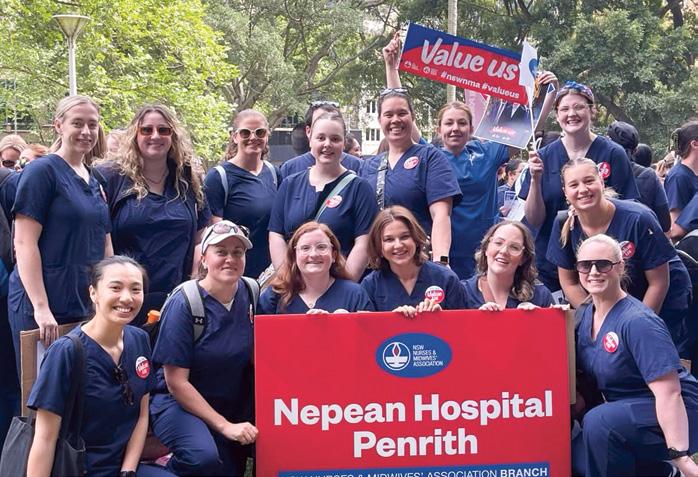
Rachele (middle back, with Value Us sign) with Nepean Hospital branch members
Fleur De La Haye
President of the Newcastle Endoscopy Centre NSWNMA branch
Newcastle Endoscopy Centre nurses have formed their first-ever branch of the NSWNMA.
Anger over low pay and outdated conditions under a lingering 2013 agreement was the catalyst for the move.
Led by Secretary Sally Todd and President Fleur De La Haye, the branch has mobilised previously inactive Association members, initiated bargaining with Cura, the centre’s owner, and submitted a log of claims.
Staff morale and cohesion have improved, with a focus on better pay,
back pay, safer staffing and the current high volume of non-nursing duties.
Fleur said inadequate wage increases and poor staffing were the main causes of dissatisfaction.
A 1.5% pay rise in January 2025 felt like “a kick in the teeth” that led to her and Sally Todd deciding to join the NSWNMA.
“We had lots of chats about pay and conditions, and decided, let’s do this. We joined the Association, rallied the existing members and recruited new members.
Staff have been left on a substandard 2013 “Greenfields” enterprise agreement far beyond its typical 12-month life, enabling the employer to hold wages well below local market rates.
Fleur said that as of 1 March 2026, Year 8 RNs at a nearby Ramsay hospital were paid $56.52/hour while Newcastle Endoscopy Centre Year 8 RNs receive $49.59/hour.
Newcastle Endoscopy Centre uses one procedure nurse per room, compared to the standard practice of two procedure nurses elsewhere.
‘Now that we have a branch, there is a lot more fire in people’s bellies.’
— Fleur De La Haye
Their initial contact with the NSWNMA led to a workplace visit by an Association organiser and the formation
The centre currently employs 34 nurses and Fleur said she was surprised to discover that many had already joined the NSWNMA. About two-thirds of the nursing staff are now members.
“A lot of members were inactive, possibly due to passivity and management assurances that negotiations were underway,” she said.
One of their first tasks was to encourage members to nominate for executive positions at the recent branch general meeting.
“We explained to people that if we want this branch to go forward, we need these positions filled.”
Fleur said the meeting focused on the need for a pay and staffing campaign.
Members are also seeking a reduction in the current high volume of nonnursing duties. “We are nurses – not cleaners or tea ladies,” Fleur said.
She said Cura had not made a move to substantially improve pay and staffing levels, but that they now have the opportunity in bargaining to invest in nurses’ pay and safe staffing.
“From a short-term profit perspective, it is advantageous to have a theatre operate with one nurse, and a low paid one at that.
“However, we believe that nurses are the business. Invest in us, and the benefits flow to the business in so many ways.”
The formation of a NSWNMA branch has given the nurses on-the-ground leverage and a communication structure, converting frustration into coordinated bargaining power and launching enterprise negotiations with a clear log of claims.
“Now that we have a branch, there is a lot more passion for the cause among the nursing staff.” she said.
“We know that our situation is wrong, and we’re going to make it right.
NSWNMA officers and branch executive members have held an introductory meeting with Cura representatives with further bargaining meetings planned. n
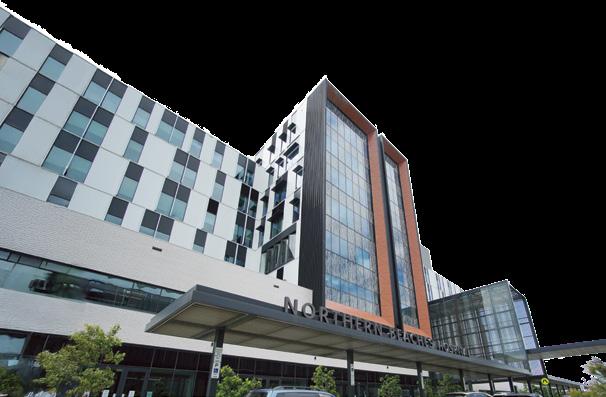
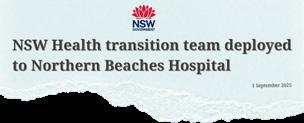
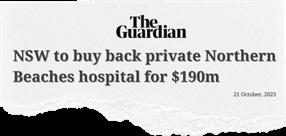
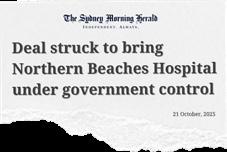
Northern Beaches Hospital transitions to public ownership
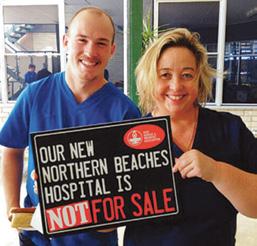
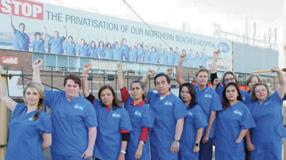
Northern Beaches Hospital is due to move to public ownership on 29 April – an outcome the NSWNMA campaigned strongly for. The Association is working to ensure the transition does not unfairly disadvantage the nurses and midwives who have loyally served the Northern Beaches community and strongly support the government takeover.
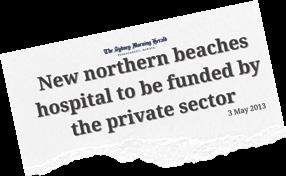
Transfer of the 494-bed Northern Beaches Hospital (NBH) from a failed publicprivate partnership under Healthscope to the public system brings both significant wins and complex challenges.
On the plus side, nurses and midwives will be covered by a generally more favourable public health system award and the NSWNMA helped achieve a major win for overseas-recruited staff employed by Healthscope on shortterm visas (see story page 16).
Meanwhile, the Association is trying to resolve issues relating to tax, a dispute over cashing out excessive
leave, and a potential reduction in annual leave for certain workers.
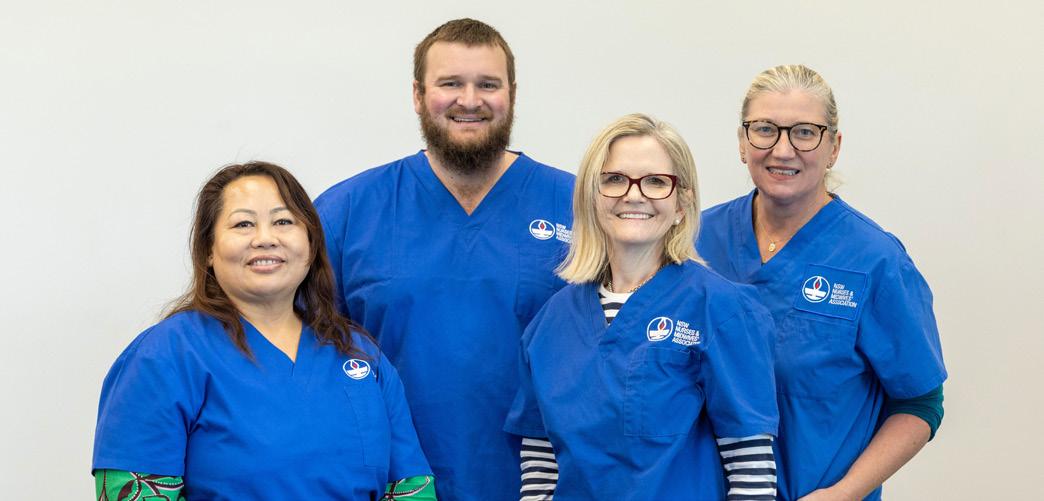
“These issues are causing a lot of anxiety among nurses and midwives,” said Sheridan Brady, president of the NSWNMA branch at Northern Beaches and a member of the Association’s Council.
The NSWNMA wrote to Health Minister Ryan Park seeking support to fix the problems.
The tax issue arises because many members have unusually large annual leave balances as a result of the Association’s win in an 18-month battle over Healthscope’s incorrect leave calculations in the Fair Work Commission.
Under the commission decision, Healthscope was forced to review the accrual and payment of annual leave entitlements for all current and former nurses and midwives, from Jan 2012 to May 2025.
Some workers had more than 400 hours of accrued annual leave restored to them.
Due to a loophole in the Fair Work Act , when an employee transfers annual leave from a private business to a government agency it is treated as income for tax purposes.
Employees will therefore be viewed by the Australian Tax Office as having significantly higher incomes, without actually receiving additional income.
In the letter to Ryan Park, the NSWNMA said employees not only faced unfairly high tax bills but “it also has the potential to have a significant impact on Centrelink payments, the repayment rates of Higher Education Loan Program debts, child support payment rates and family tax benefit.
“We understand that this is an issue that can be raised with the Australian Tax Office, and a ruling sought to ensure employees transferring their leave are not negatively impacted.
“We seek the government’s advocacy to ensure this issue is remedied prior to the transfer of leave entitlements.”
Sheridan Brady said that in order to avoid these problems, some nurses and midwives sought to have part of their leave paid out before the April transition date – in line with the Healthscope enterprise agreement which allows staff to cash out excessive leave by agreement.
“However, staff were advised that we could cash out all of our leave, or none of it,” Sheridan said.
“Therefore, we have gone back to the Fair Work Commission to try to get a ruling to allow a partial payout as per our EBA.
“We are seeking to have some of our leave paid out and some transferred. In the interest of fatigue management, we don’t want to transfer across with no leave.
“There is a lot of stress around these issues and we are trying to avoid a big tax bill for members.
“There is a lot of stress around these issues and we are trying to avoid a big tax bill for members.” — President of the Northern Beaches NSWNMA branch, Sheridan Brady
“We are also trying to minimise the potential impact in other areas, such as single parents losing child support, larger repayments due on HECS debts, increased Medicare levy and reduced government rebates for private health insurance.
“Transferring large leave balances from Healthscope would also hurt NSW Health through accrued liabilities and workforce availability, due to its strict excess leave policies.”
In the letter to Mr Park, the NSWNMA also raised a looming reduction in annual leave for parttime shift workers.
Employees who are part-time, but are classified as shift workers under the Healthscope enterprise agreement, get a minimum of five weeks of annual leave (pro rata). Under the Public Health System Nurses and Midwives’ (State) Award this leave entitlement is only four weeks.
“This means that part-time shift work employees who transition from Healthscope to NSW Health will accrue less annual leave after the transition occurs.
“It is difficult to reconcile a clear reduction in conditions of employment with the government’s goal of ensuring employees are treated fairly during a process over which they have little
control … We ask that this decision be reversed, and that transitioning employees be advised that they may continue to accrue annual leave at the higher rate.”
Sheridan said Mr Park promised that Northern Beaches staff would be no worse off by moving to the public system, and “the branch aims to hold him to this commitment.”
She pointed out that many NBH nurses and midwives were previously public employees at Manly and Mona Vale hospitals before the government closed Manly and downgraded Mona Vale.
The new NBH operated by Healthscope under the public private partnership model was the replacement acute hospital.
After NBH opened in 2018, Healthscope was bought by Brookfield – a New York-based asset and private equity fund manager –in 2019.
Brookfield then sold the land under Healthscope hospitals which gave Brookfield a cash injection but forced Healthscope hospitals to pay land rent.
Healthscope collapsed into receivership in 2025 owing $1.6 billion, which forced NSW Health to take over NBH. n
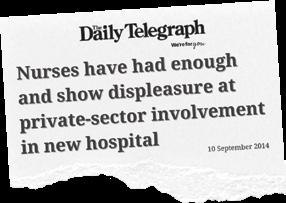
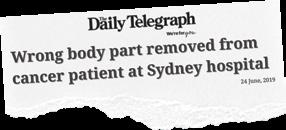
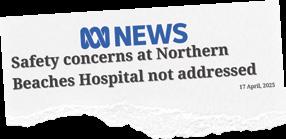
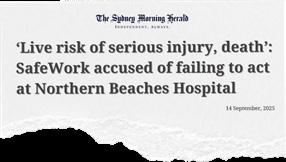
The new hospital opened. But it didn’t take long for our worst fears to be realised...
NSWNMA backs overseas recruits
Internationally recruited staff at Northern Beaches Hospital get a lifeline after the Association asks for government intervention.
Advocacy by the NSWNMA has helped to secure offers of permanent residency and other visa support for about 80 internationally recruited nurses and midwives at Northern Beaches Hospital (NBH).
The visa status of these NSWNMA members was put in doubt by the state government’s decision to take over NBH from Healthscope.
They have been working on Healthscope-sponsored temporary visas known as skills in demand 482 visas.
Healthscope’s sponsorship typically came with guarantees to support permanent residency in Australia.
The NSWNMA asked Health Minister Ryan Park for help to ensure visa sponsorship is transferred to NSW Health, with offers of permanent residency where appropriate.
Northern Sydney Local Health District later advised all NBH visa holders that NSW Health would take over management of their 482 visas.
It would also “support eligible employees to obtain permanent residency, so you and your families can build a stable future in Australia.”
A letter from the LHD said, “We want you to stay. Your skills, compassion and dedication – especially as nurses and frontline healthcare professionals – are deeply appreciated.”
The LHD described visa holders as “an essential part of our workforce”, adding: “Please know that supporting you through this transition is a priority for us. We are committed to working closely with you to ensure continuity of your employment and your immigration pathway.”
“Thank you for the incredible work you do each day, and for the heart you bring to our patients and our community. We are grateful to have you with us and look forward to supporting your continued journey here in New South Wales.”
The LHD said it had engaged an immigration lawyer “to ensure a seamless process”.
NSWNMA branch president at NBH, Sheridan Brady, said the offer was “a big win” for members with work visas.
“There were about 80 members whose futures were in doubt. So, the announcement by the LHD was something really positive.” — President of the Northern Beaches NSWNMA branch, Sheridan Brady
“There were about 80 members whose futures were in doubt, so, the announcement by the LHD was something really positive,” she said.
The Association is continuing to advocate for about a quarter of the internationally recruited nurses and midwives whose temporary visas are due to expire soon.
In a letter to Immigration Minister Tony Burke, the NSWNMA asked for help – including with bridging visas – to ensure these employees can lawfully continue working for the hospital under Northern Sydney LHD. The 482 visa typically allows the holder to work in Australia for up to four years.
It also provides what the Department of Home Affairs calls “a clear pathway to permanent residency, offering greater certainty for both migrants and sponsoring employers.”
However, Healthscope employed some nurses on 12-month 482 visas with an offer to support their permanent residency applications after a six-month probationary period.n
Jocelyn seeks stability in NBH transfer
Filipino ICU nurse Jocelyn Carpio accepted a position with Healthscope at NBH based on information that the role could provide a potential pathway toward permanent residency after a six-month probationary period.
Jocelyn’s English test results have since expired and she has been advised that she needs to sit a new English exam before her current employment with Healthscope ends on 30 April.
A NSWNMA member, Jocelyn said she understands that if she achieves the required points and meets the eligibility criteria, “NBH would be supportive of recommending me for a Subclass 190 permanent residency application”.
“My priority is to maintain a stable visa that allows me to continue working and supporting my family.”
— Jocelyn Carpio
Jocelyn has extensive international nursing experience, including 13 years working in Singapore followed by two years in Ireland, where she was also progressing toward permanent residency.
She said she chose to accept the NBH position rather than remain in Ireland because it offered an opportunity to continue her nursing career in Australia and potentially pursue permanent residency.
Australia is geographically closer to the Philippines, which would allow her to remain closer to family.
Jocelyn said the NBH NSWNMA branch has kept her informed about the transition from Healthscope to NSW Health and developments affecting her visa situation.
“I have two children attending school in Sydney and, if I cannot currently achieve the required points for permanent residency, I will explore options to extend my visa so I can continue working in Australia,” she said.
“My priority is to maintain a stable visa that allows me to continue working and supporting my family.
“Having stability would also allow me time to prepare. n
The Immigration Advice and Rights Centre (IARC) provide free, high-quality and confidential immigration and citizenship advice to NSWNMA members and your families on all immigration and citizenship matters, including:
Skilled visas
Permanent residency
Visa refusals and cancellations
Student and graduate visas
Family visas
Protection, refugee & humanitarian visas
Australian citizenship
Remember, you must be an NSWNMA member to access this service – make sure you join to access Visa Assist straight away!
INSURANCE PROTECTION when you need it most
The NSWNMA is committed to protecting the interests of nurses and midwives by purchasing a range of insurances to cover members.
Journey Accident Insurance
provides cover for members who are injured as a result of an accident while travelling between their home and their regular place of employment.
Professional Indemnity Insurance*
provides legal representation and protection for members when required. Make sure your membership remains financial at all times in order to access the insurance and other benefits provided by the NSWNMA.
Ring and check today on 8595 1234 (metro) or 1300 367 962 (rural)
Change your payment information online at www.nswnma.asn.au
Jack Everitt Fullerton
1 July 1990 – January 2026
In loving memory of Jack Fullerton, a much-loved son, brother and friend, known for his kindness, humour and strength.
Jack began his career as a nurse at St Vincent’s Hospital in ICU during the COVID-19 years and then in operating theatres at St Vincent’s Private Hospital (SVPH). Within a short time, he stepped up into the role of department representative for the Day Surgery unit, and then as President for the Branch.
“He was a natural. Jack immediately understood the role and the value of collective action when faced with employment challenges,” said Kate Westwood, St Vincent’s Private Branch Secretary.
“Jack was often seen in the staff tearoom during his break pouring over a collection of payslips: going through them and explaining to a colleague their pay, penalties and allowances.
“Jack immediately understood the role, the value of collective action when faced with employment challenges” – St Vincent’s Private Branch Secretary Kate Westwood
“His advocacy skills were invaluable when SVPH introduced changes to the hours of work and rosters in surgical services. Jack collaborated with his colleagues –summarising the issues, attending meetings with management – and he sought resolution. We all understand this can be an unnerving time, but Jack remained a steady force who demonstrated open and honest communication with management.”
Jack started working for the NSW Nurses and Midwives’ Association in September 2025, as a Nurse Midwife Advocate. Not long after, he picked up on an issue during a rostering consultation process with an employer that uncovered years of
unpaid entitlements for members. This was just one of many great Jack legacies.
Jack made a difference – to his family, colleagues and members –and his advocacy and humanity will live on in the lives he touched. n
Photo: Jack (middle) with Kate Westwood (second from right) and St Vincent’s Private Hospital branch delegates.
Ask Katrina
Supplementing unpaid parental leave
In the public health system, can annual leave be taken to supplement unpaid parental leave?
Yes, a request to take annual leave to supplement unpaid parental leave should be supported by your employer, although there are limits to the total leave period that can be taken.
Clause 5.9 of the Leave Matters Policy Directive PD2023_045 provides:
“An employee may take any accrued annual leave or long service leave (or any part of it) or accrued ADOs to supplement their unpaid parental leave. The total period of leave cannot be extended beyond 24 months from the date of birth or adoption of the child (or the commencement of parental leave if taken by the birth parent prior to Annual leave can only be taken at half pay when it is combined with a period of half pay parental leave to enable the employee to remain on full pay for that period.
Annual leave cannot be taken at half pay in any other circumstance. It should be noted that half pay annual leave to supplement parental leave only attracts pro-rata leave loading, not penalties”.
If your employer denies a request to take annual leave to supplement your unpaid parental leave, contact the NSWNMA information team for further advice.
Redundancy notice entitlements
I work in a NSW public hospital and I have just been made redundant. How much notice should my employer be giving me?
How much notice your employer should give you will depend on your length of service and your age. If you work in a NSW public hospital, the minimum notice you can be paid is 14 days as per clause 45(i) of the
When it comes to your rights and entitlements at work, NSWNMA Assistant General Secretary Katrina Bough has the answers.
Public Health System Nurses and Midwives’ (State Award 2023)
However, you may be entitled to a greater notice period depending on your length of continuous service. If your length of continuous service is more than 3 years but not more than 5 years, the minimum notice period is 3 weeks. If you have more than 5 years of continuous service, then the minimum notice period will be 4 weeks as per section 117 of the Fair Work Act 2009 (Cth). If you are over the age of 45 and have completed at least 2 years of continuous service, you should also receive an additional week of notice.
Finally, although it is rare, your contract may specify a greater notice period. You should check your contract in case it provides for a more beneficial entitlement.
Where your role has been made redundant, you will also likely have other entitlements in addition to notice. To confirm that you are receiving all your correct redundancy entitlements, please contact your branch or our information team for advice.
Employment status with multiple assignments
I work in a public hospital as an Enrolled Nurse. I work in two different units and have separate contracts for each role. This has been described to me as having multiple assignments. My hours add up to full time, am I considered a part time or fulltime employee?
Under clause 4A of the Public Health System Nurses and Midwives’ (State) Award 2023 , if you have two or more assignments under the Award within the same facility or Local Health District, then the work you perform in each will be aggregated for the purposes of determining your entitlements. In short, if your hours add up to full time, you should receive all the benefits under the
Award applicable to a full-time employee. This includes annual leave entitlements and accrued days off.
The LHD should ensure that each of your supervisors are aware of your other assignment and the requirement to aggregate the hours worked. This is essential to ensure that each is aware of the consequences of allocating you additional shifts, i.e. overtime, break between shifts, possible fatigue issues and so on.
Using personal devices for work
I occasionally use my own personal mobile phone for work purposes, such as accessing my team’s MS Teams chat group and for multifactor verification purposes to access work websites. Can I be reimbursed for these costs?
If you use your own personal mobile device for work purposes, we recommend you review the Australian Tax Office website www.ato.gov.au for information on what tax deductions you may eligible for. These may include mobile phone calls, data expenses, the cost of the device itself and for meeting any evidence or record keeping obligations. Not necessarily all costs will be covered, particularly if the device is also used for other non-work-related purposes. You should also check if your employer has a ‘Bring Your Own Device’ policy or whether a work-issued mobile phone could be provided.
Procedural fairness in workplace meetings
I am an Assistant in Nursing working in an aged care facility. I have received a letter from the Facility Manager requesting that I attend a meeting with her and the Manager of People and Culture. The meeting is apparently to answer questions about a complaint from a resident’s daughter that was
made some months ago. I have no idea what it is about, and I am worried that I will be ambushed at this meeting. Can they do this?
Employees who are the subject of disciplinary processes in the workplace should be afforded procedural fairness.
In your circumstances, this means that your employer should clearly inform you of the purpose of the meeting and if there are allegations against you, the employer should provide you with the details of those allegations in writing ahead of the meeting. Sufficient details and time should be provided to allow you to properly prepare and provide a response.
You should also be given the
opportunity to seek advice from your Association and arrange for a support person to attend the meeting with you. Please contact NSWNMA for further advice and representation.
Parental leave under the nurses award
I am currently employed in the private sector under the Nurses Award 2020. What are my parental leave entitlements from my employer?
Clause 24 of the Nurses Award refers to the parental leave entitlements set out in the Fair Work Act. In short, your entitlement to parental leave is up to 12 months of unpaid parental leave. You can also request up to a further 12 months of leave. Eligibility
is limited to those who have worked for their employer for at least 12 months before the date or expected date of birth, adoption or having taken responsibility for the care of a child. This is the minimum parental leave entitlement in Australia. NSWNMA may be able to negotiate better entitlements in an enterprise agreement with your employer, if there are enough organised union members in your workplace.
Appropriate use of email
Generally, should email be used by clinicians as a means of therapeutic communication with patients?
You should check and follow the local policies and procedures at your workplace in relation to email communication. Emails are generally only used to facilitate administrative information exchange, rather than as a means of therapeutic communication with patients. If clinical communication to patients using a work email address does occur, there should be safeguards in place to ensure that any urgent matters are directed elsewhere if the clinician is on leave or outside their working hours and there’s a process for any clinically relevant information to be transferred from email to the person’s health care record (eMR) so information is not lost.n
Branch Beat
Branch Beat with NSWNMA General Secretary
Michael Whaites
‘I wanted
to explain to members why we were having this BGM – explain the democratic process of nominations and elections of branch officials.’ — Alison Brannelly
Elected officials of NSWNMA branches in the public health system are now entitled to paid time to conduct union activity in the workplace.
The Association negotiated a new Public Health System Nurses and Midwives Award entitlement called Union Delegate Activity Time (UDAT) which came into effect from the first published roster on or after 1 November 2025.
This is a big win, achieved through the work of members and Delegates across the state. The entitlement is the first of its kind in NSW Health and will provide officials additional time during work hours to undertake their work and build our union’s power.
It gives elected branch delegates, secretaries and presidents eight hours of paid work time every eight weeks for undertaking branch business, including talking to branch members and potential members in the workplace.
Introduction of UDAT leave is a positive development that will help branch officials to engage with members and manage branch activities, while being paid.
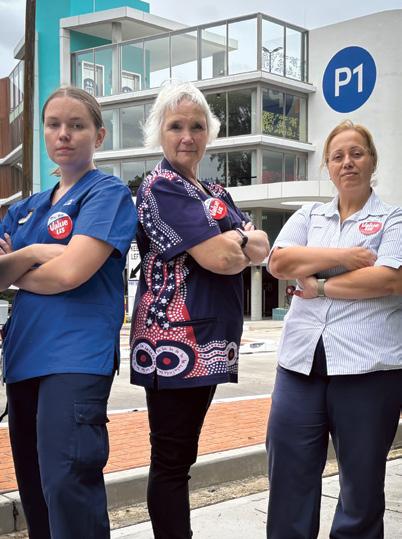
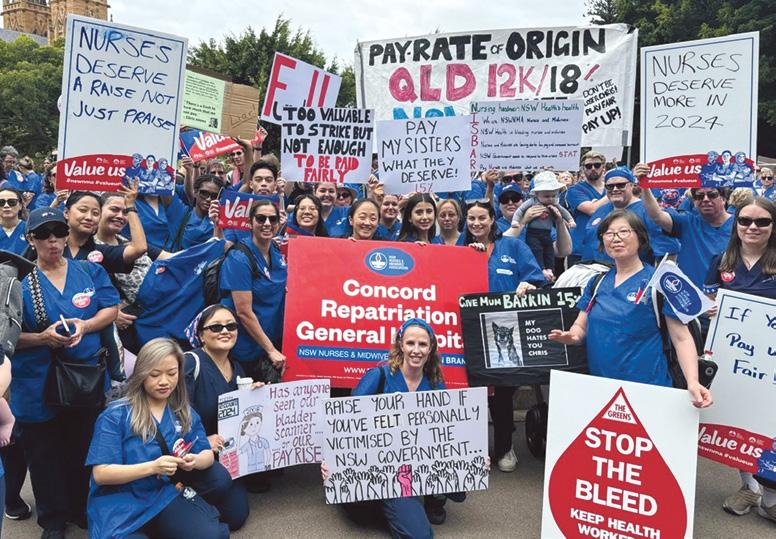
The NSWNMA branch at Concord Repatriation General Hospital in Sydney Local Health District was among the first to take advantage of UDAT, in February this year.
The branch hopes UDAT will encourage more member involvement and make executive roles within the branch more sustainable and valued.
Branch officials now paid for some of their time
Concord Hospital branch has almost 1,000 members out of the approximately 1,250-strong nursing workforce at the hospital.
Branch secretary Alison Brannelly is one of four elected officials along with president Rebecca Phair, vice president Joanne Kawtal and assistant secretary Mitzi Plaza.
USING UDAT LEAVE TO SUPPORT UNION DEMOCRACY
Alison used Union Delegate Activity Time (UDAT) leave to organise and raise awareness of the branch’s recent Biennial General Meeting (BGM).
She took eight hours UDAT leave on a single day to minimise staffing disruption.
“For me, it was easiest to take the leave and do the rounds all in one day. Other branch officials might choose to take a couple of hours off at the end of their shift and
another two hours off the following week, for example.
“It really depends on your shift patterns and what’s feasible for you personally.”
Before the introduction of UDAT, Alison and other branch officials would do branch related activities in their own time, which left fewer opportunities for conversations with members, and potential members.
UDAT leave gave her more time for deeper engagement and to listen to members’ concerns.
She used the time to visit every ward, speaking face-to-face with members to explain the Association’s democratic processes and answer questions.
“I wanted to explain to members why we were having this BGM –explain the democratic process of nominations and elections of branch officials,” Alison said.
“A lot of members don’t understand how the democratic process within the Association works – the nomination and election of branch officials, and the role of the returning officer at the BGM.
“If they pay their membership fees and don’t become a bit more involved, they may not realise how the Association supports them not only for pay claims, but regarding many other aspects of their working lives as nurses or midwives.
“Each time I go around and talk to people, I try to give them a little bit more information and understanding than they had before.”
VISIBILITY IN THE WORKPLACE
Showing her face around the hospital reinforces her visibility as the branch secretary, ensuring as many members as possible know who they can approach with workplace concerns.
“You can put up as many posters and send as many WhatsApp messages as you like, but face-to-face interaction is the most effective form of communication with members.
“Sometimes I’ll put things into our branch WhatsApp group. I assume that some people read them and some people don’t. Some people might think: ‘I wish Alison would stop WhatsApping us’, so I try to keep messaging relevant and current.”
During her UDAT rounds, Alison worked to establish an informal network of contact people in every ward.
“The UDAT leave gave me time to talk to people and ask if they would be prepared to be the branch contact person in their ward.”
She said the branch prefers to avoid the formal title of “ward steward," because many members are reluctant to take on a formal role.
“We just say to them, would you be
‘You
can put up as many posters and send as many WhatsApp messages as you like, but faceto-face interaction is the most effective form of communication with members.’
happy for us to contact you? And we keep a list of those who agree.
“That gives us one person to contact in every area, who can use the ward/ unit internal WhatsApp group to pass on messages.”
MAKING UNION ROLES MORE SUSTAINABLE
Alison believes that by providing paid time for activities previously done unpaid in personal time, UDAT leave may encourage more members to take on branch roles.
“Most branch officials have tended to do a lot of their union activities out of work hours in their own time. And
I still do a fair bit in my own time,” she said.
“But having the flexibility to use UDAT may make branch officials feel more valued, and make these positions more sustainable and appealing to more members in the future.”n
Left: Concord Hospital Branch Secretary, Alison Brannelly (centre) with Branch Vice President Jo Kawtal (right) and previous Branch Assistant Secretary Kimberly Balmforth during previous car park fees campaign. Right: Concord Hospital Branch during 2024 strike action.
Nurses and midwives share love and care at Mardi Gras
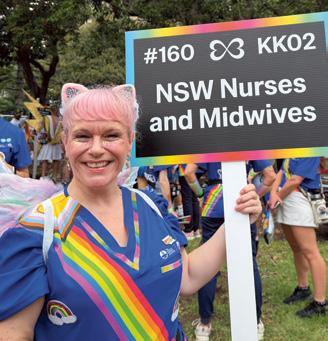
Sporting pink cat’s ears and angel wings, student nurse
Mishelle marched with the NSWNMA Sydney Gay and Lesbian Mardi Gras float for the first time this year. “I’ve always been lurking on the side watching and celebrating…but actually being part of it, I am so proud.”
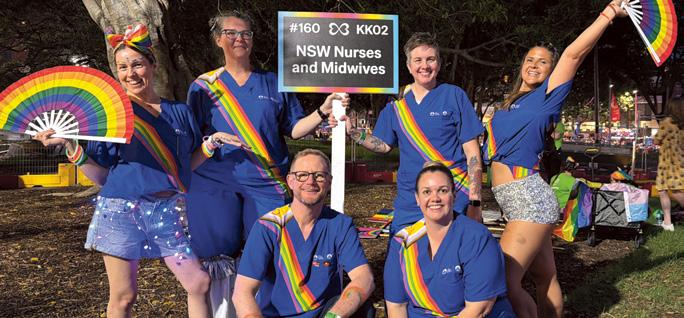
An 80-strong contingent of nurses and midwives from across NSW donned scrubs with rainbow sashes for this year’s parade, dancing down
‘I’ve always been lurking on the side watching and celebrating … but actually being part of it, I am so proud.’ — Mishelle, student nurse
‘I’m so proud that our union stands up for all of our members that we represent and we make sure that it is safe to be who you are at work and in your community ... That’s what being union is all about.’
— NSWNMA General Secretary Michael Whaites
Oxford Street under the theme ‘Nurses and Midwives: the Heart of our Community.’
Sydney-based nursing assistant and drag queen Midaz was marching with the Association for the third time. The night is “the community coming together…with no worries, no cares in the world. Just marching and celebrating love and equality as nurses,” Midaz said.
“I’m so proud that our union stands up for all of our members that we represent and we make sure that it is safe to be who you are at work and in your community,” NSWNMA General Secretary Michael Whaites said. “That’s what being union is all about.”
Lisa, from Dungog Hospital, remembers the excitement that built up every year at Mardi Gras
From left: NSWNMA Councillors Skye Romer, Lannelle Bailey and Emma Gedge celebrating diversity in the Mardi Gras parade with NSWNMA General Secretary Michael Whaites and Assistant General Secretary Katrina Bough (centre) and member Robyn Pavloudis (right).
time when she worked as a young beautician in Kings Cross 30 years ago. “I used to watch from the sidelines, but now I’m in the parade.”
This year marked 10 years of the NSWNMA’s official participation in Mardi Gras, but nurses have
supported the LGBTQIA+ community from the beginning. One of the organisers of the first Mardi Gras in 1978, Ken Davis, recalls a “gay solidarity group” of 500 people marched from Town Hall to Martin Place on the morning of the Mardi Gras. Alongside leather men, lesbian feminists, drag queens, Catholics, Jews, Protestants, Young Labor and socialists were “teachers, postal and railway workers [and] nurses,” Davis recalls.
Midwife Emma Gedge, a delegate and councillor from Wollongong
Hospital, was attending her fourth Mardi Gras this year. “It is really important because I can be with people in my LGBTQI community, and it is a really safe space for me.”
Talei from RPA was marching in her first Mardi Gras to show her support as an ally and celebrate love.
“What are you waiting for?” she says to members who might consider joining future parades. “Learning the dances and meeting other people from other hospitals all across the state has been such a friendly and exciting atmosphere.” n
Law, Ethics and Professional Standards in Nursing and Midwifery
Wed 20 May, Wed 9 Sep and Tue 10 Nov, 9am – 4pm, 6 CPD Hrs
Cost: members $95 / non-members $190
Midwifery Seminar
Fri 22 May, 9am – 4pm, 6 CPD Hrs
Cost: members $75 / non-members $150
NEW – Kate Maid Diabetes Workshop
Mon 25 May, 9am – 4pm, 6 CPD Hrs
Cost: members $95 / non-members $190
Medications: How we do it better
Fri 10 Jul, 9am – 4pm, 6 CPD Hrs
Cost: members $95 / non-members $190
Clinical Communication and Documentation
Wed 14 Oct, 9am – 4pm, 6 CPD Hrs
Cost: members $95 / non-members $190
Wound Care: Wound Care Essentials
Wed 18 Nov, 9am – 4.30pm, 6 CPD Hrs
Cost: members $120 / non-members $240
NEW – Perinatal Loss and Bereavement Support Workshop
Fri 27 Nov, 9am – 4.30pm, 6 CPD Hrs
Cost: members $95 / non-members $190
NEW – Bathurst
The Deteriorating Patient
Thu 7 May, 9am – 4pm, 6 CPD Hrs
Cost: members $95 / nonmembers $190
NEW – Blacktown
Kate Maid Diabetes Workshop
Mon 14 Sep, 9am – 4pm, 6 CPD Hrs
Cost: members $95 / non-members $190
Central Coast (Gosford)
Aged Care Nursing Seminar
Fri 25 Sep, 9am – 4pm, 6 CPD Hrs
Cost: members $75 / non-members $150
Go online to register for these education sessions and our free range of live webinars. Use the dropdown search fields to search by topic (Professional Courses, WHS Courses and Webinars), suburb or month
Co s Harbour
The Deteriorating Patient
Wed 28 Oct, 9am – 4pm, 6 CPD Hrs
Cost: members $95 / non-members $190
Dubbo
The Deteriorating Patient
Thu 20 Aug, 9am – 4pm, 6 CPD Hrs
Cost: members $95 / non-members $190
Newcastle
Wound Care: Compression Assessment and Diagnosis of Lower Leg Wounds
Thu 13 Aug, 9.30am – 4pm, 6 CPD Hrs
Cost: members $120 / non-members $240
Port Macquarie
Wound Care: Wound Care Essentials
Thu 25 Jun, 9.30am–4pm, 6 CPD Hrs
Cost: members $120 / non-members $240
Shellharbour
Wound Care: Understanding Wound Care Products
Wed 1 Jul, 9am – 4.30pm, 6 CPD Hrs
Cost: members $120 / n on-members $240
Taree
Medications: How we do it better
Wed 18 Nov, 9am – 4pm, 6 CPD Hrs
Cost: members $95 / non-members $190
Wagga Wagga
Clinical Communication and Documentation
Thu 11 Jun, 9am – 4pm, 6 CPD Hrs
Cost: members $95 / non-members $190
Waterloo
• Wed 15 April
Break the Age Barrier Workshops
Transforming age attitudes in health care
Co-hosted by the Australia Human Rights Commission and the NSWNMA.
Wednesday 15 April
NSWNMA, 50 O’Dea Avenue Waterloo 2017
Cost: FREE – NSWNMA members only
Join us for this FREE interactive workshop that will examine the assumptions and stereotypes commonly associated with ageing and older people.
Session 1: 9.30am – 12pm
Session 2: 1 – 3.30pm
Waterloo • Thu 14 May
Wound Care: Wound Debridement
Thursday 14 May, 9am – 4.30pm
NSWNMA, 50 O’Dea Avenue Waterloo 2017
Cost: members $120 /non-members $240
Lunch and refreshments are provided.
Wound debridement is the removal of dead and devitalised tissue, particulate matter and foreign bodies from a wound bed and is generally accepted as a necessary precursor to the formation of new tissue.
The importance of debridement in wound management is well known, and its role in the preparation of the wound bed to promote healing is recognised.
This course will assist nurses in understanding wound debridement methods, advantages and disadvantages to each technique and who is authorised to perform these methods.
Note: This will be a hands-on workshop where you will get to participate in wound debridement activities!
DIABETES WORKSHOP
Monday 25 May, 9am to 4pm
NSWNMA, 50 O’Dea Avenue Waterloo 2017
Cost: members $95 / non-members $190
Lunch and refreshments provided
Join Kate Maidment (Credentialled Diabetes Educator) and Chantelle Trevarthen (Accredited Practising Dietitian) for a hands-on diabetes education workshop!
This workshop covers essential knowledge in Type 1, Type 2 and Gestational Diabetes, alongside practical food education.
Gain exposure to the latest diabetes technologies, including the opportunity to wear a Continuous Glucose Monitor and hands-on experience with insulin pump therapy. Designed to build clinical confidence, enhance diabetes management skills, and support improved patient care, this interactive workshop also provides opportunities for questions, discussion, and reflective learning.
Bathurst • Thu 7 May
The Deteriorating Patient
Thursday 7 May, 9am to 4pm
Rydges Mount Panorama
1 Conrod Straight, Bathurst NSW 2795
Cost: members $95 / non-members $190
Lunch and refreshments provided
As health professionals we need to ensure people in our care who are having difficulty can be appropriately managed and cared for.
The lack of recognition and appropriate management of patients, whose condition is deteriorating, has been identified as a contributing factor for many adverse events worldwide.
Clinicians need to be concerned and have the skills to recognise and manage the deteriorating patient. This requires the ability to identify signs of deterioration and escalate as needed.
This workshop will cover key elements of deterioration such as:
• When to worry
• A-G Assessment
• Urinary system changes
• Neurological changes
• Respiratory system changes
• Circulatory system changes, and
• Communication for detecting and maintaining patient safety.
Member Foundations
Who should attend? Both new and existing members, delegates, and Branch Officials. This is an ideal starting point for new activists and a valuable opportunity for experienced members to reflect and strengthen their skills. Join us to build a foundation for meaningful union involvement and collective action.
Supporting and Representing Members + Negotiation and Issue Resolution
Who should attend? Delegates, Member Leaders and Branch Officals seeking to enhance their confidence and capability in supporting members and resolving workplace issues. Through interactive discussions and practical exercises, you will refresh essential skills and explore real experiences of member representation.
Delegate Skills
Who should attend? Current and aspiring Branch Delegates who want to enhance their knowledge and engagement within the Association. You will gain a clear understanding of your responsibilities, the democratic processes within the Association, and the rules that guide your role. You will be equipped to actively contribute to our democratic structure.
Registration renewal: a reminder for all nurses and midwives
The 31 May registration deadline is fast approaching for nurses and midwives. Begin the renewal process early to avoid unnecessary delays.
Annual renewal is a mandatory requirement set by the Nursing and Midwifery Board of Australia (NMBA) and completing it in a timely manner ensures uninterrupted registration and ongoing eligibility to practise.
Where do I renew my registration?
The renewal process is conducted exclusively through the Ahpra practitioner portal. Visit www. ahpra.gov.au to log in.
Make sure your details are up to date
Before beginning the formal renewal steps, practitioners are strongly advised to log in to the portal to verify that their username, password and account details are up to date. This simple check can help identify any
access issues well before the busy parts of the renewal period. With thousands of practitioners renewing at the same time, leaving technical problems unresolved until late in May might result in significant stress and delays that impact your ability to work.
I can’t log in – what do I do?
If you encounter difficulties logging in, need to reset your password, or discover that your details require updating, contact Ahpra as soon as possible. Ahpra is the only authority able to resolve issues related to practitioner accounts, system access, and technical troubleshooting. Addressing these matters early ensures you have ample time to complete the required declarations, update professional information and meet any continuing professional
development obligations associated with renewal.
Members are always welcome to contact the Association for general guidance, but please note the Association does not manage the Ahpra portal and so cannot rectify login or portal related issues.
Need more support?
Comprehensive information, including instructional videos and detailed guidance, can be found on the NMBA Registration Renewal page: www.nursingmidwiferyboard.gov. au/registration-and-endorsement/ registration-renewal.aspx
Additional support and frequently asked questions are available at nswnma.info/registrationFAQs n
Professional Perspectives
Online CPD options after maternity leave
I am an RN and I have been on maternity leave for the past 12 months, and haven’t undertaken any CPD. Can you suggest where I can access courses online before registration renewal?
The NSWNMA offers a free online education package to all financial members, including while on maternity leave, as part of your membership fees. To access it log in to Member Central and navigate to the Education tab drop down list to find iLearn.
You register on the platform in a few simple steps the first time, and after that you can simply log in. You will be able to search through a large selection of short online learning modules to meet your self-identified
The Association’s professional team answers your questions about professional issues, your rights and responsibilities.
learning needs. The program also keeps a record of all your learning and provides certificates to download once complete.
Even if you are on leave, you still have an obligation to undertake continuing professional development (CPD) hours in accordance with the Ahpra NMBA CPD registration standard.
Ideally, your CPD will come from a variety of sources throughout the practice year. Education is planned to meet knowledge gaps or refresh knowledge and is relevant to your context of practice.
You can find further guidance regarding the CPD registration standard on the NMBA website at www. nursingmidwiferyboard.gov.au/ registration-standards/continuingprofessional-development.aspx
Navigating pressure to deviate from protocol
I work in a GP clinic and the GPs and RNs agreed on an iron infusion protocol which everyone follows. Recently one GP has been pressuring me not to follow it, but I feel uncomfortable. What should I say to her?
If you have been asked to deviate from the documented and agreed clinic protocol, and you are concerned about the requested practice and your patient’s safety, advise her this is an RN scope of practice issue. An individual’s scope of practice is influenced by:
• context in which they practice (your clinical environment)
• clients’/patients’ health needs
• level of competence and confidence of the nurse
• service provider policies.
This is set out in the NMBA’s Fact sheet: Scope of practice and capabilities of nurses . To remain within your scope of practice, and therefore meet your professional obligations as an RN, you must follow your service provider policies, which set out practice requirements in your clinical environment. This means you are obligated to follow the protocol regarding iron infusions that was agreed upon with your practice GPs.
Return to clinical practice
I have been working in a nursing role in telehealth for five years with no direct patient contact. I’ve decided I want to return to a clinical setting again, but I’m not confident that my clinical skills are current. How do I prepare to ensure I provide safe and effective care in a direct clinical role?
ask what education and support is available for nurses transitioning back into clinical roles and determine if there will be a supernumerary period. When you transition into any new context of practice, you will need to regularly assess your knowledge and skills and seek support to incorporate anything new into your individual scope.
A part-time midwife will receive overtime rates for:
(1) total hours worked in excess of 38 hours in that week (having regard to the total work performed for the MGP and the other assignment)
Provided you hold general registration, you can change your context of practice; however, planning and educational preparation is necessary.
Every clinician is responsible for being aware of and working within their individual scope of practice. You can map out your skills and knowledge in relation to the clinical area in which you are seeking to work. The decisionmaking framework will assist in mapping to identify any knowledge gaps which will need to be addressed through education.
Next, prepare an education plan to meet the requirements of the clinical position you are seeking. Undertake appropriate education and record it as per the continuing professional development (CPD) registration standard in your CPD portfolio. When interviewing for positions,
Further information can be found in the registration standard: Recency of practice and the NMBA decision making framework at www.nursingmidwiferyboard.gov.au
On-call expectations in MGP
Last night I was working oncall for my Midwifery Group Practice (MGP) model of care and was called in to assist the core midwifery staff due to acuity. Is this allowed?
Whilst we understand that it is not ideal for you to be working outside of your allocated MGP hours, safety in the unit remains a priority and there may be times when you’re required to assist the core midwifery team. Midwives who work shifts in an assignment other than the MGP are to be paid in accordance with the provisions of the Public Health System Nurses and Midwives’ (State) Award
A full-time midwife will receive overtime rates for any midwifery or nursing work performed outside the MGP in addition to their fulltime commitments.
(2) hours worked on a single shift in the other assignment that are in excess of the ordinary rostered hours of a full-time employee working in the same area.
Please let your MGP manager know if you are asked to work additional hours outside of the MGP model of care.
Ahpra password
I had an Ahpra account last year. Do I still need a new password?
If you registered last year, you could reuse your previous password, but Ahpra advises doing this early to avoid delays. You may still be prompted to reset depending on system checks or multifactor authentication (MFA) set up.n
NSWNMA fee waiver for members on parental leave
Did you know, if you’re going on parental leave, paid or unpaid, we’ll waive your Association fees until you return to work? You’ll still be entitled to access advice and receive The Lamp. Contact the Association and let us know when you plan to take parental leave so we can set up your waiver. Call 1300 367 962 or email gensec@nswnma.asn.au
YOUR health+wellbeing
Grad year playbook
Your graduate year is underway and there’s a lot to learn. Expect moments of being overwhelmed, but also real rewards. These ideas can help you survive - and even thrive.
Eat well
We know eating well helps with energy, but doing it when you’re tired, stressed and time-poor is another story. The goal isn’t perfection, just making things easier. You can:
• cook extra when you have the energy so future-you has something ready
• try not to go too long without eating, even if it’s something small
• keep a few quick options on hand – yoghurt, fruit, nuts or a frozen meal – for days when cooking just isn’t happening.
Re-think movement
You don’t need long or intense workouts –even 10 minutes can help.
To help yourself get moving:
• find an activity you enjoy
• build it into your routine
• make it a priority – self-care is not a luxury
• ask a friend or colleague to join you (and keep each other on track).
Choose your mindset
Talk to someone who knows
Talking things through can help make sense of work. Find someone you trust to share the good, the hard and everything in between. Reflecting together can lighten the load and build confidence.
You may also be interested in the national Graduate Mentorship Program launching soon with Nurse & Midwife Support. It pairs graduates with experienced nurses or midwives for a 12-month mentoring partnership focused on professional and personal development. Scan the QR code to register your interest and be notified when applications open.
Balance the load
Are you feeling pessimistic, burdened, stressed or not good enough? Check in with your thoughts – are they negative, or full of “I can’t”? Try positive self-talk and find an affirmation, stick it to your lanyard and refer to it throughout your day. Choose your response –rather than auto-react, take a breath, pause, reset, remove yourself if you need to, and reflect.n
Manage your day
At the end of a shift, be deliberate about separating work from life:
• Manage your roster – think about getting enough sleep, plan night shifts in advance and avoid later/early shift combinations as much as you can.
As a grad you will be busy, work shifts, and be challenged by difficult situations. It is important to seek balance in the tricky juggling act of work-life, good stress-bad stress, busy shifts, responsibilities and clocking off.
• Stay connected – schedule social time.
• Clock off after work – find healthy ways to unwind after a shift.
If you need help, Nurse & Midwife Support is available 24/7 on 1800 667 877.
You can also access confidential peer support counselling through the Nurse Midwife Health Program Australia on 1800 001 060.
NMHPA
1800 001 060
www.nursemidwifehpa.org.au
NMS 1800 667 877
www.nmsupport.org.au
AUSTRALIA
ACTU call for shorter working week, reproductive leave and an additional week of leave in NES
Working women in states of Australia other than NSW are seeing the gender pay gap narrow thanks to new work rights, pay rises in undervalued sectors, and strong increases in award and collective agreement wages, the ACTU says.
The federal parliament’s House of Representatives Standing Committee on Employment, Workplace Relations, Skills and Training has launched an inquiry into whether the National Employment Standards (NES) continues to meet the needs of working Australians.
The NES sets out guaranteed minimum conditions for all workers under the federal industrial relations system. These conditions – which form part of the Fair Work Act - provide an important safety net for workers, and play a key role in bargaining between employees and employers.
The Australian Council of Trade Unions (ACTU) has made a submission to the inquiry alongside Australia’s union movement.
Key to the ACTU’s asks is a reduction in maximum weekly hours from 38 to 35, a new universal right to reproductive leave, and an additional week of annual leave.
Unions claim these additional leave entitlements will counter rising work pressures and the increase in unpaid hours that Australians regularly perform, as well as improving workers’ health.
“No Australian should have to choose between their health and their pay,” stated ACTU Assistant Secretary, Liam O’Brien.
“The evidence is clear: giving people paid time off to manage their health improves long-term well-being and lifts productivity.”
The ACTU’s submission also includes recommendations on areas such as roster justice, cultural and kinship leave, improvements to personal and carers leave, and clarifications around redundancy payments.
Committee Chair, Dr Carina Garland MP, highlighted the importance of the NES, and the need to ensure it reflects the modern workplace.
“The National Employment Standards are a critical part of the workplace relations framework, setting out a guaranteed minimum safety of terms and conditions that cannot be undercut. It’s time for a coordinated review to find out whether the Standards remain fit ‘for purpose’ in a changing labour market,” Dr Garland remarked.
“The committee wants to receive submissions on the effectiveness and application of the NES, including any opportunities for technical improvements.”n
“No Australian should have to choose between their health and their pay.”
— ACTU Assistant Secretary, Liam O’Brien.
AUSTRALIA
Federal Government spends more on property investor tax breaks than social housing, homelessness services and rent assistance combined
Recent analysis by the Australian Council of Social Service (ACOSS) shows that in 2025 the government spent $3.3 billion more on property tax breaks than social housing, homelessness services and rent assistance combined.
Social housing in Australia is at a record low, making up less than 2% of dwellings built today – an incredible decline from the 22% built annually in the 1950s. In 2025 social housing comprised 3.6% of dwellings, nearly 3% worse than the average for G7 countries, and 4.4% behind EU countries. There is also strain on social housing, as the number of those who are homeless or at risk of homelessness has risen from 26% to 41% of the public housing waitlist over the last decade.
Data shows the homelessness crisis is getting worse, and as increasing numbers of Australians struggle to meet their basic human right to shelter, criticism of the government’s property tax breaks is growing.
ACOSS’ recommendations to the Federal Government include significant curbing of the Capital Gains Tax to gradually halve the current discount, and to phase out negative gearing over five years. Alongside this reduction in expenditure, ACOSS calls for national social housing targets to be set and investment to grow the housing supply.
“This report today shows housing stress and homelessness are getting worse while absurdly generous tax breaks drive up home prices and supercharge inequality in our society,” said ACOSS Acting CEO, Jacqueline Phillips.
“More people are struggling to afford the private rental market, pushing them into homelessness and onto growing social housing waitlists… Property investor tax breaks come at a staggering cost of more than $12 billion each year, which could be spent on social housing, social services and supports that benefit everyone.”n
AMERICA
Nurses make New York City history with 41 days of industrial action
Industrial action involving nearly 15,000 New York City nurses broke records across 41 days of strikes, resulting in a three-year contract with increased wages, safe staffing levels and protections against AI.
On 12 January 2026, nearly 15,000 nurses from New York-Presbyterian, Montefiore and Mount Sinai hospital systems went on strike. Demands included fair increase to wages, enforceable safe staffing standards, protected rights as clinical use of AI grows, and tighter security in the context of growing workplace violence.
On 21 February, after 41 days of striking, over 4,000 members of the New York State Nurses Association (NYSNA) employed by the New York-Presbyterian system approved a three-year contract that includes a 12% increase in salaries, protection of their health-care benefits and commitment to enforceable safe staffing with hiring quotas agreed.
“NYSNA nurses showed what it means to advocate for patients, and this moment will go down in history as a win for our communities, in the fight for healthcare justice, and for the labor movement.”
— NYSNA
President, Nancy Hagans
It is estimated that over the six weeks, the hospitals’ management spent $100 million to plug the gap in workforce with temporary staff, many coming from interstate.
Terms of the agreement also reflect more modern challenges healthcare workers are facing. Included were safeguards around AI, ensuring a nurse’s clinical judgement can supersede advice from AI and that nurses can escalate concerns about the use of AI and other technologies without fear of repercussions.
Hospital safety was also a focus, with commitments to expand weapons detection systems and grow security presence. Tighter policy was also introduced to support nurses dealing with ICE and help protect the care of immigrant patients.
This is the second strike in three years, and although some nurses expressed disappointment in the pay increase, the commitment to safe staffing has been well received.n
AMERICA
The impact of US withdrawal from World Health Organization
Just over a year after Donald Trump took office and announced the United States’ intention to leave the World Health Organization (WHO), the withdrawal is now complete. The US, a founding member and long time leading donor, has played a central role in global health for decades.
Over the past 20 years, US funded programs in partnership with WHO are estimated to have prevented more than 90 million deaths worldwide, including 30 million child deaths. The US was also instrumental in eradicating smallpox and advancing efforts against polio, HIV, Ebola, influenza and other public health threats.
Reasons cited by the Trump administration for the withdrawal included perceived failures in WHO’s COVID response and an alleged effort to compromise US independence.
WHO’s ability to respond to global health threats relies on coordinated international cooperation. For example, the Global Influenza Surveillance and Response system relies on live data from 131 countries to develop recommendations for influenza virus vaccines. Without US participation, the program suffers a significant loss in data potentially affecting the efficacy of their recommendations.
It also leaves a significant gap in funding, which China has stepped in to fill, pledging $500 million USD in voluntary contributions over the next five years. This now makes China WHO’s largest financial contributor.
“There are many things done through WHO that benefit the United States, especially in health security,” the Director-General of WHO, Dr Tedros Adhanom Ghebreyesus, said. “The US cannot be safe without working with WHO.”
“When I say for the US to reconsider its return, it’s not about money. Money can be adjusted. It’s about co-operation. It’s about solidarity. The best immunity is solidarity.” — Director-General of WHO, Dr Tedros Adhanom Ghebreyesus n
Cost-of-living pressures linked to increase in heart disease
A new study has linked cost-of-living pressures to an increase in heart disease, as perpetual ‘survival mode’ risks increased strain on the heart.
In a recent study from The Growth Distillery in collaboration with Medibank, 48% of Australians say money and financial concerns have the most significant impact on their mental wellbeing, and one in three full time workers say they feel burnt out on a weekly basis.
Stress causes the release of cortisol and adrenaline, the hormones which trigger our fight or flight response. They make your heart beat faster, blood vessels narrow and blood pressure rise to face the danger. Being caught in this heightened state over
long periods of time can increase risk of heart disease and stroke.
For the 48% of Australians feeling the constant pressure of the costof-living crisis, it can be hard to recognise the connection between stress and their physical health.
“Most people think of stress as emotional or mental, but the heart feels it too,” said Nicci Dent, CEO of Heart Research Australia.
“We’ve normalised being wired and tired, but living in stress mode is like leaving your car engine running all night. The cost-of-living squeeze means many Australians feel like every day is a crisis – and our hearts are paying the price.”n
Meeting your Continuing Professional Development (CPD) obligations is even easier with this great benefit for NSWNMA members. As a financial member you have access to over 200 CPD modules – all part of your Association membership.
FEATURING
FREE access to over 200 CPD modules online
Highly visual and interactive modules you can do at your own pace
New modules added regularly
Your own personalised ePortfolio and CPD tracker so you can provide evidence to the Nursing and Midwifery Board of Australia (NMBA) of participation in CPD annually.
ACROSS
1 Common type of bacterial lung infection (12.9)
12 Give CPR (11)
13 Unit of weight (5)
14 Neural pathway (5)
16 Island nation in Oceania (5)
18 A conical projection (5)
19 Leptospirosis carrier (3)
20 Rounded, projecting anatomical parts (5)
22 Kidney hormone that regulates blood pressure (5)
23 Contain, incorporate, consist of (7)
24 Prefix meaning "few" or "little” (5)
25 DNA amplification technique (1.1.1)
26 Sweat (5)
27 Medical uniform (5)
29 Huddled together (5)
30 Eliminate (7)
31 Courteous, gracious (4)
33 A scrub cap (9)
36 Home-related (11)
38 Nuclear Magnetic Resonance distancemapping phenomenon (1.1.1)
39 Infection of the tissue surrounding the kidney (13)
41 Margarines (5)
42 A curved line or segment of a circle (3)
44 Nutrient with antiinflammatory properties found in tea, red wine, and berries (9)
46 Snore-like lung sounds (7)
47 High temperature (3)
48 Charged atom (3)
49 Moist; damp (5)
50 Enter (data or a program) into a computer (5)
52 Unit of hospital capacity (3)
53 Obesity hypoventilation syndrome (1.1.1)
54 A trade union for educators (1.1.1)
55 Raw, unprocessed (7)
56 Stretchy protein (7)
57 Trunks (5)
58 Structure joining the cephalic vein near the elbow (9.8.4)
DOWN
1 Mental disorder with persecutory delusions (8.13)
2 Exophthalmos-producing substance (1.1.1)
3 Posterior thigh muscle (8.6.7)
4 Postpartum infections of the female reproductive organs following childbirth (8.5)
5 Cerebrovascular accident (1.1.1)
6 Energy molecule produced by mitochondria (9.12)
7 A group of people who are approximately equal in age or social status (4.5)
8 Tube leading to the eardrum (8.8.5)
9 An anticonvulsant agent used to treat partial seizures in patients resistant to less-toxic drugs (11)
10 Characteristic of a common white blood cell (12)
11 A common symptom of 1 Down (8.13)
17 Pressure sore (5)
18 Greek word for "itch” (5)
21 Outdoor unit (1.1.1)
28 Cancel (4)
32 Symbol for carbon monoxide (1.1)
34 Any substance used for pain relief during surgery (11)
35 No set pattern (9)
40 Suffering from vitamin C deficiency (9)
42 Alkaline diet (4.4)
43 Symbol for density (1.1.1)
45 Chemical product formed in an aldehyde-ketone reaction (5)
51 A small child (3)
MC
JAMILA RIZVI
Jamila Rizvi is an author, podcaster and diversity, equity and inclusion expert. She is Deputy Managing Director of FW (formerly Future Women) and co-founder of the FW Jobs Academy, supporting Australian women to find work and build careers.
Jamila was Mamamia’s Editor in Chief. She is a columnist in the Sydney Morning Herald and The Age’s Sunday Life, and a commentator on The Project, The Drum, ABC News Breakfast and Q&A.
COUNTTOWARDSCPDHOURS
Keynote speaker PETER GRESTE
Professor Peter Greste is an award-winning broadcast journalist, academic, media freedom activist and author. He spent 25 years as a foreign correspondent mostly for the BBC and Al Jazeera.
He won the International Association of Press Clubs’ Freedom of Speech Award; the Australian Human Rights Commission Medal, and the Australian Press Council’s 2018 Press Freedom award.
Peter has written about his experiences in his book The First Casualty, which is in production as a feature film. He remains an avid advocate of media freedom and journalist safety. + more speakers will be announced soon