AGED CARE
WORKPLACE VIOLENCE
REBUILDING MIDWIFERY
Taking the fight for ratios to Canberra
The disturbing “new normal” needs to change
Safer staffing and a stronger workforce
page 06
page 14
page 16
REGULARS Ask Katrina Professional Perspectives Health & Wellbeing Crossword
THE MAGAZINE OF THE NSW NURSES AND MIDWIVES’ ASSOCIATION VOLUME 84 NO 5 OCT/NOV 2026
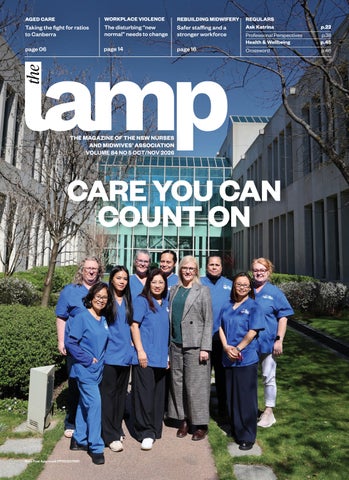
CARE YOU CAN COUNT ON
Print Post Approved: PP100007890
1 | THE LAMP JUNE / JULY 2026
p.22 p.38 p.45 p.46
Face the future with confidence. At HESTA, we invest time in your super, to help you invest in your future. Our online Future Planner tool, Retirement Income Stream, and Transition to Retirement Income Stream are just some of the many ways we’re supporting our members to retire with confidence. Learn more at hesta.com.au
Issued by H.E.S.T. Australia Ltd ABN 66 006 818 695, Trustee of HESTA ABN 64 971 749 321. Consider whether this product is appropriate for you by reading the PDS and TMD at hesta.com.au/pds. For more information on Super with impact™, see hesta.com.au/impact.
2 | THE LAMP JUNE / JULY 2026
CONTENTS
Contacts NSW Nurses and Midwives’ Association For all membership enquiries and assistance, including The Lamp subscriptions and change of address, contact our Head Office. Head Office 50 O’Dea Avenue, Waterloo NSW 2017 (all correspondence) T 8595 1234 (metro) 1300 367 962 (non-metro) F 9662 1414 E gensec@nswnma.asn.au W www.nswnma.asn.au
VOLUME 83 NO. 5 OCTOBER / NOVEMBER 2026
NSWNMA Communications Manager Danielle Blasutto T 02 8595 1234 (metro) T 1300 367 962 (regional) For all editorial enquiries T 8595 1234 E lamp@nswnma.asn.au 50 O’Dea Avenue, Waterloo NSW 2017 Produced by Citrus Media E jim@citrusmedia.com.au Press Releases Send your press releases to: F 9662 1414 E gensec@nswnma.asn.au Editorial Committee Michael Whaites, NSWNMA General Secretary Katrina Bough, NSWNMA Assistant General Secretary O’Bray Smith, NSWNMA President Michelle Cashman, Long Jetty Continuing Care Michelle Cutmore, Tweed Hospital Karen Hart, Wagga Wagga Base Hospital Robyne Brown, Maitland Hospital Printed by Printed by IVE Group Sydney
6
COVER STORY Aged Care Members take the realities of aged care directly to Canberra, calling for mandatory staffing ratios and greater accountability to ensure residents receive the care taxpayers fund.
Advertising T 8595 2139 E nswnursescomms@nswnma.asn.au Information & Records Management Centre To find archived articles from The Lamp, or to borrow from the NSWNMA nursing and health collection, contact: Adrian Hayward, Coordinator. T 8595 2175 E gensec@nswnma.asn.au The Lamp ISSN: 0047-3936 General Disclaimer The Lamp is the official magazine of the NSWNMA. Views expressed in articles are contributors’ own and not necessarily those of the NSWNMA. Statements of fact are believed to be true, but no legal responsibility is accepted for them. All material appearing in The Lamp is covered by copyright and may not be reproduced without prior written permission. The NSWNMA takes no responsibility for the advertising appearing herein and it does not necessarily endorse any products advertised. Authorised by M.Whaites, General Secretary, NSW Nurses and Midwives’ Association, 50 O’Dea Avenue Waterloo NSW 2017 Privacy Statement The NSWNMA collects personal information from members in order to perform our role of representing their industrial and professional interests. We place great emphasis on maintaining and enhancing the privacy and security of your personal information. Personal information is protected under law and can only be released to someone else where the law requires or where you give permission. If you have concerns about your personal information, please contact the NSWNMA office. If you are still not satisfied that your privacy is being maintained, you can contact the Privacy Commission. Subscriptions for 2026 Free to all Association members. Professional members can subscribe to the magazine at a reduced rate of $30. Individuals $84, Institutions $140, Overseas $150.
PEFC Certified Paper from sustainably managed forests and controlled sources PEFC/21-31-119
pefcaustralia.org.au
14 16 24 28
WORKPLACE VIOLENCE
Violence is not part of the job Violence and aggression have become normalised as an inherent part of care work. This needs to change, say the NSWNMA and ANMF. MIDWIFERY SERVICES
Rebuilding midwifery Midwives have their say on postnatal ratios, skill mix and the safeguards needed as NSW tackles workforce shortages. Plus, how MidStart is helping nurses make the move into a rewarding new career. REFLECTING ON LEADERSHIP
Challenging the status quo From nurse-led clinics tackling rural healthcare shortages to the fight for safeguards around AI and workplace surveillance, experts at the NSWNMA’s Professional Day explore how leadership can drive change.
REGULARS
5 Editorial 22 Ask Katrina 32 Education calendar 36 Branch Beat 38 Professional Perspectives 40 News in brief 45 Your Health & Wellbeing 46 Crossword
WORKPLACE VIOLENCE
REBUILDING MIDWIFERY
Taking the fight for ratios to Canberra
The disturbing “new normal” needs to change
Safer staffing and a stronger workforce
page 06
page 14
page 16
AGED CARE
REGULARS Ask Katrina Professional Perspectives Health & Wellbeing Crossword
p.22 p.38 p.45 p.46
THE MAGAZINE OF THE NSW NURSES AND MIDWIVES’ ASSOCIATION VOLUME 84 NO 5 OCT/NOV 2026
CARE YOU CAN COUNT ON
EQUIPPING THE WORKFORCE
Ready for what’s next Pioneering CAR T-Cell nurse Ty Simpson explains how education, curiosity and a willingness to adapt are equipping nurses to take a frontline role in cutting-edge cancer treatment.
Print Post Approved: PP100007890
1 | THE LAMP JUNE / JULY 2026
COVER: Image by Thomas Mitchell The Lamp is printed on PEFC certified paper. The paper is certified under the Programme for the Endorsement of Forest Certification (PEFC) which assures consumers that the utilised forestry products can be traced from a certified, sustainably managed forest through all stages of processing and production by a chain of custody process. The Lamp is wrapped in Ecopure film which is recyclable and biodegradable.
THE LAMP OCTOBER / NOVEMBER 2026 | 3
A free 24/7 anonymous helpline for confidential advice and referral.
1800 667 877 Head to our website and discover: Online Resources Mentorship Program Wellbeing Portal Service Finder nmsupport.org.au
DISCOUNTS + OFFERS
Savings for your summer fun! Enjoy great savings on your shopping, travel and summer activities! Discover compelling offers on: Hire cars with up to 60% savings over retail Movie tickets, day trips & adventures Travel insurance to give you complete peace of mind Tech that you will love!
Login and see how easy it is to iSave!
online.nswnma.asn.au E
iSave half.indd 1
1300 853 352
customercare@memberadvantage.com.au 8/9/2026 3:54 PM
EDITORIAL
We need to defend our wins As The Lamp goes to print, the NSW Safe Staffing Levels Taskforce has announced that medical, surgical and palliative care wards across every category A, B, and C hospital will convert to shift-by-shift nurse to patient ratios.
T
his is a massive milestone in our long-standing and hardfought campaign to improve workloads and deliver quality patient care. This win belongs to members and while we celebrate the win, we must not rest. The NSW Government is yet to meet its initial commitment to the remaining NHPPD wards, ICU, MPS and Level 2 EDs. Our work now is to hold them to account to deliver more. We won’t rest until we have secured ratios in every specialty area. Our fight for ratios in the private and aged care sectors must also continue. Nurses, midwives and carers everywhere need safe workloads. This is the driving force behind the ANMF’s national aged care campaign. There has been undeniable progress in the aged care sector, but the actions of some employers shows that we can’t rest on our laurels. Some aged care providers manipulate care minutes to maintain their profits at the expense of care. So, we need to push for further reform. The lesson for us is clear – whenever we get a win, we need to make sure that those wins are defensible and can be progressed. That requires action at the workplace, with our communities, and in our parliaments. In aged care we have entered into a national campaign with the ANMF to build on the solid foundations of our previous campaigns and to move on to the next stage to improve the lives of our elderly and our dedicated members who care for them.
A comprehensive national survey of aged care workers by the ANMF shows the sector still suffers from widespread understaffing, increased workplace violence, cost-cutting and a lack of transparency for billions of taxpayer dollars (see page 6). The campaign calls for: • mandatory staffing ratios and skills mix across all shifts to replace the current care minutes system • adoption of a 10-point plan to better protect nurses and care workers from physical, verbal and emotional violence • public reporting of providers’ financial performance and use of $25 billion in public funding. Aged care shows us that employers can find a way to undermine progressive reform, and we need to be resolute in enforcing it. We are holding employers and governments to account, and we must do so again, and again, and again.
PLENTY OF WORK AHEAD OF US We are faced with similar challenges in all parts of the public health system from maternity services to mental health. There have been decades of government neglect, the constant squeezing of the public sector for “efficiencies” and chronic underinvestment in the workforce. The consequences were predictable: unreasonable workloads, inadequate pay, professionalism unrecognised, career paths not established, and the rising costs of tertiary education pushed back on the workforce.
“It is going to take a focussed and concerted effort to rebuild the midwifery and nursing workforces.” In response to these decades of neglect is the need for workplace planning to provide a pipeline of midwives and specialty trained nurses to meet the needs of a sustainable public health system. Workforce planning requires a long lead time. This is why our work in implementing ratios across the public sector has been so important, and why we must continue to fight. It is going to take a focussed and concerted effort to rebuild the midwifery and nursing workforces. It will require more students who get the right support, experience and knowledge as they train. It will require the right pay, sustainable workloads and effective retention strategies to attract and retain more people to our wonderful professions. Establishing ratios in our Level 3 to Level 6 Emergency Departments has provided positive change. Aged care has shown us that with patience, courage and stamina we can make radical and positive improvements to our workplaces for the benefit of our communities. But the journey is never simple. Employers or governments can prioritise their self-interest and push back or stall reforms even when they are self-evidently needed. This is the work of unions. We fight for improvements, and even when we win, we must continue fighting – to enforce what we have won and to improve our rights, our workplaces and our professions even more. To do this we need to be organised and strong and have a united voice as we go forward. n THE LAMP OCTOBER / NOVEMBER 2026 | 5
AGED CARE
Members lobby ministers for aged care ratios A NSWNMA delegation to Canberra tells politicians that ratios must replace the care minutes system of staffing, which providers are abusing.
M
embers of the NSWNMA who work in aged care have met government ministers and MPs at Parliament House in Canberra to push for mandatory staffing ratios in nursing homes. Our members joined with aged care workers from other states to launch a national campaign for ratios, measures to reduce violence and aggression, and public reporting of providers’ use of government funding. NSWNM A nurses and care workers met Aged Care Minister Sam Rae, Immigration Minister Tony Burke, Assistant Immigration Minister Matt Thistlethwaite, MP for
NSWNMA delegation met with ministers in Canberra
6 | THE LAMP OCTOBER / NOVEMBER 2026
Gilmore Fiona Phillips and MP for Macquarie Susan Templeman. NSWNMA General Secretary Michael Whaites said members gave ministers a frontline perspective on the substandard care that residents still receive and how providers are misusing public money. He said the national campaign
“The aged care sector has seen some improvement in recent years, but it is far from being fixed.” – Michael Whaites, NSWNMA General Secretary
aims to fix problems that continue, despite historic changes flowing from the Royal Commission into Aged Care Quality and Safety, which reported in 2021. “The aged care sector has seen some improvement in recent years, but it is far from being fixed,” Michael said. “In the face of care minutes not being complied with, we need ratios to deliver better staffing and skill mix, safer workplaces to prevent workplace violence, and greater transparency of taxpayer funding. “These are all practical reforms that can help to build an aged care sector that works now and into the future.” The campaign called ‘Australia needs care you can count on’ was launched by the NSWNMA’s national body, the Australian Nursing and Midwifery Federation (ANMF), in September. A survey of aged care workers by the ANMF shows that the sector still suffers from widespread understaffing, increased workplace violence, cost-cutting and a lack of transparency for billions of taxpayer dollars (see survey report page 10). The campaign calls for: • Mandatory staffing ratios and skills mix across all shifts to replace the current care minutes system • Adoption of a 10-point plan to better protect nurses and care workers from physical, verbal and emotional violence • Public reporting of providers’ financial performance and use of $25 billion in public funding. n
AGED CARE
Mandatory minutes, missing care Residents neglected despite mandatory care minutes, minister told.
A
iN Nisamon Klomkleaw has worked at a Sydney nursing home for nine years and was a member of the NSWNMA delegation to Canberra. Nisamon said her colleagues at the nursing home were excited about her trip and hopeful that high-level lobbying would lead to improvements. She said Minister for Aged Care Sam Rae was friendly and listened carefully to the delegation. “Sam Rae said he’s going to take it further. Not just listening and then ignoring it.” She said the delegation raised problems common throughout the aged care sector. They include staff being required to perform non-care tasks, such as cleaning, laundry and setting up tables, which are then counted toward mandated care minutes. Staff have no access to care minute records despite them being used to justify reduced staffing levels. “Like many facilities, we are always working short-staffed with not enough time to spend with the residents,” Nisamon said. “We are always rushing to do something outside of the care minutes, like doing the tea trolley, setting up the lunch table, water jug, laundry, emptying bins, or cleaning. “One day we will have like eight staff. And then maybe two or three weeks later, management will say, ‘The care minutes have gone down’, so we have less staff. “We don’t have access to the records to see what is actually happening with the care minutes.” Nisamon said short staffing occurs almost daily, with exceptions on some weekends. Staff on sick leave are not replaced, and staff on holiday are listed on
“We don’t have time to sit down and ask, How are you and how are you feeling? How’s your weekend? Nothing like that. We just pop in and pop out quickly.” – Nisamon Klomkleaw, AiN
the roster, thereby inflating actual staffing levels. “When we raise that with management, they say, ‘Oh, that’s a mistake’. But it happens the whole time.” She said understaffing brings greater risk of falls. “Because of short staffing, we cannot be there to keep an eye on residents at high risk of falling, and sometimes we find them on the floor. We don’t know how they got there or how long they’ve been there. “Also, they don’t get proper showers and their meals are late. “We don’t have time to sit down and ask, How are you and how are you feeling? How’s your weekend? Nothing like that. We just pop in and
pop out quickly. So, it’s really difficult.” She said some residents get angry and complain that service is poor despite high fees. Others are sympathetic and forgo proper care, such as a full shower, to avoid burdening overworked staff. “Some of (the residents) are really nice. But some get really angry and yell and curse us.” Nisamon said apple and orange juice at lunchtime has been replaced with cheaper cordial, which residents hate. “Nobody drinks cordial, it just gets wasted every day.” Many aged care workers are on student or sponsorship visas and reluctant to speak out for fear of jeopardising their immigration status, she added. n THE LAMP OCTOBER / NOVEMBER 2026 | 7
AGED CARE
Politicians get the lowdown on staffing NSWNMA members are hopeful of seeing improvements to aged care after receiving a warm reception from government ministers.
A
ged care RN Pranita Rai travelled to Canberra as part of the NSWNMA delegation to launch the ‘Australia needs care you can count on’ campaign at Parliament House. The delegation met with Aged Care Minister Sam Rae, Immigration Minister Tony Burke, Assistant Immigration Minis ter M att Thistlethwaite and other MPs to share the experiences of workers on the frontline and discuss changes needed across aged care. Pranita said the campaign was not about one provider or one facility, but about ensuring that aged care workers have safe and sustainable working conditions and that residents receive safe, timely, dignified and highquality care. “We gave them the real story about what we are facing every day at our workplaces. I said to Sam Rae, ‘Please don’t believe what you read on the providers’ spreadsheet data.’ “Some of the MPs and ministers we spoke with were surprised by the experiences shared by members from NSW, Queensland, the ACT and Tasmania. When we spoke with Sam Rae and Matt Thistlethwaite, they asked us, ‘Is this really happening?’ “It was important for us to bring these frontline experiences directly to policymakers and make sure they understand the need for safe staffing, appropriate ratios, workplace safety, transparency and accountability across the aged care sector.” Pranita said she felt “valued and respected” by the politicians she met at Parliament House. “It made us feel proud to be there. 8 | THE LAMP OCTOBER / NOVEMBER 2026
“It was meaningful to have our voices heard and our work recognised.” – Pranita Rai, aged care RN
It was meaningful to have our voices heard and our work recognised. I hope aged care workers can receive the same level of respect and appreciation in their workplaces.” She said Sam Rae “was very active in listening to our issues individually. He gave us hope that there will be changes and said he will closely look into what is going on”. Pranita has worked for more than four years in the aged care sector in Sydney – initially as an Assistant in Nursing (AiN) and now as a recently graduated RN. “The workload is piling up day by day, and I haven’t seen the
improvements we need,” she told The Lamp. She said staff on sick or annual leave were not always replaced, increasing the workload for those remaining. She said similar staffing and workload concerns were being raised by aged care workers across different states. Pranita also said that greater transparency was needed around mandatory care minutes and how they were calculated. “Even if a provider is meeting the required care minutes on paper, we need to ask whether that is enough to meet residents’ actual care needs.
AGED CARE
Meeting the required number should not be the only measure of quality care.” She said that staff on sick leave were not always replaced, increasing pressure on the remaining staff. “Residents can sometimes wait 30 to 40 minutes for essential personal care, including assistance with toileting, repositioning or transferring to a recliner chair.” She raised the issue directly with Matt Thistlethwaite, asking him to consider how he or a loved one would feel in the same situation. “I asked him, ‘If you needed to use the toilet, could you hold your bladder for 30 or 40 minutes while waiting for assistance?’”
She said aged-care workers are also required to perform non-direct care tasks, such as cleaning, laundry and organising recreational activities. “I believe that providers may be counting the time spent on these activities as direct care minutes, even though these duties are not direct care. “Our members are coming forward and raising concerns about how staff time is being used. I am not saying residents should not have celebrations, special meals or activities, they absolutely should, because these things are important for residents’ wellbeing and quality of life.
“My concern is when significant staff time is being spent on presentation, decorations and events while frontline staff are already struggling to meet residents’ basic care needs. “We need to make sure that celebrations and activities are properly supported with adequate staffing, so that they don’t come at the expense of residents waiting for essential personal or clinical care. “Our campaign is not going to stop. We want to make the situation transparent and speak up and go public. We will continue until we achieve our goal.” n
Ratios will guarantee care time A law passed in 2024 promised 215 minutes of care a day to Australia’s aged care residents. However, providers are dodging their responsibility by counting laundry, cleaning and catering work as care minutes. Also, providers measure care minutes as a facility-wide daily average, which allows a nursing home to meet its target on paper while residents go without safe staffing on certain shifts. NSWNMA Assistant General Secretary Katrina Bough says that
the law must ensure residents get the care they are legally entitled to every day, on every shift. “The government must legislate the existing 215-minutes standard as a mandated staffing ratio of direct care time that applies on every shift,” she said. “The care minutes requirement must be translated into minimum staffing numbers for each shift, based on the residents in the home and their care needs, as set out in the Aged Care Rules using the same methodology that already
produces the 215-minute target. “This method would count only the RNs, ENs and AINs actually rostered and present on each shift. “The provider would not be able to average staff numbers across wings, units or the whole facility in order to disguise a short-staffed shift elsewhere.” Katrina said ratios won’t cost the government any more than what it already pays providers. n
“The care minutes requirement must be translated into minimum staffing numbers for each shift, based on the residents in the home and their care needs.” – Katrina Bough, NSWNMA Assistant General Secretary
THE LAMP OCTOBER / NOVEMBER 2026 | 9
AGED CARE
Residents aren’t getting what the government pays for Federal government aged care reforms have led to improvements but there is a big gap between policy intent and the daily realities experienced by residents and staff.
A
national survey of aged care workers reveals a workforce under severe strain despite government-mandated reforms such as mandatory care minutes and 24/7 registered nurse coverage. A total of 3,552 aged care nurses and care workers (including AiNs) responded to the survey, which provides a frontline perspective on staffing, skills mix, and violence and aggression in the workplace. The Australian Nursing and Midwifery Federation (ANMF) conducted the survey from October to December 2025. Forty-nine per cent of respondents said they did not get enough time to deliver care, a figure that rose to over 55 per cent in for-profit facilities. More than 47 per cent of respondents said the ratio of nursing staff to care staff was inadequate, increasing to 52 per cent in for-profit providers. Almost 40 per cent of aged care workers surveyed described their workplace staffing levels as “poor” or “very poor”. W hile t he legislated 2 4/7 registered nurse requirement has improved RN numbers, staffing relating to enrolled nurses (ENs) and personal care workers (PCWs) is widely seen as inadequate. More than 44 per cent of respondents rated the number of ENs as inadequate. About 41 per cent said the number of PCWs was inadequate.
REGISTERED NURSES Respondents reported substantial adverse changes to staff roles, such 10 | THE LAMP OCTOBER / NOVEMBER 2026
Forty-nine per cent of respondents said they did not get enough time to deliver care, a figure that rose to over 55 per cent in for-profit facilities. – ANMF survey results
as RNs being shifted from direct clinical care to administrative tasks. More than 62 per cent of RNs said that their administrative duties had increased, partly due to new reporting and compliance measures resulting from Royal Commission reforms. Almost 50 per cent of RNs also reported a decrease in direct clinical care.
AGED CARE
Respondents were asked to rate the amount of time they spent completing paperwork or administrative tasks in the previous 12 months. Just over half of RNs rated this as “poor” or “very poor”, compared to almost 46 per cent of ENs and 42 per cent of PCWs.
recognised and supported as integral members of the aged care team. To support this, the ANMF recommends attracting ENs back to the sector through dedicated staffing targets and a range of workforce incentives that recognise and strengthen their role.
ENROLLED NURSES
The survey shows that “universal worker” models are diverting PCWs from direct care to hotel, food, and laundry services. More than 67 per cent of PCWs reported increased expectations to complete hotel, food, or domestic duties. This misallocation of skills contributes to burnout, unhappiness and compromised quality of care, the report says.
The survey reveals a significant erosion of the enrolled nurse role, w it h reduced clin ica l responsibilities, reclassification from nursing to care staff positions, and, in some cases, redundancy. The survey report says that because funding models lack specific EN targets, providers have an incentive to replace them with lower-cost PCWs, leading to EN redundancies and a dilution of clinical skills. The report estimates this has resulted in the loss of about 1,840 full-time EN positions nationally. The report says ENs “play a critical role in delivering safe, personcentred nursing care” and must be
PERSONAL CARE WORKERS
VIOLENCE AND AGGRESSION The prevalence of workplace violence and aggression is alarmingly high, with more than 96 per cent of respondents reporting they had experienced or observed it in the previous 12 months.
The most common forms are verbal abuse (experienced by almost 77 per cent) and physical aggression (experienced by almost 70 per cent). While residents are the primary perpetrators, families, visitors, and other staff also contribute significantly. The survey establishes a link between inadequate staffing and violence and aggression: staff who rated their workplace staffing as “very poor” were more likely to experience violence. Understaffing leads to rushed care and unsupervised residents, increasing the risk of aggressive incidents, the report says. The report also points to a culture of poor management of incidents of violence and aggression. Many respondents felt that aggression was dismissed as inevitable and “part of the job,” and that reporting incidents often led to blame rather than support. This has created a culture of underreporting, as staff lose confidence that any meaningful action will be taken, the survey report says. n
Union sues Opal over dodgy numbers The NSWNMA has launched Federal Court action against for-profit aged care provider, Opal Healthcare, for breaching an enterprise agreement by failing to meet care minute targets and misreporting care minutes. The Union is seeking civil penalties for serious breaches of clause 58 of the Opal Healthcare (NSW) Enterprise Agreement 2023. The NSWNMA says that despite misclassifying laundry and kitchen tasks to try and reach its mandated minutes, Opal failed to meet its mandatory 215 minutes of direct care per resident per day across more than 50 NSW facilities between November 2024 and March 2026.
NSWNMA General Secretary Michael Whaites said, “We have been raising concerns with Opal on behalf of our members for an extended period to no avail, which is why we’ve now filed in the federal court.” The NSWNMA took the issue to the Fair Work Commission in June last year, after members found that non-direct care duties were being misreported to the Department of Health, Disability and Ageing as
direct care. Despite an updated Care Minutes Responsibility Guide being released by the department, which clarified that tasks such as kitchen, laundry and lifestyle duties must not be counted as direct care, the NSWNMA believes Opal has done little to rectify the issue, which reduces staffing and the levels of care given to residents. n
“We need all aged care providers to be adhering to legislative reforms... and those who are non-compliant to be held to account.” – Michael Waites THE LAMP OCTOBER / NOVEMBER 2026 | 11
Free online CPD portal
for NSWNMA members
Access to online CPD FREE for NSWNMA members and student members Hundreds of hours of FREE CPD online Meeting your Continuing Professional Development (CPD) obligations is now even easier with this great benefit for NSWNMA members. As a financial member you have access to over 200 CPD modules – all part of your Association membership. FEATURING
FREE access to over 200 CPD modules online Highly visual and interactive modules you can do at your own pace New modules added regularly Your own personalised ePortfolio and CPD tracker so you can provide evidence to the Nursing and Midwifery Board of Australia (NMBA) of participation in CPD annually.
LOGGING ON
nswnma.info/ilearn
MEMBERS New users create a ONE-TIME login to Member Central
NON-MEMBERS Join at www.nswnma.asn.au and receive access to hundreds of FREE CPD hours online!
LOGIN HELP AND FAQ
nswnma.info/ ilearn-help
WORKPLACE VIOLENCE
Violence is not part of the job Violence and aggression have become normalised as an inherent part of care work. This needs to change, say the NSWNMA and ANMF.
R
eport after report, nationally, internationally and in NSW, show that nurses and carers are reporting exposure to violence that is increasing in both frequency and severity. In response, the ANMF has developed a 10-point plan to end workplace violence and aggression in aged care. “Violence and aggression should not be an accepted part of providing care in the aged care sector. Instead, they should be managed as preventable workplace hazards through systematic risk management, prevention and continuous improvement,” says NSWNMA Assistant General Secretary Katrina Bough. The Workplace Violence and Aggression 10-Point Plan and Audit Tool is designed to “provide a framework for employers to assess compliance, identify gaps and guide improvement actions”. The ANMF seeks to embed this tool in the Aged Care Quality Standards. The full 10-Point Plan aims to: • improve security • identify risk to workers and others • include families • report and act • prevent v iolence t h roug h workplace design • provide education and training to healthcare workers • integrate legislation, policies and procedures • provide post-incident support • apply anti-violence approach across all disciplines 14 | THE LAMP OCTOBER / NOVEMBER 2026
cultures, improved support for workers following incidents, and greater accountability at all levels. “Integrating the 10-Point Plan into the Quality Standards will provide a practical mechanism to ensure that safe care for residents is supported by safe workplaces for aged care workers.”
UNACCEPTABLE LEVELS OF AGGRESSION
“We believe the 10-Point Plan will promote safer workplaces, stronger reporting cultures, improved support for workers following incidents, and greater accountability at all levels.” – NSWNMA Assistant General Secretary Katrina Bough
• empower workers to expect a safe workplace. Katrina says an important part of the plan is that it goes beyond a mere response to incidents “and focuses on preventative measures that identify and control risks before they cause harm”. “We believe it will promote safer workplaces, stronger reporting
International studies have found that occupational violence in healthcare continues to increase globally. A study published in Occupational and Environmental Medicine found that 61.9 per cent of healthcare workers report having experienced some sort of violence perpetrated by patients and visitors. A NSWNMA Report into occupational violence released earlier this year found that workers in residential aged care were particularly vulnerable and more likely to experience physical violence compared to other types of violence. 77.46 per cent of aged care respondents to the NSWNMA survey stated they had experienced or witnessed occupational violence. Alarmingly, they cited three substantial barriers to reporting the violence: • a lack of faith in the system (they didn’t think it would make a difference) • workloads (didn’t have the time) • minimising personal experience (didn’t think the indicent was serious enough).
WORKPLACE VIOLENCE
The report found that there were multiple reasons for violence in aged care, including: • understaffing and poor skill mix • a high proportion of residents with complex medical conditions i nclud i n g ment a l he a lt h conditions and dementia • insufficient specialty facilities for residents with high-risk behaviours, and • expectations of families. 44.21 per cent of aged care workers said the most effective way to address aggression is more staffing. The report argued that the intersection bet ween gender, indust r y a nd ex per ience of occupational violence “must be given serious consideration when looking for solutions”. According to SafeWork Australia, women are 1.5 times more likely to lodge a workers compensation claim for exposure to occupational violence or being assaulted. “We cannot address our goals around reducing violence against women without addressing violence in healthcare,” said Katrina. n
Everyday violence in the course of delivering care In a report – Occupational Violence has no place in my workplace – released by the NSWNMA earlier this year, a number of NSW aged care workers shared their harrowing experiences of being attacked as they carried out their care work and their employers’ lack of empathy: “I was assisting a resident with personal cares, and asked her permission for each stage of showering, which she agreed to,” a residential aged care Assistant in Nursing told The Lamp. “She intentionally waited for me to start washing her feet when she grabbed my head and drove her knee into my nose. My co-worker had to help
remove her hands from my hair. Our company seems to ask more what we did wrong than to help put preventions in place.” “There was a new resident who was still quite fit and strong,” said another RN in residential aged care. “I felt as if he had become obsessed with me. I was the only RN on one particular night, and I had to lock myself in the office to get away from him. He became very angry and was kicking and punching the door and trying to break it down. I was very frightened. I spoke to the manager about him, and he said: ‘Some residents just take a while to settle in’.”
“Two male residents at (my facility) constantly touch your breasts and bottom every time you attend to the medications or hygiene cares.” – EN, Residential Aged Care THE LAMP OCTOBER / NOVEMBER 2026 | 15
MIDWIFERY SERVICES
Members have their say on postnatal ratios Member surveys and ballot to guide the NSWNMA in talks with Ministry of Health.
T
he NSWNMA’s longstanding claim for ratios in the public health system is for one midwife to every three women in postnatal wards. The state government accepted this ratio and the Safe Staffing Levels Taskforce, comprising the NSWNMA, NSW Health, and local health districts, has been working to roll it out at selected hospitals. They are Campbelltown, Liverpool, Nepean, John Hunter, Royal Hospital for Women, Royal Prince Alfred, and Westmead. However, the shortage of midwives across the country means there is no ability to recruit to the positions to meet 1:3 immediately. This led the NSWNMA to seek members’ views to guide its work in the Safe Staffing Levels Taskforce. Earlier this year the Association surveyed midwifery members twice on possible transitional arrangements in order to help meet workforce demand and rebuild midwifery. The surveys explored workforce conditions and sought members’ opinions on issues such as night duty ratios and possible transitional skill mix arrangements (see pages 18 to 21). The findings led the NSWNMA to propose a temporary variation of the 1:3 claim to allow for a 16 | THE LAMP OCTOBER / NOVEMBER 2026
transitional skill mix from 80-90 per cent to reach 100 per cent at all sites within a defined period of time. This would include RNs undertaking midwifery training in MidStart positions. “This transitional approach to skill mix was the most supported option in our recent survey of PHS midwives,” said NSWNMA General Secretary Michael Whaites. “We need to rebuild, retain and attract the midwifery workforce we need. We would not be considering this proposal if there was an immediately available workforce.
“This is not a change to our ratios claim – we will focus on negotiating a timeframe for transition to the full claim. “By accepting a lower skill mix than our claim, for a defined period of time, we will be able to rebuild the midwifery workforce, with targeted recruitment and retention processes in place.” Midwifery members were voting on whether they approve the General Secretary to negotiate a transitional skill mix. If members approve this, any outcome of those negotiations will be brought back to the members. n
MIDWIFERY SERVICES
New start with MidStart The core attractions of midwifery – professional independence, the joy of birth and long-term patient relationships – can make it a compelling career shift for registered nurses.
N
SW Hea lt h’s M id St a r t program allows RNs to retrain as registered midwives while maintaining paid employment. The RN is employed as a student midwife in a public hospital – usually on a 12-month contract, typically working 32 hours per week. At the same time, the RN enrols in a postgraduate midwifer y programme (usually a graduate diploma or masters). The RN is supported on the job by educators and mentors and gets one day off a week to focus on university studies. Coffs Harbour Hospital Branch Secretary Amanda Bailey-Derrett worked as a RN for about nine years before moving to midwifery. It was always her intended career, and she pursued nursing as a stepping stone until MidStart became available at Coffs Harbour Hospital in 2020. “MidStart was an excellent program, and we were really well supported,” she said. “Overall, I think MidStart has been a success. We’ve always got a few MidStarts coming through at our hospital.” Amanda said midwifery can offer a broader scope of independent practice compared to nursing. “Nursing is largely driven by medical directives whereas midwifery is more autonomous. “Midwives consult and refer if necessary based on set guidelines and only need to escalate to the medical obstetric staff if there’s a problem. “That increased scope and independence of the role can be
“Overall, I think MidStart has been a success. We’ve always got a few MidStarts coming through at our hospital.” – Amanda Bailey-Derrett, Coffs Harbour Hospital Branch
really rewarding. Also, nursing often involves caring for patients during their darkest times, whereas midwifery generally centres on one of life’s happiest times.” Amanda pointed to another rewarding aspect of midwifery: its ability to enable continuity of relat ionships, w it h some mothers returning for second and third pregnancies. “This continuity is especially
rewarding in continuity- ofcare models, where a midwife supports a woman throughout her pregnancy journey. “Midwifery is not confined to a hospital setting and has a strong presence in community-based care. “In the Coffs Harbour area, for instance, opportunities include private practice midwives helping with home births, women’s health clinics, antenatal clinics, and postnatal home visiting services. “Some other areas also run publicly f u nded home -bir t h programmes”. Amanda said career advancement in midwifery follows a trajectory comparable to nursing, with roles in education, clinical midwifery specialist positions, endorsed midwife status (similar to nurse practitioner level), and management roles. She said some MidStarts “have not always had the best experience because the amount of support they get can depend on the service and it can be really varied”. She explained that MidStart nurses are supernumerary when working in the birthing unit and antenatal clinics – the areas most critical to their learning. “ When staffing shortages arise, they are often pulled to the postnatal ward or the special care nursery, where they are not supernumerary. “This can disrupt their ability to gain the necessary clinical experience and really highlights the need for a consistent approach to the program across the state.” n THE LAMP OCTOBER / NOVEMBER 2026 | 17
MIDWIFERY SERVICES
Midwives favour limited skill mix concessions Midwifery members want staffing ratios with enough qualified midwives to keep patients safe and retain experienced staff.
S
taff shortages in maternity services must not be addressed by signif icantly diluting midwifery positions. Midwives must comprise a substantial majority of maternity staff during any workforce rebuilding or transition period. These were the views of a large majority of NSWNMA midwifery members who responded to a statewide survey conducted by the Association in order to guide its ongoing discussions with the Ministry of Health. There are two main unresolved issues currently in negotiations: night duty ratios and the skill mix for the 1:3 ratio being rolled out in postnatal wards. The survey shows staff numbers and skill mix are major concerns. Two-thirds (67.4 per cent) of respondents experienced staffing levels they considered unsafe on every or most shifts they worked; 60 per cent reported working with a skill mix they considered unsafe on every or most shifts.
18 | THE LAMP OCTOBER / NOVEMBER 2026
UNPLANNED LEAVE The survey also examined how unplanned leave is managed. Almost 85 per cent said unplanned absences were mostly or sometimes replaced by classifications other than midwives. “While these arrangements may provide short-term staffing relief, ongoing concerns remain about workload distribution and the impact upon specialised maternity care delivery,” the survey report says.
SKILL MIX M idw ive s were a l so a ske d about accept able sk i l l m i x arrangements during any workforce rebuilding or transition period. The model favoured by 44 per cent
“Respondents are in favour of rebuilding workforce capacity while maintaining the integrity of the midwifery profession and the specialised care it provides.”– 2026 PHS Midwifery Member Survey
of respondents was a workforce comprising 90 per cent midwives and 10 per cent other classifications. A further 26 per cent supported an 80 per cent midwife / 20 per cent other classifications model. “There is a clear need to preserve specialised expertise while allowing limited f lexibility to support workforce sustainability during periods of recruitment and workforce growth,” the survey report says. “Importantly, support for a 90/10 model reflects a view that workforce shortages should not be addressed through significant dilution of midwifery positions. “Instead, respondents are in favour of rebuilding workforce capacity while maintaining the integrity of the midwifery profession and the specialised care it provides.”
MIDWIFERY SERVICES
NIGHT SHIFT Night shift staffing was a key issue for respondents. Asked whether the Association should maintain its claim for a 1:3 ratio on night shift, 81.3 per cent of respondents said yes. Of those supporting 1:3 on night shift, 80.6 per cent expressed strong support rather than moderate support.
RETENTION CRISIS More than four in five respondents (83.5 per cent) reported either having considered leaving their role or actively planning to leave due to workload and staffing pressures. Of particular concern, 22.3 per cent were actively planning to leave. When asked whether a 1:3 staffing ratio would make them more likely to remain in midwifery, more than half (56 per cent) said “Yes, definitely”. A further 33.2 per cent said a 1:3 ratio would somewhat influence their decision. n
ABOUT THE SURVEY The Association conducted the statewide survey of midwifery members working in the public health sector in May 2026. It received a total of 882 responses from local health districts covering metropolitan and regional maternity services. The survey captured a mostly experienced workforce. Almost half (49 per cent) of respondents had more than 10 years of midwifery experience, and a further 19.1 per cent had between six and 10 years. More than half (53.7 per cent) of respondents were employed part-time.
“Valuable pipeline” for new midwives A proven pathway from nursing into midwifery is helping build confidence and recruit new midwives, but experienced staff remain vital to its success.
M
idw ife a nd lac t at ion consultant Emma Gedge sa id placing R Ns in postnatal wards as they work towards their midwifery degree has proven to be a valuable and successful recruitment pipeline. Emma works at Wollongong Hospital and in private practice and is a member of the NSWNMA state council. She said RNs become part of the hospital’s maternity team when they become student midwives and are counted in staffing numbers while they complete their practical training. She finds that nurses with prior maternity ward experience tend to be more confident and more certain of their career choice when they start formal midwifery studies. “We’ve had some real successes from midwives who worked for six months on the maternity ward as an RN and then went on to do their MidStart. “They tend to have a lot more confidence as a student midwife because they’ve been around the nitty gritty of it for six months already. They know how it works. “Having RNs as part of staffing
numbers on postnatal wards should be restricted to those RNs who have already enrolled in MidStart.” Emma adds that while MidStart is a valuable pipeline for new midwives, the use of student midwives alone cannot solve the statewide staffing crisis in maternity. “I don’t think we should be increasing the number of students on each shift because they require significant support and supervision from senior midwives. “There are plenty of maternity wards around the state where students could go, but it’s really important that we get the right mix of senior midwives, junior midwives, and student midwives. While the RN to RM pipeline was important, “we also need to ensure that midwives are supported to stay in midwifery – recruitment is not enough”. Emma said support for student midwives varies significantly from hospital to hospital. “Support is sometimes inadequate – mainly due to shortages of qualified preceptors. “I’ve seen an improvement in support over the last few years though it still can be very patchy.” n
“We also need to ensure that midwives are supported to stay in midwifery – recruitment is not enough.” – Emma Gedge, NSWNMA Councillor
THE LAMP OCTOBER / NOVEMBER 2026 | 19
MIDWIFERY SERVICES
Transitional skill mix can’t be a permanent fix Midwives are open to a workforce development strategy that includes nurses in post-natal units for a period of time, providing they are working towards midwifery registration.
N
SWNMA midwives support a transitional skill mix model for postnatal units as a pathway to rebuilding the midwifery workforce, a recent NSWNMA survey suggests. However, members are clear that transitional arrangements must not become a permanent replacement for registered midwives. Just under half (49.1 per cent) indicated they could support a transitional skill mix model if there was a clear Award requirement and a plan to recruit, educate and rebuild the midwifery workforce. A further 18.3 per cent said they may be able to support a model if strict policies and procedures were in place. Combined, 67.4 per cent indicated conditional support or possible support. Of the rest, 13.8 per cent did not support a postnatal skill mix model even with conditions. “The results demonstrate that suppor t was over whelming ly conditiona l rather than unconditional,” the survey report says. “The strongest level of support was connected to Award enforceability and a defined plan to rebuild the midwifery workforce.” The survey asked midwives which nursing classifications could be included in a postnatal skill mix model. The responses showed a clear preference for classifications that are already undertaking midwifery education or have the capacity to enter a formal midwifery pathway. The highest level of support was for undergraduate midwifery students employed as Assistants in 20 | THE LAMP OCTOBER / NOVEMBER 2026
Midwifery (77.2 per cent). This model has the potential to support nonmidwifery component of care while providing students with valuable clinical experience and strengthening the future workforce pipeline. “We need to continue growing and supporting our Bachelor of Midwifery students and new graduate midwives because, ultimately, the aim is to build a sustainable pipeline of midwives coming into the profession and staying.” said NSWNMA General Secretary Michael Whaites. A clear majority (66.8 per cent) said RNs and ENs in postnatal units should be required to enrol in MidStart or a Bachelor of Midwifery. Just over 32 per cent did not support mandatory enrolment. Among supporters of mandatory enrolment, 54 per cent would require this to commence within 12 months. The survey results therefore “support a model in which the pathway into midwifery is clearly defined at the
commencement of employment and begins within an agreed period,” the survey report says. The survey also asked if RNs undertaking MidStart should be included in the 80 per cent or 90 per cent midwifery component of the workforce. A narrow majority (52.4 per cent) supported this suggestion. “This question is central to the practical rebuilding of the midwifery workforce,” the survey report says. “RNs undertaking MidStart are not yet registered midwives. However, they have formally entered an education pathway that leads to midwifery registration and are developing midwifery knowledge and clinical capability under supervision. “Including MidStart participants within the higher percentage may provide ser vices with a practical mechanism to develop t he f ut u re work force wh i le ma inta ining a predomina ntly midwifery model.” n
MIDWIFERY SERVICES
“A really special profession” Karen Hart, president of the NSWNMA branch at Wagga Wagga Base Hospital, was a nurse for almost 20 years before she moved to midwifery. After almost a decade of work as a midwife, she has no regrets about making a career move: “I can’t recommend midwifery highly enough. It is a really special profession, totally different from nursing. “Midwives require a specialised skill set tailored to supporting women and families at the vulnerable time of transition to motherhood. “Your aim is to support women to have safe and positive antenatal, birth, and postnatal experiences.” She says the role is dynamic – “no two days are the same” – and offers career pathways such as endorsed midwife, lactation consultant, clinical specialist, and roles in antenatal clinics, birth
suites, postnatal ward, special care nurseries, and Midwifery Group Practice teams. “And you don’t have to do midwifery full time; you can split your time between nursing shifts and midwifery shifts to maintain both sets of skills and interests.” Karen says nurses should also not assume they are too old to take up midwifery. “People transitioning to the midwifery program after years of nursing bring a wealth of life experience and nursing skills, such as assessment skills and time management, to handle any comorbidities the women have.
“We’re lucky we can have experience as an RN and then be paid for 12 or 18 months to complete a midwifery degree. Having both sets of skills expands your career opportunities, in Australia and overseas. And for some nurses who may be feeling burnt out, programs like MidStart provide a pathway into a different and very rewarding profession. “Even with the staff shortages and other issues facing midwives, I don’t regret changing careers. “I always thought I’d do nursing and midwifery together, but now I’m just doing midwifery and I love it.” n
“We’re lucky we can have experience as an RN and then be paid for 12 or 18 months to complete a midwifery degree.” – Karen Hart, Wagga Wagga Hospital Branch
Nurse or midwife? For free, confidential, independent peer support call 1800 001 060
Scan to learn more Funded by the Commonwealth Government
THE LAMP OCTOBER / NOVEMBER 2026 | 21
YOUR RIGHTS
Ask
Katrina CNS/CMS underperformance Can a CNS/CMS Grade 1 status be revoked for someone who is underperforming? Yes, however removing CNS status from someone who is underperforming should only occur after ensuring that every effort has been made through a performance management process to assist the CNS to improve their performance. The performance plan should be well documented. The staff member needs to be made aware of the potential outcome for underperformance at CNS level and be afforded time to improve and have procedural fairness during any discussions and performance management process. Any appeal relating to the grading or revalidation of a CNS/CMS Grade 1 should be made to the Director of Nursing/Midwifery.
Parental leave eligibility I have been working at NSW Health worksite on part-time basis for the past 7 months and am currently pregnant. I have been offered a new role at another NSW Health hospital. Will I still be entitled to paid parental leave? Yes, you will still be eligible for paid parental leave when moving between NSW Health facilities or government sector organisation. As per the Leave Matters for the NSW Health Service NSW Health Policy Directive PD2024_046, an employee is entitled to 14 weeks of paid parental leave if they have completed at least 40 weeks’ continuous service by the expected date of the birth, adoption, surrogacy or ongoing placement. Your previous continuous service will be counted towards the service 22 | THE LAMP OCTOBER / NOVEMBER 2026
When it comes to your rights and entitlements at work, NSWNMA Assistant General Secretary Katrina Bough has the answers.
prerequisite for paid parental leave if: • your service was performed on a fulltime or permanent part-time basis • your employment did not end due to dismissal and • your new role starts on the next working day with the new employer Under clause 34(A)(ii) of the Public Health System Nurses’ and Midwives’ (State) Award 2023, a break in service of up to two months is permitted before the new position is commenced as long it was secured before ceasing employment with the former employer. However, this period is not counted towards the total service period required for eligibility.
Working 12-hour shifts I am a full-time RN working in a public hospital and have been advised that my ward will be starting 12-hour shifts. What does this mean and do I have to participate? Participation in 12-hour shifts must be voluntary and alternative shift options must remain available. A 12-hour shift usually spans 12.5 hours, including one 30-minute unpaid meal break and two 20-minute paid tea breaks. During night shifts, a further one hour paid break or two 30-minute paid breaks should be provided. A maximum of three 12-hour shifts can be worked in a row, with a minimum 11.5-hour break between shifts. An employee may be rostered for four consecutive shifts once in each 6-week cycle at the request of the employee. Either a 6-week (19 x 12hr shifts) or 4-week (12 x 12hr shifts + 1 x 8hr shift) model is used. No overtime can be worked under a 12-hour shift arrangement. The Association should be notified of any new 12-hour shift arrangements prior to it starting,
and you should also be able to opt out of working 12-hour shifts with one roster period notice.
Blocking union support I recently had my shifts cut and my manager has told me that I cannot raise the matter with the union as it is operational and “not a union matter”. Is that right? No. Your employer cannot prevent or discourage you from speaking with your union. As a union member, you have the right to seek advice, support and representation from your union about any workplace issue. Employers a nd indiv idua l ma na ger s ca n face ser ious consequences for attempting to discourage, pressure, or coerce employees into not contacting their union. Reductions to shifts can have significant financial and personal impacts and, depending on the circumstances, may be unlawful. This is precisely the type of issue your union can assist with. You are fully entitled to contact your union for advice and support. Please get in touch with us as soon as possible so we can help you further.
Advice after termination I work as an RN for NSW Health and my employment has been terminated. I researched what to do online, and the AI responded that I should apply to the Fair Work Commission for unfair dismissal. Is that correct? AI can be very handy for certain tasks, but care needs to be taken as it often provides inaccurate and sometimes incorrect advice on legal and industrial matters. If a NSW Health employee is unfairly
YOUR RIGHTS
dismissed, and eligible given their circumstances, the NSWNMA would make an application to the NSW Industrial Relations Commission for unfair dismissal. The Fair Work Commission hears unfair dismissal applications for the private sector, such as private hospitals, aged care, GP practices and so on. Members are strongly encouraged to contact the NSWNMA for advice as soon as possible should they be asked to attend a fact-finding interview, are issued with a show cause letter, and/ or their employment is terminated. There is a strict 21-day time limit for unfair dismissal applications.
Workplace injury rights I have an historic physical injury from work and struggle to perform my role in ICU, though I can perform work that isn’t as physical. My employer said they may medically terminate me. What are my rights? Under the workers Workplace Injury Management and Workers Compensation Act 1998 (NSW), both employers and injured workers have an obligation to co-operate and make reasonable efforts to return to work in suitable employment or pre-injury employment. If you have some capacity to work but not ‘on the floor’, your employer should offer you suitable alternate duties (something that isn’t related to your role) as you recover. Your employer has an obligation to provide suitable duties, which means employment in work for which the worker is currently suited which must have regard to the nature of the worker’s incapacity, the worker’s age, education, skills and work experience. If you have capacity to work, your employer should also make reasonable adjustments to your role. There is also the option
of redeployment to an area that doesn’t place as much physical demand on you. The NSW Public Health System should prioritise new vacancies for employees with workers compensation injuries. Please contact the Association to discuss your individual situation.
Sick leave and secondary employment In the public health system, can an employee be counselled for sick leave absences where the employer believes the pattern of absence relates to the employee’s approved secondary employment? Yes. Recurring patterns of absence which appear to relate to an employee’s secondary employment could be considered grounds for an employer to counsel an employee about their excessive sick leave / attendance. Please see clause 3.2.5 of the Leave Matters Policy Directive PD2023_045 for further information.
Prioritising leave requests Should annual / long service leave requests lodged far in advance be given more weight / priority for approval in the public health system over other leave requests? Long Service Leave and annual leave are given and taken at a mutually agreed time between employee and employer. There is nothing expressly written in the Public Health System Nurses & Midwives’ (State) Award or
Leave Matters Policy Directive that states that leave requests lodged far in advance should be treated with more priority; the policy is silent on that issue. In general, managers are responsible for scheduling annual leave equitably throughout the year to manage leave liabilities and to prevent unreasonable increased workload for remaining employees arising from the taking of leave.
Leave while suspended I am suspended with pay due to a workplace investigation that has been going for some weeks. Can I go away for a few days break due to stress during this time? If an employee is suspended with pay at the employer’s initiative due to a workplace investigation, there is generally an expectation that they remain contactable and available to attend any meeting or request. If an employee wishes to take leave during an investigation process, they would generally have to utilise their own leave and the investigation would be delayed until their return. Failure to attend a meeting without a reasonable excuse could also result in the employer taking further disciplinary action against you or making a decision on the available evidence without your input. If you are being assisted by the Association with the matter, you should also inform your support person if you are planning to be absent during an investigation as they also may need to contact you. n THE LAMP OCTOBER / NOVEMBER 2026 | 23
REFLECTING ON LEADERSHIP
Nurse-led clinics flourish Nurses working to their full scope of practice are the solution to primary care gaps, says healthcare pioneer Haley Hodgson.
H
aley Hodgson was working as a practice nurse in the Northern Rivers town of Maclean when her clinic’s future was threatened by the looming retirement of its GP. There was no obvious replacement; no one wanted to buy the clinic, and Maclean, like many rural communities, was losing doctors fast. So, Haley found a solution: she bought the clinic herself. Haley, who is a transitional nurse practitioner, addressed the NSWNMA’s 2026 Professional Day in July. “(The clinic) was one of the original buildings in the town of Maclean, and they were just going to close the doors,” she said. “And so I said, ‘Why can’t I buy it?’ And I was told I couldn’t because I wasn’t a doctor. But I did. That was four years ago.” At first, she ran the clinic with a part-time doctor and part-time receptionist. After six months, she reorganised it as a nurse-led clinic named AvenuPlus. In its first year it had more than 10,000 presentations in a population of about 25,000. “85 per cent (of presentations) said they would have gone to the emergency department had we not been there, and we had an average wait time of three minutes,” she said. Hayley opened a second AvenuPlus clinic in the nearby city of Grafton in March this year. Both clinics advertise “walkin access health care, led by nurses – without the GP wait”. Haley’s latest move was to open Maclean’s only private radiology unit 24 | THE LAMP OCTOBER / NOVEMBER 2026
“Rural communities cannot wait for the perfect workforce conditions. We already know there’s not enough GPs across Australia, but in the country it’s much worse.” – Haley Hodgson – including MRT, ultrasound, and bone density services – to address the lack of local access to diagnostic imaging in the town. “I rang every radiology clinic… in New South Wales and Queensland, and none of them wanted to come to the area. So, I decided to open my own,” she said. “Why should our community go without? Why should we have
to travel two hours to the nearest city to get scans? I just thought it was ridiculous.” She had to overcome resistance from banks and other lenders who were hesitant to fund a nurse-led project. “I was told I was a middle-aged woman who was a nurse, which isn’t a profession that is worthy of lending millions of dollars to build something. “And I was crazy, and I had a mortgage, and I had children, and so no bank would touch me… (but) I wasn’t taking no for an answer, and I kept fighting and fighting.” Hayley said she built a case for funding by using clinic presentation data and RACGP statistics to prove demand and the lack of GPs in the area. It cost about $180,000 to open a clinic, she said. “I’ve got the model of care sitting there, ready for anyone that wants to pick it up and open up elsewhere.” While the clinics are led by nurse practitioners and RNs, Hayley emphasised the critical role of enrolled nurses. “Our clinic thrives because of our enrolled nurses. They are bloody amazing (but) they really want to be able to work to the top of their scope, and we allow them to do that in this space.” She said AvenuPlus was about to get a badly needed endorsed midwife. “In the first week we opened at Grafton, we had 18 women that were in the first trimester of pregnancy that did not have a GP.
REFLECTING ON LEADERSHIP
From left: Edward Santow, Francis Rice and Haley Hodgson speaking at NSWNMA’s 2026 Professional Day in July
“They were going through without any antenatal care whatsoever. Nurse practitioners and endorsed midwives are definitely going to sit in that space amazingly well.” She said AvenuPlus would also get a mental health nurse practitioner soon. “Rural communities cannot wait for the perfect workforce conditions. We already know there’s not enough GPs across Australia, but in the country it’s much worse. “My idea is that nurse practitioners and endorsed midwives will essentially, in primary healthcare in regional or rural towns, take over from the GPs. “There’s absolutely a need in this country for GPs and doctors. But it’s about building teams where every profession can work to their full scope.” Hayley said AvenuPlus clinics have to charge a flat $60 private fee because the Medicare rebate for nurse practitioners and endorsed midwives is only $27 – too low to cover costs. “(A fee) is not ideal, especially in some locations, but it’s either that or we’re out.”
“We’ve got good pipelines. We’ve got great numbers of students coming through programs in nursing and midwifery. Then we struggle to keep them in the profession.” – Francis Rice Hayley called on nurses to take action to help stem the decline of primary health care services – especially in non-metropolitan areas. “When communities cannot access care, we have a responsibility to do more than just describe the problem. “We need to take some ownership, and we must be prepared to build the solution, which is what I’ve attempted to do.”
CALL TO ABANDON PERVASIVE ‘ILLNESS MODEL’ Australian healthcare needs to shift from “an illness model to a wellness model and a prevention model” said
Francis Rice, chief nursing officer at the Australian College of Nursing. Greater emphasis on preventive healthcare would reduce the strain on the nursing workforce, Rice told the NSWNMA Professional Day. She said Australia will need at least 80,000 more nurses by 2035. “I think we do a reasonable job of recruiting nurses into the profession,” Rice said. “We’ve got good pipelines. We’ve got great numbers of students coming through programs in nursing and midwifery. Then we struggle to keep them in the profession. “We have a retention issue, and so we need to be doing better to keep nurses engaged in that profession. “As you all know, it’s a very challenging thing to do. There is lots of policy. There’s lots of systemic issues, violence from consumers, bullying and challenging behaviour from our colleagues, pay and shift work, and so many things that are systemic and not very easy to change. “We work in an illness model, and we need to be working in a wellness model and a prevention model.” n THE LAMP OCTOBER / NOVEMBER 2026 | 25
REFLECTING ON LEADERSHIP
Is your employer spying on you? Nurses warned against invasive surveillance trade-offs when adopting AI.
L
aw reform and collective action are needed to set boundaries on the use of digital tools to monitor workers, an expert on human rights and new technology told the NSWNMA annual conference. Edward Santow, director of policy and governance at the Human Technology Institute, UTS, said common IT tools have hidden surveillance features that can be configured to keep tabs on workers beyond communication needs. Workers should not have to accept harmful surveillance as an integral part of beneficial artificial intelligence, he added. Santow, a former Australian Human Rights Commissioner, warned against “fantastic AI systems that are also monitoring or surveilling you at every moment of your workday”. “Sometimes the argument is made that you can’t have these wonderful aspects of AI without putting up with these terrible things. “And my argument to you is that it’s bullshit. (…) We don’t have to accept that the technology that (has) genuine, real benefits for people must also cause harm through, for example, over-surveillance of workers.” Santow said the most common piece of technology being used to monitor workers in Australia today is Microsoft Teams. “There are buttons that you can press behind the scenes by a manager or as an employer that can monitor you in a whole bunch of different ways.” 26 | THE LAMP OCTOBER / NOVEMBER 2026
“There are buttons that (an employer) can press behind the scenes that can monitor you in a whole bunch of different ways.” – Edward Santow A conference delegate asked Santow how to find out what level of surveillance an employer is using on Microsoft Teams. He replied, “You can ask the question of your manager, but ultimately this needs to happen
at the system level. (…) That’s something that’s really important for representatives to actually take very seriously and ask those questions.” He said a “very small tweak” in the law is needed to make clear that “monitoring should be no more than is absolutely necessary to, for example, keep people safe” – regardless of what your employment contract says. “It ma ke s sen se to have some monitoring in dangerous environments like mines to make sure that workers there are safe, but that doesn’t justify people’s conversations being recorded and being told, ‘I can see you’ve got this particular political view, and we don’t really like that in our company.’” Santow said about 80 per cent of AI projects fail – mainly because the people designing and implementing them don’t understand the field in which they’re being integrated. “You may know a lot about the science and the technology, but if you don’t understand the area in which a nurse or another health professional operates, and you just want to give them a piece of tech, there’s a really good chance it’ll fail.” He added, “Technology should make your job easier or make you better at doing your job. “You should not have to completely change the way in which you do your job to suit the needs of the machine.” n
EQUPPING THE WORKFORCE
A key role for nurses in cutting-edge therapy CAR T-Cell therapy is a relatively new and evolving field of medicine that has provided nurses with a critical, frontline role in managing patients through every phase of the process. “
T
his is a whole new ball game,” Ty Simpson told the NSWNMA Professional Day audience when outlining the journey he and other haematology nurses had navigated in the development of CAR T-Cell therapy. Ty was named Nurse of the Year at the HESTA Australian Nursing and Midwifery Awards in 2025 for his pioneering work delivering this ground-breaking form of cancer immunotherapy to patients. He is the first CAR-T Clinical Nurse Consultant at The Alfred Hospital in Melbourne. CART-Cell therapy is a new treatment that requires a lot of workforce education, he says. “If you talk about T-Cells, there are nursing considerations that we’ve never had to think about before. We have a whole new model of care,” he said. “We have new esca lat ion processes, and we have new medications that we need to be giving. Patients that go to intensive care often have neurotoxicity, and there’s certain types of nursing care that we deliver at the bedside. “It plays with people’s immune systems. They get low blood counts. They’re at risk of infections. How we educate our patients and talk with them is going to change.” Ty says he has a passion for advancing nursing practice and nurse-led innovation. It was imperative, he says, to “work closely with the ward to uplift, upskill, and develop our nurses” 28 | THE LAMP OCTOBER / NOVEMBER 2026
“If you talk about T-Cells, there are nursing considerations that we’ve never had to think about before.” – Ty Simpson, CAR-T Clinical Nurse Consultant
so they are equipped to meet the challenges of the new treatment. “We started doing multidisciplinary education days where we would hear from our neurologists, neuropsychologists, pharmacy, cell therapy unit, apheresis nurses, inpatient nurses, outpatient nurses, cancer day unit and clinical trials.
EQUPPING THE WORKFORCE
“We would all come together and say, ‘These patients are coming. What are we going to do?’”
What is CAR T-Cell therapy?
PARTNERING WITH REFERRAL CENTRES Ty says creative innovations such as ‘CAR T Nurse Champions’, and ‘CAR T study days’ built valuable connections with nurses from clinical trials or from inpatient units. There was a sharing of information with referral centres and a sharpening of communication, he says. “We invited nurses that were receiving these patients after this complex care to come and work with us, (to be) with their patients through the whole continuum, so that when they went home, they were comfortable managing these complications that sometimes are From left: Edward Santow, Francis Rice and Haley Hodgson speaking at NSWNMA’s 2026 Professional Day in July life-threatening.
“We knew that we had to upskill our emergency departments and intensive care units, which we did.” – Ty Simpson “We knew that we had to upskill our emergency departments and intensive care units, which we did. Very quickly we had buy-in from all the departments.” Initially there were only four nurses to upskill and support nurses in the field, he says. “Last year, there was 120 of us at our annual conference. (At this year’s annual congress) we had 160 nurses from around Australia, New Zealand, Malaysia, Singapore, and Hong Kong. “We as a group never intended for anything to be bigger than what we wanted it to be. And that was a community of work that made sure that patients, regardless of their postcode, got the same care, whether they were in Melbourne or in Alice Springs, and we’ve done that. So, I’m very, very happy.” n
Car T-Cell therapy is a type of immunology that re-engineers a patient’s own blood cells to hunt and destroy cancer cells. It works through: CELL COLLECTION: Blood is drawn from the patient and T-Cells are separated out through a process called leukapheresis LABORATORY MODIFICATION: Scientists add a gene for a special receptor – called a chimeric antigen receptor (CAR) to the T-Cells in a specialised laboratory MULTIPLICATION: The modified CAR T-Cells are grown and multiplied into massive numbers INFUSION: The cells are modified back into the patient’s bloodstream where they recognise and kill cancer cells carrying the targeted antigen. Ty Simpson says that CAR T-Cells are an important regulator in immune function.
“T-Cells themselves are very, very powerful. These are all native cells that we have in our bodies,” he explains. “We collect them via a process called apheresis. We take the cells away, and we send them off to a manufacturing facility. “For patients with lymphoma, there’s a specific antigen we use. For patients with myeloma, there’s a specific antigen we use. “During that time, we give the patient treatment – which takes about four to eight weeks. They come back to the hospital, and we infuse them.” Ty says that CAR T-Cell therapy is now “in replacement of palliation”. “These patients that otherwise would have been palliated, now are cured. About 30 per cent of patients with lymphoma are cured. And about 30 per cent of patients with multiple myeloma, which has previously been described as an incurable blood cancer, we haven’t said cured, but 30 per cent of them are in remission at five years.” n THE LAMP OCTOBER / NOVEMBER 2026 | 29
EQUPPING THE WORKFORCE
A passionate trailblazer Trying his hand at everything equipped Ty Simpson for a pioneering pathway in the new field of CAR T-Cell therapy.
T
y started his health journey studying podiatry on the NSW Central Coast. He says, at the time, he heard a nursing student say, “Oh, it was amazing! We got to ride in the chopper on nursing placement.” “And I’m thinking, ‘I’m totally in the wrong profession here.’ So that year, I transferred out of podiatry, – thank God – and into nursing,” he told the NSWNMA’s recent Professional Day. Nurses, he says, are curious and need to stay curious. His own development in nursing embodies this maxim and has led to a fruitful, exciting and unexpected pathway of career development in a burgeoning field of haematology. “I did my nursing placement all around New South Wales: Westmead, Royal North Shore, Broken Hill, the private sector – working with nurses that were nurse consultants, nurse specialists. And also, of course, getting those fundamental skills on the unit. “I did a little bit of everything in my placement, which I strongly encourage nursing students (to do). “Try and shake it up and don’t do the same thing. Because what I thought I wanted to do as a nursing student is not what I’m doing now.” Ty says he worked in ED, mental health and in a cardiothoracic
“I did a little bit of everything in my placement, which I strongly encourage nursing students to do.” – Ty Simpson 30 | THE LAMP OCTOBER / NOVEMBER 2026
high dependency unit. During COVID he even worked for a clinical trials company. “These companies are cashed up, private pharma companies, and they want nurses that have high dependency experience. They send nurses on clinical trials all around Australia. “During lockdown, I was the only person on a flight to Hobart from Sydney. There’s a photo of me, with the four flight attendants, social distancing, of course, up the back of the plane eating all the business class meals! “So, I did that for a little bit (but) I was really wanting to get back into the hospital.”
NURSES KNOW HOW TO ADAPT AND LEARN After he moved to Melbourne with his partner, Ty found himself unemployed. “There was a job advert at the Alfred Hospital, which was the hospital across the road from
where we had our rental,” he says “They were looking for a haematology clinical trial coordinator – with high dependency experience – and I thought, ‘I’m qualified!’ Ty got the job as the trial coordinator and was given a portfolio of patients to look after who were “receiving something called CAR T-Cell therapy”. “All of this, by the way, is just to show how quickly nurses can adapt and learn. I didn’t know what febrile neutropenia was. I didn’t know what a lymphocyte count was. And so, you just get into these jobs, and you just learn and learn and learn. “In 2021 we infused our first patient, and over the course of the last five years, we’ve infused over 360 patients with this life-saving treatment that started back then. So, it’s come a long way.” n
DO YOU NEED VISA SUPPORT FOR YOU AND YOUR FAMILY?
Visa Assist can help! Visa Assist is a union referral service delivered by the Refugee and Migrant Workers Centre to provide immigration legal advice to eligible union members. The Refugee and Migrant Workers Centre provide free, high-quality and confidential immigration and citizenship advice to NSWNMA members and your families on all immigration and citizenship matters, including:
Skilled visas Permanent residency Family visas Visa refusals and cancellations Student and graduate visas Australian citizenship Protection, refugee & humanitarian visas REMEMBER, you must be an NSWNMA member to access this service – make sure you join to access Visa Assist straight away!
nswnma.info/visa-assist SCAN THE QR CODE TO ACCESS VISA ASSIST
*Note: once referred the service agreement will be between The Refugee and Migrant Workers Centre and the member, not NSWNMA. Authorised by M.Whaites, General Secretary, NSWNMA and Branch Secretary, ANMF NSW Branch
32 | THE LAMP JUNE / JULY 2026
THE THELAMP LAMP JUNE / JULY 2026 | 33
34 | THE LAMP JUNE / JULY 2026
d
n
a st
r e h $50 t e g o t
SNOWY PUFFER JACKET
CLEARANCE
d
u
o r p
to
LONG SLEEVE POLO SHIRT
SHORT SLEEVE POLO SHIRT
ORDER VIA
Check out other NSWNMA merchandise at Member Central, sold at cost to members
LOGIN @ www.nswnma.asn.au
SPEND $60 & OVER TO RECEIVE FREE POSTAGE $10 postage for orders under $60
MEMBER CENTRAL Merchandise half.indd 1
INDIGENOUS SCRUB TOP
BEANIE $20
16/9/2026 8:57 AM
A super fund for health workers For over 30 years Aware Super has been managing the retirement savings of 295,000 healthcare workers. Caring for others is your super power. Being super helpful is ours.
Join today at aware.com.au
Consider if Aware Super is right for you and read the PDS and TMD at aware.com.au. Issued by Aware Super Pty Ltd (ABN 11 118 202 672, AFSL 293340) trustee of Aware Super (ABN 53 226 460 365). AS426 0526
THE LAMP JUNE / JULY 2026 | 35
BRANCH BEAT
Branch
Beat
Branch Beat with NSWNMA General Secretary Michael Whaites
NSWNMA workplace branches are always at the forefront of community campaigns to defend and improve local health services. The NSWNMA branch at Scott Memorial Hospital in the town of Scone, population 5000, is a case in point. Scone’s only GP obstetrician is about to retire without a replacement. The future of antenatal, birthing and postnatal care for a large Upper Hunter catchment area is therefore under a cloud. Muswellbrook Hospital is just 25 minutes from Scone but it lost its maternity service in 2022. Singleton Hospital, almost an hour from Scone, does low-risk birthing 24/7 and inductions and C-sections only from Monday to Wednesday. The next-closest options are Tamworth and Maitland
hospitals, each almost two hours from Scone. Both Tamworth and Maitland hospitals are under increasing pressure from a shortage of midwives and an evergrowing population. Both also operate over capacity and are understaffed. A branch-led community campaign to prevent the closure of Scone’s maternity services has won strong public support. The Association is working to empower, advocate for, and guide our members in Scone to achieve their desired outcome. NSWNMA staff have helped the branch in areas such as media training, writing flyers, promoting a petition, and engaging with politicians. In doing so, they draw on the experience of countless workplace branch campaigns around the state.
Doctor’s departure births campaign to save maternity service
“
W
ould you want your loved one to be birthing on the side of the road? If that’s a no, please sign this petition to support us,” said midwife and Scone hospital branch member Kayla Collins in a social media post. Kayla and other branch members made short videos to promote the branch’s “Save Our Maternity Service” digital petition, which had gathered almost 3,500 signatures when The Lamp went to press. Scone local Annabelle Norrie lent her support to the campaign by telling her birthing story to NBN TV. Considered a high-risk pregnancy, Annabelle was recently referred to Tamworth Hospital about 140km from Scone. She didn’t make it in time and baby Toby was born on a picnic blanket on the side of the New England Highway. Stories like Annabelle’s could become more common if Scone lost its maternity service, the NBN report warned. The broadcast generated an immediate spike in petition signatures. Branch President Georgia Stanton 36 | THE LAMP OCTOBER / NOVEMBER 2026
said that Scone midwives became “angry and frustrated” about a lack of information from the Hunter New England LHD early in 2026. “Midwives were booking women in for births knowing that the obstetrician was retiring and there was no information from the LHD,” she said. M idw ive s approached t he NSWNMA for advice and branch executive members called a branch
meeting. The meeting agreed to try to involve all members in a campaign to save the maternity service. Georgia said the branch opted for a digital petition rather than paper because it would be easier to gather online support from the wide geographical area served by Scone’s maternity unit. “The union head office helped us put together a flyer with a QR code linked to the e-petition,” she said. “Members posted the flyer on their social media and took printed leaflets around to local venues such as cafes and the public library. “We did a lot of letterboxing and also targeted places like preschools, daycare centres and service clubs. The union did some online training for branch members on how to put our case to the media. Our members did that quite effectively.”
COMMUNITY LEFT WITHOUT MATERNITY CARE FOR MORE THAN 208KM Georgia said the campaign had got nurses and midwives more involved in the Union, with a big jump in attendance at branch
Above: Scone local Annabelle Norrie lent her support to the campaign by telling her birthing story to NBN TV. Far left: Midwife and Scone hospital branch member Kayla Collins
meetings. The branch executive drew up a letter seeking answers from the LHD. “This lack of transparency has contributed to increasing anxiety, uncertainty, and declining staff morale,” the branch executive pointed out. Meanwhile, midwives found two obstetricians prepared to step in providing they could job share as hospital employees. “However, the LHD appears to favour a midwife-led model restricted to business hours, Monday to Friday. That would be the end of birthing at Scone hospital,” she said. “One concern is that if the maternity unit is closed after hours, presenting women would have to be assessed by ED nurses who may not be qualified midwives. “After-hours patients concerned about foetal movement might skip assessments entirely to avoid driving long distances to another hospital.” As a Scone branch resolution adopted by NSWNMA annual conference warned: “With ongoing maternity unit closures across the state, including the nearby
“Midwives were booking women in for births knowing that the obstetrician was retiring and there was no information from the LHD.” – Branch President Georgia Stanton
Muswellbrook maternity service in 2022, thousands of community members will be left without local maternity care for more than 208km.” The branch approached Upper Hunter MP Dave Layzell (Nationals), who agreed to table the petition in state parliament and held a virtual meeting with the branch. The branch also received support from Upper Hunter Shire Council, which wrote to Health Minister Ryan Park. A subsequent Shire Council meeting called on the government “to retain and restore essential obstet r ic ser v ice s, includ ing antenatal, birthing and postnatal care, and to improve access to timely
specialist and surgical services for Upper Hunter residents, with a focus on reducing short-notice postponements and cancellations.” Members also wrote to Chief Midwife Donna Garland seeking her support – who then replied promptly with an invitation to a virtual meeting. n
SAVE OUR MATERNITY SERVICE The only obstetrician at Scone is retiring at the end of the year. Where will our local women birth? Would you want your loved one birthing on the side of the road?
We need your support to protect maternity services and keep our local community safe!
SCAN THE QR CODE TO SIGN THE PETITION
WANT TO HELP SOME MORE? Email or write to your local member of parliament at upperhunter@parliament.nsw.gov.au 94 John Street, Singleton NSW 2330
THE LAMP OCTOBER / NOVEMBER 2026 | 37
YOUR RIGHTS
Professional Perspectives Fetal heart monitoring and RN scope
I am an RN employed at a remote NSW MPS site with no maternity facilities. Yesterday, a pregnant woman attended our facility concerned about reduced fetal movements, but there were no midwives, nor dual-qualified staff on-shift to assess her. I was asked by the Remote Medical Consultation Service (RMCS) to auscultate the fetal heart rate with a handheld doppler. Is it within my scope of practice to do this? No. Women presenting with decreased fetal movements require comprehensive assessment and management as per local policy and pathways. This assessment must be undertaken by a midwife, who is appropriately trained and skilled in providing antenatal care including abdominal palpation and performing clinical observations on both the mother and unborn baby. If there are no appropriately skilled staff on-shift to perform this assessment, the woman must be referred to the nearest maternity facility, as per local policy.
The Association’s professional team answers your questions about professional issues, your rights and responsibilities.
Under the National Law, nursing and midwifery are recognised as two separate professions, with each having unique education, knowledge, skills and standards for practice and individual responsibilities. Auscultation of fetal heart sounds falls outside the scope of practice of an RN, meaning that you are breaching the NMBA’s registration standards, standards for practice, codes and guidelines.
Finding support during MidStart
I have been an RN for five years and have just commenced the MidStart Program. I am feeling incredibly overwhelmed studying again! Who can I turn to for help? Being a student midwife can be overwhelming. Assignments, clinical placements and high workloads can be stressful, so it is essential that you have support to maintain your wellbeing to ultimately succeed in the MidStart program. To assist in the development and consolidation of your midwifery knowledge, skills and practice, we encourage you to
have regular conversations with senior midwives, who can offer advice, feedback and encouragement to help you navigate your midwifery studies. If you have any concerns, your mentor, Clinical Midwifery Educator and University Program Convenor should be your first contacts. Your facility may have access to an Employee Assistance Program to help you manage your wellbeing. Alternatively, Nurse & Midwife Support provides a free, 24/7, confidential national support service for nurses and midwives, including t hose enrolled in postgraduate midwifery programs. You can contact them on 1800 667 877. You can also contact the NSWNMA on (02) 8595 1234.
Redeployment and scope of practice
I am a New Graduate “direct entry” midwife. Recently, due to staffing shortages at my facility, I have been redeployed to a general nursing ward to work in the capability of an AIN. In that role, I am caring for male patients under RN supervision. I feel unsafe. What should I do? A “direct entry” or “single registered” midwife holds midwifery qualifications, without prior nursing registration. These midwives are trained specifically in knowledge, skills and practice relating to women’s health, reproductive and sexual health, and child and family health care only. Due to this specific scope of practice, these midwives cannot be responsible for the direct care of general patients, including males. Rather, as per the DecisionMaking Framework for Nursing and Midwifery, “direct entry” midwives can be delegated tasks to assist in the care of general patients, for example observations, medication
38 | THE LAMP OCTOBER / NOVEMBER 2026
YOUR RIGHTS
administration, answering call bells, or any other skill within their scope of practice. They must then report all findings back to their nursing colleague, who will have ultimate responsibility for the patient. This is an example of team nursing/midwifery, where each practitioner provides their expertise collaboratively. In this situation, it is important that you bring such scope of practice concerns to the attention of the Team Leader, NUM and/or the after-hours manager as soon as possible. This protects not only your registration, but also patient wellbeing.
What the new RACGP Standards mean
I’m an RN in a general practice and I heard the new RACGP Standards are out. What’s changed and new that I need to know? The RACGP has recently published the 6th edition of the Standards for General Practices, which set out the requirements general practices must meet for accreditation. There are several new or strengthened requirements nurses should be aware of.
All active patient records must now document known allergies, or that the patient has no known allergies, in a codable field. Practices must also document each attempt to contact and recall patients with clinically significant results and have a process for following up results or investigations that have not been provided to the GP. Infection prevention requirements have also been strengthened, including safe reprocessing of reusable medical devices and traceable sterilisation load numbers to individual patients when sterile instruments are used. There is a new focus on environmental sustainability, digital health and AI. Practices must identify climate-related risks, take steps to improve climate resilience, document strategies to reduce environmental impact, and nominate a team member responsible for sustainability. New digital health requirements address safe and secure use of technologies such as telehealth, patient portals, remote monitoring, and secure messaging, while practices using AI must address informed consent, privacy, staff training, and governance. There is
also a stronger focus on staff safety and wellbeing, including managing occupational exposures, supporting staff following emergencies or incidents, and monitoring workloads. There’s also opportunity for nurses to get involved with quality improvement activities. n
FOR MORE INFORMATION, SEE https://www.racgp.org.au/running-apractice/practice-standards/standards6th-edition/standards-6th-edition-hub and for support with some of these new requirements, reach out to your PHN. THE LAMP OCTOBER / NOVEMBER 2026 | 39
NEWS IN BRIEF
AUSTRALIA
AUSTRALIA
Changing of the guard at ACTU
National gender pay gap at its lowest ever
Secretary Sally McManus and President Michele O’Neil have stepped down from their positions at the ACTU.
Sally (left) and Michele were elected to the ACTU leadership in 2017 and 2018 respectively and are the longest serving leadership team since 1969. ANMF Federal Secretary Annie Butler, who also sits as ACTU Vice President, said Sally and Michele made an extraordinary collective contribution to the nation’s industrial relations system, delivering a raft of reforms that improved the everyday lives of Australian workers. “Sally and Michele have demonstrated an unwavering commitment and conviction to securing ongoing IR reforms, fighting for fairer wages and conditions and safer workplaces. Their leadership has helped drive important policy campaigns on workplace rights, secure employment, cost-of-living, tax reforms and gender equity,” Annie said. “As a predominantly female union, the ANMF commends Sally and Michele for achieving so many significant IR legislative changes which have addressed legacy gender inequity in Australian workplaces. Notably, they helped win historic increases in award and minimum wages, which have benefitted low-paid care workers across the country. We pay tribute to their extraordinary courage and commitment. Their generous and inclusive leadership has built enormous unity and created the platform for strong growth across the movement.” The ACTU Executive has appointed Melissa Donnelly as the new Secretary-elect of the ACTU. Melissa was the National Secretary of the Community and Public Sector Union (CPSU) and at 44 will be one of the youngest ever ACTU Secretaries. n
“The ANMF commends Sally and Michele for achieving so many significant IR legislative changes which have addressed legacy gender inequity in Australian workplaces.” – Annie Butler, ANMF Federal Secretary 40 | THE LAMP OCTOBER / NOVEMBER 2026
Australian Bureau of Statistics data shows the national gender pay gap has fallen from 11.5 per cent to 11.3 per cent over the past six months. Australia’s gender pay gap is now at its lowest ever on record. The closing of the gap is driven by wage gains for women in lower paid work, including in the health care sector, and off the back of key reforms to end the historic practice of undervaluing the work in female-dominated occupations. From early 2026, significant pay increases began for occupations with a majority-women workforce, including dental assistants, pathology collectors and other health professionals. This follows the significant increases for aged care workers and early childhood education and care workers. The ACTU says workplace reforms won by unions, such as paid parental leave and paid family and domestic violence leave, are also boosting women’s wages, by supporting them to stay in their jobs and to win higher pay. Albanese Government reforms banning pay secrecy and expanding access to collective bargaining are among other significant reforms impacting the gender pay gap. The increase of 4.75 per cent won by unions in this year’s Annual Wage Review will also help close the gender pay gap as women make up 60 per cent of Australia’s minimum wage and award-reliant workers. Recently departed ACTU President Michele O’Neil said the impressive progress was happening “because new gender equity laws and record pay rises for workers in undervalued sectors won by unions are having an impact – and not before time”. n
“New gender equity laws and record pay rises for workers in undervalued sectors won by unions are having an impact.” – Former ACTU President Michele O’Neil
NEWS IN BRIEF
WORLD
WORLD
Cuba’s health system crippled as US blocks fuel supplies
BRICS boost to traditional medicine
Cuba is struggling to keep its hospitals open as the island faces regular blackouts and acute fuel shortages amid US measures aimed at restricting oil supplies to the country, reports the British Medical Journal (BMJ).
The Global South organisation’s recognition is an important step towards strengthening global cooperation in traditional, complementary and integrative medicine.
Former ACTU official Don Sutherland (centre)
US sanctions on Cuba have also caused shortages of food, water, medical equipment and medicines in what was recognised as one of the best health systems in the Global South. The BMJ laid responsibility for the crisis on the Trump administration’s targeting of fuel shipments to Cuba, including penalties for countries that supply oil. “The lack of oil is causing daily power outages in cities and towns across the island with healthcare professionals reporting that hospitals are unable to keep their lights on and doctors cannot perform basic scans such as x-rays or ultrasounds,” it said. In June 2026, UN High Commissioner for Human Rights Volker Turk cited data indicating that infant mortality in Cuba had nearly doubled in recent months. Former ACTU official Don Sutherland recently visited Cuba’s National Cardio-Paediatric Centre, which is supported by the Cuban Children’s Hospital Fund Australia. The Fund is supervised by the Australian union movement’s international aid arm, Union Aid Abroad – APHEDA. “The whole world had to live through COVID but only Cuba is living through a blockade like this,” a nurse at the centre told Sutherland. Despite the worsening shortages, healthcare staff have done more ops this year than last year, she said. “It has forced us to do more with less because what we cannot do is let children die. We have highly qualified staff who want to save lives but don’t have the means.” n
The commitment by BRICS leaders is in lockstep with the World Health Organisation (WHO) Global Traditional Medicine Strategy 2025-2034, which provides an international platform for research, capacity building and collaboration in traditional medicine. BRICS is an international organisation that brings together the biggest countries and economies in the Global South including Brazil, China, Egypt, Ethiopia, India, Indonesia, Iran, Russia, South Africa and the United Arab Emirates. It represents nearly half of the world’s population and comprises more than a quarter of the global economy. BRICS leaders say support of traditional medicine will strengthen health and advance progress towards universal health coverage systems in Global South countries. The endorsement by BRICS leaders at the organisation’s recent New Delhi summit builds momentum behind WHO’s efforts to advance the safe, effective and evidence-informed use of traditional medicine. Experts say it signals a new phase in BRICS cooperation, moving beyond recognition towards structured mechanisms for research, knowledge exchange and policy collaboration. n CROSSWORD SOLUTION
MORE INFORMATION Cuban nurses speak out – https://tinyurl.com/566f9uma Visit the Cuban Children’s Hospital Fund – Australia: https://www.facebook.com/Cubanchildren/ THE LAMP OCTOBER / NOVEMBER 2026 | 41
NEWS IN BRIEF
AUSTRALIA
AUSTRALIA
ANMF urges action on violence against healthcare workers
One Nation and the Liberals threaten compulsory super
Recent data shows the number of healthcare workers hospitalised after being assaulted at work has more than doubled in a decade. National figures released by the Australian Institute of Health and Welfare show assault has now climbed from the fourth to the second leading cause of hospitalisation for injuries among healthcare workers. By comparison, assault ranks seventh for the general Australian population. Assault-related hospitalisations among healthcare workers rose from 49 in 2015-16 to 126 in 2024-25 – a jump in the rate from 4.3 to 8.1 per 100,000 healthcare workers. The ANMF said the findings of the AIHW report reinforced what the ANMF already knew was occurring in health and aged care settings across the country. “Nurses, midwives and personal care workers continue to be attacked, abused and intimidated in their workplaces. We also know that workplace violence and aggression is underreported, so the true scale of the problem could be much worse,” said ANMF Federal Secretary Annie Butler. “Occupational violence and aggression in the workplace are causing significant physical and psychological harm and trauma which is impacting health workers and their capacity to deliver care.” The AIHW report also found there were 7,416 injury hospitalisations among healthcare workers over the 10 years to 2024-25, including 819 in 2024-25 alone. n
“Nurses, midwives and personal care workers continue to be attacked, abused and intimidated in their workplaces.” – Annie Butler, ANMF Federal Secretary
Pauline Hanson’s call for an end to universal superannuation has brought a sharp response from unions. The ACTU has strongly criticised One Nation leader Pauline Hanson and Liberal frontbencher Andrew Bragg after they both called for an end to compulsory superannuation – a move the union peak body says would put millions of workers at risk of poverty in retirement. Hanson described the compulsory retirement system as “broken” while Bragg described it as “one of the biggest public policy failures since federation”. “Superannuation is a great Australian success story. Because of superannuation ordinary working people are able to retire and maintain their standard of living into retirement,” said ACTU Assistant Secretary Joseph Mitchell. “Working people love their super and want to see a successful super system that provides a great retirement income. Rather than support this effort, Andrew Bragg and Pauline Hanson are looking to collaborate and tear it all down. “Super is not their ideological plaything, it’s hard-earned money for retirement. Unions won’t let One Nation or the Liberals take it away.” One Nation and the Liberal Party have a track record of working together to undermine compulsory super. One Nation voted with the Coalition to freeze a legislated increase to the Superannuation Guarantee under the previous Coalition Government., It also supported workers raiding their super to get by during COVID. n
“Super is not their ideological plaything, it’s hard-earned money for retirement. Unions won’t let One Nation or the Liberals take it away.” – Joseph Mitchell, ACTU Assistant secretary
42 | THE LAMP OCTOBER / NOVEMBER 2026
NEWS IN BRIEF
WORLD
WORLD
Australia’s first National Nursing Workforce Strategy unveiled
Fiji has the fastest growing HIV outbreak in the world
The plan outlines a roadmap for a sustainable nursing workforce.
Authorities have declared the epidemic a national public health emergency.
Released in August by Health Minister Mark Butler, the strategy sets out a long-term vision to guide governments, employers, education providers and the profession in building a sustainable nursing workforce capable of meeting Australia’s future health needs. The strategy aims to improve recruitment and retention, support nurses throughout their careers, strengthen leadership opportunities, and enable the profession to play a greater role in delivering innovative models of care. The strategy acknowledges Australia’s health system is facing significant workforce pressures driven by an ageing population, growing rates of chronic disease, increasing demand for aged care, primary care and mental health services, persistent nursing shortages across metropolitan, rural and remote Australia, and increasing complexity of patient care. “Investing in nursing ensures people receive cost effective and quality health care,” it states. “This contributes to better health outcomes for the community and enables people to live full and productive lives. Investment in nursing is essential for optimising health outcomes and to generate broader societal and economic benefits.” The strategy establishes four national priorities: • enhancing workforce planning, education and regulation • enabling nursing innovation • elevating the nursing profession and • delivering a sustainable nursing workforce. The Strategy was developed through extensive consultation with chief nursing and midwifery officers, governments, professional organisations, unions, education providers, employers and other stakeholders. n
“Investment in nursing is essential for optimising health outcomes and to generate broader societal and economic benefits.” – National Nursing Workforce Strategy
MORE INFORMATION Read the full strategy at: https://www.health.gov.au/ resources/publications/nationalnursing-workforce-strategy
For years, the more than 330 islands that make up Fiji had almost zero HIV cases. But over the past five years there has been a 14-fold increase in infections. According to the Lowy Institute, Fiji recorded 1,583 new HIV cases in 2024, an incidence of about 158 per 100,000 people. By comparison, Australia, a nation with around 27 times the population of Fiji, had just 757 new cases in 2024 (2.9 per 100,000 people). Fiji’s new HIV cases have increased by 1,219 per cent between 2019-24, contrasting with global trends of a steady decline since the mid-1990s. This trajectory shows no signs of slowing down. Fiji now has the unenviable title of having the fastest-growing HIV epidemic in the world. Yet, the figures likely underestimate the extent of Fiji’s HIV crisis due to poor testing rates. Only a third of people living in Fiji know their status and only about a quarter receive treatment. “What is driving this epidemic now is risky injecting drug use of people who currently inject methamphetamines,” said Dr Jason Mitchell, chair of Fiji’s National HIV Outbreak Cluster Response Task Force. The Pacific islands – positioned between East Asia, the Americas, Australia and New Zealand – have long been a gateway for drug traffickers. But during COVID-19, the drugs were unable to move, and a domestic market for crystal meth grew, experts say. n
“What is driving this epidemic now is risky injecting drug use.” – Dr Jason Mitchell, Fiji’s National
HIV Outbreak Cluster Response Task Force
THE LAMP OCTOBER / NOVEMBER 2026 | 43
Contact the NSWNMA if you are:
There are some things you shouldn’t handle alone.
Asked to attend a disciplinary or fact finding interview with your employer Threatened with dismissal Instructed to provide a statement for any reason Contacted by the Health Care Complaints Commission or the Nursing and Midwifery Council of NSW Contacted by police or solicitors in relation to a Coronial Inquest
Call us on 1234 8595 (metro) or 962 367 1300 (non-metro) Email gensec@nswnma.asn.au
www.nswnma.asn.au
Benefit - half.indd 1
22/3/2024 12:13 pm
Australian Nursing & Midwifery Federation NSW Branch
FINANCIAL STATEMENTS & DISCLOSURES From 31 October 2026, the Australian Nursing and Midwifery Federation New South Wales Branch will make available to members the following reports and disclosures for the year ended 30 June 2026: • Audited Financial Statements • Officer & Related Party Disclosures They will be available on Member Central’s Member Resources – Governance page at online.nswnma.asn.au. Members without internet access may obtain a hard copy of the statements by applying in writing to: ANMF NSW Branch Financial Controller 50 O’Dea Avenue, Waterloo NSW 2017
Australian Nursing & Midwifery Federation Federal Office
FINANCIAL REPORT
From 31 October 2026, the ANMF Federal Office Financial Report for the year ended 30 June 2026 will be available at www.anmf.org.au. Members without internet access may obtain a hard copy of the report by applying in writing to: Australian Nursing & Midwifery Federation Finance Officer Level 1, 365 Queen Street Melbourne VIC 3000
YOUR
health+wellbeing
BROUGHT TO YOU BY
When workplace behaviour crosses the line Keep a record Document what happens, including dates, times, what was said or done, who was present and the impact it had on you or your work. Keeping factual records can help you understand patterns and provide useful information if you decide to raise concerns.
Know your workplace processes Familiarise yourself with your organisation’s policies and procedures for addressing bullying, harassment and inappropriate workplace behaviour. Consider speaking with a trusted manager, HR representative or union representative.
Don’t face it alone
Feeling undermined, anxious or unsafe at work should never be dismissed as part of the job – and support is available. Nursing and midwifery can be demanding professions, but feeling anxious, undermined or unsafe at work should not be accepted as “just part of the job”. Workplace bullying and lateral violence can affect confidence, wellbeing, relationships and, importantly, patient safety. Under the Fair Work Act 2009, workplace bullying occurs when a person or group repeatedly behaves unreasonably towards a worker or group of workers, creating a risk to health and safety. Reasonable management action, such as respectful feedback about clinical practice or performance, is not bullying. The context, manner and frequency of behaviour matter.
Bullying isn’t always dramatic. It can look like micromanagement, being left out of information or decisions, unreasonable workloads or favouritism – behaviours that are easy to dismiss individually but corrosive over time. If you’re unsure whether what you’re experiencing meets the definition, that uncertainty is common; talking it through with a trusted colleague or a support service. Left unaddressed, bullying doesn’t only affect the person targeted. It lowers morale across a team, drives higher sick leave and turnover, and can compromise patient care. If you are experiencing behaviour that concerns you, there are steps you can take:
Workplace bullying can take a significant toll on wellbeing. Talking with someone outside the situation can help you consider your options and regain perspective. You can also support colleagues by checking in, listening without judgement and speaking up when something doesn’t feel right. Small acts of support can help create workplaces where everyone feels respected and safe.
Contact a specialist support service Reaching out early can be a protective step – you don’t have to wait until you’re not coping. One conversation can change a lot. NMHPA: 1800 001 060, www.nursemidwifehpa.org.au NMS: 1800 667 877, www.nmsupport.org.au n THE LAMP OCTOBER / NOVEMBER 2026 | 45
CROSSWORD
test your
Knowledge
ACROSS
1 Excess of cholesterol in the blood (21) 12 Mental distress manifested physically (13.8) 13 Preparing a heat pack (6) 14 Relating to the most caudal part of the brain (14) 18 A 4-drug chemotherapy regimen for stage-III Hodgkin lymphoma (1.1.1.1) 19 Endogenous immune stimulation (16) 21 Ability to find data quickly (10) 22 Agent of clotting (10) 24 Treatment for Pompe or Gaucher disease (1.1.1) 25 Sign (6) 26 Appetite-suppressing (12) 29 Lumbus (4) 30 History of Present Illness (1.1.1) 31 To become faint or more distant (6)
33 Abnormally elated mental state (5) 34 Spasm (3) 35 Area of equivalent radiation dose (7) 36 Capable of flying (6) 37 A boundary or end (5) 38 Trunk (5) 39 A spring that discharges hot water and steam (6) 40 Excavate (3) 43 Environmentally modified organism (4) 46 Compulsion or constraint (6) 48 Viral or bacterial variations (9) 50 A framework or stand (4) 51 Period around birth (9) 52 A group of disorder caused by subnormal ability of the intestine to absorb nutrients into the bloodstream (13.8)
46 | THE LAMP OCTOBER / NOVEMBER 2026
DOWN
1 Excessive vomiting during pregnancy (11.10) 2 Relating to the study of drug treatment for mental illness (21) 3 Re-experience a sound (6) 4 Compression garment (4) 5 Like a lipomatous area (5) 6 Bristle-related (5) 7 Endometrial curettage (1.1.1) 8 A compound of oxygen with an element or radical (5) 9 In the past (3) 10 Simulated subject (5) 11 J-shaped chromosome (11.10) 14 Condition like diabetes or gout (10.8) 15 The outer layer of the wall of a spore or pollen grain (5) 16 Process modulated by deep brain stimulation (17)
17 Surgeon's illumination source (9) 19 Calcaneal connectors (8.7) 20 Most abundant antibody (1.1.1) 22 Heartbeat's visualiser (1.1.1) 23 Muscular contraction (5) 24 Crown's outer layer (6) 27 Ionizing treatment for tumours (1-3.7) 28 Pertaining to a bony prominence (11) 32 Australian dog (5) 42 Utilise (3) 44 A child’s bed (3) 45 Atmosphere absolute (1.1.1) 47 Saliva (4)