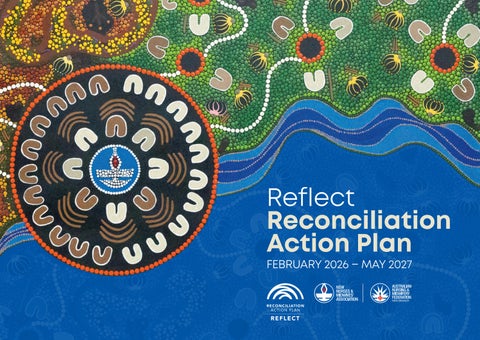
Reflect Reconciliation Action Plan FEBRUARY 2026 – MAY 2027
Acknowledgement of Country The NSWNMA would like to acknowledge the traditional Custodians of the lands on which we work and live. We pay our deepest respects to all elders past and present, and acknowledge their sovereignty and unbroken connection to these lands. We extend this respect to all First Nations peoples reading this document and reaffirm the NSWNMA’s commitment to the principles and spirit of the Uluru Statement from theHeart including the journey towards Voice, Treaty and Truth. We stand with the Aboriginal and Torres Strait islander community in solidarity and hope, hope that one day they will again possess selfdetermination in lore and in life.
Contents RAP artwork
4
Statement from CEO of Reconciliation Australia
6
Relationships
16
Message from NSWNMA General Secretary
7
Respect
18
Our organisation
8
Opportunities
20
Our RAP
9
Governance
21
Our journey
11
Our representatives
13
Partnerships and initiatives
14
Our Reflect – Reconciliation Action Plan
15
RAP artwork Reconciliation is the process of restoring friendly relations or making two seemingly contradictory peoples compatible with one another. This is an essential element in the ongoing effort to heal historical divisions and build mutual respect between Indigenous and non-Indigenous peoples. This painting is a representation of the journey to developing reconciliation as well as the harmony in community when it is done right. Using the rich vocabulary of narrative symbolism, the journey begins from the dominant centre circle. Here initially begins the division of indigenous and non-indigenous peoples, demonstrated through the outer layer of people.
Also highlighted is the birthing place, while the entire circle is surrounded in a line of vivid orange – traditionally a healing colour. It depicts pregnant women, the elderly and the nurse … reconciliation is healing.
The protection of a wind break indicating that with our care, the process of Reconciliation is always protected.
About the artist
At the centre is the NSWNMA organisation, central to this process, for protection and its outcomes. Outside the circle is a representation of the community with reconciliation. It shows a healthy community, respectful of the land, flora and fauna. Water is for life, ongoing, and orange small circles show widespread healing, cultural humility. It goes from the green of the coast to the orangebrowns of the desert. The landscape of mountains, earth, rivers and rocks is punctuated with flowering gums, desert grasses, wattle (and Hardenbergia violacea), emu, kangaroo, eagle, goanna, echidna and ants as well as man and woman.
At the heart of the NSWNMA’s new Reflect Reconciliation Action Plan (RAP), the Association has been honoured to recognise the contribution of the first Aboriginal person to be endorsed as a nurse practitioner in Australia, Lesley Salem. A proud descendant of the Wonnarua Nation in NSW and Order of Australia recipient, Lesley was invited to describe her vision of the Association’s reconciliation journey. “My nursing has shown me that we often need a greater connection with our patients,” Lesley says. “My art is that connection with patients within the Aboriginal communities I work with.”
The RAP commits to strengthening relationships, improving cultural safety and increasing representation and leadership within the organisation. “RAPs give our profession a practical, measurable way to build relationships, promote respect and create a meaningful way forward together,” Lesley says. “My art just tries to depict how working together purposefully can result in a better society.”
Lesley’s work is helping to launch and guide the NSWNMA’s new RAP, which builds on reconciliation practices underway across the Association. Reflect Reconciliation Action Plan
4
Reflect Reconciliation Action Plan
5
Statement from CEO of Reconciliation Australia Reconciliation Australia congratulates NSW Nurses and Midwives’ Association (NSWNMA) on continuing its reconciliation journey by formally endorsing NSWNMA’s second Reflect Reconciliation Action Plan (RAP). Through this plan, NSWNMA continues to play an important role in a network of more than 3000 corporate, government, and not-for-profit organisations that have made a formal commitment to reconciliation through the RAP program. Since 2006, RAPs have provided a framework for organisations to leverage their structures and diverse spheres of influence to support the national reconciliation movement. The program’s potential for impact is greater than ever, with over 5.5 million people now working or studying in an organisation with a RAP. The four RAP types – Reflect, Innovate, Stretch and Elevate – allow RAP partners to continuously develop and strengthen reconciliation commitments in new ways. This Reflect RAP continues the journey and primes the workplace for future RAPs and reconciliation initiatives. The RAP program’s strength is its framework of relationships, respect, and opportunities, allowing an organisation to strategically set its reconciliation commitments in line with its own business objectives, for the most effective outcomes.
These outcomes contribute towards the five dimensions of reconciliation: race relations; equality and equity; institutional integrity; unity; and historical acceptance. It is critical to not only uphold all five dimensions of reconciliation, but also to increase awareness of Aboriginal and Torres Strait Islander cultures, histories, knowledge, and leadership across all sectors of Australian society. This Reflect RAP enables NSWNMA to deepen its understanding of its sphere of influence and the unique contribution it can make to lead progress across the five dimensions. Getting these steps right will ensure the sustainability of future RAPs and reconciliation initiatives, and provide meaningful impact toward Australia’s reconciliation journey. Congratulations NSWNMA on your second Reflect RAP, and I look forward to following your continuing reconciliation journey. Karen Mundine
Chief Executive Officer Reconciliation Australia
Reflect Reconciliation Action Plan
6
Message from NSWNMA General Secretary As nurses, midwives and carers we are privileged to care for people at every stage of life and in every community. This responsibility extends beyond delivering culturally safe and compassionate healthcare. It requires us to actively contribute to a fairer and more just society: one where Aboriginal and Torres Strait Islander peoples enjoy equality, self-determination, cultural safety, and the opportunity to thrive.
Our Reconciliation Action Plan represents a commitment to meaningful action. Reconciliation is not an aspiration that can be achieved through words alone. It requires courage, honesty, and a willingness to confront the truth of Australia’s history and its ongoing impacts. As a union, we acknowledge the enduring strength, resilience, and leadership of Aboriginal and Torres Strait Islander peoples, who have cared for Country, culture, and community for tens of thousands of years. Truth-telling is central to reconciliation. We must recognise and understand the historical and continuing effects of colonisation, dispossession, racism, and exclusion on Aboriginal and Torres Strait Islander peoples and communities. These impacts continue to influence health outcomes, access to services, employment opportunities, and experiences within workplaces and healthcare systems. By listening to and learning from the voices of Aboriginal and Torres Strait Islander people, we can better understand our shared history and our collective responsibility to create change.
Education is a powerful tool in this journey. Through cultural learning, reflection, and ongoing dialogue, we can challenge assumptions, deepen understanding, and build workplaces where Aboriginal and Torres Strait Islander nurses, midwives, students, and health workers feel respected, valued, and supported. We are committed to fostering a culture of learning that strengthens cultural safety and equips our members to provide care that respects the rights, dignity, and cultural identities of Aboriginal and Torres Strait Islander peoples.
approaches that are led by Aboriginal and Torres Strait Islander peoples, grounded in respect, and focused on equity and self-determination.
Importantly, reconciliation also requires us to examine the systems, practices, and structures that continue to place a colonial load on Aboriginal and Torres Strait Islander communities. Too often, Aboriginal and Torres Strait Islander peoples carry the burden of navigating institutions that were not designed with their voices, experiences, or their aspirations at the centre of the needed services.
Together, we can help create workplaces, health services, and communities that honour truth, celebrate culture, reduce inequity, and advance justice. We are proud to take this step forward and remain committed to turning our intentions into meaningful and lasting change.
We acknowledge and embrace our role in challenging these barriers and advocating for
This Reconciliation Action Plan is an opportunity for our union to strengthen relationships, build trust, and walk alongside Aboriginal and Torres Strait Islander peoples in pursuit of a shared future. It reflects our commitment to listening, learning, and acting, and to ensuring that reconciliation is embedded in the work we do every day.
Michael Whaites
General Secretary NSW Nurses and Midwives’ Association Reflect Reconciliation Action Plan
7
Our organisation The New South Wales Nurses and Midwives’ Association (NSWNMA) is the registered union for all nurses, midwives and carers in New South Wales. It also serves as the state branch of the Australian Nursing and Midwifery Federation (ANMF). The NSWNMA operates under a service agreement with the ANMF – NSW Branch and both entities are jointly managed by a unified executive team and governing Council. Throughout this Reconciliation Action Plan (RAP), any reference to the NSWNMA should be understood as referring collectively to both the NSWNMA and the ANMF NSW Branch. The NSWNMA represents the industrial and professional interests of nurses, midwives and carers employed in NSW in the public, private, aged care and primary health sectors. Our role is to protect the interests of nurses, midwives, carers and the nursing and midwifery professions. The NSWNMA also represents and provides for the industrial, professional, and educational welfare of nurses, midwives and carers in government and non-government forums at state, national and international levels. The NSWNMA has approximately 85,000 members networked across 274 branches which includes the Aboriginal Torres and Strait Island Member Circle. The NSWNMA union affiliations include the Australian Nursing and Midwifery Federation, Unions NSW, the Australian Council of Trade Unions (ACTU), Hunter Workers, South Coast Labour Council and Public Services International.
Currently, the NSWNMA employs approximately 250 staff working across NSW with the head office located on Gadigal (Waterloo) and a satellite office on Awabakal (Newcastle). Three members of staff have self-identified as Aboriginal and/or Torres Strait Islander; however, the NSWNMA recognises we need to create a streamlined process where current and new employees can self-identify. The workplaces of our members become the workplaces of our staff, we therefore recognise that our staff work across and in health facilities spanning all of NSW. The geographic reach of the NSWNMA is right across New South Wales and its many unceded Aboriginal lands.
Reflect Reconciliation Action Plan
8
Our RAP The NSWNMA recognises that its members and staff live, work and play on unceded Aboriginal lands. We are committed to creating inclusive and culturally safe workplaces. This RAP demonstrates our commitment to reconciliation and provides a framework to guide our reconciliation efforts with Aboriginal and Torres Strait Islander peoples. While there is a growing awareness of the importance of reconciliation, there is an opportunity to deepen staff and member understanding and engagement across all levels.
Without a current formal RAP, we are not yet fully leveraging the potential to build stronger, more meaningful relationships with Aboriginal and Torres Strait Islander peoples and communities. Developing a second Reflect RAP will provide the foundation for a more structured, purposeful approach to reconciliation, empowering our organisation to make a positive impact on our workplace culture by standing against racism, the support we provide Aboriginal and Torres Strait Islander nurses, midwives and carers (our members), and the broader reconciliation movement. The President of the NSWNMA will serve as the champion of our Reflect RAP, leveraging their senior position and responsibility for governance and strategic oversight.
Reflect Reconciliation Action Plan
9
How the NSWNMA will implement our RAP RAP Training sessions
Stakeholder Engagement Plan
Communication Plan
• Engaging staff and leadership in the process through facilitated workshops to ensure broad understanding and involvement including cultural safety sessions. • Review and design culturally safe and appropriate training resources for Association members (including Association Member Training, Chairing a Meeting Guide, online learning modules).
Identifying and engaging Aboriginal and Torres Strait Islander groups, communities, and individuals and other key stakeholders who can assist us to achieve our objectives.
Ensuring consistent internal and external communication of our RAP commitments supported by strategic messaging that promotes anti-racism and encourages proactive bystander action.
Impact Assessment Framework Developing a framework for tracking and reporting the effectiveness of the Association’s RAP initiatives.
Recognising and promoting significant dates through education and celebration We acknowledge the importance of several key dates to Aboriginal and Torres Strait Islander peoples. As part of our commitment to reconciliation, we will honour these dates through targeted education sessions for staff, members, and Branch Officials. These initiatives aim to raise awareness, foster understanding, and celebrate by coming together to share stories and experiences. These dates include: • Invasion Day/Survival Day (26 January) • National Apology Day (13 February) • UN International Day for the Elimination of Racial Discrimination (21 March) • Bringing Them Home Report Anniversary (5 April) • National Sorry Day (26 May) • National Reconciliation Week (27 May – 3 June) • 1967 Anniversary Referendum (27 May)
• Raising of the Torres Strait Islander Flag (29 May) • Mabo Day (3 June) • Coming of the Light (1 July) • NAIDOC week (first Sunday in July until the following Sunday) • National Aboriginal and Torres Strait Islander Children’s Day (4 August) • UN International Day of the World’s Indigenous Peoples (9 August) • Indigenous Literacy Day (4 September) • World Suicide Prevention Day (10 September) • Anniversary of the UN Declaration on the Rights of Indigenous Peoples (13 September) • Koori Knockout (4 – 7 October) • Dance Rites (19 – 20 October) • Uluru returned to Anangu people (26 October)
Strengthening voice Continuing to strengthen the voice of Aboriginal and/or Torres Strait Islander members through Council, Member Circle, staff and through our member led democratic processes including but not limited to Committee of Delegates and Annual Conference.
Improve cultural safety Improve the cultural safety of Aboriginal and Torres Strait Islander members and staff by improving the recognition of Aboriginal and Torres Strait Islander culture in our shared physical environment.
Reflect Reconciliation Action Plan
10
Our journey
2018
In 2018, the Association officially endorsed the Uluru Statement from the Heart.
1997 The Association’s journey started with members identifying the need for a peak body for Aboriginal and Torres Strait Islander nurses, midwives and students. We supported the establishment of the Congress of Aboriginal and Torres Strait Islander Nurses and Midwives (CATSINaM) in 1997.
2023
We launched our first endorsed Reflect RAP. While we are proud of the progress achieved, recent organisational restructuring, new leadership, and a revised strategic plan have prompted us to develop a second Reflect RAP. Building on the foundations of our initial RAP, we have paved the way for the progress outlined below. In creating our second RAP, we have identified key areas for improvement, including ensuring representation from every internal team within the RAP Working Group and placing Aboriginal and Torres Strait Islander members at the centre of decision-making.
Reflect Reconciliation Action Plan APRIL 2018 – APRIL 2019
In 2022, delegates voted in support for the motion for Branch Officials to acknowledge the land 2022 their branch is on when introducing themselves to speak at Committee of Delegates and Annual Conference. The NSWNMA continues to educate and encourage branch officials to understand the land which their branch is on.
In February 2023, Elected Officers invited all Aboriginal and Torres Strait Islander members to a gathering at our head office on Gadigal land (Waterloo). The purpose of the meeting was twofold: to collaborate with members in co-designing a meaningful model for leadership and representation within the Association, and to formally acknowledge and apologise for the Association’s past inaction. During this pivotal and historic meeting, members agreed to establish a statewide Aboriginal and Torres Strait Islander branch/collective; a dedicated Aboriginal and Torres Strait Islander staff position would be created to support this work; and 2 Aboriginal and Torres Strait Islander Councillor positions would be created, one dedicated nurse and one dedicated midwife. In subsequent meetings, members chose to call their collective “the Circle” – representing “that we sit together as equals”. Reflect Reconciliation Action Plan
11
2023
At the 2023 NSWNMA Annual Conference, Delegates passed a motion to amend our union rules to create a collective of Aboriginal and Torres Strait Islander members which would have the same power and recognition as other union branches. At the same conference, members voted in support of creating one dedicated nurse and one dedicated midwife Aboriginal and Torres Strait Islander Council positions. The Association committed to campaign for a “Yes” vote in the Voice to Parliament campaign as part of the broader union movement. In the lead up to the campaign, the NSWNMA commissioned Bradley Page of the Dharawal nation to create the Family Union Gathering artwork for our inaugural Aboriginal scrub design. In 2023, the Association introduced a new permanent full-time role; The Aboriginal and Torres Strait Islander Engagement Officer to help lead vital work on our path to reconciliation.
2025 2024
The Member Circle was formed in January 2024 and by resolution at Annual Conference in the same year, members voted to formalise cultural protocols to open meetings and events with a Welcome to Country by local Aboriginal Elders.
In 2025, our Aboriginal and Torres Strait Islander members elected two dedicated Aboriginal and Torres Strait Islander members (one nurse and one midwife) into leadership roles on Councils (which acts as the Board of Directors). Across the NSWNMA Head Office in Gadigal land, we demonstrate our commitment to creating a culturally safe workplace and respecting the land on which we work by displaying Indigenous artwork by local artists and assigning Indigenous names to our meeting rooms. Acknowledgement of Country is displayed on our corporate website and email signatures to show respect for the Traditional Owners and acknowledge their continuing connection of Aboriginal and Torres Strait Islander peoples to Country. In 2025, we formed a RAP working group and Steering Committee to lead the development of the NSWNMA Reflect RAP. Reflect Reconciliation Action Plan
12
Our representatives RAP Working Group
RAP Steering Committee
Our current RAP working group is made up of staff members from various teams throughout the organisation. They are responsible for developing, implementing, and reviewing the RAP for the NSWNMA in line with Reconciliation Australia’s requirements. The group also updates the Steering Committee on progress and highlights RAP successes through The Lamp (both online and print), social media, and the Annual Report.
The current RAP Steering Committee is composed of an Elected Officer, Council members, Member Circle representatives, and NSWNMA staff. This Committee provides strategic direction and effective governance to ensure that the RAP remains aligned with the NSWNMA’s mission, vision, and strategic priorities. The Committee also serves as an advocate for the RAP within the NSWNMA membership, facilitates decision escalation and issue resolution to ensure the RAP receives necessary support, and delivers progress reports on RAP implementation to both the NSWNMA Council and the Committee of Delegates.
Representatives of the RAP Working Group: • Frances Underwood – Primary Care Sector Coordinator • Jacqui Nissim – Organising Educator • Janaki Chellam-Rajendra – Director, Strategy & Transformation • Jannine Graham – Industrial Officer (Gadigal) • Joanne Purdue – Senior Professional Officer • Justine Kirby-Wilson – Information Technology Adoption Coordinator • Kalina Christova – WHS Professional Officer • Kayla Wipiti – Organiser • Keith Wicks – Aboriginal and Torres Strait Islander Engagement Officer (Yuin & Yorta Yorta man) • Laura Drury – Manager, Professional Services (Biripi) • Nicole Mason – Lead, Public Health Organising • O’Bray Smith – President, NSWNMA • Ushter Abbasi – Information Officer • Warren Williams – Manager, Administrative Services
Representatives of the RAP Steering Committee: • Diane Lang – Councilor, NSWNMA • Elizabeth McCall – Councilor, NSWNMA • Emma Gedge – Councilor, NSWNMA • Janaki Chellam-Rajendra – Director, Strategy & Transformation • Kate Adams – Professional Officer • Keith Wicks – Aboriginal and Torres Strait Islander Engagement Officer (Yuin & Yorta Yorta man) • Kristen Lawerence – Aboriginal and Torres Strait Islander Members Circle, NSWNMA (Awabakal Lands) • Laura Drury – Manager, Professional Services (Biripi) • Lisa Currie – Aboriginal and Torres Strait Islander Members Circle, NSWNMA • Mathew Grant – Councilor, NSWNMA (Wiradjuri) • Matthew West – Personal Assistant • O’Bray Smith – President, NSWNMA • Paul Haines – Councilor, NSWNMA • Rebekah Henderson – Councilor, NSWNMA (Wiradjuri) • Robyne Brown – Councilor, NSWNMA • Warren Williams – Manager, Administrative Services Reflect Reconciliation Action Plan
13
Partnerships and initiatives The NSWNMA Community are strengthening current partnerships with:
The Congress of Aboriginal and Torres Strait Islander Nurses and Midwies (CATSINaM)
Awabakal Local Aboriginal Land Council
First Nations Workers Alliance
Coffs Harbour LALC
Regional Rural Common Threads Aboriginal Health Remote Research and Medical Research Council and Clinical Trials Program – AH&MRC
Illawarra LALC
Internal activities/initiatives: • Aboriginal or Torres Strait Islander nurse councillor • Aboriginal or Torres Strait Islander midwife councillor • Aboriginal and Torres Strait Islander Member Circle
Tweed/Byron LALC
Albury & District LALC
Waminda
Indigenous Employment Australia
Metropolitan Local Aboriginal Land Council
La Perouse Local Aboriginal Land Council
Connections with Southern Sydney Traditional Owners Koori Interagency Network of the Pilliga and participation in the campaign with Gomeroi/ Gamilaraay people
• Aboriginal and Torres Strait Islander Engagement Officer • National Reconciliation Week event with activity guided by Reconciliation Australia’s NRW resources • Climate Change Action Reference Group advocacy for land rights Reflect Reconciliation Action Plan
14
Recon c
n Pla
OUR
on Actio i t n li ia
Reflect
Reflect Reconciliation Action Plan
15
Relationships DELIVERABLE
TIMELINE
RESPONSIBILITY
ACTION 1. Establish and strengthen mutually beneficial relationships with Aboriginal and Torres Strait Islander stakeholders and organisations. Identify Aboriginal and Torres Strait Islander stakeholders and organisations within our local area or sphere of influence.
March 2026
Lead: Manager, Professional Services Team Support: Professional Services Team
Research and record areas of strategic alignment for example organisations and programs that deliver Close the Gap initiatives.
December 2026
Lead: Manager, Professional Services Team Support: Professional Services Team
Research best practice and principles that support partnerships with Aboriginal and Torres Strait Islander stakeholders and organisations such as NATSIAACC membership.
April 2026
Lead: Director of Transformation and Strategy Support: Elected Officers
Introductory contact achieved with each recognised organisation. Areas of strategic benefit/alignment to be established along with a commitment for ongoing collaboration with these organisations.
December 2026
Lead: Manager, Professional Services Team Support: Elected Officer, Manager, Organising Private Hospitals & Aged Care Team, Manager, Public Health Organising Team
ACTION 2. Build relationships through celebrating National Reconciliation Week (NRW). Circulate Reconciliation Australia’s NRW resources, events and reconciliation materials to our staff and NSWNMA/ANMF members.
May 2026
Lead: Manager, Campaigns and Communications Team Support: Campaigns and Communications Team
RAP Working Group with Senior Leadership Team to participate in an external NRW event.
27 May – 3 June 2026
Lead: President Support: Elected Officers, Senior Leadership Team
Encourage and support staff and senior leaders to participate in at least one external event to recognise and celebrate NRW in the lands where they work, live or play.
27 May – 3 June 2026
Lead: President Support: Elected Officers, Senior Leadership Team
Reflect Reconciliation Action Plan
16
Relationships DELIVERABLE
TIMELINE
RESPONSIBILITY
Communicate our commitment to reconciliation to all staff: including but not limited to targeted internal communications, creating space at staff meetings and through delivery of internal education. At least one activity occurs each month.
September 2026
Lead: Manager, Employee Engagement Team Team: Employee Engagement Team
Identify external stakeholders that our organisation can engage with on our reconciliation journey.
June 2026
Lead: Director, Strategy and Transformation Support: Manager Professional Services Team
Identify RAP and other like-minded organisations that we could approach to collaborate with on our reconciliation journey.
June 2026
Lead: Director, Strategy and Transformation Support: Manager Professional Services Team
ACTION 3. Promote reconciliation through our sphere of influence.
ACTION 4. Promote positive race relations through anti-discrimination strategies. Research best practice and policies in areas of race relations and anti-discrimination.
April 2026
Lead: Manager, Employee Engagement Team Team: Employee Engagement Team
Conduct a review of Employee Engagement (HR) policies and procedures to identify existing anti-discrimination provisions, and future needs.
December 2026
Lead: Manager, Employee Engagement Team Team: Employee Engagement Team
Reflect Reconciliation Action Plan
17
Respect DELIVERABLE
TIMELINE
RESPONSIBILITY
ACTION 5. Increase understanding, value and recognition of Aboriginal and Torres Strait Islander cultures, histories, knowledge and rights through cultural learning. Conduct a review of cultural learning needs within our organisation and Council.
June 2026
Lead: Manager, Employee Engagement Team Team: Employee Engagement Team
Build awareness of cultural load within the organisation.
September 2026
Lead: Manager, Employee Engagement Team Team: Employee Engagement Team
Alleviate cultural burden and Improve cultural competence by reviewing resource requirements.
June 2026
Lead: Manager, Employee Engagement Team Team: Employee Engagement Team
Review onboarding processes to develop to increase cultural awareness and cultural competency.
May 2026
Lead: Manager, Employee Engagement Team Team: Employee Engagement Team
Explore ways to deliver a training package incorporating truth telling for increasing understanding, value and recognition of Aboriginal and Torres Strait Islander cultures, histories, knowledge and rights within our organisation.
September 2026
Lead: Manager, Employee Engagement Team Team: Employee Engagement Team
Commence delivery of above training packages to both staff and Council.
December 2026
Lead: Manager, Employee Engagement Team Team: Employee Engagement Team
Review shared environmental (office) spaces of NSWNMA staff for cultural safety. Use the physical environment as an opportunity to increase awareness, provide education and display Aboriginal and Torres Strait Islander excellence and cultures.
December 2026
Lead: Manager of Administration and General Services Support: Facility Management
Research the role that our professions played (nurses, midwives and carers) in the enduring trauma inflicted upon Aboriginal and Torres Strait Islander peoples. This includes but is not limited to the Stolen Generations, exclusion from healthcare provision, cultural erasure and systematic discrimination.
September 2026
Lead: Manager, Professional Services Team Support: Elected officers
Work in collaboration with our national body to deliver an apology of the impacts of generational trauma and acknowledge wrong doings of our professional groups.
May 2027
Lead: General Secretary Support: President
Respect DELIVERABLE
TIMELINE
RESPONSIBILITY
ACTION 6. Demonstrate respect to Aboriginal and Torres Strait Islander peoples by observing cultural protocols. Develop an understanding and greater recognition of the local Traditional Owners of the lands and waters within our organisation’s operational area and span of travel.
September 2026
Lead: Chief Technology Officer Support: Senior Leadership Team
Increase staff’s understanding of the purpose and significance behind cultural protocols, including Acknowledgement of Country and Welcome to Country protocols.
March 2026
Lead: Senior Leadership Team Support: Employee Engagement Team
ACTION 7. Build respect for Aboriginal and Torres Strait Islander cultures and histories by celebrating NAIDOC Week. Raise awareness and share information amongst our members and staff about the meaning of NAIDOC Week
June 2026
Lead: Manager, Communications and Campaigns Team Support: Senior Leadership Team
Introduce our members and staff to NAIDOC Week by promoting external events across NSW.
June 2026
Lead: Manager, Communications and Campaigns Team Support: Senior Leadership Team
RAP Working Group to participate in an external NAIDOC Week event.
July 2026
Lead: President Support: Senior Leadership Team
Reflect Reconciliation Action Plan
19
Opportunities DELIVERABLE
TIMELINE
RESPONSIBILITY
ACTION 8. Improve employment outcomes by increasing Aboriginal and Torres Strait Islander recruitment, retention and professional development. Build understanding of current Aboriginal and Torres Strait Islander staffing to inform future employment and professional development opportunities.
September 2026
Lead: Manager, Employee Engagement Team Team: Senior Leadership Team
Review existing recruitment and retention policy as well as practices to ensure culturally safe approaches to recruitment and onboarding.
April 2026
Lead: Manager, Employee Engagement Team Team: Employee Engagement Team
Develop a business case for Aboriginal and Torres Strait Islander specific roles within our Association.
June 2026
Lead: Manager, Employee Engagement Team Team: Employee Engagement Team
Explore mentoring programs and development opportunities for Aboriginal and Torres Strait Islander staff.
May 2026
Lead: Manager, Employee Engagement Team Team: Employee Engagement Team
Increase the number of staff who identify as Aboriginal and Torres Strait Islander people at the Association.
December 2026
Lead: Manager, Employee Engagement Team Team: Employee Engagement Team
ACTION 9. Increase Aboriginal and Torres Strait Islander supplier diversity to support improved economic and social outcomes. Revise, update and continue to implement the procurement policy to prioritise purchasing from Aboriginal and Torres Strait Islander businesses.
February 2026
Chief Technology Officer
Revise and update the Association’s procurement policy to promote the ethical and respectful engagement of Aboriginal and Torres Strait Islander products and services.
December 2026
Chief Technology Officer
Explore and engage in corporate partnerships with organisations such as Supply Nation by investigating.membership.
February 2026
Lead: Director, Strategy and Transformation Support: Executive Office
Reflect Reconciliation Action Plan
20
Governance DELIVERABLE
TIMELINE
RESPONSIBILITY
ACTION 10. Establish and maintain an effective RAP Working Group (RWG) to drive governance of the RAP. Form a RWG and RAP Steering Committee (RSC) to govern RAP implementation.
February 2026
Lead: Director, Strategy and Transformation
Draft a Terms of Reference for the RWG and RSC.
February 2026
Lead: Director, Strategy and Transformation
Establish Aboriginal and Torres Strait Islander representation on the RWG and RSC.
February 2026
Lead: Director, Strategy and Transformation
ACTION 11. Provide appropriate support for effective implementation of RAP commitments. Define resource needs for RAP implementation.
February 2026
Lead: Council and Elected Officers Support: Manager, Professional Services Team
Engage senior leaders in the delivery of RAP commitments.
February 2026
President
Maintain a senior leader to champion our RAP internally.
February 2026
President
Define appropriate systems and capability to track, measure and report on RAP commitments.
February 2026
Director, Strategy and Transformation
Reflect Reconciliation Action Plan
21
Governance DELIVERABLE
TIMELINE
RESPONSIBILITY
ACTION 12. Build accountability and transparency through reporting RAP achievements, challenges and learnings both internally and externally. Report RAP goals and progress at the following events: • Monthly Council meetings. • Monthly staff meetings • Member Circle Meetings. • RAP Steering Committee Meetings.
December 2026
Report RAP progress to key stakeholders such as NSWLALC affiliates.
February 2026
Lead: President Support: Aboriginal and Torres Strait Islander Engagement Officer
Contact Reconciliation Australia to verify that our primary and secondary contact February 2026 details are up to date, to ensure we do not miss out on important RAP correspondence.
Manager, Professional Services Team
Contact Reconciliation Australia to request our unique link, to access the online RAP Impact Survey.
1 August annually
Manager, Professional Services Team
Complete and submit the annual RAP Impact Survey to Reconciliation Australia.
30 September, annually
Manager, Professional Services Team
ACTION 13. Continue our reconciliation journey by developing our next RAP. Register via Reconciliation Australia’s website to begin developing our next RAP.
January 2027
Manager, Professional Services Team
Reflect Reconciliation Action Plan
22
Contact details President NSWNMA/ RAP Champion
Aboriginal and Torres Strait Islander Engagement Officer
O’Bray Smith Phone: 0439 051 302 Email: osmith@nswnma.asn.au
Name: Keith Wicks Phone: 0499 707 456 Email: kwicks@nswnma.asn.au
Reflect Reconciliation Action Plan
23
Reflect Reconciliation Action Plan FEBRUARY 2026 – MAY 2027
Authorised by M.Whaites, General Secretary, NSWNMA and Branch Secretary, ANMF NSW Branch | August 2026