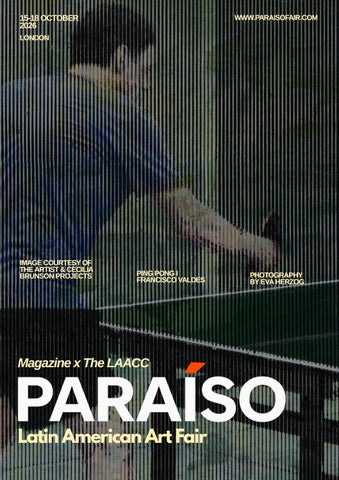
15-18 OCTOBER 2026
WWW.PARAISOFAIR.COM
LONDON
IMAGE COURTESY OF THE ARTIST & CECILIA BRUNSON PROJECTS
PING PONG I FRANCISCO VALDES
Magazine x The LAACC
Latin American Art Fair
PHOTOGRAPHY BY EVA HERZOG
Jaime Gili Courtesy of Aninat Art Projects
Table of Content 3
4
5
59
Exhibitors
Paraiso Highlights
Note from the Founder
Note from the Editor
Javier Calderón
Manuela Rodríguez
62
70
72
76
Paraiso Highlights
Guest Country Program
Limited editions and publications
México
Directed by Calaca Press
Independent artists
Víctor Delgado & Laura Montañés
Adriana Buckley
84
90
93
98
Public programme
Video Art from Central America
Partners introduction
Meet the team
Curated by Juan Canela
35 MARYLEBONE RD, LONDON NW1 5LS
OCTOBER 15-18 2026
AMBIKA P3
Letter from Javier Calderon From a shy romance to an open relationship. Paraíso Latin American Art Fair in London emerges with the full confidence that the UK and Latin America are ready for a new and open relationship. Latin American art, artists and art professionals' presence in the UK has increased significantly over the last few decades, but over the last few years it has exploded into a great number of exhibitions, including many at national institutions. Universities now have programmes dedicated to Latin American art history, and every year a great number of Latin American students come to study art in the UK; many of them have also developed successful careers here. The aim of Paraíso is to reinforce what has been achieved and to fill the gaps, as we want to see this as just the beginning of a new golden age of collaboration and understanding between the UK and Latin America. There is no more diverse and rich artistic tradition in any other region than Latin America, as this region is the cradle of two of the six original civilisations: the Andean and the Mesoamerican. In economic terms, it has three country members of the G20, and the capital talent is truly impressive. Past and present collide in exciting forms of representation by artists exploring both local and universal themes and ideas, and employing all sorts of materials and technologies, making this region truly special. The first edition of Paraíso is a prelude to a hundred years, as we believe that there is so much great Latin American art from the last hundred years which hugely deserves to be discovered by the British public. In this first edition we are presenting the work of Felipe Ehrenberg (Mexico, 1943–2017) and Pola Weiss (Mexico, 1947–1990), two Latin American mavericks whose work sheds light on the forward-thinking spirit of art in Latin America. But there are many more great Latin American maestros, along with an impressive number of contemporary artists. Paraíso is here to provide a platform for diverse artists, galleries and organisations, in particular those who do not have a presence in the UK. At the same time, Paraíso seeks to create new audiences for Latin American art. Paraíso should create the scenario for the formation of a new generation of collectors of Latin American art and for cementing a new and long-lasting relationship between artists and art organisations in the UK and Latin America. Paraíso also sees the UK as the greatest hub for Latin America to start creating opportunities with other regions, such as Asia, India and the Middle East, as there is a need to create new channels of collaboration with all other regions, which are waiting to be opened, and this is something that can be done from the UK. For now let’s enjoy this new and open affair from the 15 to the 18 October at Ambika P3. JAVIER CALDERON Founder and director Paraíso
Paraíso Magazine
3
From the Editor MANUELA RODRÍGUEZ Co-founder The LAACC
Eight months ago, Javier and I had our first conversation about Paraíso. It was an idea without a brand or participants, and it sounded a lot like a dream. The LAACC signed on as a partner when everything was still preliminary, and I'm glad we did. Editing this magazine made me grasp the true scale of what has been built since. It also made clear that Paraíso is arriving at exactly the right moment, and how much it matters for Latin American art that it is happening in London. What moves me most is the community that made it possible. More than twenty galleries trusted a first edition, and thirteen independent artists joined them, alongside live music, talks and a programme of speakers of the highest calibre. So many people joined generously and without expecting anything in return, simply because they understood this was a timely and necessary project. After years of working for Latin American art, I'm proud to share this space with every exhibitor and participant in this year's fair. On a personal level, watching this unfold and being part of this team has been deeply fulfilling. This is a first edition, and there will surely be lessons along the way. But we set out to deliver something of quality, and that was never compromised or up for negotiation. This magazine is here to show it. I hope this is the first magazine of many to come. May we keep working together, carrying Latin American art around the world and opening doors for artists of every trajectory in global art centres as relevant as London. Welcome to Paraíso. Manuela Rodríguez
Paraíso Magazine
4
BOOTHS N°1 Acapulco62 · Mexico N°2 SOMERS · UK N°3 Piloto Pardo Gallery · UK N°4 Quimera Galería · Argentina N°5 The Light Gallery · Colombia / UK N°6 Isabel Croxatto Galería · Chile N°7 Victoria Law Projects · UK N°8 Aninat Art Projects · Chile N°9 Art Elsewhere · UK N°10 PANIK.CO · Mexico N°11 Vesper Tzu · Peru BOOTHS N°12 The LAACC · Colombia N°13 NUBE Gallery· Bolivia N°14 Alvarez Chida Gallery · Mexico N°15 Carlos Caamaño · Peru N°16–17 Cecilia Brunson Projects · UK N°18 Belmacz · UK N°19 Astéri Contemporary · UK N°20 La Rebelde · Peru N°21 Patricia Christie Galleries · UK N°22 Salón Silicón · Mexico
Exhibitors
5
ACAPULCO 62 MEXICO BOOTH 1
PRESENTING: Boris Viskin (México) Alfonso Mena (México) Marcos Castro (Mexico) Chavis Mármol (México) Benjamin Torres (México) Germán Venegas (México)
Beginning in February 2018, the gallery took the name of its first location in Mexico City's Roma neighbourhood. In mid-2019, it moved to Dr. Atl Street in Santa María la Ribera, directly across from the Kiosko Morisco. In 2026, it opened a new space on James Sullivan Street, next to Paseo de la Reforma and near the Jardín del Arte, becoming part of the area's cultural fabric. With a solid, eclectic program, the project brings together artists of different generations and disciplines, from posthumous homages to recent works by key contemporary artists and emerging young talent. Acapulco 62 believes art should be available to everyone. This shows in its free public access and in the gallery's physical openness to its surroundings, inviting passersby and visitors to encounter art naturally.
Paraíso Magazine
6
ACAPULCO 62
Boris Viskin Born in Mexico City in 1960, Boris Viskin spent his youth in Israel and three years in Florence, where he began his painting career at the Studio Art Center International. Returning to Mexico City in 1985, he studied printmaking and lithography at the Academia de San Carlos. These shifts in culture, landscape and language shape his work, which small figures swallowed by vast spaces, or abstract elements set against figurative
ones,
evoke
the
uprooted
self:
fragile
and
vulnerable, yet firm in the face of an apparently senseless existence. Of his practice he says: "I always distrusted words. The world of images was a more solid and secure space," and painting has become the ideal medium to weave together his multiple, contradictory personalities.
C o u r t e s y o f A r t e i n fo r m a do
Alfonso Mena Alfonso Mena Pacheco, born in Mexico City in 1961, is known for the philosophical originality of his abstract vocabulary and for building an ontological dimension for painting. His pictorial beings stand out both for their autonomy and for the relationships they form with other elements, making him one of Mexico's leading contemporary artists. A recipient of grants, prizes and selections in major exhibitions, he trained at La Esmeralda (INBA) and has taught at UNAM's Escuela Nacional de Artes Plásticas. C o u r t e s y o f I s a b e l le S e r r a n o F i n e A r t G a l le r y C o u r t e s y o f A r t e i n fo r m a do
Marcos Castro Mexican artist Marcos Castro works across drawing, ceramics,
installation,
painting
and
murals,
approaching art as a sacred sphere. Drawing is the key to his process, and his work draws on symbolic elements from myth, local and national history, and natural environments, seeking to generate new identities from ancient images, with "ruins" as a recurring motif. By presenting these subjects in new and revealing ways, he heightens their physical and emotional resonance, which is why he is drawn to the power of ritual and murals as spaces of community and utopia for the experience of art.
Paraíso Magazine
7
ACAPULCO 62
Chavis Marmol Mármol is a Mexico City-based artist from Hidalgo whose practice of just over ten years is grounded in contradiction,
exploring
indigenous
identity
in
contemporary society, the irony of materiality, latestage capitalism, and the slapstick intervention of concept and form. Drawing on deep knowledge of
in
tools and materials, he creates sculptures, sitespecific installations and performance sculptures steeped in political satire and social criticism, with play at their core.
Courtesy of JOHS
Benjamin Torres Benjamín Torres's work maintains a strong relationship with design, reappropriating the creative exercises established by the Pop art of the 1960s. Through strategies
of
appropriation,
parody,
décollage,
collage and casting, he highlights the formal qualities of everyday object design. Likewise, many of his works return to a reflection on the importance of the image in contemporary society, and on how its constant, recurring presence builds imaginaries, dialogues and relationships of knowledge that replace the real object with its representation.
C o u r t e s y o f A r t e i n fo r m a do
Paraíso Magazine
8
ACAPULCO 62
in
C o u r t e s y o f G e r m a n Va n e g a s
German Vanegas Was born in 1959 in La Magdalena Tlatlauquitepec, State of Puebla. From 1977 to 1982 he studied at "La Esmeralda" (National School of Painting, Sculpture and Printmaking). He presented his first solo exhibition in 1984. Shortly before his formal training as an artist as a craftsman carver was developed. It was widely recognized as one of the most outstanding representatives of the generation of artists during the eighties broke with great force on the national cultural scene, who qualified as Neomexicanistas, he combined the technique of wood carving and painting in many of its early works. After an extended period devoted to sculpture, painting Venegas returned to the task, finding a new point of departure led to the philosophical-religious universe where Buddhism found a link between his life and his art, enriching their work with a new perception of life and death, represented in his paintings and drawings deities and icons eastern and Western. He received the award of acquisition in the III National Meeting of Young Artists in 1983 and fellow of FONCA in four times in two different categories in 2000, 20001, 2004 and 2010, among other distinctions. His work has been exhibited in Mexico and abroad (USA, Japan, Spain, Guatemala, Brazil, Germany, Ecuador, Australia, Cuba, Italy and France), and important collections including the Museum of Ponce in Puerto Rico, the Museum of Modern Art in Mexico City, the Metropolitan Museum in New York and the Museum of Extremeño e Iberoamericano of Contemporary Art in Badajoz, Spain, and others.
Paraíso Magazine
9
SOMERS U.K
BOOTH 2
PRESENTING: Felipe Ehrenber (Mexico) Pola Weiss (Mexico)
Somers Gallery was established in 2015 as a project space under the name of Chalton Gallery. In 2022 the gallery changed its name to Somers Gallery. Chalton Gallery championed mainly Mexican and British artists while Somers Gallery is focused on Latin American and British art. Somers is committed to championing Latin American and British art. But Somers is more than a gallery — it is a 21st-century Avant-Garde force dedicated to the praxis of the most pressing issues of our time. Somers Gallery is located in Somers Town, London, a historic neighbourhood now at the forefront of innovation.
Paraíso Magazine
10
SOMERS
Felipe Ehrenberg Paraíso
presents
Felipe
Ehrenberg:
26
Maculate Letters from Mexico | An Unfinished Conversation, bringing to London 26 works by the Mexican artist (1943-2017), conceived for a 2016 exhibition in the city that was never realised. At its centre are the 26 Maculate Letters from Mexico, sent through the postal system in a project where correspondence became both medium and method. For Ehrenberg, the letter was a form of movement between people, places and ideas, a way for art to circulate beyond exhibition spaces. The works return to the intense international correspondence he began after arriving in Britain in 1968, recovering the pleasure of receiving a "real" letter. Shown ten years on, they appear alongside other pieces that reveal recurring elements in his practice: fragments, signs, words and images that circulate, collide, disappear and return. Rather than reconstructing the exhibition that might have been, An Unfinished Conversation allows an interrupted exchange to continue. Ehrenberg was a pioneering artist, publisher, cultural activist and self-described neologist whose work in mail art, performance and publishing challenged the boundaries of the artwork.
Paraíso Magazine
11
PILOTO PARDO
U.K
PRESENTING:
BOOTH 3
Alejandra Prieto (Chile)
Juan Martínez Macari (Chile) Cosima zu Knyphausen (Chile) Martina Quesada (Argentina)
Piloto pardo is a curator-run gallery in Farringdon, London, with a permanent space since 2025. Founded in 2021 by Chilean-German curator Philippa zu Knyphausen, it focuses on contemporary art with a particular interest in Latin America, presenting conceptually rigorous, research-driven work. Working with an international roster, the gallery operates within London's commercial landscape while amplifying underrepresented voices. Its scale allows close, sustained collaboration with emerging artists such as Darya Diamond, Martina Quesada, and Cosima zu Knyphausen.
Paraíso Magazine
12
PILOTO PARDO
Cosima zu Knyphausen
J u a n M a r t í n e z M a c a r i
Martina Quesada
A le j a n d r a P r i e t o
Courtesy of the artist
C o u r t e s y o f P i lo t o Pa rdo
C o u r t e s y o f P i lo t o Pa rdo
c o u r t e s y o f P i lo t o Pa rdo Photos by René Lazový.
Piloto Pardo: Latin American Perspectives Across Borders London-based, Latin American-run gallery Piloto Pardo will present works by four Latin American artists whose practices unfold across different geographies and artistic languages: Juan
Martínez
Macari,
Alejandra
Prieto,
Cosima
zu
Knyphausen, and Martina Quesada. Based in Idahue, Chile, Juan Martínez Macari explores the intimacy of everyday life through painting, drawing inspiration from still-life traditions and the observation of domestic objects, flowers, and familiar surroundings. Fellow Chilean artist Alejandra Prieto, based in Santiago, works across sculpture and installation, investigating materiality, labour, extraction, and the structures of global capitalism. Chilean artist Cosima zu Knyphausen, based in Berlin, moves between painting, drawing, and writing, reinterpreting arthistorical and literary references to explore desire, intimacy, identity, and queer experience. Meanwhile, Argentine artist Martina Quesada, based between Buenos Aires and Paris, works across sculpture, installation, and video, drawing on geometry, sacred symbolism, and nature to examine perception, memory, and the boundaries between the visible and invisible. Together, these four practices offer distinct perspectives on contemporary Latin American art, reflecting the diversity of artistic approaches and experiences that emerge across borders.
Paraíso Magazine
13
QUIMERA GALERÍA
ARGENTINA BOOTH 4 PRESENTING: Nina Kovensky (Argentina) Julio Hilger (Argentina)
Quimera functions as a platform for the development of curatorial, exhibition, educational, and editorial projects. It represents an intermediate generation of contemporary artists and fosters interdisciplinary dialogue by providing space for cycles, projects, artists, and curators within its venue. In 2015, it launched its own publishing imprint, Q·Editora, with bilingual publications accompanying its exhibitions, and in 2016 added an alternative exhibition space, Qubo, for site-specific proposals. Since its inception, the gallery has opened new markets and introduced Argentine artists to unexplored destinations. Over the years, it has succeeded in placing works by several of its artists into important international collections. The gallery is part of Meridiano and works actively toward the development of the local art scene.
Paraíso Magazine
14
QUIMERA GALERÍA Julio Hilger (b. Buenos Aires, Argentina) is a visual artist who participated in the Artists’ Programme at Universidad Torcuato Di Tella, where he developed his practice under the guidance of Mónica Girón, Santiago Villanueva, and Mariano Mayer. He furthered his training through workshops and mentorships with artists including Diego Bianchi, Mariela Scafati, Eduardo Stupía, and Pablo Siquier. In 2024, he participated in the Hito Cultural Fellowship and was selected for the Federico Jorge Klemm Visual Arts Prize. In 2025, he participated in the Amalia Lacroze de Fortabat Foundation Prize and presented a solo exhibition at Miranda Bosch Gallery. More recently, he was selected for the GCH Prize with his work Todo crece en esta selva.
Hernán Soriano (b. 1978, Buenos Aires, Argentina) is a multidisciplinary artist who studied at the Prilidiano Pueyrredón School of Fine Arts and participated in programmes at Centro Cultural Ricardo Rojas (2006), Centro de Investigaciones Artísticas (2010), and Gachi Prieto Gallery (2012). He is a member of the artistic collectives Provisorio Permanente and Tótem y Tabú. His practice spans installation, sculpture, and experimental artistic projects. His solo exhibitions include El tiempo que nos queda (2020, Galería Lanzallamas), Formar mentalmente una máquina (2016, Museo de Arte Moderno de Buenos Aires), and Edición (2015, Document Art). He has also participated in group exhibitions at Museo MAR, Museo Emilio Caraffa, and the Stuttgarter Filmwinter Festival in Germany.
Images: courtesy of Quimera Galeria and the artists.
Nina Kovensky (b. 1993, Buenos Aires, Argentina) is a multidisciplinary artist whose practice spans sculpture, performance, curatorial projects, and public interventions. She studied at Casa Escuela de Arte and participated in the Artists’ Programme at Universidad Torcuato Di Tella in 2017. Her work explores collective participation and everyday interactions through public performances she calls “interferences.” She has exhibited at Isla Flotante, El Gran Vidrio, and arteBA, where she received the Premio en Obra in 2018. She is also co-founder of Caterine Ful Lov, a collaborative culinary project combining art, food, and political activism. She currently works with El Gran Vidrio gallery.
Paraíso Magazine
15
THE LIGHT GALLERY U.K/COLOMBIA BOOTH 5
PRESENTING: Citlali Fabián (Mexico) River Claure (Bolivia) Luis Morales (Colombia) Julia Fullerton-Batten (Germany)
The Light Gallery fosters cross-cultural dialogue and introduces Latin American artists to new global audiences and collectors. Its curatorial programme explores the relationships between image, cultural identity, and space, while continually expanding the visibility and appreciation of contemporary Latin American art. Directed by Luz María Osorio, a Fine Arts graduate with a Master's in Museology and five years of experience at Christie's London, the gallery operates between Medellín and London, with an active presence at international art fairs and temporary exhibitions across Colombia, the United Kingdom, and the United States.
Paraíso Magazine
16
THE LIGHT GALLERY The reinterpretation of cultural identity through photography. At Paraiso The Light Gallery presents four photographic practices that explore how Latin American
identity
is
shaped
by
culture,
memory, territory and storytelling. Directed by LuzMa
Osorio,
The
Light
Gallery
is
a
contemporary art gallery based in London and Medellín, committed to promoting dialogue between Latin America and the international art market through exhibitions and international art fairs. With a strong focus on photography, the gallery represents and promotes artists whose work explores questions of identity, memory, territory and cultural heritage. Through a carefully curated programme, The Light Gallery brings Latin American artistic practices to new audiences and collectors, supporting both emerging and established artists and contributing to their visibility within the international art world.
B i l h a - S t o r i e s o f m y s i s t e r s 2025 , C i t l a l i Fa b i a n , S o n o f t h e s t a r s 2020
Artists at Paraíso Latin American Art Fair : Mexican artist Citlali Fabián presents Bilha Stories of My Sisters, a deeply personal body of work rooted in her Zapotec heritage and the experiences of the women within her family and community. Through intimate portraiture, Fabián reflects
on
transmission
ancestry, of
belonging
cultural
and
identity
the
across
generations, creating a visual dialogue between memory, tradition and contemporary life. Bolivian artist River Claure presents Son of the Stars, his photographic adaptation of Antoine de Saint-Exupéry’s The Little Prince, reimagined through the landscapes, traditions and visual language of contemporary Andean culture. Claure relocates the familiar narrative to a distinctly Bolivian context, bringing the universal themes of Saint-Exupéry’s S o n o f t h e s t a r s 2020 , R i v e r C l a u re
story
into
dialogue
with
indigenous heritage, contemporary identity and ideas of belonging.
Paraíso Magazine
17
THE LIGHT GALLERY Colombian artist Luis Morales presents Litoral, an interactive and contemplative series centred on the shifting boundary between sea and shore. As viewers immerse themselves in the work, they gradually discover small stories and details embedded within the images, encouraging personal
a
more
encounter
intimate
and
with
each
photograph. The horizon becomes both a physical
and
metaphorical
threshold
through which Morales explores memory, human
presence,
impermanence.
permanence
and L i t o r a l ( S h o re l i n e) 2026 , L u i s M o r a le s
Guest Artist : German artist Julia Fullerton-Batten presents Frida / A Singular Vision of Beauty & Pain. Developed through extensive research into Mexican culture and an immersive period living within the local community in Mexico, the series seeks to capture an authentic sense of place and cultural context. Working in real locations and through carefully constructed scenes, Fullerton-Batten explores Kahlo’s identity, physical suffering, resilience and distinctive approach to self-representation.
Fr i d a - A s i n g u l a r v i s i o n o f B e a u t y & Pa i n 2024 , J u l i a Fu l le r t o n - B a t t e n
Paraíso Magazine
18
ISABEL CROXXATO GALERIA CHILE
BOOTH 6
PRESENTING: Nelson Hernández (Chile)
IIsabel Croxatto Galería is an international contemporary art platform founded in Santiago in 2012 by Chilean performance researcher, choreographer, and cultural manager Isabel Croxatto. It promotes contemporary art from the South of the World, supporting emerging and mid-career artists and encouraging new ways of collecting through its Living with Art programme. The gallery takes part in international fairs across Asia, Europe, and the Americas. It launched the virtual space ICG+ in 2020, opened LOCAL 2 for young artists in 2022, and established the LA EMBAJADA residency in 2023. Its artists explore the human condition, memory, and the analogue and the digital, often through figurative art.
Paraíso Magazine
19
ISABEL CROXXATO GALERIA Errantes is a solo presentation by Chilean artist Nelson Hernández inspired by the Latin concept of wandering stars, the exhibition explores movement, transformation, and the blending of identities. Featuring Errantes, a large-scale painting combining Baroque tenebrism with cartoon imagery, alongside the new Fever Dreams II series and other works, the presentation reflects on the shifting meanings that emerge through displacement and change. Nelson Hernández (b. Patagonia, Chile) is a visual artist based in London. He holds a BA in Fine
Arts
from
the
Pontificia
Universidad
Católica de Chile and an MA in Painting from the Royal College of Art, London. His practice explores
the
impact
of
globalisation
on
contemporary identity, examining how local cultures and individual histories are reshaped by increasingly standardised global narratives. Drawing from art history and popular culture, Hernández combines diverse painting styles, appropriation, and reinterpretation to challenge notions of identity, belonging, and memory.
His work has been exhibited across North and South America, London, and Europe. In 2024, he completed an artist residency at GlogauAIR in Berlin, and in 2025, he was selected for the Herbert Smith Freehills Portrait Award at the National Portrait Gallery in London. His works are held in private and institutional collections in Chile, the United States, the United Kingdom, and India.
Paraíso Magazine
20
VICTORIA LAW PROJECTS U.K
BOOTH 7
PRESENTING: Lucia Pizzani (Venezuela) Jose Olvera (Venezuela)
Victoria Law Projects (VLP) is an independent project space founded in London in 2023, dedicated to showcasing contemporary art through exhibitions, artist talks, and cross-cultural collaborations, with a particular commitment to women artists. Founder Victoria Law has lived across the USA, Europe, the Middle East, and Africa, and has engaged with the international art world since 2008. An early collector and patron of Middle Eastern contemporary art, she has more recently turned her attention to Latin America, now central to VLP's programme. Recent highlights include Lucía Pizzani's Of Roots and Vessels at Photo London 2025 and her installation at Frieze Sculpture 2025, followed by The Living Trace by Carolina Baldomá and Edward Rollitt at Photo London 2026. Victoria is also a patron of institutions including Gasworks, Delfina Foundation, and The Photographers' Gallery.
Paraíso Magazine
21
VICTORIA LAW PROJECTS
What the Ground Holds
Jose Olvera
Jose Olvera
C o u r t e s y o f V i c t o r i a L a w P ro j e c t s
C o u r t e s y o f V i c t o r i a L a w P ro j e c t s
Venezuela's modern history was written in oil: in what could be extracted from the ground, and in who paid when the wealth ran out. London-based artists of the Venezuelan diaspora, Lucía Pizzani and José García Olvera carry that question into the earth and the city, asking what land and labour are worth when they are valued only for what they yield. Pizzani treats the earth as a body that keeps records. Like Ana Mendieta before her, she places the body against the land, yet her focus is on what the ground holds: what is sealed, compressed, extracted and remade. Her sculptures are shaped by hand in black clay and pressed with seeds and vegetation from South America, allowing the land to leave its own print. Nearly everything on the booth is new, including collages from the Acorazada series, cyanotypes, sculptures and paintings. The exception is Escritura (2020), a major earlier work that reaches back to the first uses of clay and the origins of language. Olvera turns to the labour a city relies on but keeps out of sight: outsourced work, migrant economies and the hierarchies of everyday urban life. He gives material form to the systems that make city life seem frictionless while shifting its costs onto those who sustain it. At Paraíso he presents the collage Landscape (bristle by bristle) and Whispers Amidst the Noise, an installation that brings conversations with cleaning-sector workers into the booth, alongside drawings made while researching his solo exhibition As Long as It Yields at Timespan, Scotland. Together, the two practices reject the idea that land and people exist simply to be used. Pizzani reveals what the ground holds before it is taken; Oliva shows the people whose labour is taken in turn.
Paraíso Magazine
22
ANINAT ART PROJECTS CHILE
BOOTH 8
PRESENTING: Agostina Branchi (Argentina) Estefanía Tarud (Chile) Paula Ceroni (Chile) Arturo Fermandois (Chile) Alicia Rinsche (Chile) Jaime Gili (Venezuela)
Aninat Art Projects is a platform sponsored by Galería Aninat to support emerging artists. Launched in 2024, it connects young creators with international audiences and runs experimental projects with universities, municipalities, and other institutions to broaden audiences through cultural mediation. The platform has taken part in leading international art fairs, consolidating its presence on the contemporaryart circuit, including Untitled Miami (2024); PintaLima (2025 and 2026); Art Toronto (2025), where it received recognition for best foreign proposal; and ARCO Lisboa (2026).
Paraíso Magazine
23
ANINAT ART PROJECTS
PAU L A C E R O N I
ALICIA RINSCHE
E ST E FA N Í A TA R U D
C o u r t e s y o f A n i n a t A r t P ro j e c t s
C o u r t e s y o f A n i n a t A r t P ro j e c t s
C o u r t e s y o f A n i n a t A r t P ro j e c t s
The gallery will present a selection of works by Paula Ceroni, Catalina Swinburn, Estefanía Tarud, Alicia Rinsche, María Ossandón, and Jaime Gili, bringing together different approaches to painting, textiles, drawing, and sculpture. The presentation reflects the diversity of artistic languages and approaches within the contemporary Chilean art scene, through artists who explore materiality, territory, memory, and different ways of relating to their surroundings.
C ATA L I N A S W I N B U R N
MARIA OSSANDÓN
JAIME GILI
C o u r t e s y o f A n i n a t A r t P ro j e c t s
C o u r t e s y o f A n i n a t A r t P ro j e c t s
C o u r t e s y o f A n i n a t A r t P ro j e c t s
Paraíso Magazine
24
ART ELSEWHERE U.K
BOOTH 9
PRESENTING:: Ana Paula Garcia Benavides (Mexico)
Art Elsewhere is a London-based curatorial platform and advisory founded by Senem Cagla BilginKeys in 2017. Through exhibitions, artist residencies, art fair presentations, and independent projects, it works closely with artists through sustained dialogue, research, andcollaboration. Its programme is grounded in social and ecological concerns, with particular interest in practices engagingwith migration, identity, and cultural memory. Working across disciplines and geographies, it places artisticpractices in dialogue with wider cultural contexts, creatingspace for critical exchange. Alongside its curatorial work, Art Elsewhere advises collectors and galleries on acquisitions and collection development, and develops collaborative projects with cultural institutions and other arts organisations.
Paraíso Magazine
25
ART ELSEWHERE Ana Paula García Benavides (b. 1996, Monterrey, Mexico) is a London-based Mexican artist whose practice considers how internal emotional states might take material form, particularly those that remain unspoken, unresolved or resistant to language. Working through colour, gesture and layering, Benavides approaches painting as a process through which memory and emotion are registered rather than represented. Each work begins with an instinctive palette, often drawn from a particular memory or experience and evolves through a negotiation between pigment, gesture and material. The saturated landscapes and visual cultures of her childhood in Mexico inform this chromatic language, alongside her interest in subconscious and spiritual states. Benavides works with marble powder, wax, oil and pastel building surfaces that shift between density and exposure. Her canvases are primed with clear gesso, leaving the raw ground visible beneath and between layers of pigment. Accumulation, abrasion and shifts in texture register the gestures and material decisions through which the work takes form. Vulnerability, tension and introspection emerge through these processes, operating across sensory and embodied registers. She studied for an MA in Painting at the Royal College of Art in London, UK (2021–2023), and a BA (Hons) in Advertising and Marketing Communications at ITESM in Monterrey, México (2018). Courtesy of the artist
Courtesy of the artist
Paraíso Magazine
26
PANIK.CO
MEXICO BOOTH 10
PRESENTING: Carlos Amorales (Mexico)
Panik.co is a contemporary art production studio founded in Mexico City by artists Plinio Ávila and Emilio Chapela. The project was born with the intention of offering collectors a closer experience of the creative process, allowing them to develop a deeper understanding of the works they acquire. This vision soon evolved into the creation of a support network among all those involved in artistic production: from the conception of the work throughto its realisation and eventual circulation. Panik.co seeks to reveal the full picture of what it means to create and share a work of art.
Paraíso Magazine
27
PANIK.CO
Carlos Amorales Carlos Amorales (b. 1970, Mexico City) is a conceptual artist whose work moves across drawing,
video,
installation,
animation,
performance,
sculpture,
and
painting,
unified less by a signature look than by a system. At its core is the Liquid Archive, a library of vector-based shapes (birds, skulls, spiderwebs, moths, abstract forms) that he has
built
since
recombines
the
across
late
1990s
media,
and
putting
authorship, repetition, and the circulation of images at the center of his practice. His graphic, high-contrast visual language, often in black and white, gives themes of violence, fear,
migration,
displacement,
and
the
breakdown of language a deceptively clean, iconic surface.
Alongside collaborative projects such as Amorales vs. Amorales and the band Nuevos Ricos, he has more recently turned to painting and gestural abstraction, loosening the strict graphic style of his earlier work.
Courtesy of the Pheonix Art Museum
Paraíso Magazine
28
VESPER TZU PERU
BOOTH 11
PRESENTING: Yone Makino (Peru) Alessandra Risi (Peru)
Vesper Tzu is a contemporary art gallery based in Lima. Founded in 2016 as Ginsberg + Tzu, it became a platform for rigorous curatorial projects and longterm collaborations with artists across diverse practices, with a focus on conceptual depth, material experimentation, and critical engagement with contemporary discourse. In 2025, the founding partners amicably separated, and in 2026 Vesper Tzu emerged as an independent continuation of the project, an organic evolution rather than a rupture. It maintains the same curatorial line, artist relationships, and intellectual framework within a renewed institutional structure. Today, the gallery develops ambitious exhibitions and international collaborations, positioning itself within a broader global conversation while staying deeply connected to its local context.
Paraíso Magazine
29
VESPER TZU
Yone Makino
Courtesy of Mercado Arte Peru
Yone Makino's work is built on a precise observation of the everyday and of the structures
of
memory.
painting
practice
Her
examines
introspective how
minimal
gestures, domestic objects and spaces of transit take on symbolic density. A graduate in Plastic and Visual Arts from the Escuela Nacional Superior Autónoma de Bellas Artes del Perú, Makino has taken part in various solo and group exhibitions, including the VII Salón
de
Arte
Joven
Nikkei,
where
she
presented Gelatina de té verde (2024). Her work establishes a quiet dialogue between painting, time and perception, revealing a sensibility that shuns grandiloquence in favor of the essential.
Alessandra Rissi Alessandra Risi is a Peruvian painter based between Lima and London. She studied at Corriente Alterna in Lima, the Nuova Accademia di Belle Arti in Milan, and the Royal College of Art in London (2024-2025). Her work has been shown at Revolver Galería in Lima, Mucciaccia Gallery and General Assembly in London, MO.CA in Brescia, and Salon ACME in Mexico City. Drawing on personal and family archives such as stamps and Italian botanical books, she makes gestural paintings, both abstract and figurative, and hangs them unframed alongside copper, ceramic, matchboxes and light boxes. Her work reflects on her Peruvian and Italian roots, rethinking colonial and capitalist systems and presenting nature as both a means of power and something vulnerable. Courtesy of the artist
Paraíso Magazine
30
THE LAACC COLOMBIA
BOOTH 12
PRESENTING: Sofía Alrich (Mexico) Daniel Arteaga (Colombia) Mena Guerrero (Guatemala) Aline Bittar Künzel (Brazil) Cayetano Sanz (Colombia) Joe Gómez (Colombia)
The LAACC (Latin American Art & Culture Consultancy) is a cultural consultancy led by Laura Montañés and Manuela Rodríguez. Over the past five years, it has become one of Colombia's most active independent cultural initiatives, focused on Latin American art, audience development, and social impact. It is now establishing itself as Colombia's first cultural holding company, combining consultancy, education, community-building, and high-impact cultural projects. It has led more than 30 projects in Colombia, Mexico, and the United States, with new initiatives in the United Kingdom, Ecuador, and Argentina. The LAACC also supports a community of artists and runs a young collectors' club of more than 700 members, fostering a more accessible and educational relationship with art and collecting.
Paraíso Magazine
31
THE LAACC
Elsewhere and here The
LAACC
presents
Elsewhere
and
Here,
bringing together the work of six artists from Mexico, Colombia, Guatemala and Brazil: Sofía Alrich Veytia, Daniel Arteaga, Aline Bittar Künzel, Joe Gómez, Mena Guerrero and Cayetano Sanz. Elsewhere and Here begins with a question: what happens to artistic identity when a practice rooted in one region enters a global system of education, production and circulation? Five of the six artists in
the
presentation
have
lived,
studied
or
developed their practices in London. Their work exists between places—shaped by where they come from, but also by the cities, institutions, languages
and
cultural
contexts
they
have
encountered along the way.
C AY E TA N O S A N Z D E S A N TA M A R Í A , C o lo m b i a b . 1 9 97
A L I N E B I T TA R , B ra z i l , b . 1 997
DA N I E L A R T E AG A , C o lo m b i a , b . 1 9 93
Paraíso Magazine
32
THE LAACC
Elsewhere and here
A L I N E B I T TA R , B ra z i l , b . 1 997
Through the idea of shifting identities, the exhibition looks at Latin American identity not as something fixed or geographically contained, but as something continuously negotiated and transformed. Elsewhere and Here explores what it means to belong to a region while simultaneously producing within a global art world: carrying one place into another, and allowing both to reshape the work. J O E G O M E Z 8 , C o lo m b i a , b . 1 991
S O F Í A A L R I C H M ex i c o , b . 1 997
Paraíso Magazine
33
NUBE GALLERY
PRESENTING: Oscar Abraham Pabón (Venezuela) José Ballivián (Bolivia) Cecilia Lampo (Bolivia) Alex Zapata (Estados Unidos) Carolina Aranibar-Fernandez (Bolivia)
BOLIVIA
BOOTH 13
NUBE Gallery (Santa Cruz de la Sierra, Bolivia) is a contemporary art space dedicated to cultivating, exhibiting, and promoting the talent of both Bolivian and international artists, connecting them with local and global collectors. Through international exhibitions, art fairs and diverse collaborations, it serves as a vibrant meeting point for cultural exchange and dialogue. NUBE expands its institutional impact by being part of the ecosystem and receiving the support of the Fundación Cultural Raquel Schwartz de Vargas, just like KIOSKO Galería, a non-profit organization that promotes social transformation, creative thinking, and the generation of ideas aligned with sustainable development through contemporary art.
Paraíso Magazine
34
NUBE GALLERY
Veils of Silence Curated by Douglas Rodrigo Rada Veils of Silence brings together a body of practices that explore the relationships between matter, memory, and representation through surfaces functioning simultaneously as support, archive, and language. Embroidery, painterly glazes, maps, textiles, and landscapes configure an exhibitionary territory where each work presents itself as an accumulation of layers: strata of time, sedimented experiences, and traces of cultural processes that resist immediate reading. The central image articulating the exhibition is that of a fabric suspended over the "salt flat of language." Rather than a scenographic element, this veil operates as a metaphor for perception itself. It is not an obstacle preventing access to the world, but a membrane through which the world takes form. Concealing and revealing emerge here as inseparable gestures: every representation reveals something while simultaneously displacing, obscuring, or transforming that which it represents.
Paraíso Magazine
35
NUBE GALLERY
From this perspective, the selection departs from the notions of transparency that have historically accompanied cartography, landscape painting, and other forms of visual knowledge organization. Countering the idea of an image capable of offering a stable truth about territory, the artists gathered in Veils of Silence propose readings where space emerges as a cultural construct traversed by affects, memories, displacements, and permanently shifting systems of meaning. The material layers present in the works are not merely formal devices; they constitute modes of inscription. Each embroidery, each glaze, each intervened surface registers processes of accumulation and transmission that link bodies, places, and histories. Matter thus becomes a sensitive archive where traces of the lived persist—where time appears not as a linear sequence, but as an overlay of presences that continue to act upon the present.
n this context, the silence invoked by the title should not be understood as an absence of discourse, but as a zone of latency—a space where meanings, memories, and experiences remain held within the textures of the objects, awaiting activation by the gaze. The veils in this exhibition do not hide a definitive truth; on the contrary, they signal the impossibility of any total representation. Between the visible and the invisible, between what is spoken and what remains suspended, the works invite us to inhabit a realm of productive ambiguity from which to rethink the relationships between territory, identity, memory, and perception.
Paraíso Magazine
37
ALVAREZ CHIDA GALLERY MEXICO
BOOTH 14
PRESENTING: Karel Munnúzuri (Mexico) Mixael Rudloff (Mexico)
Alvarez Chida is a contemporary art gallery presenting exhibitions by emerging and established artists internationally. Working without a permanent space, the gallery stages presentations in partnership with institutions, project spaces, and distinctive venues, allowing each exhibition to respond to its context and fostering dialogue across geographic and cultural boundaries. Its programme centres on artists whose practices negotiatememory, landscape, and perceptual experience across painting, sculpture, and installation. Through this itinerant model, Alvarez Chida builds sustained relationships with its artists while presenting their work across Mexico and abroad, within an international context that spans institutions, the fair circuit, and private collections.
Paraíso Magazine
37
ALVAREZ CHIDA GALLERY
Karel Munuzuri
C o u r t e s y o f C u lt o C o le c t a
Mixael Rudloff
Courtesy of Art House Holland
Paraíso Magazine
38
CARLOS CAAMAÑO
PERU BOOTH 15
PRESENTING: Hans Stoll (Peru) Ana De Orbegoso (Peru) Mafe García (Peru) Rocio Gomez (Peru) Luis Castro Mendivil (Peru) Carolina Estrada (Peru) Leslie Osterling (Peru/UK)
Carlos Caamaño Espacio Fotográfico was created in 2010 to give photography relevance within contemporary art, balancing document and form. It focuses on collective identities, mainly Latin American or from the Global South, with a particular interest in Peru. Photography remains central, but the space now also presents projects in other media that dialogue with its themes and are produced through mechanical or digital processes. It works collaboratively with artists, photographers, curators, institutions, fairs, publishers, and the private sector to exhibit, disseminate, and commercialise projects.
Paraíso Magazine
39
CARLOS CAAMAÑO
Hans Stoll
M a fe G a rc i a
C o u r t e s y o f C a r lo s C a a m a ñ o
C o u r t e s y o f C a r lo s C a a m a ñ o
Galería Carlos Caamaño brings to Paraíso a group presentation of seven Peruvian artists. Their practices span photography, video, drawing, textile and mixed media, and keep returning to questions of memory, identity and the ways images and materials carry meaning. Photography anchors the presentation. Hans Stoll (b. 1964), who lives and works between Lima and New York, builds austere, architectural images through an impeccable handling of natural light, turning portrait, landscape and urban scenes into moments of contemplation. Mafe Garcia (b. 1976) works with archives, artist's books and assemblage to ask how everyday objects, spaces and bodies become visual testimony of personal and collective transformation. Leslie Osterling, who lives between Peru and the UK, came to photography after training in painting, drawing and art history in Lima, Paris and London. For her, art is not a profession but a way of life, and the camera a way of catching the light around us as a symphony of forms and colours, so that each image becomes a trace of our brief passage through the world. Others turn to history and the stories a culture tells itself. Ana de Orbegoso (b. 1964), a Lima-born, New York-based artist, uses historical iconography in her socially engaged work to examine gender, identity and collective memory, as in her award-winning video The Last Inca Princess. Rocío Gómez (b. 1973) draws on her training in visual anthropology to explore how the objects, images and gestures we inherit shape what we take to be true, working across drawing, painting, photography and video. The presentation closes on matter and perception. Carolina Estrada (b. 1989), who holds an MA in Textiles from the Royal College of Art, studies material as culture, drawing on Andean textile techniques and Indigenous knowledge to explore the sensory links between technology, myth and nature. Luis Castro Mendivil (b. 1971), who now lives in the Sacred Valley of the Incas in Cusco, completes the group with a gaze in which the familiar becomes strange.
Paraíso Magazine
40
CECILIA BRUNSON PROJECTS LONDON
BOOTH 16-17
PRESENTING: Francisco Valdés (Chile) Monica Perez (Uruguay)
Cecilia Brunson Projects is shaping the future of Latin American art through visionary artists, exhibitions, andglobal collaborations with institutions. The gallery has introduced audiences to majorcontemporary voices from across the region, such as Claudia Alarcón & Silät, Patricia Domínguez, Paz Errázuriz, Coco Fusco, and Sheroanawe Hakihiiwe. It has also helped bring pivotal 20th-century Latin American artists to international attention, includingAlfredo Volpi and Willys de Castro, whose 2016 showsmarked the first UK exhibitions of these pioneering Brazilian Modernists, as well as Feliciano Centurión, Victor Magariños D., and Katie van Scherpenberg.
Paraíso Magazine
41
CECILIA BRUNSON PROJECTS For the inaugural edition of Paraíso Cecilia Brunson Projects brings two solo presentations by contemporary artists Francisco Valdés and Mónica Pérez. Francisco Valdés presents a new body of paintings which looks at ping pong as a playful metaphor for power and control. Born in Santiago in 1968, Valdés came of age in the aftermath of Chile’s dictatorship. His paintings frequently disrupt and reconstruct photographic imagery, making the act of looking itself unstable. Images appear to shift with the viewer’s position, vibrating and abstract up close before resolving into recognisable forms from a distance. His technique is quietly political, questioning how images are produced, circulated and understood. Paraíso marks Mónica Pérez’s first presentation beyond the institutional framework of the Royal College of Art. The Uruguayan painter creates her own pigments from materials gathered in her home country, including Garzón clay, bone black, raddle and industrial wool residue. These materials root the paintings in the history of Uruguay’s grasslands and in the livestock economy that once linked the country’s agriculturalwealth to industrial Britain. Through them, Pérez examines the systems of marking, counting and control embedded within that history.
Courtesy of the artist and Cecilia Brunson Projects
Courtesy of the artist & Cecilia Brunson Projects
Paraíso Magazine
42
CECILIA BRUNSON PROJECTS
Mónica Pérez b.1968 Montevideo, Uruguay Monica Perez with COST.28, 2025. Courtesy the artist and Cecilia Brunson Projects.
Mónica Pérez is a painter based in London, currently undertaking a Master of Research at the Royal College of Art. She paints with raddle, fleece, bone black and clay gathered in Garzon, Uruguay. These materials are bound to the livestock economy that tied Uruguay's grasslands to the mills of industrial Britain. Her work follows the systems of marking, counting and control that sustained it, and the bodies and land its records leave out. Recent exhibitions include FAULT: studies in survival, The Old Waiting Room, Peckham Rye, London (2026); Eternal Return Vol. II, The Koppel Project, London (2026); The Diasporic Archive, The Old Waiting Room, London (2025); Donde Comenzamos, Bomb Factory Art Foundation, London (2025); ARK Parrhesia, Hockney Gallery, London (2025); Fall of Icarus, Upper Gulbenkian Gallery, London. (2025); and Ancestral Utopias, Hangar Gallery, London (2025). She has been an invited artist at CAMPO ARTFEST in Garzón, Uruguay (2020, 2023). Her work is discussed and illustrated in Jesse Ash's "Mosaic Methodologies: What Does a Regenerative Art Practice Look Like?" (Arts, 2026), and in Jasmine Haniff's "Unravelling the thread from colonial England to Uruguay in Monica Perez's art" (Latin America Bureau, 2025). She holds an MA in Painting from the Royal College of Art (2025).
Paraíso Magazine
43
CECILIA BRUNSON PROJECTS
Francisco Valdés b. 1968 Santiago, Chile Francisco Valdés paints with technical precision and deep conceptual rigour. His works shift with the viewer's movement: abstract and vibrating at angles, tactile up close, and resolving into high realism at a distance. His practice draws on Sigmar Polke, whose recreations of mass-media printing reflected on truth, reproduction and post-war German memory. Valdés came of age in a Chile emerging from authoritarianism, in the legacy of artists who used coded conceptual languages when visual culture was censored or filtered. His work reminds us that images, as tools of communication, memory and resistance, are never neutral. Working from found photographs, Valdés questions our faith in sight and the possibility of a truthful image. He presents the image as both relic of a vanished moment and something insistently alive.
Francisco Valdés (2025) Photography: Paul Iché Courtesy of Cecilia Brunson
Francisco Valdés (b. 1968, Santiago) trained in Santiago, at Goldsmiths and at the Jan van Eyck Academie, Maastricht. He has exhibited at HBH Gallery, The Florence Trust and Cecilia Brunson Projects in London, Molino in Santiago and Adelina Galeria in São Paulo. He was a 2023 John Moores Painting Prize finalist. His work is in the collections of CIFO (Miami), the Misol Foundation (Colombia) and MAR (Rio de Janeiro). He lives and works in London.
Courtesy of Cecilia Brunson Projects
Paraíso Magazine
44
BELMACZ U.K
BOOTH 18
PRESENTING: Andrea Marcellier (France/Venezuela)
Founded by Julia Muggenburg in 2000, Belmacz is a contemporary art gallery and jewellery showroom in Mayfair, London. The gallery is devoted to collaboration, supporting artists as they grow their practices and nurturing conversations through solo and group exhibitions, publishing, and commissioning projects. Artists it has worked with have received honours such as the Frieze Artist Award, the German Short Film Award, and the Paul Hamlyn Foundation Award for Artists. The showroom is a design space displaying a selection of Muggenburg's jewellery, which juxtaposes the highest quality materials to create unique pieces. The name "Belmacz" combines "bel" (French for beautiful), "maximum," and "cz" (from the Slavic alphabet), alluding to Muggenburg's vision and to the seminal Suzanne Belperron.
Paraíso Magazine
45
Belmacz 'ANDREA MARCELLIER: I WHO HAVE NOTHING TO HIDE'
Chewing gum and flowers on a car (photo: Andrea Marcellier)
arose is arose is arose, detail (photo: Ludwig Neumayr)
Served her Time (photo Andrea Marcellier)
Andrea Marcellier Portrait, (photo: Julia Schäfer)
Paraíso Magazine
46
ASTÉRI CONTEMPORARY U.K
BOOTH 19
PRESENTING: Henrique Oliveira (Brazil) Narcélio Grud (Brazil) Alice Dote (Brazil) Rafael d'Alo (Brazil) Jair Gabriel (Brazil)
Astéri Contemporary is a London-based, project-led gallery founded by Florence Woodfield Morais and Claudio Ribeiro Krause, championing emerging, mid-career and established artists from the UK and Brazil. Through exhibitions, projects and participation in art fairs across the UK, Europe and Brazil, the gallery seeks to build meaningful connections between artists, collectors, institutions and international audiences. Its programme focuses on artists exploring the complexities of human experience, imagination and our relationship with the natural world. Astéri Contemporary believes in art’s ability to transcend geographical and cultural boundaries, challenge established narratives and contribute to new ways of understanding our shared world. The gallery supports ambitious artistic practices that engage with the issues and consciousness of our time while recognising art’s enduring and universal relevance.
Paraíso Magazine
47
ASTÉRI CONTEMPORARY
Courtesy of ASTÉRI CONTEMPORARY
Astéri Contemporary makes its Paraíso debut with a presentation led by Henrique Oliveira (b. 1973), the Brazilian sculptor based between London and São Paulo. Working with recycled plywood and construction-grade wood such as temporary tapume fences, he builds organic, root-like structures that seek a reconciliation between humans and nature while exposing urban decay and imbalance. His work has been shown at the Centre Pompidou, Palais de Tokyo, MAC São Paulo and Frieze Sculpture, and featured in this summer's Homo Faber Biennial in Venice, curated by Es Devlin. Two wall works from his Cachopa series are on view at the fair.
Henrique Oliveira
Beside him is Narcélio Grud (b. 1976), whose steel and native Brazilian wood sculptures draw on natural geometries and on the legacy of Neo-Concrete art. Painter Alice Dote (b. 1992) makes her international debut with works from O Nome Disso Não é Fome (The Name of This Isn't Hunger), exploring desire, memory and the female gaze, while Rafael d'Alo (b. 1981), who is based in London, presents two paintings on the forces that move both celestial bodies and our inner drives. Making his UK debut, Jair Gabriel (b. 1950), from the Amazonian region of Rondônia, completes
the
presentation
with
his
jewel-like
Amazonian Pointillism. Narcélio Grud
Paraíso Magazine
48
ASTÉRI CONTEMPORARY
Courtesy of ASTÉRI CONTEMPORARY
Alice Dote
Rafael d'Alo
Jair Gabriel
Paraíso Magazine
49
LA REBELDE
LIMA BOOTH 20
PRESENTING: Zoe Guillen Serrano (Peru) Bruna Denegri Serkovic (Peru)
La Rebelde is an independent cultural space located in the heart of Barranco, Lima’s cultural district. More than a gallery, it combines an exhibition space with an independent bookstore, fostering dialogue between visual arts, literature, and contemporary culture. Since its founding, La Rebelde has presented exhibitions by contemporary Peruvian artists while also revisiting the work of significant modern artists, contributing to the preservation and reappraisal of their legacies. Through its programme, the space encourages exchange between different generations of artists and audiences.
Paraíso Magazine
50
LA REBELDE
Espaguetización, Zoe Guillén Serrano by Héctor Delgado
Bruna Denegri Serkovic Courtesy of the artist
Paraíso Magazine
51
PATRICIA CHRISTIE GALLERIES U.K
BOOTH 21
PRESENTING: Jerónimo Villa (Colombia) Mariana Gómez (Colombia) Danilo Rojas (Colombia) Laura Mila (Colombia) Angelica Chavarro (Colombia)
Established in 2005 and based in London, Patricia Christie Galleries acts as a global bridge, working with Latin American artists to curate site-specific exhibitions in the UK. Patricia Christie Galleries’ curatorial focus is twofold: honouring the enduring depth of contemporary painting and the timeless impact of the canvas, and celebrating art made from textiles and different materials. The gallery champions artists who honour ancestral communities and traditional techniques, ensuring materials are environmentally sourced using natural, recycled, or reclaimed elements.
Paraíso Magazine
52
PATRICIA CHRISTIE GALLERIES This selection brings together five contemporary artists who use abstraction, material, and gesture to explore identity, perception, spirituality, and social purpose. Mariana Gómez's Reflections in Colour gives vibrant visual form to the hidden layers of the female experience, confronting the historical underrepresentation of women in the art world while celebrating resilience, vulnerability, and creative power. Jerónimo Villa works with sandpaper, carborundum, sponges, and whetstones to create mixed-media pieces, such as Las Lunas and Terrario No. 16, that hold attraction and repulsion in tension and treat abrasiveness as something defined by the observer. Laura Mila's Echoes & Gold emerges from a music-driven "slow dance" on the studio floor, merging her Colombian heritage with Mallorcan influences through rich textures and gold leaf, while her work also funds education for marginalized children in Colombia. Danilo Rojas offers a quieter register: subtle, beautiful, poetic work that welcomes the viewer into small spaces of reflection and tranquility. Angélica Chavarro explores the relationship between body, mind, and spirit, making the invisible visible through painting, fabric assemblages, and large-format installations, where textiles, texts, and pigments become a play between materializing the spirit and spiritualizing matter. Together, these artists move from voice and visibility to touch, movement, stillness, and contemplation, each connecting the personal with the universal.
Mariana Gomez R e f le c t i o n s i n C o lo u r C o u r t e s y o f Pa t r i c i a C h r i s t i e G a l le r i e s J e ro n i m o V i l l a Te r r a r i o N o . 1 6 C o u r t e s y o f Pa t r i c i a C h r i s t i e G a l le r i e s
Paraíso Magazine
53
PATRICIA CHRISTIE GALLERIES
Laura Mila Rios and Tierra C o u r t e s y o f Pa t r i c i a C h r i s t i e G a l le r i e s
A n g e l i c a C h a v a r ro Ocher Landscapes of the Mind
D a n i lo R o j a s L i g ht F lo w e r
C o u r t e s y o f Pa t r i c i a C h r i s t i e G a l le r i e s
C o u r t e s y o f Pa t r i c i a C h r i s t i e G a l le r i e s
Paraíso Magazine
54
SALÓN SILICÓN
PRESENTING: Daniela de la Torre (Mexico) Karl Frias (Mexico) Betty Árbol’s (Mexico) Santiago Mora (Mexico) Romeo Gómez López (Mexico)
MEXICO
BOOTH 22
Salón Silicón is a gallery dedicated to supporting women, queer, and LGBTQ+ artists. Founded in 2017, it is an active part of Mexico City's contemporary art scene, serving as a space for dialogue, collaboration, and experimentation. It has presented more than seventy exhibitions, with a particular focus on conversations around desire, identity, and representation. The gallery has fostered a dynamic community of artists, including Sandra Blow, Alan Hernández, Romeo Gómez López, Sofía Hinojosa, Santiago Mora, Betty Árbol, Daniela de la Torre, and Karl Frias, among many others. It sees artistic practice as a shared commitment to critical discourse, experimentation, and collective growth. Salón Silicón has participated in leading art fairs such as Zona Maco, Salón Acme, Material Art Fair (Mexico), Ch.ACO (Chile), and ARCO Lisboa (Portugal).
Paraíso Magazine
55
SALON SILICON
Daniela de la Torre Daniela de la Torre works with performance and textiles
to
interrupt
the
continuum
of
the
everyday, offering a moment of suspended reason, like a backdrop for a strange romantic date. Anecdotes, scraps of fabric, song fragments and pop culture references burst in and strike like flares,
raising
questions
about
what
we
undervalue, find pathetic or feel humiliated by. Her situationist stagings bring shame, guilt, forgiveness and compassion to the surface in collaboration with the viewer. Using humor, sewing, lip sync, improvised dance, patchwork, quilting, costume, makeup and other DIY crafts, she creates a safe space
Courtesy of the artist
for excessive emotion that is both comforting and suffocating. Sewing becomes a ritual act of gathering the fragments of experience and trying to make sense of them: a soft surface on which to bounce ideas.
Karl Frias Karl Frías García is a Mexican artist who works across drawing, sculpture, installation, painting and photography, treating the transmasculine body as plastic matter. Drawing on the biological phenomenon of plant fasciation, especially in urban cacti, his work reads bodily transformation not as a linear transition but as a permanent condition: a body that grows outside
the
expected
form,
adapting
and
C o u r t e s y o f S a lo n S i l i c o n
persisting in spaces not designed for it. Attentive to the architectural and social structures that
regulate
and
contain
the
body,
he
approaches masculinity and the flesh as an aesthetic method, setting exposure, surveillance and plastic overflow against the spaces that try to hold them.
Paraíso Magazine
56
SALON SILICON
Betty Arbol
C o u r t e s y o f S a lo n S i l i c o n
Betty Árbol is an artist who mines Mexican
popular
culture,
reviving
figures from television and film to uncover the prejudices, humor and openings of a particular era. In Una piel de peluche, she revisits Peggy, the plush bird from the 1970s-80s show La carabina de Ambrosio, reading her as a queer figure who bent gender within a conservative society. Her work moves between scandal
humor and
and
vulnerability,
tenderness,
imagining
alternative pasts, such as a prehistoric Peggy who exists before gender, and extending
the
character
through
intervened objects that give her an independent life. Scandal becomes a way of seeing what a culture resists and where its stigmas lie.
Santiago Mora Santiago Mora is a visual artist who explores the relationship
between
humans
and
technology,
emphasizing the sociopolitical implications that arise from this civilizational process. He studied Visual Arts at the National School of Sculpture, Painting, and Printmaking “La Esmeralda” and completed a residency at the Graphic Research School of San Lucas in Brussels, Belgium. In his work, living beings and objects parade, reflecting on ideas of progress, time, economy, crisis, and instability, highlighting his interest in the limits of the artificial and its potential collapse. He also addresses nostalgia and the unfulfilled promise of well-being that accompanied modernity and its repercussions in the present C o u r t e s y o f S a lo n S i l i c o n
Paraíso Magazine
57
SALON SILICON
Romeo Gómez López
C o u r t e s y o f S a lo n S i l i c o n
Romeo Gómez López (Mexico City, 1991) is a visual artist who builds alternate, nightmarish worlds in dioramas and in sexual spectacles staged with puppets and toys. His work resists the expectation of compulsory heterosexuality through a personal vision fed by humor and a pornographic imagination, treating the playful and the grotesque as two sides of the same strategy. His pieces, mostly sculptural, continue a sustained interest in questioning toxic masculinity and heterosexual hegemony. Drawing on characters from mass culture, he uses humor as a tool to unmask the fears of contemporary men, turning familiar, even childlike figures into carriers of anxiety, desire and critique. At the core of the work are the terrors of masculinity, capitalism and the body, which repeat themselves and attack in spiral. The sculptures are also systems, built on the logic of gifs, loops, boomerangs, cycles and pendulums, so that fear, pleasure and violence return again and again rather than resolve. The result is a body of work that is funny and unsettling at once, exposing how deeply norms of gender and sexuality are bound up with consumption, power and the body.
Paraíso Magazine
58
PARAISO HIGHLIGHTS
Adriana Buckley PRIVATE CLIENTS DIRECTOR BONHAM’S UK
COLOMBIA A1. To begin, could you tell us a little about your background and your journey within the art world? How did you arrive at your current role at Bonhams, and what has shaped the way you approach collecting and the art market today? AB: My background is in economics and finance, at Credit Suisse and the LSE, before I pivoted to the art world through Christie's Education. I have now spent twenty-five years in it, beginning at The Fine Art Group and later founding my own advisory practice, AB Artvisory. Today, as Director of Private Clients at Bonhams, I bring all of that experience together. I work alongside our specialists across more than 60 categories, which gives me a broad, macro view of the market, and I advise important collectors on consignments, helping existing clients with legacy, inheritance and the transfer of wealth through a considered strategy for selling. I also work closely with private banks, family offices and institutions. Seeing the market from that vantage point shapes how I approach collecting. I look at a work as a cultural object first, but I also care about provenance, liquidity and long-term market health. The strongest collections tend to be built by people who respect both. 2. Throughout your career, how have you seen the perception and market for Latin American art evolve in the UK and, more broadly, across Europe? AB: The change has been gradual but real. Twenty years ago, Latin American art was often treated as a specialist niche, collected by a relatively small group of enthusiasts and mostly of interest to those with a personal or regional connection. Today it is part of a much broader conversation. Museums have given the region serious scholarly attention, and collectors who would once have focused on European or American art now look at Latin American work as a natural part of a global collection. Perception has moved from 'regional' to 'international', and that has brought greater depth, visibility and confidence to the market. 3. London is one of the world's major art-market centres, yet Latin American art has historically occupied a particular position within it. How would you describe its place in the London art ecosystem today? AB: I would say it is established but still has room to grow. London has the right infrastructure: auction houses, galleries, institutions, advisers, and an international collector base that comes through the city all year round. What Latin American art has needed is sustained visibility within that ecosystem rather than occasional moments. There is real momentum, but it is still a category where thoughtful presentation and context make a significant difference.
4. When it comes to Latin American art, where do you currently see the strongest market momentum? Is it still largely concentrated around established masters and twentieth-century modernism, or are collectors increasingly looking towards contemporary practices and younger generations? AB: The deepest and most reliable demand is still around established masters and twentieth-century modernism. That is where benchmarks, scholarship and provenance are strongest, and it gives collectors confidence. That said, I see growing curiosity about contemporary practices and younger generations of artists. Collectors who have built confidence in the established names are naturally looking for what comes next. The two are not in competition: a strong modern foundation tends to support interest in the contemporary. 5. Latin American art has often been presented internationally as a single category, despite encompassing enormously different histories, geographies and artistic traditions. Do you think the market is becoming more nuanced in the way it understands the region? AB: Yes, and it needs to. 'Latin American art' covers many countries, languages, political histories and artistic movements, and the differences between, say, Mexican muralism, Argentine geometric abstraction and Brazilian Neo-Concretism are as significant as the differences between European schools. Collectors and institutions are increasingly approaching the region artist by artist and country by country. That nuance is healthy for the market, because it allows individual practices to be properly understood and valued.
59
6. From your perspective, what tends to drive international collectors towards Latin American artists today? Are they responding primarily to particular artists and practices, or is there also a growing interest in understanding the broader cultural and historical contexts from which the work emerges? AB: It usually starts with the work itself: colour, form, material, a strong visual identity. But I find that the collectors who stay with the category are those who become curious about the context behind it. Understanding the history, politics and cultural influences that shaped an artist deepens the relationship with the work. I see more collectors asking those questions today, which is a very encouraging sign. 7. Auction houses have traditionally played an important role in establishing visibility, provenance and market benchmarks for artists. What role do you think auction houses can play today in strengthening the international market for Latin American art? AB: Auction houses provide transparency. Public results create price benchmarks, and a well-researched catalogue helps to establish provenance, exhibition history and scholarly context. Beyond sales, we can bring Latin American art to an international audience by presenting it thoughtfully, alongside other categories, and by working closely with specialists, estates and institutions. Done well, an auction can introduce an artist to new collectors and help build lasting confidence. 8. At the same time, the primary and secondary markets increasingly interact with one another. How do you see the relationship between galleries, institutions, collectors and auction houses contributing to the long-term development of an artist's market? AB: A healthy market depends on all of these players working in balance. Galleries nurture artists and build their careers, institutions provide scholarly validation, collectors give long-term support, and the secondary market provides liquidity and visibility. When these elements support one another rather than operate in isolation, an artist's market develops in a measured and sustainable way. The most damaging outcomes tend to occur when one part of the system moves much faster than the others. 9.Do you see a meaningful shift in demand for contemporary Latin American art within the secondary market? And what needs to happen for artists working today to develop sustainable international markets over time? AB: There is growing interest, but I would describe it as selective. Collectors are looking for artists with a clear body of work, strong gallery support and some institutional recognition.
For sustainable international markets, I would point to patient, consistent career-building: museum exhibitions, publications, thoughtful gallery representation and measured pricing. A secondary market works best when it follows genuine primary-market and critical engagement rather than running ahead of it. 10. How important is the presence of Latin American art within museums, institutional collections and major exhibitions in Europe to the development of its commercial market? AB: It is very important. Institutional exposure creates scholarship, public awareness and legitimacy, and collectors pay close attention to it. When a major European museum presents an artist or movement, it changes how that work is perceived and encourages new audiences to engage. The commercial market tends to follow where serious institutional attention leads. 11. Beyond the most internationally recognised names, are there particular periods, movements, countries or artistic practices from Latin America that you feel remain underrepresented or insufficiently explored by European collectors? AB: Yes, quite a few. Women artists from the region are one clear area, and many are receiving long-overdue recognition. I would also point to abstraction and geometric and kinetic art beyond the best-known names, as well as work from countries that have historically had less international exposure. European collectors have enormous opportunity to explore these areas, and there is often exceptional work available at a time when scholarship is still developing. 12. We often speak about the globalisation of the art market, but geography still matters enormously. What does London offer Latin American artists and galleries that other international art centres perhaps do not? AB: London brings together an unusually diverse international audience. Collectors, curators, advisers and institutions from Europe, the Middle East, Asia and the Americas all pass through, especially during major fairs and auction weeks. It also has a long tradition of cross-cultural exchange, a strong legal and financial infrastructure, and an open attitude to art from around the world. For artists and galleries, it is an excellent platform to reach new audiences beyond their home markets 13. Have you noticed any changes in the profile of collectors engaging with Latin American art? Are younger or more internationally minded collectors approaching the category differently from previous generations? AB: Yes. Historically, a good proportion of the collectors were from the region or had a personal connection to it. Today, the audience is far more international, and many younger collectors are comfortable moving across geographies and categories.
60
They tend to be well informed, research-driven and curious about context. They are less interested in categories and more interested in artists, ideas and quality, which is very positive for Latin American art. 14. What makes a collector move from simply discovering an artist to developing real confidence in their work and market? How important are factors such as institutional recognition, gallery representation, provenance, critical discourse and an established secondary market? AB: Confidence is built gradually, and all of those factors matter. Institutional recognition and critical discourse give intellectual credibility, gallery representation shows that the artist is professionally supported, and provenance and a visible secondary market give reassurance on authenticity and liquidity. But I always tell collectors that confidence also comes from looking: visiting exhibitions, speaking to specialists and living with the work. The market gives you information, but conviction comes from your own eye. 15. With initiatives such as Paraíso creating a dedicated platform for Latin American art during one of the most internationally significant weeks in London's art calendar, what opportunities do you think can emerge from creating spaces specifically focused on the region? AB: Dedicated platforms like Paraíso create focus at a moment when attention is spread across many events. They give galleries and artists a clear space to present their work, and give collectors and curators the chance to engage with the region in depth. They also build community and encourage dialogue, which can lead to new collaborations, new collectors and new institutional interest. I think initiatives of this kind are an important part of building the category's visibility in London. 16. Looking ahead, what would you like to see happen over the next five to ten years for Latin American art to occupy a stronger and more sustained position within the UK and European art markets! AB: I would like to see more sustained institutional engagement, more scholarship and publications, and greater integration of Latin American art into mainstream collecting and programming rather than treating it as a separate category. I would also like to see a market that grows steadily and sustainably, with strong support for living artists and a broader range of countries and practices represented. If we achieve that, the category will be well placed for long-term, international growth. 17. Finally, if you were speaking to a collector who is only beginning to explore Latin American art today, what would you encourage them to pay attention to? AB: Start by looking as much as possible: museums, galleries, fairs and exhibitions. Follow what genuinely moves you, and take the time to learn about the artist and the context. Prioritise quality, condition and provenance, and work with trusted advisers and specialists. And be patient. The most rewarding collections are built over time, with curiosity and conviction.
61
Independent Artists Paraíso Magazine
As part of Paraiso's inaugural programme, we've invited 13 independent artists to present their work through dedicated showcases across the fair. Discover new voices, practices and perspectives shaping contemporary Latin American art today.
ERNESTO CRESPO GARCIA
LAURA KAZAROFF
AQUILES PAREDES
GUSTY FERRO
YVONNE VENEGAS
SOFÍA CLAUSSE
MALU LAET
FELIPE PINEDA
JORGE ROSANO
DÉBORA DELMAR
CONSTANZA PULIT
ALESSANDRA RISSI
EMILIA GONZÁLEZ
IMAGE COURTWSY OF THE ARTIST
JORGE ROSANO 62
Independent artists Ernesto Crespo Garcia
Aquiles Paredes
(Cuba, 1994)
(Peru, 1984) Aquiles was ten when his family moved to Huamanga,
Ernesto Crespo is a Cuban-born visual artist and stage
Ayacucho, settling in Santa Ana, today known as the
designer based in Madrid, Spain. He graduated from
Barrio de los Artesanos. In his father’s weaving
the National Academy of Fine Arts, San Alejandro
workshop, he learned to spin raw wool, dye it with
(Cuba) in 2014, and later from the Higher Institute of
natural pigments such as cochineal, molle and walnut,
Arts (ISA), where he specialised in Stage Design.
and master the fundamentals of the loom. By sixteen he was exhibiting his first pieces. A later
Storytelling has always been one of his central
exhibition in Lima led him to Máximo Laura, one of
interests, and his practice currently explores different
Peru’s
modes of narration. His work revolves around the
introduced him to alto relieve — high-relief weaving —
construction of images through paintings, installation,
transforming his approach to depth, abstraction and
and film. A deep understanding of scenography and a
form.
constant reflection on space and time are defining
After returning home to establish his own workshop,
elements of his practice.
Aquiles continued developing his practice across Lima, Cusco
most
and
celebrated
Nazca,
where
tapestry
the
artists,
desert’s
who
ancient
geometry became an important source of inspiration. Today, based in Cusco, he works across six weaving techniques, combining ancestral Andean traditions with contemporary abstraction. Alongside his practice, he collects and preserves textiles from across Peru, pursuing a long-held dream: to create a museum dedicated entirely to the art of the loom.
“Independent artists open the door for young collectors: before any transaction, there's a conversation, and that's where a collection truly begins.” Laura Montañés Art Consultant
Paraíso Magazine
63
Yvonne Venegas (United States, 1970) Yvonne is a border artist working with photography and drawing. Raised in a social photography studio in Tijuana, her practice is rooted in portraiture and explores the construction of identity, gender, communities and their territories. She graduated from the International Center of Photography in New York and holds an MFA from the University of California, San Diego. Her work has been exhibited internationally, with solo exhibitions at MUAC in Mexico City, Casa de América in Madrid, the Carrillo Gil Art Museum and the European Photography Festival in Reggio Emilia, among others. In 2016, she received a Guggenheim Fellowship for her project San Pedro Garza García, followed by support from Fundación Jumex and Mexico’s National System of Art Creators. She has published several monographs, including Gestus (2015), San Pedro Garza García(2018) and El Lápiz de la Naturaleza(2023). Yvonne lives and works in Mexico City.
Malu Laet (Brazil, 1998) Malu Laet is a multidisciplinary artist based in New York City whose practice spans sculpture, installation, video, performance, sound, and interactive
technologies.
Exploring
the
relationship between technology and magic, she
draws
from
speculative
fiction,
ritual
practices, and computational culture to create immersive techno-mythological worlds. Her current body of work, WYRMDIE, follows cyber-dragons
through
mythic-digital
landscapes, merging ancient symbolism with contemporary technology. Malu holds degrees from Central Saint Martins, Goldsmiths, University of London, and Pratt Institute. In 2024, she presented her first solo exhibition, Sally’s World, at Somers Gallery in London.
Her
work
has
been
presented
internationally in New York, London, Berlin, and Rio de Janeiro.
Paraíso Magazine
64
Jorge Rosano (Mexico, 1984) Jorge Rosano Gamboa’s work comes from photographic thinking and in recent years his work has sought new ways to reflect on the relationship between an instant and its representation: the ritual of creating an image, its registration, its methods and, above all, the moment trapped in image form. His work creates manufactured and intervened spaces where absence becomes visible, since they are composed of images that seem suspended because they are only a trace, or memory. As if throwing himself into the strangeness of the ghostly, his work is nothing more than a spectrum where the spectacle of absence is contemplated, where the image and the ghosts are one and the same.
This year, he completed her first public project for the Universidad metro station, consisting of 500m² of permanent murals.
Jorge Rosano Gamboa graduated in Visual Arts from the National School of Painting, Sculpture and Engraving La Esmeralda (INBAL, 2011) and attended the SOMA Educational Program (2017). His solo exhibitions include LANDLORDS (Filet Space, London, 2018), U (Casa Equis, Mexico City, 2020), El azul de la distancia (Acme, Mexico City, 2022), EN el en-Medio (LaNao, Mexico City, 2023), and Espectro Entrecruzado(Lateral, Mexico City, 2024). His work has been exhibited at institutions and spaces including Museo Tamayo, Centro de la Imagen, Casa Wabi, Neurotitan Gallery (Berlin), Chalton Gallery (London), and The Front Gallery (New Orleans). He has participated in international art fairs and the Photography Biennial at Centro de la Imagen (2016, 2018), as well as residencies at 18th Street Arts Center (Los Angeles), Dein Jahr (Germany), Casa Wabi, and Neurotitan (Berlin).
Paraíso Magazine
65
Constanza Pulit
Emilia González
(Argentina, 1994)
(Ecuador,1996)
Constanza Pulit is a London-based artist working
Emilia González lives and works in London. Through
across photography, printmaking and sculpture. Using
sculpture
photographs that are manually and digitally distorted
embodiment, and dislocation, incorporating gesture
through print processes, her practice explores desire,
and scent to create works that invite interaction and
reflectivity and dreamlike imagery, creating translucent
activation.
compositions where bodies, flowers and objects
She holds an MFA from Goldsmiths, University of
dissolve into one another.
London, and a BFA from the School of the Art Institute
She holds an MA in Printmaking from Camberwell
of Chicago. Selected residencies include the New York
College of Arts (UAL). Her work has recently been
Studio
exhibited at Richard Saltoun Gallery, Enclave Projects
Contemporary Art in Quito, and Suttle AIR in Oregon.
and Somers Gallery. She is currently a resident at The
Her work has been exhibited internationally at venues
Revue Residency, hosted by Soho Revue.
including Arte Actual, INDUSTRA, N.A.S.A.L., SOIL, the Royal
and
installation,
Residency
Watercolour
she
Program,
Society,
explores
the
place,
Center
Copeland
for
Gallery,
Bermondsey Project Space, and Hypha Studios. Emilia is an elected member of The London Group and has received the Vic Muller Award for Innovation and a Freelands Foundation Artists’ Bursary.
Paraíso Magazine
66
Laura Kazaroff (Argentina, 1993) Laura Kazaroff is a London based artist from Buenos Aires, Argentina. In 2023 she graduated from the MFA Fine Art at Goldsmiths, and she was part of New Contemporaries 2024. Her practice is concerned with the ways in which happiness, especially in relation to mental health, becomes inevitably commodified. Through sculpture and installation, she explores the various ways in which this commodification permeates contemporary culture and makes its way into daily social interactions. Often, this is manifested in the overusing of certain terms and phrases until they completely lose their meaning. These terms or phrases are often directly taken from psychological terms -such as gaslight, narcissist, toxic, self-sabotage, etc- but through repetition, they end up being emptied of true meaning and intention. This is directly related to the commodification of mental health and its main by-product: the wellness industry. In this context, repurposing found objects serves as a dual metaphor. These once-functional items have now been transformed into gimmicky, non-functional devices that playfully deceive and ultimately ‘disappoint’ in their lack of function. Their sleek metallic surfaces, smooth curves, and vibrant screens invite closer interaction, only to reveal that the buttons don’t work, and the handles are merely plungers.
Gusty Ferro (Brazil, 1988)
Photo: © David Parry/ Royal Academy of Arts
His practice explores the relationship between architecture and the body, focusing on everyday objects, urban infrastructure and displacement. Working
across
sound,
sculpture,
video,
drawing,
printmaking
and
installation, he examines how spaces shape emotional states, identity and perceptions of public space. Drawing from his surroundings in Thamesmead, works such as Transmead and Space-in-Between explore buildings awaiting demolition and materials associated with urban transition. Through silkscreen, spray paint and galvanised metal, he investigates collective memory, materiality and the shifting relationship between bodies and the built environment.
Photo: © David Parry/ Royal Academy of Arts
Paraíso Magazine
67
Sofía Clausse (Argentina, 1989) Sofía Clausse is an artist originally from Argentina, currently based in London. She completed her BFA at the Rhode Island School of Design (2014), and the postgraduate program at the Royal Academy Schools in London (2022). She mainly works with painting, paper, diagrams, and ceramics, to create a visual
Felipe Pineda
cosmos of her research into time, repetition, cycles,
(Chile,1995)
and language. Having come from a background in design, her process in the studio is influenced by tools, systems, symbols, typography, textiles, and a circular way of working with materials.
Felipe Pineda (Chile, 1995) is a visual artist whose practice explores, through sculpture, installations, and relational objects, both the capacity and incapacity to relate to an “other,” shaped by systems of culture, communication, and exchange. More recently, his projects have addressed intersubjectivity, language, miscommunication, geographical and cultural distance, and movement across the globe. His work has been presented in the United Kingdom, Mexico, Italy, Portugal, and Chile. Among his most notable solo exhibitions are Dicho a mano at Museo de Arte Contemporáneo de Santiago Delivery System at The Koppel Project (UK), Radio Sola at Espacio 550, Escuchar lo real, lo inaudito at Galería Espora, and Por alguna razón no se dijo nada at Espacio Vilches. In 2026, he will present a solo exhibition at Gemeinde Köln in Cologne. He currently lives in London and is pursuing an MFA in Fine Art at Goldsmiths, University of London. He works with Galería NAC (Chile).
Paraíso Magazine
68
Débora Delmar (Mexico, 1986) Débora Delmar is a conceptual artist whose practice engages with institutional critique through legal, architectural, and logistical processes. Working across installation, text, sound, and spatial interventions, Delmar develops detailed briefs that operate simultaneously as instructions and descriptions of her artworks. Her installations frequently draw on the minimalist, homogenized aesthetics of non-places, employing elements such as barriers, gates, surveillance technologies, scent, sound, and contracts to examine the regulation, manipulation, and restriction of the movement of goods and people. Delmar moved to London in 2016 to study at the Royal Academy Schools, graduating in 2019. Becoming a British citizen in 2024 has further informed her recent work, particularly in relation to questions of mobility, bureaucracy, and belonging. Recent exhibitions include ALLIANCE, Friends & Family, FR (2026); TRUST 2025, Stanley Picker Gallery, UK (2025); and LIBERTY & SECURITY, Jumex Museum, MX (2024.)
Alessandra Risi (Peru, 1997) Alessandra Risi graduated from the Royal College of Art in Painting, London (2024–2025), after studying at Nuova Accademia di Belle Arti in Milan (2019–2021) and Corriente Alterna in Lima (2016–2018). Her work has been exhibited internationally, including at Art Basel Miami, Revolver Galería in Lima, Mucciaccia Gallery and General Assembly in London, Salón ACME in Mexico City, and MO.CA Brescia. Risi develops painting as a mechanism of communication, exploring identity through personal and family archives, botanical references, and scientific research. Drawing on her Peruvian
and
Italian
heritage,
her
practice
examines
processes of contamination, transformation, and translation. Working across canvas, copper, ceramics, matchboxes, and light boxes, Risi creates installations in which painting expands into space through layered materials and sensory encounters. Abstract and figurative elements coexist through gestural
brushstrokes,
creating
a
tension
between
contemporary concerns, landscape, and intimacy. Often presented without frames, her works establish a direct relationship between the surrounding space and the fluidity and textures of the painted surface.
Paraíso Magazine
69
PARAISO HIGHLIGHTS
Laura Montañés & Victor Delgado COLLECTORS
COLOMBIA
Looking back, there is one clear thread: the overwhelming majority of the artists we live with are Latin American. That was never a curatorial decision, though. We never sat down to define a thesis and then went looking for works to prove it. The coherence came from buying what moved us, again and again, and only recognising the pattern much later. Where we are genuinely inconsistent is format. We gravitate towards two extremes: small pieces that we arrange across two gallery walls at home and rearrange every few months, and large formats that take an entire wall for themselves and refuse to negotiate with anything else. There is no logic connecting those two impulses beyond how we want to live with the work. If there is a narrative, it was written backwards You write a column dedicated to collecting for a newspaper — why do you think it's important to educate other audiences on what collecting really means, and what's the one piece of advice you'd give to a new collector just starting out?
How would you define the value of collecting today, and how has your approach to selecting works evolved over time? Looking back, how would you describe the narrative you've built through your collection? For us, the value of collecting has very little to do with investment and almost everything to do with living alongside something you genuinely love. Our one rule has always been simple: buy what you actually like. And it is fine if your taste changes later, because it will. What we have learned over time is that the work is only part of what you are acquiring. You are also acquiring a relationship: with the artist, with the gallerist, and with the piece itself as it settles into your house. A purchase closes when the transfer clears. A relationship with a work keeps going.
Because the word collector frightens people off, and it should not. We do not really believe there is such a thing as an art collector, at least not as an identity or a profession. It is something that accompanies your life and shifts as your vision shifts. We write the column because that distinction matters. Most people who would genuinely enjoy this world assume it belongs to someone else: someone older, wealthier, with an inherited eye. Naming what collecting actually involves, including the conversations, the questions and the mistakes, is what makes the door visible. Our advice is deliberately unglamorous: start where you are. If you can go to a museum this weekend, go. If there is a gallery opening nearby, go. If you are travelling and have two hours free, spend them in a gallery. And start with your own scene before you go looking at anyone else's, because the local scenes across Latin America are genuinely strong and the Colombian one in particular is producing work that holds up anywhere in the world. You do not need to begin in London or New York to begin seriously. The other half of the advice is not to let it take over. Art does not need to become your identity. It is one of the most wonderful parts of a life, not a substitute for one.
70
PARAISO HIGHLIGHTS What role do you think young collectors are playing in the art ecosystem right now, and how do you see yourselves fitting into that? Young collectors are the people who will shape this market in twenty years, and a good part of the ecosystem still treats them as a nice-to-have. Budgets change. Access changes. Opportunities change. The person buying a small work on paper today is very often the person making serious acquisitions a decade from now, and they will remember exactly which galleries took them seriously when they had almost nothing to spend. There is also something our generation does differently, and we think it matters. Previous generations of collectors, whom we admire enormously, often did not think much about conservation or documentation. Works were bought, hung and loved, and that was that. Collectors our age tend to ask different questions from the beginning: where does this come from, who exactly am I dealing with, what is the provenance, how should this be displayed, where are the papers. It is not distrust. It is the understanding that we are temporary custodians of something that should outlive us. The majority of your collection is Latin American art, even though it includes pieces beyond the region. What role do you think Latin American art is playing in today's market, and how have you seen that shift since you first became part of this ecosystem? We collect Latin American art because it tells stories we recognise. The pieces in our house speak about things we grew up around: histories, tensions, landscapes, references that need no footnote for us. Being able to fully understand what sits behind a work changes how much you enjoy it, and that is a form of access no amount of market knowledge can replace. It goes well beyond aesthetics. What has shifted is the seriousness of the conversation around it. Most of the artists we collect have significant international references, strong academic formation and real institutional support behind them: biennials, museum exhibitions, rigorous curatorial work. That infrastructure is what allows us to believe in a career rather than in a moment. A decade ago Latin American art was still often presented abroad as a discovery. Today it is a market with its own weight, its own prices and, increasingly, its own terms. A fair like Paraíso taking place in London during art week is the clearest evidence of that.
Looking ahead, what excites you most about where young collectors, and collecting itself, are headed? We think often about the window our parents and grandparents had: the chance to buy extraordinary work at accessible prices from artists who had not yet become international names, people like Botero, Olga de Amaral or Beatriz González. That window has not closed. It simply moved. Someone working quietly in a studio right now will be the reference point of the next forty years, and the people paying attention today are the ones who will have lived with that work the longest. The other thing that excites us has less to do with the market and more with what collecting does to a person. Our generation was raised on instant gratification, and the art world offers none of it. Nothing here resolves quickly. You wait for a studio visit, you wait for an allocation, you wait years to understand whether you were right. Art teaches patience and it demands time, attention and study. We would like to think that patience travels, that it leaks into how a generation reads, works and pays attention to everything else.
71
Guest Country Programme PRESENTING: YONE MAKINO (PERU) ALESSANDRA RISI (PERU)
MEXICO 2026
CARLOS AMORALES
POLA WEISS
FELIPE EHREMBERG 72
CARLOS AMORALES
Carlos Amorales is presented at Paraíso by one of the participating galleries, but his presence extends well beyond the booth. Throughout the fair, a series of his interventions reaches across the experience: the bags at the fair's entrance, part of the VIP programme, and a public-space intervention in Chalton St.
Paraíso Magazine
73
POLA WEISS
Born in Mexico City in 1947, Pola Weiss was a pioneering video artist who studied at UNAM, where she became the first student to present a thesis on videotape. She coined the term "teleasta" (a play on "cineasta") to describe herself and, influenced by Fluxus and by Nam June Paik and Shigeko Kubota, founded the arTV production company in 1977 to use television as a platform for artists. That same year she presented her first work, Flor cósmica, and founded UNAM's first video production and research workshop. Her work, rooted in feminist perspectives, used her own body, identity and emotion to rework the relationship between media, art and audience, rejecting the commercial conventions of television. She exhibited across the Americas and Europe until her death in 1990.
Paraíso Magazine
74
FELIPE EHRENBERH
Please Read Carefully: Felipe Ehrenberg As part of Paraíso's programme, Please Read Carefully brings Felipe Ehrenberg (Mexico City, 1943–Morelos, 2017) back to London, the city where he spent several formative years after arriving in 1968. Presented at Galería Somers, outside the fair, for a limited run, the exhibition draws on works from the artist's personal collection that have never been shown before. They reveal a more intimate side of his practice, where life enters the work and the work returns to life. Organised in four constellations and accompanied by a Reading Table of personal materials, it invites visitors to look slowly and to notice what connects things. Ehrenberg's work is also on view within the fair, in a tribute to Mexico that extends well beyond Paraíso weekend. No puse las fechas ni la dirección de Somers porque no las tengo. Si me las mandas, las agrego.
Paraíso Magazine
75
Limited
Editions & Publications SECTION DIRECTED BY CALACA PRESS
SUPPORTED BY ALBAGLI & ALMEIDA
CURATED BY PEDRO RESENDEZ
76
LIBRERÍA CALACA Press presents LIBRERÍA, the Publishers Section of PARAÍSO Latin American Art Fair.
LIBRERÍA is an archive and bookstore dedicated to independent Latin American publishing, Initiated by CALACA Press, bringing to London titles that are rarely accessible through European libraries and bookshops. For its first iteration, LIBRERÍA brings together 21 artists and independent presses from Argentina, Brazil, Chile, Colombia, Nicaragua, Peru and the UK-based Latin American diaspora. Through publications spanning different formats and practices, the project opens conversations around migration, territory, memory and the archive. More than a bookstore, LIBRERÍA creates a space for discovering how independent publishing can circulate ideas, stories and perspectives across borders, connecting Latin American practices with new audiences in London.
SECTION CURATED BY PEDRO RESENDEZ
Paraíso Magazine
77
LIBRERÍA PARTICIPANTS Ají Press (Colombia/UK) Aquí y Allá (Colombia) Arigatos Press (Mexico) Asunción Casa Editora (Argentina) AZETAguia (Nicaragua) Azulejo Press (Brazil) Calaca Press (Mexico/UK) Consuelo Press (Peru) diSonare (Mexico) Obra Books (México/Switzerland) Dos Veces Editores (Peru) Felina Press (Colombia) Impresos México (Mexico) La Bruja Riso (Colombia) Miau Ediciones (Mexico) Não Desanime! (Chile) Natalia Mustafá (Colombia) Nómada Ediciones (Colombia) Suave (Mexico) Taller Colmillo (Colombia) Terremoto (Mexico) Tijuana (Brazil) Vitoria Bastos (Brazil)
CALACA PRESS Founded in 2020, CALACA Press is an editorial and creative production studio working between London and Mexico City. Led by Latin American artists and designers, it develops publications, cultural projects, visual identities and public programmes, approaching publishing as a social practice that gives form to perspectives outside dominant institutional narratives.
AJÍ PRESS London-based, Global South-focused publishing platform presenting Mapping Carrier Artefacts by Peruvian artist Rebeca Romero, exploring an archive of ethnographic and anthropological books from Indigenous communities in Oceania and Africa.
MIAU EDICIONES Mexico City feminist risograph studio presenting Elizabeth Trejo's ¿A dónde se fue el instinto?, revisiting family photographs through questions of motherhood, care, labour and the choice not to mother.
AQUÍ Y ALLÁ Collaborative photography project from Colombia presenting Alicia Caldera's 2219, a publication exploring Venezuelan migration.
Paraíso Magazine
78
NINE LATIN AMERICAN PUBLICATIONS YOU SHOULD GET YOUR HANDS ON Cutting through the noise these are the magazines, journals, and outlets actually shaping culture, politics, and storytelling across the region right now. Sharp long-form journalism, biting cultural criticism, fearless investigative reporting, and narrative nonfiction that hits different.
CONSUELO PRESS CHECAN MOCHE BY ALEJANDRA MOROTE PERALTA SECOND EDITION, 2025 This research project explores how Moche erotic ceramics—known as checan, the Muchik word for "love"—shifted from sacred cosmological symbols to modern spectacles. Once depicting sex as an integral part of an ancient spiritual worldview, these vessels were later obscured by modern taboos, restricted to museum rooms shrouded in childhood censorship and embarrassment. Their recent viral resurgence as a giant tourist attraction in a conservative, Catholic Peru reveals a striking paradox. By transforming sacred artifacts into hyper-visible commercial icons, society actively redefines its ancestral past. This project examines the intersection of eroticism, history, and power in contemporary culture. It highlights how ancient images continually resurface, transform, and escape our control. Ultimately, it proves that cultural heritage is never static, but endlessly reimagined. .
OBRA BOOKS PAPERWORK 2017–2026 Designed by Olga Borda and Scott Galván, with texts by Pablo Arredondo Vera, Montserrat Fernández de Bergia, and Luis F. Muñoz, PAPERWORK 2017–2026 is an artist’s book featuring a selection of works on paper produced over the past nine years.
Paraíso Magazine
79
ASUNCIÓN CASA EDITORA QAMASA Qamasa brings together seven years of photographic and ethnographic research by Sofía Bensadon, conducted alongside women construction workers in La Paz and El Alto. Through analog photography, writing, and critical thought, the book explores the relationship between strength, labor, gender, and the making of the city. It is a project about the bodies that sustain daily life and build territory. Amidst mountains of clay, bags of cement, and expanding cities, this book explores strength, the act of inhabiting space, and the ways in which thousands of women build the city while collectively building themselves.
AQUÍ Y ALLÁ REPORTAJE A UNA REPORTERA: ALICIA CHAMORRO PIONERA DE LA REPORTERÍA GRÁFICA EN COLOMBIA (A PROFILE OF A PHOTOJOURNALIST: ALICIA CHAMORRO, A PIONEER OF PHOTOJOURNALISM IN COLOMBIA) (1925-1958)
Photographs: Alicia Chamorro, Florentino Chamorro, Cecilia Chamorro Research: Adriana Díaz, José Ruíz, Arturo Salazar Text: Adriana Díaz Editing: José Ruíz, Arturo Salazar Ediciones Réplica Colombia, 2025
Paraíso Magazine
80
AZETAGUÍA FANÁTICOS ERECTOS (ERECT FANATICS) ANONYMOUS 2026 A visual essay on homoeroticism in football during the 2026 Men's World Cup.
LA BRUJA RISO EL DESEO DE LA MUJER ES SUBVERSIVO (A WOMAN’S DESIRE IS SUBVERSIVE)
COLOMBIA 2025.
In the 1980s, a group of women, weary of heteropatriarchal dominance across all spheres of life, decided to take to the streets and express their dissent through every means at their disposal. The First Latin American and Caribbean Feminist Gathering, held in Bogotá in mid-1981, provided the necessary impetus for a series of feminist events and initiatives to gain momentum and for women to take to the streets to demand their rights.
Paraíso Magazine
81
MUAU EDICIONES ¿A DÓNDE SE FUE EL INSTINTO? (WHERE DID INSTINCT GO?) ELIZABETH TREJO A contemporary conversation around motherhood, memory, and female genealogy, posing a central question: what stories emerge when the decision is not to mother?
AZULEJO PRESS 5 HOUSES (5 HOUSES)
BRUNO GULARTE BARRETO Portrays the artist's search for his childhood memories 20 years after leaving the small town where he was born, in the countryside of Rio Grande do Sul.
SUAVE SUAVE 7
A magazine about the present, based between Mexico City and Paris.
Paraíso Magazine
82
Public Programme
OCTOBER 15-18 2026
London
83
Public Programme
Talks organised in collaboration with Amalgama Art & Academy and Periferia Projects. Amalgama Art & Academy, co-run by Daniela Galan and Jane Soliman, is a London-based platform dedicated to the promotion, education and contextualisation of Latin American art, with a particular commitment to championing women artists. Founded by Lassla Esquivel, Periferia Projects is an international curatorial platform building bridges across Latin America, the UK and Europe by fostering collaborations between artists, galleries and cultural institutions. Its work spans exhibitions, advisory and professional exchange. supported by:
Sponsored by:
84
THURSDAY 15 OCTOBER VIP PREVIEW DAY 12:15 PARAÍSO’S VISION
A brief introduction of Paraíso’s vision by founder Javier Calderón.
15:00 VIDEO ART AS HAPPENING: THE WORK OF CLAUDIA JOSKOWICZ AS A SPACE FOR CRITICAL DISCOURSE A presentation of the artist’s bilingual monograph: Stillness in Motion / Quietud en movimiento (Turner: Madrid 2024), on Bolivian video artist Claudia Joskowicz. The discussion explores her film and installation practice, examining history, memory and political realities through the interplay of stillness and movement. PARTICIPANTS
Claudia Joskowicz Bolivian video artist
Dr Giuliana Borea Senior Lecturer in Latin American Studies, New Castle University Diego Chocano Assistant Curator, Barbican Centre
17:00 LATIN AMERICAN ART AND THE NETWORKS THAT CIRCULATE IT
This panel explores the international networks supporting Latin American artists, examining cross-border opportunities and ongoing challenges around funding, gender equality and access to the art market.
PARTICIPANTS Sacha Craddock
Independent critic, writer and curator.
Hall Rockefeller
Arts writer and founder of Less Than Half.
Susana de la Puente Wiese
Peruvian art patron, collector and cultural promoter.
moderated by Lassla Esquivel
Art historian and founder of Periferia Projects.
TALK ORGANISED BY AMALGAMA ART & ACADEMY AND PERIFERIA PROJECTS. AND SPONSORED BY ITA AIRWAYS 85
FRIDAY 16 OCTOBER 12:00 LATIN AMERICAN ART PUBLICATIONS IN THE BRITISH LIBRARY
British Library curators and artist Jaime Gili explore the institution’s Latin American artists’ publications and the role of print in artistic practice.
PARTICIPANTS Jaime Gili
Venezuelan artist based in London.
Laurence Byrne
Lead Curator for Latin American and Caribbean Collections at the British Library.
Santiago Valencia Parra
Project Curator for Latin American Collections at the British Library and co-founder of Ají Press
13:00 ART IN MEXICO
An introduction to Mexico as the fair’s featured country, exploring its influence on Latin American art and its cultural connections with the UK. .
PARTICIPANTS
Javier Calderón
Founder of Paraíso and Director of Somers Gallery Joined by Mexican artists and curators participating at Paraíso.
14:30 IN CONVERSATION WITH RIVER CLAURE: REIMAGINING BOLIVIA THROUGH HUMOUR, FANTASY AND PHOTOGRAPHY
Bolivian Artist River Claure discusses his creative process and recent work, exploring how humour, play and fantasy reimagine Bolivian histories and visual identities.
PARTICIPANTS River Claure
Artist based in Cochabamba, Bolivia.
Rosa Tyhurst
Curator at Gasworks.
Vania Gonzalvez
Curator at the Barbican working across learning, participation and collective practice. 86
FRIDAY 16 OCTOBER
15:45
INSTITUTIONAL GAZE: A CONVERSATION ON LATIN AMERICAN ART TODAY
A discussion on the growing visibility of Latin American art in Europe, examining institutional representation, collection-building and the need for sustainable support beyond major exhibitions.
PARTICIPANTS Sandra Sanchez
Artist, curator, writer and editor of Onda MX.
Lotte Johnson
Curator at Barbican Art Gallery.
Lucía Sanromán
Co-curator of Liverpool Biennal 2027.
moderated by Daniela Galan
Art historian and founder of Amalgama Art & Academy.
TALK ORGANISED BY AMALGAMA ART & ACADEMY AND PERIFERIA PROJECTS. 17:00 IN CONVERSATION WITH ALEXA TORRE: ROSA SUBLIME- AN INVESTIGATION OF THE COLOUR PINK
Artist and photographer Alexa Torre presents her book Rosa Sublime, exploring pink as a symbol of femininity, desire, beauty, memory and power.
PARTICIPANTS Alexa Torre
Photographer and visual artist based in Merida, Mexico.
Lassla Esquivel
Art historian, curator and founder of Periferia Projects.
87
SATURDAY 17 OCTOBER 12:00 MANO VUELTA: ON PARTICIPATION, AUTHORSHIP, OBLIGATION AND RETURN
Artist José García Oliva and curator Alberto Rios de la Rosa examine participation, collective authorship and cultural labour, asking how institutions can build reciprocal relationships with the communities they engage.
PARTICIPANTS Alberto Rios de la Rosa
Tate Modern & Delfina Foundation Brooks Fellow.
José García Oliva
Venezuelan artist based in London.
13:30 BOLIVIA THROUGH CONTEMPORARY ART: TERRITORIES, IMAGINARIES, AND CHALLENGES
Contemporary Bolivian art emerges from the convergence of a complex cultural heritage, sociopolitical realities, and transnational artistic exchange. Through distinctive visual languages, Bolivian artists contribute to contemporary debates on memory, territory, identity, and ecology, expanding the plural frameworks through which contemporary art is understood.
PARTICIPANTS Raquel Schwartz
Director of NUBE Gallery & KIOSKO Galería. Bolivian artist and curator.
15:45 WOMEN ARTISTS EXHIBITED AT PARAISO
A conversation showcasing some of the women artists presented at Paraíso, exploring their practices, perspectives, and positions within the contemporary Latin American art landscape.
PARTICIPANTS Debora Delmar Mexican artist based in London Mariana Gómez Colombian artist based in Bogota Alessandra Risi, Peruvian artist based in London. Monica Perez Uruguayan artist based in London Moderated by Daniela Galan, Art HIstorian and Founder of Amalgama Art & Academy. TALK ORGANISED BY AMALGAMA ART & ACADEMY AND PERIFERIA PROJECTS. 88
17:00 COLLECTIVE MANAGEMENT, INTERNATIONAL CIRCULATION AND THE PROTECTION OF VISUAL ARTISTS IN LATIN AMERICA An international panel exploring copyright protection, licensing, artist resale rights and fair remunerat
PARTICIPANTS SOMAAP
Mexican Society of Authors of the Plastic Arts.
ACS
UK visual artists’ copyright society.
AVACO
Colombian collective management initiative.
AUTVIS
Brazilian assosiation of visual artists’ rights.
SUNDAY 18 OCTOBER 12:00 ARCHIVING WITH URGENCY
A discussion on archives as living, collaborative tools, exploring who shapes artistic records, what is preserved and how publications create space for multiple interpretations.
PARTICIPANTS Gisselle Girón Casas
Curator and Art Historian
Alejandra Morote Peralta
Berlin-based Peruvian Artist working with video, text and printed matter.
Gabi Salas Vidal
Curator, bookseller and cultural worker. WITH SUPPORT OF THE EMBASSY OF PERU IN LONDON
89
LIVE PROGRAMME
THURSDAY 2:00 PM DANIELA DELATORRE THURSDAY VIP PARTY 7:15 PM MALU LAET 7:45 PM GUSTY FERRO 8:15 PM JUANJOSE RIVAS FRIDAY 6:00 PM RAFAEL PERFORMANCE SATURDAY 6: 00 DANIELA DELATORRE 6:30 - 8:15 PM JUANJOSE RIVAS
89
Contemporary Video Art From Central America Curated by Juan Canela
Desde el Estrecho Dudoso approaches the Central American isthmus as both territory and a way of seeing, drawing on Virginia Pérez-Ratton's idea of uncertainty as connection rather than limitation. Moving through memory, bodies, landscapes, and archives, the works choose to think and imagine from Central America rather than define it. Blending archive with fiction and observation with imagination, they explore diverse ways of inhabiting the isthmus. Rather than representing the region, the program invites viewers into a territory of images always in motion, like the isthmus's currents. 90
CONTEMPORARY VIDEO ART FROM CENTRAL AMERCIA
RUTA A LA INMORTALIDAD GABRIEL RODRIGUEZ PELLECER - GUATEMALA Uses 20th-century British and American news archival material to examine the Panama Canal as a case study of the Monroe Doctrine and Cold War political discourse. It unpacks the rhetoric of "progress" behind foreign interventions in Latin America. The artist treats the body as a somatic canvas and myth as a "technology" for rewriting identity against Western thought. EXTRA GALERÍA, GUATEMALA
PAISAJE SIMPOIETICO MIMIAN HSU - COSTA RICA Draws on "sympoiesis" (making-with, via Donna Haraway/M. Beth Dempster) to explore her family's diasporic experience as Asian-Central Americans. The artist creates a layer allowing her to physically merge with the cloud forest of San Gerardo de Dota. Rather than answering what
belonging
means,
it
seeks
to
become part of a larger, boundary-less ecosystem. SATISFACTORY, COSTA RICA
THE IRAZU SWEETS RECIPE, (DISARGING) A BODY WITH SWEETNESS GABRIELA NOVOA - EL SALVADOR
A hybrid documentary following the artist's mother as she tries to recreate her great-grandfather "Papa Chava's" sweets recipe. It's a gesture of remembrance for the one man in the family spoken
of
with
tenderness.
It
reflects
on
masculinity and a patriarchal system he himself fled. MATIA BORGONOVO, EL SALVADOR
Paraíso Magazine
91
CONTEMPORARY VIDEO ART FROM CENTRAL AMERCIA
DANZA DE LA LLUVIA CON SOL (MELANCOLIA TROPICAL) ANDREA SANTOS - PANAMA
Takes a Caribbean/Latin American saying about rain falling under sunshine as a mystical, contradictory phenomenon. It proposes inhabiting contradiction as a form of knowledge, linking the magical and affective to identity
and
territory.
The
title
also
plays
on
"depression" as both weather and emotional state, evoking a tropical melancholy. ARTECONSULT, PANAMÁ
Confronts the crisis of Central American child migrants using M&M candies as a bitter metaphor, since their cacao is harvested by child labor in the region. Names of children who died en route and
LIFE IS SWEETER THAN IT SEEMS LEONARDO GONZÁLEZ HONDURAS
landmarks like "La Bestia" and the Rio Grande are printed on the candies. It contrasts commercial gloss and opulence with the silent pain of exodus. LL PROYECTOS, HONDURAS
Paraíso Magazine
92
Meet our partners ALBAGLI & ALMEIDA Art Counsulting
Albagli & Almeida, we specializes in helping Brazilian and Latin American artists expand their presence in the UK and Europe by refining, translating and professionalising their artistic materials. Our services are designed to bridge cultural and professional gaps, ensuring that your portfolio, CV, and artist statements meet both local and international standards. Whether you are an emerging artist seeking global exposure, a mid-career professional looking to internationalise or an MFA applicant aiming for top residencies, we provide tailored solutions that enhance your visibility and credibility in the art world. Our approach combines meticulous attention to detail, cultural awareness and ethical industry expertise. We help you present your work and achievements in a way that resonates with galleries, residencies and grant panels, increasing your chances of success in the competitive international art scene.
Paraíso Magazine
93
Meet our partners
The LAACC Latin American Art & Culture Consultancy
Born as an art consultancy, The LAACC has grown into a platform that works across the whole art ecosystem. Its 360° advisory practice covers strategy for cultural institutions and projects, and the full life of a collection: acquisition and sales advisory, appraisals, cataloguing, conservation, and shipping and insurance, for private collectors and
Paraíso
is
partnership
brought with
The
to
London
LAACC
in
(Latin
American Art & Culture Consultancy), the team supporting the fair's communication, strategy, programming and outreach, led by
Laura
Montañés
and
Manuela
Rodríguez.
corporate clients alike. The
team
experiences
also
designs
around
art,
and
produces
including
the
auctions,
exhibitions, launches, brand collaborations and artist residencies. Each project is built from a single curatorial idea that runs through every detail. Alongside this, its education platform Tycher offers courses and workshops on art history, the art market and collecting, and its content studio ImPronta
develops
editorial,
design
and
communications work for galleries, museums, fairs and artists. As a Paraíso partner, The LAACC brings this experience in collections, events and audiencebuilding to the fair, helping connect Latin American artists, galleries and collectors with London's art community.
Paraíso Magazine
94
Meet our partners
Co-founded by Lorena Molina and Felipe Palacio, COLLAB is a cultural business consulting and design studio developing cultural ventures, spaces and experiences — from museums, cultural centres, archaeological parks and museology plans to exhibitions, art fairs, public programmes, heritage and innovation projects. It brings together consulting, strategy, design, production and delivery. Lorena is a Cultural Business Consultant, Project Manager and Art Practitioner, with a Master’s in Business Innovation, training in Performance Design and Practice at Central Saint Martins, and Cultural Leadership at the Royal Academy of Arts. Her practice is concept- and research-led: ideas, questions and observations come first, with materiality emerging as a means of giving them form. Alongside COLLAB, she works independently as an artist and author, extending this enquiry through her visual and literary practice. Felipe is a museographer, designer and historian, with a background spanning history, industrial design and narrative environments, including postgraduate training at Central Saint Martins. His practice is more material- and making-led, drawing on a Bauhaus-informed approach of thinking through materials, craft and production to arrive at design. Alongside COLLAB, he is Cultural Business Consulting & Design Studio MATERIA, exploring exhibition furniture and display systems through local materials and natural fibres Their parallel training at Saint Martins rooted both practices in interdisciplinary and collaborative ways of working, ultimately leading to COLLAB. Its methodology has evolved from a simple intersection between Concept → Materiality, Materiality → Design into a multidisciplinary platform for generating solutions through two complementary experiences: Felipe’s participation in ARTIENCE, which brought designers, scientists and communities together to move from ideas towards prototyping innovative solutions, and Galería NUANCE, a COLLAB intrapreneurship art gallery led by Lorena that developed artist residencies with charities, NGOs and communities, using community- and art-based research to generate insights and uncover needs and challenges that were not yet clearly recognised or articulated. Together, these experiences shaped an approach that uses artistic practice to identify the real problem rather than the perceived one, before bringing those insights into multidisciplinary teams to develop tangible responses. For the inaugural PARAÍSO Latin American Art Fair, Lorena has worked as General Project Manager, directly leading the areas of administration, gallery liaison, ticketing, partnerships and sponsorships. Felipe led the fair’s AutoCAD development and will create PARAÍSO’s 3D digital archive, which COLLAB will use to power an active membership platform, extending the fair beyond its physical edition. Working between the UK and Latin America, COLLAB explores what becomes possible when ideas, making, culture and business become part of the same collaborative process. Its next venture, COCO — the Innovation Art Fair, will extend this approach by positioning art as a lens for revealing needs, tensions and opportunities that may not yet have been clearly recognised or articulated, and turning those insights into new responses across art, research, design, business and policymaking — demonstrating the wider role art can play as a catalyst for innovation.
COLLAB Cultural Business Consulting & Design Studio
Paraíso Magazine
95
Meet our partners
AMALGAMA Art & Academy
PUBLIC PROGRAMME PARTNER
Latin American art has long been marginalized in dominant art-historical narratives, often viewed in relation to European movements rather than its own contributions. Amalgama Art & Academy, a London-based platform, seeks to change this by enhancing the visibility, understanding, and appreciation of Latin American art, focusing on women artists. Founded in 2018 by Colombian art historian Daniela Galán Lozada and co-led by Jane Soliman, Amalgama merges education, curatorial practice, and cultural exchange. Its mission asserts that artists like Frida Kahlo and Tarsila do Amaral transformed art language rather than merely followed European modernism. Central to its efforts is Amalgama Art & Academy, a bilingual educational platform offering courses and cultural experiences to over 10,000 learners globally. Collaborations with institutions like the Barbican and Universidad de los Andes enrich these offerings. Amalgama’s work also includes exhibitions, artist mentorship, and the Women Artists from Latin America Podcast, fostering dialogue on the region’s art. As the Official Cultural Partner of Paraíso’s inaugural London edition, Amalgama extends the art fair experience with a Public Programme, inviting audiences to explore Latin American art's histories and ideas within global art history.
Amalgama Art & Academy is offering an introductory course on Latin American art history at a special price to coincide with Paraiso. 6 short online lessons to change how you see a whole continent's art, and learn why the world is finally paying attention. https://amalgamaacademy.com/course/introduction-to-latin-american-art
Paraíso Magazine
96
Meet our partners
PERIFERIA PROJECTS
PUBLIC PROGRAMME PARTNER
Wall installation and photograms by Alicia Paz
Founded in London by Mexican curator and art historian Lassla Esquivel Durand, Periferia Projects is a curatorial platform building bridges
between
Latin
America,
other
emerging art scenes, and the UK and Europe. Since its first London exhibition in 2015, it has worked to expand the visibility of artists from
Pigments on paper by Daniela Prost
emerging
hubs
and
to
foster
new
collaborations between galleries, artists and institutions. Alongside its exhibitions, Periferia offers curatorial advice and art consultancy, with a particular commitment to supporting new collectors as they begin their collections. Esquivel Durand brings a rare combination of curatorial practice and academic research to the platform. A Senior Lecturer and Course Leader at Kingston University, she has taught at IESA arts & culture in Paris and Christie's Education in London, and her research on Latin American art museums and private collections has been published by Routledge.
Paraíso Magazine
97
Paraiso Magazine Editor
Manuela Rodríguez Managing Editor
Laura Montañés Content Director
Valentina Diaz
With support of:
WWW.PARAISOFAIR.COM
98