F iction
by Kylee Minus
The bitter bite of co ee sat heavily on my tongue.
When I $ rst arrived, I didn’t think about grocery shopping. I didn’t think that I would be stuck with nothing but myself for seven days straight, that I would need to know where the gas station was to re$ ll my tank—or that a sudden snow storm would stall my engine anyway so it wouldn’t matter if I had gas le in my car. I didn’t think.
!e cabin had electricity, at least. And a co ee maker.
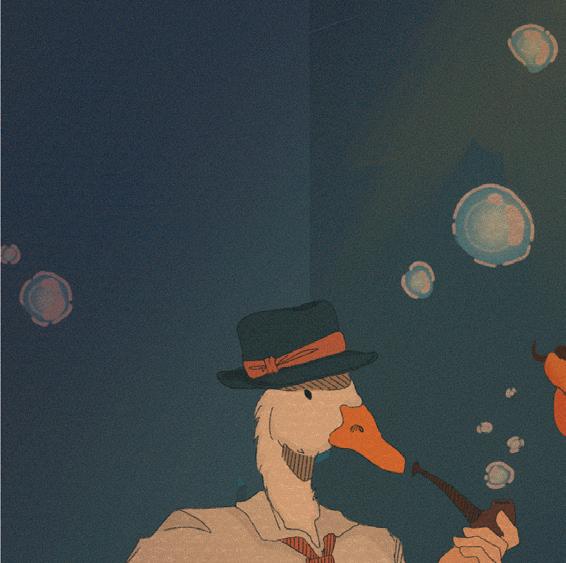
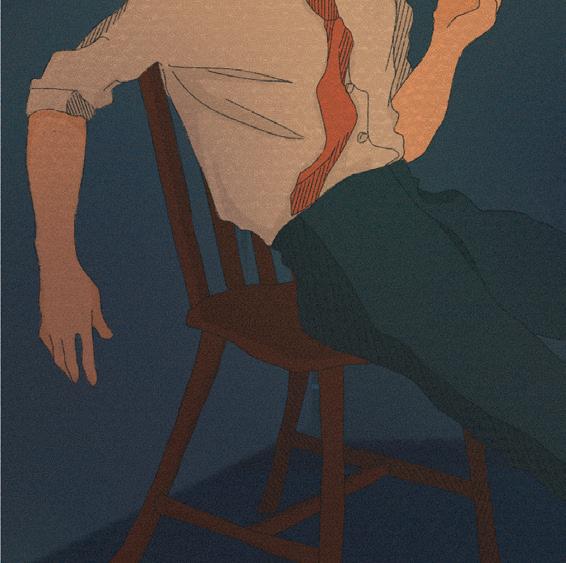
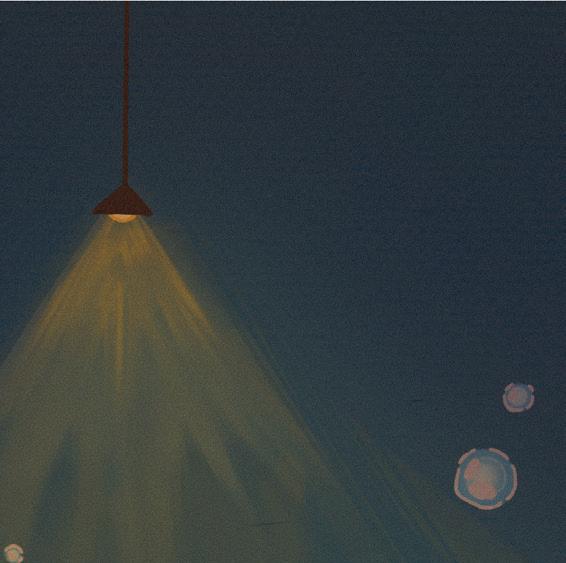
I chased down the lingering darkness with a bite of sharlotka—a cake le behind by the sponsor of my trip who didn’t seem aware that sharlotka wasn’t something the average American was familiar with. I had all the sharlotka I could ever want, but creamer? Not a chance. Not even milk to lighten my co ee. Sitting in one of the four wooden chairs that accompanied the wooden dining table, I alternated between bitter and sweet until the avors became one tangle of apples and acid, butter and dirt, light and dark. A hanging lightbulb slowly swayed above the table, icking slightly.
I had eaten nearly half of the cake, but still had $ve more days until I could return home, should the blizzard allow it. I was never one for travel, not like Andrew was, but the idea of going to the Bahamas now seemed laughable. Instead, I decided a seven-day escape to a peaceful “cottage in the woods” sounded like an answer to all my problems. It was exactly the type of thing a younger me would’ve wanted. !e “cottage” turned out to be more like a rickety cabin and the “woods” were snow. And wind. And more snow.
“I love snow,” that younger me once said. She was bright-eyed and rosy-cheeked. Skinny, with a smile that seemed bigger than her face. “It’s so peaceful, like a world where time stops and loses all meaning.”
I saw her sitting across from me. She must’ve followed me here from the cab that took me to the airport, from the airport that took me to these European cabins, perhaps all the way from the seventh-grade class that she was supposed to be sitting in. Maybe she saw me throw that
little golden ring from atop my apartment balcony and watched it sail like a falling star into the city streets. !e one with the singular, small diamond.
She sipped her own co ee—at that age, she probably only just started indulging in it—and somehow it tasted sweeter than what I had in my cup. Her hair was pulled up in a pony-tail, bangs dusting across her forehead. Her hands were thin. I knew she wasn’t eating as much as she should have been.
“You’ll never see it in person again,” I told her.
Her face fell, but only for a moment. “But it’s here now. You’re seeing it in person.”
I craned my neck to peek through the windows. It was nearly too dark to make out the strands of silver that cascaded from the inky night sky. Did she still see them as the work of fairies and snow goddesses, even if she was too old for such imagination? Did she still rush to shovel the snow before her dad could grumble his way out of the house?
I used to love shoveling the snow. No matter how long I stayed out there, no matter how many times I ran the shovel back and forth, another round of falling white would hinder my progress, and so on and so forth. To have something so beautiful ruin my hard work was a better reward than a shoveled driveway anyway. At least, that’s what I used to think. I did it even though I knew it wouldn’t matter in the end, but that was part of the charm. A day spent out in the snow could never mean nothing, a er all.
“So go shovel it,” the younger me said.
“I don’t have a shovel.” I took a sip of co ee and pursed my lips. It was already getting cold. “And I think I would freeze to death.”
It was her turn to purse her lips. “I would give anything to shovel the snow again, to clear my head. To be alone and focus on one action at a time.”
I glanced down, suddenly ashamed. I didn’t need to be regretting all of the things I didn’t do. !at was why I came to this rusty cabin in the $ rst place, wasn’t it? To clear my head.
I shoved the cake across the table. “Eat some sharlotka.”
I saw the furrow in her brow before the twitch in her cheek. She pinched the side of her stomach. Measuring. I exhaled a breath.
I pushed myself out from my chair and poured the rest of the co ee in the sink. By the time I turned around, the younger me was gone. . . . .
I didn’t remember falling asleep on the couch, but I must have. !e front door rattled under the weight of someone’s $st, pulling me out of a doze. For a moment, I thought it was Andrew—he was going to need his grandmother’s ring back and I was going to have to tell him that I didn’t have it. And he’d have to remind me, once again, that I never thought things through, that I’m too impulsive, too childish, too irresponsible. I was the type of person who throws vintage rings o balconies, who disappears into the woods, who consults the past for answers. But the past was the only place I knew where to look. She was the only part of my life untouched by him.
I stretched my neck, remembering where I was, and hurried across the living room. !e younger me sat still at the table, staring at the sharlotka with a perplexed expression, as if she was trying to break it apart with her mind. Her $ ngers absentmindedly grazed her co ee cup. Of course she was still here.
An older man waited outside. He was rubbing his gloved hands together by the time I opened the door.
“Good morning,” he said, smiling widely. “I was told to check on the guest staying in cottage 314. !e blizzard might have frozen your pipes.”
“Good morning,” I managed out, “and who told you?”
“Didn’t Cara say I was here to help out, should you need it?” he replied, still smiling.
“No. She didn’t really tell me much of anything, actually. Just gave me the key and—” I cut myself o . “Do you have milk? And sugar?”
It didn’t matter if he did have milk. !e fridge, apparently, didn’t work. An hour a er he $ rst showed up, he was sitting on the kitchen oor, surrounded by tools, muttering to himself as he played with wires. I had poured him a cup of black co ee, but it was le abandoned on the kitchen table.
I sat with my own cup, met with two faces staring at me. !e younger me, and now, a younger Louis. He was a man, barely young anymore, with a few strands of gray peeking out from dark, receding
hair. I cut a slice of sharlotka for him while Louis avoided his eye. I was starting to consider if it was something about these snowy woods that called the past to the surface.
“You know, when I lived in New York, this is all I ever did,” Louis said. “Fixin’ pipes, electrical work, building, I don’t know, units.”
“It’s a pain in my neck,” younger Louis grumbled, pulling at his collar.
“How long were you in New York?” I asked.
“Couple years, I suppose,” Louis answered. “I need a di erent screwdriver.”
“Couple years?” Younger Louis crossed his arms. “Try seven years. I hate it there. If it wasn’t for Melissa, I never would’ve moved. You know, she made me move from my family? I don’t know why I ever listened to her.”
He angrily slammed a fork into the cake and $ nished the slice in two bites. Younger me’s eyes glinted with a hint of both disgust and jealousy.
Louis cleared his throat. “Actually, it was my wife’s idea. She always wanted to live in a big city. !ought it’d give her a better opportunity as a writer.”
“Did it?” I asked.
Younger Louis glanced away.
“No,” Louis said.
“Oh.” I sipped my co ee. “!at’s unfortunate.”
“It didn’t work out. A lot of things didn’t work out between us.” He stopped to laugh. “Look at me, talkin’ your ear o . I think it’s $ xed. Do you need anything else?”
“She gave me the divorce papers just the other day,” younger Louis said quietly—and it was a tone I recognized, one of defeat and disbelief. For him, it wasn’t something that just “didn’t work out”.
Was I here because things “didn’t work out?” I couldn’t help but glance at my younger self again. She didn’t notice my gaze, too busy shaking strands of hair from between her $ nger tips. Did I try to make things work? Or had I already thrown the ring? Was that before or a er he told me I was too childish?
“I know things have been bad, but I didn’t know it was that bad.
She dragged me halfway across the country just to divorce me. Isn’t that ironic.”
“No,” I said.
So, Louis le , taking every version of him away, o into the snow, where it swallowed him whole. I needed milk and sugar still, not to mention gas to $ ll my tank.
“I hate divorce,” younger me said. “!at’s my number one fear. To waste my time, to waste my feelings, my life. I just don’t have time to waste that much.”
I smiled furtively. She had no idea how much time she’d end up wasting. When I cut her a slice of cake, she was gone. I ended up putting the slice in the fridge so it wouldn’t go bad.
. . . .
I walked to the gas station half a mile from the “cottage in the woods” carrying one of those red tanks I had found in the garage. I bought gas, $ nally got my hands on a bottle of co ee creamer, and snagged some eggs and bread. I had started to grow both sick and fond of the sharlotka. Nothing lasted forever, I supposed. At the register, I spotted a shovel, but I hadn’t brought enough cash.
By the time I returned to the cabin, the snow was falling fast and hard again. Someone was waiting on the front porch. Her face brightened once she saw me walking towards her, and she immediately rushed forward to help me with the bags in my hands. Before I could clench harder, she already had the paper handles hanging from her own knuckles.
“Nonsense,” she said when I insisted I didn’t need the extra help. “I was supposed to clean out the place, grocery shop, and leave maps in the kitchen for you, but I lost track of the days. Snow makes me lose all sense of time.”
I pulled my hands away from the bags, deciding it was best to humor her—it didn’t seem like I could convince her to give them up anytime soon—when I noticed a band wrapped around her le ring $ nger. A golden band with a small, simple diamond. An ache hit my heart, sharp and hard, leaving me standing in the falling snow a little breathless and unsteady. She abandoned me on the porch, inviting herself in. Almost shyly, I trailed a er her and started a new pot of co ee. Really only to occupy myself.
Her name was Florence, and she was a little older than a cleaning lady should’ve been. Her hair was thin and gray, her face weathered, but her eyes were so and kind. I hoped she wasn’t waiting outside in the cold for too long.
“How’s your vacation so far?” she asked, helping herself to the fridge.
Could I really consider this a vacation? “It’s . . . alright,” I answered from the kitchen table. “Co ee?”
“No, not at this hour.”
Young Florence, with a head of curls and freckled cheeks, instantly accepted. I watched as she poured way too much creamer into her mug and stirred violently. A few drops went tumbling from her cup. She o ered it over to younger me, who shook her head slowly. I regarded the young girl carefully, wondering what she was doing here, wondering what Florence could possibly be missing. I suddenly felt strangely protective of that young Florence. Just what hardships were waiting to meet her? My gaze dragged over to Florence. To her $ ngers.
“I love it when these cabins are $ lled with guests. So many people from so many di erent places, so many stories,” Florence said.
“Interesting people?” I asked.
“Everyone’s a little interesting to me. What have you been eating for dinner this whole time?”
I tried to avoid looking at the sharlotka. “I’ve been ordering out.”
Florence made a face. “!at won’t do. I’ll make you something home-cooked tonight.”
“Can I have some cake, too?” young Florence asked quickly.
I cut her a slice. !e younger me frowned as she watched. She clasped her $ ngers around her wrist and exed her hand. Her veins poked through her skin.
“It gets busy here in the summer, but not so much in the winter. You should come back in the summer, when you’re able to enjoy a hammock out in the sun. I used to love doing that as a girl.”
“Mama makes me lay down in that dumb hammock, and if I rock it too hard, she yells at me,” younger Florence corrected.
“Hush now,” Florence scolded, then settled her hand over the young girl’s curls. Young Florence pouted, but promptly clasped her mouth shut.
I paused. “You can see her?”
“Of course I can.”
“!en . . . do you know why she’s here?” I asked.
“Because I brought her with me.”
With her words, young Florence shoveled the rest of the cake into her mouth, then jumped from the chair, like she had $ nally been excused a er a long, boring dinner. I watched her run to the door and disappear into the snow. Her laughter twinkled behind her. Somehow, I knew she would come running back, but not right now. She was giving us a moment to ourselves. My own younger self stubbornly stayed put. “!at’s better. So, dinner at seven. Does that sound good?”
Florence asked.
I nodded. Younger me looked nervous. . . . .
!e next morning, I drank black co ee with sharlotka. !e cake was almost gone. I doubted it would last me the rest of my vacation stay.
Younger me carefully tipped the co ee creamer over her own mug, allowing three drops to fall. One, two, three.
“It won’t make anyone like you any better,” I suddenly said.
“!at’s not why I do it,” she snapped.
“It won’t make you feel prettier.”
“!at’s not why I . . .”
Maybe she did know why she did it, but I didn’t. Not anymore. I couldn’t remember. I only remembered the obsession with the numbers, the counting, the measuring. Just like she couldn’t understand me now. She was a distant melody, a tune I could almost hum, but I was an unknowable beast to her, wearing a face that was almost hers, a body that could be hers, but holding a heart that was not hers yet and wouldn’t be hers for a long, long time.
I got out the slice I had saved in the fridge and slid it over to her.
“I don’t want it,” she said.
“Why?” I asked. “You eat it once, it’s good, and then you’re done. It’s not hard.”
“I just don’t want it.”
“Why?” I shouted.
“Why are you trying to make me? You can’t change this part about me. Not you. Not when I was like this.”
I clasped my mouth shut. She was right. !ere was nothing I could do, in that moment, that had the power to change her. I couldn’t change anything. Just one bite. !at’s all she needed. It’s all I needed. I just needed her to prove it to me. !at I could change.
“Why are you here?” I asked. “Why did you follow me here? I just needed time to think.”
“You haven’t given yourself time to think. You’ve been talking to me,” younger me answered.
“I don’t know what else to do.”
“And why do you think I would know what you should do?”
I didn’t know how to respond. !e only reason I came to this cottage was because it was something she would’ve done.
“Well,” I said, “what would you do?”
It wasn’t a hard question for her. She glanced at the window. I followed her gaze. Snow streaked past the glass.
“I would shovel the snow.”
by Regan Gomersall
Maeve felt every muscle in her body tense as James pulled the car into the driveway. It was the same little house with daisies blooming wildly in brightly colored pots on the front porch, the same stepping-stone path she used to hop across as a kid, the same sprawling yard she would chase her brother through every time they came to visit.
But her chest felt hollow to look at it now. Her focus shi ed expectantly to the butter-yellow front door, but there was no woman inging it open, no broad smile, and no voice calling their names in that signature sing-song style. !e windows weren’t open to the autumn breeze, and there was no grainy Fleetwood Mac music oating out to greet her as she stepped into the crisp air. Had James not walked around the car to grab her hand, she was almost certain she wouldn’t have gone in. Her brother led her slowly down the path, handing her the key as they stepped onto the creaking wood panels of the porch.
“I’ll grab our bags. You go ahead inside,” he said, not meeting her eyes as he forced a smile. She knew he needed a moment before he could pass the threshold—a moment to wipe the same childhood memories plaguing her mind from his own—before he could face packing up their grandmother’s life. She granted him that time, breathing deeply as she fumbled the key into the lock.
Stale air and an eerie darkness smothered her as she entered, sending goosebumps up her arms. Maeve was entombed in the house’s lack of familiarity and immediately found herself wondering if they could $ nd a hotel to stay at for the next two days. !e record player had a layer of dust spread over it, and the smell of vanilla was missing from the air, the row of candles le unlit for weeks.
She picked up a duster and ran it over the surfaces. She’d been by the house with her mother a few times while her grandmother was in hospice, but as she waned, so did their ability to face this place. !ere had been so much else to do. So many questions. !e matter of the will, the
funeral. Should she be buried or cremated? How many people did they need to contact to say their goodbyes? !e house didn’t seem to be as big a priority. Or at least that’s what she’d told herself.
James had o ered to clean up more times than she could count. She’d told him yes, but had put o giving him the keys. She hadn’t meant to let it sit, but she’d had this image in her head of her grandmother springing from the hospital bed, better by some miracle, ready to come fuss about the state of her bookshelves. And so, the keys sat untouched on her dresser for months, collecting more dust with every excuse that rolled o her tongue.
She didn’t know why she thought she’d be able to pack things away now that her grandmother was gone from the world, leaving a gaping hole where there used to be so much life. A blazing ame extinguished in one rattling breath.
! is was not her grandmother’s home. Not really. Not anymore. !e thought reverberated through her skull as she put down the duster, turning the air thin. Everything around her was marred by absence. !e world was pressing on her from all sides. She needed to leave.
She turned back for the door, pausing just before she reached the handle. She caught sight of that old upright piano, its light wooden $ nish covered with small painted butter ies. !e $ rst piano she had ever played. Maeve pictured James, much smaller, with sandy hair falling into his eyes, as he sat beside the piano, paint palettes strewn across the oor. She saw herself perched at the bench, barreling through another beginner’s piano book, their grandmother in her rocking chair, stars twinkling in her eyes. She fell into a trance, ickers of memory passing by as if she were ipping through the pages of a picture book.
She staggered forward, her feet acting on their own accord to bring her before the instrument. Her $ ngers danced lightly over the keys, catching on the spots at their centers that were slightly worn down, but freezing before fully pressing down to release sound. !e house’s total silence crept around her, simultaneously daring her to play and holding her hand hovering in place. She could almost hear it: the ring of the keys at her grandmother’s hand. Like the house remembered it used to hold music and laughter and sent the memory oating her way.
James pushed through the door, setting their bags on the oor. “Are you playing?” he asked, a bit of genuine light slipping back into his expression as he beheld her at the piano.
She snatched her hand back. “No, I just— No.” Maeve shook her head, moving to the other side of the living room to study a bookshelf.
“Oh.” He paused, and something in his face dropped, like he was surrendering to some invisible opponent. “What do you want to do with the piano then?”
“What?” She faced him sharply, brows creased together.
He scrambled for purchase, apology lacing his every word. “Well, you said you can’t play, so I don’t know, I just thought you wouldn’t want to have the piano around if it’s that painful.”
“So, you want to throw it out?” She asked, incredulous.
“Not throw it out, no. But no one else in the family plays besides the two of you, and I hate the thought of it collecting dust. We could donate it, maybe. Or put it up for sale. I’m sure we could $ nd someone to love it as much as she did.”
“Yes… Me.” She couldn’t believe they were even having this conversation.
“So you’ll play it?”
She didn’t have a response for that. She wanted to scream yes, but the thought of playing made her feel like claws were digging into her ribs, constricting around her lungs.
“We’re not getting rid of it.”
He took a deep breath. Maeve could practically see her brother sorting through words in his head, trying to $ nd the right ones. His brows knitted in an expression entirely too similar to one she o en wore. She wanted to throw up.
“Maeve, I don’t want to push you too hard. I just don’t know what’s going on with you. You haven’t touched an instrument in months.”
“I just need more time.”
“How much time?” She refused to meet his eyes. “You can’t just stop living. I’ve never seen you this low for this long.”
She opened her mouth to argue, but came up short. He was right. Nothing had kept her from playing before. She didn’t know how to release these emotions, not when they were gray with static, drowning out any sound in her head.
“Even a er you broke your wrist in high school, the second that cast was o , you were playing again. Mom had to beg you to stop working through the pain, and even then, it was only the threat of another injury holding you back. I mean, you’re not even trying. I just—”
His voice broke, and her gaze shot to his. “Tell me what I can do to help, Maeve.”
!e thought of him trying to $ x her sent an itch creeping across her skin. She couldn’t help but continue to view him as the little kid that she’d watch out for at school, even now that he stood a full head taller than her. !e look on his face devastated her. She felt the pinch of failure in her chest. She should’ve hidden this from him better.
“You can’t help,” she said, her voice a quiet rasp directed at her shoes.
“Maybe if you just played something easy. ‘Let It Be’ shouldn’t be too bad. Or maybe—”
“James, I said no. I can’t do it, okay?” She moved to grab one of the cardboard boxes he’d set on the oor along with the rest of their luggage. “Let’s just start packing.”
He stared at her a moment, his smile faltering, failing to reach his eyes. She turned away from him as he muttered, “Alright.”
She sat on the oor, staring at the box in front of her, hands shaking in her lap. For a moment, she wasn’t in the house, but at the last show she’d played, almost four months ago. She was sitting at the piano on stage. !e smell of alcohol and smoke blowing in from the windows, clouding around her. She could distantly hear the man saying her name into the microphone, the crowd clapping, but she just stared at her hands, watching them shake. !e words were pounding on the inside of her skull, drowning out everything around her. !ey’re moving her to hospice. !ey think she has a few months le . You should y home when you can.
!e phone call had come in only $ een minutes before the show started. She’d known her grandmother had been in and out of doctors’ o ces, but she had never imagined she was dying, never thought someone who $ lled a room with light and laughter could have
an expiration date at all. But it became real on stage before the piano, and her trembling hands had sent her barreling o stage into the green room and out the back door.
Someone had called out her name, but she hadn’t even turned around to collect her music. When her manager had called her the next morning, asking for an explanation, the words had gotten lodged in her throat. At her silence, he’d told her if she kept this up, he’d have her blacklisted from every bar in Nashville. She’d hung up the phone and brushed it o as another one of his melodramatic rants, but she had no way of knowing for sure. She hadn’t tried to book another gig since. She hadn’t even set foot in the city. Simply packed up and ew to Pennsylvania to stay with her mom.
Tears clouded her vision until the box before her was simply a mess of brown, and she couldn’t make out the shape of her $ ngers. She turned around to make sure she was out of James’ line of sight from where he rumbled around the kitchen. Finally, she moved to the rows of records, letting a few tears fall down her face as she pulled them o the shelves and slipped them into boxes with no one to bear witness.
Maeve mechanically sorted through vinyl a er vinyl, their covers weathered on the edges from years of use, plopping an impressive collection of Billy Joel and Elton John records into a box. In the back of her head, she heard her grandmother comparing the two pianists. !eir styles, their strengths, their weaknesses. It was a conversation that could keep her talking for hours and hours every time she was prompted, and she seldom reached a conclusion about who she thought was her favorite. Maeve had witnessed it enough times that she was con$dent she could replicate the whole speech from start to $ nish.
She decided to settle her grandmother’s great debate and began counting to see which musician took up more of her grandmother’s collection. Forty-two records later, with the Piano Man in the lead, she’d managed to distract herself enough for the tears to dry out. She’d stayed painfully aware of the mu ed sounds of James’ movements behind her as she’d worked. Mercifully, he’d allowed them to fall into a quiet, steady rhythm for a few hours, but she sensed their truce coming to a close, her hand lingering on a Janis Joplin title when she felt her brother looming at her back.
“Do you remember this one?”
Maeve only nodded, staring idly at the stack of sheet music in his hand. “Lullabye (Goodnight, My Angel)” by Billy Joel. Images of her
grandmother sitting on the edge of her bed itted across her mind’s eye. She wondered if nodding would be enough to satisfy his question. But James simply stood there, watching her expectantly.
“! is was one of my favorites. Every time we’d stay the night, it was what I looked forward to the most. It came on the radio when I was driving to Mom’s house the other day, and I swear it felt like she was in the car with me.”
“She really loved that one,” Maeve said, standing to look over the piece. Silently, she added another point for Billy Joel to her mental tally.
“Do you want to help me sort through this?” He asked, gesturing towards the stack of sheet music on the small, round table next to the piano. At her face, he added, “I promise I won’t ask you to play.”
Maeve followed him to the stack, taking half of the pages from him. !ey si ed through them quietly for a few minutes, pausing every once in a while to share a small anecdote about a piece they’d found.
James lingered on “Eight Days a Week” by the Beatles, Maeve found a copy of “Fur Elise” with her sloppy, seven-year-old handwriting scrawled throughout the margins. !ey devolved into laughter when they found Elton John’s “Bennie And the Jets,” with written-in lyrics that were so incredibly wrong they read like a Weird Al parody.
“She never was good with lyrics, was she?”
“Not at all,” Maeve said. “She used to ask me to write them out when she was transcribing a song because she didn’t trust herself to get them right.”
“I can’t blame her,” James said, shaking his head at the piece.
He set the pages aside and moved on to the next one. When he stilled, sucking in a sharp breath, Maeve peered over his shoulder. She went rigid when she saw her grandmother’s elegant script across the top of the sheet in his hand. !ere were cobwebs strung across her throat, her lungs, far too thick to push her breath through.
For Maeve, it was titled. A small note in the margins read, I thought this might work well for you in Nashville. No lyrics yet, that’s your job, but I’m sure they’ll be show-stopping.
Her impulse was to turn and run. She was certain reading through this would crack open her chest, letting the mess she’d buried deep, deep down beneath layers of
muted color come tumbling out, demanding her attention. But when James pushed the pages further towards her, something in his broken expression forced her to take them.
Her eyes hit the $ rst inky dot, and she couldn’t stop. She heard every note ringing out clearly in her head. A beautiful, heartbreaking piece. She began to sway in place as she read through it, her $ ngers on her free hand pressing slightly on her thigh as she imagined playing it. Still, she didn’t move to the piano. But she could feel how the music swelled, with hope and pain, an aching pressure $ lled her chest, and the air around her became electric.
!e music began pressing in from all sides as she continued to read, sending a chill running up her spine. !e piece became more concrete in her head, so much so that she almost wondered if it had escaped the bounds of her brain to oat through the air around her. Every note seemed to be radiating from the walls, the house itself pulsing with every new beat.
She looked up to $ nd James with his mouth agape, his eyes darting around in wonder.
“You can hear it?” She found she had to yell to be heard, and suddenly she wasn’t sure how she ever could’ve thought this was all in her head.
“Where is it coming from?” James screamed. Grandma. Her heart was a mess in her chest; a muddle of emotion that shook loose within her with every new beat. !e pulses seemed to press on her skin, every new line a physical reminder of why she had fallen in love with the piano in the $ rst place. A reminder of all her grandmother had given her.
Tears streamed down her face as the piece broke, cascading around her and holding her like a blanket. For Maeve. God, how could she not play? !e song shook through her rib cage, burrowing itself in her chest, freeing long suppressed sobs from her throat. She let it press on that tender spot beneath her sternum, feeling the bruise’s ache and allowing herself to recognize both the pain and the love that it had been born from.
She swore she could hear the lyrics, sung in her grandmother’s sweet, comforting tone. !ey were right there, sitting hidden in the melody, for her to write on the page. She had everything she needed.
As the house released its last great symphony, Maeve stood and
moved to the piano. She felt a so hand on her shoulder, a faint whisper in her ear, guiding her forward.
Her hand was steady when she raised it above the keys. As the last note closed around them, the walls returning to their silence, Maeve began playing, continuing her grandmother’s song.
Nonfiction
by Toshio
The a ernoon had settled in, with the rays of light permeating through the beige curtain. It cast an elongated shadow of our heads across the ratty carpet. Summer’s reach spanned in$ nitely, and leaving felt impossible. To be fair, it was only day two of our summer break and three months until I le for college. We knew that ‘goodbyes’ and ‘I miss yous’ were inevitable exchanges awaiting us, but to waste the day watching High School Musical 2 on your laptop felt meaningful, correct.
!e world of literature was yours, not mine. I never cared to read in my free time, and I didn’t pretend that it held any more weight in my mind than a Space Bag vacuum sealed and stored at the bottom of a pile of hobbies I put aside for a rainy day. But for some reason, on that a ernoon, lying next to you under the covers of your bed, I o ered a suggestion– one assumingly too silly to be taken seriously.
“Can you recommend a book for me?”
“Hmm. Would you prefer something that I think you would like, or something that I like?”
I climbed over you and brie y scanned your bookshelf in a planking position. It was a wooden, white-painted, 5x3 colossus that faintly resembled a three-dimensional Excel spreadsheet. !ere were books of all sizes, and very little context clues to answer, which choice is easier? I chose wrong.
“Choose something you like.”
“Okay!”
You pushed the blanket and me aside, hopped out of bed, and squatted in front of your personal library. Your index $ nger dragged slowly along the bindings of each book until it reached its destination. You smiled, turned around, and o ered me the small book.
“It’s my favorite. Give it back to me when you’re done.”
!e title of the book was Babbitt by Sinclair Lewis. Originally published in 1922, you bought the 1961 version for two dollars at Half Price Books. !e cover was tattered, the thick paper creased by unintentional folds from stu ng it inside a backpack. !e pages were stained by time, jaundice yellow with the color intensifying along the edges.
“Haha, very funny. You know my last ‘free-read’ was !e Hunger Games, right?”
“I know.”
“!en go easy on me, please. I can’t read this.”
“Yes, you can. You’re not stupid.”
You pressed the novel $ rmly into my solar plexus, the corner digging into my skin. I relented, surrendering my hands face up to receive it. You hugged me tightly, and I squeezed the book out from in between us. I scanned the back cover, my chin resting on your shoulder and my vision obscured by the swaying window blinds of your thick, brown strands of hair. You laughed as my eyebrows scrunched upon further comprehending the trap that I had unintentionally stepped into.
“Promise you’ll try to read it, and if not, seriously, give it back.”
“I promise.”
! is was nine years ago. We haven’t been together for eight. !e book has followed me across three continents and has sat on six di erent bookshelves. It’s hidden itself between others, sometimes trying to mesh inconspicuously between the Penguin Classics and foreign novels. I’ve made many attempts to read it, not making it past chapter one.
It’s not that I still $ nd myself incapable of grasping the content within these pages. I fear once I $ nish it, it will feel obligatory that I return it to you.
by Jordyn Burkey
Iwoke at four in the morning to my mother shaking me, whispering my name frantically, like a prayer.
“Jordyn, wake up—quick. It’s your dad. He wants to talk to you.”
Her voice startled me more than the words themselves. My parents have been divorced for almost my entire life. I’d come to know her voice only to resonate with a tight annoyance when speaking of him. But in the darkness of my bedroom, she looked close to tears, the line between her eyebrows carved so deep, I worried it might break the skin. Without raising a $st, or even being in the same room as us, my father managed to hurt us more than ever before.
“Dad?” I rubbed my eyes and pressed the speaker closer, trying to wake up fast enough to make sense of the situation. “Is everything okay?”
“Hey, Biz,” he said, calmly, using my childhood nickname. “Just wanted to give you a call. How are you?”
I stared at the blue numbers on my clock. 4:03 a.m.
“I’m good,” I said, the words coming slowly as my eyes dri ed to an old photograph sitting on my nightstand. It was framed in stained wood, the glass faintly smudged from years of being moved or picked up and set back down again.
In the picture, we are both asleep on the couch in my childhood home. My dad still has on his thick green uniform and steel-toed boots from the steel mill, his arm wrapped around me. I’m small, maybe twoyears-old at most, clutching my bottle, tucked into a blanket beside him. I used to try so hard to stay awake on nights like that—waiting for him to come home from his shi —determined to greet him when he walked through the door.
But in the picture, we didn’t make it. We’re both fast asleep, collapsed together on the couch.
I stared at the photograph for a moment, letting the familiar image settle over me, lending me a small comfort in the confusion.
“Dad,” I $ nally asked, my voice quiet in the dark, “what’s going on?”
Across the room, my mom tried to smile. But her lip trembled. A heavy sigh crackled through the speaker. “I just wanted to tell you how much I love you. I’m about to go for my $ rst—uhh—what’s it called? A helicopter ride! I’m going in a helicopter. Pretty excited.”
It took a second to register. Not the helicopter—the slurring. !e way each word faded into the next.
“Why are you going on a helicopter?” I swung my legs out of bed. “Dad, what’s happening?”
“Jor, I—I was at, uhh, Nana and Pop-pop’s and had a small stroke. Fell down the stairs. I’m $ ne. !ey just want a specialist in Philly to check on me. ‘Cause of my kidney.”
His kidney. Terminal failure, diagnosed a year ago.
When asked to think of violence, I used to imagine someone getting punched or kicked, or some sort of action I’d see in a $ght— haphazard cruelty. But in this moment I realized some of the worst torture I’ve witnessed in this world has been the agonizing violence one does to themselves.
“Oh.” I didn’t know what to say. How does one put into words that I didn’t want this man—this man I’ve grown not to recognize—to kill the body that used to be my father’s?
“I love you, Dad,” was the only thing I could manage to utter— not to the man on the other end of the phone who skips dialysis. !e man who disregards his diet. !e man who picks $ghts with his own kids. the man who had his foot amputated because he couldn’t be bothered to treat an infection. !e man who steals our medication. !e man who is killing himself slowly—and making us watch.
“I love you, Dad,” I said.
But I wasn’t speaking to the man on the other end of the phone. I was speaking to the man who used to host game nights every Friday. !e one who took me to daddy-daughter dances. !e one who made me laugh so hard I’d snort and pretend I didn’t.
I said it to the memory of him.
A er I hung up the phone, the house fell silent. My mom sat on the edge of my bed. Neither of us cried. We had been hit by his words, taking a few moment together to recover from the latest brutal blow. I used to think violence required impact—skin against skin, a bruise blooming shades of purple. Now, I know it can look like a body refusing care. Like a father choosing the thing that harms him again and again. Like children begging him to $ nd something worth living for. My brother and I have screamed our throats raw, told him we are here, that we are enough, that this life is worth $ghting through, not at. !e words feel useless once they leave our mouths.
When I picture violence now, I don’t see $sts. I see a phone glowing in the dark at four a.m. I see my mother’s shaking hands. I hear my father saying he’s excited for a helicopter ride, his words so and slurred, as if this is an adventure and not an emergency. I see the slow unraveling of a man who still thinks he is alive. I see him comfortable, laying in the sterile white hospital bed he has made for himself.
by Ava Jones
It is green and wet and lovely outside. Excited colors ood in as the wizened Azaleas all die away, welcoming Spring with their last breath. It’s ironic, how they greet us so big just to fall so quick. Much like ceremonial doves, Azaleas swoop in, painting two weeks in blooming, atomic beauty. !ey’re dedicated to their cause and yet, as bold and breathtaking as they are, mortal all the same. But even when the fall back down to Earth is inevitable, doves still y towards Heaven. Promise follows the cycle of all life: soaking into the soil, fading into the clouds, only to rain and renew the colors of Spring.
So, don’t think of it sadly. ! ink of Time like your eyes adjusting to the night.
My parents don’t get giddy when I come home for the break. !at’s alright – they love me big and I know it. Maybe they’re tired because they don’t eat all the things that bring them joy anymore. !e dinner table was so cramped, and now their nightly meals host a third of what they did ten years ago. Maybe that’s why dieting is easier for them now. Less joy embedded in their meals, but long embedded in our dining table. We used to have to drag in other mismatched chairs and cramp in for the holidays. Not anymore. I know they miss it. I see the way my mother’s gaze lingers on this one battered chair; it’s covered in crayon markings and scratches from tiny, chubby hands. Years and years spent giving in to love’s indentation. One of its back beams falls o from time to time. We always stick it back in. Each of my siblings staked a claim on that chair at one point or another. Now my mother sits across from it, thinking about how Time scams us. But my parents love each other much more than they did ten years ago – or they’re at least loving each other better. So, they don’t get giddy when I come home, but they do smile, and they stock the fridge when I’m there.
And I sit at the table, in that battered chair, hoping they know how fond I am of it all.
When we’re driving to meet my grandfather for lunch, my dad holds in a louder voice because he’s never been like that. He clenches the steering wheel when I ask about their retirement fund, but his hands don’t scare me because he’s just not that sort of father. He’s never been one to make his children cower. And that just makes the lump in my throat more unbearable. I just watch the pronounced inhaleexhale. I watch the $ght simmer through his frame and boil up inside him. I can see the waves swelling up against the stark shoreline of his irises, splashing against the rocky coast he grew up on. What would happen if it all washed away in the riptide? Deep in my father’s eyes – in his warm, gentle eyes – it gets stormy from time to time. But I would hesitate to call the depth of that storm restraint. To insinuate that he’s holding back aggression would be an insult. An insult to the kind crinkles dug deep into his face from a lifetime of smiling, and the calloused hands that have only ever placed me snug on his shoulders – high above the world, high above the current that would’ve swept me away as a child – to give me a bird’s eye view of exactly how mountainous my expectation of masculinity should be. So, when I notice his anger, I also remember my immense luck.
I know to thank both him and my mother for this.
My grandfather’s legs work faster, better, today. His eyes are lighter and his voice is less far away, so much more like the jolly Father Christmas whose metal knee I used to sit on. But now he shakes when he cuts his halibut. A man he knows from years ago comes up to grasp his hand at the restaurant. !e man calls him a hero for something big and kind that happened on a $shing boat when they were young, and he holds back tears watching my grandfather shake. Time stole away the $ rm grasp I’m sure he was anticipating. It’s likely slowly stealing his own away, too. And I can see the inhale-exhale pronounce in my grandfather’s chest, the ash of grief through his eyes. Not just for the raw absence of youth in his body, but within his soul, too. How do you cope a er losing half of it? Fluttered away three years ago, a red cardinal into the canopy oaks. He shakes less when he watches the birds from his armchair, stilling with glazed eyes when she perches on the windowsill. She’s there with him for a moment, fetching seed from the feeder in his backyard that my dad re$ lls every week – he’d do it himself but his legs aren’t as sturdy anymore. I see his grief, the wetness in his eyes. I miss her, too. And his hands shake more.
!en I see my father’s eye twitch; he clenches his fork.
What a conundrum it is, to grow old and live? To lose the other half of your heart and to live on a er that? To watch your father shake? Or to be a father, and shake in front of your son? My mother thinks about Time, how it likes to play Rumpelstiltskin: taking our children; bartering their existence; sneaking up, taunting us, looming over our heads with its big, big presence. My father is angry – because how can he be angry? It is not a crime to grow old – yet it feels like a crime to watch it happen. He cannot be angry at my grandfather’s hands for shaking at 91, but somewhere in his tumultuous blue eyes is a small boy, perched on the rocks as the waves swell in and out. For that boy, my grandfather’s hands are likely very $ rm. Maybe that boy sometimes had a reason to cower.
Time has given that boy a life and yet taken so much. A brother, a mother, soon a father; an entire familial identity. Loss so great it’s bound to pull one out with the riptide occasionally. So, his eye twitches, and he pushes against that massive onslaught of water, masking the depth of that grief as exasperation because what else can you do? !at is how it all operates – that is how we live and breathe and expand as ripples in Time. We exist and we shake, and we fade away like the bright pink Azaleas of Spring, or doves into that small pocket of Heaven. Sometimes we crash. But still, we make room for a new generation; new batches of color and promise in a world where Time will eventually deliver them the same fate. We sing. We con ict. We grasp one another. We become adults; siblings that walk through life separately, but with patchwork hearts sewn from inextricable childhoods. We become parents, then grandparents, and old men that shake, but then we’re all children deep in the tides. We clench the steering wheel and we anger at the people we love so bad. We’re reminded that Time really is just the home constructed around us. It’s the esh we’re condensed into, and the mind that stretches us wide all the same. And it sits us down at that dining table, squished between space and linearity. Across from you your father can’t help the shake in his hands, but vivid and glistening in the in-between is the remembrance – the existence – of a man so much more solid. How confusing it must be, to feel that?
How beautiful is it, to grow old and live.
I say all this because Spring is bright and I am a happy person, but I miss my siblings. I love my mother. I love my father. I love my grandfather, too. I love it all bad, and I cannot stomach Time. I know I will clench the steering wheel, and eventually shake, too. !e Azaleas will come and go, and the tide will push back out.
But don’t think of it sadly, if you can. !e night comes and we adjust. It is alright – we all love big and we know it.
by Iz Schrader
by Sydney Graham
by Maddy Oliva
by R.R. Copeland
by Amelie Galbraith
by Gwynevere Castro
by Sophia Hoofnagle
by Julia Stephens
by Lucy Neill
Editor-in-Chief: Isa Hoofnagle
Managing Editor: Kylee omas
Event Coordinator: Melina McGahey
Treasurer: Annabelle Argeles
Faculty Advisor: Ryan Hunke
Head Editor: John Brown
Assistant Editor: Sophia Orozco
Rachel Brady • Cheyenne Cro • Yekaterina Nolan • Ezra Rosen
Antonella Craven • Shogo Oviawe • Kristen Cavanagh
Lauren Cavanagh • Elise Espano • Samuel Armesto • Emily Harris
Hannah Grinbank • Summer !ompson • Charlotte Lebedeker
Adara Cardona • Grace Mazzilli
Head Editor: Luciana Callegari
Assistant Editor: Fallon Herreno
Zoe Lieb • Monica Broome • Eabha Phelan • Scarlett Jane Whisnant
Jase Jeralds • Danielle McLemore • Caprielle (Caprie) Grisham
Mila Medina • Scout Dingman • Kayra Serpenguzel • Kylie Buigas
Lavinia Williams • Sophia Gibson • Alejandra Torruellas
Mahalia Collingsworth • Gwynevere Castro • Brenna MacKinlay