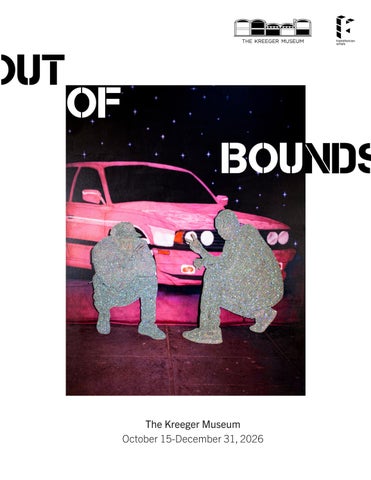
The Kreeger Museum October 15-December 31, 2026
Detail, Allison Spence, Distal Places, 2024, resin, machine embroidery, digital collage, acrylic, and faux fur on linen. Photography by Vivian Marie Doering.
CONTENTS About The Collaborative
04
About Hamiltonian Artists
07
Curator’s Foreward
08
Selin Balci
14
Larry W. Cook
18
Joyce Yu-Jean Lee
22
Christie Neptune
28
Allison Spence
32
Kyle Tata
36
Jing (Ellen) Xu
40
ABOUT THE COLLABORATIVE David and Carmen Kreeger were devoted patrons of the arts and the Washington, DC arts community. They supported countless Washington-area artists including Sam Gilliam, Simmie Knox, Thomas Downing, Gene Davis, Morris Louis, Ed McGowin, and Albert Stadler, purchasing their work at the Corcoran Gallery of Art biennials, area galleries, and directly from artists in the 1960s and early 1970s. The Collaborative is a guest artist exhibition program developed to support Washington-area artists. “We are thrilled to be in partnership with artists and arts organizations across the city to present work of contemporary Washington-area artists. The Collaborative furthers our mission by supporting and spotlighting the immense talent of visual and performing artists in our city. We are honored to champion the work of these artists and provide many of them the opportunity to present their work in a museum for the first time.”
— Helen Chason Director, The Kreeger Museum
4
Detail, Simmie Knox (American, born 1935), A Place: Suspended, 1970, acrylic and enamel on canvas (diptych). 5
Detail, Selin Balci, Contamination (39° 19.718’N, 76° 37.326’W), 2026, mold spores cultivated on panels and sealed with epoxy resin. Photography by Vivian Marie Doering. 6
ABOUT HAMILTONIAN ARTISTS Hamiltonian Artists’ mission is to nurture community and increase access to space, opportunity, and resources for emerging artists, through impactful programs and exhibitions. The organization reaffirms and expands upon its originating vision as an incubator for the professional development of emerging visual artists, serving as a hub for Washington, DC’s, creative economy and a vibrant center for contemporary art in the DC area. With its unique investment in emerging artists, Hamiltonian Artists provides resources to aid their development in important business skills, professional experiences, and visibility to support and sustain their art career. Through the fellowship program, exhibitions, studios, artist talks, public events, membership program for art collectors at all levels, and so much more, the organization contributes to the vitality of the area’s arts scene by deepening the appreciation for contemporary art and culture throughout Washington, DC, and beyond.
7
CURATOR’S FOREWORD In 2026, I was invested in sports far more than in any year I can recall. The New York Knicks made it to the NBA Finals for the first time in 27 years, and the World Cup was, well, the World Cup. While I admittedly do not know much about the rules of basketball or soccer, I do know passion. Raised in a family of athletes, I admire how much dedication and hope it takes to root for a team season after season. I appreciate what it means to represent your city or country, while having your athleticism put to the test on a global stage. And so, I tuned in for as many games as I could. What stood out to me was how often, when the opposing team began to take too large a lead, players on the trailing team seemed to push harder, step wider, and eventually end up out of bounds. Moments that seemed to me like fierce, well-executed plays were ultimately penalized because of the game’s technicalities. The line was there, and crossing it—whether intentionally or in the heat of the moment—changed the meaning of the play and the consequences that surrounded them. In sports, boundaries are enforced through a series of structures: lines sprayed onto a turf field, carefully selected referees, officials, and a rulebook that determines what counts as fair play. I have never cared much for rules; I think many artists would agree with this sentiment. But the art world is hardly free from them. Here, boundaries are less likely to be painted onto a field than embedded within systems of class, education, access, taste, and aesthetic hierarchy. They determine who is invited in, who is asked to wait, what is considered worthy of attention, and what kinds of practices are granted legitimacy.
8
Yet artists have always found ways to test these limits. The history of visual art is, in part, a history of people looking at the boundaries placed before them and asking: What happens if I move past this line? What happens if I redraw it, or even refuse to acknowledge it was ever there? For me, this is where Out of Bounds emerges. By contrast, many of the exhibited works begin with establishing a structure, system, or set of conditions, then inviting something unpredictable to happen within it. Artists Selin Balci, Ellen Jing Xu, and Kyle Tata do not simply reject rules; rather, they challenge the presumption that the artist must have absolute control over the outcome—blurring, complicating, and renegotiating assumptions around authorship and artistic process. In Selin Balci’s Contamination II, composition emerges through collaboration with microorganisms, allowing mold spores to grow, spread, compete, and ultimately define the foreground of her work. In Turn Right, Xu uses small pieces of modeling clay to extend the surface of an existing painting outward, transforming it into a highly tactile, sprawling composition of geometric abstraction that moves between painting and relief. Kyle Tata physically intervenes in photographic negatives through ink, bleach, and abrasion, disrupting photography’s presumed status as a factual record. The work emerges through negotiations between intention and that which can never be fully anticipated. These negotiations extend into the permanent collection works on view alongside the Hamiltonian alumni. In Sam Gilliam’s Cape, painting exceeds the boundaries of the canvas as a flat, contained surface, becoming a physical and spatial presence. Frank Stella’s Flin-Flon XIII similarly foregrounds the material conditions of painting—its surface, geometry, and color—rather than allowing
9
the work to recede into an illusion of another world. In each, the presumption of what a painting is expected to be becomes part of the work’s inquiry. The boundary, then, is also a mechanism of legibility. A line tells us where something belongs: photograph or object, inside or outside, visible or invisible, human or other—but what happens when something refuses to remain legible within those categories? For Christie Neptune, visibility itself is unstable. Light Years Apart asks us to consider who is seen, who is surveilled, and how racialized systems determine the terms through which a body becomes visible. Larry Cook examines the circulation of Black vernacular photography, considering how images of aspiration, material desire, and cultural life shape our understanding of history and place. Allison Spence, meanwhile, challenges the presumed legibility of both bodies and language. Her hybrid, crumpled forms resist the idea of a stable or “normal” anatomy, while embroidered words become obscured within the physical body of the painting. Simmie Knox’s A Place: Suspended further complicates the relationship between image, place, and material through its layered combination of acrylic and enamel. Here, what is difficult to categorize need not be resolved, ambiguity becomes a way of seeing. When boundaries become unstable, what lies on the other side may no longer be what it was before. In Out of Bounds, moments of transformation are ever-present, a shared method of making across many of the exhibiting artists’ practices. A painting becomes a sculptural object. A photograph becomes something haptic. An organism becomes a collaborator. A familiar image becomes a site where history, aspiration, and identity can be reconsidered. In Extreme Niño and Mesophotic Garden, Joyce Yu-Jean Lee’s speculative marine environments imagine transformation on an ecological scale, asking
10
what forms of life might adapt, survive, or disappear as the conditions of their environments change. Taken together, these works suggest that the boundaries we encounter— between mediums, bodies, histories, disciplines, and ways of seeing—are not as fixed as they appear. Rather, they are sites of friction, negotiation, and possibility. Out of Bounds is less interested in the drama of breaking rules or crossing a line than in the subtle slippages that make the line itself unstable. To know where the line is makes it possible to decide what to do with it. Perhaps, then, being “out of bounds” is not simply about breaking the rules, but about asking who drew the line in the first place—and discovering what becomes possible when the line no longer holds. — Anisa Olufemi Director of Programs and Curator, Hamiltonian Artists
11
12
13
SELIN BALCI selinbalci.com @microbialgrowth Selin Balci (b. 1980; Istanbul, Türkiye) is an interdisciplinary artist based in Annapolis, Maryland. Drawing upon her backgrounds in microbiology and visual art, she combines traditional artistic processes with biological materials, particularly mold spores, to create works that make microscopic organisms and their activities visible. Balci holds an MFA from the University of Maryland, a BFA from West Virginia University, and a BS from Istanbul University. Her interdisciplinary education in science and art continues to inform her studio practice and teaching. Her work has been exhibited nationally and internationally. Recent exhibitions include the 2025 Baker Artist Awards exhibition at the Baltimore Museum of Art; Breakdown: The Promise of Decay at the Staten Island Museum; Fungal Partners: Connections in the Network of Life at Museum Sinclair-Haus in Germany; and Tiny Giants at the Mühlerama Museum in Zurich, Switzerland. Selin Balci was a 2010-2012 Hamiltonian Artists Fellow. “In Contamination II (39° 19.718’N, 76° 37.326’W), I explore the relationship between control, chance, and living systems. I collect mold spores from specific environments and introduce them onto prepared surfaces, where they grow, spread, compete, and create their own colors, textures, and patterns. Rather than fully controlling the composition, I invite the microorganisms to become my active collaborators in the work.
14
Selin Balci, Contamination (39° 19.718’N, 76° 37.326’W), 2026, mold spores cultivated on panels and sealed with epoxy resin. Photography by Vivian Marie Doering.
Through this process, I make microscopic organisms that normally remain invisible visible at a macroscopic scale. In Contamination II (39° 19.718’N, 76° 37.326’W), I blur boundaries between painting and installation, art and science, and artist and organism. The resulting biological landscape reflects my ongoing exploration of a constantly changing living world shaped by interaction, competition, adaptation, and transformation.” — Selin Balci
15
16
17
LARRY W. COOK larrywcook.com @larry_william21 Larry W. Cook (b. 1986; Maryland, US) is an interdisciplinary artist, educator, and archivist based in Laurel, MD. His work examines mass incarceration, family, vernacular photography, and Black visual culture. Cook is an Associate Professor of Art and Photography at Howard University. His work has been exhibited nationally and internationally, including the Brooklyn Museum, Berkeley Art Museum and Pacific Film Archive, and the Art Gallery of Ontario. Cook was awarded the 2024 Gordon Parks Fellowship in Art. He is the founder of Wherever There Is Light, a social art initiative that supports the photographic practice of individuals with carceral experiences. Larry W. Cook was a 2013-2015 Hamiltonian Artists Fellow. “My work explores how the pose and hand-painted backdrops circulate within vernacular club photographs, often reimagining them through collage, digital manipulation, and staged photography. From 2007 to 2013, I worked as a club photographer in the Washington, D.C. area, setting up makeshift photo booths that featured backdrops of surrealist landscapes and luxury goods. The surrealist backdrops symbolize not just material luxury but also the aspirations and dreams that manifest in the ephemeral space of club culture. I’m interested in iconography within Black vernacular images and how it shapes our understanding of history and culture.” — Larry Cook
18
Larry W. Cook, Tradewinds, 2023, archival pigment print and rhinestones on Dibond. Courtesy of the artist.
19
20
21
JOYCE YU-JEAN LEE joyceyujeanlee.com @joyceyujeanlee Joyce Yu-Jean Lee (b. 1979; Texas, US) is a transnational TaiwaneseChinese American visual artist based in New York, NY. Combining video, sculpture, photography, and installation with social practice and institutional critique, her artwork examines how media, technology, and culture shape notions of truth and understanding of the “other.” She founded FIREWALL, a project about internet censorship that drew backlash from Chinese state authorities in 2016. In 2026, the Metropolitan Transportation Authority commissioned Joyce to create Manahatta Waterways: A Sanctuary, a 52channel video installation for Fulton Transit Center in Manhattan. Joyce has exhibited globally, including at the Austrian Association of Women Artists (VBKÖ), the Oslo Freedom Forum, SCOPE Art Fair, The Delaware Contemporary, and Kreeger Museum. Her work has been featured in The New York Times, The Washington Post, Hong Kong Free Press, and Hyperallergic. She is an Associate Professor of Foundation at Pratt Institute and the 2027 HighSmith Distinguished Visiting Scholar at UNC Asheville. Joyce Yu-Jean Lee was a 2010-2012 Hamiltonian Artists Fellow.
22
Detail, Joyce Yu-Jean Lee, Mesophotic Garden, 2023, kiln-formed glass, animated video. Photography by Vivian Marie Doering.
23
24 Joyce Yu-Jean Lee, Extreme Niño, 2023, kiln-formed glass, animated video. Photography by Vivian Marie Doering.
“Extreme Niño is a video sculpture made from kiln-formed glass. In my process, the alchemical reaction of copper and sulfur glass powders produces hues of blue, brown, and white, reminiscent of sea foam or shifting tides. Inside the frame, I anthropomorphize photographs of Polynesian flora and fauna into imaginary aquatic beings, animating them to swim and drift through undulating waves. The color palette evokes the historic trade of precious commodities, like Jingdezhen Chinese porcelain, carried across the ocean along maritime Silk Road routes. With this piece, I imagine how marine wildlife might thrive despite extreme El Niño conditions and the warming ocean temperatures driven by climate change. By embedding a screen within glass—a material historically shaped by heat and light—I draw a connection between two thermal processes. Glass is permanently transformed by temperature, just as interspecies relationships in the ocean are reshaped by global warming.
25
In Mesophotic Garden, I reveal a speculative underwater reef within a kilnformed glass frame of warm amber and rust tones, speckled with white and red inclusions like sediment or coral debris. I reference sancai, or “threecolor,” Chinese Tang dynasty lead-glazed pottery; the glass encases a speculative mesophotic ecosystem, which I animate from collaged Polynesian photographs I have taken. With this piece, I envision what survives and what might be lost as ocean temperatures rise and shallow reefs bleach and decline. Mesophotic corals live in the dim, deeper sea, just beyond the reach of full sunlight, protected from surface-level warming. I am increasingly interested in these deeper reefs as a refuge for the fish and aquatic wildlife that depend on them in the food chain, and I see them as offering a possible natural adaptation to the climate crisis threatening the shallows. The speculative marine garden’s wild future, as I imagine it, holds both warning and quiet hope for these deeper, less visible environments.” — Joyce Yu-Jean Lee
26
Joyce Yu-Jean Lee, Mesophotic Garden, 2023, kiln-formed glass, animated video. Photography by Vivian Marie Doering.
27
CHRISTIE NEPTUNE christieneptune.com @cnvisualart Christie Neptune (b. 1986; New York, US) is an artist-researcher based in Brooklyn, NY. She received her M.S. in Art, Culture, and Technology from the MIT School of Architecture and Planning and her B.A. in Visual Arts from Fordham University. Neptune’s work has been exhibited internationally at venues including The Museum of Modern Art Medellín (MAMM), Gagosian, Martos Gallery, and the Queens Museum, among others. In 2021, she was awarded the Prix Medeos for the presentation of her work at Art-O-Rama in Marseille, France. Her work has been widely discussed in publications such as Artforum, Hyperallergic, The New York Times, The Wall Street Journal, and the Washington Post. Her numerous awards and residencies include the Pioneer Works visual arts residency, Light Work artist-in-residence, NYFA fellowship in interdisciplinary arts, Smack Mellon studio residency in partnership with the Van Lier fellowship, and the Bronx Museum of the Arts artist-in-marketplace (AIM) Fellowship, among others. Christie Neptune was a 2015-2017 Hamiltonian Artists Fellow. “In Light Years Apart (2021-2025), I follow Fula, an interdimensional being, as she travels between two dimensions to escape the violence of othering. Fula’s flight-or-fight, a precarious event negotiated in real time by the viewer, retools the paradigms of visibility to draw focus to the deep-rooted prejudice at the core of digital surveillance.
28
Detail, Christie Neptune, Light Years Apart (2021 - 2025), web-based interactive HD 1080p film. Photography by Vivian Marie Doering.
By utilizing edited film sequences, AI-powered biometric technology, the World Wide Web, and the body, I construct multiple trajectories within a branching narrative structure, drawing a distinction and, conversely, muddying the boundaries between Fula’s interiority and the enclosure of white racial framing. To see Fula—to sensitize the body to the joys, subjectivity, and desires of her presence—necessitates labor: a transcendent process of conscious reorientation within the labyrinthine scheme of cinematic spectatorship that I invite viewers to undertake. I wrote, directed, and edited Light Years Apart as a Backslash fellow. The film stars Ronis Aba, Nia Simone, and Zipporah Wilson, and was made possible with contributions from Backslash creative technologist Heidi Minghao He, choreographer Kyle Marshall, and director of photography Daniele Sarti, through generous support from Backslash at Cornell Tech. The Backslash at Cornell Tech fund supports bleeding-edge technological interventions into artistic practice.” — Christie Neptune
29
30
Detail, Christie Neptune, untitled video still, Light Years Apart (2021 - 2025), web-based interactive HD 1080p film 24:28 mins (linear); 20:41 mins (non-linear) TRT. Courtesy of the artist.
install shot/spread
31
ALLISON SPENCE allison-spence.com @_allisonspence Allison Spence (b. 1986; Florida, US) is an artist currently based in Indiana. Working with painting, sculpture, collage, and writing, she makes interdisciplinary objects about states of hybridity within nature and culture. Her research often branches into fields such as biology, horror, and botany, and she focuses on creating work that exists between media distinctions. Her most recent project critically explores the history of monstrosity. She received an MFA in Visual Arts from the University of California, San Diego, a BFA in Painting, and a BA in Art History from the University of Florida, and her work has appeared in national publications such as The Washington Post and New American Paintings. Spence has exhibited both internationally and nationally. She lives and works in Florida, and is currently a Visiting Assistant Professor of Art at the University of Notre Dame. Allison Spence was a 2014-2016 Hamiltonian Artists Fellow. “A consistent theme in my work has been the classification of monstrosity, and the idea that the monster exists to preserve and enforce the myth of the baseline, average human. How we categorize corporeal, verbal, or formal bodies is central to my work. Most traditional media have bodies of a kind, resulting in objects with widely accepted but often stifling anatomies. Mish-mashed, crumpled, mutant, or hybrid—most of my work is some form of collage. Most recently they’ve begun standing on their own, on or off the wall, containing something like an interior and exterior. However, like most crushed things, they’re both interior and exterior at once.
32
Allison Spence, Distal Places, 2024, resin, machine embroidery, digital collage, acrylic, and faux fur on linen. Photography by Vivian Marie Doering.
Distal Places is a nod to an anatomical/medical term describing a place far from the center of the body. The term points to the impetus for making this series of paintings, which was the recent discovery of and surgery to remove a teratoma (“monstrous tumor”) from my body, after ten years of referencing that medical anomaly in my work. Teratomas are amalgamations of tissues from different parts of the body (some notoriously containing hair and teeth), and I have long used their structures as physical models for my work.” — Allison Spence
33
34
35
KYLE TATA kyletata.com @kyletata Kyle Tata (b. 1990; Maryland, US) is an artist based in Los Angeles. He received a BFA from the Maryland Institute College of Art in 2012 and an MFA from the University of California, Los Angeles in 2022. He has had recent solo and two-person exhibitions at Casemore Gallery in San Francisco, and The Fulcrum in Los Angeles. He has participated in group exhibitions at The Walters Art Museum, Baltimore; The International Print Center, New York; Canepa Selling, Los Angeles; Lightwork, Syracuse; and Helen J Gallery, Los Angeles. Tata’s work has been acquired by George Mason University, Capital One Bank Corporate Headquarters, and the library collections of the School of the Museum of Fine Arts, Boston, and the International Center of Photography. In early 2027, Tata will have a solo exhibition at the California Museum of Photography. Kyle Tata was a 2015-2017 Hamiltonian Artists Fellow. “I create photographs that exist in a murky territory between the abstract and the representational, inviting the viewer to consider their own act of perception. My practice is rooted in the studio, where I construct rudimentary sculptures and objects to photograph. I am interested in the alchemic and mysterious processes of photography and its ability to complicate our understanding of what is factual and what is fabricated. I combine contemporary and antiquated photographic technologies to develop idiosyncratic processes that produce moments of slippage between mediums— allowing photography to push up against the characteristics of painting, sculpture and drawing.
36
Kyle Tata, Studio Apparition #10, 2025, archival pigment print from an altered negative. Photography by Vivian Marie Doering.
Studio Apparition #10 emerges from a body of work in which I altered photographic negatives with ink, bleach, and abrasions. The resulting image is not simply a document of a singular moment, but a composite of photographic record and physical intervention—something that could exist only in this form. By introducing gestural mark-making into a photographically produced image, I ask viewers to move between the haptic and the optic: to see the photograph not only as an image, but also as a living object.” — Kyle Tata
37
38
39
JING (ELLEN) XU ellenjingxu.com @ellenjingxu Jing (Ellen) Xu (b. 1987; Hailar, Inner Mongolia, China) is a multidisciplinary artist based in Queens, New York. Working across sculpture, installation, painting, and drawing, she uses ordinary materials such as modeling clay, popsicle sticks, and recycled packaging to explore repetition, accumulation, decision-making, and the tension between fragility and persistence. Xu received her MFA in Photomedia from the University of Washington and her BA in Sculpture and Law from Xiamen University. She was a BRIC Fellow and attended the Skowhegan School of Painting & Sculpture. Her recent exhibitions include a solo exhibition at Garrison Art Center and presentations at New York Live Arts and the Creative Climate Awards. She has received support from the Queens Arts Fund in 2024 and 2026 and participated in residencies, including Foundation House. Jing (Ellen) Xu was a 2017-2019 Hamiltonian Artists Fellow. “Turn Right began with a small acrylic painting that I thought was finished. At some point, I changed my mind. I began adding small pieces of modeling clay by hand, one after another, until the original painting became part of something much larger. The clay pushes the work away from a flat image and gives it a tactile, uneven surface. The title came from this act of changing direction. Instead of starting over, I kept what was already there and worked from it.
40
Jing (Ellen) Xu, Turn Right, 2023, acrylic, modeling clay, canvas. Photography by Vivian Marie Doering.
Every piece of clay required another small choice: where to place it, how much to add, when to stop. Modeling clay also reminds me of making things as a child. It is simple, direct, and never completely controlled. In Turn Right, I am interested in how a series of small decisions can gradually change something that once seemed finished.” — Jing (Ellen) Xu
41
Detail, Jing (Ellen) Xu, Turn Right, 2023, acrylic, modeling clay, canvas. Photography by Vivian Marie Doering. 42
43
Out of Bounds The Kreeger Museum Washington, DC October 15-December 31, 2026
Image Credits: All images are credited to Vivian Marie Doering unless otherwise noted. Cover image: Larry W. Cook, Tradewinds, 2023, archival pigment print and rhinestones on Dibond. Courtesy of the artist.
This catalogue was produced in conjunction with an exhibition featuring alumni from Hamiltonian Artists and organized by The Kreeger Museum. Published in the United States by The Kreeger Museum 2401 Foxhall Road NW Washington, DC 20007 www.kreegermuseum.org Helen Chason, Director, The Kreeger Museum Anisa Olufemi, Curator and Designer Katherine Capristo, Designer Hamiltonian Artists 1353 U Street Northwest, Suite 101 Washington, DC 20009 hamiltonianartists.org
Copyright © 2026 The Kreeger Museum All rights reserved. This publication may not be reproduced without written permission from The Kreeger Museum.