The Kansas City
GARDENER November 2026 | kcgmag.com
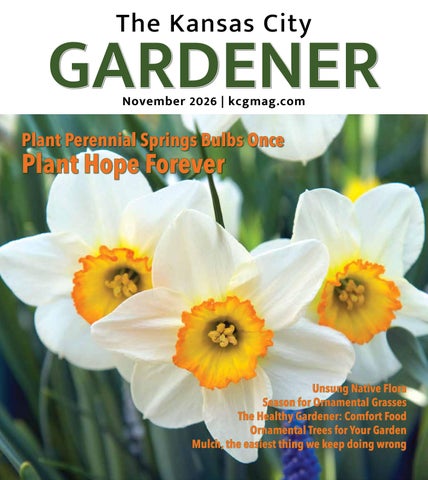
Plant Perennial Springs Bulbs Once
Plant Hope Forever
Unsung Native Flora Season for Ornamental Grasses The Healthy Gardener: Comfort Food Ornamental Trees for Your Garden Mulch, the easiest thing we keep doing wrong
editor’s notes
The Kansas City
GARDENER Independently owned and operated since 1996
An attitude of gratitude
PUBLISHER Michael Cavanaugh EDITOR Elizabeth Cavanaugh CONTRIBUTORS Mark Ayers Melissa Cotton Kim Dyer Markis Hill Jesse Kirk Anthony Reardon Arricca Elin Sansone Anne Wildeboor Scott Woodbury DISTRIBUTION Publishers Delivery Solutions, Inc. IF YOU WOULD LIKE TO DISTRIBUTE the magazine at your place of business, please contact Mike Cavanaugh at mike@kcgmag.com 913-648-4728 NEED MORE MAGAZINES? mike@kcgmag.com 913-648-4728 CONTACT US P.O. Box 8725 Prairie Village, KS 66208 913-648-4728 ADVERTISING Mike Cavanaugh at mike@kcgmag.com 913-648-4728 QUESTIONS ABOUT EDITORIAL AND SUBSCRIPTIONS Elizabeth Cavanaugh elizabeth@kcgmag.com 913-648-4728 HOW TO SUBSCRIBE See details on page 19. WEBSITE kcgmag.com
T
ransitioning from summer to fall is tough. Gardens and gardeners alike are unable to hide their weariness. The colors of autumn are slow to show, and I’m feeling a bit cranky and glum. In all honesty, this is my least favorite season, especially when the temperatures are more like early summer rather than early autumn. The rain gauge is dusty. The foliage is dry and crispy. The search for caterpillars has ended. Butterflies and hummingbirds gone. Garden color is drab. In fact, if it weren’t for the containers awaiting cleanup there would be no color at all. Gardening feels a bit ho-hum. Yet, there’s work to be done, so I start with hand-watering the ferns in containers. At least they are still green. With sprayer in hand, I begin to relax and let my mind wander. I recalled this quote from Marcel Proust, “Let us be grateful to people who make us happy; they are the charming gardeners who make our souls blossom.” Naturally, next came this memory. Four small maple leaves were taped to the wall in my office. I kept them there not as tokens of fall’s bounty or as decorative display.
This time of year there are plenty of leaves “on display” right outside my office window. I kept these special four as a reminder of how they came to me—as a gift from the chilly palm of my then eight-year-old daughter. Then came the shift. You know the one. A subtle, nearly unnoticed, change in attitude. A reminder for me to find joy in the small things. I just love when that happens. I am grateful for the nudge. These days are opportunities for gratitude. Don’t let them get away. We’d like to take this opportunity to thank all of you. Without the support of our advertisers, contributors and readers, we would not be able to deliver this quality publication. We appreciate your commitment to and enthusiasm for gardening in your community. You truly are special to us. Speaking of special people, I must acknowledge the sad news that one of our long-time contributors passed away in September. Lenora Larson, the butterfly maven, taught me, that butterflies need more than pretty flowers that deliver nectar as food in the garden. Just as important, possibly more important, is the need for host plants. That’s where the se-
rious work happens, the place where life begins for another generation..... and so much more. So much more indeed! Let’s pause to give thanks for the people who enrich our lives, for the challenges that build us, and for the kindness bestowed upon us. As you approach the holiday season, may your heart be filled with love, laughter and happiness. I’ll see you in the garden!
In this issue
November 2026 | kcgmag.com 4 Ask the Experts 6 The Healthy Gardener 8 Ornamental Trees 10 Plant Perennial Spring Bulbs 12 Mulch, the easiest thing we keep doing wrong
14 16 17 18 19 19
Season for Ornamental Grasses Rose Report Unsung Native Flora Garden Calendar Upcoming Garden Events Subscribe
About the cover: Daffodils, plant them now. Learn about the varied perennial spring bulbs starting on page 10. 2
November 2026 | kcgmag.com
‘27-‘28
Midnight Express Redbud ®
TRIALED & TESTED FOR YOUR SUCCESS
A great landscape starts with a great tree. Proven Winners® ColorChoice® trees bring structure, shade, and multi-season interest while supporting pollinators and birds. Their manageable size makes them easy to fit into any yard. And because they carry the Proven Winners ColorChoice name, they’re built to perform. Look for the Proven Winners ColorChoice trees at your local garden center or learn more at ProvenWinnersColorChoice.com
SCAN TO LEARN MORE
The Kansas City Gardener | November 2026
3
Ask the Experts CONCERN ABOUT LEAFY GREEN SHOOTS ON GARLIC Question: In years past, when we’ve had warmer autumns, the garlic that I just planted somehow manages to send up leafy shoots before winter even arrives. While I don’t recall it affecting the harvest, should this concern me? Anthony’s Answer: With seasons that provide warm soil paired with cool, moist weather, a natural byproduct of this favorable environment may be sending up shoots during warmer stretches before the ground has frozen. While it is true that these shoots are, in fact, drawing on the bulb’s energy storage, the prolonged period in the ground throughout winter and spring allows the plant ample opportunity to replenish reserves. The shoots will die back with the first freeze. Once growth resumes, fertilize according to soil test recommendations. The leafy growth that follows will continue to fuel bulb development, helping to ensure hearty garlic bulbs are available at harvest. WINTER PREP OF VEGETABLE GARDEN INCLUDES EROSION CONTROL Question: Generally speaking, my winter vegetable garden entails fallow soil. I don’t hassle with cover crops and don’t have any perennial vegetables in my plots. Is there anything I should be doing with this after my annual fall clean-out? I am particularly concerned about erosion control. Anthony’s Answer: Even without having active plant matter in the garden, methods exist to help ensure that your well-built garden topsoil
stays in place where you want it. Utilizing straw, gardeners can apply a heavier layer than usual, around 3 to 6 inches, to help fend off weeds during the winter while physically “pinning” the soil in place. Doing so will also keep soil moisture in the garden more consistent through the off-season, avoiding the wetting and
efficiently mitigate weeds and keep soil in place. In the long-term, soil aggregates may just be slightly less protected. WINTER BURN IS OF CONCERN Question: I planted a handful of new evergreens in my landscape this year, and now that winter is
There are mitigation options for protecting evergreen shrubs, like the boxwood above. For example, provide shelter from winter winds by using burlap wraps, or three-point windbreak tents. Ensuring adequate water is also important. drying cycles that often lead to the breakdown and erosion of soil aggregates. Plus, a healthy dose of organic matter will be present throughout the winter, keeping the soil microbiome fed while other plants are away. If you’d prefer not to go the straw route, black silage tarp over the beds until spring is also an option that will
approaching, I’m terrified of how they’ll make it through. Any important winter tips I should be aware of with conifers? Anthony’s Answer: An important factor to bear in mind with evergreens in winter is that “winter burn” can be of particular concern. Winter burns occur when an ever-
green lacks sufficient soil moisture, and dry winter winds blow through, removing water from the plant via the stomata in the needles. With no water in the soil to replenish what is lost, a “burning” desiccation of plant cells then follows, appearing as brown, reddish-brown, or orange dead foliage in the spring. Winter burn can be reduced by ensuring that the soil profile of your evergreen trees and shrubs is adequately moist throughout the winter—damp like a sponge but not sopping wet. On days when the temperature is above freezing, and the ground is not frozen, this may entail dragging your hose out of storage and giving plants an additional drink than what the weather has been providing. If a soil probe can reach a depth of around 2 feet, this indicates the soil is moist enough to reach the plants’ root zone. Then, of course, make sure to disconnect your hose and properly store it again to avoid damage to pipes. Also, remember that screening can be used alongside winter watering to help prevent winter burn. Providing shelter from winter winds, water is less likely to escape through the stomata and negatively impact the plant. These screens can include burlap wraps around the specimen, three-point windbreak tents made with T-posts and burlap, or other windbreak-specific materials. If you plant a specimen with an exposed trunk, these tents will help protect it from sunscald—where winter sun thaws the southwest side of the trunk, only for it to freeze again in the evening and cause damage. So, not to worry, there are options!
MARKIS HILL | Horticulture Agents | ANTHONY REARDON Markis Hill and Anthony Reardon are the horticulture agents for K-State Extension Johnson County, each specializing in ornamentals and edible crops, respectively. For free information fact sheets, visit www.johnson.k-state. edu, or call our Garden Hotline at 913-715-7050.
4
November 2026 | kcgmag.com
Landscape Services Design & Installation One time Clean-Up Pruning & Maintenance Mulch & Sod Installation
Text or Email
liz@greenleafkc.com
(816) 916-5171 Serving Johnson County in Kansas
Christmas
in the Village FRIDAY & SATURDAY NOVEMBER 13TH & 14TH 6:00 PM - 9:00 PM
Free Event!
Open to the public! Lights, Sights & Decorations Fireside S’mores
Christmas Music
Hot Cocoa, Cider & more
Holiday Photo Opportunities Christmas Cookies ...and more!
Bring the whole family!
Hope to see you there! 4385 W. 247TH STREET, LOUISBURG, KS, 66053 913.837.3510 CALL OR TEXT
The Kansas City Gardener | November 2026
5
The Healthy Gardener
Comfort Foods, Garden Style
A
s the months get colder, you might notice yourself reaching for more “comfort foods,” or foods that bring feelings of warmth, comfort, or nostalgia. These foods are often higher in calories, sugar, carbohydrates, or fat. So, why do our eating habits sometimes change with the seasons? There are several reasons we may crave different foods during the colder months: • Winter holidays bring more opportunities to enjoy special foods. Family recipes, holiday treats, and food tied to memories can all bring a sense of comfort and connection. • Fresh produce may be less available. In colder months, many fresh fruits and vegeta-
bles are harder to grow or find locally. Hearty grains, potatoes, and other starchy foods may become a bigger part of our meals. • Our bodies respond to colder weather. Eating food creates heat as our bodies digest it, and a warm meal or drink can feel especially comforting as the temperature drops. • Less sunlight may affect our eating habits. Changes in daylight can affect hormones related to mood and hunger, causing shifts in appetite or food cravings for some people. Of course, this does not mean you need to avoid your favorite foods. Instead, aim for balance. You
MELISSA COTTON Field Specialist 6
November 2026 | kcgmag.com
can enjoy special foods while still prioritizing your health….and your garden can help! Try these simple strategies: • Use what you grew or stored from your garden. Winter squash, sweet potatoes, carrots, beets, onions, and other root vegetables can add fiber and nutrients to soups, stews, casseroles, and more. Fresh or dried herbs can add plenty of flavor, so you won’t need to add extra salt or butter. • Don’t forget frozen and canned produce are quick and healthy options. Add vegetables to soups, casseroles, and pasta dishes. Add fruit to oatmeal, yogurt, or baked dishes.
• Include protein with meals and snacks. Protein can help you feel full and satisfied. Try meat and poultry, fish, eggs, beans, lentils, Greek yogurt, cottage cheese, nuts, or seeds. • Enjoy your favorite foods mindfully. When you choose a special treat, slow down and enjoy it. Use a smaller plate or bowl, sit down while you eat, and pay attention to the flavors and textures. You may find that the smaller portion was the perfect amount. • Stay hydrated. It is easy to forget about water when the weather is cold. Water, milk, and unsweetened tea are good choices. Coffee and hot cocoa can also be part of your day, but remember that some warm drinks add extra sugar, calories, and caffeine. • Make gatherings about more than food. If you tend to overeat at holiday gatherings, give yourself something else to focus on. Play a board game, work on a knitting or crochet project, put together a puzzle, or head outside for a game of football with the family. Comfort and good nutrition can share the same plate! Some of the most comforting winter meals can start right in your garden. A warm bowl of vegetable soup and roasted root vegetables can give you the cozy feeling you crave while providing your body with the nutrients it needs.
Melissa Cotton is a Field Specialist in Nutrition and Health Education with the University of Missouri Extension. She offers programming related to healthy aging, chronic disease prevention and management, and overall wellness in the Kansas City area. Email her at cottonmr@missouri.edu for more information.
Enjoying Nature from the comfort of home!
Loyalty Program
Buy 9 bags of seed & the 10th is FREE!
Best Selection Of
birding supplies in town! Now carrying Lizzie Mae’s Amish Craft Birdseed
Locally owned & operated by Drew & Megan Diekmann
56 NE Sycamore St, Lee’s Summit, MO • (816) 272-5878
Fall clean up is upon us:
Celebrate the Holiday Season
We have a great selection of fresh Christmas decorations & flowering plants. festive poinsettias • holiday décor fresh cut trees • fresh garlands & greenery unique gifts for that special gardener
This is the time to get your lawn in shape with grass seed and fertilizer. We service what we sell and more. Stop in today! Mowers, Blowers, Hedge Clippers and Chain Saws are in stock now! All equipment assembled, serviced and ready to go when you buy it.
Nothing goes out of here in a box! 7130 Troost, Kansas City, Mo. www.soilservice.com | 816-444-3403
Koi Pond and Water Feature Designs
Lawn & Garden supplies • Pet supplies • Bird seed
10% off any 5# bag
of Wild Delight Wild Bird seed with the purchase of any bird feeder.
Wildlife Science suet cakes $1.79
New Installations, Remodels, Upgrades, Repairs and Maintenance Services Wendy Hix • 913.481.5416 Tate Foster • 913.406.6804 www.hixandsonaquatics.com
4807 N. Brighton, KCMO www.mowerpartskc.com
816-452-8393 Mon.-Fri. 8a-5p Sat. 8a-1p
The Kansas City Gardener | November 2026
7
Six Ornamental Trees You’re Going to Love for Your Garden
Y
our yard overflows with colorful annuals, perennials and shrubs, but you may be missing something. Adding a small tree to your landscape makes your garden uniquely yours. “An ornamental tree defines a space and serves as an accent,” says Maria Zampini, tree program manager for Proven Winners ColorChoice Flowering Trees. “In addition to their beauty, they fulfill many other purposes, including providing seasonal blooms, shade, and support for wildlife.” Many new tree cultivars also are more compact, so they fit in spaces where you don’t have room for a towering specimen such as a maple or magnolia. They’re fast-growing as well, so you achieve low-maintenance good looks without waiting forever. Are there areas in your garden that look bare or need some spring color? An ornamental tree can bring interest to that space, and fall is the ideal time for planting. With warm soil that encourages roots to establish quickly, cooler temperatures, and more plentiful rainfall, fall planting typically is less stressful on new trees, says Zampini. But before buying any tree, do some homework. “Read the plant tag, and talk to the nursery people,” says Zampini. “When you’re making any other large purchase for your home, such as an appliance, you do research. Do the same when selecting a tree so that it’s the right fit for your garden.” The most common mistake is to
Lollipop Crabapple
Midnight Express Redbud
underestimate a tree’s size someday years from now. You don’t want to plant a tree too close to your house, overhead wires, or sidewalks so that you have to prune it into submission constantly. Take the time to measure and map out its mature circumference and consider its eventual height before planting to save yourself maintenance issues down the road, says Zampini. Following are a few ornamental trees that will thrive in your Midwest garden: Redbud (Cercis canadensis) Native to eastern North America, redbuds are true show-stoppers when they burst into bloom in early spring. Their exquisite pea-shaped
ARRICCA ELIN SANSONE Garden Writer 8
November 2026 | kcgmag.com
blooms appear on bare branches, while the heart-shaped leaves in shades of green or red are attractive all season long. Varieties to plant: Midnight Express Redbud is fast-growing variety with pink flowers and deep burgundy foliage that holds its color better than others in the heat. It’s on the larger side at 20 to 30 feet tall but still works in most gardens. Crabapple (Malus spp) There’s nothing as mesmerizing as a crabapple in full bloom in the spring. Their lush flowers make them particularly appealing as an accent in a front yard or large garden bed. Wildlife enjoy the shiny, red fruits in fall.
Varieties to plant: With its fragrant white blooms, Lollipop Crabapple keeps its charming round shape, maxing out at 8 feet tall and wide. Show Time Crabapple is larger, eventually reaching 25 feet tall, with deep pink flowers that are clustered on the branch, green leaves with a reddish tint, and vibrant redorange fall foliage. Japanese Maple (Acer palmatum) These eye-catching trees make excellent specimen plantings for their finely-textured foliage and graceful forms. They work equally well in landscape beds or as a focal point in nearly any style garden. Many varieties have bright foliage that contrasts beautifully with other predominantly green plantings in the landscape. Varieties to plant: Metamorphosa Japanese Maple has a handsome, shrubby form. It’s true to its name with intriguing foliage coloration that emerges yellow, then morphs to a pinkish margin that shifts to white and reddish-orange in summer. Fall brings magnificent red-orange col-
Arricca specializes in writing lifestyle and gardening content. With a background in health reporting, she applies these same research skills when writing about the science of growing things. She trials new plants in her garden, and her houseplant collection consists of 60+ varieties. Arricca writes for publications such as Country Living, House Beautiful, Good Housekeeping, VERANDA, Southern Living, and more.
Skinny Fit Ginkgo
Photo credit Plants Management Australia Pty Ltd.
Metamorphosa Japanese Maple
Crusader Hawthorn
Show Time Crabapple
or that turns to red-violet. It’s truly unique!
an attractive accent—like an exclamation point!—in your garden. If you love drama, this dazzling columnar tree, which reaches 16 feet tall and a tidy 3 to 4 feet wide, deserves a spot in your landscape
Ginkgo (Ginkgo biloba) Gingko trees are coveted for their unusual fan-shaped leaves. But some older varieties can become particularly tall and shed messy fruit. However, new cultivars are bred to be compact and columnar, yet still maintain their glowing golden color in autumn—but with no fruit production. Varieties to plant: Skinny Fit Gingko reaches sky-high so it makes
Hawthorn (Crataegus crusgalli) Native to the eastern U.S., hawthorn trees have attractive white flowers in spring, pretty silvery bark and bright fall foliage. The flowers support pollinators, such as bees, while songbirds are attracted to the “haws,” or fruits.
Varieties to plant: Crusader Hawthorn is a thornless variety that is super-tough and can handle a wide variety of conditions. It tolerates most types of soil and salt and boasts good disease resistance. Its showy fruit supports wildlife. Japanese Snowbell (Styrax japonicus) This lesser-known spring bloomer is absolutely stunning. With fragrant, bell-shaped blooms that cascade from its branches, it’s wellsuited to plant alongside walkways so you can catch a whiff of its scent or in a landscape bed as a striking focal point. Varieties to plant: Starway to Heaven has an upright habit and boasts fragrant, five-petaled flowers in spring and fall. Each blossom nearly looks metallic, while the foliage emerges red and turns to green. Marley’s Pink Styrax has a more elegant weeping form with graceful blush-pink flowers.
Marley’s Pink Styrax
The Kansas City Gardener | November 2026
9
Plant Perennial Spring Bulbs Once
Plant Hope Forever
W
hat the world needs now, as much as ever, is hope. For me, hope comes in little botanical packages—bulbs, corms, and rhizomes. So if you need more hope in your garden, start planting now. If you are not a polar bear and a lover of long, cold winters that we sometimes must endure, start planting the cure for the winter time blues now. The best time to plant bulbs in our area is after the ground temperature falls below 55 degrees. There are so many choices so if you are new to fall bulb planting, here is a little direction. If you’ve been through a few seasons of hopeful anticipation, perhaps I can encourage you to try something new and add to your repertoire of hope. As a rule, plant bulbs twice as deep as the bulb is tall. The larger the bulb, the deeper it goes. Once planted, water well one time, then let the magic happen. If using mulch, put it over the newly planted bulbs after temperatures drop to freezing. A good starting point is at the daffodil display. First, a simple semantics lesson on Narcissus vs. daffodils vs. jonquils. Narcissus is the botanical name, whereas daffodil is the common name for those plants
with only one good sized bloom per stem, while jonquils have multiple smaller blooms per stem. There are some other slight differences that warrant a little more research if you are interested. Daffodils are true perennials in our area and multiply, so that in a few years, you will have a delightful show from each clump. As a bonus, daffodils are unappetizing so deer steer clear. I recommend planting in clumps of 3 or 5. Even if you prefer a straight or curved border of daffodils, plant clumps to create a swathe so that it looks natural. If you would like a large cluster, plant in sets of 3 with 6 inches between each set so they have room to multiply. My favorite big daffodil is Dutch Master. Both the bulb and bloom are large at about 4 inches across so they are hard to miss. Planted en masse really makes a statement. They are classic yellow so the trumpet or corona and the skirt or petals match. Ready for more, I encourage you to start branching out and try planting sets of the less common varieties such as double coronas like ‘Tahiti.’ Consider a collection of miniature daffodils along your regular winter route where they can be enjoyed as a
KIM DYER Merchandiser 10
November 2026 | kcgmag.com
Dutch Master Daffodil
Kim Dyer is a Merchandiser at Suburban Lawn & Garden, 135th and Wornall location, in Kansas City, Missouri. She is an emeritus Kansas City Master Gardener with decades of growing experience and a wealth of knowledge on a variety of gardening subjects. You can reach her at kimd@suburbanlg.com.
petite wonder. My favorite is ‘Tetea-Tete.’ It is pure yellow, small at less than 10 inches tall with fragrant blooms. A great choice for forcing. So cute in a bud vase with other small blooms like Muscari (grape hyacinths) and Scilla siberica. Another miniature, ‘Kapiti Peach’ is so fun. The dual color blooms form a globe known as a tazetta so that each stem is a whole miniature bouquet. My newest collection effort is split crown or butterfly daffodils. I love how the petals are usually a contrasting color and the corona is more like a ruffle. This year, I am planting ‘Precocious,’ though I have no idea where. Some other perennial staples needed for a spring explosion are Crocus, Muscari and Hyacinths. Each come in a variety of colors. I find that Crocus are often are the very first to bloom hailing in the new season. Muscari seem to last the longest and are great cut flowers. Hyacinths have a classic fragrance that will chase away all your winter blues. Do handle with care though, some people are sensitive to Hyacinth bulbs so wash your hands well after handling this bulb. Fortunately, the flower stalk does not contain the compound that causes itchiness. They are great cut flowers and usually can be easily forced to give you the strength to get through the dreary days of January. The trick to forcing bulbs is giving them a bit of a chill. Even if they are pre-chilled, if they have been in a retail store, re-chill them by putting in a paper bag in a cold but not freezing spot for a 2-6 weeks. If this interest you, do your homework and have fun. Even if you don’t feel successful the first time, keep trying as it is a bit of an art. A bulb that is commonly forced in our area is Paperwhites. They are not perennial in our area so forcing them indoors in water or soil is the best way to enjoy them. So many bulbs and so little time. We haven’t even covered other perennials like lycoris (surprise lilies), alliums, iris or peonies. Perhaps another time. See you at the garden center!
Butterfly Daffodil
Muscari ‘Helena’
Daffodil ‘Kapiti Peach’
Daffodil ‘Tete-a-tete’
Daffodil ‘Precocious’
Crocus mix
Hyacinths
Paperwhites
Double Daffodil ‘Tahiti’ The Kansas City Gardener | November 2026
11
Mulch, the easiest thing we keep doing wrong The Good: Mulching is one of the simplest and most beneficial things homeowners can do for their trees. When applied properly, mulch conserves moisture, moderates soil temperatures, and reduces competition from grass and weeds. Unfortunately, improper mulching is also one of the most common problems I encounter when inspecting trees in residential and commercial landscapes throughout the Kansas City area. Too much mulch, or mulch mounded on the trunk, can create substantial future problems. In a natural forest, trees grow in soil covered by decomposing leaves, twigs, and other organic material. This layer protects the soil, supports beneficial organisms, and gradually returns nutrients as it decomposes. In our maintained landscapes, fallen leaves are often removed and turfgrass grows right up to the trunks of trees. Applying organic mulch helps recreate some of those natural conditions. One of mulch’s greatest benefits is moisture conservation. By shading the soil and reducing evaporation, mulch helps maintain more consistent moisture levels during our hot Kansas summers. This is especially valuable for newly planted trees, whose limited root systems make them particularly vulnerable to drought stress. Mulch also moderates soil temperatures, keeping the soil cooler during summer and reducing temperature fluctuations during winter. As wood chips and other organic materials decompose, they contribute organic matter, improve soil structure, and encourage biological activity. Over time, these improve-
ments can benefit root development, particularly in our often compacted urban soils. Another important benefit is reducing competition from turfgrass. Grass competes with tree roots for water and nutrients, especially near the surface where many of a tree’s fine absorbing roots grow. A properly maintained mulch ring eliminates much of this competition while also protecting the trunk from lawnmowers and string trimmers. The Bad: Unfortunately, more mulch isn’t necessarily better. One of the most common mistakes is creating a “mulch volcano,” where mulch is piled high against the trunk. These mounds are frequently seen around trees in commercial landscapes and residential yards. Tree trunks are not designed to remain continuously buried in moist organic material. Excessive mulch against the bark can encourage decay, maintain conditions favorable to certain diseases, and provide shelter for rodents that may damage the bark. Deep mulch can also inter-
JESSE KIRK Master Arborist 12
November 2026 | kcgmag.com
fere with water and oxygen movement into the underlying soil. Over time, buried root collars can become associated with the development of adventitious roots and potentially stem-girdling roots. These roots may grow across or around the trunk, eventually restricting the movement of water and nutrients as the tree increases in diameter. Although girdling roots can develop for several reasons, excessive mulch and improper planting depth are the most significant factors in my opinion. Ideally, the root flare, where the trunk widens and transitions into the major structural roots, should remain visible. If your tree resembles a telephone pole entering the ground rather than havng a flared base or buttress, it may be planted too deeply or have excessive an excess of mulch covering the root collar. 100% of the time I’d prefer to see a tree planted high rather than too deep. A tree planted too high is easily corrected with some soil or mulch but once a tree establishes to deeply, corrective actions become limited. For most landscape trees, I recommend maintaining approximately two to three inches of organic mulch over the soil surface. Keep mulch several inches away from the trunk, leaving the root flare exposed. Rather than piling mulch deeper, expand the mulched area outward whenever possible. A broad mulch ring extending several feet beyond the trunk is far more beneficial than a small, deeply mulched circle. Arborist wood chips are an ex-
cellent mulching material. They contain a mixture of wood, bark, and leaves that decompose gradually and supports soil organisms. Contrary to a common misconception, fresh wood chips applied to the soil surface generally do not rob established trees of nitrogen. I also don’t worry much about arborist wood chips vectoring fungal or insect disease. How to get free Mulch One resource homeowners may not know about is ChipDrop (getchipdrop.com), a service that connects homeowners with arborists who need places to unload wood chips generated during tree work. Homeowners can sign up to receive a load of chips, often at no cost, although optional payments and delivery conditions may apply. The biggest consideration is quantity; most chip trucks will deliver 2025 cubic yards per dump. The chips may also contain leaves, logs, and be a mixture of tree species. Typically, we only look on ChipDrop for a site if we have a good clean load. If it’s a mixed load or primarily species like tree of heaven, it’s going to the green waste yard. For homeowners with large properties, extensive landscape beds, erosion issues, upcoming construction projects or numerous trees to mulch, this can be an excellent opportunity to obtain organic material while helping local arborists reduce disposal and transportation costs. Proper mulching doesn’t need to be expensive or complicated. A few inches of wood chips, spread over a generous area and kept away from the trunk, can provide lasting benefits to your trees for years to come.
Jesse Kirk is District Manager for Wellnitz Tree Care and a Registered Consulting Arborist and ISA Board Certified Master Arborist. A graduate of Kansas State University, he specializes in professional tree management, plant health care, and arboricultural consulting. Email him at Jkirk@wellnitztreecare.com or call 913-350-0050.
THE DIFFERENCE IS IN THE DETAILS Fertilize indoor plants with Sure Bloom® to keep them green & healthy all winter long. Apply Mushroom Stuff ® - strengthen root systems outdoors. Apply Earth Right products when ground isn’t frozen.
Grow your herbs with Mushroom Stuff indoors Earth Right 913 492 2992 www.superlawnstuff.com Made & Formulated for the Heartland - Tune in Saturday at 6 AM to the Tobin Family Program on KMBZ.com
Paula’s Petals Greenhouse & Floral
The Shrub Removal Guy
Found off the beaten path, down a country road
913-620-1092 CALL or TEXT
• Design & Installation • Landscape Renovation • Bed Maintenance • Fall Clean-up • Mulch & Rock Installation
816-807-1008 williamslandscapekc.com
SUPPORT LOCAL
TELL ADVERTISERS YOU SAW THEIR AD IN THE KANSAS CITY GARDENER.
Offering houseplants, herbs, annuals, perennials, roses, fruits, vegetables, fresh cut flowers, florals for all occasions. Delivery on Florals is available.
NO SHRUB TOO BIG OR TOO SMALL TIMOTHY MAGILL TheShrubRemovalGuy@Gmail.com
Located at 33607 E 199th St, Pleasant Hill, MO Take the second entrance off the main road. www.paulas-petals.com • 816-929-0522
A Gardener’s Destination Decorate for the Holidays
Fresh cut Fraser Firs, Christmas décor, Wreaths, Garland and Greenery Planters.
Christmas Open House Saturday, Nov 14, 9a-4p
Refreshments • Specials • Come shop the great selection of gifts for all your gardening friends.
KCGMAG.COM
One free, easy call gets your utility lines marked AND helps protect you from injury and expense. Safe Digging Is No Accident: “Always Call Before You Dig in Kansas” Call 811, 1-800-DIG-SAFE, (800-344-7233) or visit us at www.kansas811.com.
112 E. Green St. • Clinton, MO 64735 • 660-885-3441 • Mon-Fri 8-6, Sat 8-4
Serving KC for all things natural stone for over 40 years including decorative gravel, flagstone, natural stone veneer, edging stone, bubbling boulders, and more.
913-432-5990 🌐🌐 houseofrocks.com
1725 M e rri a m La n e, Ka n sa s Cit y, KS 66016 • I -35 & L A M A R
The Kansas City Gardener | November 2026
13
Little Bluestem Standing Ovation
Little Bluestem The Blues
Little Bluestem Carousel
Little Bluestem Twilight Zone
Season for Ornamental Grasses
T
he garden is winding down. The temperature has finally cooled. Now gardeners can take a deep breath and enjoy the slower pace. I personally love our seasons, and the slow down of fall and early winter. Just because the pace has slowed doesn’t mean your garden is less beautiful. It’s just different. When I create garden designs I consider this season and what can be added of interest. Evergreens are an obvious choice, ornamental grasses are right up there with them. In some cases higher, because they have a lower price point so I can add more to fill a space. There are ornamental grasses for every type of location from full sun to full shade. Some enjoy wet feet, others prefer well drained. There are grasses that can grow ten feet tall in a season (I’m not exaggerating), while others are under a foot. Let’s dive in and see if these have a place in your fall landscape.
Little Bluestem (Schizachyrium) might just be my favorite ornamental grass. Please don’t tell the others, they may get a complex. But really this genus is top tier across the board. It’s medium in height, usually getting around 3-4 feet tall. Unlike Big Bluestem (Andropogon) which can be 5-6 ft tall. By having a smaller stature it holds its shape better. Staying a nice neat clump and not falling on its next door neighbor. The fall color is wonderful. You have smoky blue foliage in the warmer months and as the temps cool you get a reddish purple hue. Depending on the temperature that color will hold into November and sometimes December. Shape wise, it’s great usually until those snow storms flatten it down. I have tried a few varieties that I enjoy. Standing Ovation, The Blues, Carousel and Twilight Zone are all tried and true. If you are not wanting that large of a grass, or looking for some-
ANNE WILDEBOOR Horticulturist 14
November 2026 | kcgmag.com
thing that is less upright, you can’t go wrong with the Pony Tails grass (Nassella) or Stipa. It is a smaller grass in circumference, so works well in tight spaces. It gets about 16-24 inches tall. But it really is an arching grass, hence the pony tail common name. It is a pretty golden tan color in the fall and that color will last until spring. Personally, I leave mine until mid spring before trimming it back. I like the contrast with the spring flowers and the way it dances in the breeze. I have grown it in part shade…it was just ok. Really full to part sun is best with well drained soil. Carex is such a diverse genus. From full shade to full sun to lots of water to very well drained soil. These grasses are so easy, but you have to make sure you are putting it in the correct environment. So pay close attention to what you are selecting. What I truly love are the evergreen nature and the thin graceful
leaves. Plenty of Carex is planted in shady locations at the Overland Park Arboretum & Botanical Gardens. They are so low maintenance and do well under trees. But it is that texture of the foliage with the round leaves of hostas, hydrangeas and ferns that make them stand out. Look into the ‘Evercolor’ series. They are going to look bright and fresh in the late fall garden. I like to experiment with our hardiness zone on occasion. We are currently 6B, which changed in 2023. This is our cold hardiness, not our summer heat temperature range. Which is something to consider, some plants will survive our winter but be unhappy in our summer heat/ humidity. Muhly grass is one of my experiments that has paid off for many years. Muhly grass (Muhlenbergia) has some varieties that are hardy in zone 6 but my favorite is zone 7. ‘White Cloud’ only gets 3-4 feet with flowers. The flowers are
Anne Wildeboor, is long-time horticulturist at the Overland Park Arboretum & Botanical Gardens. She loves sharing her passion for plants with the public and working alongside dedicated staff and volunteers.
New owners, new location, and new name. Same quality seed options blended in a showroom full of accessories for every deck, porch, patio, or garden oasis.
Stipa Ponytail
Carex Everoro (Evercolor series)
Mon-Th & Sat: 10am-5pm Fri: 10am-6pm
Holiday Open House Nov 11 – 14 What was Wild Bird Center and Wild Bird House, is now
Cooper’s Seed & Garden Oasis 17020 US 40 Hwy, Unit #10, Scottdale Center Independence, MO (Across the highway from Tim’s Pizza.) 816-372-4867 coopersseedgardenoasis@gmail.com
Muhly Grass White Cloud
Maiden Grass My Fair Maiden
very long and they are bright plumes of white. In the fall garden they absolutely glow. They gracefully blow in the breeze, and as the temperatures cool they turn a light tan. A bright spot in the late fall landscape. I will say they can be late to emerge in the spring, so be patient. The pink variety is also beautiful and also one to try for its wispy airy texture that it adds. Almost like pink cotton candy in the garden. You may be wondering why I haven’t added any Maiden grass (Miscanthus) varieties to my list. They truly are a staple in many landscapes. They are large, tough, can give good fall color, and have pretty plumes. Here at the gardens we are seeing some reseeding on some of our Miscanthus. This is an interest-
ing development. Leaving our grasses for winter interest adds beauty to our gardens, wind breaks and shelter for creatures. We are going to try a few different methods this fall to try to combat the reseeding. We are going to deadhead the plumes and leave the grass. In other areas we are going to completely cut down. It is our own little science experiment. There are some new varieties on the market that the plumes are infertile. We are going to try ‘Scout’ and ‘My Fair Maiden’ in 2027, both are sterile. I hope you are still finding beauty and calmness in your garden this November. If you are missing that end of the season interest in your garden space, consider ornamental grasses. There are so many fun, easy options out there to choose from.
EASY ONLINE BULK DELIVERY MULCH • SOIL COMPOST (INSTALLATION NOT INCLUDED)
Top Soils
• Pulverized Top Soil • Custom Soil Mixes • Garden Soil • Raised Bed Soil
Mulch
• Premium I • Colored Mulches (red, brown & black) • Cedar • Hardwood Chips • Erosion Stabilization
Compost
• NatureWise • Composted Forest Products • Composted Pine Fines TM
Scan code or learn more at https://missouriorganic.bulkdelivery. app/catalog/delivery
816-483-0908 | missouriorganic.com The Kansas City Gardener | November 2026
15
Rose Report
November 2026 | kcgmag.com
Photo by Jerry Dreyer.
Blush Drift Rose
Gold Medal Rose
Music Box Rose
turfgrass and more eco-beneficial plants. We created raised beds around the house with enriched topsoil and other organic, loose material. An irrigation system was installed to cover both the turfgrass and landscape beds. This is also a good time to get an initial soil test(s) to assess the pH and fertility of your soil so you can group plants with similar pH requirements together. For example, native plants, roses, azaleas, blueberries/strawberries each have different optimum pH levels. Native seeds were sown to avoid the high cost of container-grown plants. November and December are the best times to sow native seeds.
classes. Common classes for OGRs include Alba, Bourbon, and Damask. Common classes for Modern Roses include Hybrid Teas, Grandifloras, and Floribundas. The garden is diverse and includes many types of roses. Some roses are more eco-beneficial than others in the context of the design goals noted above. Generally, roses with low petal counts are of more interest to insects since they are easier to get into and extract nectar. For example, a Species rose may only have five petals, whereas a Modern rose may have 50 petals. Species and OGR’s generally require less maintenance, particularly less insecticides and fungicides, if any. The pollinators and wildlife in the garden will greatly benefit from using less pesticides. Some of the initial Species and Old Garden Roses in this garden include the Pasture Rose (Rosa carolina), Swamp Rose (R. palustris), Illinois Rose (R. setigera) and the Zéphirine Drouhin climber. There
are many pollinator-friendly roses commercially available, so look for ones that meet your objectives and where possible, find ones that are disease resistant. Remember to spend time on design and research so your labor and money are well spent. Implement your overall plan in sections so you can see quick benefits and make changes as needed. Be patient, all perennial plants need time to mature, usually about three years. To see examples of Species and Old Garden Roses, visit the new Heritage Rose Garden, established this summer within the Laura Conyers Smith Municipal Rose Garden at Loose Park in Kansas City, MO. For more information on all aspects of rose gardening visit our website www.kansascityrosesociety.org and click on the Grow Roses tab. Send rose garden questions to rosehelp@ kcrosesociety.org where they will be answered by one of our Consulting Rosarians.
Rose Selection The American Rose Society has three major groupings of roses: Species roses, aka wild roses; Old Garden Roses (OGRs), developed before 1867; and Modern Roses, developed after 1867. OGRs and Modern Roses are further divided into
MARK AYERS Consulting Rosarian 16
Photo by Corinda Stallbaumer.
his article is a case study on building a new garden with diverse plants to be a natural habitat garden that is also pleasing to the humans who see it. The design goal was to be a pollinator-friendly and naturalistic garden with compromises between what birds, bees, butterflies and humans like. In this case, diverse means natives, nonnatives, roses, vegetables and fruit. The introduction of roses to this garden was part of the design goal. Thus, we have a garden with roses, not a rose garden. Another design goal was to create a 50/50 split between turfgrass and landscape beds. Many of the design ideas came from national environmental thought leaders like Doug Tallamy, Thomas Rainer and Claudia West. The property is a half-acre garden with a new house in the center. I recommend that you start with an overall master plan to cover the next five years. It does not need to be detailed but specific enough to guide your major decisions. We started with farmland on predominately clay soil. During the house construction we tackled the Johnsongrass and other weedy, unwanted plants. At this phase you can be aggressive and not worry about other plantings. After most construction was complete and weeds removed, we brought in a thin layer of enriched topsoil to give a better baseline soil than the clay. This was also the ideal time to cut a couple of rain gardens into the natural swales. While these are still a work in progress, they offer a solution for less
Photo by Jerry Dreyer.
T
Pollinator Friendly Garden with Roses
Mark is an American Rose Society Consulting Rosarian, Johnson County KS Master Gardener and Master Naturalist. Originally from Wichita now residing and gardening full time in Lenexa, KS.
Unsung Native Flora: Part 1 Photos by Scott Woodbury.
I
n this first of a two-part series, I highlight several somewhat elusive garden plants to create interest in them and to encourage nurseries to start dabbling in their use and production. This year, giant hyssop (Agastache nepetiodes) towered at 9 to 10 feet tall in my trampoline garden. Normally, at 6 or 7 feet, it’s big enough to impress, yet isn’t influenced by gravity. This season, a few caved under pressure. Being slender, it tucks itself politely between other tall plants. It shares air space in my backyard with Joe pye, Indian plantain, and even a neighboring black gum. I’m enjoying its pale green seed spikes somewhat now, but I’m really waiting for the chocolatebrown spikes that stand at attention in winter. Arrowleaf Aster (Smphyotrichum urophyllum) is one of nine DWAs (damn white asters) native to Missouri. Though white asters tend to be similar, two stand out to me as strikingly different and useful garden plants. Arrowleaf aster has dark stems and pure white flowers with yellow or raspberry centers. It is native to open woodlands and is a favorite of whitetail deer. This aster species grows 3 to 4 feet tall, is strongly upright and narrow, and weaves nicely between other perennials in the garden. Heath aster (Symphyotrichum ericoides) is the opposite, growing in full sun with a soft billowing shape. They can be pendulous, spilling over and softening retaining walls. Wherever they’re grown, their ultra-fine texture and myriad tiny flowers add a misty quality to the garden. The appeal of the next odd-
Deer Tongue Grass
Great Indian Plantain
False Boneset
ball relative of the aster family, the commercially elusive false boneset (Brickellia eupatorioides), may be a head-scratcher for most of the year (when it is drab green). But when it goes dormant in autumn, its white fluffy seeds hold on tight and shine brightly. Unlike asters and goldenrods, whose fluffy seeds blow away in the wind, false boneset seeds do not. Their showy seeds hold on tight through much of winter. The commercial availability of great Indian plantain (Arnoglossum reniforme) is sparse, especially of the smaller Ozark ecotype. This species is smaller than others in this genus, growing 3 to 5 feet in height, though most of the foliage is held at about 2 feet. Its 6- to 10-inch leaves are scallop-shaped, giving this woodland plant a dramatic, dramatic, standout appearance. Tick trefoil, sometimes called beggar ticks (many species in the Desmodium genus), has seeds that notoriously hitch a ride on clothing. Pointed-leaved tick trefoil (Desmodium glutinosum) is a spectacular woodland plant with three-foot
graceful flower stems. With leaves bunched below, and leafless, wiry flower stems arching high above, its clear pink flowers appear to be floating in air. This is easily one of my favorite plants, yet it is not easy to find for sale. Deer tongue grass (Dichanthelium clandestinum) gets its name from its wide, sometimes scurfy leaves that resemble a deer’s tongue or bamboo leaves. It is a droughttolerant plant that does well in infertile, dry, shady areas. Birds and small mammals love eating the seeds. I occasionally meet with customers who have large, old oak trees in their yard, where more native sedges and grasses exist, than turf grass. These open, shady yards are a perfect place to forget about mowing turf and let deer tongue grass naturalize. Slender bush clover (Lespedeza virginica) and violet lespedeza (Lespedeza violacea) are perfect dry-loving companion plants. Both are native to dry open woodlands, and their seeds are also highly attractive to birds. I see many neighborhood parks with acres of
mowed woodland, an oxymoron if I ever saw one. They could be easily transformed into diverse habitat for pollinators and wildlife. Just stop mowing, add the right seed, scout for honeysuckle, and treat it when found. Lastly, Indian physic (Gillenia stipulata) captures my attention in all four seasons. Blooming in late spring with showy, white star-shaped flowers, it is a showstopper. It’s also highly rabbit- and deer-proof. The foliage is ferny and contrasts nicely with other nearby plants. Also, I’m easily impressed by its dark, wiry red stems that stand out and add significant value to the garden, especially during the off-season, between bloom time and fall color. Speaking of which, this plant’s fall leaf, stem, and seed head color is a rich, glowy orange, apricot, or yellow, followed by dark, wiry naked stems and seed heads that starkly contrast with pale grasses in winter. These plants are truly some of my favorites in the garden. I hope someday they become yours as well. Happy gardening, y’all!
SCOTT WOODBURY Horticulturist
Scott Woodbury is the owner of Cacalia: Native Garden Design and Wilding, and he is a Grow Native! professional member. Find suppliers of native plants and seed, as well as landscaping services, at grownative.org.
The Kansas City Gardener | November 2026
17
GARDEN CALENDAR November list of what to do in the garden.
TURF
• Continue to mow as long as the grass is still actively growing. • Second-best time to fertilize cool-season lawns. • Spray winter annual weeds • If no seeding is taking place, apply pre-emergent herbicide to prevent winter annuals. Irrigation may be needed to activate the herbicide. • Irrigate when dry before freezing temperatures set in. • Dormant seeding can start when temperatures drop below 40°F. • Remove large piles of leaves from lawn areas by bagging and removing, mulching them into the lawn, or moving them to an area off turfgrass.
TREES AND SHRUBS
• Water newly planted trees and shrubs. • Protect young plants from rabbit damage by wrapping or making a wire screen. • Continue to plant new trees and shrubs. • Rake and remove any leaves that are diseased to reduce reinfection in the spring. • Check mulch layers and replenish to maintain a 2-to-3-inch depth. • Prune dead or hazardous limbs. • Do not prune spring-flowering trees and shrubs until after they bloom. • Water evergreens to reduce winter injury in dry soil conditions.
VEGETABLES AND FRUITS
• Sort apples in storage and remove spoiled fruit. • Clean and remove fallen fruit from around trees to reduce insects and disease next year. • Treat peaches for peach leaf curl while dormant. • Review garden notes about successes and failures. • Start planning for next year. • Take a soil test and make needed adjustments. • Till garden soil and add organic matter. • Plant a green manure crop such as winter wheat or rye for added organic matter.
• Remove all debris from the garden area to reduce insects and disease next year.
HOUSE PLANTS
• Check plants for insects such as aphids and spider mites. • Keep plants away from heat vents and cold drafts. • Locate plants about 1 foot away from windows to protect them from winter cold. • Reduce or stop fertilizing until spring. • Water as needed and avoid letting roots stand in water. • Rinse to remove dust from leaves. • Continue dark treatment of poinsettias for holiday blooming. • Plant and water amaryllis bulbs for Christmas blooms.
FLOWERS
• Clean up rose beds to help reduce disease for next season. • Remove frost-killed annuals. • Till the annual flowerbeds and add organic matter to improve soil health. • Continue to plant spring-flowering bulbs. • Dig and store tender bulbs, cannas, gladiolus, dahlias, and others in a cool, dark, dry area. • Cut back tall rose canes to 24 inches to prevent winter breakage. • Mulch tea roses with a cone of garden soil about 6 inches deep over the plant. • Leave dead stems on perennials to provide nesting areas for native bees and pollinators. • Wind-blown leaves in gardens provide a natural area for overwintering beneficial insects.
MISCELLANEOUS
• Clean and oil garden tools, sprayers, and other equipment for winter storage. • Drain garden hoses and sprinklers and store indoors for increased life. • Start a compost pile with fall leaves. • Turn compost pile to hasten breakdown.
K-State Extension Johnson County recommends environmentally-friendly gardening practices. This starts by identifying and monitoring problems. Cultural practices and controls are the best approach for a healthy garden. If needed, use physical, biological or chemical controls. Always consider the least toxic approach first. Markis Hill and Anthony Reardon are the horticulture agents for K-State Extension Johnson County, each specializing in ornamentals and edible crops, respectively. For free information fact sheets, visit www.johnson.k-state.edu, or call our Garden Hotline at 913-715-7050.
18
November 2026 | kcgmag.com
Upcoming Garden Events CLUB MEETINGS Garden Club of Shawnee Thurs, Nov 5, 7p; at Shawnee Town, 1929 Town Hall, 11600 Johnson Dr, Shawnee, KS. Our program will be a take home project: DIY Dried Flower Ornaments. This is a pre-registered project. We will serve drinks and snacks, and great door prizes will be given away. As always, visitors are welcome! Learn about us at gardenclubofshawnee.org and our Facebook page. Leawood Garden Club Tues, Nov 17, 10:30a; at Cure’ of Ars Catholic Church, 9401 Mission Rd, Leawood, KS 66206. Horticultural Hints: “The Poppy” by Carol Dennison. Program: “Creating Welcoming Arrangements for the Season” by Katherine Taylor. Celebrate the beauty of late autumn with a floral design demonstration led by Bramble & Stem owner, Katherine Taylor. We’ll share simple techniques for creating welcoming seasonal arrangements using fresh flowers, foliage, branches, and other natural elements, perfect for Thanksgiving gatherings. Olathe Garden & Civic Club Tues, Nov 17, 1p; at Grace Church Gathering Room, 11485 S Ridgeview Rd, Olathe, KS. November Meeting & Orchid Presentation **Free & Open to the Public** Join us for our November meeting featuring a presentation on orchids from guest speaker Jim Bird.
Raytown Garden Club Tues, Dec 3, 11:30a. Members, spouses and friends Christmas Lunch. The RGC will be taking a winter break; our meetings will resume Feb 2027. For more information about our club, check out our Facebook page: www.facebook.com/RaytownGardenClub
CLASSES | WEBINARS Gardening When Space is Limited Tues, Nov 3, 2p. Virtual. Want to garden but have limited space? Learn how to maximize your garden space with clever planting for small spaces and how to select the right plants for success. Register at https://www.johnson.k-state.edu/ then click on News and Events. K-State Garden Hour Webinar: Houseplant Propagation and Care Wed, Nov 4, Noon-1p. Virtual. As cooler weather moves in, now is the time to bring plants indoors and plan for their winter care. Whether taking cuttings or downsizing houseplants, plant propagation is a key skill for managing an indoor plant collection. Join Megin Jacques, Marshall County Extension Agent, to learn about various methods of plant propagation and the best practices for indoor winter care of houseplants. Register at https:// www.johnson.k-state.edu/ then click on News and Events.
Hotlines for Gardeners Extension Master Gardeners are ready to answer all your gardening questions.
CASS COUNTY 816-380-8194; Wed, 9am-noon; casscomg@gmail.com DOUGLAS COUNTY 785-843-7058; dgcogardenhotline@gmail.com; Mon, Wed, Fri, 1-4pm GREATER KANSAS CITY MISSOURI AREA 816-833-8733 (TREE); Mon-Fri, 9am-noon; mggkc.hotline@gmail.com JOHNSON COUNTY, KS 913-715-7050; Mon-Fri, 9am-4pm; garden.help@jocogov.org JOHNSON COUNTY, MO 660-747-3193; Wed, 9am-noon LEAVENWORTH COUNTY 913-364-5700; Leave a message. A Master Gardener will contact you. MIAMI COUNTY & LINN COUNTY 913-294-4306; Apr 1 thru Oct 1; Thurs, 8am-noon WYANDOTTE COUNTY 913-299-9300; Mon-Fri, 9am-4pm QUESTIONS ABOUT ROSES? Ask a Rose Expert; rosehelp@kcrosesociety.org; www.kansascityrosesociety.org
Dig Your Dinner: Brussel Sprouts Wed, Nov 18, Noon-1p. Virtual. Join Anthony Reardon, Horticulture – Small Farms agent, and Chelsea King, Nutrition, Food Safety, and Health agent, as they explore growing Brussels sprouts at home, tips for preparing them in the kitchen, and their nutritional benefits. Register at https:// www.johnson.k-state.edu/ then click on News and Events. So, I Want to Have a Vegetable Garden. Learn What You Need to Know to Make it Happen. Tues, Dec 1, 2-3p | Virtual. Are you new to growing vegetables? Before seed packets start appearing in the stores, understanding the basics of soil, what grows when, watering and fertility will get you started toward a successful year. Register at https:// www.johnson.k-state.edu/ then click on News and Events. K-State Garden Hour Webinar: Spiff, Sharpen, and Stow—Wintering Garden Tools Wed, Dec 2, Noon-1p. Virtual. Your garden might be ready for winter, but are your tools and lawnmower? Join Lane Wiens, Shawnee County Horticulture Agent, as he shares tips for sharpening, cleaning, and sanitizing your garden tools for winter. Plus, discover the best ways to winterize your lawn mower and how to prepare your patio planters for the next growing season. Register at https:// www.johnson.k-state.edu/ then click on News and Events.
Holiday Wreath Workshop for Adults Sat, Dec 5, 10a; at 11811 S Sunset Dr, Olathe, KS. Get creative this holiday season with a hands-on wreath-making workshop led by Floral Design Extension Specialist Irina Sheshukova of Kansas State University. Learn professional techniques and industry tips as Irina guides you step-by-step through creating your own beautiful holiday wreath. Enjoy a morning of creativity, learning, and holiday camaraderie, then take home a festive decoration you’ll enjoy for years to come! Registration: https:// lp.constantcontactpages.com/ev/reg/anwydkb Holiday Wreath Workshop for Youth Sat, Dec 5, 1p; at 11811 S Sunset Dr, Olathe, KS. Get creative this holiday season with a hands-on wreath-making workshop led by Floral Design Extension Specialist Irina Sheshukova of Kansas State University. Learn professional techniques and industry tips as Irina guides you step-bystep through creating your own beautiful holiday wreath. Enjoy an afternoon of creativity, learning, and holiday camaraderie, then take home a festive decoration you’ll enjoy for years to come! Registration: https://lp.constantcontactpages.com/ev/ reg/t4c2xgm
List garden events, club meetings, plant sales, and more for FREE! Send details to: elizabeth@kcgmag.com. Deadline for the December issue is November 7.
SUBSCRIBE TODAY For convenient mail delivery, complete the form below and send with your check for $38.00. You will receive a one-year subscription.
Name: Address: City, State, Zip: Phone: E-mail: Where did you pick up The Kansas City Gardener? Please enclose your check payable to The Kansas City Gardener and mail with this form to: P.O. Box 8725, Prairie Village, KS 66208 The Kansas City Gardener is published monthly Jan. through Dec.
The Kansas City Gardener | November 2026
19
Final Weeks Tree Sale
November calls us
Home
There’s still time to plant! Save 20–50% on a beautiful selection of shade and flowering trees during our Fall Tree Sale.
Brighten your home and set the scene for gatherings to come.
Sale ends November 22nd.
Find Inspiration
Plant Spring
In a glittering assortment of unique tree decorations, home accents, and table décor.
Now
Plant spring bulbs this fall and look forward to a garden bursting with cheerful color when spring arrives.
Fresh & Fragrant Real evergreen wreaths and garland are estimated to arrive in our stores in early November.
105th & Roe (913) 649-8700 20
S U B U R B A N LG . C O M
November 2026 | kcgmag.com
K-7 & Prairie Star Pkwy (913) 897-5100
135th & Wornall (816) 942-2921