GARDENER
Independently owned and operated since 1996
PUBLISHER
Michael Cavanaugh
EDITOR
Elizabeth Cavanaugh
CONTRIBUTORS
Amy Albright
Natalie Carmolli
Markis Hill
Jesse Kirk
Lenora Larson
Tamra Reall
Anthony Reardon
Corinda Stallbaumer
DISTRIBUTION
Publishers Delivery Solutions, Inc.
IF YOU WOULD LIKE TO DISTRIBUTE the magazine at your place of business, please contact Mike Cavanaugh at mike@kcgmag.com 913-648-4728
NEED MORE MAGAZINES? mike@kcgmag.com 913-648-4728
CONTACT US P.O. Box 8725 Prairie Village, KS 66208 913-648-4728
ADVERTISING
Mike Cavanaugh at mike@kcgmag.com 913-648-4728
QUESTIONS ABOUT EDITORIAL AND SUBSCRIPTIONS
Elizabeth Cavanaugh elizabeth@kcgmag.com 913-648-4728
HOW TO SUBSCRIBE
See details on page 23.
WEBSITE kcgmag.com

In awe of the garden
Where I sit in the living room is more than comfortable. It’s a seat with a view. My spot is on the sectional, up against the right armrest, next to the end table with a lamp. Eyes forward, the scene through the bay window is of the front yard landscape. There is an aging wooden arbor where birds build nests and squirrels play tag. Handmade wren boxes hang in the crabapple tree awaiting inspectors, and the ground-level birdbath is available to all wildlife, including raptors and the occasional feline. Here I watch nature in action. Beyond wildlife, my collection of peonies are within view and take center stage in spring. All three varieties are planted—herbaceous, tree, and intersectional. Keeping track of names is not a strength of mine, and not essential for inclusion in my garden. Simply put, peony blooms are beautiful and when bloom time has finished, the foliage adds to the texture of the garden. This season there were so many blossoms, that I was able to prune many to bring indoors, and still feel good about leaving just
as many on the plants for passersby to appreciate. I love when walkers pause and cars slow to a stop in order to take in what the garden has to offer.
Back on my comfy couch, the fragrance of peonies is near. There on the end table is a Mason jar full in varying stages. Some are fully bloomed out, exposing every delicate petal, some are partially open, and yet others are buds next in line to display.
Recently, while having coffee with Mr. Gardener and discussing the garden as we do, I gazed at the peonies next to me and was overcome with a feeling of awe. How does this piece of nature come into the world? Just think of the sequence of events, the process entailed in order for this gorgeous flower to make it to my living room. Much of what I’m referring to is found in botany textbooks or a website search. There you will find the details, everything you need to know about how this peony flower came into being. My amazement, though, is of the botanical world, the larger picture.
That’s what gardening is like for me, with a sense of awe at every stage—from the soil stain on my knees to the microbes found under my fingernails. It is bewildering to acknowledge how a small acorn can develop into a mature tree and live for decades. Remarkable! When we pause long enough to contemplate nature, gratitude for the privilege to witness flows. I’ll see you in the garden!


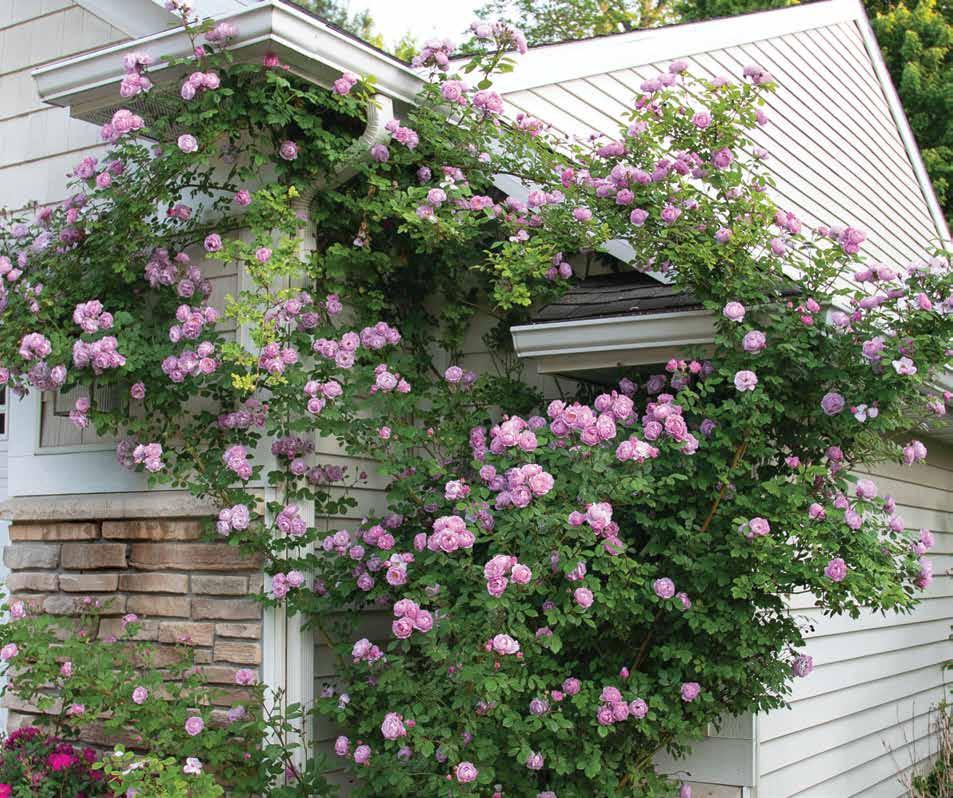
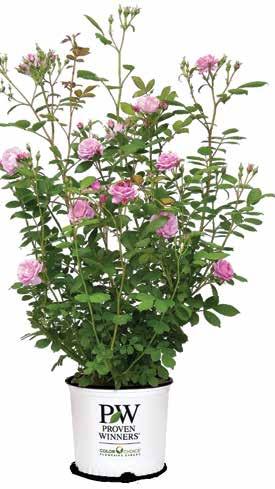
Rise Up Lilac Days rose brings eye-catching, cool-toned lilac blooms with a powerful fragrance you’ll notice from across the garden. Its versatile habit can be trained up a trellis or pruned as a full, upright shrub, making it an easy fit for a wide range of spaces. Like all Proven Winners® ColorChoice® roses, it has been carefully trialed for strong vigor and reliable disease resistance.

Look for Rise Up Lilac Days climbing rose in the distinctive white Proven Winners® container at your local garden center, or learn more at ProvenWinnersColorChoice.com/riseuproses SCAN TO LEARN MORE
Question: I’m so excited for all of my berry plants to start producing, but I also remember the heartbreak birds have left me with before. Any tips for protecting these fruits?
Anthony’s Answer: Investing the necessary resources into berries, only to have them ultimately consumed by birds at the finish line, can be a maddening experience. Nevertheless, with a few handy supplies and perhaps a little creativity in construction, birds can successfully be deterred.
Namely, they must be excluded entirely utilizing a mesh netting system. The strong caveats here: The net itself should have small holes, and it should be easily visible to the eye, because as much as we want to deter birds, we also don’t want them to get stuck or injured. Then, the structure holding the net needs to be constructed sturdily so it can withstand weather events, sufficiently anchored to the ground, and large enough to fully drape without netting lying on limbs or tangling in branches. Enough net should also then drape onto the ground that it can be pinned down with rocks or bricks.
The plus side to this extra-attentive labor? Other pests, such as Japanese Beetles, will be excluded from feasting as well, leaving the “fruits” of your labor to you alone.
BUG ZAPPERS DO NOT KILL MOSQUITOES
Question: My neighbor has a bug zapper, and it is zapping all night long. It must be getting a lot

Ask the Experts
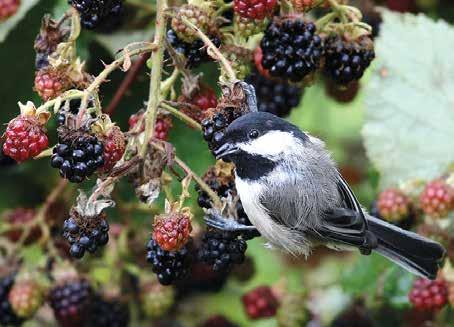
Utilizing a mesh netting system can be an ideal solution for protecting berries from birds. The net should have small holes and it should be visible to the naked eye.
of mosquitoes. Does this help keep the mosquito population down?
Markis’ Answer: NO! Bug zappers do not kill mosquitoes; they kill insects attracted to light. Beetles, moths, midges, and lightning bugs can all fall victim to these unhelpful devices. Mosquitoes find you because of the CO2 and heat your body gives off, and it’s very unlikely that they will visit a bug zapper unless you are standing right next to it. In fact, a study published 30 years ago by Doug Tallamy found that less than 0.3% of the over 13,000 insects killed by a bug zapper over 40 days were mosquitoes or biting flies. The majority of the insects killed are harmless aquatic insects that are essential to our aquatic food chain.
If you are looking to keep mosquitoes away this season, invest in bug repellent spray. It has been proven to be more effective at preventing bites from mosquitoes, biting flies, and ticks. In a time where providing habitat for our vulnerable insect population is becoming increasingly popular, these murder machines should be left in the past as a reminder that passively killing insects en masse is harmful to the environment.
HOW TO REPURPOSE USELESS CROPS
Question: Every year, I’m left with an excess of crops that didn’t come out of the garden quickly enough, bolted, and are useless. I am curious, are there any alter-
native uses for these that would give them some kind of purpose again?
Anthony’s Answer: There are a few routes you can take after crops become less than consumable. You could allow them to bolt even further, flowering and helping pollinators. You could use them as trap crops if they’re favored by pests, treating them and not consuming them to lower pest populations in your garden. And, of course, they can be a valuable nitrogen source for your compost garden.
HERBICIDE ALTERNATIVES
Question: I saw a video online of someone using household items as alternatives to synthetic herbicides. Does that kind of stuff really work?
Markis’ Answer: When using these chemicals as herbicides, success looks different depending on your goals. If the goal is to kill a weed, lots of the chemicals you find under the sink will do the job. If your goal is to spray a dandelion in a lawn without affecting the lawn, these items will not achieve that.
Using non-herbicides as herbicides will result in less effective control than using synthetic herbicides. Alternatives may require higher concentration or repeated applications to remain effective. These chemicals can also drift or contact non-target plants, causing damage, just as their synthetic counterparts do.
While there are alternatives to harmful herbicides, hand-pulling weeds remains the most environmentally safe way to remove them effectively.
MARKIS HILL | Horticulture Agents | ANTHONY REARDON
Markis Hill and Anthony Reardon are the horticulture agents for K-State Extension Johnson County, each specializing in ornamentals and edible crops, respectively. For free information fact sheets, visit www.johnson.k-state. edu, or call our Garden Hotline at 913-715-7050.









Growing Degree Days: Why 2026 May Be a Challenging Year for KC’s
Trees and Shrubs
If you spend enough time working around plants, you start to notice that nature rarely follows the calendar. Plants and insects respond primarily to temperature, and one of the best ways we track that relationship is through something called Growing Degree Days, often shortened to GDD.
Growing Degree Days are a way of measuring accumulated heat over the course of a season. Rather than simply looking at calendar dates, GDD models track how much warmth has built up over time. As temperatures rise, plants develop faster and insects progress through their life cycles more quickly. This system allows arborists, horticulturists, farmers, and entomologists to better predict bloom times, insect emergence, disease development, and ideal treatment windows. Good websites to track GDDs are https:// mesonet.k-state.edu/ or www.uspest. org.
At the time of writing this article in early May, the Kansas City metro is running more than three weeks ahead of the 30-year average in accumulated Growing Degree Days. That is significant. It means many insects are becoming active earlier than we historically expect, plants are advancing rapidly, and management timing is becoming more compressed than normal.
The dramatic warm-up followed by the hard freeze in early March placed substantial stress on plant material across the region. Ever-

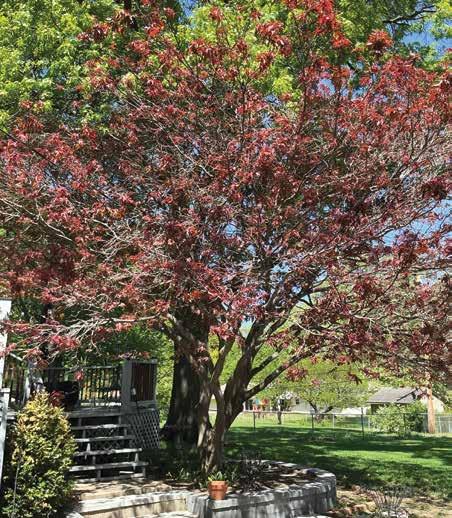
green species showed the damage almost immediately. Arborvitae, boxwoods, hollies, yews, junipers, and spruce all displayed varying levels of winter desiccation, browning, and needle injury shortly after the freeze event.
On deciduous trees and shrubs, however, some of the damage has
JESSE KIRK Master Arborist
taken longer to reveal itself. Trees that initially appeared healthy are now beginning to show dead branch tips, delayed leaf expansion, sparse canopies, and declining vigor. In many cases, the freeze damaged flower and leaf buds, or newly emerging shoots that were already beginning to de-harden after the un-
usually warm late winter temperatures.
One important concept homeowners should understand is that stress on plants is cumulative. Trees and shrubs are remarkably resilient organisms, but every stress event consumes stored energy reserves. Drought, heat, freeze injury, compacted soils, root damage, poor planting depth, and insect feeding all compound one another over time. A healthy tree may tolerate one or two stressors relatively well. A tree already weakened by environmental conditions becomes much more susceptible to secondary pests and diseases.
Across the Kansas City metro, we are already seeing elevated pest
Jesse Kirk is District Manager for Wellnitz Tree Care and a Registered Consulting Arborist and ISA Board Certified Master Arborist. A graduate of Kansas State University, he specializes in professional tree management, plant health care, and arboricultural consulting. Email him at Jkirk@wellnitztreecare.com or call 913-350-0050.
Japanese Maple scale
Japanese Maple scale
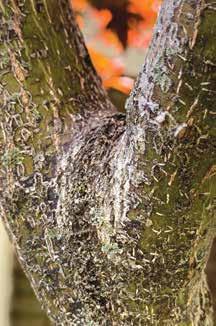
pressure in several areas. One insect becoming increasingly more common is Japanese maple scale. Historically, this scale insect was not especially common in the Kansas City region. Today, it is being found on a growing number of landscape plants across numerous genera. Japanese maple scale is particularly problematic because infestations often go unnoticed during the early stages. The visible decline usually lags several years behind the initial infestation. By the time canopy thinning, branch dieback, or general decline becomes obvious, populations may already be well established throughout the plant.
The accompanying photographs with this article show examples of Japanese maple scale infestations. These insects are often found clustered along twigs and smaller stems where they blend surprisingly well with bark texture. Homeowners frequently overlook them until significant damage has already occurred.
Mimosa webworm is another insect I’m now frequently encountering on honeylocust. These insects create webbing around foliage while feeding, eventually causing leaves to turn brown and scorched.
Kermes scale, on pin and red oaks, is another growing concern locally. Heavy infestations can contribute to canopy thinning, branch decline, and general stress over time,
especially when combined with older previously stressed trees due to drought or construction issues.
Normally, natural predator populations begin increasing as pest populations rise. Lady beetles, lacewings, parasitic wasps, and predatory mites all help suppress outbreaks naturally. However, after highly abnormal weather patterns like we experienced this spring, those predatorprey cycles can become disrupted.
Walk your landscape regularly. Look for thinning foliage, premature yellowing, branch dieback, webbing, unusual bumps on twigs, or changes in leaf size and color. Pay close attention to plants that were already stressed before this spring’s weather extremes. Early detection often allows problems to be managed before they cause significant decline.
The reality is that our climate patterns are becoming less predictable, and Growing Degree Days are becoming increasingly valuable for understanding how trees, insects, and diseases are responding to those changes. The calendar alone is no longer a reliable guide for plant care timing.
If you are uncertain whether a tree or shrub is showing normal seasonal stress or the early signs of a more serious issue, this is a good year to bring in a certified arborist for evaluation. Catching problems early may make all the difference.
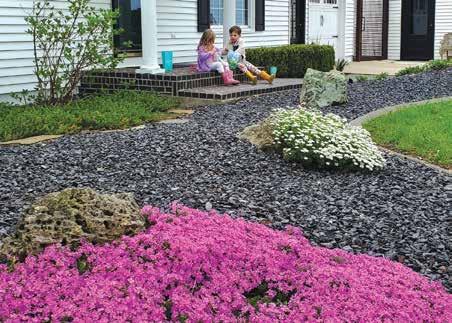


RIGHT products help you beat
Our conditioner is in all of the plant products. This helps wick water, keeping plants cooler. For bigger roots & lots of blooms use Mushroom Stuff™ & Sure Bloom™ in gardens. Great in containers! Mushroom Stuff on turf thickens your rhizome grass. Keeps roots from burning & soil conditioned.







Step outside on a warm day and you might notice something odd. The yard feels full of life in the morning, quiet at midday, and active again in the evening. Ants may be moving after a storm. Some insects appear all at once, then vanish just as quickly. This month’s questions come from noticing those patterns and asking what they mean.
Kids Ask Dr. Bug A Closer Look at the Backyard
sects, this happens all at once, like mayflies near water or periodical cicadas. For many others, it happens more gradually. Even then, the adult stage may only last a few weeks.
Timing matters and adults often appear when food is available or when mates are most likely to be found. For example, some groundnesting native bees emerge in spring,
Why do some insects only show up for a few weeks and then disappear?
Many insects spend most of their lives out of sight. What we notice – flying, crawling, or buzzing – is usually the adult stage, focused on reproduction. Some species live for months or even years underground, in water, or inside plant material before emerging. When temperature, moisture, and day length line up, adults begin to appear. For some in-

then aren’t seen again until the next year. When insects seem to disappear, they usually haven’t gone far. The next generation is already in a different life stage, growing out of sight.
Why do insects slow down or disappear when it gets really hot?
Insects breathe through small openings along their bodies called spiracles. Air moves through a network of tubes that delivers oxygen
directly to their tissues. As temperatures rise, their bodies speed up, increasing their need for oxygen while also increasing water loss.
Instead of changing how they breathe, many insects change when they are active. You’ll often find them in shaded areas, under leaves, or active in the early morning and evening. A quiet yard in the middle of the day doesn’t mean insects are gone. It often means they’re avoiding heat and drying out.
Why do ants sometimes move their whole nest after a rain?
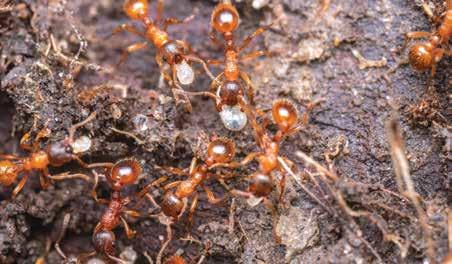
Ant colonies depend on stable soil conditions. Heavy rain can flood tunnels, fill air spaces, or collapse parts of the nest. When that happens, workers begin moving the colony, often carrying larvae and pupae to higher ground.
As ants dig and move soil, they improve aeration and help redistribute nutrients. Around homes they can be a nuisance, but in most landscapes they contribute to soil structure and water movement.
Do insects ever get tired of the same plants?
Insects don’t get bored, but they respond to changes in plants. As plants grow, flower, and age, their chemistry shifts. Some insects feed on young leaves, others on flowers, seeds, or decaying material. Over a season, a single plant can support many species.
That’s one reason plant diversity matters. A mix of species, especially those adapted to our region, supports
more beneficial insects, which in turn supports birds and other wildlife.
Insects are closely tied to what is happening around them. Their activity reflects temperature, moisture, plant growth, and time of day. Noticing those patterns helps us understand what our yard is supporting.
The Bug Lab: Backyard Science Quests for Curious Kids (and Grown-Ups Too!) Backyard Science Challenge: Where Did the Bugs Go?
Insects aren’t equally active all day long. As temperatures rise, many move, rest, or hide to avoid heat and water loss.
This month’s Bug Lab turns you into a Time-of-Day Tracker. Your mission is to observe how insect activity changes from morning to midday to evening.
Look for insects:
• Early in the morning
• During the hottest part of the day
• In the evening
Record what you see, sketch insect activity, and look for patterns in when and where insects are active.
Watch the Kids Ask Dr. Bug video series: https://bit.ly/KADBvideos Send your questions: https://bit.ly/ KidsAskDrBug
Play the firefly-catching game: https://bit.ly/CatchFireflies
Share feedback (we’d love to hear from you!): https://bit.ly/KidsAskDrBugSurvey
Dr. Tamra Reall (@MUExtBugN Garden) is the horticulture specialist for MU Extension in Jackson County. For free, research-based gardening tips, call 816-833-TREE (8733), email mggkc.hotline@gmail.com, or visit www.extension.missouri.edu.
TAMRA REALL Horticulture Specialist
Worker ants carrying white ant larvae across wet soil after rainfall as the colony relocates to higher ground.















The Height of Elegance: Rise Up Lilac Days rose
There’s no shortage of pink and red roses on the market, but every so often, a variety comes along that truly shifts expectations. Rise Up Lilac Days® climbing rose is one of those rare introductions, offering an unusual, cool-toned flower color paired with the kind of garden performance expected of a Proven Winners® ColorChoice® shrub. If you’re seeking something distinctive yet approachable, this lavender lovely is quite the compelling creature.
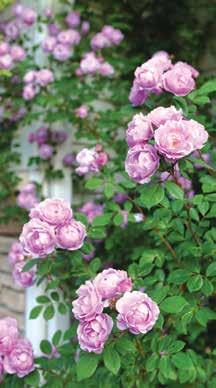
The first thing you’ll notice is the color. Described as a luminous lilac-purple, the blooms carry subtle blue undertones, a trait that remains highly sought-after in roses. This floriferous climber blends beautifully with both cool-toned palettes and neutral backdrops, from gray siding to natural stone. It also pairs effortlessly with perennials and shrubs in whites, blues, and deep purples, creating layered, cohesive combinations.
Each bloom is semi-double in form, with a relaxed, open structure that feels soft, natural, and very “cottagecore.” That openness does more than contribute to its charm; it also invites pollinators, making this a rose that participates in the broader garden ecosystem. Bees and other beneficial insects readily visit the flowers throughout the season, adding movement and life to the planting.
Fragrance is another standout feature. While many shrub roses sacrifice scent in favor of disease resistance or flower power, Rise Up Lilac Days manages to deliver both. The blooms carry a strong, sweet per-

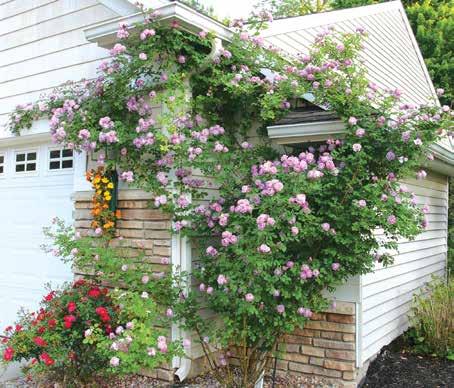
fume that is noticeable even at a distance and rewards anyone who leans in closer. It’s the kind of fragrance that transforms a garden moment, making pathways, seating areas, or entry points feel more immersive and inviting.
In terms of habit, this rose offers flexibility. It naturally grows taller than it is wide, typically reaching 5 to 8 feet in height with a spread of 2 to 4 feet. Given support, it performs beautifully as a climber, weaving its way through a trellis, obelisk, or fence. Unsupported, it can be pruned to form a strong, upright shrub that works well in mixed borders. This dual-purpose nature makes it especially useful in smaller landscapes where every plant needs
NATALIE CARMOLLI
to earn its place.
Bloom performance is also off the charts. Flowers are produced in generous clusters that appear continuously throughout the summer. This reblooming habit ensures consistent color and interest, reducing the gaps that can sometimes occur with older rose varieties. The effect is a plant that feels dynamic and ever-changing, yet reliably present.
Hardiness across USDA Zones 4 through 9 broadens its appeal, allowing gardeners in both colder and warmer regions to enjoy everything this beauty has to offer. Like most roses, it performs best in at least six hours of sun a day, where it can develop strong growth and maximize flowering. Good air circulation and
routine care will help it thrive, but it does not demand excessive attention to deliver a strong show. Ultimately, Rise Up Lilac Days climbing rose stands out not just for one feature, but for how well it balances several: distinctive color, repeat bloom, fragrance, and adaptable form. It answers a common desire for today’s gardener—something that feels fresh and memorable without requiring specialized knowledge to grow. For anyone looking to introduce a cool-toned focal point with real presence, this is a rose worth considering.
Look for Rise Up Lilac Days rose at your favorite garden center, or find a retailer near you at ProvenWinnersColorChoice.com.
Natalie is rooted in horticulture, having worked in the family floral business until college, where she earned her degree in fine and theatrical arts. Now, an avid gardener, writer, and public speaker for Spring Meadow Nursery, Natalie delights in sharing her expertise and enthusiasm about the art of gardening, using Proven Winners® ColorChoice® Shrubs.


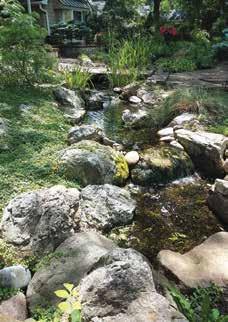
off the main road. www.paulas-petals.com • 816-929-0522



A Gardener’s Destination


BLUE SPRINGS
Colonial Gardens, 27610 E Wyatt Rd
FAIRWAY
Hen House, 2724 W 53rd St
KANSAS CITY, KS
Hen House, 8120 Parallel Pkwy
House of Rocks, 1725 Merriam Ln
KANSAS CITY, MO
Heartland Nursery, 10300 View High Dr
Planter’s Seed Company, 513 E Walnut
Soil Service Garden Center, 7130 Troost
Suburban L & G, 4 W 135th St
Sutherlands, 311 W 72nd St
Van Liew’s, 7347 Prospect
Be a Part of Something Blooming: Become a University of Missouri Extension Master Gardener!
Do you love gardening and want to share your passion with others? Become an Extension Master Gardener and join a vibrant community dedicated to learning and teaching the best practices in horticulture.
The MU Extension Master Gardener program offers:
In-depth training: Gain knowledge from MU Extension experts through a 16-week course covering various aspects of gardening, from soil health to plant science.
Flexible learning: Attend online sessions on Wednesdays (9:30 AM12:30 PM) starting August 5th, with optional in-person field trips for hands-on experience.
Make a difference: Volunteer your newfound expertise on exciting local projects like community gardens, children’s programs, and the MGGKC Gardening Hotline, helping others become better gardeners.
Grow as a gardener: Gain ongoing support and learning opportunities through continued education and a network of passionate individuals.
Limited spots available! Apply before August 4th.
Cost: $200
Register: https://extension.missouri.edu/events/extension-mastergardener-training-kansas-city-jackson-clay-counties
Contact Info: Molly Baurain (mbaurain@missouri.edu) or Dr. Tamra Reall (reallt@missouri.edu)
Don’t miss this chance to cultivate your knowledge and help your community bloom!
The Water Garden Society of Greater Kansas City Presents 33rd Annual Tour – Red, White and Bloom
9 a.m. to 5 p.m. — Rain or Shine
July 25 Tour #1, Missouri South, including Jackson
LEAWOOD Hen House, 11721 Roe Ave
LEE’S SUMMIT
Randy’s Lakeview Nursery, 1820 NE County Park Rd
LENEXA
Hen House, 15000 W 87th Pkwy
Suburban L & G, 9275 Dunraven St
LIBERTY
Family Tree Nursery, 830 W Liberty
LOUISBURG
Swan’s Water Gardens, 4385 W 247th St


N KANSAS CITY, MO
KC Pond, 1557 Swift
OLATHE
Hen House, 13600 Blackbob Rd
Sutherlands, 16665 W 151st St
OVERLAND PARK
Family Tree Nursery, 8424 Farley
Hen House, 11930 College Blvd
Hen House, 6900 W 135th St
Suburban L & G, 10501 Roe Ave
PRAIRIE VILLAGE
Hen House, 4050 W 83rd St
Hen House, 6950 Mission Ln
RAYMORE Creekside Market, 800 E Walnut St
SHAWNEE
Earl May Garden Center, 21700 Midland Dr
Family Tree Nursery, 7036 Nieman Rd
SMITHVILLE
Pack’s Hardware, 116 N US Hwy 169
LAWRENCE
Botanical Dreams, 612 N 2nd St
Clinton Parkway Nursery, 4900 Clinton Pkwy
Uplift Coffee, 624 N 2nd St
OTTAWA The Wet Lilies
Beautiful Shade Plant with an Unflattering Name
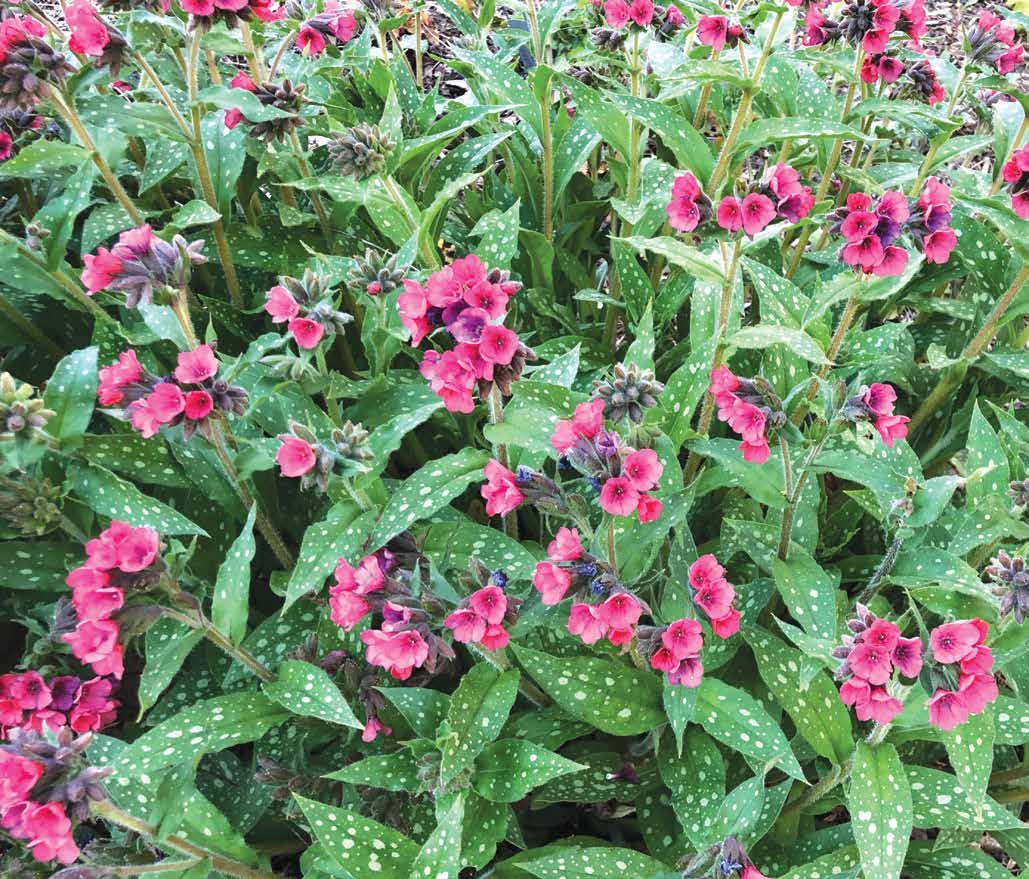
Lungwort might sound like something you’d find in a witch’s cauldron, but Pulmonaria is actually a very attractive, easy-to-grow perennial that brings bright color to the spring shade garden with boldly colored blooms and striking variegated foliage.
Native to Europe, lungwort came into cultivation sometime in the 15th century. Back in olden times, people thought that if a plant or plant part resembled a body part, it had medicinal use for curing afflictions affecting that part. Folks thought the spotted leaves of Pulmonaria officinalis resembled diseased lungs, so the plant was used for treating coughs and other lung ailments. Hence, the botanical and common names.
Pulmonarias bloom from March through May with clusters of fivepetaled, trumpet-shaped blooms of pink, purple, and sometimes blue that change color as the petals age. These shade plants can handle some morning sun and periods of drought, and they hold up quite well in summer heat. Lungworts grow to their full potential in rich, humusy, welldrained neutral-to-alkaline soil, and they’re cold-hardy to Zone 3. The bitter taste and unpleasant texture of lungwort foliage render it highly deer and rabbit-resistant.
Our favorite cultivars are vigorous, low-maintenance, and bring ornamental beauty to shady spaces from spring through fall.
‘Lisa Marie’ was noticed and selected for its showy, large, long-lasting raspberry-pink blooms. Lance-

shaped leaves grow up to 12” long and are boldly marked with bright silvery-white polka dots. Plants grow to about 18” high and remain dense and compact without need for pruning or additional care.
‘Shrimps on the Barbie’ is a petite cultivar that grows only 10” high and 24” wide, making a striking groundcover. Shrimp-pink flower clusters open just above the silver polka-dotted foliage. ‘Shrimps’ is perfect for edging a shady path or surrounding large ferns and hostas in a matrix planting.
Pulmonaria longifolia ‘Bertram Anderson’ has striking multicolored blooms, with pink buds that open to dark true-blue flowers. Very narrow, lance-shaped foliage is heavily variegated, with dots often running together, creating shimmering leaves of mostly silver. With the same dense, mounding habit of the other cultivars, ‘Bertram’ spreads out to make an outstanding foliage display 8-10” tall and 16” wide.
Here are other varieties you will likely notice in local garden centers.
‘Raspberry Splash’ is compact and mounding growing 10-12” tall and 12-18” wide. Vibrant raspberrycoral flowers in spring.
‘Pink-a-Blue’ flowers open pink and transition to blue in late spring. Silver speckling frosts the deep green leaves. You’ll enjoy its attractive foliage after the spring flowers are finished.
‘Silver Bouquet’ makes a deerresistant clump 6” tall and 2’ wide with shiny, silver, mildew-resistant
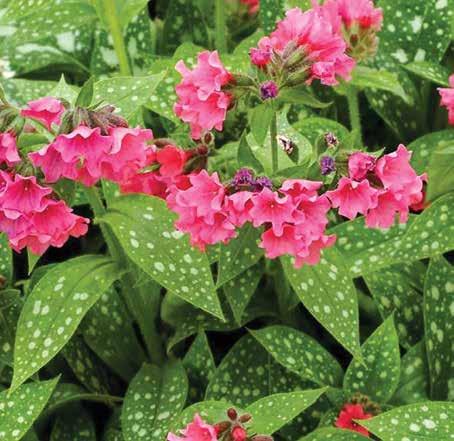
ABOVE: Shrimps on the Barbie
foliage.
Lungwort is related to comfrey (Symphytum officinale), a beautiful perennial herb with flower clusters similar to lungwort that open pink and mature to light blue. Comfrey has a long history of medicinal use, with beneficial soil-building properties when “chopped and dropped” for green mulching flower and vegetable beds.
Both lungwort and comfrey are part of the Borage family. Borage (Borage officinalis) is another useful herb that can be planted with
vegetables to repel hornworms and cabbage moths. The true blue flowers are edible and can be eaten fresh or candied for decorating cakes and other desserts.
Don’t have a garden space? All of the Pulmonaria cultivars are showy enough to be featured in container groupings, often successfully over-wintering when kept from drying out during the cold months. Together with hardy ferns and hostas in weatherproof pots, they make a lowmaintenance patio or balcony display that can last for many seasons!
Amy Albright and her husband, Doug Davison, own Vinland Valley Nursery, a full service organic nursery and greenhouse that includes a huge selection of native plants and features a U-pick flower garden, workshops and a garden shop just south of Lawrence, KS. Their team includes experienced landscapers, plant growers, and artists, including their three daughters who grew up in the business.
Photo credit: Terra Nova Nurseries.
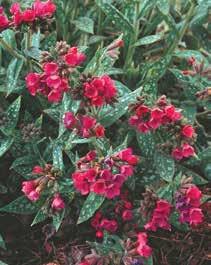
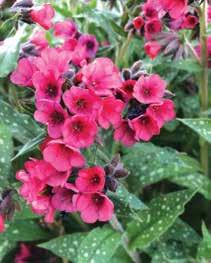
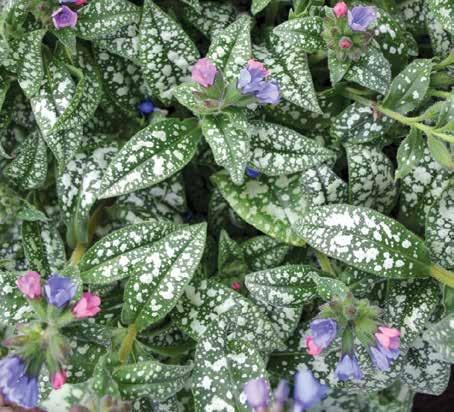
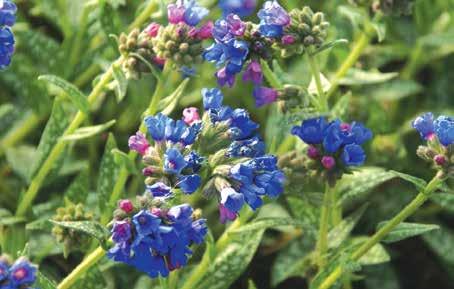
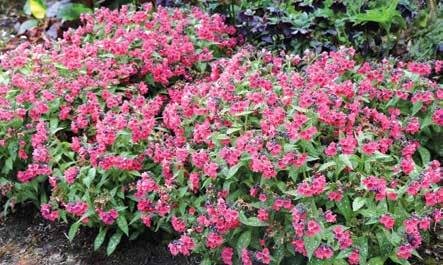
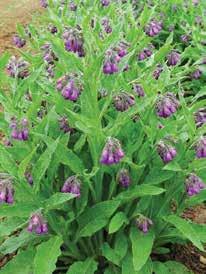
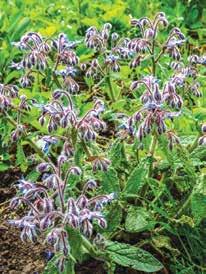
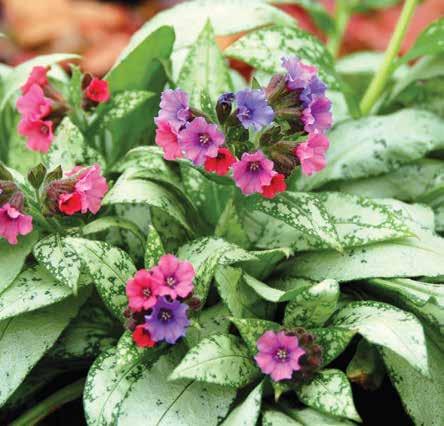
ABOVE LEFT: Comfrey seeds; ABOVE RIGHT: Borage BELOW: Silver Bouquet
ABOVE: Shrimps on the Barbie
ABOVE: Raspberry Splash ABOVE: Lisa Marie
ABOVE: Pink-a-Blue BELOW: Bertrum Anderson
Photo credit: Terra Nova Nurseries..
Photo credit: Bluestone Perennials..
Photo
Photo credit: Proven Winners..
Photo
Proven Winners..
Photo
Speed Dating for Butterflies
Human social butterflies may be so busy flitting between work and leisure activities that they may not have time for dating and long courtships. Speed dating was invented as a formal process for singles to meet, talk, and choose from among 10 or 20 potential suitors in one afternoon or evening. Butterflies have a similar time-crunch. Once emerging from their chrysalis, most species have only a few days to court multiple mates, so they “speed date” by focusing on only one activity, reproduction. A male makes the most of his short life by impregnating as many lovely ladies as possible. Then he dies. Females lay their precious eggs and die, their destiny fulfilled.
Love Is Not Color-coded!
Sexual recognition needs to be quick and sure when you have only a short time to find love. Butterflies have the best color vision of all animals, even better than bees, birds and humans. Surprisingly, this excellent eyesight is not for finding potential mates, rather to recognize colorful nectar-rich flowers. As butterflies evolved from moths about 100 million years ago, the wing colors and patterns developed as defense strategies against hungry daytime predators, especially birds. The viceroy’s near-perfect copying of the poisonous monarch’s orange and black wings proves this point. If color were a sexual clue, monarchs and viceroys would be constantly making mismatches and wasting time.
Butterfly Speed Dating Tactics
Butterflies (and many other animals) establish sexual identity with behaviors and aromas. Male butter-

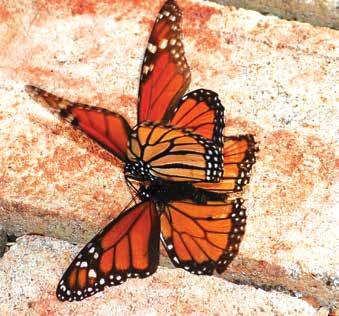
In contrast, the brutish Monarch knocks the female to the ground and stomps on her until she surrenders.
flies are initially attracted by movement and even chase falling leaves. Males emerge from their chrysalis before the females and begin preparing spermatophores, which contain his sperm, carbohydrates, proteins from nectar and minerals from puddling. Mating delivers both sperm and a snack!
Other speed dating tactics include: Setting-up Territories
Males establish a territory, usually near the species’ host plant, because females always search out their caterpillar’s food plant and usually mate with multiple males. Depending on the species, the guy will either patrol his territory to hunt females, or perch and ambush passing ladies. The same territory may be occupied by several males who are active at different times of the day.
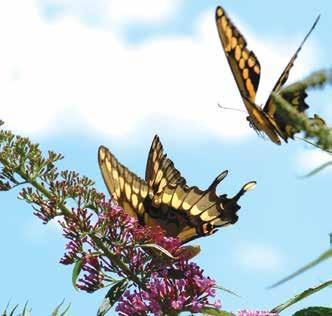
Unlike female moths that waft scented pheromones into the air to attract males from miles away, it’s the male butterfly that uses pheromones from his wing pockets as he aerially dances with his selected lady. While the couple spirals and synchronizes wing beats, he showers her with pheromones. If she likes his “aftershave lotion” and his dance moves, they lock together and land on nearby foliage to consummate the relationship.
The Third Eye
Butterflies mate back-to-back, but the male can’t turn his head to see if he’s correctly aligned. The solution? Male butterflies have a third eye on the tip of their penis, which acts like a refrigerator door’s light. When the light goes out, he’s in the right spot and employs his claspers
to lock-in the connection. The couple may stay together for up to 90 minutes.
Female Choice
The ladies are not passive in this game. If a male does not impress her, she can fly away or flip her abdomen into the unavailable vertical position. Even if an unwanted male has mated, he is not guaranteed to be the father because the female selects the “best” sperm to fertilize each egg as she lays it. Any sperm judged as inferior is digested in her vagina’s stomach for additional nutrition.
Summary
There’s no time to waste in the pursuit of love. “Speed dating” tactics promote fast action and compatible matches between male and female butterflies.
LENORA LARSON Butterfly Maven
Marais des Cygnes Extension Master Gardener, Idalia Butterfly Society and Kansas Native Plant Society member, Lenora Larson gardens and hosts butterflies in the cruel winds and clay soil of Paola, Kansas. She may be contacted at lenora.longlips@gmail.com.
The romantic male Giant Swallowtail hovers over his chosen lady, showering her with pheromones to enhance the mood.
The Perfumed Dance
Photos by Lenora Larson.
Public Garden Tour by Johnson County EMGs
The Public Garden Tour is back!
The Johnson County K-State Extension Master Gardeners have opened their personal home gardens for you to explore. While these homes were designed wonderfully by the homeowners, the volunteers have been working hard to make every space shine. Whether you are looking for inspiration for your own home or want to see some amazing gardens in your community, this year’s public garden tour promises to be the biggest and best one yet. Six Extension Master Gardener homes were chosen across Johnson County, each featuring different plants and styles that are sure to leave any visitor in awe.
The garden tour will take place June 12 and 13. With this later date, many of the plants in these gardens will have a chance to reach their peak condition to show off to the public. Expect to see everything from native ground covers in the shade to roses and hydrangeas.
Still need convincing? Review these garden descriptions. We’re pretty sure they will seal the deal.
Graham Garden
You CAN Have It All
There is so much to discover in this garden, where every detail was
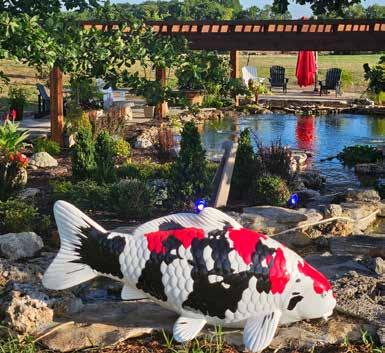
crafted by the homeowners. Blossoms, hydrangeas, and roses mingle with thriving vegetables, fruit trees, and herbs. A koi pond with waterlilies and an inviting swimming pool add charm to this colorful retreat, where beauty meets purpose and blossoms, and bounty flourishes together.
Knutson Garden
Cottage Garden Escape
Inspired by English and French cottage gardens, this garden blooms in harmonious chaos, where roses tumble over stone walls and lavender perfumes the air. Every corner displays creativity and color, a living canvas of blossoms dancing to nature’s harmony. Meandering paths guide visitors through a colorful, creative landscape where order yields to whimsy and blossoms dance over gravel paths to nature’s rhythm.
Bergmann Garden
Colorful Serene Retreat
Thoughtfully designed yet naturally inviting, this garden is both captivating and relaxing, inviting you to come and stay a while. Every plant thrives in harmony, complemented by cherished heirlooms like peonies from the owner’s child-
hood home, that infuse the landscape with memory and meaning. A floral mosaic where nature’s grace and personal history bloom side by side.
Schoenhals Garden
Formal French Country
Brimming with French Country charm, this exquisite garden is a poetic blend of elegance and personality. Soft hues of white, pink, purple, and yellow drift through the landscape in creative rhythm. Each blossom tells a story, living tributes to cherished friends and family who inspired the garden owners. Graceful paths, fragrant blooms, and timeless stonework weave together a sanctuary where elegance and beauty bloom in harmony.
Janzen Garden Planting Joy - Creating Dreams
This cozy cottage garden bursts with color and creativity. Whimsical touches like painted birdhouses, antique pots, and flea market finds, nestle among annuals and perennials that return like old friends. Everywhere you look, you will find a touch of creativity, from a hand-laid flagstone path to flea market treasures, crafting a haven that feels both artful and alive with interest.
Wyatt Garden
Natural Beauty
Celebrate the beauty and resilience of native plants in this lively garden, a Monarch Waystation and Certified Wildlife Habitat. Bursting with blooms that support birds, bees, and butterflies, the Wyatt Garden nurtures pollinators year-round and inspires harmony between people and nature.
Not only will there be beautiful home gardens to explore, but you can also shop at the Garden Tyme Marketplace at the Dennis Patton Garden Gallery located adjacent to the Johnson County Sunset Government Office. Popular concrete leaf stepping stones will be available while supplies last, along with a variety of other handmade items from Extension Master Gardeners and local vendors.
Tour proceeds support educational projects of the Johnson County Extension Master Gardener Program.
Tickets are $35 through June 11, and $40 on tour days. They can be purchased online at www.johnson.kstate.edu, or in our office at 11811 South Sunset Drive, Suite 1500, Monday-Friday 8:30-5:00. For questions visit our website or call 913715-7000.
Rose Report
June National Rose Month | June 12 National Red Rose Day
Ah, June! The greatest time of the year for rose growers!
The spring flush is always amazing, the once-a-year bloomers are still going and the rebloomers are starting. What a wonderful time!
In 1986, President Ronald Reagan signed Proclamation 5574, declaring the rose as the National Floral Emblem of the United States of America. The original celebration of National Rose Day actually began earlier, in 1959, to encourage the adoption of the Rose as the national flower. The Rose took its place among the patriotic symbols of our nation, the American Flag; the Great Seal; the Bald Eagle; the National Anthem; the National Tree, the Oak. The rose symbolizes love, beauty, passion, and devotion. Since the rose is also the primary birth flower for June it is a fitting theme for the month.
Due to their connection to romance, roses are popular for June weddings and anniversaries. While red is the most popular, roses naturally grow in white, pink, yellow, lavender, orange, and green. Red: Deep love, romance, and passion. White: Purity, innocence, and new beginnings. Pink: Grace, gratitude, admiration, and happiness. Yellow: Friendship, joy, and caring. Lavender: Enchantment, wonder, and mystery. Orange: Energy, enthusiasm, and desire. Green: Life, growth, and renewal.
From the article by Carolyn Elgar, Master Rosarian, Orange County Rose Society, titled The Fragrance of Roses, Past and Present
“if you love roses, there’s a very

good chance that their fragrance is one of your favorite things about them. That’s why it’s hard to believe that, in the past, fragrance was not a key priority in commercial hybridizing. The history of rose popularity and commercialization sheds some light on how this came about. The fragrance of roses has a long history. According to legend, Cleopatra filled a room with a foot deep bed of rose petals to weaken Mark Anthony’s resistance to her charms. Rose fragrance and rose oil were used throughout Medieval times for medicine and to mask bad odors. In the 12th and 13th century, Crusaders bought back Damask roses from the Middle East because of their fragrance; perfume was made from the petals. Empress Josephine, in 1799, established the beginnings of what would become the largest rose garden in Europe; her
CORINDA STALLBAUMER
desire to collect every known rose in the world led to Napoleon including plant collecting in his warship commanders’ duties. Because of her support, rose popularity increased. As a result, botanists and nurserymen of that time hybridized many roses, but fragrance was not a quality as important to them as color and bloom repeat…”
The full article can be found on The American Rose Society website at https://rose.org/the-fragrance-ofroses-past-and-present/. It is a great read!
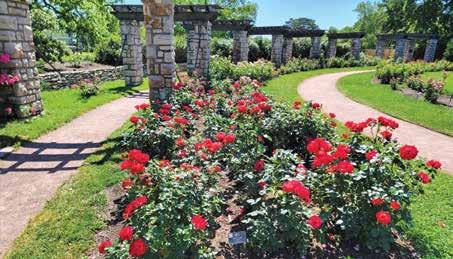
Make June the month to celebrate roses. Visit the Laura Conyers Smith Municipal Rose Garden in Loose Park in Kansas City (over 3,000 rose bushes, 130 varieties). For those of you who live near St. Joseph, visit the Wyeth-Tootle Mansion Memorial Rose Garden (only 35 rose bushes, but surrounded by many other plants and an historical
mansion). Visit nurseries that have roses for sale. Take one home! Plant a rose. To quote Laura Dickinson, “Roses are easier to grow than tomatoes.” Join the Kansas City Rose Society to enjoy the cultural and educational events available.
RESOURCES
• American Rose Society www.rose.org
• Kansas City Rose Society www.kansascityrosesociety.org
• For help with questions, contact the Ask A Rose Expert rosehelp@kcrosesociety.org
• For help in St. Joseph contact Moffet Nursery where the knowledge of the late Charlie Anctil continues, call (816) 233-1223.
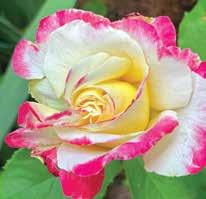
FEATURED ROSE
Double Delight Tea Rose
Both beautiful and fragrant. Intense, sweet, strawberry-citrus fragrance and striking creamywhite blooms with vivid strawberry-red edges that intensifies with more sunlight.
Corinda Stallbaumer is an American Rose Society Consulting Rosarian and a Buchanan County Missouri Master Gardener. A native of Kansas City and a graduate of KU. Her philosophy is the same for roses as it was for her career in information systems; never stop learning!
Photo by Corinda Stallbaumer.
Laura Conyers Memorial Rose Garden, Loose Park, Kansas City, MO
Photo by Mark Ayers.










Shop at our Nursery in Brazito, MO and Save 12 to 14 percent! We service what we sell and more! Nothing goes out of here in a

4807 N. Brighton, KCMO www.mowerpartskc.com 816-452-8393 Mon.-Fri. 8a-5p Sat. 8a-1p All equipment assembled, serviced and ready to go when you buy it. We also carry Lawn & Garden supplies, pet supplies and bird seed.
Missouri Wildflowers Nursery
573-496-3492
www.mowildflowers.net
mowldflrs@socket.net 9814 Pleasant Hill Rd Jefferson City MO 65109
How to move a plant that’s on your property or share it with a friend when it’s actively growing. This particularly applies to plants with big tops and deep roots. Digging plants from the wild is frowned upon.
1. Cut the top of the plant off, leaving a leaf or node down low for new growth.
2. Dig eight to twelve inches of root.
3. Have a bucket of water ready to put the plant in if most of the dirt falls off the roots.
4. Dig a hole large enough for the plant. Hopefully the soil that’s removed, is dry enough that it crumbles into small particles.
5. Position the plant in the hole and fill in with loose soil.
6. Water immediately to settle the soil around the roots. Don’t press on the soil after watering. The roots need small air spaces so they can get oxygen and carry on respiration.
7. If the soil is too moist to break into small particles, fill in around the plant with loose soil from another location, or use commercial potting soil.
UPCLOSE with Jesse Kirk
WELLNITZ TREE CARE KANSAS CITY METRO
THERE ARE GREEN INDUSTRY PROFESSIONALS DEDICATED TO THEIR CRAFT, MADE OBVIOUS BY THEIR CAREER CHOICE. WE ARE CURIOUS ABOUT THE INFLUENCES TOWARD THEIR CAREER, AS WELL AS OTHER INTERESTING ASPECTS OF THEIR LIFE.
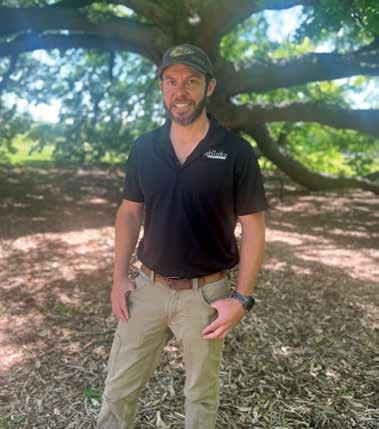
Name: Jesse Kirk
Title: Consulting Arborist/District Manager
Company: Wellnitz Tree Care is a full-service tree care company serving the Kansas City Metro, Lawrence, Emporia and Topeka. We focus on proper pruning, plant health care, removals, and consulting. Our team is made up of highly trained, credentialed arborists who follow industry standards like the ANSI A300 guidelines, so homeowners can feel confident they are getting professional, science-based tree care.
Services offered and typical duties: We provide pruning, removals, plant health care programs, as well as arboricultural consulting. On a typical day, I’m evaluating trees, diagnosing pest or disease issues, and meeting with clients to ensure they can make informed decisions about their trees. A big part of the job is education, helping homeowners understand what’s happening with their trees and how they can improve them.
Background: I graduated from Kansas State University with a degree in Conservation Biology. I grew up on a Christmas tree farm in Bonner Springs, I remember getting my first chainsaw when I was about 11 so it’s hard for me to say exactly when I began working with trees... I’ve worked in both municipal forestry and private
consulting, including a decade as a city arborist for a local municipality. Over the years I’ve earned most of the credentials in the industry. The ones I’m most proud of are Registered Consulting Arborist through the American Society of Consulting Arborists and Board Certified Master Arborist through the International Society of Arboriculture.
Why trees: I grew up running around in the woods, climbing trees and building tree houses. It wasn’t until college in Botany and Plant Taxonomy classes that I realized I knew more about trees than most of my peers. I think my dad was into planting and growing trees and some of that must have rubbed off on me. From there it seems I just took the path of least resistance and made a career out of it. I’m a firm believer in leaving things better than you found them and doing the right thing. I think planting and caring for trees is my opportunity to reach into the future and positively influence the world that someday my kids might be raising their kids in.
Career choice inspiration: First and foremost, I’d have to say my parents, they got me outside camping, fishing and working in the Christmas trees. After college as I began working in the real world, I’ve been fortunate to have great bosses who encouraged me to continue growing my credentials, awesome mentors willing to share their years of knowledge and wisdom and great friends
in the arboricultural world who I get to collaborate with on all sorts of projects.
What every gardener / homeowner should know: Many tree problems start at planting. Planting depth, soil conditions, and site characteristics are far more important than most people realize. If a tree is planted in a poor location, too deeply or develops girdling roots, those issues can show up years later as decline that’s difficult to correct.
Little-known secret: Humans and squirrels are probably the most damaging tree pests in the urban environment. Everyone wants a quick fix to kill the bugs but that’s more like treating the symptom than the disease. People tend to not recognize the initial stressor that allowed the secondary pests to take hold. That’s not true for everything but I think it’s an accurate generalization.
Free time: When I’m not working, I’m working on my passion projects. I have seven acres where I’ve started my own little orchard/arboretum to feed the wildlife. I participate in land stewardship activities on the properties I hunt. And with my young family, we’re outside hunting, fishing, camping, canoeing, and gardening.
Contact: Wellnitz Tree Care Kansas City Metro; 913-406-2514; wellnitztreecare.com










More Wonders of Discovery than You Ever Imagined!
Wonders of Discovery
Thurs., June 18
9 a.m. to 2 p.m. at
By Jerry Heath, K-State Johnson County Extension Master Naturalist
Mark Thursday, June 18th on your calendar for the Wonders of Discovery community event at the Pollinator Prairie—located at 320 South Blake Street in Olathe’s “Original Town” neighborhood. There’s plenty to learn and beautiful, unique gardens to appreciate.
Wonders of Discovery is an impressive event scheduled each year in June to coincide with National Pollinator Week. This will be the 12th annual event with a focus on environmental education and outreach involving hundreds of participants including community members and summer camp youngsters. There will be exhibits and tabletop activities appealing to every age and no admission charge. Over 20 exhibits will feature topics such as live birds of prey, importance of pollinators, native plants, simple things you can do at home to support nature, soil conservation, and much more. The event runs from 9:00 a.m. until 2:00 p.m.
Some plants are self-pollinated such as oak trees and corn. Many
others, including plants necessary for human nutrition, grow from seeds that require pollination of their parent flowers. Many insects and animals that visit flowers contribute to pollination, but the most important pollinators are bees. Honeybees are widely appreciated as pollinators in agriculture, but they are not as good as native bees for pollination of many important native plants because native bees and plants evolved together over time. Native bees, including many species of bumblebees, carpenter bees, leaf cutters, and others, that nest in hollow plant stems and ground burrows, get the job done.
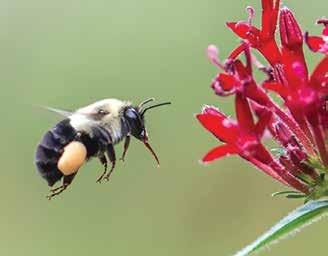
Bumblebees are considered one of the best pollinators but about a quarter of the 50 species occurring in North America are threatened to some degree. Research is underway to better understand and protect bumblebees. Citizen science programs, like songbird nest monitoring programs, allow folks to contribute pictures and observations of bumblebees. Social bumblebees are annual nesters most often in ground
cavities started by a queen that does everything until workers are reared to take over foraging and other tasks including colony defense. Worker bumblebees can sting, but people don’t often encounter bumblebee nests and nest populations don’t usually get very large.
Other native bee species are very docile featuring a solitary female that collects pollen to rear a small number of offspring. Many are very small. Some are very colorful and attractive.
A unique garden at the Pollinator Prairie features considerable bare ground with certain soil characteristics to promote burrowing of native bees. Bee biology and the intricacies of pollination are just a couple topics to explore at the Wonders of Discovery event. Similar fascinating stories can be told about butterflies, hummingbirds and other wildlife. Native plant gardens at the Pollinator Prairie are designed to showcase these.
The Pollinator Prairie was not always a place of serene beauty for public enjoyment. Forty years ago, the scene was unsightly stacks of bar-
rels, boxes and other containers containing chemicals. These containers degraded and leaked over time, polluting the soil and groundwater. A visit to Pollinator Prairie would not be complete without taking a moment to view the entrance sign that explains the site’s history. Every bit as fascinating as the ecological wonders to be appreciated at Pollinator Prairie today is the wonder of civil interaction among government agencies, corporations, non-profit organizations, and diverse volunteers to create what we now see. The Pollinator Prairie’s transformation has been recognized as an outstanding model for environmental restoration. This beautiful site is worth celebrating. Join the fun at Wonders of Discovery on June 18th at the Pollinator Prairie in Olathe.
Wonders of Discovery and the Pollinator Prairie are projects of K-State Extension’s Master Naturalist Program in Johnson County. Check out the Pollinator Prairie –Olathe KS page on Facebook and the K-State Extension Johnson County website to learn more.
Native bee with XL pollen baskets full of pollen.
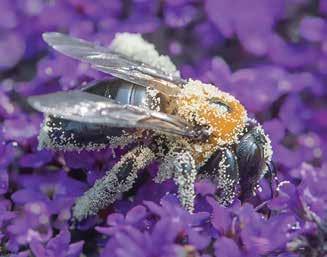
XL Carpenter bee covered in pollen grains.
Photos by Lisa Healey, Extension Master Naturalist.
Upcoming Garden Events
ies. Hart’s Daylilies, 7460 W 255th, Louisburg, KS. For information call 816-769-4600.
For more information or to register visit http:// www.nekba.org/bee-funday.html
Idalia Butterfly Society
Sat, Jun 13, 5p; at Matt Ross Community Center, 8101 Marty St, Overland Park, KS 66204.
Program: “The Micro-World Living in Your Garden: Why Insects Are the Most Interesting Neighbors You Have.” Insects quietly shape our gardens in ways we rarely notice. This presentation invites you to slow down and explore this hidden realm and the vital roles insects play. Learn why even small green spaces matter! We’ll look beyond pollinators to better understand the full range of insect roles that support healthy ecosystems. Along the way, you’ll discover how native plants strengthen these relationships and support a greater diversity of life. Doors open at 5p for light refreshments and social time. Program begins PROMPTLY at 5:45p following a brief announcements. FREE and open to all. Bring a friend! Questions? Please call/text 816-283-6258, or email us at idaliasociety@yahoo.com. Facebook: Idalia Society of Mid-American Lepidopterists.
Leavenworth County Master Gardeners
Wed, Jun 10, 11a; at Riverfront Community Center, 123 Esplanade St, Leavenworth, KS 66048. Colleen Winter with Wild Birds Unlimited, will be our speaker. She will share ideas on creating the perfect environment to provide food and shelter for backyard birds. FREE. Visitors are welcome. For more information contact the Leavenworth County K-State extension office at 913-364-5700.
Leawood Garden Club
Tues, Jun 23, 10:30a; at Colonial Church, 7039 Mission Rd, Prairie Village, KS 66208. Program: “Gardening With Flying Flower” by Lenora Larson, starts at Noon. Thirty species of large, tropical-looking native butterflies call our area “home”. Unfortunately, many gardeners only see the occasional Cabbage White, a non-native. This presentation reviews butterfly biology and the basics of butterfly gardening. Spectacular photographs introduce many of the amazing butterflies (and their equally charismatic caterpillars) that gardeners can attract to their yards. But flowers are not the critical element. You must learn to love and plant for the caterpillars, thereby choosing which species of butterflies embellish your garden.
Olathe Garden & Civic Club
Tues, Jun 16, 10a; at the Ewing and Muriel Kauffman Memorial Garden, 4800 Rockhill Rd, Kansas City, MO 64110.**Free & Open to the Public** Join us for a special meeting featuring a field trip to the garden! Optional meetup afterwards for lunch on the Plaza.
Kansas City Cactus and Succulent Society Jun 5, 6, 7; at Elks Lodge, 515 East 99 St, KCMO. Fri 5-8p, Sat 9a-4p, Sun 10a-2p. It’s our 50th anniversary and our annual Show and Sale! Select from hundreds of cactus and succulent plants and beautiful pottery made specifically for succulents. Both professional vendors and club members are selling. View club members’ winning entries in numerous cactus and succulent categories in the judged show. A potting table and demonstrations will be available to help you find success with your plants. Open to the public all three days!
Sedgwick County Garden Tour
Fri, Jun 5, 9a-5p; Sat, Jun 6, 9a-5p; Sun, Jun 7, 12-4p. Six gardens throughout Sedgwick County will be available for the public to view. Tickets are $10 and are available at the gardens, at Sedgwick County Extension office, 7001 W 21st St, Wichita, KS 67205 or online sedgwick.k-state.edu; 316-660-0100
Heartland Hosta & Shade Plant Society
Annual Spring Plant Sale
Sat, Jun 6, 9a-2p; at Woods Chapel Community of Christ Church, 500 NE Woods Chapel Rd, Lee’s Summit, MO 64064. The sale features over 1000 plants including 50 varieties of Hosta and plenty of shade/part shade perennials! Prices start at $10 and we have all sizes of Hosta from mini to giant to suit all size gardens. This sale is open to the public. Sale list with pictures and descriptions will be available on the club website prior to the sale. For more information please visit www.HeartlandHosta.club or the Facebook page www.Facebook.com/HeartlandHostaandShadePlantSociety.
Railroading in the Gardens
Sat, Jun 6, and Sun, Jun 7, 10a-4p. Visit the 2026 Garden Railroad Tour consisting of ten train gardens at homes in the Kansas City area. See how gardening and model trains blend together in a creative and colorful way. Each garden railroad is different and unique with the trains running among a variety of plants and landscaping in a miniature world of trees, bridges, tunnels, houses and water features. Hosted by MO-KAN Garden Railroaders, the admission cost for this self-guided tour is $15 a car to see all the gardens for both days. This event is always fun for both adults and kids, with partial proceeds going to Harvesters. For details, tickets and tour guide, go to www.mokangardenrailroaders.org.
Beekeeper’s FunDay
Open House
Sat, Jul 4 and Sun, Jul 5 from 9a-1p. Additional days by appointment. Gardens have 600 variet-
Sat, Jun 6, 8a-5p; at the Douglas County Fairgrounds, 2120 Harper St, Lawrence, KS 66046. The Northeast Kansas Beekeepers Association announces its Beekeeping FunDay! Cost is $50 includes lunch, beverages, and honey ice cream. Vendors available for purchasing beekeeping related equipment. A silent auction will also be included to raise youth and veteran scholarships.
Hermann, MO 31st Annual Garden Tour Jun 6 and 7. The Garden Tour includes both a walking tour of gardens in downtown Historic Hermann and a driving tour to gardens in the hills around Hermann. The $20 ticket price includes visits to at least five private gardens. The Hermann Garden Club’s website www. hermanngardentours.com provides up-to-date events, ticket prices, links to the online ticket sale site, contact numbers, and photographs of past tour gardens.
Union Hill Neighborhood Garden Tour Sun, Jun 7, 10a-3p. Discover the gardens of historic Union Hill. Join us for flowers, food, music and family fun. unionhillkc.com/garden-tour
Public Garden Tour
Fri, Jun 12 and Sat, Jun 13. Ticket prices are $35. Day of tour ticket prices are $40 each. Learn more and purchase tickets online at: https://www.johnson.k-state.edu/programs/ lawn-garden/special-events/public-garden-tour/ Gardeners get a chance to explore six beautiful private gardens filled with inspiration, creative design ideas, and unique plantings. Questions? Contact us at 913-715-7050 or garden.help@ jocogov.org.
Ellie’s Garden Party & Homes Tour
Sat, Jun 13, 9am-4pm (rain or shine). See spectacular gardens and historic Weston homes while enjoying delicious foods at each site. Tickets: $50 individual ticket or (2) tickets for $80. In the heart of historic Weston, gardens are preparing to bloom with purpose. The community will gather for Ellie’s Garden Party & Homes Tour,—a day filled with beauty, hospitality, and hope for a remarkable young woman named Ellie Bargmann who just graduated from high school as Valedictorian and now faces a new challenge of needing a kidney transplant! Guests will enjoy exclusive access to stunning private homes and gardens throughout Weston, along with tea party treats and charming touches at every stop. More than a garden tour, the event is a celebration of resilience, community, and the power of people coming together to help change a life. Every ticket purchased helps COTA (Children’s Organ Transplant Association) for Ellie’s transplant journey while reminding her family that they are not walking this path alone. In a town known for its warmth and beauty, June 13 promises to be a day where compassion blooms right alongside the flowers. To purchase tickets: https://cota.org/cotaforelliesjourney/events/ellies-garden-party-homestour/. Ticket pickup location: Eventful at Locust Grove, 25180 NW County Road JJ, Weston, MO 64098.
Wonders of Discovery
Thurs, Jun 18, 9a-2p; at Pollinator Prairie, Olathe. This is a free event for all ages hosted annually by the Johnson County Extension
Master Naturalists. There will be exhibits on Kansas native plants, gardening for wildlife, pollinators, such as native bees and bats, and other nature related displays. Games and activities are planned for children, so this will be a fun and educational event for the whole family.
Water Garden Society Tour
See our ad on page 11 in this issue.
CLASSES
Permaculture; Food Forests and sustainable design for home gardens
Tues, Jun 2, 2p; VIRTUAL Session. K-State Extension Johnson County. This session will introduce gardeners to the core principles of Permaculture, emphasizing sustainable garden design strategies that work in harmony with natural systems. These principles are being applied to the Food Forest on the campus of Johnson County Community College (JCCC), providing a firsthand look at how these principles have been applied locally. Practical methods for integrating these concepts into home gardens will also be explored. Register at johnson.k-state. edu, the click on News and Events.
K-State Garden Hour Webinar: Maximizing Garden Success with Extension Resources Wed, Jun 3, at noon-1p. Discover how to leverage Extension resources effectively to plan, manage, and troubleshoot problems in your landscape and garden. Join Cassie Thiessen and Matthew McKernan, K-State Extension Horticulturalists, as they explore practical tools and resources available through Extension that can help improve the success of your garden. Learn how to access research-based resources and utilize them to make informed decisions for your garden. Register at johnson.k-state.edu, the click on News and Events.
Growing Sweet Potatoes
Thurs, Jun 11, 6:30p; at Basehor Community Library 1400, 158th St, Basehor, KS 66007. Bennett Gamel, a Leavenworth County Master Gardener, will be speaking on “ Growing Sweet Potatoes in Northeastern Kansas.” The meeting is free and open to the public. For more information contact the Leavenworth County K-State extension office at 913-364-5700.
Fruiting Trees and Vines
Thurs, Jun 18, 7p; at Leavenworth Public Library, 417 Spruce St, Leavenworth, KS 66048. Dylan Parsley, the Horticulture Agent at Wyandotte County K-State Extension office, will be presenting “Enhancing Landscapes with Fruiting Trees and Vines.” The meeting is free and open to the public. For more information contact the Leavenworth County K-State extension office at 913-364-5700.
List garden events, club meetings, plant sales, and more for FREE! Send details to: elizabeth@kcgmag.com.
Deadline for the July issue is June 7.
Daylily

GARDEN CALENDAR
June list of what to do in the garden.
VEGETABLES AND FRUITS
• Plant squash, cucumbers, sweet corn, green beans, and other summer vegetables.
• Conserve moisture and control weeds with mulch.
• Harvest spring vegetables until the end of the season, then remove them.
• Pinch herbs to keep bushy and fresh with new growth.
• Watch for the development of squash bugs as they multiply rapidly— control as needed.
• Treat tomato leaf disease with a fungicide if needed.
• Apply one inch of water per week if there is no rain.
• Continue a regular fruit disease and insect control program.
• Fertilize strawberries regularly to promote new growth.
• Renovate June bearing strawberry beds.
• Treat peach trees for borers.
• Remove sucker growth from the base of trees and along branches.
• Turn the compost pile and keep it moist to hasten breakdown.
LAWNS
• Mow bluegrass and tall fescue 3 to 3½ inches high to improve drought stress.
• Avoid fertilizing tall fescue and bluegrass during summer.
• Mow Zoysia to a height of 1 to 2 inches all season.
• Fertilize Zoysia with high nitrogen fertilizer such as 27-3-3 one to two more times this summer.
• Repair dead spots and bare areas in Zoysia by sodding or plugging.
• Core aerate Zoysia to control thatch and improve water and nutrient uptake.
• Spot treat for summer broadleaf weeds.
• Fertilize naturally by letting grass clippings fall.
• Water the turf sparingly to increase drought tolerance during the heat of summer.
• Begin grub treatments with preventive-type insecticides.

• Keep the mower blade sharp for a clean cut.
FLOWERS
• Pinch chrysanthemum tips for the development of bushier plants.
• Remove spent flower blossoms to keep the plant flowering.
• Remove flower stalks from peonies and irises.
• Fertilize roses and trim spent blossoms.
• Check plants for insects.
• Remove dead foliage from spring bulbs.
• Water and fertilize container plantings regularly to encourage growth and flowering.
• Maintain a 2- to 3-inch mulch layer to reduce moisture loss, control weeds, and preserve excellent soil.
• Apply one inch of water per week if there is no rain.
TREES AND SHRUBS
• Check for bagworms and control.
• Prune elongated “candles” of new growth on pines and spruces to shape/control size.
• Prune spring flowering shrubs.
• Water newly planted trees and shrubs.
• Check for spider mite damage by shaking branches over white paper. Mites look like tiny dots.
• Clip hedges to maintain shape.
• Maintain a mulch ring around young trees and shrubs.
• Prune dead or damaged limbs to correct structure and maintain health.
HOUSE PLANTS
• Water and fertilize regularly to promote summer growth.
• Repot overgrown plants, shifting up to a one-inch larger pot.
• Rotate pots to provide sunlight on all sides, producing a balanced plant.
• Prune and shape plants.
K-State Extension Johnson County recommends environmentally-friendly gardening practices. This starts by identifying and monitoring problems. Cultural practices and controls are the best approach for a healthy garden. If needed, use physical, biological or chemical controls. Always consider the least toxic approach first. Markis Hill and Anthony Reardon are the horticulture agents for K-State Extension Johnson County, each specializing in ornamentals and edible crops, respectively. For free information fact sheets, visit www.johnson.k-state.edu, or call our Garden Hotline at 913-715-7050.
33rd Annual Water Garden Tour, the tradition continues
The Greater Kansas City Water Garden Society invites you to continue the exciting summer of patriotism with the 33rd annual water garden tour—Red, White and Bloom—on three separate Saturdays in July and August. Each Saturday tour will spotlight 12 unique water features with lily and lotus blooms exploding in celebration of America’s 250th birthday and Kansas City hosting the FIFA World Cup 2026.
From 9 a.m. to 5 p.m., visitors can meet working plein-air artists at select sites as they reflect on the art of nature. Some homes feature working garden trains, fountains, and sculpture gardens, in a variety of settings and designs.
Tour tickets, good for all three Saturdays, are $15 per person. Tickets include maps, addresses, and host-written descriptions for each water feature. Many visitors take photos and ask questions of the homeowners about ponds, landscaping challenges, and specific plant names. So bring
your pencil and paper to keep track of the inspirational moments.
Proceeds from the tour support the KC Water Garden Society service projects for schools and other non-profits. Tickets will be available on Eventbrite and in local retail garden centers by the first of June.
Tour #1 – July 25, Missouri South, including Jackson and Cass counties
Tour # 2 – August 8, Kansas and Missouri, North of I-70
Tour # 3 – August 15, Kansas South of I-70
Look for updates and artists locations on our Facebook page and website, kcwatergardens.com.
Hotlines for Gardeners
Extension Master Gardeners are ready to answer all your gardening questions.
CASS COUNTY
816-380-8194; Wed, 9am-noon; casscomg@gmail.com
DOUGLAS COUNTY
785-843-7058; dgcogardenhotline@gmail.com; Mon, Wed, Fri, 1-4pm
GREATER KANSAS CITY MISSOURI AREA
816-833-8733 (TREE); Mon-Fri, 9am-noon; mggkc.hotline@gmail.com
JOHNSON COUNTY, KS
913-715-7050; Mon-Fri, 9am-4pm; garden.help@jocogov.org
JOHNSON COUNTY, MO
660-747-3193; Wed, 9am-noon
LEAVENWORTH COUNTY
913-364-5700; Leave a message. A Master Gardener will contact you.
MIAMI COUNTY & LINN COUNTY
913-294-4306; Apr 1 thru Oct 1; Thurs, 8am-noon
WYANDOTTE COUNTY
913-299-9300; Mon-Fri, 9am-4pm
QUESTIONS ABOUT ROSES?
Ask a Rose Expert; rosehelp@kcrosesociety.org; www.kansascityrosesociety.org
SUBSCRIBE TODAY
For convenient mail delivery, complete the form below and send with your check for $38.00. You will receive a one-year subscription.



Tree
Shrub