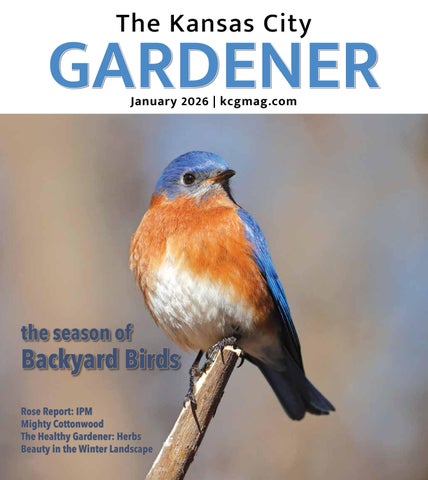
The Kansas City
GARDENER January 2026 | kcgmag.com
the season of
Backyard Birds Rose Report: IPM Mighty Cottonwood The Healthy Gardener: Herbs Beauty in the Winter Landscape
editor’s notes
The Kansas City
GARDENER Independently owned and operated since 1996 PUBLISHER Michael Cavanaugh EDITOR Elizabeth Cavanaugh CONTRIBUTORS Natalie Carmolli Melissa Cotton Drew Diekmann Markis Hill Gretchen Huebert Anthony Reardon Anne Wildeboor Scott Woodbury DISTRIBUTION Publishers Delivery Solutions, Inc. IF YOU WOULD LIKE TO DISTRIBUTE the magazine at your place of business, please contact Mike Cavanaugh at mike@kcgmag.com 913-648-4728 NEED MORE MAGAZINES? mike@kcgmag.com 913-648-4728 CONTACT US P.O. Box 8725 Prairie Village, KS 66208 913-648-4728 ADVERTISING Mike Cavanaugh at mike@kcgmag.com 913-648-4728
Winter Garden Entry
L
ast month brought arctic temperatures, our first snowfall, and Juncos—yes, winter has truly arrived. While shoveling four inches of snow from the driveway may not be my favorite pastime, I am grateful for its benefits to the garden. The much-needed moisture, especially for the newly planted, provides a sense of calm, even if only for a month or two. However, when winter temperatures are above freezing and precipitation has been minimal, it’s time to get the hose out for supplemental watering. During the winter months, the framework of our garden comes into sharp focus. Leafless trees reveal their distinctive bark. Evergreen trees and shrubs remain steadfast in their duty of providing essential structure and color in an otherwise gray landscape. Garden art becomes more visible, and the unique beauty of the season is revealed. Also in plain sight now are backyard birds—my favorite pastime of the season. Without foliage obstructing the view, it’s easy to watch birds in the garden. Right outside my office window stands a maple tree where pairs of cardinals sometimes
WEBSITE kcgmag.com
Backyard Bird Count (GBBC) was the first online citizen science project, also referred to as community science, to collect data on wild birds and to display results in near real time. Learn more at birdcount.org. When I’ve filled the feeders and heated bird bath, it is time to rest and reflect, to pause and to practice presence. Will you join me in this pause? In this moment let gratitude be your guide. I’ll see you in the garden!
In this issue
QUESTIONS ABOUT EDITORIAL AND SUBSCRIPTIONS Elizabeth Cavanaugh elizabeth@kcgmag.com 913-648-4728 HOW TO SUBSCRIBE See details on page 19.
perch. It’s fascinating to see them up close and within reach, and to catch a glimpse of their behavior. There is a variety of birds that visit—Bluejay, Goldfinch, Wren, Sparrow, Junco, Flicker, Downy Woodpecker, and so many more. If you are curious about birds, read the article about backyard birds in this issue. Authored by Drew Diekmann, an avid birder and owner of Return to Nature, the article describes birds you’ll likely see, and how to attract them to your garden by offering what they like to eat. Due to limited space, Diekmann only writes about ten birds. If you are curious and would like to learn more about birds that winter here, feel free to contact him. He is remarkably knowledgeable and eager to share what he knows. Looking for more bird action? Consider participating in a global bird count in February. Each year people from around the world come together to watch, learn about, count, and celebrate birds. Join the world in connecting to birds February 13-16. Launched in 1998 by the Cornell Lab of Ornithology and National Audubon Society, the Great
January 2026 | kcgmag.com 4 6 8 9 10 13
Ask the Experts The Healthy Gardener: Herbs Mighty Cottonwood Beauty in the Winter Landscape Season of Backyard Birds Growing Better Knowing Better
14 15 16 18 19 19
Rose Report Continuous Bloom Hydrangea Upcoming Garden Events Garden Calendar Hotlines Subscribe
About the cover: To learn more about this Bluebird and other backyard birds seen in winter, begin on page 10. (Photo credit to Drew Diekmann.) 2
January 2026 | kcgmag.com
REMINISCENT Garden Roses ®
TRIALED & TESTED FOR YOUR SUCCESS
Achieve rose success with Reminiscent roses from Proven Winners® ColorChoice® Shrubs. Their lush, fragrant blooms combine the classic beauty you’ve been missing in roses with the modern-day vigor that comes from eight to ten years of trialing and testing to ensure superior performance in your garden or landscape. Look for Reminiscent roses in the distinctive white Proven Winners container at your local garden center, or learn more at provenwinnerscolorchoice.com/reminiscentroses
SCAN TO LEARN MORE
The Kansas City Gardener | January 2026
3
Photo by Heather Cwach.
Photo courtesy of K-State Extension.
Ask the Experts
Photo courtesy of K-State Extension.
Praying mantis egg mass
Praying mantis
Spring garlic under row cover
WINTER WEED ACTION Question: I’m perplexed by what to do with winter weeds in my vegetable garden. I know that allowing a seedbank to grow in my soil is bad, but I also know that winter weeds die with heat. Should I still try to control them? Anthony’s Answer: In honor of my predecessor, I’m going to say, “It depends.” While it is correct that allowing a weed seedbank to grow in your soil can cause ample maintenance problems down the line, the effort put into winter weed control can largely depend on the type of crops you are aiming to grow in your vegetable garden in the coming growing season.
If you’re a gardener who loves to get out and start growing cool-season crops in mid-to-late March, then yes, control your winter weeds. The henbit, chickweed, and clover popping up can directly compete with the crops being sown, smothering out seedlings while siphoning away essential water, nutrients, space, and light. If, however, leafy greens and root vegetables aren’t really your aim and you prefer growing fruiting crops such as tomatoes, peppers, and cucumbers, winter weeds will, as you’ve mentioned, die off from seasonal heat long before they have a chance to compete with these plants. In exchange for leaving your winter weeds be, you will support
soil structure by preventing erosion, potentially fix nitrogen into the soil with legume-type weeds like clover, and provide a much-needed early food source for emerging native bees and other pollinators. Just remember, if you ever do want to aim for cool-season crops, flowering plants are much closer to setting and dropping seed. MANTIS EGGS Question: There is this large, growth-looking thing on a twig on my shrub. This doesn’t look like it’s part of the plant. It almost looks like yellow Styrofoam. What is it? Markis’ Answer: What you are looking at is an egg case called an “ootheca” of a Chinese mantis (Tenodera aridifolia). There can be as many as 600 eggs in the ootheca. These mantids can grow to be 5 inches long. It doesn’t happen often, but full-grown females have been documented eating small rodents, amphibians, and birds. These nonnative mantids can outcompete the much smaller, native Carolina mantis (Stagmomantis carolina). The ootheca of Carolina mantids are much smaller and thinner, with around 50 eggs. Chinese mantises were sold as a biological control for pests in gardens, but because they are sitand-wait predators, they do not offer widespread control in the garden. As they grow larger, they eat larger prey, including large butterflies and bees. CARING FOR GARLIC Question: I planted garlic in the fall and am unsure if I need to be doing anything right now. Should I just leave it be?
Anthony’s Answer: For now, garlic is doing all the work—absorbing moisture, developing cloves, and widening its root span so it can shoot up come spring. Your job is to provide the plants with enough water to keep the soil moist on days when the temperature is above freezing. However, don’t overdo it. Too much water will encourage early growth or bulb rot. THE EFFECT OF HEAVY SNOW Question: The city snowplow just piled a whole bunch of snow on top of my shrub and flower beds. Are they going to be okay? Markis’ Answer: Generally speaking, it is not a good idea to pile a heavy load of snow on top of shrubs. Heavy, compacted snow can crush woody plants, causing branches to split or break. When this happens to conifer shrubs, broken branches can take a long time to regrow or may not grow back at all. Long splits down the middle of branches can also open plants up to diseases and pests. The physical damage from the weight is not the only thing that can damage your plants. Often, ice melt or rock salt is applied to hard surfaces in preparation for ice and snow. If the snow being piled up is mixed with ice melt and salt, it can leach into the soil or damage plants. When spring arrives, the chemical damage to turfgrass along sidewalks becomes apparent. The best approach is to apply smaller amounts of ice melt preemptively, remove all existing snow before using the ice melt, and sweep up and dispose of any leftover salt after the snow and ice have melted.
ANTHONY REARDON | Horticulture Agents | MARKIS HILL Anthony and Markis are the horticulture agents for K-State Extension, Johnson County, each specializing in edible crops and ornamentals, respectively. For free information fact sheets, visit www.johnson.ksu.edu, or call the Extension office at 913-715-7000.
4
January 2026 | kcgmag.com
New Year - New Plants! January Special: 15% off
ial Garden Symposium 9th Bienn Gardening by Design
houseplants, pots/ containers, potting mixes & fertilizers.
Mark your calendar:
Hands On Gardening Help Spring Clean-Up Pruning & Groundcover Control Mulch & Compost Installation Planting Help & Curb Appeal Drainage Solutions Sod Installation
Sunday, Feb. 1 @ 2:00 pm st
Nature, Science, and Garden Design February 28, 2026 9:00 a.m. to 4:00 p.m. Doors open at 8:30 a.m.
Town Square Events 15 W. Wea, Paola, KS Tickets are $65.00 per person. Registration is required by February 13, 2026 Registration includes gourmet boxed lunch, refreshments, snacks and printed materials
1430 Hwy. 58, LeRoy KS 66857
grow@arnoldsprairie.com Sun 1-5p. → Closed Dec. 25 - Jan. 1 ← * Follow us on Facebook *
Call Greenleaf Garden Services and get the support for your gardening dreams
(816) 916-5171
This event is open to all! Register online at https://tinyurl.com/53hk3y7c Payment can be made online or by check. (See details when registering online.)
Soil Safari
Lenora Larson MdC Extension Master Gardener
ALL WINTER LONG
COMPOST TOPDRESSING Boosts and thickens plant growth by improving soil quality and water-holding capacity. Ask About Compost Installation!
Find our great products in bags or bulk at all of our locations. Get Our “Abby Guarantee”! When you buy 3 or more yards of our Raised Bed Soil + The Growing MOR Nutrient Pack, we guarantee your growing success, or we’ll give you your money back on your plants. (Up to $200. Restrictions will apply.)
Find a location near you.
816-483-0908 | missouriorganic.com
Water Worry to Water-wise
Dr. Jonathan Aguilar Professor and K-State Irrigation Specialist
Using the Natural Elements in Garden Design
Kristopher Dabner President and Creative Director, The Greensman, Inc.
Informed Plant Selection and Placement
Anne Wildeboor Horticulture Supervisor at the Overland Park Arboretum and Botanical Gardens See the article ‘Growing Better by Knowing Better’ in this issue. Details can also be found on our Facebook page at: www.facebook.com/mdcemg Presented by: Master Gardener Marais des Cygnes District Kansas State University is committed to making its services, activities and programs accessible to all participants. If you have special requirements due to a physical, vision or hearing disability, contact the Marais des Cygnes Extension District at 913-294-4306. Kansas State University Agricultural Experiment Station and Cooperative Extension Service K-State Research and Extension is an equal opportunity provider and employer.
The Kansas City Gardener | January 2026
5
The Healthy Gardener
Seasoning Life: How Herbs Boost Flavor and Health
H
erbs are a fun and flavorful way to spice up both what we grow and what we eat. They’re one of the easiest plants to start indoors, even during the winter months, and are a great entry point for newer gardeners. Most herbs thrive with just a few basics: sunlight, good soil, and proper drainage. Beyond that, each type of herb has its own preferences for climate and care. If you’re interested in exploring which varieties fit your space and growing style, here’s a great resource to get you started: Herbs vs. Spices What’s the Difference? Many people use the terms herbs and spices interchangeably, but they aren’t quite the same. • Herbs typically come from the leafy parts of plants that grow in temperate climates. • Spices, on the other hand, are usually grown in tropical regions and can come from many different plant parts such as bark, berries, roots, seeds, or flower buds. Interestingly, some plants can produce both. Coriandrum sativum, for example, gives us cilantro (the herb, from the leaves) and coriander (the spice, from the seeds). Herbs tend to have a milder flavor, so they’re often used in larger quantities than spices. Common herbs include mint, rosemary, sage, oregano, basil, and
Basil Pesto Makes: About 2 cups Use for: Pizza, pasta, sandwiches, vegetables, and more
INGREDIENTS
4 oz pine nuts 4 cups fresh basil leaves 3 garlic cloves 1 cup grated Parmesan cheese 1 Tbsp lemon zest 1 tsp lemon juice 1 cup olive oil 1/4 tsp salt 1/8 tsp ground pepper
parsley. Popular spices include cinnamon, ginger, cumin, nutmeg, and cloves. Health Benefits of Herbs and Spices Herbs and spices offer far more than taste. Many are nutrient-dense, antioxidant-rich plants. In fact, USDA analysis has shown that oregano can contain 42 times more antioxidant activity than apples. Antioxidants work like protective armor for our cells, helping shield them from damage. Herbs and spices have been used in healing traditions around the world for centuries, and today’s research continues to highlight their benefits. For example: • Sage may support memory and brain health. • Rosemary may help ease headaches. • Cinnamon can support blood glucose management.
MELISSA COTTON Field Specialist 6
January 2026 | kcgmag.com
• Garlic is linked with improved heart health. • Ginger may help reduce nausea and indigestion. • Turmeric contains compounds that may reduce inflammation. Cooking With Herbs In the kitchen, herbs add color and flavor without adding extra calories, sugar, or saturated fat. Fresh herbs release more flavor when finely chopped. Kitchen shears can make this quick and easy. Dried herbs and spices benefit from a quick crush before cooking, which helps release their aromatic oils. Experimenting with different herbs across recipes can keep meals exciting and prevent flavor fatigue. Whether you grow them for taste, health benefits, or convenience, herbs are a rewarding and cost-effective addition to any garden!
DIRECTIONS
Toast the pine nuts: Place them in a small skillet over medium heat and cook until lightly golden and fragrant. Start the pesto base: In a food processor, combine half the toasted pine nuts, 3 cups of the basil, 2 garlic cloves, ½ cup Parmesan, and the lemon zest. Blend briefly. Add oil: With the processor running, slowly drizzle in about ¾ cup of the olive oil until the mixture begins to form a smooth paste. Scrape down the sides as needed. Finish the pesto: Add the remaining pine nuts, basil, garlic, Parmesan, olive oil, and the lemon juice. Pulse until everything is finely chopped and well combined. Season: Stir in salt and pepper to taste. Adapted from North Dakota State University Extension
Melissa Cotton is a Field Specialist in Nutrition and Health Education with the University of Missouri Extension. She offers programming related to healthy aging, chronic disease prevention and management, and overall wellness in the Kansas City area. Email her at cottonmr@missouri.edu for more information.
Paula’s Petals Greenhouse & Floral Found off the beaten path, down a country road
OPEN YEAR ROUND
The Shrub Removal Guy Shrub Removal
No shrub too big or too small Offering houseplants, herbs, annuals, perennials, roses, fruits, vegetables, fresh cut flowers, florals for all occasions. Delivery on Florals is available. Located at 33607 E 199th St, Pleasant Hill, MO Take the second entrance off the main road. www.paulas-petals.com • 816-929-0522
THE DIFFERENCE IS IN THE DETAILS • Design & Installation • Landscape Renovation • Mulch & Rock Installation • Scheduled Bed Maintenance • Spring Clean-up
TIMOTHY MAGILL (The Shrub Removal Guy)
Call/Text: 913-620-1092 TheShrubRemovalGuy @Gmail.com
Eco-Landscaping Courses Starting February 5
Ready to dig into sustainable gardening? Discover how to transform your own yard into an eco-friendly, low-maintenance haven that attracts pollinators and helps the planet thrive.
MISSING ANY ISSUES?
Scan to see all Spring Gardening Courses.
Find back issues at KCGMAG.COM Grab a cup of tea, sit back and enjoy our archives.
No Application Process — Just Sign-Up and Show-Up!
CREATING & MAINTAINING KANSAS CITY LANDSCAPES SINCE 2001
816-807-1008 williamslandscapekc.com
Johnson County Community College non-credit Life & Leisure courses
KCGMAG.COM
Go to: JCCC.EDU/WDCE
Questions? 913-469-2323
We service what we sell and more. Stop in today! Mowers, Blowers, Hedge Clippers and Chain Saws are in stock now! All equipment assembled, serviced and ready to go when you buy it.
Lawn & Garden supplies • Pet supplies • Bird seed
Wild Bird Seed
FEBRUARY 10-11, 2026
50# bags ON SALE for $28.00
Oil Sunflower Seed
REGISTER TODAY!
Kauffman Conference Center & Anita B. Gorman Discovery Center
50# bags ON SALE for $30.87
Great selection of bird feeders
Organic Chicken Feed
Happy New Year to all of our wonderful customers. Thank you for your patronage the last 48 years!
Space is limited! Register today!
Keynote Speakers
Full Access Ticket Price: $315 • 21 Concurrent Sessions and a
Vibrant Exhibit Hall • Native Landscape Design & Maintenance • Native Bee and Butterfly Conservation • Prairie Restoration Projects
Learn more and register at PlanItNative.org
Camille Dungy
Author of Soil: A Black Mother’s Garden
Dr. Abigail Lewis
Executive Director of Citizens for Conservation
4807 N. Brighton, KCMO www.mowerpartskc.com 816-452-8393 Mon.-Fri. 9a-6p • Sat. 9a-1p (closed for lunch 12:45-1:30) The Kansas City Gardener | January 2026
7
Mighty Cottonwoods
T
he dearest things in life tend to be hidden in plain sight. A few things come to mind, like food from diverse cultures, hand-made/ hand-repaired clothing, and cottonwood trees. I’ll risk tipping your apple cart to point out something that became apparent to me only after a devastating tornado ripped through St. Louis on May 16, 2025. Surprisingly, nearly all of the “mighty” oaks were shredded and blown over, but the lowly eastern cottonwood (Populus deltoides) was one of the few trees left standing. It should’ve been more apparent to me when I first read An Illustrated History of the Missouri Botanical Garden. In it, Henry Shaw (later in life) wrote the following account of the first time he saw St. Louis in 1819, … “For a distance of nearly 2 miles from where Tower Grove Park is now laid out, to [downtown St. Louis], no trees were growing except two or three venerable cottonwoods in the low ground.” The entire area was lushly growing with fire-dependent prairie grasses. The force of wind traveling over vast open grasslands is considerable on lone trees. If you’ve ever driven through Kansas, you may have experienced stout winds blowing tumbleweeds and forcing you to swerve on the highway. The wind really rips across the plains. At times, galeforce winds shut highways down. Trees must be strong-rooted to endure in this harsh environment. I can only imagine that this was also the case in St. Louis when there were prairies lapping the west bank of the Mississippi River. Eastern cottonwood is the fourth most important keystone tree spe-
cies, according to entomologist Dr. Doug Tallamy, because it supports much more wildlife than most other trees. Tallamy (and his grad students) observed caterpillars of 249 species of butterflies and moths that feed on cottonwood leaves, including viceroy, mourning cloak, red-spotted purple, and tiger swallowtail. Why do we care so much about caterpillars? Because they are the fuel that feeds baby birds in North America. If there aren’t enough keystone plant species, and the habitat to sustain them, there aren’t enough caterpillars to feed birds, and bird populations decline. That is sadly the state we are in right now. Historically, eastern cottonwood was a dominant species in St. Louis, because it grows in the low-ground along creeks and rivers. It still does, though most of the original natural creeks in St. Louis are piped underground. Today, cottonwood mostly grows in alleys and abandoned city lots. It also grows along the few remaining naturally flowing urban creeks. There are magnificent old
SCOTT WOODBURY Horticulturist 8
January 2026 | kcgmag.com
cottonwoods scattered throughout Forest Park; they are the descendants of cottonwood that once grew along the La Petite River, which used to flow east from Forest Park to the Mississippi in the early 19th century. In the direct path of the historic tornado, which decimated the western edge of Forest Park, cottonwoods remain standing tall, even though the park lost over 3,000 trees to that storm. Most people have rejected cottonwood as a landscape tree because it has large, messy leaves and fruit. Cottonwood is barely available commercially. But that hasn’t stopped people from excessively planting London plane tree, Sycamore, and southern Magnolia, which also have messy leaves and fruits. Arborists are leery of cottonwood, because their tip branches break easily. Obviously, their trunks and roots do not. I have always loved cottonwood trees, though I’ve never had the wherewithal to promote them. Now I do. They get massive quickly, yet fit in narrow urban spaces. They can exist in poor clay soils. They sprout and flourish in unsupervised places.
They were the first trees to sprout in the wake of the Brentwood Bound project along Deer Creek, and will contribute significantly to the future forest that is in its infancy today. I love how their fluffy, light seeds fill the sky in late spring like snow, and how they float along city sidewalks and drift up along the curb. I love (and hate) how they show up in urban gardens uninvited, and I confess that they’re weedy. But so are river birch and red maples—two of the most overutilized and weedy trees. When it comes to cottonwood, I look on the bright side: there’s always a seedling nearby to transplant to a new home. The mighty cottonwood stood on the banks of Mississippi River in 1803 when St. Louis was born as a frontier city, fueled by the Louisiana purchase and Westward Expansion. Cottonwood likely framed and fueled the riverboats that transported goods to St. Louis, though the fires that sustained Midwestern prairies would have prevented cottonwood from expanding beyond protected floodplains. Nevertheless, the mighty cottonwood persists, in spite of Euro-American settlement, and in spite of F3 tornadoes. Perhaps its time we yield to its historic and aesthetic appeal, and to get over our collective snobbery. Cottonwood is here to stay and has proven itself superior to other tree species. It will be on my short list of trees to recommend in neighborhoods devastated by the tornado, because I’m convinced of its longevity, its grandeur, and its ability to transcend generations, who have identified the Mississippi River and the tallgrass prairie region as home. Happy tree-planting, ya’ll!
Scott Woodbury was the horticulturist at Shaw Nature Reserve for 30 years and stepped down from that position in June 2022. He continues to work on contract for Shaw Nature Reserve to carry out native landscaping education and has launched his own business called Cacalia: Native Garden Design and Wilding. Find suppliers of native plants, seeds, and services at the Grow Native! Resource Guide: www.moprairie.org.
W
Beauty in the Winter Landscape
inter is so hard for gardeners. We are used to being outside, hands in the dirt, tending our babies, enjoying the beauty and fulfillment it brings. I do look forward to the change of pace that winter brings and slowing down a bit. Sometimes, during the height of the busy gardening season, I feel like a hamster on a wheel! I do not enjoy the cold temperatures that winter brings with it; give me hot 90 degree days! One of the main reasons winter is hard, is our gardens are sleeping and can be a little drab if not planned for. So, if you feel like you are gazing out your windows looking out at your garden or pulling in your driveway and thinking “blah,” then you should consider some of these winter beauties. Berries are the jewels of the winter landscape. Their vibrant colors pop against the starkness of the branches. Winterberries (Ilex) are a native shrub that do well in our climate. Going unnoticed most of the time, but when they are adorned with red or orange berries you can’t miss them. Make sure you have a male and a female variety, otherwise no berries. Eastern Red Cedars (Juniperus virginiana) are also a native tree. They are tough, drought tolerant, and adapt to poor soils. They have gorgeous icy blue berries. Birds enjoy snacking on them and they also look great in winter arrangements. Junipers or other evergreen shrubs and trees are great windbreaks, and warm respites for wildlife. At the Overland Park Arboretum & Botanical Gardens, we have even had deer sheltering under them. Crabapples (Malus) look like teeny, tiny cherries hanging off the branches. In the winter months, especially in snow cover,
American Bittersweet
Paperbark Maple
their pop of color is a welcome addition to the landscape. Birds also enjoy them as a winter snack. Pyracantha can be a tough shrub to handle with lots of thorns. Literally the common name is Fire Thorn. However, the beautiful clusters of vibrant berries are spectacular and worth the pokey nature. Personally I am a fan of gold or lime green anything in the garden. My eye is instantly drawn to it, and I feel like it adds a pop of bright energy to the space. Gold Evergreens in the winter landscape glow in the winter sun. They provide that color that we are craving. If you visit the Arboretum in the winter, look for the Golden Mops in the Monet Garden. Or the Gold Drop or Franky Boy Arborvitaes in the Train Garden. Dried flowers, even though sometimes brown, are lovely in the winter landscape. Hydrangeas are a personal favorite that I always leave on the bush. Yes, they may break down after a few winter snows but gorgeous nonetheless. There are ac-
tually some summer annuals that we leave into the fall and still look good in the winter. Gomphrena or the globe amaranth holds its color and is a very dry bloom. The lack of moisture helps preserve it by the absence of water molecules not freezing when the temps drop. Strawflowers are another that dry and hold their color beautifully, again due to the lack of moisture in the blossoms. Ornamental Grasses are one of the easiest, most low maintenance perennial plants. Literally plant them, leave them all season, then cut them back to the ground in the spring, and there they go again. Their linear shape provides structure and texture to the landscape. Their plumes dance in the winter breeze. Miscanthus is a sturdy ornamental grass that holds up well in winter conditions. Feather Reed grass (Calamagrostis) is a skinnier grass but still very sturdy and stays upright. Small Pennisetums are great because they are usually smaller and lower to the ground. Leaving grasses
ANNE WILDEBOOR Horticulturist
can also help buffer the winds and provide habitat for creatures and insects. We have Carex planted in beds near the admissions kiosk on the east side; they can hold their blue-green color for a long time, depending on the winter temperatures. Occasionally, if the paths are unsafe for our volunteers, I help fill the bird feeders in the gardens and in the bird watching area. It is so satisfying to fill them and sometimes, before you move onto the next, the birds are already enjoying their meal. I love seeing the different species of birds in the winter landscape. The different colors and shapes of the birds are spectacular. Yes this can be expensive and time consuming, but so worth the effort to help them make it through the hard winter months. Peeling bark on trees often goes unnoticed in the summer months. In the winter when the trees are bare, they shine. At the Overland Park Arboretum, there are three Paperbark Maples (Acer griseum) near the pond tucked under the canopy of a beautiful, majestic Osage Orange. The Osage Orange gets the oohs and aahs in the summer, and in the winter, guests are drawn to the cinnamon-colored sloughing bark of the Maples. Acer griseum is a wonderful, low maintenance, small stature tree. The Coral Bark Willow (Salix) glows in the afternoon sun in the Monet Garden at the Arboretum. It enjoys being at the bottom of the slope near Margaret’s Pond. January is the hardest month for me, it seems that winter will never end. I try to find joy and beauty in the things I have mentioned. They help propel me through the drab and dim. Knowing that spring will soon be on our doorstep.
Anne Wildeboor, is long-time horticulturist at the Overland Park Arboretum & Botanical Gardens. She loves sharing her passion for plants with the public and working alongside dedicated staff and volunteers.
The Kansas City Gardener | January 2026
9
the season of
Backyard Birds
W
inter is arguably the best time of the year to observe and appreciate your backyard birds. There is truly nothing like a frigid, wintry day to sit and watch the amazing variety of songbirds that visit our backyards. The colder months are busy times at backyard feeders, with birds consuming a much larger amount of food, especially when natural food sources like insects and fruit are scarce or not available. Winter days are also much shorter, and with the drop in temperature, birds must burn higher amounts of calories to help them survive freezing nights. Another challenge birds face in the wintertime is finding reliable sources of water. When creeks, ponds, and streams are frozen over, it is just as important to provide them with an unfrozen water source such as a heated bird bath. While the Midwest hosts hundreds of different bird species, here are 10 backyard bird visitors that you can expect to see this winter, and how you can attract them to your backyard. Northern Cardinal A beloved backyard favorite, the Northern Cardinal’s bold red colors make it possibly the most striking backyard bird, especially when set to a winter scene. These birds are non-territorial in the winter and will gather and feed in flocks of over two dozen birds. They are easily drawn to backyards with peanuts and sunflower seeds in hopper or platform
Northern Cardinal feeders. Look for them to be the earliest and the latest to feeding areas, staying until nearly dark. Blue Jay Blue Jays are among the most beautiful and intelligent backyard birds, and sometimes earn a bad reputation as backyard bullies. They serve as “look-outs” for other songbirds and can be very vocal at times, even imitating hawk calls to scare other birds away from feeding areas. Acorns account for up to two-thirds of a Blue Jay’s diet in the winter, so they’re not usually far from Oak trees. They will eat sunflower seed,
DREW DIEKMANN Avid Birder 10
January 2026 | kcgmag.com
mealworms, and suet nuggets, but their favorite feeder offering is peanut splits and in-shell peanuts in a tray or platform feeder. American Goldfinch One of the most common feeder birds across the country. These yearround residents’ bold, bright plumage changes in Fall and Winter to a pale brownish-yellow to olive-gray shade, causing a common misconception that they’ve migrated for the winter. One of the only songbirds that survive almost exclusively on seeds, these beloved birds prefer Nyjer seed and sunflower chips from
a tube, mesh, or hopper feeder. Dark-eyed Junco One of the favorite winter visitors with birders, these tiny slateto-charcoal colored birds are often referred to as “snowbirds.” Juncos are actually native sparrows, which arrive every year just before winter and stay into spring, coming from their breeding grounds in Canada and Alaska. They rarely visit feeders, but usually can be found kicking around underneath feeding areas, alongside Cardinals and other Sparrows, looking for their favorite foods, like sunflower chips, cracked corn, and white
Drew Diekmann and his wife, Megan, own and operate Return to Nature in Lee’s Summit, Missouri. He has been an avid birder and amateur photographer for the past decade. He enjoys photographing birds and nature both from his home and local parks. For any birding or nature questions, email via ReturntoNatureLS@Outlook.com or call 816-272-5878.
Tufted Titmouse If there was one bird that looked like a Disney character, this would be the one! These brave little birds are notorious for taking hair from sleeping cats and dogs to line their nests. Their repeating “peter-peter-peter” song is a sure sign this adorable bird is in your area. Almost always seen grabbing food “to-go,” you can typically spot them in a nearby perch, where they’ll peck their seed or nut into smaller pieces while holding it between their feet. They absolutely love peanut splits, but will also eat sunflower seed, both in and out of shell, and suet. Black-capped Chickadee One of the “chattiest” backyard birds, Chickadees are a wonderful year-round visitor, and are extremely energetic, active birds. Listen for their “hey-sweetie” call, as they communicate with each other from within the trees. They often hide food to eat later, especially in fall and winter, and are able to remember thousands of different cache locations. They aren’t picky about feeder types, and will eat Sunflower seeds, peanuts splits, suet, and berries.
Photos by Drew Diekmann.
millet. Females are usually brownish, but both sexes share the white belly and tiny pink bill. Look for the flash of their outer white tailfeathers when they take flight, which can help flock members stay together and signal potential danger.
Blue Jay
American Goldfinch
Tufted Titmouse
Black-capped Chickadee
Dark-eyed Junco
White-breasted Nuthatch
White-breasted Nuthatch These blue-gray and whitecolored birds might catch your eye while using a gravity-defying skill of walking head-first down the trunks of trees, checking crevices for insects and hidden seeds that other birds could have missed. Much like other songbirds, their diet shifts from mostly insects in the summer to a higher proportion of seeds in the winter. They will eat suet and mealworms, but also enjoy peanut splits and sunflower seeds, which they will stash in tree bark and other places to save for later. (continued on page 12)
The Kansas City Gardener | January 2026
11
Backyards Birds
(continued from page 11)
Eastern Bluebird The state bird of Missouri, Eastern Bluebirds are common winter visitors. They can be drawn to your backyard in the winter with roosting boxes, bird baths, and mealworm feeders. They prefer open flythrough or platform-style feeders. They tend to group together in winter, forming small flocks for warmth and survival. These winter flocks usually remain until early spring, when they break-off in pairs to find nesting sites and establish territory. Carolina Wren These little explorers are one of the busiest backyard birds, often checking underneath BBQ grills, decks, and even investigating the inside of garages for food or nesting spots. Primarily insect and caterpillar eaters, in the winter they can be drawn to feeders by feeding mealworms, suet, peanuts, and sunflower seeds. They are easily recognized by their “checkmark” shape and their beautiful “tea kettle” song. Woodpeckers (Downy, Hairy, Red-bellied, and Northern Flickers) Woodpeckers are unique in that they are Zygodactyl, meaning they have two toes that point forward and two that point backward, which gives them excellent grip on bark when clinging to trees. They also have unique tail feathers, that are stiff and provide a sort of “tripod” to brace against the trunks of trees. Downy, Hairy, Red-bellied, Red-headed, Pileated, and Northern Flickers are all known visitors, with Downy and Red-bellied being much more common backyard visitors. A suet feeder with quality suet will keep them near year-round, but they will also eat sunflower, peanuts, and other mixed seeds from practically any feeder. Grab your binoculars, a blanket, and your favorite beverage, and keep your eyes out for all these backyard beauties and more! 12
January 2026 | kcgmag.com
Eastern Bluebird
Carolina Wren
Downy Woodpecker
Hairy Woodpecker
Red-bellied Woodpecker
Northern Flicker
Growing Better By Knowing Better Nature, Science, and Garden Design Symposium with all-star lineup
B
efore you know it, it’ll be time to get back outside and kneedeep into gardening! Just in time, on February 28th, the Marais des Cygnes Extension Master Gardeners (MdC EMG) will be hosting their 9th biennial symposium, titled Nature, Science, and Garden Design. The full day event in Paola, Kansas, features four brilliant specialists digging deep into their areas of expertise to provide you unique insights through fascinating journeys of learning that you can take back and apply to your own growing. First, get on board with the MdC EMG’s very own Lenora Larson as she leads you through a Soil Safari, delving into your garden’s soil, an ecosystem as diverse and complex as any on earth. This expedition will investigate your soil’s attributes and needs so you can choose gardening techniques that maximize your plants’ health. You will meet the engineers, the water carriers, and the warriors of your soil! See how
healthy plants rule the soil ecosystem, directing the flow of nutrients and managing inventory, and witness the microbial partners process those nutrients and perform vital soil functions with a little help from symbiotic fungi. The end of the safari will bring you to your destination: understanding the “why” of science-based horticultural practices that improve soil health. Let Dr. Jonathan Aguilar take you from Water Worry to Waterwise as he leads you through this essential element for good growth. Dr. Aguilar, K-State Professor and State Irrigation Specialist, will wade into water with a smarter way to grow, exploring the basics of water to make the most out of rainfall, opportunities in irrigation, and dealing with drought. In pursuit of the “hydro-illogical cycle,” you’ll learn how to cope and hope, no matter what mother nature has in store for the season. After the symposium’s lunch
(included in the ticket price), Kristopher Dabner of The Greensman, Inc., will help you transform your outdoor space by Using the Natural Elements in Garden Design. Travel with Kristopher from serene Japanese Zen gardens to vibrant Mediterranean landscapes, gathering innovative ideas for breathtaking spaces. You’ll then explore real-world examples from the Kansas City region for inspiration on cultivating unique gardens that can work for you, incorporating the existing structure, and, importantly, reflecting your personal style. The final excursion will take you on a course of Informed Plant Selection and Placement. Overland Park Arboretum and Botanical Gardens Horticulture Supervisor Anne Wildeboor will walk you through selecting plants as a critical step finalizing your garden. Abiding by the mantra, “right plant, right place,” she will show you how to find success and minimize plant loss by under-
standing the site and the conditions imposed by mother nature, such as sun, soil, and moisture. As an expert in the field, she will help you learn about intended functions, size considerations, HOA restrictions, and maintenance time for your plant choices. You’ll get to see successful — and unsuccessful — plant selections, with examples of the wrong plant in the wrong place. A ticket not only gets you a specialized learning opportunity, the symposium also has great door prizes and take aways! The Nature, Science, and Garden Design symposium will be presented by the MdC EMG on Saturday, February 28, 2026, from 9:00 a.m. to 4:00 p.m. at Town Square Events, 15 W. Wea Street, Paola, Kansas. Visit MdC EMG on Facebook at www.facebook.com/mdcemg for more information on this event. Register online today at https://tinyurl.com/53hk3y7c Don’t miss it!
The Kansas City Gardener | January 2026
13
Rose Report
integrated pest management to introduce beneficial insects when pest insects are low in numbers. It takes planning and patience to successfully use biological control but once you have a plan in place, it gets easier. An experienced gardener typically can predict what pests usually show up and when during the growing season. At about the first flush of rose buds, the aphids appear. You can try to spray them off with a hard Photo courtesy of Heirloom Roses.
W
e are now in the coldest part of the year in Kansas City. Everything is dormant and for the rose gardeners, we wait, plan, and ponder how we could do better next season. By doing better I mean could I use fewer chemicals and still have beautiful roses? The answer is yes! The concept of Integrated Pest Management (IPM) is not a new one, but is gaining attention in the arena of home gardening. According to the Environmental Protection Agency, IPM is an effective and environmentally sensitive approach to pest management that relies on a combination of common sense practices. IPM uses three methods of control: • Physical pest control: includes traps, barriers and exclusions • Chemical pest control: includes biopesticides and baits • Biological pest control: using predatory insects/organisms and fungi/bacteria This article will focus on biological pest control. The practice of using beneficial insects works by introducing insect predators that are naturally present in the environment but supplementing their numbers. This gives the advantage to these predators and results in diminishing the prey numbers. This method of pest control does not provide the quick kill that you expect from chemical pesticides. It takes time for the pests to develop, and it will take time for the predators to act and green lacewing adult resolve the infestation. Monitoring your garden closely is key for maximum effectiveness. It is best
Adult Green Lacewing stream of water, but one natural predator to try is the green lacewing. You can purchase lacewing eggs that have been applied to a cardboard hangtag that hangs on your rose bush. In a matter of days the insects hatch, mature and start eliminating the aphids. Last spring, Kansas City experienced an uncommon outbreak of rose slug, the larvae of the sawfly, that harms leaves and weakens the plant. Natural sawfly predators include lady bugs and birds. These caterpillar-looking pests can be hand-
GRETCHEN HUEBERT Rosarian 14
January 2026 | kcgmag.com
picked if your garden is not too big. This past year, we had a significant presence of rose midge. This horrible bug has a fast life cycle and can be very hard to control. The adult fly lays eggs in the new buds destroying them before they can bloom. Natural predators of the adult stage of midge are lacewings and ladybugs. This pest’s life cycle includes a stage in the soil. Covering your soil with plastic for a couple of weeks can prevent the larvae that falls to the ground from pupating and generating the adult fly. Later in the season come the spider mites. There are a multitude of natural predators for these nasty pests that can be purchased in the form of eggs or adults. If you are interested in getting started with IPM, now is the time. Collaborate with local gardening groups or extension services for advice and support. Heirloom Roses has a program that ships appropriate beneficial bugs every month during the growing season. If you want to create your own program, Arbico Organics has a very helpful hotline with knowledgeable professionals to answer your questions and offer solutions from their extensive offering of IPM options. Further information on rose pests and biological options to treat them can be found under the Growing Roses tab on our website: www. kansascityrosesociety.org. Our Consulting Rosarians are always available to help you through our Ask a Rose Expert email hotline: rosehelp@kcrosesociety.org and we love “What is this bug?” photos!
Featured Rose
Photo credit to Gretchen Huebert.
Love Song A beautiful Floribunda with old-fashioned ruffled lavender citrus scented blooms. Love Song produces the largest flowers in cooler temperatures. Her romantic flowers make great arrangements and is a must-have for a cutting garden.
Gretchen Huebert is a member of the Kansas City and American Rose Societies. She chairs the Garden Committee that organizes over 60 volunteer rose groomers in the Loose Park rose garden.
A Continuous Blooming Hydrangea?
H
ave you ever been frustrated by a hydrangea that seems determined not to bloom? You’re not alone. Sure, it was a boon to gardening when reblooming hydrangeas were introduced. But even with those, late frosts, unpredictable weather, and untimely pruning could often leave you wondering if you’d ever see flowers. Then, when a few blooms finally emerged, it was so late in the season there would hardly be time left to enjoy them! But Let’s Dance Sky View® Continuous Blooming Hydrangea changed all that. This hydrangea doesn’t just rebloom, it produces a steady stream of lush mophead flowers from early summer through fall, even after frost setbacks. Better yet, it’s so easy to grow.
meant any damage to those buds left me bloomless. When remontant hydrangeas appeared, I was hopeful. They bloomed on old and new wood, but if (and when) the old-wood buds didn’t bloom, I still had to wait until the end of summer for flowers. But Let’s Dance Sky View hydrangea is a combination of bigleaf and mountain hydrangea. Mountain hydrangeas naturally tolerate colder conditions and unpredictable weather better than the showy bigleaf types. By combining the two species, we get mountain hydrangea resilience while still offering those full, gorgeous mophead blooms. The result is a remarkably hardy hydrangea, reliable down to USDA zone 4, that is truly a continuous rebloomer.
Why Let’s Dance Sky View® Works So Well I used to grow this big, oldfashioned hydrangea that seemed to bloom only when the stars aligned. That’s because its flower buds formed only at the tips of last year’s growth, the “old wood,” which
The Secret Behind Continuous Blooming Weather swings and pruning mishaps can sabotage even the hardiest rebloomers. What sets Let’s Dance Sky View apart is how and where it sets its flower buds. Instead of forming buds only at
NATALIE CARMOLLI Avid Gardener
the tips, it also forms them near the base of the stems. That means even if the upper buds are lost, those lower buds still bloom right on schedule. It’s like it has backup buds! Also, the new wood blooms arrive faster. Reliable old wood blooming plus fast-developing new wood flowers equals real season-long color. Those Dreamy Blue Flowers Another fun surprise has been how quickly Let’s Dance Sky View blooms shift to blue. I used to amend my alkaline soil in spring and wait until the following year for the flowers to transition. With this hydrangea, I begin seeing soft blue tones in the same season. Even without adjusting the soil, the color range is beautiful: icy pink, soft lavender, gorgeous sky blue. Why I Love Growing It • Continuous color from early summer to fall Old-wood buds bloom dependably, and new wood forms flowers quickly. • Beautiful, versatile color
Easily coaxed to blue, but equally lovely in pink or lavender. • Compact, hardy, and dependable Excellent performance in USDA zones 4–9. Neat 2–3’ height and 2–4’ spread fits easily into most gardens. Tips for Success • Light: Full to part sun, with morning sun preferred. • Water: Deep watering 2–3 times per week, adjusted for heat. • Soil: Moist, well-draining. • Color control: Acidify soil for blue; maintain alkalinity for pink. A soil test helps. More Blooms, Sooner If you’re tired of hydrangeas that keep you guessing, Let’s Dance Sky View is the solution. It flowers reliably from early summer through fall, shrugs off unpredictable weather, and delivers the sky-blue blooms gardeners dream about. You can find it at garden centers that carry Proven Winners® ColorChoice® Shrubs or online at ProvenWinners.com.
Natalie is rooted in horticulture, having worked in the family floral business until college, where she earned her degree in fine and theatrical arts. Now, an avid gardener, writer, and public speaker for Spring Meadow Nursery, Natalie delights in sharing her expertise and enthusiasm about the art of gardening, using Proven Winners® ColorChoice® Shrubs.
The Kansas City Gardener | January 2026
15
Upcoming Garden Events CLUB MEETINGS
Leawood Garden Club Tues, Jan 27, 10:30a; at Cure of Ars Catholic Church, 9401 Mission Rd, Leawood, KS 66206. Program: “Winter Sowing” starts at Noon. Winter sowing is a moist germination method. It is meant to be easy (don’t overthink it) no lights, no heating pads, no indoor space required. You can save seeds from your garden, gather seeds from your friends or experiment with new varieties. This is a fun gardening activity to do in the winter. Presenters: Nancy Chalmers and Carolyn Smith; Master Gardeners in Johnson County. Kansas City Cactus and Succulent Society Sun, Jan 18, 1:30-3:30p; at Trailside Center, 9901 Holmes St, Kansas City, MO. We will continue to discuss our 50th anniversary celebration which will include our annual Show and Sale plans for June. Our Plant of the Month competition continues and we welcome guests who enjoy growing succulents and are eager to learn more about them. Refreshments will be served. Raytown Garden Club Meetings will resume on the first Tuesday of the month from Feb thru Nov at Blue Ridge Presbyterian Church, Raytown, MO. Guests are always welcome. Mark your calendar for Feb 3. Our program will be by Garrett Anderson, Owner of Blue Stem Plant Restoration on the topic of “Creating an Eco-System.” For more information check out our Facebook page: https://www.facebook.com/ RaytownGardenClub
SHOWS | SALES | SYMPOSIUMS
Plan It Native Feb 10-11, at Kauffman Conference Center and Anita B Gorman Discovery Center. Registration now open. Full Access Ticket Price: $315. 21 Concurrent Sessions and a Vibrant Exhibit Hall. Native Landscape Design and Maintenance. Native Bee and Butterfly Conservation. Prairie Restoration Projects. Keynote Speakers: Camille Dungy, Author of Soil: A Black Mother’s Garden;
16
January 2026 | kcgmag.com
Dr Abigail Lewis, Executive Director of Citizens for Conservation. Learn more and register at PlanItNative.org. Kansas City Home & Flower Show Feb 27-Mar 1, at Bartle Hall, Kansas City, MO Convention Center. The show boasts over 300 booths full of new and innovative products for upgrading your home and outdoor living space. Stroll through beautiful home, lawn, garden, and landscaping displays! Bring the kids for FREE and experience fun entertainment for the whole family! Explore an Immersive and Rare Butterfly Exhibition! Enjoy live performances all 3 days by America’s Got Talent fan favorite “Puppy Pals” – a family fun actionpacked show where adopted and rescued dogs perform spectacular stunts & breathtaking feats! Ticket prices: Adult $15, Youth 16 & under are FREE! One admission ticket is good for both the KC Home & Flower Show and the Missouri Big Buck Show next door! Show hours: Friday Noon-8pm, Saturday 10am-7pm, & Sunday 10am-4pm; https://KCMOhomeshow.com/ Gardening Symposium in Paola, KS “Nature, Science and Garden Design” Sat, Feb 28, 9a to 4p; Sponsored by the Marais des Cygnes Extension Master Gardeners, at Town Square, 15 Wea Street, Paola, KS. Speakers include Lenora Larson leading a soil safari, Dr. Jonathan Aguilar on being water-wise, Kristopher Dabner explaining garden design, and Anne Wildeboor about selecting the right plants. The $65 fee includes a box lunch. Pre-registration is required before Feb 13 at https://tinyurl.com/53hk3y7c. Find out more as it becomes available on: www.facebook. com/mdcemg or www.maraisdescygnes. ksu.edu or call the Paola Extension Office: 913-294-4306. Paola Spring Plant Sale Apr 23, 24, 25, Indoor shopping at the Miami County Fairgrounds. Bldg #2, 401 Wallace Park Dr, Paola, KS. Thursday 9 to 6, Friday 9 to 5, and Saturday 9 to 1. The sale will feature pesticide-free locally grown plants. In addition to the usual selection of butterfly host plants,
pollinator flowers and native perennials, there will be ornamental annuals, perennials, herbs, succulents, hanging baskets, and veggies. Extension Master Gardeners, including butterfly expert Lenora Larson, will be on hand to assist shoppers throughout the sale. Credit Cards welcome! More info at www. maraisdescygnes.ksu.edu. Follow us on Facebook at www.facebook.com/mdcemg or call the office: 913-294-4306.
CLASSES Remarkable Trees, Monumental Trees and Champion Trees Tues, Jan 6, 2-3p; FREE, Virtual. JCPRD partners with K State Extension Johnson County Extension Master Gardeners: “Tree-via” is a fascinating exploration into the world of Remarkable Trees, Monumental Trees, and Champion Trees. We’ll show what makes them significant and talk about their history from the time of the pyramids to today. These magnificent sentinels can be found globally, in our country and state, maybe even in your own neighborhood. Registration required. johnson.k-state. edu Backyard Prairie Series Tues, Jan 13. Virtual. Installing a native garden or prairie stand can seem overwhelming. But, with the right guidance, you’ll be growing your own prairie in no time. Introducing Backyard Prairie, the 4-part series intended to help guide you through an entire year of prairie garden maintenance. Join Patti Ragsdale, president of the Kansas Native Plant Society, Extension Master Naturalist, and Executive Director of the non-profit, Botanical Belonging, each season as she discusses what tasks need to be done now and what to plan for in the future. Dates are Jan 13, Apr 7, July 21, and Oct 6, all from 6:00 p.m. to 7:00 p.m. via Zoom. Free, virtual class! Unable to attend all four classes? Not a problem! Patti will answer all your questions regarding establishment and maintenance. Register at this link: https://tinyurl.com/3jeha4xz Selection and Care of Houseplants Thurs, Jan 15, 10a; at Wyandotte Coun-
ty Extension Office, 1208 N 79th St, Kansas City, KS. Charge: Free to Master Gardeners, $10 for everyone else. Presented by Markis Hill, Horticulture Agent, Johnson County Extension, KSU. Markis will be providing training on the selection and care of houseplants. This will give those who have, or wish they had, a green thumb the opportunity to exercise it when they can’t get back in the garden. Homegrown Honey Wed, Jan 21, noon-1p; Virtual. FREE. Join Anthony Reardon, Horticulture Small Farms agent, and Chelsea King, Nutrition, Food Safety, and Health agent, as they discuss at-home honey production, its uses, and nutritional benefits in the first Dig Your Dinner webinar of 2026. Register on our Classes and Events page: johnson.k-state.edu, to receive a confirmation email with a URL. Basics of Home Composting Thurs, Jan 22, 6p; at Johnson County K-State Extension Office, 11811 S Sunset Dr, Olathe, KS. $3 Registration fee. Curious about starting to compost but not sure where to begin? Join horticulture and small farms Extension agent Anthony Reardon to learn the dos and don’ts of home composting, and how it can help keep your garden and landscape healthy and thriving. Register on our Classes and Events page: johnson.kstate.edu Victory Gardens Thurs, Feb 5, 11:30a; at Wyandotte County Extension Office, 1208 N 79th St, Kansas City, KS. Charge: Free to Master Gardeners, $10 for everyone else. Presented by Alleen VanBebber, Johnson County Master Gardener. These gardens were a reality that captured our entire nation and upon which the government, our military, and those at home depended while we fought two world wars. List garden events, club meetings, plant sales, and more for FREE! Send details to: elizabeth@kcgmag.com Deadline for the February issue is January 10.
Koi Pond and Water Feature Designs
Enjoying Nature from the comfort of home!
Loyalty Program
Buy 9 bags of seed & the 10th is FREE!
Best Selection Of
birding supplies in town! Check Us Out on Facebook & Instagram! New Installations, Remodels, Upgrades, Repairs and Maintenance Services Wendy Hix • 913.481.5416 Tate Foster • 913.406.6804 www.hixandsonaquatics.com
Locally owned & operated by Drew & Megan Diekmann
56 NE Sycamore Street, Lee’s Summit, MO • (816) 272-5878
SUPPORT OUR ADVERTISERS! Tell them you saw their ad in The Kansas City Gardener.
913-837-3510
Email: swanswatergardens@gmail.com
SwansWaterGardens.com SERVING THE KANSAS CITY AREA FOR 30 YEARS!
2026 Cleanout and Maintenance Program Sign Ups Start In January! KCGMAG.COM
Planters Seed Co. • Since 1924 •
Retail • Wholesale • Lawn • Garden • Farm 513 Walnut, KCMO • 816-842-3651 Mon-Sat 8am-5pm, Sun 9am-3pm
2026 SEEDS in stock
and more arriving daily!
Contact us to inquire about services for the 2026 season. We have many different program options to fit your needs.
POND AND LAKE MANAGEMENT
BEFORE
Flowers & Vegetable Seed ~ Largest Selection in the Area ~
AFTER
Grass Seeds • Fertilizers • Mulches • Bulbs • Bird Supplies • Pottery
Best Quality of “Locally Grown” Bird Seed!
CHEMICAL AND BIOLOGICAL TREATMENT SOLUTIONS AERATION & FOUNTAINS
4385 W 247th Street, Louisburg, KS 66053 The Kansas City Gardener | January 2026
17
GARDEN CALENDAR January list of what to do in the garden.
LAWN
VEGETABLES AND FRUITS
FLOWERS
INDOOR PLANTS
• Avoid walking on frozen lawns as it may injure the grass. • Rake fallen leaves that pile up on the lawn to prevent the grass from suffocating. • Proper mower maintenance is essential; tune-up now. • Scatter snow instead of piling up on the lawn next to drives and walks. • Talk with the lawn service company now about summer contracts. • Dormant seed following a light snow or rainfall. • Scan nursery catalogs for new introductions. • Still have bulbs to plant? Get in the ground now. • Start seeds throughout the winter, depending on growth requirements. • Water fall-planted perennials as needed to prevent desiccation. • Watch for signs of frost heaving and cover tender roots. • Replace mulch layers as needed. • Check stored bulbs for rot and decay and discard damaged ones. • Curl up with a good book and learn more about gardening.
TREES AND SHRUBS
• Gently brush off heavy snow from tree and shrub limbs to reduce damage. • Prune storm-damaged limbs quickly to reduce damage and prevent tearing of the bark. • Allow ice to melt naturally from limbs. • Bring twigs of flowering trees and shrubs indoors for forced spring blossoms. • Avoid the temptation to prune on a warm winter day. • Water fall-planted trees and shrubs when soil is dry and not frozen. • Watch out for rabbit damage to bark of trees and shrubs.
• Peruse seed catalogs and prepare orders. • Check stored seeds for decay. • Soil test and prepare for spring planting by making required additions. • Start vegetable transplants for the garden under grow lights. • Order fruit trees. • Pick up fallen fruit before spring arrives and discard. • Be on the lookout for rabbit and rodent damage to fruit tree bark. • Wash the dust off plant leaves to allow more sunlight to reach the leaves. • Water plants with room temperature water. • Insecticidal soap sprays can be used to remove pests. • Mealy bugs and scales can be wiped off with a swab soaked in rubbing alcohol. • Rotate plants to develop a well-rounded plant. • Keep new plants separated to be sure they do not harbor insects. • Reduce fertilizer use until spring when more sunlight is available for growth.
MISCELLANEOUS
• Repair garden tools. • Sand and seal tool handles to prevent splinters. • Apply brightly-colored paint to tool handles to make them easier to spot in the garden. • Keep bird feeders and water supplies filled for feathered friends.
Johnson County K-State Research and Extension recommends environmentally-friendly gardening practices. This starts by identifying and monitoring problems. Cultural practices and controls are the best approach for a healthy garden. If needed, use physical, biological or chemical controls. Always consider the least toxic approach first. Markis Hill is the horticulture agent for Johnson County K-State Research and Extension. For free information fact sheets, visit www.johnson.ksu.edu, or call the Extension office at 913-715-7000.
18
January 2026 | kcgmag.com
Garden Design Program Planned Jan. 17 An architect and garden designer will kick off the 2026 Gardeners Connect Free Speaker Series.
For 2026, the Gardeners Connect Free Speaker Series programs switch from Tuesday evenings to Saturday mornings. The venue remains the Merriam Community Center, 6040 Slater, across from Ikea at Johnson Drive and I-35. Programs are scheduled for Jan. 17, Feb. 21, April 18, and May 9. Everyone is welcome. The programs will start at 9:30 a.m., but come early to enjoy coffee and some breakfast treats. For the Jan. 17 program, Paul Helmer, a principal in Touch of Distinction Color & Design, will present a program on landscape design and green landscaping principals. Helmer contends that much of today’s landscaping is a bit clumsy and only adds fluff to a property. Green landscaping takes into consideration principals of good property sighting, indigenous plant materials, nongrass ground covers, cutting wind, drying, hot and cold pathways to a property, and relating to neighboring properties, roadways, and paving. Helmer’s Touch of Distinction Color & Design website (https://www.touchofdistinction.net/) shows samples of his exterior and interior design work and craftmanship. He is a professional landscapist, decorative artist and a degreed architect. He has more than 40 years of experience in the study of renovation and restoration of homes and conservation of the environment. Helmer has served as a staff architect for the Kansas City Landmarks Commission. He has been recognized by Historic Kansas City as a community catalyst for revitalizing Kansas City neighborhoods.
Hotlines for Gardeners Extension Master Gardeners are ready to answer all your gardening questions.
CASS COUNTY 816-380-8194; Wed, 9am-noon; casscomg@gmail.com DOUGLAS COUNTY 785-843-7058; dgcogardenhotline@gmail.com; Mon, Wed, Fri, 1-4pm GREATER KANSAS CITY MISSOURI AREA 816-833-8733 (TREE); Mon-Fri, 9am-noon; mggkc.hotline@gmail.com JOHNSON COUNTY, KS 913-715-7050; Mon-Fri, 9am-4pm; garden.help@jocogov.org JOHNSON COUNTY, MO 660-747-3193; Wed, 9am-noon LEAVENWORTH COUNTY 913-364-5700; Leave a message. A Master Gardener will contact you. MIAMI COUNTY & LINN COUNTY 913-294-4306; Thurs, 8am-noon WYANDOTTE COUNTY 913-299-9300; Mon-Fri, 9am-4pm QUESTIONS ABOUT ROSES? Ask a Rose Expert; rosehelp@kcrosesociety.org; www.kansascityrosesociety.org
Great Plains Growers Conference 2026 January 8-10 The 2026 conference takes place Thursday, January 8 to Saturday, January 10 on the campus of Missouri Western University in St. Joseph, MO. Workshops will take place on Thursday; Conference tracks will take place on Friday and Saturday. 2026 GPGC Keynote Speaker: Curtis Millsap Farming as a Sacred Trust: Building Community at the Intersection of Land, Food, and People Register at greatplainsgrowerconference.org For more information: Call (816) 279-1691 or email: buchananco@missouri.edu
Use Our Natural Products All Year For Containers, Gardens, Turf, Shrubs, And Trees Earth Right Super Stuff breaks up clay allowing percolation & deeper rooting! Mushroom Stuff expands root systems quickly & promotes production of buds. Sure Bloom sets the bloom & creates beautiful foliage & blooms. Use all 3 in containers for beautiful indoor plants! Tune in to the Tobin Home & Garden Show Saturdays at 6 am with your questions. KMBZ.com Hosted by Mark Tobin! www.tobytobinsbackyard.com
SUBSCRIBE TODAY For convenient mail delivery, complete the form below and send with your check for $38.00. You will receive a one-year subscription.
Name: Address: City, State, Zip: Phone: E-mail: Where did you pick up The Kansas City Gardener? Please enclose your check payable to The Kansas City Gardener and mail with this form to: P.O. Box 8725, Prairie Village, KS 66208 The Kansas City Gardener is published monthly Jan. through Dec.
The Kansas City Gardener | January 2026
19
Houseplants & Ceramic Pottery
SALE
20% OFF
on all regularly priced items, January 3–31 Explore all three locations to browse our selection.
105th & Roe (913) 649-8700 20
January 2026 kcgmag.com SUBU R B| A N LG . C O M
K-7 & Prairie Star Pkwy (913) 897-5100
135th & Wornall (816) 942-2921