acknowledgements Carrie Secrist Gallery Gregg Hertzlieb and the Brauer Museum of Art Kay Rosen Monique Meloche Gallery WE ARE ALL HOMELESS PROJECT Western Exhibitions Gallery
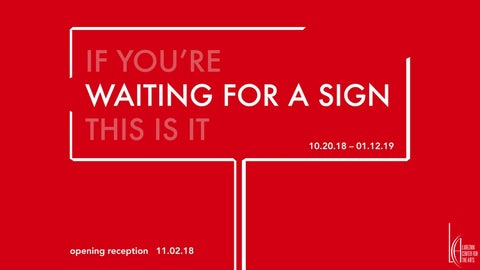
Either figuratively or literally, and whether from God or Mother Nature, Waiting for a Sign explores the use of signage, text, and iconography—visual images and symbols—in the work of eight contemporary artists. We encounter signs every day. From billboards to businesses to our own front yards, signage is part of the typical American landscape. Originally a tool for identification, signs have arguably evolved from an advertising medium to a fine art. Signage has a multitude of jobs: to provide a persuasive message or one of protest; to instruct; to direct; or to provide tools for navigating a search for meaning and truth. Accordingly, these eight artists employ and transform visual language to deliver messages of environmental justice, protest, personal identity, and hope. The work included in this show marries verbal and visual communication. Considering text as shape, form, and action, the artists use humor, plain text, and provocative statements to engage and involve viewers in the hunt for the truth concealed in these large-scale works.
willie baronet
WE ARE ALL HOMELESS PROJECT, 1993-2018 Artist and professor Willie Baronet has purchased more than 1,400 homeless signs over the past 25 years, and he uses this collection to create installations to raise awareness about homelessness. There have been over 30 art installations of WE ARE ALL HOMELESS since 2009 in the US and UK, including exhibits at NYU, University of Pennsylvania, and the University of Cambridge. The installations provide an experience for people to explore the humanity of the signs, and asks questions regarding the nature of home, compassion and what it means to truly see each other. SIGNS OF HUMANITY is a documentary film that explores interrelated themes of home, homelessness, compassion, and humanity. During the month of July 2014, Willie and three filmmakers drove across the country, interviewing more than 100 people on the streets and purchasing over 280 signs. SIGNS OF HUMANITY is a film about that trip.
diana guerrero-maciá Minding the Gap, 2059 2016 wool, cotton, hand cut and stitched, dyed canvas, on canvas
Minding the Gap, 2015 2016 wool, cotton, hand cut, stitched, and bleached on commando cloth
Hybrid-painter Diana Guerrero-Maciá believes that making a painting with stitchwork, cutwork , and hand-dyed color is a slow form of protest. By revealing her hand, Maciá combats and questions biases about gender and identity of ‘the maker’ present in art history. Here she combines the undeniably gendered art of textile making with her painting practice, presenting an exploration of the gender pay gap in these two iterations of Minding the Gap. The work is meant to have a searching quality; here viewers can find references to star charts, medieval symbols, and numerical statistics of the gender pay gap. According to Maciá, the spirit of her work is about building the world you want to live in and refusing the status quo.
corey hagelberg Corey Hagelberg considers himself a social change artist. His active woodcuts ask viewers to question the implications of how we treat the physical environment and act to create cultural change. His prints tell stories of interaction between heavy industry and the natural world. Using a medium historically aligned with social resistance, Hagelberg seeks to present nature as the superior force and encourages viewers to revel in the physical beauty of the diverse Indiana Dunes environment. By consistently referring to the regenerative power of the landscape, his prints force viewers to confront an everyday dichotomy: humans vs. nature.
(from L to R) Everybody's Last Supper, Birth of Christ in Bethlehem Steel, Birth of Ecology, Industrial Pipeline, Liar, Liar, River on Fire
cheryl pope from COMMUNITY IS BUILT ON EMPATHY, 2016, nylon and tackle twill applique letters and border SOMETIMES I TELL THE TRUTH TOO MUCH I CAN'T IGNORE THAT I AM WHITE I SHOULDN'T FEEL GUILTY I WISH I DID MORE I'M NOT GOOD AT BEING VULNERABLE I AM SCARED OF FAILING
Interdisciplinary artist Cheryl Pope elevates the voices of young people into championship statements through the banners of her COMMUNITY IS BUILT ON EMPATHY series. Pope’s banners work through simplicity; she both removes the artist’s hand and the identity of her speakers. Pope presents and gives validity to statements that express vulnerabilities, insecurities, and emotions within a framework of celebration. These intimate statements not only examine the emotions of college students in the U.S. but also aim to elicit self-reflection from the viewer. Her format of sports banners references collective young adulthood and the sweltering emotions that individuals of any age are scared to admit.
kay rosen Trained in languages and linguistics, Kay Rosen realized in the nineteen seventies that what most interested her about language had to be expressed visually, so she left academia and started over as a “self-taught” artist. Her work explores the intersection of meaning and structure in language through pictorial means: color, materials, typography, graphic design, etc. Her investigation into alternative functions of language continues here with her series List. With this series, Rosen draws many references; like the S section of the Gary, IN telephone book, or 19thcentury Hungarian Composer Franz Liszt. Homophonia is a list of words identified by the artist that each contain a pair of identical looking and sounding letters, homophonic, in other words. List/Listeis a list of French and English words. Liste, the first part consists of French words which look like English words. The second part, List, is the English translation of the French Liste, which of course look like English words. (from L to R) Ugly Duckling, Homophonia, Liszt, List/Liste
joel ross Anything is Possible (installed and abandoned, Chicago, IL) in collaboration with Jason Creps 2012 In the Future (installed and abandoned, Bradley, IL) in collaboration with Jason Creps 2012 False Promises (installed and abandoned, Champaign County, IL) 2008 Glimmers of Greatness (installed and abandoned, Ford County, IL) in collaboration with Jason Creps 2012 archival pigment prints
Joel Ross has long engaged dual audiences, both chance onlookers and art gallery visitors, with strategically and surreptitiously installed, text-based sculptures and the resulting photographs. In this case, Ross’s work takes the form of roadside signage, sculptures that are made, then installed and abandoned, at locations ranging from single-lane gravel farm roads to major highways. The signs often give voice to or are in dialogue with the public spaces where they are placed. Adding to and often inspired by the American landscape, the signs/sculptures are declarations that take control of the site with confidence, humor, urgency, and pride, sometimes implying the aftermath of a celebration or suggesting aggression. His work activates viewers’ imaginations and invites us to stop and consider some of the spaces we travel through or pass by every day.
deb sokolow You tell people you're working really hard on things these days, part 2 2013 - 2015 graphite, acrylic, color pencil, photo collage, tape on paper
Deb Sokolow’s partially fictional, text-driven drawings and collages oftentimes start with simple observations about her surroundings. The idea for this drawing comes from Alfred Hitchcock’s 1954 movie Rear Window. In the movie a newspaper photographer, while recovering at home with a broken leg, observes neighbors through his window, witnesses what he thinks might be a murder, and decides to solve the crime himself. Perhaps this drawing functions as documentation of individuals and events occurring at a particular place in time. But the voice of the narrator who is relaying all of the information is intentionally unreliable; therefore, it’s up to the viewer, when engaging with the drawing, to determine what in it might be real and what might be fiction.
deb sokolow bernard williams Buffalo Chart 2008-2018 wood and found objects
Bernard Williams presents a spinning history of the American West, combining tales of Native American tradition, United States patriotism, and African Americans’ involvement in securing the Western frontier, a theme he has been exploring for over 20 years. This work, Buffalo Chart, serves as an information grid composed of silhouetted representations of weapons, tools, words, animals, instruments, and people working and fighting. Its title is derived from the Buffalo Soldiers: African-American U.S. soldiers, so named by Native people, who helped “win” the West after the Civil War. Buffalo Chart serves as a cultural mixture , overlapping African-American histories like The National Association for the Advancement of Colored People and representations of African masks; with the history of the West, like oil rigging technologies ; and the names of now forgotten Native villages, like Chondote. Williams removes the individual stories to communicate a combined, collective, symbolic, and spiritual history of the Western landscape and its people.
This winter, Lubeznik Center for the Arts presents Waiting for a Sign, a show that exists at the intersection of art and literacy. Hosting 1,800 - 2,000 schoolchildren each year, this exhibit of contemporary art not only reflects LCA's greater initiative "Literacy Through the Arts", but encourages all visitors young and old to critically think of the letters, languages, and messages they use to communicate. The eight artists of Waiting for a Sign deliver messages of environmental justice, protest, identity, mystery, and hope.
Catalogue produced in conjunction with an exhibit at the Lubeznik Center for the Arts (LCA) 101 W. 2nd St #100 Michigan City, IN 46360, 219-874-4900, lubeznikcenter.org Waiting for A Sign Curated by Lora Fosberg Research + Didactics by Ming Washington Edited by Priscilla Lawler Graphic Design by Kyle Murphey Catalogue Designed by Ming Washington © 2018 LCA. All rights reserved