community
international
shuls/schools
lifestyle
sports
TO ADVERTISE HERE OR THE BANNER BELOW Contact us at advertising@thejewishreport.com.au
FREE
Fostering a closer Jewish community
VOL. 59 Friday, 14 February 2020 / 19 Sh'vat, 5780
Free subscription to electronic copy go to www.thejewishreport.com.au
ANGELS NEEDED MORE THAN EVER
PAGE 2
UIA 2020 CAMPAIGN PAGE 5
PLANTING THE SEEDS OF JEWISH VALUES
PAGE 6
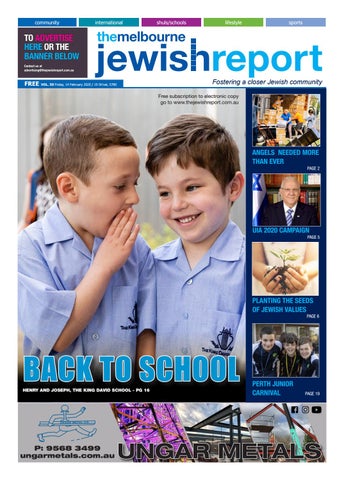
BACK TO SCHOOL
HENRY AND JOSEPH, THE KING DAVID SCHOOL - PG 16
P: 9568 3499 ungarmetals.com.au
PERTH JUNIOR CARNIVAL PAGE 19
UNGAR METALS
2
community
February 2020
The Angels are needed more than ever OPERATION ANGEL The fires have been burning for weeks- A smoke haze blankets our skies, the air quality levels reach hazardous levels and we are pained by the constant images of destruction and loss. The fires are so close and yet we feel so far away. How can we help? We give over our credit card details and leave extra coins at cafés to be forwarded to the businesses affected by the disaster. We promise ourselves that we will holiday in Mallacoota as soon as the time is right. But still we want to contribute. And then we hear about Operation Angel. Operation Angel is a “pop up humanitarian organisation “ founded in 1997 by Jacqueline Pascarl. It springs into action delivering relief at times of national disaster and emergency. “Angel” is currently running a very focused response to the Bushfire crisis gripping our nation by delivering comfort kits to the brave and dedicated fire-fighters on the scene. Each pack contains about 20 pieces including hygiene items such as soap and toothbrushes, relief items such as eye drops and lip balms, and basic food such as tins of tuna for an injection of protein on the go. The contents are carefully thought out and sent with beautiful Thank you cards drawn by children and families. Over 12000 kits have been sent to the fatigued fire-fighters plus 2800 for evacuees. For the past few weeks the operations centre for packing has been in a church hall in Brighton and following a targeted social media campaign, hundreds of businesses and individuals have donated goods, and
volunteers are lining up each session to help pack the kits. Jacqueline brings to the project decades of experience from the Defence Forces, CARE International and World Health UN, and understands exactly what will best aid the weary workers in the catastrophic conditions. She is coordinating an amazing community response and energises and inspires all the volunteers. Whilst, there is no official listing, Jacqueline estimates that most sessions are filled with a very high proportion of Jewish volunteers. She reports “ The response from the Jewish
A Jewish community book club to change the world STAND UP JACQUI DUBS Stand Up is excited to announce the launch of its new social justice book club, ‘Upstanders’ in Melbourne. The club is a great opportunity to harness our community’s collective passion for literature, social justice, and the sharing of robust discussion about contemporary human rights issues. The group will meet every two months to discuss literature across themes such as racism, sexism, equal opportunity, refugees, political freedom, slavery, anti-semitism and more. The first book to be tackled will be ‘No Friend but the Mountains’ by asylum seeker Behrouz Boochani, winner of the 2019 Victorian Premier’s Literary Awards for Non-fiction and Literature. Special guest speakers and authors will be invited to present their views to the group, adding further dimension and reach to group discussions and debates. Books featured will vary from fiction to non-fiction, including memoir, textbook, historical fiction and literary fiction. Members will also have the option to chat online via the Upstanders Book Club Facebook Group, offering a space for opinions, articles, reviews and other materials to be shared. Janine Schloss, former co-director of Melbourne Jewish Book Week, will be volunteering her time as Upstanders Book Club Coordinator. “I’m excited to be
coordinating the new Upstanders Book Club”, says Janine. “I believe that literature offers us, by way of character and plot, the chance to relate to situations outside our personal experiences, building empathy and tolerance for others. I look forward to sharing discussions about humanity and the human condition at a deep level, and hope that through constructive conversation we can develop better ways to connect and create change”. SIGN UP as a member today at Standup.org.au/bookclub. Up to 40 people can join the book club, decided on a first in basis. Membership is free. The first Upstanders Book Club meeting will be on Tuesday 17 March, 7.30pm (location advised on sign up).
community across all walks of life has been phenomenal – often days are filled with a 60 % component, rolling up their sleeves in a common cause. Ladies from an Israeli dance group, children from youth groups, members of orthodox families arriving together en masse to help – it is humbling to see the room filled with the commonality of wanting to unite to contribute something practical and channel positivity and hope.” As of time of writing - the generous donations continue to arrive, the caring volunteers continue to pack, the brave
emergency workers continue to appreciate the deliveries and the incredible Operation Angel unites us all. Chessed and Tzedaka – kindness and charity are core values of Judaism and a willingness to help is fundamental to our community members. Thank you to Operation Angel for facilitating our desires to assist in a practical way at these challenging times and for the opportunity to work along side a diverse range of Victorians uniting together in hope and good Aussie spirit.
Second Australian Yad Vashem honour wall for Holocaust victims and survivors AUSTRALIAN FRIENDS OF YAD VASHEM The inaugural Australian Wall of family plaques located in the Memorial Cave at Yad Vashem is now full and a second wall has been set aside to meet ongoing demand. More than 200 families have taken the opportunity to honour their loved ones by dedicating plaques to family members who died in the Holocaust or who survived and have since passed. The Australian Wall was initiated by community figure, the late Johnny Baker OA. The project to complete the wall has continued under the leadership of current president of Australian Friends of Yad Vashem, Joey Borensztajn AM and
committee members. “We are all very proud of this achievement which is a fitting testament to Johnny’s vision and commitment. It is a wonderful way for families to pay tribute to their loved ones and for future generations to be given the opportunity to observe remembrance of family members who were victims of the Shoah. Plaques have been ordered for the second wall and we encourage families to participate,” Borensztajn said this week For more information about the Memorial Cave, go to http://yadvashem.com.au/ If you or a family member would like to dedicate a plaque, please email afyv.exec@gmail.com
For the People of Israel
2020 CENTENNIAL CAMPAIGN 100 years of empowering and strengthening the People of Israel GALA EVENT
WOMEN’S BRUNCH
COMMUNITY EVENT
YOUNGUIA LAUNCH
MONDAY 24 FEBRUARY
WEDNESDAY 18 MARCH
WEDNESDAY 25 MARCH
WEDNESDAY 25 MARCH
PRESIDENT REUVEN RIVLIN
YOLA REITMAN
GONEN BEN YITZHAK
GONEN BEN YITZHAK
IDAN RAICHEL
DR TALIA COHEN SOLAL
HIS EXCELLENCY
PRESIDENT REUVEN RIVLIN PRESIDENT OF THE STATE OF ISRAEL As President, Rivlin declared his commitment to safeguard the State of Israel as a Jewish and Democratic State, establishing partnerships to ensure full equality among all its citizens.
IDAN RAICHEL ISRAELI SINGERSONGWRITER AND MUSICIAN Considered one of the most prominent and successful musical artists In Israel, and is among the most well-known Israeli artists abroad.
YOLA REITMAN FORMER MOSSAD AGENT
DR TALIA COHEN SOLAL
Led and facilitated the rescue of thousands of Ethiopian Jews fleeing persecution, by acting as the Director of a diving operation on the Sudanese shores of the Red Sea. Her story has been made into a Netflix movie “Red Sea Diving Resort.”
CEO AND CO-FOUNDER OF GENITIKA+
GONEN BEN YITZHAK
RABBI DAVID SAPERSTEIN
SHIN BET RECRUITER OF THE “GREEN PRINCE” Gonen managed to penetrate the Hamas leadership and turn the son of its founder into an agent for Israel for ten years.
Fast-growing and revolutionary Israeli startup developing personalised medical tools to better treat depression.
PRESIDENT WORLD UNION FOR PROGRESSIVE JUDAISM Saperstein is the Senior Advisor to the URJ for Policy and Strategy, Director Emeritus, Religious Action Centre of Reform Judaism. He will speak at the Progressive Trust Launch on Thursday 12 March 2020.
BOOKINGS AT UIAAUSTRALIA.ORG.AU OR 1300 ISRAEL (1300 477 235)
4
community
February 2020
Tikkun Olam Shines through Victorian Bushfire Crisis DAVID SOUTHWICK MP MEMBER FOR CAULFIELD Tikkun Olam embodies the Jewish principals of charity, good deeds and support for others and these values have been on full display during Victoria’s recent bushfire crisis. As Victorians well understand, the recent bushfires across our state and other parts of the country have been devastating. These fires have resulted in the loss of lives and property and caused enormous damage to Victoria’s precious native flora and fauna across large parts of Eastern and Northern Victoria. It is often adversity that brings out the best in our community and this has certainly been the case recently. Early in the bushfire crisis, I was inspired to hear of the selflessness of students at Camp Gan Yisroel – a camp run in the high country town of Harrietville. During the peak of the bushfire threat and following the declaration of a state of emergency, the town of Harrietville was evacuated including the students at the camp. Despite the clear danger of the situation, the students immediately acted to support others by donating their remaining supplies, including fresh fruit and vegetables, once they arrived at the Wangaratta Bushfire Relief Centre. Closer to home, residents of Emmy Monash Aged Care organised a care package assembly day from essential goods donated by the community. These packages supported many of those on the frontline of the bushfires, including firefighters and
emergency service workers, as well as children and their families who had fled oncoming fires. It was inspiring to see elderly members of our community contribute in such a positive way and a number of my staff who attended the event were proud to be involved. The Victorian Jewish community has also taken the lead on raising funds for bushfire relief appeals. Following a generous $1 million donation by John and Pauline Gandel early during the crisis, many others in the Jewish community have contributed financially to supporting those most affected by these fires. A the time of writing, an appeal fund established by the Jewish community has reached it’s goal of $2.5 million, an amazing effort that embodies the support and solidarity the Jewish community
has shown regional Victorians during this time of crisis. As Shadow Minister for Police and Community Safety I have been fortunate enough to visit bushfire affected areas and hear first-hand the challenges facing our regional communities. Witnessing the devastation of these bushfires was at times overwhelming, but the resilience shown by local residents and their clear determination to recover from this incident is nothing short of inspiring. When driving in Bairnsdale in East Gippsland I was struck by a large sign on the road into town advertising that “Gippsland is not receiving donated goods”. It was clear that the generosity of Victorians had exceeded the capacity for regional communities to store, transport and consume goods and in
a very short period, regional Victorians had received more basic goods than they could ever need. During this visit, I was pleased to meet with the Gippsland Emergency Relief Fund, who have been providing financial support following natural disasters to local communities since 1978. This organisation supports local residents to get back to day-today life by funding essential repairs such as reconnecting electricity, rebuilding fencing and purchasing feed for livestock. Another important way to support bushfire affected communities is by paying them a visit. So much of regional Victoria’s economy relies on tourism – and with extraordinary numbers of booking cancellations across accommodation, restaurants, cafes and tourism attractions, the coming weeks and months will be critical for the survival of numerous regional businesses and jobs. Regional Victoria has so much to offer visitors from Melbourne or other parts of the state and I would encourage anyone planning a holiday to consider supporting our bushfire affected communities and booking a break in regional Victoria. During this crisis, the Victorian Jewish community has responded with overwhelming generosity, empathy and unwavering support for those impact by this crisis. It will take many years for our state to fully recover but I am confident as proud Victorians and Jews, we will continue in the spirit of Tikkun Olam and support our regional communities every step of the way.
Doctor from Shaare Zedek Leads Study Treating Antibiotic-Resistant Bacteria AUSTRALIAN FRIENDS OF SHAARE ZEDEK INC MIRIAM PACANOWSKI A team of Israeli doctors and biophysicists say they have developed a mathematical model that could help medical professionals predict whether certain bacteria-fighting antibiotic treatments will fail or succeed. This information could help doctors handpick antibiotics with a greater chance of success and increase patient survival rates In a study recently published in Science magazine, a team led by Dr. Maskit BarMeir, head of the Paediatric Infectious Diseases at Shaare Zedek Medical Centre and Professor Nathalie Balaban of Hebrew University of Jerusalem, showed that resilient bacteria may be treatable with currently available therapies. The study was featured in a recent Jerusalem Post article. “We can predict which antibiotic combination would work on these bacteria and which would not,” Balaban told The Jerusalem Post. “Our understanding could help doctors choose what treatment to give.” It could also save lives. Bacteria develop defences against hostile elements in their environment,”. One common tactic is “tolerance” – lying dormant during antibiotic treatment,
which allows the bacteria to survive, since antibiotics only spot and kill growing targets. Ultimately, these bacteria become resistant. Antibiotic resistance causes at least 700,000 deaths a year worldwide. Without action, according to some reports, the death toll could rise to 10 million people a year by 2050, overtaking cancer as a leading cause of death. Shaare Zedek Medical Centre played an
important role in the study. Balaban’s lab teamed up with Bar-Meir and repeated their study and tolerance-test technique, analysing daily bacterial samples from patients hospitalized at Shaare Zedek with life-threatening, persistent methicillinresistant Staphylococcus aureus (MRSA) “Golden Staph” infections. The pattern they found was strikingly similar to their lab findings: First, the patients’ bacteria developed tolerance, then resistance, and ultimately, antibiotic treatment failed. The intermediary “antibiotic tolerance”
stage lasts only a few days and cannot be detected in standard medical labs. But it can be detected using this mathematical model. Based on the patient’s bacteria profile, doctors could handpick antibiotics with a greater chance of success, according to the study. “Using the right combination of available antibiotic drugs at the outset could dramatically increase a patients’ survival rate before their infection becomes tolerant to all the antibiotics in our arsenal,” Balaban said. In the short term, Bar-Meir and Balaban want to give hope to patients with lifethreatening infections by encouraging medical centres to adopt the laboratory test they developed which gauges antibiotic tolerance. This would enable doctors to quickly and easily choose antibiotics with a greater chance of success. Dr Allan Garfield, chairman of the AFSZ Inc notes that this study is yet another example of the crucial role Shaare Zedek plays in the development and application of life saving therapies. As Jerusalem’s most central hospital treating some 800,000 patients per annum, the hospital makes important contributions to the cycle of research and discovery that is saving lives both in Israel and around the world. www.shaarezedek.org.au
February 2020
5
community
Next Level Guest for UIA 2020 Campaign
UIA Victoria will also be holding their Women’s Division event on Wednesday 18 March, Community morning tea on Wednesday 25 March and their YoungUIA event on Wednesday 25 March, with details to be released shortly. “Our 2020 campaign will be taken to the next level as we celebrate this milestone. As a symbol of the unique place that Keren Hayesod-UIA holds, I am delighted to confirm that President Rivlin will be our guest for this momentous celebration. We are so delighted and excited to be hosting him and look forward to this unique and special visit. The event is sure to sell out and I strongly encourage our community to book as soon as possible to avoid disappointment,” UIA Victoria President Hayley Southwick said. Events will sell out and seating is limited. To book for the Gala event, visit https:// www.uiaaustralia.org.au/our-events/vic or for more information contact 1300 ISRAEL (1300 477 235), info@uiavic.org Follow UIA on Facebook for updates on our 2020 Campaign: facebook.com/uiaaus
UIA CARLI DVASH UIA Victoria’s 2020 Campaign will be taken to the next level as we celebrate the incredible milestone of Keren Hayesod-UIA’s 100 years of supporting the People of Israel. With the unique position that Keren Hayesod-UIA holds for both the People of Israel and the local Jewish Community, it is an absolute privilege to announce that UIA will be hosting Israel’s number one citizen the President of the State of Israel His Excellency President Reuven (Ruvi) Rivlin as our guest of honour this year to celebrate with us. UIA is extremely proud that President Rivlin will spend time with the Jewish Community joining the UIA’s Campaign opening events. The 2020 Campaign’s opening Gala event will take place on Monday 24 February and officially launch our centenary celebrations with additional exciting live entertainment from Idan Raichel. In honour of the centennial, we have made a strategic decision to adopt a new format. As a communal organisation, we felt it was important that a larger contingent of the community have access to our speaker, as it is his only public appearance. The 2020 Gala Event will therefore take the format of a theatre style presentation and not be a dinner. President Rivlin received a personal invitation from Steven Lowy AM during a meeting at the President’s residence last year. The fact that he is joining us to engage
with the UIA family is a wonderful testament to the UIA’s place in strengthening and empowering the People of Israel. Rivlin has served as the President of the State of Israel since 2014. As President, Rivlin declared his commitment to safeguard the State of Israel as a Jewish and Democratic State and to aspire to establish a partnership between the different ideological groups in Israeli society and ensure full
Professions for Life – the new project to be supported by the UIA Women’s Division
UIA CARLI DVASH
The UIA Women’s Division is delighted to support the Professions for Life program for the 2020 campaign in honour of Keren Hayesod-UIA’s centennial. The smooth integration of new immigrants after they arrive in Israel is crucial to their success in their new homeland. One of the major roadblocks is the lack of recognition of their professional qualifications. This leads to unemployment, familial hardship and financial strain on welfare services. In this groundbreaking program, Professions for Life assists participants to fast track their professional licenses and/or gain new qualifications that help increase their employability. Participants and their families are also provided Hebrew lessons, resume and job seeking assistance, housing and networking opportunities. One of the unique qualities of this lifechanging program is a long-term solution to achieve independence, employability in highdemand sectors and upward socio-economic
mobility. This is turn reduces the financial strain on government and welfare services. Approximately 450 new olim, predominately from the Former Soviet Union and Ethiopia participate annually. This program is highly successful in that 99% go on to secure longterm employment. A donation of $6,500 will support all the needs of one immigrant and their family as part of the program. We are excited that this new program will broaden the reach of our donors’ fundraising dollars and our campaign has the opportunity to directly impact the People of Israel. We invite our donors to support this valuable and vital program, as together, we continue to empower and strengthen the People of Israel. Please join us at our 2020 Women’s Division Brunch on Wednesday 18 March. We are thrilled to announce that Yola Reitman, Former Mossad Agent and Dr Talia Cohen Solal, CEO of Gentika + will feature on a panel moderated by Jackie Frank, former editor of Marie Claire Magazine.
equality amongst all its citizens. During the Six Day War Rivlin fought with the Jerusalem Brigade and as an Intelligence Officer also accompanied the Paratroopers Brigade. Reuven Rivlin, a staunch supporter of Keren Hayesod-UIA has been quoted as saying ”Without Keren Hayesod, there would have been no State of Israel, plain and simple!”
SAVE THE DATES: GALA EVENT Monday 24 February 2020 WOMEN’S DIVISION BRUNCH Wednesday 18 March 2020 COMMUNITY MORNING TEA Wednesday 25 March 2020 YOUNG UIA EVENT Wednesday 25 March 2020
בס״ד
ENQUIRE NOW!
PESACH 2020 FORRESTERS BEACH RESORT
CENTRAL COAST NSW WEDNESDAY 8TH - 16TH APRIL, 2020 COMPLETE PACKAGE 9 NIGHTS 10 DAYS ALL INCLUSIVE ACCOMMODATION AND MEALS WARM HEIMISHE ATMOSPHERE - PROGRAMMES FOR THE WHOLE FAMILY- COMMUNAL SEDORIM (PRIVATE SEDORIM AVAILABLE) DELICIOUS MENU- SAFE AND CHILD FRIENDLY ENVIRONMENT 8 MINUTE WALK TO THE BEACH - SWIMMING POOL - ONLY 1.5 HOURS DRIVE FROM SYDNEY REBECCA: 0404460460 AVI: 0404010273
PESACHFAMILYRETREAT@GMAIL.COM WWW.PFR.ORG.AU
6
community
February 2020
Reclaiming Service: Planting the seeds of Jewish values
GLOBAL AMBASSADOR, MORIAH COLLEGE & CEO, MOSAIC UNITED RABBI BENJI LEVY
In our fast-paced interconnected world, it can be so hard to do a good deed in a truly selfless way. When we run a marathon for charity and post about it on social media in order to encourage donations, we are all too often more interested in counting the ‘likes’ from friends than the money we’re raising for the cause. This behavior leads me to believe that perhaps the closest we can come to achieving true selflessness is through focusing on the good we leave behind for future generations. Such a legacy will allow them to reap the benefits of our actions long after we have passed on, and long after we stand to benefit in any way from the benevolence of our act – the ultimate demonstration of altruism. After celebrating Tu B’Shvat (the New Year for Trees), I am reminded of the wellknown Talmudic tale about the encounter between the sage Choni HaMa’agel (the ‘Circle-Maker’) and a young man planting a tree (Ta’anit 23b). As the young man secures the sapling in the ground, Choni looks on curiously, wondering why he is making such an effort for this type of tree, which will take around 70 years to bear fruit. “How can you be sure that you will live another 70 years, long enough to derive benefit from this tree?” inquires Choni. Without skipping a beat, the man replies: “Just as my ancestors planted trees for me, I am planting trees for my descendants. Everyone should merit being born into a world full of trees.” This story highlights the importance of thoughtfulness, forward thinking and generosity. At the same time, it underscores the very essence of Jewish continuity. Traditionally, Jewish continuity has been viewed through the lens of the family unit, defined primarily by one’s commitment to raise a Jewish family. This narrow scope, however, negates the transcendental echo left by the indelible impression we leave on everyone that we encounter. To connect our present to both our past and collective future, we must ensure that we leave behind a world that our descendants will be proud to inherit. Westheimer and Kahne, two Americanborn 20th century academics known for their works on citizenship education, suggest three core components to participatory civic typology – responsibility towards the personal, communal and societal realm (‘The Politics of Educating for Democracy,’ 2004). With all that is broken in our world, there is no shortage of opportunities to roll up our sleeves and get to work in all three realms. Service, charity, volunteer work, and other selfless acts comprise the ethical
element of our gift to the next generation. In fact, acts of service and benevolence embody core Jewish values that can be traced all the way back to Abraham and Sarah. Our forefather Abraham personifies the three components of Westheimer’s and Kahne’s approach to civic typology: assuming personal responsibility (acts of chesed or loving-kindness, like welcoming visitors to his tent), participation in communal efforts (acts of tzedakah or charity, such as the designation of wells to be used by all who need), and social justice oriented activism (acts of tzedek, including lobbying for the righteous citizens of Sodom). His natural ability to exemplify these acts of inherent goodness was the very basis upon which he was chosen to be the progenitor of our People. Working diligently to improve our world is an unmistakable hallmark of the Jewish way of life and a contribution that we bestow upon every new generation. Over the last few decades, record numbers of young Jewish men and women have picked up the mantle of service, giving of their time, talents and energies in order to make a positive impact on the world, both in the short- and longterm. These positive acts are often motivated by that same sense of responsibility that has characterized the Jewish people since time immemorial. Data gathered from several surveys conducted by service organizations has revealed that the vast majority of Jewish volunteers do not mind whether the framework through which they volunteer is Jewish (‘Volunteering and Values,’ Repair the World, June 2011). This service is, of course, impactful for the wider world, but our inability to connect these participants to their Jewish identities through their own passionate benevolent pursuits represents thousands of missed opportunities. The world of volunteerism and service encapsulates a myriad of entranceways
back into the organized Jewish world, for those hovering on its fringes. Helping them harness and re-channel their passion, energy and sense of communal and societal responsibility is a vital step in reconnecting these young adults with their heritage. As such, contextualizing their service as an inherently Jewish value and as an inseparable part of what it means to be a Jew in the world today could serve as a transformative catalyst for strengthening our collective Jewish future. The Torah tells us that a person is like “a tree in the field” (Deut. 20:19). Much like a tree, a person needs proper sustenance to grow and thrive. Values anchor us to our moral inheritance and provide us with the nourishment that allows us to reach our potential and eventually bear fruits that may be shared with the global family of nations. At a time when identity ties are generally weakening among young people, linking their moral values to our shared destiny could assist in allowing their Jewish identity to flourish. What’s more, Jewish identity is not owned or monopolized by any one particular age, stage or generation. Indeed, needs, perspectives and attitudes change and differ from one group to the next. As such, in each epoch, we must find our own unique conduit for connecting with Jewish values. Ultimately however, these values are eternal with no specific allegiance to one era or another. In addition to healing the fractured world around us, service experiences can be an essential component in making Jewish identity more relevant to this generation. But it won’t truly take root unless we plant the seeds of Jewish values within the initiatives themselves throughout programming as well as through preparatory and follow-up reflections and engagement. As they take part in a range of worthy causes, from natural disaster relief projects and housing construction drives to food
TO ADVERTISE HERE. Contact us at advertising@thejewishreport.com.au
distribution initiatives and refugee work, young Jews should feel an explicit sense of Jewish rootedness and belonging through the assistance they provide. With the right education and guidance, through giving, they can receive a deeper understanding of who they are and forge a connection with the generations of givers who came before and will come after. After all, it’s one thing to become an agent of change, but another thing entirely to discover that you are part of an intergenerational story of social activists. By reframing service initiatives through the Jewish lens, we can give young Jews, who may be hoping to become part of something ‘bigger than themselves’, the greatest gift of all: a reminder that they already are. We are living in auspicious times. As we celebrated Tu B’Shvat, we reflect on the long and arduous journey that a seed travels until it becomes a fruit – a lesson also learned from the Talmudic tale of Choni HaMa’agel, where we see that the germination process may take as long as 70 years. That makes this year, the 70th since the establishment of the modern State of Israel, the perfect opportunity to reap what was sown by previous generations and continue to plant. We must now expand the definition of Jewish continuity and highlight the importance of our ethical legacy by reclaiming service as a core Jewish value. Rabbi Benji Levy is the CEO of Mosaic United, a partnership between the State of Israel and the global Jewish community dedicated to addressing wide-ranging approaches to Jewish engagement and raising the playing field to ensure a stronger Jewish future. A recent Oleh from Australia, he previously served as the Dean of one of the largest Jewish schools in the world, Moriah College and now is their global ambassador.
February 2020
7
international
The Real Reason Arabs in Israel Do Not Want to Live in 'Palestine' KHALED ABU TOAMEH Arab citizens of Israel, who number nearly two million, are up in arms about US President Donald Trump's plan for Middle East peace, which proposes including some of their communities in a future Palestinian state. Since the unveiling of the plan, thousands of Arabs have been demonstrating to express their rejection of the idea of placing them under the sovereignty of a Palestinian state. Trump's "Peace to Prosperity" plan proposes land swaps that could include both populated and unpopulated areas. It suggests that the so-called Triangle area in Israel, consisting of several Arab communities "which largely self-identify as Palestinian, become part of the State of Palestine." The plan points out that the Arab communities "were originally designated to fall under Jordanian control during the negotiations of the Armistice Line of 1949, but ultimately were retained by Israel for military reasons that have since been mitigated." Why are the 250,000 Arab Israelis living in the Triangle area strongly opposed to the idea of becoming part of a Palestinian state? The main reason Arabs in Israel are afraid of becoming Palestinian citizens is because they know that the Palestinian state will be anything but democratic. Many Arab citizens of Israel see how Palestinians living under the Palestinian Authority (PA) in the West Bank and Hamas in the Gaza Strip are subject to human rights violations on a daily basis. In Israel, Arab citizens participate in the general elections and have their own
representatives in the Knesset. In the West Bank and the Gaza Strip, Palestinians have been deprived of free and fair elections since January 2006. The continued power struggle between the PA and Hamas has denied Palestinians the right to vote for new members of their parliament, the Palestinian Legislative Council (PLC). In addition, Palestinians have been denied the right to vote for a
new president since January 2005, when Mahmoud Abbas was elected for a four-year term of office. Last month, Abbas entered the 16th year of the same term. In light of the ongoing dispute between the PA and Hamas, the prospects of holding new presidential or parliamentary elections remain zero. While Palestinians have not had a functioning parliament since 2007, when
Hamas violently seized control of the Gaza Strip after overthrowing Abbas's PA regime, Israel's Arab citizens continue to run in elections for the Knesset. The current Knesset has 14 Arab parliamentarians. Apart from the issue of elections, though, Arab citizens of Israel are mainly worried about having to live in a Palestinian state CONTINUED PAGE 8
Turkey and Israel: Can pragmatism defeat ‘bad blood’? BURAK BEKDIL For the first time in several years, the word “Israel” is not automatically accompanied in Turkey by bold pejoratives like “baby killer” or “terrorist state.” The reason appears to be an emerging intention in Ankara to see if pragmatism can overcome the bad blood that has arisen between the two states, which were strategic partners in the 1990s. Turkey and one Libyan government are standing together in opposition to Greece, Cyprus, Israel, Egypt, the UAE and the other Libyan government. Ankara’s recent muscle flexing in the Eastern Mediterranean looks like the behavior of a neighborhood bully who wants to spoil the other kids’ game because he wasn’t invited to participate. Motivated primarily by a desire to ratchet up its regional posture, Turkey recently made two major moves: It signed an agreement with the Libyan government in Tripoli creating a maritime link by which each country’s exclusive economic zone (EEZ) goes beyond 200 km of its territorial waters; and its parliament ratified a resolution to send troops to Libya to defend the Tripoli government. Sinan Ülgen, head of the The Centre for Economics and Foreign Policy Studies (EDAM), an Istanbul-based think tank, explains: “In recent years, Ankara’s ill-fated regional policy coupled with its unconditional support to the Muslim Brotherhood has led to the estrangement of [Turkey from] Egypt and Israel. As a result, Turkey faces
a consortium of nations in the region eager to leverage the natural resources of the Eastern Mediterranean, to the detriment of Turkey’s interests. “For [President Recep Tayyip] Erdoğan, the deal with Libya is a formula to break Turkey’s isolation and win support for its bid for what he regards as a fairer distribution of offshore resources in the Eastern Mediterranean.” The gunboat gambit in the Eastern Mediterranean was so unexpected that many observers were curious as to who might have advised Erdoğan to up the stakes in this way. The mastermind was Rear Admiral Cihat Yayci, chief of staff of the Turkish Navy. “Without the president’s realism and courage this would have remained an academic paper in a [library] shelf,” Yayci has said. The admiration is mutual. In a speech at the inauguration of the Russian-Turkish TurkStream pipeline, Erdoğan praised Yayci by name. Now that the Libyan deal is done, Yayci says there is one more thing Turkey should do: “There is a very important step we must take now. We should sign with Israel, as soon as possible, the same [EEZ] agreement we signed with Libya. This step must definitely be taken.” One might be tempted to think there is too much metaphorical bad blood between the government of Israeli Prime Minister Benjamin Netanyahu and Turkey’s Islamist establishment for any such agreement to be a realistic prospect. They might point out that Turkey and Israel have not exchanged ambassadors since May
2017, so any dialogue would be limited in diplomatic nature. There are subtle signs, however, that this may not be the whole picture. In a recent speech, Erdoğan threatened that “no project [in the Mediterranean] without Turkey could survive economically, legally, or diplomatically.” But he also said Turkey is keen to negotiate with any state actor except Cyprus [with which Turkey does not have diplomatic relations]. The phrase “any state actor except Cyprus” underlined that Israel is acceptable. It could be legally and technically problematic if Turkey and Israel decide to delineate their maritime borders, which could result in a maritime zone off south Cyprus that Turkey claims as its own. Such a deal is not impossible, as neither Turkey nor Israel is a signatory to the U.N. Convention on the Law of the Sea (1982). Neither is the United States. Then there is the financial aspect. The ambitious 1,900-km pipeline that will carry Eastern Mediterranean natural gas to Europe is one of the E.U.’s “Projects of Common Interest.” It will reach from Israeli waters to Greece via Cyprus. On the western Greek mainland, the pipeline will connect to the planned Poseidon Pipeline, co-financed by the European Union, and will run from the Greek-Turkish border to Italy. This is not the cheapest route by which to transport gas into Europe. As one senior Turkish diplomat notes, “This is a solution imposed on Israel. Israelis know that they can make a more feasible [natural gas
transport] agreement with Turkey. And without any need to wait for a change in political leadership in either country.” Despite the absence of ambassadors in Ankara and Tel Aviv, the existing network of diplomatic ties could be enhanced for, in the words of the same Turkish diplomat, “a more objective, more independent, honest and mutually profitable deal that fully respects both countries’ sovereign rights.” This could be overly optimistic, given the bad blood that has arisen between Turkey and Israel since 2010 (except for a brief normalization period between the end of 2016 and mid-2017). But remember: Turkey and Russia, with their deeply divergent interests in Syria and Libya, not to mention their ideological differences, are working as strategic partners in critical military procurement. Erdoğan’s endless love affair with Hamas (and the Muslim Brotherhood) stands in the way of full normalization—but he may be inclined to downplay this ideological kinship as the nearest Turkish elections are more than three years away. Burak Bekdil is an Ankara-based columnist. He regularly writes for the Gatestone Institute and Defense News, and is a fellow at the Middle East Forum. He is also a founder of, and associate editor at, the Ankara-based think tank Sigma. This article was first published by the Begin-Sadat Center for Strategic Studies.
8
international
February 2020
Kirk Douglas’s quintessential American Jewish life JONATHAN S. TOBIN
Actor Kirk Douglas may have been the last surviving star from the golden age of Hollywood. So his death this week at the age of 103 is a chance for fans of cinema to appreciate not only his impressive body of work, but his role as a transformative figure in his industry as it evolved from the era of Hollywood studios to one in which individual actors and their production companies began to dominate. Douglas was the quintessential star of the era in which the movies dwarfed popular culture. He evolved from being a Hollywood bad boy actor to independent filmmaker and producer to eventually become a patriarchal figure whose struggle to overcome the impact of a stroke carved out a new and cherished role for him in the country’s memory. Douglas will be remembered for powerful performances in a host of great movies. But his acclaim was also based on his championing of personal projects, such as the classic anti-war film “Paths of Glory,” as well as the fact that he was the one who broke the infamous Hollywood blacklist by hiring Dalton Trumbo to write “Spartacus.” That move ended a dark era in which some left-wing writers were banned from contributing to films under their own names after being identified as Communists or Communist sympathizers. But his journey was also a Jewish story— one that aptly illustrates the way Jews have carved out for a place in American life and struggled with the choices its freedom presented to them with respect to their unique heritage. His path was, in part, one of typical assimilation. But it was also one in which his fierce loyalty to his identity, love for the State of Israel and ultimately a return to Judaism made him an example that offers hope for a community struggling with demographic implosion and a loss of a
sense of Jewish peoplehood. Born Issur Danielovich, the son of Yiddishspeaking Russian Jewish immigrants in Upstate New York, he grew up in poverty but worked his way through college. He legally changed his name to the non-ethnic sounding Kirk Douglas and eventually was able to establish himself as an actor, first in New York and then in Hollywood. Douglas was famously difficult, an aggressive personality who was known for a ruthless, self-interested way of working in a business in which prima donnas proliferate. As he ascended to Hollywood stardom, Judaism and the Jews were not topics that interested him. He married non-Jewish women (and serially cheated on them), and his children were not raised as Jews. In that sense, he was a typical mid-20thcentury American Jew who largely discarded anything that interfered with the ability to break through to success in secular society. But even during that period of his life, Douglas had a strong connection to Israel. In 1953, he made “The Juggler,” the first Hollywood feature to be filmed in the Jewish
state, where he played a Holocaust survivor struggling with post-traumatic stress disorder, a rare instance of the subject being broached in that era. More than a decade later, he would return to Israel to make “Cast a Giant Shadow,” a film depicting the life of a real life Jewish hero, Col. David “Mickey” Marcus, an American who played a key role in the 1948 War of Independence. Douglas was also a philanthropist who, along with his second wife Anne Buydens, donated more than $100 million to charitable causes. He was particularly associated with support of Israel, where he helped fund various projects in Jerusalem. But like so many Jews of his generation, his Jewish connections were largely tangential to a thoroughly secular life. While he would be remembered fondly by Jews for his Zionism and philanthropy—as well as for all of the acting parts that made him an icon of 20th-century film—the final decades of his life provided yet another chapter to his Jewish story. In 1991, during a stay in a hospital following a helicopter crash, Douglas
decided to reconnect with the Judaism that was a relic of his childhood. In a memoir, he later wrote that he had asked himself why he was spared in a collision that left two others dead and decided that it was “because I had never come to grips with what it means to be Jewish.” What followed was an intensive course of Torah study with a number of rabbis and a second bar mitzvah at the age of 83. While he had rejected the possibility of studying for the rabbinate as a teenager determined to make it in the secular world, Douglas had come back to the world of Jewish practice at last. The example he set influenced his oldest son, Michael, a Hollywood icon in his own right, to embrace his father’s heritage and led him to win the 2015 Genesis Prize awarded to those who exemplify Jewish values. A year earlier, Douglas’s wife had surprised guests at their 50th-wedding anniversary by announcing her conversion to Judaism. Like so Jews of his generation, his might have been a life in which Jewish origins were merely a footnote to a biography of other concerns that took precedence. But by retaining a strong sense of Jewish pride, he never entirely lost touch with the Jewish world. And by returning to Judaism at the end of his life, he seems to have ensured that not only would some of his grandchildren be raised as Jews, but that he had set an example that inspired many others to do the same. While he will always be chiefly remembered for playing Spartacus, Vincent Van Gogh and dozens of other iconic roles, his place in the history of American Jewry is also secure. May his memory be a blessing. Jonathan S. Tobin is editor in chief of JNS— Jewish News Syndicate. Follow him on Twitter at: @jonathans_tobin.
The Real Reason Arabs in Israel Do Not Want to Live in 'Palestine' FROM PAGE 7 that suppresses public freedoms, including freedom of speech and the media. Hardly a day passes without the Arab citizens of Israel hearing about the harsh conditions the Palestinians face under the PA in the West Bank and Hamas in the Gaza Strip. Palestinian journalists, human rights activists, political activists and university students are targeted by the PA and Hamas on a regular basis. That is what Israel's Arab citizens are afraid of. A recent report by the West Bank-based Committee of the Families of Political Prisoners revealed that the PA security forces have arrested dozens of university students in the past few months because of their political activities. The report documented at least 619 violations against university students by the PA security forces in the past two years. Arab students who are citizens of Israel, meanwhile, are free to hold protests on campuses there without having to worry about being arrested or summoned for interrogation. Last week, for example, Arab students at Tel Aviv University demonstrated against the Trump plan, chanting "Palestine is Arab, from the [Jordan] river to the [Mediterranean] sea." Palestinian Arab university students, however, who are not citizens of Israel, and who live in the Palestinian areas of the West Bank and Gaza Strip, can only
envy the Arab Israeli students who are free to hold political activities on campus. Another recently published report revealed that several students arrested by the PA security forces have been brutally tortured. Most of the arrests took place at An-Najah University, the largest university in the West Bank city of Nablus, according to the report. Palestinian students living in the Gaza Strip under Hamas, where virtually everyone is Arab and not a citizen of Israel, have fared no better. Hamas security forces have been regularly raiding university campuses and arresting students and teachers because of their political activities. One of the campuses that has been frequently targeted by Hamas is AlAzhar University in Gaza City. In November 2019, Hamas security forces also raided Palestine University in the northern Gaza Strip and arrested several students who were preparing to hold a political rally on campus. While in Israel, Arab citizens are free to criticize the Israeli government and leaders, Palestinians in the West Bank and Gaza Strip who speak out against the PA or Hamas often find themselves behind bars. In the West Bank, for example, a professor who dares to criticize Abbas could find himself in detention for several days. Professor Abdel Sattar Qassem, an outspoken critic of Abbas, was accused in 2016 of "insulting" Abbas and held in detention for several days. Palestinian journalist Majdoleen Hassouneh was also
accused of "insulting" Abbas on Facebook. In the Gaza Strip, Hamas has arrested hundreds of its political opponents in the past few years. Even Palestinian comedians who make sarcastic remarks about Hamas have become regular targets of Hamas's crackdown on freedom of speech. Recently, Hamas security forces arrested comedian Adel Mashoukhi after he posted a video on social media mocking the electricity crisis in the Gaza Strip. It is no wonder, then, that Israel's Arab citizens are extremely concerned about the prospect of living under a Palestinian state controlled by the PA and Hamas under some potential land transfer. These Arab citizens of Israel know that once they become citizens of a Palestinian state, they will meet the same fate of the Palestinians living under the PA and Hamas. Some of the leaders of the Arab community in Israel are even calling the idea of having to live under a Palestinian state as a "nightmare that cannot be implemented." The Arab Israelis' protests are seen as a message to the world that they prefer to continue living in Israel and not under another Arab dictatorship. A survey conducted by The Israel Democracy Institute in 2017 showed that 66% of Arab Israelis see Israel's overall situation as "good" or "very good." Another poll, conducted by Professor Sami Samuha of the University of Haifa, 68.3% of Israel's Arab citizens said they preferred to live in Israel than in other countries. Samuha said that among the
Arab citizens, "there is acknowledgment of convenience, freedom and stability in the State of Israel." "In Israel, there are a lot of benefits and a modern way of life, as well as economic and political stability. You can't compare the lives of Arabs [in Israel] to that of Arabs in Palestine, Lebanon or Egypt. There is also the element that in Israel there is no concern of an Islamist takeover." What the Arab citizens of Israel need now is to elect new leaders who will promote coexistence between Arabs and Jews in Israel, and not engage in anti-Israel rhetoric and actions. Some of the leaders of the Arab citizens of Israel, particularly a number of Knesset members, have been acting against the interests of their constituents. It is almost as if these purported leaders represent the PA and Hamas instead of the Arab Israelis who voted for them with the hope that they would work to solve problems confronting their communities, such as unemployment. The Arab citizens of Israel need real leaders who properly represent them in the Knesset and build -- not destroy -- bridges with Jews. Let the protests on the streets of Arab Israeli communities against becoming part of a Palestinian state serve as a fair warning to Israeli Arab leaders: stand by your people, or get out of the way. Khaled Abu Toameh, an award-winning journalist based in Jerusalem, is a Shillman Journalism Fellow at Gatestone Institute.
9
international
February 2020
The customs and traditions of Tu Bishvat DVORA WAYSMAN Tu Bishvat, which falls this year on February 10, heralds the end of the rainy season in Israel. Buds are beginning to appear on the trees, and the blossoming almond trees, the harbinger of spring, have begun to dot the landscape. So on the 15th day of the Hebrew month of Shvat we celebrate the yearly cycle for the growth of trees in Eretz Israel. According to our Jewish mystic tradition, Tu Bishvat is the day when God renews sustenance and the life cycle of the trees, when the sap starts to rise. There are many customs that have arisen to remind us of the meaning of this day. We eat fruits and nuts, especially the fruits for which the Torah praises the Land of Israel, which is a land of grapevines, figs and pomegranates, olives and sweet dates. Many pious Jews hold a Tu Bishvat Seder, not unlike the meal we have on Passover. This ancient tradition was upheld in Safed, the seat of Kabbalistic studies in the 16th century. This Seder became a new way to reaffirm the spiritual bond with the land, in celebration of the approach of spring and the fruit of the earth. Sometimes, the Hebrew newspaper Yediot Aharonot distributes a Tu Bishvat “Haggadah” in time for the holiday. It was devised by Dr. Joel Rappel of Bar-Ilan University. There is a snowy white tablecloth, candles, copious amounts of fruit and nuts; prayers, readings and songs. There are also four
cups of wine accompanied by fruit divided into levels of “ascending spirituality.” The first cup is chilled white wine, symbolizing winter, accompanied by the lowest level of fruit, which needs a protective covering, such as oranges or almonds. The second cup is white wine mixed with a small amount of red, signifying spring, the budding of new life, and this is served with olives, apples, peaches and dates (the outer layer is eaten, yet the heart is protected and has within it the seed of new life.) The third cup is red wine with a small amount of white. This is the symbol of summer and a perfect world in which nothing
is wasted. With this, the highest level of fruit is eaten, such as figs, grapes and berries. The fourth cup is just red wine, representing fertility and the bounty of autumnal crops waiting to be harvested. What else happens on Tu Bishvat? Very little religiously, but a lovely ritual has arisen in Israel that’s been adopted all over the Jewish world. It is a popular observance to plant trees, one of the greatest “mitzvot” you can do. Trees have great significance in Judaism. It is written in Deuteronomy: “When you besiege a city for many days to wage war against it to seize it, don’t destroy its
trees....” In Midrash Shmuel on Pirkei Avot 3:24, it is written than man is like a tree in that his good deeds are his produce, his “fruits,” and his arms and legs the branches which bear these fruits. He is, however, an “upside-down tree,” for his head is rooted in the heavens, nestled in the spiritual soils of the Eternal, nourished by his connection to his Creator. At the end of the Hasmonean dynasty, there lived a holy man named Honi, known as the circle drawer, and we read his story in Ta’anit 23a. One day Honi saw a man planting a carob tree and asked him: “How many years does it take for the carob tree to bear fruit?” The reply was “Seventy years.” Honi asked: “Do you think you will live another 70 years and reap its fruit?” The simple man responded: “I am planting the tree not for myself but for my grandchildren.” Although the world has never regarded Jews as being tied closely to the land, the truth is that no religion has closer ties to agriculture and ecology. The Midrash teaches us that man’s life depends on the tree, and we are forbidden to live in a city that has no gardens and trees. They are so important to us that Rabbi Yohanan BenZakai declared: “If you hold a sapling in your hand and are told: ‘Come look, the Messiah has arrived,’ plant the sapling first and only then go and greet the Messiah.” Happy Tu Bishvat! The writer, who has lived in Jerusalem for 48 years, is the author of 14 books. Her latest novel is Searching for Sarah.
Ten iconic Holocaust films to watch now on Netflix and Amazon
FRANCINE WOLFISZ
he sees a boy among the bodies who might be his son, and feels he must find a rabbi to give the child a proper Jewish burial. Available to rent or buy on Amazon
Defiance (2008) Directed by Edward Zwick, Defiance tells the true-life story of the Bielski partisans, a group led by Belarusian Jewish brothers, who saved and recruited Jews in Belarus during the Second World War. The film stars Daniel Craig as Tuvia Bielski, Liev Schreiber as Zus Bielski, Jamie Bell as Asael Bielski, and George MacKay as Aron Bielski. Available to rent or buy on Amazon. Schindler’s List (1993) One of the greatest Holocaust films of all time and recipient of seven Academy Awards, Steven Spielberg’s sweeping epic Schindler’s List follows the real-life story of Oskar Schindler (Liam Neeson), a German businessman who saved the lives of more than 1,000 mostly Polish Jews by employing them in his factories during the Second World War. The stellar cast includes Ralph Fiennes as sadistic SS officer Amon Goeth and Ben Kingsley as Schindler’s Jewish accountant Itzhak Stern. Available on Netflix, and to rent or buy on Amazon Denial (2016) Gripping courtroom drama based on the reallife trial in which American academic Deborah Lipstadt (Rachel Weisz) was sued by British author David Irving (Timothy Spall) after she described him as a ‘Holocaust denier’. During the trial, Irving maintained no Jews were murdered by gassing at Auschwitz. It was a tension-filled case watched by the world’s media that ultimately vindicated Lipstadt and left Irving’s reputation in tatters as a falsifier of history. The stellar cast also includes Andrew Scott as solicitor Anthony Julius and Tom Wilkinson as barrister Richard Rampton. Available on Netflix, and
Red Trees (2017) Award-winning director Marina Willer’s father was among 12 Jewish families to survive the Nazi occupation of Prague during the Second World War. In Red Trees, she traces the perilous journey taken by the family, as told through the voice of her father, Alfred (narrated by Tim Pigott-Smith), from war-torn Eastern Europe to the solace of South America. The visually-stunning film to rent or buy on Amazon Inglourious Basterds (2009) An alternative history from director Quentin Tarantino, which presents two plots to assassinate Nazi Germany’s leadership. One is planned by Shosanna Dreyfus (Mélanie Laurent), a young French-Jewish cinema proprietor, the other by a team of Jewish-American soldiers led by First Lieutenant Aldo Raine (Brad Pitt). The stellar cast also includes Christoph Waltz, Michael Fassbender and Diane Kruger. Available to rent or buy on Amazon. The Resistance Banker (2018) Chosen as Netherland’s entry for next year’s Oscars, The Resistance Banker shows the audacious actions of Walraven van Hall and his brother, Gijsbert, members of a prominent banking family, who for three years bankrolled the Dutch resistance. Together, they stole $250million from Nazi-controlled coffers and borrowed an additional $250m from other bankers to carry out attacks, smuggle Allied pilots to safety and provide
financial support to at least 8,000 Jews in hiding during the Second World War. The bravery of van Hall, who was recognised as a Righteous Among the Nations at Yad Vashem in 1978, is powerfully told. Available on Netflix Operation Finale (2018) Thrilling drama from director Chris Weitz retelling the true-life story of Mossad agent Peter Malkin (Oscar Isaac) and his team, who covertly hunted down and captured Nazi criminal Adolf Eichmann (Ben Kingsley), while hiding in Argentina. Operation Finale shows Eichmann’s subsequent arrest and trial in Israel in 1961, where he was ultimately executed for his crimes. Available on Netflix Son of Saul (2015) Winner of the Academy Awards for best foreign language film, director László Nemes’ drama revolves around Saul Ausländer (Géza Röhrig), an inmate chosen to work in the Sonderkommando at Auschwitz. Aside from the unspeakable horror he witnesses,
The Pianist (2002) This powerful biographical drama directed by Roman Polanski is based on the Holocaust memoir of Polish-Jewish pianist and composer Władysław Szpilman (played by Adrien Brody). Nominated for seven Oscars, The Pianist picked up three for best director, best adapted screenplay (Ronald Harwood) and best actor, as well as the Palme d’Or at the 2002 Cannes Film Festival. Available to rent or buy on Amazon Auschwitz: The Nazis and the Final Solution (2005) Powerful six-part documentary series from the BBC, which presents an in-depth look at the story of Auschwitz and features interviews with former inmates, guards and re-enactments of historic events. From conception to reality, mass murder, experimentation and ultimately liberation and revenge, the series covers all aspects of this notorious Nazi camp, where more than one million Jews were sent to their deaths. Available on Netflix
10
schools and shuls
Bialik Blasts Off Into 2020 BIALIK COLLEGE
Last year, Bialik College’s vision to grow its family came to fruition with the opening of the freshly-built creche. It was a momentous occasion in the College’s history as children as young as three months through to three years were warmly welcomed into our inclusive, nurturing community. In 2019, as well as proudly placing in the top five in the state for VCE results, Bialik once again hosted the Cultures of Thinking Conference in collaboration with Project Zero at the Harvard Graduate School of Education. The biennial conference was attended by over 400 educators from Australia and around the globe and is a highly respected event in the education community, teaching schools to become places where thinking is valued, visible, and actively promoted. Another milestone event for Bialik in 2019 was the launch of the College’s Entrepreneurship Week for Year 9 students. In an Australian first, Bialik partnered with LUNA Startup Studio and UHG (Unified
Healthcare Group) to develop a program that inspires, empowers and excites students as they consider their future endeavours through the lens of entrepreneurship. During the week-long program, the students made their own way around the innovation hub of Richmond and Cremorne, using public transport. They engaged with CEO guest-speakers, interviewed successful entrepreneurs and pitched their own ideas to respected figures in the business world. After its successful launch, this amazing program will continue in 2020. This year will also continue other programs that teach students skills for life such as the Skills Program in the Primary School and Builda-Business and Entrepreneurship electives in the Secondary School. In Year 10, all of our students go to China with a focus on commerce, manufacturing and technology and then on to Israel with an Innovations theme. Together, these programs are focussed on upskilling students in real world teachings and ensuring their development as global Jewish Australians. In 2020, the flagship ‘Dogs for Life’
program continues in the ELC and early Primary years. This exceptional program has enhanced curriculum activities significantly for its young participants. The program is geared towards building social and emotional intelligence and teaches students key concepts such as verbal and non-verbal communication, rights and responsibilities and conflict resolution. Two new programs will be launched in the Primary School for students in Years 2—5. The Skipping Program aims to improve general fitness, coordination, rhythm, movement and team work. The Bike Education Program will provide whole classes with age-appropriate bikes and will be differentiated to accommodate those learning to ride, to those who are proficient and require more challenging learning opportunities. In the past few years, students throughout Bialik’s Primary, Middle and Senior schools have been recognised for their amazing achievements in external STEM (Science, Technology, Engineering and Maths) initiatives, like the Victorian Science Talent
February 2020
Search, FIRST LEGO League Regional Robotics Competition, the Everybody Dance NAO Robot Dance Competition and BrainSTEM’s Innovation Challenge. These and many other thrilling opportunities will be available to students this year, as well as many programs that are aimed at getting more girls involved in STEM. Health and Wellbeing continues to be a key focus in 2020. From Prep to Year 12, students will benefit from the College’s exceptional program that develops the whole student and deals with building healthy relationships, healthy minds and healthy bodies. We’re looking forward to a fantastic year, filled with challenges, learning and personal growth for all our students. To enrol your child at the sparkling new, family and community-friendly Bialik Creche or find out more about enrolments at Bialik, please email the registrar: registrar@bialik.vic.edu.au
Starting the New School Year at Yeshivah – Beth Rivkah Colleges YESHIVAH - BETH RIVKAH COLLEGES The start of the school year at Yeshivah – Beth Rivkah Colleges has been met with smiles and excitement and has been punctuated with opportunities for students, parents and teachers to meet and connect. The Schools have welcomed new Principal, Dr Shimon Waronker, who looks forward to “working together in common purpose... and [continuing to] build the … school”. In addition, Yeshivah Secondary, Beth Rivkah Primary and Yeshivah Primary have introduced new senior management team structures and Heads of School. Following outstanding VCE results in 2019, students from kinder to VCE arrived at Yeshivah – Beth Rivkah Colleges with smiles to kick off the 2020 school year. Introductory sessions to orient the Foundation, Year 7 and VCE students were held prior to the first day of school and helped all students begin the school year on a positive note. A Welcome BBQ
hosted by the Yeshivah – Beth Rivkah Parents’ Association (YBRPA) gave the Primary school families an opportunity to get-together, whilst families of the Yeshivah-Beth Rivkah Pre-School – the Gurewicz Early Learning Centre – flocked to the Centre for their own vibrant welcome event. Meet and Greet sessions with the teachers added to the ‘connectedness’ across the schools. For children enrolled to commence kinder at the Yeshivah – Beth Rivkah PreSchools Gurewicz Early Learning Centre (GELC) in 2021, a series of Orientation sessions will be held this year to familiarise children with the kinder environment and introduce them to the excitement of vibrancy of the kinder world. With immersive learning, as well as camps and further enriching encounters on the calendar for the coming months across the Yeshivah – Beth Rivkah campuses, students are geared for a year full of learning, connection and growth.
3 good reasons to advertise with us: 1. Most competitive rates guaranteed. 2. Free design work. 3. Helpful, reliable and friendly sales staff. E-mail advertising@thejewishreport.com.au for a rate card.
CHAG SAMEACH!
February 2020
11
schools and shuls
Yesh (Yisrael Sheli) – The King David School’s Israel Experience THE KING DAVID SCHOOL SIDRA MOSHINSKY Yesh (Yisrael Sheli) – The King David School’s Israel Experience The King David School Yesh made me think about… ‘My connection to Judaism’, ‘My Connection to Israel’, ‘My life and the paths I could take’. What I liked best was… ‘Experiencing such a complex country with so many friends’, ‘Getting closer with the year level’, ‘The food!’. There are just some of the student comments voiced at the end of Yesh 2019-2020, the School’s four-week Israel trip for Year 10 students. Over their time in Israel, the 36 students, accompanied by four teachers, two Israeli madrichim and tour guide Dr Tuvia Book, travelled the length and breadth of the country. From ascending Masada and walking back centuries with every step and hiking in the dark to a lookout where we could view the sun rise over four countries (Israel, Egypt, Jordan & Saudi Arabia), to coastal areas, the mystical town of Safed and, of course, Jerusalem, the group could experience much of the land’s natural and historical diversity. The program also invited students to experience the cultural and social mix that constitutes Israel in the 21st century by fostering encounters with the Bedouin, Palestinian and Druze minorities; hearing from a Sudanese asylum seeker, members of Tel Aviv’s LGBTQ centre, modern Orthodox, kibbutzniks, far-right settlers, members of
the Reform community and others. A degree of choice was offered through the ‘Tracks’ options, with students choosing to spend three days either experiencing the desert close up, engaging in tikkun olam (social justice) or participating in a culinary tour. ‘It was one of the best experiences of my life,’ wrote one student. It doesn’t get much better than that!
discover King David Early Learning Centre Senior School Discovery Tour & Junior School Discovery Tour Years 6-12 Pre-Kindergarten & Kindergarten Wednesday 19 February, 9am Prep-Year 5 517 Orrong Road, Armadale Wednesday 12 February, 9am 373 Dandenong Road, Armadale
BOOKINGS: www.kds.vic.edu.au or call (03) 9527 0102
Modern
|
Thinking
|
Judaism
12
schools and shuls
February 2020
BACK TO SCHOOL SNAP SHOTS BIALIK COLLEGE
MOUNT SCOPUS COLLEGE
February 2020
13
schools and shuls
BETH RIVKAH
THE KING DAVID SCHOOL
YESHIVAH COLLEGE
GELC KINDER
14
schools and shuls
February 2020
Turtles all the way down: attempting to make sense of tragedy ARK CENTER RABBI GABI KALTMANN A well-known scientist some say it was Bertrand Russell once gave a public lecture on astronomy…..At the end of the lecture, a little old lady at the back of the room got up and said: “What you have told us is rubbish. The world is really a flat plate supported on the back of a giant tortoise.” The scientist gave a superior smile before replying, “What is the tortoise standing on?” “You’re very clever, young man, very clever,” said the old lady. “But it’s turtles all the way down!” Despite the humorous nature of this story, Hawkings ultimately wanted to demonstrate and probe to the reader the following questions: How much - if anything- do we truly understand? How certain are the answers that science or other streams of thought provide? Hawking sarcastically contends that in the very fibre of our identity includes the great uncertainty and lack of explanations which constantly accompanies our lives. Last week in Jerusalem, in several lavish ceremonies, the 75th anniversary of the liberation of Auschwitz was commemorated. In my personal experience, both as a social worker and rabbi, I have consistently had great difficulty both on a personal level in understanding and explaining to another
the events of the Shoah. The Holocaust is a subject that continues to tremendously affect and influence us, particularly amongst ourselves of the Melbourne Jewish community of which so many of us are descendants or have known Holocaust survivors. Many great theologians and thinkers have attempted to answer this burning question regarding the presence and guardianship of God from 1939-1945. However ultimately I believe that there is simply no clear answer. I will not attempt to provide an answer or to reason the events of World War II - it is simply above our human comprehensionbut I believe that there are unique parallels in first few Parshiot of Exodus and our current predicament and there are vital lessons to be learnt in dealing with this national grief. I believe that I speak for many when I say that Pesach is one of the happiest and joyous chagim in the Jewish yearly cycle.
What’s new at Scopus
MOUNT SCOPUS
In 2020 Mount Scopus students can look forward to an increased emphasis on spoken Hebrew. The Sherut girls are developing a fun new Hebrew language program in the Secondary school, to be run during both class time and lunchtime, focussed on improving students’ spoken Hebrew. In keeping with the increased focus on spoken Hebrew, Prep classes with have a Hebrew speaking Assistant in every class full time, integrating spoken Hebrew into all learning activities throughout the day. The Hebrew Assistant will work with both General Studies and Jewish Studies teachers to bring a bilingual approach to learning. In the Secondary school, the Year 9 ‘Connected Conversations’ Interfaith dialogue on environmental issues with Santa Maria College and East Preston Islamic College, which was started in 2019, will expand to more year levels in 2020. While the Scopus Life Values and Intimacy Education Program will expand for all Year 8 students. This is run by Scopus’ informal and formal Jewish Studies staff in small groups to support and guide students in building healthy relationships, inspired by Jewish texts and wisdom. It will now run in Years 7, 8 and 10. Year 9 students will expand their involvement as madrichim, by sharing Kabbalat Shabbat with our Kinder students and activities for Jewish Book Week. While the Year 7 Kashrut Excursions as part of Jewish studies, will introduce a new aspect working with CCare to prepare meals for those in our community in need. A new Year 8 elective subject ‘My World, My Future’ will be offered this year through the Humanities faculty, while at Year 9 the new Science elective ‘What on Earth – Environmental Science and Ecology’ will run for the first time. The College Musical for 2020 is the much loved tale of Annie and will be staged for four performances from 29-31 March. As part of the evolution of the College’s Bat
Mitzvah program, a new Rosh Chodesh service will run for all Year 6 girls, encouraging them to leyn (read from the Torah) on a regular basis. Over the summer break, Scopus classrooms, Science labs and Art studios received a makeover, as did the Secondary Library and kinder rooms. Students returned to new carpets, furniture and equipment. Planning will continue in 2020 for the newly announced ‘Year 3 Discovery Centre’ to open in 2021. The creation of a dedicated ‘Discovery Centre’ for Year 3 in South Caulfield, will allow for a tailored program to bring out the very best in this year group. The centre will include an ‘Innovations Lab’ which will give hands-on experience with the technologies of the future such as robotics, 3D printing and coding, a ropes course providing both fun and physical challenge, and a kitchen garden where children can ‘learn by doing’ about horticulture, nutrition and cooking. The Scopus community will come together for the Parents’ Association Community Breakfast on Friday 15 May at Leonda By the Yarra, with a well-known guest speaker, to be announced early in the new school year.
Conducting the Seder is a night of consistent celebration and family bonding. However the story of Exodus seemingly appears far from anything joyous. The Hebrews were not only embitterly enslaved for hundreds of years but were also dehumanized and persecuted, with Pharaoh most famously casting new-born Hebrew babies into the Nile river. Yet despite the occasional reference in the Haggadah and the periodical eating of bitter herbs, why is the Seder an event of great festivity and joy? Ultimately, when looking back after so many thousands of years, we can see as described by many exegetes the ‘Tov HaNistar- the hidden good’ or the ‘Hashgacha Pratit- the divine providence’ in our sojournings in Egypt. Our forefather’s time in Egypt forged their identity. Centuries before the invention of
democracy, it was engraved in the Jewish psyche the firm notions of the rights of man and the importance of freedom and liberty - beliefs which have accompanied us throughout the ages. Through their persistence and unity in maintaining their faith in the face of hardships, our ancestors shaped and formed our identity which remains intact till today in the Diaspora. Hence we celebrate Pesach with such festivity because after so many millennias we can see in retrospect the providence of our time in Egypt. Despite us living a generation after the Holocaust and our difficulty in comprehending how such atrocites occurred, it is a fundamental belief in Judaism that all events contain a ‘Tov HaNistar.’ Whether this ‘hidden good’ will be revealed to us in decades to come or if at all- only time will tell…. To end off, I would like to conclude with a quote from child Holocaust survivor and former Chief Rabbi of Israel Yisrael Meir Lau: “I am a believer—and I will remain so until my dying day; I do not believe in coincidence but in Divine providence. Why did it have to happen? Why was my brother Milek, torn from our mother to go to his death, while I was separated from her and lived? I will never know, but this will not diminish my faith in the One Who Spoke and Created the World.” May we only from now experience goodness and happiness.
Mazel Tov to the Class of 2019 BIALIK COLLEGE It is with pride and naches that Bialik celebrates its class of 2019. Our graduating class is a cohesive year level who radiate the Bialik values of Respect, Integrity, Perseverance, Empathy and Responsibility. Some highlights include: • 100% of students “buddied” together with a Prep student throughout their final year of study; • 36% of students voluntarily held school leadership positions in the Mazkirut (school leadership team); • 74% of the year level completed leadership training and went on to mentor younger students during their senior years; • Over $10,000 was raised for external charities; • 100% of eligible Year 11 and over half of Year 12 students participated in competitive interschool sport and the College competed in EISM Grand Finals in Soccer, Basketball, Tennis, Volleyball, Futsal and Hockey. • 83 VCE students were involved in visual and performing arts events during their VCE years, including half of the Class of 2019. The following results also reflect the commitment and hard work of the students and their dedicated teachers: • 16% of students achieved an ATAR of 99 or above, placing them in the top
1% of the State, whilst 48% of students attained 95 or above, placing them in the top 5% of the State; • 64% scored 90 or above, placing them in the top 10% of the State; • 5 perfect study scores of 50 across 4 subjects: Ben Aizenstros (Accounting and Further Mathematics), Harry Carp (Biology), Talia Cohen (Psychology) and Josh Miller (Further Mathematics); • An incredible 44.3% of study scores were 40 or above placing them in the top 8% of the State; • The median study score was 39 and the median ATAR was 94.25. Congratulations go to the 2019 Bialik College Dux, Ben Aizenstros, for achieving the remarkable ATAR of 99.8. Nominated by the College, Ben was awarded the University of Melbourne’s prestigious Principal’s Scholarship. Ben is a mensch. He was a key member of the Mazkirut (student leadership team) and is renowned for giving of his time and his heart to support others and his community.
February 2020
15
schools / shuls
2020 JIFF Short Film Fund now open for submissions JIFF The Jewish International Film Festival (JIFF) is thrilled to announce the return of its Short Film Fund in 2020. Successfully launched in 2017, the Fund was established to provide funding to Australian filmmakers for the completion of a Jewish-themed short film (narrative, documentary or animation). In 2019, the Fund was awarded to local filmmakers Karen Pearlman and Joel Kohn, whose films I want to make a film about women and The Mirror had their World Premiere screenings at JIFF 2019. 2017 winner, Still Alive (dir. Anita Lester), has gone on to great international success, with screenings at film festivals around the world, and a recent licensing by Yad Vashem to screen as a part of their digital exhibition. "Your visionary work in creating and sustaining JIFF, and in offering the Short Film Fund award is hugely significant. Making a film, even a short one, is hard. But getting it seen, and embraced is, in some ways even harder! You have, in giving us those two beautiful cinema launches, created a home, a trajectory, and a series of possibilities for our labour of love. This warm embrace of our unusual short film means the world to us. Thank you is not enough, but it is sent with sincerity and great affection!" — I want to make a film about women director Karen
Last year’s winner: I want to make a film about women
Pearlman In 2020, a total grant pool of $10,000 is available for the production of two short films (narrative, animation or documentary) incorporating a Jewish theme, character or story arc. We are seeking treatments and scripts for films under 10 minutes that are universally engaging and entertaining, and able to resonate with audiences from all backgrounds. “We are excited for JIFF to continue to
be a catalyst for the production of great Australian short films to be shared on the big screen, providing a launching pad for their international recognition.” — JIFF artistic director Eddie Tamir Building on a 30 year history of Jewish film festivals in Australia, JIFF has established itself at the forefront of the world’s biggest and most successful Jewish film festivals. Cementing its reputation for delivering international cinema of supreme
quality, the festival is proud to showcase a diverse and world-class slate of film and event programming: from award-winning documentaries and dramas, to comedies and short films. Screening across 8 locations in 5 cities with audiences of over 55,000, JIFF provides an outstanding national exposure to a diverse and engaged audience. This year, the festival looks forward to continuing its support of Australian filmmakers with its Short Film Fund: a monetary funding initiative that aims to create opportunities for emerging filmmakers in Australia, and to encourage and support the production and exhibition of short films on themes that engage with Jewish life, history and culture. JIFF is committed to supporting and championing local filmmakers, and stories reflecting the global Jewish experience. The festival is seeking projects to a maximum length of 10 minutes, and is open to all filmmakers who are Australian residents. Applications for the 2020 Fund are now open on the JIFF website, and close on 1 April 2020. The allocation of funding will be announced in mid-May 2020, and will be determined by a panel of experienced industry judges. We expect the films to be ready for exhibition at JIFF 2020, with final delivery required by early October 2020. \
Tu B’Shvat with the Premier RABBINICAL COUNCIL OF AUSTRALIA AND NEW ZEALAND President of the Rabbinical Council of Australia and New Zealand and Senior Rabbi of the St Kilda Hebrew Congregation Rabbi Yaakov Glasman met privately with Victorian Premier The Hon Daniel Andrews last week to discuss various Jewish communal issues and to share insights in the Jewish festival of Tu B’shvat – the New Year for Trees. Rabbi Glasman briefed the Premier on the activities of the Rabbis across Australia and New Zealand and thanked the Premier for the outstanding support he has given to the Rabbinate and to the Jewish community as a whole. Rabbi Glasman also used the opportunity to invite the Premier as a guest of honour to the gala dinner celebration marking
the 150th anniversary of the St Kilda Hebrew Congregation to take place at the Crown Casino in November this year. Premier Andrews congratulated Rabbi Glasman on his recent election to President of the Rabbinical Council of Australia and New Zealand, a position he held once before in 2016, and wished him every success in continuing the good work the Rabbinate does for the Jewish and wider community. Discussing the theme of Tu B’shvat, Premier Andrews and Rabbi Glasman focuses on the importance of preserving the environment as mandated by the Torah and the need to ensure sustainability well into the future. The meeting concluded on a sweet note by enjoying a new fruit as is customary on this special holiday, after which the unused fruits were donated to charity.
www.cherylthesleepcoach.com.au
16
lifestyle
February 2020
FROM THE ARMCHAIR
The Lesson of Mindfulness on Tu Bishvat ARMCHAIR PSYCOLOGY AMANDA GORDON
It’s February. I’m writing this while it is pouring with rain, following a January of bushfires that may finally be impacted in a positive way by the weather. It is also nearly Tu Bishvat, the new year of the trees – but as I look out my window, my garden is dead. Perhaps after a week of this rain, predicted to occur, there will be some new green shoots. Judaism seems to be the only religion that has a celebration for the new year of the trees. It began merely as a way of counting the age of trees, so that it was known when they were four, until which time their fruit was to be left – when they were four, their fruit was for sacrifice, and only when they turned five can we eat the fruit of the tree. Sort of indigenous knowledge about the land, I think, and how best to manage it. I love the way that the new year for the trees falls just around our secular new year. In Australia, it brings into sharp focus our important relationship with the land. Customs, including a Tu Bishvat seder, are becoming mainstream, and remind us of the fruits of the land, its abundance, its diversity, and the need to sustain it. I believe Tu Bishvat also talks to us about the need for humanity to protect nature. We do not have rights over the trees, we have
responsibility towards them. We have to nurture them, not take of the young fruit but let it mature, give the first edible crop as sacrifice, acknowledge that we are guardians rather than owners. This again reflects Australian Indigenous knowledge – the ancient cultures were more mindful of their environments then we tend to be – aware of the source of their food and the need to cultivate mindfully. Acknowledging the land, the source of our sustenance, the connection with nature, is one form of mindfulness that can be helpful in coping with the stresses of life. Even as many parts of Australia have been devastated by bushfires and are looking forward to recovery and rehabilitation, we sit on Tu Bishvat and contemplate our dependence on the land. It can be soothing to know that throughout the many cycles of fire and flood, drought and abundance, we
have and will survive. Psychologists know that Mindfulness is good for our mental health. What does that mean – especially in the context of trees? It is amazing how soothing it can be to sit or walk amongst the trees. When we focus on them, we tend to get our relationships better in context. We can focus on human issues when we see ourselves as part of the bigger picture. In this case, I am not talking about the awareness of the source of food. Mindfulness in this sense is when we stop thinking, and just experience. Being amongst trees is a great place to do this. This season, though, once the rain stops, many of us will be walking through land that used to be treed, and is now arid. Blackened tree trunks, devastated houses and communities. These bushfires have been so extensive that they have touched all of us. Everyone in the Australian community feels
as if they personally have been affected. We have smelt the smoke in the cities, been overwhelmed by the dust and the haze far from the actual blazes. The intensity of the media coverage has brought the pain and heartbreak, the angst and despair into all our homes. People are feeling helpless to impact the course that nature seems to have taken, as a result of human growth. On Tu Bishvat we are reminded that we, as custodians of the trees, can reap the fruit only when we care for them. It is the same for the whole world. We have to care for it, and we can all do our small bit to care for our part of the environment. We learn that by playing our own small part we can change the world. A feeling of helplessness is difficult to bear and can be the precursor of anxiety or depression. Take steps yourself and with your family to ensure that none of us is helpless. Protect your own environment and ensure that your children know that anxiety is not helpful but action is. We don’t have to wait for Government to take big steps, we are the individuals who can determine the course of the world through our own small actions. Take time to use techniques of mindfulness to enhance your sense of wellbeing. Then ACT mindfully, being aware of our environment and our responsibilities towards it. That will protect the mental health of you and your children. Amanda Gordon is a psychologist and the Clinical Director of Armchair Psychology, based in Edgecliff, Sydney.
www.armchairpsychology.com.au
Of Silence, Shame and Malka Leifer CAULFIELD SHULE RABBI RALPH GENENDE One of the most difficult of moral dilemmas is knowing when to be silent and when to speak out. The wise King Solomon understood this well when he said “There is a time to speak and a time to keep quiet” (Ecclesiastes 3:7). There are occasions when silence is the best response such as a conflict when a misplaced word can inflame an already volatile situation. Yet, there are other circumstances when a failure to say anything can imply consent to shameful behaviour. Churchill encapsulated the quandary in his epigrammatic: “Courage is what it takes to stand up and speak; courage is also what it takes to sit down and listen”. There is a moral imperative and religious obligation to sometimes be silent in the face of unreasonable provocation: “Let my soul be silent to those who curse me; let my soul be humble”. (Brachot 17a, and part of our daily Amidah prayer). There is also an ethical and Halachic responsibility to be vocal in the face of unacceptable behaviour: “Do not stand by when your brother’s blood is spilled” (Leviticus 19:16). The Australian Jewish community, almost in its entirety, has not stood by silently in the Malka Leifer saga. We have stood beside the alleged victims and their
deep pain, humiliation and shame. Our community, leaders from ECAJ to AIJAC have voiced their outrage that after more than 60 hearings Mrs Leifer has not been brought to trial. The brave alleged victims with the help of these leaders, have brought this sad story to the attention of the highest political officials of Australia; the latest being Christian Porter. The extended delays, obstacles and obfuscations are all strong, if not compelling indications that this woman is being protected by powerful individuals, Israeli state institutions and the Deputy Health Minister, Rabbi Litzman in particular. Rabbi Litzman is himself under investigation for fraudulent practises and the Israeli police has recommended his indictment. The response of the Israeli government – despite repeated assurances from the very top – has been parev at best, egregious at worst. It reached another ludicrous point last week when state psychiatrists simply “forgot” that they had a summons to give the court an evaluation of her mental state. Journalist Chemi Shalev is only too right when he suggests that this is a crisis of Maccabiah proportions for our community. We remember with regret and anger the long and shameful cover-up and refusal by Israeli authorities to take responsibility for the Maccabiah Bridge disaster in 1997. Now too we are confronted by Israel’s
seeming indifference to our concerns, its willingness to place political expediency before moral decency. It’s a gross Chilul Hashem (disparagement of God’s name) that the Ultra-Orthodox community in Israel is seen as obstructing Leifer’s extradition suggesting that she be tried in Israel rather than abandon her to a “court of goyim”. It has also been suggested that local Chareidi circles in Melbourne are abetting this. As a result, the Melbourne Chareidi community in particular and the Australian Jewish community in general is being regarded by the “goyim” as a group that has not really learned the lessons of the Royal Commission. In the popular mind it’s the entire Australian religious community that is being tarred with the same brush: we are all being seen as failing in our moral duty, unable to face the reality of child sexual abuse in our midst. And maybe we are. Perhaps we, the members of the religious community, we the rabbis, leaders and institutions of Australia’s religious community have not been passionate and vocal enough about our utter shame, have not been strong enough in our recognition of the untold anguish and unimaginable damage to the alleged victims. Not to mention the harmful message this is sending to the children of our community. We too have been complicit not only in this “Chilul Hashem” (shaming God’s
reputation) but the “Dibah Raah” (the besmirchment) of the State of Israel. “Chatanu” – we have sinned against you – the victims, our fellow – Jews, the people of Israel, the Australian people. It was the theologian Dietrich Bonhoeffer, who fought against Nazism and was executed for this in Flossenburg concentration camp in 1945, who got to the heart of it when he said: “Silence in the face of evil is itself evil. God will not hold us guiltless. Not to speak is to speak. Not to act is to act”. The Torah readings of the past few weeks remind us that our Patriarch Jacob lived with the tension between concealment and outspoken-ness. He is sadly (albeit understandably) passive in the face of his sons brutal reaction to the rape of their sister Dinah. He is wisely quiet when provoked by his son Reuben. Yet the same Jacob can be strongly active and unequivocal when criticising his sons for their poor behaviour. He was not quiet in his rebuke of Joseph nor in his mourning for his apparent death. It’s high time for the Australian and especially Melbourne religious institutions and communities to speak out unhesitatingly to the Israeli Rabbinic and especially Chareidi authorities to help end this sham and put a stop to this shame! Shabbat Shalom Rabbi Ralph
17
lifestyle
February 2020
Man Wronged RICHARD JEWELL (M) ALEX FIRST Hero or villain? Richard Jewell, the movie, answers that question about the chief suspect in the Centennial Park bombing in 1996, which killed two people and left more than 100 injured. On 27th July that year, during the Atlanta Olympics, security guard Jewell (Paul Walter Hauser – I, Tonya) discovers a suspicious backpack hidden under a bench in the park that is found to contain an incendiary device. This is a guy who is a trusting man and believes in the power and responsibility of law enforcement. It is he who makes the running on this matter. With little time to spare, he helps clear the immediate area around the backpack, ultimately saving many lives and minimising potential injuries. While he is hailed a hero at the time, three days later his life implodes when the FBI jumps to the conclusion that he “did it”. The Bureau determines that he was the one who planted the bomb. The reason – put simply, profiling theory. A large, single man, Jewell dotes upon his loving mother, Bobi (Kathy Bates – Misery), who is mighty proud to see what her son did to save all those people – until she, too, gets swept up in the maelstrom. The pair is unable to move without media crews and the FBI tailing them and listening in to their conversations. Jewell then turns to a man, Watson Bryant (Sam Rockwell – Jojo Rabbit), he met at
another job years earlier, somebody who impressed him because he was prepared to listen to what Jewell had to say, rather than making fun of him, like others had. That man is a lawyer and Jewell is now in a position where he needs all the help he can get. Let’s face it, the FBI pulled a hatchet job here that would have been more at home when the intelligence and security service was under the leadership of J Edgar Hoover. You sit there watching in disbelief. The film – written by Billy Ray (Captain Phillips), based on true events and on a Vanity Fair article titled “American
Home, I’m Darling
REVIEW BY ALEX FIRST
Think back to all that was good about the 1950s (consider the fashion, architecture and styling … and if you can’t because you have either forgotten or weren’t yet born, then simply Google it). That is how Judy (Nikki Shiels) and Johnny (Toby Truslove) have decided to live their lives in the Australian premiere of Home, I’m Darling. It is the present day in the UK and yet this is their new reality, but just how realistic is it? She’s took a voluntary redundancy package from a better paid job than what her husband earns from real estate listings and sales to live the life of a dutiful housewife, with all that entails. I speak of all of the household chores, let alone making his lunch each day, preparing an alcoholic beverage and lovingly laying his slippers by the door for his return ... and, naturally, delivering the evening meal. At the start of the play Judy and Johnny both declare how blissfully happy they are with the arrangement (which has been in place for three years, even though they only agreed to trial it for six months). Suddenly, something unexpected happens to throw Judy off kilter. Her BFF, Fran (Susie Youssef), who is over for a visit, tells Judy she spotted Johnny at a pizza joint at the new shopping centre ... with a woman. Judy is clearly upset and confronts Johnny when he comes home that evening. He assures her all is fine and that although he was, indeed, at a pizza restaurant with a woman, that woman was his new boss, Alex (Izabella Yena), somebody he is trying to impress. That is because there is a promotion up for grabs at the office ... and Johnny has been there the longest. Johnny isn’t too fussed about rising up the ranks, but Judy is. That is because under their arrangement they now have only one income and the couple is under severe financial pressure, only Johnny doesn’t know it because she is keeping it from
him. So, it turns out their idyllic lifestyle isn’t so idyllic after all ... and something has got to give. There are also a couple of other sub plots in Home, I’m Darling, one involving Fran’s husband, Marcus (Peter Paltos), and the other Judy’s relationship with her mother, Sylvia (Jane Turner). A cleverly conceived and written comedy by Olivier Award-winning playwright Laura Wade, the play is also imbued with high points of drama and pathos. All the performances are grand – none better than Nikki Shiels as Judy, who has longed to live her fantasy life for as long as she can remember. Toby Truslove is the perfect foil as her husband, who has been having misgivings for some time. Truslove’s lightness of touch works beautifully against the various sides to Judy’s character – the dreamer, the schemer and the sufferer. The secondary players also impress in realising well-formed and decidedly distinct characters that are a pleasure to watch in action. Among them, as straight shooter Sylvia, Jane Turner delivers a withering monologue about what it was really like to live in the ‘50s. The set – think Henrik Ibsen’s A Doll’s House – is spectacular. A lit up, wooden ‘50s window with planter box below set against a jet-black backdrop greets you stage left as you enter the theatre. As the show starts, the huge set in its full glory is revealed. I speak of an intricate two-tiered period home, complete with kitchen and living room downstairs, a carpeted staircase and a bathroom and bedroom upstairs. And what a treat the costuming is, particularly that lavished upon Judy, notably the tuille swing dresses. The creative spark behind both sets and costumes is Renée Mulder.
Nightmare – The Ballad of Richard Jewell” by Marie Brenner – features a surfeit of rich characters and first-rate performances. None are better than Hauser as a left of centre, larger than life, upholder of the law who gets caught up in a firestorm and Rockwell as the rough and ready, call it like it is attorney, with a sharp mind, who doesn’t take a backward step. They are ably supported by Bates as Jewell’s nearest and dearest, who – like Jewell – is totally blindsided by the events that play out. Olivia Wilde (A Vigilante) makes quite an impression as the gung ho journalist, Kathy
Scruggs, who would do anything for a scoop. Jon Hamm takes charge as the morally questionable lead FBI agent Tom Shaw (a fictionalised character), willing to bring down Richard Jewell at any cost – and, not surprisingly, he grates – just as he is supposed to. Richard Jewell is driven by masterly direction from Clint Eastwood. There is something special when Eastwood takes charge of a picture and Richard Jewell is no exception. Rated M, Richard Jewell scores an 8 out of 10.
The Secret Life of Shirley Sullivan LISA IRELAND The Secret Life of Shirley Sullivan is a charming, nostalgic and heart-warming story for women of any age - and it all begins when 79-year-old Shirley kidnaps husband from his nursing home for one final adventure. 'An endearing novel about one gutsy, smart and inspirational woman. I want to be Shirley when I grow up.' Rachael Johns 'Elderly. Is that how the world sees me? A helpless little old lady? If only they knew. I allow myself a small smirk.' When Shirley Sullivan signs her 83-yearold husband, Frank, out of the Sunset Lodge Nursing Home, she has no intention of bringing him back. For fifty-seven years the couple has shared love, happiness and heartbreak. And while Frank may not know who his wife is these days, he knows he wants to go home. Back to the beach where they met in the early 1960s . . . So Shirley enacts an elaborate plan to evade the authorities – and their furious daughter, Fiona – to give Frank the holiday he’d always dreamed of. And, in doing so, perhaps Shirley can make amends for a lifelong guilty secret . 'With both humour and heart, The Secret Life of Shirley Sullivan takes the reader on a (literal) journey – in a Kombi van! – following one couple’s unconventional love
story, and examining the lengths a person will go to to right the wrongs of a lifetime. 'This is Lisa Ireland’s breakout novel for sure.' Sally Hepworth 'Lisa Ireland’s writing is simply magical, and Shirley’s charming and heartfelt story brought me to tears again and again. The Secret Life of Shirley Sullivan is one of my favourite books, ever.' Kelly Rimmer 'This moving story, celebrating ageing and all types of love, will leave you with a smile on your face and warmth in your heart.' Rachael Johns
18
lifestyle
February 2020 news
T RS ON FI ITI ED FREE
The Early Bird: When baby wakes too early, especially in summer THE SLEEP COACH CHERYL FINGLESON In Australia, our early morning summer sunrises and our much celebrated daylight savings lifestyle is a godsend for many, transforming the early morning exercise regime or commute into something far more pleasurable. But for families with babies, toddlers or very young children the ‘early morning wake up’ might begin to slide to an earlier and earlier timeslot each day, becoming something ugly and unmanageable in a very short space of time. Early-morning waking is a common in young families, enhanced by the early sunrises and later bedtimes that are endemic to the party season. So why is baby waking earlier and more frequently during summer? Simply put, it is because a baby’s “sleep drive” is very low as the normal waking hour approaches. The “sleep drive” is the pressure that builds over time to help us fall asleep. It’s the visceral instructions that send us climbing into our beds, that make our eyelids heavier and our attention spans weaker and compels us as adults to go to sleep. However, the opposite is true during early morning hours: our bodies have had almost a full night of rest, the sun is beginning to rise, our melatonin drops, and we are in a lighter stage of sleep. Our bodies may NEED more sleep, but all of these factors are fighting for us to wake up. That “drive” to sleep is so weak compared to what we felt at bedtime. All human circadian rhythms reset to light exposure, and even a little light in the morning will cause your baby to ‘lock in’ to an earlier wake up time. In addition, the quality of sleep is usually ‘light’ in the early morning, as the baby’s brain transitions out of the deep sleep of the middle of the night. So it’s much easier to wake for any reason, like a sunrise, an unexpected sound, the need for stimulation or in search of breakfast. Adults may be able to regulate this need, and put themselves back to sleep if they wake too early. But babies have not yet learned this valuable skill. What are the reasons for my baby’s early waking? Parents and carers need to puzzle out the reasons and solutions, based on whether their child might have a sleep association that is waking them more frequently, or if they are waking for a particular reason. Reason #1: Sunlight is sneaking in.
As we now know, sunlight is an inbuilt circadian prompt to wake the human brain. The easiest solution then is to darken the room as much as possible, install blackout blinds or move the baby to a darker place in the house. Reason #2: Bedtime is too late. For most babies, a later bedtime does not encourage “sleeping in.” In fact, a later bedtime can do just the opposite and cause babies to wake earlier. If your baby is struggling with early mornings, consider an EARLIER bedtime. This may seem counter-intuitive, but earlier bedtimes really do help many families resolve early morning woes! Even just 20 minutes earlier can have a huge impact. Reason #3: The first nap of the day is too early. An early first nap can cement early morning wakings! Your baby’s body treats a very early nap as an extension of night sleep, and early morning wakings will continue. So parents should evaluate how long the baby is up and awake between the big nighttime sleep and her first nap of the day. Reason #4: Baby is overtired at bedtime. An overtired baby has poor sleep habits, and must re-learn the basics of sound and regular sleep times. Reason: #5: Hunger Whilst this is a common assumption, its not always true. If your baby is getting his calories in during the day and staying on his growth curve, hunger does NOT have to be your first go-to for night wakings. If you think your baby may truly be waking out of hunger in those early morning hours, then he definitely needs more calories. Try adding in extra daytime calories by giving an extra grams in each daytime bottle or by adding in a nursing session during the day to rule out hunger. If your baby is older than 6 months, talk to your pediatrician about adding more solids to his diet. Correcting early morning wakings will take time and consistency. When making changes for your little one, give the strategies at LEAST a week to evaluate the effectiveness. It is imperative that babies and toddlers get the right amount of sleep, and wake appropriately. Sleep is vital for growth, development, health and happiness. I always advise my clients’ to take control of their babies’ sleep routine straight away. It’s not worth deferring, no matter how demanding the season, as sleep loss and poor routine has significant impacts on the wellbeing of these precious young people, and by extension their whole families. There are plenty of tools available to protect sleep and settling. And if parents can’t do it alone, there is plenty of professional help on hand too. Don’t be afraid to ask for help!.
CANDLE LIGHTING TIMES DATE
LIGHT
END
CANDLES Friday, Feb 14, 2020
8:03 pm
9:01 pm
Friday, Feb 21, 2020
7:54 pm
8:51 pm
Friday, Feb 28, 2020
7:44 pm
8:41 pm
Friday, Mar 6, 2020
7:34 pm
8:30 pm
Friday, Mar 13, 2020
7:24 pm
8:20 pm
Friday, Mar 20, 2020
7:13 pm
8:09 pm
VOL. 1
Friday, 5
opinions
community
lifestyle letters
December
reviews
sports
#Bne Showcaimitzvah Initiati ses Our ve Commun ity 2014 / 13
Kislev, 5775
Fostering
a closer
Jewish comm
unity
Pick up a
EMMA BOYAR JEWISH CARE VICTORI
A
Join us on a journey style, music back in time when Care’s aged and family care facilities, in-hand tradition with beehives went handin its disability cook with , puffed custom suits clients homes or sleeves isolated share a with matching and members lunch with Jewish Care tie and kippah. of the commun Appleby is celebratin said. ity,” Mr Mitzvahs across generatio g Bar and Bat Hugo Burstin, you to be ns and another Initiative involved. we want Bnei Mitzvah participan This time t, said: importan in our lives “I think t to support share. The is somethin look after local charities it’s memorie g we all my commun s stay with You may that ity. I was visit clients us forever. have read excited who use your parsha Melbourn to Jewish Care before my at the East e Synagog Bar Mitzvah services ue before the New a ‘posh do’ donation to really Empire Ballroom see how s are making at at Carlton my , or had a differenc Sam Lipski, synagogu a service e.’’ e in your CEO, The followed school uniform emphasise by herring Pratt Foundatio s: “When and cheeseca home. n Jewish families children celebrate ke at Jewish Care’s and their a Bar or Bat We recall B’nei Mitzvah a unique Mitzvah, they opportunit connects the nerves Initiative, prepared young Jewish we felt which more meaningfu y to make the celebration have our speeches participan as we and philanthr people to l by giving even t said: ‘Giving , the voice on the bimah, charity tzedakah.” opy. For “We believe cracking 13, the charity is time and the lollies students that young B’nei Mitzvah money to or the women’s importan aged 12pelting down 13 are Jews at t for me I was so gallery on Initiative from opportun ideal candidate age 12 and my is a unique We know ity to demonst excited Shabbat family. first-hand s for learning you are to have morning. their matched about how rate commitm smiling as my donation commun by the So hunt giving can you read ent to ity. Pratt Foundati s difference, an for those this. occasion make a experien Participa cherished and dust on of my Batmitzv ce which on the be memorab nts nominate off your memorie we hope ah.” le and stay Bill Appleby, albums, s their charity Jewish will to take a because with them We chose Care as of choice Jewish Care walk down it’s time total in later life. Jewish Care matching in lieu of memory CEO said amount Jewish of the for the Bnei gifts. lane. donated the Initiative not only Care is Mitzvah in the student’s The Pratt Foundati gift dollar for dollar will be matched creating because of anecdote a compilati by the tovim (good it does ma’asim on empower name dollar for s and deeds) but give it their on Foundati ed participan dollar by photos celebrate on. best effort. the Pratt ts to regardless of affiliation because it does Jewish Melbourn to share and so “There is All funds in all its or involvem e’s coming The program no program tradition donated ent. of age go and glory. is open through like this as it gives towards wherever Send your to in Australia this initiative youth the Jewish and in whatever all Bnei Mitzvah, , favourite unique opportun Care’s social experien programs memorab , funny families, way they, ce how such as le Bar/Bat ity to choose to justice or most their money and their first hand,”he Mitzvah celebrate counselli housing all those helps people of passage” photo captured this special ng, financial years ago. support, said. . rite services, and employm He explained The project Share your education ent, mental it offered hopes to Bar/Bat insight into disability and photo an eye-open raise awarene health promotio Mitzvah and health the amazing anecdote on Faceboo ss of n, through ageing services. s work of Jewish ing use the k or Instagram Ruby Alford, a structure hashtag Care and d volunteer Bnei Mitzvah #bneimitz targeting these to: vah, or experien specifica mitzvah@ Initiative email ce lly for this jewishca “Participa For more age group. re.org.au nts meet informati on on the residents Initiative, Bnei Mitzvah in Jewish call Emma Boyar on 5933 or visit (03) 8517 www.jew ishcare.o rg.au/mit zvah
Dalia Lemku s – Murde r to Peace
3
8 fascinating facts on Chanukah
93-95 Hawt horn Rd Caulfield North 3161 Ph: 9519 sales@sticko 7444 nsigns.com www.sticko .au nsigns.com .au
15
Jewish Roots of the ANZAC Legend
Serving the
community
17
A Person Report of al the Attack in Har Nof
since 1976
19
Shallow Water Blackout: know the facts!
23
FREE
copy of
Ph:9519 744
4
at any one of the following outlets: RETAIL
Astoria Paper Products Bambra Deli Booran Rd Newsagency Cafe Delish Cafe Uffizi Cambridge Cellars Chai Books Coles Balaclava Coles Bentleigh Coles Church Street Brighton Coles Glenferrie Road Coles North Brighton Community Pharmacy, Centre Road Community Pharmacy, Glen Huntly Continental Kosher Butchery Daneli’s Danny’s @ 525 Discount Pharmacy, Ripponlea Dom’s Balaclava Fruit Mart Fairkinks : 564 Hawthorn Road Falafel Omisi Food Works, Caulfield South Gefen Liquor Glicks Carlise Street Glicks Centre Road Glicks Glenferrie Road Glicks Glen Hawthorn rd Golds World Of Judacia IGA X-press Ripponlea Isaac Batzli Hair Hair Dresser Kimberly Gardens Hotel Kleins Gourmet Foods Kosher Kingdom Kraus Foods Lennie’s Deli Loco Cafe Taboon Woodfire Bakery Mr Brightside Party Bazaar Pharmacy NEO, Malvern Central Sandwich Bar 55 Savion Cakes and Bagels Shemesh Vegetarian Pizza Shiloh restuarant Simeon’s Florist, Glen Huntly Spot On Cafe The Fruit Shop Elsternwick The Shuk Victoria Fruit Palace, Ripponlea Woolworths, Bentleigh Woolworths Glen Huntly Woolworths Middle Brighton Yumi’s Zavdiels
AGED CARE
Arcare Bupa Aged Care Graceland Manor Aged Care Hostel Jewish Care Gary Smorgon House Jewish Care Montefiore Homes Community Residence Jewish Care Smorgon Family Nursing Home
OTHER
Caulfield Recreation Centre Michael Danby
COMMUNITY ORGANISATIONS Beit Weizmann C Care JBD JCCV Jewish Holocaust Centre Jewish Museum Lamm Jewish Lbrary of Australia Maccabi Meals On Wheels National Council Of Jewish Women
JEWISH SCHOOLS
Bialik College Buddies Early Learning Centre,Jasper Rd Buddies Early Learning Centre,Grange Rd King David School Leibler Yavneh College, Elsternwick Yeshiva-Beth Rivka Colleges
SHULES
Beis Chabad Ohel Devorah Beit Aharon Synagogue Beis Menachem community centre Chabad Bentleigh Cecil Street Blake Street Hebrew Congregation Brighton Hebrew Congregation Caulfield Hebrew Congregation Central Shul Chabad Chabad House of Glen Eira Elwood Talmud Torah Kehilat Nitzan Mizrachi North Eastern Jewish Centre, Doncaster Shira South Caulfield Hebrew Congregation Spiritgrow St Kilda Hebrew Congregation Etz Chaim Progressive Synagogue
Melbourne Jewish Report Disclaimer: Except where expressly stated otherwise, content in The Melbourne Jewish Report, (“the paper”) is provided as general informations only. The articles in this paper have been contributed by a third party. The opinions, facts and any media content here are presented solely by the author, and The Jewish Report assumes no responsibility for them. It is not intended as advice and must not be relied upon as such. You should make your own inquiries and take independent advice tailored to your specific circumstances prior to making any decisions. We do not make any representation or warranty that any material in the papers will be reliable, accurate or complete, nor do we accept any responsibility arising in any way from errors or omissions. We will not be liable for loss resulting from any action or decision by you in reliance on the material in the papers. By reading the papers, you acknowledge that we are not responsible for, and accept no liability in relation to, any reader’s use of, access to or conduct in connection with the papers in any circumstance. Photographs submitted by individuals or organisations are assumed to be their property and are therefore not otherwise credited. All articles in this paper have received the expressed consent of the author to publish in this paper The Melbourne Jewish Report; ISSN 2204-4647 Publisher: The Jewish Report Pty Ltd (ACN 167302981) Comments or suggestions to: editor@thejewishreport.com.au Article submissions go to www.thejewishreport.com.au Advertising: Elenore email: advertising@thejewishreport.com.au Tel: 0416 353 086 website: www.thejewishreport.com.au Printer: Spotpress Pty Ltd
lifestyle
February 2020
Leadership Team - Maccabiah 2021 announced Athletes Now encouraged to sign up
MACCABI
The Australian Maccabi Delegation has taken an exciting step forward on the road to the 21st Maccabiah after the Executive confirmed the Senior Leadership Team, Team Managers and Coaches for Australia’s delegation for the upcoming Games. After an extensive interview process, the Senior Leadership Team (comprising 16 members), Team Managers and Coaches (60 in total), have been appointed to lead the Australian Delegation to the 2021 Games. A
full list of appointments can be found on the Maccabiah website. Nominations are now open to be a part of the Media Team as a Journalist, Photographer or Videographer. To express your interest, visit Media Team Nominations Form. Head of Delegation, Barry Smorgon OAM, in congratulating the people appointed, made note of the high calibre of candidates and suggested that the group’s vast experience will be invaluable to delivering a successful Maccabiah campaign. “Our team culture and management philosophy of togetherness,
Perth Junior Carnival was EPIC! MACCABI JUNIOR CARNIVAL
Maccabi Junior Carnival 2020 in Perth wrapped up earlier this week and it was an unbelievable week of sport, fun social events and more sport! The WA organising committee was passionate about a return to the days of competitive State V State finals, with the week culminating in a Finals morning on Australia Day. All those not in finals cheered fervently for their home states and the atmosphere was electric. There were plenty of sports on offer during the week including soccer, netball, basketball, futsal, beach volleyball, tennis, touch rugby, plus new popular additions 3x3 basketball, fast 5 netball and a taekwondo competition. These competitive sports were balanced with fun sporting games such as tug of war and dodge ball so that everyone could get involved. WA also included an afternoon of All Abilities sporting activities, kindly supported by the JCA Choice Foundation. The activities included wheel chair basketball & archery, All Inclusive sport games run by Football West, and our junior soccer boys played a game with a WA state Para soccer team. Participants rotated through the activities and had a chance to do 2 of these sports - the wheel chair sports being a big favourite with everyone, especially our 2 participants in moon boots
mutual respect and a collegiate approach, will underpin the Australian Team, our goal is to provide a rewarding and memorable experience,” Smorgon said. With the Management team in place, Simone Cohen, General Manager officially opened the nominations for athletes and with the Games a mere 18 months away encouraged all aspirant athletes to sign up by following the link, Athlete Nomination Form. Athletes interested in Maccabiah 2021 are encouraged to attend the Information
RESULTS
as finally a sport they could be included in! A big thank you to The Choice Foundation in NSW who sponsored this afternoon. It really was an incredible experience for the kids to see sport through the eyes of others and many commenting on this being one of the highlights of the week. All the evening social activities were full of energy and included the Opening Ceremony & Party, a night at 'The Simulation Centre' (indoor climbing, visual & sensory arcade games & agility activities), outdoor laser tag and silent disco, and the final Aus Day BBQ with inflatable obstacle course including a farewell disco. This successful carnival is totally in line with the Maccabi brand of Connecting our Jewish Community through Sport and Maccabi Australia couldn’t be prouder. As is tradition, the dates of the next carnival were announced at the closing and many parents are already diarising the dates for Melbourne Carnival 2021 (14th-21st January) - save the dates now! Mazel Tov to the WA organising team, all the state managers and local volunteers who helped throughout the week. Plus a huge thanks to the Youth Leaders who did such a great job with coaching the teams and getting everyone involved throughout the week. Amazing photos (on back page) were captued by Julie K Photography, Samara Toister and Saul Frank.
Beach Volleyball U14'S VIC Blue U16'S VIC /QLD Comp Fast 5 Netball U14'S VIC Red U16'S NSW 7-A-Side Soccer U14'S VIC /QLD Comp U16'S WA Ultimate Frisbee U14'S NSW U16'S WA Touch Rugby U14'S U16'S 3 V3 Basketball U14 Girls U14 Boys U16 Girls U16 Boys
VIC NSW VIC 1 VIC 1 NSW WA 2
Tennis U14 Boys Saul Chapman (NSW) U14 Girls Cassie Bereszkowski (VIC ) U16 Boys Joah Hitter Table Tennis U14 Boys Jake Dembo (WA) U14 Girls Liel Grau (QLD) U14 Doubles Boys
19
Sessions running in NSW on 16th February and VIC on 23rd February, with WA still to be confirmed. To register, please visit Event Information. Maccabi Australia President Jeff Sher, believes that Maccabiah 2021 will be another significant event in the Maccabi calendar and sincerely thanked all of the volunteers now appointed, who by their contribution enable such a large undertaking to be successful. “We simply would not be able to support a team of over 500 without their dedication and commitment,” Sher said.
Jake Dembo / Jacob Kerbel (WA) U14 Doubles Girls Mia Levy (WA) / Liel Grau (QLD) U16 Girls Taylor Kaplan (NSW) U16 Doubles Taylor Kaplan /Jamie Kaplan (NSW) Taekwondo Winner Asher Raiter (WA) Futsal U14’S VIC Red U16’S VIC /WA/QLD Comp Netball U14’S VIC Blue U16’S NSW Basektball U14 Boys VIC Blue U14 Girls VIC Red U16 Boys WA Good Sport Awards Name State 1 Rory Goldhawk NSW 2 Maya Silman WA 3 Ethan Cohen VIC 4 Natalie Israel VIC 5 Stav Marom WA 6 Ondine O'Chee QLD 7 Dylan Rockman WA 8 Asher Raiter WA 9 Ethan Glasser WA 10 Dina Avichzer WA
Nom 3 3 3 2 2 2 2 2 2 2
NEW : ONLINE SUBMISSION FOR CONTENT 4 Log onto - thejewishreport.com.au 4 click on Submit Article in the top right hand corner 4 follow the prompts and submit the article You will receive an email confirming submission Any problems or queries please contact Bindi Bettman on prepress@melbournejewishreport.com Next issue: 13 March
20
sports
February 2020
Perth Junior Carnival Pictures
Your Will... Israel’s Future Continue the legacy of the Founders and Leaders of Israel by leaving a Bequest or an Endowment Fund for OUR PEOPLE For a confidential discussion, please contact: Idan Goldberger Executive Director/Shaliach Idan.Goldberger@uiavic.org Estelle Wytwornik Planned Giving Co-ordinator Estelle.Wytwornik@uiavic.org or 1300 ISRAEL (1300 477 235)
Counselling for
growth
healing
BALANCE
TO ADVERTISE HERE Contact us at
advertising@thejewishreport.com.au