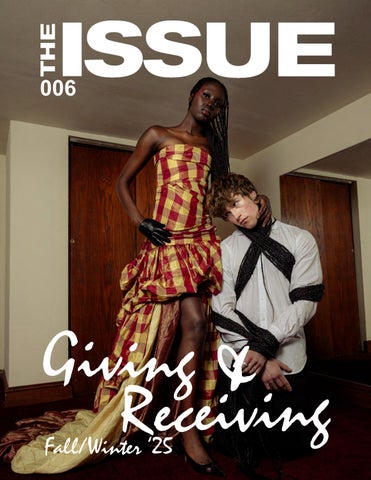
006
Giving & Receiving Fall/Winter ‘25
Table of Contents
1
Statement from the Executive Board
3-4
Letter From the Editor
5-6
Shrink Wrapped
7-14
Shared Stalls
15-26
Terms and Conditions
27-38
Corporate Slop
39-48
Simulacra and Simulation Simulacra and Self Simulacra and Art Simulacra and Fashion
49-65 50-53 54-56 57-64
Feminism Rapunzel On Agony and Agency “Don’t be Such a Pussy!”
66-78 66-69 70-74 75-78
Sustainability
79-86
Spiritual Dimension With Nature Ìyá Ayè Igba Òtútù Through a Wildflower’s Eyes Homes We Keep
80-104 80-92 93-98 99-104
Glitter
105-110
This magazine contains suject matter including sexual assault, queer expression, codependency, corporate America, loss in repetition, sexism, climate change, our connection to the world around us, and party culture.
22
13
Thank you to everyone who contributed to this magazine and organization. You made this possible. <3 The Issue Executive Team
4
ONLY WAY Letter From the Editor
IS THR 5
Y OUT
It feels only fitting, in an issue talking about giving and receiving, to reflect on how much The Issue has given me. For three years, I have been a part of a constant exchange of ideas alongside a group of the most inspiring people I have ever gotten to know. Every different perspective on art, fashion, and culture has immensely changed my perception of the world for the better. To say that The Issue has given me a chance to express myself would be an understatement. Because of this organization, I am confident, more passionate in my craft, and surrounded by relationships I will cherish forever.
ROUGH This academic year, I have been given the opportunity to lead this club and have experienced first hand the importance of creative demonstration. To see everyone come together and discuss how they give and receive within their own lives was a gift in itself. However, watching the group run with the concept and create a mosaic of impactful and personal stories is what filled me with hope. I sincerely want everyone to find something within this magazine that sparks reflection, or even their own creativity. Art and expression heals the world during these uncertain times and there is never enough of it. Sidney Petersen, Executive Director of The Issue
6
7
Shrink Wrapped Creative Director: Ashlin Driscoll Producer: Emma Schieffer Project Managers: Mariana Minter & Lily Bloch Photographers: Emma Schieffer, Ashlin Driscoll Stylist: Lily Bloch Set Design: Agata kudlacz Writers: Spencer Runde, anonymous Models: Ellieww, Agata kudlacz, Alicia obiakor, Marco assam, Serres rossing, Lily Bloch
untitled Can you imagine experiencing assault both as a woman and a man Was it because I questioned God? Why not just say “amen.” From what I learned about God growing up, he views me as beastly The Old Testament says I should marry the human that raped me Instead of marriage I proceeded to sin day after day Late night sex and Xanax for a makeshift soiree Anything that could serve me a mental getaway When truly I just wanted safety in the foreplay Every now and then on my phone I see the words “Protect the Dolls” But what are you supposed to do when society doesn’t give a fuck at all? I’ve heard of victim blaming but I still can’t feel my worth All because I strayed from my assigned sex at birth I’ve been tunnel visioned on combatting the silence With my hands funneled I can educate thousands on violence That’s right–thousands–a one followed by three different zeroes Yet every step I take is diminished by three digits that call themselves heroes
9
- anonymous
Untitled Sometimes it’s not some big thing. It happens and you move on with your life and you forget about it. A few years later you sit down with a bottle of wine and as the drinks flow, your past does too. You watch your friends faces as they realize —and you realize for the first time in a long time— that this shouldn’t have happened. That maybe you’ve been too dismissive of yourself and you’ve been too forgiving. This moment is fleeting though, and as the night persists you push it down, even further. You move on until the next bottle of wine. - anonymous
10
11
12
13
For the longest time, I couldn’t come to terms with it, remaining as disconnected as I possibly could. I was living in London alone and had nobody to turn to in person. After that, I was never really “in my body”, often suppressing signals like hunger, pain, and tiredness. Everything made it incredibly difficult to form any sort of secure connection with men. I’m now in therapy and slowly learning how to be more present in my body, beginning the healing process.
UHS survivor services: • survivorservices@hus.wisc.edu • uhs mental health crisis hotline: 608-265-5600 dane county rcc hotline • 608-251-7273 promoting awareness, victim empowerment (pave) • chair.pave@gmail.com • 608-636-0208 wisconsin coalition against sexual assault (wcasa) services for survivors of sexual exploitation and human trafficking • 608-278-2300, mail to: help@arccommserv.com
14
15
Kate, Elyise, Danielle, Lydia, Zach, Mimi, Gage, Ayla, Tyler Cora Ficklen, Declan Smith, Richard Song, Claudia Schwiesow, Krishna Lakkaraju, Threshell, Ella DeNeen, Ceris Omar, Grantham Green, Walter VanDyke, Justin Herrera, Lily Bloch, Cosette Wildermuth, Lucy Kenevan, Ellie Salton, Finn Bromstead, Ty Pieper, Hadley Schultz, Maya Moreno, Carmela Rey
Brandon Mar, Sidney Petersen, Maddie Gordon, Maya Moreno, Cora Ficklen, Carmela Rey, Jacquy Sandoval, Cosette Wildermuth
16
17
On Sunday mornings, once a month when I was very young, my mother would cut my family’s hair, one by one in the small bathroom next to my parent’s room. And after she had trimmed the dead-ends in my long blonde hair, I would watch her shave my father’s head. I wondered about the sensation of the clippers against his skull, and how it felt to be in the sun. I ran my hands over the stubble that was left and loved how smooth it was on my fingers. I thought about how free I would feel to be so light.
When I was thirteen, in the middle of the ocean, I shaved my head to the skin. Minutes later, fallen tiny clippings still itching on my neck, in a family bathroom, I closed my eyes and let my fingers graze what was left of the hair on my head. I thought of how my mother cried watching the long blonde strands spin to the floor. She still keeps a piece in her bedside drawer in a plastic zip-lock bag. Maybe as a token of my childhood, like my first bloody tooth. I think though, that it is, for her, the last physical reminder of my femininity, of the little thing she had dreamed of all her life. A year or so later, in a public restroom at McDonald’s in Englewood, as I ran cheap foamy soap through my fingers, an older woman in her fifties, videotaping on her phone, began to shout, mouth so wide I saw the cavity filler in the back of her teeth. I guess she read me wrong. On the train later I stared into myself through the smudged window. I contemplated my form, how I translated outside of myself. I thought on what it was to be a girl, fourteen, adolescent, masculine. This was the first of many incidents like it. I was sixteen and I had begun to find comfort in myself. My hair was brown now and long again. Metal hung in my nose. I discovered what it was to sit in the bath at night, to dip the tips of my fingers into its pull. To listen to the soft trickle of the water as it moved along me. For a long while I found peace there. One Monday though, out of the blue, I felt the current suddenly shift towards the drain and I watched as it carried the warmth elsewhere. The tub never filled to the top for me after that. Maybe if I were broader, my shoulders wider, my arms stronger. Maybe if I were taller. Here I am today, a few years older. I look into the blue of the mirror in the bathroom I rent. My hair is short again, though my mother hasn’t cut it in a while. It’s getting closer to blonde, but won’t ever be as it was. A river lays in my backyard, red campion grows at its bank, and minnows flutter in its shallow.
18
19
20
21
22
23
24
You never know what goes on behind closed doors, A silent cry that somehow echoes Through the cracked tiled floors Or the trembling smile of a secret Finally, inevitably known You never know what goes on behind closed doors, When the faucet runs like it’s got somewhere else to be, Carrying the weight of unspoken confessions Down a drain too used to listening When the light flickers, A stuttering pulse That mimics the heartbeat of someone with knots in their throat Names etched into the walls With desperation and anger The memories of those that passed through, Showing their existence To a world that forgets too fast,
25
You never know what goes on behind closed doors To the girl that reapplies courage in the mirror, Painting strength back onto her trembling lips to the boy who washes the sorrow off his face Forever stained with the unfathomable grief of man Every stall carries a story, Some whispered, some wept, Some etched into brick In the language of the unguarded Behind each door The universe blooms and collapses In the span of a breath You never know what goes on behind closed doors But if you listen closely, You can hear the symphony of humanity, The breaking, The mending, The becoming.
26
Creative Director - Eve Martin Project Manager - Maryam Yusuf Project Assistant - Sara DeBuhr, James Casserly Writer - Marguerite Giese Visual Artist - Lily Freund Graphics/ Editors - Maryam Yusuf, Eve Martin Photographer - Phoebe Tseng Stylists - Nusaybah Quardi, Dave Simeon Models - Cora Ficklen, Ella DeNeen, Isabella Lawson, Cameron Kiger
27
If two people are bound to meet one another, does that mean our lives are forewritten? Do we have control over our lives or does everything transpire as it’s meant to? If two people meet despite every circumstance being against them, wouldn’t every moment leading up to that be predestined? When I first heard of the red string theory, these are some thoughts that ran through my mind. I have never truly been in love nor have I had a connection that felt as though we were destined to meet. So I observed one of my closest friends’ love life. She had been drawn back to her boyfriend repeatedly. They always found their way back to one another, despite being in different relationships, places and phases of life. Their relationship evinces the idea that we are meant to meet certain people when the timing is right. I personally thought that relationships, especially the ones that return, are meant to reveal something within us. Some of our lessons can manifest back through relationships. This theory, along with other captivating relationship dynamics such as parasocial relationships, became catalysts for this interview. I sought to uncover whether relationships that feel “meant to be”, truly are, or if they may be a reappearance of unresolved wounds. So I brought some of these thoughts to my therapist, Amber, to understand how psychology plays a role in these connections.
Marguerite: The first question I have is, what is an attachment style and how does it influence the way we form relationships? Amber: Attachment styles come from attachment science, and it starts with infants and the bonds that form between a baby and a caregiver. It includes our whole developmental years. Our attachment styles developed based on the nature of those relationships and whether they were secure and stable, or insecure. Marguerite: How do you think parasocial relationships form, and why do they feel real? And how does attachment style come into play with this dynamic? Amber: I think they form as an attempt to find a missing experience, and to heal something. They probably didn’t get certain needs met as a child, so as they enter adulthood they unconsciously seek to find these unmet needs. It can feel easier to do that in this fantasy they’ve built for themselves. With social media, and videos of celebrities it’s easy to form a picture of this person, learn about them and create an experience of having a connection. Since it’s fantasy, it might feel safer for the nervous system than attempting to develop that with a real person, where there’s vulnerability. It’s one sided, so you don’t have to open up. Attachment style definitely plays a role. I mean, someone with a healthy attachment in relationships would most likely not find themselves in this predicament. This is where you can easily see the “missing piece” these individuals have.
28
Marguerite: Should those in a parasocial Amber: I certainly believe in things that are relationship seek therapy, and how should beyond our capacity to see in the tangible world, someone overcome this? and forces beyond our ability to understand. So it sounds like another kind of idea that fits Amber: I would recommend if somebody in with the cosmic mystery of what we’re doing feels like they’ve formed a parasocial here. I don’t believe I’ve experienced it in my relationship, to talk to a therapist about it, personal life, but that doesn’t mean that other and try to understand what might be driving people haven’t. it. They don’t have to feel ashamed about it. Marguerite: Could belief in this theory Marguerite: Are there any benefits with encourage codependent behavior or parasocial relationships, or even AI unrealistic, delusional behavior? relationships. Or should they just go to Amber: I pretty much think any belief therapy… surrounds confirmation bias. Anyone could Amber: I can imagine there are both benefits use that concept to confirm to themselves and consequences that go together. It’s that this specific person is the one for them. meeting some needs but maybe not in the Anything can be used to support a delusional right way. There’s better avenues to meet that belief. That’s why it’s important to hold lightly need. Such as having real life connections the way we’re making sense of life or making with friends or community. As for AI, I meaning of things believe it’s designed to keep us engaged. It’s not designed to help you overcome. It Marguerite: To end this interview off, Could really tries to colonize your attention, so it’s someone use the Red String Theory to important to be aware of that. It can really manipulate others? detract you from other relationships. Amber: It depends on their intentions, some Marguerite: What do you think of the Red people aren’t consciously trying to manipulate String theory, and that there may be someone others. Again, someone’s attachment can who we are destined to meet? show up with unconscious manipulation. This theory can also easily contribute to spiritual bypassing, which are spiritual ideas that sidestep rather than confront discomfort. Someone definitely could manipulate others to believe they’re destined to meet, creating a false fantasy knowing it’s not true. There should be caution around the use of spiritual ideals, and to be used in a mindful way. Otherwise listen to your gut feeling and try to notice patterns.
29
30
In 1183, a young woman was well known throughout Japan for her bewitching dancing, and remarkable beauty. She aroused audiences in the Imperial Court through her graceful and fluid movements. Provoking an emotional depth within the gathering was a natural occurrence. Her name was Lady Shizuka Gozen, and she was one of the most influential dancers of the 12th century. Her presence attracted only the highest ranked warriors and gentlemen. When Minamoto no Yoshitsune first encountered Shizuka, he was a warrior constantly on the move. His familiarity resided in political tension and constant movement, living in danger. Therefore, his attendance at the Kyoto court was rare, only occurring during brief moments between campaigns. But it was during one of those ephemeral visits where chance placed him before Shizuka. Watching her ostentatious performance, Minamoto quickly became infatuated with Shizuka. Her elegant movement spoke to him more than any other woman he encountered. Shizuka also felt something towards Minamoto and understood their meeting was inevitable.
31
This connection wasn’t bound by only affection, but an enticing pull neither could deny. Although their lives were not in alignment with one another there was a force neither could resist. They no longer belonged solely to themselves, rather some parts of each lived in the other. This bond never diminished, even when separated by a tumultuous political state. Thoughts of one another consumed them, tightening the pull that felt inescapable.
32
This effulgent pull is anything but innocent. It proposes that a deeper force is at work, one that defies logic. In East Asian culture this force is known as the Red String Theory; an invisible string that connects two souls who are destined to meet regardless of time, place or circumstance. The string may tighten during propinquity, loosen with uncertainty, and tangle when met with resistance. Yet no matter how knotted or unraveled the string is, it will never break. Shizuka and Minamoto were proof of this theory. Every quick glance, thought and words tugged at the thread, ensuring they always found their way back to one another.
33
The Red String theory explains the complexities of these enduring relationships. It’s one of the most enthralling explanations of why two people can’t break free from one another. It suggests certain relationships are meant to happen especially when the timing is right. If we look around to those who have made a profound impact on us, maybe we’d begin to understand the longing that binds us together.
34
35
36
37
38
Corporate/:,Slop. Creative Direction: Leah Kennedy, Leah Rodriguez Photography: Amy Laudi, Leah Rodriguez Styling: Lucy Baird, Leah Kennedy “The Control Machine” written by Alex Goff Talent: Akshaj Kumar, Jordan Almandi, Sophia Koo Wardrobe: The Bounty Madison
../”The Control Machine “Smash the control images—Smash the control machine” William S. Burroughs They have me where they want me, walled in with enough mediocre satisfaction to sustain me until I die. I’m not happy, I’m imperceptibly content. At some point you have bought into the illusion for long enough that it becomes your reality and part of your world. There comes a time in everyone’s lives when they give up.
Most do it on their death bed, letting go of what feeble energy they still have. Others, like me, have given up early. The soup has gone cold. The ice has melted. My dreams floated away, and I didn’t even notice. It has gotten increasingly hard to avoid that there is no alternative to my fate. It feels like I am leaving behind all of my free will. I recall when I used to look forward to the future. I was younger; everything was brighter. Going to school felt like an adventure. Every day was fresh, and flowers bloomed. What I think of life now is anyone’s guess. There is less of a thought, more so a feeling of complacence. Every day my skin sags a little more and my body dares me to give up. I find that working endlessly denies me the time to sit with my mistakes. Without even knowing it I have become what I used to despise: The man with the suit and the fake smile, the firm handshake that is intended to show dominance, finding joy in the mundane aspects of a simple life serving the system. Another part of the machine.
You could say that my corporate life isn’t that bad, but who are you to put yourself in my shoes? At the end of the day, how I feel only matters to me. I am not designed to work like this. There is no color in my life. Reality is gray. What else is there to do but accept that this is how I have to live? The love of my life is far away, but at least I can see their face on Instagram. There I can also see how so many apparently are living the good life. Influencers, streamers, everyone that somehow does nothing but has everything. I will never be happy, because that would require me having a dream. But that got crushed by the fact that I no longer believe in anything. Everything is so meaningless these days. I spend hours scrolling on my phone, simply because I
41
42
am too afraid to commit to anything that is real. Everything feels useless when you realize no one is motivated enough to actually try and change things. The fact is, my brain is too fried to even care anymore. I can barely keep a conversation, but nor can anyone else. The human connection is lost and is never coming back. Instead, we add each other on Instagram and then don’t have the guts to speak when we pass in the street. I’ve never loved anything or anyone, but love is so old-fashioned anyways. Who needs it? At least with AI I get to think even less! Everyday becomes easier because I can be even stupider (get it?), and it won’t matter. America has created its legion of mindless freaks like me that will be good little consumers. I will watch all the shows and drink all the alcohol you have! More more more! Critical thinking is so passe. I’d like to imagine that I have had great ideas, ones that would have gotten me far, and that they have leaked out of the hole in my head, where the rest of my passions and personality dripped out. A job is a job and life is meaningless; ergo…I forgot. Upon entering the office, I let my face melt off and apply my new corporate mask. Smiles, “Did you see the game”, always conscious of my ugliness that no amount of
skincare or makeup will ever fix. No one actually talks to each other like a normal person. We all barely know each other, and even what we know is fabricated. Seeing as I’ve never interacted well with anyone, I dread having to speak with anyone. What do they have in common with me? I’m unique, I’m cool, I’m different, but they don’t see that part of me. My entire persona is fake, although at this point, I have to use it so much that it has become me. You can only smash your fingernails with a hammer a few times, before they completely fall off. The ones that grow back will be similar, but not the same. They never are. I love my corporate job. I will stick with it. It cannot be that bad, except I know it will be. The benefits will be plenty, and I will be comfortable, although that is entirely in the physical. Internally, I will slowly lose my soul, as the shareable, friendly, and fake persona fills me to the brim with its infective monotony. How many knives can you jab into me until nothing is left? Only Caesar may know. Life cannot only consist of work and death, yet as Americans that is our dream. I can only hope that when I retire, my pathetic old body will be able to keep up with what is left of my aspirations. I have taken the steps to
becoming a corporate lapdog. My hair is standard, my clothing conforms, I cannot wait to play golf with my boss. I will play the game, tote the line, telling myself that once I get a job, work a bit, make some money, I can transition to something else, something that gives me meaning and fills my days with color. My fake smile and firm handshake will get me on the right path. Truthfully, when I am free from the machine, I can be something. Although, I will find that all I have become has made me fearful of what I once was. I am weary of those who choose their own path and did not conform, because they have a freedom that I lost so many years ago. There will be so many just like me; hollow, afraid of life, spending the rest of their lives withering away, regretful of everything. I’m tired. I’m drained. Yesterday is today and today is yesterday, while tomorrow never comes. Tomorrow things will change. I can only be trapped for so long, until I can get out of it and live how I want to live. One more day, one more year, work is work, so how can I complain? Days pass by in a silent way.
44
The keyboard clicks and slow drags of coffee snap my brain out of focus, only for the sheet to slip off the bed again, pulling me out of my daydreams. The monotony has become comfortable, if only for the fact that it allows me to be nothing. Nothing is humbling, because most people are nothing. They are hollow and sickly, waiting to die, even rushing to die, just so nothing can be said about them at their funeral, besides “they lived and they died, as all do”. But that is only the frozen arena we find ourselves in at work. At home, I melt the ice off and spread my brilliant wings. Reds, blues, hints of gold: life is bright outside of the office. The world is bustling outside those blank walls and brown carpets. In my home I am myself; it is a castle that no part of my work-personality can destroy. From the moment I step inside I can feel a change inside of me. My own time to be myself. No one can take that from me. However, we all know that is not true…my job trails me home, watching, waiting, for the moment when I break and cannot overcome the ways in which its chokehold grip has changed my humanity. “My life is not my job!”, I cry as I attempt to sleep, thinking of spreadsheets. Giving away every ounce of my freedom for a paycheck, never again will I dream, and eventually I will grow fearful of dreaming. There is no life without expression, yet I feel drawn to the security of a job that will only trap me. I cannot bear to be boxed in, yet it seems that is my fate. Inevitably, we all must grow up and accept it.
45
I have given in. What has occurred to me is that I no longer have the energy to fight for my goals, I am drained of any responsibility for my life. The comfortability of domestic mediocrity is stunning. I have all I need. Life has been made simple and sweet because my brain has been turned off.
Artificial noises, fake lighting, disingenuous smiles, where did my passion for life go? If I cannot create like others, then all I am left with is picking from this corporate slop. In this office, everyone else has given up everything to be “something” in a world that does not care. Everyone has shed their beautiful cocoons only to become hideous, pitiful, decomposing bugs. Don’t ever ask me again what I want from Chipotle.
47
SIMULACRA AND SIMULATION SIMULACRA AND SIMULATION SIMULACRA AND SIMULATION SIMULACRA AND SIMULATION SIMULACRA AND SIMULATION SIMULACRA AND SIMULATION SIMULACRA AND SIMULATION SIMULACRA AND SIMULATION SIMULACRA AND SIMULATION SIMULACRA AND SIMULATION SIMULACRA AND SIMULATION SIMULACRA AND SIMULATION SIMULACRA ANDSIMULACRA SIMULATION AND SIMULATION SIMULACRA AND SIMULATION SIMULACRA AND SIMULACRA SIMULATIONAND SIMULATION SIMULACRA AND SIMULATION SIMULACRA AND SIMULATION SIMULACRA AND SIMULATION SIMULACRA AND SIMULATION SIMULACRA AND SIMULATION
SIMULACRA AND SIMULATION
Simulation: The creation of a copy of an object. Simulacra: Objects that are copies of a copy. Objects that have lost semblance of their original. – Ideas of Jean Baudrillard Where do we see simulation and simulacra in the present? What effect does it have on our culture? What effect does it have on us? How do we give and receive these shells of objects with their strange, loose veneers?
49
SIMULACRA AND SELF SIMULACRA AND SELF SIMULACRA AND SELF SIMULACRA AND SELF SIMULACRA AND SELF SIMULACRA AND SELF SIMULACRA AND SELF SIMULACRA AND SELF SIMULACRA AND SELF SIMULACRA AND SELF SIMULACRA AND SELF SIMULACRA AND SELF SIMULACRA AND SELF SIMULACRA AND SELF SIMULACRA AND SELF SIMULACRA AND SELF SIMULACRA AND SELF SIMULACRA AND SELF
SIMULACRA AND SELF
WRITING: IAN WOJTAK MODEL: RILEY FUCHSEL PHOTOGRAPHY: OLIVER BRAATEN CREATIVE DIRECTION: IAN WOJTAK
51
The past two decades have been something of a vindication for Baudrillard and his theoretical acolytes. It is difficult to imagine such philosophies of simulation were created before the smartphone or the VR headset, but these inventions are products of the same enterprise Baudrillard lamented, the divorce of reality from the material. This disunion manifests in the two most prominent frontiers of digital reality: generative artificial intelligence and the digital social sphere. In our lifetime, man has created the means to obfuscate reality with illusory videos of people never born, and grids of portraits more real to others than the face behind them. Generative AI is the simulacra mechanized. Engorged on great works of art, masterful prose, and the sum of human-made knowledge, these algorithms spit out cheap copies, lifeless approximations of the earthly intellectual canon. A third-grader generates an essay that reads as stilted Didion, a company’s cartoonish advertisement vaguely resembles a Pixar character. Perhaps one day you will drive past a billboard and see a model wearing the face of your mother. Nothing is sacred in the backwash of the machine learning revolution. But why is it that the reproductions of machines fall so flat on human eyes? No great human work stands alone; Davinci copied the face of a model to paint the Mona Lisa, Christopher Nolan drew from Satoshi Kan’s Paprika in directing Inception, and the seminal 90’s rom-com 10 Things I Hate About You could not exist without its basis in Shakesphere’s Taming of the Shrew. Something singular, almost magical, occurs when the human mind is inspired. It seems that ideas cannot pass through us unchanged. The entirety of human creation is a chain of inspiration, homage, and reinvention where no one work is inseparable from its predecessors. There is no line of code, no fresh water reservoir, and no publicly traded company capable of distilling this power into an amiable chatbot. Even so, the machine chugs along, taps run dry, and billions line the pockets of concerned shareholders.
52
53
Simulacra is ultimately a tool of culturalcritique. After all, Baudrillard’s work originates from sociology; the simulacra is the anxieties of digitizing society put to paper. And in the 21st century these anxieties are evergreen, it seems every day some new invention wears the mask of simulacra. For the culturally tuned-in, the most immediate example is the new home of social interaction in the digital age: social media. It is in this ecosystem that the simulacra has thrived. For most, particularly those who entered the cultural fold under the Coronavirus shutdowns, the digital reality has usurped the material. The “real world” is something auxiliary that periodically interrupts the one behind a screen. What the median 150-200 followers of an Instagram account know as you is a perfectly curated grid of portraits and experiences, all filtered and vetted to paint your life in enviable color. The world beamed through the Tik Tok algorithm is awash with farm-to-table small plates, bleached teeth, and 60-second “get-ready-with-me’s” from corporate-sponsored Jones’ perfectly engineered for keeping up with. If you spend the American average of six hours a day in this world, why bother doing anything else? The real world is drab, expensive, and hurtling at break-neck speed towards a pretty bad place. This imbalance of desirability only intensifies the allure of the digital. To lessen the burdens of a cold and cruel world, we have crafted a new one in blue light, and every new account reaffirms the digital reality’s place on top of the material. Social media and the online have become the simulacra of material reality, and for what? You sit on a bus with 25 people your age, any eyes you are lucky enough to catch are promptly hidden behind a decorative phone case. The friends you made at that party fade from your memory, cropping up among a growing list of story-likers all accrued in a similar fashion. And now artificially-generated images infiltrate your feed, and the mantles of simulacra coalesce. In this brave, new world, what is left for the human? In 2024, artificial intelligence “bot” accounts made up 51% of internet traffic. Increasingly little, it would seem. The path forward is unclear, for the time being the world (or at least its more powerful members) seems captivated by the AI revolution and short-form social media, leaving the rest of us to grin and bear it. But we huddled masses are no strangers to uncomfortable circumstances. Perhaps some blank canvas, some new face across the bus, is waiting to render this incomprehensible reality familiar. So don’t stop telling stories, being inspired, talking to strangers. Remember that what these simulacra seek to capture in their emulations are the things we give and receive without even thinking. Hold these things close, use them to steel yourself against the onslaught of the unreal, and next time you make something new, thank those makers that came before you. With nothing to copy, where would we be?
Simularca and Art Simularca and Art Simularca and Art Simularca and Art Simularca and Art Simularca and Art Simularca Simularca and Artand Art Simularca Simularca and Artand Art Simularca and Simularca Simularca and Art Artand Art Simularca and Art Simularca Simularca and Artand Art Simularca and Art Simularca Simularca and Art and Art Simularca and Art SimularcaSimularca and Art and Art Simularca and Art Simularca and Art Simularca and Art
Simularca and Art
54
Art encapsulates humanity. It represents, distinguishes, completes, and augments. A way for people to express themselves, their beliefs, ideologies, and emotions, and subsequently, it has turned into a conversation. No piece is created within a vacuum. No concept is completely original. And so, where do we determine originality? In what is there a reference? Where is an homage, where is opposition? One of the quintessential components of the simulacra in art, particularly modern art, is the in-depth conversation of references and emotion regarding other pieces and aesthetics. Entire movements have come into being to directly combat modern events and other movements; for example, Dada in reaction to World War I, or Futurism’s idealization of an increasingly advanced world. Art also notably connects with the development of political movements–acting as another device oriented toward garnering understanding and camaraderie through people and groups, showing another facet of simulacrum being that this art is so often interlocked with real life and reference within itself. Women were far underestimated and underrepresented in art, so they entered the field because of the setbacks they may face–feminism was a powerful force motivating women to strive past any predetermined future society may have set for them. Female artists utilized their precarious political standings as fuel for art and entered the conversation. Many of their works, as iconic as they may be, based around history and things currently surrounding them, become references amongst themselves and for future movements. Simulacra become present with these constantly engaging facets, when women enter the conversation in the mid-20th century. Tired of constant dehumanization, even in the art of their peers, women began to create aggressively. Janine Antoni’s Loving Care (1993) is a direct counter toward Yves Klein’s Anthropometries line (1960s) in which he utilized women’s silhouettes as “human paintbrushes.” Antoni shouts back, using her own hair and hands as paintbrushes as a reclamation. Carolee Schneemann is an icon in speaking against the phallic focus, orienting toward the vulvic, putting her own empowering mantras and beliefs in writing on a scroll, removing it, and reading it aloud in performance art called Interior Scroll (1975), in reference to all of the men ruling modern art, and as inspiration to all of the women craving to create.
55
A piece of community and conversation where women acknowledge and inspire others, Judy Chicago’s Dinner Party (1974-79), referenced many feminist artists and icons, including homages to Georgia O’Keefe, Susan B. Anthony, and Virginia Woolf. And so the dinner plates mirroring these feminist figures became their own icons, images of superimposed femininity that illustrate the concept of consuming media individually to form your own identity. Its prevalence continues to bleed into feminist art, seen in Shani Rhys James recent work, where dinner plates with a man’s head on top (Isabella, 2020), or plates with beautiful and ornate flowers (What Came of Picking Flowers, 2022) allude to something definitely seen before. As women’s voices are heard, as time passes and the gender gap is lessened, as what’s been communicated is understood and implemented, these highly influential ideas continue to flow and develop, to morph and shift into something new. Simulacra exists inherently in art- every person leads their own individual living experience, and depending on the vacuum in which you live, what influences you deeply, what you create will be vastly different compared to that of someone else seen in any other time period or any other country. What we ingest is mimicked in what we create, and as time passes, what we see is vastly different than any other person’s experience. What art we see today often provides links to the past, especially as notable works interlock with our current headspaces. But so many pieces are lost in the process, and so many voices forgotten. What we see is but a minuscule parcel, and will be the same to someone in the future with the expansion of technology and everyone who creates. You are but a piece of the simulacra to someone, so you might as well contribute to it. Emulate what you believe, create to alter what’s broken. Everything weaves, interlocks, and combines, so it might make a difference to someone someday.
Writing: Scarlett Schrammel Model: Hadley Schultz Photographer: Oliver Braaten
56
57
60
61
62
63
64
66
67
68
69
70
71
72
73
75
77
78
Clothes: a necessity, a way of self-expression, a way to separate, a way to flaunt, a way to survive the elements. We are marketed with all types of clothing draped on models that inspire envy in our eyes. We get swept away in what is being sold, yet how is it made—and at whose expense? Many of us know factories exist to make these clothes or imagine designers sketching the pieces we’re shown, yet the exact details behind production rarely reach the public until cracks begin to show.
This relentless demand from new fads means thousands of items are pushed into the market at lightning speed, which comes at the cost of human lives and dignity. Low prices for buyers and quick turnaround times for brands are made possible only through the exploitation of workers who are underpaid, overworked, and denied basic rights.
Many other fast-fashion companies follow variations of this same model, multiplying the scale of harm faced by SHEIN provides an all-too-real view of this inhumane treat- garment workers around the world. We want to remind buyers that behind every polished advertisement or trendment. From July to December of 2021 alone, the brand added between 2,000 and 10,000 new styles to its store ing style may stand a workforce stretched to exhaustion, per day—an output that can only be achieved through im- paid pennies, and denied the protections every human deserves. mense pressure on garment workers. Investigations revealed workers were being paid just £0.03 per item, working 16+ hour days, and receiving only one or no days off Models: Crystal Li and Finn Bromstead Visual Design and Photography: Harrison Arnold per month. A BBC investigation similarly uncovered employees forced into 75-hour workweeks, in direct violation Writer: Finn Bromstead of labour laws in China.
81
82
83
1.)
2.)
In the long run, fast fashion just fuels consumption and makes us have this need to buy, buy, and buy again. This consumption is made by messages that equate consumption with fulfillment. A message pushed down our throats in the media, which is only supported when our clothes aren’t made to last in the first place, so all we can do is buy again. The issue plaguing us is entirely social, and the way to rid ourselves of the effects of fast fashion is to change the culture of fashion entirely.
84
85
Fast fashion generates an estimated 92 million tonnes of textile waste globally each year. From 2000 to 2015, global clothing production doubled, even as the average number of times a garment is worn decreased by 36 percent. This cycle produces lower-quality clothing, sells it cheaply, and then discards it rapidly, contributing significantly to environmental degradation. Much of this waste is shipped to economically vulnerable countries, due to foreign affairs, where it is dumped in large quantities. These textiles contaminate soil, strain local waste-management systems, and can take decades to decompose. In the United States alone, approximately 81.5 pounds of clothing are discarded per person annually, resulting in significant national waste generation. As consumption trends accelerate, more garments are burned or landfilled after only a few wears. Achieving sustainability requires addressing both the conditions that garment workers face and the intentionally short lifespan of fast-fashion products. These two issues lie at the core of fast fashion’s unsustainable impact and must be confronted to reduce its global harm. Model: Micheala Hamilton Writer and Set Design: Finn Bromstead Visual Design and Photography: Harrison Arnold
86
87
88
90
91
92
93
95
96
97
98
99
100
101
102
103
104
Soyer Foley,Tyler Burbey,Annika Nelson, Gabrielle Tiberi, Ella Piette, Rose Kungl
106
107
Soyer Foley,Tyler Burbey,Annika Nelson, Gabrielle Tiberi, Ella Piette, Rose Kungl
108
109
It is when you give yourself that you truly give.
Khalil Gibran