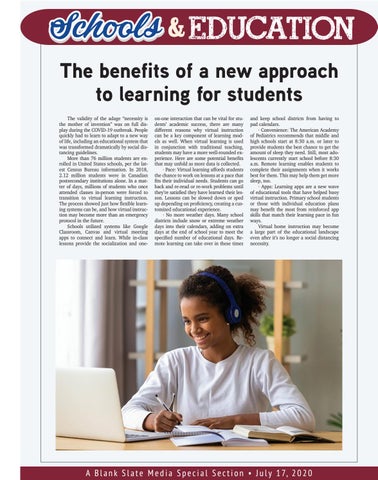
& The benefits of a new approach to learning for students The validity of the adage “necessity is the mother of invention” was on full display during the COVID-19 outbreak. People quickly had to learn to adapt to a new way of life, including an educational system that was transformed dramatically by social distancing guidelines. More than 76 million students are enrolled in United States schools, per the latest Census Bureau information. In 2018, 2.12 million students were in Canadian postsecondary institutions alone. In a matter of days, millions of students who once attended classes in-person were forced to transition to virtual learning instruction. The process showed just how flexible learning systems can be, and how virtual instruction may become more than an emergency protocol in the future. Schools utilized systems like Google Classroom, Canvas and virtual meeting apps to connect and learn. While in-class lessons provide the socialization and one-
on-one interaction that can be vital for students’ academic success, there are many different reasons why virtual instruction can be a key component of learning models as well. When virtual learning is used in conjunction with traditional teaching, students may have a more well-rounded experience. Here are some potential benefits that may unfold as more data is collected. · Pace: Virtual learning affords students the chance to work on lessons at a pace that fits their individual needs. Students can go back and re-read or re-work problems until they’re satisfied they have learned their lesson. Lessons can be slowed down or sped up depending on proficiency, creating a customized educational experience. · No more weather days. Many school districts include snow or extreme weather days into their calendars, adding on extra days at the end of school year to meet the specified number of educational days. Remote learning can take over in these times
and keep school districts from having to pad calendars. · Convenience: The American Academy of Pediatrics recommends that middle and high schools start at 8:30 a.m. or later to provide students the best chance to get the amount of sleep they need. Still, most adolescents currently start school before 8:30 a.m. Remote learning enables students to complete their assignments when it works best for them. This may help them get more sleep, too. · Apps: Learning apps are a new wave of educational tools that have helped buoy virtual instruction. Primary school students or those with individual education plans may benefit the most from reinforced app skills that match their learning pace in fun ways. Virtual home instruction may become a large part of the educational landscape even after it’s no longer a social distancing necessity.
A B l a n k S l a t e M e d i a S p e c i a l S e c t i o n • J u l y 1 7, 2 0 2 0
24 Guide to Schools & Education • Blank Slate Media Newspapers, Friday, July 17, 2020
How college students can confront returning to campus The world’s response to the outbreak of the COVID-19 virus left no aspect of life untouched. People from all walks of life had to make sacrifices to prevent the spread of the potentially deadly virus, and college students were no exception. Many colleges and universities abruptly canceled in-person classes in mid-March 2020, forcing students to finish their coursework via remote learning. That response had a significant impact on the 2019-20 school year, and the virus figures to affect the upcoming school year just as much. In fact, many colleges and universities are beginning the coming school year early in the hopes that students can continue their educations on campus but be safely back home by late November, when many scientists are anticipating a second wave of COVID-19 infections will arrive. Schools that are reopening this summer insist that it is safe to do so, and have even indicated their intentions to implement new practices to ensure their campuses are safe and healthy environments in which to learn. For example, the University of North Carolina at Chapel Hill is reconfiguring in-person course instruction to include physical distancing provi-
sions. Small classes will meet in larger spaces, while lectures may be delivered remotely. Despite such measures, some students may still be hesitant to return to campus at a time when so much about the COVID-19 virus remains a mystery. The following are some ways students can confront any nervous feelings they may have about returning to campus for a new school year. · Determine your options. While many
colleges and universities are returning to campus, some may be allowing students to learn remotely. For instance, students with preexisting conditions that make them vulnerable to COVID-19 may be allowed to continue learning from home. Many schools’ roadmaps to returning are fluid, so students concerned about returning to campus likely have options that do not require them to sit out the semester. · Learn about residential life. Many college students live in dorms that feature
double or even triple occupancy rooms. Such an environment will compromise students’ ability to practice social distancing. Some schools, including Binghamton University in New York, are converting triple occupancy rooms into double occupancy. Both Binghamton and UNC Chapel Hill also are designating one residential hall as temporary housing for students who test positive for COVID-19. In addition, some schools may be designating certain residential facilities for at-risk students. Students who want to avoid the dorms should inquire about off-campus, single-person housing. · Ask about testing. Students have a right to know about COVID-19 testing protocols and should not hesitate to ask what those protocols will be. Due to the fluid nature of schools’ roadmaps to return, testing policies may not yet be set in stone, and are likely to evolve as the school year progresses. Students should look into the testing policy specifics and ask if they have any recourse if they feel the testing policy is inadequate. Students who are hesitant to return to campus this summer or fall can do their due diligence to determine if they’re comfortable going back to campus.
Celebrating Our 14th Year!
Join Us This Summer! The most prestigious in Studio Dance industry experience! The industry’s biggest names in broadway shows, concert world tours, professional dance companies, television, film, talent representation and casting directors are at our studio.
DANCE CAMP AUGUST 3rd to 7th Ages 7 to 11 • Hours: 12 to 4 pm Limited Enrollment Available - SIGN UP NOW!
•
Fall Enrollment - AUGUST 3rd-7th, 12-6pm COME IN OR CALL! “Featuring some of the best teachers in the country in all styles”
15C Jericho Turnpike New Hyde Park 516.DANCE77 • 516.326.2377 www.mossadanceacademy.com
All Students from all areas are welcome!
Blank Slate Media Newspapers, Friday, July 17, 2020 • Guide to Schools & Education
Join us at temple beth sholom Become a part of our TBS family where you and your children can begin a lifelong journey of learning and taking advantage of all our wonderful and enriching family education opportunities. Come learn, grow and celebrate with us!
Learn more about our EARLY CHILDHOOD CENTER We offer a safe and nurturing environment for children to learn, to ask questions and to develop a strong sense of self. We value and honor each child as a unique individual and are here to support their social, emotional and intellectual growth. Children develop an understanding of their Jewish identity through our play-based curriculum and interactions with their teachers and peers. All classrooms are equipped with air purifiers and our Center adheres to all Covid-19 CDC program guidelines.
Learn more about our RELIGIOUS SCHOOL TBS Religious School strives for a curriculum that will challenge the children and provide them with a sense of pride in Judaism. Project based learning is the Religious School approach to impart knowledge and establish ownership of the students’ learning. We strive to serve individual needs as we instill the love of Torah, Israel and Jewish values to our students. Social action projects are a core value of our curriculum where we strive to emphasize Jewish ideals to live by and to practice in our daily lives.
Learn more about MAKOM (The Place) Teens Doing Jewish Makom is the place to be for teen engagement at Temple Beth Sholom. Students will cultivate and nurture their relationships with the sources of our tradition, TBS clergy, educators, each other and the greater community. This allows space for Jewish values and thinking to inform meaningful Jewish choices. Makom, a teen program, focuses on essentials of creating future Jewish leadership. Young adults who are informed, and engaged Jewishly through different avenues. Our program encompasses social action, madrichim (student aids), chesed (kindness and caring) in the community and by studying fundamental textual sources of our tradition. TEMPLE BETH SHOLOM IS COMMITTED TO PROVIDING AN INCLUSIVE ENVIRONMENT FOR ALL STUDENTS. PLEASE FEEL FREE TO SPEAK TO OUR DIRECTORS ABOUT OUR SPECIAL NEEDS SERVICES OR EMAIL INCLUSION@TBSROSLYN.ORG. PLEASE CONTACT: JEN SCHIFFER, ECC Director 516-621-1171 | jschiffer@tbsroslyn.org SHARON SOLOMON, Religious School Director – Family & Youth Engagement and Makom Director 516-484-4980 | 516-621-2288 ext. 118 or 119 | sharonsolomon@tbsroslyn.org 401 ROSLYN ROAD ROSLYN HEIGHTS, NY 11577 | 516-621-2288 | WWW.TBSROSLYN.ORG
25
26 Guide to Schools & Education • Blank Slate Media Newspapers, Friday, July 17, 2020
SANDS POINT PRESERVE A Peaceful Sanctuary Open for Everyone
SUMMER CAMP ADVENTURES VIRTUAL & ONSITE AGE 3 – 10
SUMMER HOURS Wednesdays – Saturdays: 11 AM – 7 PM Members Only: 9 – 11 AM
Sundays: 9 AM – 7 PM Social distancing and face masks are required.
www.sandspointpreserve.org info@Sandspointprserve.org 127 Middle Neck Road, Sands Point, NY 11050 516.571.7901
Blank Slate Media Newspapers, Friday, July 17, 2020 • Guide to Schools & Education
WANT TO STAY CLOSE TO HOME? Come to St. Thomas Aquinas College
A special message from STAC’s new President, Kenneth Daly, a student-centric academic and business leader, who took office on July 1st, 2020, succeeding Dr. Margaret Fitzpatrick, S.C., Ed.D., who retired after completing 25 years of exceptional leadership at the College. “As the new President of St. Thomas Aquinas College, I commit to providing you with a very supportive and caring environment to help you navigate these challenging times. • • •
•
•
We have a dedicated team of faculty who will mentor you every step of the way. We have a beautiful, safe, and vibrant campus environment. We have student activities, clubs, and sports programs to ensure you feel welcome and engaged. We have access to New York City, international travel, internships, and community service to enhance your learning experience. We have a proud history of caring for students like you—and an exciting future whereby, together, we will overcome the challenges we face and develop you into our leaders of tomorrow—leaders with a genuine sense of purpose.
PRESIDENT, KENNETH D. DALY
I encourage you to consider St. Thomas Aquinas College and I hope to see you on campus in the new semester so we can prepare you for the future.”
Please visit us at www.stac.edu/Island-Relief within 2 weeks to apply for special COVID-19 Relief scholarships amounting to at least $50,000 over 4 years. NYC Metropolitan Area (20 minutes from the heart of Manhattan) 125 Route 340 • Sparkill, NY 10976 • 845.398.4100 • WWW.STAC.EDU
27