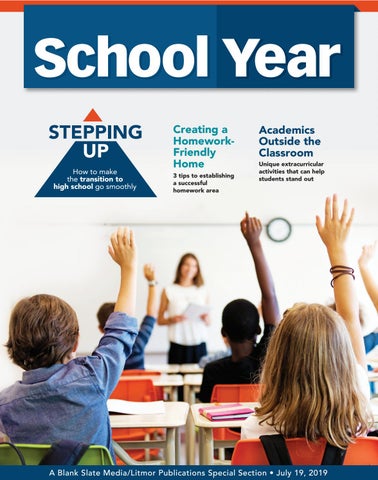
STEPPING UP How to make the transition to high school go smoothly
Creating a HomeworkFriendly Home 3 tips to establishing a successful homework area
Academics Outside the Classroom Unique extracurricular activities that can help students stand out
A Blank Slate Media/Litmor Publications Special Section • July 19, 2019
32 SCHOOL YEAR • Blank Slate Media Newspapers, Friday, July 19, 2019 ADVERTORIAL
NYU School of Professional Studies Division of Applied Undergraduate Studies Affordable Associates Degrees Within Your Reach Perhaps you or someone you know has thought about earning an associates degree, but has not gotten around to enrolling or even making the time to investigate options. Many people do not know that the NYU School of Professional Studies (NYUSPS) Division of Applied Undergraduate Studies offers a truly affordable option for earning an associates degree. In order to encourage students to begin college studies or return to school, NYUSPS recently lowered the cost on its associates degrees, which are now comparable in price to earning a degree at a local community college. The difference is that students benefit from a stellar NYU
education that will open the doors to a wealth of new opportunities. Whether they are pursuing an undergraduate degree for the first time or are returning to school after a hiatus, an NYU education is now well within their reach. Financial aid advisers help students to make the best decisions about financing their education. They guide students on the costs for earning their degree and help them to navigate the process by which to apply for financial aid. Scholarships are also available for those who qualify. NYUSPS associates degrees are designed for students who have earned a high school diploma at least one year ago (students entering this program are typically 19 years or older, with many in their 20s, 30s, and 40s). These degrees serve as an introduction to a professional career or as the first major milestone in a student’s college education. Upon graduation, the credits students earn are transferable to the Division’s bachelors degree programs, allowing them to seamlessly complete the next phase of their education. The associates degrees are perfect for students who decided to take a break after high school or who stopped out of college before earning at least 45 transferable college credits. While enrolling in college later
in life can seem daunting, NYUSPS makes it easy, walking students through the process and helping them to get acclimated to attending classes and to producing college-level work. The range and diversity of academic programs offer unparalleled opportunities for intellectual stimulation and professional growth. Associates degrees provide rigorous curriculum that enables students to acquire knowledge that is immediately applicable on the job. Students build critical analytical thinking skills, gain academic insight, and develop personal and professional relationships—all within a highly supportive environment. The NYUSPS Division of Applied Undergraduate Studies faculty and staff members are committed to ensuring student success. Professionally credentialed academic advisers are dedicated to helping students to navigate successfully through their educational experience. All new students are assigned an academic adviser who provides assistance, support, and a sense of confidence in academic choices. Faculty advisement and tutoring services also are available to ensure that students are getting the most out of their NYUSPS educational experience. The NYUSPS Division of Applied Undergraduate Studies offers four associates degrees: the AA in Liberal Arts, the AAS in Business, the AAS in Health Administration, and the AAS in Information Systems Management. Each of these degrees provides a solid liberal arts core—the hallmark of the wellrounded education that hiring managers seek. From day one, the professionally oriented programs immerse students in industry focused content that readies them for the job market or for additional studies at the baccalaureate level. The Associate of Arts in Liberal Arts allows students to explore a broad range of subjects that will build critical thinking skills, develop invaluable quantitative reasoning skills, and ground them in history and culture. The Associate of Applied Science in Business prepares students with quantitative reasoning skills in accounting, economics, and marketing, while building knowledge about different economies, cultures, and approaches to conducting business globally. The Associate of Applied Science in Health Administration prepares students for roles in managing healthcare systems efficiently and effectively. The Associate of Applied Science in Information Systems Management prepares students
to design, operate, and evaluate competitive technology alternatives to meet an organization’s needs. Central to an NYUSPS education is a strong foundation in the liberal arts. An academic requirement that all NYUSPS Division of Applied Undergraduate Studies students must fulfill, the 32 credits of liberal arts core courses provide critical information and develop a broad range of competencies that form the basis for more specialized and professionally oriented study. The curriculum is enriched by access to the exceptional cultural, economic, political, creative, technical, and business resources of New York City. Classes held during days and evenings, intensives, and online degrees and courses cater to students who are often balancing personal and professional responsibilities. Flexible course schedules
and formats ensure that students can earn their degree as quickly as possible, in a way that fits their busy lifestyle. NYUSPS associates degree students also benefit from career resources offered through their academic division, as well as from career development/management services provided by the School and the University at large. The NYU Wasserman Center for Career Development at the NYU School of Professional Studies and the University’s Wasserman Center for Career Development work in partnership with the School’s academic program areas to provide supplemental services and programs specifically designed for NYU School of Professional Studies students. For more information, please visit sps.nyu.edu/appliedUG/associates01 or call 212-998-7100.
Blank Slate Media Newspapers, Friday, July 19, 2019 • SCHOOL YEAR
WHAT DO YOU WANT TO BE WHEN YOU SHOW UP?
You’re full of potential and eager to get ahead, but one thing’s missing—your college degree. Whether you took a break after high school or you stopped out of college with less than 45 credits, earning your Associates Degree now through the NYU School of Professional Studies Division of Applied Undergraduate Studies can change your life!
OPEN HOUSE - Saturday, July 20, 9 a.m. VIRTUAL INFO. SESSION - Tuesday, August 13, 7 p.m. WALK-IN WEDNESDAYS July 24, 31; August 7, 14, anytime 9:30 a.m. - 5:30 p.m. Register - sps.nyu.edu/appliedUG/events01
From the first day you step into our classrooms, you’ll develop applicable work-related skills in a highly supportive environment, while building your confidence and benefiting from a wealth of university and career development resources. New affordable tuition makes a world-class NYU education attainable.
You can do this, we can help! * Bachelors degree programs available for those who have earned 45 transferable college credits or more.
For information: visit sps.nyu.edu/appliedUG/associates01 call 212-998-7100
CHOOSE FROM PROGRAMS IN: Business, Health Administration, Information Systems Management, Liberal Arts New York University is an affirmative action/equal opportunity institution. ©2019 NYU School of Professional Studies.
33
34 SCHOOL YEAR • Blank Slate Media Newspapers, Friday, July 19, 2019
3 tips to establishing a successful homework area conducted in recent years, is older, there’s little reason to suspect today’s high school students are being asked to do any less than their predecessors were in 2014.
H
igh school students have a lot on their plates. Today’s parents often lament that kids’ schedules are far more hectic than their own schedules were when they were teenagers. But for many high school students, a familiar foe their parents have no doubt encountered is proving a considerable source of stress. Homework has long been the bane of high schoolers’ existence. Studies regarding just how much homework is being assigned to teenagers are somewhat outdated, which makes it difficult to
determine just how much work kids are being asked to do after school lets out. A 2014 survey from the University of Phoenix found that high school teachers assign, on average, 3.5 hours of homework per week. Multiply that figure by five, which is the number of different teachers many high school students have in a typical school day, and the survey concluded that high school students may be expected to complete as much as 17.5 hours of homework per week. Though the study, which is the only one of its kind to be
While parents might not be able to do much to lessen their children’s homework workload, they can take steps to ensure their homes are as homework-friendly as possible. The following are three ways to do just that.
1. Create a communal homework table. The Harvard Graduate School of Education notes that youngsters who seem reluctant to do their homework may benefit from doing their afterschool work at a communal table. With parents nearby, such students may feel less lonely and may be
less likely to procrastinate if they know mom or dad are nearby. Students who are not reluctant to do their homework may benefit from working quietly in their bedrooms.
staying quiet until everyone has finished their homework. Encourage younger siblings to leave the homework area and play quietly or read elsewhere in the home.
2. Clear the area of distractions.
3. Include a break between school and homework time.
Distractions like televisions, devices that are not necessary to complete assignments and even younger siblings can make it hard for teenagers to concentrate on their work. Designate a time each day for homework, ensuring that the television is off and that devices have been placed on “Do Not Disturb.” In addition, high school students with younger siblings can expect their brothers and sisters to be finished with their homework first. Make sure youngsters recognize the importance of
Much like parents may like a few minutes to unwind when getting home from work at night, kids likely won’t want to dive right into their homework after getting home from school. A break between the school day and homework time can help kids clear their heads so they’re more capable of concentrating when they sit down to do their work. A good work environment at home can help kids live up to their academic potential.
Blank Slate Media Newspapers, Friday, July 19, 2019 • SCHOOL YEAR
39
STEPPING UP How to make the transition to high school go smoothly
O
ver the course of an academic career, the average student switches schools three to four times. Elementary school gives way to middle school or junior high. From there, students will transition to high school. If a student chooses to keep their academic journey going after high school, college or trade school awaits. Adolescence is a transitional period when many students may be learning how to make decisions and taking their first significant steps toward becoming independent adults. That can make the transition from middle school to high school more complicated than previous transitional periods young people experienced.
Several changes take place in high school that can impact students’ anxiety levels. • Students go from being the oldest in middle school to the youngest in high school. • The student body population typically increases dramatically. • Curriculum becomes more demanding than it was in middle school. • School hours change, often requiring students to wake up earlier. • A new school may mean students are funneling in from different feeder schools. Long-time friends may be separated depending on where they ultimately choose to go to high school.
A 2016 survey from the Pew Research Center found that
70% of teens say anxiety and depression are a “major problem” among their peers. To help make high school a positive experience and less likely to induce anxiety, students and their parents can employ these tips. • Establish a consistent routine. The education resource CollegeVine advises students to build good study habits, create a calm and organized homework environment and focus on studies while keeping distractions at bay.
• Encourage extracurricular activities. Activities outside of the classroom are a great way for students to make friends and involve themselves socially with their peers. Such extracurriculars can lead to strong friendships that flourish throughout high school and beyond. • Buddy up. Just as they might have done upon entering kindergarten, students on the cusp of starting high school can find someone who will be attending the same school and go over schedules and potential meet-up times. They can make plans to sit together at lunch as they both get acclimated to their new environments. • Attend open houses. Families can tour the campus to get a feel for the layout of their children’s school. Ask for a map of the school grounds so students can get an idea of where their schedules will require them to be throughout the course of the day. The transition to high school is a significant one in the life of a teenager. Families can employ various strategies to make that transition go smoothly.
40 SCHOOL YEAR • Blank Slate Media Newspapers, Friday, July 19, 2019
Unique extracurricular activities that can help students stand out W
hen thinking of extracurricular activities, many people’s first thoughts might be about team sports or group activities like the Boy Scouts and Girl Scouts. While such activities are popular, attracting tens of millions of kids every year, there are plenty of extracurricular activities rooted in academics as well. Extracurricular activities can provide a respite from schoolwork and give kids a chance to socialize with their peers. Extracurricular activities also can be great places to learn lessons that might not be taught in the classroom, such as how to work as a team, the value of good sportsmanship and how to handle defeat. Many of those same lessons can be learned through more unique extracurricular activities. In addition to the things they can learn, students who participate in extracurricular activities can bolster their college applications. According to The Princeton Review®, college admissions officers approach each admissions season hoping to create a class made up of students with diverse interests and backgrounds. To accomplish that goal, officers typically look at each applicant’s extracurricular activities to learn more about the person behind the application. Academic performance is important, but extracurricular activities might help set students apart from other applicants with similar academic backgrounds but little or no extracurricular activity on their applications. Students who want to their extracurricular activities to stand out among the masses of college
applicants can speak with officials at their school about these opportunities.
Model United Nations: Often referred to as “Model UN,” this activity asks students to roleplay as United Nations delegates. Students who participate in Model UN develop public speaking skills while also learning how to conduct research, frame debates and develop their leadership skills. Foreign language clubs: Many high schools offer foreign languages clubs to their student bodies. Such clubs can allow students who study foreign language to develop their language skills further, and they also can be great ways to learn about the culture and history behind the languages they’re learning. Fluency in a foreign language can bolster a student’s college application. Many schools also sponsor additional subject-specific clubs, such as chemistry clubs or English clubs, which can be ideal for students who want to pursue college degrees in such subjects. National Honor Society: While it’s easy to mistake the National Honor Society as little more than an honor roll, the organization is much more than that. Students who qualify for membership in the NHS are challenged to develop their skills further through participation in school activities and community service. Extracurricular activities can help students make the most of their time in school and help them improve their candidacy in the eyes of college admissions officers.
Sport Psychology Dr. Tom Ferraro
has specialized in sport psychology for 20 years and works in the fields of golf, tennis, soccer, baseball, football, wrestling, lacrosse, figure skating, gymnastics, softball, fencing and more. He has helped professional teams, Olympians and elite young athletes learn how to manage the intense pressure of competitive sports. He appears on both TV and radio and has sport psychology columns in 5 different newspapers and has been featured in The New York Times, Wall street Journal and the London Times. Golf Digest includes him in their list of top mental game gurus in America. For a consultation see below: Williston Park Professional Center 2 Hillside Ave, Suite E. Williston Park NY 11596 (building parallel to E. Williston railroad station)
drtomferraro.com drtferraro@aol.com
(516) 248-7189
Blank Slate Media Newspapers, Friday, July 19, 2019 • SCHOOL YEAR
DISCOVER HIGH-QUALITY, AFFORDABLE EDUCATION! CLOSER THAN YOU THINK! NASSAU COUNTY
• 40+ Award-Winning Academic Programs & Our NationallyNationallyRecognized Queensborough Academies Model for Student Success • Championship Athletics, Rich Campus Life, Internships, and Study Abroad & Scholarship Opportunities • Beautiful 37-Acre Campus
IT’S NOT TOO LATE! APPLY FOR FALL 2019! www.qcc.cuny.edu/admissions
222- 0 5 5 6 t h Ave n u e, B ays i d e, N Y 1 1 36 4
41
42 SCHOOL YEAR • Blank Slate Media Newspapers, Friday, July 19, 2019