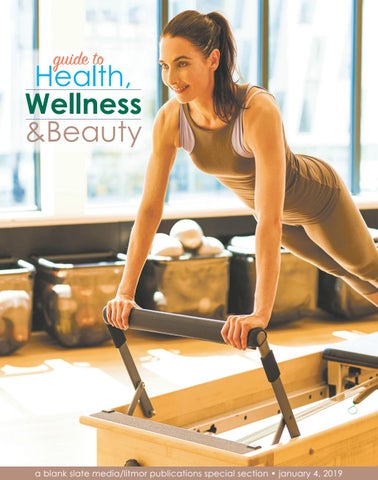
Health, Wellness &Beauty
a blank slate media/litmor publications special section • january 4, 2019
28 HEALTH, WELLNESS & BEAUTY • Blank Slate Media Newspapers, Friday, January 4, 2019
Simple ways to avoid injuries when working out
A
desire to live a healthy, active life compels many people to include exercise in their daily routines. Numerous studies have shown that regular workouts that include a combination of strength training and cardiovascular exercise can make bodies less susceptible to injury while reducing a person’s risk for conditions such as heart disease, stroke and diabetes. Exercising is most effective when it’s part of a daily routine, but that routine can be derailed if men and women are not taking the appropriate measures to avoid injury while working out. While even professional athletes succumb to injury from time to time, there are steps everyone can take to avoid injury when working out. Confirm your technique is the right one. Exercise science is continuously evolving, and that means workouts and fitness machines are evolving as well.
When using a piece of equipment for the first time or altering a workout routine, men and women should consult with a gym employee or personal trainer to learn the correct technique. Incorrect technique can lead to minor and serious injuries because muscles are used in ways they are not intended to be used when exercises are performed properly. Research appropriate techniques, taking advantage of online video tutorials if you don’t exercise at a gym, to ensure the exercises you want to perform are done properly. When beginning a new routine, ask a friend or gym employee to observe your workout and let you know if you are doing anything incorrectly. Be patient. Lifting too much weight or pushing yourself too hard on the treadmill, exercise bike or elliptical machine will increase your risk of injury. This is especially true for men and women working out for the first time or after lengthy stretches of inactivity. Men and women who
are elderly, inactive and/or overweight are likely to suffer from poor balance because their muscles are weak. Those muscles can be strengthened over time, but remain patient and stick to light weight during initial workouts so lack of balance does not lead to pain or injury. Take the same approach with aerobic exercise to prevent muscle strains and pulls. Increase weight and the intensity of cardiovascular exercises as muscles gradually strengthen and become accustomed to exercise. Allow for adequate time to warm up. Failure to warm up is another contributor to exercise-related injury. Before diving into a workout routine, spend between five and 10 minutes warming up your body with some low-intensity exercises. This increases blood flow to the muscles and makes them more elastic and pliable than cold muscles, thereby improving flexibility. Some low-intensity cardiovascular exercise on the stationary bike or treadmill can greatly reduce injury risk during the workout.
Five to 10 minutes of light aerobic exercise before working out can help men and women avoid injury. Vary workouts and exercise regularly. Varying workouts is a good idea because doing so can prevent repetitive-use injuries and prevent overuse of muscles. Repetitive-use injuries such as shin splints and tendinitis require extended rest to heal, and that can derail your routine and nullify your progress. Vary workouts so you are not always working the same muscles, and don’t mistake
varying workouts for varying workout schedules. Working out five days one week and one day the next increases your risk of injury. Injuries sometimes happen when exercising. But veteran and novice fitness enthusiasts can employ a handful of simple strategies to greatly reduce their risk of injury while working out.
(YHU\RQH QHHGV D GHQWLVW <RX GHVHUYH D JUHDW RQH
: 3 LG & :H 3URYLGH D &RPSUHKHQVLYH $UUD\ RI 'HQWDO 6HUYLFHV K L $ I' W O6 7HHWK &OHDQLQJ ‡ )LOOLQJV ‡ 7HHWK :KLWHQLQJ ‡ ,PSODQWV 9HQHHUV ‡ &URZQV ‡ %ULGJHV ‡ %RWR[ % 5 $ 1 ' 1 ( : 6 7$7 ( 2 ) 7 + ( $ 5 7 ' ( 1 7$ / 2 ) ) , & (
; 5D\ ([DP &OHDQLQJ
)5(( 7$.( +20( :+,7(1,1* .,7 :LWK D FOHDQLQJ
2)) 'HQWDO ,PSODQWV
6H +DEOD (VSDxRO
&DQFHOODWLRQ 3ROLF\ Âą $ FDQFHOODWLRQ IHH ZLOO DSSO\ IRU ODVW PLQXWH FDQFHOODWLRQV ZLWKLQ KRXUV RI \RXU VFKHGXOHG DSSRLQWPHQW
&DOO WR 6FKHGXOH DQ $SSRLQWPHQW 7RGD\
'U $QGUHZ /HY\ ''6 ‡ ‡ 2OG 6KRUH 5G 3RUW :DVKLQJWRQ 1< ‡ YLOODJHGHQWDOSZ FRP
Blank Slate Media Newspapers, Friday, January 4, 2019 • HEALTH, WELLNESS & BEAUTY
Why dental hygiene is essential for overall health T he importance of maintaining clean teeth and healthy gums goes beyond having fresh breath and a white smile. Many people are surprised to discover that oral hygiene plays an integral role in overall health.
Research indicates that oral health mirrors the condition of the body as a whole. Also, regular dental visits can alert dentists about overall health and pinpoint if a person is at a risk for chronic disease. An oral health check-up also may be the first indication of a potential health issue not yet evident to a general medical doctor. Heart disease According to the Academy of General Dentistry, there is a distinct relationship between periodontal disease and conditions such as heart disease and stroke. Joint teams at the University of Bristol in the United Kingdom and the Royal College of Surgeons in Dublin, Ireland, found that people with bleeding gums from poor dental hygiene could have an increased risk of heart disease. Bacteria from the mouth is able to enter the bloodstream when bleeding gums are present. That bacteria can stick to platelets and subsequently form blood clots. This interrupts the flow of blood to the heart and may trigger a heart attack. Brushing and flossing twice daily and rinsing with mouthwash can remove bacteria and keep gums healthy. Facial pain The Office of the Surgeon General says infections of the gums that support the teeth can lead to facial and oral pain. Gingivitis, which is an early stage of gum disease, as well as advanced gum disease, affects more than 75 percent of the American population. Dental decay can lead to its own share of pain. Maintaining a healthy mouth can fend off decay and infections, thereby preventing pain.
Pancreatic cancer In 2007, the Harvard School of Public Health reported a link between gum disease and pancreatic cancer. In the ongoing study, 51,000 men were followed and data was collected beginning in 1986. The Harvard researchers found that men with a history of gum disease had a 64 percent increased risk of pancreatic cancer compared with men who had never had gum disease. The greatest risk for pancreatic cancer among this group was in men with recent tooth loss. However, the study was unable to find links between other types of oral health problems, such as tooth decay, and pancreatic cancer. Alzheimer’s disease Various health ailments, including poor oral health, have been linked to a greater risk of developing Alzheimer’s disease. In 2010, after reviewing 20 years’ worth of data, researchers from New York University concluded that there is a link between gum inflammation and Alzheimer’s disease. Follow-up studies from researchers at the University of Central Lancashire in the United Kingdom compared brain samples from 10 living patients with Alzheimer’s to samples from 10 people who did not have the disease. Data indicated that a bacterium — Porphyromonas gingivalis — was present in the Alzheimer’s brain samples but not in the samples from the brains of people who did not have Alzheimer’s. P. gingivalis is usually associated with chronic gum disease. As a result of the study, experts think that the bacteria can move via nerves in the roots of teeth that connect directly with the brain or through bleeding gums. These health conditions are just a sampling of the relationship between oral health and overall health. Additional connections also have been made and continue to be studied.
ADVERTORIAL
29
30 HEALTH, WELLNESS & BEAUTY • Blank Slate Media Newspapers, Friday, January 4, 2019
We don’t “do” helmets,
Did you know?
we treat Plagiocephaly.
Running on a variety of surfaces instead of sticking to just one surface may help runners reduce their risk of injury. Officials with the USA Track and Field’s Sports Medicine and Science Committee recommend that runners vary their runs so they run on pavement, trails and tracks. While it helps to run on various surfaces, researchers do not believe one particular surface is better than another. In fact, while running on asphalt has long been assumed to increase injury risk because of the presumption that harder surfaces produce greater impact forces on the body, a 2008 study from researchers at the Hannover Medical School Department of Plastic, Hand and Reconstructive Surgery in Germany found that running on asphalt surfaces decreased mid-portion tendinopathy risk while running on sand surfaces increased that risk tenfold.
Cranial Remolding Specialists Addressing the needs of children since 1996.
Call toll free to discuss your child’s needs
Toll Free: 833-NIC-BRAND 833-642-2263 Fax: 516-282-0011 246 Mineola Blvd. Suite 107 Mineola, NY 11501 185-15 Union Tpke. Jamaica Estates, NY 11366 ADVERTORIAL
Back-To-Sleep, Plagiocephaly and Cranial Helmets Since 1992, when the American Academy of Pediatrics issued a change to infant sleeping position, the incidence of Plagiocephaly (flat head syndrome) has increased exponentially. The reason for the change in sleep position was based on research in preventing SIDS (Sudden Infant Death Syndrome) related deaths. While the research showed a 40% decrease in SIDS deaths when infants were placed on their back to sleep, the incidence of Deformational Plagiocephaly (flat head syndrome) increased just as dramatically. While cranial molding dates back as far as Hippocrates, using such materials as birch bark to bind the skull, today we utilize sophisti-
cated equipment such as 3-dimensional surface scanning devices to capture the infant skull shape, CAD-CAM (computer aided design-computer aided manufacturing) foam carvers to produce a symmetrical foam model which is used to fabricate the corrective helmet. Plaster of Paris casting of infants is a thing of the past. The use of a 3-dimensional surface scanner allows the Orthotist to produce digital model of your baby’s head in about 3 minutes. The surface scanner basically takes pictures of the baby’s head and assembles them into a digital image which can be manipulated, modified in shape and emailed. In addition, this scanning
technology permits before and after comparisons, thus tracking your baby’s progress is fast and accurate. Cranial molding is best initiated between the ages of 3 and 6 months. To be effective, the CRO must be used during the period of rapid brain growth, normally between birth and 8 months of age. Daily wearing time is between 22 and 23 hours, with time off for cleaning and hygiene. The total treatment time is dependent on several factors. Starting age probably plays the greatest role due to the need for rapid brain growth. The older the child starts the longer the treatment time and the greater the chance full
correction will not be achieved. Severity of the asymmetry and compliance with wearing are other important factors when calculating treatment time length. The best thing to do is discuss your concerns with your physician and call us for an appointment. The NiC BAND Program provides a no fee consultation assessment. We will perform a complete evaluation of your child, calculate all the variables to determine severity and offer an estimate of treatment time. We have offices located in Mineola and Queens. Please call toll free 833-NiCBAND to schedule your consultation
Anthony J. Cappa, BS, CPO has over 25 years of experience in cranial remolding. He has worked closely with the leading neurosurgeons, craniofacial surgeons and plastic surgeons in New York City, the five boroughs, Nassau and Suffolk. He has lectured physicians, allied health professionals, case workers and insurance companies on the treatment of Plagiocephaly and post-operative craniosynostosis. Founded in 1996, the FDA approved (Non-invasive Cranioplasty Band) N i.C. BAND™ Program established 11 standards of care for the treatment of infants with cranial asymmetry. The Program utilizes the latest 3-dimensional Class 1(safe for the eyes) structured light scanner to capture the outer contour of an infant’s head. This device is portable so it may be used in hospitals for post-operative cranial care. Please call for a free brochure outlining all 11 standards and more detailed information on Plagiocephaly and cranial remolding.
246 Mineola Blvd., Suite 107, Mineola,, NY 11501 185-15 Union Turnpike, Jamaica Estates, NY 11366 833-642-2263