Rolling the dice in Penobscot Bay
A new board game simulates Maine lobstering
BY COURTNEY NALIBOFF
Lobster fishing is a blend of strategy, hard work, and good fortune. The right gear, the right timing, and the right places to set strings of traps can be no match for the weather, or the whims of the market, but fisherfolk persevere, and often end a season in the black.
This mixture of luck and skill made lobster fishing an obvious source of inspiration for Searsport-based game designers Gregory Birgfeld and Cindy Wren, the co-creators of Corker, a table-top strategy game currently in play tests.
“I had a lot of experience with friends whose parents were lobstering,” Birgfeld said. “It’s a culture within a culture. I was familiar with the weather, having sailed on Penobscot Bay, the perniciousness. The market and how the season changes quickly between prices and stuff. We fully built that into the game.”
They named the game after “a corker,” an old term that can refer to a great catch.
It takes about 20 turns, spanning the time from post-winter hard shell season, through the warmer soft shell season, and back to hard shell. A tide card,
In late March, the Vinalhaven Community
The game was designed by Gregory Birgfeld and Cindy
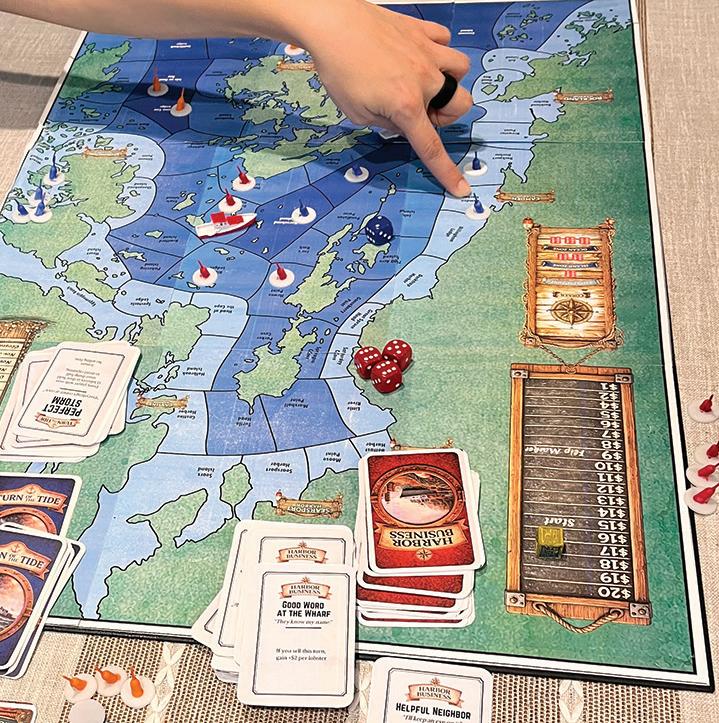
pulled at the start of each turn, defines the conditions on Penobscot Bay for that turn, including the weather and the market. Action points are quantified through a die roll, and include setting traps, hauling them, and moving from location to location within the bay.
“A lot of the game play involved tangling ropes, stacking traps improperly, changing weather around the islands, ledges, open ocean. Key mechanics is that if you stay in-shore where it’s safer you haul fewer lobsters, but
Matinicus refreshes its power generation
Logistics are hard enough on an island—then
COLUMN BY EVA MURRAY
Since summer 2025, Matinicus Island’s municipally owned electric utility has powered homes and businesses using a 160kW solar array, two new Perkins diesel generators, and a “hybrid supercapacitor” battery energy storage system.
there’s the paperwork!
Matinicus, easily 20 miles offshore from Rockland, first offered grid-style electricity to homeowners in the mid1960s, when our earliest rudimentary power company was built using secondhand equipment. This paralleled the start of residential telephone service to island customers. Prior to that, anybody who wanted electrical
appliances (or the latest gimmick, television) had a personal generator in their backyard.
These days, we don’t hear those engines run all the time (certainly an improvement!), but the new storage capacity ensures the electricity stays on.
(Well—except for summer nights during a stretch of the 1970s. An experiment was briefly undertaken to shut the system down nightly at 10 p.m. during warm weather to save fuel. That was only done for a short time, but even now we still encounter people who think Matinicus shuts the electricity off at night. It does not.) These days, we don’t hear those engines run all the time (certainly an improvement!), but the new storage capacity ensures the electricity stays on. The old Detroits are gone, having worked for years beyond their expected lifespans, and the 1980s-era switchgear had begun to fail by the time the new system went online last July. The island also replaced its aging continued on page 3
The independent utility first called Matinicus Light and Power, then Matinicus Plantation Electric, went through several improvements over the decades. In 1983, with a Community Development Block Grant and the extensive knowledge of island residents Page and Betsy Burr—he an electrical engineer, she with considerable financial acumen—a new generation system was installed, designed for efficiency. This included three Detroit diesels, with generators, and automated switchgear to bring engines on and offline as electrical demand changed seasonally and daily. Maintained by Billings Diesel in Stonington, the old powerhouse engines chugged away 24 hours a day for decades, providing reliable electricity. continued on page 3
GUEST
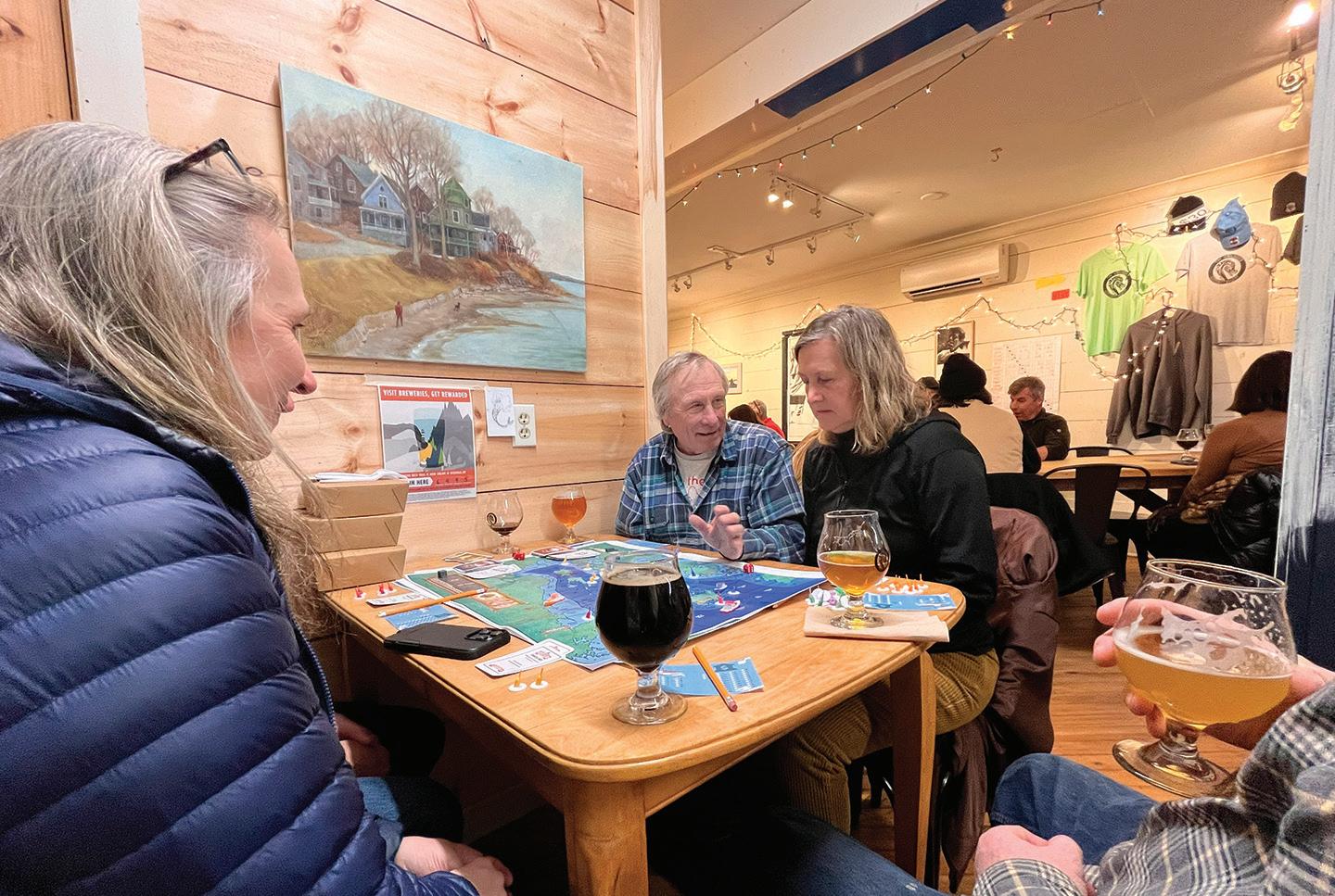
Brewery hosted the first public play test of the board game Corker.
Wren of Searsport. PHOTO: COURTESY ANCHOR POINT GAMES
Shucking oysters 2,000 miles from the source
New Texas restaurant grows and sells Maine oysters
BY CRAIG IDLEBROOK
Buzz is growing about a new restaurant with photos on the wall of Maine and a raw bar that serves oysters from the Pine Tree State, including the occasional oyster from the restaurant’s own aquaculture farm.
Such a restaurant may not seem unique in Bar Harbor or Portland, but it does garner a second look in Austin, Texas.
The Austin Oyster Co. opened its first brick-and-mortar location in April in a 1950s-era bungalow in East Austin after hosting pop-up venues and catering at events for several years. The food company exclusively serves oysters shipped from Maine’s coastline, and now offers a smattering of the shellfish grown on its farm, Lone Pine Oyster Ranch in Brunswick, Maine.
Austin Oyster Co. founder Brendan Yancy knows it’s a lot of time and expense to source oysters from Maine for Texas shellfish connoisseurs, but the quality of the product is worth it.
“It’s an amazing product. It’s often overshadowed by lobsters or scallops,” Yancy said. “But I think it’s truly a special, special thing that people in Texas aren’t exposed to quite a lot.”
Yancy is something of an accidental restaurateur and shellfish farm owner. He and his wife, Kerry, both worked at Expedia in Austin after moving to Texas from New England. Then the pandemic hit, and the two decided to fight the blues of isolation by hosting a socially distanced oyster shucking party for friends.
Kerry Yancy, who is from Maine, had oysters flown from one of their favorite
farms for the occasion in May 2020. They posted photos of the party, and the post quickly went viral, with others clamoring for the pair to host a similar outdoor event.
“They’re like, ‘Who’s doing this? How could I order this to my house?’” Yancy said. “And that’s kind of the lightbulb moment where I was like, ‘Oh, I know how to build a website.’”
Once the site went live, reservations were sold out within 10 minutes, leaving Yancy scrambling to fill the orders. Over the next year, the company hired 10 shuckers and hosted up to 10 events a weekend. They would bring the oysters out from Maine via a refrigerated trucking network and air freight.
To supply the oysters, they leaned on Maine friends and family to build out a network of shellfish farmers from which they could buy directly. Yancy would sometimes have to overcome a bit of skepticism at first to make the connections.
“There’s so many farmers that we work with that the relationship was a head-scratch to begin with,” Yancy said. “Once they kind of get what you’re trying to do and how you’re trying to tell their story to new people, it changes.”
At the events, people began asking if the company had a restaurant, and for the longest time Yancy and business partner Drew Ahumada had no answer. A plan was hatched in 2022 to open a restaurant as well as a smallscale oyster farm in Maine.
It turned out that it was easier to start an aquaculture farm in Maine than it was to line up the investors to start a restaurant in Austin.

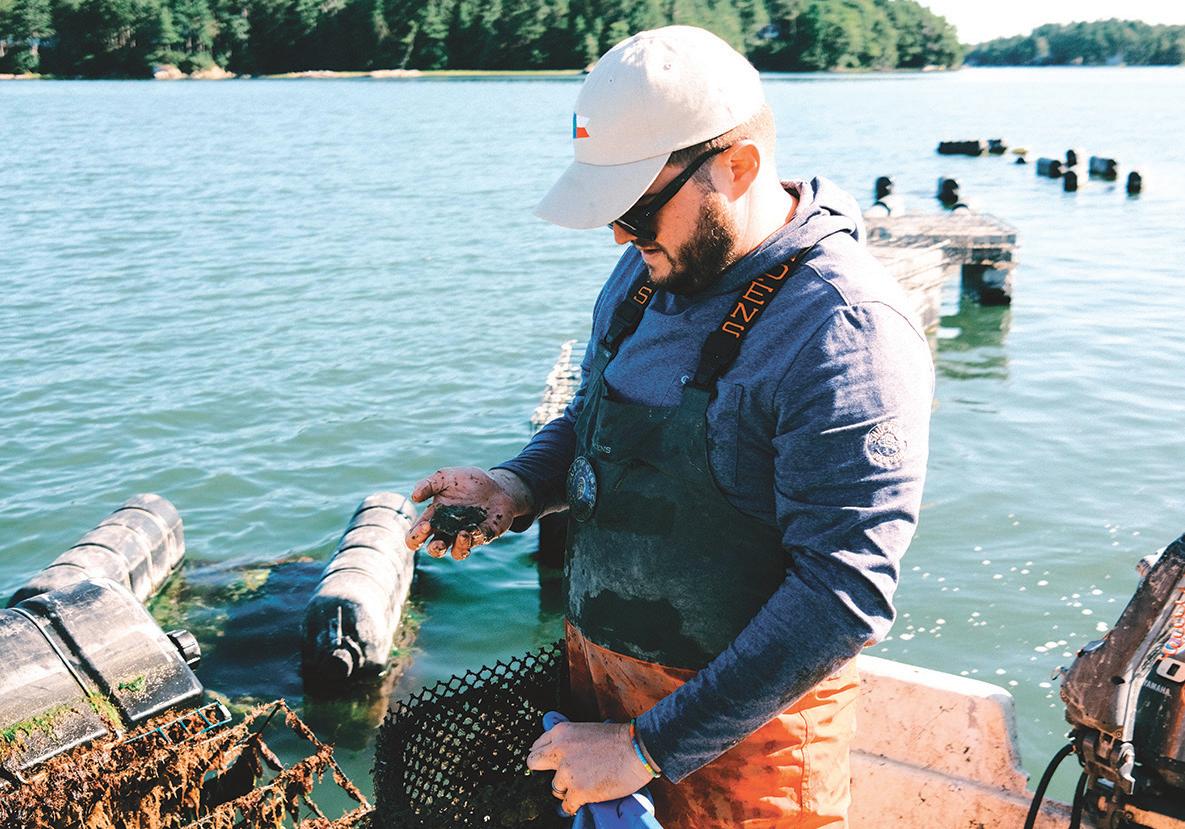
The Brunswick farm, which opened in 2024, is small in scale, currently producing only enough oysters to supply a restaurant for a week, Yancy said. Until the restaurant opened, he sent the oysters produced to other restaurants to test the product and build up conversation about his venture.
Some shellfish farmers have vertically integrated to serve their products at their own restaurant, said Bob Rheault, executive director of the East Coast Shellfish Growers Association. However, he’s never heard of any growers attempting to do so at such a great distance.
Running an oyster farm and a restaurant at the same time can be extremely
labor intensive, but also a great way to add value to the product grown, he said.
Growers who combine their product with ecotourism and the possibility of adult beverages may do quite well.
“I wouldn’t say it’s easier to make money as a restaurant, but it does create a certain nexus to monetize,” Rheault said. “The combination, honestly, is a killer.”
In the early days, that’s been the case for Yancy with the Austin Oyster Co. restaurant, which has been very busy.
“I haven’t slept a lot,” Yancy said. “We’d much rather have this problem than maybe some other problems that restaurants face where you’re like, ‘Wait, I’m open, why isn’t anyone here?’”
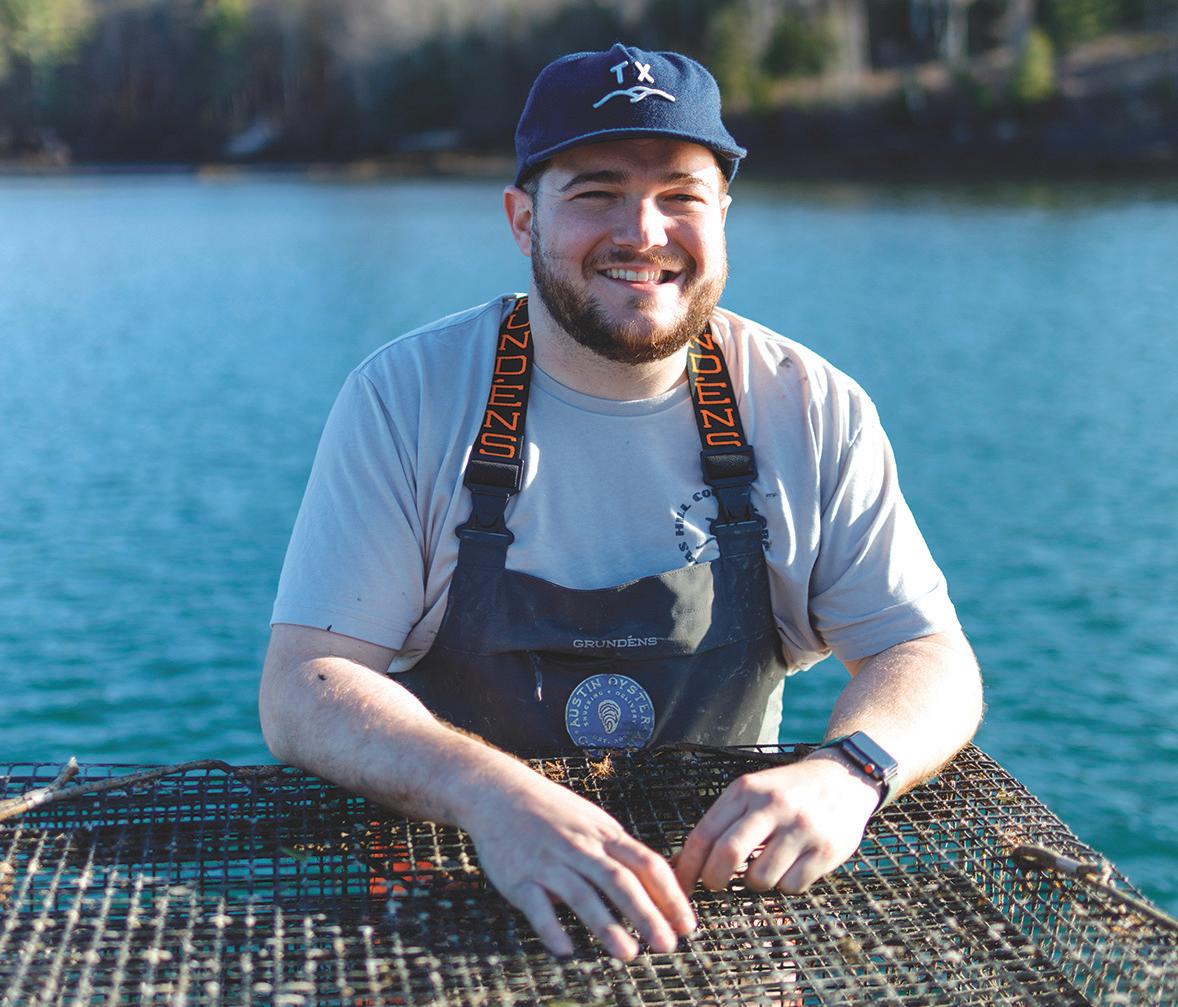
Brendan Yancy is the founder of Austin Oyster Co., a Texas business that sells Mainegrown oysters in Texas. He started a small oyster farm in Brunswick in 2024 and just opened a new restaurant in East Austin. PHOTO: MASON ADAMS/COURTESY AUSTIN OYSTER CO.
Austin Oyster Co. started out by shipping Maine oysters to Texas for pop-ups and catering. PHOTO: REILLY ERIN/COURTESY AUSTIN OYSTER CO.
Austin Oyster Co. has its own aquaculture site in Brunswick, called Lone Pine Oyster Ranch. PHOTO: JUSTIN SMULSKI/COURTESY AUSTIN OYSTER CO.
DICE
continued from page 1
if you gamble for deeper water or lobsters where fewer people fish, you run the risk of the weather changing or the buoys being washed away by whitecaps or some other event,” Birgfeld said. “You’re thinking every turn how much risk you’re willing to take on. People start feeling the pressure to bring in more money.”
Although gear sabotage is a harsh reality of fishing culture, that element was carefully kept out of the game play. “You gamble with your own boats and own traps. People will receive cards that you can play on other people, but no sabotage cards,” said Birgfeld.
Play testing is an essential element of game design. “All our friends know if they come over they are automatically paying a play test of Corker,” Wren said.
The first public play test was held in late March on Vinalhaven, after a serendipitous connection was made with Go Fish store owner Rachel Noyes.
“I think it was an email I got … I’m always trying to find something new and when I saw it was a game with lobster boats and there’s North Haven and Vinalhaven right in the middle, I thought, this is so fun, I want this in my store,” Noyes said.
The email was to gauge interest for carrying the game, but Noyes saw a perfect opportunity. “I said, would you ever consider coming out to do a test out here on Vinalhaven? And it turned out that was their dream,” she said. Noyes asked the Vinalhaven Community Brewery to host, which they were
MATINICUS
continued from page 1
fuel storage facilities, accounting for a substantial chunk of the expense and complexity of the project.
With just over 100 ratepayers—many seasonal— our modern “microgrid” stands alone.
The financing for this million-plus dollar project was a public-private partnership.
For the most part, island ratepayers and taxpayers bear the cost of the new system. A municipal bond was obtained for roughly $900,000. First, Matinicus Isle Plantation had to hold a special town meeting for voters to approve seeking a “bridge loan” from Camden National Bank, repaid when the bond came through. While the town was busy raising funds through bond issuance, an islander (with more faith in solar power and energy storage systems than some of the “old timers” had) formed a company and was out applying for grants that would not be available to a municipality.
One struggle has been that Matinicus didn’t have time to wait for certainty about grant funding or have time for the slow wheels of municipal financing to secure the bond. Everyone from engineers to “old guys who turn wrenches” agreed in 2024 that our power plant wouldn’t handle another summer. The old system was failing fast; the island did not have the luxury of time, but necessary system components required many months of lead time prior to delivery. This project involved constant pivoting, an exasperating administrative burden, and much explanation to people in various positions who could scarcely envision this remote island.
On top of everything, our municipal treasurer, administrative assistant, power company bookkeeper,



happy to do following a successful cribbage tournament earlier in the month.
Despite some nervousness about the potential turnout, all agree that the play test was a success. “We had two full days of three games, three to four players per table going, and then again on Saturday afternoon,” Wren said. “People were planning their Saturday afternoon around going to play.”
The crowd, which included several lobster fishers, was enthusiastic. “When I saw people smiling and laughing and groaning, ‘aw man,’ ‘oh yay,’ seeing that emotion of them being involved in the game was the most rewarding part,” Wren said.
“My favorite feedback was a guy telling another person, ‘Oh my God, that happened to me last year,’” said Birgfeld.
Praise was mixed with constructive feedback, Wren said, primarily focused on the rulebook and instructions. She and Birgfeld immediately began work on simplifying and streamlining that element of the game, and will schedule additional play tests in the near future.
From there, finalizing the design and launching a crowdfunding campaign will bring Corker closer to store shelves. The developers are currently exploring Maine manufacturing options, including doing some of it in-house since Birgfeld already has equipment to produce game components.
Once it’s completed, Noyes is eager to carry it. “I think it will be a fun thing to support, and it’s local,” she said. The Penobscot Marine Museum,
and the project’s coordinator were all new at their (supposedly part-time) jobs.
Tremendous thanks are due to many who helped Matinicus with the administrative, financial, and grant application side of acquiring the new equipment— difficult work done largely behind the scenes—not to mention the engineering and logistics. Planning consultant Gabrian McPhail’s knowledge was critical. “Alex Zipparo [with Island Institute at the time] was wonderful and really cared about what was going on,” observed assessor—in effect, a selectperson for the plantation—and power company bookkeeper Laurie Webber. “Alex gave us the kickstart,” added Phil Davies, who coordinated the project.
Island Institute helped the island apply for a renewable power/community action grant through the Community Resilience Partnership and the Governor’s Office of Policy Innovation and the Future—now called the Maine Office of Community Affairs. This grant of about $50,000 for design work helped bring on board electrical engineer Spencer Egan of RLC Engineering, who continues to be indispensable to our power company. “Egan drew the short straw,” in the words of Davies, “and got to fly out to Matinicus to inspect our aging system. He had no idea what he was getting into, but he rolled up his sleeves, put on his ear protectors … and provided a roadmap for a replacement system.”
“A big break was an award in excess of $350,000 from the USDA Rural Energy for America Program, which would match up to 50% for solar installations and battery storage in rural areas,” according to Davies.
Island Institute also provided a grant for $20,000 for some specialized equipment on the transmission lines that will help minimize outages and reduce fire risk, and a $10,000 grant for administrative assistance compiling the larger applications.
and several other local businesses, have expressed enthusiasm as well.
For Noyes, the appeal is obvious. “The board is just so familiar,” she said. “It’s home.”
Courtney Naliboff teaches, writes, and plays music on North Haven. She may be reached at courtney. naliboff@gmail.com.

thank Camden National Bank, in particular Steve Matteo, Jody Landrith, and Donnaleen DiNapoli. “They may have thought we were crazy at first,” commented one municipal staff member, “but they were great. They made it work.”
Davies noted, “The Maine USDA team up in Bangor were fantastic. They were a big help navigating the application process” for the federal matching grant.
Webber reiterated that a community without electricity would lose telephone, internet, postal service, small businesses, and more. “Hopefully not in my lifetime,” asserted Webber. “Not without a fight.”
Eva Murray is a writer and year-round Matinicus resident with multiples roles on the island, including municipal clerk, EMT, waste and recycling coordinator, and winter meter reader for the power company.

John Martin, Bud Staples, and Elsie Gillespie chat around the woodstove at the annual town meeting.
Gerald “Punkin” Lemoine
Levi Moulden
Bud Staples
Matinicus would like to
The game Corker, seen here in prototype, allows players to simulate lobster fishing around Penobscot Bay.
PHOTO: COURTESY ANCHOR POINT GAMES
Solar panels are part of the new power generation system on Matinicus Island. PHOTO: EVA MURRAY
Cushing project moves ahead
Town eventually hopes to install a public boat ramp
BY CHARLES EICHACKER
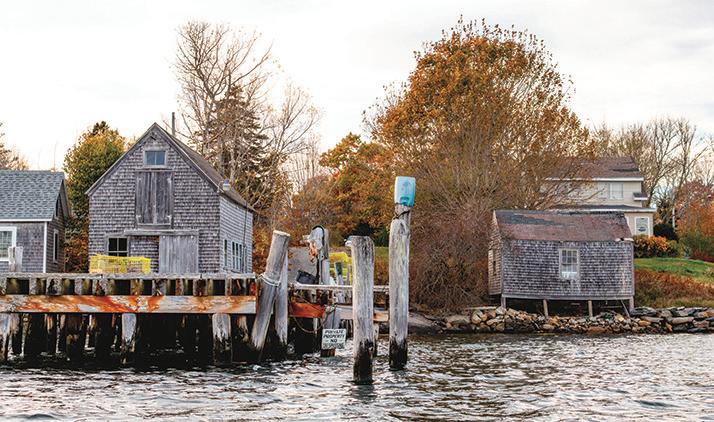
Cushing is on track to buy one and a half acres along Pleasant Point Gut where local officials eventually hope to build a public boat ramp.
Residents approved the purchase in March by a 211-81 vote, providing a strong mandate to continue with the project. If successful, it would create the first public access for boats to reach deep water in the fishing town along the St. George River.
“I think the town is very happy it’s going forward,” said Harbormaster Austin Donaghy, who has helped lead the project. “The vote gave us a very clear view of what the townspeople would like.”
Officials aim to close on the purchase on June 30. The owners have agreed to sell the land at 16 Barnacle Lane, which now includes an old pier, a home, and some sheds, for roughly $730,000. The town plans to cover half of that cost and get much of the rest from the Land for Maine’s Future program. The board of the state program initially approved the funding in September and was due to consider final approval on May 27.
By late April, the town had completed many of the requirements to secure the funding, including getting voter approval and surveying and appraising the property. It was also working to complete an environmental assessment and ensure it had clear title for the land.
Town officials had originally hoped the Land for Maine’s Future program would cover half of the purchase price, or $365,000. But Donaghy now expects the final amount to be lower—around $290,000— because of the findings of a property appraisal.
Cushing has been working for 20 years towards the purchase of land for public water access. Voters have annually agreed to contribute money from boat excise fees into a public water access fund that will provide most of the $365,000 the town expects to spend on the purchase. It would also use $31,000 in new appropriations and $26,000 from undesignated funds.
The town is seeking grant money to cover the gap in state funding and has a bridge loan from Maine Coast Heritage Trust to help close on the purchase, according to Donaghy.
If the purchase goes through, the town next wants to clear the site and develop it for parking and a slab-based boat ramp, with planning assistance from the Maine Department of Inland Fisheries and Wildlife. While overnight parking would not be allowed, Donaghy said the town is also looking into developing a nearby lot into parking for people traveling overnight to one of the nearby unbridged islands, primarily Gay Island.
The project hasn’t been universally popular in Cushing. It received pushback before and during a public hearing in January. Critics also aired their concerns in a letter to the town that was co-signed by more than 50 households, many from the area near the proposed boat ramp.
In the January letter, they acknowledged the importance of the town securing public water access, but argued that opening the area around Pleasant Point harbor to public access could degrade the environment and bring unsafe levels of vehicle traffic. They called for the town to set rules for the property—including limiting its use to local residents and
workers—and devote more resources to enforcing them. They unsuccessfully requested a 180-day moratorium on considering the purchase.
“This open-ended vision for such a small site would entail dramatic changes to the current limited use of Pleasant Point harbor by approximately two dozen commercial fishing boats and some local residents,” they argued.
During the public hearing, other residents came to the project’s defense. One man said he lives on a landlocked property along Pleasant Point Road and would appreciate having a public place to put his kayak into the water. Others argued it would make it easier to reach Gay Island, where a few residents live and where a house fire occurred in recent years. Fishermen have also supported the proposal, given that it would help them access their vessels or service them in emergencies.
According to Donaghy, if the town does obtain the land, the local harbor committee would then develop rules for its use and seek more public feedback. He noted that officials could also review the speed limit in that area.
To help pay for future work on the site, the town would try to replenish its public water access fund.

New Era Gallery
Elaine Austin Crossman “Distant Islands”
The town of Cushing hopes to buy this property on Pleasant Point Gut, seen here in October 2025, and eventually install a public boat ramp there. PHOTO: JACK SULLIVAN

Penobscot Island Air goes on strike
THIS SPRING, Penobscot Island Air used an unconventional tactic to get money it’s owed for flying mail out to Maine islands.
On April 21, the small airline shared on Facebook that the U.S. Postal Service owed it $388,000 for mail deliveries going back to 2023—including for all deliveries so far in 2026. The next part got the agency’s attention.
“We have to make a small stand, so we won’t be delivering USPS mail today,” the airline wrote. “It’s been 75 days this year alone that we have dutifully loaded up USPS mail and ferried or flown it out to the islands. It’s no secret that winter is our slow period, and without prompt payments, cash flow is bleak.”
The airline said that had exhausted other efforts and wasn’t taking the step lightly.
The next day, it shared another update: USPS had pledged to pay about 25% of its balance that week.
“Considering the pace at which USPS generally moves, our contract officer pulled off a small miracle to make it happen,” the airline said. “We have a framework for going forward, and there’s enough clarity for us to work with. We’ll be back in the morning delivering mail.”
The airline noted that Maine’s congressional delegation was working to make it whole.
Coastal Maine eateries pilot reusable food containers
UNIVERSITY OF MAINE student researchers are helping businesses in Bar Harbor, Bath, and South Portland incorporate reusable food containers into their dining experiences to reduce waste, through a pilot program called Reuse Maine.
Participating eateries include Cafe This Way and Coffee Matter/Mother’s Kitchen in Bar Harbor, Solo Pane in Bath, and Second Rodeo Coffee and Verbena in South Portland.
They offer diners the option of getting their food and beverages in returnable stainless steel containers. Customers can check out these containers by signing up for a free account in the Recirclable app, then return them to participating establishments.
By testing the viability of reusable takeout packaging, the students and restaurants are helping develop a model that reduces waste, prevents plastic pollution, and saves local businesses and municipalities money on the purchase and disposal of singleuse food and beverage packaging.
The student researchers are working with the businesses to track results and analyze usage patterns to refine the returnable model.
“The driver for this project has been a focus on wanting to maintain and protect Maine’s coastal environment because it’s a very important part of the state’s culture,” said Ryan Kennedy, a University of Maine senior in the Department of Anthropology.
Kennedy, an undergraduate research assistant on the project, has been involved since the initial baseline surveys last June. They noted that the team met with restaurant owners to discuss their establishments’ capabilities and customer habits.
“I think we’re starting to see people realize how easy it is to make more sustainable swaps,” Kennedy said.
In just a little over a month since the Reuse Maine pilot project launched, more than 100 customers across the state have borrowed nearly 500 reusable containers.
As part of an extensive, interdisciplinary effort to mitigate marine pollution, the project is funded by the National Oceanic and Atmospheric Administration (NOAA), Maine Sea Grant, and the Maine Department of Environmental Protection. The support allows the team to tackle environmental challenges while providing student researchers with the resources needed to develop scalable, real-world solutions.

Islesford Boatworks holds special programs to celebrate 20th anniversary
THIS SUMMER marks the 20th year of Islesford Boatworks, a community-based nonprofit on Little Cranberry Island that teaches traditional wooden boatbuilding to all ages. Throughout the summer, it will be running special programs and events to celebrate this milestone, culminating in its first ever Blue Duck Derby on Aug. 1. During this charitable fundraising event, thousands of numbered rubber ducks will be released into the harbor in a race toward a finish line. People can “adopt” or buy tickets for the ducks, with prizes awarded to the winner. Proceeds will help Boatworks continue to offer free and reduced programming for local kids, as well as help fund the renovation of its waterfront shop, the historic “Blue Duck” building.
To adopt a duck or get more information about Islesford Boatworks and its programs, check out its website at islesfordboatworks.org.
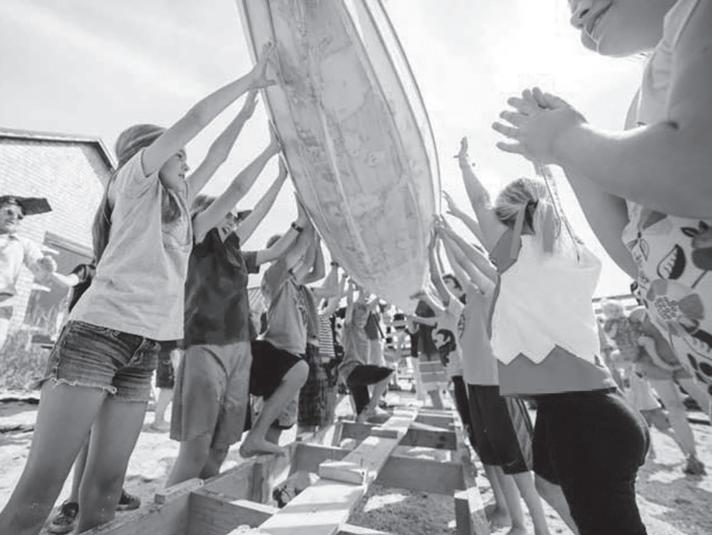
By teaching kids to build traditional wooden boats, Islesford Boatworks accomplishes its mission: Building opportunity, community, and a future for Maine’s working waterfront.
Students hoist a boat they worked on at Islesford Boatworks. PHOTO: COURTESY ISLESFORD BOATWORKS
An example of the reusable, stainless steel containers that restaurants in Bar Harbor, Bath, and South Portland are now handing out in cooperation with UMaine student researchers. PHOTO: COURTESY UMAINE
Mark Bennett, a pilot for Penobscot Island Air, on a trip from the mainland to Matinicus last fall. PHOTO: CALVIN KENJIRO GROVER
from the helm
Creating a bigger table
A father’s lessons on personal and community well-being
BY KIM HAMILTON
I’VE BEEN thinking about tables lately. My father passed away in February after living his 96 years fully and generously. Creating a big table was his superpower. Everyone was welcome, and his table seemed to grow larger as he grew older.
At 90, he reluctantly agreed to let us host what he insisted be a small birthday gathering. We handed him invitations to share with a few friends. Then the responses began to arrive— more than 150 in all. What started as an intimate gathering quickly became a celebration of his extended community. I wasn’t necessarily surprised that he had so many friends; what struck me was how many I didn’t know, and how many had come into his life in recent years. Building a big table wasn’t a simple act for my father—it was his daily practice, a deeply-held value. I’ve come to believe that my father’s longevity was closely tied to the many people he welcomed into his life. Research suggests this connection is real. In 2023, then-U.S. Surgeon General Vivek Murthy wrote powerfully about “loneliness, isolation, and the healing power of social connection,” highlighting the undeniable impact of relationships on well-being.
This idea feels especially relevant to a community development organization like ours. We think often about the symbolism of tables. In the small communities we serve, important conversations happen around them— whether at well-worn tables in kitchens or meeting rooms, or virtual ones online. The size of the table, how it’s set, who is invited: they all matter.
Trust is built at these tables. The strongest ones can hold diverse perspectives and withstand spirited debate. The larger and more inclusive the table, the richer the conversation and more thoughtful the decisions.
And yet, in today’s climate, big and inclusive tables can feel increasingly rare. The balance between common purpose and division, between connection and exclusion, feels more tenuous than it should. This is particularly concerning for small coastal communities, where challenges are growing in both scale and urgency. At a moment like this, we need to lean into the forces that draw us together. Deep community engagement can be our shared superpower, too, but it requires intention and care to thrive. It requires daily practice.
There is reason for optimism. As Murthy reminds us, “each of us can start now, in our own lives, by strengthening our connections and relationships.
Seeking badasses
Our individual relationships are an untapped resource—a source of healing hiding in plain sight.” It’s a simple but profound idea: choosing to connect is, in itself, a consequential act to build a stronger and healthier community, one that welcomes and endures.
In the beautiful poem “Perhaps the World Ends Here,” U.S. Poet Laureate Joy Harjo writes, “the gifts of earth are brought and prepared, set on the table. So it has been since creation,
and it will go on.” Let’s keep making room at that timeless table. And like my father’s 90th birthday, perhaps we’ll be surprised—in the best possible way—by how many people show up.
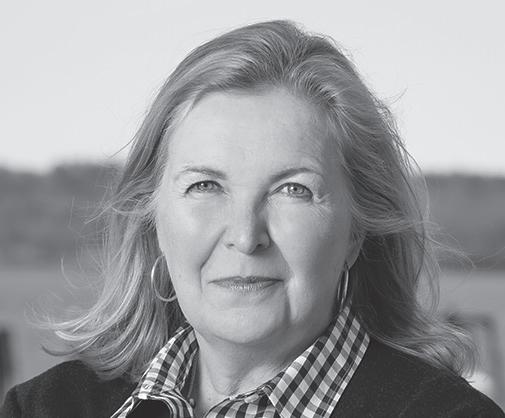
Kim Hamilton is president of Island Institute, publisher of The Working Waterfront. She may be contacted at khamilton@islandinstitute.org.
Perhaps the World Ends Here by Joy Harjo
The world begins at a kitchen table. No matter what, we must eat to live.
The gifts of earth are brought and prepared, set on the table. So it has been since creation, and it will go on.
We chase chickens or dogs away from it. Babies teethe at the corners. They scrape their knees under it.
It is here that children are given instructions on what it means to be human. We make men at it, we make women.
At this table we gossip, recall enemies and the ghosts of lovers.
Our dreams drink coffee with us as they put their arms around our children. They laugh with us at our poor falling-down selves and as we put ourselves back together once again at the table.
This table has been a house in the rain, an umbrella in the sun.
Wars have begun and ended at this table. It is a place to hide in the shadow of terror.
A place to celebrate the terrible victory.
We have given birth on this table, and have prepared our parents for burial here. At this table we sing with joy, with sorrow. We pray of suffering and remorse. We give thanks.
Perhaps the world will end at the kitchen table, while we are laughing and crying, eating of the last sweet bite.
Finding comfort in fictional competence sweetest in the gale
BY CHARLES EICHACKER
WHEN THE WORLD’S a mess, as it often feels these days, I turn to “competency porn.”
This brand of fiction depicts hypertalented people solving difficult problems, and of course, it could describe many classic works. Odysseus makes it home. Poirot finds the killer. Furiosa frees the Citadel.
But I only learned the term lately in discussions of The Pitt, a popular TV show about the busy staff of a Pittsburgh emergency room. Before watching it, I’d questioned how hourly doses of illness, gore, and death could soothe me when the real world offers plenty of the same.
Having now devoured its two seasons, I get it. These medical workers are good-hearted and great at what they do, a balm against the pessimism and dysfunction prevailing over the planet these days.
In one moment from the first season, as the hospital is flooded with patients from a nearby mass shooting, a young resident makes a quick but risky decision that saves one of them.
“OK, you never should have done that on your own. Ever. Do you
understand?” a grizzled senior doctor says afterward. Then he whispers, “But that was pretty badass.”
Chef’s kiss.
My diet of well-intentioned competence hasn’t stopped there. Among other things, I recently consumed both the audiobook and movie versions of Project Hail Mary, a hopeful sci-fi tale about citizens of Earth and beyond working to stop a space-traveling microbe from destroying the sun.
Most movingly, I just read The Ministry for the Future, a utopian novel about humanity, in the wake of a cataclysmic drought, coming together to develop plausible solutions to climate change. By the end, a new financial system is promoting decarbonization while solarpowered airships and sailboats have become the main way to circle the globe.
Yet I do wonder about this fixation. Are these fictions inspiring me to make real change in the world, or just lulling me with false visions of progress? If I was tasked with saving a life, a planet, or a galaxy, how would I do?
To try to answer the second question, at least, I recently put myself to the test.
I work with plenty of folks who do know something about making real
change, specifically in communities along Maine’s coast. So in late April, I joined some of them on a kind of tabletop exercise, in which participants were split into three teams— the nations of Island, Bayland, and Peninsuland—that each had to plan out the development of a shared body of water.
I was assigned to Bayland, taking on the role of energy industry representative while my three teammates handled planning, shipping, and natural resource management. We quickly got to work on a large game map, laying out tiles for ferries, ports, fishing sites, electric transmission, and more. We decided to orient our economy around crabbing and exports, while also trying to attract visitors and protect natural assets like kelp forests.
Perhaps I was not cut out for this, though, because when it came to energy matters, I largely took a backseat. Over the course of an hour, our planner handled the purchase of offshore wind power from another nation, then distributed new tiles for wave and tidal energy.
Late in the game, our natural resources manager made the controversial

decision to place oil rigs close to the shores of the other two nations, turning them against us. They were soon discussing legal action or a flotilla.
In short, I felt like we were making a mess of the world. And our constituents, the citizens of Bayland, were surely seeking distraction in their own favorite films about competent leaders. So, I can’t really say that my fondness for competency porn has trained me for a career in energy development. But I was impressed by my colleagues in this exercise. Many of them do work on energy, climate, and economic issues, and while I was loafing around, they were getting things done.
It’ll take people like that to get us through this mess. It’ll takes badasses.
Charles Eichacker is the editor of The Working Waterfront and Island Journal. He may be contacted at ceichacker@islandinstitute.org.
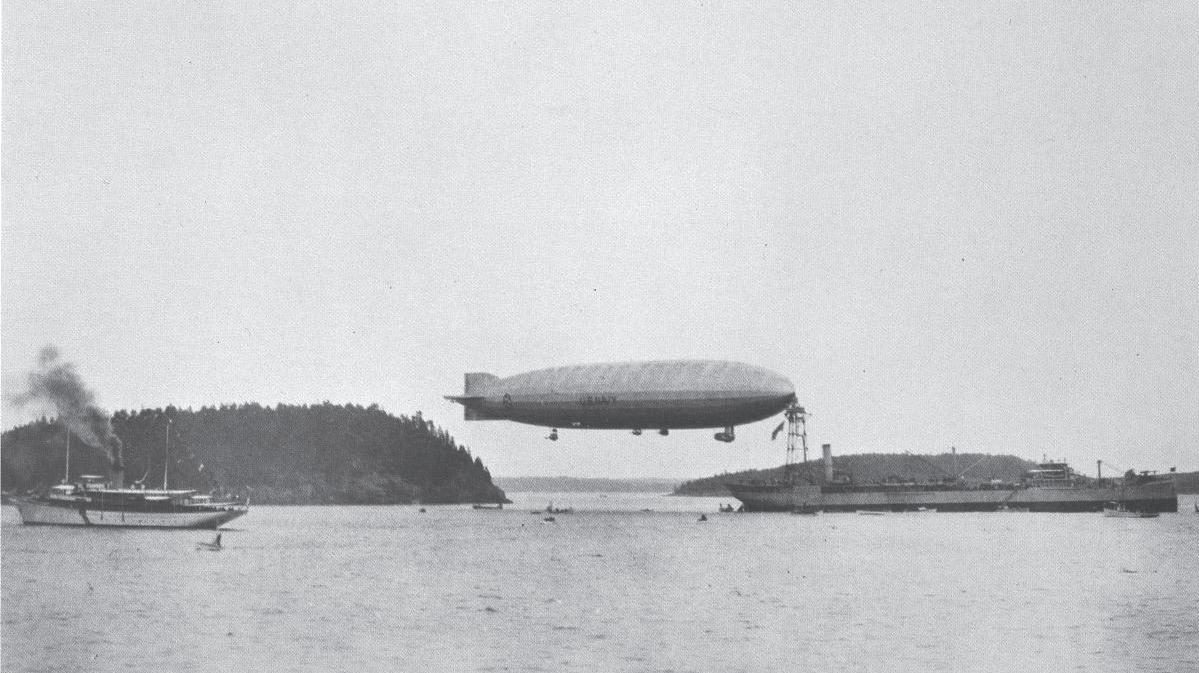
AIRSHIP AHEAD—
The Shenandoah, a dirigible U.S. Navy airship, hovers off the coast of Bar Harbor in July 1925, with the yacht Lyndonia in the foreground. Just two months later, the Shenandoah would be destroyed in a deadly crash over Ohio. Do any readers recall seeing this airship over Maine—or hearing about it? Apparently some aviation enthusiasts are now calling for the return of airships as a more sustainable way to travel. Would you ever ride in one? If you can share any information or memories, contact editor Charles Eichacker at ceichacker@islandinstitute.org.
the public’s policy
A threat to NOAA’s funding for states
Agency uses cooperative federalism to support local efforts
BY NICK BATTISTA
THE WHITE HOUSE recently released its 2027 budget proposal, a document that clearly signals the president’s priorities, though it could face substantial changes as it makes its way through appropriations subcommittees in Congress this spring and summer.
While the latest proposal would bolster some maritime programs, it would, unfortunately, eliminate funding for important programs that states administer with federal agencies such as the National Oceanic and Atmospheric Administration (NOAA).
It requests funding to support “American Maritime Dominance”— basically funding for new ships for the armed services, as well as a new Arctic research vessel and $135 million for shipbuilding.
It also proposes much-needed investments in an “America First Seafood” strategy, including funds to address unfair trade practices and illegal, unreported, and unregulated global fishing that undermine the competitiveness of our well-regulated domestic fisheries.
While these measures fund work that may help Maine, a much bigger concern is the proposal to eliminate funding for NOAA programs that directly affect the state.
Island Institute Board of Trustees
Doug Henderson, Chair
John Conley, Vice-Chair
Bryan Lewis, Secretary, Chair of Philanthropy and Communications Committee
Katherine Vogt, Treasurer, Chair of Finance Committee
Michael Boyd, Clerk
Shey Conover, Chair of Programs Committee
Michael Sant, Chair of Governance Committee
Robert Baines
Pamela Baker-Masson
Sebastian Belle
Des Fitzgerald
Christie Hallowell
Kristin Howard
Nadia Rosenthal
Michael Steinharter
Carol White
John Bird (honorary)
Tom Glenn (honorary)
Joe Higdon (honorary)
Bobbie Sweet (honorary)
Kimberly A. Hamilton, PhD (ex officio)
The budget calls for a $1.6 billion reduction in spending on NOAA’s research and grant programs. The 792-page document dedicated to NOAA includes a list of proposed program terminations. Many of these grant programs are how NOAA supports “cooperative federalism”—the partnership with states to achieve shared goals. This structure recognizes that many coastal issues are better addressed by states rather than through a one-size-fits-all approach.
NOAA provides money and guardrails for its use, while the state can provide expertise, local connections, and matching funds. The state entity serves as the face of the work and its implementation. Cutting grants for these programs fundamentally alters the federal-state partnership and hinders states’ ability to manage their coastal resources.
Several consequential cooperative federalism programs that benefit Maine are on the termination list. Two of them are critical partners to Maine’s coastal communities, businesses, and organizations like Island Institute. The second two are less visible but play a key role in the management of our state’s fisheries.
NOAA’s National Sea Grant College Program promotes the sustainable development, conservation, and practical use of coastal resources through technical assistance, applied research, and education on topics such as
working waterfronts, aquaculture, and storm resilience. According to Maine Sea Grant, in 2024 the program helped to do a number of things, including generating an estimated $20.2 million in economic benefits; creating or supporting 489 jobs and 283 businesses; improving resilience in 60 communities; getting more than 2,710 people to adopt safe and sustainable fishing practices; restoring or protecting an estimated 5,314 acres of habitat; and supporting the education of 138 college students.
Another offering, Coastal Zone Management, helps states address issues related to coastal resources and economic development. The Maine Coastal Program, administered by the state Office of Community Affairs, helps towns develop plans for coastal uses, maintain working waterfront access, and strengthen coastal infrastructure. Some of these funds also go directly to communities.
One of the less visible programs is Interjurisdictional Fisheries, which provides funding to state agencies, including $190,000 to Maine which annually supports monitoring and management of fisheries that span multiple jurisdictions, including herring, lobster, and shrimp.
Another behind the scenes program, Cooperative Enforcement, provides funding to state agencies that
THE WORKING WATERFRONT
Published by Island Institute, a non-profit organization that boldly navigates climate and economic change with island and coastal communities to expand opportunities and deliver solutions.
All members of Island Institute and residents of Maine island communities receive monthly mail delivery of The Working Waterfront. For home delivery: Join Island Institute by calling our office at (207) 594-9209
E-mail us: membership@islandinstitute.org • Visit us online: giving.islandinstitute.org
386 Main Street / P.O. Box 648

share responsibility for law enforcement of priority federal fisheries— supporting the salaries of four marine patrol officers in Maine. NOAA and Coast Guard lack the equipment to haul lobster gear, so state agencies do all such enforcement in federal waters.
As Susie Arnold, Island Institute’s senior ocean scientist, notes in this issue’s Fathoming column, NOAA funding is critical to our long-term monitoring. It also supports weatherrelated work, hydrographic surveys, research grants, and tracking where species like the North Atlantic Right Whale are and, importantly, are not. Our congressional delegation has consistently shown strong support for NOAA funding and for these and other cooperative federalism programs. They understand the importance of addressing these issues locally, and they see this work matters to Maine, its businesses, and its communities. I hope that support continues well into the future.
Nick Battista is chief policy and external affairs officer for Island Institute, publisher of The Working Waterfront. He may be contacted at nbattista@islandinstitute.org.
EDITOR: Charles Eichacker ceichacker@islandinstitute.org
Our advertisers reach 50,000+ readers who care about the coast of Maine. Free distribution from Kittery to Lubec and mailed directly to islanders and members of Island Institute, and distributed monthly to Portland Press Herald and Bangor Daily News subscribers.
To Advertise Contact: Charles Eichacker ceichacker@islandinstitute.org (207) 535-9305
www.WorkingWaterfront.com

Lobster scientist Bob Steneck elected to National Academy
IN ONE OF the highest honors in American science, the National Academy of Sciences has elected Robert S. Steneck, a longtime University of Maine marine ecologist whose work has reshaped understanding of coastal ecosystems.
The academy announced on April 28 the election of 120 members and 25 international members, bringing its total membership to 2,705 active members and 557 international members.
Steneck spent more than 40 years at UMaine, where he helped shape marine research and policy through studies of kelp forests, lobster fisheries, and coral reefs. He retired in 2023.
A marine ecologist, Steneck has focused on the structure and function of coastal ecosystems, particularly in the Gulf of Maine and the Caribbean.
His research examines food webs, dominant species, and ecological processes in benthic marine environments, often through in situ observation using scuba diving, underwater video systems, and remotely operated vehicles.
His work in Maine has explored kelp forest ecosystems and the relationships among lobsters, sea urchins, and fish stocks.
Steneck joined UMaine in 1982 and was among the first marine ecologists to collaborate directly with lobstermen, integrating scientific research with industry knowledge.
Steneck’s election follows other recent honors, including his 2025 induction into the American Academy of Arts and Sciences.
Housing
(In response to Kim Hamilton’s AprilMay column on Island Institute’s new housing strategy.)
Dear Ms. Hamilton,
Thank you for your leadership of Island Institute’s worthy housing endeavors.
Housing availability and affordability is a complex topic that I’ve been concerned with professionally as a Realtor. The median home price in Bellingham, Washington, our college town and Whatcom County seat, was $665,000 in March 2026. When I started my career 30 years ago, a modest home went for $250,000.
Like some coastal cities in Maine, we have a working waterfront with a fishing fleet, whale watching, active railroads, and a cargo port. We’ve resisted the proliferation of some noxious business proposals (like storage and shipping of dirty coal) out of environmental concern.
Nestled on the inland coast between Seattle and Vancouver, British Columbia, we are an area with consistently increasing housing prices. Few people want to leave, and in-migrating global citizens often pay cash for properties. Home prices here, perhaps increasingly like there, are unrelated to availability of local jobs with livable wages. And working people are being priced out.
We are trying new programs to address these challenges. The City of Bellingham is working with an online business, Nesterly, to rekindle an earlier practice of renting rooms in our homes to boarders.
In addition to other down-payment assistance programs, Washington State has the Covenant Homeownership Program, established in 2023, which offers up to $150,000 in a 0% interest second mortgage loan to people now named as protected classes by federal and our more protective state fair housing laws. It is available for people whose ancestors settled prior to 1968, while housing discrimination was widely practiced.
I hope these two innovative programs may be of some service if
they can perhaps be customized to help meet the specific needs of your communities.
Julie Carpenter Bellingham, Washington
Forest City
(In response to the new column by Peaks Island resident Rusty Foster.)
I enjoyed Rusty Foster’s new column in the April/May Working Waterfront. Your newspaper has to walk a fine line between serving locals and serving interested outsiders. I feel that same tension between the local and the outside world in Foster’s reaction to our current political madness. I happened to be visiting Maine in the weeks after 9/11. I remember overhearing a conversation in a diner about “those poor people” in New York City. It was spoken as if referring to another country, a world far removed from the comfort and sanctity of Maine. Foster’s essay is a fitting reminder that we’re all in this together. Thanks for pushing into new territory through the open quadrant of your columnists’ spread.
John Goodman Cambridge, Massachusetts
The Working Waterfront accepts letters to the editor of 250 words. Send them to editor Charlie Eichacker at ceichacker@ islandinstitute.org. Longer opinion pieces should be approved by the editor before being sent.
Corrections
The Fathoming column from the February-March issue misstated which survey would provide 2025 spring bottom water temperatures. The survey was the Northeast Fisheries Science Center bottom trawl survey.
A piece in the April-May issue on shellfish harvesting in Boston Harbor misstated the year when the song “Dirty Water” by the Standells came out. It was 1966.

Bob Steneck delivers an acceptance speech for an award from the National Academy of Sciences in 2024. PHOTO: COURTESY UMAINE
Colby taps new director for Port Clyde center
Price has led initiatives at Bigelow Laboratory for Ocean Sciences
BY BOB KEYES, COLBY NEWS
This announcement has been condensed and lightly edited.
Nichole Price, a senior scientist, marine ecologist, and community leader who has dedicated her career to working alongside Maine’s coastal and rural communities to adapt to change and plan for the future, will become Colby College’s inaugural director of the Center for Resilience and Economic Impact in Port Clyde.
Price, who has directed the Center for Seafood Solutions at Bigelow Laboratory for Ocean Sciences in East Boothbay since 2015, begins her new position June 1. As director of the Port Clyde center, she will lead the research that Colby is doing to help Maine’s cities and towns strengthen their resilience to natural disasters, economic adversity, and other challenges. In addition to her scientific work, Price is known as a convener who brings together fishermen, farmers, policymakers, and researchers.
Price will guide the center’s strategic direction from its base in Port Clyde, establishing it as a premier hub for interdisciplinary research-to-action. She will oversee core research initiatives, mentor student fellows, and build collaborative partnerships with Maine communities and governmental entities to drive proactive, data-driven resilience.
In addition to her work at Bigelow, Price holds a research faculty appointment at Colby and has served as professor of environmental studies since 2021. Notably, she and a team of research partners are part of a $10-million U.S. Department of Agriculture grant to study algae-based feed supplements that boost milk production and improve farmer profitability.
Prior to her work at Bigelow, Price spent several years as a project scientist and postdoctoral researcher at the Center for Marine Biodiversity and Conservation at Scripps Institution of Oceanography at the University of California San Diego.
crises, said Provost and Clara C. Piper Professor of Environmental Studies Denise Bruesewitz.
“Our aspiration is for the center to become a national model for how liberal arts institutions can catalyze community preparedness. Under Nichole’s leadership, we envision a future where the center not only supports the resilience of Maine’s communities and environment but also helps to position our state as a leader in the innovation economy,” Bruesewitz said.
The center’s presence in Port Clyde is intended to support, not replace, the community’s own vision for its future.
“I care deeply about the coast of Maine and the people who make their living here,” said Price. “This work only succeeds if it’s done with communities, not for them. That means listening first, respecting local knowledge and heritage, and bringing people together to build practical solutions that support resilience and economic opportunity. This is also a chance to build on momentum across the state and work alongside communities like Port Clyde to address challenges and create new opportunities.”
As a home for educational opportunities, outreach, and community building, the Port Clyde center will work with residents, local officials and municipalities, state and federal governmental partners, and research institutions to make data-informed decisions and evaluate progress in resilience planning. It will take a practical, community-driven approach, working in partnership with stakeholders so solutions reflect local priorities and values.
Established with a gift from Maine-based NorthLight Foundation, the Center for Resilience and Economic Impact is the latest entity created as part of Colby’s Dare Northward campaign. Port Clyde residents Dan and Sheryl Tishman formed the NorthLight Foundation to address conservation, climate, and community resilience issues in Maine and across the country.
This effort will build on key partnerships across Maine with scientists, policymakers, economists, and individuals and organizations directly impacted by environmental, economic, cultural, and public health
It is based in Port Clyde, in part, because the village has sustained a series of natural and economic catastrophes in recent years, and continues to recover and rebuild. A fire ripped through it in fall 2023, destroying the general store, a waterside restaurant, and other places integral to community life. The winter after the fire, devastating ocean storms battered critical coastal infrastructure for the fishing industry, underscoring the vulnerability of Maine communities.
The center’s presence in Port Clyde is intended to support, not replace, the community’s own vision for its future.
With a gift from the Tishmans, Colby acquired the Seaside Inn, The Barn, the Squid Ink building, and the site of the Port Clyde General Store, which
was destroyed by the fire in September 2023. Colby’s plans for the properties include rebuilding a structure on the site of the former general store, which will house a restaurant and offices, including gathering and collaborative space open to the community.
It will also maintain The Barn, across from the former general store, which has operated as a seasonal bar and community gathering spot, and the 12-room Seaside Inn as housing for scholars and others working at the center and as a home for student researchers who will live and work in Port Clyde. As part of her initial work at the center, Price plans to introduce a lecture series this summer and appoint a first cohort of academic fellows to begin work in Port Clyde.
The center will build on ongoing state and federal efforts to strengthen coastal resilience and economic opportunity. In 2024, Maine established the Commission on Infrastructure Rebuilding and Resilience, co-chaired by Dan Tishman, to develop a plan to mitigate risk. Colby’s Center for Resilience and Economic Impact evolved from that work.
Deborah Bronk, president and CEO of Bigelow Laboratory for Ocean Sciences, said Price’s move to Colby will benefit both institutions. “Colby College has been one of our most important partners,” Bronk said. “Nichole’s move opens new opportunities to collaborate in ways that strengthen both institutions and expand what we can achieve together.”
Advertise in The Working Waterfront, which circulates 45,000 copies from Kittery to Eastport ten times a year. Contact Charles Eichacker: ceichacker@islandinstitute.org




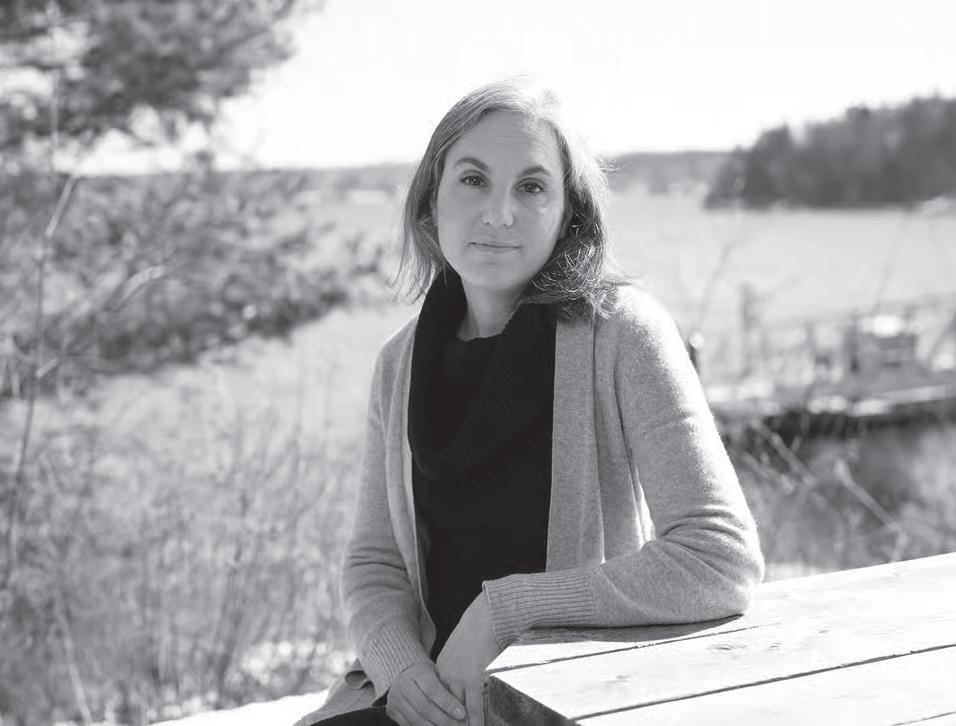
Nichole Price, a senior scientist and marine ecologist at Bigelow Laboratory for Ocean Sciences and professor of environmental studies at Colby College, will become Colby’s inaugural director of the Center for Resilience and Economic Impact.
PHOTO: CAITLIN PENNA/COURTESY COLBY COLLEGE
A whaling museum grows New Bedford museum documents maritime history
BY CRAIG IDLEBROOK
At a time when many museums are retrenching post-pandemic, the New Bedford Whaling Museum on the south shore of Massachusetts is expanding.
In March, it was announced the museum would receive a $15 million tax-exempt bond from MassDevelopment, a quasi-public state development agency, to fund the creation of a new visitor center and expanded exhibition space. Construction began on the new center in January. The 20,000-square-foot plan, projected to cost $37 million, is targeted for completion in 2027.
The expansion seeks to create a more welcoming and up-to-date space for visitors, and to provide the opportunity to exhibit more of the museum’s 750,000 pieces and traveling exhibitions.
Currently, one of the museum’s most notable pieces, a 1,275-foot-long panoramic painting tracking a 19th century whaling voyage, is only on display off the museum grounds.
Ultimately, New Bedford Whaling Museum CEO Amanda McMullen told The New Bedford Light, the goal is to create the largest and most up-todate exhibition space in New England south of Boston.
Foot traffic at the museum has recovered more strongly than at some institutions in the wake of COVID, with attendance climbing from some 70,000 annually in 2022 to some 89,000 in 2025, said Annelise Conway, the museum’s chief engagement officer.
“I think people are starting to discover the gem of New Bedford in the south coast,” said Conway. “And we like to think they’re discovering the gem of the Whaling Museum as well, and that we’re not just whaling.”
By contrast, an American Alliance of Museums survey found that 29% of museums in the U.S. had decreased visitation in 2025 compared to the year previous.
Barry did not work with the whaling museum on this expansion.
“…we like to think they’re discovering the gem of the Whaling Museum as well, and that we’re not just whaling.”
The museum, an outgrowth of the work done by the Old Dartmouth Historical Society, focuses on New Bedford’s whaling history, but it also documents maritime history more broadly. It has interactive exhibits about the waves of immigration that powered commercial fishing throughout U.S. history, the art and handicrafts borne from commercial whaling, and the ecology of the Atlantic Ocean and its largest mammal inhabitants. All this is what draws visitors to the museum, said Conway.
In 2025, the museum began demolition of a vacant building that once housed a local printing company for the expansion. It also created 20,000 square feet of new space for an education center in 2015.
Expansion can carry some risks if not carried out thoughtfully and in an economically sustainable fashion. Conway said much of the museum’s expansion has occurred slowly within existing spaces over the years.
Downtown New Bedford has seen high vacancy among business spaces in recent years, providing natural opportunities for expansion.
“I think it’s been the process where [buildings] have been available and we’ve needed the space,” Conway said. “And so it’s been a natural growth and availability process.”
Museums which had a diversified revenue stream and strong institutional fundamentals weathered the storm better, said Angie Barry, the founder of AB Museum Consulting LLC.
“The museums that had operating reserves, strong board and staff leadership, and local community support were the most successful,” Barry said in an email interview.
Downtown New Bedford, site of where Moby Dick author Herman Melville first set sail on a whaling vessel, has leaned into its history as once being the commercial fishing capital of the world.
It has been aided by the establishment of an urban national park in 1996. The site encompasses 13 city blocks and is managed in partnership with the National Park Service, the city, and downtown institutions, including the whaling museum.
Old predator poses new threat to lobster
UMaine researchers are studying it
This article first appeared in UMaine News. It has been edited and condensed.
Michelle Staudinger, associate professor of fisheries science, is leading a new study at the University of Maine to find out whether lobsters are being consumed by a long-known fish predator, cunner, in a new way.
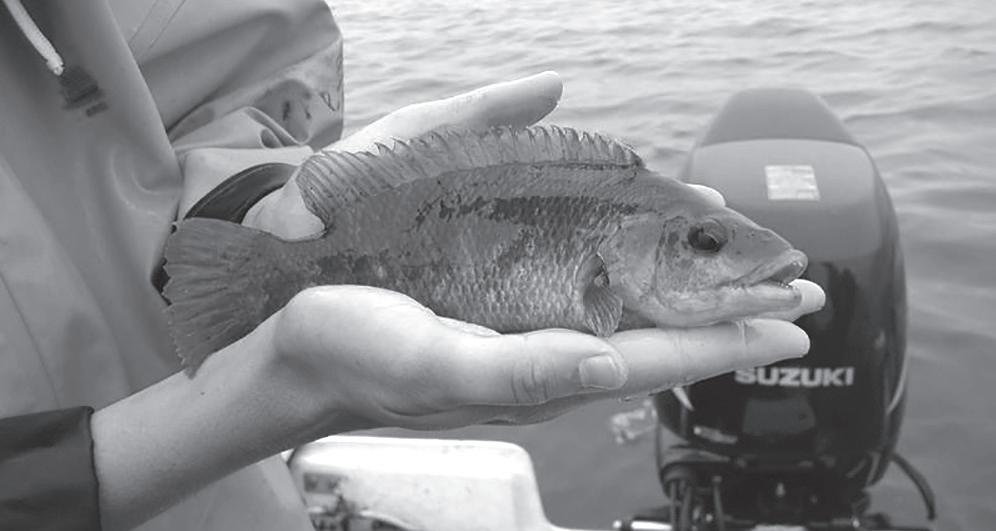
These small, vibrant fish, often associated with rocky habitats, are native to the Gulf of Maine. They are known to eat young lobster in the benthic stage, as well as small clams and snails.
Increasingly, the Maine Department of Marine Resources and commercial lobstermen are finding cunner caught in their traps. Staudinger said the lobstermen have shared photos of cunner with lobster eggs in their mouths and are concerned it’s impacting the fishery.
The National Geographic Society awarded Staudinger with one of 20 grants to study keystone species in the U.S., in honor of the nation’s 250th anniversary. Selected projects, including Staudinger’s lobster research, are receiving funding, equipment, and other support to advance innovative solutions to contemporary conservation challenges.
Lobster and cunner have coexisted for a long time, but this would be a new behavior and new dynamic within the rocky substrate where they reside.
Cunners are unique in that they have tiny teeth throughout their jawline, which helps them capture food from rocky surfaces. They use their teeth to crush shells and other food, making it hard to recover evidence. Because of this, Staudinger said her research team will be studying the contents of cunners’ stomachs using environmental DNA.
While shifts in community composition, distribution, and timing of occurrence are all well-known ecological responses to environmental change, Staudinger said researchers have a poor understanding of how these responses affect predator-prey and competitive interactions among species.
“We don’t know if this behavior has been happening and gone unnoticed or if there is an environmental factor causing it to happen now,” she said. “We would like to gather evidence to determine how widespread it is happening, and the best way to do that is to work with the fishermen who are on the water every day and see them in their traps.”
Staudinger said the team will be working through various hypotheses about what’s contributing to this shift.
Barry said it’s vital for museums to have a realistic plan for growth, one built on a clear understanding of visitor demand and the resources available. And growth should never be just for growth’s sake, she said.
“Museums should make missiondriven decisions when expanding,” Barry said. “Growth should not just be measured in square footage, but in the increase of diverse narratives and interpretive scope and the focus on fundraising for sustainability.
“It’s possible there’s been a shift in timing. It could be a spatial distribution or a temporal shift that is bringing these two species together during certain life phases that they didn’t meet in previously,” Staudinger said.
“I found old historical papers that show cunner ate a lot of mollusks and other benthic invertebrates. One paper I found suggested that cunner really like to eat mussels, which have been less abundant in recent years. There is the possibility that they are exploring new food sources because others have
decreased. They also might just be opportunistic, and that behavior could be leading them to take advantage of something they didn’t before.”
If fishermen or other stakeholders find cunner with lobster eggs in their mouths, the Staudinger Lab is asking they send photos or information to 508-348-9039 or cunner.maine@gmail. com with the date the fish was captured and its location. More information is available on the lab’s website.
Maine lobstermen are increasingly finding cunner caught in their traps. The predatory fish are a threat to young lobster, and UMaine researchers are trying to learn more about this trend. PHOTO: COURTESY MASSACHUSETTS DIVISION OF MARINE FISHERIES
Protecting Nantucket’s vanishing working waterfront
Historic fish house gets a new preservation restriction essay
BY MARY BERGMAN
THERE ARE TIMES when I wonder if Nantucket Island, where I have lived and worked for the last twelve years, faces an impossible situation. Thirty miles south of mainland Massachusetts, Nantucket’s character is eroding under extreme development pressures. They aren’t making any new land out here; more and more of it is submerged at high tide. What land remains is worth an astounding amount.
Once known the world over for its role in the American whale fishery, Nantucket’s booming economy crashed in the 1850s when whaling died out. The next couple of decades were quiet, difficult years on the island. Few new buildings were constructed; once grand whale-oil merchant and sea captain’s homes sat empty, untouched by modernity. Poverty aids preservation. It wasn’t until the later part of the 19th century that city-dwellers began to “discover” Nantucket, and the island woke up from its foggy slumber.
What happened next is what happens in most every beautiful coastal place: first come the fishermen, then come the artists and bohemians, then come the tourists and real estate developers.
Most of my working life on Nantucket has been dedicated to local history and historic preservation. Nantucket earned the dubious distinction of being named to the National Trust for Historic Preservation’s 11 Most Endangered Places in 2000.
Waterfront property is at a premium here, and no address is more desirable
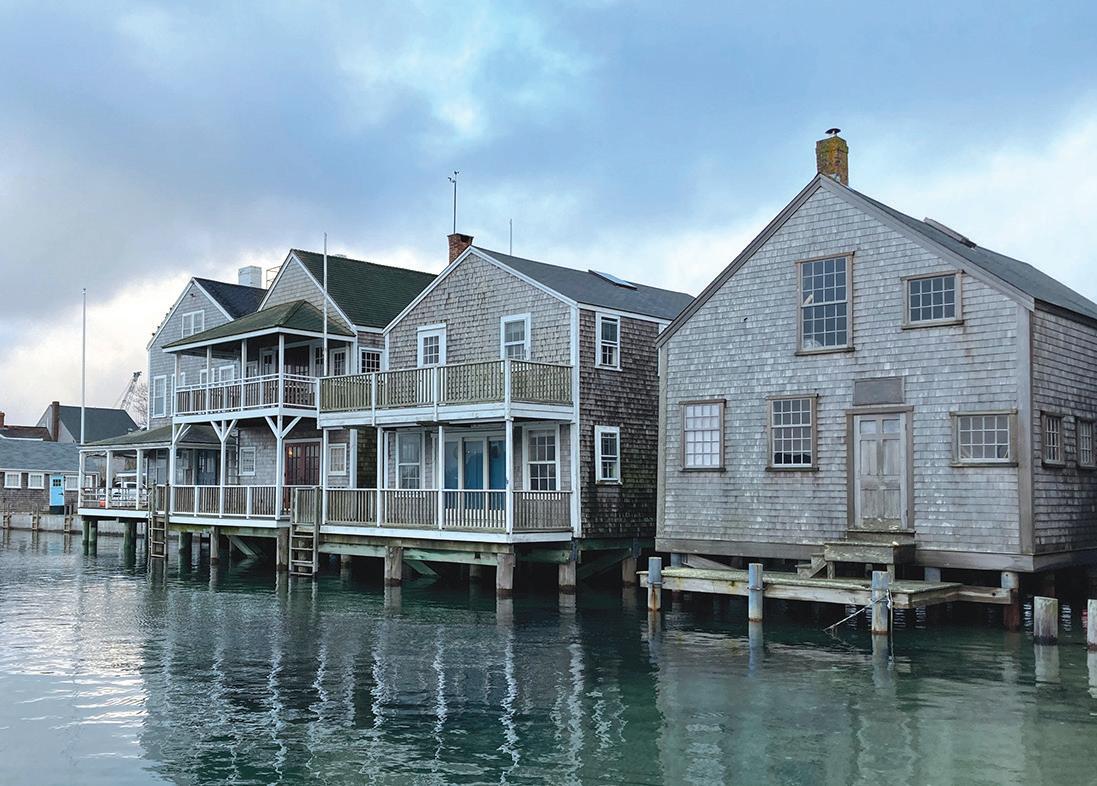
than Old North Wharf, just off the Easy Street boat basin. Originally built in the 1770s, the Wharf first supported the whaling industry and, later, commercial fishing ventures closer to home. Today, most of its cottages are outrageously valuable tiny trophy homes, some assessed at more than $10,000 a square foot.
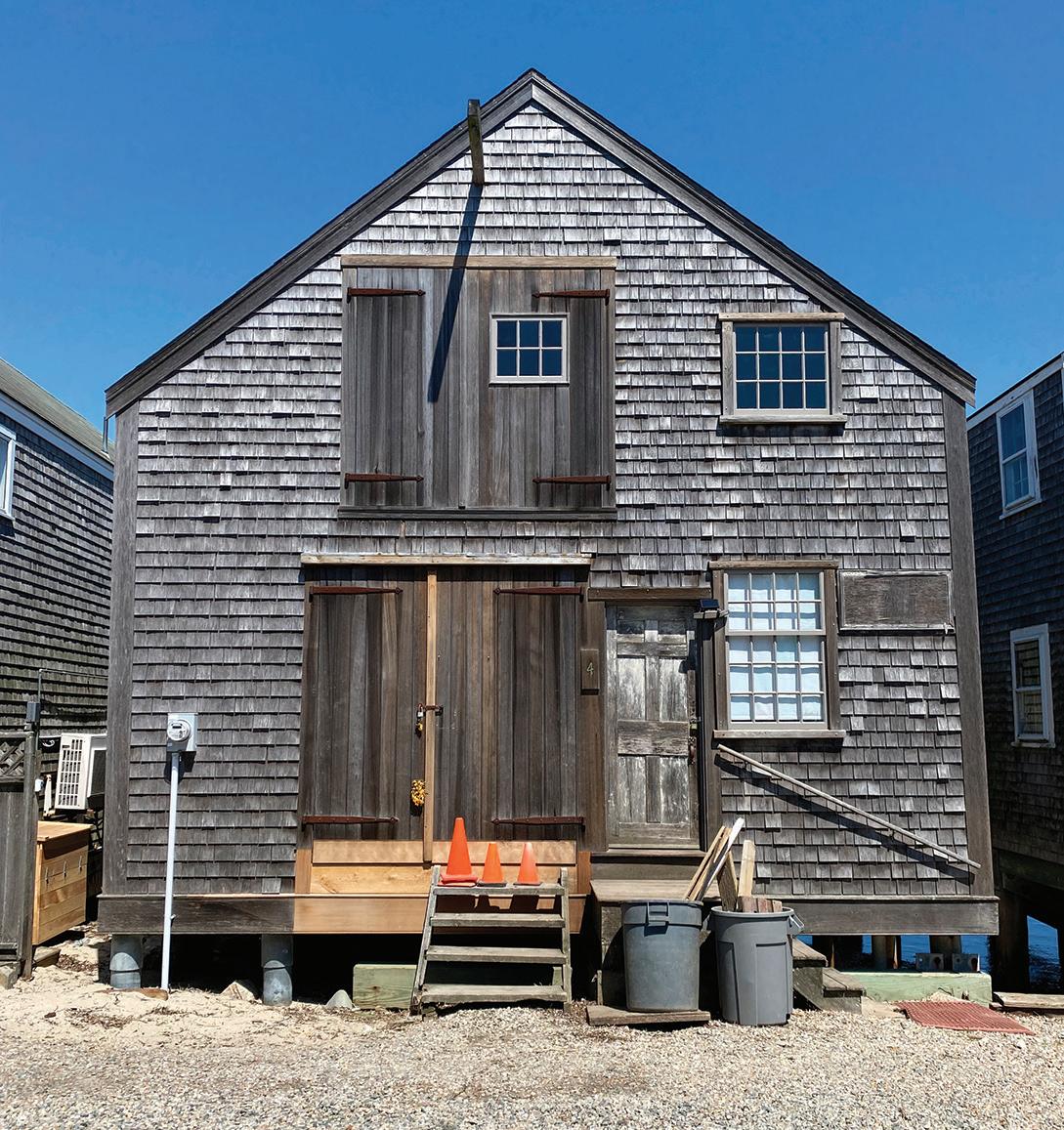
One lone working building remains, the Mitchell-Andrews fish house, constructed c. 1847. Originally a carpenter’s shop, later a fish house, and today a shanty where scallops are opened from Nov. 1 through March 31, this building is the last sliver of the working waterfront on the Wharf. The shanty’s natural beauty is unmarred; it smells of fish even when none are present. When Ginger Andrews, the shanty’s owner and steward, walked into my office in December 2023, and said it was about time she put a preservation restriction on the place, I knew I couldn’t leave this job until the restriction was recorded. Ginger comes from a long line of islanders. Her mother was an ornithologist, and she inherited a naturalist’s reverence for birds along with her uncle George Andrew’s shanty. She is a close observer of the world, and some of her best advice to me is rooted in this practice: when you find yourself in an impossible situation, you have to keep looking.
Preservation restrictions, or easements, are voluntary legal agreements that perpetually protect the character defining features of a building, interior and exterior. The easement is an enforceable instrument, and travels with the deed of a building, no matter the owner now or in the future.
Ginger wanted to protect more than just the architectural form of the building. She sought to preserve a way of life. Were she to sell the shanty without an easement, it would most certainly become another confection: scrubbed up, straightened out, fancied up. The shanty is not a high-style building; its significance is found in simplicity. You can see the passage of time in its weathered shingles and glass worn smooth by wind and salt spray. There is not much original fabric here, and as the building has been in a nearconstant state of use since the 1840s, standing on piers over tidal land, it has been in a near-constant state of repair.
Massachusetts does not have a program like Maine’s Working Waterfront Covenant, but public access to waterways and tidal lands is protected under Chapter 91 of Massachusetts General Law. To protect the shanty itself from future insensitive development, we had to look for a creative solution.
Ginger wanted to ensure that the shanty would never be taken out of operation as a commercial building, and wanted to support the fishery and the artists who followed. In creating this preservation restriction, we wrote in a condition that would require approval to change the use of the building to one “other than institutional, educational or commercial enterprises that reflect, commemorate, or continue Nantucket’s historic maritime economy or its historic artists colony; such uses may include, but are not limited to marinerelated services, non-residential art studios, or art gallery.”
For an agreement between a homeowner and a preservation society, there are a lot of outside reviews involved. In addition to the approval of the Massachusetts Historical Commission at the state level, Nantucket’s Select Board had to sign off on this easement. I worried that they would not—certainly,
restricting the development potential of this building in a highly desirable location would bring down the assessed value, and therefore, the taxes an owner would pay to the town. But the town signed off on the restriction, and my hope is that they, too, understand the value of the working waterfront to Nantucket’s economy.
While it is true that Nantucket has lost quite a bit of its grit in the last 50 years, it is not all bad news here. There is still a bay scallop fishery. Despite the extreme cold this winter, 20 scallop boats were fishing, hitting their 6-bushel limit most days before noon. The annual bay scallop harvest was over 8,000 bushels for the first time since the 2019-2020 season.
The story of the Mitchell-Andrews shanty drew attention from members of the island community near and far. Folks on the Wharf donated money to support the easement program, and a family in Texas even sent a donation to help offset the costs of managing the shanty’s restriction. Researchers came to study the shanty and imagine its future.
Using the available laws to preserve access to the commercial waterfront and its structures is something those tasked with preserving history in coastal towns should look into. Preservation is about far more than buildings; it is about people and ways of life. When I see the scallopers leave in the early morning in winter, or hear the openers chatting with each other in the early afternoon, I know that scalloping is a very real link to our past. We have to keep working and planning to ensure commercial marine industries remain part of our future, and not just a page in the history books.
Mary Bergman was the executive director of the Nantucket Preservation Trust from January 2020 until May 2026. She is a freelance writer and researcher living on Nantucket.
The Mitchell-Andrews fish house (far right) is the only part of Nantucket’s Old North Wharf that still serves as working waterfront. Most of the Wharf’s cottages are now outrageously valuable tiny trophy homes, some assessed at more than $10,000 a square foot.
The front of the Mitchell-Andrews fish house, which today serves as a shanty where scallops are opened from Nov. 1 through March 31. PHOTOS: MARY BERGMAN
Gentrification threatens small coastal towns
Communities can still do something about it
BY STEVE TRAIN
MAINE IS the oldest state in the nation. Not oldest as in historic. Oldest as in the average age of its people is higher than anywhere else in the country. That matters more than most people realize, and it is worth discussing.
The democratic process, at its most basic, results in people voting their own interests. Politicians follow large groups of voters because that is how they keep their jobs. I get it. I am a voter and I feel this way about plenty of things myself, usually at the national level more than the local. But at the local level, this dynamic has consequences that compound over time in ways that are hard to see until they are very difficult to reverse.
As communities gentrify, for whatever reason—whether it is remote work, retirement migration, rising property values, or just the discovery that a place is beautiful—local politics tend to follow the direction of growth. The momentum builds and continues until either what you were hoping to protect is gone, or enough people recognize what is being lost and decide to do something about it.
An affluent, older community has real benefits. I am not dismissing that. But at some point the public resources required to service it become either untenable or so expensive that members of the younger working class must leave. And when they leave, they take more than themselves. They take their willingness to volunteer, their ability to work part-time around school hours, and their children.
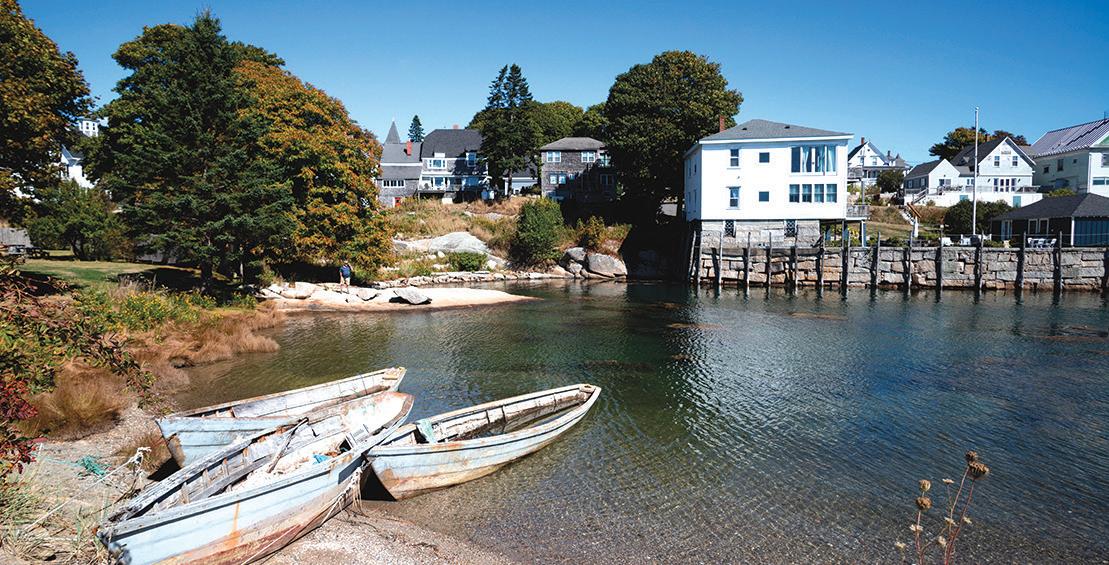
We can already see where this leads. A December 2025 report from the Interlocal Deer Isle-Stonington Housing Task Force found that 46% of homes in Deer Isle and 42% in Stonington are now occupied only seasonally. The same report found that nearly 20% of the island’s workforce commutes at least 100 miles round-trip daily, and that more than a hundred local jobs remain unfilled largely because prospective employees can’t find a place to live.
The volunteer fire and rescue services that coastal communities depend on are feeling this too. A University of Maine study found that the state’s rural fire departments are facing what it called an existential crisis when it comes to

INVENTORY READY FOR YOUR WATERFRONT PROJECTS!
• Marine grade UC4B and 2.5CCA SYP PT lumber & timbers up to 32’
• ACE Roto-Mold float drums. 75+ sizes, Cap. to 4,631 lbs.
• Heavy duty HDG and SS pier and float hardware/fasteners
• WearDeck composite decking
• Fendering, pilings, pile caps, ladders and custom accessories
• Welded marine aluminum gangways to 80’
• Float construction, DIY plans and kits Delivery or Pick Up Available!
recruiting and retaining personnel. When working families leave, they take the volunteers with them. What replaces them are full-time professional services that cost significantly more, if they can be staffed at all.
That can seem manageable at first, with fewer schools, buses, playgrounds, and public facilities to maintain. But it leads in one of two directions: Either higher taxation to cover services that used to be handled by people who lived here and did it because this was their home, or a community that slowly fails because it no longer has a diverse enough population to sustain itself.
This is not just an island problem or a coastal problem. Maine is aging and gentrifying, which are forces bigger than any one town or harbor.
But individual communities can still choose to do something about it. The tools exist, including zoning, housing policy, working waterfront protection, and intentional planning. What is often missing is the will to use them before the window closes.
Or we can wait and see what we are left with.
Steve Train is a lobsterman from Long Island.
code WWF to receive $100 to mission-aligned organizations when you open a new personal or business checking account.*



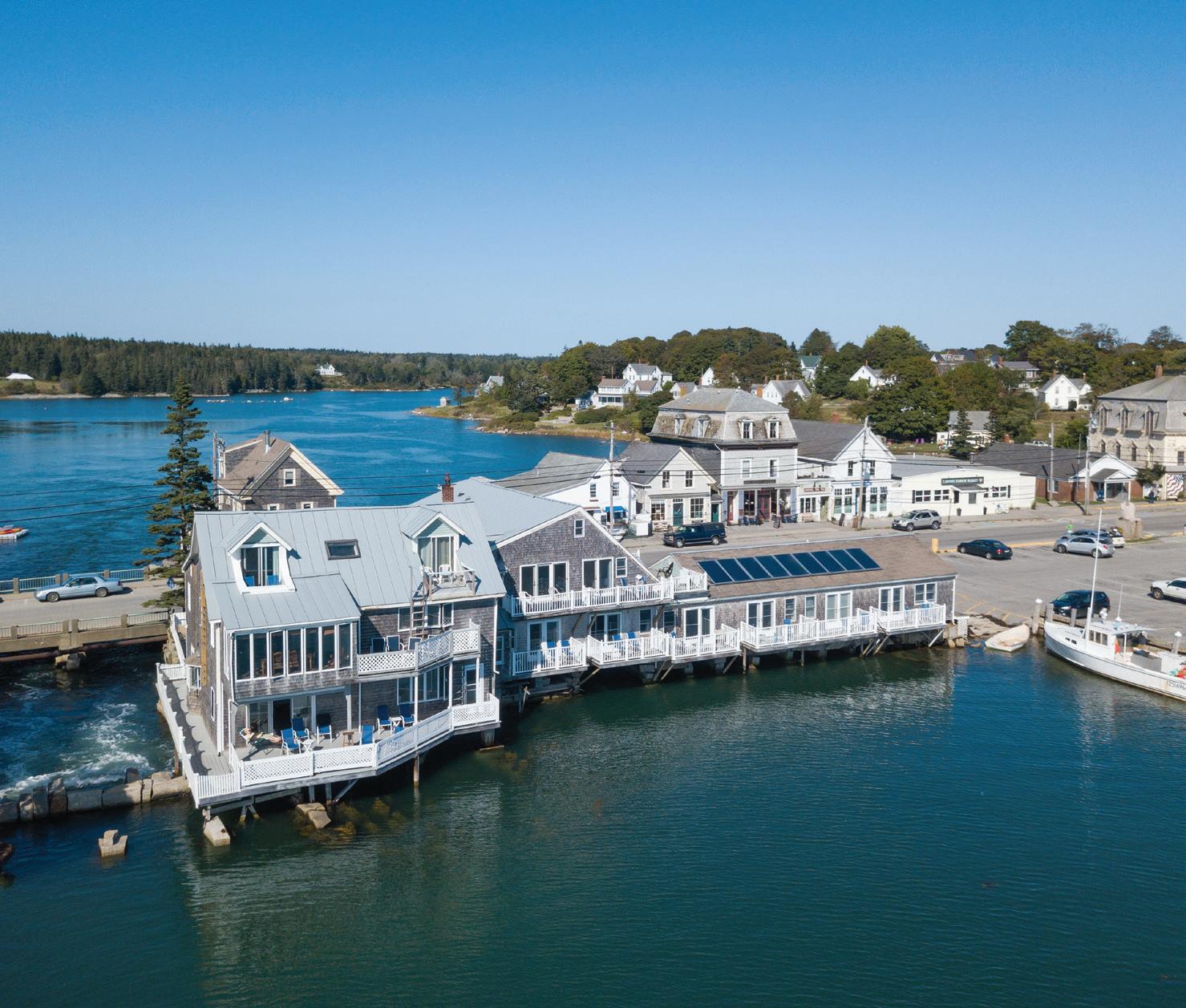
Waterfront property in Stonington, where a recent report found that 42% of homes are occupied only seasonally. PHOTO: JACK SULLIVAN
INFORMING THE FUTURE OF MAINE’S COAST AND ISLANDS
Waypoints is part of Island Institute’s effort to gather data and share stories that spur action and provide decision-making support to community leaders. Like the waypoints on a journey or map, thoughtful interpretations of data and science provide navigation points toward community-led solutions.
Housing and Affordability
Housing affordability in Maine’s island and coastal areas threatens these communities’ economic resilience and long-term sustainability. A limited supply of housing that is affordable for teachers, municipal officials, fishermen, and others means that many people cannot live where they work. This disconnect threatens the economic resilience, workforce stability, and long-term sustainability of coastal and island communities.
Home ownership is generally considered unaffordable if the home’s mortgage, taxes, basic utilities, and insurance costs exceed 30% of pre-tax household income. Since COVID, skyrocketing real estate prices in coastal Maine have priced out a majority of Maine families from their communities. Up until 2020, the median income could cover the cost of the median-priced home. From 2020 to 2025, the income needed to afford the median-priced home doubled, while median income only increased by 31 percent.
Households Unable to Afford MedianPriced Home, 2024
Households Unable to Afford MedianPriced Home, 2024
Coastal Counties Knox 81% Sagadahoc 77% Cumberland 77% York 75% Lincoln 74% Hancock 74%
Waldo 66%
Washington 56% Central Counties
Androscoggin
Penobscot 55%
Rim Counties
Oxford 69% Franklin 64%
Somerset 59%
Piscataquis 52%
Aroostook 46%
Maine 64%
Source: Maine Development Foundation’s Measures of Growth publication. This publication provides an important overview of more than 25 indicators related to the State’s economy.
Maine is experiencing a housing shortage that is harming the quality of life and economic prosperity of all Mainers.
At the same time, Maine has one of the oldest housing stocks in the nation. Over 20 percent of Maine homes were built before 1940, and half were constructed before 1980. This means that many of Maine’s single-family homes are likely in need of renovations and efficiency upgrades to meet modern building standards and energy efficiency requirements.
Maine’s housing shortage impacts the quality of life of all Mainers. Long-time residents and workers moving to and within Maine are struggling to find homes that they can afford close to job opportunities. Young people who grew up in Maine face rising housing costs for rental homes and entry-level homeownership, making it hard for them to stay. Aging Mainers struggle to downsize and find adequate housing to age in place in their communities.*
Maine’s housing shortage constrains statewide economic growth. Many Maine companies now struggle to fill open jobs due to limited housing options. This issue will grow as an increasing number of Mainers reach retirement and growing businesses require more workers. Without enough homes available for eligible workers to take open jobs and stay in or move to the state, businesses will continue to struggle and at times fail—harming the prosperity of all.*
The data paints a picture of Maine’s housing affordability that is not pretty. But communities across the coast are building solutions to meet the challenge. Island Institute is committed to supporting community-led solutions. To learn more about our Housing Initiative, visit islandinstitute.org.
* Reprinted from "A Roadmap for Future Housing Production in Maine," HR&A Advisors, January 2025
A 2023 Housing Needs Study found that Maine needs 84,000 new homes by 2030 to meet projected population growth and demand, and to start to address affordability concerns.
This Waypoints page looks at the state’s housing challenges through three different lenses: affordability, existing housing supply, and the need for new housing. There is much more demographic, income, and housingrelated data that can be found through various housing data portals. Some of this data can be viewed and compared at the county or community level.

Maine Homes by Decade Built, 2024
Source: American Community Survey (ACS), U.S. Census Bureau
Our Island Communities

Casco Bay islands team up on erosion
Collaborative model helps get grants and find solutions
GUEST COLUMN BY BETH MACKEY
If you live on or near an island shoreline in the Casco Bay region, you may have already heard about a local group of volunteers who have been working hard to raise awareness about coastal erosion and related climate vulnerabilities to our islands. This collaborative group now includes representatives from Great Diamond, Little Diamond, Long, Chebeague, and Peaks islands.
Five years ago, Tracy Sommers from Great Diamond began a local campaign to educate her community about the dangers of sea level rise. Early on, she saw the value of collaborating with local nonprofits and state experts. The heavy storms in the winter of 2023-2024 brought a new urgency to the group’s mission.
You may have seen the Calling Your Bluff series: a webinar introduction to bluff erosion followed by a daylong symposium at the Gulf of Maine Research Institute (GMRI). This event brought together residents and experts from across Maine, including the Maine Geological Survey, the Department of Environmental Protection, GMRI and Island Institute. Thanks to a state coastal community grant, these events were professionally recorded and made available on Greater Portland Council of Government’s YouTube channel. This grant also funded two other successful projects: an online “toolkit” that compiles available resources, and island-specific community conversations to discuss climate resilience priorities.
For more information on the Calling Your Bluff toolkit, please visit https://www.islandinstitute.org/ calling-your-bluff-toolkit/.
As Tracy explains, “We learned very early on that working beyond GDI— building relationships and partnerships across islands—was essential to advancing knowledge and action at home. These connections have created opportunities for shared learning,
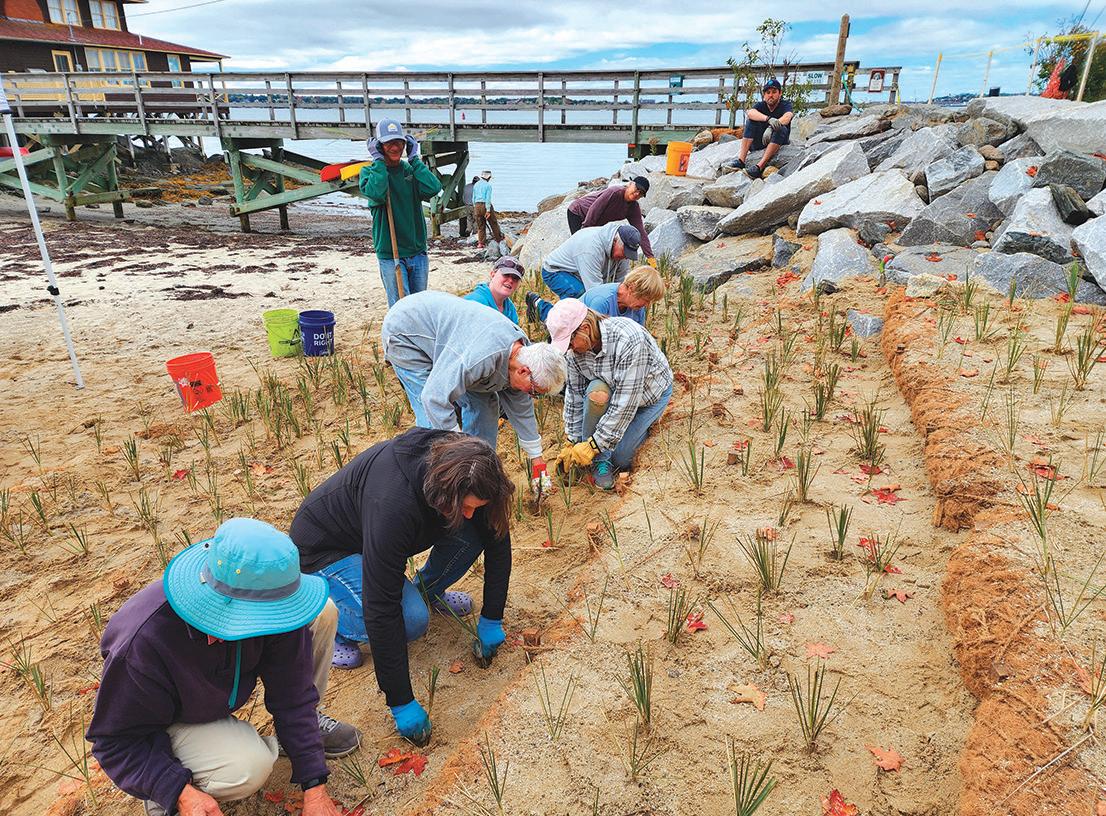
expanded community engagement, and access to resources that would not have been possible working in isolation. Just as importantly, this broader collaboration has strengthened our relationship with the City of Portland, helping to align island-led efforts with city and regional priorities, and creating a more coordinated approach to resilience across Casco Bay and ultimately to our island.”
The Casco Bay Island Climate Collaborative (CBICC) formed in 2025 to bring together volunteers from the GDI Partnership, the municipalities of Long and Chebeague, and the city islands of Peaks and Little Diamond. This group is moving forward with new educational content to advance knowledge and encourage action on each island. For example, in the fall of 2025, Island Institute hosted a workshop on Little Diamond to showcase the nature-based solution designed and implemented by local volunteers to mitigate erosion at the ferry pier and beach, and to rebuild the dune.
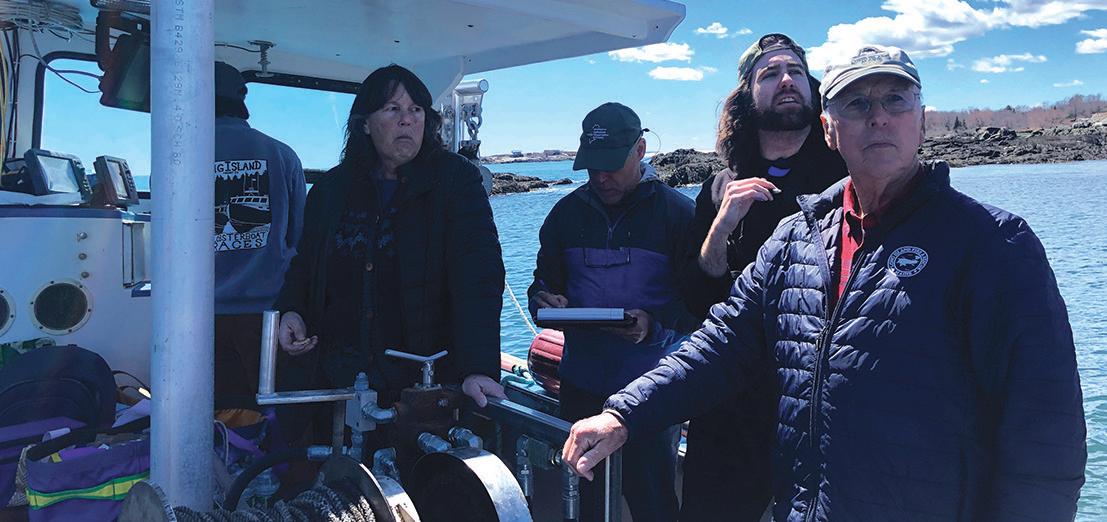
The Collaborative is now partnering with Island Institute and Portland’s sustainability office to create new programming entitled “Beyond the Bluff.” Thanks to a public-private partnership (a Casco Bay Estuary Partnership grant to Portland and the generosity of a GDI homeowner), a workshop will be held this August to highlight upland bluff management strategies to mitigate shoreline erosion. Over the past several years of working together, Collaborative members have found that although their communities are different in some ways, they share many of the same concerns for the future.
“We all care so much about our respective islands. Through the Collaborative we have each learned so much from each other that we can then take back to our own islands,” notes Ellen Grant from Little Diamond. “LDI has benefitted from learning of climate problems and solutions executed by other islands, and they have learned from our experiences. The CBICC
has been an enriching and productive connector for Casco Bay islands.”
By partnering across island communities, the group has expanded the reach of its education efforts while strengthening its competitiveness for grant funding. This spring, a grant awarded to Island Institute by the Casco Bay Estuary Partnership is supporting work on five islands, where residents are exploring practical solutions to shoreline challenges.
As part of the initiative, Emma Polhemus, a Maine Conservation Corps member hosted at Island Institute, is conducting site visits on each island, assessing three shoreline properties per island. These assessments will use Maine DEP’s OUR SHORE guide to provide homeowners and members of the Collaborative with detailed reports outlining site conditions, recommended next steps, and potential nature-based stabilization strategies.
To extend these findings to a broader audience, Island Institute in partnership with Portland and island leaders is hosting a webinar in May highlighting key issues and showcasing recommendations drawn from one representative site on each island.
Working together, the group has discovered not only greater capacity to reach more residents, but it is also more effective and efficient. Tracy says, “A big part of [our] progress has been creating a space where our community is heard and taken seriously. We’ve helped bridge that gap and shift the mindset from frustration to participation—moving from ‘why isn’t something being done?’ to ‘how can we be part of the solution?’
“That’s the shift—from frustration to shared responsibility—and that’s what I’m most proud of.”
Beth Mackey is a resident of Great Diamond Island and a member of the Casco Bay Island Climate Cooperative.
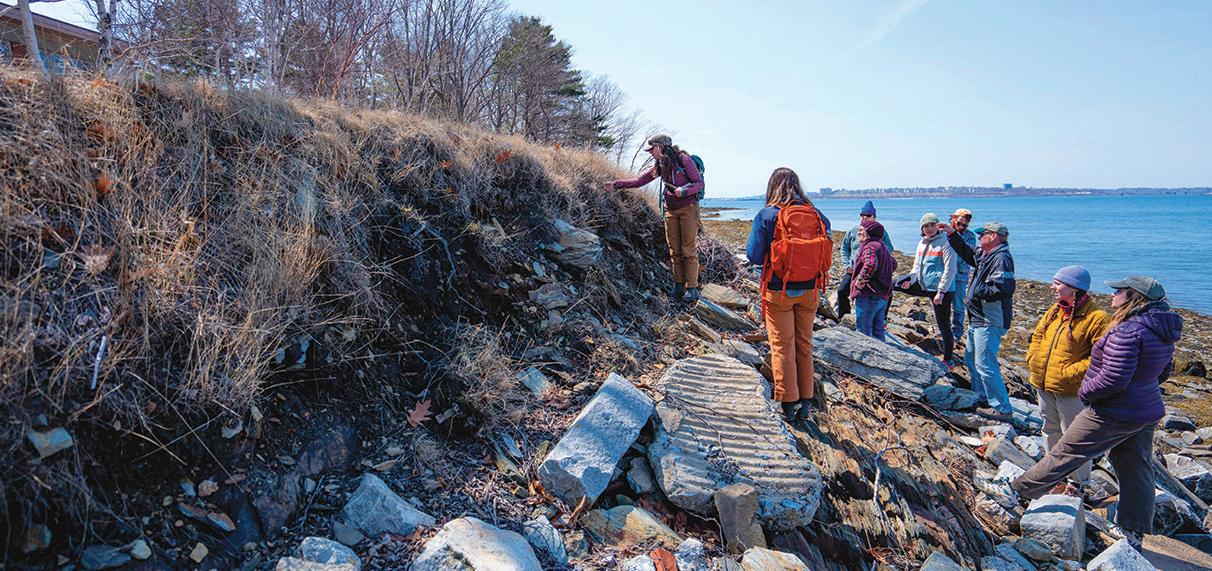
In fall of 2024, volunteers worked to implement nature-based solutions to protect the shore of Little Diamond Island. PHOTO: COURTESY SCOTT WILSON Casco Bay island residents haven taken to the water to survey their shorelines as part of a broader effort to address erosion and other climate vulnerabilities.
PHOTO: COURTESY TRACY SOMMERS
A destabilized bluff on Great Diamond Island. PHOTO: MADISON MCCLINTOCK
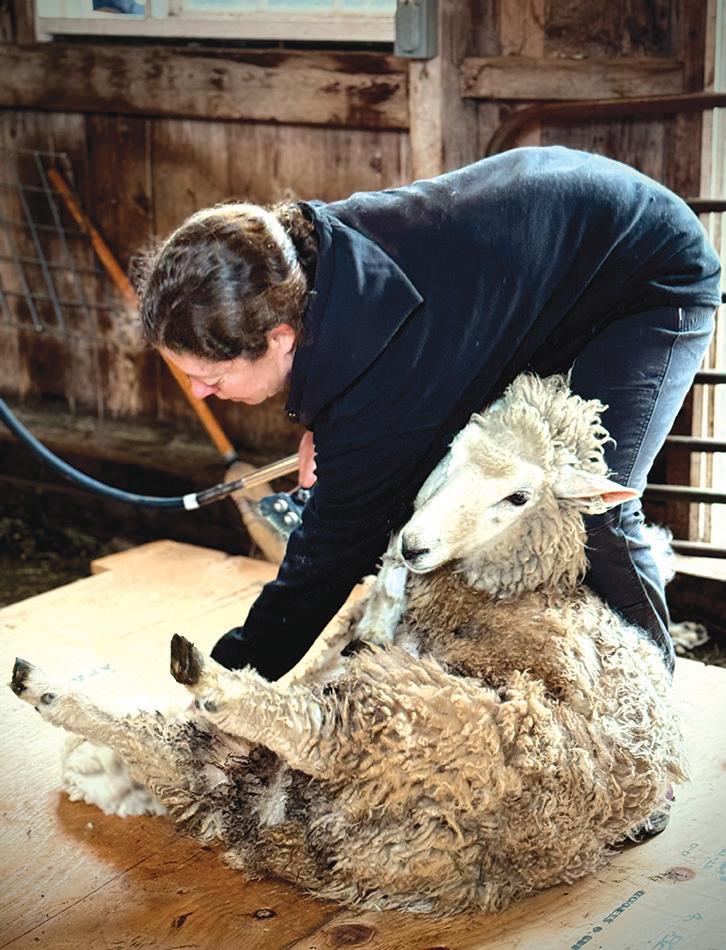
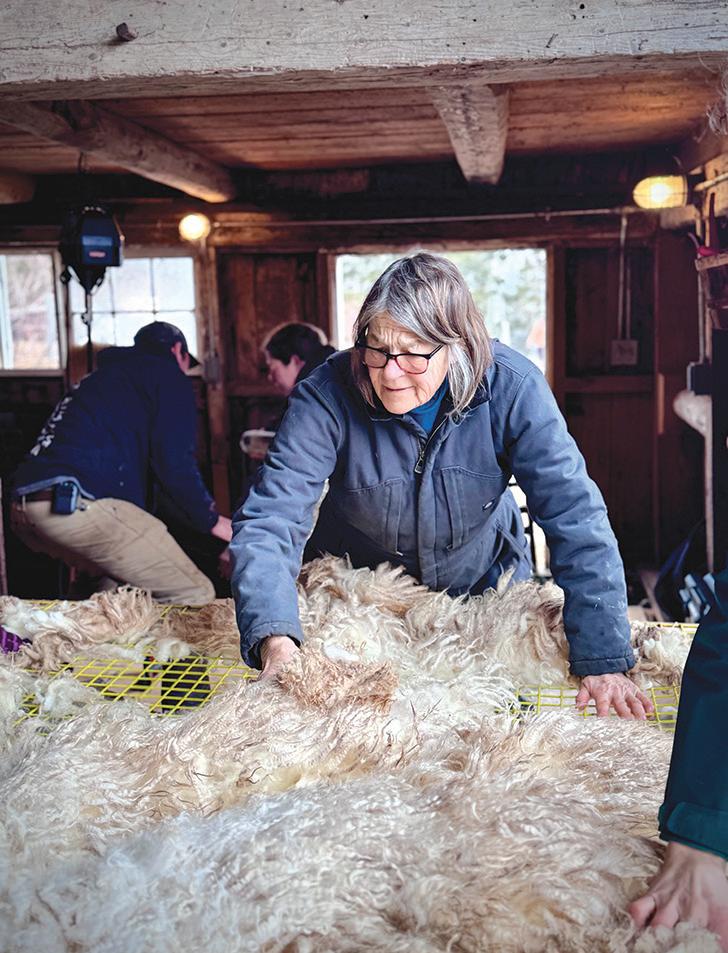
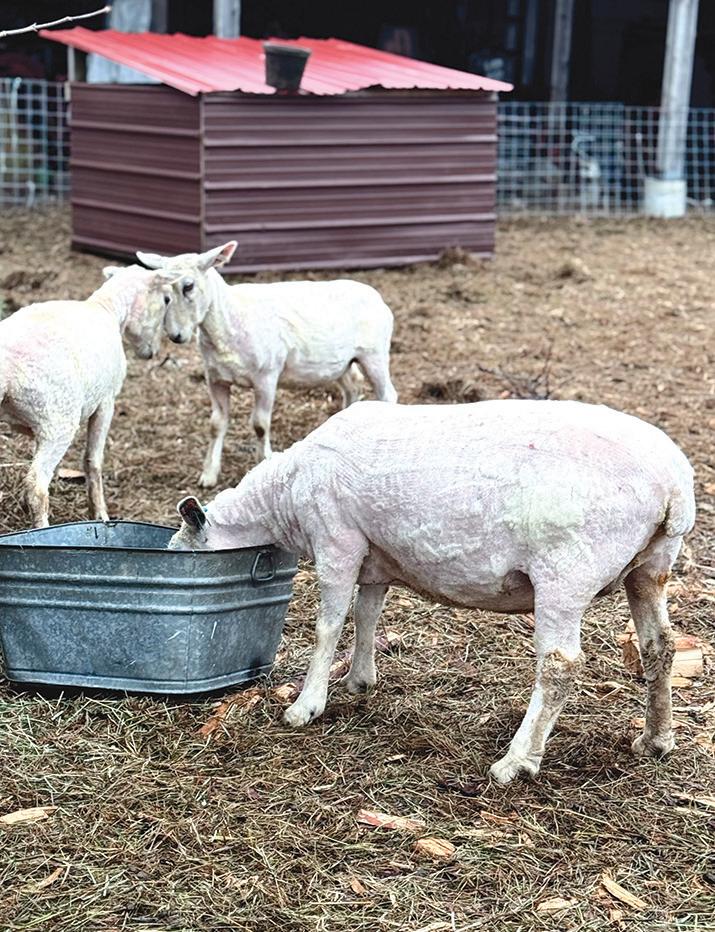
Saltwater fleece
Shearing North Haven sheep is
a community affair
BY COURTNEY NALIBOFF
For North Haven farmer Becky Bartovics, the secret to blue ribbon-winning fleece is multifaceted.
Some of the magic might come from the salt air and cooler summers. The sheep’s Coopworth genetics, a particularly auspicious Leicester/Romney cross, certainly play a role. But the real star player is the shearing day itself, which brings together friends, family, and an expert shearer to create the best possible experience for the sheep—and their wool.
“That’s been in my life since 1977, so it’s a longstanding thing for me,” Bartovics said. “It kind of harkens back to the old days in Scotland and England.”
Bartovics has owned Cider Hill Farm since 2005. She grew up on a farm in Delaware and later in Lincoln, Massachusetts, where she was introduced to sheep-rearing by a neighbor. Cider Hill Farm, which enjoys a striking view of the Camden Hills from the island’s north shore, produces vegetables, pork, and lamb, in addition to the prized fleeces. The weekly farmstand is also often stocked with fermented and pickled vegetables, sourdough loaves, and bouquets.
Cider Hill Farm’s fruit trees are an attraction of their own, with a genetically unique specimen of apple gracing the front yard. In September, when the farm lives up to its name with regular community cider pressings, its branches are laden with pale green, quinceshaped fruit named Cora’s Grand Greening after a former resident of the farm, a midwife.
The annual sheep-shearing at Cider Hill Farm is as much a community event as the cider pressings. “I think the way she does it is, like, really special, it makes it really nice for everyone, she has a way of bringing people together,” said Emily Garnett, the professional sheep shearer Bartovics has worked with since 2006.
Shearing sheep is an all-hands-on-deck event. “It takes more than just one person shearing sheep; you need a whole bunch,” Bartovics said. “You muster the sheep, put coats on the sheep to keep them clean, we take manure tags off around the outside and anything that’s full
of hay, then roll up the fleeces,” she said. All told, 20 friends and family members came through the farm to help on the March 21 shearing day, from Bartovics’ 6-year-old granddaughter, who kept the sheep happy with alfalfa kibbles, to her cousin Lisa, who worked one end of the skirting table, cleaning the fleece after it was shorn.
To keep the humans happy, Bartovics provided a hearty lunch. This year, the menu included curried squash soup, made with Cider Hill Farm produce, bread, salad, a huge frittata, and dilly beans brought by a friend.
To keep the sheep happy, Garnett works with their nature to make the shearing as low-stress as possible.
“We made it so it was kind of easy to get a hold of one and then calmly move it to the shearing platform, and then I hold them so that their legs aren’t touching
the ground or the wall. They feel like they can’t push off on anything and get away,” Garnett said. “They are afraid, so just by handling them calmly and gently and trying to quickly get through it, we can help them have a better experience.”
The final ingredient needed for award-winning fleece is in the care taken to keep it clean and the shearing technique Garnett employs. Bartovics’ sheep wear coats, she said, in an effort to keep as much straw, dirt, and manure out of them as possible while they graze. They also spend their pre-shearing night indoors to ensure the wool is dry when it’s time to shear.
“Emily does a really good job not doing second cuts,” Bartovics said. A “second cut” occurs when the shearer doesn’t cut the full length of the fiber on the first pass and has to go back for a second trim:
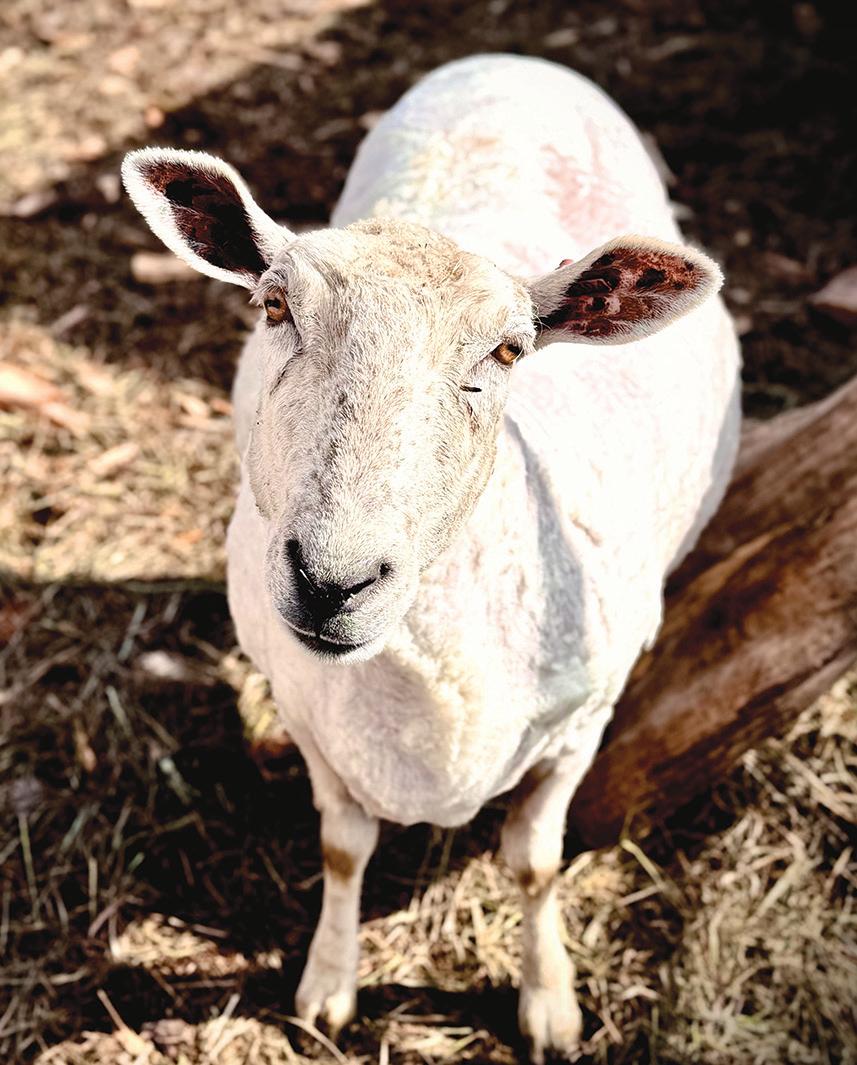
“You notch and end up with these little pieces of wool. I’ve always noticed how few second cuts are in my fleece.”
“All shearers, or most of us, shear sheep in the same pattern,” said Garnett. “Part of why we shear in that pattern is because you have to hold onto the sheep with your legs and body while your hand is doing the shearing, and so this pattern was developed as the most efficient way to get all around the sheep’s body and get all the wool off. With every sheep that I shear, I am doing my best to stay right on the skin so I’m getting the full length of the fiber with every cut.”
Bartovics’ and Garnett’s winning combination of community and care is unique in a field that sometimes values speed over compassion: where Garnett shears four or five sheep in an hour, some shearers can race through 150, but, as Bartovics said, the sheep “looked like hamburger after.” The pastoral setting, delicious lunch, and opportunities for young and old to get involved keep the sheep happy, the helpers returning, and the fleeces earning that coveted blue ribbon year after year.
Courtney Naliboff teaches, writes, and plays music on North Haven. She may be reached at courtney.naliboff@gmail.com.
Emily Garnett shears sheep March 21 at Cider Hill Farm on North Haven.
Becky Bartovics has owned Cider Hill Farm on North Haven since 2005. Each spring, she holds an annual shearing in which a professional shearer comes to remove wool from her sheep, and friends and family provide assistance.
PHOTOS COURTESY AMANDA LABELLE
Bartovics works to keep her sheep happy during the annual shearing at her North Haven farm.
UMaine gets new marine research vessel
A new teaching and research vessel at the University of Maine’s Darling Marine Center is expanding student access to the largest ecosystem on Earth: the open ocean.
The new 45-foot vessel is the biggest in the center’s fleet. Previously used as a commercial tuna fishing platform, it will support student training, faculty research, and workforce development within the School of Marine Sciences and Maine Agricultural and Forest Experiment Station.
With docking stations at both the Darling Marine Center and in Portland, the vessel will give students and faculty improved access to offshore waters throughout New England, from the Gulf of Maine to Rhode Island. It has considerable range, able to travel up to 100 miles offshore, cruise at 18 knots and carry 700 gallons of fuel.
“A tenet of my teaching philosophy has always been learning by doing,” said Walt Golet, UMaine associate professor of marine science. “This vessel will serve as the perfect platform for our students to do just that.”
Depending on the fieldwork, classes of up to 20 students or more can participate at once. Equipped with specialized safety equipment, a fully enclosed wheelhouse, an onboard generator, a heating system, and a small galley, the boat is designed for extended trips and comfort, even in challenging weather. It also has two large bait wells, living quarters with four bunks, a head, a roof top crane, a pot hauler, and a tuna door that can be used to bring large fish onboard for tagging or serve as a dive entry point.
Golet has already been using the vessel for several courses. The boat’s
platform allows students to tag fish and collect data that help track their movements and collect data for fisheries management. Golet, who leads the Pelagic Fisheries Lab, is using the vessel to conduct his research on Atlantic bluefin tuna, billfish, sharks, and other large migratory species and bring students onboard to participate.
Students also assist with deploying gear and learn safety protocols for handling animals, as well as basic vessel and navigation skills.
In addition to shark and tuna tagging projects, the vessel will support marine mammal and seabird surveys, fisheries research, and other offshore studies. It will also enhance courses included in UMaine’s Semester by the Sea program, which brings students from the Orono campus to the coast for an immersive marine science education.
Feds create new USDA Office of Seafood
On April 15, U.S. Secretary of Agriculture Brooke L. Rollins, alongside other federal officials and Maine Sen. Susan Collins, announced the creation of the new Office of Seafood within the U.S. Department of Agriculture. This first of its kind office will prioritize customer service and ease of navigation for American seafood cultivators, producers, and processors to access USDA programs.
“Fishing is the very foundation of Maine’s heritage. Today, the seafood industry in our region generates more than $5 billion in income and supports hundreds of thousands of jobs, in addition to providing a nutritious food supply, delicious restaurant meals, and sustaining entire coastal communities,” Collins said. “I appreciate that USDA is recognizing our fishermen as farmers of the sea and establishing the
Office of Seafood. The creation of this office is a long overdue, essential step to expanding seats at the table for our hardworking fishing families, who are a key piece of our nation’s history and our future as well.”
One of the primary roles of the new Office of Seafood will be coordinating across USDA offices to ensure fishermen are integrated into the agency’s programs and working alongside the
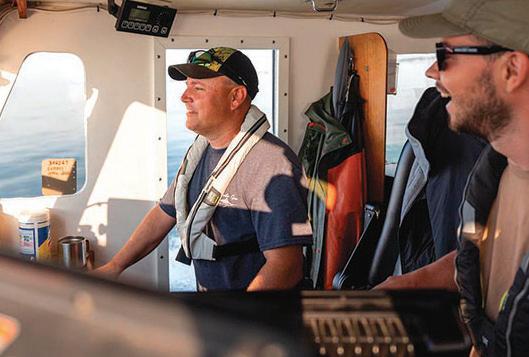
The vessel was gifted by an anonymous donor who has a passion for cooperative research and education and sought to create more opportunities for UMaine students to experience the ocean firsthand.
U.S. Department of Commerce and other federal partners to revitalize the American seafood industry.
The Office of Seafood will play an important role in coordinating with the U.S. Department of Commerce in the development of the America First Seafood Strategy to promote production, marketing, sale, and export of U.S. fishery and aquaculture products and strengthen domestic processing capacity.



Students and staff at University of Maine’s Darling Marine Center are now using a new research vessel. The former commercial tuna fishing platform was gifted by an anonymous donor.
PHOTO: COURTESY UMAINE

Love and art: a gift to Monhegan
The island museum’s summer show is extra special
REVIEW BY CARL LITTLE
This summer the Monhegan Museum of Art & History’s special show features an extraordinary gift: 91 artworks by some of the greatest artists associated with the island. To Monhegan, With Love: The Susan Bateson and Stephen S. Fuller Collection represents what museum director Jennifer Pye in the exhibition catalog calls “a treasure trove of Monhegan art” that “illuminates the lively networks of relationships and the spirit of artistic freedom that have long existed on Monhegan.”
Pye’s essay recaps in a lively manner those “lively networks” that often started with a word-of-mouth youshould-check-out-this-island nudge from a fellow artist. Most famously perhaps was Robert Henri’s insistence that his students, including Edward Hopper, George Bellows, and Rockwell Kent, make their way to Monhegan.
The history of the island’s art reflects just about every 20th-century “ism,” including impressionism. Paintings by Charles Ebert and Edward Redfield capture island scenes with brisk brushstrokes—impressions—their palettes favoring warm summer colors. A lively watercolor of a clothesline by
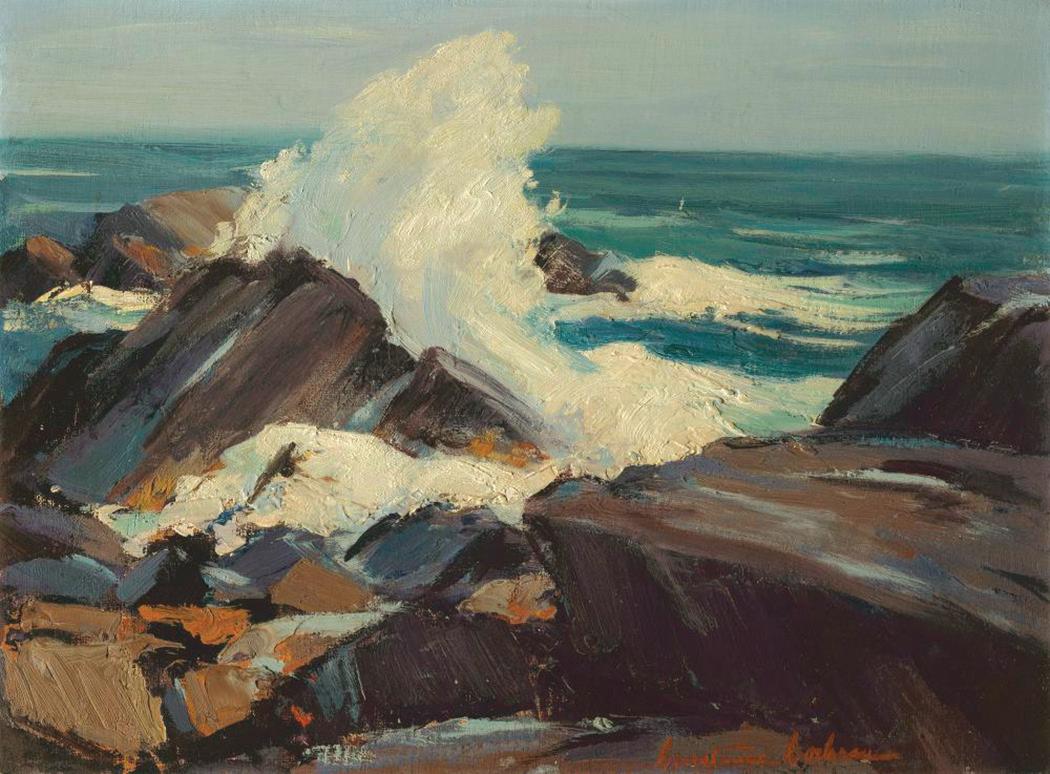
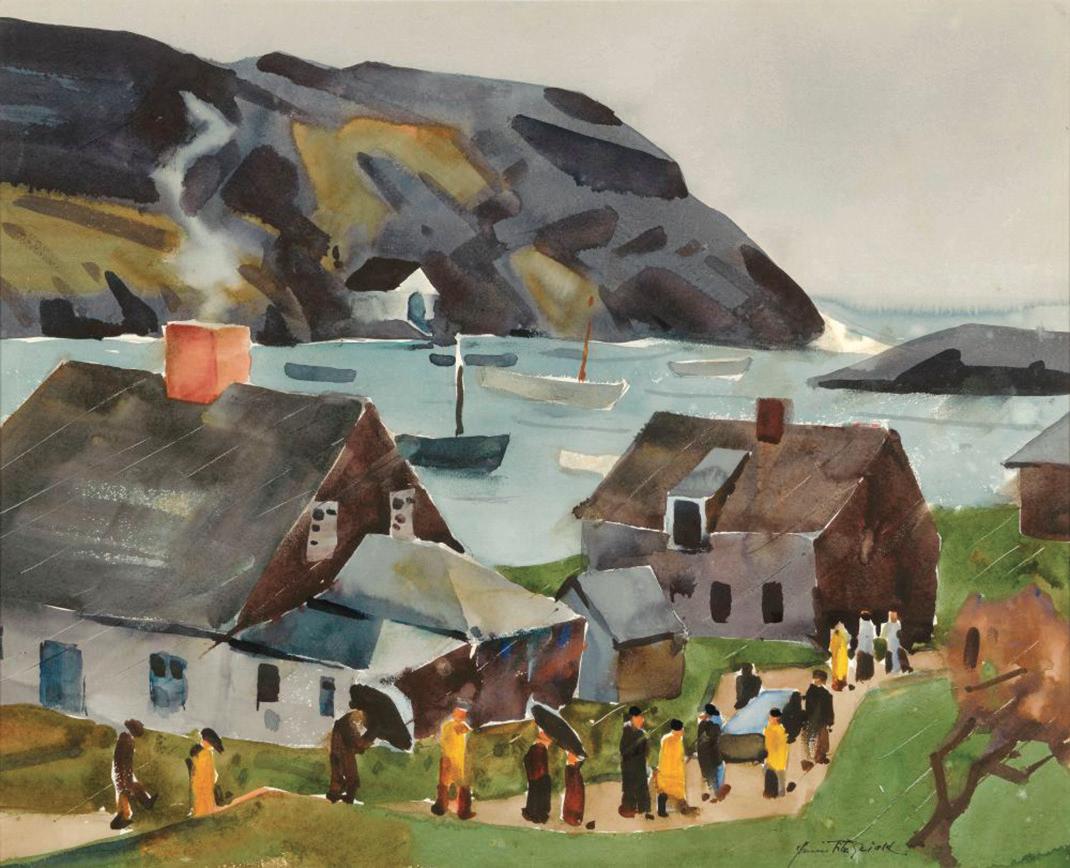
Maud Briggs Knowlton might also fall into this category, the wash whipped by the wind.
With its mid-ocean location, Monhegan experiences its share of weather. The exhibition features a number of classic wave-on-rocks paintings. In “A Storm Brewing, Norton’s Ledge,” ca. 1920, Constance Cochrane catches a wave mid-crash. Equally dramatic is “Pines, Rock and Spray,” 1946, by Joseph De Martini. Another natural phenomenon captures the attention of a group of awestruck onlookers on Lighthouse Hill in “Northern Lights,” 1937, by Alfred Fuller.
The seasons also get their due. As a year-round islander, the aptly named Andrew Winter appreciated the offseason. You can feel the chill in his “Old Fish House,” 1936, the snow covering skiffs, lobster traps, roofs, and part of Manana Island, Monhegan’s harbor guardian. His fellow all-season painter Jay Connaway also found a muse in the winter months. In his “Monhegan,” 1937, a female figure braves the arcticlike elements.
The one non-Monhegan painting stands out: James Fitzgerald’s watercolor “Moon Streak,” also called “Katahdin Under Moonlight,” ca. 1952, one of his iconic images of Maine’s
mighty mountain. Six other Fitzgerald paintings in the show testify to his love of the island and its hardy citizens.
Historian and Osher Map Library director Libby Bischoff admires how this “wonderful and lovely gift” represents much of Monhegan’s life and history. Fitzgerald’s funeral procession, Sears Gallagher’s net menders in a field, Edward Potthast’s bathers at Swim Beach, Emil Holzhauer’s fishermen playing cribbage: these and other images document a working— and playing—island.
The collection includes some Monhegan art-historical revelations. Who knew that painter and interior and furniture designer Lockwood de Forest painted on the island? Edward Deci did, that’s who. The late beloved curator and Monhegan art authority alerted Bateson and Fuller that de Forest’s 1905 oil on board “Monhegan, Maine” was coming up for auction. A service for Deci will take place on the island on Aug. 11.
The exhibition catalogue includes the collector couple’s account of why and how they assembled the artwork and what inspired them to gift it to the Monhegan Museum. They relate a fascinating journey of discovery and engagement—and pay tribute to this
remarkable repository of island art and history.
“By returning these significant works to the island that inspired their creation,” writes Pye in the catalog, “Susan and Steve do so much more than make a generous gift. They enrich the cultural heritage of Monhegan and ensure that the vibrant artistic legacy of the island is preserved in perpetuity for the benefit of art enthusiasts, residents, and visitors alike.” Well done!
One special aspect of the exhibition: the museum is displaying the work in three different venues. In addition to the Assistant Keeper’s House Gallery and the Keeper’s House history displays on Lighthouse Hill, part of the collection will be on view at the KentStoddard-Fitzgerald studio on Horn’s Hill. It is a moveable visual feast.
To Monhegan, With Love: The Susan Bateson and Stephen S. Fuller Collection runs July 1–Sept. 30. To confirm dates and times, visit www.monheganmuseum.org.
Carl Little is the author of The Art of Monhegan Island (Down East Books, 2004).
“Sea Captain’s Cottage and Wash,” Maud Briggs Knowlton (1870–1956), 1919, watercolor on paper, 11¼ x 8⅛ in.
“A Storm Brewing, Norton’s Ledge,” by Constance Cochrane (1888–1962), ca. 1920, oil on board, 11½ x 15½ in.
“Island Funeral” (also called “Burial, Monhegan”), James Fitzgerald (1899–1971), 1956, watercolor and Chinese ink over graphite on paper, 19¼ x 23½ in.
‘Big Jim’ finds new, temporary home
Penobscot Marine Museum highlights industry, icon
BY TOM GROENING
Big Jim isn’t what he once was. At least for now. The iconic 40-foot tall sign that once welcomed visitors to Maine in the late 1950s and early 1960s, and later towered over the Stinson Canning plant in Prospect Harbor, is lying in a paint shed at Belmont Boatworks this spring.
“We call him ‘Flat Jimmy,’” jokes Dan Miller, founder of the boatyard just outside of Belfast, showing the dozen quarter-inch-thick aluminum panels that most recently made up Big Jim, lying on pallets. Those panels have been sandblasted and painted a dull gray, further diminishing Jim’s oncecommanding presence
But Big Jim will rise again, this time along Route 1 in Searsport at the entrance to the Penobscot Marine Museum’s campus, temporarily welcoming visitors to its Sardineland exhibit, which is entering its second year. The sign is then set to head back to Prospect Harbor in the fall.
The sign and character are intertwined with Maine’s fishing heritage. The museum’s executive director, Karen Smith, shared the story with supporters earlier this year, including how the unlikely quest to restore and host Big Jim took shape.
“We’re right along heavily traveled Route 1,” she said, “but we tend to get overlooked.” In what Smith admitted was a “wild idea,” staff suggested that “we need something like Big Jim, the big sardine man, that will just stop people and make them see that we’re here.”
Jim made his debut on Route 1 in Kittery in 1959, courtesy of the Maine Sardine Council, welcoming visitors “to both sardineland and vacationland,” Smith said. He originally was made of plywood, with the image of an oilskin-clad fisherman painted on both sides.
It’s believed, Smith said, that Jim was named for James Warren, the director of the sardine council, who was also associated with Eastport’s R.J. Peacock Canning Co.
As more visitors chose the interstate over Route 1, and tourism promotion became more sophisticated, Big Jim seems to have fallen out of favor. But he reappeared in Prospect Harbor in Hancock County at the Stinson Canning plant, this time made of aluminum, with the image painted on just one side.
Smith noted that through his nearly 70 years, Big Jim has been painted different colors, had different facial expressions, and held different placards. His last incarnation had him holding a lobster trap.
In 2010, the Prospect Harbor plant closed, the last sardine cannery in the country to be shuttered.
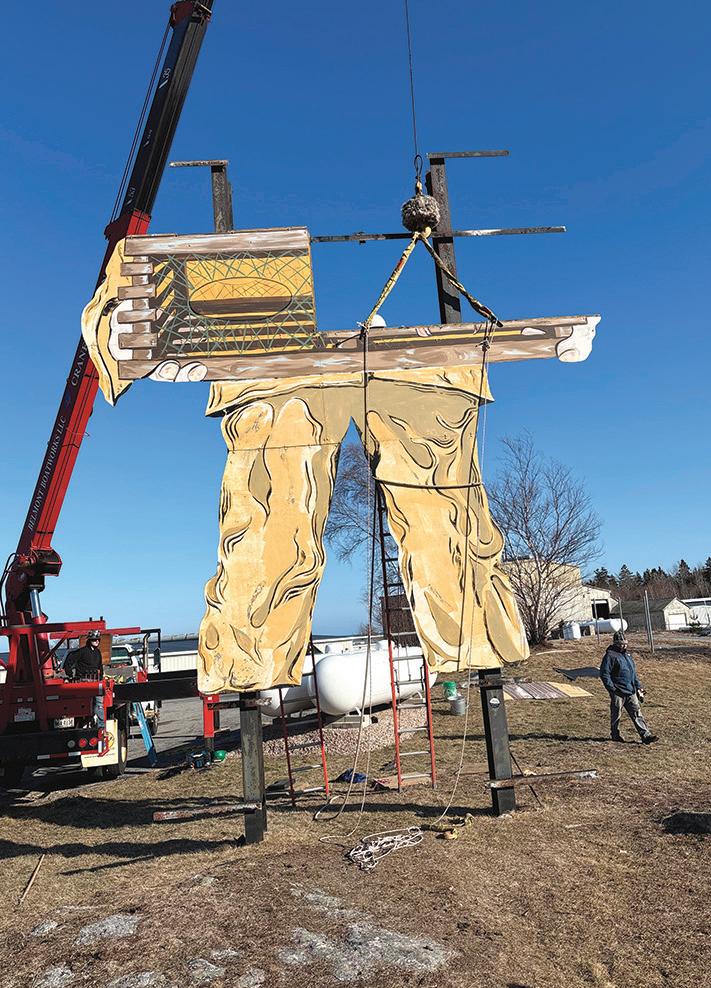
“It was an industry that was along our coast for nearly two centuries,” Smith said. The demise impacted “so many communities.”
As the plan to restore, repaint, and replant Jim took shape, museum staff turned to Miller, of Belmont Boatworks.
“Dan has been a great friend to the museum and the community,” Smith said. “He has a creative spirit. So when we talked to Dan, he got very excited about this idea,” she said.
“I do as much volunteer stuff as I can for the museum,” Miller said. “I think they’re fantastic.”
Miller traveled to Prospect Harbor and climbed over the sign to learn how it might be dismantled. David Wyman, a naval architect, also pitched in to determine how it might be reassembled. Plans were even developed to lower Jim to the ground if a hurricane was bearing down on the coast.
Moving Jim was less of an ordeal than thought. Miller said when it became clear that dismantling it was the best method, the sign was easily transported on a trailer. Though perhaps not needed, Gouldsboro police escorted the vehicles out of town, an expression of community pride, Miller believes.

Repainting Big Jim will be completed by the WOW (Women On Walls) Collective, a group of local artists. It’s appropriate, Smith notes, that women will do this work, given how cannery workforces were mostly women.
Bold Coast Seafood, which now owns the Prospect Harbor plant, was onboard with loaning the sign to the museum, and the Gouldsboro Historical Society also has been supportive, Smith said.
Not only is the sign entirely appropriate for the museum’s Sardineland exhibit, but Smith argues it will provide “a fun way to welcome people back to the community” after two years of extensive work on Route 1 through town.
The museum’s opening day is May 22.
Tom Groening is a former editor of The Working Waterfront. He may be contacted at thomasjgroening@gmail.com.
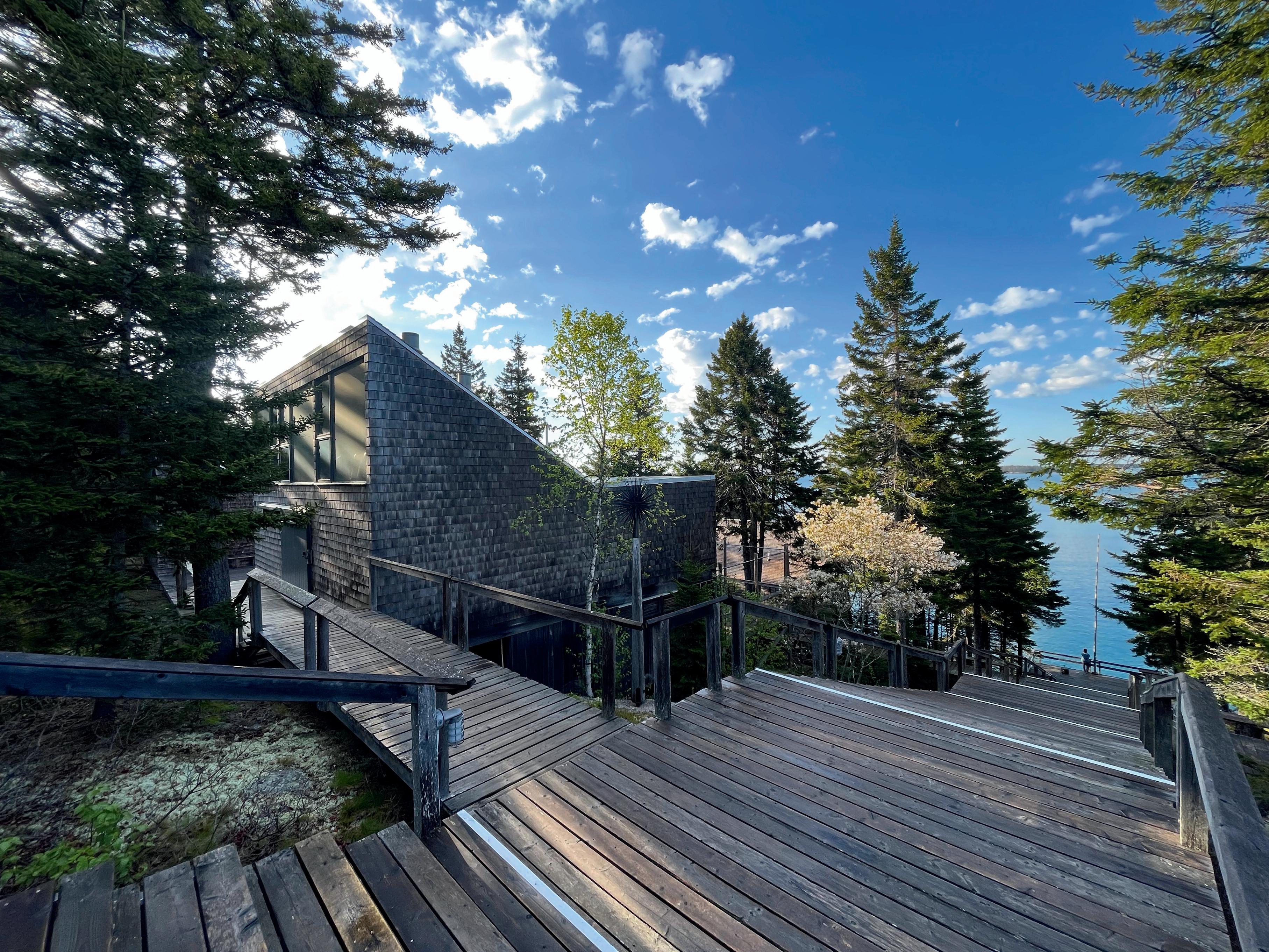

The sign commonly known as “Big Jim” has had several iterations along Maine’s coast, including in Kittery and more recently in the Gouldsboro village of Prospect Harbor. It was getting restored in Belfast in the spring and would temporarily be on loan to Penobscot Marine Museum in Searsport this summer.
The iconic “Big Jim” is dismantled in Prospect Harbor so it can be restored. PHOTOS COURTESY PENOBSCOT MARINE MUSEUM
The working waterfront threw me a lifeline
Finding structure at the lobster co-op essays
BY LISA MAE DEMASI
I DIDN’T COME to Lincoln County looking to start over. I was already here. By early June of 2025, I had moved to Jefferson and begun building a life—writing, volunteering, settling into a rhythm. Three weeks after moving in with my partner, our relationship ended abruptly. Overnight, I was without housing or stable income, staring down peak season. I loved this place too much to leave. I needed work. Before Maine, I’d spent years as a content writer in tech. When my company was acquired, my job disappeared, and I struggled to reenter an industry already shifting under the weight of AI.
I reached out locally and was met with openness. A conversation with Anne Rundle at the Damariscotta Region Chamber of Commerce helped me see where I might fit. That small generosity mattered.
I had been drawn to the water from the start. There is something honest about maritime work—the hours, the weather, the lack of pretense.
I found my way to the South Bristol Fishermen’s Co-op, initially helping with bookkeeping and pitching in wherever needed, from serving shore dinners during the busy season to whatever the day required.
Jeff’s boat
The work wasn’t complicated; it was real. No glamour—just early mornings, long days, and people doing what they’ve always known how to do, often alongside family members, across generations.
Early on, my boss, Laura Hughes, commented as I put a half dozen lobsters into the cooker: “Bet you never thought you’d be doing this at 60.”
What struck me immediately was the humility of the place. No one was performing. The crew and staff never once gave me the hairy eyeball, even though it was clear I was a city girl— wearing lipstick. One fisherman even gave me the nickname “Lipstick.”
After months of grief and uncertainty, something shifted. I found myself spending more time down on the floats as the boats came in, first taking pictures of the water and the light, then focusing on the boats and fishermen themselves.
I was drawn to the rhythm of their labor—hours in heat, wind, and freezing cold—and to the quiet pride they carried in their work.
I started posting short videos on the Co-op’s Facebook page, and the response came immediately from fishermen’s families, the community at large, and summer residents away for the winter. Crews unloading crates. Sternmen moving in practiced coordination. Faces relaxed once the work was done.
A tow back to shore to remember
BY ALAN SPEAR
I RENTED 20-foot Bertram boats from Jeff Armstrong at Jeff’s Marine in Thomaston for many years. Jeff had five of those Bertram Bahia Mar models. Wonderfully built, amazingly seaworthy, and steady. Ten years ago, I rented a boat from Jeff as usual, but about two weeks into the summer rental, the boat developed a problem, so Jeff took it in for repairs and supplied a second boat, also a Bertram, with a different kind of motor.
My relationship with that motor (a 2-stroke instead of a 4-, for those who know outboards) was not particularly friendly. I had a heck of a time getting it to start and run smoothly, but I eventually thought I had it licked and headed out to Monhegan, about eight miles out in the Atlantic, for some fishing. The fishing was good, and the motor ran OK, but my good luck ran out on both fronts at about the same time as I decided to head in.
I’ve been a boater for over 60 years, and I know to watch the weather. I could see clouds building to the southeast, and winds beginning to pick up, but I knew that the boat would carry me in in plenty of time—except the
motor would not start. I tried over and over, did everything I knew, and got zip. Meanwhile, I was drifting across the approaches to Penobscot Bay toward Haddock and Roaring Bull ledges some miles downwind, and the waves were growing with the wind, approaching four feet. In a 20-foot boat with no power, that’s no fun at all, and standing up became nearly impossible.
The boat I usually rented had a shipto-shore radio, but the replacement did not, so my only hope for shore contact was my cell phone, which is a weak reed when you are miles out at sea. I tried flagging down a lobster boat, but he was too far away, and my emergency flares would have been very hard to see in the bright daylight, so I tried to get a cell signal, and got a notice that only 911 calls would go through. I finally dialed 911 and got an amazingly helpful operator at the Lincoln County emergency center who first asked me my location. “That,” I said, “is the issue at hand.” She immediately understood the situation, asked for my coordinates and direction of drift, and called Jeff at the marina. She called back in 10 minutes to tell me he was en route and would arrive in about 45 minutes. Well, 45 minutes feels like a week in rough water, and I knew I had to do
Families shared the posts—a way of life reflected back to them. People in town mentioned it—to Laura, to Danny, our dock manager, and to the fishermen themselves.
And it’s not just men doing the work. Women on the dock work the crates and scales, drag-hook lobsters into bins, lower them into the water, run the hoist. During the summer months, there are women sternmen too— strong, capable, and fully part of the work. It matters.
What I was seeing was not novelty, but visibility. This work happens every day, largely unseen. I realized I wanted to help reflect it back—not to rebrand it, not to dress it up, but to show it as it is, for the people who depend on it and the community it sustains.
Over time, my role deepened. I began using the skills I’d built over decades— writing, visual storytelling, communication—in service of something tangible and local. I even took on payroll so Laura could take a much-deserved vacation. The work felt earned, grounded in trust and responsibility.
For months, nothing felt certain. I bounced between temporary housing in Nobleboro and Bremen. I watched my savings thin. I made plans to leave Maine, then changed my mind. What kept me here was the work—showing up, being needed, doing my part, and
reflecting the fishermen’s work back to the community.
Eventually, I found housing near the water, close to the Co-op. My commute takes me past farms, Capes, trees, and fields. It’s quiet. It’s steady. I live alone now, and that aloneness feels earned, not empty.
The working waterfront didn’t rescue me. It didn’t fix my life. What it gave me was structure, dignity, and a reason to show up each day. It reminded me that belonging isn’t something you’re granted; it’s something you build through contribution.
The Midcoast is full of people who work hard, often without recognition, and keep showing up anyway. I’m grateful to stand alongside them. The lifeline I found here wasn’t dramatic. It was practical. And sometimes, that’s exactly what saves you.
Lisa Mae DeMasi is a creative professional and storyteller whose work centers on the people behind Maine’s working waterfront. With a background in editorial and communications roles at EMC Corp., VMware, and Dell Technologies, she brings a people-first lens to every narrative she crafts. Her recent creative nonfiction appears in the UK’s Funny Pearls, and she will self-publish her memoir, The Baggage Claim, this summer.
something to get the bow into the waves. I was in more than 100 feet of water and had a 75-foot anchor line, so that was out. I had nothing heavy enough to make up a sea anchor (something you drag over the bow to keep it into the waves), so I finally latched onto a lobster buoy, tied it to my bow line, and let it keep the boat steady. In just under an hour, here came Jeff in White Knuckles his 22-foot Lyman. We cut the buoy free (without damaging it or its warp line), managed to get a tow line between the Lyman and the Bertram, and started in toward Port Clyde. With about 75 feet between the boats, I could sometimes see Jeff, completely relaxed with one hand on the wheel and his feet up on the coaming. But part of the time I couldn’t even see the Lyman due to the height of the waves. The tow took about an hour, but the last half of it was calmer, and we finally pulled into a float in Port Clyde harbor. Jeff climbed aboard the Bertram, fiddled with the engine a bit, and off she went. (He got along with that engine.)
Two weeks later, and just before we left for home in Illinois, I sat down with Jeff to talk about the boat (the original one) and the future. Jeff was very ill. He knew it. I knew it, and he was trying to get things done. Sitting in his office, he said
“I’d like for you to have the boat.” I asked him, “Why me?” and he said I was the only renter who always brought his boats back cleaner and looking better than when they left. After a bit of negotiation, the sale was made, and the Bertram was mine. I was convinced then, and still believe, that he only sold me that boat because he knew I would love it as he did, and that his time with it was over.
Jeff died in January. His office manager called me soon after it happened and it took me a while to get it together after that call. I’ve never met anyone quite like Jeff—kind of crusty, full of opinions, and connected to the sea and the Maine coast as nobody else I know. Here was a guy with everything to live for, but he died too soon anyway.
I remember after he towed me in, I said I was pretty impressed with how he handled the tow in rough weather. “Well,” he said, “This wasn’t my first rodeo, you know.” I am sorry it was one of his last, but I was privileged to be part of it.
Alan Spear, of Batavia, Illinois, has been coming to Maine for more than 70 years. He fishes, sails, and spends about three months a year living here in a motor home.
book reviews
A sea captain gets her due
The story of the first female captain of a U.S. merchant ship

The Sea Captain’s Wife: A True Story of Mutiny, Love, and Adventure at the Bottom of the World By Tilar
Mazzeo
(2025, St. Martin’s Press)
REVIEW BY TINA
COHEN
MARY ANN BROWN Patten’s name didn’t make it into the title of Tilar Mazzeo’s book about her, The Sea Captain’s Wife, which I find a bit ironic given one of the author’s goals is to educate readers about the impressive achievements of a now-forgotten female sea captain. But also, perhaps it was her nod to tradition, recognizing that many accomplished women go unnamed and unacknowledged in history.
But what accomplishments: Patten was the first female captain to helm a U.S. merchant ship and to navigate around Cape Horn. And that was at age 19, while she was several months pregnant and caring for her deathly ill husband, Captain Joshua Patten.
After tuberculosis struck her husband early in the journey, the crew
“acclaimed” Patten as its next captain. She’d worked alongside Joshua on a previous voyage and learned to read navigation charts, plot a course, and find her way with the stars. She had the “pluck” to work with the male crew. She had also picked up reading, writing, and math during childhood schooling, and could use the ship’s library, which included books on first aid and treating illnesses.
To research her book, Mazzeo used many documents, correspondence, and journals from various archives but found nothing written by Patten herself. She was born in 1837 to parents who had immigrated from England and grew up in Boston with two sisters and six brothers. She found a love match in Joshua, a man 10 years older from Maine. By age 16, she was married.
area. The couple hoped to earn enough to settle along the Weskeag River in South Thomaston.
They planned to make their fortune working on clipper ships carrying goods between international ports, agreeing that she would come along on any rigorous sailing jobs. What clearly wasn’t in their plans was Joshua contracting tuberculosis in 1856, while captaining the 216-foot schooner Neptune’s Car.
It shows an undaunted woman, successful at doing what most assumed was a “man’s job.”
Along the coast of South America, without a reliable first or second mate, Patten stepped in as captain and got the ship to San Francisco. With Joshua still bedridden, the couple made it back to New York on other ships. But he died never knowing they’d had a son, and Patten herself succumbed to tuberculosis a few years later, leaving Joshua Jr. to grow up with their relatives.
The descriptions—of 50-foot-plus high seas, jagged coastline, blizzards, and icebergs from nearby Antarctica— dramatically convey the risk.
Mazzeo personally took to those waters in a kayak to experience the setting. In a recent interview with the Portland Herald, she noted, “It’s so hard to explain how truly extraordinary her skill was as a captain. That you could be 19 and have only done one circumnavigation and be such a phenomenally gifted sea captain and sailor is quite astonishing.”
There are many reasons to read this book. Primarily, it is a thrilling tale. It shows an undaunted woman, successful at doing what most assumed was a “man’s job.” And it offers insight into Maine’s glory days of producing schooners and sea captains.
Mazzeo, with family ties to Rockland and a past career teaching literature at Colby College, has a deep appreciation for this salty mix. Her tribute to a female sea captain is both inspiring and a heartfelt homage.
Both Pattens had grown up familiar with the working waterfront. He became a sea captain like many in his family, which was from the Rockland
Tying it all together
Rope’s role in everything from seafaring to magic

Rope: How a Bundle of Twisted Fibers Became the Backbone of Civilization
By Tim Queeney (2025, St. Martin’s Press)
REVIEW BY DAVID D. PLATT
CLIPPER SHIPS, splices, knots, cowboys, pyramid-builders, bridge engineers, tightrope walkers, executioners—this book has them all. Like Salt, Cod, and other thoroughly researched books about familiar things and their many lives, Rope considers the bundled and twisted combinations of plants, metals, and synthetics we humans all use to keep our world running—or standing, as may be the case aboard a sailing dinghy or a full-rigged ship.
Metal rope? Sure: recall the twisted cables we use to support suspension bridges or the stays that keep a mast standing. Rope for what the New York City police department considered a criminal enterprise? Of course… consider the French high-wire artist who crossed between the twin World Trade towers three decades ago, several times in broad daylight before being arrested—and before those towers fell in a terrorist attack. (Setting the tightrope in place for the stunt, in case you’d like to know, involved a bow and arrow,
monofilament line, and a naked man; if you’re still curious, read the book.)
Rope played a major role in the laying of the first transatlantic telecommunications cable, both in the manufacture of the cable itself and the long ropes used to find and retrieve it when it broke, deep in the Atlantic Ocean off Ireland.
Author Tim Queeney, a Maine resident who formerly edited Ocean Navigator magazine, connects his own longtime fascination with rope, knots, and the many things one can do with them to his own father, with whom he often sailed small boats.
“Like many men of the World War II generation, Dad was not comfortable talking about his inner struggles,” Queeney writes in an introduction.
“He definitely didn’t chew them over with me.” If they spoke about knots, Queeney doesn’t say. But he concludes, many years later, after going through a crate of his father’s old ropes (two of them joined together with a sheet bend) that this knot “meant something more important to me than merely the
Mazzeo, who also sails, explains in lay language the nautical concepts involved in Patten’s navigation of the dangerous waters around Cape Horn.
Tina Cohen has been an educator, librarian, and therapist, and spends most of the year on Vinalhaven.
joining of two lengths of rope—the knot had existed because my dad had tied it—I have no proof, but I like to think that somehow my dad tied that knot for me.”
Rope considers the bundled and twisted combinations of plants, metals, and synthetics we humans all use to keep our world running…
A gift or a life sentence? Depends on one’s perspective. For Queeney, those father-son sails morphed into a maritime career, not to mention all the research required to produce a book like Rope. He begins with prehistoric archaeology, from cave dwellers in Europe chasing and trapping wild animals to ancient Egyptians building pyramids, both using twisted fibers or earlier approximations like vines. His book unfolds in a series of chapters (Queeney entitles them “strands”) on topics such as stitching together skins to make boats and dragging huge blocks of stone up ramps. And on he goes, through obvious things like fishing (lines, nets); executions (hangman’s knots, etc.); mountain climbing; rope tricks; cathedralbuilding; kids’ skip ropes; to the fantastic and futuristic, from theatrical tricks to an imagined “space elevator.”
“The technology to build a space elevator is tantalizingly close,” Queeney states in one of his later strands. “According to its most fervent adherents, the major technological problem of the tether, a rope so fantastically strong as to invoke the fabled Indian rope trick (see page 237 in the book) is within humanity’s grasp.”
With all its detail, this is a very readable book. An author with prodigious research skills—Simon Winchester comes to mind—can produce an unreadable text if they’re not careful, or isn’t edited with the reader in mind. Winchester did just that in Atlantic, which I’ve never finished. Mark Kurlansky, author of Salt and Cod, falls at the opposite end of the readability spectrum. So does Tim Queeney. Pick up Rope, details and all, and you won’t be disappointed. I’m not certain, but I think the combination of good writing, fascinating anecdotes, varied focus—and yes, the details—make Rope a book you won’t want to put down.
And just in case you’re interested in his fatherly sheet bend, Queeney ties up that loose end in a brief epilogue: “The rope knotted by my father’s hand still hangs on my wall,” he writes. “I think I’ll leave it right there.”
David D. Platt is former editor of The Working Waterfront.
book reviews
Regular readers of The Working Waterfront probably know Kevin Johnson, the photo archivist for the Penobscot Marine Museum in Searsport, as a regular contributor to our In Plain Sight column featuring archival images. He’s also a prolific photographer himself and has recently helped publish two new collections. Both are reviewed here, and Johnson’s latest column (page 25) also provides a snapshot into one of them.
Past and present on the Boothbay peninsula
Photo collection pairs new and old views
Boothbay Now and Then: New and Historic Images of the Boothbay Peninsula
By Kevin Johnson (2026, Penobscot Marine Museum)
REVIEW BY DANA WILDE
PHOTOGRAPHER KEVIN Johnson’s new book, Boothbay Now and Then, is a selection of photos depicting the Boothbay region. This subject matter is attractive enough for anyone interested in Maine’s coast. But the book digs a little deeper than that.
Half of the photos were made during the last couple of years by Johnson, photo archivist at the Penobscot Marine Museum, and the other half were made by photographers for the Eastern Illustrating and Publishing Co. of Belfast about 100 years ago.
The EIP, from around the turn of the century through World War II, made scenic postcards from photos. Johnson’s mission, at the prompting of Southport preservationist George McEvoy of Boothbay Harbor who died last year, was to show in pictures how the Boothbay region has changed over the past roughly hundred years. It’s kind of a scenic archaeology.
The book sets postcard images side by side with Johnson’s skillfully made recent images of the same places. We discover that upper Townsend Avenue in Boothbay Harbor village has remained much the same over the decades. The Smiling Cow gift shop, its two stories now painted blue and white, is still there, similar to its 1930s presence. The building beside it, now bright red, was the home of The Sportswear Shop. The brick chimneys on both buildings have disappeared by the 21st century.
A beautiful contemporary shot of the harbor from McKown Hill shows a nicely kept green yard, beyond it the dock, sailboats, and a distant tourist ship. The old EIP view is kind of a fossil of the same scene—shipyard structures in the foreground, a much narrower dock, and a few sailboats.
The background islands and point across the bay are exactly the same.
Johnson had to excavate, as it were, for some shots. A view of the working waterfront taken from Mount Pisgah around a hundred years ago, for example, shows a few sailboats, the footbridge with its small house right in the middle, industrial wharves and buildings, and a couple of two-masted vessels in the channel. Johnson could not access the site the EIP photographer shot from, so to duplicate the camera angle, he used a drone. The new image shows the footbridge revamped, the evolution of large waterfront buildings, and many more pleasure boats at mooring.
The more things change, the more they stay the same, might be the archaeological lesson. Cottages at Ocean Point and Isle of Springs are still standing, with only superficial changes to vegetation and in some cases renovated dormers. The iconic soldier’s monument which, with the Congregational Church, made up the backbone of Boothbay center, now stands lonely in the Route 27 roundabout, like a vestige of a bygone time.
The archaeology of the scene is ultimately an archaeology of the people
A Midcoast artist’s odd creations
Mike Silverton taps the strange and amusing

REVIEW BY DANA
New and Used Poems and Objects
By Mike Silverton Photographs by Kevin Johnson (2026, Sagging Meniscus Press)
WILDE
IT HAS NOW been 109 years since Marcel Duchamp’s urinal was not shown in an art exhibit in New York City. This was because the Society of Independent Artists couldn’t decide whether “Fountain” was actually art. So since their policy was to never reject any submissions, they quietly placed it out of sight.
Fast-forward about a century, and the contents of Midcoast Maine resident Mike Silverton’s book New and Used Poems and Objects seem nowhere near as weird as Duchamp’s urinal seemed to his colleagues. We are kind of used to the idea that anything you look at can be regarded as art, one way or another. Urinals can now be talked about as if they’re artwork, and so can Silverton’s makeshift contraptions and paintings, photographed for the book by Kevin Johnson.
Just to describe one of these “objects” in the artist’s own words: “While clearing out the garage and barn I came across an elegant old coat hook the brass base of which I trimmed and secured to a framed piece a friend gave me years before. And so, ‘The Poet Laureate Contemplates a White Porcelain Sphere.’” You have to see Johnson’s precision-skill photos to grasp the ways in which you have never seen anything like Silverton’s objects in your life.
Duchamp and the modernists called this art made of found objects “readymade.” The ideas that were careening into visual art in 1917 were also veering into literature. A poem could be looked at as an object, too. In the same way a bunch of random parts could be glued, hammered, or welded together to form something you never saw before, so could words. Words do not have to refer to reality. You can put seemingly unrelated verbs, nouns, and modifiers together in any order you can think of and then observe the result.
This artistic-literary movement as a whole is called Dadaism. Eventually it was noticed that you didn’t even have to think. You could just let words bubble up out of your Freudian
unconscious, as if you were dreaming in words on paper. This came to be called Surrealism and filtered into visual art too (think of Salvador Dali’s famous melting clock). This is the literary and artistic milieu Silverton explicitly, in a couple of short, playful essays appended in the book, inhabits. Dadaism and Surrealism were taken in lots of offbeat directions in the 20th century, some of them deadly academic serious, and some of them just for the curious fun of it. Silverton’s poems and objects, thankfully, are primarily for the fun of it. You can get a quirky, impish, funny, pathetic, ironic, or silly Monty Python-like kick off any page of New and Used Poems and Objects.
The kick can come from a weird combination of words that almost seems to mean something recognizable, but doesn’t. “Ahoy!” in its entirety goes:
Ahoy, eyes! Return!
An immortal’s waving a blizzard like a bedspread! I need to watch.
Ahoy, Dracula, dead to the world in an ebony box (exclusive of attachments), on a bed of dirt from your native land!
who live there. In an old view of the Cozy Harbor House at Southport Island, people are lounging in the yard and socializing on the porch. The house, according to the photo caption, was built originally in the 1700s by the Pierce family.
This is the family of my grandmother, Harriet Pierce, born in Southport, I think, in 1881. Family documents indicate a couple of English Pierces helped finance the Pilgrims’ Mayflower expedition. Later in the 17th century some of them landed in Marblehead, Massachusetts—my father’s hometown, coincidentally I guess—and soon escaped to Southport. Probate documents from the 1970s show my mother’s name in a list of heirs of a deceased Pierce from Southport. I wonder if those are images of my own relatives lounging in that postcard yard.
I don’t think you need direct connections to the Boothbay area to appreciate this book, though. The visual cues to the peculiar hold the past has on us are in the land and the ways people shape it. Clues to a community’s ancestral life are in its bygone forms. Boothbay’s are imaged here artfully and evocatively by Johnson.
(On the page facing this poem is Johnson’s photo of what could be a black box with a corkscrew prong sticking out of it.) If a poem like “Ahoy!” doesn’t exactly get your attention, there are others like “Tiptoe Away” that sound almost like wisdom, if you decide to take it seriously:
When you hear the dark angel snarling unhand whatever impulse obtains and tiptoe away.
I think Duchamp and his unruly co-conspirators Tristan Tzara, Man Ray, Mina Loy, Andre Breton, Francis Picabia, etc., not to mention Gertrude Stein if not Jacques Derrida, would be proud of the soapbox derby go-cart Silverton is driving through art and poetry a century after they got the ball rolling uphill. If you grasp what rocker David Byrne meant a few decades ago when he admonished us all to “Stop Making Sense,” then you should look through this book. For the fun of it, at least.
Dana Wilde is a former newspaper editor and college professor who lives in Waldo County.
saltwater cure
Froggy night
Seeking peepers on a spring evening
BY COURTNEY NALIBOFF
IT’S THE FIRST mild night of early April, and the peepers are screaming. Their shrill chorus is most noticeable from the car, where the Doppler effect magnifies their treble mating call. But it permeates the air when I walk into the house at dusk, or let the dog out later at night before I go to bed.
I am always aware of the presence of frogs. I grew up with a frog pond in the backyard, fed by a tiny trickling stream that I spent many early springs attempting to dam up, hands growing numb in the icy water. I drank from the outflow pipe, miraculously never contracting any sort of bacterial infection from the murky water. The first fiddleheads I ever ate grew by its banks, and I spent hours every spring and summer harassing the green frogs, bull frogs, and leopard frogs that squatted on its muddy banks. I caught them
over and over again in my butterfly net, holding them gently, staring into their impossibly gilded eyes, then startling when they inevitably pushed their way out of my waiting hands and expertly breaststroked into the camouflaging layer of oak leaves and pine needles on the pond’s bottom.
Spotted salamanders swam sinuously, and peepers perched on grassy hummocks. A few swam as well…
We heard, but rarely saw, spring peepers. Pseudacris crucifer is tiny, and blends in even more ably with its surroundings than its larger cousins. They are most active at night, a time that held untold terrors for my young self. An abiding interest in the natural world, and in outer space, was overshadowed by a fear of the dark and a phobia of alien abduction that lasted well into adulthood. I ran from the car into the house, never lingering to listen to frogs and insects or to gaze at the sky.
Thankfully, something has shifted for me in the last several years. In the careful tending I’ve given to my mental health, I’ve found that the enveloping darkness of Maine is a welcome part of the day. Night walks to observe comets or the aurora or just an interesting conjunction of planets have become something I look forward to, not an experience I white-knuckle my way through.
So now, when the peepers turn up the volume, I reach for my headlamp. Excited by the prospect of assisting amphibians across the road on warm wet nights, or just by seeing them out and about, I walk down the road in the dark.
Penrose came with me on my first excursion this year. I was on call, so we couldn’t go far from the house. We didn’t see any critters in the road, but the shriek of tiny frogs grew more intense the closer we got to the park entrance, so we turned down the dirt path. The ditch just to the left was the origin of the cacophony, so we approached.
Our lights revealed a small world of activity. Spotted salamanders swam
journal of an island kitchen
The analog life
Growing food in the time of AI
BY SANDY OLIVER
AI ISN’T GOING to peel your carrots for you. It’ll explain how and why to do it or not, or, most appealing to modern people, what’s the fastest way. In fact, here is what AI advises: “The fastest way to peel carrots is to use a swivel peeler to make rapid, back-and-forth strokes along the length of the carrot without lifting the blade.” Ah. Links follow to various videos of humans (at least I think they’re real people ) peeling carrots quickly.
Nor will AI cook your carrots for you. Again, advice abounds but, as Julia Child may have said after picking a dropped ingredient up off the floor, “You are alone in the kitchen.” It’s just you, your stove, and your ingredients working together all by yourselves to make dinner.
A friend asked, “What about robots cooking?” Of course, turn to your cellphone to find robots in a kitchen. One video shows a robot picking a pan up off a stove, holding it perfectly vertical, dumping the contents on itself and the floor, then doing the old softshoe, shuffling food all over, before collapsing in an electronic heap. It was hysterically funny to watch; no doubt some engineer is beavering away as we speak, refining robotic dexterity.
What about growing food? Same scenario, pretty much. Lots of advice, big machines with an operator in the cabin burning now ever-more-expensive diesel, roaring up and down acres of land.
I end up wondering exactly how we will spend all the time AI and robots will afford us? This is a serious question for workers being laid off in favor of AI, which doesn’t need bathroom breaks, a lunch hour, or time off to nurse a cold. The question seems to be: what are humans good for?
Writing poetry? Nursing the sick? Composing ethereal music? Fixing broken plumbing? Peeling carrots? Those all need analog attention. Well, maybe not writing poetry and composing music. We might wonder if we still need humans to grow and harvest carrots. Not so much. Even small farming operations can use mechanical devices to seed carrots. On large commercial farms enormous machines do the harvesting
Abundant leisure time afforded us by machines that think and do for us sounds terrific until you ponder how we will be fed, housed, and cared for in illness.
sinuously, and peepers perched on grassy hummocks. A few swam as well, seeming to glow against the backdrop of the water. Equating our presence with the looming threat of some giant predator, the chirping all but stopped under our observation. We moved away, letting the vernal pool fade into darkness, and the sound resumed. We returned long enough to get a few dim videos of the teeming life in this glorified, ephemeral puddle, then walked carefully home. The visual evidence of peepers, paradoxically tiny compared to their giant voices, and the silent sensuality of the salamanders, made the night seem friendlier, more full, and more alive.
Courtney Naliboff teaches, writes, and plays music on North Haven. She may be reached at courtney.naliboff@gmail.com.
job by yanking up millions of carrots by their green tops, knocking away clinging soil, and flinging them into the big container it conveys. Of course, carrots can take all that banging around and not get bruised. And then, you can buy them already peeled. So then I wondered if we still needed humans to pick, say, tender strawberries. It appears not. Autonomous harvesters with robotic arms that detect ripeness nip berries off the stem and even deposit them directly into clamshells for market. No robotic sensor can taste a strawberry to see how delicious it is, as we humans can, which means that too often that clamshell is filled with the mere simulacrum of a strawberry. The good news, however, is that it spares farmers from needing 25 to 30 laborers, often migrants being deported by the dozens. The bad news is that they won’t be replaced by AI-laid-off workers.
Abundant leisure time afforded us by machines that think and do for us sounds terrific until you ponder how we will be fed, housed, and cared for in illness. Huge farm equipment costs a lot of money and farmers can’t just give away farm produce. Nor can people who might cook our food with or without robotic help. Folks who fix plumbing and sit with the sick and dying have to be sustained while our culture is allergic to a guaranteed basic income.
Probably no data center will sprout up on our islands, nor will robots replace sternmen. And I bless my lucky stars that I can grow enough carrots in my garden to supply me for most of the year, and that I have a good sharp peeler to use. If you come over some sunny day to help with analog planting and weeding, I’ll share carrots and my peeler with you while an AI version of me writes this column.
Sandy Oliver is a food historian who gardens, cooks, and writes on Islesboro. She may be contacted at SandyOliver47@gmail.com
cranberry report
A chilly spring
April can be the toughest month on a Maine island
BY BARBARA FERNALD
“THE SUN WAS WARM but the wind was chill./ You know how it is with an April day/ When the sun is out and the wind is still,/ You’re one month on in the middle of May./ But if you so much as dare to speak,/ A cloud comes over the sunlit arch,/ A wind comes off a frozen peak,/ And you’re two months back in the middle of March.” – Robert Frost, “Two Tramps in Mud Time”
People imagine it would be tough to survive a Maine winter on the islands, but it is often the month of April that I find the hardest to get through. Out here, that “wind coming off of a frozen peak” is coming off the waves at sea. This year, on the last day of the month, the water temperature was only 41 degrees. I know because I was dipping with friends on April 28 when we had a sunny day with air temperature in the low 50s. By the afternoon of the 29th, Bruce said, “I think I’ll get a fire
going in the wood stove. It’s just so raw outside.” Robert Frost aptly describes the weather of this dreaded month.
Not every April is bad. In 2020, after the first month of COVID, April was incredibly warm and sunny, as if Mother Nature was compensating for the global pandemic. I was active in my garden weeks earlier than usual. In 2021, I loved April again as, thanks to vaccines, we finally felt safe to travel to see the grandkids after eight months of staying apart.
This year, April was a bear. The month brought snow, frost, and rain, with very little sun. The state of the world didn’t help. I would wake with the same kind of anxiety I felt in April 2020, checking the news first thing to see if anything “bad” happened overnight. I’m extremely troubled by
The month brought snow, frost, and rain, with very little sun. The state of the world didn’t help.
the senseless war in Iran and by the lack of any saving grace from our current administration. I look for an escape from my default moods of rage or depression. As I write this, tomorrow is the first of May, and it would behoove me to take a little inventory of the past month to find some love to counteract my hate. I planted over 100 bulbs in my fencedin garden last fall so I could watch their steady promise and progress all month. Most of them survived the winter and are almost ready to open. I love having colorful blooms that I don’t have to wait until June to see. I was able to do a bit of April gardening, and the muscle soreness was a welcome reminder I was getting in shape for more good gardening days to come. A buzz of energy started to build as more
Nothing more expensive than a free boat Adventures of the thrifty sailor forest city
BY RUSTY FOSTER
LAST SUMMER I finally succumbed to sailboat ownership after decades of heroic resistance. I’ve sailed my whole life, but always on boats owned by other people, which is the best kind of boat. I had just returned to the island after months hiking the Appalachian Trail in the claustrophobically forested southern mountains, and Casco Bay’s cool, sparkling waters were at their most alluring when my alleged best friend informed me of a free sailboat that I ought to “take a look at.” The Universal Boat Distribution System had cast its gimlet eye upon me. Still, I resisted. There’s nothing more expensive than a free boat, and my first inspection revealed a 1977 Cape Dory Typhoon that had sat in the woods for eight years and was currently full of water. I sighed in relief at a narrow escape. But my increasingly culpable friend told me to look again, and with closer inspection I had to admit that the deck and cockpit sole seemed very sound, and the woodwork, though it would never be beautiful, did appear firmly attached and sturdy enough. Aside from draining and swabbing out the cabin, it didn’t seem to need any urgent repairs.
So I called the owner, who informed me that the boat was certainly not free, and that pretty much sealed it. For free, this was a very questionable boat. But for $1,500 it was a great deal. All the sails
and spars had been stored indoors, and all the bits and pieces were present and accounted for. My tenure as a boat owner had arrived. I delayed every upgrade that could possibly be delayed and managed to spend more time sailing than working on the boat, which is as close to winning as you can get in the fundamentally losing proposition of boat ownership.
I’ve sailed my whole life, but always on boats owned by other people, which is the best kind of boat.
One afternoon in July, I was lounging at the mooring after a sail when I saw a Catalina 27 motoring in toward the vacant mooring next to mine. It was helmed by a man in his twenties and crewed by a woman of about the same age. They both displayed a refreshingly unstudied approach to their tasks—a genuine beginner’s mindset, without the weight of orthodoxy or received technique. After overrunning the pennant several times they traded jobs and nearly got the pennant wound up in the propeller. They seemed on the precipice of discovering an exciting new way to pick up a mooring, but regrettably I had to row back to the dock before I found out whether they did.
That Catalina had the look of a free boat if I ever saw one. Scuffed topsides, always a bumper or two dangling from the lifelines, bits of line flopping this way and that as it rolled in the incessant chop in Diamond Pass. The
islanders readied for outdoor work in May. I loved seeing the fishing boats come back to their island moorings after a winter on dry land. The migrating birds also started to arrive. When goldfinches visited the feeders they came by the dozens, their bright new plumage an echo of the daffodils and forsythia that were out. A cheery color no matter the weather. I also read more books in April, which feels like a win.
This inventory helped me remember April wasn’t all bad. It reminded me to be grateful that I get to survive my worst month in such a beautiful, peaceful, and remote spot in a tiny community that I love.
Barbara Fernald lives on Islesford (Little Cranberry Island). She may be contacted at Fernald244@gmail.com.
canvas on the headsail and the mainsail cover were green, but not the nice green you’re imagining. The other kind of green. On Labor Day weekend, the owner and some friends sailed it in the TEIA Club’s annual race around Peaks Island, and then managed to wrap the jib inside out, which I wouldn’t have thought possible. I know it didn’t leave the mooring again all season, because that jib remained mis-furled for the next month.
I took my boat out of the water early in October, as I prepared to finish the southern couple hundred miles of the A.T. with my son Mica and his boyfriend Christian. I was taking the sails off the Typhoon and getting ready to lower its mast when I noticed that the Catalina was riding strangely at the mooring. The boot stripe was underwater at the bow, and I could see more of the stern than was seemly. I rowed over and observed that the boat was full of water inside, a good six inches above the cabin sole. A pair of canvas sneakers drifted about as it wallowed. I sent some pictures to my boat-recommending friend, who also oversees the mooring field, and he said he’d contact the owner.
In case you’re not a nautical expert: six inches of water above the floor of a
sailboat is a catastrophe that demands immediate action. In maritime lingo, we boaters refer to it as “sinking.” So I was very surprised to get a text from my friend two weeks later, just after I had finished telling this tale as we hiked through the Smokies. The text read “This was the inevitable conclusion:” above a picture of the top few feet of a mast with its instantly recognizable mis-furled jib poking out of the water. It cost the owner $5,000 to get it salvaged and hauled to the dump, because there’s nothing more expensive than a free boat.
Rusty Foster lives on Peaks Island and writes the email newsletter Today in Tabs. He can be reached at rusty@ kuro5hin.org.
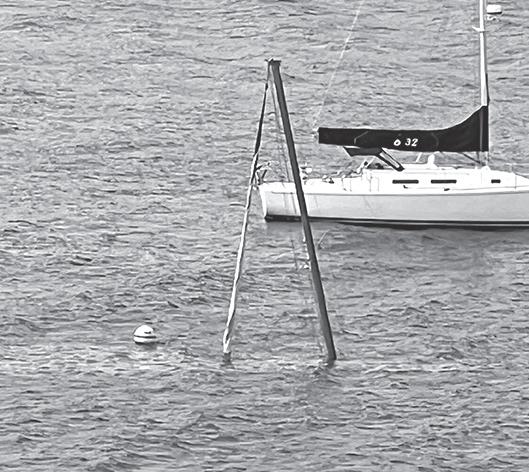
Rusty Foster’s friend sent him this photo of a sailboat that sank at its mooring off Peaks Island. PHOTO: COURTESY ROB MEHARG
fathoming
Exploring space and oceans
Success of Artemis II shines light back on our own blue dot
BY SUSIE ARNOLD
I’VE NEVER FELT more compelled to celebrate Earth Day and World Oceans Day than in 2026.
Partly, these holidays—on April 22 and June 8, respectively—help us recommit to conserving our planet, a task made even more urgent as the federal government continues to deprioritize science and funding to protect it. Additionally, the world just witnessed a remarkable scientific and technological feat as an international crew of astronauts on the Artemis II mission encircled the moon, bringing them farther than any human has ever been from Earth. Space travel offers a distinct reminder that our planet is small, fragile, isolated, and unique.
Seeing images from space also reminds us that our planet is made primarily of oceans—just in time for World Oceans Day, which aims to help protect global oceans for future generations. This year, it’s focusing on how the ocean regulates climate, provides oxygen, and supports biodiversity. Here in Maine, oceans are foundational to our way of life. According to a new ocean economy dataset from NOAA, a strengthening U.S. marine economy
added more than 500,000 jobs and grew wages by 32% from 2021 to 2024.
Despite this, funding for the very agency that measures this economic importance is in question. Cutting NOAA’s assets used for weather forecasting, navigation, oceanographic monitoring, and more puts marine businesses at risk and hinders our understanding and management of oceans and coasts.
As the appointee to the Maine Climate Council with expertise in marine science, I’ve found it increasingly important to tell that story. The federal assault on science since January 2025 led the council’s Scientific and Technical Subcommittee (STS) to mount an ongoing effort to document the importance of science assets across the state. As expected, we’re finding that a diminished federal role in climate and environmental investment can reduce capacity, weaken decisionsupport, delay implementation, and disproportionately hit communities with fewer resources. The STS also recently released an interim report around Earth Day highlighting select new science on 19 topics relevant to Maine’s people and economy, as well as critical assets for tracking these topics,
reflections
ranging from atmospheric temperature to groundwater drought. Overall, the report shows that continued investment in good science to inform decision-making, local planning, and practical climate action will help Maine people prepare for changes that are underway or ahead.
Pertaining to the Gulf of Maine, the STS interim report addressed changes in ocean temperatures, as well as projections of sea level rise and its impact on coastal environments.
For terrestrial systems, the report covered forest carbon; health and biodiversity; range shifts and endangerment of wildlife and plants; freshwater invasive plants; and land conservation. Similar measurements can be taken of the Gulf of Maine, which is also affected by climate and other human impacts. But those measures are harder to study. I would love to see the interest in going the distance in space rejuvenate our curiosity for exploration closer to home—for oceans. Society’s interest in the underwater world seems to have waned since Jacques Cousteau captured it from the 1950s to 70s. Just because we can’t see the changes below the surface doesn’t mean they’re not happening. The shifts we’ve seen in
Measuring time with narrative
Storytelling’s role in ecological stewardship and community planning
Reflections is written by Island Institute Fellows, recent grads of college and master’s programs who do community service work on Maine islands and in coastal communities through the Island Institute, publisher of The Working Waterfront.
PHIPPSBURG IS a slim place of mudflat, deep coves, strong currents, and diverse fishing histories. During a recent heavy rainstorm, I met with two lobstermen who told stories about their lives on the water. One reminisced about boyhood skiff rides on summer evenings, visiting Cundy’s Harbor for a burger. The other recalled a fisherman who had wrapped a line around his hand, with a tuna hooked on the other end. When the tuna decided to run, the fisherman was hauled overboard. He lived, but was dragged pretty deep before figuring out which way he had wound the line.
“It wasn’t a job,” they said of fishing. “It was something that you wanted to do.” They talked about change, the evolution of boats, the shifts in the shape of Phippsburg’s villages.
Other residents recall when Route 209 was emptier and a person could walk across the peninsula in an afternoon. One woman described building
a private wharf decades ago, floating its pieces from another shore, through the fog—all without planning board approval. “Couldn’t get away with it now,” she laughed.
At Shellfish Commission meetings, members weave in anecdotes of nowdefunct dealers, of long-retired state biologists, of boom and bust years. On my first day in Phippsburg, a digger recounted a recent catastrophe: Flooding in the Kennebec River closed clam flats for so long that some harvesters had to dip into retirement savings, or even lost homes.
The importance of narratives is growing in environmental management. In a 2019 paper examining environmental justice methodologies, communications scholar Chad Raphael writes that sidelined voices can offer “important signals about the wellbeing of human and natural systems, and sources of hopeful action to improve them.” Stories can also connect demographics. As ecosystems, economies, and property lines change, the need for small-town collaboration increases. To that end, a key part of my fellowship is acting as a liaison. Storytelling is odd work—but useful, I hope. It’s also inherently imperfect, in its selectivity. People, including
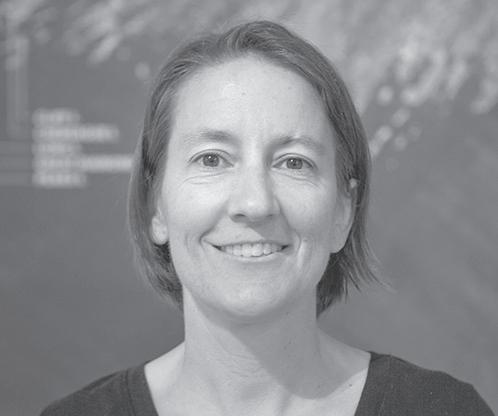
wild kelp forests in the Gulf of Maine are an important example.
Now is a critical time to provide opportunities for field-based studies to interested students. Many kids still dream of being marine biologists. Let them. Let’s recalibrate the trend of more graduate students focusing on computer-based models alone, back to more focus on field work. Students can’t experience and appreciate the beauty of the underwater world from a desk. Kelp forests and coral reefs, two of the most biodiverse ecosystems in the ocean, are accessible without much technology, yet both are dying as we continue to pollute and warm the oceans. We are reminded by the Artemis II mission that pictures and stories capture the public’s attention better than data and models.
As we press on to ensure long-term success in space, let’s not neglect the only home we have. Let’s continue to invest in scientific discovery of our oceans, and our planet.
Susie Arnold is the senior ocean scientist at Island Institute, publisher of The Working Waterfront. She may be contacted at sarnold@islandinstitute.org.
Wabanaki ancestors, have lived on what is now called the Maine coast for 12,000 years. Infinite stories have been lost—and ecological understanding with them.
Activist Rebecca Solnit writes that “Political change often follows culture … Which means that every conflict is in part a battle of the story we tell, or who tells and who is heard.” So to all the storytellers, I say: Keep on ranting. If you didn’t, I wouldn’t learn anything. Storytelling is not just my schtick, luckily. There’s a push on Maine’s coast to get old stories stirred up into new audiences. Some are simply yarns with a good punchline. Others help track sea level rise. Some storytellers meet you on their way to the flats. Some stories are fleeting as an owl in daylight; others echo for a long time. Often, what sounds like a profound grief lines stories of ecological and cultural loss.
The heaviness of the stories I hear and tell really hit home this winter. One morning, I called a friend in Newfoundland who produces fisheries broadcasts for CBC. Like many here in New England, his family once made a strong living on the water. The region has a strong fishing identity, but it’s accompanied by a sense
of cultural loss. My friend knows a lot about telling—and living—such heavy stories. “I had to separate a piece of myself from it, eventually,” he said. “One person just can’t fix it all.” Maybe this reflection got a tad morose. But some folks live the heaviness of the stories. It’s an act of giving dignity, I feel, to acknowledge that heaviness. Acknowledging reality is part of the way forward.
Though Phippsburg’s identity is distinct, its stories represent larger histories and patterns. It’s a good, small place to learn about the world. The hope of storytelling on this peninsula, short of fixing everything, is to link some silos of knowledge, community, and purpose. That’s all.
As an Island Fellow in Phippsburg, Katherine Cart primarily liaises between working waterfront stakeholders. She began writing about fisheries while working on commercial fishing vessels. Her writing can be found in such places as Conjunctions, Missouri Review, and Raritan.
in plain sight
Then and now
Eyeing the past and present of a Midcoast shipyard
BY KEVIN JOHNSON
EARLY IN MY position as photo archivist at PMM, I was asked to do a project with a group of students at Searsport High School. I decided to do a re-photographing exercise using photos from the Eastern Illustrating & Publishing Co. Collection. The students and their instructor, Leslie Gregory, were as enthusiastic about the exercise as I was! It was a fun challenge to find the exact vantage point where a photographer stood and retake the photo. It’s always an intriguing revelation to see how much—or how little—a scene has changed between “then” and “now” (we gain similar insights from town elders at illustrated talks where the Eastern photos are shown). I did further rephotographing projects with that class for the next several years, and I also did it on my own wherever I travelled around New England.
When George McEvoy asked me to put together a book of historic photos of the Boothbay region, I knew just how I wanted to approach it. Eastern’s photographers covered every nook and cranny of that peninsula at a time when it was still a cluster of distinct working communities, before the rise of heavy tourism. The past three years
FIELD NOTES—
included numerous trips to Boothbay. The variables of season, time of day, and tides—along with change due to fires, development, and time— combined to make the simple concept of retaking a photo a bit difficult at times. I had plenty of help from locals to get it right. I even had to cheat a bit by enlisting a drone photographer, Joe Potter, to secure a couple of “bird’s eye” views which would otherwise have been impossible due to tree regrowth.
The biggest reward from the project was hearing the stories told by elderly locals who’d witnessed the slow metamorphosis of their communities. Driving around Southport with 97-yearold Evelin Sherman to find these locations was magical. It was fascinating to hear Barbara Rumsey talk about how Boothbay Harbor had changed over many decades but had never lost its sense of place. Spending so much time with George during what would be the last years of his life was worth all the effort.
Jean-Baptiste Alphonse Karr coined the phrase, “The more things change, the more they stay the same.” This rings true in this East Boothbay waterfront scene. The “then” view shows the Rice Brothers shipyard at the bottom of School Street shortly after a disastrous fire in 1917. The new buildings, together with the remains of burned ones, show a
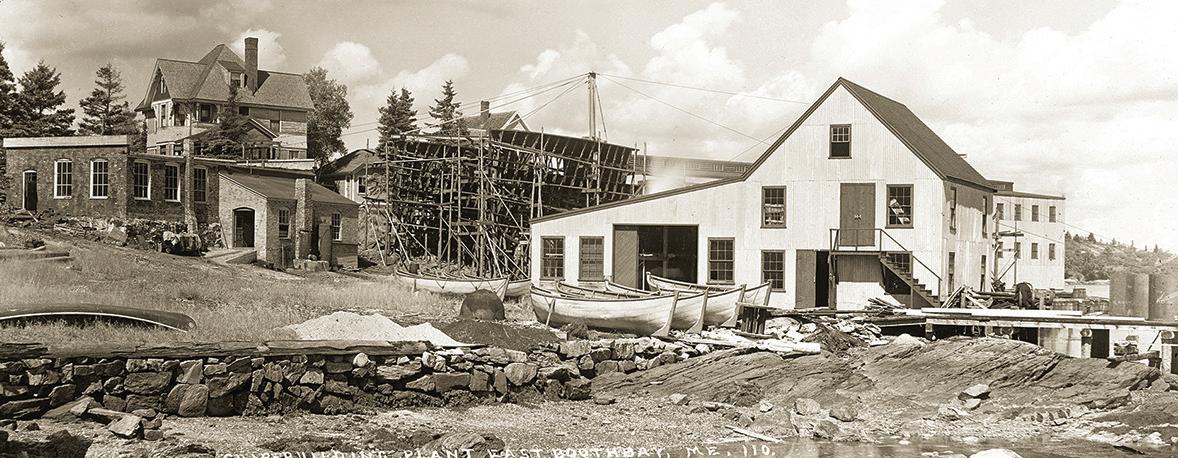
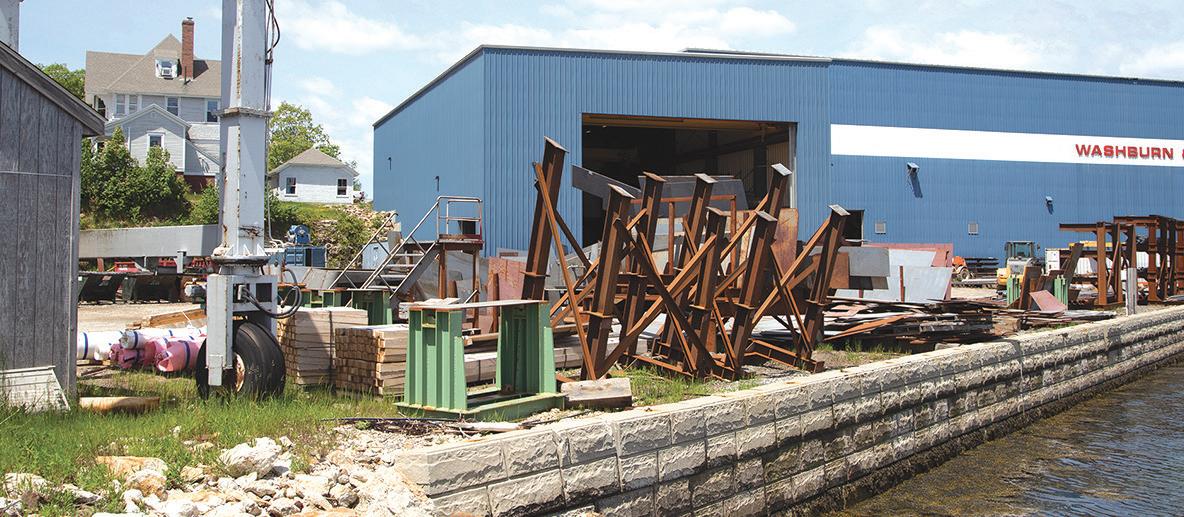
The
was taken after a disastrous fire in 1917; the second in recent years. Both feature an active shipyard, though the names have changed. A new photo collection from Kevin Johnson contains many similar pairings of old Boothbay-area photos from Eastern Illustrating & Publishing Co. Collection and modern shots of the same spot.
transformation actively happening. The show must go on! The “now” view looks much different, yet it also depicts an active shipyard; even the names have changed. If one looks closely, the modern scene shows one remaining building from over a century ago, the original home of Frank Rice, now the offices of Washburn & Doughty.
Building connections on the mail boat
Everyday spaces offer a lesson in communities
NAME: Bruce Doughty
TITLE: Community Development Officer
FOCUS: As part of Island Institute’s Future of Fishing program, I work with coastal and island communities in and around Washington County to understand local needs and support the long-term resilience of working waterfronts. With a background in commercial fishing, ecological restoration, grant writing, and aquaculture, I focus on building relationships and connecting people to resources that help sustain these communities.
IN THIS PHOTO: I’m riding the mail boat to Great Cranberry Island, one of the primary ways on and off the island, talking with local residents about current events and what’s happening in their community. Trips like this are a core part of my work. The mail boat isn’t just transportation—it’s a space where conversations happen, information is shared, and you start to understand the rhythm of island life.
During this visit, I spent time listening and learning, getting a better sense of the challenges and opportunities facing island communities, from maintaining year-round populations to supporting working waterfronts. As someone new to this role, these experiences are invaluable. They help me build relationships and gain the local knowledge needed to support communitydriven solutions. Being present in these everyday spaces is essential to understanding how to best serve and work alongside the people who call these islands home. I would like to thank Alden Hathaway and Ingrid Gaither for the warm welcome, tours, introductions, and great conversations. Looking forward to the next visit.
Kevin Johnson is the photo archivist for the Penobscot Marine Museum. This piece is inspired by a new collection he has just published, Boothbay Now and Then: New and Historic Images of the Boothbay Peninsula. He also provided photos for another new work, New and Used Poems and Objects by Mike Silverton. Both are reviewed on page 21.
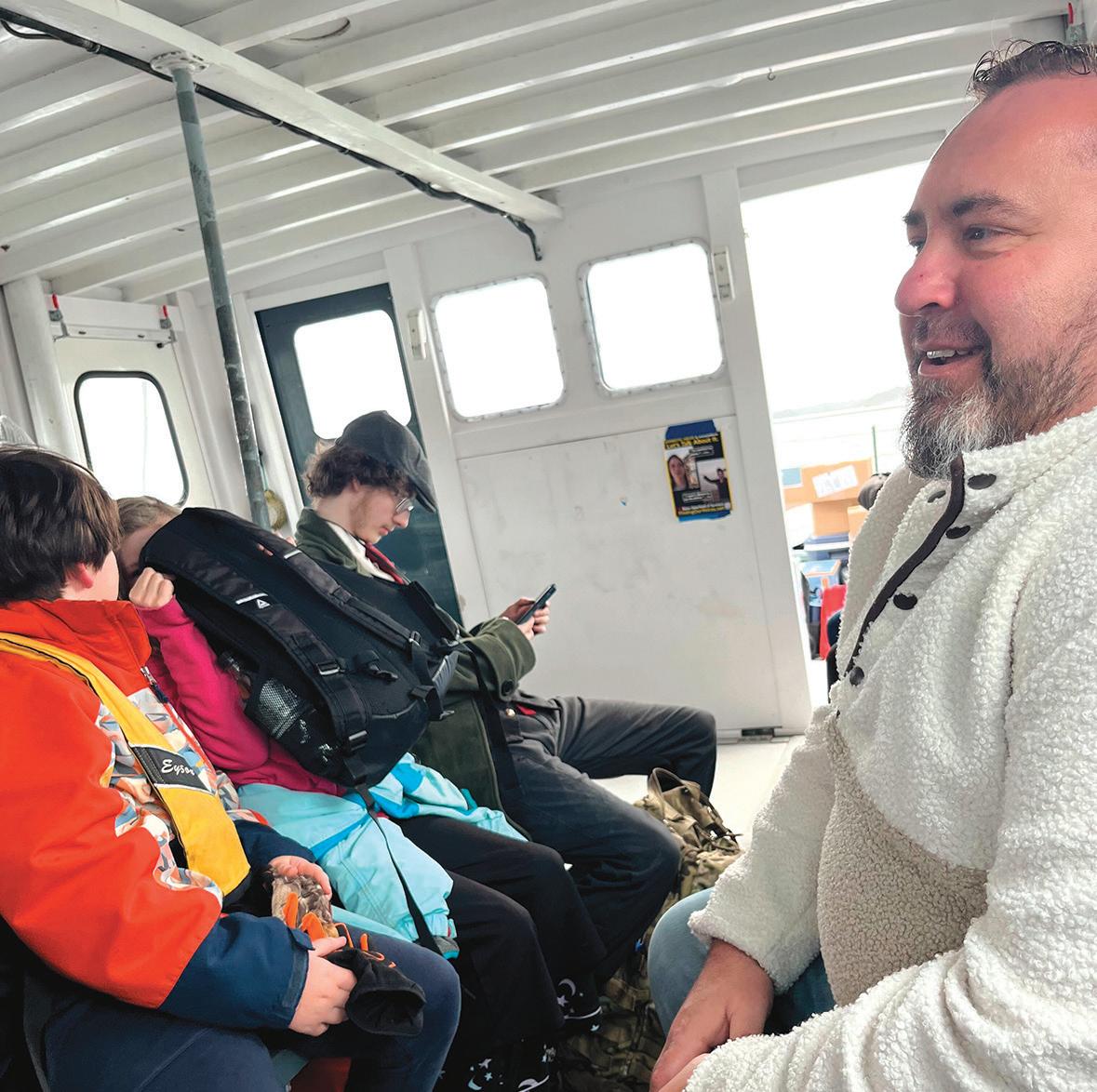
These images show the same parcel in East Boothbay more than a century apart.
first
PHOTOS: COURTESY KEVIN JOHNSON
Carol Sloane and the appeal of pilings
An impressionist take on tidal settings
BY CARL LITTLE
“I AM PARTICULARLY fond of the Impressionists,” painter Carol Sloane noted in an email exchange. “Their view of life resonates with me,” Sloane wrote, “how every time we look at something it seems to transform.”
Sloane seeks a similar impression of the world when working around tidal water and in her plein air landscape painting. She spends time watching shadows move, rocks emerge and submerge, and “observing light getting brilliant, then rosy, then dusky.”
Her “Belfast Pilings” series exemplifies Sloane’s endeavor to evoke that experience of a shifting landscape. The pilings that support the city’s pedestrian bridge, she explained, are in fresh and salt water, exposed and then hidden depending on the tides. By painting them at different times using overlapping images, she achieves the effect of movement and circulating water. She also creates a dazzling abstract composition.
Sloane came to Maine, to Montville, in 1972, five years after graduating from Skidmore College with a bachelor’s degree in art. As noted on her
website, she wanted to live in the country “more than she wanted a career in art.” She raised sheep, cultivated a large garden and sewed at the Leather Bench in Camden.
Sloane eventually started her own business making fabric handbags. She marketed her work for many years through Perspectives, a fine crafts gallery in Camden, and at craft shows around the country. In 1994, wishing to leave the consumer-oriented life and work instead “in a more abstract
By painting [the pilings under Belfast’s pedestrian bridge] at different times using overlapping images, she achieves the effect of movement and circulating water.

•
•
MARINE SAFETY CONSULTING LIFE RAFT INSPECTIONS

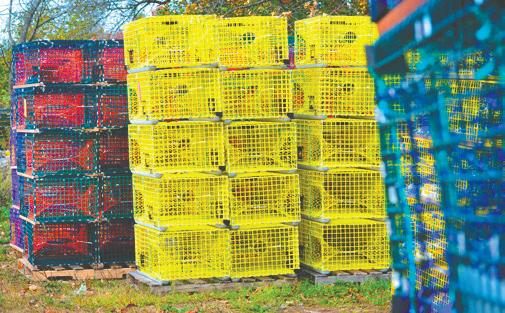

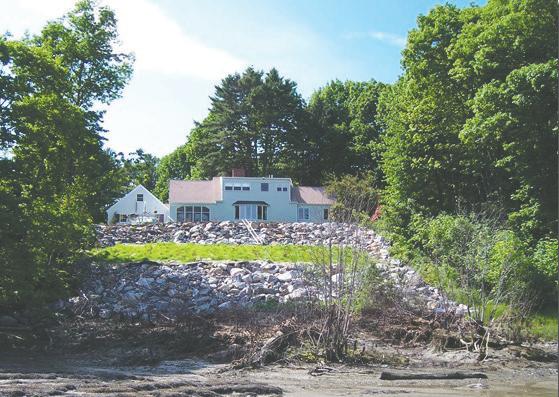

“Belfast Pilings II,” by Carole Sloane, 2013, oil on canvas, 50 x 46 in. COURTESY CAROL SLOANE
world,” she became obsessed with a desire to paint again.
That obsession gained momentum through six winters at the renowned Art Students League in New York City in the 1990s where Sloane studied painting with Ken McIndoe and Leatrice Rose. She drank in the city and its culture, visiting galleries and museums. She also benefitted from several artist residencies, including a six-week Carina House stint on Monhegan in 2002.
In 1992, Sloane moved to Washington, Maine, where she helped establish an art hub. She was a founding artist of the Downtown Gallery (19952012) and a member of the Gibbs Library Art Committee. In 2017, she moved to Rockland, where today she gardens on a more modest scale but with “great enthusiasm” and continues to follow her muse.
Sloane’s studio is a “jumble.” She collects things—dolls, pitchers, flower seeds, and kitsch—that catch her fancy and may be painted later. During a recent winter, she tried painting over old canvases as a way of “mining languages and memories” and compressing her “visual diary experiences.”
Sloane is a member of the Midcoast Salon, a group of artists who meet monthly via Zoom to share projects and discuss topics, like one last winter titled “Aging Artists: Challenges in Living and Legacy.” She finds it an engaging way to interact with other working artists.
“I experience a certain recklessness when I consider the enormity of our
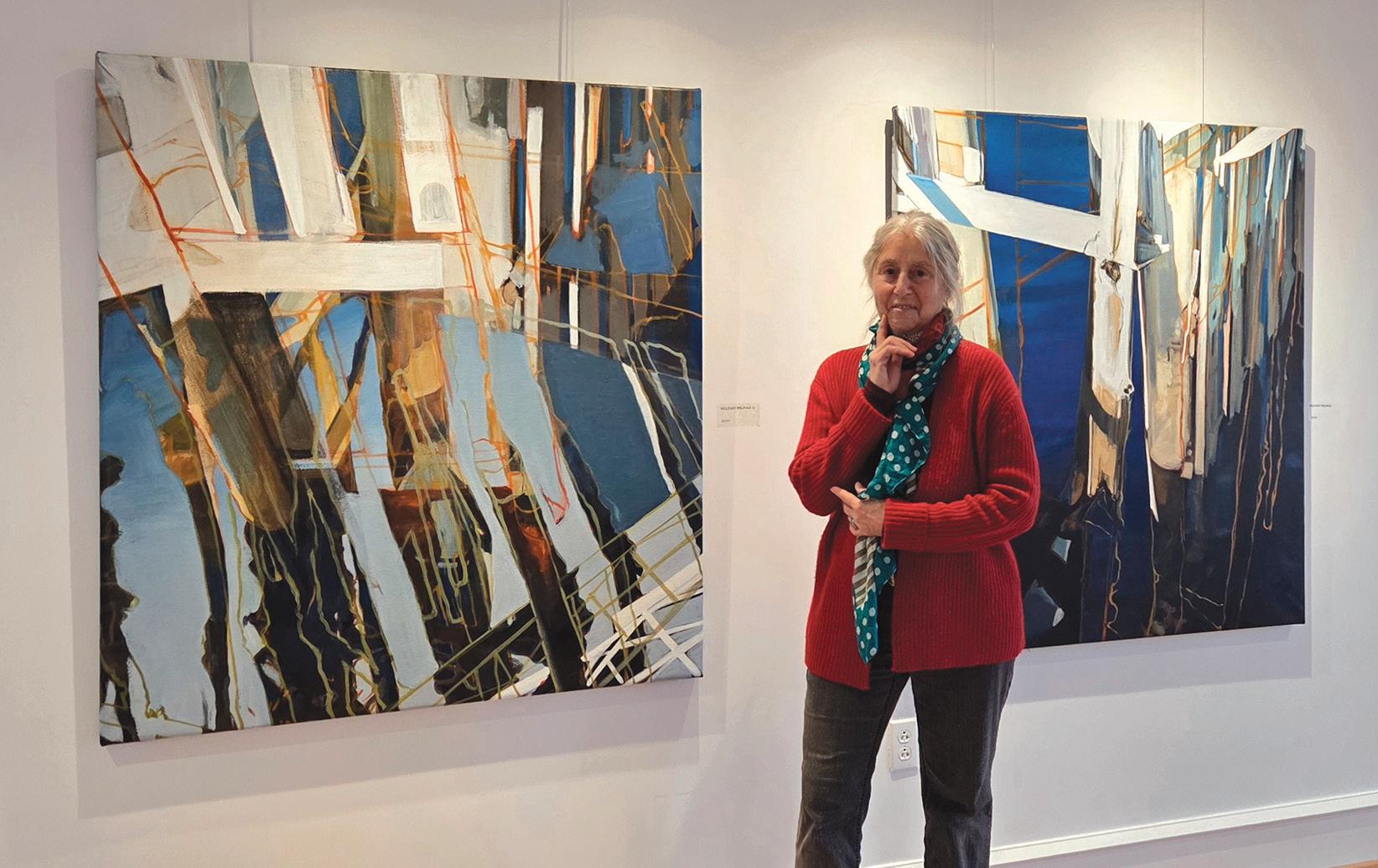
three-dimensional landscape,” Sloane has explained, “and work to place a small part of it onto a two-dimensional surface with paint.” She wants to create “a sensation of a place rather than a clear representation.” Her Belfast pilings paintings attest to the success of that admirable mission.
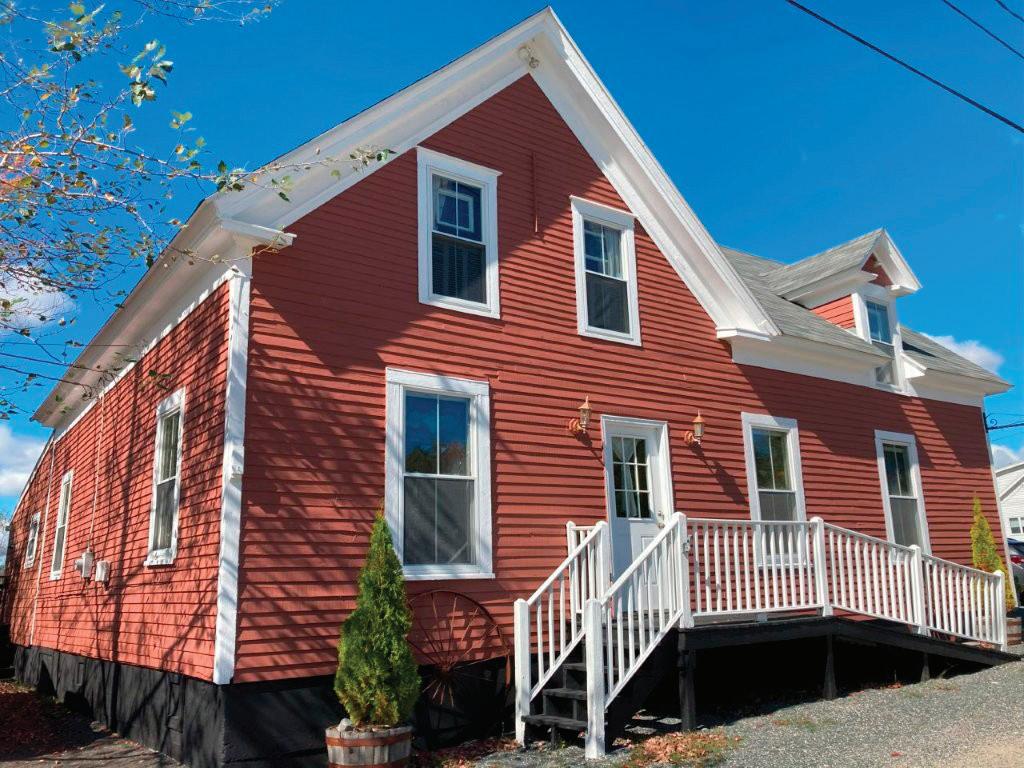


Sloane has shown at the Caldbeck Gallery, the Craignair Inn in Spruce Head, Thos. Moser in Freeport, the Maine Coastal Islands National Wildlife Refuge Visitor Center in Rockland, and the Portland Public Library. You can see more of her work at www.carolsloanemaine.com.
Carl Little is curating Francis Hamabe’s Maine: A Lifetime in Art for the Castine Historical Society this summer. He contributed a chapter on photographer George Daniel for Fire Island Art: 100 Years, from Phaidon.
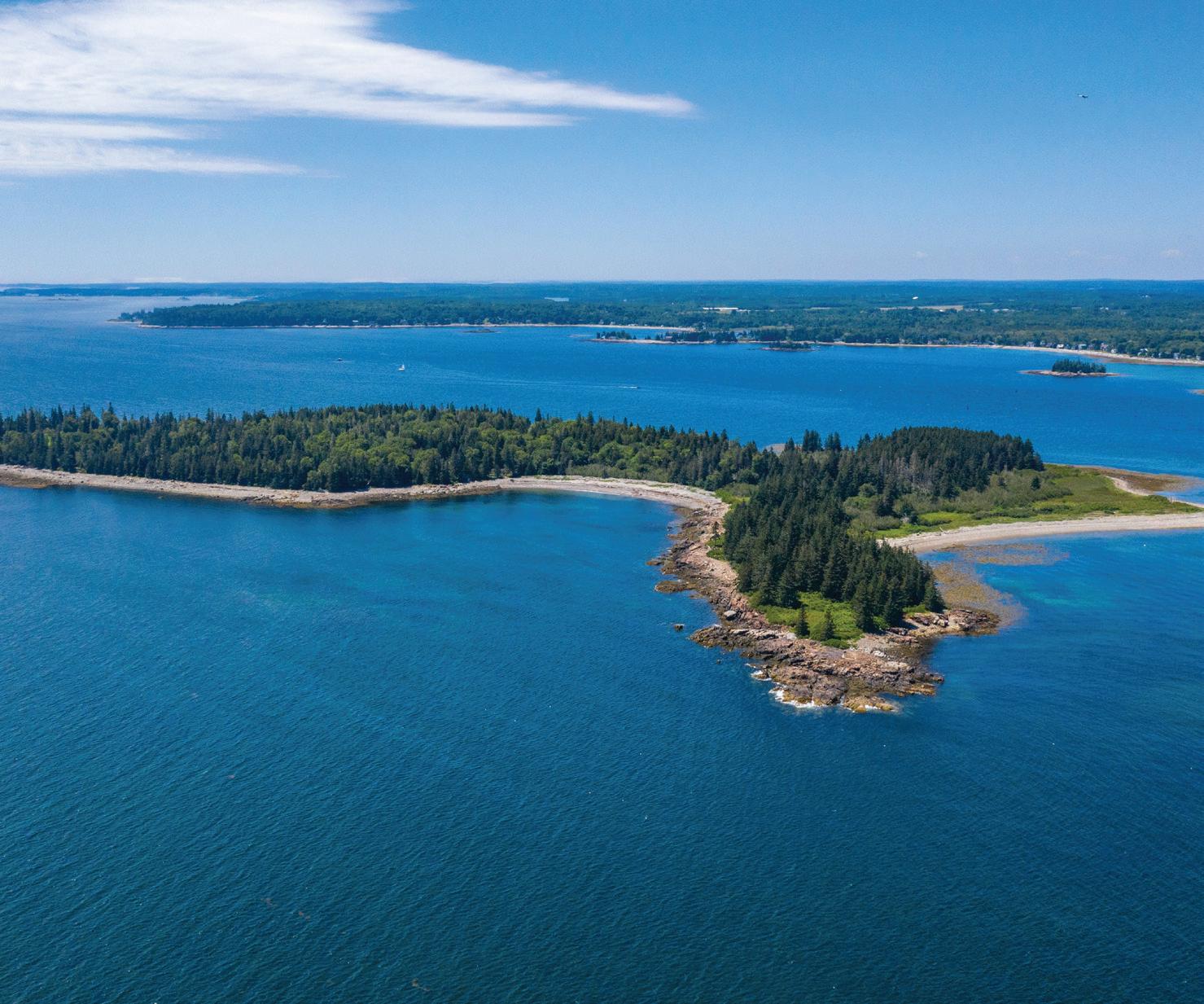
antique boutique
Carol Sloane standing in front of two of her paintings of Belfast pilings at her show at the Maine Coastal Islands National Wildlife Refuge Visitor Center show last November. PHOTO: COURTESY KAY ETHERIDGE






















Leave a Legacy for the Coast

“ I have always had deep respect for those who work the water. The daily challenges they face, the risks they accept, the families that support them and the value they bring to coastal communities requires our recognition and calls for our support.
I’m no millionaire, but making a long term pledge from my estate can help, and the wonderful relationship I have with the Institute has a value all its own. Every year I learn new things about the working waterfront, and the hundreds of hours I spend on the water each summer, often sharing that with professional fishermen, reminds me why this is important.
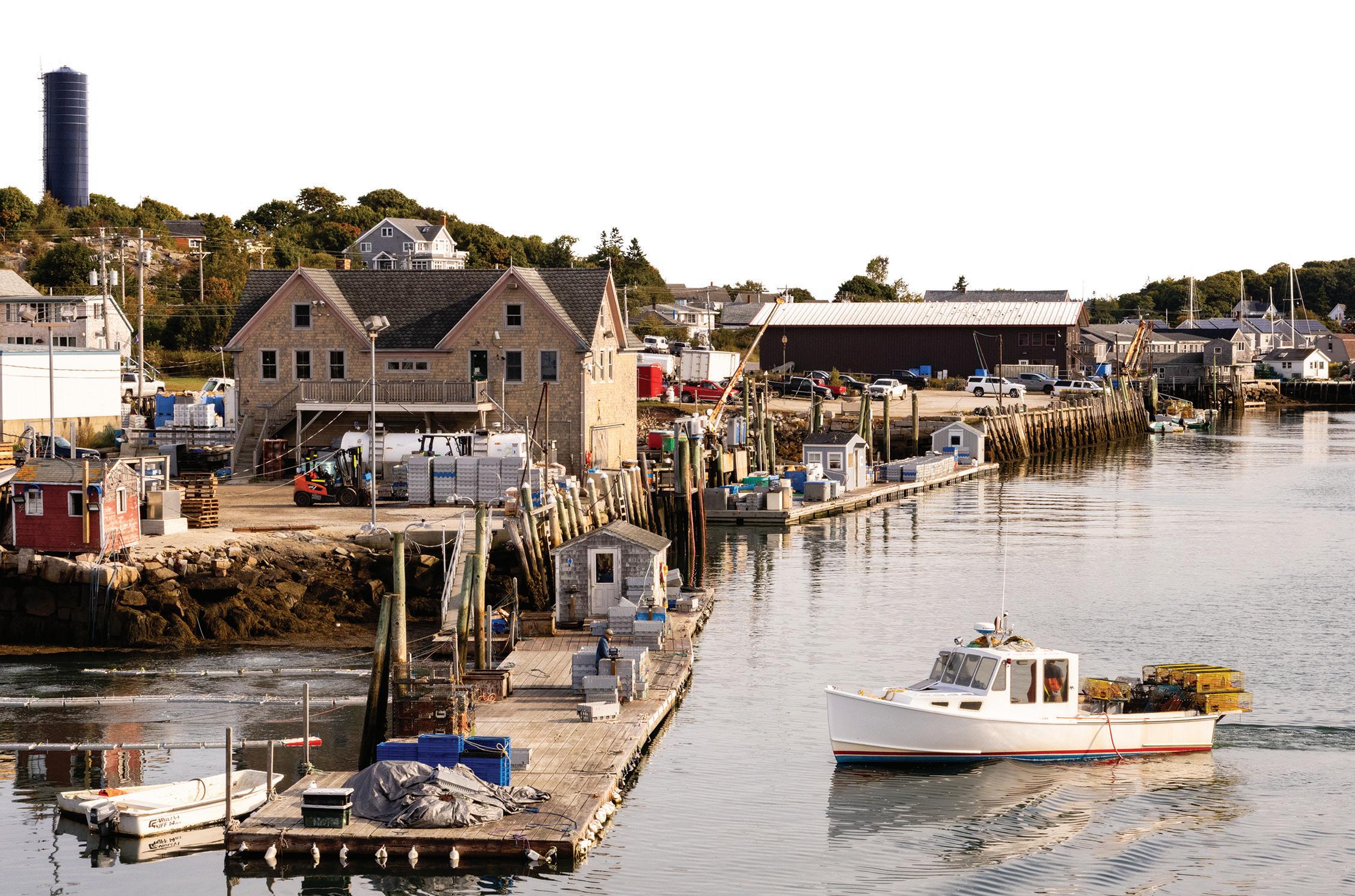
There’s a satisfaction in knowing that some of what I leave behind will support the industry and the people who work the ocean. Although I live in Illinois, I count the days every year toward my return to Maine.” —Alan Spear
Naming Island Institute as a beneficiary of a will, revocable trust, retirement plan, life insurance policy, or life-income gift provides essential support for Maine’s coast and may offer tax benefits to you and your loved ones.