News from Maine’s Island and Coastal Communities volume 40, no. 1 n feb/mar 2026 n free
publishedby byisland islandinstitute institute nn workingwaterfront workingwaterfront.com .com published
Leaning into fishing
A new Maine program gives young fishermen career skills BY JACQUELINE WEAVER
F
or years, teachers and guidance counselors at the Charles M. Sumner Learning Campus in Sullivan worked diligently to give students who fish a broader outlook on possible occupations other than a life on the sea. But Whytne Crabtree, a career education teacher, decided to take a different tack. Crabtree oversees Sumner’s MELMAC Education Foundation grant, which helps students develop educational and career aspirations in preparation for life post-high school. “But there was never anything comparable for students who fish,” she said. Crabtree thought taking students out on boats would require lots of permission slips and supervision. So that was out. But then she came up with the idea of hosting a regional event for other students who fish. “These students have real assets and lives,” she said. “They’re 35-year-olds in 17-year-old bodies. I decided to have them lean into it.” What resulted was the inaugural Marine Trade Forum for students in Hancock and Washington counties. The March 12, 2025, program drew about
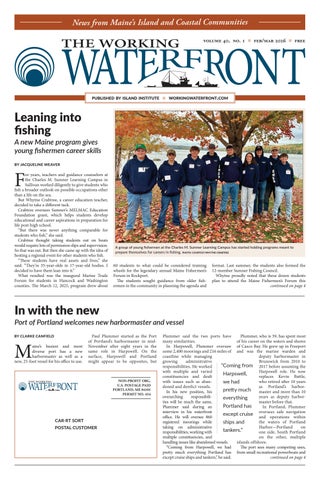
A group of young fishermen at the Charles M. Sumner Learning Campus has started holding programs meant to prepare themselves for careers in fishing. PHOTO: COURTESY WHYTNE CRABTREE
60 students to what could be considered training wheels for the legendary annual Maine Fishermen’s Forum in Rockport. The students sought guidance from older fishermen in the community in planning the agenda and
format. Last summer, the students also formed the 12-member Sumner Fishing Council. Whytne proudly noted that these dozen students plan to attend the Maine Fishermen’s Forum this continued on page 4
In with the new
Port of Portland welcomes new harbormaster and vessel BY CLARKE CANFIELD
M
aine’s busiest and most diverse port has a new harbormaster as well as a new, 25-foot vessel for his office to use.
Paul Plummer started as the Port of Portland’s harbormaster in midNovember after eight years in the same role in Harpswell. On the surface, Harpswell and Portland might appear to be opposites, but
NON-PROFIT ORG. U.S. POSTAGE PAID PORTLAND, ME 04101 PERMIT NO. 454
CAR-RT SORT POSTAL CUSTOMER
Plummer said the two ports have Plummer, who is 39, has spent most many similarities. of his career on the waters and shores In Harpswell, Plummer oversaw of Casco Bay. He grew up in Freeport some 2,400 moorings and 216 miles of and was the marine warden and coastline while managing deputy harbormaster in growing administrative Brunswick from 2010 to “ Coming from 2017 before assuming the responsibilities. He worked with multiple and varied Harpswell role. He now Harpswell, constituencies and dealt replaces Kevin Battle, with issues such as abanwho retired after 10 years we had doned and derelict vessels. as Portland’s harborpretty much In his new position, his master and more than 10 overarching responsibiliyears as deputy harboreverything ties will be much the same, master before that. Portland has Plummer said during an In Portland, Plummer interview in his waterfront oversees safe navigation except cruise and operations within office. He will oversee 860 registered moorings while the waters of Portland ships and taking on administrative Harbor—Portland on tankers.ˮ responsibilities, working with one side, South Portland multiple constituencies, and on the other, multiple handling issues like abandoned vessels. islands offshore. “Coming from Harpswell, we had The port sees many competing uses, pretty much everything Portland has from small recreational powerboats and except cruise ships and tankers,” he said. continued on page 4
2
The Working Waterfront . february / march 2026
Phil Crossman, in memoriam Remembering a giant oak of a man BY PHILIP CONKLING AND PETER RALSTON
W
hen a giant oak of a man is felled on an island everyone hears it instantly and feels the loss deeply and personally. Phil Crossman, Vinalhaven writer, raconteur, businessman, and activist, among his many other island roles and occupations, crossed the bar shortly before the turn of the New Year surrounded by family. He was 81. Crossman’s affectionate nickname on Vinalhaven was “Crow,” bestowed upon him as a teenager, after he grew six inches in less than a year and reminded his island neighbors of the similarly named 6-foot-6 stonecutter who was a certifiable island character. People from Vinalhaven and from away might have encountered Phil at the ferry delivering or retrieving guests from his motel, the Tidewater, where guests could walk into the motel with no one behind the desk and just take a key with their name on it to sign in. Or you might have encountered him at a town meeting, where he was a selectman, or at civic meetings, land trust events, or singing with his a cappella group Phil ‘n the Blanks. Or you may have read his weekly columns as the “Observer” for Vinalhaven’s Wind, where he was a constant source of rich island observation, lore, and wit. As a serial author, Crossman artfully dissected the distinctions between island natives and other residents in his book Away Happens, a supremely wry and antic chronicle of island life. “There are only two places,” he wrote, “Here, this island off the coast of Maine and Away. Here, this place, is a small place and Away, everywhere else, is a big place, but make no mistake about it, Here is Here and Away is Not.” Many people, whether they read the book or not, remember its cover, which featured a photograph of a late-middle-aged man standing back-to on the shore of Carver’s Harbor wearing nothing but a life jacket while waving to a departing ferry. In addition to his many columns over the decades in The Working Waterfront, and contributions to Island Journal, Crossman also collaborated as the keen essayist accompanying Joel Greenberg’s stunning black-and-white collection of photographs in Vinalhaven: Portrait of a Maine Island. Crossman eloquently depicted in writing the souls of the likes of Cowboy Jack Watt, cracking crabs; the prim Finnish
None of Phil Crossman’s friends were particularly surprised when in 2009 he proposed to walk every foot of Vinalhaven’s 273-mile crenellated and indented shoreline—or as he enjoyed referring to it, his “circumambulation.” PHOTO: PETER RALSTON
matron Jennie Webster; and the thousand-yard stare of boatbuilder Gus Skoog. His description of one young hellion is unforgettable: “From her first toke, she was page-one material, blazing a path of outrage, as she became a mighty warrior in the timeless battle of youth against convention.” The man could write! During one of Crossman’s countless communitarian efforts, he helped organize the local preservation nonprofit Historic Downstreet, which among other successes raised more than $150,000 to renovate the island’s original fire station. In the course of his fundraising, Crossman visited the reclusive artist Robert Indiana, who owned the adjacent historic Odd Fellows building. Crossman hoped that Indiana might recall his second-story window, which had been smashed by island bullies and subsequently how Crossman, seeing the damage on his way to work, retrieved a ladder, took out the window
frame, brought it back to his shop, replaced the glass, repaired the frame, and reinstalled it, without a word of acknowledgement passing between him and the artist for 40 years. Pure Phil. Crossman’s friends and admirers were legion, and none were particularly surprised when in 2009 he proposed to undertake an expedition no one in Vinalhaven’s 250-plus-year history had thought of. He decided he would walk every foot of the island’s 273-mile crenellated and indented shoreline. Further he took immense pleasure in referring to it as his “circumambulation,” delighting as every single person thus informed had to ask what the word meant. Classic Phil. A greater undertaking late in Phil’s life was his profound and unshakable commitment to organizing and leading resistance to the current administration in Washington. He threw his big heart into this with everything he could muster—which was a lot—until he was, quite simply, drained. Purest Phil. Over the years since we founded the Institute in 1983, we have had the vast honor and pleasure of working with a great many people in a huge range of capacities, but all along, we were together in holding Phil as an absolute epitome of caring and community. We will miss him terribly. Philip Conkling and Peter Ralston are the founders of Island Institute.
All along, we were together in holding Phil as an absolute epitome of caring and community. Crossman documented in black ink the progress of his ongoing walk around the 273 miles of Vinalhaven’s shoreline. PHOTO: PETER RALSTON
. April . february www.workingwaterfront.com www.workingwaterfront.com 2026 / march2020
133
observer
When Vinalhaven was its own service center More regular ferry service has changed the island town
Upstairs over the clothing store like today’s convenience store with candy, snacks, lots of beer and soda, was the telephone exchange. A team and Phillip was smoking and carrying a few necessities—milk, butter, eggs, of local ladies, all mothers, and each a bottle.” Longtime Vinalhaven columnist “For goodness sakes, Mabel, will it and it stayed open later than the bigger among the most well-informed of the Phil Crossman passed away on groceries to serve the needs of the disor- conspiratorial parents, handled every ever end? I’ll send Bud right down.” Dec. 27. We also have a full article Fifty years later the island is served ganized, the procrastinators, and those phone call made by anyone to anyone. remembering him, but wanted to run Our number was 356. Walking by by two big steel ferries. One carries who only ventured out after dark. one of his own pieces, one last time. It was the late 1950s and Vinalhaven on the sidewalk one floor below, one 16 or so vehicles, the other 22, and This one first appeared in August 2014. was jumpin.’ Served by a wooden might easily have heard an incoming together they make six round trips Our gratitude for Phil’s many years of a day. The newsstand is for sale. The ferry that only carried two cars and call run its course: writing, and condolences to his family. only remaining hardware store closed “Operator.” made two trips a day, it could hardly “Hi Mabel. Would you ring Cal for a few years ago. There is one grocery, WHEN I WAS A KID, my friends and I be otherwise. There was little point in no clothing store, no cobbler, no drug went to great lengths to pick a secluded going off island to do shopping; neither me?” “Cal’s not home, Phyllis—she’s down store, no soda fountain, no dry goods spot where we might misbehave, but was there a need. This community of the parents in this little island town 1,200 or so, captive because of logistics, to Isabel’s knitting nets. Want me to store, no movie theater, no five & dime, no conventional retail. call there?” were a troublesome bunch, alert and was thriving because it was captive. There are several nice restaurants, “Sure, thanks Mabel.” We had four gas stations. There conspiratorial, and we often found our Mabel plugged Phyllis’ 646 into one spectacular gallery, a couple of were little stores like clandestine activities Tibb’s everywhere. Each Isabel’s 497 and Isabel passed the sweet gift shops and a wonderful woefully transparent. jeweler, but downtown is no longer neighborhood had one. phone to Cal. One day in 1958 we “Cal, I thought we was gonna get the retail environment of a working The town sported three snuck a pack of Camels community. It’s a leisure market. full service automotive together to play cards today.” from the Cascade Downtown This is certainly not to say Vinalhaven “No Phyllis, that’s tomorrow down garages—this before Lanes, lifted a bottle is no longer there were even many to Lucy’s after I get done baiting trawl is a leisure community. We are home to of vanilla extract from the busiest and most profitable lobster vehicles—twine and net for Luther.” E.G. Carver’s, scored a the retail “Oh goodness, that’s right. I thought fishing fleet anywhere, and that critical shops, several barberbottle of Haffenreffer environment element represents about 50% of the shops, a casket store, two Luther was already gone seining.” from Tibb’s, and headed Mabel, always eager to remain in town’s income. The other half comes cobblers, a tin knocking down the little alley of a working Staples, Elsie loops Gillespie chat woodstove at the annual or indirectly fromtown thosemeeting. depenthe manyand island and soaround reluc- thedirectly shop, anotherJohn poolMartin, room, Bud between L. R. Smith’s four bakeries, two drug tant to relinquish a connection, dent on the seasonal economy, an equally and Mary’s Restaurant community. stores with companion offered, “Land sakes, Luther’s boat hardworking population, but most of to enjoy ourselves. It’s a leisure us jump on the ferry when we need to, soda fountains, a news- was gone at sunup.” Cascade Lanes was run around on the mainland getting all On this day, however, we’ d have stand, two lumber yards, O. V. Drew’s very busy market. three hardware stores, a heard, had we paused long enough to sorts of things done, come back with bowling and pool empofive & dime, a dry goods listen, first the sound of 356 ringing, a car full of stuff or simply sit down at rium. L. R. Smith was a the computer and order whatever we store, three other restau- then my mom’s voice. bustling clothing store. need, with hardly any exceptions, online. “Hello.” rants, a tobacconist, E. G. Carver’s was one “Pat, this is Mabel down to the Excepting groceries, what’s left of downof four very busy Main Street groceries. movie theater, fishing gear supply, a Tibb’s was kind of a grocery but only in firewood business, photography studio, switchboard. Phillip and Jo-Jo just town serves those with more money to a charitably inclusive sense. It was more two maternity homes, and a mortuary. headed down to the carriage house, spend than needs to fulfill. BY PHIL CROSSMAN
Like our stories, columns, and photos?
Check us out and “like” The Working Waterfront on Facebook!
Levi Moulden
Support for coverage of the Future of Fishing is made possible by a grant from Gideon Asen. Bud Staples
Gerald “Punkin” Lemoine
G.F. JohnstonConsulting & Associates Civil Engineers Concept Through Construction
• • •
Regulatory permitting • • Land evaluation • Project management
Site Planning Sewer and water supply systems Pier and wharf permitting and design
12 Apple Lane, Unit #3, PO Box 197, Southwest Harbor, ME 04679 Phone 207-244-1200—
www. gfjcivilconsult.com —
4
The Working Waterfront . february / march 2026
YOUNG FISHERMEN
continued from page 1
March and hold a second Student Marine Trades Forum, the latter funded by a chowder dinner fundraiser they held in Winter Harbor in October. Whytne said the feedback from students following the Marine Trade Forum made it clear they were on the right track. “They said thanks for giving them a chance to listen to people about something they are really interested in,” she said. “This group was really formed because of student interest and commitment to the fisheries and making sure they have information they need for their future on the waterfront.” Three of the organizers said the experience of holding their own forum and then attending the longer-standing gathering in Rockport is laying the groundwork not only for fishing and keeping up with new rules and regulations, but also to network with others who in the future will be much more politically active in the fishing industry. Dawson Hunt Jr., of Corea, is a generational fisherman who shares a boat with his brother, Gavin, a 2024 Sumner graduate. Harrison Richardson, a senior and first generational fisherman, has his own boat, fishes out of a few harbors, and is sternman for others. Ian Thomas, who has his own boat and fishes with his grandfather in Winter Harbor, is technically a junior but will be able to graduate in 2026 and get a head start on fulltime fishing. Hunt said it is more challenging to break into the industry today and to set oneself up for success. There is the acquired knowledge of where to set traps and learning from others who have developed sustainable businesses. As a backup, Hunt is planning to attend Maine Maritime Academy and enroll in the marine engineering operations program.
Ian Thomas, who has his own boat and fishes with his grandfather in Winter Harbor, is graduating in 2026 as a junior and plans to get a head start on fulltime fishing. He’s helped organize a group at the Charles M. Sumner Learning Campus in Sullivan that prepares young fishermen for careers. PHOTO: COURTESY WHYTNE CRABTREE
He said it’s gratifying to be working on developing a school-based program that ties in directly with his passion for fishing. “In the past the school pushed us away from it,” Hunt said. “We’ve never seen a group to support what we’re doing. Now we can talk about it, learn about it.” Richardson said he’s worried about the rising cost of gear and bait and the expense overall of breaking into fishing as a livelihood. Becoming politically astute, he said, can only help.
“We’re the future workers and we will be making the rules,” Harrison said. Thomas said the talk is pretty much the same wherever they go. “We get together and talk about lobsters, how we’re doing, and safety,” Thomas said. “There is always someone talking about marine safety.” Both Harrison and Thomas, like Hunt, have a back-up plan in place as well. They are training in the diesel program at Hancock County Technical Center in Ellsworth.
NEW HARBORMASTER
continued from page 1
sailboats to huge cruise ships and oil tankers. It’s home to scores of fishing boats, container cargo ships, and ferries that serve Casco Bay’s islands. It also hosts large events such as the annual Peaks to Portland swim, lobster boat races, and Fourth of July fireworks. “I think the biggest thing for today’s harbormasters, especially in today’s age, is conflict mitigation,” Plummer said. “We have shared use of the waterfront and try to mitigate those conflicts. Putting out small fires everywhere is part of the day-to-day operation of a Maine harbormaster.” Plummer’s experience and his calm, professional demeanor make him an ideal fit for the job, said Will Owen, the Yarmouth harbormaster and president of the Maine Harbor Masters Association. The association represents over 140 waterfront municipalities from Kittery to Eastport that have harbormasters. “He knows where he’s coming from both on the administrative level and functionally on the water,” Owen said. “I’m very happy to keep him in Casco Bay and working a couple of towns over; instead of to my left, he’s now to my right.” Plummer works out of a first-floor office in the Marine Trade Center on the Portland Fish Pier, which he shares with his administrative assistant and a deputy harbormaster, Hattie Train. Berthed outside is the new 25-foot aluminum harbormaster vessel powered by twin 250-hp Mercury outboards. It was built by LymanMorse Workboats in Thomaston and launched last fall. Most of the state’s full-time harbormasters are in southern Maine, below the Kennebec River, Owen said. Through the years, a growing number of towns have seen the importance of having a full-time person in charge of enforcing regulations and overseeing the waterfront. In some places they belong to the local police department, whereas in others they are standalone offices, such as in Portland Harbor. Harbormasters in coastal communities east of the Kennebec River are more likely to be seasonal or part-time, Owen said.
Paul Plummer, the new harbormaster for the Port of Portland, also has a new, 25-foot vessel that his office will use to oversee the waters around Portland, South Portland, and multiple offshore islands. PHOTO: CLARKE CANFIELD
No matter where they’re located, harbormasters have taken on added responsibilities, much of it administrative. Plummer guesses that 75 percent of his job in Portland will be administrative. One “continuing and growing problem” Plummer is prepared for is the uptick in the number of vessels abandoned along the Maine coast in recent years. His predecessor had to deal with it in Portland and Plummer has first-hand experience with it from his time in Harpswell. Last year, the Coast Guard removed the 83-foot motor vessel Jacob Pike from the waters of the New Meadows River in Harpswell, where it sank during a winter storm two years ago. The vessel was built in 1949 but had been long retired from its original use as a sardine carrier. The question about the Jacob Pike and other abandoned vessels is who ends up paying for their removal. When removing the Jacob Pike, the Coast Guard said it would bill the owner for the cost, which could exceed $300,000. Plummer worked with the Coast Guard during the process. Plummer said he and the vice president of the Maine Harbor Masters Association have been talking
with a state lawmaker about developing legislation that would somehow force or encourage boat owners to foot the bill for removal costs of derelict boats. As it now stands, owners can plead guilty in court to a misdemeanor crime of abandoning a vessel and simply pay a small fine, leaving it up to local municipalities to pay for the removal costs, he said. For now, he’s focusing on building relationships as he gets to know the wharfs, marinas, and officials in the two cities and with agencies such as the Coast Guard and Marine Patrol. “The running joke I tell people is—and it may not be as applicable here in Portland Harbor because there are more resources—is that harbormasters are really police, fire, and public works on the water. All three and then some,” he said. “Whatever comes up, it typically gets thrown on you first and then you have to delegate. ‘Do I need to call the Marine Patrol? Do I need to call the Coast Guard? Do I need to call the fire department?’ It usually starts with you.” Clarke Canfield is a former reporter for the Portland Press Herald and the Associated Press. He lives in South Portland.
www.workingwaterfront.com . february / march 2026
5
guest column
So you want to save working waterfront? Lessons from a decade-plus effort to expand Port Clyde’s landing BY DAN MORRIS
M
any people and organizations in Maine, including the publishers of this paper, have rightfully sounded the alarm about the loss of working waterfront along the coast. What is obvious is that Maine’s coast has become a very desirable place to live, and many fishing families have been displaced from shorefront access. This is the story of one town’s efforts to save that access and working waterfront. St. George, which includes Port Clyde, has seen its share of working waterfront shrink over the years. Just over a decade ago, the peninsular town had a mere 183 feet of public access to its largest asset, the Atlantic Ocean, upon which many residents depended. In 2014, when the property next to Port Clyde’s public landing became available, the town recognized it as a once-in-a-lifetime opportunity to protect a deep-water piece of working waterfront. The harbormaster at the time, Dave Schmanska, asked the owners whether they’d consider selling to the town, after they previously donated the site of the existing landing, which was outdated and impossible to expand. They agreed to sell at a discount, and the town went to work. Most of that work fell to the Harbor Committee, which I chaired at the time. We first held public informational meetings, initially to ask the town to purchase the property, and later for a rehabilitation plan to build a new landing. We stressed the need for preserving working waterfront. Subsequently, voters agreed to spend $800,000 to purchase the property, and later to issue a $2.6 million construction bond, which added $25 to the average annual tax bill. We hired firms to assist us with communications, planning and, perhaps most importantly, getting permits from the state and U.S. Army Corps of Engineers. We planned to run new sheet steel from a wharf that was in good shape across one that needed repair, creating more usable space but requiring a permit to fill two small coves. We were surprised to hear at our meetings from non-fishermen who particularly valued watching fishing boats coming and going, bringing in fresh seafood that they could enjoy. By around 2019, we’d obtained permits and went to choose a contractor, but were surprised to learn that soaring construction costs had put the plan beyond our original estimate. We needed to find more money or scale back the project. The latter wouldn’t save much and would go against voters, so we decided to apply for a federal grant. First, we unsuccessfully applied for a grant with a 60-40 split between the feds and the town. We’d sought letters of support and application assistance from other entities like the state Department of Marine Resources and Island Institute. We were encouraged to reapply and started back up around the arrival of the pandemic, which stalled things for the better part of two years but eventually led to new grant opportunities aimed at re-starting
the economy. One of them fit our project well, offering an 80-20 split. We reviewed our plans again and sought assistance from Maine’s congressional delegation, including Sens. Angus King and Susan Collins. They provided invaluable help and our application for $4.8 million dollars was approved in 2022. Of course, these grants come with strings and most steps from that point on required federal approval. The town retained a consultant and engineer to oversee construction and ensure the town got what it paid for. Fortunately, a member of our committee had useful previous experience in commercial building and was knowledgeable about contract requirements. Each change resulted in either a credit or, more often, an extra charge, all needing to be negotiated with the contractor. It’s easy to rack up thousands in extra charges when straying from the original bid. Our largest change order created an extra $500,000 in costs, as we tried to remove a huge rock that our surveys had called ledge, 20 feet below the mud line. We also recognized the importance of clear lines of communication with the contractor. As the project dragged on for years, we sometimes faced questions and criticism from the public about it. Some meetings brought frustration and secondguessing about what we were trying to do. At times social media would fill with misinformation and rumors, mostly from people who rarely, if ever, attended our meetings. The committee released periodic updates, but we learned that detractors are gonna detract. Finally completed in 2025, the project has enhanced the working waterfront and increased shore access
for everyone. It turned out very well, and many of the town’s residents and visitors seem to think so. While we thought we had plenty of money going into this, we ended up spending most of it in the end. The town and several organizations have even used the site for a fundraising concert—not something we originally envisioned, but nonetheless, a beautiful shorefront spot for locals to take advantage of. In the area where the general store burned, the facility has helped to bring people into the village of Port Clyde. A grassy elevated area above the dock has attracted many to just enjoy the view, watch the lobster boats come and go, and perhaps spend some money locally. It provides more parking and a safer traffic pattern in a highly congested area. The docks are being used for kayak rentals, islanders, charter boats, and transient boats that all can tie up to over 100 feet of new floats. Lobster fishermen have used the commercial dock and float. Two new hoists are available, along with a new year-round launch ramp. We knew the project would take years, but none of us expected it to be a decade-plus and require hundreds, if not thousands, of volunteer hours. We dealt with some extraordinary circumstances that could not have been predicted. So, for those of you who might be contemplating saving some working waterfront in your own town, this may be a cautionary tale. But in the end, our new landing was worth the trouble. Dan Morris is a lobster fisherman and former member of the Maine Marine Patrol. He grew up in Port Clyde and previously led the St. George Harbor Committee.
National Bank
D R EAM FIRST
A Division of The First Bancorp • 800.564.3195 • TheFirst.com Member FDIC • Equal Housing Lender
6
The Working Waterfront . february / march 2026
from the helm
From the ashes, a call to action Why a fire on Portland’s waterfront matters BY KIM HAMILTON
IN MY LAST “From the Helm” column, I wrote about the importance of Maine’s working waterfront—the people, the structures, the boats, and the businesses that sustain Maine’s marine economy. I asked you to imagine what it would look like if that critical connection between land and sea were to disappear. And then, in late December, a fire tore through the Custom House Wharf, threatening to destroy the heart of Portland’s waterfront and arguably one of the city’s most iconic locations. For those of you reading this column from the warmth of your homes, know that Dec. 26 was brutally cold. Were it not for the tenacity of the first responders, fishermen, and firefighters—and a fortuitous offshore wind—the devastation could have been worse. For historians, the red sky and roaring inferno on Custom House Wharf certainly evoked fears of the Great Fire of 1866 when much of Portland, from the Old Port to Munjoy Hill, succumbed to flames. For the individual businesses that were affected, the Custom House Wharf blaze dealt real economic loss. As we learned during the January storms of 2024, such losses also take
a psychological toll, as beloved land- foundations of our maritime commumarks are threatened if not destroyed. nities from Bath to Belfast, Stonington This is true for the fishermen who rely to Lubec. Their form and functions, upon that wharf for their livelihoods honed over generations, would be very as well as the thousands of visitors who hard to recreate anew. This is why any want to experience firsthand Maine’s assault—natural or manmade—to the essential infrastructure that keeps our maritime economy in action. Custom House Wharf is part of my marine economy humming is espeown history. My father’s great-great- cially concerning. But there is much we can do today to uncle, Ropheus Hamilton, owned R.D. Hamilton’s Fish Market in the 1880s at build a more resilient future. Most immediately, 9 Custom House Wharf, support the efforts to now the location of the Custom House rebuild Custom House revered Harbor Fish Wharf may be Wharf. Our colleagues Market. That’s just one at the Maine Coast of the ways that my particularly Fishermen’s Association family, like so many have established a fund others, has connections historic and for the response at the to this important locarecognizable, request of the fishing tion. While supporting community. One hundred Maine’s working waterbut its vitality percent of your donation fronts is central to Island and importance will support those affected Institute’s mission today, by the fire. I also feel this loss at a are replicated Of course, continue to personal level. frequent the businesses Custom House all along the and restaurants along the Wharf may be particucoast. wharf that bring this slice larly historic and recogof Portland Harbor to life. nizable, but its vitality Over the longer term, follow local and importance are replicated all along the coast. It is not an exaggera- community efforts related to coastal tion to say that vibrant wharves are the development. Many of our working
waterfronts and shorefronts that provide access to fishermen and aquaculturalists are quietly disappearing without sufficient discussion, thought, visibility, or long-term planning. Support the state of Maine’s efforts to protect working waterfronts and commercial fishing access through the Working Waterfront Access Protection Program, which will re-open early this year and can limit non-fishery related development at a site. More information can be found on the Department of Marine Resources website and from Island Institute. Lastly, support our local marine economy—from the fishermen to the many businesses that make the waterfront work for all of us. Collectively, we need more tools, more resources, and more awareness to protect what’s threatened. And we need you. Kim Hamilton is president of Island Institute, publisher of The Working Waterfront. She may be contacted at khamilton@islandinstitute.org.
sweetest in the gale
Looking for hope in a stormy season A bleak news cycle interrupted by a personal milestone BY CHARLES EICHACKER
IN HINDSIGHT, I wonder if the name I chose for this column was too wishful. I took the phrase “Sweetest in the Gale” from Emily Dickinson’s poem, “‘Hope’ is the thing with feathers,” in which a bird stands for hope in dark times. “And sweetest - in the Gale - is heard - / And sore must be the storm - / That could abash the little Bird / That kept so many warm…” In November, as I was putting together my first issue of The Working Waterfront, I figured that line would evoke a salty, offbeat optimism in the face of worsening storms. We need some hope, and part of my role is to highlight where it’s warranted. For personal reasons, I was brimming with hope at that moment. I was coasting on the joy of a new job at an organization which, defying national trends, values local journalism. I was learning the ropes from outgoing editor Tom Groening, who has just retired. Perhaps most of all, my wife and I had navigated Maine’s real estate market—a gale-force storm, in its own way—and were close to making an offer on a home in the Rockland area.
And while the last few years have Australia, at Brown University, and in been challenging for everyone, if I the home of Rob and Michele Reiner. And the nation continues its assault squinted, I could also make out glimon efforts to meaningfully slow climate mers of good news on a larger scale. In one example: The asking price for change, which is fueling storms, the home we’d set our sights on had droughts, and other problems in Maine dropped more than $100,000 since and elsewhere. Clean energy continues the summer, part of a broader cooling to grow around the world, thankfully, in the seller’s market that had made but why must it be so hard? To borrow from another famous property so much more expensive poem about a bird: “Things fall apart; since COVID. Yet as I write my second column, at the centre cannot hold.” So I’m questioning the dark turn of the year, how much hope I’ll it’s gotten harder for me be able to serve up, at to ignore other gathering At the dark least for now. Perhaps storms. readers of The Working Some of this is related turn of the Waterfront can help me to a series of illnesses and find it. deaths that have affected year, it’s gotten Back on the personal my friends, family, and harder for level, I can boast that colleagues in recent we finally did buy that months. Another part is me to ignore home, just two days the usual winter malaise. other gathering before Christmas. But it’s more than Of course, this has those things. For a while storms. brought new forms of now, it has felt rare to go dread. a single week without Before the closing, I hearing another round worried that a powerful wind would of shocking national or global news. In mid-December, there was the blow a tree onto the roof, or knock string of deadly attacks on a beach in out power long enough for pipes to
freeze. After the closing, I’m even more scared of those things. But I have no right to complain. Another fear was that the couple selling us the property would resent us when we finally met them, for what seemed like a deal that worked in our favor. I didn’t have to worry. They now live in a nearby town and, at the closing, got misty-eyed expressing their happiness that the place where they raised their kids would become ours. They shared a handwritten note with contacts for themselves, their plumber, and their furnace guy. They still own and rent out another property next to ours, and with snow on the way, they offered to plow our driveway. Now that was sweet. Charles Eichacker is the editor of The Working Waterfront and Island Journal. He may be contacted at ceichacker@islandinstitute.org.
www.workingwaterfront.com . february / march 2026
7
HOUSING LOSS— This photo shows an apartment building on the corner of Cumberland Avenue and Casco Street in Portland in 1954. This building was torn down a few weeks later. PHOTO: COURTESY MAINE HISTORICAL SOCIETY
the public’s policy
Maine’s housing crossroads Progress, limits, and what comes next BY ERIN QUETELL
MAINE ENTERED the 2025 legislative session with housing at the top of its policy agenda. For years, Mainers have grappled with unaffordable rents, scarce housing availability for working families, and regulatory barriers that help keep supply low—all of which has been exacerbated by the COVID-19 pandemic, growing numbers of seasonal homes, and development challenges. This past year, the Legislature passed historic reforms that began to confront these challenges. A centerpiece of the 2025 session was zoning reform aimed at increasing housing supply. Lawmakers passed LD 1829, a major rewrite of state housing density rules. This law requires municipalities to allow more units per lot, particularly in “designated growth areas” that encourage intentional development. It also prevents communities from imposing overly restrictive lot sizes and density limits, and it simplifies the permitting for development of multi-family housing and accessory dwellings. And the new law makes it easier to build “by right”—a zoning term that means a developer can follow a predictive approval process if the project meets set requirements. Zoning reform is only one piece of the housing puzzle. The Legislature also
created a dedicated funding source for affordable housing through updates to the real estate transfer tax, directing revenue from high-end property sales into a housing fund—a first for the state. Despite this progress, state officials warn that existing housing dollars are nearly exhausted, and without renewed investment, production may slow sharply in the coming years. While that funding has been transformational for some projects, it has also limited the development of the “missing middle,” or housing that would support residents in the brackets receiving 80% to 150% of the area median income. Additional funding reform is needed to address the broader affordability issues and reduce constraints on equitable new housing solutions. One solution aimed at addressing this was to enact legislation to protect residents of manufactured housing communities by limiting excessive rent and fees and establishing preservation funds. Affordability isn’t just about building new units but also protecting existing ones. So what comes next in 2026? Affordable housing funding must be renewed and expanded: with Maine Housing’s current pipeline potentially tapering due to lack of funding, the Legislature will need to revisit financing mechanisms. This might include a new housing bond, expanding transfer tax
Island Institute Board of Trustees Doug Henderson, Chair John Conley, Vice-Chair Bryan Lewis, Secretary, Chair of Philanthropy and Communications Committee Katherine Vogt, Treasurer, Chair of Finance Committee Michael Boyd, Clerk Shey Conover, Chair of Programs Committee Michael Sant, Chair of Governance Committee Robert Baines Pamela Baker-Masson Sebastian Belle Des Fitzgerald Christie Hallowell Kristin Howard Nadia Rosenthal Michael Steinharter Carol White John Bird (honorary) Tom Glenn (honorary) Joe Higdon (honorary) Bobbie Sweet (honorary) Kimberly A. Hamilton, PhD (ex officio)
revenues, or developing other ways of supporting inclusive and equitable housing development. Without steady capital, even the best zoning reforms won’t translate into new homes for those who need them the most. Antidiscrimination policies protect vulnerable populations: The Legislature will likely revisit tenant protections and antidiscrimination policies based on income, which would push Maine toward stronger safeguards for renters in a tight market and support diversified housing solutions. Healthy Housing = Healthy Workforce = Healthy Economy: The Legislature may explore new ways to integrate housing policy with broader economic goals, such as workforce development, rural housing and revitalization, and increased infrastructure planning. The business community has increasingly mobilized around prohousing coalitions, emphasizing that workforce shortages and housing scarcity are intertwined. Housing policy cannot be siloed. The Legislature must consider how the varied housing concerns—affordability, housing preservation, homelessness, regional planning, and developer recruitment—all intersect with zoning, permitting, and finance. Building a durable housing ecosystem will require lawmakers to knit these threads
THE WORKING WATERFRONT
Published by Island Institute, a non-profit organization that boldly navigates climate and economic change with island and coastal communities to expand opportunities and deliver solutions. All members of Island Institute and residents of Maine island communities receive monthly mail delivery of The Working Waterfront. For home delivery: Join Island Institute by calling our office at (207) 594-9209 E-mail us: membership@islandinstitute.org • Visit us online: giving.islandinstitute.org
together rather than treat them as separate issues. Here at Island Institute, we have listened to our communities echo much of this concern—without coordination and consideration for smaller, rural and island communities, such places are at risk. We need to come together to develop community-driven housing solutions that simultaneously protect local character and economies while reducing the risk for development— especially for smaller projects suited to the unique communities we serve. The 2025 session laid critical groundwork for advancing housing solutions and has signaled a shift from one-off solutions to coordinated reform. We have much work ahead of us and are ready to roll up our sleeves. Erin Quetell is public policy director for Island Institute, publisher of The Working Waterfront. She works with communities and partner organizations and leads government relations work and public policy campaigns to advance the resilience of Maine’s island and coastal communities. She may be contacted at equetell@islandinstitute.org.
EDITOR: Charles Eichacker
ceichacker@islandinstitute.org
Our advertisers reach 50,000+ readers who care about the coast of Maine. Free distribution from Kittery to Lubec and mailed directly to islanders and members of Island Institute, and distributed monthly to Portland Press Herald and Bangor Daily News subscribers.
To Advertise Contact: 386 Main Street / P.O. Box 648 • Rockland, ME 04841 The Working Waterfront is printed on recycled paper by Masthead Media. Customer Service: (207) 594-9209
Dave Jackson djackson@islandinstitute.org (207) 542-5801
www.WorkingWaterfront.com
8
The Working Waterfront . february / march 2026
53 years of fishing news comes to an end Newspaper convened fishermen, scientists, officials BY ROBIN ALDEN
A longer version of this piece appeared in the last issue of Commercial Fisheries News, which ceased publication at the end of 2025.
C
ommercial Fisheries News, the Northeast’s commercial fishing trade newspaper, published its last issue in December 2025. CFN was founded in 1973 in Stonington, Maine, as an idea in my 22-year-old head to create a community of fishermen, scientists, and government people, where the voices of fishermen would be heard, and where the knowledge needed for sensible fisheries decisions could be shared. The paper would bridge differences. Good fisheries policy would make fishing prosper in every small harbor in Maine. I know now that CFN couldn’t do all those things, or at least not alone. But I was very young. The paper’s 53-year news span is something to behold. CFN launched three years before the 200-mile limit, running monthly maps showing hundreds of foreign trawlers fishing off New England. We celebrated when the Magnuson Act passed, and had high hopes that the brand-new New England Fishery Management Council would give fishermen a constructive voice in management. We spent pages and pages trying to make the council system accessible to fishermen, even as it brought quotas and shutdowns. As federal management came to dominate every fishery in New England, CFN became its paper of record. Fishermen, council members, and even council staff read CFN to learn what had happened during the confusing, multi-day council meetings. Some fishermen were motivated to participate. Others just shook their heads and choked on their language on the radio offshore. As fisheries changed, CFN reported on the whole package: boats and gear, landings and prices, and management decisions at the state, interstate, and federal levels. CFN covered booms, and rode them with its advertising. First groundfish, with new nets, trawl doors, electronics, monofilament gillnets, and the conflict over lobster dragging and gear conflict. The start of the innovative Portland Fish Exchange and the fishermen and dealers who stood up to make a transparent marketplace. In the early 1980s, new, >100-foot steel scallopers in New Bedford fueled CFN’s move to southern New England. Through the whole 50+ years, the gradual—and then huge—Maine lobster boom. First, in the 1970s, diesels, wire traps, the first electronics, and 30-40-foot fiberglass boats replacing wood. Later came new Maine lobster rules, Atlantic States Marine Fisheries Commission, and the five-fold rise in Maine lobster landings, stunning new electronics, and 40-50-foot boats with big diesels and trap racks. We created booms: CFN was instrumental in turning a few local lobster boat
races into an annual statewide circuit. The paper ran the Maine Fishermen’s Forum for several years and was pivotal to the forum’s trade show. CFN was there for the epic boom-andthen-bust of the Maine urchin fishery. And the bust-and-then-recovery of the Maine inshore scallop fishery. So many busts. The redfish boats that returned for groundfish in the Gulf of Maine and Georges after the U.S.Canada Hague Line—for a few years— until groundfish collapsed and they left for better fishing in Alaska. Further groundfish collapse, especially in eastern Maine. The collapse of the lobster fishery south of Cape Cod. And herring: CFN’s coverage spanned from publishing annual discharge permits for Maine’s 16 sardine canneries to purse seining and midwater trawling, to the Jeffries stock collapse, and now, bait supplies. Of course, there was more. Prices: the quahog report from Rhode Island and the lobster price report. An annual big fish issue followed the swordfish and tuna world. Joint ventures with floating processors that started and ended. The mid-Atlantic’s squid, mackerel, and butterfish fisheries with shoreside processing. And, since the 1980s, CFN has covered marine mammal issues— from harbor porpoises and gillnets to right whales and lobster traps. Through it all, CFN covered boat launchings, engine models, the explosion of electronics, and “Along the Coast” news of boats, people, storms, and tragedies. In 2015, Rick Martin, then publisher of CFN, faced the realities of the news business brought on by the internet and other forces, and shifted the paper away from fisheries management. Brian Robbins, a writer and former fisherman, stepped forward, and ever since, CFN has been a place to feature new and “reborn” boats, gear, and information about other aspects of being a fisherman, from the “Lobster Doc” to safety to mental health. And always, the people and happenings in the region’s industry. I left the paper in 1995 after more than 20 years to become Maine’s commissioner of marine resources. But CFN never left my heart. Now, in a different sort of parting, I am deeply appreciative of the paper’s life over 53 years; and the dedicated staff, for whom the paper was more a mission than a business. They captured the voices and the stories that made fishing in the Northeast so vibrant, multifaceted and complex, so troubled, and so worth fighting for. They created a community for the creativity, the smarts, and the wisdom of so many in the fishing industry. Returning, now, to my original vision for CFN. Future fishing communities can only thrive by operating within the bounds of the ever-changing ocean. This is tough, a call for all hands— fishermen, scientists, and yes, government—to drop our defenses, share our knowledge, and think beyond ourselves with courage. We will always need to listen and learn from each other, with or without CFN.
Robin Alden putting together an early issue of Commercial Fisheries News. PHOTO: COURTESY ROBIN ALDEN
Robin Alden is founder and former editor and publisher of Commercial Fisheries News. She was commissioner of marine resources in the Gov. Angus King administration. She can be reached at robin.alden3@gmail.com.
Insurance for your home and your business. Ask Allen. We’re here to help!
(207) 236-4311 | AllenIF.com
www.workingwaterfront.com . february / march 2026
9
guest column
Climate work goes mainstream Climate Week events stoke optimism BY SAIMA SIDIK
EARLIER THIS FALL, I took the train down to New York for a few days to join in on Climate Week—a collection of events organized by the non-profit Climate Group in service of reaching net zero by 2050. The sessions were spread out all over Manhattan, so I spent three days taking the subway uptown, then downtown, and over to Brooklyn at night, where I stayed in a hotel room that was only a few square feet bigger than the double bed within it. Down by Wall Street, I heard about how 3D printing has made it vastly cheaper to create living seawalls,
opening opportunities to grow marine ecosystems that will protect coastal cities from flooding. The next morning, I went to N.Y.U. to learn about resilience hubs, where people can get support during and after extreme weather. Later, I travelled all the way up to Columbia University (trust me when I say that Manhattan is not a small place) for a session about optimizing the electrical grid. Throughout the sessions, what struck me was the sheer amount of momentum that’s built up around climate change. Reading article after article about the federal government’s attempts to derail clean energy can make it feel like we’re headed for Coal Era 2.0.
And don’t get me wrong, there was plenty of talk about how tough the sector is right now. The word “headwinds” was in heavy rotation. But looking at how many businesses and other organizations are now part of the climate equation, it was hard to imagine those headwinds prevailing. Business-types crowded into a standing-room-only event meant to connect Korean climate tech companies with American investors. Members of the insurance industry asked questions at more than one session I attended. A communications person from the Natural Resources Defense Council talked about her organization’s partnerships with
Hollywood. The Church of Latter-day Saints sent people. It all felt incredibly… mainstream. There were far more suits than dreadlocks and Birkenstocks (although often those suits were worn with sneakers, which is apparently the thing to do now). Now I’m back in my home office in the attic, settling in to spend the winter writing about what I learned. The life of a freelancer is a solitary one, so it was good to be reminded that I’m not alone. Far, far from it, in fact. Saima Sidik is a science journalist from Lincolnville who now lives in Somerville, Mass. You may subscribe to her newsletter at saimamay.com/newsletter.
Affordable housing opening on Vinalhaven VINALHAVEN HOUSING INITIATIVE has been putting the finishing touches on four units of affordable rental housing soon to be available to eligible year-round residents. “We look forward to families, single people and couples enjoying the day-to-day of living in energy efficient housing, in the village area close to the school and library,” said VHI board President Elin Elisofon. The nonprofit VHI was formed in 2023 with a mission to establish year-round, affordable, and sustainable housing for island residents. Thanks to funding from generous supporters and an $840,000 island-specific MaineHousing grant, VHI was able to move forward with its first major project in 2025. The resulting homes, for up to ten people, highlight the organization’s resourcefulness and creativity by incorporating existing, new, and recycled housing. VHI was able to acquire the Department of Transportation’s ferry crew quarters, slated for demolition, and move the residence to 16 East Boston Road—a VHI property and the site of an existing historical quarry-era house. That historical house had been converted to two apartments, and VHI reconfigured the crew quarters into a three-bedroom family home. In addition, VHI recently added a prebuilt modular home to the location—ferried to the island by the Island Transporter. “The site is a thoughtful mix of old and new construction, while also recycling and reimagining available housing,” Elisofon said. “When the state found they no longer needed the crew quarters they generously agreed to donate it to us for affordable housing.” Construction crews led by Project Manager Dylan Jackson are progressing through the punch list with the expectation that the homes will be ready in the new year. The housing can’t come soon enough to Vinalhaven, where housing costs have spiked since the pandemic, forcing people to move off-island. “We are not just building homes, we are anchoring Vinalhaven’s future as a sustainable year-round community,” says Jackson. “Soaring housing prices are a problem nationwide, but on the island, fifteen miles from the mainland, there is no neighboring town for commuting,” Elisofon added. “We are thrilled by how far we have come and look forward to our next opportunity to create more affordable yearround housing on the island.”
156 SOUTH MAIN STREET ROCKLAND, MAINE 04841 TELEPHONE: 207-596-7476 FAX: 207-594-7244 G ener al & Marine C ontr aCtor D reDGinG & D oCks 67 Front s treet, roCklanD, Maine 04841 www. proCkMarineCoMpany. CoM tel: (207) 594-9565
www.primroseframing.com
Launching The Boat Chair! Handcrafted in Maine with traditional wooden boatbuilding techniques. Simply riveting! Come visit our studio! 43 N. Main St., Stonington (207) 367 6555 owlfurniture.com
10
The Working Waterfront . february / march 2026
Lyman-Morse to build solar-power ferries Three boats will be used on Merrimack River
L
yman-Morse, a premier Mainebased boatbuilder known for craftsmanship, innovation, and advanced marine technology, has been awarded the contract to design and build three solar-powered ferries for MeVa Transit, operator of public bus service in the Merrimack Valley region of Massachusetts. Lyman-Morse workboats division was selected through a competitive “value bid” process that considered overall design, materials, and performance—not just price. The company’s winning design calls for three aluminum-hulled, solar-assisted electric ferries built in partnership with William Lincoln of Response Marine, a Newburyport-based designer and longtime resident who is renowned for his aluminum watercraft. Evoy Vita Power, based in Flora, Norway, will supply the advanced electric propulsion system.
Each ferry will be a 33-foot doublepontoon catamaran, accommodating 18 to 22 passengers and crew, with additional space for two bicycles or scooters. Powered by twin 120-horsepower electric outboard motors, the vessels will cruise comfortably at 10-12 knots. Solar roof panels will supplement the onboard batteries, and the boats will have access to docks at both ends of the crossing that feature fast-charging stations for quick power boosts between trips. “Bringing this project to life is an exciting challenge,” said Jonathan Egan, workboats division director at Lyman-Morse. “We’re combining precision marine engineering with sustainable technology to deliver efficient, accessible, and environmentally responsible vessels that honor the Merrimack River’s maritime history while shaping its future.” The ferries will offer fully flush decks for wheelchair and mobility access,
letters to the editor Delighting in differences To the Editor, Thank you so much for the publishing Phil Crossman’s article, “Remembering a friend and island helper” [in the October-November issue]. It brought to mind a quote of Bill Bradley’s when he ran for president and was asked about the possibility of equal rights for gay Americans. He said that he hoped that in the future—“the different variations nature plays on the theme of human existence will delight, not frighten us.” Bob Gober North Haven
Thank you to our 2025 Corporate Partners! If your company would like to join us to support Maine’s island and coastal communities, please email membership@islandinstitute.org
Food Scares In response to Sandy Oliver’s OctoberNovember column titled “Food advice: It’s always something.” Dear Sandy, Your column is always a delight and I’d like to thank you for it. The latest one not only made me laugh but also made me remember a litany of some other short-lived alimentary scares and ‘recommendations’ going back decades. Salt! Butter! Margerine! Veal! Aspartame! This oil or that oil! Leaded tuna! We learned to ignore 99% of the so-called expert guidelines a long time ago and follow our own common sense in the kitchen. Serge Nedeltscheff Friendship
“This project represents exactly what aligning with Lyman-Morse’s commitment to inclusive design. The first we stand for at Lyman-Morse,” said vessel is expected to begin demonstra- Drew Lyman, president of Lymantion trips in 2026, with full ferry service Morse. “It’s a blend of innovation, projected to launch in 2027, connecting design excellence, and environmental stewardship—all built Haverhill, Amesbury, right here in Maine.” and Newburyport. Since the company’s The project—funded Powered by twin founding in 1978, through a $4.2 million 120-horsepower Lyman-Morse has federal grant—will grown to include bring clean, quiet, and electric outboard several interrelated lines efficient commuter motors, the of business including and recreational ferry boatbuilding, marine service back to the vessels will cruise service, marina operaMerrimack River for tions, yacht brokerage, the first time in nearly comfortably at and fabrication. With a a century. 10-12 knots. focus on excellence and Once operational, customer satisfaction the ferries will provide in everything it does, morning and evening commuter trips, as well as additional the company builds yachts, from highmidday recreational runs. Bus routes tech carbon-fiber ocean racers to coldwill be coordinated to meet the ferries, molded wooden “Spirit of Tradition” sloops and luxurious motor yachts. enhancing regional connectivity.
70 YEARS AGO FEB. 16, 1956: MOVIE MUSICAL CAROUSEL, SET IN BOOTHBAY HARBOR, PREMIERES—The Rodgers and Hammerstein movie musical Carousel, starring Shirley Jones and Gordon MacRae, is released. The story is set in Boothbay Harbor, and much of the movie was filmed there and in Camden, Newcastle, and Augusta. Some of the movie’s scenes were filmed twice to accommodate two types of wide-screen processing methods. Frank Sinatra was supposed to play the male lead in the movie, but on the first day of production in 1955, he walked out, claiming he wasn’t being paid to act in two movies. — from This Day in Maine, by Joseph Owen (Islandport Press, 2020)
www.workingwaterfront.com . february / march 2026
11
ESSAY
Kindness of others brightens a dark holiday season A flood of support after a grim diagnosis
They had a gift card for $200, which is offered to patients to do with as few weeks before Thanksgiving, they please, funded by donations to my son Jackson and I were this ALS clinic in Brunswick. When sitting quietly in a medical the nurse handed over the envelope examining room with a small bed, with the card, Jack lost his composure a computer, a sink, and two chairs and began to sob. This went on for a crammed into the remaining space. few minutes. The nurses hugged him. The physician, whom I had just called I hugged him. I struggled to keep my “a great doctor” and received the own composure. I knew Jack’s emotion had nothing corroborating reply “I don’t know about that,” had left the room. We were to do with $200. What touched him were the fact his life is closing down waiting for two nurses to come in. Beside me was a motorized wheel- at the age of 34; that he’ll never play chair. The doctor had given it to us for his guitars again; that he has only a as long as needed. This visit was to let short time left to love his close-bound us know, after months of hemming 8-year-old son Silas; that soon he will and hawing by other neurologists, be unable to look after himself; the that complete test results were finally finality of the gesture. And all this, I in, and the most likely cause of Jack’s knew, was subsumed by the compasincreasing difficulty walking was ALS, sion directed to him. Not the money, amyotrophic lateral sclerosis, Lou not the gesture, not even the loss, but compassion directly in the face of hell Gehrig’s disease. It is a rare neurodegenerative overwhelmed him. The nurses clearly don’t do this disorder with severe motor symptoms that only worsen. Sometimes its cause heartbreaking work for just money. involves a gene mutation, and this has The neurologist who runs the clinic is a great doctor partly been treated experibecause he knows and mentally with positive “ This kindness administers his science results. But Jack’s tests better than any other showed he does not of friends and neurologist we saw, have the mutated gene. strangers will but also because he There is no cure. Jack is was clearly not doing not going to live a lot endure long after it just for money. longer. In the meanthe money, and These people make time, his body and life their livelihoods out are going to wither. the wheelchair of compassion. This Soon the nurses came is extremely painful in. They explained how ramp we will work. It is something they are going to help build with it, to be grateful for, even Jack, and me. They though its depth can’t demonstrated again are gone.” be articulated. how the wheelchair Jack’s mom, Bonnie, works. They said again and again that we should call them came to the end of a five-year ordeal with any questions. Their smiles were with breast cancer about two years authentic and encouraging despite the ago, just before Jack began to limp. At facts on the ground. They will be Jack’s the time, her brother John set up an guides through hell. I tried to express online fundraiser to help us with the how grateful I felt about this, but failed. inhumane costs of medical and other
BY DANA WILDE
A
The author’s son, Jackson, paints with his own son Silas. PHOTO: COURTESY DANA WILDE
care. The outpouring of donations was humbling. Bonnie’s high school students from two decades offered testimony of their love of her, and by some kind of recursive emotional arithmetic, her love of them. The most heart-touching donations were of five dollars. It’s hard to say how deeply we appreciated, not the money—which, make no mistake, helped—but the emotional, moral, and spiritual magnanimity of so many people together. The collective compassion. In the face of Jack’s illness, John persuaded us to let him start another GoFundMe page. The outpouring has again been staggering. People I know have given thousands of dollars. People I know only distantly, hundreds and hundreds. Three girlfriends from forty-plus years ago, when my own behavior could not have prompted positive karma of any kind, called, emailed, donated. An agnostic friend of 50 years who lives in New Mexico. A Christian friend of equal longevity and generosity in North Yarmouth. Buddhist friends in Tennessee.
Jack posted to Facebook a video of a song he wrote and recorded years ago with this note: “I’m really glad I recorded so much of my material. Being unable to play anymore … I’m overwhelmed listening to myself. This song meant something to me then, but so much more now. It’s like my past self knew something that I didn’t. I know I will appreciate it more than anybody, and that’s okay. I’ve been to hell, and not coming back, but this is the type of thing that makes it a little easier to live with. The life I had gave me something back, and combined with all the love and support I’ve already received, this is the type of glue to hold it all together. For all the good, bad, and awful, light always finds its way through the cracks. But if you’re not looking you’ll miss it. It’s okay to lose battles, just don’t stop fighting the war. Love you all. Now go live. ♥”
My chronically peeved brother in Florida. Trump voters. Harris voters. Nonvoters. People who pray, and people who don’t. People I haven’t spoken with in decades. People I’ve never met. Anonymous people, like the donors to the ALS clinic making possible the $200 gift card in Jack’s trembling hand. It’s not about the money. “Only emotion endures,” a poet once wrote. When compassion coalesces, as it has for us this dark evening in our year, the heart swells. It is humbling, ineffable in its dimensions. It overwhelms. This kindness of friends and strangers will endure long after the money, and the wheelchair ramp we will build with it, are gone. Our Thanksgiving-Christmas story is that we are all in this mess together, operating from a common source. And many more people than you might believe, know it. Dana Wilde is a former newspaper editor and college professor who lives in Waldo County.
The Working Waterfront . february / march 2026
12
Celebrating Maine’s role in American art Yearlong Farnsworth show marks 250th anniversary of U.S.
I
n honor of America’s 250th anniversary, the Farnsworth Art Museum proudly announces MAINE: A Force Within American Art (1890– 2026), a yearlong landmark exhibition from Feb. 7, 2026 through Jan. 3, 2027. This major initiative asserts Maine’s enduring imprint on American art, honoring the artists whose vision andcreativity have shaped the nation’s ongoing artistic legacy. Organized by the Farnsworth curatorial department and a group of advisors, MAINE: A Force Within American Art (1890-2026) presents the museum’s unique mission of celebrating Maine’s integral role in shaping American art. From the early 20th century onward, Maine has been deeply interwoven with the most influential movements in American art. Artists who participated in the groundbreaking 1913 Armory Show—including Marsden Hartley (1877–1943), John Marin (1870–1953), and Charles Demuth (1883–1935)—found enduring inspiration in Maine’s landscapes and communities. Alfred Stieglitz’s circle, which included Georgia O’Keeffe (1887–1986) and Marin, often drew upon time spent in Maine
as they developed new approaches to abstraction and modernism. Meanwhile, Ogunquit emerged as a hub for modernist experimentation, welcoming artists like Hamilton Easter Field (1873–1922) and Yasuo Kuniyoshi (1889–1953), whose practices bridged regional creativity with national innovation. These intersections reveal how Maine served not as a distant outpost, but as a vital crossroads in the evolution of the canon of American art. “The story of American art cannot be told without Maine,” said Christopher J. Brownawell, executive director of the Farnsworth Art Museum. “For generations, this state has served as both inspiration and influence for some of the most important artists in our nation’s history. This exhibition will demonstrate how deeply Maine is woven into the fabric of American art— past, present, and future.” The exhibition will trace how people, places, and ideas intersected with pivotal moments in art from the 20th century into the 21st, revealing the interconnectedness between Maine and the broader trajectory of American art.
“Clam Flats” by Andrew Wyeth (1942), watercolor on paper, 18 x 21 7/8 inches. COURTESY: FARNSWORTH ART MUSEUM
Select sections include: • Milestone exhibitions and institutions such as the groundbreaking 1913 Armory Show and the rise of galleries, such as Macbeth Gallery
and the Downtown Gallery, dedicated to American art. • Influential residency programs including Skowhegan School of Painting & Sculpture, Haystack Mountain School of
Protecting Our Neighbors, One Policy at a Time. Home, auto, business and more. Call 1-800-898-4423 for a free quote today!
Boldly navigating change with island and coastal communities
DID YOU
KNOW?
Island Institute served 185 island and rural coastal communities with projects, technical assistance and grants last year. Learn more in our 2024 Impact Report: islandinstitute.org/about/2024-impact-report
info@jedwardknight.com ~ jedwardknight.com Boothbay Harbor New Harbor Vinalhaven Rockland Bath Wiscasset
www.workingwaterfront.com . february / march 2026
“Beating Out to Sea” by George Bellows, (1913), oil on plywood panel, 14 5/8 x 18⅞ inches. COURTESY: FARNSWORTH ART MUSEUM, PHOTO: ALAN LAVALLEE
Crafts, Maine Media, Ellis-Beauregard Foundation, and Indigo Arts Alliance. • Artistic centers from Ogunquit and Monhegan Island to Slab City Road in Lincolnville, which fostered networks of creativity and exchange between Maine and the wider art world. • Community-driven initiatives like the Tanager Gallery and the Maine
Indian Basketmakers Alliance (MIBA), which highlight artist-run organizations and collective action. Drawn largely from the Farnsworth’s permanent collection, the exhibition will spotlight artists and influencers with strong ties to Maine who have shaped multiple chapters of American art history. Together, these works affirm Maine as both sanctuary
FULL INVENTORY READY FOR YOUR WATERFRONT PROJECTS! • • • • • • •
Marine grade UC4B and 2.5CCA SYP PT lumber & timbers up to 32’ ACE Roto-Mold float drums. 75+ sizes, Cap. to 4,631 lbs. Heavy duty HDG and SS pier and float hardware/fasteners WearDeck composite decking Fendering, pilings, pile caps, ladders and custom accessories Welded marine aluminum gangways to 80’ Float construction, DIY plans and kits
13
“A Girl in a Punt” by Winslow Homer (circa 1880), watercolor on paper, 8 5/8 x 11 7/16 inches. COURTESY: FARNSWORTH ART MUSEUM, PHOTO: ALAN LAVALLEE
and source of innovation for artists across generations. “This exhibition brings together artists, movements, and histories often studied in solitude, and reveals their impact—both locally and nationally,” says Jaime DeSimone, the Farnsworth’s chief curator. “It reframes Maine’s arts community not as a peripheral backdrop but as a driving force. This more expansive lens and new interpretive
connections will deepen our understanding of how place, community, and creativity intersect to shape American art history.” Partners on the exhibition include the Ellis-Beauregard Foundation, Haystack Mountain School of Crafts, Hudson Museum, Indigo Arts Alliance, Maine Media, and Skowhegan School of Painting and Sculpture, along with Faye Hirsch and Theresa Second.
A new bank built for New England’s farms & fisheries.
Delivery or Pick Up Available! (207) 772-3796
www.customfloat.com
JOIN US! USE PROMO CODE “WWF”* “It’s a breath of fresh air to find a financial institution that’s aligned with our values.” DIRECTOR OF OPERATIONS NORTHEAST NON-PROFIT
*Receive a sign-up incentive (up to $100 value) when you open and fund (minimum for accounts for individuals: $100; minimum for accounts for organizations: $1,000) a Walden account within 30 days of opening. Visit waldenmutual.com/terms-conditions/sign-up-incentives for details.
WWW.WALDENMUTUAL.COM | 603.227.6801
14
The Working Waterfront . february / march 2026
Surf scoturs
Maine’s coast is a birder’s delight in winter Balmier weather draws Canadian waterfowl PHOTO ESSAY BY BOB DUCHESNE
THE ROCKBOUND coast of Maine is home to a greater variety of birds in winter than in summer. Many waterfowl nest on freshwater across northern Canada. Before those waterbodies freeze up in December, the birds come south to find food and shelter. Some are uncomfortable in the turbulent waters offshore, and find Maine’s bays, coves, and harbors ideal. Some birds seen along the waterfront have nested in Maine. Common loons and common goldeneyes make a short jump from Maine’s lakes and ponds to the coast in late autumn. However, most of the wintering birds nested north of Maine. Harlequin ducks, buffleheads, long-tailed ducks, red-breasted mergansers, and three species of scoter will head back there again in April. Horned and red-necked grebes will do likewise. Mallards and American black ducks are freshwater puddle ducks, but even they can sustain themselves in the shoreline seaweed all winter. Since all these birds hug the coastline, this is the season to go look for them. Bob Duchesne serves as vice president of Maine Audubon’s Penobscot Valley chapter. He developed the Maine Birding Trail, with information at mainebirdingtrail.com. He can be reached at duchesne@midmaine.com.
Buffleheads
Harlequin ducks
www.workingwaterfront.com . february / march 2026
White-winged scoter
Common loon
Common eider
Long-tailed ducks
Red-breasted merganser
Hooded merganser
Horned grebes
Common goldeneyes
15
16
The Working Waterfront . february / march 2026
Locals worried as Downeast marina goes up for sale The site has hosted a ferry and other working waterfront uses BY STEPHEN RAPPAPORT
M
uch like ancient Gaul, Winter Harbor on the Downeast coast is divided into three parts, at least when approached from the water. To the west lies Grindstone Neck, the site of many large, elegant summer homes and the Winter Harbor Yacht Club, which offers a hospitable welcome to visiting yachtsmen. In the center, the narrow inner harbor provides mooring space for the town’s large and active lobster fleet. With the busy lobster co-op near its head and the large town dock—devoted almost entirely to fishing—near its entrance, the inner harbor has little to offer the recreational boater. To the east, though, in Henry Cove at the base of the Schoodic Peninsula on the road entering the local section of Acadia National Park, lies the Winter Harbor Marine Center. The 3.4-acre site has more than 300 feet of water frontage and a large granite wharf with a boat ramp and float that provides deepwater access to the harbor, fueling services, and more than a dozen registered moorings. They’re the only moorings close to the center of Winter Harbor available to visitors and recreational boaters. Town records show the land and buildings—two storage facilities and a small, 3-bedroom house—as having an assessed value of $840,500. Currently the property is for sale, listed with LandVest-Christie’s for $4.95 million, and locals are worried about the future of this important piece of the town’s working waterfront. In addition to offering moorings, tie-up space and, in the past, some boat storage and repair services, the property currently serves as the base for the Bar Harbor ferry, run by Downeast Windjammer Cruise Lines, which runs five daily round trips across Frenchman Bay from spring through fall. The Island Explorer bus service also does hourly drop-offs and pick-ups at the site seven days a week. The Winter Harbor Marine Center property has been owned by Pettegrow Properties LLC since 2015, and before that by Anthony and Josette Pettegrow who acquired the site in 2000. The Schoodic Institute recently leased the property for a 20-year term, with an option to renew for an additional 20 years. But the lease terminated around the time of the COVID pandemic, according to Bob DeForrest, who manages projects in eastern Hancock County for the Maine Coast Heritage Trust. While it was leased to the institute, the property continued to serve as a boatyard and marina. In recent years, DeForrest said, the marine center has seen a variety of uses in addition to its role as The Winter Harbor Marine Center, which is the terminal for ferry service to Bar Harbor, has been listed for sale for the Bar Harbor ferry terminal. Some local fishermen $4.95 million. PHOTOS: COURTESY DEAN TYLER PHOTOGRAPHY have landed urchins and scallops at the property, and for a while, a bait company operated there. The Maine Marine Patrol maintains a small boat at the site, which has the only all-tide launching “We’ve got to be creative about how to acquisition by the town and some form of joint publicramp near the center of town. make it work,” he said. “We’ve got to be private acquisition or a “nonprofit ownership model.” The ramp is also used by the collaborative to make these things fly.” As is often the case, it’s unclear where the funds to About 60 people Winter Harbor volunteer fire Last September, Winter Harbor’s Select accomplish any of these plans would come from. attended a public department. Board held a special public meeting to Maine does have a Working Waterfront Access According to Steven Pagels, discuss the future of the marina property, Protection Program that, through the Land for discussion and owner of the company that operaccording to notes prepared by Town Maine’s Future Program, provides matching funds to raised several ates the ferry, the Pettegrows Manager Sara Liscomb. About 60 people help preserve waterfront properties for commercial have been good landlords. attended and, according to Liscomb, they fishing and aquaculture use. But the process under concerns about “They’ve been really good raised several concerns about the poten- that program is complex and relatively slow moving. working with us,” Pagels said tial sale, including what they said is the In late December, Liscomb said that there had been the potential sale. recently. “They very much town’s inability to meet current demand no apparent progress towards sorting out the future believe in working waterfront. for dockage. Residents voiced support of the marine center property. They obviously went out and for preserving the marina as year-round “There’s been no follow up, no changes,” Liscomb did it. They put their money working waterfront and for redeveloping it said. “There’s been a lot of talk but no money.” where their mouth is.” He was “cautiously optimistic” for a mix of seasonal and year-round uses. On New Year’s Day, listing broker Scott McFarland that the marine center property would continue to be The meeting also explored options for the future said the property had not yet sold and was still on available as working waterfront. ownership and management of the site, including the market.
www.workingwaterfront.com . february / march 2026
17
Stunning photos show earlier era of Maine fishing Archival photos from Boothbay-area show cod, shrimp fishing BY STAFF, PENOBSCOT MARINE MUSEUM
T
he late Alice Larkin wrote for Commercial Fisheries News, the Maine-based newspaper that recently stopped publication after a half-century covering the Atlantic fishing industry. Larkin was the Boothbay region’s correspondent and took many stunning photos of boats and crews at work in the 1970s and 1980s. In 2017, she donated her color slides to Penobscot Marine Museum in Searsport, which has reshared them with The Working Waterfront. Among the historic images are ones of fishermen bringing in cod and northern shrimp—New England fisheries that no longer exist at nearly that level.
PHOTOS: COURTESY PENOBSCOT MARINE MUSEUM
Two crew members prepare for a trip aboard Lucille B, a trawler out of Boothbay.
A fisherman maneuvers flats of northern shrimp, which are lifted by a boom from the trawler deck to the wharf.
Crew aboard the trawler Lucille B inspect her twine where it’s hung to dry after a trip.
The trawler Cigar Joe II lies tied at the wharf, her gear neatly stowed, with the barn doors hanging at her starboard side.
Two fishermen spear codfish with long-handled forks and drop them into a basket to be hoisted ashore.
The seiner Dianne Carinhas prepares for a set; the seine skiff idles near her stern.
18
The Working Waterfront . february / march 2026
Little Hurricane donated to trust Camden’s Caroline Morong makes conservation gift VINALHAVEN LAND TRUST has announced the permanent protection of Little Hurricane Island in Penobscot Bay thanks to the generosity of Caroline Morong of Camden. Morong’s donation ensures that this ecologically and historically significant island will remain undeveloped and conserved for generations to come. Little Hurricane Island, located just southwest of Vinalhaven, is a cherished natural landmark known for its rugged shoreline, seabird activity, and sweeping views across Hurricane Sound. The island has long been admired by boaters, naturalists, and local residents who value its quiet beauty and its role in the larger island ecosystem. “We are deeply grateful to Caroline Morong for entrusting Vinalhaven Land Trust with the care of Little Hurricane Island,” said Andrea Hogan, the land trust’s executive director. “This gift reflects a profound commitment to conservation and to the natural character of Penobscot Bay. Protecting this island adds to
the ecological resilience of our region and honors the longstanding connection between local families and these coastal landscapes.” The donation was supported by stewardship funds provided by the Creighton family, allowing VLT to incorporate Little Hurricane Island into its network of conserved lands. VLT will apply established stewardship practices to protect the island habitat, maintain its natural integrity, and ensure responsible public access where appropriate. Detailed management planning will begin in the coming months. Board President Elizabeth Swain added: “As we celebrate the 40th anniversary of Vinalhaven Land Trust, this gift expands our ability to safeguard the beauty and biodiversity of the Vinalhaven archipelago. We are honored by Caroline’s trust and thrilled to welcome Little Hurricane Island into VLT’s care.” Vinalhaven Land Trust extends heartfelt appreciation to Caroline Morong, the Creighton family and to
Acadia worker housing contracts awarded THE NATIONAL PARK Service recently awarded two major contracts to complete the construction of employee housing at Harden Farm in Bar Harbor. A $3.4 million contract will connect the site to the town’s sewer system, and a $7.4 million contract will construct an additional 28 bedrooms for park employee housing. In September, the park service awarded a contract to King Construction of Machias to construct the first 28 bedrooms of employee housing. The contract for the second phase of construction, also awarded to King Construction, will complete another 28 bedrooms, adding a total of 56 bedrooms between the two phases to the park’s housing inventory. The park service awarded the contract to connect the site to the town of Bar Harbor’s sewer system to McKenzie Construction and Site Development of Washington, D.C. “Thanks to generous donations from Friends of Acadia and the National Park Foundation, along with significant federal funds, seasonal employees at Acadia will have a place to live,” said park Superintendent Kevin Schneider. “As we have seen this summer, Acadia National Park needs employees to clean and stock restrooms, rescue injured adventurers, manage visitor centers, and complete countless other tasks to keep Acadia open and accessible. The future housing at Harden Farm will make it possible for the best and brightest rangers to accept positions in Acadia.” The construction at Harden Farm is possible because of donations from Friends of Acadia, including funds from their Raise the Roof campaign, a $2 million grant from National Park Foundation, funding from the
National Park Service’s Centennial Challenge and Housing Improvement Programs, and Helium Act funds. “Friends of Acadia is proud to partner with Acadia National Park to help create attainable housing that supports the seasonal staff who make the park’s visitor experience possible,” said Friends of Acadia’s President and CEO Eric Stiles. “These employees are essential to protecting Acadia’s resources and welcoming millions of visitors each year, and they deserve a safe, stable place to call home. By investing in housing, we’re investing in the future of the park and the people who care for it. We are incredibly grateful to our members and community who helped make this possible by contributing to our Raise the Roof campaign and to the National Park Foundation for their support.” “We’re proud to support Acadia National Park and the Friends of Acadia in their effort to address the need for employee housing,” said Lise Aangeenbrug, chief program officer at the National Park Foundation. “By working together, we can find creative, local solutions to take care of the dedicated professionals who care for our national parks and create unforgettable experiences for visitors.” Identified as a potential site for workforce housing since 1959, Harden Farm is home to eight existing bedrooms constructed in 1960. Over the past several years, the park service designed a plan to add 56 bedrooms of employee housing on the Harden Farm campus. Learn more about the progress at Harden Farm on our park website: https://www.nps.gov/acad/ learn/management/housing.htm
A shoreline view of Little Hurricane Island, now protected by Vinalhaven Land Trust. PHOTO: COURTESY VINALHAVEN LAND TRUST
all community members who support the conservation of the islands, forests, shores, and waters that make this region unique. The Vinalhaven Land Trust is a nonprofit organization dedicated to conserving the natural and cultural
resources of Vinalhaven and its surrounding islands. Through land protection, stewardship, and community engagement, VLT works to preserve the ecological integrity, scenic character, and traditional uses of the islands for present and future generations.
Making clam and green crab data more available FOR YEARS, coastal communities in Maine have collected valuable data on soft-shell clam recruitment and the spread of invasive green crabs, but much of that information has remained fragmented, difficult to access, or unavailable to the public. The lack of a centralized, userfriendly system has made it challenging for clammers, municipal committees, educators, and policymakers to understand long-term trends, compare sites across towns, or use data to inform management and conservation decisions. That gap is now being addressed through a new collaborative project led by Brian F. Beal, professor of marine ecology and director of the University of Maine at Machias’ Marine Science Field Station at the Downeast Institute, and Georgios Boumis, assistant professor of civil and environmental engineering at the University of Maine, where he leads the Future Coasts Lab. “Data is only valuable if people can access and understand it,” Beal said. “This project is about breaking down barriers between science and the public, and making long-term ecological information available to the clammers, towns, educators and policymakers who depend on it.” The project—supported by a grant from the Maine Coastal and Marine Climate Action Fund—will create an interactive, publicly accessible web platform that compiles and visualizes long-term recruitment data for softshell clams and green crabs from 12 Maine coastal communities dating back to 2020.
“Communities have been collecting important fisheries data for years, but it hasn’t always been easy to use or share,” Boumis said. “By bringing it together in a single, open platform, we can help people see long-term patterns and make better-informed decisions.” The platform will standardize years of existing data into a searchable database, allowing users to filter by town, site, species, year, density, and size distribution, and to explore trends through interactive graphs and maps. For coastal communities that rely on shellfish management programs, the platform will turn years of technical data into an accessible, practical tool for local decision-making. “Easy access to this data will be so helpful when we prepare reports for Islesboro’s annual town report and for our shellfish committee, which is composed of volunteers from the community, as we make decisions about what to do to protect ‘our’ clams from predation,” said Janis Petzel, a volunteer shellfish committee member for the town of Islesboro. Designed to serve a wide range of audiences, the web-based tool will be integrated into the Downeast Institute’s website and will include explanatory content, glossaries, and tutorial videos. By making the data transparent and easy to use, the project aims to support workforce development in the clamming industry, strengthen local decision-making, and improve public understanding of how environmental change is affecting Maine’s coastal ecosystems.
www.workingwaterfront.com . february / march 2026
19
Rare ivory gull returned
Specimen sadly shot, but now in collection NEARLY 86 YEARS AGO, Acadia National Park seasonal naturalist Maurice Sullivan received a call from Wendell Gilley who was reporting a small, pure-white gull sitting on an ice-cake near a wharf in Southwest Harbor. It turned out to be a rare-toMaine, mature ivory gull (Pagophila alba). Sullivan asked for it to be “collected,” that is, shot, and a local fisherman obliged. The specimen was mounted and “added to the collection at Acadia National Park” according to records. Except, sometime over the next 40 years, the gull seemingly flew the coop—and left no trace—until a series of memos were recently discovered suggesting the specimen had been transferred not once, but twice, to different repositories in Maine. After some sleuthing, the park’s curator connected with the last repository listed—Maine’s Department of Inland Fisheries and Wildlife—and was able to locate the ivory gull in its collections. A quick drive to Augusta provided the reunion: a bird in the hand. Welcome back to Acadia, ivory gull!
The recovered ivory gull in Acadia National Park. PHOTO: COURTESY NATIONAL PARK SERVICE
Maine researchers develop test for toxic algae Test could help shellfish growers avert outbreaks
T
iny organisms called algae can have an outsized impact on working waterfronts. While many benefit their ecosystems, others can cause devastating economic and ecological effects. University of Maine doctorate candidate Sydney Greenlee and researchers Robin Sleith and Peter Countway from the Bigelow Laboratory for Ocean Sciences have developed a faster, more accurate way to detect a toxic species of algae known as Pseudo-nitzschia australis (P. australis). In 2016, the algae bloomed along the East Coast for the first time, spreading a neurotoxin in its wake. The neurotoxin contaminates shellfish, causing amnesic shellfish poisoning in those who eat the affected seafood. It can be deadly to humans and cause aggressive behavior in marine mammals. Shellfish farms from the Bay of Fundy to Rhode Island halted harvesting for weeks and recalled products. While a major event like this has not occurred in the Gulf of Maine since, P. australis continues to threaten hatcheries and Maine’s working waterfront. The team developed a test that uses a quantitative version of the Polymerase Chain Reaction (qPCR) to detect P. australis in environmental DNA (eDNA) samples. The test builds on Pseudonitzschia research conducted over the past decade in Countway’s lab, where Greenlee is based, and offers a more accurate approach to monitoring these toxic algae. As a result, this test can help the shellfish industry better track and respond to harmful algae blooms.
“Genetic tools like this are becoming an important tool in our monitoring efforts for the Marine Biotoxin Monitoring Program within the Department of Marine Resources’ Bureau of Public Health and Aquaculture,” said Tyler Spillane, a marine resource scientist with Maine DMR. “This assay will help us in better identifying toxin forming blooms of Pseudo-nitzschia phytoplankton, allowing us to refine our management practices to better protect public health and potentially minimize growing area closures that impact the shellfish industry in Maine.” Approximately half of Pseudonitzschia species are toxic, with P. australis producing the highest levels of domoic acid, the neurotoxin that causes amnesic shellfish poisoning. Harmful algal blooms occur when a toxic species becomes more abundant than normal, sometimes taking over an ecosystem. While the bloom species is dominant, its toxins accumulate in shellfish, and when humans and other animals ingest those shellfish, it can lead to dangerous and even lethal consequences. The dangers of P. australis in Maine loomed after its unexpected arrival in 2016, especially as scientists did not have the tools to best monitor and understand the species. Currently, researchers use light microscopy to monitor samples of seawater for Pseudo-nitzschia. While not all Pseudo-nitzschia produce toxins like P. australis, it is nearly impossible to differentiate toxic and non-toxic species visually, even based
An oyster farmer washes oysters in Southern Maine in 2024. PHOTO: COURTESY UNIVERSITY OF MAINE
on observations by a skilled technician. When Pseudo-nitzschia cells reach a certain abundance in the water, precautionary measures are taken within the shellfish industry to avoid selling contaminated products. These measures remain in place until resource managers determine whether shellfish meat contains domoic acid. Collectively, this makes the benefits of identification costly to resource managers and other stakeholders. The team’s new eDNA assay is able to quickly identify P. australis by detecting a unique genetic marker in as little as a liter of water. This approach, which was published in the journal Harmful Algae, offers new species-level identification at a much lower cell density than is possible by microscopy. With a faster and more accurate method of detection, water can be
tested more often and with a quicker turnaround time for results. This would allow resource managers to better identify threats to hatcheries and ecosystems, and target interventions to reduce potential damage. Greenlee and Sleith recently trained scientists at DMR on this exact procedure. “This new approach finally gives us the opportunity to study the ecology of Pseudo-nitzschia australis against the backdrop of many other types of Pseudo-nitzschia that are found in the Gulf of Maine, and will hopefully lead to some explanations for the drivers of its bloom dynamics,” said Countway. “A goal for our ongoing work is to implement this and similar detection methods along the coast of Maine so that this species never surprises us again, as was the case with the 2016 bloom event.”
20
The Working Waterfront . february / march 2026
book review
Following the stars
A deep look at a wholly unique form of navigation The Last Navigator: A Young Man, An Ancient Mariner, The Secrets of the Sea By Steve Thomas (Revised Edition, The Abbeville Press, 2023) REVIEWED BY DAVID D. PLATT
I’VE NEVER MET Steve Thomas, but we’ve shared a lot: time in Micronesia (where his story takes place and I spent two years in the Peace Corps); an interest in sailing and navigation; and love of a good yarn, told in the presence of friends and a few drinks. Steve’s time in Micronesia was some 15 years after mine—I joined the first cadre of Peace Corps Volunteers in the fall of 1966 to teach school on the island of Yap in the Western Carolines, while he went to Satawal (to the east of Yap but still part of the Carolines) in the 1980s as a researcher, journalist, and author studying traditional Micronesian navigation. I arrived with a college education and a smattering of its local language learned during Peace Corps training in Florida; he set out with a deep knowledge of ocean voyaging in the Atlantic and Pacific. Both of us, as it turned out, had lots to learn. A little history: Micronesia, an array of islands stretching from Guam and Palau on the west to Ponape, Truk, and the Marshalls on the east, are perhaps best known as Pacific dots where World War II was fought. Many were colonized by Spain, then Germany, then Japan before falling into U.S. hands after the war under a U.N. trusteeship. Yap had hosted a communications station and a Japanese airfield. Truk
was the site of a large Japanese naval base. Atolls in the Marshall Islands became atomic testing sites. Over the years occupiers—both missionaries and military—engaged with islanders in many ways, from schools to fisheries, from churches to slave-labor camps. The Micronesians Thomas and I got to know may have seemed isolated to us, but in fact they’d been part of a huge, centuries-long drama of colonization and war. Traditional Micronesian navigation—the central topic of this book— is based on readings of stars and ocean swells, from shore and from canoes in the open water. Compass, clock, and sextant, the three basics of Western navigation, were unknown to Micronesian mariners, but that didn’t keep them from attempting ever-longer ocean voyages. The systems developed by Yapese, Trukese, Marshallese, and other Micronesian and Polynesian navigators, Thomas writes, satisfy “the three basic requirements of any navigational system: to determine the course to an objective, to maintain that course at sea, and to measure and compensate for the displacement from the correct course by current or other factors such as leeway and storm drift.” Unlike Western systems such as LORAN, GPS, or sextant and compass, Micronesian navigation eschews charts or instruments. “It relies on a vast body of lore and the navigator’s own senses,” Thomas writes. A navigator knows the course to his destination, “the star under which the island lies—at night he maintains his course by following that star… if it has not yet risen or is too high to steer by, he selects one of a number of substitute stars that travel the same arc or path
through the heavens…. The student learns them from his master over years of apprenticeship.” If anyone on Yap—where fishermen eventually shifted from canoes to wooden or fiberglass boats powered by outboard motors—carried even part of such knowledge in his brain, no one told me about it. Boats carried compasses or didn’t venture far offshore; if you wanted to get to one of the outer islands in the 1970s, you took the mailboat or flew. Traditional navigation was historical lore, little more. Thomas, however, spent most of his Micronesian time on one of the Yap District’s most distant—and traditional—islands, Satawal, where the mailboat went once a month. Traditions were stronger, even at the time he was there, some 15 years after I lived on Yap. Islands anywhere can be places of magic and secrets. On Yap in the 1960s I got to know a “magic man” who could make it rain: show him how much water you needed to fill your catchment or tank and when (“tomorrow or the next day,” you were supposed to tell him), ask him politely, and give him a small gift (preferably a bottle of Japanese whiskey). We did those things and stood by, not forgetting tales of a typhoon that had struck Yap when the U.S. Navy had presented its chosen weather man with a whole case of whiskey. On schedule, it rained and our tanks filled to the brim. In the 1960s at least, Yapese weather magic was still potent and believable. Fifteen years later, in the face of clannish and chiefly jealousy and secrecy surrounding traditional navigation, Thomas earns enough of some islanders’ trust to apprentice himself
to one or more navigators. He learns at least some of their secrets and even travels with them aboard breadfruitwood outriggers to islands even more remote than Satawal. The navigation he saw and learned about may not have been as “magical” as what I experienced—it was based on generations of observations and practice—but much of it was off-limits to most outsiders. Penetrating that secrecy was the key to writing this book, the second (revised and well-illustrated) edition of which I’ve now read. I spent years as a journalist, and I know good journalism when I see it. From the Phoenicians to the present, navigation has evolved, developing—often in secret—around human needs for everything from fish to treasure. Medieval Portuguese fished the grounds off Newfoundland for years without revealing how they got there and made fortunes in the process; Englishmen and other Europeans puzzled over longitude centuries before discovering the virtues of an accurate clock for that purpose; ancient Chinese contributed the magnetic compass. More modern times have given us LORAN (a tall tower was built on Yap to send its signals to aircraft and Navy ships); Satellite Navigation (SatNav) and the Global Positioning System or GPS. The navigation story will always be a global one, rich with secrets and surprises, and Micronesian navigation is an important part of that story. Steve Thomas’ exploration and telling are real contributions to it. David D. Platt is former editor of The Working Waterfront.
Ogunquit art shows explore national identity THE OGUNQUIT MUSEUM of American Art’s 2026 exhibition season features four major shows that explore national identity, elevate underrecognized artists, and celebrate the museum’s rich connections to place, community, and American art history. This dynamic lineup, running from April 10, 2025 to Nov. 15, 2026, underscores OMAA’s commitment to presenting innovative, resonant, and deeply human narratives that reflect the museum’s past while charting its future. “As our nation celebrates its 250th anniversary, OMAA is honored to join museums across the country in reflecting on the many ways American art has both shaped and challenged our collective understanding of who we are,” says Amanda Lahikainen, executive director of OMAA. “OMAA’s 2026 exhibitions invite us to consider
America not as a singular narrative, but as a living, evolving story that is enriched by new voices, rediscovered histories, and artistic visions that continue to expand boundaries.” “Each of these exhibitions invites us to reconsider what American art is and who gets to shape it,” says Devon Zimmerman, curator of modern and contemporary art at OMAA. “From nationally acclaimed artists like Hank Willis Thomas to the long-overdue recognition of regional figures like Carl Sprinchorn, the 2026 season looks to take the 250th anniversary of the United States as a prompt to reflect on the range of experiences that define American life. Together, these shows affirm OMAA’s belief that American art is not fixed—it’s continually reimagined by the many stories we choose to tell.”
April 10-July 19: “Looking for America” brings together Hank Willis Thomas and artists who have worked with him, highlighting the power of creative communities. It will include three sculptures on the grounds as well as a mural project. April 10-Nov. 15: “American Conversations” explores how artists have shaped—and reshaped—what “America” means. Drawing from OMAA’s collection and supplemented by loans, it pairs work in evolving “conversations” to highlight themes central to American identity and experience. April 10-Nov. 15: “In Her Own Light” is the first exhibition dedicated to the life and work of Margaret (Maggie) Connor Strater (1893–1976), a trained artist active in Ogunquit’s creative community.
Connor Strater forged her own artistic path as a painter, sculptor, and active participant in early 20th-century art circles. This focused exhibition brings together several sculptures by Connor Strater that have never before been on public view. Aug. 6-Nov. 15: “All the World is a Painting” is a major exhibition celebrating an underrecognized modernist, Carl Sprinchorn, whose life—from Sweden to New York to California to Maine—shaped a vivid and deeply personal body of work. The exhibition highlights his deft movement between working-class subjects and scenes of leisure, between intimate portraits and energetic compositions of lumberjacks, hunters, dancers, and swimmers. They illuminate the artist’s negotiations of identity as a Swedish immigrant, a gay man, and a modern painter.
www.workingwaterfront.com . february / march 2026
21
book reviews
Meaningful change in small town Maine A promising young author concludes her trilogy In a Distant Valley By Shannon Bowring (2025, Europa)
REVIEWED BY TINA COHEN
AUTHOR SHANNON BOWRING describes her fictitious town of Dalton as in “the county”—a reference to Maine’s northernmost Aroostook County. With its isolation and harsh winters, some readers might assume it’s a place where few would choose to live unless rooted there. But whether to leave Dalton is hardly one of the big questions confronting Bowring’s characters. She spotlights people in the midst of personal struggles, showing how they can redefine themselves and live differently than might be expected. Among the rich cast are a series of young men. One of them, like his father, is drunk, angry, and abusive. But we watch how he rejects his own father’s example and becomes a more involved parent to his sons and more
Bowring’s insightful and beautirespectful to their mother. He holds down a job and comes to live a more fully written trilogy began with The Road to Dalton, continued with Where sober, responsible life. Another man is left alone with a baby the Forest Meets the River, and has after the suicide of his wife and ques- concluded with In a Distant Valley. tions what went wrong or could have Three books in three years! Described as living on Maine’s been done differently. Midcoast now, Bowring But help comes from grew up in a small, two sets of grandparisolated Aroostook town ents who help raise his (Dalton’s prototype?) daughter and provide near the Canadian unconditional support. We see how border. She earned a Believing in himself, he bachelor’s in English/ gradually connects with their respective creative writing from the a woman, and by book’s traumas leave University of Maine and end, they seem poised to a Master of Fine Arts get together and form a them stronger from the University of blended family. and more Southern Maine. A third young man is This last Dalton book college-aged and unsure empathic. ends on New Year’s Eve, of his sexual identity. 1999, so we don’t see how But he finds acceptance these characters have despite many unreweathered the two and solved questions. He half decades since then. feels support, not shame. None of these examples struck me as We don’t know how Dalton would contrived, or as tidily packaged “case have been affected by COVID, or social studies.” They felt real and serve as media, or debates over immigration. But, I have a question for Bowring: examples of resilient personalities. We see how their respective traumas leave Could the series continue with another Dalton update? I’d like to see how the them stronger and more empathic.
community would welcome more recently arrived “new Mainers.” Elizabeth Strout took on Lewiston in a novel, The Burgess Boys, which features Muslim characters and the mosque where they worship. Many Maine communities, whether rural or dependent on manufacturing, once had little ethnic or religious diversity. But economic need eventually brought new migrants to bolster the local work force in factories and fields. Some longtime residents have felt challenged by those changing demographics. But I would hope that residents of a place like Dalton would extend their tolerance and compassion to those initially seen as “different.” As we know, many of these characters had the bravery to want a new option, a second chance. They benefited from family and community support. Seeing commonalities and appreciating opportunities, it seems to me Dalton’s citizens would extend the same helping hand to newcomers. Tina Cohen has been an educator, librarian, and therapist, and spends most of the year on Vinalhaven.
Franklin Burroughs reflects
Essay collection highlights profound connections to nature The View from Here: Reflections on the Deep North, the Wild East By Franklin Burroughs (Down East Books)
REVIEWED BY CARL LITTLE
IN HIS 50-PLUS years in Maine, the South Carolina-born writer Franklin Burroughs has attained the stature of one of the state’s most beloved and brilliant nature writers. His Confluence: Merrymeeting Bay won the prestigious John Burroughs Award for natural history writing in 2007. This collection of essays includes the “Room with a View” columns Burroughs wrote for Down East magazine from August 2016 to December 2018. Limited to a “miserly word count”—650—these occasional pieces nonetheless manage to overcome that limitation to offer engaging perspectives on living in Maine. Burroughs riffs on a variety of topics, including our “abject” moniker, “Vacationland.” It’s as though, he writes, “the state had no substance—no
history, no distinct character, the near-tragic tale of the misstep and complexity, sophistication, cussedness, the subsequent rescue by professional no claims of its own, as if it existed rafters who happened to be on the river only as a sort of high-class amusement that day. It’s a narrative that has stuck park.” And then he quotes T. S. Eliot with me since finding it in Down East a from Four Quartets: “The vacant into few years ago. A re-read redoubled the the vacant.” wonder of this fisherman’s near-miracBy its clarity and craft, ulous recovery. the writing brings to In “The Deep North,” mind John McPhee and Burroughs returns to A devoted fly E. B. White. Burroughs a summer spent on cites the latter at the Cooper Lake in Quebec fisherman, beginning of a column in 1963, an experiBurroughs on chickens where he ence that “informed broods on the broodithe whole” of his adult describes this ness of hens and writers. life. In this memoir pastime with “Reach your hand under he describes life as a brooding hen. You’ll a compass man, “a grace—until he get a sharp peck, and timber cruiser’s assismay find no eggs at all. tant,” for the Canadian tumbles down Ask a broody writer how International Paper a cliff at Harris it’s going at your own Co. 200 miles north of risk.” La Tuque. All of 21, he Station on the A devoted fly fishlearns the ways of camp Kennebec… erman, Burroughs life, from trapping bear describes this pastime cubs and drawing water with grace—until he from sphagnum moss to tumbles down a cliff maintaining planes and at Harris Station on the Kennebec, chainsaws. At one point, describing the loses consciousness and winds up in feeling of home found in a pitched tent, a hospital. “Catch and Release” tells he cites Hemingway’s Nick Adams,
a fitting reference: this chronicle of northern living similarly captures the wonders of the great outdoors. Other featured writings include the author’s convocation address at Bowdoin in 2001 (he taught medieval English there from 1968 to 2000); “Up to Camp,” a reminiscence of a fishing retreat on Hungry Mountain; a National Geographic piece on the ACE (Ashepoo, Cornbahee, Edisto) Basin in South Carolina; and a tribute to wolves. This last piece, based on Burroughs’ Quebec adventures, highlights his spiritual connection to nature. Hearing those creatures, he recalls, “was a variety of religious experience, in the same way that falling in love is: it does not commit you to a creed; it does commit you to trying to be worthy of something you in no way deserved or ever truly expected.” Some beautiful writing, that.
Carl Little’s recent publications include a profile of poet Gary Lawless in the Island Journal and a feature on Ellen Windemuth’s jewelry in Ornament Magazine.
22
The Working Waterfront . february / march 2026
saltwater cure
Winter is time for ‘vertical swimming’ Island ski exploration provides sublime joy BY COURTNEY NALIBOFF
MY LOVE OF swimming is well documented. But while I don’t turn my nose up at a cold dip, the salty miles I log in the Millstream and Pulpit Harbor every summer aren’t possible from October to May on North Haven. As an alternative, when we get any amount of snow sufficient to cover the ground, I run out my door, jump into my skis, and head to the woods. Much to my mother’s chagrin, I never became a confident downhill skier, despite years of her gamely riding the chair lift with my sisters and me and skiing down with one of us between her knees and another one or two towed down by ski patrol while we sobbed and protested. Nordic skiing, however, fulfills the need my nervous system has for slow, steady, cross-body movement. After all, cross-country skiing is essentially vertical swimming—a little damp, a little cold, right arm and left leg, left arm and right leg, surrounded by trees and bald eagles and the glint of the sea.
The perfect confluence of temperature and atmosphere occurred on Christmas Eve and Christmas Day this year, and far from the mixed precipitation we’ve become accustomed to, we were gifted over a foot of powder. And it stayed cold! I was home alone for the holidays and had signed up for quite a lot of EMS shifts, but begged for an hour of Christmas Day coverage so I could get out and enjoy the trails. Snow, and therefore cross-country skiing, is ephemeral. With coverage in place and my gratitude expressed, I threw on my new winter sport pants and my hiking boots. I use Altai Hok skis, which are hybrid trekking skis. They can glide down a hill and even execute turns, but the strip of carpet on the underside also allows for easy walking up hills. They have universal bindings, which can click tightly around any type of boot and which have held up even through my most spectacular wipeouts. My house is next door to the entrance to the town park, and on this best of all
possible ski days, the park road hadn’t been plowed, but a few trucks and tractors had driven through, essentially creating groomed trails. I was able to easily glide along the shoulder of the road for the hundred or so feet between the end of my driveway and the park, and then begin my adventure. I traveled near-silently down the road, amazed at the piles of snow coating most of the trees. The wind had kicked up at several points during the storm, but it was no match for the sheer quantity of snow. I built up some momentum down longer hills, but never felt out of control, and soon reached the field at the heart of the park. From there, like a Robert Frost poem gone wild, many roads diverged. Did I want to go to Big Beach? Boy Scout? Campsite? Stay on the road through the park and then turn around? I chose Boy Scout, largely because a truck had made the same choice earlier and the packed snow was enticing. The road to Boy Scout, a popular beach with a low-tide land bridge to its
namesake island, is narrower than the main road, and the flora on each side varied from tiny, Dr Seuss-like shrubs to surprisingly tall bushes covered in vivid red berries. Soon, I emerged from the woods and found myself on the beach, gazing out to sea. The unique privilege that island life affords, where I can ski from my doorstep into the town park directly to the ocean, wasn’t lost on me. My calm mind, the cold air, the warmth my body had generated, the tracks of birds and rabbits and deer, the snow-covered island, the slate gray water sandwiched between the cloud-covered sky and snow-covered beach: few things are more rare, or more perfect. Courtney Naliboff teaches, writers, and plays music on North Haven. She may be reached at courtney.naliboff@gmail.com.
journal of an island kitchen
All that is old is new again Grandma’s kitchen is making a comeback BY SANDY OLIVER
WRITING FOR THE New York Times, Kim Severson annually digs deeply into food trend predictions and comes up with what we ought to expect to see in the coming year. For islanders, the good news seems to be that with a little tweaking, we can participate this year. Or, actually, what we have been doing all along seems to be coming around again. The past couple of years have been about “chasing micronutrients”; that is, all the stuff touted on packaging that you’ve never heard of and didn’t know you needed, along with cramming protein. The upcoming trend is nicknamed “grandmacore,” defined as “the food your best imaginary grandma made.” Apparently, over in America there are whole restaurants dedicated to grandma cooking: braising, stewing, long slow cooking following recipes with deep family history. On islands, I think you’ll find this cookery at potlucks and in recipes enshrined in cookbooks assembled by churches, clubs, and community organizations, sold to raise money. At this point, back to the landers of the 1970s are old enough to be
grandmas and grandpas, so homecanned food, sourdough bread, pickles and preserves—all considered grandmacore—meet up with another 2026 trend, “backyard bounty,” unique locally foraged fare. The ingredient of the year is vinegar and will appear even in cocktails mixed by bartenders who may never have known that fruit-infused vinegar mixed with sugar enough to make a heavy syrup called shrub helped early 19th century teetotalers make a tasty non-alcoholic beverage. (There was an alcoholic shrub as well.) Nine kinds of vinegar inhabit my pantry at present, including a blueberry balsamic, a terrible waste of blueberries. The white vinegar is useful for cleaning projects. Of course, Mainers and Maritime Canadians have been ruining French fries for decades by dumping malt vinegar on them, and vinegar and salt potato chips garnish snack food shelves. Seafarers received vinegar as part of their rations even into the 20th century and they added it to their food as a condiment. The best news though: cabbage will be The Vegetable of the Year. Easily one of the least distinguished
vegetables, compared to, say, arugula, cabbage comes through time as peasant fare, with early medieval and Renaissance elites claiming their digestive systems weren’t robust enough to digest the stuff. Even in the 1800s, truly genteel company might have been offended if a host served simply boiled cabbage. If one served cabbage at a ladies’ luncheon, one had to concoct a version considered acceptable to ladies that was heavily sauced with cream and butter to diminish the strong flavor and lower-class smell. Yankees generally preserved cabbage whole; raw, but segregated in cellars or in a less smelly pickled form, like chowchow or spiced vinegar, not fermented as in sauerkraut which helps explain the rude nickname for German immigrants. The raw shredded cabbage dish with a dressing we called Cole slaw actually came from the Dutch and in a charming garble, early versions of the recipes were titled cold slaw. We still relish it, and it’s ubiquitous alongside fried fish or clams, hot dogs, and at picnics and bean suppers. My favorite cabbage story, though, comes from George Brown Good’s 1887 history of the American fisheries
wherein Gloucester fishermen were favorably compared to Maine coast fishermen. The Gloucestermen fished steadily through the seasons, industriously changing gear on their vessels to suit different fish to pursue. They even had a Shakespeare reading society. Maine fishermen, on the other hand, had the reputation of fishing for one trip, coming home, selling their catch, then resting on their laurels until their money ran out, then they’d make another trip. Besides that, they grew cabbage in their front yards. Needless to say, they also probably drank too much and certainly didn’t read Shakespeare. Cabbage freshly harvested out of my island garden and neatly shredded, dressed lightly (hold the pineapple) is an unmatched crunchy, juicy treat. It ought to be the Vegetable of Every Year.
Sandy Oliver is a food historian who cooks, gardens, and writes on Islesboro. She may be contacted at sandyoliver47@gmail.com.
www.workingwaterfront.com . february / march 2026
23
cr anberry report
My space to be creative
Contemplating art studio inspires memories, projects BY BARBARA FERNALD
I LOOK AROUND as I sit at a freshly decluttered desk in my studio to write for the first time in 2026. This 8-foot by 10-foot room has been the work area for countless projects and creations for over 40 years. I used to design and make jewelry here until a few years ago when my vision for it became compromised. I still have all the equipment because you never know. What I love about my studio is that any time I enter, my shoulders lower and I smile and think, what do I want to make? The space may be small, but the room is packed with all manner of art supplies and tools. Each wall is lined with shelves on which sit books, paper, punches, a variety of scissors, cups of pens and tiny drawers filled with beads, earwires, clasps, and stones. Other drawers hold split rings, jump rings, crimp beads, posts, ear clips, and lobster claws. There are anvils on wooden stumps and hammers lining the wall near a small TV. Drawers are filled with rubber stamps, pads, strands of pearls, waxed linen, and small ziplock bags.
Wire and metal sheet stand upright in same reason this is the desk that I sit at almost every morning for a 7 a.m. folders tucked between bookshelves. My writing area is right next to the Zoom meeting of like-minded friends. The other two only window in the room. work areas are for the From here I can see chickapaper arts. I work on dees and juncoes at the little Christmas ornafeeder below. The birch tree, ments in November loaded with seeds this year, and December (made also draws the goldfinches. from those old jewelry My hope is that the redpolls The space may box tops I no longer will drop down from their be small, but need!). There is white boreal hangouts to party glue for the collage with my other feathery the room is backgrounds and faithfuls. If they do, I’ll be super-glue for the right here in my studio to packed with all tiny figurines. Scraps watch. Redpolls have not manner of art of paper and glue are been around for a few years. everywhere. Tight against the windowsupplies and By January, all sill is a right-angle piece of tools. that stuff fits under lobster trap wire, screwed another work bench into place with a thin until next November. scrap of tire rubber. Bruce It is as out of sight installed it for me years as my unfinished ago to store my 19 various jewelry inventory. needle nose pliers. I might After the holidays I not be using them now for jewelry, but they come in handy when have a wide horizon of opportunity I need to make an armature of wire for for artistic endeavors. I’ll start work on some larger collages and I’ll do another my latest needle felted figure. Needle felting takes place here series of needle-felted party birds like I because it’s the cleanest desk. For that did last year.
I’ll rejoin my Facebook Drawinga-Day group from Colorado for the month of February, a swell group of artists who draw at all levels. We applaud each other’s efforts; camaraderie and commitment in the doldrums of winter. In the summer we are often asked by day visitors, “What do you do here in the winter?” There are all manner of answers to that one, but quite a few of us just spend time recovering our energy with quiet activity at home. It tends to get pretty windy in the winter which does nothing to make me want to go outside. Though the island is starkly beautiful I am content to wander the landscape of my own little studio. If I ever doubt the value of my time spent here I just remember the words of my friend Ashley Bryan: “When you’re making art you’re not doing anything wrong!” In my studio there is always something to do right. Barbara Fernald lives on Islesford (Little Cranberry Island). She may be contacted at fernald244@gmail.com.
Helping kelp farmers run the numbers New tool provides cost-saving strategies FARMING KELP to sell as food, beauty products, fertilizer additives and other goods is a growing industry in Maine, but also a costly one. One key barrier for new farmers is a lack of cost-analysis tools to help reduce expenditures and develop sustainable business plans. Researchers from Kelson Marine in Portland, Maine and the University of Maine developed a new tool that provides detailed economic analyses for kelp farmers and reveals strategies for reducing the cost of farmed seaweed. It accounts for differences in site selection, weather, crop size and dozens of other scenario-specific factors. It can be used for operations nearshore and offshore, like large-scale farms in the Gulf of Maine that are fully exposed to nor-easter driven waves. “By using this tool to investigate the comprehensive implications of any given farm design or operational decision, we can help kelp farmers meaningfully reduce production costs and achieve economic sustainability,” said project lead Zach Moscicki, ocean engineer with Kelson Marine. “The tool allows us to carefully navigate the multitude of tradeoffs associated with any such decision and avoid leaning
into overly narrow-scoped improvements that may reduce costs in one way, but increase costs or reduce production via some other indirect but connected pathway.” The tool incorporates many different factors from a farming scenario, including site specific-ocean and meteorological conditions, species-specific crop characteristics and growth, workboat types and sizes, labor structures, operational technology, local shoreside infrastructure, maintenance schedules, and more. By resolving the comprehensive impact on the bottom line and the multitude of tradeoffs associated with specific operational and farm design decisions, the tool provides unique insight into the implications of costsaving alternatives. These can include on-board kelp processing or storage techniques, or using various machinery to increase operation speeds. To test the tool, researchers used it to analyze the production costs of a hypothetical sugar kelp farming operation occupying 1000 acres, located about 12 miles from shore at a site with a water depth of 330 feet. Several scenarios, including multiple farm designs and operational models, were evaluated to
understand the inherent impacts on farming at such a site. The tool predicted that operating a kelp farm that is simply designed for low structural costs and high production volume would cost $2618 per tonne of fresh kelp. However, by testing design and operational decisions via the tool, the team was able to identify significant improvements that, when combined, reduced the cost of production by 85% to $383 per tonne of fresh kelp. These improvements included deeper cultivation lines, mechanized harvest and seeding operations, processing the kelp on-site into a slurry, optimizing vessel sizes, and selecting different vessels. The team from Kelson Marine and UMaine was supported by scientists from the University of New Hampshire, Woods Hole Oceanographic Institute, and Vertical Bay Maine. The framework for this tool and case study findings are published in Algal Research. Kelp farmers in Maine and beyond who are interested in receiving analyses from this tool can contact Moscicki at z.moscicki@ kelsonmarine.com. This work was supported with funding from Conscience Bay
Research, The Builders Initiative, and the U.S. Small Business Administration. Structural analysis tools developed and validated under the U.S. Department of Energy’s Advanced Research Projects Agency-Energy Macroalgae Research Inspiring Novel Energy Resources (ARPA-e MARINER) program were applied in this study. This tool is the latest example of how UMaine students and faculty are preserving and propelling the state’s blue economy, industries that use ocean resources for economic growth without jeopardizing the environment. Through innovation and workforce development, the university broadens insight into ecological and socioeconomic changes that affect the state’s coastal communities and businesses. Its faculty and students are also exploring opportunities for new sectors and markets. “What is exciting about this new model is that it is the most comprehensive and detailed cost analysis of offshore kelp growth in the U.S. to date,” said Damian Brady, professor of marine sciences at UMaine. “And this type of analysis helps us find pain points where investments in technology can rapidly change the cost-benefit analysis.”
24
The Working Waterfront . february / march 2026
fathoming
Shrimp fishery moratorium continues Federal cuts make collaborative research more important BY SUSIE ARNOLD
IT’S HARD TO MANAGE a fishery with little data. It’s hard to collect data with few people. I attended the Atlantic States Marine Fisheries Commission shrimp fishery meeting in Portland in December. Its goal was to determine the fate of the northern shrimp fishery, and besides the depressing news of another year of no Maine shrimp, some themes emerged that are worth discussing. From my perspective as a marine scientist, 2025 was filled with bad news about the federal government’s de-prioritization of science. The National Marine Fisheries Service, which manages fisheries, lost 545 positions, including 50 in the Northeast. So it wasn’t entirely surprising when I heard at the meeting that we still don’t have access to 2025 spring bottom water temperatures from the Maine-New Hampshire Inshore Trawl Survey—an important metric for potentially re-opening the shrimp fishery. Personnel and budget cuts, combined with the longest government shutdown in history, make it difficult to move forward efficiently. Fifteen years of rapid warming have taken a toll on cool-water species like
northern shrimp, which were already at the southern edge of their range in the Gulf of Maine. The winter shrimp fishery has remained under a moratorium since closing in 2014. But data show that since late 2023, the Gulf of Maine has been cooler at depth. NOAA scientists suggest that circulation changes could continue to temper the warming for some time, although they say more monitoring is needed. The cooler temperatures brought some hope that shrimp might rebound. However, scientific trawl surveys in 2025 caught record low numbers, and, as the press reported, last winter’s research fishery caught just 70 shrimp. Now, the moratorium will continue for three more years, and no research fishery will happen in 2026. But headlines don’t tell the whole story. As we put off another shrimp season, are we also casting aside the people who have the knowledge, gear, and ability to collect current data on temperature and catch: the fishermen themselves? With an all-out assault on science, why not allow people whose livelihoods depend upon data to go out and collect it? At the meeting, shrimp fishermen were not asking to re-open the fishery,
but to improve the data collection, including how the research fishery is conducted. Fishing one day per week, as was the rule in 2025, is not practical or cost-effective for fishermen. It doesn’t allow time to steam to distant areas, stay overnight, and explore. Last year, it resulted in very little fishing and shrimp. Even when the shrimp fishing was good, Justin Libby, the fisherman assigned the expansive area from Monhegan to Canada, said “timing is important; one week you are catching 2,000 pounds an hour and the next week, you’ll catch a tray. There are a lot of variables.” Gary Libby, fisherman and chair of the Northern Shrimp Advisory Panel, said he wasn’t confident in the timing of the trawl survey. I’ve heard the same concern from many fishermen about scientific trawl surveys. They’re standardized over time to meet scientific rigor, but if species have moved and the trawls aren’t happening when and where they show up, there are bound to be many zeros. In May 2025, the northern shrimp management plan was amended to include two environmental indices to guide management, including a temperature trigger. Two out of three
years of favorable conditions would trigger a reinstatement of the fishery. “Overall, we have to stay on top of the science,” Gary Libby stated. “We need more data into the system and having more boats go would give us more data. We need a more robust sampling program, we need more participation to cover more area. We are going to meet the triggers, I don’t have any doubt of that. If this trend keeps up, we are going to meet them for a while. We are asking for a season down the road.” The shrimp may return. They may not. The zeros may be representative. But excluding a group of experts from conducting research on their own dime does not help us fill data gaps. With reduced federal monitoring of our marine environment, the time is now for saying yes to cooperative research with fishermen. Susie Arnold is senior ocean scientist at Island Institute working on the impacts of climate change on marine resources and fisheries-dependent communities. She may be contacted at sarnold@ islandinstiute.org.
reflections
On Monhegan, the sea shapes my work Wharf, breakwater, and housing Reflections is written by Island Institute Fellows, recent grads of college and master’s programs who do community service work on Maine islands and in coastal communities through the Island Institute, publisher of The Working Waterfront. BY ELIZABETH DUDLEY
ON MONHEGAN, everything comes back to the sea. Hope, joy, and sustenance are linked to the ocean, literally and metaphorically. The fishery revolves around ocean conditions and revels in a good catch day. The postmaster and businesses await the mail boat, delivering personal mail and cargo for business operations; trash is collected by a dump-truck arriving on a barge. My work, which focuses on the wharf and breakwater infrastructure projects, means the ocean is continuously in my thoughts. Opening my eyes in the morning, I am aware of the ocean. From the window in my bedroom, from the dining room table where I drink my morning coffee—or the porch on warmer days—I can see the ocean.
It is rough beside the small island of Manana and more gentle in the harbor that separates it from Monhegan. The smell of salt and seaweed permeates my clothing as it hangs on the line. The wind whips through my hair, turning a warm day into a crisp one or a cold day into a biting one. It even extends to our recreation. Even those who make their living on the water love to explore, whether on the water in small boats or on foot to see the waves crash against the cliffs. Venturing inshore for a weekend away hinges on the ferry being able to run in ocean conditions. All our island lives are defined by the ocean. The ocean creeps into our vocabulary. In a meeting on affordable housing, a resident described the prioritization of housing over other issues thusly: “It’d be one thing if our head was above water—but it’s not.” The metaphor for the lack of affordable year-round housing adds to the literal understanding that waterfront buildings are on the front lines of sea level rise. The combination paints a picture of the community’s long-term viability at risk.
This sentiment can be applied more literally to the working waterfront. The wharf regularly gets overtopped by water in storms, washing out the gravel surface. Storms like those in January 2024 underscore the need for increased resiliency in the face of changing climates and rising sea levels. The fishermen need a wharf for operating their businesses; we all need the protection that a better breakwater would give the harbor so safe landings at the wharf are a matter of course rather than weather dependent. We can scrape by and keep refilling the gravel as it gets washed away, just like community members patch together unstable and inadequate housing situations. But the reality is that these problems are only going to get worse without big changes. The fears of a community going underwater can only be alleviated by forward-thinking problem solving; we need to dedicate time and energy to swimming rather than treading water. We need to build our community up, literally raising our waterfront infrastructure and building new housing stock, to create a future for Monhegan
where the emphasis is on joy and hope, not fear and scarcity. This work is being done. That’s why I’m here. The Monhegan Island Sustainable Community Association has been working on the housing crisis for years, and that work will continue long after I’m gone. Municipal leadership has kicked off projects for the wharf and the breakwater, understanding the long road ahead but the necessity of getting started now. What remains is for those of us here temporarily or watching from inshore to help plug the holes in the proverbial ship, to lend capacity to the community wherever we can. That way the community can have the space and energy to move forward—and up. Elizabeth Dudley is assisting the Monhegan Plantation with a working waterfront resiliency project as it redesigns the public wharf and breakwater. She also works to create more year-round affordable housing on the island.
www.workingwaterfront.com . february / march 2026
25
in plain sight
The final years before an island got its bridge Car ferries linked Sedgwick and Deer Isle BY KEVIN JOHNSON
SARGENTVILLE’S WHARF was bustling on a summer day around 1934 when Evie Kimball (Barbour) made a series of photographs using her 5-by-7-inch view camera. She had repeatedly photographed the area over several decades, always hunting for new “views” for her realphoto postcards. Of the hundreds of postcards she made around the Blue Hill peninsula between 1907 and 1940, the moment she captured this day was especially notable. Sargentville, a village of Sedgwick, is not one of Maine’s most well-known coastal communities. At present, it might be best known for the tasty burritos at El El Frijoles, but it wasn’t always that way. As in many waterfront Maine communities in the early 20th century, various industries thrived there: ice, farming; mills making timber products, grist, furniture, and cider; and fishing. All of this was supplemented by tourism, but as the century progressed, the balance shifted further in that direction. Just a few years after this photo, a new bridge connected Sedgwick to Deer Isle, and the shift toward a tourism-based economy was irreversible.
This photo displays the rural community that thrived here before the Deer Isle Bridge. In the foreground are two of Captain Charles Scott’s car ferries. His family ran this transportation business, shuttling people and vehicles between Sedgwick and Deer Isle for more than a century. The one on the right is ready to head to the island with a 1927 or 1928 Chevrolet, while an arriving ferry has a dredging machine hanging off the rear, no doubt a useful machine when dealing with shifting sediment. Each ferry is equipped with numerous life jackets hanging on the rails. Also in this scene, the steamship Southport is heading to the Eastern Steamship Lines wharf during what was most likely her last year of service on Penobscot Bay. She had been built in 1911 in Boston for the Eastern Steamship Corp. and initially ran the Boothbay-Kennebec River routes before taking the Penobscot Bay route in 1920. She later became part of the war effort, renamed the Col. Frank Adams, before being refitted as an excursion boat in New York City in the 1950s. The wharf is lined with period automobiles waiting for the steamer’s arrival. A 1933 or 1934 Ford V8 sedan can be seen to the right of the building,
FIELD NOTES—
From energy planning to project implementation Kate Klibansky helps connect communities NAME: Kate Klibansky TITLE: Senior Community Development Officer FOCUS: I lead the work of Island Institute’s Resilient Energy team on a federally funded program that supports improving energy reliability, resilience, and affordability for rural, remote, and island communities across the Northeast. IN THIS PHOTO: I am chatting with Alden Hathaway, president of the Cranberry Isles Community Solar Association, aboard the ferry from Islesboro to Lincolnville. We are on the way back from a site visit led by Island Institute’s Resilient Energy team. Earlier that day, a group of community members from across the Northeast (as far south as Martha’s Vineyard and as far north as Eastport), along with Island Institute staff and our partners from Slipstream Inc. (a nonprofit based in Madison, Wisconsin), ventured to Islesboro to tour the island’s energy infrastructure and learn about its efforts to transition away from fossil fuels and improve energy independence and reliability. This visit was part of a two-day convening hosted out of our Rockland office to connect community members to one another, share knowledge, and learn more about our local energy landscape. This is the best part of my job: providing the space and opportunity for community members to make connections. Seeing another community’s success firsthand can provide a lightbulb moment—pardon the pun—especially for communities in the early stages of energy planning. Beyond that, it reminds us all that progress is possible, and ultimately gives us hope and connection, two things so crucial to what we do.
This photo, taken around 1934 by Evie Kimball, shows car ferries and a steamship at the Sargentville wharf. It was taken for a postcard and reflects the final years before a bridge was built between Sedgwick and Deer Isle, rendering the ferries obsolete. COURTESY PENOBSCOT MARINE MUSEUM
which helps us date the photo. Another building on the right and the hoists poking above its roof hark back to the “ice works” that had boomed on the wharf just a decade or so prior. Like most of the postcard photographers of that time, Kimball did not intend to document a place for posterity. She was earning a living meeting the demands of a social media craze of that time. She had an artistic eye, great skill with a camera, and a drive to provide her customers with new views. Most
of her glass plate negatives have disappeared save for a dozen that turned up at an auction and were donated to Penobscot Marine Museum by Phil Villandry. Her pictorial legacy, however, persists through the postcards she made and that people sent and collected. These historical documents provide a window to the past, and we are grateful for her work. Kevin Johnson is the photo archivist for the Penobscot Marine Museum.
The Working Waterfront . february / march 2026
26
art of the waterfront
Paul Trowbridge pursues ‘the real stuff’ Capturing life on the Blue Hill peninsula BY CARL LITTLE
BORN IN BAR HARBOR, Paul Trowbridge grew up in Maine in the summers. He had, he writes, “a real affinity for boats and the docks that came with them.” His parents spent 10 years on Crow Island off Deer Isle, coming and going by way of the lobster dock at Sunshine (his father, writer Clinton Trowbridge, turned the experience into a book, The Crow Island Journal, 1970, illustrated by his wife, Lucy Reeves Trowbridge). That landing is the setting for Trowbridge’s watercolor “Dockworkers.” Three lobstermen in Grundéns converse on their boat while others bear crates here and there. A man in a surgeonlike white outfit weighs the catch. The CHASLE21.PLT 2/10/2021 2:43:50 PM painting, Trowbridge writes, “is about respect for what the lobstermen do and an appreciation of the shapes and colors of boats, docks, and figures.” A similar trio of orange-aproned lobstermen takes center stage in “Three Musicians II.” Trowbridge based their bearing on African sculptures he had studied, incorporating the shapes into “the local vernacular.” He borrowed the title of this “humorous conceptual
piece” from Picasso. He also credits Stephen Pace’s paintings of Stonington fishermen for seeking more simplicity in his work. Growing up, Trowbridge was always interested in art “to some degree.” He earned a bachelor’s degree in creative arts at Principia College where he studied with watercolorist James Green (1911-2005), who shared his technical expertise and emphasized “practice, practice, practice.” Later, at the School of the Museum of Fine Arts, Boston, Trowbridge took a course on contemporary art. His teachers traveled to New York City every few weeks to take pictures at galleries, which they would then share with their students in slide shows. “We saw Ellsworth Kelley, Frank Stella, and Scale: 1:12.83 H: 36.252 L: 96.247 in others, pop artists, minimalists, and conceptualists,” he writes, adding, “The ideas were fast and furious.” At the University of Memphis, Trowbridge took art history courses while ensconced in a large studio where he focused on figurative dance studies. That three-year stint—culminating in a Master of Fine Arts degree in 1990— was the first time he felt respect for his place in the art world.
Paul Trowbridge, “Dockworkers,” watercolor on Arches paper, 22 x 30 in. COURTESY PAUL TROWBRIDGE
Returning to Maine in the 1990s, Trowbridge vowed to fit in with a culture that tended to disdain outsiders. While working as a carpenter, he fought for every opportunity to paint. Lucky for him, his wife Jennifer had a
career in dance and was “sympathetic to art-making even though the bank account didn’t do well.” “After grad school and the heady atmosphere of ‘what is real art?,’ ‘what is relevant?’ ‘what is sentimental
BROOKS TRAP MILL & MARINE SUPPLIES
A large selection of traps and trap kits
GET HAULIN’
Life Raft Sales and Inspections Inflatable Boats • Charts Books • Navigational Tools
Stop by for all your fishing and commercial boating needs
MARINE SAFETY CONSULTING LIFE RAFT INSPECTIONS
PORTLAND
207-772-6383
ELLSWORTH 207-667-9390
NEW LOCATION IN PORTLAND: 84 COVE STREET
Linkel Construction, Inc. Locally owned and operated; in business for over twenty-five years.
• • •
•
•
Specializing in slope stabilization and seawalls. Department of Environmental Protection (DEP) certified. Experienced, insured and bondable. Free site evaluation and estimate. One of the most important investments you will make to your shorefront property. We have the skills and equipment to handle your largest, most challenging project.
For more information: www.linkelconstruction.com 207.725.1438
Enter to win a $100 gift certificate by visiting our website or “Like” us on Facebook. Jonesboro, ME (207) 434-5791
Portland, ME (800) 244-8727
BROOKSTRAPMILL.COM Thomaston, ME (800) 426-4526
West Bath, ME (855) 848-6027
www.workingwaterfront.com . february / march 2026
Paul Trowbridge, “Three Musicians II,” oil on canvas, 16 x 20 in. COURTESY PAUL TROWBRIDGE
tourist art?’” Trowbridge recalls,“I felt a little guilty painting boats, harbors, and quaint villages.” While appreciating those big questions, he believed in “an authentic quest, an honest pursuit” that would lead to “the real stuff.” Painting plein air, Trowbridge grew familiar with coastal motifs. In his studio in winter, he could “push” an idea. Working in series became his habit. “I would make progress by doing many versions and takeoffs from an original idea,” he notes. He cites Cézanne’s paintings of Mont SainteVictoire as an inspiration.
A recent series exemplifies this process—and Trowbridge’s love of the landscape. After learning that a developer planned to build nine homes on the Salt Pond blueberry barrens at the Blue Hill-Sedgwick line, he made nine paintings “to commemorate and celebrate the land and to protest the loss of the iconic view and natural habitat.” The paintings, shown at the Turtle Gallery last summer, highlight the beauty of the 38 acres accented with glacial erratics that look to him like “a natural Stonehenge.” A percentage of the proceeds from the sale of his paintings went to support a buy-out of the
With 550 feet on Tunk Stream, this is one of the oldest of the stately homes in the Village of Steuben. Built in 1840, the house is surrounded by natural growth and beautiful perennial gardens on 2 acres. A path follows the stream to a point on the land beyond the house in a southwesterly direction. The charming interior has lovely period details including a back entry to a seasonal sunporch overlooking the stream, a country eat-in kitchen with lots of original brick work, dining room, living room, and a 1st floor bedroom with a full bath. The formal front entry with the stairway to the second floor leads to the secondfloor landing, two bedrooms, a second full bath and two small office spaces. Across from the Village Green, this historic setting reminds us of a gentler time as the steeple clock on the green marks the passage of years and the graceful buildings remain as when they were built in the 1880’s. $395,000
TACY RIDLON
(207) 266-7551
TACYRIDLON@MASIELLO.COM
27
Paul Trowbridge works at his easel at Camp Newfound on Long Lake in Harrison, Maine, September 2024. PHOTO: COURTESY PAUL TROWBRIDGE
land, which the community successfully negotiated. Trowbridge has worked in animation with Noel Paul Stookey in Blue Hill, taught watercolor at the WoodenBoat School, and shown his work at many venues on the Blue Hill peninsula and beyond. Recently the Sedgwick-based artist has been attending a drawing group at the home of Deer Isle painter Erik Meijer. Once intimidated by portrait painting, he is starting to enjoy the challenge, “seeing the face as a miniature landscape.” After a conversation with his mother last year, Trowbridge began working on
a version of a painting she did of Burnt Cove on Deer Isle. He has simplified the subject, emphasized the color, and given more illusion of distant space. “What a fun way to communicate,” he writes, as he contemplates spending inordinate amounts of time this winter “thinking, editing, applying paint with a brush and so forth,” in search of the “real stuff.” Carl Little’s recent publications include a profile of poet Gary Lawless in the Island Journal and a feature on Ellen Windemuth’s jewelry in Ornament Magazine.
We’ve traveled the back roads, we’ve navigated the waters, and we know Maine. Selling Fine Waterfront Properties, Islands & Select Farms Maine Offices Camden 23 Main Street | 207-236-3543 Northeast Harbor 125 Main Street | 207-276-3840 Portland 36 Danforth Street | 207-774-8518 York Harbor 457 York Street | 207-414-5299 HQ: 888 Boylston Street Suite 520 | Boston, MA 02199 landvest.com
EXPLORE OUR LISTINGS
28
The Working Waterfront . february / march 2026
Open House Sale April 11th to 19th
10% OFF EVERYTHING!
OUR BUSINESS IS TO LEND YOU MONEY. OUR MISSION IS TO GROW YOUR SUCCESS.
Beam up the lowest deals of the year!
Nobody finances commercial fishing like Farm Credit East.
800-639-2715 • hamiltonmarine.com
No other lender offers more expertise, specialized financial products, or dedicated services to achieve your goals.
Wharves
farmcrediteast.com | 800.831.4230
Operating Lines
Kittery | Portland | Rockland | Searsport | SW Harbor | Jonesport
Like agriculture, the fishing industry has its own unique credit needs. And we’re proud to serve them both.
Financing For: Boats & Trucks Real Estate Permits Bait Storage Facilities Equipment Haul Out & Repair
11530_FISHING_Made in Ag_Our Business_4.9x7.35.indd 1
10/8/19 1:03 PM
Without innovation, adaptation, and support, our iconic working waterfronts could disappear. Coastal Maine is changing. Maine’s iconic working waterfronts are a cultural keystone of life here on the coast, but increased challenges, from rising seas and warming waters to soaring costs and regulatory changes, mean that year-round fishing communities are facing an existential threat.
YOU CAN MAKE A DIFFERENCE. At a time when the impacts of climate change and economic uncertainty can feel overwhelming, we are working towards positive, tangible solutions. By donating to Island Institute, your taxdeductible year-end gift will help keep the coast working—and keep communities rooted in the livelihoods that have shaped Maine over generations.
LEARN MORE
islandinstitute.org/working-waterfront-fund