News from Maine’s Island and Coastal Communities volume 40, no. 6 n dec 2026/jan 2027 n free
publishedby byisland islandinstitute institute nn workingwaterfront workingwaterfront.com .com published
A new type of flood protection Damariscotta now has a deployable barrier for its downtown BY STEPHANIE BOUCHARD PHOTOS BY MADISON MCCLINTOCK
U
nder gray skies and in a stiff wind on a Saturday morning in mid-October, about 30 people wearing reflective safety vests lined up on each side of a section of the barrier that is a key part of Damariscotta’s plan to protect its historic downtown from flooding. The volunteers—residents and other community members, town employees, and representatives from local emergency management agencies—were learning how to deploy a 200-foot-long section of the 850 feet of flood barrier the town purchased from Quebec-based MegaSecur in 2024 for $135,508.68. Made in Canada with a mix of PVC-coated polyester, steel, polyethylene, and polypropylene, the bright yellow flexible flood barrier requires no electricity or permanent infrastructure to use. Once deployed, it uses the weight and pressure of incoming continued on page 3
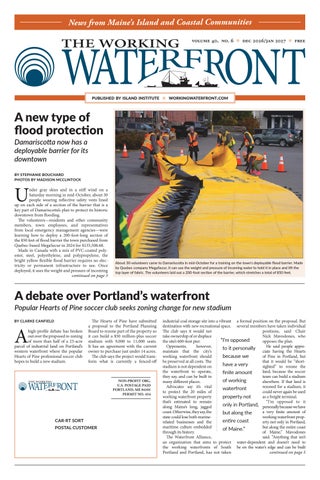
About 30 volunteers came to Damariscotta in mid-October for a training on the town’s deployable flood barrier. Made by Quebec company MegaSecur, it can use the weight and pressure of incoming water to hold it in place and lift the top layer of fabric. The volunteers laid out a 200-foot section of the barrier, which stretches a total of 850 feet.
A debate over Portland’s waterfront
Popular Hearts of Pine soccer club seeks zoning change for new stadium BY CLARKE CANFIELD
A
high-profile debate has broken out over the proposed re-zoning of more than half of a 23-acre parcel of industrial land on Portland’s western waterfront where the popular Hearts of Pine professional soccer club hopes to build a new stadium.
The Hearts of Pine have submitted a proposal to the Portland Planning Board to rezone part of the property so it can build a $50 million-plus soccer stadium with 9,000 to 11,000 seats. It has an agreement with the current owner to purchase just under 14 acres. The club says the project would transform what is currently a fenced-off
NON-PROFIT ORG. U.S. POSTAGE PAID PORTLAND, ME 04101 PERMIT NO. 454
CAR-RT SORT POSTAL CUSTOMER
industrial coal storage site into a vibrant a formal position on the proposal. But destination with new recreational space. several members have taken individual The club says it would not positions, said Chair take ownership of or displace Nick Mavodones, who “ I ’m opposed the site’s 600-foot pier. opposes the plan. Opponents, however, He said people appreto it personally maintain that the city’s ciate having the Hearts working waterfront should of Pine in Portland, but because we be preserved at all costs. The that it would be “shorthave a very stadium is not dependent on sighted” to rezone the the waterfront to operate, land, because the soccer finite amount they say, and can be built in team can build a stadium of working many different places. elsewhere. If that land is Advocates say it’s vital rezoned for a stadium, it waterfront to protect the 20 miles of could never again be used working waterfront property as a freight terminal. property not that’s estimated to remain “I’m opposed to it only in Portland, personally because we have along Maine’s long, jagged coast. Otherwise, they say, the a very finite amount of but along the state could lose both marineworking waterfront propentire coast related businesses and the erty not only in Portland, maritime culture embedded but along the entire coast of Maine.” through its history. of Maine,” Mavodones The Waterfront Alliance, said. “Anything that isn’t an organization that aims to protect water-dependent and doesn’t need to the working waterfronts of South be on the water’s edge and can be built Portland and Portland, has not taken continued on page 5
2
The Working Waterfront . december 2026/ january 2027
www.workingwaterfront.com . April 2020
13
Joseph “Jay” (seen here) and Jo Ann Townsend are the new owners of the Winter Harbor Marine Center.
The Winter Harbor Marine Center, which is the terminal for ferry service to Bar Harbor, has been sold to new owners who want to preserve public access to it. PHOTO: COURTESY DEAN TYLER PHOTOGRAPHY
PHOTO: COURTESY JOSEPH TOWNSEND
New owners keep Winter Harbor marina open Philanthropists bought the site of the Bar Harbor ferry terminal in July BY CRAIG IDLEBROOK
M
any public-access marinas and boat ramps along the Maine coast are actually on private land. This can create uncertainty among recreational boaters and marine businesses when these waterfront parcels go up for sale. Such was the case with the Winter Harbor Marina. In late 2025, townspeople learned that the marina facilities and 3.5-acre property were going on the market with a listing price of $4.95 million. The town wasn’t in a position to buy the property, and a real estate agent said that the sellers were motivated, according to town meeting minutes. The sellers, the owners of Pettegrow Properties LLC, were navigating bankruptcy after being accused of fraud in a civil lawsuit, according to a Bangor Daily News report. The marina’s boat ramp provides the only all-tide access on the Schoodic Peninsula, according to Bob DeForrest, Maine Coast Heritage Trust’s conservation project manager for eastern Hancock County. This makes it vital for the local fire department, first responders, and ferry service to Bar
Harbor, he said. No one knew what ramp for fitting purposes before pulling go so far in creating a sustainable long-term model for the marina. In it out of the water again for the winter. new owners of the marina might do. Plans are also underway to tear down a September 2025 meeting about the “There was a question if it would be a conversion to a residence and shut an old storage facility and build a new potential sale, local residents voiced down the public access or if they’d have one with the goal of having it ready in concern that it has been difficult to a use that would conflict with the ferry time for boaters in fall 2027. Townsend maintain year-round businesses at the hopes to also attract a corner store, and marina. In a July 2026 town meeting, service,” DeForrest said. Then in July 2026 Mosquito Harbor offer something of a small visitor center Winter Harbor officials indicated that Holdings LLC bought the land and in partnership with the local historical the Townsends had asked for donato helpatwith marina, request society. The Townsends alsochat havearound hired thetions buildings for $3.2 million,John according Martin, Bud Staples, and Elsie Gillespie woodstove the the annual townameeting. to real estate records. The entity was a full-time operations manager, Kerr the town said it couldn’t facilitate, according to the meeting’s minutes. created by Joseph “Jay” and Jo Ann Heidinger. Townsend is realistic about the limits Steven Pagels, whose company operTownsend for the purchase. The Townsends have said they plan to ates the local ferry service, said the of his family’s money when it comes to maintain public access and invest in Townsends’ approach is giving opti- bigger capital improvements. He cited the need for repairs to the boat launch improvements for the marina campus. mism to those who use the marina. “We’re very positive about not just and pier as examples. He is working This is not the first improvement project the Townsends have taken on in where they’re going, but I’m seeing real with the trust and others to connect Winter Harbor. The couple already has signs that they’re going there in a good with organizations that may have funding available to help with longbeen renovating a former Baptist church way,” Pagels said. With the ferry service connecting term improvements. in town to create a music center that While more work still needs to be will serve as a permanent home for the Winter Harbor to the tourism hub of Winter Harbor Music Festival. Joseph Mount Desert Island, the marina is done, DeForrest said the Townsends’ Townsend’s grandfather founded the often the first place visitors see in the purchase of the marina represents an town, said Townsend. He wants to put important step in the future of the Wawa convenience store chain. “Wawa has done incredibly well, and the community in the best light possible property, said DeForrest. “It’s a chance to go out of panic mode so that puts us in a position to be able with the marina improvements. “As long as the ferry keeps hauling or emergency mode and really take to have philanthropic pursuits,” he said. Efforts are already underway to people from Bar Harbor, we have a the time, which I think Jay has been doing, to talk to community members improve the marina facilities, Townsend captive audience,” he said. However, local stakeholders are and figure out how to do it in a viable, said. In late October, workers were scheduled to put down a new float and aware that private funding will only sustainable manner,” DeForrest said.
Levi Moulden
Support for coverage of the Future of Fishing is made possible by a grant from Gideon Asen. Bud Staples
Gerald “Punkin” Lemoine
G.F. JohnstonConsulting & Associates Civil Engineers Concept Through Construction
• • •
Regulatory permitting • • Land evaluation • Project management
Site Planning Sewer and water supply systems Pier and wharf permitting and design
12 Apple Lane, Unit #3, PO Box 197, Southwest Harbor, ME 04679 Phone 207-244-1200—
www. gfjcivilconsult.com —
www.workingwaterfront.com . december 2026/ january 2027
3
DAMARISCOTTA
continued from page 1 water to hold it in place and lift the top layer of fabric up to a height of 39 inches. “The more [water that] comes into it, the better it works, because it will become heavier and heavier,” Stéphane Turcotte from MegaSecur told the volunteers. The material can also withstand some serious punishment, he noted, including being battered by ice, tires, telephone poles, and other debris. “Anything that can be pushed by water,” he said, has been captured in the barriers, “and they remain in place.” Like many coastal communities, Damariscotta has invested in layered infrastructure to protect itself from rising sea levels and worsening storms, such as the ones that battered Maine’s coast in the winter of 2024. Across the world, municipalities, businesses, and homeowners have considered a range of solutions to these threats, from elevating roads and other infrastructure to using vegetation, shellfish reefs, and other natural techniques to blunt the effect of floods. Deployable barriers may offer a more affordable and flexible solution for communities looking to protect vulnerable areas. While sandbags have long served this role, newer designs have emerged in the last decade, ranging from walls that can temporarily be raised around structures to softer barriers that activate when filled with air or water. Damariscotta had originally planned to install a permanent floodwall, but concerns about environmental impacts, aesthetics, and an estimated cost of $1.5 to $2 million caused the town to explore deployable floodwall options, said Emerson Wesselhoff, an Island Institute Fellow working with the town who organized the flood barrier deployment training. The barrier is just one component of the town’s flood resiliency plan, and has been over a decade in planning, she said. A study the town completed in 2015 identified resiliency options for the downtown, including
sewer system upgrades and a permanent floodwall that would extend approximately 4 feet above grade along the riverside municipal parking lot. In the years since that study, the town tackled projects one by one, including making sewer and drainage upgrades. Purchasing the deployable flood barrier was the final major component of the town’s $4 million flood resiliency project, which included elevating sections of the municipal parking lot and installing a 150,000-gallon stormwater retention tank underneath it. While the town’s climate resiliency planning is ever evolving, the push now is to raise awareness and get the community involved, Wesselhoff said, which is where October’s training came in. Deploying 850 feet of heavy flood barrier can be done with a handful of public works employees, but having 20 or 30 people from the community involved would make things go more quickly, Wesselhoff said. “We want to rely on community members because they love this place and that is a huge motivator,” she said. And having community volunteers pitching in helps to free up emergency responders and public works employees who may be needed elsewhere. The town has a preliminary plan for the flood barrier that right now lives mostly in people’s heads, Wesselhoff said. Eventually, a formal plan will be written up with a deployment checklist and
A partner to New England’s farms and fisheries. We’re a bank that understands your organization’s seasonal cash flow and unique financing needs. Use code WWF to receive $100 to mission-aligned organizations when you open a new personal or business checking account.*
Stephanie Bouchard is a freelance writer and editor living on the coast of Maine. Find her at stephaniebouchard.net.
FULL INVENTORY READY FOR YOUR WATERFRONT PROJECTS! • • • • • • •
Marine grade UC4B and 2.5CCA SYP PT lumber & timbers up to 32’ ACE Roto-Mold float drums. 75+ sizes, Cap. to 4,631 lbs. Heavy duty HDG and SS pier and float hardware/fasteners WearDeck composite decking Fendering, pilings, pile caps, ladders and custom accessories Welded marine aluminum gangways to 80’ Float construction, DIY plans and kits
Delivery or Pick Up Available!
JOIN US!
Visit www.waldenmutual.com to learn more. *Choose an incentive (up to $100 in value) when you open a new Spend Local or Spend Local Business account and fund it with a minimum of $100 within 30 days of opening. Incentive will be delivered within 60 days of account opening and funding. This may be reported on IRS Form 1099INT or 1099-MISC; consult your tax advisor. © 2026 WALDEN MUTUAL BANK. MEMBER FDIC.
guidelines for communicating to volunteers. Marks will be painted on the pavement to indicate where the barrier needs to go. The flood barrier is stored in sections kept in four large crates. Each section of the barrier is connected by heavy-duty Velcro. The full barrier of 850 feet will extend from the bridge on Main Street, around the corner at 49 Main St. into the parking lot, stretch along the parking lot’s riverfront, and end on the hill at Water Street. It took less than two hours to deploy one section, learn how to make corners, and repack it during October’s deployment training. Wesselhoff estimates that with 20 to 30 trained volunteers, the entire barrier could be set up in three to four hours. The next training is planned for April 2027 and will once again include a trainer from MegaSecur. The hope is to do a full barrier deployment at that training, said Wesselhoff. The cost of that training and the one in October is being covered by a $10,000 community climate planning grant from Island Institute, which publishes The Working Waterfront. Once those professional trainings are complete, regular trainings will be handled by locals.
(207) 772-3796
www.customfloat.com
The Working Waterfront is growing its digital presence. You can now regularly find our stories and images on Instagram. That’s on top of our long-running website, e-weekly newsletter, and Facebook page.
FOLLOW US! @theworkingwaterfront
4
The Working Waterfront . december 2026/ january 2027
Data centers a growing concern More coastal Maine towns are trying to restrict them BY CRAIG IDLEBROOK
O
n town council meeting agendas and local ballot questions throughout coastal Maine, data centers have become a hot-button issue. In the past year, many Mainers have packed town meetings and joined local rallies to voice opposition to these IT infrastructure facilities. And local officials have spent significant resources determining how to regulate them. Voters in at least eight Maine towns—including four along the coast: Eliot, North Berwick, Wells, and Wiscasset—approved new restrictions on data center development during the midterm election on Nov. 3, according to reporting by The Maine Monitor and Bangor Daily News. And in the year leading up to the election, about a dozen more local governments in communities along or near the coast enacted new moratoriums or restrictions on them, according to published reports. While data center development did not rank in the top five nationally among voter concerns in surveys leading up to election, opposition to them comes into sharp focus when voters are asked whether they would want one in their own backyards. According to a September UMass Lowell poll of 650 likely Maine voters, 76% said they would oppose a data center being built in their communities. In some cases, community members aren’t even waiting for a proposal to emerge before voicing their opposition. That’s partly because they fear local officials may already be discussing such projects in secret, said Sarah Woodbury, legislative director for Maine Conservation Voters, an environmental policy advocacy group. For example, the Wiscasset Newspaper obtained an August 2025 nondisclosure agreement between the town manager and a possible data center developer about a potential project at the former Maine Yankee nuclear plant. “It should be a transparent process so that community members are not blindsided,” Woodbury said. Local officials have said they are hitting pause on new data center development to buy time to update their regulations before developers with deep pockets approach them. Bucksport adopted a 6-month moratorium on data centers on Oct. 7. During a recorded meeting, Bucksport Councilor Paul Rabs said he favored the pause because there was an inherent mismatch in financial resources between data center developers and local town governments. He said a company that might be considering locating a data center in the town likely has a budget measured in the billions
Marine officials report unexploded ordnance off Portland On Nov. 9, the Maine Lobstermen’s Association passed on information about old explosives found in the waters off Southern Maine: “We were recently notified of a new discovery of unexploded ordnance by Maine [Department of Marine Resource’s] Maine Coastal Mapping Initiative. Its location is approximately 8 miles or so offshore from Portland, Maine, in position: 43-3703.180N / 070-04-22.800W. NOAA is aware and will be working to get it charted. “Mariners are advised to exercise extreme caution when transiting the vicinity and to refrain from anchoring, bottom trawling, ground fishing, or otherwise disturbing the seabed within the area.”
Without more regulatory clarity at the state level, of dollars; Bucksport’s budget for this fiscal year was developers and communities are left to figure out $12.25 million. “If they decide that Bucksport looks pretty darn how to proceed with data center proposals under good to them, they are going to come after us like rules that weren’t designed for this relatively new a runaway gorilla,” Rabs said. “We’re going to need type of infrastructure. That even includes the prospect of offshore data center some pretty significant lawyer representation when development. In February 2026, Massachusetts develthat gorilla breaks loose, if it breaks loose.” Local officials opposed to the suggested morato- oper DeepGreen Western Passage SPV LLC approached riums have argued that they could scare away proj- local officials in Eastport and sought a permit with the ects bringing needed development. They also say that Federal Energy Regulatory Commission (FERC) for a those opposed to data centers often take a one-size- plan to create an underwater data center as large as 51 fits all approach. That was Councilor Ed Rankin Jr.’s megawatts in the Western Passage of Passamaquoddy Bay. The developer later reduced the size of the concern at the Bucksport meeting. “I don’t like the blanket of throwing it right across proposed project to no more than 15 megawatts. The commission has not yet provided a final ruling the board,” said Rankin. “They need to be separated on the application, but the plan is being opposed from small to large.” by the town of Eastport, Washington These debates have also played out at County commissioners, and members the state level, where Gov. Janet Mills in of the Passamaquoddy Tribe. In August, late April vetoed a bill that would have “ We’re going Eastport enacted a six-month pause on put an 18-month moratorium on new to need data center development after public data center development for projects outcry. In September, the town then requiring at least 20 megawatts of power. some pretty enacted a permanent ban on data center The bill would have been the nation’s significant development in areas covered by the first statewide moratorium on data moratorium. It is unclear whether the centers signed into law, according to data lawyer town has the power to halt the undercompiled by the National Conference of State Legislatures. representation water project fully. DeepGreen developer Louis Wolfson The governor said she supported a when that had hoped his proposed project, which moratorium but vetoed the legislawould generate its own power and tion because she had wanted legislagorilla breaks be located offshore, would not have tors to carve out an exception for a loose, if it invoked such opposition. He also wished $550 million data center project that he had held public meetings early on in she said had local support in Jay in breaks loose.” the process, despite the project being in Franklin County. The developers the preliminary planning stages. pulled out of the project in June, but “We didn’t hold public meetings early on because now appear to be trying to restart it, according to we had nothing built to show and we are still vetting the Bangor Daily News. A few days after the veto, Mills signed an executive hardware data,” Wolfson said via email. “In hindorder that created the Maine Data Center Advisory sight, because the term ‘data center’ carries so much Council. The council was formed “to provide stra- baggage today, explaining earlier that a preliminary tegic input, facilitate coordinated state planning, and permit [with FERC] is strictly paper research would evaluate policy tools” to help the state regulate large- have cleared up a lot of confusion.” However, even preliminary plans can drain town scale data center projects. In October, the council released a working draft resources. Eastport residents brought forward two report suggesting regulatory changes for future data new ordinances for the town to consider because of center development, including requiring developers the DeepGreen proposal. One ultimately became the to pay for needed electrical grid updates for their enacted moratorium, while the other was rejected projects and use renewable energy for projects over because of legal concerns. That process takes time 50 megawatts in size. They also recommended the and money, said City Manager Brian Schuth “I spent about a quarter of our legal budget having state provide stronger regulation on water consumpthe text of the ordinances reviewed,” Schuth said. “I tion and emissions for data centers. The council’s final report is due on the governor’s was concerned that there might be issues with them, desk by Jan. 29, 2027. A spokesperson for the council but I felt I couldn’t make that point without having had a lawyer make it for me.” did not make members available for comment.
Divers find wreck of WWII-era ship torpedoed by German sub Volunteers made a historic discovery in July off the coast of Mount Desert Island: a sunken Canadian merchant ship that was torpedoed by a German U-boat during World War II. According to the Bangor Daily News, the U-boat had just dropped off two Nazi spies near Hancock when it attacked the SS Cornwallis. A group of divers had spent seven years searching for the vessel, which sank roughly 82 years ago, the BDN reported. Forty-three crewmembers, most of them Canadian, died in the attack.
Like our stories, columns, and photos? Check us out and “like” The Working Waterfront on Instagram and Facebook!
www.workingwaterfront.com . december 2026/ january 2027
5
PORTLAND
the stadium, an indoor soccer facility for youth and adults, recreational trails, and open green space. In decades past, the site operated as upland or somewhere else shouldn’t Merrill’s Marine Terminal and was a take away working waterfront land.” Hearts of Pine founder Gabe busy place exporting and importing Hoffman-Johnson said the club looked large volumes of hardwood pulp, rolls at multiple sites for a new stadium, of newsprint, scrap metal, coal, and including the former Sable Oaks golf other products. But with those markets largely course in South Portland, a farm in Westbrook, the Maine Mall parking gone and the infrastructure aging, lots, and a decommissioned oil tank the upland portion of Cassidy Point — the portion the soccer club wants farm in South Portland. The team wants to be in an urban — is no longer economically viable, setting, Hoffman-Johnson said, and said David Glendon, chairman of Cassidy Point was the only place on Sprague Operating Resources. Sprague the Portland peninsula with space for a announced in September that it had stadium, with parking and transit options agreed to sell the remaining nine or nearby, and that was for sale or lease. The so acres, including the pier and wareclub aims to begin construction in 2027 house facilities, to McAllister Towing and Transportation Co., the parent and open a new stadium in early 2029. The club, he said, isn’t trying to of Portland Towing tugboat and ship supplant working waterfront property, docking company. “Unfortunately, the Merrill’s terminal but rather improve the upland portion was built to serve a market that no of the site. “We’re here to contribute to Portland longer exists, and alternative industrial and Maine and we want to continue to uses are not viable at the site,” Glendon engage in conversations around what wrote in a public comment to the we can contribute to that end,” he said. Planning Board. Before its first workshop on the “It doesn’t need to be mutually exclusive. We certainly have a deep respect proposal in September, the Planning for the working waterfront—past, Board received dozens of written comments from people on both sides present, and future.” Since beginning play in the USL of the issue. A number of marine-related orgaLeague One professional soccer league two years ago, the Hearts of Pine nizations and business, including have sold out every home match at the Maine Port Authority, Maine Fitzpatrick Stadium, which can seat Lobstermen’s Association, and Portland about 6,000. The stadium would be used Pilots, oppose the plan. A former city by both the men’s team and the club’s planner, two former Planning Board chairs, and a former city professional women’s team, waterfront coordinator the Wildness, which begins have also gone on record play next year. The club says in opposition. The club announced in the project Bill Needelman, who August that it had agreed to purchase part of the would transform was the city’s waterfront coordinator from 23-acre site at Cassidy what is currently 2014 until 2025, said the Point, on the western end Portland waterfront is of Commercial Street near a fenced-off an economic engine for the Veterans Memorial Maine, and that Cassidy Bridge. That stretch of industrial coal Point should remain waterfront is primarily storage site zoned for industrial use. industrial, located up the “I express this opposiFore River and west of the into a vibrant tion in the full knowledge Casco Bay Bridge. destination with of the popularity of the Owned by Sprague applicants and goodwill Operating Resources new recreational that the Hearts of Pine LLC of Portsmouth, have generated in the New Hampshire, the site space. community,” Needelman includes a marine terminal wrote. “We all love the and industrial warehouse, Hearts. However, the port is the true storage, and a large open-air coal pile. A recently passed city ordinance requires heart of the city.” But supporters said a new stadium Sprague to permanently cover the coal pile by Jan. 1, 2027, and to remove it and recreation area can serve as an economic engine of its own while by 2030. To build a stadium, the soccer team creating new opportunities for needs the parcel to be rezoned from the community events and revitalizing a Waterfront Port Development Zone to waterfront property. Portland resident and former the B-5 Urban Commercial Zone, while also adding “stadium” as a permitted Planning Board member Sean Dundon use in the B-5. The team plans to build wrote that allowing the stadium would continued from page 1
These renderings shows the stadium that the Hearts of Pine soccer club hopes to build on Cassidy Point in Portland. The project would require a controversial rezoning of the property, which opponents argue should remain fully available for marine uses. IMAGE: COURTESY SMRT ARCHITECTS & ENGINEERS
phase out an obsolete industrial use, while maximizing public access and benefiting area businesses. The plan, he said, is compatible with Portland’s ReCode initiative, a comprehensive rewrite of the city’s land use code and zoning map that was approved by the City Council two years ago. The stadium proposal is about co-existence, not displacement, Dundon wrote. “Rezoning for a stadium allows developers to preserve critical industrial nodes—such as a 600-foot deep-water pier—while transforming the surrounding surface footprint into a public gathering space,” he wrote. “This achieves ReCode’s balance of economic modernization without entirely erasing Portland’s industrial capabilities.” The new proposal isn’t the first time that waterfront development has spurred pushback. Condominium construction on Chandler’s Wharf in 1985 alarmed residents who feared fishing and marine infrastructure would be pushed out by condos and offices, sparking a 1987
referendum that brought strict waterfront zoning. In 2019, a local developer withdrew plans to build a 93-room hotel on a wharf in the central waterfront zone following opposition from fishermen and the community at large. Even the landmark Becky’s Diner on Commercial Street faced some pushback when it requested a zoning variance in 1990 to be able to open. At the time, the city’s waterfront zoning prohibited non-marine commercial businesses in that location. In the end, owner Becky Rand was granted a variance after successfully arguing that she would cater primarily to fishermen, as well as prepare bulk food dishes such as lasagna and macaroni and cheese to take on fishing trips. The process for the Hearts of Pine’s stadium proposal will play out in the months ahead with workshops and meetings before the Planning Board makes a recommendation to the City Council. If councilors approve a zoning change, then the project would go back to the Planning Board for a separate review.
National Bank
D R EAM FIRST
A Division of The First Bancorp • 800.564.3195 • TheFirst.com Member FDIC • Equal Housing Lender
6
The Working Waterfront . december 2026/ january 2027
from the helm
The immeasurable gifts of community A unique understanding of the gifts we give and receive BY KIM HAMILTON
EARLY IN MY CAREER, I trained as a cultural anthropologist, wanting to understand the norms, values, and behaviors that shape us across time and geography. For a variety of reasons, I chose a different path, pursuing foreign policy, global philanthropy, and now, community development here on the coast of Maine. My curiosity and appreciation for anthropology, however, has remained. It offers tools and frameworks to help understand how we engage and adapt in a changing world. The fundamental work by the late French anthropologist Marcel Mauss is a great example. I return frequently to his essay entitled “The Gift.” At the risk of diluting his intellectual contributions, here’s the gist: for Mauss, not only are gifts given, but they must also be received and reciprocated, creating a cycle that strengthens social bonds. What I especially love about his theory is that gifts are not just objects. They are inextricably linked to the spirit of the giver, and they carry meaning that continues over time. It’s beautiful. It’s powerful. It goes to the heart of trust-building.
At Island Institute, we consider whether on boats, wharves, in town the invitation to partner closely with halls, or in small businesses all along communities a unique gift, expressed the coast. We’d talk about intangible in so many subtle and extraordinary gifts like precious time and steadfast patience, knowing of ways. Given the opporthe demands that small tunity, I’d have loved to communities and the talk with Mauss about … a true picture people who live in them the social bonds that are of community shoulder every day. forged through the gift At Island Institute, we of these partnerships development receive these gifts with along the coast. must consider tremendous humility and I’d tell him about enduring appreciation. the incredible generthe two-way These gifts draw us closer osity we’ve experienced and wrap us in the mantle island after island, trade in time, of kindness and courage peninsula by peninsula. resources, and that animates the spirit I imagine that we would of Maine’s islands and talk about the passion knowledge coastal communities. for place that commuthat builds the In turn, we reciprocate. nity leaders share with Our values of authentic us, about the offer of most important collaboration, resourcea night’s stay and a fulness, and clarity of warm dinner when currency: trust. purpose infuse our contristormy weather cancels butions and underpin our ferry service, about lively community potlucks, coffee and own belief that together we thrive. I don’t want to diminish the critiques donuts, and the intimacy of a kitchen table. I would mention community of Mauss, and I’m quite sure I’m taking celebrations and memorials, the words liberties with his work. Yet, his theory of kindness and encouragement, and of the circular nature of giving aptly the many offers to learn from those describes the fundamentals of commuwho know our shores and waters best, nity development that we see every day.
As the year draws to a close, and we begin to tally our impact over the year, we need to tread cautiously when abstracting the complexity of our community partnerships into data points and pie charts. While these measures matter, a true picture of community development must consider the two-way trade in time, resources, and knowledge that builds the most important currency: trust. To that end, we close this year with enormous gratitude for the communities and people we work with every day. We are honored to share in the experience of giving and receiving the immeasurable gifts of working in and living on the extraordinary coast of Maine.
Kim Hamilton is president of Island Institute, publisher of The Working Waterfront. She may be contacted at khamilton@islandinstitute.org.
sweetest in the gale
Meet the neighbors
The folks we’ve gotten to know over a year in our first home BY CHARLES EICHACKER
IT’S BEEN a year since my wife and I bought our first home, just outside Rockland, and I’m still figuring out the neighborhood. The folks next-door have all been friendly. To our north is the semiretired couple active in the local Rotary Club. After a bedframe we’d ordered was mistakenly delivered to them in a rainstorm, they stowed it in their garage until we could pick it up. The guy has offered to take me trout fishing and encouraged us to pick fruit from their pear trees. On the other side is a renter who grew up in the area and works in landscaping. He moved in this summer and soon came over to introduce himself. He complimented our place. He regularly waves. Beyond those folks, I’m less sure where we stand. Our road is a state highway that can get busy, so the passing drivers sometimes feel like neighbors— neighbors who mostly mean well but occasionally throw energy drinks and old vape pens on our lawn.
Across the road is a younger couple we’ve not met yet. They don’t usually look our way, or wave, when they take their two small dogs out. With some online sleuthing, I’ve learned that they bought their place a few years ago. With some real-world sleuthing—peering out the front window with binoculars—I’ve noticed them spraying Roundup along their driveway. Do they know the health risks of this herbicide? Can’t they just pull out their weeds by hand? Our drinking water comes from a nearby well. We also have a small dog; he eats anything. I’d like to bring this up with them, but am not sure how. Lastly, our lot backs up to 133 acres of scrubby, overgrown land that eventually turns into a marsh. In the original property listing, the sellers had claimed this neighboring land was part of a conservation area, an exaggeration we confirmed was not the case before the closing. Still, as we got settled in, we quickly came to prize this mysterious wilderness. It was hard to imagine it getting developed, not least because it intersects with a low-lying flood zone.
Then, sitting outside one afternoon late in the summer, I heard two men conversing, seemingly nearby in the woods. Huh, I thought. Noise must travel from that subdivision beyond the marsh. Or maybe some hunters were out there, making plans for deer season. I considered buying a drone, to get a better view of what those woods concealed. Then, driving home one day, I noticed that workers had set up a few doors down from us, where that undeveloped parcel comes up to the road. The crew had brought some heavy machinery and was clearing a path back into the brush. A week later, under the cover of dusk, I walked down a new gravel driveway until I reached a clearing right behind our property. Looking up towards our house, I couldn’t make it out through the trees that remained standing. A few days after that, some no-trespassing signs were posted. I reached out to Maine DOT, which manages our road, and a friendly transportation official informed me the property owner, apparently a military veteran and a decent-seeming guy, was
passing some land on to his kids for them to build homes on. He thanked me for calling, noting the owner had gotten a permit for the work. Phew. Not a data center. I soon went over to chat with our closest neighbor, the retired guy active in the local Rotary. He confirmed the part about the new home lots. “And that’s OK,” he said, adding that he’d even asked the owner if he could buy some of that land for his own grown kid to live on. We moved on to other subjects. Fall was settling in. He was almost done fishing for the year. He reminded me to pick some pears before they all turned.
Charles Eichacker is the editor of The Working Waterfront and Island Journal. He may be contacted at ceichacker@islandinstitute.org.
www.workingwaterfront.com . december 2026/ january 2027
7
FEMALE FRIENDSHIP— The Camden-born photographer Theresa Babb (1868-1948) helped capture this photo of a picnic on Sherman’s Point in 1900. Babb made a series of similar images of women enjoying the Maine countryside of that era. It’s not clear what beverage they’re all tossing back here. Any guesses? If you can share any memories, contact Editor Charles Eichacker at ceichacker@islandinstitute.org. PHOTO: COURTESY CAMDEN PUBLIC LIBRARY / THE PUBLIC DOMAIN REVIEW
the public’s policy
Federal cuts threaten Maine science assets A new paper documents how these cuts are adding up BY NICK BATTISTA
IN THE FACE of shifting federal policy priorities and funding, Maine is finding that federal agencies have become less reliable partners in the effort to track the effects of climate change on the state. These shifts impact our state in multiple ways, with the disruption of funding for grants, research, and related programs often the most obvious example. That’s the takeaway from a revealing new white paper titled “Maine Climate Science Assets at Risk,” co-authored by Nicole Spaulding and Ivan Fernandez, both of the University of Maine, and Island Institute’s Senior Ocean Scientist Susie Arnold. Here are three other impacts that the authors document: The first is “administrative realignment and expertise attrition,” or the shift of an agency’s mission away from climate priorities. This includes reducing research stations, regional offices, and modeling hubs, as well as weakening scientific advisory boards and politicizing staff scientists. As this disruption prompts scientists to leave federal service or not enter it in the first place, fewer scientists remain in the agencies to partner with. For
Island Institute Board of Trustees
states, that means a loss of institutional knowledge, a decrease in expert support, and weaker technical capacity. The second impact is “archival transition,” which means that federal data sources and archives become less stable. Longterm datasets that are critical to understanding change over time may be disrupted. It is hard to go back and fix these holes after they emerge, diminishing the future value of the dataset. Existing data may be broken up or made harder to find, index, or access. It may be re-indexed in response to linguistic shifts, sometimes making it impossible to locate. The cumulative result is that states are left with more limited data and weaker evidence to rely on for decision-making. The third impact is “cooperation and international isolation”: As the U.S. withdraws from major climate science frameworks, international monitoring efforts weaken, as do the ties U.S. scientists need to navigate the peer review process. Additionally, expectations of open access are rolled back and more research moves behind paywalls, depriving states of access to shared global science and consensus baselines. With these impacts in mind, the big question is: if we are concerned that federal agencies are becoming
Doug Henderson, Chair John Conley, Vice-Chair Michael Boyd, Clerk Shey Conover, Chair of Programs Committee Bryan Lewis, Secretary, Chair of Philanthropy and Communications Committee Michael Sant, Chair of Governance Committee Katherine Vogt, Treasurer, Chair of Finance Committee Robert Baines Des Fitzgerald Christie Hallowell Kristin Howard Pat Keliher Mark Rodrigues Nadia Rosenthal Michael Steinharter Carol White John Bird (honorary) Tom Glenn (honorary) Joe Higdon (honorary) Emily Lane (honorary) Bobbie Sweet (honorary) Kimberly A. Hamilton, PhD (ex officio)
less reliable partners in achieving our climate goals, what can we do about it? The number of assets, their national scope, and the costs of establishing a new monitoring program—think setting up a satellite network—mean that Maine won’t be able to address shifts or gaps across all of these assets. Still, the state has opportunities to make meaningful investments. The Maine Mesonet weather monitoring system is one example, deploying a network of 26 stations to fill gaps in missing or deprioritized federal crop management data. Data processing is conducted in partnership with a university in New York that does similar work, and the data is shared directly via the Maine Climate Office website. Public-private partnerships, such as the one supporting the American Lobster Settlement Index, are another example of how industry, researchers, and the state support the collection of baseline population data that informs our collective understanding of the fishery’s health. The new white paper outlines a pathway for Maine to pursue strategic climate autonomy, in which the state builds institutional stability and empirical autonomy, achieves archival independence and information resilience,
THE WORKING WATERFRONT
Published by Island Institute, a non-profit organization that boldly navigates climate and economic change with island and coastal communities to expand opportunities and deliver solutions. All members of Island Institute and residents of Maine island communities receive monthly mail delivery of The Working Waterfront. For home delivery: Join Island Institute by calling our office at (207) 594-9209 E-mail us: membership@islandinstitute.org • Visit us online: giving.islandinstitute.org
and maintains appropriate diagnostic oversight while smartly leveraging resources. The paper’s concluding comment sums up the opportunity well: “The mapping of over 150 federally dependent assets within a single state’s climate framework demonstrates that this passive reliance has transformed into a critical strategic vulnerability. When federal priorities shift or central networks are de-prioritized, the operational consequences cascade down through every state, municipality, and resource manager in the nation.” Maine can identify the science assets most central to implementing the Maine Won’t Wait climate action plan and take steps to close the most critical gaps. The state can shift away from passive reliance to strategic actions that build our autonomy. Nick Battista is chief policy and external affairs officer for Island Institute, publisher of The Working Waterfront. He may be contacted at nbattista@islandinstitute.org.
EDITOR: Charles Eichacker
ceichacker@islandinstitute.org
Our advertisers reach 35,000+ readers who care about the coast of Maine. Free distribution from Kittery to Lubec and mailed directly to islanders and members of Island Institute, and distributed monthly to Portland Press Herald and Bangor Daily News subscribers.
To Advertise Contact: 386 Main Street / P.O. Box 648 • Rockland, ME 04841 The Working Waterfront is printed on recycled paper by Maine Trust for Local News. Customer Service: (207) 594-9209
Charles Eichacker ceichacker@islandinstitute.org (207) 535-9305
www.WorkingWaterfront.com
8
The Working Waterfront . december 2026/ january 2027
LETTER TO THE EDITOR Giving back on Vinalhaven I have some mixed feelings about Banner Moffat’s recent essay in the October-November issue, a pitch to seasonal residents of Vinalhaven to volunteer for efforts that help sustain the island community. My spouse and I agree it is important to give back to our community. Although our own time on Vinalhaven did not begin until we were adults and able to purchase property here, like Mr. Moffat we have spent many years since enjoying our island home. Getting to spend summers here started for me when our children were young and I had a school-year job. Ten months of the year I was “crazy busy.” Being on Vinalhaven was salve for the worn-out soul. Many of the friends I made during those years were also parents on break from a school job. Many who came then, in the 1980s, are now retired and no longer think of Vinalhaven primarily for family time, escape, or respite. Instead, we see a multi-faceted community that can always use help and to which we can more actively contribute. But I also am aware how that exhausting and demanding phase of life continues to exist; many of our adult children are now in it, balancing demanding jobs with raising children and caring for elders. Mr. Moffat makes a sweeping
statement when he writes about “summer people” who “come and go with a smile on their face and a serene indifference to the complex community they are enjoying.” Seeing people on vacation shouldn’t mean they all think of Vinalhaven as “a resort.” Maybe it’s more of a reset. I appreciate Mr. Moffat challenging folks to volunteer and get involved helping Vinalhaven. I agree: Help if you can, and maybe most importantly, be ready to help. Keep it a goal for when you can. Tina Cohen Vinalhaven
The Working Waterfront accepts letters to the editor of 250 words. Send them to Editor Charlie Eichacker at ceichacker@islandinstitute.org. Longer opinion pieces should be approved by the editor before being sent.
Insurance for your home and your business. Ask Allen. We’re here to help!
(207) 236-4311 | AllenIF.com
Navy to dredge Kennebec River The U.S. Navy has renewed its authorization for conducting maintenance dredging of the shoaled portions of the Kennebec River Federal Navigation Project between Phippsburg and Bath. Dredging operations are scheduled to begin Dec. 1and continue through Feb. 8, 2027. Operations will occur 24 hours a day, seven days per week. The Navy plans to dredge approximately 60,500 cubic yards of clean sand from shoaled areas at Doubling Point, Popham Beach, and Bath Reach and place it at a previously used area north of Bluff Head (in about 95,100 feet of water) and at a 500-yard diameter placement area located 0.4 nautical miles south of Jackknife Ledge (in about 4,050 feet of water), respectively. Approximately 35,500 cubic yards will be removed from the Doubling Point area, approximately 10,000 from the Popham Beach area mouth, and approximately 15,000 from the Bath Reach area. Historically, dredging occurs in two to three hour periods separated by an hourlong transit to and from the disposal site. Fisherman are advised to relocate gear to minimize interactions. The haul route from the Popham Beach location to Jackknife Ledge will be the same route as previously used.
www.workingwaterfront.com . december 2026/ january 2027
9
A shortage of young striped bass Maine anglers fear for their sport’s future BY DELGER ERDENESANAA, THE MAINE MONITOR
F
rom May to October each year, hundreds of thousands of anglers fan out across the Maine coast, casting their lines from beaches, piers, and boats. Most are fishing for Atlantic striped bass, affectionately called “stripers,” which make up the largest recreational saltwater fishery in the state. For now, the fishing is good, with plenty of big stripers around to catch (and mostly, release). But a current of anxiety runs underneath the sport and the industry. Captain Marco Lamothe, who runs Keeper Charters out of Saco, went on more than 100 fishing trips this year and caught plenty of larger, older striped bass, which can live to 30 years or more. But he worries about the fishery’s future because he’s not seeing as many smaller, younger fish. Of the hundreds of striped bass he caught this year, only one measured less than 28 inches. “The tourists were abundant, and the fish were cooperative, and we had a lot of really successful fishing trips,” Lamothe said. But, he added, “We’re just not seeing any small- to medium-sized fish. So it’s concerning.” Zachary Whitener, a senior research associate at the Gulf of Maine Research Institute and a former charter boat captain himself, put it more strongly. “It’s terrifying,” he said. “Once those big fish are gone, there’s nobody to refill the population.” The factors behind this decline are complex, Whitener said. But one major factor is rainfall in the Chesapeake Bay watershed. Some striped bass spawn in the Kennebec River watershed here in Maine, but most stripers are born in the Chesapeake and migrate up and down the East Coast each year. Striped bass need plenty of rain and freshwater to reproduce. As the climate is changing, so are rainfall patterns. And the Chesapeake has seen plenty of drought in recent years. Scientists in Maryland and Virginia conduct surveys each spring for juvenile striped bass in the rivers that feed into Chesapeake Bay, to see how many young fish are born and then survive the earliest stages of life, in a process they call recruitment. For nearly a decade, there haven’t been very many young stripers. The latest survey from the Maryland Department of Natural Resources, released on Oct. 19, shows that striped bass recruitment was low for the eighth year in a row. Results from the Virginia Institute of Marine Science survey were better, showing average recruitment in the southern half of the bay this year. The scientists noted in their report, however, that “low recruitment in recent years remains a major concern.” These surveys are important pieces of an ongoing stock assessment coordinated by the fishery’s regulatory body, the Atlantic States Marine Fisheries Commission. ‘Keeping fish is not helping anything’ State and federal officials estimate that anglers made nearly 1.8 million saltwater recreational fishing trips in Maine last year, catching more than 800,000 striped bass. They kept about 61,000 of those fish, or roughly 7 percent, releasing the rest.
A school of striped bass in Saco Bay on Aug. 9, 2026. PHOTO: COURTESY BOB WIEGERS/THE MAINE MONITOR
A bustling industry has grown around the sport, from guided fishing trips on charter boats to the tackle shops and bait dealers that supply anglers. Maine does not have a commercial striped bass fishery, though some other states do. The recreational fisheries are much larger. Recreational fishing accounts for approximately 82 percent of the striped bass caught and killed each year, according to the Atlantic States Marine Fisheries Commission. This includes the 9 percent of fish that scientists estimate die from stress after being caught and released. Mainers who make their living from striped bass are closely watching the stock assessment and regulatory process, waiting to see what happens next. George Norris, owner of The Tackle Shop in Falmouth, said his shop had plenty of foot traffic this summer, especially with people’s excitement over catching big fish. But he’s deeply concerned about the near future. Although Norris believes environmental factors are harming the species more than overfishing, and though more rules might hurt business in the short term, he still wants regulators to take stronger action to protect the existing spawning population. “They’re finding great information, but they’re not doing anything with that information,” he said. Back in 2019, the commission declared striped bass to be overfished and set a deadline of 2029 for rebuilding the population. The last stock assessment, released in 2024, found that, while people are no longer actively overfishing striped bass, the population remains low overall.
Regulators have tried out different catch limits over the years. The current rules limit recreational fishermen to keeping one striped bass per day and only if the fish is 28 to 31 inches long. The size restriction is specifically meant to protect fish born in 2015, a strong year, allowing them to stay in the population and reproduce. Norris advocated for a temporary moratorium on anglers keeping any fish at all and seeing if that helps. “Keeping fish is not helping anything,” he said. “We’re just taking breeding fish out of the population.” The commission is feeling the pressure to further restrict the fishery, said Bob Humphrey, a wildlife biologist and fishing guide who is one of two Mainers on the commission’s striped bass advisory panel. He said the commission’s goal is “to make sure that everybody can harvest as much as they possibly can without harming the population.” Maine gets the short end of the stick, Humphrey added. Being at the end of the striped bass migration route means Maine’s fishing season is shorter, and many fish have already been picked off by fishermen in other states first. Maine also doesn’t have much in the way of other recreational saltwater fisheries, raising the stakes of regulation. “We don’t have any other option,” Humphrey said. If striped bass are taken away, “there’s not really much else here.” ‘Not the same planet’ Carrie Kennedy, acting associate director of the Maryland Department of Natural Resources’ fishing continued on page 19
G ener al & Marine C ontr aCtor D reDGinG & D oCks 67 Front s treet, roCklanD, Maine 04841 www. proCkMarineCoMpany. CoM tel: (207) 594-9565
10
The Working Waterfront . december 2026/ january 2027
Baby lobster decline foreshadows Midcoast population loss, study shows This piece originally ran in UMaine News. A STEEP drop in baby lobsters provided an early warning of the sharp decline in adult lobsters along the Midcoast, a new University of Maine study shows. Researchers found that an 80% decline in baby lobster sampled from 2010 to 2022 was followed by a 70% decline in young lobsters since 2015 and a 50% decline in adults large enough for lobstermen to catch. The findings trace the losses through successive life stages, showing how fewer baby lobsters preceded fewer adults available to the fishery. The Midcoast, defined as ranging from Brunswick to the Schoodic Peninsula, is where researchers recorded the steepest declines in the Gulf of Maine. Those losses followed a period of growth, when the number of lobsters sampled doubled from the 2000s to the 2010s. The Gulf of Maine’s overall lobster population has declined since the mid2010s, with implications for a fishery that generated more than $461 million in Maine landings in 2025. UMaine researchers worked with the Maine Department of Marine Resources to analyze state surveys that used scuba divers, traps, and trawls to sample lobsters at different life stages and depths. Their findings were published in the journal Marine Ecology Progress Series. Comparing those surveys revealed the pattern of declining numbers from baby to young lobsters to adults. The study classified young lobsters as those with shell lengths of 45 to 83 millimeters.
“Central Maine showed the clearest links among baby, adolescent, and adult lobsters across surveys driven by the boom and then decline in lobster abundance in the region tied to warmer water temperatures,” said lead researcher Robert Jarrett II, a recent Ph.D. graduate who began the study during his time at UMaine. “Faster growth there also creates a more consistent signal than in eastern Maine, where slower, variable growth likely makes the signal harder to detect.” Downeast experienced a similar decline in the number of baby lobsters sampled since 2010, but a smaller decline among adults. Trends among adolescents varied by survey. Researchers said fewer sampling efforts in Downeast could help explain the differences between the two regions. Warming waters also have made deeper habitats more suitable for lobsters in Midcoast and Downeast. That shift can complicate efforts to track population changes because surveys cover limited areas and habitats, according to researchers. Previous research found that lobster population density declined as lobsters became more dispersed and changed the habitats they occupied. “Maine DMR is invested in a comprehensive, coastwide lobster monitoring approach and leads multiple surveys to study lobsters across their full life cycle,” said study co-author Kathleen Reardon, senior lobster fishery scientist with the department. “Collaborations with the fishing industry make these surveys possible, and collaborations with UMaine researchers supplement the findings of the stock assessment analyses and aid us in synthesizing
These lobsters were caught last June by fishermen working out of Spruce Head. PHOTO: MADISON MCCLINTOCK
these large datasets into tangible insights about the future of the Gulf of Maine lobster resource.” In Southern Maine, meanwhile, the number of lobsters sampled across all life stages has remained relatively stable since 2010, according to the study. Unlike in the other regions, cold water doesn’t circulate from the depths to the surface in Southern Maine. As a result, deeper waters remain too cold for lobsters even as water temperatures rise, and the territory in which they can reside remains unchanged. The study affirms that baby lobsters serve as an indicator for the fishery, as their decline preceded decreases in adolescent lobster populations in the Midcoast and Downeast. It follows
another recent study that examined a preferred food source for baby lobster amid declines in young lobster survival and the availability of that food source. Researchers also said differences in survey methodology, coupled with lobster behavior and habitat preferences, can influence the results and hamper scientists’ efforts to track and interpret population changes. “American lobster may be one of the most data-rich fisheries in the world. However, even with the abundant data, we are continuing to expand sampling efforts to effectively support our sustainable fishery and understand how it will be impacted by future environmental changes,” said Jarrett.
Maine lobstermen welcome new federal right whale findings MAINE LOBSTERMEN welcomed the news that federal regulators have preliminarily updated their estimates of North Atlantic right whale deaths and injuries from fixed gear fisheries and found them to be lower than they were four years ago. Based on those findings, regulators could decide to loosen long-anticipated new lobster fishing rules aimed at preventing deadly entanglements with endangered whales, but which fishermen have argued would be too restrictive and hobble the industry. Those rules were already delayed by Congress until 2028 and could have faced additional delays under a new bill passed by the House of Representatives earlier this year. NOAA Fisheries announced it new initial findings on Nov. 5. The agency listed several updates that have contributed to its position, including: • A new scientific method for apportioning whale entanglements by country based on the latest gear identification data indicates the U.S. proportion is around 25%, less than
previously estimated. These preliminary results are currently in peer review and subject to change. • The Population Viability Analysis model can be used to inform recovery factors, as measured by the “potential biological removal level,” or PBR, of the right whales under the Marine Mammal Protection Act. Given that this is one of the most well-studied whales in the country, with advanced modeling tools and high-quality data, there is reduced uncertainty in the current and future status of the species and as a result an adjustment to the recovery factor may be justified. • The 2025 population estimate and 2024-2025 estimated mortality, which will be released in mid-November at the North Atlantic Right Whale Consortium. PBR is the scientific estimate used in marine mammal stock assessments to determine the maximum number of human-caused deaths or serious injuries a marine mammal population can sustain annually and still reach its optimum population.
“Based on a preliminary review of assessments that misapplied the science this latest information, NOAA Fisheries and the law, threatened the future of expects the estimated mortality and Maine’s lobster industry, and were ultiserious injury incidental to U.S. mately ruled unlawful.” The group added, “For more than 25 commercial fixed gear fisheries to be substantially lower than estimated in years, Maine lobstermen have made 2022, bringing estimates within the significant and costly changes to their fishing practices to protect right whales. range of PBR,” the agency said. Maine fishing regulators and industry Those efforts reflect the industry’s longrepresentatives welcomed those findings. standing commitment to conservation.” The group plans to closely follow the “This announcement is positive news for Maine’s fixed gear fisheries, next steps with the regulations. including lobster, and represents the commitment by [the National Marine Fisheries Service] to a scientifically sound approach to assess risk posed by fixed gear fisheries that does not rely on ‘worst case’ scenarios,” said Carl Wilson, commissioner of the Maine Department of Marine Resources, in a statement. The Maine Lobstermen’s Association, which has fought the new rules in court, also welcomed the shift, calling it “a dramatic change from A North Atlantic right whale breaches. the government’s previous PHOTO: COURTESY NOAA FISHERIES/CHRISTIN KHAN
www.workingwaterfront.com . december 2026/ january 2027
11
op-ed
Deja vu all over again
Do hatcheries make sense during a lobster downturn? BY RICHARD WAHLE AND ROBERT STENECK
OVER THE PAST year, there’s been much discussion around revisiting lobster hatcheries as a way to reverse the decade-long downturn in Maine’s lobster landings. Now, as the population declines, interest in hatcheries is resurfacing. In the words of baseball’s Yogi Berra, “It’s deja vu all over again.” However, decades of research suggest that while hatcheries serve valuable roles in education and research, they have never been shown to enhance lobster fisheries. Rather, time-tested conservation strategies likely offer a more reliable path forward. Consider that Maine’s lobster harvest rose to an all-time high in 2016 at 133 million pounds, and since has fallen by 41% to 79 million pounds in 2025. For fishermen accustomed to the bounty of the past few decades, this decline is understandably troubling. Yet, in the longer historical context, 2025’s landings are on par with 2010, still well above historical norms. Prior to 1990 and back more than a century, annual landings rarely exceeded 23 million pounds. The dramatic expansion of the fishery since then created new expectations, but today’s fishery remains robust. The recent decline wasn’t unexpected. By virtue of long-term monitoring, annual counts of young-of-year baby lobsters in coastal nurseries had started falling after 2008, and because it takes 5 to 9 years to grow to harvestable size, the landings downturn was already on the horizon. But why did the counts of babies start falling even as spawner abundance was still at all-time highs? Evidence suggests that a warming climate may be responsible. One hypothesis is that higher temperatures cause lobsters to mature at smaller sizes, reducing egg production and quality, even as spawners remained plentiful. Another suggests that the
warming ocean has altered plankton communities, starving larvae through reduced food supply. Regardless of the mechanism, the result is fewer baby lobsters surviving to join the fishery despite a large reproductive stock. Given these constraints, fishery managers have limited options. One of the most effective tools is to redouble efforts to conserve spawners. Maine’s lobster industry has long embraced this approach through measures such as minimum and maximum size limits, and v-notching, the practice of marking the tails of proven breeders of harvestable size, thereby safeguarding them, even when they’re not carrying eggs. Although environmental variability makes the natural supply of baby lobsters hard to predict, extra protection of mature lobsters is a hedge against losses. Against this backdrop, the appeal of hatcheries is understandable. Raising lobsters through their most vulnerable early life stages and releasing them into the wild has been explored for over a century in New England and Atlantic Canada. Maine’s Department of Marine Resources laboratory in Boothbay Harbor was first established in 1904 as one of several federal lobster hatcheries in New England. But despite the release of large numbers of larvae, these efforts failed to demonstrate benefits to the fishery. Eventually, many early hatcheries were closed or repurposed. Interest in hatcheries revived in the 1970s and 1980s when advances in lobster husbandry and technology enabled researchers to raise lobsters from hatch to legal size in captivity in only two years. But due to their cannibalistic tendencies, lobsters require individualized housing, and optimizing growth and survival requires plenty of space, staffing, and heated seawater, putting it economically out of reach to scale up commercially. In Europe and the United Kingdom, where lobster populations had been severely depleted and market prices were much higher, hatchery-based stock enhancement received significant funding. Researchers there developed “microwire tags” embedded internally to track hatchery-reared juveniles after release. Despite this noteworthy innovation, survival rates were too low to justify the expense of scaling up, even at high market price. Learning from the European experience, subsequent field experiments in New England put hatchery enhancement to a more rigorous test. With NOAA support, the University of Rhode Island designed a field experiment with appropriate control treatments to evaluate the joint effects of both habitat and hatchery enhancement. While adding A 3-week old American lobster is seen through a camera mounted on a dissecting microscope. PHOTO: COURTESY JESICA WALLER/UNIVERSITY OF MAINE DARLING MARINE CENTER
Maine’s Department of Marine Resources laboratory in Boothbay Harbor was first established in 1904 as one of several federal lobster hatcheries in New England. It’s seen here on a postcard. IMAGE: COURTESY RICHARD WAHLE
shelter-providing rocky habitat had a positive effect on juvenile numbers, only one of 2,000 tagged, hatcheryreared juveniles was recaptured. In 2006, to enhance what they saw as underperforming fishing grounds in eastern Penobscot Bay (Maine’s lobster zone C), local harvesters opened a hatchery on the Stonington waterfront. They partnered with Bigelow Laboratory for Ocean Sciences to evaluate the efficacy of releases, comparing experimental release sites to unseeded control sites. The hatchery released over 21,000 early juveniles at sites regularly monitored by divers, and another 80,000 at unmonitored sites in the zone. Despite an estimated mortality exceeding 90% in the first week postrelease, they found a positive cumulative effect on population densities at sites the size of a football field seeded over four years. Ultimately, the widespread surge in natural larval settlement along the coast that eventually fueled Maine’s landings boom overwhelmed any measurable effect of the hatchery releases. The facility closed in 2010. These findings reveal a consistent pattern: while hatchery releases can produce localized, short-term positive effects under controlled conditions, they are not an economically feasible way to enhance lobster populations at the scale required to support Maine’s commercial fishery. In contrast, conservation measures that protect broodstock have demonstrated long-term effectiveness without resorting to hatcheries. By maintaining a healthy population of spawners, and letting nature take its course, the fishery is better positioned to recover from periods of low production. Maine’s extensive monitoring network provides critical data across multiple life stages, enabling early detection of changes in population dynamics that inform management decisions. By one recent analysis, Maine’s conservation measures enabled it to capitalize on the period of favorable conditions over the past few decades, and may well stave off more severe declines through further conservation of spawners. Toward that end, over the past summer the Maine Lobstermen’s Association launched its “Billion Egg Challenge,” which encouraged more harvesters to v-notch
breeders. Meanwhile, continued larval settlement monitoring keeps a finger on the pulse of new babies entering the population each year. Along the way, a number of small-scale research hatcheries have continued to crop up along New England’s coast, hosted by universities, research institutions, and aquariums. They’ve played a significant role in public engagement, training, and advancing our understanding of environmental and genetic effects on lobster larval development and biology. We strongly encourage reliable tracking of hatchery-reared lobsters in the wild using state-of-the-art tagging or genetic markers, and an experimental design to rigorously assess the impact on local populations. It’s not a trivial undertaking. But despite everimproving technology, hatcheries are not yet ready to compete with Mother Nature to produce enough larvae to reverse the current population decline. When larval settlement lags and landings decline, it’s tempting to ask why not be a lobster midwife? Research shows it’s an issue of scale. Proponents of hatcheries must do the math to assess the scale of production and releases required to make a difference within defined areas, using informed assumptions of survival, cost, and benefit. Hatcheries can complement traditional conservation by strengthening research partnerships between scientists, fishermen, and coastal communities while advancing knowledge that supports sustainable fisheries and our working waterfronts. But just like deja vu, the expectation that hatcheries can restore Maine’s lobster fishery remains an illusion. For an extended, fully referenced version of this article and details on the Billion Egg Challenge, see a new website on the history of lobster hatcheries hosted by the Maine Lobster Community Alliance and Lobster Institute: www.lobsterhatchery.info Richard Wahle is a former professor of marine sciences and director of the Lobster Institute at the University of Maine. Robert Steneck is professor emeritus of marine sciences at the University of Maine and member of the National Academy of Sciences.
12
The Working Waterfront . december 2026/ january 2027
Algal bloom deals blow to Maine shellfish harvesters It could encourage more collaboration in response to future threats BY CRAIG IDLEBROOK
IN SEPTEMBER, the coastline off Brunswick and Harpswell transformed into a scene out of a horror film. First, water around local mudflats turned unusually brown. State and local officials then warned of a spreading bloom of Karenia mikimotoi, a type of phytoplankton that had been spotted a month earlier in the waters off Massachusetts. The bloom spread quickly and proved devastating. A Sept. 8 Facebook reel shared by the Harpswell fisheries and marine resources committees showed a mudflat littered with dead worms and clams. Local officials closed the flats to protect the juvenile shellfish that survived. “It was hard to watch,” said Anne Langston Noll, executive director at the Maine Aquaculture Innovation Center in Walpole. “They saw the clams crawling out of the mud to try and escape the bloom, and because they couldn’t, it became like a cascade. You’ve got things dying, and then you get the dissolved oxygen plummeting.” It is important to note that shellfish exposed to K. mikimotoi are not toxic for human consumption. Nevertheless, the algae can cause high rates of mortality in shellfish, worms, and even sea urchins. The bloom’s expansion to Brunswick was particularly brutal because the area flats had recently been reseeded, said Dan Devereaux, the town’s coastal resource manager. “This algal bloom [causes] the worst mortality, immediate mortality, in shellfish that I’ve ever witnessed,” Devereaux said. “And I’ve been working here in this area for 30-plus years.” The bloom, which has since dissipated off Brunswick, has also spread to the waters off Port Clyde. As of mid-October, it appeared to be dissipating in most areas of coastal Maine, according to state officials. Some Maine aquaculture producers are reporting high mortality rates with their shellfish stock, but it can be difficult to attribute each death to the algae, which was last seen in Maine waters
Bunganuc Cove in Brunswick is seen here in the wake of an algal bloom that traveled along the Maine coast in September, killing clams and marine worms.
Dead clams are seen in Maquoit Bay after an algal bloom spread to the Midcoast in September.
PHOTO: COURTESY DAN DEVEREAUX
PHOTO: COURTESY DAN DEVEREAUX
in 2017, said Noll. It will be difficult to know the full impact of the bloom for some time, said Sebastian Belle, the Maine Aquaculture Association’s executive director. “The real question for us is what will happen in the spring, and will we see elevated mortality levels in the spring,” Belle said. One reason for this is because shellfish often react to algal blooms by closing up and ceasing to feed. Late summer and early fall are a prime feeding time as they try to stock up for winter. The bloom likely will hurt the state’s estimated $208 million aquaculture industry and those who commercially harvest wild shellfish. Softshell clams are one of the state’s most valuable fisheries, accounting for $21.5 million in landings last year, according to preliminary state data. The mortality from the bloom could have large-scale economic ripple effects. Noll noted that many Mainers rely on shellfish harvesting for a second income to help pay for necessities like heating oil and school clothes. “It’s easy to think about the dollar amount of lost seafood, but it’s also about the rolling impacts to human
SPEAK UP FOR MAINE’S COAST!
NOAA ’BOUT IT! The proposed federal budget would cut NOAA funding by $1.6 billion—putting critical programs that support Maine’s coast at risk.
LEARN MORE & TAKE ACTION at islandinstitute.org/NOAA
beings in our working waterfronts,” she said. While K. mikimotoi is common in other regions of the world, researchers are still trying to learn how it impacts sea life in New England waters. Because of this, regional shellfish experts have little specific advice for aquaculture producers for how to handle the bloom. Instead, they suggest reducing the handling of shellfish that are already stressed by the bloom. “Basically, the best thing to do is to just not touch the animals at all and leave them to kind of hunker down,” Belle said. “With shellfish as with human beings, stress can be cumulative.” While it can be hard to spot a silver lining to this crisis, those interviewed for this story said the collaborative nature of regional shellfish stakeholders has been an asset. They also believe that this collaboration will only deepen because of this experience. During the bloom, the Maine Department of Marine Resources, University of Maine Darling Marine Center, Maine Sea Grant, Maine Aquaculture Association, Bigelow Laboratory for Ocean Sciences, and industry stakeholders
have been rapidly sharing information to coordinate a response. “You combine all those observations and that expertise, that doesn’t just occur everywhere, and that adds up to a pretty good team to try to understand this,” said Dana Morse, an extension agent with UMaine Cooperative Extension. In addition, new technology is becoming available to help monitor for future algal blooms. Since 2019, Bigelow Laboratory in East Boothbay Harbor has been collaborating with Maine DMR to develop new ways to detect ocean pathogens or organisms that can impact sea life off the state’s coast. The monitoring program was successful in detecting the bloom’s spread, said Nick Record, director of the Tandy Center for Ocean Forecasting at Bigelow. Record said such collaboration and detection capabilities will be needed in a rapidly changing seascape, where climate change and international mobility is causing organisms like the algae to show up in novel places. “I think when it comes to all kinds of aspects of the ocean, we should be preparing for more surprises,” Record said.
www.workingwaterfront.com . december 2026/ january 2027
I N F O R M I N G
T H E
F U T U R E
O F
M A I N E ’ S
COA S T A N D
13
I S L A N D S
Waypoints is part of Island Institute’s effort to gather data and share stories that spur action and provide decision-making support to community leaders. Like the waypoints on a journey or map, thoughtful interpretations of data and science provide navigation points toward community-led solutions.
Aquaculture Maine's aquaculture industry has become an integral and vibrant piece of Maine's coastal economy, spanning finfish, shellfish, and seaweed farms from York to Pleasant Point. Finfish remains the sector's top earner by value, while shellfish has emerged as the fastest growing segment, enmeshing in Maine's working waterfronts and deepening economic resiliency for coastal communities.
ECONOMIC CONTRIBUTION
EMPLOYMENT CONTRIBUTION
$119,603,429
$80M
$60M
1,047 jobs
SHELLFISH
$2,855,429 $100M
591 jobs
FINFISH
$85,752,226
$120M
From 2014 to 2023, shellfish farm sales tripled as many smaller farms slowly grew and became profitable.
$40M
82 jobs
SEAWEED
$20M
0
0
200
400
600
800
1,000
TOTAL : $208,211,083*
TOTAL : 1,720 jobs
TOTAL ECONOMIC CONTRIBUTIONS
TOTAL EMPLOYMENT CONTRIBUTIONS
of Maine Aquaculture farms in 2023
Employment Labor Income Value Added**
1,200
of Maine Aquaculture subsectors in 2023
Output
Finfish
Shellfish
Seaweed
Total
Direct
1,207
$36,272,094
$29,001,661
$105,902,520
Direct
304
829
75
1,207
Indirect
264
$18,601,449
$29,897,519
$57,545,064
Indirect
156
106
3
264
Induced
247
$14,481,403
$28,014,393
$44,675,497
Induced
132
113
4
249
TOTAL
1,720
$69,354,945
$86,913,573
$208,123,081*
TOTAL
591
1,047
82
1,720
* Totals differ slightly (<1%) because species figures were modeled individually and summed, while direct, indirect, and induced figures were modeled for the sector statewide. ** Value added is the overall money added to the economy by the aquaculture industry.
Thirty-five percent of Maine aquaculture businesses have operated fewer than five years and just 21% more than a decade, while 83% of respondents hold 20 leased acres or fewer.
In 2023, Maine aquaculture's economic footprint extended well beyond the farms themselves. Direct activity generated $105.9 million in output, but indirect and induced effects added another $102.2 million, together supporting $69.4 million in labor income and $208.1 million in total output statewide.
Direct: Sales output from aquaculture farms themselves. Indirect: Local spending by aquaculture businesses on goods and services (e.g., boats, equipment, feed) and the wages that spending supports. Induced: Household spending by employees of aquaculture and its supply chain in sectors like housing, healthcare, groceries, and retail.
From 2014 to 2023, Maine aquaculture jobs increased by 60% and total economic contribution rose 51%.
WAYPOINTS WEBINAR SERIES Join Island Institute, the Maine Aquaculture Association, and seafood farmers for a webinar about this data on Tuesday, Dec. 1, 12:30 to 1:30 p.m.
Maine aquaculture supported 1,720 jobs in 2023. Most jobs came from direct farm work, with additional indirect and induced employment echoing through supply chains and local spending, reflecting the aquaculture's broad economic reach to communities across Maine.
This report was written by Sam Feldman, a community development officer at Island Institute, using data from Maine Aquaculture Association, a nonprofit trade association representing aquatic farmers.
14
The Working Waterfront . december 2026/ january 2027
Our Island Communities Island vaccine clinics get a boost under new partnership Seacoast Mission and Community Pharmacies team up to offer more than just flu and COVID shots
“That was a crazy day,” said Wood, who credited everyone involved in the clinics for being flexible ust as it did every year, Maine Seacoast Mission with their plans. The crew gave a total of 174 vaccines to 101 different offered its annual vaccine clinics across several unbridged islands this fall. But it did so with people, immunizing them against threats including flu, COVID, pneumonia, tetanus, shingles, mumps, some new faces and a few more resources to offer. Based in Northeast Harbor, the organization has measles, and rubella. In mid-November, the Mission was also planning to long offered flu and, more recently, COVID shots offer another clinic on Frenchboro with the Sunbeam. through its Island Health program. Matinicus lobsterman and Assessor Clayton This year, the Mission was able to expand those free vaccine offerings to include several other immuniza- Philbrook got his flu and COVID shots during the tions when it visited five islands over three days in recent clinics. He also got a pneumonia shot after the team found that he was due for a new late October. one, he said during an interview two It was able to do so through a new partdays later. nership with Community Pharmacies, “ I t’s clear “The first night was difficult because I an independent, Augusta-based pharcouldn’t find a side to lay on,” Philbrook macy chain that serves much of the state both of our said, recalling the body soreness that through its brick-and-mortar locations followed the jabs. “But yesterday I was and community clinics. companies out working. They were here yesterday And it was the Mission’s first vaccine have similar or day before, then yesterday I was out clinic since Taylor Wood became the moving firewood.” new nurse for its vessel, the Sunbeam, values in being Philbrook expressed appreciation almost a year earlier. able to make for the clinics, which allow him to get Since Wood started in that role, she’s immunized close to home during a quickly learned about the logistical healthcare time of year when he’s normally too challenges that can make it harder busy with fishing and other work to to provide health services to Maine’s accessible to easily get over to the mainland. And offshore island communities. rural parts of if he waited to get the shots during his This fall, that included some mainannual physical in January, he said, he tenance delays on the Sunbeam that Maine.” likely wouldn’t be protected against the forced the group to find alternate seasonal respiratory infections going transportation for the vaccine clinics. around the mainland that time of year. Instead, the team took ferries to the He guessed that more than half of the island’s Cranberry Isles and Isle au Haut over the first two days. The third and final day was the longest, with a population turned out for the recent clinic. “It’s a lot easier than going to town right now,” he round-trip ferry to Monhegan in the morning and a said. “The Sunbeam makes it a lot easier.” flight to Matinicus in the afternoon.
BY CHARLES EICHACKER
J
As part of the fall vaccine clinic, Maine Seacoast Mission and Community Pharmacies visited the Cranberry Isles, Isle au Haut, Monhegan, and Matinicus. PHOTO: COURTESY MAINE SEACOAST MISSION
Both Wood and Emily Dee, the pharmacist from Community Pharmacies who gave the shots, said their new collaboration worked well. It was Dee’s first time visiting each of the five islands, although Community Pharmacies has previously done clinics on other islands including North Haven and Vinalhaven. “It’s clear both of our companies have similar values in being able to make healthcare accessible to rural parts of Maine,” Dee said. She enjoyed the logistics of reaching the islands using ferries and planes. She carried her supplies in a cooler strapped down with Bungee-style cords to a rolling cart. In recent years, Seacoast Mission had partnered with Northern Light Health to provide vaccines at its clinics. But it switched to working with Community Pharmacies this year, which was able expand the vaccine offerings. Wood, the nurse for the Sunbeam, said the clinics can be a valuable resource for islanders, who often face a variety of barriers to getting healthcare. It helps that they can offer the vaccines in community centers and other locations that are more familiar to the island residents than a clinical or pharmacy space. “The kids did great because they didn’t have the suspenseful buildup of ‘I’m at the doctor’s office. I’m getting nervous,’” Wood said, reflecting on the clinics. “It was like, ‘Oh, I’m at the library and the shot takes two seconds.’” Charles Eichacker is the editor of The Working Waterfront and Island Journal. He may be contacted at ceichacker@islandinstitute.org.
Emily Dee, of Community Pharmacies, gave out vaccines across five Maine islands in late October, as part of a clinic offered through a partnership with Maine Seacoast Mission. At right, Dee gives a vaccine to Etzel Gifford, a crew member for the Beal & Bunker ferry service to the Cranberry Isles. PHOTO: COURTESY MAINE SEACOAST MISSION
www.workingwaterfront.com . december 2026/ january 2027
15
Vinalhaven route gets Maine’s first hybrid electric ferry THE MAINE DEPARTMENT of Transportation and the Maine State Ferry Service commissioned the M/V Captain Almer Dinsmore on Thursday, Nov. 6. The ceremony at ferry service headquarters in Rockland marked the vessel’s official introduction into service on the Rockland-Vinalhaven route. The Dinsmore is the first hybrid diesel-electric ferry designed and built in New England. Attending the ceremony were the vessel’s namesake, Captain Almer Dinsmore; Congresswoman Chellie Pingree; Maine DOT Commissioner Dale Doughty; and Maine DOT Director of Multimodal Operations Bill Geary. A tour of the vessel followed the ceremony. “Today’s commissioning is about the future of Maine’s ferry service and the people who have built its proud tradition of service,” said Doughty. “The Captain Almer Dinsmore brings a new generation of ferry technology to the Rockland-Vinalhaven route while honoring a captain whose career reflected a deep commitment to Maine’s island communities.” “For Maine’s island communities, ferries are a lifeline connecting people to jobs, schools, healthcare, and one another. As an island resident, I know how much these connections matter,” said Pingree, who lives on North Haven. “The Captain Almer Dinsmore represents an investment in the future of island transportation, pairing cleaner technology with the essential service generations of Mainers have relied on. It’s also a great example of how the bipartisan Infrastructure [Investment and Jobs Act] continues to make real, transformative impacts in our communities. Once again, Maine is leading the way on clean-energy innovation and showing what’s possible when we invest in the future of our working waterfronts.”
The M/V Captain Almer Dinsmore (above) is a new hybrid diesel-electric ferry running between Rockland and Vinalhaven. It’s named after Dinsmore (at right), a longtime captain for the Maine State Ferry Service. PHOTOS: COURTESY MAINE DEPARTMENT OF TRANSPORTATION
Dinsmore was born in Harrington in 1946 and raised in Steuben. His 45-year career at sea included service with the Maine State Ferry Service from 1978 until his retirement in 2013. He first piloted the Everett Libby on the Swan’s Island route and served as a relief captain for several island communities before becoming permanent captain of the Libby in 1987. His work reflected a lasting commitment to the residents and workers who depend on ferry transportation. “It is a tremendous honor to have my name on this vessel,” Dinsmore said. “The most meaningful part of my career was serving the island residents and working alongside dedicated crews. I am proud that
this ferry will carry that commitment forward for Vinalhaven and the people who travel there.” The vessel’s hybrid diesel-electric design marks a new chapter for the service, connecting its tradition of maritime service with a new approach to powering its ferries.
Free ferry service returns to a unique Maine island Swan Island sits in the Kennebec River near the head of Merrymeeting Bay STORY AND PHOTOS BY CHARLES EICHACKER
M
ost readers of this newspaper probably know Swan’s Island, the unbridged island community reached by a state ferry from Bass Harbor. But there’s another Maine island with a similar name— and a very different feel—that’s also had a ferry service over the years. Swan Island is a 4-mile-long piece of land in the lower Kennebec River that sits near the head of Merrymeeting Bay, between the riverside towns of Richmond and Dresden. Once the site of various human settlements, it’s now a publicly accessible wildlife management area overseen by the state Department of Inland Fisheries and Wildlife. While IF&W used to run a free ferry from downtown Richmond to Swan Island, it had to stop that service in 2022 after the U.S. Coast Guard found that it didn’t meet federal passenger vessel requirements. But this year, free ferry service returned to Swan Island through a new arrangement with a private boat operator that received one-time funding from the Legislature. The rides were offered by reservation over the weekends from summer through the early fall.
Capt. Gary Smith, the owner and operator of River Run Tours in Bath, provided ferry service to Swan Island, at the head of Merrymeeting Bay, over the summer and early fall. The island is a state wildlife management area with historic structures, a campsite, and miles of walking trails.
Capt. Gary Smith, the owner of River Run Tours in Bath, offered the rides on a 23-foot tritoon boat. The Legislature would have to approve more funding to bring the ferry back next year. A spokesperson for IF&W didn’t immediately respond to request for information about how many passengers rode the ferry this year. Swan Island can also be reached by canoe or kayak. It includes historic
structures, a wildlife viewing tower, a campground with lean-tos, multiple hiking trails, and an unpaved road running across its length. According to a history compiled by the nonprofit Friends of Swan Island, the Abenaki visited the island going back at least 9,000 years. Capt. James Whidden purchased the island and formed a permanent settlement during the colonial era. The town of Perkins
later incorporated there in the mid19th century but dissolved in 1918. By the 1940s, the island was abandoned amid the Great Depression and ongoing pollution in the Kennebec River. Charles Eichacker is the editor of The Working Waterfront and Island Journal. He may be contacted at ceichacker@islandinstitute.org.
16
The Working Waterfront . december 2026/ january 2027
Engineers began construction of a new jetty at the mouth of the Saco River in June and, after a pause in the winter, will resume work next spring. PHOTO: COURTESY U.S. ARMY CORPS OF ENGINEERS
Boulder by boulder
Long-awaited jetty aims to protect southern Maine beach BY CLARKE CANFIELD
R
ock by rock, boulder by boulder, a 750-foot jetty is coming together to help protect a cherished beach from violent waves that have battered a Southern Maine seaside village for generations. More than 25 years in the making, construction of the long-awaited jetty is underway at Camp Ellis, a small community in Saco at the mouth of the Saco River. Two cranes atop barges are assembling the barrier using grapples that pick up rocks and boulders and put them in place one at a time, like a jigsaw puzzle. The smaller rocks that make up the underlayer weigh about 1 ton each, while the larger boulders that form the outer armor come in at 8 to 12 tons each. If all goes according to plan, the jetty will be completed by next August, after which the badly eroded Camp Ellis beach will be replenished with more than 73,000 cubic yards of sand. Jenifer Thalhauser, project manager and chief of navigation at the New England District of the U.S. Army Corps of Engineers, said the project’s roots date back to a 2000 study that looked at ways to combat the beach erosion. Through the decades, Congress appropriated money for a jetty to be built parallel to shore, but the money was never enough. But now, thanks to a $45 million federal authorization through the Water Resources Development Act in 2022, the Army Corps has enough money to proceed. Mohawk Construction Inc., based in
Connecticut, began installing the jetty in June. Work was expected to continue weather permitting until late fall and resume next spring. Although hesitant to predict exactly how helpful the jetty will be in reducing the erosion, Thalhauser knows it will have a positive impact. “I know this has got to do nothing but help,” she said. “We know a structure in the water that intercepts waves is going to reduce the energy.” Camp Ellis has about 20 streets with mostly old homes and a smattering of new ones on small lots, a neighborhood market, and a seasonal restaurant. A public pier, commercial fishing boats, and marinas are situated on the river, largely protected from wrath of the ocean. Nowhere else in Maine, or perhaps New England, has prolonged beach erosion wreaked the havoc it has here. The beach and the shoreline of the village have been eroding away for decades, due largely to a riprap breakwater built by the federal government in the 1800s that extends 6,600 feet into the ocean. While the breakwater protects the entrance channel to the Saco River, it also deflects ocean waves toward the beach, accelerating the erosion. Furthermore, it prevents sand from the river from moving north and replenishing the beach. The community is especially vulnerable to nor’easters and other violent storms that have washed away not only the beach, but also homes, roads, utility poles, and sewer and water lines. According to a 2013 report, about 30 properties that existed in 1908 are now underwater. Some of the property
A long-awaited jetty is now under construction at the mouth of the Saco River. Federal and local officials hope it will prevent erosion along the beachfront village of Camp Ellis. PHOTO: CLARKE CANFIELD
owners still own their submerged lots and even pay taxes on them. David Plavin, a Camp Ellis homeowner and vice president of the advocacy group SOS Saco Bay, said residents are pleased to finally see construction begin. After the jetty is completed and the beach is replenished, he said it will be important to monitor the beach to see how effective the jetty is. “It’s good to see people working out there,” Plavin said. “The estimated completion date is August 2027, and hopefully they’ll meet that and hopefully it’ll make a difference.” After the jetty is completed, phase two of the project will deliver 73,170 cubic yards of sand—enough to cover a football field 34 feet deep—to nourish the beach. Thalhauser said the sand could come from both onshore and offshore sources. To determine the effectiveness of the jetty once it’s completed, a University of New England research team deployed two “wave gauges” on the ocean bottom last spring to measure the wave heights. One gauge measured waves about halfway between the shore and where the new jetty is located, while the other did the same on the seaward side of the jetty. Once the jetty is completed, the team will again measure the waves to determine if the jetty is achieving the Army Corps’ goal of reducing the wave height by 20%. The project is led by Will Kochtitzky, an assistant professor in UNE’s School of Marine and Environmental Programs. “For the city of Saco and the people of Camp Ellis, we want to know if this project was successful,” he said. Kochtitzky said his team has also deployed what’s known as a spotter buoy farther from shore that floats and measures waves that are approaching from the open ocean. Additionally, it erected a “wave radar” on Ram Island in August that scans the waves across a 1.5-mile radius around the island to Camp Ellis. The island is located a little over a mile from shore and is owned by UNE. Between the wave gauges on the ocean bottom, the spotter buoy, and the wave radar, there should be plenty of detailed information about waves as they approach and interact with the Camp Ellis shoreline, he said. Even with the jetty in place, there will continue to be some beach erosion, given the complex and dynamic coastal forces of Saco Bay. “I believe everyone understands this is not a silver bullet, that the erosion that is happening can really be attributed to the entire hydrodynamics of the Saco Bay,” Thalhauser said. “It’s not just our jetty, so we’re not solving all of the issues that are leading to the erosion. I think people are well aware of that.”
www.workingwaterfront.com . december 2026/ january 2027
17
This Maine lab studies uniquely colored lobsters A RARE white lobster—its color estimated to occur just 1 in 100 million times—has arrived at the University of New England in Biddeford, where it will join ongoing research into the genetic causes of unusual lobster coloration. Fittingly named Casper, the lobster was donated to UNE by the Maine State Aquarium in Boothbay. White lobsters, sometimes referred to as “ghost” lobsters, are considered the rarest among the unusual color variations found in the species. Casper will now reside at UNE’s Arthur P. Girard Marine Science Center in Biddeford and become part of a research project led by Markus Frederich, professor of marine sciences, to better understand why some American lobsters develop rare shell colors. The project uses noninvasive techniques to collect and analyze genetic material without harming the lobsters. Researchers are examining differences in gene expression that may help explain the molecular mechanisms behind rare coloration. UNE launched the research initiative in 2024 after becoming home to a growing collection of rare-colored lobsters, including orange, yellow, blue, purple, calico, and split-colored varieties. The research expanded after Peaches, a 1-in-30-million orange lobster, produced offspring displaying a range of colors, providing researchers with a unique opportunity to investigate how coloration may be inherited.
Researchers have since collected genetic material from the juvenile lobsters and are analyzing more than 15,000 genes as they work to identify differences associated with shell color. Casper is the rarest-colored lobster to join the research effort to date. “Animals like Casper capture people’s attention because they are so rare and beautiful. But, for us, they also provide an amazing opportunity to ask fundamental biological questions,” said Frederich, director of the Invertebrate Physiology Lab at UNE. “What makes this research especially rewarding is that our undergraduate students are involved in every step of the process, from working with these incredible animals to analyzing their genes and helping uncover the mechanisms behind their unusual colors.”
PEOPLE most affected by COASTAL CHALLENGES are at the HEART of our SOLUTIONS. The
A rare white “ghost” lobster is the newest unusually colored crustacean to be studied at the University of New England in Biddeford. PHOTOS: COURTESY UNE
Protecting Our Neighbors, One Policy at a Time. Home, auto, business and more. Call 1-800-898-4423 for a free quote today!
Sign up for news and updates.
Communities shaping Maine’s coast are coming together—join us! Islandinstitute.org/stayconnected
The Working Waterfront is growing its digital presence. You can now regularly find our stories and images on Instagram. That’s on top of our long-running website, e-weekly newsletter, and Facebook page.
FOLLOW US! @theworkingwaterfront
info@jedwardknight.com ~ jedwardknight.com Boothbay Harbor New Harbor Vinalhaven Rockland Bath Wiscasset
18
The Working Waterfront . december 2026/ january 2027
essay
Remembering ‘Sardineland’ The intertwined stories of a fish and an industry
Passamaquoddy ancestors knew where the young herring ran and ON A WARM and sunny Saturday in when, designing weirs of wooden October, music filled the air and people poles and branches to trap the fish crowded the streets of downtown during the high tide of night. Colonists Searsport. It was the second annual copied the technique, but they were mostly focused on cod and other fish. SardineFest, and I was hungry. I hurried past the fiddlers and In the 1800s, “sardines” were Sardina through the shadow of a giant, yellow pilchardus from France, oil-fried and sou’wester-clad fisherman, past a canned, imported by New York firms display of sails and rigging, and headed like Wolff & Reesing. When war interfor the tables with samples of tinned rupted the sardine supply from Europe, fish. All of them were good. None of Julius Wolff came Downeast looking for a substitute. them were from Maine. The rest, as we say, is history. By 1900, The festival, hosted by the Penobscot Marine Museum, was both celebra- some 75 sardine canneries were operating on the Maine tion and memorial coast, supplied with of Maine’s sardine herring from seines industry, which domiIt seems easier and weirs operated nated the coast for to remember by hundreds of fishnearly a century. Some ermen, transported by people at the event the jobs we had specialty boats called knew this history well. and the money sardine carriers. Others were learning Whistles blew, and about it—and tasting we made, the women and children sardines—for the first made their way to time. booming business the cutting room, as Festivalgoers listened and bustling men shoveled fish to music and watched onto conveyor belts films of sardines being downtowns, than and moved racks packed into cans. Did the nature that of packed cans into they know that when machines for cooking, we talk about Maine made it all possible. saucing, sealing. The “sardines” we are really energy of the cannery talking about Atlantic herring, Clupea harengus? That some- drew others into its orbit, creating where in the Gulf of Maine, or out on markets for ash splint totes, metal cans, Georges Bank, herring were spawning? wooden shipping crates, and even the A single female herring produces scrim of herring scales that accumua lot of roe; spawning can cover the lated on the docks. Then came more war. A can of ocean floor with a thick, sticky layer of fertilized eggs. Within two weeks, sardines was perfect food for soldiers: nutritious, selfthe eggs will hatch, larvae living on non-perishable, Canneries increased their yolk sac, drifting with the current contained. through the winter. Come spring they production, the U.S. government their will begin swimming, eating cope- biggest customer. Maine herring landings peaked in pods and other zooplankton, moving inshore then offshore again. When the the 1950s, the state’s largest fishery by juvenile fish return to the coast the weight and value, much of it going to the following spring at two years old, they 46 canneries still operating along the coast. Sardines were such a part of the are large enough to catch and cook. BY CATHERINE SCHMITT
Atlantic herring are harvested in the Wadsworth weir in Rockport Harbor, circa 1955. PHOTO: COURTESY CARROLL THAYER BERRY COLLECTION / PENOBSCOT MARINE MUSEUM
The “Big Jim” sign promoting sardine-packing in Maine was temporarily located to Penobscot Marine Museum in Searsport this year. PHOTO: COURTESY PENOBSCOT MARINE MUSEUM
state’s identity, and the newly created Maine Sardine Council so influential, that a 40-foot tall fisherman holding a can of sardines welcomed motorists to “Vacationland & Sardineland” as they traveled Route 1 into Kittery. This was the heyday on display at SardineFest, the big fisherman towering over it all. There was Rita Wiley, fivetime World Champion Sardine Packer, and a chance to see how fast you could cut and stuff (plastic) fish in a can. The festival complemented the museum’s Sardineland exhibit “exploring the people, places, and stories behind the Maine sardine industry.” To become an adult of spawning age (three or four years) and sustain the population, a herring has to find enough planktonic prey and avoid being eaten by numerous predators, including cod, tuna, whales, seals, and sea birds. Those that survive begin to group up, forming larger schools, older fish leading the young to feeding grounds. This habit of swimming together made the fish vulnerable to international fleets that had started fishing in the Northwest Atlantic beginning in the 1960s. These vessels were large, their nets and trawls swept deeper into the water, catching fish day and night. Depth recorders, echo sounders, and airplanes searched the sea. The technology gave fishermen “flexibility to follow the fish offshore rather than wait for them to enter a stationary shoreside weir,” wrote Edwin A. Roberts Jr. in the National Observer in the 1970s. Over the next several decades, state and federal government scientists tried to manage the taking of herring. The Georges Bank herring population recovered, but Gulf of Maine populations did not. Fewer and fewer juveniles ran near shore. More canneries closed. Those that remained had to compete with the
increasing number of canneries elsewhere in the world and more demand for herring for lobster bait and fish oil. They imported fish to keep operating, and switched to packing larger (older) fish. The Sardineland fisherman had relocated to the Stinson cannery in Prospect Harbor, the last in the United States. When it closed in 2010, fishermen were still bringing more than 200 million pounds of herring annually into East Coast ports, a level of “overfishing” that led to decreasing catches ever since. And so the story goes. Plans for a 2027 SardineFest are underway. The Penobscot Marine Museum continues to collect memories of Maine’s sardine era. Preserving history, according to Jason Dove Mark, author of The Earth Said Remember Me, is “the best—really, the essential— antidote to environmental amnesia across generations.” It seems easier to remember the jobs we had and the money we made, the booming business and bustling downtowns, than the nature that made it all possible. Perhaps because nature must be experienced to truly be remembered: the sight and sound of a stream of silver flashing off a moonlit shore, the tension of a net full of fish, the taste of a herring fresh from the weir and grilled over a wood fire. Out in the Gulf of Maine, herring still swim, younger fish following older fish to deeper waters for the winter. Perhaps someday they will return to the coast. That is an experience I would like to remember. I would like to write that story. Catherine Schmitt is the author of Trees of Acadia and The President’s Salmon: Restoring the King of Fish and its Home Waters.
www.workingwaterfront.com . december 2026/ january 2027
19
essay
Nature writer Annie Dillard’s Acadia connection Remembering one of the great prose stylists of postmodern American literature BY DANA WILDE
THIS PAST September, Annie Dillard died. She was not exactly a household name. Except possibly to a generation or two of readers in the post-Silent Spring 20th century who took seriously not only the early warnings of Henry David Thoreau about the need to balance civilization with wilderness, but also his encouragement to confront nature as a reflection of divinity. For those readers, Annie Dillard was like a literary prophet. Her determination to make the glints of the divine she detected in nature as clear as possible, came through her writing like radiation. Her first book, Pilgrim at Tinker Creek, won a Pulitzer Prize in 1975 when she was 29 years old. It was a lot like Thoreau’s Walden, but set in Virginia, where she lived, not Massachusetts. It may not be widely known that she got the idea for the book during a camping trip at Acadia National Park in October 1972. The story she told to a number of interviewers is that during the trip, she was reading a nature book about Maine which annoyed her. “I’d read this writer’s good book,” she told one interviewer in the 1980s, “and now I was reading one of his many bad ones. And this book was so poor, it was a sort of old man’s
STRIPED BASS
continued from page 9 and boating services, said she wonders if fisheries managers like herself need to adjust their expectations for striped bass as their environment changes. Kennedy oversees Maryland’s fish monitoring efforts, including the juvenile striped bass survey. “The likelihood of making that 2029 rebuilding seems less and less likely every additional year we have low recruitment,” Kennedy said. Striped bass isn’t the only sea-run fish — fish that spawn in freshwater but live as adults in the ocean — struggling with recruitment, Kennedy pointed out. White perch and yellow perch show similar trends over the same time period. “I think it’s a pretty good indicator that fishing isn’t the problem,” she said. Instead, Kennedy pointed to the large-scale ecosystem shifts currently underway due to climate change and other factors, such as development on land that affects streams, rivers, estuaries and ultimately the ocean, too. “It’s not the same Chesapeake Bay. It’s not the same planet that we had 20 years ago when we had really great recruitment,” she said. Kennedy urged fishermen to get involved in policy and planning discussions not just about stock assessments and catch limits, but about these upstream environmental issues as well. There are some reasons to be cautiously optimistic, she added. Even
book. The … dear old familiar things, … the dear little finches.” The detail that got her was a mention of the dear little fireflies whose charming glow the writer confesses he knows nothing about. “Come on buddy, write a book,” she remembers thinking when she realized that she, in fact, did know the chemistry involved in producing that glow. “I was reading the book and I knew what caused it, and he was writing the book and he didn’t. I thought, ‘Shoot, I should be writing this book, I know more about his stuff than he does.’” At first she planned to set her book in Maine, but for various reasons changed the setting to Virginia, where she lived at the time. The “old man’s book” was The Northern Farm, Henry Beston’s memoir of an agricultural season at his Nobleboro home, Chimney Farm, where he lived with his wife, Elizabeth Coatsworth. And where environmentalist-poet Gary Lawless and his wife, artist Beth Leonard, have lived for decades. Before I knew who had written this book Dillard didn’t like, I’d read a compilation of Beston’s writings and reacted similarly to her, possibly harsher. So I was on her wavelengths. I spent a decade reading her books, teaching her essays in college courses, and learning from them. Her prose style and peculiar insight into the
though recruitment was lower than average once again on the Maryland side of the Chesapeake, it was better than last year. And scientists found the juvenile striped bass dispersed among more sites within the watershed. A separate, healthier population of striped bass lives in Canada’s Gulf of St. Lawrence, sometimes causing confusion. But fish from that population don’t travel to Maine or other U.S. waters. The next striped bass stock assessment for the U.S. population managed by the Atlantic States Marine Fisheries Commission is now underway. It’s meant to be an especially thorough one, with scientists reevaluating all of the data and assumptions they use to estimate the population, explained Megan Ware, director of external affairs at the Maine Department of Marine Resources, at an Oct. 22 public meeting. “This is a really critical stock assessment because it will tell us if we are able to rebuild—what we would have to do to meet that rebuilding target,” Ware said. She added that it’s difficult to predict the outcome, “because there’s some pretty big moving parts,” including new methods to estimate how much anglers are fishing and new data on catch-and-release mortality rates in different regions. The stock assessment is expected to undergo peer review in the spring and be presented to the Atlantic States Marine Fisheries Commission’s striped bass management board next summer. At a meeting in August, commissioners predicted tough times ahead.
natural world formed a whole facet of my literary and epistemological consciousness. She was intent on how the natural facts relate to actual experience. She worked Thoreau’s sentence, “Let us not underrate the value of a fact; it will one day flower in a truth,” almost literally, it seems to me. Pilgrim at Tinker Creek is her most popularly talked about book, but some others are better. Holy the Firm can scare your socks off, it comes so close to the subjects of the angels—pain and beauty. Her most crystalline writing, for my money, is in the essay collection Teaching a Stone to Talk. “Total Eclipse” in that book seems to me her great masterpiece. In it she tells the story, from several astonishingly inventive points of view, of a trip to Washington state to watch a total eclipse of the sun. I have told students that the two great prose stylists of postmodern American literature are Annie Dillard and Joan Didion, because each wrote uniquely cut, diamondlike sentences that were about something rather than nothing. It’s an extravagant claim, to use Thoreau’s word, but I still think it might be true. In one way of looking at it, it’s not surprising such adepts would be women, a subject they were both interested in; but that’s a different conversation. They were absolute
masters of the literary tenet that form is always an extension of content. But Dillard wasn’t writing museum pieces to be studied in classrooms. She was trying to get to the bottom of things and provide reports on what she found. Reports that noticed scientific facts and grew them in emotional, moral, and spiritual dimensions. How words can reflect content, or nature can reflect divinity, are unsolvable mysteries. Annie Dillard dove straight into it, sensing all the time the presence of a Christian, but also universal divinity in the woods and fields. Her essays reflect elemental aspects of the perennial philosophy, which I and other scholars have shown. And her writing, in its deep heart’s core, never loses touch with humanity, which is where all ideas about reality live, after all. She was a fiercely honest writer who simply wanted to make sense out of who we are, where we are, and what it’s like to be here. Everybody who’s writing about nature in the 21st century owes her the mightiest effort they can summon to live up to her intensity, for the world’s sake. Former editor and college professor Dana Wilde lives in Troy. His new book is Songs of the Seasons: Birds, Beasts, Flowers, Tides, and Time in the Maine Woods.
Captain Marco Lamothe, left, of Keeper Charters and a young angler hold a striped bass they caught on a fishing trip off the Maine coast in July 2026. PHOTO: COURTESY MARCO LAMOTHE/THE MAINE MONITOR
“We are arguably entering the most challenging period of time for this species in the last half-century,” said Marty Gary, a member of the commission’s striped bass management board and the director of the Division of Marine Resources at the New York State Department of Environmental Conservation. “In the next year and a half, we’re going to have some very difficult discussions with this species.” Maine’s anglers are anxiously awaiting those discussions. In the meantime, many have already voluntarily stopped keeping stripers.
More and more anglers are now practicing catch-and-release fishing out of concern for the population, according to Humphrey of the commission’s advisory panel, though he also said more education is needed on how to handle the fish properly to improve their odds of surviving after release. Whitener, the researcher, hasn’t kept and eaten a striper in a few years now, as a personal policy. “We weren’t catching as many little fish. I stopped keeping them. I’d rather catch them than eat them,” he said. “Which is too bad because they’re delicious.”
20
The Working Waterfront . december 2026/ january 2027
book reviews
Murder with a side of poached eel A mystery set against Maine’s elver fishery
The Glass Eel By J.J. Viertel 2025, Mysterious Press
REVIEW BY DANA WILDE
WEIRD things keep happening around Jeanette King’s house on Caterpillar Island. First there is the crewless lobster boat making circles in the cove at 4 a.m. and waking her up. Turns out the boat, in the opening scene of J.J. Viertel’s novel The Glass Eel, is the Jeanette, which belongs to her ex-husband, Simon. Upon rowing out to the boat, she discovers the hold is full of elvers, which strikes her as weirder yet. Next, one of her deceased son’s old buddies, Joey, arrives at the boat in the predawn twilight. Joey has with him a boxful of money which Jeanette promptly confiscates, intending to ask Simon what this is all about. Jeanette is the tough guy in the story, and Viertel—a pseudonym for the father-son writing duo Jack and Josh Viertel—provides a good feel for her sense of determination to find Simon and give him a good stern talking-to. For Simon is missing. Neither Jeanette
nor anyone else in her circle of island deaths, including one in Wisconsin. friends, acquaintances, or employees Caterpillar Island is somehow large of her makeshift crabmeat-picking enough to maintain its own police business knows where he is. She is kind department, and one of the young of unsettled by the idea that he might cops, another boyhood friend of have fallen overboard, as happened Jeanette’s lost son, gets sick of the seemysteriously to another fisherman just no-evil chiefs (Big Otis and Little Otis) and surreptitiously joins Jeanette’s a few weeks earlier. This is not the end of the weird stuff. efforts to piece together what the heck Soon Joey’s body turns up on the stone is going on here. Dead bodies, illegal eel harvesting, beach near her house. Jeanette receives political corruption. It is a a cryptically threatening standard whodunit mystery, visit from a shady local with quirks. character named Bennett One quirk is that much Tyson. A mysterious Native of the narrative is so tongue American-like fellow is in cheek that it’s sometimes apparently stalking her and, It is a teetering on the edge of somewhat improbably, has a farce. When a body is found hobby making pavement art standard in a lobster tank, the scene by slamming the brakes of whodunit feels like a TV sitcom joke, his car and screeching tires but with horrific details. artfully all over the road. mystery, Jeanette, who drinks too Who is this “Jesse Ed Davis,” with quirks. much, plods summarily and why is he lurking around into some dicey situaJeanette’s house and crabtions seeming implicitly to picking operation? Did he understand that as the main kill Joey? Or possibly Simon? character, nothing seriously As the story unfolds, bad can happen to her. Jeanette susses out Tyson’s And there are some strange asides interactions with a South Korean corporate executive and a ham-handed on Jesse Ed Davis’s past involving the corrupt ex-governor of Maine who is back-to-the-land “Nearinsky” family, not shy about pulling strings inside which in the context looks like a satirthe Department of Marine Resources ical play on Helen and Scott Nearing, to facilitate the shipping of illegal who spent their later life keeping a elvers out of state. There are more famous organic farm in Brooksville.
The running joke about Jesse is that no one is quite sure whether he’s a Native environmentalist or a kook. The sometimes subtle, sometimes nearly farcical tongue-in-cheek tone plays out in a half dozen or so extended passages told from the point of view of sea creatures. This provides the authors with the opportunity to describe the natural history of eels, lobsters, and rock crabs. But the effect is pretty weird. We follow one lobster from youth through its adulthood in traps, where it finds “herring, delicious oily bunker, or even, on especially lucky days, the heads of small tuna or freshwater carp, which, although they had been frozen, were very appealing and exotic to a Maine lobster.” Appealing and exotic to a lobster? This is sort of funny. But the story’s events are mainly serious, and the frequent disconnect between tense scenes and the cheeky sentences conveying them may challenge your willingness to suspend your disbelief. As a result, I did not exactly burn through this book. Though it will no doubt keep you entertained on the ferry rides, in a Murder, She Wrote sort of way. Former editor and college professor Dana Wilde lives in Troy. His new book is Songs of the Seasons: Birds, Beasts, Flowers, Tides, and Time in the Maine Woods.
Forever and ever
Tracing the impact of PFAS contamination in Maine Inescapable: Facing Up to Forever Chemicals By F. Marina Schauffler 2026, Johns Hopkins University Press
REVIEW BY TINA COHEN
YOU may have heard of PFAS, the synthetic, long-lasting “forever chemicals” that have been used as a coating on products to resist heat, water, and oil. While harmful to humans, they’ve been used in non-stick cookware, firefighting foam, and treatments that protect fabrics such as cloth, carpet, and upholstery from stains and water. They can include the compounds per- and polyfluoroalkyl. In this book, environmental journalist Marina Schauffler shares her research into the presence of PFAS in Maine. Her book isn’t just data, explanations, and definitions. It is about places and people and their stories. I appreciated Schauffler’s accounts. They increased my insight into the devastating impacts of these chemicals, including cancer diagnoses, a family
needing to destroy its cows, and multigenerational farms having to shut down. A slightly different tragedy for those impacted has been the feeling of betrayal, knowing now that the corporations 3M and Dupont advertised the chemicals as safe despite knowing of their dangers. But the corporate profit incentive outweighed ethical responsibility, and government agencies often chose inaction. Maine has PFAS in its waterways, including rivers, bays, marshland, and groundwater. Industrial mills have commonly used adjacent rivers for their waste disposal. As municipal sewage treatment plants looked for cheap disposal of their sludge, which can be contaminated with PFAS, they dispersed it to farmers, claiming it could fertilize soil and represented a cost-savings to taxpayers. At the former naval air base in Brunswick, PFAS were frequently released during firefighting training. But PFAS have earned their nickname because they resist eradication and can last virtually “forever.” Another feature of the book I appreciated was Schauffler’s chapter headings. As she points out the harsh realities of PFAS, the headings sound like the
stuff of hokey horror movies: “invis- compensate people whose lives have ible monster,” “a spreading problem,” been viciously transformed? How do “dishonorable discharge,” you address cleaning a “toxic torrent.” But she’s up the environment, not after an easy laugh. Her and regulating toxic PFAS have seven very thorough appenchemicals or elimiearned their dices convey where to find nating them? Readers more information including can easily identify nickname primary sources, books, artimore information to cles, videos, documentaries, seek if they’d like to because interviews, law cases, governkeep learning. they resist ment resources, advice for The book is a call to farmers, and lots more. action, the way Rachel eradication I’d be happy to join a book Carson challenged her and can last group using her “Discussion readers in Silent Spring Guide.” The suggested questo not feel helpless virtually tions get at the complex realior complacent about ties of forever chemicals and protecting our lives and “forever.” don’t oversimplify the subject environment. Schauffler or ignore the emotional begins her book with experience of PFAS contamination. a quote from that book: “... we should As much as this book contains no longer accept the counsel of those distressful information, PFAS contam- who tell us we must fill our world with ination is important for all of us to be poisonous chemicals; we should look aware of. While it’s hard to come away about and see what other course is open feeling more hopeful and optimistic to us.” about the scourge of these chemicals, Schauffler’s book is an empowering read, offering an awareness of how Tina Cohen spends most of the year changes have occurred with sugges- on Vinalhaven and has worked as a tions for future action. How do you therapist with female adolescents.
www.workingwaterfront.com . december 2026/ january 2027
21
book reviews
Poems out of stone
A collection inspired by the geology around Mount Desert Island Stone Math By Mike Bove 2026, Bottlecap Press
REVIEW BY CARL LITTLE
IN ONE of his columns in the Mount Desert Islander this past September, naturalist Rich MacDonald turned his attention to geology. “The Mount Desert Island we know and love has not always looked as it does today,” he noted, and went on to describe some of the telltale features that reveal its glaciated past. As an Acadia National Park writerin-residence in 2024, Portland-based poet Mike Bove fell under the spell of that ancient history, the fissures, striations, and strata that cause wonder. “Naming the Darkness,” the opening
piece in Stone Math, Bove’s collection of 21 prose poems, references that long-ago time: “Before love / and wars, chaos and machines, there was fertile / absence.” The poem closes with a litany of more befores: “Before all / phenomena. Before soil, seed, leaf, and root. / Before river and sea, bird and beast. Before / hillside. Before field. Before it there was stone.” Bove gained some of his stone appreciation from geologists Ruth and Duane Braun, whose annual talk on the geology of MDI at the Southwest Harbor Public Library always draws a crowd. They are the limners of the island’s past, bearing us back millions of years. In his poem “Meeting the Geologists,” Bove admits the trouble he has with “the mathematics of time” as presented by the Brauns. “I ask if they can conceive / of deep time. Yes, they’ve made peace with / insignificance.” He remembers them later as he looks into the tight fissures in a gray “sea-slab,” appreciating “the glittering timeline of a story / that doesn’t need me to tell it.”
e night Columbus talked with Th Isabella These rocks were slatting on the coast of Maine. When Rome fell, and Atlantis, they were here. They rode the glacier down from Canada, Maybe, in state; and dropped in the sack of the sea.
as they gaze upon “sea-worn stones, glittering / eggs spilled and spread.” Surrounded by granite walls, he senses the “ghosts of prehistoric / waters, salt and roll, offerings of stone, the growl / of eternal tides.” While staying on Isle au Haut, Bove encounters more phantoms. In “The Light from My Lantern II,” he senses his parents’ presence, “both still dead but arrived in / whisper wind between the cabin’s slats and sills.” He speaks to them, telling them he is afraid. He is “small again” as they “move in close as darkness creeps.” In the final poem in Stone Math, “Naming the Light,” Bove acknowledges the Indigenous people who have returned to the shoreline marsh to gather sweetgrass. “Listen,” he writes: “voices travel over the water. Far beneath / cloaked in darkness, a stone turns toward the / light.”
In “Caves of Acadia,” Bove considers the tourists with phones and flashlights swallowing “packed snacks”
Carl Little wrote the foreword to Sharon Yates: In the Fields of Maine (Custom Museum Publishing).
Bove’s awe at the millennia of stone comes to the fore in “Glacial Ablation” where he delineates the process: “A hundred thousand years of cold slid / into melting, into vapor, finger by finger as ice / wore to slick wet nothing, to bone, to a / shimmering rebirth in a dawn of stone.” He echoes the rock reverence of poet Abbie Huston Evans (1881-1983). In “Pebbles from Sister Island,” Evans captured a breathtaking timeframe:
Kristie Billings’ reality poetry
Following the ‘stages of grief’ of a parent’s illness and death
Everything At Once By Kristie Billings 2026, North Country Press)
REVIEW BY CARL LITTLE
WHEN Peter Neill interviewed writer Kristie Billings on his WERU radio program Conversations from the Pointed Firs in 2023, she had recently published Sea Witch: Photographs, Poems and Forget-Me-Nots from a Mainer Growing Up (Seapoint Books). Billings discussed her life and offered spirited readings of some of her poems, which Neill called “astonishingly honest.” Such an appraisal holds true for the 50 poems in Billings’ new collection, Everything At Once. The Stoningtonborn writer wears her heart and much more on her sleeve; there is anger, sadness, and quite a bit of raw selfreflection. One might call the writing reality poetry. The book is divided into five “stages of grief ” chronicling the poet’s mother’s dementia, her death, and its aftermath. In the poem “The Disease,” she describes a household in turmoil as her mother tosses the contents of the refrigerator
Her mother’s death produces mixed to the gulls. She also cites the advice of well-meaning if tone-deaf friends, emotions: guilt, grief, rage, relief, loss. which brings on thundering headaches. Everything takes on new meaning such Some poems reflect the vicissitudes as an obsession with her “goddamn hair” of a small community. In “Blacklisted,” related in “Something.” This stream of Billings recounts the repercussions consciousness-like account relates to of standing up to a “snotty cashier” her mother’s hairbrush, which she now uses all the time. for being rude to her mother In “Prescription when she buys groceries. This Drugs,” she confrontation draws the stares of wonders if she people “craning their European The can “do much of cucumber necks / with ham Stoningtonanything / Except steak faces.” put on my mothA tour of a nursing home with born writer er’s nightgown its “perfectly themed / wings of wears her / and take some dementia” prompted “Shining Lorazepam.” Stars.” The smells of “Cafeteria heart and Several poems Food, / plastic, / piss / cleaning serve as selfproducts” permeate the facility much more portraits. In “like despair.” on her sleeve; “Snowman,” she Billings can push the similes describes having from time to time. “My heart like there is anger, a body “made of popcorn kernels on the stove / sadness, and rotten apples” about to burst” she writes at the and muses, “If end of “I Often Worry.” Elsewhere, quite a bit you were to get in the poem “Exhaustion,” she on top of me / I’d writes, “The sighing never stops / of raw selfbe apple sauce.” Like a jackhammer.” These hyperreflection. Billings’ reading boles nonetheless strike home of this poem on in the context of the author’s Instagram is a circumstances. In “All the Trees hoot, self-loathing are Dying,” she describes her mother’s eyes “full of water / like a mixed with touches of humor. In and among these cris de coeur are capsized dinghy.” Her heightened response carries the day: “I’m trying, a handful of poems that offer some reprieve from the suffering. “Twirl” is a Ma! I’m trying to bail you out.”
memory of swimming with her mother and sister at her grandparents’ beach in Brooklin. “I’m old and I’m fat,” she writes at the end, “But I twirl. / I twirl. Falling into the ocean. / Arms wide / clutching for my mom’s hands.” In the aforementioned interview with Neill, Billings recounts how not long after her father died, she had a quote from Sylvia Plath’s The Bell Jar tattooed on her: “I took a deep breath and listened to the old brag of my heart. I am, I am, I am.” (The second annual marathon reading of the famous novel took place in New York City this past October.) The words might serve as the motto for her life and writing. The book’s cover features a Billings photograph of an island road with intertwining tire marks (Deer Isle became renowned for its burntrubber streaks through John Steed’s 2006 documentary Tire Tracks). Those black lines and these poems represent an independence of spirit, a certain wildness, unchecked by societal norms. Billings is her own woman, flaws and all.
Learn more about Billings on her website, kristiebillingsphotographyandpoetry.com. Also, check out Carrie Jones’ interview with her in Bar Harbor Story, March 2024.
22
The Working Waterfront . december 2026/ january 2027
saltwater cure
Wild geese
The not-so-migratory birds of North Haven BY COURTNEY NALIBOFF
NORTH HAVEN has become host to a gaggle—at least—of Canada geese. I’m sure we’ve always had a few stop in as passersby, but of late it seems that the geese never leave. They occupy summer families’ yards, blessed as they are with a grassy expanse abutting the ocean. In winter they interlope with flocks of free-ranging chickens, taking advantage of shoveled walkways and scattered grain. In spring, their fuzzy goslings trail behind them on the Mill Stream. Despite being so large and picturesque, we don’t tend to regard Canada geese as charismatic megafauna. Far from the awe and wonder inspired by, say, a snowy owl stopping by from the Maritimes, the geese are a source of complaint, and preventative measures like unnerving statuary of wolves, with red eyes and slavering jaws, dot the lawns of the summer families. Unsuspecting humans encountering the rubbery, uncanny simulacra are horrified. The geese are undeterred.
Wild geese don't get such a bad rap in every context. Mary Oliver rhapsodizes about them in her poem of the same name, something I've found amusing of late given their status as a North Haven nuisance. The poem has been front of mind for me because of its first stanza: “ You do not have to be good. Y ou do not have to walk on your knees For a hundred miles through the desert, repenting. You only have to let the soft animal of your body love what it loves.” Any time I lie down on the couch, old episodes of ER on in the background, a nap in the immediate future, I think to myself, “You don't have to be good.” I'm through with chemo and recuperating from a lumpectomy. There's a constant debate in my head about what I should be doing with my spare time, which is ample. The walks I should go on (and I do), the piano sonatas I should be playing (and I do), the
writing I should be doing (obviously, I do that), the drawing and painting I could fill my time with (I do that, too). Those things would be “good,” by which I mean productive, by which I mean they would take away the pang I feel about not being at work. But I’m using “Wild Geese” as a mantra to help me validate letting things be easy and soft, even if it sometimes looks like slothfulness and not like a picturesque and scenic walk to the beach. Productivity can’t be my priority right now. I’m still healing from the cyclical sledgehammer of chemo, getting my hemoglobin back up to normal, returning my gut to its usual state of mild uncertainty from its current state of constant drama, and regrowing hair. I’m now also recuperating from relatively minor surgery, which requires a reasonable amount of rest. So, the soft animal of my body currently loves a good nap and some comfort TV, and that’s OK. The North Haven geese seem to have taken the hint, too. The soft animals of their bodies love a well-kept lawn, a tidal
Despite being so large and picturesque, we don’t tend to regard Canada geese as charismatic megafauna.
inlet, a kindly farmer. They’re neither flying home “high in the clean blue air,” nor “calling to me harsh and exciting.” Instead, we’re all taking advantage of the comforts available to us, without selfjudgment, and with grace. Courtney Naliboff teaches, writes, and plays music on North Haven. She may be reached at courtney.naliboff@gmail.com.
journal of an island kitchen
A wonderful moment in the checkout lane Bringing an island shopping experience to the mainland BY SANDY OLIVER
AFTER A season of putting up pickles, chutney, relish, peaches, and tomato sauce, the supply of pint-sized canning jars was getting pretty low around here. I put them on the shopping list. The next time I went off island, I grabbed a box full, along with the other items I needed, and stuck it in the cart. That day, in that grocery store, two checkout lanes with human cashiers were open, one for 14 or fewer items, and one for everything else, which was the one I needed. I pulled in back of two other customers, and waited (probably a little impatiently but never mind). Behind me, next to go through, was a tall, skinny gent, with a long gray beard and ponytail—an old hippie, I thought, or at least a back-to-the-lander, one of a few of us who are still a round. “Doing some canning?” he asked. I affirmed that I was. “What’re you putting up?” “I’ve still got a lot of tomatoes.” “Yeah, me too,” he said, “those San somethings.” “San Marzanos?” I asked “Yeah, that’s the one. They’re really nice.” I started to unload my cart, and we kept talking about the virtues of our
The cashier, bagging my purchase, stopped and said, “I have to show you this,” pulling out her phone.
favorite plum tomatoes, which segued into a conversation about gardens generally, and particularly favorite pole bean varieties. As the cashier ran my groceries over the scanner, the gent pulled out his phone and showed me pictures of his plants. Two more customers behind him in the line, people who could be annoyed about waiting behind a garden conversation, smiled instead as they eavesdropped. The cashier, bagging my purchase, stopped and said, “I have to show you this,” pulling out her phone. “This is what the sky looked like this morning when I got up.” A gorgeous, brilliant red and gold sunrise appeared which we admired,
passing her phone back to the others in the line. Ooos and aaahs. “I don’t have a garden,” she said, semi-apologetically. Clearly, she was more than happy to join in on a happy exchange, and we were glad she did. Neither of our two island markets have a self-checkout scanner. We have familiar and usually friendly neighbors ringing up our purchases. Sometimes the conversations with them and others in line delve into both personal and town matters, and because we know each other, it isn’t particularly unusual to talk together. In fact, it can come in handy when I think, “I ought to ask so-and-so about this-or-that,” or I have meant to send an email or make a call but I see the person instead
at the store or post office. There is a constant human connection in our stores. Sometimes, if I am in a hurry, squeezing several errands into one, I think I ought to have a bag over my head so I don’t get slowed down. I can’t think of a reason not to converse in a mainland grocery store, but I almost never do. Something about the bubble of privacy we set up around ourselves during commercial transactions inhibits me from bursting into some observation and now with ubiquitous phones, I hesitate to interrupt what looks like a person seriously engaged in a private interaction. I probably wouldn’t speak to a phoneengaged fellow islander either. I never use the self-check-out in stores. And now because of a day brightened by a discussion about San Marzanos, I’m even gladder I don’t.
Sandy Oliver is a food historian who gardens, cooks, and writes on Islesboro. She may be contacted at SandyOliver47@gmail.com.
www.workingwaterfront.com . december 2026/ january 2027
23
cr anberry report
Quality over quantity
The unique and infrequent appeal of island takeout BY BARBARA FERNALD
I’VE BEEN living on Little Cranberry for 50 years as of this fall, and I still love almost everything about it. The beauty, the quiet, and the remoteness feed my soul. I’ve learned to cooperate with the challenges of weather and the seasonal changes in ferry schedules. The smaller population for nine months of the year is comfortable as I’ve become more of an introvert since the early COVID years, but that doesn’t mean I don’t also enjoy the busy summers of gorgeous beach days and seeing more family and old friends. If someone asked me, “Is there anything you miss out here?” I would say “Yes.” I miss being able to order out food when neither of us feels like cooking. In the summer there are restaurant and cafe options for a night off, but sometimes we just want to stay at home to eat the meal we didn’t prepare. Luckily, we have experienced different kinds of island takeout over the years. I might miss more frequent takeout opportunities, but what I’ve had has always been top notch. It’s just that the availability does not always match the desire.
When Soos Valdina owned the Islesford Market she made great pizzas for the lunch crowd. If I recall, we could pick one up for dinner once a week. It was my first experience with pizza-to-go on the island. Newlyweds Erin Fernald and Aaron Gray ran the market from 2005 to 2006. They offered a different takeout dinner almost every week. Pork chops with mashed potatoes and gravy delivered right to your door! After a lull of several years, Cory Alley started cooking his award-winning barbecue for “Sundays at the Shack.” His wife Cari helped out and those meals were complete with salad, rolls, and a dessert. I wish it had lasted longer. There have been takeout opportunities in the summer, too. In 2015 Hugh and Karen Smallwood took orders for pizzas on Tuesday nights and continued to do so for three summers. They were baked in the wood fired oven that Hugh built himself. Pick-up times were staggered and their yard became a summer social spot. During the two COVID summers you could order takeout at the Islesford Dock Restaurant. Restaurant dining in the safety of your own home. Last summer,
Just about everyone out here is a really good cook, so if one of them offers an opportunity for dinner takeout, I take it!
2025, Karen hosted a chili night as a fundraiser for the new roof at the church. There was no sitting and dining at the Neighborhood House. Everyone picked up their chili and took it home. She hosted a second fundraising event with lobster rolls for folks to pick up.
Most recently we have a friend who has access to a commercial kitchen on the mainland and who is willing to cook meals or entrees and put them on the afternoon boat going to the islands. On Election Day I was on that 3:30 p.m. boat headed home to vote after running errands on the mainland. Tired and wondering what to have for dinner, I happily realized I had ordered one of the chicken pot pies that had just been secured inside the cabin. There were at least eight other island families getting the same takeout for dinner. Over the years these meals have been announced through various means; a note at the post office, a social media post, a private email, a phone call, or a text. When there’s a takeout opportunity, word gets around. Just about everyone out here is a really good cook, so if one of them offers an opportunity for dinner takeout, I take it! Barbara Fernald lives on Islesford (Little Cranberry Island). She may be contacted at Fernald244@gmail.com.
forest city
Launching a New England Review of Boats It doesn’t review boats, yet BY RUSTY FOSTER
ONE OF the many fabulous perks of a writing career is that sometimes someone will publish a piece I wrote and then throw a party about it. Other times someone will publish a piece I wrote and pay me for it, but regrettably these are rarely the same publication. Fortunately a simple solution is to republish a piece I’ve already been paid for in one of the party-throwing places, which can rarely afford to be picky about niceties like “first publishing rights” after all. I recently accomplished this delightful grift when my May column for The Working Waterfront, “Nothing more expensive than a free boat,” was republished in the inaugural issue of a new journal of maritime literature called the New England Review of Boats. While the fee offered was a very long lay indeed, as Ishmael would put it, the Rhode Island-based editorial collective behind the magazine threw contributors and supporters a packed and raucous launch party in October at Captain Seaweed’s pub in Providence. If you can picture a dive bar in SpongeBob’s hometown of Bikini
In telling people about the New Bottom, you’ll have a good idea of the England Review of Boats, the question vibe at Captain Seaweed’s. While trying to converse one-on-one, often arises: “So do they … review I often find myself stuck in irons, with boats?” The answer is not really, sort of my head dead to wind and no way on. the same way The Paris Review doesn’t But for some reason, standing on a chair review Paris. These days, any publication and yelling my little jokes at a crowded called “The [Place] Review of [Thing]” is a signal that literary bar full of strangers holds people are having no terrors, so I led off the a bit of a goof. Or, readings. There were also Issue 1 is the as the magazine’s readings from Jamie Burke introductory editor’s about learning to sail from result of a lot note puts it: “Back in teens who’ve seen it all, of work by a 2011, the folks in Los Molly Mulhern about how Angeles figured out a new boat can be a new group of friends you can get anyone start, Tyson Birch about who had a bit to take you seriously biking across the east if you append the passage of Narragansett too much to name of a city to the Bay (you’re gonna have to magic words ‘Review buy a copy to find out what drink on a trip to of Books.’” If that’s that means), and Aymar Block Island and disappointing to you, Ccopacatty about growing I asked Stackpole if up with boats between Lake arguably took a they would let me Titicaca, Peru and Block joke too far. review specific boats Island. NERB Island Editor for issue 2—Joshua (and former Peaks Islander) Slocum’s Spray Tom Stackpole closed out the readings with a story about a perhaps, or Noah’s Ark—and he seemed disaster at sea which ended on a cliff- receptive to the idea. Of course, there may never be an hanger before we found out whether or issue 2. Issue 1 is the result of a lot of not he survived. I hope he did.
work by a group of friends who had a bit too much to drink on a trip to Block Island and arguably took a joke too far. But many successful magazines have a similar origin story, and the demand for a New England Review of Boats was strong enough to fill 80 beautiful, union-printed, full-color pages so far. Copies of issue 1 are still available at newenglandreviewofboats.com, and I believe anyone reading this column will enjoy the magazine tremendously. While I’m exposing the secrets of the writer’s craft, another useful columnist’s trick is to compost one column into another, such as writing a column about republishing a previous column. I won’t apologize for it—boaters and islanders know that you often have to make do with whatever you already have on board. Rusty Foster lives on Peaks Island and writes the email newsletter Today in Tabs. He can be reached at rusty@ kuro5hin.org.
24
The Working Waterfront . december 2026/ january 2027
fathoming
My NOAA story
The federal data a Maine ocean scientist relies on BY SUSIE ARNOLD
YOU MAY have seen Island Institute’s efforts to protect funding for the National Oceanic and Atmospheric Administration through a campaign we’re calling “NOAA ’bout it! Speak up about it!” As part of that effort, people are sharing stories about how they use NOAA tools and data in their everyday lives. The executive branch’s 2027 budget proposal would cut $1.6 billion from NOAA, including complete elimination of the National Sea Grant College program and the Integrated Ocean Observing System. These cuts would take many important tools away from states like Maine, which relies on federal data to safely use and protect its nearly 3,500 miles of tidal coastline and the waters of the Gulf of Maine. I would need an entire diary to log all the ways I engage with data and people supported through NOAA. So, here I’ll focus on the NOAA assets I interacted with just in the last week. First, like many Mainers, I like to spend as much time as I can outdoors, so I use forecasts from NOAA’s National Weather Service pretty much every day.
Last weekend, I paddled a tidal river. It was critical to prepare for this by looking up the agency’s data on tides, currents, and wind. For work one evening, I went out to Chebeague Island to give a presentation on changes in the Gulf of Maine. This came at the tail-end of the nor’easter hitting the region, so I referred to the NWS storm prediction tracker to ensure my ferry wouldn’t coincide with a high tide and any surge brought in from the storm. In a 45-minute talk, I pulled from more than a dozen individual NOAA data sources. Much of the talk focused on changes in commercial fisheries landings, which are collaboratively tracked by NOAA Fisheries and Maine Department of Marine Resources. I drew from NOAA’s National Centers for Environmental Information to discuss statewide precipitation trends dating back to 1895. I explained sea surface temperature using another NOAA dataset that integrates long-term observations from satellites, ships, buoys, and other instruments. I referred folks to WhaleMap.org, an interactive online map of the latest right whale observations that uses data from NOAA’s Protected Species branch and other sources.
I couldn’t resist sharing a tool new to me: a NOAA satellite that shows chlorophyll fluorescence, which has been used to track the recent Karenia mikimotoi bloom in the Gulf of Maine. The bloom turned ocean water brown and harmed marine species by reducing oxygen levels on the seafloor of coastal bays. Beyond those specifics, I referenced papers and reports that cite NOAA data countless times. Later in the week, I attended the State of Casco Bay meeting, hosted by Casco Bay Estuary Partnership (a group funded largely by guess who? Not NOAA, but the EPA, another important federal agency for another column). Casco Bay, we know, is an economic driver, with 10% of Cumberland County’s jobs related to the ocean. NOAA had tendrils in much of what was discussed at this conference: tide gauges used to track sea level rise, programs that monitor eelgrass, water quality, climate indicators, and more. I’m also editing a manuscript about the changing federal science landscape, for which we conducted an audit of the 2024 “Scientific Assessment of Climate Change and Its Effects in Maine” produced by the Maine Climate Council’s Scientific and Technical
Subcommittee. Of the more than 150 references to federal science assets, 58 were connected to NOAA. States rarely have the fiscal capacity or technological infrastructure to replicate national data pipelines, and smaller, rural municipalities— the kind Maine is full of—rely more heavily on these federal products and partnerships. Accumulating cuts to agencies like NOAA result in planning failures and localized socioeconomic impacts. This scientific infrastructure is not superfluous, but rather the baseline prerequisite for effective planning and resilience. Mind you, this column touched on an average week for me, so only a fraction of my full interaction with NOAA. Yes, I’m a NOAA nerd, but fortunately I’m not alone. Check out “NOAA ’bout it! Speak up about it!” Don’t let the tools we rely on be silently weakened. Susie Arnold is the senior ocean scientist at Island Institute, publisher of The Working Waterfront. She may be contacted at sarnold@islandinstitute.org.
reflections
Planning on island time Thinking ahead in Maine’s newest town BY TED ARNOLD
THE TOWN of Chebeague Island was founded in 2007, not quite 20 years ago. When it completed its first comprehensive plan in 2011, the crises at hand were keeping the school open, bringing reliable internet service to the island, and increasing the town’s capacity to deliver on lofty goals. Today, Chebeague’s school remains open, its homes are served by fast, reliable fiber, and the town is leading infrastructure projects to improve the Stone Wharf and public services building. Yet, some things never change: other issues identified in the 2011 plan were affordable housing shortages, a warming climate, and impaired water quality, challenges that islanders are still struggling with up and down Maine’s coast. A comprehensive plan is meant to serve as a roadmap for a community’s long-term future, and thankfully, there is no better place to write one than on an island, where residents tend to be painfully aware of the pitfalls of shortsightedness. Forget your keys? The next boat is in an hour! Make it home and realize you didn’t get milk at the store? That’ll be a 2-hour trip! When life revolves around
a ferry schedule, and a grocery run is where Chebeague’s primary ferry lands, a half-day commitment, long-term are universally understood. Less obviously: shoreline erosion threatens roads thinking becomes second nature. Big picture challenges like climate on the island’s fringes but has united the community around resilchange play out on the iency projects to protect scale of decades, well For sensitive dune and bluff beyond the budgeted fiscal ecosystems. year approved at each town Chebeague, In my hometown, where meeting, but Chebeague’s the challenge I was often the youngest residents are up for the person in the room, discustask. Years of thinking on of looking sions about the future often island time—not slower, focused heavily on the but ahead—has prepared forward is past. Comprehensive planthe community to plan for mitigated ning can help answer what its future. kind of community you The many unique chalby a culture want to be, who you want lenges of island life also that is used to include, where you’ll be, build a community like and how you’ll get there. no other. In my first to thinking For Chebeague, the chalfew months here, I’ve lenge of looking forward is been offered firewood, ahead. mitigated by a culture that kindling, furniture, dishis used to thinking ahead. ware, food, and whatever else a fresh college graduate from the Maine’s newest town will continue to face Midwest could possibly need to survive real, difficult questions in the next 15 to on Chebeague. If you do forget milk, a 20 years: how to respond to a changing climate, how to preserve a way of life neighbor will happily share theirs. Islanders recognize the challenges under threat by national trends, how to their neighbors are facing. As sea levels keep cherished community activities rise, obvious threats to the community running with an aging volunteer base, like water overtopping the Stone Wharf, and so many more.
These questions, like all crises in community planning, cannot and will not be solved in days, weeks, or even months. Treating every problem like an emergency means you miss the little details that underly the task at hand. The challenges facing Maine’s unbridged, year-round island communities are layered and complex. No one person, plan, or program, can solve them all, which is why comprehensive plans have to last longer than a fellowship, or a sole elected official’s term. A comprehensive plan is a living, breathing document, and bringing people together to write one will ensure that it doesn’t end up on a shelf collecting dust. A process that finds common cause can inspire an island community to look to the future, think proactively, and learn from other Maine islanders facing the same challenges. Ted Arnold is leading the town of Chebeague Island’s comprehensive plan rewrite, connecting with community members to prepare for the Island’s next 20 years.
www.workingwaterfront.com . december 2026/ january 2027
25
in plain sight
The hidden diversity of Maine shipbuilders Looking beyond enumeration
A clipping from the Bath Daily Times, Oct.15, 1901. BY KELLY PAGE
BATH’S HISTORIC Percy & Small Shipyard is a rare American relic. Stewarded by Maine Maritime Museum since 1971, it is the nation’s last intact shipyard from the Age of Sail. Like many shipbuilding sites, its story is mostly told through statistics: the number of vessels launched, the tonnage of cargo they carried, and the immense resources required to construct some of the world’s largest wooden vessels, including the famous six-masted schooner Wyoming. Far less visible is the story of the yard’s workforce. At peak production, more than 200 employees and subcontractors labored in all weather conditions, six days a week for up to 10 hours a day. Ship carpenters, the yard’s most numerous workers, contributed to every stage of construction. They supplied their own tools and typically earned $2 to $3 per day. Photographs of these workers offer valuable clues about life at the yard, but they reveal only part of the story. This image of Percy & Small workers is believed to be from 1909 and taken in front of Wyoming’s frames. Today, a monumental sculpture of the vessel occupies the site. Because employee records are scarce, inquiry into the lives of these workers requires an examination of
what may be missing from the picture, exploring methods of recovery, and stumbling into the right resources. Long believed to be the only person of color at Percy & Small, Willis Pinder traveled from Maryland each summer for nearly a decade to work as a carpenter at the shipyard. References in the Bath Daily Times documented his arrivals and departures, with the initial 1901 article describing him as “one of a few colored men who was working in Bath shipyards.” Without this rare identification, his story might have been lost entirely. This suggests that other Black shipbuilders worked in Maine’s yards without leaving similarly traceable records. Through continually expanding online records, more of Pinder’s life has been uncovered. Born in Maryland in 1846, he grew up in the shadow of slavery. Shipbuilding was one of the most lucrative skilled trades available to Black workers in nearby Baltimore, though racial violence and discrimination increasingly pushed them from the city’s yards. This may have prompted Pinder to seek opportunity in Maine, where 1870 census records list him as a ship carpenter in Thomaston. After marrying and raising a family on a Maryland farm, Pinder returned to Maine’s shipbuilding industry as a seasonal worker at Percy & Small.
IMAGE: COURTESY MAINE MARITIME MUSEUM
Shipbuilders of Percy & Small are seen in this image taken c. 1909. PHOTO: COURTESY MAINE MARITIME MUSEUM
During winters down south, he continued related work cutting railroad ties and ship frames. His last known departure from Bath came in 1909. Leaving just two months before Wyoming’s launch, he almost certainly contributed to its construction. Much of Pinder’s story remains unknown. No known surviving records are in his voice, leaving unanswered questions about his experiences as a migrant, Black shipbuilder. These gaps
remind us how much work remains to fully understand the diverse people whose labor built Maine’s maritime legacy—and to ensure they are included in the picture. Kelly Page is curator of collections at Maine Maritime Museum. Re|Sounding, on view through October 2027, explores Black and Wabanaki contributions to Maine’s maritime culture. Plan your visit at www.mainemritimemuseum.org.
FIELD NOTES—
Talkin’ electric boats
Inaugural two-day forum showcases marine electrification NAME: Lia Morris TITLE: Senior Community Development Officer FOCUS: For the past five years, I’ve led Island Institute’s marine innovation program, with a focus on electric propulsion for commercial operators. We work from two directions. From the bottom up, we’ve helped transition 23 boats to electric, so operators can see the technology work for themselves. From the top down, we published a shoreside infrastructure report on opportunities and gaps, launched a pilot to upskill the workforce for a growing electric motor market, collect and analyze data, and keep building the ecosystem around all of it. IN THIS PHOTO: Island Institute has hosted a marine electrification convening for four years. The first year drew a small group of marine service providers and boatyard technicians. Each year the group has grown and the conversations have deepened. One attendee, Ellery Brown of Hylan & Brown Boatbuilders, was so inspired that he reached out to Kate Holden, a friend and colleague with deep ties to the boat show world. With Island Institute as a founding partner, they launched the inaugural Electric Watercraft Forum on Oct. 22-23 at Lyman-Morse in Camden. The forum has three pillars: education, exhibition, and experience. Here, as part of the education track, I’m co-presenting a case study on Wattson, a high-voltage vessel Island Institute helped put on the water at Spruce Head Fisherman’s Co-op, alongside Patrick Fogg of Fogg’s Boatworks and Tom Watson of ePropulsion North America. The inaugural forum was a phenomenal success and continues to demonstrate Maine’s leadership in the electric boat space. Over 130
Island Institute’s Lia Morris, at right, speaks during the inaugural Electric Watercraft Forum Oct. 22-23 in Camden. Also pictured (left to right) are Phoebe Wheeler of Island Institute, Patrick Fogg of Fogg’s Boatworks and Tom Watson of ePropulsion North America. PHOTO: COURTESY ALISON LANGLEY
people attended, including boatbuilders, service yards, naval architects, policymakers, government affairs staff, aquaculture farmers, product manufacturers, suppliers, and electric-curious boat buyers.
The Working Waterfront . december 2026/ january 2027
26
art of the waterfront
A behemoth moving across Portland Harbor Rush Brown’s Casco Bay BY CARL LITTLE
“I AM drawn to watery environs,” writes Portland-based painter Rush Brown, when asked about his passion for his city’s waterfront. Moving to Newbury Street at the base of Munjoy Hill in 2000, Brown encountered a view out his window of a lively ship-shifting vista. Before his eyes all manner of vessels made their way across Casco Bay. Among the ships that caught his eye is one of a fleet of tankers owned by Knutsen OAS Shipping headquartered in Haugesund, Norway. Painted in 2005, “Knutsen” shows the behemoth moving across Portland Harbor behind a double row of small racing sailboats set on floating docks. Brown found the rhythmic shapes of CHASLE21.PLT 2/10/2021 2:43:50 PM the racing boats and their masts fascinating. They serve, he notes, “as a sort of taming device” for the tanker. “I did consider that there might be a socioeconomic ‘message’ in the relationship between sailboats and the oil industry,” he explains, “but it only occurred when I was painting the picture and was not a preconceived intention.” The U.S. Department of State included the painting in its Art in Embassies program.
“Knutsen” by Rush Brown, 2005, oil on canvas, 20 by 48 in. IMAGE: COURTESY RUSH BROWN Scale: 1:12.83 H: 36.252 L: 96.247 in
Over the years, Brown has owned a sailboat, kayaks, and a dinghy, the latter the only boat he uses nowadays. “I’ve crewed on plenty of yachts,” he writes, “but now anything more involved than my dinghy takes too much time away from painting.” He has joined his youngest grandchildren on the Lucky Catch, a lobstering tour boat, and has tried to withstand the “inexorable
demands” of a grandson while crewing for him during SailMaine races. As far as subjects go, Brown prefers working boats, tugs, and tankers, adding, “I like the amount of water they displace.” Since moving off the peninsula to Portland Foreside, he has been putting more yachts in his pictures, but lobster boats, he avers, have more character.
Brown often paints and sketches from life. He also uses photographs to create studies and “get a good idea of what things look like.” He may apply all these images in service to a larger work. “In the practice of painting,” he believes, “things have a way of working out.” Born July 5, 1948, in Pittsburgh, Pennsylvania—his mother happened to be visiting her family in the steel city
BROOKS TRAP MILL & MARINE SUPPLIES
A large selection of traps and trap kits
GET HAULIN’
Life Raft Sales and Inspections Inflatable Boats • Charts Books • Navigational Tools
Stop by for all your fishing and commercial boating needs
MARINE SAFETY CONSULTING LIFE RAFT INSPECTIONS
PORTLAND
207-772-6383
ELLSWORTH 207-667-9390
NEW LOCATION IN PORTLAND: 84 COVE STREET
Linkel Construction, Inc. Locally owned and operated; in business for over twenty-five years.
• • •
•
•
Specializing in slope stabilization and seawalls. Department of Environmental Protection (DEP) certified. Experienced, insured and bondable. Free site evaluation and estimate. One of the most important investments you will make to your shorefront property. We have the skills and equipment to handle your largest, most challenging project.
For more information: www.linkelconstruction.com 207.725.1438
Enter to win a $100 gift certificate by visiting our website or “Like” us on Facebook. Jonesboro, ME (207) 434-5791
Portland, ME (800) 244-8727
BROOKSTRAPMILL.COM Thomaston, ME (800) 426-4526
West Bath, ME (855) 848-6027
www.workingwaterfront.com . december 2026/ january 2027
when he arrived—Brown grew up in Manhattan, in Stuyvesant Town-Peter Cooper Village, and then New Canaan, Connecticut. His parents were physicians; “They seemed very progressive and socially active,” he recalls. The family lived near the Silvermine Guild of Artists in New Canaan, a renowned hub of artistic activity. Brown remembers meeting famed architect Philip Johnson and Robert Bugg, an illustrator who ghost-drew the Dennis the Menace Sunday comic. His mother advised that he had better marry somebody rich while his dad said that being an artist was a fine life pursuit. Brown earned a B.F.A. at the Philadelphia College of Art in 1971. After two years at the California College of Arts and Crafts in the mid1970s he returned to the East Coast. New York University awarded him an M.A. in painting in 1980. A Maine state certification led to a teaching position at Sanford High School. From 1991 to 2011, he taught painting, drawing, sculpture, ceramics, computer art, and art history. He also instructed adult education classes in painting, watercolor, and ceramics. Brown and his family first lived at Kents Hill in Readfield where he painted landscapes. When they moved to Cape Elizabeth, he turned his attention elsewhere, making paintings of museum and gallery interiors. He also organized summer plein air painting trips in France between 1994 and 2002.
27
Rush Brown is seen in his Portland studio. PHOTO: COURTESY ALLISON BROWN
“I take on lots of diverse projects as a painter,” he admits. While drawn to the “allure” of “Modern Art,” Brown’s intuitive approach takes precedence. Through what he calls “an almost cacophonous art/painting pursuit, filled with all kinds
The Cross Road Farmhouse, built in the mid-1800’s sits on 13 beautiful acres in the middle of the Hancock Point Peninsula. The interior has been completely redone with a state-of-theart kitchen which seats 8 for great gatherings, living room with wood stove, bunk room, and an incredible custom full bath, game room in the ell with a mud room opening onto a back deck overlooking the back field. Two beautiful bedrooms on the second floor with a large bath with soaking tub, shower, double sinks, and heated towel racks. Huge barn with haylofts and lots of storage areas. All this within a short bike ride to beaches, tennis courts, dock and anchorage in the harbor, fabulous inn with the public welcomed for dining or a place for your house guests with beautiful accommodations, bar, and dining room with a great menu. Halfway between Acadia National Park on MDI or the Schoodic branch of Acadia National Park. Everything you’d want to do is nearby for boating, hiking, walking, bike riding, or just enjoying yourself on Frenchman Bay, one of the loveliest bays on the Coast of Maine. $795,000
TACY RIDLON
(207) 266-7551
TACYRIDLON@MASIELLO.COM
of influences,” he continues to paint nearby panoramas, including an active waterfront. Over time, he states, these paintings “effectively make themselves.” Brown has exhibited in many different venues, including the Maine Jewish Museum where he will be
showing in November 2027. You can see more of his work on his website, www.rushbrown.format.com. Carl Little wrote the foreword to Sharon Yates: In the Fields of Maine (Custom Museum Publishing).
We’ve traveled the back roads, we’ve navigated the waters, and we know Maine. Selling Fine Waterfront Properties, Islands & Select Farms Maine Offices Camden 23 Main Street | 207-236-3543 Northeast Harbor 125 Main Street | 207-276-3840 Portland 36 Danforth Street | 207-774-8518 York Harbor 457 York Street | 207-414-5299 HQ: 888 Boylston Street Suite 520 | Boston, MA 02199 landvest.com
EXPLORE OUR LISTINGS
28
The Working Waterfront . december 2026/ january 2027
From the Holiday Season into the New Year
OUR BUSINESS IS TO LEND YOU MONEY. OUR MISSION IS TO GROW YOUR SUCCESS.
HAMILTONHas it!
Grab a
Hamilton Marine Gift Card
Scan QR Code to Shop All of Our
for the boater in your life! A GIFT FOR YOUR BOAT.
HOLIDAY DEALS
Hamilton Marine
Nobody finances commercial fishing like Farm Credit East. Like agriculture, the fishing industry has its own unique credit needs. And we’re proud to serve them both.
800-639-2715
hamiltonmarine.com
Kittery | Portland | Rockland | Searsport | SW Harbor | Jonesport
Financing For: Boats & Trucks Real Estate Permits Bait Storage Facilities
No other lender offers more expertise, specialized financial products, or dedicated services to achieve your goals.
Wharves
farmcrediteast.com | 800.831.4230
Operating Lines
11530_FISHING_Made in Ag_Our Business_4.9x7.35.indd 1
Equipment Haul Out & Repair
10/8/19 1:03 PM
—
You bring trusted information to Maine’s Coast. The Working Waterfront is more than a newspaper. It connects Maine’s island and coastal communities with trusted, local journalism to make informed decisions. As local newspapers disappear across the country, The Working Waterfront matters more than ever. Island Institute delivers local journalism that connects people to the issues, ideas, and decisions that affect their communities.
TURN INFORMATION INTO ACTION!
THREE WAYS TO
GIVE:
1.
Go to islandinstitute.org and click “Give Today!”
2.
Use the QR code:
3.
Send a check to: Island Institute PO Box 648 Rockland, ME 04841