News from Maine’s Island and Coastal Communities volume 40, no. 2 n apr/may 2026 n free
publishedby byisland islandinstitute institute nn workingwaterfront workingwaterfront.com .com published
Startup wants to help lobstermen raise scallops Approach will require new state policies BY PAUL KAROFF
A
Midcoast aquaculture startup wants to spawn a new way to cultivate Atlantic sea scallops and, in the process, create a lucrative source of supplemental income for Maine fishermen. Seascale is the brainchild of aquaculture veteran Charlie Walsh of Thomaston and lobster boat sternman Jon Steuber of Tenants Harbor. Today, nearly all locally caught sea scallops are scooped up by draggers, with a much smaller percentage harvested by divers. About half the scallops Americans consume are farm-raised imports from Asia, and a few small operations in Maine waters have also begun to emulate the highly labor-intensive, suspended-line aquaculture techniques long practiced in Japan. Seascale hopes to augment Maine’s almost $9 million wild caught fishery with scallops raised on the sea floor. The cofounders have applied for a provisional patent on their Maine Scallop Pot and have been working with researchers and fishermen to
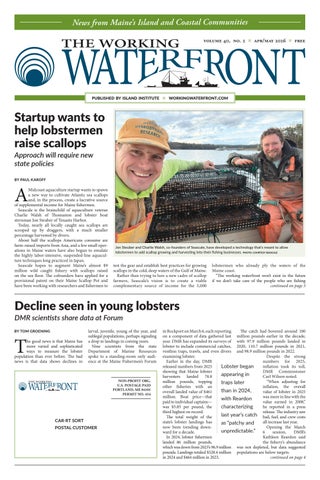
Jon Steuber and Charlie Walsh, co-founders of Seascale, have developed a technology that’s meant to allow lobstermen to add scallop growing and harvesting into their fishing businesses. PHOTO: COURTESY SEASCALE
test the gear and establish best practices for growing scallops in the cold, deep waters of the Gulf of Maine. Rather than trying to lure a new cadre of scallop farmers, Seascale’s vision is to create a viable complementary source of income for the 5,000
lobstermen who already ply the waters of the Maine coast. “The working waterfront won’t exist in the future if we don’t take care of the people who are fishing continued on page 3
Decline seen in young lobsters DMR scientists share data at Forum BY TOM GROENING
T
he good news is that Maine has more varied and sophisticated ways to measure the lobster population than ever before. The bad news is that data shows declines in
larval, juvenile, young of the year, and sublegal populations, perhaps signaling a drop in landings in coming years. Nine scientists from the state Department of Marine Resources spoke to a standing-room only audience at the Maine Fishermen’s Forum
NON-PROFIT ORG. U.S. POSTAGE PAID PORTLAND, ME 04101 PERMIT NO. 454
CAR-RT SORT POSTAL CUSTOMER
in Rockport on March 6, each reporting The catch had hovered around 100 on a component of data gathered last million pounds earlier in the decade, year. DMR has expanded its surveys of with 97.9 million pounds landed in lobster to include commercial catches, 2020, 110.7 million pounds in 2021, ventless traps, trawls, and even divers and 98.9 million pounds in 2022. examining lobster. Despite the strong Earlier in the day, DMR numbers for 2025, released numbers from 2025 inflation took its toll, Lobster began showing that Maine lobster DMR Commissioner appearing in harvesters landed 78.8 Carl Wilson noted. million pounds, topping “When adjusting for traps later other fisheries with an inflation, the overall than in 2024, overall landed value of $461 value of lobster in 2025 million. Boat price—that was more in line with the with Reardon paid to individual captains— value earned in 2008,” was $5.85 per pound, the he reported in a press characterizing third highest on record. release. The industry saw last year’s catch bail, fuel, and crew costs The total weight of the state’s lobster landings has all increase last year. as “patchy and now been trending downOpening the March unpredictable.” 6 session, DMR’s ward for a decade. In 2024, lobster fishermen Kathleen Reardon said landed 86 million pounds, the fishery’s abundance which was down from 2023’s 96.9 million was not depleted, but data suggested pounds. Landings totaled $528.4 million populations are below targets. in 2024 and $464 million in 2023. continued on page 4
2
The Working Waterfront . april/ may 2026
University of Maine graduate student Sander Elliott, left, and another researcher pose with a sturgeon they caught in the Penobscot River. (Research conducted under NOAA Permit No. 20347-02.) PHOTO: COURTESY SANDER ELLIOTT
Giants in our midst The continuing search for sturgeon BY CATHERINE SCHMITT
R
ight now, somewhere between the waterfronts of Bangor and Brewer, hundreds of shortnose sturgeon lie on the bottom of the Penobscot River, settled on the rocks like sardines, or on the many logs that sunk during the region’s reign as Lumber Capital of the World. Soon the sturgeon will wake from their winter’s rest, dispersing through the river and down to the bay. It was nearly 20 years ago now that University of Maine researchers documented the presence of both shortnose sturgeon and Atlantic sturgeon in the Penobscot River. The large, heavy, bottom-dwelling fish were known to Wabanaki ancestors and were once a target of commercial fishermen for meat and caviar, a pursuit that along with water pollution in rivers nearly drove them to extinction. Shortnose sturgeon was among the first animals on the Endangered Species List, alongside the grizzly bear, California condor, and the American alligator. After a fisherman accidentally hooked a sturgeon in the Penobscot, bringing the prehistoric creature up from the deep and back into the collective memory, biologists began to search for more. It didn’t take long to find them, dozens then hundreds of both species. Fish were tagged, weighed, measured, and released, an array of floating sensors picking up the sound waves emitted from the tags as the fish passed by, recording their movements. Even more fish were tagged in the Kennebec River. Research has continued, in collaboration with multiple researchers and many students, building on the work of those who came before, said lead researcher Gayle Zydlewski of the University of Maine. In 2025, graduate student Sander Elliott caught an Atlantic sturgeon in the Kennebec River that was tagged in 2007. The fish had doubled in size, to about seven feet long. In the Penobscot River, he recaptured an Atlantic sturgeon tagged in 2019 that was of similar size, the largest ever caught in the Penobscot. The size is notable because Elliott had been finding that Penobscot River Atlantic sturgeon tended to be smaller than those in the Kennebec River. A previous student researcher, Matt Altenritter, had noticed a similar pattern. In January, while presenting this information at the Atlantic Salmon Ecosystems Forum hosted by NOAA Fisheries in Bangor, Elliott said the size differences may have something to do with spawning, with larger fish being reproductive. Both Atlantic and shortnose sturgeon spawn in the Kennebec River, but to date spawning has not been documented in the Penobscot River, although shortnose are present in the rocky spawning habitat above the former Veazie Dam site, including juveniles.
Elliott plans to set out baited lines to try to catch the younger fish and determine their origin. The search continues. Elliott has experience studying sturgeon in the mid-Atlantic region, where populations have rebounded. Trends in Gulf of Maine sturgeon populations are less clear. The University of Maine has been tracking sturgeon for 20 years, and the state Department of Marine Resources for longer than that. With funding from a NOAA Species Recovery Grant, they have combined their data and are working together to estimate the current abundance of both species of sturgeon, said DMR biologist Danielle Frechette, who also serves on a sturgeon committee of the Atlantic University of Maine graduate student Sander Elliott, left, and States Marine Fisheries Commission. another researcher do research on a sturgeon in the Penobscot Conditions for sturgeon have improved River. (Research conducted under NOAA Permit No. 20347-02.) in recent decades due to the Clean PHOTO: COURTESY SANDER ELLIOTT Water Act and dam removals, although mercury pollution may be an issue in the Penobscot River. They remain protected In riverfront parks in Hallowell and Augusta, South under the Endangered Species Act. “We think they are holding steady or potentially increasing,” said Orrington and Winterport, people search the river’s Frechette. “We need more information to better surface for leaping sturgeon. Frechette of Maine understand how sturgeon populations are doing so DMR has asked the public for help as researchers try to establish where sturgeon cross paths with people. that we can chart their path toward recovery.” Since then more than 100 people have reported The NOAA grant is funding the research by Elliott. This year he will re-deploy an array of acoustic sensors sturgeon encounters: an accidental capture while to monitor the movement of tagged sturgeon between fishing for stripers or smelts, while paddleboarding rivers and along the coast, to learn whether and how or scuba diving, carcasses washed up on the beach. patterns have changed. He’ll also be attaching pop-up Frechette said that, in addition to providing data on satellite tags to Atlantic sturgeon to see where they sturgeon movements, “the reports will help focus spend the winter. Atlantic sturgeon make longer future outreach efforts to help connect people with migrations along the coast, with Maine fish known to these amazing fish.” “These fish are really cryptic,” said Elliott. “We see travel as far as Nova Scotia and North Carolina. In the meantime, riverfront communities have awak- them when they jump, but otherwise they are really ened to the giants in their midst. In June 2023, river hard to know.” Elusiveness and mystery is part of their appeal. To flows were high enough that hundreds of Atlantic sturgeon spawned in Cobbosseecontee Stream, a tributary see them is to wake briefly into a kind of dream, a of the Kennebec River, where they were visible from a glimpse of rivers full of life, moving freely, and to know bridge. Biologist and writer John Waldman described the future can be big enough for people and fish. the scene in the journal Fisheries: 200 fish, large and quivering, packed into the clear, shallow stream with a crowd of people watching from the bridge, “enjoying a You can aid the sturgeon search by reporting sightings newfound ‘sturgeon fever.’” of them both live and dead to the Maine DMR At the forum in January, several people remarked sturgeon reporter: https://survey123.arcgis.com/share/ that watching sturgeon is a way that people are 76f3d7e08838484e8524d6d35b54d71e getting to know their rivers, many for the first time. It is not so hard to see a sturgeon, thanks to their Catherine Schmitt is the author of The President’s mysterious habit of propelling themselves straight Salmon: Restoring the King of Fish and its Home out of the water and landing with a splash, a kind of Waters. She was on the Penobscot River with sideways bellyflop, an eruption of muscle, cartilage, researchers when they tagged the second and third and rough skin flashing in the sun. shortnose sturgeon in 2006.
. April www.workingwaterfront.com www.workingwaterfront.com . april 2026 / may2020 SCALLOPS
continued from page 1 now,” says Walsh, whose resume includes roles harvesting seaweed at Maine Sea Farms, bivalves at Pemaquid Oyster, and eel at American Unagi, as well as a stint managing University of Maine’s experimental hatchery. “All of the hopes people have for aquaculture are pinned around fishermen still existing, wharfs still existing, and working waterfronts being maintained.” He says a thriving traditional fishing fleet, especially lobstermen, is critical to keeping the rest of the coastal economy afloat, from bait suppliers, fuel docks, trap mills, rope factories, boatyards, and fiberglass shops to the trucking to bring products to market in big cities. Key to the pair’s strategy is to make raising scallops a natural extension of a lobsterman’s daily workflow. “There have been many attempts to bring commercial fishing over to the dark side of aquaculture,” says Steuber, who spends most days on the back of a Port Clyde lobster boat. “We instead brought aquaculture to them in a form factor that sits on the wash rail and is unscary.” That unscary form factor is a scallop pot that looks and feels a lot like a lobster trap. Working out of Walsh’s unheated, uninsulated barn, with a long extension cord run from the kitchen, the pair prototyped a scallop pot that mimics a lobster trap in dimensions, weight, and ease of handling. “When you live up here, you take a lobster trap for granted,” Walsh says, “but it’s 200 years of iteration— something that in size and weight one person can handle. They stack. You can cast them over the side of the boat and they land right-side up.” Recognizing that fishermen already have full-time jobs, Seascale’s “fishing first” ethos envisions a way for harvesters to diversify at relatively low cost. Most fishermen, Walsh says, are open to trying something alongside fishing as long as they don’t have to add expensive equipment or change the configuration of their boats. Given its similarity to a lobster trap, the Maine Scallop Pot requires little change to the workflow of a typical lobster boat crew. Seascale’s vision is also to match the scalability of lobstering so that someone can choose how much of their business to devote to scallops, testing the waters with 10 pots or investing in a much bigger plunge. Earnings from growing scallops could help make a boat payment in a lean lobstering year or be set aside for a new truck fund. Lobstermen face an array of challenges, from federal rules to protect right whales to offshore wind development to the gentrification that is gobbling up working waterfronts, not to mention shifts in the distribution of the stocks they’re fishing as a result of a rapidly warming Gulf of Maine. Against that backdrop, lobstermen have no choice but to consider opportunities to diversify, says Sebastian Belle, executive director of the Maine Aquaculture Association. “We’ve seen that in aquaculture—a lot of lobstermen dabbling on the side to see whether it’s worth it or not and see if they can make a little money. Over time,
133
the interest will increase,” predicts Belle, who serves on the board of the Island Institute, which publishes The Working Waterfront. Another driver of interest in raising scallops may be the state of the wild fishery. In January, the Maine Department of Marine Resources ordered emergency closures of six of the state’s scallop harvest areas, interspersed from Casco to Cobscook bays, “to reduce the risk of unusual damage and imminent depletion of the scallop resource.” That cut short an already compressed fishing window and came in spite of a state policy designed to preserve stocks through rotational closings from one season to the next. When Walsh and Steuber introduce Charlie Walsh, a co-founder of Seascale, inspects a new technology the fishermen to their scallop pot, which startup has developed called the Maine Scallop Pot. While they look like sells for $200, there’s little discussion lobster traps, they’re meant to allow fishermen to easily grow scallops in of how the gear works. “They look between harvesting lobster. PHOTO: COURTESY SEASCALE exactly like a lobster trap,” Steuber essentially giving scallop pots the same mobility that says. “You know how many are going to fit on the back of your boat, your trailer. Their lobster traps have today. “We envision an aquaculture license with a gear questions are: What sort of bottom do they need? How long does it take to grow ‘em? How much can I standard and tag system like the lobster fishery operates under,” Steuber says. “Fishermen would be able sell them for? How many scallops fit in a pot?” Seascale has worked with fishermen and university to shift this gear seasonally and deploy it where their researchers to test the gear in Gulf of Maine waters, lobster traps aren’t, without having to go to the state growing scallops three miles offshore and in the shal- and ask for exclusive economic rights in the ocean.” The Seascale founders realize that pushing lows of the Damariscotta River. They’ve determined that the pots perform best sitting on a sand or gravel through such a bold policy change won’t be possible bottom in deep water—90 to 130 feet. Crucially, those without muscular support from lobstermen and a depths are below the zones where most biofouling willingness to exert their considerable influence in occurs, meaning pots can be set and left alone for as Augusta. Walsh and Steuber have been stressing their complement-not-compete mantra in meetings with long as six months before they’re hauled up again. “We’re not just developing the gear. We’re devel- lobstermen, legislators, fisheries advocates, and other oping the husbandry manual for how to grow in this stakeholders. They hope their grassroots campaign John “We Martin, Staples, andifElsie Gillespie woodstove at the annual town meeting. willaround lead tothe a bill in the 2027 legislative session. gear,” Walsh says. feelBud strongly that people are chat DMR spokesperson Jeff Nichols declined to going to take the leap and incorporate this into their business, we want to make sure that they have the comment on a potential new licensing framework, but told The Working Waterfront that “one of the best information possible.” Scallop specialist Michael Coogan, research assistant Department’s concerns about this approach is the professor at the University of New Hampshire, is among potential to add vertical lines in the Gulf of Maine those who have tested the Seascale gear. “They solved at a time when there is significant federal pressure to one of the many problems that we were trying to solve,” reduce them in order to lower risk of entanglement he says. “There’s still a lot of biology and economics to to endangered North Atlantic right whales.” But University of Maine oceanography Professor figure out, but Seascale has figured out a really good option for the engineering and design of the gear. As far Damian Brady thinks that Seascale’s approach has as trying to get more people farming scallops, their gear merit and may succeed. “The lobster fishing industry is pretty powerful,” he notes. “If it’s a ground-up is the best—robust and easy to work with.” While Seascale’s scallop pot may closely resemble approach where lobstermen are asking for the flexa traditional lobster trap, the regulations governing ibility to deploy their gear very similarly to how they the two wire boxes are fundamentally different in an lobster, then I think they have a shot.” important respect. Fishermen need only a license to drop lobster Paul Karoff is a Camden-based freelance writer. traps more or less wherever they want, but growing Until 2024, he was an associate dean at the Harvard scallops requires an aquaculture permit tied to a School of Engineering and Applied Sciences and geographically fixed lease. Seascale’s path to success previously held senior communications and public will require getting the Legislature to change the affairs positions at nonprofit and higher education way the state regulates the cultivation of sea scallops, organizations and at a Fortune 100 Company.
Levi Moulden
Support for coverage of the Future of Fishing is made possible by a grant from Gideon Asen. Bud Staples
Gerald “Punkin” Lemoine
G.F. JohnstonConsulting & Associates Civil Engineers Concept Through Construction
• • •
Regulatory permitting • • Land evaluation • Project management
Site Planning Sewer and water supply systems Pier and wharf permitting and design
12 Apple Lane, Unit #3, PO Box 197, Southwest Harbor, ME 04679 Phone 207-244-1200—
www. gfjcivilconsult.com —
4
The Working Waterfront . april/ may 2026
Fishermen divided over proposed menhaden changes Legislation would expand eligibility for the prized bait fishery BY STEPHEN RAPPAPORT
L
ike the schools of menhaden that roil the summer waters off the coast of Maine, a proposed law that would open that lucrative fishery to more participants has been raising turmoil among fishermen, legislators, and state regulators. Menhaden has become a significant part of the bait supply for Maine’s lobster industry, especially over the past several years when herring have been in short supply. Introduced last year by Rep. Billy Bob Faulkingham, the House minority leader and a Winter Harbor lobsterman, LD 1353 was held over for consideration until this year. In early February, the Legislature’s marine resources committee voted 8-5 to recommend passage of the bill, which would ease requirements for obtaining a menhaden fishing license from the Maine Department of Marine Resources. The bill the committee ultimately approved differed substantially from the original that DMR testified against at a public hearing last April, but the changes didn’t entirely assuage the agency’s objections. Current law limits issuance of a new license for menhaden—commonly called “pogies”—to fishermen who were licensed during any two of the years between 2019 and 2022 and reported landings of at least 25,000 pounds during any one of those years. On Feb. 19, a few days after its initial vote, the committee approved final language for an amended bill authorizing DMR to issue 2026 resident and nonresident commercial menhaden licenses to fishermen who reported landings of at least 20,000 pounds (5,000 fewer pounds) in any of the years 2019, 2020 or 2021 (a shorter time period) and who held a commercial license in at least one of those years but did not have, and would not have been entitled to, a license in 2023. DMR is still not happy with the amended bill. According to department spokesperson Jeff Nichols, the reduced landings requirements could allow as many as 20 additional participants into the fishery, resulting in a total of 376.
“The Department’s position,” Nichols said, “is that rather than continue to amend the eligibility criteria, the Department should use the existing authority the Legislature has provided to create an entry system where licenses are replaced when they exit the fishery.” DMR, he said, would support issuing new licenses at a 1:1 ratio as current license-holders leave the fishery once the number of outstanding licenses drops below 350. Allowing more participants into the fishery is just what divides fishermen. Introducing LD 1353, Faulkingham told lawmakers that the existing rule threatened “to shut out the very fishermen who helped build this fishery … but missed one qualifying year.” That was the case for fishermen such as Warren Graybill of Harpswell, who told the committee that he had the required landings “in one year, but not two out of three” needed to qualify for a license. He suggested that the amendment would allow only a few more participants into the fishery. Initially, LD 1353 drew support from some members of the lobster industry, such as Jason Joyce of Swan’s Island. He told the committee that bait was in short supply and difficult to obtain on the island where there were no licensed menhaden fishermen but there were three fishermen who had the necessary boats and equipment, and had met the 25,000-pound landings requirement in the last year that the fishery was completely open, but didn’t have the two years of landings required to qualify for licenses in 2023 and later. Joyce said allowing those fishermen to participate in the menhaden fishery would benefit Swan’s Island lobstermen. Tad Miller, a Tenants Harbor fisherman who harvests menhaden around Matinicus Island, opposed LD 1353 as introduced, arguing that the addition of as many as 20 more boats into the fishery would have a serious impact on the resource. According to Miller, fishing pressure is already impacting the menhaden in the water, where the fish are “wilder and harder to catch” than in the past. “There’s only so much fish,” Miller said shortly before the marine resources committee released the text of the amended bill.
The fishery is regulated by the Atlantic States Marine Fisheries Commission which each year sets a quota for East Coast menhaden landings. It allocates a portion of that quota to each seaboard state from Maine to Florida. This year, the quota has been reduced by 20 percent from the 2025 total. Maine’s quota for 2026 is 19.57 million pounds. While that sounds like a lot, in 2024, the last year for which DMR has published figures, Maine fishermen landed 25.64 million pounds of Atlantic menhaden valued at $13.2 million. However, that hardly describes the value of the fishery to Maine. Menhaden comprise a substantial proportion of the bait used by lobstermen in the state’s $461 million fishery. With the longstanding shortage of herring likely to continue, if the supply of menhaden were interrupted, many of the state’s lobstermen might have to leave their traps on the bank rather than in the water, fishing. Miller also said that with too many boats fishing for menhaden, the bait market would suffer, especially west of Penobscot Bay and along the Midcoast. He’s worried that new entrants to the fishery who don’t already have customers for their landings will likely reduce their prices to attract buyers. That would be bad for fishermen already in the bait market, who could be forced to lower their prices to retain customers. Market disruption like that could also create “gaps” in the supply, he said, when lobstermen are most in need of bait. He suggested that the menhaden fleet should be capped at no more than 350 licenses, with a 1:1 exit ratio for new licenses: “A lot of people will tell you it should be less than 350, and I’m probably one.” The amended bill, which as of March 2 still awaits action by the full Legislature does establish a cap of 350 on the number of commercial menhaden fishing licenses and calls for a 1:1 entry to exit ratio for new licenses. The bill also directs DMR to identify groups of fishermen who should get priority for the first available licenses and to develop an entry plan for new participants in the fishery.
YOUNG LOBSTERS
continued from page 1
“The trend has been downward,” she said, with “a really strong spatial dynamic,” meaning data “signals” show the population is stronger in eastern areas. DMR’s Marissa DeCosta noted that landings numbers have showed “more stability” in the areas south of Penobscot Bay, while the eastern coast initially recorded higher catches, then saw declines over the last 10 years. The surveys do not mean changes in management are called for, Reardon said, but DMR recommends continued review. Water temperatures measured on the bottom were cooler last year than in 2024, she said, a preferred condition. Lobster began appearing in traps later than in 2024, with Reardon characterizing last year’s catch as “patchy and unpredictable.” Fishing boats were less active than usual in the summer months, she added. Factors for that trend include retirements, fewer new licenses being issued, and fishermen perhaps waiting for others to begin reporting success before heading out. Maine lobster harvesters took more than 21,000 fewer fishing trips in 2025 than in 2024, a nearly 10 percent decline in fishing effort. DMR’s Heather Glon and Robert Russell presented information on the populations of lobster up to a year old. While “2024 was a fairly typical year for larvae,” Glon said, “in 2025, we saw larvae later in the year.” Russell said larvae were seen as late as midDecember: “That’s kind of crazy.”
A fisherman working out of Port Clyde bands a lobster in 2023. PHOTO: JACK SULLIVAN.
Research found that settlement of young lobster— the point in their life cycle when they take shelter on the bottom—came later than usual and showed low numbers. Staff concluded there is no consistency in recent patterns to suggest a coming boom or bust. DMR’s Robyn Linner reported the results of an inshore trawl survey counting the number of sublegal lobster, conducted along the New Hampshire and Maine coasts out to the 12-mile limit. Only the Penobscot Bay region showed increases.
Ventless trap surveys showed similar results for sublegal-sized lobster, according to DMR’s Kristyn Kleman. “We did see a slight drop in sublegal in all zones,” she said. In answer to an audience question, DMR scientists said they don’t yet know the cause of the decline in larval and juvenile lobster. Tom Groening is a former editor of The Working Waterfront. He may be contacted at thomasjgroening@ gmail.com
www.workingwaterfront.com . april / may 2026
5
Inflation, tariffs impacted seafood industries Softshell clams 2nd most valuable after lobster COMMERCIAL SEAFOOD harvesters earned $619 million in 2025, the Maine Department of Marine Resources reported on March 6, the 14th consecutive year earnings topped $500 million. But inflation impacted the fishing and sea farming industries last year, DMR Commissioner Carl Wilson noted, “with market uncertainty due to tariffs, and a late molt that limited access by the summer fishery to new shell lobsters.” Maine’s softshell clam fishery was again the state’s second most valuable in 2025 with an overall value of $21.5 million, a jump of nearly $6 million over 2024. Maine clammers increased their harvest over 2024 by 441,578 pounds and saw an increase in price at the dock from $2.72 per pound in 2024 to $3.49 per pound in 2025.
Atlantic menhaden, a favorite bait for Maine lobster harvesters, was the third most valuable fishery in Maine in 2025, earning fishermen $18.9 million, an increase of more than $5 million over 2024. Landings in the fishery jumped from 26.7 million pounds in 2024 to 31 million pounds in 2025. Maine oyster harvesters and growers continue to see increasing demand for their product, which was the fourth most valuable in 2025, at $16 million. “The reputation for Maine oysters continues to grow as consumers prize their clean, briny, sweet flavor,” Wilson said, “which comes from the cold, clean, nutrient rich waters along our coast.” Maine scallops were the fifth most valuable commercially harvested species in 2025, earning both fishermen and aquaculturists $9 million.
“Maine scallops continue to provide a vital winter fishery for harvesters,” the commissioner added, “an emerging opportunity for aquaculturists, and a delicacy for consumers.” Elver fishmen harvested 7,797 pounds of baby eels in 2025 and earned $6.9 million, placing the fishery as the sixth most valuable. “Once again, Maine fishermen and sea farmers in 2025 delivered premium products sought by consumers around the world who value nutritious, sustainably harvested seafood,” said Gov. Janet Mills. “Through their hard work and dedication, Maine’s fishermen and aquaculturists are providing a strong foundation for our economy and preserving Maine’s heritage for generations to come.”
Shellfish harvesting can return to Boston Harbor The shift follows years of cleanup BY CRAIG IDLEBROOK
T
hree towns perched on the shore of Boston Harbor can now devise rules for shellfish harvesting, something no municipality near the harbor has been able to do for more than a century. The Massachusetts Department of Marine Fisheries announced at the beginning of this year that water quality in certain parts of the harbor has improved to the point that mudflats off the coasts of Winthrop, Hingham, and Hull can be opened for shellfish harvests for direct consumption or commercial sale. In the past, certain areas of Boston Harbor allowed for conditional shellfish harvesting, but the shellfish needed to spend time in Massachusetts’ lone purification plant before sale or consumption. That purification plant permanently closed after significant storm damage in December 2024. Clammers can’t wade into Boston Harbor with clam rakes just yet, however. Massachusetts, like Maine, still abides by colonial-era regulations that give municipalities the power to regulate shellfish harvesting once the state deems an area safe for raking. That may take some time, said DMF Regional Shellfish Supervisor Wayne Castonguay, as municipalities are starting from scratch. “They have no history of managing these resources, and so they need to take votes, they have to write rules and hire staff to patrol,” Castonguay said. This is the first time parts of Boston Harbor have been cleared for possible
harvest since a national typhoid outbreak Three years later, a federal judge sided traced to contaminated shellfish led to with environmentalists, forcing the city the death of at least 150 people in 1924- to find a better solution to deal with its 1925. This outbreak was the first time waste. The city began construction on a scientists were able to conclusively gather new wastewater treatment plant in 1989, evidence about the role shellfish can play and a new 9.5-mile tunnel to carry treated in spreading disease. It led to the creation sewage out further from the shoreline. of the National Shellfish Sanitation It was a laborious process to clean Program in 1925, a coopthe Charles River erative federal and state and Boston Harbor, “ It takes program to create rules said Chris Mancini, and monitor water quality executive director local leaders to ensure the safety of of Save the Harbor/ and active harvested shellfish for Save the Bay, one of human consumption. the nonprofits that community Boston’s Charles River pushed for cleaner and harbor have steadily waterways in the area. organizations gotten cleaner since the “This was a massive to get involved days when the area’s undertaking, with waterways were memorimultiple lawsuits and to work in alized by the song “Dirty and major rate payer partnership with Water” by the Standells in increases for folks. 1965. It still took time to Now nobody thinks [the state]…” gather the data to prove twice about it,” that shellfish in the harbor Mancini said. “We could be safe to eat, Castonguay said. have a really clean harbor and we can Shellfish are filter-feeders, meaning they go to the beach every day,” are remarkably good at concentrating Much of Maine’s coastline is condiany pathogen or pollutant that may be tionally open for shellfish harvesting, found in a body of water. but there are several swaths of the “To have open shellfishing areas, you coastline that are permanently closed, need basically the cleanest of any water including much of Portland Harbor. quality designation, even cleaner than Portland’s waters are closed because of for swimming or boating,” he said. sewer overflows, historic contaminaFor years, Boston simply dumped raw tion from its industrial past, and waste sewage into the harbor, and its beaches and pollution from boating activity. were routinely closed because of contam- There can be other causes for long-term ination. In 1982, the Conservation Law closures, as well. Harpswell Cove off Foundation filed a federal lawsuit against of Brunswick’s coastline was closed in the city for violating the Clean Water Act. 2024 due to a spill of PFAS chemicals.
Often, there is not one easily identifiable culprit for pollution, and it can be difficult to remediate issues that can cause closures near rural coastal municipalities, said Bridie McGreavy, who served as a past chair of the Maine Shellfish Restoration Resilience Fund and works with the Maine Shellfish Learning Network. To improve shellfish harvesting opportunities in Frenchman’s Bay, she and other advocates spent a decade painstakingly going from mudflat to mudflat to identify local sources of pollution. There are no shortcuts to the grassroots efforts needed to improve the water quality of Maine’s mudflats, she said. “It takes local leaders and active community organizations to get involved and to work in partnership with Maine DMR to figure out what’s going on for any particular closure and identify strategies for how to open them,” McGreavy said. The process is often hampered by a lack of funding to remediate sources of pollution, she said. If there was strong funding available to help communities remediate issues, there would be more mudflats open along the Maine coast, she said. “If we could really invest in our infrastructure, I think we would see more solutions become available to us or feel more available than they currently do,” McGreavy said. “Absent those kinds of resources and investments, communities are taking on the burden of addressing these kinds of issues and doing the best that they can.”
National Bank
D R EAM FIRST
A Division of The First Bancorp • 800.564.3195 • TheFirst.com Member FDIC • Equal Housing Lender
6
The Working Waterfront . april / may 2026
from the helm
The power of a room of one’s own
Institute adds a housing strategy for coastal and island communities BY KIM HAMILTON
WHEN MY PARENTS purchased the home that I grew up in nearly 60 years ago, the $12,000 price tag was almost out of their reach. They managed to pull together a down payment, and that home has remained our family’s center of gravity for six decades. As homes go, ours was small. Two bedrooms, one bath, a tiny kitchen and living room, and an unfinished basement and attic. Somehow, the four of us made it work. It was a house full of all the comings and goings of any working family plus the commotion of two siblings coming of age in the 1970s and 80s. (I remember a few heated exchanges with my brother as the one-bathroom situation began to cramp our teen style.) And I know that my father, fatigued from shift work, longed for one peaceful, eight-hour stretch of sleep uninterrupted by the banging of doors, the thump of the record player, and the endless ringing of the phone from our friends making plans. Eventually, I moved upstairs into a newly refinished, tongue-andgroove pine bedroom and thought I was the luckiest person alive. Many
of the knots in the pine looked like animals. A rabbit, a seagull, and an especially life-like sea turtle were my constant companions. I had a long bulletin board covered with pictures of friends, my drawings as a budding artist, and no doubt plenty of Partridge Family posters. I pored over my subscription to Teen Beat in that room, staying up to date on all the latest lyrics and celebrity gossip. I loved that room, and that house. What I didn’t realize then but understand so well today is that what happened outside that house was as important as what was happening inside. My parents’ choice to move to this small home was a good bet on ensuring a better future for their children. I received an enviable education, had friends from across the economic spectrum, and was able to build a life that was unimaginable to my younger self. When we speak of the skyrocketing costs of housing along the coast, what’s often forgotten is the value of opportunity that stable housing provides. It empowers not just families but also communities. With it comes access to education, social services, jobs, neighbors—all of which enhance
opportunity and the likelihood of economic security. For communities, housing creates employment and investment and expands tax revenues. Without adequate housing options, families disappear, businesses struggle, and communities are weakened. At Island Institute, we have heard clearly from communities up and down the coast and on islands that solving the housing crisis must be a top priority, and they need help. Median home prices are north of $500,000 in many locations. Interest rates are high. Housing stock is low. First-time home buyers are boxed out, and small and big businesses alike can’t attract critical talent. Everybody suffers. In the communities where we work, the addition of two or three new units could be a game changer, but few developers are interested in small-scale development even if it’s transformational. This is why Island Institute has launched a new housing strategy. Our goal is to strengthen community-led solutions, with more resources, technical assistance, and best national practices. Today, a coalition we’ve organized made up of communities,
housing organizations, and other stakeholders already exchanges lessons and strengthens the collective voice of these communities. Through new partnerships, we’ll bring even more attention and resolve to solving the unique housing challenges along the coast. I know there are parents out there who are struggling just like my parents did to piece together a down payment on a small home or to afford a rental unit. They have dreams for their children, and they know a permanent home, no matter how small, will foster both dreams and opportunity. This is why I am especially proud of our new focus on housing. We want to be there for every child who longs for a room of their own where childhood can expand gloriously in front of them. Kim Hamilton is president of Island Institute, publisher of The Working Waterfront. She may be contacted at khamilton@islandinstitute.org.
sweetest in the gale
Scallops and me
What it takes to get them fresh and local I HAVE A SHORT and complicated history with scallops. Growing up in Maryland, my fondness for seafood mostly extended to the basics: canned tuna; flaky white fish; some crab, shrimp, and shellfish; occasional lobster and salmon. I don’t remember starting to eat scallops until a decade ago, and they quickly struck me as more decadent. At a wedding on Cape Cod, I swallowed one wrapped in bacon and feared needing the Heimlich as it briefly lodged in my throat. During a trip with my wife’s family to the Jersey shore, I spent a day on the toilet after consuming a seafood platter that included them. To be clear, I accept all risks of shellfish consumption, and my troubles may have owed more to the kitchens’ liberal application of animal fat. But as I’ve learned more about scallops in recent years—especially what’s required to put them on a plate—my appreciation has grown. It’s hard work catching scallops in the deep of winter. And as a consumer, it’s no easy thing getting ones that haven’t been frozen, soaked in preservatives, or shipped from many miles away.
I’m used to thinking this way about terrestrial food: I grow my own vegetables and tend to enjoy the bacon cradling those scallops more when the pigs and farmers lead good lives, preferably nearby with minimal waste of other resources. Yet only in recent years have I begun to think more deeply about seafood. It’s a big deal in Maine, where fishing and aquaculture are entwined with our economy, environment, and culture— and where the life-blood lobster industry faces challenges that have contributed to an ongoing drop in landings. When it comes to Maine’s relatively tiny scallop fishery, I’m primarily struck by how dangerous it is to catch them, illustrated by the tragic drownings of multiple Downeast fishermen last year. I’m also fascinated by the new ways that local seafood producers are trying to raise them (see the page 1 article about the startup Seascale). So I contrived a challenge for myself when I became the editor of The Working Waterfront late last year, heading into the winter scallop season. I resolved to buy scallops off the dock, straight from the brave souls who caught them.
They’d be so fresh and local, I’d have to overcome my earlier hangups! Turns out this was easier said than done, having almost no connections of my own in the fishing world. So I did what comes much more naturally and found someone advertising dayboat scallops on Facebook. The message leapt out as I was scrolling the app first thing on a rainy weekday morning. “Today we are in Belfast 1/15, across from the Reny’s parking lot,” a page called "Pride and Joy Peddling" had written 20 minutes earlier. “Please come get your fresh dry Maine day boat scallops today while you can! Price is $28lb. Have a good day and thank you for your support.” I drove the 45 minutes from Owls Head to Belfast, where a sign beckoned me into the parking area, the words “Fresh Scallops” painted in black letters over plywood. I parked near a pickup truck loaded with chest coolers. A woman named Samantha Benner met me at the tailgate and, using a digital scale, loaded a pound of the little white blobs into a clear plastic bag that she tied shut. They were mine for $28.
When I asked about the scallops, Benner said that her father, Thurin, runs the operation. They buy them from fishermen and sell them in parking lots around Midcoast and central Maine. Business was brisk. Three other buyers stopped by during our 10-minute interaction, including one guy who left empty-handed because he hadn’t brought cash. I was mildly embarrassed to learn that the Benners had gotten these scallops in Spruce Head, just a short drive from where I had woken up that morning. I returned that way, stopping at the grocery store for butter to cook them in. Charles Eichacker is the editor of The Working Waterfront and Island Journal. He may be contacted at ceichacker@islandinstitute.org.
www.workingwaterfront.com . april / may 2026
7
SNOWED IN—
This image captured a woman and cat amid mountains of winter snow—not unlike the ones that fell along the Maine coast this year. It was taken by Helen Shute, a longtime Midcoast journalist and photographer working from the early 1900s to the 1960s. Do readers recall when this photo was taken, or who this person was? If you can share any information or memories, contact editor Charles Eichacker at ceichacker@islandinstitute.org. PHOTO: COURTESY BELFAST HISTORICAL SOCIETY AND MUSEUM
the public’s policy
Electrifying Maine's working waterfronts Island Institute report examines shoreside charging resources BY ERIN QUETELL
MAINE’S COAST IS beautiful, with mountains to mudflats, pine trees to pebbles. It is more than a scenic backdrop; it is an economic hub for the marine economy. The working waterfronts of Maine are home to one of the most productive lobster fisheries in the world, a growing aquaculture industry, and thousands of recreational boaters who support our local economies. Now, for the first time, there’s a comprehensive data-driven blueprint for how this maritime economy can lead the state’s clean energy transition via expanded shoreside infrastructure and the electric vessels on water. Island Institute is releasing a first-ofits-kind statewide report on shoreside electric vessel charging, Electrifying Maine’s Working Waterfront: A Study of Shoreside Charging Infrastructure. The report was prepared by Homarus Strategies, LLC with support from Haley Ward, Inc. It analyzed shoreside charging potential across all 1,605 of Maine’s working waterfront areas. Using a geospatial evaluation framework with multiple criteria, researchers scored every working waterfront site across four dimensions: proximity to the power grid, existing demand from boat owners, market potential for growth, and overall site viability. The result is a detailed, county-by-county picture of
where shoreside charging infrastructure can realistically be built and for which types of vessels. The analysis also includes an interactive online geographic information system (GIS) tool that can be used by municipalities, utilities, and other decision makers to advance grid readiness and shoreside infrastructure. The headline numbers are encouraging—373 waterfront sites were scored as highly suitable for shoreside charging across one or more vessel-use cases, including commercial fishing dayboats, aquaculture skiffs, small recreational outboards, and larger yachts. Of those, 140 sites can support multiple vessel types, offering flexible, multi-use charging solutions. Regional patterns emerged clearly from the data. Southern Maine, from Kittery through Casco Bay, is best positioned for recreational vessel charging. The Midcoast, spanning the Sheepscot to Penobscot rivers, offers the strongest opportunities for aquaculture electrification. High-value commercial harbors like Stonington, Bass Harbor, and Jonesport/Beals are the most viable candidates for commercial fishing hybridization, or even electrification— a critical finding given that Maine’s lobster fishery accounts for roughly 75% of annual marine landings by value. Additionally, the team conducted 35 stakeholder interviews and four community round tables in Ellsworth,
Island Institute Board of Trustees Doug Henderson, Chair John Conley, Vice-Chair Bryan Lewis, Secretary, Chair of Philanthropy and Communications Committee Katherine Vogt, Treasurer, Chair of Finance Committee Michael Boyd, Clerk Shey Conover, Chair of Programs Committee Michael Sant, Chair of Governance Committee Robert Baines Pamela Baker-Masson Sebastian Belle Des Fitzgerald Christie Hallowell Kristin Howard Nadia Rosenthal Michael Steinharter Carol White John Bird (honorary) Tom Glenn (honorary) Joe Higdon (honorary) Bobbie Sweet (honorary) Kimberly A. Hamilton, PhD (ex officio)
Machias, Portland, and Rockland. The underlying message received from fishermen, harbormasters, marina operators, and municipal planners was that reliable infrastructure is the prerequisite for adoption. Without it, even willing early adopters won’t make the leap. The report arrives at an important moment. Maine Won’t Wait, the state’s recently updated climate action plan, explicitly calls for supporting commercial marine and small harbor craft to adopt electrified propulsion. As more folks on the water see the benefit in cost savings for fuel and maintenance costs, and experience the other social benefits of electric vessels (they are virtually silent, produce zero local emissions, and can be VERY fun to maneuver), the need for reliable and readily available shoreside infrastructure is critical, and this report provides the evidence base to act on advancing this transition. However, there are real infrastructure hurdles. Only a quarter of Maine’s working waterfront facilities currently have access to three-phase power—which is needed for Level 3 fast charging—within 250 feet of the water. Grid capacity constraints, especially in the more rural areas along the coast, pose an immediate barrier. Additionally, many commercial harbors rely on moorings rather than docks, complicating the ability to make shoreside connections.
THE WORKING WATERFRONT
Published by Island Institute, a non-profit organization that boldly navigates climate and economic change with island and coastal communities to expand opportunities and deliver solutions. All members of Island Institute and residents of Maine island communities receive monthly mail delivery of The Working Waterfront. For home delivery: Join Island Institute by calling our office at (207) 594-9209 E-mail us: membership@islandinstitute.org • Visit us online: giving.islandinstitute.org
Now, there may be use cases that do not require the intensity of three-phase power and may support lower-cost solutions utilizing Level 1 (conventional household outlets) or Level 2 (think electric dryer or oven outlets) to power charging infrastructure for aquaculture needs, municipal harbors, and recreational marinas. The report outlines three parallel strategies for policymakers: widespread lowpower demonstration projects, targeted high-power investments in key commercial harbors, and early-adopter incentive programs to build market confidence. Maine’s marine economy has weathered storms for generations—but climate change and rising fuel costs demand new strategies. Explore the report and mapping tool at islandinstitute.org, and join us in turning this data into dockside action. Contact Island Institute to discuss how your harbor can be part of Maine’s clean energy transition. Erin Quetell is public policy director for Island Institute, publisher of The Working Waterfront. She works with communities and partner organizations and leads government relations work and public policy campaigns to advance the resilience of Maine’s island and coastal communities. She may be contacted at equetell@islandinstitute.org.
EDITOR: Charles Eichacker
ceichacker@islandinstitute.org
Our advertisers reach 50,000+ readers who care about the coast of Maine. Free distribution from Kittery to Lubec and mailed directly to islanders and members of Island Institute, and distributed monthly to Portland Press Herald and Bangor Daily News subscribers.
To Advertise Contact: 386 Main Street / P.O. Box 648 • Rockland, ME 04841 The Working Waterfront is printed on recycled paper by Masthead Media. Customer Service: (207) 594-9209
Charles Eichacker ceichacker@islandinstitute.org (207) 535-9305
www.WorkingWaterfront.com
8
The Working Waterfront . april / may 2026
Lobsterman honored for right whale response
State launches working waterfront council
MAINE DEPARTMENT of Marine Resources Commissioner Carl Wilson presented Chris Welch of Kennebunk the annual “DMR Andy Mays Award of Excellence” at the recent Fishermen’s Forum in Rockport. Wilson praised Welch, chairman of Maine’s lobster management Zone G Council, for his work in Southern Maine to implement a rapid and coordinated response during last winter’s unprecedented aggregation of North Atlantic right whales (NARWs) near Jeffreys Ledge. “Chris was instrumental in bringing lobstermen to the table to craft a solution to avoid entangling the nearly 100 NARWs, while allowing fishermen to keep gear in the water,” said Wilson. “This was a unique challenge that had no playbook,” he went on. “Chris brought lobstermen together to work with DMR on a plan that relied on a combination of NARW sightings data from survey teams across the region including DMR’s whale monitoring program and data from vessel trackers on federally permitted lobster vessels to identify areas that had the highest risk of entanglement in gear. Welch coordinated a meeting with fishermen and DMR staff within days
MAINE OFFICE of Community Affairs announces the formation of the new Working Waterfront Advisory Council to identify and seek solutions to challenges faced by Maine’s working waterfronts. Established through legislation in June 2025, the Council consists of 15 members appointed by MOCA who will submit annual recommendations to the Legislature. “With this remarkable group of working waterfront representatives and experts, we will find solutions to keep Maine’s marine industry and culture strong,” said MOCA Director Samantha Horn. “Their range of expertise and the variety of regions they represent highlight the interdependence of community, industry, and government in creating a vibrant future for Maine.” “This will allow for consistency in crafting policy and will help center our working waterfronts as a strategic priority for the Legislature, instead of acting only when crisis strikes,” said Rep. Morgan Rielly, D-Westbrook, who developed the legislation creating the Council.
Welch coordinated fishermen during 2025 aggregation
DMR Commissioner Carl Wilson (left) presents the 2026 DMR Andy Mays Award of Excellence to Chris Welch. PHOTO: COURTESY MAINE DMR
of the first sighting of the aggregation to develop a solution involving fishermen dropping one of two vertical lines on their string of traps, according to Wilson. No entanglements of whales from the NARW aggregation have been observed this year, according to Maine DMR. “The input of fishermen to craft an out-of-the-box solution has paved the way for future efforts to manage risk to this endangered species in a way that also protects the livelihoods of Maine lobstermen,” Wilson said. The award is named for Southwest Harbor fisherman Andy Mays who died in 2017, leaving a legacy of participation in the management and regulatory process.
Insurance for your home and your business. Ask Allen. We’re here to help!
(207) 236-4311 | AllenIF.com
Group will make recommendations to lawmakers The Council will provide annual reports with updates and recommendations and work to advance initiatives that support working waterfronts. Stacey Keefer, a council member who leads the Maine Marine Trades Association, noted that, “Despite Maine’s extensive coastline, its working waterfront infrastructure and businesses face significant challenges that threaten their long-term viability. Fortunately, a broad coalition of stakeholders from both the public and private sectors are collaborating to ensure the protection of this vital sector.” The creation of the council follows investments by the Mills administration to increase resilience and protection of working waterfronts across the state, including $21.2 million in grants for 68 working waterfronts damaged by winter storms and a $69 million federal grant to protect against extreme storms, flooding, and rising sea levels. The Council will initially focus on issues related to flood insurance and financing, land use planning, and permitting.
Sea farming group starts awareness campaign THE MAINE Farmed Seafood Coalition (MFSC) is launching a campaign to educate the public about Maine aquaculture, an effort to address recent sea farming disputes in coastal communities. The campaign, titled “Maine Farmers Are Why,” puts sea farmers at the front of the conversation and tells the stories of innovators who make a diversified living on the coast of Maine. Krista Tripp is one such person. She is a Coalition member, a commercial lobsterman fishing 800 traps, and a lifelong Midcoast resident. Having grown up fishing with her father, Tripp has spent her career continuing that family tradition. In 2018 she decided to start a second business, Aphrodite Oysters, a four-acre sea farm in South Thomaston that now employs three full time workers for most of the year. “There’s always uncertainty in the wild-caught fisheries, so I went into oyster farming,” Tripp says. “I wanted to pass something on to the future generations. My son Sebastian is growing up alongside the business and can get into oyster farming when he’s older if he chooses to.” According to 2023 federal data, at least 80 percent of seafood consumed in the U.S. is imported. The global demand for farmed seafood keeps growing, and Maine’s cold clean coastal waters produce premium seafood. Additionally, Maine’s skilled maritime
workforce and working waterfront infrastructure make the state an optimal location for sea farming. The Coalition recognizes this potential to bring seafood production close to home and identified the public’s lack of aquaculture knowledge as a barrier. “This campaign will help Maine people understand and appreciate the tremendous value aquaculture provides to our state, economically, ecologically and culturally,” said Andrea Cianchette Maker, president of FocusMaine and a member of the Coalition’s steering committee along with representatives from Maine Aquaculture Association, World Wildlife Fund, Coastal Enterprises Inc., and the Island Institute. A 2024 Maine Aquaculture Association poll found that 76 percent of all Mainers identify Maine aquaculture products as a sustainable food source, but that number increases to 82 percent among Mainers with preexisting familiarity with aquaculture. The new campaign is meant to amplify stories of Maine farmers and their products, increase the public knowledge and perception of the industry, and broaden overall support. Tripp said, “People just don’t know what we’re doing out there. When there’s a new industry in their area, people feel a lot of fear around it, and they picture a worst-case scenario. We’re not trying to take over the Gulf of Maine. We’re just trying to make a living on the water.”
www.workingwaterfront.com . april / may 2026
9
Comparing Maine and Mexico fishing communities UMaine professor contributes to global research This piece first appeared in UMaine News.
M
ore than 70 percent of Maine’s fishing value comes from American lobster. The fishery has delivered prosperity for decades, but it also leaves coastal communities exposed if lobster populations falter, ocean conditions shift, or markets change. That pattern is not unique to Maine. For more than 20 years, University of Maine professor of marine sciences Heather Leslie has collaborated with an international group of researchers studying how coastal communities respond to environmental, economic, and political pressures in northwest Mexico. Leslie’s research program, based at UMaine’s Darling Marine Center, examines how marine ecosystems and the people who are part of them respond and adapt to environmental and socioeconomic changes. Supported by the National Science Foundation and other funders, Leslie and her colleagues have shared data, resources, and fieldwork across regions, producing studies on the ecological and social characteristics of fisheries and examining how fishing communities respond to change, particularly in northwest Mexico. Together, the research points to a commonality across disparate coastlines: when fishing communities lose variety, in species or in business structure, their resilience declines. Leslie recently spoke with UMaine News about the findings. Her comments have been edited for clarity and brevity. Is having fewer species a hardship for fishing communities? To focus on the analogy with New England, it used to be that 25 or 30 years ago fishermen in coastal Maine were not just fishing for lobster. They were fishing for finfish and shrimp in the wintertime and lobster in the summer. Now more than 70 percent of fished value on the coast of Maine comes from one single species: the American lobster. While that’s been a really lucrative and biologically productive fishery over the last couple of decades, we’re also seeing that it can really constrain people’s opportunities to rely so heavily on one species. There are a lot of similarities between the communities you study in Mexico and the ones here in Maine, but what are the differences? One thing that’s different between the two regions is the biological variety. As we move toward the tropics, we tend to see a greater variety of animals and other organisms. Think coral reefs. The poles don’t necessarily have that wide array of species, and we see that when we look at what people fish in Maine versus Mexico. In Maine, particularly now, we have a fairly small set of species that are harvested commercially and recreationally, whereas in Mexico in some places, folks are catching tens of different species each year. However, we have observed that for better or worse, Mexico, in many places, is starting to look like Maine. And what I mean by that is the number of targeted species is declining, and where and how people can fish is becoming more constrained. The group’s recent research references the organization of fisheries and how that plays a role in their success. Can you explain the different ways fishermen organize? In some instances — and this is true in Maine, as well as northwest Mexico — fishing businesses and people are organized as cooperatives and
Fishermen on a boat in La Paz, Mexico. PHOTO: COURTESY HEATHER LESLIE
close work with communities in different parts of Baja California Sur that individuals who are part of fishing cooperatives have different sources of resilience to change than individuals who are working for private businesses or on their own. Is one type of organization better than another?
University of Maine professor of marine sciences Heather Leslie.
share decisions, expenses, and revenues. Another typical way that people organize themselves to fish is through privately held businesses, where one person is leading and financing the operation and hiring other people to fish. There also are smaller cooperatives that aren’t as well-resourced as the larger ones. And then there are folks who fish and sell their fish on their own; this owner-operator model is the one that most people think of when they think of the coast of Maine and lobsters. How people organize themselves to fish can play a big role in how they’re able to respond to disturbances in the fishery. We were able to document through
There are financial and logistical advantages to being part of a cooperative, and that’s why they are so prevalent in regions we’ve studied. But there’s also liabilities that cooperatives face that people working in these other organizational structures are not exposed to. One of those liabilities is that large cooperatives tend to have a smaller set of species that they’re focused on, in part because they receive concessions, or exclusive access to specific fishing places, for high value species like lobster. When conditions change and those species become less accessible to fishermen, cooperatives may be more economically exposed and have fewer options to switch to than other types of fishing organizations. A recent paper led by Mateja Nenadović, a UMaine alum and University of Rhode Island professor, makes a strong case that it’s not that one of these forms is better than the other, it’s that there are changes that people encounter in the business of fishing, whether it’s economic or environmental or political, where one or the other of these organizational forms tends to be advantageous.
Attention Maine writers under 30 Submissions are now open for the Jay Skriletz Playwriting Intiative
win $1,000 cash submit by May 1
week-long workshop & staged reading at Eastport Arts Center
lodging & food stipend Guidelines: EastportArtsCenter.org/skriletz Questions?: eacplaywriting@gmail.com
G ener al & Marine C ontr aCtor D reDGinG & D oCks 67 Front s treet, roCklanD, Maine 04841 www. proCkMarineCoMpany. CoM tel: (207) 594-9565
Launching The Boat Chair! Handcrafted in Maine with traditional wooden boatbuilding techniques. Simply riveting! Come visit our studio! 43 N. Main St., Stonington (207) 367 6555 owlfurniture.com
10
The Working Waterfront . april / may 2026
NASA data helps Maine oyster farmers Satellites identify best conditions for growth BY EMILY DEMARCO FOR NASA
W
hen oyster farmer Luke Saindon went looking for a place to grow shellfish in Maine, he knew that picking the wrong waters could sink the farm before it began. So Saindon did something oyster farmers couldn’t have done a generation ago: He used NASA satellite data to view the coastline from space. “Starting a farm is a big venture,” said Saindon, director for The World Is Your Oyster farm in Wiscasset. “If you choose the wrong spot, you can blow through a lot of money without ever bringing oysters to market.” NASA satellites had been passing over these waters for years, recording temperatures and other conditions. Using a site-selection tool created by University of Maine researchers, Saindon examined satellite maps showing where water temperatures and food levels might be best for growing oysters. The maps pointed him toward a wide, shallow bay near his home. Four years later, the farm is still there— and the oysters are thriving. Saindon believes that using the satellite data to select his oyster farm site resulted in faster-than-average growth rates. “This is an example of how NASA’s Earth science program supports our nation,” said Chris Neigh, the Landsat 8 and 9 project scientist at NASA’s Goddard Space Flight Center in Greenbelt, Maryland. “We collect global data, but its value grows when it’s used locally to help communities work smarter and make their livelihoods more sustainable.” That same satellite-based approach is now the foundation of a study published Jan. 15 in the journal Aquaculture. Led by University of Maine scientists Thomas Kiffney and Damian Brady, the research demonstrates how temperature data from Landsat—the joint NASA and U.S. Geological Survey mission — combined with European Sentinel-2 satellite estimates of oyster food availability, namely plankton, can predict how quickly eastern oysters reach market size.
Thank you to our 2025 Corporate Partners! If your company would like to join us to support Maine’s island and coastal communities, please email membership@islandinstitute.org
The team built a satellite data–driven model of how oysters divide their energy among growth, survival, and reproduction. Feed the model sea surface temperature and satellite estimates of chlorophyll and particulate organic matter, and it predicts how fast oysters will grow. “By showing where oysters grow faster, the model can help farmers plan ahead,” Kiffney said. “That could mean better decisions about when to seed, when to harvest, and how much product to expect, all of which reduces financial risk.” That kind of insight is increasingly valuable in Maine, where oyster farming has grown rapidly over the last decade. From 2011 to 2021, the industry’s value increased 78 percent, rising from about $2.5 million to more than $10 million. The stakes are considerable. “It takes two to three years of scoping in order to get your permit to grow, and then it can take two years for those oysters to reach market,” Brady said. “So if you’ve chosen the wrong site, you’re four years in the hole right off the bat.” Maine’s coast measures about 3,400 miles if you follow the tide line. It is a coast of drowned valleys and glacier-scoured granite. Water depth, temperature, and circulation can shift dramatically within a few miles. This complexity makes oyster site selection notoriously difficult, and some satellites that see the coast in broad strokes miss the small, patchy places where oysters live. Landsat 8 and 9’s pixels can distinguish more subtle temperature differences between neighboring coves. For a coldblooded oyster, those distinctions can translate into months of growth. Warm water accelerates feeding and shell development. Cold water slows both. A challenge for satellites is clouds. Maine’s sky is frequently overcast, and together Landsat 8 and 9 pass over any given point only every eight days. To work around this, the research team analyzed 10 years of Landsat data (2013– 2023) and built seasonal “climatologies,” or average temperature patterns
Monique Boutin, an aquaculture technician with The World Is Your Oyster farm, sorts oysters during harvest work. PHOTO: COURTESY NINA BOUTIN/THE WORLD IS YOUR OYSTER
Luke Saindon, director of The World Is Your Oyster farm in Wiscasset, checks cages on the farm’s floating platform. PHOTO: COURTESY JACQUELINE CLARKE/THE WORLD IS YOUR OYSTER
for every 98-foot pixel along the coast. Sentinel-2 imagery added estimates of chlorophyll and particulate organic matter, the drifting microscopic food that oysters pull from the water column with rhythmic contractions of their gills. Field tests at multiple sites showed the technique’s accuracy. The University of Maine team is now developing an online tool to put this model into practice. A grower will be able to click on a coastal location and receive an estimate for time to market. The researchers also assist with workshops through Maine’s Aquaculture in Shared Waters program, teaching farmers how to interpret temperature and water clarity data. The Maine project is helping pave the way for other NASA missions.
The PACE satellite (Plankton, Aerosol, Cloud, ocean Ecosystem) launched in 2024 and is now delivering hyperspectral observations of coastal waters. Where earlier sensors could estimate how much plankton was present, PACE can begin to identify the different plankton species themselves. For oysters, mussels, and other filter feeders, that specificity matters. Not all plankton are equal food: Different kinds offer different nutrition, and some plankton are harmful to oysters. A next step will be turning that richer picture of coastal life into forecasts people working on the water can use, helping farmers trade some of the coast’s mystery for evidence they can apply to their harvest.
www.workingwaterfront.com . april / may 2026
11
Underwater AI data center? Downeast project would rely on tidal power BY E DWARD FRENCH, THE QUODDY TIDES
A
new tidal power project is being proposed off Eastport, but whether the developer has the technical expertise and financial backing to proceed with the proposal is not clear. Along with planning to provide electricity to local communities, the company, DeepGreen Western Passage SPV LLC, is seeking to power underwater artificial intelligence (AI) computer server racks. The project proposes a 51-megawatt tidal energy and subsea data center in Western Passage off Kendall’s Head and extending south nearly to Harris Point in Eastport. On Feb. 11, DeepGreen Western Passage SPV LLC submitted an application to the Federal Energy Regulatory Commission (FERC) for a preliminary permit for the project. The company is seeking a 48-month permit to conduct environmental baseline studies and engineering work. The application states that the project would transition Western Passage “into a managed, data-integrated energy hub.” The project would include “universal docking cradles,” a subsea foundation system that would act as an electrical socket; subseacompute pods, which would be highdensity AI-computer server racks; and a tidal sensing power platform that would provide real-time telemetry and environmental compliance monitoring. It would include 170 turbines mounted in the docking cradles and 34 pods of the AI-computer server
racks. While DeepGreen Western Passage is seeking a permit for 400 acres, the active infrastructure would occupy only about 7 percent of the space, or just over 27 acres. The project, estimated to cost $415 million, would be financed initially through the company’s cash reserves and private equity, according to the application. Construction would be financed through private equity and green-AI institutional investors. The project also would seek federal tax credits through the Inflation Reduction Act. While noting that Ocean Renewable Power Company (ORPC) had obtained a preliminary permit from FERC for its Western Passage tidal power project, DeepGreen asserts in its application that its project is an “infrastructure-layer expansion,” with the docking cradles designed to host third-party hardware, including ORPC units. Stuart Davis, CEO of ORPC, which has been working on tidal energy projects in the Eastport area for many years, comments, “DeepGreen’s proposal for the Eastport area is an exciting development for tidal energy in Maine, and we’d welcome the opportunity to see ORPC power systems support their project.” While ORPC had announced in 2023 that it would be using Western Passage to develop its new Optimor tidal power system, Davis now points to the company’s earlier site in Cobscook Bay. “ORPC has a lot of activity planned at our Cobscook Bay site in 2026 and 2027, which we will provide more information about in the second quarter. Our current focus is in Millinocket, where
we will begin testing of our next generation river system next month, which we believe will lower our delivered cost of electricity by up to 70 percent.” ORPC also has recently been awarded funding for a project in the St. Lawrence River in Quebec and is planning to deploy two devices there later this year. Real estate broker Louis Wolfson is the managing member of DeepGreen, based in Needham, Mass. He says the project development is in its preliminary stage but would use proven technologies. “We’re putting together resources” for the project, including reaching out to research teams in Maine and leaders in the industry. The company would not be producing its own turbine design, and Wolfson says he is reaching out to ORPC about being a potential partner. “We haven’t picked a turbine developer yet,” he says. “We want the best available technology to benefit everybody.” The tidal turbines would provide energy both for the AI server racks and for electricity for Eastport and the Passamaquoddy Tribe, he says. Its preliminary proposal calls for a power line to come ashore at Kendall’s Head in Eastport. According to the application, the company is pursuing a community benefits agreement with the City of Eastport and a memorandum of understanding with the Passamaquoddy Tribe at Sipayik. Eastport City Manager Brian Schuth says that, while he has spoken with Wolfson, there has not yet been any discussion about a formal agreement. Of the AI data center, Wolfson says, “There’s a real need for it.” Noting
that data centers utilize a great deal of energy, he wants to harness the energy of the tides to power the server racks, which would be underwater, with the surrounding water cooling them. Data centers generate massive amounts of heat and require intense cooling. Wolfson says other parts of the world are working on developing similar projects, with China having launched commercial-scale undersea data centers to use seawater cooling for high-performance computing. Along with the Western Passage site, the company has filed for a preliminary permit from FERC for a site at Cook Inlet in Alaska, which happens to be the location of another ORPC tidal energy project. Wolfson says his company is exploring different avenues for funding, including private equity and possibly federal grant funding. As for a timeline, he says, “We’d like to keep the momentum going.” If FERC grants a preliminary permit, then he says there could be a four- to five-year period before the company files for a FERC license for the project. “The sooner we can get going to provide energy and data to the community and tax revenue, the better.” He adds, “We’re bringing people together who are capable of providing the best product at the end of the day.” “We look forward to working with the community and the Passamaquoddy Nation,” Wolfson says. “I treat my neighbors as I would like them to treat me. This has to be a win for everybody.”
This story first appeared in The Quoddy Tides and is reprinted with permission and gratitude.
letters to the editor Remembering Phil Crossman To the editor, Philip Conkling and Peter Ralston’s tribute to Phil Crossman in the February/March Working Waterfront captured the man as only those who knew him well could. I did not, but I happened to see Phil in action when he attended a Maine State Ferry Service rate hearing in Belfast several years ago. MSFS had raised the ferry tariffs way too high, and had stuck Islesboro with the biggest increase of all. The hearing was packed, mostly with Islesboro residents. We testified at length. And then I noticed Phil rise and add his voice to defend Islesboro against the bureaucrats. This man was from Vinalhaven, where the rate increase was nowhere near the magnitude of ours! He simply thought Islesboro’s plight was unfair. He said so. Phil could have stayed home. I’ve never forgotten that he showed up. He fought against injustice and unfairness. The MSFS went back to the drawing boards, and months later implemented
a fair rate compromise for us, and all the islands. Phil was a man of strong values, an islander through and through. Thanks Phil. Doug Welldon Islesboro To the editor, Phil Crossman was a very wonderful person and it was a treat to have known him while staying at the Tidewater Inn. You were always comfortable when under his care and the island begged to be explored! Always a special time and many lifetime memories. May he rest in peace. Walter Ray Davis Jr Atlanta, Georgia The Working Waterfront accepts letters to the editor of 250 words. Send them to editor Charlie Eichacker at ceichacker@ islandinstitute.org. Longer opinion pieces should be approved by the editor before being sent.
Watershed event to be held in Eastport A COLLECTIVE OF environmental, arts, and Indigenous-led organizations is collaborating to produce We Are the Watershed, a twoday event aimed at reconnecting humans with nature and revitalizing the health of waterways, estuaries, and the bay in Peskotomuhkatikuk (traditional Passamaquoddy territory). Events, including theatrical performances, music, culinary experiences, and a showing of submitted artwork, will be held May 1-2 at Eastport Arts Center (EAC). A publication of written and visual works will also be released with proceeds to support conservation efforts and awareness of their impacts. Written and visual works are currently sought from artists and creatives on both sides of the border across Peskotomuhkatikuk for the publication, which will be sold by donation at the event. Proceeds from the sale will be dedicated to related community-building efforts, public engagement, and continued restoration. The deadline for digital submission for the publication is April 1. Physical works can be dropped off at EAC Sunday, April 26 between 11 a.m. and 1 p.m. to be a part of the exhibition, which will continue after the event until May 15. Artists under 18 will receive 100 percent of the proceeds if they opt to put their pieces up for sale during the exhibit. Artists older than 18 will receive 70 percent of the proceeds, with the remainder going to conservation efforts and promoting awareness of the Passamaquoddy Bay. Please visit eastportartscenter.org/we-are-the-watershed for more information about the event and submission guidelines.
12
The Working Waterfront . april / may 2026
York County rebuilding dunes It’s just the start to save the coastline BY E MMETT GARTNER, THE MAINE MONITOR
A
crew guided a York County barge equipped with a giant sea vacuum across the waters of Wells Harbor in late February. One contractor nudged the so-called dredge in a tiny tugboat. Another manned the equipment, which sucked up sand from the seabed. Still more workers maneuvered a more than 2,000-foot tube to Wells Beach. There, the tube deposited great heaps of sand that a crew member in a bulldozer carefully molded with GPS-guided precision, restoring dunes that disastrous winter storms washed out two years ago. The equipment deposited sand right up to the seawalls of some residences. Roughly 7,600 cubic yards of dredged sand will be deposited in front of a long row of waterfront homes and businesses along Wells Beach altogether, a sight that York County emergency preparedness coordinator Chris McCall once doubted he’d ever see. York County purchased the dredge in 2021 with federal funds from the American Rescue Plan Act. After the 2024 storms caused the county roughly $40 million in public
York County began a $5.1 million project last month to repair stretches of coastal dunes damaged by winter storms in 2024, but the county has bigger ambitions. The coast will need further fortification to fend off larger floods. (PHOTO: MATT BILLIAN/COURTESY THE MAINE MONITOR)
damage and wrecked more than 200 homes, county officials began plotting how to use the machine to rebuild dunes from Ogunquit to Old Orchard Beach. The initial plan was to restore the dunes to protect against a 100-year
flood, which has a 1 percent chance of occurring any given year. But the Trump administration’s cancellation of a popular federal resilience grant last year caused the county to pivot. Instead it created a two-tiered plan: First is this $5.1-million stopgap
measure, currently underway, to bolster dunes in Wells, Saco, and Old Orchard Beach to protect against a five-year flood. The work is primarily funded by federal disaster relief money, which covers 75 percent of project costs, while
Protecting Our Neighbors, One Policy at a Time. Home, auto, business and more. Call 1-800-898-4423 for a free quote today!
GREG GORDON REAL ESTATE
WE KNOW THE MAINE COAST BECAUSE WE LIVE IT.
If you are buying or selling a home, work with someone who knows it. 66 Water Street Eastport, ME
Office: 207-853-9606 Cell: 207-214-6818
Website: www.greggordonrealestate.com
info@jedwardknight.com ~ jedwardknight.com Boothbay Harbor New Harbor Vinalhaven Rockland Bath Wiscasset
www.workingwaterfront.com . april / may 2026
a mix of state and municipal funds from the three towns pays for the rest. Second, the county wants to pursue a broader $50 million project to restore the dunes to withstand a 100-year flood. A slew of federal permitting delays pushed the first phase’s start date back from November, and it wasn’t until late last year that York County got the green light to begin. York County started by trucking sand onto two stretches of dunes at Old Orchard Beach in January. Then contractors with the Wisconsinbased construction company Michels Corporation began dredging in Wells Harbor a month later. Next a separate contractor will plant more than 100,000 dune grass seedlings along Wells Beach and deposit 6,200 yards of sand at the Camp Ellis beach in Saco. McCall watched the dredge in action on a blustery day, Feb. 19, relieved that the work was underway. “Finally getting to this point is a big achievement, even though we know it’s still the first step of many,” McCall said. McCall and county emergency management director Arthur Cleaves have been sounding the alarm about York County’s vulnerability to future storms for two years. Cleaves said the 2024 storms—during which Maine recorded its highest water level ever—decimated the county’s coastal defenses, leaving the landscape and homes exposed to future storms.
Flooding destroyed 28 percent of said. “This beach has lost two to three dunes along four segments of southern hundred feet of sand. … High tide and Maine coastline, including in Saco and a storm will flood the street.” Scars from the January 2024 storms Kennebunkport, according to a study still linger in Camp Ellis. published by University of Plavin said the beach New England researchers “ The dunes has receded signifilast year in the research cantly, and some homes journal Geomorphica. served their that were breached by Climate change makes high winds or floodwapowerful storms like purpose. They ters are now raised up those that rocked Maine’s were wiped on stilts. coast that winter more After the dredge likely, while rising sea out. … How finishes in Wells, it will levels put protective sand much damage travel up the coast in dunes at greater risk, the early March and spread authors add. would have 1,200 cubic yards of “The dunes served their sand from the Saco purpose. They were wiped happened had River along Camp Ellis out,” Cleaves said last they not been Beach. In addition to April, referring to the York this project funded by County coastline. “How there before the Federal Emergency much damage would the storm?” Management Agency, have happened had they Saco is purchasing an not been there before the additional 6,000 cubic storm? So the vulnerability is there now, and we’re gambling every yards of sand to further fortify the beach, according to city officials. day that we don’t do something.” York County commissioner Justin Surging tides have washed away the flagstone patio in front of Camp Ellis Chenette said the area’s beaches, like resident David Plavin’s beachfront those at Camp Ellis, support the backhome a few times since he moved there bone of Maine’s economy, and the in 2017. Plavin, who is vice president success of the dune restoration could of environmental nonprofit Save Our be a rallying call for additional state and Shores Saco Bay, has long awaited resto- federal funding. “This is a new venture for the ration work in the dunes beyond his county to really take a leadership neighborhood’s seawall. “There’s optimism and hope that role,” Chenette said. “I think when the this will make a difference,” Plavin project is completed it’s going to spur
FULL INVENTORY READY FOR YOUR WATERFRONT PROJECTS! • • • • • • •
Marine grade UC4B and 2.5CCA SYP PT lumber & timbers up to 32’ ACE Roto-Mold float drums. 75+ sizes, Cap. to 4,631 lbs. Heavy duty HDG and SS pier and float hardware/fasteners WearDeck composite decking Fendering, pilings, pile caps, ladders and custom accessories Welded marine aluminum gangways to 80’ Float construction, DIY plans and kits
Delivery or Pick Up Available! (207) 772-3796
13
momentum for other communities along the coast.” The question remains how York County will scrounge up the additional $50 million needed to restore dunes to 100-year flood protection. Even Cleaves, a former official for FEMA, has had difficulty navigating the new terrain of gutted FEMA grants. The county will likely have to string together a combination of congressional allocations and smaller federal and state grants to cover the cost, but Cleaves said he isn’t sure if that will be enough. Meanwhile, a $75 million state bond measure for coastal resilience projects proposed by state Sen. Donna Bailey, D-Saco, awaits funding from the Maine Legislature. “Additional funding will help protect homes, businesses, and our vital tourism industry,” Bailey said in a statement. If the beaches are engineered to withstand a 100-year flood, they’ll be eligible for future FEMA reimbursements after every federal disaster, Cleaves said. Until then, they’ll remain relatively exposed, even with the current restoration projects. “I worry because protection is not there for all these areas,” Cleaves said. “What day is the storm coming?” This story was originally published by The Maine Monitor, a nonprofit and nonpartisan news organization. Visit the newsroom online: themainemonitor.org.
A partner to New England’s farms and fisheries. We’re a bank that understands your organization’s seasonal cash flow and unique financing needs. Use code WWF to receive $100 to mission-aligned organizations when you open a new personal or business checking account.*
JOIN US!
www.customfloat.com
Visit www.waldenmutual.com to learn more. *Choose an incentive (up to $100 in value) when you open a new Spend Local or Spend Local Business account and fund it with a minimum of $100 within 30 days of opening. Incentive will be delivered within 60 days of account opening and funding. This may be reported on IRS Form 1099INT or 1099-MISC; consult your tax advisor. © 2026 WALDEN MUTUAL BANK. MEMBER FDIC.
14
The Working Waterfront . april / may 2026
Mark Bennett is a pilot for Penobscot Island Air, which flies to several year-round and seasonal offshore communities.
A Maine island stressed by climate threats
Photos capture Matinicus buttoning up for winter PHOTO ESSAY BY CALVIN KENJIRO GROVER
M
atinicus Isle Plantation, located 20 miles out in the Gulf of Maine, is the furthest offshore year-round settlement on the East Coast of the U.S. In recent years, threats linked to climate change—sea level rise, accelerating erosion, and intensifying winter storms—have begun to push the community’s limits. I visited Matinicus last October as the island’s residents prepared for the winter, when the weather worsens, and the population drops from around 150 to roughly 20. Though the 2025 storm season had been relatively mild, memories of the severe back-to-back storms that hit coastal Maine in January 2024 were still fresh. Storm surge at high tide, exacerbated by sea level rise, had rushed further inland than anyone had expected, damaging historic structures and destroying one home. Though the island’s challenges are daunting, the forward-looking community has invested in resilient infrastructure, like satellite internet and a state-of-the-art solar and diesel power generation system. The plantation also received a 2024 state grant to reinforce the “Steamboat Wharf,” where the ferry service docks.
“Along here is where the cliff swallows nested, but they haven’t for many years,” said Webber. “I guess there just isn’t enough sand for them anymore.”
Calvin Kenjiro Grover is a Maine and New Jersey-based photographer and filmmaker.
Laurie Webber strolled along South Sandy Beach, which had seen significant dune erosion. “Some of the paths that I used to walk have [washed away] completely,” Webber said.
www.workingwaterfront.com . april / may 2026
15
Craig MacLeod, a lobsterman, lost his home in the historic waterfront Centennial building during the 2024 storms and was preparing to move further inland on Matinicus. He worried that climate threats paired with a high cost of living were pricing out fishermen.
Dr. Margaret “Peggy” Booth said she lost two feet of shoreline to storm-accelerated erosion in 2024. She is building a new home higher above the tide line.
Booth held an old photo of her historic home, demonstrating how far away the eroding shoreline used to sit. Last fall, the bluff nearly reached her front porch, where storms commonly left rocks and driftwood.
Phil Davies, who moved to Matinicus during the pandemic, helped upgrade the island’s faulty power generation system. He disliked publicity but asserted “if it gets someone to want to spend a week out here, then it’s worth it.” “We need people,” he added.
16
The Working Waterfront . april / may 2026
Our Island Communities
A barge lays a section of the new undersea power cable between Isle au Haut and Stonington. This shot was taken off Crotch Island on or around Feb. 20. PHOTO: COURTESY GEORGE COGAN
Isle au Haut gets new power cable Installation took place in February
T
he Isle au Haut Electric Power Co. is most of the way through a years-long project to install a new undersea electric cable to the unbridged island. Over several days in late February, contractors came together to splice together six spools of cable in Belfast, then use a barge to install the cable over roughly six miles between Isle au Haut and Stonington. The company is working to bring the new power cable online this spring. The project has cost roughly $600,000, with half coming from the Northern Border Regional Commission and the rest from private donations. The cable will supplement an older one that the island installed more than 40 years ago, as well as a new fiber internet cable laid on the sea floor in 2024.
George Cogan (far left), president-elect of the Isle au Haut Electric Power Co., talks with Parker Waite on Feb. 18 as contractors unspool several miles of power cable onto a custom-fabricated structure on a barge in Belfast. Waite helped to design and install the island’s original undersea cable that’s still in use. PHOTO: CHARLES EICHACKER
orkers on the barge that installed a new undersea power cable between Isle au Haut and Stonington had to W connect it to conduits on both ends of the cable. PHOTO: COURTESY GEORGE COGAN
A conduit was installed on the shore of Isle au Haut for the new undersea power cable that will run from the unbridged island to Stonington. PHOTO: COURTESY GEORGE COGAN
www.workingwaterfront.com . april / may 2026
17
ON NORTH HAVEN
Longtime Waterman’s director retiring Hallowell has served 21 years
T
he board of Waterman’s Community Center has announced that Christie Hallowell will retire from her role of executive director in October 2026, after 21 years of service. A search is now underway for her replacement. Information about the role and the search process will be available on Waterman’s website. Hallowell joined the center in June 2005 and has guided it through two decades of growth and transformation. According to the board, under her dedicated leadership, Waterman’s evolved from its founding vision of “a community center in the center of our community” to a vibrant cornerstone of North Haven island. Board members said that Hallowell’s leadership has been defined by her creativity, belief in lifelong learning, and ability to make everyone feel welcome and connected. She has sparked curiosity, inspired confidence, and fostered a love of learning, always with cheerful handwritten notes in her trademark blue pen. From early
childhood education and creative programming to community events that brought the island together (and countless donuts sold along the way), Hallowell’s impact can be felt in every corner of Waterman’s. During her tenure, the center grew from a small team to more than 40 full-time and seasonal staff members; expanded its programs; tripled its operating budget; built an award-winning preschool; and secured resources through donor support and thoughtful stewardship to ensure its long-term sustainability. Hallowell ensured Waterman’s was recognized as a model of success among supporters, friends, and communities on and off island. Hallowell called her tenure at Waterman’s “one of the major privileges of my life” and said she’s “very proud to have played a role in its success.” She added, “it wouldn’t have happened without our amazing staff, dedicated trustees and advisors, and the countless families and community members who have contributed in innumerable ways.”
Christie Hallowell
PHOTO: COURTESY WATERMAN’S COMMUNITY CENTER
The center’s board is launching a “Fund for Creativity and Education” in Hallowell’s name. Hallowell will remain
Cultural exchange
Community gets calligraphy classes
L
ate last fall, on Nov. 18, islanders ages eight to 80+ enjoyed a calligraphy workshop at Waterman’s Community Center. Invited by the North Haven Community School and with support from the center, instructor JoJo Liu—or “Teacher JoJo,” as children fondly call her—also taught K-12 students the following day. Observed Mandarin educator Katie Taylor: “Master Liu energized our community on the ancient art of calligraphy with her inspiring workshop. The stage’s quiet and participants’ attention revealed how focused and enthralled everyone was with such exquisite instruction. You could have heard a pin drop!” PHOTOS: COURTESY KATE HOTCHKISS
involved in an interim consultant role following her retirement, assisting with development and fundraising efforts.
18
The Working Waterfront . april / may 2026
ESSAY
Old-time cussidness in Ruth Moore’s Walk Down Main Street A contraction of “cursed” took on its own meaning BY DANE WILDE
M
y mother, who was born, grew up, lived, and died in Portland and environs, was not much of a talker. She had that taciturnity sometimes associated with oldtime Mainers. Mainers who, Robert Creeley once told me, “say as little as possible, as often as possible.” But like a lot of us, she could tell funny stories, and rarely cursed or complained, though there were reasons to. She sometimes spoke with a tone of disdain or disgust, which I’m pretty sure was a learned trait. She was not in her heart disdainful or disgusted. Not very happy, in a wintry sort of way, but not ironic. She had expressions that to a kid seemed parochial and peculiar. One was the word “cussid.” When she spoke it, you knew exactly what it meant. It carried an essence of Downeast disposition. Sure enough, upon my re-reading of Ruth Moore’s 1960 novel The Walk Down Main Street—set in a small Maine town and helpfully re-issued recently by Islandport Press—I noticed that cussid in fact channels one of the book’s central themes. “People is cussid,” Miss Eloise Marcy, the self-appointed town historian, tells a teacher who has gotten sucked into their coastal Maine town’s corrupt obsession with its high school basketball team. “They may look nice and seem nice,” she says, “but in the long run, you’ll find most of ’em cussid. If a town ever has a good old tomcat row,” she explains, referring to an ugly schism in the town a century earlier, “you can bet
your boots it’ll be over one of the two he mentioned our “prickly pride.” best things they’ve got, the church or Except Martin is beyond prickly, well the school. If only the Bible didn’t say into corrosive, with a penchant for ‘Love thy neighbor,’ it might help some. upsetting everybody and everything, But there ’tis, down there in black and including the biggest games of the white, and if you don’t abide by it, you schoolboy basketball season. According to the Oxford can’t be a Christian. Only, English Dictionary, the people is cussid, they ain’t Cussidness is word “cussid” first turns going to be told what to do. up in the 18th century, They’ll have a fight and split everywhere. around the time my mothup the church.” In Arkansas, er’s families arrived in Some pretty cussid stuff the vicinity of Boothbay. is going on in the circa the Middle I wonder if they had 1960 story, too, mainly something to do with the involving illegal betting East, Maine. coinage. It’s a contraction and its effects on basketball We’re living of “cursed,” either humorgames and players. But the ously or contemptuously, most shocking cussidness in a time or both. Cussid weather. turns up during a flashof intense The cussid government. back chapter about Susie “You cussid kids.” For McIntosh’s marriage to a cussidness the noun form cussidCoast Guardsman from ness, the dictionary drops Arkansas. When they were now. the humorous connotanewlyweds Susie accomtion and gives just the panied Brant McIntosh on a trip home to visit his dying grand- synonyms “malignity, cantankerousfather. The reception there by Brant’s ness, contrariness.” Martin. Miss Marcy wants to organize her backwoods, shack-dwelling relatives is beyond cussid. His people are like projected history of the town, not chronologically, but around “times of dangerous curs. Susie has to flee back to safety in cussidness.” In history “what sticks up Maine. But the truth is, cussidness is at most?” she asks teacher Al Berg, who home too. Before his death at sea, Brant himself has been coldcocked by antiendured nasty verbal abuse because he semitism. “War,” she answers. Al then ruminates on some examples was from away, including a metaphorical use of the N-word even though he of cussid behavior that influenced the was white. Susie’s own father, Martin town’s history, and finally reflects that Hoodless, is so cussid that she and her cussidness is often accompanied by children, two of whom are basketball incredible courage. The two together players, can barely tolerate him in his make “a hellish combination … fairly own house. He’s the sort of Mainer Lew common to most of mankind,” he thinks. Cussidness is everywhere. In Arkansas, Dietz was talking about in his book Night Train at Wiscasset Station when the Middle East, Maine. We’re living
in a time of intense cussidness now, some of which Ruth Moore foresaw in forms such as the corrupt monetization of sports, the erosion of respect for teachers, and irrational schism. My mother learned her wintry use of the word from her environment. Another peculiar word she and her sisters had was “cunnin’.” It was used mainly to exclaim on cute babies: “I’n’t she cunnin’.” Cunning is an old word, meaning originally “knowing.” Somehow in America by about 1840, it had the sense of crafty or sneaky. The cunnin’ baby somehow knew exactly what she was doing when she charmed everybody into mush. It seemed like a chilly way to think about a baby. You have to have a mind of winter to endure people’s cussidness. Maybe it’s best to keep your own cussidness to yourself as often as possible. This is my mother’s wisdom, and maybe Ruth Moore’s, not mine. Dana Wilde is a former newspaper editor and college professor who lives in Waldo County.
Strengthening aquaculture ties with Japan Maine officials celebrate long partnership IN OCTOBER, Maine Sea Grant’s Dana Morse spent two weeks in Japan, as part of a celebration of the 30th anniversary of the Maine-Aomori sister-state relationship, and as part of a technology transfer exchange on scallop farming, between a group of growers and scientists from Maine, and scallop farmers, equipment manufacturers, and processors in Aomori and Hokkaido. The first week was dedicated to the sister-state relationship, and was led by Wade Merritt, president of the Maine International Trade Center, and Rep. Ellie Sato, D-Gorham, and organized by the Maine-Aomori Sister State Advisory Council. The group met with the governor and vice governor of Aomori Prefecture, the mayor of Tsugaru City, and a variety of other local officials, to commemorate the relationship and look forward to future years and collaborations.
A letter from Gov. Janet Mills was delivered and read for Aomori Gov. Miyashita, and gifts were exchanged. Japanese hosts also arranged visits to a premier scallop processor, sites of archaeological significance, temples, and museums. Following those visits, a group of scallop farmers and scientists from Maine and Canada toured waterfronts, gear manufacturers, scallop processors, and seafood markets in Aomori and Hokkaido. This group was organized by Hugh Cowperthwaite of Coastal Enterprises Inc., and Kei Hamano of Japan Fishing Machines. The partnership has helped grow the scallop-farming industry in Maine, with opportunities to learn directly from experienced scallop farmers. The two sides have also shared information about other marine species, including squid, seaweed, and urchins.
A delegation of Maine officials visited Japan in October to celebrate the 30th anniversary of a sister-state partnership that has traded fishing and aquaculture skills.
www.workingwaterfront.com . april / may 2026
19
Maine Sea Grant gets $2M for lobster research Funding comes after last year’s cuts
T
he Maine Sea Grant program at the University of Maine is pleased to announce its receipt of $2 million from the National Oceanic and Atmospheric Administration, including $1.4 million for research and outreach through the American Lobster Initiative. With this new four-year award, Maine Sea Grant and its regional partners will support collaborative research to address complex challenges facing the American lobster fishery. The initiative will also synthesize research findings to make them accessible and actionable for fishermen, policymakers, and the public, and support place-based technical assistance within the Gulf of Maine, Georges Bank, and southern New England region. The funding also includes $600,000 in second-year support for four lobster research awards. American lobster is among the nation’s most valuable fisheries, with approximately 113 million pounds landed in 2024, valued at $715 million. The industry supports thousands of Maine families across the fishing and seafood supply chain and faces
growing uncertainty driven by environmental and market change. This underscores the need for collaborative research to understand how lobsters are responding to changing conditions and how best to sustain the fishery. Since 2019, Sea Grant’s NOAAfunded American Lobster Initiative has worked to close critical knowledge gaps about this iconic species, strengthening the fishery’s resilience to biological, economic, and social impacts of ecosystem change. The program has funded 40 projects to date and supports a national research competition alongside a regionally coordinated extension network to ensure that communities across the region benefit from these investments. “This new federal investment in lobster research is terrific news for Maine’s fishermen, marine researchers, and coastal communities, and it underscores why I advocated so strongly for the restoration of Maine Sea Grant’s funding last year,” said U.S. Sen. Susan Collins. “The research efforts led by Maine Sea Grant help inform policy makers and support our working waterfronts, strengthening
Maine’s blue economy and helping to ensure that our state’s fisheries remain sustainable and competitive for generations to come.” With the new $1.4 million award, Maine Sea Grant will begin to administer the initiative’s competitive research competition, which was previously administered by the NOAA National Sea Grant Program. “Maine Sea Grant is honored to build on our strong partnerships and tradition of research and extension excellence by expanding our role to include research administration. By leveraging our deep local connections and extensive partnerships, we will ensure this investment directly addresses the most pressing needs for the management and sustainability of the lobster fishery,” said Gayle Zydlewski, director of Maine Sea Grant. The new American Lobster Initiative research competition, to be announced this spring, will fund collaborative projects focused on priority research needs while strengthening partnerships between scientists and the industry. Maine Sea Grant will continue coordinating extension programming and
science communication in partnership with Northeast Sea Grant programs, the lobster industry, and state and federal marine resource agencies across the region. A portion of the $1.4 million award will support the New Hampshire Sea Grant program and the Woods Hole Oceanographic Institution Sea Grant program, which will work with Maine Sea Grant to expand regional support and community engagement around the new research competition. To date, the American Lobster Initiative has strengthened collaboration among researchers, managers, and industry partners, advancing understanding of lobster biology, population dynamics, and related socioeconomic and management issues. Findings from the initiative are helping inform fishing practices and management decisions, support planning efforts, and protect fishing livelihoods and local seafood economies. Project partners developed a story map to share outcomes from the initiative, which will continue to be updated as additional findings become available.
20
The Working Waterfront . april / may 2026
book reviews
A small-scale farming pioneer reassesses ‘organic’ Eliot Coleman argues the term doesn’t always apply now The Self-Fed Farm and Garden: A Return to the Roots of the Organic Method By Eliot Coleman (Chelsea Green Publishing, 2025) REVIEWED BY TINA COHEN
ELIOT COLEMAN may be familiar to you because you’ve read other books by him: The New Organic Gardener, FourSeason Harvest, The Winter Harvest Handbook. Each covers aspects of organic gardening, whether its focus is tools and techniques, year-round harvests, or using unheated greenhouses. You may also know Coleman along with his wife, Barbara Damrosch, as owners of Four Season Farm, located in Harborside, Maine. (Since 2024, they’d had a leasing agreement with Little Red Flower Truck, owned by Molly Friedland and Caleb Hawkins.) As well, Four Season Farm is built on 60 acres of land once owned by Helen and Scott Nearing, whose book Living the Good Life is a classic in the “back to the land” genre—and whose home is now called the Good Life Center. Coleman was responsible for transforming the Nearings’ rocky, acidic
soil into his organic 20-acre farm. He soil that provides food “free of the explains in his preface why he now chemical pollution and industrial toxins questions the word “organic” being that pervade our world.” As the title indicates, a self-fed farm does not use applied so widely. He writes that organic farmers used the industrially influenced, inadequate to grow crops for green manure and shortcuts so many organic farmers now rely on. “The shallowly till them into aim of this book is to the soil. They also used detail the simple and manure from their own productive methods farm animals, creating “an ...a self-fed farm we use to…produce exceptionally clean, safe, does not use clean and nourishing self-contained production food in perpetuity.” system. Nowadays it is a the industrially Coleman advises his different world. Those tradiinfluenced, farm stand customers tional, farmer-managed, that organic farming soil-improving processes inadequate is best defined by its have been replaced by “embrace of the soil’s products—purchased prodshortcuts so biological systems,” ucts from off the farm.” many organic and the book’s preface He reminds us about delineates its seven “composts” made of ingrefarmers now components. dients from municipal rely on. Packaged guano waste. (Just a few years ago, was the beginning of some Maine farms were an unfortunate trend ruined by PFAS introduced into their soil in the guise of “enrich- starting in the 1830s, probably the ment.”) Commercially-sold composts first major fertilizer collected en masse can incidentally now include contami- and sold to farmers. (Guano—dried nants such as “pesticides, herbi- seabird droppings—covered rocky cides, antibiotics, veterinary drugs, islands off Peru to depths of hundreds hormones, heavy metals, and the like.” of feet). Coleman laments, after citing He considers it a defining principle of another example—nitrate mined from Four Season Farm to grow in organic Chilean deposits—that “product”
replaced a “process.” He writes, “In this way, purchased fertilizers eventually took over agriculture.” Not only is packaged pre-made compost anathema, but chemicals can also kill insects. The “healthy plant theory” sees insects and diseases not as enemies but as indicators that the growing conditions are inadequate for the physiological needs of the plant. “Pests bring a message that the plants are under stress. When we use pesticides, we are basically shooting the messenger and ignoring the message.” This book has enlightened me, and in my view, definitely complicated the word “organic.” For me to use it now as a descriptor, it would first need to be followed by a lot of clarifying questions. Coleman put painstaking research into this book, and notably it includes footnotes, a comprehensive bibliography, charts, and color photographs. Coleman isn’t trying to boggle us as much as to explicate; he gives us the what, the why, the history, and the how-to. Tina Cohen has gardened since the early 1980s at her home on the rocky island of Vinalhaven, with only incidental help from seabirds.
A rich tale of bird migration
Heron and osprey team up in story for young readers Fly For Your Life: A Hawk and Heron Risk Everything for Each Other By Eugene Pool (Ghost Car Press, 2025) REVIEW BY KATE HOTCHKISS
FROM THE WINDSWEPT shores of Maine to warm skies over the Bahamas, Fly For Your Life follows two feathered friends on a perilous journey. While soaring above coastal beauty, osprey Stretch and great blue heron Blink teach readers about courage, loyalty, and the threats to modern bird migration. Pool’s delightful tale, aimed at middle-grade readers but with texture that holds the interest of any age, is an animal adventure rich in natural science and environmental studies. The “sky sisters” escapade begins on an island when Stretch injures her wing during a vicious hurricane. Blink becomes her caretaker, feeding and watching over her, forming a bond strengthened by adversity. They attempt the southern flight together even as questions plague them. What
does it take to really leave home, and differently than an osprey does!). Pool’s smooth, gentle writing style makes for to trust a friend with your life? Award-winning author Eugene joyous reading, even when one stresses over the next chalPool—with a cover illustralenge these “Hurricane tion by Stephen Costanza— Twins” may encounter. weaves fascinating details “…there are The dialog between an about avian navigation array of creatures feels throughout Fly For Your chases by fox outstandingly real! In Life in a way that makes brothers, a addition to older chilthe reader feel like they dren enjoying the book are soaring amongst thouraccoon threat, by themselves, this sands of birds. One learns engrossing drama is a snowy squall, about “the Pull,” as Stretch the perfect story to read calls it, that irresistible urge and more to little ones. Fly For to go, and how migratory Your Life is especially birds know where and elements that well-suited to those how to fly south. Blink, impact the curious about birds, often worried, is assured and it invites them to by Stretch, “There’s a whole physical and ask what it means to bunch of things, you know, travel somewhere new. emotional to help us—the Pull itself, To take risks. To rely the stars, the coast, the journey of on another. And as one beaches. The really sandy grows older, to seek ones sort of glow at night.” loyal friends appropriate adventures In lively pace there are from different and opportunities, even chases by fox brothers, a to navigate threats. raccoon threat, a snowy worlds…” For me personally, squall, and more elements Fly For Your Life was that impact the physical the most pleasurable and emotional journey of loyal friends from different worlds and reading escape into the wild since my talents (a great blue heron fishes very favorite childhood story My Side of
the Mountain, the uplifting classic by Jean Craighead George of a boy and his falcon friend living in the woods. Pool’s equally compelling narrative should join this exclusive group of outstanding nature-based adventures. This seven-book author also brings the exquisite Maine coast setting and impressive ornithological experience to his writing. Pool, a Maine islander, is a lifelong birder with an emphasis on New England species, knowledge that provides deep insight and explanation of Blink and Stretch’s adventurous flight along genuine migration pathways. In summary, Fly For Your Life is a tender, literally high-flying tale incorporating everyday dangers to birds, heartfelt friendships, and the invisible currents of wind and instinct that guide lives, bird or human. Whether a reader is enchanted by the Maine coast, drawn to the billions of birds that pass overhead every fall and spring, or simply moved by the notion of two friends daring to explore the unknown together, this beautiful story is worth the journey. Kate Hotchkiss is author of the On Harbor’s Edge series.
www.workingwaterfront.com . april / may 2026
21
book reviews
When the reporter is the story Two journalist memoirs get personal Boat Baby: A Memoir By Vicky Nguyen (Simon & Schuster, 2025)
The Uncool: A Memoir By Cameron Crowe (Avid Reader Press/ Simon & Schuster, 2026)
REVIEW BY TOM GROENING
SOMETIMES, the best stories journalists tell don’t make it to print or broadcast. Maybe it’s a source’s off-therecord revelation, off-topic confession, or angry outburst. Two journalist memoirs—Boat Baby, by NBC News correspondent Vicky Nugyen, and The Uncool, by rock journalist and film director Cameron Crowe—offer some of the above, but their impact comes in the full disclosure of personal lives. Both writers lay bare their complicated family dynamics (are there any other kinds?), woven through the narrative of their career advances. Nguyen caught my eye a few years ago with her consumer reports for NBC’s The Today Show. With segments typically a few minutes long, TV news tends to be superficial. Understandable, but some reporters shine more than others in this constricted medium. Nguyen is one. She lays out the bullet points of her story, throws in quick asides, handles the anchor’s follow-up questions, adding even more factual asides. It’s a classic “tip of the iceberg” moment, with the correspondent’s depth of knowledge on her topic being what lies beneath the surface. Impressive. As you might guess by her name, Nguyen (pronounced “Win”) originally
hails from Southeast Asia. Her family escaped Vietnam in 1979, four years after South Vietnam fell to the North. Her mother had worked for U.S. officials, and so was probably marked for retribution. Nguyen, an only child, was just eight months old when they fled, traveling on a boat with guides the family had to pay. Pirates intercepted the boat and, seemingly on a whim, let everyone live. Truly frightening stuff, but a testament to Nguyen’s parents’ determination to find a better life. The family languished in a refugee camp in Pulau, paying the equivalent of $175 U.S. for a 10-foot by 10-foot campsite. I remember well the stories of Vietnamese refugees coming to the U.S. A church I attended as a young man in the late 1970s and early 1980s took on a few Vietnamese children. A few families stepped up to share the burden, and as far as I know, they assimilated into the community. The sense of pride in undertaking this rescue was palpable. A year or so later, I began teaching at a school in Maine, and one of my students, for whom I was an advisor, was a survivor of the Khmer Rouge regime in Cambodia. His adoptive parents told me they believed he saw his parents murdered, and probably walked out of the country at night through jungles. The first year, he was happy, upbeat, eager to learn. The second year, he stalked the dormitory with a menacing glare. He was sent to some kind of mental health facility. I mention this because the humanitarian efforts of those years contrast so sharply with the cruelty and selfdefeating immigration policies we see today. Nguyen’s family was sponsored, she writes, by an international children’s services NGO. The family
succeeded, with her father starting and growing businesses, and of course his daughter making it to the big-time in the news business. Nguyen recounts her first big story, going undercover with a photographer to document a national food supplier for restaurants and institutions allowing perishables to sit in vans for hours. That work got the notice of NBC and led to the Today Show gig. She also writes about facing sexual harassment and racism at work, and, with no-holds-barred candor, about her father’s succeeding with a business but losing it by playing the stock market. Nguyen marries her high-school sweetheart, who becomes a doctor, and the professional couple must balance and compromise on career ambitions. The memoir unfolds in short chapters, some only a few pages, and Nguyen’s tone is self-deprecating, humorous, and honest, even about her own failings. It’s an engaging read and insight into the TV news world. Cameron Crowe’s The Uncool carries more heft, coming as the writer and director looks back on a 50-year career. When I was 15 and 16, I was devouring rock music magazines like Creem, Circus, Hit Parader, and later, Rolling Stone. Little did I know that some of the band profiles I consumed were written by someone just a couple of years older. Crowe was a bit of a prodigy in school, and his domineering mother, a college instructor, had him skip a couple of grades. He captures the 1970 vibe well, and describes how he talked his way into writing for an “underground” newspaper in San Diego. He meets and finds a patron saint in famed rock critic Lester Bangs, who breaks the news that both are, indeed, uncool, and urges Crowe to
be brutally honest with the rock musicians he covers. Crowe’s film Almost Famous (2000) fictionalizes—though just barely—his teen years covering Led Zeppelin, the Eagles, and the Allman Brothers Band. Pardon the pun, but it’s a pitch perfect rendering of the era, and funny and poignant, too. In The Uncool, Crowe drops the artifice and shares the challenges covering his heroes. An apparently drugged-up Gregg Allman tells Crowe his recently deceased brother, Duane, is sitting in an empty chair, disgusted with the young journalist. Allman demands, and gets, Crowe’s recorded interview. The matter resolves, but haunts Crowe. In another chapter, he writes about hanging out with Jim Croce and seeing evidence of the married singer having a one-night stand. Should a journalist include this in his story? The long chapter chronicling the 18 months Crowe shadowed David Bowie suggests an equally challenging ethical dilemma. Years later, Crowe tells Bowie the access offered a view of creative genius. Bowie says he doesn’t remember much of the period, as he hadn’t yet kicked drugs. In Almost Famous, the character of Crowe’s mother is a strong but funny presence. In The Uncool, we see much more—an intelligent, iconoclastic yet sometimes eccentric parent, who wanted her son to be a lawyer, but who inspired good work, even in a field she saw as shallow. Both memoirs succeed because the writers turn their reporter eyes onto themselves with practiced scrutiny.
Tom Groening is a former editor of The Working Waterfront. He may be contacted at thomasjgroening@gmail.com
Wetland projects get $4.6M Projects include dam removal, eelgrass restoration THE MAINE Natural Resource Conservation Program (MNRCP)awarded over $4.6 million for 10 projects that will restore and enhance freshwater and coastal wetlands and streams, the Maine Department of Environmental Protection announced. The projects include: • improving degraded salt marsh around the York River • removing dams on the Royal River in Yarmouth and the Nezinscot River in Buckfield • reconnecting a side channel and reestablishing wetlands along the Upper Magalloway River
• restoring eelgrass in the Great Salt Bay • expanding and enhancing the riparian buffer of a brook in Waldoboro • upgrading a culvert to a bridge on a tributary to the Aroostook River • restoring and reconnecting wetlands in Acadia National Park The work will improve water quality, enhance fish and wildlife habitat, and mitigate flooding impacts. Public agencies, municipalities, tribes, and nonprofits can all apply for funding through MNRCP, which can cover the costs of wetland consultants
and engineers who support project design and implementation. “Friends of Acadia is incredibly grateful to Maine Natural Resource Conservation Program for supporting this project,” said Lauren Gibson, Wild Acadia Coordinator for Friends of Acadia. “This funding will allow us to greatly expand restoration efforts of the Great Meadow, Acadia National Park’s largest freshwater wetland. Restoring the flow of water through the wetland to a more natural state will improve habitat for native species, reduce flooding of park infrastructure, and enable the environment to function more effectively in a changing climate.”
“Maine is experiencing dramatic declines in eelgrass statewide,” said Devin Domeyer, Coastal Resiliency Specialist, Maine Coastal Program at Maine Office of Community Affairs. “We need to act quickly and decisively to restore and protect this essential fish habitat. With this funding, we are investing in Maine’s capacity to expand eelgrass restoration not only in Great Salt Bay, but throughout the state.” The next round of applications for MNRCP funding is expected to begin in spring 2026. The program is administered by The Nature Conservancy in Maine, working in close collaboration with Maine DEP and USACE.
22
The Working Waterfront . april / may 2026
saltwater cure
Forever friendships
The decades-long bonds formed by island life BY COURTNEY NALIBOFF
I LIKE TO IMAGINE North Haven as a hub at the center of the world. A glowing dot on a map, it sends out pulses of energy, drawing people to it. Most answer the call, at one time or another. Maybe just a day sail through the Thorofare, or a few years as an Island Institute fellow. I touched its rocky soil once and then spent seven years finding my way back, needing on some molecular level to call it home. People come and people go. The lack of housing gets some, or new job opportunities. Being tethered to a ferry schedule can get old. Some find themselves at the beginning or end of a relationship, and that draws them away. Some leave to escape generational expectations. The shared experience of island life does create an especially fertile environment for friendships that can endure geographical shifts. I’ve experienced this firsthand. A former islander, one who became a fast friend in the five years she spent here in the late aughts and early 2010s, recently returned to the Midcoast area. And like a tesseract,
it seemed like no time at all had passed when we reunited. There was a fair amount of reminiscing, of course. The island has changed in the two decades I’ve been there. We remembered long nights at the Coal Wharf, now closed, where we both worked but also spent countless summer evenings chatting, drinking, and sometimes dancing. We expressed disbelief at the fact that we used to have to sit at the ferry terminal for hours to get a line number, making small talk or hiding behind a book. We shared memories, hazy with idealized golden light, of plays, dance parties, and mainland excursions. Another friend, who had visited North Haven but hadn’t lived there, unearthed photos of the three of us from 2009. There we were, somehow brighter hued than we are now but also less fully formed, posing with a vinyl record in the Coal Wharf bar. We can’t remember the significance of the record, but the significance of our being back together, nearly 20 years later, was felt by all. What is it about island life that fosters this kind of enduring connection?
Maybe there’s an element of trauma bonding, of “can you believe it?” that ties us together. Or maybe it’s the inherent closeness and limitations imposed by geographic isolation: much like a summer camp or college campus, our dining and socializing options are limited. We were ALL at the Coal Wharf. We ALL went to Lung Fest or the Street Dance or whatever was available. Or there’s something altered about us that makes it easy to find each other again, and for the connection between us to feel fated. Per Rachel Field’s 1926 poem “If Once You Have Slept On an Island,” also immortalized in Jaime Wyeth’s 1996 painting of the same name: ...Oh! You won’t know why and you can’t say how Such a change upon you came But once you have slept on an island You’ll never be the same. Like weathered trees on a cliff edge, gnarled and twisted by ocean winds, islanders—long term or temporary— are shaped by their time offshore. Our
resiliency, our ability to efficiently complete a long list of mainland chores between boats, our willingness to change plans at a moment’s notice when boats are canceled or line numbers get changed, these qualities make us the kind of people who can happily pick up a friendship after a year, or a decade. We understand time and distance. We understand that circumstances don’t always allow for physical proximity, and we know how to make the most of our opportunities. And for those of us who have been forever changed by our time on North Haven, knowing that we can instantly reconnect with old friends makes departures and arrivals all the sweeter.
Courtney Naliboff teaches, writes, and plays music on North Haven. She may be reached at courtney.naliboff@gmail.com.
journal of an island kitchen
My best kitchen utensils A set of tools for home cooks to live by BY SANDY OLIVER
PERIODICALLY, some august publication sets forth a prescription for The Best Kitchen Utensils. Sometimes I even agree with them, though their emphasis is usually on new single gadgets while my list contains splendid vintage items and multitaskers. Here is my current list. Good knives: a large chef ’s knife, two fine paring knives—one serrated, one not—and a bread knife. I prefer carbon steel but it is harder now to find than when I was a youth. Case knife: this used to be tableware in the 19th and early 20th centuries, but the wide carbon steel blade is grand for spreading and is sharp enough to slice things. My grandma reputedly could flip an egg with one, which I’ve rarely succeeded in doing though it works sometimes if I tilt the pan to meet the leaning egg. Microplane: narrow bladed ones are perfect for grating hard cheeses like parmigiano, romano, etc., even chocolate bars for dusting desserts; also good for pureeing garlic and fresh ginger. Box grater: mine’s often in the dishpan. I use it for cheddar cheese, carrots, potatoes (hash browns).
Y-shaped peeler: muckle onto one Bowl scrapers: especially those nice silicone ones. I have an old bowl of these babies and haul it across your scraper from way back. I’ll even scrape winter squash to remove tough skin in a tablespoonful out of peanut butter, a jiffy. Drag it lightly over a carrot or potato. It does the job so easily. mayonnaise, jam, sauce, jars. Hands: wonderful for tossing salad, Silicone pastry brushes: so easy to rubbing shortening into use and wash! Great for flour or sugar, mixing greasing muffin pans, cold ingredients. baking dishes, and for A mandolin: makes spreading melted butter, I have scissors the fastest coleslaw in egg whites, etc. on pastry. in every room the west. On the thicker Bristle ones get oily, blade, I burn through disgusting, and shed themof the house, cucumbers and onions selves in your food. Yuk. in a flash for breadPancake turners: antique sometimes and-butter pickles. ones with wooden handles more than Very even-sized slices and very fine blades that result. You quickly learn slide slickly under anything one pair … to mind where your that needs flipping. fingers are. Fish slice: I hardly ever Immersion blender: use it for fish, but it’s great for stir fries, sauteing onions, an electric tool that purees very hot and browning crumbled stuff. This things without the explosions that plus an ancient spoon I inherited, occur when you try to use your food named Bertha’s Spoon—with one flat- processors without waiting for the tened edge worn down by an elderly food to cool. Miscellaneous: I like my digital friend’s cook who used it constantly for decades in the 1900s—do most of thermometer very much. Whisks in various sizes are handy. Off-set my stirring. Three-tined fork: for beating eggs for spatulas spread icing neatly. I adore omelets, and picking up slices to turn parchment paper, freely used to line nearly all baking pans, which saves a them over.
lot of greasing and solves nearly all my sticking problems. Cast iron frying pan: the first kitchen pan I bought 60 years ago before I left my childhood home. It’s an old Griswold, lighter than many newer models, and it is seasoned so well it has a non-sick surface. Roasting pan: if I saw it in a yard sale, I’d recommend recycling it. Nonetheless, it’s my kitchen work horse, black with seasoning and a little warped. I use it constantly. Finally, scissors: I seldom get through a day without having to resort to hacking into packaging. Tearing, even with my teeth, doesn’t work. I have scissors in every room of the house, sometimes more than one pair, and am seriously thinking of wearing a pair on a chain around my neck. They even cut through plastic zip ties. Sandy Oliver is a food historian who gardens, cooks, and writes on Islesboro. She may be contacted at SandyOliver47@gmail.com
www.workingwaterfront.com . april / may 2026
23
cr anberry report
Tales from a Town Meeting moderator Advice for those managing an annual rite of Maine towns BY BARBARA FERNALD
OUR ANNUAL Town Meeting is March 14 at the Islesford Neighborhood House. I’ve attended more than 40 of these and no two are alike. Some wrap by lunch. Others go on and on. Some are contentious, others drama-free as we handle the business of a small town spread over five islands. We alternate responsibilities between Little and Great Cranberry with the host island also providing a meal. First, we elect a moderator. I remember Wilfred Bunker, Al Gray, David Stainton, and Hugh Dwelley among those who guided us through many meetings. While I’d served as a ballot clerk for some of those, I never considered doing so myself. But in 2003, we held a special meeting to vote on purchasing property in Manset for future parking needs. Hugh couldn’t make it, so I was asked if I could be elected to moderate.
I had never been so nervous, but got unanimous consent from voters to ask Joe Delafield, a lawyer in the audience, for procedural advice. He boosted my confidence, but by the end I never wanted to do that again! Or so I thought. A year later, the selectmen decided to change the annual meeting date from March 8 to 15. Something about scheduling for municipal committee attendance. A few people would meet on the 8th to elect a moderator, then adjourn to “time and date certain,” or the 15th. Frances Bartlett, our town clerk, asked if I could moderate the first meeting. She gave me a copy of the Maine Moderator’s Manual, which I skimmed until reaching the part that said the moderator continues when the meeting resumes at date certain. It would be all one meeting, not two! I started to read and underline in earnest. By the end, I may not have memorized everything, but I learned where
to find the answers I’d need. It served me well, because not everyone “got the memo” about the new date. The school superintendent was there to explain the school budget, and several people came from the fire department. There were others who wanted to hold the whole meeting on the original date. From the start, the meeting was unusual. We recessed right away for 20 minutes to clear up the date confusion. We resumed and two articles were taken out of order, one being the school budget. We recessed for another 45 minutes to learn about the fire department article. Several uncustomary motions required a 2/3 majority vote. When we finally adjourned around noon, we had made it through just four articles. Thirty-four more awaited us when we met again. I found the moderator’s manual invaluable. It’s written with common sense and a slight sense of humor. It gave me the confidence to finish that
first meeting and be elected to moderate 16 more. I ended up totally enjoying this form of community service, though I’m sorry for a few memorable moments of which I’m not so proud. At least I learned from them. Now that it’s someone else’s turn, I have three pieces of advice for moderators: • Give yourself a break and leave your ego at the door. • The 22-page Maine Moderator’s Manual is a reliable friend. • If you need to rap your gavel hard, do it on the table, not on the antique ballot box. It’s breakable. Barbara Fernald lives on Islesford (Little Cranberry Island). She may be contacted at Fernald244@gmail.com.
forest city
The fear across the bay
Watching immigration raids from a Maine island Editor’s note: It’s hard to replace a voice like that of Phil Crossman, who wrote a regular column about life on Vinalhaven until he died late last year. But I’m excited to announce a new column that Rusty Foster of Peaks Island will be writing. Its title, Forest City, is inspired by a nickname for the city of Portland—which includes Peaks— that’s also the name of the island’s ferry landing. Rusty writes the well-read email newsletter Today in Tabs, for which he recently was named a finalist for a National Magazine Award. He was previously profiled in The Working Waterfront, and like Phil, he enjoys the word “circumambulate.” – C.E. BY RUSTY FOSTER
IT’S BEEN AN old-fashioned winter so far. Outside it’s all snow, cold. My phone is full of videos from Minneapolis that look like they could just as well be from Portland. Snowbanks line the roads, plumes of breath blend with clouds of tear gas. The zipper on my winter coat breaks, so I order a new coat. I see a video of a Minnesota man who describes federal agents tackling one of his neighbors and dousing him with pepper spray. The man in the video wears the same coat I just ordered. It’s a good, warm parka. You need a warm coat in a winter like this. I love islands. I love that I can walk all the way around them. One of my favorite words is “circumambulate.”
I like that I can see all the edges of an island; it feels like a manageable space. My wife and I moved to Peaks Island in Casco Bay as newlyweds on Sept. 1, 2001. Ten days later, on Sept. 11, we watched America convulse on TV. I felt like we’d just avoided something big and fast and dangerous. The island felt safe. Today, the threat is no longer external, if it ever really was. A pseudonymous Twitter user once wrote, “Climate change will manifest as a series of disasters viewed through phones, with footage that gets closer and closer to where you live until you’re the one filming it.” This turns out to be true for all kinds of disasters. I watched videos of federal agents equipped for war brutalize residents of Los Angeles, then Chicago, then Minnesotans in the snow. Then the rumors started: they’re coming to Maine next. The president wants to terrorize our Somali population, too. More videos appear. This time one of them shows my grocery store in the background. In the Old Port, near my former office, federal agents smash a car’s window and abduct a civil engineer—a legal resident with no criminal record. They leave his car open and running on the street. I don’t feel safe now; I feel helpless, and useless. With my new coat to cut the wind, I take the dog down to the beach for a walk. If I squint into the low winter sun, Portland is visible two and a half miles across the water, about 20 minutes by ferry. The geographic separation is deceptive—Peaks Island is
Thick slabs of ice lined the shore of Peaks Island when this photo was taken, on Jan. 31. PHOTO: RUSTY FOSTER
part of the city of Portland. My two older kids graduated from city schools. My youngest is currently in middle school with kids from the islands and the whole Portland peninsula. It’s one of the most diverse schools in Maine. On Jan. 21, 88 of about 500 kids were absent, almost 18% of the school. We all saw the videos from Minnesota, and in Portland immigrant families are staying at home, missing work and school, trying to stay safe. Winter on the island is usually peaceful, but this year it feels anesthetizing. The fear across the bay is like phantom pain from an amputated limb. I can’t walk the dog on the beach anyway, it’s covered with thick slabs of ice, left in a jumble by the falling tide. Islanders have a reputation for rugged independence, but living on an island has taught me that problem solving mostly starts with asking for help. Islands are outposts; we’re not selfsufficient. Everything we need comes from the mainland, and the visible
edge of an island is just a membrane, permeable to the whole world. When I find icy wind blowing through the zipper of my old coat, fiber optic cables under the bay carry my credit card number into cyberspace and a warehouse worker in Canada puts a warm coat into a box. Eventually the box is brought to the ferry, then loaded onto a pickup truck, and one of my neighbors leaves it on my porch. All of us are embedded in these systems, and each of us needs all the rest of us. No one is surplus to requirements. Parents are organizing rides to and from the middle school for any kid that needs one, and attendance is up. The school is several hours round trip for us, with the boat schedule, but my wife and I are volunteering to help when we can. It doesn’t feel like enough. But for now, while the ice washes in and out on the tide, it’s all we can do. Rusty Foster can be reached at rusty@kuro5hin.org.
24
The Working Waterfront . april / may 2026
fathoming
New questions about ocean acidification Could it be affecting mussels? BY SUSIE ARNOLD
PART OF MY JOB at Island Institute is to elevate the questions and observations of people who make a living from or are otherwise intricately connected to the Gulf of Maine. Often these curiosities impact their livelihoods. One question I’ve recently gotten from multiple people is whether ocean acidification is linked to a drop in successful mussel sets along the coast. We used to hear more about ocean acidification, but with the warming of the Gulf of Maine progressing so rapidly, much of the focus has been on ecosystem impacts of rising temperatures. Both have the same root cause: excess carbon dioxide emissions. Oceans have absorbed a quarter to a third of the carbon dioxide released into the atmosphere since the Industrial Revolution. When carbon dioxide is absorbed by seawater, it forms carbonic acid, which lowers pH and increases acidity. Acidification is also exacerbated in coastal zones by freshwater runoff that carries nutrients and pollutants from land. With more intense rainstorms occurring with climate change, these runoff events and the associated degradation of water
quality are impacting coastal fisheries and aquaculture businesses. Warming ocean temperatures, to a point, result in fairly predictable responses from marine organisms (of course, with exceptions), including explosions of both native and invasive warmth-loving species, faster growth, earlier maturity, and shifts in distributions of species. The chemistry of the ocean is harder to study—we can’t feel it, and it’s difficult to measure. Its impacts on marine organisms, particularly in combination with multiple other stressors, are difficult to pinpoint, to say the least. So it was good news to learn, almost a decade ago, that the rapid warming was actually improving the buffering capacity of the Gulf of Maine and depressing ocean acidification. But if you were thinking ocean acidification is complicated, try digging into the drivers of global ocean circulation changes, factoring in climate change and natural cycles, how they all impact Gulf of Maine temperatures, and why we are in a temporary respite from that rapid warming that progressed in earnest in 2010. In short, there are three major water masses entering the Gulf of Maine, and their traits are very different. These
include warmer, saltier, higher alkalinity water from the Gulf Stream, and cooler, fresher, less alkaline water from the north Scotian Shelf Water at the surface and Labrador Slope Water at depth. Gulf Stream water has been predominant since 2010, but in late 2023 there was an influx of colder, fresher deep water into the Gulf of Maine. As is typical, this change was noticed first by people working on the water. In the winter of 2024, a Maine fisherman asked me what was up with the cold, fresh water at depth. He showed me and other scientists data from one of the offshore NERACOOS monitoring buoys (part of NOAA’s Integrated Ocean Observing System). This prompted investigation into the pause in warming—a pause that has persisted to date and according to some ocean models may continue over the next decade. It’s not clear what this tempered warming will mean for acidification in the Gulf of Maine, but when mussel farmers start asking whether ocean chemistry could be contributing to their failed sets, we listen. We know that larval shellfish, across the board, do not like higher acidity. Juveniles of many species show negative effects, such as reduced growth, and within adults, there is a high degree
of variability, with sublethal effects such as changes in immune function. With ocean climate patterns less stable over extended periods, changes in ocean chemistry are something to watch for. We are learning that these climate stressors vary geographically, emerge according to changes in oceanography, and uniquely impact marine species and thus peoples’ livelihoods. Long-term monitoring platforms remain critical for improving our understanding, as do observations from fishermen and aquaculturists. These business owners can be ready to explore and implement local adaptation strategies including using hatchery-reared seed, buffering water in hatcheries, breeding for more tolerant strains, and pursuing multi-trophic aquaculture practices where one species may improve growing conditions for another. Marine ecosystems respond in real time, and the faster we humans can catch up, the better. Susie Arnold is the senior marine scientist at Island Institute, publisher of The Working Waterfront. She may be contacted at sarnold@islandinstitute.org.
reflections
Nebulous signs of success Settling into climate work on Chebeague Reflections is written by Island Institute Fellows, recent grads of college and master’s programs who do community service work on Maine islands and in coastal communities through the Island Institute, publisher of The Working Waterfront. BY LORREN RUSCETTA
ISLAND TIME GOES by in a strange way. Since moving to Chebeague Island with my husband last September, I’ve felt both slowed down and catapulted forward. Reflecting on that temporal strangeness has been helpful, but measuring success and finding space to reflect has been more challenging. How can I quantify how well I’ve settled into the community, where I’ll be living and supporting climate resilience efforts for the next two years? When you move onto a small island in Maine to do community-based work, you are ardently greeted with many sayings. “Islanders wear many hats.” “The boat waits for no one.” “Everyone knows and/or is related to everyone.” “If you’re buying one of something, you might as well get two.”
Let’s return to the many hats of islanders. There is a neighbor who installs your internet, someone who has likely fixed your plumbing, that one woman who organizes recreational pickleball games. There’s the person who has started multiple nonprofits and community organizations on the island, and another who volunteers their time curating a community website for folks to submit activities, births, deaths, and other announcements. Sometimes these people are just one person—like Beverly Johnson, or Bev. I’ve seen Bev wear a few hats myself. I play pickleball with her up to five nights a week. She installed my internet, is my fellowship supervisor Vika’s mom, and is also the aunt of our first landlord on the island, Mandy. It’s uncanny watching all these quirky island sayings ring true in my life, but it’s equally a measure of how much I’ve settled in. I’ve come to consider my growing understanding of these island-specific dynamics as what someone in a different role might call KPIs, or key performance indicators. In my fellowship work, the concept of KPIs is a hard one to pin down.
Fellows operate as new, enthusiastic entrants into an island ecosystem. We’ve all heard from the start of our fellowships that it will be hard to know exactly what we’re doing. Much like the passage of time, measuring success will be a nebulous process requiring a metric that may not have been invented yet. No project management software can tell us whether we’ve grounded ourselves in community, or are meaningfully approaching impossible conversations around raising wharves and fishery closures. Meeting KPIs as a fellow means measuring from a cellular level, a knowing that can only come from a place of warmth in your cheeks when someone waves at you and mentions they’re excited for your event at the library where there will be pizza, storytelling, and reflections on the two years that have somehow passed since the January storms, as well as how the community is preparing for more like them. Other island KPIs I’ve met include being the first to notice the pipes were frozen at the town office, adding odd jobs to our repertoire (me dog sitting, my husband tech support), forgetting
my mainland car keys on the island and only noticing once I was halfway across Casco Bay, befriending my woodstove, developing an opinion about the “right way” to say Chebeague, knowing the best place to watch the rise and fall of the sun and moon, finding our first friend with a boat, and knowing all our neighbors’ names and inviting them to dinner. Both a lot and a little has happened since I began my fellowship in September. Quarter two brings the depths of winter, where goals may shift slightly to the cozy continuum—the new crafts I might learn, the bread I may bake, and the neighbors I will collude with to stay warm and have fun. Lorren Ruscetta is supporting the Town of Chebeague’s Climate Action Team and surveying public access to its waterfront. Following that, she will support community engagement as the town completes its comprehensive plan.
www.workingwaterfront.com . april / may 2026
25
in plain sight
Saved by reinvention The unlikely afterlife of a schooner BY KELLY PAGE
AS MUCH AS we might like to think of ourselves as historically minded, much of our material past survives accidentally. Objects often endure not because generations carefully preserved them, but because they were forgotten in attics and barns. Others are saved because their value lies in continued usefulness—or in the possibility of being repurposed for an entirely different function. The story of the schooner Cora F. Cressy follows this pattern of unintended preservation. Today the largest surviving wooden sailing vessel hulk, its longevity is the result of not one but two dramatic reinventions. Built in 1902, the Cressy was one of 41 four- to six-masted schooners constructed by Percy & Small in Bath primarily for the coastal coal trade. The aftermath of World War I saw the continued replacement of wooden vessels by steel ships, and schooners like the Cora F. Cressy sat languishing in New England harbors. Most were scuttled or scrapped. The Cressy, instead, was transformed into a floating nightclub and restaurant known as Levaggi’s Showboat in 1929. She made appearances in Boston, Providence, and New
Haven and was rumored to operate as a speakeasy. Several years later, bank-owned and deteriorating in Boston Harbor, the schooner caught the attention of Bremen, Maine, lobster dealer Bernard Zahn. In 1938, Zahn purchased the vessel for $200, envisioning yet another adaptation. Towed to Maine, the 273-foot schooner proved difficult to maneuver into an inlet at the entrance of the Medomak River. Zahn intended to use her as both a lobster pound and a breakwater, storing lobsters to stabilize supply during seasonal fluctuations. The plan ultimately failed—the schooner’s ‘tween decks left insufficient headroom to work from a skiff inside the hold—and Zahn returned to more conventional lobster pounds. Despite this failure, the vessel has found purpose. The Cressy has remained in that spot ever since, effectively serving as a breakwater. Over time, her hull has collapsed inward and the site continues be part of a working waterfront landscape. The lobster pounds are now used for oyster farming—one product is aptly named the “Cora Cressy oyster.” This unintentionally preserved hulk has resulted in a rare maritime heritage relic. The schooner has become an
The schooner Cora F. Cressy in October 1964. PHOTO: ROLAND PETERSON / COURTESY MAINE MARITIME MUSEUM
important source of data on early 20th century shipbuilding, particularly for Maine Maritime Museum, steward of the Percy & Small shipyard site where it was built. Museum staff have documented the hull in detail, recreated plans and specifications, and salvaged significant artifacts for the collection, including decorative interior paneling, steering gear, bollards, deck railing, and carved elements. The trailboard carving is currently on view in the museum lobby, providing visitors with a sense of the grand scale of the Great Schooners. Kelly Page is curator of collections at Maine Maritime Museum. Explore resources and plan your visit at www.mainemaritimemuseum.org.
Staff of Maine Maritime Museum in Bath salvaging trailboard carvings from the Cora F. Cressy in 1973. PHOTO:COURTESY MAINE MARITIME MUSEUM
FIELD NOTES—
Getting islanders together in winter Lots of logistics go into a Maine Islands Coalition gathering NAME: Ken Stevenson TITLE: Community Development Officer FOCUS: I connect island and marine-economy dependent communities with people and resources to help them thrive. IN THIS PHOTO: I am listening to Roger Berle of Cliff Island, founder of the Maine Islands Coalition, outside the Legislative Council chamber at the State House in Augusta. At that moment, coalition members were coming together from a range of unbridged island communities at the beginning of two days of meetings in Augusta. They met with legislators, representatives of Maine’s federal delegation, and staff from state agencies about housing and health care challenges. They also gathered for a social hour at the end of the first day. Bringing people together is a simple and powerful way to help communities understand each other and thrive. It can also be complicated to bring together several dozen people from various islands to gather, in winter, in Maine. I was glad that I wrote detailed directions for getting from the State House parking lot, through the hallways, tunnels, and staircases, to reach the room where this photo was taken. I was even more grateful that I walked through the directions myself and caught several mistakes, so that I could send out corrections. It came as a relief to see Roger and other coalition members right behind him. I knew that bringing these great people together would lead to progress, if I could just get them all in the room together.
An islander emailed me later to say that “It was such a beneficial experience being in Augusta with people who are so deeply committed to the sustainability of their island communities. We see each other at our Zoom meetings but it is so different being together, hearing different perspectives and challenges.”
The Working Waterfront . april / may 2026
26
art of the waterfront
Light, perspective, and scale
Boats along Maine’s coast inspired painter Janice Moore BY CARL LITTLE
ONE DAY, painter Janice Moore recalls, she was out driving with her son Joseph Coleman who was scouting locations for his short film Vacationland (2022). Moore relishes these opportunities to explore with her son as she usually goes on solo road trips in search of painting subjects. “He’s very creative,” she notes, “and I like getting his perspective.” On this particular drive, Moore came across the scene that would result in her painting “Private Wharf, Harpswell.” She had been thinking about ways of conveying distance in small compositions. Beyond the small shack with its single light, she could see the smokestacks of the Wyman Station power plant CHASLE21.PLT 2/10/2021 2:43:50 PM on Cousins Island and the SD Warren paper mill in Westbrook. The view also encompassed a jumble of lobster fishing gear in the foreground. “Nothing’s too precious around working waterfronts,” she says, “and I like that.” Moore also paints still-lifes and interiors—among them a memorable series devoted to chairs—and coastal landscapes, including many islands. She always has at least 10 to 20 paintings in
process. They can take years before she feels they are ready to show. Moore is currently working on a series of the former B&M Baked Bean cannery in Portland. “My art is contemporary and not historical,” she avers, “but knowing the history and hearing the stories about working there is essential in my process.” Her painting of the factory’s exterior will eventually hang at Northeastern University’s Roux Institute, which is building a campus on the site. The artist’s family hails from the Digby area of Nova Scotia but she was born in New Brunswick while her parents were visiting relatives. “My grandfather always insisted I say I’m from Nova Scotia,” she notes, “and that has always felt right. ” Scale: 1:12.83 H: 36.252 L: 96.247 in The family moved to Houlton in Aroostook County when Moore was five. From the mid-1970s to mid-‘80s, they spent summers living on the cheekily named M.T. Pockets, a marine trader trawler anchored in Northeast Harbor. Moore remembers lots of teak and windows. “I received great lessons on light, perspective, and scale aboard boats along the Maine coast,” she recalls. “Boating and making art share a similar
“Private Wharf, Harpswell,” by Janice Moore, oil on canvas, 20 x 16 in. PHOTO: JOEL TSUI/COURTESY JANICE MOORE
BROOKS TRAP MILL & MARINE SUPPLIES
A large selection of traps and trap kits
GET HAULIN’
Life Raft Sales and Inspections Inflatable Boats • Charts Books • Navigational Tools
Stop by for all your fishing and commercial boating needs
MARINE SAFETY CONSULTING LIFE RAFT INSPECTIONS
PORTLAND
207-772-6383
ELLSWORTH 207-667-9390
NEW LOCATION IN PORTLAND: 84 COVE STREET
Linkel Construction, Inc. Locally owned and operated; in business for over twenty-five years.
• • •
•
•
Specializing in slope stabilization and seawalls. Department of Environmental Protection (DEP) certified. Experienced, insured and bondable. Free site evaluation and estimate. One of the most important investments you will make to your shorefront property. We have the skills and equipment to handle your largest, most challenging project.
For more information: www.linkelconstruction.com 207.725.1438
Enter to win a $100 gift certificate by visiting our website or “Like” us on Facebook. Jonesboro, ME (207) 434-5791
Portland, ME (800) 244-8727
BROOKSTRAPMILL.COM Thomaston, ME (800) 426-4526
West Bath, ME (855) 848-6027
www.workingwaterfront.com . april / may 2026
thing for me: If I go too long without started by Robert Capa, Henri Cartieraccess, I lose my center and perspective.” Bresson, and others after World War II. Moore points to her mother as a Moore moved to Freeport in 1998, source of her creativity. She had a into a house built in 1817. She added a sewing business and once made a studio over the garage during a major dress for Boston Red Sox renovation in 2004. She legend Carl Yastrzemski’s loves the light-filled wife. Mother and space. “I can leave things The view also daughter took painting in a complete state of encompassed classes together at disarray,” she writes, Portland School of noting that something in a jumble of Art—now named the the chaos leads to order Maine College of Art & in her compositions. The lobster fishing Design—when Janice studio looks out over the gear in the was in high school. 145-acre Mast Landing Moore took as many Audubon Sanctuary. foreground. painting and photog“Heaven,” she calls it. “Nothing’s raphy classes as were Moore has been living allowed while at the with Multiple sclerosis for too precious Waynflete School and, 33 years. While a challater, at Sarah Lawrence lenge, especially regarding around working College. At the latter, she strength and balance, waterfronts,” studied with photograshe has learned adaptapher Joel Sternfeld. “I’m tions for painting and life. she says, “and still unpacking what I Energy is fleeting, so she is I like that.” learned from him about as intentional as possible making art and about with her time. “I never clarifying what I’m know what each day will intending to convey,” she writes. bring,” she explains, “or how much gas Fresh out of college, Moore took a I’ll have in my tank.” She paints on, resiljob at the Daniel Wolf Gallery in New ient, defiant, and engaged. York City, which provided an “incredible education” in fine art photography. Moore’s work has appeared recently The gallery assembled collections for in the Union of Maine Visual Artists’ art institutions, including the Getty juried show Washed Away at the Museum in Los Angeles. She also did a Portland Public Library and the Center yearlong internship at Magnum Photos for Maine Contemporary Art’s biennial. in New York City, the renowned You can see more of her work on her cooperative photojournalist agency website, www.janicelmoore.com.
The first two buildings known as the Peters Block, the corner building built in 1837 by Andrew Peters and the adjoining building by John Hubbard totaling 9,425 square feet have historical and architectural significance. Joined by a common wall, the 4-story buildings recently housed the oldest existing law firm in the state and a restaurant on the corner which has been a starting place for many successful Ellsworth restaurants. With great visibility from Main and State Streets, this building has office space, restaurant space, and on the top floor a domed ceiling ballroom with original tin ceilings, walls, beaded spruce and a fireplace. With 80 feet on Union River and plenty of parking, it is just a few steps from the River Walk and all other city amenities. In the heart of downtown Ellsworth these buildings offer a rare opportunity for investors or business owners to be a part of the town’s interesting past and its vibrant future. $925,000.
TACY RIDLON
(207) 266-7551
TACYRIDLON@MASIELLO.COM
27
Janice Moore in her Freeport studio. PHOTO: JOEL TSUI/COURTESY JANICE MOORE
Carl Little is curating Francis Hamabe’s Maine: A Lifetime in Art for the Castine Historical Society this summer. He
contributed a chapter on photographer George Daniel for Fire Island Art: 100 Years, forthcoming from Phaidon.
We’ve traveled the back roads, we’ve navigated the waters, and we know Maine. Selling Fine Waterfront Properties, Islands & Select Farms Maine Offices Camden 23 Main Street | 207-236-3543 Northeast Harbor 125 Main Street | 207-276-3840 Portland 36 Danforth Street | 207-774-8518 York Harbor 457 York Street | 207-414-5299 HQ: 888 Boylston Street Suite 520 | Boston, MA 02199 landvest.com
EXPLORE OUR LISTINGS
28
The Working Waterfront . april / may 2026
Big enough to supply you, small enough to know you.
HAMILTONCan Help
OUR BUSINESS IS TO LEND YOU MONEY. OUR MISSION IS TO GROW YOUR SUCCESS.
Shop in-store, by phone or online today!
PROUD SPONSOR OF
MLA Legal Defense Fund Maine Lobster Boat Races Lifejackets for Lobstermen MFF Scholarship Fund Traps 2 Treasure
Nobody finances commercial fishing like Farm Credit East.
Financing For: Boats & Trucks
Scan QR Code to Shop Flyer Now!
Like agriculture, the fishing industry has its own unique credit needs. And we’re proud to serve them both.
hamiltonmarine.com
No other lender offers more expertise, specialized financial products, or dedicated services to achieve your goals.
Wharves
farmcrediteast.com | 800.831.4230
Operating Lines
#SaveMaineLobstermen
800-639-2715
Check Out Our Monthly Sales Flyer
Kittery | Portland | Rockland | Searsport | SW Harbor | Jonesport
Real Estate Permits Bait Storage Facilities Equipment Haul Out & Repair
11530_FISHING_Made in Ag_Our Business_4.9x7.35.indd 1
LOVE THIS PAPER?
News from Maine’s Island and Coastal Communities volume 40, no. 1 n feb/mar 2026 n free
Island Institute makes it possible.
publishedby byisland islandinstitute institute nn workingwaterfront workingwaterfront.com .com published
Leaning into fishing
A new Maine program gives young fishermen career skills
Since 1987, Island Institute has published The Working Waterfront as a trusted voice covering news and stories that matter to the people of Maine’s coast. As a nonprofit, we also work to support small coastal businesses, facilitate clean energy transitions in the marine economy, and advocate for informed policy on decisions that affect coastal Mainers’ lives and livelihoods. Island Institute’s mission is to boldly navigate climate and economic change with island and coastal communities to expand opportunities and deliver solutions, but we can’t do this without your support. Our work (including this newspaper!) would not be possible without the generous support of our donors.
QUESTIONS? Email membership@islandinstitute.org
THREE WAYS 1. Use the QR code 2. Visit us online at islandinstitute.org TO and click “Give Today!”
GIVE:
3. Send a check to:
Island Institute PO Box 648 Rockland, ME 04841
10/8/19 1:03 PM
BY JACQUELINE WEAVER
F
or years, teachers and guidance counselors at the Charles M. Sumner Learning Campus in Sullivan worked diligently to give students who fish a broader outlook on possible occupations other than a life on the sea. But Whytne Crabtree, a career education teacher, decided to take a different tack. Crabtree oversees Sumner’s MELMAC Education Foundation grant, which helps students develop educational and career aspirations in preparation for life post-high school. “But there was never anything comparable for students who fish,” she said. Crabtree thought taking students out on boats would require lots of permission slips and supervision. So that was out. But then she came up with the idea of hosting a regional event for other students who fish. “These students have real assets and lives,” she said. “They’re 35-year-olds in 17-year-old bodies. I decided to have them lean into it.” What resulted was the inaugural Marine Trade Forum for students in Hancock and Washington counties. The March 12, 2025, program drew about
Mai News from
A group of young fishermen at the Charles M. Sumner Learning Campus has started holding programs meant to ities prepare themselves formm careers un in fishing. d Coastal Co n free ne’s Island an 60 students to what could be considered n 2026Last summer, the students also formed the 2025/jaformat. dectraining PHOTO: COURTESY WHYTNE CRABTREE
no. 6 n wheels for the legendary volume 39,annual Maine Fishermen’s Forum in Rockport. The students sought guidance from older fishermen in the community in planning the agenda and
12-member Sumner Fishing Council. Whytne proudly noted that these dozen students plan to attend the Maine Fishermen’s Forum this continued on page 4
In with the new
Port of Portland welcomes new harbormaster and vessel
.com ont.com rfront aterfr gwate rkingw workin ee nn wo itut itut inst Paul Plummer started as the Port Plummer said the two ports have ndinst island byisla edby lished publish of Portland’s harbormaster in mid- many similarities. pub
BY CLARKE CANFIELD
M p
aine’s busiest and most diverse port has a new harbormaster as well as a new, 25-foot vessel for his office to use.
Shoring u orking Cushing’s w nt o fr water to add a n aims A fishing tow nch lau public boat
November after eight years in the same role in Harpswell. On the surface, Harpswell and Portland might appear to be opposites, but
NON-PROFIT ORG. U.S. POSTAGE PAID PORTLAND, ME 04101 PERMIT NO. 454
CAR-RT SORT
Plummer, who is 39, has spent most of his career on the waters and shores In Harpswell, Plummer oversaw of Casco Bay. He grew up in Freeport some 2,400 moorings and 216 miles of and was the marine warden and coastline while managing deputy harbormaster in growing administrative Brunswick from 2010 to “Coming from 2017 before assuming the responsibilities. He worked with multiple and varied Harpswell role. He now Harpswell, constituencies and dealt replaces Kevin Battle, with issues such as abanwho retired after 10 years we had doned and derelict vessels. as Portland’s harborpretty much In his new position, his master and more than 10 overarching responsibiliyears as deputy harboreverything ties will be much the same, master before that. Portland has Plummer said during an In Portland, Plummer interview in his waterfront safe navigation except cruise oversees office. He will oversee 860 and operations within registered moorings while the waters of Portland ships and taking on administrative Harbor—Portland on tankers.ˮ responsibilities, working with one side, South Portland multiple constituencies, and on the other, multiple handling issues like abandoned vessels. islands offshore. “Coming from Harpswell, we had The port sees many competing uses, pretty much everything Portland has from small recreational powerboats and except cruise ships and tankers,” he said. continued on page 4
POSTAL CUSTOMER EICH ACK ER own Staples has his rman Danny in Cushing, where ongtime fishe r, land sant Point Gut wharf on Plea others can access the wate els. ral vess seve of their he and Staples e maintenance som help do ’t t didn lobster, and e of waterfron e as he was But that piec n his boat’s rudder brok Old Horse whe volumetown ing traps, near where he this past fall, 39, no. 5 n oct/nov 2025 a s out to sea haul n free les has led to Cushing, several mile e October. Stap got towed back Fixing it ther SULLIVAN te wharf in t. PHOTO: JACK Ledge. He first to assess its damage. er at his priva her ing waterfron caught lobst boat it towed anot public work les recently beached the unity’s first he had to get Thomaston so it Staples hand so y comm the ible, Dann rman River to launch make it into wasn’t poss Cushing fishe ir. me a public property and the St. George repa by a up beco s y near for a r mile tuall wate nine effort to buy would even boaters. oved from the difficult aspect of fishing parcels that recreational could be rem a ide a reliable it’s on land. has plenmercial and highlighted it would prov and know that how to go for com The ordeal x County townbring their , where goes ahead, right here, and r in the town while the Kno If the project rmen can able to do it t was wrong, page 5 hing the wate in Cushing: ors where fishe continued on ches. If it did, Then I could assess wha option for reac tiful deep harb has no public boat laun early new out the el in ” vess it. is g it own ing en-d Cush about fixin ge: catch ashore, rfront publish wate ed edtwo gotten his brok by byisland could chanpublish island have that institu d institu , buy coul te to te e. Soon nn worki workingwat s plan Staples ngwaterfron to hom erfrontt.com .com ” he said. “It stages of an ambitiou much closer P, r ASA wate the out of be hauled secure, to be “I needed to awful nice, and awful been would have
BY CHA RLES
L
News from Maine’s Island and
Coastal Communities
Mills highlights SHELLFISH FIELDp erts warn nning, ex DAY — housineg lo win gs term pla n ir u q re , federal unce e Costs g seatylevel ris eratinrtain Rising seas acceldabil impa ct affor plores ity ce ex
es for as in their hom are for ents can be prep of the resid as possible, we need to feet of e, director long h is many Cameron Wak England’s Center a inevitable, whic future that’s going even the New or of s y told tion in the ies, Universit term—genera future. an entirely Atlantic Studl has risen sea level rise the long BY TOM GROENI to require e NG for North e into the n leve response,” Wak . FIELD century or mormessage delivered by the attendees that the ocea rent CAN diffe RKE BY CLA Portland was the presentation th annual t 8 inches in said after his e inhe lackThat at the four of affordab . By le housing there are speaker impacts ce on of abou will accelerat tal ferenmuch keynote since 1912 Con “I understand economy coas the state’s ea level rise Coastal much of the economy Harbor level is projected challenges Saco Bay, and ahead, and SOShousing. impacts the near-term to occupy 2100, the the decades 1.6 any given act now to At “ from 7. ld e, g ber shou mor goin Octo That was one of the conundr that are s for to rise even communities tify solution to close tion, but we the Maine Affordable Housing ums emerging from feet on the low end and iden dock there’s people’s atten assess risks inserting Conference on Sept. the high end, 9 in Bangor. need to start to 9 feet on ussions the likely to be FIT ORG. When housing options NON-PRO in those disc challenges, Wake said. are few E PAID or too TAGexpensiv ing ahead, e, U.S. POS the workforce—which is re water longer-term When look ne’s coast mo 04101 ME already TLA facing ND, k are going generational g Mai POR decline—tightens. And which I thin transformapeople alon their of MIT NO. 454 as building t s PER wha material a term ine s in grow more costly and federal to require should imag might look funding support for projects we think of shrinks, the rental market tion of the way l communities depth in the becomes tighter. build on the feet of sea leve “There just isn’t the money the coast and the coast.” like with 10 that was available in on . Under that 2023,” said Dan Brennan, future.” coast and live rise, he said le should ask MaineHousing director. Still, es (SOS) Dr. Brian , peop Beal the state’s goal is to see 80,000 opens up a clam shell Save Our Shornonprofit a for those attending scenario does new homes by 2030. t a the Aug. 9 Shellfish Great Wass s: Wha Island “It’s costing a lot more Field Day at erve facility in Beals. Saco Bay is themselve to build homes,” Gov. s to pres the Downeast Institute’s tal commu- See more photos on pages 14-15. T work PHOTO: SOR Janet-RT that LESLIE BOWMAN Mills noted resilient coas What does in her remarks at the conferen CAR g Saco cacy group alon advo t eline like? ce, ER Wha shor blaming, in look million has About the TOM part, nity $315 this the Trump administration’s beenlike? TAL CUS and restore rfront look spent le attended POScertain tariffs adminis ingtowate on like? during herCloseAbout tration to 200 peop imports. Building material a work two dozen build n look page 5 related laws housing, Bay. five times the ocea inued onhousings were 6% spent in access to contlast were higher in August than the challengeswhat was enacted in the the period does mou from session, she said, includin previous August, she said. 2000 enor tos 2018. n the our 2,100 to support historic g those give nnts new apartme Housing shortages threaten s so Some “Eve area and tal preserva houses coas prosperity, she said. tion efforts. have been built, 1,800 g our ectintion, are under “We don’t want to think “We’ve got to revitalize construc of prot and 1,500 are in the pipeline, about it as a siloed issue, the downtowns,” Mills ” she said. Mills said. “It’s part of econom said, acknowledging the trend that began with the ic development.” Despite the challenges, pandemic in which office Monthly mortgage payment the governor highlighted space has become unders in Maine are the what she sees as wins. lowest in New England , she said, and the rent-to- used. Such spaces should be converted to multi-us e, income ratio also is lowest she said. in the region. continued on page 4
ren
Maine confe
T
S
Scientists now predic
Food, temperature inform BY STEPHA NIE BOUCHA
I
RD
n early June, conservation patrol officers with Canada’s Departm ent of Fisheries and Oceans were on a patrol flight in an area known as the
ting whale movement
science on right whales
Sackville Spur, about 310 miles east of Newfoundland’s coast, when they spotted a North Atlantic right identified as Eternity, swimmi whale, ng with a group of pilot whales in a location where right whales normally aren’t.
NON-PROFIT ORG. U.S. POSTAGE PAID PORTLA ND, ME 04101 PERMIT NO. 454
CAR-RT SORT
The officers were surprise d to see annual summer the endangered whale lecture series, Café Sci. there, but the Held July 16, their scientists working in the presentation Tandy Center shared some of the sciencefor Ocean Forecasting based at Bigelow modeling and forecasting tools scienLaboratory for Ocean Sciences in East Boothba tists at Bigelow are using y were not—because they’ to predict where and “When we d predicted it. when North Atlantic know where right whales may show “Where exactly did that whale occur?” asked postup in the short-term and the food is, doctoral scientist Jonathan the long-term. Syme. “It was right there With the current we’ll be able on that little bit of blue in disagreement about this to predict area that we predicted would regulations to protect become right whale habitat, the endangered North where the ” he said as he pointed Atlantic right whale—of to a right whales slide projected above his which there are an estihead