News from Maine’s Island and Coastal Communities volume 40, no. 5 n oct/nov 2026 n free
publishedby byisland islandinstitute institute nn workingwaterfront workingwaterfront.com .com published
Reviving Buck's Harbor
Marina rebirth and dredging project boost water access in Brooksville STORY AND PHOTOS BY CLARKE CANFIELD
J
an Van Heek stands over his boat doing something he couldn’t do two years ago here in Buck’s Harbor: He’s topping off the tank of his 42-foot sailboat with fuel. Van Heek and his wife cruise the Maine coast for four weeks each summer, stopping here and there and filling his 90-gallon fuel tank as needed. The Van Heeks, who have a summer home on Rackliff Island in Spruce Head, have a fondness for Buck’s Harbor, the picturesque deep-water harbor in Brooksville at the head of Eggemoggin Reach. But for two years—2023 and 2024—fuel was nowhere to be found here after Buck’s Harbor Marina shut down following a simmering dispute between the marina owner and the town. Sailors such as the Van Heeks aboard their J/42, Sweet Bean, couldn’t fuel up there as they cruised the Maine coast. But now, the second boating season that the marina has been open following its
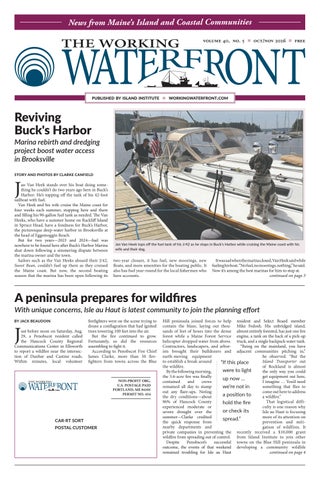
Jan Van Heek tops off the fuel tank of his J/42 as he stops in Buck’s Harbor while cruising the Maine coast with his wife and their dog.
two-year closure, it has fuel, new moorings, new floats, and more amenities for the boating public. It also has fuel year-round for the local fishermen who have accounts.
It was sad when the marina closed, Van Heek said while fueling his boat. “No fuel, no moorings, nothing,” he said. Now it’s among the best marinas for him to stop at. continued on page 3
A peninsula prepares for wildfires
With unique concerns, Isle au Haut is latest community to join the planning effort BY JACK BEAUDOIN
J
ust before noon on Saturday, Aug. 29, a Penobscot resident called the Hancock County Regional Communications Center in Ellsworth to report a wildfire near the intersection of Dunbar and Castine roads. Within minutes, local volunteer
firefighters were on the scene trying to douse a conflagration that had ignited trees towering 100 feet into the air. But the fire continued to grow. Fortunately, so did the resources assembling to fight it. According to Penobscot Fire Chief James Clarke, more than 50 firefighters from towns across the Blue
NON-PROFIT ORG. U.S. POSTAGE PAID PORTLAND, ME 04101 PERMIT NO. 454
CAR-RT SORT POSTAL CUSTOMER
Hill peninsula joined forces to help resident and Select Board member contain the blaze, laying out thou- Mike Fedosh. His unbridged island, sands of feet of hoses into the dense almost entirely forested, has just one fire forest while a Maine Forest Service engine, a tank on the back of a pick-up helicopter dropped water from above. truck, and a single backpack water tank. Contractors, landscapers, and arbor“Being on the mainland, you have ists brought their bulldozers and adjacent communities pitching in,” earth-moving equipment he observed. “But the to establish a break around Island Transporter out “ If this place the wildfire. of Rockland is almost were to light By the following morning, the only way you could the 5.6-acre fire was finally get equipment out here, up now … contained and crews I imagine … You’d need remained all day to stamp something that flies to we’re not in out any flare-ups. Noting come out here to address a position to the dry conditions—about a wildfire.” 96% of Hancock County That logistical diffihold the fire experienced moderate or culty is one reason why or check its severe drought over the Isle au Haut is focusing summer—Clarke credited more of its attention on spread.” the quick response from prevention and mitinearby departments and gation of wildfires. It private companies in preventing the recently received a $10,000 grant wildfire from spreading out of control. from Island Institute to join other Despite Penobscot’s successful towns on the Blue Hill peninsula in outcome, the events of that weekend developing a community wildlife remained troubling for Isle au Haut continued on page 4
2
The Working Waterfront . october / november 2026
www.workingwaterfront.com . April 2020
13
Bill to delay new right whale rules advances to Senate The legislation is backed by Maine lobstermen BY CRAIG IDLEBROOK
I
n August, the National Marine Fisheries Service announced it was planning to seek public input on the scope of new rulemaking for fisheries to protect the endangered North Atlantic right whale and other large whale species from fishing gear entanglement. If a new bill becomes law, the agency may decide to slow down that rulemaking process by some seven years. That’s because the U.S. House of Representatives passed a bill on Sept. 1 to extend a pause on new rules to protect right whales from entanglement. H.R. 9436 would extend that moratorium, which was due to expire Dec. 31, 2028, to Dec. 31, 2035. The bill, co-sponsored by Rep. Jared Golden of Maine’s 2nd Congressional District, a Democrat, along with Rep. Mike Lawler, (R-New York), received rare bipartisan support, with 10 Democrats crossing the aisle to vote alongside 209 Republicans in its favor. Another supporter was Rep. Chellie Pingree, also a Democrat, of Maine’s 1st district. The legislation likely will now go before the Senate. The administration of President Donald Trump previously said in a statement that he supports an extended pause in new regulations to protect the whales. In an interview with The Working Waterfront before the vote, Golden said that lobstermen had already done a lot to cut the risk of whale entanglement. New measures to protect the whales must also protect fishermen’s livelihoods, he said. “There is a limit to how many new regulations fishermen could actually adopt without just being put out of business outright,” Golden said. Proponents of the bill have also said the pause is necessary to allow NOAA Fisheries to complete a round of information-gathering and analysis of right whale behavior and interactions. That effort began as part of the late-2022 law that paused new fisheries rules to protect right whales until 2028.
A North Atlantic right whale mother and calf as seen from a research drone called a hexacopter. COURTESY: NOAA NORTHEAST FISHERIES SCIENCE CENTER/LISA CONGER AND ELIZABETH JOSEPHSON
In an earlier statement, Golden stated was in 2020, environmental advocates reflect the reality of risk on the water, and that’s not OK because there are that layoffs at NOAA and government characterize the recovery as fragile. Brogan argued that this bill short- some pretty hard-hitting economic shutdowns caused this informationcircuits the regional process of fisheries consequences to that,” said Patrice gathering to be delayed. Rep. Jared Huffman (D-California) management that brings stakeholders McCarron, MLA’s executive director. In 2023, the U.S. District of together to create consensus about the woodstove disagreed. Speaking on the House floor Bud John Martin, Staples, and Elsie Gillespie chat around at the annual townCourt meeting. Appeals for Washington, D.C. ultimately before the vote, Huffman said an exten- future policy. “Before we can even have the public sided with MLA, saying regulators must sion of the moratorium would reward the Trump administration for not process, have participation of conser- use “the best scientific and commercial faithfully following laws to protect the vationists and fishermen and scientists data available” in rulemaking. All eyes will now turn to the Senate and the experts across the board … whales and other endangered species. The administration has been “dragging they want to pause and extend this out on this issue. Golden did not directly say whether he had discussed the bill its feet, firing staff, axing science, and for another chunk of time.” The Maine Lobstermen’s Association with his counterparts in that chamber. deprioritizing ropeless gear—perhaps “I think it’s fair to say that the because they think Congress will bail (MLA) submitted a letter in favor of them out and kick the can a little further the bill, saying it will give regulators two senators from Maine care a lot time to get the information needed to about lobstermen in Maine, as well,” down the road,” Huffman said. Conservation groups have been put rules in place that can protect both Golden said. Those two senators, Republican vocal in their opposition to the bill, and the whales and the lobster industry. MLA sued the National Marine Susan Collins and independent Angus have launched campaigns for its defeat in the Senate. Gib Brogan, a fisheries Fisheries Service in 2021 to stop new King, both helped push through the campaign director for Oceana, charac- whale conservation regulations from 2022 legislation that delayed the right terized the legislation as an “extinction taking effect, arguing that regulators whale protections. Spokespeople for Collins did not bill” that will put the species in danger. were basing those rules on estimates of respond to a request for comment, as There are an estimated 384 North worst-case scenarios. “They filled in with some pretty of press time. A spokesperson for King Atlantic right whales in the ocean. While that number is 7% higher than it far-reaching assumptions that didn’t said he did not have any comment.
Levi Moulden
Support for coverage of the Future of Fishing is made possible by a grant from Gideon Asen. Bud Staples
Gerald “Punkin” Lemoine
G.F. JohnstonConsulting & Associates Civil Engineers Concept Through Construction
• • •
Regulatory permitting • • Land evaluation • Project management
Site Planning Sewer and water supply systems Pier and wharf permitting and design
12 Apple Lane, Unit #3, PO Box 197, Southwest Harbor, ME 04679 Phone 207-244-1200—
www. gfjcivilconsult.com —
www.workingwaterfront.com . october / november 2026 BUCKS HARBOR
continued from page 1 “I’m glad they figured it out,” he said. “These docks are fantastic; they’re among the best. Everything here is very nice.” The resurrection of the Buck’s Harbor Marina is just one part of the continuing efforts in Brooksville to maintain and improve basic services, such as fuel, and public access to the water that are needed for a thriving working harbor. Work is scheduled to get underway in late November or early December to dredge Betsy’s Cove, where the public landing and floats are now located. The dredging should take only a few weeks and a new pier should be built by next April, if all goes according to plan. When the dredging and new pier are completed, it will provide all-tide public access to the harbor, something that’s vital for fishermen such as Frank Peasley, who harvests lobsters and urchins. When unloading his catches of urchins, he has to wait for the tide to come in so he can bring his boat into the town landing float. As for lobstering, fishermen place their traps on the floats at low tide, but then have to wait for the tide to come in before they can bring their boat in to load the traps so they can set them for the season. “We can now do one load of traps a day, if everything works out well,” Peasley said. “Once the dredging is complete, we’ll be able to do two or three a day.” Mark Shaughnessy, chairman of the town’s Harbor Committee, said the value of a top-notch public landing that’s always accessible and a business such as Buck’s Harbor Marina are vital to the overall health of the community. “We need to preserve places for people to work. We can’t just be a retirement community and a summer community, we have to have a real community,” he said. “Keeping the working waterfront working is part of that.” The sudden closure of the Buck’s Harbor Marina at the start of the 2023 boating season jolted local and visiting boaters and fishermen. The marina was the only source of fuel between Castine and Stonington, had moorings, and was a good landing point for cruising boats.
Andrew MacArthur, a seasonal resident and president of a New York-based real estate investment and development company, bought the marina the following year. MacArthur’s family has had a home in Buck’s Harbor for three generations, and both his daughters worked at the marina in years past. It took a year to get the marina into shape before it could open. There’s a lot of work involved in installing a new 8,000-gallon fuel tank, putting in new floats, and expanding the marina’s fleet of rental power boats. They replaced all the moorings with new granite blocks and new chains; it now has about three dozen moorings, 10 of which are seasonal for transient boats. A pump-out vessel offers pump-out services to boats not only in Buck’s Harbor, but in the Benjamin River in Sedgwick and Center Harbor in Brooklin, farther up Eggemoggin Reach. The marina also has a small store with snacks, gifts, and beverages, along with marina facilities that include showers, restrooms, and a laundry. MacArthur also purchased the iconic Condon’s Garage building near the village center, which was made famous in Robert McCloskey’s 1953 children’s book One Morning in Maine. The garage is now being used for marine storage and as a place to restore dinghies and dories. Buck’s Harbor has a lot to offer boaters and the marina fills a major role. With the Buck’s Harbor Market, Buck’s Restaurant, and a newly opened coffee and ice cream shop a short stroll away, the town has plenty of other things to offer as well, said Tom Hollyday, general manager of the marina. When the marina reopened last year, many people gave thanks—“Thank God you’re open”—that it had been revived, he said. “This is a natural place to stop at the top of Reach,” Hollyday said. “It’s almost like providing access to a town.” When the marina closed for two years, fishermen coordinated with a local oil company to bring an oil truck to the dock at high tide and fill six or seven fishing boats that were lined up, but that could be done only at high tide. Sometimes high tide might be mid-morning, which pretty much messed up the whole day, Peasley said.
3
Tom Hollyday is general manager of Buck’s Harbor Marina in Brooksville, which has reopened after a two-year closure that highlighted the town’s limited public access to the water.
When the marina closes for the season, fishermen will be able to continue getting fuel in the winter months by punching in a code on the fuel tanks and filling up their vessels, Hollyday said. The cove dredging and public landing upgrades have been years in the making, but are now imminent after the town received a $900,000 federal grant this summer. That grant, coupled with state grants and a pledge by the town to spend up to $500,000 on the project, means work will commence in a couple of months, Shaughnessy said. The project will create a channel and turning basin 6-feet deep at mean low tide and result in the town’s first all-tide public pier. That’s a huge benefit for commercial fishermen, who now can’t work two hours on either side of low tide, he said. “There’s no place in Brooksville where you can access the shore at all tides, currently,” he said. “For a town with 50 miles of coastline, it seems not like a good thing. When the marina closed, it made everybody realize that there was no public access.” Boaters like Jan and Christi Van Heek are among those who fully appreciate what’s going on in town, especially the Buck’s Harbor Marina. “Just having it open again is fabulous,” Christi Van Heek said on the float next to their boat. “It’s one of my favorite places to come.”
NOAA adopts new Atlantic cod stock system The fish are now grouped into four populations across the Northeast BY CRAIG IDLEBROOK
F
or the first time, federal regulators have set catch limits for the Atlantic cod fishing season based on new rules that group the fish into four populations. The revised catch limits bulletin, which NOAA Fisheries published in early August, is the culmination of a long regulatory process to shift cod management from two populations to four. The populations are now grouped as eastern Gulf of Maine, western Gulf of Maine, Georges Bank, and southern New England cod. Previously, the cod were divided only into Gulf of Maine and Georges Bank populations. Ben Martens, executive director of Maine Coast Fishermen’s Association, said the shift should better align with what fishermen have long observed about cod behavior in the Gulf of Maine. “The cod stock structures that we have existed in for a long time, that wasn’t how they saw fish moving around,” Martens said. “A lot of energy was put into looking at genetics, talking to fishermen, trying to understand what the appropriate stock structures were, are, and should be moving forward.” Researchers and fishermen have long known there were more than two populations of cod off the coast of New England and Canada. A federal fisheries scientist published a study dividing the fish into four different populations in 1963, but regulators in 1972 elected to manage the fish as two populations.
The Atlantic cod numbers have collapsed in the last few decades and failed to recover despite restrictions to prevent overfishing. In Maine, annual cod landings peaked in 1991, reaching 21 million pounds before plummeting over the next decade and then more gradually declining, according to state data. Maine fishermen hauled in just 57,596 pounds last year, preliminary data show. Gib Brogan, fishery campaign director for Oceana, an ocean conservation advocacy organization, welcomes the shift to a four-population management system. He hopes it will give regulators the tools needed to manage the cod fishery on a more granular level. “We’re optimistic that these changes are going to make things better for cod up and down the coast,” Brogan said. The shift in management comes during a cod fishing season already in progress. The New England Fishery Management Council submitted its final draft of the change to the National Marine Fisheries Service in March 2025, but the Department of Commerce rejected it on procedural grounds and kept the two-population management system in place in the interim. NMFS finally approved the plan in late June. Jackie Odell, the executive director of the Northeast Seafood Coalition (NSC), was part of the NEFMC’s groundfish committee which agreed
to move forward with the four-stock management plan in 2024. The committee said that the plan represented the best available science, and that the plan had support from fishermen. However, Odell also has heard concerns from many fishermen about the plan’s implementation. The plan is being overlaid onto the existing sector management plan, where cod is mainly a bycatch to manage or avoid while they are pursuing other types of fish. This will create new quota and bycatch constraints for fishermen with fishing plans built around the two-stock system, Odell said. “It’s a multi-species fishery, and guys are constantly trying to stay within their bycatch limits so that they don’t have to purchase or lease more cod to cover catch of other stocks that then would make their trips potentially be economically not profitable,” she said. Odell believes that this shift in cod management may be the beginning step of a strategic rethinking of how to manage groundfish as a whole. She hopes any new plan can help New England’s beleaguered fishing industry stay viable. “There are always opportunities at crossroads for thinking it through strategically and trying to help the industry through this time and having a stronger fishery on the other side,” she said. “I am hopeful that that’s where we’re at, but we’ve lost a lot of people through the years.”
4
The Working Waterfront . october / november 2026
WILDFIRES
continued from page 1 protection plan to identify the risks and prioritize actions to reduce them. “We have a population of about 50 in the winter—roughly 250 in the summer—on an island 4 miles by 7,” Fedosh said. “Add to that we’re mostly forested, we have a fuel source, and it doesn’t take really any [forestry] background to look at all the dead trees standing and on the ground. We all fear the potential, what might happen if a wildfire started here.”
Changing climate, new risks
Prior to Isle au Haut’s participation, nine mainland communities had been working together to address climate resilience, energy efficiency, and greenhouse gas reduction. After successfully applying for grants to upgrade wastewater treatment facilities, salt-and-sand sheds, and conduct flood risk assessments, a group called Blue Hill Peninsula Forward turned its attention to another climate-related threat: wildfires. Admittedly, the Pine Tree state might not be the first place one thinks of when discussing wildfires. But Maine Forest Service ranger and fuel reduction coordinator Kent Nelson said it would be a mistake to discount the threat here. “We’re the most heavily forested state per capita in the nation,” Nelson points out. “And 78% of Maine’s homes are in the wildland-urban interface, compared to the U.S. average of 32%. So with all that vegetation growing and structures in these wooded areas, we do need to have these regional fire plans and work together to try to reduce the risk of home ignition from a wildfire.” A recent pattern of “flash” droughts is also heightening the risk in eastern Maine. While the state’s overall climate has grown wetter over the past decade, precipitation has fallen heavily in isolated storms separated by increasingly longer dry spells. Along the coast, where thin topsoil covers granite ledge, a lack of deep water storage has made conifer forests exceptionally sensitive to even three to four arid weeks. “When you get an even-age stand of spruce on a coastal island, it’s more susceptible to disease, and spruce are very shallow rooted, so they blow down,” Nelson said. “Our coastal islands—and a lot of the peninsulas— have a lot of what we call fuel loading.”
Nelson has been collaborating with Allen Kratz of Blue Hill Peninsula Forward on a regional wildfire protection plan funded by $250,000 in congressionally directed spending. The federal money has enabled the group to hire SWCA Environmental Consultants of Scarborough to develop a comprehensive strategy that includes: • An assessment of wildfire hazards and vulnerabilities. • Identification of assets at risk, such as homes, critical infrastructure, natural resources, and cultural resources. • Recommendations for reducing risk through vegetation management, home hardening, emergency preparedness, and public education. • Prioritized actions and implementation strategies. “The Blue Hill peninsula presents several interesting planning considerations,” said Arianna Porter, lead project manager in SWCA’s disaster and resilience division. “The peninsula includes a mix of forested landscapes, seasonal and year-round populations, historic village centers, working waterfronts, and transportation constraints associated with a coastal geography.” “Isle au Haut presents additional considerations because access is limited to boat and air transportation,” she added, “which can affect emergency response, evacuation planning, and the movement of equipment and personnel.”
From plan to protection
Kratz said SWCA will present the draft plan to the public at an Oct. 21 meeting in Blue Hill. Based on input from that event, he anticipates a final draft by the end of the year. “In January and early February, we will be going to the select boards for their review of the plan,” Kratz said. Subsequent adoption of the plan “will enable all towns to apply for implementation funding because FEMA has … a community wildfire defense grant program.” He expects the plan will provide each town with “things like community education, informing people about the nature of risk, what they can do to
SPEAK UP FOR MAINE’S COAST!
NOAA ’BOUT IT! The proposed federal budget would cut NOAA funding by $1.6 billion—putting critical programs that support Maine’s coast at risk.
LEARN MORE & TAKE ACTION at islandinstitute.org/NOAA
Stonington Fire Department Captain Seth Reece (right) and Penobscot firefighter Tom Allen apply water to a hotspot in the aftermath of an Aug. 29 wildfire in Penobscot. PHOTO: COURTESY MALLARY REECE
A wildfire erupted in the town of Penobscot on Aug. 29. PHOTO: COURTESY PENOBSCOT FIRE DEPARTMENT
create defensible space around their homes and other structures.” Another tangible benefit is raising a new level of awareness to the importance of firefighters, firefighting, volunteer departments, and mutual aid agreements. “Communities have found that it increases the uptake of volunteers,” Kratz said. “They also have an educational component in cooperation with the educational system, schools, and other places for community education.” Most important, from Nelson’s view, is that a strong and widely adopted protection plan leads to more funding to help communities like Isle au Haut prepare for the inevitable. He envisions funding to support “community chipping days” to reduce wood waste near homes, prepositioning cisterns for fire suppression, and cutting fire breaks around locations that commonly experience ignitions, such as transfer stations. “But the state, and local fire departments, can’t do everything,” Nelson
said. “There has to be some onus on the homeowner and it’s really not that hard. To keep your house safe from burning, just manage the vegetation within a hundred feet. People think that it’s just going to be a wall of fire that comes from the woods and burns their house down … But basically it’s just needles and leaves, what we call the fine fuels, that ignite really easily because they dry out after a rain event within an hour.” Whatever equipment and prevention strategies the plan introduces, Fedosh is sure it will be welcome on Isle au Haut. “If this place were to light up now,” he said, “we’re not in a position to hold the fire or check its spread.” Jack Beaudoin has worked as reporter, columnist and editor at the Journal Tribune, Portland Press Herald, Kennebec Journal and Maine Monitor, among other publications across the state. He lives in Stonington.
www.workingwaterfront.com . october / november 2026
5
Regulators weigh menhaden cuts
Harvesters following debate over fishery and Chesapeake Bay science considering whether to significantly reduce the tonnage caught. In 2025, ublic hearings will be held in regulators originally proposed cutting Maine and several other north- the allowable catch by as much as half, eastern states this September but ultimately cut it by 20% for a single to gather input on proposed changes fishing season. The coastal quota is divided by states in the management of the Atlantic menhaden fishery. The hearings come based on their historical catch totals, before a November meeting by the and is reconsidered periodically. States Atlantic Menhaden Management Board can ask for more quota room from of the Atlantic States Marine Fisheries other states, if needed. Virginia fishCommission (ASMFC) to finalize any ermen received 75% of the state-bystate quota, while Maine fishermen changes to the management plan. Many commercial seafood harvesters received 4.8% of the quota. The proposed changes in the are following the process out of concern that the menhaden fishery could face management plan come even as significant new restrictions. That regulators acknowledge that Atlantic menhaden currently includes in Maine aren’t overfished. where they are used ASMFC data shows as lobster bait. Some that the menhaden advocacy groups, mortality and repromeanwhile, are calling duction rates are Some advocacy for greater protection between the benchof the fish given their groups, meanwhile, marked threshold importance to other and the benchmarked marine species. are calling for target for long-term Menhaden are most greater protection sustainability. often caught to be But menhaden reduced to fish meal of the fish given numbers are not and fish oil, but they managed in isolatheir importance also are considered tion. Instead, they are an important forage to other marine managed as part of fish for striped bass, a bigger picture as a a valuable species for species. forage fish for striped sports fishing. In addibass, bluefish, and tion, the fish have been osprey, among other caught in increasing species. Striped bass, a numbers for bait, and focal species for reguare the third-most valuable fishery in Maine, according to lators to consider, are currently classipreliminary 2025 commercial landings fied as overfished by ASMFC. Regulators also cut the coastal allowdata from the Maine Department of able catch for the latest fishing season, Marine Resources. In August, menhaden fishery in part because it was discovered that regulators released a draft plan with scientists had substantially overestiproposed management changes in the mated the biomass of menhaden. While the Chesapeake Bay is a vital Chesapeake Bay, where a significant share of the coastwide menhaden fishing grounds for menhaden, there harvest occurs. Currently, fishermen is little data available specifically about are allowed to catch some 51,000 the fish’s reproduction and fishing metric tons in the bay annually for the mortality rates in the bay, says James Boyle, an Atlantic menhaden fishery fish reduction industry. The Chesapeake Bay quota is part management plan coordinator for of the total allowable catch of 186,840 ASMFC. Regulators work with the metric tons for the entire coastal information available about menhaden fishery. Among the proposed changes, and the species that prey on them to set the board can choose to reduce the quotas for the bay, he said. “The Chesapeake Bay cap is precaubay’s quota by as much as 50%, break up the quota into periods during the tionary,” Boyle said. “We don’t have fishing season, or tie quota changes to enough data right now to make an assessment that’s spatially explicit to the coastwide catch total. Separate from this, the board is just the Chesapeake Bay.” Broadly speaking, conservationpoised to set the allowable catch for the next one to three years, and is ists and recreational outfitters favor BY CRAIG IDLEBROOK
P
An Atlantic menhaden. PHOTO: COURTESY VIRGINIA INSTITUTE OF MARINE SCIENCE/NOAA FISHERIES
reductions in the total allowable catch and changes in the way the reduction fishery is managed in the Chesapeake Bay. The reduction fishery opposes changes to the bay management plan, while bait fishermen have spoken out in the past against a coastwide catch reduction. In October 2025, Patrice McCarron, executive director of the Maine Lobstermen’s Association, wrote a letter to ASMFC in opposition to a then-possible 55% reduction in the total coastal allowable catch, saying such a cut “would disrupt bait access and eliminate an important supplemental income stream for lobstermen during slow lobster periods.” In Maine, where menhaden have become an important source of lobster bait when herring are in short supply, state legislation was recently passed that eased some requirements for fishing them. Ocean Harvesters, which operates a Virginia-based fleet of vessels that catches some 156,000 metric tons of menhaden, believes ASMFC should not be making changes to the bay’s management plan without more data. Through a spokesman, the fishing company argued that ASMFC is setting policy without “a single shred of Bay-specific information” on the fish and is “moving forward based upon anecdotes”. In October 2025, the Menhaden Fisheries Coalition (MFC), of which Ocean Harvesters is a member, celebrated new scientific study efforts the Coalition says will fill in the
knowledge gaps about menhaden in the bay. However, conservationists call into question the impartiality of this research effort, and argue fishery management must work with the information on hand. Jaclyn Lunaas, a forage fisheries manager with the Theodore Roosevelt Conservation Partnership, said the Coalition has lobbied against funding for past research efforts to understand the impact of menhaden harvest on the bay. She added that enough is known about the Chesapeake Bay to know action is needed to maintain the health of menhaden and other species. “It’s a huge nursery area for the entire Atlantic coast,” Lunaas said. “And we’re just hammering the bay, and we’ve been hammering Virginia waters for decades on decades.” Lunaas argued that industries often call for more data when asked to consider conservation measures, but ocean fisheries management must work within the limits of what is known below the surface. To do otherwise is shortsighted for both conservation efforts and the industry, she said. “If they want to have a fishery for the next 50 years, they need to get serious about where the fishery is going,” she said. “We can’t just stick our heads in the sand.” ASMFC will host a virtual meeting on the proposed changes in menhaden fisheries management for interested parties in Maine, New Hampshire, Massachusetts, and Rhode Island on Sept. 29.
National Bank
D R EAM FIRST
A Division of The First Bancorp • 800.564.3195 • TheFirst.com Member FDIC • Equal Housing Lender
6
The Working Waterfront . october / november 2026
from the helm
A trusted voice on coastal issues Refining the art of delivering good news BY KIM HAMILTON
DOORSTEP DELIVERY of a newspaper is a lost art. I asked my husband about this recently. His first job was delivering newspapers at the crack of dawn in his neighborhood. Landing a newspaper properly folded in thirds on a porch within steps of the front door, while riding a bicycle, was the source of well-earned bragging rights. It’s difficult to draw parallels today as news is increasingly delivered seamlessly around the world to digital devices. No bicycles needed. Yet, while it’s speedier, the content of today’s news is a different story. There is little dispute that local news coverage has suffered. Finding well-reported local news amidst expanding news deserts and in a highly polarized world is hard work. And there is a real cost to small communities. Absent sustained, local journalism, it’s much harder for readers and listeners to make informed decisions about local budget tradeoffs or to take meaningful action to address the challenges facing their schools or the fate of the ferry service, community hospital, and volunteer fire department. This kind of local journalism helps community leaders and residents make smarter, confident decisions. Today it’s a scarce commodity.
In this context, Island Institute is we are also using online tools to make proud to deliver the best of community sure we meet everyone where they find journalism. For more than 30 years, their news—which is almost never on The Working Waterfront newspaper has their front doorstep. We’re also adapting our content. connected our readers to crucial, underYou may have noticed reported, and pivotal our new Waypoints stories. This commitment series, which transis at the heart of one of lates complex data into our strategic priorities: to … I envision this easy-to-understand be the trusted voice along newspaper as graphics. We have a the coast. new editor, Charlie We don’t seek sensaone of those Eichacker, and a new tional headlines. Rather, multimedia storyteller, we seek important stories forces that Madison McClintock. that reflect the full expebuilds, rather They bring exceptional rience of living on the new skills to our work. coast of Maine—from than erodes, We have also added economic- and climatecommunity media partnerships related challenges to and correspondents to the future of our fishing strength. our mix, ensuring that industry, the protection of this paper stays fresh, working waterfronts, and relevant, accurate, and, the livelihoods they foster. importantly, trusted. We also celebrate what At the same time, I’m keenly aware makes us unique, elevating the voices of keen observers who animate life on the that we are fighting distant forces well beyond our control that, nevertheless, coast in their columns and letters. To sustain our commitment to hit us directly. The timbre of national remaining the trusted voice on the discussions doesn’t foster trust in coast, we’ve evolved, just as quality any institution. The old economic journalism has done nationally. While models that sustained journalism we continue to distribute 35,000 copies have collapsed, stretching our budgets of our printed paper six times a year, further. The rise of myriad outlets and
other bespoke platforms has customized delivery while making a common conversation nearly impossible. In short, we’re losing the “unum” from “E pluribus unum”. As each issue of The Working Waterfront is published and the content shared more broadly, I am proud that we are doing our part to strengthen civic engagement and expand solutions on islands and in coastal communities. I think of the virtuous cycle and centripetal forces that hold us together, and I envision this newspaper as one of those forces that builds, rather than erodes, community strength. With each issue, we strive to earn your trust, and we are honored to give it a voice. While we don’t deliver each issue by bike, we hope we land it just as skillfully with the local content you value.
Kim Hamilton is president of Island Institute, publisher of The Working Waterfront. She may be contacted at khamilton@islandinstitute.org.
sweetest in the gale
A song of ice and floods
Reflecting on 500 million years of Maine’s natural history BY CHARLES EICHACKER
I’VE OFTEN wondered what it was like when glaciers carved out Maine’s coast and mountains. Did big tendrils of ice slowly creep down from the Arctic and cut through the local bedrock, like a knife through warm butter? Or was it the retreat of the ice sheets, as the planet warmed back up, that molded the landscape into its peaks, ridges, valleys, and offshore islands? This has been on my mind partly because I just celebrated my 40th birthday by hiking Katahdin, a 4,000foot mass of granite that forces you to consider its origins as you claw and sweat your way up it. More bleakly, as we heat up the planet, we’re now seeing some of the glaciers that survived the last ice age disappear, bringing disasters like the floods that just killed more than 1,300 people in Nepal. So I eagerly read a new book, The Rise and Fall of the Maine Coast, in which UMaine geology experts Joseph and Alice Kelley recap more than 500 million years of the region’s tectonic,
glacial, marine, and human history (full review on page 21). The glaciers, it turns out, did not fully shape what’s now Maine—the movement of the earth’s crust and volcanic activity played big, earlier roles—but they did a lot. They formed as the planet started to cool down 65 million years ago, due to several things, including the rise of the Himalayan Mountains, the migration of Antarctica to the South Pole, and the formation of the Isthmus of Panama, all of which helped change the flow of air and water over the planet. Changes in Earth’s orbit also played a role, limiting how much sunlight reached the planet. In what’s now Maine, falling snow packed into ice sheets more than a mile thick that acted like gravity-fed conveyor belts, depressing the earth, scouring away looser rock and debris, and depositing it far away. The glaciers eventually melted as the planet warmed back up, and the Kelleys devote the last part of their book to people, starting with the Wabanaki who arrived soon after this thaw started, followed much later by the Europeans.
I was struck by the theories those later settlers brought with them, like the 19th century scientific view that boulders strewn across New England fields were delivered not by glaciers, but by the global flood Noah survived on his ark. Perhaps it wasn’t such a crazy notion that a flood had once consumed the planet. Some 15,000 years earlier, the Atlantic Ocean had swept miles inland towards the Katahdin region, as the glaciers first melted and inundated the land before, freed of their weight, it could rebound to its present heights. And by that time the sea was again encroaching, as the Industrial Revolution was starting to fill the atmosphere with greenhouse gasses and begin a new phase of planetary warming. As the Kelleys note, this slowmotion, manmade deluge is now the biggest issue facing the coast. The challenge is even greater because some communities have come to depend on counterproductive infrastructure like seawalls and jetties to protect themselves from the ocean. “All coastal environments and their inhabitants must accommodate
this recent rate of sea-level rise or be drowned,” they write, in a message that echoes through the book. Maybe it’s natural that I’m now looking back on all this. Lots of aging men get into history. There was that meme a few years ago about the male obsession with the Roman empire. While I’m not there yet, I did make a point of taking in some Greek mythology this summer, watching from a reclining movie theater seat as Odysseus took on gods, witches, warriors, and monsters. It made me wonder what myths will be told about us, millennia from now. Did we sail closer to the six-headed beast that ate a few members of our crew? Or did a whirlpool sink our whole ship? Charles Eichacker is the editor of The Working Waterfront and Island Journal. He may be contacted at ceichacker@islandinstitute.org.
www.workingwaterfront.com . october / november 2026
7
ISLAND KIDS— A photographer on assignment for Sports Illustrated took this shot in 1958, during a yachting trip that may have included a visit to Mount Desert Island, according to Library of Congress records. Do you know the kids in this photo, or where it was taken? If you can share any memories, contact Editor Charles Eichacker at ceichacker@islandinstitute.org. PHOTO: TONI FRISSELL/COURTESY LIBRARY OF CONGRESS
the public’s policy
I support local journalism. Do you? Tax credits would help revitalize local news in rural Maine BY NICK BATTISTA
LOCAL JOURNALISM helps maintain a strong foundation for our democracy. If public figures know their actions may be scrutinized and shared, they are more likely to act appropriately. Your ability to participate in government— whether by voting on local issues or on candidates for office—is enhanced when someone shares the details of what is happening. If you see your neighbors volunteering or helping to solve an issue, you may be more likely to act. Beyond helping create a well-functioning society and an accountable government, for those who work on policy issues, one of the best-kept secrets to doing good policy work is to read the newspaper. In addition to getting good information and stories, by being a regular reader, you start to pick up on trends, emerging issues, what is gaining momentum, and how public sentiment may be shifting—all important for doing policy work. A couple of weeks ago, I had just set down the latest copy of the Midcoast Villager when one of my Island Institute colleagues sent me information about a policy change adopted by some states to support their local newspapers.
Island Institute Board of Trustees
Nationally, local newspapers and journalists are in decline. In the last 25 years, the U.S. has seen the number of journalists per 100,000 residents drop from about 40 to eight, according to national research by Muck Rack. This isn’t just a national trend; while Maine has some excellent local news sources, coverage is patchy at best. Some Maine counties, such as Sagadahoc, Somerset, and Waldo, are well below the national average and rank in the bottom third of counties nationally. In better news, Hancock leads Maine in local journalists per capita and is ranked 223rd out of 3,141 counties nationally. One way other states have begun to address the challenge of limited local journalism is by making it easier for news outlets to dedicate staff to this important coverage. These policies focus on both supporting the hiring of new journalists and retaining existing local journalism jobs. This happens through the tax code—with a tax credit for hiring local journalists and a separate, smaller job-retention credit. The job retention tax credit is valued at $20,000 per journalist for the first five positions, then drops to $15,000 per additional journalist. This provides more support to smaller, independent media outlets that tend
Doug Henderson, Chair John Conley, Vice-Chair Michael Boyd, Clerk Shey Conover, Chair of Programs Committee Bryan Lewis, Secretary, Chair of Philanthropy and Communications Committee Michael Sant, Chair of Governance Committee Katherine Vogt, Treasurer, Chair of Finance Committee Robert Baines Pamela Baker-Masson Sebastian Belle Des Fitzgerald Christie Hallowell Kristin Howard Pat Keliher Nadia Rosenthal Mark Rodrigues Michael Steinharter John Bird (honorary) Tom Glenn (honorary) Joe Higdon (honorary) Bobbie Sweet (honorary) Kimberly A. Hamilton, PhD (ex officio)
to cover important local issues and often face some of the most significant financial hurdles. The new hire tax credit is a onetime credit worth $15,000 for each additional journalist added to the newsroom’s headcount. Tax credits are beneficial because they directly offset tax liability—$1 in tax credits is $1 you don’t have to pay on your taxes. Allowing the credit to be claimed by entities with tax liability as well as those with limited or no tax liability is key to how this policy supports local news in smaller, more rural communities. In tax policy terminology, this means the credit is refundable. Whether the news outlet is a small business that doesn’t turn a profit or a nonprofit, all of our news organizations provide an important public service and should benefit from the tax credit. A couple of important tax policy provisions make these ideas more effective. These credits are stackable—meaning that in the first year of a new hire, the news outlet would benefit from both the retention and new-hire tax credits. The credits are platform-neutral—so while I talk here about local newspapers, they apply to other forms of journalism as well.
THE WORKING WATERFRONT
Published by Island Institute, a non-profit organization that boldly navigates climate and economic change with island and coastal communities to expand opportunities and deliver solutions. All members of Island Institute and residents of Maine island communities receive monthly mail delivery of The Working Waterfront. For home delivery: Join Island Institute by calling our office at (207) 594-9209 E-mail us: membership@islandinstitute.org • Visit us online: giving.islandinstitute.org
They are content-neutral, meaning any news outlet that meets certain objective standards qualifies. This is important because it removes any temptation for government officials to evaluate the “quality” or viewpoint of the news source. Organizations controlled by 501(c)4 political organizations are not eligible. Other states that have moved forward with this kind of approach include Illinois, New York, and New Mexico. In Illinois, during the first year the credits were in effect, $4 million in credits were claimed, supporting 260 journalism jobs across 120 outlets. Two-thirds of the recipients of these funds were news organizations with six or fewer journalists. Maine would be well served by adopting these tax credits and providing strong support for local journalism. Nick Battista is chief policy and external affairs officer for Island Institute, publisher of The Working Waterfront. He may be contacted at nbattista@islandinstitute.org.
EDITOR: Charles Eichacker
ceichacker@islandinstitute.org
Our advertisers reach 35,000+ readers who care about the coast of Maine. Free distribution from Kittery to Lubec and mailed directly to islanders and members of Island Institute, and distributed monthly to Portland Press Herald and Bangor Daily News subscribers.
To Advertise Contact: 386 Main Street / P.O. Box 648 • Rockland, ME 04841 The Working Waterfront is printed on recycled paper by Maine Trust for Local News. Customer Service: (207) 594-9209
Charles Eichacker ceichacker@islandinstitute.org (207) 535-9305
www.WorkingWaterfront.com
8
The Working Waterfront . october / november 2026
letters to the editor Covering climate change In response to Editor Charles Eichacker’s column in the AugustSeptember issue about a decline in media coverage of climate change and plans to keep covering it in The Working Waterfront Dear Charles, Your article was very timely, in that since the current administration took office, the focus on climate change, the existential crisis of our lives, has been nullified. We are not screaming loud enough. We need to analyze why people may not think it’s a serious problem, and we need to get people to vote as if their lives depend on it, because it does. I proposed to a state climate council that they should produce a simple trifold document about climate change and what we can do about it, and send it to every Maine resident. Often I hear, “Well, what can I do?” Simple steps, ways to volunteer, education, could all go on a brochure like this. The lake where our camp is has had an algal bloom for the past three summers. It is shallow, and the excessive heat tips the balance in addition to other issues. Sometimes I feel like those of us who take action
are crying in the dark. We want a livable world left for our children and grandchildren. Thanks for your focus on this very important issue. Liz Manduca Portland
Bad things happen to good people In response to a piece North Haven columnist Courtney Naliboff wrote in the August-September issue about her diagnosis and treatment of breast cancer. Dear Working Waterfront, I learn a lot from your articles. I have two grandchildren who lobster for a living. I have never met Courtney Naliboff. I always enjoy her cheerful articles in The Wind and The Working Waterfront. She is very brave. She is a facing her health problems with love, strength, and with loved ones. We know bad things happen to good people. Island living is a special place. I also admire Eva Murray [a writer and year-round Matinicus Island resident]; she should run for president. Donna Fifield South Thomaston
Insurance for your home and your business. Ask Allen. We’re here to help!
(207) 236-4311 | AllenIF.com
Data for the people In response to The Working Waterfront and its publisher, Island Institute, recently launching a new series of Waypoints data spreads in this newspaper. Kudos to Island Institute on relaunching Waypoints! Having accurate and timely data—not always easy to come by for islands—will undoubtably remain critical for the Institute’s programs, particularly your critically important storytelling to the outside (non-island) world. A decade ago, your original initiative was an inspiration for the Great Lakes Islands Alliance (GLIA) when we formed. I am hopeful that one day GLIA will have a similar data/indicators program to underpin our programming. We look forward to continued learning and sharing between our regions! Matt Preisser GLIA Coordinator The Working Waterfront accepts letters to the editor of 250 words. Send them to Editor Charlie Eichacker at ceichacker@islandinstitute.org. Longer opinion pieces should be approved by the editor before being sent.
Maine Blue Economy Week highlights $6.8B ocean economy MAINE BLUE Economy Week will bring more than 250 entrepreneurs, investors, researchers, students, policymakers, and marine-sector leaders to Portland this fall to focus on growth opportunities in the state’s $6.8 billion ocean economy. The three-day event will take place Sept. 30 through Oct. 2 at Holiday Inn by the Bay in Portland. Programming will focus on ocean innovation, investment, entrepreneurship, workforce development, and sustainable growth across Maine’s ocean and coastal economy. It’s presented by Gulf of Maine Research Institute, University of Maine, Bigelow Laboratory for Ocean Sciences, and Northeastern University’s Roux Institute, with state support. Maine’s ocean economy supports more than 90,000 jobs and spans many industries. Attendees will take part in panel discussions, breakout sessions, startup spotlights, an exhibitor showcase, a demo event, networking opportunities, and organized field trips. Learn more at: www.maineblueeconomyweek.com.
www.workingwaterfront.com . october / november 2026
9
essay
Ask not what this island can do for you A plea from a Vinalhaven summer resident turned year-rounder BY BANNER MOFFAT
I WAS A Summer person for 63 years and now I’ve lived on Vinalhaven year-round for seven. I am surprised, amused, and sobered by how my view of summer people has evolved since retiring here. Don’t worry, any summer people reading this; it’s not all bad. Summer people come in different flavors. For most of those 60 years I was the kind who came for a couple weeks, stayed in a family house dazed by the natural beauty of the island, and enjoyed relaxed gatherings in the cove and picnics on nearby beaches. Vinalhaven was a magical place seemingly too perfect to be real. I’d fill my camera and try to soak up every detail in my head to bring home. Vacationland. The way life should be. I have come to realize I was not the best kind of summer person. Not a bad person, exactly, but not the best. I thought little of what it takes—the work, the care, the volunteers, the decisions, the money, the government—for Vinalhaven to be what it is: a community. A lot of what visitors love is here thanks to volunteers, hard work, and donations. Some summer people really do know the island. Some spend a big chunk of their time helping the library, picking up roadside trash, maintaining trails, organizing public events, being on town boards, helping the medical center, advising or fundraising for any of the many nonprofits on the island. Many summer people donate money to local groups. A few donate a lot. One summer person recently left over a million dollars to island organizations in her will. Some have donated anonymously for decades and hardly anyone knows about it.
Most summer people don’t do any of that. They come and go with a smile on their face and a serene indifference to the complex community they are enjoying. That indifference can be a little annoying. Many are here for a week or two of cocktail parties, picnics, a lunch in town, and then are gone. They may help local business a little, but Vinalhaven is like a resort for them. Vinalhaven is not a resort. It is a community. It runs on volunteers. The town government alone has over 90 volunteer positions in all the committees, boards, and commissions that help the Select Board and town manager do their job, not to mention the fire department and the ambulance! There are always too many vacancies. It’s a struggle sometimes just keeping the island running. The many nonprofits on the island use at least that many volunteers (many of them summer people): Meals on Wheels, Fuel Fund, Celebration Committee, Island Village Childcare, Eldercare Services, Community Outreach, Community Development Partnership, Historical Society, Food Pantry, Land Trust, Housing Initiative. I could go on. Once you become aware, your attitude towards the summer person who only sees the island as an escape, a blissful paradise, changes. You view those who breeze in and breeze out—while the rest of us help keep the show on the road—differently. And the summer people who don’t contribute but who complain: you are on thin ice. “The cashier was rude to me.” “I was only two minutes late and a rude ferry person sent me to the end of the line.” “Why can’t they be open every day?” “The medical center is a joke.” “No one in the town office could help.” There will always be things to complain about, but if you are
Carvers Harbor in Vinalhaven is seen here in 2024. PHOTO: JACK SULLIVAN
enjoying the island without contributing, you might be making a bad impression. (And just paying taxes is not enough.) “Ask not what this community can do for you. Ask what you …” You know the rest. Every spring I do look forward to seeing the many friends who come for some or all of the summer. They are good people and wonderful, but after living here year-round for seven years, I can’t help seeing everyone through a filter: How well do you know and understand the island? Do you sometimes help the island? Do you contribute? If you don’t, I understand; I used to be like you. But now I know better and maybe now you do, too. If you do help, if you contribute in any way no matter how small, you get a lot of “brownie points” in my book. Banner Moffat moved full-time to Vinalhaven in 2019 after working as a code enforcement officer in California. He has served on the island’s Planning Board and Budget Committee, and tries to help in other ways.
SardineFest returns to Penobscot Marine Museum Penobscot Marine Museum in Searsport will hold SardineFest on Saturday, Oct. 3, from 10 a.m. to 4 p.m. The free, day-long event celebrates Maine’s sardine industry and the working waterfront communities connected to it. The day will feature live music, talks, a children’s stage, crafts and games, and a sea life touch tank with Herring Gut Coastal Science Center. Visitors can sample sardines and other offerings, talk with exhibitors, visit the Sardine Craft Exhibition Hall, and meet champion sardine packer Rita Willey. Museum exhibits and demonstrations will be open throughout the day. Speakers will give talks on the history of running a cannery, the culinary history of sardines, the final days of the industry, its impact on Belfast, and the restoration of “Big Jim,” the 40-foot fisherman statue featured in Sardineland, the museum’s exhibit exploring the people, places, and stories behind Maine’s sardine canning industry. A full schedule and event details can be found at PenobscotMarineMuseum.org.
Attendees make crafts during the 2025 SardineFest hosted by Penobscot Marine Museum in Searsport. PHOTO: COURTESY PENOBSCOT MARINE MUSEUM
Advertise in The Working Waterfront, which circulates 35,000 copies from Kittery to Eastport six times a year. Contact Charles Eichacker: ceichacker@islandinstitute.org
G ener al & Marine C ontr aCtor D reDGinG & D oCks 67 Front s treet, roCklanD, Maine 04841 www. proCkMarineCoMpany. CoM tel: (207) 594-9565
10
The Working Waterfront . october / november 2026
op-ed
Self-congratulation won’t help Maine’s future fishermen Looking back at 50 years of federal fisheries management BY ROBIN ALDEN
IMAGINE: rules for conservation that instead have fostered depletion of keystone species and transferred the rights to use that system to just a few owners. Does this sound like success? Or justice? A self-congratulatory press release by the National Oceanic and Atmospheric Administration recently heralded the 50-year anniversary of federal fisheries management, “conserving marine resources while supporting fishing communities and a vibrant U.S. seafood economy.” Here in coastal Maine towns, however, many might greet the milestone with a bumper sticker: “National Marine Fisheries Service: Destroying fishing communities since 1976.” Why the discrepancy? The bumper-sticker sentiment is far more than just whining: federal management has been devastating for two primary Maine fisheries. The state’s storied cod landings have gone from over 9 million pounds in 1977 to 75,000 pounds in 2024, less than 1% of what it was in 1977. In eastern Maine, the groundfish fishery collapsed in the early 1990s and has not rebuilt in 30 years. The herring fishery, the forage fish at the base of the Gulf of Maine food chain, is now 20% of what it was then, when it was already depleted after years of overfishing by the foreign fleets. Region-wide, the track record is virtually the same. The loss of fish has transformed Maine’s fishing communities now and for the future. As populations fell, federal rules turned fish in the ocean into private property. Like giving public lands in the American West to farmers who staked claims in the 1800s, a share of virtually every future cod, haddock, flounder, hake, pollock, and other groundfish species was given to boat owners based on what they caught during a specific period in the early 2000s, well after fish collapsed off much of the Maine coast. This approach, dubbed “catch shares,” had long been advocated by economists and environmental groups as a way to allow flexibility and foster stewardship. (“If you own it, you will take care of it.”) Only a handful of Maine-based boats got shares and have survived this system, with help from nonprofits. They often have to lease fish quota from share owners ashore to complete trips. The infrastructure for handling groundfish in the state has atrophied. And if groundfish rebound, it’s unlikely that the small-scale owner-operators in the lobster fishery who would like to diversify will be able to buy into the system.
A tragedy
In reality, the last half-century of fisheries management is a tragedy still unfolding: good people on all sides trying to figure out the restraint that will allow a healthy marine system
… if groundfish rebound, it’s unlikely that the smallscale owneroperators in the lobster fishery who would like to diversify will be able to buy into the system.
Lucas Feener, a sternman on the boat of Spruce Head lobsterman Bob Baines, replaces bags of menhaden bait during a day of hauling in late July. PHOTO: CHARLES EICHACKER
and healthy fishing communities— and becoming more polarized as the failures pile up. Never has management been more important. And never has it been more urgent to face the failures and learn from them. Our plastics and synthetics, our powerful diesels, and our sonar and electronics that now let us see the bottom and see the fish. The climate is changing. As the saying goes, “We have declared war on fish … and won.” Maine’s fishing communities hang in the balance. In 1976, the smart choice seemed to move conservation from a local to a national scale. The Fishery Conservation and Management Act, later called the Magnuson-Stevens Act, was one of the sweeping environmental laws of the 1970s, alongside the Clean Air and Clean Water acts. In addition to excluding foreign fleets from U.S. waters with the 200-mile limit, Magnuson established fisheries management at the federal level for the first time and required that management be science-based. It created an entirely new system of collaborative decision-making through eight regional councils. Ever since, Maine has participated in the New England Fishery Management Council, which covers the coastal states from here to Connecticut.
What’s the problem?
Magnuson was written when fisheries science was shifting from observational ecology to a new, single-species, quantitative approach: Scientists count the cod, tell fishermen how many to catch, and thereby, supposedly, achieve a predictable stock level for cod, and do it again, species by species. This quantitative approach became more
rigid after the 1996 reauthorization of Magnuson as the Sustainable Fisheries Act, when the environmental lobby inserted a legal requirement that each species individually be rebuilt within 10 years. Federal scientists and managers are now legally required to predict and produce outcomes. In reality, though, that kind of control by adjusting catch rates is a delusion, aside from the certainty that catching all the fish will crash the stock. Fifty years of federal fisheries science has developed inside this straitjacket, working to improve the surveys, the landings accounting, and the models, incorporating variables such as climate change, trying to make the prescriptions for each species result in the desired outcome. “It is a story of hubris,” a top federal fisheries scientist told me. Meanwhile, other marine science has moved on. Stunning advances have been made in the study of currents, ocean chemistry, plankton, larval life stages, and fish behavior. Now it is known that fish, even herring, have local population structure. Large fish teach younger fish where to feed and migrate. Big old fat, fecund, female fish (BOFFFFs) are vital to populations. Foraging differs at life stages and in different locations. This is a system, not a collection of discrete juveniles and adults of each species to be counted like atoms in a physics lab experiment. The interactions and the challenges are bewildering. No wonder then that in the 1970s the simple, predictive models seemed to be the only way to try to get a handle on fisheries. I was initially a huge fan of Magnuson and the council system and served two terms on the New England council.
Another way
With so many interactions among species, physical parameters like currents and temperature, and human factors, it’s proven impossible to predict the outcome of a given change as Magnuson requires. Prediction problems are not unique to fisheries. A new science has grown out of quantum physics and the development of computers. Complex adaptive systems theory (CAS) is an alternative way to cope with—not control—complex natural systems. Complex systems are not ungovernable. They have order, built from the bottom up, like the local populations of cod and herring within the larger population. That order, at multiple scales, is what makes the system so productive. Management’s task should be to protect that order. This is exactly the path Maine took with its lobster laws. Protect juveniles and large breeders. V-notch breeders. Limit technology to traps only. Limit the geographical mobility of lobstermen. Don’t privatize the lobsters; create an apprentice-based entry to mimic traditional practices. Require owneroperator. And create elected councils of lobstermen who can become partners with state scientists and managers. When Elinor Ostrom won the Nobel prize in economics for identifying principles for successful governance of CAS, she cited Maine’s lobster laws. Humility not hubris. Investing in local stewardship and shared learning instead of lawsuits. We can only dream. Robin Alden is a former Maine commissioner of marine resources and a founder of both Commercial Fisheries News and the Maine Fishermen’s Forum.
www.workingwaterfront.com . october / november 2026
11
Lobstermen compete to collect most v-notches The Billion Egg Challenge highlights long-held conservation practice BY CHARLES EICHACKER
T
eams of Maine fishermen spent the summer competing to collect the most notches from the tails of female, egg-bearing lobsters. Called the Billion Egg Challenge, the contest was an industry-led effort to draw attention to v-notching, a long-established practice that helps conserve the species by making it easier to recognize egg-bearing lobsters that are illegal to keep and important to sustaining the population. By mid-September, with just over a week left to go in the challenge, the team known as Southern Maine Future Catch (representing lobster zones E, F, and G) was leading the race with more than 27,800 notches collected. Trailing them were the Downeast Tail Pinchers (zones A and B) with over 23,500 notches, and the Midcoast Notchmen (zones C and D) with over 20,800. The contest was due to end Sept. 25, which is National Lobster Day. The light-hearted competition would earn the winning team bragging rights as well as a trophy. Followers were invited to donate or pledge their support to a particular team and, if that team won, earn the chance to win prizes including a year’s worth of lobster. After v-notches are cut from the tails of lobsters, fishermen release them
back into the water to ensure they produce more eggs in the future. The contest was organized by the Maine Lobster Community Alliance and Maine Lobstermen’s Association. It was meant to celebrate the conservation practice and remind lobstermen why it’s important, according to MLA Executive Director Patrice McCarron. The goal was for fishermen to collect a total of 100,000 notches, each one equating to 10,000 eggs that an average female lobster can carry during its life, for 1 billion total eggs. By Sept. 14, organizers calculated that more than 600,000 eggs had been protected through the new v-notches, meaning the teams would need a final surge to reach the goal by Sept. 25. During a day of hauling in late July, longtime Spruce Head lobsterman Bob Baines and his sternman, Lucas Feener, collected about 5 first-time notches, along with a few re-notches of lobsters whose previous ones were disappearing. They collected the notches in a small glass jar provided by the organizers. Baines is a board member of Island Institute, which publishes The Working Waterfront. “That one I just re-notched, that’s a shedder,” Baines said after sending one back. “Odds are it’ll egg out.” He added, “That’s what we’re trying to encourage everyone to do.”
The Working Waterfront is growing its digital presence. You can now regularly find our stories and images on Instagram. That’s on top of our long-running website, e-weekly newsletter, and Facebook page.
FOLLOW US!
Spruce Head lobsterman Bob Baines cuts a v-shaped notch in the tail of a female lobster during a day of hauling in late July. PHOTO: CHARLES EICHACKER
Even if lobstermen don’t reach the target of 1 billion eggs by Sept. 25, McCarron called the contest a “great success” and said they’d keep working towards it later in the season. “We are creeping up on the goal and will be close when the competition wraps,” McCarron said. “It’s up to the
run of lobsters—if they get a big run of eggers we may make it, but it takes time to come across those lobsters.” Charles Eichacker is the editor of The Working Waterfront and Island Journal. He may be contacted at ceichacker@islandinstitute.org.
A partner to New England’s farms and fisheries. We’re a bank that understands your organization’s seasonal cash flow and unique financing needs. Use code WWF to receive $100 to mission-aligned organizations when you open a new personal or business checking account.*
JOIN US!
@theworkingwaterfront
FULL INVENTORY READY FOR YOUR WATERFRONT PROJECTS! • • • • • • •
Marine grade UC4B and 2.5CCA SYP PT lumber & timbers up to 32’ ACE Roto-Mold float drums. 75+ sizes, Cap. to 4,631 lbs. Heavy duty HDG and SS pier and float hardware/fasteners WearDeck composite decking Fendering, pilings, pile caps, ladders and custom accessories Welded marine aluminum gangways to 80’ Float construction, DIY plans and kits
Delivery or Pick Up Available!
Visit www.waldenmutual.com to learn more. *Choose an incentive (up to $100 in value) when you open a new Spend Local or Spend Local Business account and fund it with a minimum of $100 within 30 days of opening. Incentive will be delivered within 60 days of account opening and funding. This may be reported on IRS Form 1099INT or 1099-MISC; consult your tax advisor. © 2026 WALDEN MUTUAL BANK. MEMBER FDIC.
(207) 772-3796
www.customfloat.com
The Working Waterfront . october / november 2026
I N F O R M I N G
T H E
F U T U R E
O F
M A I N E ’ S
COA S T A N D
I S L A N D S
Waypoints is part of Island Institute’s effort to gather data and share stories that spur action and provide decision-making support to community leaders. Like the waypoints on a journey or map, thoughtful interpretations of data and science provide navigation points toward community-led solutions.
Drought Maine Drought Status
Maine has been experiencing drought since the summer of 2025, and this summer, with above average temperatures and below average precipitation, several coastal Maine counties moved from moderate to severe drought.
Data valid from U.S. Drought Monitor as of September 8, 2026 None D0 (Abnormally Dry): 23% D1 (Moderate Drought): 61% D2 (Severe Drought): 16% D3 (Extreme Drought) D4 (Exceptional Drought)
As of September, moderate or worse drought now affects
90% of Maine residents.
Data Source: The U.S. Drought Monitor is jointly produced by the National Drought Mitigation Center (NDMC) at the University of Nebraska-Lincoln, the United States Department of Agriculture, the National Oceanic and Atmospheric Administration (NOAA) and the National Aeronautics and Space Administration. Map courtesy of NDMC. It can be found at: droughtmonitor.unl.edu
PRECIPITATION TRENDS
Over the short term, Maine has been drying up. 2023 was an extremely wet year, but total annual precipitation in Maine has declined since then. Precipitation over the last year is 9-14 inches below normal across most of southern, coastal and eastern Maine, 60 and as much as 17.6 inches below normal Downeast.
50
Maine Statewide Annual Precipitation, 1895-2025 64
Precipitation (inches)
Over the long-term, Maine has received more annual precipitation, but climate change is causing more extreme weather events. When comparing recent annual precipitation to a century ago, Maine receives about 6 inches more per year on average, and heavy precipitation has become more common. Overall since the 1950s, we now see 2-3 more days per year with over 1 inch of precipitation and 1-2 more days with 2 inches or more.
46 40 34 1920
1935
1950
1965
1980
1995
2010
2025
Maine Statewide Annual Precipitation, 2023-2026 60
2023
50
10
10
on record dating back to 1871.
0
0
2nd driest July
1905
Data Source: NOAA National Centers for Environmental Information (NCEI, 2026).
The Portland Climate Station reported 0.63 inches of precipitation for July, making it the
20
Linear trend
52
40 30
Annual precipitation
58
28 1890
Precipitation (inches)
12
2024 2025
40
2026
30 20
Jan
Feb
Mar
Apr
May
Jun
Jul
Aug
Sep
Oct
Nov Dec
Data Source: NOAA NCEI, Climate at a Glance: Statewide Time Series, published August 2026.
Jan FebMarch AprilMayJuneJuly August September October November December
www.workingwaterfront.com . october / november 2026
IMPACTS Streamflows, lake levels, and seasonal wetlands are below normal or worse across the state. Groundwater recharge continues to lag, with dry wells being reported. Farmers are needing to expand irrigation due to reduced soil moisture, pasture growth has stalled in many areas, and severe dryness is triggering premature leaf drop in some maples and wild apple trees.
Groundwater
Groundwater Conditions at Brunswick Monitoring Station
Groundwater is one of the slowest indicators to respond to and recover from drought. The rapid onset of drought in August 2025 drove groundwater in parts of Maine to record lows, and rainfall deficits in July and August 2026 continue to result in much-belownormal groundwater conditions.
Daily field measurements September 5, 2023-September 4, 2026
Depth to Water Level (feet below land surface)
26
More than half the state
Wells across Maine are significantly below average. Groundwater gauge data at multiple locations relies on private are reporting conditions at or wells as of 2023. near record lows. The Brunswick groundwater monitoring station, the longest standing station (dating back to 1958), is doing relatively well compared to other USGS stations in Maine, yet it has been below mean monthly levels since November 2025.
Daily median, 1979-2026
27 28 29 30 31 Dec 23
Jun 24
Dec 24
Jun 25
Dec 25
Jun 26
Data Source: ME-CW26 Brunswick, Maine, USGS (data from spring/summer 2026 may be provisional)
Soil Moisture
Near-surface soil moisture (top ~4 inches) is very dry and deep soil dryness (down to ~39 inches) has worsened over the summer. Soil particles this dry have reduced “wet-ability” and begin to repel water, reducing infiltration. In these dry soil conditions, intense storms can be less effective for aquifer recharge than stratiform rain events, as the heavy rains create more runoff than infiltration.
Fire Danger as of 9/15/26
Wildfire Risk As of September 8,
over 81%
of the continental U.S. was abnormally dry with 59% experiencing drought conditions.
Wildfire risk in Maine is low compared to the national average, but drought does increase risk. In 2026, Maine has been experiencing normal to slightly elevated fire activity, with an uptick starting in August. Last year brought the most active August on record, but improvements in detection and suppression have led to a 97% decrease in area burned since the early 1900s.
AIR QUALITY: Maine experiences adverse effects from wildfires burning elsewhere. In mid-July smoke plumes from Canadian wildfires led to declines in air quality in Maine.
OUTLOOK 2026 2025 2024 2023
Without persistent, widespread soaking rains, the standard late-summer/fall seasonal groundwater drawdown will cause drought conditions to persist or expand. NOAA’s Climate Prediction Center’s season outlook for Sept-Nov. 2026 slightly favors below-normal precipitation and above-normal temperatures, not the 15+ inches of rain needed along the coast to end the drought in the next two months. A very strong El Niño event is predicted for fall and winter 2026-27. El Niño’s influence on the northeast has historically led to warmer, wetter winters, which could help with drought recovery, particularly along the coast and in central Maine where the shallow ground frost would aid groundwater recharge.
Precipitation needed to end drought conditions in two months
11" und ormal o r A of N 35%
1
14" und ormal o r A of N 50%
1
.5" d 15 mal n u Aro of Nor % 160
Data Source: NOAA’s NWS Caribou Office, as of Sept. 3
Data Source: Maine Forest Service Wildfire Danger Report, mainefireweather.org
Stay Informed
Follow the University of Maine’s “Maine Mesonet” project, a network of 26 new weather stations currently being installed across Maine’s 16 counties, prioritizing agricultural hubs. The Maine Drought Task Force is initiated by the Maine Emergency Management Agency and the U.S. Geological Survey when abnormally dry conditions in Maine escalate. The task force was reactivated in September 2026, and reported on drought conditions, reservoir levels, precipitation, temperature forecasts, drinking water impacts and environmental and agricultural impacts. Latest online resources from the task force: www.maine.gov/mema/hazards/drought-task-force Report a dry well here: maine-dry-well-survey-maine.hub.arcgis.com
13
14
The Working Waterfront . october / november 2026
Ephemeral sweetness Lessons in light from Monhegan Island PHOTO ESSAY BY MADISON MCCLINTOCK
A
s a visual storyteller and a new resident of Maine, originally from coastal California, I have spent my first year completely absorbed by this state’s rugged beauty. Walking the dirt roads of Monhegan Island for the first time, I felt I was stepping into one of the most uniquely striking communities in the United States. On Monhegan, the ecosystem of a glacially carved island meets the cold Atlantic not in a gradual slope, but in a deliberate, dramatic fashion. The water is so clear that the ocean floor is entirely visible from the wharf—the community’s central lifeline—and looks even more breathtaking from a drone flying 350 feet in the air. My initial sense was that Monhegan was a place of profound contrast between raw wildness and rich community, before I recognized how seamlessly they harmonize. At dawn, a brilliant sunrise scatters light across the eastern cliffs where gulls nest, safely contained within the 70% of the island protected by a wildlands trust. By evening, a warm sunset washes over the historic buildings and quiet harbor on the community side. While Monhegan is undeniably idyllic, life 12 miles offshore demands deep respect. Spending time with year-round residents is a powerful reminder to relish the ephemeral summer season— its sweetness accentuated by a long winter with its challenges but also its own quiet delights. As I imagine year-round life out there, a summer sunset on Fish Beach and a warm breeze offer a golden reprieve, serving as a reminder that this moment is temporary before the realities of four-season island living return. Madison McClintock is a filmmaker and photographer based in Brunswick. She is the multimedia storyteller at Island Institute.
www.workingwaterfront.com . october / november 2026
15
16
The Working Waterfront . october / november 2026
Our Island Communities Testing a new way to fight ticks on Isle au Haut Multiyear study is administering oral insecticides to mice and deer on island BY STEPHANIE BOUCHARD
D
arting deer is a challenge in a location where deer are not habituated to people. That’s why it’s handy to be able to call your neighbor and ask if you can set up by a window with your dart gun in their house. “I always end up shooting out of a bathroom window for some reason,” said Dane Stevens. “I don’t know why, but that’s the spot that always seems to be the best spot.” Stevens is a wildlife biologist and Isle au Haut resident. His neighbors give him a lot of ribbing for using their houses as blinds, but the reasons for darting the deer are no joke. Stevens is capturing deer on the island as part of a multiyear study testing whether an ingested form of an ingredient commonly used in flea and tick treatments for pets is effective for killing ticks on mice and deer. Fipronil is an insecticide used in veterinary products such as Frontline that are applied directly to the skin of pets. The insecticide is also used in bait boxes available through professional pesticide applicators as a spot-on treatment applied to rodents via a wick that they rub up against, but studies have shown that this tick management method can be labor intensive and expensive. “It’s awfully hard to get real good coverage topically as opposed to an oral,” said Chuck Lubelczyk, a vector ecologist with MaineHealth’s Lyme & VectorBorne Disease Laboratory in Scarborough. MaineHealth is partnering with White Buffalo, the nonprofit wildlife management organization At various times of the year, the that Dane Stevens works for, and the Connecticut Agricultural Experiment Station (CAES) on the study, research team conducts drag surveys which is funded by the Centers for Disease Control across the landscape and captures mice and Prevention (CDC). The hope is that the study and deer to analyze the level of the insecwill show the oral application of fipronil effectively ticide in their blood and check for ticks reduces tick abundance and if so, for a commercial on their bodies. Now in the fourth year of the study and the third of treatment, the product to be made available to consumers, he said. The more tools in the tick reduction tool shed the team expects to have enough data by this better, said Mike Fedosh, an Isle au Haut resident and fall to start seeing trends, Stevens said. Select Board member whose southeast side property Anecdotally, though, none of the deer the team has handled have is being used as a control site for the had any ticks on them. study. Fedosh said that sometimes Lubelczyk cautions when he takes his morning cup of “ I think we have that a lack of ticks coffee to the rocks below his home, found doesn’t mean he’ll drop his gaze from the ocean to a real tick-borne their absence is due to the fipronil. see dozens of nymphal ticks crawling disease epidemic Because of two years of drought, he across his legs. He trims the bushes said, tick numbers are down. that overhang the path to the rocks, in the Northeast Even though the CDC grant for but, he said, “ticks happen.” That’s the study doesn’t cover researching why there’s doxycycline stored in his United States—if non-target impacts, such as medicine cabinet. not broader—and how the insecticide effects other Maine’s coast and islands have animals eating the laced bait or if been tick hotspots for years, and I am personally it is getting into the soil and water, Isle au Haut has been participating surprised that there the team is doing limited sampling in tick research for decades. The to have some data on that aspect, current research project is different is not more being Lubelczyk said. from previous efforts in that it is While the team in Isle au Haut simultaneously targeting two key done about this.” is conducting their part of the hosts for ticks: mice and deer. The study, the scientists in Connecticut fipronil-laced bait is deployed to are examining how long fipronil sync with the times of the year when ticks are seeking out their deer and mice hosts, said stays active in deer, which is important from a deer Stevens, maximizing the chances of killing ticks. The hunting perspective. “One of the hopes is that as bait for mice is placed in bait boxes while the bait for these new products are developing, what we call the deer is broadcast at specific locations at dusk using a withdrawal time is going to be a lot shorter [than with older veterinary medicines], which would mean spin feeder.
Members of a research team do a drag survey and place a bait box on Isle au Haut as part of a multiyear study into the effectiveness of treating mice and deer with an oral insecticide to fight tick infestations.
This is one of the bait boxes being used to administer an oral insecticide to mice on Isle au Haut as part of a multiyear study that could help fight tick infestations. PHOTOS: COURTESY CHUCK LUBELCZYK
that you could, in theory, put some of these products out, stop before the hunting season starts, still be able to kill ticks, but then the animals would be allowed to be harvested,” Lubelczyk said. With about one more year left to the original research grant, the team hopes to find additional funding to extend the study by two years. “I think we have a real tick-borne disease epidemic in the Northeast United States—if not broader—and I am personally surprised that there is not more being done about this,” Stevens said. Ultimately, he hopes that the study results in a marked decrease in tick densities that leads to the development of integrated tick management products targeting mice and deer that can be deployed across home landscapes as well as more broadly. Stephanie Bouchard is a freelance writer and editor living on the coast of Maine. Find her at stephaniebouchard.net.
www.workingwaterfront.com . october / november 2026
17
Two young Frenchboro fishermen save captain The boys refused to listen when he told them to let go BY CARRIE JONES, BAR HARBOR STORY
FRENCHBORO—The trap line caught Capt. Jay Fiandaca’s foot as the trap went overboard, Aug. 11. Suddenly, Fiandaca was at immediate risk of being pulled from the deck of the Amanda Rose. He told the two young fishermen working alongside him to let go, to do it for their own safety. Instead, they held on. One of the brothers secured Fiandaca, keeping him from being dragged overboard. The other worked the line, creating enough slack to free his captain from the entanglement. Those brothers, Lukas and Hayden Fortin, are just entering 8th grade at Mount Desert Elementary School. They are also learning to fish—and that they have what it takes to be heroes. The Frenchboro brothers had been spending the summer aboard Fiandaca’s FV Amanda Rose, working under the mentorship of a fisherman that their mother, Melyssa Hodgkins, describes as patient, deeply respected, and loved by the community. On Aug. 11, that apprenticeship became something much more consequential. When the boys came home that day, Hodgkins remembers what they said. It wasn’t about themselves. It was about their captain. “Mom. Today was hard,” they told her. “We just hope Jay is OK.” Afterwards, the Town of Frenchboro commended the brothers for what it called “extraordinary courage and decisive action,” saying their quick thinking saved a life. Hayden was surprised by the reaction. “I just didn’t expect so much attention,” he said. “I thought this was just something people do.” Fiandaca’s foot became entangled in the trap line just as the trap went overboard. In just moments, he could have been dragged off deck and into the water. But by working together, the boys kept the captain from falling over and untangled him from the line. “Despite being urged to let go for their own safety, the two apprentices acted without hesitation and with remarkable clarity,” the commendation reads. “Their coordinated actions, steady judgment, and refusal to abandon their captain directly prevented a fatality.” According to Hodgkins, “Jay is incredible, and so loved by our community. He truly cares about all the island kids and has the patience of a saint. He’s mentored many young fishermen, so when he asked them to go they didn’t hesitate (except to ask their mother first).” They were likely the perfect team to take action. “Hayden has always been very cautious and wants to be prepared. If he could, he’d choose to see the future, just so he knows what to expect from it,” Hodgkins said. “Lukas was born to be a helper, with anything and everything; he cares deeply about people and aims to please. They’ve both worked very hard, each year, to develop their own unique strengths and capabilities.” While Hodgkins said she’d “love to wrap them in bubble wrap,” she also recognizes the need for them to keep “living and learning.” She went on, “The growth and confidence I’ve seen in them over the summer, while they’ve worked with Jay, has been incredible. Proud doesn’t begin to cover how I feel.” The boys are no strangers to working on the water. They have friends and family who are involved with the working waterfront in various ways, from marine mechanics to wooden boat building, scalloping, lobstering, and more. “The first time we brought the boys to Frenchboro, their jaws dropped on sight,” Hodgkins said. “They love the freedom the island allows and its fishing community. Each year their interest in being a part of it grows.”
Lukas (left) and Hayden Fortin, brothers entering 8th grade, worked together in August to save the captain of a lobster boat from being pulled overboard. PHOTOS: COURTESY MELYSSA HODGKINS/BAR HARBOR STORY
One of the Fortin boys helps Capt. Jay Fiandaca on his lobster boat.
Lukas Fortin can be seen on the bow of Amanda Rose, while his brother Hayden and Capt. Jay Fiandaca are in the skiff.
On Frenchboro, the working waterfront is not an abstraction. It is part of the landscape, the community and, for some families, the future. For Lukas and Hayden, it has also become a classroom, a life lesson, and a chance to show exactly what kind of humans they are—the exceptional kind. If they were asked what they want to do when they grow up, “Lukas will tell you ‘an aeronautical engineer.’ He loves to build. It started with paper airplanes and has since grown to fully functioning RC aircraft, which he built at his school’s science and engineering club,” their mother said.
“When Lukas’ gears start spinning and the creative lights come on, know where your hot glue guns are plugged in folks. Hayden will say he doesn’t really know what he wants to be or do; he’s still watching, but ‘I’ll probably be a lobsterman.’”
This is an edited and condensed version of a story originally published by Bar Harbor Story. To receive regular coverage from Bar Harbor Story, sign up for a free email subscription at barharborstory.com.
18
The Working Waterfront . october / november 2026
Deer Isle-Stonington hire new housing manager
Community input sought for MDI black bear study
DEER ISLE and Stonington are pleased to announce the year-long contracting of Dan DeBord, doing business as DeBord Municipal Consulting, on Aug. 1 as a half-time housing manager working island-wide to address the towns’ most pressing economic issue: a continuing and damaging lack of housing affordable to its workforce at all income levels. “It’s incredibly important to maintain the housing creation momentum on the island,” said Stonington Select Board Chair Travis Fifield. “Having Dan on board as the municipal housing manager will help ensure the towns keep a focus on spurring the creation of even more.” The island’s workforce housing shortage has been addressed multiple times by multiple organizations. Two nonprofits, Island Workforce Housing (IWH) and Homeport, are contributing 22 and 23 units respectively, with the 22 IWH units already in service and Homeport’s units, a conversion of the former Island Nursing Home, due to come online later this fall. Beginning in 2024, the two towns jointly ran an interlocal housing task force which conducted an employer market survey and last December issued a five-point plan available on the towns’ websites. The research and plan indicate the island remains short of over 100 units of affordable
RESEARCHERS AT College of the Atlantic have launched a multiyear study to better understand black bears on Mount Desert Island, and are inviting residents and visitors to contribute to their work. The study, led by Kim M. Wentworth Chair in Environmental Studies Brittany Slabach, focuses on the population size, movement patterns, and genetic relationships of black bears on MDI, where sightings have increased over the past decade. The project will assess whether a resident bear population exists on the island and how bears are using its unique mix of national park land, villages, and private property. “This work fills a major information gap on MDI,” Slabach said. “We’re hoping the community will help us by reporting observations so we can have a clearer picture of the ecology of bears on the island.” Although black bears have long been present in Acadia National Park, there is a growing need to learn more about the bear population and their interactions within the park, Slabach said. With approximately 70% of MDI encompassed by Acadia, and with park boundaries interwoven with towns and exurban areas, this study will provide insights into the MDI bear population that could be used to inform management and potentially reduce conflicts between bears and people.
Daniel DeBord
PHOTO: COURTESY DEER ISLE-STONINGTON
housing to fulfill demonstrated workforce demand. The newly contracted housing manager will work alongside Maine Service Fellow for Housing Holly Werner to implement this plan. DeBord is a municipal planner whose career has been built in Maine’s island and coastal working waterfront communities, from a two-year municipal capacity-building Island Institute Fellowship on Monhegan to full-time commercial lobster fishing and town administration on Frenchboro. The new position is supported by a grant from the Housing Opportunities Grant Program of the Maine Department of Economic & Community Development and the Maine Office of Community Affairs.
A Maine black bear. PHOTO: COURTESY NATIONAL PARK SERVICE/COLLEGE OF THE ATLANTIC
The National Park Service and the Maine Department of Inland Fisheries and Wildlife are collaborating on the project. The latter estimates that there are 25,000-27,000 black bears in the state. Slabach and student researchers are using hair snares, a widely used, passive wildlife monitoring technique, to collect DNA samples. Each snare consists of barbed wire wrapped around several trees with a scent lure. When a bear investigates, it may leave behind hair on the wire, allowing researchers to extract DNA and estimate population size, relatedness, and movement patterns. The team is asking residents, visitors, and regional organizations to report nonemergency bear sightings through a wildlife survey at go.coa. edu/bearreport. Conflicts, threats to public safety, or property damage should be reported directly to the National Park Service or MDIFW.
PHOTO: NICK PARSON
Protecting Our Neighbors, One Policy at a Time. Home, auto, business and more. Call 1-800-898-4423 for a free quote today!
For more details and to request event access visit ElectricWaterCraftForum.com.
info@jedwardknight.com ~ jedwardknight.com Boothbay Harbor New Harbor Vinalhaven Rockland Bath Wiscasset
The Electric WaterCraft Forum is an inaugural marine industry event designed to highlight all aspects of five Maine-built electric boat projects with a mission to build community, create conversation, and capture the opportunity to establish Maine as a leader in the electric watercraft sector.
ELECTRIC WATERCRAFT FORUM | October 22 & 23, 2026 | Camden, ME In Partnership with:
Hosted by:
Supported by:
www.workingwaterfront.com . october / november 2026
19
Cathy and John Seibyl (top) work on plans for improving their property on Great Diamond Island, in the Portland office of Acorn Engineering.
Looking upland to protect the shore Great Diamond Island couple turns yard into living shore laboratory BY CHARLES EICHACKER PHOTOS BY MADISON MCCLINTOCK
L
ike many coastal homeowners, John and Cathy Seibyl are used to worrying about erosion. Since they bought their home on the western shore of Great Diamond Island a decade ago, they’ve noticed that the bluff leading down to Casco Bay is slowly washing away. But the Seibyls have a newer concern, as well. When their basement was hit with 12 inches of flooding last winter, they realized that water is coming at them from both sea and the surrounding land. “It’s a complicated organism, a bluff and its upland,” John Seibyl said. “… There’s a bit of an epiphany to realize that there’s water coming from all directions.” That discovery has shaped how the Seibyls are approaching a years-long project to protect their 1.2-acre property from the elements. Not only are they reinforcing the old chunks of stone and brick that protect their shoreline from waves, but they’re rethinking the grassy lawn that covers the upland part of the property. They’re now testing which native shrubs and perennials can stand up to the island climate, with the goal of re-landscaping with the plants that do best and publicly sharing their findings. They’re part of a small but growing movement of coastal Maine property owners trying to move away, where they can, from the traditional hard infrastructure of large rocks and geotextile fabric arranged into riprap. While still seen as necessary in places that are exposed to open ocean, that harder infrastructure can deflect waves to neighboring properties. It can also degrade over time, as it can block natural sediment from flowing between land and shore. “That effectively just cuts off the life supply of sediment from the upland to the coastal wetland, and in many cases that’s a major issue,” said Tim Forrester, managing partner and director of coastal resources at Yarmouth-based planning firm Flycatcher LLC.
“That sediment feeds and nourishes the intertidal zone and the subtidal zone for plants and animals and macroinvertebrates and everything else. … If the sediment’s no longer washing in, it would just wash out and not be replenished. So then, eventually those armament projects are going to fail because there’s nothing else in front of them.” Projects that are more sensitive to those concerns have gotten a boost in recent years, after Maine enacted new rules and guidelines in the wake of the devastating winter 2024 storms that encourage nature-based techniques for protecting shorelines. The Seibyls have enlisted Forrester’s firm and Portland-based Acorn Engineering to help with their project, which is part of a broader push to implement nature-based solutions around Casco Bay, supported in part by Island Institute, publisher of The Working Waterfront. The City of Portland, which includes Great Diamond, helped secure a grant to pay for a workshop in August highlighting the Seibyls’ efforts. Both Seibyls have led busy careers in medicine: she as an epidemiological researcher at the Department of Veterans Affairs, he as a neuroscientist and advocate for those with Parkinson’s disease. They’re drawing on their understanding of the scientific process to find the best solutions for their land. “Wouldn’t it be nice if we could learn a little bit about upland management?” John Seibyl said. “It’s not something that is particularly evident when you think about shoreline erosion, but understanding the hydrology of the land is really important.” Referring to their larger experimentation with upland plantings, he added dryly, “I’m calling it ‘Seibyl’s folly,’ because it’s rather expensive.” The Seibyls are quick to note some unique aspects of their property, including that it used to be a coal-fired power plant for the U.S. Navy, so its soil has residual coal and little organic matter. They neighbor the island’s barge landing and catch lots of water flowing off Great Diamond Island. A nearby
In early August, volunteers helped John and Cathy Seibyl plant various types of shrubs and perennials on their lawn on Great Diamond Island, as part of a years-long project to re-landscape the upland to protect their shoreline.
storm drain originally installed by the Navy is now obstructed, which contributed to their recent flooding. With the help of volunteers, they recently planted patches of different species, including chokeberry, summersweet, sweetfern, seaside goldenrod, yarrow, and New England aster, and will spend a year monitoring how well they grow in concert with the birch trees already established on the yard. Based on the findings, they’ll develop a final re-landscaping plan and work to get the project permitted. Their goal is to restore the organic matter that has run off their property over the decades. According to the Maine Department of Environmental Protection’s “OUR SHORE” guidelines, a combination of trees, shrubs, and smaller plants above a shoreline can help soak up water and hold soil in place, strengthening it against erosion. That’s in contrast to pavement, lawns, and roofs that can increase the flow of water down the slope. The Seibyls’ approach is a blend of hard and soft infrastructure, as they’re also using natural techniques to reinforce the harder riprap the Navy left behind.
Their goal is for the earth around the riprap to “maintain vegetation and grow and allow root structures to get in between the rocks and establish itself,” helping secure it and connect it to the upland, said Forrester. Forrester credited the Seibyls for offering other Maine property owners an example of newer, nature-based techniques for protecting shoreline. Although some such projects will still require riprap, he noted it can be easier and more affordable to use natural solutions. “It’s changing the mindset of people to what a living shoreline actually is,” Forrester said. “Sure, a storm can come in, it can have some impact, it can rip out some vegetation. But it’s a lot easier to run over to Skillin’s [Greenhouses] and buy 25 potted plants and stick them back in the ground than it is to have a contractor come over on a barge and restack and rebuild a whole riprap section.” Charles Eichacker is the editor of The Working Waterfront and Island Journal. He may be contacted at ceichacker@islandinstitute.org.
APPLY FOR THE
Energy Technology Innovation Partnership Project (ETIPP) BY NOVEMBER 18!
Is your coastal, remote, or island community looking to improve energy affordability, reliability, or security? DOE’s Energy Technology Innovation Partnership Project (ETIPP) offers deep dive technical assistance and strategic energy planning support to inform unique energy solutions for eligible communities. As the ETIPP Regional Partner for the Northeastern Seaboard, Island Institute’s Resilient Energy Team is ready to support you in your application through project completion and beyond. Applications for ETIPP are open through Nov. 18. 2026. Reach out to our team at energy@islandinstitute.org to learn more today!
20
The Working Waterfront . october / november 2026
book reviews
Crime thriller weaves psychiatry and island rentals Another entry in a series set on a fictionalized Vinalhaven The Last Renter By Caleb Mason 2026, Publerati
REVIEW BY TINA COHEN
This review discusses sexual violence. If you or someone you know needs resources or support related to sexual violence, contact the Maine Coalition Against Sexual Assault’s 24/7 hotline at 800-871-7741. THIS BOOK follows Mason’s previous one, Thickafog, part of an intended trilogy set on “Archer Island,” a lightly fictionalized version of Vinalhaven, in Penobscot Bay. Mason’s own familiarity with the place is reflected in myriad island names and features, as well as the community vibe. His focus here is mainly the island’s hard-working skilled laborers. From Thickafog, characters Jon, Charlie, and Linda appear again.
And we meet Hilda and Evan Olson, an elderly island couple with an outof-town home they live in and rent a portion of to short-term visitors. As the book opens, the Olsons, with second thoughts, have agreed to rent once more. Their season’s last renter is Millicent, who shows up in an agitated mood, harried and demanding. The Olsons feel some concern letting her into their home, aware how easily their own personal space—both their privacy and safety—could be breached. Making matters worse, Hilda will be staying alone with Millicent, as Evan is needed on the mainland to help their daughter. An early chapter supplies Millicent’s backstory. We learn that after bludgeoning to death a male Harvard University student, she became a patient at the “Coolidge Hospital for the Criminally Insane” in Cambridge, Massachusetts. She tells her psychiatrist, Dr. Cohen, that she had been raped when younger. After a particularly distressful session, Millicent escapes the hospital to confront her mother with allegations that her stepfather had sexually assaulted her, only
to hear her mother attribute the claim to a “false memory,” which further enrages her. The confrontation ends badly, followed by Millicent taking her mother’s car and money from her bank account. Her next stop is Archer Island, where she’s searching for the stepfather she knew was living there. Reaching the rental and anticipating meeting her abuser, she begins to act delusional, manifesting behaviors of what’s now referred to as dissociative identity disorder (but Mason calls by its former name, multiple personality disorder). Her stepfather, in a distinctly non-clinical way, will soon note: “You’re talking crazy, Millicent.” An approaching storm converges with Millicent’s arrival, flinging both the readers and characters into a scary, unpredictable situation. It’s adrenaline-laced: things unravel, worsen, and unravel some more. The raging elements, a vulnerable Hilda and others, and island isolation keep the mood tense. Mason concludes the book with an action-packed series of events, some dire outcomes, and a few hopeful possibilities.
At this point, I found myself perplexed by the contrast between Mason’s earlier sensitivity to Millicent and his later portrayal of her, as he makes her a vilified example of someone in the throes of a psychotic break. I ended up thinking Millicent’s character and behaviors became hyper-exaggerated, and wondered: to what end? I could only guess Mason needed Millicent as an agent of chaos and destruction. Yet maybe the storm on its own could have served as that. Mason’s dedication of this book was “to all those who struggle with mental illness and the psychiatrists who care for them,” and “to the rental hosts who open their doors to complete strangers.” The way the story concludes, however, made me think the book is less about a mental health crisis and more of a Stephen King-like horror story, serving as vivid caution to rental hosts about implicit risks when opening their homes to strangers. Tina Cohen spends most of the year on Vinalhaven and has worked as a therapist with female adolescents.
Our complicated ties to puffins
Illustrated collection explores seabirds along Maine’s coast
Atlas of Kinship: Stories of Connection between Seabirds, People & Place By Alice Hotopp, illustrations by Coco Faber 2026, Littoral Books REVIEW BY DANA WILDE
ECOLOGIST Alice Hotopp’s book, Atlas of Kinship, has one explicit, overriding theme: Everything in nature is connected. The particular connections in question involve the seabirds that make their homes on the coast of Maine. Across this collection of about 14 short articles, we get lists and depictions of many birds, including Arctic and common terns, razorbills, black guillemots, common eiders, gulls, doublecrested and great cormorants, and sandpipers, to name a few. The main thread throughout is the endlessly endearing Atlantic puffins. Early on we learn about Willie, who was banded as a puffling on Matinicus
Rock in 2002, grew up at sea as all Island, part of the Coastal Islands puffins do, and after several years National Refuge, and at Seal Island, returned to an island a few miles from where the book’s illustrator, Coco Faber, his natal home to set up his own adult has patrolled the grounds as a wildlife life. He has lived there pretty success- biologist for 10 years. The articles conveying the inforfully ever since. A live-feed camera of his and his mate Millie’s burrow mation run from a couple to eight has allowed the world to monitor the or 10 pages of unusual two-column design, most interspersed with Faber’s homestead for many years. We learn that like a lot of coastal colorful drawings and maps in a style birds during the last few hundred reminiscent of children’s books. The years, the puffin population has prose is characterized by a rhetorical approach that is part suffered gravely from magazine article, disruptions by humans. Atlas of Kinship part personal essay, In the 1960s efforts were and part writingmounted to restore puffins is instead a w o r k s h o p - p r o mp t to the coast, and we learn bird’s-eye moral response, and leaves of the groundbreaking the general impreswork of Steve Kress, who in elegy on a sion that overall the 1969 started from scratch world in which book is aimed toward to develop restoration young adults. methods at Eastern Egg everything that Indeed, we find the Rock in Muscongus Bay author toward the end that have been adopted is connected depicting a moment around the world. seems to be of imagined panic Kress’s Project Puffin about the ravages of successes continue today, coming apart, climate change and as evidenced just this but can be put how they might affect summer in an Audubon her daughter when Seabird Institute count that back together. she’s grown to young observed at least 200 active adulthood. The fears burrows, the most since the high in 2019 of 188. Hotopp meanwhile then divert to a daydream of the little girl describes other notable restoration and growing to become a skilled kayaker just preservation projects at Petit Manan like her mother, in love with the seabirds.
“I believe in both of the futures that flashed through my mind that day. Like all the generations before and all the generations after, my daughter will live in a fraught, beautiful world, a world in which joy is as stark and full and profound as danger.” In this romanticization, the young adult is steered toward the same appreciation of the puffins and the same sting of sympathy for their struggles that the mother feels. The moral of the story, as we hear in different kinds of explicitness at the end of almost every piece, is that there is a “cacophony of kinship that sustain(s) us all” and that is located in all of nature, particularly the life histories of the seabirds. The idea that everything in nature is connected is repeated something like a mantra in many environmental contexts, usually referring to intricate webworks of biological and ecological processes. Those kinds of details aren’t really presented in this book, beyond examples of humans looking after some birds and of humans wreaking havoc for others. Atlas of Kinship is instead a bird’s-eye moral elegy on a world in which everything that is connected seems to be coming apart, but can be put back together. Dana Wilde is a former newspaper editor and college professor who lives in Waldo County.
www.workingwaterfront.com . october / november 2026
21
book reviews
A brief history of Maine’s coast
Book recounts more than 500 million years of regional geology The Rise and Fall of the Maine Coast: A Geological History from Formation to the Future By Joseph T. and Alice R. Kelley 2026, Down East Books REVIEW BY CHARLES EICHACKER
ANYONE FAMILIAR with Maine’s coast knows to head south for big sandy beaches. North of the Kennebec River, the swimming areas tend to be fewer, smaller, and wedged between the sheer rocky outcrops for which Maine’s shoreline is better known. After reading The Rise and Fall of the Maine Coast, I now know why. Long ago, the area around Penobscot Bay also had large sandy beaches. But when glaciers covered Maine some 20,000 years ago, then retreated, they left many profound changes, including “deranging” some of the largest rivers, or shifting their flow. The most dramatic case was Moosehead Lake, which used to drain into the Penobscot River, but now flows into the Kennebec after the headwater area rebounded from the glaciers and
tilted in a new direction. That starved the Penobscot River of much of its sand, allowing mud to fill its delta. That was one of many interesting things I learned from this book, in which Joseph and Alice Kelley condense more than 500 million years of planetary, tectonic, and glacial history into an accessible volume of just under 200 pages. The longtime University of Maine geology experts have generally produced a compelling and insightful narrative about the big forces that shaped this corner of the planet. Some of their writing does veer into dryer, reference book territory, though that may appeal to any readers seeking a more thorough understanding. They first recount the tectonic activity that pushed up the mountainous East Coast, followed by hundreds of millions of years of “running water and grinding ice” that wore it down. They cover the impacts of the last ice age, including the dramatic shift of the coastline as the glaciers melted, first inward to the Katahdin region as the ocean filled back up, then outward as the land rebounded from the ice sheets, then inward again as seas kept rising. They close their narrative with the arrival of people in Maine, first
describing the earliest Wabanaki communities, then getting to the interventions that Europeans settlers made on the landscape and the dire challenge we now face from accelerating sea level rise. They succeed at conveying the broad sweep of geologic history while also translating the science and zooming in on entertaining bits of trivia, like the derangement of the big rivers after the last ice age, and the fact that what’s now Maine started as a series of small tropical islands. The authors describe the detectivelike efforts by scientists to solve the mysteries of earth’s history, especially when it came to glaciers and the discovery of ancient seashells, mammoth tusks, and spearpoints that helped fill in the record since they melted. One mystery that hasn’t been conclusively solved, but I found especially fascinating, is why smaller earthquakes occasionally shake the Downeast coast, when Maine no longer sits near any active fault zones. The Kelleys offer a few hypotheses along with a fun bit of local lore: an older Lubec resident once informed them that “no girl from that town inherited her grandmother’s china because earthquakes always
hurled the dishes from a shelf and smashed them first.” If I could have offered any feedback to the Kelleys, it might have been to step out more from behind the camera. It’s clear from the footnotes that they’ve produced much of their own research, but they rarely switch to the first person to narrate their own role in building the historical record, which might have been interesting, or offer other colorful anecdotes like that one from Lubec. When it comes to the big stuff, they do stick their landing, ending the book with straightforward warnings about the need for Mainers to learn how to live with rising sea levels—a type of progress that has usually come too late, such as the groundswell of response to the devastating coastal storms of 2024. As they warn, “Given the inertia of our society, change will likely come not in a planned, managed fashion, but in episodes associated with damaging storms.” We should trust the Kelleys on this one. They understand the epic natural forces that got us here. Charles Eichacker is the editor of The Working Waterfront and Island Journal. He may be contacted at ceichacker@islandinstitute.org.
Maine researchers tag first white shark as part of expanded research THE MAINE Department of Marine Resources is teaming up with researchers from the University of Massachusetts Dartmouth and the University of Maine on two research initiatives this year to better understand juvenile white shark presence and habitat use in the Gulf of Maine. Both projects involve attaching electronic transmitters to white sharks, known as tagging, which allows researchers to track them in the Gulf of Maine. The work is conducted both from research vessels and from shore, with researchers using rod and reel to catch sharks before tagging them. DMR has been conducting boatbased tagging research for different species of sharks and tunas for several years in collaboration with UMaine. However, this is the first year in which a white shark has been successfully tagged by DMR’s lead shark researcher Matt Davis and UMaine Associate Professor of Marine Science Walt Golet. In August, the team tagged an 8-foot female juvenile which was given the name “Bug.” The tags for this research were funded through a grant from the Maine Outdoor Heritage Fund. Since both projects began in August, three white sharks in total have been tagged by the researchers, including two through the shore-based effort run by UMass biology Professor Diego Bernal. DMR began monitoring white shark activity in the Gulf of Maine in 2020,
deploying acoustic telemetry receivers which detect white sharks that have been outfitted with transmitters. Currently, the DMR has more than 35 receiver sites deployed between Ogunquit Beach and the Canadian border. Organizations such as the Atlantic White Shark Conservancy, Massachusetts Division of Marine Fisheries, National Oceanic and Atmospheric Administration, and others have been tagging white sharks for more than a decade. “Both the UMass and UMaine projects will fill in data gaps on the seasonal presence, distribution, and habitat use of white sharks along Maine’s coastline,” said Davis. Fishing from shore at night on southern Maine beaches, Bernal will attach transmitters on up to 30 white sharks landed on baited hooks. Once the shark is caught, biological data and time on the line will be recorded, followed by transmitter attachment and release. Total handling and tagging time will take five minutes or less. Between York Beach and Boothbay Harbor, Davis and Golet will be tagging up to 10 juvenile white sharks from research vessels this year. Once caught, sharks will be brought alongside the boat, and a rope will be used to secure both the head and tail, at which point they will be outfitted with a transmitter before they are released. Public safety is a priority of both projects which are authorized under
“Bug,” an 8-foot female juvenile white shark, was the first tagged by researchers from the Maine Department of Marine Resources and the University of Maine. She’s seen here swimming alongside the research vessel Hypotheseas after she was reeled in. PHOTO: COURTESY MAINE DMR
special licenses issued by DMR that include stipulations to ensure the safety of beachgoers and sharks. Shore-based research is restricted to nighttime when beach traffic is limited, and researchers must notify state and local officials including Marine Patrol when fishing. Both projects include restrictions on how close they can be done to public swimming areas and must be suspended if swimmers are in proximity to fishing gear. While a modified chumming method using frozen menhaden chunks is allowed from the research vessels, it is not being used in the shore-based research. It is prohibited within two hours of sunrise and if an incoming
tide would prevent the chum slick from dispersing at a beach by sunrise. “Safety is paramount,” said Davis. “We’re using the same species fishermen often use as bait in their inshore lobster pots. It’s also important to note that our chumming method doesn’t attract sharks from far away but attracts sharks to the boat which are already in the area.” “In combination, these two research initiatives will help to fill an important data gap on juvenile white sharks here in the Gulf of Maine,” said Davis. “The more we know about these animals, the better we are able to manage this remarkable species and the more equipped we are to support the safety and enjoyment of visitors to our coastal beaches and waters.”
22
The Working Waterfront . october / november 2026
saltwater cure
Back to school (but not for me) Taking each day of medical leave as it comes BY COURTNEY NALIBOFF
THE BUS comes at 7:36. For my daughter to be ready and out the door in time, I set my alarm for 6:00. I can usually scrape myself out of bed by 6:30, her requested wake up time. She does also set her own alarms, but she’s inherited my ability to sleep through almost anything—including what everyone in my cabin at music camp thought was a fire alarm but did not wake me up for—so I’m there with the assist. I take care of the cats and make her a quick breakfast. By the time she’s done straightening her hair and selecting the perfect outfit and making sure she has packed enough of a snack to keep her pre-adolescent body and mind running between now and lunch, she’s ready to eat breakfast quickly and bounce out the door to catch the bus. And, unusually, I just say goodbye and close the door and stay at home. I’m on medical leave until some unspecified time later this fall, when I’m done with chemo, surgery, and radiation. This is only the second time in 22 years that I haven’t started school
with everyone else. The last time this stack on my nightstand. A beautifully happened, I had a little baby to distract bound edition of Beethoven sonatas sits me. This time, it’s just me, my depressed open on the piano, where I can sit down and play from it on a whim. immune system, and a But the other half of me is whole lot of time. itchy and anxious for more The feelings I have structure and purpose. My about this are a really actual, literal reason for mixed bag. On the one This time, it’s being on North Haven is hand, it’s September on to teach and direct. My job North Haven, the most just me, my is what brought me here, beautiful month in the 22 years ago. It’s hard to most beautiful place. I depressed detach my identity from am more or less free to immune that task. Just as imporwander the now-quiet tantly, I like doing it. And trails and beaches with system, and not just in an “absence my tiny watercolor set a whole lot makes the heart grow and my sketch pad, at fonder” context, although least when I’m not recuof time. that certainly has offered perating from chemo some clarity that can be (one more infusion left useful for reaffirming one’s at the time of writing!). purpose. No job is perfect, I have ample time to but I’m very fortunate to write, whether for this publication, another one of my bylines, be able to work with students as they or to drag myself across the finish line act, make music, and write, my three of a novel draft. Household chores greatest passions. And I can do it on are done promptly (especially if I’m a beautiful campus in a well-funded supposed to be writing). Nobody would district with amiable coworkers. Mindfulness, which I’m defining as look askance if I spent most of the day reading one of the books in the enticing truly living in the moment and not
perseverating on an uncertain future, has been my key to experiencing the chemotherapy phase of cancer treatment with as little fear as possible. It has allowed me to embrace and thrive in the times when I feel close to normal; it has allowed me to peaceably endure diagnostics and lab work and infusions with the mantra “nothing bad is happening right now”; and it has gotten me through the worst of the chemo lows by reminding me not to imagine the worst that can happen, but deal with side effects as they occur. So, I plan to apply it to this context as well. I’ll take each day of my medical leave as it comes, not think too deeply about all the good work happening without me, and feel gratitude both for this time of rest and for the amazing educators in whose good hands my students will surely thrive. Courtney Naliboff teaches, writes, and plays music on North Haven. She may be reached at courtney.naliboff@gmail.com.
journal of an island kitchen
It’s always oyster season on the Maine coast A tour of the Damariscotta estuary BY SANDY OLIVER
HUMANS HAVE loved oysters for millennia, even more than clams, middens of which dot Islesboro’s shores. No shellfish midden beats the one in Damariscotta where Route 1 crosses the river and you see floating pontoons for oyster-raising bags. The Penobscot people gathered here to feast on oysters, conduct diplomacy, and even arrange marriages. (Notes on a Lost Flute by Kerry Hardy describes this beautifully.) They devoured so many oysters here 1,000 to 2,200 years ago that the heaps of shells they left were heavily mined in the 1880s to make lime and to add to chicken feed. You can visit a small state park called Whaleback Shell Midden State Historic Site to see the midden up close. Now, oysters growing in the Damariscotta estuary are so plentiful and famous that the Maine Aquaculture Association picked it as the place to teach a bunch of us food writers and food service people and others not just about oysters—how to grow, eat, and spread the word about them—but also other types of sea
They both offer tours. They both farms along Maine’s coast growing fin fish, scallops, mussels, seed oysters, have faced objections from people whose view encompassed their sea clams, and seaweed. Islesboro, where I live, has oyster and farms—a version of NIMBYism, not in mussel farms, both of which are typical a backyard but rather “not in my water view,” or NIMWV. Mind you, people of Maine aquaculture. Not that long ago, my niece worked who object might very well like eating for the Conovers’ Islesboro Marine mussels or oysters. As we drifted down Enterprises, coming home the Damariscotta River sometimes with mussels on the tour boat, we stripped off mooring No shellfish passed many waterfront lines—sweet, fat, and midden beats cottages with generous unlike some we used to views of floating oyster gather along the shore, they the one in equipment, buoys, and had no pearls. Perhaps that Damariscotta work floats with people suggested a mussel farm sorting and packing was a no-brainer; Shey where Route 1 oysters to be taken and Josh established one, ashore. I imagined those and they now process the crosses the homeowners may have shellfish for selling locally river and you originally envisioned a and shipping out of state. broad expanse of calm Islesboro Oyster Co., see floating water with seabirds run in Broad Cove by pontoons for swooping in and out. island native Kim Grindle, Aquaculture operations sports an honor-system oyster-raising navigate a fairly involved farm stand, sells at the process for leasing, which island’s farmers’ market bags. can be a bottleneck for and out of a mobile prospective sea farmers. shucking truck, and Sea farmers are currently leasing distributes widely on the mainland. 214 standard and experimental Soon she’ll have bay scallops.
sites in Maine, with a median size of 5.23 acres, according to industry data. There are also about 800 “limited purpose” aquaculture sites, which provide leaseholders up to 400 square feet to test the viability of a site for up to a year. Perhaps they are the experimental harbingers of more sea farming to come. There we were, being plied with drinkables and raw oysters freshly pried open. (I like my seafood cooked so sampled smoked oysters, mussels, and salmon.) I thought about all the phytoplankton being filtered out of the water by millions of oysters all around me. Seeing how the estuary’s tides flush the beds and anyway oysters naturally grow in clusters, I fretted less about oyster or mussel monoculture than other types of monoculture. I marveled at sea-farmed scallops, and wondered if I ever would become fond of seaweed. Sandy Oliver is a food historian who gardens, cooks, and writes on Islesboro. She may be contacted at SandyOliver47@gmail.com.
www.workingwaterfront.com . october / november 2026
23
cr anberry report
Aging on an island
And the many perks of a daily walking habit BY BARBARA FERNALD
TWENTY-THREE years ago, when I was 50, I felt great about life and living on Little Cranberry Island. I was in pretty good physical shape and enjoyed going to social events. At one of them, a friend in her 70s told me, with a somewhat sour expression on her face, “Oh, don’t get old.” I might have been snappish with my response—something like, “Well, I actually hope to get very old!” I walked away with a middle-aged entitlement, uninterested in what aging might feel like. Wasn’t getting old a privilege that not everyone got to experience? Fast forward to this summer and many conversations with my peers are about aging. We’re living it. We share our medical anxieties with mildly shocked expressions. “How the hell did we get here?” At the beach, I am one of several gray-haired matrons discussing the ups and downs of grown children and grandchildren staying in the same
house with us. We all love it, and we all and slowly built up to longer walks. I find it exhausting. We just don’t have hopped on my bike to do errands in lieu the stamina we used to, yet some of us of taking my golf cart. I climbed extra expect ourselves to “do it all” like we flights of stairs every day. My weight slowly dropped and my knees became did in our 40s and 50s. The thing about living on an less painful. Four months later I feel so unbridged island is that you need to be much better. I expected the physical improvement from my in shape for it. Climbing efforts, but was surprised on and off the ferry with The thing and delighted by how several bags in each hand these sunrise walks feed requires strength and about living on my soul as the insanity of balance. Ascending and an unbridged the larger world tries to descending the ramps or drag me down. stairs at low tide is easier island is that Every morning I’ve with strong knees. But seen something special on somehow, by this spring, you need to be my walks. I’ve watched a I had become sedenin shape for it. young merlin family practary. My knees hurt so tice their flying lessons in I didn’t walk much. I gained weight which made my knees the treetops. I’ve seen eight deer come hurt more. I was getting old fast and up the beach to head to the woods. I feeling depressed about it. I knew what wonder, were they coming from eating a seaside breakfast? I’ve heard seals to do but it would take work. I started to walk first thing in the “singing” from the ledges in The Gut. morning, before I had time to think I noticed in August when the crickets about it. I went for 15 minutes at first replaced the early morning birdsong
of June and July. I’ve seen the lights of lobster boats winking on the southern horizon before sunrise. I’ve startled a great blue heron and watched him fly by in full moonlight. I’ve seen 20 Canada Geese just waking up on Gilley Beach. I’ve learned some lessons about aging on an island this summer. I know it takes daily effort to stay in shape and feel good in my creaky body. I know to accept the steadying hand of the crew when I get on or off the mailboat because my balance isn’t what it used to be. Best of all I know I can soothe my soul at any time by just setting off on a walk. What a privilege to get older in a place where there is beauty in any direction I choose to take. Barbara Fernald lives on Islesford (Little Cranberry Island). She may be contacted at Fernald244@gmail.com.
forest city
A northernmost working waterfront A visit to Siorapaluk, Greenland BY RUSTY FOSTER
I RECENTLY visited the village of Siorapaluk, in northwest Greenland. At about 77 1/2 degrees north latitude, it’s the northernmost human settlement in Greenland and one of the world’s northernmost working waterfronts. I arrived by kayak, paddling north across the calm late-July waters of Robertson Fjord. The shore included a broad sandy beach leading to tussocky grass between ramshackle boat sheds and the bare dirt circles where pairs of huge, wooly sled dogs are chained for their brief but boring summer. Some colorful, Danish-style buildings climb a grass and boulder slope nestled at the base of the 2,000-foot glacial scree cliffs looming behind the town. These towering rock piles were cut from the exposed bones of the world’s northernmost landmass and ground to roughly uniform size by a glacier flowing relentlessly off the inland ice sheet. Gaps between the rocks are perfect for the nests of the little auk, or dovekie as the Brits call them, a tubby, black-and-white bird that looks like a less-flamboyant puffin. One of the bird researchers who also flock to the area told me there are 60 million nesting pairs within a 100-kilometer radius. I saw perhaps half a million as they poured off the scree hills and circled and eddied in great clouds, looking from a distance exactly like a swarm of North Woods gnats. We beached our kayaks and were greeted by the town’s most enthusiastic
ambassador, a boy of about 10 wearing a battered puffy jacket and wraparound sunglasses. He helped us set up tents in the town’s grassiest spot, a small clearing beside the municipal water pipe, putting us right in the middle of the main street. Siorapaluk has long had a population of about 50, but it’s down to just 29 right now. I was told that the boy, named Romy, was currently the only child in town. Later I saw him fetch a bicycle from a beached boat and ride it up and down the main street, alone. Siorapaluk has been inhabited for many hundreds of years by Greenlanders who hunt birds, seals, and walrus, but above all narwhals. The so-called unicorn of the sea is small by whale standards, with a long tusk protruding from the left side of its face. For Greenlanders a whale was a cornucopia of food, energy, and the raw materials to create tools, clothing fasteners, dog sleds and harnesses, and even the kayaks and harpoons for hunting them. Today, most goods come on one of the two Royal Arctic container ships that arrive every year, and the hunters travel in 19-foot outboard powerboats. But they still hunt the narwhal right up close, harpooning them by hand from handmade kayaks. At the top of the hill overlooking the village, we visited a hunter named Maassannguac. His father caught what is probably the finest two-tusked narwhal in the world, and its skull sat in pride of place on his porch railing, the two symmetrical tusks each standing at least four feet high. All narwhals are born
with two tusks in their head, but typically only one erupts and develops into the spiraling lance they’re known for. Maassannguac told us the sea ice arrives one or two months later than it used to. He also said that with the ice sheet melting, the land has rebounded so much that now, from his perch above town, he can see over the hills across the fjord to the south, and “it’s light all winter now.” I’m pretty sure he was joking about that part. Before we left, we got Maassannguac’s email address, which ends in “outlook.com.” In July the sun never gets lower than a fist’s width off the horizon. As I tossed and turned on my air mattress that night, trying to sleep in the hot midnight sun, I heard the ever-present howl of the
sled dogs. Then several children laughed and screamed in delight in the school playground up the hill. Eventually the kids all trooped down the path between our tents, shushing each other with comical seriousness but limited success when they realized we were sleeping. Obviously Romy was not alone, and I was happy to have been misinformed. I did put in my earplugs, though. Rusty Foster lives on Peaks Island and writes the email newsletter Today in Tabs. He can be reached at: rusty@kuro5hin.org.
Columnist Rusty Foster visited the village of Siorapaluk, in northwest Greenland. PHOTO: RUSTY FOSTER
24
The Working Waterfront . october / november 2026
fathoming
Why Mainers are seeing more white sharks The answer likely lies several decades ago BY SUSIE ARNOLD
EARLY AUGUST saw a flurry of beach closings as white sharks were spotted near Maine shores. While that news may alarm some swimmers, it turns out this is largely a conservation success story. That’s according to two experts on the matter: Walt Golet, associate professor of marine science at the University of Maine, who studies the ecology and management of highly migratory species including sharks, and Matt Davis, Maine Department of Marine Resources’ lead shark researcher. I spoke with Golet and Davis after receiving many questions about these sightings. White sharks are found worldwide, following their preferred temperature range. While often associated with the California coast, they’ve always occupied the western Atlantic, too, making their way from as far south as the U.S. Caribbean in winter to Atlantic Canada in summer. They can live up to 80 years, and females don’t reach maturity until their 30s. Given that they reproduce so late in life, fishing pressure and other mortality has a big impact on the species.
Prohibitions on white shark fishing didn’t happen until the 1990s. By that time the 1972 Marine Mammal Protection Act had been in place for over 20 years, and marine mammals, an important food source for sub-adult to adult white sharks, were recovering. Over the last 30 years, with no retention of white sharks allowed, their numbers are rebounding. “The population ebbs and flows according to food resources and mortality, so now you have more food and more individuals are surviving,” said Golet. The Gulf of Maine is in the middle of several seal rookeries, making it a natural hotspot for white sharks. The Maine coast may also provide important habitat for juveniles. Golet and Davis recently started a collaboration to tag juveniles—sharks under nine feet in length—in nearshore Maine waters, in partnership with researchers from UMass Dartmouth. Pups can be three to four feet at birth; subadults range from nine to 15 feet; and adults can reach 21 feet. Juveniles eat squid and bony fish like stripers, menhaden, and mackerel. As the sharks become subadults, they transition to eating fatty, more
energy-dense marine mammals. Adults are opportunistic, eating gray seals, harbor seals, harbor porpoises, and some other cetaceans, including floating dead whales. “Most of the sharks tagged off of Cape Cod and the Carolinas are subadults or adults,” Davis explained. “Juveniles aren’t typically found off of outer Cape Cod, so that stage is underrepresented in tagging, especially along the Maine coast.” Davis often gets asked whether this is the new normal for southern Maine beaches. His response: “It’s just too early to say.” He notes other factors that may contribute to the sightings: “A lot of the sightings are from drones, and we haven’t had a lot of that in previous years. A lot of juveniles are just under the surface, so you can see them from a drone but not from a boat or shore.” Also, from a visual observation point of view, most of Maine’s 3,500-mile coastline is deep and murky. We tend to see sharks along sandy beaches because it’s possible to see them in the clear water against a light sandy bottom—especially with drones and more people looking. Yet that leaves plenty of coastline where it’s harder to see them. To get a better sense of their spatial distribution and numbers, Maine
DMR began deploying acoustic telemetry receivers which detect tagged white sharks in 2020. More than 35 receivers now operate from Ogunquit to Lubec, with data updates posted on the state’s White Shark Data Portal. Davis noted an interesting difference in the perception of the sharks between the east and west coasts. Many Californians surf in the habitat of white sharks without too much concern, he said, while New Englanders more often regard them with fear. I could relate to this. I grew up on Cape Cod and frequented Martha’s Vineyard as a kid, where the first Jaws was filmed. That introduced me to “great whites.” Nowadays, I manage any nagging fears while boogie boarding these shores by learning more from the shark experts and being aware. I also remember that Davis continues to be an avid surfer in coastal Maine. Susie Arnold is the senior ocean scientist at Island Institute, publisher of The Working Waterfront. She may be contacted at sarnold@islandinstitute.org.
reflections
The Monhegan shuffle A regulatory and physical dance Reflections is written by Island Institute Fellows, recent grads of college and master’s programs who do community service work on Maine islands and in coastal communities through the Island Institute, publisher of The Working Waterfront. BY LIZ DUDLEY
TWO RUBBER TOTES, two large suitcases, one cooler, one duffel bag, four backpacks. What gets packed? Not for vacation, but for a month of working, cooking, and staying grounded amidst a hectic season. What makes the list, and what do you sacrifice? August on Monhegan Island introduced me to the “Monhegan shuffle.” Well-known by residents and newcomers alike, this burden falls on many who call the island home: to move between temporary living situations until longer-term housing opens up. It’s particularly pronounced in summer, when seasonal renters and residents return to the island. Even in winter, however, the lack of adequate winterized housing can inspire multiple moves. This situation is not unique to Monhegan. Many of Maine’s island and coastal communities battle with
housing shortages, a problem intensified by the rural shift during the COVID-19 pandemic and the everwidening wealth gap. Housing organizations, such as North Haven Sustainable Housing, Isle au Haut Community Development Corp., and Cranberry Isles Realty Trust, have arisen to tackle affordable housing on their islands. Each takes a catered approach to address gaps in their communities based on their mix of zoning, housing stock, need, and community capacity. Some of their solutions can be replicated by the Monhegan Island Sustainable Community Association (MISCA), our housing nonprofit founded in the early 2000s. However, we have one element unique among these islands mentioned: Monhegan is a plantation. Maine’s plantations are a holdout from the Massachusetts Bay Colony, a vestige of language since fallen outof-use. These municipalities are an in-between: not quite a town, but more than an unincorporated area. Plantations do not have their own planning boards, nor do they have control over zoning or ordinances. That power lies with Maine’s Land Use Planning Commission (LUPC), a state body with planning and zoning authority for
unorganized and de-organized areas. LUPC must approve amendments to Monhegan’s zoning, whereas towns hold this authority themselves. Having to look to a state commission to approve changes for their own community can leave Monhegan islanders wanting more agency, especially for rules impacting something felt so acutely as housing. I have been privileged to work with LUPC to identify opportunities in our regulatory space and with MISCA to research and apply for funding opportunities to advance development projects. I have also volunteered at MISCA fundraising events. This work is grounded in everyday experiences I share with my fellow islanders, and I have been fortunate when it comes to the Monhegan shuffle. Nevertheless, I have relocated four times so far in 2026; I will move once more into winter housing come November. Throughout this process, my mental health has suffered, and my capacity to do my job has waned. Thankfully, I have had the support to weather these transitions while gaining insight into the reality of housing for those who wish to make Monhegan their home. Because of my fixed term, much of my work on Monhegan feels abstract: applying for funding I will not
administer, supporting community-led renovations I will not see, setting up the dominoes of project management such that the work can continue when my fellowship concludes. And yet, this season of moving is a reminder that the work I do here is deeply personal, and perhaps none of it is more so than my collaboration with MISCA. My work on Monhegan is, ultimately, trying to help this community answer one question: how can it better determine for itself what is best for its future and how to achieve it? I do not have the answer—no one person does. It can only be identified through careful, inclusive, and intentional dreaming with the policymaking and project planning to back it up. For now, I will keep moving my luggage—thankful for the extra hands to help carry it—and working with my neighbors towards that shared future. Elizabeth Dudley is assisting Monhegan Plantation with a working waterfront resiliency project as it redesigns the public wharf and breakwater. She also works to create more year-round affordable housing on the island.
www.workingwaterfront.com . october / november 2026
25
in plain sight
No sleep ‘til Brooklin A man tends his summer rentals BY KEVIN JOHNSON
NOAH V. TIBBETTS uses a handsaw to modify or repair the skeg of a Brutal Beast-type catboat on the beach in Brooklin, Maine, while a young man hams it up for the camera. Chatto Island is in the distance. The year is 1912; Tibbetts is the proprietor of a group of cottages that he rented to summer people, or rusticators, and he needed to be skilled in multiple trades including basic boat building to attend to his client’s needs. The group of cottages was named “Haven,” appropriately, as it was a haven from the pollution, heat, and general business of the big cities. Local lore has the name Haven being given when a post office opened for that section of Brooklin. The cottages were modest and the rent was cheap as compared to other rusticator enclaves. Visitors would take the overnight “Boston boats” of the Eastern Steamship Line to Rockland where they would then take a smaller excursion steamer to Haven’s steamboat wharf. The most famous resident was John Wesley Powell, the one-armed geologist who explored the Colorado River through the Grand Canyon in 1869. Most of the renters and then owners were lawyers,
teachers, and ministers. The present owners include the descendants of many of the families. Tibbetts’ profession was not carpentry or any other trade; rather, he was a clerk at the U.S. Patent Office in Washington, a position he held for 48 years. He was born in 1851 in Brooksville. His father, Noah Norman Tibbetts was a sea captain and his grandfather, Capt. John L. Tibbetts, was the first keeper of the Pumpkin Island lighthouse. Though his career was in the nation’s capital, he would return to Brooklin each summer when the government would shut down for a couple of months. Seeing an opportunity to supplement his income, he and his wife, Ida May, started a boarding house with a separate dining hall in the late 1800s for these people from away. Since he worked in Washington it is no small coincidence that his early visitors who became longtime cottage owners came from there. He died in Brooklin in January 1942. The person who made this photograph was one of those early summer visitors from Washington, young patent attorney Parker “Pack” Dodge. In 1902, Pack’s father bought a cottage from Tibbetts, which Pack and his brother eventually inherited. While
Noah V. Tibbetts, seen here in 1912 working on a boat, rented out cottages in Brooklin to summer visitors. PHOTO: PARKER DODGE/ COURTESY PENOBSCOT MARINE MUSEUM
photography was just a hobby for him, his photos offer a peek behind the curtain to a private place and magical time. Swimming, sailing, picnics, and the general scene were subjects for Pack’s camera over the years from 1905 to 1930. He also photographed the local surroundings like Brooklin’s working waterfront of fish and clam factories providing some of the best and only views of those traditional industries. He also captured a rare view of Tibbetts himself, the man who founded the colony. Surprisingly, Pack’s collection of film negatives of various medium format
sizes were uncovered in a shoebox in a house in Nebraska by his grandson, John Dodge. Dodge found them while cleaning out his parents’ home. He donated the collection to the Penobscot Marine Museum in Searsport in 2023. An exhibit, No Sleep ’Til Brooklin: Pack Dodge and the Haven Colony, 1900–1930, is on display at the Rockbound Chapel, 718 Reach Rd., Brooklin, Maine. The Dodge collection can be viewed through the museum’s online database. Kevin Johnson is the photo archivist for the Penobscot Marine Museum in Searsport.
FIELD NOTES—
Celebrating farmed scallops from tide to table An evening on Deer Isle highlights aquaculture and community NAME: Rosemary Price TITLE: Director of Philanthropy: Individual Giving FOCUS: My role at Island Institute is to connect individuals with our work and help them meet their philanthropic goals to create meaningful impact for Maine’s coast. IN THIS PHOTO: On a perfect summer evening this August, friends and supporters of Island Institute gathered at The Ark in Deer Isle for an event called “From Tide to Table,” a 5-course meal celebrating the ingenuity behind farmed scallops and the people who bring them to our plates. Andrew Schapiro, The Ark’s owner and innkeeper, described his culinary team’s visit to the scallop farm of Marsden and Bobby Brewer of PenBay Farmed Scallops as we sampled scallop crudo with pickled cucumber, mint, and wasabi. Schapiro shared: “We were inspired by what the Brewer family is doing and excited to find that farmed scallops are a product you can use every bit of.” The menu reflected this, featuring homemade pasta with scallop roe, fried scallop mantel on mixed lettuces, and seared scallops with local mushrooms, summer corn, and sage oil. Island Institute is grateful to our special guests, the Brewers, and Marnie Crowell, co-author with Marsden of Farmed Sea Scallop Cookbook: A Guide to Whole Sea Scallops Sustainably Harvested. We were honored to highlight their knowledge, passion, and commitment to sustainable aquaculture and the long-term health of Maine’s coastal communities. The evening was a powerful reminder that aquaculture can bring fishermen, farmers, and community members together around a shared vision for the future of the coast.
Pictured from left: Andrew Schapiro, Rosemary Price and Marsden Brewer on the deck of The Ark. PHOTO: ISLAND INSTITUTE
The Working Waterfront . october / november 2026
26
art of the waterfront
Depicting Maine’s own ‘Cannery Row’ Paul Breeden honors the waterfronts of Downeast Maine BY CARL LITTLE
“I HAVE always been attracted to worn and well-weathered waterfront structures,” writes painter/photographer Paul Breeden. “They seem to tell a story of endurance and tenacity in the face of the vagaries of the seasons and heavy use.” Over the years, Breeden has painted and photographed working waterfronts before they were “replaced, remodeled, or demolished by winter storms.” The structures spoke to him of earlier days of wooden boats, lobster traps, and buoys, “inefficient gas engines,” hard work, and care for the community. “The dignity, pride, and personalities of fisher folk,” he writes, “seemed to rub off on the old sunbleached shacks and wharves.” CHASLE21.PLT 2/10/2021 2:43:50 PM Breeden found the subject for his painting “Cannery Row” in the “offthe-beaten track” harbor of South Gouldsboro. “It touched me to see how two family-owned lobster boats were neatly placed on opposite sides of what was once a small cannery,” he explains, adding, “The visually balanced scene speaks of confidence and implied trust, since in many other communities the
boats would be the targets of vandalism, if not outright theft.” In 40-plus years living in Sullivan, Maine, Breeden has visited Downeast harbors and made friends among the fishers of the sea while admiring their vessels. He points to Merle Beal of Beals Island and his island-built boat, the Silver Dollar, Leamon Chipman with his “cute old” Jennie Kay, Bud Kilton with his “sweet” Marita K., and many others. Breeden was especially fond of the late Jean Symonds of Corea and her modern fiberglass lobster boat Finest Kind. “She was tough as nails but sweet as honey,” he states. He admired her Paul Breeden’s design for the 29-cent courage as a woman lobster fisher. pinecone postage stamp, issued in 1993. Born in Millville, New Jersey, by his IMAGE: COURTESY SMITHSONIAN own account Breeden decided to be an artist the second his Sunday school Scale: 1:12.83 H: 36.252 L: 96.247 in teacher told him his drawing of a tree were free and plentiful.” Later on, his looked like a “bunch of scribbles.” At high school art teacher and his parents 5 years old, he relates, “my determina- encouraged him to go to art school. tion to succeed overcame her insult.” “I lasted three miserable months,” he At the same time, Breeden’s parents reports, “and stayed untamed.” supported his artistic efforts. His After working as a janitor and typist, father brought home lead pencils and Breeden landed his first art-related job stacks of used blueprints from the at J. H. H. Turner & Co., sign painters factory where he worked. “They stunk to the White House in Washington. of ammonia,” the artist recalls, “but While raking in a “whopping”
Paul Breeden in his Sullivan studio. PHOTO: COURTESY ANN BREEDEN
$60-per-week salary, he taught himself calligraphy. Years later, he worked as a calligrapher at the White House. Breeden’s first published illustration appeared in a 1967 National Geographic: a black-and-white scratchboard drawing of an ancient bottle recovered from the ocean floor. He became a regular at Nat Geo and began painting full-color illustrations in gouache, which led to
BROOKS TRAP MILL & MARINE SUPPLIES
A large selection of traps and trap kits
GET HAULIN’
Life Raft Sales and Inspections Inflatable Boats • Charts Books • Navigational Tools
Stop by for all your fishing and commercial boating needs
MARINE SAFETY CONSULTING LIFE RAFT INSPECTIONS
PORTLAND
207-772-6383
ELLSWORTH 207-667-9390
NEW LOCATION IN PORTLAND: 84 COVE STREET
Linkel Construction, Inc. Locally owned and operated; in business for over twenty-five years.
• • •
•
•
Specializing in slope stabilization and seawalls. Department of Environmental Protection (DEP) certified. Experienced, insured and bondable. Free site evaluation and estimate. One of the most important investments you will make to your shorefront property. We have the skills and equipment to handle your largest, most challenging project.
For more information: www.linkelconstruction.com 207.725.1438
Enter to win a $100 gift certificate by visiting our website or “Like” us on Facebook. Jonesboro, ME (207) 434-5791
Portland, ME (800) 244-8727
BROOKSTRAPMILL.COM Thomaston, ME (800) 426-4526
West Bath, ME (855) 848-6027
www.workingwaterfront.com . october / november 2026
“ I have always been attracted to worn and well-weathered waterfront structures … They seem to tell a story of endurance and tenacity in the face of the vagaries of the seasons and heavy use.”
commissioned illustrations in many major magazines, including Audubon and Smithsonian. He also designed the pinecone postage stamp, the first selfstick, which was issued in 1993. Among Breeden’s illustrated books is Peter Jenkins’ classic A Walk Across America. His work appeared in prestigious exhibitions, among them 100 Years of Illustration. Museum collections include the Hunt Institute for Botanical Documentation. Breeden, his wife Ann, a painter, and their family moved to Maine in 1983 after years of tenting at a campground on Southport Island. After “foolishly” buying an old captain’s house, they built a “woodsy” home and “cozy” gallery. Four of their five children are artists. On a break from painting, Breeden says he will be back at the easel soon (he has two waterfront works
“Cannery Row” by Paul Breeden, ca. 2016, acrylic on hardboard, 12 by 16 in. IMAGE: COURTESY PAUL BREEDEN
in mind). In the meantime, he is working on his 82nd creative short story—“just another means of artistic expression,” he says, with words replacing brush strokes.
On Tunk Stream in the Village of Steuben, this 1860’s cape is a real gem. The waterfrontage consists of the stream frontage and a tributary that splits some of the land forming an island accessed over a little wooden footbridge. The house sits high on the land above the stream with a covered glassed-in porch on the stream side as well as the studio space. Owned by an artist, the inside is enchanting with charming, whimsically painted areas. Three bedrooms on the second floor with a full bath, and on the first floor, the studio space, dining room, living room, kitchen, full bath, and laundry are accessed from the front foyer. An addition on the house was used as a sales room for the artist’s work. This is a beautiful recreational and cultural area with nearby restaurants, shops, theaters, and the Schoodic branch of Acadia National Park. $295,999
TACY RIDLON
(207) 266-7551
TACYRIDLON@MASIELLO.COM
After showing in Santa Fe, Taos, Rockland, Ellsworth, D.C., Connecticut, and elsewhere, Breeden now exhibits exclusively at Spring Woods Gallery in Sullivan.
Carl Little lives and writes on Mount Desert Island. He and Catherine Schmitt received the first Chatwold Awards from the Writers Guild of Acadia this past August.
We’ve traveled the back roads, we’ve navigated the waters, and we know Maine. Selling Fine Waterfront Properties, Islands & Select Farms Maine Offices Camden 23 Main Street | 207-236-3543 Northeast Harbor 125 Main Street | 207-276-3840 Portland 36 Danforth Street | 207-774-8518 York Harbor 457 York Street | 207-414-5299 HQ: 888 Boylston Street Suite 520 | Boston, MA 02199 landvest.com
EXPLORE OUR LISTINGS
27
28
The Working Waterfront . october / november 2026
Dedicated to supplying the legendary men and women of Maine’s lobstering industry!
MLA Legal Defense Fund Maine Lobster Boat Races MFF Scholarship Fund Traps 2 Treasure PROUD SPONSOR OF
#SaveMaineLobstermen
800-639-2715
Scan QR Code to Shop Flyer Now!
hamiltonmarine.com
Kittery | Portland | Rockland | Searsport | SW Harbor | Jonesport
OUR BUSINESS IS TO LEND YOU MONEY. OUR MISSION IS TO GROW YOUR SUCCESS.
Nobody finances commercial fishing like Farm Credit East. Like agriculture, the fishing industry has its own unique credit needs. And we’re proud to serve them both.
Financing For: Boats & Trucks Real Estate Permits Bait Storage Facilities
No other lender offers more expertise, specialized financial products, or dedicated services to achieve your goals.
Wharves
farmcrediteast.com | 800.831.4230
Operating Lines
Equipment Haul Out & Repair
11530_FISHING_Made in Ag_Our Business_4.9x7.35.indd 1
Monthly giving is an impactful way to support Island Institute and the communities you love. Starting at just $5 a month, recurring donations add up for consistent, reliable support while providing you with uninterrupted home delivery of The Working Waterfront. At $10 each month, donors will also receive the annual Island Journal. As a recurring donor, you’ll also join a special group of sustaining supporters whose consistent donations help us plan ahead as we work with Maine’s island and coastal communities to address the critical issues they face.
QUESTIONS? Email membership@islandinstitute.org or call 207-747-1180
LEARN MORE AND GIVE: Use the QR code or visit islandinstitute.org/giving
10/8/19 1:03 PM