Home away from home
Portland Seafarer’s
Friend
center offers a respite for mariners
BY CLARKE CANFIELD
Like a friend welcoming his buddies home after a long voyage at sea, Jasper DelCarlino greets the crew members of virtually every working ship that arrives in the port of Portland.
With his beaming smile, DelCarlino boards the steady flow of cargo ships and oil tankers, giving seafarers snack bags or packages they have ordered through him online. He’ll offer rides to where they might want to go, or simply a comfortable place where they can sit back and relax.
DelCarlino is a port chaplain for Seafarer’s Friend, a nonprofit organization that offers international mariners a welcome break from the grind of global shipping. The seafarers come from the Philippines, India, Africa, Latvia, Ukraine, Russia, and other faraway places.
The organization has been around since 1827, when it was founded as The Boston Seaman’s Friends Society in a small church in Boston’s North End. It officially adopted its new name in 1998 and opened
the Portland center on Commercial Street two summers ago.
The center has free Wi-Fi, a comfortable couch, a library, music, a conference table, and even a pingpong table in the basement. Across the street from
the Portland Fish Pier, it operates quietly in a smart brick building with plate-glass windows near some swanky shops and upscale restaurants and hotels. Two sailors are visiting the center on a late spring
Seeking new ways to lower Gulf of Maine acidity
Scientists are testing new methods and trying to limit harm to fisheries
BY CRAIG IDLEBROOK
Similar to doctors, researchers know that to combat climate change they must first do no harm. That’s why for the next two years researchers with the Woods Hole Oceanographic Institution (WHOI) in
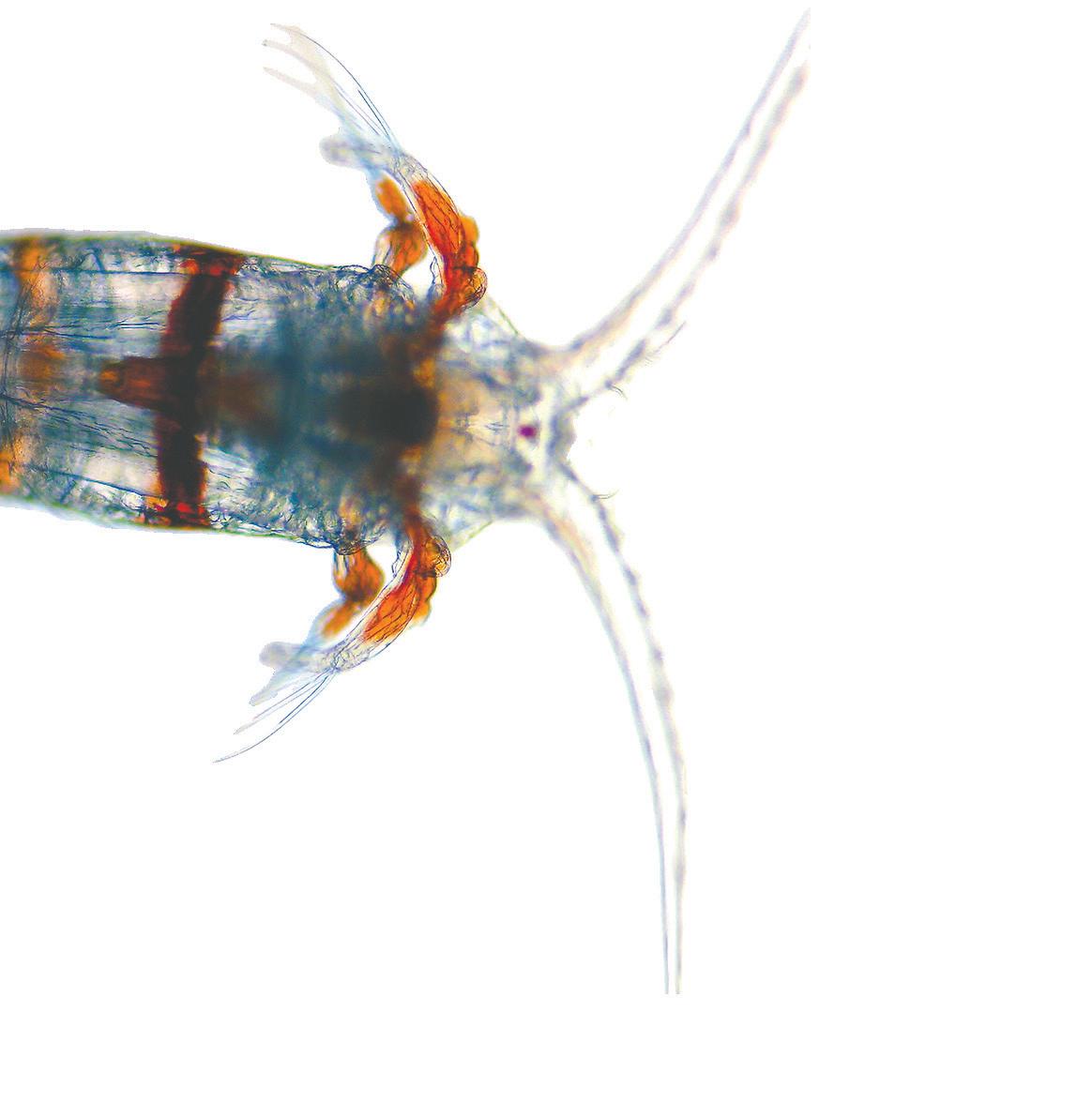
Massachusetts will be testing in a lab whether reducing the acidity of ocean water could harm larvae of American lobster and tautog fish.
The project recently received $300,000 in funding from the Prince Albert II of Monaco Foundation. It was one of two proposals funded through
CAR-RT SORT POSTAL CUSTOMER
the foundation’s Carbon to Sea initiative, which encourages research on ocean alkalinity enhancement (OAE). That is the process of adding alkalinity to waterways to increase their ability to lock in carbon and lower acidity.
Adam Subhas, a WHOI associate scientist in marine chemistry, is leading the research effort. It builds on his work conducting the first large open-water field test of OAE using sodium hydroxide, or lye that is commonly added to drinking water to adjust pH. For six hours in August 2025, Subhas and his team dispersed lye in the Wilkinson Basin, a section of the Gulf of Maine that’s off the Massachusetts coast.
fuels. And while its findings won’t be ready for a while, at least some members of the New England fishing community have credited the researchers with considering their input as the project has moved along.
This new method for enhancing ocean alkalinity has the potential to store carbon in a stable form for thousands of years …
About a third of the carbon dioxide in Earth’s atmosphere has been absorbed by the ocean, which has reduced the pH of ocean water and caused increased acidity. More acidic water can decalcify coral, damage fish shells, and hinder the ocean’s ability to take up more carbon in the future.
This new method for enhancing ocean alkalinity has the potential to store carbon in a stable form for thousands of years, Subhas said.
“This basically turns that atmospheric carbon into this stable form continued on page 3
The project is one of many new efforts by scientists to mitigate the harm caused by greenhouse gases that have built up in the atmosphere over the last few centuries due to human consumption of fossil continued on page 3
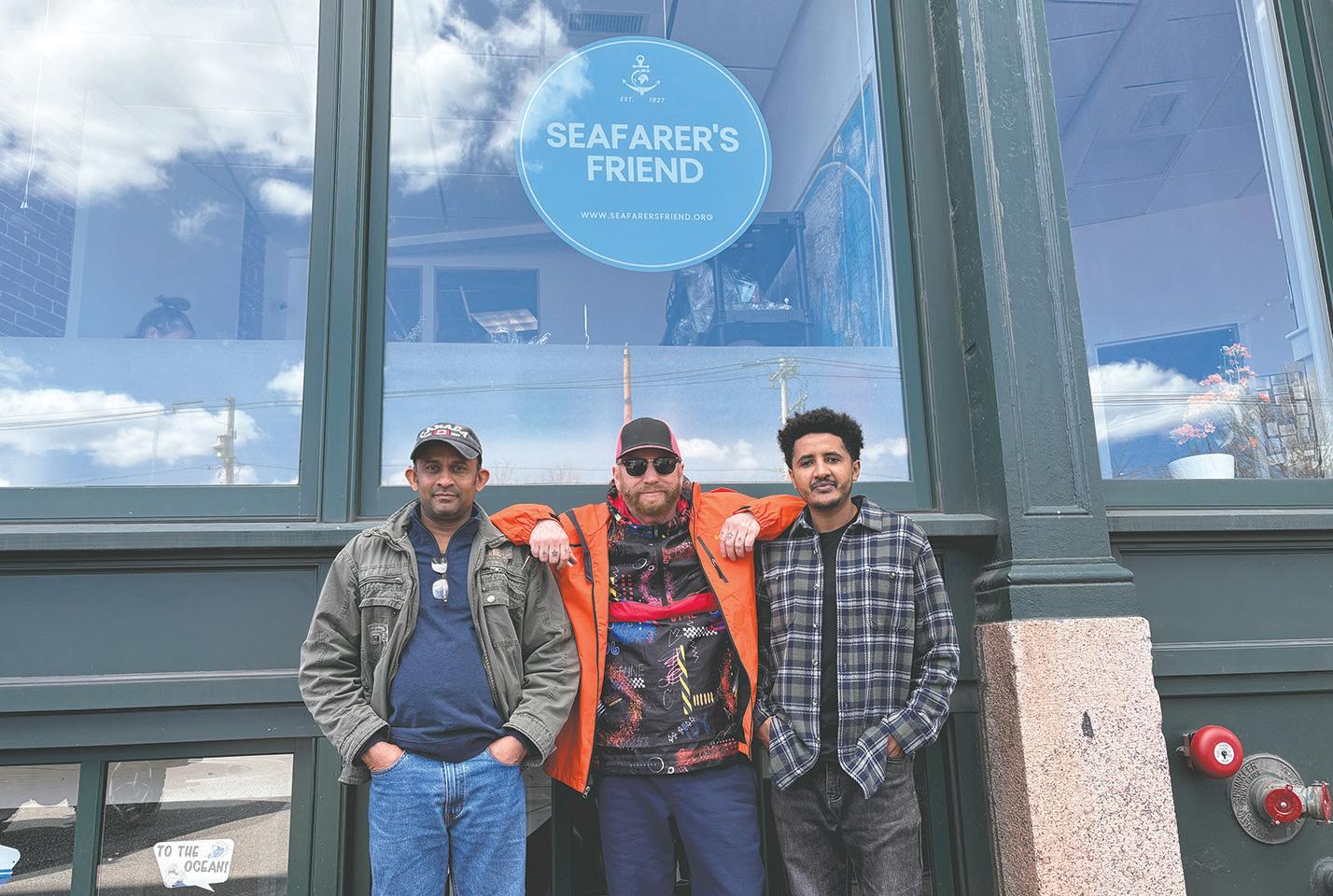
From left, Indika Siriwardhana, Jasper DelCarlino, and Eyasa Asmara pose outside the Seafarer’s Friend center on Commercial Street in Portland. PHOTO: CLARKE CANFIELD
Making sense of mackerel
BY CRAIG IDLEBROOK
In late May, NOAA Fisheries announced a new research initiative with the Northeast fishing industry to gather information about the Atlantic mackerel, a fish so common that it is often overlooked for research and so misunderstood that regulators have routinely miscalculated how many are in the sea.
With the new two-year initiative, researchers hope to fill in gaps about mackerel’s behavior and mortality rate after hatching. Incomplete understanding of mackerel mortality rates from fishing and other factors has led regulators to set flawed catch targets after strong recruitment years, said Jason Didden, a fishery management specialist with the Mid-Atlantic Fishery Management Council.
“For example, the 1997 mackerel allowable biological catch was specified 10 times higher than what we now think the total spawning stock biomass was in that year,” Didden said. “We just had kind of a fundamental misunderstanding of the stock’s productivity.”
The project, which will receive $2.3 million this fiscal year, will enlist 50 fishing vessels to help researchers gather data.
Those involved will gather mackerel samples, use echosounder sonar to find and gather information about
the fish, and conduct an egg survey, according to information provided by NOAA Northeast Fisheries Science Center. Researchers will work with the Woods Hole Oceanographic Institute in Massachusetts to develop a more complete picture of where the mackerel live and what environmental factors contribute to the stock’s health or decline.
The Atlantic mackerel fishery in the U.S. is worth up to $23 million annually, according to NOAA Fisheries. Commercially, they are caught for export to Europe for food and as baitfish for striped bass and bluefin tuna. Atlantic mackerel make a great starter species for recreational fishing, said Chris Uraneck, recreational fishing project lead with the Maine Department of Marine Resources.
“In Maine, they come in close to shore, so you could catch them from the dock or a pier,” Uraneck said. “It’s easy to catch, so it’s fun for families.”
the late 1970s, there have been several strong spawning years followed by steep declines in fish numbers.
Researchers now believe that’s because U.S. regulators were creating flawed models of mackerel populations based mainly on a multi-species trawling method for live fish and not incorporating data from an egg survey favored by Canadian regulators. When the Canadian egg survey data was combined with the trawl data, they realized that high recruitment hasn’t led to long-term stability.
“You can see these big age classes enter the fishery and kind of be fairly quickly wiped out,”
“ We just had kind of a fundamental misunderstanding of the stock’s productivity.”
Maintaining a stable population in the north Atlantic has been a challenge. Since mackerel were first regulated under the Magnuson-Stevens Fishery Conservation and Management Act in



Didden said.
Regulators also must contend with the fact that the mackerel are crossing between U.S. and Canadian waters, and the two nations haven’t worked together to manage the fishery. There are environmental advocates and fishery stakeholders on both sides of the border who believe the other nation is the problem.
The Canadian government recently has ruled that the commercial mackerel fishery will remain closed for the coming fishing season. Oceana Canada, an environmental advocacy
group, said that this will not be enough to stabilize the fishery’s numbers.
“The population remains firmly in the critical zone, with a negative near-term outlook for recovery due to unsustainable levels of fishing pressure in the United States and a history of overfishing and mismanagement in Canada,” the group said in a statement. U.S. regulators have become much more cautious about raising the catch limit. NOAA Fisheries’ most recent assessment of spawning stock of mackerel found it was 56% of the way toward the 181,090 metric tons target for the fishery’s restoration. That’s technically above the threshold for being declared overfished.
However, a committee cut the projected numbers for the fish by 93%, based on past experience. U.S. commercial fishermen will be allowed to catch some 10,714 metric tons of mackerel in 2026. That is some 7,500 metric tons more than was allowed in 2025.
On paper, it appears mackerel have had a banner recruitment year, but researchers and fishery stakeholders are waiting to see if this year’s data will validate the trend toward recovery, says Didden.
“I think in ‘27, we’ll have a better read of whether this was real recruitment, or was it a bit of a phantom and evaporate after we see those fish in Years 2 and 3,” Didden said.

John Martin, Bud Staples, and Elsie Gillespie chat around the woodstove at the annual town meeting.
Gerald “Punkin” Lemoine
Levi Moulden
Bud Staples
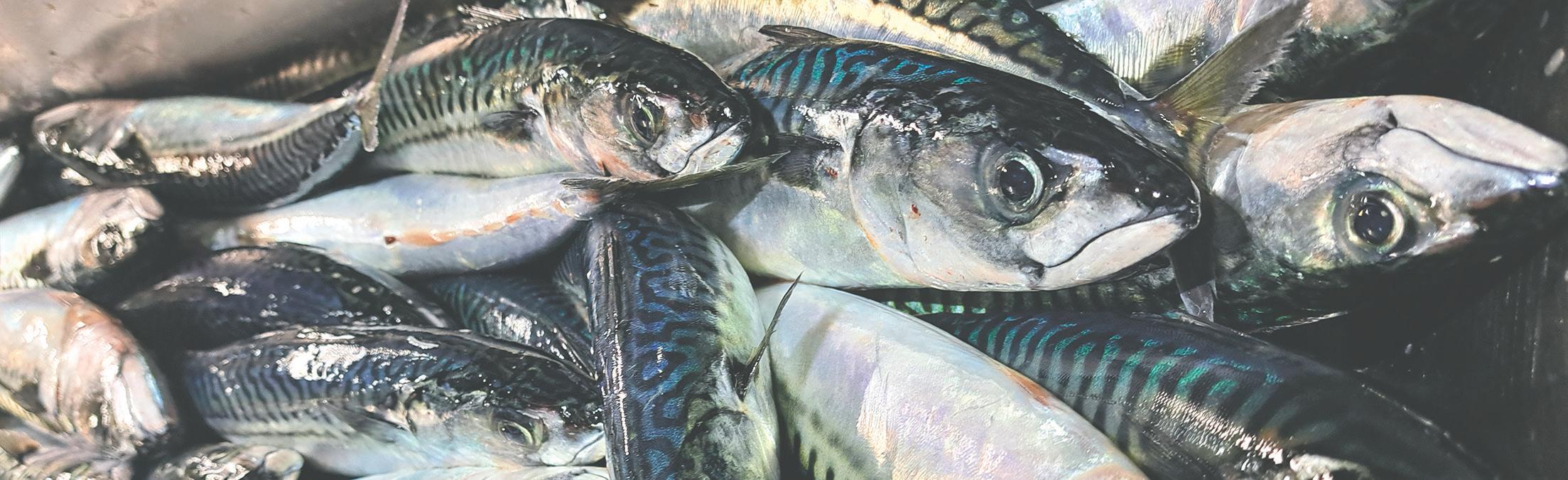
These Atlantic mackerel were found during the Northeast Fisheries Science Center’s bottom trawl survey.
PHOTO: COURTESY NOAA FISHERIES
SEAFARER'S FRIEND
continued from page 1
morning after completing a nine-day journey from Reykjavik, Iceland, to Portland aboard the EF Ava container cargo ship. After spending the night aboard the ship in Portland, they will continue on to Halifax, Nova Scotia, the following day before crossing the Atlantic back to Iceland. The typical round trip takes 22 or 23 days, said Indika Siriwardhana, who is from Sri Lanka, an island nation south of India—nearly 8,500 miles from Portland.
Siriwardhana, who is 51 and has been working at sea for 15 years, said having the Seafarer’s Friend center in port offers a welcome break from working in the engine room on board the ship. “It’s a nice place to relax, and just enjoy our time off,” said Siriwardhana while seated with DelCarlino and Eyasa Asmara, who is from Ethiopia and works on the same vessel.
Before becoming a port chaplain, DelCarlino worked on tugboats and NOAA research vessels until late 2024. That’s when he decided to get in on the spiritual side of seamanship. His arms and hands are covered with nautical-themed tattoos, like anchors, a lighthouse, ship wheels, and a propeller.
He and Marriah Tronvig run the Seafarer’s Friend center in Portland. She is the manager and also a chaplain.
DelCarlino personally visits every oil tanker and ship carrying container or bulk cargo that arrives in port. Oil tanker crew members are primarily from Canada, he said, while container cargo ships have largely Filipino crews, with some from India and
GULF OF MAINE
continued from page 1
of bicarbonate, which is essentially dissolved baking soda,” he said.
During the testing in the Gulf of Maine, researchers distributed the lye and a red tracer dye to study how it dispersed, then measured the pH balance of the area for five days. They also observed sea life in the vicinity. Using remote sensors and autonomous vehicles, the researchers found that the dispersal lowered the acidity in the area and had no significant biological impacts on the organisms there. Long-term measurement of the beneficial effects of that small release of lye is also possible, according to Subhas.
“That alkalinity that we added was still taking up carbon and will still take up carbon for about a year,” he said. “Even very, very small changes in this buffering capacity can help the ocean to take up more CO2 over time.”
Now researchers want to more deeply understand the effects of releasing the sodium hydroxide on marine organisms, and to do so without risking important fisheries. That’s where the new lab study comes in, Subhas said.
The WHOI research effort is dubbed the LOC-NESS (Locking Ocean Carbon in the Northeast Shelf and Slope) project. It is one of several projects to study the effectiveness and viability of OAE efforts around the world.
While LOC-NESS is research-focused, some other efforts are commercially based, seeking to cash in on the carbon credit trading market. One such effort, the Nova Scotia-based Planetary, is testing the effectiveness of adding an alkaline slurry to an outfall waterway in Halifax. The company declined to comment for this story.
Adding trace alkaline materials is just one way to combat the rising acidity of the oceans, according to Parker Gassett, an assistant director of the Maine Climate Science Information Exchange, based at the University of Maine’s Climate Change Institute in Orono. Many beneficial OAE efforts, like oyster reef restoration, can sound less sci-fi than the WHOI project and have stirred up less controversy among fishing communities.
Strategies to combat climate change are shifting as the concentration of carbon dioxide in the atmosphere climbs. Whereas before the goal was focused
Eastern Europe. The bulk cargo ships, which carry things like salt, asphalt, and gypsum, have Indian crew members.
DelCarlino doesn’t board cruise ships—they’re too large and too busy when they arrive—but does stand outside and greet crew members as they depart the ship, inviting them to the center a few blocks away. Those crews are primarily from the Philippines, he said, and often stop by the center for some downtime.
At any given moment, the center might be filled with the sounds of mariners making video calls home, laughing, conversing, playing music, and picking up or dropping off packages.
Many have been at sea for months at a time, working long shifts far from home. When they call on Portland, time is short and the center can be a crucial stop for them. DelCarlino is also there with an open ear to those who need to talk through anything. Many seamen have bouts of homesickness, he said, and one of his goals is to create a nurturing environment that feels like a home away from home.
“We’re a friend, we’re an ally for you,” DelCarlino said. “We’re here to help with anything we can do.”
Asmara, 29, has been working on the EF Ava for about six months. He previously worked on a ship that traveled from the Netherlands to Mexico, and then onto China before ending in Abu Dhabi in the United Arab Emirates. That route didn’t have any places like the Portland center to serve mariners during port calls, he said.
So it’s nice to be greeted by DelCarlino, who has become a friend and a welcome sight in port. “He’s a nice guy,” Asmara said.
on reducing carbon emissions, now climate and marine researchers are beginning to advocate for measures to remove carbon from the air.
“We’re starting to look at the Earth like it’s a fishbowl and a terrarium, and we think we might have the smarts to take care of it,” Gassett said. “But not everyone’s so confident playing the role of the tinkerer.”
Such direct measures to combat climate change have raised alarm among some stakeholders in the New England fishing community, according to field interviews conducted by Brown University undergraduate researcher Ashley McKinnon in collaboration with the Fishery Friendly Climate Action Campaign.
During a public comment period before the WHOI field test, fishery representatives expressed concern that OAE could further stress species that already face various challenges. Some asked that the field test be scaled back or cancelled in favor of lab testing, McKinnon reported. Many fishermen worried this would be a redo of their experience with offshore wind projects, where they felt shut out of the regulatory process.
“From my interviews, it seems that fishermen are scarred from their experiences with [offshore wind] and have lost trust in governance structures,” McKinnon said during a podcast for the campaign.
Katie Almeida is one of those concerned about fishing communities being shut out of future carbon capture efforts. Almeida, senior representative for government relations and sustainability at The Town Dock, a Rhode Island fishing wholesaler, said efforts to include the seafood industry in offshore wind projects have felt perfunctory, and fishermen and wholesalers need a full say on future projects.
“For carbon reduction projects, that whole sector, we need to be at the table at the beginning, not once the project is approved and the site is already planned,” Almeida said.
Ben Martens, executive director for the Maine Coast Fishermen’s Association, was one of those who was skeptical when he first heard about Subhas’ OAE research project. However, Subhas has done all the right things to assuage community skepticism, Martens said on the association’s podcast.
“Adam was really good at communicating the risks, the opportunities, and the thoughts behind what was happening with the oceans, this project, and, ultimately, what we should anticipate around this type of work in the Gulf of Maine.”
Besides Portland, Seafarer’s Friend serves mariners in Portsmouth and Boston. While those cities have people to help mariners during their port calls, until recently Portland was the only one of the three with a dedicated center where ship crews could visit to relax. DelCarlino said Boston opened its own dedicated space in June.
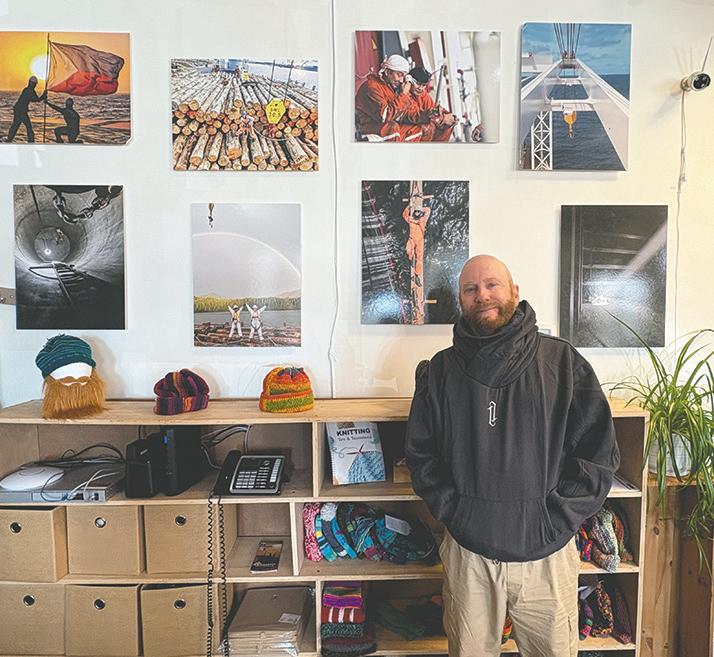
In Portland, the center is easy to overlook for people walking down Commercial Street. But behind the front window lies a world that mariners can call a home away from home.
It is understandable for New England fishing stakeholders to be skeptical of new efforts to combat climate change, said Susie Arnold, senior ocean scientist at Island Institute, which publishes The Working Waterfront.
However, Arnold argued that collectively not enough has been done to reduce carbon emissions, which leaves humanity scrambling to find new ways to store existing atmospheric carbon.
“If we don’t want to do the things we know work, which is burning fewer fossil fuels… we have to try other things,” Arnold said. “It’s a horrible spot to be in.”
For his part, Subhas doesn’t want to set unrealistic expectations about OAE efforts. He’s simply trying to see whether it has the potential to mitigate the effects of climate change.
“I’m not going to say that this is going to be the silver bullet that’s going to solve our climate problems,” Subhas said. “It’s going to be one potential approach to help us meet these challenges.”
Inside the Seafarer’s Friend center in Portland, Jasper DelCarlino stands in front of photos taken by mariners at sea. PHOTO: CLARKE CANFIELD
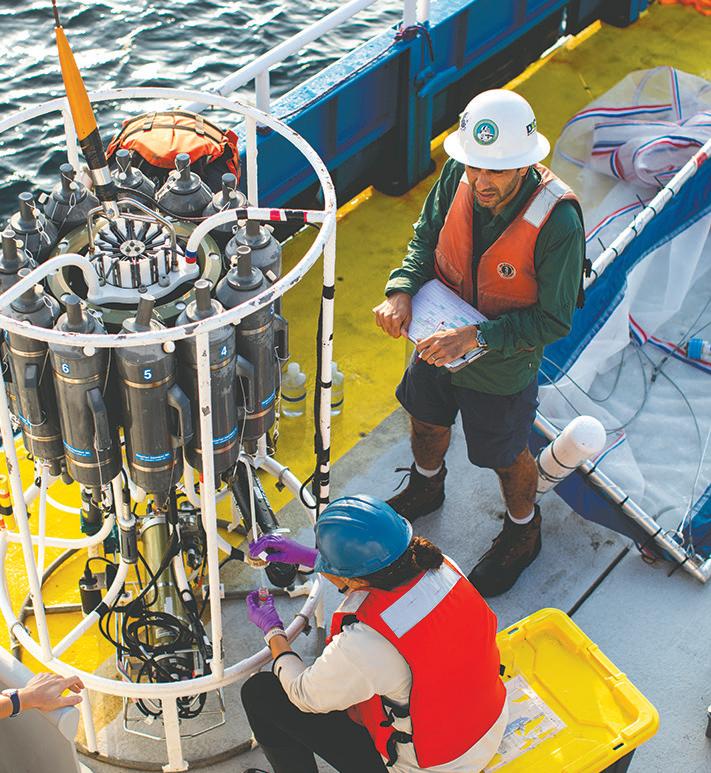
Adam Subhas (standing) and Jennie Rheuban take seawater samples from device called a CTD rosette on board the research vessel Connecticut. Subhas, of the Woods Hole Oceanographic Institution, is leading research into whether adding sodium hydroxide to the Gulf of Maine can reduce its acidity and help lock up carbon dioxide. PHOTO: DANIEL COJANU, UNDERCURRENT PRODUCTIONS, © WOODS HOLE OCEANOGRAPHIC INSTITUTION
No sailor required
Now
operating in the Northeast, drone vessels raise privacy concerns
BY CRAIG IDLEBROOK
WHETHER THEY KNOW it or not, New England fishermen have been sharing the Gulf of Maine with autonomous surface vehicles (ASVs).
Built and deployed by Saildrone, a Californiabased marine research and defense company, these uncrewed vessels traversed the gulf’s waters in 2023 and 2024 to map parts of the ocean floor.
The drones, which rely on wind and solar power, are monitored around the clock by trained operators on the mainland. They generally feature a narrow hull connected to an upright section that resembles a sail and helps capture the wind, but is closer to an airplane wing in design.
And now, it seems, those vessels have a new mission in the Northeast.
The California maritime tech company announced in May it had signed a $15.5 million contract with the U.S. Coast Guard to deploy 16 of its Voyager-class vessels to patrol the Great Lakes and Northeast coast. In the north Atlantic, the fleet will monitor for illegal, unreported, and unregulated fishing. The 33-footlong vessels will also patrol the Great Lakes, and monitor for drug smuggling and other illegal activity in both areas.
That surveillance mission has raised some concerns among privacy advocates. Petra Molnar, a faculty associate with the Berkman Klein Center for Internet and Society at Harvard University, worries the vessels controlled by the private company will sweep up
“This type of model raises the same accountability questions in every region these vessels enter,” Molnar said in an email. “Who actually controls the data once it is collected, and what happens to the data beyond the stated mission of these projects?”
Jenn Virskus, a Saildrone spokesperson, told The Working Waterfront that the company could not share details about its contract with the Coast Guard, and does not have a role in how the information may be used once gathered.
“Saildrone does not independently determine how Coast Guard mission data is used, retained, or disclosed,” Virskus said in an email. “For Coast Guard missions, the data collected is customerdirected and belongs to the customer, in this case, the U.S. Coast Guard.”
Some boaters have also expressed worry about the drone vessels. In a recent report in The Guardian, Ryan Weekes, the leader of Cleveland-based InterCity Yacht Club, said their presence raises concerns. He called for transparency whenever new surveillance technology is deployed.
A Coast Guard spokesperson countered that the Saildrone mission represented “a proactive mission to further strengthen maritime domain awareness, surveillance, and safety throughout the region,” according to the report.
The Coast Guard did not respond to a request from The Working Waterfront for comment.
Saildrone has been doing similar surveillance work for the U.S. government off the southern coast of the United States, deploying some 20 Voyager drone vessels to monitor for illegal activity.
The company also is developing a new class of vessels, the Spectre, its first designed to carry offensive capabilities. In October 2025, Lockheed Martin announced it would invest $50 million in Saildrone to equip the Spectre drones with missile launchers. Overall, Saildrone has built out more than 130 uncrewed vessels of various sizes for defense and research work.
Less controversially, the company is continuing its multiyear partnership with NOAA to gather data on hurricanes. It will send out 10 of its sturdy, 23-foot-long Explorer drones into stormy waters this summer. The vessels will gather information on how hurricanes form and how they change once formed, said Kitch Kennedy, Saildrone’s senior director for ocean mapping programs.
Perhaps the company’s most ambitious work in the Gulf of Maine to date has been its mission to survey more than 1,100 square nautical miles of the ocean floor in 2023 and 2024. For this, the company equipped two Voyager ASVs with long-range multibeam sonar sensors to measure the depth and shape of the ocean floor, as well as other metrics such as water temperature and salinity.
Drones have the potential to fill in extensive knowledge gaps about the shape and contours of the ocean floor, according to Jesse Minor, program lead for the Maine Coastal Mapping Initiative with the Maine Department of Marine Resources. The Gulf of Maine is vast, and the existing mapping products often are antiquated or incomplete.
“There are parts of Casco Bay that were last charted in, like, the 1870s from sailboats, and parts of Penobscot Bay that have never been charted,” Minor said.


SPONSORED BY
Join us while we discuss our work in the global ocean, from the surface to the depths!
A Downeast yacht club holds fast
Eastport club closely tied to counterparts across Passamaquoddy Bay
BY LURA JACKSON
Over its long relationship with its nearby human inhabitants, the Passamaquoddy Bay— located between Downeast Maine and southwest New Brunswick—has traditionally served as an international connection point.
Even in recent years, it has continued to do so despite broader political and economic tensions that have flared up between the U.S. and Canada.
The Eastport-based Passamaquoddy Yacht Club (PYC), in particular, exemplifies the bay’s intertwined history. It closely collaborates with a Canadian counterpart, the New Brunswickbased St. Andrews Yacht Club, sharing racing schedules and other resources.
“It’s been such an important connection for us here in Passamaquoddy Bay,” says Roger McNabb, commodore of the New Brunswick club, who adds that the international component has been in place since long before he joined in 2006. “Regardless of geopolitical stuff, we’re all friends here. We all have relatives on both sides of the border.”
It’s an appropriate evolution for the Eastport club, which counts former President Franklin D. Roosevelt among its first members. Originally founded on Campobello Island during the post-Depression era when a summer colony of affluent families took root, the then-named Campobello Yacht Club embraced the natural beauty of the area—still among its strongest attractions.
“It’s what you see when you go out there,” says Robin Gautier, commodore of the PYC, who joined in 1988 after she and her partner Phillippe crossed the Atlantic in a steel boat and has experience sailing in various locales around the world. “This place has the Mediterranean beat, as far as I’m concerned. It’s just gorgeous out there.”
“It’s the wildlife, specifically the marine-connected wildlife,” adds Dean Pike, a club member and instructor of boatbuilding at Eastport’s closely connected Boat School. “There’s nothing like it. We used to do these sailings over in Federal Harbor—oh my God, it’s a blessed place on Earth.”
It wasn’t always smooth sailing. The club’s membership waned after its original founding. It then crossed the bridge to become the Lubec Campobello Yacht Club and “started to build,” says Gautier. “It was important to ensure we were representing the bay.”
“ This place has the Mediterranean beat, as far as I’m concerned. It’s just gorgeous out there.”
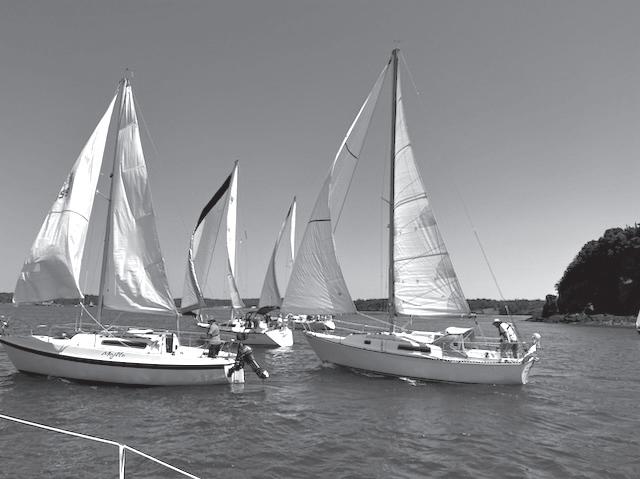
The Eastport-based Passamaquoddy Yacht Club was originally founded on Campobello Island during the post-Depression era under the name Campobello Yacht Club. Former President Franklin D. Roosevelt was among its first members.
The club’s representation expanded even further when it moved to Eastport and changed its name to the Passamaquoddy Yacht Club around the late 1980s.
“Adding ‘Passamaquoddy’ opened it to more people,” says Pike, noting that their members now include people from Deer Island, Calais, Robbinston, and Perry.
State officials once asked the club to change the name, because it’s not a tribal group. But according to Gautier, it kept the moniker after Melvin Francis, then governor of the Passamaquoddy Tribe at Sipayik, said it would be acceptable if the club allowed four tribal youths to join its programs at no cost, an arrangement that continues today. Gautier noted that the club continues to consider updating its name.
Perhaps the most effective way the PYC has grown is through its youth program—which, in turn, had its start with the St. Andrews Yacht Club. After St. Andrews experienced an aging out and its youth sailing program dwindled, it donated three Mirror dinghies to the Eastport club to start its own led by then-Commodore Davis Pike (no relation to Dean).
Seven club members got certified as instructors, and three more Mirrors were purchased. The program immediately took off, helping the club to expand its membership.
“We wanted to make sure sailing was accessible to local families,” Gautier says.
The impact was soon clear. Gautier vividly recalls one student who, at 10 or 11 years old, was “not very athletic, wanting to be involved in stuff but not good at things.” But, “Did he take to
PHOTO: COURTESY PASSAMAQUODDY YACHT CLUB
sailing!” By the end of the program, he couldn’t wait to take his grandparents sailing. Within short order, he bought his own boat. “He just loved it. All of a sudden something clicked in him. That’s what you hope for.”
Given the older age of both the club and its membership, Gautier went on, “Having the sailing program was—and is—critical to succession and keeping the spirit and legacy of sailing in the bay alive. There’s no other way to do it except teaching kids how to sail.”
While the club’s own instructors eventually aged out of teaching, the program was quickly taken up by outdoor recreation instructor
Scott Fraser at Washington County Community College in Calais under PYC’s guidance. The college eased the way by offering an online registration system, insurance, and scholarship management.
For five years, the program flourished, but with administration changes it once again faced closure. A reprieve arrived in the form of Cobscook Institute, where club board member Damon Weston is also an instructor. For the past five years, the program has been under Cobscook’s watch with the club’s continued support.
“This support has been crucial in keeping the program going and making it affordable to kids from any economic background,” Weston says. “From what I have seen, it is one of the most affordable options for learning to sail in New England.”
DREAM FIRST

For Weston, it’s a rewarding task. “I personally love teaching sailing since it gives kids the freedom to steer their own vessel even at a young age. It is always magical when a kid grasps the concept for the first time.”
“There’s a tradition, a legacy of seafaring here that one has to remember and celebrate,” Gautier says. “I think that’s also a big part of it.”
In keeping with recognizing its roots, the PYC recently loaned a selection of documents along with the Yacht Club Cup and a plaque of brass nameplates of the annual race winners to Roosevelt Campobello International Park, the only park in the world jointly managed by two countries. Gautier recalls a recent “nice email” from Christopher Roosevelt—a member of the park’s commission and grandson of the former president and his wife Eleanor—about the contribution. “I find it kind of fun that there’s been this connection maintained.”
Sailors of all stripes can take part in the PYC and St. Andrews races, which are advertised on their websites. “It is just a wonderful area to sail,” McNabe says. “You do have to learn how to plan with the tides and the currents, but we have so much local knowledge, and all of the members are so willing to mentor anyone coming to the region. We’ll pass on as much information as we can.”
The Eastport-based Passamaquoddy Yacht Club has relied on youth programs to help grow its membership over the years.
PHOTO: COURTESY PASSAMAQUODDY YACHT CLUB
When innovation crashes the party
Tradition goes hand in hand with ingenuity
BY KIM HAMILTON
WITH SUMMER HERE, many people are returning to familiar places with deep generational roots, surrounded by memories and family heirlooms. Summer traditions are in full swing: children jumping into the ocean from heights that terrify older eyes, community concerts and plays, good books, tidal pools, croquet, and lobster bakes.
These traditions are powerful, and my family, too, has its own history and rituals. I generally appreciate tradition. I also recognize the privilege of having a history to tell and living in a community that honors its place on this earth and the moments that mark time.
In communities like ours, where tradition runs deep, conversations often center on what has changed since last summer: a new house nearby, the closing of our general store, a beloved landmark tree lost in a storm, or the yews stripped by hungry deer over the winter. These changes become part of our history, stitched into the fabric of our coastal place: “Remember, that was the winter the storms wiped out the town landing,” or “that was the year our brakes gave out and the truck ended up in the drink.”
In places where tradition rules, innovation must muscle its way in. Tradition is anchored in the past—in repetition, predictability, and remembrance. Innovation, by contrast, can feel unsettling. It can arrive at tradition’s door like an unwelcome party guest: brash, unmoored, unruly, and even threatening.
Yet tradition and innovation have long lived side by side along the coast of Maine. Even as we celebrate our coastal heritage and praise “the way life should be,” with its associations of simplicity, dependability, and ease, we often overlook the essential role innovation has always played in daily life.
That is why Island Institute’s vision statement places innovation at the center: “Maine’s island and coastal communities thrive in a rapidly changing world, leading as models of innovation.” This spirit drives our community investments and our belief that people in small island and coastal communities can do big things, even when they do not think of themselves as innovators.
… people in small island and coastal communities can do big things, even when they do not think of themselves as innovators.
Consider Caden Blackwood, a sternman from Stonington with a welding side business. Now in his young 20s, he used a workforce grant from Island Institute to buy welding equipment that allowed him to fabricate a multi-pronged grapple to help lobstermen retrieve lost gear. I doubt he spent much time wondering whether his adaptation would appear in national innovation statistics.
The same is true of Willy Leathers and Erin Oransky of Maine Ocean Farms, an aquaculture business in South Freeport. They are advancing innovation with Maine’s—and the country’s—first fully electric aquaculture workboat. Poetically named Heron, the one-of-a-kind vessel supports a heritage industry and shows what can happen when local funding, local partners like Island Institute, and big dreams come together. Our marine innovation grants have also supported Cranberry Oysters, led
by
Institute grants, they invested in technologies to flip oyster cages more efficiently and build a fully solar-powered oyster barge. These process improvements have helped them grow, create jobs, and win well-deserved state and national recognition for their sustainable and groundbreaking work.
Tradition and innovation are deeply connected: the innovation we support draws strength from tradition, and the traditions we value endure because of innovation. In these examples, and across our work, we invest in ingenuity and the people closest to the problems—and therefore closest to the solutions—because it’s the best way we know of to secure an enduring, vibrant, and prosperous marine economy.
That’s why, when we host the party, innovation is always invited.
Kim Hamilton is president of Island Institute, publisher of The Working Waterfront. She may be contacted at khamilton@islandinstitute.org.
Staying focused on the climate crisis
News coverage of climate change has dropped in recent years sweetest in the gale
THERE’S NOTHING like a near-record heat wave to make you feel like garbage.
That’s my first thought as I write this during the sweltering days before July 4, sitting in my un-cooled home office, with a slight headache and sweat forming on my brow before 10 a.m.
But stifling as it is, I’m lucky to be indoors rather than out in the direct heat, like so many workers must be. And I was already planning to devote this column to climate change— specifically, to how we talk and write about it. So at least this weather helps me make a point.
To state what should now be obvious, our planet is heating up. We’re to blame, and we must do a lot to avoid the worst outcomes, from reducing our fossil fuel use, to finding creative ways to remove carbon from the atmosphere, to lessening the many harms. It’s a tall, tall order.
I know many readers of this newspaper get this, because when we surveyed you all in 2024, nearly two-thirds pointed to “Climate issues / Impacts of sea level rise” as an area where you’d like to see more and better coverage. It was the top-ranking answer, followed closely by “Environment / Land use / Sustainability.”
The timing of that survey was noteworthy, coming in the wake of the winter storms that killed four people across Maine and dealt more than $90 million in damage to public infrastructure alone.
I had a closeup view of the first deluge, just before Christmas, which pushed the Androscoggin River well over its banks in Bethel, where I was living. It closed all major roads into town and swamped a substation, knocking out power for days. This was soon followed by two more storms in January, which caused unprecedented flooding damage to Maine’s coastal and island communities.
At the time, I felt like we were reaching some sort of peak in our attention to climate change. Not only had a series of storms, droughts, wildfires, and near-record ocean temperatures felt like wakeup calls, but federal and state lawmakers had spent the previous few years approving huge sums of money for resilience and renewable energy projects.
The news media matched this, devoting more staff and funding to exploring causes, impacts, and solutions to the crisis. One example was
Maine Public, where I worked from 2021 to 2023, a period that coincided with the station hiring a dedicated climate reporter and undertaking an ambitious series of climate stories across each of Maine’s 16 counties.
But now, a few years later, our attention has drifted.
It’s not for lack of awful weather. The recent heat wave sent more than 100 Mainers to the hospital, the western U.S. is facing another bad wildfire season, and a strong El Niño could push up global temperatures even more this year.
But the White House has recently gutted climate and science programs, and many Americans have checked out, perhaps because they’re struggling to buy groceries, or stressed about national politics, or distracted by something else.
Just as troubling, many news outlets seem to have matched this apathy. Global news coverage of climate change has fallen 38% since 2021, as the outlet Grist recently reported using data from the University of Colorado Boulder’s Media and Climate Change Observatory.
So I’m making a resolution as the editor of this newspaper. The national

mood may have shifted, for now, on climate change. But we’re going to keep covering it. For starters, check out pages 12-13, where our latest Waypoints data spread is devoted to warming air and water temperatures.
Going forward, I’m going to try to follow some guidelines that I recently learned from the group Covering Climate Now, which is trying to beat back this decline: good climate coverage should localize the issues, highlight the human side of them, and point to the solutions.
That’s where you, good reader, can help. If you’ve been directly affected by climate change, or are actively working towards a solution, please get in touch.
Charles Eichacker is the editor of The Working Waterfront and Island Journal. He may be contacted at ceichacker@islandinstitute.org.
Lauren Simmons Gray and her team of women sea farmers. With Island
SHIPPING OUT—
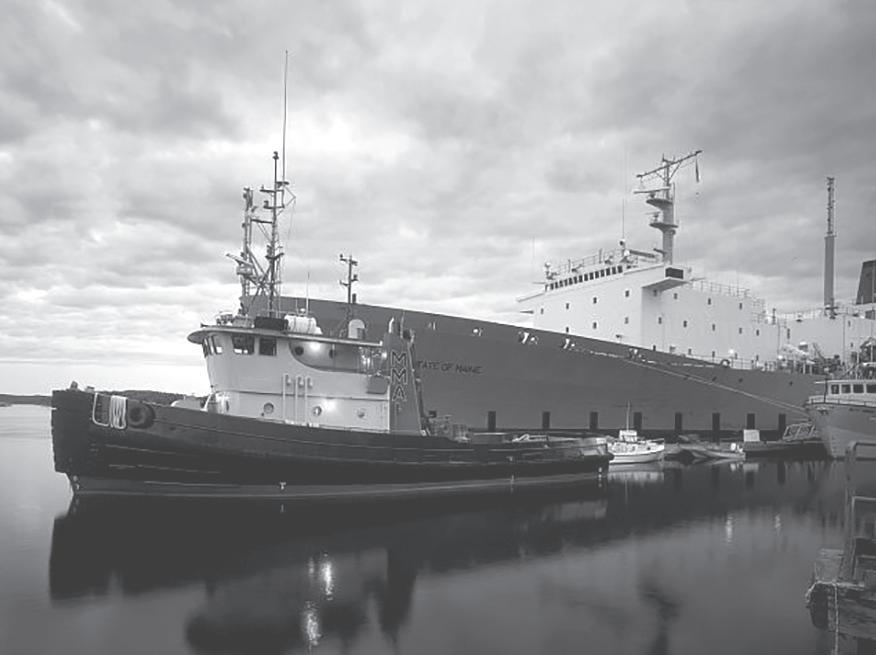
This undated photo shows the former State of Maine, the training vessel used by Maine Maritime Academy in Castine. The academy now has a new training ship of the same name. Do you have memories of learning seafaring on the old training ship? If you can share any information or memories, contact editor Charles Eichacker at ceichacker@ islandinstitute.org.
OF CONGRESS
PHOTO: COURTESY CAROL M. HIGHSMITH/ LIBRARY
the public’s policy
Powering work boats with electric engines
The young industry is a strong example of innovation in the blue economy
BY NICK BATTISTA
THE LAST TIME I drove Island Institute’s boat, a 25-footer with an outboard motor, I used about 16 gallons of gas per hour. That’s the standard measure of a boat’s fuel consumption, and being out on the water for much of the day, it added up to 74 gallons— enough gas to drive my car from Rockland to Key West, Florida. In addition, the outboard engine was so loud that I had to strain to hear my colleagues, who were talking just a few feet away.
This was in sharp contrast to a ride I just took on Heron, a boat powered by two electric outboards that Maine Ocean Farms uses on its oyster farm based in South Freeport. Twelve people were on board, including staff from multiple state agencies and a few others active in statewide policy.
Cruising down the bay at 16 knots, we had a normal conversation about the benefits of electric-powered workboats, the current challenges facing the industry, and the opportunities for state policy change to support this emerging industry.
Maine Ocean Farms, the Spruce Head Fishermen’s Co-op, Pendleton Yacht Yard, and other coastal businesses using
Island Institute Board of Trustees
Doug Henderson, Chair
John Conley, Vice-Chair
Michael Boyd, Clerk
Shey Conover, Chair of Programs Committee
Bryan Lewis, Secretary, Chair of Philanthropy and Communications Committee
Michael Sant, Chair of Governance Committee
Katherine Vogt, Treasurer, Chair of Finance Committee
Robert Baines
Pamela Baker-Masson
Sebastian Belle
Des Fitzgerald
Christie Hallowell
Kristin Howard
Pat Keliher
Nadia Rosenthal
Mark Rodrigues
Michael Steinharter
John Bird (honorary)
Tom Glenn (honorary)
Joe Higdon (honorary)
Bobbie Sweet (honorary)
Kimberly A. Hamilton, PhD (ex officio)
electric engines for workboats are at the forefront of a new innovation in traditional Maine industries. They are taking risks with emerging technology, using custom or semi-custom systems that require fine-tuning. These businesses actively gather data, share experiences, and provide feedback to partners such as Island Institute and the manufacturers of boats, engines, and batteries.
At the state level, Maine supports this work through the Maine Technology Institute (MTI). MTI is a critical partner, fostering innovation and helping both Island Institute and the businesses developing electric outboards reduce risk. The state’s Blue Economy Task Force also identified electric outboards and marine propulsion as key areas, representing early opportunities for Maine’s Center for the Blue Economy at MTI.
A municipality purchasing a boat powered by an electric outboard is eligible for state funding through the Community Resilience Partnership. Replacing or re-powering small skiffs used by harbormasters for daily work around the harbor, or pump-out boats, present potentially interesting use cases for communities to consider.
On Heron, one area of discussion was that Maine Won’t Wait, our state
climate action plan, calls for state agencies to identify opportunities to “lead by example.” With this mandate, state agencies have shifted their vehicle fleets to include EVs or made significant weatherization and energy efficiency upgrades to their physical buildings. With a couple of the coordinators of this state approach on Heron, we talked about identifying the right places where an agency owns and operates a boat that provides a good use case for electric outboards.
Based on Island Institute’s work, conversations with industry partners, and state agency staff, it is clear that more is needed to help advance the development and deployment of this technology. Three key areas for additional support from the state are: Ensuring businesses, towns, and other entities have support and technical assistance to operationalize these vessels: Because these are custom or semi-custom designs and projects, they require a lot of problem-solving— from the boats, batteries, systems, and engines to the infrastructure needed on shore to charge them.
Funding to support the innovative businesses in Maine that build these boats: Heron and the work skiff at the Spruce Head co-op, Wattson, were
THE WORKING WATERFRONT
Published by Island Institute, a non-profit organization that boldly navigates climate and economic change with island and coastal communities to expand opportunities and deliver solutions.
All members of Island Institute and residents of Maine island communities receive monthly mail delivery of The Working Waterfront.
For home delivery: Join Island Institute by calling our office at (207) 594-9209 E-mail us: membership@islandinstitute.org • Visit us online: giving.islandinstitute.org
made in a Maine boatyard. Funding to support innovation and equipment at businesses such as these boatyards will help the sector grow and keep Maine at the forefront of these conversations nationally.
Funding or subsidies to mitigate risk for vessel operators: Currently, these systems carry high upfront capital costs and a level of risk for operators. All of the boats mentioned in this article were the result of leveraging multiple sources of funding from public, philanthropic, and nonprofit sources, as well as from the multiple businesses involved.
As Maine heads toward a new governor and the start of a new legislative session, the Island Institute team is looking forward to advancing policies that help our partners—businesses, communities, and the state—begin to address these needs.
Nick Battista is chief policy and external affairs officer for Island Institute, publisher of The Working Waterfront. He may be contacted at nbattista@islandinstitute.org.
EDITOR: Charles Eichacker ceichacker@islandinstitute.org
Our advertisers reach 50,000+ readers who care about the coast of Maine. Free distribution from Kittery to Lubec and mailed directly to islanders and members of Island Institute, and distributed monthly to Portland Press Herald and Bangor Daily News subscribers.
To Advertise Contact: Charles Eichacker ceichacker@islandinstitute.org (207) 535-9305
www.WorkingWaterfront.com
Underwater data center
Dear Working Waterfront,
In the April/May edition you republished an article titled, “Underwater AI data centers: Downeast project would rely on tidal power,” written by Edward French. Originally the article was printed in The Quoddy Tides.
My main question is, if everyone does this, specifically locate Al data centers in the ocean, won’t that raise the temperature of the ocean?
We are hearing a lot these days about how much Al data centers consume in electricity. According to my Copilot search, “AI data centers are energyhungry primarily because of the massive computing power needed to train and run AI models, and secondarily because of the cooling required to keep that equipment running efficiently.”
Obviously the ocean is huge and a single data center is not going to make an appreciable difference for the whole ocean, but what about the temperature of the water around it? Would a single data center generate enough heat to impact the temperature of the water cooling it? The heat has to go somewhere.
We know that the fishery is changing, and science says it is because the ocean
letters to the editor
is warming. It does not take much, just 1 or 2 degrees warmer, and the whole food chain can be impacted, and that seems like something to consider before an AI data center gets built, is up and running, perhaps to the detriment of an entire ecosystem, a community’s economy, and the individuals that live and work in that economy.
Anne Perschon Rockport
A bigger table
In response to Kim Hamilton’s June-July column about her father’s “superpower” of welcoming people to a big table.
Dear Kim (if I may), Thanks so much for your thoughts on the “bigger table.” Your piece is both deeply moving and wise. You so adeptly move from the personal to the larger point of community engagement. I would have liked to have known your father, whom you portray as the inspiration of your work at the Island Institute. Long may the spirit continue.
Sincerely, Tina Gillis Berkeley, California
Corker
In response to the June-July article “Rolling the dice in Penobscot Bay” about the new lobster fishing board game Corker. It’s named after an old term for a good catch—though evidently “corker” can also refer to other things.
Preordered … Fun! Perfect birthday present for my brother, with whom I own an island house. Never know what to get him. Thought I should mention, the word “corker” comes from hard cider. When making batches, when the ferment is done and it’s just right, it’s time to decant and cork … hence THAT’S A CORKER! Now it applies to all sorts of good things.
Nanne
Kennedy Washington, Maine
To the editor, We are the co-founders of Anchor Point Games and the creators of Corker. Thank you for sharing our story.
After the article ran, we heard from the mom of a young aspiring game designer. When 12-year-old Lily Sanders read about Corker, she knew she wanted to talk to us. Lily is designing her own board game for a school project. Over
Memorial Day weekend, she and her stepdad, Colin Samuel, met us at ChocoLatte Cafe in Bar Harbor to play Corker. We played a full game, talked about lobstering and game design. Lily walked us through her own prototype to get feedback and glean tips. Families stopped to ask questions. A customer at another table asked to read the rulebook. A cafe table turned into a conversation about games, fishing, and creativity. That is the part of this story that matters most to us, and why we are so grateful. The Working Waterfront shared Corker with its readers. Your article did more than introduce people to a game. It created a small ripple that brought new people around the table. Lily said afterward, “Maine has such an amazing sense of community.” We agree. That afternoon reminded us that when stories about the working waterfront are shared, they can spark curiosity, connection, and a desire to carry that culture forward.
Cindy Wren and Gregory Birgfeld Searsport
The Working Waterfront accepts letters to the editor of 250 words. Send them to editor Charlie Eichacker at ceichacker@islandinstitute.org. Longer opinion pieces should be approved by the editor before being sent.


A Maine governor’s long, eclectic legacy
Assessing Gov. Ken Curtis’ impact 60 years later
BY DOUGLAS ROOKS
Sixty years ago, Mainers elected a new governor who went on to transform state government, and in many ways give it the shape it still retains today.
Ken Curtis was just 35 when he defeated incumbent John Reed in 1966, the last time a Maine governor lost a reelection bid. A liberal Democrat, Curtis nonetheless worked successfully with Republican legislatures throughout eight years in office to enact a state income tax, create the state university system, reform K-12 education, and create literally dozens of new programs, capped off by reorganizing government into 16 cabinet departments.
It’s in his approach to economic development and land conservation, however, that he differs most dramatically from his predecessors and successors. Today, no Democratic officeholder would suggest that a major oil refinery be sited on the coast of Maine. And no Republican could imagine creating a major new wilderness area. Yet Curtis did both.
A bond issue to create what became the Allagash Wilderness Waterway passed in 1966, and Curtis went to work to ensure it would receive what he called “maximum wilderness protection.” At the time, virtually all of the north Maine woods was privately owned except for nearby Baxter State Park. After Sen. Ed Muskie was able to enact the National Wild and Scenic Rivers Act in Congress, Curtis arranged for the Allagash to receive both federal and state protection, the only river to have such joint management.
Crucially, Curtis believed that protecting key landscapes of forests, lakes, and streams would yield the greatest economic benefits, even as he oversaw a boom in paper mill and sawmill construction that were encouraged by his Department of Economic Development. He coined the slogan, “Conservation through Development,” and was determined to achieve both. In the 1990s, when the group Restore: The North Woods proposed a 3.2-million-acre national park in terrain surrounding Baxter and the Allagash, Curtis was one of the few major political figures to endorse it.
Along the upper Washington County coast, Curtis advocated a different approach. After growing up on a failing 5th-generation farm in Leeds, the new governor believed state government must become an active partner in industrial development to relieve economic distress and create prosperity in neglected regions.
At the time, Mainers heated their homes almost entirely with fuel oil and were paying the highest prices in the country matched with the lowest incomes in New England. The cause was the Mandatory Oil Import Program enacted by the Eisenhower administration to limit Middle Eastern imports, allegedly on grounds of national security. The result was that domestically produced oil cost twice as much, with Maine consumers paying far higher prices because of the import controls.
There were no oil refineries in New England, and still aren’t—the only U.S. coastal region without any. The best way to bring prices down and provide benefits throughout the region, Curtis believed, would be to build one. The governor assembled a talented team of aides who fixed on Machiasport and Machias Bay as the best site for a terminal and 300,000-gallon-perday refinery operation.
Thus began a multi-year battle over the Machiasport site and others along the Maine coast, including Eastport, Sears Island, and Portland Harbor, to locate a refinery, which in turn spawned numerous other energy and manufacturing schemes. To date, none has been built.
While Curtis’s advocacy for a refinery may seem shocking today, global warming was not yet a
concern, and alternative fuels, such as coal, were dirtier or more expensive. Nor was Curtis blind to the need for strict environmental controls, which he said must precede any actual construction.
Lawmakers duly passed the Oil Handling Act to combat spills. It has efficiently protected Portland Harbor ever since, and served as a model for Sen. George Mitchell’s federal legislation passed after the Exxon Valdez disaster in Alaska’s Prince William Sound in 1989. Companion legislation, the Site of Location Act, created the first statewide zoning for industrial and commercial development. Ironically, Maine ended up with some of the nation’s strictest environmental laws but not, with rare exceptions, the economic development they were intended to regulate.
In the decades since, Maine has forged ahead on many Curtis administration priorities. Curtis doubled the number of state parks, and acquired 650,000 acres of public reserved land, the result of negotiations with major landowners after courts upheld the state’s ownership of the unorganized territory’s “public lots.” Funding from the federal government, the Land for Maine’s Future program, and contributions from dozens of private land trusts has protected millions of forested acres from development while vastly expanding public access to the coast and interior.
The “development” part of “conservation through development” has fared less well. The animus that understandably developed toward petroleum refineries, nuclear power plants, and LNG terminals has extended to far less threatening uses such as fish farming and wind turbine fabrication. Not coincidentally, Maine’s rural areas and especially its magnificent Bold Coast have continued to struggle economically, with tourism and seasonal homes the only significant growth sector. Jobs remain scarce, and out-migration continues.
Ken Curtis believed that Maine could balance the challenges of preservation and development, that conservation and even wilderness was fully compatible with sustainable growth. Environmental protection and conservation joined economic development as the focus of cabinet-level departments on his watch, as he tolerated and even encouraged lively public debate among his commissioners.
The activist stance he embodied, including trade missions abroad, agreements with Canadian

provinces, and emphatic support for cooperation with fellow New England states, has rarely been equaled or even approached by his successors. These far-reaching initiatives, along with steadfast support for the Wabanaki nations, labor unions, women, the elderly, and racial and ethnic minorities, led to the widespread belief by the end of his administration that Curtis had indeed become governor of all the people of Maine.
As we ponder our choices this November, these are accomplishments and aspirations worth remembering, and renewing.
Douglas Rooks, a lifelong journalist, has served as editorial editor of the Kennebec Journal and editor and publisher of Maine Times, and is a weekly columnist for the Maine Trust for Local News. He has written five books, the most recent Transformational: Ken Curtis, Maine’s Reform Governor.

Advertise in The Working Waterfront, which circulates 45,000 copies from Kittery to Eastport ten times a year.
Contact Charles Eichacker: ceichacker@islandinstitute.org
Former Maine Governor Ken Curtis PHOTO: COURTESY DOUGLAS ROOKS
State awards funds and seeks proposals for coastal projects
THE MAINE OFFICE of Community Affairs’ (MOCA) Maine Coastal Program (MCP) and Municipal Planning Assistance Program (MPAP) are accepting applications for approximately $450,000 in coastal planning grants through Aug. 31.
Awards of up to $50,000 for individual applicants and $75,000 for group applicants will support local or regional planning projects that prepare coastal communities and critical public infrastructure for current and future hazards and storms, and to advance community resilience planning.
The funding is available through two grants: the MCP Shore and Harbor Planning Grant and the MPAP Coastal Community Grant (CCG). Both grants are supported by an annual National Oceanic and Atmospheric Administration (NOAA) award to MCP.
Instructions can be found on the MOCA website. Questions must be submitted by email to mainecoastalprogram@maine.gov by Aug. 21.
Past awards have been used to develop long-term coastal hazard and risk assessments, design resilient public working waterfront infrastructure, improve public access to the coast, and improve regulatory and non-regulatory approaches to land use planning and local ordinances to address current and future hazards.
MOCA, MCP, and MPAP also recently announced awards of $649,975 in grants. Projects began in late spring 2026.
“As Maine’s communities continue to face a variety of threats, these grants underscore our commitment to helping them protect and enhance crucial coastal resources, water access, and infrastructure,” said MOCA director Samantha Horn. “By investing in these planning projects, we help communities to create strategies that safeguard resilience and that prepare them to
obtain implementation funding for infrastructure projects.”
Under CCG, MPAP has granted $294,060 to the following municipalities and organizations:
• Bath will build on existing flood vulnerability assessments to evaluate site-specific adaptation options downtown and create conceptual designs for a pilot adaptation project.
• Bath will also hire a consulting team to create a final design and action plan for the riverwalk. The consulting team will provide nature-based designs for shoreline stability and flood adaptation while improving public access and neighborhood connectivity near the river.
• Southern Maine Planning and Development Commission will update and conduct community trainings for two climate resilience tools, the Nature-Based Strategies Decision Support Tool and the Climate Ready Coast Vulnerability Assessment Mapping Tool.
• South Portland will hire a consultant for a modeling study to understand stormwater movement in the Mill Creek watershed. The study will help identify flood mitigation strategies and stormwater system improvements the city can implement to reduce flooding and improve the quality of the watershed.
• Southwest Harbor will hire a consultant to update the harbor management plan and integrate climate considerations and other recent local planning efforts. The updated plan will guide investment and management of harbors and public waterfront infrastructure.
• Yarmouth will create a master plan to understand vulnerabilities and opportunities at working waterfronts, while accounting for future climate
adaptation needs. The plan will guide investment, policy decisions, and infrastructure improvements at the working waterfront.
Within the Shore and Harbor Planning Grant program, MCP has awarded $355,915 to the following municipalities:
• Bowdoinham will hire a consultant to create a master plan to improve shore fishing and hand-carry boating access. The plan will include resilience improvements, conceptual designs, and cost estimates.
• Brooksville will hire an engineer to create construction-ready designs for a new pier and float at the public landing.
• Chebeague Island & Yarmouth will hire a consultant to assess vulnerabilities and create conceptual designs and cost estimates for
NOAA selects UNH as hub for aquaculture research
THE UNIVERSITY of New Hampshire has been selected as the host institution for a new program under the National Oceanic and Atmospheric Administration called the Cooperative Institute Fostering Aquaculture Research and Markets (CIFARM) to expand NOAA’s impact and strengthen efforts to boost American seafood competitiveness.
After a highly competitive application process, this new 5-year cooperative institute will harness partnerships with cutting-edge researchers to advance American marine aquaculture. Approximately $13.5 million will be available this year for projects following the establishment of CIFARM.
“The United States is finally recognizing aquaculture as a vital complement to our world-class fisheries,” said NOAA Administrator Neil Jacobs. “We look forward to collaborating with these exemplary partners to continue
to unlock the potential of this industry in the United States.”
CIFARM researchers will investigate solutions that can be leveraged for industry advancement, such as marine aquaculture demonstration projects; engineering and technology development; artificial intelligence for aquaculture; environmental observations and forecasting; risk management and vulnerability analysis; and seafood markets research.
These research priorities will also magnify scientific advancement through education, outreach, and engagement.
“We are excited to partner with NOAA on this first-of-its kind cooperative institute to advance American aquaculture,” said UNH President Elizabeth Chilton. “By leveraging our coalition’s scientific excellence and regional expertise, we are poised to make great strides for the aquaculture industry.”
UNH has partnered with a diverse suite of outstanding academic,
industry, and non-governmental organization partners, including New Hampshire Sea Grant, the University of Miami, Florida Sea Grant, University of Southern Mississippi, MississippiAlabama Sea Grant Consortium, Hubbs-Sea World Research Institute, California Sea Grant, University of Hawaii, and Hawaii Sea Grant.
“By investing in aquaculture research and markets, NOAA Fisheries continues its commitment to improving sustainable American fisheries through science-based management,” said Eugenio Piñeiro Soler, assistant administrator for NOAA Fisheries. “We are proud to empower the industry to produce more seafood for American plates.”
Americans eat $24.2 billion in imported seafood each year, about half of which is estimated to be farmed in other countries. Aquaculture creates jobs, uplifts coastal economies and complements wild-capture fisheries,
work to improve the resilience of the parking lot and wharf for the Chebeague Island Ferry.
• Columbia Falls will hire a consultant to create a master plan for improvements to the town landing; these plans will include resilience adaptations and alterations to improve public use of the facility.
• Friendship will hire an engineering firm to create final designs for the reconstruction of the municipal wharf.
• Monhegan Plantation will hire a consultant to create permit-ready engineering designs and cost estimates for work to increase the resilience of the breakwater.
• North Haven will hire an engineering firm to create engineering designs for a new fishermen’s wharf to reduce congestion at the existing public landing and improve water access.
while providing healthy and sustainable seafood to American families and bolstering domestic food security. Congress directed the establishment of a new cooperative institute advancing U.S. marine aquaculture development in its fiscal year 2024 appropriations. By providing scientific solutions for the aquaculture industry, NOAA’s effort also helps fulfill the 2020 Executive Order on Promoting American Seafood Competitiveness and Economic Growth and supports President Donald Trump’s 2025 Executive Order Restoring American Seafood Competitiveness.
NOAA Aquaculture Program’s mission is to provide science, services, and policies that create conditions for opportunity and growth of sustainable U.S. aquaculture. This long-term collaborative partnership will promote research, education, training, and outreach aligned with this mission.
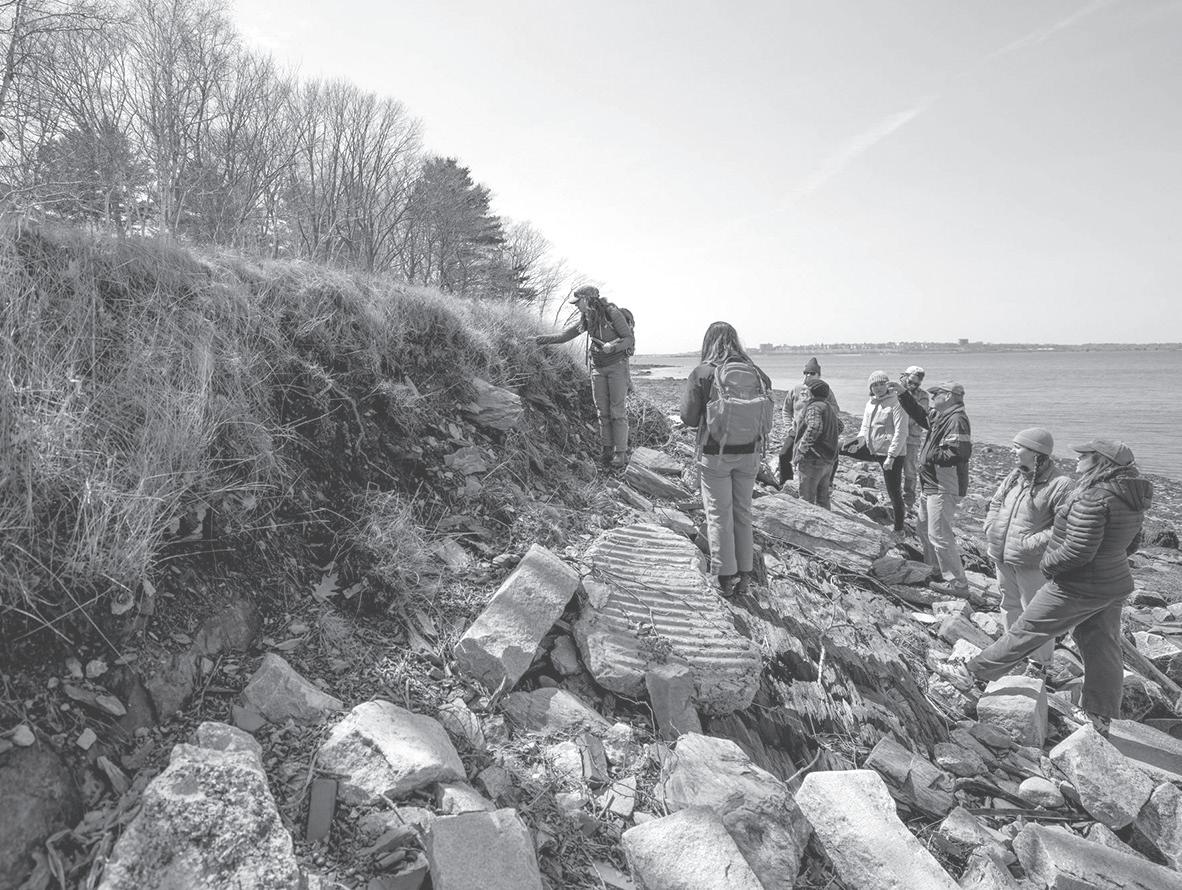
Residents and visitors inspect a destabilized bluff on Great Diamond Island.
PHOTO: MADISON MCCLINTOCK
Algae art
BY CARL LITTLE
Seaweed is having a moment— well, actually, more like an era. Attention to algae has been growing for many years now, led by environmentalists and entrepreneurs. While their goals might at times clash, both groups focus on this coastal mainstay: the weeds in the water.
Another cohort taking notice— artists—is becoming increasingly visual in its celebration and championing of these diverse species. In Holdfast! A Seaweed Exhibition, Celeste Roberge and Ian Ellis have assembled 30 artists— sculptors, photographers, painters, mixed media-tors, printmakers, quilters, et al.—for a tribute to seaweed of all sorts. The title of the show does double duty, as a description of an anchoring marine organism and as a declaration of solidarity, if you will, with the contested aquatic algae.
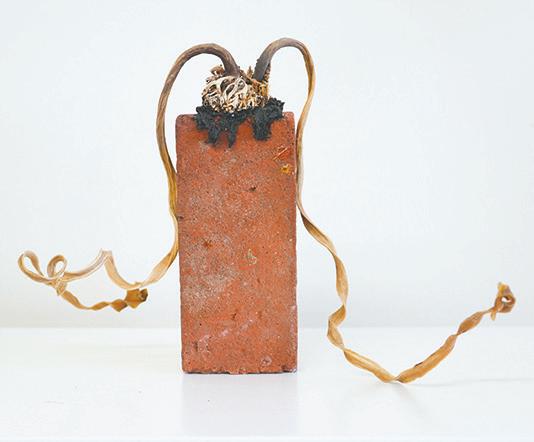
Ron Leax’s “Holdfast” might serve as the centerpiece. What appears to be a found sculpture features an orangered brick stood on end with a dried kelp holdfast and stem attached at the top—a sea-spirited piece that highlights the grip of nature. Likewise does Suzanne Demeo’s watercolor “Holdfast Study #3” demonstrate the weed’s ability to grasp, in this case a mussel.
Jordan Chalfant presses seaweed, a skill she situates “at the crossroads of art and science.” She floats the specimens in a shallow tray of water over herbarium paper to create colorful organic designs. Pressings in the show include dumontia and protomonostroma undulatum. Chalfant and fellow College of the Atlantic graduate Glen Mittelhauser co-lead the Maine Natural History Observatory’s Seaweeds of Maine project whose goal is to create a guide to the weeds.
Dave Wade’s photograph “New Swirl” captures the whirlpool motion of seaweed in tidal surges. The movement of seaweed also enlivens paintings by Krisanne Baker and Elizabeth Awalt, both of whom snorkel and dive to find their underwater subjects. (Awalt has curated Water Proof at the Wendell Gilley Museum in Southwest Harbor this summer, with a number of artists overlapping, including herself, Baker, Roberge, Michel Droge, and Posey Moulton.)
The range of mediums in the show is remarkable. Lisa Tyson Ennis contributes several cyanotypes from her “Ocean Garden” series, using the vintage photographic printing technique to highlight the shapes of her algaic subjects. Karen Adrienne offers a monotype titled “Sugar Kelp Shimmy.”
Barbara Putnam and Josie Iselin draw on science in their seaweed-inspired textile pieces.
In her 2018 book Seaweed Chronicles: A World at the Water’s Edge, Blue Hillbased writer Susan Shetterly warned of the impact of the seaweed gold rush on the chain of coastal ocean life. “A functioning ecosystem is a living mosaic,” she wrote, “as strong as we can make it.” The Holdfast! artists take this to heart in their creations.
Rich MacDonald, successor to the late, great Ruth Grierson as nature columnist for the Mount Desert Islander, ended a post titled “Is seaweed really a weed?” with this advice: “Next time you walk along the shoreline, look at the seaweed and ponder its vital role in the natural and human world.”
wonder.
His article on how two vintage Steinway pianos ended up on Sutton Island appears in Island Journal.
Holdfast! A Seaweed Exhibition is on view at The Warehouse, 20 Winter Street, Rockland, Aug. 1-Sept. 13. The show is open Friday, Saturday, and Sunday, 11 a.m.-5 p.m. The exhibitors are hosting a series of noontime talks at the venue. Among the offerings: “Tide Pools Instead of Babysitters,” with Seraphina Erhart, manager of Maine Coast Sea Vegetables in Ellsworth (Aug. 8); “Josie Iselin: Art & Algae: An Artist’s Journey into the Science of Seaweed and the Drama of the Kelp Forest” (Aug. 9); and “The Natural History of Seaweeds through the Holdfast! Exhibition” with Jessica Muhlin, professor of marine biology and chair of the Corning School of Ocean Studies at Maine Maritime Academy (Aug. 15). A complete list of talks is available on Instagram at @holdfastseaweedexhibition.
• Marine grade UC4B and 2.5CCA
• WearDeck composite decking • Fendering, pilings, pile caps, ladders and custom accessories
• Welded marine aluminum gangways to 80’
’re a bank that understands your organization’ s seasonal cash flow and unique financing needs.
code WWF to receive $100 to mission-aligned organizations when you open a new personal or business checking account.*



The art in this remarkable show compels us to consider seaweed in new and different lights and forms. Look and
Carl Little curated Francis Hamabe’s Maine: A Life in Art for the Castine Historical Society (through Oct. 12, 2026).
“Holdfast,” by Ron Leax; brick, tar, dried kelp holdfast and stem; 10¼ x 15 x 7½ in.
PHOTO: COURTESY RON LEAX
INFORMING THE FUTURE OF MAINE’S COAST AND ISLANDS
Maine Air Temperature
Maine is heating up
The average warm season since 2010 is about two weeks longer, and winters are about two weeks shorter as compared to the 20th century, creating ripple effects in our state’s economy and population’s health.
• On average, temperature in Maine has warmed by about 3.5°F since 1895.
• The 10 warmest years on record for Maine have all occurred since 1998, with 2024 as the warmest year on record.
are projected to warm by another 2-10°F by 2100, depending upon emissions scenarios.
Number of Days in Portland 0ºF or Colder, 1950-2025
Number of 0ºF or colder days
Data source: NOAA NCEI Global Historical Climatology Network daily (GHCNd)
With more hot days, cases of heat-related illness (HRIs) increase.
Across the U.S., heat-related mortalities tripled between 2016 and 2023. Last summer in Maine, emergency department (ED) visits due to HRIs spiked. This trend continues in 2026, with the week leading up to July 4 already surpassing the highest week of 2025, with 115 ED visits.
Access to cooling protects against HRIs. From 2011 to 2023, the percent of Mainers with air conditioning (A/C) in their homes increased from 53% to 78%, bringing Maine closer to the national average (88% in 2020). But, the level of protection varies by county and income; 84% of homes in York County have some sort of A/C, compared to only 62% of Hancock County residents (data from 2023).
From 2011 to 2023, the percent of Mainers with some sort of air conditioning in their homes increased from 53% to 78%.

Data source: National Centers for Environmental Information (NCEI), an office of the National Oceanic and Atmospheric Administration (NOAA)
Warming air temperatures impact our tourism and agriculture economies. Visitors spent over $9 billion in Maine in 2025 (Maine Office of Tourism), and changing temperatures are expected to influence tourist activities. Fewer freezing days in winter means less snow and ice cover for skiing, snowmobiling, and ice fishing. More warm weather extends fall recreation. The agricultural sector has seen the growing season increase by two weeks since 1950, which affects which crops can thrive in Maine.
On average since 1950, Portland now sees three more days per year 85°F or warmer, and 12 fewer days 0°F or colder.
Heat-Related Illnesses in Maine by week, May-Sep 2025
Waypoints is part of Island Institute’s effort to gather data and share stories that spur action and provide decision-making support to community leaders. Like the waypoints on a journey or map, thoughtful interpretations of data and science provide navigation points toward community-led solutions. A newly released Extreme Temperature Response and Resilience: A Guidebook for Maine Communities from the Maine Center for Disease Control and Prevention can be found by using the QR code.
Data source: Maine Tracking Network, Maine Center for Disease Control and Prevention
Gulf of Maine Temperature
Annual Average Sea Surface Temperature for Gulf of Maine, 1982-2025
Average sea surface temperature (SST) 1991-2020
Annual average SST
The 2025 temperature (blue circle) was similar to temperatures in 2002 and 2010 (red circles), though they come at the end of warming (red arrows) versus cooling (blue arrow).
Data Source: NOAA Optimal Interpolation Sea Surface Temperature V2 High Resolution Dataset. Figure generated by Gulf of Maine Research Institute.
Temperature can be perceived differently, depending upon the baseline against which it is compared.
The 2026 sea surface temperatures in Boothbay Harbor are another example of why baselines matter. January 2026 sea surface temperatures in Boothbay Harbor were cool when compared to the years 2010-2024, however when compared to the long-term average dating back to 1906, the 2026 temperatures were warmer.
In January 2026, you may recall seeing more sea ice than in recent memory. Yet, when comparing temperatures to the early 1900s and sea ice extent between the two periods, 2026 was actually quite warm and sea ice was thin and patchy relative to the ice in the early 1900s when people could walk, ice skate, drive a car, or even pull a house across coastal Maine bays during many winters.
Boothbay
Recently cooler, but still very warm
The Gulf of Maine has been in a warm state, with sea surface temperatures above the long-term average since 2010. While temperatures have been cooler than recent peaks during the past several years, they have remained warm compared to preceding decades.
Baselines matter!
Baselines are the years used to represent reference conditions. As seen in the chart to the left, sea surface temperatures in the Gulf of Maine have been above the long-term average since 2010. Given the warm temperatures from 2010 to 2025, the 2025 temperature seems cool, as it is one of lowest temperatures during that period. Yet, the 2025 temperature was on par with those experienced in 2010 and 2002. Given that temperatures from 1982 to 2010 were cooler, those two years felt warm.
Harbor Sea Surface Temperature
2010-2024 baseline average temperature
1906-2024 baseline average temperature 2026 temperature
Data source: Department of Marine Resources Boothbay Harbor Environmental Monitoring Program
Why the warm, then the pause?
Three major water masses enter the Gulf of Maine, and their characteristics are very different. These include warmer, saltier water derived from the Gulf Stream, and cooler, fresher water from the north which arrives from Scotian Shelf Water at the surface and Labrador Slope Water at depth. Since 2010, Gulf Stream water has been the predominant water mass entering the Gulf of Maine, but since late 2023 there has been a shift back towards a greater influence of colder, fresher water from the north. These broader oceanographic changes have resulted in the pause in warming that we are currently experiencing. Some models predict this pause may endure through 2030. These changes have major impacts on species including cod, lobster, right whales, northern shrimp, seabirds, green crabs, longfin squid, black sea bass, and many others.
Oceanographic changes set up the possibility of new and unexpected conditions that impact management of fisheries, aquaculture, protected species, marine recreation, and transportation. While some warm-water species may decline during this short-term cooling, it does not necessarily imply a sustained return to pre-2010 conditions.

BOTTOM LINE
Air and ocean warming are driven by climate change. Changes in atmospheric and oceanic currents, like jet streams and the Gulf Stream, influence short-term events, like cold snaps or ocean cooling, but the longterm trend of warming remains.
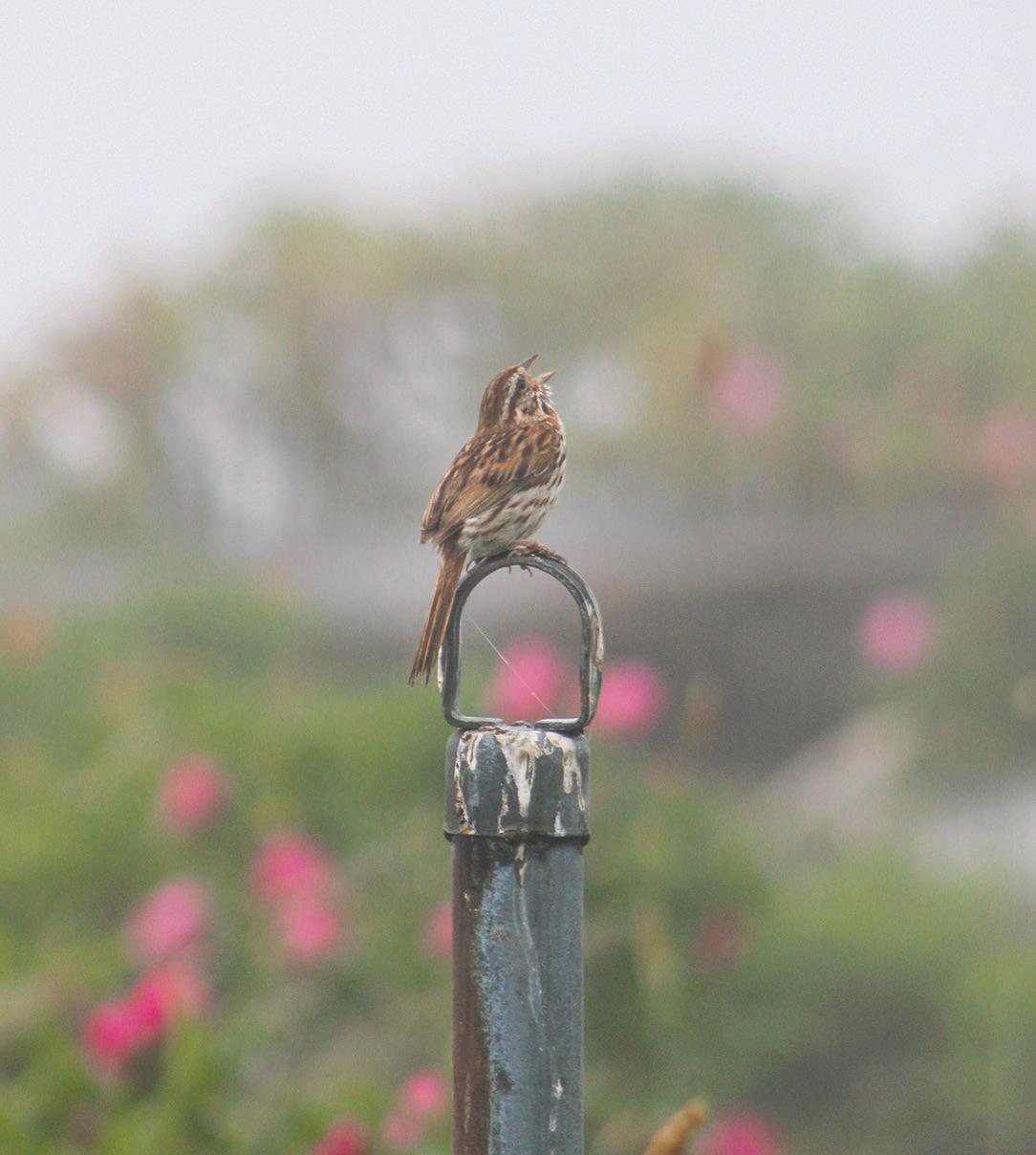
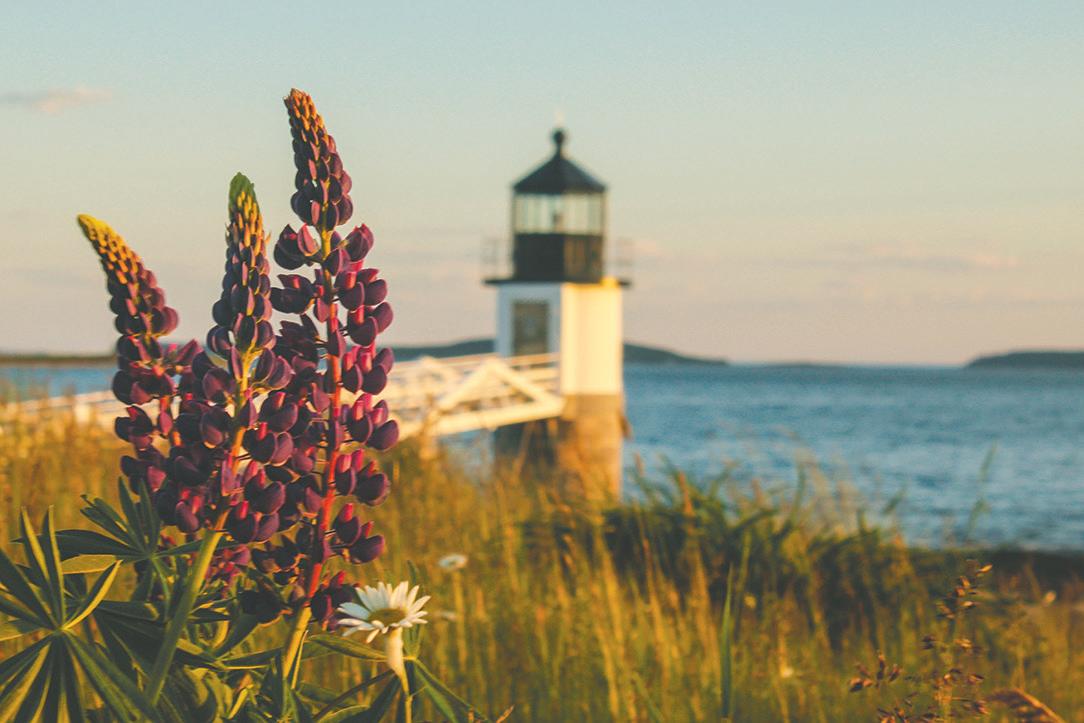
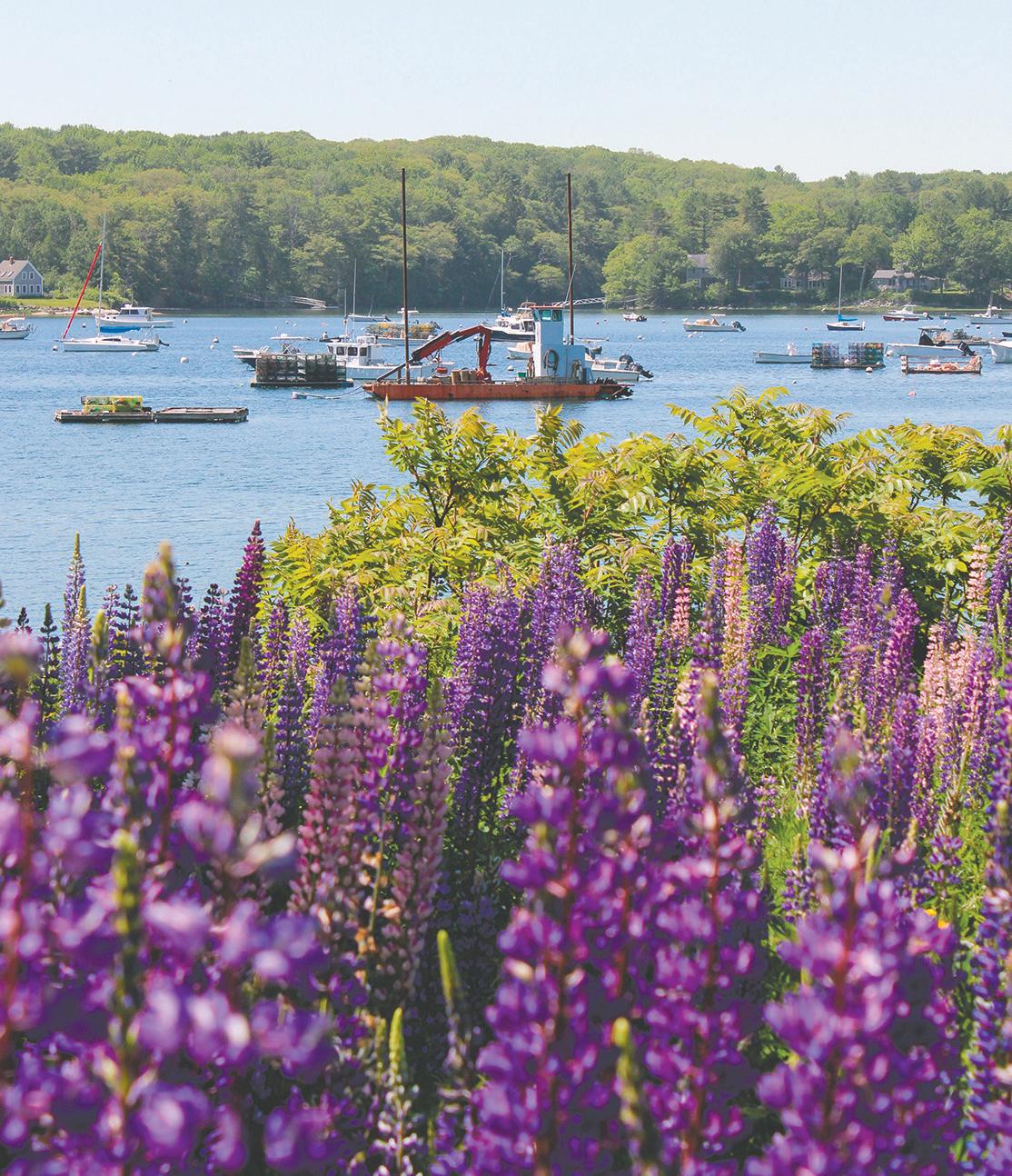
Welcoming summer with Maine’s lupines
The flowers stole the show during a recent visit to the Midcoast
PHOTO ESSAY BY GEORGIA HOWE
Like so many Mainers before me, I grew up with a well-loved copy of Barbara Cooney’s Miss Rumphius on my bookshelf. The titular character, better known in my family simply as “the Lupine Lady,” took on a sort of folkloric presence in my childhood. In the backseat of sleepy return trips from the beach, I often imagined her pedaling a bike alongside the car, scattering lupine seeds to spring up in the hills and gullies along Route 27.
Today, lupines have firmly cemented themselves as my favorite flower. Their short-lived anthesis marks the turning of the seasons, blooming briefly during those long, sunlit days of mid-June. Dotting highway ditches and coastal meadows, the iconic lupinus polyphyllus are an invasive species. But for many Mainers, they still herald the solstice and the start of our long-awaited summer months.
I was lucky enough to spend this fleeting time of year in a photography workshop with Benjamin Williamson, a beloved photographer known for his dramatic, colorful shots of the Maine coast. With a crew of four other photographers and twice as many cameras, we spent a day chasing the light across two Midcoast peninsulas.
The workshop was bookended by lighthouses—sunrise on Pemaquid Point and sunset on Marshall Point—and filled with stops at working waterfronts. In New Harbor’s Back Cove, I focused my lens on dewy lobster traps. At the Port Clyde Fisherman’s Co-op, I tracked boats humming across the horizon. These places, though active year-round, were thrumming with that late-spring crescendo of anticipation for the busy season.
But throughout the day it was the abundant lupines that always seemed to catch my eye. A detour through Bristol brought me to a field of the flowers overlooking Round Pond—not too far from where the woman who inspired Miss Rumphius once lived in Christmas Cove. Their buds, sporting colors of indigo and rose, framed a glittering harbor, and I found myself basking in the satisfying symbolism of it all. The coast’s sepia palette had given way to the full saturation of a bustling Maine summer.
Georgia Howe (she/her) is a writer and creative based in Hallowell. She is the content marketing specialist at Island Institute and a staff writer for Same Faces Collective.
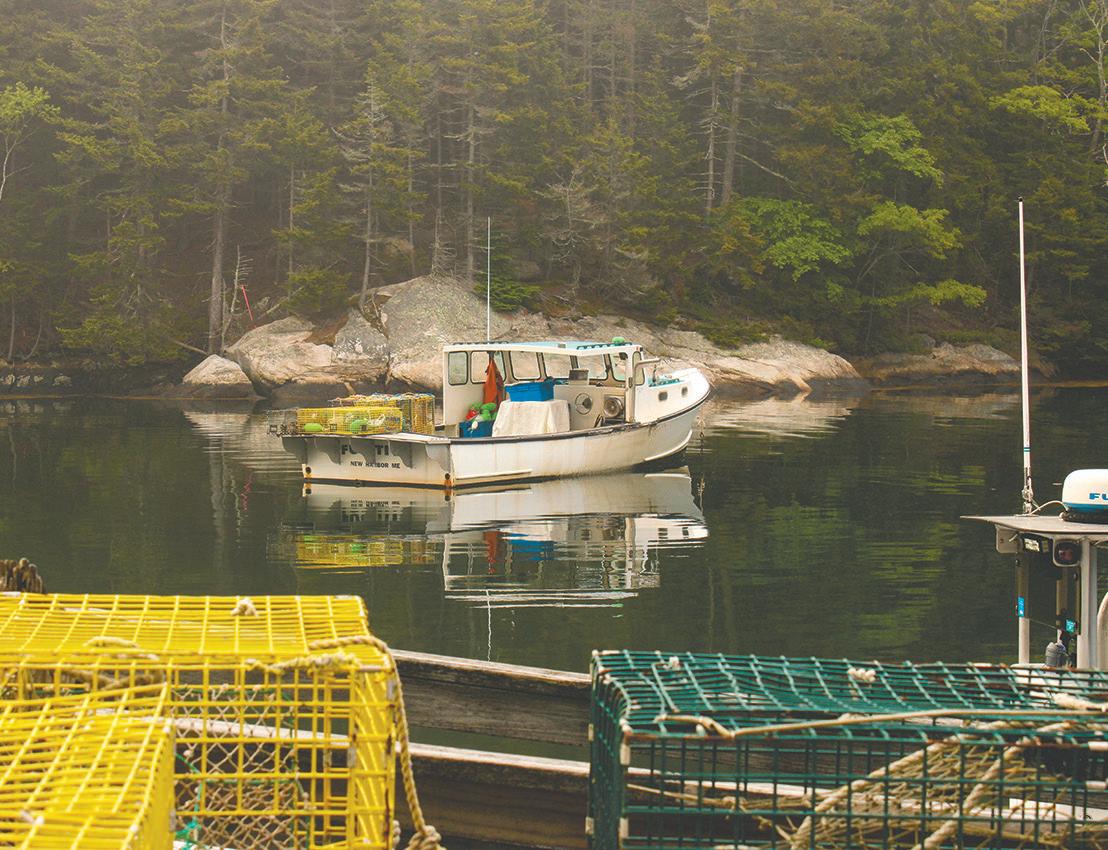
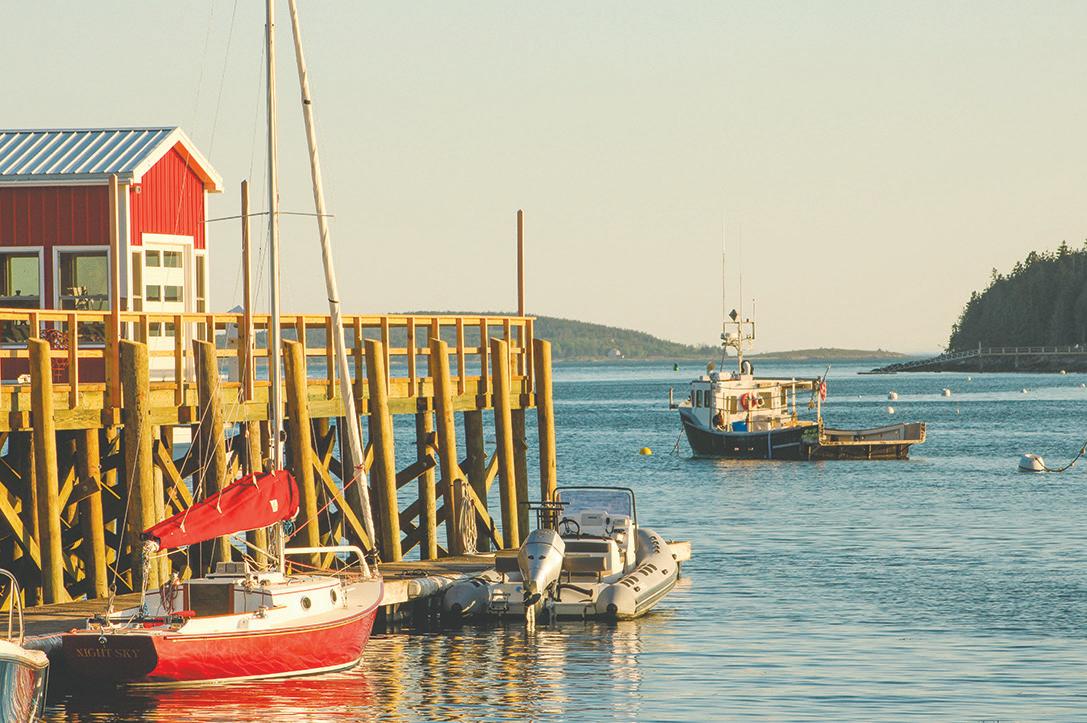
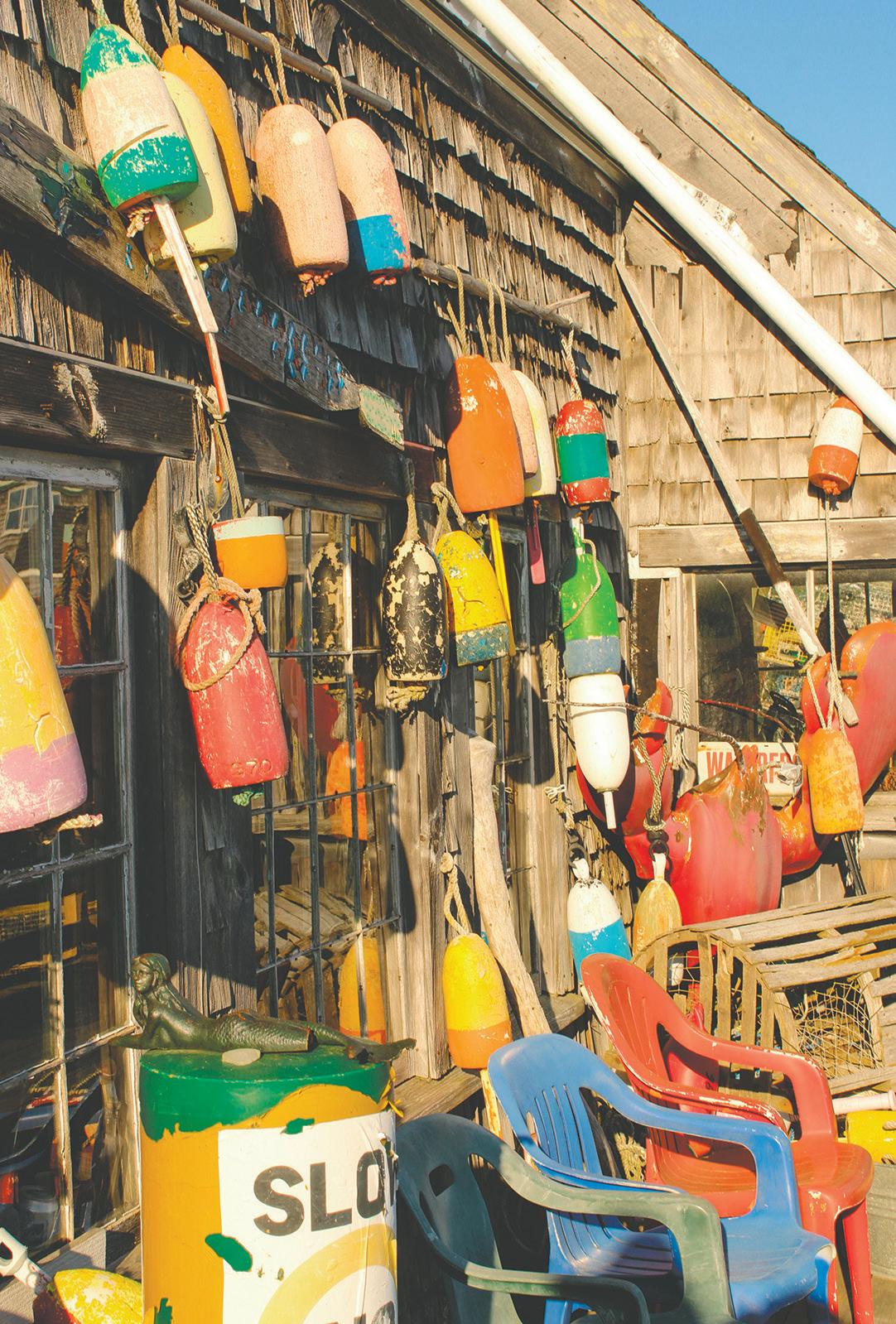

Our Island Communities

The tall task of throwing away lobster rope
An effort to move 5 tons off Matinicus shows the scale of the problem
BY JOHN BLODGETT, MIDCOAST VILLAGER
Lobstermen call it pot warp: the rope that runs from the buoy on the water’s surface down to the trap on the ocean floor. A single lobsterman may use miles of it. Until the mid-20th century, pot warp was made of natural fiber—Manila, cotton, hemp—that wore out, broke down, and eventually was burned or left to biodegrade. Then synthetic rope replaced it almost entirely, adopted for its strength, durability, and low cost. The rope must be replaced regularly because the plastics involved degrade with use and exposure, and no lobsterman wants to risk losing traps, or lobsters, to a snapped line.
For generations, old pot warp, natural or synthetic, was often tossed overboard or burned. But while natural fiber rope biodegrades eventually, plastic rope does not. It breaks down into microplastics, and if burned in an open fire, produces what Matinicus Island resident Eva Murray calls a “revolting black oily fire” and leaves behind multicolored goo on the rocks. Nobody in the waste industry wants it either. Fed into mechanized equipment, the plastic rope twists around shafts and conveyor belts, forces shutdowns, and requires workers to cut it free by hand. Old rope as a result piles up under wharves and behind fish houses when it’s pulled out of service.
Murray arrived on Matinicus in 1987 to teach school for a year and never left. She has served as its town clerk, treasurer, administrative assistant and, as she puts it, garbage czar. Over 23 years, she and others have built a recycling and solid waste program from nothing on an island with no loading dock, no tractor-trailer access, and a ferry schedule that governs everything: The boat departs only once to five times per month, varying by season. Today, it all moves by truck and ferry to a transfer station on the mainland. Though run by volunteers, it is an actual municipal department, funded by property taxes, like every other town in Maine is required to have. But one thing Matinicus is still figuring out how to throw away is its pot warp, and there’s plenty of it on the island, where lobstering remains essentially the only local industry.
So when nearly 5 tons of accumulated lobstermen’s rope finally left Matinicus on April 23 on a rented truck bound for a warehouse in New Bedford, Massachusetts, it was both a local success, if a limited one, and an illustration of a problem that runs the length of the Maine coast. In the absence of a statewide system for disposing of end-of-life fishing gear, the solution and the cost fall on affected communities often with limited or no resources. The trip was for demonstration as much as disposal, intended to show what it takes to move old gear off a remote island, and to argue that Maine needs something like what New Bedford has: a dedicated warehouse to receive, sort, and process marine debris from across the region.
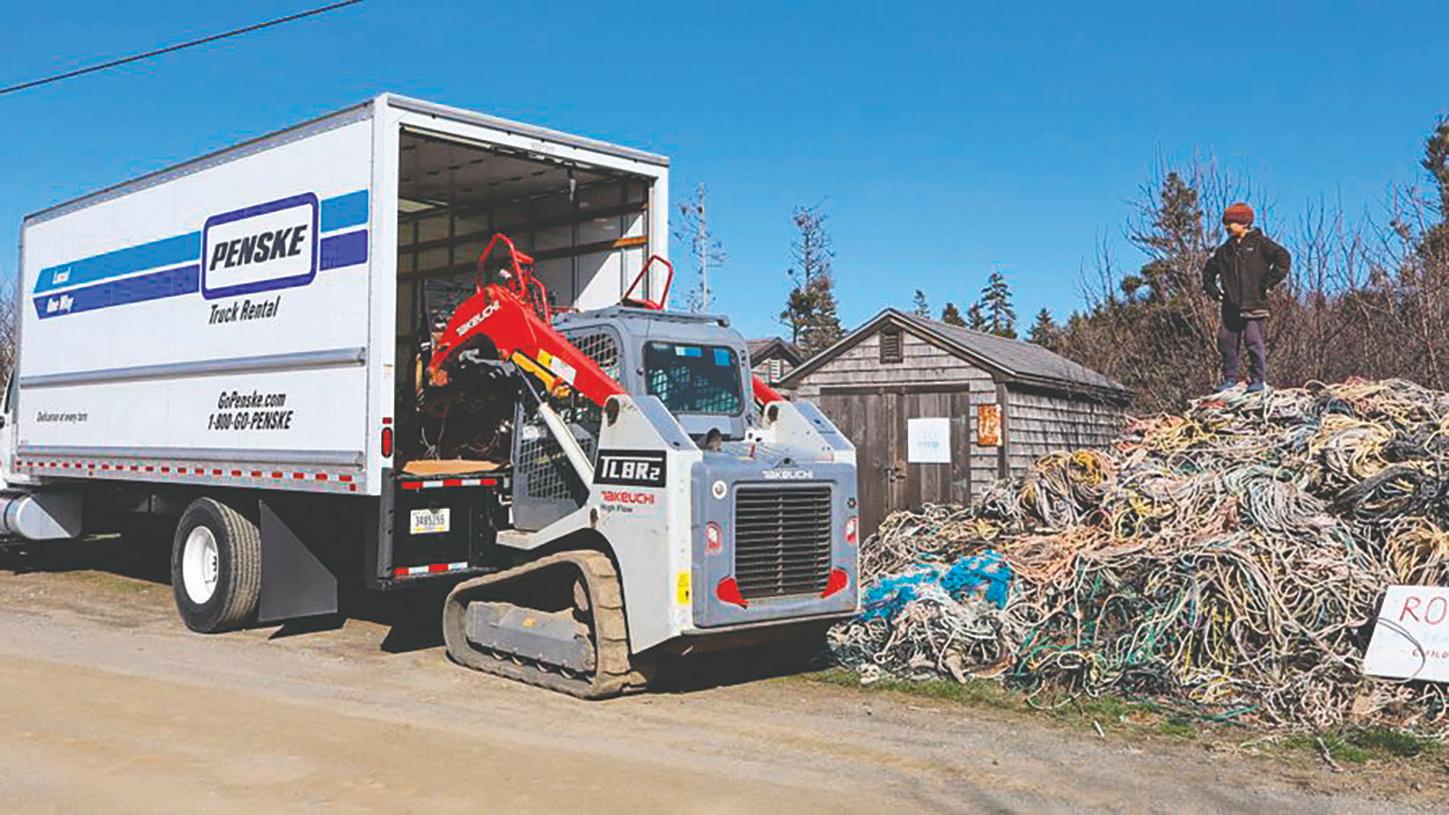
Phil Davies uses a skid steer with a grapple attachment to load discarded fishing rope onto a rental truck on Matinicus Island.
PHOTO: COURTESY EVA MURRAY/ MIDCOAST VILLAGER
Eva Murray drives a rental truck containing almost five tons of discarded fishing rope from Matinicus off the ferry in Rockland on April 23.
PHOTO: JOHN BLODGETT/ COURTESY MIDCOAST VILLAGER
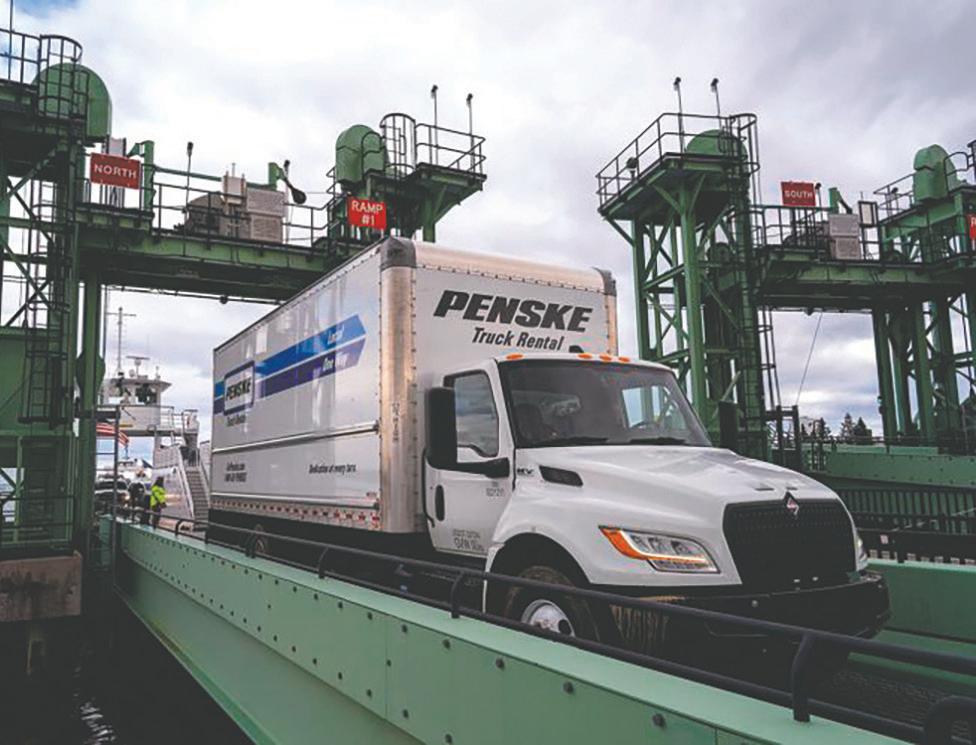
“ This is not going to be our routine solid waste mechanism unless somebody with deep pockets wants to help.”
“This is not going to be our routine solid waste mechanism unless somebody with deep pockets wants to help,” Murray said.
It was not Murray’s first attempt at a solution for getting rid of the old rope. At the Maine Resource
Recovery Association’s annual conference in 2017— “dump school,” she calls it—she met Hank Lang, the plant manager at Penobscot Energy Recovery Co., which then ran the trash-to-energy facility in Orrington. PERC had recently acquired a machine called the Terminator, designed to shred materials too difficult for conventional equipment, and Lang was looking for something to test it on. “I said, ‘Boy, have I got a difficult material for you,’” Murray recalled. “He said, ‘What have you got?’ I said, ‘A lot of plastic rope. A lot.’” Lang offered to take the first truckload for free. Over three years, from 2018 to 2021, Murray made nine trips—hauling rope in U-Hauls or borrowed dump trucks, with volunteers on the island pitching it in by hand. She hauled more than 35 tons in all. Then PERC went out of business, changed ownership, and the facility caught fire. Whether the Terminator survived the blaze, Murray cannot determine. She was left holding the rope, and the pile that she and other volunteers had been steadily reducing began to grow again.
Murray spent several years attending Fishermen’s Forum and writing letters in support of grant applications by a regional coalition of nonprofits working on the marine debris problem. Among them were the Center for Coastal Studies, the Rozalia Project, and Net Your Problem, a nonprofit with a 4,000-square-foot warehouse in New Bedford where discarded fishing rope is collected and sorted. The higher-quality and more colorful rope is sold to artists who use it to make doormats, baskets, and sculptures, while the more degraded rope is shredded for concrete aggregate or shipped all the way to Denmark to a recycling plant.
The coalition agreed to cover the costs for Murray to haul a load of Matinicus rope to New Bedford. The original plan was to make the trip in October 2025, but the weather did not cooperate. The trip was rescheduled for December, but the weather failed to cooperate again. The pile sat through the winter until this spring, when the forecast, the tides, and the ferry schedule all finally aligned.
Undertaking such a project on the island is, as Murray put it, a three-ring circus of logistics. Given the infrequent ferry schedule, ordinary vehicle reservations can be made up to three months in advance, yet even the special 4-month window available to
Matinicus Island Recycling and Solid Waste doesn’t guarantee a truck spot, as they fill quickly. The island’s wharf is inaccessible at low tide, and even at high tide it is not big-truck-friendly, as the steep, narrow ramp also features a hairpin turn. The loading window is roughly an hour before the ferry departs. If you miss it, the next one could be a week away or longer, depending on the weather and calendar.
For the April trip, a skid steer one of the islanders happened to own, fitted with a grapple—steel jaws that could seize a mass of tangled rope and hoist it into the truck’s box—made the loading considerably faster than on prior trips. Even so, the people inside the truck still had to pitch the rope forward by hand for about four hours. When Murray weighed the truck at certified scales on the way south, it came to nearly 5 tons. “We could easily haul off multiple truckloads a year,” she said, “if somebody would take it.”
The total cost of the trip: about $3,000 in truck rental, ferry fare, fuel, and hotels, covered by coalition grants—and that figure includes a detour to Fairfield, on the far side of Waterville, the only rental outlet in the region she could find with a truck of sufficient capacity. “That doesn’t count my time or anybody else’s time,” Murray said.
The artists who came to help unload the rope in New Bedford on April 24 were delighted with what they found. Kim Edwards, a fiber artist from Westerly, Rhode Island, who makes baskets and other creations from discarded fishing gear, had been waiting since the previous fall, when the trip was first delayed by weather. “I just pulled this right here which has lavender and this pink,” she told CAI, the local NPR affiliate, which covered the unloading. “So right now it looks very dirty and once you wash it all these bright beautiful colors come out.” Nicole Baker, the founder of Net Your Problem, told CAI that Maine’s rope is distinctively more colorful than what comes
off Massachusetts boats. The prettier rope was priced at 75 cents a pound for artists. As for the rest, Baker told CAI, shipping it to a recycling plant in Denmark is “actually cheaper and lower carbon emissions” than domestic alternatives because most U.S. recycling facilities are not equipped to handle it.
“These people were really pleased to have it,” Murray said, “so that sort of took the edge off the fact that the bill was rather large to do this.” Yet Murray is quick to say that it was a demonstration, not a solution, and not practically repeatable. “There is no costeffective way to make this stuff go away,” she said. She estimates close to twice as much rope remains in the pile on the island, which will only continue to grow. Future trips depend on whether the coalition can secure continued funding; Matinicus Island Recycling and Solid Waste cannot finance the truck rental and associated costs.
Murray says she would do it again if the funding materialized. The coalition’s marine debris grant has already funded one small step—a $600 pallet jack that would simplify future loading—but that’s the extent of the funding for now. Still, the demonstration served a purpose. “It’s to show people how hard it is,” said Laura Ludwig of the Center for Coastal Studies. “People don’t understand the scale of the problem. Fishermen have many, many more thousands of pounds of rope than that in their backyards.”
Murray does not blame the fishermen. “They don’t have the alternative of natural fiber rope,” she said, as it is no longer made at the scale or price that commercial fishing requires. Murray calls for product stewardship, or extended producer responsibility, or whatever you want to call it—modest fees collected at the point of sale for commercial fishing gear, similar to those already in place for paint and car batteries— that would help cover disposal costs on the other end.
Maine has no warehouse like the one in New Bedford where fishing communities up and down
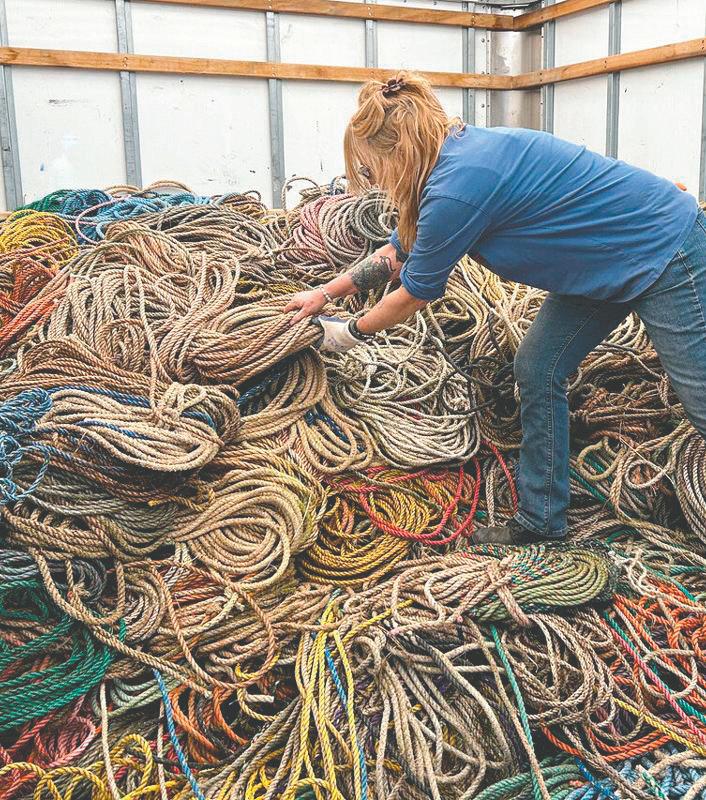
the coast can bring accumulated gear in quantity. But if the most remote community in Maine—where the logistics are most challenging and the options most limited—is willing to work hard to dispose of it properly, Murray said that other, larger communities have no excuse not to try.
“If we can prevent this rope from being thrown overboard and ending up being speck-sized marine debris that things eat and then starve to death,” she said, “then morally that’s a good thing.”
This story was published in partnership with Midcoast Villager, where it first appeared.


Hilary Moll, an artist who works with marine debris, helps offload fishing rope from Matinicus Island at a warehouse in New Bedford, Massachusetts on April 24.
PHOTO: COURTESY EVA MURRAY/MIDCOAST VILLAGER
The Smithsonian gets its first Maine lobster
THE SMITHSONIAN’S National Museum of Natural History has opened a new exhibit, From these Lands, featuring 600 specimens and objects showcasing the nation’s rich natural and cultural history.
At the center of one display is a large American lobster harvested last year by a Vinalhaven fisherman. Upon discovering the museum collection
lacked a suitable lobster for display, a staffer with ties to lobstering donated the specimen, along with four others for its permanent collection.
The exhibition will be on view through 2029, illuminating the many connections between people, places, and the natural world that can help visitors understand the nation’s past, interpret the present, and plan for the future.
Items on display include a brilliant blue gemstone from California rarer than gold and a Northern bobwhite collected by a young Theodore Roosevelt in New York. The show highlights science in action, from feather fragments used to identify bird species involved in airplane strikes to the story of efforts to reintroduce sea otters to the Oregon coast. It will also explore the enduring ties between people
and place, from the fishing practices of the Pamunkey Indian Tribe and African American oyster harvesting communities on the Chesapeake Bay to the artistry and stewardship behind traditional Samoan bark cloth.
A state symbols interactive will allow visitors to design and send digital postcards with photographs of official state flowers, birds, rocks, fossils, and more.
UMaine researcher sails Southern Ocean to study phytoplankton
BY UMAINE NEWS
BATTLING POLAR winds, rough seas, and sea ice, the University of Maine’s Emmanuel Boss and his colleagues sailed the Southern Ocean to study plankton, microscopic organisms that form the foundation of marine food webs.
These microorganisms, particularly the plant-like phytoplankton, have been producing about 50% of the world’s oxygen, and feed numerous species—oysters, crustaceans, seabirds and whales—that support marine ecosystems and economies worldwide. Greater plankton biodiversity is often associated with healthier and more resilient marine ecosystems.
That’s why Boss, professor of oceanography, spent 50 days from January to March investigating biodiversity in the Ross Sea bordering Antarctica.
Aboard the Perseverance, a 131-footlong aluminum schooner serving as a floating research platform, Boss sailed 7,200 miles between Antarctica, Australia, and New Zealand. He and his colleagues deployed buoys with sensors to collect ocean and atmospheric data and harvest water samples as the boat wove past floating sea ice through high winds.
“With this data, my colleagues and I plan to develop a biodiversity algorithm that will link satellite observables with ocean biodiversity parameters assessed with genomic techniques,” Boss said. “Such data is critical to design and evaluate ecosystem models with, as well as assess the state of the ocean health.”
The total fuel consumption of the Perseverance during the 50-day voyage was about 20 tons, similar
to that of a standard research vessel of the academic fleet in a single day. That’s because the ship utilized sails along most of its journey in the Southern Ocean.
Boss collaborated with scientists from NASA, the European Space Agency, and the Centre National de la Recherche Scientifique on his project and others throughout the voyage. Citizen scientists were also recruited to assist with the research.
Phytoplankton contain chlorophyll, which influences the color of ocean surface water. Different phytoplankton communities affect ocean color in different ways. Satellites can measure light reflecting off the ocean’s surface, allowing researchers to study ocean color remotely. Boss and his colleagues tested whether that information could be used to identify the types of species
residing in various areas of the Ross Sea and Southern Ocean.
Some of the sensors used during the expedition measured light emanating from the ocean as influenced by phytoplankton communities as well as the optical properties of the water via instruments through which ocean water flows. The data from those instruments, as well as water samples that underwent genetic analysis in the onboard labs, were provided to NASA for comparison with satellite imagery collected during the expedition and for use to develop new space-based algorithms.
“Satellite observations are the only [way] that can span the full planet in a matter of a few days,” Boss said. “Any link we can make between them and the state of the ecosystem, the better we can understand the living ocean on relevant time and space scales.”
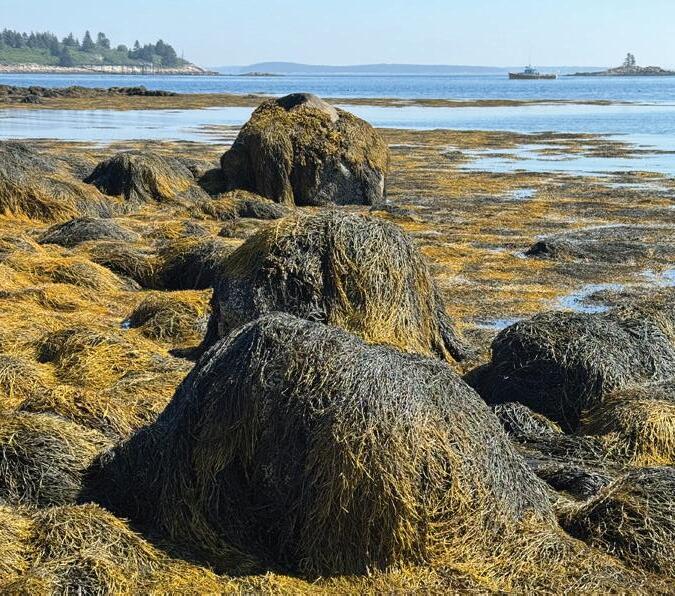
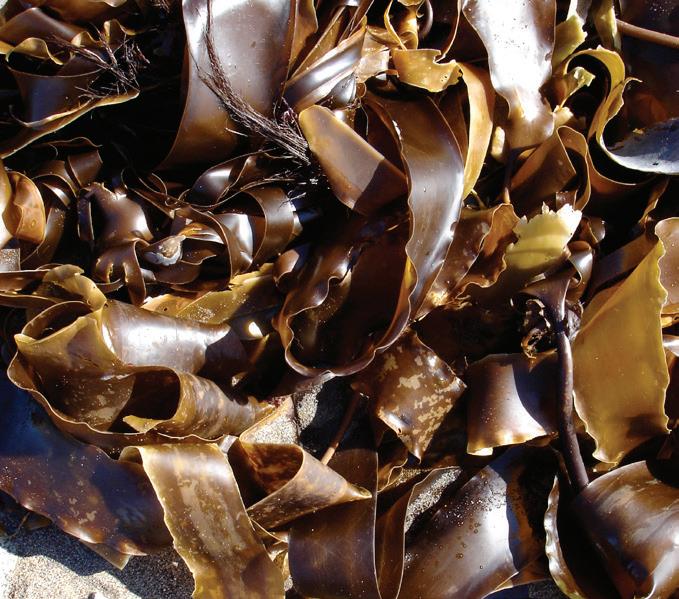

Island Reader turns 20
The anthology is published by Maine Seacoast Mission
Readers of The Working Waterfront probably known Maine Seacoast Mission as the group that offers health, education, and other important services across Maine’s unbridged island communities. The Mission also celebrates those communities with The Island Reader, its annual anthology of art, poems, and other writing by island residents. This year, the Reader is celebrating its 20th birthday by sharing works under the theme of “What Brings You Joy.” Its publishers have graciously given us permission to publish a small sampling of those pieces. The digital version of the Reader can be read, and hard copies can be ordered, at https://seacoastmission.org/ sunbeam/island-outreach/the-island-reader/.
The Heath*, Late September
I was putt-putting down the gravel path along its edge to visit friends when I just had to stop, awed by its sheer expanse: the spongy sphagnum “ground" in so many shades of green and brown, stippled all over with uplifted luminarias of bright white cotton grass; scags jutting up through the moss, tall, proud and silver in their death; here and there, stands of tall, elegant wool grass, their barmy headdresses, their thin, downturned leaf arcs ready as guarding scimitars; swathes of blueberry leaves, burgundy red in what could be celebration or protest; a border of scraggly larch, their short needles not yellow, not yet fallen and every-which-way branches like arms of a cheering crowd, or maybe, again, Don’t die! Don’t do that! But it’s all the rich decomposing material that makes this place so rich, that feeds, that feeds ongoing life, allowing it to harbor orchids, (calopogons, Arethusa bulbosa), sundews, pitcher plants, fritillaries, ravens, eagles, osprey doing reconnaissance, mink trolling for voles, scurrying along the runnels. The Heath is the soft center of our island, and, like some earlier humans, we consider it sacred, careful of it as we’d be of a baby’s fontanel. This bubbling alchemical cauldron shields from solar heat, sequesters carbon, filters water, prevents evaporation and erosion, perpetually transforming what dies away from what can be reborn. Unlike those who are offput by a bog, thinking it nothing by a mire to get sucked up in, we hold ours inviolate. It’s not to be interfered with. So any deep-pocketed off-islander who dast wander over to propose “clean up,” infill, luxury, ocean-view homes will feel our wrath.
*pronounced “Haith,” on our island along the coast of Maine
Susan Deborah King Great Cranberry
Laundry day, Monhegan
Rocks broken from the shore roll back, And slowly turn to sandy clouds below, The calm and ordered tidal pool a wrack Of chaos as a new wave breaks across.
It recalls the wildness of her younger days, With wind-blown hair, a salt-rimed summer girl. Nature’s made to fall apart, she thinks. Why is it so reversed for her?
The sun comes out, it’s laundry day. She sighs and sets about the tasks ahead. One more long day of chores for her to do, Till darkness calls her upstairs to their bed.
Remembering her arrival to the island, Wild parties, wilder boys and girls. The laundry dances too, bright patterns swirl; She loves the chaos of the wind and sheets.
Much older now, and past chaotic bedding, Her life is now routine, with ordered days, Another ordered year in life’s routines. What happened to their once disordered ways?
The ordered catenary curves between the pins Mock the lively chaos of the sheets. She knows that when she goes upstairs to bed, There is yet another task before she sleeps.
Barring Coughlin Peaks Island
Maine warns boaters to keep distance from humpback whales
THE MAINE Department of Marine Resources has recently sighted numerous humpback whales close to shore, spanning from Port Clyde up through Jonesport. We have also received reports of boaters coming in close proximity to these whales. This can result in injuries to both the whales and the people.
When boating in waters shared with whales, boaters are reminded to:
• Keep your distance: NOAA Greater Atlantic Region recommends all fishermen and boaters (including kayakers and paddleboarders) to keep a safe distance from humpback whales of at least 100 feet—preferably 300 feet.
• Slow down: In areas where you suspect whales will be present, slowing to 10 knots helps to
prevent collisions by allowing both you and the whale time to react.
• Steer clear of spouts and bubbles: If you see any large bubbles or disturbances in the water, it could be a whale feeding. Respect a whale’s behavior and keep your distance.
• Protect your recreational fishing gear: Don’t cast or troll near or around humpback whales or bubble clouds. If a bubble cloud appears while you’re fishing, pull up your gear, if possible.
Humpbacks sometimes create bubble clouds to corral their prey. Fishermen or boaters in these bubble patches run the risk of colliding with a humpback whale as it rapidly approaches the surface. When a whale collides with a vessel, it can be gravely injured and die from its injuries. Collisions with whales
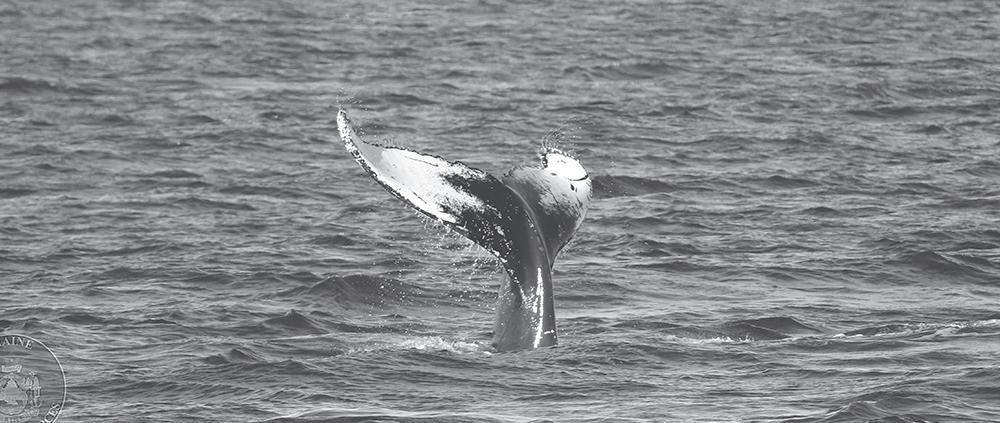
have also thrown boaters from, caused damage to, and even capsized vessels, causing injuries and even death.
As a reminder, all whales in U.S. waters are protected by the Marine Mammal Protection Act, which makes it illegal for people to harm, injure, kill, chase, or harass whales or any other marine mammal. Harassment includes any activity that results in changes to the whales’ natural behaviors, such as feeding. Violating the Marine Mammal Protection Act can result in fines up to $35,000 and up to one year in prison.
This humpback whale was spotted in waters off Maine.
PHOTO: COURTESY MAINE DEPARTMENT OF MARINE RESOURCES
book reviews
An island doctor goes deep on rare diseases
Dr. Chuck Radis gives an inside look at difficult diagnoses

The Mystery in the Room: A Physician’s Journey Treating Patients with Rare Diseases
By Dr. Chuck Radis (2025, Sakamo Press)
REVIEW BY TINA COHEN
I HAVE ENJOYED reading, and reviewing, two previous books by Dr. Chuck Radis, D.O., a longtime resident and once the practicing physician on Peaks Island. His previous works, Island Medicine and Go By Boat, introduced readers to his wife and two daughters, the challenges of island life, and treatment of island patients, including many colorful characters. Radis considers this newest book, about rare immune system disorders, “a reflection on the dance practitioners and their patients engage in as they navigate uncertainty. Arriving at a specific diagnosis in uncommon diseases takes time, persistence, and may require referrals to multiple specialists.” It begins after a year in which Radis left Peaks to study rheumatology as a specialty. It also focuses again on family and island life.
‘The
If you are a susceptible person who responds to definitions of illness by believing you share the symptoms, this book may not be for you. But understanding more about how doctors think and work with patients has appeal. Radis could have titled this book “The Third Person in the Room,” as he gives an inside look at approaches to healing. It’s very informative.
If you’re curious about the nuts and bolts of doctor-patient interaction, Radis recreates conversations that reveal the state of patients—usually in pain—and his process of trying to diagnose and treat illnesses in the most helpful, respectful, and empathetic way possible. Treatment can involve tests, consultations, and digging up medical history—and it usually doesn’t bring quick or easy answers. Radis draws readers in, telling his story with a folksy tone and humble persona. He provides humorous anecdotes to demonstrate his shortcomings, and describes his not-fancy lifestyle
on Peaks. Even though doctors are authority figures entrusted with saving lives, he is not burdened with a big ego. I think he’s a “regular guy.”
Radis has a good eye for fascinating details and appreciates action-packed stories. There’s a nail-biting chapter on his own neardeath experience and dramatic rescue while spending a day skiing on Mount Washington. Despite it being spring, it felt like winter as his group began ascending.
He provides humorous anecdotes to demonstrate his shortcomings, and describes his not-fancy lifestyle on Peaks.
Just as they were finishing up, Radis lost his footing and tumbled into a fastmoving stream of water that carried him along, weighed down with boots and backpack, until he finally stopped, pressed against some boulders. His friend waded in and was able to bring him out to where a treaded vehicle could reach them. Then he was ambulanced to the North Conway hospital, in pain from a dislocated shoulder. The longest-lasting
Greatest Show on Earth’
Bernd Heinrich explores the less-noticed parts of nature

By Bernd Heinrich
REVIEW BY CARL LITTLE
IN THE FOREWORD to his new book, Bernd Heinrich explains the reasoning behind its title. “Ensconced for forty years in the Maine woods,” the famed biologist and author writes, he has explored his forest retreat, focusing on the “common uncommon,” natural phenomena that have “not been sufficiently noticed.”
The spirit of the writing is generous, the sense of place, intimate and compelling. Every encounter with the natural world expands our wonder. Spiders, beetles, chestnut trees, eastern phoebes, woodcock, swallows: thanks to Heinrich’s empathetic guidance, we see these and other flora and fauna with the clarity of someone who possesses a power of observation that seems almost preternatural.
In a section on arachnids, Heinrich highlights the precision of their webs as structures and traps. His devotion to these brilliant spinners leads him to
comment on Charlotte’s Web: “I’d have preferred E. B. White to show what spiders really do, not what we might dream they do or what people might like to hear about them.” Point taken.
Here and there, Heinrich references his early life. He got to know his “first love,” beetles, in the Hahneheide forest “while we were eating crows and mice when we could get some as we arrived as refugees in Germany after our flight from Poland with nothing.” Noting that there are about 350,000 species, he cites British evolutionary biologist J. B. S. Haldane as declaring that if God created all living organisms, then he must have had “an inordinate fondness for beetles.”
On a rare occasion, Heinrich lays on the language of biology. Writing about leaf shedding in the fall, for instance, he notes that it is likely influenced by “photoperiods and circannual biorhythms, which trigger the production of abscission enzymes that dissolve the cell layers….” That mouthful aside, his explanation of autumn colors will lead this reader to
look at those autumnal glories with a new respect.
… the 80-somethingyear-old author-biologist climbs one of the trees with a nimbleness some of us will never possess.
Heinrich is not only observing nature, he is rescuing it. His successful efforts to revive the wild American chestnut tree have attracted worldwide attention. Since planting a few saplings around his cabin in Weld, the chestnuts have spread and now number more than a 1,000. In the video “The Wild American Chestnut: A Giant Returns” posted by the Global Justice Ecology Project in December 2025, Anne Petermann, the project’s executive director, visits Heinrich to talk about his resurrection of this endangered tree. At one point in the clip, the 80-something-year-old author-biologist climbs one of the trees with a nimbleness some of us will never possess.
Speaking of rescuing, in his inimitable style Heinrich relates the story of a merganser trapped in a pool in a nearby brook, unable to take off. After jumping in, he grabbed the duck on a “swim-by” and tossed into the air as high as he could, “which was high
impact was post-traumatic stress disorder, which included recurrent nightmares, panic attacks, and a fear of darkness, tight spaces, and being alone. Now, Radis says, he appreciates that his experience provided greater understanding of others with PTSD.
He also shares some concerns. He is wary of addictive opioid painkillers and sometimes questions the decisions of other providers who have prescribed them to his patients.
He realizes people with opioid use disorder who are refused by him will keep hunting for other doctors to try. Radis also sees many patients asking if they have specific conditions, and he feels frustrated that some patients require certain diagnoses in order for their insurance to cover treatment. While a refusal can disappoint the patient, the process is also hard for him as the doctor.
You can find Radis’ books in independent bookstores around Maine and also online. Each of these three books can be read as a stand-alone. I’m already looking forward to his next.
Tina Cohen has been an educator, librarian, and therapist, and spends most of the year on Vinalhaven.
enough for it to leave without a crash in the forest.”
In some ways, The Common Uncommon is Heinrich’s Walden, a study of a specific place where he finds everything he needs—and which is now secure under a Maine Forest Society easement. “I’m not sure how one should own land, or air or water, except to love and respect it for what it is,” he writes.
For all his geniality, Heinrich can be urgent in his delivery. “When will we wake up,” he asks at one point, “open our senses to the community of this great superorganism that was created over a period of untold millions of years, of which we have seconds?”
Toward the end of The Common Uncommon, Heinrich writes, “Feeling the beauty and wonder of nature is a prelude to loving it and achieving a state of grace by the knowledge of being a part of something beyond ourselves, being linked to every other organism.” In the final sentence, he declares his ultimate goal: “I want to join the party of the greatest show on Earth, life everlasting.”
Carl Little curated Francis Hamabe’s Maine: A Life in Art for the Castine Historical Society (through Oct. 12, 2026). His article on how two vintage Steinway pianos ended up on Sutton Island appears in Island Journal.
The Common Uncommon: A Forest Journey
(2026, W. W. Norton & Company)
book reviews
Shady marketing of a sugary beverage
How Coca-Cola obscured its own health risks

Sweet and Deadly: How CocaCola Spreads Disinformation and Makes Us Sick
By Murray Carpenter (2025, MIT Press)
REVIEW BY DANA WILDE
THE MOST revealing passage in Murray Carpenter’s book Sweet and Deadly appears toward the end, almost as an aside.
At that point, the reader has been through about 250 pages of highquality facts, quotes, anecdotes, and summaries of things you for the most part wish you didn’t have to know about sugar-sweetened drinks, the soft drink industry, and the Coca-Cola Co. in particular. We eventually get to the current decade, when the company considers—then rejects—reporting out on the public health effects.
The plot alone is so familiar and predictable it almost makes you sick. Carpenter, of Belfast, takes us expertly and readably through a roughly chronological overview of the soft drink industry, focusing on Coke. We learn from his visit to the World of Coca-Cola museum in Atlanta that in 1884 John Pemberton devised the French Wine Coca drink, an imitation of a popular patent medicine, blending alcohol, caffeine, and a coca extract.
Carpenter likens it to “a Jägerbomb with a small bump of cocaine.” By 1888 alcohol was replaced with carbonated water so it could be marketed as a temperance drink renamed Coca-Cola.
Within a few years, the cocaine was replaced by “decocainized coca-leaf extract,” which remains today. Early on, an 8-ounce serving contained 80 milligrams of caffeine, comparable to that of Red Bull today. A century of formula tweaks eventually led to a reduction in caffeine content, too. (For more fascinating information about caffeine, which is lethal in surprisingly small amounts, see Carpenter’s 2015 book Caffeinated.)
What is not widely known is that there have been questions about the healthfulness of Coke practically the whole time.
no wrongdoing. In 1942, the American Medical Association backed off a 1930s statement validating Coke as probably a health food, instead stating that the sheer quantity being drunk by Americans, with its significant amounts of sugar, was “definitely undesirable.”
In episode after skillfully investigated episode, researchers and scientific groups that backed Coke’s marketing claims turn out to be directly or indirectly funded by the company itself.
Meanwhile credible, authoritative research showing sugary soft drinks pose serious health risks piled up for decades.
From practically the beginning, Coke’s marketing strategies were ambitious and wildly successful. By the 2020s, annual revenues were around $46 billion. Billions of people drink billions of Cokes every year. What is not widely known is that there have been questions about the healthfulness of Coke practically the whole time. The company was sued in 1911 by the precursor to the U.S. Food and Drug Administration for allegedly being addictive, laced with caffeine, and marketed to children. The company settled at the Supreme Court, admitting
Organization formed to support Camden Hills State Park
WITH MORE THAN 30 miles of hiking trails, 100 campsites, spectacular vistas and varied four-season recreational opportunities for both families and hard-core adventurers, Camden Hills State Park is one of Maine’s most treasured public resources. A new nonprofit organization has been formed to preserve and improve upon the iconic park for future generations of users.
The Friends of Camden Hills State Park was established to coordinate volunteer projects, develop educational programming, and channel financial support for the park.
The park’s 5,710 acres span the towns of Camden and Lincolnville and include mountains, Penobscot Bay shoreline, sheer cliffs beloved by climbers, streams, vernal ponds, rare flora and fauna, unique geology, picturesque picnic spots, and an accessible auto road to the Mt. Battie summit. The park came into existence as a project of the Depression-era Civilian Conservation Corps, during which hundreds of “CCC boys” lived in on-site barracks and carved the park out of the Camden mountains and shoreline.
“Our goal is to help the park, with its limited budget and staffing, to do some of the things it cannot do for itself,” said Friends of CHSP Board President Paul Karoff. “We have a list of near- and longer-term projects we hope to tackle. For now, we’re seeking volunteers for both outdoor, hands-on tasks such as trail construction, invasive plant removal, native plant installation, and garden maintenance, and lighter duty needs such as event planning, volunteer engagement, fundraising, website support, and historical research.”
The park manager, Charlene Sunshine Hood, serves as an ex officio member of the organization’s board of directors.
To advance its goals, the group is seeking individual members and business partners. One can join by making a donation at any level. People can see a list of volunteer opportunities and sign up to receive updates on events and activities at the group’s website: www. friendsofchsp.org.
Anyone interested in learning more can check the website or contact info@ friendsofchsp.org.
After World War II, the game was on, so to speak, between health advocates and Coca-Cola’s marketing department. As research began pointing to sugar consumption’s role in diabetes, obesity, and kidney and heart disease, the soft drink industry pushed back with marketing strategies designed to deflect attention from science-based analyses. Players who had worked on tobacco company campaigns to counter damning facts about smoking were brought in to help keep Coke and Pepsi from suffering similarly bad press. There were efforts to discredit the scientific studies, and efforts to divert attention, such as the spurious “calories in, calories out” theory of sugar metabolism which led to another spurious claim about obesity being due to physical inactivity instead of diet. There were efforts to muddy information by hiring the company’s own scientists.
Toward the end of the book, Carpenter reports on the Coca-Cola Co. shareholders’ meeting of 2019, where it was boasted that in the previous 11 years the company’s management had returned $91 billion to shareholders. One of the questions up for consideration at the meeting was a request that the company’s directors recognize the swelling evidence of sugary soft drinks’ adverse effects by issuing a report on sugar and public health.
The shareholders loved their money more than they cared about disease, suffering, and death. They voted 3 billion shares to 152 million shares to issue no report.
Avarice won again.
This readable, eye-opening book reveals Coca-Cola’s decades-long efforts to sidestep troubling facts inconvenient to the sales of its drinks. Sweet and Deadly is, unfortunately, a reporting parable of our times.
Dana Wilde is a former newspaper editor and college professor who lives in Waldo County.
Marine Patrol launches largest patrol vessel
THE MAINE MARINE Patrol has launched the newest and largest patrol vessel in its fleet, the 57-foot P/V Allegiance, which will support safer and more effective offshore patrols.
It was officially put into service on Thursday, June 11 during a christening event at Perry’s Lobster in Surry.
“Maine Marine Patrol routinely patrols commercial fishing activity offshore and hauls and inspects tens of thousands of lobster traps annually,” said Colonel Matt Talbot.
Talbot said the vessel would better position the agency “to conduct offshore commercial fisheries enforcement, including the ability to safely haul and inspect large lobster trawls in federal waters.”
It will also be used to respond to search and rescue incidents, and monitor additional fisheries including scallop, Atlantic herring, menhaden, and groundfish.
Allegiance will be based in Boothbay Harbor and assigned to Marine Patrol Specialist Evan Whidden. It replaces the 29-year-old, 35-foot P/V Vigilant.
Allegiance was constructed and finished by Wesmac Custom Boats in
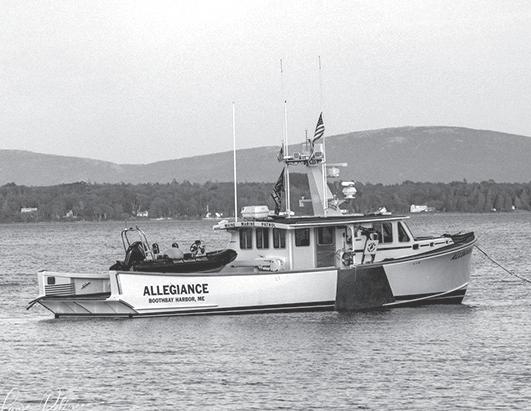
Allegiance is the newest vessel in the Maine
Surry. It’s powered by a low-emission Tier 4 Man Diesel V-12 1450hp engine which can cruise in excess of 20 knots. It is equipped with state-of-the-art Furuno navigation electronics, and a heavy duty 17-inch hauler. It has significant deck space and an open stern which will allow officers to safely handle and set back the larger offshore lobster trawls. The vessel is also equipped to carry a 15-foot Ribcraft Rigid Hull Inflatable boat on deck, which can be used for at-sea boardings to check vessels for compliance with marine resources laws.
Marine Patrol fleet.
PHOTO: COURTESY LAURA PELLERANO
The best place for a bad time
Navigating a difficult diagnosis from an island
BY COURTNEY NALIBOFF
FIRST, some news.
On April 23, my 45th birthday, I was diagnosed with breast cancer.
The thumbnail sketch is that my prognosis is great, it hasn’t spread anywhere, and I’m on a curative treatment plan that starts with chemo, then surgery, then maybe radiation, then immunotherapy. I found the tumors myself, which is a good reminder to everyone not to skimp on your selfchecks and mammograms. I’m on leave from teaching until some time this fall, mostly due to my depressed immune system and the cyclical nature of my energy levels with chemo. But two weeks out of three, I feel pretty close to normal. Just bald.
One theme I keep returning to in this column is the way in which being on an island shapes life experiences. Having cancer—or any catastrophic medical event—is certainly no different. When I was in the pre-treatment stage, traveling back and forth almost daily for PET scans, MRIs, chemo information sessions, intakes with surgeons and medical oncologists, biopsies, and my port placement surgery, the 12 miles of water between me and my team felt like a more onerous separation than usual.
saltwater cure journal of an island kitchen
But once my diagnosis was fully realized, I became the beneficiary of a few systems that have been put in place for islanders like me who are going through a long-term medical event.
First, the Maine DOT allows for free ferry transportation, walk-on or vehicle tickets, for us. There’s a nominal amount of paperwork involved, but it’s no small benefit, especially when counted against summer rates. We are also granted medical priorities for treatments and other appointments; again, a true boon when getting a car to and from Rockland can seem impossible.
But maybe best of all is the fact that I'm going through this hard, unwanted thing on North Haven in the summertime.
I’ve been able to get almost all of my appointments scheduled at MaineHealth Pen Bay Hospital—with the exception of an MRI that bounced me down to Damariscotta—which is incredibly convenient and reduces my travel time by a minimum of a half hour, given that the next closest hospital is in Belfast. Beyond the convenience, Pen
Where does the friction go?
The fashionable inefficiency of island life
BY SANDY OLIVER
FRICTION-MAXXING, according to its Wikipedia definition, “is the practice of intentionally choosing less convenient options in daily life to build tolerance for discomfort, resist technology-driven ease, and preserve what proponents describe as meaningful human experiences.”
In reality, it’s a fairly normal state of being on most islands, whether one chooses it intentionally or not. Yet what constitutes friction depends largely on one’s age and inclination.
Many ways to “max” have cropped up. One can healthmax; looksmax; money, gym, or sleepmax. The use of these terms seems more common among the younger generations.
These grand- and great grandkids of Boomers were born with smartphones in-hand. Ironically, one way a Boomer can now friction-max is to try using technology for ordinary tasks, like getting information with a QR code. Doing almost anything on an island piles on the friction. The ferry service helps with this a great deal. At peak summer season on Islesboro, you’ll pay
the best part of $100 to get yourself and the kids off island for a dentist visit, never mind a pleasant family excursion. Talk about friction. And please hope that the day you picked months ago isn’t when the ferry is off down the bay to Rockland to fill its water tanks. And we on this island have it easy compared to the others whose ferry trips last an hour or longer.
When you buy groceries in an actual store, cook from scratch, and eat on plates you have to wash, you are friction-maxxing.
When Boomers went back-to-the-land in the 1960s and ‘70s, they essentially friction-maxxed. Those days seems so quaint, now, building simple homes, planting gardens, sewing and knitting clothes, making bread, having babies with the help of midwives. (If enough birthing centers close in Maine, we may find ourselves birthing at home again— maybe even on our islands instead of at some mainland hospital.)
Bay truly understands the exigencies of island life. I’ve yet to have to spend the night on the mainland due to an appointment that didn’t fit neatly between boats. They’ve also allowed me to get my pre-chemo labs done on-island a day or two before an infusion. That way, should I not make counts, I’m spared an unnecessary trip to the mainland. It also cuts some time off what’s already a very long day, and again, makes it possible to go between boats.
Then there’s the island itself. Like perhaps no other place on earth, North Haven circles its residents in times of need. My closest friends have created a formal care team, which has included everything from food to rides to pet care to bringing my daughter to the grocery store. Former islanders, and plenty of other mainland-based friends, have given rides and kept me company during or after appointments. But maybe best of all is the fact that I’m going through this hard, unwanted thing on North Haven in the summertime. I’m
writing this from my front porch, with a common yellowthroat and a robin nattering back and forth. A cardinal flew over the house a few minutes ago, and a male ruby-throated hummingbird has been making the rounds between the catmint and the beauty bush, probing each richly colored blossom in turn. Bees harmonize and a squirrel scolds. A diverse collection of butterflies has lazily flapped through the yard. I can walk out of the house and be in the town park in under a minute, get in the car and swim in the ocean in 10. Outdoor eating options are plentiful, and most social engagements are on the beach anyway.
I have my vegetable gardens, with vigorous tomatoes needing to be pruned and tied, corn which has surpassed the “knee high by the 4th of July” test, and kohlrabi just starting to swell. There’s hardly been a day when I haven’t felt well enough to at least walk through, pull a weed, and let the verdant coolness soothe my body and spirit.
Courtney Naliboff teaches, writes, and plays music on North Haven. She may be reached at courtney.naliboff@gmail.com.
shifts somewhere else. Let’s use salad as an example. These days, one can pry open a plastic container and dump the green contents into a bowl, add dressing, and eat. No tedious rinsing and spinning, then plucking apart of leaves into bite-sized bits, never mind stepping into a garden in the first place to select a head of lettuce which one has grown, having maxxed the effort by putting seeds into soil, watering and thinning, transplanting, and nurturing along by removing competing weeds and insect pests.
Doing almost anything on an island piles on the friction.
All that growing, harvesting, cleaning, packing, and shipping is performed by other human beings and machines. The growers are increasingly also preparing it for eating, while consumers merely consume as if plants set forth vegetable-filled plastic containers instead of leaves. Farmers and distributors absorb the friction.
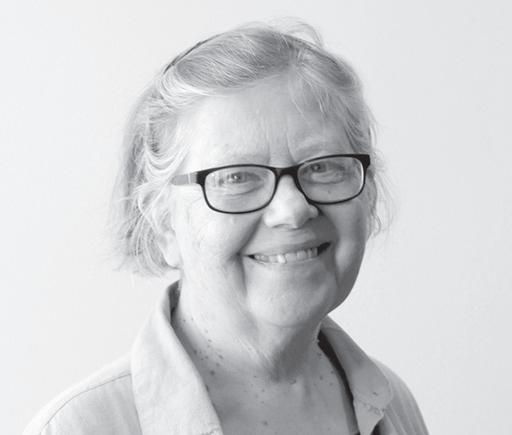
from the hundreds that are available, sporting different colors, leaf shapes, and textures. Buttercrunch lettuce, for example, is a fabulous combination of tender, silky leaves and crisp, juicy stems. It can be hard to find in the grocery store produce section. Plus, vegetables’ nutritional benefits are at a peak the day they are harvested, instead of having lost many of them during travel across country, or even just a couple states, or mercy help us, from abroad.
I’ll make a trade. I can offer homegrown, same-day harvested, washed, and torn lettuce. In exchange, someone who has avoided their own lettuce friction can follow the trail of a QR code to help me operate a hunk of office equipment I just acquired. Just, please oh please, don’t make me do it myself. It creates too much friction.
The problem with avoiding friction is that it doesn’t disappear: it merely
Any benefit to a harder way to do things? Personally, I like choosing my favorite varieties of lettuce to grow
Sandy Oliver is a food historian who gardens, cooks, and writes on Islesboro. She may be contacted at SandyOliver47@gmail.com.
Friendly banter and ferry updates
Celebrating a decade of the Cranberry Isles community Facebook page cranberry report
BY BARBARA FERNALD
IN JULY OF 2005, I wrote a column about the posters and signs people installed around the islands and how they were the best way to find out what was going on.
Twenty-one years later, people still put up posters, but if you want details about island activities, most folks turn to the "Cranberry Isles Information Page" on Facebook.
The page was created 10 years ago to share information about and among the islands in the town of Cranberry Isles. In winter it is indispensable for finding out if the ferry is running on a questionable weather day. Also from the page, we can usually learn where a power outage originated or whether a fix will be in place soon.
As summer gets underway, there are postings of programs and schedules for two islands. The Squeezebox Stompers return to play music at the 4th of July picnic on Great Cranberry Island. On Little Cranberry, the 10th annual 4th of July bike and golf cart parade starts in front of the Ashley Bryan School at 3:45 p.m.
Island hopping
There are posts about upcoming shows and workshops. There is information about services at the island churches. Beal and Bunker have posted their summer ferry schedule as has the Cranberry Cove ferry. There will be fire extinguisher inspections on July 9 at Great Cranberry, and on July 25 on Islesford (Little Cranberry)—$6 per extinguisher. The Dockside Veterinary Services posted their schedule for August. Contact Dr. Shively by phone or email to set up an appointment. What I like about the page are the personal requests and the answers they receive. They get more varied as more people come to stay on the islands, but the uptick in population doesn’t change the small town feeling that we look out for each other. Weekly, there are one or two posts about UPS packages misplaced on the “other” island. It’s an easy mistake, and just as easily someone will respond
to say they’ve seen it and will put it on the next mailboat.
People ask if there are cribs and strollers to borrow for a week, and others answer with items to lend. Boys clothes for a toddler—size 4T—from Islesford have a taker on Great Cranberry.
An announcement inviting islanders to a recent wedding reception read: ‘Bad news for my admirers... I'm getting married!! …’
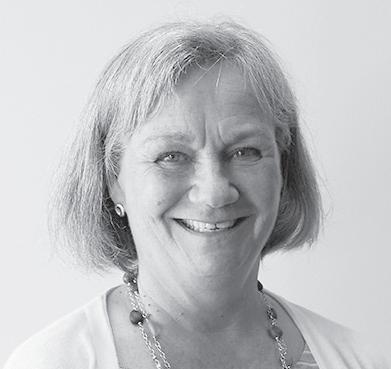
Lion’s mane jellyfish have beached themselves on both islands. A post reminds the public that these large, red jellyfish are highly toxic to dogs.
An Islesford resident needs help with transportation to Ellsworth for dialysis three days a week. Friends responded within hours.
An announcement inviting islanders to a recent wedding reception read: “Bad news for my admirers... I’m getting married!! Come down and hang out this Saturday, we’d love to see ya!!!!”
Another post asked, “Could someone pick up cough medicine at Carrolls in
A theory about those who visit islands forest city
BY RUSTY FOSTER
IF YOU WANT to meet islanders, go to an island.
Now before you send a letter to the editor complaining about the dumbest sentence you’ve ever read in your life, let me explain. I had that admittedly room-temperature insight recently, on the barnacle-crusted shore of West Gosling, one of a pair of little islets tucked alongside Lower Goose Island in the northeastern reaches of Casco Bay, a few miles from Freeport. East and West Gosling, as well as part of Lower Goose, are owned and maintained by Maine Coast Heritage Trust and offer a few sites for tent camping and a roomy, protected cove for mooring or anchoring boats.
I was in a sea kayak, or rather I had just stiffly pried myself out of a sea kayak, after a 13-mile paddle down the bay from Peaks Island that I had only expected to be 10 miles. It was a gorgeous Saturday afternoon in June, so I wasn’t surprised to see a family already set up in the campsite I had hoped to snag. All I could do was walk up with a smile and ask if there was room for another tent.
It wasn’t a surprise to find myself on another island, either. Many people love
to visit an island, but in my experience none more so than islanders. I know several Peaks Islanders who vacation on Monhegan, and my family has been among them. We’ve also been to Block Island, Michigan’s Mackinac Island, and Hilton Head Island. It’s a rare family vacation that doesn’t find us on a distant ferry for one reason or another. I’ve canoed out to numerous postagestamp-sized lake islands while hiking in Baxter State Park, and stopped for lunch on Clifford Island in Tennessee’s Watauga Lake while on an Appalachian Trail kayaking side quest. If there’s an island to be visited, chances are I will visit it.
In fact, I paddled out to the Goslings as part of training for a sea kayaking expedition later this month on the northwest coast of the world’s largest non-continental island, Greenland. I hope I’ll have more to say about that in a future column, but in the unlikely event I don’t make it back, at least know that I died doing what I loved (being eaten by a polar bear). Assuming all goes
well though, later this fall my wife and I have a trip planned in the Canadian Maritimes, where of course we’ll visit Cape Breton Island, Newfoundland, and the oddly situated French island of St. Pierre.
I had that admittedly room-temperature insight recently, on the barnacle-crusted shore of West Gosling …
Back on West Gosling, a group that I interpreted to be a mom, a dad, and a young teenager sat in folding chairs around a fire pit and looked up as I called out “Hello!” I crunched up the gravelly beach in my kayak skirt and bulky lifejacket. “Is there any room around here for one more tent?” The mom got up and walked down to meet me, looking dubious and explaining that they had more family coming in for the evening. First-come-first-serve camping is always a delicate negotiation, so I asked if she knew of any other spots nearby. She started to describe the options, and then stopped, took off her sunglasses, and squinted at me. “Huh, she looks familiar …” I thought, just before she said, “Is that Rusty?”
SW Harbor? They don’t deliver to the Manset boat on Saturdays.” Again, there were several offers in response. Can I borrow a heating pad? Does anyone have a coffee grinder I can use for an hour? I have free rhubarb if anyone wants it.
The posts usually generate more than one positive comment.
My favorite post of the summer, so far, was a photo of a shoe with the notice: “Lost on Islesford Saturday night on the Sandbeach Road somewhere between Roy Hadlock’s home and the Town dock. Only one is missing.” The shoe was reported found, but not before someone else commented, “Okay, Cinderella!”
Check out the "Cranberry Isles Information Page" on Facebook if you want to get a feel for what goes on out here. Happy Summer!
Barbara Fernald lives on Islesford (Little Cranberry Island). She may be contacted at Fernald244@gmail.com.
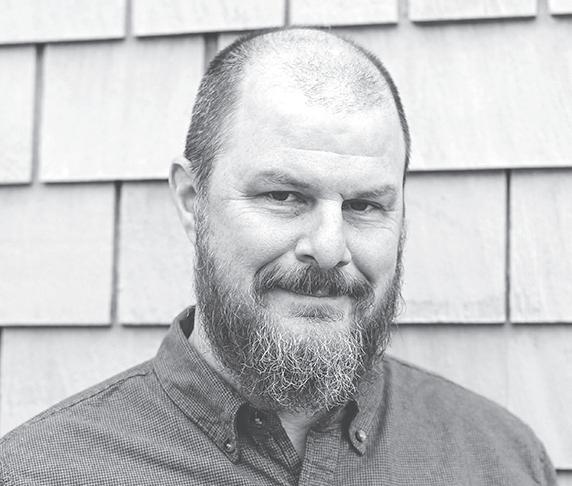
It turns out this family used to live on Peaks, and my youngest child, Ash, spent weekdays at their house as an infant when my wife and I were both working. Her face clicked into place as soon as she introduced herself, although I don’t think I’d seen her in a decade or more. But of course they were visiting an island; they were islanders. The campsite negotiation immediately got quite a bit friendlier as she directed me to a lovely spot on Lower Goose, just across from West Gosling and overlooking the boats moored in the cove. I told them about the Greenland trip, and they seemed duly impressed that I had just paddled all the way from Peaks.
I thanked her and waved to the family, and as I headed back to my kayak for the very short paddle across the inlet to Lower Goose, I thought: “If you want to meet islanders, go to an island.”
Rusty Foster lives on Peaks Island and writes the email newsletter Today in Tabs. He can be reached at rusty@ kuro5hin.org.
Listening first
New Port Clyde center aims to build rural resilience together
BY NICHOLE PRICE
This column has been guest-written, in recognition of the role that other organizations play in bridging marine science with local coastal knowledge.
A FEW WEEKS ago, I became the inaugural director of Colby’s Center for Resilience and Economic Impact in Port Clyde. Since then, one question has come up repeatedly: “What is this Center all about?”
My answer is simple. It’s about helping rural Maine thrive for generations to come.
There is no better place to begin this work than Port Clyde. A working waterfront brings together many opportunities and challenges facing all rural communities. It is where our economy, natural resources, heritage, and sense of place all meet. While rooted here, the Center’s mission reaches beyond the shoreline. Our findings will help strengthen communities across Maine, from fishing villages to farming towns, and could act as a beacon beyond the state.
That work starts with listening. During our recent opening event, I saw fishermen talking with scientists; business owners with students; nonprofit leaders with municipal officials, and neighbors.
They didn’t agree on everything, but shared something more important: a commitment to community, to collective history, and to working together toward a resilient future.
That gives me hope because the strongest solutions are built by forming strategic partnerships, strengthening existing momentum, pooling resources and knowledge, and identifying new challenges to face together.
I’ve come to understand resilience personally and professionally. Before moving to the Midcoast 12 years ago, my husband and I lost our home in California’s Tea Fire, along with more than 200 others. The only thing left standing was our wood stove; all else was ash. I know how devastating and shocking a fire can be, like the one that destroyed the Port Clyde General Store and Dip Net restaurant, where the Center has just started reconstruction. My experience taught me recovery is about more than replacing what was lost. It is about helping people regain identity, stability, opportunity, and confidence in the future. I am grateful and honored for the opportunity to help a community in the way my own family was helped.
Throughout my career as a marine scientist, my personal definition of
fathoming reflections
Resilient kids and grids
Fashioning energy systems and recycled threads
BY ELIZABETH DYER
Reflections is written by Island Institute Fellows, recent grads of college and master’s programs who do community service work on Maine islands and in coastal communities through Island Institute, publisher of The Working Waterfront.
AS I ENJOY my first summer on Islesboro, I’m struck by the blossoms and lush greenery returning after a quiet winter. They remind me of a word that has become a regular part of my vocabulary: resilience.
We use “resilience” to describe how an entity recovers or adjusts after a change or challenge. This is certainly a buzzword in the fields of energy work and sustainable development, where I spend much of my time as a fellow. It’s easy to see why: who wouldn’t want to recover quickly from adversity? Still, resilience is a more complex process than blooms pushing back up winter after winter. We do not simply become resilient communities by default, but rather through concentrated efforts to transform our past and present challenges into a future that feels attainable and secure.
I often talk with my host organizations, the Islesboro Energy Committee and the Islesboro Community Center, about energy resilience—how we can supply power when outages occur, and how we can ensure islanders have reliable, affordable power for years to come. Our island is connected to the mainland’s electrical grid via underground cable, meaning that any electrical disruptions across Penobscot Bay can limit access to power on the island. During my first nine months on Islesboro, fallen trees and winter storms have both triggered outages directly on the island and caused mainland outages that affected us “down the line.” Generally speaking, the plan for outages like these is to wait it out until reconnection.
It’s no small task for an island community to make backup plans and share resources for outages that can span hours or even days. Backup generators and designated resource hubs, like the Community Center, can build resilience amidst challenging circumstances, but they have also come to be the way our community chugs along, business as usual.
So, what if we could plan to allocate resources so that outages lasted for only
resilience has come to include three essential parts. My graduate training focused on ecological resilience: the ability of an ecosystem to recover its purpose and function after a catastrophe, like a forest regrowing after fire, or a fishery recovering from collapse.
My professional experience within the aquaculture industry has taught me the importance of economic resilience, especially on the working waterfront. I define this as the opportunity for the next generation to earn a thriving wage, even as markets, technology, and the environment changes.
Governance resilience is the third leg. Communities strengthen when governments respond effectively, local experience informs policies, and good information is easy to access and understand.
The Center can help bridge the gap between research and decision-making by translating science into plain language and ensuring rural voices are heard.
Building resilience means supporting Maine’s defining industries and natural resources, while creating new opportunities for young people to stay, families to grow, and businesses to succeed. It means building a future-ready economy without losing the character of rural Maine.

I hope this Center can play that role. Not by arriving with the answers, but by asking the right questions. By listening carefully. By connecting people who might not otherwise meet. By launching local ideas into practical action. By employing student energy to assist the vivacious entrepreneurs to reinvent as needed in the face of change.
Over the coming months, I look forward to spending time on docks and farms, in small businesses, at town meetings, and around kitchen tables. Those conversations will shape this Center far more than anything written in an office.
Ultimately, I believe resilience is measured by what we leave behind. If our work helps ensure that our children and grandchildren can build lives, businesses, and communities in rural Maine, then we will have succeeded. That is the future I hope we can build together. It is the future I want for my two daughters.
The pace of progress of the Center is fundamentally determined by the speed and breadth of community trust.
Learn more and engage with the team at the Facebook page of the Center for Resilience and Economic Impact.
a few moments rather than stretching out and prolonging everyone’s frustration? On Islesboro, we are redefining our approach to energy resilience by exploring the development of microgrids, which are energy systems designed to offer a more reliable backup option. Once tailored to the needs of its community, a microgrid can help an island weather electrical grid outages by seamlessly switching over to energy that’s generated and stored on the island. While these types of resilience conversations can get quite technical, I also find the same threads of strength and persistence when I get to work with kids at the Community Center. This spring, I led a program with our young islanders called “the Trashion Show,” in which students repurposed materials such as bubble wrap, fabric scraps, cardboard, plastic bags, bottle caps, and other functional forms of garbage into runway-ready masterpieces. Perhaps to an outside perspective, the stakes were lower for this show than technical conversations about a sustainable energy future. However, if you stepped into our “Trashion Tuesdays” workshop space, you’d know that wasn’t the case. In fact, most town planners would

get a run for their money from the pure determination and adaptability of sixto 13-year-olds designing garments from discarded materials.
Planning an energy-resilient island is a careful balancing act between local demands, storage capacity, and generation potential that must consider the needs of residents and businesses. Planning a resilient trashion outfit is a problem-solving relay involving materials that were perhaps never anticipated to be wearable.
Yet both struggles represent the way we can build a resilient island. Energy plans and art projects need to have a clear vision coupled with a willingness to continuously adjust to the inevitable snags ahead. And so, holding technical expertise in one hand and creativity in the other, I look forward to watching Islesboro’s resilient future bloom.
Dyer supports Islesboro’s energy committee with home and municipal projects and engages local youth around energy and other environmental science and sustainability topics at the Islesboro Community Center.
in plain sight
An earlier era of shipyard housing
New
Bath Iron Works housing initiative departs from previous efforts
BY KELLY PAGE
ACCORDING TO Bath Iron Works’ most recent economic impact report, just over 8% of the shipyard’s 6,772 employees lived in Bath in 2024. The company identified a 300% increase in housing costs over the previous decade, along with limited access to childcare, as major barriers to recruiting and retaining workers. That same year, Bath Iron Works announced it had received $34 million from the U.S. Navy to help address these challenges. While government investment in housing for Bath shipbuilders is not unprecedented, the proposed 84-unit development— intended primarily for entry-level professionals—marks a significant departure from earlier workforce housing initiatives.
Previous government investments in workforce housing occurred during wartime, when labor shortages threatened national defense production. Unlike many industrial communities, tenement-style housing was distinctly lacking from Bath’s built landscape. Instead, its blue-collar neighborhoods consisted largely of small, tidy, single-family homes. This modest housing stock could not absorb the workers needed to meet wartime
FIELD NOTES—
production goals. Employee turnover was high as workers accepted jobs but left after failing to find suitable housing.
Because of these conditions, Bath became an ideal candidate for federal housing programs during both World Wars. Even so, new construction was initially viewed as a last resort. Federal policy first emphasized rent stabilization, maximizing occupancy of existing housing, and improving transportation to shipbuilding centers. During World War I, the “White Project” provided housing for 90 BIW families, while the “Brick Project” added 109 homes for workers building freighters and tankers at Texas Steamship Co.
During World War II, the federal government funded Lambert Park and Hyde Park, which added 400 and 200 housing units, respectively. Tucked away in Bath’s north end, this 1943 image shows Lambert Park’s mix of housing units.
A second important distinction lies in the type of housing that was built. At a time when many workingclass families were accustomed to crowded living conditions, none of these wartime units contained fewer than two bedrooms. The developments established new standards of living for working-class families by
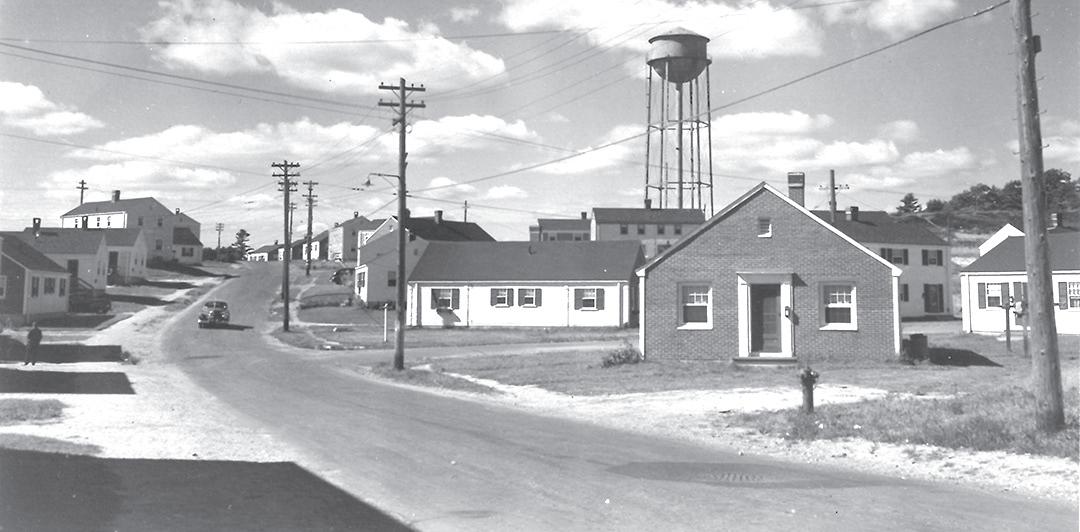
emphasizing detached, single-family homes, duplexes, and townhouses rather than tenements or boarding houses. This government-funded investment in the well-being and productivity of working families represented a notable shift in public policy and helped shape expectations for moderate-income housing in the decades that followed. This was especially radical during World War I, which predated New Deal social welfare policies.
By contrast, many recent housing developments across Maine—including the current BIW project—have favored
Connecting to place and colleagues
Coordinating a Fellows retreat along Stonington’s archipelago
NAME:
Lisa
Millette
TITLE: Senior Community Development Officer
FOCUS: For the past 3+ years, I’ve led Island Institute’s fellowship program. Island Institute Fellows work in and with communities for two years on community-identified projects related to climate resilience, the marine economy, and affordable housing. Since 1999, this flagship program has energized critical projects in small island and coastal Maine communities and helped recent college graduates build skills and networks to continue their careers.
IN THIS PHOTO: Island Institute’s fellowship cohort and I are listening to Will Steinharter of Osprey’s Echo Sea Kayaking as he talks about Stonington’s archipelago and PenBay Farmed Scallops’ growing and processing sites. (I’m in the front row, closest to Steinharter.) Each year, the Fellows participate in a multi-day orientation and two in-person retreats. Part of my job is to plan the logistics of each of these from the location and lodging to workshops and activities. Retreats are held in one of the current fellowship locations to better understand a Fellow’s experience; when Stonington was selected, the Fellow working there, Grace Upham, said that a kayak tour was a must. Being on the water gave us a different perspective and appreciation for Stonington, its surrounding islands, and strong fishing community. Getting to kayak up to a scallop processing site and hear directly from one of the farmers about their operation was the cherry on top.
studios and one-bedroom apartments. While these units help meet the needs of young professionals and couples entering the workforce, they do little to address the shortage of family-sized housing. Expanding the supply of larger rental units could not only better serve working families, but also strengthen long-term employee retention.
Kelly Page is curator of collections at Maine Maritime Museum. Explore resources and plan your visit at www. mainemaritimemuseum.org.
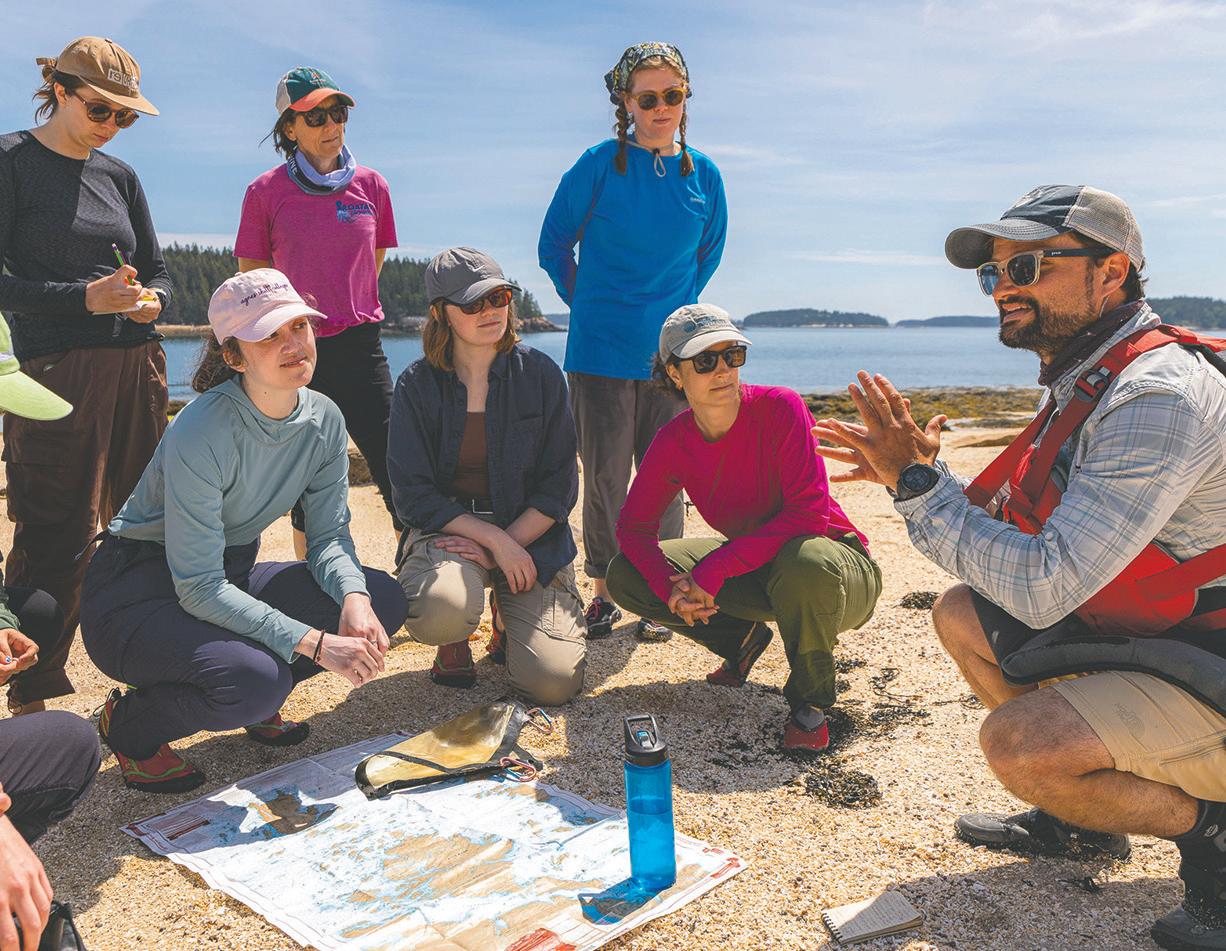
Fellowship retreats not only help the Fellows and staff learn more about Maine’s coast and economy, but they are important in-person times for us to deepen our relationships to place and each other.
This 1943 image shows a mix of housing units in the Lambert Park development in Bath. The federal government funded the project during World War II to accommodate workers at Bath Iron Works. PHOTO: COURTESY MAINE MARITIME MUSEUM
PHOTO: JAMIE WALTER
Edith Wright’s town dock
A colorful slice of life on the Cranberry Isles art of the waterfront
BY CARL LITTLE
THE WATERFRONT on Little Cranberry Island, aka Islesford, is the beating heart of this remarkable community off the southern end of Mount Desert Island. Lobster boats and their crews come and go from the fishermen’s co-op, ferries arrive and depart, islanders mingle—the place is abuzz.
In her lively watercolor “Town Dock,” painted in 1995, Edith Wright (1929-2018) captured those dynamics with a kind of joy. Among the stacks of traps, people walk a dog, ride bikes, traverse the dock ramp, and tend to a lobster boat. The hills of MDI serve as iconic backdrop to the bustle.
A colorful palette heightens the scene, from a red pickup truck parked at one end of the pier, to yellow lobster buoys and roof, to Old Glory waving overhead. Wright brings additional energy to the view through inspired brushwork, in turn quite precise—the boat sports an identifying number, 669677—and abstract, as in the foreground where waves break against the pilings.
Wright and her husband Charles (1928-2022), a doctor, first came to Little Cranberry from their home in
Atlanta, Georgia, in the early 1970s, renting the Baldwin house (they also spent several summers with Edith’s sister Dodie Pierce in Northeast Harbor).
After taking a few years off in the ‘80s, the couple decided to acquire their own Maine home. In the winter of 1987, they looked at a bunch of places around MDI before returning to Islesford. Hildegarde Ham met them at the dock and showed them Rita Fernald’s house. It was, recounts their daughter Marnie Read, “like coming home.”
Wright had extensive training in art.
Born in Boston, she majored in studio painting with Sarah Baker (1899-1983) at the American University art school in Washington, D.C. She continued her art education at Atlanta College of Art where she studied with L. Comer Jennings Jr. (1926–2016). She took workshops with Wolf Kahn, Janet Fish, and Charles Reid and was a member of the Georgia Watercolor Society (she also painted in oil). She showed her work in the Atlanta area as well with Kate and Dan Fernald at the Islesford Artists Gallery.
For a time Wright worked in the photo lab at Life magazine where she once accidentally cut in half each image in a roll of film taken by
She worked plein air, wandering the island in a golf cart in search of a motif.
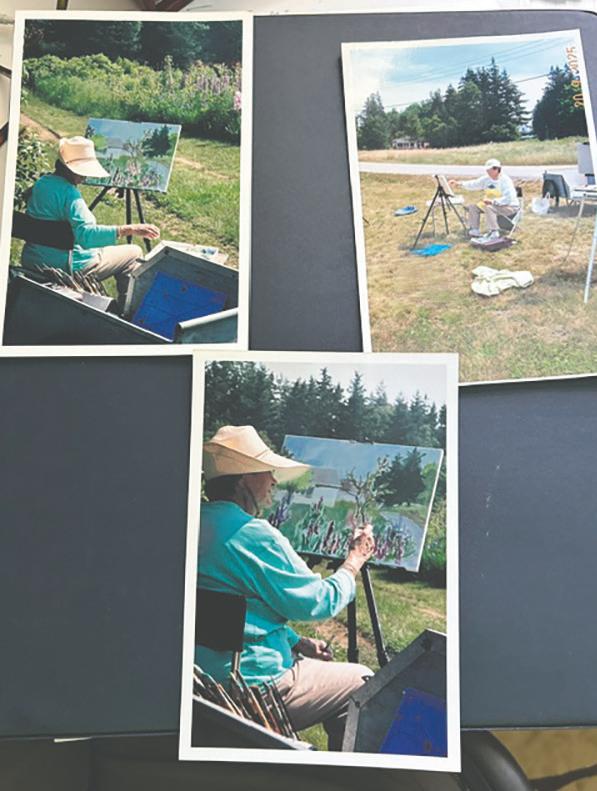
famed photojournalist David Douglas Duncan. She also had positions at the Whitney Museum of American Art in New York City and the Philips Collection in Washington, D.C.
MARINE SAFETY CONSULTING LIFE RAFT INSPECTIONS
estimate.
• One of the most important investments you will make to your shorefront property.
• We have the skills and equipment to handle your largest, most challenging project.
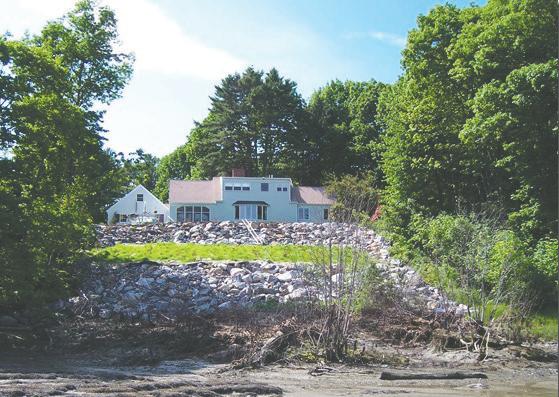

Wright’s daughter describes her mother’s painting routine on Islesford
Have paint, will travel: that was Wright’s MO. She took along painting supplies on trips to the Yucatan, Egypt, Italy, France, and Spain, as well as the north Georgia mountains and the Okefenokee Swamp. She had a special love for gardens.
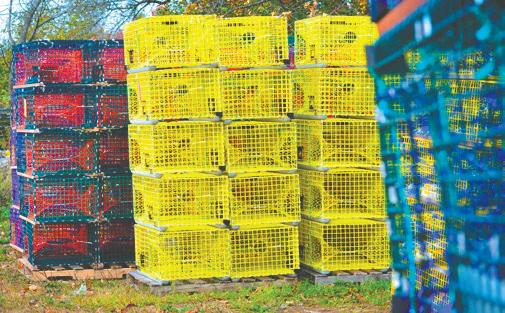


A set of photos of Edith Wright painting on Islesford. PHOTO: COURTESY MARNIE READ
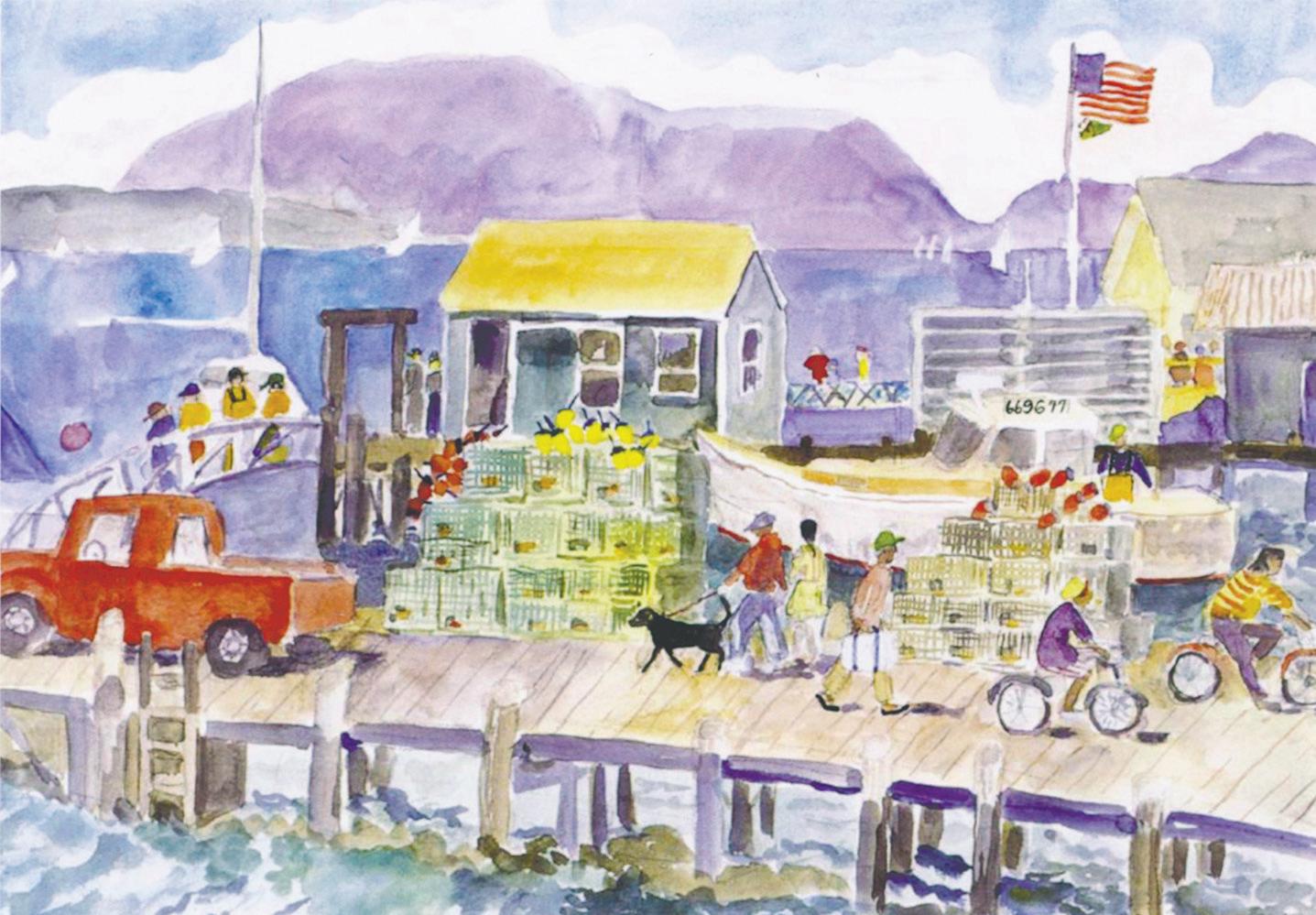
as leisurely. She worked plein air, wandering the island in a golf cart in search of a motif. Seated in a folding chair in front of a small easel, she would take up her brush and begin composing. She also had a studio in her house.
Wright interacted with fellow island artists, including Ashley Bryan, Marian Baker, Mark Howard, Peter Rudolph, and Henry Isaacs. She also added to the art scene by hosting her “painting girls,” a group of Atlanta women she had met in painting classes and invited
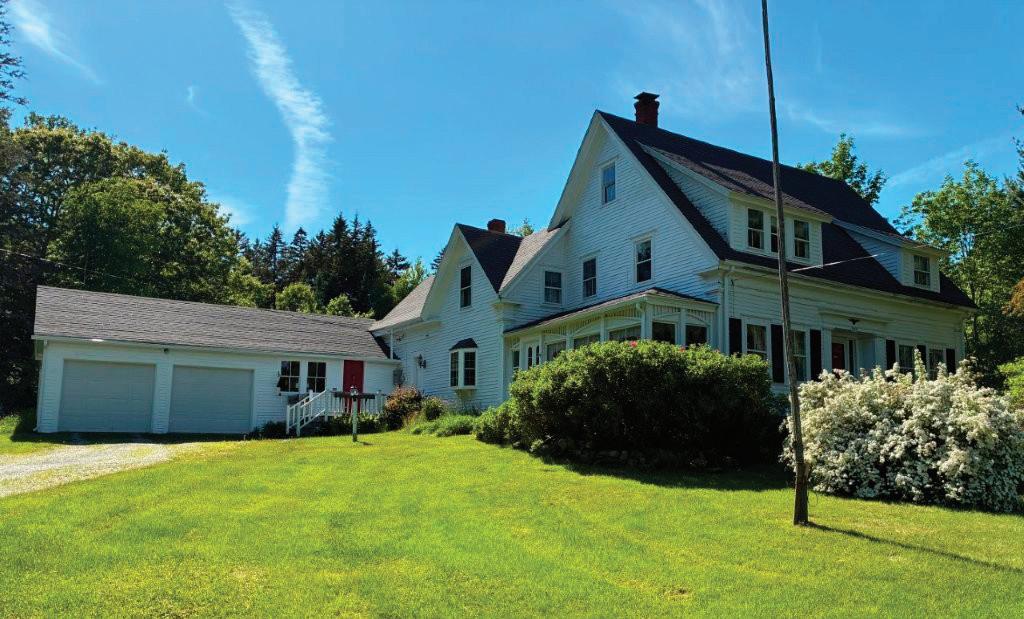
On an elevated site, this 1850 Cape has 4.2 acres with a back yard full of lupine, conservation land abutting the property, and stately white pines attributing to its name, The Pines. A charming interior includes country kitchen, den, glassed in sunporch for 3 seasons, living room with field stone, woodburning fireplace, dining room, laundry room, and bath with 3 bedrooms on the second floor with a full bath in addition to summer sleep space in the ell with a back stairway to the laundry/utility room. A short bike ride to a beautiful, crescent shaped beach which is steps away from the pier serving lobsters and blueberry pie overlooking the mountains of Mt. Desert Island and long views of the bay. They knew how to site houses in the 1850’s, nicely set back from the road, on a little knoll as most of the properties are on this uniformly beautiful road with fields leading to the water, lovely historic homes, and mature tree growth. $395,000.
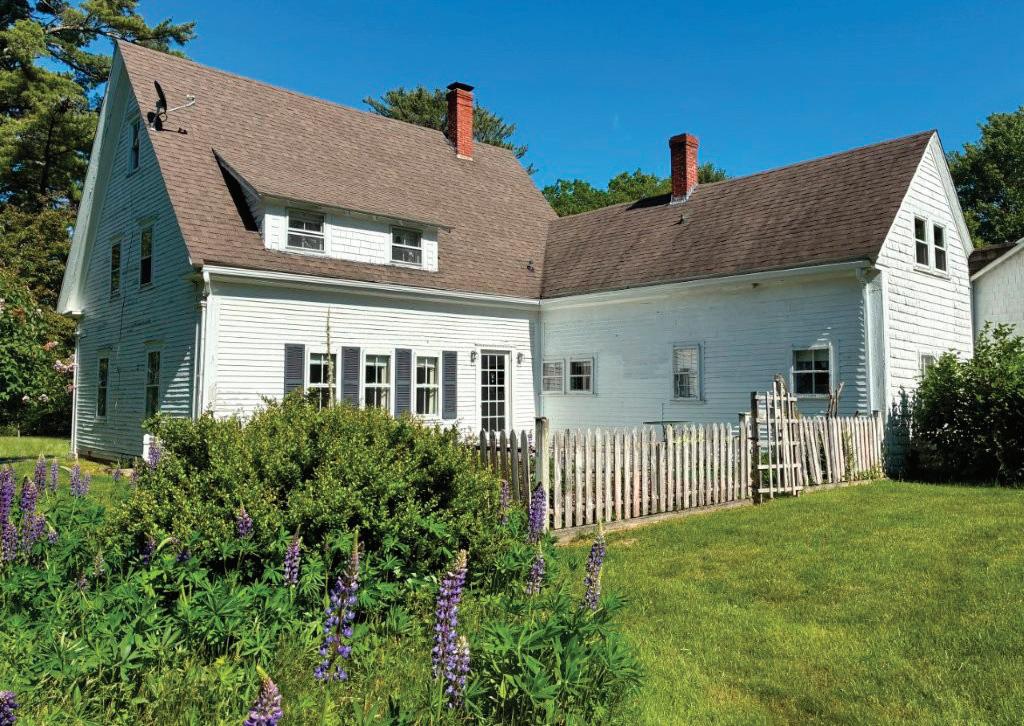
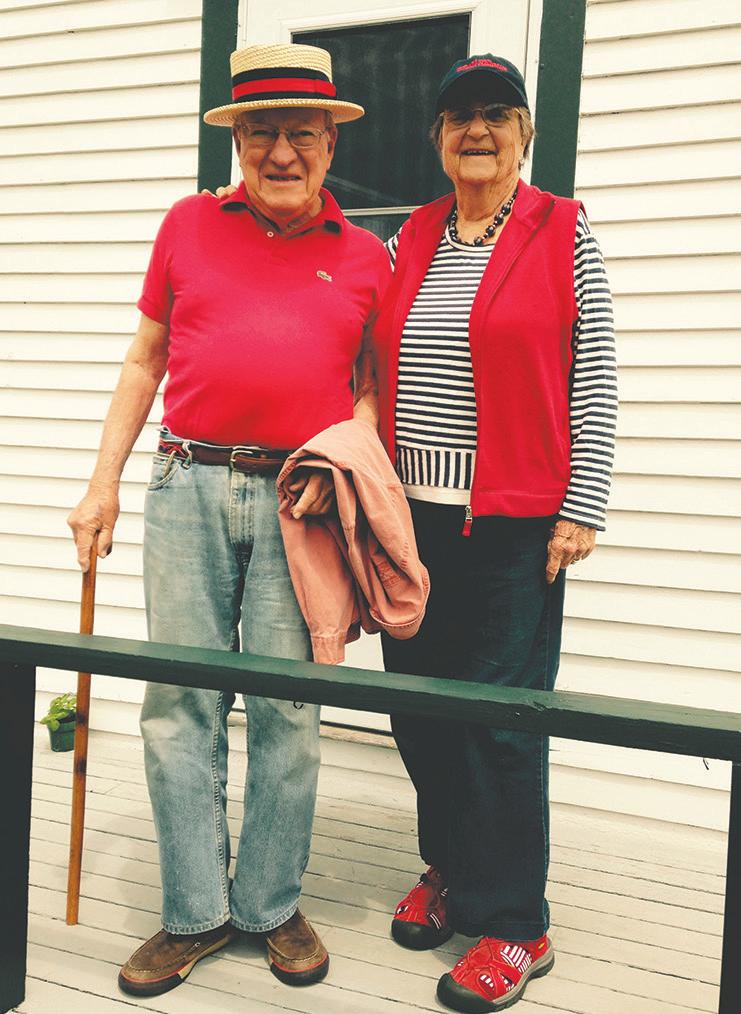
to the island. “They had a ball,” Read relates. “Folks on the island still talk about those gatherings.” Wright found a muse—and a welcoming community—on Islesford. Her love of this summer retreat lives on in her bright and lively paintings.
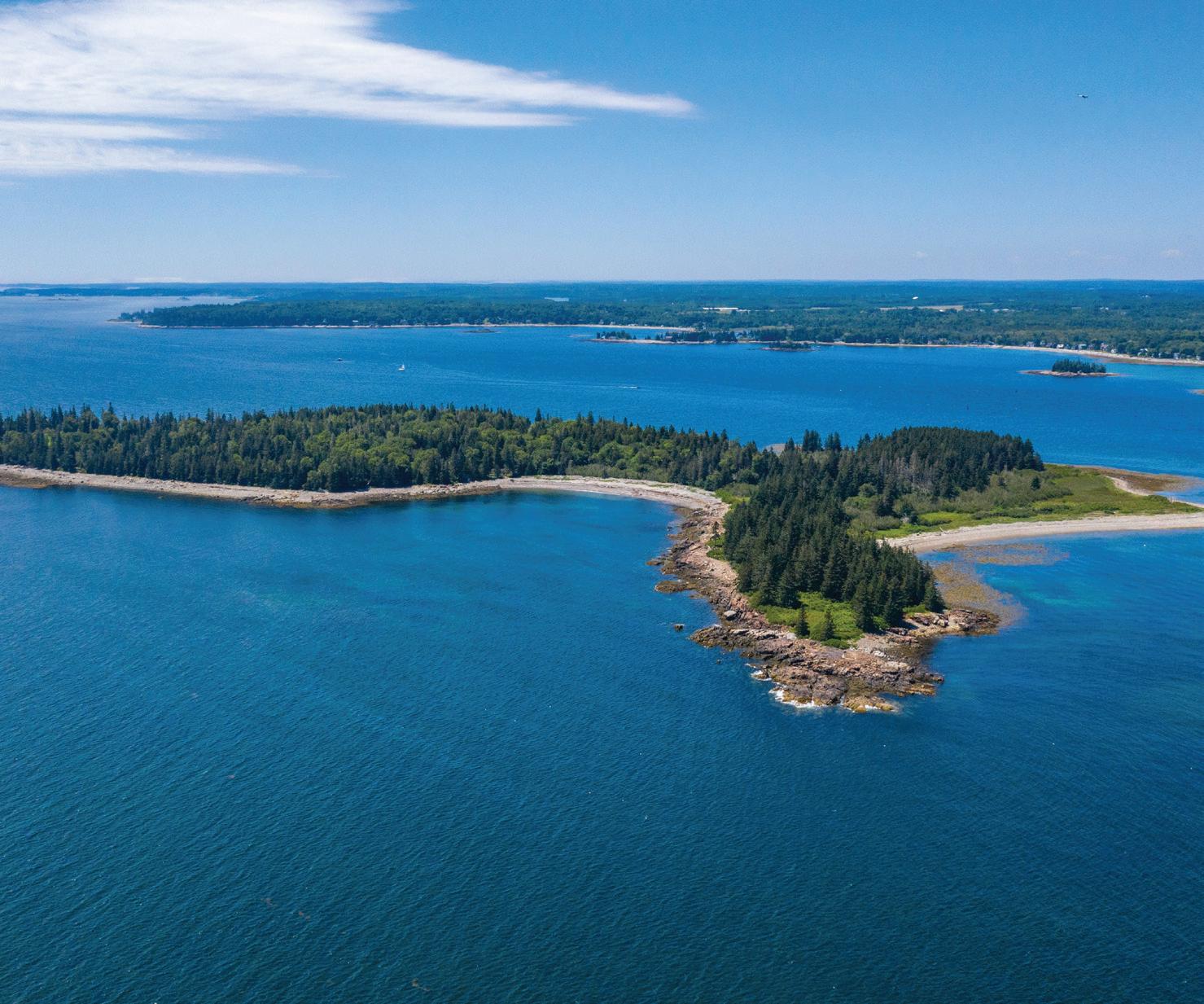

“Town Dock,” by Edith Wright, 1995, watercolor, 22 by 30 in. COURTESY COLLECTION OF WALTER PERRIN, ATLANTA, GEORGIA
Carl Little curated Francis Hamabe’s Maine: A Life in Art for the Castine Historical Society (through Oct. 12, 2026). His article on how two vintage Steinway pianos ended up on Sutton Island appears in Island Journal.
Charles and Edith Wright. PHOTO: COURTESY MARNIE READ
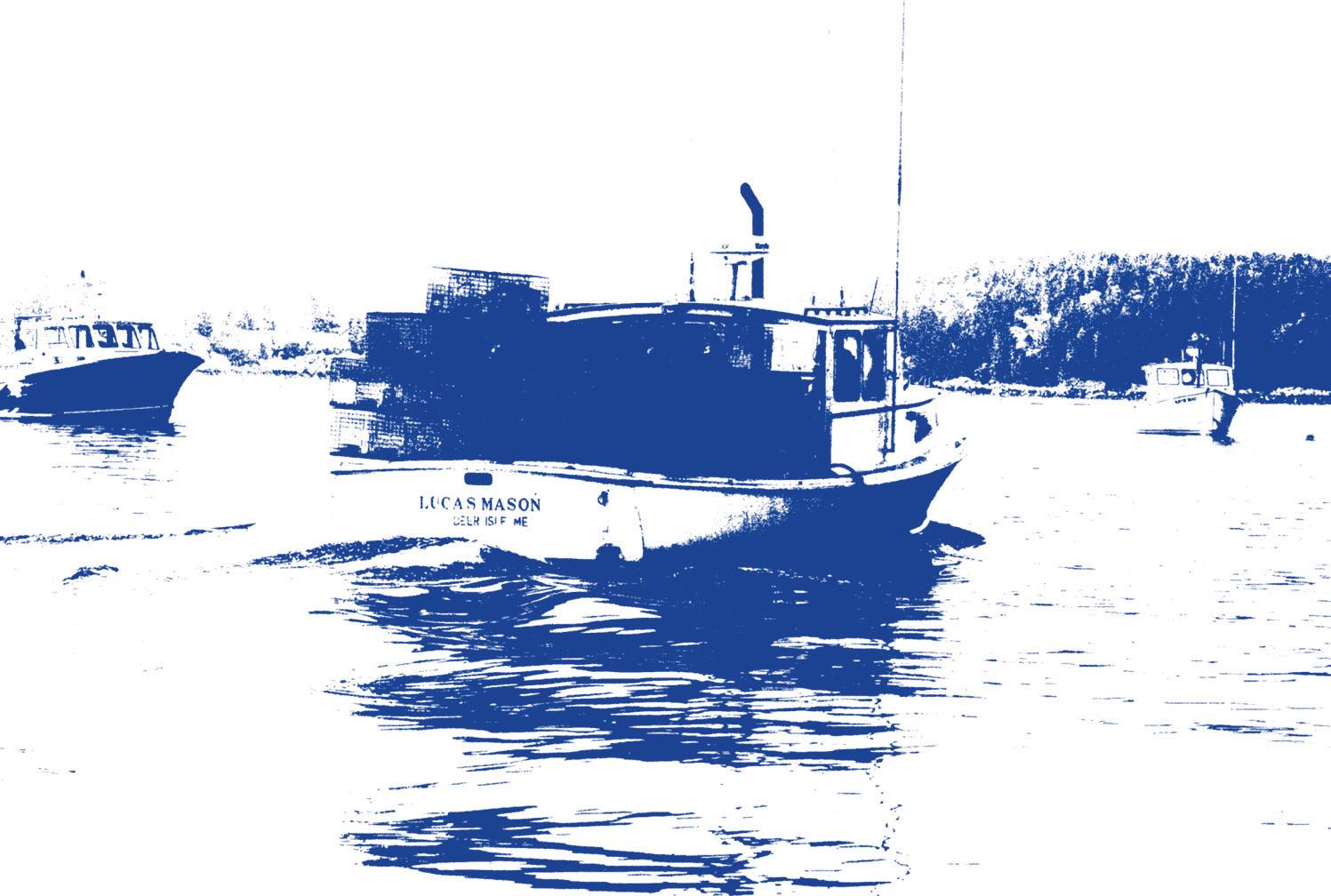





















SUPPORT MAINE’S COAST
Maine’s island and coastal communities are facing increased pressures compounded by climate change: sea level rise threatens to jeopardize our coastal infrastructure, housing costs are skyrocketing, and warming ocean temperatures are posed to disrupt the fishing industry on which many coastal families rely.
Donating to Island Institute makes a difference for the places you know and love.
At Island Institute, we believe real change happens when communities come together to tackle big challenges. When we plan for the future, engage in challenging conversations, and encourage innovative solutions, we strengthen Maine’s island and coastal communities. Join us by making a gift today!
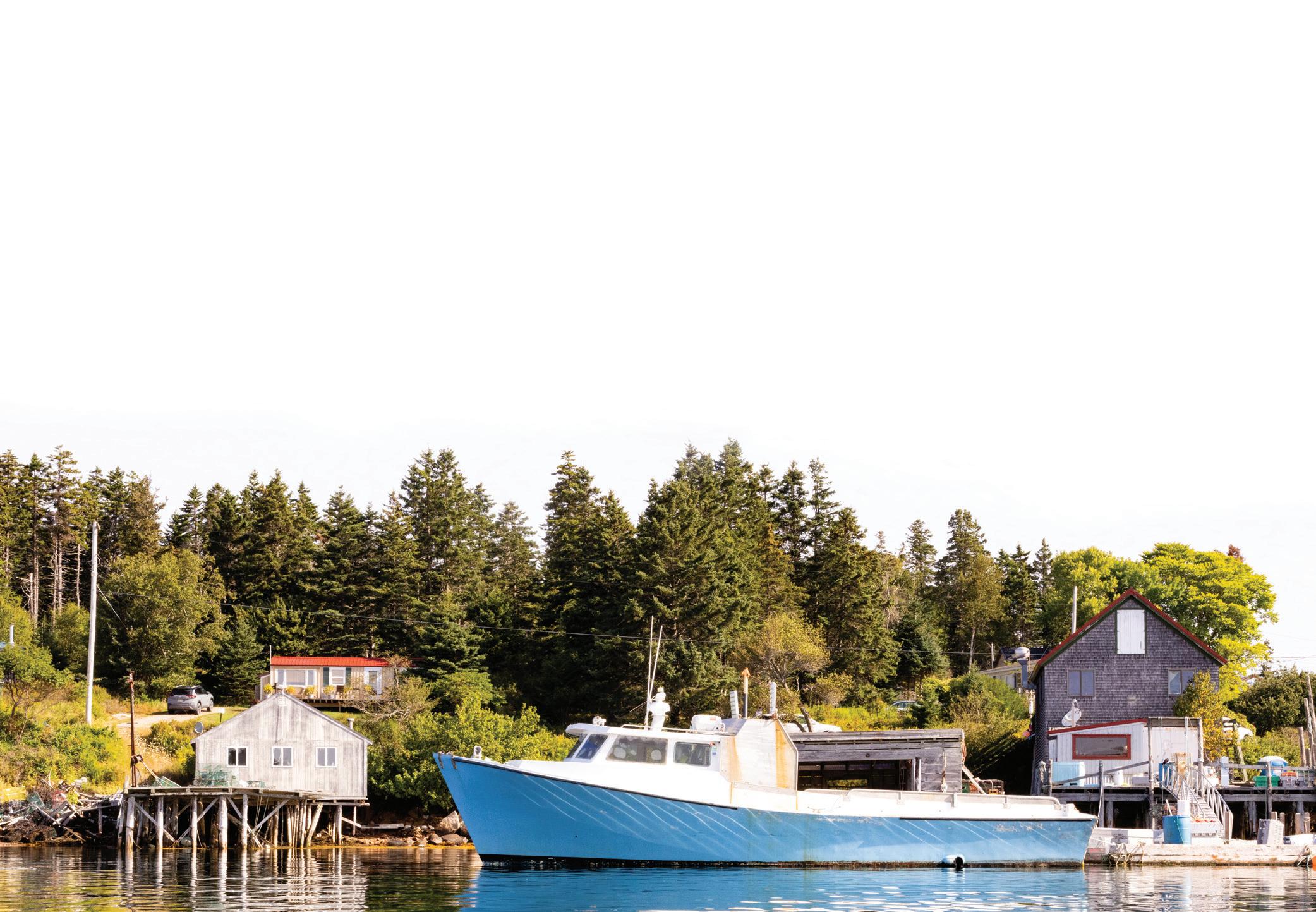
1. Use the QR code
2. Visit us online at islandinstitute.org and click “Give Today!”
3. Send a check to: Island Institute PO