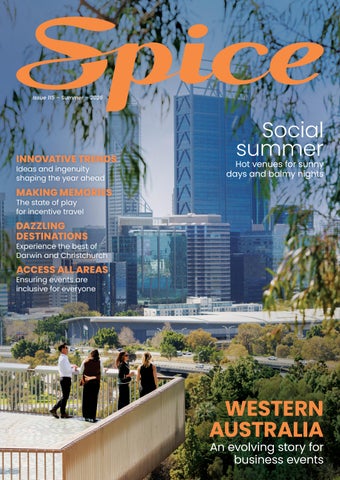
Issue 115 – Summer – 2026
INNOVATIVE TRENDS Ideas and ingenuity shaping the year ahead
Social summer
Hot venues for sunny days and balmy nights
MAKING MEMORIES The state of play for incentive travel
DAZZLING DESTINATIONS
Experience the best of Darwin and Christchurch
ACCESS ALL AREAS Ensuring events are inclusive for everyone
WESTERN AUSTRALIA
An evolving story for business events
DON’T START WITH THE VENUE. START WITH THE BRIEF.
20 delegates or 1,800. One day or several. Central location or regional getaway. The right venue depends on what you’re trying to achieve.
With nine venues across Victoria, Queensland and Tasmania, our team of experts can help find the perfect place for your conference or event. CITY
RACV City Club
COUNTRY
RACV Hobart Hotel
RACV Healesville Country Club & Resort
COAST
RACV Goldfields Resort
RACV Royal Pines Resort
RACV RACV Cape Schanck Torquay Resort Resort
WE’VE GOT JUST THE PLACE
RACV Inverloch Resort
To find out more, visit racv.com.au/venues
RACV Noosa Resort
Contents
20
Summer 2026
REGULARS 5
Editor’s letter
8
New and noteworthy
6 18
24
78
Going up, going down Five minutes with…
Michael Rodrigues, NSW 24-Hour Economy Commissioner.
Emerging leaders
Kirsty Boase from Business Events Cairns and Great Barrier Reef.
34 36
38
42
FEATURES 20
Cover story: Business Events Perth
An evolving business events story in Western Australia.
22
26
28
84
32
30
Event briefings
Designing events with purpose.
Coming together
How events drive social cohesion.
Exhibitor success
Secrets to supercharging your stand.
Events accessibility
Ensuring events are inclusive for everyone.
46 Trends for 2027
Ideas and ingenuity shaping the year ahead.
58
Events Uncovered
A review of Spice’s recordbreaking event for 2026.
Hospitality hygiene
Hidden cleaning risks for venues.
70
Budget airline risk
Incentive travel
The state of play for incentive travel.
Summer venues
Hot venues for sunny days and balmy nights.
Lessons from the collapse of Spirit Airlines.
DESTINATIONS
Safety and risk
78
Putting safety first in events.
Events entertainment
Five key production decisions to getting it right.
Christchurch
Fresh beginnings for the New Zealand city.
84 Darwin
Tales from the Top End. spicenews.com.au 3
Editor’s letter
Celebrating a big year
I
Gavin Dennett Editor Managing Director Simon Grover Publisher Paul Wootton pwootton@intermedia.com.au Editor Gavin Dennett gdennett@intermedia.com.au National Sales Team Charlotte Marshall and Katherine Ross Production Jacqui Cooper and Tazlin Cantrill magazine.material@intermedia.com.au Art Director Alyssa Coundouris Prepress Tony Willson Subscriptions subscriptions@intermedia.com.au The opinions expressed by contributors
and advertisers in Spice magazine are not
t’s hard to believe we are already at the end of 2026. It has been another busy year in the events industry, and Spice is basking in the afterglow of record-breaking Events Uncovered, which celebrated it’s biggest instalment at Hyatt Regency Sydney on 1 September 2026. The 11th edition of the event attracted Australian events industry professionals for educational knowledge sessions, more than 45 exhibitors and an unforgettable after-party. We are already looking forward to Events Uncovered in 2027, with a date and venue to be announced soon. With 2026 nearly behind us, attention turns to 2027 and what the events sector has in store. More innovation, ideas, tech and creative events design is on the horizon as planners and delegates seek new ways to engage and connect. We take a look at what is driving events in the year ahead in our annual trends feature, which you can read from page 46. This issue’s cover story features Business Events Perth and highlights Western Australia as a compelling destination for incentive travel and business events. From the enticing city of Perth to coastal towns and outback marvels, the state offers diverse and naturally stunning landscapes and attractions where delegates can embark on a journey of connection, discovery and wonder. Read all about it from page 20. Also in this issue is a feature on the value of incentive travel (page 58); a spotlight on accessible event design (page 42); our annual summer venues feature (page 70); and destination profiles on Christchurch (page 78) and Darwin (page 84). Have a great Christmas and New Year and we will see you at an event in 2027. ON THE COVER
Kings Park in Perth for Business Events Perth.
Spice magazine sales and marketing team Charlotte Marshall +61 2 8586 6216 cmarshall@intermedia.com.au
Katherine Ross + 61 2 8586 6176 kross@intermedia.com.au
Visit spicenews.com.au for the latest industry news as it happens. Our twice-weekly updates cover venues, suppliers, destinations and technology, as well as inspiration and tips to help you plan stand-out events. Spice Magazine
@SpiceNewsMag
@SpiceNews
Spice magazine and spicenews.com.au are proud media partners of:
necessarily those of Food and Beverage Media's management or staff.
All material contained in Spice is copyright.
Spice magazine is published by
Food and Beverage Media Pty Ltd (ABN 81 163 792 292)
41 Bridge Road, Glebe NSW 2037
ph: 02 9660 2113, fax: 02 9660 4419 ISSN 1832-7176
4 Spice Summer 2026
DISCLAIMER This publication is published by Food and Beverage Media Pty Ltd (the “Publisher”). Materials in this publication have been created by a variety of different entities and, to the extent permitted by law, the Publisher accepts no liability for materials created by others. All materials should be considered protected by Australian and international intellectual property laws. Unless you are authorised by law or the copyright owner to do so, you may not copy any of the materials. The mention of a product or service, person or company in this publication does not indicate the Publisher’s endorsement. The views expressed in this publication do not necessarily represent the opinion of the Publisher, its agents, company officers or employees. Any use of the information contained in this publication is at the sole risk of the person using that information. The user should make independent enquiries as to the accuracy of the information before relying on that information. All express or implied terms, conditions, warranties, statements, assurances and representations in relation to the Publisher, its publications and its services are expressly excluded save for those conditions and warranties which must be implied under the laws of any State of Australia or the provisions of Division 2 of Part V of the Trade Practices Act 1974 and any statutory modification or re-enactment thereof. To the extent permitted by law, the Publisher will not be liable for any damages including special, exemplary, punitive or consequential damages (including but not limited to economic loss or loss of profit or revenue or loss of opportunity) or indirect loss or damage of any kind arising in contract, tort or otherwise, even if advised of the possibility of such loss of profits or damages. While we use our best endeavours to ensure accuracy of the materials we create, to the extent permitted by law, the Publisher excludes all liability for loss resulting from any inaccuracies or false or misleading statements that may appear in this publication. Copyright © 2026 - Food and Beverage Media Pty Ltd.
Brisbane’s forecast: Sunny, with a high chance of success. Host of the 2032 Olympic and Paralympic Games, Brisbane is Australia’s rising star. The city is brimming with convention must-haves and many more must-dos. Warm and walkable, captivating and connected, green and generous, your delegates will love it here.
Our city, your canvas.
sales@BCEC.com.au | 07 3308 3063
A South Bank Corporation venue, proudly managed by Legends Global.
Trends
Scavenger hunts, live polling, points systems and challengebased sessions are replacing passive sit-and-listen content. Event organisers are borrowing game mechanics to keep energy up and make engagement measurable.
AI delivering real value
The conversation around AI has moved beyond experimentation. Event organisers are embracing AI to create personalised delegate experiences, improve accessibility and reduce administrative workload. The most successful applications aren’t flashy; they’re the ones that save time, remove friction and deliver measurable value for delegates and event teams.
Going up
Lexie Duncan, general manager of Melbournebased events company WALDRONSMITH Management, runs the rule over what’s popular and what’s passé in events as we head into 2027.
Wellness-first programming
Movement breaks, mindfulness sessions, fresh air and comfortable seating are now agenda items, not afterthoughts. Organisers are designing for attendee energy levels across a full day, not just cramming in content.
Removing barriers to participation
As workplaces become more diverse, event organisers are recognising a one-size-fits-all approach no longer works. Family-friendly policies, accessible venues, wellbeing spaces, flexible participation options and inclusive event design are making it easier for more people to attend, engage and feel connected. 6 Spice Summer 2026
Photos: iStock.com – Khafizh Amrullah; momcilog; AzmanJaka; zamrznutitonovi.
Gamified, interactive formats
Trends “Death by PowerPoint” keynotes
Interminable slides and one-way lectures drain delegates’ energy. Keynotes that lack audience interaction, live polling or dynamic presentation styles feel archaic. Content needs to be conversational, visually engaging and open to dialogue.
Prop-heavy and gimmicky decor
Excessive, single-use themed decor feels dated and environmentally irresponsible. Audiences favour authentic, narrative-driven design that celebrates local destination culture or purposefully reinforces a conference’s core message.
Going down
Standard conference satchels
The days of just providing a branded satchel, notepad and pen are fading. Delegates are seeking more meaningful and sustainable takeaways – such as reusable luggage tags and travel pouches made from sustainable materials – while organisers are reducing waste and focusing budgets on elements that enhance the attendee experience.
Photos: iStock.com – tylim; Noko LTD; Anchiy; Nikolay Tsuguliev.
Spectacle without substance
The wow-factor – such as oversized production, or style with no purpose – is losing favour. Budgets are shifting towards experiences attendees can actually use, not just admire. spicenews.com.au 7
Upfront
New + noteworthy
Sydney hotel unveils new grand ballroom Crowne Plaza Sydney Burwood has unveiled its 210-squaremetre Grand Regent Ballroom, which brings a premium and flexible events offering to Sydney’s Inner West. The dedicated events space on level one of the hotel is
designed for conferences, meetings, business events, weddings and social celebrations. Located between Sydney CBD and Parramatta, the new venue provides event planners with a contemporary setting for events at scale, supported by onsite accommodation, dining and leisure facilities. The Grand Regent Ballroom features a contemporary aesthetic, natural light, flexible styling and a spacious floor plan. “The name Grand Regent reflects the experience we want every guest to have – one that feels impressive and refined, while remaining warm, welcoming and personal,” says Dony Andrian, general manager, Crowne Plaza Sydney Burwood. “A regent presides over the room; it doesn’t rule it – in the same way, the ballroom provides an elegant backdrop without defining the event. “Each occasion can be tailored to reflect the host’s vision, whether it is a corporate conference, gala dinner, wedding or milestone celebration. It is grand by name but bespoke by nature.”
The Grand Regent Ballroom can accommodate up to 170 guests, and the space can also be divided into two individual rooms: The Grand Room measures 120 square metres and accommodates up to 100 guests, while the 90-square-metre
Regent Room accommodates up to 60 guests for a banquet. A 115-square-metre pre-function area provides additional space for guest arrivals, registration, networking and pre-event gatherings. In its largest configuration, the ballroom can accommodate up to 230 guests for a cocktail-style event. “Today’s event planners are looking for venues that offer flexibility, convenience and a complete experience,” says Dewi Meliala, director of sales and marketing, Crowne Plaza Sydney Burwood. “Our ‘Meet, Stay and Play’ proposition brings together contemporary event facilities, onsite accommodation, dining and leisure, creating a seamless experience for delegates and organisers under one roof.” The Grand Regent Ballroom is supported by Crowne Plaza Sydney Burwood’s wider offering, including 90 guest rooms with private balconies, a rooftop swimming pool, a 24-hour fitness centre and three onsite dining destinations: SKYE Bar & Lounge, Onyx Grill and Artisaint Patisserie.
Apartment hotel brand debuts in Hobart Australian international hotel company TFE Hotels has unveiled 48-room Adina Hobart, marking the Tasmanian debut for the apartment hotel brand. Set within the same mixed-use development as the existing 142-room Vibe Hobart, Adina Hobart has welcomed its first guests, who have full access to onsite amenities including Belvedere restaurant and bar, conferencing facilities, a pool and gym. Adina Hobart features contemporary studios and one-bedroom and twobedroom apartments to cater to growing demand for flexible accommodation at the premium end of the market in Tasmania. 8 Spice Summer 2026
“Apartment-style stays are increasingly important to the visitor economy because they encourage extended travel and support local operators,” says Jamie Capp, general manager, Adina Hobart. “With both Adina
and Vibe now in Hobart, we’re offering travellers more choice, whether they’re here for business, culture or nature.” Drawing on the Central Highlands, Mount Field National Park and Lake St Clair, the apartment-style hotel “translates the colours, textures and organic forms of the Tasmanian landscape into the guest experience” with natural timbers and neutral tones. Local imagery by Tasmanian photographers Elliott and Annalisa Doedens features throughout Adina Hobart to “help shape the property’s visual identity and introduce guests to landscapes they can explore beyond Hobart”.
Upfront Powerhouse Parramatta welcomes first guests The highly anticipated Powerhouse Parramatta opened to the public on 7 November 2026, with the cultural institution home to seven versatile events spaces. More than a decade in the making, $915 million Powerhouse Parramatta is the largest cultural infrastructure project in NSW since Sydney Opera House. With seven events spaces onsite, the venue is one of Australia’s most distinctive event destinations, where culture, architecture and innovation come together. Located on the banks of Parramatta River, the landmark cultural institution combines world-class architecture with purpose-built events facilities. It can accommodate executive meetings, product launches, conferences, gala dinners, exhibitions and large-scale celebrations, with capacity ranging from intimate gatherings of 20 guests to major events for 1000 attendees. Among Powerhouse Parramatta’s signature spaces is ING Pavilion, a rooftop glass venue overlooking Parramatta River that is ideal for cocktail functions, networking events and celebrations. The Residence provides an intimate environment for leadership forums, workshops and strategy sessions, while PS7, the museum’s largest indoor space, delivers “cathedral-like proportions and world-class production capabilities” suited to conferences, large-scale presentations and gala events. The Vitocco Family Kitchen offers a unique setting where food, science and storytelling intersect, accommodating up to 200 guests for culinary activations, intimate dinners and brand experiences. The Medich Foundation Cinema and The Green Bar are designed for screenings, keynote presentations and launches, while the Western Sydney University Forum features retractable tiered seating with capacity for 940 people that adapts to lectures, conferences, performances and community events. UNSW House provides a flexible ground-floor venue for smaller meetings, presentations and networking functions.
Designed by architects Moreau Kusunoki and Genton, the 6-Star Green Star building provides a striking backdrop for brand experiences and business events. Guests benefit from convenient transport connections, premium hospitality and support from a dedicated events team. “What excites me most about Powerhouse Parramatta is the opportunity to create events that people will genuinely remember,” says Karlah van Arend, head of business development and events, Powerhouse Parramatta. “The architecture, scale and cultural experience gives us an incredible canvas to work with, and there is so much possibility in how each space can come to life. I’m really looking forward to working with our clients to be ambitious, creative and to create something extraordinary.”
Melbourne development welcomes new hotel A new hotel has opened its doors in Melbourne as part of a $196 million development, offering a ballroom and rooftop events space. Hotel owner and hospitality group ERDI has announced the opening of Novotel St Kilda – taking over from the site’s former Saint Kilda Beach Hotel – as part of the St Kilda Collective development on Fitzroy Street in the inner-east beachside suburb. “This is a significant moment for ERDI and the beginning of an exciting new chapter for this landmark St Kilda property,” says Ricky Jeffs, CEO and executive director, ERDI. “This transformation represents a significant investment in the hotel and the future of this iconic location, and it builds on the successful partnership we have developed across our broader hotel portfolio with Accor.
“Our vision has been to completely reimagine the hotel and create an experience that feels connected to the character, energy and lifestyle of St Kilda, from the redesign of the guestrooms and public spaces through to the new restaurant and expanded events offering.”
Christos Pavlidis is general manager of Novotel St Kilda, bringing more than 25 years in hotel operations and pre-openings. “Reopening a property in a destination as iconic as St Kilda is a fantastic opportunity,” he says. “With the strength of the Accor brand and the vision and support of ERDI behind us, we have a great opportunity to create something really special.” Novotel St Kilda features 80 redesigned rooms and suites, and is home to a ballroom for up to 120 guests, a boardroom for up to 26 guests – with private courtyard – and a level-five rooftop space accommodating up to 150 guests. The hotel complex also features Urban Kitchen & Bar all-day dining venue, which blends Italian and modern Australian cuisine with a woodfired oven imported from Verona, Italy. spicenews.com.au 9
Upfront Major refurbishment complete for Sydney hotel As PARKROYAL Parramatta celebrates its 40th anniversary in 2026, it has unveiled a multimillion-dollar transformation, including to multiple meetings and events spaces and its ballroom. The hotel in Sydney’s west has revealed the completed final stage of its transformation, following the redesign of two-thirds of its rooms in 2025. This second stage delivers a redesigned lobby, upgraded meetings and events spaces, and a premium executive suite. “As we celebrate PARKROYAL Parramatta’s 40th anniversary this year, completing this transformation is a reflection of our proud history and a commitment to the future,” says Jeroen Meijer, cluster general manager, Sydney, Pan Pacific Hotels Group. “Following the refurbishment of our guest rooms in 2025 as the first phase of the transformation, this next stage ensures we are ready to meet growing demand and deliver an enhanced experience for every guest.” The upgrading of PARKROYAL Parramatta’s meetings and events facilities
includes enhancements to the Governor’s Ballroom (pictured, above) and the introduction of western Sydney’s first and biggest permanent hotel LED wall, through a partnership with Encore APAC. The 10-metre-by-three-metre LED wall “combines cutting-edge visual technology with Encore’s internationally recognised event production expertise, giving organisers access to immersive presentation capabilities typically reserved for major convention venues”. Complementing the technology investment is the hotel’s portfolio of 13 events spaces designed for executive
board meetings, conferences, gala dinners and celebrations. “We’ve invested in creating a destination that reflects where western Sydney is heading,” says Hans Joachim, manager, PARKROYAL Parramatta. “Parramatta is no longer an emerging business centre; it is an established commercial hub that continues to attract major investment, corporate activity and events. “As that evolution continues, businesses expect venues that are flexible, sophisticated and capable of delivering memorable experiences for delegates. The completion of this transformation ensures we are well positioned to support that future.” The refurbishment also introduces the newly refurbished 116-squaremetre PARKROYAL Suite, which can accommodate up to six guests and is suited to intimate business meetings in a private setting, with the option of a tailored boardroom experience that transforms the suite into a bespoke executive meetings space, with personalised menu option for private dining.
Melbourne hotel unveils massive LED screen A Melbourne hotel has launched Australia’s widest permanently installed hotel LED screen. Encore Event Technologies has installed the LED screen in the Grand Ballroom at Pullman & Mercure Melbourne Albert Park, with the six-screen configurable installation spanning 36 metres across and boasting a 126-square-metre LED footprint. The LED screen features a custom tracking system, which allows event organisers to reconfigure the ballroom for conferences, awards programs, exhibitions and immersive brand experiences. The installation has capacity to further expand in the future, “creating potential for an even larger permanent hotel LED display as event requirements evolve”, according to Encore. The LED screen investment “is designed to create a more immersive, connected and high-impact event experience from arrival to finale”. The screen showcases the work of Encore’s Design Studio, which enables immersive storytelling, cinematic content and experience-led event design, giving event organisers “new ways to engage audiences, elevate content and create moments built for impact”. “This is more than a technology upgrade – it is a bold reimagining of what a hotel event destination can be,” says Jack Illeperuma, regional general manager, Victoria, South Australia and Western Australia, Encore APAC. “Together with Pullman & Mercure Melbourne Albert Park, we are creating one 10 Spice Summer 2026
of the most advanced event environments in Australia and setting a new benchmark for the Asia-Pacific region. “The scale of this installation gives our Design Studio an innovative, flexible canvas to create immersive experiences, powerful brand stories and memorable audience moments.” Pullman & Mercure Melbourne Albert Park features 2600 square metres of events space across more than 30 rooms, with capacity for up to 1600 guests. “Client expectations have changed significantly in recent years,” says Shreyas Matkari, manager, Pullman & Mercure Melbourne Albert Park. “Event organisers are looking for greater visual impact, flexibility and opportunities to create memorable delegate experiences. This investment allows us to offer capabilities rarely found within a hotel environment.”
Upfront
Heritage events venue reopens at Luna Park Sydney Heritage-listed venue The Crystal Palace at Luna Park Sydney has made its grand return as a business events venue. Originally built in 1935, the building has played many roles throughout its history, including as a dodgem hall and BMX track. Following Luna Park Sydney’s reopening in 2004, the space was transformed into a dedicated functions venue and became a prominent space for business events. However, in 2023, Crystal Palace temporarily closed its doors to events as it was transformed into a home for some of Sydney’s biggest immersive experiences, including the sold-out Stranger Things: The Experience, in partnership with Netflix. But in October 2026, the multipurpose venue returned as a home for business events on the shores of Sydney Harbour. Situated on the north side of the harbour, Crystal Palace offers stunning views of the Sydney city skyline, including Sydney Opera House and Sydney Harbour Bridge. Crystal Palace’s head of events, Adam Garrett, tells Spice that Luna Park is excited to welcome back the venue
as a spectacular setting for business events. “Crystal Palace has been part of Sydney’s events scene for decades, and we’re thrilled to bring it back for a new generation of celebrations and corporate functions,” he says. “Few venues in this city can offer uninterrupted harbour views alongside the flexibility to host an intimate gathering up to a 1300-guest cocktail event. “There is nowhere else in Sydney quite like Crystal Palace; you’re right on the harbour foreshore, with the Opera House and Harbour Bridge as your backdrop, inside one of the city’s most iconic locations.”
Crystal Palace offers four configurations, and across the entire venue, capacities include up to 1300 guests cocktail style and up to 888 guests banquet style. Its Grand Ballroom can hold up
to 950 guests; the Crystal Ballroom up to 600 people; and the Sunset Room and Ted Hopkins room up to 350 guests each. Luna Park Sydney has partnered with catering partners Laissez-faire Catering, Flavours Catering + Events and The Fresh Collective. “We know how important it is for event planners to have a space that’s flexible and effortless to work with,” says Garrett. “That’s why we’ve brought together a panel of some of Sydney’s best caterers, alongside a venue that can flex from a 600-guest banquet to a 1300-guest cocktail party, all with harbourside views and easy access by public transport or onsite parking.”
Convention centre goes big on tech Gold Coast Convention and Exhibition Centre has installed Australian-first GDS lighting technology across its four exhibition halls as part of phase one of its lighting, sound and technical infrastructure project. The upgrade is designed to “give event organisers greater flexibility, production efficiency and creative control” of their events at the Southeast Queensland venue. The Australian-first GDS lighting system features 168 new LED fixtures and more than 840 individually controllable colour channels. The lighting can be programmed as one unified environment or tailored individually, enabling “everything from subtle exhibition ambience to bold colour washes for gala dinners and special events”. The initial phase also includes new speakers, upgraded cabling and a broadcast-standard network-based signal distribution system. This new network allows visual content and AV systems to be distributed more efficiently across the venue, and gives clients a wider range of production solutions across different budgets. The project forms part of a $3 million investment in technology across the venue during the past 18 months. “Our clients should not have to choose between creative ambition and efficient delivery,” says Nick Jeffrey, general manager, Gold Coast Convention and Exhibition Centre.
“This product gives them both, with greater freedom to transform our exhibition halls while reducing the time, complexity and cost involved in bringing an event to life. “We want organisers to see the exhibition halls as a creative canvas, not simply a space to fill. This technology gives us greater scope to shape the atmosphere and identity of an event from the moment delegates walk through the doors.”
spicenews.com.au 11
Upfront Major renovation for Darwin hotel
Photo: Jillian McHugh.
The first phase of a major redevelopment for a Darwin hotel is complete, with a new poolside dining destination for guests to complement existing events spaces. Hospitality company Prendiville Group is behind the 18-month transformation of the former Travelodge Resort Darwin, rebranding it as The Leea boutique hotel. The 168-room hotel has now unveiled its
fully renovated, open-air poolside dining hub, Lido, that is “made for the tropics, where bold flavours, Top End produce and a menu influenced by coastal Sicily take centre stage”. The venue comprises three areas – The Garden, Poolside Deck and Indoor Caffe – which creates “an inward-facing oasis in the heart of Darwin’s CBD”.
Unique events venue launches in Sydney A new inner-Sydney studio and events venue has been launched by the team behind AV1 and Sprintr. Industry stalwart Keith Wootton is founder of FSTVL GRP, the group behind AV1, Sprintr and All Things All Creatures, and he has signed the lease on new studio and events space INTERLUDE in Alexandria, Sydney. Located at 23 McCauley Street, INTERLUDE is a passion project for Keith, and “it is intended to sit in the space between a boardroom and a ballroom”. The main room is a flexible white box that is 14.5 metres by 7.9 metres with a 5.7-metre ceiling, with an arrival space for guests and an exterior courtyard. Wootton says the idea draws on his early career working with artists at The Factory, a creative hub in Dublin. The intention is for commercial bookings to fuel the space’s use by artists and creatives, meaning clients and creators share the room. He says the concept is relevant given the current trend towards smaller, intimate community gatherings, and INTERLUDE can serve as an events venue, studio, gallery or space for creative development. “I have spent more than 30 years in the events industry, and I kept coming back to this idea of a space that was neither a ballroom nor a boardroom,” says Wootton. “INTERLUDE is the space between, and clients are welcome, collaborators are encouraged, and I would love to know what you would do in the space.” 12 Spice Summer 2026
The property is the first entry to Darwin for Western Australia-based Prendiville Group, which is the company behind 20 destination-led venues including The Cottesloe Beach Hotel, Samphire Rottnest, Tigerfish in Cottesloe and Mangrove Hotel Broome. The Leea is also home to six functions spaces, including intimate boardrooms for meetings as well as larger event rooms for up to 200 guests. “This is a new chapter for The Leea and a new tourism offering for Darwin; an elevated boutique lifestyle hotel that reflects the unique, laidback energy of the city, curated for business and leisure travellers,” says Garrett Prendiville, regional CEO, Prendiville Group. “Privately enclosed, yet just steps from the city centre, the open-air venue will be the vibrant social hub of the hotel, offering premium hospitality, a breezy resort atmosphere and a standard of design and dining that will feel genuinely fresh to the CBD.” The transformation of The Leea will take place in stages during the next 18 months, with the property’s restaurant to be renovated in the second phase.
EVENTS & EXPERIENCES. DELIVERED D I F F E R E N T LY.
From intimate meetings to stadium-scale celebrations.
Host your next event at Marvel Stadium. Enquire now. functions@marvelstadium.com.au
Upfront New events spaces for luxury Brisbane hotel W Brisbane has launched three new studios on Level 6 of the property, transforming premium riverside space into a new destination for executive meetings, private dining, intimate conferences, celebrations and cocktail receptions. The new spaces boast natural light with views of Brisbane River, plus innovative AV technology, flexible configurations and a “more personalised approach to food and beverage”. W Brisbane says the new studios are in response to growing demand for smaller, more flexible events spaces as the hotel increasingly accommodates shorter-lead and smaller-scale events alongside its larger conferences and functions. “We’re seeing an appetite from planners for spaces that do more than simply accommodate a meeting,” says Kirsty Clunes, director of sales and distribution, W Brisbane. “They’re looking for venues that feel distinctive, have the technology to support the way businesses operate today, and give them the flexibility to create an experience around their attendees. “Natural light, views, quality food and beverage, and advanced AV are all increasingly important considerations, particularly for smaller groups where every element of the experience is more visible, and Level 6 has been designed with that in mind.” At the centre of the new collection of spaces is 63-squaremetre Studio 7, W Brisbane’s premier new events facility that offers views across South Bank and The Wheel of Brisbane, and features a private adjoining office “and advanced technology that allows the space to transition from VIP board meetings by day to elevated dining experiences by night”. Technology is a defining feature across the new studios, reflecting growing expectations of businesses accustomed to sophisticated AV capabilities in their own workplaces.
Studio 5 and Studio 6 feature three-metre seamless direct-view LED displays, ultra-fine 1.5mm pixel pitch, distributed ceiling audio, wireless presentation and content sharing, and one-touch room control. Studio 5 is a versatile 55-square-metre setting with west-facing views across Brisbane River and the CBD – perfect for sunset events. It features a large boardroom table and is equipped with a three-metre LED screen and integrated ceiling audio. This space is suited for business meetings, presentations, private dining and intimate events. Clients can book individual studios – Studio 5, Studio 6 or Studio 7 – or the entire floor. With three studios ranging from 55 square metres to 63 square metres, the collection offers a variety of configurations for up to 49 guests per studio, or up to 136 guests when the Level 6 collection is used as an exclusive floor. The new Level 6 events spaces complement W Brisbane’s existing Level 3 studio collection.
New inner-Sydney events venue opens Inner-Sydney suburb Alexandria has welcomed a new multimillion-dollar events venue, with 600 square metres of dedicated space for business events. Italian dining establishment Verde, which is based in Darlinghurst, has expanded its presence in Sydney with the opening of Verde Alexandria. The new venue spans 600 square metres across five flexible events spaces, including a 200-seat restaurant, 120-seat courtyard and capacity for more than 300 guests. The opening gives Verde two distinct event propositions across Sydney, with its original Darlinghurst venue suitable for intimate celebrations, and the new Alexandria venue ideal for large-scale business events, launches and brand activations. Verde Alexandria is on the site of the former COOH cafe, and the main restaurant accommodates 200 guests seated or 300 standing, while the courtyard can host 120 seated or 180 standing. Five additional spaces cater for groups of 16 to 100 guests, giving organisers flexibility across a range of event formats. A five-metre bar, high ceilings and late licence allow the venue to transition from daytime dining into a fully private events space. 14 Spice Summer 2026
“We wanted Verde Alexandria to complement what we already offer in Darlinghurst,” says Antonio Ruggerino, owner, Verde. “Darlinghurst is perfect for something more intimate, while Alexandria gives us the scale and flexibility to host much larger celebrations, launches and events.”
Upfront
Two new-build coastal hotels announced for NSW IHG Hotels & Resorts has announced a pair of new hotels will be built as part of multimillion-dollar mixed-use developments in NSW coastal regions. The hotel company has embarked on a partnership with developer Urban Property Group to build Crowne Plaza Newcastle and Hotel Indigo Gosford (pictured, right). The announcement comes off the back of the two companies joining forces to deliver Crowne Plaza Parramatta, which is set to open in Sydney’s west in 2029. The Gosford and Newcastle hotels will anchor mixed-use developments in their respective cities. The 171-room Crowne Plaza Newcastle is expected to open in late-2029 and will be part of a 43-storey development alongside 219 residential apartments. The hotel will feature all-day dining, a lobby bar, and more than 550 square metres of meetings and events space, including a 425-square-metre ballroom, a pool and landscaped public spaces. The 152-room Hotel Indigo Gosford will open in mid-2030, forming part of Urban’s The Waterfront precinct and boasting
a significant development pipeline across NSW, and we see considerable opportunity to grow together over the long term. “Regional growth is an important part of our strategy in Australia, particularly in markets benefiting from sustained
Property Group during the past 12 months, illustrating our shared strategic vision for the sector and growing strength in our partnership,” says Matt Tripolone, managing director, Australasia and Pacific, IHG Hotels & Resorts. “Urban has
high-quality internationally branded hotels in these locations. “We are excited to return Crowne Plaza to Newcastle and to bring Hotel Indigo’s distinctive neighbourhood-led experience to the Central Coast for the first time.”
views across Brisbane Water, a cafe, bar, rooftop pool and wellness facilities. “IHG has now signed three exciting new projects with Urban
investment in infrastructure, tourism and major development. Newcastle and Central Coast are both significant visitor and economic centres, and we see strong long-term potential for
Spirit of Tasmania launches two new ships Two new ships have made their maiden passenger voyages across Bass Strait between Geelong and Devonport. Spirit of Tasmania IV and Spirit of Tasmania V made inaugural passenger sailings on 31 October 2026, with simultaneous departures from the respective Victorian and Tasmanian cities. The voyages signal the beginning of a new era for Tasmania’s sea link, introducing the largest and most advanced vessels ever operated by Spirit of Tasmania and ushering greater capacity, enhanced onboard experiences and increased freight capability across Bass Strait. The maiden voyages “represent one of the most significant milestones in the company’s history, strengthening Tasmania’s connection to mainland Australia while supporting future growth in tourism, trade and regional economies”, according to Spirit of Tasmania. “This marks the beginning of a new chapter for Tasmania,” says Tasmanian Premier Jeremy Rockliff. “The inaugural sailings of Spirit of Tasmania IV and Spirit of Tasmania V represent a significant investment in our state’s future and in the vital connection between Tasmania and mainland Australia. “These vessels will help welcome more visitors, support local businesses and freight operators, and deliver a world-class travel experience that proudly showcases Tasmania from the moment passengers step onboard.” The next-generation vessels feature contemporary accommodation, expanded passenger and vehicle capacity, and a range of new dining and lounge experiences. 16 Spice Summer 2026
“This is a proud and historic day for Spirit of Tasmania and everyone who has played a role in bringing these vessels to life,” says Chris Carbone, chief executive officer, Spirit of Tasmania. “As we welcome our first passengers aboard Spirit of Tasmania IV and Spirit of Tasmania V, it marks the beginning of a new era for Bass Strait travel. These ships offer greater capacity, more choice and a contemporary onboard experience that reflects the unique character and quality of Tasmania.” The new ships can carry an additional 470 passengers per trip and feature 301 cabins, including family, deluxe, accessible and pet-friendly accommodation options, alongside increased vehicle and freight capacity.
Host your event at the iconic NSW Parliament House between January and April 2027 and unlock one of our exclusive booking rewards Offer 1
Spend $15,000
Receive a complimentary Barista Coffee Cart Complimentary 1 coffee cart throughout the agreed event period for up to 200 guests The perfect addition for conferences, seminars, meetings and networking events
Offer 2
Spend $10,000
Receive a $1,000 Event Credit Use your credit towards catering, beverages, venue hire, or AV services. The $1,000 credit will be automatically deducted from your final invoice
Offer 3
Spend $8,000
Receive two complimentary classic canapes per guest on arrival Create a memorable first impression with complimentary pre-event canapés, adding an extra touch of luxury to your guests' arrival experience Valid with banquet lunch or dinner packages
Offer 4
Spend $5,000
Receive a complimentary self-serve premium pod coffee station Keep your delegates refreshed throughout the day Perfect for conferences, seminars, meetings, and corporate events Terms & Conditions apply. Only one promotion may be redeemed per event booking. Valid for new bookings only, with events held between January and April 2027
Start Planning Your Event sales.catering@parliament.nsw.gov.au parliamentarycatering.com.au (02) 9230 2924
Five minutes with…
Five minutes with…
Michael Rodrigues, NSW 24-Hour Economy Commissioner
Michael Rodrigues is NSW’s first 24-Hour Economy Commissioner, who is a beacon of hope for transitioning the state into a vibrant epicentre for hospitality, events and culture around the clock, writes Gavin Dennett.
I
n 2021, Michael Rodrigues was appointed as NSW’s first 24-Hour Economy Commissioner. He is a leading voice in how cities can function beyond traditional daylight hours and leads the Office of the 24-Hour Economy Commissioner – which operates under the NSW Department of Creative Industries, Tourism, Hospitality and Sport – positioning the night-time and emerging morning economy as essential infrastructure. His groundbreaking work connects music, culture, hospitality, events and nightlife to place-based policy and investment, and since his appointment, he has driven system-wide reforms that have strengthened NSW’s position as a global leader in 24-hour economy governance, and the rest of Australia and the world is taking notice.
What is your background that led to your role as NSW 24-Hour Economy Commissioner?
I have a background in law and civil engineering, and I was part of the startup team behind the launch of Time Out Australia in 2007. I worked on Time Out for a long time [until 2021] and understood the challenges for bars, pubs and other venues, especially in light of Sydney’s lockout laws. I became 18 Spice Summer 2026
frustrated that things weren’t easy for these businesses so I set up the Night Time Industries Association.
How is it going since moving into a government role at the Office of the 24-Hour Economy Commissioner?
It was devastating what happened with our nightlife from lockout laws, but in a strange way, I’m grateful for it because without them we wouldn’t have done the navel gazing to understand what the city of Sydney needed. When I started, bars, cafes and hotels all saw each other as competition, but now they understand if we all work together, we can drag people out of the house and that is a massive win. My job is to co-ordinate, at a state government level, the agencies that can impact positively or negatively on the going-out experience. That’s transport, police, health, planning, local government and the many councils across the state. We now have a world-first Minister for Music and the Night-time Economy [John Graham] so other states and cities around the world are looking at what we are doing to overcome challenges to a vibrant going-out economy.
Five minutes with…
“My job is to co-ordinate, at a state government level, the agencies that can impact positively or negatively on the going-out experience.” What are some of those challenges in stimulating the 24-hour economy?
Because of our penal colony mindset dating back to 1788, we tend to regulate for the day and say ‘no’ at night. My job is to turn “no at night” into “yes, unless”, provided there isn’t a legitimate reason for restricting it. The other thing is Sydney is such an incredible daytime city so many people like to get home early and wake up early for surfing and other outdoor activities. While we aspire to be New York or London, we have beaches and better weather. However, my role is to build the regulatory environment that enables things to happen at night. A major challenge is simply getting people out and about. Once upon a time, it was easy because it was part of communal rituals, but with the advent of social media, the incursion of the COVID-19 pandemic, and the aggregation of streaming services, the going-out economy is under existential threat from the rise of the app.
What are some initiatives to address the challenges?
There’s been three rounds of Vibrancy Reforms legislation passed to make it easy to do business and limit restrictions without government making it difficult. These are designed to overhaul outdated regulations, reduce red tape and revitalise the NSW night-time economy and live performance sectors. We have established precinct grants across the city to encourage collaboration between businesses and attract customers; streamlined liquor licence applications; and made it more difficult for music venues to be closed due to complaints. One area the needle has moved on a lot is Purple Flag accreditation, which is for designated Sydney precincts – such as Burwood, Lakemba, Haymarket, Marrickville and Oxford Street – that celebrates vibrant, diverse and well-managed night-time precincts. There are now 10 of these precincts in effect.
Declaring a Special Entertainment Precinct doesn’t make it boom, but it makes it clear the area will intensify in terms of entertainment and events.
How can the events industry benefit from these precincts?
These precincts are the new player in the going-out economy. They partner with state government agencies to do things such as shut the street for a major festival, which opens opportunities for event planners. Councils are important stakeholders and we work with them to encourage things to happen in the hospitality and events space.
How did you view the NSW Government intervening to allow The Cutaway in Barangaroo to trade 24/7?
It’s incredible the NSW Government came out to embrace vibrancy and open up Sydney by declaring The Cutaway should be 24/7. It demonstrated the shift in thinking when NSW Minister for Planning and Public Spaces Paul Scully came out to say the venue won’t have a midnight curfew. I don’t want to be flippant about community views [that oppose unrestricted trading] but for events, the midnight ceasing of trading was not practical. Part of my job is monitoring everything to make sure we’re not seeing adverse outcomes such as excess alcohol consumption. There are a bunch of initiatives in place working with regulatory teams to ensure there’s not over-densification of alcohol venues and that transport arrangements are in place.
Are you confident NSW’s night-time economy will continue to trend upwards?
Absolutely. Ultimately, Sydney is a town that likes to party. Many of the reforms have been about freeing up the system with special events trading and making transport run 24 hours during large events such as Mardi Gras – and other Australian states are taking notice. I’ve had many calls from interstate asking for guidance on how they can start to implement our blueprint. n
Your work stretches beyond Sydney – how are things progressing in regional NSW? Photos: AdobeStock – Judah; maxbelchenko.
The past year has seen a lot done in our regional expansion work. The office has been made state-based and we’re working to help the regions. Currently, 10 of the districts we are working with are in areas beyond Sydney, Newcastle, Wollongong and Central Coast. There is a lot of interest in our special entertainment precinct work, which is a tool we’ve put into legislation enabling councils to designate areas with a primary purpose for entertainment, ensuring flexible trading hours and decibel limits. There have been trials and funding for that in places such as Kiama and Tamworth. spicenews.com.au 19
Cover story
Elizabeth Quay in Perth.
WESTERN AUSTRALIA: An evolving business events story
From the enticing city of Perth to coastal towns and outback marvels, Western Australia offers diverse destinations where delegates can embark on a journey of connection, discovery and wonder.
N
ew accommodation, investment in venues and distinctive regional experiences are giving event planners more ways to bring people together in Western Australia. From the city of Perth to the state’s diverse regions, possibilities take shape in ways that reflect the character of each destination. A conference can be followed by an island escape, while an incentive program can take delegates from the meeting room to the waters of Ningaloo. For a retreat, the vineyards and forests of the South West offer a unique setting. Throughout Western Australia, new hotels are adding character to the accommodation offering, while investment in established venues is enhancing spaces available for business events. These developments are broadening options for planners to create memorable programs. Beyond the formal agenda, Western Australia’s varied regions offer opportunities for shared discovery through coastal adventures, food and wine, and cultural experiences.
Fresh energy in Perth
Perth combines the infrastructure of a capital city with a setting shaped by Swan River, parklands and the Indian Ocean. New and reimagined hotels are broadening accommodation choices, while refreshed meetings facilities and audiovisual technology support a range of event formats. Beyond the conference room, delegates can cruise Swan River, explore Kings Park or discover the city’s restaurants and small bars. Indigenous-led walking tours offer insights into local culture and connections to Country. 20 Spice Summer 2026
A visit to Rottnest Island offers delegates a chance to slow down, cycle between bays, snorkel in clear waters and spot the island’s quokkas before settling into leisurely lunch. Fremantle adds maritime history, markets and waterfront dining, while Swan Valley offers cellar-door visits and local produce. These experiences give organisers scope to shape anything from an afternoon activity to a longer stay.
Fresh possibilities in the South West
In the South West, investment in events infrastructure and accommodation is strengthening the region’s appeal for conferences, incentives and retreats. New convention facilities in Busselton expand the possibilities for regional gatherings, with the surrounding Margaret River region adding depth to the itinerary. “Investment in regional venues and accommodation is opening fresh possibilities for conferences, incentives and retreats, with experiences that make the destination part of the conference program,” says Gareth Martin, CEO, Business Events Perth. Around three hours’ drive south from Perth, the Margaret River region is also accessible via direct flights from Melbourne and Sydney into Busselton Margaret River Airport, giving interstate delegates another convenient way to reach the South West. Once there, delegates can explore wineries, meet local producers and share a leisurely vineyard lunch showcasing seasonal ingredients. These experiences create time to connect beyond the meeting room, with the region’s
Cover story food, wine and landscapes shaping the itinerary. Guided cave visits, coastal walks and time exploring Busselton’s waterfront add variety, giving planners scope to balance discovery and adventure with a relaxed pace. Further south, forests and rugged coastlines create settings for smaller retreats and extended stays. Around Denmark and Albany, local food trails, heritage attractions and coastal scenery offer plenty to explore. Refreshed hotels and nature-based accommodation complement these experiences, while guided walks and wellness activities give delegates time to pause between structured sessions.
A different incentive experience
Broome and the wider North West offer a distinctive setting for incentives and smaller business groups, with pearling heritage, cultural knowledge and striking coastal landscapes shaping the experience. In Broome, delegates can explore Chinatown, learn about the town’s pearling history and watch the sunset over Cable Beach. A sunset cruise offers another perspective on the coast, while Indigenous-led tours introduce local stories and knowledge of Country. Beyond Broome, Dampier Peninsula provides opportunities to visit pearl farms and discover the coastline with local guides. Further into the Kimberley, scenic flights, guided gorge walks and river cruises reveal landscapes on a different scale. Accommodation additions broaden the options for an immersive stay, and working with local suppliers helps planners account for seasonality and travel distances while leaving time for discovery and informal conversation. “The opportunity for incentive groups is to connect with a place through its people, culture and landscapes, while making time for shared discovery,” says Martin.
Broader horizons from coast to outback
The Coral Coast offers memorable possibilities for incentive journeys and delegate extensions. At Ningaloo, delegates can snorkel over coral gardens, explore by glass-bottom boat or join a guided whale shark swim during the season.
Wildlife and pristine beaches: Major drawcards of Western Australia.
The Bell Tower at Elizabeth Quay in Perth.
Aboriginal-led experiences introduce cultural perspectives on the coast, while Kalbarri’s river gorges and the Pinnacles’ limestone formations provide contrasting landscapes for guided exploration. The Golden Outback adds further variety, where delegates can explore coastal national parks around Esperance, discover the Wheatbelt’s rock formations and country towns, or delve into the Goldfields’ goldrush history. Cultural tours and local art offer further connections to the region’s people and stories. For delegates with more time, these regions can turn a business trip into a broader journey through Western Australia. “There’s a powerful sense of scale in Western Australia, and with that comes unique creativity and event experiences,” says Martin.
More ways to bring people together
The opportunity for planners lies in bringing these elements together with purpose. A well-chosen experience can create space for conversation, reward a team’s achievements, or give delegates a shared memory beyond the conference floor. With more choice about where to meet, stay and explore, Western Australia offers fresh ways to shape a gathering around its people and its setting, and gives visitors a reason to return. n
Canal Rocks in the Margaret River region.
Lake Ballard, 200km north of Kalgoorlie.
spicenews.com.au 21
Events Uncovered
Record-breaking Events Uncovered
Hyatt Regency Sydney hosted the 11th edition of Events Uncovered presented by Spice, which has been celebrated as the biggest in the events history.
T
Photos: Oneill Photographics.
he Australian business events industry came together on Tuesday, 1 September, 2026, for an unforgettable day of connection, learning, networking and fun at the 11th edition of Events Uncovered presented by Spice. Hosted at Australia’s largest hotel, Hyatt Regency Sydney, on the first day of spring – with gorgeous sunny weather to match – the biggest-ever Events Uncovered attracted Australian events industry professionals for educational knowledge sessions, more than 45 exhibitors and an unforgettable after-party. The Spice Knowledge Sessions drew a large audience throughout the day, with a fascinating opening keynote from Yasmin London, thanks to Inspire Speakers, bringing empathy and real-world expertise to the complex challenges of leadership, digital culture and human connection – with a few sobering AI realities dropping jaws across the room. Throughout the day, attendees were treated to thought leadership and professional insights from keynote speakers and panels, who delved into the pertinent issues facing the business events sector. One of Australia’s leading sales resilience experts, Michael Licenblat, infused personal stories, scientific research and real-life applications to show event planners and conference professionals how to build simple, repeatable business development habits that drive results. Trade show strategist Jessica Turnbull, from Oscar Events Co, delivered a fascinating keynote on the pillars of success for high-performing exhibitors, while team leadership expert Keegan Luiters presented his motivational session on leadership development and enhancing team performance.
22 Spice Summer 2026
Events Uncovered
Uncovered After Dark boyband tribute Larger Than Life.
“Quinn Darragh captivated the room with his deeply personal journey of heartbreak and resilience, providing lessons in gratitude and optimism.” Engaging panel sessions provided attendees with case studies and key takeaways across themes of events debriefing, current trends, AI, utilising attendee data in events design, emerging leaders and social responsibility. Closing keynote was the inspirational story of Bondi Rescue’s Quinn Darragh, thanks to Inspire Speakers, who captivated the room with his deeply personal journey of heartbreak and resilience, providing lessons in gratitude and optimism. His powerful message was a dynamic end to a comprehensive day of learning. The expo floor was buzzing all day as attendees and exhibitors networked and talked business, which led to the Sundowner drinks where everyone loosened their collars before Uncovered After Dark, where the day was capped off with drinks, delicious food and a nostalgic performance from Larger Than Life, who brought a big ’90s boyband vibe for everyone who kicked on. From the Spice team, a huge thanks to host venue Hyatt Regency Sydney, as well as all sponsors, speakers, exhibitors and attendees. We look forward to the 12th edition of Events Uncovered in 2027! n
Team leadership expert Keegan Luiters.
Spice editor Gavin Dennett with Events Uncovered MC Jessica Ridley.
Opening keynote speaker Yasmin London.
spicenews.com.au 23
Emerging leaders
Leaving the comfort zone
Taking a leap of faith into the unknown has opened many career doors for Kirsty Boase, events coordinator at Business Events Cairns and Great Barrier Reef, writes Gavin Dennett. Above: ABEA’s Emerging Leaders.
S
ince finding her calling in business events, proud Tropical North Queenslander Kirsty Boase has discovered the power of simply giving things a go.
What is your background?
I’m a born and bred Tropical North Queensland girl. I grew up in Innisfail, about an hour south of Cairns, and other than a year living in New Zealand, I’ve always called the region home. I studied a Bachelor of Business (Marketing) at James Cook University in Cairns, before seven years working in real estate as an executive assistant. I then spent my time in New Zealand working as a marketing and advertising specialist, before making my way back home.
How did you first get involved in business events?
I just fell into it, which I’ve learned is actually quite common. I had never heard of business events before being given the chance to join the Business Events Cairns and Great Barrier Reef (BECGBR) team. I completed an internship with Tourism Tropical North Queensland while I was studying at JCU, but that was in the marketing team so I didn’t have any exposure to the business events side of the organisation. It’s funny to look back and realise I was already sitting within the organisation that would eventually lead me into this industry and career. 24 Spice Summer 2026
What was the appeal of representing the region through TTNQ?
I’m a local girl and Tropical North Queensland is my home. In our industry, being a true local can feel like a bit of a rarity, particularly in a destination that attracts so many people from all over the world who fall in love with it. I’m proud to represent my home, and it’s not a bad office, either!
What do you enjoy most about your role?
Outside of how varied each day is, it’s the people I get to work with that I enjoy most. Internally, we have a great team, but I also get to work with an amazing network of local suppliers and clients. BECGBR plays an important role connecting those pieces, and there’s something special about bringing people here and giving them an opportunity to experience Tropical North Queensland. We get to be the cheerleaders for our destination while connecting our local industry and groups looking to bring their events here.
What have your industry mentors taught you?
My managers, Tara Bennett and Natalie Johnson, have both been incredible mentors – kind, patient, approachable and pretty much everything you could want when finding your feet in a new industry.
Emerging leaders When you’re new, it’s easy to assume everyone else knows more than you. They’ve encouraged me to give things a go, be brave enough to put myself forward and trust that I bring something to the table.
What are your favourite projects you have worked on?
I’ve been involved in some pretty incredible famils, with my first being an Australia Next group from New Zealand, which was a fun introduction to that side of the industry. Being involved in planning, executing and hosting the Connect in Cairns trade exchange was another highlight. I always enjoy our Tropical Showcase roadshows, too.
Did you enjoy speaking on the emerging leaders panel at Spice’s Events Uncovered in 2026?
Absolutely! It was such an amazing experience and a privilege to be part of the conversation with Andrew Crook, Holly Barnett, Edward Callen and Terence Smith. Looking around the room and seeing people nodding along to the points we were discussing was incredibly rewarding. Knowing the emerging leaders conversation gave people something to think about and take back to their workplaces made the experience very meaningful.
What have you learned from other next-gen talent in the events industry?
That the challenges we’re facing are the same. It’s reassuring to realise that even though we work in different destinations, organisations and roles, we’re often navigating similar things. We share ideas, experiences and the occasional “is this normal?” query. Initiatives such as ABEA’s Emerging Leaders Coffee Catch-ups are so valuable. Being able to connect with like-minded people, bounce ideas around and learn from each other can make a huge difference, particularly when you’re still finding your feet.
Kirsty Boase with fellow emerging leaders at Events Uncovered presented by Spice.
Is the input of young workers valued enough in the sector?
I’ve been fortunate to work in an environment where my ideas and input are valued, and I’ve been given opportunities to contribute well beyond what I expected when I first entered the industry. I think the conversation is improving at an industry level, particularly as we’re more open about the fact that different generations can have varying expectations and motivations at work. Some of the conversations I heard during last year’s ABEA Conference really stuck with me, particularly assumptions around younger professionals. We might not always be motivated by the same things, but understanding what drives different generations can only make our industry stronger. Young professionals bring fresh perspectives and aren’t afraid to question why things are done a certain way. Some of the best ideas can come from the person who’s newest in the room simply because they’re looking at something with fresh eyes.
What advice do you have for any young person considering a career in business events?
Just give things a go. We need to remind ourselves we can do hard things. I’d also say there’s no harm putting yourself out there, as uncomfortable as that can feel. One of my favourite sayings is “big things happen on the other side of uncomfortable”, which has been true for me. A lot of the opportunities that have had the biggest impact on my career started with me feeling nervous and questioning whether I was ready but still doing it anyway.
What does the future hold for you?
From left: Natalie Johnson, Kirsty Boase and Tara Bennett from Tourism Tropical North Queensland.
Since stepping into business events two-and-a-half years ago, I’ve experienced more growth than I thought possible. I don’t know exactly what the future holds, but it will be in this industry. I hope to keep the same passion, and continue learning, growing and contributing, and saying yes to opportunities that scare me a little bit. n spicenews.com.au 25
Budget airlines Photo: iStock.com – Boarding1Now.
Budget airline risks for business events
When US budget airline Spirit collapsed in May 2026, it sent shockwaves through the aviation industry. Chris Waite, travel trends expert for Seven Network program Sunrise, examines what the airline’s demise means for events.
W
hen an airline collapses, the headlines follow quickly: Is this the end of cheap flying? Are budget airlines in trouble? They are fair questions. US carrier Spirit Airlines was not a fringe operator before it ceased flying in early May 2026. It had been in the air for more than three decades and was one of the bestknown ultra-low-cost carriers in the country. Its collapse is worth noting, particularly against the drumbeat of stories about fuel prices, rising costs and softer economic conditions. But it’s not necessarily a case of “budget airlines are in trouble”. In Australia, we might be forgiven for feeling nervous. Airline failures have, at times, become almost a semi-regular bloodsport: Ansett, Compass, Bonza, Rex and even Virgin Australia for a brief period. However, the doom-and-gloom argument does not hold up for our current operators. Qantas is profitable, Virgin Australia is in a much healthier position than it was a few years ago, and Jetstar – our closest low-cost example – has been delivering very strong earnings, with Jetstar Group’s underlying earnings before interest and taxes (EBIT) of $769 million for the 2024-2025 financial year. So, yes, we can breathe a little easier as there are no urgent signs that lowcost aviation is broken in our part of the world. But Spirit is a timely reminder of something the business events industry probably doesn’t talk about enough: airline risk. Not in a dramatic “will this airline still exist tomorrow?” way, but in the 26 Spice Summer 2026
practical sense that matters when you are moving delegates, speakers, sponsors and incentive groups. The real question is, “Will this route still have the capacity, frequency and reliability we need when delegates actually travel?” An airline does not need to collapse for the events sector to feel the impact. Pressure shows up in quieter ways – a route gets paused, frequency is reduced, aircraft shift to stronger markets, fares climb closer to departure, and a destination becomes harder and more expensive to reach than it was when the event was first pitched. Sometimes the impact is not quiet at all. Spirit’s shutdown left Arnold Palmer Regional Airport in Pennsylvania without any commercial service as Spirit had been its only carrier, and when it disappeared, so did the airport’s connectivity. Australia has had its own version of that warning. When Rex entered voluntary administration in 2024, its capital city jet services were grounded, while its regional network continued operating. The Federal Government later announced up to $80 million in financial support to keep regional routes running. Rex did not disappear in the way Spirit has, but the episode showed how exposed some communities can be when a key aviation link comes under pressure. For a leisure traveller, a cancelled flight might mean a frustrating rebook, or a long bus journey. For an event organiser moving a large group, it can quickly become a domino effect across transfers,
accommodation, catering, speaker schedules, sponsor commitments and the overall delegate experience. For a destination relying on that event, the consequences run deeper. It is also worth keeping in mind as we look at future entrants, including Koala Airlines, which launches in late 2026 as a charter-only carrier. New competition should be welcomed because travellers enjoy more competition – and, in theory, lower fares – and organisers get more choice, and destinations benefit. But after Bonza’s collapse, Rex’s restructuring and with a tricky cost environment, our market is unforgiving. There is a meaningful difference between announced capacity and dependable capacity. For corporates and event organisers, preferred carrier arrangements mean negotiated fares, premium servicing and strong relationships. For travellers, loss of loyalty programs can mean no more points, status, credits, upgrades or lounge access. When an airline disappears, a lot of that value can disappear with it. Airline risk is not just an aviation story. For the events industry, it is a destination issue, a delegate experience issue and an event planning issue. For event organisers, the question is not whether fares are cheap; it is whether the route is secure, the carrier is credible, the schedule works, and the contingency plan is real. That’s the conversation the Australian events industry should be having, ideally before any disruption arrives. n
Events safety
The Australian Business Events Association recently launched ABEA BE:SAFE, a national safety guide for the business events sector, designed in consultation with industry. Bea Tomlin, founder of Beaspoke Safety and member of the ABEA Risk and Safety Council, outlines how the guide took shape.
W
hen the Australian Business Events Association (ABEA) approached me about a national safety guide for the business events industry, the project was being driven through the ABEA Risk and Safety Council, bringing together people with operational and safety experience from across the business events industry. There was an understanding from the beginning that this wasn’t about pulling together a few existing documents, adding a logo and calling it a national guide. If we were going to do this, it needed proper research, industry consultation and time to question what we were putting into it and why. We all work with requirements that have been around for years. They appear in venue manuals, exhibitor manuals, contractor requirements, risk assessments and event documentation, and many have become a normal part of how we work. But when you are putting something into a national industry guide, the phrase “that’s what we normally do” isn’t enough.
28 Spice Summer 2026
We needed to go back to the source and establish whether something comes from legislation, the National Construction Code, an Australian Standard, regulator guidance, a venue requirement or accepted industry practice. We also needed to know where it applies, whether it is still current and whether it belongs in a national guide. That process has taken us through seating, temporary structures, electrical installations, working at height, plant, stand construction, emergency management, crowd management, accessibility, contractor management and plenty more. Calling it a national guide adds another layer. Australia doesn’t have one workplace safety legislative system, and requirements and terminology vary between jurisdictions. Many of us work across those jurisdictions regularly, sometimes delivering the same event or exhibition in several states, so the ABEA BE:SAFE guide needs to acknowledge those differences without becoming so complicated that nobody wants to use it.
Photo: iStock.com – Mikhail Badaev.
Putting safety first in events
Events safety
“When you are putting something into a national industry guide, the phrase ‘that’s what we normally do’ isn’t enough.”
We have also been conscious that plenty of good guidance already exists. We have looked at Australian regulator and venue guidance, the UK eGuide, The Purple Guide and other existing industry resources. There is no point rewriting good information just so we can say it is ours. The work has been in looking at what already exists, understanding where it came from, checking whether it is applicable within Australia and deciding what should form part of the guide. However, research is only part of developing something intended for an entire industry. You can have something that works perfectly well on paper but doesn’t necessarily reflect what happens during bump-in, when multiple contractors and suppliers are working alongside each other and decisions need to be made quickly. That is where the ABEA Risk and Safety Council has played such an important role in developing the ABEA BE:SAFE guide. Its members bring experience from across venues, organisers, suppliers and safety, as well as different types and sizes of events and exhibitions across Australia. That breadth of experience has allowed us to test and challenge the ABEA BE:SAFE guide against what happens in practice. We weren’t looking for people to simply tell us the guide looks good. We wanted them to question it; tell us where something wasn’t clear; identify where their experience was different; point out anything we had missed; and challenge anything that might be technically correct but difficult to apply in practice. Some feedback resulted in changing a couple of words, while other comments sent us back into legislation, Australian Standards and regulator guidance, and resulted in entire sections being reconsidered. There have also been some useful conversations where we have discovered just how differently the same issue can be managed across our industry, which is exactly the sort of thing a national guide needs to recognise. The ABEA BE:SAFE guide isn’t supposed to represent how one consultant, one venue or one organiser thinks things should be done. It has been built by the industry, for the industry. If we are going to call it an industry guide, our industry needs to be involved in developing it, and that involvement shouldn’t stop when Version 1 is published.
From the beginning, the intention has been that ABEA BE:SAFE will remain a live document. Legislation changes; Australian Standards and the National Construction Code are updated; regulator guidance changes; technology and equipment changes; and the way we design and deliver events and exhibitions continues to change. It would make very little sense to put all this work into producing a guide and then leaving it untouched while everything around it moves on. We also continue to learn. We learn from incidents and near misses, from things that haven’t worked quite as planned, from research and from people finding better ways of doing things. We learn from other industries and we learn from each other. Once Version 1 is being used, there will undoubtedly be people who identify something that could be clearer, provide information we haven’t considered, or find that something doesn’t work quite as intended in practice. We want that feedback because it is how the guide will continue to improve. Having the ABEA BE:SAFE guide questioned or amended doesn’t mean there was something wrong with creating Version 1. It means the guide is being used and that we are prepared to keep reviewing it as our industry develops. I would be far more concerned if we published it and nobody questioned or changed anything for the next 10 years. One of the other things we have been conscious of throughout the process is usability. There is no point creating a beautifully researched safety guide that nobody actually opens. It needs to be useful when we are planning an event or exhibition, developing contractor requirements and reviewing documentation, but also needs to be useful during bump-in when somebody is standing on a show floor trying to understand why they are being asked to do something. Hopefully, instead of the answer simply being “because that’s what we’ve always done”, we will have somewhere we can reference to understand what actually sits behind the requirement. The ABEA BE:SAFE guide isn’t going to make every venue or every event operate in exactly the same way, and nor should it. Events are different, venues are different and risks need to be considered in context, but it gives us a much more consistent starting point. n spicenews.com.au 29
Events entertainment
The most memorable events entertainment is designed into the guest journey long before a performer enters the room. Five make-or-break production decisions determine whether the moment feels inevitable or simply interrupts the event, writes Sam Gosper, director of Sydney-based entertainment and production company Series of Events Australia.
Events entertainment:
The Finnies 2025 at Doltone House Jones Bay Wharf in Sydney.
Five key production decisions to getting it right
A
n event runsheet may allocate five or 10 minutes to entertainment, but guests experience far more than those minutes. They experience the anticipation, the movement of the room, the performance itself and then whatever happens immediately afterwards. When those elements connect, entertainment can change the energy of an event. When they don’t, even an excellent act can feel bolted on. At Series of Events Australia, we start by designing the function of the moment, then work backwards into performers, production and timing. The following five decisions make the greatest difference.
Entertainment can deliver a variety of outcomes. Arrival performers can establish atmosphere and give guests an immediate way into the event; a dinner show can reset attention after service; an awards transition can lift energy between formal segments; and a final feature can open the dance floor and signal the event has changed gear. The question is not simply, “What act should we book?” rather it is, “What should be different in the room when this finishes?” That answer determines the format, scale and placement more reliably than choosing the most spectacular option first. 30 Spice Summer 2026
A floorplan is useful, but it is usually viewed from above. Guests see the event from chairs, cocktail clusters, bars and service queues. Their view can be interrupted by centrepieces, columns, cameras or other guests standing to film. A performer may fit in the allocated area but be invisible to half the room. Remember to walk important sightlines at guests’ height. Check where attention is naturally facing, how performers enter and exit, and whether the audience must turn away from the stage or screen. For roaming entertainment, map where people will gather rather than distributing performers evenly across empty space.
3. Build the runsheet backwards from the live moment
The listed performance start time is only one point in a longer sequence. Performers need arrival, access, preparation and a reliable cue. Audiovisual teams need final files and a known playback point. Lighting may need to change before the entrance rather than after it, and catering and venue teams need to clear performance paths without making the room feel paused. Work backwards from the intended audience reaction. Identify the final preceding speech, meal-service movement or award; allow time for the room to settle;
Photos: Courtesy Series of Events Australia.
1. Decide what the entertainment must achieve
2. Design for guests’ view, not the floorplan
Events entertainment
Be Unstoppable Foundation gala at Wenty Leagues in Wentworthville, Sydney. Photo: Giovanni Portelli Photography. Series of Events Australia’s Lunar Lion Stunt Show at City of Ryde Lunar New Year Festival.
and give the master of ceremonies a concise introduction that doesn’t explain away the surprise. Also, build in a hold point so one person can confirm every department is ready.
4. Give every supplier the same version of the moment
DiJones Annual Awards 2023 at Ivy Ballroom in Sydney.
“The best entertainment does not feel like content inserted into a spare window. It feels like the event was always moving towards that moment.”
A planner can brief every supplier and still receive five slightly different interpretations. Performers may expect a blackout, the photographer may expect front light, the venue may expect music from the house system, and the special-effects operator may be waiting for a verbal cue nobody else knows. Create one short production brief for each major moment. It should name the cue caller, exact music version, performer positions, lighting state, effect timing, photography needs, access route and the action that follows. The value is not bureaucracy; it is removing assumptions before they become visible to guests.
5. Protect transition after applause
The end of the act is also the beginning of the next event phase. If the lights return to a holding state, the master of ceremonies searches for notes and performers leave through the audience, the energy disappears almost immediately. The transition needs as much design as the performance. Decide where attention goes next. That might be an award recipient, a brand reveal, a live musician or an open dance floor. Coordinate the final pose, lighting shift, music tail and first words after the performance so the response is carried forward rather than reset.
A moment designed as part of the whole
NSW Local Government 2025 Excellence Awards.
The best entertainment does not feel like content inserted into a spare window. It feels like the event was always moving towards that moment. When purpose, guest flow, timing, suppliers and the next transition are aligned, the performance can do more than impress: it can connect the entire program. n spicenews.com.au 31
Hospitality cleaning
Hidden cleaning risks for venues
Everyday cleaning mistakes in hospitality and events venues can compromise health, safety and reputation, but taking preventative steps is a simple solution, writes Prabin Shrestha, group CEO of commercial cleaning, maintenance and security services company SKG Services.
I
Common cleaning mistakes
One of the most common mistakes I see across hospitality and events venues is treating cleaning as a reactive task rather than a proactive risk management strategy. 32 Spice Summer 2026
Many operators focus heavily on visible presentation areas while overlooking high-touch surfaces and high-risk zones. Door handles, lift buttons, handrails, restroom touchpoints and food service areas can quickly become hotspots for contamination if cleaning schedules are not properly structured and monitored. Another common issue is inconsistent cleaning standards across different shifts or contractors. Without clear procedures, training and accountability measures, cleaning outcomes can vary, creating gaps that may not be immediately visible but can present serious risks over time. In large-scale event environments, timing also becomes critical. High attendee volumes can place enormous pressure on facilities, particularly restrooms and common spaces. Cleaning frequencies that may be adequate during normal operations often become insufficient during peak event periods. The use of incorrect cleaning products or improper chemical dilution is another costly mistake. Not only can this reduce the effectiveness of cleaning and disinfection processes, it can also create safety hazards for staff and guests, and potentially damage venue assets.
Photos: iStock.com – Jack N. Mohr; Svitlana Hulko; SeventyFour.
n the hospitality and events industry, the guest experience is often measured by what people can see, such as exceptional service, well-presented venues, quality catering and seamless event execution. However, one of the most critical factors influencing guest satisfaction, staff wellbeing and business reputation often goes unnoticed until something goes wrong: cleaning and hygiene standards. Having spent more than 30 years in the cleaning and facilities management industry, I have seen firsthand how seemingly minor cleaning oversights can create significant health, safety, operational and reputational risks for venues. As events become larger and guest expectations rise, maintaining effective cleaning practices is no longer simply an operational requirement – it is a business-critical function.
Hospitality cleaning Underestimated hidden health risks
One of the biggest misconceptions in hospitality is that a venue that appears clean is hygienic. Visual cleanliness and hygienic cleanliness are not always the same thing. Contaminated high-touch surfaces can contribute to the spread of viruses, bacteria and other pathogens, particularly in venues accommodating large numbers of guests from diverse locations. During conferences, exhibitions, sporting events, concerts and large-scale functions, thousands of people may interact with the same surfaces throughout the day. Poor restroom hygiene management can also create significant health risks and negatively impact guest perceptions. Indoor air quality is another often-overlooked consideration. Inadequate cleaning of ventilation systems and air-conditioning components can contribute to dust accumulation and airborne contaminants, potentially affecting guests’ comfort and staff wellbeing. For venue operators, these risks extend beyond health outcomes. Failure to maintain appropriate cleaning and hygiene standards can expose organisations to regulatory scrutiny, workplace health and safety concerns, customer complaints, negative reviews and reputational damage.
Practical steps to improve cleanliness
The good news is that many risks can be reduced through practical and relatively simple measures. Firstly, venues should adopt risk-based cleaning programs rather than relying solely on fixed schedules. Cleaning frequency should be aligned with foot traffic, event type, occupancy levels and specific risk profiles. Secondly, staff training must remain a priority. Even the most sophisticated cleaning program will fail if employees do not understand correct procedures, product usage and hygiene protocols.
“Even the most sophisticated cleaning program will fail if employees do not understand correct procedures, product usage and hygiene protocols.” Thirdly, operators should place greater emphasis on monitoring and verification. Technology now enables venues to track cleaning activities, verify completion, identify high-risk areas and provide real-time reporting. Clear communication between venue management, event organisers and cleaning teams is equally important. Cleaning requirements can vary significantly between a business conference, entertainment event, trade exhibition or sporting fixture. Cleaning should also be viewed as an investment rather than a cost. Effective cleaning protects guests, supports staff wellbeing, extends asset life, reduces operational risks and strengthens brand reputation.
Cleaning as a competitive advantage
As the hospitality and events sector evolves, expectations around cleanliness, health and safety will only increase. Today’s guests are more aware of hygiene standards than ever before. The most successful venues are recognising that cleaning is no longer simply about presentation; it is a fundamental component of risk management, customer experience and operational excellence. By adopting proactive cleaning strategies, investing in training and technology, and maintaining strong focus on hygiene outcomes, hospitality operators can create safer environments for guests and staff while protecting the reputation and long-term success of their venues. In an industry built on creating exceptional experiences, effective cleaning remains one of the most powerful and often underestimated tools available. n
Event briefings
Designing events with purpose The best event brief starts with the outcome, not the format, and organisers should define what they want attendees to think and feel before making decisions about venues and programming, writes Lisa Golding, general manager at Sydney events management company EP Agency.
H
aving been reading event briefs for many years, I’ve noticed a major common shortfall. Picture this: you receive the brief – four hundred attendees, two days, on the Gold Coast. There’s a couple of keynotes, some breakouts and an awards gala. Theme to be confirmed. Budget attached. You submit a beautiful proposal, then fast-forward to the event and the venue is stunning, the run sheet is tight and the gala is a hit. Then, 90 days later, nothing in the business has changed. Fortunately, for event producers, this isn’t a production problem – it’s a briefing concern. Every logistical request has been answered, yet the only one that really matters hasn’t been asked: “What is this event actually for?” I understand why we start with format. It feels concrete and completely controllable. Venues need to be secured, last year’s run sheet is already sitting in the shared drive ready to be tweaked, and as far as I’m aware, nobody’s ever been in trouble for booking a ballroom.
34 Spice Summer 2026
So the room is often locked in first, and the purpose is worked out later. Usually that happens around the second creative meeting, when someone asks what the theme is supposed to mean. The result is an event designed completely backwards. Creative is retrofitted to the venue, the program becomes a collection of great speakers rather than a journey, and success is measured by whatever is easiest to count: attendance, satisfaction scores and whether the food was good. It’s nice to know, but I’ve never heard of a tasty canape changing employee behaviour in the long-term. If the brief only asks for logistics, then logistics is all you can judge, and the winner of a pitch is simply whoever shaved the most off the room rate. What you really need to know when looking for an event partner is who will embed themselves inside your business, ask the uncomfortable questions and understand what needs to change. The cheapest quote and the right quote are rarely the same thing.
Photo: iStock.com – Edwin Tan.
Goal oriented:
Event briefings
“I’ve never heard of a tasty canape changing employee behaviour in the long-term.”
At EP Agency, we are not in the logistics business. We create experiences, and an experience has a very specific meaning. It’s something a person lives through or feels, and it leaves an impression or has an emotional or cognitive effect on them. That effect is the whole point. The impressions people carry out of the room, and the way they felt while they were in it, is what prompts them to change their behaviour or adopt something new. The first questions in any brief should be: How do we want attendees to think differently? What do we want them to feel? What do we want them to do when they get back to their desks? “Inspire our people” doesn’t count – that’s a hope, not an outcome. With this in mind, let’s rewrite that Gold Coast brief. Our attendees have been through a messy rollout, are tired of hearing another version of the strategy, or are resisting new initiatives, and head office needs them to change what happens in the office or in store come Monday morning. We want them to feel backed by the business rather than dictated to, and we want them to commit to taking the required action within 30 days.
Not being dictated to changes who speaks and how much of the program is a conversation rather than a lecture. Peer-led sessions with partners who have already made it work will do more than another executive keynote. Once you’ve defined what people should think, feel and do, you’ve already written your measurement framework. Take a baseline beforehand, track behaviour at 30, 60 and 90 days, and your next conversation with the chief financial officer about return on investment versus return on experience gets a lot easier. No time for all this? It takes a workshop, not a month. Just a celebration? Feeling valued is an outcome, and a powerful one. This is what partnership looks like. Our job is to sit down with clients and work out what needs to change, and to identify the specific response or action that will deliver the outcome the business needs. Then we design the experience around that result. Only then do we lock in the format that will get us there. So next time you write a brief, pitch or otherwise, start with what you want people to think, feel and do. The venue can wait. n
ELEVATE YOUR NEXT EVENT Discover design-led interiors, sophisticated spaces, and inspired dining in a prime waterfront setting at Melbourne Marriott Hotel Docklands. Designed for those who want to work, stay, and play, while staying effortlessly connected to the city’s rhythm.
SPECIAL EVENT OFFER 10% off Catering Bill
RESIDENTIAL CONFERENCE OFFER Group Accommodation Rate from $200 per room, per night + 10% off Day Delegate Packages Contact our team on (03) 8638 6000 or sales.docklands@marriott.com. Terms and conditions apply: Offer valid for new enquiries only, booked before 31 December 2026. For events between 1 March 2027 and 30 September 2027. Residential conference Terms and conditions apply: Offer valid new enquiries only,spend booked before 31 December 2026. For between March 2027 and 30 September 2027. Residential offer eligibility requires a minimum of 25for rooms and catering of $5,000 (excludes room rental & events AV). Social event1offer eligibility requires a minimum catering spendconference of $5,000 offer eligibility requires a minimum of & 25AV). rooms and catering spendand of $5,000 (excludes room rental & AV). Socialbeevent offer eligibility requires a minimum catering spend of $5,000 (excludes room rental Subject to availability blackout dates . The above offers cannot combined with any other promotion or discounts. (excludes room rental & AV). Subject to availability and blackout dates . The above offers cannot be combined with any other promotion or discounts.
Events and social cohesion
Photo: iStock.com – Noko LTD.
A sense of belonging By design, the best events build connections and communities, not just crowds, writes Jordan Oppy, founder of Pub Trivia Australia.
I
n a 2025 report from social cohesion advocate the Scanlon Foundation, “Mapping Social Cohesion”, it found the proportion of Australians with a strong sense of national belonging has dropped from 63 per cent in 2020 to 46 per cent. Among millennials, it has nearly halved during the past decade. Around 60 per cent of younger Australians report feeling socially isolated at least some of the time. This is the environment your event attendees are walking in from. Online ticketing platform Eventbrite’s 2026 research found 83 per cent of Australians agree live events make them feel more connected to other people and their community – a figure higher than any other country surveyed. Australians are not disengaged; they are looking for spaces where real connection can happen. The question is whether the events we design actually deliver them. Most events do a reasonable job of creating connection but could improve by building stronger communities. Not because the content is poor, but because the format asks people to receive rather than participate. A keynote asks them to listen. A panel asks them to observe. A networking session asks them to introduce themselves to someone they will probably never see again. These formats can be well executed, but they rarely produce the kind of moment that makes someone feel they genuinely belong somewhere.
36 Spice Summer 2026
Participation is not an add-on
Eventbrite’s 2026 research found 49 per cent of Gen Z and millennial attendees want events that feel less choreographed and more real. However, this is not a generational quirk. Gen X built their professional networks long before LinkedIn existed and understand better than most what is lost when connection is replaced with a screen. Across all age groups, people are done with passive attendance and forced networking. They want to actually do something. Active participation means giving people a shared task, not just a shared room. It means keeping the barrier to joining in low, creating moments where nobody has the definitive answer, and designing formats where different people get to be the expert at different points. That last part matters more than most programs acknowledge. When a session only rewards one type of knowledge, a big chunk of the room quietly checks out. After nearly 20 years running live trivia nights across Australia, Pub Trivia Australia has observed this directly. Modern elements matter – sharp visuals, clean delivery and well-paced content – but the moments that generate real connection are often the most analogue ones. A shared answer sheet at the table creates a huddle, a debate and a laugh. That friction is the point.
Events and social cohesion By contrast, buzzer formats tend to collapse into a solo race for the fastest finger. The tension disappears and so does the conversation. New is not always better. The job is to protect the human moments while improving everything around them. Scanlon Foundation data directly supports this; Australians who actively participate in community groups are more likely to feel a sense of belonging, trust others and report being happy. The mechanism that builds belonging in communities works the same way in events. People need to contribute, not just attend.
Four things attendees need to feel connected
You do not need to overhaul your program, rather build in these four principles attendees are seeking. 1. To feel valued Connection happens when people feel like contributors, not audience members. Design sessions where input is sought and where the format signals that everyone has something worth offering. Eventbrite found 45 per cent of attendees cite belonging and identity as key motivators for joining community events. People want to leave feeling seen, not just entertained. 2. To learn or gain something real Eventbrite’s research found 80 per cent of Australians agree a live event has expanded their perspective more effectively than reading about the same topic online. Programming should leave people with something they didn’t have when they walked in. We learn through play, through debate, through being gently wrong in a safe environment. Events that build this in outperform those that simply inform.
“Connection happens when people feel like contributors, not audience members.” 3. To share a laugh Shared laughter is one of the fastest ways to build trust between strangers. It triggers dopamine and oxytocin, reduces social anxiety and creates a sense of shared experience that lasts well beyond the room. Events that make space for levity – through a welldesigned activity, friendly competition or a facilitator who understands that warmth and rigour are not opposites – generate stronger post-event connection than those that default to formality. 4. To feel part of something with positive impact According to Eventbrite’s 2026 research, 73 per cent of younger attendees are more likely to attend an event tied to a cause they care about. For Australian millennials, this is not a peripheral motivation. The strongest events build a sense of common purpose into the room, not just in the cause they support, but in the feeling that everyone present is part of something worth being part of. In best-selling 2020 book Cult Status: How to Build a Business People Adore, author Tim Duggan argues the most enduring communities are built around shared rituals and common language, and that when people experience a sense of collective purpose, individual ego dissolves into something bigger. That is not just good brand strategy, it is good event design.
Digital fatigue factor
Photo: iStock.com – Alvarez.
Eventbrite’s research reveals 74 per cent of Gen Z believe in-person experiences are more important than digital ones. The era of events designed for the photo rather than the feeling is fading. What people want now are experiences that cannot be replicated on a device. The value needs to be in the room, in the conversation at the table, and in the moment of shared laughter that only works when people are physically present and engaged. A room full of people is not automatically a community. Rather, community is built through shared experience and moments where people contribute, connect and carry something home. The events that build loyal, returning communities are not the ones with the biggest budgets. They are where people feel part of something, are challenged and leave the room smiling. Connection is not a networking add-on, it is a design outcome. In a country where belonging is declining, the events that prioritise it will be the ones people come back to. n spicenews.com.au 37
Exhibitions
Exhibitions provide enormous potential for businesses to reach customers and generate new opportunities, but the key isn’t always on-stand bells and whistles, with public-facing expertise and thorough pre-show briefings essential to achieving exhibitor goals, writes Jess Turnbull, trade show strategist for Oscar Events.
Exhibitor success:
Secrets to supercharging your stand
B
usinesses spend months preparing for an exhibition, agonising over stand design, graphics, giveaways and every little detail of how their brand will appear on the show floor. Yet despite all that effort and investment, the people working the stand who are responsible for turning opportunities into something valuable might only get a 15-minute briefing before doors open. I call this strange imbalance the “lemonade stand” approach where they build the stand, stock it with products, put a few people behind the counter and wait for customers to appear. Except exhibitions don’t work like that – or, at least, they shouldn’t. Trade shows are fast, noisy and unpredictable. People need to read situations quickly, recognise opportunities and know when to bring someone else into a conversation. Expecting them to work out all of that on the day is a big ask. When businesses want to improve their performance, the instinct is often to turn up the volume and make a bigger splash – a bigger stand, better giveaways or a more impressive activation with something spinning or flashing. I love a beautiful exhibition stand and a clever idea as much as anyone, but attraction and performance need to work together. You can have the most impressive stand in the hall, but if the people working on it are not ready for the environment they are stepping into, an enormous opportunity can disappear.
38 Spice Summer 2026
It’s usually at this point a business starts looking for reasons the investment didn’t deliver the results it expected. Attention might turn to the audience, the organiser, the location or the stand itself. What gets examined far less often is how effectively the team used the opportunity it had. I’ve had clients tell me an event didn’t generate a particular opportunity, only to discover later that an existing deal progressed significantly because a decision maker spent time face-to-face with their team on the stand. Technically, the lead did not come from that show, but commercially, the event mattered enormously. That is the power of exhibitions and why measurement can feel slippery. Those conversations build trust, answer unresolved questions and create momentum that is difficult to replicate in calls and emails. However, these are the deals that never get attributed to trade shows. There is a difference between briefing a team and preparing one. A final pre-show briefing matters, but it shouldn’t be the first time people hear what the business is trying to achieve. So what should good exhibition team preparation cover? Firstly, bring the right people into the planning early and help the wider team understand the strategy well before the show. They need to know why decisions have been made, what success looks like and how the exhibition supports the business beyond the few days spent on the stand.
Exhibitions
“When there is a plan for what happens before the event, during it and afterwards, the show itself becomes one part of a much larger commercial effort.” Then make the practical briefing specific. At a minimum, everyone working on the stand should understand: • Who they are trying to reach: The priority audiences and what makes a visitor relevant to the business. • What conversations matter: The main messages, likely visitor questions and opportunities worth exploring. • Who does what: Individual responsibilities, when to involve a specialist colleague and how handovers will work. • What to capture: The information that matters from each conversation and how it will be recorded. • How the stand will operate: Rosters, breaks, logistics and expectations for the team throughout the day. • What happens afterwards: Who owns follow-up and how useful observations will be shared. This is less about telling people what to do and more about giving them a chance to practice conversations, think through different visitor scenarios, and work out how to respond to different situations. Knowing the strategy and feeling comfortable putting it into practice are two different things. When I deliver workshops on this, I find people embrace practical strategies. You can see their confidence increase when they know simple things, such as what to do during quiet periods so they don’t hide behind counters or get on their phones. This is why I love exhibition strategy. When there is a plan for what happens before the event, during it and afterwards, the show itself becomes one part of a much larger commercial effort. It runs deeper than just brand colours and design finishes. A busy stand can feel like a successful stand, but more visitors aren’t necessarily the answer for most B2B businesses. I often see teams leave an event exhausted and excited by the activity, only to find the results don’t match that feeling afterwards. The goal is almost always to have more effective conversations with the right people. Trade shows probably need a bit of a shake-up. Not because we need less creativity, fewer activations or plainer stands, but a lot of people are talking about authenticity and the power of face-to-face interaction without adequately preparing the people representing the business. We need the excitement, the environment and the people working within it to support the same goal. When that happens, stands become memorable for the right reasons, teams become more effective, and the business has a much better chance of turning face-to-face opportunities into something valuable. If we are prepared to invest so much money getting people into the same room, it only makes sense to prepare our teams for what happens once they get there. n spicenews.com.au 39
Team getaways where strategy meets soul, and state-of-the-art facilities meet a highlands state of mind.
Great venue for a conference. The staff at Berida Hotel were exceptional. The hotel has a boutique and charming atmosphere and met all of our delegates expectations. CONFERENCE HOST
A stay that stays with you. Berida Hotel, 6 David Street, Bowral, NSW
Nestled in the heart of beautiful Bowral township, Berida Hotel is the perfect base to enjoy the many riches the Southern Highlands has to offer. From waterfall walks to beer gardens, galleries to cellar doors, there is something for every guest to enjoy.
Elegance and ease alight in our stylish new state-of the-art conference spaces. Personal and professional, with the soul of the Highlands stitched in every detail, Berida Hotel in Bowral is a refreshing shift from your average conference setting. A place where strategy sessions flow into soulful afternoons, where every aspect of the vibe and decor inspires creative thinking, Berida hosts the kind of conferences that don’t feel like work and make people want to stay in the conversation.
Ideal for small to mid-size meetings of minds; conferences, corporate retreats, think-tanks, creative off-sites, client events or team celebrations that feel more like a retreat, a reconnect, a revelation, (or all three!). Thoughtfully designed to combine style, sophistication, natural light, space to think and the latest Creston enterprise-grade AV system, our brand new, 58.2 square metre conference space can accomodate up to 50 delegates. Create your ideal space with flexible configurations across three independent spaces, or one open, unified event space.
Delicious food and beverage options, a gym, tennis court, games room and ample indoor and outdoor breakout spaces throughout the Hotel for your team to eat, drink, rest, recharge, and regroup between sessions, And when the work is done? The full Berida experience unfolds. A refreshing ale or an apéritif and some small plates in Aspinalls Bar & Lounge opening out to a beautiful terrace with a cooling highlands summer breeze. Dinner or drinks in Bistro Sociale and a beautiful room to return to when the night retreats, (undoubtedly after one more Negroni or a nightcap).
Learn more about beautiful Berida Hotel ammenities and conference offerings at beridahotel.com.au.
Get in touch with our team to learn more about how Berida can host & curate your ideal team experience. Call 02 4861 1177 or email conferences@beridahotel.com.au.
Events accessibility Photo: iStock.com – Timur Malazoniia.
Access all areas
Accessibility belongs at the heart of event planning, ensuring every guest feels comfortable, welcome and included, writes Rachael Bolton.
W
e all know what it feels like to be in a place that just feels right. Sometimes the reasons for that feeling are obvious to us – temperature, light levels, the arrangement of furniture – and sometimes it’s about something more subconscious, about feeling at ease like it is a safe place where you are welcome and accommodated. A place that fulfills that sense of belonging is not always easy to find, and if you are one of the more than 5.5 million Australians with a disability, it can be even more challenging. Historically, spaces have been designed with a median body in mind. That makes them inherently less comfortable for anyone whose body was not considered in ways that those they were designed around may not recognise. Even when event organisers recognise this problem and try to overcome some of the obstacles, those efforts can fall short of creating a true sense of inclusion. This has been a common experience for disability advocate and accessibility consultant Rosie Putland, herself a wheelchair user.
42 Spice Summer 2026
“I was at an event recently where I was the winner of an award,” she recalls. “They did have a ramp to the stage but it wasn’t wide enough for my wheelchair. They were totally trying to make it possible but it just didn’t happen to work for me. I had to accept my award in front of the stage instead, which was not the ideal situation.” Just getting through the front door is only the beginning. At gala dinners, Putland has also found herself unable to move between tables once guests have pulled out their chairs, meaning she is limited in her ability to network like other guests. “I get stuck at my own table,” she says. “Everyone else gets to mingle, but I don’t.” For Sue Wickham, who trains events professionals in accessible design, these considerations belong at the very beginning of the planning process. “You actually need to look at accessibility across all areas of event design, whether it’s marketing, registration, venues, working with suppliers, even presenters, and looking at your program and your timings,” she says. “It needs to be part of your budget.”
Events accessibility
Rosie Putland.
Five accessibility questions to ask before your next event 1. Have attendees and presenters been invited to share their access requirements? 2. Can people move between tables, reach the stage and use facilities once the room is furnished? 3. Can attendees access spoken, written and visual content? 4. Have staff, volunteers and suppliers been briefed on arrangements? 5. Is accurate access information available before booking, with a named contact for questions?
Sue Wickham.
“You need to look at accessibility across all areas of event design, whether it’s marketing, registration, venues, working with suppliers or presenters.” Wickham says planning early also gives organisers time to find suppliers and brief staff and volunteers, avoiding the expense and pressure of last-minute changes. Some considerations are as simple as the height of a registration desk, or whether someone can use it comfortably while seated. Lower or adjustable desks are one option. Wickham encourages organisers to ask suppliers about tables at different heights, including for catering. Treating accessibility as a checklist is how good intentions end up falling short, she says. “Sometimes event organisers think just of getting a wheelchair into the venue,” says Wickham. “But they don’t consider much else.” Where is that access? Is it in a stinky alleyway behind a dumpster? If your accessibility access is in an unusual location, do you have adequate signage and trained staff on hand to show people who need it where to go? These are the kinds of questions that need to be asked, answered and then advertised at your ticket point of sale or on your website.
“I shouldn’t have to call around to ask and get transferred to five different people before I can get that information,” says Putland. Sharna Carter, marketing and communications manager at Cairns Convention Centre, agrees. An online accessibility guide at her Queensland venue helps delegates plan their visit before they arrive. She says the centre’s expansion and refurbishment that was completed in 2023 provided the perfect opportunity to review how people move through the building, including its older sections. That meant everything from auditing wayfinding signage and considering colour contrast, to the positioning of Braille signage, audio in lifts, tactile flooring and the width of corridors. Inside the venue’s events spaces, Carter says the team pays attention to “making sure there’s really clear, wide pathways between tables” as a matter of course. “Accessibility is built into the nature of the building,” she says. Cairns Convention Centre also has a Changing Places facility with a heightadjustable adult change table and → spicenews.com.au 43
Events accessibility
Lifts and escalators at Cairns Convention Centre.
ceiling hoist. Its new multi-faith prayer room includes prayer mats and washing facilities, while a parenting room provides feeding lounges and changing tables. Staff are also trained in the Hidden Disabilities Sunflower program to recognise when a guest wearing its lanyard, badge or wristband may need additional assistance. “There’s always more we can do and things we’d like to explore in the future,” says Carter. For example, quiet spaces to better accommodate guests with different sensory needs and creches for parents have become mainstays of planning conversations with organisers. Carter says in response, the centre is considering ways to offer moveable versions of these types of facilities in the future. Physical space is just one aspect of inclusive design. Wickham recalls one conference where a video paired spoken questions with answers displayed only as text, leaving a blind attendee unable to access those responses. “Make sure you have audio as well as captions,” she says. That kind of detail isn’t just necessary for blind or deaf delegates; it’s the type of inclusion that makes the event better for everybody. Putland is excited by conferences she has seen discussed online where delegates use headphones to follow different sessions running simultaneously in one large room “like a silent disco”. 44 Spice Summer 2026
“Usually, any accessible items you put into an event benefit more than just the people who have a disability.”
Assistance for hearing impaired guests at Cairns Convention Centre.
Events accessibility “There might be six sessions happening, and you can pick up a pair of headphones and tune into the channel you want in that room,” she says. “You have the feed of people talking straight into your headphones, and you’re blocking out any background distractions, which is helpful for a lot of neurodivergent folks.” This is the kind of scenario the Cairns Convention Centre team is all over. Delegates at the venue’s events can stream session audio direct to their phones through the WaveCast app over wi-fi. Live captioning and multilingual tools offer additional ways for attendees to follow presentations. The same consideration applies to presentation slides, where important visual information needs to be described aloud. Organisers also need to provide clear sightlines to captions and Auslan interpreters, with interpreting requirements arranged ahead of an event. “There is also the mental load of preparing to go to an event when you don’t know whether it’s going to be accessible to you, and they haven’t provided any information upfront,” says Putland. “We want people to have that information upfront so they can make an informed decision about whether they attend your event.” One newer innovation that everyone agrees can be a huge help is well designed event apps. A good app with accessibility info clearly outlined and contact details for more specific queries can help attendees feel more confident from the moment they consider booking their tickets. But it can be even more basic than that. Putland suggests providing photos of entrances, stages and other features so attendees can visualise what to expect, and keeping images on Google Maps up to date. “It can take a lot of time for people, and anything we can do to make that a little bit easier, I think is such a win,” she says. These considerations are becoming increasingly relevant as Australia’s demographics change. Australian Bureau of Statistics data shows the proportion of Australians with a disability rose from 17.7 per cent in 2018 to 21.4 per cent in 2022. As the nation’s population ages, that number is likely to grow. The Australian Department of the Treasury projects that people aged 65 and above will account for 24.8 per cent of the population by 2065, up from 17.8 per cent in 2025-2026. More than half of Australians in that age group were identified as disabled in the 2022 Australian Bureau of Statistics survey. While ease-of-accessibility features for events and venues positively impact those who need it, they also improve the experience for people who do not identify as disabled. In practice, accessible design is just good design. Spaces that are easier to navigate might help a person using a mobility device or a wheelchair,
Top: Auslan interpreter Ben Richardson with live event captioning. Photo: Paul Redding. Above: Quiet space at Te Pae Christchurch Convention Centre.
but the ramp that helps that person reach the stage also means a woman in a sweeping gown can ascend more easily, for example. Or the broadcast systems people using hearing aids tune into can also allow delegates to hear sessions more clearly in large, noisy environments. Better signage helps everyone navigate events spaces more efficiently. Apps that allow people to check out accessible features of a space ahead of time help all attendees plan their experience. “Usually, any accessible items you put into an event benefit more than just the people who have a disability,” says Wickham. Quiet rooms are another example. Wickham has encouraged events staff to use them for short breaks, and points out that someone who has had minimal sleep or just needs a moment to think might appreciate time away from the crowd. Wickham urges planners to talk to people with disabilities about the barriers they encounter and involve them in planning. For Putland, the ambition is for accessibility to become so familiar that it is an expectation of what makes a good event. n spicenews.com.au 45
Events trends
WHAT’S BIG IN EVENTS FOR 2027 Human connection, innovation, tech, inclusivity and defined delegate value tops the list of trends for business events as we head into the new year, writes Matthew Sainsbury.
46 Spice Summer 2026
Events trends
Saltwater Busselton. Photo: Abby Murray.
spicenews.com.au 47
Events trends
All photos on this page and opposite page: Elará Melbourne by Evoqé Group.
T
he business events environment heading into 2027 looks like this: delegates arrive with AI assistance that can summarise every session, they walk out of any session that fails to justify its slot, and a growing share of them are drinking less, working through breaks and are sensitive to who is recording the room. Once the content of a conference can be captured and replayed by a device in a delegate’s pocket, the live event has to deliver what the device cannot: corridor conversations, introductions and networking opportunities that can change careers, and, more generally, the sensation of being part of something bigger than any single business or project. As Brad Dabbs, managing director of Melbourne’s Evoqé Group, puts it: “By 2027, ‘you had to be there’ should be the standard we’re designing for.”
Sessions must earn their place
Stephen Noble, general manager, Asia Pacific, at The Conference Company, has watched delegate behaviour harden over two years. “Delegates are refusing to give up their time without a clear reason or value demonstrated,” he says. “They look at the program in advance and choose sessions carefully, and if a session doesn’t earn its place, they leave it. Two years ago, people mostly stayed put out of politeness.” The Conference Company has responded with shorter programs, fewer filler sessions and published learning outcomes for every slot. “If a delegate’s AI can summarise a session perfectly, the summary is no longer the value,” says Noble. “We’re designing for moments that have to be experienced, not just recorded.” → 48 Spice Summer 2026
Events trends
Who is recording the room?
“Delegates are refusing to give up their time without a clear reason or value demonstrated. They look at the program in advance and choose sessions carefully, and if a session doesn’t earn its place, they leave it.”
Brad Dabbs, managing director of Evoqé Group, thinks AI note-taking could get attendees looking up again, allowing organisers to design sessions with more participation at its core. But what worries him is how discreet recording has become. “You might know a presentation is being recorded without expecting your conversation afterwards to be captured, too,” he says. “We need a bigger industry conversation about how those expectations keep up with the devices coming through the door.” The Conference Company sets its recording rules upfront. Keynotes are generally fine, but closed roundtables, off-the-record briefings and sensitive client discussions are marked “no recording” in the program and at the door. “People speak more openly when they know they won’t be recorded, and delegates have respected that when it is explained well,” says Stephen Noble, general manager, Asia Pacific, The Conference Company. Meanwhile, transparency around data can be a useful way to enhance delegate experiences. “Session recommendations based on the interests you told us at registration are helpful,” says Noble. “Tracking your movements around the venue without telling you is intrusive. Most people are happy to share data when they trust you and can see the benefit. They push back when it feels hidden.”
spicenews.com.au 49
Events trends This shift is resulting in changes to the very format of conventions in the medium term. In Noble’s view, the convention closest to retirement is “the traditional keynote or panel of four speakers taking turns to agree with each other”. “Delegates have little patience for it,” he says. Instead, workshops, facilitated roundtables, live polling and case-study challenges are taking its place, partly for the benefit of early-career delegates, many who began their working lives remotely during the COVID-19 pandemic. For them, first-timer briefings, mentoring programs and smaller group sessions – where it is easier to speak up – are all making event attendance seem mandatory.
No place for copy-and-paste events
Dabbs from Evoqé Group starts every brief with the morning after. “Guests are comparing what’s in front of them with the best thing they saw on Instagram last week, which could have happened anywhere in the world,” he says. “Arrival drinks, three courses and a dance floor can still work, but the running order alone won’t get people excited. “Ask yourselves what people will talk about the next morning. If nothing comes to mind, it’s worth challenging the format before booking more of the same.” A similar principle applies to the city of choice, and making it part of the event experience is core to the thrill of being there. “If you took away the event branding, would guests still know which city they were in?” asks Dabbs. “If the whole evening could be transferred somewhere else without changing a thing, there’s an opportunity being missed.” More than anything, key to the event experience is understanding why people are there and what they want to do while in attendance. A simple, yet common, example of event organisers misaligning with delegate expectations is making a music group and a busy bar the networking moment. “You’ve brought people together to talk, and now they’re shouting over music,” says Dabbs. “The band might be brilliant, but the timing is wrong. Everything needs to be curated: the volume, the food service and how the energy builds.”
All photos on this page: Exhibition stands from Outstanding Displays.
50 Spice Summer 2026
Events trends
Sustainability first for events
The floor becomes a workplace
Belinda Meredith, business development manager at Outstanding Displays, has a name for the exhibition experience delegates will no longer tolerate: “stand-and-balance”, where people are juggling plates, coffees, phones and conversations with nowhere to sit. “Today, they expect genuine comfort: places to pause, meet, recharge and work,” she says. “This shift is driven by hybrid work habits, attention fatigue and a desire for more intentional, human-centred environments.” Her floor plans lead with business hubs, charging stations, semi-private meeting pods and integrated cafe zones – all of them sponsorable. “Delegates can’t afford to be offline for two days, and organisers are responding by bringing the workplace into the conference,” says Meredith. “These additions have quickly shifted from novelty to expectation.” Another key trend is to have spaces change in purpose as the day progresses. For example, one sponsor-led bar could be pouring fresh juice in the morning and offer a mixed list later, while doubling as a live demo zone and converting enough product sales to cover the sponsor’s investment. Meredith also says clutter is leaving event spaces. Pull-up banners, brochure stands and long rows of booths are giving way to clustered “village” zones. She cites one example where an organiser asked for an “exhibition-in-the-round” – a circular layout facing a central networking area. In place of white walls, clients want texture and form. →
Shelley Mitchell, head of events at Doltone Hospitality Group, says delegates now expect sustainable practices rather than merely appreciating them, and the clearest effect is on what clients ask to remove from the room. “Printed collateral, disposable signage and single-use event materials are steadily being replaced by digital alternatives,” she says. “What they’re investing in instead is technology, creative lighting and immersive production elements that transform a space without creating unnecessary waste.” Brad Dabbs, managing director of Evoqé Group, thinks tighter budgets will push sustainability further than another eco statement. “Nothing makes you question an unnecessary build quite like having to pay for it,” he says. When clients want more for less, Dabbs and his team look harder at what the venue already offers and what can be hired or reused. “The cheapest option isn’t automatically the most sustainable,” he says. “But I’d like us to stop treating reuse as though we’ve settled for second best. Taking something that already exists and making it feel completely different is a creative skill.” The question he wants asked when the design is approved, “while we can still do something about the answer”, is: “What happens to this tomorrow?”
spicenews.com.au 51
Events trends
Hickinbotham Terrace at National Wine Centre.
“Delegates are asking for breaks in fresh air and natural light, and organisers are building it into the program rather than treating it as downtime.” A sense of place
At the National Wine Centre in Adelaide, general manager Simon Burgess says the biggest shift is time outside the plenary room. “Delegates are asking for breaks in fresh air and natural light, and organisers are building it into the program rather than treating it as downtime,” he says. The venue’s Hickinbotham Hall opens onto a 1000-square-metre terrace, vineyard and Adelaide Botanic Gardens, and organisers are booking Indigenous cultural experiences and wine education sessions as conference content. Arrival drinks have become sommelier-hosted regional tasting stations, and “What Wine Am I?” invites guests to blind taste and talk with sommeliers about what is in their glass. “Both are about knowledge, not quantity, and a single taste can carry the whole activity,” says Burgess. That same instinct towards openness and flexibility has reshaped the glass. Every package at National Wine Centre now includes TINA, the venue’s This is Not Alcohol range. “The aim is that a delegate who isn’t drinking has something considered in their glass, not soft drink as an alternate option to wine,” says Burgess. “The venues that thrive will be the ones that give delegates a genuine sense of where they are.” → 52 Spice Summer 2026
A sommelier-hosted wine tasting session for event delegates.
Hickinbotham Hall at National Wine Centre in Adelaide.
Events trends Inclusion written into the brief
Further emphasising the importance of flexibility and comfort, Shelley Mitchell, head of events at Doltone Hospitality Group, says the request her team receives far more often than a few years ago is for a quiet room or low-sensory space. Her event managers now raise it during planning even when a client has not. “Quiet rooms are an excellent example of a relatively simple initiative that can significantly improve the experience for attendees,” she says. On event costs, Mitchell describes shared delivery. The organiser determines the requirement and the venue finds the space, and if an existing room can be repurposed, impact is minimal. Specialised furniture, sensory resources and external services are generally borne by the organiser. “The conversation is shifting from responding to specific requests to proactively considering inclusive event design from the outset,” she says. The same move from reactive to built-in runs through Mitchell’s 2027 forecast. “Delegates will expect wellbeing and inclusion to be built into every event, not offered as optional extras,” she says, pointing to healthier menus alongside quiet rooms and low-sensory spaces. “Today, these elements are often viewed as progressive additions. By 2027, they are likely to be considered standard.” →
Yoga session at National Wine Centre in Adelaide.
“Delegates will expect wellbeing and inclusion to be built into every event, not offered as optional extras.”
The 2027 test for business events Two tests will decide whether an event feels current by the end of 2027: “Was it worth the travel?” and “Was it worth the time on the floor?” City of Busselton Mayor Phill Cronin’s answer to the first question is clear value beyond a conference that is held closer to home. Direct flights from Sydney and Melbourne into Busselton Margaret River Airport have removed the Perth transfer for east-coast travellers, and organisers are now willing to accept “slightly longer travel times or a smaller convention footprint if the destination offers a stronger overall delegate experience”. Cronin says success is increasingly measured through repeat visitation, media exposure, industry partnerships and community outcomes, as well as delegate count.
54 Spice Summer 2026
For Belinda Meredith, business development manager at Outstanding Displays, her answer to the second question is comfort as a non-negotiable. “Exhibition floors will be designed with this in mind first: ample seating, integrated cafe spaces, and layouts that encourage natural movement and conversation,” she says. “The era of standing with a muffin and coffee is ending.” Meredith also expects all-inclusive exhibitor packages to become the norm, giving every exhibitor equal visibility regardless of budget. “By 2027, equality, comfort and functionality will define the baseline delegate experience, and events that don’t offer these will feel instantly outdated,” she says.
Events trends
A seat at the brief
Saltwater Busselton. Photo: Abby Murray.
“Organisers are increasingly recognising that destinations such as Busselton can enhance delegate engagement.” Destination part of the program
With increased focus on the role of location in the experience, regional destinations are now winning conferences that once defaulted to capital cities, and City of Busselton Mayor Phill Cronin sees lasting change. “Organisers are increasingly recognising that destinations such as Busselton [in Western Australia] can enhance delegate engagement and create more memorable event experiences,” he says. Saltwater Busselton, which opened in 2026 with a 640-seat auditorium, has already hosted the 25th International Pathogenic Neisseria Conference and BacPath 2026, Australia’s premier biennial meeting dedicated to bacterial pathogenesis. Cronin says what delegates want from a region is to feel connected to the place rather than attending a conference that could be held anywhere. Cultural experiences such as Koomal Dreaming tours and the Ngilgi Cave Ancient Lands Experience are being written into itineraries as networking activities and partner programs – “rather than being treated as optional post-conference add-ons” – so delegates connect with Wadandi Country during the event. This is good for the regional location and broadens the value of events by allowing delegates to tie holidays into their attendance, supporting modern, flexible work-life balance. “Business events are increasingly acting as a catalyst for additional tourism,” says Cronin, with delegates extending stays and travelling with partners and family. For that reason, a midweek conference is more welcome than ever among professionals. n 56 Spice Summer 2026
Event inclusion requests end up on the production desk, and Nigel Mintern, managing director of AV1, says some of them no longer need to be requested at all. “Captioning now runs on most of our events by default, even when the client doesn’t know if anyone needs it,” he says. Transport sector clients always book an Auslan interpreter, and at awards nights “a stage ramp or wheelchair lift is becoming standard so every winner gets to the stage the same way”. Mintern says who pays is settled and so is who delivers. “The organiser owns the commitment and the budget, and the venue owns the building,” he says. “But the production partner makes it work in the room: the interpreter lit and onscreen, captions easy to read, and the ramp in the set design from day one.” The brief for what goes into the room is changing, too. Clients want fewer screens for the sake of it and more that people can touch and talk about. However, delegates do not always behave the way the brief expects. “On a recent university event, the brief leaned lo-fi, yet at the
installations, people went straight to the digital ones,” says Mintern. “They wanted to be hands-on, and the most hands-on experiences turned out to be tech-driven.” The answer, he says, is tech that delegates do not notice or can meaningfully interact with. “For one client dinner, we projection-mapped a waterfall onto the venue’s stonewall face,” says Mintern. “There was no screen in sight: the room itself became the immersive experience.” Phones get the same treatment. Instead of banning them, AV1 would “rather design moments worth being present for”. By the end of 2027, Mintern expects delegates to assume the event knows who they are: digital signage that updates in real time, and a dynamic QR code that opens delegates’ agenda and photos. “AI-assisted coding now makes custom apps built for a single event workable,” he says. Mintern says delegates will accept AI behind the scenes provided the people who read the room are still there to fix problems before anyone notices. All of it works better when production is in the room at the brief, with content, staging, LED, lighting and tech designed as one experience rather than “handed to five suppliers and stitched together on bump-in day”. “Accessibility, sustainability and audience experience are design decisions, and the earlier they’re made, the better they work and the less they cost,” says Mintern.
AV1’s Common Ground event at The Calyx in Sydney.
Step out of the keynote and into the garden. Floor-to-ceiling windows. A 1000 square metre terrace. A working vineyard and the spectacular Adelaide Botanic Garden on the doorstep. At the National Wine Centre, fresh air and natural light are part of the program. Delegates can move from plenary to terrace in under a minute, and organisers can build in experiences that make the breaks count: an Indigenous cultural tour through the Botanic Garden, a ride along the River Torrens, or a wine education session matching wines with canapés. The menu tells the same story. South Australia has access to some of the freshest produce in the country, drawn from Adelaide and its surrounding regions.
Executive Chef Sato Kikuchi brings innovation and versatility to every menu, featuring native ingredients, and local produce. Set in the heart of Adelaide’s CBD, beside the Botanic Garden and within the vibrant East End precinct, the Centre’s striking architecture creates a setting delegates remember long after the closing session. www.nationalwinecentre.com.au
P: +61 8 8313 3355 | E: nwc.info@adelaide.edu.au Corner Botanic & Hackney Road Adelaide, South Australia, 5000
Incentive travel
Making memories with incentive travel 58 Spice Summer 2026
Incentive travel
Despite current economic pressures and corporate belt-tightening, incentive travel remains a powerful means of rewarding employees, building culture and delivering unforgettable experiences, writes Matthew Sainsbury.
Waikiki on the island of O‘ahu in Hawai‘i.
spicenews.com.au 59
Incentive travel
Mercedes Ibbett.
H
eading into 2027, there is a delicate balance in incentive travel across Australia and New Zealand. On one hand, demand is steady among companies that have run an incentive program before, although decisions are taking longer, budgets are being more closely scrutinised, and there are open questions on whether such trips can be replaced by gift cards of the same dollar reward. If a gift card can be approved in an afternoon and sent by email, what does a trip, with all the additional work that goes into it, deliver that the card cannot? Rewards should be memorable and that is where incentive travel continues to be compelling. If someone is still talking about their reward in months or years down the track, its value is far greater than raw dollars on a plastic card.
Simple is not the same as effective
Mercedes Ibbett, managing director and owner of EVT Incentive Marketing and board member of Society for Incentive Travel Excellence ANZ (SITE ANZ), describes a market that has matured. SITE ANZ is driving more knowledge sharing and stronger supplier relationships than the Australian and New Zealand region has had before, and demand is strongest among organisations that have already seen a program work. The choice between a trip and a transaction, says Ibbett, comes down to the outcome the company wants. “If the objective is simply to distribute value quickly and easily, cash or gift cards will often win,” she says. “They are familiar, simple to administer and easy to explain internally. But if the objective is to build relationships, loyalty, recognition and a stronger connection to the organisation, incentive travel is in a different category. → 60 Spice Summer 2026
Kauna‘oa Bay on Kohala Coast on the island of Hawai‘i.
Incentive travel HAWAI‘I: SIX ISLANDS OF PARADISE Kris Phadungkiatipong, country director, Oceania, at Meet Hawai‘i, says planners come to the Hawaiian islands for programs that feel rewarding, whether the group has 10 or 10,000 people. In the past year, the Pacific destination has hosted Australian and New Zealand groups from retail, finance, technology, medical and direct-selling industries, typically for four to five days, and for many of them, the wow factor came from using more than one island. On O‘ahu, a group can enjoy exclusive use of the fantail of USS Missouri at Pearl Harbor, or a private cultural experience at Kualoa Ranch. On Maui, a cultural practitioner can lead a private oli chant at the 10,000-foot summit of Haleakalā before an evening buyout at a lavender farm in Kula. On Hawai‘i Island, groups can stargaze with a local astronomer under some of the darkest skies on earth. Food also carries the storytelling, from farm tours at Kahuku Farms on O‘ahu’s North Shore to buyouts at O‘o Farm on Haleakalā and seed-to-cup coffee workshops in Kona. “These experiences give attendees something they could not simply purchase or replicate on their own,” says Phadungkiatipong. Hawai‘i’s 2027 pipeline is busy. Hilton Hawaiian Village Waikīkī Beach Resort’s Ali‘i Tower reopens in spring 2027, The Royal Hawaiian is being renovated ahead of its centenary the same year, and Mauna Kea Beach Hotel has completed its transformation. On Kaua‘i, the 210-room Hale Hōkūala Kaua‘i, Curio Collection by Hilton opened in late September 2026 with around 930 square metres of outdoor events space, and Hawai‘i Convention Center’s first major overhaul since 1998 is due to reopen in January 2028. On value, Phadungkiatipong says the islands reward restraint. “True luxury for today’s delegate is not built on expensive stage set-ups or heavy AV production; it’s created through connection,” he says. “A sunset culinary tasting on the beach or a morning oli and cultural blessing at sunrise creates a profound, high-touch emotional connection at a fraction of the cost of a traditional ballroom production.” Shoulder seasons and a dual-island split stretch the budget further, and Meet Hawai‘i negotiates concessions with its hotel and airline partners, from room upgrades to waived resort fees. Logistics favour the long haul. Hawaiian Airlines and Qantas fly direct from Sydney, and Air New Zealand from Auckland, and the overnight northbound schedule means delegates cross the International Date Line and land on the morning of the same day, with fewer lost working days and less jet lag.
spicenews.com.au 61
Incentive travel “Cash looks simpler on the spreadsheet, but simple does not always mean effective, and it certainly does not always mean the organisation is getting the best bang for its buck.” Ibbett says cash becomes part of everyday spending and loses its identity as a reward almost immediately. “Six months later, most people couldn’t tell you what they did with a cash bonus or why they earned it,” she says. “It also becomes expected, whereas an incentive trip is different. People anticipate it, talk about it, experience it with others and continue telling stories about it afterwards. The reward has a life before, during and after the actual trip.” The challenge is that in the current economic climate, clients are trimming trip duration, destination and the edges of the program while protecting what creates aspiration: great hotels, quality experiences and duty of care. This creates a death-byone-thousand-cuts scenario, where the trims eventually result in an experience that doesn’t inspire. “There is a tipping point where a shorter trip to a less desirable destination with limited inclusions stops feeling worth changing your behaviour to earn,” says Ibbett. “At that point, the company may technically still have an incentive trip, but it has lost the incentive.” Doubling down on the experience might be challenging to justify but has greater impact when it gets over the line. Cash looks attractive when household budgets are tight, but an experience people would not buy for themselves becomes even more aspirational. “We know incentive travel works,” says Ibbett. “Our job as an industry is to become better at connecting the reward to the business objective, measuring the outcome and articulating why it was worth the investment.” →
Kingfisher Bay Resort at K'gari.
62 Spice Summer 2026
Mauna Kea Beach Hotel in Hawai‘i.
“An incentive trip is different. People anticipate it, talk about it, experience it with others and continue telling stories about it afterwards.”
EnquireToday CRNHI-SALESADM@hilton.com
Meet, Stay & Celebrate IN THE HEART OF CAIRNS
Two exceptional hotels. Endless possibilities.
nd From corporate meetings and conferences to social celebrations, Hilton F Cairns and r DoubleTree by Hilton Cairns offer versatile indoor and outdoor event spaces in stunning waterfront locations.
g
Enjoy premium Hilton hospitality, tailored food and beverage packages, flexible accommodation options and modern facilities. Whether you're planning a corporate function or special celebration, our venues provide the perfect setting for a memorable event. Enquire Today CRNHI-SALESADM@hilton.com
c
Incentive travel
Golf at Prince Waikiki in Hawai‘i.
The case against cash
Nick Merry, managing director, APAC, at loyalty, incentive, engagement and enablement agency Motivforce, says more than 80 per cent of global businesses are maintaining or expanding their incentive budgets, led by the financial services, technology and automotive sectors. Companies are taking a far more strategic view of trip length and location, but the appetite to reward top performers is intact. His case against cash rewards rests on a motivation framework. “According to [employee motivation model] Harvard Four-Drive Framework, human motivation is driven by four core needs: the drive to acquire, bond, comprehend and defend,” he says. “Cash and gift cards only satisfy the drive to acquire; once the money is spent, the motivation stops.” Merry says travel answers the three other needs: alignment, learning and public recognition – and there are numbers that can back this up. “Cash suffers from the rule of ‘3X’,” he says. “To achieve the same performance spike as a $5000-per-head travel experience, you would typically need to offer three times that amount in cash.” The rationale behind those numbers comes down to the soft benefits and visibility of rewarding people this way. “Nobody boasts around the office or on social media about paying off an electricity bill or putting new tyres on their car,” says Merry. “Cash delivers zero networking, zero access to leadership, and no lasting culture of recognition.” Another benefit of incentive travel is that it affords an organisation the ability to deliver something different. This is important because there’s a generational consideration that needs to be made now. Gen Z and Millennials comprise nearly 60 per cent of the workforce, and cookie-cutter resorts and generic corporate gifts leave them cold. → 64 Spice Summer 2026
“Nobody boasts around the office or on social media about paying off an electricity bill or putting new tyres on their car. Cash delivers no lasting culture of recognition.”
Nick Merry.
Our outlook is always happy. Whatever the view.
fiji.com.fj
Incentive travel “Younger attendees want autonomy, clear purpose and authentic local experiences,” says Merry. “If a trip feels like a staged corporate photo-op or conflicts with their personal values, they simply disengage.”
Business case comes before itinerary
Selina Sinclair, CEO of Realm Events, says clients are now becoming sophisticated in measuring the impact of incentives. They track qualifier performance for 12 months after the trip against a control group who did not qualify; tie program cost to incremental revenue or margin; and compare retention of qualifiers with company-wide attrition. This has changed how programs are built. “We’re building measurement frameworks into the proposal stage, not bolting them on afterwards,” says Sinclair. “We’re designing content such as briefings, recognition moments and brand storytelling that’s engineered to reinforce the behaviours the program is meant to drive, rather than just filling the itinerary with beautiful experiences for their own sake.” A tight labour market has changed what the trip is for. Retention is now often the primary objective, and the trip is pitched in the boardroom as a retention lever. “Employees who are choosing to stay want to feel that staying is the right call, and a well-designed recognition trip is one of the clearest ways a company can say, ‘We see you and we value you,’ without it being empty rhetoric,” says Sinclair. “They don’t want a trip that feels performative or disconnected from the place that hosts them.” At the same time, Sinclair acknowledges the incentive travel industry as a whole needs to catch up with this new reality. “The industry still too often sells the itinerary before it understands the business problem,” she says. “We get a brief for ‘five nights, luxury, wow-factor’ and jump straight to hero excursions and menus, when the first question should be: what behaviour is this program trying to drive?” Objectives and measurement should be the first conversation, with destination and budget second, and destination management companies treated as part of the team rather than as suppliers.
Kingfisher Bay Resort at K'gari.
K’GARI: THE ISLAND IS THE REWARD Lisa Walker, business development manager at Kingfisher Bay
with experienced driver/guide to Lake McKenzie and Central
Resort on the Queensland island of K’gari (formerly Fraser
Station camping area. Ranger-guided walks and Kingfisher
Island), says event planners choose the world’s largest sand
Bay Resort’s Bush Tucker Talk & Taste experience carry the
island because “the destination itself feels like a reward”.
cultural side, and most evenings begin with sunset cocktails
One of her standout programs of the past year was for
before dinner under the stars.
Mitsubishi Motors Australia, which brought dealership
This experience is pitched to people who are looking to
representatives to K’gari to drive the latest vehicle range
provide a premium incentive experience without the premium
across the island’s sand tracks, with outdoor dining and
price tag. Rooms generally start from $199 per night, and
waterfront networking included. The resort fed the group
Walker says the most memorable moments on K’gari often
each day, ferried across 16 vehicles and booked a solo
cost little extra.
musician for one evening.
“Beachfront sunsets, outdoor dining under the stars,
“Positive feedback centered on the uniqueness of the
ranger-guided walks and time spent exploring the island’s
destination and the opportunity to experience the vehicles
iconic landscapes create a strong sense of exclusivity and
and the island in a way that simply couldn’t be replicated
reward because they’re experiences that can’t be replicated
in a traditional conference or city setting,” says Walker.
elsewhere,” she says.
Groups can experience Air Fraser Island scenic flights
The resort has hosted everything from a 12-person wellness
that take off and land on the island’s beach highway, drive
retreat to a 320-delegate celebration, and is now part of
75 Mile Beach in convoy on facilitated self-drive 4WD
the Journey Beyond portfolio, which Walker says points to
programs, or charter the resort’s custom-built 4WD buses
a continued emphasis on experience-led programs for 2027.
66 Spice Summer 2026
Incentive travel
Fiji
Where paradise is earned Akshay Singh, regional director of sales and marketing for Fiji and the Pacific at InterContinental Fiji Golf Resort & Spa, says the case for Fiji is made before a group has checked in. “From the moment a group is welcomed with the sound of the lali drum and a collective bula, Fiji establishes a sense of occasion,” he says. “The warmth of our people is genuine, immediate and inclusive. It breaks down hierarchy, encourages connection and turns colleagues and partners into a community remarkably quickly.” On Natadola Beach, the resort’s Watercourt Precinct has a pillarless ballroom for up to 600 guests, while the beach and fourth hole of Natadola Bay Championship Golf Course become private stages for galas and reveals. Its Vanua Immersion Dinner runs from torchlit path and kava ceremony to Meke and fire performance under the stars.
68 Spice Summer 2026
In May 2025, the resort hosted IHG Hotels and Resorts’ own Global Sales Incentive, a group of hospitality professionals whose expectations reset how it designs every program, says Singh. At the resort, purpose is being written into itineraries. Its apiary runs more than 21 beehives producing Natadola Bay Honey, and resort-led clean-ups removed more than 128kg of waste from the bay in the first quarter of 2026. Access is improving, too. Fiji Airways is adding Western Sydney International Airport services and more frequencies from Hong Kong, Singapore, Christchurch and Tokyo – around 125,000 extra seats a year. Singh says when budgets are tight, the Pacific island setting does much of the work. “A sunset gathering with excellent local food, acoustic music and thoughtful lighting can feel more generous than an elaborate ballroom installation,” he says.
Singh recommends one hero experience with high-value inclusions around it: “Generosity is ultimately a feeling,” he says. “It comes from personalisation, timing, hospitality and surprise, not simply from how much a planner spends.” At Nanuku Resort in Pacific Harbour, the adventure and dive capital of Fiji, director of sales Jennifer Grayson says incentive groups usually take the whole property. Nanuku Resort has hosted three full buyouts in 2026 – two from the US and one from Australia and New Zealand, with 40 to 80 people staying four to six nights with themed dinners almost every evening. “When doing a buyout, the sky is the limit,” says Grayson, from a private island barbecue with jet skis and snorkelling to flying in an overseas band. Her one caution is lead time. Buyouts need significantly more of it so planners should already be looking at 2027 and beyond. n
BUSSELTON
AUDITORIUM
|
CONVENTION CENTRE
|
ART GALLERY
2.5 HOUR DRIVE FROM PERTH DIRECT FLIGHTS FROM MELBOURNE & SYDNEY
9 Queen St, Busselton WA
bookings@saltwaterbusselton.com.au
saltwaterbusselton.com.au
Summer venues NOA
Sydney Overlooking Cronulla Beach, NOA brings chef Nelly Robinson’s signature experiential dining to the coast in a relaxed setting. The menu celebrates seasonal produce, with highlights including premium rib-eye, whole fish for sharing and playful signature items, alongside theatrical touches such as Champagne and caviar trolleys and dishes finished tableside. For groups and events, NOA offers two private dining rooms and a flexible approach designed around choice rather than format. Just steps from the sand, Little NOA offers a more casual beachside experience, with burgers, snacks and cocktails. Together, the two spaces create a warm coastal destination for Sydney’s south, spanning everything from a casual drink or bite by the beach to long lunches, dinners and group celebrations.
Crystal Club Perth
Located on the 15th floor of Crown Towers Perth, this spacious private lounge includes a cocktail bar and open terrace with unimpeded views of Swan River, the city skyline and Western Australia’s sunsets. Crystal Club offers a boutique selection of private dining spaces and business meeting rooms, with breakfast, lunch, dinner, canapes and drinks all catered for to make luxurious events unforgettable against the backdrop of Perth’s famous view. The venue’s Crystal Made package includes overnight accommodation, Crystal Club access for two people, complimentary breakfast and evening canapes, and valet parking.
Summer sensations
Summer has arrived and these spacious venues bring fun, relaxed vibes as long afternoons turn into warm open-air evenings under the stars.
Fern Bar & Dining Melbourne
Fern Bar & Dining brings a playful taste of Italian summer to Melbourne’s CBD with Fern’s Alfresco, its courtyard garden on level two of Hotel Indigo Melbourne Little Collins. Inspired by 1960s and 1970s Italy, the space is glorious with striped umbrellas, olive trees, festoon lights and feel-good Italo disco. The venue is designed for long lunches, sunset spritzes and balmy evenings beneath the open sky. Groups can settle in over generous Italian share plates, signature cocktails and freshly cooked pizza, before tossing a golden coin into the Il Desiderio wishing fountain. Open from 11am until late daily throughout summer, Fern’s Alfresco welcomes group bookings and private events, from relaxed celebrations to lively get-togethers in the heart of Melbourne.
70 Spice Summer 2026
Summer venues
Sheraton Grand Mirage Resort, Gold Coast Gold Coast
Where the Gold Coast meets the ocean, Sheraton Grand Mirage Resort, Gold Coast creates an unforgettable setting for events by the water. Its beachfront and lagoon-facing venues celebrate the resort’s spectacular Main Beach location, offering indoor and outdoor spaces ideal for summer celebrations, networking events, business retreats, gala dinners and team-building experiences. With tropical resort surroundings and the coastline as a natural backdrop, events flow effortlessly between sophisticated indoor spaces and relaxed outdoor settings. Across 14 flexible venues accommodating up to 1000 guests, planners have freedom to create everything from intimate gatherings to large-scale occasions. Behind every event, dedicated onsite planners, AV technicians and catering specialists provide seamless support, combining professional event delivery with the relaxed elegance of one of the Gold Coast’s most iconic beachfront destinations.
Hamsi Taverna Sydney
Located at the new Sydney Fish Market, Hamsi Taverna offers a vibrant Mediterranean-inspired setting that’s perfect for any event. The seafood-focused menu, designed for sharing, pairs beautifully with coastal wines and refreshing cocktails for a memorable dining experience. The venue provides flexible event spaces, including exclusive use, a private dining room and semi-private options such as the outdoor balcony with views of Anzac Bridge and Blackwattle Bay. With capacity for more than 200 guests, seated and standing events are easily accommodated. The dedicated events team collaborates with clients to create a tailored experience, offering bespoke menus and drink pairings that reflect Hamsi Taverna’s lively spirit.
Verity Lane Market Canberra
Set within Canberra’s heritage-listed Sydney Building, Verity Lane Market is a unique indoor-outdoor events destination in the heart of the city. Spanning character-filled indoor spaces and an atmospheric open-air laneway, the precinct offers the flexibility to create events that move seamlessly between inside and out. With capacity for up to 1500 guests across the precinct, Verity Lane Market is suited to large-scale business events, cocktail receptions and conference functions, as well as intimate dinners and gatherings. In summer, the precinct comes alive with heritage architecture, open-air spaces, diverse food experiences and exceptional cocktails creating a distinctly Canberra backdrop. For event planners looking beyond a conventional ballroom or conference facility, Verity Lane Market offers scale, flexibility and atmosphere within one of Canberra’s most iconic heritage precincts.
spicenews.com.au 71
Summer venues SKYE Bar & Lounge Sydney
Perched on the Level 11 rooftop at Crowne Plaza Sydney Burwood, SKYE Bar & Lounge is where summer evenings in Sydney’s Inner West stretch out. The rooftop takes in 360-degree views, from the city skyline to the Blue Mountains, and golden-hour sunsets set the scene for craft cocktails, premium spirits and curated wines, with menus including share plates, canapes and buffets. For event planners, SKYE Bar & Lounge is a ready-made canvas. The rooftop hosts up to 150 guests and is suitable for welcome drinks, networking receptions, awards after-parties and end-of-year celebrations, all tailored by the hotel’s events team.
Lucky’s Club House
Guests can spend a day in the newly launched Grand Regent Ballroom followed by drinks on the rooftop, meaning delegates can move from plenary to sunset without leaving the building. The hotel is a 10-minute walk from Burwood Station and 30 minutes from the CBD.
Adelaide
Lucky’s Club House is Adelaide’s new summer destination, bringing together premium hospitality, entertainment and playful social experiences at Festival Terrace & Balcony from 20 November 2026 to 3 January 2027. Overlooking Adelaide Oval, the seven-week pop-up combines private booths, long lunches, cocktails, DJs, pickleball, wellness sessions and late-night events in one design-led clubhouse. Guests can drop in casually, reserve a private booth or book a high bar table. By day, expect coffee, hydration, wellness and relaxed summer sessions, and by night, the venue shifts into a vibrant social setting with music, drinks and an open-air stage. With capacity for up to 1000 guests, Lucky’s Club House is built for celebrations, corporate catch-ups, summer parties and spontaneous afternoons that turn into memorable summer nights.
The Howling Moon Canberra
Perched above the city, The Howling Moon at Canberra Rex Hotel is the national capital’s first rooftop bar, offering a luminous vantage point for summer celebrations, conversations and curated escape. Catch the sunset, raise a glass beneath the stars and gather as the city glows below. With sweeping views across Canberra and an atmosphere that’s lively and elevated, The Howling Moon brings a sense of occasion to business gatherings, cocktail receptions, networking events and end-of-year celebrations. Fully accessible and available for exclusive or non-exclusive hire, the venue can be tailored to suit the moment, with audiovisual support and
custom catering packages available upon request.
72 Spice Summer 2026
Summer venues Steersons Steakhouse Sydney
After nearly 20 years as one of Sydney’s premier waterfront dining destinations, Steersons Steakhouse at King Street Wharf has undergone a $4 million transformation, unveiling a refreshed look and flavour-led identity. Located on Darling Harbour’s waterfront, it is the perfect spot to celebrate the warmer months, with a gorgeous open-window balcony that keeps the room bright, open and composed by day – ideal for business lunches, client dining and meals that feel polished without being heavy. As the festive season approaches, Steersons offers flexible event packages, including canapes, shared menus, seated dining and beverage options built around steakhouse favourites, Australian seafood, wine and classic drinks. The venue can accommodate a range of styles and sizes: semi-private outside dining for 18 people, semi-private inside for 45-55 guests, or full venue exclusivity for up to 120 guests – perfect for a private dinner, business function or special celebration.
A grand beachfront horizon for events of any scale Home to some of the most versatile event venues on the Gold Coast, Sheraton Grand Mirage Resort offers you premium conference venues, flexible function rooms and well-appointed meeting spaces. Take a seat beside floor-to-ceiling windows, with sweeping views of Main Beach. Rely on state-of-art AV, refined design and premium catering bring your vision to life, whether that means an awards night of up to 1,000, or a cocktail reception for a select few. Twelve rooms. 1,335 square metres. A dedicated, experienced team. Blue-sky possibilities for an event that runs seamlessly, and impresses even the most discerning person in the room. SCAN TO LEARN MORE
71 Seaworld Drive Main Beach, QLD, 4217
sheratongoldocast sheratongrandgoldcoast
Summer venues The Boathouse Balmoral Sydney
Set on the water overlooking beautiful Balmoral Beach, The Boathouse Balmoral is the ideal summer destination for long lunches, afternoon drinks and relaxed coastal dining. With newly refurbished interiors and a vibrant atmosphere, the venue is designed to bring people together. The menu celebrates fresh, seasonal flavours, beautiful seafood and locally inspired dishes, complemented by cocktails and an exceptional selection of wines. Whether you’re stopping by for a drink, spending the afternoon by the water, or booking a group for the festive season, The Boathouse Balmoral captures everything locals love about summer in Sydney.
Berida Hotel Bowral, NSW
Berida Hotel is the perfect venue to host a summer
team retreat, conference or celebration. Located in the heart of the picturesque NSW Southern Highlands, a cool-climate oasis where warm, sunny days give way to cooler evenings, only a one-to-two-hour drive from Sydney, Canberra and the South Coast. Light streams in from floor-to-ceiling windows throughout this exquisitely restored heritage hotel. The relaxed, yet refined, restaurant, Bistro Sociale, and elegant Aspinalls Bar & Lounge open onto stylish terraces overlooking tranquil grounds. Enjoy a hit of tennis, a round of golf across the road or venture out for a waterfall-lined walk followed by a meal, aperitif and some small plates as the afternoon arcs into star-splattered highlands skies.
Stilts
Brisbane Perched above Brisbane River on Kangaroo Point Bridge, Stilts offers an elevated dining experience with 180-degree views across the river and Brisbane city skyline. Its expansive, open-air setting creates a relaxed yet sophisticated atmosphere, perfect for long lunches, sunset cocktails and memorable evenings by the water. The menu celebrates modern Australian cuisine, showcasing premium local produce with a strong focus on fresh seafood, live oysters straight from the tank, succulent lobster, premium wagyu and quality seasonal ingredients. A curated cocktail and wine selection complements the menu, making Stilts an ideal destination for afternoon drinks or dining after dark.
Photo: Markus Ravik.
74 Spice Summer 2026
With its spacious layout, waterfront backdrop and versatile events spaces, Stilts is suited to group dining, business events, celebrations, weddings and private functions for a distinctly Brisbane dining experience.
Summer venues Hilton Cairns Cairns
Make the most of Cairns’ tropical setting with memorable outdoor events at Hilton Cairns. From waterfront celebrations to sunset cocktails, versatile outdoor spaces offer the perfect backdrop for any occasion. Host garden parties, long lunches and celebrations at Waterfront Gardens, featuring open lawns and sweeping views across the Coral Sea. Enjoy relaxed cocktail receptions and sunset drinks at Edge Terrace, overlooking Trinity Inlet, or gather beneath the stars at Ballroom Gardens, surrounded by lush palms and one of Cairns’ largest outdoor events spaces. For a more laidback tropical atmosphere, Hilton Cairns’ poolside setting offers a picturesque backdrop beside the lagoon-style pool.
Cleveland Estate
Macedon Ranges, Victoria
Whether planning a business function, wedding or private celebration, the hotel’s dedicated events team can create a memorable experience with tailored menus and warm Hilton hospitality.
Just 45 minutes from Melbourne, Cleveland Estate offers an idyllic escape in the Macedon Ranges, celebrated for its boutique wineries, historic estates and countryside. Set across 100 acres, this heritage property comes into its own during summer. Think leisurely lunches overlooking the vines, garden celebrations beneath blue skies and balmy evenings that linger beyond sunset. Guests can savour seasonal dining at Carriage House Restaurant or discover the region’s only underground cellar door, where intimate wine tastings offer memorable experiences. With versatile events spaces, boutique accommodation and a beautifully restored 1887 six-bedroom homestead – perfect for exclusive executive retreats – Cleveland Estate brings together the romance of country living and warm hospitality for summer gatherings worth travelling for.
Strangers’ Restaurant Sydney
Celebrate summer at Strangers’ Restaurant at NSW Parliament House, one of Sydney’s most distinctive venues. Filled with natural light and offering beautiful views across the Domain, the venue’s events spaces provide an inspiring setting for conferences, celebrations and special occasions. The summer menus showcase delicacies, fresh flavours and unique regions of NSW, with native ingredients grown on the building’s rooftop garden. The restaurant is proud to partner with local producers who practice ethical and sustainable farming, bringing quality seasonal produce to every event.
The venue’s commitment to supporting NSW extends to its drinks served onsite, with function beverage selection sourced exclusively, ensuring every event is an opportunity to celebrate the flavours, producers and character of the state.
76 Spice Summer 2026
Cleveland Estate
Lancemore Milawa
From vineyard estates to a heritage mansion and a bushland retreat, our design-led venues give teams space to focus, connect and make decisions. Restaurant quality dining brings people together between sessions, while time outdoors and thoughtful wellness touches help teams recharge. It’s all backed by 40 years of meeting and event expertise.
Lancemore Mansion Hotel
Lancemore Lindenderry Red Hill
Lancemore Macedon Ranges
Lancemore Lindenderry Red Hill
Lancemore Milawa
Lancemore Milawa
lancemore.com.au
Destination Christchurch Bustling Regent Street in Christchurch.
Ascending from the depths Having overcome tragedy and destruction, the rise of New Zealand city Christchurch is a triumphant story of pride and resilience that honours the past while focusing on the future, writes Gavin Dennett.
O
n 22 February 2011, the New Zealand city of Christchurch was devastated by a 6.3 magnitude earthquake that levelled large parts of its metropolitan region, causing catastrophic damage and loss of life. Already reeling from a 7.0 magnitude earthquake in September 2010, and subsequent aftershocks, the 2011 quake was especially destructive due to its shallow epicentre beneath the city. Tragically, the earthquake claimed 185 lives and left a lasting impact on the city of 419,000 people. With many buildings damaged, destroyed or subsequently demolished – including ChristChurch Cathedral, which lost its spire, and Lancaster Park stadium, which was condemned and later knocked down – recovery was long and emotionally burdensome for Christchurch’s residents. However, despite the toll of such a destructive event, the people of Christchurch are resilient and fiercely proud of their hometown. As the region has bounced back through a long rebuilding process, there is an overarching sense of pride as the city embraces its future as a vibrant, fast-growing urban centre featuring new infrastructure and optimism for what lies ahead. Located on the east coast of New Zealand’s South Island, Christchurch is a relaxed and green city that melds the old and new. With walkable, tree-lined streets, expansive gardens and coastal charms, it’s a calming nature-driven destination that allows visitors to take a deep breath and enjoy. 78 Spice Summer 2026
Christchurch trams provide vibrant living history in the city.
Destination Christchurch
Kayaking on Avon River.
As a result of Christchurch’s rebuilding process, there is a renewed sense of purpose in how the city is built, how it operates and the attitude of its people. Connected, unified and cultural, there’s a palpable and dignified sense of respect for this wonderful corner of the earth from the people who call it home. For visitors, this environment makes for a welcoming atmosphere and calming rhythm. For those who arrive for business events, Christchurch offers a well-rounded locale that encourages connection, vibrancy and wonderment. “A vibrant and walkable Christchurch central city brings venues, hotels, hospitality, culture and experiences within easy reach,” says Bree Jones, business events manager, ChristchurchNZ Business Events. “For organisers, that makes logistics simpler, but for delegates, that closeness changes the feel of an event. Moving from the conference floor to dinner, from formal sessions to informal conversations, and from the planned program to those spontaneous moments that happen in between and often become the most memorable. “The city is the gateway to an extraordinary natural playground, where coast, mountains, vineyards and wide-open landscapes create opportunities to turn a business trip into something much more. “For incentive groups, it means memorable, uniquely New Zealand experiences. For delegates, there is every reason to arrive early, stay longer or bring someone along. Christchurch offers the best of both worlds: an urban experience that is easy to navigate and a remarkable region that invites you to explore. “For Australians, Christchurch delivers real destination impact without complexity. It’s easy to reach, easy to navigate and easy to do business, yet still gives delegates that unmistakable feeling of being somewhere different. That’s a pretty compelling combination for conferences and incentives.”
Te Pae Christchurch Convention Centre.
Te Pae Christchurch Convention Centre
Opened in December 2021, Te Pae Christchurch Convention Centre is a world-class facility in the heart of Christchurch. It embodies the culture of the Canterbury region, offering modern, flexible events spaces for between 50 and 2000 people. The venue represents the region it calls home and aims to forge lasting social, cultural and economic connections. The award-winning design of Te Pae Christchurch reflects the natural beauty of the city and its surrounding mountains, rivers and lands. The name Te Pae draws inspiration from several phrases in te reo Māori, including Te Pae Maunga (“our mountain views”) and Te Pae Whenua (“the vast plains we inhabit”). Te Pae also reflects the term, Te Pae Tangata (“a place to meet and converse”). The name Te Pae was gifted by local iwi Ngāi Tūāhuriri, reflecting the site’s historic role as a traditional gathering and trading place along the banks of the Ōtākaro Avon River. Te Pae Christchurch Convention Centre’s main exhibition hall features 2800 square metres of space, divisible into three sections. The venue also boasts a divisible tiered auditorium with capacity for 1364 people, a dedicated banquet space, and many smaller rooms for meetings and events, totalling 24 rooms. “What makes Christchurch stand out is the combination of a world-class business events venue and a destination people genuinely want to spend time in,” says Ross Steele, general manager, Te Pae Christchurch Convention Centre. “At Te Pae Christchurch, event organisers have the flexibility, expertise and hospitality they need under one roof, while delegates can step outside and immediately experience the energy of the city. It’s that combination of venue, people and place that makes Christchurch such a strong proposition for Australasian and international events.” → spicenews.com.au 79
Destination Christchurch
The magnificent One New Zealand Stadium in Christchurch.
One New Zealand Stadium
With a prime location in Christchurch CBD, One New Zealand Stadium is an incredible new facility with capacity for 25,000 seated patrons, the ability to increase to 30,000 with a temporary stand at its northern end, and capacity for 37,000 people for concerts. The fully roofed stadium opened in April 2026 and is located near accommodation, hospitality and entertainment attractions. For business events, the stadium offers three key spaces. The Ōtautahi Lounge is a 1150-square-metre space with a 514-square-metre terrace overlooking the field of play. It can host up to 900 guests for cocktail functions and up to 520 for a banquet dinner. The Lancaster is located at the north end of the stadium and offers a blank canvas of 2750 square metres for customised events, with capacity for 2500 for a cocktail function and 1360 for a banquet dinner. The Scenic Hotels’ Circle on level three has capacity for 500 guests with aerial views of the field of play and Christchurch city centre. One New Zealand Stadium also offers bespoke tours for private groups, exploring the back-of-house areas, coaches’ boxes, camera platform, suites, changing rooms and players’ tunnel. “While public attention at One New Zealand Stadium can at times be skewed towards major ticketed events, it is business events that take up the majority of our booking calendar,” says Danny Schroder, chief commercial officer, Venues Ōtautahi, the largest venue, event and culinary services management company in New Zealand, which operates the stadium. “One New Zealand Stadium will host more than 150 business and private events annually. “The Ōtautahi Lounge has proven to be the most popular space so far but as summer rolls around, it will be hard to beat The Lancaster where you can bask in the sunshine of a beautiful Christchurch day while being protected by the stadium’s roof if the weather turns. “At One New Zealand Stadium, our clients get the benefit of a new state-of-the-art facility while also having the reassurance of the experience of the Venues Ōtautahi staff and culinary team to deliver an exceptional experience. It is a fantastic way to elevate your next business event and leave your guests with an unforgettable experience.” → 80 Spice Summer 2026
“While public attention at One New Zealand Stadium can be skewed towards major events, it is business events that take up the majority of our booking calendar.”
Beautiful cuisine for events guests at One New Zealand Stadium.
Spice editor Gavin Dennett at One New Zealand Stadium.
Destination Christchurch
“Christchurch Town Hall offers great flexibility across its spaces, which means it’s perfectly aligned for a wide variety of business events.”
Christchurch Town Hall.
“Christchurch Town Hall has a proven track record delivering high-quality experiences and that trust is seen by the 290 events hosted here in the past financial year, making it our busiest venue [for Venues Ōtautahi]. All events are serviced by our highly renowned in-house culinary team who celebrate the best of local Waitaha Canterbury produce with carefully crafted menus.”
Hotels and venues
Limes Room at Christchurch Town Hall.
Christchurch Town Hall
Christchurch Town Hall is a heritage building that sits on the banks of Avon River. Opened in 1972, the building suffered severe structural and foundational damage during the 2011 earthquake. Closed for eight years while it underwent a NZ$167 million restoration, the venue reopened in 2019 and is currently operated by Venues Ōtautahi. Within the building’s walls sit five distinct spaces: Douglas Lilburn Auditorium, James Hay Theatre, and versatile rooms Limes, Avon and Victoria. Douglas Lilburn Auditorium is renowned for its worldclass acoustics, and seats up to 2500 people for concerts, 450 people for cocktail functions or 318 for banquet dinners. James Hay Theatre is a modern tiered facility for up to 750 people for conferences and theatre. Limes Room features 545 square metres of parquet floor and can accommodate up to 400 people; Avon Room is 230 square metres with capacity for 170 people and views of Victoria Park and Christchurch Town Hall fountain; and Victoria Room has a floor area of 225 square metres with capacity for 90 guests. “Christchurch Town Hall offers great flexibility across its spaces, which means it’s perfectly aligned for a wide variety of business events,” says Schroder. “We have seen some spectacular uses of the spaces, including the stunning foyer through to the venue’s five flexible spaces. 82 Spice Summer 2026
For event planners visiting Christchurch for business events, there are numerous hotels and venues that should be on the radar. Distinction Christchurch Hotel at Cathedral Square has 182 rooms and three conference spaces, while directly next door, Adina Heritage Christchurch is a boutique apartment hotel with 28 rooms. On the northern fringe of the CBD, Sudima Christchurch City has 86 rooms and two conference spaces; Crowne Plaza Christchurch has 204 rooms and multiple events spaces just two minutes’ walk from Te Pae Christchurch Convention Centre; and Novotel Christchurch Airport is a convenient stop next to the terminals with 10 meetings and events spaces. For spectacular events, Christchurch Art Gallery can be hired for dinners and cocktail soirees, with options including the glass foyer, auditorium and balcony, as well as private exhibition viewings. Riverside Market is an enclosed fresh farmers’ market and vibrant shopping environment in the heart of Christchurch CBD. It offers after-hours market experiences with exclusive access to the venue, plus private events spaces. n
Christchurch Art Gallery in the CBD.
Destination Darwin
Tales from the TOP END
A unique piece of Australia in the tropical north, Darwin is a relaxed and culturally rich city that offers a compelling case for event planners seeking a destination like nowhere else in the world, writes Gavin Dennett.
B
ack in 1993 and 1994, the Northern Territory ran an advertising campaign based around the slogan of “You’ll never, never know if you never, never go”. While the region moved on from the campaign featuring TV’s Daryl Somers, the sentiment endures more than 30 years later for leisure tourism and business events. Stretching 1600km north to south – and 970km east to west – Northern Territory offers a uniquely vibrant mix of ancient Indigenous culture, stunning red-dirt outback landscapes, tropical wetlands and phenomenal wildlife experiences, from the lush Top End to the arid Red Centre. For its capital Darwin, a city of 159,000 people that is located at the mouth of Beagle Gulf, which opens onto Timor Sea, it presents a relaxed, laidback ambiance with an easy-going tempo and welcoming locals who are proud of the Top End’s natural and cultural charms. The population represents a broad mix, including around 10 per cent Indigenous locals – with the Larrakia people traditional Aboriginal owners of the Darwin region – with the city also boasting a strong South East Asian influence, as well as a large tourism and backpacker presence.
84 Spice Summer 2026
Destination Darwin
As a regional hub and major gateway to Asia and Kakadu National Park, Darwin feels larger than its population suggests. With an international airport, modern infrastructure, top hotels and a variety of venues and attractions, it appeals to visitors seeking a destination unlike anywhere else. For business events and incentives, there are infinite opportunities to meld conferences and meetings with spectacular sights, natural experiences and tropical hospitality. This is enhanced by the Northern Territory Business Events Support Fund, which provides a compelling incentive for organisations to bring their events to the region. “The Northern Territory combines iconic landscapes, enriching cultural and nature-based experiences with strong economic momentum, making it an increasingly compelling destination for business events,” says Rebecca McCaig, director, Northern Territory Business Events. “Our competitive advantage is further enhanced by our Business Events Support Fund, which offers valuable financial assistance to eligible organisations considering the Territory for their business events.” Unlike other Australian convention bureaus, Northern Territory Business Events operates as a non-membership-based organisation representing the entire Territory. It provides independent advice to event planners and “partners with local industry to generate opportunities by researching, preparing and presenting bids, generating leads and promoting the destination to high-value decision makers across association, corporate and incentive sectors”. The Northern Territory Business Events Support Fund provides financial assistance to organisers of eligible business events and incentives held in the Territory. Priority consideration is given to business events that align with the Northern Territory’s economic and social strengths, and all activities conform with the Northern Territory Visitor Economy Strategy 2032, which outlines a vision to grow year-round visitation – across distinct dry and wet seasons – and economic outcomes across the Territory. The strategy targets $2.2 billion in visitor expenditure and 1.5 million trips by 2032, with business events a critical linchpin to attracting high-yield visitors. → Far left: Outdoor gala dinner at Darwin Convention Centre. Left: The Katherine Outback Experience at Darwin Waterfront.
spicenews.com.au 85
Destination Darwin
Darwin Convention Centre’s Waterfront Room.
“Darwin’s strategic position as Australia’s gateway to Asia, combined with strong local industry expertise and unforgettable delegate experiences, creates real value for conferences and events.” Darwin Convention Centre
Central to attracting business events to the Top End is Darwin Convention Centre. Opened in 2008 as part of the Darwin Waterfront Precinct, the venue spans 23,000 square metres, which includes a 1200-seat tiered auditorium, 4000 square metres of exhibition halls, 225 exhibition booth spaces and seven concurrent meeting spaces. Common areas also feature light-filled foyers with harbour views and large outdoor spaces. With Darwin home to world-leading expertise in sectors such as oil, gas, mining, renewable energy, international education, tropical health and agribusiness, Darwin Convention Centre serves as a versatile base for clients to meet and access local industry professionals who can guest speak at events or host field visits across the region. “More organisations are choosing Darwin because it offers much more than a meeting location,” says Peter Savoff, general manager, Darwin Convention Centre. “Its strategic position as Australia’s gateway to Asia, combined with strong local industry expertise and unforgettable delegate experiences, creates real value for conferences and events. Darwin Convention Centre is proud to be at the heart of that experience.”
Foyer space at Darwin Convention Centre.
Larrakia Cultural Centre
More than two decades in the making and opened in September 2026, Larrakia Cultural Centre showcases the culture, history and art of the traditional owners of the lands and waters of the Darwin region, the Larrakia people. The Larrakia are “saltwater people” and consist of nine family groups, with more than 2600 people living in and around Darwin. 86 Spice Summer 2026
One of many meeting rooms at Darwin Convention Centre.
Destination Darwin Located on Darwin Waterfront, adjacent to the Stokes Hill sacred site, Larrakia Cultural Centre’s vision is to preserve and protect the Larrakia culture, language, arts and traditions for future generations. The venue shares Larrakia culture with visitors from around the world through art, language, storytelling, ceremonies and protocols. The venue features dedicated meeting rooms, conference spaces and has business events hire options, including for its 450-person outdoor amphitheatre.
Darwin Turf Club
The new Larrakia Cultural Centre. Photo: Larrakia Cultural Centre and Abi Saroji.
SPACE TO
Think
When you take time to think differently and allow room for inspired thought, great things happen. Find your space to think.
Just five minutes from Darwin CBD, in tranquil Fannie Bay, Darwin Turf Club is a versatile racecourse and events venue. Home of the Darwin Cup Carnival, it boasts contemporary indoor venues and expansive outdoor spaces. For event planners, the venue features six function areas catering for 10 to 1000 guests, as well as other expansive indoor and outdoor areas for large gatherings. The racecourse’s grandstand opened in 2020 and is a fully accessible premium option with trackside outlook, while the Pavilion offers full-length glass frontage trackside with a private verandah – ideal for exhibitions, awards nights and galas. Darwin Turf Club also boasts intimate spaces for product launches, networking events and private functions, and lawn areas for large-scale events. →
Destination Darwin Darwin hotels
In and around Darwin city centre, many hotels are located close to hotspots including Darwin Waterfront and the CBD, with some new additions recently opening their doors. In May 2026, new-build voco Darwin Suites welcomed first guests, marking the Top End debut for the InterContinental brand. The 88-room property on Mitchell Street features suite-style accommodation and has a dedicated events venue, The Nest, which can host up to 80 guests, as well as The Aviary Bar and Brasserie and poolside space for outdoor functions. Darwin is home to three Hilton hotels, with each offering desirable accommodation, events and dining options. Hilton Darwin is centrally located in Darwin CBD, overlooking Darwin Harbour and close to the Esplanade, Darwin Waterfront and dining and entertainment precincts. The 233-room property features six flexible meeting configurations, including its 320-person-capacity Grand Ballroom, plus two smaller ballrooms, conference spaces and meeting rooms. The hotel also has a poolside functions space, restaurant, bar and lounge. Hilton Garden Inn Darwin is located on the Esplanade and “provides a relaxed and accessible base for meetings, business events and corporate stays”, according to the hotel. The 184room property has 189 square metres of events space across three rooms, with a poolside garden offering an additional events option, as well as relaxed dining venue Together & Co. Next door to Hilton Garden Inn Darwin is DoubleTree by Hilton Esplanade Darwin, a recently refurbished 197-room hotel with six meeting rooms and a total offering of 908 square metres of indoor and outdoor events space. Its Grand Ballroom is a versatile 502-square-metre room accommodating up to 410 guests, and Aqua Restaurant & Bar is a popular Mediterraneaninspired onsite eatery. Mindil Beach Casino Resort boasts a range of upscale amenities, including 154 rooms and stunning outdoor settings – including one of Darwin’s ultimate vantage points for watching glowing sunsets over Arafura Sea. During Darwin’s dry season, it offers perfect conditions for open-air events, while also offering its Grand Ballroom with capacity for 440 people, and Beachside Pavilion for up to 600 guests. →
Hilton Garden Inn Darwin.
88 Spice Summer 2026
Hilton Darwin.
voco Darwin Suites.
Mindil Beach Casino Resort. Photo: Tourism Australia.
Ubirr Lookout, Kakadu National Park.
See wonder
The Northern Territory offers a multi-sensory experience that transcends the physical and connects you to the land, the ancient culture and the people. We are a destination that empowers delegates to reconnect to what matters. ntbusinessevents.com.au
Find out more
Destination Darwin
Darwin Convention Centre.
Wharf One Food & Wine.
Other Darwin hotels of note include 168-room The Leea, a boutique hotel in the CBD that has recently rebranded from Travelodge Resort Darwin and is undergoing a major transformation, including the recent completion of its openair poolside dining hub. Adina Apartment Hotel is located on Darwin Waterfront, directly across from Darwin Convention Centre, and Courtyard by Marriott Darwin launched in 2025 in the city centre.
Venues and activities
At Darwin Waterfront, Wharf One Food & Wine is a premier hospitality venue for dining and business events. A short stroll from Darwin Convention Centre, the venue accommodates a range of event sizes, from intimate meetings to large functions. Indoor spaces seat up to 110 guests for banquets or 200 people for cocktail events, while the alfresco deck caters to 300 seated guests or 500 standing. When combined with the adjoining F3 Sports venue, Wharf One Food & Wine can host up to 620 guests seated or 1280 for cocktails. In Darwin CBD, Crocosaurus Cove is a premier inner-city attraction, where visitors can get up close to the Northern Territory’s famous apex predator, the saltwater crocodile. Those who are daring can experience the Cage of Death dive, Australia’s only saltwater crocodile plunge. Lowered into the water inside a transparent Perspex cylinder, the 15-minute encounter allows people to come face-to-face with a five-metre croc. For visitors wishing to keep their distance and stay dry, Crocosaurus Cove is home to the world’s largest display of Australian reptiles – more than 70 species – and showcases 220,000 litres of aquarium habitat, including barramundi. For events, Crocosaurus Cove can accommodate up to 1000 guests in its indoor and outdoor spaces. In the centre of Darwin, Charlie’s of Darwin is a restaurant, bar and gin distillery that celebrates Northern Territory flavours. The distillery specialises in crafting unique gins using native botanicals, and caters to groups through multiple events spaces, including a restaurant and alfresco terrace. Venturing beyond Darwin city centre, delegates can embark on a croc-watching cruise on Mary River with Corroboree Billabong Wetland Cruises, or attempt to catch a barramundi at Hooked on Barra, a land-based fishing experience at Middle Point on Adelaide River. n 90 Spice Summer 2026
Crocosaurus Cove. Photo: Tourism and Events NT and Tourism Australia.
“Those who are daring can experience the Cage of Death dive, Australia’s only saltwater crocodile plunge.”
Charlie's of Darwin.
Venue and Supplier Guide
Planning a conference, gala dinner or team event? Browse venues and event suppliers, check photos and key details, and contact the businesses that fit your brief directly.
EXPLORE THE GUIDE
Want to showcase your business? Email: info@spicenews.com.au
spicenews.com.au
Elevated rooftop experiences.
Two venues. One Melbourne location. Same exceptional team.
Exceptional events on a grander scale.
e vo q e . a u 1 2 3 Q u e e n S t re e t , M e l b o u r n e i n f o @ e vo q e . a u
scan to plan your next event