People Technology Business
www.propack.pro October 2026
A FOCUS ON:
LOUPE Americas 2026 review All the new products, technologies, and innovations on show
East Coast Canning celebrates 10 years Grows from a 2016 vision into a successful packaging business
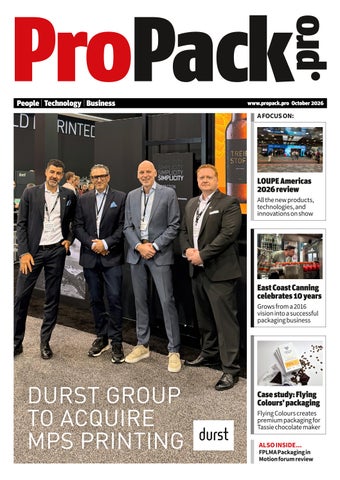
DURST GROUP TO ACQUIRE MPS PRINTING
Case study: Flying Colours’ packaging Flying Colours creates premium packaging for Tassie chocolate maker ALSO INSIDE...
FPLMA Packaging in Motion forum review
0 0 8
R U O OF W S E N NT E I L C E M CO M . S O FR RRAL E F RE
% % 0 1 I’ve had a chance to open the boxes and I’m absolutely thrilled with the quality. The print colour, detail and finish are all beautiful, and the textured stock looks fantastic. Thank you for all your help throughout the process. It’s been a pleasure working with you. Amanda 3/7/26
2 Thanks Hero Print for the incredible business cards and fliers. Love the raised holographic foil. Also the long edge printing services and die cut services are excellent too, items that are not available everywhere. Great value and fast service.
3 Thank you & your team so very much for your help with this job. The progress tracker and your efficiency has been excellent.
4 Everyone was happy with the finished job. I was impressed with both communication, speed and price.
I couldn’t be happier.
The product was delivered to the client yesterday afternoon, very happy!
I appreciate all efforts made to get this job sorted out under a tight deadline. Well done to you and your team.
Alayna 27/5/26
Thank you again!
Cayne 17/6/25
Stacey 14/5/26
AUSTRALIA’S BEST TRADE PRINTER
CONTENTS
IN THIS ISSUE... Michael Wu joins Tetra Pak
P08
FPLMA Packaging in Motion – how to navigate today’s markets and needs P30-32
P09
The forum addressed technological opportunities, economic challenges, and business culture
Is named MD of Oceania
Opal sells bag business P16
Sells its kraft paper bags and sacks operations
Paper sacks growth for Pope P09 Pope Packaging expands paper sacks division
East Coast celebrates 10th anniversary P10
P10-11
Grows from a 2016 vision into a family-owned beverage packaging business
Flying Colours creates premium packaging for Tasmanian Chocolate Makers P12-13 P20
FGDX partners with Xerox
P05
Technology integration forms part of the deal
Peacock Group expands operations in Victoria
P06
P06
The Pact Group exec will soon step down from his role with a replacement to be announced soon
JacPak fuels IVE’s growth
Graffica finds its next box-making powerhouse in AOPACK P14
COVER STORY: Durst Group announces MPS Printing acquisition at LOUPE P16-18 With the acquisition, Durst adds further flexographic expertise, technology, and engineering know-how to its capabilities
LOUPE Americas review P08
Company reports operational efficiencies
P20-28
Manufacturers showcase the latest innovations across labels, flexible packaging, folding cartons, automation, and finishing
P33
The awards celebrated excellence in flexo, offset, and digital packaging
The best packaging businesses are growing differently P34 Many strong performers will continue investing heavily in capability, systems, facilities, and customer experience
2025 AIP Career & Salary Survey provides industry insights P35 Highlights a highly skilled packaging workforce and the need for technical expertise
The quiet responsibility of keeping things made here
Graffica finds the right fit in its new manufacturing partner AOPACK
Expands with a new, purpose-built facility
Sanjay Dayal steps down from Pact Group
Designs and produces a chocolate box that can evolve alongside a growing business
Jamesprint, Peacock Bros, and Richdale win big at 2026 FPLMA Awards
P36
Australian manufacturing endures because it supports local jobs, skills, and capability
How retail trends will redefine packaging by 2031: Smithers P37 By 2031, packaging will need to be automation-ready, traceable, and low-carbon
Pack diary
P38
A guide to the upcoming local and international events around the world
THIS ISSUE SUPPORTED BY
www.propack.pro 0.de
4 ProPack.pro October 2026
NEWS Editor’s Note
The global print and packaging landscape continues to shift, with some major developments emerging from both sides of the world. At LOUPE Americas, Durst announced it will acquire MPS Printing, bringing it into the Durst Group from 1 January 2027 under the name MPS – a Durst Group company. We also bring you extensive coverage of the tradeshow in this issue, following Informa Markets’ first staging of the event since its rebranding. Closer to home, a startling point was raised at FPLMA’s technical forum, recently held at the Melbourne Exhibition & Convention Centre, highlighting some of the challenges and opportunities confronting Australia’s flexible packaging and label sector. Read about all these and more in this issue.
Flint Group Digital Xeikon inks strategic partnership with Xerox
The Flint Group Digital Xeikon building
Flint Group Digital Xeikon (FGDX) has announced a new strategic partnership with Xerox Holdings Corporation where the latter will offer digital presses under the Xerox brand based on Xeikon’s digital printing technology, enabling printers to access digital print solutions through Xerox’s established sales and service channels. As part of the agreement, Xerox will integrate FGDX technology into its production print portfolio, combining its colour presses with the Xerox Production Ecosystem, global distribution capabilities, workflow automation software, finishing solutions, remote services, and global support infrastructure. The companies said the move reflects a shared commitment to helping printers respond to growing demand for shorter
runs, faster turnaround times, versioning, and highvalue applications in an increasingly dynamic market. By combining Xerox’s commercial reach and customer relationships with Xeikon’s digital press technology, the companies aim to accelerate adoption of digital print production across a broader segment of the market. The partnership will also broaden FGDX’s production print portfolio, strengthen its position in high-growth segments, and create new opportunities in digital packaging, labels, and commercial print applications. FGDX president Walter Benz said, “This partnership will make Xeikon’s proven technology accessible to more printers, enabling them to grow their businesses and respond more effectively to changing market demands”. Xerox global production print services president Terry Antinora said, “By combining FGDX digital press technology with the Xerox production ecosystem, we are delivering a complete production platform that helps print providers increase productivity, unlock new applications, and drive profitable growth”. By bringing together Xerox’s client relationships and commercial reach with Xeikon’s digital press technology, the companies aim to accelerate digital print adoption and expand access to new production applications. This addition will complement flagship offerings like the Xerox Iridesse Production Press, Xerox Proficio PX500/PX300 Presses, Xerox IJP900 Inkjet Press, and Xerox PrimeLink printers and presses. The first press, sold and serviced by Xerox, will be branded under the Xerox name and enhanced with Xerox-developed software, integration, and service capabilities.
Stay informed… visit www.propack.pro and subscribe to receive the latest packaging industry news and views
ProPack Industry Supporters
Managing Director & Publisher: James Wells Editor: Hafizah Osman Co-editor: Pamela Connellan Production Manager: Jacqui Cooper
Pre-Press Manager: Tony Willson Design: Sarah Vella Printed by: Hero Print, Alexandria, NSW 2015 Mailed by: D&D Mailing Services
ProPack.pro is published by Printer Media Group, registered in Australia ABN 47 628 473 334. This publication may not be reproduced or transmitted in any form in whole or in part without the written permission of the publishers. While every care has been taken in the preparation of this magazine, it is a condition of distribution that the publisher does not assume any responsibility or liability for any loss or damage which may result from any inaccuracy or omission in the publication.
ProPack.pro National Sales & Partnerships Manager Carmen Ciappara +61 410 582 450 carmen@proprint.com.au
DISCLAIMER This publication is published by The Intermedia Group Pty Ltd (the “Publisher”). Materials in this publication have been created by a variety of different entities and, to the extent permitted by law, the Publisher accepts no liability for materials created by others. All materials should be considered protected by Australian and international intellectual property laws. Unless you are authorised by law or the copyright owner to do so, you may not copy any of the materials. The mention of a product or service, person or company in this publication does not indicate the Publisher’s endorsement. The views expressed in this publication do not necessarily represent the opinion of the Publisher, its agents, company officers or employees. Any use of the information contained in this publication is at the sole risk of the person using that information. The user should make independent enquiries as to the accuracy of the information before relying on that information. All express or implied terms, conditions, warranties, statements, assurances and representations in relation to the Publisher, its publications and its services are expressly excluded save for those conditions and warranties which must be implied under the laws of any State of Australia or the provisions of Division 2 of Part V of the Trade Practices Act 1974 and any statutory modification or re-enactment thereof. To the extent permitted by law, the Publisher will not be liable for any damages including special, exemplary, punitive or consequential damages (including but not limited to economic loss or loss of profit or revenue or loss of opportunity) or indirect loss or damage of any kind arising in contract, tort or otherwise, even if advised of the possibility of such loss of profits or damages. While we use our best endeavours to ensure accuracy of the materials we create, to the extent permitted by law, the Publisher excludes all liability for loss resulting from any inaccuracies or false or misleading statements that may appear in this publication. Copyright © 2026 — Charted Media Group Pty Ltd
www.propack.pro
October 2026 ProPack.pro 5
NEWS
Peacock Group expands Melbourne operations Peacock Group has expanded its Victorian operations, with a new 8,000 sqm purposebuilt facility in Dandenong South, bringing Peacock Bros. and insignia together. The new site increases the company’s combined warehouse and production footprint by approximately 66 per cent and provides approximately 56 per cent more production space. The move sees around 150 employees from the two businesses progressively relocate to the site, creating a shared Melbourne base for teams currently operating from Knoxfield and Oakleigh. While Peacock Bros. and insignia currently operate as established businesses within Peacock Group, the new shared location allows their teams to work more closely and give customers greater access to the group’s broader end-to-end offering. Peacock Group CEO Ryan McGrath said the new facility was the result of a considered search for a space that could support its people, operations, and longer-term plans. “Bringing our Oakleigh and Knoxfield teams together is a significant step forward for Peacock Group and for how we work together as one team. We’ve taken the time to find a site that works for our people and our current operations, while giving us the space and flexibility to support where we want to take the business in the future,” he said. “Peacock Bros. and insignia have established teams and expertise, and the new facility gives us an opportunity to bring those strengths closer together in a way we haven’t been able to before. It will create a larger, more modern environment for our
The new facility brings Peacock Bros. and insignia together at a shared Melbourne location
teams, with better facilities and more space for our growing operations.” A key feature of the Dandenong South site is also the Peacock Group Solutions Centre, a purpose-built customer experience space showcasing the breadth of solutions available across the group. Customers will be able to experience technologies in action and see how the Peacock Group works together to provide a full range of end-to-end solutions. The Solutions Centre will support customers across industries including manufacturing, warehousing, transport and logistics, retail, food and beverage, pharmaceutical, beauty and healthcare. Plus, it will provide a dedicated space for Peacock Group to collaborate with its technology partners.
Pact Group’s Sanjay Dayal steps down Pact Group has announced that its CEO and managing director Sanjay Dayal has advised the board of his intention to step down from his role. The company has announced there will be no immediate change to the leadership of Pact Group and the board has commenced a search process for a new CEO and is working with Dayal to facilitate an orderly transition. Dayal will continue as CEO and managing director until the commencement of a new CEO. Dayal started working with Pact Group in April 2019 and has led the company through a period of significant transformation, including the development and implementation of Pact’s strategy
6 ProPack.pro October 2026
Sanjay Dayal will soon step down from his role at Pact Group
to lead the circular economy, positioning the company as a leading provider of sustainable packaging and reuse solutions. Throughout his time at Pact Group, Dayal was instrumental in establishing
Also including AMR Hewitts Print Packaging, Peacock Group provides solutions spanning industrial coding and marking, printing and labelling, mobile computing, identification and tracking, colour labels and packaging, and software solutions. AMR Hewitts will continue to operate from its Tullamarine location, with its packaging solutions showcased as part of the centre. The move to the new Dandenong South facility will take place progressively, with employees currently based at Knoxfield relocating first, followed by the Peacock Bros. Oakleigh team in early 2027. Peacock Group plans to officially open the new facility and Solutions Centre in the first half of 2027.
Pact’s recycling and reuse joint ventures and securing long-term partnerships with key customers. Dayal said, “Leading Pact has been one of the great privileges of my career. Overseeing the company’s transformation and bringing the circular economy strategy to life have been extremely rewarding experiences. I want to thank our chair for his support and the board for its guidance and assistance. “I would also like to thank Pact’s talented management team for its commitment to Pact’s success, as well as our customers and partners for their support.” Pact Group executive chair Raphael Geminder said, “On behalf of the board, I thank Sanjay for his friendship, leadership, and commitment to Pact, our people, and our customers. We respect his decision and will work with him to ensure an orderly transition. We wish him well for the next stage of his career”.
www.propack.pro
NEWS
JacPak relocation and new business wins both support IVE’s growth IVE Group has reported operational efficiencies and growth in the second half of FY26 following its relocation of JacPak, which it acquired in October 2023, from Keysborough to Braeside in Victoria, and the addition of new customers. In an FY26 earnings call, IVE Group managing director Matt Aitken also confirmed the company’s Kemps Creek packaging plant is now in production. “The relocation of packaging into the Braeside site in Victoria… [enable] future capacity for growth as well as cost efficiencies,” Aitken said. “There are a lot of benefits to go from two sites that we had at Braeside into this one site, providing dedicated in-house logistics facilities for our packaging business, which had historically been outsourced up until recently. “The replacement of aging sheetfed printing presses and other equipment also facilitate IVE’s packaging expansionary packaging plans at Kemps Creek. “[In addition to] operating efficiencies, it provides additional space to accommodate further expansion, particularly in packaging, and it is a much more modern fit-for-purpose site for our staff to be accommodated in and to work from.
IVE Group managing director Matt Aitken
“We will now begin the relocation of New South Wales and Queensland packaging client revenue from Victoria up to New South Wales to enhance speed to market and reduce transport costs.” “Major new client” wins also bolstered IVE Group’s growth in packaging towards the second half of FY26, and is expected to have a positive impact on its FY27 results as well. New client wins include PepsiCo and Arnott’s. “Packaging new business wins of PepsiCo and Arnott’s commenced live production in
Tetra Pak appoints Michael Wu as new MD of Oceania Tetra Pak has appointed Michael Wu as managing director of its Oceania business so he can lead the company’s operations in Australia and New Zealand, supporting customers with packaging and processing solutions that help deliver safe food, while also reducing environmental impact. With 18 years’ experience across Tetra Pak’s global business, Wu joins Oceania from his most recent role as market operations quality and sustainability director. Prior to this, he was managing director of Tetra Pak Malaysia, Singapore, Philippines and Indonesia, where he led the company’s operations across one of the most diverse and dynamic regions. During his career, Wu has held a range of commercial and operational leadership roles, including vice-president commercial and cluster leader for Greater China, and director of supply chain integration, working
8 ProPack.pro October 2026
Michael Wu is now Tetra Pak’s managing director of Oceania
across China, Canada, and Southeast Asia. A firm believer in the role of business as
June following successful trials earlier this year,” Aitken added. IVE Group’s FY26 results shows that the company is continuing to successfully execute its planned 2030 strategy to achieve $1.2 billion to $1.3 billion by 2030 with “a solid full-year result in line with guidance in a difficult macroeconomic environment”. IVE reported full year FY26 revenue of $937.4 million, down 1.8 per cent from $954.8 million in the previous corresponding period (including acquisition revenue during the year). Its material gross profit margin of 51.4 per cent was up from 49.3 per cent in the previous corresponding period, underlying operating cash conversion remains strong at 93.6 per cent compared with 101.9 per cent in the previous corresponding period, and net debt was reported at $173.2 million, up from $114.4 million at 30 June 2025 (unchanged from 31 December 2025), reflecting acquisition funding coupled with capital expenditure associated with the packaging capacity build-out and new site fit outs. Its IFRS NPAT declined to $37.4 million from $46.7 million in the previous corresponding period, which it said reflects an increase in non-operating items primarily associated with the Dandenong South and Kemps Creek site relocations. IVE Group attributed its revenue softness in part to current macroeconomic conditions which impacted the retail and media sectors, particularly IVE’s catalogue and publishing business. IVE Group also revealed that it intends to maintain an acquisition pipeline as it builds on its ‘now to 2030’ strategy.
a force for good, Wu is passionate about driving positive societal impact, particularly in the areas of food availability, safety and environmental sustainability. Commenting on his appointment, Wu said he is looking forward to leading the Oceania team and building on the business’s momentum in the region. “Australia and New Zealand are home to a dynamic and innovative food industry, and I am excited to be joining such a strong team,” he said. “Our customers are navigating changing consumer expectations, evolving technologies and increasing focus on sustainability, while continuing to deliver safe, nutritious food and beverages to communities every day. Tetra Pak is uniquely positioned to support them through innovation, with deep industry expertise and a commitment to helping build more resilient and sustainable food systems. “I look forward to working alongside our customers, partners and colleagues to unlock new opportunities for growth while contributing to a future where food is safe, available and sustainable for generations to come.”
www.propack.pro
NEWS
Opal decides to sell its bag manufacturing business As part of its broader strategic focus, Opal has undertaken a detailed review of its bag manufacturing operations in Thomastown, Victoria, and “after careful consideration” has sold its kraft paper bags and sacks converting operation to an Australian entity owned by Thomastown International, Inc. Thomastown International, Inc. is an affiliate of The Magan Group, a US family office exclusively focused on investing in corporate divestitures. Opal, a subsidiary of Nippon Paper Industries, said the sale is consistent with its strategic focus on its core integrated recycling, paper, and packaging products and services. The acquisition was completed on 1 September 2026 and was subject to the fulfilment of the sale conditions. Flagstaff Partners was hired as financial adviser to Opal in relation to the sale of its kraft paper bags and sacks converting
Opal has decided to sell its kraft paper bags and sacks converting operation
operation. Flagstaff’s advisory team was led by William Ullmer and Jack Damyon. Opal added that the company and the buyer will work closely with its bag customers and suppliers to support a seamless transition once the sale is complete. It added that there aren’t any interruptions expected to production during
the transition period. Opal chief supply chain and procurement officer Simon Nozu said, “This decision was made following careful consideration and supports Opal’s continued focus on its core integrated recycling, paper and packaging products and services”.
Pope Packaging upgrades paper sacks division Pope Packaging has expanded its paper sacks division, boosting its manufacturing capability in its facility in South Australia. The company said this marks the largest single project undertaken in its 70-year history. This major local manufacturing investment builds on its existing Windmöller & Hölscher (W&H) equipment. Printing capacity has doubled, while converting capacity has increased by 50 per cent. The facility upgrade also brings new technology, additional warehousing, and greater manufacturing flexibility. Specifically, the production expansion introduces exciting new manufacturing capabilities including 8-colour printing, digital pasting technology, and inner patch capability. Inner patch technology opens opportunities for products previously unavailable in the Australian and New Zealand market. A new Miraflex II can print photo-like, 8-colour images at more than 1,000 bags per minute. W&H RUBY also provides 24-hour visibility across connected equipment. Pope Packaging said this helps improve efficiency, reduce costs, and continually improve performance.
www.propack.pro
Pope Packaging has added new technology to its paper sacks division
Pope Packaging CEO and chairman Craig Elkington said for Australian and New Zealand customers, the benefits include shorter lead times, increased safety stock, and lower working capital holding costs. It also significantly reduces supply chain risk. Elkington added that security of supply was a major reason behind the investment. “With our increased production capacity and footprint, Pope now offers unmatched security of supply, especially when compared to import alternatives,” he said. The expanded operation also brings production and warehousing together on one site, providing greater visibility
and accuracy throughout the process. Pope Packaging paper sacks Australia general manager Matt Sullivan mentioned local access to advanced manufacturing was a key benefit. “What excites me most is being able to offer our customers world-class capability, right here in Adelaide, Australia,” he said. The company also said the move reinforces its commitment to Australian manufacturing and customers across Australia and New Zealand, as well as gives customers greater flexibility, faster response times, and access to innovative new product opportunities locally.
October 2026 ProPack.pro 9
PEOPLE IN PACKAGING
East Coast Canning & Printing celebrates 10th anniversary East Coast Canning & Printing has grown from a 2016 vision into a family-owned beverage packaging business built on quality, innovation, and strong industry relationships
Brayden Tracey (East Coast Canning) checks the CODI mobile filling machine
E
ast Coast Canning & Printing is celebrating its 10th anniversary this year, marking a decade since Chris Kelly and his wife, Melissa, founded the business in 2016. Driven by a passion for quality and a vision to revolutionise beverage packaging, the pair set out to establish a business that would make its mark on the industry. Now, 10 years on, Chris explained that his journey into the canning and packaging industry began with a different ambition. “Back in 2013, my wife and I were keen to start a brewery. We put together a full business plan, but the equipment side of things was daunting. There was no cheap-but-good brewing equipment coming out of China like there is now, and the craft beer scene in Australia was still
10 ProPack.pro October 2026
in its infancy. It felt like too big a risk to take,” he said. “Then in 2014, we were travelling around the US and noticed beer in cans everywhere – so different to back home. I started digging into why, and that’s when I discovered mobile canning. It suited my skills and passions around machinery, time management, and team building perfectly. “I remember waking up in a cold sweat one night a few months later, knowing I had to find out whether this was actually a viable business. The more I researched, the more confident I got, and it turned into an absolute no-brainer. We rolled up our sleeves and got stuck in.” Chris recalled all the help from the industry that he received in the early days,
adding, “In brewing, it’s really about peerto-peer sharing – and there are so many great people still in the industry today who helped shape our early practices. “On the technical and product side, brewers like Sam Fuss from Philter were a huge help, always keeping us on our toes. On the commercial side, I was lucky to get guidance from Owen Lingley in the US, who founded Craft Canning and built a significant mobile canning business through Seattle and Portland in the early days of the craft beer scene there. He was always generous with his time and happy to answer my questions. “I also remember a great meeting with Stone & Wood early on – Jamie Cook and Brad Rogers asked me why on earth I’d want to package every single day.
www.propack.pro
PEOPLE IN PACKAGING
The staff of East Coast Canning
They thought it was the craziest idea in the world. But even those challenging questions helped shape where we ended up.” Parth Singh (East Coast Canning) mans the Hinterkopf D240
The people make the industry Chris said one of the things he enjoys most about the industry is its people. “It’s a bit of a cliché, but the people do really make this industry. Australia’s craft beer and beverage space is full of excellent people – the creative founders bringing out non-alcoholic and functional drinks today are fantastic, and so are the OG mates who’ve been in beer from day one,” he said. “Beyond the people, what excites me is the way beverages bring multiple disciplines of science together to create something a consumer holds in their hand and genuinely enjoys. Humans have a deep attachment to food and drink moments – not everyone, but plenty of us. “I think about someone holding a can on a beach, a mountain top or a lookout with friends and family, having a moment they’ll remember for years. That’s the real power of drinks – they’re shared in the moments that matter and that’s what cements our love for this industry.” These days, Chris said East Coast Canning is a “pretty simple” business that prints cans and fills them. “We don’t fill every can we print, but around 95 per cent of what we fill, we’ve also printed. We print and fill the full range of can formats available in Australia, in both sleek and classic,” he said. “The 375ml classic is still by far our most popular format, but we’re seeing strong growth in sleek demand and in the 500ml classic. But we love seeing brands innovate with format.” In this industry, Chris said the company aims to keep its machinery simple. “We have a Hinterkopf D240 digital printer, paired with full depalletising and palletising equipment from Codi
www.propack.pro
many great people come through our doors over the years,” he said. The Hinterkopf D240 at East Coast Canning
Manufacturing, which also supplies all our filling lines. For quality assurance, we use CMC Kuhnke seam inspection gear and a Hach Orbisphere dissolved oxygen meter,” he mentioned. “We’re big believers in the Codi equipment – we wouldn’t be where we are without it, and they’re great people who make a great product. We’re equally big believers in counter-pressure filling. In Australia, particularly in a mobile setting, it’s how we deliver a quality product day in and day out – filling highly carbonated beverages with low wastage and low dissolved oxygen pick-up – and saying ‘yes’ to a much wider range of products as a result. “Our ambition is to build a footprint as a drinks business, not just a canning business, providing solutions to beverage producers of all kinds around their packaged goods and their businesses more broadly. “We want to help drinks founders succeed: get their product to market and help craft brewers land an excellent product on shelf. At heart, we want to be a canned drinks business – and that’s the strategy we’re building toward.” Having the right staff Reflecting on running East Coast Canning & Printing, Chris said his staff have been instrumental to the business’ success. “Our staff are everything to us. It’s an easy thing to say – almost expected, as the owner of a business – but our current team is genuinely excellent, and we’ve had so
“The key is bringing people in who align with our team, culture, and values. When we get that right, we get a great result every time. It’s not a new idea, but it’s true, and we hire for fit because we know how much of an advantage it is – for the person, and for the rest of the team. “At the same time, one of our core values is the ability to be an individual at work. We want people to be themselves, and we’ve worked hard to build a culture of acceptance. It’s worked for a long time, and it shows in the results our staff deliver. “We’ve also worked hard to build a culture that genuinely loves drinks – a team that finds the work exciting and finds the world of drinks exciting. That has a real impact on the outcomes we deliver for customers.” As East Coast Canning & Printing marks its 10th anniversary, Chris was keen to acknowledge the customers and staff who have been part of the journey. “I do want to thank every customer we’ve worked with. We’ve been first on site and first in line for so many key Australian brands, and I’m grateful to everyone who has trusted us with their ‘drinks babies’ along the way. Thanks also to every staff member who has worked with us. “And finally, thanks to the industry as a whole, and to everyone who has advocated for us and referred people to us over the years. It means a lot. We’re a small, familyowned business, and the support we’ve had – built simply through a focus on product and quality – has been humbling. “That focus is the bottom line for us, and it’s why our outcomes have reflected how hard we work and how much we care.”
October 2026 ProPack.pro 11
CASE STUDY
Flying Colours creates premium packaging for Tasmanian Chocolate Makers For this promotional packaging project with Tasmanian Chocolate Makers, Flying Colours Group designed and produced a chocolate box that could evolve alongside a growing business Group director of client services and marketing Isobel Clark said. Flying Colours Group then brought its creative director Antish Gopala into the project because of his packaging design experience, and the process began with an initial consultation to understand the product, the founders’ vision and the practical requirements of the packaging. “As this was packaging for a completely new product and a new brand entering the market, the design was developed from the ground up alongside the brand identity,” Gopala said.
Flying Colours Group has designed and produced this premium chocolate bar packaging for Tasmanian Chocolate Makers
G
reat packaging isn’t just about how it looks – it’s about how it works. That was the guiding principle behind how Flying Colours Group produced a promotional packaging project for Tasmanian Chocolate Makers. Flying Colours Group designed and produced this premium chocolate bar packaging for Tasmanian Chocolate Makers, a Tasmanian craft chocolate brand focused on small-batch, bean-to-bar chocolate, that wanted to centre its packaging positioning around simple ingredients, quality craftsmanship, ethical sourcing, and a strong connection between Pacific cacao and Tasmanian flavour. As a result, Tasmanian Chocolate Makers approached Flying Colours Group in July 2024 as both a new client and a newly established company preparing to launch its first chocolate range. Since that initial enquiry, Flying Colours
12 ProPack.pro October 2026
Group has worked with the business across brand identity, packaging design, and packaging production.
“The aim was to create packaging that felt premium, distinctive, and true to the makers’ philosophy of simplicity, quality, and joy. It also needed to support a growing range of flavours while remaining practical to manufacture in smaller quantities during the early stages of the business.” The client was seeking a partner who could help establish the brand and create packaging that would: •
As a Tasmanian-owned creative print, signage, and packaging business providing end-to-end services across design, commercial print, digital print, labels, packaging, large-format signage, fabrication, and installation, Flying Colours Group works with clients from initial concept through to final delivery, combining creative thinking with practical production knowledge.
• • •
“Tasmanian Chocolate Makers contacted us seeking support with logo design, packaging design, and printing for a new locally made chocolate product. They had some early ideas, but needed a creative and production partner who could help develop the brand and translate the concept into functional, premium packaging,” Flying Colours
•
• • •
Present the chocolate as a premium artisan product Differentiate the brand in the market Support multiple flavour variants Communicate the connection between Pacific cacao and Tasmanian ingredients Be produced economically in smaller quantities Scale as the business and product range grew Provide a high-quality customer experience Manage the process from creative concept through to finished production.
Flying Colours Group managed the complete process, including strategy, design, structural development, artwork, pre-press, printing, cutting, finishing, packing, and delivery.
www.propack.pro
CASE STUDY The printing was completed using digital colour and PMS colour reproduction, with printing applied to both the internal and external faces. This required accurate registration, careful pre-press preparation and precise finishing. The early production runs were initially cut and scored using Flying Colours Group’s Zünd digital cutting system. This allowed Tasmanian Chocolate Makers to order smaller quantities, trial different flavour variants, and enter the market without the higher upfront cost of custom tooling. Flying Colours Group has designed and produced this premium chocolate bar packaging for Tasmanian Chocolate Makers
Mapping the design direction
But as the business grew and packaging volumes increased with demand, Flying Colours Group introduced a custom dieform. This improved production efficiency, scoring accuracy, consistency, and repeatability while preserving the original structural design.
The design direction began with understanding the story behind Tasmanian Chocolate Makers and the founders’ experience with traditionally made, stone-ground chocolate. From there, Flying Colours Group developed a visual identity and packaging system that reflected the brand’s focus. The project involved several stages across both design and production, with the design process including: • • • • • • • • • •
An initial consultation and project briefing Research into the product, target market and brand story Logo and visual identity development Packaging concept development Structural packaging design Flavour variant development Artwork refinement and client review Prototyping and testing Final artwork preparation and pre-press Production testing and approval
Shelf-ready sophistication
The structural component incorporated a self-locking mechanism requiring no adhesives
Both the internal and external surfaces were considered as part of the design, helping create a more complete and polished unboxing experience. This was then tested to ensure the self-locking mechanism assembled correctly and performed reliably.
www.propack.pro
The final product was a premium, highly finished presentation package with strong shelf presence and clear differentiation between flavour variants. It featured crisp print reproduction, clean folds, precise cutting, and a self-locking construction without visible adhesive. The combination of structural design, colour, typography, and flavour-specific artwork created packaging that felt more aligned with specialty coffee, craft spirits or premium wine than traditional massmarket confectionery.
The final product was a premium, highly finished presentation package with strong shelf presence
“The packaging needed to feel refined without becoming overly complicated. It also needed enough flexibility to accommodate different flavour variants while maintaining a consistent and recognisable brand presence,” Gopala said. The structural component was designed by Flying Colours Group’s in-house creative team and incorporated a self-locking mechanism requiring no adhesives. This created a clean finished appearance, simplified assembly, and reduced the need for additional materials.
“This was ideal for cost-effective shortruns and allowed the client to test new flavours without committing to large volumes or tooling,” Clark said.
The finished result reflected the quality and story of the chocolate while giving the brand a strong foundation for retail, gifting, and future product growth. “This project is a strong example of Flying Colours Group’s ability to support a new business from its earliest stage and help turn an initial product idea into a professionally presented, market-ready brand,” Clark said.
Both the internal and external surfaces were considered as part of the design, helping create a more complete and polished unboxing experience
Packaging innovation that evolves The packaging was produced on 300gsm Sovereign Silk, selected for its smooth print surface, structural strength, and ability to hold clean folds and scores.
“It demonstrates that our role extends beyond simply printing supplied artwork. We can work collaboratively with clients to develop the brand, design the packaging structure, solve production challenges, and establish a manufacturing approach that grows with the business. “The project also reflects the value of having creative, print, and finishing capabilities working together under one roof. That integration allowed us to test, refine, and produce the packaging efficiently while maintaining control over quality throughout the process.”
October 2026 ProPack.pro 13
NEW PRODUCTS
Graffica finds its next box-making powerhouse in partner AOPACK Graffica has found its next box-making partner in AOPACK, replacing Autobox with four machines covering customised, short-run, and on-demand packaging production
F
or nearly a decade, Graffica was the sole distributor for UK machine manufacturer Autobox Ltd, building a strong presence for the brand across Australia and the wider Asia Pacific region.
scattered orders and low to medium volume box production solutions. Next up is the AOPACK BM1800-Mini. With a small footprint, six second set up job-to-job and 1,800mm max width, the automatic corrugated box making machine aims to redefines efficiency, space optimisation, and sustainability in the corrugated box production industry.
During that time, Graffica sold 13 Autobox machines in Australia, nine in New Zealand, and a further two systems across Singapore and Indonesia, establishing a solid customer base for the company’s automated box-making technology. However, Autobox closed its doors nearly two years ago, leaving Graffica with the challenge of finding a new technology partner that could match the performance, capability, and market fit of the machines it had previously represented. That search was not straightforward. “Finding something that stacked up wasn’t easy,” Graffica director Neil Southerington said. After an extensive search, Southerington believes he has found the right fit in AOPACK. The partnership gives Graffica a new platform to build on its experience in the automated box-making market, while offering customers access to a new generation of equipment designed to support the growing demand for short-run, on-demand, and customised packaging. For Graffica, AOPACK represents more than simply a replacement for Autobox. It provides an opportunity to continue developing the box-making segment with technology and solutions that can meet the changing needs of packaging producers across the region. Graffica carries four of AOPACK’s product models, which Southerington says are “probably the most advanced machines on the market today”. One of them is the heavy-duty corrugated box making machine, the AOPACK BM3000-HD. It is designed for short-run and on-demand corrugated box production and processes standard and high-strength corrugated cardboard from E flute to AAA, including 3/5/7-ply cardboard, with board widths up to 3,000mm.
14 ProPack.pro October 2026
The AOPACK BM3000-HD is a heavy-duty corrugated box making machine
The BM3000-HD is targeted at corrugated packaging manufacturers that need to produce different box sizes and styles in short- or medium-production runs. The machine integrates feeding, slotting, scoring, creasing, slitting, and cross cutting into one automated workflow. Its reinforced processing capability allows it to handle both standard corrugated board and high-strength 7-ply and AAA board. With fast order changeover and flexible box dimensions, BM3000-HD is suitable for customised packaging, industrial packaging, and on-demand corrugated box production. It also can produce hundreds of different styles, with 150 already pre-programmed and comes with optional functions such as vibrating cutting knifes, male and female double-sided creasing, and inline gluing, amongst others. The next is the AOPACK BM2508-Pro – an innovative and versatile cardboard box making machine. It can process more than 150 box styles, no mould is needed, and oversized carton boxes can be processed in one go. It can produce up to 800 boxes per hour, depending on the design. One BM2508-Pro cardboard box machine includes a slitter, a slotter, a gluer, and a sample maker. This machine enables converters to improve production efficiency and save labour costs. It is also fully automatic and produces customised packaging boxes. It specialises in
At the core of the BM1800-Mini’s appeal is its ultra-compact footprint. Measuring just 1.5m in length, 2.5m in width, and 2.03m in height, the machine is engineered to fit into tight spaces – even storefront workshops or multi-story facilities. With a weight of 1,848kg, it can easily be transported via standard elevators, enabling installation on second or third floors. This flexibility eliminates the need for expansive factory floors, making it ideal for urban manufacturers or businesses prioritising space efficiency. The machine is aimed at JIT orders of custom mid-sized boxes. Finally, for on-demand applications, Graffica offers the AOPACK FF2800 e-commerce fan fold machine. The machine can process up to six different fanfold cardboard stacks with automatic material selection, providing exceptional production flexibility without the need for manual material changes. The FF2800 integrates multiple processing functions into a single compact system, including slotting, scoring, creasing, slitting, and trimming, enabling complete box production in one continuous operation. Designed for on-demand and customised packaging, the FF2800 provides a complete box-making solution that allows manufacturers to produce exactly the boxes they need, whenever they need them. “These AOPACK automatic box making machines fit in nicely with our large format corrugated die cutters from Century; CorrFold folding box gluers; Ameida cutting tables; glue plotters; Fengchi Litho Laminating machines/window patching machines; other box making, auto slitting, and slotting machines; and related equipment,” Southerington said.
www.propack.pro
PACKAGING AND DISPLAY EQUIPMENT
Scan HERE to visit our YouTube channel.
See our range of folding box gluers, board slitters, creasing machines, auto loaders, unloading cutting tables and more.
CARTONFOLD PRO
Available in 650, 850, and 1100 with auto-set and job recall. Features crash-lock and 4/6 point gluing. Optional pre-feeder/ packer operates at 450 M/min. The CorrFold range is also available in 1450, 1700, 2100, 2300, 2800, and 3200, also with crash-lock and 4/6 point gluing. Includes auto-set/recall, pre-creasing unit, and pre-feeder/stacking, operating at 300 M/min.
HIGH-SPEED LAMINATING MACHINES
Ameida Cutting Tables. Now with an auto feeder (not shown).
• Fengchi GW Series, 16,000 SPH • Handles single face, F flute up to 10mm • Top sheet range: 120 gsm – 700 gsm • Single-sided, double-sided, and partial laminating • 3-minute job changeover • Available sizes: 1060 / 1450 / 1700 / 2200
• A dozen machines installed across Australia • Oldest machine has been in operation for more than 10 years and is still running daily • Now available with auto feeding • Introductory offer – Cutting table with auto feeder, including cut and crease functionality, from $75,000 installed
Discover our range of cutting and glue plotter tables!
Graffica Pty Ltd Phone +61 477 200 854 I Email grafficapl@bigpond.com I Visit Us www.graffica.com.au
COVER STORY
Durst Group announces MPS Printing acquisition at LOUPE Americas With MPS Printing, Durst Group is adding further flexographic expertise, technology, and engineering know-how to its strong suite of capabilities
Thomas Macina, Christoph Gamper and Dr Stefan Kappaun from Durst with Michiel Borst from MPS Printing (second from right)
A
s one of the first announcements out of the recent LOUPE Americas 2026 tradeshow in Chicago, Durst revealed it will be acquiring Netherlandsbased specialist in flexographic printing systems for the label and flexible packaging industry, MPS Printing, and that the latter will become part of the Durst Group on 1 January 2027, operating under the name MPS – a Durst Group company. Durst said the strategic acquisition will represent a step in its long-term commitment to the labels and flexible packaging market as the industry is undergoing a fundamental transformation with customers of all sizes looking for greater automation, more connected workflows, and production environments that can efficiently handle a variety of applications, run lengths, and business models.
16 ProPack.pro October 2026
Durst added that it finds digital printing will play an increasingly important role in this transformation, but the future of label production will not be based on one technology alone. As Durst has built a strong position in digital printing, software, and automation and, together with OMET, in highperformance hybrid production, the addition of MPS to its portfolio will add further flexographic technology, engineering expertise, and deep application know-how to the group. This will also broaden the group’s technology platform, shorten development cycles, and enable a faster go-to-market for new solutions connecting digital and flexographic printing with software, automation, and finishing. In addition, it will create
additional integration paths for automated end-to-end label production. Further to that, the acquisition will reflect Durst’s long-term strategy of connecting printing systems, software, workflow automation, and production intelligence into increasingly integrated production environments. Durst’s ambition is to create a broader and more scalable technology platform in which converters can select the most appropriate combination of digital, hybrid, and flexographic production for their individual applications. Durst Group CEO and co-owner Christoph Gamper said, “Label production is becoming increasingly connected, automated and data-driven. Our customers need production environments
www.propack.pro
COVER STORY that allow them to manage different applications, run lengths and business models with maximum efficiency and flexibility. “Durst already has strong capabilities in digital printing, software and hybrid production. With MPS, we are adding further flexographic expertise, technology, and engineering capabilities to the group.
MPS’ EF SYMJET range offer hybrid printing solutions that provide a range of new print potential
“This will give us additional integration options and allow us to pursue complementary development paths in parallel. It means we can innovate faster, address a broader range of customer requirements and bring new solutions to market more quickly.” MPS will continue its operations as a strong brand within Durst MPS confirmed it will continue to develop, manufacture, and market its existing portfolio of flexographic printing systems.
With offset sleeve combination printing, the MPS EXL-Offset offers variable sleeves for different repeat lengths for both plates and blankets
The existing MPS management team will remain in place and the current CEO of MPS Printing Michiel Borst will continue to lead the company as managing director of MPS, reporting within the Durst Group management structure. Borst said, “What changes is not who we are, but what we will be able to achieve. MPS will retain its entrepreneurial approach, its customer focus and its commitment to flexographic innovation.
MPS’ existing direct sales channels will remain in place across Europe, while Durst USA will assume responsibility for MPS sales and service in North America
The EXL-Packaging press enables narrow to mid-web printers and converters with wider and faster flexo printing without limits
www.propack.pro
“At the same time, becoming part of the Durst Group gives us access to a broader technology platform, a global organisation and the long-term perspective of a family-owned company. This creates new opportunities for our customers, our partners and our employees, while building on the strengths and culture that have made MPS successful.” MPS also confirmed its existing direct sales channels will remain in place across Europe. In North America, Durst USA will assume responsibility for sales and service of the MPS portfolio, providing customers with direct access to Durst’s established regional organisation. MPS will also increasingly benefit from Durst’s international service and spare-parts infrastructure, strengthening local support and response capabilities for customers worldwide. Existing contracts and service commitments remain in place in accordance with their terms, and continuity of service and support will remain a key priority throughout the integration.
October 2026 ProPack.pro 17
COVER STORY OMET/Durst relationship to remain Durst’s existing partnership with OMET also remains in place and continues independently of the MPS transaction. Together, Durst and OMET develop, manufacture, and market the KJet and XJet hybrid platforms. Durst said these solutions remain an important part of its hybrid strategy and continue to be developed, marketed, and supported through the established partnership and channels.
Michiel Borst (MPS Printing) and Christoph Gamper (Durst)
Durst added that the cooperation with OMET has enabled it to establish successful high-performance end-to-end solutions combining flexographic printing, digital printing, and finishing, and that the addition of MPS gives Durst further technology and integration options for different customer requirements, applications, and market segments. “Our partnership with OMET remains strategically important and continues,” Gamper said. “At the same time, the label market is highly diverse and there is no single production concept that meets every requirement. Our objective is not to duplicate solutions, but to give customers the right technology, level of automation and production concept for their individual requirements.”
MPS’ EF next generation multi-substrate flexo printing presses are of high-quality and are fully automated
The evolution of MPS MPS started as a small Dutch engineering venture focused on improving flexo and pioneered servo-driven narrow-web technology. It grew into a global label and packaging press manufacturer and has now entered another major phase under Durst ownership. MPS Printing has a history that goes back to 1996 in the Netherlands, when three former Stork employees – Bert van den Brink, Eric Hoendervangers, and Henk Wientjens – founded Multi Print Systems (MPS) with the aim of developing a better flexographic printing press. The company began operating from a small garage before moving to larger premises in Nijmegen in 1997. A key milestone came in 1997, when MPS sold its first press to a Swedish printer.
18 ProPack.pro October 2026
That machine was notable because it was based on servo-driven flexographic technology, an innovation MPS says its founders pioneered for narrow-web printing. Remarkably, that first press was still in production when MPS celebrated its 25th anniversary in 2021. The company expanded rapidly during the late 1990s. In 1999, MPS took over the Sloka machine factory in Didam, bringing its employees into the business and establishing a stronger manufacturing base. Over the following years, MPS expanded internationally, establishing operations in Germany, the UK, North America, and Asia, while building a broader network of agents and distributors. Technologically, MPS evolved from its narrow web flexo roots into a supplier of flexo, offset, and hybrid presses for the label and flexible packaging markets. Its portfolio increasingly incorporated automation, connectivity,
The acquisition of MPS remains subject to customary closing conditions and regulatory approvals. and digital integration, including hybrid solutions combining flexographic printing with digital inkjet technology. By its 25th anniversary, MPS reported more than 800 machines operating worldwide, reflecting its transition from a small Dutch press manufacturer into an international printing technology company. Today, MPS says it has more than 1,000 machines installed across 100+ countries. MPS’ major restructuring in 2025, followed by a management-led buyout involving Richard Miedema, Michiel Borst, Nick Tyrer, and co-founder Bert van den Brink, was intended to restore stability and put greater emphasis on service, recurring revenue, innovation, and long-term customer relationships. Now, the latest chapter with Durst is particularly significant as it continues to develop and manufacture its existing flexographic press portfolio.
www.propack.pro
TAU G3 Empower your business.
For more information, please visit durst-group.com/g3
LOUPE AMERICAS REVIEW
LOUPE Americas 2026 puts the spotlight on print innovation LOUPE Americas 2026, which was recently held in Las Vegas, US, brought the global packaging print industry together, showcasing the latest innovations across labels, flexible packaging, folding cartons, automation, and finishing
The first LOUPE iteration took place in Chicago, US A
T
he first LOUPE tradeshow recently took place in the US, with organiser Informa Markets running the first iteration of the show in Chicago since its rebranding. LOUPE was formerly known as the Labelexpo series, and the rebranding was unveiled at Labelexpo Europe in Barcelona last year. Informa Markets Americas group director Tasha Ventimiglia opened the event, saying, “This is our first official LOUPE event, so we’re really excited to roll it out in the Americas market for the first time. “This year, we are at 181,000 square feet, which is where we were at last time, so we’re pretty happy with that result.
20 ProPack.pro October 2026
“We do have some companies that have taken additional equipment at the show – this year, we’ve got some 430 exhibitors in total, of which 112 are new exhibitors. Some of these new companies have come in on the flexible packaging side as well.”
He added that the KJet on the Durst stand is one such example, combining OMET’s rich legacy of analogue excellence with Durst’s cutting-edge digital technologies, creating a hybrid line that embodies the best of both worlds.
Informa Markets labels and packaging group strategic director Andy ThomasEmans identified some of the key trends that were showcased on the trade floor.
As for AI, Thomas-Emans said there are some ‘interesting applications’ of it from companies that are leading in this space, such as Brotech, AVT, Dantex, and CERM.
He mentioned that flexo and AI are some of the biggest ones prevalent this year. Within flexo, Thomas-Emans said increasing automation and digital integration is taking centre stage, where the ‘digital twin’ concept of a flexo press with a digital model is increasingly emerging.
Thomas-Emans also spoke about manufacturers diversifying into flexible packaging, adding some examples include Mark Andy, ABG-Galaxy, and the HP Indigo Flexpack Factory ecosystem. “These are the entrepreneurial ones leading the way. These are the businesses
www.propack.pro
LOUPE AMERICAS REVIEW that are going to disrupt the market,” he added. “This is part of the LOUPE concept this year and you’ll be seeing a lot more of this at LOUPE Europe next year.” Here are what some exhibitors showcased at LOUPE Americas. AB Graphic AB Graphic (ABG) put on its largest-ever display at LOUPE Americas with a total of 14 solutions on stand. This display included the DigiLase Duo, Galaxy GS20 Plus with Pouch Jet, and the Converter Series 4 with ASU (auto server unwinder) and Vectra turret rewinder technologies. LOUPE Americas attendees were also among the first in the region to experience ABG’s DigiLase Duo laser finishing system, which made its North American debut at the tradeshow. The machine features two laser beams instead of one, thereby doubling the cutting speed and significantly increasing overall production efficiency. The addition of dual independent lasers not only increases speed and throughput, but also provides full redundancy of the laser hardware, critical in a web-to-print environment – reducing dependency on a single laser. This design makes the DigiLase Duo faster, more flexible, and more resilient in high-demand production settings.
The DigiLase Duo also supports customers in improving sustainability, with ABG’s sophisticated ‘ABG Connect’ workflow ensuring that job changes create minimal waste, reduce material loss and support leaner, more environmentally conscious operations. The Galaxy GS20 Plus with Pouch Jet provided visitors with the first opportunity to see ABG FlexPack in action. Developed to meet growing demand for short-run and value-added flexible packaging production, the solution extends ABG’s proven finishing expertise into the rapidly expanding flexible packaging sector. As for the Converter Series 4 with ASU (auto server unwinder) and Vectra turret rewinder technologies, the combination forms a highly automated, non-stop digital finishing and print converting system. Together, these systems maximise throughput by eliminating the manual downtime associated with master roll loading, matrix stripping, and finished roll changes. Currie Group is the distributor of ABG in A/NZ. Canon Canon debuted Edale to the US market at LOUPE Americas following its acquisition of the company in 2022. As a result of that
Designed for high-speed digital label and packaging production, the DigiLase Duo delivers precision laser cutting, creasing and perforating without the need for conventional tooling, enabling faster job changes and greater production flexibility. A major innovation within the system is ‘Repeat Flow’, which allows for the automated switching of die lines within each web repeat, without creating waste or operator input – ideal for unique and short-run sheet applications.
strategy, the company had the LabelLine FL4p as the hero product of its booth at the trade show. The Edale LabelLine Series is a modular label-converting platform engineered to handle short-, medium-, and long-run flexographic production of labels, packaging, and light cartons. The LabelLine FL4p integrates flexographic printing and converting into a single, streamlined platform, reducing production touchpoints and minimising the need for manual intervention. It’s a high-capability 430-570mm label press with features such as advanced registration control and optional inline embellishment, job storage and recall, and modular upgrade paths. This means one platform delivers premium, diversified label work, consistently, across every shift. Canon production marketing senior director Ronaldo Martinez said, “Canon acquired Edale four years ago to expand into the labels and packaging market. “Since Canon has acquired the expertise of Edale, which has 75 years of experience in the analogue flexo printing market, the LabelLine FL4p is the new offering which is the centrepiece of the Canon booth at LOUPE Americas. “The LabelLine FL4p is designed to help customers improve workflow efficiency, increase flexibility, streamline short-run production, and reduce production touchpoints and manual intervention.” In addition, Canon showcased its awardwinning Colorado M-series large format printer, an imagePrograf GP-2600S, and two of its newest desktop label printers: the LX-D400 and the LG-P800.
Ronaldo Martinez (Canon) with the LabelLine FL4p
A dedicated applications gallery and unboxing experience also brings Canon’s full packaging ecosystem to life on stand, showcasing how its solutions integrate seamlessly across labels, cartons, mailers, point-of-purchase displays, and package inserts. CS Graphics CS Graphics has celebrated its first year following its ownership takeover of the core distributor operations from Aldus Graphics.
Mark Daws (Currie Group) and Ralf Wirtz (ABG) at the ABG stand
www.propack.pro
CS Graphics co-director Chris Bodger was at LOUPE Americas in Chicago, where he told ProPack.pro about the company’s recent advancements, including the move to its own building, having its own warehouse and showroom, and the addition of new staff to its team.
October 2026 ProPack.pro 21
LOUPE AMERICAS REVIEW control architecture. New power supplies, electronics, cabling, and software deliver greater efficiency, modularity, and reliability, backed by GEW’s in-house manufacturing expertise. Intelligent, serialised lampheads enable enhanced telemetry, OEM integration, and remote monitoring, while standard features such as hour and reflector counters simplify system management and maintenance.
Chris Bodger (CS Graphics) and Marcus Greenbrook (GEW)
“Over the last 12 months, since we met at Labelexpo in Barcelona, we’ve accomplished so much! It’s phenomenal, the amount of effort Sheetal and I have put in. Our families too, have put in countless hours behind the scenes, helping us set up our computer systems and website,” Bodger said. “We now have our own building, we have a showroom, we have warehousing, and we have nice offices. We’re based in Williamstown North in Victoria. We’ve employed two more people – Sean McAuley, who’s now our technical sales manager, and Tania Mishra, who works as our general assistant. “Our sales were good in the first 12 months, and the reception that we’ve had from the industry has been tremendous.” The new showroom is home to several of CS Graphics’ partner solutions, including two pieces of equipment from bespoke ultrasonic anilox cleaning systems company Alphasonics and some GEW equipment. CS Graphics plans to add on some Rhyguan equipment to the showroom in the near future. “We’ve sold eight Rhyguan machines in the last year. I’ve been installing those units too; I’m not just doing sales but the installs and the technical support too,” Bodger said.
EOS remains fully compatible with GEW’s patented interchangeable ArcLED technology and adds end-to-end encryption for secure system communications. As well, Bodger mentioned Mark Andy’s showcase of the Digital Series HD at LOUPE Americas. The press is a high-performance production-class hybrid printing unit that combines high-resolution UV inkjet digital printing with native flexographic and inline converting capabilities in a single pass. The high-speed machine runs at 146m/min, at 1,200 dpi. “The amount of productivity users get off the machine is incredible. Based on the calculations, Mark Andy is looking at one machine producing US$10 million worth of work,” Bodger added. Durst Group In addition to the MPS Printing acquisition that it announced at LOUPE Americas, Durst Group’s TAU G3 Peak made its North American debut at the tradeshow. This follows its launch at Labelexpo Europe in Barcelona last year. Representing the next evolution in Durst Tau technology, the G3 Peak delivers exceptional 1200dpi print resolution, outstanding colour consistency, and speeds of 80m/min which can be expanded to 100m/min, depending on configuration. Print widths range from 244mm to 510mm, offering scalability for different production needs.
For maximum colour flexibility, the Tau G3 Peak supports CMYK plus extended gamut options – Orange, Violet, Green and White – available with both UV and LED curing. This versatility, combined with compatibility for substrates from paper to films and aluminium foils within a 20 to 500µm thickness range, ensures application diversity across labels and flexible packaging. The machine architecture, based on the proven Tau RSC design, introduces intuitive LED status displays, improved ergonomics, and optimised serviceability. A redesigned cooling system, electrical cabinet, and improved component accessibility simplify handling and maintenance. The ergonomic inspection unit, equipped with D50/RGB lighting and flexible adapters for inspection systems, further enhances process reliability. The G3 also comes equipped with some new productivity features: Durst ARC (Automatic Register Control) and Durst MEP (Material Edge Protection), making operation easier while boosting productivity. In addition, HAWK AI, Durst’s intelligent monitoring and assistance system, can be included to automate the colour-to-colour register and to provide closed loop nozzle correction during printing. At LOUPE Americas, Durst Oceania managing director Matt Ashman also confirmed the company will be installing A/NZ’s first TAU G3 Peak in Sydney at the end of the year. “There has been a really positive reception for the TAU G3 Peak following the launch back in Europe last year at Labelexpo Barcelona and the first US launch here at LOUPE Americas – and we have our first TAU G3 Peak being installed at the end of this year in Sydney,” he said. “It will be at the premises of a very wellknown label converter. The principal of
Some of the company’s other global manufacturing partners include Mark Andy, Rotoflex, Maxcess, DYM, Harper, Polywest, JM Heaford, and Graymills & Enercon. Bodger also spoke about some of the latest developments from its manufacturing partners that are currently being shown at LOUPE Americas. At the trade show, GEW is showcasing its latest EOS technology, which replaces its established RHINO Power platform with a completely redesigned power and
22 ProPack.pro October 2026
Graham Blackall, Martin Leitner, and Matt Ashman from Durst at LOUPE Americas
www.propack.pro
LOUPE AMERICAS REVIEW the company is a visionary, and the digital side of his business is just growing exponentially. So, we are all very excited.
Epson
“We’re also seeing a huge amount of interest in the hybrid – the KJET. This year has been an interesting one with the install of new machines, and we’re really happy that the first Peak is going to be coming in. “Durst has been making really revolutionary moves in the industry, to set it at the forefront of this industry. If you look back 20 years, Durst was selling photographic machines and machines to make photographic books. Look at how much the company has grown and changed today.” Alongside the G3 platform, Durst showcased its digital labels production machine, the KJET, which is a hybrid solution built to deliver flexibility, efficiency, and reliability for all label converting environments. A result of the Durst and OMET partnership, the KJET is one of the most versatile hybrid labels printing systems in the market, combining digital inkjet with conventional flexo and finishing in a single line. This integration allows inline varnishing, embellishment, and special effects, offering converters the best of digital productivity with the versatility of flexo. Designed to streamline operations and be easy to operate, while maintaining high output quality, the KJET offers endless possibilities for labels and packaging without compromising performance or print quality. The KJET is available in a 420mm-wide configuration, as well as a 510mm-wide configuration, and can hold up to nine colours in digital – CMYK, orange, violet, green, and double white. In addition, modules for finishing and further processing (such as cold foil stamping or die-cutting units) can be integrated into the KJET, offering flexibility and an enormously broad application portfolio. The configuration of the KJET can be tailored to the specific requirements of each customer. Durst labels and flexible packaging head of product management Martin Leitner said, “The US, as a single country, is the most important country for Durst. Labels, as a market, is growing year on year in double digits for Durst – we have delivered around 90 labels machines globally this year. “This is the reason why labels is such a huge focus for Durst, and underpinning that is the showcase of the Durst TAU G3 Peak and KJET here at LOUPE Americas.”
www.propack.pro
Gerardo Gordon (Epson) at LOUPE Americas
At Epson’s booth at LOUPE Americas, there were no presses physically displayed on stand but instead, a huge Epson screen connected to its demo centres in California and Paris was showcasing three of its latest products – the SurePress L-4733AW, the SurePress L-6534VW, and the SurePress L5034.
“What we’ve been seeing at LOUPE Americas is a lot of people coming from South America as well – people from Argentina, Chile, Brazil, and the Caribbean. So there’s a lot of people trying to start up in the digital printing business,” Gordon said. “The majority of these people like to see the highest productivity machine first, and then they start to ask more about the entry level because it’s the first investment in some cases. The L5034 compared with our L4733, has pretty much three times the productivity. So, I’m seeing a lot of people asking for the L6534 and then end up being more interested in the L4733, which is the entry level machine. “Epson is likely the only company – or very close to it – that can produce presses with both the technologies of UV ink and waterbased ink. Epson is very unique in this sense and that’s why these models are popular with the attendees of the show.” Flint Group/Xeikon
Epson America product manager Gerardo Gordon said, “We have the L4733 and L6534 at our headquarters in Los Angeles, California, and in Paris, France, we have the L5034. So we are showcasing all of these on our screen because we can provide a more detailed demonstration of the presses”. The SurePress L-4733AW is an industrial, water-based digital label press designed for high-quality, short-run prime labels and flexible packaging. A low-cost turnkey solution, it comes withautomated features such as advanced auto head cleaning, technology that verifies the health of each nozzle, an optional inline spectrometer and increased film printing production versus the previous generation. In addition, it uses water-based resin AQ4 inks, including White Ink for clear and metallic films, that meet the latest safety standards and regulations. The SurePress L-6534VW is an industrial digital label printing press that reaches speeds up to 50m/min. With built-in reliability and automated processes the SurePress L-6534VW provides the widest colour gamut CMYK plus orange and white ink, enabling creation of impactful label designs, cost effectively. As for the SurePress L5034, it combines aqueous inkjet innovation with industrial grade reliability, delivering high-quality labels at speed with room to grow a business. It is designed for converters who demand high image quality, accurate colour, and reliability.
Flint Group Packaging Solutions CEO Pepyn Dinandt (middle) gives the company update at LOUPE Americas
The recent partnership that Flint Group Digital Xeikon inked with Xerox was in the spotlight at LOUPE Americas. Speaking at LOUPE Americas, Flint Group Packaging Solutions CEO Pepyn Dinandt said the partnership will extend the company’s reach and place it in markets it was unable to penetrate before. Dinandt said Xerox has about 6,000 customers in the US itself that are printing digitally, and that the integration of Flint Group Digital Xeikon technology into Xerox will widen its global distribution capabilities. Dinandt further explained that as per the partnership, the Xeikon TX500 presses will also be offered under the Xerox brand, enabling converters to access Xeikon’s digital printing technology through Xerox’s established sales and service channels. “The whole reason for this partnership is so that Xeikon’s technology can reach
October 2026 ProPack.pro 23
LOUPE AMERICAS REVIEW Xerox’s customer base. We will build the machine for them, and they will enhance it with Xerox-developed software, integration, and service capabilities before offering it to their customers as a Xerox sold and serviced product,” Dinandt said. “It’s a new route to market, and one that we’re excited about.” Flint Group Packaging Solutions and Xerox previously said the partnership reflects a shared commitment to helping printers respond to growing demand for shorter runs, faster turnaround times, versioning, and high-value applications in an increasingly dynamic market. By combining Xerox’s commercial reach and customer relationships with Xeikon’s digital press technology, the two companies said they are positioned to accelerate adoption of digital print production across a broader segment of the market. The partnership with Xerox will also broaden Flint Group Digital Xeikon’s production print portfolio, strengthen its position in high-growth segments, and create new opportunities in digital packaging, labels, and commercial print applications. Flint Group Packaging Solutions also had the latest edition of its established EkoCure XS product line – the EkoCure Fast Cure Ultralow COF Shrink White – making its show-floor debut. This new high-performance, dual-cure first-down white ink is purpose-built for shrink-sleeve applications requiring low to moderate shrink performance and it’s designed to run on both conventional UV and UV LED systems. At LOUPE Americas, the Flint Group team guided visitors through a system showing how an integrated ink, coating, and online platforms can help narrow web printers streamline their work and at the same time, cut complexity, improve productivity, and support consistent print quality across a wide range of packaging and label applications.
UV conventional technology for food packaging applications. Built on an advanced resin platform, Flexocure LEAP is engineered to reduce the risk of photoinitiator migration and to protect packaging integrity as food contact material regulations tighten. Visitors to the booth also explored the company’s portfolio of conventional and digital coatings, designed to deliver shelf-ready visual impact and functional protection without complicating production. It also highlighted FlintLink, its secure customer B2B portal; VIVO Colour Solutions, with its end-to-end colour management platform; and Hydrokett and Hydrofilm water-based ink systems for narrow web paper and film applications. HP Australia’s leading label, sleeve, blister foil, and print packaging specialist Labelmakers bought an HP Indigo 200K Digital Press and an ABG Digicon Series 3 from Currie Group at LOUPE Americas, adding capacity to its trans-tasman operations. The HP Indigo 200K Digital Press purchase marks Labelmakers’ third HP wide-web digital printing press purchased through Currie Group and is the company’s 15th digital machine in operation. Labelmakers managing director Adam Bamford said, “Our work mix is changing; we’re seeing a large portfolio of jobs needing digital printing. The wider web of the HP Indigo 200K Digital Press does allow us to produce both medium- and short-run work – bridging the gap between digital and flexo printing”. “As a producer of our own self-adhesive label stock, the wider format of the HP 200k series suits our business needs and we have great know-how in the group for the wider HP platform. Combined with the
latest HP inline slitter, we now have the ability in Sydney to print multiple digital jobs together whilst efficiently utilising our own label stock.” As part of the HP Indigo 200K Digital Press install, one of Labelmakers’ existing HP Indigo 6800 presses will be circulated within Australia, ensuring digital capability is available at every manufacturing site in Australia. “We recently built a new facility in Sydney, so we’ve got close to 13,000 square metres of capacity at our Arndell Park facility housing folding-carton, blister foil and pressure-sensitive label production. The strategy has always been to continue growing our digital platform and digital capacity in Sydney,” Bamford said. “We were previously restricted with space in our Northmead facility and weren’t able to install additional digital capacity for six or seven years. This meant a lot of new digital work went to other sites. But now, as this new facility gives us the required footprint it made sense to make the investment in the latest wide-web digital technology.” According to Bamford, the install of the HP Indigo 200K Digital Press is going to help Labelmakers with several products, including amplifying its pressure-sensitive labels offering – which will be the majority of work on this machine – and give it the ability to fall back and produce flexible packaging and other film prints including items such as promos and summer campaigns for its major FMCG customer base (often with personalisation and variable data). Labelmakers also agreed to purchase a custom 430mm ABG Digicon Series 3 digital label finishing and embellishment machine with that strategy in mind. The S3 Digicon is fully modular which will allow for future embellishment upgrades, with digital inkjet solutions in mind. Currie Group A/NZ director – labels and packaging Mark Daws said, “We’ve enjoyed
The EkoCure Fast Cure Ultralow COF Shrink White combines high opacity, fast curing, strong adhesion, low transfer and ultra-lowCOF surface properties. It also helps printers reduce build-up on sleeving equipment, improve press and converting performance, and achieve consistent, repeatable results. Its increased opacity may also reduce the need for multiple hits, while allowing an additional layer to be applied when greater white density is required. As well, Flint Group Packaging Solutions showcased Flexocure LEAP, its newest
24 ProPack.pro October 2026
Yoav Lotan (HP), Adam Bamford (Labelmakers), and Mark Daws and Wayne Quayle from Currie Group seal the deal at LOUPE Americas
www.propack.pro
CO-LOCATED EVENTS
THE FUTURE OF PACKAGING INDUSTRY FORUM 9.00am | Friday 16 October, 2026 | Shangri-La Sydney
READ ALL THE FORUM INSIGHTS IN THE DECEMBER ISSUE.
Platinum Sponsor
Gold Sponsors
Silver Sponsors
www.propack.pro
Bronze Sponsors
LOUPE AMERICAS REVIEW a long-standing partnership with Labelmakers – one that extends beyond digital printing to a broad range of technologies. It has been a rewarding journey for all three companies, and we’re incredibly proud of what we’ve achieved together. “Adam continues to build an outstanding business, and it is customers such as Labelmakers that inspire us to continually deliver best-in-class technology and support. As our customers evolve, we’re committed to evolving alongside them as their partner of choice. We look forward to a smooth implementation and another successful chapter in our partnership.” HP head of products and solutions Yoav Lotan said, “HP pairs exceptionally well with Labelmakers’ long-term strategy, which is to grow its digital portfolio to be closer to its end users and enable faster services and capabilities. “The HP Indigo 200K Digital Press will enable Labelmakers to be more agile around its campaigns and offer the same level of quality across its sites. The company has always been a pioneer in its capabilities and the brands it serves. “The press will also enable the business with a wide range of applications, especially with the focus on high volume digital label manufacturing. The machine sits well in this pocket of productivity, time to market, in ganging different jobs, and converting with its in-line slitter,” Lotan added. “We are excited to be able to facilitate this and to see our partnership with Labelmakers and Currie Group moving forward.” LOUPE Americas also marked a milestone for the HP Indigo 6K+ Digital Press, which surpassed 200 sales since launching at Labelexpo Europe 2025, with a growing number of customers investing in a second or third press.
HP said the milestone comes as label and packaging converters navigate rising production costs, labour shortages, and increasing demand for shorter runs, faster turnaround times, and greater production flexibility. Hybrid Software Hybrid Software recently showcased its all-in-one PDF editor for labels and packaging, PACKZ, at LOUPE Americas. PACKZ minimises the need for multiple software programs and provides more automation options, ultimately streamlining the process and proofing cycles to make them 70 per cent faster. At the event, Hybrid Software vicepresident and general manager of labels and packaging Bert Van der Perre said, “At LOUPE Americas, we are showing some new things we have just launched, and those are the AI features in PACKZ, our editor. “Plus, we have advanced colour management with Colorspace. People don’t really understand that we are becoming more of a colour management company, because it’s a critical thing in the whole production of labels and packaging. That’s why we’ve spent quite a bit of development resources on getting this right. “This was following our acquisition of the ColorLogic business. Initially, it was for our DFE business because we needed to have good colour separation handling, but we found that for labels and packaging, this is a very underestimated part in the whole chain. “We’re also showcasing PACKZ Max, which has our Harlequin RIP engine inside. It is very powerful and has been very well received by many of our advanced users.” Van der Perre added there’s a strong requirement for PACKZ in the industry at the moment.
“PACKZ Max solves a problem where customers have separate hardware and have to buy a wide expensive RIP on it. With PACKZ Max, customers have so much power at their disposal that they can do the ripping on the fly, and this gives them additional advantages,” he said. Hybrid Software is a company which provides a wide variety of products and Van de Perre said at LOUPE Americas, they are making sure they talk to the attendees and find out exactly what they’re requiring in their businesses. “We know the converter market in general very well and we know the high-level processes they do, and we can say, okay, we can do prepress and file handling plus improving the artwork based on your production requirements. Or we can do automation for your company – it all depends on where the needs are and it’s not just one solution,” he added. Van der Perre said overall, Hybrid Software’s focus for the future is growing its customer base and serving them better. “We have now been in the labels packaging market for 15 years – and we are an established name. But there’s still a lot of customers that can benefit from our solution who haven’t experienced our solutions yet. Then of course, the whole AI wave is coming, so that’s something that we will continue to work on from a development point of view and make sure that people also benefit from AI in their production environment,” Van der Perre said. He added that Hybrid Software already uses AI in its solutions and earlier this year, launched a new application called jAImes – an AI-powered assistant designed to automate order intake and back-office communication for print and packaging operations. According to Van der Perre, order administration is where the major bottlenecks are increasingly occuring, and so jAImes is critical in addressing this. “Secondly, we do have AI in our editor for text detection. You can detect all the texts in the PDF files and bring it in another business system, which handles the translations of these kinds of things,” he said. “We also have an AI assistant built into the application, so it helps the operators ask questions and again, this speeds up the process. We are busy with some other AI solutions but these are in research and development right now, so there’s more good stuff on the way.” Konica Minolta
The Hybrid Software team at LOUPE Americas
26 ProPack.pro October 2026
Building on the success of more than 2,000 customer installations worldwide since it
www.propack.pro
On the pulse of print.
Software solutions for labels and packaging printing. Enterprise workflows Native PDF editors Color management 3D prototyping & visualization
Discover our products
High-speed RIPs and DFEs Printheads electronics
www.hybridsoftware.com
LOUPE AMERICAS REVIEW so show attendees could see examples of digital label embellishment using the Screen Truepress LABEL 350UV SAI S, working with Color-Logic’s metallic colour system, featuring 924 metallic colours and virtually unlimited embellishment effects produced in a single pass. The applications were be printed using Screen’s white plus CMYK inks on Mactac 50322-P5 2M TC Rainbow Metallised BOPP. Jason Dizzine and Artie Williams from Konica Minolta with the new AccurioLabel 231
entered the digital label market nearly a decade ago, Konica Minolta launched its newest AccurioLabel 231 at LOUPE Americas. The company said the launch represents the next evolution of the AccurioLabel platform, bringing enhanced automation, improved colour consistency, and greater operational efficiency to label production environments. The AccurioLabel 231 is a new digital label press for businesses across the label ecosystem. Designed to increase production flexibility and automation while improving colour consistency, the press helps businesses deliver reliable, high-quality output. “Building on the continued success of the platform, the AccurioLabel 231 reflects years of customer feedback and real-world production experience,” Konica Minolta industrial and production print president Frank Mallozzi said. “What we consistently hear from customers is the need to keep presses running, reduce operator intervention, and maintain quality under demanding production conditions. The AccurioLabel 231 was designed to help them do exactly that while creating more opportunities for profitable growth.” Positioned as an entry- to mid-production solution, the AccurioLabel 231 aims to maximise productive press time. The new press extends maintenance intervals to twice those of the AccurioLabel 230 and nearly doubles its engine life, allowing production teams to spend more time printing and less time servicing equipment.
operators maintain quality while keeping production moving. The press delivers production speeds of up to nearly 24m/min and enhanced print resolution of 1,200 dpi by 2,400 dpi, enabling sharper text, smoother gradients, and more accurate colour reproduction across a wide range of label applications. The AccurioLabel 231 also features an intuitive operating environment designed to simplify onboarding and support smooth integration into existing production workflows. Mallozzi added that the introduction of the AccurioLabel 231 further strengthens Konica Minolta’s digital label portfolio, providing customers with a scalable path from entry-level production through higher-volume applications. Together with the AccurioLabel 400, the platform gives converters, commercial printers, and brand owners greater flexibility to align technology investments with application requirements and future growth. Screen Screen Americas and Color-Logic partnered at LOUPE Americas, giving attendees the chance to explore the possibilities of digital label embellishment using the Screen Truepress LABEL 350UV SAI S and ColorLogic’s range of software products. Screen Americas specialises in metallic colour systems and print embellishments,
Especially for the show, Color-Logic had created two new label files incorporating multiple SKUs. These samples demonstrated the range of metallic colours and decorative effects achievable with the Screen Truepress LABEL 350UV SAI S. LOUPE Americas also marked the first show demonstration of Visualis3R (V3R) – a software solution which enables users to visualise print embellishments accurately on a monitor before production. The V3R can help converters: • • • •
Reduce production time and material waste associated with physical proofs Present realistic embellishment concepts to brands before going to press Accelerate design reviews and customer approvals Market their print-embellishment capabilities more effectively
Screen ran CMYK, orange, blue and white (CMYKOB+W) on its press at the show. This enabled Color-Logic to demonstrate Touch7 Photo ECG, which enables users to incorporate Screen’s extended-gamut orange and blue inks into images with a single mouse click. The software provides an efficient method for expanding image gamut while taking advantage of the press’s ECG capabilities. Color-Logic director of marketing and sales Mark Geeves said, “By combining Screen’s digital label press technology with Color-Logic metallic, embellishment, visualisation, and extended colour gamut solutions, converters can see an integrated workflow designed to deliver compelling labels while reducing proofing waste and production complexity”.
Advanced automation and the introduction of Intelligent Quality Optimizer (IQ) technology help increase throughput, reduce waste, and minimise production interruptions. Konica Minolta’s IQ technology continuously monitors print performance and automatically corrects for variations that can occur during longer production runs. The result is consistent output with fewer manual adjustments, helping
28 ProPack.pro October 2026
The Screen stand at LOUPE Americas
www.propack.pro
2026 FPLMA TECHNICAL FORUM
FPLMA Packaging in Motion – navigating today’s markets Over two days in Melbourne, the FPLMA’s 2026 technical forum addressed technological opportunities, economic challenges, and business culture. Peter Kohn reports and “an industry-led pathway” to improving packaging sustainability. Dal Maso said targets set by APCO in 2017-18 have not been met, particularly for plastic packaging. She presented information showing that as of 2024-25, the target that 70 per cent of plastic packaging will be recycled or composted had only been fulfilled by one-fifth (19 per cent), while the phasing out of problematic single-use plastic packaging has worsened to minus-50 per cent of target level.
Sandra Dal Maso (APCO), Piotr Wnuk (Labels and Labeling), and James Malone (Label Power)
A
startling point was made at Packaging in Motion, this year’s technical forum of the Flexible Packaging & Label Manufacturers Association (FPLMA), which was recently held at the Melbourne Exhibition & Convention Centre.
pandemic, noted Kelly, but he cautioned that the recovery has not been strong.
In a keynote presentation on how current supply uncertainties are impacting flexible packagers worldwide, NAB head of international economics and markets research Tony Kelly showed a slide of a set of soft packs from Calbee, Japan’s leading dry snacks manufacturer. The packaging was in black-and-white, a decision attributed to an acute inks shortage due to shipping bottlenecks for raw materials, triggered by the Iran conflict.
With residential housing values softening nationally due to CGT changes in the May federal budget, big-ticket purchases related to house moves have also been affected, he said, and this is being felt by packaging manufacturers.
Although there was debate among conference delegates that Calbee’s switch to black-and-white might have been “a marketing stunt”, the point still served as a stark illustration of current realities. Kelly said that while fears of a global recession triggered by the Middle East conflict have been allayed, supply lines remain challenged. Unpredictability has also been caused by US tariffs, he said. Moreover, geopolitical events can affect consumer certainty and defer major purchasing decisions, all of which subdues the packaging sector. In 2025, Australia’s economy climbed out of its lowest growth phase since the
30 ProPack.pro October 2026
“In the first quarter of this year, we started to see growth slow down and we think an update on the second quarter will also show pretty slow growth,” he said.
But the rapid adoption of AI has seen growth in south-east Asia with an explosion in semiconductor chip manufacturing to power AI data centres. In Australia, some 40 per cent of small businesses have indicated they are already applying AI and 50 per cent intending to, reported Kelly. He predicted that the greatest disrupter since the arrival of the internet in the 1990s may ultimately lift Australia’s flat productivity levels. Packaging’s environmental impact With around seven tonnes of packaging materials placed on the Australian market annually, packaging manufacturers were reminded of regulations governing the environmental considerations. Australian Packaging Covenant Organisation (APCO) head of packaging transformation Sandra Dal Maso described her organisation as “a co-regulatory body”
She explained that the National Environment Protection Measures (NEPM) sets its goals through the Environmental Protection Agency in each state and territory but variations between jurisdictions and voluntary membership of APCO by manufacturers are challenges. Jurisdictions are moving at different speeds across collections, container deposit schemes and policy settings. For example, in 2025 Western Australia decided not to extend bins to glass only and in Victoria, local councils have resisted a proposal to add glass-only bins to homes. But on the upside, NSW has widened its ‘return-and-earn’ deposit scheme, WA has expanded its Containers for Change program, and NT has extended its CDS. “The current model struggles with shared responsibility,” said Dal Maso. “You can join APCO, you can join the state EPAs, there can be duplication of effort. There’s inconsistent rules across the states, there’s limited enforcement powers and there’s no national harmonisation.” Some states have indicated their frustration with the slow pace of national standardisation, said Dal Maso, citing the NSW government’s drafting of its 2025 Product Life legislation. But there is hope for greater national consistency, she said, with a meeting of state/territory environment ministers in March this year agreeing to draft an inter-governmental agreement for standardising product stewardship over packaging materials and battery disposal. In May, a federal ministers roundtable focused on packaging reform and
www.propack.pro
2026 FPLMA TECHNICAL FORUM across the production supply chain, investing in automation that solves defined production problems, profiling presses under controlled, realistic operating conditions, maintaining anilox, press and process capability through preventative maintenance, and “using measurable standards and production data to drive continuous improvement”.
Exhibitors at the event included Canon Edale, Esko, XSYS, Tesa, Apex, and Mark Andy
domestic recycling to safeguard plastics supply chains.
existing customers are more likely to require flexible packaging.
Relating to brand owners
“The converter who uses AI and comes to customer meetings better prepared than the other person at the table has a structural advantage,” he said.
The era of mass-produced packaging has been transformed, with brand owners becoming inventory-adverse, and demanding segmentation, seasonal variation, regional versioning, and personalisation, said Piotr Wnuk, senior online editor at international magazine Labels & Labeling. Brand owners want micro-campaigns and require short lead times, sustainability, traceability, and digital connectivity. “That is a lot to ask from a piece of paper with a little bit of adhesive,” quipped Wnuk. “Converters need to learn how to navigate this extreme complexity,” he said, but nailing the brief can be rewarding. “The harder the brand owner’s brief, the more difficult you, as a packaging manufacturer, are to replace.” In APAC, Australian label converters have at their doorstep one of the fastest growing packaging markets in the world, said Wnuk. It is a market that “rewards converter agility”. Wnuk said quite a few technology gaps still need to be closed. He cited recalibration of tension management and ink holdout where cartonboard is stiffer and less forgiving than labelstock; spot-coating on glue tabs to overcome the problem of varnish preventing bonding, and developing workflow costing that is specific to carton manufacturing. He also said the arrival of AI for label converters should not be limited to the pressroom but should inspire “a commercial conversation” with brand owners. AI provides tools that help converters generate analysis to place in front of brand owners in minutes not days, and tools that help converters analyse SKU patterns to identify which of their
www.propack.pro
Converters need to start perceiving themselves as their brand owners’ “strategic partner” rather than their “supplier”, he argued. Brand owner mindsets, which generally regard packaging as a commodity, might be difficult to change, and many brand owners – even the ones which have productive relationships with converters – will still go to tender. But developing a comprehensive partnership can place a converter in an optimal position. Controlled processes as well as preventive maintenance Addressing the automation of flexo printing, Kirk Group technical manager Ben Prout took his audience to the micro level. He described preventative maintenance as a priority in the packaging workflow. Measures such as controlling the doctor blade setup, ink circulation, drying and airflow, monitoring press alignment, compression consistency, and web tension, are critical, said Prout. So are good habits like moving from reactive repair to scheduled maintenance, involving operators in daily checks and early fault identification, using downtimes to drive prevention, not just recovery, and keeping critical spares available to reduce unplanned downtime. Prout said “margins quietly disappear” under adverse conditions such as long setup times, slow makereadies, unplanned downtime, excessive press corrections, remakes, and customer complaints. He was adamant that ad hoc decisions are no substitute for controlled processes. Converters can become more efficient by building stronger technical partnerships
Prout emphasised the importance of press profiling, which “captures the real-world performance of the process”, he said. “It translates it into a repeatable, data-driven reference point. Without profiling, every job becomes a new experiment. With profiling, every job becomes a controlled reproduction of a known and validated condition.” Extended colour gamut The world of extended colour gamut (ECG) was placed under the spotlight by DIC Graphics Thailand regional technical service Michael Schnabel, who said ECG’s advantages are many – including better colour consistency, reduced makeready times, quicker turnarounds, and greater sustainability. He described greater efficiencies with ECG than conventional four-colour/spotcolour work. For example, the elimination of spot-colour ink ‘leftovers’ could spell a 25 per cent saving on inks. On short spot-colour jobs, he said more ink is washed away after the press run than is used on the job itself. In terms of set-up, five conventional jobs with five set-ups can take three-and-a-half hours. With ECG, it would be one set up taking half an hour. Schnabel urged converters to bring brand owners on board in a collaborative approach to optimising ECG reproduction. “Setting expectations with the brand owner and open communication is critical. If existing packaging designs are to be converted to the ECG printing process, the first thing to check is to what extent the spot colours used can be achieved through the extended colour gamut,” he said, noting that “colour variations are only accepted within narrow tolerances”. However, he said ECG, as a seven-colour process, including CMYK plus orange, green and violet, delivers 93 per cent of Pantone colours. Rethinking ink transfer The precision balance between the four key elements of the flexographic process – inks, anilox, plates and substrates – was a focal point of Mangesh Bhise’s presentation. The director of Apex Asia-Pacific, based
October 2026 ProPack.pro 31
2026 FPLMA TECHNICAL FORUM in Maharashtra, India, pointed out the benefits of optimising ink transfers.
board, was the keynote speaker on the forum’s second day. Samaras shared her insights on building and leading teams, the basics of effective hiring practices, onboarding, and culture shaping in the Australian conversion sector.
“Modern packaging requires an anilox strategy that can absorb variability without multiplying the number of variables,” he explained. It results in finer process work, more consistent transfer, improved printing of heavy solids, ability to manage varied print structures from the same press, higher plate screens, and greater anilox control with less dependence on a large dedicated roll inventory.
Ben Prout (Kirk Group)
Michael Schnabel (DIC Thailand)
Future-ready printing
NAB group security, culture, and advisory Mariam Nasir addressed strategies for mapping today’s cyber-threat landscape.
Currie Group A/NZ director of labels and packaging Mark Daws and HP Indigo graphic solutions country manager Craig Walmsley gave a joint presentation on automation, intelligence, and the future-ready print factory. They described an industry sector that has undergone a journey from the era of mass-production to one that is versioned, “hyper-customised”, personalised, and connected. The aim today is to enhance an “extended consumer experience”, said Daws. Innovative marketing will drive packaging, they argued, citing an example of packaging for a Brazilian coffee brand. Dubbed ‘original newspaper packaging’, portions of that day’s daily newspaper were reproduced on the packaging to convey to consumers how fresh the product was.
Alexander Frenk, W&H regional manager, technical sales, printing and finishing, spoke about optimising set-up processes in wide-web CI-flexo. Mangesh Bhise (Apex Asia Pacific)
Michael Lin (Sinwa Printech Taiwan)
Mark Daws (Currie Group) and Craig Walmsley (HP)
FPLMA president Paul Garside welcoming attendees to the event
AI is already making inroads into package converting, with design products such as Canva and Copilot. Daws and Walmsley quoted survey figures indicating that 95 per cent of leading packaging converters will adopt AI, which will be used to make important decisions in how a job will be specified. Robotic arms will become common assets on the pressroom floor and bot-driven remote support will be on hand for hardware support. Other packaging insights from speakers include:
32 ProPack.pro October 2026
Garrett Tayler of SOMA North America and Roman Dressler of SOMA APAC, discussed navigating the future of flexible packaging through innovation, market dynamics, and emerging technologies. Converter profitability was addressed by AVT marketing and product vicepresident Guy Yogev, who has spent 35 years in print and packaging. He spoke about strategies for preventing production waste, recommending comprehensive inspection regimes that catch problems such as print defects, colour drift, register, barcode/VBC issues and varnish or cold-seal, and reducing waste and time before it eats into margin. OpenWay Food Company R&D director Andre Roberts spoke on From Black Box to System Solution. Esko director of product management, prepress, and platemaking Pascal Thomas presented on the thorny issue of bridging the gap between brand expectation and pressroom reality.
Tony Kelly (NAB)
Sandra Dal Maso (APCO)
Taiwan’s Sinwa Printech Group owner Michael Lin noted that China’s converters have traditionally used litho and gravure. They strongly embraced flexo over gravure in the 2010s but that ended with the pandemic, and the rush to flexo has never regained its momentum. Lin said growing manufacturing costs in China have driven much packaging conversion to ASEAN nations. Demi Samaras, who is the customer service manager at MultiColor Corporation in Adelaide and a member of the FPLMA
Koki Noritake, president and CEO of Japanese printing and packaging provider Noritake Kougado, spoke on Passing the Plate: What three years as a fifthgeneration CEO taught me about succession. Noritake succeeded his father Shufu Noritake in the Tokyo-based company three years ago.
Piotr Wnuk (Labels & Labeling)
Demi Samaras (Multicolor)
Moving packaging forward – a conversation across industries was the theme of a panel discussion that rounded off the two-day forum. The panel was led by US Flexographic Technical Association president Nathan Ridnouer, who visited Australia for the FPLMA conference from Florida. The panel discussed topics such as market shifts, evolving customer expectations, future skills, and challenges involved in conducting business across diverse regions. Throughout the two days, packaging industry suppliers also ran information tables on the latest industry technology, with exhibitors including Canon Edale, Esko, XSYS, Tesa, Apex, and Mark Andy.
www.propack.pro
FPLMA AWARDS
Jamesprint, Peacock Bros, Richdale win big at FPLMA Awards The FPLMA’s 2026 awards celebrated excellence in flexo, offset, and digital packaging
T
he FPLMA recently hosted its gala 2026 awards dinner at Melbourne’s Palladium At Crown, with Jamesprint, Peacock Bros, and Richdale Packaging winning big on the night. They all won Best in Show awards, covering major categories including offset labels and tags, digital labels and tags, and flexo narrow web.
Silver – Andrew Kohn, Flexible Packaging, for Steggles Korean Tenderloins 600g, Brandpack
Best in Show Labels winner Peacock Bros
Here’s the full list of award winners: BEST IN SHOW Jamesprint Mildura, for Alinta Sparkling Brut (Digital) Peacock Bros, for Shaws Distillery (Digital) Richdale Packaging, for Bespoke Roast Potatoes with Duck Fat (Flexo Wide Web) INNOVATION AWARD MultiColor Corporation Adelaide, for Peter Lehmann Wines (Lot 850) FLEXIBLE PACKAGING CATEGORY Gold – MultiColor Corporation Melbourne, Flexo Narrow Web x 680mm surface print paper, for Luna Hueca Gold – Filton Packaging, Flexo Narrow Web, for Mozart Potatoes 2kg (prepress: Brandpack) Gold – Rollspack Pty Ltd, Flexo Narrow Web, for BLM Steel Cut (prepress: Kirk) (prepress: Brandpack) Gold – Richdale Packaging, Flexo Narrow Web, for Bespoke Roast Potatoes with Duck Fat Gold – J&P Flexographics, Flexo Narrow Web, Tasman Foods Yum Cha BBQ Pork Bun 80g (prepress: Brandpack) Gold – Amcor Flexibles, Flexo Narrow Web, for Mondelez Cadbury & More (prepress: SGK) Gold – Rollspack Pty Ltd, Gravure Flexible Packaging, for Snack Brands Kettle Sweet Chilli & Sour Cream (prepress: Shanxi) Gold – GS Paperboard & Packaging SDN BHD, Flexo, for Connors Stout Porter Xtra Malt (prepress: Vpee Graphics India) Gold – GS Paperboard & Packaging SDN BHD, Flexo, for Kesar Bites (prepress: Vpee Graphics India) Gold – Ultra Labels & Flexpack Queensland, Digital, Flexible packaging, any web width, for Collagen Booster Silver – Label Power Queensland, Flexo Labels & Tags, Line & Process, for PH8 Water Silver – Amcor Flexibles, Flexo Narrow Web, for Westgolds Butter (prepress: SGK) Silver – Rollspack Pty Ltd, Flexo Narrow
www.propack.pro
Best in Show Flexo Wide Web winner Richdale Plastics
MultiColor Corporation nabbed five out of the 34 gold and silver gongs presented
2026 Hall of Fame inductee Tania Mathias
Web, for Carman’s Original Fruit Free 1.5kg (prepress: Brandpack) Silver – Rollspack Pty Ltd, Flexo Narrow Web, for Snack Pack’s CCs Pepperoni (prepress: Brandpack) Silver – Rollspack Pty Ltd, Flexo Wide Web, for Snack Packs Ridge Cut (prepress: Brandpack) Silver – Rollspack Pty Ltd, Gravure Flexible Packaging, for Snack Packs Ridge Cut (prepress: Shanxi) Silver – Amcor Flexibles, Flexo Wide Web, for Nestle Smarties (prepress: SGK) Silver – Richdale Packaging, Flexo Wide Web, for Coles Finest Duck Fat Potatoes (prepress: Brandpack)
LABELS CATEGORY Gold – Jamesprint Mildura, offset, labels & tags, colour process for Alinta Sparkling Brut Gold – MultiColor Corporation Adelaide, offset labels & tags, wines & spirits, for Darma Gold – Peacock Bros Victoria, Digital Labels & Tags, digital wines and spirits combination, for Shaws Distillery Gold – MultiColor Corporation Griffith, Digital Labels & Tags, Digital all labels, non-wine & spirits, for Last Street Beechworth Well Spring Water Gold – Labelsplus Queensland, combination labels & tags, for Kamikaze Preworkout Gold – Label Avenue Pty Ltd Adelaide, combination labels & tags, for 78 Degrees Essendon FC Legends Whisky Gold – Ultra Labels & Flexpack Queensland, Digital Labels & Tags, Digital all labels, non-wine & spirits, for PER4RM 2.0 Gold – MultiColor Corporation Victoria, Digital Labels & Tags, Digital wine & spirits, for Vincraft Wine Silver – Peacock Bros Victoria, Digital Labels & Tags, digital wines and spirit combination, for Rare Penny 2024 Cab Sauv Front Label Silver – Labelhouse Victoria, Digital Labels & Tags, Digital wine & spirits, for Six Brothers Pinot Noir Silver – Ultra Labels & Flexpack Queensland, Digital Labels & Tags, all labels, non-wine & spirits, for King of Pumpz Silver – Ultra Labels & Flexpack Queensland, Digital Labels & Tags, all labels, non-wine & spirits, for Hectic Silver – Reflex Labelsplus APAC, Digital Label, for Altezza Shiraz Silver – Jamesprint Mildura, offset labels & tags, wines & spirits, for Dal Zotto Pucino Prosecco Silver – Label Avenue Adelaide, combination labels & tags, for Coffin Bay Spirits In addition, Jake Slaven from MCC In-mold Labeling (IML) was named FPLMA Apprentice of the Year, while Fantastick Label Company general manager Tania Mathias was inducted into the FPLMA Hall of Fame. There was no Merit Award given this year.
October 2026 ProPack.pro 33
OPINION
The best packaging businesses are growing differently As businesses begin planning for 2027 and beyond, many strong performers will continue investing heavily in capability, systems, facilities, and customer experience
I
t has become common to talk about growth as though it is the ultimate measure of success. More revenue, more customers, more facilities, more products, more acquisitions. If the top line is moving upwards, surely everything must be going well. What I have observed over the last year or so tells a slightly different story. The strongest packaging businesses I have worked with are still growing, but not at any cost and rarely growing across every segment at once. Their leadership teams seem increasingly comfortable making decisions that focus on improving profitability, customer experience, operational performance, and long-term business quality, rather than grow sales at any cost. New investment One trend that stands out is the number of significant investments being made across the sector. Businesses such as IVE and Abbe have committed substantial capital into new facilities and infrastructure. These projects are not simply about creating additional capacity; they are designed around operational excellence, workflow optimisation, automation, logistics efficiency, and ultimately a better customer experience. IVE’s recently opened Kemps Creek facility in NSW has been positioned around creating a more connected operation with improved workflow, integrated production and distribution capabilities, and future scalability. Abbe’s brand-new facility is nearing completion, also at Kemp’s Creek, and is expected to deliver similar benefits for its corrugated business and customers. These investments are about building better businesses. The same thinking is showing up elsewhere in the industry. Omni Packaging’s recent investment in a new 11,000sqm facility isn’t just about creating additional space, it’s about building a stronger platform for future growth, improving operational capability, and positioning the business to better serve customers as it continues to expand nationally.
34 ProPack.pro October 2026
genuinely create value and which activities simply create noise within the system. Some tail slicing, yes, but sometimes the right answer is to continue doing things together, just differently. Recovering costs
IVE Group has substantially invested in its recently opened Kemps Creek facility in NSW
The most successful leadership teams appear to recognise that growth becomes much easier when customers consistently receive a superior service experience. New equipment brings faster lead times, greater reliability, and improved quality outcomes. This becomes one of the business’ strongest salespeople. ‘Tail slicing’ is a strategic capability In this new world of data and instant insights, supported by AI, there is no excuse not to be across your customer and product profitability – I addressed this in the June 2026 issue of ProPack.pro. Most packaging businesses have accumulated a degree of complexity over decades and legacy accounts continue operating under arrangements negotiated many years earlier. Price breaks, complimentary freight, and multi-year fixed pricing or undercooked CPI increases. Individually, each decision can seem reasonable. Collectively, they often create an enormous operational burden and hit to profitability. So, does shrinking to grow work? Well, the most successful businesses are now taking a far more disciplined approach to reviewing their product portfolios, customer base, and service offering. Unprofitable accounts are being reviewed and customers that consume disproportionate amounts of management time, technical resources, or production capacity are receiving a fresh assessment of their fitness for the business. Whilst this inevitably leads to transitioning some customers to a supplier of better fit, this is not a brutal cutting exercise geared to turning least profitable customers away. It is about understanding which activities
One of the biggest shifts since the cost pressures of recent years has been a renewed focus on commercial discipline. What I see though is that most customers understand that sustainable suppliers are better long-term partners than suppliers operating under margin pressure and continually looking for shortcuts. It takes commercial discipline to have the negotiation and transparency with the customer, and commercial discipline is not inconsistent with strong customer relationships. In many cases, it helps protect them, especially when that discipline results in those cost recovery surcharges quickly disappearing once they are no longer required. Growing through productivity Perhaps the biggest lesson from the best-performing businesses is that growth is increasingly being generated through productivity improvements rather than volume alone. Management teams are focusing on machine utilisation, automation, waste reduction, scheduling efficiency, inventory optimisation, pricing discipline, and customer retention. They are extracting more value from existing assets before immediately reaching for the next expansion project. As businesses begin planning for 2027 and beyond, many of the sector’s strongest performers will continue investing heavily in capability, systems, facilities, and customer experience. They will continue growing, with growth more deliberate, profitable, and sustainable than before. Peter Fotiadis is a co-founder and partner at BrightCast Advisory, an industry expert supporting businesses through critical moments of change.
www.propack.pro
COMMENT
2025 AIP Career & Salary Survey provides deep industry insights The Australasian Institute of Packaging’s 2025 Career & Salary Survey highlights a highly skilled packaging workforce and the growing need for technical expertise
F
or the fifth consecutive year, the Australasian Institute of Packaging (AIP) has released key findings from the 2025 Career & Salary Survey for the food, beverage, and wider industries.
Here are some of the key findings from the 2025 Career & Salary Survey: Technical qualifications: 15 per cent of the respondents have a Diploma in Packaging Technology, 7 per cent have the Certificate in Packaging, 5 per cent have completed the Fundamentals of Packaging Technology, and 5 per cent have completed the Master of Food & Packaging Innovation.
The Australasian Career & Salary Survey was developed to provide a more detailed breakdown of the people who make up the industry including their roles, education, experience, career satisfaction, concerns, and salaries. The survey and results cover the industry across Australia, New Zealand, and Asia.
Education: 53 per cent of the total respondents have a Graduate Degree and 36 per cent have an Undergraduate Degree. This is a continued indication that the industry is highly educated with degree level qualifications.
The 2025 Career & Salary Survey provides not only salaries, and career-related data, but it also highlights the growing level of technical packaging professionals within the industry.
Experience: 33 per cent of the total respondents have more than 20 years’ experience in the packaging industry. This is an indication of longevity in the industry and stable careers.
Now, more than ever, with Extended Producer Responsibility and ecomodulation coming to the Australasian region, we need to see more technically skilled packaging professionals in the industry. Packaging technologists and engineers need to have the technical qualifications to ensure that the packaging materials, designs, and choices being made are fit for purpose, functional, and offer the lowest environmental impact. This is where the AIP can help train packaging manufacturers, suppliers, brands, and retailers to have the most technically-competent teams in readiness for the next era of packaging design.
The 2025 Career & Salary Survey provides people with deep insights about statistics related to the packaging industry
“Packaging is a science, and anyone that is a Packaging Technologist or engineer requires formal qualifications in the field. “The AIP is here to fill technical packaging knowledge gaps for everyone that works in, and around packaging.
AIP education director Prof Pierre Pienaar also said, “If you are growing your team,or simply need to retain the talent you have, then the AIP Career & Salary Survey provides the insights to ensure that you have the most qualified team in place to keep your business moving in the right direction”.
“Knowledge can be attained through our training courses, workshops, forums, webinars, the Fundamentals of Packaging Technology course, Certificate in Packaging Technology, Diploma in Packaging Technology, the Master of Food & Packaging Innovation degree and the Certified Packaging Professional designation.
“The 2025 Career & Salary Survey once again shows how well qualified the people are that work in our industry. Whilst the industry is very-well skilled, we still need to see more people technically qualified in the science, engineering and/or technology of packaging.
“The more packaging professionals in the Australasian region that undertake education and training through the AIP, the more informed and technically-sound packaging decisions will be made, for the overall betterment of the company and the industry.”
www.propack.pro
Job function: 29.94 per cent of the total respondents indicated that they work in packaging technology/design. This was followed by research and development at 12.74 per cent, and then 12.10 per cent in corporate management. Satisfaction with job security: 38 per cent of the total respondents feel very secure with their job, while 34 per cent feel somewhat secure. Industry category: 50 per cent of the total respondents work in the food industry and 14 per cent indicated that they work in packaging materials. AIP members can access the full 2025 AIP Career & Salary Survey by emailing info@aipack.com.au with their request for a copy. An executive summary is available to the wider industry on the AIP website. Nerida Kelton is the executive director of the Australian Institute of Packaging (AIP) and vice-president, sustainability and save food of the World Packaging organisation (WPO).
October 2026 ProPack.pro 35
OPINION
The quiet responsibility of keeping things made here Australian manufacturing endures because it supports local jobs, skills, and capability despite ongoing cost and competitive pressures, says Pakko’s Nina Nguyen
T
here is something very real about walking through a factory early in the morning before the day fully begins.
mistakes can be fixed properly because the people making the product are close enough to care. It matters when young people can walk into a factory and see that manufacturing is not old fashioned. It is skill, technology, problem solving, design, machinery, and people working together.
The machines are quiet for a moment. The stock is stacked. The jobs are lined up. The floor is still. Before the phones start ringing, before the emails come in, before the problems and decisions start landing, you can feel the weight of what it means to manufacture something here in Australia.
And it matters because once local capability is gone, it is very hard to rebuild. I do not think every customer will always choose Australian made. I understand that price matters, especially in small business. Everyone is watching costs. Everyone is trying to protect their margins. But I do think there needs to be more understanding around what local manufacturing actually carries.
It is not just about cardboard. It is wages, machinery, rent, electricity, lead times, supplier pressure, customer expectation, and people relying on the business to keep moving. Every day, decisions are made that either protect that or place it under more pressure. I think Australian manufacturing is often spoken about in a very polished way from the outside. We talk about being local, supporting local, creating jobs, faster turnaround, quality control, and supply chain security. All of that is true, but behind those words are business owners and teams doing the≈work every day, trying to make the numbers stack up while still choosing to keep things made here. That choice is not always the easiest one. There will always be cheaper options overseas. There will always be customers comparing price without seeing the full story. There will always be moments where you question whether people really understand what goes into producing something locally. Because local manufacturing is not just about a product being made in Australia. It is about the people behind it. It is the machine operator who knows when a board is not running right. It is the designer who adjusts a dieline so a product actually fits. It is the estimator who must consider material, labour, waste, print, setup, and freight before a quote ever reaches a customer. It is the production team trying to meet deadlines when something unexpected happens. It is the customer service person explaining what is possible, what is not possible, and what needs more time.
36 ProPack.pro October 2026
Nina Nguyen (Pakko) stresses the importance of Australian manufacturing
And it is the founder, sitting somewhere in the middle of all of it, trying to balance quality, price, people, pressure, and the long-term future of the business. I have learnt that manufacturing is not for the faint hearted. It requires patience in a world that wants everything instantly. It requires cash flow discipline in a business model that constantly needs materials, stock, and equipment before the final outcome is delivered. It requires resilience when customers change dates, suppliers change pricing, or a machine decides not to cooperate on the one day you need it most. But even with all of that, I still believe there is something deeply valuable about keeping manufacturing here. Not because it is easy. Because it matters. It matters when a customer can speak to someone who understands the product, instead of sending an email into nowhere. It matters when a business needs packaging quickly and does not have months to wait for freight delays or overseas production. It matters when
When you support an Australian manufacturer, you are not only buying a product. You are supporting the ecosystem behind it. You are supporting jobs, skills, local suppliers, faster problem solving, and businesses that are choosing to stay, invest, and build here, even when it would sometimes be easier not to. For me, Pakko has never just been about making boxes. It has been about proving that manufacturing can still be built with care, technology, quality, and heart in Australia. Some days that feels exciting. Some days it feels heavy. Most days it is both. But every time I walk through the factory and see something start as a flat sheet of board and become something useful for another business, I am reminded why it matters. Manufacturing is not perfect. It is messy, practical, expensive, detailed, and sometimes incredibly stressful. But it is also real. And in a world where so much feels outsourced, automated, or disconnected, there is still something powerful about making something with your own team, in your own factory, for another business that is also trying to grow. That is the part I never want to lose. By Nina Nguyen, the founder and CEO of Pakko.
www.propack.pro
STUDY
How retail trends will redefine packaging by 2031: Smithers By 2031, packaging will need to be automation-ready, traceable, and low-carbon, while still hitting tighter cost targets set by increasingly powerful retailers
R
Credit: istock.com/Minerva Studio
etail is undergoing rapid, widereaching change, and packaging sits at the centre of it. In this Q&A, Smithers sat down with Windsor Holden, author of The Impact of Retail Trends on Packaging to 2031, to unpack what these shifts mean in practice – from AI-ready warehouses and smart packaging to the margin squeeze reshaping vendor-retailer relationships. Here’s what converters and brands owners need to know now. Q: What’s the single biggest force reshaping retail packaging right now? Windsor Holden (WH): The research points to a convergence of five pressures at once: automation, data, sustainability, value, and cost. None of them is acting in isolation. Retail operations are moving fast toward automation – warehouses, micro-fulfilment centres, even stores themselves – and that demands packaging that’s consistent, predictable, and machine-readable. At the same time, retailers are under real margin pressure, forcing a parallel push toward simplification and cost control. Packaging must answer both calls simultaneously. Q: You identify automation-ready formats as a defining feature of packaging by 2031 – what does that look like? WH: As retailers scale dark stores and micro-fulfilment centres, packaging stops being a static asset and becomes a dynamic component of the retail ecosystem. Robotics and AI systems need extreme consistency to work efficiently, so what that means in practice is formats optimised for warehouse automation and robotic picking – standard pack sizes, consistent materials, and machine-readable identifiers. That’s a fundamental shift from today’s largely one-size-fits-all approach. Q: How is packaging expected to change as a brand and security tool? WH: Retail-integrated smart packaging is transforming the pack into a traceability tool, an authentication device, and an engagement platform. Brands that embed smart features to capture information from packaging will see measurable gains in loyalty and reduced counterfeiting,
www.propack.pro
Retail trends are reshaping consumer expectations of packaging
while those that don’t risk falling behind on both fronts. Q: The report calls sustainability a “non-negotiable requirement” – can you expand on that statement? WH: It reflects a convergence of forces rather than a single driver. Retail-driven plastic reduction, EPR, reuse and refill systems, carbon transparency – these are all pushing brands toward mono-materials and fibre alternatives. We will see higher recycled content, refill-compatible design, and genuine reusability. At the same time, mandatory digital labelling and recyclability scoring are standardising on-pack information. Packaging is becoming as much a compliance vehicle as a brand asset. Q: You talk about tension between value-seeking and premiumisation, what does that mean for how packaging is designed? WH: Shoppers are pulling in two directions: they are hunting value through EDLP and private-label growth, while still paying premiums for quality and convenience. So, packaging has to do two jobs at once. For value tiers, that means keeping things simple and cost-efficient. For premium products, it means delivering the features
that justify a higher price: easy-open, resealable, and sustainability storytelling – this is where the pack itself, through materials, visuals, and on-pack messaging, visibly communicates a product’s sustainability credentials to the shopper, making it part of the premium appeal rather than just a compliance box-tick. Q: How serious is the cost pressure on vendors specifically? WH: More serious than it might first appear, and I go into the mechanics in detail in the report. Retailers are stretching payment cycles – from 30 days out to 60 or 90 – which puts real working capital strain on vendors who still have to pay their own suppliers on time. Leaner, just-in-time retail models also push inventory risk back onto vendors, who must hold higher stock levels to cover sudden demand spikes. Add retailer consolidation and geopolitical risk mitigation into the mix, and vendors face a dual mandate: packaging has to get cheaper to produce and transport, while becoming more resilient and traceable. Q: How can vendors prepare for what’s coming? WH: There are several practical steps: engineering formats and substrates that hit cost targets without a visible quality drop; providing SKU-level waste, damage, carbon, and cost-per-unit data so retailers can justify choices internally; building automation-ready designs for dark stores and high-velocity picking; and accelerating smart packaging, RFID, QR, and traceability rollout. On the resilience side, that means localised production, diversified sourcing, and expanding into value and mid-tier channels. The report sets all of this out in more depth, mapping how these retail trends are expected to play out through to 2031 and what they mean for packaging strategy at each stage. By Windsor Holden, a payments and technology consultant with over 25 years’ industry experience. His latest Smithers market report, The Impact of Retail Trends on Packaging to 2031, brings together the automation, sustainability, regulatory, and cost pressures reshaping retail packaging.
October 2026 ProPack.pro 37
PACK DIARY
UPCOMING INDUSTRY EVENTS ProPack Packaging Forum October 16, 2026 Sydney, Australia propack.pro
APPEX 2027
ProPrint Awards October 16, 2026 Sydney, Australia proprintawards.com.au
ProPak Asia 2027
March 16-19, 2027 Melbourne, Australia appex.com.au
June 9-12, 2027 Bangkok, Thailand propakasia.com
Sustainable Packaging Summit
LOUPE South China 2026
FoodTech Sydney 2027
Interpack China 2026
Paris Packaging Week 2027
Foodtech Packtech 2027
November 10-12, 2026 Utrecht, Netherlands packagingsummit.earth
November 16-18, 2026 Shanghai, China interpack.com
December 2-4, 2026 Shenzhen, China loupe-southchina.com
February 3-4, 2027 Paris, France parispackagingweek.com
August 17-18, 2027 Sydney, Australia foodtechsydney.com.au
September 21-23, 2027 Auckland, New Zealand foodtechpacktech.co.nz
Got an event? Send an email to hosman@intermedia.com.au with all the details and we will put your event on the page.
Sign up for FREE today! Australia’s most trusted source of news and technology in labels and packaging.
www.propack.pro
38 ProPack.pro October 2026
www.propack.pro
Still Standing. Still Publishing. Still Leading. 26
8
15 YEARS
HAFIZAH OSMAN
51
YEARS
BRUCE CRAIG
CLAIRE HIBBIT
YEARS
41
18
YEARS
YEARS
with your audience.
CARMEN CIAPPARA
14
76
TRUST
YEARS
YEARS
JAMES WELLS
Choose the team and the mastheads with a combined 300+ years of industry credibility.
YEARS
BRIAN MOORE
35 YEARS
39 YEARS
Printer Media Group Pty Ltd, a division of Charted Media Group Pty Ltd and The Intermedia Group Pty Ltd
37 34 YEARS
XPS GROUP