PEOPLE IN PACKAGING a meticulous process to redraw over the top,” he recalled. “The other issue is that the master bromide was not the original – it was a bromide of a bromide, of a bromide – this causes the issue of rounding and some areas ‘filling in’ a bit. The goal was not to make a perfect facsimile, but to interpret what the original intent was.” Moving to greener pastures In 2001, craving a new challenge, Rumens packed up his life in London and moved to Sydney. He worked on everything from annual reports for Westpac to advertising for P&O Cruises. But packaging, according to Rumens, offers something other design disciplines don’t: tangibility. “You can hold it; you can turn it over. It has to work from all angles – physically and emotionally,” he said. In January 2008, he joined Tweak and moved up the ranks over almost 18 years. There’s something old school in Rumens’ approach – not in his methods, but in his principles. He values integrity over speed, clarity over flash, and collaboration over hierarchy. He is a design leader who builds trust, champions integrity, and continues to shape packaging with the same care he learned in a London studio more than 30 years ago – one detail at a time. “At Tweak, design is not just about aesthetics – it’s about strategy, problemsolving, and trust. We don’t just make a pretty picture. We make something that works in the market, on the shelf, in the real world,” Rumens said. Rumens currently manages the Colgate‑Palmolive account across Australia and Asia, guiding this year’s design and artwork projects for Total, Optic White, Ajax, and Palmolive. “One of the biggest, most impressive artwork projects for Colgate-Palmolive was probably the roll out of Total for the Asia Pacific market, but my personal favourite is the Palmolive Dish Australian Extracts. We worked with Aboriginal Art by Lani, who created some beautiful art, but then we had to manoeuvre the challenge of getting the art to work on pack, which we did successfully,” he said. A unique leadership style
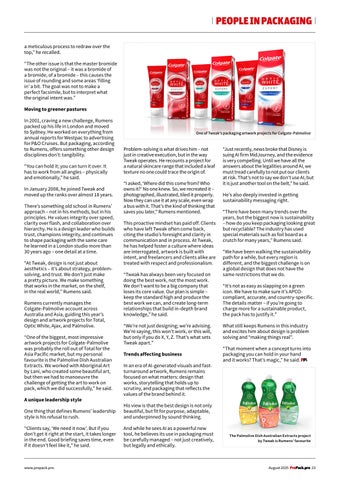
One of Tweak’s packaging artwork projects for Colgate-Palmolive
Problem-solving is what drives him – not just in creative execution, but in the way Tweak operates. He recounts a project for a natural skincare range that included a leaf texture no one could trace the origin of. “I asked, ‘Where did this come from? Who owns it?’ No one knew. So, we recreated it – photographed, illustrated, tiled it properly. Now they can use it at any scale, even wrap a bus with it. That’s the kind of thinking that saves you later,” Rumens mentioned. This proactive mindset has paid off. Clients who have left Tweak often come back, citing the studio’s foresight and clarity in communication and in process. At Tweak, he has helped foster a culture where ideas are interrogated, artwork is built with intent, and freelancers and clients alike are treated with respect and professionalism. “Tweak has always been very focused on doing the best work, not the most work. We don’t want to be a big company that loses its core value. Our plan is simple – keep the standard high and produce the best work we can, and create long-term relationships that build in-depth brand knowledge,” he said. “We’re not just designing; we’re advising. We’re saying, this won’t work, or this will, but only if you do X, Y, Z. That’s what sets Tweak apart.” Trends affecting business In an era of AI-generated visuals and fastturnaround artwork, Rumens remains focused on what matters: design that works, storytelling that holds up to scrutiny, and packaging that reflects the values of the brand behind it.
One thing that defines Rumens’ leadership style is his refusal to rush.
His view is that the best design is not only beautiful, but fit for purpose, adaptable, and underpinned by sound thinking.
“Clients say, ‘We need it now’. But if you don’t get it right at the start, it takes longer in the end. Good briefing saves time, even if it doesn’t feel like it,” he said.
And while he sees AI as a powerful new tool, he believes its use in packaging must be carefully managed – not just creatively, but legally and ethically.
www.propack.pro
“Just recently, news broke that Disney is suing AI firm MidJourney, and the evidence is very compelling. Until we have all the answers about the legalities around AI, we must tread carefully to not put our clients at risk. That’s not to say we don’t use AI, but it is just another tool on the belt,” he said. He’s also deeply invested in getting sustainability messaging right. “There have been many trends over the years, but the biggest now is sustainability – how do you keep packaging looking great but recyclable? The industry has used special materials such as foil board as a crutch for many years,” Rumens said. “We have been walking the sustainability path for a while, but every region is different, and the biggest challenge is on a global design that does not have the same restrictions that we do. “It’s not as easy as slapping on a green icon. We have to make sure it’s APCOcompliant, accurate, and country-specific. The details matter – if you’re going to charge more for a sustainable product, the pack has to justify it.” What still keeps Rumens in this industry and excites him about design is problem solving and “making things real”. “That moment when a concept turns into packaging you can hold in your hand and it works? That’s magic,” he said.
The Palmolive Dish Australian Extracts project by Tweak is Rumens’ favourite
August 2025 ProPack.pro 23