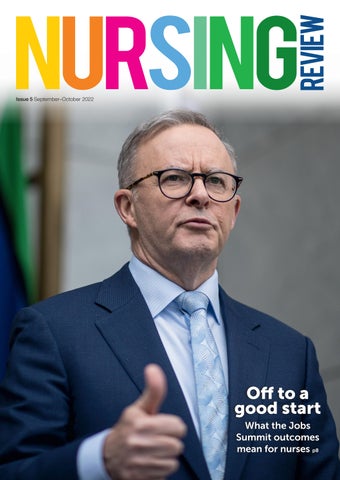
Issue 5 September–October 2022
Off to a good start What the Jobs Summit outcomes mean for nurses p8
Important information for Healthcare Professionals. For Formula-fed infants.
New name. Same formulation.
S-26 has changed its name to Alula For more information, please contact our Careline on 1800 552 229 IMPORTANT STATEMENT: Breastfeeding is best for babies. It has benefits for the infant, such as reducing infection risk, and for the mother. It is important to have a healthy balanced diet in preparation for, and during breastfeeding. Infant formula is designed to replace breast milk when an infant is not breastfed. Breastfeeding can be negatively affected by introducing partial bottle-feeding, and reversing a decision not to breastfeed is difficult. Infant formula must be prepared and used as directed. Unnecessary or improper use of infant formula, such as not properly boiling water or sterilising feeding equipment, may make your baby ill. Social and financial implications, including preparation time and the cost of formula, should be considered when selecting a method of infant feeding.
® S-26 is a registered trade mark. Used under licence. Distributed by Sanulac Nutritionals Australia Pty Ltd. Level 1, 42-44 Chandos Street, St Leonards NSW 2065. 05676-18052022
For Healthcare professionals use only. For Formula-fed infants.
contents
MANAGING EDITOR
news
Richard Garfield 02 9936 8628 richard.garfield@apned.com.au
2
Free degrees in Vic
3
Migration to boost nurse numbers
NEWS EDITOR
Eleanor Campbell 02 9936 8637 eleanor.campbell@news.com.au HEALTH EDITOR
Elise Hartevelt elise.hartevelt@news.com.au
02
05
New measures protect nurses
5
Lack of violence support
6
NSW nurses strike again
7
Govt to fund pay rise
industry and reform
8
SALES MANAGER
A good start ACN chief on Jobs
Sarah Licence 02 9936 8710 sarah.licence@apned.com.au
Summit outcome
10 Allied concerns Fears allied health hrs will be cut
SUBSCRIPTION ENQUIRIES
Isabella Galea 02 9936 8607 isabella.galea@news.com.au subs@apned.com.au
11 Data error Digitisation can lead to harm
12 Fair day’s pay Nurses speak out for fair pay
COVER
Prime Minister Anthony Albanese at the 2022 Jobs and Skills Summit. Picture: NCA NewsWire/Martin Ollman
4
14 How much is enough? Dealing with polypharmacy
08
11
specialty focus
16 Equal access PUBLISHED BY
Increasing nurses’ role in abortion care
18 Honouring a legacy Flight nurse shares his story
APN Educational Media GPO Box 4245 Sydney NSW 2001 ABN 58 090 900 999 ISSN 1326-0472 PP100001944
19 Higher calling Nurse pursues higher ed goals
clinical practice
20 Facing the facts
PUBLISHER’S NOTE
© Copyright. No part of this publication can be used or reproduced in any format without express permission in writing from APN Educational Media. The mention of a product or service, person or company in this publication, does not indicate the publisher’s endorsement. The views expressed in this publication do not necessarily represent the opinion of the publisher, its agents, company officers or employees.
In-person best for palliative care
18
22
22 Monkeypox explained What’s in store for us
24 Chronic condition Relief in sight for rare condition
workforce
26 Step towards safety New shoe designed for nurses
27 COVID contribution Carer recognised with award
Technology
28 On balance
26
28
New tool helps prevent falls
nursingreview.com.au | 1
news
Vic Premier Daniel Andrews. Photo: David Crosling
Debt reduction Free degrees for 10,000 nurses and midwives.
N
ursing groups have welcomed Victoria’s proposal to pay off university debts for nursing and midwifery students but warn that a nationwide strategy is needed to tackle sector wide shortages and burnout. The Victorian government recently announced it would spend $270 million to recruit and train thousands of new nurses and midwives.
Under the five-year program, new domestic students enrolling in a professional-entry nursing and midwifery course over the next two years would receive a scholarship to cover course costs. Students will receive $9000 over the first three years of study and the remaining $7500 would be paid off if they work in the Victorian public health services for two years. “If you’re in Year 12 and you’ve been thinking about studying nursing or midwifery – go for it. We’ve got your HECS fees covered,” Premier Daniel Andrews said. During a recent health workforce
ADF members working in a Frankston aged care home in February 2022. Photo: Supplied
COVID fail Report highlights failures in aged care vaccine rollout.
A
ged care staff and residents were left waiting for COVID-19 vaccines last year due to a profound lack of planning by the federal government, a new report has shown. An analysis by the auditor-general found the health department failed to hit critical vaccine targets for high-risk populations in 2021 because it underestimated “the complexity of administering in-reach
2 | nursingreview.com.au
services to the aged care and disability sectors”. All aged care residents and staff were meant to be vaccinated during the first phase of the government’s vaccine rollout in February 2021. It wasn’t until June 2021 that second dose vaccine clinics for aged care residents were completed. By July, federal health department figures showed only a third of aged care workers had been fully vaccinated. NDIS residential disability residents did
roundtable nurses unions raised the idea of a one-off nationwide HECS waiver to abolish university debt for nurses working across all sectors. Australian College of Nursing acting chief Yvonne Mckinlay said Victoria’s plan was a “crucial” first step but needed to be expanded into other states and territories. “A multi-faceted approach is needed to establish a sustainable nursing workforce that shapes the health of all Australians for generations to come,” she said. Following the announcement, NSW nurses urged the state government to follow in Victoria’s footsteps. NSW Nurses and Midwives’ Association general secretary Shaye Candish said thousands of NSW nurses were flocking to other states, including Victoria and Queensland, in search of better working conditions and nurse-to-patient ratios. “The Victorian government’s announcement is exactly the type of forward-thinking we have been championing in NSW to address some of the workforce concerns we can already see coming down the line here,” she said. ■
not reach 80 per cent double vaccinated until 9 November 2021. Poor uptake of the vaccine in aged care and the disability sectors was driven by a lack of consultation and engagement with providers, the report said. By the end of 2021, there were a total of 918 deaths in aged care facilities across Australia. Federal Health and Aged Care Minister Mark Butler said the findings laid bare a “multitude of failures” on behalf of the former government. “The report found there was a lack of targets and, when there were targets, the rollout completely missed their deadlines, especially for priority populations,” he said. “The weekly program management report provided to the former Minister for Health and Prime Minister also included the key risks to the rollout for the week and the status of key program milestones. “As far back as 10 March 2021 the report identified the slow rollout to residential aged care facilities as a key risk and in reach to residential disability settings was ‘at risk’.” The Health Department has agreed to all of the recommendations put forward by the auditor-general, including a “comprehensive” review of the nation’s vaccine rollout due by the end of December. ■
news
Minister for Home Affairs Clare O’Neill at the National Jobs Summit at Parliament House. Photo: NCA NewsWire/Gary Ramage
“This could mean thousands more nurses settling in the country this year. The Perrottet government offered striking nurses a pay increase of 3.0 percent back in July, along with a ‘thank-you’ payment of $3,000. Both the NSW government and state opposition have yet to agree to introduce a new ratio system.
AGED CARE AT ‘CRISIS POINT’
Overseas SOS Migration reform to drive nurses into Australia. By Eleanor Campbell
O
verseas visas will be processed faster and foreign students will be able to work in the country longer under a plan to attract ‘thousands’ of nurses into Australia. The federal government’s Job and Skills Summit saw peak nursing unions and advocates address ongoing skills and labour shortages in the health system. Major changes to Australia’s permanent migration cap were announced on the second day, with numbers set to increase from 160,000 to 195,000 as of this year. Prime Minister Anthony Albanese said the government had yet to decide on the “mix” of temporary and permanent migration pathways. “I say very unashamedly that my starting point is in favour of giving people the security that comes with a path to permanent migration, a path to being an Australian citizen,” Albanese told reporters. “It makes no sense for example to bring in a nurse for two years, three years, and then see them leave, then try to find another nurse to take that place, have them train, have them adapt to Australian conditions as well.” Along with the 35,000 extra skilled migrants to be allowed in each year,
the government will also expand post-work rights for international students – allowing them to work for two years after finishing their courses. Home Affairs Minister Clare O’Neil said the reforms were a “turning point” for Australia. “Based on projections, this could mean thousands more nurses settling in the country this year,” she said on Twitter. Around 33 per cent of Australia’s nursing workforce were born overseas, according to the latest ABS data. Research from Health Workforce Australia predicts that due to rising rates of chronic disease and an ageing population, the country could face a shortfall of around 100,000 nurses by 2025. According to the NSWMA, NSW only had 2,800 graduate nurses and midwives in the public sector this year alone. On the first day of the jobs summit, the state’s nurses and midwives took strike action to draw attention to short-staffing and unsafe working conditions. “Nurses and midwives are leaving in droves because the health workforce has been neglected, the conditions are abhorrent, and the staffing system needs an overhaul,” said NSWNMA assistant general secretary Michael Whaites. “We need safe staffing ratios in every ward, on every shift, in every hospital and health service.”
Securing Australia’s future aged care workforce emerged as a headline issue during the two-day jobs summit. In her keynote address, Grattan Institute chief Danielle Wood laid out the confronting reality facing the industry. She quoted recent CEDA estimates that Australia would need an additional 35,000 care workers annually to meet future care needs. “This problem has been a long time in the making,” Wood said. “High workloads and low pay are pushing people out of these sectors and making it unattractive for others to enter. “Properly remunerating care work is going to be critical to providing the quality and quantity of health, disability, and aged care services that our older population will need.” Sue Gordon, a professor of healthy ageing at Flinders University, said aged care was at a ‘crisis point’ with around 70 per cent of providers losing money. She said better training for workers was crucial to meeting increased demands for specialised care. “We do not have an adequate workforce in numbers or capability to meet the needs of older Australians,” she said. “We can no longer have these silos of aged, primary and disability care. It isn’t working for us. We need to provide flexibility.” Overall, the summit delivered 36 ‘concrete’ plans to tackle Australia’s economic challenges. This included an additional $1 billion in joint federal-state funding for feefree TAFE, amending the Fair Work Act to strengthen access to flexible working arrangements, and improving access to jobs and training pathways for women. In wrapping up the event Treasurer Jim Chalmers said the summit had “exceeded even our most optimistic expectations”. ■ nursingreview.com.au | 3
news
Safety first
RPA’s casualty entrance. Photo: John Grainger
New safety model to address violence after nurse attack. By Eleanor Campbell
T
he Sydney Local Health District has agreed to spend $3 million to implement a new workplace safety model for hospital workers in response to a violent incident in 2019 which saw three nurses stabbed. Following an investigation by Fair Work NSW, SLHD will oversee 24/7 specialised teams made available to state health staff and the development of a new graduate diploma in managing work-related violence and aggression. The agreement was made in response to a violent incident at Royal Prince Alfred Hospital in Camperdown in May 2019. During the incident, an elderly patient was stabbed in the face and three nurses
were seriously injured after a 29-year-old patient allegedly stole a pair of scissors. Nearly one in two nurses and midwives in NSW have experienced violence in their workplace, according to a 2019 survey by the NSW Nurses and Midwives Association. Verbal abuse, physical violence, sexual harassment and death threats have been flagged as the most common daily occurrences facing health workers on the job. According to NSWNMA general secretary Shaye Candish, nurses and midwives continue to experience violence and aggression at significant rates across the state. “This multi-million dollar enforceable undertaking [...] is a step in the right direction, but this incident, and many others like it, do take a considerable toll on the nurses involved as well as their colleagues who are witnesses,” she said.
“We all must do better in protecting our health workforce. “The psychological injury to health professionals, who are simply trying to care for their patients safely, is profound. “We all must do better in protecting our health workforce.” The last prosecution of a workplace violence incident in NSW was in 2007, despite 2019 figures indicating 4,370 physical incidents involving state hospital health staff. Nurses are disproportionately affected, with data showing nurses were impacted by 85.5 per cent of all incidents during the first half of 2019. The new SLHD initiative will oversee the employment of a program manager to oversee safe care for mentally ill and behaviourally disturbed patients. According to SafeWork representative Valerie Griswold, the strategies will set a “new health industry benchmark in workplace health and safety.” “As part of the agreement, the SLHD will develop and accredit a Graduate Diploma in the Assessment and Management of Acute Behavioural Disturbances to support staff to develop specialist skills in the management of work-related violence and aggression,” she said. “The course will focus on increasing an understanding and awareness of factors of behavioural disturbances including mental illness, drug and alcohol abuse, dementia or delirium, and 25 scholarships will be available to clinicians from across the sector.” ■
SubScribe for leSS than $2 Per week The laTesT news for nursing & healThcare professionals Nursing Review is essential reading for anyone involved in the healthcare sector in Australia. It provides unrivalled coverage of specialist topics from features and opinion pieces, to international news and profiles. • Latest news and resources for all healthcare professionals • Comprehensive coverage of a diverse range of topics • Analysis of the major issues facing the health sector as a whole • Delivered free of charge to your home or place of work monthly
Please call 02 9936 8666 to find out more. 4 | nursingreview.com.au
news
Coping mechanism Lack of support for nurses facing violence.
A
ustralian nurses experiencing workplace violence are turning to their fellow nurses to cope due to a lack of support from their organisation, new research shows. Researchers from Flinders University and the University of Queensland spoke with 23 nurses working in hospitals across regional Queensland. The majority said they had experienced workplace violence, but felt “unsupported immediately” by management in the aftermath of an incident.
“We found that often support was not provided, nor were nurses aware of the support services available,” said study author Dr Hila Dafny. “Although personal family and friends were a valuable support, most nurses were reluctant to disclose their experiences to protect them.” A 2021 survey by the Australian Nursing and Midwifery Association SA found 47 per cent of health care workers said they or their colleagues have been exposed to violence or threats of violence in the workplace. Alarmingly, the study showed 76 per cent agreed that they or their colleagues
regularly experience traumatic events, distressing situations or aggressive patients. Dafny said many nurses she interviewed felt the strongest source of support they had after an incident came from other frontline nurses. “We have to support each other because that is all we have, especially senior staff members,” one participant said. The findings come as rising Covid-19 hospitalisations and influenza cases overwhelm state hospitals, prompting nurses to walk off the job due to chronic understaffing. Past studies have highlighted a direct link between staff shortages in hospitals and increased incidents of verbal and physical violence. “There is a need for hospital management to provide effective support services and improve staff awareness of available support services,” said Dafny. “They need to provide appropriate effective support, which may mitigate the enduring impacts of experiencing violence.” ■
You make CDU We bring those with unique paths, perspectives and experiences together in an inclusive and supportive learning environment because we cannot build a better world without diversity of thought.
you make cdu CRICOS 00300K (NT/VIC) 03286A (NSW) | RTO 0373 | TEQSA PRV12069
nursingreview.com.au | 5
news
NSWNMA members protest in Gosford, NSW on 1 September. Photo: Supplied
“You can understand why many rank-and-file nurses and midwives are upset.
The good fight NSW nurses continue push for better pay and conditions. By Elise Hartevelt
F
or the fourth time, nurses and midwives have coloured the streets from Tweed Heads to Albury navy blue as they proudly wore their scrubs while advocating for better work conditions. The NSWNMA’s statewide 24-hour strike on September 1 came in response to the dangerous hospital staff-to-patient ratios, causing over 70 per cent of staff to feel burned out. Nurses have been facing dramatic workforce shortages, with the need for staff projected to be a shortfall of 123,000 nurses by 2030. “You can understand why many grassroots and rank-and-file nurses and midwives are upset,” Greig Taylor from the UNSW Business School says. “Always, there needs to be enough staff on hand for the number of patients, particularly if there’s a surge in demand as we saw during the recent pandemic.” Yet, according to union representatives, NSWNMA’s previous calls for the state to balance out the unequal staff-to-patient ratio have fallen on deaf ears.
6 | nursingreview.com.au
Greig says the lack of staff is one of the underpinning bones of contention driving nurses and midwives to continue to walk off the job. “Many healthcare workers feel pushed into a corner because their demands are not being listened to. “And the government still hasn’t given any real clarity.” Peak unions have been pushing for a 7 per cent across-the-board wage increase that’s in line with inflation. The cost of living has risen by 6.1 per cent in the 12 months to Jun 2022 – the fastest annual increase Australia has seen over the last 21 years. On the back of floods and heavy rains in NSW and Queensland, crops have failed, leading to fruit and vegetables costing 5.8 per cent more than last quarter. In the meantime, the state government’s raise of the public sector’s wage cap by 3 per cent is not backing up against growing inflation rates. It’s estimated that nurses, paramedics, and teachers will face a real wage cut of over $7,200 every year. The government offered health workers a one-off $3000 thank-you payment in June to show appreciation for their work during the pandemic, but nurses say it
doesn’t even come close to making up for years of wage cuts. Greig says the pay cap is a significant issue that can burden the workforce financially if they struggle to meet basic living expenses. “They were hailed as the heroes of the pandemic – continuing patient care under difficult, maybe even deadly circumstances. “They were promised a pay raise. “At the very least, they don’t want to see a decrease in their real wages.” Greig says the government’s chronic underinvestment in public healthcare has been a deliberate strategy. “They pursue deliberate underfunding of healthcare services to usher in more private sector involvement,” he says. “Not only by Australia’s last government but also by other governments of a similar bent, such as the UK. “The combination of that underinvestment and macroeconomic factors, such as inflation and rising interest rates, are finally coming to a head.” In early September nurses and midwives were represented in the 2022 Jobs and Skills summit by Annie Butler from the Australian Nursing and Midwifery Federation (ANMF). “The job summit was an opportunity for the broader union movement to push for pay rises to keep up with inflation, or at least to keep their real wages equal to what it was,” Greig says. NSWNMA general secretary, Shaye Candish, says the NSW government’s lack of response sends a message that nurses and midwives are not valued. “It is a shame in this state that we must continue to demonstrate to give patients the care they deserve,” Candish says. “The longer this government stalls on adopting safe nurse-to-patient ratios, the more we’ll continue to see nurses and midwives leaving the profession. We want ratios, safer workplaces and fair pay. “It’s time we caught up with the rest of the country and provided these highly skilled health professionals with the support they need to deliver the clinical care our communities deserve.” ■
news
Fair work, fair pay
Govt moves to fund pay rise for aged care nurses
T
he federal government has pledged to fund a pay rise for Australia’s aged care nurses and workers, a move that peak unions said recognises the efforts of a “chronically undervalued” workforce. Labor filed a revised submission to the Fair Work Commission (FWC) supporting a wage increase but did not nominate a set figure. Aged care Minister Anika Wells said that nurses and carers deserved a “meaningful” increase.
“That is for the commissioners to decide exactly what percentage the work-value cases were,” Wells said. “But we have agreed that we will fund it no matter what the decision.” The FWC is currently considering a 25 per cent wage rise after the Australian Nursing and Midwifery Federation (ANMF) and the Health Services Union launched a historic aged care work value case in 2020. ANMF federal secretary Annie Butler said a “long-awaited” wage rise would allow nurses and care workers to be recruited and retained in an under-resourced sector.
“The nature of the work required across the aged care sector has developed considerably over the years and become significantly more complex,” Butler said. “We welcome the government’s agreement that current award rates do not adequately reflect the value of aged care workers. “Particularly in light of their extraordinary efforts over the last 30 months of the COVID-pandemic, which has already claimed the lives of more than 3,000 elderly Australians.” If the AMNF campaign is successful, all aged care nurses and workers could see a minimum wage increase of at least $5 per hour. The hourly rate for a qualified personal carer would rise from $23.09 to $28.86. Union representatives and government figures are due to be heard by the FWC later this month. Lifting sector wages was one of 148 recommendations handed down in the final report of the Aged Care Royal Commission. ■
ADVANCE YOUR NURSING CAREER IN 2023 Apply now for an online graduate certificate
Become an expert practitioner in your clinical specialty and increase your earning potential with Australia’s leading graduate certificate provider for nurses. Apply for the January 2023 intake. � 100% online � Complete in 12 months � FEE-HELP available SCAN TO FIND OUT MORE or visit acn.edu.au/grad-certs
*Not applicable to Start-Ups and Undergraduate Members.
ACN MEMBERS SAVE 10%*
TEQSA Provider ID: PRV14001 Institute of Higher Education
05.09.2022
nursingreview.com.au | 7
industry & reform Prime Minister Anthony Albanese addresses the media at the end of the summit. Photo: NCA NewsWire/Martin Ollman
A good start NR: What was your response to the summit regarding raising the immigration cap to fill workforce shortages?
ACN chief happy with Skills Summit, but says more needs to be done. Kylie Ward interviewed by Elise Hartevelt
N
ursing’s national voice has welcomed the migration cap’s expansion and support of work rights for international students from the recent National Jobs Summit, but says the work is far from finished. ACN chief and adjunct professor Kylie Ward had hoped the summit would lead to investment into study and pay for enrolled and existing nurses. “We appreciate the government prioritising the skills shortage, but that’s nothing new,” she says. “It’s only going to get worse globally and domestically unless we have discussions about the representation of the nursing profession.” Nursing Review spoke with Ward about skilled overseas nurses finding work in rural Australia, HECS debts needing to be waived and whether the government will commit to a comprehensive migration scheme.
8 | nursingreview.com.au
KW: I’m really pleased to see a new government, within their first month, addressing this skills gap. We’ve long championed the need for the government to address barriers preventing nurses who wish to call Australia home. Nursing has been a passport around the world. Australian nurses have used their profession to travel long before women had rights that they have today, and nurses have for a long time come to Australia. So we see that this is something that the nursing profession has always experienced: it’s more of a global perspective of community, and skilled migration is essential for us to be able to deliver care. We feel that this will help fill some needs gaps, maybe in rural, remote, and aged care, but for a longer term or more ethical or sustainable perspective, we should see ourselves as a nation that nurses would want to come to learn, perhaps live and get residency, or spend a few years investing in what we have to offer and then take that back home.
What issues did we see previously with skilled migrants working on a visa in rural areas? Before the pandemic hit, the International Council of Nurses and the World Health Organization was predicting that there would be, by 2030, a five to six, maybe
seven million nursing workforce shortage worldwide. Now at this stage of the pandemic, they’re predicting that will be a 13 to 15 million nursing workforce shortage worldwide. No country isn’t having workforce issues around nursing. I think that if we only see attracting people who were born or live overseas to come and work in Australia to fill the gaps, that is a concern for me, because what we should be thinking about is more inclusive language, considering diversity, integration into communities, how we would support people with housing, how we would support their families, and how they can build healthy communities, healthy economies, as well as supplement the workforce. From the ACN’s perspective, skilled migration is absolutely key, it always has been, but it’s not the only answer. The pandemic and the closing of the borders did put pressure on Australia in ways that we’re feeling now in many health settings. I think that we need to think about our reputation as a nation and tackle any underlying racism and how we actually treat people that come from overseas, how we welcome them, and how we value them other than seeing them as filling our gaps, but also how they can enhance the communities.
The summit also resolved to improve access to TAFE training. We are hearing from international nurses that they’re not receiving letters, they’re getting short timeframes, and that the
industry & reform
processes are taking too long. We really need to get a coordinated approach so that we don’t have inhibitors that disadvantage people or affect our reputation. If somebody is looking to migrate to another country, Australia may be a country of choice, but it probably isn’t going to be the only country unless they have relatives or loved ones, or a reason to come here. If they make their mind up and they want to come here, we should be doing everything to expedite that to support our workforce.
You said the summit missed an opportunity to develop the skills and expertise of existing nurses. When we weren’t vaccinated and we didn’t understand COVID as well as we do now, nurses were incredibly brave and courageous and kept our nation safe. While we do need more nurses and clinical staff to come into our workforce, we should never forget the sacrifices and the service that the existing workforce have made. We should be investing in their leadership, their education, their training and development, as well as being able to get them time off and have a real holiday – to actually concentrate on mindfulness, self-care, and regeneration of their energy and spirit to be able to then give as much as they do in every setting. What I would like to see is a government that’s prepared to give back; some of that will be in pay and equity, and other parts of that respect would be in investment in leadership and professional development.
You said it would be helpful if HECS fees and debts were waived. How could this be implemented? We actually put this to the federal government before the announcement that the Victorian government made. They are only waiving some of the HECS debt, and giving back some of those HECS fees after two years of service in the public system. I acknowledge that and recognise the effort that the government’s making. What the ACN put forward was that the government should, for a period of time or even as a one-off, wipe any debt that any nurse in the system has now, as a way of saying thank you. There’s token one-off payments, but we shouldn’t be grateful for that. That’s almost insulting for the amount of extra hours, the double shifts. At least 50 per cent of students would come out of the high school system, but there’s a large number that enter nursing
as mature-aged students, or as a second career. They’ve given up paid employment, probably some of them have families, and some of them are single mums trying to work after hours. HECS debt is only part of the cost of studying for nursing. HECS would only go part of the way but would take some burdens off. And I think that as long as we made sure that the attraction was for the right people who wanted to do nursing for the right reasons, that financial incentive would go a long way in recognising the value of nursing, but also really as a thank you to invest in nurses.
What’s your response to the 3 per cent wage cap and how is it problematic for health care workers? If you look at what a nurse does, who a nurse is, how educated they are – nurses come with scientific knowledge and qualifications, medical qualifications, behavioural and social science qualifications. I’ve never met a nurse that hasn’t done post-graduate studies. Many nurses have two, three, four post-graduate certificates, Masters, PhDs. This is a profession that is a knowledge industry, and invests heavily in ongoing training. You only have to look at immunisation and vaccination. The ACN has educated, on behalf of the government, over 200,000 clinicians in vaccination. The pay is really like a trade and we’ve heard over the last few years that nurses could earn more packing shelves in the supermarket. So, when we’re fighting for 3 per cent and not even being considered to get it, I find it insulting as a first world country that the government isn’t looking at gender equality and pay disparity. We know that there’s a pay disparity in the gender gap, so why wouldn’t they at least look at 7 per cent to start to get nursing as a femaledominated profession aligned to where it should be, and for people to be paid their value and their worth, rather than begging for a couple of per cent every few years? I’d like to see a government that really honours their word in respecting all of their citizens, all members of the community, and that includes female-dominated professions. That’s a government that’s really going to take us forward as a nation.
Are you satisfied overall with the outcomes of the Jobs Summit? If not, what improvements do you hope to see? The Jobs Summit only had one nursing organisation there, the union. While I was
“Skilled migration is absolutely key … but it’s not the only answer. pleased they were there, the fact that there are 400,000 registered nurses in Australia and the summit didn’t include any professional nursing organisation to discuss workforce issues shows their lack of understanding that we are the largest professional group in the country. We are the largest clinical group. Without a nursing workforce, there is no healthcare system in Australia. When there are not enough nurses that turn up to work, wards close, beds close and services close. So the government not inviting proportionate representation of the nursing workforce concerns me. Having said that, I’m pleased with some of the initiatives that they’ve come forward with. Nursing must be considered in terms of skilled migration and the workforce. If you don’t have a healthy community, you won’t have a healthy economy. And when you look at preventative health, chronic and complex disease, and primary health, nursing is absolutely key in those areas. I think more effort should have been made for enrolled nurses to be invested in as enrolled nurses. Being an enrolled nurse is an incredibly important and valued profession in and of its own right, and I want to see more investment in post-graduate study and pay for enrolled nurses. We appreciate the government prioritising the skills shortage but that’s nothing new and that’s only going to get worse globally and domestically, unless they have discussions with all the representation of the nursing profession. When we look at nurse practitioners, registered nurses being able to work as advanced practise nurses, and the enrolled nursing workforce, there’s still a little bit to do. I’m happy enough with the outcomes, but I certainly will be watching to see what comes of the summit and what they actually do now. The government has an opportunity to let us know who they’re going to be and whether the promises they’ve made are going to be fulfilled. We’re all watching and waiting, and we welcome the opportunity to work with the government to address some of these challenges. ■ nursingreview.com.au | 9
industry & reform
Allied health concerns Fears boost to nurse hours will cut allied health funding. By Elise Hartevelt
T
he physiotherapy peak body fears the government’s promise to raise nursing hours in residential care will cut the budget allocated for allied health services. The new AN-ACC funding model, set to replace the Aged Care Funding Instrument from October 1, is expected to provide allied health services with a resident budget of roughly $225 per day. Yet, the federal government is still to reveal the model’s precise figures and outlines. National president of the Australian Physiotherapy Association, Scott Willis, worries Labor’s pledge to place 24/7 nurses in residential care will negatively affect funding promised to allied health. “We still haven’t got a real understanding of the AN-ACC funding and how it’s going to fit in with the care minutes the government have placed,” he says. “We’re concerned that that will come from our allied health funding. “Especially with no boost to compensate for the increased Consumer Price Index (CPI) allowance in aged care, it will put another added barrier and possibly lack of funding for allied health.” CPI, the percentage that measures household goods and service inflation, has risen by 5.2 per cent since March last year and is predicted to stay its course upward.
10 | nursingreview.com.au
While the government has said it will start subsidy indexation from July 1st, it anticipates the aged care figures to be well over $85,000 in 2022-23 – an increase of nearly 10 per cent per resident compared with the budget in 2021-22. Willis foreshadows higher living costs and services will have an adverse impact on residents’ access to allied health. Since AN-ACC’s model doesn’t specify how care homes spend money earmarked for residents, it may lead to facilities reducing allied health services to save costs. “We can’t just rely on one funding pool for one funding model; both state and federal have their responsibilities,” Scott says. “They need to get together and stop working as a silo. “All forms of government and bureaucracy need to work together and create a pathway in developing a model that provides what it was always supposed to be set up for – one that provides the best pathway for someone that’s ageing. “Physiotherapy can help prevent falls, offer restorative and incontinence care and address mobility issues.” The service can keep people out of the hospital, which is the most expensive form of treatment for anyone to access, according to Willis. Nevertheless, a 2018-19 survey by the Aged Care Royal Commission found that only 2 per cent of Home Care Package budgets was spent on allied health assistance.
“They need to get together and stop working as a silo. Less than half of the residents had received fewer than five allied health services in a year. Despite the Royal Commission recommendations, Willis says physiotherapy remains an under-used resource in residential care. “Physiotherapy in aged care is an essential service – it’s not just a luxury, and I think that’s how the government and aged care providers look at it,” he says. APA is pushing for Labor’s commitment to appropriately fund allied health and attribute specific minutes to physiotherapy. “They plan to expand effectiveness and safety in aged care, and I think that includes provision for allied health services like physiotherapy, rehabilitative and restorative care,” Willis says. He’s still awaiting a response from both the Aged Care Minister Anika Wells and Health Minister Mark Butler to discuss funding arrangements. “We haven’t had any correspondence from the government,” Willis says. “We’ve written to them, looking to set up a meeting to discuss the implementation of the AN-ACC model and the funding arrangements for aged care, but still, we haven’t heard anything from them. “They’ve got our information and we’ll be looking to meet with them in the near future.” ■
industry & reform
Data error
Healthcare digitisation leading to more data-induced harm. By Elise Hartevelt
P
rofessor Enrico Coiera says his prediction that digitisation in healthcare over the past decade would lead to increased data-driven patient harm has come true. Ten years ago the director of the Centre for Health Informatics at Macquarie University warned in his paper ‘The Dangerous Decade’ that technology innovation needed to go hand in hand with safeguarding digital health. “Instead, we’ve seen a huge encroachment of digital health, especially in keeping electronic records around every level of healthcare delivery,” he said. Digital health involves using information and communication technology (ICT) in healthcare settings to improve patient wellbeing, such as telehealth and telemedicine. Coiera foreshadowed that ICT deployed in healthcare over the past decade would amount to more than in the health system’s entire history. While data-driven healthcare has rapidly improved how we receive care, he said the progress may compromise digital health. “For many organisations worldwide, digital health safety is now a significant issue.
“If we don’t pay attention to it, we can harm patients.
“If we don’t pay attention to it, we can harm patients.” Data-related harm may result from human errors, wrong alerts and missing data within the system, or downtime where the network crashes or the power goes off. Other events, such as the recent flooding in NSW and Queensland that impacted hospitals and GP practices, can also cause data breaches. Coiera said that while digitisation is now everywhere – from patient record systems like Medicare and mail merges that deliver test results – there are harms and benefits. “Things go wrong for complicated reasons, but they do go wrong.” OAIC’s annual report revealed that a fifth of all data breaches in the first half of 2021 occurred in the healthcare industry, leading OAIC to call it a ‘cause for concern’. Similarly, the Notifiable Data Breaches scheme said the sector has recorded the highest number of compromised data incidents for nearly four years. “Digital risks continue to be one of the largest risks many healthcare companies have,” Coiera said. “Negative outcomes have been rare, but we are now rolling out these systems on a scale that we’ve never seen before, and there is still a long list of things that can go wrong.” He said digital safety in healthcare is a complex issue where people need to use ICT under high work pressure.
“In the current Covid situation, people are also burned out and understaffed, so we know that when something goes wrong, it’s usually a chain of events that lead to the actual harm event or patient incident.” Although innovative technology has been implemented in many healthcare settings, older operating systems can be very clunky and slow. “You might have a screen that’s not so easy to navigate, so you might have a very busy and distracted nurse, who incorrectly enters data into the wrong field, causing the wrong drug to be given.” Lacking the appropriate staff, healthcare workers have found ways to bypass slow systems to work more efficiently. “I can give you a very famous one: when a nurse is administering medicine to patients in a ward, they’re meant to scan the barcode,” Coiera said. “And so what nurses do to save time is to take all the barcodes and put them on their arm. “Of course, that breaks the safety mechanisms embedded in checking the patient in front of you.” Yet, he also highlighted the need for more updated systems and staff training to smooth out the workflow. While basic standards to operate ICT are being adopted in many healthcare settings, the workforce is still lacking user-friendly design and support. “Usually, the electronic record systems we get are tough to change once they’re in place, and often things we want to do just don’t necessarily fit in the very old systems,” Coiera said. “We would love to see a more app-like world, where you can create specific tools in the system to assist different tasks, and they would be like apps and connect to an electronic record. “Although this is being implemented in some areas, historically, innovation has been difficult because of the control the companies have had on design.” Coiera said that in the end, every clinician should put patient safety as the priority in all they do, whether they’re busy or not. “Every time we bring in a workaround or a shortcut because we are busy, short staffed or under pressure, we just have to be aware that that’s not a risk-free decision.” ■ nursingreview.com.au | 11
industry & reform
“We always try our best to take time out of our shift to talk to the residents. “We are often expected to do multiple things at once, or complete this job quickly so we can also get cleaning or other tasks the client wants done completed during a 30-minute service. “Home support workers have not been recognised for these extra responsibilities either in position or pay.”
A fair day’s pay Care staff speak out at fair work pay rise case. By Eleanor Campbell
P
ersonal care workers are under increasing pressure to juggle residents’ complex health needs while nurses are fleeing from the sector due to a lack of support, the fair work regulator has heard. Around 72 aged care staff, including registered nurses, personal care workers and chefs, recently laid bare their concerns to the Fair Work Commission as part of an ongoing bid to lift sector wages. They spoke of the impact of critical staffing shortages and the increasingly complex health needs of residents on their day-to-day jobs. Associate Professor Maree Bernoth from Charles Sturt University’s nursing school said over the past 20 years she has seen a significant reduction in the ratio of registered nurses (RN) to personal care workers. “There are now not enough staff to work with, supervise or mentor care staff to show them what is important and what can be left, for example, or how to prioritise care,” she said. “New RNs going into aged care usually do not have the benefit of a mentor. They are usually rostered on without another RN and so have to find their own way.”
12 | nursingreview.com.au
A lack of support and mentorship has placed significant stress on aged care staff, she said, and has contributed to large numbers of nurses leaving the sector. Personal carer Geronima Bowers said the nature of aged care has changed significantly since she entered the workforce in 2006. She said people who would have previously entered aged care are now staying at home for longer, and those coming in are older and have serious mental and physical health issues. “Nearly half of all residents in aged care have serious health or behavioural conditions like dementia and depression,” she said. “Trying to care for residents with these kinds of conditions means you need to have a team of healthcare workers like doctors, nurses and personal care workers. “However, the reality is that many aged care providers are short staffed, and they try to make up the staff shortage by hiring more personal care workers.” Multiple witnesses gave evidence about the lack of adequate skills ratios among staff employed by aged care providers. In-home carer Veronique Vincent said due to shifting expectations and understaffing she is expected to fulfil the duties of a nurse. “We handle medications, we tend to wounds, we take blood pressure,” she said.
LOVE FOR THE INDUSTRY REMAINS STRONG The majority of witnesses agreed that while their wages were too low they loved their jobs nonetheless. Paul Jones, a personal care worker, said his work gave him the opportunity to contribute to the lives of residents through “day-to-day care, advocacy, or simply bringing a smile to their face”. “This is especially important to me with those residents who receive few or no visitors,” he told the hearing. Administration officer and activities coordinator at Uniting Care, Fiona Gauci, said that for most people living in aged care homes “the building is their entire world”. “If you are having a bad day, you cannot put that energy on the resident as it can significantly impact them,” she said. “It doesn’t matter what life is like on the outside of the building, you always have to be positive towards the residents.” Care team leader Kerri Boxsell spoke about the enjoyment she gained from spending quality time with residents. “We always try our best to take time out of our shift to talk to the residents,” she said. “For example, there is one resident who requires ice gel every day. I don’t give her the ice gel during the morning medication rounds. “I usually visit her later on in the day to apply the gel so that I can spend some one on one time with her. She really appreciates this.” The Fair Work Commission is expected to make a decision on the aged care work value case by the end of the year or by early 2023. ■
SubScribe for leSS than $2 a week
The laTesT news and resources for healThcare professionals
• Analysis of the major issues facing the health sector today
Nursing Review is essential reading for anyone involved in the healthcare sector in Australia. It provides unrivalled coverage of specialist topics from features and opinion pieces, to international news and profiles.
• Can be used as a professional development resource
At Nursing Review we pride ourselves on being at the forefront of the ever changing healthcare sector. We provide an independent source of news, and cover the issues relevant to nurses and the sector giving an informative, practical and insightful view into day to day life in hospitals and in surgery.
• 6 issues per year • Interviews and opinion pieces from professionals in the industry • Written by an independent voice • Tax deductible
Please call 02 9936 8666 to find out more.
industry & reform
How much is enough? Lack of accountability blamed for dangerous polypharmacy. By Elise Hartevelt
N
ew research suggests a rivalry between industry bodies as to who should be in charge of medication reviews is leading to preventable hospitalisations and deaths of people in aged care homes. Up to 91 per cent of aged care residents are on five or more different medications and close to 75 per cent are taking over nine different types of drugs. Meanwhile, almost half of the prescribed medication is considered inappropriate for the resident and causes one in five hospitalisations. Dr Amy Page from The University of Western Australia says regular medication reviews can prevent this issue but are not fully optimised in residential care due to industry bodies’ reluctance to take responsibility. “There are so many different competing bodies, and everybody’s so stretched,” Page says. “A lot of different people think it’s somebody else’s responsibility. “We must move to a situation where everybody is taking responsibility for reviewing medications regularly.”
14 | nursingreview.com.au
Calling it a “major public health concern”, her recent research highlights the continuing issue of medication-induced harm and polypharmacy for people in residential aged care. Page says that each industry body is coming across different roadblocks when it comes to facilitating medication reviews. “Pharmacists bemoan the fact that their recommendations to the GP aren’t implemented,” she says. “The GPs feel like they can’t implement these recommendations or have the courage of de-prescribing because they’re medicines that the specialist has started or is perceived as managing. “And the specialist doesn’t think that it sits with them, but with the GP, to have that whole-of-person view of the medicines regimen.” Similarly, hospitals report that something should be done in the community because “they’re only looking at the acute event”, Page says. Over 250,000 hospital admissions each year are caused by medicine-related harm, costing the healthcare sector more than $1.4 billion. However, interventions to address the issue have been unsuccessful because of this reluctance to take responsibility. “So many people are affected by suboptimal medicine regimens,” she says.
“It’s vital when we’ve got so many people who are impacted that we do take action to try and reduce the potential for harm because medicines also have the potential for benefit.” She’s a firm believer in empowering consumers to make it a priority with their healthcare professionals. “Consumers need to know what questions to ask or have the resources or the tools to be able to question it,” she says. “But it’s tough to ask questions when you don’t know what questions to ask.” Page recommends the list of questions from the Australian not-for-profit organisation NPS MedicineWise, which was created to help reduce over-medicalisation. Dr Janet Sluggett from the University of South Australia agrees that frequent talks between consumers and health professionals are valuable. She recently found that residents had a 5 per cent lower risk of death if they’d received a medication review every 12 months. “We know these reviews can successfully identify and resolve some of these problems with medicines,” Sluggett says. “However, they are not being utilised in residential care, although it has been recommended for all people when they enter an aged care facility and when their clinical circumstances change.” Sluggett’s study, funded by the Australian Association of Consultant
industry & reform
Pharmacy, came in response to the Aged Care Royal Commission’s recommendation to look closer at the evidence behind the medication review programme. The study revealed that, on average, medication reviews identify between 2.7 and 3.9 medicine-related problems, yet, four out of five residents are missing out on those meet-ups despite being eligible. She emphasises that many factors are at play regarding polypharmacy and medication-induced harm. “It’s a very complex process where many barriers can arise across each step,” she says. “So that’s very likely the reason why we’re seeing limited uptake of the review service in residential care.” The “right” process starts with someone receiving a referral and then undertaking a review. They are then provided with recommendations before being incorporated into a medication management plan.
But complications and communication issues along the way can prevent people’s medications being reviewed. Particularly when someone goes into residential aged care, Sluggett says, as many residents get a new GP and will receive care from new staff who may not have the resident’s full medical background information. “Or they might be receiving medicines dispensed from a new pharmacy or have been in hospital before they come into residential aged care,” she explains. “So, all of those factors can mean that medicines change on entry. “And we know that when a person goes through a transition of care, it can be a riskier period in terms of medication use.” Sluggett is calling for better communication between the industry bodies to prevent medication-induced harm. “A key component of this is building strong relationships between pharmacists, GPs and providers, together with residents and their families, so that all parties are on the same page,” she says.
“There are so many different competing bodies, and everybody’s so stretched. The government has announced funding for a new program to support pharmacists working onsite in aged care facilities, starting from January 2023. Pharmacists will be able to work onsite more often in aged care homes while facilitating collaboration between the pharmacists and other care team members. Sluggett says she’s looking forward to the implementation of the new program. “Then they’re on the ground to provide more resident care and improve health outcomes for residents,” she says. “But we’re also still encouraging residents to ask for frequent medication reviews and for GPs, pharmacists and aged care providers to think about which of their residents could potentially benefit from a review.” ■
WE SEE YOU ADVANCE STUDY POSTGRAD CLINICAL NURSING Enhance your career opportunities in nurse leadership roles and gain a competitive edge with an online graduate certificate or masters in Clinical Nursing.
APPLY NOW TO START IN MARCH 2023
CRICOS: 00219C | RTO: 40939
C_AD_2202_185x133_PG_Nursing1
nursingreview.com.au | 15
specialty focus
Equal access The case for nurses to be more involved in providing abortion care. Lydia Mainey interviewed by Elise Hartevelt
A
n expert says Australian abortion legislation is hindering people seeking access to those services, and suggests nurses and midwives should be more involved. CQUniversity academic Lydia Mainey, who specialises in abortion care and gender-based violence, says a change in abortion laws is needed to enable nurses and midwives to perform procedures as well. Currently, most states mandate the approval of two GPs and the procedure can only be performed by a medical practitioner. “If you’ve only got one GP in the community who’s pro-choice and everybody else is anti-abortion, it’s a huge stumbling block for access to abortion,” she says. During her PhD research, she found that nurses and midwives sometimes pretended to be a medical provider to sign the referral so people could have the procedure. Nursing Review had a conversation with Lydia about what needs to change to improve access to abortion services.
16 | nursingreview.com.au
NR: Why are you calling for a rethink on abortion services offered in Australia? LM: Abortions are probably the most commonly performed gynaecological procedure in Australia. One in four pregnancy-capable people will have an abortion in their lifetime in this country. So it’s very, very common, but unfortunately access to abortion care is a bit of a rigmarole at the moment. People disadvantaged by socioeconomic status, because they live in regional or remote areas, or even if they live in metropolitan areas but find it difficult navigating transport systems, etc, have real access barriers to abortion care. The only people who can provide abortions in Australia in most states are medical practitioners, ie doctors. This would be greatly relieved if nurses and midwives, with the appropriate amount of training and credentials, could also provide abortion care. It will particularly open it up to the regions because there are far more nurses and midwives there than doctors. In the regions doctors tend to rotate in and out, whereas nurses, generally speaking, tend to come from the communities, so it’s a more stable workforce. If you get a nurse or midwife in the community who can provide medical or surgical abortions, then it’s likely to be a service that can be provided long term.
“We’re putting nurses and midwives in really precarious situations. I’ve done a scoping review of the global literature on the nurse and midwives’ scope of practice in abortion care, and Australia has a very conservative scope of practice. In developing countries surgical abortion is performed by trained auxiliaries: they don’t have as high education levels as nurses and midwives, and these are safe and effective. Surgical termination or abortion performed by nurses and midwives who are appropriately trained has been studied extensively. The findings are that it is at least as safe and effective as surgical abortions performed by medical staff. If nurses and midwives can do a pap smear, if they can insert an intrauterine device, they’ve already got most of the skills that they need to be able to perform an abortion. They need upskilling certainly, and they need somebody to train and preceptor them, absolutely. But there is potential for them to be providers of surgical abortion. Nurses and midwives are as safe and effective at providing medical abortion as a medical provider.
specialty focus
Nurses and midwives, especially in the private sector, tend to do the majority of the work in that space anyway: prepping and educating the patient. It’s just the prescription of the drugs that the medical provider does at the moment. And if nurse practitioners or certified midwives could do that, that would stop people bouncing around the healthcare system and going to different providers for different steps.
In most states there has to be two GPs present or at least to agree to the procedure. What barriers does this bring for people wanting to access abortion? Those laws are barriers in and of themselves. The two GP issue is a major barrier in regional centres where there’s a lot of anti-abortion sentiment. So if you’ve only got one GP in the community and everybody else is anti-abortion, it’s a huge stumbling block for access to abortion. What I found in my PhD research is that nurses and midwives will pretend that they are a medical provider to sign the referral, so it looks like there’s two GPs signing off on the procedure. That’s illegal, but they should not be put in that situation in the first place. Every day that ticks over as you’re waiting for that second GP referral, or the ultrasound scan, or the blood test, or the travel to a hospital somewhere that provides abortion becomes more critical because you’re becoming more and more pregnant. And the more pregnant you get, the fewer options you’ve got.
What barrier does conscientious objection play? It probably impacts abortion care far more significantly than people realise. We know where GPs say, ‘Sorry, I don’t agree with abortion. And therefore I can’t provide it to you,’ they’re supposed to refer you to somebody who does provide abortion care. But if they’re the only GP in town, there’s no one they can refer you to. Or if they do refer, you’ll have to travel for abortion care, which is logistically difficult for people who might have to travel hundreds of kilometres or people who have got complex lives, who can’t just get in the car and travel across town to see a different provider. Many religious-affiliated private hospitals just don’t provide abortion, but they don’t provide many contraceptive procedures also. In the public sector there
are people at high levels, the director of a maternity unit for example, who may be a conscientious objector and therefore abortion isn’t allowed in that hospital. Another way that it’s blocked is if you have, for example, nursing and midwifery conscientious objectors who say they won’t take part in a surgical abortion, and that can slow a whole theatre down. It puts the burden of work on people who are pro-choice and will be part of the abortion. I understand that people have the right to object, and I understand that people are pro-choice. I think in that situation healthcare systems have the obligation to have a look at their workforce and plan accordingly on days where abortions are being performed. I’ve known of people who have had to sell their cars and take out loans to get an abortion in the private sector, because it was just taking too long, or they couldn’t access abortion in the public sector. The other major issue that I haven’t spoken about is in Western Australia where the public health system has been, I don’t know if outsourced is the right word, but a Catholic organisation is running the public hospitals in Western Australia. So all of the abortions are outsourced to a private organisation and that’s brilliant that the private organisation can do that, but it is not the role of our public health system to outsource care.
What changes in law should we make to improve Australia’s abortion services? We need to change the law about who can prescribe mifepristone and misoprostol. Certified midwives and nurse practitioners should be able to do it. So that needs to be changed at a federal level. The other thing that needs to change is nurse practitioners need to be able to order ultrasound scans without it being an extra cost to their patients. The Nursing and Midwifery Board of Australia needs to have a good, hard think about the clause in our standards for practice about following legislation, and considering what we do when legislation doesn’t protect human rights or is antithetical to human rights. Funding to hospitals and health services should be tied to abortion care. So if a hospital does not provide abortion care, it doesn’t get its full allocation of funding from the state or the federal government.
Could you tell us a bit about your PhD and what you found? I wanted to know how nurses and midwives provide abortion care in Australia for people victimised by gender-based violence, and what was happening in the environment around them that made them provide care that way. I found that nurses and midwives probably don’t have much time to think about the gender-based violence component of their care because getting access to the abortion in the first place was a major issue for them. The attitudes from people in high levels about abortion care were making the nurses and midwives feel like they were being backed into a corner, and that there was nothing they could do within the law or within the policy of the hospital or healthcare service to help people access abortions. So they would find ways to help people get abortion care that were either against policy or against the law. Some would be part of teams in those religious-based health services that would sneak people in to have abortions under made up, fictitious diagnoses. Nothing much happened for the genderbased violence, because it all had to be very hush hush, and nobody could know the real reason why the woman or the pregnant person was in the hospital. Other people created pathways where they would help patients get to the metropolitan areas where they could have abortions in secret. Others would sign off as the doctor, to be that second medical provider to sign the paperwork. Other people would fudge paperwork to get people free travel or transport to the abortions. There’s heaps of stuff going on because access to abortion is so hard. And when I asked how it made them feel, most were absolutely fine about their decision. Some were anxious because they had to make the decision, but when I asked would you do it again they said, ‘Yes, absolutely.’ I think that shows we’re putting nurses, midwives and other healthcare providers in really precarious situations by the dumb laws and stupid logistical issues we have around abortion care right now. It shows that nurses do take part in political acts. We are highly political, but we just exercise our politics quietly. It’s really important that in many instances, our politics is practised quietly when nobody can see it. We resist in a way where it’s not recognised. ■ nursingreview.com.au | 17
specialty focus
Honouring a legacy
An aspiring flight nurse shares his journey. By Elise Hartevelt
A
World War II nurse has passed on her passion to her grandson, who now is now aiming for a nursing career with the Royal Flying Doctor Service. Harrison Mayall, 23, is the same age as his grandmother Betty Dorothy Robinson when she was posted to a military hospital in Driffield, a town in Yorkshire in England. As planes and bombers would fly in from the coast, Betty cared for wounded soldiers and pilots who were hurt on the battlefield. “She was such a remarkable woman and told some truly inspiring stories about nursing during the War and the lives she saved,” Harrison said. “Soldiers, pilots, POWs – she treated everyone and everything, including meningitis, TB and other infectious diseases. “I always dreamed that one day I would do the same.” Betty passed away at 92, but her stories live on through Harrison. He shared with Nursing Review that he visited her often and listened to how his grandmother saved people’s lives and helped others. “She said that as she did nursing, it helped her become a better person as well,” he said. “It inspired me to want to become a nurse myself growing up.”
18 | nursingreview.com.au
Harrison is now in his second year of a Bachelor of Nursing at the University of Southern Queensland and aspires to join the Royal Flying Doctor Service. He said they share a similar personality as they love working in a high-paced, adventurous environment. “I’m a bit of an adrenaline junkie,” Harrison said. “With flying doctors, I like that you can travel and fly out to remote areas and help people – it’s exciting.” Harrison is excited about his first placement this semester and plans to specialise in working in the emergency department. For him, it’s essential to focus on gaining experience and confidence in the work field, especially as the sector faces significant staffing shortages and higher workloads. “I’m just really nervous about the whole thing, I guess,” he shared. “I can imagine how busy you would be, so it would be even busier now with the shortages.” He’s also aware that the sector is a female-dominated workplace and that he might encounter the negative influence of gender stereotyping. Roughly 90 per cent of those working in the sector are female. “I think that I may be stereotyped as a male nurse going into a femaledominated workplace just because people will be used to women rather than men,” he said.
“I’m a bit of an adrenaline junkie. “So I’m also a little worried, but if I do the nursing and the programme right and study pretty much everything about nursing, then I’ll go into it confidently.” After finishing his Bachelor’s degree, Harrison is weighing up working as a registered nurse to gain some experience or immediately applying for his Masters “while the knowledge is still fresh in his mind”. If he genuinely wants to pursue his dream as a flying doctor, he’ll also need midwifery experience. “If you fly to a remote area where there’s no hospital, and someone’s giving birth, you need to be prepared for that as well,” he said. “I’ve never been the studious type, so perhaps hands-on experience works out well for me.” But one thing is clear to Harrison – his grandmother would be proud of him. “I was pretty young when she passed away and I was quite affected by it, but I had a good connection with her. “She inspired me so much. To be a better person and help people wherever Harrison Myall. Picture: Supplied I can.” ■
specialty focus
“It’s been and still is a big learning curve for me.
Higher calling Clinical nurse pursues her ‘calling’ in higher education. By Elise Hartevelt
T
wenty-six-year-old nurse Hannah Kent always considered becoming an associate lecturer as her career goal. But when the job opportunity popped up, and she applied, she didn’t expect to be offered the position straight away. “I was very shocked to hear when they rang me that I had the position,” she told Nursing Review. “It’s much earlier in my career than I anticipated – it’s a huge challenge and jump, but I love it.” Six years prior, she’d just picked up her undergraduate degree and started specialising in coronary care and cardiac cath lab at the Sydney Adventist Hospital. She’s now trained in critical care and accredited in advanced life support. Driven by an urge to help people going through difficult times, the choice of her discipline was also about gaining confidence as a nurse. “I really wanted to be able to deal with life-threatening situations,” Hannah says. “My biggest fear was if my patient was going into cardiac arrest and I wouldn’t be able to help them.
“That’s why I chose to fully specialise in the coronary care unit; to feel confident in those emergency situations.” During her training, she discovered her passion for education. “New grads or staff would come onto our ward, and I loved orienting them through their nursing journey,” Hannah says. “And I decided then and there that I wanted to pursue a career in education and nursing.” Her newfound interest brought her back to Avondale University, where she obtained a Master’s in Clinical Teaching in 2021. Today, she looks at the 20-odd faces of first-year students in a classroom aspiring to become nurses. She continues working part-time as a clinical nurse, lectures at the university twice a week and teaches in the clinical lab once a week. “I get to give the students the theory behind what we’re doing, or the body system or the skill, and then I also demonstrate and practise the skill clinically with them in our lab,” she says. As a registered nurse in the field for over six years, transitioning to being in front of students can be quite challenging. Hannah says the job came with many new hurdles, such as writing assessment tasks and marking. “It’s been and still is a big learning curve for me,” she shares.
Her new position also began during one of the most tumultuous times for health care in history. “COVID has made such an impact,” Hannah says. “A lot of our students have been sick this semester, so we had to reorganise the necessary labs and practical sessions. “At the moment, we’re trying to reengage them – students have had online learning for so long that we’ve had to really encourage them to be involved in their lectures and labs.” When asked what she hopes to contribute to the next generation of nurses before they venture into Australia’s understaffed and exhausted healthcare system, Hannah says it’s about building their confidence and self-care. She says that teaching them resilience is the only way to ensure they can stay in the profession. “A lot of senior nurses have moved on, and the ones left are at their wit’s end. “The future nurse has to be resilient in an environment that will be challenging for them when they go out.” Growing up, Hannah learned a lot about the profession and the challenges it has experienced over the years. A third-generation nurse, she followed in the footsteps of her grandmother and mother, who also trained in Sydney Adventist Hospital’s wards. “They definitely contributed to my passion for nursing,” she says. “They’re amazing, kind, intelligent women who inspired me. “But I also had a personal reason – I feel called to be a nurse.” While Hannah loves caring for people, she particularly enjoys encouraging her students to be passionate about nursing. She’s found teaching to be an enriching experience since she started her position as an associate lecturer. “It’s been inspiring to see them develop as nurses,” she says. “It will be interesting to see their journey from being first-year nurses and learning the basics to being third-year nurses and about to graduate and be out in the field. “I think seeing that progression from being a novice to somebody who is hopefully an excellent graduate and an excellent nurse; it’s pretty great.” ■ nursingreview.com.au | 19
clinical practice
Facing the facts Research suggests telehealth can’t replace inperson palliative care. By Elise Hartevelt
A
s the pandemic fostered the demand for telehealth, a team of researchers asked themselves whether it stood a chance in replacing real-life palliative care services. Following 130 palliative care patients, the researchers’ two studies revealed that 91 per cent of patients and doctors thought telehealth was acceptable and 72 per cent said it was satisfactory in most situations. Professor Jennifer Philip from the University of Melbourne said it offers new
20 | nursingreview.com.au
opportunities but can’t substitute in-person palliative care. “We were a little surprised to find such high satisfaction rates, particularly in people living in rural and remote parts of Australia,” she said. “Telehealth served well when it was a routine check-up and health was stable. “But when someone was experiencing a lot of pain and distress, people said that telehealth was insufficient to address the issues properly.” Nursing Review asked Jennifer what patients enjoyed about using telehealth during their palliative care meet-ups, and what aspects were still lacking in replacing the personal doctor-to-patient connection.
NR: How did you come by the connection between palliative care and telehealth, and what did you find in your study? JP: Like everyone else with the lockdowns across Australia, telehealth became something we previously had small amounts of experience with. But suddenly, we had to use telehealth in all care provisions. It was interesting to think how this would be adopted and adapted to palliative care. A lot of what we do is around relationshipbuilding and helping people explore their understanding of the illness, what’s going on, and what they hope for. These are often reasonably important existential things, so having a good relationship between doctor
clinical practice
and patient is vital to the success of palliative care. I was among a few who were a bit sceptical about how this could work in palliative care, and we saw an opportunity to research whether it would work well or not and, if so, for whom it would work best or work least well. So we undertook a mixed method study. We had two approaches: one was a survey after people had had a telehealth consultation with their doctor. We asked both the doctor and the patient to answer a series of questions about how well it worked, and what they thought went well, and how satisfied they were or not. Then we also carried out interviews both with doctors and patients. Some of the things we found were perhaps not surprising. For example, we found that people from regional and rural areas thought telehealth was fantastic. But we were a little surprised that we found a high level of satisfaction and high acceptability. Interestingly, both doctors and patients were quite satisfied with palliative care through telehealth. Patients were more likely to find it acceptable and satisfactory than their doctors, but there was a series of things where they thought it worked very well, and some things didn’t work so well. So, they thought it worked well if it was just a routine appointment when there were no urgent or problematic concerns that needed to be addressed — particularly for people living in rural or regional parts of Australia. They’re less likely to be satisfied if their health was unstable. So patients and their doctors thought that if the pain was a bit problematic, other symptoms were alarming, or people were distressed, telehealth was insufficient. Patients didn’t like it if it needed to be a significant communication type of consultation. If it was exploring plans and goals for the future, they didn’t think it was such a great medium. The qualitative work was interesting because that showed that telehealth enabled more follow-up and continuity of care between patients and their doctors; mindful that this was when a lot of the community palliative care services were under the pump. If people were getting sicker, normally you would not keep asking people to come back to appointments because it’s a burden and hard work. Instead, you would refer those patients or ask for their community
support, their community palliative care, to take on the primary mantle of care. But because community palliative care was pretty stretched during Covid, and also because telehealth enabled even people who were quite frail to have ongoing relationships with their doctors, telehealth facilitated that access – which was a bit of a surprise. During our studies, we could follow people for longer because they didn’t have to come to the hospital. So we often try to make it easy for people in terms of their appointments; if they were coming to the hospital for a set of scans or those sorts of things, in the usual world, we would see people at those times because they’re at the hospital already, rather than asking them to come back on a separate occasion to see us. Another positive aspect of telehealth was that it strengthened the connection between patients and their palliative care doctor. Typically, when someone needs to go to a hospital for a medical appointment, their usual palliative care doctor might not be available. So that would mean that they’d see a different doctor, whereas with telehealth, they would come and have their scans, but then they would see their usual doctor by telehealth on the other day. So, it enabled continuity in that way as well.
So it made accessing palliative care easier and enhanced the connection between the palliative care doctor and the patient? Absolutely. It makes it easier for the patient to have the same ongoing relationship with the person and to access the healthcare. They’re not spending half their day going to the hospital. In hospitals, you have to walk around a lot, and there are always distances and long waiting times. So if you’re not feeling well, that might be the tipping point that you think, ‘Oh, I’m not up for it today.’ Indeed, we asked patients, and several respondents said, ‘If it had meant that I had to come to the hospital, I would have had to cancel my appointment because I wouldn’t be feeling well enough.’
How likely is it that palliative care using telehealth will be incorporated more in the future? I think the success would be a combination of both because of telehealth’s downsides. If people had new or challenging symptoms, then patients didn’t rate the telehealth service so highly. Many of them
“Telehealth served well when it was a routine check-up and health was stable. were done on the phone rather than via a visual sort of medium, such as Zoom. And it’s not nearly so good on the phone. In that case, it’s harder to understand what’s going on fully. You can’t see each other’s expressions. Especially for people where English may not be the first language, we use many visual cues to help us understand the intention of what’s being said, and you can’t get that on the phone. The other downsides of using the phone – because we use phones so much throughout our day-to-day lives – people said they lost the formality of the appointment if it was on the phone. They weren’t ready for it, or they hadn’t got themselves thinking about what questions they wanted to ask. Sometimes they might be out walking the dog or at the shops, and suddenly they’d forgotten about their telehealth appointment. They also talked about how seeing people face-to-face is much more reassuring; that the personal relationship offers a lot of reassurance and safety. I think some combination going forward is likely the best, but we need to add structure to that. The appointments are giving us two different ways of having a consultation, and both of them have potentially got benefits, but we need to get the most out of both. So, perhaps every third consultation should be another in-person check-in or some regular opportunity to reengage in that interpersonal way.
On the other side, though, could the loss of formality help enhance the doctor-topatient relationship? Yes, potentially. If patients are in their own homes, they may feel more comfortable doing that. So I think both ways have potential benefits, and we need to work out how to do it properly. I think the other thing is that we must ensure that we support people to access telehealth, not just telephone health. Because there are also people who can’t afford broadband or don’t have the data on their phone to have visual consultations. We need to be aware of that and have the proper support and infrastructure to enable people to access it fully. ■ nursingreview.com.au | 21
clinical practice
I think the best theory is that there has been, after the pandemic, an explosion in air travel in terms of interaction. This won’t last, but the current caseloads seem to be exclusively in men who have sex with men. So I think part of this is a behavioural issue around sexual practices, and part of it is a leftover from the pandemic in terms of we’re now seeing an explosion of travel. The virus spreads via close physical contact with respiratory secretions or direct skin contact. That’s not new. That hasn’t changed in terms of people having close sexual contact. That just tells you how the virus transmits. It doesn’t explain why we have this current explosion in cases. Another explanation people have looked at is, well, maybe we had it before and we just didn’t notice it. It’s not really a virus you’d miss because it has such overt signs of infection with the pustules, so I don’t think that’s really a reasonable explanation either. A nurse prepares an injection of monkeypox vaccine at a clinic in France. Photo: Alain Jocard / AFP
Monkeypox explained What’s in store as another virus threat arises. Nigel McMillan interviewed by Elise Hartevelt
A
n infectious disease expert says not only will monkeypox cases continue to rise, but we’re also likely facing the appearance of new contagious diseases in the future. According to Griffith University Professor Nigel McMillan, climate change, population increase and urbanisation have gradually been pushing the limits of protection from dangerous viruses and infections. “We’re entering into these ecosystems and viruses then have an opportunity to spread to new hosts, including humans,” he says.
22 | nursingreview.com.au
“Among Covid, we’ve already seen it with other diseases such as Ebola and Japanese encephalitis in Australia.” McMillan joined Nursing Review to speak about monkeypox and how society has been at war with infectious diseases “since we came out of the oceans”.
NR: Could you explain why we’re seeing a rise in monkeypox cases across the world now? NM: I think this is one of the curiosities about this particular outbreak. Monkeypox has been endemic in western and central Africa for a long time. It’s not clear why we’re seeing an outbreak now. The virus itself doesn’t seem to have changed in terms of looking at sequence.
One of the hypotheses is that urbanisation and deforestation is impacting the spread of the disease. Could you explain how this influences the spread? That is a very broad explanation for the rise in many, many viral infections, including COVID. There are probably three factors at present as to why we’re seeing an increase in a lot of communicable diseases – not just monkeypox, but COVID as well – and that’s population increase. The second is global climate change, which is seeing ecosystems disrupted; for example things like mosquitoes moving into new areas because it’s warmer. We only need to look at Japanese encephalitis cases in Australia, where we had a handful in 20 years, and then suddenly, we have a number of cases from South Australia and Victoria, right up to Queensland. This climate change is certainly responsible for changes in patterns there. Then, of course, another factor is deforestation. You only have to look at Borneo since 1980, where we’ve cleared a massive amount of that forest. We’re entering into ecosystems where boatloads of viruses live. You could talk to HIV as one of the early indicators of that sort of
clinical practice
thing, that we’re entering into these ecosystems and viruses can then have an opportunity to spread to new hosts. Ebola is another one. That doesn’t explain monkeypox per se, but it’s part of a pattern of a general rise in infectious diseases overall that is explained by those factors.
Are you concerned that monkeypox will be infecting more people across the globe in the coming months? Oh, we’re going to see this soon. We’ve always known this has been a battle we’ve had since we came out of the ocean. It’s a war that we’re always fighting, but as our population increases and becomes more dense, more crowded and we encroach on these ecosystems, we are going to see new infectious diseases move into the community.
I believe that monkeypox doesn’t really mutate in the way that COVID does? Monkeypox is a much more stable type of virus compared to COVID. COVID, HIV and the like are viruses that are very sloppy at replicating or growing themselves. They make mistakes quite often, whereas viruses like monkeypox are actually quite stable.
Would you suggest that monkeypox is less dangerous than COVID, keeping in mind that they’re quite different? We can think of monkeypox as a much less dangerous virus to us compared to something like a respiratory virus like ’flu or COVID. It’s much more stable. It’s a virus where you are generally infectious when you have lesions, so that means from an infectious disease control point of view it’s much easier to control, whereas with something like COVID people are infectious before they actually have symptoms. The symptoms are very obvious for monkeypox, so as long as people isolate, and it’s actually a long course of isolation for three weeks, and we take the appropriate control measures, this will be fairly self-limiting in terms of outbreaks. What we really don’t want to happen is for this virus to become endemic in Europe, the US or even Australia, even though we’ve only had a small number of cases to date. We have a good chance to really control this and eliminate it.
How often is monkeypox fatal? It’s very rarely a fatal disease. What we would often suspect is that the people who are succumbing to this particular virus probably have immune dysfunction or, perhaps, there’s a very small group of people whose immune systems are not working well enough to actually control this disease. Any infectious disease can be fatal if your immune system isn’t up to scratch. Generally, healthy adult people and children would see monkeypox off without any particular issue other than the rashes and the sneezing. But, as in every population, we have people who are genetically vulnerable.
The smallpox vaccine protects people for about 85% against monkeypox. Do you anticipate that we’ll be seeing an increase in vaccinations against monkeypox, or maybe new ones? We’re kind of relying on a vaccine against another virus, smallpox, which we actually have eliminated and is closely related. The current vaccine against smallpox seems to work against monkeypox to a degree. It’s not perfect. I think two things are going on. First of all there will be new monkeypox vaccines, no doubt, in development, which will be much higher in terms of their specificity in activity. Then we’ve got a couple of different versions of smallpox vaccination. Some of them are older, and some are newer. We’re trying to source newer vaccines that have less side effects, as is everyone else in the world. There’s a limited supply right now. No one needs to rush out and get vaccinated against smallpox to protect themselves against monkeypox. The authorities will do what we call ring vaccination so that close contacts and people who are infected themselves will get vaccinated if it’s early enough in the infection cycle. That will put a barrier around the infected person to prevent the virus taking hold. I think we’ve probably got a limited supply of vaccines right now, and we’re looking to secure more for Australia.
It doesn’t sound like you’re very concerned. Why is it that the World Health Organization called it a global health emergency? That was against their expert panel’s advice, but I think the main thing about
“We are going to see new infectious diseases move into the community. the chief health officer’s call in Australia and also the WHO’s call is that it puts in place a lot more monitoring and tracking. What they will not want to happen is for this to become endemic throughout other parts of the world because it can be controlled and isolated. One of the concerns is people who are HIV positive, in the men who have sex with men group, will be more susceptible to monkeypox as well, and so that obviously attacks their immune system. This is not even in the same sort of solar system as COVID in terms of public health concerns, where COVID will become our leading cause of death by the end of the year in Australia. I think we’ll take the time now while it’s such a small problem to try and eliminate it out of Australia other than, of course, imported cases, which we get from infectious diseases all the time. For the WHO, it’s about making sure it doesn’t become endemic in Europe and North America.
What do you think we need at the moment to reduce the spread in Australia? We had a good public health response, so we obviously need people to come forward who identify as having or suspect they might have monkeypox. We might see some resistance in that area because of the isolation period and the fact that people are sick of isolation from COVID. Hopefully that’s something we don’t see because it’s easily controlled and treated and, ultimately, we want the public or those populations who might have been exposed to do the right thing. From a medical point of view, we want to make sure we secure more vaccines because that will be our most effective public health response. There are drugs to treat the virus, but that would only be in people who are very sick and have poor immune response. Getting a good supply of next generation vaccine is something I know the health department are working on. I think otherwise, don’t panic. This is not in the same ballpark as COVID. ■ nursingreview.com.au | 23
clinical practice
A new hope Rare chronic condition might finally be treatable. By Elise Hartevelt
V
ery few researchers have endeavoured to do what Professor James McAuley and his team are about to embark on. They’ve started a large, world-first trial exploring whether physiotherapy in combination with a drug can treat a rare chronic condition characterised by intense pain in parts of the body. So far, definite treatment for Complex Regional Pain Syndrome (CRPS) has eluded scientists for decades as its underlying mechanisms are hard to pinpoint. “There’s a real unmet need for people in the community living with this really devastating pain condition for which there’s no treatment,” McAuley from the University of Notre Dame Australia said. “It gets to the point that these symptoms become extremely distressing. “So, we’re starting one of the biggest trials that may have been conducted globally, and we’re able to do that because we’re doing it as a tele-trial.” 24 | nursingreview.com.au
McAuley joined Nursing Review in a conversation about this rare chronic condition and whether his team is close to finding the cure.
NR: What are the main symptoms of the condition and how can someone develop it? JM: We’re investigating two promising treatments for CRPS. It’s a rare condition characterised by some horrible signs and symptoms that are very painful for the patient. So, for example, they may get a swollen hand or other peripheral parts of their body, although it’s usually the hand. The main symptoms are intense pain and visible signs and symptoms, such as inflammation, swelling, changes in sweatiness, sometimes changes in the skin quality, colour and texture, and also changes in the quality of hair and nails. Some people might get a hairier or less hairy limb, or nails that are either stronger or more brittle and crack. As time goes on, it becomes worse and worse. Unfortunately, there are very few treatments available for them. The condition occurs most commonly following fracture or surgery and its
incidence peaks between 50 and 70 years old. It’s a little bit more common in females than males, and we think that’s because [elderly] women tend to break bones a bit easier. When someone falls, they often put their hand out to stop themselves from hitting the ground and may fracture their wrist. Then, they go to emergency and get some kind of slab on their hand, or maybe have an operation. And for most people, they recover very well. But about 3 to 5 per cent of people, when the slab or cast comes off, their hand doesn’t get any better but instead starts to get worse. It starts to feel worse over time and gets very, very painful. It gets to the point that these symptoms become extremely distressing. And the treatments for it can either be ineffective or very intensive and marginally effective. So there’s a whole group of people in Australia with these symptoms and CRPS, for which evidence-based options are extremely limited. And hence, we came in with the trial.
How far has research progressed in finding a treatment for people with CRPS? There’s so much we don’t know about this disease. One of the reasons is because
clinical practice
it’s very rare. Therefore, researchers who investigate this usually only have one or two cases of people living with the condition in hospital clinics where people with CRPS invariably end up. So, we’re trying to recruit as many people as possible with this condition. We’re starting one of the biggest trials that may have been conducted globally, and we’re able to do that because we’re doing it as a tele-trial. And that allows us to recruit more people, such as those who live in rural and remote parts of Australia, to engage with the clinical trials. Covid has helped with normalising treatments on Zoom, for example, which has ended up being great for people with rare conditions because now they have access to specialists and also to clinical trials.
With this trial you’re hoping to create a new physiotherapy-based rehabilitation regime that aims to change how the brain processes information from the painful body part. Could you elaborate on that? One of the things that we don’t know about CRPS is the mechanics behind it. If you look at the brains of people with CRPS in an MRI scanner, it’s pretty clear that they process information that’s coming from their affected body part in a different way than either their nonaffected body part or people who don’t have CRPS. It means that it opens up different types of interventions. One possible intervention is graded motor imagery, and we’re testing that. It includes mirror therapy and other modalities or interventions, such as laterality training. Graded motor imagery is a treatment that’s been around for probably 20 to 25 years now and is used reasonably widely for people with CRPS. It’s only been tested in a couple of small trials, but what we’re doing in our trial is testing a more contemporary version of graded motor imagery. What we’re testing is actually quite different to what has been tested in the past and what is used clinically. I suppose we’re using the latest scientific evidence to add to this intervention and make it a little more comprehensive. The purpose is to try and change the way the brain is processing information that’s coming from the hand so that people can feel confident to move the hand or their body in a much more normal way, and
start to be able to think about putting some weight on their hand and use their hand to do things that they haven’t been able to do in the past.
How does the condition progress? Does it ever go away by itself? That’s a great question, and, unfortunately, like most questions to CRPS, we don’t have a lot of data to help us. Some very small studies with quite a number of limitations suggest that the recovery for CRPS is actually quite high initially. But for a proportion of people who don’t recover, say, within the first six to twelve months, they continue to have pain and impaired function. And we’re seeing those people because the trial’s already started. We have had over 3,000 inquiries about the trial. Not all of those people have CRPS, obviously, but many have had CRPS for many years and are struggling. One of the things that has been very interesting as part of the trial in the last couple of months is seeing the unmet need in the community for people with ongoing symptoms of CRPS. We’re only recruiting people who have had CRPS for up to 5 years, but some have been having the condition for 30 to 40 years.
What are some of the treatments available to people with CRPS? The most common intensive treatment is ketamine infusion, where people go to the hospital to receive it. So they might get ketamine infusion for over five to seven days, which would be a hospital stay. And that might give them some pain relief, but that is a relatively temporary solution. The pain often comes back after a few months, and then they return to the hospital for another ketamine infusion. Obviously, not everybody can tolerate ketamine infusions because it also has a range of side effects. But this is the intervention that has the most evidence for it, even though it’s still done on very, very small trials. And I think that’s where our trial comes in. So, it’s a burden for them to go to hospital all the time or to find treatment, even though it might be short-term. There are two treatments we’re exploring in this trial. One is graded motor imagery which we just spoke about. The second one is whether or not a type of medicine can also help reduce pain intensity. We want to test whether or not that can
“We’re using the latest scientific evidence to add to this intervention. help, combined with physiotherapy or on its own. Unfortunately, we are restricted in what we can say about the medicine, but let’s just say it is a medicine that’s being repurposed in our trial. So it’s a medicine used for other conditions and has been around for quite some time. We think it might have some analgesic effects for CRPS. So we’re testing a 16-week course of this against a placebo. Because it’s a rare condition, we want to get as much out of this trial as possible. That’s why we’re testing two trials within the one trial, if that makes it two treatments within the one trial.
Are you hopeful of the results? Or do you have some idea how this will work out? Absolutely no idea at all, which is why we’re doing it. But as I said, in our previous studies, we found that these were promising interventions. It’s in its very early days, but it looked like there might be something there, but we cannot be sure. We really hope that even by doing the study, we can help people with CRPS and maybe people with other chronic conditions and pain. For example, we will be starting a trial very soon for people with phantom limb pain and then hope to do another trial next year for kids who also develop CRPS. We hope one of the benefits of this trial is that it does give people with CRPS some hope. People with CRPS often feel like they’re being told that they’re just imagining it; that it can’t possibly be real because no tests have shown that there’s something wrong with their body. So they’re often made to feel like they’re making it up. But it’s absolutely clear that everybody with CRPS has a real condition that is very distressing and affects their lives in many ways. We are recruiting for the next couple of years in Australia and, again, nationally. So it doesn’t matter where you are; if you’re sitting in Alice Springs or up in Tennant Creek, Darwin or Melbourne, you can be part of this trial. ■ nursingreview.com.au | 25
workforce Picture: Supplied.
A step towards safety New shoe designed for nurses highlights a lack of safety regulations. By Elise Hartevelt
W
hat started as a project to help provide feedback to diabetic patients who’d lost sensation in their feet became a brand-new footwear concept for healthcare workers. Monash University and Blundstone Australia put their heads together to design footwear for nurses and healthcare professionals to advance their safety and comfort while working. High-tech sensors in the shoes analyse various parts of the foot and send feedback to a smartphone app, which allows the wearer to monitor their activities throughout shifts. Doctor Rowan Page from the Monash Health Design Collab said there’s a need to improve nurses’ footwear and increase safety considering a lack of appropriate regulations. “We identified that healthcare workers had quite a high level of risk,” Page told Nursing Review. “They are on their feet a lot and are lifting heavy loads – they perform many similar activities you might see in high-risk occupations, but they don’t have any regulations or specific safety footwear.
26 | nursingreview.com.au
“So we saw a great opportunity to dive into healthcare and see if there are other options to improve the experience of their footwear.” On a 12-hour shift, a nurse walks roughly four to five miles – double the distance of the average Australian. To create footwear that can prevent injuries before they occur, researchers designed the sensors to identify different postures, variations in walking gait and weight lifted during a shift. They also inform the wearer where they might experience high body pressures, identifying personal risk areas. “It shows how active you were, but also whether you were active in a safe way and not lifting too much,” Page said. “The information can guide people towards those healthier behaviours during work.” During the concept design, the researchers noticed a high amount of variability in what people wore, ranging from sneakers to rubber clogs. They also asked healthcare workers what they thought were the essential features of their footwear. “They were interested in materials that were easy to clean, effortless to take on and off, more comfortable and lighter weight,” Page said. “So we wanted to create something that’s a boot, but with more of a sneakerstyle midsole, so it’s quite lightweight.
“On a 12-hour shift, a nurse walks roughly four to five miles. “We also looked into new materials that made the shoes more manoeuvrable.” The shoe has parts made of non-leather material and parts of microfibre material, so it has antibacterial properties and breathes well. “We’ve made the elastic section on the boot a lot larger than your typical elastic – it’s an engineered net, so it’s got a variable kind of elasticity to it making it easier to take on and off,” Page said. “We didn’t want laces because they were difficult to clean.” Page said the technology could be improved to highlight other health indicators such as injury risk and fatigue. Shortlisted for the Designers Australia Awards 2022, the team hopes the concept will inspire other footwear producers to improve shoes for healthcare workers. They emphasised that the shoe is still a concept and unlikely to hit the Australian markets soon. “We hope the concept will inform future footwear coming onto the market,” Page said. “So, unfortunately, it’d be hard to put a timeframe to being able to buy something like this.” ■
workforce
Carer awarded for her spirit A Victorian carer was recognised for her positive contributions during Covid-19. By Elise Hartevelt
P
ersonal care assistant Maria La Marca has been honoured with an award for her stop-at-nothing attitude in supporting nurses and caring for patients. Nursing agency, Caring for You, handed out the ‘Can Do Attitude’ prize to honour Maria’s limitless energy while working in Victoria’s Peninsula Health and Frankston Hospital. “I just jump into anything,” she said. “If a ward has 30 beds and I’m assigned to one or two patients, and my patients are good, I’ll go to the other side and help them out. “I can’t keep still. I’m everywhere.” The realisation that she’d won the award only dawned on her during the night’s event when she accepted the glass trophy and $500 cash prize. Nominations had flooded in as she’d won over the hearts of healthcare workers, patients and nurses. Fifteen years ago, she started her career as a personal care assistant in an aged care facility, where she stayed for close to a decade. Then, she decided to shift to a hospital environment and work with people experiencing delirium or dementia. “If I could administer or check a patient’s drugs, I would do it all, but I’m limited in what I can do,” Maria said.
“If I can do something for patients or nurses, I’ll do it.” She wasn’t always a personal care assistant – Maria began working as a machinist, sewing body armour and gun holsters. Her first experience caring for someone came when her father was diagnosed with cancer, after which she and her mother nursed him while staying in the Alfred Hospital. Then, 10 years after her father passed, her mother developed Parkinson’s and Maria cared for her throughout the illness as well. “After that, I realised that I needed a change,” she said. “I applied for a carer position in a nursing home, and it opened my eyes. “I was very happy to go to work every morning; over the 12 years working as a carer, I never missed a day.” Last October, Maria had a very personal experience when she came across an Italian lady of 95 in the Covid wards who was close to passing. Coming from a Sicilian family herself, she was struck by the lady’s close resemblance to her mother. She’d asked the staff to come into the room to say a final prayer but was also hesitant due to Covid restrictions. Maria heard the lady whispering, inviting her to come in. “She looked exactly like my mum; the black hair and an Italian nonna. It brought back a lot of emotions. “I placed my hand on her chest and started to say Our Father. I said half of the Hail Mary, and then she passed.
“I just jump into anything. “It was beautiful that I could be there to do that, and I felt so grateful because no one needs to die alone.” During the pandemic, Maria saw how much help nurses need while working in flu and Covid-packed hospitals. Currently, there are over 8,500 medical staff in isolation amid significant workforce shortages and strains on the healthcare system. “They are under so much pressure that they constantly need help,” Maria said. “They’re there every day with passion because they need to be there. “I just try to make it a little bit easier for them.” Maria has also noticed the toll the pandemic has taken on her body. Especially as people get older, she’s found it harder to do things with them. “I’ll certainly be doing this for another five years, and if I can go on, I will,” Maria said. “But it’s becoming a considerable strain on my body, and with everything out there – it is tough and sad.” Luckily, the work pressure hasn’t taken the joy out of her job. “I’ve sat with patients looking at the sunrise – that was special,” Maria shared. “Sometimes I just sit down with them and talk for a little bit, hold their hand and reassure them that they’re okay. “It’s very rewarding to see them get better.” ■ nursingreview.com.au | 27
technology The new ‘Balance Mat’ is expected to be implemented in aged care facilities soon. Picture: Supplied
On balance Groundbreaking tool could help prevent falls and save lives. By Elise Hartevelt
S
cientists have pioneered the ‘Balance Mat’ in an effort to reduce high numbers of lethal falls in aged care. Falls by older people are more likely to result in hospitalisations or severe injury, where data has found that 94 per cent of fall-related deaths were of people aged over 65. Staff in residential aged care homes have been eager to reduce those numbers, yet are faced with significant challenges due to the complex nature of falls. Canberra-based researchers from the Human-Centred Technology (HCT) Research Centre and Robotics joined forces with Aussie start-up ‘Balance Mat’ to design a tool that accurately estimates someone’s risk of falling over time. Dr Maryam Ghahramani, a lecturer and HCT Research Centre member, told Nursing Review that current measuring tools are rudimentary. “Gauging someone’s postural sway – and therefore how at risk they are of having a fall – is usually done visually by doctors,” she said. “This is very subjective, and therefore not a good measure – it isn’t precise and
28 | nursingreview.com.au
can’t be used to tell if someone’s balance is deteriorating or improving over time.” Currently, classic questionnaire-format tools such as the STRATIFY scale are the go-to for clinicians as few digital tests exist. If a medical practitioner does decide to use computerised devices, like the Force Plate, costs can rise as high as $30,000, Maryam added. Those devices often rely on preciselyplaces sensors and are prone to be disrupted by ‘noise’ such as a participant’s breathing. “The Balance Mat is the first technology I’ve seen that addresses these limitations, being small, light and therefore portable and just a fraction of the price of the others,” she said. While predicting fall risk is complex due to multiple factors, such as medication use and environmental hazards, research has linked postural sway as an effective indicator. Maryam said that although humans naturally sway, it increases as we age. “You might be standing and not realise you’re swaying, but if you close your eyes, you’ll start to feel a bit wobbly,” Maryam explained. “Postural sway also worsens when moving or in different positions. “So it’s very important that when you’re assessing the risk of falls we look at the postural balance of older people in different standing positions.”
“Keeping track of a resident’s balance over time can prevent falls in the future. Reduced eyesight and sleepiness are other reasons why older people tend to fall more frequently during night-time. “Older people don’t have good vision at night because the brain does not have that visual feedback and cannot correct its balance and posture,” Maryam said. “Sometimes, it becomes so bad that the person is at immediate risk of falling.” While aged care homes can undertake measures to ensure areas are safer at night, Maryam said keeping track of a resident’s balance over time can prevent falls in the future. “Geriatricians will be better able to measure a person’s balance based on what is happening to their postural balance using the Balance Mat,” she said. “They can repeat the test weekly or monthly and the data will be stored in the cloud platform. “If it worsens, they can devise some interventions and exercises.” The Balance Mat’s next phase is preparing it for the market and expanding its usability for future use. ■
The laTesT news for aged care professionals
Aged Care Insite provides the best in original journalism and is the authoritative source of news and analysis for the residential and community care sectors. At Aged Care Insite we pride ourselves on being at the forefront of the ever-changing care sector. We provide an independent source of news, and cover the issues relevant to you. • Comprehensive coverage of a diversity of topics affecting the aged care sector • News and information on medical matters and products • Analysis of the major issues facing the aged care sector as a whole • 6 issues per year • Editorial integrity and industry relevance • Keeps industry professionals up-to-date on the politics and policy that matter • Tax deductible
please call 02 9936 8666 to find out more.
TAKE YOUR HEALTH MANAGEMENT SKILLS TO THE NEXT LEVEL! Health Administration studies for Facility Managers and Clinical Nurse Managers AMA Training Services has proudly been partnering with the aged care industry for over 20 years in supporting the growth and development of our workforce, with training programs designed for everyone from new care workers to the frontline leaders that help deliver outstanding care in often challenging circumstances. Available exclusively from AMA Training Services, the 10720NAT Diploma of Health Administration has been developed after extensive consultation with health sector stakeholders. Take your health management skills to the next level and stand out with this exclusive, nationally recognised qualification.
About the Diploma of Heath Administration
The Diploma is delivered using the AMA’s unique Assisted
Entry Requirements
Study Program (ASP). The ASP ensures that you are given
There are no specific entry requirements for this qualification,
every opportunity to succeed and develop yourself as a
though appropriate language, literacy and numeracy skills for a
manager, even if you haven’t studied for some time.
Diploma-level qualification are expected.
Unit competencies are assessed via coursework. There are
Ideally, students will have current vocational experience within
no examinations.
the health, aged and/or community sector at a supervisory or
The Diploma consists of 16 industry relevant units.
The ASP guides you through two units of competency per school term, supporting your studies with weekly live online lectures in our virtual classroom. Throughout the term you
higher level. Course Fees Total course fees will vary depending on any credit for prior studies that may be applicable. Fees are only paid as you go.
will also have the opportunity to attend workshops and seminars relevant to your studies.
Ready to Enrol
The ASP strikes a balance between providing you with a
If you are ready to take the next step in your career
rich learning experience and maintaining your work/life
and advance your health management skills, contact
balance.
AMA Training Services today.
Visit amatraining.edu.au to enrol or contact us direct on 1800 248 292 AMA Services (WA) Pty Ltd – RTO Provider Code 2010