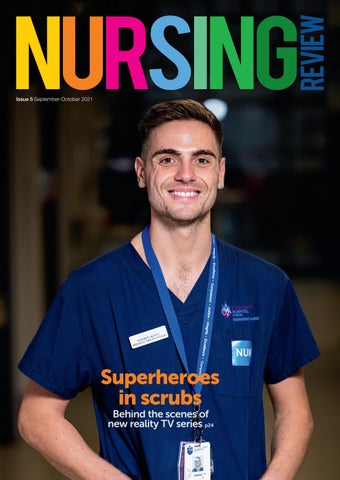
Issue 5 September-October 2021
Superheroes in scrubs Behind the scenes of new reality TV series p24
For formula-fed infants Fo For healthcare professional use only
S-26 Alula Gold Newborn
Providing nutritional support for key areas of paediatric development and function Growth and Development • • •
Contains a lower-protein quantity of 1.28g/100mL. Feeding infants a lower protein# formula during infancy may encourage appropriate weight gain, closer to breast-fed infants during early childhood development up to 6 years.1,2 Enriched with sn-2 palmitate. Sn-2 enriched infant formula is associated with increased bone mineral content. †3
• • •
Sn-2 palmitate enriched formula is associated with improved absorption of calcium and fat and may result in softer stools.3-7 Easy to digest whey dominant, whole (intact) protein.8,9 Whey:casein ratio 65:35
•
Contains Nucleotides and zinc. Naturally found in breast milk, they may help support immunity.10-15
•
The DHA content (min. 0.32%) of S-26 Alula Gold Newborn closely aligns with the average DHA content of mature breast milk* and expert recommendations.16-18
Digestion
Immunity
Brain Development
# Versus higher-protein formula
*Mean concentration 0.32%+/- 0.22%
† At 4 months of age
IMPORTANT STATEMENT: Breastfeeding is best for babies. It has benefits for the infant, such as reducing infection risk, and for the mother. It is important to have a healthy balanced diet in preparation for, and during breastfeeding. Infant formula is designed to replace breast milk when an infant is not breastfed. Breastfeeding can be negatively affected by introducing partial bottle-feeding, and reversing a decision not to breastfeed is difficult. Infant formula must be prepared and used as directed. Unnecessary or improper use of infant formula, such as not properly boiling water or sterilising feeding equipment, may make your baby ill. Social and financial implications, including preparation time and the cost of formula, should be considered when selecting a method of infant feeding. References 1. Koletzko, B., et al., 2009. AJCN, 89: 1836-1845. 2. Weber et al. 2014. Am. J. Clin. Nutr., 99: 1041-1051. 3. Béghin L et al.,2019, Clin. Nutr. Jun; 38(3):1023- 1030. 4. Kennedy et al. 1999. Am. J. Clin. Nutr., 70: 920-927. 5. Yao, M., et al., 2014. JPGN, 59: 440-448. 6. Bar-Yoseph et al. 2013. PLEFA, 89: 139-143. 7. Bronsky J, et al. J Pediatr Gastroenterol Nutr. 2019 May;68(5):742-760. 8. Lönnerdal, B. 2003. AJCN, 77:1537S-1543S. 9. Martin, C., et al., 2016, Nutrients, 8 (279), pp. 1-11. 10. Yu, V., 2002, J. Paediatr. Child Health: 38, pp. 543-549 11. Hess, J. & Greenberg, N., 2012,: Am. Soc.Par. Ent. Nutr., 27 (2), pp. 281-294 12. Singhal, A., et al., 2008. AJCN, 87: 1785-1792 13. Ackland, M. & Michalczyk, A., 2016, Archives of Biochemistry and Biophysics, 611, pp. 51-57 14. Aumeistere L.,et al., 2018, , Nutrients, 10 (1438), 1-9. 15. Carver, J., 1999, Acta Paediatr Suppl: 430, pp. 83-8.16. Brenna, J. T., et al. 2007. AJCN, 85: 1457-1464.17. Koletzko, B., et al 2008., J. Perinat. Med., 36, pp. 5-14. 18. European Food Safety Authority (EFSA), 2014, EFSA Journal, 12 (7): 3760, pp.1-106.
Or visit: www.alula.com.au
Phone: 1800 552 229 www.meandmychild.com.au
S-26 is a registered trade mark. Used Under licence. Distributed by Sanulac Nutritionals Australia Pty Ltd. Level 1, 42-44 Chandos Street, St Leonards, NSW 2065. AN-05377-03082021
contents
MANAGING EDITOR
news
Richard Garfield 02 9936 8628 richard.garfield@apned.com.au
2
Aged care workforce growing
3
Nurses brace for Delta
4
Cannabis trial promising
5
Pregnancy advice update
6
Health system failing vulnerable
NEWS EDITOR
Conor Burke 02 9936 8638 conor.burke@apned.com.au
industry and reform
HEALTH EDITOR
Eleanor Campbell eleanor.campbell@news.com.au
8
02
05
SALES MANAGER
Customer knows best Involving consumers in healthcare
10 Night terrors
Sarah Licence 02 9936 8710 sarah.licence@apned.com.au
Shift work’s health impact
11 Prevention, not cure
SUBSCRIPTION ENQUIRIES
Health gap widens
Daniel Omelia 02 9936 8607 subs@apned.com.au
for low earners
12 Calling it out Racism, inequality in midwifery
COVER
14 Better by design
St Vincent’s NUM Darren Scott Photo: Supplied
Designing better aged care
16 At a distance PUBLISHED BY
10
14
Isolation fears for elderly
specialty focus APN Educational Media GPO Box 4245 Sydney NSW 2001 ABN 58 090 900 999 ISSN 1326-0472 PP100001944
18 Reading with senses
PUBLISHER’S NOTE
20 Keep moving
© Copyright. No part of this publication can be used or reproduced in any format without express permission in writing from APN Educational Media. The mention of a product or service, person or company in this publication, does not indicate the publisher’s endorsement. The views expressed in this publication do not necessarily represent the opinion of the publisher, its agents, company officers or employees.
Blind artist brings science to life
19 Write stuff Nurse pursues creative writing
clinical practice Improving patient mobility
22 Break the bond COVID blamed for infant deaths
18
22
23 Stress response Sedatives linked with PTSS
workforce
24 Heroes wear scrubs Behind the scenes of Nurses
26 On the frontlines Life in a COVID vaccine hub
27 At breaking point NZ nursing in crisis
technology
28 Cyber secure
26
28
Reducing cybersecurity risks
nursingreview.com.au | 1
news
“In 2020 half of RAC workers were aged under 40 years.
Bigger and younger Aged care workforce growing while its workers are getting younger.
(or 78 per cent) direct care staff in the CHSP.
By Conor Burke
PANDEMIC IMPACT
T
However, due to COVID-19 the number of volunteer workers has fallen dramatically. In 2020 there were 11,980 volunteer workers in aged care – almost half of the number in 2016 (23,537). The impact COVID-19 has had on the overall workforce in that period is variable. Most RACs reported no change in the size of their workforce during the pandemic (47 per cent) while 44 per cent saw an increase and 9 per cent reported a decrease in size. Previous workforce census have shown that the aged care workforce was ageing and older than the national workforce on average. However, that trend changed in 2016 and in 2020 half of RAC workers were aged under 40 years, an increase from around one-third in 2016. RNs are the youngest, with around 60 per cent of these workers aged below 40 years. In 2020, the median age for PCWs and ENs in both HCPP and CHSP is younger than in 2016 and lies between 40-49 years (50 per cent of workers in these job roles are aged 40-49 years or younger), while median ages for RNs are the same age as in 2016.
he findings of the Health Department’s 2020 Aged Care Workforce Census have been released and they tell the tale of an increasing, and increasingly younger, workforce. This is the fifth census of its kind, following four previous workforce data collections in 2003, 2007, 2012 and 2016. In 2020, the total number of workers in residential care (RAC) was 277,671, 14 per cent higher than in 2016. In the Home Care Packages Program (HCPP) there are 80,340 workers and 76,096 in the Commonwealth Home Support Programme (CHSP). In RAC, there was an increase in the number of direct care workers. There are 208,903 staff in direct care roles, and 201,542 of these are employed on a permanent or casual/contractor basis, an increase of 32 per cent since the 2016 census. Most direct care permanent staff work part time (93 per cent). This is higher than in 2016, when this figure was 87 per cent. Of the RAC direct care staff, 77 per cent are employed in a permanent position with 19 per cent employed in casual or contract positions and four per cent employed as agency staff or sub-contractors. In the HCPP 64,019 (80 per cent) are direct care staff while there are 59,029
2 | nursingreview.com.au
WORKFORCE SHORTAGE At the time of the census there were an estimated 22,000 vacancies in direct care roles across the sector.
In RACs there were 9,404 vacancies, with PCWs making up most of the staff shortages followed closely by RNs. Meanwhile, workforce attrition continued to be a problem for RAC providers. Over the 12 months from November 2019 to November 2020 providers reported that 29 per cent of all workers they employed in these roles as at November 2019 had left their employment by 23 November 2020. The turnover of NPs and RNs was higher than that of other roles, with 37 per cent having left their employment over the 12-month period. Eighty per cent of providers reported that they had an RN rostered on duty overnight every day in the last fortnight, while a further 9 per cent said they had an RN on call overnight every day in this period. As for provider management, RAC facilities are much more likely to come from a nursing background than a business background, with a bachelor’s degree in nursing or postgraduate nursing qualifications more common than business management or administration. The most common qualifications for care managers in HCPP were also in nursing, while in CHSP care managers were most likely to hold qualifications in business management. Aged Care Services minister Richard Colbeck said the census shows that efforts to attract younger people to the workforce are bearing fruit. He said that the data now provides a benchmark for the government as it continues to drive generational reform. “Right across the aged care sector we continue to see examples of a workforce that is determined to make individual care a priority,” Colbeck said. “We are investing $652.1 million in growing and skilling the workforce. Aged care workers are the engine room of the reforms and key to ensuring respect, care and dignity for senior Australians. “The census also benchmarks the attributes and skills central to the delivery of quality aged care – a useful reference for us as we move through our $17.7 billion, five year, five pillar reform of aged care.” ■
news
NSW Chief Medical Officer Dr Kerry Chant and Premier Gladys Berejiklian at a daily COVID briefing on September 7. Photo: NewsCorp Australia
“The fear of what’s to come is aggravating everyone’s anxiety.
Watching and waiting Nurses ‘holding their breath’ as virus spreads to NSW regions. By Eleanor Campbell
N
urses in regional NSW fear that ongoing staff shortages and daily changes in exposure sites will soon leave them overwhelmed, advocates have told Nursing Review. “I think the fear of what’s to come is aggravating everyone’s anxiety,” said Michelle Cashman, a NSWNMA counsellor and Central Coast delegate. “It’s all well and good for the government to say ‘we’re building a ward here, we’ve done this’, and yes, we’ve got more ventilators, but a Covid patient who is incubated takes six staff. If you’ve got many Covid patients in an ICU, that’s a lot of work.” The state’s healthcare system is under increasing pressure, with a surge in over 2,000 cases a day predicted for October according to recent government modelling. Cashman, a registered nurse, said regional staff are working daily double night shifts have been told to reduce plans for leave and for holidays to prepare for the coming weeks. “I think the fear is that if we had more lockdowns and if the patient load gets higher, where will staff come from? “The workload for the average nurse is pretty great at the best of times, let alone with those extremes on top.” Last minute isolation orders are leaving gaps in staffing rosters and forcing workers
to take on 16-hour shifts, according to Cashman. “I feel the anxiety is so high, and there are predictions that this could get so much greater,” she said. “Staff are really worried, and they’re worried because some of them are young mums going home to families, some of them have older parents as well, and there’s that fear of what you are potentially going to bring home.” Day-to-day operations at local hospital wards have also been significantly affected, according to Cashman, with routine surgeries being cut to accommodate staffing and wards. A parliamentary inquiry into the working and staffing conditions in NSW rural and regional hospitals is currently ongoing. “The staff shortages have been an ongoing event for a long time, we’ve been trying hard to get ratios because we know that’s the best care that we can provide,” said Cashman. “Nurses provide physical and medical care, but we also provide emotional care too, and unfortunately that’s really hard and at the moment the needs of the patients are so great.” Earlier this year, nurses and midwives across the Central Coast walked out on shift to demand the government introduce staff-to-patient ratios. According to Cashman, local health authorities have signalled that hospitals would be able to cope with a large-scale outbreak.
“According to Central Coast Health, I think they think they are prepared, and the impression I get from the staff is no, that is not the case,” she said. “People aren’t in the ICU for one day, they are in there for a couple of weeks or more, so if the best outcome happens they are still needing a lot of care for a long time. “There is a limit to what can be provided, and I just hope to God that we never see that maximum limit reached right across the entire area.” Staff in hospitals across the state’s regions are also reporting higher levels of stress due to increased workloads, according to NSWNMA assistant secretary Shaye Candish. “Most of the hospitals in the state are taking some other type of work to try and relieve the stress from some of those hospitals where we have got the highest pressures due to Covid,” she said. “Even if they are not directly affected, what we’ve seen is the hospitals really trying to get through high numbers of elective theatre cases or substantial planning assuming the outbreak will reach them at some point. “In addition to that, we are seeing nurses go and assist in vaccine hubs and special health accommodation, so it has reduced the pool of workforce the hospitals have to draw upon.” In response to the impending strain on NSW hospitals, the government has released a four-level plan to map out how the system will cope under increased pressure. The strategies include using private hospitals and allocating a higher number of patients per staff member. Candish said there are “more questions than answers” as to how the plan will work due to a lack of detail. “We’ve seen the government for the first few months of this outbreak claim that there was nothing to see here and that everything in the hospitals was fine,” she said. “What they’ve done now is try to manage expectations of nurses and midwives and other healthcare workers by saying it will get worse.” ■ nursingreview.com.au | 3
news
“The first phase of the trial and preliminary data shows a promising improvement in emotional wellbeing.
The good oil Medicinal cannabis trial opens a new window for cancer sufferers. By Eleanor Campbell
A
n Australian first medicinal cannabis trial has offered new treatment pathways for advanced cancer patients. Mater researchers observed the efficacy of cannabidiol (CBD) oil to provide symptom relief in more than 150 participants, who they say showed vast improvement in their overall wellbeing. Kevin Jocumsen, 66, said his mental health had improved within weeks of taking part in the trial. “I have a whole new outlook on life,” he told Nursing Review. “I honestly don’t believe I’d be alive today if they had just kept on popping me with pills.” First diagnosed with prostate cancer in 2011, the Queensland father of four was placed on strong pain medication after it began to spread up into his spine. He grew easily irritable and foggy, and said he was experiencing anxiety and depression on a weekly basis. “During this period, my mental health was sort of gone and down, doom and gloom a little bit, and anxiety was not too bad. It was manageable. “Then it started to get worse. I got really bad. And then they put me on drugs to try and help control that. “I don’t even really remember, probably about two months of that.”
4 | nursingreview.com.au
After spiralling into a depression, Kevin’s family intervened and he sought the help of Professor Janet Hardy for palliative care treatment. His pain medication was tweaked and he began the first stages of the randomised study. Each day, he filled a form to monitor his nausea, appetite and mental health. Kevin said within seven days he felt his mental health improve enormously, which enabled him to better manage his chronic pain. “The pain was less, my attitude was better. “Before I did the oil the pain, even with all the painkillers, was pretty much a constant three all the time, now it’s usually a one. “I don’t know whether it helps the pain, but I know when you’re in a better mental state, that helps.” Leeanne, Kevin’s wife of over 34 years, said she began to notice the changes within days. Kevin became more interactive with family members and his regular mood swings began to subside. “We were just spiralling around and around, the different medications they tried. Some of them were just dreadful. “And then the pain lessened, and his attitude got better again. So it was just continuing, evolving. “Now we’re just under 12 months later, being on the oil and seeing things stabilised and the levels being better, and the pain being better. We’ve been upgrading our van and are planning a trip to travel around Australia.” Legalised in Australia in 2016, doctors in most states can prescribe medicinal cannabis to patients with specific medical
conditions, including epilepsy, chronic pain and chemotherapy-related nausea. While there continues to be substantial public demand, studies report obstructions to access have prevented eligible patients from taking the legal route. Kevin, a Bribie Island man, said he has spoken to people with ill family members who have fought ongoing battles with doctors and health departments to obtain a script. “Part of the problem they’re having here is most GPs won’t prescribe it. “I just think there needs to be a lot more research in it.” In recent years, public acceptance towards medicinal cannabis has grown. Surveys suggest, however, that GPs tend to hold a more conservative view, with less than sixty per cent agreeing that cannabis should be available in prescription. Medicinal cannabis products are also not currently part of the Pharmaceutical Benefits Scheme (PBS), and there is only one cannabis-based product currently listed on the Australian Register of Therapeutic goods. While effects of CBD in improving chronic pain are understudied, experts hope the results of the trial will pave the way for the country’s first registered cannabis treatment for people with advanced cancer. “The first phase of the trial and preliminary data shows a promising improvement amongst patients in emotional wellbeing,” said Hardy, who is the Mater Director of Palliative and Supportive Care Professor. “It will also play a role in educating the general public about the appropriate usage of these products while developing a wider understanding of non-conventional treatments,” she said. Kevin said he will continue CBD treatment for the rest of his life, and is looking forward to the future. “I don’t know when I’m going to go, but whenever the cancer turns, I’m positive about it because everything’s so good in my life at the moment.” Two more randomised trials set to take place within the coming years. ■
news
No need to wait WHO advice to wait two years before next pregnancy questioned.
N
CRICOS 00586B
ew research has challenged the conventional wisdom that women must wait at least 24 months after giving birth to become pregnant again. Curtin University-led research found that the WHO recommendation that women
wait two years, in order to reduce the risk of adverse pregnancy outcomes like preterm and small-for-gestational age births, may be unnecessary for mothers in high income countries. Lead researcher Dr Gizachew Tessema from the Curtin School of Population Health said the 15-year-old WHO advice is based on limited evidence from resourcelimited countries.
His team looked at approximately 3 million births from 1.2 million women with at least three children, and found that the risk of adverse birth outcomes after an interpregnancy interval of less than six months was no greater than for those born after an 18-23 month interval. They also found that siblings born after a wait of 60-months or more had an increased risk of adverse birth outcomes. “Given that the current recommendations on birth spacing is for a waiting time of at least 18 months to two years after live births, our findings are reassuring for families who conceive sooner than this,” he said. Dr Tessema said just as the current WHO recommendations are not age specific, the study’s results were not necessarily equally applicable to parents of all ages. “Our next step with this research is to identify whether intervals between pregnancies affect the risk of adverse birth outcomes among women of different ages,” he said. ■
Take your nursing career to the next level FLEXIB LE O N L I N E P O STG RA DUAT E STU DY We have postgraduate courses to support every working nurse’s goals. Choose from over 20 flexible specialisation streams, from a Graduate Certificate in Nursing through to a Master of Clinical Nursing. You might be in the early or late stage of your career, working in an area of specialisation, or moving into a role that encourages you to lead and manage. Scholarship supported places are also available through our national network of industry partners.
Clinical outreach at Sheffield.
Find out more utas.edu.au/nursing-postgraduate
nursingreview.com.au | 5
news
“Healthcare is being driven by an administrative approach: completing paperwork rather than addressing medical needs.
Needs not being met Health system ‘unequipped’ to care for those with intellectual disabilities. By Eleanor Campbell
P
eople with intellectual disabilities are hospitalised at significantly higher rates compared to the general population, according to an Australian-first study. The analysis, published in the Medical Journal of Australia, spotlighted the critical gaps present in our healthcare system. Researchers evaluated data from 92,542 individuals with an intellectual disability in NSW, comparing it to hospitalisation rates from the general population. It was found that those with an intellectual disability were at a 4.5 times higher risk of hospital admission for an avoidable condition. The study’s lead author, Dr Janelle Weise from the Department of Developmental Disability Neuropsychiatry at UNSW Sydney, told Nursing Review that the findings were not surprising. “Historically, people with disabilities were put in institutions so they weren’t accessing community or hospital systems like the general population,” she said. “What we saw when they moved out of these institutions and into the community
6 | nursingreview.com.au
was that mainstream services weren’t equipped to meet the needs of those with a disability. “This is what you see as a result: people being hospitalised for things that should have been picked up earlier or treated in the community.” The study found that convulsions and epilepsy, conditions generally treated at home or in the community, led to 25.7 higher rates of hospital admissions. Those with intellectual disabilities were also three times more likely to be hospitalised for a vaccine-preventable condition, such as the ‘flu. According to the latest senate estimates, just over one per cent of those in a disability care setting have had their first dose of the COVID-19 vaccine. Higher risks of contracting the virus paired with a lack of overall research on the subject is “alarming” according to Dr Weise. “There’s a reluctance among health professionals … there’s a lack of confidence and skills in this space for them to be able to modify their practice to meet the complex needs of someone with an intellectual disability. “Healthcare is being driven by an administrative approach: completing paperwork rather than addressing one’s medical needs, so that’s an indication of where things might be going awry.”
Past research has also identified a lack of depth in knowledge and training relating to the healthcare needs of people with intellectual disabilities in tertiary education. “If we looked at the content of medical curriculum and nursing curriculum, there’s a paucity of content,” said Dr Weise. “It’s not surprising that you end up with a health workforce that isn’t sure, because they’re not taught it,” she said. High rates of preventative deaths are among the most serious implications of inadequate healthcare treatment and assessment for people with intellectual disabilities. “What our research shows is that they have higher rates of preventable death, that’s the worst case scenario. So they die younger from conditions that they didn’t need to die from. “We also see other people who are unable to engage in their lives and do the things they want to do because they have poor health.” Research in the UK and Canada also demonstrates similar rates of preventative hospitalisations, suggesting the problem extends on a global scale. In Australia, the ongoing royal commission has highlighted the links between restricted access to healthcare with the systemic abuse, neglect and exploitation of people with disabilities. Earlier in May, the federal government finalised a roadmap for improving the health of the estimated 480,000 Australians who identify as having an intellectual disability. According to Dr Weise, much work needs to be done to further address the systemic inequalities embedded into the health system. “We’ve come such a long way since the 60s and 70s about speaking about people with disability and their role in society, and addressing their fundamental needs,” said Dr Weise. “But I think we’re still chipping away at those undertones of attitude and beliefs. “Hopefully we can get traction to try and address these fundamental rights that aren’t being upheld.” ■
PROGRESS YOUR Apply now for an online NURSING graduate certificate CAREER Enrol in an online graduate certificate to pursue your passion, become a specialist in your area of practice and increase your earning potential. FEE-HELP is available and ACN members receive an exclusive 10% discount. Not applicable to Start-Ups and Undergraduate Members.
acn.edu.au/grad-certs 02.09.21
industry & reform Dr Brett Scholz is a researcher and critical health psychologist. Picture: Supplied
The customer knows best Is a consumer-led health system the way forward? Brett Scholz interviewed by Eleanor Campbell
T
he movement of consumer driven healthcare has become a growing phenomenon. Engaging people accessing healthcare in the creation of policy, services, education and research is vital to address public needs, according to Dr Brett Scholz from ANU’s medical school. Dr Scholz, who is a critical health psychologist and researcher, recently took home the 2021 ACT Young Tall Poppy science award for his studies in the area. He joined Nursing Review to discuss the potential of consumer expertise during COVID-19, the importance of listening, and breaking down the power hierarchies in healthcare.
NR: Can you paint us a picture about what consumer-driven health care is, and how prevalent is it in our health system? BS: It’s not at all as prevalent as I would love it to be. The work that I try to do is about consumer leadership across the health system. So that includes in-health policy, in-health services, in-health education and health research. The first example that comes to mind, and it’s really important now in the context of COVID, is that we have all of these standards that we work to, around 8 | nursingreview.com.au
partnering with consumers. But around the time of COVID one of the disappointing but perhaps unsurprising things I saw was that including and engaging with consumers was forgotten. There are pockets of where that is still done, but there was even more COVID policy that was developed without input from consumers. Here in the ACT, the triage process for COVID was actually developed with 26 different consumer care and community groups, and it means that the ACT’s triage policy is based on human rights, it’s based on consumers’ needs, and it still takes into account clinical considerations like bed numbers, capacity and clinicians’ day-to-day lives. The principles of that policy are grounded in consumers’ needs. That’s an awesome example of policy that I wish we saw a lot more in COVID. There are so many benefits. One of the first ones is that it means that we’re creating relevant policies for consumers, rather than just health professionals presuming what consumers need or want to know. It also allows us to be more innovative. In a number of projects that I’ve been involved in with consumers, non-consumer members of the team have said, ‘Oh, how did I not see that solution the consumers had come up with or had co-developed?’ They see the health system in a very different way to people who are working within that system as health professionals.
The other benefit is that it means we can actually be providing cost-effective services as well. There are so many things that happen in health that consumers might not want, or that are no longer relevant, or no longer fit for purpose. So if we can get rid of those things, or reform them to make sure that what we are offering does map with consumer’s needs, then we’re providing not only cost-effective but better value-for-money services.
Can a more consumer-led model help address health inequity? In a lot of the work that I have done and some of my colleagues do in this area, we often acknowledge that. There’s so many intersections of vulnerabilities. Almost every paper I’ve read in this area has a paragraph towards the end saying it would be great to involve more diverse communities. It would be great to involve Aboriginal and Torres Strait Islander people, people from CALD backgrounds, people from socioeconomically disadvantaged backgrounds, and so on. I don’t know that we’re necessarily doing a good enough job of it yet. I think people are acknowledging that we need to do better. I think if we are actually creating services, and policies, and education, and research together with the people that are impacted the most, including those who are vulnerable, stigmatised or marginalised, then I think we can work towards making more relevant care for them as well. I really want to see that being done a lot more.
industry & reform
Do you think the extended lockdowns are an opportunity for healthcare providers to integrate more consumer voices into the delivery of their services? Speaking as a health professional myself, and not coming from a consumer perspective, I think so many of us can presume what is in the best interest of consumers or what’s going to help them. And I think most health professionals get into health because they do want to make things better for consumers. But I think the COVID pandemic, and some of the mental health implications it’s had and continues to have on us all, means we can probably learn a lot more from people who’ve experienced acute mental health concerns, given that they understand not only the health services and systems but they’ve had to work towards adopting recovery principles within themselves. There was talk early on in the pandemic about how this might be an opportunity for us all to acknowledge that mental health concerns are something that we should talk about more and be more aware of. What I hope happens is that we’re also aware of consumer’s expertise. People who’ve been through some of these mental health concerns have a lot to offer the mental health system, and other consumers of services.
What do you think healthcare employees and organisations can do to involve people more in the design of their health care? I think so much that’s done in mental health and health more broadly is well-meaning, but not necessarily engaged enough with people who’ve actually experienced those concerns. It sounds so simple; it almost sounds trite and I’m almost wary of saying it. But I think the most important thing they can do is listen.
Do you think there’s a cultural shift required to push this model forward? I do. I think there’s a lot of stigma, and also a really entrenched power hierarchy within health. I’ve had the privilege of working in a range of areas, and the way that I see how the hierarchy’s playing out within different professions is, at times, a barrier. When we’re talking about bringing consumers into that hierarchy, and actually treating them as equal partners in what we do in the health system, I think that requires a big change in mindset. I think some health professionals can be very defensive and affronted
by consumers. But I think all of us who get into health are motivated because we do genuinely want to make things better. So if we start to see partnerships with consumers as equals, rather than us doing something for consumers or to consumers, we will start doing things with consumers. When I started getting interested in doing research with consumers six or seven years ago it was really quite rare, and people would stare agape, because they didn’t really understand the idea of consumers working on a research project as equals, and not just as participants. Even in that short period of time it’s becoming more and more recognised as valid. Now, I hear people say, ‘Oh, if you’re not going to do research with consumers, how do you know that it’s going to be relevant?’ So I do see that shift happening. I think it needs to happen more. I don’t think we’re there yet. It’s a cultural shift, and we just need to keep encouraging people to engage with consumers as partners.
You’ve said that about two-thirds of your research has been co-produced with people with lived experiences of illness. How has that improved the quality and the impact of your research? It’s improved it no end. There are so many insights that consumers have had in research projects that couldn’t have come from other health professionals. It’s changed the way that I approach defining research questions. And it’s also really fun. That’s not to downplay that it can be difficult, and there’s lots of barriers to getting enough resources to ensure that consumers are paid for their expertise. But it’s actually really enjoyable sitting there trying to solve problems with a multidisciplinary team, including consumers who previously would have been left out of research. So it’s valuable, it’s fun, and I guess there’s a sense of justice as well. It’s not just me sitting in my office assuming what consumers need, but actually really engaging in what research questions we should be asking in the first place.
How do you think policymakers and people who actually provide the funding for these services should integrate the voices of people who are accessing the healthcare system? I think it’s really varied. There are some policymakers that embed this in from the
“There are so many insights that consumers have had in research projects that couldn’t have come from health professionals.
beginning, there’s some who’ve never even thought about doing it at all. It really varies across jurisdictions, across services, and I think we all have a long way to go. The National Health and Medical Research Council has started a consumer panel, which I think is great, because if we are funding research from public money, I think it’s important that consumers are involved in some kind of decision-making process around how that money is spent.
What would you say are the key barriers that might be preventing the system from developing into a more consumer-led model? The first is stigma. There’s often a stigma for people to talk about their lived experience. And we often assume that experience is not as important as clinical knowledge. I think we have to address that and show that we actually do value people’s experiences, just as much as we value clinical experience. The second issue is around power. There’s a hierarchy in healthcare, and when consumers are brought into the hierarchy they’re often at the bodttom. So I think that power dynamic does need to be addressed. The last barrier is that there’s not necessarily a defined way of how to do this. I get health professionals coming to me saying, ‘Look, I do want to co-produce with consumers. I don’t even know where to start. I don’t know what I should be doing.’ And with every project the way that you co-produce with consumers is going to be different because everything we do in health is very varied. The first step should always be talking to consumers to find out how they want to be involved. I think in general people fail at that first step because we have a lack of culture around how to do this, they don’t even know where to go. I think we just need to keep doing this, and keep chipping away, and keep making this the normal way we do everything in health. ■ nursingreview.com.au | 9
industry & reform
“Shift workers had increased risk markers for future disease states.
Is your night shift killing you? University study confirms the harm night shifts can do to our health. By Conor Burke
P
icture the scene. It’s 2.00am and you’re three coffees and two bags of m&ms down and you’ve lost count of how many laps of the ward you’ve done. You’re on the first shift of a week of nights and sure, the hospital is quieter, somewhat more manageable, but this is killing you. No really, this could be killing you. According to researchers, our bodies are straight up not designed to be going at night and the disruption to our natural circadian rhythm may well result in cardio-metabolic disease. A team at Charles Sturt University looked at a group of healthy males and split them into two groups: shift workers and non-shift workers. They did pre-screening questionnaires to do with their general health and screened for existing disorders pre-trial, from diabetes to pre-existing arrhythmias or cardiovascular conditions. “What we found is that shift workers, even apparently healthy shift workers, did have increased risk markers for future cardiometabolic conditions,” said researcher and PhD candidate Blake Collins. Collins tested people during work using things such as a glucose tolerance test.
10 | nursingreview.com.au
“Basically you drink a specific amount of a sugary drink and then over a two hour time course we see how quickly the body metabolises or removes that glucose, and if you’re taking longer to metabolise that glucose it’s a risk factor for type 2 diabetes,” he tells Nursing Review. “We also looked at things like their cardiorespiratory fitness, current things like kidney levels, those kinds of generic markers of health as well, and that’s what we found — shift workers had increased risk markers for future disease states.” Approximately 1.4 million people work shift work in Australia, making up 16 per cent of all employees. Around 46 per cent of nurses worked a rotating shift in 2015. Collins says that there could be a few reasons why shift work doesn’t agree with the human body. First, access to healthy food can be difficult late at night and he says that shift workers are also more likely to smoke or engage in similar unhealthy behaviours. But equally, the body’s natural 24 hour rhythms struggle to adapt to night shifts. “Your heart rate, blood pressure, those kinds of things are all on this rhythm and it’s regulated by cues, and those cues are for exposure to light, when you eat something and when you’re physically active. So, those three factors train the body into that 24 hour rhythm and that’s
what helps control our normal function,” Collins says. If you’re doing a night shift, everything in your body is telling you that it’s time to go to sleep but you’re giving it mixed biological signals. “You’ve got an artificial light on, you’re being physically active, all these things that are basically sending these mixed biological signals to the body which we’ve seen can acutely affect cardiometabolic health,” Collins says. Another area of work Collins and his team are looking at is whether acute bouts of exercise could balance the negative effects of shift work. “If you exercise before a shift, then we know that the shift is going to affect, say, your insulin sensitivity negatively, but exercise positively affects your insulin sensitivity. “So, was it the case that we could acutely do some things to offset those negatives? And then if that becomes chronic, we could encourage all of our shift workers to exercise, then that would potentially offset the negative effects of doing shift work.” Exercise has been shown to increase attention and decrease fatigue, Collins says, so if you are a health worker doing a 12-hour night shift and fatigue is setting in, a short hit of cardio might be a useful intervention. Collins’ research looked at males largely because of the businesses he had access to in Bathurst, such as prisons and mines, but a future area of research would include female participants and a hospital setting would throw up a lot of interesting questions as to the best way to combat the negative effects of night shifts. “So, does it matter if you do clockwise rotating shifts? So, should you go from a morning to an afternoon to a night. Go anti-clockwise?” Collins wonders. “The length of the shift is another one. Is it more beneficial to do shorter shifts? “Some people prefer to do a couple of 12 hour shifts since even though it’s a longer disruption, you have to do less shifts. Whereas if you do eight hour night shifts, you’d have to do an extra night in that rotation to work the same hours.” ■
industry & reform
“The strategies that we use for the whole of the population work less well for low income communities. COVID-19 as well, governments will be very slow to see the opportunity to change.”
BACK ON TRACK
Prevention, not cure Report finds higher preventable deaths among low income earners. By Eleanor Campbell
A
ustralia’s health inequality gap is growing, a new report has warned, and experts are calling for a cultural shift in policy to help curb preventable deaths in lower socioeconomic communities. The 2021 Australia’s Health Tracker by Socio-economic Status report found that compared to wealthier areas, lower income earners are 1.5 times more likely to die prematurely from a chronic health condition. Lead author Professor Rosemary Calder from Victoria University’s Mitchell Institute said she was shocked by the results, which were last updated in 2016. “You would hope that it’s the biggest road sign possible, ‘please note, low incomes put people at risk’, but more than that, they put our economy and our health services at risk. “People on low incomes need more resources from the government, to live life in a more healthy and free way,” said Calder. Just over one per cent of Australia’s health spending is currently directed towards prevention. Most government policies target the health of the entire population, widening gaps in communities that benefit from more tailored solutions, according to Calder.
“We’ve had very good communications campaigns to encourage people to stop smoking, but smoking rates in lower income Australia are much, much higher than smoking rates in high income Australia,” she said. “That tells us the strategies that we use for the whole of the population work less well for low income communities and instead of ignoring that, we’re not seeing it.” The report card found that 10 million Australians living in lower socioeconomic areas live with higher rates of preventable disease, including obesity, respiratory issues, diabetes and cardiovascular conditions. “The cost of people living shorter lives, but with longer years of poor health that is preventable, is such inadequate economic thinking. “We’re spending a fortune on the healthcare of people who could be supported not to need it. “And we don’t articulate it, we don’t make it visible, we don’t address it.” Professor Calder has worked in both state and federal government, and said she was previously unaware of the severity of the issue as a bureaucrat. “You know about shorter lifespans, but I think there is an invisible bias, or hidden bias, or unconscious bias,” she said. “Every day is relentless in government. It’s not just during a pandemic, the daily life of an economy and a nation is extraordinarily busy. “If we don’t have leadership from the public and health professionals through
Launched in conjunction with the health tracker report, the Australian Health Policy Collaboration (AHPC) outlined a set of policy directives for politicians, educators and health professionals. Priority actions include setting a sugar levy on sweetened beverages, more regulation for junk food advertising and increased education around smoking risks. Urgent policy action should be driven from the ground up, said Calder. “It needs a combined effort,” she said. “There are ministers who are committed and caring and want to do this, but they’re in circumstances where industry has very strong lobby and advocacy. “That’s where health professionals provide that leadership, that ministers get the most joint support from.” For the first time in history, Australia is developing a national preventative health strategy. The long awaited plan, Calder said, will rely on the public health workforce to embed prevention strategies into their everyday practices. “It’s quite clear that health professionals are under enormous pressure with the workload of chronic disease that now infuses our entire population and health system. “They are often not presented with the opportunity to work with people on prevention.” A cultural shift in healthcare will help guide resources towards preventative health, according to Calder. “Engage with people about their weight, about their diet. Even if they’re presenting some pointy-end clinical need, take the time to say, ‘What’s your diet like?’ “It’s a clear message that this makes a difference to the burden of illness in our population and in our economy. “That’s the sort of leadership we need, and we need it from all health professionals,” she said. ■ nursingreview.com.au | 11
industry & reform Renae Coleman is a proud Darug woman and midwifery activist. Picture: Supplied.
“Many First Nations women don’t feel culturally safe with what the mainstream system offers.
‘Call it out’ Claims of inequality and racism in the midwifery sector. By Eleanor Campbell
A
new report detailing Indigenous patients’ experiences of hospital care has affirmed the importance of supporting the midwifery workforce, according to UWS researcher and registered midwife Renae Coleman. Recent insights from the Bureau of Health Information (BHI) found that Aboriginal women in NSW had a significantly less positive experience of care than non-Indigenous women. The survey also found that Aboriginal women giving birth were more likely to report higher levels of respect and improved communication when supported by an Aboriginal health worker. “Many First Nations women don’t feel culturally safe with what the mainstream system offers,” said Renae, who is a descendant of the Boorooberongal people of the Darug Nation. “Services that offer continuity of care throughout pregnancy, birth and postnatal; there’s just not enough services out there and available.” Continuity of care is vital to the wellbeing of an expecting mother and her child, with studies showing that having a trusted midwife can significantly reduce medical interventions and preterm birth. In Australia, Indigenous women face disproportionate rates of adverse health risks during pregnancy and postpartum periods. Access to continuity of care is essential to reducing these disparities. “It’s difficult to implement this type of care in the fragmented mainstream system, where women see different midwives each time,” said Renae.
12 | nursingreview.com.au
“There’s also a lot of women that have complex medical histories. Often they get flagged as high risk and they don’t get the opportunity to see a midwife. They’re moved to the doctor’s clinic and they tend to not come back.” Birthing on Country, described as the ‘gold standard’ of care for Aboriginal mothers, calls for the development of the Indigenous maternity workforce to improve women’s experiences and overall health outcomes. According to Renae, acknowledging the individual needs of every Indigenous woman is paramount to the delivery in this type of care. “It’s all about what the community wants and it’s all directed from there. “There’s that big influence of having an Aboriginal workforce that propels this kind of framework.”
Racism entrenched in the health workforce is a major barrier for Aboriginal student midwives, according to Renae. “There’s also an issue where we’re exposed to quite a bit of racism, bias and the blindness that stems from white privilege.” Kinship and connection to other Aboriginal people, she said, is crucial to supporting students through their learning and development. “Sometimes we call it our ‘sisterhood’, and it is so important because it can be a very isolating experience going through colonised education systems and colonised healthcare systems.” Non-Indigenous health practitioners can better support Aboriginal students and co-colleagues by removing the notion that everyone is treated the same, said Renae. “I think it’s important to them, to speak up when you hear racist comments. “It’s okay to call it out because for your Aboriginal colleagues or student midwives, it does chip away at them and it’s difficult to speak up. “And often you see people don’t speak up and they end up leaving.”
CLOSING THE GAP NOT ENOUGH GRADUATES Around one per cent of Australia’s healthcare workforce identifies as Indigenous and Torres Strait Islander. In a joint research paper, Renae noted that there was an inadequate number of Indigenous midwifery graduates to redress this gap. “Not most, but many of our Aboriginal students have families or care responsibilities that they need to juggle. “There’s barriers within the health system as well, with experiences of racism. “But many of us do overcome that and are able to get through that period, but usually it’s with a lot of love and support around them.” According to a recent AIHW report from April, over 30 per cent of Indigenous Australians indicated they did not access required health services due to discrimination, language barriers or a lack of cultural safety.
Last month Prime Minister Scott Morrison announced a $1 billion implementation plan towards closing the gap in Indigenous health, education and justice. The annual Closing the Gap report showed that only three out of the 17 new targets had made progress, including improving birth weight and preschool attendance. In the midwifery space, Renae said that working in collaboration with Indigenous women would be pivotal to implementing future policies aimed at achieving equality. “I think it’d be great if we could try and review policies and procedures, through the lens of Aboriginal women, and better still, asking Aboriginal people to be involved in that process. “Ask them to provide their input when making decisions, and actually listen to them, not just invite them to tick boxes.” ■
industry & reform
Better by design Using cross-cultural collaboration and ‘design thinking’ to innovate in aged care. Lisa Scharoun interviewed by Eleanor Campbell
I
nnovation and co-design in aged care delivery is a key solution to addressing the needs of the global ageing population, according to researchers. Cross-Cultural Design for Healthy Ageing, published earlier this year, reports on a series of workshops involving university students and academics from Australia, China, Singapore, Hong Kong and Taiwan. Students from nursing, design, film and media schools travelled to major urban cities to co-design projects, services and campaigns in aged care residential homes, hospitals and community housing precincts. Lead editor and co-author Dr Lisa Scharoun, from the University of Technology Queensland, said the workshops encouraged students to transcend their different disciplines to produce new solutions for healthy ageing. She spoke with Nursing Review about ‘design thinking’ and the power of cross-cultural collaboration in moving the aged care sector forward.
NR: How did the idea for the book and the workshops come about? LS: The idea started with a grassroots initiative at the University of Canberra 14 | nursingreview.com.au
called InnovAGE, which was an ageing innovation workshop that brought people from government and academics together to come up with new solutions to different issues in that sector. Through that, our design team came up with a lot of really interesting ideas that ended up winning some of the top prizes. And I thought this would be an amazing opportunity to run something like this with students. So I took that idea further. I’d been running a series of study tours to China and Japan, but that was more around industrial and design teaching practise and looking at product design and cultural exploration. So I thought I switch the focus of the tours to design for healthy ageing. I had some very close contact with colleagues in nursing who were really keen on the idea too, to bring their students to learn about how they could be influential in the design process. It then grew into this multi-year, government-funded study tour to Singapore and institutional partnerships with places in Hong Kong and Taiwan, and many different partnerships with the hospitals and care homes in Singapore that evolved over time.
What role did the nursing students play in the workshops? The nursing students engaged in the entire process with us. The first part of the tour would be a cultural briefing. We’d bring students to a cultural immersion experience at different museums and sites so they could understand the cultural contexts in Singapore. And then we would
bring them together with students from nursing and design at an institution in Singapore. So they were working crossculturally with other students who had Singaporean and Chinese backgrounds. Within those workshops we taught all of the students the design thinking process of how to approach issues in a global context. And then we would run through activities like a day in the life, which gets students to think about stepping into the shoes of someone in an aged care facility. We’d run different types of experiences with them where we would simulate ageing. So we used mobility aids, students had to wear glasses that were a bit fogged over, and we constricted their hands to have the feeling of arthritis and different things like that. And then students would have to navigate around in teams. After we immersed them in that type of experience, we brought them to care homes. The first tour that we brought nursing students on was more of an observation. So students went to different care homes across the island and hospitals, and they didn’t talk to any patients or residents. But in the second year we integrated interviews into it and real participatory design. So we actually had residents in care homes and patients in hospitals speak to us and the students interviewed them to understand their experience in those facilities.
What were the different perceptions of ageing held by the students? The Singaporean students had a completely different understanding of what
industry & reform
ageing would be like in Australia, and vice versa. They were nearly all of a younger demographic, so their interpretation of ageing was as an observer if they had grandparents, or in the case of Singapore, many of the grandparents lived with them so they had more of that first-hand experience. Many of them had a lot of preconceptions that were debunked during the tour, both between cultures and also within their own culture. They really hadn’t thought about what it’s like to age, and it was a really great way for them to get a true idea of the complexities, the issues, but also the great benefits of ageing and how they could actually make a difference in terms of designing solutions to some of the issues they saw in the care homes, but also creating new programmes and awareness for younger people to engage more with the ageing population in their countries.
Explain the concept of design thinking that was used in the workshops. Design thinking is a process has been around for a very long time. It’s embedded in all of our design disciplines, but it was never really extracted from the process and was never sold as a service at a design agency until the 1990s. The idea is that when designers have a problem, they go through an exploratory process of looking at all the different angles of the problem. And sometimes through that exploratory process, you find new issues that you need to deal with, or you find the true source of the pain points or an understanding of the end user. You continually prototype and test those prototypes until you get it right. We wanted to bring nursing students into this process because they didn’t really feel attached to the design solutions that were embedded in, say, a hospital setting. If they experienced something like a bundle of cables that they had to navigate around, they never thought, ‘Well, I could come up with a design solution to fix that.’ They just assumed it would be fixed by a spatial designer or a facilities manager. When we started to introduce them to the design process, we said you can actually integrate the observations that you’re making on a daily basis within these spaces, and work with the designer on the ground level to come up with new solutions to that. So that was really
important for particularly nursing students to realise that they actually have agency in a design process and that they’re not just the part of the end-user experience and they just have to accept whatever design has been given to them.
Could design thinking potentially provide a solution to attracting more workers and nurses to the aged care sector? I think it still has a way to go, but we’re trying to integrate design thinking into the design and delivery of health services. For instance, I’m part of the Australian Association of Gerontology and I frequently go to their annual conference. When I first started going back in 2015 there weren’t any other designers and there wasn’t a design section at that conference, but now we have a whole section on design. I think it’s becoming more prevalent, that idea that designers should be working with healthcare practitioners and should be working within the sector instead of just as a client to come in and design something that’s detached from the end user. I’m seeing it gain traction. We’ve got a project at the moment at QUT where we’re working with Queensland Health to help integrate these design processes into major hospital settings, small clinics, and looking at current and existing issues that they have and how we can come up with new solutions using design thinking. So I think it’s becoming more of a given instead of just a nice added extra, which is fantastic.
Do you believe design thinking can be used in the future to better improve experiences of ageing and allow different age demographics to collaborate? I think it’s linked because we’re looking at the end user and their needs and wants, instead of just a broad understanding of ageing as a problem. Everyone has a different experience of ageing, even within a culture. When we take students on these trips, we bring those stereotypes to the forefront. So they assume that everybody wants to be gardening, for example. They have these kinds of assumptions. But what we do by talking to the end user and working directly with them is try to develop new ways to adjust the experience so that ageing doesn’t seem so scary to younger people, and also to an older person because a lot of the new digital technologies and services are designed
“ You can actually work with the designer on the ground level to come up with new solutions. by younger people. It becomes really daunting. So they start to become co-dependent when they actually want to have agency over their life. By bringing younger people and older people together, we’re saying: help design this service in a way that is not so scary or difficult to use for someone that has never engaged with it. Design it for them, with them, so then it becomes something they designed as opposed to something that was designed for them, and it’s easier for them to use and manage. It can be something as simple as having to go into a bank when maybe the bank’s far away from you, or your local branch closes down and then you think, ‘How am I going to do my banking? I don’t know what I’m going to do.’ Then you can engage with that technology and its not so scary because you’ve actually worked together with the designer. The designer has really thought about how that end user is engaging with it. Those are the kinds of things we’re looking at and, how we can actually make this experience easier instead of a process of continual decline, a detachment from society, because you’re part of it, part of the design process, part of the new designs that are being involved and technologies that are supporting your lifestyle. Singapore’s population is ageing more rapidly than ours, and it’s hitting a crunch point with them. So you see lots of people basically never being able to retire. They’re working until they die more or less. Many of our discussions in that context, and also particularly when we went on a trip to Japan, was about how we can actually empower people in that setting and also look at retraining people to deal with some of the complexities of aged care. Some of the solutions that we created in the Singapore tours involved looking at how younger and older people could live together in housing complexes where they’d have businesses together, they’d have services that would support each other. So they’re not just living there, they’re working there as well. ■ nursingreview.com.au | 15
industry & reform
“ We must rethink our understanding of the causes and impacts of isolation and loneliness.
Isolating the problem
Pandemic solution threatens to become an endemic problem for aged care. By Michael Fine
S
ocial isolation and physical distancing have never looked as good as they have over the past year-and-a-half, proving to be essential tools in limiting the impact of the COVID-19 virus. More recently, much of NSW, Victoria and even occasionally south-east Queensland, South Australia and Western Australia have once again been returned to lockdown conditions. Perhaps that’s not so surprising given the disappointments and limitations of the vaccination program in Australia to date. We’re not the ‘envy of the world’ anymore. Neither are we unique. Similar responses have once again been reintroduced in many other countries, as the limits of even the best run and resourced vaccination policies to date have become increasingly evident through a significant increase in active COVID cases. Despite its benevolent use as a life saving measure in the pandemic, the idea of social isolation still holds significant fears for
16 | nursingreview.com.au
most people. For those older people who need care, the situation should be seen as even more alarming. We now have strong evidence that prolonged isolation for such people is nothing less than life threatening. Isolation clearly remains a major social problem and threat to mental health for all age groups. Medical research has now also shown it to be one of the leading causes of illness, morbidity and dependency among older people. It is also a leading cause of admissions to aged care services, including residential care. As we emerge from the pandemic, however slowly and uncertainly, it is time, once again, to pay attention to the problems of social isolation and loneliness amongst older people. We must rethink our understanding of the causes and impacts of isolation and loneliness, and work to improve our responses to best counter its ill effects. An important new report, released by the WHO in May, documents how social isolation and loneliness among older people are growing public health and policy concerns internationally. According to research cited by the WHO report, increasing numbers of older people live alone or in isolation, while as many as 20 to 34 per cent of older people in China, Europe, Latin America, and the US report that they are lonely. According to a study cited by the AIHW, in Australia in 2018 approximately 8 per cent of those aged 75 and above are socially isolated, and almost 20 per cent experience loneliness. These figures are probably higher today. Loneliness and social isolation are not the same and should not be
confused. Loneliness is an unpleasant subjective emotional response to lack of good companionship. Social isolation, in contrast, is an objective state, an observable absence of regular contact with people who know and care about you. It may be caused by poverty, social exclusion or housing problems, or come about as a result of bereavement, physical or mental health problems. Both women and men are commonly affected. In the worst cases, it results in a lonely death, a product of a life lived in isolation for years. The WHO report and a significant body of medical research also shows how both social isolation and loneliness are harmful. In addition to reducing quality of life, they can shorten older people’s lives as well as damage their mental and physical health. There is no vaccine available to treat the underlying conditions. It is, however, clear that social isolation is a social condition that requires social responses. That’s where aged care comes in. Left alone when in need of care, what emerges is a form of neglect for which the only readily available response is expensive forms of aged care. But we can do so much better. Rather than promoting social contact, Australian aged care services in recent years, especially those delivered to people at home, have increasingly been reshaped to focus on the complex needs of individuals. Those who are isolated and who don’t seek out help or social connections often miss out. Day care and social activity programs, long associated with the community sector, often struggle for funding. In the Home Care Packages, access to social activity programs is often accorded low priority and is in danger of becoming increasingly rare. In the wake of both the Royal Commission and the COVID-19 pandemic, social isolation ceases to be a solution. It becomes an endemic and increasing problem, a challenge that needs to be faced as Australia reforms its aged care system for the future. ■ Michael Fine is honorary professor in the School of Social Sciences at Macquarie University.
The laTesT news for aged care professionals
Aged Care Insite provides the best in original journalism and is the authoritative source of news and analysis for the residential and community care sectors. At Aged Care Insite we pride ourselves on being at the forefront of the ever-changing care sector. We provide an independent source of news, and cover the issues relevant to you. • Comprehensive coverage of a diversity of topics affecting the aged care sector • News and information on medical matters and products • Analysis of the major issues facing the aged care sector as a whole • 6 issues per year • Editorial integrity and industry relevance • Keeps industry professionals up-to-date on the politics and policy that matter • Tax deductible
please call 02 9936 8666 to find out more.
specialty focus A low vision participant exploring the HIV and its capsid at a Sensory Science Exhibition 2020, artwork by Erica Tandori. Picture: Supplied.
“Ophthalmologists can look into my eyes … but they don’t know what the world looks like from my perspective. A LIFE IN ART
Reading with your senses The blind artist bringing science to life By Eleanor Campbell
M
elbourne-based artist and researcher Dr Erica Tandori has enabled people with low-vision or blindness to touch, feel and experience the world of infection, immunity and nutrition in a new exhibition. As part of Science Week 2021, Monash University’s Rossjohn Lab exhibited a suite of multisensory, interactive science books, which explore the digestive system and role of immunity in a healthy diet. Dr Tandori, who lost her vision in her early twenties, said the exhibit, titled ‘My Goodness’, would allow people of all ages, abilities and diverse needs to learn about the wonders of microbiology. “Science is about us, it’s about our world,” she said. “It belongs to all of us, not just to the scientists, and not just to the people who can see it. “We should all have access to it, and equal access to it.” The exhibit was launched in a collaboration between Monash’s Biomedicine Discovery Institute’s Rossjohn Laboratory and Swinburne University’s Interaction Design Lab. Using large print text, braille, tactile artworks, haptic and 3D audio, visual
18 | nursingreview.com.au
tracking and sensor technologies, Dr Tandori said the books will offer an immersive reading experience. “I was inspired by some kids books that were really exploratory, and also inspired by books in themselves, like being a kid and sitting by the fire with my huge Reader’s Digest Book of the Universe. “I thought, wouldn’t it be lovely to have kids being awe-inspired about books again? But what happens when you actually have blindness, like I have now? How do we deliver these books to kids with low vision?” Over half a million people in Australia are estimated to live with blindness or visual impairment. A lack of accessible health information and service design continues to be a significant barrier facing visually impaired communities, according to Blind Services Australia. By using art to describe her loss of vision to healthcare professionals, Dr Tandori said she has become empowered to guide the management of her condition. “It is honestly the best way to describe this disease, because I always realised that ophthalmologists can look into my eyes. “They’ve got thousands of dollars’ worth of equipment, they’re specialists, but they don’t know what the world looks like from my perspective. “In this way, the patient becomes part of the dialogue, not just the recipient of what they’re being told in the healthcare setting.”
Growing up in the heart of Armadale’s contemporary art precinct, Dr Tandori said her journey into artistry began when her family opened a gallery after migrating from Europe during the 1960s. Her talent for drawing and painting was fed at an early age, framing iconic paintings and chatting with famous Australian artists who would visit the High Street gallery. “It was such a fortunate education, and then I could walk up the street and see all these amazing galleries that were opening up, so I was really, really lucky,” she said. “And I remember selling my first paintings at age 11 or 12.” After obtaining a philosophy degree from Melbourne University, Tandori began noticing a decline in her vision. She was then diagnosed with Stargardt’s disease, a form of muscular dystrophy, shortly after she enrolled in art college. In later years as her eyesight began to deteriorate, she discovered the power of sculptural design after landing a job at the Rossjohn Laboratory at Monash University. Her past works have since used chicken wire and couscous to make a model of the HIV virus, and taken oats, dough and flour to form a sculpture of a yeast cell. She said her interactive exhibitions have had extremely positive reactions from the low vision and blind community. “When it’s all said and done, it’s about really communicating and inspiring these people who are so often left without anyone taking any notice of them at all, or including them in dialogue. “This is the way, I think, that we do it, through engagement with multisensory modalities. “If we do that for people with blindness and low vision, it seems to me that we will then be able to engage and include just about everyone. It almost makes it like the baseline for universal design.” Tandori plans to take the ‘My Goodness’ exhibition to rural and regional Australia in the future. ■
specialty focus Adam Brannigan is a Queensland-based registered nurse and post graduate student. Picture: Supplied
“My career as a nurse does without a doubt inform the writing.
Nurse of letters Using writing as a creative outlet to offset the demands of the job. By Eleanor Campbell
A
fter hearing news he had won a national literary award, Queensland palliative care nurse Adam Brannigan said he had no plans on becoming a best-selling author. “I just keep offering my perspectives on the world and hope people want to read them,” he said. The 49-year-old recently won first place in the inaugural 2021 Kuracca Prize for Australian Literature. The judges awarded Adam for his short stories ‘Great Grandmother Arrabrilya’, a pre-invasion tale of a dreamer who visits an elder, and ‘Lest We Forget’, a monologue of a settler guarding his farm against an Indigenous man. “I really favour flash fiction and short stories. I’ve tried my hand at novels, but I get to a certain word count and I lose steam,” said Adam. Growing up in an Airforce family, Adam began writing as a teenager in a very non-serious, confessional tone, and kept it as a secret hobby into his 20s and 30s. It was the marriage celebrant at his wedding who suggested that he pursue
a creative writing degree after the arts lecturer was taken by his vows. “I think we all need a creative outlet and I think nursing, especially now it’s so demanding, it’s so challenging, so emotional and we’re giving so much more. “It’s tough and I’ve found that for me in the last few years, I think writing has been … it’s kind of saved me.” After working as a disability support worker for several years, Adam enrolled in a nursing degree in his early 40s. As soon as he graduated, he took up a position in an inpatient mental health ward in Toowoomba and then transitioned up and down the coast before moving into palliative care. He said the human aspect of healthcare is what has charged his writing the most. “Even from disability services, right through nursing, mental health and palliative care, the death and dying process and the process of grieving and some of the human condition is very raw in those settings, it’s very present. “It’s hard not to be influenced by my career as a nurse, and that does without a doubt inform the writing,” he said. Since 2018, Adam has studied a bachelor’s of creative writing and publishing part-time at the University of the Sunshine Coast. Through his degree, he has been mentored by published authors and
academics who encouraged him to submit pieces into local and international writing competitions. Balancing his creative studies with fulltime responsibilities at the hospital, he said, requires much time and patience. “It is very difficult, especially with shift work or if I’ve done a series of afternoons or I do night shifts and then I have to read,” he said. “There’s little tricks that I’ve learned, little shortcuts, but on the whole, it’s a difficult balancing act.” Working in the palliative care field, dealing with life, death and loss, the daily creative ritual has become a comfort over the past few years, he said. “Grief is one of those common things that we all face at some point in various instances, not always necessarily around the death of a relative or a friend, but just normal instances of grief of loss. “That’s where I’m most comfortable writing: in those shadowed places, I guess you can say, where things are a bit complex and murky.” A descendant of the Bardi people from northern Broome, Adam said that some of his pieces are influenced by his cultural histories, but he is most intrigued by the day-to-day complexities of human relationships. He said his writing is most influenced by global literature, from American novelist Richard Brautigan to Japanese writer Haruki Murakami. His award-winning short stories will be published in the Winter edition of the literary journal Overland, which opened its nationwide writing competition in 2020 to support the struggling arts community. Reflecting on his first place win, Adam said he hopes to pursue further opportunities in writing and academia, and said he currently has his sights set on poetry. “I have an opportunity obviously for post-graduate studies in nursing, the masters, but the masters in creative writing is really strongly beckoning to me at the moment. “I’m very happy in my nursing career, I see a future in that. I’m getting to the point where I need to consider what I need to do in terms of my life in the next 10 years.” ■ nursingreview.com.au | 19
clinical practice
Move it or lose it Nurses have their say on the barriers to keeping patients active. Danny Hills interviewed by Eleanor Campbell
W
ith COVID-19 severely restricting physical activity on wards, nurses have spoken out about the most significant challenges they face when getting their patients up and moving. Professor Danny Hills and his colleagues at Federation University surveyed 138 nurses and found heavy workloads, ward structures and family attitudes are consistent barriers. “Our research really has shown that nurses think it’s really, really important,” said Hills. “But they are kind of frustrated because there are so many other things that they have to do on their busy day.” Eleven nurses were interviewed in-depth about their experiences in subacute wards. Organisational planning was a recurring issue that deterred nurses from initiating patient movement.
20 | nursingreview.com.au
“The way health services are organised, it can be hard for them to be involved in discussions and decisions around patient care,” Hills said Nurses also reported that patients and their families perceived hospital as a place to recuperate and didn’t prioritise the need to move around. “There needs to be a lot more work around informing patients and families about the importance of being active, and how they can really be engaged in helping that process along.” Creative solutions such as installing reading nooks, or small spaces for group activity, could encourage patients to get out of bed and come together, Hills said. Professor Hills joined Nursing Review to discuss the role of nurses in preventing sedentary behaviour and how they feel they can be better supported in this endeavour.
NR: Is physical inactivity an issue that you noticed early on in your nursing career? DH: I can remember back to a time when I had my appendix out and I was pretty young. But I remember staying in bed for about 10 days, and of course when I got
up, I fell onto the floor, which was pretty painful. When I had some surgery done about 20-odd years ago I was strongly encouraged to get up by a physiotherapist in the hospital the day after I’d had the surgery on my leg, so a lot had changed over the years. My background has been in mental health mainly, but of course we all know how important physical activity is for your health and wellbeing. And if you’re used to moving around, if you’re used to doing exercise, if you’re used to doing physical things, it seems hard to imagine that you could get by without doing that. I think if you do any work in hospitals you would know that staying in bed is generally seen as not a good thing. But in acute care, people generally don’t stay that long. It’s where there are longer stays such as in rehabilitation services, or other kinds of services like subacute services, geriatric evaluation services, where people may be older, less firm or recovering from accidents or chronic illnesses where you’d expect to see people getting up, but it doesn’t always happen.
clinical practice
What do you see as the role of the nurse in getting their patients up and moving? It is important, and our research has shown that nurses think it’s really important, but they’re kind of frustrated because there are so many other things that they have to do in their busy days. And like many other industries, there’s a lot of specialisation that’s occurred: it used to be a regular role of nurses, but we do have more allied health professionals now, and physiotherapists particularly would be very much involved in getting people up and moving. So, there’s a demarcation that’s occurred around that as well.
You surveyed 138 nurses around Australia and conducted interviews with 11 of them, what was the general consensus? I think nurses see it as their role, there’s absolutely no doubt about it. But their roles are complex too, there are many other things that they are required to do. And so it’s not always easy to facilitate that. The other side of it is the expectations of families and patients themselves, that they’re in hospital to recuperate. The idea about resting and trying to recuperate slowly is quite ingrained, and maybe it’s something that’s embedded in media portrayals and memories of how it used to be a long time ago. But of course that’s not how it is, people do need to get up and get moving, and keep moving, to get better and to remain healthy. It’s good for their wellbeing, it’s good for their muscle strength. It’s a positive and important thing all around. There’s also the resistance that nurses recognise from family and the patients themselves. Sometimes there’s issues around the worry about people falling. If they had the time or the personnel to be really careful about walking with people who were perhaps a little frail, or in danger of falling, they might be more inclined to get them up. I think there’s a bit of an issue around the degree to which nurses are involved in decision making. It can be hard for them to be involved in discussions and decision making around patient care, so there’s a bit of a feedback loop that doesn’t get back to the treating physician and the nursing managers on the wards. Another thing that quite a few nurses brought up was the increasing complexity of patient conditions. That could be
around multiple chronic illnesses, it could be that a lot of people are coming in who are extremely overweight so they require a lot of special handling using machines and someone to get them up. It’s complex. I think nurses really recognise this complexity, and I think in a way it worries them that they know what they’d like to do, but it’s really often hard to organise it.
What do the nurses say about how families and carers can better support them in promoting movement? I think if patients and families have a particular expectation about what’s going to happen when they come into a hospital ward, then maybe we just need to try and change those perceptions. One of the things that really came out of this research was the realisation that there needs to be a lot more work around informing patients and families about the importance of being active and how they can really be engaged in helping that process along. I guess the nurse’s concerns are really around that kind of friction that may arise, because it’s quite a frequent thing. One of the things our team is looking at now is the sorts of intervention that we might be able to introduce. We need to find a way to get the families involved in this whole process, and of course they need to know about it. So some of the answer to that problem may be early information, or information given on admission into the ward, so they can be informed that not only will their loved one have to get up and get moving, but that they’re going to be a part of that process as well. It’s about involving everybody and seeing how we can develop that process, how we can design it to make it more transparent and get a more collaborative approach to solving this problem.
What did the nurses say about the ways the organisations and the people who are in decision making roles can better support them? Part of it will be education and training, so more knowledge about physical activity and sedentary behaviour as it applies to their particular nursing context. And also the skills about how they might go about translating that knowledge into clinical practise: actually working out how to work with patients and families in a constructive way and a more effective
way. It’s also about engaging the nursing staff in some more decision making. It might be you set up little nooks for people to read, or to have visitors. Or create a space where you might have a centre of activity that would encourage people to get out of bed, or get off their chair, and to come together to do something enjoyable. Nurses may be thinking about these things, but they might not get the opportunity to feed those suggestions through to the managers and leaders.
Did the findings of the study surprise you in any way? Yes and no. I think from working both clinically and as a manager a lot of the information that has come from this study has reinforced some of the ideas or thoughts that I’ve already had. We talked to those who worked in subacute services and to managers, and there was a lot of crossover. So I think a lot of things were known, it’s just about getting that all together and making it clear so we can really see what are the important issues that need to be addressed. Once we get that information, we can start thinking more clearly about how we might work towards improving the situation. That’s what’s important about doing research like this, to get much more clarity from the perspectives of the people that are directly affected by the concerns and the focus of the research.
Do you think nurses are being listened to in this context? I think everybody knows it’s an issue. There often is a bit of a barrier to that free flow of information. Some of it’s got to do with the fact that it’s easier to just get on and do the work at hand. But sometimes you do need to sit down and ask what’s going on and where there might be some areas for improvement, or where you might do something differently in the way you work. This is one of many really important issues, so certain things can be drowned out a bit by all of the other important issues which might be more pressing, or at least have more visibility. I think this is why this sort of research is good because it brings to light something that’s important but maybe gets pushed down a little bit amongst all of the noise and clamour of working in health care and providing patient care. ■ nursingreview.com.au | 21
clinical practice
“Do everything you can to avoid them being separated in the first place
Breaking the bond Thousands of infant deaths worldwide caused by COVID separation policies. By Eleanor Campbell
D
r Karleen Gribble, associate professor at Western Sydney University, has spent the last year studying the different COVID-19 separation policies in maternity wards across the globe. According to her research, the impact of changing health advice and an absence of skin-to-skin contact has led to severe health implications for both mothers and newborns. As the pandemic continues, routine mother-baby separation continues to occur in maternity wards across several countries, including the United States, China and Indonesia. “We know that there have been thousands of infants die because they’ve been separated from their mothers unnecessarily,” she said. “They estimated in low and middle income countries that you would get at least a hundred times more deaths from separating mothers who had COVID-19 from their infants.” To date, there is little evidence to suggest that newborn babies are harmed when born to women who have or are suspected of having contracted the virus. Researchers have indicated the serious effects of early maternal separation, which is projected to continue with the global spread of COVID-19. “The biggest implication is for the mother-infant relationship,” said Dr Gribble.
22 | nursingreview.com.au
“We know that when mothers and infants are separated it makes it really difficult for the mother emotionally, but also that interruption of that early bonding and early relationship building can be quite significant.” A rise in child abuse cases in other countries during lockdown has drawn attention to the vital role of stable relationships and familial bonding practices. “I did find last year in the UK, because they had such a big wave early on, that separation was happening and all sorts of terrible things,” said Dr Gribble “They had increased reports of infants being physically abused, and a 20 per cent increase to their child protection services.” Currently, in Australia public maternity wards do not recommend separating mother from child after birth. During the beginning of the pandemic some private hospitals in the country did encourage separation, which has raised concerns for the children born during that period. “One of the private hospitals in Victoria during the lockdown last year was only allowing two one hour visits a day, so that sort of restriction is really significant in terms of breastfeeding and maternal mental health,” Dr Gribble said. In a recent global survey, two-thirds of healthcare workers stated they would not permit mothers who have or are suspected of having COVID-19 to touch their newborn babies. Nearly one-quarter of respondents said they would not allow breastfeeding, even by an uninfected caregiver. As a crucial pillar of early health, the process of breastfeeding has become
riddled with challenges for mothers visiting maternity wards around the world. Policies prohibiting immediate skinto-skin contact within the first hour of birth have led to significant challenges in newborn healthcare. “It’s a difficult enough thing to have a sick baby, but to have a sick baby and be separated from them and trying to produce milk manually because you can’t be there with your baby, I mean, it’s tough.” Other than the key physical benefits it provides, most studies show that breastfeeding plays a critical role on early development of a baby’s cognition, behaviour and overall social and mental health. In Australia, hospitalisation rates for infants that are fully formula fed from birth are three to five times greater versus those that are fully breastfed. According to Dr Gribble, women are also reporting having increased difficulties accessing postpartum support, which is further disrupting these critical early bonding practices. “They’ve been wanting to get women out of hospital as quickly as possible once they’ve had their baby, for good reason. “But sometimes they’re then being discharged into situations where they can’t actually access support.” “The other concerning aspect of this is that where you don’t have visitors, where infants don’t have mothers, that means that unless the hospital increases staffing levels those infants aren’t going to be getting the same interaction with an adult.” The best course of action for practitioners in situations where babies are separated from their mothers, according to Dr Gribble, is to initiate and promote skinto-skin contact. “First of all, do everything you can to avoid them being separated in the first place. “When mothers and infants are being separated, the best thing health workers can do is to support them when they are reunited,” she said. “I also think normalising their experience is also really important to actually recognise that what they’ve experienced has been a trauma and a loss, and that it can take some time to recover and that’s quite normal.” ■
clinical practice
“ Identification of the early distress allows medical professionals to engage families sooner.
Cause and effect QUT study links sedative use in children with post traumatic stress. By Wade Zaglas
A
drug commonly used to sedate children receiving treatment in intensive care has been identified as a “possible predictor” of post traumatic stress symptoms (PTSS), a study led by the Queensland University of Technology (QUT) has found. The study, which has been published in Australian Critical Care and holds significant implications for at-risk children, found that 24 per cent of children who were treated with midazolam showed elevated PTSS symptoms during the 12 months following hospital discharge. Midazolam is a benzodiazepine used to sedate children when life saving treatments like intubation are required, but the long-term side effects of using the drug in children have not been explored previously.
THE STUDY The first longitudinal study on the effects on children receiving midazolam was a collaboration between QUT, UQ and Children’s Health Queensland. Co-led by associate professor Debbie Long from QUT, the study was conducted between 2008 and 2011 and included 265 children from two Queensland hospitals. The children were aged 2-16 years, and parents completed surveys related to their child’s
behaviour at intervals of one, three, six and 12 months. Long said the study concluded that the children were almost four times more likely to be displaying “elevated post traumatic stress symptoms after intensive care” if they were exposed to midazolam. While the QUT professor said drug protocols for children admitted to intensive care have changed recently as safer options have become available, midazolam was still widely used. The study was therefore critical in raising awareness of the drug’s “potential adverse effects and the need for early intervention”, particularly among at-risk children. During the study the team of researchers demonstrated that another drug, dexmedetomidine, could be used for up to 14 days for sedation and did not have the amnesiac effects of midazolam. However, Long stated that midazolam could not be completely replaced. “One of the benefits of dexmedetomidine is that we can reach the desired levels of sedation quickly and safely and have more awake sedation, allowing children to be calm and comfortable,” Long said. “But there are some illnesses and injuries, such as seizures, for which midazolam is still considered the first line therapy so it is unlikely that the drug will be completely removed from our treatment armoury.” Each year more than 10,000 children are treated in intensive care units in Australia and New Zealand because of trauma, critical illness or requiring life support. The
bulk of children admitted to intensive care are under five years of age, Long states, with roughly 50 per of those under the age of two. “It was thought that giving a child midazolam would help them forget being in intensive care. But unfortunately, we think it distorts their memory making process,” she said. “It’s possible they construct nonfactual memories and that, combined with drug withdrawal-related delirium, could lead to post traumatic stress in the acute recovery phase. “We’re starting to wonder if early post traumatic stress is a gateway disorder to anxiety and depression even if it resolves, because health conditions like these are doubling as more children survive intensive care. “If symptoms are not identified and managed early, the ripple effect could be life-long – affecting relationships at home, school or when getting a job in later years.” The QUT professor said the symptoms were significant in the first month after treatment involving midazolam, but could continue for 10-12 months before resolving, and that some children still had elevated symptoms at 12 months. “Our concern is that families with children who experience post traumatic stress won’t engage in ongoing care because they’re too traumatised,” she said. “Identification of the early distress allows medical professionals to engage families sooner and monitor children more closely.” While this study explored the association between post traumatic stress symptoms in children and intensive care treatment, Long said “non-treatment factors” such as distressed parents during the child’s admission phase, and “pre-existing internalising child behaviours also predicted ongoing distress after hospital discharge”. Building on this study, Long will colead an interventional study to investigate psychosocial support for both children and parents, and “ways to normalise the hospital treatment process to reduce the incidence of post traumatic stress”. ■ nursingreview.com.au | 23
workforce NUM Darren Scott. Photo: Supplied
Superheroes in scrubs Everyday heroes take us inside the nursing profession on new TV reality series. By Eleanor Campbell
A
new factual reality series has ushered audiences behind the frontlines of Australia’s busiest hospitals, from the eyes of the nurses who work inside. Nurses premiered in August on Channel 7, beating The Bachelor to attract almost 900,000 viewers nationwide. A recent episode delved into the operating theatres, intensive care units and the bustling emergency department of St Vincent’s Hospital in Sydney. Preparing a 43-year-old woman for heart replacement surgery, viewers meet senior perioperative nurse Nakita Magua, who guides a young scout nurse as they assist on a four-hour heart valve repair surgery. Nakita, 35, said when she was first approached by her manager to appear on the show, she believed an onscreen tribute to nurses was a subject that was long overdue. “Naturally, the surgeons and the doctors kind of get all of the recognition and the nurses don’t always get recognised for how much knowledge they have and
24 | nursingreview.com.au
how much work they put into things,” she told Nursing Review. “So I thought the show was a great idea. “In reality it was quite difficult: trying to act natural in front of a camera is not easy.” As the surgery gets underway, Nakita speaks through voiceover about the importance of remaining 10 steps ahead. Carefully observing, the four nurses monitor each and every move performed by the surgeons. Nakita goes on to unwrap a prosthetic ring to be fitted into the woman’s heart valve and hands it over to the surgeon. The room falls silent, as the patient’s heart rate gains traction on the monitor, and then begins to pump into a full rhythm. “It’s such an honour just seeing that we’ve been able to provide a better life for someone who has been so sick, and has really been suffering. I still find it incredible,” Nakita tells the camera as she grins behind her mask. Intensive 12-week filming for Nurses began at St Vincent’s earlier this year when community COVID-19 transmission stood at a halt. The experience of filming a television show and working through a pandemic, Nakita said, was challenging. “It was one of the hardest things I’ve ever done.
“There’s hardly any space in the operating room anyway, and they had this extra person with this camera that was constantly there, and then I had a mic on so you’re kind of aware of everything you’re saying, but your natural side kicks in because you’ve got to focus on your work.” During her late teens and early 20s, Nakita had successfully pursued diplomas in beauty and personal training, but said after reaching the top of those vocations, she still felt like something was missing from her life. “I sort of got to a point where I was like ‘nope, I still need to do this’, I’ve been trying to avoid it for so long, so I went to university a little bit later when I was 25,” she said. “And I fell head over heels in love.” After completing a one-year perioperative course at St Vincent’s, Nakita launched straight into her nursing career and never looked back. Filming the show, she said, was an opportunity to offer her friends and family a rare insight into the operating theatre, a place where often only a few are permitted to enter. “I think a lot of people think, ‘oh yeah they just do bed baths and bedpans’, and they think you’re kind of like that assistant person that is just running around doing little bits and pieces.
workforce
“But so many of our senior nurses, including myself, pretty much know those surgeries inside out, back to front, upside down, and those surgeons are the ones asking us for advice and asking us for help on certain things. “I just think this is a really good way to show the public that there is so much more to nursing than that stereotypical view.” Nurses goes on to highlight the various roles and responsibilities held by those working on the wards, taking viewers into the emergency rooms of St Vincent’s over a busy weekend. On the eve of the end of Sydney’s lock-out laws, viewers are introduced to Nurse Manager Darren Scott, 32, who oversees a stream of intoxicated patients coming in on his overnight shift. Supervising up to 16 nurses at once, Darren shoots back and forth between his desk where he directs on-coming patients. Appearing on camera while juggling his duties, he said, was a difficult yet rewarding feat. “We are human at the end of the day, and it’s showing that we’ve all got different personalities and that we are all here for the same reason, which is to look after the patients,” he told Nursing Review. “In emergency, we’ve got such a big team and everyone works differently. “I think the whole experience was pretty incredible to be honest.” Growing up in a small town in central Scotland, Darren came to Australia six years ago and has completed nursing placements back home, on the Gold Coast and in Sydney. He joins the around 118,000 registered nurses working in Australia who have migrated from other countries. In September, the show is scheduled to air overseas under the title Nurses Down Under, offering distant friends and families a glimpse into the working lives of their loved ones. “I agreed to do it because it’s going to be airing in the UK and obviously I haven’t seen my family for two years now, so I thought it would be nice for them to see,” Darren said. “And then for them to really see what I do, because you talk about work sometimes and no one really understands what it’s like on a day to day basis. “I think my mum and dad are really proud of it, and I haven’t spoken to my nana yet but I think she was super excited to watch it.”
Senior perioperative nurse Nakita Magua. Photo: Supplied
For Darren and his emergency team, the recent airing of the program has provided a much needed morale boost on the emergency ward. “Especially now that we’re back in lockdown and it’s pretty rough on the floor at the moment, there’s so many different policies, procedures and everyone’s personal life is kind of on hold as well,” he said. “It’s work, and then it’s your home, and then you’re in lockdown, and then at work you’re in full PPE, it’s just risk, risk, risk all the time. “I think with the show being on there’s been a lot of buzz around the department which I think is nice. A lot of people are talking and a lot of people are laughing.” Executive producer Ben Ulm, an observational documentary filmmaker for over 20 years, said the pandemic had illuminated the role of nurses in bolstering the public during times of hardship. According to Ulm, the idea of having the nurses tell their own stories from behind the camera was formed to offer a candid view into the profession. “There’s something about this show that really made me smile in the very early stages,” he said. “It’s a wide ranging vocation, the things that nurses have to do every day are superhuman to an extent.” After looking into the issues of nurse shortages, ratios and the effects of the closing of international borders, Ulm consulted with the Nursing and Midwives Association and got the green light to produce the show in 2020.
“ This is a really good way to show the public that there is so much more to nursing. “It was clear to me from that conversation that I would get support from nurses, because they felt like the time was right to tell their story,” he said. “What I needed to be satisfied by was the range of their activities, because you know, the old cliche about nursing being about bedpans and bedside manner, I had a gut feeling that there was a lot more to it than that.” Previously aired medical programs have featured the work of nurses, with the wildly successful Life on the ER and Paramedics following medical staff in everyday, high-pressure situations. What makes Nurses unique, Ulm said, is the focus on the duty of a nurse as an individual, exploring their various backgrounds and experiences that they bring into the job. “All the projects I’ve worked on over the years, this one universally had this underlying good will. “Some of these stories that you’ll see across the series are very uncomfortable viewing, and there’s someone who is the subject of that story, that you go, well why would they want that to be on air? “But there’s a public education and a public interest in demystifying the process or giving the public an understanding of the job that nurses do, and goodwill comes from that.” ■ nursingreview.com.au | 25
workforce Physiotherapist Nerissa Grebert receives Westmead Vaccination Clinic’s 50k jab from RN Puspadevi Paudel. Photo: NSW Health
“I have a beautiful team and I’m proud to say that.
On the front line What it’s like to work at the Westmead mass COVID-19 vaccine hub. By Eleanor Campbell
W
hen asked what keeps her going during 12-hour shifts at one of NSW’s major vaccine clinics, nurse unit manager Disha Balraj credits the camaraderie felt by everyone on her team. “We have come a long way,” she says. “The processes that we have built, it takes years when you are running a department to be able to build those. “I have a beautiful team and I’m proud to say that.” Disha has worked as a renal nurse in Westmead Hospital for 12 years. In February, she received a call to join one of the first vaccination hubs established in NSW. The Westmead clinic was one of three major centres opened to vaccinate priority workers during the early stages of the rollout. “I can still remember that day when we had a team of our project members in one little room, starting from scratch,” she says. “Setting up the clinic took a multidisciplinary approach, with input from basically every area that you could imagine. “There was a lot of anxiety among staff and the public at the time.”
26 | nursingreview.com.au
Operating seven days a week, the clinic administers Pfizer vaccines to thousands of people each day. As NSW confronts the rapid spread of the Delta variant, a substantial growth in numbers has the building reaching capacity on a regular basis. “There have been days when we have gone up to 1,800 as well and that is the constant increase in recent months,” says Disha. “But people do need to realise that there have still been safe processes and safeguards, that things got approved appropriately and there is nothing to be scared of.” As fear, worry and anger builds amongst the public, incidents of verbal abuse and physical threats of violence made against immuniser workers have been reported across the country. Confusion over eligibility criteria and booking protocol are causing members of the public to lash out at staff, according to Disha. “We have got people coming in who are not booked in, or they are not within that age group; people who are not eligible for Pfizer vaccine. “They come at the screening station and literally they fight with the screening people.” As nurse unit manager, Disha oversees one-on-one discussions, group building sessions and end of shift debriefing
meetings with her team. While the work is extremely rewarding, she says, the impact of facing public abuse has taken a toll on staff. “There have been days where I literally had to sit down and do deep breathing sessions with the staff. “Nobody comes to work to be yelled at, nobody comes to work to be told that basically you are useless people and you are just puppets of the government and you’re doing this and you’re not listening to the public.” Bernadette Wykes, the clinic’s operations manager, said new staff have been hired to assist with long lines and iPads given to concierge staff to try and alleviate the stress at the hub. “We try to improve by having debrief lessons, and we’ve also got a yoga teacher on site,” she said. A registered nurse of 16 years, Bernadette worked with district nursing during the beginning of the pandemic to urgently recruit and replace healthcare workers who fell ill or had to isolate. At the beginning of the year, she was recruited to oversee the opening of the clinic. Shifting from district nursing to operations manager of a first-of-its-kind of a mass vaccine hub, she says, has required a step into the unknown. “I think you need to be very trusting with little details and a lot of it is about thinking outside of the square. “A lot of what we had to create in the backend was really just on minimal information and a lot of imagination.” One of the biggest challenges facing immuniser staff is the constant cycle of updated information and regulations. Each week, adjustments made to priority groups, changing operational hours to include weekends and increases in capacity numbers have become the norm. “The ability to pivot really quickly initially was a challenge, but now I think the teams feel a great resilience around it,” says Bernadette. “We plan ahead to always accept that things are going to change and that’s okay within the climate. “Our job is just to make everyone feel safe and make sure they’re vaccinated safely.” ■
workforce Nurses strike outside Wellington hospital in 2018. Picture: AAP Image/Boris Jancic
“Our system is teetering dangerously towards not being able to survive.
On the brink of collapse New Zealand’s nursing crisis. By Eleanor Campbell
O
n the frontlines of hospitals and emergency units around New Zealand, nurses and midwives are suffering from deteriorating working conditions. Nurses claim they are at breaking point, reporting severe exhaustion, dangerous staffing levels and unacceptable pay and conditions. “We go home from work and we cry,” said registered nurse Nano Tunnicliff, who works in an infusion unit at Kenepuru Hospital in northern Wellington. “I’ve been in the nursing industry for over 30 years now; it is the worst I have ever experienced.” In June, 30,000 nurses, midwives and healthcare assistants ran a nationwide strike over eight hours. The movement gained traction earlier this year after the country’s Labour-led government announced a public sector wage freeze. Future walk-offs have now been called off due to the District Health Board’s (DHB) refusal to offer pay changes before the upcoming strike notices were withdrawn. Nano, a former president of the New Zealand Nurses Organisation (NZNO), likened the situation to “blackmail”. “We’re on the brink of collapse, our system is teetering dangerously towards not being able to survive,” she said.
“Unfortunately we don’t have the protection of patient-nurse ratios in New Zealand, so it comes down to what you can do, with the staff you do have,” she said. With large numbers of home-grown nurses being drawn into COVID-19 vaccination programs and a lack of international workers available to fill the vacancies, already depleted staffing levels are worsening in the country’s health sector. “To be brutally honest, it’s been compounded by COVID,” said Nano. “Today, on our particular unit, we don’t have anyone else that can come and fill in, so you have to make do with the staff you have on the floor and that time we only had three, with 15 patients coming in. “Tomorrow, in the same unit, we have three staff rostered on and 24 patients coming in.” In New Zealand, there have been increased reports of nurses moving to Australia in search of better pay, affordable living and better working conditions. Australian official health bodies and governments have made efforts to move in on the growing dissatisfaction. The Queensland government recently took out ads in the New Zealand Herald which urged Kiwi nurses and midwives to “ditch the winter chill, expand your horizons in sunny Queensland!”. Many nurses, including Nano, have said they would consider moving if they did not
have familial obligations. This has raised future concerns over a potential mass exodus of health workers. “When the borders opened up recently and the travel bubble opened, many nurses from New Zealand took the opportunity to move to Australia for better working conditions and pay,” said Nano. “Now we of course can’t replace them because the New Zealand borders remain closed.” Rosie Feliuai, 42, is a duty nurse manager at Hawke’s Bay, on the east coast of New Zealand’s north island. A mother of four, she also works as an emergency department nurse. She reported that emergency departments are over capacity each week, with workers unable to manage the floods of paediatric admissions caused by a recent outbreak of respiratory syncytial virus, or RSV. Nurses are having to take more days off to care for their own sick children. “From an ED point of view, we have 19 beds, including three resus beds. We see up to 180 patients a day,” she said. “I’ve never been so worried for patient safety in my career. It’s been bad for probably about five or six years, but it’s certainly been dangerous this year.” Working over 40 hours a week, Rosie told Nursing Review that the government has been unreceptive to considering the needs of families. Rosie and her husband, who also works in healthcare, are currently unable to afford a property to live in. She says high rates of renting are common amongst those working in the sector. “There’s not really any point in having recruitment drives when there’s no houses, our hospitals are full, there’s nowhere for people to live.” Both Nano and Rosie said that despite the abusive conditions that they face, they will continue to work in the profession in which they love. “I’m just doing the best that I can possibly do for my patients and their families,” said Rosie. Negotiations between the NZNO and the DHBs are ongoing, with the demands around the last negotiations around pay equity expected to be resolved in November. ■ nursingreview.com.au | 27
technology
“Board members must realise that they are responsible for the impact of any risk.
Cyber secure Mitigating the risks of cyber attacks in the health sector. By Ajay Unni
T
he health and aged care sectors are facing an increasing onslaught of cyber attacks, often causing untold financial and reputational damage to their organisations. Earlier this year, The Australian Cyber Security Centre (ACSC) reported cyber security incidents relating to the Australian healthcare sector increased by 85 per cent in 2020. Outside of government and individuals, the health sector reported the highest number of cyber crime incidents to the ACSC in 2020. Back in April, a cyberattack at UnitingCare Queensland proved a cautionary tale, with the attack rendering the organisation’s digital and technology systems inaccessible, affecting multiple hospitals and aged care homes. In the health and aged care sector, a cyber attack is not merely a business risk, but a serious health and medical risk. Unless health and aged care organisations start prioritising their cybersecurity now, they’ll be next in line to become the latest cyber attack headline.
Why is health a target? The health and aged care industry is a valuable and vulnerable target for malicious cyber criminals. Highly sensitive personal data combined with valuable intellectual property on technology and research put a massive target on the back of any health-related business. 28 | nursingreview.com.au
COVID-19 has only increased these risks, with financially motivated cyber criminals targeting the sector thanks to increased reliance on telehealth and internet-enabled services. With public mistrust of the government and vaccines reaching a fever pitch, there’s more than enough motivation for an anti-vaxxer hacker to take advantage of the sector’s vulnerabilities. Clearly, there is a huge and very real pressure on health sector organisations to maintain their digital systems and, if disrupted, to rapidly restore them to full functionality. Despite this, cyber security is often pushed to the bottom of the never ending to-do list.
Implementing better cyber security So how can businesses begin to implement cyber security that actually works? Cyber security has some basic hygiene principles that all health and aged care businesses should follow. It all comes down to culture, enforcement and encouragement leading to a broad cultural change. In order to assess their cyber security risks, health and aged care businesses should look in three main areas: people, systems and processes. Once they have established the weaknesses in these three areas, the next step is to see how those weaknesses can be exploited to cause damage to the business. If there are no policies or processes for cyber security in place, it’s almost possible to prevent an imminent attack. For example, if your staff are not trained in ransomware, phishing and the signs to look out for, it’s more likely that they would click on a link that could install malicious
software. If your systems don’t have the latest security patches installed, it’s easier for them to be breached. Passwords should be rotated at the very least every 60 days, although every 30 days is even better. To make them even harder to guess, passwords should be at least eight to 10 characters long, have at least one number, one capital letter, and one special character, such as one of the following: ‘!@#$)’. Multi-factor authentication (MFA) adds an extra layer of security by using two or more pieces of evidence to log in to a single location. Some common examples of MFA include an SMS message, phone call, or authenticator app to verify a browser login. Board members must look at cybersecurity through the lens of risk and exposure, and realise that they are responsible for the impact of any risk — including cyber. In fact, personal responsibility could soon be a legal requirement as the federal government considers making company directors accountable. Ensuring that cyber security is set as part of the board’s agenda needs to be a priority. Set aside time to build a cyber security strategy, which includes appointing someone in the management team to lead and be responsible for cyber security. Check that your board’s risk register includes cyber risk, is updated regularly, and tabled at the board meetings. Provide leadership and take part in cyber security awareness and training. The best way to deal with cyber attacks uses a combination of processes, people training and technology. Constant training, awareness and process flows are the only way for internal and external staff to spot any anomalies before they turn into a massive breach. Health and aged care organisations hold a massive amount of sensitive, personal, and medical information about the people under their care. It’s the sector’s job to prioritise the safety and security of that information, now and into the future. ■ Ajay Unni is the CEO and founder of StickmanCyber.
SubScribe for leSS than $2 a week
The laTesT news and resources for healThcare professionals
• Analysis of the major issues facing the health sector today
Nursing Review is essential reading for anyone involved in the healthcare sector in Australia. It provides unrivalled coverage of specialist topics from features and opinion pieces, to international news and profiles.
• Can be used as a professional development resource
At Nursing Review we pride ourselves on being at the forefront of the ever changing healthcare sector. We provide an independent source of news, and cover the issues relevant to nurses and the sector giving an informative, practical and insightful view into day to day life in hospitals and in surgery.
• 6 issues per year • Interviews and opinion pieces from professionals in the industry • Written by an independent voice • Tax deductible
Please call 02 9936 8666 to find out more.
Fund of the Year Our members know whatever the future holds, there is always blue sky.
Visit QSuper.com.au today
Winner of SuperRatings’ Fund of the Year 2021 award. The rating/award is issued by SuperRatings Pty Ltd ABN 95 100 192 283 AFSL 311880 (SuperRatings). Ratings are general advice only and have been prepared without taking account of your objectives, financial situation or needs. Consider your personal circumstances, read the product disclosure statement and seek independent financial advice before investing. The rating is not a recommendation to purchase, sell or hold any product. Past performance information is not indicative of future performance. Ratings are subject to change without notice and SuperRatings assumes no obligation to update. SuperRatings uses objective criteria and receives a fee for publishing awards. Visit superratings.com.au for ratings information. © 2021 SuperRatings. All rights reserved. Product issued by the QSuper Board (ABN 32 125 059 006, AFSL 489650) as trustee for QSuper (ABN 60 905 115 063). Consider the PDS on our website to see whether QSuper is right for you. © QSuper Board.