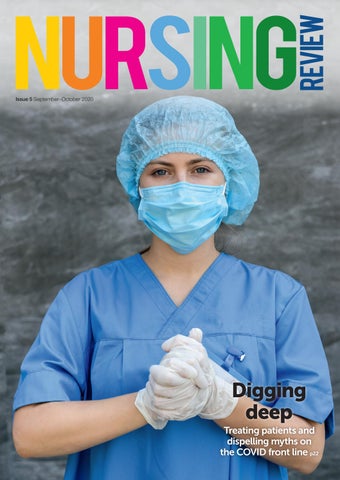
Issue 5 September–October 2020
Digging deep Treating patients and dispelling myths on the COVID front line p22
contents
MANAGING EDITOR
news
Richard Garfield 02 9936 8628 richard.garfield@apned.com.au
2
Labor weighs in on aged care
3
Should COVID residents go straight to hospital?
Dallas Bastian 02 9936 8637 dallas.bastian@apned.com.au
4
Colbeck grilled in inquiry
5
MP escapes leak investigation
HEALTH EDITOR
6
Activewear maker fined
NEWS EDITOR
Conor Burke 02 9936 8638 conor.burke@apned.com.au
02
06
SALES MANAGER
Sarah Licence 02 9936 8710 sarah.licence@apned.com.au
industry and reform
9
National approach Call for national COVID vaccine plan
10 Shining a light Poor treatment of pregnant women exposed
SUBSCRIPTION ENQUIRIES
Daniel Omelia 02 9936 8607 subs@apned.com.au
12 Masking the problem
PUBLISHED BY
14 Managing medication
The efficacy of masks to contain COVID
Wrong meds prescribed too often APN Educational Media GPO Box 4245 Sydney NSW 2001 ABN 58 090 900 999 ISSN 1326-0472 PP100001944
12
18
New workforce CEO stays neutral
specialty focus
18 From little things Training bridges language barrier
PUBLISHER’S NOTE
© Copyright. No part of this publication can be used or reproduced in any format without express permission in writing from APN Educational Media. The mention of a product or service, person or company in this publication, does not indicate the publisher’s endorsement. The views expressed in this publication do not necessarily represent the opinion of the publisher, its agents, company officers or employees.
16 Like Switzerland
clinical practice
20 Right on time Preemie rates down during pandemic
22 Straight talking – Cover story
20
22
Life on the COVID ward
workforce
24 Bright future Prepping nurses for new reality
26 Tech talk Using IT to fight COVID
technology
28 Voices heard Capturing COVID experiences
24
28 nursingreview.com.au | 1
news
Labor on aged care attack Opposition Leader Anthony Albanese during question time. Photo: NCA NewsWire/Gary Ramage
Albo comes out for minimum staff levels, union pushing Medicare rise to fund aged care. By Conor Burke
I
n a departure from the policies taken to the last federal election, Labor leader Anthony Albanese has come out in favour of minimum staffing levels in aged care. Speaking to the National Press Club, Albanese decried the state of affairs in the sector and blasted the current aged care minister Richard Colbeck. “There are few greater indictments on this Government than Minister Colbeck’s performance before the Senate Select Committee on COVID-19 led by Katy Gallagher,” said Albanese. “As he fumbled about with pieces of paper, it became clear that even the absolute basics of his job were beyond him. “We saw the heights of his ineptitude.” He hit the government for funding cuts to the system, such as the 1.7 billion stripped from the sector by Scott Morrison when he was treasurer. He also took aim at the revolving door nature of the aged care portfolio while the coalition has been in power. “As a distillation of the Liberal ethos – deregulation to the point it’s almost the law of the jungle – it’s hard to top. “They have churned through seven ministers with responsibility for aged care – one for every year they have been in power. “The incumbent doesn’t even sit in the Cabinet. And this week he was effectively demoted,” he said.
2 | nursingreview.com.au
Albanese laid out Labor’s eight-point plan for addressing the massive failings of the system, and top of the list is mandating staff to resident ratios. “In the absence of a Government plan, here are eight points the Government could consider: 1. Minimum staffing levels in residential aged care. 2. Reduce the home care package waiting list so more people can stay in their homes for longer. 3. Ensure transparency and accountability of funding to support high quality care. 4. Independent measurement and public reporting as recommended by the Royal Commission this week. 5. Ensure every residential aged care facility has adequate personal protective equipment. 6. Better training for staff, including on infection control. 7. A better surge workforce strategy; and 8. Provide additional resources so the Aged Care Royal Commission can inquire specifically into COVID-19 across the sector while not impacting or delaying the handing down of the final report.”
MEDICARE LEVY AN OPTION FOR FUNDING One funding option continually put forward as a fix for aged care is a Medicare levy and appearing on ABC’s Insiders, Albanese did not rule this out. “We’ll examine the royal commission when it comes out with regard to structural change that’s required,” Mr Albanese said.
“There are few greater indictments on this Government than Minister Colbeck’s performance. “But I make this point … Labor oversaw the creation of Medicare to deal with our health system as a whole.” The Health Services Union has called for a Medicare levy hike to pump up to $20 billion into Australia’s crisis-hit aged care sector. HSU modelling shows lifting the levy from two per cent to 2.65 per cent would transform the sector over four years. “Australians have a clear choice,” the union’s national president Gerard Hayes said. “We can provide dignity and decency to the generation that built this nation. And we can do it for a reasonably modest outlay.” The plan would create 59,000 jobs across the sector, which has come under immense pressure during the coronavirus pandemic, with hundreds of resident deaths. Lifting the levy would also improve standards for residents who would receive an extra 89 minutes of daily attention from carers, allied health therapists and registered nurses. However, Treasurer Josh Frydenberg was quick to pour cold water on the union’s plan. “We have no plans to do that. Our focus is on lower taxes,” he told Sky News. “We do commit to spending more on aged care by the tune of $1 billion a year.” ■
news
Home or hospital? Residents were removed from the aged care centre St Basils Greek Orthodox because of an outbreak. Photo: Jason Edwards
The debate over transferring COVID-positive aged care residents to hospital. By Dallas Bastian
A
ged care providers are equipped to deal with the flu and gastro, not unprecedented worldwide pandemics. That’s why Aged and Community Services Australia (ACSA) chief executive Patricia Sparrow believes all residents who test positive for COVID-19 should be transferred to hospital. “Immediate transfer to hospital of the first people in residential care diagnosed with COVID is the best possible protection measure against the terrible tragedy we are seeing unfold in Victoria,” Sparrow said. “Community transmission is the enemy of aged care. Once a single case gets into a facility it can be impossible to contain. This is because aged care homes are not hospitals. They aren’t staffed like hospitals. They are not funded like hospitals. They are homes.” In Victoria, the number of deaths linked to aged care homes has climbed to more than 170, while nationally more than twothirds of all COVID-19 deaths to date relate to people in residential aged care. South Australia and Queensland have both pledged to send any resident who tests positive for COVID-19 to hospital and ACSA said: “We really don’t understand why other states wouldn’t.” A spokesperson for Uniting NSW.ACT told AAP: “The vast majority of aged care providers agree – and Uniting NSW.ACT
residents and their families expect – that aged care residents who test positive to COVID-19 should be transferred to hospital for treatment.” The group, which has about 5500 residents in its care in 72 aged care homes across NSW and the ACT, said managing outbreaks within the homes is costly and inefficient. It argued automatic hospitalisation of positive cases would break the chain of infection within aged care homes, giving facilities time to ensure adequate staffing. “While there is still adequate hospital capacity in NSW and the ACT, why wouldn’t we transfer our most vulnerable people to hospital if they contract the virus?” the spokesperson said. In an opinion piece for The Conversation, Jed Montayre, a senior lecturer in nursing at Western Sydney University and Richard Iain Lindley, Professor of Geriatric Medicine at University of Sydney, said there are both advantages and disadvantages to consider. They wrote that while hospitals provide specialist treatment, better infection control measures and a much higher ratio of highly trained nursing staff, aged care facilities offer familiar faces, which the academics said may be particularly valuable during a time when residents aren’t able to see their loved ones. “Introducing a completely new environment during an illness, particularly for residents with dementia, may do more harm than good,” Montayre and Lindley said. “Limited knowledge about the resident could lead to unmet needs while in hospital, which could trigger behaviours that are difficult to manage.”
That line of thinking played a role in the decision not to hospitalise residents of Newmarch House, where 17 people died. Back in May, the chief executive of Anglicare said if he could go back in time he would push to have residents who tested positive for COVID-19 at Newmarch House sent to hospital. Grant Millard told ABC radio: “If I had my time again, I’d be insisting people who are COVID-positive go to hospital – in hindsight that would have been my preference.” Millard complied with NSW Health’s containment strategy after the outbreak and the state’s chief health officer Dr Kerry Chant stood by the decision-making of clinicians onsite at Newmarch House. “For many of the residents, that was their actual place of residence… when you move people from their environment they’re exposed to other risks such as falls risk, disorientation and then as a consequence get other health issues,” Chant said in May. In his opening statement for the Royal Commission into Aged Care Quality and Safety, counsel assisting Peter Rozen said meeting records showed NSW Health in April had a preference not to move residents into hospital to avoid setting “a precedent” around transfers. Rozen said: “We hope to understand what the precedent was that was concerning the New South Wales officials.” And later added: “Many of the residents in aged care homes worked their entire lives to build the world class health system of which Australians are justifiably proud. They have the same right to accessing in their hour of need as the rest of the community. To put it very directly, older people are not less deserving of hospital treatment because they are old. Such an approach is ageist.” Montayre and Lindley said hospitals may not be able to cope with such a large influx of aged care residents at one time. “There’s an argument that if COVID-19 cases can be managed within the aged care home, they should be, to avert pressure from the hospital system. “Worryingly though, we’ve seen reports of the health department denying requests for aged care residents with COVID-19 to be transferred to hospital.” The duo said on balance, it’s probably better to transfer residents to hospital as soon as they test positive to COVID-19. “This offers the best chance of preventing widespread infection among other residents and staff, and disease spread from the home into the community.” ■ nursingreview.com.au | 3
news
Senator Richard Colbeck. Photo: Gary Ramage / NCA NewsWire
Minister under fire Aged care minister embarrassed at senate inquiry, government preparedness questioned.
replied that it was “everybody’s responsibility to prevent the spread of the virus”.
By Conor Burke
A numbers game
S
enator Richard Colbeck faced intense questioning at the Senate Select Committee hearing on Australia’s response to COVID-19, and was criticised for appearing not to know how many people in aged care have died from COVID-19 since the beginning of the pandemic. The committee, made up of a senator from each of the major parties and chaired by Labor senator Katy Gallagher, tried to get to the bottom of whether the government was sufficiently prepared for outbreaks of the coronavirus in residential aged care, which resulted in a number of awkward, tense exchanges involving Senator Colbeck. Gallagher asked the minister for aged care if he could confirm if the government was the primary funder and regulator of aged care in Australia and therefore responsible for the safety of those residents. In what seemed like a continuation of the tactic Prime Minister Scott Morrison employed throughout the week, the senator tried his best to avoid answering the question. “Our responsibility is to provide information to the aged care sector,” he replied. “And to ensure that they have the appropriate systems in place to provide high quality care to senior Australians.” Gallagher rephrased a few times and asked if it wasn’t his government’s job to keep residents safe. To which the minister
4 | nursingreview.com.au
The most damming moment came when Colbeck was asked how many aged care residents have thus far died form COVID-19. The minister couldn’t answer and for the next minute fumbled through documents until a deputy secretary in attendance came up with the figure. He then couldn’t tell the committee how many people have the virus in aged care altogether. “It’s not front of mind for you as the minister for aged care?” Gallagher asked. “I’m struggling to believe that you are not aware of these details,” she said.
Worst case scenario Most of the two-and-a-half-hour session was spent disputing the preparedness for workforce shortages in aged care homes in the instance of large-scale outbreaks. Colbeck and Gallagher argued over her assertion that the government has gone missing on aged care in Victoria, with Colbeck telling the chair he found the idea offensive. The situation in Victoria remains “fragile” Colbeck said. The workforce is stretched, but considerable effort is going into helping alleviate this issue. “There is now,” Gallagher retorted. Gallagher, as well as Greens Senator Rachel Siewert and ALP senator Murray Watt, asked Colbeck repeatedly why there were workforce shortages in St. Basils aged care home when the senator and his department announced surge workforce plans in April. The government sent letters to providers telling them that they could expect to lose
80 to 100 per cent of staff in the event of an outbreak, but Colbeck told senators that his department never imagined the scenario at St. Basil’s – where all staff were lost to isolation – and that his plan was for losing direct care staff only. Colbeck also told the committee that there was no official strategy to address surge workforce needs in aged care, which provoked an incredulous response from the chair. “It’s just reactionary,” Gallagher said. We learned that to date, there have been 1,426 aged care staff who have contracted the virus, with Colbeck telling the senators that four or five times that number would be isolating and therefore out of the workforce.
No way to stop the virus The government was accused of a double failure in aged care: first letting the virus in to homes and then allowing it to spread. Colbeck said that it was his belief that there was no way to stop the virus entering aged care. The only way to do so would be to isolate the sector completely and as long as there is community transmission he said, there would be COVID-19 in aged care. When asked if the government had looked into how much it might cost to protect aged care residents form the virus, Colbeck replied that he did not believe that was possible.
Anderson sets record straight Aged Care Quality and Safety Commissioner Janet Anderson used the hearing to set the record straight about misleading information she provided in a previous session. She had previously stated that she had no knowledge of the St. Basil’s outbreak until 14 July, when in fact her commission had been alerted by staff at the home on July 10 that a positive test had been found. St. Basil’s had previously been accused of keeping authorities in the dark. “I am now aware that the Commission had received information on 10 July via our telephone assessment contact about a COVID-19 outbreak at the home,” Anderson said. “Although the Commission is not the first responder in a COVID-19 outbreak, and our understanding at the time was that the public health unit had been contacted, I recognise that we erred in not escalating this information to the Commonwealth Department of Health at the time and we should have done better.” ■
news
No Leak
Member for Keppel Brittany Lauga. Photo: Allan Reinikka
MP will not be investigated over claims she leaked contact-tracing information.
A
Labor MP will not be investigated over claims she leaked confidential contact-tracing information about a nurse who tested positive to COVID-19. The Crime and Corruption Commission (CCC) cleared member for Keppel Brittany Lauga, saying there was insufficient evidence of a criminal offence.
Nurses Professional Association of Queensland spokesperson Jack McGuire alleged information the nurse gave to contact tracers was passed on to Lauga, which was then leaked to the media. In a statement the CCC said: “Following an assessment of the allegations and information provided in the complaint, and after reviewing information independently obtained by the CCC, the CCC has now determined there is insufficient evidence that a criminal offence has been committed by the Member for Keppel. “Therefore, the CCC will take no further action in relation to her.” The commission referred another allegation – one relating to the alleged disclosure of confidential and personal information by a Central Queensland Hospital and Health Service (CQHHS) employee – to the CQHHS to deal with itself. “It is an opportune time to remind public servants who are required to deal with confidential and personal information to only access it, and disclose it, for authorised reasons,” the CCC said. Lauga told ABC Capricornia that the outcome exonerates her and added that she obtained the information to which the complaints referred through the media. “That’s where I learnt about it just like everyone else, so that kind of level of information is not provided to me as a Member of Parliament, nor should it be,” she said. “The conversations that people have with contact tracers is incredibly private and confidential and should be kept that way.” ■
Take a break on us Your organisation may be eligible for Australian Government-funded support to help alleviate the pressure of finding a temporary replacement when you or your colleagues go on leave. You will be given all the support needed to recruit, screen and place highly experienced health professionals that can hit the ground running from the moment they arrive.
For more information visit www.rurallap.com.au
nursingreview.com.au | 5
news
A Lorna Jane garment claiming anti-virus protection. Photo: Annette Dew
Sign at a Lorna Jane store in Toowong Village, Queensland. Photo Isabella Magee
Virus claims debunked Experts call out activewear company’s anti-virus claims. By Dallas Bastian
C
lothing company Lorna Jane has been fined $40,000 for claiming it sold “anti-virus activewear”. The Therapeutic Goods Administration (TGA) issued three infringement notices totalling $39,960 to the Brisbane clothing company for alleged unlawful advertising in relation to COVID-19. Lorna Jane allegedly claimed on its website that its “anti-virus activewear” prevents and protects against infectious diseases, which the TGA held implied it is effective against COVID-19. The website said that any bacteria “is terminated when it comes in touch” with a product applied to the fabric. The Royal Australian College of General Practitioners (RACGP) spoke out
6 | nursingreview.com.au
on the claims, warning consumers to be wary. RACGP president Dr Harry Nespolon said: “Active wear is great for the gym but it can’t protect you against viruses or bacteria. I suspect Lorna Jane are cynically trying to exploit fears concerning the COVID-19 pandemic to sell clothes. “If you spray their product onto any fabric and expect that it will act as a ‘shield of protection’ for you by breaking through the ‘membrane shell of any toxic diseases’ I have some bad news for you – this will not happen. The only thing that will be ‘terminated’ by the ‘shield particles’ is the money in your bank account.” Nespolon said such marketing could lull people into a false sense of security and make them less vigilant against the virus. In a statement, a Lorna Jane spokesperson said: “Our testing shows that LJ Shield is an important part of stopping the spread of both bacteria and viral infections and should be used in combination with other precautionary
measures such as face masks and thorough and frequent hand washing.” In a piece written for The Conversation, Catherine Burke, a senior Lecturer at the University of Technology Sydney, said there was no evidence the Lorna Jane product will work against viruses. “Even if the … fabric is antibacterial, there’s no evidence to suggest this product affects the survival of viruses, including the one that causes COVID-19. “Many antimicrobial products exist on the market. The important question for me isn’t so much whether they can kill microorganisms, but whether using those products actually reduces your risk of getting sick. In many cases, the answer is no.” As for whether antimicrobial materials in general work as intended, Burke pointed to one randomised trial that found they were not effective at reducing the numbers of bacteria on hospital scrubs. “So even in a healthcare environment where the risk of infection is higher than in the community, the effectiveness of antimicrobial materials for reducing transmission remains to be confirmed,” she said. The TGA alleged that Lorna Jane represented its ‘anti-virus activewear’ for therapeutic use and therefore believes that it is a therapeutic good within the meaning of the Therapeutic Goods Act 1989, and as such, should have complied with appropriate regulations. The regulatory body issued a warning to advertisers and consumers about illegal advertising of therapeutic goods, saying it will take action where appropriate. Adjunct Professor John Skerritt, deputy secretary of the Department of Health – where the TGA sits – echoed Nespolon’s concern about the impact of anti-virus claims. “This kind of advertising could have detrimental consequences for the Australian community, creating a false sense of security and leading people to be less vigilant about hygiene and social distancing.” ■
A combination anaesthesia that endures*
For use with:
Helps prevent pain and unnecessary expense
Minor cosmetic procedures
Vaccinations
Tattoos
EGO PHARMACEUTICALS PTY LTD
Always read the label and use only as directed. References: 1. Data held on file at Ego Pharmaceuticals Pty Ltd.
21–31 Malcolm Road, Braeside 3195 Australia australia +61 3 9586 8800 toll free 1800 033 706 ‘Ego’ and ‘Numit’ are trademarks of Ego Pharmaceuticals Pty Ltd. ©2019 Ego. ask@egopharm.com www.egopharm.com Date of Preparation: September 2019
0486-34/NR
* Lidocaine (Lignocaine) 2.5% w/w Prilocaine 2.5% w/w provides skin analgesia for 2 to 4 hours
1
SubScribe for leSS than $2 a week
The laTesT news and resources for healThcare professionals
• Analysis of the major issues facing the health sector today
Nursing Review is essential reading for anyone involved in the healthcare sector in Australia. It provides unrivalled coverage of specialist topics from features and opinion pieces, to international news and profiles.
• Can be used as a professional development resource
At Nursing Review we pride ourselves on being at the forefront of the ever changing healthcare sector. We provide an independent source of news, and cover the issues relevant to nurses and the sector giving an informative, practical and insightful view into day to day life in hospitals and in surgery.
• 6 issues per year • Interviews and opinion pieces from professionals in the industry • Written by an independent voice • Tax deductible
Please call 02 9936 8666 to find out more.
industry & reform
National approach Prime Minister Scott Morrison and Professor Peter Kelly visit with team members of the Microbiology Laboratory at AstraZeneca. Photo: Lisa Maree Williams - Pool/Getty Images
Regardless of the vaccine, Australia ‘needs a distribution plan’. By Dallas Bastian
T
he Australian Medical Association (AMA) wants Australia to quickly develop a national plan to distribute COVID-19 vaccination. AMA president Dr Omar Khorshid said it was pleasing to see that efforts of the medical and scientific community to fast-track a safe and effective vaccine were going well and that the Government has a plan to make a vaccine available to all Australians, but he added: “The greatest challenge is likely to be accessing enough doses of an approved vaccine and we expect that it will take some time to provide enough vaccine for the whole population.” The AMA said Australia needs to develop a plan for a Therapeutics Goods Administration endorsed vaccine to be distributed to at-risk groups first, particularly older adults and those with health conditions leaving them at increased risk. “After vulnerable groups have been provided with the vaccine, it should then be rolled out to other groups. All frontline health care workers should be allowed early access to an approved vaccine.” Khorshid said he’d be one of the first to roll up his own sleeve to receive a dose. He added he’s not likely to be the only one ready and willing as Australians know “it’s the only way to get back to the lives we led before COVID-19”. “There are of course implementation issues yet to be tackled about how to distribute a vaccine to those who need it,” he added. “We know there are often distribution problems in getting the influenza
vaccination distributed on time and to those who need it first. “To ensure Australia is ready and able to get a vaccination out, be it the Oxford vaccination or any other vaccine approved for use by Australian authorities, we need a national COVID-19 vaccine distribution plan.” The Federal Government recently inked a deal to produce the Oxford-AstraZeneca vaccine locally, should trials succeed. Prime Minister Scott Morrison said he is “hopeful but also naturally cautious” that it will be safe and effective. “We are not putting everything in the AstraZeneca basket but it is one of the most advanced and the most likely, based on the expert advice we have,” Morrison said. If it proves successful, the government would manufacture it and provide it to Australians for free. Writing for The Conversation, Professor Katie Louise Flanagan, an infectious diseases specialist at the University of Tasmania, and Magdalena Plebanski, a Professor of Immunology at RMIT University, reminded Australians that the Oxford vaccine hasn’t completed phase 3 trials, “so we can’t be sure it will be safe and effective for all”. “All the signs are promising so far, as the vaccine has been shown to provoke an immune response in humans and hasn’t yet caused serious side effects,” the pair wrote. “But there’s a risk the vaccine may not fully protect against COVID-19 in humans. “It still needs to pass through phase 3 trials, which are currently recruiting and expecting results at the end of the year. So we can’t get too excited yet.” The virus has mostly been tested on young, healthy individuals, the experts added. “It may still produce serious side effects we don’t yet know about.”
Currently, there are more than 160 candidate vaccines in development, dozens of which have entered human clinical trials, including Russia’s ‘Sputnik V’ vaccine, which was controversially granted regulatory approval after less than two months of human testing. In a separate Conversation article, University of Sydney Associate professor Adam Kamradt-Scott, a global health security scholar and former RN, said even if the Oxford or Russian candidate and others are proven to be safe and effective, developing the vaccine is just the first step. “Some of the biggest challenges in getting everyone vaccinated still lie ahead.” Kamradt-Scott said initial supplies are going to be extremely limited. “The first major challenge after a vaccine is developed is to produce enough of it to start vaccination programs. “It has been estimated that to achieve sufficient levels of immunity among the global population with a two-dose vaccine, we would need between 12 billion and 15 billion doses – roughly twice the world’s current total vaccine manufacturing capacity. “Shifting to exclusively manufacture a COVID-19 vaccine will also mean shortages of other vaccines such as those for preventable childhood diseases such as measles, mumps and rubella. So prioritising COVID-19 could cost many other lives.” He added that without substantial investment to strengthen international and national supply chains, it will be years before vaccines reach everyone who needs them. Kamdadt-Scott predicted a long wait before the world is vaccinated and the borders are open as before. If they become available sooner than expected it will “only be because countries have agreed to work together like never before”. “Let’s hope they can do it.” ■ nursingreview.com.au | 9
industry & reform
Shining a light COVID-19 has revealed ‘human rights abuses’ that pregnant women face. By Conor Burke
P
regnant women have faced significant obstacles over the last eight months. On top of the challenges expectant mothers usually experience they have the added stress of a once-in-a-generation pandemic. Add to the mix a consistent stream of inconsistencies nationwide over hospital birthing protocols, and what should be a wonderful experience for most women has become considerably less so. Women have had very specific birth plans changed and changed back again by government and hospital policy, and many women feel they are being denied the choice to birth the way they want. Health experts also worry how this will affect the health and wellbeing of children born of the pandemic.
10 | nursingreview.com.au
For Melbourne woman Sarah Sherman, pregnant with her second child, it started when she was looking for a new hospital. “When I went to my first appointment with them, I got to the hospital and the reception staff literally treated me like I’d walked in there with a bomb. They were like, ‘Why are you here?’ They were really rude to me,” she told Nursing Review. At her next appointment she was told to wait in the carpark, phone the midwife and conduct a thirty-minute interview over the phone before she was allowed to set foot in the hospital for her tests. Sherman feels that the level of care she has received compared to her first pregnancy is “non-existent” and that this pregnancy has been “stressful” and a “joyless experience” as she battles constant worries over whether her hospital will allow her to have a water birth or even gas and air.
NO RIGHTS Professor Hannah Dahlen from Western Sydney University says this is a symptom of
the constant infringements on the rights of pregnant women, now brought to light by the pandemic. Dahlen uses the recent stoush over showers and water births as a case in point. The Royal Australian and New Zealand College of Obstetricians and Gynaecologists (RANZCOG) has come out against the use of water in the birth setting. “What RANZCOG put out a couple of weeks ago was, I think, giving open slather to deep biases and agendas. Obstetricians have never liked water birth. To be honest, hospital managers are highly suspicious of water birth. Many people find it quite peculiar and only because women insist on doing it do we provide them the support for it, not only because the evidence tells us that actually it’s a very safe thing to do and women really like it and it helps,” Dahlen tells Nursing Review. The RANZCOG website says: “However, in the setting of increased community transmission of coronavirus (COVID-19), services are advised to suspend the use of water immersion for labour and birth for all women. The protection of our maternity
industry & reform
and neonatal health care workforce is essential. PPE is not effective when wet and consequently, the use of water immersion during this period presents an unacceptable risk.” “I despair sometimes,” Dahlen says. “We’re just about to publish a paper that talks about how the COVID pandemic has really exposed the pandemic of human rights abuses when it comes to women’s reproductive rights. Because very clearly, what came out is guidance from WHO, from The Royal College of Midwives, from many, many different bodies, that there is absolutely no evidence of transmission of COVID in a bath. “Unless you had a woman who was known to be COVID positive, and that’s a very different case. If you don’t have that, then there is no reason that water births should not be an option for women. Now in our massive study that we’ve undertaken where we’ve got nearly 5,000 responses, we’ve had two women positive for COVID in that time.”
MENTAL HEALTH FALLOUT A huge stressor for many expectant mothers has been childcare. Sarah and her husband had recently moved to Melbourne before the pandemic hit and have no family in Australia. Now with stage four restrictions in place and the due date in sight the rules around which family member can be in the hospital has added yet another strain. “I’m obviously super excited because I get a baby at the end of it, but I’m probably not going to have any more babies after this one, and I didn’t get to enjoy just going out and being pregnant and showing people my bump or anything. But not only that, it’s just been so stressful worrying about what’s going to happen at the birth, who’s going to look after [first child] Caer when I birth,” she says. “Am I going to be able to have the pain relief that I want, or is Drew going to be able to attend the birth with me? The whole thing, it’s just been an absolute nightmare, to be honest.” Dahlen worries about the mental scars that this period will leave on the women and their children. “None of this has been done with any kind of common sense and consultation with women and what is important to families,” she says. “My big concern is that the aftermath of the psychological trauma of what’s going on now, we’re going to be part of
that. And that aftermath will go on and have repercussions for child development, concern over mental health, then on and on it goes into society. “We know mental health issues and anxiety is on the rise. We know that if you’re pregnant and highly stressed and feel unsupported, that has an impact on your baby. Then you’re more likely to have a postnatal depression. You interact differently with your baby. Your baby’s brain gets wired differently, grows up, and it goes on. “So when we talk about women who are pregnant and giving birth, we’re actually talking about the future of society.”
VIEWING BIRTH DIFFERENTLY The differing rules from hospital to hospital and state to state around water and visitation is another issue for Dahlen, who believes that many decisions are not evidence-based but decided by an inflexible medical establishment. “In some hospitals they’re saying, particularly in some private hospitals, women should be encouraged to have early epidural. Now, doctors are very comfortable with epidurals. A woman who’s immobilised on a bed, they can pretty much do whatever they want. They’re not comfortable with a woman who’s rocking around the room or in a bath, doing things that aren’t part of their domain,” says Dahlen. “So already, you start to see what gets preferenced, and what doesn’t get preferenced, is very much within that medical paradigm. But I also think what we’ve done, unfortunately, in our historical birth context is take a highly human social, physiological function, and it is the only physiological function, and we have placed it in a medicalised, pathologised, institutionalised organisation of hospital structure. And we are about efficiency. We are about fixing, and we are about pushing out, and moving things along. “So we put birth in this context, and so the ripple-down effect of sickness needs to be fixed, and it’s all about making sure that you fix the disease and you get them out; this is permeating into decision making around birth without the realisation that this is a very, very social and physiological function that has long term consequences regarding trauma, the bonding with babies, the way women feel about themselves, and about mothering.” Dahlen says that society has done women a huge disservice during this pandemic. She says the data shows that
“We’ve really failed … the potential worldwide implication is of more mothers and babies dying. worldwide, there has been a 10 per cent reduction in services for women during pregnancy and birth. “We’ve really failed … the potential worldwide implication is of more mothers and babies dying. And it is massive. “Look at the abortion services. When the COVID pandemic began, the message to services offering abortion was they were not considered an essential health service, they were not entitled to PPE. So they had to go down to Bunnings to buy their masks and their gloves. And yet again, we make comment on women’s reproductive services by those sorts of decisions. “There’s a big international report that’s being put out, looking at the consequences and I’m fascinated … in New South Wales, we went and shut down one of the only freestanding birth centres in order to have a COVID clinic. You cannot tell me there are no other places to run a COVID clinic. So why did we target that? Because nobody’s ever been really happy with freestanding birth centres because they don’t make doctors feel comfortable. So, the agendas have definitely been exposed in this pandemic.” Sarah is glad that she eventually found a hospital which allows water births, as well as gas and air (she says they “must have a few women on the board”) but laments how this major life event has been changed for her. “Honestly, I’m just really grateful that I’m not a first-time mum, because as a secondtime mum, I feel like so much has been taken away from me, but can you imagine as a first-time mum? You don’t even know what to expect. You don’t know what it’s going to be like. “After I had Caer, my husband had to go home because of visiting hours in that hospital … I was absolutely traumatised by that, and that wasn’t during a pandemic. Can you imagine what that would be like now for a first-time mum? It’s just hideous. “I don’t know what they’re trying to achieve. I know you’re trying to protect people and keep them safe, but the levels of postpartum depression after this are going to be outrageous I think.” ■ nursingreview.com.au | 11
industry & reform
Masking the problem The arguments around the efficacy of masks in helping stop the spread of COVID-19. Nick Talley interviewed by Conor Burke
T
he coronavirus outbreak in Melbourne, and now spreading to New South Wales, has thrown the nation’s seemingly smooth recovery from COVID-19 up in the air. Lockdown measures have been in place for weeks and we’re now having conversations about how we will live with this virus long term. Nowhere are these conversations more fractured than over the use of masks by the public as a measure to slow the spread of the virus. There is debate about their efficacy, and mixed government messaging is compounding the confusion. One mask advocate is Professor Nick Talley, editor of the Medical Journal of Australia, and he joined Nursing Review to discuss the merits of mask use and whether they should be made mandatory nationwide.
NR: What is your position on mask use in the fight against COVID-19? NT: Mask use alone is not the answer, but I do believe that adding masks to social 12 | nursingreview.com.au
distancing and hand hygiene and so forth is critically important. The evidence supports it and it needs to be widespread. The real issue is if only a few people wear masks. If most people wear masks when they’re out and about in outbreak areas, there is good evidence that there are real added benefits.
Why is there such anger and confusion over the use of masks? I think there have been confusing public health messages. To be honest, the data was not clear at the beginning of this new virus. It behaves a little bit differently to other similar viruses. So it’s been difficult to know what should be the best advice. And indeed, some people still don’t believe masks add very much value, but the bulk of evidence really has firmed up to support the use of masks. There’s lots of both direct and indirect evidence, and I think that’s part of the problem. In Victoria mask use is recommended all around the state, but in Melbourne and related areas where the outbreak is, it’s compulsory. I would argue in New South Wales, with its continued bubbling along of cases, which is very worrying, widespread use of masks in the outbreak area would be pretty reasonable.
Is there any other area of public health messaging that has been so mixed and poor? Doesn’t that undermine the rest of the nation’s efforts? It’s certainly not been ideal and I would have argued consistency and keeping it as simple as possible really matters. The data’s pretty clear and the modelling’s clear. If 70, 80 per cent of the population wear cloth masks and masks are about 70 per cent effective, which is about what the data says, then indeed, it really makes a very significant difference to transmission according to the information that we have. The messaging needs to be: as many people as possible need to wear masks when you’re out and about. It’s really valuable to wear masks. Schools are a complex issue, but where possible, yes, one could argue wearing masks in that setting where you’re in enclosed spaces for prolonged periods, that would reduce transmission. The social distancing remains so critical, but masks promote social distancing, and that’s one of the value adds of masks. It’s not just the physical barrier. One other point to make is masks work primarily for preventing an infected person transmitting, less so for preventing you from catching it. So if the infected
industry & reform
I think of the HIV epidemic analogy where condom use was recommended. And in fact, there was a federal government campaign to promote this. And while that wasn’t popular in all quarters, no doubt that saved a lot of lives. And again, people need to hear the clear messaging and I hope the messaging gets clearer because I still think there’s a little bit of confusion.
In Asian nations, when people are sick, as a matter of courtesy people put masks on. Why do Western nations struggle with this idea? I think it is cultural. We’re not used to wearing masks in public. That’s not something that we’ve seen in Australia since probably the Spanish flu epidemic. So I think that’s probably the explanation. In other parts of the world, this is normal, and indeed, well accepted. Masks alone are not the answer. It’s very much about a combination of strategies. But if you can combine the strategies, and masks are part of that, I think it could make a real difference, and I hope, in Victoria, it will.
people aren’t wearing masks there’s a real problem, even if you are. So that’s the message.
We’ve used masks and PPE for infectious diseases for a very long time. They’re widespread in medical circles. Why is the science divided? I think that there was some evidence that was presented, although it wasn’t very strong evidence, that standard cloth masks may not be preventative or very useful, and this was cited as evidence you shouldn’t promote mask use. That’s all changed with more information and more data from areas where the outbreaks have occurred, as well as all the modelling that’s being done and the information on aerosol transmission or particular aerosol transmission of the virus. I think it’s fair to say that with a new outbreak there was confusion. But I must admit, as I think back on this, we’ve used masks in medical settings for a long time and we wear them for very good reasons: to protect ourselves and protect our patients from infectious diseases that we can transmit through talking, coughing, sneezing, et cetera. And this is no different.
When you’re running, you don’t have to wear masks. And quite a few people were maybe upset by that. What is your view on masks and running? Well, I think all I can say is I hope that runners stay well away from each other. It’s a matter of being well away. The good thing about running outside is the air moves and that brings the microdroplets down very quickly. And there’s some experiments about open windows and the ventilation in a room being helpful. The problem is if you’re running inside a gym there could be droplets in the air staying there for hours potentially, and that’s a risk to others if you’re infected.
Is this only an argument because numbers in Australia up until now have been comparatively low? If we had larger numbers, would we have embraced masks earlier? In March, April and the initial a wave of infection, most of it was from return travellers. It was easier to isolate, easier to test and trace in that sense. There was limited community transmission. We didn’t really have a big community outbreak, although we were fearful there might have been, but it looks to me like we had limited community outbreak.
“We’ve used masks in medical settings for a long time and we wear them for very good reasons … this is no different. This is the real first wave we’re having now, in Victoria and probably New South Wales. This is where there’s really serious community transmission and this is why now masks make sense. You could have argued at the last lockdown perhaps they were not required, and in hindsight, which is always the easiest tool to apply, I think that’s right. But this time, to me at least, based on the evidence that I’ve seen, it would be very sensible for as many people as possible in outbreak areas, that’s in Victoria and New South Wales right now, to wear masks. And if most people comply, it’ll make a difference with the other strategies.
What should people look for in an everyday mask? Obviously, a surgical mask is better than a cloth mask probably, and an N95 mask is better than a surgical mask, but for community situations, it’s going to be some kind of cloth mask. The recommendations are it be multilayered, at least three layers, it have a water-resistant fabric if possible. It also needs to be dry and clean. You can make these out of t-shirts or socks or other materials, and there are videos online to teach you how to do this. There are groups making cloth masks with the characteristics I just described that are good quality that you can purchase. You can also purchase medical masks too, although one always worries about supplies running out if that become more problematic with transmission over time. I think that they’re the characteristics of a good mask, but anything over your face probably helps. And of course, the key thing is to put it on, wash your hands before you put it on, wash your hands after you put it on. Then when you get home, take it off carefully and wash your hands again. Protect yourself from self-infecting. That’s obviously key. And wash it every day if you’re using a cloth mask. Don’t go out in a dirty cloth mask or a wet cloth mask because that’s not probably going to be as effective. ■ nursingreview.com.au | 13
industry & reform
Communication is key New research identifies barriers to good medication management in dementia care. By Conor Burke
P
oor communication, poor training and a lack of reviews are the main reasons that two-thirds of people with dementia are prescribed the wrong medications, new research has found. Led by Monash University’s Centre for Medicine Use and Safety (CMUS), a new study from Monash University explores system challenges which may lead to poor medication management. The work investigates the obstacles and complexities in medication management for people living with dementia through qualitative research involving four key stakeholder groups: carers, general practitioners, nurses and pharmacists. “Most people with dementia live with multiple chronic diseases, which often require medications to manage symptoms and disease progression. It’s a complex and challenging process which requires many competing considerations when optimising medication use,” said lead author Dr Amanda Cross.
14 | nursingreview.com.au
Medication management has been a major concern throughout the aged care sector and a large part of the Royal Commission has been devoted to chemical restraints. It has been estimated that about 80 per cent of people in residential care with dementia are on one form of psychotropic – be that antipsychotics, antidepressants or sedatives – but experts believe that only around 10 per cent of those might benefit. It has also been found that aged care residents are often prescribed antipsychotics for longer than two years on average. This was equivalent to more than 80 per cent of the time they had been living in care and without a single adjustment to the dose in over a year. Government guidelines limit the use of these medications to 12 weeks, and only for people with severe behaviours of a certain type. Cross said that medication management for those with dementia becomes particularly complicated in the context of polypharmacy increasing cognitive decline, changing goals of care, multiple stakeholders and multimorbidity. Limited evidence to guide prescribing and deprescribing for people with dementia makes this process even more challenging.
“We know that up to 90 per cent of people with dementia are exposed to polypharmacy and for each additional medication used the risk of emergency department presentation and mortality increases.” The research found that the barriers to effective medication management are poor communication and relationships between stakeholders, infrequent medication reviews and a lack of practitioner training, evidence and guidelines to navigate prescribing and deprescribing decisions. The study recruited focus group participants from a wide range of communities and healthcare settings, including those in carer roles who are carrying the majority of the burden and often experiencing high levels of stress, perpetuated by complicated healthcare systems and medication regimen complexity. Health professional and system-level changes are therefore key to help minimise the burden placed upon carers. “Health professionals need to collaborate and communicate to help optimise medication use and future interventions should focus on training and evidence-based guidelines for prescribing and deprescribing in people with dementia,” Cross said. ■
Take your nursing career further
You’ll receive specialised expertise and training in a range of health-related fields. And wherever you join us from, we’ll give you an engaging experience, tailored to the areas you’re passionate about. Learn more at utas.edu.au/online/health
PHOTO: Osborne Images / CRICOS Provider Code 00586B
The last six months have highlighted the vital role nurses play in our community. By studying with us in 2021, you can really take your career to the next level.
industry & reform
Neutral territory
an agency registered nurse. I’ve worked across the spectrum clinically. One of my grandmothers spent the last 10 years or more of her life in residential aged care in Queensland. So from a young age, I was very much aware of what residential aged care offered to older people in the country, at least in her situation. And then further in my career, I more recently worked for the Commonwealth government in the department of health where I worked in Indigenous health for 10 years, and then in aged care for over five years. I worked on the Living Longer Living Better taskforce, so I’ve been involved in that team in developing those reforms and working across the sector.
O’Neill joined Nursing Review to discuss her ambitions for the council.
NR: Your appointment was funded with government support. What does that mean, exactly, and how involved are the government going to be in the council?
New workforce council CEO vows to avoid politics and effect positive change for aged care workers. Louise O’Neill interviewed by Conor Burke
L
ast January, the various aged care peak bodies announced the formation of an industry group dedicated to leading the sector’s workforce strategy. The Aged Care Workforce Industry Council was recommended by the Aged Care Workforce Strategy Taskforce’s report A matter of care – a strategy for Australia’s aged care workforce, and has been charged with enforcing the 14 strategic actions outlined to help build a better trained and better paid workforce for the future. Now, more than a year after the announcement, the council has appointed its first CEO, former nurse and senior bureaucrat Louise O’Neill. O’Neill comes to the role amid a tumultuous period for the sector. The author of the workforce report, John Pollaers, recently told the media that the government has “sat” on the report for two years and has “ducked” its recommendations.
16 | nursingreview.com.au
LO: Initially the government is very involved in helping to fund the council. That said, the industry itself is also providing very large amounts of in-kind support to the council’s runnings. The current deputy chair, Kevin McCoy, and the other nine directors on the council at the moment are all senior leaders in the aged care sector, either providers or representative of the workforce itself or consumer organisations. And they all give of their time freely and ‘freely’: there is no charge from them to be on the council. In the short time that I’ve been here, they have been incredibly supportive in working with me. Eventually the council is aiming to be industry-run and largely funded by industry. But of course, government’s been very generous to kickstart us into this. And the industry is clearly responding very strongly about it too, in a positive way.
A criticism of some high-level roles in the management and running of aged care on certain councils has been that managers don’t have relevant aged care experience. What is your background and what do you bring to this role? I was a registered nurse for 22 years, mostly in emergency and intensive care or acute settings. But I did work as a casual worker, so I’ve moonlighted in aged care often as
What do you see as some of the really pressing issues for the aged care workforce? I don’t think it’s any surprise to people, given there’s a royal commission in aged care at the moment, that the workforce in aged care has not always been able to provide the care that people expect or should be entitled to. That is no criticism of aged care workers. It is that the industry and government needs to work together to support workers to be better trained and have clear career pathways and be remunerated appropriately. It’s no surprise that that’s the central issue behind delivering the implementation of the strategy. In the current climate with COVID, I think it’s a really huge challenge, and it’s something that certainly I have never seen in my lifetime, and I don’t think anyone in this country has.
How can a council that has been actioned by the peak bodies and is part funded by the government be able to properly and independently advocate for the workforce? The council is independent, and I see part of my role as being really clearly independent. I’ve very much done some ‘speed dating’ with the whole industry in the first four weeks in my role, and one of my comments to all of the leaders in the industry has been that I see myself in the council as Switzerland – that we hold a neutral role in all of this, and our key objective is to deliver the 14 strategic actions of the strategy and to work with industry. Not just providers, but unions and the workforce entities,
industry & reform
definitely the consumer entities as well, and other organisations that support people who are in care to make sure that we get the best for our workforce and ultimately the best for all the people who receive care.
There are 14 strategic points that are going to be the focus of your work. What do you see as the most important to improve or tackle first off? There’s a couple of things that are already well progressed. So there has been a significant amount of work developing the aged care workforce study to help the council and the sector better understand workforce needs and their own workforce situation. There’s also work on digital learning and what that means for the sector and how we can actually enhance that. And I think there’s a real opportunity here with what we’ve seen through the COVID response in terms of online training becoming much more acceptable. [The question is] how do we actually digitalise the training and ensure the safety of workers and the care recipients? The industry itself has been working to drive the delivery of the voluntary industry code of practice, which we hope to see released in the next couple of months. And I know that there has been a lot of consultation already led by LASA and Sean [Rooney] leading that with the sector providers and consumer groups.
I really want to push forward with how we change the image of the sector and make it a sector of choice. There are opportunities with lots of people who unfortunately have had a downturn in their ability to work through tourism and travel industries, for example, who would make fantastic additions to the workforce in aged care. There’s some great opportunities for us here.
It’s going to be tough to be that Switzerland and advocate for higher staff pay when you’ve got the government on one side and the peaks on the other maybe not necessarily wanting that to go up a drastic amount That is an important part of the strategy. It is incredibly important that the councillors are able to work closely with government and the industry and drive a better outcome for remuneration for workers. I think I can still do that ‘big Switzerland’ because I can be true to the intent of the strategy and walk that path without becoming highly political in the middle of it.
We’re seeing in Victoria people coming to work while they’re symptomatic, because workers in the sector can’t afford to stay home. Do we need to have a higher minimum wage for aged care workers? That’s a good question. And it’s not one I have fully contemplated currently in my role. I know that we need to look at their
remuneration differently. And it needs to be something that everyone can live with, but not least of all that workers feel they are appropriately remunerated for the roles that they play. And I think this is going to be a really tough one to implement, but it needs to have really good thinking around it from some clear experts in the field and from collaboration across government and industry to come up with the right solution. I want to drive that through, but I don’t have the answer to it right now.
When your time is finished, what would success look like? Success for me would be that we have addressed all of the strategic actions in the matter of care. There’s 60 recommendations under those actions, so it’s sizable and it’s detailed in what we need to deliver. The council is not accountable for delivering all of them, but is accountable for pushing to have them all delivered. In my first three years I think it’ll be a case of scratching the surface of some of those actions in the sense that there’ll always be work to continue on in many of them. Success for me would be that they are clearly having positive outcomes for workers, and that we’ve got a more robust workforce with more and better trained workers, and that older Australians are getting the care that they really want and need. ■
DIGITAL HEALTH INSTITUTE SU 10 - 25 NOVEMBER 2020
BRISBANE
PERTH
SYDNEY
MELBOURNE
IT ADELAIDE
Healther lives, digitally enabled digitalhealth.org.au/institute-summit
nursingreview.com.au | 17
specialty focus
From little things
New staff training aims to bridge the language barrier, foster stronger relationships between residents and carers. By Conor Burke
A
new training kit has been developed to help foster stronger relationships between carers and aged care recipients. The creation of The Little Things training kit was led by the Farnham Street Neighbourhood Learning Centre in partnership with Meaningful Ageing Australia and contains evidence-based intercultural language training materials for personal care assistants from culturally and linguistically diverse (CALD) backgrounds working, or training to work, in aged care. It is all about increasing the confidence of students and helping them engage with older Australians in a meaningful way in their future careers. Approximately 6.9 million Australians were born overseas and 23.2 per cent of homes speak another language as well as English, and it is estimated that 32 per cent of RACF workers were born overseas, so finding a way to communicate in a diverse society is key for care workers. The idea was formed by Pip Mackey, project coordinator of The Little Things training, as she taught English while
18 | nursingreview.com.au
studying for her master’s in applied linguistics. Mackey taught an Ethiopian student who often struggled with grammatical English and worked in aged care while she studied. “I became interested in that, thinking of the complexity of the work of a personal care assistant, which we call PCAs. With that complex work, with this sort of low, strictly low level of English, how was she managing to bridge that divide?” said Mackey. “I was also studying this use of pragmatic language, which is the rules and tools of how we make meaning between ourselves and the other person, and how we understand or misunderstand each other. So, she was my sort of ‘person zero’ on that, and I did some study activities with her and looked at how she had all these pragmatic language skills, even though maybe her verbs didn’t agree with their pronouns, and was clearly very effective in the way she connected with an older person.” This initial idea led Mackey to seek and receive funding through the Workforce Training Innovation Fund, the Department of Education and Training in Victoria. Mackey spoke with Nursing Review to discuss the project and how it can improve the lives of aged care recipients.
NR: What does the training include? PM: The key tools are six films. The Little Things project involved going and making
recordings of personal carers working with older people. So, the participating PCAs, who were nominated as displaying best practice by older people living in aged care homes or by senior staff, were interviewed as were the senior staff and trainers in our RTOs to find out what they saw as the most important things that people needed to know and learn. Best practice PCAs wore little audio recording devices and made recordings with older people who volunteered to be part of it over a course of three days. We used those recordings, after coding and analysing them, to form the backbone of six films. So, everything relies on authentic language use and the practise that we observed in the aged care homes, as well as what occurred in the recordings. They’re not scripted as such as using chunks of authentic language. It includes a lot of what we call ‘little words’ that are really quite important and often overlooked and rarely something that you teach a person, but they are discourse markers. So, they’re the words like the ‘so’ or the ‘okay’ and the ‘aha.’ A lot of those little sounds are interspersed through our language and they perform really important functions in the way we communicate. So, the films highlight those as well as highlighting other language strategies people use, such as how they might connect with an older person as they go along.
specialty focus
How they might do things like use their voice. They might refer to a shared history. They might say, ‘We did that yesterday. Let’s do that together,’ and it’ll incorporate that sort of small talk in the chat. There might be a bit of fun. We found a lot of the PCAs that we met talked about how some of them like to sing, and join in singing a song with an older person. The films describe six different situations that commonly occur. One of them is setting the dining room and some of the politics around serving of lunch and people sharing tables, attitudes to food, to alcohol. There’s a shower scene. There’s a situation where an older person is reluctant to engage in an activity, and the PCA is aware that she needs to encourage that person to come out of her room for her mental health needs. Lots of these issues that get commonly described, they’re our backbone. We have a trainer’s manual that describes how the training can be delivered, and it really focuses on it being very flexible training. We know that if a trainer wants to use this in an RTO, that trainer is going to have a lot more opportunities to spend more time and expand and engage their students, and those students will benefit from communicative activities.
All of this work eventually led to a pilot program. Can you tell us a bit about the places where you ran the program and some of the things that you’ve seen arise? We worked with four aged care organisations and three RTOs as partners, and they fed into the project the whole time and that’s where we conducted our research. When it came to the pilot project, we delivered the training at three RTOs to groups of students who were studying certificate three in individual support, and we also delivered it to groups of personal carers who were in the workplace at the aged care homes: Ourcare, Uniting AgeWell, Outlook Gardens; and the three RTOs were Levitan Community Education, The Centre in Wangaratta and the Westgate Community Initiatives Group. We went and trialled the materials. We actually ran a first pilot program where we had three-hour training sessions. We surveyed the students or the PCAs pre and post training and looked for what effects the training had. We had really good results from that, and we also used that as our main idea to help us improve the materials for the next round of trials, which we ran
January through to March this year, and of course, COVID-19 hit as we were just finishing off. Professor Yvonne Wells from La Trobe Uni conducted the evaluation. She used the pre and post surveys and she also ran a most significant change evaluation process. She interviewed 23 of the trainees, about two- or three-weeks post-training, to ask them what the most significant change was that they experienced from the training. We also ran an online survey three or four weeks after and had pretty good responses from that too.
What kind of feedback were you getting from students and the recipients of care? We weren’t surveying the recipients of care. We were surveying the PCAs and the RTO students, and the feedback we were getting was very much that this kind of training helped them relate better to people, think about relating to people, and relating as they went along. Some of them said things like, ‘This training should be given to all carers.’ ‘The older person is going to feel safe, comfortable, and trustful to you.’ ‘It showed me how to connect with others in specific situations in day to day care.’ ‘I realised that this will improve the relationship between me and residents.’ And this one came up quite often and in discussion as well: ‘It made my job easier and now I can relate to my clients even more.’ So, it was self-perceived improvements, but the perceived impression of how their communication skills improved was 80 or 90 per cent.
So, it was probably a lot about confidence? Yeah, confidence came up as a theme. The most significant change was the quality of evaluation process, and that was one of the key themes; that confidence had improved remarkably from this three hour session, and that they could see that they could apply it, that it was relevant, and they very much looked at how it could improve the quality of care that they could offer.
Was there any anecdotal evidence from the homes and recipients of care? I know there was no official survey, but was there any feedback, or just things that you noticed from the recipients? There was a beautiful quote, someone saying of when, after they did the training
and they were talking to an older man and he said stuff like, ‘What’s happened to you? You’re talking so differently.’ So, clearly they did notice, and it came up that they were just noticing they were a bit more efficient and coming up against less resistance from an older person.
About the name, The Little Things. It sounds like it is all about those little niceties, those little bits of relationships that can be built through the small act of language and communication. Yeah. I’d definitely agree. They are massive. So, there’s a couple of answers to that. One, it’s not just the niceties. They are really important ways of how you modify your practical type of language. A PCA’s job is extremely practical, but also extremely relational at the same time. So, how they modify their language during some very tricky, practical tasks and very intimate and very invasive ones to make that person feel, as one of our trainees said, ‘comfortable and trustful to you’. Those are their words. That is really important, and you can do it with language in conjunction with body language and facial expressions. They are the things that don’t necessarily transfer across a culture, but we don’t often have a discussion about how those cultural differences can apply and then just feel somebody is being rude because in their culture, your tone of voice goes down when you would like the tone of voice to go up. Those very subtle differences make a massive difference. So, those are really little things that have a very big impact, and the other thing was just about everybody we interviewed to ask what those differences were in communication, they often said, ‘Oh, it’s just the little things. You know?’ It’s just saying hello before you take a nightie off or the little ‘Thank you’s,’ or the ‘How are you?’ Or the taking an interest in a picture that’s on a wall. Those very little things make a big difference, and yeah, we almost heard it with every single person. They said how important those little things were, because we know we can’t ask a PCA to add another big thing to their daily care routines, but they can incorporate these little things to the work that they’re already running around doing. ■ nursingreview.com.au | 19
clinical practice
Arriving on time Where have all the preemies gone during the pandemic? By Conor Burke
M
aternity wards across the globe have noticed something strange happening during the coronavirus pandemic. Premature births were disappearing. Preterm birth is defined by the WHO as babies born alive before 37 weeks, with extremely preterm occurring before 28 weeks. In some of the countries that recorded a drop in preemie babies, rates of births occurring before 28 weeks dropped by as much as 90 per cent. As reported by the New York Times, the discoveries were made at the same time in both Ireland and Denmark. Unbeknownst to each other, doctors in both countries looked at the data from the time during severe lockdowns across Europe and compared it to previous years, and found all preterm birth rates plummeted. Dr Roy Philip, a neonatologist at University Maternity Hospital Limerick in Ireland, looked at all the births in January and February of every year since 2001 and compared the birth weights of those babies with the babies born in 2020.
20 | nursingreview.com.au
Babies born under 3.3 pounds are classified as very low birth weight and made up 8 of every thousand births in his hospital. He found that number had dropped by a quarter in 2020. His hospital also recorded no births in the extremely low range, 2.2 pounds, which usually made up three in every three thousand births. “Initially I thought, ‘There is some mistake in the numbers’,” Philip said. The Denmark researchers were finding similar results, as doctors there looked upon near empty NICUs. One hospital found the rate of babies born before 28 weeks had dropped by 90 per cent. The researchers are stumped as to why this is all happening. They hypothesise that lockdowns may be forcing expectant mothers to actually fully rest more than before in the final term of pregnancy. Falling pollution rates is another reason floated by academics, as is the idea that women in lockdown may have avoided other infections, such as the flu, which can increase risk of preterm birth. Similar numbers were noticed by doctors and nurses in the US, Canada and Australia and researchers are excited by the prospect of revealing the cause of premature birth and potentially saving many children from future health problems.
“One hospital found the rate of babies born before 28 weeks had dropped by 90 per cent. However, hospitals in Australia are being cautious about the anecdotal evidence so far. According to The Australian Institute of Health and Welfare, one in 10 babies in Australia are born premature (before 37 weeks gestation) and approximately 15 per cent of all babies require some form of extra care at birth. The average gestational age for all preterm births was 33.3 weeks. Royal Women’s Hospital obstetrician Claire Whitehead told the Nine papers that Australia’s experience of coronavirus so far is different to the rest of the world, so it is too early to draw the same conclusions. “It’s raised an important question, but we are yet to know the answer,” she said. “We haven’t quite seen the same picture here in Australia. Partly, I think because we’ve had a different situation in how coronavirus has affected us. “It will be interesting to see what happens in the next couple of months in Victoria now we are back in lockdown,” she said. “These results need to be replicated before we can make any conclusions.” ■
An AFR Fast Starter company
the time is right to Join the rapidlY groWing home Care seCtor
With people needing help at home more than ever before, noW is the ideal time to start YoUr oWn bUsiness in the booming home Care indUstrY Home Caring provides high quality, personcentred home care services to seniors and people with disability.
We offer our franchisees:
As an AFR Fast Starter company, we’ve had:
• A 50/50 partnership which reduces initial investment by 50% and provides an ongoing 50% share of profits.
• 100% growth in the hours of service we provide from March to July 2020.
• Alignment with our highly regarded brand names, Home Caring and Dementia Caring.
• Over 20 franchisees have joined in the past 18 months.
• A generous salary package so you don’t have to worry about paying bills and can focus on growing your business.
By joining us as a franchisee, you can become an approved provider of government-funded services and start enjoying a fulfilling career, on your own terms.
• Comprehensive training program, ongoing operation support and management tools. • An opportunity to give back to your community.
To find out more visit our website www.homecaringfranchise.com.au or contact Bill Lockett on 1300 658 311 or email info@homecaringfranchise.com.au
clinical practice
Telling it straight A NUM opens up on dealing with the pandemic and dispelling myths.
deterioration and being very mindful of that. That's been important for us.
well. We've had to use baby monitors and phones to communicate with the patients.
Jenny Wallace interviewed by Conor Burke
How does the basic treatment differ from COVID-19 to other respiratory illnesses?
I imagine you've ventilated patients before many times. I'd imagine now you have to think a lot more carefully about how the virus spreads in that procedure. Has that been difficult?
J
enny Wallace is the NUM on the respiratory/COVID ward at Liverpool hospital in Sydney. Wallace has been working on the respiratory ward for 11 years and talks to Nursing Review about how treating COVID-19 positive patients differs from other diseases. She also talks about the mental toll the pandemic has taken on nurses and how her team has navigated through it.
NR: How does this virus and the disease that causes the respiratory illness compare with anything you've seen before in your career? JW: For me, it's just something out of the ordinary. I actually wasn't working in respiratory when SARS had hit, so it's all been very new for me.
How does it differ in comparison to other respiratory illnesses? I think it's really just about being focused on the transmission component, the rapid 22 | nursingreview.com.au
It's just that monitoring. We're trying to symptom manage, so we're looking at the oxygen saturations and providing that oxygen, and when those saturations become a real concern for us, we're then calling in our ICU team.
The donning and doffing of PPE has been talked about along with all the other precautions that you must take. How difficult is it to carry on with your normal day to day work around the virus? Working within the PPE, I praise my nurses a lot, because they're the ones that are actually in there most of that time. They've had to learn different ways to nurse. For example, bundling care: going in and doing the morning medication, the breakfast delivery, making beds and assisting with the showers all in one go. That's challenging because it changes the concept of how you nurse your patient. It's not a matter of popping in just to see how they are as constantly as you would normally. It's a lot of visual cues and hand gestures to make sure people are all right, and coming up with innovative ways as
Yes. Defining that ventilation, we go as far as non-invasive ventilation on the wards, and that all comes down to a lot of the procedures, even nebulising patients, and our protocols behind all of that have changed. Even giving someone a simple nebuliser and making sure that all of our new procedures are followed. Before, that was something that came really naturally to us. Yes, they've definitely changed.
What have you learned about the virus over this period of about six months that we've been experiencing it? The changes that we've gone through in multiple layers have come rapidly. They've been continuous, and they've been dramatic. You come to work and you don't necessarily know if what you knew yesterday is still the same today. That was definitely the case in the beginning. Even now, we're still facing those changes. Now we're seeing what's happening in Victoria and having to make
clinical practice
a lot more changes, like wearing face masks in all the clinical settings and when providing care to all patients.
I've spoken to someone who's had COVID-19, and he talked about the long list of things that come with it: memory loss, trouble with speech, losing vision. Is that difficult for you on the respiratory ward? Obviously, you're used to dealing with mostly respiratory symptoms, but these people are experiencing so many other things. Absolutely, they are experiencing all the different pieces. What's also happening is that you will have people that aren't necessarily coming in for the respiratory component; it just becomes a component to it. You may have someone that has fallen over and fractured their hip, and then you're having to work out, ‘how do we actually manage this on a nonorthopaedic unit?’ Or somebody who is pregnant and changing your practices for conditions that you aren’t normally looking after. It is about communicating with multiple teams and trying to gain that information and work out what's best for the patient and be able to advocate with them.
How big is your ward and how many COVID patients are you currently treating? I've got a 30 bed unit, and it varies on COVID patients. We have query COVID patients and there is no difference between query COVID and COVID patients in terms of how we treat them with our PPE. That can vary.
How has it felt when a patient has come in with COVID-19 and worsened and gone on to the ICU, and maybe you've lost a patient with COVID-19? Has that been different mentally for you and your team? Absolutely. It's actually really challenging, because it emphasises what this actual disease, this viral illness, is like. But, as a team we pull together and we dig deep down on all those qualities of a nurse – the resilience, the strength, the compassion – and work together. I think a key component during the whole of COVID is that team environment and being able to support each other. That's been extremely difficult, because we've all had to learn very quickly and adapt.
We do forget about what's happening with our family, as well. We've all had to get our families through the fact of, ‘Oh, dear, we're looking after COVID patients.’ In the beginning, that was extremely difficult, because here we are trying to learn and trying to work out what was real information and what wasn't. Then having to try and get ourselves up to scratch with, ‘No, this is what it is, and this is how we're going to do it and how we are going to be safe.’ Even now, I think that some of the families are even being harassed about that out in the community. Because it does come down to an understanding, and people are scared, really scared. But, as nurses, we got through that.
Were you bombarded with questions from family and friends early on? Did you have to dispel any myths and was it tiring? Oh, it was and it still is exhausting. In that beginning phase, it was just exhausting. It was 24/7 COVID. You would be at work, it was all COVID. There were major changes going on that you're having to deal with. You jumped in the car, and all you're hearing is COVID. People around you are only talking about COVID. And then, you couldn't even escape in your sleep, because you were having nightmares. What really helped was our colleagues and working together, and just being able to talk about what was happening for each of us. It was about stepping back and looking at what we're dealing with and taking a logical approach to things to stop that panic. But that was really difficult. I think living it was really tough. Even now, people turn to you for advice. I now look at that as a bit of an honour, actually: that I'm able to contribute to people's knowledge, try to get rid of some of those myths and be able to take them logically through what's going on and how we're dealing with it and what we're facing.
There must have been days when you and your colleagues didn't want to go to work. What is the general vibe among your team? In the beginning, we did have had that. But we started talking about it and really dug down into those qualities of a nurse, what we're here for. Realising that, yes, this is very different. This is something that
“You come to work and you don't necessarily know if what you knew yesterday is still the same today. we've never experienced in our lifetime, but what are we here for as a nurse? And looking at those qualities that we need, that resilience, that strength, that caring and adaptability. Then we were able to come to terms with what we actually needed to do.
What would you tell any nurses or health practitioners around the country who haven't yet had to face any COVID patients? It's just to stop and think: What is it? What is the transmission of it? What are you actually dealing with? And trusting what we're being taught and trusting the PPE. We've faced many a staff member that would need to get something from our ward, and they were too scared to come in. And that's where we'd use that opportunity to talk to them and try to support them with the truth.
You've worked at Liverpool Hospital your whole career. How has this pandemic changed the hospital and the people working there? There's been a lot of changes for the good. I think that it's really highlighted the true strength of the hospital. From the local level of my nurses coming together and doing the most amazing things, to the hospital executives having to make so many changes, and those decisions and the plans that have had to go into place. They've done a great job in such a difficult time. This also includes our local health district. I think that there's a lot of people that should be very proud of what they’ve done, and of what we're achieving as a hospital.
Is there anything going forward that you would like the government to change, to make the next big thing, or just your job in general, that bit easier? I think it's just making sure that they're reviewing what happened this time, what worked really well and what didn't work so well. Getting that information from the grass roots, the people that actually have been at the coalface, I think, is extremely important. ■ nursingreview.com.au | 23
workforce
Future tense How can we prepare the nursing workforce for the new reality? By Tim Morris
A
s a former nurse, it breaks my heart to know that more than 600 nurses have lost their lives fighting the COVID-19 pandemic. As part of the Future of Healthcare webinar series, I have spoken to many healthcare leaders to discuss how we can learn from the current pandemic and futureproof our healthcare systems. It was striking to hear from our presenters, including Karen Blake, head of clinical informatics at healthAlliance and Kate Renzenbrink, chief nursing and midwifery information officer at Bendigo Health, during the series how regions, like South Korea, who had firsthand experience of the SARS or MERS epidemics, and others that locked down fast had significantly lower transmission rates and associated mortality rates compared to others. In life, there is often a reluctance to accept advice from others, especially from country to country. However, nurses around the world are willing to look to their colleagues for advice and support to learn from each other’s experience. As Karen Blake voiced in our discussion, we need to learn from our past and equip the nursing workforce to be prepared for the next emergency or crisis.
ENHANCING NURSING WORKFLOW WITH TECHNOLOGY FOR PATIENTCENTRIC CARE MODEL Many hospitals have shifted their care delivery models to mitigate the risk of infection. In merely six weeks between April and May this year, there were close to 3,000 telehealth appointments at Bendigo Health, according to Renzenbrink. This is a marked increase from less than 200 appointments made last year. 24 | nursingreview.com.au
Care delivery, especially for elective procedures, is becoming de-hospitalised from the acute hospital to the community as providers adopt patient-centric care (PCC) models. Under the PCC delivery model, care is organised around the patient and puts the patient at the forefront of care decisions and actions. With the rise of digital health technologies including telehealth services, mobile apps and wearables, patients are more informed and engaged in their own health than ever before, and this is changing the dynamics of care provision and patient-clinician interactions. As nurses work towards delivering care through PCC, they are taking on more active roles in educating and supporting patients and their caregivers with the right information to make the most informed decision about their own health. In these roles, nurses need ready access to knowledge, which is now delivered via technology. Care plans, which are integrated into electronic health record (EHR) systems, allow nurses to have quick access to past history and evidence-based knowledge, enabling them to provide better care for patients, reducing information variability and preventing potential omissions of care.
BUILDING DIGITAL HEALTH CAPABILITIES IN THE NURSING WORKFORCE There is a need for organisations to invest in upskilling the digital capabilities of their nursing workforce. Organisations need to understand the diverse knowledge levels surrounding information technology that exist within their current nursing workforce. In New Zealand, the nursing workforce is older, with 43 per cent aged 50 or above[i]. Similarly, in Australia, about 49 per cent of the nursing workforce is aged 45 or above[ii]. Ongoing education and upskilling support needs to take into consideration
generational gaps that exist in digital literacy and be willing to provide appropriate training and education programs. Onboarding needs to constantly evolve to prepare new nurses for skills and roles that may not have been conceived today. To support nurses in delivering evidencebased, knowledge-driven care, they need to be trained in Clinical Decision Support (CDS) tools, which integrate with existing EHR systems. These tools help nurses access the latest evidence-based guidelines and care plans so that they can make data-enabled and efficient clinical decisions for their patients.
OPENING CAREER PATHWAYS AND LEADERSHIP OPPORTUNITIES COVID-19 has put healthcare systems under immense pressure and many nurses have had to step up to provide increased levels of care. Their integral contributions to care delivery should be extended to leadership roles, especially in digital health. With the increased usage of digital tools and technology, nurses today are leveraging data and technology to lead improvements in patient care. Nursing informatics, for example, is a new speciality where nurses study patient data to make knowledgedriven decisions for their patients. Investing and advocating for the expansion of nursing leadership roles is more critical than ever today. As we commemorate 200 years of nursing this year, we are reminded that the world needs another 5.9 million nurses globally[iii]. One in five New Zealand nurses are looking to retire in the next five years, causing a potential threat to healthcare staffing[iv]. Nursing workforce projections in Australia have also estimated a shortfall of approximately 123,000 nurses in the next 10 years[v]. Having nursing voices in leadership and decision-making can help to support retention policies and ensure that we continue supporting future generations of nurses. Through the many health crises that have plagued us for centuries, nurses have raised their hands and stood at the front line to save and improve lives. That is what nurses do. It is time we recognise their value and equip them with technology, so that they can continue pushing the boundaries in healthcare. ■ Tim Morris is the commercial portfolio and partnership director at Elsevier. For references go to www.nursingreview.com.au.
APPLY NOW
workforce
Talking tech How nurses are using IT to fight COVID-19. Andrew Ingersoll interviewed by Conor Burke
N
urse Andrew Ingersoll is the inaugural chief nursing information officer (CNIO) for South Western Sydney Local Health District and one of only a few to hold this role nationwide. CNIOs advocate on behalf of the nursing and midwifery workforce as health districts undergo digital transformation. As a qualified nurse with IT skills, Ingersoll says he can speak “both languages” which is key to ensuring that the technologies put in are fit for purpose. The CNIO role is important because it means there is a nurse at the table when it comes to design, implementation and optimisation of any new technologies. During the pandemic Ingersoll has led the upskilling of a team of nurses and pharmacists to deliver telehealth capability across the SWSLHD in a short period of time. These telehealth capabilities have, among other things, been used to keep in contact with COVID positive patients and their families. Ingersoll spoke with Nursing Review to discuss his unique role and how
26 | nursingreview.com.au
it is being used to help in the fight against COVID-19.
your native US it was all digital. How do you think that affects the way that the Aussie system helps patients?
NR: Tell us a bit about what your job was like pre-COVID.
I think I’m really lucky in that I learned, and I was qualified and trained, in the American system where I had done my documentation electronically, and I could see the widespread benefit that digital documentation provides not only to the nursing workforce, but also the safety benefits that the patients experience as well. So, having that experience and then coming to Australia 13 years ago, I felt like it was a brilliant opportunity to get involved in the digital transformation of the Australian healthcare system. I can see where we’re headed and it’s just really, really exciting.
AI: My role is the district chief nursing information officer. It’s a new role in Australia. There’s only a handful of us in New South Wales, but our role is largely to advocate on behalf of the nursing and midwifery workforce as the health system starts to introduce different forms of technological change. I guess the biggest technology change that we’ve had in recent years has been the introduction of electronic medical records. My role pre-COVID has been ensuring and advocating and advising that the electronical medical records we put into place and practice are going to not only be safe and secure, but will help nurses to do their job effectively. It’s a big challenge. It’s a different way of working and there’s a lot of change management associated with it. It’s an interesting landscape, but it is definitely transforming how we deliver healthcare.
You’re a dual American and Australian citizen. You’ve said you were surprised when you moved here that lots of things were done on paper, whereas in
In basic terms, what kind of changes are we talking about? First of all, things are legible. So you don’t have to worry about reading somebody’s poor handwriting, but technology allows us to be able to do really cool, slick things with data, and to be able to trend patient information, to be able to do slick reporting and dashboards, and the future of artificial intelligence and machine learning is on the horizon. Ultimately, it helps to make the care that we provide safer. It gives us insights that
workforce
we would potentially otherwise miss in a paper environment. So that transparency is definitely going to help transform how we provide clinical care in a more digitised environment.
How has your role changed with the advent of the pandemic? I think what COVID has thrust upon us is the requirement to work in different ways and in virtual ways. At the end of March, as the number of positive COVID cases started to increase in Australia, we had a number of our clinical areas requesting assistance with telehealth and to establish virtual models of care underpinned by telehealth technologies. My response throughout the pandemic was to lead the upskilling of a clinical workforce of pharmacists and nurses in telehealth principles and practice, so that they could then go out and support our clinical services to implement, adopt and use telehealth as a virtual model of care. That has been an incredible experience to see our clinical areas adopt virtual ways of working in a very short time period.
I would imagine you’ve been working on this for a while, but all of a sudden you had to quickly get this going. How did you feel about that? One of the things that I love about Southwestern Sydney is the resilience of the workforce and the adaptability and the creative troubleshooting. We were planning on doing electronic medication management at one of our larger hospitals, and that got paused just before April, so we ended up with 12 clinical resources with IT skills that could then support those clinical areas to implement telehealth, but they didn’t know anything about telehealth. I had to quite quickly respond to that and put them through a bit of a bootcamp to upskill them in telehealth principles and practice within a very short period of time. But the resilience of that team was absolutely phenomenal and they absolutely embraced the challenge of learning about telehealth so that they could then support other clinical areas to introduce it into their models of care.
How does this intersect exactly with COVID-19? I’m assuming staff have used telehealth to keep in touch with people who have come through your health district and tested positive for the virus? We supported 160 different clinical areas within our local health district to introduce
telehealth into those virtual models of care. We started with providing our intensive care units with telehealth-enabled workstations on wheels, which are essentially a computer on a trolley with a webcam and a speaker, and that enabled our intensive care unit staff to communicate with COVIDpositive family members who weren’t allowed to come into the unit. So that was used for family conferences, and it also gave those patients and family the ability to be able to connect virtually when the tyranny of distance didn’t allow those family members to come in and visit in a face-to-face setting. We’re reducing transmission risk by allowing people to stay at home and isolate where they need to, so that’s another area where the intersection of telehealth and COVID comes together.
There must have been some element of nurses being quite happy that telehealth can be used with COVID positive patients. Oh, absolutely. There’s a lot of anxiety and stress within the peers that I’ve been working with about unnecessary exposure and transmission risk. So, to have telehealth and virtual care as an option to still be able to provide continuity of care is brilliant.
How important is your role going to be in the future? The CNIO is a relatively new role in Australia. There’s only three of us in New South Wales. There’s a handful in Victoria and there’s a few others scattered around the country. Recently as a collective group of CNIOs we published through the Australian College of Nursing a position statement on the role in digital health transformation. That position statement is available through the Australian College of Nursing’s website and it outlines and explains the value of our role going forward in the digital transformation with, or without COVID. I think that having nurses at the table when decisions about technology are being made is crucial to the successful delivery and benefits of those technologies. Having a nurse be able to speak on behalf of the profession in those types of executive forums is so important in ensuring that we get the design and the delivery right so that it suits the needs of the nurse. We don’t always get it right, but we can make iterative enhancements along the way, continually striving for a better user
“Having nurses at the table when decisions about technology are being made is crucial to the successful delivery and benefits of those technologies. experience for the nurse and therefore the downstream benefits to the patient.
How has COVID affected you in your everyday life? For me as a dual Australian American citizen I’m not allowed to leave the country without an exemption. If something were to happen to my family in America, I couldn’t hop on a plane tomorrow. So personally I have felt a lot of stress and anxiety about not being able to be at my family’s side through this pandemic period. I know there’s many other nurses in similar situations who are either dual nationals or permanent residents of Australia with family and loved ones overseas, and it’s really difficult. My mother is in an aged care facility in America, and they’ve got COVID-positive patients in their facility and COVID-positive staff members. I think about it every day, to be honest. There’s definitely feelings of being trapped and helpless, but I do have to say that my organisation’s employee assistance wellness group has been fantastic. And the mental health support from my colleagues has been spectacular. So I take comfort in knowing that I’m surrounded by a good support structure here in Australia. I’ve been able to express myself and my stresses and my feelings of helplessness with a trained professional who can then provide me with their tips and tricks on how I can approach different situations to help manage that stress and anxiety. It’s been absolutely fantastic to have that.
I imagine that would probably trickle down to the people you work with and the colleagues below you? Oh, absolutely. I said to those clinicians that I was supporting or leading through as the telehealth squad to reach out to our employee assistance program or wellness group, because that’s what they’re there for. There’s nothing to be ashamed of by putting your hand up and saying, ‘I need to talk to somebody’. So yes, as a leader, being able to convey my personal experiences to my team has been wonderful. ■ nursingreview.com.au | 27
technology
Hearing their voices New app aims to capture health workers’ thoughts on dealing with COVID-19. By Conor Burke
I “
guess there’s a lot of pressure, pressure on us, and its, its very tiring and challenging to get breaks in and so on,” she says into her phone to no one in particular. “We’ve had, you know, young people that have had car accidents or motorbike accidents or attempted suicides, and normally the family would just rush to be with those people. You know, their parents, they want to be there at the bedside, but they just can’t. And that’s really, really hard. “I think that somehow that goes against a parent... that goes against your instinct altogether, to be with your child if they’ve been hurt.” The 42-year-old intensive care nurse is talking about her work life during the COVID-19 pandemic. She describes the stress felt on the ward. She talks about the struggle to get patients out and onto the ward to make room for the next lot. She is feeling the strain. “And there’s a bit of a feeling I think, from a nursing perspective, that we’re just numbers. You know that we’re not. We’re not. Yeah, we’re just there to do a job so that we can get more patients, see?” she says. This nurse is like millions of others across the globe who are facing down not only a deadly virus, but the added complexity of nursing in a stretched and panicked system. She is also helping us glean valuable insights into how we are dealing with this pandemic by keeping her diary via voice memo on a new WhatsApp channel dedicated to the stories of health workers.
28 | nursingreview.com.au
Led by researchers in the Nossal Institute for Global Heath at the University of Melbourne, The Health Worker Voices project is collecting and analysing these stories and collating key lessons about health systems’ responses to the pandemic, which they hope will better prepare us in the future. It is a very simple idea: the healthcare professional is able to record a voice memo anytime, from anywhere in Australia and as many times as they like - all anonymously. “When an epidemic is unfolding in front of our eyes as we have with COVID, we know from past epidemics that learning from health workers as the situation develops and unfolds is critical for us responding appropriately at the time,” says Dan Strachan, senior technical advisor from the Nossal institute. Strachan tells Nursing Review that in other situations researchers have approached health workers after an event which, while helpful, often gave insights that were condensed, summarised and lacking depth as memories often are. The immediacy of the Health Worker Voice channel will let researchers in on the challenges and successes of the health system as they develop. “We don’t know what’s most important and pressing for health workers. We need them to tell us. It’s not a survey. It’s just us inviting health workers to tell us what they think is the critical issue, over time. So they can come back again and again, tell us again if the situation’s developed,” he says. The project has already provided some interesting insights into how the Australian workforce has coped thus far, and paints a picture of a group that has been able to adapt in tough conditions.
“We’ve seen a whole range of responses. People have zeroed in on their own coping mechanisms. Being able to deal with increased demands within their services, how many hours they’ve been expected to work and the sort of duress they’re under.” One nurse, also working in intensive care, describes a similar worry for the families of her patients and the heightened stress levels felt on the ward. “The ones who seem to have suffered most have been patients with other medical issues who’ve avoided coming to hospital … Some of them haven’t survived what have been normally survivable illnesses,” she says. The technology used in the project only has the capacity to translate the English language for now. It does, however, have the ability to translate a range of accents, meaning the team at Nossal can potentially make comparisons between Australia and other countries harder hit by the virus, such as the UK and North America. Making the app anonymous may also help participants to speak freely and help the researchers gain insights that any health department post mortem may not. These voice memos, like written diaries of the past, will eventually serve as historical documents for future generations who may wonder what healthcare was like in 2020. And much like any diary, this project could help the authors to make sense of life and work through a tough time. “We were hoping that this concept will enable us to learn what health workers are doing in response to this challenge, how best can we learn those lessons, as well as giving health workers a needed opportunity to air whatever it is that they might not want to burden family members or colleagues with,” says Strachan. ■
Take the next step! Health Administration studies for NUMs and Allied Health Managers 10720NAT Diploma of Health Administration - Exclusive to AMA Training Services AMA Training Services has proudly been partnering with the healthcare industry for over 20 years in supporting the growth and development of our workforce, with training programs designed for everyone from new care workers to the frontline leaders that help deliver outstanding care in often challenging circumstances. To support the growing demands placed on Nurse Unit Managers and health leaders, AMA Training Services developed the nationally accredited 10720NAT Diploma of Health Administration. This 16-unit Diploma was developed with extensive input from the healthcare industry to ensure the outcome was more confident, business capable and agile managers.
What will your studies look like?
What subjects are covered?
hhThe Diploma is delivered using the AMA’s unique
The Diploma consists of 16 units – 10 Core and 6 Electives.
Assisted Study Program (ASP). The Assisted Study
You will have the opportunity to enhance your skills in:
Program ensures that you are given every opportunity
hhTeam leadership hhChange management hhBudgeting and funding management hhStaff recruitment hhManaging quality customer service hhManaging legal and ethical compliance hhManaging infection control hhEmotional intelligence hhWork health and safety
to succeed and develop yourself as a manager, even if you haven’t studied for some time.
hhUnit competencies are assessed via coursework. There are no examinations.
hhThe ASP guides you through two units of competency per school term, supporting your studies with weekly live online lectures in our virtual classroom. Throughout the term you will also have the opportunity to attend workshops and seminars relevant to your studies. The online lectures and seminars are recorded, so can be viewed later if you cannot attend.
hhThis approach keeps your school holidays free from study requirements whilst ensuring there are other students and dedicated trainers sharing your learning journey with you.
Plus you have a broad choice of electives, encompassing statistics, advanced spreadsheets, project management, risk management, medical terminology, compliance management and more!
hhThe Assisted Study program strikes a balance between providing you with a rich learning experience and maintaining your work/life balance.
Find out more and commence your learning journey with us at amatraining.edu.au or speak with one of our friendly staff on 1800 248 292. AMA Services (WA) Pty Ltd – RTO Provider Code 2010
Thank
for all that you do. Your dedication in caring for our community is inspiring. You’re the reason why we do what we do. And have been since 1912.
Visit qsuper.com.au to find out how we are supporting our members. Product issued by the QSuper Board (ABN 32 125 059 006, AFSL 489650) as trustee for QSuper (ABN 60 905 115 063). Consider the PDS on our website to see whether QSuper is right for you. © QSuper Board.